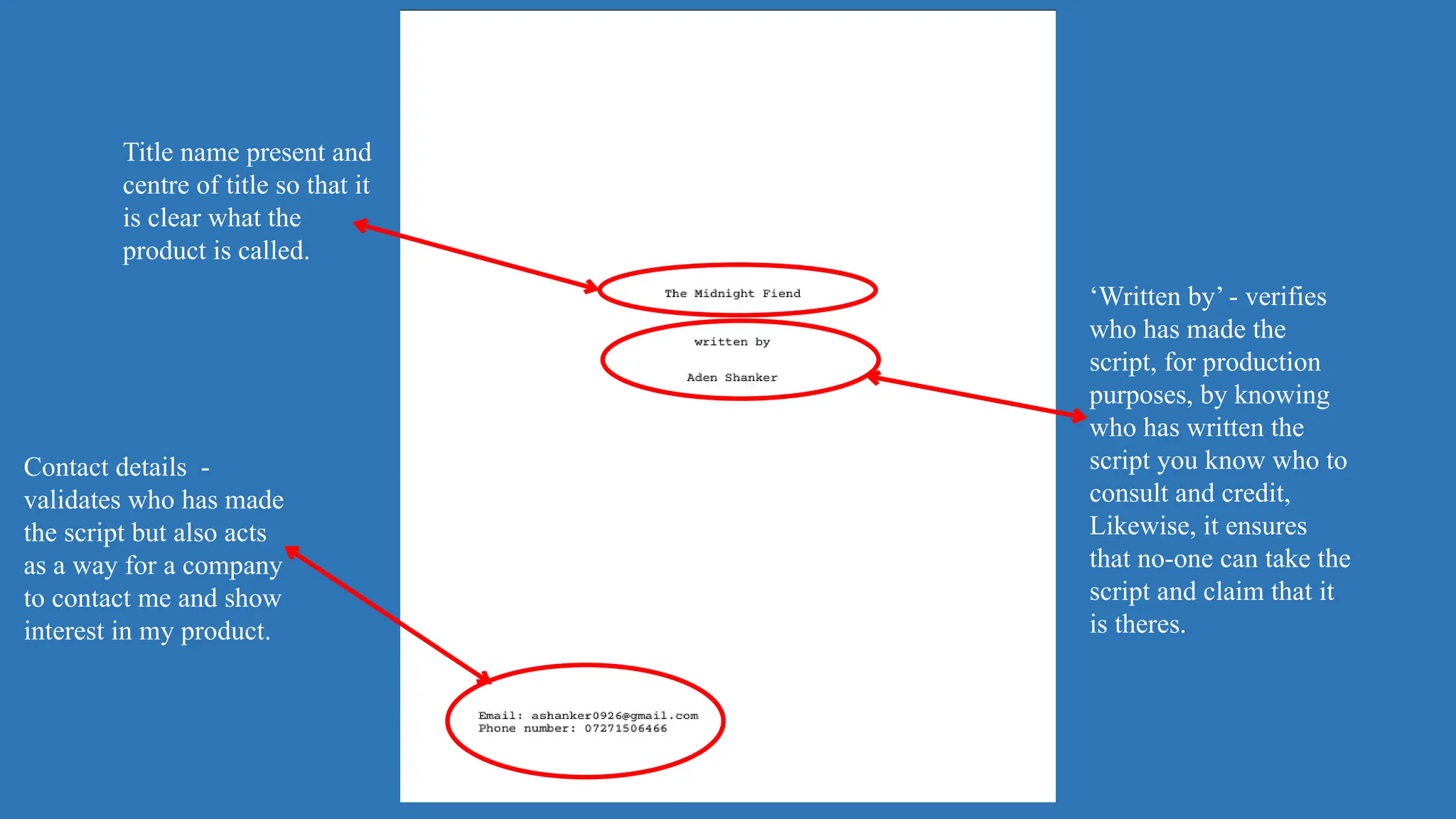
Title name presentand
centre of title so that it
is clear what the
product is called.
‘Written by’ - verifies
who has made the
script, for production
purposes, by knowing
who has written the
script you know who to
consult and credit,
Likewise, it ensures
that no-one can take the
script and claim that it
is theres.
Contact details -
validates who has made
the script but also acts
as a way for a company
to contact me and show
interest in my product.
2.
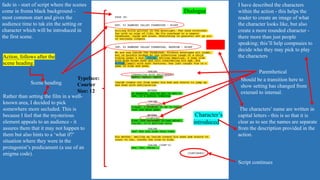
Action, follows afterthe
scene heading.
fade in - start of script where the scenes
come in froma black background -
most common start and gives the
audience time to tak ein the setting or
character which will be introduced in
the first scene.
Scene heading
Parenthetical
Script continues
Typeface:
Courier
Size: 12
Character’s
introduced
I have described the characters
within the action - this helps the
reader to create an image of what
the character looks like, but also
create a more rounded character -
there more than just people
speaking; this’ll help compnaies to
decide who they may pick to play
the characters
Rather than setting the film in a well-
known area, I decided to pick
somewhere more secluded. This is
because I feel that the mysterious
element appeals to an audience - it
assures them that it may not happen to
them but also hints to a ‘what if?’
situation where they were in the
protagonist’s predicament (a use of an
enigma code).
Dialogue
The characters’ name are written in
capital letters - this is so that it is
clear as to see the names are separate
from the description provided in the
action.
Should be a transition here to
show setting has changed from
exteranl to internal.
3.
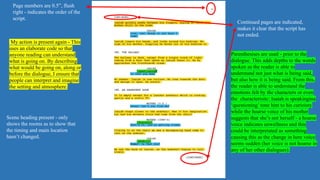
My action ispresent again - This
uses an elaborate code so that
anyone reading can understand
what is going on. By describing
what would be going on, along or
before the dialogue, I ensure that
people can interpret and imagine
the setting and atmosphere.
Parenthesises are used - prior to the
dialogue. This adds depths to the words
spoken as the reader is able to
understand not just what is being said,
but also how it is being said. From this,
the reader is able to understand the
emotions felt by the characters or even
the characterisitc: Isaiah is speakingina
‘questioning’ tone hint to his curioisty
while the hoarse voice of his mother
suggests that she’s not herself - a hoarse
voice indicates unwellness and this
could be interpretated as something
causing this as the change in here voice
seems sudden (her voice is not hoarse in
any of her other dialogues).
Continued pages are indicated,
makes it clear that the script has
not ended.
Page numbers are 0.5”, flush
right - indicates the order of the
script.
Scene heading present - only
shows the rooms as to show that
the timing and main location
hasn’t changed.
4.
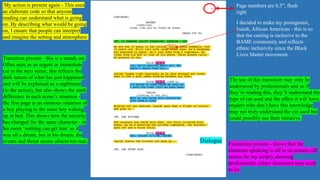
My action ispresent again - This uses
an elaborate code so that anyone
reading can understand what is going
on. By describing what would be going
on, I ensure that people can interpret
and imagine the setting and atmosphere.
Transition present - this is a smash cut.
Often seen as an urgent or immediate
cut to the next scene, this reflects the
dark nature of what has just happened
and will be explained as a nightmare
(in the action), but also shows the stark
difference in each scene’s situation -
the first page is an ominous situation of
a boy playing to the same boy waking
up in bed. This shows how the security
has changed for the same character - in
his room ‘nothing can get him’ as it
was all a dream, but in his dream, the
events and threat seems almost too real.
Page numbers are 0.5”, flush
right
I decided to make my protagonist,
Isaiah, African American - this is so
that the casting is inclusive to the
BAME community and reflects
ethnic inclusivity since the Black
Lives Matter movement.
Dialogue
The use of this transition may only be
understood by professionals and so if
they’re reading this, they’ll understand the
type of cut used and the effect it will have,
readers who don’t have this knowledge
may not truly understand the cut used but
could possibly use their initiative.
Extensions present - shows that the
character speaking is off or on screen (off
screen for my script), showing
professionals where characters may need
to be.