



info@@scientificrevenue.com Pricing Without Compromise
Getting to Continuous Optimization
USF Seminar in Analytics, November 2016
info@@scientificrevenue.com Pricing Without Compromise
Agenda
• Background on Scientific Revenue
• Analytics as it is Done Today
• Going Down the Rabbit Hole
• Above Ground Again
• Some More Details on Causal Inference
• Frameworks for Evaluation
info@@scientificrevenue.com Pricing Without Compromise
Machine Learning for E-Commerce
(Revenue Optimization)
机器学习之于电子商务
(收益优化)
info@@scientificrevenue.com Pricing Without Compromise
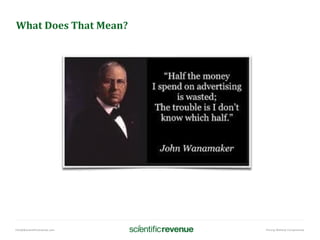
What Does That Mean?
info@@scientificrevenue.com Pricing Without Compromise
What Does That Mean?
info@@scientificrevenue.com Pricing Without Compromise
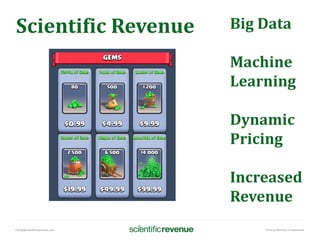
Scientific Revenue Big Data
Machine
Learning
Dynamic
Pricing
Increased
Revenue
info@@scientificrevenue.com Pricing Without Compromise
Agenda
• Background on Scientific Revenue
• Analytics as it is Done Today
• Going Down the Rabbit Hole
• Above Ground Again
• Some More Details on Causal Inference
• Frameworks for Evaluation
info@@scientificrevenue.com Pricing Without Compromise
The Motivational Quote
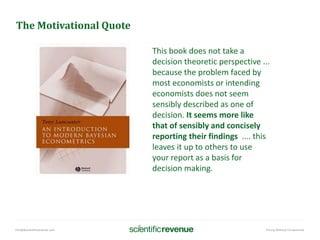
This book does not take a
decision theoretic perspective ...
because the problem faced by
most economists or intending
economists does not seem
sensibly described as one of
decision. It seems more like
that of sensibly and concisely
reporting their findings .... this
leaves it up to others to use
your report as a basis for
decision making.
info@@scientificrevenue.com Pricing Without Compromise
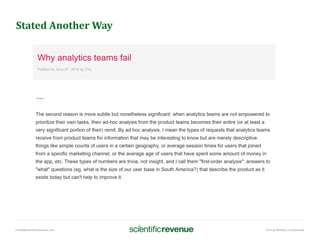
Stated Another Way
….
info@@scientificrevenue.com Pricing Without Compromise
The First Escape: “A/B” Testing
It’s a compromise
You get engineering to insert some
bifurcated code (the test) into the system
Usually define all the variations in advance,
and then wait for a new version of the game
to be released
After that, someone looks at the test every
hour until statistical significance is achieved

You have a “winner” and go with it
info@@scientificrevenue.com Pricing Without Compromise
Multivariate Testing
A/ B quickly becomes multivariate – 4 or 5 arms is common
This is the most common evaluation methodology today
Problems:
• For most things worth testing, more arms elongates the
testing cycle
• Therefore, success requires a long-term test
• Therefore, ability to iterate is limited
During the Test:
• You’ve got potentially bad variations live!
info@@scientificrevenue.com Pricing Without Compromise
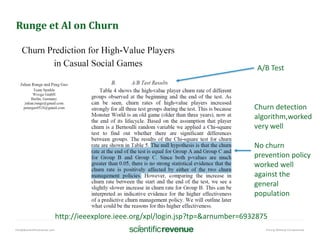
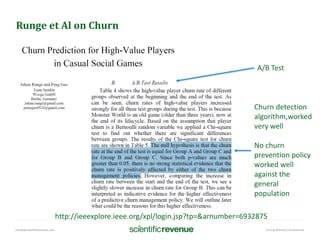
Runge et Al on Churn
Churn detection
algorithm,worked
very well
No churn
prevention policy
worked well
against the
general
population
A/B Test
http://ieeexplore.ieee.org/xpl/login.jsp?tp=&arnumber=6932875
info@@scientificrevenue.com Pricing Without Compromise
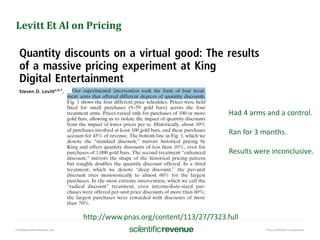
Levitt Et Al on Pricing
Had 4 arms and a control.
Ran for 3 months.
Results were inconclusive.
http://www.pnas.org/content/113/27/7323.full
info@@scientificrevenue.com Pricing Without Compromise
Agenda
• Background on Scientific Revenue
• Analytics as it is Done Today
• Going Down the Rabbit Hole
• Above Ground Again
• Some More Details on Causal Inference
• Frameworks for Evaluation
info@@scientificrevenue.com Pricing Without Compromise
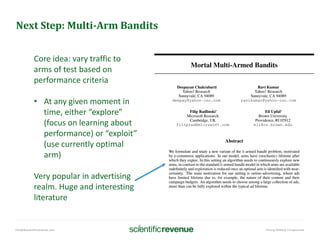
Next Step: Multi-Arm Bandits
Core idea: vary traffic to
arms of test based on
performance criteria
• At any given moment in
time, either “explore”
(focus on learning about
performance) or “exploit”
(use currently optimal
arm)
Very popular in advertising
realm. Huge and interesting
literature
info@@scientificrevenue.com Pricing Without Compromise
Multi-Arm Bandit Pros
Traffic to bad variations quickly
decreases (assuming a robust
performance metric)
Generally, helps you get to a “winner”
faster
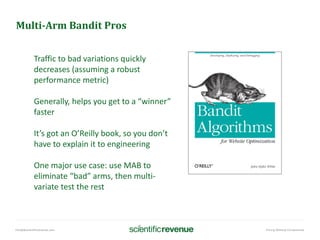
It’s got an O’Reilly book, so you don’t
have to explain it to engineering
One major use case: use MAB to
eliminate “bad” arms, then multi-
variate test the rest
info@@scientificrevenue.com Pricing Without Compromise
Multi-Arm Bandit “Cons”
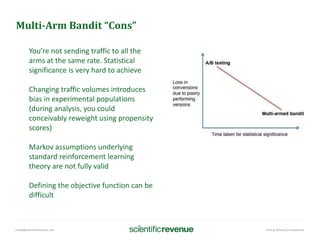
You’re not sending traffic to all the
arms at the same rate. Statistical
significance is very hard to achieve
Changing traffic volumes introduces
bias in experimental populations
(during analysis, you could
conceivably reweight using propensity
scores)
Markov assumptions underlying
standard reinforcement learning
theory are not fully valid
Defining the objective function can be
difficult
info@@scientificrevenue.com Pricing Without Compromise
Bias ?
Changing traffic volumes introduces bias in experimental populations
Suppose you send 20% of the users to each of 5 arms. Then suppose
you send 40% of new users to the first arm, and 15% to each of the
remaining arms
The population going to the first arm has a lower percentage of
experienced users, and a higher percentage of people from certain
locales (depending on the time you alter the percentages)
Propensity scores are your friend here. But so is a certain level of
resignation.
info@@scientificrevenue.com Pricing Without Compromise
Agenda
• Background on Scientific Revenue
• Analytics as it is Done Today
• Going Down the Rabbit Hole
• Above Ground Again
• Some More Details on Causal Inference
• Frameworks for Evaluation
info@@scientificrevenue.com Pricing Without Compromise
But … Why Assume There's a Single Best Outcome?
You've parametrized multiple
behaviors
You're recording lots of user
features
You're already changing system
behavior at runtime
You’re running randomized trials
already
If you're really a bandit maven,
you've got a reserved population
already in place for ongoing
exploration
info@@scientificrevenue.com Pricing Without Compromise
! =
info@@scientificrevenue.com Pricing Without Compromise
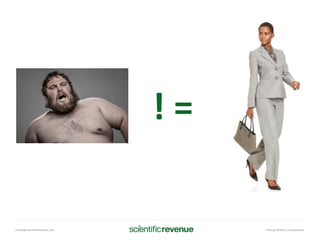
Think of a test arm as a population-selecting function
info@@scientificrevenue.com Pricing Without Compromise
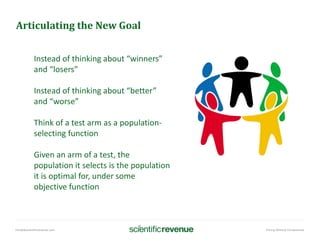
Articulating the New Goal
Instead of thinking about “winners”
and “losers”
Instead of thinking about “better”
and “worse”
Think of a test arm as a population-
selecting function
Given an arm of a test, the
population it selects is the population
it is optimal for, under some
objective function
info@@scientificrevenue.com Pricing Without Compromise
Key Idea: Continuous Optimization Using a Control
Framework
If you have an objective function
And you have a control state
And you have multiple treatments
Then you should map the user to the treatment that maximizes
the objective function
• In realtime
• On a per-user basis
info@@scientificrevenue.com Pricing Without Compromise
The Analytical Two-Step
Run randomized trials
• Users randomly assigned to treatments
• Banditing has much more explore (and much less
exploit) than is usual
• Exploration is guided by models
After the trial, run a predictive model builder
• Put your eyeballs at the end of the experiment and see if
you can figure out how you should have assigned the
users (to optimize the objective function)
info@@scientificrevenue.com Pricing Without Compromise
What Does a Model Builder Produce
Fast segmenters (the primary goal of a model builder is to
provide a real-time segmentation algorithm whose segments
can be matched to treatments)
Proportional estimates. What percentage of traffic is going to
each treatment (thought of as a segment)
Estimates of improvement for each segment (the model should
predict the gain)
info@@scientificrevenue.com Pricing Without Compromise
The Analytical Two-Step (Uplift Version)
Run randomized trials
• Users randomly assigned to treatments
• Banditing has much more explore (and much less
exploit) than is usual
• Exploration is guided by models
After the trial, run n model builders (one per arm)
• Each model builder is used to assess a particular
treatment by building a regression function
• Send users to the treatment with the highest regressed
value
info@@scientificrevenue.com Pricing Without Compromise
The Analytical Two-Step (Causal Version)
Run randomized trials
• Users randomly assigned to treatments
• Banditing has much more explore (and much less
exploit) than is usual
• Exploration is guided by models
After the trial, run a predictive model builder
• Put your eyeballs at the end of the experiment and see if
you can figure out how you should have assigned the
users (to optimize the objective function)
• This is inherently a counterfactual exercise, and requires
causal inference
info@@scientificrevenue.com Pricing Without Compromise
Comparing the two Approaches
Uplift Models
• Build model per treatment
• Easy! Off the shelf Code!
• Works well when control outcomes are close to constant
(rare in real life) or when the data isn’t “too noisy” or
when the data is relatively imbalanced
Causal Modeling
• Lots more code to write
• Harder math
• Works well when there is a lot of hererogeneity
unrelated to treatment effects or when the data is highly
imbalanced
info@@scientificrevenue.com Pricing Without Compromise
Agenda
• Background on Scientific Revenue
• Analytics as it is Done Today
• Going Down the Rabbit Hole
• Above Ground Again
• Some More Details on Causal Inference
• Frameworks for Evaluation
info@@scientificrevenue.com Pricing Without Compromise
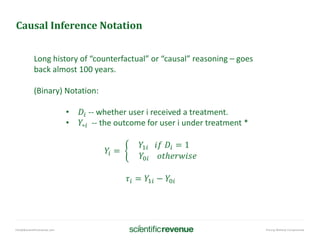
Causal Inference Notation
Long history of “counterfactual” or “causal” reasoning – goes
back almost 100 years.
(Binary) Notation:
• 𝐷𝑖 -- whether user i received a treatment.
• 𝑌∗𝑖 -- the outcome for user i under treatment *
𝑌𝑖 = ቊ
𝑌1𝑖 𝑖𝑓 𝐷𝑖 = 1
𝑌0𝑖 𝑜𝑡ℎ𝑒𝑟𝑤𝑖𝑠𝑒
𝜏𝑖 = 𝑌1𝑖 − 𝑌0𝑖
info@@scientificrevenue.com Pricing Without Compromise
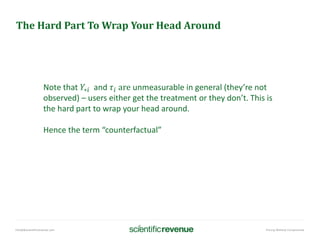
The Hard Part To Wrap Your Head Around
Note that 𝑌∗𝑖 and 𝜏𝑖 are unmeasurable in general (they’re not
observed) – users either get the treatment or they don’t. This is
the hard part to wrap your head around.
Hence the term “counterfactual”
info@@scientificrevenue.com Pricing Without Compromise
Causal Inference Notation II
E[𝑌𝑖 𝐷𝑖 = 1 − 𝐸 𝑌𝑖 𝐷𝑖 = 0] -- observed difference in outcome
E[𝑌1𝑖 𝐷𝑖 = 1 − 𝐸 𝑌0𝑖 𝐷𝑖 = 0] -- same thing
E[𝑌1𝑖 𝐷𝑖 = 1 − 𝐸 𝑌0𝑖 𝐷𝑖 = 1] + E[𝑌0𝑖 𝐷𝑖 = 1 − 𝐸 𝑌0𝑖 𝐷𝑖 = 0]
Treatment effect on treated Selection bias
(red is counterfactual and inserted for algebraic convenience)
info@@scientificrevenue.com Pricing Without Compromise
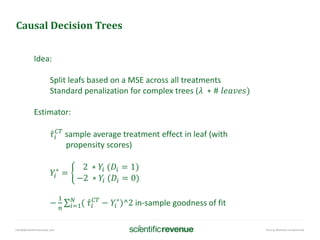
Causal Decision Trees
Idea:
Split leafs based on a MSE across all treatments
Standard penalization for complex trees (𝜆 ∗ # 𝑙𝑒𝑎𝑣𝑒𝑠)
Estimator:
Ƹ𝜏𝑖
𝐶𝑇
sample average treatment effect in leaf (with
propensity scores)
𝑌𝑖
∗
= ቊ
2 ∗ 𝑌𝑖 (𝐷𝑖 = 1)
−2 ∗ 𝑌𝑖 (𝐷𝑖 = 0)
−
1
𝑛
σ𝑖=1
𝑁
( Ƹ𝜏𝑖
𝐶𝑇
− 𝑌𝑖
∗
)^2 in-sample goodness of fit
info@@scientificrevenue.com Pricing Without Compromise
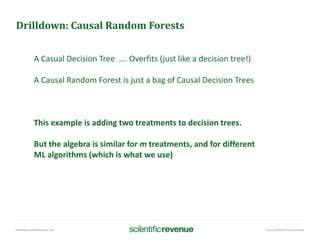
Drilldown: Causal Random Forests
A Casual Decision Tree …. Overfits (just like a decision tree!)
A Causal Random Forest is just a bag of Causal Decision Trees
This example is adding two treatments to decision trees.
But the algebra is similar for m treatments, and for different
ML algorithms (which is what we use)
info@@scientificrevenue.com Pricing Without Compromise
Agenda
• Background on Scientific Revenue
• Analytics as it is Done Today
• Going Down the Rabbit Hole
• Above Ground Again
• Some More Details on Causal Inference
• Frameworks for Evaluation
info@@scientificrevenue.com Pricing Without Compromise
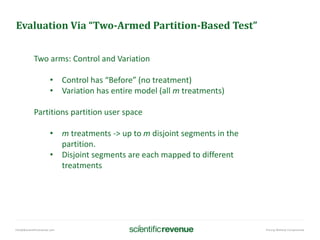
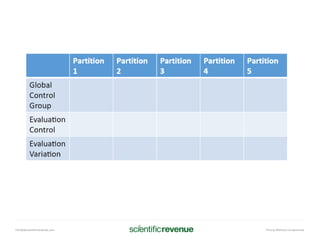
Evaluation Via “Two-Armed Partition-Based Test”
Two arms: Control and Variation
• Control has “Before” (no treatment)
• Variation has entire model (all m treatments)
Partitions partition user space
• m treatments -> up to m disjoint segments in the
partition.
• Disjoint segments are each mapped to different
treatments
info@@scientificrevenue.com Pricing Without Compromise
Runge et Al on Churn
Churn detection
algorithm,worked
very well
No churn
prevention policy
worked well
against the
general
population
A/B Test
http://ieeexplore.ieee.org/xpl/login.jsp?tp=&arnumber=6932875
info@@scientificrevenue.com Pricing Without Compromise
Revisiting Runge et Al
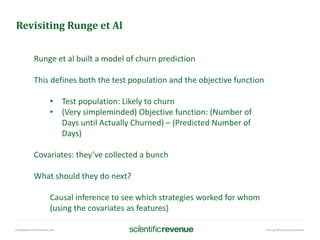
Runge et al built a model of churn prediction
This defines both the test population and the objective function
• Test population: Likely to churn
• (Very simpleminded) Objective function: (Number of
Days until Actually Churned) – (Predicted Number of
Days)
Covariates: they’ve collected a bunch
What should they do next?
Causal inference to see which strategies worked for whom
(using the covariates as features)
info@@scientificrevenue.com Pricing Without Compromise
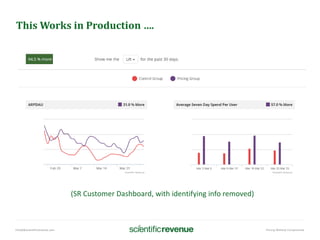
This Works in Production ….
(SR Customer Dashboard, with identifying info removed)
info@@scientificrevenue.com Pricing Without Compromise
Thank You
William Grossobill@scientificrevenue.com
bill@scientificrevenue.com

Scientific Revenue USF 2016 talk

  • 1.
    info@@scientificrevenue.com Pricing WithoutCompromise Getting to Continuous Optimization USF Seminar in Analytics, November 2016
  • 2.
  • 3.
  • 4.
    info@@scientificrevenue.com Pricing WithoutCompromise Agenda • Background on Scientific Revenue • Analytics as it is Done Today • Going Down the Rabbit Hole • Above Ground Again • Some More Details on Causal Inference • Frameworks for Evaluation
  • 5.
    info@@scientificrevenue.com Pricing WithoutCompromise Machine Learning for E-Commerce (Revenue Optimization) 机器学习之于电子商务 (收益优化)
  • 6.
    info@@scientificrevenue.com Pricing WithoutCompromise What Does That Mean?
  • 7.
    info@@scientificrevenue.com Pricing WithoutCompromise What Does That Mean?
  • 8.
    info@@scientificrevenue.com Pricing WithoutCompromise Scientific Revenue Big Data Machine Learning Dynamic Pricing Increased Revenue
  • 9.
    info@@scientificrevenue.com Pricing WithoutCompromise Agenda • Background on Scientific Revenue • Analytics as it is Done Today • Going Down the Rabbit Hole • Above Ground Again • Some More Details on Causal Inference • Frameworks for Evaluation
  • 10.
    info@@scientificrevenue.com Pricing WithoutCompromise The Motivational Quote This book does not take a decision theoretic perspective ... because the problem faced by most economists or intending economists does not seem sensibly described as one of decision. It seems more like that of sensibly and concisely reporting their findings .... this leaves it up to others to use your report as a basis for decision making.
  • 11.
    info@@scientificrevenue.com Pricing WithoutCompromise Stated Another Way ….
  • 12.
    info@@scientificrevenue.com Pricing WithoutCompromise The First Escape: “A/B” Testing It’s a compromise You get engineering to insert some bifurcated code (the test) into the system Usually define all the variations in advance, and then wait for a new version of the game to be released After that, someone looks at the test every hour until statistical significance is achieved  You have a “winner” and go with it
  • 13.
    info@@scientificrevenue.com Pricing WithoutCompromise Multivariate Testing A/ B quickly becomes multivariate – 4 or 5 arms is common This is the most common evaluation methodology today Problems: • For most things worth testing, more arms elongates the testing cycle • Therefore, success requires a long-term test • Therefore, ability to iterate is limited During the Test: • You’ve got potentially bad variations live!
  • 14.
    info@@scientificrevenue.com Pricing WithoutCompromise Runge et Al on Churn Churn detection algorithm,worked very well No churn prevention policy worked well against the general population A/B Test http://ieeexplore.ieee.org/xpl/login.jsp?tp=&arnumber=6932875
  • 15.
    info@@scientificrevenue.com Pricing WithoutCompromise Levitt Et Al on Pricing Had 4 arms and a control. Ran for 3 months. Results were inconclusive. http://www.pnas.org/content/113/27/7323.full
  • 16.
    info@@scientificrevenue.com Pricing WithoutCompromise Agenda • Background on Scientific Revenue • Analytics as it is Done Today • Going Down the Rabbit Hole • Above Ground Again • Some More Details on Causal Inference • Frameworks for Evaluation
  • 17.
    info@@scientificrevenue.com Pricing WithoutCompromise Next Step: Multi-Arm Bandits Core idea: vary traffic to arms of test based on performance criteria • At any given moment in time, either “explore” (focus on learning about performance) or “exploit” (use currently optimal arm) Very popular in advertising realm. Huge and interesting literature
  • 18.
    info@@scientificrevenue.com Pricing WithoutCompromise Multi-Arm Bandit Pros Traffic to bad variations quickly decreases (assuming a robust performance metric) Generally, helps you get to a “winner” faster It’s got an O’Reilly book, so you don’t have to explain it to engineering One major use case: use MAB to eliminate “bad” arms, then multi- variate test the rest
  • 19.
    info@@scientificrevenue.com Pricing WithoutCompromise Multi-Arm Bandit “Cons” You’re not sending traffic to all the arms at the same rate. Statistical significance is very hard to achieve Changing traffic volumes introduces bias in experimental populations (during analysis, you could conceivably reweight using propensity scores) Markov assumptions underlying standard reinforcement learning theory are not fully valid Defining the objective function can be difficult
  • 20.
    info@@scientificrevenue.com Pricing WithoutCompromise Bias ? Changing traffic volumes introduces bias in experimental populations Suppose you send 20% of the users to each of 5 arms. Then suppose you send 40% of new users to the first arm, and 15% to each of the remaining arms The population going to the first arm has a lower percentage of experienced users, and a higher percentage of people from certain locales (depending on the time you alter the percentages) Propensity scores are your friend here. But so is a certain level of resignation.
  • 21.
    info@@scientificrevenue.com Pricing WithoutCompromise Agenda • Background on Scientific Revenue • Analytics as it is Done Today • Going Down the Rabbit Hole • Above Ground Again • Some More Details on Causal Inference • Frameworks for Evaluation
  • 22.
    info@@scientificrevenue.com Pricing WithoutCompromise But … Why Assume There's a Single Best Outcome? You've parametrized multiple behaviors You're recording lots of user features You're already changing system behavior at runtime You’re running randomized trials already If you're really a bandit maven, you've got a reserved population already in place for ongoing exploration
  • 23.
  • 24.
    info@@scientificrevenue.com Pricing WithoutCompromise Think of a test arm as a population-selecting function
  • 25.
    info@@scientificrevenue.com Pricing WithoutCompromise Articulating the New Goal Instead of thinking about “winners” and “losers” Instead of thinking about “better” and “worse” Think of a test arm as a population- selecting function Given an arm of a test, the population it selects is the population it is optimal for, under some objective function
  • 26.
    info@@scientificrevenue.com Pricing WithoutCompromise Key Idea: Continuous Optimization Using a Control Framework If you have an objective function And you have a control state And you have multiple treatments Then you should map the user to the treatment that maximizes the objective function • In realtime • On a per-user basis
  • 27.
    info@@scientificrevenue.com Pricing WithoutCompromise The Analytical Two-Step Run randomized trials • Users randomly assigned to treatments • Banditing has much more explore (and much less exploit) than is usual • Exploration is guided by models After the trial, run a predictive model builder • Put your eyeballs at the end of the experiment and see if you can figure out how you should have assigned the users (to optimize the objective function)
  • 28.
    info@@scientificrevenue.com Pricing WithoutCompromise What Does a Model Builder Produce Fast segmenters (the primary goal of a model builder is to provide a real-time segmentation algorithm whose segments can be matched to treatments) Proportional estimates. What percentage of traffic is going to each treatment (thought of as a segment) Estimates of improvement for each segment (the model should predict the gain)
  • 29.
    info@@scientificrevenue.com Pricing WithoutCompromise The Analytical Two-Step (Uplift Version) Run randomized trials • Users randomly assigned to treatments • Banditing has much more explore (and much less exploit) than is usual • Exploration is guided by models After the trial, run n model builders (one per arm) • Each model builder is used to assess a particular treatment by building a regression function • Send users to the treatment with the highest regressed value
  • 30.
    info@@scientificrevenue.com Pricing WithoutCompromise The Analytical Two-Step (Causal Version) Run randomized trials • Users randomly assigned to treatments • Banditing has much more explore (and much less exploit) than is usual • Exploration is guided by models After the trial, run a predictive model builder • Put your eyeballs at the end of the experiment and see if you can figure out how you should have assigned the users (to optimize the objective function) • This is inherently a counterfactual exercise, and requires causal inference
  • 31.
    info@@scientificrevenue.com Pricing WithoutCompromise Comparing the two Approaches Uplift Models • Build model per treatment • Easy! Off the shelf Code! • Works well when control outcomes are close to constant (rare in real life) or when the data isn’t “too noisy” or when the data is relatively imbalanced Causal Modeling • Lots more code to write • Harder math • Works well when there is a lot of hererogeneity unrelated to treatment effects or when the data is highly imbalanced
  • 32.
    info@@scientificrevenue.com Pricing WithoutCompromise Agenda • Background on Scientific Revenue • Analytics as it is Done Today • Going Down the Rabbit Hole • Above Ground Again • Some More Details on Causal Inference • Frameworks for Evaluation
  • 33.
    info@@scientificrevenue.com Pricing WithoutCompromise Causal Inference Notation Long history of “counterfactual” or “causal” reasoning – goes back almost 100 years. (Binary) Notation: • 𝐷𝑖 -- whether user i received a treatment. • 𝑌∗𝑖 -- the outcome for user i under treatment * 𝑌𝑖 = ቊ 𝑌1𝑖 𝑖𝑓 𝐷𝑖 = 1 𝑌0𝑖 𝑜𝑡ℎ𝑒𝑟𝑤𝑖𝑠𝑒 𝜏𝑖 = 𝑌1𝑖 − 𝑌0𝑖
  • 34.
    info@@scientificrevenue.com Pricing WithoutCompromise The Hard Part To Wrap Your Head Around Note that 𝑌∗𝑖 and 𝜏𝑖 are unmeasurable in general (they’re not observed) – users either get the treatment or they don’t. This is the hard part to wrap your head around. Hence the term “counterfactual”
  • 35.
    info@@scientificrevenue.com Pricing WithoutCompromise Causal Inference Notation II E[𝑌𝑖 𝐷𝑖 = 1 − 𝐸 𝑌𝑖 𝐷𝑖 = 0] -- observed difference in outcome E[𝑌1𝑖 𝐷𝑖 = 1 − 𝐸 𝑌0𝑖 𝐷𝑖 = 0] -- same thing E[𝑌1𝑖 𝐷𝑖 = 1 − 𝐸 𝑌0𝑖 𝐷𝑖 = 1] + E[𝑌0𝑖 𝐷𝑖 = 1 − 𝐸 𝑌0𝑖 𝐷𝑖 = 0] Treatment effect on treated Selection bias (red is counterfactual and inserted for algebraic convenience)
  • 36.
    info@@scientificrevenue.com Pricing WithoutCompromise Causal Decision Trees Idea: Split leafs based on a MSE across all treatments Standard penalization for complex trees (𝜆 ∗ # 𝑙𝑒𝑎𝑣𝑒𝑠) Estimator: Ƹ𝜏𝑖 𝐶𝑇 sample average treatment effect in leaf (with propensity scores) 𝑌𝑖 ∗ = ቊ 2 ∗ 𝑌𝑖 (𝐷𝑖 = 1) −2 ∗ 𝑌𝑖 (𝐷𝑖 = 0) − 1 𝑛 σ𝑖=1 𝑁 ( Ƹ𝜏𝑖 𝐶𝑇 − 𝑌𝑖 ∗ )^2 in-sample goodness of fit
  • 37.
    info@@scientificrevenue.com Pricing WithoutCompromise Drilldown: Causal Random Forests A Casual Decision Tree …. Overfits (just like a decision tree!) A Causal Random Forest is just a bag of Causal Decision Trees This example is adding two treatments to decision trees. But the algebra is similar for m treatments, and for different ML algorithms (which is what we use)
  • 38.
    info@@scientificrevenue.com Pricing WithoutCompromise Agenda • Background on Scientific Revenue • Analytics as it is Done Today • Going Down the Rabbit Hole • Above Ground Again • Some More Details on Causal Inference • Frameworks for Evaluation
  • 39.
    info@@scientificrevenue.com Pricing WithoutCompromise Evaluation Via “Two-Armed Partition-Based Test” Two arms: Control and Variation • Control has “Before” (no treatment) • Variation has entire model (all m treatments) Partitions partition user space • m treatments -> up to m disjoint segments in the partition. • Disjoint segments are each mapped to different treatments
  • 40.
  • 41.
    info@@scientificrevenue.com Pricing WithoutCompromise Runge et Al on Churn Churn detection algorithm,worked very well No churn prevention policy worked well against the general population A/B Test http://ieeexplore.ieee.org/xpl/login.jsp?tp=&arnumber=6932875
  • 42.
    info@@scientificrevenue.com Pricing WithoutCompromise Revisiting Runge et Al Runge et al built a model of churn prediction This defines both the test population and the objective function • Test population: Likely to churn • (Very simpleminded) Objective function: (Number of Days until Actually Churned) – (Predicted Number of Days) Covariates: they’ve collected a bunch What should they do next? Causal inference to see which strategies worked for whom (using the covariates as features)
  • 43.
    info@@scientificrevenue.com Pricing WithoutCompromise This Works in Production …. (SR Customer Dashboard, with identifying info removed)
  • 44.
    info@@scientificrevenue.com Pricing WithoutCompromise Thank You William Grossobill@scientificrevenue.com bill@scientificrevenue.com