Editorial by our Co-Founders
There is no single, simple solution to climate disruption1
.
That’s the sad truth, but we have to be realistic.
Given growing awareness about the degree of urgency, it is tempting to resort to
simplistic analysis or to stick our head in the sand. Climate change is an infinitely
complex issue, constantly unraveling and shifting before our very eyes. It is
discouraging to say the least. Not to mention the flood of figures and bad news in the
media every day.
It is time to roll up our sleeves and be brave. Climate disruption is an immense
challenge. It is also unprecedented in the history of mankind. Our industrial civilization
is built on fossil fuels. Current production and consumption practices generate
greenhouse gas emissions, which are responsible for climate disruption. It is a
systemic problem. There is no simple analysis or solution. Everything is
interconnected.
Our challenge is not to save the planet. Rest assured - it will go on revolving around
the sun for centuries regardless of the temperature and other events. We need to
ensure that the human species and the ecosystems we depend on - such as resources
and biodiversity - are able to adapt and survive on our planet.
The first step to solving a problem is asking the right questions and making a proper
diagnosis. Time for the Planet trusts international scientists whose work is collected
and synthesized by the Intergovernmental Panel on Climate Change (IPCC) - the same
scientists who have been warning us for decades about the dangers to our planet.
The second step is for individuals to understand and accept the diagnosis. A problem
understood is a problem half solved. If we understand the intricacies of the problem,
it puts a stop to false rumors and fake news. Time for the Planet has published this
Scientific Brief to explain the situation clearly to the general public.
1
This Scientific Brief focuses on climate disruption - climate imbalance caused by human activity -
rather than natural cycles of climate change and global warming. Understanding this concept helps to
understand how we can make a difference.
1
In Part 1, we will explain how human activity has disrupted climate change. We aim to do so
in an entertaining but thorough way, backed by science.
Motivation to solve a problem is generated by understanding the risks. For scientists, the
“+2°C scenario” is disastrous. Most individuals who have not studied the subject think it
simply means the pool will be warmer in summer and that they will need fewer sweaters in
winter. No cause for panic. At Time for the Planet, we intend to illustrate the terrible
consequences of climate change. That is the aim of Part 2. It is not an easy read, but it will
force us to act - on a global scale and very quickly.
Rather than give up and be totally depressed for decades to come, we decided to turn this
systemic problem into an opportunity. We intend to have a hand in our future - to make the
world more sustainable and resilient, more humane and mindful of the ecosystem. It is a
great opportunity! There is no single solution. All sectors of our economy must be
transformed. The potential for innovation is endless.
In the last two sections, we present our scope for action and our method for selecting
innovative solutions. All our efforts are focused on drastically reducing greenhouse gas
emissions. But we need you too. Success depends on individuals working hand in hand with
the best scientists and entrepreneurs.
We are resolutely optimistic. We do not have a choice. We must and will make this crucial
transition successfully - for ourselves, for our children, and for future generations.
Time for the Planet’s 6 Co-Founders
2
Contents
PART 1: “There’s lots of fake news about global warming.”
Learn about climate disruption and its causes. 6
I. "We don’t know who to believe anymore.” How to choose reliable sources. 7
II. “It’s all so complicated.” Finally understanding global warming. 8
A. “The weather changes all the time. There are even cold spells!” True, but it’s not
the same thing. 8
1. Don't confuse weather and climate. 8
2. The correct definition of “climate disruption” 9
B. “The climate has always changed naturally.” True, but this is different. 9
C. "Global warming is not caused by mankind.” Yes, it is! It is now an undisputed fact.
Global warming is generated by human activity. 13
1. “There are gases in the air.” Understanding the atmosphere’s role. 13
2. “It’s the greenhouse effect’s fault.” False! The greenhouse effect is essential
for life, but it is disrupted14
3. “CO₂ is the problem.” Among others. Each GHG has a different impact. 16
a. Residence time 16
b. Radiative forcing 16
c. Comparing different GHGs and their impact 17
4. "It's not my fault." The sharp increase in GHGs is due to human activity. 18
D. “It’s OK. The planet regulates itself.” Not anymore. 26
1. Understanding CO2 and the natural carbon cycle 27
2. How the carbon cycle has been disrupted. 28
PART 2: “Relax. It’s only a few more degrees.”
The main consequences of climate change and the runaway greenhouse effect. 32
I. Consequences of global warming: mechanisms at work 32
A. Basic mechanisms 32
1. Temperature increase and heat waves that harm biodiversity 32
2. The water cycle is disrupted, exacerbating extreme weather events 34
3. Ice melt: 36
a. The difference between glaciers, ice caps and ice shelves 36
b. Fresh water and water stress 36
c. Rising water levels 37
4. Ocean acidification 39
3
B. “Vicious circle” mechanisms or the double whammy effect 40
1. Reducing the albedo effect: not a pretty picture 40
2. Ocean currents are altered due to CO2 not being captured 41
3. The forests are dying, it’s a crying shame 42
4. Steam, it’s heating up 42
5. The melting permafrost, it’s not a joke 42
6. Methane, keep it cool 44
II. “What if we stopped everything today? Would that do? Not even! There’s still the problem
of inertia. 46
A. Residence time. “It’s nice up there.” 46
B. Thermal inertia or “why is the swimming pool always too cold?” 47
C. Exactly how long are we talking about? 47
III. “OK, if I understand correctly, it’s all messed up, and it’s too late.” No, but we must
act now! 47
A. “We are not at our best.” In fact, we are currently in one of the worst-case scenarios
predicted by the IPCC. 48
1. The different IPCC scenarios 48
2. Even the IPCC’s worst-case scenarios were optimistic in the end. 51
B. “Shouldn’t we just give up now?” 53
1. If we give up, with between +5°C and +7°C, the world as we know it will
come to an end. 53
2. The world will keep going after 2100, won’t it? 57
3. We have no choice. We must keep the curve as low as possible. 58
C. “No, it’s not too late.” Look who says so. 58
D. What should we do? 59
E. Is carbon capture new? 64
PARTIE 3: “Are you interested in all innovations? No.”
Our Scope for Action and the 20 issues Time for the Planet aims to solve. 65
I. What Time for the Planet won’t do. 67
A. We can’t solve all the planet’s problems. 67
B. We can’t address all environmental problems. 67
C. Unique focus: limit GHG and target carbon neutrality. 68
1. Innovations that have no direct and significant impact on GHG emissions 68
2. Innovations with indirect and unmeasurable effects 68
3. Innovations that cannot be reproduced or upscaled worldwide 69
4. The nuclear issue 69
4
D. Neither sorcerer’s apprentices nor climate engineers 69
II. Our strategy is to focus on our four actions for mitigating GHG emissions, those we can
control. 70
A. Zero emissions or decarbonization 70
B. Energy efficiency 71
C. Mindful consumption 71
D. GHG capture 72
III. Our Scope: five priority sectors 72
A. Energy: The Heart of the Reactor 73
B. Industry: The Energy Glutton 74
C. Transportation: The Oil King 75
D. Farming: The All-Around Champion 75
E. Buildings: The Essential Building Blocks 76
F. Digital: The New Sector on the Rise 77
IV. Time for the Planet’s 20 issues: our matrix and priorities for action 78
V. The rebound effect: a problem, though not directly ours 80
PART 4: “Do you know any inventors?”
Our method for finding and selecting innovations
I. Finding fabulous innovations 84
II. Types of innovations 85
III. Innovation selection: assessment criteria 87
IV. Stages in innovation selection 87
A. Preselection through collective intelligence 87
B. Scientific committee validation
C. Potential market validation 89
D. Ethical validation 89
Conclusion and Contacts 89
Bibliography 90
5
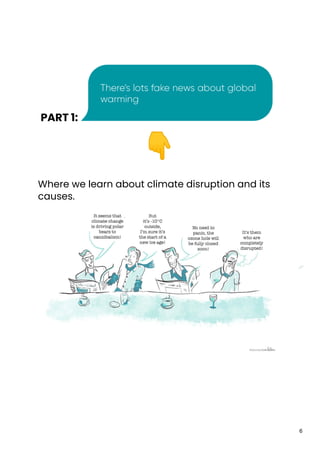
PART 1:
👇
Where we learn about climate disruption and its
causes.
6
Introduction
It is difficult to stay calm given the flood of information in the media and on social
networks about the climate. It would be easier if all the information was correct and
based on credible sources. Unfortunately, in the age of fake news and given the
enormity of the problem, outlandish views, conspiracy theories, and hearsay abound.
This seriously undermines the case for science. If we are to find solutions together, the
majority of the population needs to grasp the problem fully, however complex and
daunting it may be. Part 1 of the Scientific Brief explains the how and why of climate
disruption based on widely recognized scientific sources. Time for the Planet’s aim is
to provide a common diagnosis to help you understand how we invest and select
innovations.
I. “We don’t know who to believe anymore.”
How to choose reliable sources.
Time for the Planet trusts scientists. They have been warning us about climate disruption for
decades. In 1988, the Intergovernmental Panel on Climate Change was created to pool the
knowledge of worldwide climate researchers. It is an international group open to all UN
countries that expresses and symbolizes scientific consensus. The mission of the IPCC is to
test all relevant scientific, technical, and socio-economic information, objectively, accurately,
and methodically.
7
IPCC reports are used to inform international public debate and are the main source of
figures in this brief. The IPCC continually updates its reports about climate disruption. We
will also develop our brief to reflect these changes over time.
We use other complementary sources, cross-referencing them where possible to ensure they
reflect broad international scientific consensus. Other sources include relevant reports and
briefs by the International Energy Agency, the European Environment Agency (EEA), the
World Meteorological Organization (WMO), the French Agency for Ecological Transition
(ADEME), the National Inventory Reference Center, CITEPA’s Projections and Assessments
on Air Pollutants and Greenhouse Gases and the Food and Agriculture Organization of the
United Nations (FAO).
We will only cite scientists for technical issues. We do not refer to any other professionals
including politicians, whistleblowers or associations. As relevant as they may be, they have
not been used as scientific sources for this brief.
It’s time to scrutinize how climate change has been disrupted and what it means. Along the
way, we’ll take a closer look at all those endlessly repeated glib phrases about the climate
(printed in blue).
II. “It’s all so complicated.”
Finally understanding global warming.
A. “The weather changes all the time. There
are even cold spells!”
True, but it’s not the same thing.
It’s easy to refer to a cold snap, as Donald Trump has done, to prove that global warming
doesn’t exist.
1.Don't confuse weather and climate.
Weather is an instant and local phenomenon, such as temperature, rain and wind. Climate,
on the other hand, is based on statistics: averages and variability of such phenomena over
long periods and on a global scale. The reference period set by the World Meteorological
Organization to establish averages that characterize a climate is 30 years.
In simple terms, the difference between weather and climate is like the difference between a
student’s grade on a test and their average annual grade.
8
2. The correct definition of “climate disruption”
Climate disruption refers to sustainable modification caused by human activity on the global
climate “compounded with natural climate variability observed over similar periods".2
However, it is not easy to model climate disruption given the number of phenomena and
variables involved. Simple equations are not enough.
To model climate change, IPCC experts rely on numerous simulations of the atmosphere,
oceans and ice sheets, landforms, vegetation, clouds, and greenhouse gases. Global
analysis and forecasts are possible using a combination of climate models.
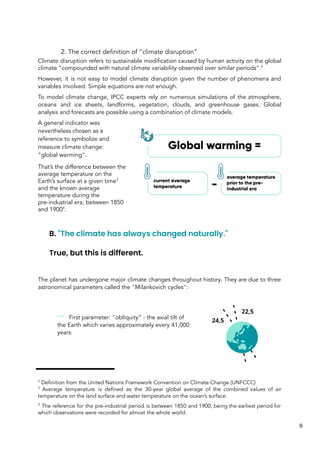
A general indicator was
nevertheless chosen as a
reference to symbolize and
measure climate change:
"global warming".
That’s the difference between the
average temperature on the
Earth’s surface at a given time3
and the known average
temperature during the
pre-industrial era, between 1850
and 19004
.
B. "The climate has always changed naturally."
True, but this is different.
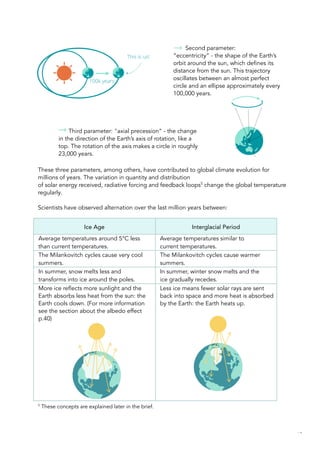
The planet has undergone major climate changes throughout history. They are due to three
astronomical parameters called the "Milankovich cycles":
First parameter: "obliquity” - the axial tilt of
the Earth which varies approximately every 41,000
years.
2
Definition from the United Nations Framework Convention on Climate Change (UNFCCC)
3
Average temperature is defined as the 30-year global average of the combined values of air
temperature on the land surface and water temperature on the ocean’s surface.
4
The reference for the pre-industrial period is between 1850 and 1900, being the earliest period for
which observations were recorded for almost the whole world.
9
Second parameter:
“eccentricity” - the shape of the Earth’s
orbit around the sun, which defines its
distance from the sun. This trajectory
oscillates between an almost perfect
circle and an ellipse approximately every
100,000 years.
Third parameter: "axial precession” - the change
in the direction of the Earth’s axis of rotation, like a
top. The rotation of the axis makes a circle in roughly
23,000 years.
These three parameters, among others, have contributed to global climate evolution for
millions of years. The variation in quantity and distribution
of solar energy received, radiative forcing and feedback loops5
change the global temperature
regularly.
Scientists have observed alternation over the last million years between:
Ice Age Interglacial Period
Average temperatures around 5°C less
than current temperatures.
Average temperatures similar to
current temperatures.
The Milankovitch cycles cause very cool
summers.
The Milankovitch cycles cause warmer
summers.
In summer, snow melts less and
transforms into ice around the poles.
In summer, winter snow melts and the
ice gradually recedes.
More ice reflects more sunlight and the
Earth absorbs less heat from the sun: the
Earth cools down. (For more information
see the section about the albedo effect
p.40)
Less ice means fewer solar rays are sent
back into space and more heat is absorbed
by the Earth: the Earth heats up.
5
These concepts are explained later in the brief.
10
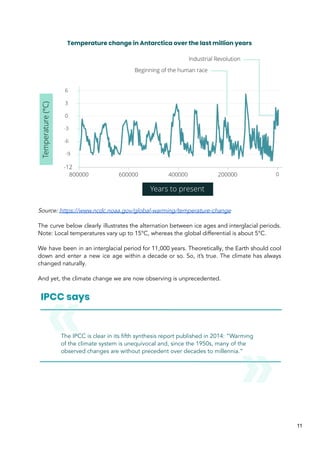
Temperature change in Antarctica over the last million years
Source: https://www.ncdc.noaa.gov/global-warming/temperature-change
The curve below clearly illustrates the alternation between ice ages and interglacial periods.
Note: Local temperatures vary up to 15°C, whereas the global differential is about 5°C.
We have been in an interglacial period for 11,000 years. Theoretically, the Earth should cool
down and enter a new ice age within a decade or so. So, it’s true. The climate has always
changed naturally.
And yet, the climate change we are now observing is unprecedented.
The IPCC is clear in its fifth synthesis report published in 2014: “Warming
of the climate system is unequivocal and, since the 1950s, many of the
observed changes are without precedent over decades to millennia.”
11
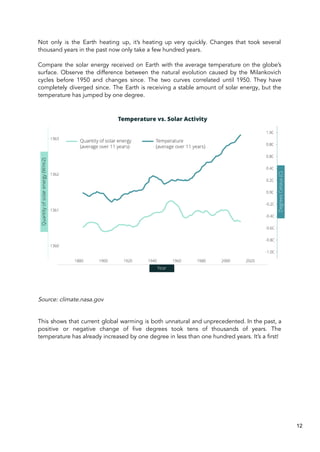
Not only is the Earth heating up, it’s heating up very quickly. Changes that took several
thousand years in the past now only take a few hundred years.
Compare the solar energy received on Earth with the average temperature on the globe’s
surface. Observe the difference between the natural evolution caused by the Milankovich
cycles before 1950 and changes since. The two curves correlated until 1950. They have
completely diverged since. The Earth is receiving a stable amount of solar energy, but the
temperature has jumped by one degree.
Source: climate.nasa.gov
This shows that current global warming is both unnatural and unprecedented. In the past, a
positive or negative change of five degrees took tens of thousands of years. The
temperature has already increased by one degree in less than one hundred years. It’s a first!
12
C. “Global warming is not caused by mankind." Yes, it is!
It is now an undisputed fact. Global warming is generated
by human activity.
1. “There are gases in the air.”
Understanding the atmosphere’s role.
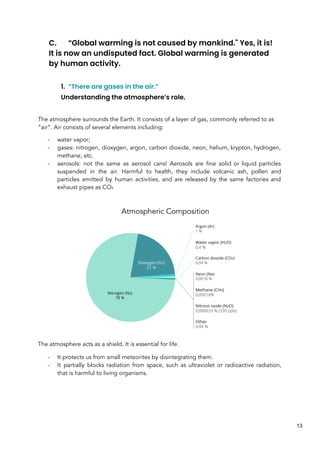
The atmosphere surrounds the Earth. It consists of a layer of gas, commonly referred to as
“air”. Air consists of several elements including:
- water vapor;
- gases: nitrogen, dioxygen, argon, carbon dioxide, neon, helium, krypton, hydrogen,
methane, etc.
- aerosols: not the same as aerosol cans! Aerosols are fine solid or liquid particles
suspended in the air. Harmful to health, they include volcanic ash, pollen and
particles emitted by human activities, and are released by the same factories and
exhaust pipes as CO₂
Atmospheric Composition
The atmosphere acts as a shield. It is essential for life.
- It protects us from small meteorites by disintegrating them.
- It partially blocks radiation from space, such as ultraviolet or radioactive radiation,
that is harmful to living organisms.
13
- This helps the planet maintain a temperature that is conducive to the development
of life.
This phenomenon is fundamental to understanding climate disruption.
2. “It’s the greenhouse effect’s fault.”
False! The greenhouse effect is essential for life, but it is disrupted.
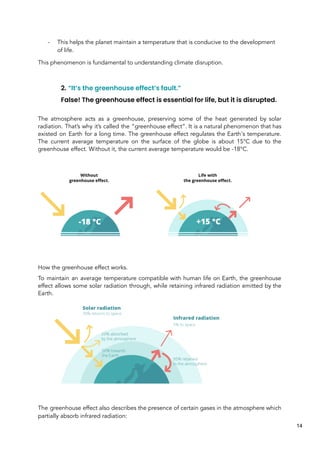
The atmosphere acts as a greenhouse, preserving some of the heat generated by solar
radiation. That’s why it’s called the “greenhouse effect”. It is a natural phenomenon that has
existed on Earth for a long time. The greenhouse effect regulates the Earth's temperature.
The current average temperature on the surface of the globe is about 15°C due to the
greenhouse effect. Without it, the current average temperature would be -18°C.
How the greenhouse effect works.
To maintain an average temperature compatible with human life on Earth, the greenhouse
effect allows some solar radiation through, while retaining infrared radiation emitted by the
Earth.
The greenhouse effect also describes the presence of certain gases in the atmosphere which
partially absorb infrared radiation:
14
They are called "greenhouse gases" or GHGs6
. We will refer to them as GHGs from now on.
It will save paper!
GHGs only represent 1% of the gases in the atmosphere, yet they have considerable impact
on the Earth’s temperature.
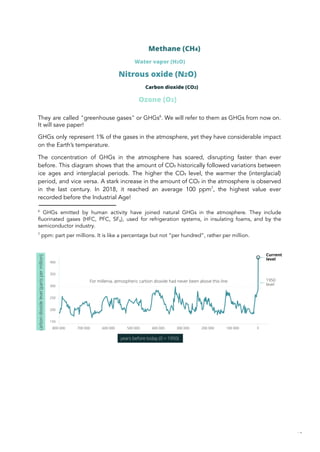
The concentration of GHGs in the atmosphere has soared, disrupting faster than ever
before. This diagram shows that the amount of CO₂ historically followed variations between
ice ages and interglacial periods. The higher the CO₂ level, the warmer the (interglacial)
period, and vice versa. A stark increase in the amount of CO₂ in the atmosphere is observed
in the last century. In 2018, it reached an average 100 ppm7
, the highest value ever
recorded before the Industrial Age!
6
GHGs emitted by human activity have joined natural GHGs in the atmosphere. They include
fluorinated gases (HFC, PFC, SF6), used for refrigeration systems, in insulating foams, and by the
semiconductor industry.
7
ppm: part per millions. It is like a percentage but not “per hundred”, rather per million.
15
Source:
https://climate.nasa.gov/climate_resources/24/graphic-the-relentless-rise-of-carbon-dioxide
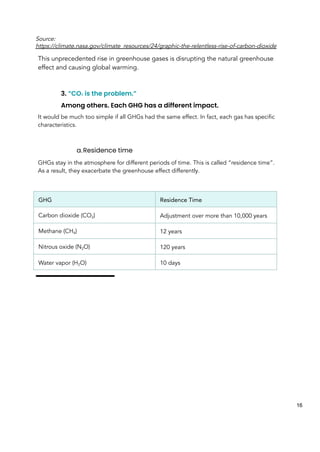
This unprecedented rise in greenhouse gases is disrupting the natural greenhouse
effect and causing global warming.
3. “CO₂ is the problem.”
Among others. Each GHG has a different impact.
It would be much too simple if all GHGs had the same effect. In fact, each gas has specific
characteristics.
a.Residence time
GHGs stay in the atmosphere for different periods of time. This is called “residence time”.
As a result, they exacerbate the greenhouse effect differently.
GHG Residence Time
Carbon dioxide (CO2) Adjustment over more than 10,000 years
Methane (CH4) 12 years
Nitrous oxide (N2O) 120 years
Water vapor (H2O) 10 days
16
Unlike methane or nitrous oxide, carbon dioxide is a highly stable molecule. Resistant to
atmospheric chemistry, its concentration is adjusted over several thousand years. It is partly
absorbed by the oceans and partly by vegetation. What remains can be released from the
atmosphere, but it’s a much slower process.
b.Radiative forcing
At a constant temperature, the Earth emits and receives the same quantities of energy: that
is radiative balance which maintains a stable average global temperature.
If the Earth heats or cools, there is radiation imbalance between the energy radiated by the
sun and received by the Earth, and the energy radiated by the Earth to the species. The
adjective "radiative" is used to differentiate from “radiation”.
To compare these mechanisms that heat or cool the planet, the notion of “radiative forcing”
is used. Radiative forcing is the difference in energy per m² of the Earth’s surface between
two locations. It is measured in W/m2
.10
Scientific analysis compares the current situation
with a reference, generally 1750.
Radiative forcing of GHGs is positive. They heat the atmosphere. In contrast, aerosols11
tend
to return solar radiation to their transmitter, causing the Earth to cool. In this case, radiative
forcing is negative.
Applied to global warming, radiative forcing measures the tendency of a factor to disrupt
the Earth’s energy balance.
c.Comparing different GHGs and their impact
You can’t compare apples and oranges. Greenhouse gases all heat the atmosphere but they
have different characteristics.
The indicator created to compare GHGs is the GWP or "Global Warming Potential".
Calculating GWP: take a GHG’s radiative forcing over 100 years to neutralize the question of
residence time, then compare it to the CO₂ value. By definition, the GWP of CO₂ is 1.
10
W/m2: density of radiant flux in watts received per square meter
11
Aerosols are particles suspended in the air with a negligible falling rate. They can be solid (dust) or
liquid (spray), organic (soot) or mineral (eroded rock), and differ in size, measuring between a few
tenths of a nanometer to a hundred micrometers. The vast majority of them are natural, but human
activity releases them in large quantities.
17
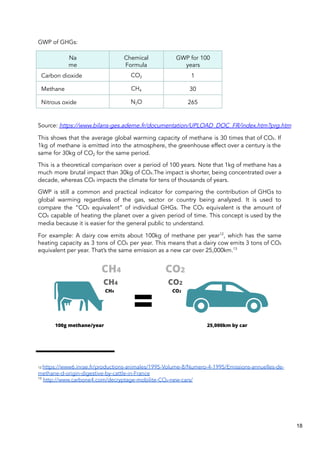
GWP of GHGs:
Na
me
Chemical
Formula
GWP for 100
years
Carbon dioxide CO2 1
Methane CH4 30
Nitrous oxide N2O 265
Source: https://www.bilans-ges.ademe.fr/documentation/UPLOAD_DOC_FR/index.htm?prg.htm
This shows that the average global warming capacity of methane is 30 times that of CO₂. If
1kg of methane is emitted into the atmosphere, the greenhouse effect over a century is the
same for 30kg of CO2 for the same period.
This is a theoretical comparison over a period of 100 years. Note that 1kg of methane has a
much more brutal impact than 30kg of CO₂.The impact is shorter, being concentrated over a
decade, whereas CO₂ impacts the climate for tens of thousands of years.
GWP is still a common and practical indicator for comparing the contribution of GHGs to
global warming regardless of the gas, sector or country being analyzed. It is used to
compare the “CO₂ equivalent” of individual GHGs. The CO₂ equivalent is the amount of
CO₂ capable of heating the planet over a given period of time. This concept is used by the
media because it is easier for the general public to understand.
For example: A dairy cow emits about 100kg of methane per year12
, which has the same
heating capacity as 3 tons of CO₂ per year. This means that a dairy cow emits 3 tons of CO₂
equivalent per year. That’s the same emission as a new car over 25,000km.13
12 https://www6.inrae.fr/productions-animales/1995-Volume-8/Numero-4-1995/Emissions-annuelles-de-
methane-d-origin-digestive-by-cattle-in-France
13
http://www.carbone4.com/decryptage-mobilite-CO₂-new-cars/
18
4. "It's not my fault."
The sharp increase in GHGs is due to human activity.
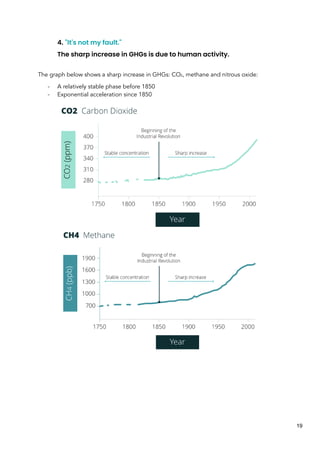
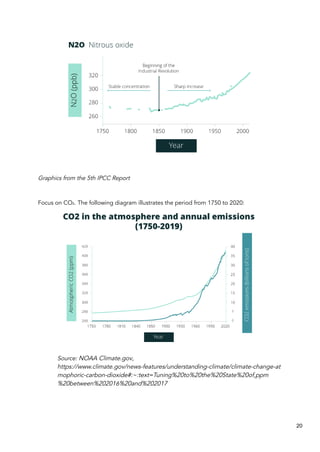
The graph below shows a sharp increase in GHGs: CO₂, methane and nitrous oxide:
- A relatively stable phase before 1850
- Exponential acceleration since 1850
19
Graphics from the 5th IPCC Report
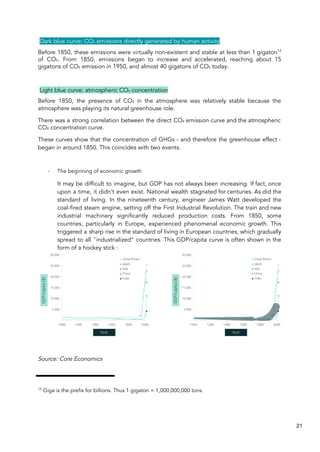
Focus on CO₂. The following diagram illustrates the period from 1750 to 2020:
Source: NOAA Climate.gov,
https://www.climate.gov/news-features/understanding-climate/climate-change-at
mophoric-carbon-dioxide#:~:text=Tuning%20to%20the%20State%20of,ppm
%20between%202016%20and%202017
20
Dark blue curve: CO₂ emissions directly generated by human activity
Before 1850, these emissions were virtually non-existent and stable at less than 1 gigaton12
of CO₂. From 1850, emissions began to increase and accelerated, reaching about 15
gigatons of CO₂ emission in 1950, and almost 40 gigatons of CO₂ today.
Light blue curve: atmospheric CO₂ concentration
Before 1850, the presence of CO₂ in the atmosphere was relatively stable because the
atmosphere was playing its natural greenhouse role.
There was a strong correlation between the direct CO₂ emission curve and the atmospheric
CO₂ concentration curve.
These curves show that the concentration of GHGs - and therefore the greenhouse effect -
began in around 1850. This coincides with two events.
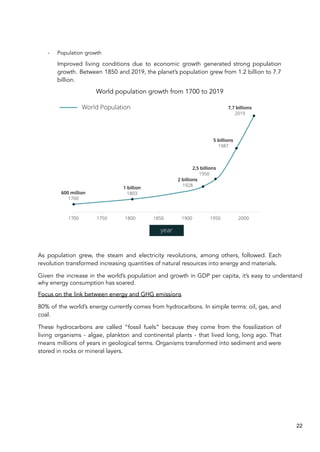
- The beginning of economic growth
It may be difficult to imagine, but GDP has not always been increasing. If fact, once
upon a time, it didn’t even exist. National wealth stagnated for centuries. As did the
standard of living. In the nineteenth century, engineer James Watt developed the
coal-fired steam engine, setting off the First Industrial Revolution. The train and new
industrial machinery significantly reduced production costs. From 1850, some
countries, particularly in Europe, experienced phenomenal economic growth. This
triggered a sharp rise in the standard of living in European countries, which gradually
spread to all "industrialized" countries. This GDP/capita curve is often shown in the
form of a hockey stick :
Source: Core Economics
12
Giga is the prefix for billions. Thus 1 gigaton = 1,000,000,000 tons.
21
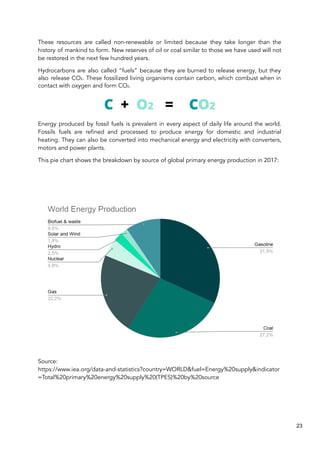
- Population growth
Improved living conditions due to economic growth generated strong population
growth. Between 1850 and 2019, the planet’s population grew from 1.2 billion to 7.7
billion.
World population growth from 1700 to 2019
As population grew, the steam and electricity revolutions, among others, followed. Each
revolution transformed increasing quantities of natural resources into energy and materials.
Given the increase in the world’s population and growth in GDP per capita, it’s easy to understand
why energy consumption has soared.
Focus on the link between energy and GHG emissions
80% of the world’s energy currently comes from hydrocarbons. In simple terms: oil, gas, and
coal.
These hydrocarbons are called “fossil fuels” because they come from the fossilization of
living organisms - algae, plankton and continental plants - that lived long, long ago. That
means millions of years in geological terms. Organisms transformed into sediment and were
stored in rocks or mineral layers.
22
These resources are called non-renewable or limited because they take longer than the
history of mankind to form. New reserves of oil or coal similar to those we have used will not
be restored in the next few hundred years.
Hydrocarbons are also called “fuels” because they are burned to release energy, but they
also release CO₂. These fossilized living organisms contain carbon, which combust when in
contact with oxygen and form CO₂.
Energy produced by fossil fuels is prevalent in every aspect of daily life around the world.
Fossils fuels are refined and processed to produce energy for domestic and industrial
heating. They can also be converted into mechanical energy and electricity with converters,
motors and power plants.
This pie chart shows the breakdown by source of global primary energy production in 2017:
Source:
https://www.iea.org/data-and-statistics?country=WORLD&fuel=Energy%20supply&indicator
=Total%20primary%20energy%20supply%20(TPES)%20by%20source
23
First place goes to oil.
Oil is the most widely used energy in the world. It accounts for almost a third of the world’s
energy consumption. It is used as fuel for motor vehicles, fuel and raw material for chemical
industries and plastic manufacturing.
Coal is in second place.
Despite all the bad press, coal is still widely used, accounting for 27% of the world’s energy
consumption. Once used to fuel trains and steam engines, coal is now primarily used to
generate heat and power. It is also used in many industries, such as metallurgy and plastics.
Third place goes to natural gas.
Not far behind coal, natural gas accounts for 22.2% of global energy consumption. It is
mainly used in households, by industry, and to produce electricity.
Our economy is still heavily reliant on fossil fuels that emit CO₂. Despite its emergence
about 30 years ago, renewable energy, from sun or wind for example, only represents a
minor part of our energy consumption.
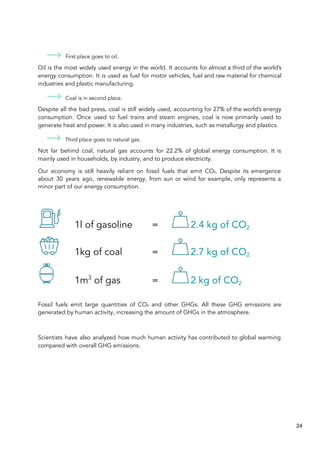
1l of gasoline = 2.4 kg of CO2
1kg of coal = 2.7 kg of CO2
1m3
of gas = 2 kg of CO2
Fossil fuels emit large quantities of CO₂ and other GHGs. All these GHG emissions are
generated by human activity, increasing the amount of GHGs in the atmosphere.
Scientists have also analyzed how much human activity has contributed to global warming
compared with overall GHG emissions.
24
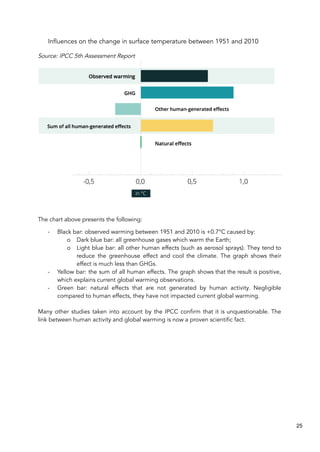
Influences on the change in surface temperature between 1951 and 2010
Source: IPCC 5th Assessment Report
The chart above presents the following:
- Black bar: observed warming between 1951 and 2010 is +0.7°C caused by:
o Dark blue bar: all greenhouse gases which warm the Earth;
o Light blue bar: all other human effects (such as aerosol sprays). They tend to
reduce the greenhouse effect and cool the climate. The graph shows their
effect is much less than GHGs.
- Yellow bar: the sum of all human effects. The graph shows that the result is positive,
which explains current global warming observations.
- Green bar: natural effects that are not generated by human activity. Negligible
compared to human effects, they have not impacted current global warming.
Many other studies taken into account by the IPCC confirm that it is unquestionable. The
link between human activity and global warming is now a proven scientific fact.
25
IPCC experts are clear in their fifth assessment report: “The influence of
mankind on the climate is now clearly established and human greenhouse
gas (GHG) emissions are higher than ever.”
D. “It’s OK. The planet regulates itself.”
Not anymore!
Many natural cycles help the planet self-regulate to sustain ecosystems. They are called
"biogeochemical cycles".
These cycles are all based on the same principle: elements, such as water and carbon,
circulate continuously in various forms called “flows” between the different reservoirs in the
environment capable of storing them. These different reservoirs are called "wells” or “sinks"
and are found in:
- the atmosphere;
- the hydrosphere (sea, ocean - anywhere there is water);
- the lithosphere (soil); and
- the biosphere (living organisms).
We’ve all heard of the water cycle: water evaporates from oceans and vegetation, forms
clouds, then falls back as rain or snow, feeds streams and vegetation, and then the cycle
begins again.
The carbon cycle plays a particularly vital role in climate change. It has continued to function
since the Industrial Age began in the 1850s, but the cycle has been disrupted by human
activities.
New elements have been released into the natural flows: human emissions. These additional
- and unnatural - elements enter the cycle, joining existing natural flows. As a result, they
change natural balances which leads to significant climate change.
26
1. Understanding CO₂ and the natural carbon cycle
As explained earlier, CO₂ is one of the main GHGs responsible for global warming. However,
CO₂ is part of the carbon cycle (C).
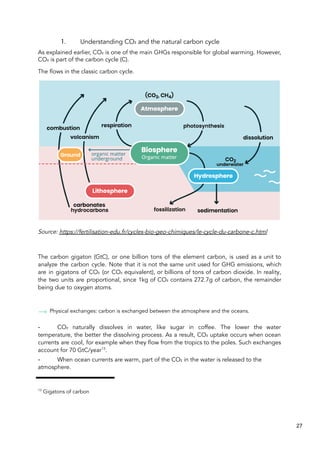
The flows in the classic carbon cycle.
Source: https://fertilisation-edu.fr/cycles-bio-geo-chimiques/le-cycle-du-carbone-c.html
The carbon gigaton (GtC), or one billion tons of the element carbon, is used as a unit to
analyze the carbon cycle. Note that it is not the same unit used for GHG emissions, which
are in gigatons of CO₂ (or CO₂ equivalent), or billions of tons of carbon dioxide. In reality,
the two units are proportional, since 1kg of CO₂ contains 272.7g of carbon, the remainder
being due to oxygen atoms.
Physical exchanges: carbon is exchanged between the atmosphere and the oceans.
- CO₂ naturally dissolves in water, like sugar in coffee. The lower the water
temperature, the better the dissolving process. As a result, CO₂ uptake occurs when ocean
currents are cool, for example when they flow from the tropics to the poles. Such exchanges
account for 70 GtC/year13
.
- When ocean currents are warm, part of the CO₂ in the water is released to the
atmosphere.
13
Gigatons of carbon
27
Biological exchanges: between plant and animal life.
We'll work from the ground up:
- Photosynthesis: soil and vegetation absorb CO₂ from the atmosphere. This
process divides the CO ₂ molecule into compounds containing carbon (C) that integrate the
biosphere (plant, soil) and oxygen (O2) that is released into the atmosphere.
- On the other hand, two types of biological flow release CO₂:
When animals and humans breathe, they inhale oxygen and release CO₂.
Decomposing plants and animals release carbon, which, when associated with oxygen,
forms CO₂ in the atmosphere.
These two flows are responsible for an exchange of 120GtC per year.
When the carbon cycle functions correctly, all the flows between the atmosphere and the
rest of the planet are balanced. That is an exchange of approximately 190GtC per year.
Note: there are also flows in the water (50GtC/year).
- Marine plants - mainly algae and phytoplankton - grow by absorbing CO₂ in the
water. They are then eaten by marine animals which absorb their carbon content.
- In the other direction, marine animals breathe in oxygen and discharge CO₂ into the
water. Microorganisms also feed on dead seabed plants and breath out CO₂.
Finally, as we saw earlier, carbon fossilizes to create hydrocarbons, which, when burned,
release CO₂ into the atmosphere.
2. How the carbon cycle has been disrupted.
The balance of the carbon cycle has been disrupted since the Industrial Revolution began in 1850.
As we explained earlier, the stock of fossil fuels (coal, gas and oil) was created by the slow
decomposition of living organisms over hundreds of millions of years. Those fossil resources
are being transformed by human activity. Their use suddenly releases large amounts of CO₂
into the atmosphere from carbon that was underground for millions of years. Land use, such
as deforestation, agriculture, and drying wetlands and peat, also has significant impact on
the balance of natural carbon reserves.
Human activity has therefore produced an additional flow that is disrupting the carbon cycle.
The Earth’s reaction: threatened by this unnatural flow in the atmosphere, the Earth activates
all the natural, physical and biological mechanisms described above. Unfortunately, that’s
not enough.
28
The breakdown of human-generated CO₂ flow14
:
- 25% is absorbed by the ocean;
- 25% is absorbed by continental ecosystems (soils and plants); and
- 50% is directly added to the CO₂ already present in the atmosphere, and increases
the greenhouse effect.
Human activity has a strong impact on the carbon cycle which can no longer regulate
excessive emissions.15
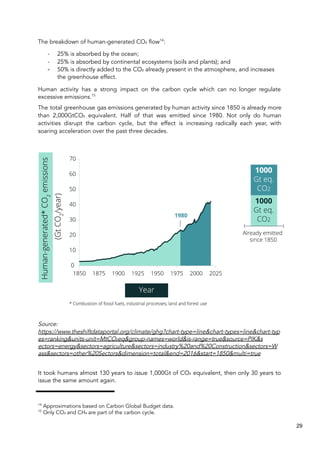
The total greenhouse gas emissions generated by human activity since 1850 is already more
than 2,000GtCO₂ equivalent. Half of that was emitted since 1980. Not only do human
activities disrupt the carbon cycle, but the effect is increasing radically each year, with
soaring acceleration over the past three decades.
Source:
https://www.theshiftdataportal.org/climate/ghg?chart-type=line&chart-types=line&chart-typ
es=ranking&units-unit=MtCO₂eq&group-names=world&is-range=true&source=PIK&s
ectors=energy&sectors=agriculture&sectors=industry%20and%20Construction&sectors=W
ass&sectors=other%20Sectors&dimension=total&end=2016&start=1850&multi=true
It took humans almost 130 years to issue 1,000Gt of CO₂ equivalent, then only 30 years to
issue the same amount again.
14
Approximations based on Carbon Global Budget data.
15
Only CO₂ and CH₄ are part of the carbon cycle.
29
At that rate, humans will emit another 1,000 Gt within the next 20 years.
Another telling figure: 50% of the annual emissions by human activities (over 50Gt CO₂ equivalent)
takes up residence in the atmosphere as GHGs.
Conclusion
Current global warming is completely unprecedented.
It is progressing at a hurtling pace.
This is due to GHG emissions generated by human activity, which disrupt the carbon
cycle.
30
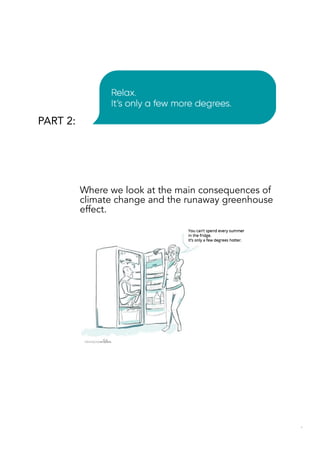
PART 2:
Where we look at the main consequences of
climate change and the runaway greenhouse
effect.
31
I. Consequences of global warming:
mechanisms at work
A. Basic mechanisms
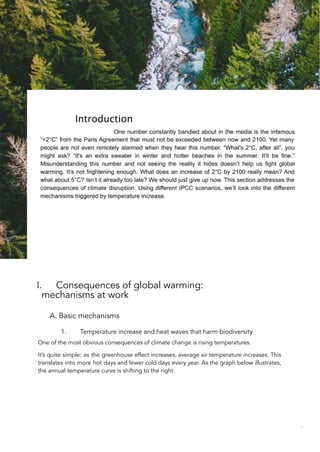
1. Temperature increase and heat waves that harm biodiversity
One of the most obvious consequences of climate change is rising temperatures.
It’s quite simple: as the greenhouse effect increases, average air temperature increases. This
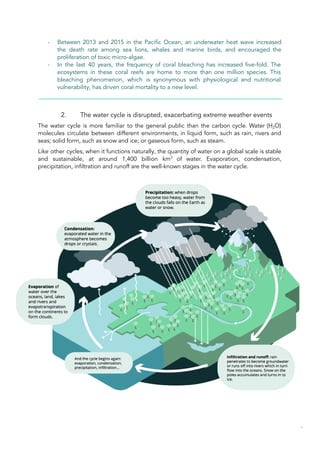
translates into more hot days and fewer cold days every year. As the graph below illustrates,
the annual temperature curve is shifting to the right.
32
+1°C is bad enough already
We can already see it. In the Northern Hemisphere:
- 18 of the 19 hottest summers ever recorded occurred in the last 20 years.
- Since 1998, the 10 hottest February temperatures have been recorded.
We have also witnessed periods of extreme heat or heat waves. They can be deadly for the most
fragile and even threaten much of the population. There’s a certain threshold above which the
human body can no longer regulate its own temperature. The 2003 heatwave in Europe resulted in
70,000 deaths within a few weeks.
Not only does the air heat up; average water temperature also increases. Oceans absorb
more energy due to the greenhouse effect and their temperatures rise, causing marine life
to suffer.
+1°C is bad enough already
- The frequency of marine heat waves has doubled since the 1980s.
- During the 2003 heat wave, IFREMER, the French research institute for fishing,
registered a sharp increase in the fish mortality rate.
33
- Between 2013 and 2015 in the Pacific Ocean, an underwater heat wave increased
the death rate among sea lions, whales and marine birds, and encouraged the
proliferation of toxic micro-algae.
- In the last 40 years, the frequency of coral bleaching has increased five-fold. The
ecosystems in these coral reefs are home to more than one million species. This
bleaching phenomenon, which is synonymous with physiological and nutritional
vulnerability, has driven coral mortality to a new level.
2. The water cycle is disrupted, exacerbating extreme weather events
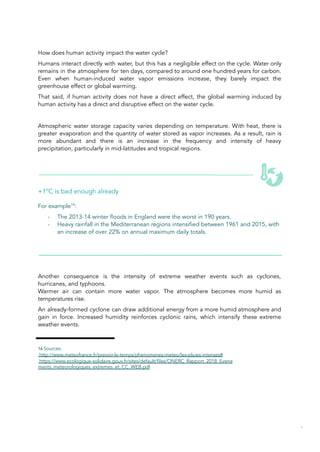
The water cycle is more familiar to the general public than the carbon cycle. Water (H2O)
molecules circulate between different environments, in liquid form, such as rain, rivers and
seas; solid form, such as snow and ice; or gaseous form, such as steam.
Like other cycles, when it functions naturally, the quantity of water on a global scale is stable
and sustainable, at around 1,400 billion km3
of water. Evaporation, condensation,
precipitation, infiltration and runoff are the well-known stages in the water cycle.
34
How does human activity impact the water cycle?
Humans interact directly with water, but this has a negligible effect on the cycle. Water only
remains in the atmosphere for ten days, compared to around one hundred years for carbon.
Even when human-induced water vapor emissions increase, they barely impact the
greenhouse effect or global warming.
That said, if human activity does not have a direct effect, the global warming induced by
human activity has a direct and disruptive effect on the water cycle.
Atmospheric water storage capacity varies depending on temperature. With heat, there is
greater evaporation and the quantity of water stored as vapor increases. As a result, rain is
more abundant and there is an increase in the frequency and intensity of heavy
precipitation, particularly in mid-latitudes and tropical regions.
+1°C is bad enough already
For example16
:
- The 2013-14 winter floods in England were the worst in 190 years.
- Heavy rainfall in the Mediterranean regions intensified between 1961 and 2015, with
an increase of over 22% on annual maximum daily totals.
Another consequence is the intensity of extreme weather events such as cyclones,
hurricanes, and typhoons.
Warmer air can contain more water vapor. The atmosphere becomes more humid as
temperatures rise.
An already-formed cyclone can draw additional energy from a more humid atmosphere and
gain in force. Increased humidity reinforces cyclonic rains, which intensify these extreme
weather events.
16 Sources:
http://www.meteofrance.fr/prevoir-le-temps/phenomenes-meteo/les-pluies-intenses#
https://www.ecologique-solidaire.gouv.fr/sites/default/files/ONERC_Rapport_2018_Evene
ments_meteorologiques_extremes_et_CC_WEB.pdf
35
+1°C is bad enough already
Climate catastrophes are increasingly devastating for populations. Cyclones Sandy (2012)
and Irma (2017), and hurricane Harvey (2017) came at terrible human cost.
3. Ice melt
Ice is found on glaciers, ice caps and ice shelves. Although all regions with ice are melting
more rapidly due to global warming, the consequences are different.
a. The difference between glaciers, ice caps and ice shelves
Let’s look at some definitions.
Glaciers
Here, the ice rests on land - on a mountain top, for example. It functions like a fresh water
reservoir. Glaciers melt during the summer to feed the springs that feed the streams and
rivers, and so on. And in winter, under normal conditions, snowfall freezes and transforms
into ice, reforming glaciers.
Ice caps and ice sheets
Ice caps are vast frozen areas, sheets of ice with a surface area of less than 50,000km2
, which
cover land. They are like very big glaciers.
If they are larger than 50,000km2
, they are known as “ice sheets”. The ice can be several
thousand meters high.
On our planet, there are only two ice sheets:
- one in northern Greenland which has been in existence for 3 million years; and
- one in the south of Antarctica which has been in existence for 30 million years.
Ice shelves
Ice shelves are also significant layers of ice. The major difference with an ice cap is that they
appear on the surface of water. Ice shelves float, a bit like ice cubes. They are only found in
the Arctic and Antarctic.
Now that we’re clear on the definitions, let’s take a look at the effects of temperature
increases caused by climate change on ice regions.
b. Fresh water and water stress
36
Currently 3% of the Earth’s water is fresh water, and only 1% of that is in liquid form. Melting
glaciers have an impact on fresh water reserves. In fact, a glacier is supposed to melt
gradually during dry periods and run off into streams. By melting more quickly, glaciers no
longer act as reservoirs which gradually release fresh water under normal conditions.
Fresh water is drinkable making it necessary for humans and animals on a daily basis.
Accelerated melting and the disappearance of glaciers lead to what is known as “water
stress” - demand outweighs the quantity available. This is a vital issue that already presents
a major geopolitical challenge in some of the world’s driest regions.
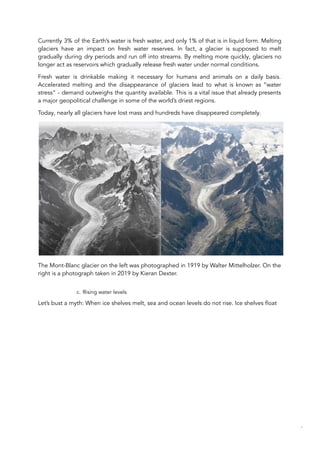
Today, nearly all glaciers have lost mass and hundreds have disappeared completely.
The Mont-Blanc glacier on the left was photographed in 1919 by Walter Mittelholzer. On the
right is a photograph taken in 2019 by Kieran Dexter.
c. Rising water levels
Let’s bust a myth: When ice shelves melt, sea and ocean levels do not rise. Ice shelves float
37
on water, so when they melt, the total water volume does not change. Exactly like an ice
cube in a glass of water.
Actually, rising water levels is linked to three different phenomena:
Melting ice caps and ice sheets
When the ice caps and sheets melt, fresh water is added to the sea and ocean water.
Consequently, the water mass increases automatically.
Ice sheets are thousands of meters thick, so if they melted completely, ocean levels would
rise:
- 7 meters for Greenland
- 54 meters for Antarctica
Melting glaciers
As we have already seen, glaciers store water in ice form. When they melt, the water runs off
and joins the rivers that feed into the ocean. This causes water levels to rise.
In addition, glacier melt increases the risk of flooding and landslides, by releasing abnormal
water volumes which flow over and destabilize the ground.
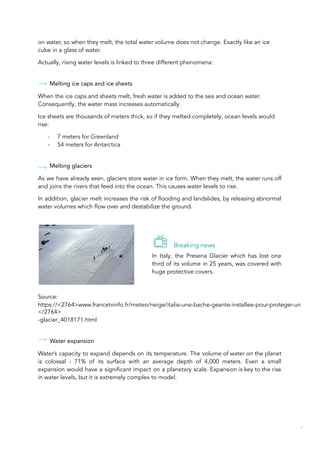
Breaking news
In Italy, the Presena Glacier which has lost one
third of its volume in 25 years, was covered with
huge protective covers.
Source:
https://<2764>www.francetvinfo.fr/meteo/neige/italie-une-bache-geante-installee-pour-proteger-un
</2764>
-glacier_4018171.html
Water expansion
Water’s capacity to expand depends on its temperature. The volume of water on the planet
is colossal - 71% of its surface with an average depth of 4,000 meters. Even a small
expansion would have a significant impact on a planetary scale. Expansion is key to the rise
in water levels, but it is extremely complex to model.
38
4. Ocean acidification
Another consequence of climate change is ocean acidification.
We have seen that CO2 can dissolve in the ocean, like sugar in water. During this chemical
reaction, it transforms into carbonates (HCO3- and CO3
2-
) and releases H+ ions. These ions
are acidic, and they reduce pH (measure of acidity). Accordingly, the more CO2, the more
acidic the ocean becomes.
Note that there is no direct link between water temperature and acidification. The ocean is
not becoming more acidic because it’s warming up. However, the drop in pH is a direct
result of the increased concentration of CO2 in the atmosphere which is in contact with the
ocean. Remember, 35% of human-induced CO2 emissions will be directly absorbed by the
ocean.
With the drop in the ocean’s pH, “calcification” - the formation of calcium carbonate -
becomes more difficult. There are fewer bicarbonate ions which are needed to form calcium
carbonate.
More specifically, micro-organisms such as pteropods and coccolithophores usually have
calcium carbonate shells or scales. They are significantly affected by ocean acidification.
These micro-organisms are the base of the entire marine food web. If they disappear, all
marine flora and fauna will be impacted. The ricochet effect will be that whole fishing areas
will be depleted of their stocks, jeopardizing food security for some populations.
The IPCC summarizes it as follows: “Changes to water chemistry and
temperature are already disturbing species at all levels of the marine food
web. This has repercussions on marine ecosystems and the populations
which depend on them.”
39
B. “Vicious circle” mechanisms, or the double whammy effect
Why do we talk about “runaway” climate change so much? Or the “point of no return”?
And “absolute” climate emergency? Where does this idea that “we must not exceed 2°C”
come from?
Climate disruption is in no way a linear problem. Some of the consequences of global
warming themselves become additional causes of climate disruption. “Vicious circles” of a
sort. Scientists call them “positive feedback loops”. But beware, “positive” doesn’t mean
that they’re positive for the climate. Quite the contrary. It means that they enhance the initial
perturbation. Some loops have an amplifying effect and some represent a grave danger:
“climate bombs” that could potentially render the climate completely out of control in an
irreversible way.
Let’s take a look at six: the albedo effect, ocean currents, forest degradation, water vapor,
melting permafrost and methane hydrate release.
1.Reducing the albedo effect: not a pretty picture
Albedo is the measure of a surface’s reflective power. Every surface or object reflects back
into space a fraction of the light it receives. It absorbs the rest, raising its own temperature.
The albedo is the proportion of solar energy that is reflected in relation to what is absorbed.
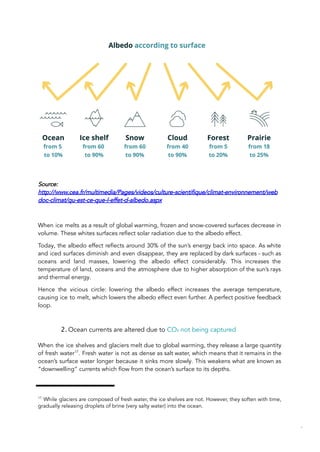
Albedo is different depending on a surface’s color and composition. The lighter the color,
the higher the albedo. As snow, clouds and ice are white, they reflect a lot of solar radiation.
40
Source:
http://www.cea.fr/multimedia/Pages/videos/culture-scientifique/climat-environnement/web
doc-climat/qu-est-ce-que-l-effet-d-albedo.aspx
When ice melts as a result of global warming, frozen and snow-covered surfaces decrease in
volume. These whites surfaces reflect solar radiation due to the albedo effect.
Today, the albedo effect reflects around 30% of the sun’s energy back into space. As white
and iced surfaces diminish and even disappear, they are replaced by dark surfaces - such as
oceans and land masses, lowering the albedo effect considerably. This increases the
temperature of land, oceans and the atmosphere due to higher absorption of the sun’s rays
and thermal energy.
Hence the vicious circle: lowering the albedo effect increases the average temperature,
causing ice to melt, which lowers the albedo effect even further. A perfect positive feedback
loop.
2. Ocean currents are altered due to CO₂ not being captured
When the ice shelves and glaciers melt due to global warming, they release a large quantity
of fresh water17
. Fresh water is not as dense as salt water, which means that it remains in the
ocean’s surface water longer because it sinks more slowly. This weakens what are known as
“downwelling” currents which flow from the ocean’s surface to its depths.
17
While glaciers are composed of fresh water, the ice shelves are not. However, they soften with time,
gradually releasing droplets of brine (very salty water) into the ocean.
41
The ocean stores CO2 differently on the surface and in deep water. The deep ocean is the
main carbon sink, where it stores 30 to 40 times more CO2 than on the ocean’s surface.
With the weakening of the downward currents, the deep ocean becomes less accessible as a
carbon sink. The ocean's surface cannot send its surplus of dissolved CO2 any lower. The
surface becomes saturated with CO2 and in turn, it becomes a less effective carbon sink.
Instead of dissolving the CO2, it can start to reject it into the atmosphere through
evaporation. As a result, the carbon sinks become a source of GHG emission. All that
because of the altered marine currents.
Releasing GHG rather than absorbing it exacerbates the greenhouse effect. This leads to
more global warming, more glacier melt and increased alteration of ocean currents. That’s
the positive feedback loop.
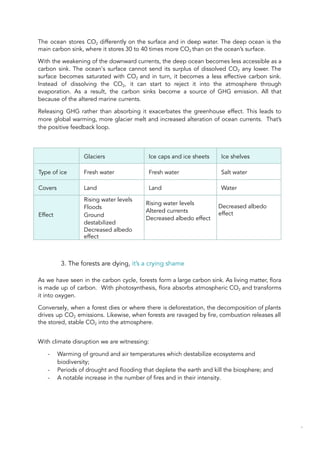
Glaciers Ice caps and ice sheets Ice shelves
Type of ice Fresh water Fresh water Salt water
Covers Land Land Water
Effect
Rising water levels
Floods
Ground
destabilized
Decreased albedo
effect
Rising water levels
Altered currents
Decreased albedo effect
Decreased albedo
effect
3. The forests are dying, it’s a crying shame
As we have seen in the carbon cycle, forests form a large carbon sink. As living matter, flora
is made up of carbon. With photosynthesis, flora absorbs atmospheric CO2 and transforms
it into oxygen.
Conversely, when a forest dies or where there is deforestation, the decomposition of plants
drives up CO2 emissions. Likewise, when forests are ravaged by fire, combustion releases all
the stored, stable CO2 into the atmosphere.
With climate disruption we are witnessing:
- Warming of ground and air temperatures which destabilize ecosystems and
biodiversity;
- Periods of drought and flooding that deplete the earth and kill the biosphere; and
- A notable increase in the number of fires and in their intensity.
42
These three perturbations, which are consequences of climate change, lead to plant decay.
The plants which do survive will have a much lower capacity to absorb CO2 and those that
die will decompose and release CO2. This concentration of atmospheric GHG will increase,
causing global warming, which leads back to the three effects cited above. And there you
have a third positive feedback loop.
Between the Australian bush fires burning throughout the summer of 2019, and President
Bolsonaro’s efforts to deforest the Amazon as quickly as possible, this is not a hypothetical
situation, but a positive feedback loop that’s well underway.
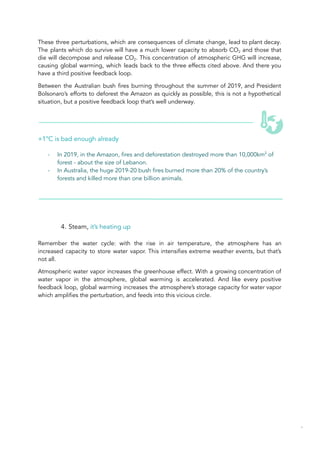
+1°C is bad enough already
- In 2019, in the Amazon, fires and deforestation destroyed more than 10,000km2
of
forest - about the size of Lebanon.
- In Australia, the huge 2019-20 bush fires burned more than 20% of the country’s
forests and killed more than one billion animals.
4. Steam, it’s heating up
Remember the water cycle: with the rise in air temperature, the atmosphere has an
increased capacity to store water vapor. This intensifies extreme weather events, but that’s
not all.
Atmospheric water vapor increases the greenhouse effect. With a growing concentration of
water vapor in the atmosphere, global warming is accelerated. And like every positive
feedback loop, global warming increases the atmosphere’s storage capacity for water vapor
which amplifies the perturbation, and feeds into this vicious circle.
43
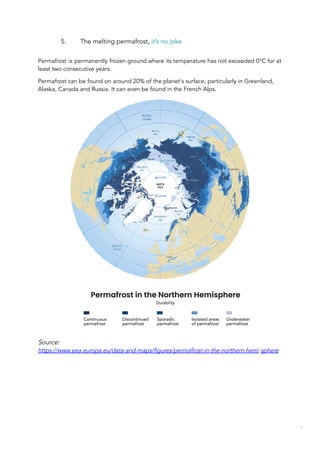
5. The melting permafrost, it’s no joke
Permafrost is permanently frozen ground where its temperature has not exceeded 0°C for at
least two consecutive years.
Permafrost can be found on around 20% of the planet's surface, particularly in Greenland,
Alaska, Canada and Russia. It can even be found in the French Alps.
Source:
https://www.eea.europa.eu/data-and-maps/figures/permafrost-in-the-northern-hemi sphere
44
The major problem with permafrost is that it contains elements that have been locked into
the ice for thousands of years. And we can’t really let these elements out into the
atmosphere. Why not?
Picture this: permafrost is like a huge freezer. If you leave the door open, your pizza will
defrost, your ice cream will melt, and germs will feed off these organic elements. In the
same way, permafrost releases organic matter. Depending on germ activity, this produces
either CO2 when oxygen is present, or methane when there is no oxygen. These GHGs join
the atmosphere and accelerate warming.
The GHG potential from permafrost is colossal: we are talking about 1,500GtC. That’s
double the amount of GHGs already present in the atmosphere. This would triple the
concentration. Just imagine the additional greenhouse effect that would be generated. In
this sense, the thawing of a large part of the permafrost represents one of the two possibly
irreversible “climate bombs”.
An additional, not insignificant, effect is that the permafrost has locked in diseases that
disappeared hundreds and thousands of years ago. Thawing permafrost could free them
and create major health crises.
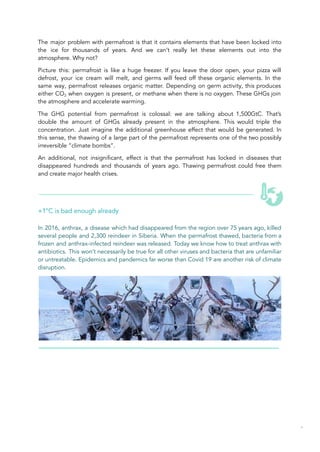
+1°C is bad enough already
In 2016, anthrax, a disease which had disappeared from the region over 75 years ago, killed
several people and 2,300 reindeer in Siberia. When the permafrost thawed, bacteria from a
frozen and anthrax-infected reindeer was released. Today we know how to treat anthrax with
antibiotics. This won’t necessarily be true for all other viruses and bacteria that are unfamiliar
or untreatable. Epidemics and pandemics far worse than Covid 19 are another risk of climate
disruption.
45
6. Methane, keep it cool
Methane represents another potential “climate bomb”. Here we’re talking about methane
molecules trapped in ice. There are large quantities:
- under the permafrost; and
- at the bottom of the oceans, in ocean sediment.
For now, methane storage in these reservoirs is stable. It is difficult to estimate the precise
quantities, but we are talking about around 10,000GtC - 7 times more than all the GHGs
contained in the permafrost, and 21 times more than all the GHGs present in the
atmosphere.
Unfortunately, if temperatures exceed the infamous 2°C, these molecules could become
unstable. In fact, with the melting permafrost and warming oceans, methane will be
increasingly in contact with higher temperatures. And the probability of these molecules
becoming unstable is significant at 2°C and above. In that case, the molecules could
dissociate and methane would escape directly into the atmosphere. Given that we’re talking
about a gigantic volume of methane, it’s easy to understand the disastrous consequences
for global warming and life on Earth.
II. “What if we stopped everything today? Would that do?”
Not even! There’s still the problem of inertia.
We often fantasize that if we stopped all GHG emissions tomorrow, the problem would be
solved. That would be great but unfortunately, the planet doesn't work that way.
The climate system has substantial inertia, and the effects of climate disruption are observed
over several decades or even longer.
Besides, this is why the pathways proposed by the IPCC are not modelled on a radical
decrease in GHG concentration or temperature. Even in the boldest scenarios, the inertia
phenomenon has been calculated and built-in.
How do you explain this inertia? It’s due to residence time and the planet’s thermal inertia.
A. Residence time.
“It’s nice up there.”
In Part 1.II.C.3.a, we saw that each GHG is characterized by a different residence time. CO2,
for example, remains in the atmosphere for thousands of years. And throughout that time, it
contributes to the greenhouse effect, even if there are no simultaneous and additional GHG
46
emissions on Earth. The consequences of a GHG emission are spread out over extremely
long periods of time.
Imagine heating water (the ocean) with an increasingly hot flame (GHG). Stopping GHG
emission is not like putting out the flame because GHGs remain in the atmosphere
throughout their residence time. It only means the flame isn’t getting any bigger. The water
stays on the fire and continues heating until it reaches a certain temperature. This is the
point of equilibrium.
B. Thermal inertia or “why is the swimming pool always too
cold?”
GHGs accelerate the greenhouse effect and, consequently, air, water, ground and glacier
warming. Each of these elements heat up at a distinct speed. We talk about different
“thermal inertia”.
For example, when a ray of sun breaks through, you quickly feel the air heat up. That
doesn’t mean the temperature of the water in the pool instantly heats up. That can take
several hours or days. Conversely, if the slightest cloud hides the sun, we shiver, but the
swimming pool temperature doesn’t suddenly drop five degrees. It’s the same for the
planet. It would take ages to heat up the enormous volumes of water in the oceans.
One positive effect of this inertia is that it avoids rapid heating. On the other hand, it is
extremely dangerous as it hides what is to come. Oceans will continue to heat up for a long
time, even after GHGs decrease. Due to inertia, they will take a long time to cool down. The
interval between the causes (GHG emissions) and the consequences is counted in decades.
C. Exactly how long are we talking about?
When we add residence time to thermal inertia, total inertia is colossal. In real terms, this
means that even if all emissions were to stop tomorrow, the Earth would continue to warm
rapidly for the next 20 years.
Put another way, while the climate in 2020 is worrying enough, current GHG emissions will
only make an impact on the temperature in around 2040.
47
III. “OK, if I understand correctly, it’s all messed up,
and it’s too late.”
No, but we must act now!
Now that you’ve learned about the most troublesome mechanisms in climate disruption -
positive feedback loops and inertia - you might be tempted, like many others, to state that
it’s “too late.” At Time for the Planet, we have all gone through that state of despair. That
moment when we became aware of the consequences of climate disruption. However, we
refuse to accept that it’s messed up beyond repair. Quite the opposite. Let’s build on the
different IPCC scenarios to see our scope for action.
A. “We’re not at our best.”
In fact, we are currently in one of the worst-case scenarios predicted
by the IPCC.
1.The different IPCC scenarios
Thanks to the aggregation of numerous climate models and the computing power that is
now available, the IPCC has been able to establish various scenarios that consider an
impressive number of variables.
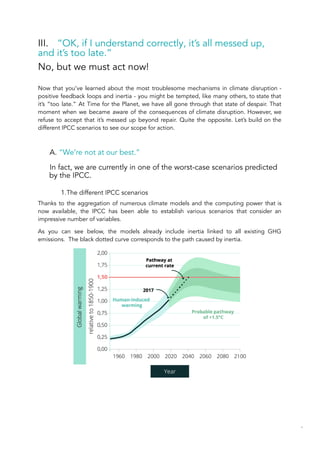
As you can see below, the models already include inertia linked to all existing GHG
emissions. The black dotted curve corresponds to the path caused by inertia.
48
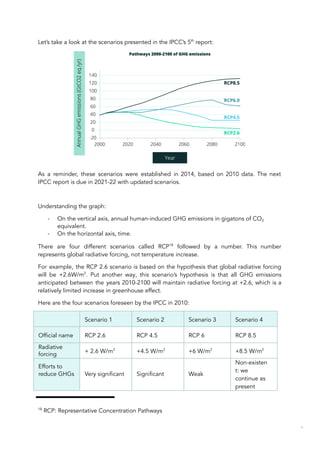
Let’s take a look at the scenarios presented in the IPCC’s 5th
report:
As a reminder, these scenarios were established in 2014, based on 2010 data. The next
IPCC report is due in 2021-22 with updated scenarios.
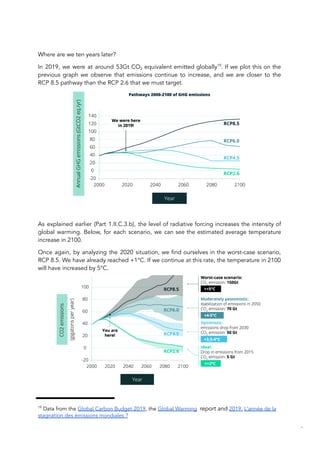
Understanding the graph:
- On the vertical axis, annual human-induced GHG emissions in gigatons of CO2
equivalent.
- On the horizontal axis, time.
There are four different scenarios called RCP18
followed by a number. This number
represents global radiative forcing, not temperature increase.
For example, the RCP 2.6 scenario is based on the hypothesis that global radiative forcing
will be +2.6W/m2
. Put another way, this scenario’s hypothesis is that all GHG emissions
anticipated between the years 2010-2100 will maintain radiative forcing at +2.6, which is a
relatively limited increase in greenhouse effect.
Here are the four scenarios foreseen by the IPCC in 2010:
Scenario 1 Scenario 2 Scenario 3 Scenario 4
Official name RCP 2.6 RCP 4.5 RCP 6 RCP 8.5
Radiative
forcing
+ 2.6 W/m2
+4.5 W/m2
+6 W/m2
+8.5 W/m2
Efforts to
reduce GHGs Very significant Significant Weak
Non-existen
t: we
continue as
present
18
RCP: Representative Concentration Pathways
49
Where are we ten years later?
In 2019, we were at around 53Gt CO2 equivalent emitted globally19
. If we plot this on the
previous graph we observe that emissions continue to increase, and we are closer to the
RCP 8.5 pathway than the RCP 2.6 that we must target.
As explained earlier (Part 1.II.C.3.b), the level of radiative forcing increases the intensity of
global warming. Below, for each scenario, we can see the estimated average temperature
increase in 2100.
Once again, by analyzing the 2020 situation, we find ourselves in the worst-case scenario,
RCP 8.5. We have already reached +1°C. If we continue at this rate, the temperature in 2100
will have increased by 5°C.
19
Data from the Global Carbon Budget 2019, the Global Warming report and 2019, L'année de la
stagnation des émissions mondiales ?
50
2. Even the IPCC’s worst-case scenarios were optimistic in the end.
Since the 2014 IPCC report, and until the next report, other scientific groups have updated
these scenarios.
The Coupled Model Intercomparison Project brings together around 20 major laboratories
worldwide. They have created climate models that will serve as the basis for the IPCC and
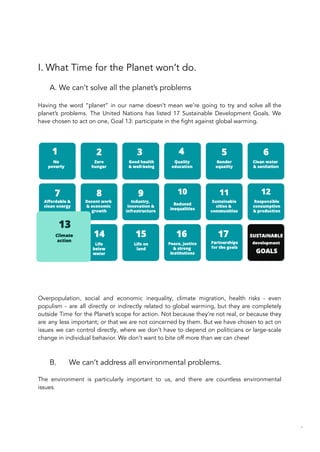
will need to be included in its next report.
What changed?
- They were able to model the effect of clouds and aerosols more precisely;
- Computer processing power has improved even more; and
- They took into account countries’ efforts since 2010 to significantly reduce GHG
emissions.
And the result? The new Shared Socio-economic Pathway (SSP) models are even more
troubling than the RCP scenarios. Here are the new scenarios proposed by the scientists:
Source CEA.
The worst-case scenario forecasts an average global temperature increase of +7°C by 2100.
That’s well above the IPCC’s worst-case scenario of +5°C. The curve simulates climate
evolution if we don’t change our consumption patterns and production methods.
Even the most favorable scenario, represented in light green, is not terribly optimistic. Even
the most optimistic scenario stabilizes around a +2°C warming, but “only just, [with] a
significant mitigation effort (...), and at the cost of temporarily exceeding the 2°C objective
over the course of the century”.
51
B. “Shouldn’t we just give up now?”
1. If we give up with between +5° and +7°C, the world as we know it
will come to an end
Why do “collapsonauts” seem to be convincing more citizens each day? Because they are
aware of the systemic and incredibly fragile nature of our current system. They recognize
climate change as a risk that could lead to the total collapse of our civilization.
We won’t go that far because a collapse is extremely difficult to predict both in terms of
date and intensity. Above all, because we can’t predict future measures. Even so, we should
still ask ourselves what a world with a +5°C temperature would be like.
The exact difference between our current interglacial period and an ice age is +5°C. This
temperature change usually takes 20,000 years to occur.
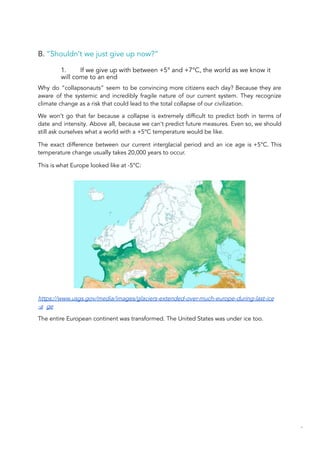
This is what Europe looked like at -5°C:
https://www.usgs.gov/media/images/glaciers-extended-over-much-europe-during-last-ice
-a ge
The entire European continent was transformed. The United States was under ice too.
52
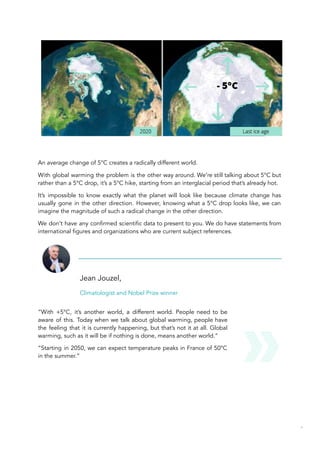
An average change of 5°C creates a radically different world.
With global warming the problem is the other way around. We’re still talking about 5°C but
rather than a 5°C drop, it’s a 5°C hike, starting from an interglacial period that’s already hot.
It’s impossible to know exactly what the planet will look like because climate change has
usually gone in the other direction. However, knowing what a 5°C drop looks like, we can
imagine the magnitude of such a radical change in the other direction.
We don’t have any confirmed scientific data to present to you. We do have statements from
international figures and organizations who are current subject references.
Jean Jouzel,
Climatologist and Nobel Prize winner
“With +5°C, it’s another world, a different world. People need to be
aware of this. Today when we talk about global warming, people have
the feeling that it is currently happening, but that’s not it at all. Global
warming, such as it will be if nothing is done, means another world.”
“Starting in 2050, we can expect temperature peaks in France of 50°C
in the summer.”
53
Nicholas Stern,
Economist, vice-president of the World Bank, and author of “The
Economy of Climate Change” in 2006.
“Not in 10 million years has the planet known such a sharp rise in
temperature. And human beings, who only appeared on Earth 250,000
years ago, have never lived in a world that is 4°C warmer.”
According to his report:
- Southern Europe will look like the Sahara;
- The African desert will reach the South;
- Snow, which brought water to more than 2 billion people, will disappear from the
Himalayas;
- The Amazon basin will be struck by desertification;
- Extreme weather events such as hurricanes, storms and cyclones will become more
frequent; and
- It is difficult to evaluate the level of rising water, but it is estimated that a rise of only
2 meters would cause the displacement of over 200 million people.
The World Bank,
in its 2012 report “Turn Down the Heat”
“In a +4°C scenario, no country will be spared from global warming.
The World Bank predicts:
- A temperature shock for North African countries, the Mediterranean region, the
Middle East, and the United States where average temperatures could increase by
6°C or more;
- Sea levels rising by between 0.5 and 1 meter or more by 2100;
54
- Salt water rising back to river deltas, rendering land unsuitable for cultivation;
- An increase of 150% in ocean acidity: a real catastrophe for marine flora and fauna;
and
- A drastic reduction in the scope of services provided by ecosystems and which
society depends on.
Antonio Guterres,
UN Secretary-General
“The world is facing a direct existential threat; climate change is moving
faster than we are.”
The UN puts the number of climate refugees at 150 million within 30 years.
Henri de Castries,
CEO, AXA
“A world that’s 4°C warmer would not be insurable.”
Jean-Marc Jancovici,
Member of the French High Council on Climate
“In a world that warms up by a few degrees, say 4 to 5°C by 2100,
there would be, starting in 2070, between 1.5 billion and 3 billion
people on Earth living in conditions hotter than the Sahara is now.
There would be 1 billion people living in areas where outdoor
conditions would be deadly almost every day of the year.”
Clearly these prospects are not good news, but they are consistent with the mechanical
climate consequences if nothing is done to change the pathway. Radical changes to
available natural resources will undoubtedly lead to water stress, drought, famine, and major
health crises. Many people will die, and the majority of the population will need to change
countries, if not continents.
Geopolitical stability will be impossible to sustain in the face of all these pressures. Look at
what happens to European Union cohesion when a few migrants attempt to cross the
Mediterranean Sea. It’s hard to imagine global cooperation capable of handling all of these
impending disasters.
On a smaller scale, the Covid 19 episode and the fight for scarce resources - such as drugs,
respirators, and masks - clearly demonstrated each country’s race to save itself and the
increased competition in a crisis situation. International conflicts are likely to re-establish
global geopolitical balance in a new and unpredictable way.
We could spend hours scaring ourselves. These statements make it easy to understand that
we must avoid this situation at all costs.
Despite what the general public thinks, global warming along the lines of the IPCC’s
worst-case scenario would impact everyone’s lives. We are the last generation capable of
avoiding this catastrophic scenario.
2. The world will keep going after 2100, won’t it?
Another problem is this idea that it’s “already too late”. Everything is focused on 2100,
because all forecasts stop at that date. News flash: the planet will not disappear after 2100.
Global warming will not suddenly stop as we move into the next century.
Giving up now quite simply means accepting the end of the human race in the coming
centuries. With +5°C, our civilization could quite simply collapse. With even greater
warming, it’s hard to imagine how humans could survive. We aren’t talking about something
that might happen in ten generations to come. This will affect our grandchildren and
great-grandchildren.
3. We have no choice. We must keep the curve as low as possible.
No one can accept the reality described above. We cannot give up. The climate is
not an on/off objective:
56
- Either we succeed in limiting global warming at +1.5°C;
- Or we fail and reach +7°C.
The reality is somewhere between the two. The stabilized level of warming will define our
quality of life and the survival of mankind over the next few centuries. Each degree - won or
lost - will have far-reaching consequences.
All our efforts must head the same way: limit global warming and GHG emissions. To
prevent suffering in our lifetimes and to guarantee a livable life for future generations.
C. “No, it’s not too late.” Look who says so.
After everything we’ve looked at, is the race over before we’ve even started? Let’s ask the same
leading figures and organizations:
Jean Jouzel,
Climatologist and Nobel Prize winner, in 2020:
“Global warming will be played out in the next 10 to 20 years.”
“We must act now”.
“One of the keys to success is innovation”.
57
Antonio Guterres,
UN Secretary-General, in 2018:
“The world has two years to act on climate change. If we don’t change
direction by 2020, we risk disastrous consequences for humans and the
natural systems that support us.”
Let’s roll up our sleeves and get a move on!
D. What should we do?
Instead of focusing on the worst-case scenarios, we should look at how to implement the
most optimistic ones. Because those scenarios are possible too.
They are the subject of the IPCC’s 2018 “Global Warming” report. Rather than updating the
scenarios put forward in its 5th
report (update due in 2021-22), it gives a more detailed
analysis of those scenarios that limit warming to +1.5°C.
The IPCC is focusing on these to demonstrate that it is still possible and that +1.5°C is far
more desirable than the +2°C targeted by the Paris Agreement. Detailed reasons are given
in their report.
The IPCC offers four new scenarios that help to stay under, or slightly above, a +1.5°C, if we
start in 2020.
58
Whether it’s scenario P1, P2, P3 or P4, to keep warming under +1.5°C, or slightly above (P4),
CO2 emissions must be drastically reduced to reach 0 by around 2060, the point at which a
scenario’s curve crosses the x-axis.
The other major GHGs need to be reduced drastically without having to reach 0, unlike
CO2.
59
The IPCC simulates each scenario in detail. How to interpret the scenarios:
Each graph shows:
- reducing fossil fuel consumption and the impact of global, high GHG-emitting
industries => the black curve decreases but remains positive, as it is impossible to
neutralize completely.
- preserving natural carbon sinks, such as forests, land conservation, carbon neutral
agriculture, etc. => the blue curve, the AFOLU (Agriculture, Forestry and Other Land
Uses). This can be positive or negative depending on whether the land and
vegetation are carbon sinks or GHG-emitting sources.
60
- finding and developing carbon capture solutions, known as BECCS (Bio-Energy with
Carbon Capture and Storage) => the yellow curve which counters global warming
because it absorbs GHGs.
Combining the three curves, we obtain the red curve, which simulates the overall result in
terms of GHGs. When this curve crosses the x-axis the planet reaches what is known as
“carbon neutrality”.
Carbon neutrality is a state of equilibrium between human-induced GHG emissions and
their withdrawal from the atmosphere by mankind.
Now that you fully understand these graphs, let's take a detailed look at the IPCC’s four
scenarios to stay below +1.5°C.
P1: In this scenario, social, commercial and technical innovations lead to reduced demand
for energy until 2050. Living conditions improve, particularly in the Southern Hemisphere. A
smaller scale energy system allows quicker decarbonization of the energy supplied.
Afforestation (or reforestation) is the only Carbon Dioxide Removal (CDR) retained. It does
not use fossil fuels with Carbon Capture and Storage (CCS) or BECCS.
P2: This scenario emphasizes sustainability. It includes energy intensity, human
development, economic convergence and international cooperation. There is a shift towards
more sustainable and robust consumption patterns, technological innovations with low
carbon intensity and well-managed land-use systems, with limited societal acceptability for
BECCS.
P3: An intermediate scenario in which societal and technological developments follow
common patterns. Reducing emissions is achieved mainly although changes to the ways in
which energy and products are obtained, and to a lesser extent, by reduced demand.
P4: A resource and energy intensive scenario where economic growth and globalization lead
to the widespread adoption of GHG-intense lifestyles, including a high demand for fuel and
61
livestock products. Reduction in emissions is achieved mainly through technological means,
intensively using CDR through BECCS.
Scenario 1 requires no effort to capture carbon. Our civilization is capable of drastically
limiting the use of industry and fossil fuels. Conversely, in scenario 4, we continue to use
resources and energy intensively and therefore need to capture a huge amount of GHGs to
compensate.
In each scenario:
- Carbon neutrality must be achieved between 2050 and 2060; and
- The red curve must decrease by half between 2020 and 2030. That’s a 7% GHG
reduction every year, either through reducing emissions or by capture.
We can all aim for these two goals.
What does an annual 7% decrease in GHGs look like?
It’s ambitious. Less 7% could be:
- Halving all transport around the world, both for individuals and goods;
- Making half the world’s population vegetarian; or
- Stopping all energy use in housing and the service sector: no more heating, air
conditioning, warm showers, coffee and hot food.
Another telling example
During Covid 19, we could actually empirically observe what a 7% drop in annual GHG
emissions looks like. While most of the world was in lockdown for months and all except
essential economic activity was at a standstill, we witnessed a 7% drop in GHG emissions.
And we saw how much our economy, in its current form, suffered and will continue to suffer
for many years to come.
62
The press used this analogy to state that in order to achieve the +1.5°C objective, it would
require the equivalent of one Covid episode per year. Unfortunately, that’s not quite right.
To remain within plus +1.5°C, it would take a further 7% decrease annually as compared to
the previous year. To use the analogy correctly, to meet the less 7% annual target, there
would need to be two Covid episodes in 2021, 3 in 2022, 4 the next year, and so on.
It goes to show the extent to which our economy must transform. And the technological
solutions that must be found through innovation.
E.Is carbon capture new?
Prior to the IPCC’s latest report, the focus was never really on carbon capture. Today it’s
difficult to imagine how we could reach an optimistic scenario without increasing our
capacity to eliminate CO2.
This could be through increasing the capacity of natural sinks, but equally through
technological innovation in the capture and storage of GHGs, particularly CO2. These are
known as “negative emission solutions” and include CDR techniques: all human activities
that eliminate CO2 from the atmosphere and sustainably store it in geological, land or ocean
reservoirs, or in products.
However, carbon capture is by no means a miracle cure. Feasibility and sustainability studies
of these new solutions are still underway and already they’re facing considerable hurdles.
63
PART 3:
Where we detail our Scope for Action and the
20 issues Time for the Planet aims to solve.
64
65
I. What Time for the Planet won’t do.
A. We can’t solve all the planet’s problems
Having the word “planet” in our name doesn’t mean we’re going to try and solve all the
planet’s problems. The United Nations has listed 17 Sustainable Development Goals. We
have chosen to act on one, Goal 13: participate in the fight against global warming.
Overpopulation, social and economic inequality, climate migration, health risks - even
populism - are all directly or indirectly related to global warming, but they are completely
outside Time for the Planet’s scope for action. Not because they’re not real, or because they
are any less important; or that we are not concerned by them. But we have chosen to act on
issues we can control directly, where we don’t have to depend on politicians or large-scale
change in individual behavior. We don’t want to bite off more than we can chew!
B. We can’t address all environmental problems.
The environment is particularly important to us, and there are countless environmental
issues.
66
For the first time in 2009, then in an updated form in 2015, researchers proposed a list of
nine planetary boundaries. This approach was adopted by the United Nations, Europe, and
most recently France. These boundaries set limits that mankind must respect to live in a
sustainable and safe ecosystem.
Apart from climate change, the nine boundaries include loss of biodiversity, disruption of
nitrogen and phosphorus cycles, freshwater use and preservation of the ozone layer.
Once again, it would be impossible to address all these problems. A focused approach is
more efficient. That’s why we have decided to concentrate on climate change. For example,
we won’t try to find solutions to desalinate seawater or to protect endangered animal
species.
C. Unique focus: limit GHG and target carbon neutrality
Within the scope of climate change, we have narrowed our action down to a single goal:
funding solutions that mitigate greenhouse-gas emissions to achieve carbon neutrality.
Quickly and globally!
As a result, we exclude:
1. Innovations that have no direct and significant impact on GHG
emissions.
Take plastic.
We won’t try to solve the problem of plastic in the oceans. It causes terrible levels of
pollution that seriously impact biodiversity. However, according to current knowledge,
plastic in the oceans has a negligible impact on the climate. The capacity to absorb CO2 by
phytoplankton is decreasing but the impact is low.
On the other hand, plastic production and other industries are within our scope of action
because they have significant impact on GHG emissions.
Funding a new bank that only invests in green projects, for example, does not have enough
direct impact on our main goal of reducing greenhouse gases.
2. Innovations with indirect and unmeasurable effects.
Take education and raising awareness about climate change.
Don’t get us wrong. We are particularly passionate about this at Time for the Planet as we
hope this brief demonstrates. We believe that education is vital.
67
We strive - and will continue to strive - to explain the urgency of the situation.
On the other hand, we will not fund educational projects, such as a mobile app that
measures the GHG impact of supermarket purchases. Of course, such projects are essential,
but measuring their direct impact is too difficult. How can you predict whether a person will
change their behavior and to what degree?
We have decided to focus on direct and measurable effects on GHG.
3. Innovations that cannot be reproduced or upscaled
worldwide.
Many individuals are organizing personal projects on a local level. Despite being both
admirable and exciting, we won’t count on local projects that are often tailor-made. We are
looking for scalable innovations that can be standardized and deployed quickly and globally
to save time and optimize impact.
4. The nuclear issue
The nuclear issue is a highly contentious debate. Time for the Planet does not wish to take a
stand on this issue, either ideologically or for investment purposes.
We simply support two claims:
- The general public often has a preconceived idea about nuclear energy, thinking it is
a major source of greenhouse-gas emissions. This is not true. In fact, it is one of the
lowest GHG emitting energies, often referred to as “low-carbon” energy.
- On the other hand, nuclear energy should not be considered as readily renewable.
Uranium is now a finite resource, just like fossil fuels. It is also a resource that
underpins major geopolitical and security challenges which we do not wish to be
involved in.
Finally, from a practical point of view, the financial investments necessary for impacting the
nuclear sector are colossal and well beyond Time for the Planet’s capacity. As a result, we
will not finance any innovations in the nuclear sector.
68
D. Neither sorcerer’s apprentices nor climate engineers
The more we postpone action against global warming, the more tempting geoengineering
becomes. What is geoengineering?
Geoengineering is the use of scientific knowledge to influence and make large-scale
corrections to the climate. There are two different types of geoengineering:
- Corrective geoengineering which seeks to amplify and accelerate natural
phenomena in order to reduce greenhouse gas emissions into the atmosphere.
- Geoengineering which seeks to compensate for global warming by provoking
change through deliberate action.
There’s an essential difference between the two that’s rarely addressed. Although both have
a remedial effect, corrective geoengineering reduces additional human-generated
greenhouse gas emissions. But when geoengineering seeks to compensate, it does not limit
consequences and it can even create greater risk for the future.
A regularly cited example, is the injection of massive amounts of sulfur or its derivatives into
the atmosphere as sulfate aerosols. It has been shown that radiative forcing of such
elements can be negative and cool the planet. Sending aerosols into the atmosphere would
increase the albedo, slowing global warming. But aerosols only stay in the atmosphere for a
limited time. Injections would therefore be required at regular intervals.
This type of geoengineering known as Solar Radiation Management (SRM) compensates but
it comes with extremely high risks.
- First, the side effects are difficult to anticipate, particularly for health: aerosols have
been shown to be harmful.
- Secondly, if for some reason - technical or geopolitical for example - we were no
longer able to send aerosols into the atmosphere to compensate for GHG, the
impact of the greenhouse effect on the climate would be very sudden. Consequent
climate warming would be immediate and extremely violent.
We want to minimize climate change without creating additional risk for the future. That’s
why we’ve decided to focus on reducing GHG emissions and their concentration in the
atmosphere. We will not explore geoengineering which seeks to compensate for climate
change.
69
II. Our strategy is to focus on our four
actions for mitigating GHG emissions,
those we can control
Time for the Planet’s goal is clear: drastically reduce GHG emissions to reach carbon
neutrality as quickly as possible.
We have further identified four complementary and indispensable actions:
1. Zero emissions: develop energy sources and materials that do not emit GHG20
.
2. Energy efficiency: improve the efficiency of current systems to reduce their energy
consumption and associated emissions.
3. Mindfulness: reduce our needs to limit GHG in the entire production chain
mechanically.
4. Capture: directly and indirectly capture GHG emissions to limit their concentration in
the atmosphere.
A. Zero emissions or decarbonization
The first action is decarbonization, also referred to as decarbonation.
The aim is to develop solutions - radical innovations - that contribute to carbon neutrality.
This includes shifting from using fossil fuels that emit GHG to decarbonized, renewable
energy.
Carbon neutrality is a long-term vision. Significant research and development are required,
but investment is vital now if it is to be achieved!
This action is essential, but it’s not enough. It is impossible to change all of society at once.
A transition phase is essential, not only technologically but also socially, politically and
economically. Time for the Planet can contribute to the transition, helping various players
with innovative and attractive solutions.
B. Energy efficiency
Our second action, energy efficiency is a short- to medium-term action. We must limit
energy waste in existing processes and systems until we reach carbon neutrality. This limits
total energy consumption - and therefore GHG emissions - during the transition phase.
Many improvements are already in place for the production, processing and consumption of
carbon energy.
20
Once produced. It is physically impossible to create new solutions for operations which do not emit
GHGs over the course of their life cycle.
70
But, there is enormous potential for innovative systems, equipment and machinery to
optimize our energy efficiency.
Improving energy efficiency alone would be insufficient to achieve large-scale energy
transition. As one of four complementary actions, however, it can have a rapid and crucial
impact across all sectors of activity, being widely acceptable and easy to implement.
C. Mindful consumption
Reducing our consumption is an important action for the short term and must also have
significant impact in the long term. Reducing all our needs - such as travel, goods,
construction and food - has a mechanical and almost immediate effect on our GHG
emissions. The global drop observed during COVID-19 lockdowns is a case in point.
Such global changes in our lifestyles will have significant and long-lasting impact. Choices
must be natural, positive, economical and accessible to encourage the majority of people to
be mindful and reduce their consumption. For example, it’s easy to choose to get around by
bike if it’s quicker than going by car.
D. GHG capture
Our fourth and final action is to develop solutions to capture GHG.
Carbon capture is an essential element of an ambitious mitigation strategy that aims to
reduce global warming to +1.5°C, as demonstrated in the latest IPCC scenarios.
There are many ways to capture carbon: in natural sinks (ground, forests, oceans, etc.),
geological storage, or carbon captured as materials. The diverse sustainability of storage
solutions must be identified, but they are all necessary for successful transition.
It’s important to note that GHG capture and storage does not compensate for
human-generated emissions. It would be wrong to think that these solutions alone are
sufficient in the fight against global warming. However, they are necessary to limit climate
disruption and its consequences.
71
III. Our Scope: Five Priority Sectors
Time for the Planet plans to take effective action to reduce GHG emissions. To do so, it is
essential to identify the most important sources of GHG emissions generated by human
activity.
IPCC reports provide the breakdown between the different sectors of our economy for
2010.
2010 Global GHG emissions by economic sector
Excerpt from IPCC Report no.5 on 2010 emissions
Note: this is a global analysis but the situation varies greatly from country to country. Factors
include:
- geographic location (cold or hot country, mountainous, coastlines)
- demographics (number of households to feed and heat)
- available natural resources (rivers, oil, biomass)
- GDP per capita (people in “rich” countries consume more)
- energy mix (breakdown of energy sources: fossil fuels, nuclear power, renewable
energy)
- national policy, particularly for energy transition (support for coal plants or insulating
buildings)
A. Energy: The Heart of the Reactor
72
The conclusion about GHG emissions is final: the energy sector is a major problem.
According to the IPCC, in 2010, the energy-production sector accounted for approximately
34% of global GHG emissions. This includes emissions generated by extraction and
processing.
Breakdown of indirect GHG generated by the energy sector, by
economic sector and end-user
Whether for electricity or generating heating, the sector’s GHG emissions are directly
related to the massive use of fossil fuels - over 80%.
Beyond debate on stock levels of fossil resources (oil, gas, and coal), it is essential to shift
the global energy mix to other low-carbon sources.
B. Industry: The Energy Glutton
Industry is the second largest GHG-emitting sector:
- It uses the most energy resources, and is also one of the major GHG-emitting sectors
in the world: 44% of energy.
- Industrial processes also emit 21% of the world’s GHGs. For example, in cement
production, reducing limestone (CaCO3) to lime (CaO)
73
generates CO2. In other words, it is chemically impossible to avoid CO2 emissions
when producing cement.
In total, cement production is responsible for 32% of global GHG emissions.
The three industries that emit the most GHGs are steel, heavy chemistry and cement
production.
C. Transportation: The Oil King
Transportation accounts for almost 15% of global GHG emissions - mainly CO2. Note,
however, that emissions from producing means of transport, such as cars and planes, are
accounted for in the industry sector. The 15% of GHG emissions attributed to transportation
are due to fuel consumption.
Road transport is by far the worst culprit, with 10.5% of global emissions. Road transport
includes light and heavy vehicles: everything from motorbikes and cars to trucks. Global air
transport emissions are around 2%.
It’s true that your individual carbon footprint is much higher if you travel by plane rather than
by car, but the volume of road trips worldwide has a much greater impact than air travel.
Impact for 1,000 km in France
Source: https://ecolab.ademe.fr/blog/transport/impact-carbone-mobilite-eco-deplacement.md
74
D. Farming: The All-Around Champion
Agriculture and land use account for 24% of GHG according to the IPCC.
The sector accounts for the bulk of global emission of non-CO2 gases: two-thirds of
methane (CH4) and nitrous oxide (N2O) are generated by agriculture, due to cattle breeding
and use of fertilizer respectively.
Livestock breeding emits more than the transportation sector. Breeding causes emissions
through animal feed and enteric fermentation generated by livestock which ruminate and
release methane.
Emissions due to crops are mainly generated by mineral and organic nitrogen fertilization
(mineral fertilizers, sludge, compost and animal waste), basic soil amendments (limestone,
dolomite) and rice farming. Rice itself does not produce GHG. The decomposition of
organic matter in flooded rice fields produces methane which escapes into the atmosphere
through air bubbles and rice plants.
Farming contributes to CO2 emissions, as it is part of the “Agriculture, Forestry and Other
Land Use” category. It therefore takes into account carbon flows due to the development of
carbon sinks caused by forest management, agricultural soils, afforestation, artificialization,
prairie laboring, etc.
Finally, deforestation, mainly due to agricultural expansion, land-to-pasture conversion,
destructive logging and forest fires, accounts for 11% of global GHG emissions.
E.Buildings: The Essential Building Blocks
Buildings account for just over 6% of global GHG emissions. This includes residential and
commercial buildings.
GHG emissions related to the building life cycle are included in this sector. Emissions from
construction are not included. Making building materials, including cement, is accounted for
in the industry sector figures. Given the nature of emissions, the figures for the construction
sector vary greatly around the world, because needs differ according to climate.
Most of the GHG emissions from buildings are generated by heating and air conditioning.
That’s why energy performance plays a key role: a well-insulated building requires less
heating or cooling.
Heating and air conditioning use fossil fuels and hydrofluorocarbons (HFCs). These are gases
primarily used as refrigerants in air conditioners and refrigerators, or as propulsion agents in
aerosols. They are made with carbon, fluorine and hydrogen atoms. Powerful GHGs, they
heat up to 14,800 times21
more than CO2.
There is enormous potential to reduce current GHG emissions, but environmental advocates
insist that action is too slow. In order to meet the objectives of the Paris Agreement, the
Global Alliance for Buildings and Construction, hosted by the UNEP, aims to improve energy
consumption by 30% in the buildings and construction sector.
The development of new techniques, tools, products and technologies (heat pumps,
improved windows, better insulation, energy-efficient appliances and smarter design) had
75
stabilized emissions. However, they are increasing emissions due to growing numbers of
air-conditioning systems and intense climate events such as heat waves.
F. Digital: The New Sector on the Rise
In addition to the five major sectors responsible for human-generated GHG emissions, we
have included a “bonus” sector: digital. Why “bonus”?
Unfortunately, the sector has not yet been specifically analyzed in global studies. There are
no data available about the digital sector, even by country. The only attempt to quantify the
sector’s impact was made by the Shift Project. However, the results should be taken with a
grain of salt because they have not been subjected to international scientific review.
What is certain, however, is that the growing digital sector generates GHGs. According to
the first figures, the carbon footprint may increase by 9% per year. Causes include:
- Energy for manufacturing equipment such as servers, networks and terminals that are
currently accounted for in the figures for the industry and energy sectors.
- The proliferation of digital devices such as smartphones and connected objects
which are frequently renewed, are currently accounted for in the industry sector.
- A boom in data traffic and video usage (Netflix, YouTube and more recently during
Covid-19 lockdowns, Zoom and Skype) uses significant bandwidth which is currently
accounted for in the industry sector.
According to a French Senate report in 2019, the digital sector produced 3.7% of the world’s
greenhouse gases, and 2% of France’s total emissions. That’s a total of 15 million tons of
CO2. This figure could rise to 6.7% of the national total by 2040, well above air travel at
4.7%. If it were ranked as a country, the digital sector would be the fifth largest CO2 emitter
globally.
21
GWP100 between 437 and 14,800.
76
Apart from its GHG impact, the sector must also be closely monitored for other effects.
- It is using a growing over-sized share of available electricity which is increasing the
strain on decarbonized power sources.
- It is also generating a growing demand for critical metals with limited availability,
many of which are also essential for low-carbon technologies.
That’s why it is a bonus sector that has attracted our attention and falls into Time for the
Planet’s scope. The sector has not yet been assessed or documented by the IPCC, but it is
currently accounted for in the industry and energy sectors, one of our five priorities.
77
IV. Time for the Planet’s 20 issues: our matrix and
priorities for action
Having detailed our four actions and five priority sectors, we can now build a matrix which
clearly sets out Time for the Planet’s scope for action. We will identify, select and fund
solutions that fall within this matrix.
The 20 issues we intend to address are set out below:
For additional information or to see how your innovation fits in, please contact
denis@time-planet.com.
You can also suggest an innovation on our website. You will notice that we have
particular priorities.
They are as follows:
1. To decarbonize energy, we will rely on renewable energy and infinite flows.
2. To decarbonize our energy consumption on a large scale, we will rely on one of the
key solutions which is energy storage.
3. To avoid fossil fuels (limited stock, security, etc.) in storage systems, we plan to
develop energy storage solutions without critical or rare earth metals. We will also
favor long-lasting innovations.
4. To develop renewable energy effectively, we will work to improve energy efficiency.
Production is reaching a ceiling. This is not conducive to new users choosing
renewable energy, creating significant availability problems.
78
V. The rebound effect: a problem, though
not directly ours
When we present Time for the Planet, a question often comes up about the risk of a
“rebound effect”. What is it exactly?
The rebound effect, also known as the take-back effect, is a counter-intuitive limit to any
innovation’s efficiency. Improvements in productivity, efficiency, or energy savings do not
always generate a proportional decrease in global consumption of resources. Sometimes
there are increases!
Take a manufacturer that was able to build a car engine that goes 90 km/hour, takes up 1
cubic meter under the hood and consumes 2 gallons of gas per hour. An innovation comes
along and this same engine now takes up half the original space and consumes 1 gallon per
hour at the same speed. In terms of efficiency, this is a great improvement. The
manufacturer immediately starts wondering what to do with the new-found space under the
hood and decides to double the engine power. The new engine is back to 1 cubic meter but
now it reaches 130 km/hour. A great selling point for the manufacturer! There’s just one
problem: this new engine now consumes 4 gallons per hour. The innovation created a
rebound effect with negative consequences in terms of energy consumption. Had the
manufacturer been content with rolling out the original innovation, the car would have been
lighter and energy consumption cut in half.
The innovation does not directly create the rebound effect. It was the opportunity where
“more is better”. That’s why it’s so important to pair innovation with mindful consumption.
Reducing a factory’s GHG emissions cannot be viewed as an opportunity to create a second
plant which results in a constant GHG level. Rather, it must remain a way of reducing overall
GHG emissions.
The rebound effect has a more “psychological” risk which is often pointed out to players like
Time for the Planet.
Some believe that innovation-based initiatives such as Time for the Planet could actually
lead citizens to believe that climate disruption will be under control within a few years. As a
result, they would lose interest in the climate and not change their behavior. On the
contrary, we hammer home the point that Time for the Planet’s role is to continue the fight,
which will never be sufficient. We must all act and for decades to come.
Consequently, we are highly conscious of the rebound effect and its risks. Is that a reason to
give up on innovation and improvements in productivity? Absolutely not!
Here’s why. There are at least four reasons.
79
. First, some innovations have such an impact on decreasing GHG emissions, it’s unlikely the
rebound effect will catch up. The introduction of ICT (Information and Communications
Technology) has caused an increase in GHG emissions because of the infrastructures (data
centers, lines, devices, etc.) necessary for a virtual world. That said, several reports including
the WWF in 2008 demonstrated that ICT’s carbon account was positive. Their GHG
emissions were well below the emissions savings generated by these technologies. The
primary reasons cited by the French Academy of Technologies are the following:
- onboard IT in automobiles and optimization of transportation (1.5Gt)
- e-commerce, industry and digitalized administration (0.9Gt)
- use of ICT in the energy and industry sectors (0.8Gt)
- use of ICT in existing housing to optimize consumption (0.5Gt)
- use of ICT in new buildings (0.4Gt)
. Secondly, certain existing technologies with a bad carbon account today could evolve in
the near future. Specifically, electricity production and storage without recourse to mining of
rare raw materials.
Take the electric car. It currently has a bad carbon account due to how electricity is
produced. In Germany, where coal is still widely used, the electric car’s carbon account is
much worse than in France which produces more low-carbon nuclear energy. In absolute
terms, it’s absurd to denigrate the electric car. Rather, we must opt to transform
automobiles, industrial and aviation machines into electric-operated machines so research
into renewable energies is immediate and massive. We must be ready when a solution for
renewable energy production and storage is found. It would be a shame if machines were to
continue to operate with fuel or gas. Transitions must occur simultaneously.
. The third reason is that our society is changing. More and more money is put on the table
by investment funds, governments, and companies in the fight against GHG emissions. Old
and new still coincide in this contradictory period. Investment in fossil fuels continues but
hope lies in banks’ and governments’ commitment to refuse the use of coal sooner rather
than later.
. Lastly, with the rebound effect, energy savings can lead to increased spending in another
sector. A person who saves on energy costs after making green home improvements or
buying solar panels may spend the savings on clothing, travel or other items. This is a valid
point. Yet again, if taken on a global scale, reducing the carbon impact across all fields in
the economy will also reduce the rebound effect in each sector. Imagine that for €100 saved
on energy costs, a French person buys €30 more clothes. Imagine again that these garments
were produced using solar-powered electricity, transported in hydrogen-propelled trucks
and woven on electric machines. The carbon impact of the rebound effect is much lower
than in our current world where production uses 80% fossil fuels.
Even if we are fully aware of the risks of the rebound effect, we reassert our conviction that
we must continue to innovate.
We will not be able to control all rebound effects. First, they are very difficult to quantify.
Secondly, we have no control over them as they are the result of economic, fiscal and even
political factors. Deciders must regulate and encourage mindful consumption.
At our level, we can simply limit the use of resources necessary for our innovations without
increasing them:
80
- Obviously, we will avoid built-in obsolescence. We are looking for solutions that are
sustainable, recyclable and much more.
- Advance analysis of the resources necessary for producing our solutions in terms of
carbon energy, critical metals and rare-earth elements.
81
PART 4:
Where we explain our method for finding and
selecting innovations
82
I. Finding fabulous innovations
First things first. Before choosing and financing these innovations, we need to source as
many as possible, so the best candidates rise to the top.
At any one time, worldwide, there are thousands of innovations capable of changing the
future. To find them, it’s not enough to leaf through scientific articles or analyze innovation
blogs. Close contact with inventors and scientists is key. We network with scientists,
laboratories and researchers to name a few. We also monitor international scientific news
through seminars, conferences, published material, etc.
Yet quite simply, what works best is having a personal relationship. To cite the theory of Six
Degrees of Separation, we are all on average six or fewer social connections from any other
person in the world.
83
Our greatest asset in identifying solutions for our 20 issues is our community of partners and
their networks. This participative element is key to our detection process. It is important to
optimize the number of people we work with to create an unprecedented international
grassroots movement.
How do we do this? It only takes a few minutes to suggest an innovation on our website.
Anyone can do it. We then contact inventors for detailed information on their solutions.
How far along are they? What’s the possible economic model? In short, all the information
necessary for drawing up an Innovation Information Sheet. This info sheet is important as it
serves as supporting documentation for preselection.
Our detection strategy is participative and will become even more powerful as the Time for
the Planet movement expands.
II. Types of innovations
There is often a clash between two different world views: high tech versus low tech.
On one side, some push for an even more technological approach. They believe that the
current development mode and science alone will allow human civilization to carry on. More
and more science, always more science: transhumanism, inter-connected objects, and so
forth.
On the other side, are the defenders of scaling back technology, or low tech which uses
little or no energy. This presents very low development costs as it is based on existing
technologies.
Time for the Planet is not categorical. Based on the stakes, we are counting on a
combination of high tech and low tech solutions. Including no technology if the occasion
arises!
We can easily imagine thousands of bikes on Parisian streets coexisting with self-driving
electric taxis made out of bamboo and using organic batteries. It’s possible - both
economically and intellectually. Technology is not responsible for the destruction of the
environment. Technology results from choices made without knowledge of ecological limits.
The 20 issues identified by Time for the Planet can all be addressed using both high tech,
low tech and even simple innovative business models.
Let’s look at three different examples:
Low tech: Bring low-cost houses with low-tech operations into the mainstream:
84
Source: Low Tech Lab
High tech: Record the world’s data on synthetic DNA using low-energy storage
Concept/business model innovation: A website for reconditioning and reusing
electronic devices. Example of Back Market below:
Back Market
85
III. Innovation selection: assessment criteria
The first criterion for assessment is whether the innovation fits within the Time for the Planet
scope. To decide, one need only refer to the matrix presented in Part 3.IV of this Scientific
Brief.
Six other criteria are taken into account.
- Impact: The proposed innovation must have a direct and significant
measurable impact on GHG emissions.
- Feasibility: The solution’s technical relevance has been demonstrated.
- External factors: The innovation’s impact on human health, biodiversity and
limited resources has been evaluated.
- Replication: The solution must have rapid global application.
- Marketplace: The solution has clients who are ready to buy.
- Viable: Value can be created without relying on intellectual property. The
solution must be compatible with open-source rollout.
IV. Stages in innovation selection
Once the analytic framework is clearly specified, an evaluation is made and it must be as
objective as possible. The following stages meet this challenge:
A. Preselection through collective intelligence
To make a preliminary assessment of the identified innovations, we assemble a pool of
evaluators from around the world. This panel’s diversity - scientists, financial backers,
industrialists and more generally, concerned citizens who want to participate - will preselect
innovations with strong potential that are aligned with Time for the Planet’s expectations
Collective preselection reduces individual biases inherent to country, expertise,
surroundings, gender and other characteristics.
The panel rates each proposed solution on the criteria presented above. All solutions are
first reviewed using a common reference guide, so they all have an equal chance.
86
In other words, this step filters all innovations which are relevant for Time for the Planet. It
does not analyze the quality of the innovation. Once the preselection is completed, we can
then drill down into the details of each innovation! We validate each solution’s technical
relevance, business potential and alignment with Time for the Planet’s model before even
considering the subsidiary which will run the project. This is crucial. Consequently, we have
introduced not a one- nor a two- but a three-step validation process.
B. Scientific committee validation
First and foremost is the scientific and technical validation. There’s no point estimating the
market potential or questioning the ethics of a solution if it doesn’t work.
The scientific committee provides an opinion on a solution’s scientific relevance and
technical feasibility. This opinion is based on a precise rating of the six evaluation criteria:
impact, feasibility, external factors, replication, market place and open-source rollout.
Decisions must be unanimous. All members must agree on the final rating for each criterion.
The Scientific Committee is composed of a dozen experts with complementary skills and
profiles. Each member signs up for one, two or three years. This creates a stable base and
total adherence to Time for the Planet values. Annually, one-third of the members are
renewed to preserve the committee’s strength.
In practice, the Scientific Committee meets once a quarter. Innovators are also invited to
attend the committee meetings to speak directly with the experts, answer all questions,
discuss their solution’s strong points and any improvements. We use a life cycle analysis
method. This tool was developed specifically for these Time for the Planet evaluations. As
intelligent as they may be, these twelve committee members cannot assemble all the
world’s expertise. Consequently, the committee also calls on different external specialists for
targeted needs and expertise.
The experts receive no wages or compensation for this activity. Further, there must be no
conflict of interest with their professional or voluntary activities. A member with a potential
conflict of interest may attend the meetings but cannot vote under any circumstances.
C. Potential market validation
A scientific and technical solution does not necessarily meet market expectation.
Consequently, the solution’s product/market fit is analyzed. In other words, rethinking a
solution’s competitive advantage to meet market demand. Examples include a lower price,
better quality or greater durability.
87
Time for the Planet, the Scientific Committee and the innovator work on this jointly before
moving on to “high frequency testing” which will confirm market potential in an empiric
manner.
During this high-frequency testing phase, Time for the Planet takes the reins. Over a
three-week period, working with a dedicated team of “growth hackers” and a budget of
several thousand euros, we evaluate the market’s appetite for the solution as well as the
economic model’s relevance.
Real-life testing is conducted as though the solution were already available: meetings with
prospective clients, creation of landing pages to present the solution, advertising on social
media, or retargeting, to mention a few.
At this stage, the resulting KPIs are analyzed. They allow Time for the Planet to decide
whether to move on to the following step, or not.
Regardless of Time for the Planet’s decision, all test results and analyses are made available
to innovators so that they can improve product positioning and their sales pitch.
D. Ethical evaluation
Once the innovation is vetted scientifically and its market potential is confirmed, the final
stage is a presentation before all Time for the Planet partners.
The co-founders verify that the innovator’s values are aligned with those of Time for the
Planet; we also confirm there are no conflicts of interest. This is a first ethical validation for
our partners.
We then prepare the investment file. It presents the solution, the different analyses
(technical, market, team and other) and details the suggested subsidiary funding such as
timeline and ticket size. This file is first presented to the Time for the Planet Board for their
opinion. The investment file and opinion are then sent to all the partners.
Lastly, a General Assembly for all Time for the Planet partners is convened. The subsidiary’s
investment resolution is presented and a vote is called.
If the resolution passes, the subsidiary can be created to develop the solution.
To the contrary, if the resolution is rejected, the file can be reworked and improved,
taking criticisms into account before being submitted to another General Assembly vote.
For an overwhelming rejection, the file may be completely dropped.
*************************************
88
89
Bibliography
IPCC (2018). Summary for Policy Makers, Global Warming of 1.5°C
An IPCC special report on the impacts of global warming of 1.5 °C above pre-industrial
levels and related global greenhouse gas emission pathways, in the context of
strengthening the global response to the threat of climate change, sustainable
development, and efforts to eradicate poverty. [Publication directed by V.
Masson-Delmotte, P. Zhai, H. O. Pörtner, D. Roberts, J. Skea, P.R. Shukla, A. Pirani, W.
Moufouma-Okia, C. Péan, R. Pidcock, S. Connors, J. B. R. Matthews,
Y. Chen, X. Zhou, M. I. Gomis, E. Lonnoy, T. Maycock, M. Tignor and T. Waterfield]. World
Meteorological Organization, Switzerland, 32 pp.https://www.ipcc.ch/sr15/
IPCC (2014). Climate Change 2014: This Synthesis Report is based on the reports of the
three Working Groups of the Intergovernmental Panel on Climate Change (IPCC), including
relevant Special Reports. [Publication directed by R.K. Pachauri and L.A. Meyer]. IPCC,
Geneva, Switzerland, 161 pp. https://www.ipcc.ch/report/ar5/syr/
IPCC (2013). Climate Change 2013: The Physical Science Basis
The Working Group I contribution to the Fifth Assessment Report of the Intergovernmental
Panel on Climate Change (IPCC) provides a comprehensive assessment of the physical
science basis of climate change. [Directed by Stocker, T.F., D. Qin, G.-K. Plattner, M. Tignor,
S. K. Allen, J. Boschung, A. Nauels, Y. Xia, V. Bex and P.M. Midgley].
Cambridge University Press, Cambridge, United Kingdom and New York (State of New
York), United States of America. 204 pages. https://www.ipcc.ch/report/ar5/wg1/
IPCC (2014). Climate Change 2014: Impacts, Adaptation and Vulnerability Summaries, FAQs
and Themes Working Group II contribution to the IPCC’s Fifth Assessment Report (WGII
AR5) evaluates how patterns of risks and potential benefits are shifting due to
climate change [Publication managed by Field, C.B., V.R. Barros, D.J. Dokken, K.J. Mach,
M.D. Mastrandrea, T.E. Bilir, M. Chatterjee, K.L. Ebi, Y.O. Estrada, R.C. Genova, B. Girma,
E.S. Kissel, A.N. Levy, S. MacCracken, P.R. Mastrandrea and L.L. White]. World
Meteorological Organization( Switzerland), 201 pp.https://www.ipcc.ch/report/ar5/wg2/
IPCC (2014). Climate Change 2014, Mitigation of Climate Change. The Working Group III
contribution to the IPCC’s Fifth Assessment Report (AR5) assesses literature on the
scientific, technological, environmental, economic and social aspects of mitigation of
climate change [Directed by Edenhofer, O., R.
Pichs-Madruga, Y. Sokona, E. Farahani, S. Kadner, K. Seyboth, A. Adler, I. Baum, S.
Brunner, P. Eickemeier, B. Kriemann, J. Savolainen, S. Schlömer, C. von Stechow, T.
Zwickel and J.C. Minx]. Cambridge University Press, Cambridge, United Kingdom and
New York (State of New York), United States of America. 158 pages.
https://www.ipcc.ch/report/ar5/wg3/
90
IPCC (2012). Summary for Policy Makers. Managing the Risks of Extreme Events and
Disasters to Advance Climate Change Adaptation [Directed by Field, C.B., V. Barros, T.F.
Stocker, D. Qin, D.J. Dokken, K.L. Ebi, M.D. Mastrandrea, K.J. Mach, G.-K. Plattner, S.K.
Allen, M. Tignor and P.M. Midgley]. Special Report by IPCC Working Groups I and II about
climate change. Cambridge University Press, Cambridge, United Kingdom and New York
(State of New York), United States of America, 20 pages.
https://www.ipcc.ch/report/managing-the-risks-of-extreme-events-and-disasters-to-advance-
climate-change-adaptation/
IPCC (2019). Summary for Policy Makers. Special Report on the Ocean and Cryosphere in a
Changing Climate Special Report on the Ocean and Cryosphere in a Changing Climate by
the IPCC [Directed by H.-O. Pörtner, D.C. Roberts, V. Masson-Delmotte, P. Zhai, M. Tignor,
E. Poloczanska, K. Mintenbeck, M. Nicolai, A. Okem,
J. Petzold, B. Rama and N. M. Weyer]. 33 pages. https://www.ipcc.ch/srocc/
IPCC (2019). Summary for Policy Makers, Climate Change and Land. An IPCC Special
Report on climate change, desertification, land degradation, sustainable land management,
food security, and greenhouse gas fluxes in terrestrial ecosystems. [P.R. Shukla, J. Skea, E.
Calvo Buendia, V. Masson-Delmotte, H.- O. Pörtner, D. C. Roberts, P. Zhai, R. Slade, S.
Connors, R. van Diemen, M. Ferrat, E. Haughey, S. Luz, S. Neogi, M. Pathak, J. Petzold, J.
Portugal Pereira,
P. Vyas, E. Huntley, K. Kissick, M. Belkacemi, J. Malley, (Publ. Dir.)]. 36
pages.https://www.ipcc.ch/srccl/
UNEP (2019). Frontiers 2018/19, Emerging Issues of Environmental Concern, United
Nations Environment Programme, Nairobi. 78 pages.
https://www.unenvironment.org/resources/frontiers-201819-emerging-issues-environmental
-concern
WMO (2018) Climate Change: Science and solutions. World Meteorological Organization
Journal - volume 67 (2). 75 pages.
https://public.wmo.int/en/resources/bulletin?tid-type-bulletin=516
WMO (2019). The global climate 2015-2019. [Peter Siegmund, Jacob Abermann, Omar
Baddour, Pep Canadell, Anny Cazenave, Chris Derksen, Arthur Garreau (Météo-France),
Stephen Howell, Matthias Huss, Kirsten Isensee, John Kennedy, Ruth Mottram, Rodica Nitu,
Selvaraju Ramasamy, Katherina Schoo, Michael Sparrow, Oksana Tarasova, Blair Trewin,
Markus Ziese]. 21 pages.
https://public.wmo.int/en/media/press-release/global-climate-2015-2019-climate-change-ac
celerates ng
91
UNEP, Christensen, J. and Olhoff, A. (2019). Lessons from a decade of emissions gap
assessments. United Nations Environment Programme, Nairobi. 18 pages.
https://wedocs.unep.org/bitstream/handle/20.500.11822/30022/EGR10.pdf?sequence=
1&isAllowed=y*
Global Carbon Project (2019). Global Energy Growth Is Outpacing Decarbonization. A
special report for the United Nations Climate Action Summit September 2019. [Jackson
RB, Le Quéré C, Andrew RM , Canadell JG, Korsbakken JI , Liu Z, Peters GP , Zheng B,
Friedlingstein], International Project Office, Canberra Australia. 12 pages.
https://iopscience.iop.org/article/10.1088/1748-9326/aaf303
Global Carbon Project (2019). Carbon budget and trends 2019.
[www.globalcarbonproject.org/carbonbudget] published on 4 December 2019, along with
any other original peer-reviewed papers and data sources as appropriate. 90 slides.
www.globalcarbonproject.org/carbonbudget
Citepa (2019). Gaz à effet de serre et polluants atmosphériques, Bilan des émissions en
France de 1990 à 2017. Rapport national d’inventaire. 447 pages.
https://www.citepa.org/fr/2020_06_a07/
Ministère de la transition écologique et solidaire et I4CE (2020). Datalab - Chiffres clés du
climat 2020 - France, Europe et Monde. 88 pages.
https://www.i4ce.org/download/datalab-chiffres-cles-du-climat-france-europe-et-monde/
ONERC, 2018. Les événements météorologiques extrêmes dans un contexte de
changement climatique. Rapport de l’ONERC au Premier ministre et au Parlement. 199
pages.
https://www.ecologie.gouv.fr/observatoire-national-sur-effets-du-rechauffement-climatiqu
e-onerc
International Energy Agency (2020). The impacts of the Covid-19 crisis on global energy
demand and CO₂ emissions. Global Energy Review 2020, Paris. 52 pages.
https://www.iea.org/reports/global-energy-review-2020
International Energy Agency (2020), Accelerating technology progress for a sustainable
future. Special Report on Clean Energy Innovation, Paris. 183 pages.
https://www.iea.org/reports/clean-energy-innovation
United Nations Population, Department of Economic and Social Affairs, Population
Division (2019). World Population Prospects 2019: Highlights. 46 pages.
https://population.un.org/wpp/
92
Global Alliance for Buildings and Construction, International Energy Agency and the United
Nations Environment Programme (2019). Towards a zero-emission, efficient and resilient
buildings and construction sector. 2019 global status report for buildings and construction.
39 pages.
https://globalabc.org/resources/publications
European Environment Agency, 2015. Living in a Changing Climate Signals 2015. 37 pages.
https://www.eea.europa.eu/publications/signals-2015
HLPE (2012). Food Security and Climate Change. Report by the high level of experts on
food security and nutrition of the International Food Security Committee, Rome. 115
pages. http://www.fao.org/cfs/cfs-hlpe/reports/en/
United Nations Food and Agriculture Organization (2016). Breeding and Climate Change.
FAO Work on Climate Change. 16 pages.
http://www.fao.org/publications/en/?page=1&ipp=4&tx_dynalist_pi1[par]=YToxOntzOjE6Ik
wiO3M6MToiMCI7fQ==
United Nations Food and Agriculture Organization (2016). Adapting Agriculture to
Climate Change. FAO Work on Climate Change. 16 pages.
http://www.fao.org/publications/en/?page=1&ipp=4&tx_dynalist_pi1[par]=YToxOntzOjE6IkwiO3M6
MToiMCI7fQ==
United Nations Food and Agriculture Organization (2016). Energy, Agriculture and Climate
Change: FAO Work on Climate Change. 16 pages.
http://www.fao.org/climate-change/en/
IPCC (2011). Summary for Policy Makers and Technical Summary Special IPPC report about
renewable energy and climate change mitigation [Directed by O. Edenhofer, R.
Pichs-Madruga, Y. Sokona, K. Seyboth, P. Matschoss, S. Kadner, T. Zwickel, P. Eickemeier, G.
Hansen, S. Schlömer et C. von Stechow], Cambridge University Press, Cambridge, United
Kingdom and New York (State of New York), United States of America. 242 pages.
https://www.ipcc.ch/reports/
ADEME (2015). Un mix électrique 100% renouvelable ? Analyses et optimisations. Rapport.
163 pages. https://www.ademe.fr/mix-electrique-100-renouvelable-analyses-optimisations
ADEME (2018). Intégration des énergies renouvelables et de récupération dans l’industrie :
à chaque secteur ses solutions. Rapport. [Marina BOUCHER, Manon GERBAUD, ENEA
Consulting, David BARDINA, Suzan HMOUD, Céline HUITRIC, KERDOS Energy, Mehdi
GUELLIL, Etienne MARTIN]. 148 pages.
https://www.ademe.fr/integration-energies-renouvelables-recuperation-lindustrie
ADEME (2017). Actualisation du scénario Energie-Climat ADEME 2035-2050. [Guilain Cals,
Patricia Sidat, Robert Bellini, Vincent Guenard, Nadine Berthomieu, David Canal, Philippe
Laplaige, Julien Delanoe, Rodolphe Morlot, Stéphane Biscaglia, Astrid Cardona Maestro,
Simon Thouin, Marc Bardinal, Thomas Eglin, Bruno Gagnepain, Sarah Martin, Florence
93
Proharam, Frédéric Streiff, Aicha El Khamlichi, Luc Bodineau, Guillaume Bastide, Yves Moch,
Solène Marry, Anne Lefranc, Mathieu Mefflet-Piperel, Mathieu Chassignet, Séverine
Boulard, Sandrine Carballes, Bertrand Olivier Ducreux, Stéphane Barbusse, Gabriel Plassat,
Maxime Pasquier, Yann Tréméac, Marie-Laure Nauleau, Laurent Meunier, Gaël Callonnec].
42 pages.
https://www.ademe.fr/actualisation-scenario-energie-climat-ademe-2035-2050
ADEME, I-CARE & Consult (2016). Sols et Changement climatique : Impacts et Adaptation.
Etat des lieux de la recherche et identification de pistes de recherche. 93 pages.
https://www.ademe.fr/etat-lieux-connaissances-apportees-etudes-experimentales-sources-
particules-fines-france
94

Scientific brief for the Planet

  • 2.
    Editorial by ourCo-Founders There is no single, simple solution to climate disruption1 . That’s the sad truth, but we have to be realistic. Given growing awareness about the degree of urgency, it is tempting to resort to simplistic analysis or to stick our head in the sand. Climate change is an infinitely complex issue, constantly unraveling and shifting before our very eyes. It is discouraging to say the least. Not to mention the flood of figures and bad news in the media every day. It is time to roll up our sleeves and be brave. Climate disruption is an immense challenge. It is also unprecedented in the history of mankind. Our industrial civilization is built on fossil fuels. Current production and consumption practices generate greenhouse gas emissions, which are responsible for climate disruption. It is a systemic problem. There is no simple analysis or solution. Everything is interconnected. Our challenge is not to save the planet. Rest assured - it will go on revolving around the sun for centuries regardless of the temperature and other events. We need to ensure that the human species and the ecosystems we depend on - such as resources and biodiversity - are able to adapt and survive on our planet. The first step to solving a problem is asking the right questions and making a proper diagnosis. Time for the Planet trusts international scientists whose work is collected and synthesized by the Intergovernmental Panel on Climate Change (IPCC) - the same scientists who have been warning us for decades about the dangers to our planet. The second step is for individuals to understand and accept the diagnosis. A problem understood is a problem half solved. If we understand the intricacies of the problem, it puts a stop to false rumors and fake news. Time for the Planet has published this Scientific Brief to explain the situation clearly to the general public. 1 This Scientific Brief focuses on climate disruption - climate imbalance caused by human activity - rather than natural cycles of climate change and global warming. Understanding this concept helps to understand how we can make a difference. 1
  • 3.
    In Part 1,we will explain how human activity has disrupted climate change. We aim to do so in an entertaining but thorough way, backed by science. Motivation to solve a problem is generated by understanding the risks. For scientists, the “+2°C scenario” is disastrous. Most individuals who have not studied the subject think it simply means the pool will be warmer in summer and that they will need fewer sweaters in winter. No cause for panic. At Time for the Planet, we intend to illustrate the terrible consequences of climate change. That is the aim of Part 2. It is not an easy read, but it will force us to act - on a global scale and very quickly. Rather than give up and be totally depressed for decades to come, we decided to turn this systemic problem into an opportunity. We intend to have a hand in our future - to make the world more sustainable and resilient, more humane and mindful of the ecosystem. It is a great opportunity! There is no single solution. All sectors of our economy must be transformed. The potential for innovation is endless. In the last two sections, we present our scope for action and our method for selecting innovative solutions. All our efforts are focused on drastically reducing greenhouse gas emissions. But we need you too. Success depends on individuals working hand in hand with the best scientists and entrepreneurs. We are resolutely optimistic. We do not have a choice. We must and will make this crucial transition successfully - for ourselves, for our children, and for future generations. Time for the Planet’s 6 Co-Founders 2
  • 4.
    Contents PART 1: “There’slots of fake news about global warming.” Learn about climate disruption and its causes. 6 I. "We don’t know who to believe anymore.” How to choose reliable sources. 7 II. “It’s all so complicated.” Finally understanding global warming. 8 A. “The weather changes all the time. There are even cold spells!” True, but it’s not the same thing. 8 1. Don't confuse weather and climate. 8 2. The correct definition of “climate disruption” 9 B. “The climate has always changed naturally.” True, but this is different. 9 C. "Global warming is not caused by mankind.” Yes, it is! It is now an undisputed fact. Global warming is generated by human activity. 13 1. “There are gases in the air.” Understanding the atmosphere’s role. 13 2. “It’s the greenhouse effect’s fault.” False! The greenhouse effect is essential for life, but it is disrupted14 3. “CO₂ is the problem.” Among others. Each GHG has a different impact. 16 a. Residence time 16 b. Radiative forcing 16 c. Comparing different GHGs and their impact 17 4. "It's not my fault." The sharp increase in GHGs is due to human activity. 18 D. “It’s OK. The planet regulates itself.” Not anymore. 26 1. Understanding CO2 and the natural carbon cycle 27 2. How the carbon cycle has been disrupted. 28 PART 2: “Relax. It’s only a few more degrees.” The main consequences of climate change and the runaway greenhouse effect. 32 I. Consequences of global warming: mechanisms at work 32 A. Basic mechanisms 32 1. Temperature increase and heat waves that harm biodiversity 32 2. The water cycle is disrupted, exacerbating extreme weather events 34 3. Ice melt: 36 a. The difference between glaciers, ice caps and ice shelves 36 b. Fresh water and water stress 36 c. Rising water levels 37 4. Ocean acidification 39 3
  • 5.
    B. “Vicious circle”mechanisms or the double whammy effect 40 1. Reducing the albedo effect: not a pretty picture 40 2. Ocean currents are altered due to CO2 not being captured 41 3. The forests are dying, it’s a crying shame 42 4. Steam, it’s heating up 42 5. The melting permafrost, it’s not a joke 42 6. Methane, keep it cool 44 II. “What if we stopped everything today? Would that do? Not even! There’s still the problem of inertia. 46 A. Residence time. “It’s nice up there.” 46 B. Thermal inertia or “why is the swimming pool always too cold?” 47 C. Exactly how long are we talking about? 47 III. “OK, if I understand correctly, it’s all messed up, and it’s too late.” No, but we must act now! 47 A. “We are not at our best.” In fact, we are currently in one of the worst-case scenarios predicted by the IPCC. 48 1. The different IPCC scenarios 48 2. Even the IPCC’s worst-case scenarios were optimistic in the end. 51 B. “Shouldn’t we just give up now?” 53 1. If we give up, with between +5°C and +7°C, the world as we know it will come to an end. 53 2. The world will keep going after 2100, won’t it? 57 3. We have no choice. We must keep the curve as low as possible. 58 C. “No, it’s not too late.” Look who says so. 58 D. What should we do? 59 E. Is carbon capture new? 64 PARTIE 3: “Are you interested in all innovations? No.” Our Scope for Action and the 20 issues Time for the Planet aims to solve. 65 I. What Time for the Planet won’t do. 67 A. We can’t solve all the planet’s problems. 67 B. We can’t address all environmental problems. 67 C. Unique focus: limit GHG and target carbon neutrality. 68 1. Innovations that have no direct and significant impact on GHG emissions 68 2. Innovations with indirect and unmeasurable effects 68 3. Innovations that cannot be reproduced or upscaled worldwide 69 4. The nuclear issue 69 4
  • 6.
    D. Neither sorcerer’sapprentices nor climate engineers 69 II. Our strategy is to focus on our four actions for mitigating GHG emissions, those we can control. 70 A. Zero emissions or decarbonization 70 B. Energy efficiency 71 C. Mindful consumption 71 D. GHG capture 72 III. Our Scope: five priority sectors 72 A. Energy: The Heart of the Reactor 73 B. Industry: The Energy Glutton 74 C. Transportation: The Oil King 75 D. Farming: The All-Around Champion 75 E. Buildings: The Essential Building Blocks 76 F. Digital: The New Sector on the Rise 77 IV. Time for the Planet’s 20 issues: our matrix and priorities for action 78 V. The rebound effect: a problem, though not directly ours 80 PART 4: “Do you know any inventors?” Our method for finding and selecting innovations I. Finding fabulous innovations 84 II. Types of innovations 85 III. Innovation selection: assessment criteria 87 IV. Stages in innovation selection 87 A. Preselection through collective intelligence 87 B. Scientific committee validation C. Potential market validation 89 D. Ethical validation 89 Conclusion and Contacts 89 Bibliography 90 5
  • 7.
    PART 1: 👇 Where welearn about climate disruption and its causes. 6
  • 8.
    Introduction It is difficultto stay calm given the flood of information in the media and on social networks about the climate. It would be easier if all the information was correct and based on credible sources. Unfortunately, in the age of fake news and given the enormity of the problem, outlandish views, conspiracy theories, and hearsay abound. This seriously undermines the case for science. If we are to find solutions together, the majority of the population needs to grasp the problem fully, however complex and daunting it may be. Part 1 of the Scientific Brief explains the how and why of climate disruption based on widely recognized scientific sources. Time for the Planet’s aim is to provide a common diagnosis to help you understand how we invest and select innovations. I. “We don’t know who to believe anymore.” How to choose reliable sources. Time for the Planet trusts scientists. They have been warning us about climate disruption for decades. In 1988, the Intergovernmental Panel on Climate Change was created to pool the knowledge of worldwide climate researchers. It is an international group open to all UN countries that expresses and symbolizes scientific consensus. The mission of the IPCC is to test all relevant scientific, technical, and socio-economic information, objectively, accurately, and methodically. 7
  • 9.
    IPCC reports areused to inform international public debate and are the main source of figures in this brief. The IPCC continually updates its reports about climate disruption. We will also develop our brief to reflect these changes over time. We use other complementary sources, cross-referencing them where possible to ensure they reflect broad international scientific consensus. Other sources include relevant reports and briefs by the International Energy Agency, the European Environment Agency (EEA), the World Meteorological Organization (WMO), the French Agency for Ecological Transition (ADEME), the National Inventory Reference Center, CITEPA’s Projections and Assessments on Air Pollutants and Greenhouse Gases and the Food and Agriculture Organization of the United Nations (FAO). We will only cite scientists for technical issues. We do not refer to any other professionals including politicians, whistleblowers or associations. As relevant as they may be, they have not been used as scientific sources for this brief. It’s time to scrutinize how climate change has been disrupted and what it means. Along the way, we’ll take a closer look at all those endlessly repeated glib phrases about the climate (printed in blue). II. “It’s all so complicated.” Finally understanding global warming. A. “The weather changes all the time. There are even cold spells!” True, but it’s not the same thing. It’s easy to refer to a cold snap, as Donald Trump has done, to prove that global warming doesn’t exist. 1.Don't confuse weather and climate. Weather is an instant and local phenomenon, such as temperature, rain and wind. Climate, on the other hand, is based on statistics: averages and variability of such phenomena over long periods and on a global scale. The reference period set by the World Meteorological Organization to establish averages that characterize a climate is 30 years. In simple terms, the difference between weather and climate is like the difference between a student’s grade on a test and their average annual grade. 8
  • 10.
    2. The correctdefinition of “climate disruption” Climate disruption refers to sustainable modification caused by human activity on the global climate “compounded with natural climate variability observed over similar periods".2 However, it is not easy to model climate disruption given the number of phenomena and variables involved. Simple equations are not enough. To model climate change, IPCC experts rely on numerous simulations of the atmosphere, oceans and ice sheets, landforms, vegetation, clouds, and greenhouse gases. Global analysis and forecasts are possible using a combination of climate models. A general indicator was nevertheless chosen as a reference to symbolize and measure climate change: "global warming". That’s the difference between the average temperature on the Earth’s surface at a given time3 and the known average temperature during the pre-industrial era, between 1850 and 19004 . B. "The climate has always changed naturally." True, but this is different. The planet has undergone major climate changes throughout history. They are due to three astronomical parameters called the "Milankovich cycles": First parameter: "obliquity” - the axial tilt of the Earth which varies approximately every 41,000 years. 2 Definition from the United Nations Framework Convention on Climate Change (UNFCCC) 3 Average temperature is defined as the 30-year global average of the combined values of air temperature on the land surface and water temperature on the ocean’s surface. 4 The reference for the pre-industrial period is between 1850 and 1900, being the earliest period for which observations were recorded for almost the whole world. 9
  • 11.
    Second parameter: “eccentricity” -the shape of the Earth’s orbit around the sun, which defines its distance from the sun. This trajectory oscillates between an almost perfect circle and an ellipse approximately every 100,000 years. Third parameter: "axial precession” - the change in the direction of the Earth’s axis of rotation, like a top. The rotation of the axis makes a circle in roughly 23,000 years. These three parameters, among others, have contributed to global climate evolution for millions of years. The variation in quantity and distribution of solar energy received, radiative forcing and feedback loops5 change the global temperature regularly. Scientists have observed alternation over the last million years between: Ice Age Interglacial Period Average temperatures around 5°C less than current temperatures. Average temperatures similar to current temperatures. The Milankovitch cycles cause very cool summers. The Milankovitch cycles cause warmer summers. In summer, snow melts less and transforms into ice around the poles. In summer, winter snow melts and the ice gradually recedes. More ice reflects more sunlight and the Earth absorbs less heat from the sun: the Earth cools down. (For more information see the section about the albedo effect p.40) Less ice means fewer solar rays are sent back into space and more heat is absorbed by the Earth: the Earth heats up. 5 These concepts are explained later in the brief. 10
  • 12.
    Temperature change inAntarctica over the last million years Source: https://www.ncdc.noaa.gov/global-warming/temperature-change The curve below clearly illustrates the alternation between ice ages and interglacial periods. Note: Local temperatures vary up to 15°C, whereas the global differential is about 5°C. We have been in an interglacial period for 11,000 years. Theoretically, the Earth should cool down and enter a new ice age within a decade or so. So, it’s true. The climate has always changed naturally. And yet, the climate change we are now observing is unprecedented. The IPCC is clear in its fifth synthesis report published in 2014: “Warming of the climate system is unequivocal and, since the 1950s, many of the observed changes are without precedent over decades to millennia.” 11
  • 13.
    Not only isthe Earth heating up, it’s heating up very quickly. Changes that took several thousand years in the past now only take a few hundred years. Compare the solar energy received on Earth with the average temperature on the globe’s surface. Observe the difference between the natural evolution caused by the Milankovich cycles before 1950 and changes since. The two curves correlated until 1950. They have completely diverged since. The Earth is receiving a stable amount of solar energy, but the temperature has jumped by one degree. Source: climate.nasa.gov This shows that current global warming is both unnatural and unprecedented. In the past, a positive or negative change of five degrees took tens of thousands of years. The temperature has already increased by one degree in less than one hundred years. It’s a first! 12
  • 14.
    C. “Global warmingis not caused by mankind." Yes, it is! It is now an undisputed fact. Global warming is generated by human activity. 1. “There are gases in the air.” Understanding the atmosphere’s role. The atmosphere surrounds the Earth. It consists of a layer of gas, commonly referred to as “air”. Air consists of several elements including: - water vapor; - gases: nitrogen, dioxygen, argon, carbon dioxide, neon, helium, krypton, hydrogen, methane, etc. - aerosols: not the same as aerosol cans! Aerosols are fine solid or liquid particles suspended in the air. Harmful to health, they include volcanic ash, pollen and particles emitted by human activities, and are released by the same factories and exhaust pipes as CO₂ Atmospheric Composition The atmosphere acts as a shield. It is essential for life. - It protects us from small meteorites by disintegrating them. - It partially blocks radiation from space, such as ultraviolet or radioactive radiation, that is harmful to living organisms. 13
  • 15.
    - This helpsthe planet maintain a temperature that is conducive to the development of life. This phenomenon is fundamental to understanding climate disruption. 2. “It’s the greenhouse effect’s fault.” False! The greenhouse effect is essential for life, but it is disrupted. The atmosphere acts as a greenhouse, preserving some of the heat generated by solar radiation. That’s why it’s called the “greenhouse effect”. It is a natural phenomenon that has existed on Earth for a long time. The greenhouse effect regulates the Earth's temperature. The current average temperature on the surface of the globe is about 15°C due to the greenhouse effect. Without it, the current average temperature would be -18°C. How the greenhouse effect works. To maintain an average temperature compatible with human life on Earth, the greenhouse effect allows some solar radiation through, while retaining infrared radiation emitted by the Earth. The greenhouse effect also describes the presence of certain gases in the atmosphere which partially absorb infrared radiation: 14
  • 16.
    They are called"greenhouse gases" or GHGs6 . We will refer to them as GHGs from now on. It will save paper! GHGs only represent 1% of the gases in the atmosphere, yet they have considerable impact on the Earth’s temperature. The concentration of GHGs in the atmosphere has soared, disrupting faster than ever before. This diagram shows that the amount of CO₂ historically followed variations between ice ages and interglacial periods. The higher the CO₂ level, the warmer the (interglacial) period, and vice versa. A stark increase in the amount of CO₂ in the atmosphere is observed in the last century. In 2018, it reached an average 100 ppm7 , the highest value ever recorded before the Industrial Age! 6 GHGs emitted by human activity have joined natural GHGs in the atmosphere. They include fluorinated gases (HFC, PFC, SF6), used for refrigeration systems, in insulating foams, and by the semiconductor industry. 7 ppm: part per millions. It is like a percentage but not “per hundred”, rather per million. 15
  • 17.
    Source: https://climate.nasa.gov/climate_resources/24/graphic-the-relentless-rise-of-carbon-dioxide This unprecedented risein greenhouse gases is disrupting the natural greenhouse effect and causing global warming. 3. “CO₂ is the problem.” Among others. Each GHG has a different impact. It would be much too simple if all GHGs had the same effect. In fact, each gas has specific characteristics. a.Residence time GHGs stay in the atmosphere for different periods of time. This is called “residence time”. As a result, they exacerbate the greenhouse effect differently. GHG Residence Time Carbon dioxide (CO2) Adjustment over more than 10,000 years Methane (CH4) 12 years Nitrous oxide (N2O) 120 years Water vapor (H2O) 10 days 16
  • 18.
    Unlike methane ornitrous oxide, carbon dioxide is a highly stable molecule. Resistant to atmospheric chemistry, its concentration is adjusted over several thousand years. It is partly absorbed by the oceans and partly by vegetation. What remains can be released from the atmosphere, but it’s a much slower process. b.Radiative forcing At a constant temperature, the Earth emits and receives the same quantities of energy: that is radiative balance which maintains a stable average global temperature. If the Earth heats or cools, there is radiation imbalance between the energy radiated by the sun and received by the Earth, and the energy radiated by the Earth to the species. The adjective "radiative" is used to differentiate from “radiation”. To compare these mechanisms that heat or cool the planet, the notion of “radiative forcing” is used. Radiative forcing is the difference in energy per m² of the Earth’s surface between two locations. It is measured in W/m2 .10 Scientific analysis compares the current situation with a reference, generally 1750. Radiative forcing of GHGs is positive. They heat the atmosphere. In contrast, aerosols11 tend to return solar radiation to their transmitter, causing the Earth to cool. In this case, radiative forcing is negative. Applied to global warming, radiative forcing measures the tendency of a factor to disrupt the Earth’s energy balance. c.Comparing different GHGs and their impact You can’t compare apples and oranges. Greenhouse gases all heat the atmosphere but they have different characteristics. The indicator created to compare GHGs is the GWP or "Global Warming Potential". Calculating GWP: take a GHG’s radiative forcing over 100 years to neutralize the question of residence time, then compare it to the CO₂ value. By definition, the GWP of CO₂ is 1. 10 W/m2: density of radiant flux in watts received per square meter 11 Aerosols are particles suspended in the air with a negligible falling rate. They can be solid (dust) or liquid (spray), organic (soot) or mineral (eroded rock), and differ in size, measuring between a few tenths of a nanometer to a hundred micrometers. The vast majority of them are natural, but human activity releases them in large quantities. 17
  • 19.
    GWP of GHGs: Na me Chemical Formula GWPfor 100 years Carbon dioxide CO2 1 Methane CH4 30 Nitrous oxide N2O 265 Source: https://www.bilans-ges.ademe.fr/documentation/UPLOAD_DOC_FR/index.htm?prg.htm This shows that the average global warming capacity of methane is 30 times that of CO₂. If 1kg of methane is emitted into the atmosphere, the greenhouse effect over a century is the same for 30kg of CO2 for the same period. This is a theoretical comparison over a period of 100 years. Note that 1kg of methane has a much more brutal impact than 30kg of CO₂.The impact is shorter, being concentrated over a decade, whereas CO₂ impacts the climate for tens of thousands of years. GWP is still a common and practical indicator for comparing the contribution of GHGs to global warming regardless of the gas, sector or country being analyzed. It is used to compare the “CO₂ equivalent” of individual GHGs. The CO₂ equivalent is the amount of CO₂ capable of heating the planet over a given period of time. This concept is used by the media because it is easier for the general public to understand. For example: A dairy cow emits about 100kg of methane per year12 , which has the same heating capacity as 3 tons of CO₂ per year. This means that a dairy cow emits 3 tons of CO₂ equivalent per year. That’s the same emission as a new car over 25,000km.13 12 https://www6.inrae.fr/productions-animales/1995-Volume-8/Numero-4-1995/Emissions-annuelles-de- methane-d-origin-digestive-by-cattle-in-France 13 http://www.carbone4.com/decryptage-mobilite-CO₂-new-cars/ 18
  • 20.
    4. "It's notmy fault." The sharp increase in GHGs is due to human activity. The graph below shows a sharp increase in GHGs: CO₂, methane and nitrous oxide: - A relatively stable phase before 1850 - Exponential acceleration since 1850 19
  • 21.
    Graphics from the5th IPCC Report Focus on CO₂. The following diagram illustrates the period from 1750 to 2020: Source: NOAA Climate.gov, https://www.climate.gov/news-features/understanding-climate/climate-change-at mophoric-carbon-dioxide#:~:text=Tuning%20to%20the%20State%20of,ppm %20between%202016%20and%202017 20
  • 22.
    Dark blue curve:CO₂ emissions directly generated by human activity Before 1850, these emissions were virtually non-existent and stable at less than 1 gigaton12 of CO₂. From 1850, emissions began to increase and accelerated, reaching about 15 gigatons of CO₂ emission in 1950, and almost 40 gigatons of CO₂ today. Light blue curve: atmospheric CO₂ concentration Before 1850, the presence of CO₂ in the atmosphere was relatively stable because the atmosphere was playing its natural greenhouse role. There was a strong correlation between the direct CO₂ emission curve and the atmospheric CO₂ concentration curve. These curves show that the concentration of GHGs - and therefore the greenhouse effect - began in around 1850. This coincides with two events. - The beginning of economic growth It may be difficult to imagine, but GDP has not always been increasing. If fact, once upon a time, it didn’t even exist. National wealth stagnated for centuries. As did the standard of living. In the nineteenth century, engineer James Watt developed the coal-fired steam engine, setting off the First Industrial Revolution. The train and new industrial machinery significantly reduced production costs. From 1850, some countries, particularly in Europe, experienced phenomenal economic growth. This triggered a sharp rise in the standard of living in European countries, which gradually spread to all "industrialized" countries. This GDP/capita curve is often shown in the form of a hockey stick : Source: Core Economics 12 Giga is the prefix for billions. Thus 1 gigaton = 1,000,000,000 tons. 21
  • 23.
    - Population growth Improvedliving conditions due to economic growth generated strong population growth. Between 1850 and 2019, the planet’s population grew from 1.2 billion to 7.7 billion. World population growth from 1700 to 2019 As population grew, the steam and electricity revolutions, among others, followed. Each revolution transformed increasing quantities of natural resources into energy and materials. Given the increase in the world’s population and growth in GDP per capita, it’s easy to understand why energy consumption has soared. Focus on the link between energy and GHG emissions 80% of the world’s energy currently comes from hydrocarbons. In simple terms: oil, gas, and coal. These hydrocarbons are called “fossil fuels” because they come from the fossilization of living organisms - algae, plankton and continental plants - that lived long, long ago. That means millions of years in geological terms. Organisms transformed into sediment and were stored in rocks or mineral layers. 22
  • 24.
    These resources arecalled non-renewable or limited because they take longer than the history of mankind to form. New reserves of oil or coal similar to those we have used will not be restored in the next few hundred years. Hydrocarbons are also called “fuels” because they are burned to release energy, but they also release CO₂. These fossilized living organisms contain carbon, which combust when in contact with oxygen and form CO₂. Energy produced by fossil fuels is prevalent in every aspect of daily life around the world. Fossils fuels are refined and processed to produce energy for domestic and industrial heating. They can also be converted into mechanical energy and electricity with converters, motors and power plants. This pie chart shows the breakdown by source of global primary energy production in 2017: Source: https://www.iea.org/data-and-statistics?country=WORLD&fuel=Energy%20supply&indicator =Total%20primary%20energy%20supply%20(TPES)%20by%20source 23
  • 25.
    First place goesto oil. Oil is the most widely used energy in the world. It accounts for almost a third of the world’s energy consumption. It is used as fuel for motor vehicles, fuel and raw material for chemical industries and plastic manufacturing. Coal is in second place. Despite all the bad press, coal is still widely used, accounting for 27% of the world’s energy consumption. Once used to fuel trains and steam engines, coal is now primarily used to generate heat and power. It is also used in many industries, such as metallurgy and plastics. Third place goes to natural gas. Not far behind coal, natural gas accounts for 22.2% of global energy consumption. It is mainly used in households, by industry, and to produce electricity. Our economy is still heavily reliant on fossil fuels that emit CO₂. Despite its emergence about 30 years ago, renewable energy, from sun or wind for example, only represents a minor part of our energy consumption. 1l of gasoline = 2.4 kg of CO2 1kg of coal = 2.7 kg of CO2 1m3 of gas = 2 kg of CO2 Fossil fuels emit large quantities of CO₂ and other GHGs. All these GHG emissions are generated by human activity, increasing the amount of GHGs in the atmosphere. Scientists have also analyzed how much human activity has contributed to global warming compared with overall GHG emissions. 24
  • 26.
    Influences on thechange in surface temperature between 1951 and 2010 Source: IPCC 5th Assessment Report The chart above presents the following: - Black bar: observed warming between 1951 and 2010 is +0.7°C caused by: o Dark blue bar: all greenhouse gases which warm the Earth; o Light blue bar: all other human effects (such as aerosol sprays). They tend to reduce the greenhouse effect and cool the climate. The graph shows their effect is much less than GHGs. - Yellow bar: the sum of all human effects. The graph shows that the result is positive, which explains current global warming observations. - Green bar: natural effects that are not generated by human activity. Negligible compared to human effects, they have not impacted current global warming. Many other studies taken into account by the IPCC confirm that it is unquestionable. The link between human activity and global warming is now a proven scientific fact. 25
  • 27.
    IPCC experts areclear in their fifth assessment report: “The influence of mankind on the climate is now clearly established and human greenhouse gas (GHG) emissions are higher than ever.” D. “It’s OK. The planet regulates itself.” Not anymore! Many natural cycles help the planet self-regulate to sustain ecosystems. They are called "biogeochemical cycles". These cycles are all based on the same principle: elements, such as water and carbon, circulate continuously in various forms called “flows” between the different reservoirs in the environment capable of storing them. These different reservoirs are called "wells” or “sinks" and are found in: - the atmosphere; - the hydrosphere (sea, ocean - anywhere there is water); - the lithosphere (soil); and - the biosphere (living organisms). We’ve all heard of the water cycle: water evaporates from oceans and vegetation, forms clouds, then falls back as rain or snow, feeds streams and vegetation, and then the cycle begins again. The carbon cycle plays a particularly vital role in climate change. It has continued to function since the Industrial Age began in the 1850s, but the cycle has been disrupted by human activities. New elements have been released into the natural flows: human emissions. These additional - and unnatural - elements enter the cycle, joining existing natural flows. As a result, they change natural balances which leads to significant climate change. 26
  • 28.
    1. Understanding CO₂and the natural carbon cycle As explained earlier, CO₂ is one of the main GHGs responsible for global warming. However, CO₂ is part of the carbon cycle (C). The flows in the classic carbon cycle. Source: https://fertilisation-edu.fr/cycles-bio-geo-chimiques/le-cycle-du-carbone-c.html The carbon gigaton (GtC), or one billion tons of the element carbon, is used as a unit to analyze the carbon cycle. Note that it is not the same unit used for GHG emissions, which are in gigatons of CO₂ (or CO₂ equivalent), or billions of tons of carbon dioxide. In reality, the two units are proportional, since 1kg of CO₂ contains 272.7g of carbon, the remainder being due to oxygen atoms. Physical exchanges: carbon is exchanged between the atmosphere and the oceans. - CO₂ naturally dissolves in water, like sugar in coffee. The lower the water temperature, the better the dissolving process. As a result, CO₂ uptake occurs when ocean currents are cool, for example when they flow from the tropics to the poles. Such exchanges account for 70 GtC/year13 . - When ocean currents are warm, part of the CO₂ in the water is released to the atmosphere. 13 Gigatons of carbon 27
  • 29.
    Biological exchanges: betweenplant and animal life. We'll work from the ground up: - Photosynthesis: soil and vegetation absorb CO₂ from the atmosphere. This process divides the CO ₂ molecule into compounds containing carbon (C) that integrate the biosphere (plant, soil) and oxygen (O2) that is released into the atmosphere. - On the other hand, two types of biological flow release CO₂: When animals and humans breathe, they inhale oxygen and release CO₂. Decomposing plants and animals release carbon, which, when associated with oxygen, forms CO₂ in the atmosphere. These two flows are responsible for an exchange of 120GtC per year. When the carbon cycle functions correctly, all the flows between the atmosphere and the rest of the planet are balanced. That is an exchange of approximately 190GtC per year. Note: there are also flows in the water (50GtC/year). - Marine plants - mainly algae and phytoplankton - grow by absorbing CO₂ in the water. They are then eaten by marine animals which absorb their carbon content. - In the other direction, marine animals breathe in oxygen and discharge CO₂ into the water. Microorganisms also feed on dead seabed plants and breath out CO₂. Finally, as we saw earlier, carbon fossilizes to create hydrocarbons, which, when burned, release CO₂ into the atmosphere. 2. How the carbon cycle has been disrupted. The balance of the carbon cycle has been disrupted since the Industrial Revolution began in 1850. As we explained earlier, the stock of fossil fuels (coal, gas and oil) was created by the slow decomposition of living organisms over hundreds of millions of years. Those fossil resources are being transformed by human activity. Their use suddenly releases large amounts of CO₂ into the atmosphere from carbon that was underground for millions of years. Land use, such as deforestation, agriculture, and drying wetlands and peat, also has significant impact on the balance of natural carbon reserves. Human activity has therefore produced an additional flow that is disrupting the carbon cycle. The Earth’s reaction: threatened by this unnatural flow in the atmosphere, the Earth activates all the natural, physical and biological mechanisms described above. Unfortunately, that’s not enough. 28
  • 30.
    The breakdown ofhuman-generated CO₂ flow14 : - 25% is absorbed by the ocean; - 25% is absorbed by continental ecosystems (soils and plants); and - 50% is directly added to the CO₂ already present in the atmosphere, and increases the greenhouse effect. Human activity has a strong impact on the carbon cycle which can no longer regulate excessive emissions.15 The total greenhouse gas emissions generated by human activity since 1850 is already more than 2,000GtCO₂ equivalent. Half of that was emitted since 1980. Not only do human activities disrupt the carbon cycle, but the effect is increasing radically each year, with soaring acceleration over the past three decades. Source: https://www.theshiftdataportal.org/climate/ghg?chart-type=line&chart-types=line&chart-typ es=ranking&units-unit=MtCO₂eq&group-names=world&is-range=true&source=PIK&s ectors=energy&sectors=agriculture&sectors=industry%20and%20Construction&sectors=W ass&sectors=other%20Sectors&dimension=total&end=2016&start=1850&multi=true It took humans almost 130 years to issue 1,000Gt of CO₂ equivalent, then only 30 years to issue the same amount again. 14 Approximations based on Carbon Global Budget data. 15 Only CO₂ and CH₄ are part of the carbon cycle. 29
  • 31.
    At that rate,humans will emit another 1,000 Gt within the next 20 years. Another telling figure: 50% of the annual emissions by human activities (over 50Gt CO₂ equivalent) takes up residence in the atmosphere as GHGs. Conclusion Current global warming is completely unprecedented. It is progressing at a hurtling pace. This is due to GHG emissions generated by human activity, which disrupt the carbon cycle. 30
  • 32.
    PART 2: Where welook at the main consequences of climate change and the runaway greenhouse effect. 31
  • 33.
    I. Consequences ofglobal warming: mechanisms at work A. Basic mechanisms 1. Temperature increase and heat waves that harm biodiversity One of the most obvious consequences of climate change is rising temperatures. It’s quite simple: as the greenhouse effect increases, average air temperature increases. This translates into more hot days and fewer cold days every year. As the graph below illustrates, the annual temperature curve is shifting to the right. 32
  • 34.
    +1°C is badenough already We can already see it. In the Northern Hemisphere: - 18 of the 19 hottest summers ever recorded occurred in the last 20 years. - Since 1998, the 10 hottest February temperatures have been recorded. We have also witnessed periods of extreme heat or heat waves. They can be deadly for the most fragile and even threaten much of the population. There’s a certain threshold above which the human body can no longer regulate its own temperature. The 2003 heatwave in Europe resulted in 70,000 deaths within a few weeks. Not only does the air heat up; average water temperature also increases. Oceans absorb more energy due to the greenhouse effect and their temperatures rise, causing marine life to suffer. +1°C is bad enough already - The frequency of marine heat waves has doubled since the 1980s. - During the 2003 heat wave, IFREMER, the French research institute for fishing, registered a sharp increase in the fish mortality rate. 33
  • 35.
    - Between 2013and 2015 in the Pacific Ocean, an underwater heat wave increased the death rate among sea lions, whales and marine birds, and encouraged the proliferation of toxic micro-algae. - In the last 40 years, the frequency of coral bleaching has increased five-fold. The ecosystems in these coral reefs are home to more than one million species. This bleaching phenomenon, which is synonymous with physiological and nutritional vulnerability, has driven coral mortality to a new level. 2. The water cycle is disrupted, exacerbating extreme weather events The water cycle is more familiar to the general public than the carbon cycle. Water (H2O) molecules circulate between different environments, in liquid form, such as rain, rivers and seas; solid form, such as snow and ice; or gaseous form, such as steam. Like other cycles, when it functions naturally, the quantity of water on a global scale is stable and sustainable, at around 1,400 billion km3 of water. Evaporation, condensation, precipitation, infiltration and runoff are the well-known stages in the water cycle. 34
  • 36.
    How does humanactivity impact the water cycle? Humans interact directly with water, but this has a negligible effect on the cycle. Water only remains in the atmosphere for ten days, compared to around one hundred years for carbon. Even when human-induced water vapor emissions increase, they barely impact the greenhouse effect or global warming. That said, if human activity does not have a direct effect, the global warming induced by human activity has a direct and disruptive effect on the water cycle. Atmospheric water storage capacity varies depending on temperature. With heat, there is greater evaporation and the quantity of water stored as vapor increases. As a result, rain is more abundant and there is an increase in the frequency and intensity of heavy precipitation, particularly in mid-latitudes and tropical regions. +1°C is bad enough already For example16 : - The 2013-14 winter floods in England were the worst in 190 years. - Heavy rainfall in the Mediterranean regions intensified between 1961 and 2015, with an increase of over 22% on annual maximum daily totals. Another consequence is the intensity of extreme weather events such as cyclones, hurricanes, and typhoons. Warmer air can contain more water vapor. The atmosphere becomes more humid as temperatures rise. An already-formed cyclone can draw additional energy from a more humid atmosphere and gain in force. Increased humidity reinforces cyclonic rains, which intensify these extreme weather events. 16 Sources: http://www.meteofrance.fr/prevoir-le-temps/phenomenes-meteo/les-pluies-intenses# https://www.ecologique-solidaire.gouv.fr/sites/default/files/ONERC_Rapport_2018_Evene ments_meteorologiques_extremes_et_CC_WEB.pdf 35
  • 37.
    +1°C is badenough already Climate catastrophes are increasingly devastating for populations. Cyclones Sandy (2012) and Irma (2017), and hurricane Harvey (2017) came at terrible human cost. 3. Ice melt Ice is found on glaciers, ice caps and ice shelves. Although all regions with ice are melting more rapidly due to global warming, the consequences are different. a. The difference between glaciers, ice caps and ice shelves Let’s look at some definitions. Glaciers Here, the ice rests on land - on a mountain top, for example. It functions like a fresh water reservoir. Glaciers melt during the summer to feed the springs that feed the streams and rivers, and so on. And in winter, under normal conditions, snowfall freezes and transforms into ice, reforming glaciers. Ice caps and ice sheets Ice caps are vast frozen areas, sheets of ice with a surface area of less than 50,000km2 , which cover land. They are like very big glaciers. If they are larger than 50,000km2 , they are known as “ice sheets”. The ice can be several thousand meters high. On our planet, there are only two ice sheets: - one in northern Greenland which has been in existence for 3 million years; and - one in the south of Antarctica which has been in existence for 30 million years. Ice shelves Ice shelves are also significant layers of ice. The major difference with an ice cap is that they appear on the surface of water. Ice shelves float, a bit like ice cubes. They are only found in the Arctic and Antarctic. Now that we’re clear on the definitions, let’s take a look at the effects of temperature increases caused by climate change on ice regions. b. Fresh water and water stress 36
  • 38.
    Currently 3% ofthe Earth’s water is fresh water, and only 1% of that is in liquid form. Melting glaciers have an impact on fresh water reserves. In fact, a glacier is supposed to melt gradually during dry periods and run off into streams. By melting more quickly, glaciers no longer act as reservoirs which gradually release fresh water under normal conditions. Fresh water is drinkable making it necessary for humans and animals on a daily basis. Accelerated melting and the disappearance of glaciers lead to what is known as “water stress” - demand outweighs the quantity available. This is a vital issue that already presents a major geopolitical challenge in some of the world’s driest regions. Today, nearly all glaciers have lost mass and hundreds have disappeared completely. The Mont-Blanc glacier on the left was photographed in 1919 by Walter Mittelholzer. On the right is a photograph taken in 2019 by Kieran Dexter. c. Rising water levels Let’s bust a myth: When ice shelves melt, sea and ocean levels do not rise. Ice shelves float 37
  • 39.
    on water, sowhen they melt, the total water volume does not change. Exactly like an ice cube in a glass of water. Actually, rising water levels is linked to three different phenomena: Melting ice caps and ice sheets When the ice caps and sheets melt, fresh water is added to the sea and ocean water. Consequently, the water mass increases automatically. Ice sheets are thousands of meters thick, so if they melted completely, ocean levels would rise: - 7 meters for Greenland - 54 meters for Antarctica Melting glaciers As we have already seen, glaciers store water in ice form. When they melt, the water runs off and joins the rivers that feed into the ocean. This causes water levels to rise. In addition, glacier melt increases the risk of flooding and landslides, by releasing abnormal water volumes which flow over and destabilize the ground. Breaking news In Italy, the Presena Glacier which has lost one third of its volume in 25 years, was covered with huge protective covers. Source: https://<2764>www.francetvinfo.fr/meteo/neige/italie-une-bache-geante-installee-pour-proteger-un </2764> -glacier_4018171.html Water expansion Water’s capacity to expand depends on its temperature. The volume of water on the planet is colossal - 71% of its surface with an average depth of 4,000 meters. Even a small expansion would have a significant impact on a planetary scale. Expansion is key to the rise in water levels, but it is extremely complex to model. 38
  • 40.
    4. Ocean acidification Anotherconsequence of climate change is ocean acidification. We have seen that CO2 can dissolve in the ocean, like sugar in water. During this chemical reaction, it transforms into carbonates (HCO3- and CO3 2- ) and releases H+ ions. These ions are acidic, and they reduce pH (measure of acidity). Accordingly, the more CO2, the more acidic the ocean becomes. Note that there is no direct link between water temperature and acidification. The ocean is not becoming more acidic because it’s warming up. However, the drop in pH is a direct result of the increased concentration of CO2 in the atmosphere which is in contact with the ocean. Remember, 35% of human-induced CO2 emissions will be directly absorbed by the ocean. With the drop in the ocean’s pH, “calcification” - the formation of calcium carbonate - becomes more difficult. There are fewer bicarbonate ions which are needed to form calcium carbonate. More specifically, micro-organisms such as pteropods and coccolithophores usually have calcium carbonate shells or scales. They are significantly affected by ocean acidification. These micro-organisms are the base of the entire marine food web. If they disappear, all marine flora and fauna will be impacted. The ricochet effect will be that whole fishing areas will be depleted of their stocks, jeopardizing food security for some populations. The IPCC summarizes it as follows: “Changes to water chemistry and temperature are already disturbing species at all levels of the marine food web. This has repercussions on marine ecosystems and the populations which depend on them.” 39
  • 41.
    B. “Vicious circle”mechanisms, or the double whammy effect Why do we talk about “runaway” climate change so much? Or the “point of no return”? And “absolute” climate emergency? Where does this idea that “we must not exceed 2°C” come from? Climate disruption is in no way a linear problem. Some of the consequences of global warming themselves become additional causes of climate disruption. “Vicious circles” of a sort. Scientists call them “positive feedback loops”. But beware, “positive” doesn’t mean that they’re positive for the climate. Quite the contrary. It means that they enhance the initial perturbation. Some loops have an amplifying effect and some represent a grave danger: “climate bombs” that could potentially render the climate completely out of control in an irreversible way. Let’s take a look at six: the albedo effect, ocean currents, forest degradation, water vapor, melting permafrost and methane hydrate release. 1.Reducing the albedo effect: not a pretty picture Albedo is the measure of a surface’s reflective power. Every surface or object reflects back into space a fraction of the light it receives. It absorbs the rest, raising its own temperature. The albedo is the proportion of solar energy that is reflected in relation to what is absorbed. Albedo is different depending on a surface’s color and composition. The lighter the color, the higher the albedo. As snow, clouds and ice are white, they reflect a lot of solar radiation. 40
  • 42.
    Source: http://www.cea.fr/multimedia/Pages/videos/culture-scientifique/climat-environnement/web doc-climat/qu-est-ce-que-l-effet-d-albedo.aspx When ice meltsas a result of global warming, frozen and snow-covered surfaces decrease in volume. These whites surfaces reflect solar radiation due to the albedo effect. Today, the albedo effect reflects around 30% of the sun’s energy back into space. As white and iced surfaces diminish and even disappear, they are replaced by dark surfaces - such as oceans and land masses, lowering the albedo effect considerably. This increases the temperature of land, oceans and the atmosphere due to higher absorption of the sun’s rays and thermal energy. Hence the vicious circle: lowering the albedo effect increases the average temperature, causing ice to melt, which lowers the albedo effect even further. A perfect positive feedback loop. 2. Ocean currents are altered due to CO₂ not being captured When the ice shelves and glaciers melt due to global warming, they release a large quantity of fresh water17 . Fresh water is not as dense as salt water, which means that it remains in the ocean’s surface water longer because it sinks more slowly. This weakens what are known as “downwelling” currents which flow from the ocean’s surface to its depths. 17 While glaciers are composed of fresh water, the ice shelves are not. However, they soften with time, gradually releasing droplets of brine (very salty water) into the ocean. 41
  • 43.
    The ocean storesCO2 differently on the surface and in deep water. The deep ocean is the main carbon sink, where it stores 30 to 40 times more CO2 than on the ocean’s surface. With the weakening of the downward currents, the deep ocean becomes less accessible as a carbon sink. The ocean's surface cannot send its surplus of dissolved CO2 any lower. The surface becomes saturated with CO2 and in turn, it becomes a less effective carbon sink. Instead of dissolving the CO2, it can start to reject it into the atmosphere through evaporation. As a result, the carbon sinks become a source of GHG emission. All that because of the altered marine currents. Releasing GHG rather than absorbing it exacerbates the greenhouse effect. This leads to more global warming, more glacier melt and increased alteration of ocean currents. That’s the positive feedback loop. Glaciers Ice caps and ice sheets Ice shelves Type of ice Fresh water Fresh water Salt water Covers Land Land Water Effect Rising water levels Floods Ground destabilized Decreased albedo effect Rising water levels Altered currents Decreased albedo effect Decreased albedo effect 3. The forests are dying, it’s a crying shame As we have seen in the carbon cycle, forests form a large carbon sink. As living matter, flora is made up of carbon. With photosynthesis, flora absorbs atmospheric CO2 and transforms it into oxygen. Conversely, when a forest dies or where there is deforestation, the decomposition of plants drives up CO2 emissions. Likewise, when forests are ravaged by fire, combustion releases all the stored, stable CO2 into the atmosphere. With climate disruption we are witnessing: - Warming of ground and air temperatures which destabilize ecosystems and biodiversity; - Periods of drought and flooding that deplete the earth and kill the biosphere; and - A notable increase in the number of fires and in their intensity. 42
  • 44.
    These three perturbations,which are consequences of climate change, lead to plant decay. The plants which do survive will have a much lower capacity to absorb CO2 and those that die will decompose and release CO2. This concentration of atmospheric GHG will increase, causing global warming, which leads back to the three effects cited above. And there you have a third positive feedback loop. Between the Australian bush fires burning throughout the summer of 2019, and President Bolsonaro’s efforts to deforest the Amazon as quickly as possible, this is not a hypothetical situation, but a positive feedback loop that’s well underway. +1°C is bad enough already - In 2019, in the Amazon, fires and deforestation destroyed more than 10,000km2 of forest - about the size of Lebanon. - In Australia, the huge 2019-20 bush fires burned more than 20% of the country’s forests and killed more than one billion animals. 4. Steam, it’s heating up Remember the water cycle: with the rise in air temperature, the atmosphere has an increased capacity to store water vapor. This intensifies extreme weather events, but that’s not all. Atmospheric water vapor increases the greenhouse effect. With a growing concentration of water vapor in the atmosphere, global warming is accelerated. And like every positive feedback loop, global warming increases the atmosphere’s storage capacity for water vapor which amplifies the perturbation, and feeds into this vicious circle. 43
  • 45.
    5. The meltingpermafrost, it’s no joke Permafrost is permanently frozen ground where its temperature has not exceeded 0°C for at least two consecutive years. Permafrost can be found on around 20% of the planet's surface, particularly in Greenland, Alaska, Canada and Russia. It can even be found in the French Alps. Source: https://www.eea.europa.eu/data-and-maps/figures/permafrost-in-the-northern-hemi sphere 44
  • 46.
    The major problemwith permafrost is that it contains elements that have been locked into the ice for thousands of years. And we can’t really let these elements out into the atmosphere. Why not? Picture this: permafrost is like a huge freezer. If you leave the door open, your pizza will defrost, your ice cream will melt, and germs will feed off these organic elements. In the same way, permafrost releases organic matter. Depending on germ activity, this produces either CO2 when oxygen is present, or methane when there is no oxygen. These GHGs join the atmosphere and accelerate warming. The GHG potential from permafrost is colossal: we are talking about 1,500GtC. That’s double the amount of GHGs already present in the atmosphere. This would triple the concentration. Just imagine the additional greenhouse effect that would be generated. In this sense, the thawing of a large part of the permafrost represents one of the two possibly irreversible “climate bombs”. An additional, not insignificant, effect is that the permafrost has locked in diseases that disappeared hundreds and thousands of years ago. Thawing permafrost could free them and create major health crises. +1°C is bad enough already In 2016, anthrax, a disease which had disappeared from the region over 75 years ago, killed several people and 2,300 reindeer in Siberia. When the permafrost thawed, bacteria from a frozen and anthrax-infected reindeer was released. Today we know how to treat anthrax with antibiotics. This won’t necessarily be true for all other viruses and bacteria that are unfamiliar or untreatable. Epidemics and pandemics far worse than Covid 19 are another risk of climate disruption. 45
  • 47.
    6. Methane, keepit cool Methane represents another potential “climate bomb”. Here we’re talking about methane molecules trapped in ice. There are large quantities: - under the permafrost; and - at the bottom of the oceans, in ocean sediment. For now, methane storage in these reservoirs is stable. It is difficult to estimate the precise quantities, but we are talking about around 10,000GtC - 7 times more than all the GHGs contained in the permafrost, and 21 times more than all the GHGs present in the atmosphere. Unfortunately, if temperatures exceed the infamous 2°C, these molecules could become unstable. In fact, with the melting permafrost and warming oceans, methane will be increasingly in contact with higher temperatures. And the probability of these molecules becoming unstable is significant at 2°C and above. In that case, the molecules could dissociate and methane would escape directly into the atmosphere. Given that we’re talking about a gigantic volume of methane, it’s easy to understand the disastrous consequences for global warming and life on Earth. II. “What if we stopped everything today? Would that do?” Not even! There’s still the problem of inertia. We often fantasize that if we stopped all GHG emissions tomorrow, the problem would be solved. That would be great but unfortunately, the planet doesn't work that way. The climate system has substantial inertia, and the effects of climate disruption are observed over several decades or even longer. Besides, this is why the pathways proposed by the IPCC are not modelled on a radical decrease in GHG concentration or temperature. Even in the boldest scenarios, the inertia phenomenon has been calculated and built-in. How do you explain this inertia? It’s due to residence time and the planet’s thermal inertia. A. Residence time. “It’s nice up there.” In Part 1.II.C.3.a, we saw that each GHG is characterized by a different residence time. CO2, for example, remains in the atmosphere for thousands of years. And throughout that time, it contributes to the greenhouse effect, even if there are no simultaneous and additional GHG 46
  • 48.
    emissions on Earth.The consequences of a GHG emission are spread out over extremely long periods of time. Imagine heating water (the ocean) with an increasingly hot flame (GHG). Stopping GHG emission is not like putting out the flame because GHGs remain in the atmosphere throughout their residence time. It only means the flame isn’t getting any bigger. The water stays on the fire and continues heating until it reaches a certain temperature. This is the point of equilibrium. B. Thermal inertia or “why is the swimming pool always too cold?” GHGs accelerate the greenhouse effect and, consequently, air, water, ground and glacier warming. Each of these elements heat up at a distinct speed. We talk about different “thermal inertia”. For example, when a ray of sun breaks through, you quickly feel the air heat up. That doesn’t mean the temperature of the water in the pool instantly heats up. That can take several hours or days. Conversely, if the slightest cloud hides the sun, we shiver, but the swimming pool temperature doesn’t suddenly drop five degrees. It’s the same for the planet. It would take ages to heat up the enormous volumes of water in the oceans. One positive effect of this inertia is that it avoids rapid heating. On the other hand, it is extremely dangerous as it hides what is to come. Oceans will continue to heat up for a long time, even after GHGs decrease. Due to inertia, they will take a long time to cool down. The interval between the causes (GHG emissions) and the consequences is counted in decades. C. Exactly how long are we talking about? When we add residence time to thermal inertia, total inertia is colossal. In real terms, this means that even if all emissions were to stop tomorrow, the Earth would continue to warm rapidly for the next 20 years. Put another way, while the climate in 2020 is worrying enough, current GHG emissions will only make an impact on the temperature in around 2040. 47
  • 49.
    III. “OK, ifI understand correctly, it’s all messed up, and it’s too late.” No, but we must act now! Now that you’ve learned about the most troublesome mechanisms in climate disruption - positive feedback loops and inertia - you might be tempted, like many others, to state that it’s “too late.” At Time for the Planet, we have all gone through that state of despair. That moment when we became aware of the consequences of climate disruption. However, we refuse to accept that it’s messed up beyond repair. Quite the opposite. Let’s build on the different IPCC scenarios to see our scope for action. A. “We’re not at our best.” In fact, we are currently in one of the worst-case scenarios predicted by the IPCC. 1.The different IPCC scenarios Thanks to the aggregation of numerous climate models and the computing power that is now available, the IPCC has been able to establish various scenarios that consider an impressive number of variables. As you can see below, the models already include inertia linked to all existing GHG emissions. The black dotted curve corresponds to the path caused by inertia. 48
  • 50.
    Let’s take alook at the scenarios presented in the IPCC’s 5th report: As a reminder, these scenarios were established in 2014, based on 2010 data. The next IPCC report is due in 2021-22 with updated scenarios. Understanding the graph: - On the vertical axis, annual human-induced GHG emissions in gigatons of CO2 equivalent. - On the horizontal axis, time. There are four different scenarios called RCP18 followed by a number. This number represents global radiative forcing, not temperature increase. For example, the RCP 2.6 scenario is based on the hypothesis that global radiative forcing will be +2.6W/m2 . Put another way, this scenario’s hypothesis is that all GHG emissions anticipated between the years 2010-2100 will maintain radiative forcing at +2.6, which is a relatively limited increase in greenhouse effect. Here are the four scenarios foreseen by the IPCC in 2010: Scenario 1 Scenario 2 Scenario 3 Scenario 4 Official name RCP 2.6 RCP 4.5 RCP 6 RCP 8.5 Radiative forcing + 2.6 W/m2 +4.5 W/m2 +6 W/m2 +8.5 W/m2 Efforts to reduce GHGs Very significant Significant Weak Non-existen t: we continue as present 18 RCP: Representative Concentration Pathways 49
  • 51.
    Where are weten years later? In 2019, we were at around 53Gt CO2 equivalent emitted globally19 . If we plot this on the previous graph we observe that emissions continue to increase, and we are closer to the RCP 8.5 pathway than the RCP 2.6 that we must target. As explained earlier (Part 1.II.C.3.b), the level of radiative forcing increases the intensity of global warming. Below, for each scenario, we can see the estimated average temperature increase in 2100. Once again, by analyzing the 2020 situation, we find ourselves in the worst-case scenario, RCP 8.5. We have already reached +1°C. If we continue at this rate, the temperature in 2100 will have increased by 5°C. 19 Data from the Global Carbon Budget 2019, the Global Warming report and 2019, L'année de la stagnation des émissions mondiales ? 50
  • 52.
    2. Even theIPCC’s worst-case scenarios were optimistic in the end. Since the 2014 IPCC report, and until the next report, other scientific groups have updated these scenarios. The Coupled Model Intercomparison Project brings together around 20 major laboratories worldwide. They have created climate models that will serve as the basis for the IPCC and will need to be included in its next report. What changed? - They were able to model the effect of clouds and aerosols more precisely; - Computer processing power has improved even more; and - They took into account countries’ efforts since 2010 to significantly reduce GHG emissions. And the result? The new Shared Socio-economic Pathway (SSP) models are even more troubling than the RCP scenarios. Here are the new scenarios proposed by the scientists: Source CEA. The worst-case scenario forecasts an average global temperature increase of +7°C by 2100. That’s well above the IPCC’s worst-case scenario of +5°C. The curve simulates climate evolution if we don’t change our consumption patterns and production methods. Even the most favorable scenario, represented in light green, is not terribly optimistic. Even the most optimistic scenario stabilizes around a +2°C warming, but “only just, [with] a significant mitigation effort (...), and at the cost of temporarily exceeding the 2°C objective over the course of the century”. 51
  • 53.
    B. “Shouldn’t wejust give up now?” 1. If we give up with between +5° and +7°C, the world as we know it will come to an end Why do “collapsonauts” seem to be convincing more citizens each day? Because they are aware of the systemic and incredibly fragile nature of our current system. They recognize climate change as a risk that could lead to the total collapse of our civilization. We won’t go that far because a collapse is extremely difficult to predict both in terms of date and intensity. Above all, because we can’t predict future measures. Even so, we should still ask ourselves what a world with a +5°C temperature would be like. The exact difference between our current interglacial period and an ice age is +5°C. This temperature change usually takes 20,000 years to occur. This is what Europe looked like at -5°C: https://www.usgs.gov/media/images/glaciers-extended-over-much-europe-during-last-ice -a ge The entire European continent was transformed. The United States was under ice too. 52
  • 54.
    An average changeof 5°C creates a radically different world. With global warming the problem is the other way around. We’re still talking about 5°C but rather than a 5°C drop, it’s a 5°C hike, starting from an interglacial period that’s already hot. It’s impossible to know exactly what the planet will look like because climate change has usually gone in the other direction. However, knowing what a 5°C drop looks like, we can imagine the magnitude of such a radical change in the other direction. We don’t have any confirmed scientific data to present to you. We do have statements from international figures and organizations who are current subject references. Jean Jouzel, Climatologist and Nobel Prize winner “With +5°C, it’s another world, a different world. People need to be aware of this. Today when we talk about global warming, people have the feeling that it is currently happening, but that’s not it at all. Global warming, such as it will be if nothing is done, means another world.” “Starting in 2050, we can expect temperature peaks in France of 50°C in the summer.” 53
  • 55.
    Nicholas Stern, Economist, vice-presidentof the World Bank, and author of “The Economy of Climate Change” in 2006. “Not in 10 million years has the planet known such a sharp rise in temperature. And human beings, who only appeared on Earth 250,000 years ago, have never lived in a world that is 4°C warmer.” According to his report: - Southern Europe will look like the Sahara; - The African desert will reach the South; - Snow, which brought water to more than 2 billion people, will disappear from the Himalayas; - The Amazon basin will be struck by desertification; - Extreme weather events such as hurricanes, storms and cyclones will become more frequent; and - It is difficult to evaluate the level of rising water, but it is estimated that a rise of only 2 meters would cause the displacement of over 200 million people. The World Bank, in its 2012 report “Turn Down the Heat” “In a +4°C scenario, no country will be spared from global warming. The World Bank predicts: - A temperature shock for North African countries, the Mediterranean region, the Middle East, and the United States where average temperatures could increase by 6°C or more; - Sea levels rising by between 0.5 and 1 meter or more by 2100; 54
  • 56.
    - Salt waterrising back to river deltas, rendering land unsuitable for cultivation; - An increase of 150% in ocean acidity: a real catastrophe for marine flora and fauna; and - A drastic reduction in the scope of services provided by ecosystems and which society depends on. Antonio Guterres, UN Secretary-General “The world is facing a direct existential threat; climate change is moving faster than we are.” The UN puts the number of climate refugees at 150 million within 30 years. Henri de Castries, CEO, AXA “A world that’s 4°C warmer would not be insurable.” Jean-Marc Jancovici, Member of the French High Council on Climate
  • 57.
    “In a worldthat warms up by a few degrees, say 4 to 5°C by 2100, there would be, starting in 2070, between 1.5 billion and 3 billion people on Earth living in conditions hotter than the Sahara is now. There would be 1 billion people living in areas where outdoor conditions would be deadly almost every day of the year.” Clearly these prospects are not good news, but they are consistent with the mechanical climate consequences if nothing is done to change the pathway. Radical changes to available natural resources will undoubtedly lead to water stress, drought, famine, and major health crises. Many people will die, and the majority of the population will need to change countries, if not continents. Geopolitical stability will be impossible to sustain in the face of all these pressures. Look at what happens to European Union cohesion when a few migrants attempt to cross the Mediterranean Sea. It’s hard to imagine global cooperation capable of handling all of these impending disasters. On a smaller scale, the Covid 19 episode and the fight for scarce resources - such as drugs, respirators, and masks - clearly demonstrated each country’s race to save itself and the increased competition in a crisis situation. International conflicts are likely to re-establish global geopolitical balance in a new and unpredictable way. We could spend hours scaring ourselves. These statements make it easy to understand that we must avoid this situation at all costs. Despite what the general public thinks, global warming along the lines of the IPCC’s worst-case scenario would impact everyone’s lives. We are the last generation capable of avoiding this catastrophic scenario. 2. The world will keep going after 2100, won’t it? Another problem is this idea that it’s “already too late”. Everything is focused on 2100, because all forecasts stop at that date. News flash: the planet will not disappear after 2100. Global warming will not suddenly stop as we move into the next century. Giving up now quite simply means accepting the end of the human race in the coming centuries. With +5°C, our civilization could quite simply collapse. With even greater warming, it’s hard to imagine how humans could survive. We aren’t talking about something that might happen in ten generations to come. This will affect our grandchildren and great-grandchildren. 3. We have no choice. We must keep the curve as low as possible. No one can accept the reality described above. We cannot give up. The climate is not an on/off objective: 56
  • 58.
    - Either wesucceed in limiting global warming at +1.5°C; - Or we fail and reach +7°C. The reality is somewhere between the two. The stabilized level of warming will define our quality of life and the survival of mankind over the next few centuries. Each degree - won or lost - will have far-reaching consequences. All our efforts must head the same way: limit global warming and GHG emissions. To prevent suffering in our lifetimes and to guarantee a livable life for future generations. C. “No, it’s not too late.” Look who says so. After everything we’ve looked at, is the race over before we’ve even started? Let’s ask the same leading figures and organizations: Jean Jouzel, Climatologist and Nobel Prize winner, in 2020: “Global warming will be played out in the next 10 to 20 years.” “We must act now”. “One of the keys to success is innovation”. 57
  • 59.
    Antonio Guterres, UN Secretary-General,in 2018: “The world has two years to act on climate change. If we don’t change direction by 2020, we risk disastrous consequences for humans and the natural systems that support us.” Let’s roll up our sleeves and get a move on! D. What should we do? Instead of focusing on the worst-case scenarios, we should look at how to implement the most optimistic ones. Because those scenarios are possible too. They are the subject of the IPCC’s 2018 “Global Warming” report. Rather than updating the scenarios put forward in its 5th report (update due in 2021-22), it gives a more detailed analysis of those scenarios that limit warming to +1.5°C. The IPCC is focusing on these to demonstrate that it is still possible and that +1.5°C is far more desirable than the +2°C targeted by the Paris Agreement. Detailed reasons are given in their report. The IPCC offers four new scenarios that help to stay under, or slightly above, a +1.5°C, if we start in 2020. 58
  • 60.
    Whether it’s scenarioP1, P2, P3 or P4, to keep warming under +1.5°C, or slightly above (P4), CO2 emissions must be drastically reduced to reach 0 by around 2060, the point at which a scenario’s curve crosses the x-axis. The other major GHGs need to be reduced drastically without having to reach 0, unlike CO2. 59
  • 61.
    The IPCC simulateseach scenario in detail. How to interpret the scenarios: Each graph shows: - reducing fossil fuel consumption and the impact of global, high GHG-emitting industries => the black curve decreases but remains positive, as it is impossible to neutralize completely. - preserving natural carbon sinks, such as forests, land conservation, carbon neutral agriculture, etc. => the blue curve, the AFOLU (Agriculture, Forestry and Other Land Uses). This can be positive or negative depending on whether the land and vegetation are carbon sinks or GHG-emitting sources. 60
  • 62.
    - finding anddeveloping carbon capture solutions, known as BECCS (Bio-Energy with Carbon Capture and Storage) => the yellow curve which counters global warming because it absorbs GHGs. Combining the three curves, we obtain the red curve, which simulates the overall result in terms of GHGs. When this curve crosses the x-axis the planet reaches what is known as “carbon neutrality”. Carbon neutrality is a state of equilibrium between human-induced GHG emissions and their withdrawal from the atmosphere by mankind. Now that you fully understand these graphs, let's take a detailed look at the IPCC’s four scenarios to stay below +1.5°C. P1: In this scenario, social, commercial and technical innovations lead to reduced demand for energy until 2050. Living conditions improve, particularly in the Southern Hemisphere. A smaller scale energy system allows quicker decarbonization of the energy supplied. Afforestation (or reforestation) is the only Carbon Dioxide Removal (CDR) retained. It does not use fossil fuels with Carbon Capture and Storage (CCS) or BECCS. P2: This scenario emphasizes sustainability. It includes energy intensity, human development, economic convergence and international cooperation. There is a shift towards more sustainable and robust consumption patterns, technological innovations with low carbon intensity and well-managed land-use systems, with limited societal acceptability for BECCS. P3: An intermediate scenario in which societal and technological developments follow common patterns. Reducing emissions is achieved mainly although changes to the ways in which energy and products are obtained, and to a lesser extent, by reduced demand. P4: A resource and energy intensive scenario where economic growth and globalization lead to the widespread adoption of GHG-intense lifestyles, including a high demand for fuel and 61
  • 63.
    livestock products. Reductionin emissions is achieved mainly through technological means, intensively using CDR through BECCS. Scenario 1 requires no effort to capture carbon. Our civilization is capable of drastically limiting the use of industry and fossil fuels. Conversely, in scenario 4, we continue to use resources and energy intensively and therefore need to capture a huge amount of GHGs to compensate. In each scenario: - Carbon neutrality must be achieved between 2050 and 2060; and - The red curve must decrease by half between 2020 and 2030. That’s a 7% GHG reduction every year, either through reducing emissions or by capture. We can all aim for these two goals. What does an annual 7% decrease in GHGs look like? It’s ambitious. Less 7% could be: - Halving all transport around the world, both for individuals and goods; - Making half the world’s population vegetarian; or - Stopping all energy use in housing and the service sector: no more heating, air conditioning, warm showers, coffee and hot food. Another telling example During Covid 19, we could actually empirically observe what a 7% drop in annual GHG emissions looks like. While most of the world was in lockdown for months and all except essential economic activity was at a standstill, we witnessed a 7% drop in GHG emissions. And we saw how much our economy, in its current form, suffered and will continue to suffer for many years to come. 62
  • 64.
    The press usedthis analogy to state that in order to achieve the +1.5°C objective, it would require the equivalent of one Covid episode per year. Unfortunately, that’s not quite right. To remain within plus +1.5°C, it would take a further 7% decrease annually as compared to the previous year. To use the analogy correctly, to meet the less 7% annual target, there would need to be two Covid episodes in 2021, 3 in 2022, 4 the next year, and so on. It goes to show the extent to which our economy must transform. And the technological solutions that must be found through innovation. E.Is carbon capture new? Prior to the IPCC’s latest report, the focus was never really on carbon capture. Today it’s difficult to imagine how we could reach an optimistic scenario without increasing our capacity to eliminate CO2. This could be through increasing the capacity of natural sinks, but equally through technological innovation in the capture and storage of GHGs, particularly CO2. These are known as “negative emission solutions” and include CDR techniques: all human activities that eliminate CO2 from the atmosphere and sustainably store it in geological, land or ocean reservoirs, or in products. However, carbon capture is by no means a miracle cure. Feasibility and sustainability studies of these new solutions are still underway and already they’re facing considerable hurdles. 63
  • 65.
    PART 3: Where wedetail our Scope for Action and the 20 issues Time for the Planet aims to solve. 64
  • 66.
  • 67.
    I. What Timefor the Planet won’t do. A. We can’t solve all the planet’s problems Having the word “planet” in our name doesn’t mean we’re going to try and solve all the planet’s problems. The United Nations has listed 17 Sustainable Development Goals. We have chosen to act on one, Goal 13: participate in the fight against global warming. Overpopulation, social and economic inequality, climate migration, health risks - even populism - are all directly or indirectly related to global warming, but they are completely outside Time for the Planet’s scope for action. Not because they’re not real, or because they are any less important; or that we are not concerned by them. But we have chosen to act on issues we can control directly, where we don’t have to depend on politicians or large-scale change in individual behavior. We don’t want to bite off more than we can chew! B. We can’t address all environmental problems. The environment is particularly important to us, and there are countless environmental issues. 66
  • 68.
    For the firsttime in 2009, then in an updated form in 2015, researchers proposed a list of nine planetary boundaries. This approach was adopted by the United Nations, Europe, and most recently France. These boundaries set limits that mankind must respect to live in a sustainable and safe ecosystem. Apart from climate change, the nine boundaries include loss of biodiversity, disruption of nitrogen and phosphorus cycles, freshwater use and preservation of the ozone layer. Once again, it would be impossible to address all these problems. A focused approach is more efficient. That’s why we have decided to concentrate on climate change. For example, we won’t try to find solutions to desalinate seawater or to protect endangered animal species. C. Unique focus: limit GHG and target carbon neutrality Within the scope of climate change, we have narrowed our action down to a single goal: funding solutions that mitigate greenhouse-gas emissions to achieve carbon neutrality. Quickly and globally! As a result, we exclude: 1. Innovations that have no direct and significant impact on GHG emissions. Take plastic. We won’t try to solve the problem of plastic in the oceans. It causes terrible levels of pollution that seriously impact biodiversity. However, according to current knowledge, plastic in the oceans has a negligible impact on the climate. The capacity to absorb CO2 by phytoplankton is decreasing but the impact is low. On the other hand, plastic production and other industries are within our scope of action because they have significant impact on GHG emissions. Funding a new bank that only invests in green projects, for example, does not have enough direct impact on our main goal of reducing greenhouse gases. 2. Innovations with indirect and unmeasurable effects. Take education and raising awareness about climate change. Don’t get us wrong. We are particularly passionate about this at Time for the Planet as we hope this brief demonstrates. We believe that education is vital. 67
  • 69.
    We strive -and will continue to strive - to explain the urgency of the situation. On the other hand, we will not fund educational projects, such as a mobile app that measures the GHG impact of supermarket purchases. Of course, such projects are essential, but measuring their direct impact is too difficult. How can you predict whether a person will change their behavior and to what degree? We have decided to focus on direct and measurable effects on GHG. 3. Innovations that cannot be reproduced or upscaled worldwide. Many individuals are organizing personal projects on a local level. Despite being both admirable and exciting, we won’t count on local projects that are often tailor-made. We are looking for scalable innovations that can be standardized and deployed quickly and globally to save time and optimize impact. 4. The nuclear issue The nuclear issue is a highly contentious debate. Time for the Planet does not wish to take a stand on this issue, either ideologically or for investment purposes. We simply support two claims: - The general public often has a preconceived idea about nuclear energy, thinking it is a major source of greenhouse-gas emissions. This is not true. In fact, it is one of the lowest GHG emitting energies, often referred to as “low-carbon” energy. - On the other hand, nuclear energy should not be considered as readily renewable. Uranium is now a finite resource, just like fossil fuels. It is also a resource that underpins major geopolitical and security challenges which we do not wish to be involved in. Finally, from a practical point of view, the financial investments necessary for impacting the nuclear sector are colossal and well beyond Time for the Planet’s capacity. As a result, we will not finance any innovations in the nuclear sector. 68
  • 70.
    D. Neither sorcerer’sapprentices nor climate engineers The more we postpone action against global warming, the more tempting geoengineering becomes. What is geoengineering? Geoengineering is the use of scientific knowledge to influence and make large-scale corrections to the climate. There are two different types of geoengineering: - Corrective geoengineering which seeks to amplify and accelerate natural phenomena in order to reduce greenhouse gas emissions into the atmosphere. - Geoengineering which seeks to compensate for global warming by provoking change through deliberate action. There’s an essential difference between the two that’s rarely addressed. Although both have a remedial effect, corrective geoengineering reduces additional human-generated greenhouse gas emissions. But when geoengineering seeks to compensate, it does not limit consequences and it can even create greater risk for the future. A regularly cited example, is the injection of massive amounts of sulfur or its derivatives into the atmosphere as sulfate aerosols. It has been shown that radiative forcing of such elements can be negative and cool the planet. Sending aerosols into the atmosphere would increase the albedo, slowing global warming. But aerosols only stay in the atmosphere for a limited time. Injections would therefore be required at regular intervals. This type of geoengineering known as Solar Radiation Management (SRM) compensates but it comes with extremely high risks. - First, the side effects are difficult to anticipate, particularly for health: aerosols have been shown to be harmful. - Secondly, if for some reason - technical or geopolitical for example - we were no longer able to send aerosols into the atmosphere to compensate for GHG, the impact of the greenhouse effect on the climate would be very sudden. Consequent climate warming would be immediate and extremely violent. We want to minimize climate change without creating additional risk for the future. That’s why we’ve decided to focus on reducing GHG emissions and their concentration in the atmosphere. We will not explore geoengineering which seeks to compensate for climate change. 69
  • 71.
    II. Our strategyis to focus on our four actions for mitigating GHG emissions, those we can control Time for the Planet’s goal is clear: drastically reduce GHG emissions to reach carbon neutrality as quickly as possible. We have further identified four complementary and indispensable actions: 1. Zero emissions: develop energy sources and materials that do not emit GHG20 . 2. Energy efficiency: improve the efficiency of current systems to reduce their energy consumption and associated emissions. 3. Mindfulness: reduce our needs to limit GHG in the entire production chain mechanically. 4. Capture: directly and indirectly capture GHG emissions to limit their concentration in the atmosphere. A. Zero emissions or decarbonization The first action is decarbonization, also referred to as decarbonation. The aim is to develop solutions - radical innovations - that contribute to carbon neutrality. This includes shifting from using fossil fuels that emit GHG to decarbonized, renewable energy. Carbon neutrality is a long-term vision. Significant research and development are required, but investment is vital now if it is to be achieved! This action is essential, but it’s not enough. It is impossible to change all of society at once. A transition phase is essential, not only technologically but also socially, politically and economically. Time for the Planet can contribute to the transition, helping various players with innovative and attractive solutions. B. Energy efficiency Our second action, energy efficiency is a short- to medium-term action. We must limit energy waste in existing processes and systems until we reach carbon neutrality. This limits total energy consumption - and therefore GHG emissions - during the transition phase. Many improvements are already in place for the production, processing and consumption of carbon energy. 20 Once produced. It is physically impossible to create new solutions for operations which do not emit GHGs over the course of their life cycle. 70
  • 72.
    But, there isenormous potential for innovative systems, equipment and machinery to optimize our energy efficiency. Improving energy efficiency alone would be insufficient to achieve large-scale energy transition. As one of four complementary actions, however, it can have a rapid and crucial impact across all sectors of activity, being widely acceptable and easy to implement. C. Mindful consumption Reducing our consumption is an important action for the short term and must also have significant impact in the long term. Reducing all our needs - such as travel, goods, construction and food - has a mechanical and almost immediate effect on our GHG emissions. The global drop observed during COVID-19 lockdowns is a case in point. Such global changes in our lifestyles will have significant and long-lasting impact. Choices must be natural, positive, economical and accessible to encourage the majority of people to be mindful and reduce their consumption. For example, it’s easy to choose to get around by bike if it’s quicker than going by car. D. GHG capture Our fourth and final action is to develop solutions to capture GHG. Carbon capture is an essential element of an ambitious mitigation strategy that aims to reduce global warming to +1.5°C, as demonstrated in the latest IPCC scenarios. There are many ways to capture carbon: in natural sinks (ground, forests, oceans, etc.), geological storage, or carbon captured as materials. The diverse sustainability of storage solutions must be identified, but they are all necessary for successful transition. It’s important to note that GHG capture and storage does not compensate for human-generated emissions. It would be wrong to think that these solutions alone are sufficient in the fight against global warming. However, they are necessary to limit climate disruption and its consequences. 71
  • 73.
    III. Our Scope:Five Priority Sectors Time for the Planet plans to take effective action to reduce GHG emissions. To do so, it is essential to identify the most important sources of GHG emissions generated by human activity. IPCC reports provide the breakdown between the different sectors of our economy for 2010. 2010 Global GHG emissions by economic sector Excerpt from IPCC Report no.5 on 2010 emissions Note: this is a global analysis but the situation varies greatly from country to country. Factors include: - geographic location (cold or hot country, mountainous, coastlines) - demographics (number of households to feed and heat) - available natural resources (rivers, oil, biomass) - GDP per capita (people in “rich” countries consume more) - energy mix (breakdown of energy sources: fossil fuels, nuclear power, renewable energy) - national policy, particularly for energy transition (support for coal plants or insulating buildings) A. Energy: The Heart of the Reactor 72
  • 74.
    The conclusion aboutGHG emissions is final: the energy sector is a major problem. According to the IPCC, in 2010, the energy-production sector accounted for approximately 34% of global GHG emissions. This includes emissions generated by extraction and processing. Breakdown of indirect GHG generated by the energy sector, by economic sector and end-user Whether for electricity or generating heating, the sector’s GHG emissions are directly related to the massive use of fossil fuels - over 80%. Beyond debate on stock levels of fossil resources (oil, gas, and coal), it is essential to shift the global energy mix to other low-carbon sources. B. Industry: The Energy Glutton Industry is the second largest GHG-emitting sector: - It uses the most energy resources, and is also one of the major GHG-emitting sectors in the world: 44% of energy. - Industrial processes also emit 21% of the world’s GHGs. For example, in cement production, reducing limestone (CaCO3) to lime (CaO) 73
  • 75.
    generates CO2. Inother words, it is chemically impossible to avoid CO2 emissions when producing cement. In total, cement production is responsible for 32% of global GHG emissions. The three industries that emit the most GHGs are steel, heavy chemistry and cement production. C. Transportation: The Oil King Transportation accounts for almost 15% of global GHG emissions - mainly CO2. Note, however, that emissions from producing means of transport, such as cars and planes, are accounted for in the industry sector. The 15% of GHG emissions attributed to transportation are due to fuel consumption. Road transport is by far the worst culprit, with 10.5% of global emissions. Road transport includes light and heavy vehicles: everything from motorbikes and cars to trucks. Global air transport emissions are around 2%. It’s true that your individual carbon footprint is much higher if you travel by plane rather than by car, but the volume of road trips worldwide has a much greater impact than air travel. Impact for 1,000 km in France Source: https://ecolab.ademe.fr/blog/transport/impact-carbone-mobilite-eco-deplacement.md 74
  • 76.
    D. Farming: TheAll-Around Champion Agriculture and land use account for 24% of GHG according to the IPCC. The sector accounts for the bulk of global emission of non-CO2 gases: two-thirds of methane (CH4) and nitrous oxide (N2O) are generated by agriculture, due to cattle breeding and use of fertilizer respectively. Livestock breeding emits more than the transportation sector. Breeding causes emissions through animal feed and enteric fermentation generated by livestock which ruminate and release methane. Emissions due to crops are mainly generated by mineral and organic nitrogen fertilization (mineral fertilizers, sludge, compost and animal waste), basic soil amendments (limestone, dolomite) and rice farming. Rice itself does not produce GHG. The decomposition of organic matter in flooded rice fields produces methane which escapes into the atmosphere through air bubbles and rice plants. Farming contributes to CO2 emissions, as it is part of the “Agriculture, Forestry and Other Land Use” category. It therefore takes into account carbon flows due to the development of carbon sinks caused by forest management, agricultural soils, afforestation, artificialization, prairie laboring, etc. Finally, deforestation, mainly due to agricultural expansion, land-to-pasture conversion, destructive logging and forest fires, accounts for 11% of global GHG emissions. E.Buildings: The Essential Building Blocks Buildings account for just over 6% of global GHG emissions. This includes residential and commercial buildings. GHG emissions related to the building life cycle are included in this sector. Emissions from construction are not included. Making building materials, including cement, is accounted for in the industry sector figures. Given the nature of emissions, the figures for the construction sector vary greatly around the world, because needs differ according to climate. Most of the GHG emissions from buildings are generated by heating and air conditioning. That’s why energy performance plays a key role: a well-insulated building requires less heating or cooling. Heating and air conditioning use fossil fuels and hydrofluorocarbons (HFCs). These are gases primarily used as refrigerants in air conditioners and refrigerators, or as propulsion agents in aerosols. They are made with carbon, fluorine and hydrogen atoms. Powerful GHGs, they heat up to 14,800 times21 more than CO2. There is enormous potential to reduce current GHG emissions, but environmental advocates insist that action is too slow. In order to meet the objectives of the Paris Agreement, the Global Alliance for Buildings and Construction, hosted by the UNEP, aims to improve energy consumption by 30% in the buildings and construction sector. The development of new techniques, tools, products and technologies (heat pumps, improved windows, better insulation, energy-efficient appliances and smarter design) had 75
  • 77.
    stabilized emissions. However,they are increasing emissions due to growing numbers of air-conditioning systems and intense climate events such as heat waves. F. Digital: The New Sector on the Rise In addition to the five major sectors responsible for human-generated GHG emissions, we have included a “bonus” sector: digital. Why “bonus”? Unfortunately, the sector has not yet been specifically analyzed in global studies. There are no data available about the digital sector, even by country. The only attempt to quantify the sector’s impact was made by the Shift Project. However, the results should be taken with a grain of salt because they have not been subjected to international scientific review. What is certain, however, is that the growing digital sector generates GHGs. According to the first figures, the carbon footprint may increase by 9% per year. Causes include: - Energy for manufacturing equipment such as servers, networks and terminals that are currently accounted for in the figures for the industry and energy sectors. - The proliferation of digital devices such as smartphones and connected objects which are frequently renewed, are currently accounted for in the industry sector. - A boom in data traffic and video usage (Netflix, YouTube and more recently during Covid-19 lockdowns, Zoom and Skype) uses significant bandwidth which is currently accounted for in the industry sector. According to a French Senate report in 2019, the digital sector produced 3.7% of the world’s greenhouse gases, and 2% of France’s total emissions. That’s a total of 15 million tons of CO2. This figure could rise to 6.7% of the national total by 2040, well above air travel at 4.7%. If it were ranked as a country, the digital sector would be the fifth largest CO2 emitter globally. 21 GWP100 between 437 and 14,800. 76
  • 78.
    Apart from itsGHG impact, the sector must also be closely monitored for other effects. - It is using a growing over-sized share of available electricity which is increasing the strain on decarbonized power sources. - It is also generating a growing demand for critical metals with limited availability, many of which are also essential for low-carbon technologies. That’s why it is a bonus sector that has attracted our attention and falls into Time for the Planet’s scope. The sector has not yet been assessed or documented by the IPCC, but it is currently accounted for in the industry and energy sectors, one of our five priorities. 77
  • 79.
    IV. Time forthe Planet’s 20 issues: our matrix and priorities for action Having detailed our four actions and five priority sectors, we can now build a matrix which clearly sets out Time for the Planet’s scope for action. We will identify, select and fund solutions that fall within this matrix. The 20 issues we intend to address are set out below: For additional information or to see how your innovation fits in, please contact denis@time-planet.com. You can also suggest an innovation on our website. You will notice that we have particular priorities. They are as follows: 1. To decarbonize energy, we will rely on renewable energy and infinite flows. 2. To decarbonize our energy consumption on a large scale, we will rely on one of the key solutions which is energy storage. 3. To avoid fossil fuels (limited stock, security, etc.) in storage systems, we plan to develop energy storage solutions without critical or rare earth metals. We will also favor long-lasting innovations. 4. To develop renewable energy effectively, we will work to improve energy efficiency. Production is reaching a ceiling. This is not conducive to new users choosing renewable energy, creating significant availability problems. 78
  • 80.
    V. The reboundeffect: a problem, though not directly ours When we present Time for the Planet, a question often comes up about the risk of a “rebound effect”. What is it exactly? The rebound effect, also known as the take-back effect, is a counter-intuitive limit to any innovation’s efficiency. Improvements in productivity, efficiency, or energy savings do not always generate a proportional decrease in global consumption of resources. Sometimes there are increases! Take a manufacturer that was able to build a car engine that goes 90 km/hour, takes up 1 cubic meter under the hood and consumes 2 gallons of gas per hour. An innovation comes along and this same engine now takes up half the original space and consumes 1 gallon per hour at the same speed. In terms of efficiency, this is a great improvement. The manufacturer immediately starts wondering what to do with the new-found space under the hood and decides to double the engine power. The new engine is back to 1 cubic meter but now it reaches 130 km/hour. A great selling point for the manufacturer! There’s just one problem: this new engine now consumes 4 gallons per hour. The innovation created a rebound effect with negative consequences in terms of energy consumption. Had the manufacturer been content with rolling out the original innovation, the car would have been lighter and energy consumption cut in half. The innovation does not directly create the rebound effect. It was the opportunity where “more is better”. That’s why it’s so important to pair innovation with mindful consumption. Reducing a factory’s GHG emissions cannot be viewed as an opportunity to create a second plant which results in a constant GHG level. Rather, it must remain a way of reducing overall GHG emissions. The rebound effect has a more “psychological” risk which is often pointed out to players like Time for the Planet. Some believe that innovation-based initiatives such as Time for the Planet could actually lead citizens to believe that climate disruption will be under control within a few years. As a result, they would lose interest in the climate and not change their behavior. On the contrary, we hammer home the point that Time for the Planet’s role is to continue the fight, which will never be sufficient. We must all act and for decades to come. Consequently, we are highly conscious of the rebound effect and its risks. Is that a reason to give up on innovation and improvements in productivity? Absolutely not! Here’s why. There are at least four reasons. 79
  • 81.
    . First, someinnovations have such an impact on decreasing GHG emissions, it’s unlikely the rebound effect will catch up. The introduction of ICT (Information and Communications Technology) has caused an increase in GHG emissions because of the infrastructures (data centers, lines, devices, etc.) necessary for a virtual world. That said, several reports including the WWF in 2008 demonstrated that ICT’s carbon account was positive. Their GHG emissions were well below the emissions savings generated by these technologies. The primary reasons cited by the French Academy of Technologies are the following: - onboard IT in automobiles and optimization of transportation (1.5Gt) - e-commerce, industry and digitalized administration (0.9Gt) - use of ICT in the energy and industry sectors (0.8Gt) - use of ICT in existing housing to optimize consumption (0.5Gt) - use of ICT in new buildings (0.4Gt) . Secondly, certain existing technologies with a bad carbon account today could evolve in the near future. Specifically, electricity production and storage without recourse to mining of rare raw materials. Take the electric car. It currently has a bad carbon account due to how electricity is produced. In Germany, where coal is still widely used, the electric car’s carbon account is much worse than in France which produces more low-carbon nuclear energy. In absolute terms, it’s absurd to denigrate the electric car. Rather, we must opt to transform automobiles, industrial and aviation machines into electric-operated machines so research into renewable energies is immediate and massive. We must be ready when a solution for renewable energy production and storage is found. It would be a shame if machines were to continue to operate with fuel or gas. Transitions must occur simultaneously. . The third reason is that our society is changing. More and more money is put on the table by investment funds, governments, and companies in the fight against GHG emissions. Old and new still coincide in this contradictory period. Investment in fossil fuels continues but hope lies in banks’ and governments’ commitment to refuse the use of coal sooner rather than later. . Lastly, with the rebound effect, energy savings can lead to increased spending in another sector. A person who saves on energy costs after making green home improvements or buying solar panels may spend the savings on clothing, travel or other items. This is a valid point. Yet again, if taken on a global scale, reducing the carbon impact across all fields in the economy will also reduce the rebound effect in each sector. Imagine that for €100 saved on energy costs, a French person buys €30 more clothes. Imagine again that these garments were produced using solar-powered electricity, transported in hydrogen-propelled trucks and woven on electric machines. The carbon impact of the rebound effect is much lower than in our current world where production uses 80% fossil fuels. Even if we are fully aware of the risks of the rebound effect, we reassert our conviction that we must continue to innovate. We will not be able to control all rebound effects. First, they are very difficult to quantify. Secondly, we have no control over them as they are the result of economic, fiscal and even political factors. Deciders must regulate and encourage mindful consumption. At our level, we can simply limit the use of resources necessary for our innovations without increasing them: 80
  • 82.
    - Obviously, wewill avoid built-in obsolescence. We are looking for solutions that are sustainable, recyclable and much more. - Advance analysis of the resources necessary for producing our solutions in terms of carbon energy, critical metals and rare-earth elements. 81
  • 83.
    PART 4: Where weexplain our method for finding and selecting innovations 82
  • 84.
    I. Finding fabulousinnovations First things first. Before choosing and financing these innovations, we need to source as many as possible, so the best candidates rise to the top. At any one time, worldwide, there are thousands of innovations capable of changing the future. To find them, it’s not enough to leaf through scientific articles or analyze innovation blogs. Close contact with inventors and scientists is key. We network with scientists, laboratories and researchers to name a few. We also monitor international scientific news through seminars, conferences, published material, etc. Yet quite simply, what works best is having a personal relationship. To cite the theory of Six Degrees of Separation, we are all on average six or fewer social connections from any other person in the world. 83
  • 85.
    Our greatest assetin identifying solutions for our 20 issues is our community of partners and their networks. This participative element is key to our detection process. It is important to optimize the number of people we work with to create an unprecedented international grassroots movement. How do we do this? It only takes a few minutes to suggest an innovation on our website. Anyone can do it. We then contact inventors for detailed information on their solutions. How far along are they? What’s the possible economic model? In short, all the information necessary for drawing up an Innovation Information Sheet. This info sheet is important as it serves as supporting documentation for preselection. Our detection strategy is participative and will become even more powerful as the Time for the Planet movement expands. II. Types of innovations There is often a clash between two different world views: high tech versus low tech. On one side, some push for an even more technological approach. They believe that the current development mode and science alone will allow human civilization to carry on. More and more science, always more science: transhumanism, inter-connected objects, and so forth. On the other side, are the defenders of scaling back technology, or low tech which uses little or no energy. This presents very low development costs as it is based on existing technologies. Time for the Planet is not categorical. Based on the stakes, we are counting on a combination of high tech and low tech solutions. Including no technology if the occasion arises! We can easily imagine thousands of bikes on Parisian streets coexisting with self-driving electric taxis made out of bamboo and using organic batteries. It’s possible - both economically and intellectually. Technology is not responsible for the destruction of the environment. Technology results from choices made without knowledge of ecological limits. The 20 issues identified by Time for the Planet can all be addressed using both high tech, low tech and even simple innovative business models. Let’s look at three different examples: Low tech: Bring low-cost houses with low-tech operations into the mainstream: 84
  • 86.
    Source: Low TechLab High tech: Record the world’s data on synthetic DNA using low-energy storage Concept/business model innovation: A website for reconditioning and reusing electronic devices. Example of Back Market below: Back Market 85
  • 87.
    III. Innovation selection:assessment criteria The first criterion for assessment is whether the innovation fits within the Time for the Planet scope. To decide, one need only refer to the matrix presented in Part 3.IV of this Scientific Brief. Six other criteria are taken into account. - Impact: The proposed innovation must have a direct and significant measurable impact on GHG emissions. - Feasibility: The solution’s technical relevance has been demonstrated. - External factors: The innovation’s impact on human health, biodiversity and limited resources has been evaluated. - Replication: The solution must have rapid global application. - Marketplace: The solution has clients who are ready to buy. - Viable: Value can be created without relying on intellectual property. The solution must be compatible with open-source rollout. IV. Stages in innovation selection Once the analytic framework is clearly specified, an evaluation is made and it must be as objective as possible. The following stages meet this challenge: A. Preselection through collective intelligence To make a preliminary assessment of the identified innovations, we assemble a pool of evaluators from around the world. This panel’s diversity - scientists, financial backers, industrialists and more generally, concerned citizens who want to participate - will preselect innovations with strong potential that are aligned with Time for the Planet’s expectations Collective preselection reduces individual biases inherent to country, expertise, surroundings, gender and other characteristics. The panel rates each proposed solution on the criteria presented above. All solutions are first reviewed using a common reference guide, so they all have an equal chance. 86
  • 88.
    In other words,this step filters all innovations which are relevant for Time for the Planet. It does not analyze the quality of the innovation. Once the preselection is completed, we can then drill down into the details of each innovation! We validate each solution’s technical relevance, business potential and alignment with Time for the Planet’s model before even considering the subsidiary which will run the project. This is crucial. Consequently, we have introduced not a one- nor a two- but a three-step validation process. B. Scientific committee validation First and foremost is the scientific and technical validation. There’s no point estimating the market potential or questioning the ethics of a solution if it doesn’t work. The scientific committee provides an opinion on a solution’s scientific relevance and technical feasibility. This opinion is based on a precise rating of the six evaluation criteria: impact, feasibility, external factors, replication, market place and open-source rollout. Decisions must be unanimous. All members must agree on the final rating for each criterion. The Scientific Committee is composed of a dozen experts with complementary skills and profiles. Each member signs up for one, two or three years. This creates a stable base and total adherence to Time for the Planet values. Annually, one-third of the members are renewed to preserve the committee’s strength. In practice, the Scientific Committee meets once a quarter. Innovators are also invited to attend the committee meetings to speak directly with the experts, answer all questions, discuss their solution’s strong points and any improvements. We use a life cycle analysis method. This tool was developed specifically for these Time for the Planet evaluations. As intelligent as they may be, these twelve committee members cannot assemble all the world’s expertise. Consequently, the committee also calls on different external specialists for targeted needs and expertise. The experts receive no wages or compensation for this activity. Further, there must be no conflict of interest with their professional or voluntary activities. A member with a potential conflict of interest may attend the meetings but cannot vote under any circumstances. C. Potential market validation A scientific and technical solution does not necessarily meet market expectation. Consequently, the solution’s product/market fit is analyzed. In other words, rethinking a solution’s competitive advantage to meet market demand. Examples include a lower price, better quality or greater durability. 87
  • 89.
    Time for thePlanet, the Scientific Committee and the innovator work on this jointly before moving on to “high frequency testing” which will confirm market potential in an empiric manner. During this high-frequency testing phase, Time for the Planet takes the reins. Over a three-week period, working with a dedicated team of “growth hackers” and a budget of several thousand euros, we evaluate the market’s appetite for the solution as well as the economic model’s relevance. Real-life testing is conducted as though the solution were already available: meetings with prospective clients, creation of landing pages to present the solution, advertising on social media, or retargeting, to mention a few. At this stage, the resulting KPIs are analyzed. They allow Time for the Planet to decide whether to move on to the following step, or not. Regardless of Time for the Planet’s decision, all test results and analyses are made available to innovators so that they can improve product positioning and their sales pitch. D. Ethical evaluation Once the innovation is vetted scientifically and its market potential is confirmed, the final stage is a presentation before all Time for the Planet partners. The co-founders verify that the innovator’s values are aligned with those of Time for the Planet; we also confirm there are no conflicts of interest. This is a first ethical validation for our partners. We then prepare the investment file. It presents the solution, the different analyses (technical, market, team and other) and details the suggested subsidiary funding such as timeline and ticket size. This file is first presented to the Time for the Planet Board for their opinion. The investment file and opinion are then sent to all the partners. Lastly, a General Assembly for all Time for the Planet partners is convened. The subsidiary’s investment resolution is presented and a vote is called. If the resolution passes, the subsidiary can be created to develop the solution. To the contrary, if the resolution is rejected, the file can be reworked and improved, taking criticisms into account before being submitted to another General Assembly vote. For an overwhelming rejection, the file may be completely dropped. ************************************* 88
  • 90.
  • 91.
    Bibliography IPCC (2018). Summaryfor Policy Makers, Global Warming of 1.5°C An IPCC special report on the impacts of global warming of 1.5 °C above pre-industrial levels and related global greenhouse gas emission pathways, in the context of strengthening the global response to the threat of climate change, sustainable development, and efforts to eradicate poverty. [Publication directed by V. Masson-Delmotte, P. Zhai, H. O. Pörtner, D. Roberts, J. Skea, P.R. Shukla, A. Pirani, W. Moufouma-Okia, C. Péan, R. Pidcock, S. Connors, J. B. R. Matthews, Y. Chen, X. Zhou, M. I. Gomis, E. Lonnoy, T. Maycock, M. Tignor and T. Waterfield]. World Meteorological Organization, Switzerland, 32 pp.https://www.ipcc.ch/sr15/ IPCC (2014). Climate Change 2014: This Synthesis Report is based on the reports of the three Working Groups of the Intergovernmental Panel on Climate Change (IPCC), including relevant Special Reports. [Publication directed by R.K. Pachauri and L.A. Meyer]. IPCC, Geneva, Switzerland, 161 pp. https://www.ipcc.ch/report/ar5/syr/ IPCC (2013). Climate Change 2013: The Physical Science Basis The Working Group I contribution to the Fifth Assessment Report of the Intergovernmental Panel on Climate Change (IPCC) provides a comprehensive assessment of the physical science basis of climate change. [Directed by Stocker, T.F., D. Qin, G.-K. Plattner, M. Tignor, S. K. Allen, J. Boschung, A. Nauels, Y. Xia, V. Bex and P.M. Midgley]. Cambridge University Press, Cambridge, United Kingdom and New York (State of New York), United States of America. 204 pages. https://www.ipcc.ch/report/ar5/wg1/ IPCC (2014). Climate Change 2014: Impacts, Adaptation and Vulnerability Summaries, FAQs and Themes Working Group II contribution to the IPCC’s Fifth Assessment Report (WGII AR5) evaluates how patterns of risks and potential benefits are shifting due to climate change [Publication managed by Field, C.B., V.R. Barros, D.J. Dokken, K.J. Mach, M.D. Mastrandrea, T.E. Bilir, M. Chatterjee, K.L. Ebi, Y.O. Estrada, R.C. Genova, B. Girma, E.S. Kissel, A.N. Levy, S. MacCracken, P.R. Mastrandrea and L.L. White]. World Meteorological Organization( Switzerland), 201 pp.https://www.ipcc.ch/report/ar5/wg2/ IPCC (2014). Climate Change 2014, Mitigation of Climate Change. The Working Group III contribution to the IPCC’s Fifth Assessment Report (AR5) assesses literature on the scientific, technological, environmental, economic and social aspects of mitigation of climate change [Directed by Edenhofer, O., R. Pichs-Madruga, Y. Sokona, E. Farahani, S. Kadner, K. Seyboth, A. Adler, I. Baum, S. Brunner, P. Eickemeier, B. Kriemann, J. Savolainen, S. Schlömer, C. von Stechow, T. Zwickel and J.C. Minx]. Cambridge University Press, Cambridge, United Kingdom and New York (State of New York), United States of America. 158 pages. https://www.ipcc.ch/report/ar5/wg3/ 90
  • 92.
    IPCC (2012). Summaryfor Policy Makers. Managing the Risks of Extreme Events and Disasters to Advance Climate Change Adaptation [Directed by Field, C.B., V. Barros, T.F. Stocker, D. Qin, D.J. Dokken, K.L. Ebi, M.D. Mastrandrea, K.J. Mach, G.-K. Plattner, S.K. Allen, M. Tignor and P.M. Midgley]. Special Report by IPCC Working Groups I and II about climate change. Cambridge University Press, Cambridge, United Kingdom and New York (State of New York), United States of America, 20 pages. https://www.ipcc.ch/report/managing-the-risks-of-extreme-events-and-disasters-to-advance- climate-change-adaptation/ IPCC (2019). Summary for Policy Makers. Special Report on the Ocean and Cryosphere in a Changing Climate Special Report on the Ocean and Cryosphere in a Changing Climate by the IPCC [Directed by H.-O. Pörtner, D.C. Roberts, V. Masson-Delmotte, P. Zhai, M. Tignor, E. Poloczanska, K. Mintenbeck, M. Nicolai, A. Okem, J. Petzold, B. Rama and N. M. Weyer]. 33 pages. https://www.ipcc.ch/srocc/ IPCC (2019). Summary for Policy Makers, Climate Change and Land. An IPCC Special Report on climate change, desertification, land degradation, sustainable land management, food security, and greenhouse gas fluxes in terrestrial ecosystems. [P.R. Shukla, J. Skea, E. Calvo Buendia, V. Masson-Delmotte, H.- O. Pörtner, D. C. Roberts, P. Zhai, R. Slade, S. Connors, R. van Diemen, M. Ferrat, E. Haughey, S. Luz, S. Neogi, M. Pathak, J. Petzold, J. Portugal Pereira, P. Vyas, E. Huntley, K. Kissick, M. Belkacemi, J. Malley, (Publ. Dir.)]. 36 pages.https://www.ipcc.ch/srccl/ UNEP (2019). Frontiers 2018/19, Emerging Issues of Environmental Concern, United Nations Environment Programme, Nairobi. 78 pages. https://www.unenvironment.org/resources/frontiers-201819-emerging-issues-environmental -concern WMO (2018) Climate Change: Science and solutions. World Meteorological Organization Journal - volume 67 (2). 75 pages. https://public.wmo.int/en/resources/bulletin?tid-type-bulletin=516 WMO (2019). The global climate 2015-2019. [Peter Siegmund, Jacob Abermann, Omar Baddour, Pep Canadell, Anny Cazenave, Chris Derksen, Arthur Garreau (Météo-France), Stephen Howell, Matthias Huss, Kirsten Isensee, John Kennedy, Ruth Mottram, Rodica Nitu, Selvaraju Ramasamy, Katherina Schoo, Michael Sparrow, Oksana Tarasova, Blair Trewin, Markus Ziese]. 21 pages. https://public.wmo.int/en/media/press-release/global-climate-2015-2019-climate-change-ac celerates ng 91
  • 93.
    UNEP, Christensen, J.and Olhoff, A. (2019). Lessons from a decade of emissions gap assessments. United Nations Environment Programme, Nairobi. 18 pages. https://wedocs.unep.org/bitstream/handle/20.500.11822/30022/EGR10.pdf?sequence= 1&isAllowed=y* Global Carbon Project (2019). Global Energy Growth Is Outpacing Decarbonization. A special report for the United Nations Climate Action Summit September 2019. [Jackson RB, Le Quéré C, Andrew RM , Canadell JG, Korsbakken JI , Liu Z, Peters GP , Zheng B, Friedlingstein], International Project Office, Canberra Australia. 12 pages. https://iopscience.iop.org/article/10.1088/1748-9326/aaf303 Global Carbon Project (2019). Carbon budget and trends 2019. [www.globalcarbonproject.org/carbonbudget] published on 4 December 2019, along with any other original peer-reviewed papers and data sources as appropriate. 90 slides. www.globalcarbonproject.org/carbonbudget Citepa (2019). Gaz à effet de serre et polluants atmosphériques, Bilan des émissions en France de 1990 à 2017. Rapport national d’inventaire. 447 pages. https://www.citepa.org/fr/2020_06_a07/ Ministère de la transition écologique et solidaire et I4CE (2020). Datalab - Chiffres clés du climat 2020 - France, Europe et Monde. 88 pages. https://www.i4ce.org/download/datalab-chiffres-cles-du-climat-france-europe-et-monde/ ONERC, 2018. Les événements météorologiques extrêmes dans un contexte de changement climatique. Rapport de l’ONERC au Premier ministre et au Parlement. 199 pages. https://www.ecologie.gouv.fr/observatoire-national-sur-effets-du-rechauffement-climatiqu e-onerc International Energy Agency (2020). The impacts of the Covid-19 crisis on global energy demand and CO₂ emissions. Global Energy Review 2020, Paris. 52 pages. https://www.iea.org/reports/global-energy-review-2020 International Energy Agency (2020), Accelerating technology progress for a sustainable future. Special Report on Clean Energy Innovation, Paris. 183 pages. https://www.iea.org/reports/clean-energy-innovation United Nations Population, Department of Economic and Social Affairs, Population Division (2019). World Population Prospects 2019: Highlights. 46 pages. https://population.un.org/wpp/ 92
  • 94.
    Global Alliance forBuildings and Construction, International Energy Agency and the United Nations Environment Programme (2019). Towards a zero-emission, efficient and resilient buildings and construction sector. 2019 global status report for buildings and construction. 39 pages. https://globalabc.org/resources/publications European Environment Agency, 2015. Living in a Changing Climate Signals 2015. 37 pages. https://www.eea.europa.eu/publications/signals-2015 HLPE (2012). Food Security and Climate Change. Report by the high level of experts on food security and nutrition of the International Food Security Committee, Rome. 115 pages. http://www.fao.org/cfs/cfs-hlpe/reports/en/ United Nations Food and Agriculture Organization (2016). Breeding and Climate Change. FAO Work on Climate Change. 16 pages. http://www.fao.org/publications/en/?page=1&ipp=4&tx_dynalist_pi1[par]=YToxOntzOjE6Ik wiO3M6MToiMCI7fQ== United Nations Food and Agriculture Organization (2016). Adapting Agriculture to Climate Change. FAO Work on Climate Change. 16 pages. http://www.fao.org/publications/en/?page=1&ipp=4&tx_dynalist_pi1[par]=YToxOntzOjE6IkwiO3M6 MToiMCI7fQ== United Nations Food and Agriculture Organization (2016). Energy, Agriculture and Climate Change: FAO Work on Climate Change. 16 pages. http://www.fao.org/climate-change/en/ IPCC (2011). Summary for Policy Makers and Technical Summary Special IPPC report about renewable energy and climate change mitigation [Directed by O. Edenhofer, R. Pichs-Madruga, Y. Sokona, K. Seyboth, P. Matschoss, S. Kadner, T. Zwickel, P. Eickemeier, G. Hansen, S. Schlömer et C. von Stechow], Cambridge University Press, Cambridge, United Kingdom and New York (State of New York), United States of America. 242 pages. https://www.ipcc.ch/reports/ ADEME (2015). Un mix électrique 100% renouvelable ? Analyses et optimisations. Rapport. 163 pages. https://www.ademe.fr/mix-electrique-100-renouvelable-analyses-optimisations ADEME (2018). Intégration des énergies renouvelables et de récupération dans l’industrie : à chaque secteur ses solutions. Rapport. [Marina BOUCHER, Manon GERBAUD, ENEA Consulting, David BARDINA, Suzan HMOUD, Céline HUITRIC, KERDOS Energy, Mehdi GUELLIL, Etienne MARTIN]. 148 pages. https://www.ademe.fr/integration-energies-renouvelables-recuperation-lindustrie ADEME (2017). Actualisation du scénario Energie-Climat ADEME 2035-2050. [Guilain Cals, Patricia Sidat, Robert Bellini, Vincent Guenard, Nadine Berthomieu, David Canal, Philippe Laplaige, Julien Delanoe, Rodolphe Morlot, Stéphane Biscaglia, Astrid Cardona Maestro, Simon Thouin, Marc Bardinal, Thomas Eglin, Bruno Gagnepain, Sarah Martin, Florence 93
  • 95.
    Proharam, Frédéric Streiff,Aicha El Khamlichi, Luc Bodineau, Guillaume Bastide, Yves Moch, Solène Marry, Anne Lefranc, Mathieu Mefflet-Piperel, Mathieu Chassignet, Séverine Boulard, Sandrine Carballes, Bertrand Olivier Ducreux, Stéphane Barbusse, Gabriel Plassat, Maxime Pasquier, Yann Tréméac, Marie-Laure Nauleau, Laurent Meunier, Gaël Callonnec]. 42 pages. https://www.ademe.fr/actualisation-scenario-energie-climat-ademe-2035-2050 ADEME, I-CARE & Consult (2016). Sols et Changement climatique : Impacts et Adaptation. Etat des lieux de la recherche et identification de pistes de recherche. 93 pages. https://www.ademe.fr/etat-lieux-connaissances-apportees-etudes-experimentales-sources- particules-fines-france 94