YEARLY SCHEME OF WORK
                                                          SCIENCE YEAR FIVE 2007
THEME: A. Investigating Living Things

Learning Area: 1. Microorganism

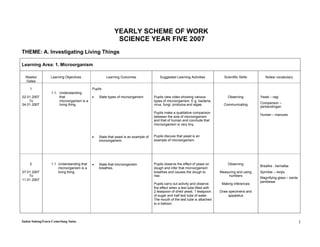
  Weeks/         Learning Objectives                Learning Outcomes                  Suggested Learning Activities           Scientific Skills      Notes/ vocabulary
  Dates

    1                                      Pupils
                 1.1. Understanding
02.01.2007            that                    State types of microorganism        Pupils view video showing various             Observing         Yeast – ragi
    To                microorganism is a                                           types of microorganism. E.g. bacteria,
04.01.2007            living thing.                                                virus, fungi, protozoa and algae.           Communicating       Comparison –
                                                                                                                                                   perbandingan
                                                                                   Pupils make a qualitative comparison
                                                                                                                                                   Human – manusia
                                                                                   between the size of microorganism
                                                                                   and that of human and conclude that
                                                                                   microorganism is very tiny.


                                              State that yeast is an example of   Pupils discuss that yeast is an
                                               microorganism.                      example of microorganism.


    2            1.1 Understanding that       State that microorganism            Pupils observe the effect of yeast on         Observing
                                                                                                                                                   Breathe - bernafas
                     microorganism is a        breathes.                           dough and infer that microorganism
07.01.2007           living thing.                                                 breathes and causes the dough to          Measuring and using   Sprinkle – renjis
    To                                                                             rise.                                         numbers
                                                                                                                                                   Magnifying glass – kanta
11.01.2007
                                                                                                                                                   pembesar
                                                                                   Pupils carry out activity and observe      Making inferences
                                                                                   the effect when a test tube filled with
                                                                                   2 teaspoon of dried yeast, 1 teaspoon     Draw specimens and
                                                                                   of sugar and half test tube of water.          apparatus
                                                                                   The mouth of the test tube is attached
                                                                                   to a balloon.


Indon Sulong/Guru Cemerlang Sains                                                                                                                                             1
Weeks/
  Dates          Learning Objectives              Learning Outcomes                Suggested Learning Activities              Scientific Skills        Notes/ vocabulary


                                             State that microorganism grows   Pupils carry out activities by                   Observing           Grow – bertumbuh
                                                                               sprinkling a few drop of water on slice
                                                                               bread. Pupils put the bread in a            Measuring and using      Mouldy –berkulat
                                                                               plastic bag and observe it for a few            numbers
                                                                               days.
                                                                                                                            Making inferences
                                                                               Pupils observe rotten oranges or
                                                                               mouldy rice using hand lense or             Draw specimens and
                                                                               microscope and record their                      apparatus
                                                                               observation for a few days.

                                                                               Pupils observe and record their
                                                           .                   findings by drawing.


    3            1.1 Understanding that      State that microorganism moves   Pupils view video on the movement of             Observing           Move –bergerak
                     microorganism is a                                        microorganism in water.
14.01.2007           living thing.                                                                                           Communicating          Naked eyes – mata
    To                                                                         Pupils collect samples of water from                                              kasar
18.01.2007                                                                     ponds, rivers or drains and observe          Making inferences
                                                                               the movement of microorganism
                                                                               under a microscope.                         Draw specimens and
                                                                                                                                apparatus
                                                                               Pupils record their observations.
                                                                                                                          Use and handle science
                                             Conclude that microorganisms     Pupils discuss and state that             apparatus and substances
                                              are living things and most of    microorganism is living things and
                                              them cannot be seen with naked   most of them cannot be seen with
                                              eyes.                            naked eyes.


Indon Sulong/Guru Cemerlang Sains                                                                                                                                          2
Weeks/         Learning Objectives              Learning Outcomes                   Suggested Learning Activities               Scientific Skills      Notes/ Vocabulary
  Dates

    4            1.2 Understanding that      State examples of use of            Pupils gather information on the uses      Communicating
                     some                                                         of microorganisms, e.g.                                             Uses – kegunaan
                                              microorganisms.
21.01.2007           microorganisms are                                            a) Making bread                           Making inferences        Harmful – berbahaya
    To               harmful and some        State the harmful effects of         b) Making tapai
                                                                                                                                                      Contagious -berjangkit
25.01.2007           are useful.              microorganism.                       c) Making tempe
                                                                                   d) Making fertiliser                                               Quarantine –diasingkan
                                                                                                                                                      Measles – campak
                                             Describe that disease caused by     Pupils gather information on the harmful
                                              microorganism can spread from       effects of microorganism, e.g.                                      Chicken pox – cacar
                                                                                  a) Causing illness
                                              one person to another.              b) Causing food poisoning                                           Stomach upset – sakit
                                                                                  c) Causing food to turn bad                                                         perut
                                                                                  d) Causing denggi.                                                  Caugh – batuk
                                                                                  e) Causing tooth decay
                                                                                                                                                      Tooth decay –gigi reput
                                             Explains ways to prevent            Pupils gather information on disease
                                                                                                                                                      Sneezing – bersin
                                              diseases caused by                  causes by microorganism e.g. stomach
                                              microorganism.                      upset, measles, cough, flu, tooth decay,                            Flu – selesema
                                                                                  conjunctivitis, mumps, denggi and AIDS.
                                                                                                                                                      Mumps –benguk
                                                                                  Pupils discuss that diseases caused by
                                                                                  microorganism can spread from one
                                                                                                                                                      Conjunctivitis – sakit
                                                                                  person to another.                                                                   mata
                                                                                  Pupils discuss on how diseases caused by
                                                                                  microorganism can be prevented from
                                                                                  spreading, e.g.
                                                                                  a) By washing hands before handling
                                                                                       food,
                                                                                  b) By boiling water before drinking.
                                                                                  c) By covering mouth and nose when
                                                                                       coughing or sneezing.
                                                                                  d) By washing hands after using the
                                                                                       toilet.
                                                                                  e) By putting patient who have chicken
                                                                                       pox, conjunctivitis or mumps into
                                                                                       quarantine.
                                                                                  f)   By covering wounds.


                                                                             HARI KEPUTERAAN SULTAN KEDAH
                                                                                21 JANUARY 2007 (SUNDAY)


Indon Sulong/Guru Cemerlang Sains                                                                                                                                               3
Learning Area: 2. Survival of The Species

  Weeks/         Learning Objectives               Learning Outcomes                 Suggested Learning Activities        Scientific Skills      Notes/ vocabulary
  Dates

    5        Pupils should learn :        Pupils

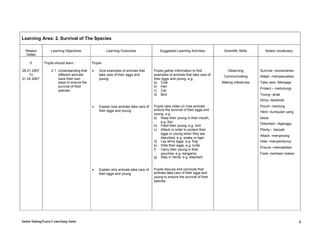
28.01.2007       2.1 Understanding that      Give examples of animals that      Pupils gather information to find          Observing         Survival –kemandirian
    To               different animals        take care of their eggs and        examples of animals that take care of    Communicating       Adapt –menyesuaikan
01.02.2007           have their own           young.                             their eggs and young, e.g.
                     ways to ensure the                                          a) Cow                                  Making inferences    Take care –Menjaga
                     survival of their                                           b) Hen
                                                                                                                                              Protect – melindungi
                     species.                                                    c) Cat
                                                                                 d) Bird                                                      Young –anak
                                                                                                                                              Slimy –berlendir
                                             Explain how animals take care of   Pupils view video on how animals                             Pouch –kantung
                                              their eggs and young.              ensure the survival of their eggs and
                                                                                                                                              Herd –kumpulan yang
                                                                                 young, e.g.
                                                                                 a) Keep their young in their mouth,                          besar
                                                                                     e.g. fish                                                Disturbed –diganggu
                                                                                 b) Feed their young, e.g. bird
                                                                                 c) Attack in order to protect their                          Plenty – banyak
                                                                                     eggs or young when they are
                                                                                                                                              Attack –menyerang
                                                                                     disturbed, e.g. snake or tiger.
                                                                                 d) Lay slimy eggs, e.g. frog                                 Hide –menyembunyi
                                                                                 e) Hide their eggs, e.g. turtle
                                                                                                                                              Ensure –memastikan
                                                                                 f) Carry their young in their
                                                                                     pouches, e.g. kangaroo                                   Feed- memberi makan
                                                                                 g) Stay in herds, e.g. elephant.


                                             Explain why animals take care of   Pupils discuss and conclude that
                                              their eggs and young.              animals take care of their eggs and
                                                                                 young to ensure the survival of their
                                                                                 species.


Indon Sulong/Guru Cemerlang Sains                                                                                                                                     4
Weeks/         Learning Objectives                 Learning Outcomes               Suggested Learning Activities          Scientific Skills         Notes/ vocabulary
  Dates

    6            2.2 Understanding that   Pupils :                                                                                                 Various – pelbagai
                     different plants
                                                                                                                                                   Waxy – berlilin
04.02.2007           have their own          State various ways plants         Pupils study live specimens, view              Observing
    To               ways to ensure the       disperse their seed and fruits.   video or computer simulation to find                               Husk - sabut
08.02.2007           survival of their                                          out the various ways of seeds and         Making inferences        Shell - tempurung
                     species.                                                   fruits dispersal, e.g.
                                                                                a) By water                                 Communicating          Disperse – pencaran
                                                                                b) By wind
                                                                                                                                                   Edible – boleh dimakan
                                                                                c) By animal                                  Classifying
                                                                                d) By explosive mechanism                                          Flame of the forest –
                                                                                                                           Handle specimens
                                                                                                                                                   semarak api
                                             Explains why plants need to       Pupils discuss and conclude that         correctly and carefully
                                              disperse seed or fruits.          plants need to disperse their seeds or                             Chestnut – buah
                                                                                fruits to ensure the survival of their
                                                                                                                                                               berangan
                                                                                species.
                                                                                                                                                   Balsam – keembung
                                             Give example of plant that        Pupils gather information to give                                  Lady’s finger - kacang
                                              disperses seeds and fruits by     examples of plants that disperse
                                              water.                            seeds and fruits by:                                                                 bendi
                                                                                                                                                   Love grass – kemuncup
                                             Give example of plant that        a)   Water
                                              disperses seeds and fruits by     b)   Wind                                                          Characteristics – cirri-ciri
                                              wind.                             c)   Animals
                                                                                d)   Explosive mechanism.                                          Explosive mechanism –
                                                                                                                                                   mekanisma letupan
                                             Give examples of plants that
                                              disperse seeds and fruits by      Pupils study live specimens, view
                                              animals.                          video and discuss the relationship
                                                                                between characteristics of seeds and
                                                                                fruits and their ways of dispersal.
                                             Give examples of plants that
                                              disperse seeds and fruits by      a) By water - light and have air
                                              explosive mechanism.                 space
                                                                                b) By wind – light, have wing- like
                                             Relate characteristics of seeds      structure, dry, have fine hairs and
                                              and fruits to the ways they are      small.
                                              dispersed.                        c) By animals – fleshy, brightly
                                                                                   colored, edible, have smell or
                                                                                   have hooks.
                                                                                d) Explosive mechanism - dry when
                                                                                   ripe.


Indon Sulong/Guru Cemerlang Sains                                                                                                                                                 5
Weeks/         Learning Objectives                 Learning Outcomes                Suggested Learning Activities        Scientific Skills      Notes/ vocabulary
  Dates

    7            2.3 Realizing the        Pupils :
                     importance of
                     survival of the         Predict what will happen if some    Pupils discuss and predict the             Observing         Shortage –kekurangan
11.02.2007           species.                 species of animals or plants do     consequences if certain species of
    To                                        not survive.                        animals and plants become extinct,       Communicating       resource – sumber
15.02.2007                                                                        e.g.
                                                                                  a) Shortage of food resources               Predicting       extinction - kepupusan
                                                                                  b) Other species may also face
                                                                                       extinction.


Learning Area: 3 Food Chain and Food Web

  Weeks/         Learning Objectives                 Learning Outcomes                Suggested Learning Activities        Scientific Skills      Notes/ vocabulary
  Dates


    8        Pupils should learn :        Pupils :

18.02.2007       3.1 Understanding food      Identify animals and the food       Pupils carry out a brainstorming           Observing         Extinction – kepupusan
    To               chain.                   they eat.                           session on animals and the food they
                                                                                                                                               Shortage – kekurangan
22.02.2007                                                                        eat.                                     Communicating
                                                                                                                                               Food chain – rantai
                                             Classify animals into herbivore,    Pupils discuss and classify animals        Classifying
                                                                                                                                                            makanan
                                              carnivore and omnivore.             into the following groups according to
                                                                                  the food they eat.                                           producer –pengeluar
                                                                                  a) Herbivore
                                                                                                                                               consumer -pengguna
                                                                                  b) Carnivore
                                                                                  c) Omnivore

                                             Construct food chain                Pupils build food chains to show the
                                                                                  food relationship among organism.

                                             Identify producer                   From the food chain pupils identify
                                                                                  the producers and the consumers.
                                             Identify consumer


                                                        CHINESE NEW YEAR         -18 & 19 FEBRUARY 2007 (SUNDAY & MONDAY)


Indon Sulong/Guru Cemerlang Sains                                                                                                                                       6
Weeks/         Learning Objectives               Learning Outcomes                    Suggested Learning Activities        Scientific Skills      Notes/ vocabulary
  Dates


    9            3.2 Synthesizing food     Pupils :
                     chains to construct    Construct a food web                   Pupils construct a food web based on       Observing         Food chain – rantai
25.02.2007           food web.                                                      food chains given.
                                                                                                                                                              makanan
    To                                                                                                                       Communicating
01.03.2007                                    Construct food webs of different     Pupils walk around the school                                Food web –siratan
                                               habitats                             compound to study food webs in
                                                                                    places such as field, science garden,                                   makanan
                                                                                    and pond or under flower pot.                                Producer – pengeluar

                                                                                    Based on the organism identified,                            Consumer – pengguna
                                                                                    pupils construct food chains and then
                                                                                    food webs for the habitats they have
                                                                                    studied.


    10           3.2 Synthesizing food        Predict what will happen if there    Pupils discuss and predict what will       Observing         Food web – siratan
                     chains to construct       is a change in the population of a   happen if there is a change in the                                     makanan
04.03.2007           food web.                 certain species in a food web.       population of a certain species in a     Communicating
    To                                                                              food web.                                                    Population –populasi
08.03.2007                                                                                                                      Predicting
                                                                                    Pupils carry out simulation or play
                                                                                    games based on food webs.                                    extinction - kepupusan

                                              Explain what will happen to a        Pupils view video to study various
                                               certain species of animals if they   species that are facing extinction
                                               eat only one type of food.           because they only eat one type of
                                                                                    food.

                                                                                    Pupils conclude that a certain species
                                                                                    of animals that eats one type of food
                                                                                    only has difficulty to survive because
                                                                                    their only source of food may run out,
                                                                                    e.g.
                                                                                    a) Panda eats bamboo shoots only
                                                                                    b) Koala bear eats eucalyptus
                                                                                         leaves only
                                                                                    c) Pangolin eats ants only.


 11.03.07
    To                                                                              MID-TERM HOLIDAY
 17.03.07

Indon Sulong/Guru Cemerlang Sains                                                                                                                                         7
THEME: B. Investigating Forces And Energy

Learning Area: 1 Energy

  Weeks/         Learning Objectives                Learning Outcomes               Suggested Learning Activities        Scientific Skills      Notes/ vocabulary
  Dates


    11       Pupils should learn :       Pupils :                                                                                            Sources – sumber
                                                                                                                                             Energy – tenaga
                 1.1 Understanding the      Explain why energy is needed.      Pupils discuss and conclude that           Observing
18.03.2007           uses of energy                                             energy is needed :                                           Bounce - melantun
    To                                                                          a) By living things to carry out life    Communicating
                                                                                                                                             Fuel – bahan api
22.03.2007                                                                          processes such as moving,
                                                                                    breathing and growing.              Making inferences    Boil – mendidih
                                                                                b) To move, boil, melt or bounce
                                                                                    non-living things.

                                            Give examples where and when       Pupils gather information and give
                                             energy is used.                    examples where and when energy is
                                                                                used.


                                            State various sources of energy.   Pupils gather information about
                                                                                sources of energy, e.g.
                                                                                a) Sun
                                                                                b) Food
                                                                                c) Wind
                                                                                d) Fuel
                                                                                e) Battery

                                                                                Pupils discuss that the sun is the
                                                                                main sources of energy.


                                                                                       TEST 1


Indon Sulong/Guru Cemerlang Sains                                                                                                                                   8
Weeks/         Learning Objectives                 Learning Outcomes         Suggested Learning Activities             Scientific Skills       Notes/ vocabulary
  Dates


    12           1.2 Understanding that   Pupils :
                     energy can be
                                                                                                                                               appliances –peralatan
25.03.2007           transformed from        State the various forms of   Pupils observe various events and               Observing
    To               one form to              energy.                      identify the form of energy involved,                               catapult – lastik
29.03.2007           another.                                              e.g.                                         Communicating
                                                                                                                                               transformed –diubah
                                                                           a) A moving battery-operated toy
                                                                                car                                        Classifying         Stretch –tarik
                                                                           b) A stretched rubber band,                                         Charcoal –arang kayu
                                                                           c) A burning candle                       Use and handle science
                                                                           d) A ringing telephone.                  apparatus and substances   Chemical energy –
                                                                                                                                               tenaga kimia
                                                                                                                    Store science apparatus
                                             State that energy can be     Pupils carry out activities to discuss                              electrical energy –
                                              transformed.                 the transformation of energy, e.g.                                  tenaga elektrik
                                                                           a) Switching on the light :
                                                                               Electrical energy  light energy                                heat energy – tenaga
                                                                           b) Lighting candle:                                                 haba
                                                                               Chemical energy  light energy
                                                                                + heat energy.                                                 fuel –bahan api
                                                                           c) Using solar powered calculator :
                                                                                Solar energy  electrical energy                               kinetic energy –tenaga
                                                                                 light energy                                                 kinetik

                                                                           Pupils discuss that energy can be
                                                                           transformed.

                                                                           Pupils gather information and identify
                                                                           appliances that make use of energy
                                                                           transformation and state the form of
                                                                           energy involved, e.g.
                                                                           a) Electric iron:
                                                                                Electrical energy  heat energy
                                                                           b) Radio :
                                                                               Electrical energy  sound energy
                                                                           c) Ceiling fan :
                                                                                Electrical energy  kinetic
                                                                                energy + sound energy.
                                                                           d) Gas stove :
                                                                                Chemical energy  heat energy
                                                                                + light energy


Indon Sulong/Guru Cemerlang Sains                                                                                                                                       9
Weeks/         Learning Objectives                Learning Outcomes              Suggested Learning Activities         Scientific Skills     Notes/ vocabulary
  Dates


    13                                                                                                                                       Renewable energy –
                 1.3 Understanding       Pupils :                                                                          Observing         tenaga diperbaharui
01.04.2007           renewable     and
    To               non-renewable          State what renewable energy is.   Pupils discuss that renewable energy      Communicating       Non-renewable –
05.04.2007           energy.                State what non-renewable          is the energy that can be replenished                         tenaga yang tidak
                                             energy is.                        when used up and non-renewable              Classifying       boleh diperbaharui
                                                                               energy is the energy that cannot be
                                                                               replenished when used up.                Making inferences    Replenished –
                                                                                                                                             digantikan
                                            List renewable energy resources    Pupils gather information on the
                                                                               following :                                                   Used up- habis
                                            List non-renewable energy         a) Renewable energy resources,                                         digunakan
                                             resources.                             e.g. solar, wind, biomass
                                                                               b) Non-renewable energy                                       Coal – arang batu
                                                                                    resources, e.g. natural gas,
                                                                                    petroleum and coal.                                      Charcoal – arang kayu

                                                                                                                                             Wisely – secara
                                            Explain why we need to use        Pupils discuss and conclude why we                                     bijaksana
                                             energy wisely.                    need to use energy wisely, e.g.
                                                                               a) Some energy resources cannot
                                                                                   be replenished when used up
                                                                               b) To save cost
                                                                               c) To avoid wastage
                                                                               d) To reduce pollution


    14           1.3 Understanding          Explain why renewable energy is   Pupils discuss why renewable energy         Predicting
                     renewable and           better than non-renewable         is better than non-renewable energy.                          Renewable energy –
08.04.2007           non-renewable           energy.                                                                    Making inferences    tenaga diperbaharui
    To               energy.
12.04.2007                                                                                                               Communicating       Non-renewable –
                                            Give examples on how to save      Pupils carry out brainstorming                                tenaga yang tidak
                                             energy.                           session on how to save energy in                              boleh diperbaharui
                                                                               everyday life.
                                                                                                                                             Replenished –
                                                                                                                                             digantikan
                                            Practice saving energy            Pupils draw a list of do’s and don’ts
                                                                               on how to save energy and use it as                           Used up- habis
                                                                               a guide to carry out daily activities.                                 digunakan

Indon Sulong/Guru Cemerlang Sains                                                                                                                                  10
Learning Area: 2 Electricity

  Weeks/         Learning Objectives                   Learning Outcomes               Suggested Learning Activities            Scientific Skills     Notes/ vocabulary
  Dates


    15           2.1 Knowing the            Pupils :
                     sources of                                                                                                   Observing
15.04.2007           electricity.              State the sources of electricity   Pupils carry out activity such as                                Dry cell – sel kering
    To                                                                             lighting up a bulb or ringing an             Communicating       Hydroelectric power –
19.04.2007                                                                         electric bell to verify that the following
                                                                                   sources produce electricity, e.g.                                kuasa hidro elektrik
                                                                                   a) Dry cell / battery
                                                                                   b) Accumulator
                                                                                   c) Dynamo
                                                                                   d) Solar cell


                 2.2 Understanding a        Pupils :
                     series circuit and a
                     parallel circuit          Identify the symbols of various    Pupils build as many different electric        Observing         Series circuit – litar
                                                compon ents in a simple electric   circuits as they can.                                                              bersiri
                                                circuit.                                                                        Communicating
                                                                                   Pupils are introduced the symbols of                             Parallel circuit – litar
                                                                                   the components in an electric circuit,         Predicting                           selari
                                                                                   i.e. battery, bulb, connecting wires
                                                                                   and switch.                                                      Brightness –
                                                                                                                                                    kecerahan

                                               Draw circuit diagram.              Pupils draw circuit diagram based on                             Arrangement -
                                                                                   the circuits that they have build.                               susunan


                                               Identify the difference in the     Pupils observe various series circuit
                                                arrangement of bulbs in series     and parallel circuits.
                                                and parallel circuits.
                                                                                   Based on observation, pupils discuss
                                                                                   the differences in the arrangement of
                                                                                   bulbs in series and parallel circuits.

                                                                                   Pupils draw circuit diagrams of series
                                                                                   and parallel circuits and compare the
                                                                                   arrangement of the bulbs in these
                                                                                   circuits.

Indon Sulong/Guru Cemerlang Sains                                                                                                                                           11
Weeks/         Learning Objectives                 Learning Outcomes                  Suggested Learning Activities                Scientific Skills      Notes/ vocabulary
  Dates


    16           2.2 Understanding a           Build a series circuit              Pupils given batteries, bulbs,                     Observing          Series circuit – litar
                     series circuit and a                                           switches and connecting wires to                                                        bersiri
22.04.2007           parallel circuit          Build a parallel circuit.           build series and parallel circuits.             Communicating
    To                                                                                                                                                    Parallel circuit – litar
26.04.2007                                                                                                                             Predicting                            selari
                                               Compare the brightness of the       Pupils observe and compare the
                                                bulbs in a series and a parallel    brightness of the bulbs in :                  Controlling variables   Brightness –
                                                circuit.                            a) Series circuits                                                    kecerahan
                                                                                    b) Parallel circuits                          Making hypotheses
                                                                                    c) Between series and parallel                                        Arrangement –
                                                                                         circuits.                                   Experimenting        susunan

                                               Compare the effect on the bulbs     Pupils carry out activities and              Use and handle science
                                                when various switches in a          compare what happen to the bulbs in                apparatus
                                                series and a parallel circuit are   a series circuit and in a parallel circuit
                                                off.                                when various switches in each circuit         Draw specimens and
                                                                                    are off.                                           apparatus


    17           2.3 Understanding the      Pupils :
                                                                                                                                                          electric shock –
                     safety precautions      Describe the danger of                Pupils discuss the danger of                       Observing
                                                                                                                                                          kejutan elektrik
29.04.2007           to be taken when           mishandling electrical              mishandling electrical appliances,
    To               handling electrical        appliances.                         e.g.                                            Communicating         Appliances –
03.05.2007           appliances.                                                     a) Electric shock c) Burn
                                                                                                                                                          peralatan
                                                                                     b) Fire              d) Electrocution         Making inferences

                                                                                    Pupils discuss the safety precautions                                 electrocution –renjatan
                                                                                    to be taken when using electrical                                     elektrik
                                               Explain the safety precautions to   appliances, e.g.
                                                be taken when using electrical      a) Do not touch electrical                                            Faulty – rosak
                                                appliances.                              appliances with wet hands.
                                                                                    b) Do not use electrical appliances                                   insulator -penebat
                                                                                         that are faulty or having broken
                                                                                         insulation wires.
                                                                                    c) Do not repair electrical
                                                                                         appliances on your own
                                                                                    d) Do not connect too many
                                                                                        electrical appliances to one
                                                                                        power supply.

                                                                     LABOUR DAY & WESAK DAY -1 MAY 2007(TUESDAY)

Indon Sulong/Guru Cemerlang Sains                                                                                                                                                 12
Learning Area: 3 Light

  Weeks/         Learning Objectives               Learning Outcomes                    Suggested Learning Activities             Scientific Skills       Notes/ vocabulary
  Dates


    18       Pupils should learn :        Pupils :
                                           State that light travels in a           Pupils carry out activities to observe                              Beam – alur cahaya
                                                                                                                                    Observing
06.05.2007       3.1 Understanding that       straight line.                        that light travels in a straight line.                              Travel – bergerak
    To               light travels in a                                                                                           Communicating
                     straight line.          Give examples to verify that light    Pupils gather information and give                                  Opaque – legap
10.05.2007
                                              travels in a straight line.           examples of events or phenomena                Predicting
                                                                                    that shadow light travels in a straight    Measuring and using      Straight line –garis
                                                                                    line.                                                                              lurus
                                                                                                                                   numbers

                                             Describe how shadow is formed.        Pupils observe and discuss the                                      Phenomena –
                                                                                                                               Controlling variables
                                                                                    formations of shadow to conclude                                    fenomena
                                                                                    that shadow is formed when light is         Making hypotheses
                                                                                    blocked by an opaque or a                                           Shadow –bayang-
                                                                                    translucent object.                                                         bayang
                                                                                                                                  Experimenting

                                             Design a fair test to find out what   Pupils carry out activities to                                      Blocked –dihalang
                                                                                                                              Use and handle science
                                              factors cause the size of shadow      investigate the factors that cause the          apparatus
                                              to change by deciding what to         shape and size of a shadow to                                       Distance –jarak
                                              keep the same, what to change,        change.                                    Draw specimens and
                                              and what to observe.                                                                                      Light source –sumber
                                                                                     Pupils observe, discuss, and                   apparatus
                                                                                                                                                                      cahaya
                                                                                    conclude that :
                                                                                    a) When the distance between an           Store science apparatus
                                                                                         object and its light sources
                                                                                         decrease, the size of shadow
                                                                                         increase.
                                                                                                      and
                                                                                    When the distance between an object
                                                                                    and the screen decrease the size of
                                                                                    the shadow decrease.

                                             Design a fair test to find out what   b) The shape of the shadow changes
                                              factors cause the shape of a          according to the position of light
                                              shadow to change by deciding          sources.
                                              what to keep the same, what to                         and
                                              change, and what to observe.          The shape of the shadow changes
                                                                                    according to the position of an object.


Indon Sulong/Guru Cemerlang Sains                                                                                                                                              13
Weeks/         Learning Objectives                      Learning Outcomes                    Suggested Learning Activities             Scientific Skills       Notes/ vocabulary
  Dates


    19       3.2 Understanding that            Pupils :                                    Pupils carry out activities to                  Observing
                 light can be reflected.                                                   investigate the reflection of light                                 reflection – pentulan
13.05.2007                                        State that the light can be             using:                                        Communicating
    To                                             reflected.                              a) A mirror                                                         sharp bend- selekoh
17.05.2007                                                                                 b) An aluminum foil                       Use and handle science    tajam
                                                                                                                                           apparatus
                                                  Draw ray diagram to show                Pupils draw ray diagram to show the                                 ray diagram –
                                                   reflection of light.                    reflection of light in the above           Draw specimens and       gambarajah sinar
                                                                                           activities.                                     apparatus
                                                                                                                                                               Image -imej
                                                  Give examples of uses of                Pupils gather information about the       Store science apparatus
                                                   reflection of light in everyday life.   uses of reflection of light in everyday
                                                                                                                                                               Reflector mirror –
                                                                                           life, e.g.
                                                                                                                                                               cermin pembalik
                                                                                           a) Side mirror of a car
                                                                                           b) Mirror at the sharp bend of a
                                                                                                                                                               Side mirror –cermin
                                                                                                 road
                                                                                                                                                                            sisi
                                                                                           c) Mirror in the barbershop
                                                                                           d) Periscope

                                                                                           Pupils apply the principle of light
                                                                                           reflection to design devices, e.g.
                                                                                           a) Periscope
                                                                                           b) Kaleidoscope


    20
                                                              REVISION AND PREPARATION FOR MID-YEAR EXAM - 20 MAY 2007
20.05.2007
    To                                     MID-YEAR EXAMINATION – 21, 22, 23 DAN 24 MAY 200 7 (MONDAY, TUESDAY, WEDNESDAY & THURSDAY)
24.05.2007


                                                                                          MID-YEAR HOLIDAY
                                                                                    25 MAY 2007 UNTIL 09 JUNE 2007


Indon Sulong/Guru Cemerlang Sains                                                                                                                                                      14
Learning Area: 4 Heat

  Weeks/         Learning Objectives                  Learning Outcomes                 Suggested Learning Activities          Scientific Skills       Notes/ vocabulary
  Dates


    21           4.1 Understanding that    Pupils :
                     temperature is an                                                                                           Observing
10.06.2007           indicator of degree      State that when a substance         Pupils heat 250ml of water for 3                                  Degree of hotness –
    To               of hotness.               gains heat it will become warmer.   minutes and feel the water every few        Communicating         darjah kepanasan
13.06.2007                                                                         seconds while heating to feel the
                                                                                   change of temperature.                   Measuring and using      heat –haba
                                                                                                                                numbers
                                                                                                                                                     Temperature –suhu
                                              State that when a substance         Pupils let the warm water cool down     Use and handle science
                                               loses heat it becomes cooler.       and feel the water every few seconds.         apparatus           Thermometer –
                                                                                                                                                     jtermometer
                                                                                   Based on the above activities, pupils   Clean science apparatus
                                                                                   discuss and conclude that :                                       Mercury –
                                                                                   a) Heat gain cause the water to         Store science apparatus   raksa/merkuri
                                                                                       become warmer

                                                                                   b)   Heat loss causes the water to
                                                                                        become cooler.

                                              Measure temperature using the       Pupils are guided to use and read
                                               correct technique.                  thermometer correctly.


                                              State the metric unit for            Pupils gather information on the
                                               temperature.                        metric unit for measuring
                                                                                   temperature.


                                                                                           TEST 2


Indon Sulong/Guru Cemerlang Sains                                                                                                                                          15
Weeks/         Learning Objectives                Learning Outcomes                   Suggested Learning Activities            Scientific Skills       Notes/ vocabulary
  Dates


    22           4.1 Understanding that       State the temperature of an          Pupils carry out activity to measure           Observing           Increases –meningkat
                     temperature is an         object or material increases as it   temperature, e.g:
                                                                                                                                                       Decreases –menurun
17.06.2007           indicator of degree       gains heat.                           a) Heat up water and record the             Communicating
    To               of hotness.                                                         temperatures every few minutes                                Gains heat –
21.06.2007                                    State that temperature of an          b) Turn off the bunsen burner and        Measuring and using      bertambah haba
                                               object or material decreases as it        record the temperature every             numbers
                                               loses heat.                               few minutes while the water                                   Loses heat –
                                                                                         cools off.                          Use and handle science    kehilangan haba
                                                                                                                                   apparatus
                                                                                    Pupils discuss and conclude that the                               Indicator –petunjuk
                                                                                    temperature :                            Clean science apparatus
                                                                                    a) Increase when heat is gained                                    hotness –kepanasan
                                                                                    b) Decrease when heat is lost.           Store science apparatus

                                              Conclude that the temperature is     Pupils discuss and conclude that the
                                               an indicator to measure hotness.     temperature is an indicator to
                                                                                    measure hotness.


    23           4.2 Understanding the     Pupils :
                                                                                                                                                       dent – kemek
                     effects of heat on     State that matter expands when         Pupils carry out activities to observe         Observing
24.06.2007           matter.                   heated.                              the effects of heat on matter, e.g.
                                                                                    a) Heating an iron ball and inserting                              expand –
    To                                                                                                                           Communicating
                                                                                                                                                       mengembang
28.06.2007                                    State the matter contracts when           it into an iron ring
                                               cooled.                              b) Cooling the heated iron ball and        Making inferences
                                                                                         inserting it into the iron ring                               contract – mengecut
                                                                                    c) Heating colored water in a
                                                                                         beaker with a glass tube and                                  snap – putus
                                                                                                                             Use and handle science
                                                                                         observing the water level in the          apparatus
                                                                                         glass tube                                                    Sag –lendut
                                                                                    d) Heated a dented ping pong ball        Clean science apparatus
                                                                                         in hot water.                                                 Gap –celah/ruang
                                                                                    e) Cooling colored water in a            Store science apparatus
                                                                                         beaker with a glass tube and                                  Inflate -kembung
                                                                                         observing the water level in the
                                                                                         glass tube.

                                                                                    Pupils discuss their observations of
                                                                                    the activities and conclude that :
                                                                                    a) Matter expands when heated
                                                                                    b) Matter contracts when cooled

Indon Sulong/Guru Cemerlang Sains                                                                                                                                            16
Weeks/         Learning Objectives              Learning Outcomes                    Suggested Learning Activities            Scientific Skills       Notes/ vocabulary
  Dates


    24           4.2 Understanding the       Give examples of the application    Pupils view video or computer                   Observing
                     effects of heat on       of the principle of expansion and   simulation on the expansion and                                     expand –
                     matter.                  contractions in everyday life.      contraction of matter in everyday life,       Communicating         mengembang
01.07.2007                                                                        e.g.
    To                                                                            a) An electric cable is installed           Making inferences       contract – mengecut
05.07.2007                                                                             loosely to prevent it from
                                                                                       snapping when it contracts in                                  snap – putus
                                                                                       cold weather.                        Use and handle science
                                                                                                                                  apparatus           Sag –lendut
                                                                                  b)   There are gaps at railway tracks
                                                                                       to allow for expansion in hot        Clean science apparatus   Gap –celah/ruang
                                                                                       water.
                                                                                                                            Store science apparatus   Inflate –kembung
                                                                                  c)   A tight bottle cap can be
                                                                                       loosened by immersing it in hot                                Concrete slab –
                                                                                       water.                                                         kepingan konkrit

                                                                                                                                                      Immersing -
                                                                                  d)   Concrete slabs on pavement                                     meletakkan
                                                                                       have gaps to allow for
                                                                                       expansion.


Indon Sulong/Guru Cemerlang Sains                                                                                                                                           17
THEME: C. Investigating Materials

Learning Area: 1 States of Matter

  Weeks/         Learning Objectives                    Learning Outcomes             Suggested Learning Activities            Scientific Skills       Notes/ vocabulary
  Dates


    25           1.1 Understanding that      Pupils :
                     matter exists in the                                                                                        Observing
08.07.2007           form of solid, liquid      Classify objects and materials   Pupils classify objects and materials                              Solid –pepejal
    To               or gas.                     into three states of matter.     into solid, liquid and gas. Pupils           Communicating
12.07.2007                                                                        discuss and give reasons for their
                                                                                  classification.                                Classifying         Liquid –cecair

                                                State the properties of solid.   Pupils study the properties of solid      Measuring and using
                                                                                  by:                                           numbers              Properties –sifat-sifat
                                                                                  a) Weighing various kinds of solids
                                                                                  b) Measuring the volumes of                Making inferences
                                                                                      various kind of solids                                         Mass –jisim
                                                                                  c) Putting various types of solids       Use and handle science
                                                                                      into containers of various                 apparatus
                                                                                      shapes.                                                        Fixed volume –
                                                                                                                           Clean science apparatus   isi padu tetap
                                                                                  Pupils discuss and conclude the
                                                                                  properties of solids, i.e. a solid :     Store science apparatus   Fixed shape –bentuk
                                                                                  a) Has mass                                                        tetap
                                                                                  b) Has fixed volume
                                                                                  c) Has fixed shape

                                                State the properties of liquid   Pupils study the properties of liquid
                                                                                  by :
                                                                                  a) Weighing various kinds of liquids
                                                                                  b) Measuring the volumes of liquids
                                                                                  c) Pouring liquid into containers of
                                                                                       various shapes

                                                                                  Pupils discuss and conclude the
                                                                                  properties of solids, i.e. a liquids :
                                                                                  a) Has mass
                                                                                  b) Has fixed volume
                                                                                  c) Has no permanent shape but
                                                                                      takes the shape of its container.

Indon Sulong/Guru Cemerlang Sains                                                                                                                                              18
Weeks/         Learning Objectives              Learning Outcomes                   Suggested Learning Activities             Scientific Skills       Notes/ vocabulary
  Dates


                                             State the properties of gas         Pupils study the properties of gas by :         Observing           Gas – gas
                                                                                  a) Balancing two inflated balloons
                                                                                      on a stick and puncturing on of           Communicating         Inflated –berisi angina
                                                                                      the balloons
                                                                                  b) Inflating balloons of different         Measuring and using      Smoke –asap
                                                                                      shapes                                     numbers
                                                                                  c) Observing smoke in a closed                                      Occupies -memenuhi
                                                                                      container the placing an inverted       Making inferences
                                                                                      container on it. Removing the
                                                                                      cover of the first container and      Use and handle science
                                                                                      observe how smoke moves from                apparatus
                                                                                      a container to another inverted
                                                                                      container placed directly over it     Clean science apparatus
                                                                                  d) Feeling the pressure of gas in a
                                                                                      syringe when its plunges down         Store science apparatus
                                                                                      with nozzle closed.

                                                                                  Pupils discuss and conclude the
                                                                                  properties of gas, i.e.
                                                                                  a) Has mass
                                                                                  b) Has no fixed shape but takes the
                                                                                      shape of its container
                                                                                  c) Occupies space and has no fixed
                                                                                      volume
                                                                                  d) Can be compressed


    26           1.2 Understanding that   Pupils :                                                                                                    Boiling –pendidihan
                     matter can change     State that water can change its       Pupils carry out the following                  Observing
                                                                                                                                                      Melting –peleburan
15.07.2007           from one state to        state.                              activities to observe the change of the
    To               another.                                                     state of matter :                             Communicating         water vapor – wap air
19.07.2007                                                                        a) Allowing ice to melt
                                                                                                                                                      water cycle – kitar air
                                                                                  b) Heating water until it boils
                                                                                  c) Collecting water vapors, allowing      Use and handle science    interchangeable –
                                                                                       it to cool and making it freeze.           apparatus           boleh saling bertukar

                                             Conclude that water can exist in    Pupils discuss and conclude that :        Clean science apparatus
                                              any of the three states of matter   a) Water can change from one state
                                                                                      to another                            Store science apparatus
                                                                                  b) Water can exist as solid, liquid
                                                                                      and gas.

Indon Sulong/Guru Cemerlang Sains                                                                                                                                               19
Weeks/         Learning Objectives                 Learning Outcomes                 Suggested Learning Activities           Scientific Skills       Notes/ vocabulary
  Dates


                                                                                                                                                     evaporation –
    27           1,2 Understanding that      Identify the processes involved      Pupils discuss the process involved           Observing           penyejatan
                     matter can change        when a matter changes from one       when a matter changes from one
22.07.2007           from one state to        state to another.                    state to another, i.e.                      Communicating         condensation –
    To               another.                                                      a) Melting                                                        kondensasi
26.07.2007                                                                         b) Boiling                                Making inferences
                                             Identify factors that affect the     c) Evaporation                                                    freezing - pembekuan
                                              rate of evaporations of water.       d) Condensation                         Use and handle science
                                                                                   e) Freezing                                   apparatus           melting – peleburan

                                                                                                                           Clean science apparatus   Boiling –pendidihan
                                             Identify factors that affect the     Pupils investigate and discuss the
                                              rate of evaporation of water.        factors that affect how fast water      Store science apparatus
                                                                                   evaporates e.g.
                                                                                   a) Hot water
                                                                                   b) Windy


                 1.3 Understanding the    Pupils :
    28               water cycle.
                                             Describe how clouds are formed.      Pupils view computer simulation to            Observing           cloud – awan
29.07.2007                                                                         study the formation of clouds and
                                                                                                                                                     water cycle – kitar air
    To                                                                             rain.                                       Communicating
02.08.2007                                                                                                                                           Formation -
                                             Describe how rain is formed.         Pupils discuss and explain the                                    pembentukan
                                                                                   changes in the state of matter in the
                                                                                   water cycle.                                                      Water cycle –kitar air

                                             Explain how water is circulated in   Pupils view computer simulation on                                Water droplet –titis air
                                              the environment.                     how water is circulated in the
                                                                                   environment.                                                      Water vapour – wap
                                                                                                                                                                    air
                                             Explain the importance of water      Pupils discuss the importance of
                                              cycle.                               water cycle.


Indon Sulong/Guru Cemerlang Sains                                                                                                                                              20
Weeks/         Learning Objectives                  Learning Outcomes               Suggested Learning Activities      Scientific Skills     Notes/ vocabulary
  Dates


                 1.4 Appreciating the      Pupils :
    29               importance of water
                     resources.               Give reasons why we need to       Pupils view video about ;                 Observing         Water resources –
05.08.2007                                     keep or water resources clean.    a) The importance of water for living                       sumber air
    To                                                                               things                              Communicating
09.08.2007                                                                                                                                   Importance –
                                                                                 b)   The effects of human activities                        kepentingan
                                                                                      on quality of water supply.
                                                                                                                                             Effect -kesan


                                              Describe ways to keep our water   Pupils gather information on how to
                                               resources clean.                  keep our water resources clean and
                                                                                 present it in the form of folio.

                                                                                 Pupils draw posters to show
                                                                                 appreciation that water is an
                                                                                 important resource.


Indon Sulong/Guru Cemerlang Sains                                                                                                                                  21
Learning Area: 2 Acid and Alkali

  Weeks/         Learning Objectives                  Learning Outcomes                 Suggested Learning Activities          Scientific Skills       Notes/ vocabulary
  Dates


                 2.1 Understanding the       Pupils :
                                                                                                                                                     litmus paper – kertas
    30               properties of acidic,    Identify acidic, alkaline and        Pupils test substances to determine          Observing
                     alkaline and neutral        neutral substance using litmus     whether they are acidic, alkaline or                                                litmus
12.08.2007           substances.                 paper.                             neutral substances based on the            Communicating         sour – masam
    To                                                                              change of wet litmus papers colour.
16.08.2007                                                                                                                       Classifying         bitter - pahit
                                                                                                                                                     neutral – neutral
                                                                                                                             Making inferences
                                                Identify the taste of acidic and    Pupils determine whether food                                   acidic – keasidan
                                                 alkaline food.                     samples are acidic or alkaline by       Defining operationally
                                                                                                                                                     alkaline – kealkalian
                                                                                    testing the food samples and testing
                                                                                    with litmus paper.                     Use and handle science    property - sifat
                                                                                                                                 apparatus

                                                                                                                           Clean science apparatus
                                                Conclude the properties of         Pupils carry out discussion and
                                                 acidic, alkaline and neutral       conclude the properties of acidic,     Store science apparatus
                                                 substances.                        alkaline and neutral substance in
                                                                                    terms of taste and colour changes of
                                                                                    litmus paper.


 17.08.07                                                                           MID-TERM HOLIDAY
    To
 25.08.07


Indon Sulong/Guru Cemerlang Sains                                                                                                                                                22
THEME: D. Investigating The Earth and The Universe

Learning Area: 1 Constellation

  Weeks/         Learning Objectives                Learning Outcomes          Suggested Learning Activities            Scientific Skills       Notes/ vocabulary
  Dates


             Pupils should learn :       Pupils :
    31
                 1.1 Understanding the      State what constellation is   Pupils view video or computer                  Observing           Constellation – buruj
26.08.2007           constellation.                                        simulation or visit planetarium to
    To                                                                     observe various constellations.              Communicating         Orion – belantik
30.08.2007                                                                                                                                    Scorpion – scorpion
                                                                           Pupils discuss that constellation is a
                                                                                                                                              Big bipper – biduk
                                                                           group of stars that form a certain
                                                                           pattern in the sky.                      Use and handle science    Southern cross – pari
                                                                                                                          apparatus
                                                                                                                                              Pattern – corak
                                            Identify constellation        Pupils observe the Orion, Scorpion,                                direction – arah
                                                                           Big Dipper, and Southern Cross in        Store science apparatus
                                                                                                                                              Season - musim
                                                                           the sky.


                                            State the importance of       Pupils build a model to study the
                                             constellations.               pattern of Orion, Scorpion, Big
                                                                           Dipper, and Southern Cross.

                                                                           Pupils gather information on the
                                                                           importance of constellations, e.g.
                                                                           a) To show direction
                                                                           b) To indicate the time to carry out
                                                                               certain activities, e.g. planting
                                                                               season.


                                                                                  TEST 3


Indon Sulong/Guru Cemerlang Sains                                                                                                                                     23
Learning Area: 2 The Earth, The Moon and The Sun

  Weeks/         Learning Objectives                Learning Outcomes                  Suggested Learning Activities              Scientific Skills       Notes/ vocabulary
  Dates


    32           2.1 Understanding the   Pupils :
                     movement of the
02.09.2007           Earth, the Moon,       State that the Earth rotates on its   Pupils view video or computer                    Observing           Rotate – berputar
    To               and the Sun.            exist.                                simulation or model about the                                        Sundial – jam
06.09.2007                                                                         movement of the Earth, the Moon and            Communicating
                                                                                   the Sun.                                                             matahari
                                                                                                                              Use and handle science    Axis- paksi
                                            State that the Earth rotates and      Pupils discuss and explain the                   apparatus
                                             at the same time moves round          rotation of the Earth and the Moon                                   West – barat
                                             the Sun.                              and their movement around the Sun.         Store science apparatus
                                                                                                                                                        East – timur
                                            State that the Moon rotates on its                                                                         Movement –
                                             axis.                                                                                                      pergerakan

                                            State that the Moon rotates and                                                                            Position – kedudukan
                                             at the same time moves round
                                             the Earth.


    33           2.1 Understanding the      Describe the changes in length        Pupils observe and record the length             Observing           Throughout –
                     movement of the         and position of the shadow            and the position of the shadow of a                                  sepanjang
09.09.2007           Earth, the Moon,        throughout the day.                   pole at different time of the day (pole        Communicating
    To               and the Sun.                                                  as the object and the Sun as the                                     Shadow – bayang-
13.09.2007                                                                         source of light).                           Measuring and using              bayang
                                                                                                                                   numbers
                                                                                   Pupils fix a toothpick vertically on the                             Rotate – berputar
                                                                                   surface of a globe. Pupils observe the     Use and handle science
                                                                                   length and position of the shadow                                    Sundial – jam
                                                                                                                                    apparatus
                                                                                   formed when the globe is rotated at                                            matahari
                                                                                   its axis over a fixed light source.        Store science apparatus
                                                                                                                                                        Axis- paksi
                                                                                   Pupils build a sundial.                                              West – barat
                                                                                   Pupils discuss and conclude that the                                 East – timur
                                            Conclude that the Earth rotates
                                             on its axis from west to east.        Earth rotates on its axis from west to
                                                                                   east.

                                                               AWAL RAMADHAN - 13 SEPTEMBER 2007 (THURSDAY)

Indon Sulong/Guru Cemerlang Sains                                                                                                                                             24
Weeks/         Learning Objectives              Learning Outcomes                    Suggested Learning Activities             Scientific Skills       Notes/ vocabulary
  Dates


    34           2.2 Understanding the   Pupils :                                                                                                      Illuminating –
                     occurrence of day    State that it is day time for the       Pupils view video or computer                   Observing           menyuluh
16.09.2007           and night.              part of the Earth facing the sun.     simulation on how days and nights
    To                                                                             are formed or carry out a simulation          Communicating         Facing - menghadap
20.10.2007                                                                         by illuminating a rotation globe to
                                                                                   observe the occurrence of day and           Making inferences       Rotating glob – glob
                                                                                   night.                                                              yang berputar

                                            State it is night time for the part   Based on the above activity, pupils                                 Day – siang
                                             of the Earth facing away from the     discuss how day and night occur.
                                             Sun.                                                                                                      Night – malam

                                            Explain that day and night occur      Pupils draw diagrams to show the                                    Occurrence – kejadian
                                             due to the rotation of the Earth      occurrence of day and night.
                                             on its axis.


    35           2.3 Understanding the   Pupils :
                     phases of the        State that the Moon does not            Pupils view video or computer                   Observing           New moon – anak
23.09.2007           Moon.                   emit light.                           simulation and discuss that the Moon                                           bulan
    To                                                                             does not emit light but reflects the          Communicating
27.09.2007                                  Explain that the Moon appears         Sunlight.                                                           Crescent – bulan sabit
                                             bright when it reflects sunlight.                                                 Making inferences
                                                                                                                                                       Half moon – bulan
                                            Describe the phases of the            Pupils view video on the phases of         Measuring and using                  separa
                                             Moon.                                 the Moon.                                      numbers
                                                                                                                                                       Full moon – bulan
                                                                                   Pupils using the ping-pong ball and       Use and handle science                penuh
                                                                                   light sources to simulate the following         apparatus           Reflect –
                                                                                   phases of the moon :                                                memantulkan
                                                                                   a) New Moon                               Store science apparatus
                                                                                   b) Crescent                                                         Phase – fasa
                                                                                   c) Half Moon
                                                                                   d) Full Moon                                                        Lunar calendar –
                                                                                                                                                       takwim qamari
                                                                                   Pupils carry out a project to observe
                                                                                   and record the phases of the Moon                                   Emit - memancarkan
                                                                                   for a month and relate them to the
                                                                                   dates of the lunar calendar.


Indon Sulong/Guru Cemerlang Sains                                                                                                                                             25
THEME: E. Investigating Technology

Learning Area: 1 Strength and Stability

  Weeks/         Learning Objectives                    Learning Outcomes                Suggested Learning Activities               Scientific Skills       Notes/ vocabulary
  Dates


                 1.1 Knowing the         Pupils :                                                                                                          Shape – bentuk
    36               shapes of objects                                                                                                 Observing
                     in structures.             State the shapes of objects.        Pupils carry out activity to recognize                                Cube – kubus
30.09.2007                                                                           the shapes of objects, i.e.                     Communicating
    To                                                                               a) Cube                                                               Cuboid – kuboid
04.10.2007                                                                           b) Cone                                           Classifying
                                                                                     c) Cuboids                                                            Sphere – sfera
                                                                                     d) Sphere                                         Predicting
                                                                                     e) Cylinder                                                           Cone – kon
                                                                                     f) Pyramid                                   Measuring and using
                                                                                     g) Hemisphere                                    numbers              Cylinder – silinder

                                                                                                                                  Controlling variables    Pyramid – piramid
                                                Identify shapes in structure        Pupils walk around the school
                                                                                     compound and identify shapes                  Making hypotheses       Hemisphere –
                                                                                     mentioned above.                                                      hemisfera
                                                                                                                                     Experimenting
                 1.2 Understanding the       Pupils :                                                                                                      Structure – struktur
                     strength and                                                                                                Use and handle science
                     stability of an            Identify shapes of objects that     Pupils carry out activities to identify           apparatus           Strength – kekuatan /
                     object.                     are stable.                         the shapes of objects that are stable.                                kekukuhan
                                                                                                                                  Draw specimens and
                                                                                     Pupils carry out activities to                    apparatus           Stability – kestabilan
                                                Identity the factors that effects   investigate the factors that affects
                                                 stability of objects.               stability of a structure, e.g.              Store science apparatus   Base area – luas
                                                                                     a) Pushing a bottle standing upright                                  tapak
                                         .                                                and a bottle standing upside
                                                                                          down.                                                            Affect –
                                                                                     b) Pushing a high chair and a low                                     mempengaruhi
                                                                                          chair.
                                                                                                                                                           Stand at ease –
                                                                                     Pupils discuss and conclude that the                                  senang diri
                                                                                     stability of an object is s affected by :
                                                                                     a) Base area                                                          Stand at attention –
                                                                                     b) Height                                                             bersedia

Indon Sulong/Guru Cemerlang Sains                                                                                                                                                   26
Weeks/         Learning Objectives           Learning Outcomes                 Suggested Learning Activities             Scientific Skills       Notes/ vocabulary
  Dates


                                          Explain how base area affects                                                                         Strength – kekuatan /
                                           stability.                        Pupils carry out activities to                  Observing
                                                                                                                                                 kekukuhan
                                                                             investigate how base area affects the
                                                                             stability of an object, i.e. the bigger       Communicating         Stability – kestabilan
                                                                             the base area, the more stable of the
                                          Explain how height affects        object.
                                                                                                                                                 Base area – luas
                                           stability.                                                                   Measuring and using
                                                                                                                                                              tapak
                                                                                                                            numbers
                                                                             Pupils carry out activities to
                                                                                                                                                 Affect –
                                                                             investigate how height affects the         Controlling variables
                                                                                                                                                 mempengaruhi
                                                                             stability of an object, i.e. the higher
                                                                             the object, the less stable of the          Making hypotheses       Stability –kestanilan
                                                                             object.
                                                                                                                           Experimenting
                                                                                                                                                 Balance –
                                                                                                                                                 keseimbangan
                                                                             Pupils carry out activities to            Use and handle science
                                                                             investigate how height affects the              apparatus
                                                                                                                                                 Topple –tumbang
                                                                             stability of an object, i.e. the higher
                                                                             the object, the less stable of the         Draw specimens and
                                                                             object.                                         apparatus

                                                                                                                       Store science apparatus


    37
                                                                           FINAL YEAR EXAMINATION
07.10.2007
    To                                 08 OCTOBER 2007 UNTIL 11 OCTOBER 2007 (MONDAY, TUESDAY, WEDNESDAY & THURSDAY)
11.10.2007


Indon Sulong/Guru Cemerlang Sains                                                                                                                                         27
Weeks/         Lear ning Objectives             Learning Outcomes                     Suggested Learning Activities              Scientific Skills       Notes/ vocabulary
  Dates


    38           1.2 Understanding the      Identify the factors that affect the   Pupils carry out activities to study the         Observing           Strength – kekuatan /
                     strength and            strength of a structure..              factors that affect the strength of a                                kekukuhan
14.10.2007           stability of a                                                 structure, e.g.                                Communicating
    To               structure.                                                     a) Suspend a weight on a straw and                                   Stability – kestabilan
18.10.2007                                                                               then on a pencil.                      Measuring and using
                                                                                    b) Make two bridges, one using a                numbers              Base area – luas
                                                                                         piece of flat paper and the other                                            tapak
                                                                                         using a folded paper. Then put         Controlling variables    Affect –
                                                                                         objects of the same mass on                                     mempengaruhi
                                                                                         each bridge.                            Making hypotheses
                                                                                                                                                         Stability –kestanilan
                                                                                    Pupils discuss and conclude that the           Experimenting
                                                                                    strength of a structure is affected by :                             Balance –
                                                                                    a) Types of materials used                 Use and handle science    keseimbangan
                                                                                    b) How the structure is placed.                  apparatus
                                                                                                                                                         Topple -tumbang


                                                       HARI RAYA PUASA - 13 & 14 OCTOBER 2007 (SATURDAY & SUNDAY)


                 1.2 Understanding the      Explain how base area affects          Pupils carry out activities to                   Observing           Strength – kekuatan /
    39               strength and            stability.                             investigate how base area affects the                                kekukuhan
                     stability of an                                                stability of an object, i.e. the bigger        Communicating
21.10.2007           object.                                                        the base area, the more stable of the                                Stability – kestabilan
    To                                                                              object.
25.10.2007                                  Explain how height affects                                                         Measuring and using      Base area – luas
                                             stability.                                                                             numbers                           tapak
                                                                                    Pupils carry out activities to
                                                                                    investigate how height affects the          Controlling variables    Affect –
                                                                                    stability of an object, i.e. the higher                              mempengaruhi
                                                                                    the object, the less stable of the           Making hypotheses
                                                                                    object.                                                              Stability –kestanilan
                                                                                                                                   Experimenting
                                                                                    Pupils carry out activities to                                       Balance –
                                                                                    investigate how height affects the         Use and handle science    keseimbangan
                                                                                    stability of an object, i.e. the higher          apparatus
                                                                                    the object, the less stable of the                                   Topple –tumbang
                                                                                    object.                                    Store science apparatus


Indon Sulong/Guru Cemerlang Sains                                                                                                                                                 28
Weeks/         Learning Objectives                   Learning Outcomes                   Suggested Learning Activities               Scientific Skills      Notes/ vocabulary
  Dates


    40           1.2 Understanding the            Design a model that is strong       Pupils design the strongest and most              Observing          Strongest –paling
                     strength and                  and stable.                         stable structure using materials of                                             kukuh
28.10.2007           stability of an object.                                           their choice.                                   Communicating
    To                                                                                                                                                      Stable structure –
01.11.2007                                                                                                                         Use and handle science   binaan yang stabil
                                                                                                                                         apparatus

                                                                                                                                  Store science apparatus


    41           1.2 Understanding the            Design a model that is strong       Pupils design the strongest and most              Observing          Strongest –paling
                     strength and                  and stable.                         stable structure using materials of                                             kukuh
04.11.2007           stability of an object                                            their choice.                                   Communicating
    To                                                                                                                                                        Stable structure –
08.11.2007                                                                                                                         Use and handle science     binaan yang stabil
                                                                                                                                         apparatus

                                                                                                                                  Store science apparatus


                                                                         DEEPAVALI - 8 NOVEMBER 2007 (THURSDAY)


    42

11.11.2007                                          Revise all the topic that pupils had learned in the Curriculum Specification Science Year Five
    To
15.11.2007


18.11.2007
    To                                                                                 END-YEAR HOLIDAY
01.01.2008


Indon Sulong/Guru Cemerlang Sains                                                                                                                                                  29

Science year-5

  • 1.
    YEARLY SCHEME OFWORK SCIENCE YEAR FIVE 2007 THEME: A. Investigating Living Things Learning Area: 1. Microorganism Weeks/ Learning Objectives Learning Outcomes Suggested Learning Activities Scientific Skills Notes/ vocabulary Dates 1 Pupils 1.1. Understanding 02.01.2007 that  State types of microorganism Pupils view video showing various Observing Yeast – ragi To microorganism is a types of microorganism. E.g. bacteria, 04.01.2007 living thing. virus, fungi, protozoa and algae. Communicating Comparison – perbandingan Pupils make a qualitative comparison Human – manusia between the size of microorganism and that of human and conclude that microorganism is very tiny.  State that yeast is an example of Pupils discuss that yeast is an microorganism. example of microorganism. 2 1.1 Understanding that  State that microorganism Pupils observe the effect of yeast on Observing Breathe - bernafas microorganism is a breathes. dough and infer that microorganism 07.01.2007 living thing. breathes and causes the dough to Measuring and using Sprinkle – renjis To rise. numbers Magnifying glass – kanta 11.01.2007 pembesar Pupils carry out activity and observe Making inferences the effect when a test tube filled with 2 teaspoon of dried yeast, 1 teaspoon Draw specimens and of sugar and half test tube of water. apparatus The mouth of the test tube is attached to a balloon. Indon Sulong/Guru Cemerlang Sains 1
  • 2.
    Weeks/ Dates Learning Objectives Learning Outcomes Suggested Learning Activities Scientific Skills Notes/ vocabulary  State that microorganism grows Pupils carry out activities by Observing Grow – bertumbuh sprinkling a few drop of water on slice bread. Pupils put the bread in a Measuring and using Mouldy –berkulat plastic bag and observe it for a few numbers days. Making inferences Pupils observe rotten oranges or mouldy rice using hand lense or Draw specimens and microscope and record their apparatus observation for a few days. Pupils observe and record their . findings by drawing. 3 1.1 Understanding that  State that microorganism moves Pupils view video on the movement of Observing Move –bergerak microorganism is a microorganism in water. 14.01.2007 living thing. Communicating Naked eyes – mata To Pupils collect samples of water from kasar 18.01.2007 ponds, rivers or drains and observe Making inferences the movement of microorganism under a microscope. Draw specimens and apparatus Pupils record their observations. Use and handle science  Conclude that microorganisms Pupils discuss and state that apparatus and substances are living things and most of microorganism is living things and them cannot be seen with naked most of them cannot be seen with eyes. naked eyes. Indon Sulong/Guru Cemerlang Sains 2
  • 3.
    Weeks/ Learning Objectives Learning Outcomes Suggested Learning Activities Scientific Skills Notes/ Vocabulary Dates 4 1.2 Understanding that  State examples of use of Pupils gather information on the uses Communicating some of microorganisms, e.g. Uses – kegunaan microorganisms. 21.01.2007 microorganisms are a) Making bread Making inferences Harmful – berbahaya To harmful and some  State the harmful effects of b) Making tapai Contagious -berjangkit 25.01.2007 are useful. microorganism. c) Making tempe d) Making fertiliser Quarantine –diasingkan Measles – campak  Describe that disease caused by Pupils gather information on the harmful microorganism can spread from effects of microorganism, e.g. Chicken pox – cacar a) Causing illness one person to another. b) Causing food poisoning Stomach upset – sakit c) Causing food to turn bad perut d) Causing denggi. Caugh – batuk e) Causing tooth decay Tooth decay –gigi reput  Explains ways to prevent Pupils gather information on disease Sneezing – bersin diseases caused by causes by microorganism e.g. stomach microorganism. upset, measles, cough, flu, tooth decay, Flu – selesema conjunctivitis, mumps, denggi and AIDS. Mumps –benguk Pupils discuss that diseases caused by microorganism can spread from one Conjunctivitis – sakit person to another. mata Pupils discuss on how diseases caused by microorganism can be prevented from spreading, e.g. a) By washing hands before handling food, b) By boiling water before drinking. c) By covering mouth and nose when coughing or sneezing. d) By washing hands after using the toilet. e) By putting patient who have chicken pox, conjunctivitis or mumps into quarantine. f) By covering wounds. HARI KEPUTERAAN SULTAN KEDAH 21 JANUARY 2007 (SUNDAY) Indon Sulong/Guru Cemerlang Sains 3
  • 4.
    Learning Area: 2.Survival of The Species Weeks/ Learning Objectives Learning Outcomes Suggested Learning Activities Scientific Skills Notes/ vocabulary Dates 5 Pupils should learn : Pupils 28.01.2007 2.1 Understanding that  Give examples of animals that Pupils gather information to find Observing Survival –kemandirian To different animals take care of their eggs and examples of animals that take care of Communicating Adapt –menyesuaikan 01.02.2007 have their own young. their eggs and young, e.g. ways to ensure the a) Cow Making inferences Take care –Menjaga survival of their b) Hen Protect – melindungi species. c) Cat d) Bird Young –anak Slimy –berlendir  Explain how animals take care of Pupils view video on how animals Pouch –kantung their eggs and young. ensure the survival of their eggs and Herd –kumpulan yang young, e.g. a) Keep their young in their mouth, besar e.g. fish Disturbed –diganggu b) Feed their young, e.g. bird c) Attack in order to protect their Plenty – banyak eggs or young when they are Attack –menyerang disturbed, e.g. snake or tiger. d) Lay slimy eggs, e.g. frog Hide –menyembunyi e) Hide their eggs, e.g. turtle Ensure –memastikan f) Carry their young in their pouches, e.g. kangaroo Feed- memberi makan g) Stay in herds, e.g. elephant.  Explain why animals take care of Pupils discuss and conclude that their eggs and young. animals take care of their eggs and young to ensure the survival of their species. Indon Sulong/Guru Cemerlang Sains 4
  • 5.
    Weeks/ Learning Objectives Learning Outcomes Suggested Learning Activities Scientific Skills Notes/ vocabulary Dates 6 2.2 Understanding that Pupils : Various – pelbagai different plants Waxy – berlilin 04.02.2007 have their own  State various ways plants Pupils study live specimens, view Observing To ways to ensure the disperse their seed and fruits. video or computer simulation to find Husk - sabut 08.02.2007 survival of their out the various ways of seeds and Making inferences Shell - tempurung species. fruits dispersal, e.g. a) By water Communicating Disperse – pencaran b) By wind Edible – boleh dimakan c) By animal Classifying d) By explosive mechanism Flame of the forest – Handle specimens semarak api  Explains why plants need to Pupils discuss and conclude that correctly and carefully disperse seed or fruits. plants need to disperse their seeds or Chestnut – buah fruits to ensure the survival of their berangan species. Balsam – keembung  Give example of plant that Pupils gather information to give Lady’s finger - kacang disperses seeds and fruits by examples of plants that disperse water. seeds and fruits by: bendi Love grass – kemuncup  Give example of plant that a) Water disperses seeds and fruits by b) Wind Characteristics – cirri-ciri wind. c) Animals d) Explosive mechanism. Explosive mechanism – mekanisma letupan  Give examples of plants that disperse seeds and fruits by Pupils study live specimens, view animals. video and discuss the relationship between characteristics of seeds and fruits and their ways of dispersal.  Give examples of plants that disperse seeds and fruits by a) By water - light and have air explosive mechanism. space b) By wind – light, have wing- like  Relate characteristics of seeds structure, dry, have fine hairs and and fruits to the ways they are small. dispersed. c) By animals – fleshy, brightly colored, edible, have smell or have hooks. d) Explosive mechanism - dry when ripe. Indon Sulong/Guru Cemerlang Sains 5
  • 6.
    Weeks/ Learning Objectives Learning Outcomes Suggested Learning Activities Scientific Skills Notes/ vocabulary Dates 7 2.3 Realizing the Pupils : importance of survival of the  Predict what will happen if some Pupils discuss and predict the Observing Shortage –kekurangan 11.02.2007 species. species of animals or plants do consequences if certain species of To not survive. animals and plants become extinct, Communicating resource – sumber 15.02.2007 e.g. a) Shortage of food resources Predicting extinction - kepupusan b) Other species may also face extinction. Learning Area: 3 Food Chain and Food Web Weeks/ Learning Objectives Learning Outcomes Suggested Learning Activities Scientific Skills Notes/ vocabulary Dates 8 Pupils should learn : Pupils : 18.02.2007 3.1 Understanding food  Identify animals and the food Pupils carry out a brainstorming Observing Extinction – kepupusan To chain. they eat. session on animals and the food they Shortage – kekurangan 22.02.2007 eat. Communicating Food chain – rantai  Classify animals into herbivore, Pupils discuss and classify animals Classifying makanan carnivore and omnivore. into the following groups according to the food they eat. producer –pengeluar a) Herbivore consumer -pengguna b) Carnivore c) Omnivore  Construct food chain Pupils build food chains to show the food relationship among organism.  Identify producer From the food chain pupils identify the producers and the consumers.  Identify consumer CHINESE NEW YEAR -18 & 19 FEBRUARY 2007 (SUNDAY & MONDAY) Indon Sulong/Guru Cemerlang Sains 6
  • 7.
    Weeks/ Learning Objectives Learning Outcomes Suggested Learning Activities Scientific Skills Notes/ vocabulary Dates 9 3.2 Synthesizing food Pupils : chains to construct  Construct a food web Pupils construct a food web based on Observing Food chain – rantai 25.02.2007 food web. food chains given. makanan To Communicating 01.03.2007  Construct food webs of different Pupils walk around the school Food web –siratan habitats compound to study food webs in places such as field, science garden, makanan and pond or under flower pot. Producer – pengeluar Based on the organism identified, Consumer – pengguna pupils construct food chains and then food webs for the habitats they have studied. 10 3.2 Synthesizing food  Predict what will happen if there Pupils discuss and predict what will Observing Food web – siratan chains to construct is a change in the population of a happen if there is a change in the makanan 04.03.2007 food web. certain species in a food web. population of a certain species in a Communicating To food web. Population –populasi 08.03.2007 Predicting Pupils carry out simulation or play games based on food webs. extinction - kepupusan  Explain what will happen to a Pupils view video to study various certain species of animals if they species that are facing extinction eat only one type of food. because they only eat one type of food. Pupils conclude that a certain species of animals that eats one type of food only has difficulty to survive because their only source of food may run out, e.g. a) Panda eats bamboo shoots only b) Koala bear eats eucalyptus leaves only c) Pangolin eats ants only. 11.03.07 To MID-TERM HOLIDAY 17.03.07 Indon Sulong/Guru Cemerlang Sains 7
  • 8.
    THEME: B. InvestigatingForces And Energy Learning Area: 1 Energy Weeks/ Learning Objectives Learning Outcomes Suggested Learning Activities Scientific Skills Notes/ vocabulary Dates 11 Pupils should learn : Pupils : Sources – sumber Energy – tenaga 1.1 Understanding the  Explain why energy is needed. Pupils discuss and conclude that Observing 18.03.2007 uses of energy energy is needed : Bounce - melantun To a) By living things to carry out life Communicating Fuel – bahan api 22.03.2007 processes such as moving, breathing and growing. Making inferences Boil – mendidih b) To move, boil, melt or bounce non-living things.  Give examples where and when Pupils gather information and give energy is used. examples where and when energy is used.  State various sources of energy. Pupils gather information about sources of energy, e.g. a) Sun b) Food c) Wind d) Fuel e) Battery Pupils discuss that the sun is the main sources of energy. TEST 1 Indon Sulong/Guru Cemerlang Sains 8
  • 9.
    Weeks/ Learning Objectives Learning Outcomes Suggested Learning Activities Scientific Skills Notes/ vocabulary Dates 12 1.2 Understanding that Pupils : energy can be appliances –peralatan 25.03.2007 transformed from  State the various forms of Pupils observe various events and Observing To one form to energy. identify the form of energy involved, catapult – lastik 29.03.2007 another. e.g. Communicating transformed –diubah a) A moving battery-operated toy car Classifying Stretch –tarik b) A stretched rubber band, Charcoal –arang kayu c) A burning candle Use and handle science d) A ringing telephone. apparatus and substances Chemical energy – tenaga kimia Store science apparatus  State that energy can be Pupils carry out activities to discuss electrical energy – transformed. the transformation of energy, e.g. tenaga elektrik a) Switching on the light : Electrical energy  light energy heat energy – tenaga b) Lighting candle: haba Chemical energy  light energy + heat energy. fuel –bahan api c) Using solar powered calculator : Solar energy  electrical energy kinetic energy –tenaga  light energy kinetik Pupils discuss that energy can be transformed. Pupils gather information and identify appliances that make use of energy transformation and state the form of energy involved, e.g. a) Electric iron: Electrical energy  heat energy b) Radio : Electrical energy  sound energy c) Ceiling fan : Electrical energy  kinetic energy + sound energy. d) Gas stove : Chemical energy  heat energy + light energy Indon Sulong/Guru Cemerlang Sains 9
  • 10.
    Weeks/ Learning Objectives Learning Outcomes Suggested Learning Activities Scientific Skills Notes/ vocabulary Dates 13 Renewable energy – 1.3 Understanding Pupils : Observing tenaga diperbaharui 01.04.2007 renewable and To non-renewable  State what renewable energy is. Pupils discuss that renewable energy Communicating Non-renewable – 05.04.2007 energy.  State what non-renewable is the energy that can be replenished tenaga yang tidak energy is. when used up and non-renewable Classifying boleh diperbaharui energy is the energy that cannot be replenished when used up. Making inferences Replenished – digantikan  List renewable energy resources Pupils gather information on the following : Used up- habis  List non-renewable energy a) Renewable energy resources, digunakan resources. e.g. solar, wind, biomass b) Non-renewable energy Coal – arang batu resources, e.g. natural gas, petroleum and coal. Charcoal – arang kayu Wisely – secara  Explain why we need to use Pupils discuss and conclude why we bijaksana energy wisely. need to use energy wisely, e.g. a) Some energy resources cannot be replenished when used up b) To save cost c) To avoid wastage d) To reduce pollution 14 1.3 Understanding  Explain why renewable energy is Pupils discuss why renewable energy Predicting renewable and better than non-renewable is better than non-renewable energy. Renewable energy – 08.04.2007 non-renewable energy. Making inferences tenaga diperbaharui To energy. 12.04.2007 Communicating Non-renewable –  Give examples on how to save Pupils carry out brainstorming tenaga yang tidak energy. session on how to save energy in boleh diperbaharui everyday life. Replenished – digantikan  Practice saving energy Pupils draw a list of do’s and don’ts on how to save energy and use it as Used up- habis a guide to carry out daily activities. digunakan Indon Sulong/Guru Cemerlang Sains 10
  • 11.
    Learning Area: 2Electricity Weeks/ Learning Objectives Learning Outcomes Suggested Learning Activities Scientific Skills Notes/ vocabulary Dates 15 2.1 Knowing the Pupils : sources of Observing 15.04.2007 electricity.  State the sources of electricity Pupils carry out activity such as Dry cell – sel kering To lighting up a bulb or ringing an Communicating Hydroelectric power – 19.04.2007 electric bell to verify that the following sources produce electricity, e.g. kuasa hidro elektrik a) Dry cell / battery b) Accumulator c) Dynamo d) Solar cell 2.2 Understanding a Pupils : series circuit and a parallel circuit  Identify the symbols of various Pupils build as many different electric Observing Series circuit – litar compon ents in a simple electric circuits as they can. bersiri circuit. Communicating Pupils are introduced the symbols of Parallel circuit – litar the components in an electric circuit, Predicting selari i.e. battery, bulb, connecting wires and switch. Brightness – kecerahan  Draw circuit diagram. Pupils draw circuit diagram based on Arrangement - the circuits that they have build. susunan  Identify the difference in the Pupils observe various series circuit arrangement of bulbs in series and parallel circuits. and parallel circuits. Based on observation, pupils discuss the differences in the arrangement of bulbs in series and parallel circuits. Pupils draw circuit diagrams of series and parallel circuits and compare the arrangement of the bulbs in these circuits. Indon Sulong/Guru Cemerlang Sains 11
  • 12.
    Weeks/ Learning Objectives Learning Outcomes Suggested Learning Activities Scientific Skills Notes/ vocabulary Dates 16 2.2 Understanding a  Build a series circuit Pupils given batteries, bulbs, Observing Series circuit – litar series circuit and a switches and connecting wires to bersiri 22.04.2007 parallel circuit  Build a parallel circuit. build series and parallel circuits. Communicating To Parallel circuit – litar 26.04.2007 Predicting selari  Compare the brightness of the Pupils observe and compare the bulbs in a series and a parallel brightness of the bulbs in : Controlling variables Brightness – circuit. a) Series circuits kecerahan b) Parallel circuits Making hypotheses c) Between series and parallel Arrangement – circuits. Experimenting susunan  Compare the effect on the bulbs Pupils carry out activities and Use and handle science when various switches in a compare what happen to the bulbs in apparatus series and a parallel circuit are a series circuit and in a parallel circuit off. when various switches in each circuit Draw specimens and are off. apparatus 17 2.3 Understanding the Pupils : electric shock – safety precautions  Describe the danger of Pupils discuss the danger of Observing kejutan elektrik 29.04.2007 to be taken when mishandling electrical mishandling electrical appliances, To handling electrical appliances. e.g. Communicating Appliances – 03.05.2007 appliances. a) Electric shock c) Burn peralatan b) Fire d) Electrocution Making inferences Pupils discuss the safety precautions electrocution –renjatan to be taken when using electrical elektrik  Explain the safety precautions to appliances, e.g. be taken when using electrical a) Do not touch electrical Faulty – rosak appliances. appliances with wet hands. b) Do not use electrical appliances insulator -penebat that are faulty or having broken insulation wires. c) Do not repair electrical appliances on your own d) Do not connect too many electrical appliances to one power supply. LABOUR DAY & WESAK DAY -1 MAY 2007(TUESDAY) Indon Sulong/Guru Cemerlang Sains 12
  • 13.
    Learning Area: 3Light Weeks/ Learning Objectives Learning Outcomes Suggested Learning Activities Scientific Skills Notes/ vocabulary Dates 18 Pupils should learn : Pupils :  State that light travels in a Pupils carry out activities to observe Beam – alur cahaya Observing 06.05.2007 3.1 Understanding that straight line. that light travels in a straight line. Travel – bergerak To light travels in a Communicating straight line.  Give examples to verify that light Pupils gather information and give Opaque – legap 10.05.2007 travels in a straight line. examples of events or phenomena Predicting that shadow light travels in a straight Measuring and using Straight line –garis line. lurus numbers  Describe how shadow is formed. Pupils observe and discuss the Phenomena – Controlling variables formations of shadow to conclude fenomena that shadow is formed when light is Making hypotheses blocked by an opaque or a Shadow –bayang- translucent object. bayang Experimenting  Design a fair test to find out what Pupils carry out activities to Blocked –dihalang Use and handle science factors cause the size of shadow investigate the factors that cause the apparatus to change by deciding what to shape and size of a shadow to Distance –jarak keep the same, what to change, change. Draw specimens and and what to observe. Light source –sumber Pupils observe, discuss, and apparatus cahaya conclude that : a) When the distance between an Store science apparatus object and its light sources decrease, the size of shadow increase. and When the distance between an object and the screen decrease the size of the shadow decrease.  Design a fair test to find out what b) The shape of the shadow changes factors cause the shape of a according to the position of light shadow to change by deciding sources. what to keep the same, what to and change, and what to observe. The shape of the shadow changes according to the position of an object. Indon Sulong/Guru Cemerlang Sains 13
  • 14.
    Weeks/ Learning Objectives Learning Outcomes Suggested Learning Activities Scientific Skills Notes/ vocabulary Dates 19 3.2 Understanding that Pupils : Pupils carry out activities to Observing light can be reflected. investigate the reflection of light reflection – pentulan 13.05.2007  State that the light can be using: Communicating To reflected. a) A mirror sharp bend- selekoh 17.05.2007 b) An aluminum foil Use and handle science tajam apparatus  Draw ray diagram to show Pupils draw ray diagram to show the ray diagram – reflection of light. reflection of light in the above Draw specimens and gambarajah sinar activities. apparatus Image -imej  Give examples of uses of Pupils gather information about the Store science apparatus reflection of light in everyday life. uses of reflection of light in everyday Reflector mirror – life, e.g. cermin pembalik a) Side mirror of a car b) Mirror at the sharp bend of a Side mirror –cermin road sisi c) Mirror in the barbershop d) Periscope Pupils apply the principle of light reflection to design devices, e.g. a) Periscope b) Kaleidoscope 20 REVISION AND PREPARATION FOR MID-YEAR EXAM - 20 MAY 2007 20.05.2007 To MID-YEAR EXAMINATION – 21, 22, 23 DAN 24 MAY 200 7 (MONDAY, TUESDAY, WEDNESDAY & THURSDAY) 24.05.2007 MID-YEAR HOLIDAY 25 MAY 2007 UNTIL 09 JUNE 2007 Indon Sulong/Guru Cemerlang Sains 14
  • 15.
    Learning Area: 4Heat Weeks/ Learning Objectives Learning Outcomes Suggested Learning Activities Scientific Skills Notes/ vocabulary Dates 21 4.1 Understanding that Pupils : temperature is an Observing 10.06.2007 indicator of degree  State that when a substance Pupils heat 250ml of water for 3 Degree of hotness – To of hotness. gains heat it will become warmer. minutes and feel the water every few Communicating darjah kepanasan 13.06.2007 seconds while heating to feel the change of temperature. Measuring and using heat –haba numbers Temperature –suhu  State that when a substance Pupils let the warm water cool down Use and handle science loses heat it becomes cooler. and feel the water every few seconds. apparatus Thermometer – jtermometer Based on the above activities, pupils Clean science apparatus discuss and conclude that : Mercury – a) Heat gain cause the water to Store science apparatus raksa/merkuri become warmer b) Heat loss causes the water to become cooler.  Measure temperature using the Pupils are guided to use and read correct technique. thermometer correctly.  State the metric unit for Pupils gather information on the temperature. metric unit for measuring temperature. TEST 2 Indon Sulong/Guru Cemerlang Sains 15
  • 16.
    Weeks/ Learning Objectives Learning Outcomes Suggested Learning Activities Scientific Skills Notes/ vocabulary Dates 22 4.1 Understanding that  State the temperature of an Pupils carry out activity to measure Observing Increases –meningkat temperature is an object or material increases as it temperature, e.g: Decreases –menurun 17.06.2007 indicator of degree gains heat. a) Heat up water and record the Communicating To of hotness. temperatures every few minutes Gains heat – 21.06.2007  State that temperature of an b) Turn off the bunsen burner and Measuring and using bertambah haba object or material decreases as it record the temperature every numbers loses heat. few minutes while the water Loses heat – cools off. Use and handle science kehilangan haba apparatus Pupils discuss and conclude that the Indicator –petunjuk temperature : Clean science apparatus a) Increase when heat is gained hotness –kepanasan b) Decrease when heat is lost. Store science apparatus  Conclude that the temperature is Pupils discuss and conclude that the an indicator to measure hotness. temperature is an indicator to measure hotness. 23 4.2 Understanding the Pupils : dent – kemek effects of heat on  State that matter expands when Pupils carry out activities to observe Observing 24.06.2007 matter. heated. the effects of heat on matter, e.g. a) Heating an iron ball and inserting expand – To Communicating mengembang 28.06.2007  State the matter contracts when it into an iron ring cooled. b) Cooling the heated iron ball and Making inferences inserting it into the iron ring contract – mengecut c) Heating colored water in a beaker with a glass tube and snap – putus Use and handle science observing the water level in the apparatus glass tube Sag –lendut d) Heated a dented ping pong ball Clean science apparatus in hot water. Gap –celah/ruang e) Cooling colored water in a Store science apparatus beaker with a glass tube and Inflate -kembung observing the water level in the glass tube. Pupils discuss their observations of the activities and conclude that : a) Matter expands when heated b) Matter contracts when cooled Indon Sulong/Guru Cemerlang Sains 16
  • 17.
    Weeks/ Learning Objectives Learning Outcomes Suggested Learning Activities Scientific Skills Notes/ vocabulary Dates 24 4.2 Understanding the  Give examples of the application Pupils view video or computer Observing effects of heat on of the principle of expansion and simulation on the expansion and expand – matter. contractions in everyday life. contraction of matter in everyday life, Communicating mengembang 01.07.2007 e.g. To a) An electric cable is installed Making inferences contract – mengecut 05.07.2007 loosely to prevent it from snapping when it contracts in snap – putus cold weather. Use and handle science apparatus Sag –lendut b) There are gaps at railway tracks to allow for expansion in hot Clean science apparatus Gap –celah/ruang water. Store science apparatus Inflate –kembung c) A tight bottle cap can be loosened by immersing it in hot Concrete slab – water. kepingan konkrit Immersing - d) Concrete slabs on pavement meletakkan have gaps to allow for expansion. Indon Sulong/Guru Cemerlang Sains 17
  • 18.
    THEME: C. InvestigatingMaterials Learning Area: 1 States of Matter Weeks/ Learning Objectives Learning Outcomes Suggested Learning Activities Scientific Skills Notes/ vocabulary Dates 25 1.1 Understanding that Pupils : matter exists in the Observing 08.07.2007 form of solid, liquid  Classify objects and materials Pupils classify objects and materials Solid –pepejal To or gas. into three states of matter. into solid, liquid and gas. Pupils Communicating 12.07.2007 discuss and give reasons for their classification. Classifying Liquid –cecair  State the properties of solid. Pupils study the properties of solid Measuring and using by: numbers Properties –sifat-sifat a) Weighing various kinds of solids b) Measuring the volumes of Making inferences various kind of solids Mass –jisim c) Putting various types of solids Use and handle science into containers of various apparatus shapes. Fixed volume – Clean science apparatus isi padu tetap Pupils discuss and conclude the properties of solids, i.e. a solid : Store science apparatus Fixed shape –bentuk a) Has mass tetap b) Has fixed volume c) Has fixed shape  State the properties of liquid Pupils study the properties of liquid by : a) Weighing various kinds of liquids b) Measuring the volumes of liquids c) Pouring liquid into containers of various shapes Pupils discuss and conclude the properties of solids, i.e. a liquids : a) Has mass b) Has fixed volume c) Has no permanent shape but takes the shape of its container. Indon Sulong/Guru Cemerlang Sains 18
  • 19.
    Weeks/ Learning Objectives Learning Outcomes Suggested Learning Activities Scientific Skills Notes/ vocabulary Dates  State the properties of gas Pupils study the properties of gas by : Observing Gas – gas a) Balancing two inflated balloons on a stick and puncturing on of Communicating Inflated –berisi angina the balloons b) Inflating balloons of different Measuring and using Smoke –asap shapes numbers c) Observing smoke in a closed Occupies -memenuhi container the placing an inverted Making inferences container on it. Removing the cover of the first container and Use and handle science observe how smoke moves from apparatus a container to another inverted container placed directly over it Clean science apparatus d) Feeling the pressure of gas in a syringe when its plunges down Store science apparatus with nozzle closed. Pupils discuss and conclude the properties of gas, i.e. a) Has mass b) Has no fixed shape but takes the shape of its container c) Occupies space and has no fixed volume d) Can be compressed 26 1.2 Understanding that Pupils : Boiling –pendidihan matter can change  State that water can change its Pupils carry out the following Observing Melting –peleburan 15.07.2007 from one state to state. activities to observe the change of the To another. state of matter : Communicating water vapor – wap air 19.07.2007 a) Allowing ice to melt water cycle – kitar air b) Heating water until it boils c) Collecting water vapors, allowing Use and handle science interchangeable – it to cool and making it freeze. apparatus boleh saling bertukar  Conclude that water can exist in Pupils discuss and conclude that : Clean science apparatus any of the three states of matter a) Water can change from one state to another Store science apparatus b) Water can exist as solid, liquid and gas. Indon Sulong/Guru Cemerlang Sains 19
  • 20.
    Weeks/ Learning Objectives Learning Outcomes Suggested Learning Activities Scientific Skills Notes/ vocabulary Dates evaporation – 27 1,2 Understanding that  Identify the processes involved Pupils discuss the process involved Observing penyejatan matter can change when a matter changes from one when a matter changes from one 22.07.2007 from one state to state to another. state to another, i.e. Communicating condensation – To another. a) Melting kondensasi 26.07.2007 b) Boiling Making inferences  Identify factors that affect the c) Evaporation freezing - pembekuan rate of evaporations of water. d) Condensation Use and handle science e) Freezing apparatus melting – peleburan Clean science apparatus Boiling –pendidihan  Identify factors that affect the Pupils investigate and discuss the rate of evaporation of water. factors that affect how fast water Store science apparatus evaporates e.g. a) Hot water b) Windy 1.3 Understanding the Pupils : 28 water cycle.  Describe how clouds are formed. Pupils view computer simulation to Observing cloud – awan 29.07.2007 study the formation of clouds and water cycle – kitar air To rain. Communicating 02.08.2007 Formation -  Describe how rain is formed. Pupils discuss and explain the pembentukan changes in the state of matter in the water cycle. Water cycle –kitar air  Explain how water is circulated in Pupils view computer simulation on Water droplet –titis air the environment. how water is circulated in the environment. Water vapour – wap air  Explain the importance of water Pupils discuss the importance of cycle. water cycle. Indon Sulong/Guru Cemerlang Sains 20
  • 21.
    Weeks/ Learning Objectives Learning Outcomes Suggested Learning Activities Scientific Skills Notes/ vocabulary Dates 1.4 Appreciating the Pupils : 29 importance of water resources.  Give reasons why we need to Pupils view video about ; Observing Water resources – 05.08.2007 keep or water resources clean. a) The importance of water for living sumber air To things Communicating 09.08.2007 Importance – b) The effects of human activities kepentingan on quality of water supply. Effect -kesan  Describe ways to keep our water Pupils gather information on how to resources clean. keep our water resources clean and present it in the form of folio. Pupils draw posters to show appreciation that water is an important resource. Indon Sulong/Guru Cemerlang Sains 21
  • 22.
    Learning Area: 2Acid and Alkali Weeks/ Learning Objectives Learning Outcomes Suggested Learning Activities Scientific Skills Notes/ vocabulary Dates 2.1 Understanding the Pupils : litmus paper – kertas 30 properties of acidic,  Identify acidic, alkaline and Pupils test substances to determine Observing alkaline and neutral neutral substance using litmus whether they are acidic, alkaline or litmus 12.08.2007 substances. paper. neutral substances based on the Communicating sour – masam To change of wet litmus papers colour. 16.08.2007 Classifying bitter - pahit neutral – neutral Making inferences  Identify the taste of acidic and Pupils determine whether food acidic – keasidan alkaline food. samples are acidic or alkaline by Defining operationally alkaline – kealkalian testing the food samples and testing with litmus paper. Use and handle science property - sifat apparatus Clean science apparatus  Conclude the properties of Pupils carry out discussion and acidic, alkaline and neutral conclude the properties of acidic, Store science apparatus substances. alkaline and neutral substance in terms of taste and colour changes of litmus paper. 17.08.07 MID-TERM HOLIDAY To 25.08.07 Indon Sulong/Guru Cemerlang Sains 22
  • 23.
    THEME: D. InvestigatingThe Earth and The Universe Learning Area: 1 Constellation Weeks/ Learning Objectives Learning Outcomes Suggested Learning Activities Scientific Skills Notes/ vocabulary Dates Pupils should learn : Pupils : 31 1.1 Understanding the  State what constellation is Pupils view video or computer Observing Constellation – buruj 26.08.2007 constellation. simulation or visit planetarium to To observe various constellations. Communicating Orion – belantik 30.08.2007 Scorpion – scorpion Pupils discuss that constellation is a Big bipper – biduk group of stars that form a certain pattern in the sky. Use and handle science Southern cross – pari apparatus Pattern – corak  Identify constellation Pupils observe the Orion, Scorpion, direction – arah Big Dipper, and Southern Cross in Store science apparatus Season - musim the sky.  State the importance of Pupils build a model to study the constellations. pattern of Orion, Scorpion, Big Dipper, and Southern Cross. Pupils gather information on the importance of constellations, e.g. a) To show direction b) To indicate the time to carry out certain activities, e.g. planting season. TEST 3 Indon Sulong/Guru Cemerlang Sains 23
  • 24.
    Learning Area: 2The Earth, The Moon and The Sun Weeks/ Learning Objectives Learning Outcomes Suggested Learning Activities Scientific Skills Notes/ vocabulary Dates 32 2.1 Understanding the Pupils : movement of the 02.09.2007 Earth, the Moon,  State that the Earth rotates on its Pupils view video or computer Observing Rotate – berputar To and the Sun. exist. simulation or model about the Sundial – jam 06.09.2007 movement of the Earth, the Moon and Communicating the Sun. matahari Use and handle science Axis- paksi  State that the Earth rotates and Pupils discuss and explain the apparatus at the same time moves round rotation of the Earth and the Moon West – barat the Sun. and their movement around the Sun. Store science apparatus East – timur  State that the Moon rotates on its Movement – axis. pergerakan  State that the Moon rotates and Position – kedudukan at the same time moves round the Earth. 33 2.1 Understanding the  Describe the changes in length Pupils observe and record the length Observing Throughout – movement of the and position of the shadow and the position of the shadow of a sepanjang 09.09.2007 Earth, the Moon, throughout the day. pole at different time of the day (pole Communicating To and the Sun. as the object and the Sun as the Shadow – bayang- 13.09.2007 source of light). Measuring and using bayang numbers Pupils fix a toothpick vertically on the Rotate – berputar surface of a globe. Pupils observe the Use and handle science length and position of the shadow Sundial – jam apparatus formed when the globe is rotated at matahari its axis over a fixed light source. Store science apparatus Axis- paksi Pupils build a sundial. West – barat Pupils discuss and conclude that the East – timur  Conclude that the Earth rotates on its axis from west to east. Earth rotates on its axis from west to east. AWAL RAMADHAN - 13 SEPTEMBER 2007 (THURSDAY) Indon Sulong/Guru Cemerlang Sains 24
  • 25.
    Weeks/ Learning Objectives Learning Outcomes Suggested Learning Activities Scientific Skills Notes/ vocabulary Dates 34 2.2 Understanding the Pupils : Illuminating – occurrence of day  State that it is day time for the Pupils view video or computer Observing menyuluh 16.09.2007 and night. part of the Earth facing the sun. simulation on how days and nights To are formed or carry out a simulation Communicating Facing - menghadap 20.10.2007 by illuminating a rotation globe to observe the occurrence of day and Making inferences Rotating glob – glob night. yang berputar  State it is night time for the part Based on the above activity, pupils Day – siang of the Earth facing away from the discuss how day and night occur. Sun. Night – malam  Explain that day and night occur Pupils draw diagrams to show the Occurrence – kejadian due to the rotation of the Earth occurrence of day and night. on its axis. 35 2.3 Understanding the Pupils : phases of the  State that the Moon does not Pupils view video or computer Observing New moon – anak 23.09.2007 Moon. emit light. simulation and discuss that the Moon bulan To does not emit light but reflects the Communicating 27.09.2007  Explain that the Moon appears Sunlight. Crescent – bulan sabit bright when it reflects sunlight. Making inferences Half moon – bulan  Describe the phases of the Pupils view video on the phases of Measuring and using separa Moon. the Moon. numbers Full moon – bulan Pupils using the ping-pong ball and Use and handle science penuh light sources to simulate the following apparatus Reflect – phases of the moon : memantulkan a) New Moon Store science apparatus b) Crescent Phase – fasa c) Half Moon d) Full Moon Lunar calendar – takwim qamari Pupils carry out a project to observe and record the phases of the Moon Emit - memancarkan for a month and relate them to the dates of the lunar calendar. Indon Sulong/Guru Cemerlang Sains 25
  • 26.
    THEME: E. InvestigatingTechnology Learning Area: 1 Strength and Stability Weeks/ Learning Objectives Learning Outcomes Suggested Learning Activities Scientific Skills Notes/ vocabulary Dates 1.1 Knowing the Pupils : Shape – bentuk 36 shapes of objects Observing in structures.  State the shapes of objects. Pupils carry out activity to recognize Cube – kubus 30.09.2007 the shapes of objects, i.e. Communicating To a) Cube Cuboid – kuboid 04.10.2007 b) Cone Classifying c) Cuboids Sphere – sfera d) Sphere Predicting e) Cylinder Cone – kon f) Pyramid Measuring and using g) Hemisphere numbers Cylinder – silinder Controlling variables Pyramid – piramid  Identify shapes in structure Pupils walk around the school compound and identify shapes Making hypotheses Hemisphere – mentioned above. hemisfera Experimenting 1.2 Understanding the Pupils : Structure – struktur strength and Use and handle science stability of an  Identify shapes of objects that Pupils carry out activities to identify apparatus Strength – kekuatan / object. are stable. the shapes of objects that are stable. kekukuhan Draw specimens and Pupils carry out activities to apparatus Stability – kestabilan  Identity the factors that effects investigate the factors that affects stability of objects. stability of a structure, e.g. Store science apparatus Base area – luas a) Pushing a bottle standing upright tapak . and a bottle standing upside down. Affect – b) Pushing a high chair and a low mempengaruhi chair. Stand at ease – Pupils discuss and conclude that the senang diri stability of an object is s affected by : a) Base area Stand at attention – b) Height bersedia Indon Sulong/Guru Cemerlang Sains 26
  • 27.
    Weeks/ Learning Objectives Learning Outcomes Suggested Learning Activities Scientific Skills Notes/ vocabulary Dates  Explain how base area affects Strength – kekuatan / stability. Pupils carry out activities to Observing kekukuhan investigate how base area affects the stability of an object, i.e. the bigger Communicating Stability – kestabilan the base area, the more stable of the  Explain how height affects object. Base area – luas stability. Measuring and using tapak numbers Pupils carry out activities to Affect – investigate how height affects the Controlling variables mempengaruhi stability of an object, i.e. the higher the object, the less stable of the Making hypotheses Stability –kestanilan object. Experimenting Balance – keseimbangan Pupils carry out activities to Use and handle science investigate how height affects the apparatus Topple –tumbang stability of an object, i.e. the higher the object, the less stable of the Draw specimens and object. apparatus Store science apparatus 37 FINAL YEAR EXAMINATION 07.10.2007 To 08 OCTOBER 2007 UNTIL 11 OCTOBER 2007 (MONDAY, TUESDAY, WEDNESDAY & THURSDAY) 11.10.2007 Indon Sulong/Guru Cemerlang Sains 27
  • 28.
    Weeks/ Lear ning Objectives Learning Outcomes Suggested Learning Activities Scientific Skills Notes/ vocabulary Dates 38 1.2 Understanding the  Identify the factors that affect the Pupils carry out activities to study the Observing Strength – kekuatan / strength and strength of a structure.. factors that affect the strength of a kekukuhan 14.10.2007 stability of a structure, e.g. Communicating To structure. a) Suspend a weight on a straw and Stability – kestabilan 18.10.2007 then on a pencil. Measuring and using b) Make two bridges, one using a numbers Base area – luas piece of flat paper and the other tapak using a folded paper. Then put Controlling variables Affect – objects of the same mass on mempengaruhi each bridge. Making hypotheses Stability –kestanilan Pupils discuss and conclude that the Experimenting strength of a structure is affected by : Balance – a) Types of materials used Use and handle science keseimbangan b) How the structure is placed. apparatus Topple -tumbang HARI RAYA PUASA - 13 & 14 OCTOBER 2007 (SATURDAY & SUNDAY) 1.2 Understanding the  Explain how base area affects Pupils carry out activities to Observing Strength – kekuatan / 39 strength and stability. investigate how base area affects the kekukuhan stability of an stability of an object, i.e. the bigger Communicating 21.10.2007 object. the base area, the more stable of the Stability – kestabilan To object. 25.10.2007  Explain how height affects Measuring and using Base area – luas stability. numbers tapak Pupils carry out activities to investigate how height affects the Controlling variables Affect – stability of an object, i.e. the higher mempengaruhi the object, the less stable of the Making hypotheses object. Stability –kestanilan Experimenting Pupils carry out activities to Balance – investigate how height affects the Use and handle science keseimbangan stability of an object, i.e. the higher apparatus the object, the less stable of the Topple –tumbang object. Store science apparatus Indon Sulong/Guru Cemerlang Sains 28
  • 29.
    Weeks/ Learning Objectives Learning Outcomes Suggested Learning Activities Scientific Skills Notes/ vocabulary Dates 40 1.2 Understanding the  Design a model that is strong Pupils design the strongest and most Observing Strongest –paling strength and and stable. stable structure using materials of kukuh 28.10.2007 stability of an object. their choice. Communicating To Stable structure – 01.11.2007 Use and handle science binaan yang stabil apparatus Store science apparatus 41 1.2 Understanding the  Design a model that is strong Pupils design the strongest and most Observing Strongest –paling strength and and stable. stable structure using materials of kukuh 04.11.2007 stability of an object their choice. Communicating To Stable structure – 08.11.2007 Use and handle science binaan yang stabil apparatus Store science apparatus DEEPAVALI - 8 NOVEMBER 2007 (THURSDAY) 42 11.11.2007 Revise all the topic that pupils had learned in the Curriculum Specification Science Year Five To 15.11.2007 18.11.2007 To END-YEAR HOLIDAY 01.01.2008 Indon Sulong/Guru Cemerlang Sains 29