Classifying
Classifying is when you arrange
or sort objects by following
a certain rule or order.
Classifying objects or information:
1. Carefully observe the objects that you will classify. Identify their
similarities and differences.
2. Choose a characteristics that is common to most of the objects.
Use this characteristic as your guide to regroup the objects.
3. Look closely to the smaller groups that you form. See if there are
other characteristics that you can use to reclassify the objects and
then repeat the first two steps.
Classifying is arranging a set of objects or information by
following a certain order.
Characteristic is a distinct feature or trait of a person or object.
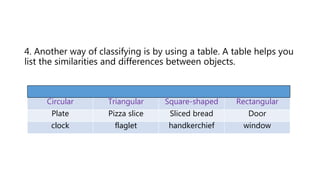
4. Another way of classifying is by using a table. A table helps you
list the similarities and differences between objects.
Circular Triangular Square-shaped Rectangular
Plate Pizza slice Sliced bread Door
clock flaglet handkerchief window
Classifying is grouping objects or information according
to their common characteristics.
Sorting and using a table are some of the ways that you
can classify objects or information.
Measuring
Measuring is science process
skill that helps you know the length,
mass, volume, area, temperature,
and other characteristics of an object.
Standard units of measurement
and
Nonstandard units of measurement
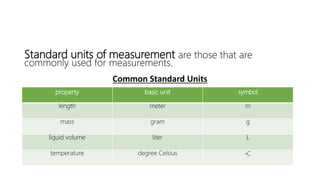
Standard units of measurement are those that are
commonly used for measurements.
Common Standard Units
property basic unit symbol
length meter m
mass gram g
liquid volume liter L
temperature degree Celsius ◦C
Nonstandard units of measurement are those that are not
commonly used. They can only be described according to how
many objects are used for measurement.
Predicting
Predicting is a science process skill by
which you tell what is likely to happen
based on what you know
and observe.
Science process skills contuation..

Science process skills contuation..

  • 1.
    Classifying Classifying is whenyou arrange or sort objects by following a certain rule or order.
  • 2.
    Classifying objects orinformation: 1. Carefully observe the objects that you will classify. Identify their similarities and differences. 2. Choose a characteristics that is common to most of the objects. Use this characteristic as your guide to regroup the objects. 3. Look closely to the smaller groups that you form. See if there are other characteristics that you can use to reclassify the objects and then repeat the first two steps. Classifying is arranging a set of objects or information by following a certain order. Characteristic is a distinct feature or trait of a person or object.
  • 3.
    4. Another wayof classifying is by using a table. A table helps you list the similarities and differences between objects. Circular Triangular Square-shaped Rectangular Plate Pizza slice Sliced bread Door clock flaglet handkerchief window
  • 4.
    Classifying is groupingobjects or information according to their common characteristics. Sorting and using a table are some of the ways that you can classify objects or information.
  • 5.
    Measuring Measuring is scienceprocess skill that helps you know the length, mass, volume, area, temperature, and other characteristics of an object.
  • 6.
    Standard units ofmeasurement and Nonstandard units of measurement
  • 7.
    Standard units ofmeasurement are those that are commonly used for measurements. Common Standard Units property basic unit symbol length meter m mass gram g liquid volume liter L temperature degree Celsius ◦C
  • 8.
    Nonstandard units ofmeasurement are those that are not commonly used. They can only be described according to how many objects are used for measurement.
  • 9.
    Predicting Predicting is ascience process skill by which you tell what is likely to happen based on what you know and observe.