The Basics of Autism
Spectrum Disorders
  Training Series

    Regional Autism Advisory Council of

      Southwest Ohio (RAAC-SWO)

      RAAC Training Committee 2011
Training Series Modules
 Module One: Autism Defined, Autism Prevalence
  and Primary Characteristics
 Module Two: Physical Characteristics of Autism
 Module Three: Cognition and Learning in Autism
 Module Four: Getting the Student Ready to Learn
 Module Five: Structuring the Classroom
  Environment
 Module Six: Using Reinforcement in the Classroom
Training Series Modules
Module Seven: Autism and Sensory Differences
Module Eight: Sensory in the Classroom
Module Nine: Communication and Autism
Module Ten: Communication in the Classroom
Module Eleven: Behavior Challenges and Autism
Module Twelve: Understanding Behavior in
Students with Autism
Training Series Modules
 Module Thirteen: Social Skills in the School
  Environment
 Module Fourteen: Functional Behavior Assessment
 Module Fifteen: Working Together as a Team
 Module Sixteen: Autism and Leisure Skills to
  Teach
 Module Seventeen: Special Issues of Adolescence
 Module Eighteen: Safety and Autism
 Module Nineteen: Special Issues: High School,
  Transition, and Job Readiness
Safety
Emergencies:
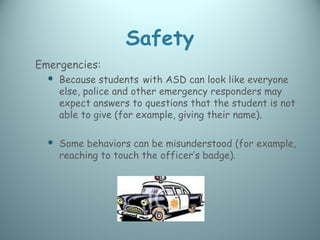
   Because students with ASD can look like everyone
    else, police and other emergency responders may
    expect answers to questions that the student is not
    able to give (for example, giving their name).

   Some behaviors can be misunderstood (for example,
    reaching to touch the officer’s badge).
Safety

Emergencies:
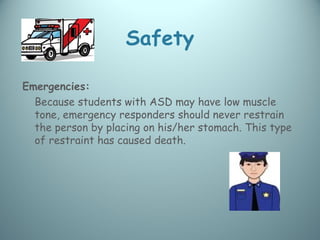
  Because students with ASD may have low muscle
  tone, emergency responders should never restrain
  the person by placing on his/her stomach. This type
  of restraint has caused death.
Safety

Dangerous situations:
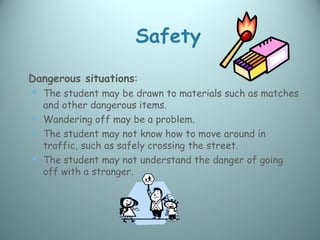
 The student may be drawn to materials such as matches
  and other dangerous items.
 Wandering off may be a problem.
 The student may not know how to move around in
  traffic, such as safely crossing the street.
 The student may not understand the danger of going
  off with a stranger.
Big Idea

A student with ASD may not
recognize a dangerous situation.
Safety Strategies
 Families should be encouraged to get to know their
  neighbors.
 Also, families should get to know nearby public
  safety agencies, police, fire department, and other
  emergency responders.
 Suggest to families that they consider notifying
  them that a child with ASD lives in the home
  including where they sleep and other special needs.
 If school staff is in the community with someone
  with ASD, they should carry/wear identification.
Safety Strategies:
             Identification
 The student with ASD should carry identification
  at all times.
 The student should practice showing their
  identification.
 The student should wear a medical alert
  bracelet/Identification bracelet.
 Identification information should say that the
  student may not be able to speak or may be too
  frightened to answer questions in an emergency.
Safety and ASD:
        Strategies at Home
 At home, door alarms may be helpful to make sure the
  child doesn’t leave the house without your knowledge.
 If the child with ASD has dietary restrictions,
  refrigerator locks and cabinet locks may be needed.
  (Special permission is necessary for this.)
 Removable stove knobs may be helpful if the child with
  ASD isn’t aware of the danger of burning themselves.
 Cleaning supplies and other dangerous products may
  need to be locked up.
Safety and ASD:
          In the Community
 Autism decals for car windows are available to
  make sure that in case of an emergency,
  responders know that there is a passenger with
  ASD in the vehicle.

  (contact www.autismcincy.org).
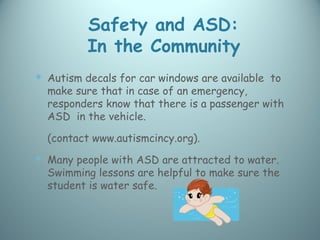
 Many people with ASD are attracted to water.
  Swimming lessons are helpful to make sure the
  student is water safe.
Behavior and Safety
 When possible, be prepared for situations that
  could lead to behavior difficulties.
 Know the early signs of a problem behavior.
 Have a plan for when problems occur.
 Get to know the people who work in the places you
  go to frequently in the community so they can be
  helpful in an emergency.
Abuse and Neglect
 Nationally, individuals with developmental
  disabilities are 4-10 times more likely to be victims
  of crime than those without disabilities.
 Children with disabilities are 1.7 times more likely to
  be abused or neglected than children without
  disabilities.
 It is believed that these numbers may be much
  higher as many cases of abuse and neglect are never
  reported.
 Many student with autism are not verbal or cannot
  articulate their needs to others. This makes them at
  even higher risk for abuse and neglect.
Abuse
Abusive treatment is:
Physical abuse by inflicting pain or injury to a person,
including hitting, kicking, pinching, slapping, pulling
hair, or any sexual abuse.
Emotional abuse which includes ridiculing or
demeaning an individual, making derogatory remarks or
cursing directed to the individual.
Programmatic abuse by use of aversive stimuli
methods not approved by the individual’s behavior plan
that includes use of isolation and restraint.
Neglect
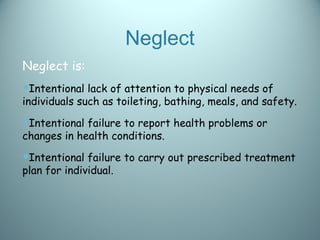
Neglect is:
Intentional lack of attention to physical needs of
individuals such as toileting, bathing, meals, and safety.
Intentional failure to report health problems or
changes in health conditions.
Intentional failure to carry out prescribed treatment
plan for individual.
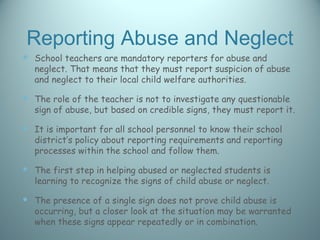
Reporting Abuse and Neglect
 School teachers are mandatory reporters for abuse and
  neglect. That means that they must report suspicion of abuse
  and neglect to their local child welfare authorities.

 The role of the teacher is not to investigate any questionable
  sign of abuse, but based on credible signs, they must report it.

 It is important for all school personnel to know their school
  district’s policy about reporting requirements and reporting
  processes within the school and follow them.

 The first step in helping abused or neglected students is
  learning to recognize the signs of child abuse or neglect.

 The presence of a single sign does not prove child abuse is
  occurring, but a closer look at the situation may be warranted
  when these signs appear repeatedly or in combination.
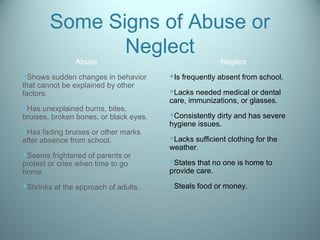
Some Signs of Abuse or
               Neglect
                Abuse                                   Neglect
Shows sudden changes in behavior       Is frequently absent from school.
that cannot be explained by other
factors.                                Lacks needed medical or dental
                                        care, immunizations, or glasses.
Has unexplained burns, bites,
bruises, broken bones, or black eyes.   Consistently dirty and has severe
                                        hygiene issues.
Has fading bruises or other marks
after absence from school.              Lacks sufficient clothing for the
                                        weather.
Seems frightened of parents or
protest or cries when time to go        States that no one is home to
home.                                   provide care.

Shrinks at the approach of adults.     Steals food or money.
Big Idea


Get to know the warning signs and pay
attention to changes in behavior. Get
 other team members input. Do not
   wait overly long to act, as small
 problems can move to bigger ones,
 and always keep data to document
               changes.

Safety and Autism

  • 1.
    The Basics ofAutism Spectrum Disorders Training Series Regional Autism Advisory Council of Southwest Ohio (RAAC-SWO) RAAC Training Committee 2011
  • 2.
    Training Series Modules Module One: Autism Defined, Autism Prevalence and Primary Characteristics  Module Two: Physical Characteristics of Autism  Module Three: Cognition and Learning in Autism  Module Four: Getting the Student Ready to Learn  Module Five: Structuring the Classroom Environment  Module Six: Using Reinforcement in the Classroom
  • 3.
    Training Series Modules ModuleSeven: Autism and Sensory Differences Module Eight: Sensory in the Classroom Module Nine: Communication and Autism Module Ten: Communication in the Classroom Module Eleven: Behavior Challenges and Autism Module Twelve: Understanding Behavior in Students with Autism
  • 4.
    Training Series Modules Module Thirteen: Social Skills in the School Environment  Module Fourteen: Functional Behavior Assessment  Module Fifteen: Working Together as a Team  Module Sixteen: Autism and Leisure Skills to Teach  Module Seventeen: Special Issues of Adolescence  Module Eighteen: Safety and Autism  Module Nineteen: Special Issues: High School, Transition, and Job Readiness
  • 5.
    Safety Emergencies: Because students with ASD can look like everyone else, police and other emergency responders may expect answers to questions that the student is not able to give (for example, giving their name).  Some behaviors can be misunderstood (for example, reaching to touch the officer’s badge).
  • 6.
    Safety Emergencies: Becausestudents with ASD may have low muscle tone, emergency responders should never restrain the person by placing on his/her stomach. This type of restraint has caused death.
  • 7.
    Safety Dangerous situations:  Thestudent may be drawn to materials such as matches and other dangerous items.  Wandering off may be a problem.  The student may not know how to move around in traffic, such as safely crossing the street.  The student may not understand the danger of going off with a stranger.
  • 8.
    Big Idea A studentwith ASD may not recognize a dangerous situation.
  • 9.
    Safety Strategies  Familiesshould be encouraged to get to know their neighbors.  Also, families should get to know nearby public safety agencies, police, fire department, and other emergency responders.  Suggest to families that they consider notifying them that a child with ASD lives in the home including where they sleep and other special needs.  If school staff is in the community with someone with ASD, they should carry/wear identification.
  • 10.
    Safety Strategies: Identification  The student with ASD should carry identification at all times.  The student should practice showing their identification.  The student should wear a medical alert bracelet/Identification bracelet.  Identification information should say that the student may not be able to speak or may be too frightened to answer questions in an emergency.
  • 11.
    Safety and ASD: Strategies at Home  At home, door alarms may be helpful to make sure the child doesn’t leave the house without your knowledge.  If the child with ASD has dietary restrictions, refrigerator locks and cabinet locks may be needed. (Special permission is necessary for this.)  Removable stove knobs may be helpful if the child with ASD isn’t aware of the danger of burning themselves.  Cleaning supplies and other dangerous products may need to be locked up.
  • 12.
    Safety and ASD: In the Community  Autism decals for car windows are available to make sure that in case of an emergency, responders know that there is a passenger with ASD in the vehicle. (contact www.autismcincy.org).  Many people with ASD are attracted to water. Swimming lessons are helpful to make sure the student is water safe.
  • 13.
    Behavior and Safety When possible, be prepared for situations that could lead to behavior difficulties.  Know the early signs of a problem behavior.  Have a plan for when problems occur.  Get to know the people who work in the places you go to frequently in the community so they can be helpful in an emergency.
  • 14.
    Abuse and Neglect Nationally, individuals with developmental disabilities are 4-10 times more likely to be victims of crime than those without disabilities.  Children with disabilities are 1.7 times more likely to be abused or neglected than children without disabilities.  It is believed that these numbers may be much higher as many cases of abuse and neglect are never reported.  Many student with autism are not verbal or cannot articulate their needs to others. This makes them at even higher risk for abuse and neglect.
  • 15.
    Abuse Abusive treatment is: Physicalabuse by inflicting pain or injury to a person, including hitting, kicking, pinching, slapping, pulling hair, or any sexual abuse. Emotional abuse which includes ridiculing or demeaning an individual, making derogatory remarks or cursing directed to the individual. Programmatic abuse by use of aversive stimuli methods not approved by the individual’s behavior plan that includes use of isolation and restraint.
  • 16.
    Neglect Neglect is: Intentional lackof attention to physical needs of individuals such as toileting, bathing, meals, and safety. Intentional failure to report health problems or changes in health conditions. Intentional failure to carry out prescribed treatment plan for individual.
  • 17.
    Reporting Abuse andNeglect  School teachers are mandatory reporters for abuse and neglect. That means that they must report suspicion of abuse and neglect to their local child welfare authorities.  The role of the teacher is not to investigate any questionable sign of abuse, but based on credible signs, they must report it.  It is important for all school personnel to know their school district’s policy about reporting requirements and reporting processes within the school and follow them.  The first step in helping abused or neglected students is learning to recognize the signs of child abuse or neglect.  The presence of a single sign does not prove child abuse is occurring, but a closer look at the situation may be warranted when these signs appear repeatedly or in combination.
  • 18.
    Some Signs ofAbuse or Neglect Abuse Neglect Shows sudden changes in behavior Is frequently absent from school. that cannot be explained by other factors. Lacks needed medical or dental care, immunizations, or glasses. Has unexplained burns, bites, bruises, broken bones, or black eyes. Consistently dirty and has severe hygiene issues. Has fading bruises or other marks after absence from school. Lacks sufficient clothing for the weather. Seems frightened of parents or protest or cries when time to go States that no one is home to home. provide care. Shrinks at the approach of adults. Steals food or money.
  • 19.
    Big Idea Get toknow the warning signs and pay attention to changes in behavior. Get other team members input. Do not wait overly long to act, as small problems can move to bigger ones, and always keep data to document changes.

Editor's Notes

  • #3 You-tube medical issues for Autistic people.