1|
Dmitry Schigel
Roderic Page
Donald Hobern
iBOL7, Kruger, South Africa
Bridging biodiversity evidence
through data standards:
the GBIF perspectives towards molecular data
NASA/CXC/SAO/JPL-Caltech/STScI
2|
3|
Biodiversity information
Informatics partnerships – Common standards – Stable infrastructure
4|
Intergovernmental open data infrastructure
Funded by the governments
of the participant countries
Network for free and open access
to biodiversity data
94 participants:
54 countries and 40 organisations
https://www.gbif.org/the-gbif-network
5|
54
875,244,719
BYTHE NUMBERS
21Nov2017
37,209
Species occurrence records Datasets
1,12940
PublishersOrganizational
Participants
Country
Participants
43.4billion 97,053
Records downloaded per month (avg Jan-Aug 2017) Total page views (Aug)
6|
Data published
through GBIF.org
www.gbif.org/analytics/global
7|
Data richness levels
supported by GBIF
https://www.gbif.org/dataset-classes
Species Checklists
Species OccurrencesCollection Metadata
Sampled Organisms
1.
Catalogue of collections
2.
Species in countries and
areas
3.
Species with dates and
coordinates
4.
Species with dates,
coordinates, methods,
abundance and absence etc.
8|
https://www.gbif.org/dataset-classes
Types of data shared through GBIF
sample-based data
Barcoding!
Metagenomics!
eDNA!
9|
Organizing occurrences
GBIF needs a single, consistent taxonomy
GBIF assembles taxonomic index of checklists
Catalogue of Life – largest single source
Checklist bank: source for GBIF Backbone
Name matching service
10|
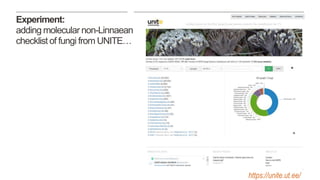
https://unite.ut.ee/
Experiment:
adding molecular non-Linnaean
checklist of fungi from UNITE…
11|
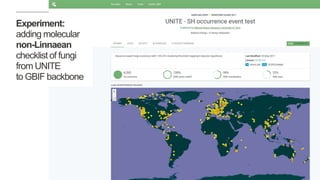
Experiment:
adding molecular non-Linnaean
checklist of fungi from UNITE to GBIF backbone
12|
Experiment:
an opportunity to index and list georeferenced sequence data
13|
Experiment:
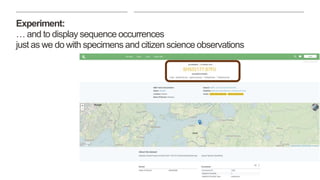
… and to display sequence occurrences
just as we do with specimens and citizen science observations
14|
Experiment:
… and to link back to the detailed information at source
15|
Experiment:
adding molecular
non-Linnaean
checklist of fungi
from UNITE
to GBIF backbone
16|
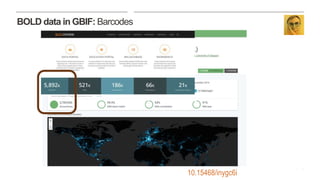
BOLD data in GBIF: Barcodes
10.15468/inygc6i
17|
BOLD data in GBIF: Barcodes
10.15468/inygc6i
18|
Checklists are the key…
OTU sources
What and where?
Stable, but dynamic
Digitally citable, DOI
Linked to Linnaean taxa
19|
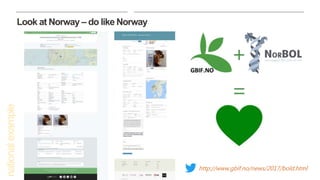
Look at Norway – do like Norway
http://www.gbif.no/news/2017/bold.html
+
=
20|
Peer-reviewed publications using GBIF-mediated data
through30September 2017
https://www.gbif.org/science-review
Grab your
copy here
and in the
GBIF booth
21|
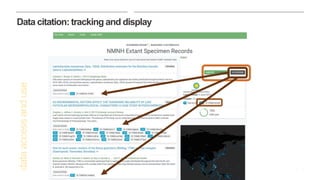
Data citation: tracking and display
22|Troudet et al. Nature 2017
Global biodiversity
23|
Global biodiversity state of knowledge
Fungi
Plantae
Viruses
Bacteria
Chordata
Nematoda
Mollusca
Crustacea
Algae
Insecta
Arachnida
others
Number of species worldwide:
Purvis & Hector 2000 Nature 405
doi:10.1038/35012221
Number of species occurrences
GBIF.org, 9 May 2017
24|
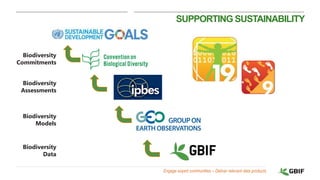
SUPPORTING SUSTAINABILITY
Engage expert communities – Deliver relevant data products
Biodiversity
Commitments
Biodiversity
Assessments
Biodiversity
Models
Biodiversity
Data
25|
Efficiency of research
Scholarly rigor and quality of research
DOIs: tracking data use and citation
Spectrum of academic products, data papers
Visibility and scope for engagement
Researchers to ask new questions
Collaboration and community-building
Economic and social impact of research
International conventions and funding requirements
Benefits of openess
Piwowar et al. 2007
Cartoon:SeppoLeinonen,www.seppo.net
26|
University of Sydney https://library.sydney.edu.au/research/data-management/research-data-management.html
The research data lifecycle
Generate / Access
(re)Organize
Modify
Analyze
Archive
Cite
27|
Take home messages Only one biodiversity: cross-link the data
GBIF: big, open and free to use for all
Involve your institution and your country
GBIF: actively and increasingly used scientific infrastructure
Open your barcode, BIN and other data (as soon as you can)
Fill the gaps and fight the biases – temporal, spatial and taxonomic
Track the use though DOI-powered data citation
Data postprocessing: fitness for use needs user action
GBIF adds value: every records counts in science and policy
BOLD and GBIF to move from static to dynamic connection!
28|
Thank you
Many thanks to:
Markus Döring
Urmas Kõljalg
Paul Hebert
Sujeevan Ratnasingham

Schigel@al gbif i-bol7v2

Editor's Notes

  • #2 Bridging biodiversity evidence through data standards: the GBIF perspectives towards molecular data Dmitry D. Schigel,1 Roderic R. Page,2 and Donald D. Hobern1 1Secretariat, Global Biodiversity Information Facility, Denmark. 2Institute of Biodiversity Animal Health and Comparative Medicine, University of Glasgow, United Kingdom. Corresponding author: Dmitry D. Schigel (email: dschigel@gbif.org). Global Biodiversity Information Facility (GBIF) has grown to accommodate evidence from many sources, including citizen science and quantitative ecology. A critical requirement is to expand this network to accommodate evidence from molecular research. GBIF.org aims for universality in its data discovery services, supporting integration, search and filtering capabilities, documenting data provenance, and promoting best practice around data citation. By early 2017, the GBIF network includes several datasets of molecular origin. These early efforts require further enhancements around data linkage and attribution, particularly through making connections between specimen data and associated molecular information. GBIF’s ambition is to accelerate processing of all data records to cluster related data records derived from specimens, sequences, publications, and other sources. GBIF and Barcode of Life Data System (BOLD) need to establish a continuous feed for new sequence data to be incorporated within GBIF. As the barcode of life community continues to expand, growing volumes of data will flow from field-based monitoring activities that rely on barcodes to determine the set of taxa recorded. The interpretation of the growing volumes of sequences will evolve as reference libraries improve. These data will serve as one of the key streams of evidence for species distribution. GBIF aims to work closely together with molecular infrastructures to (i) form cross-linkages between digitized specimens and associated barcode data, (ii) to accommodate spatiotemporal data from environmental sequencing projects, and (iii) to expand the current taxonomic backbone to include operational taxonomic units based on molecular and other evidence, including BOLD Barcode Index Numbers (BINs). Further, GBIF could support organisation and visualisation of data on infraspecific genetic variation as part of the representation of species distribution data.
  • #4 Users need all biodiversity information to work together and for it to be possible to create synthetic complex data sets
  • #5 Remove obstacles to collaboration in sharing and use of biodiversity data Organise evidence of recorded occurrence of any species in time and space Support development of a global virtual natural history collection
  • #6 Useful to see GBIF in its different modalities: A window on biodiversity An informatics infrastructure focused on tools and standards in service to science and society A global network on bioinformatics
  • #8 GBIF now deals with four types of biodiversity data: Occurrences (observations, specimens etc) Samples (sets of observations from a single collecting event, including information on sampling protocols and abundance) Checklists (names) Metadata (data about data) - http://www.gbif.org/dataset/search?type=METADATA Occurrences are records that document a 'collection event'—evidence that a particular, named organism was found at a particular time and place. Also known as primary biodiversity data, occurrences document the 'what, where, when, how and by whom' of our exploration of the planet's species. An occurrence record can be based on an observation in the field, vouchered (labeled) specimen in a museum or herbarium, or other evidence. Sample-based data are records from thousands of different kinds of environmental, ecological, and natural resource monitoring and assessment investigations. These events range from one-off surveys to ongoing monitoring and includes activities like freshwater and marine sampling, plant cover and vegetation plots, and citizen science bird counts, among others. Checklists are lists of scientific names of organisms grouped into taxonomic hierarchies. They serve two main functions: first, they provide data that help to enrich information about particular species, for example by including them on national checklists, and on lists of invasive or threatened species; and they provide taxonomic 'backbones' around which species information can be organized. Metadata are structured descriptions of datasets giving essential details such as the geographic and taxonomic scope of the data, methods of collection or observation, contact details and citation requirements. They help to give context to datasets and enable users to assess whether data are fit for use in a particular research project or application.
  • #17 Moving these figures closer
  • #18 Moving these figures closer
  • #20 Mendeley, monitoring use
  • #22 Mendeley, monitoring use
  • #23 Mendeley, monitoring use
  • #24 Mendeley, monitoring use
  • #25 Meeting big national and global needs depends on government commitments (as coordinated through the CBD). IPBES exists to coordinate global and regional assessments to guide and support these commitments. These assessments should be based on the best available models, which in turn depend on the best possible data. Coordinated work on delivering and organising biodiversity data can support this whole process.