How Sca -to-BIM
Tra for Heritage
Pre ervatio a d
Re toratio
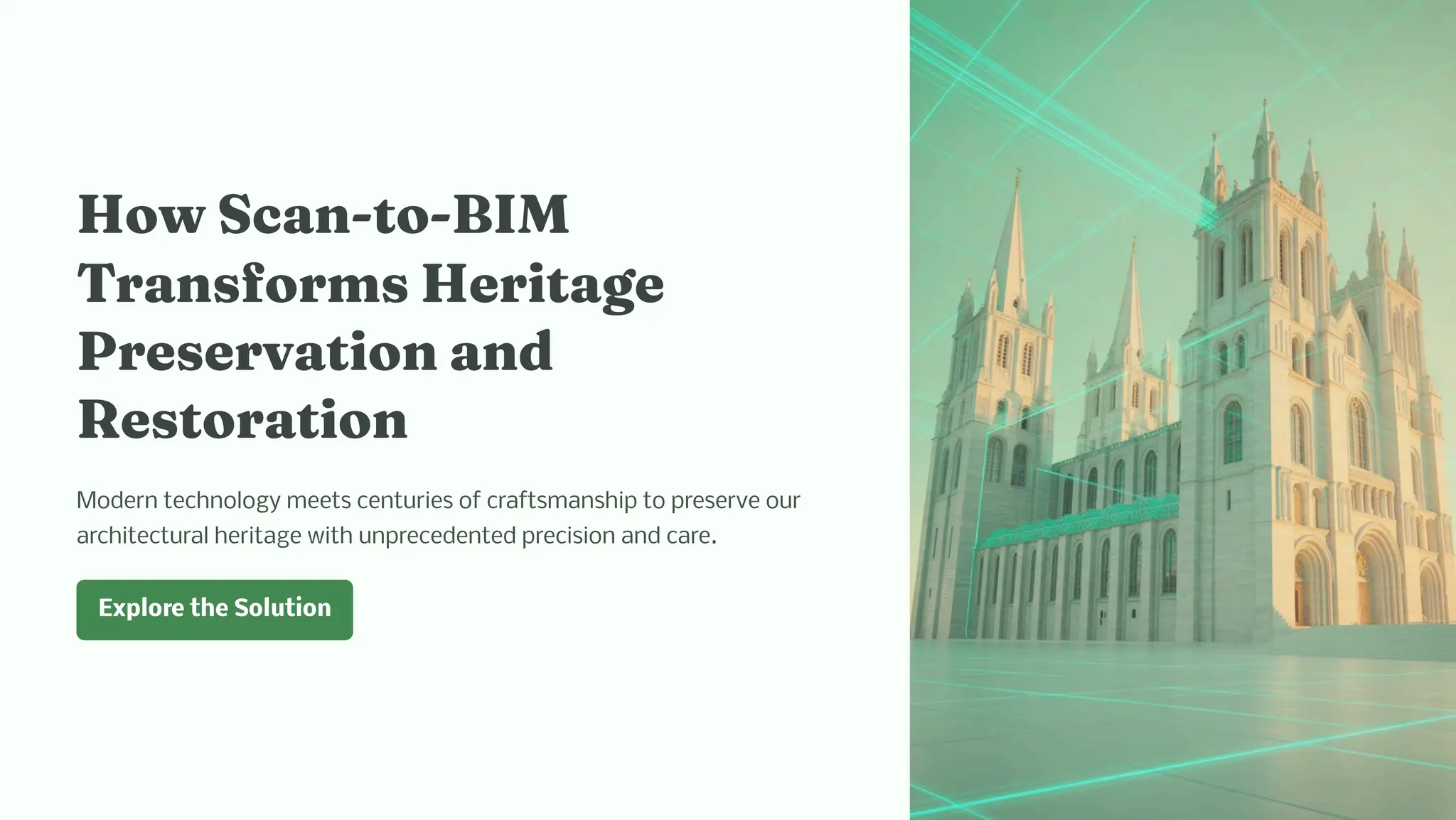
Modern technology meets centuries of craftsmanship to preserve our
architectural heritage with unprecedented precision and care.
Explore the Solution
C apter 1: T e C alle ge of
Pre ervi g Heritage
Structure
Cultural Ide tity at
Ri k
Historic buildings embody
cultural identity and centuries
of craftsmanship, but face
mounting threats from aging
infrastructure, rapid
urbanization, and the
accelerating impacts of
climate change.
Traditio al
Li itatio
Traditional restoration
methods rely on manual
measurements and incomplete
blueprints, frequently causing
errors, project delays, and
irreversible loss of original
architectural detail.
T e Preci io C alle ge
Preserving authenticity while upgrading structural integrity
demands millimeter-level precision and comprehensive
documentation that conventional methods struggle to deliver
consistently.
T e Li it of Traditio al Met od
Docu e tatio C alle ge
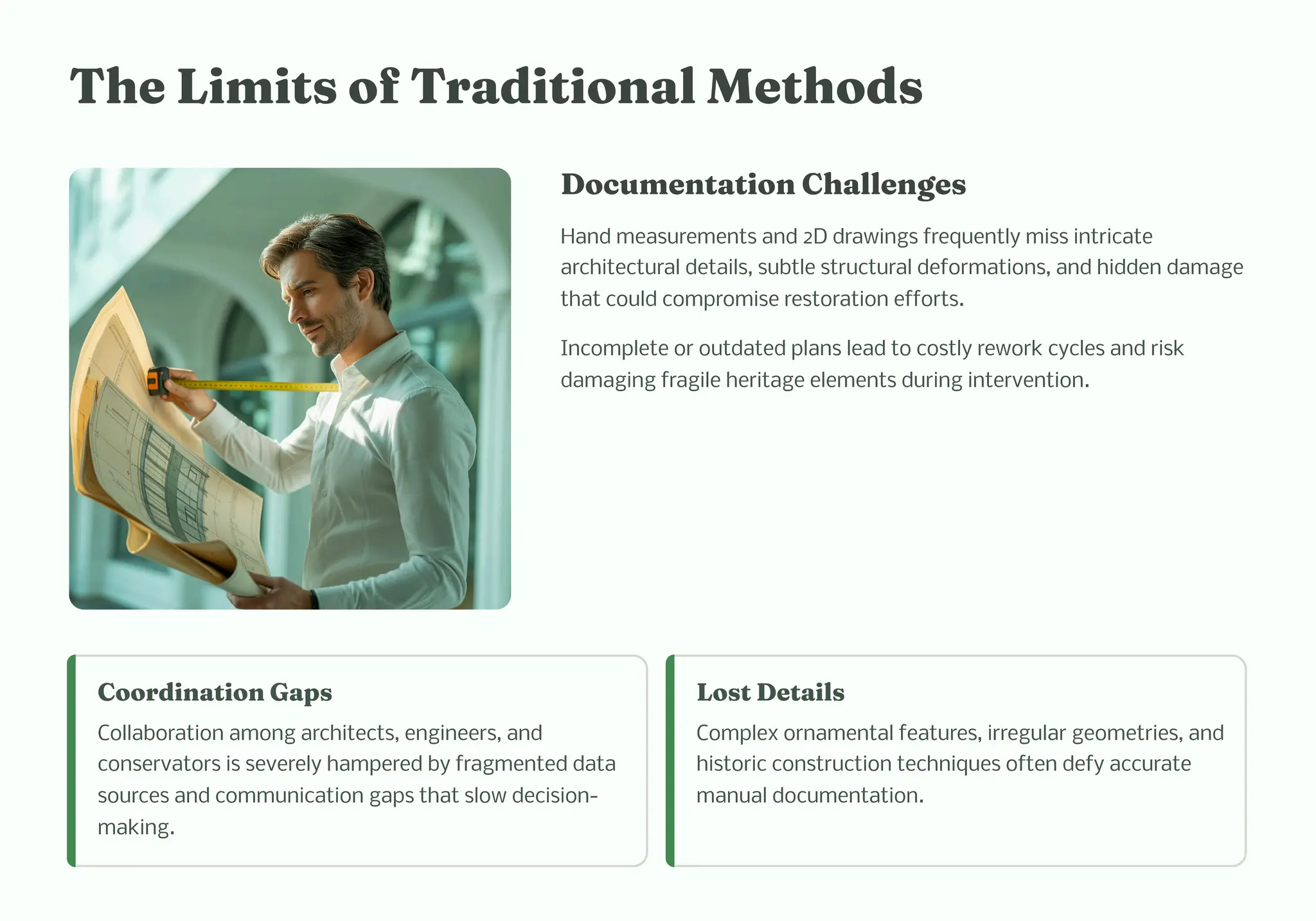
Hand measurements and 2D drawings frequently miss intricate
architectural details, subtle structural deformations, and hidden damage
that could compromise restoration efforts.
Incomplete or outdated plans lead to costly rework cycles and risk
damaging fragile heritage elements during intervention.
Coordi atio Gap
Collaboration among architects, engineers, and
conservators is severely hampered by fragmented data
sources and communication gaps that slow decision-
making.
Lo t Detail
Complex ornamental features, irregular geometries, and
historic construction techniques often defy accurate
manual documentation.
W e Traditio Fall
S ort
Conventional documentation methods struggle to capture the full complexity and authenticity of heritage structures,
leaving gaps that compromise restoration quality.
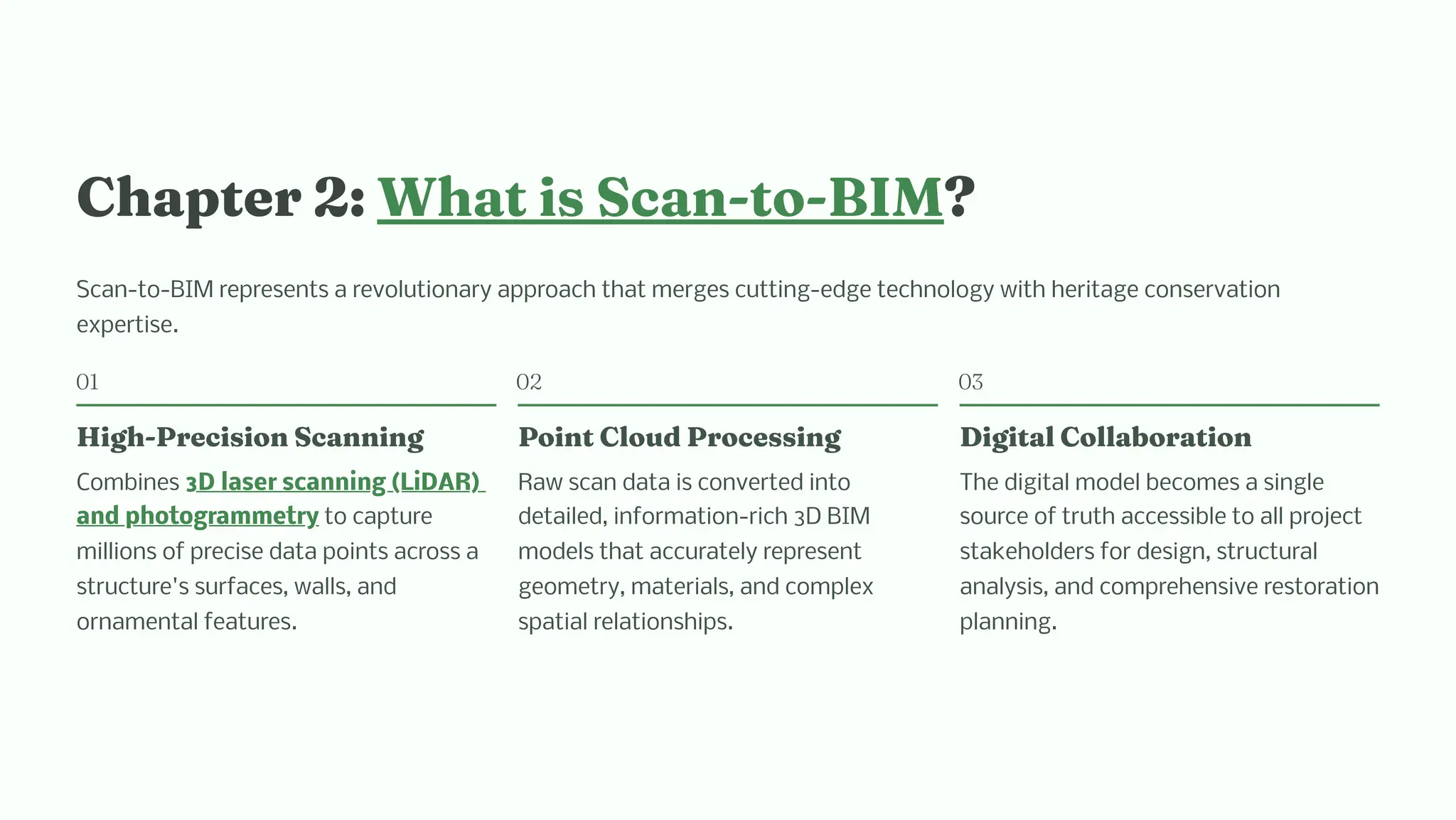
C apter 2: W at i Sca -to-BIM?
Scan-to-BIM represents a revolutionary approach that merges cutting-edge technology with heritage conservation
expertise.
01
Hig -Preci io Sca i g
Combines 3D laser scanning (LiDAR)
and photogrammetry to capture
millions of precise data points across a
structure's surfaces, walls, and
ornamental features.
02
Poi t Cloud Proce i g
Raw scan data is converted into
detailed, information-rich 3D BIM
models that accurately represent
geometry, materials, and complex
spatial relationships.
03
Digital Collaboratio
The digital model becomes a single
source of truth accessible to all project
stakeholders for design, structural
analysis, and comprehensive restoration
planning.
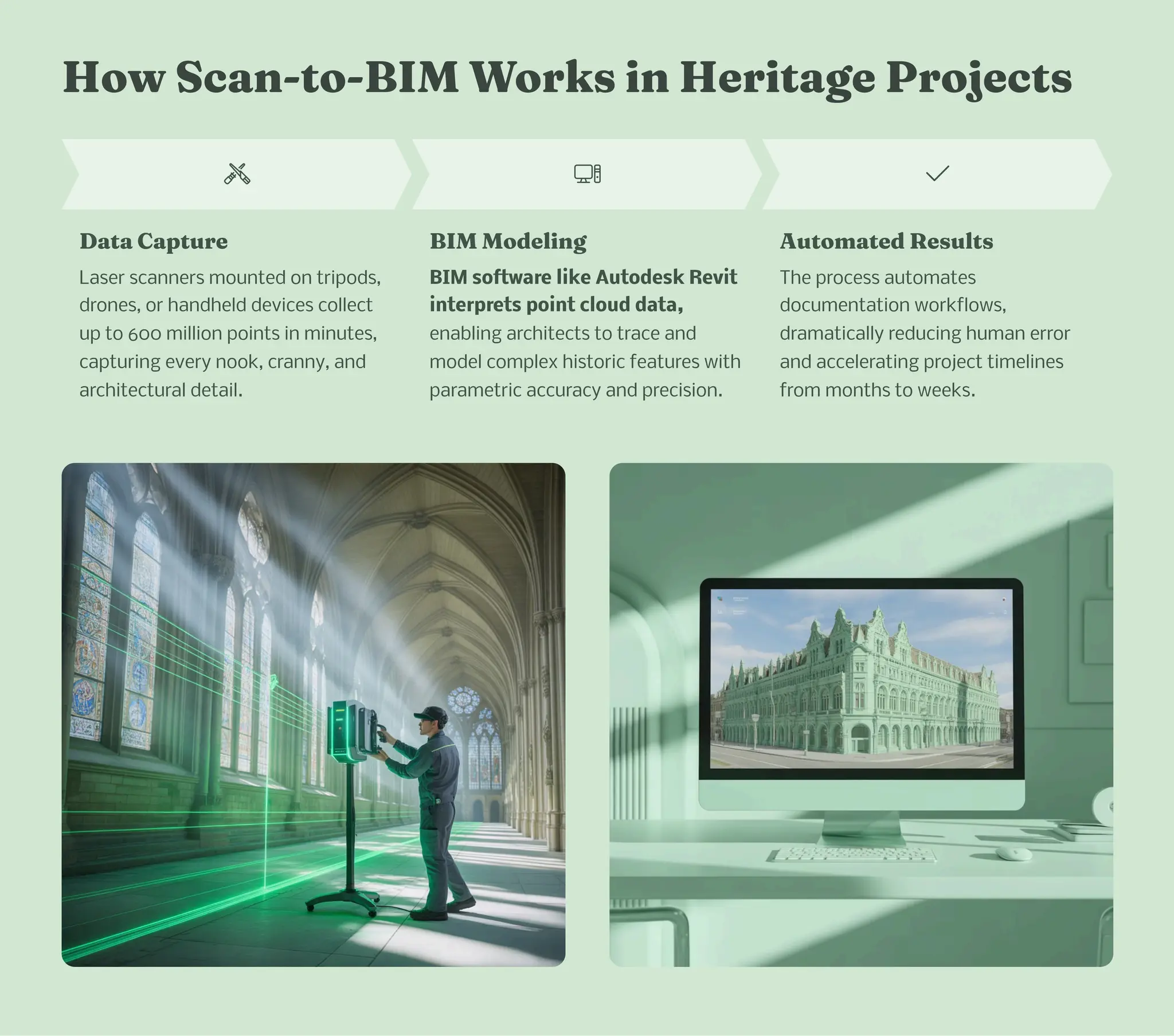
How Sca -to-BIM Work i Heritage Project
Data Capture
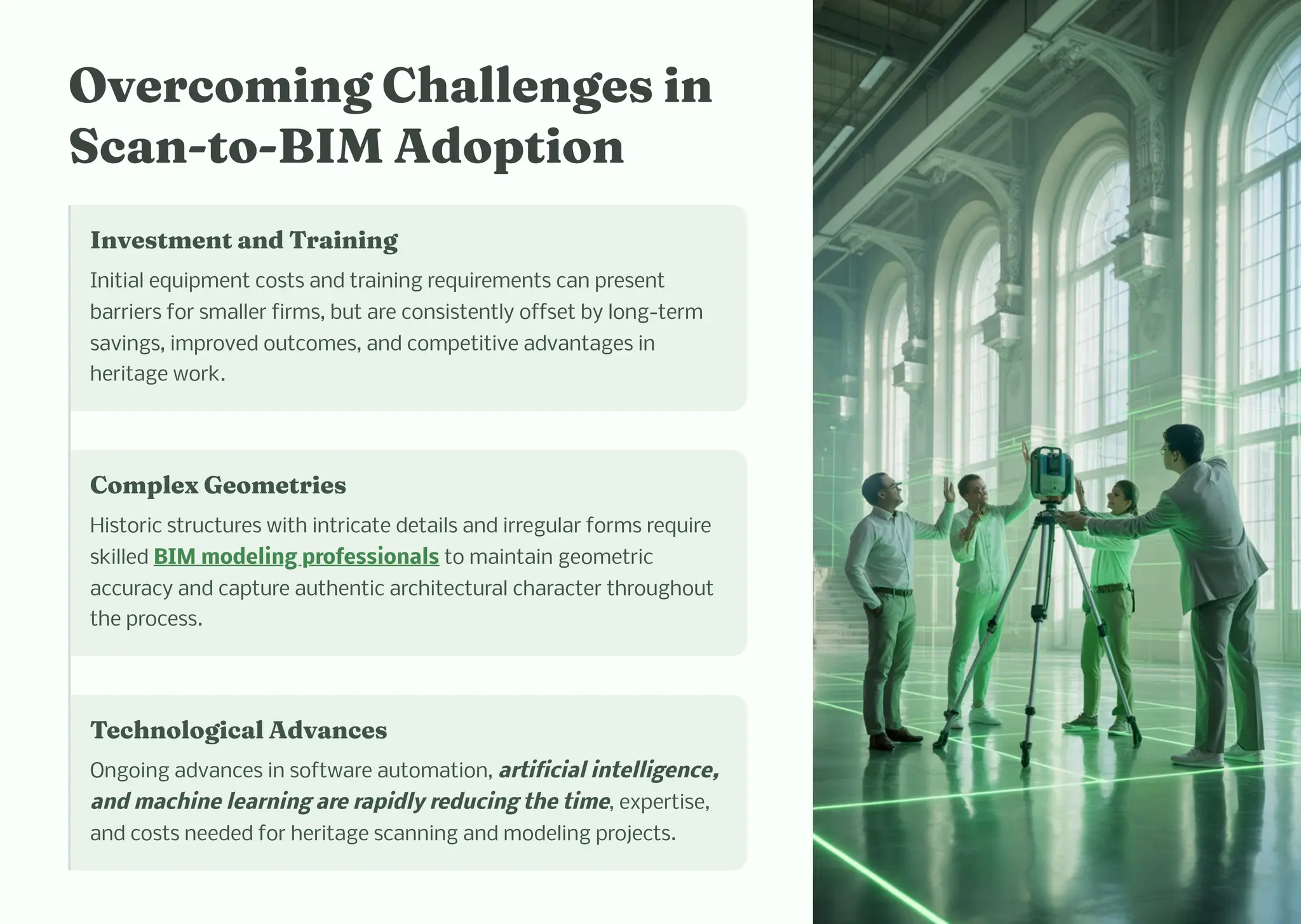
Laser scanners mounted on tripods,
drones, or handheld devices collect
up to 600 million points in minutes,
capturing every nook, cranny, and
architectural detail.
BIM Modeli g
BIM software like Autodesk Revit
interprets point cloud data,
enabling architects to trace and
model complex historic features with
parametric accuracy and precision.
Auto ated Re ult
The process automates
documentation workflows,
dramatically reducing human error
and accelerating project timelines
from months to weeks.
C apter 3: Key Be efit of Sca -to-BIM Over
Traditio al Met od
U atc ed Accuracy
Captures intricate details such as ornate moldings, structural
cracks, and subtle deformations that manual measurement
methods consistently miss or misrepresent.
Co pre e ive Docu e tatio
Creates a permanent digital archive of the building's current
state, providing invaluable reference material for future
conservation efforts and historical research.
Ri k Mitigatio
Enables detailed structural analysis to identify hidden
weaknesses before restoration begins, preventing
unexpected failures and protecting workers and heritage
fabric.
Ti e a d Co t Efficie cy
Faster data capture and model creation dramatically reduce
overall project duration and eliminate costly rework from
measurement errors or missing information.
E a ced Collaboratio
A shared, continuously updated 3D model improves
coordination among architects, engineers, conservators, and
regulatory authorities throughout the project lifecycle.
Pre ervatio of Aut e ticity
Ensures all interventions harmonize perfectly with original
design intent, maintaining cultural significance and historical
integrity for generations to come.
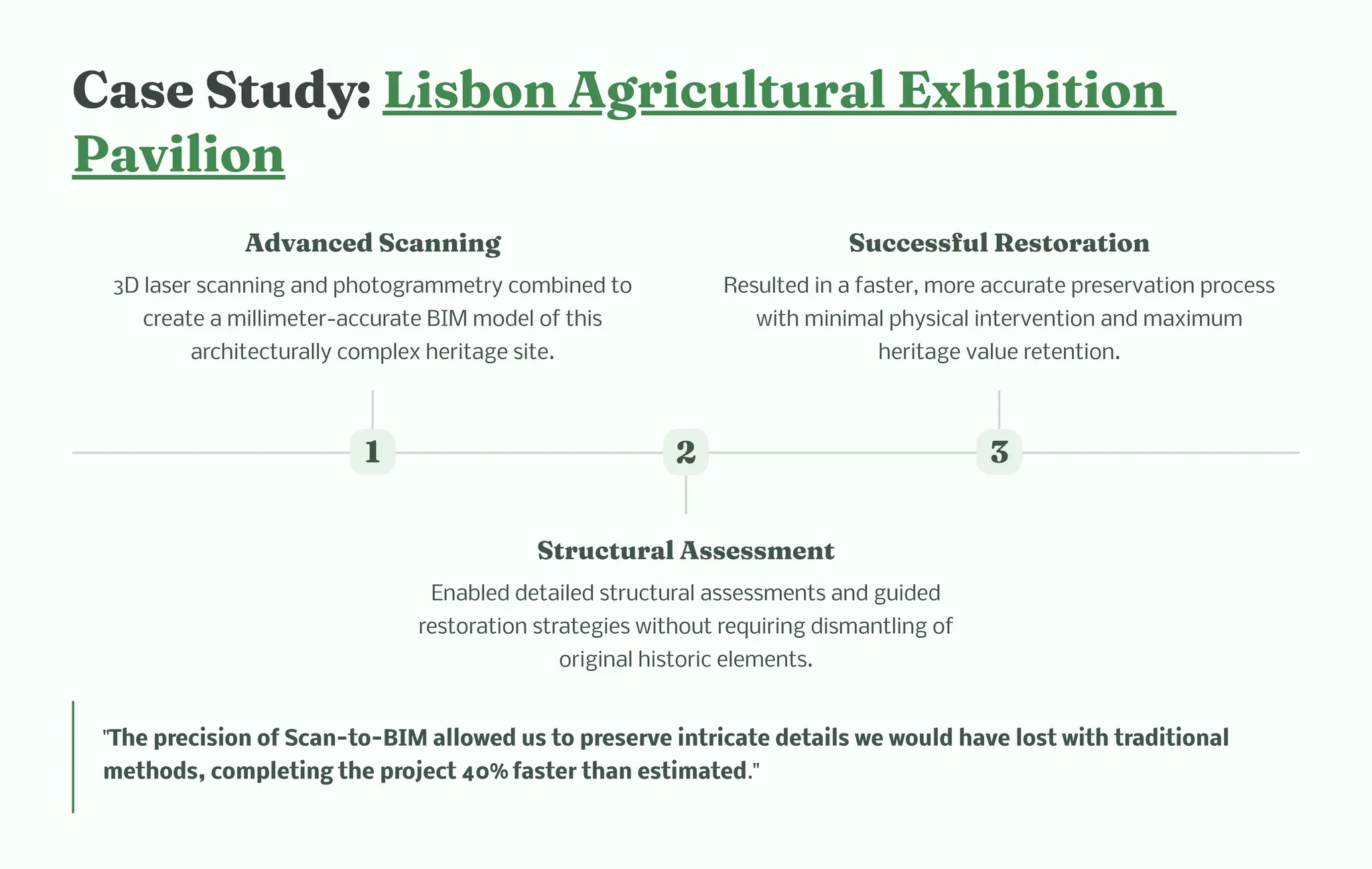
Ca e Study: Li bo Agricultural Ex ibitio
Pavilio
1
Adva ced Sca i g
3D laser scanning and photogrammetry combined to
create a millimeter-accurate BIM model of this
architecturally complex heritage site.
2
Structural A e e t
Enabled detailed structural assessments and guided
restoration strategies without requiring dismantling of
original historic elements.
3
Succe ful Re toratio
Resulted in a faster, more accurate preservation process
with minimal physical intervention and maximum
heritage value retention.
"The precision of Scan-to-BIM allowed us to preserve intricate details we would have lost with traditional
methods, completing the project 40% faster than estimated."
Preci io Meet
Pre ervatio
Every arch, column, and carved detail captured with millimeter accuracy, creating a digital twin that honors centuries of
craftsmanship.
C apter 4: Sca -to-BIM i Actio : Real-World
Succe Storie
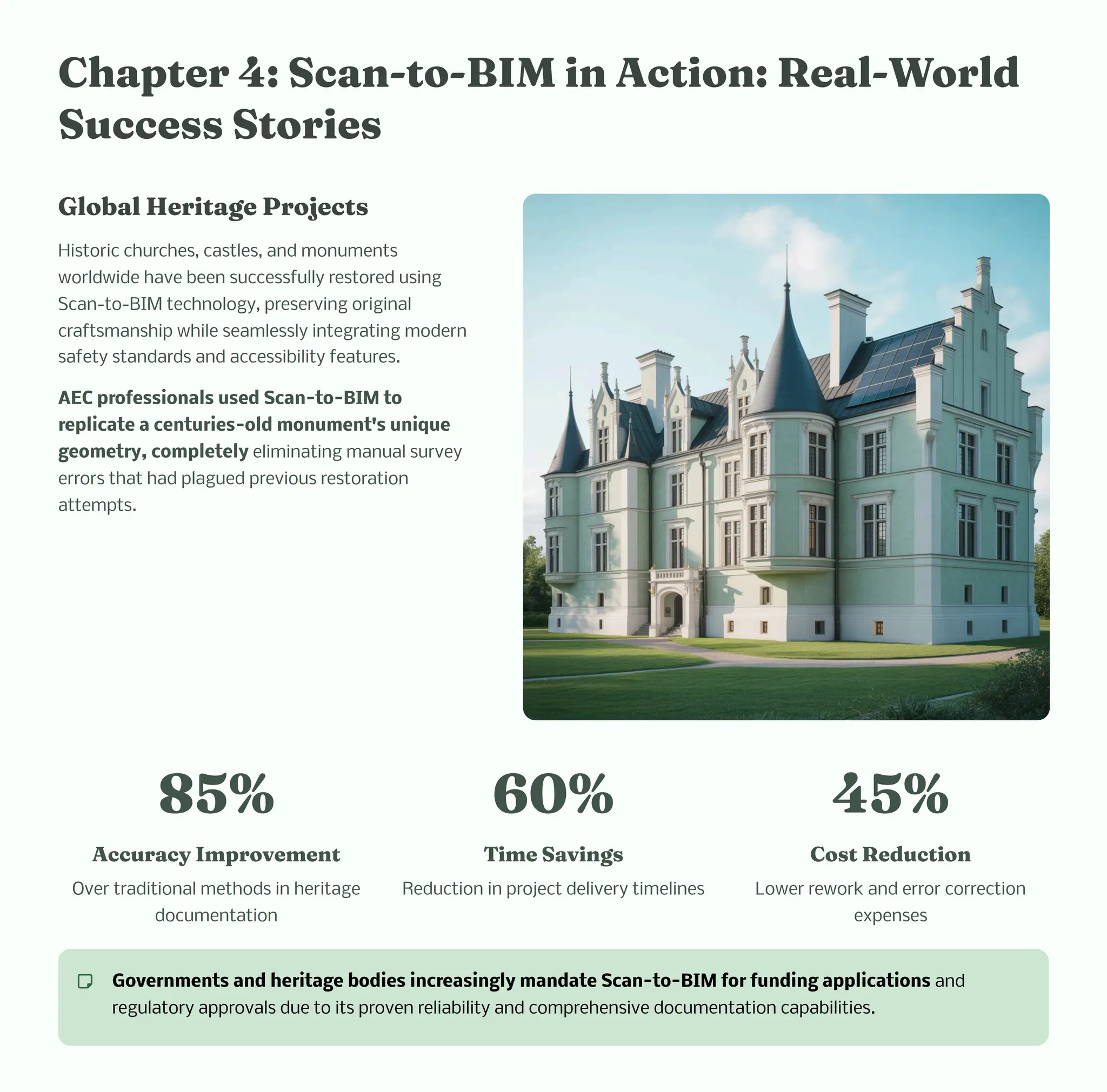
Global Heritage Project
Historic churches, castles, and monuments
worldwide have been successfully restored using
Scan-to-BIM technology, preserving original
craftsmanship while seamlessly integrating modern
safety standards and accessibility features.
AEC professionals used Scan-to-BIM to
replicate a centuries-old monument's unique
geometry, completely eliminating manual survey
errors that had plagued previous restoration
attempts.
85%
Accuracy I prove e t
Over traditional methods in heritage
documentation
60%
Ti e Savi g
Reduction in project delivery timelines
45%
Co t Reductio
Lower rework and error correction
expenses
Governments and heritage bodies increasingly mandate Scan-to-BIM for funding applications and
regulatory approvals due to its proven reliability and comprehensive documentation capabilities.
Overco i g C alle ge i
Sca -to-BIM Adoptio
I ve t e t a d Trai i g
Initial equipment costs and training requirements can present
barriers for smaller firms, but are consistently offset by long-term
savings, improved outcomes, and competitive advantages in
heritage work.
Co plex Geo etrie
Historic structures with intricate details and irregular forms require
skilled BIM modeling professionals to maintain geometric
accuracy and capture authentic architectural character throughout
the process.
Tec ological Adva ce
Ongoing advances in software automation, artificial intelligence,
and machine learning are rapidly reducing the time, expertise,
and costs needed for heritage scanning and modeling projects.
T e Future of Heritage Pre ervatio wit Sca -
to-BIM
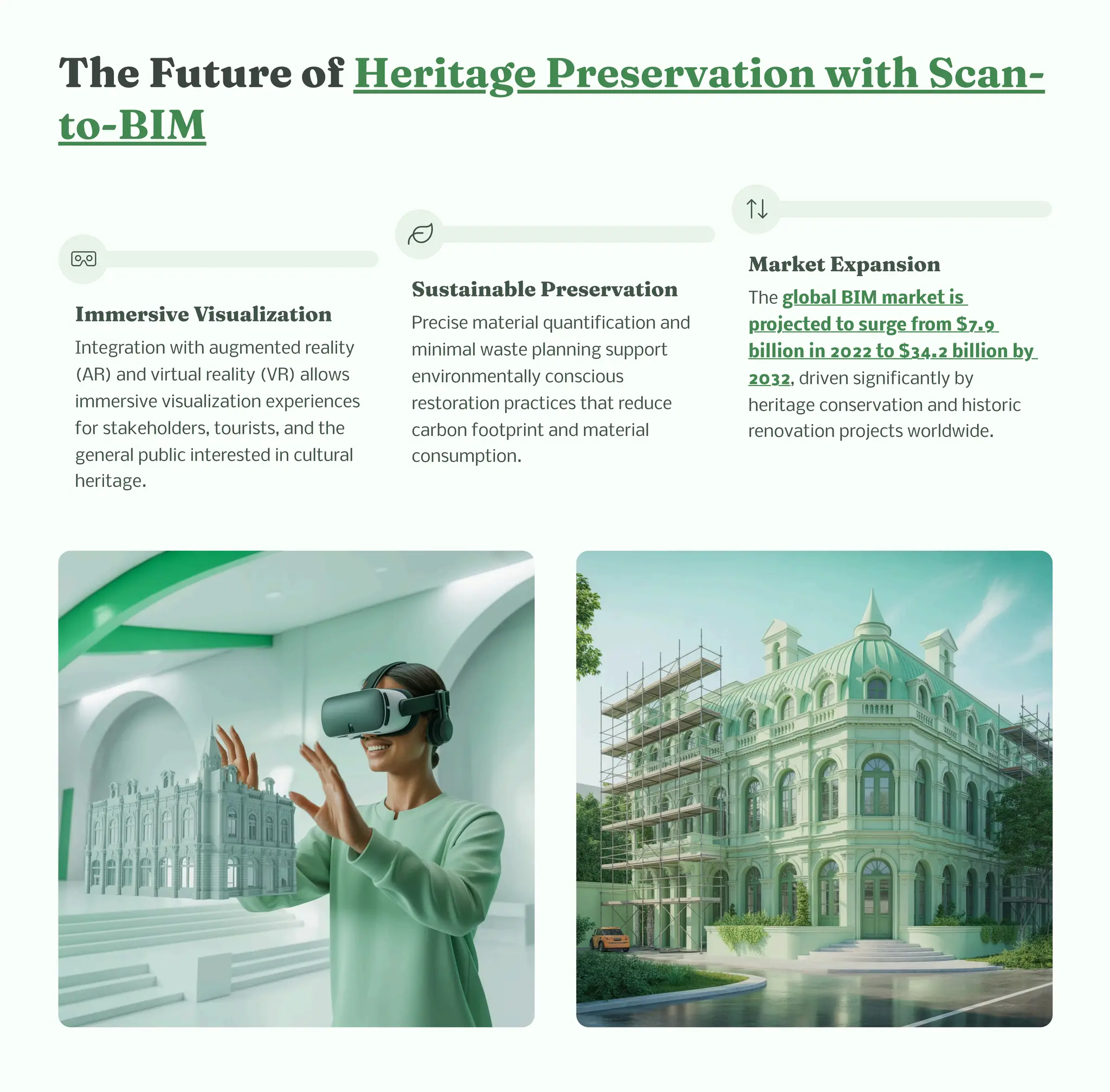
I er ive Vi ualizatio
Integration with augmented reality
(AR) and virtual reality (VR) allows
immersive visualization experiences
for stakeholders, tourists, and the
general public interested in cultural
heritage.
Su tai able Pre ervatio
Precise material quantification and
minimal waste planning support
environmentally conscious
restoration practices that reduce
carbon footprint and material
consumption.
Market Expa io
The global BIM market is
projected to surge from $7.9
billion in 2022 to $34.2 billion by
2032, driven significantly by
heritage conservation and historic
renovation projects worldwide.
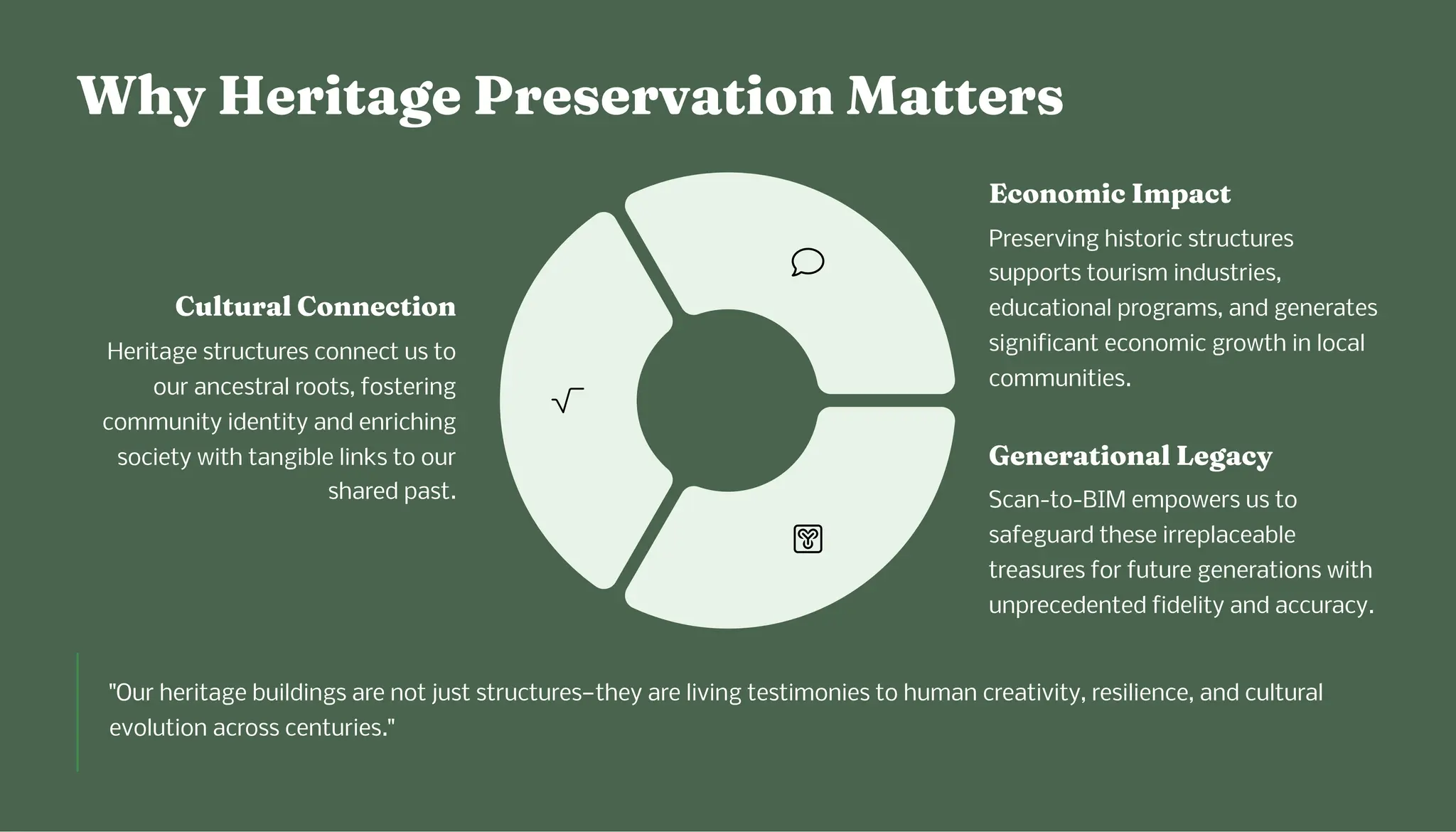
W y Heritage Pre ervatio Matter
"Our heritage buildings are not just structures4they are living testimonies to human creativity, resilience, and cultural
evolution across centuries."
Cultural Co ectio
Heritage structures connect us to
our ancestral roots, fostering
community identity and enriching
society with tangible links to our
shared past.
Eco o ic I pact
Preserving historic structures
supports tourism industries,
educational programs, and generates
significant economic growth in local
communities.
Ge eratio al Legacy
Scan-to-BIM empowers us to
safeguard these irreplaceable
treasures for future generations with
unprecedented fidelity and accuracy.
Pre ervi g t e
Pa t, Buildi g
t e Future
Where history meets innovation, heritage structures stand renewed for generations to come.
Co clu io : E braci g Sca -to-BIM for
Heritage' Next C apter
Scan-to-BIM is revolutionizing heritage preservation by delivering accuracy, efficiency, and collaboration impossible with
traditional documentation methods.
Aut e ticity Guara teed
Ensures historic structures retain
their authentic character and
cultural significance while meeting
modern standards for safety,
accessibility, and long-term
usability.
Profe io al Excelle ce
For architects, engineers, and
conservators committed to
preserving cultural legacy, Scan-
to-BIM has become the
indispensable tool for achieving
restoration excellence.
Future-Ready Tec ology
As technology advances and costs
decrease, Scan-to-BIM adoption
will continue accelerating across
heritage projects of all scales
worldwide.
Ready to Tra for Your Heritage Project?
Discover how Scan-to-BIM can revolutionize your heritage preservation and restoration work4preserving history
with unmatched precision, efficiency, and care.
Start Your Project

Scan to BIM for Heritage Conservation: A Complete Restoration Workflow

  • 1.
    How Sca -to-BIM Trafor Heritage Pre ervatio a d Re toratio Modern technology meets centuries of craftsmanship to preserve our architectural heritage with unprecedented precision and care. Explore the Solution
  • 2.
    C apter 1:T e C alle ge of Pre ervi g Heritage Structure Cultural Ide tity at Ri k Historic buildings embody cultural identity and centuries of craftsmanship, but face mounting threats from aging infrastructure, rapid urbanization, and the accelerating impacts of climate change. Traditio al Li itatio Traditional restoration methods rely on manual measurements and incomplete blueprints, frequently causing errors, project delays, and irreversible loss of original architectural detail. T e Preci io C alle ge Preserving authenticity while upgrading structural integrity demands millimeter-level precision and comprehensive documentation that conventional methods struggle to deliver consistently.
  • 3.
    T e Liit of Traditio al Met od Docu e tatio C alle ge Hand measurements and 2D drawings frequently miss intricate architectural details, subtle structural deformations, and hidden damage that could compromise restoration efforts. Incomplete or outdated plans lead to costly rework cycles and risk damaging fragile heritage elements during intervention. Coordi atio Gap Collaboration among architects, engineers, and conservators is severely hampered by fragmented data sources and communication gaps that slow decision- making. Lo t Detail Complex ornamental features, irregular geometries, and historic construction techniques often defy accurate manual documentation.
  • 4.
    W e TraditioFall S ort Conventional documentation methods struggle to capture the full complexity and authenticity of heritage structures, leaving gaps that compromise restoration quality.
  • 5.
    C apter 2:W at i Sca -to-BIM? Scan-to-BIM represents a revolutionary approach that merges cutting-edge technology with heritage conservation expertise. 01 Hig -Preci io Sca i g Combines 3D laser scanning (LiDAR) and photogrammetry to capture millions of precise data points across a structure's surfaces, walls, and ornamental features. 02 Poi t Cloud Proce i g Raw scan data is converted into detailed, information-rich 3D BIM models that accurately represent geometry, materials, and complex spatial relationships. 03 Digital Collaboratio The digital model becomes a single source of truth accessible to all project stakeholders for design, structural analysis, and comprehensive restoration planning.
  • 6.
    How Sca -to-BIMWork i Heritage Project Data Capture Laser scanners mounted on tripods, drones, or handheld devices collect up to 600 million points in minutes, capturing every nook, cranny, and architectural detail. BIM Modeli g BIM software like Autodesk Revit interprets point cloud data, enabling architects to trace and model complex historic features with parametric accuracy and precision. Auto ated Re ult The process automates documentation workflows, dramatically reducing human error and accelerating project timelines from months to weeks.
  • 7.
    C apter 3:Key Be efit of Sca -to-BIM Over Traditio al Met od U atc ed Accuracy Captures intricate details such as ornate moldings, structural cracks, and subtle deformations that manual measurement methods consistently miss or misrepresent. Co pre e ive Docu e tatio Creates a permanent digital archive of the building's current state, providing invaluable reference material for future conservation efforts and historical research. Ri k Mitigatio Enables detailed structural analysis to identify hidden weaknesses before restoration begins, preventing unexpected failures and protecting workers and heritage fabric. Ti e a d Co t Efficie cy Faster data capture and model creation dramatically reduce overall project duration and eliminate costly rework from measurement errors or missing information. E a ced Collaboratio A shared, continuously updated 3D model improves coordination among architects, engineers, conservators, and regulatory authorities throughout the project lifecycle. Pre ervatio of Aut e ticity Ensures all interventions harmonize perfectly with original design intent, maintaining cultural significance and historical integrity for generations to come.
  • 8.
    Ca e Study:Li bo Agricultural Ex ibitio Pavilio 1 Adva ced Sca i g 3D laser scanning and photogrammetry combined to create a millimeter-accurate BIM model of this architecturally complex heritage site. 2 Structural A e e t Enabled detailed structural assessments and guided restoration strategies without requiring dismantling of original historic elements. 3 Succe ful Re toratio Resulted in a faster, more accurate preservation process with minimal physical intervention and maximum heritage value retention. "The precision of Scan-to-BIM allowed us to preserve intricate details we would have lost with traditional methods, completing the project 40% faster than estimated."
  • 9.
    Preci io Meet Preervatio Every arch, column, and carved detail captured with millimeter accuracy, creating a digital twin that honors centuries of craftsmanship.
  • 10.
    C apter 4:Sca -to-BIM i Actio : Real-World Succe Storie Global Heritage Project Historic churches, castles, and monuments worldwide have been successfully restored using Scan-to-BIM technology, preserving original craftsmanship while seamlessly integrating modern safety standards and accessibility features. AEC professionals used Scan-to-BIM to replicate a centuries-old monument's unique geometry, completely eliminating manual survey errors that had plagued previous restoration attempts. 85% Accuracy I prove e t Over traditional methods in heritage documentation 60% Ti e Savi g Reduction in project delivery timelines 45% Co t Reductio Lower rework and error correction expenses Governments and heritage bodies increasingly mandate Scan-to-BIM for funding applications and regulatory approvals due to its proven reliability and comprehensive documentation capabilities.
  • 11.
    Overco i gC alle ge i Sca -to-BIM Adoptio I ve t e t a d Trai i g Initial equipment costs and training requirements can present barriers for smaller firms, but are consistently offset by long-term savings, improved outcomes, and competitive advantages in heritage work. Co plex Geo etrie Historic structures with intricate details and irregular forms require skilled BIM modeling professionals to maintain geometric accuracy and capture authentic architectural character throughout the process. Tec ological Adva ce Ongoing advances in software automation, artificial intelligence, and machine learning are rapidly reducing the time, expertise, and costs needed for heritage scanning and modeling projects.
  • 12.
    T e Futureof Heritage Pre ervatio wit Sca - to-BIM I er ive Vi ualizatio Integration with augmented reality (AR) and virtual reality (VR) allows immersive visualization experiences for stakeholders, tourists, and the general public interested in cultural heritage. Su tai able Pre ervatio Precise material quantification and minimal waste planning support environmentally conscious restoration practices that reduce carbon footprint and material consumption. Market Expa io The global BIM market is projected to surge from $7.9 billion in 2022 to $34.2 billion by 2032, driven significantly by heritage conservation and historic renovation projects worldwide.
  • 13.
    W y HeritagePre ervatio Matter "Our heritage buildings are not just structures4they are living testimonies to human creativity, resilience, and cultural evolution across centuries." Cultural Co ectio Heritage structures connect us to our ancestral roots, fostering community identity and enriching society with tangible links to our shared past. Eco o ic I pact Preserving historic structures supports tourism industries, educational programs, and generates significant economic growth in local communities. Ge eratio al Legacy Scan-to-BIM empowers us to safeguard these irreplaceable treasures for future generations with unprecedented fidelity and accuracy.
  • 14.
    Pre ervi gt e Pa t, Buildi g t e Future Where history meets innovation, heritage structures stand renewed for generations to come.
  • 15.
    Co clu io: E braci g Sca -to-BIM for Heritage' Next C apter Scan-to-BIM is revolutionizing heritage preservation by delivering accuracy, efficiency, and collaboration impossible with traditional documentation methods. Aut e ticity Guara teed Ensures historic structures retain their authentic character and cultural significance while meeting modern standards for safety, accessibility, and long-term usability. Profe io al Excelle ce For architects, engineers, and conservators committed to preserving cultural legacy, Scan- to-BIM has become the indispensable tool for achieving restoration excellence. Future-Ready Tec ology As technology advances and costs decrease, Scan-to-BIM adoption will continue accelerating across heritage projects of all scales worldwide. Ready to Tra for Your Heritage Project? Discover how Scan-to-BIM can revolutionize your heritage preservation and restoration work4preserving history with unmatched precision, efficiency, and care. Start Your Project