Lessons from Open Source Datalake
Projects
Building Distributed
System with Golang
WWW.ZENITHIVE.COM
Introduction
Why Distributed Systems Matter in
2025.
Tech debt kills velocity, investor trust, and roadmap
execution
⚬Every modern business runs on data at scale.
⚬Data power fintech, AI, SaaS, and beyond.
⚬Challenge : Streaming ingestion, flexible schemas,
distributed storage, high – speed queries.
⚬Enter Golang ( Go ) -> built for concurrency & scalability.
s:
Why Go for Distributed Systems?
Tech debt kills velocity, investor trust, and roadmap
execution
⚬Concurrency without complexity ( goroutines,
channels ).
⚬Networking First- class citizen ( HTTP, GRPC, WebSockets,
TCP / UDP ).
⚬Simplicity & maintainability -> lower tech debt for MVPs.
⚬Performance at scale -> near – C speed with safer
memory model.
Used by MinIO, etcd, NATS, ClickHouse Go clients.
Results:
Lesson 1 : Architecture & Design
Tech debt kills velocity, investor trust, and roadmap
execution
⚬MinIO : separates ingestion, storage, metadata layers.
⚬Etcd : clean Raft implementation for consensus.
Startups need foundational speed and scalability
Results:
⚬ Keep services focused -> ingestion, storage, query as
separate scalable units ( avoid monolith datalakes ).
Zenithive takeaway :
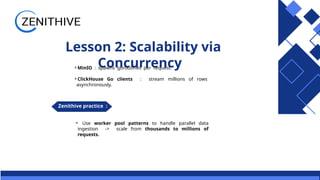
Lesson 2: Scalability via
Concurrency
Tech debt kills velocity, investor trust, and roadmap
execution
⚬MinIO : spawns goroutines per request.
⚬ClickHouse Go clients : stream millions of rows
asynchronously.
Startups need foundational speed and scalability
Results:
⚬ Use worker pool patterns to handle parallel data
ingestion -> scale from thousands to millions of
requests.
Zenithive practice :
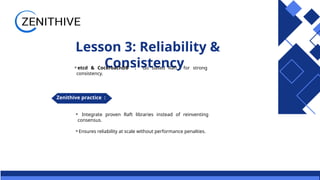
Lesson 3: Reliability &
Consistency
Tech debt kills velocity, investor trust, and roadmap
execution
⚬etcd & CockroachDB : Go based Raft for strong
consistency.
Startups need foundational speed and scalability
Results:
⚬ Integrate proven Raft libraries instead of reinventing
consensus.
⚬Ensures reliability at scale without performance penalties.
Zenithive practice :
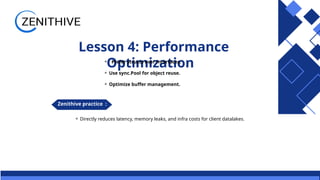
Lesson 4: Performance
Optimization
Tech debt kills velocity, investor trust, and roadmap
execution
⚬ Prefer structs over interfaces.
⚬ Use sync.Pool for object reuse.
⚬ Optimize buffer management.
Startups need foundational speed and scalability
Results:
⚬ Directly reduces latency, memory leaks, and infra costs for client datalakes.
Zenithive practice :
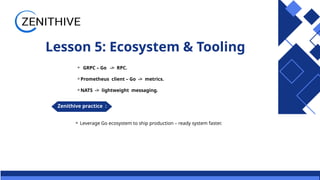
Lesson 5: Ecosystem & Tooling
Tech debt kills velocity, investor trust, and roadmap
execution
⚬ GRPC – Go -> RPC.
⚬Prometheus client – Go -> metrics.
⚬NATS -> lightweight messaging.
Startups need foundational speed and scalability
Results:
⚬ Leverage Go ecosystem to ship production – ready system faster.
Zenithive practice :
Thank You
Building a scalable MVP or data platform?
Zenithive helps startups design distributed systems that last.
+91 91060 69395 1105, GANESH GLORY, Jagatpur Rd,
off Sarkhej – Gandhinagar Highwa
y, Gota, Ahmedabad, Gujarat 3824
81
www.zenithive.com info@zenithive.com

Scaling with Go: Distributed System Lessons from Open-Source Datalakes

  • 1.
    Lessons from OpenSource Datalake Projects Building Distributed System with Golang WWW.ZENITHIVE.COM
  • 2.
    Introduction Why Distributed SystemsMatter in 2025. Tech debt kills velocity, investor trust, and roadmap execution ⚬Every modern business runs on data at scale. ⚬Data power fintech, AI, SaaS, and beyond. ⚬Challenge : Streaming ingestion, flexible schemas, distributed storage, high – speed queries. ⚬Enter Golang ( Go ) -> built for concurrency & scalability. s:
  • 3.
    Why Go forDistributed Systems? Tech debt kills velocity, investor trust, and roadmap execution ⚬Concurrency without complexity ( goroutines, channels ). ⚬Networking First- class citizen ( HTTP, GRPC, WebSockets, TCP / UDP ). ⚬Simplicity & maintainability -> lower tech debt for MVPs. ⚬Performance at scale -> near – C speed with safer memory model. Used by MinIO, etcd, NATS, ClickHouse Go clients. Results:
  • 4.
    Lesson 1 :Architecture & Design Tech debt kills velocity, investor trust, and roadmap execution ⚬MinIO : separates ingestion, storage, metadata layers. ⚬Etcd : clean Raft implementation for consensus. Startups need foundational speed and scalability Results: ⚬ Keep services focused -> ingestion, storage, query as separate scalable units ( avoid monolith datalakes ). Zenithive takeaway :
  • 5.
    Lesson 2: Scalabilityvia Concurrency Tech debt kills velocity, investor trust, and roadmap execution ⚬MinIO : spawns goroutines per request. ⚬ClickHouse Go clients : stream millions of rows asynchronously. Startups need foundational speed and scalability Results: ⚬ Use worker pool patterns to handle parallel data ingestion -> scale from thousands to millions of requests. Zenithive practice :
  • 6.
    Lesson 3: Reliability& Consistency Tech debt kills velocity, investor trust, and roadmap execution ⚬etcd & CockroachDB : Go based Raft for strong consistency. Startups need foundational speed and scalability Results: ⚬ Integrate proven Raft libraries instead of reinventing consensus. ⚬Ensures reliability at scale without performance penalties. Zenithive practice :
  • 7.
    Lesson 4: Performance Optimization Techdebt kills velocity, investor trust, and roadmap execution ⚬ Prefer structs over interfaces. ⚬ Use sync.Pool for object reuse. ⚬ Optimize buffer management. Startups need foundational speed and scalability Results: ⚬ Directly reduces latency, memory leaks, and infra costs for client datalakes. Zenithive practice :
  • 8.
    Lesson 5: Ecosystem& Tooling Tech debt kills velocity, investor trust, and roadmap execution ⚬ GRPC – Go -> RPC. ⚬Prometheus client – Go -> metrics. ⚬NATS -> lightweight messaging. Startups need foundational speed and scalability Results: ⚬ Leverage Go ecosystem to ship production – ready system faster. Zenithive practice :
  • 9.
    Thank You Building ascalable MVP or data platform? Zenithive helps startups design distributed systems that last. +91 91060 69395 1105, GANESH GLORY, Jagatpur Rd, off Sarkhej – Gandhinagar Highwa y, Gota, Ahmedabad, Gujarat 3824 81 www.zenithive.com info@zenithive.com