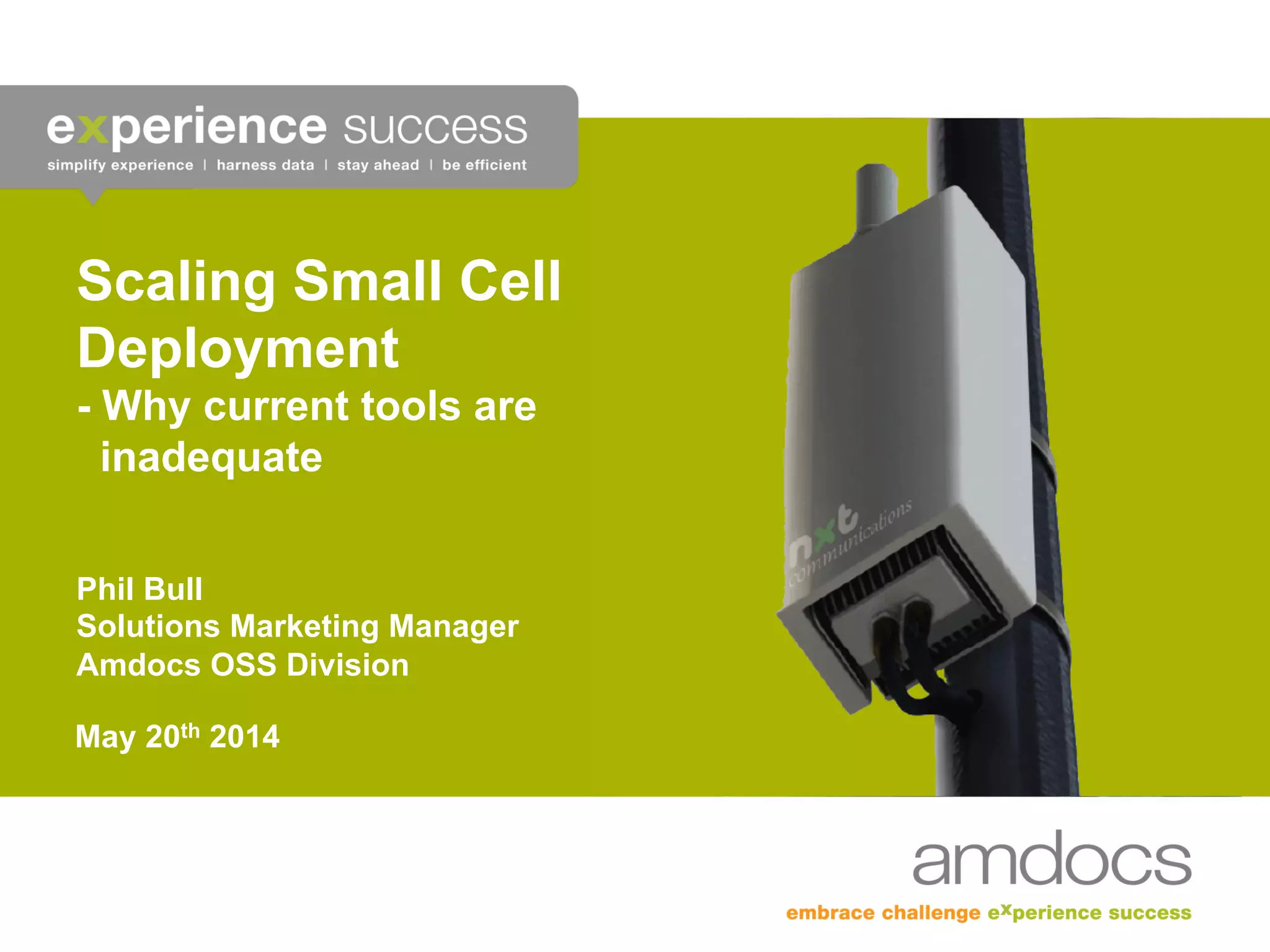
Scaling Small Cell
Deployment
- Why current tools are
inadequate
Phil Bull
Solutions Marketing Manager
Amdocs OSS Division
May 20th 2014
Information Security Level 1 – Confidential
© 2014 – Proprietary and Confidential Information of Amdocs2
Agenda
● Small cells market
● Deployment challenges
● Backhaul complexity
● Limitations of today’s planning tools and processes
● Amdocs Small Cell Solution
● Catalog driven ‘factory’ approach
● Benefits of Dynamic Plan Management
● Summary
● Q&A
Information Security Level 1 – Confidential
© 2014 – Proprietary and Confidential Information of Amdocs3
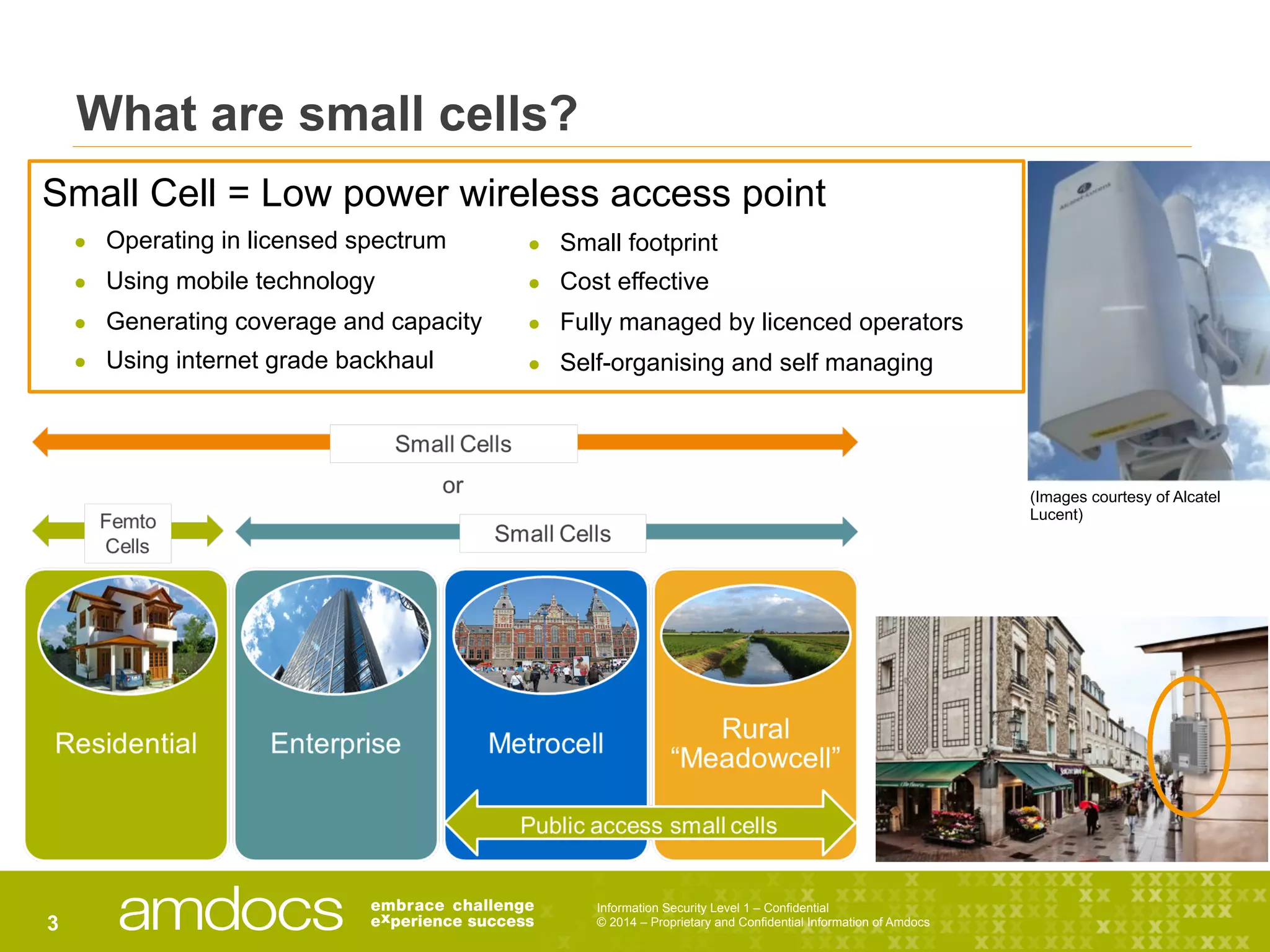
What are small cells?
Small Cell = Low power wireless access point
●  Operating in licensed spectrum
●  Using mobile technology
●  Generating coverage and capacity
●  Using internet grade backhaul
●  Small footprint
●  Cost effective
●  Fully managed by licenced operators
●  Self-organising and self managing
(Images courtesy of Alcatel
Lucent)
Information Security Level 1 – Confidential
© 2014 – Proprietary and Confidential Information of Amdocs4
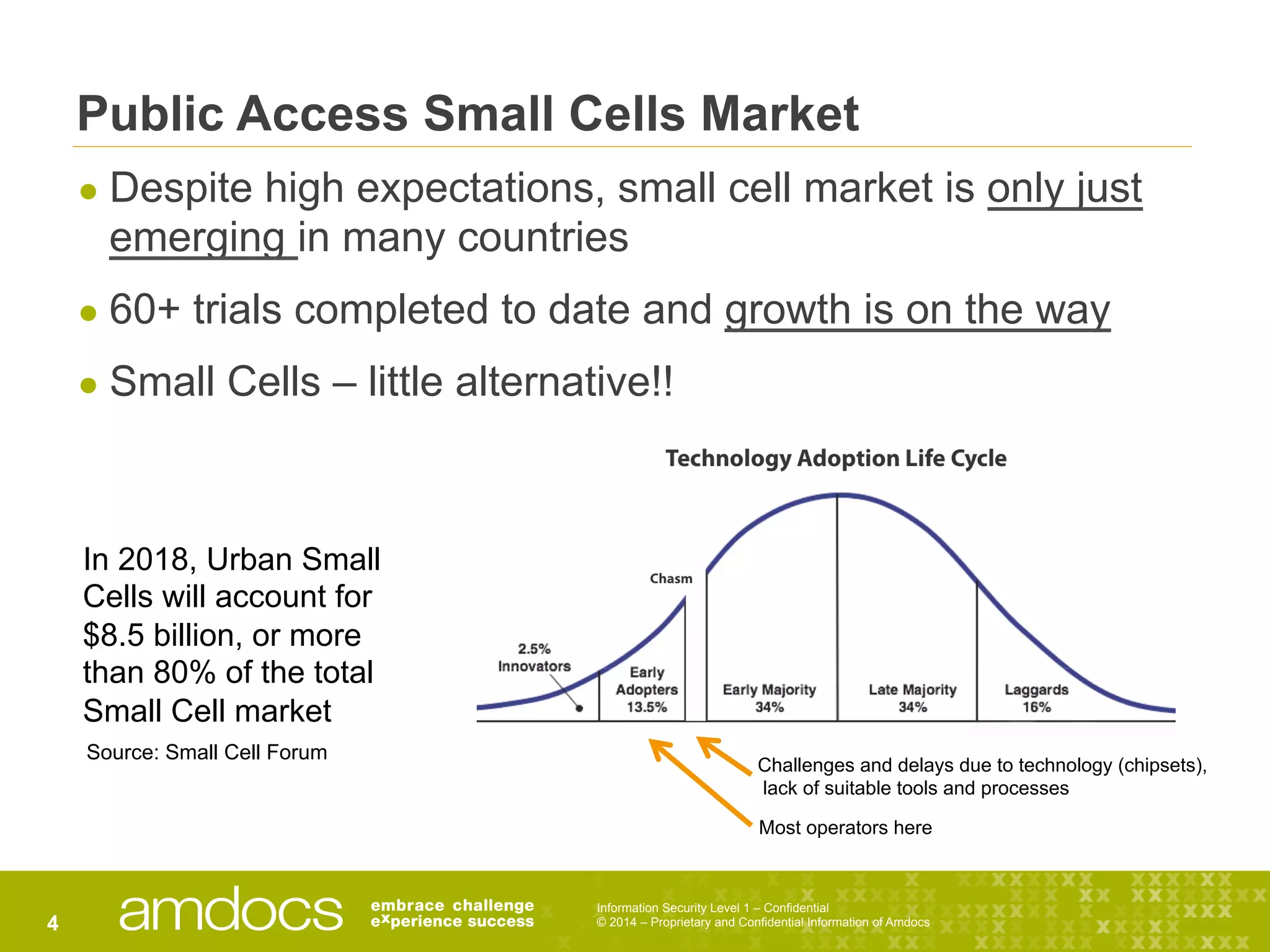
Public Access Small Cells Market
● Despite high expectations, small cell market is only just
emerging in many countries
● 60+ trials completed to date and growth is on the way
● Small Cells – little alternative!!
In 2018, Urban Small
Cells will account for
$8.5 billion, or more
than 80% of the total
Small Cell market
Source: Small Cell Forum
Challenges and delays due to technology (chipsets),
lack of suitable tools and processes
Most operators here
Information Security Level 1 – Confidential
© 2014 – Proprietary and Confidential Information of Amdocs5
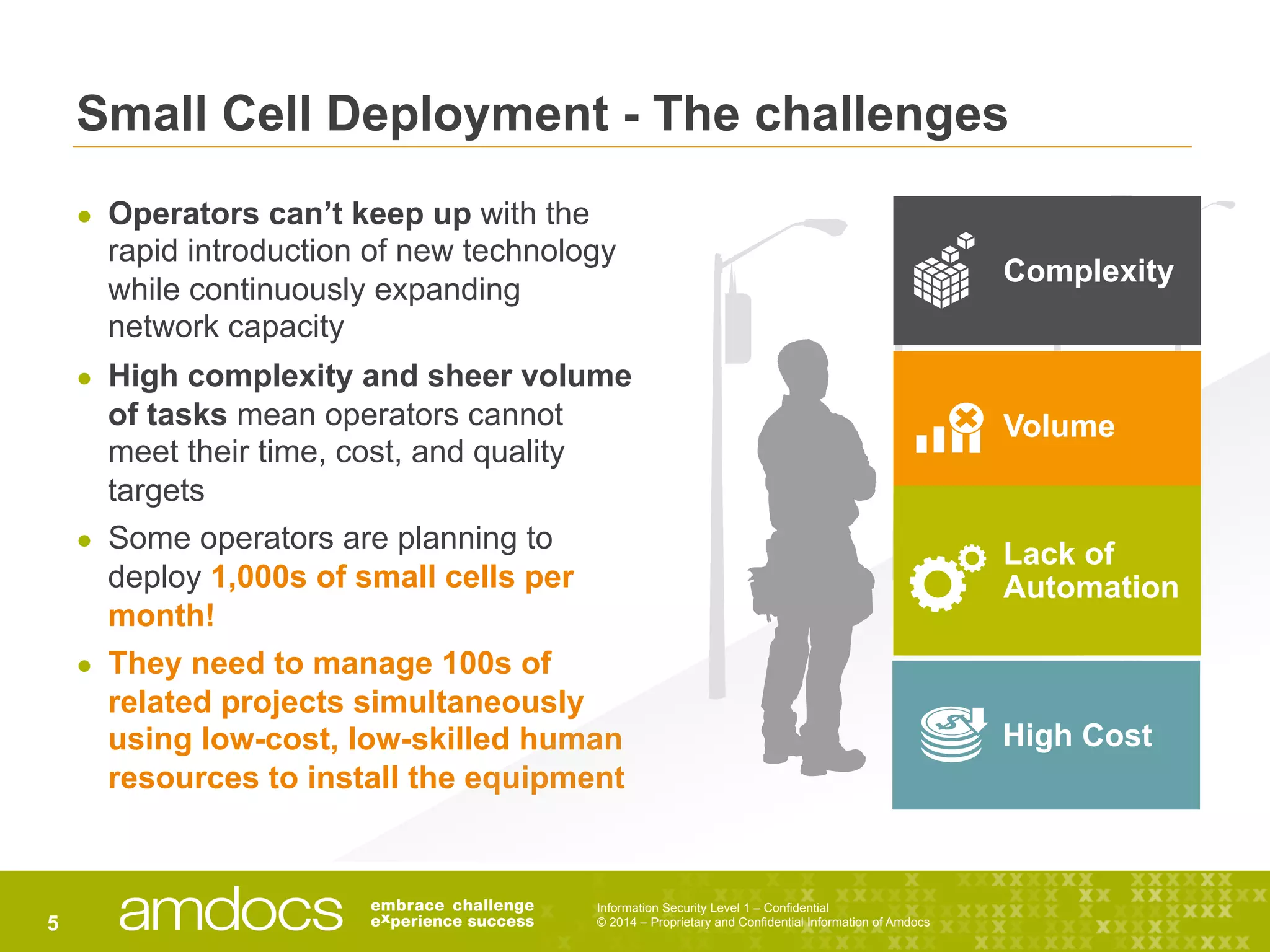
Small Cell Deployment - The challenges
●  Operators can’t keep up with the
rapid introduction of new technology
while continuously expanding
network capacity
●  High complexity and sheer volume
of tasks mean operators cannot
meet their time, cost, and quality
targets
●  Some operators are planning to
deploy 1,000s of small cells per
month!
●  They need to manage 100s of
related projects simultaneously
using low-cost, low-skilled human
resources to install the equipment
High Cost
Volume
Lack of
Automation
Complexity
Information Security Level 1 – Confidential
© 2014 – Proprietary and Confidential Information of Amdocs6
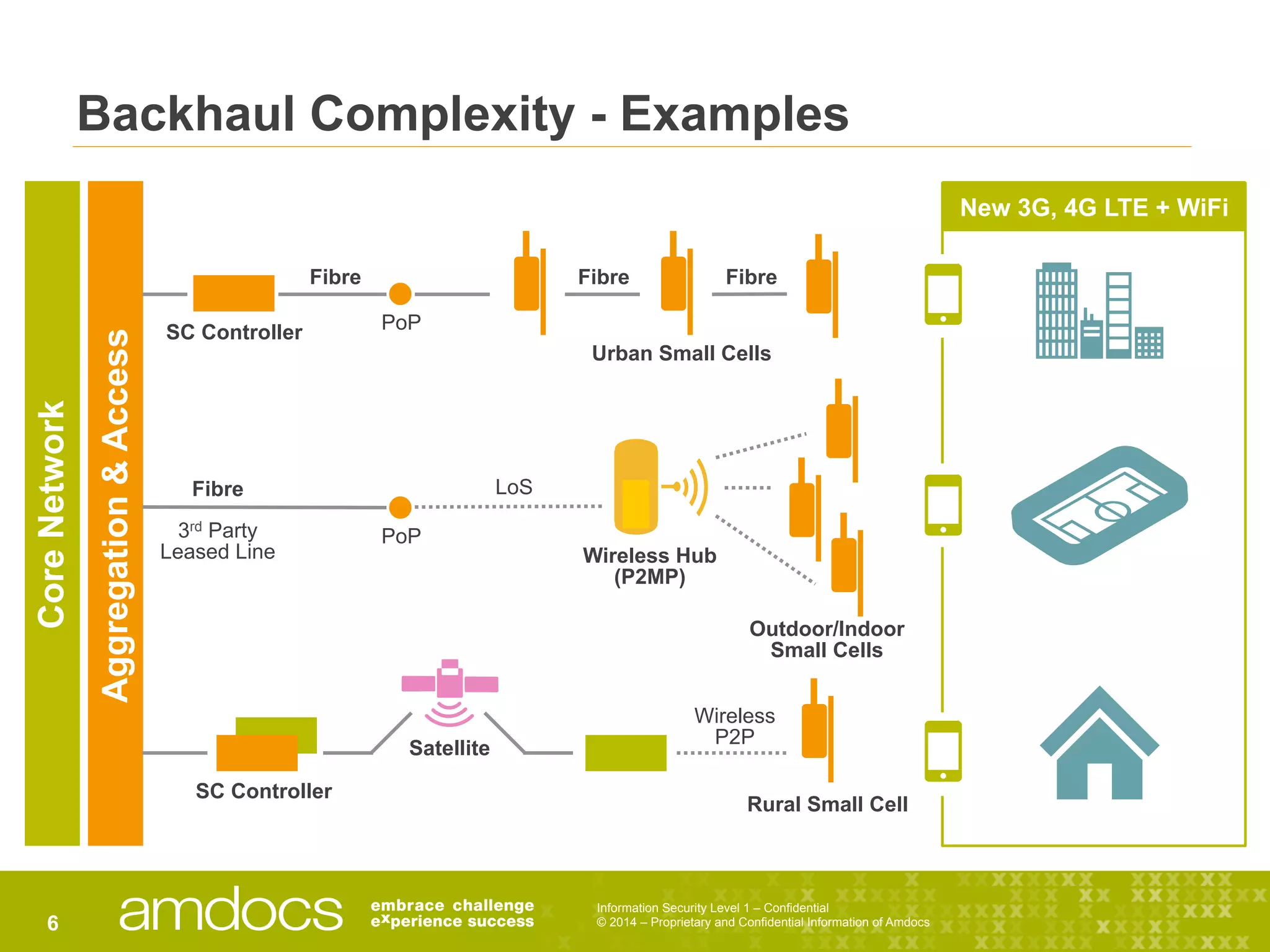
Backhaul Complexity - Examples
SC Controller
New 3G, 4G LTE + WiFi
CoreNetwork
Aggregation&Access
Wireless Hub
(P2MP)
SC Controller
Satellite
Rural Small Cell
Fibre
3rd Party
Leased Line
PoP
LoS
PoP
Fibre Fibre Fibre
Outdoor/Indoor
Small Cells
Wireless
P2P
Urban Small Cells
Information Security Level 1 – Confidential
© 2014 – Proprietary and Confidential Information of Amdocs7
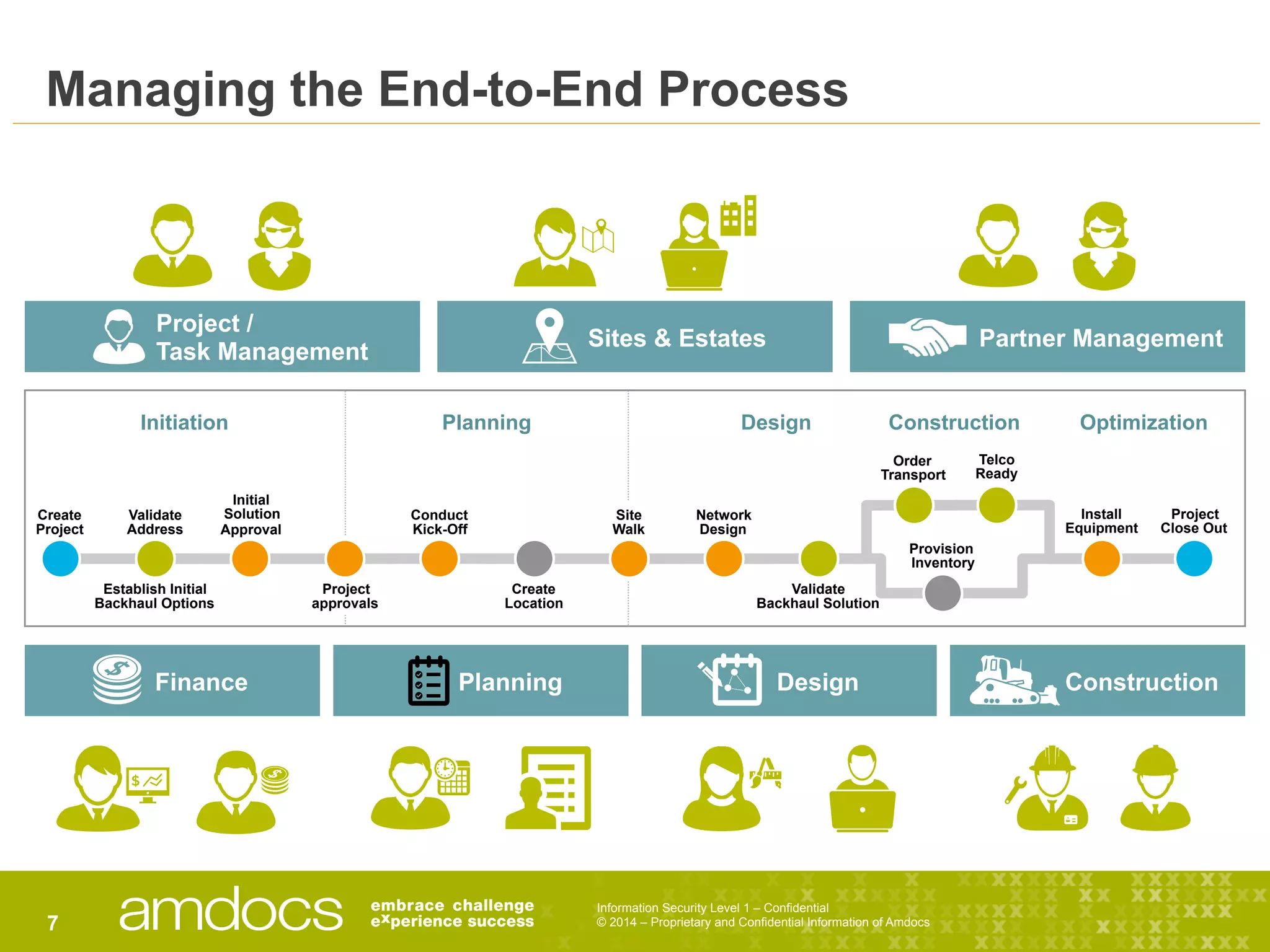
Managing the End-to-End Process
Finance Planning Design Construction
Create
Project
Validate
Backhaul Solution
Initial
Solution
Approval
Conduct
Kick-Off
Create
Location
Site
Walk
Network
Design
Project
approvals
Establish Initial
Backhaul Options
Install
Equipment
Provision
Inventory
Telco
Ready
Order
Transport
Project
Close Out
Validate
Address
Project /
Task Management
Sites & Estates Partner Management
Initiation Planning Design Construction Optimization
Information Security Level 1 – Confidential
© 2014 – Proprietary and Confidential Information of Amdocs8
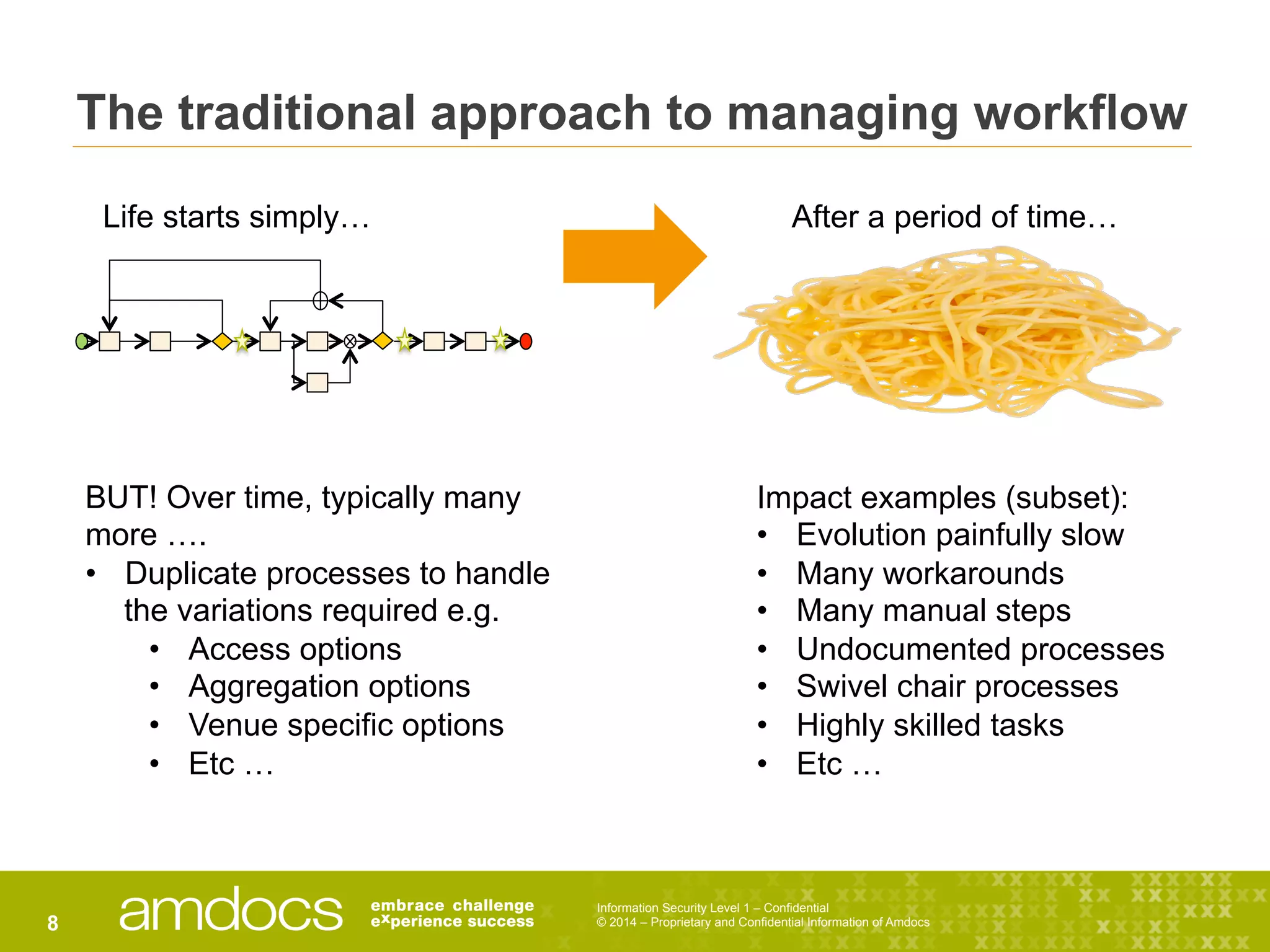
The traditional approach to managing workflow
Life starts simply…
BUT! Over time, typically many
more ….
•  Duplicate processes to handle
the variations required e.g.
•  Access options
•  Aggregation options
•  Venue specific options
•  Etc …
Impact examples (subset):
•  Evolution painfully slow
•  Many workarounds
•  Many manual steps
•  Undocumented processes
•  Swivel chair processes
•  Highly skilled tasks
•  Etc …
After a period of time…
Information Security Level 1 – Confidential
© 2014 – Proprietary and Confidential Information of Amdocs9
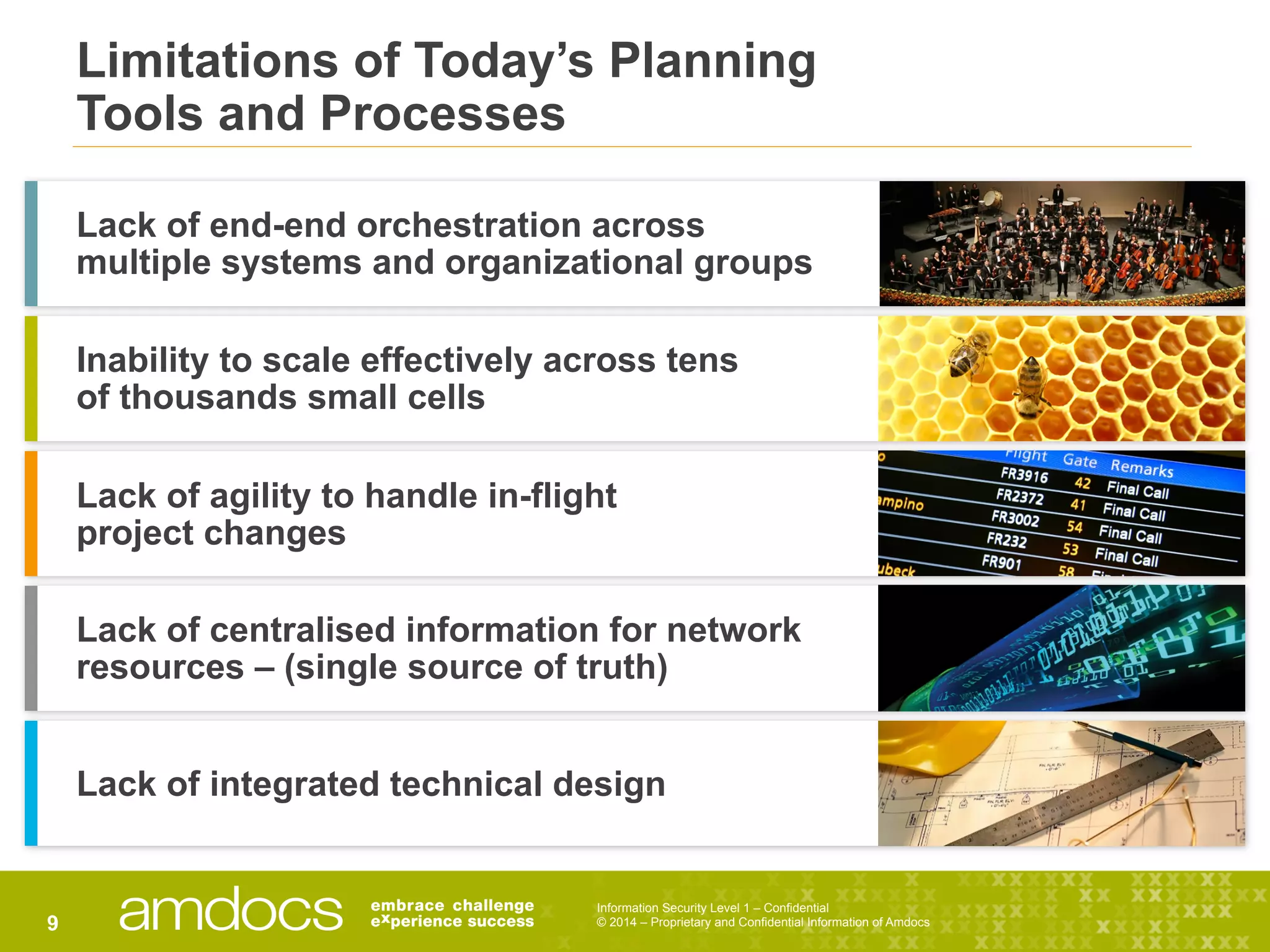
Limitations of Today’s Planning
Tools and Processes
Lack of end-end orchestration across
multiple systems and organizational groups
Inability to scale effectively across tens
of thousands small cells
Lack of agility to handle in-flight
project changes
Lack of centralised information for network
resources – (single source of truth)
Lack of integrated technical design
Information Security Level 1 – Confidential
© 2014 – Proprietary and Confidential Information of Amdocs10
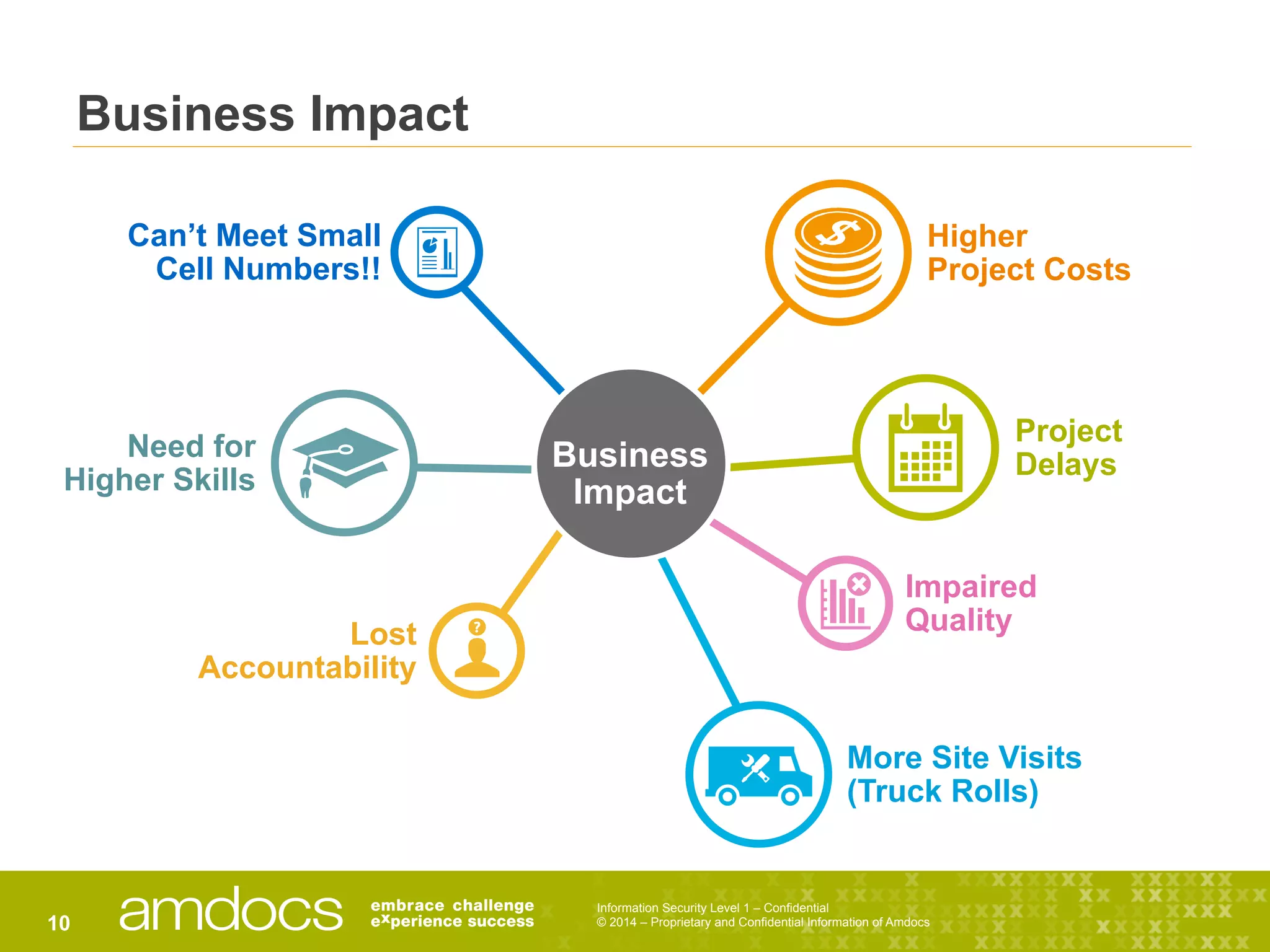
Business Impact
Business
Impact
Higher
Project Costs
Project
Delays
Impaired
Quality
More Site Visits
(Truck Rolls)
Lost
Accountability
Need for
Higher Skills
Can’t Meet Small
Cell Numbers!!
Information Security Level 1 – Confidential
© 2014 – Proprietary and Confidential Information of Amdocs11
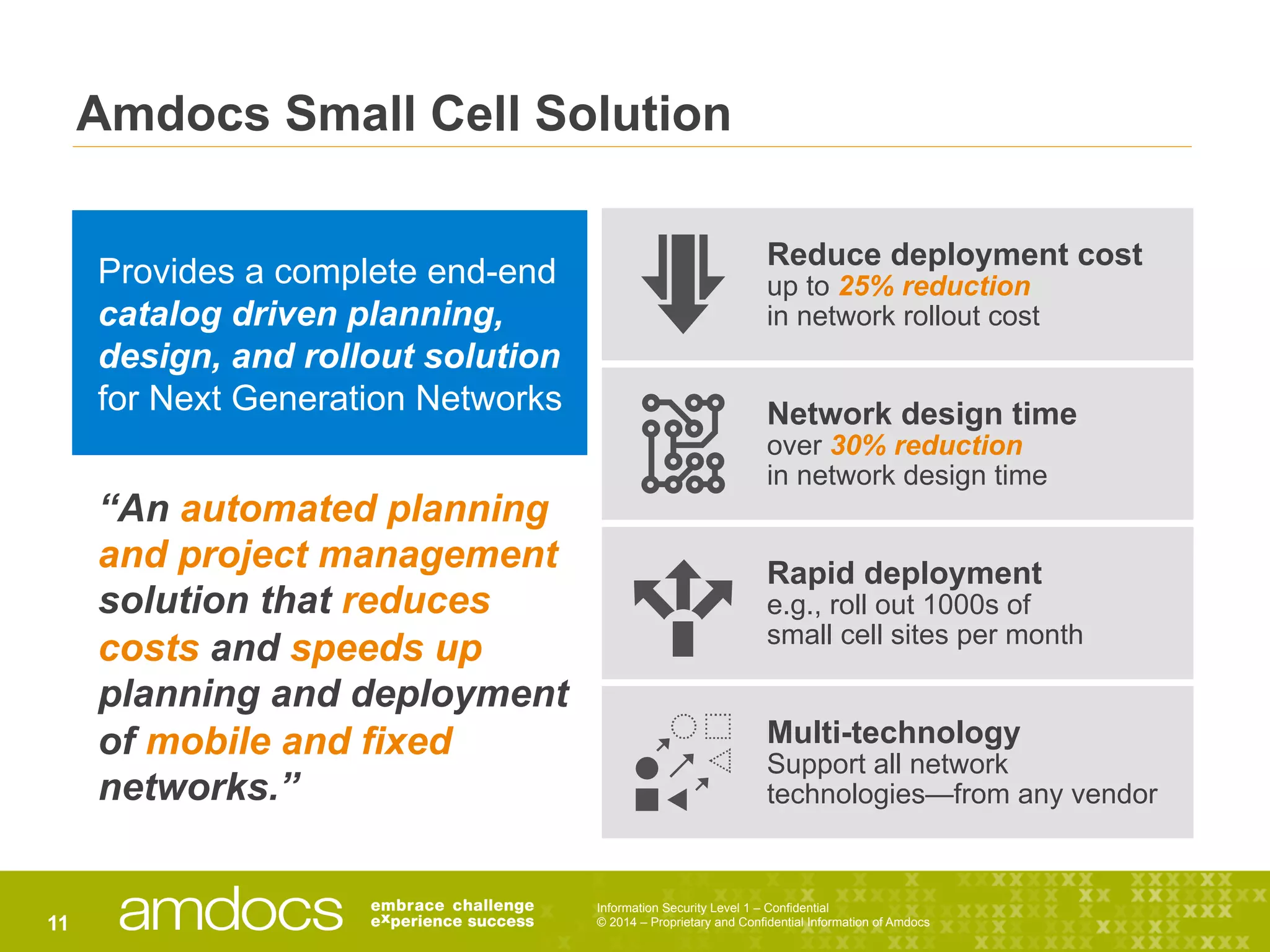
Amdocs Small Cell Solution
Provides a complete end-end
catalog driven planning,
design, and rollout solution
for Next Generation Networks
“An automated planning
and project management
solution that reduces
costs and speeds up
planning and deployment
of mobile and fixed
networks.”
Network design time
over 30% reduction
in network design time
Rapid deployment
e.g., roll out 1000s of
small cell sites per month
Reduce deployment cost
up to 25% reduction
in network rollout cost
Multi-technology
Support all network
technologies—from any vendor
Information Security Level 1 – Confidential
© 2014 – Proprietary and Confidential Information of Amdocs12
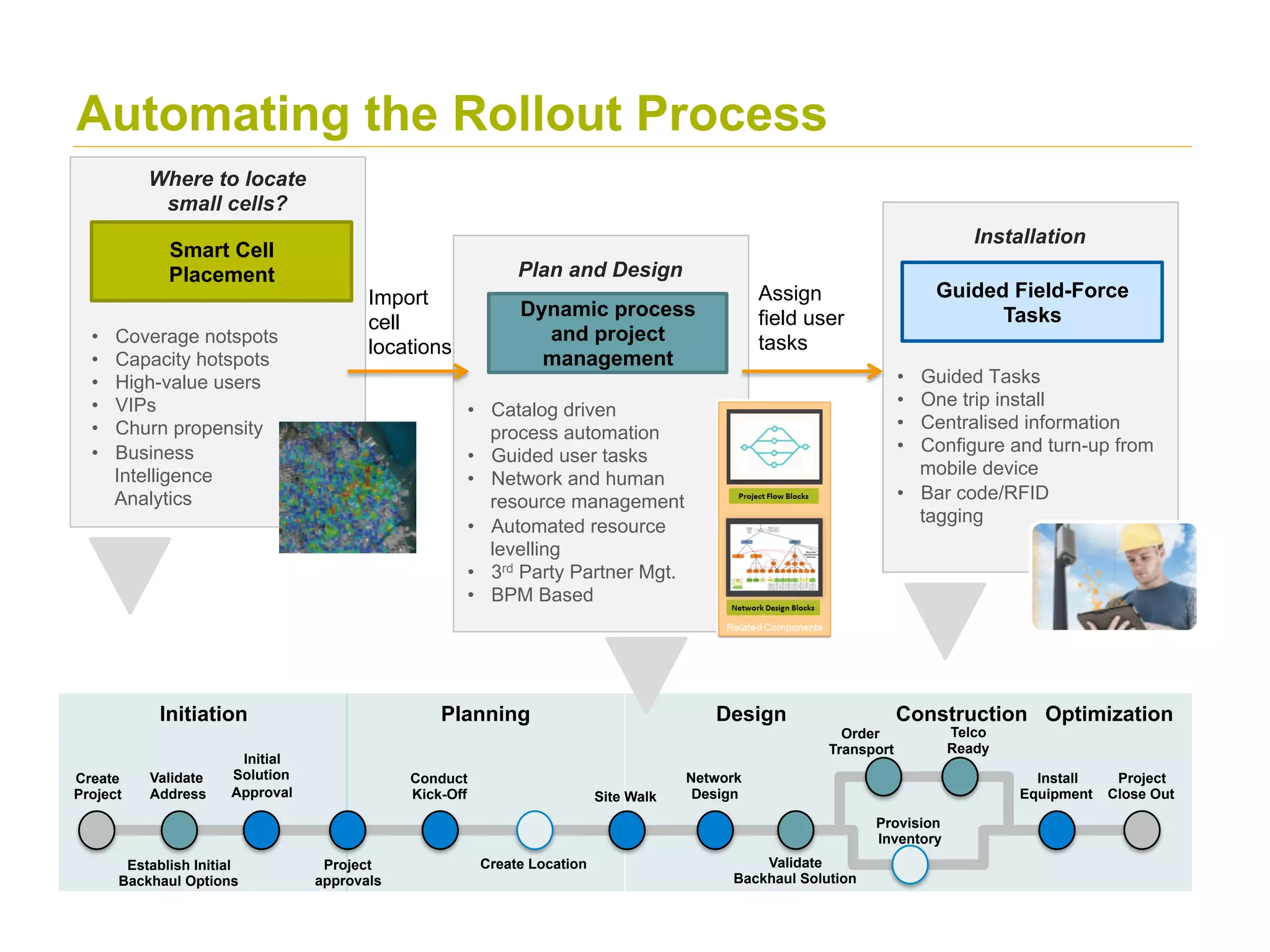
Initiation Construction OptimizationDesignPlanning
Validate
Backhaul Solution
Initial
Solution
Approval
Conduct
Kick-Off
Create Location
Site Walk
Network
Design
Project
approvals
Establish Initial
Backhaul Options
Install
Equipment
Provision
Inventory
Telco
Ready
Order
Transport
Create
Project
Project
Close Out
Validate
Address
Automating the Rollout Process
Smart Cell
Placement
•  Catalog driven
process automation
•  Guided user tasks
•  Network and human
resource management
•  Automated resource
levelling
•  3rd Party Partner Mgt.
•  BPM Based
Where to locate
small cells?
Dynamic process
and project
management
Plan and Design
•  Coverage notspots
•  Capacity hotspots
•  High-value users
•  VIPs
•  Churn propensity
•  Business
Intelligence
Analytics
•  Guided Tasks
•  One trip install
•  Centralised information
•  Configure and turn-up from
mobile device
•  Bar code/RFID
tagging
Installation
Guided Field-Force
Tasks
Import
cell
locations
Assign
field user
tasks
Information Security Level 1 – Confidential
© 2014 – Proprietary and Confidential Information of Amdocs13
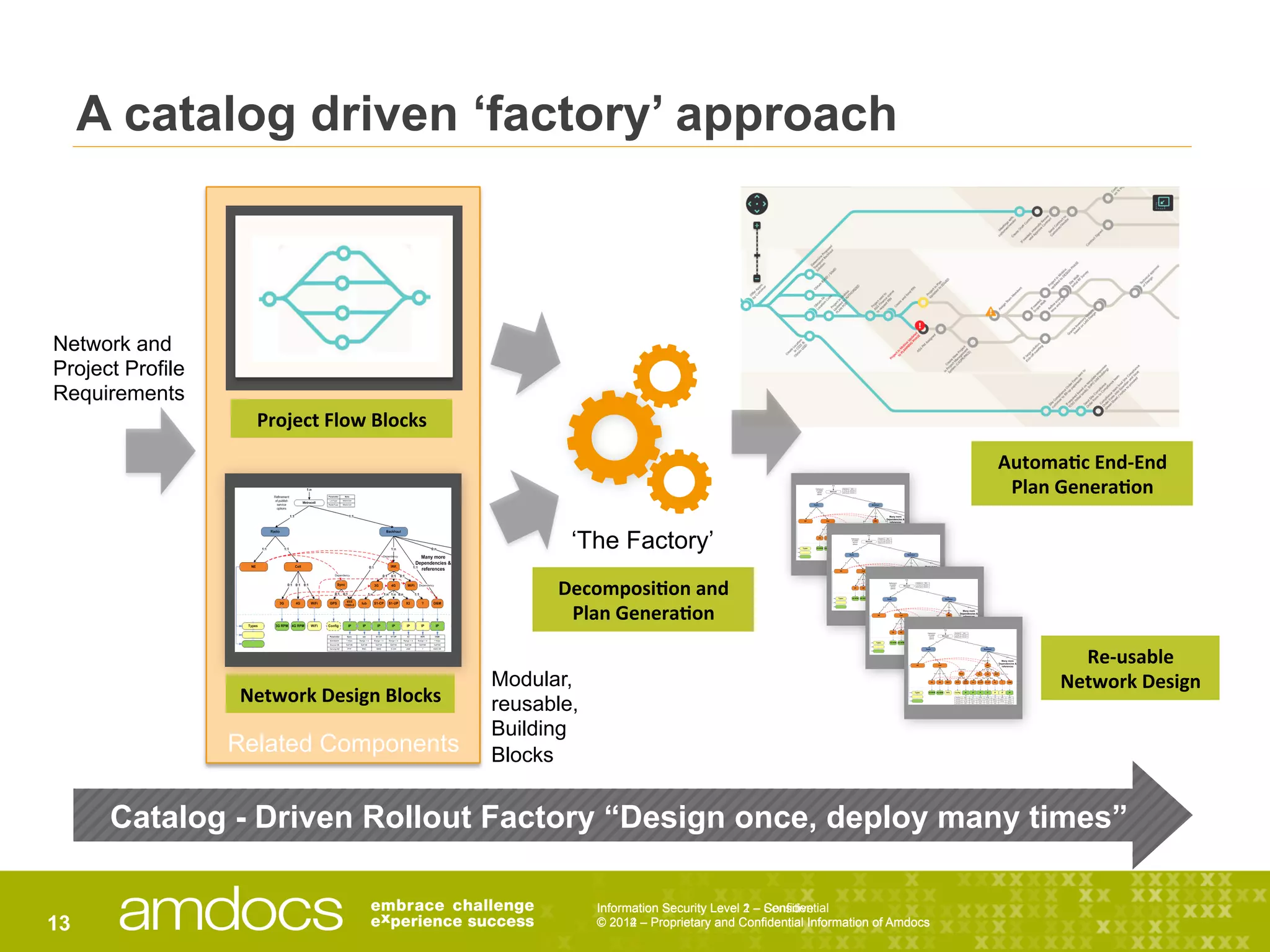
Related Components
A catalog driven ‘factory’ approach
Catalog - Driven Rollout Factory “Design once, deploy many times”
Information Security Level 2 – Sensitive
© 2012 – Proprietary and Confidential Information of Amdocs
Decomposi)on	
  and	
  
Plan	
  Genera)on	
  
Network	
  Design	
  Blocks	
  
Project	
  Flow	
  Blocks	
  
Re-­‐usable	
  
Network	
  Design	
  
Automa)c	
  End-­‐End	
  
Plan	
  Genera)on	
  
Network and
Project Profile
Requirements
Modular,
reusable,
Building
Blocks
‘The Factory’
Information Security Level 1 – Confidential
© 2014 – Proprietary and Confidential Information of Amdocs14
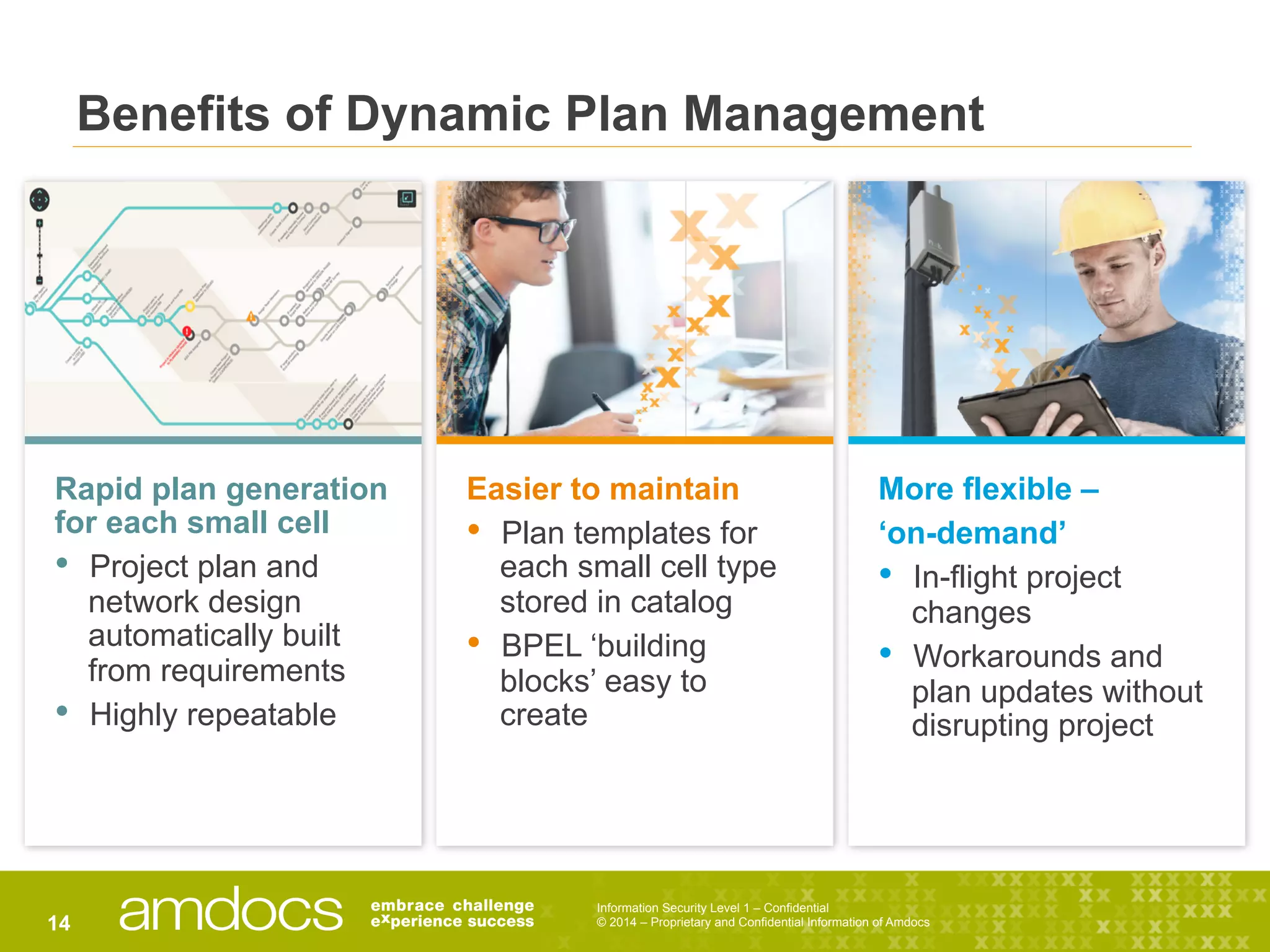
Benefits of Dynamic Plan Management
Rapid plan generation
for each small cell
•  Project plan and
network design
automatically built
from requirements
•  Highly repeatable
Easier to maintain
•  Plan templates for
each small cell type
stored in catalog
•  BPEL ‘building
blocks’ easy to
create
More flexible –
‘on-demand’
•  In-flight project
changes
•  Workarounds and
plan updates without
disrupting project
Information Security Level 1 – Confidential
© 2014 – Proprietary and Confidential Information of Amdocs15
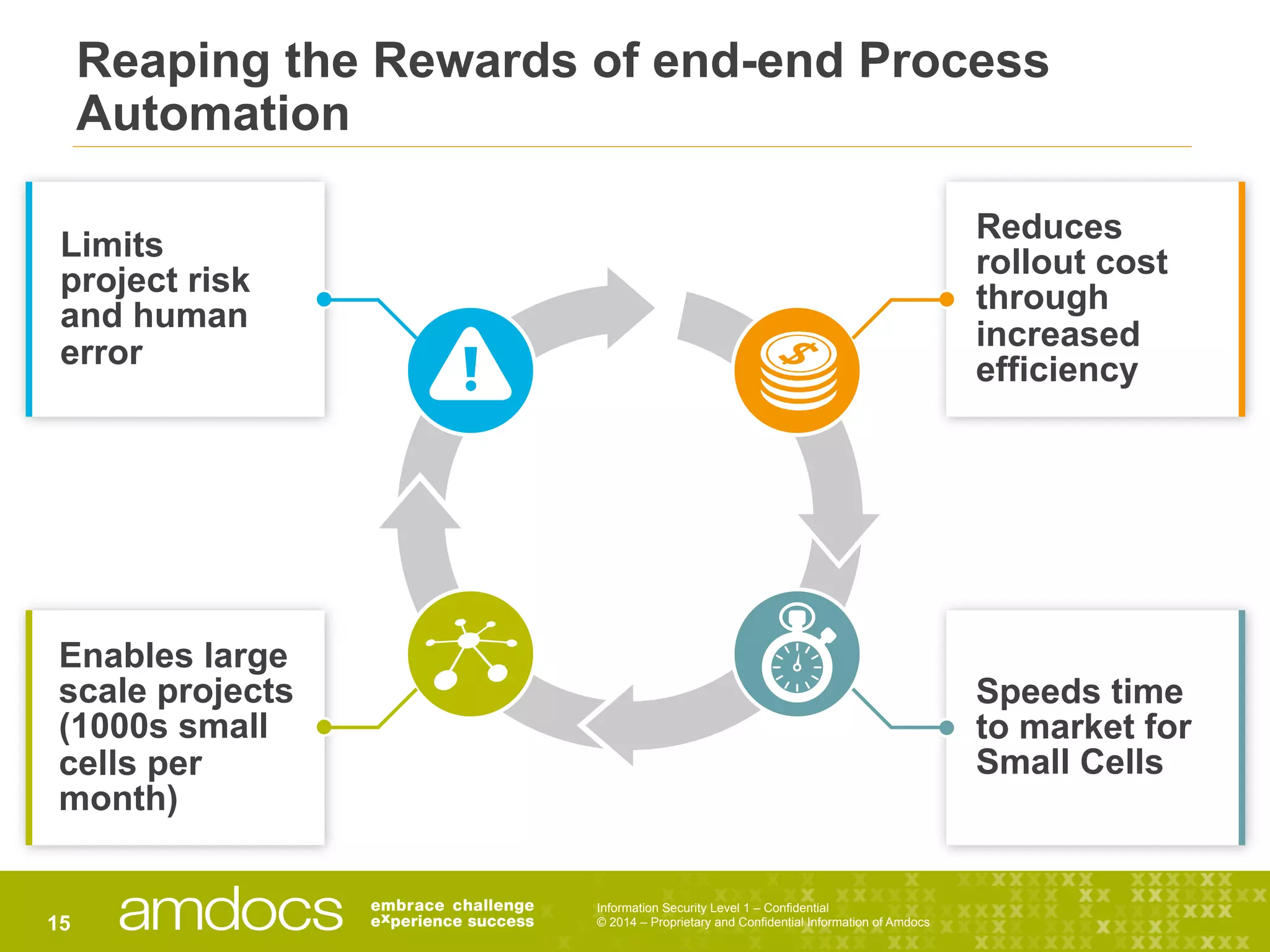
Speeds time
to market for
Small Cells
Reaping the Rewards of end-end Process
Automation
Reduces
rollout cost
through
increased
efficiency
Enables large
scale projects
(1000s small
cells per
month)
Limits
project risk
and human
error
Information Security Level 1 – Confidential
© 2014 – Proprietary and Confidential Information of Amdocs16
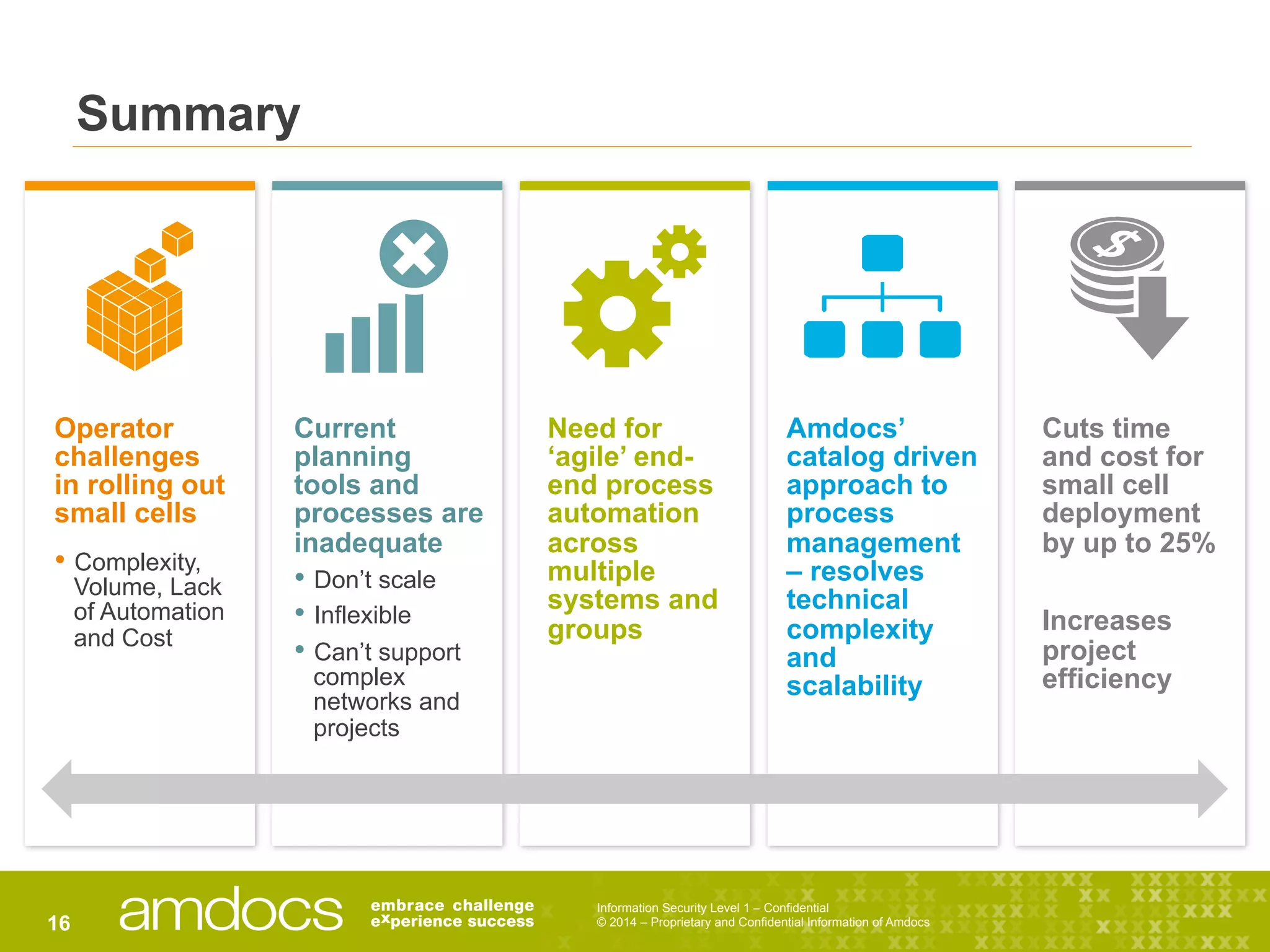
Summary
Operator
challenges
in rolling out
small cells
• Complexity,
Volume, Lack
of Automation
and Cost
Current
planning
tools and
processes are
inadequate
• Don’t scale
• Inflexible
• Can’t support
complex
networks and
projects
Need for
‘agile’ end-
end process
automation
across
multiple
systems and
groups
Amdocs’
catalog driven
approach to
process
management
– resolves
technical
complexity
and
scalability
Cuts time
and cost for
small cell
deployment
by up to 25%
Increases
project
efficiency
Information Security Level 1 – Confidential
© 2014 – Proprietary and Confidential Information of Amdocs17
Who to contact?
● Phil Bull, Solutions Marketing Manager
●  philip.bull@amdocs.com
● Visit our Small Cell Solutions page
www.amdocs.com/Products/OSS/Pages/small-cell-
solution.aspx

Scaling small cell deployment - Why current tools are inadequate

  • 1.
    Scaling Small Cell Deployment -Why current tools are inadequate Phil Bull Solutions Marketing Manager Amdocs OSS Division May 20th 2014
  • 2.
    Information Security Level1 – Confidential © 2014 – Proprietary and Confidential Information of Amdocs2 Agenda ● Small cells market ● Deployment challenges ● Backhaul complexity ● Limitations of today’s planning tools and processes ● Amdocs Small Cell Solution ● Catalog driven ‘factory’ approach ● Benefits of Dynamic Plan Management ● Summary ● Q&A
  • 3.
    Information Security Level1 – Confidential © 2014 – Proprietary and Confidential Information of Amdocs3 What are small cells? Small Cell = Low power wireless access point ●  Operating in licensed spectrum ●  Using mobile technology ●  Generating coverage and capacity ●  Using internet grade backhaul ●  Small footprint ●  Cost effective ●  Fully managed by licenced operators ●  Self-organising and self managing (Images courtesy of Alcatel Lucent)
  • 4.
    Information Security Level1 – Confidential © 2014 – Proprietary and Confidential Information of Amdocs4 Public Access Small Cells Market ● Despite high expectations, small cell market is only just emerging in many countries ● 60+ trials completed to date and growth is on the way ● Small Cells – little alternative!! In 2018, Urban Small Cells will account for $8.5 billion, or more than 80% of the total Small Cell market Source: Small Cell Forum Challenges and delays due to technology (chipsets), lack of suitable tools and processes Most operators here
  • 5.
    Information Security Level1 – Confidential © 2014 – Proprietary and Confidential Information of Amdocs5 Small Cell Deployment - The challenges ●  Operators can’t keep up with the rapid introduction of new technology while continuously expanding network capacity ●  High complexity and sheer volume of tasks mean operators cannot meet their time, cost, and quality targets ●  Some operators are planning to deploy 1,000s of small cells per month! ●  They need to manage 100s of related projects simultaneously using low-cost, low-skilled human resources to install the equipment High Cost Volume Lack of Automation Complexity
  • 6.
    Information Security Level1 – Confidential © 2014 – Proprietary and Confidential Information of Amdocs6 Backhaul Complexity - Examples SC Controller New 3G, 4G LTE + WiFi CoreNetwork Aggregation&Access Wireless Hub (P2MP) SC Controller Satellite Rural Small Cell Fibre 3rd Party Leased Line PoP LoS PoP Fibre Fibre Fibre Outdoor/Indoor Small Cells Wireless P2P Urban Small Cells
  • 7.
    Information Security Level1 – Confidential © 2014 – Proprietary and Confidential Information of Amdocs7 Managing the End-to-End Process Finance Planning Design Construction Create Project Validate Backhaul Solution Initial Solution Approval Conduct Kick-Off Create Location Site Walk Network Design Project approvals Establish Initial Backhaul Options Install Equipment Provision Inventory Telco Ready Order Transport Project Close Out Validate Address Project / Task Management Sites & Estates Partner Management Initiation Planning Design Construction Optimization
  • 8.
    Information Security Level1 – Confidential © 2014 – Proprietary and Confidential Information of Amdocs8 The traditional approach to managing workflow Life starts simply… BUT! Over time, typically many more …. •  Duplicate processes to handle the variations required e.g. •  Access options •  Aggregation options •  Venue specific options •  Etc … Impact examples (subset): •  Evolution painfully slow •  Many workarounds •  Many manual steps •  Undocumented processes •  Swivel chair processes •  Highly skilled tasks •  Etc … After a period of time…
  • 9.
    Information Security Level1 – Confidential © 2014 – Proprietary and Confidential Information of Amdocs9 Limitations of Today’s Planning Tools and Processes Lack of end-end orchestration across multiple systems and organizational groups Inability to scale effectively across tens of thousands small cells Lack of agility to handle in-flight project changes Lack of centralised information for network resources – (single source of truth) Lack of integrated technical design
  • 10.
    Information Security Level1 – Confidential © 2014 – Proprietary and Confidential Information of Amdocs10 Business Impact Business Impact Higher Project Costs Project Delays Impaired Quality More Site Visits (Truck Rolls) Lost Accountability Need for Higher Skills Can’t Meet Small Cell Numbers!!
  • 11.
    Information Security Level1 – Confidential © 2014 – Proprietary and Confidential Information of Amdocs11 Amdocs Small Cell Solution Provides a complete end-end catalog driven planning, design, and rollout solution for Next Generation Networks “An automated planning and project management solution that reduces costs and speeds up planning and deployment of mobile and fixed networks.” Network design time over 30% reduction in network design time Rapid deployment e.g., roll out 1000s of small cell sites per month Reduce deployment cost up to 25% reduction in network rollout cost Multi-technology Support all network technologies—from any vendor
  • 12.
    Information Security Level1 – Confidential © 2014 – Proprietary and Confidential Information of Amdocs12 Initiation Construction OptimizationDesignPlanning Validate Backhaul Solution Initial Solution Approval Conduct Kick-Off Create Location Site Walk Network Design Project approvals Establish Initial Backhaul Options Install Equipment Provision Inventory Telco Ready Order Transport Create Project Project Close Out Validate Address Automating the Rollout Process Smart Cell Placement •  Catalog driven process automation •  Guided user tasks •  Network and human resource management •  Automated resource levelling •  3rd Party Partner Mgt. •  BPM Based Where to locate small cells? Dynamic process and project management Plan and Design •  Coverage notspots •  Capacity hotspots •  High-value users •  VIPs •  Churn propensity •  Business Intelligence Analytics •  Guided Tasks •  One trip install •  Centralised information •  Configure and turn-up from mobile device •  Bar code/RFID tagging Installation Guided Field-Force Tasks Import cell locations Assign field user tasks
  • 13.
    Information Security Level1 – Confidential © 2014 – Proprietary and Confidential Information of Amdocs13 Related Components A catalog driven ‘factory’ approach Catalog - Driven Rollout Factory “Design once, deploy many times” Information Security Level 2 – Sensitive © 2012 – Proprietary and Confidential Information of Amdocs Decomposi)on  and   Plan  Genera)on   Network  Design  Blocks   Project  Flow  Blocks   Re-­‐usable   Network  Design   Automa)c  End-­‐End   Plan  Genera)on   Network and Project Profile Requirements Modular, reusable, Building Blocks ‘The Factory’
  • 14.
    Information Security Level1 – Confidential © 2014 – Proprietary and Confidential Information of Amdocs14 Benefits of Dynamic Plan Management Rapid plan generation for each small cell •  Project plan and network design automatically built from requirements •  Highly repeatable Easier to maintain •  Plan templates for each small cell type stored in catalog •  BPEL ‘building blocks’ easy to create More flexible – ‘on-demand’ •  In-flight project changes •  Workarounds and plan updates without disrupting project
  • 15.
    Information Security Level1 – Confidential © 2014 – Proprietary and Confidential Information of Amdocs15 Speeds time to market for Small Cells Reaping the Rewards of end-end Process Automation Reduces rollout cost through increased efficiency Enables large scale projects (1000s small cells per month) Limits project risk and human error
  • 16.
    Information Security Level1 – Confidential © 2014 – Proprietary and Confidential Information of Amdocs16 Summary Operator challenges in rolling out small cells • Complexity, Volume, Lack of Automation and Cost Current planning tools and processes are inadequate • Don’t scale • Inflexible • Can’t support complex networks and projects Need for ‘agile’ end- end process automation across multiple systems and groups Amdocs’ catalog driven approach to process management – resolves technical complexity and scalability Cuts time and cost for small cell deployment by up to 25% Increases project efficiency
  • 17.
    Information Security Level1 – Confidential © 2014 – Proprietary and Confidential Information of Amdocs17 Who to contact? ● Phil Bull, Solutions Marketing Manager ●  philip.bull@amdocs.com ● Visit our Small Cell Solutions page www.amdocs.com/Products/OSS/Pages/small-cell- solution.aspx