Enterprise 9-1-1:
Roadmap to campus safety

Mark J. Fletcher, ENP
Chief Architect
Worldwide Public Safety Solutions
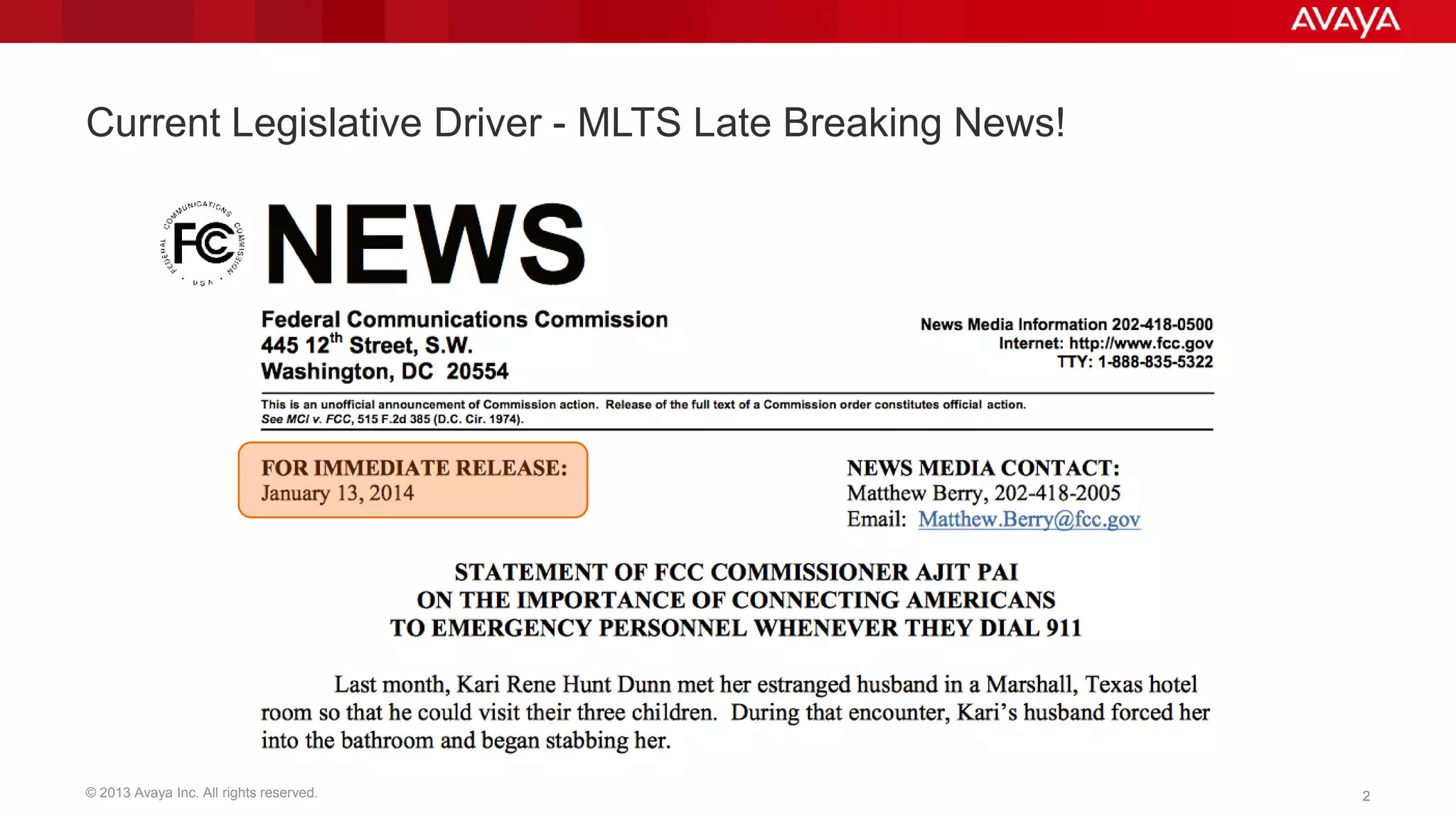
Current Legislative Driver - MLTS Late Breaking News!

© 2013 Avaya Inc. All rights reserved.

2
Avaya‟s Message to Customers
 Next Generation Emergency Services have been clearly defined in both the
US (NENA 08-003) and Europe (NG112-LTD)
 Enterprise administrators must look to the future when designing emergency
services for users in their networks

 Building a NENA i3 compliant architecture is the recommended decision
from a technology and investment perspective
Avaya DevConnect Partners that have followed best practices and guidance set forth
by Avaya’s strategy and thought leadership in the industry, are are able to provide
resilient, life safety solutions that are fully compliant, and in lockstep, with the Next
Generation Emergency Service standards of tomorrow, effectively future proofing the
customer’s emergency communications infrastructure investments today.
Mark J. Fletcher, ENP
Chief Architect
Avaya Worldwide Public Safety Solutions
© 2013 Avaya Inc. All rights reserved.

3
THE PROBLEM TODAY:

LEGACY ANALOG BASED E9-1-1
ANI/ALI DATABASES ARE IRRELEVANT

© 2013 Avaya Inc. All rights reserved.

4
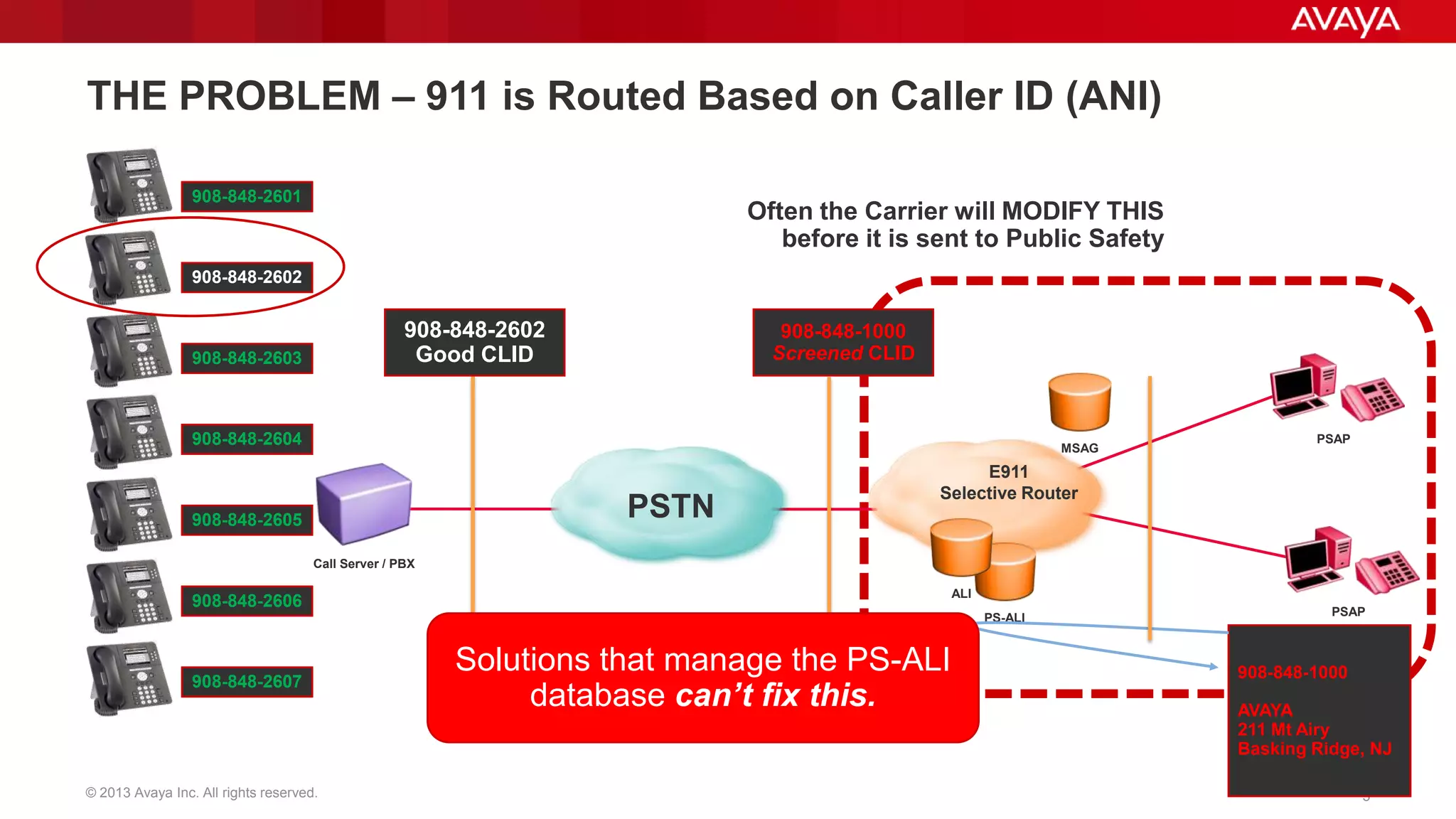
THE PROBLEM – 911 is Routed Based on Caller ID (ANI)
908-848-2601

Often the Carrier will MODIFY THIS
before it is sent to Public Safety

908-848-2602

908-848-2602
Good CLID

908-848-2603

908-848-1000
Screened CLID

908-848-2604

MSAG

PSTN

908-848-2605

PSAP

E911
Selective Router

Call Server / PBX
ALI

908-848-2606

PS-ALI

908-848-2607

© 2013 Avaya Inc. All rights reserved.

Solutions that manage the PS-ALI
database can’t fix this.

PSAP

908-848-1000
AVAYA
211 Mt Airy
Basking Ridge, NJ
5
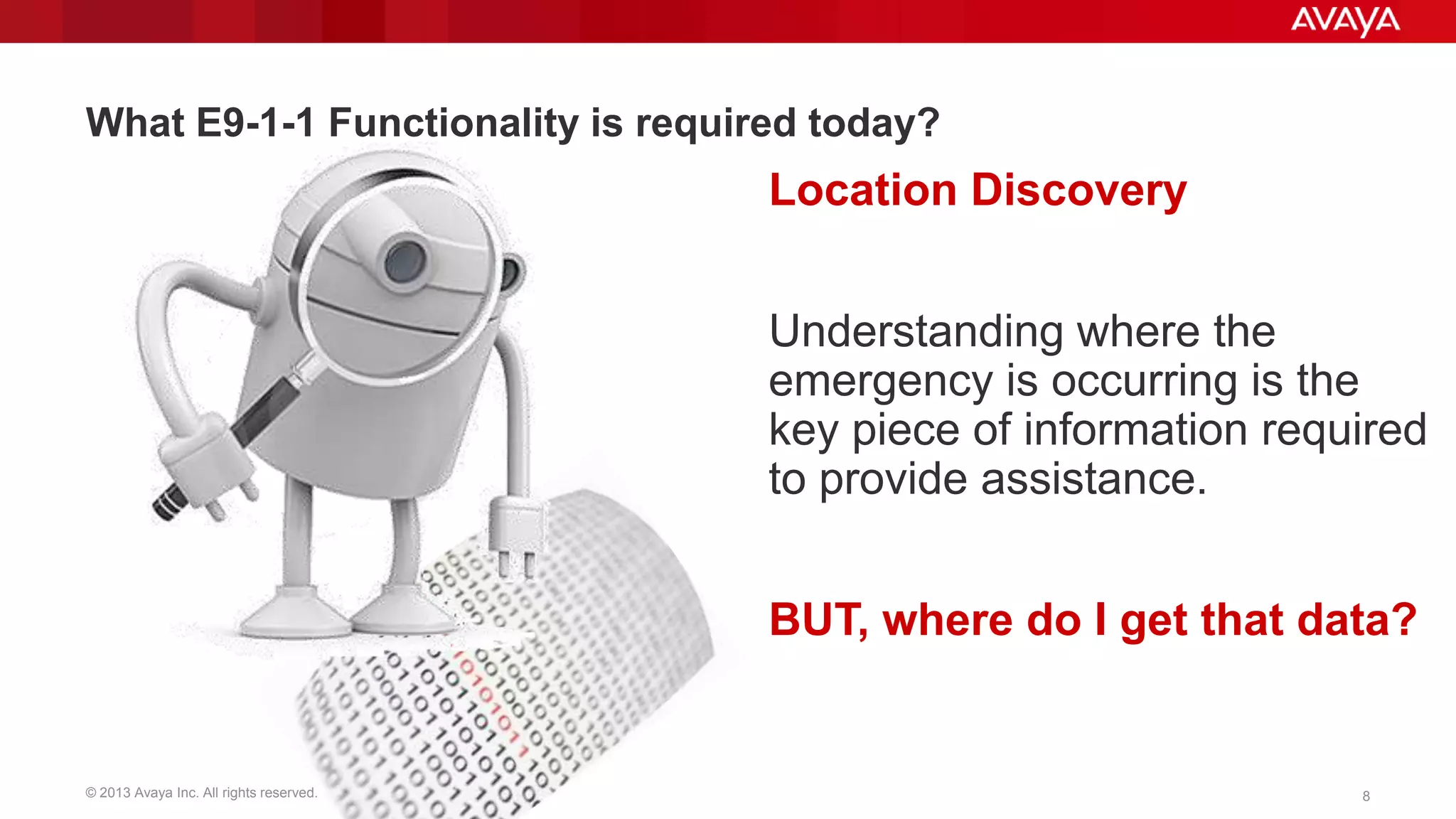
What E9-1-1 Functionality is required today?

Location Discovery

Understanding where the
emergency is occurring is the
key piece of information required
to provide assistance.
BUT, where do I get that data?

© 2013 Avaya Inc. All rights reserved.

8
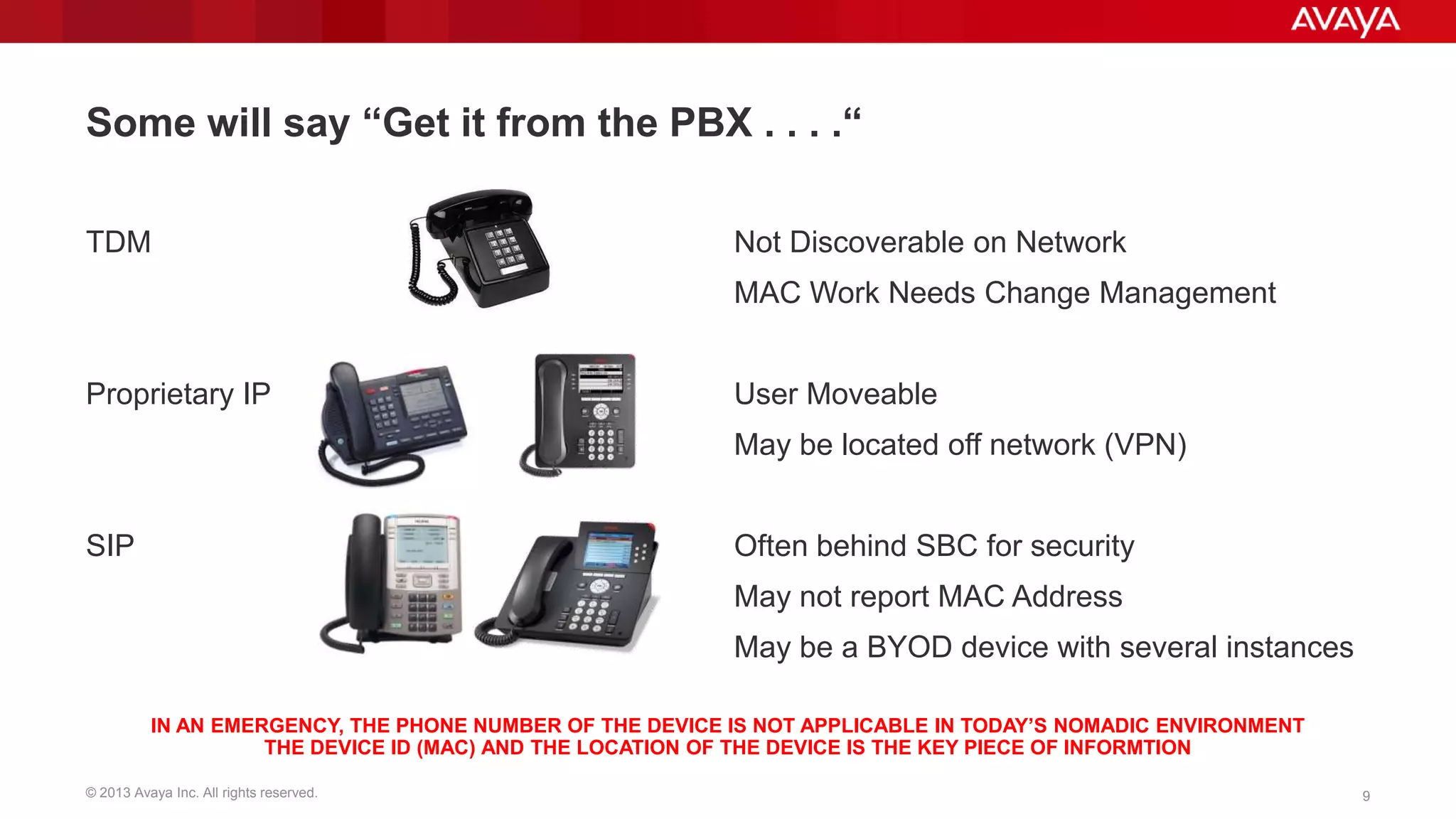
Some will say “Get it from the PBX . . . .“
TDM

Not Discoverable on Network
MAC Work Needs Change Management

Proprietary IP

User Moveable
May be located off network (VPN)

SIP

Often behind SBC for security
May not report MAC Address
May be a BYOD device with several instances
IN AN EMERGENCY, THE PHONE NUMBER OF THE DEVICE IS NOT APPLICABLE IN TODAY‟S NOMADIC ENVIRONMENT
THE DEVICE ID (MAC) AND THE LOCATION OF THE DEVICE IS THE KEY PIECE OF INFORMTION

© 2013 Avaya Inc. All rights reserved.

9
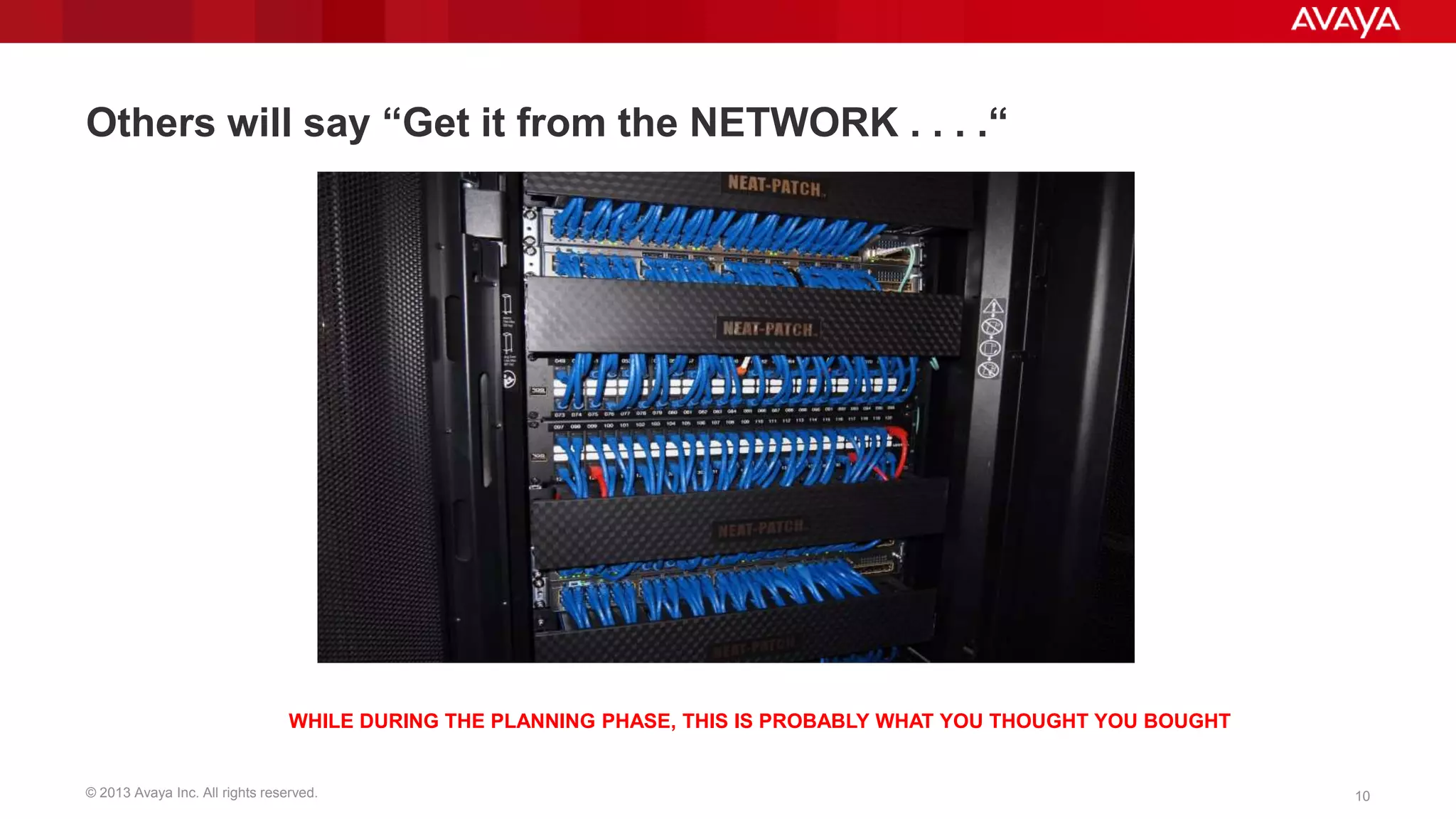
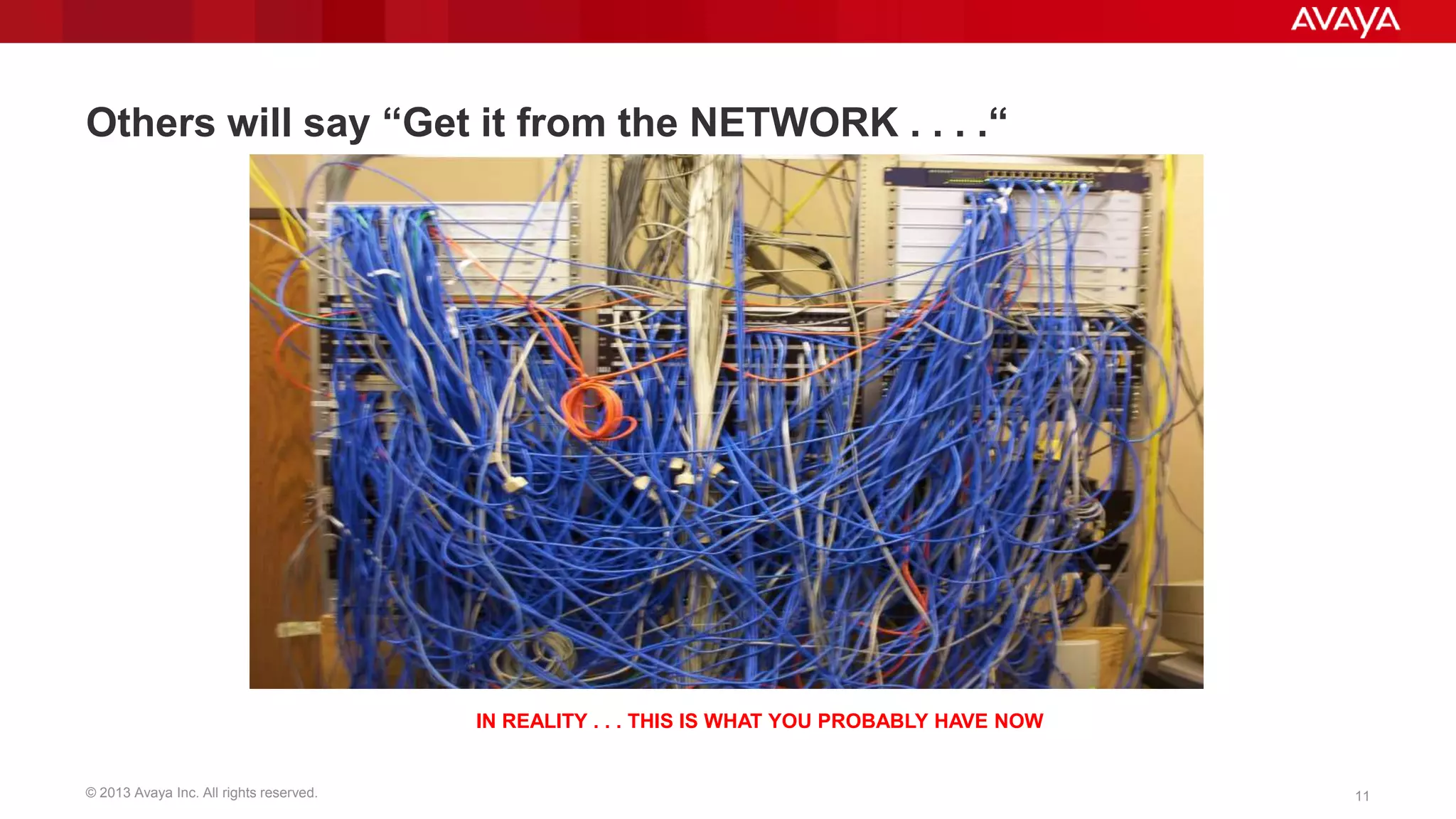
Others will say “Get it from the NETWORK . . . .“

WHILE DURING THE PLANNING PHASE, THIS IS PROBABLY WHAT YOU THOUGHT YOU BOUGHT

© 2013 Avaya Inc. All rights reserved.

10
Others will say “Get it from the NETWORK . . . .“

IN REALITY . . . THIS IS WHAT YOU PROBABLY HAVE NOW

© 2013 Avaya Inc. All rights reserved.

11
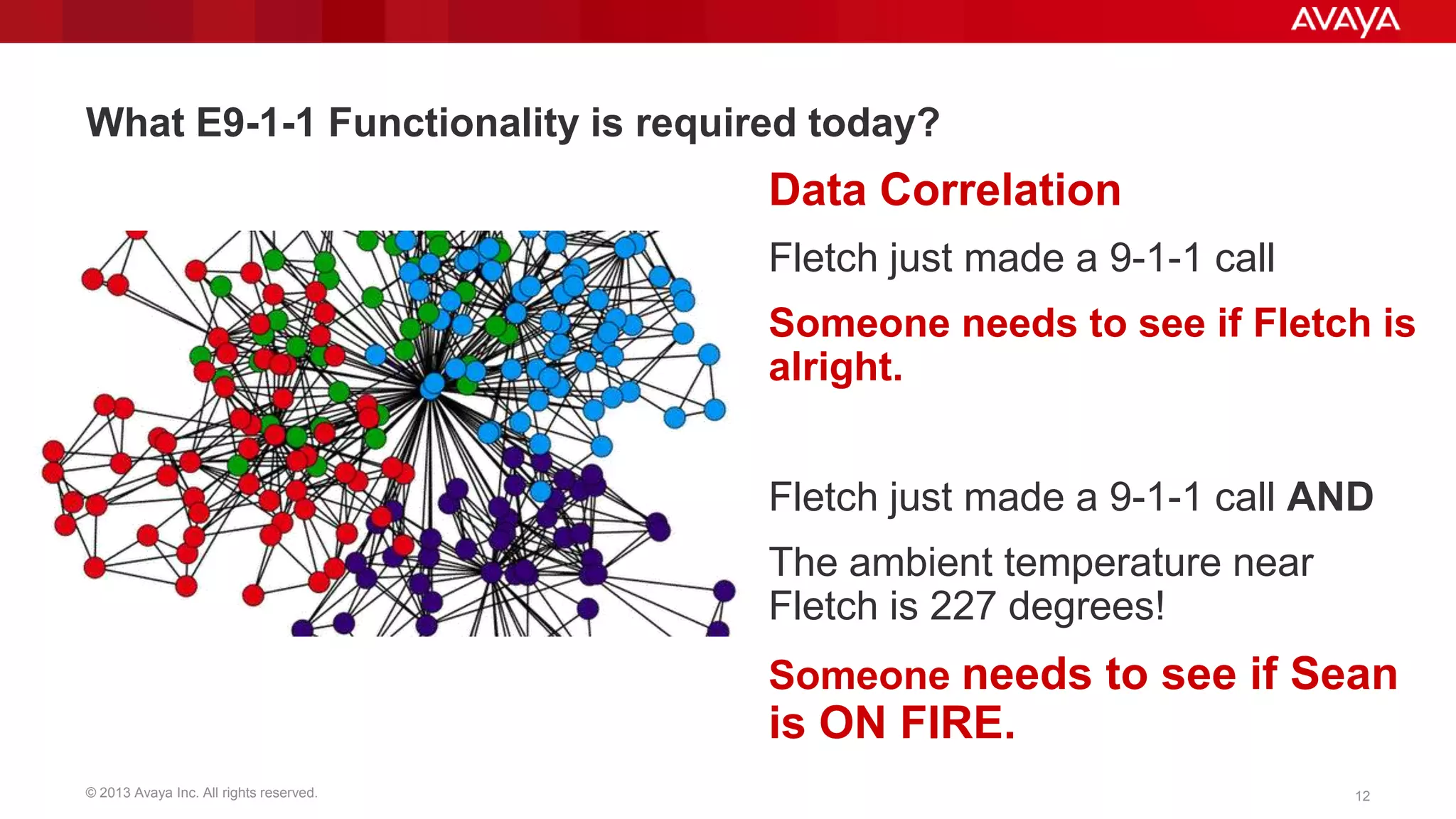
What E9-1-1 Functionality is required today?

Data Correlation
Fletch just made a 9-1-1 call
Someone needs to see if Fletch is
alright.

Fletch just made a 9-1-1 call AND
The ambient temperature near
Fletch is 227 degrees!

Someone needs to see if Sean

is ON FIRE.
© 2013 Avaya Inc. All rights reserved.

12
What E9-1-1 Functionality is required today?
Proper Routing
Fletch just made a 9-1-1 call from his VPN
phone

Fletch is 3 States away, we have no
trunks there.
Fletch just called 9-1-1 from his VPN phone
Fletch is NOT on the corporate LAN and
needs to be routed to a VPC.

Someone needs to see if Fletch is
ON FIRE, again.
© 2013 Avaya Inc. All rights reserved.

13
Identify the problem . . . Then fix it
 In addition to the PBX having data,
what about:
– LDAP
– HR Databases

– Directories
– Maps
– Cable Plant

 Does mail get delivered to your
cubicle?
 Chances are you already have the
information you need to locate
someone in the building
© 2013 Avaya Inc. All rights reserved.

Graphic © Copyright and courtesy Scott Brinker
@chiefmartec http://www/chiefmartec.com

14
The REAL problem is “How do I send additional data to the PSAP?”
SIMPLE – YOU CAN‟T
Instead of worrying about a problem you can not solve,
concentrate on eliminating the problems you CAN solve.
Remember the 3 main problems:

1.) Location – Someone has to be able to find you
2.) Routing – You need to get to the right agency
3.) ON SITE NOTIFICATION – Help is on the way,
and you are ready to help

© 2013 Avaya Inc. All rights reserved.

15
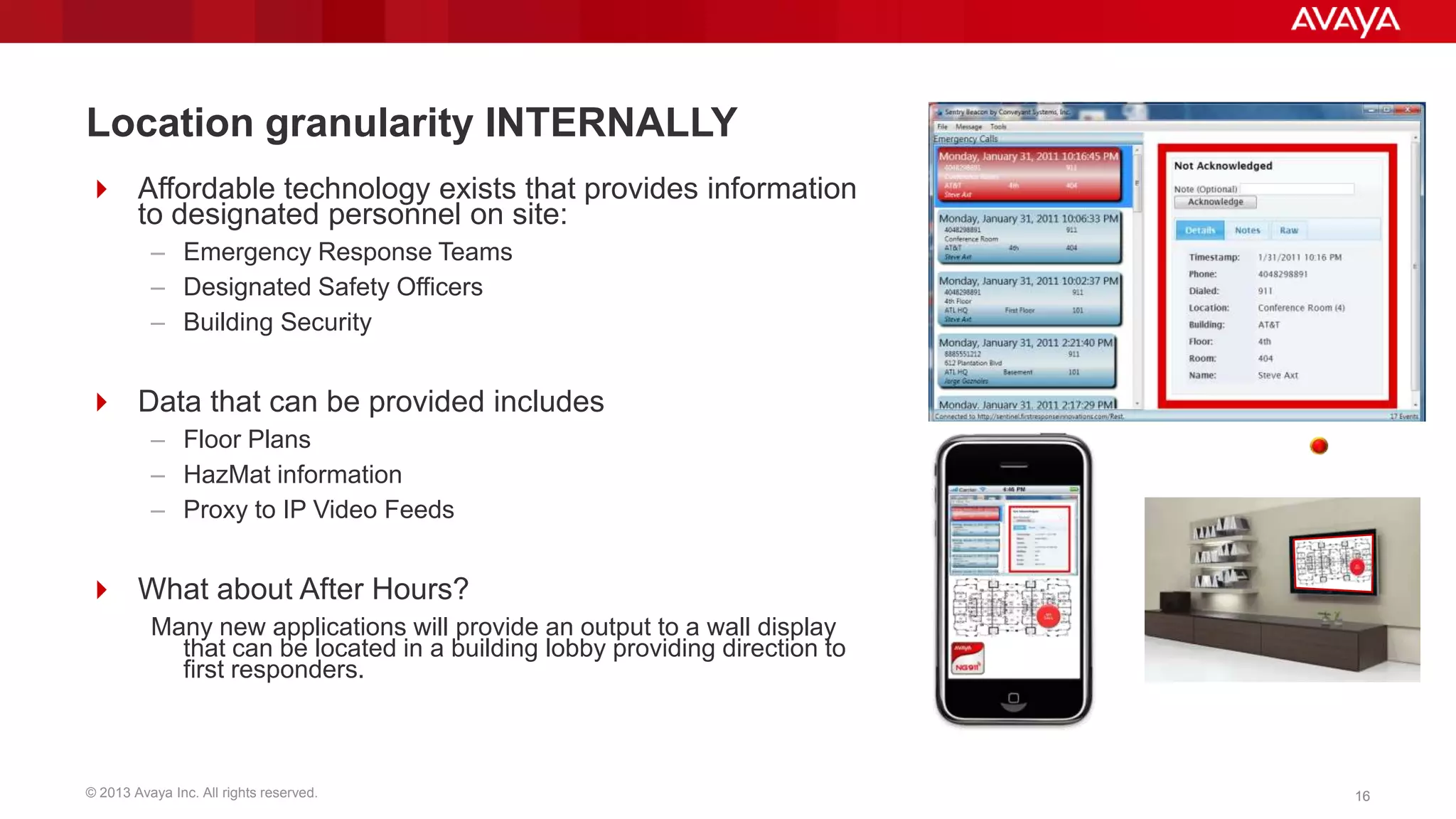
Location granularity INTERNALLY
 Affordable technology exists that provides information
to designated personnel on site:
– Emergency Response Teams
– Designated Safety Officers
– Building Security

 Data that can be provided includes
– Floor Plans
– HazMat information
– Proxy to IP Video Feeds

 What about After Hours?
Many new applications will provide an output to a wall display
that can be located in a building lobby providing direction to
first responders.

© 2013 Avaya Inc. All rights reserved.

16
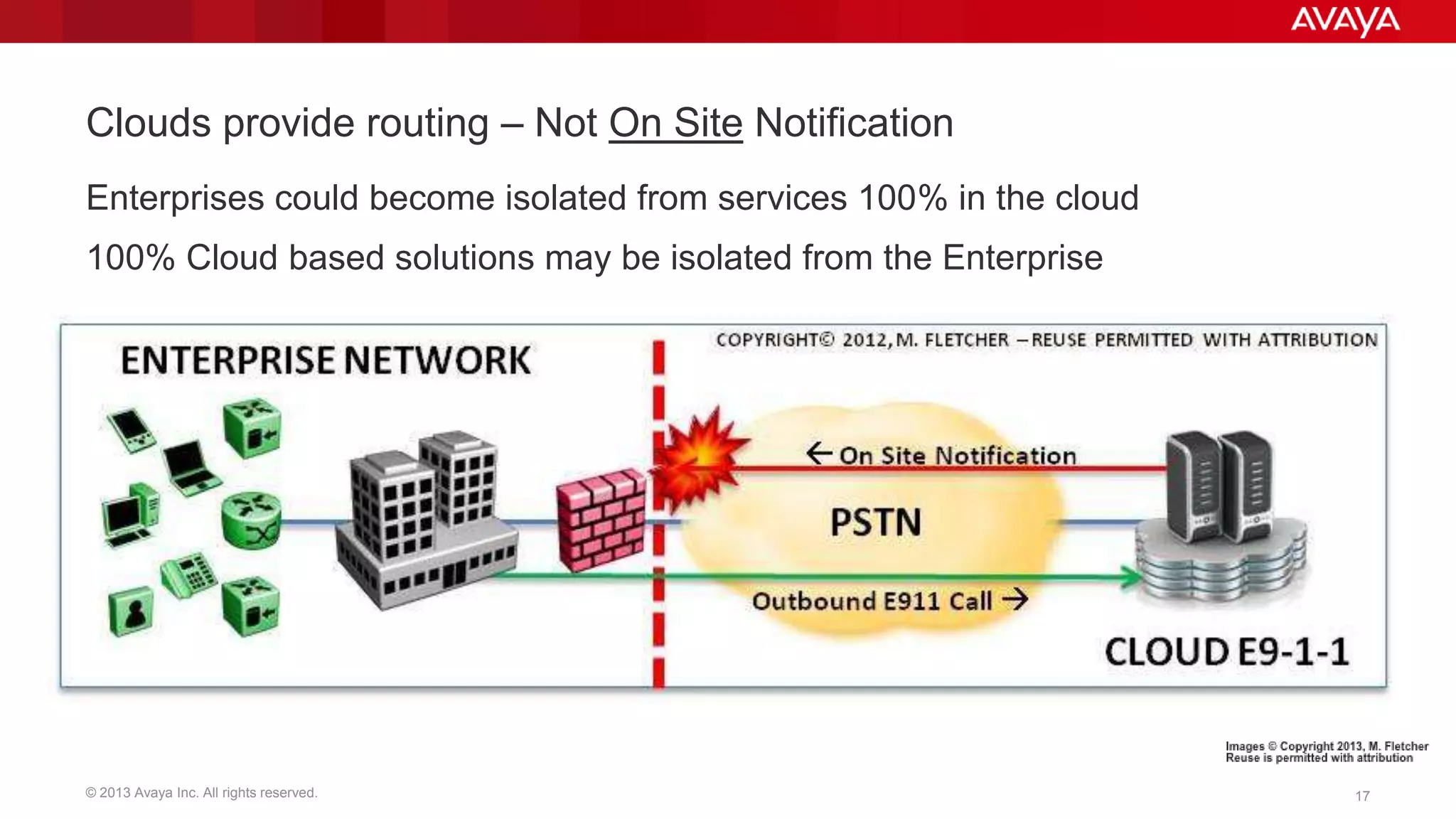
Clouds provide routing – Not On Site Notification
Enterprises could become isolated from services 100% in the cloud
100% Cloud based solutions may be isolated from the Enterprise

© 2013 Avaya Inc. All rights reserved.

17
NG911 Data to the PSAP TODAY
Over The Top of the Legacy 911 Network

• NENA 08-003 V2 ALDR / ACDR Functional Elements
• Preparing to switch to NG911 (there is no transition)

© 2013 Avaya Inc. All rights reserved.

18
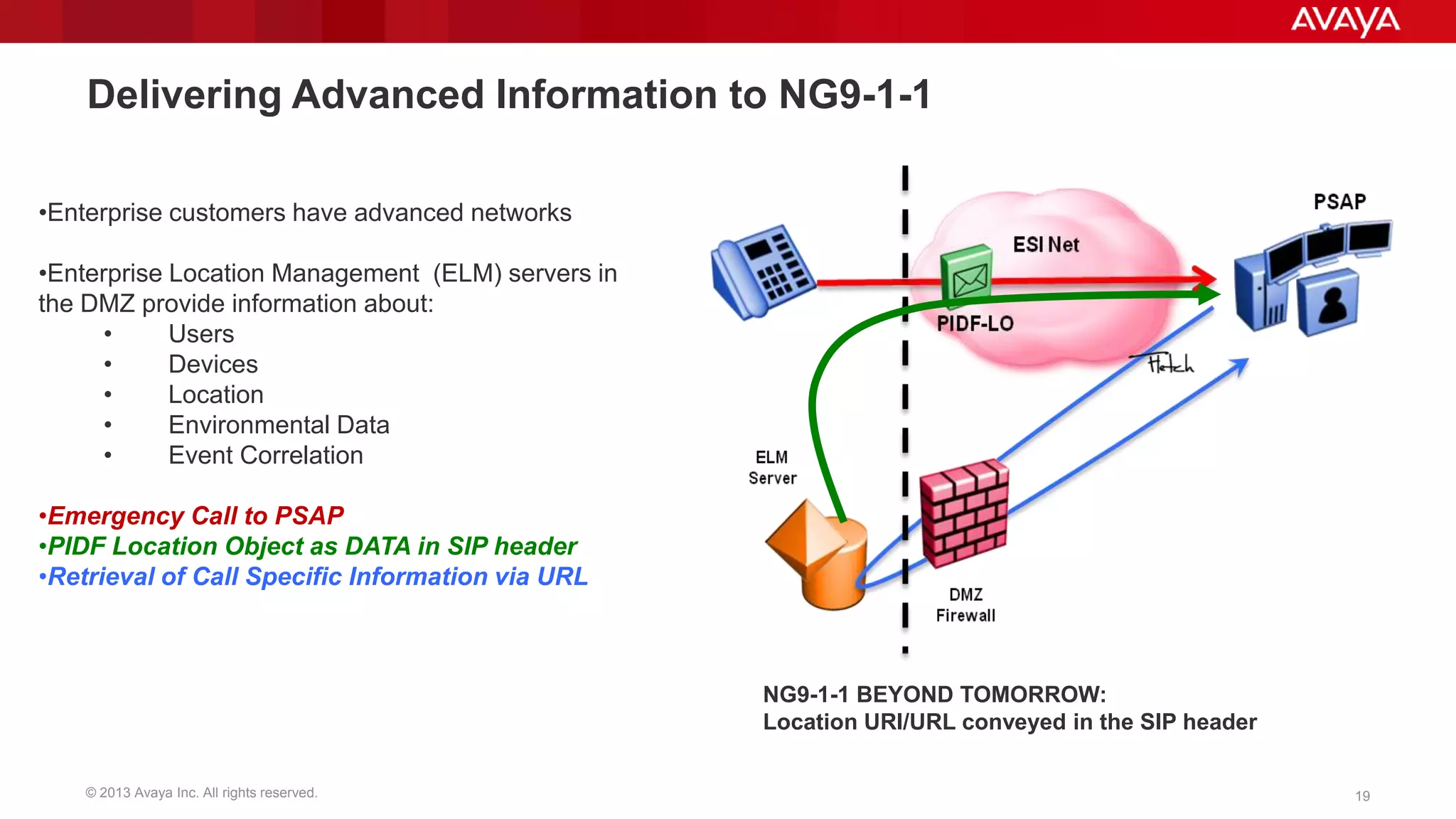
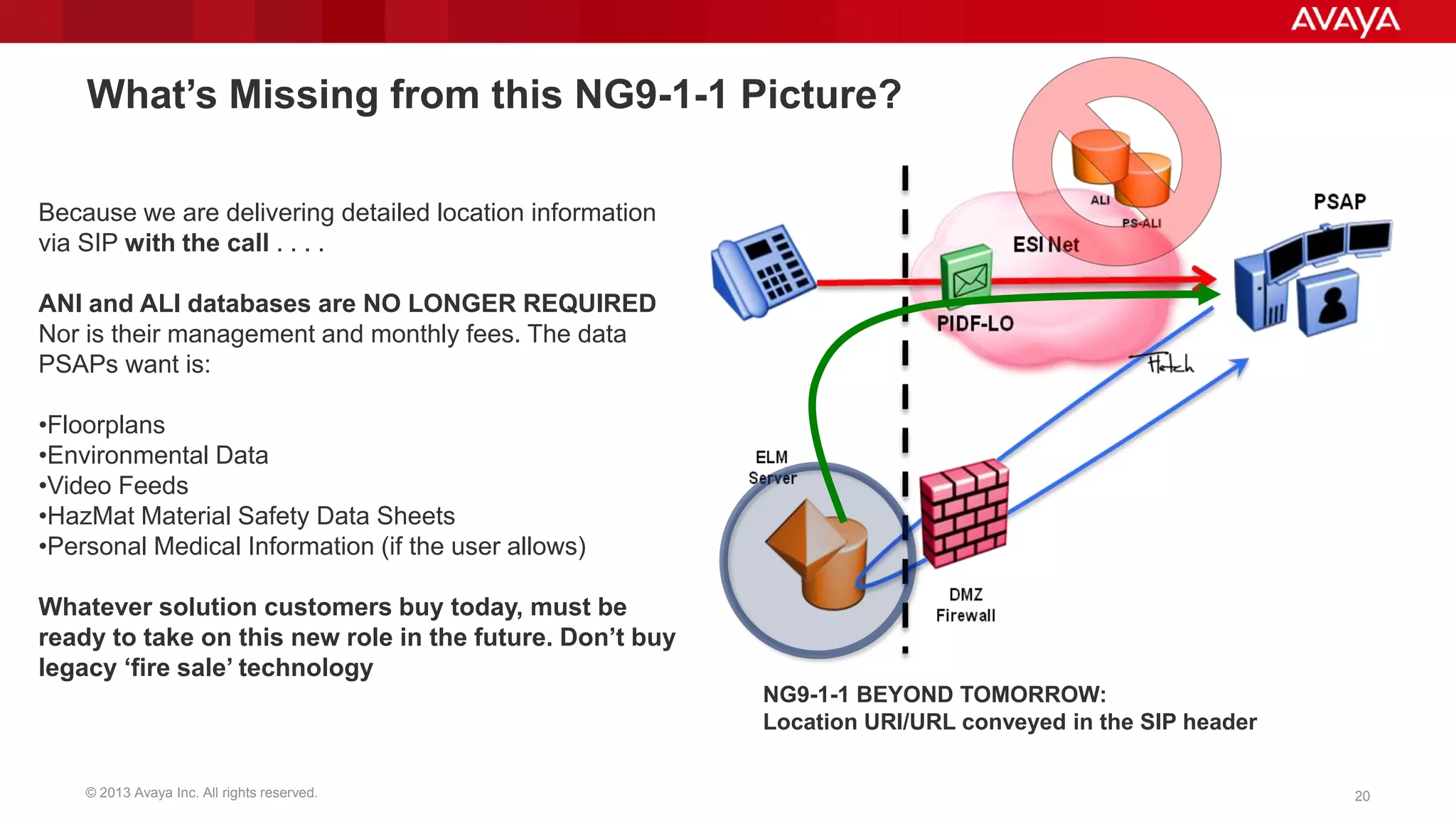
Delivering Advanced Information to NG9-1-1
•Enterprise customers have advanced networks
•Enterprise Location Management (ELM) servers in
the DMZ provide information about:
•
Users
•
Devices
•
Location
•
Environmental Data
•
Event Correlation
•Emergency Call to PSAP
•PIDF Location Object as DATA in SIP header
•Retrieval of Call Specific Information via URL

NG9-1-1 BEYOND TOMORROW:
Location URI/URL conveyed in the SIP header
© 2013 Avaya Inc. All rights reserved.

19
What‟s Missing from this NG9-1-1 Picture?
Because we are delivering detailed location information
via SIP with the call . . . .
ANI and ALI databases are NO LONGER REQUIRED
Nor is their management and monthly fees. The data
PSAPs want is:
•Floorplans
•Environmental Data
•Video Feeds
•HazMat Material Safety Data Sheets
•Personal Medical Information (if the user allows)
Whatever solution customers buy today, must be
ready to take on this new role in the future. Don‟t buy
legacy „fire sale‟ technology
NG9-1-1 BEYOND TOMORROW:
Location URI/URL conveyed in the SIP header
© 2013 Avaya Inc. All rights reserved.

20
NENA 08-003 V2 ALDR / ACDR Functional Elements
•NENA 08-003 V2 ALDR / ACDR* servers
in the DMZ provide information about:
•Users
•Devices
•Location
•Environmental Data
•Event Correlation
•Additional information reference URL/URI is sent
in the SIP header with a pointer to the Enterprise data
relevant to the emergency call.
1. Additional Data Sent in SIP Header
2. Data examined by network and PSAP for routing
3. Additional Data retrieved from the Enterprise
* NENA 08-003 V2 Functional Elements
ALDR - Additional Location Data Repository
ACDR - Additional Caller Data Repository
© 2013 Avaya Inc. All rights reserved.

21
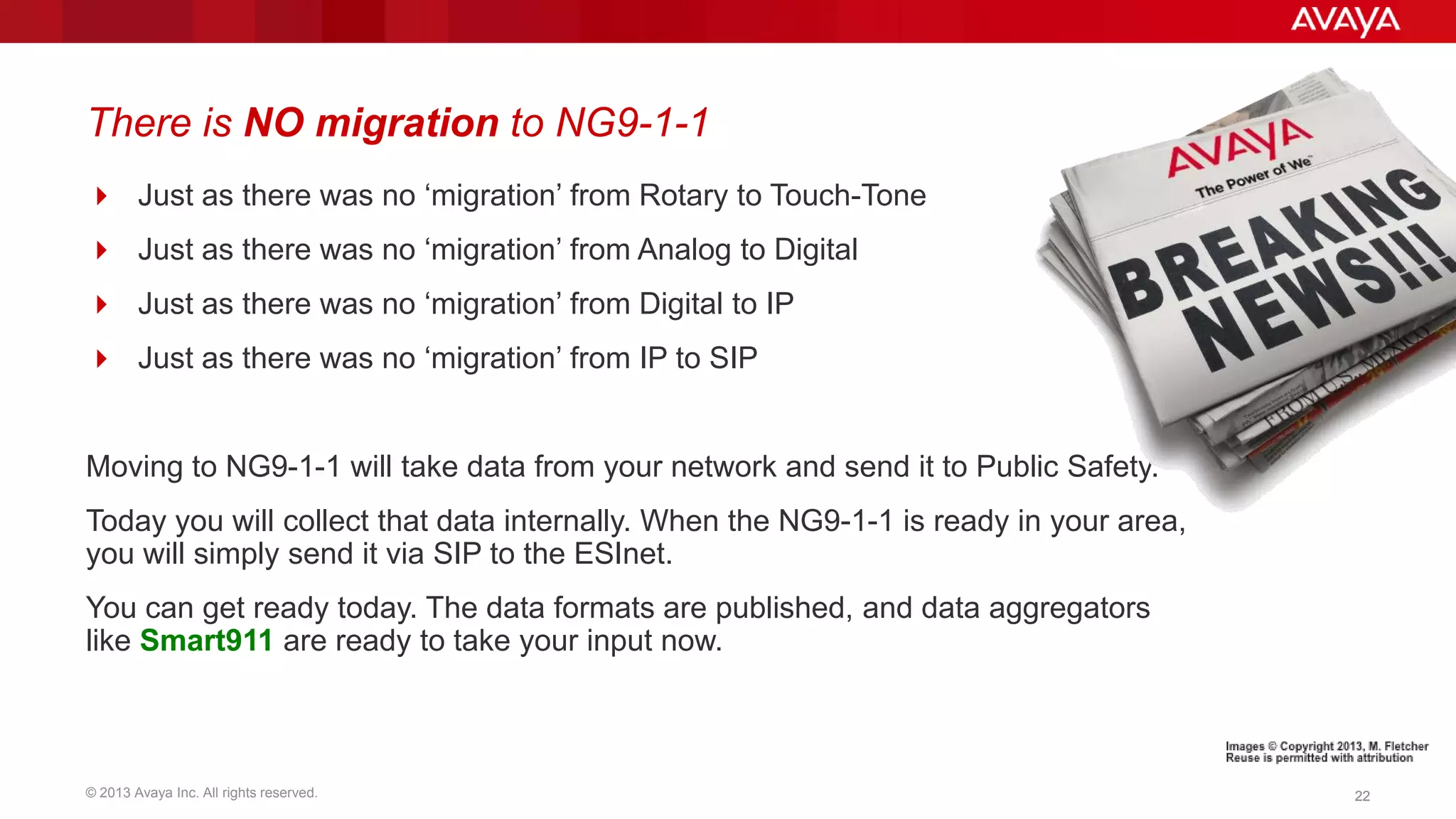
There is NO migration to NG9-1-1
 Just as there was no ‘migration’ from Rotary to Touch-Tone
 Just as there was no ‘migration’ from Analog to Digital
 Just as there was no ‘migration’ from Digital to IP
 Just as there was no ‘migration’ from IP to SIP

Moving to NG9-1-1 will take data from your network and send it to Public Safety.
Today you will collect that data internally. When the NG9-1-1 is ready in your area,
you will simply send it via SIP to the ESInet.
You can get ready today. The data formats are published, and data aggregators
like Smart911 are ready to take your input now.

© 2013 Avaya Inc. All rights reserved.

22
Best practices for your deployment - Must Have Features
 No single Point of Failure
 Full support of the Emergency Services functions in the Call Server
 Devices and applications must connect via the approved and supported
interoperability points as defined by the Avaya DevConnect program and
Product Managers.
 Defined roadmap to NG911 integration with NENA 08-003 V2 requirements
and support for Additional Data Repository (ADLR / ACDR) functionality.

Enterprise
Network Data
© 2013 Avaya Inc. All rights reserved.

NG9-1-1
PSAP
23
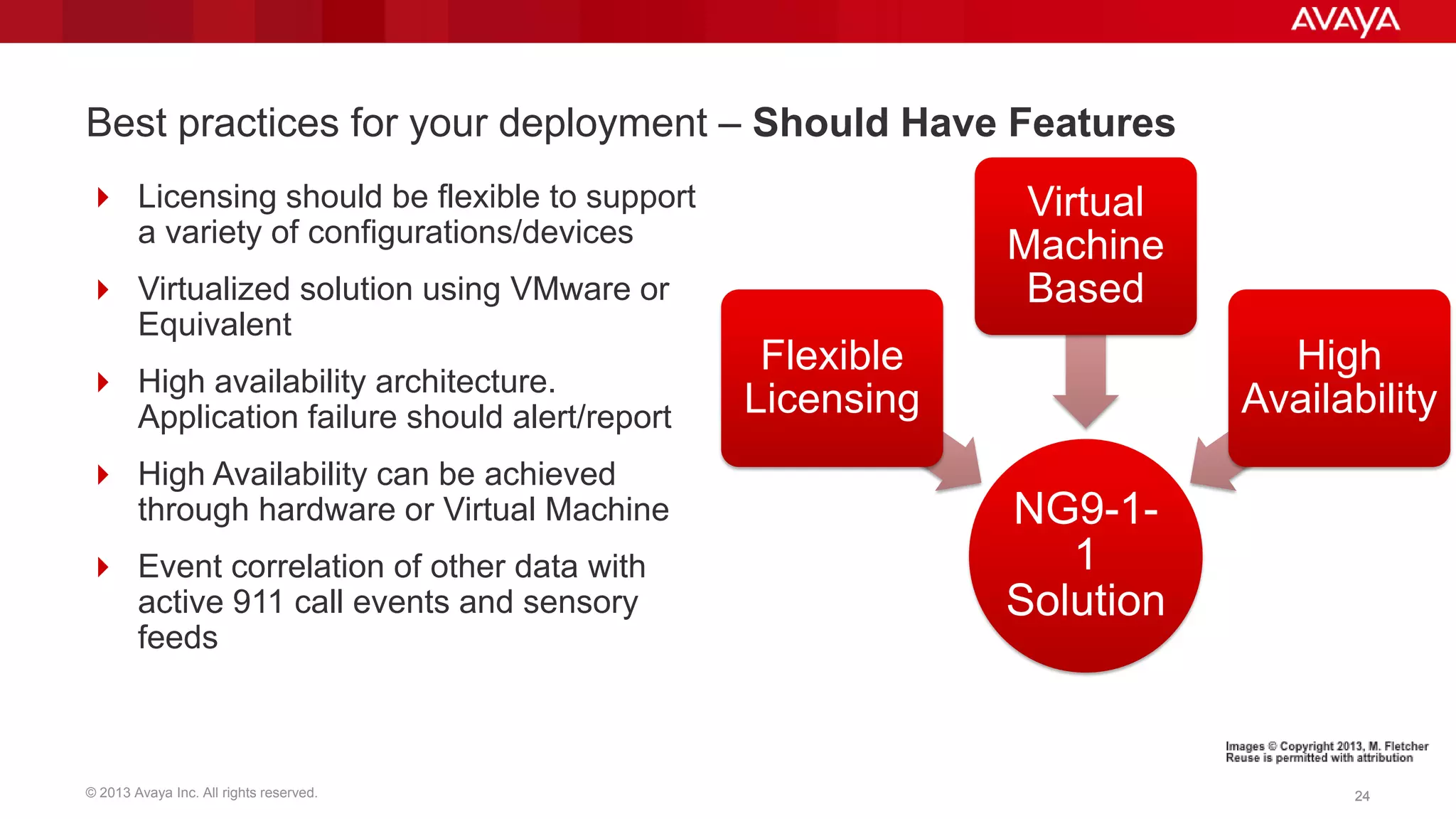
Best practices for your deployment – Should Have Features
 Licensing should be flexible to support
a variety of configurations/devices
 Virtualized solution using VMware or
Equivalent

 High availability architecture.
Application failure should alert/report
 High Availability can be achieved
through hardware or Virtual Machine
 Event correlation of other data with
active 911 call events and sensory
feeds

© 2013 Avaya Inc. All rights reserved.

Virtual
Machine
Based
Flexible
Licensing

High
Availability

NG9-11
Solution

24
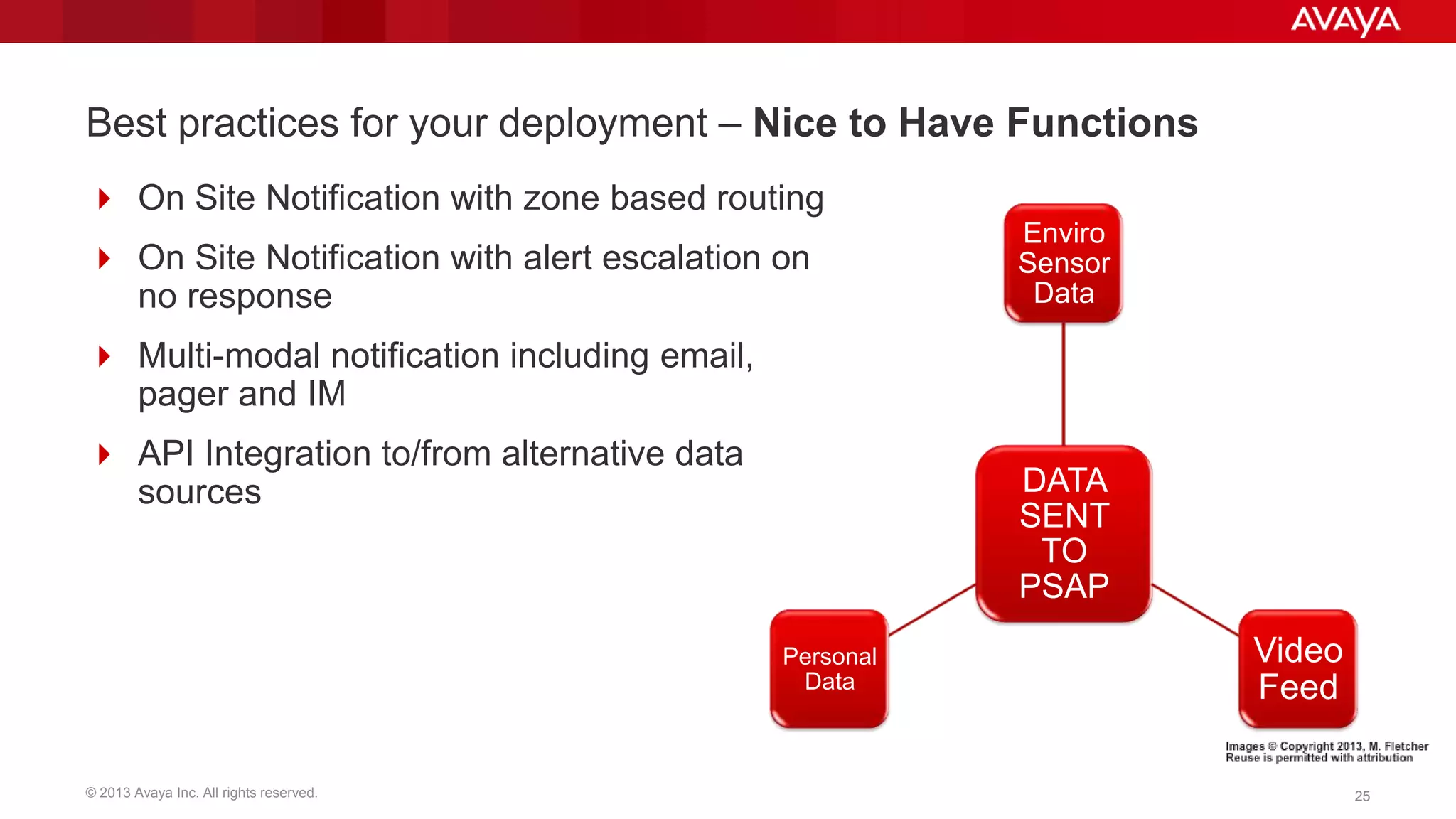
Best practices for your deployment – Nice to Have Functions
 On Site Notification with zone based routing
 On Site Notification with alert escalation on
no response

Enviro
Sensor
Data

 Multi-modal notification including email,
pager and IM
 API Integration to/from alternative data
sources

DATA
SENT
TO
PSAP
Personal
Data

© 2013 Avaya Inc. All rights reserved.

Video
Feed
25
The moral of the story . . . . .
 E9-1-1 / NG9-1-1 is NOT a magic box that you plug in and walk away from
 Understand what‟s really required
– Categorize users and define functionality needed
– Some users need special services that others do not

 Understand who actually requires the information and when
– Public safety needs to get to the right building
– When they arrive, further instructions can be provided

 Understand how it can be delivered
– Getting the data ready in a format that is legible is key
– When NG9-1-1 is available, turn on the data flow

© 2013 Avaya Inc. All rights reserved.

26
Thanks for your time today!
Any Questions?

RESOURCES For Additional Information
Avaya’s Public Safety Page
Fletch’s CONNECTED Blog
Fletch’s E911 Talk Podcast
Fletch’s YouTube Channel

http://www.avaya/PublicSafety
http://Avaya.com/Fletcher
http://Fletch.TV
http://YouTube.com/Fletch911TV

Avaya Podcast Network
http://avaya.com/APN

© 2013 Avaya Inc. All rights reserved.

27
Lehigh Carbon NG911 / E911 Review

Lehigh Carbon NG911 / E911 Review

  • 1.
    Enterprise 9-1-1: Roadmap tocampus safety Mark J. Fletcher, ENP Chief Architect Worldwide Public Safety Solutions
  • 2.
    Current Legislative Driver- MLTS Late Breaking News! © 2013 Avaya Inc. All rights reserved. 2
  • 3.
    Avaya‟s Message toCustomers  Next Generation Emergency Services have been clearly defined in both the US (NENA 08-003) and Europe (NG112-LTD)  Enterprise administrators must look to the future when designing emergency services for users in their networks  Building a NENA i3 compliant architecture is the recommended decision from a technology and investment perspective Avaya DevConnect Partners that have followed best practices and guidance set forth by Avaya’s strategy and thought leadership in the industry, are are able to provide resilient, life safety solutions that are fully compliant, and in lockstep, with the Next Generation Emergency Service standards of tomorrow, effectively future proofing the customer’s emergency communications infrastructure investments today. Mark J. Fletcher, ENP Chief Architect Avaya Worldwide Public Safety Solutions © 2013 Avaya Inc. All rights reserved. 3
  • 4.
    THE PROBLEM TODAY: LEGACYANALOG BASED E9-1-1 ANI/ALI DATABASES ARE IRRELEVANT © 2013 Avaya Inc. All rights reserved. 4
  • 5.
    THE PROBLEM –911 is Routed Based on Caller ID (ANI) 908-848-2601 Often the Carrier will MODIFY THIS before it is sent to Public Safety 908-848-2602 908-848-2602 Good CLID 908-848-2603 908-848-1000 Screened CLID 908-848-2604 MSAG PSTN 908-848-2605 PSAP E911 Selective Router Call Server / PBX ALI 908-848-2606 PS-ALI 908-848-2607 © 2013 Avaya Inc. All rights reserved. Solutions that manage the PS-ALI database can’t fix this. PSAP 908-848-1000 AVAYA 211 Mt Airy Basking Ridge, NJ 5
  • 6.
    What E9-1-1 Functionalityis required today? Location Discovery Understanding where the emergency is occurring is the key piece of information required to provide assistance. BUT, where do I get that data? © 2013 Avaya Inc. All rights reserved. 8
  • 7.
    Some will say“Get it from the PBX . . . .“ TDM Not Discoverable on Network MAC Work Needs Change Management Proprietary IP User Moveable May be located off network (VPN) SIP Often behind SBC for security May not report MAC Address May be a BYOD device with several instances IN AN EMERGENCY, THE PHONE NUMBER OF THE DEVICE IS NOT APPLICABLE IN TODAY‟S NOMADIC ENVIRONMENT THE DEVICE ID (MAC) AND THE LOCATION OF THE DEVICE IS THE KEY PIECE OF INFORMTION © 2013 Avaya Inc. All rights reserved. 9
  • 8.
    Others will say“Get it from the NETWORK . . . .“ WHILE DURING THE PLANNING PHASE, THIS IS PROBABLY WHAT YOU THOUGHT YOU BOUGHT © 2013 Avaya Inc. All rights reserved. 10
  • 9.
    Others will say“Get it from the NETWORK . . . .“ IN REALITY . . . THIS IS WHAT YOU PROBABLY HAVE NOW © 2013 Avaya Inc. All rights reserved. 11
  • 10.
    What E9-1-1 Functionalityis required today? Data Correlation Fletch just made a 9-1-1 call Someone needs to see if Fletch is alright. Fletch just made a 9-1-1 call AND The ambient temperature near Fletch is 227 degrees! Someone needs to see if Sean is ON FIRE. © 2013 Avaya Inc. All rights reserved. 12
  • 11.
    What E9-1-1 Functionalityis required today? Proper Routing Fletch just made a 9-1-1 call from his VPN phone Fletch is 3 States away, we have no trunks there. Fletch just called 9-1-1 from his VPN phone Fletch is NOT on the corporate LAN and needs to be routed to a VPC. Someone needs to see if Fletch is ON FIRE, again. © 2013 Avaya Inc. All rights reserved. 13
  • 12.
    Identify the problem. . . Then fix it  In addition to the PBX having data, what about: – LDAP – HR Databases – Directories – Maps – Cable Plant  Does mail get delivered to your cubicle?  Chances are you already have the information you need to locate someone in the building © 2013 Avaya Inc. All rights reserved. Graphic © Copyright and courtesy Scott Brinker @chiefmartec http://www/chiefmartec.com 14
  • 13.
    The REAL problemis “How do I send additional data to the PSAP?” SIMPLE – YOU CAN‟T Instead of worrying about a problem you can not solve, concentrate on eliminating the problems you CAN solve. Remember the 3 main problems: 1.) Location – Someone has to be able to find you 2.) Routing – You need to get to the right agency 3.) ON SITE NOTIFICATION – Help is on the way, and you are ready to help © 2013 Avaya Inc. All rights reserved. 15
  • 14.
    Location granularity INTERNALLY Affordable technology exists that provides information to designated personnel on site: – Emergency Response Teams – Designated Safety Officers – Building Security  Data that can be provided includes – Floor Plans – HazMat information – Proxy to IP Video Feeds  What about After Hours? Many new applications will provide an output to a wall display that can be located in a building lobby providing direction to first responders. © 2013 Avaya Inc. All rights reserved. 16
  • 15.
    Clouds provide routing– Not On Site Notification Enterprises could become isolated from services 100% in the cloud 100% Cloud based solutions may be isolated from the Enterprise © 2013 Avaya Inc. All rights reserved. 17
  • 16.
    NG911 Data tothe PSAP TODAY Over The Top of the Legacy 911 Network • NENA 08-003 V2 ALDR / ACDR Functional Elements • Preparing to switch to NG911 (there is no transition) © 2013 Avaya Inc. All rights reserved. 18
  • 17.
    Delivering Advanced Informationto NG9-1-1 •Enterprise customers have advanced networks •Enterprise Location Management (ELM) servers in the DMZ provide information about: • Users • Devices • Location • Environmental Data • Event Correlation •Emergency Call to PSAP •PIDF Location Object as DATA in SIP header •Retrieval of Call Specific Information via URL NG9-1-1 BEYOND TOMORROW: Location URI/URL conveyed in the SIP header © 2013 Avaya Inc. All rights reserved. 19
  • 18.
    What‟s Missing fromthis NG9-1-1 Picture? Because we are delivering detailed location information via SIP with the call . . . . ANI and ALI databases are NO LONGER REQUIRED Nor is their management and monthly fees. The data PSAPs want is: •Floorplans •Environmental Data •Video Feeds •HazMat Material Safety Data Sheets •Personal Medical Information (if the user allows) Whatever solution customers buy today, must be ready to take on this new role in the future. Don‟t buy legacy „fire sale‟ technology NG9-1-1 BEYOND TOMORROW: Location URI/URL conveyed in the SIP header © 2013 Avaya Inc. All rights reserved. 20
  • 19.
    NENA 08-003 V2ALDR / ACDR Functional Elements •NENA 08-003 V2 ALDR / ACDR* servers in the DMZ provide information about: •Users •Devices •Location •Environmental Data •Event Correlation •Additional information reference URL/URI is sent in the SIP header with a pointer to the Enterprise data relevant to the emergency call. 1. Additional Data Sent in SIP Header 2. Data examined by network and PSAP for routing 3. Additional Data retrieved from the Enterprise * NENA 08-003 V2 Functional Elements ALDR - Additional Location Data Repository ACDR - Additional Caller Data Repository © 2013 Avaya Inc. All rights reserved. 21
  • 20.
    There is NOmigration to NG9-1-1  Just as there was no ‘migration’ from Rotary to Touch-Tone  Just as there was no ‘migration’ from Analog to Digital  Just as there was no ‘migration’ from Digital to IP  Just as there was no ‘migration’ from IP to SIP Moving to NG9-1-1 will take data from your network and send it to Public Safety. Today you will collect that data internally. When the NG9-1-1 is ready in your area, you will simply send it via SIP to the ESInet. You can get ready today. The data formats are published, and data aggregators like Smart911 are ready to take your input now. © 2013 Avaya Inc. All rights reserved. 22
  • 21.
    Best practices foryour deployment - Must Have Features  No single Point of Failure  Full support of the Emergency Services functions in the Call Server  Devices and applications must connect via the approved and supported interoperability points as defined by the Avaya DevConnect program and Product Managers.  Defined roadmap to NG911 integration with NENA 08-003 V2 requirements and support for Additional Data Repository (ADLR / ACDR) functionality. Enterprise Network Data © 2013 Avaya Inc. All rights reserved. NG9-1-1 PSAP 23
  • 22.
    Best practices foryour deployment – Should Have Features  Licensing should be flexible to support a variety of configurations/devices  Virtualized solution using VMware or Equivalent  High availability architecture. Application failure should alert/report  High Availability can be achieved through hardware or Virtual Machine  Event correlation of other data with active 911 call events and sensory feeds © 2013 Avaya Inc. All rights reserved. Virtual Machine Based Flexible Licensing High Availability NG9-11 Solution 24
  • 23.
    Best practices foryour deployment – Nice to Have Functions  On Site Notification with zone based routing  On Site Notification with alert escalation on no response Enviro Sensor Data  Multi-modal notification including email, pager and IM  API Integration to/from alternative data sources DATA SENT TO PSAP Personal Data © 2013 Avaya Inc. All rights reserved. Video Feed 25
  • 24.
    The moral ofthe story . . . . .  E9-1-1 / NG9-1-1 is NOT a magic box that you plug in and walk away from  Understand what‟s really required – Categorize users and define functionality needed – Some users need special services that others do not  Understand who actually requires the information and when – Public safety needs to get to the right building – When they arrive, further instructions can be provided  Understand how it can be delivered – Getting the data ready in a format that is legible is key – When NG9-1-1 is available, turn on the data flow © 2013 Avaya Inc. All rights reserved. 26
  • 25.
    Thanks for yourtime today! Any Questions? RESOURCES For Additional Information Avaya’s Public Safety Page Fletch’s CONNECTED Blog Fletch’s E911 Talk Podcast Fletch’s YouTube Channel http://www.avaya/PublicSafety http://Avaya.com/Fletcher http://Fletch.TV http://YouTube.com/Fletch911TV Avaya Podcast Network http://avaya.com/APN © 2013 Avaya Inc. All rights reserved. 27

Editor's Notes

  • #6 Before we talk about next generation 911,it’s important understand how 911 works in today’s network environment. When a station places a 911 call the calling line ID is presented to the local carrier network. In some cases that calling line ID is screened for 911 calls, and converted to the main billing telephone number. This causes a generic address to be displayed to the 911 call taker. Because of this, customer premise solutions that manage the 911 PS-ALI database, are really not providing any value as the station telephone number never makes it to the 911 center. This is a common place where the legacy solutions fall down, as they operate well within their confines, but don’t see the big picture.
  • #7 In other cases a station may not have a direct outside number, and an invalid or null number may be sent by the PBX. In these cases, the carrier will also insert a main billing number on 911 calls in an attempt to make sure that there routed properly. Once again, since every telephone number has a unique entry in the database, substituting the main billing number on an emergency call also effectively hides any specific station level location that may be associated with the users specific number; and solutions that manage the PS-ALI database cannot fix this problem, as there is no control over the telephone number being sent, or correlation to the station that made the call. These are just two of the primary gotchas that affect customer E911 deployments today; And are the most common causes of customer dissatisfaction in a legacy solution.
  • #8  Another common problem is remote users. They could be nomadic in a public place like a Starbucks coffee shop, or they could be a remote work at home user. In either case, the 911 problem is actually twofold. Not only is the user’s caller ID irrelevant to their location, but the PBX may not have trunks that service the local 911 network where the user is located. This is especially true for users that are located in another state, but could be applicable to users in the next town over depending on the local 911 service geography. We will deal with remote routing of 911 calls later in the presentation, but for now, let’s concentrate on location discovery and notification.
  • #17 For buildings that are not staffed 24 hours a day by security or a receptionist, this same information can be provided to a low-cost flat screen panel located in the lobby of the building that is available to public safety responders 24 hours a day. In many cases this proves to be a low-cost solution that is already in sync with fire alarm panel operational procedures.
  • #20 When we look at enterprise data networks, and how we are going to feed our information into the next generation 911 network which is known as the emergency services IP network or ESINet.The NENAi3NG 911 standard allows for the conveyance of additional information. In simple terms, the enterprise is merely a repository for additional location data that is queried in real time by the public safety agency. Should an enterprise network, not wish to place that information in an open DMZ, or the 911 center doesn’t want an open Internet connection in their facility, there are companies that are providing data aggregation services such as smart 911 that help bridge that gap. This is one reason why the question “does NG 911 exist today?” becomes irrelevant. Why? Because this over the top model allows for technology to deliver detailed information out of band, and directly to the agency that needs the information. Additionally, when next-generation 911 does become a reality, the very same equipment within the enterprise will be feeding the location information in real time within the SIP header. We’re on the verge of this technology being deployed in many areas across the US. Major cities like Washington DC, Nashville, King County Washington and nearly 1000 others are using the smart 911 solution today. From an enterprise perspective, any 911 solution you deploy should have a definitive roadmap for this NG 911 architecture and conveyance of information. Anything that does not might very quickly become a doorstop in the near future. D
  • #21 Because we are delivering detailed location information via SIP with the call . . . .ANI and ALI databases are NO LONGER REQUIRED when the originating endpoint or the PBX they are attached too is capable of sending contextual information and references to additional data like:FloorplansEnvironmental DataVideo FeedsHazMat Material Safety Data SheetsPersonal Medical Information (if the user allows)Whatever solution you buy today, must be ready to take on this new role in the future. Don’t buy legacy ‘fire sale’ technology