January	
  2015	
  
ThinkSmallCell	
  Webinar	
  
David	
  Chambers,	
  Senior	
  Analyst,	
  ThinkSmallCell	
  
Choosing	
  the	
  right	
  
In-­‐building	
  Wireless	
  Solu4ons	
  
Webinar	
  sponsored	
  by	
  SOLiD	
  
Technologies	
  
A	
  top-­‐down	
  view	
  of	
  	
  
In-­‐building	
  Wireless	
  opDons	
  	
  
January	
  2015	
  
Cellular	
  service	
  worsening	
  indoors	
  
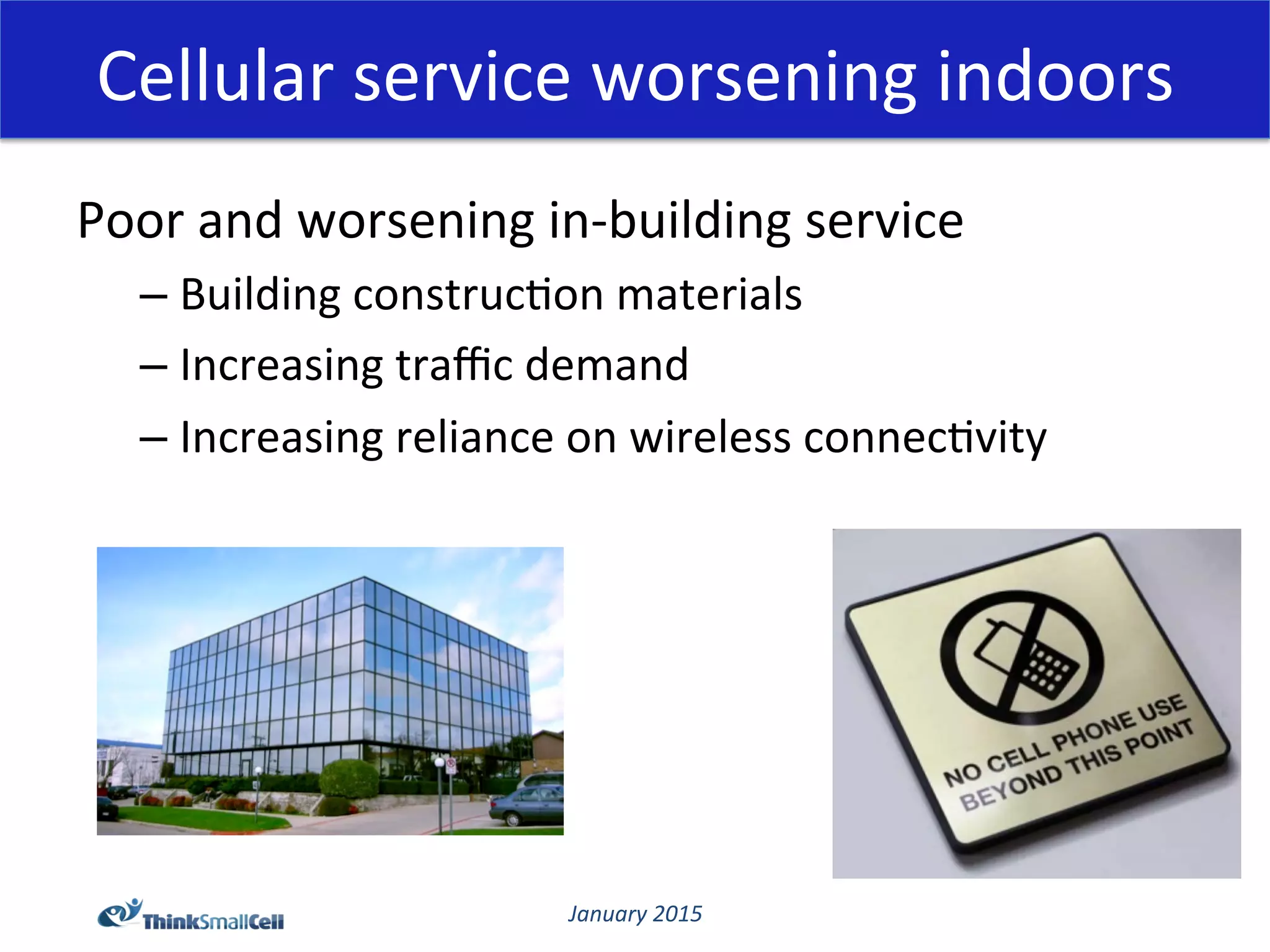
Poor	
  and	
  worsening	
  in-­‐building	
  service	
  
– Building	
  construc@on	
  materials	
  
– Increasing	
  traffic	
  demand	
  
– Increasing	
  reliance	
  on	
  wireless	
  connec@vity	
  
January	
  2015	
  
Signal	
  aCenua@on	
  in-­‐building	
  
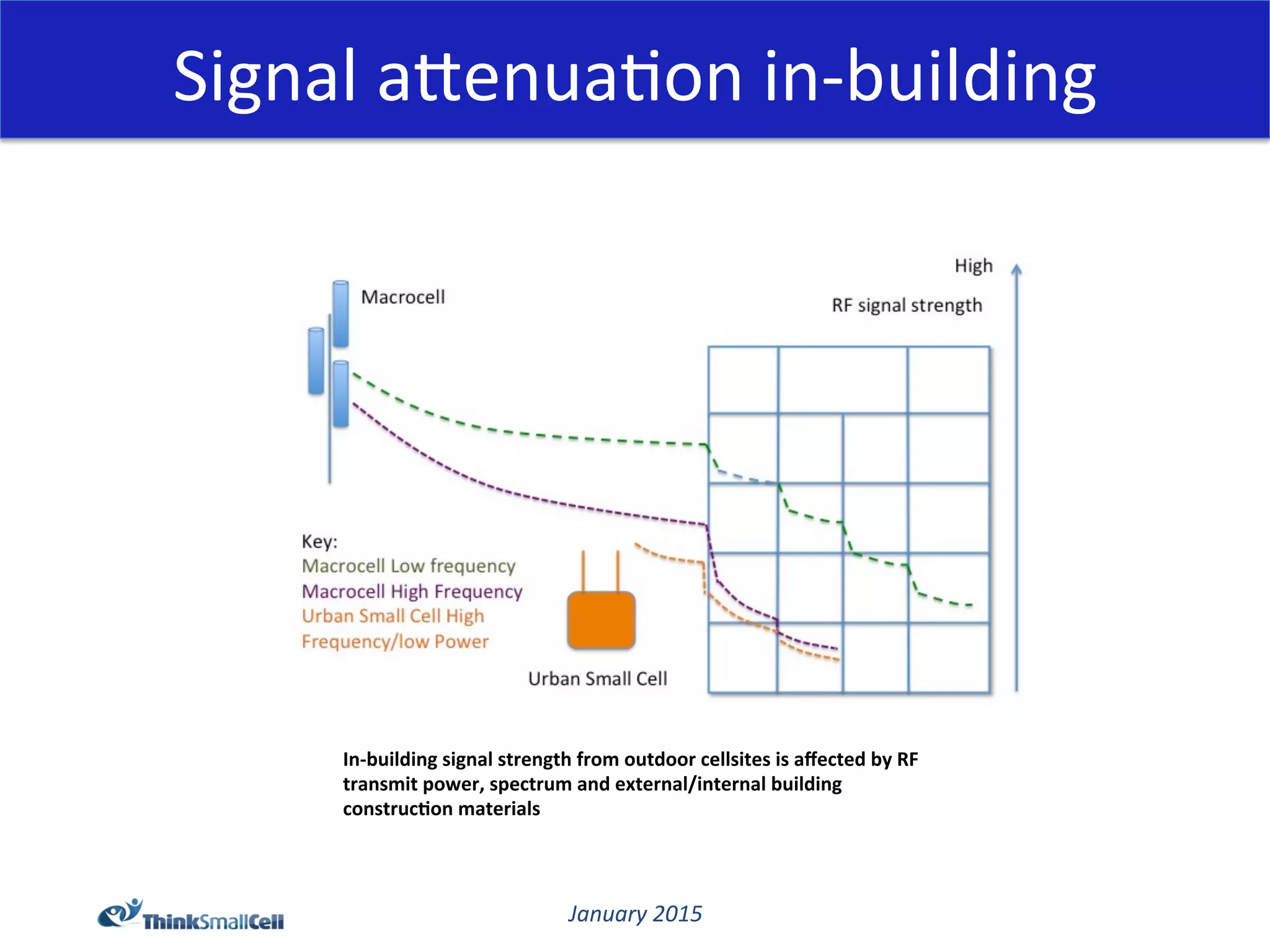
In-­‐building	
  signal	
  strength	
  from	
  outdoor	
  cellsites	
  is	
  affected	
  by	
  RF	
  
transmit	
  power,	
  spectrum	
  and	
  external/internal	
  building	
  
construc4on	
  materials	
  
January	
  2015	
  
Range	
  of	
  building	
  sizes	
  
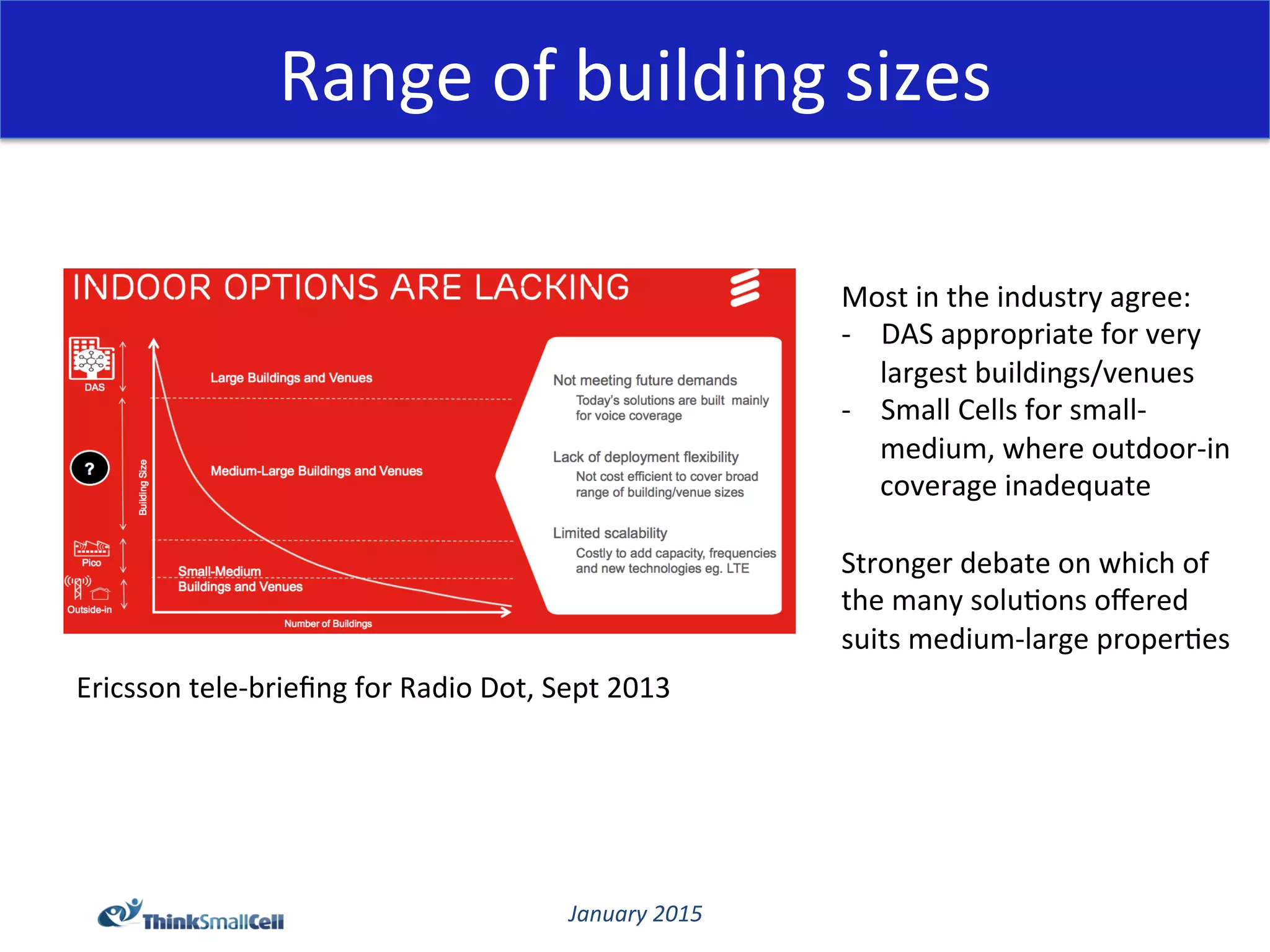
Ericsson	
  tele-­‐briefing	
  for	
  Radio	
  Dot,	
  Sept	
  2013	
  
Most	
  in	
  the	
  industry	
  agree:	
  
-­‐  DAS	
  appropriate	
  for	
  very	
  
largest	
  buildings/venues	
  
-­‐  Small	
  Cells	
  for	
  small-­‐
medium,	
  where	
  outdoor-­‐in	
  
coverage	
  inadequate	
  
Stronger	
  debate	
  on	
  which	
  of	
  
the	
  many	
  solu@ons	
  offered	
  
suits	
  medium-­‐large	
  proper@es	
  
January	
  2015	
  
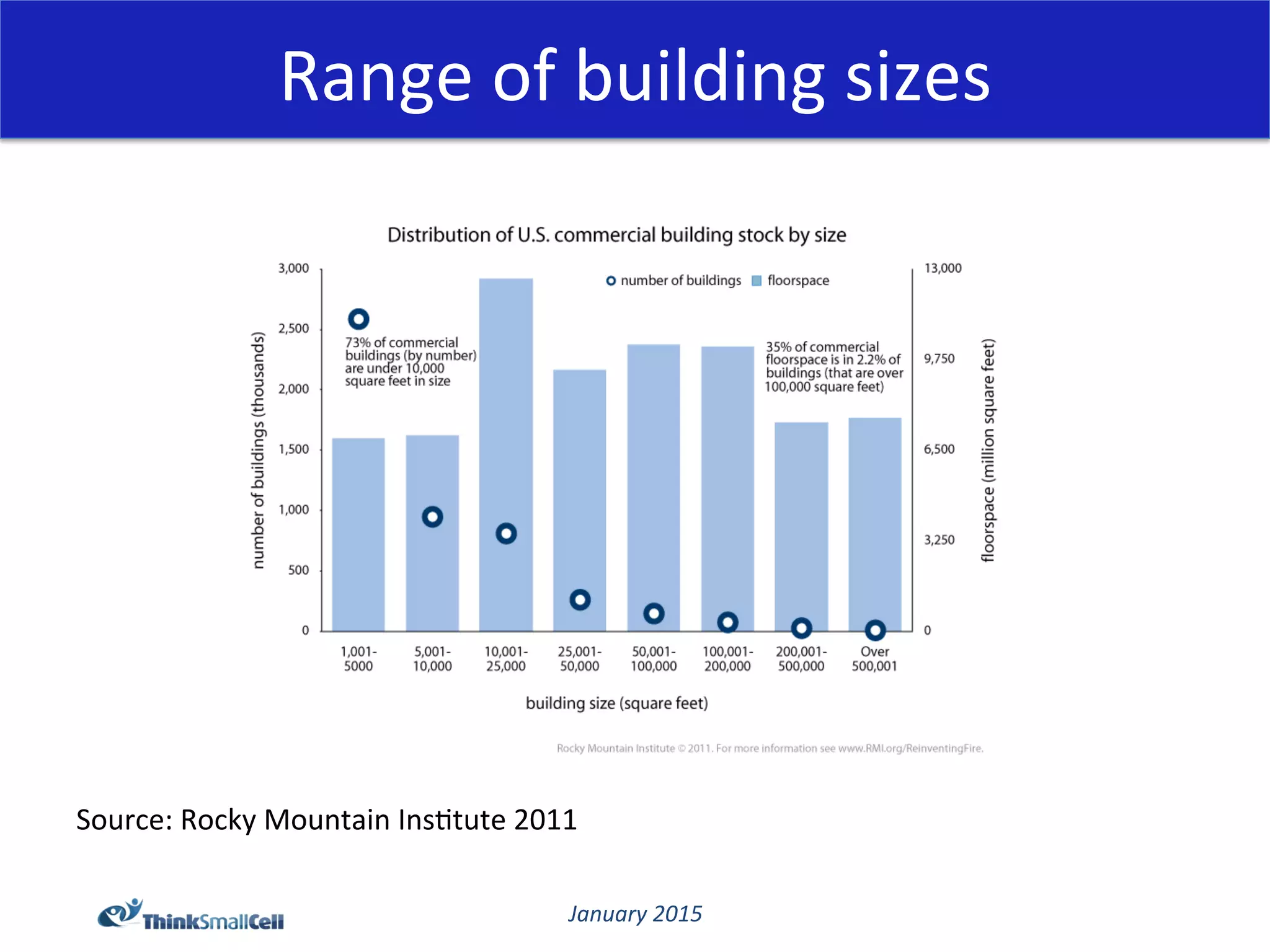
Range	
  of	
  building	
  sizes	
  
Source:	
  Rocky	
  Mountain	
  Ins@tute	
  2011	
  
January	
  2015	
  
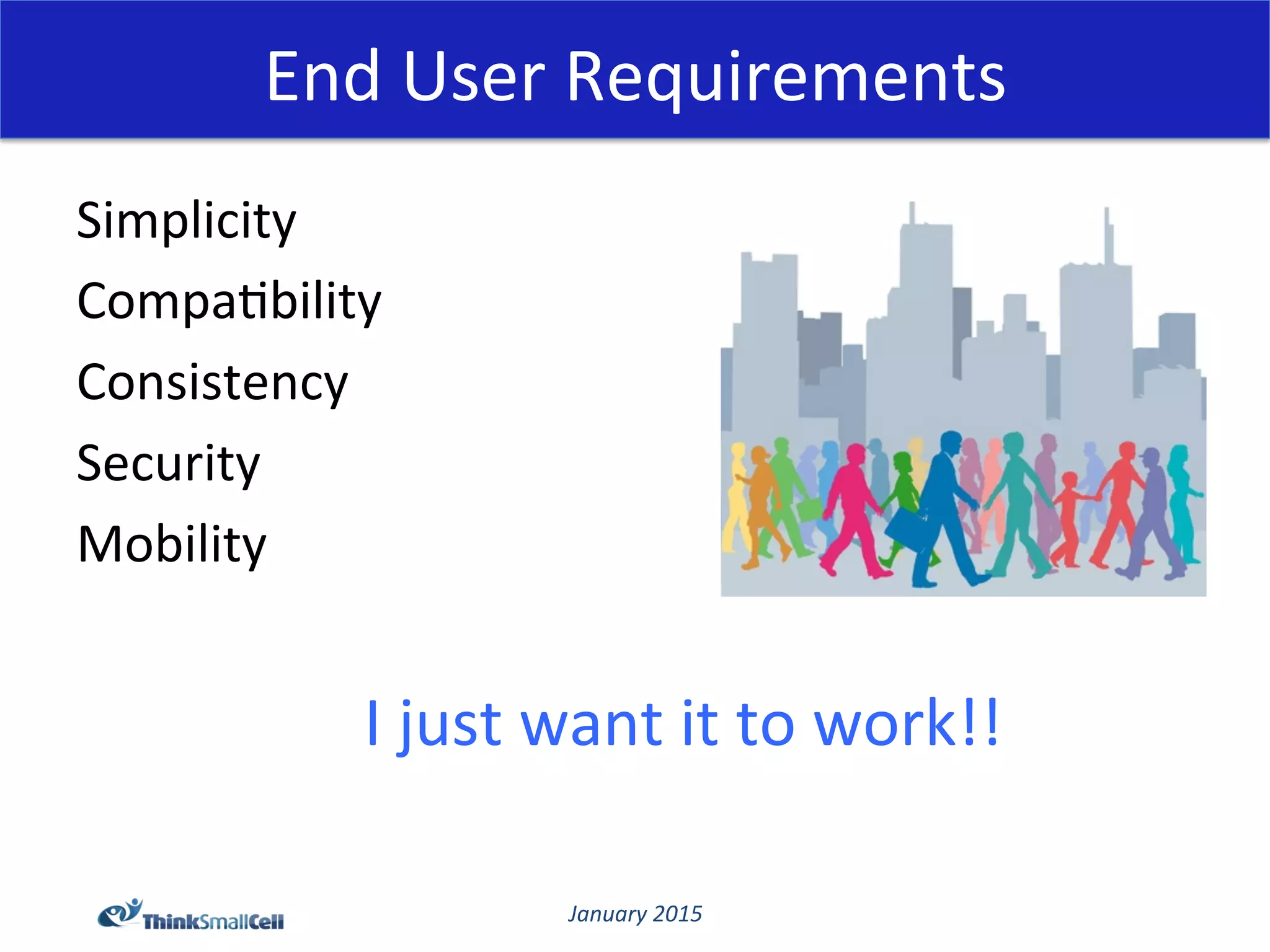
End	
  User	
  Requirements	
  
Simplicity	
  
Compa@bility	
  
Consistency	
  
Security	
  
Mobility	
  
I	
  just	
  want	
  it	
  to	
  work!!	
  
January	
  2015	
  
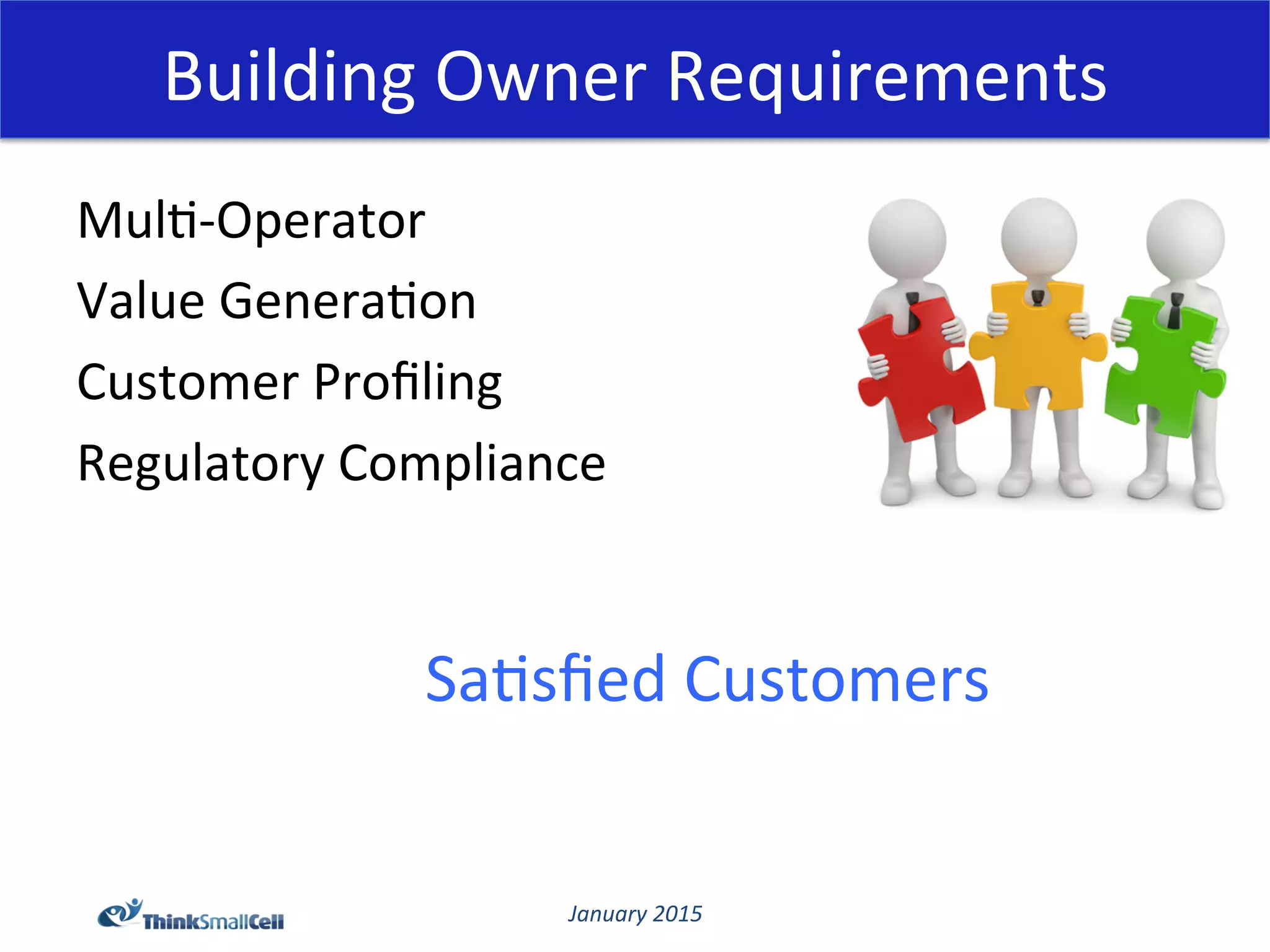
Building	
  Owner	
  Requirements	
  
Mul@-­‐Operator	
  
Value	
  Genera@on	
  
Customer	
  Profiling	
  
Regulatory	
  Compliance	
  
Sa@sfied	
  Customers	
  
January	
  2015	
  
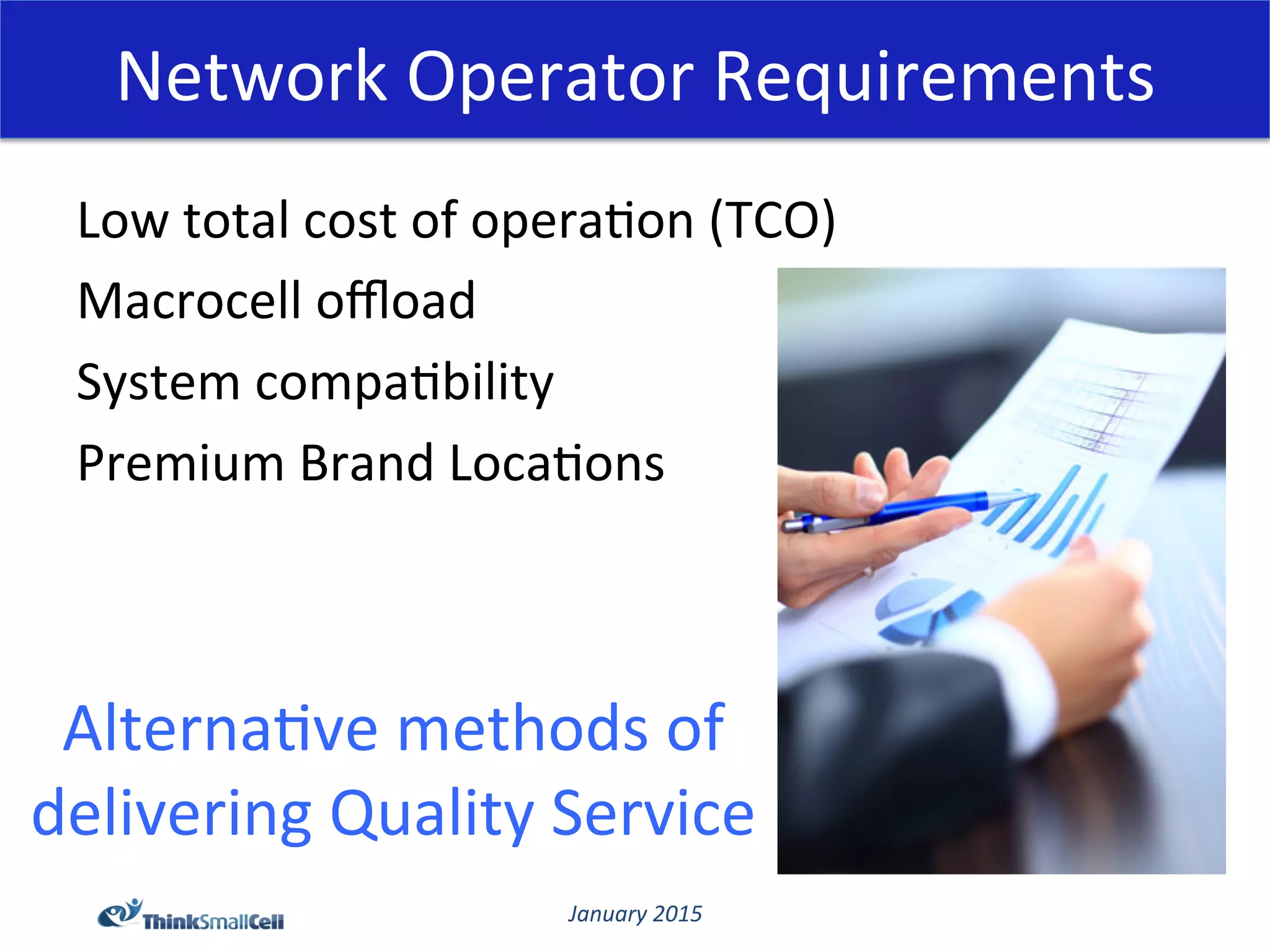
Network	
  Operator	
  Requirements	
  
Low	
  total	
  cost	
  of	
  opera@on	
  (TCO)	
  
Macrocell	
  offload	
  
System	
  compa@bility	
  
Premium	
  Brand	
  Loca@ons	
  
Alterna@ve	
  methods	
  of	
  
delivering	
  Quality	
  Service	
  
January	
  2015	
  
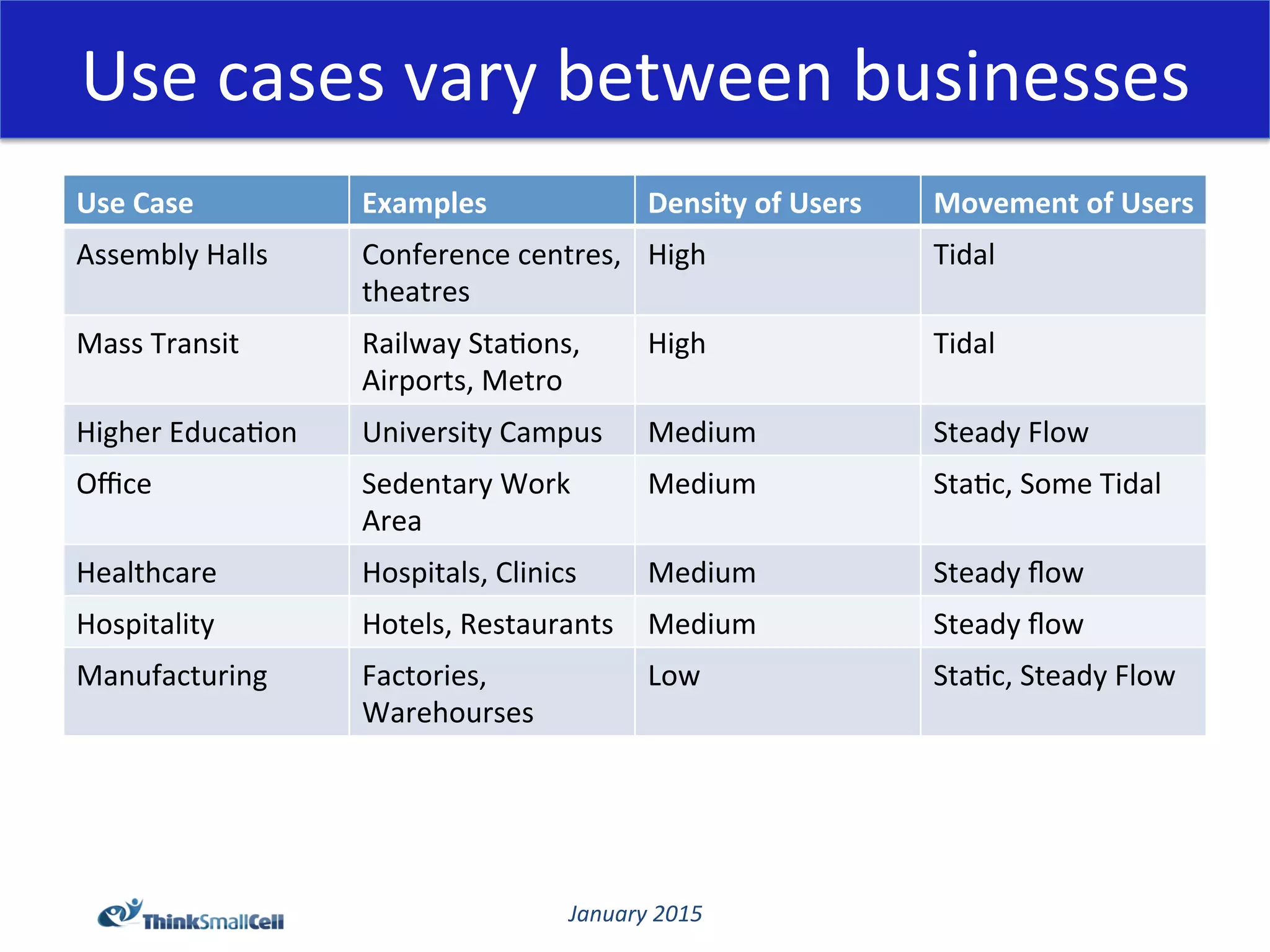
Use	
  cases	
  vary	
  between	
  businesses	
  
Use	
  Case	
   Examples	
   Density	
  of	
  Users	
   Movement	
  of	
  Users	
  
Assembly	
  Halls	
   Conference	
  centres,	
  
theatres	
  
High	
   Tidal	
  
Mass	
  Transit	
   Railway	
  Sta@ons,	
  
Airports,	
  Metro	
  
High	
   Tidal	
  
Higher	
  Educa@on	
   University	
  Campus	
   Medium	
   Steady	
  Flow	
  
Office	
   Sedentary	
  Work	
  
Area	
  
Medium	
   Sta@c,	
  Some	
  Tidal	
  
Healthcare	
   Hospitals,	
  Clinics	
   Medium	
   Steady	
  flow	
  
Hospitality	
   Hotels,	
  Restaurants	
   Medium	
   Steady	
  flow	
  
Manufacturing	
   Factories,	
  
Warehourses	
  
Low	
   Sta@c,	
  Steady	
  Flow	
  
January	
  2015	
  
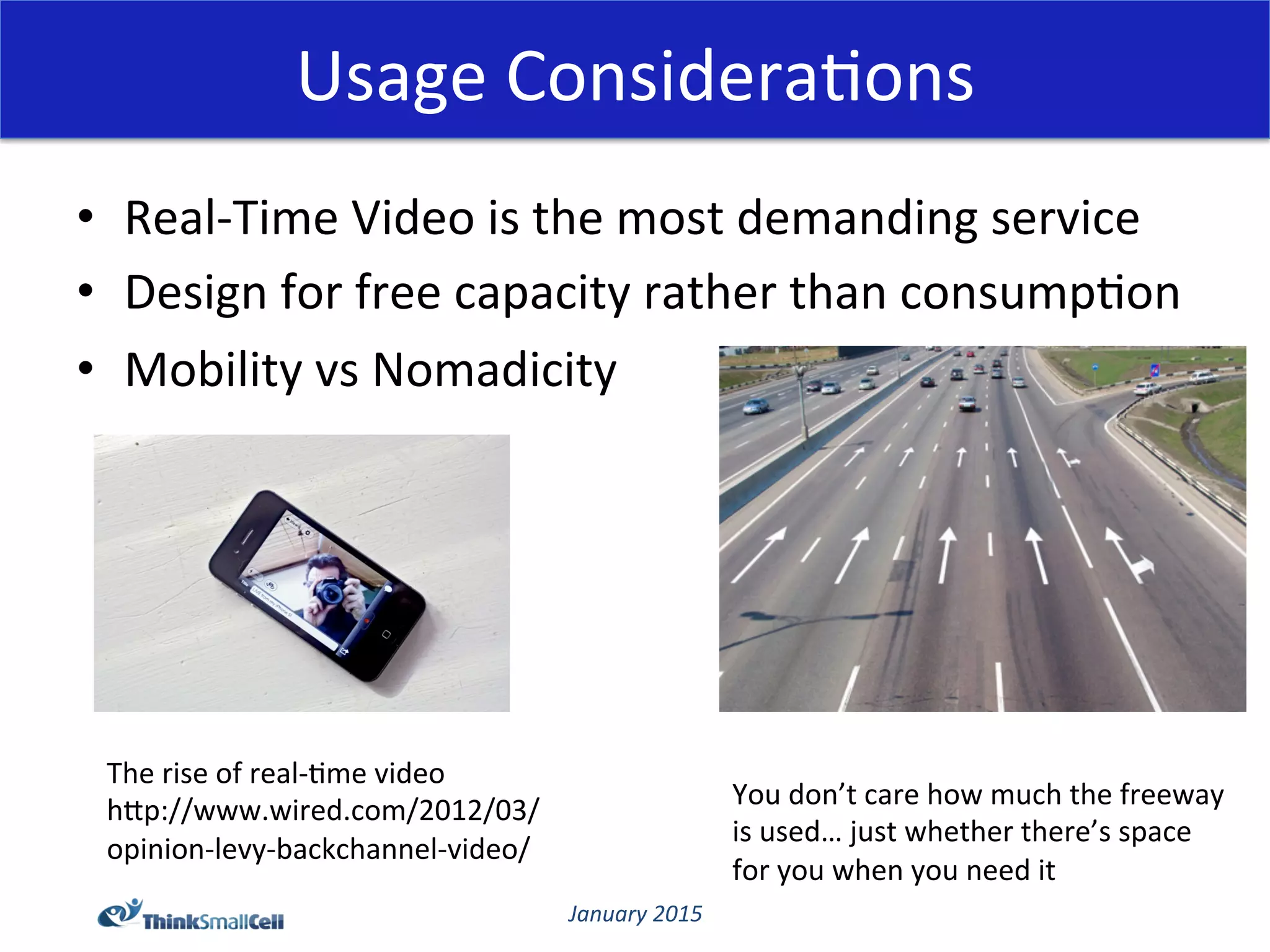
Usage	
  Considera@ons	
  
•  Real-­‐Time	
  Video	
  is	
  the	
  most	
  demanding	
  service	
  
•  Design	
  for	
  free	
  capacity	
  rather	
  than	
  consump@on	
  
•  Mobility	
  vs	
  Nomadicity	
  
The	
  rise	
  of	
  real-­‐@me	
  video	
  
hCp://www.wired.com/2012/03/
opinion-­‐levy-­‐backchannel-­‐video/	
  
You	
  don’t	
  care	
  how	
  much	
  the	
  freeway	
  
is	
  used…	
  just	
  whether	
  there’s	
  space	
  
for	
  you	
  when	
  you	
  need	
  it	
  
January	
  2015	
  
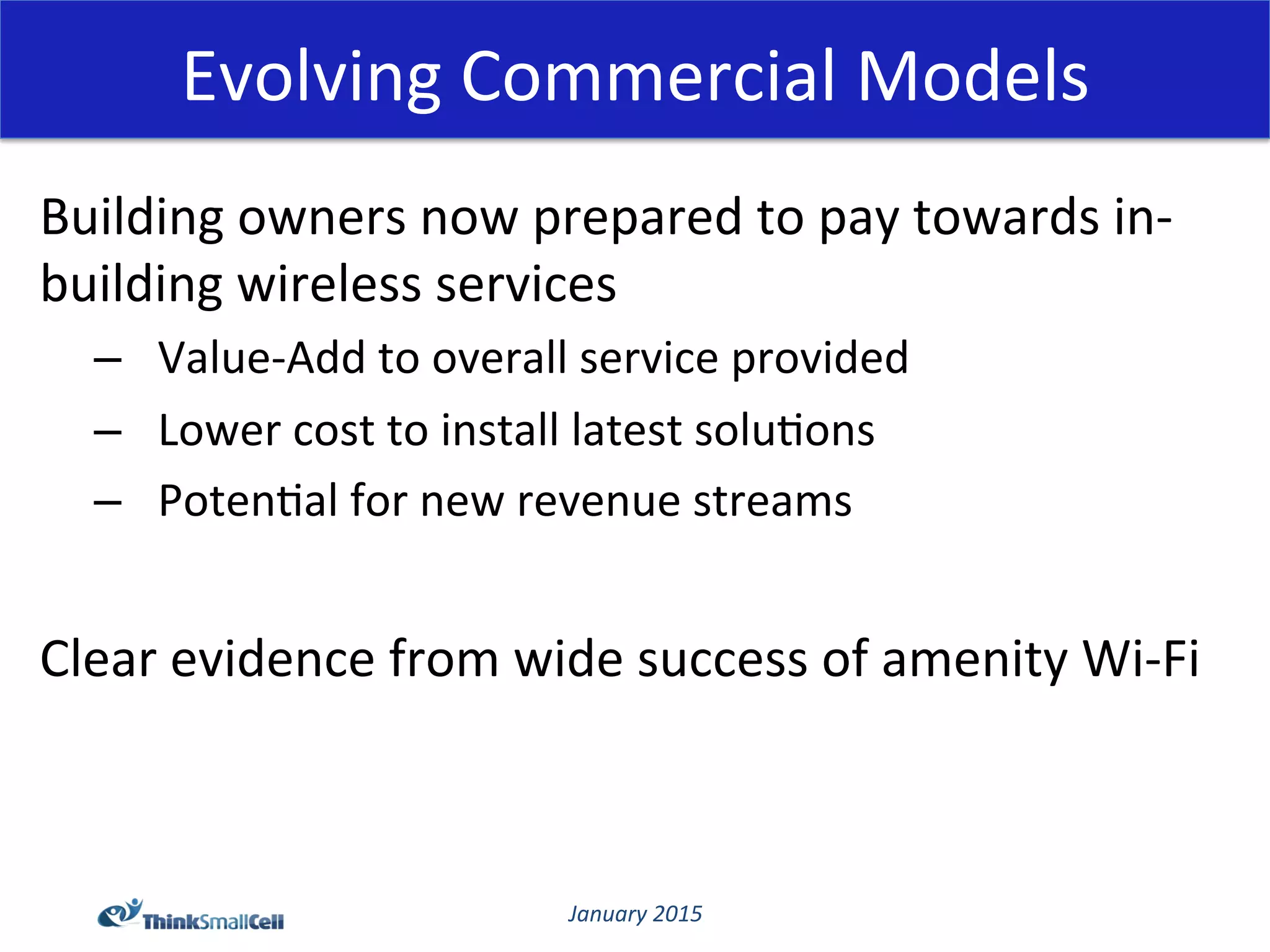
Evolving	
  Commercial	
  Models	
  
Building	
  owners	
  now	
  prepared	
  to	
  pay	
  towards	
  in-­‐
building	
  wireless	
  services	
  
–  Value-­‐Add	
  to	
  overall	
  service	
  provided	
  
–  Lower	
  cost	
  to	
  install	
  latest	
  solu@ons	
  
–  Poten@al	
  for	
  new	
  revenue	
  streams	


Clear	
  evidence	
  from	
  wide	
  success	
  of	
  amenity	
  Wi-­‐Fi	
  
January	
  2015	
  
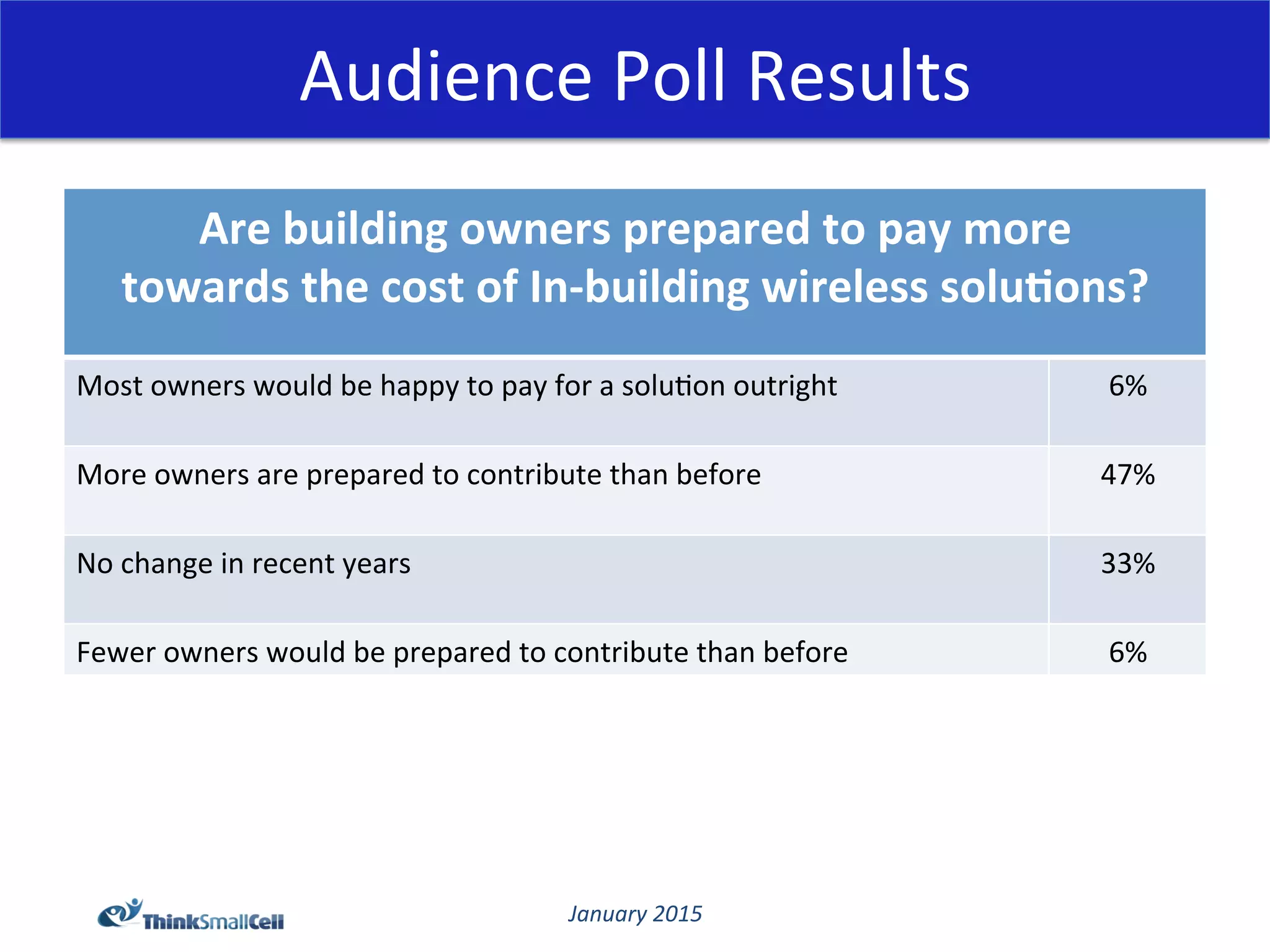
Audience	
  Poll	
  Results	
  
Are	
  building	
  owners	
  prepared	
  to	
  pay	
  more	
  	
  
towards	
  the	
  cost	
  of	
  In-­‐building	
  wireless	
  solu4ons?	


Most	
  owners	
  would	
  be	
  happy	
  to	
  pay	
  for	
  a	
  solu@on	
  outright	


14%	
  
More	
  owners	
  are	
  prepared	
  to	
  contribute	
  than	
  before	


47%	
  
No	
  change	
  in	
  recent	
  years	


33%	
  
Fewer	
  owners	
  would	
  be	
  prepared	
  to	
  contribute	
  than	
  before	
   6%	
  
January	
  2015	
  
In-­‐building	
  Wireless	
  Toolkit	
  
•  Small	
  Cells	
  
•  Distributed	
  Radio	
  Systems	
  (eg	
  RadioDOT,	
  Lampsite)	
  
•  Distributed	
  Antenna	
  Systems	
  
•  Enterprise	
  Wi-­‐Fi	
  
View	
  our	
  earlier	
  webinar	
  on	
  Cellular	
  
Enterprise	
  Solu@ons	
  at	
  
youtube.com/thinksmallcell	
  
January	
  2015	
  
In-­‐building	
  Wireless	
  Toolkit	


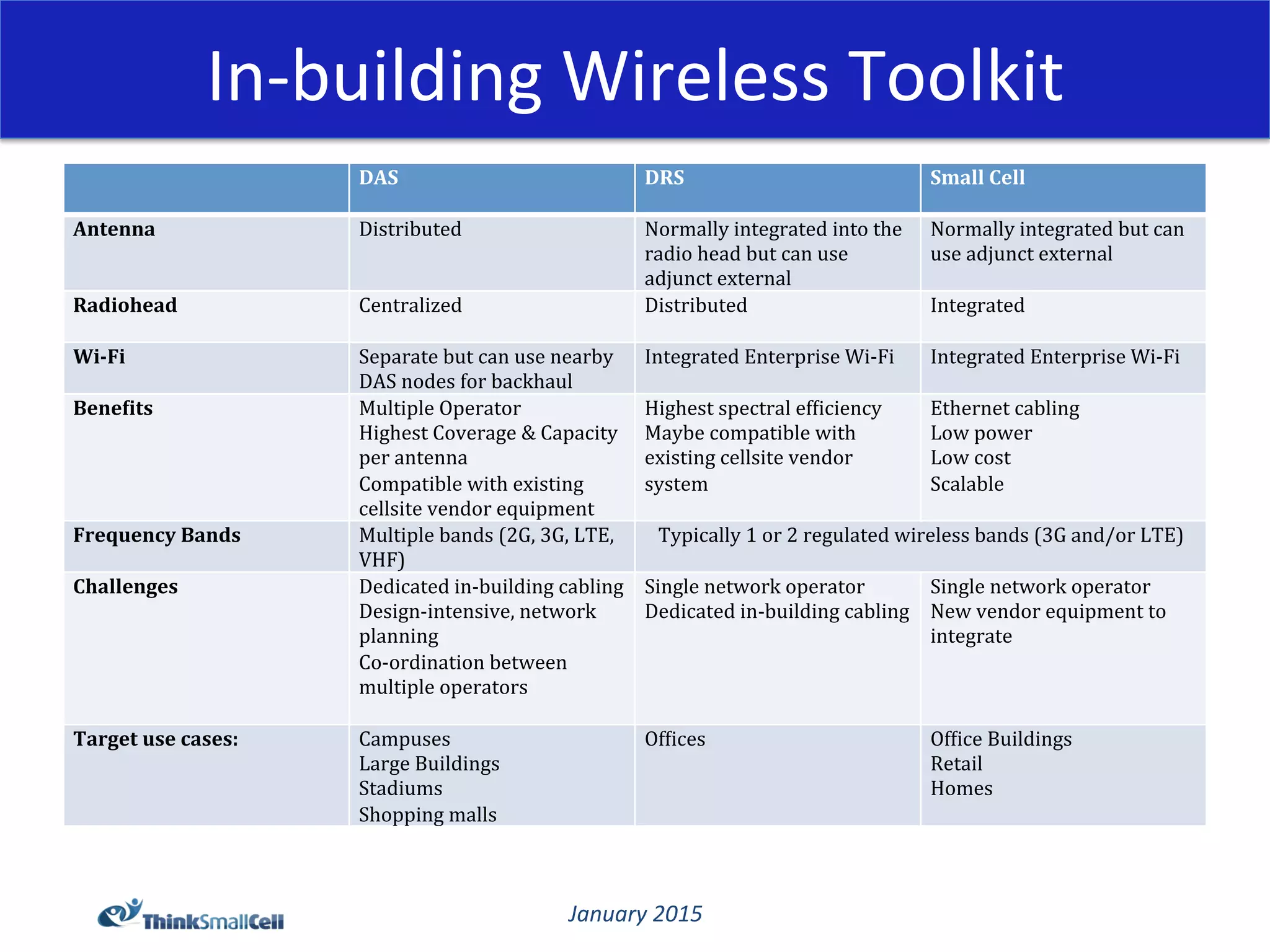
   DAS	
   DRS	
   Small	
  Cell	
  
Antenna	
   Distributed	
   Normally	
  integrated	
  into	
  the	
  
radio	
  head	
  but	
  can	
  use	
  
adjunct	
  external	
  
Normally	
  integrated	
  but	
  can	
  
use	
  adjunct	
  external	
  
Radiohead	
   Centralized	
   Distributed	
   Integrated	
  
Wi-­‐Fi	
   Separate	
  but	
  can	
  use	
  nearby	
  
DAS	
  nodes	
  for	
  backhaul	
  
Integrated	
  Enterprise	
  Wi-­‐Fi	
   Integrated	
  Enterprise	
  Wi-­‐Fi	
  
Bene5its	
   Multiple	
  Operator	
  
Highest	
  Coverage	
  &	
  Capacity	
  
per	
  antenna	
  
Compatible	
  with	
  existing	
  
cellsite	
  vendor	
  equipment	
  
Highest	
  spectral	
  efJiciency	
  
Maybe	
  compatible	
  with	
  
existing	
  cellsite	
  vendor	
  
system	
  
Ethernet	
  cabling	
  
Low	
  power	
  
Low	
  cost	
  
Scalable	


Frequency	
  Bands	
   Multiple	
  bands	
  (2G,	
  3G,	
  LTE,	
  
VHF)	
  
Typically	
  1	
  or	
  2	
  regulated	
  wireless	
  bands	
  (3G	
  and/or	
  LTE)	
  
Challenges	
   Dedicated	
  in-­‐building	
  cabling	
  
Design-­‐intensive,	
  network	
  
planning	
  
Co-­‐ordination	
  between	
  
multiple	
  operators	


Single	
  network	
  operator	
  
Dedicated	
  in-­‐building	
  cabling	
  
Single	
  network	
  operator	
  
New	
  vendor	
  equipment	
  to	
  
integrate	
  
Target	
  use	
  cases:	
   Campuses	
  
Large	
  Buildings	
  
Stadiums	
  
Shopping	
  malls	
  
OfJices	
   OfJice	
  Buildings	
  
Retail	
  
Homes	
  
January	
  2015	
  
In-­‐building	
  Wireless	
  Toolkit	


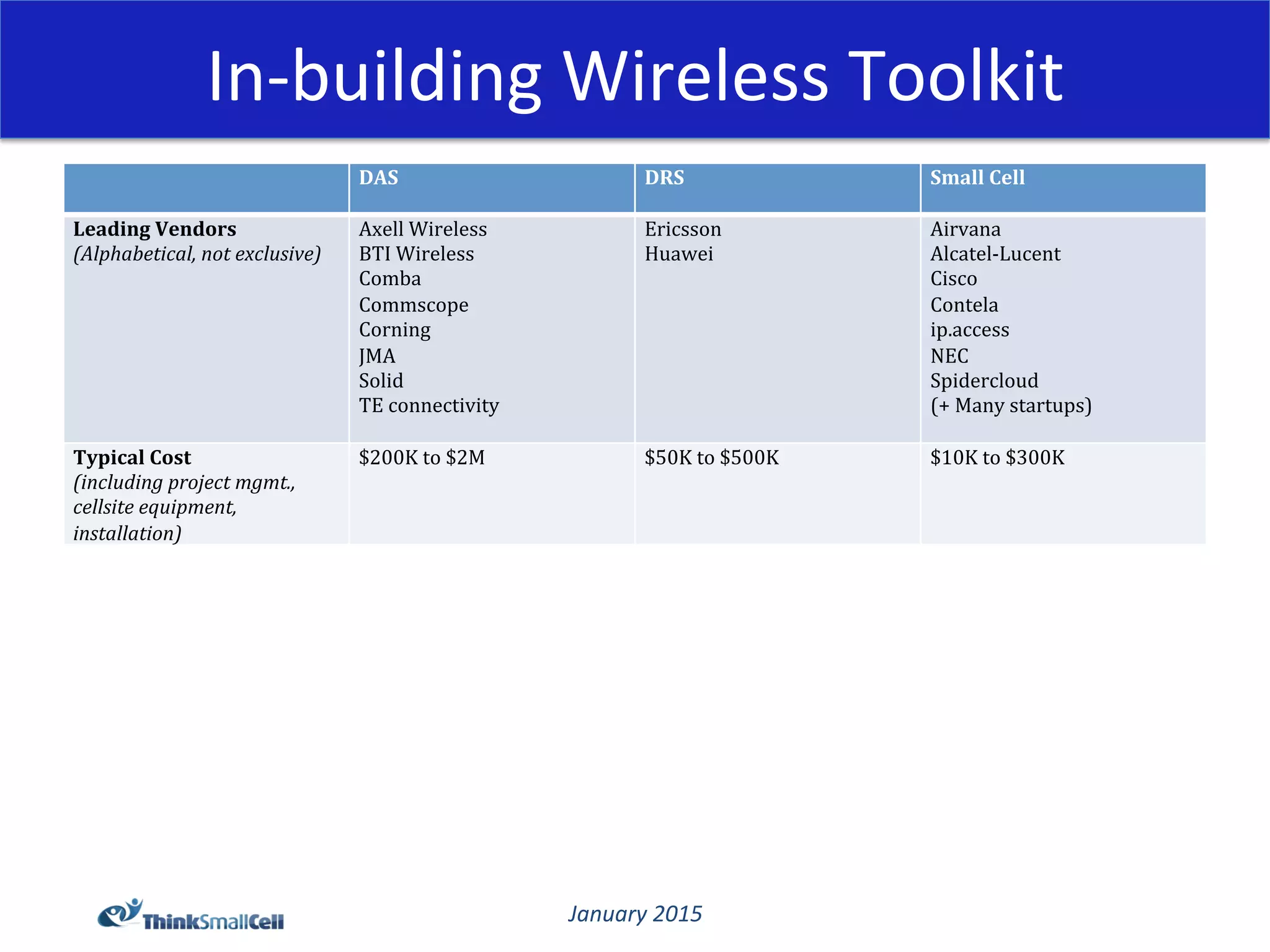
   DAS	
   DRS	
   Small	
  Cell	
  
Leading	
  Vendors	
  
(Alphabetical,	
  not	
  exclusive)	
  
Axell	
  Wireless	
  
BTI	
  Wireless	
  
Comba	
  
Commscope	
  	
  
Corning	
  
JMA	
  
Solid	
  
TE	
  connectivity	


Ericsson	
  
Huawei	


Airvana	
  	
  
Alcatel-­‐Lucent	
  
Cisco	
  
Contela	
  
ip.access	
  
NEC	
  
Spidercloud	
  
(+	
  Many	
  startups)	


Typical	
  Cost	
  
(including	
  project	
  mgmt.,	
  
cellsite	
  equipment,	
  
installation)	
  
$200K	
  to	
  $2M	
   $50K	
  to	
  $500K	
   $10K	
  to	
  $300K	
  
January	
  2015	
  
Primary	
  Decision	
  Factors	
  
•  Mul@ple	
  Operator	
  vs	
  Single	
  Operator	
  
•  Traffic	
  Profile/Density	
  
•  Building	
  Size	
  
•  Total	
  budget	
  and	
  funding	
  sources	
  
•  Internal	
  building	
  construc@on	
  or	
  new	
  build	
  
January	
  2015	
  
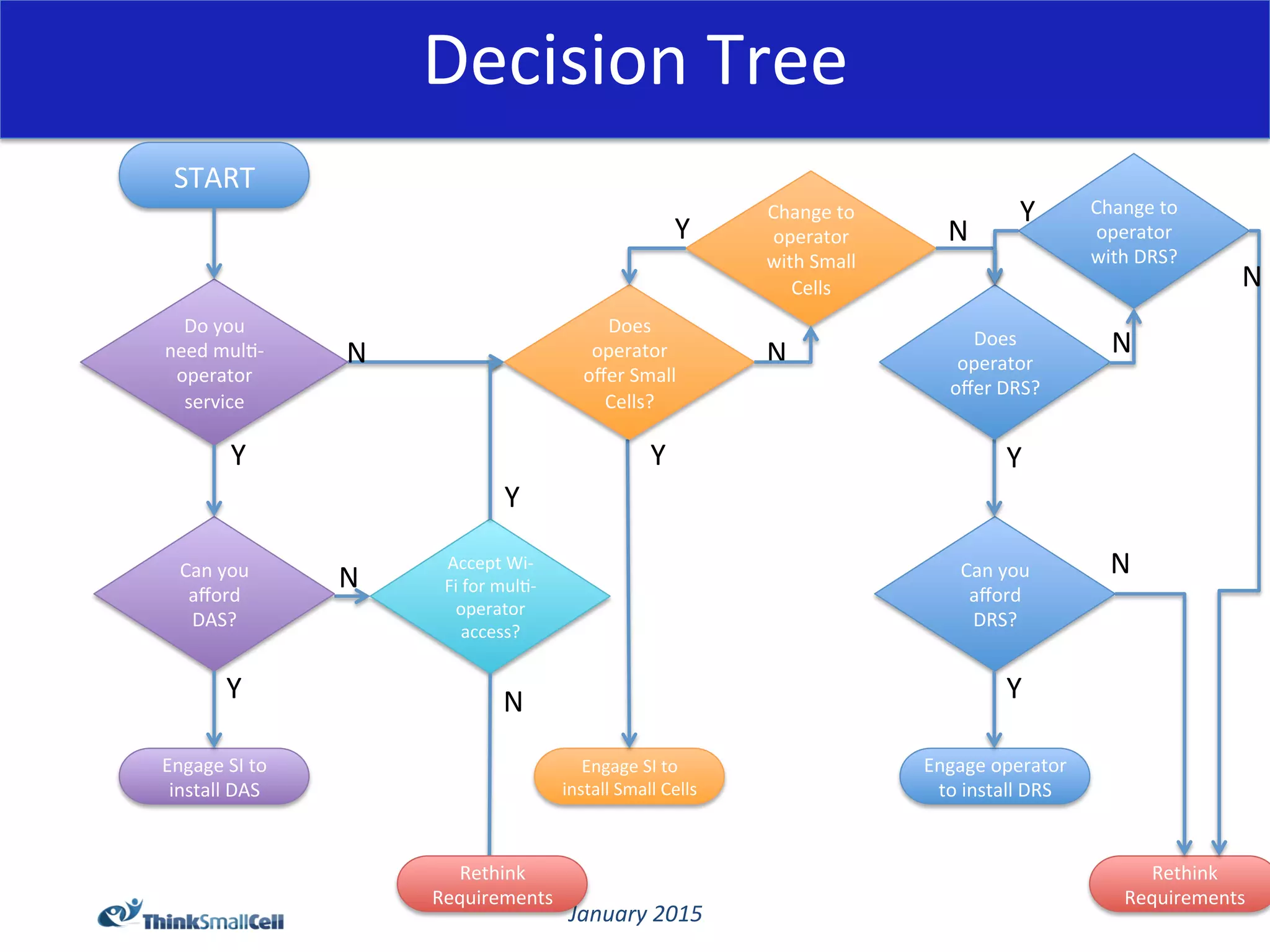
START	
  
Do	
  you	
  
need	
  mul@-­‐
operator	
  
service	
  
Accept	
  Wi-­‐
Fi	
  for	
  mul@-­‐
operator	
  
access?	
  
N	
  Can	
  you	
  
afford	
  
DAS?	
  
Y	
  
Engage	
  SI	
  to	
  
install	
  DAS	
  
Y	
  
Engage	
  SI	
  to	
  
install	
  Small	
  Cells	
  
Y	
  
Can	
  you	
  
afford	
  
DRS?	
  
Y	
  
Engage	
  operator	
  
to	
  install	
  DRS	
  
Y	
  
Does	
  
operator	
  
offer	
  Small	
  
Cells?	
  
N	
  
Y	
  
Rethink	
  
Requirements	
  
N	
  
N	
  
Change	
  to	
  
operator	
  
with	
  Small	
  
Cells	
  
Y	
  
Does	
  
operator	
  
offer	
  DRS?	
  
N	
  
N	
  
Change	
  to	
  
operator	
  
with	
  DRS?	
  
Y	
  
N	
  
Rethink	
  
Requirements	
  
N	
  
Decision	
  Tree	
  
January	
  2015	
  
Other	
  Factors	
  
•  Use	
  of	
  local	
  server	
  based	
  applica@ons	
  	
  
•  Device	
  mix	
  between	
  3G/LTE	
  and	
  evolu@on	
  
•  Mul@ple	
  Operator	
  via	
  MOCN	
  or	
  MORAN	
  
•  Small	
  Cell	
  solu@ons	
  for	
  Medium/Larger	
  
buildings	
  typically	
  use	
  an	
  in-­‐building	
  controller	
  
January	
  2015	
  
Future	
  Developments	
  
•  Commercial	
  partnership	
  
agreements	
  
•  Wider	
  adop@on	
  of	
  offloading	
  
solu@ons	
  
•  Interoperability	
  
•  First	
  Responder/E911	
  
adop@on	
  of	
  LTE	


January	
  2015	
  
Summary	
  
Urgent	
  demand	
  for	
  solu@ons	
  today	
  
-­‐  Making	
  a	
  good	
  choice	
  today	
  is	
  beCer	
  than	
  an	
  
ideal	
  choice	
  tomorrow	
  
Work	
  though	
  a	
  clear	
  set	
  of	
  requirements	
  and	
  
priori@es	
  to	
  determine	
  what	
  suits	
  best	
  
Support	
  from	
  network	
  operator	
  for	
  a	
  given	
  
solu@on/architecture	
  is	
  key	


January	
  2015	
  
Further	
  Informa@on	
  
White	
  Paper:	
  Available	
  from	
  our	
  website	
  resources	
  
hCp://www.thinksmallcell.com/viewdownload/4-­‐white-­‐papers/69-­‐
selec@ng-­‐an-­‐enterprise-­‐wireless-­‐solu@on.html	


Monthly	
  NewsleCer	
  and	
  regular	
  ar@cles	
  
www.thinksmallcell.com	


Vendor	
  websites	
  and	
  conferences	


David	
  Chambers	
  
ThinkSmallCell	
  
feedback	
  (at)	
  thinksmallcell.com	


Webinar	
  sponsored	
  by	
  
SOLiD	
  Technologies	
  

Choosing an enterprise wireless solution

  • 1.
    January  2015   ThinkSmallCell  Webinar   David  Chambers,  Senior  Analyst,  ThinkSmallCell   Choosing  the  right   In-­‐building  Wireless  Solu4ons   Webinar  sponsored  by  SOLiD   Technologies   A  top-­‐down  view  of     In-­‐building  Wireless  opDons    
  • 2.
    January  2015   Cellular  service  worsening  indoors   Poor  and  worsening  in-­‐building  service   – Building  construc@on  materials   – Increasing  traffic  demand   – Increasing  reliance  on  wireless  connec@vity  
  • 3.
    January  2015   Signal  aCenua@on  in-­‐building   In-­‐building  signal  strength  from  outdoor  cellsites  is  affected  by  RF   transmit  power,  spectrum  and  external/internal  building   construc4on  materials  
  • 4.
    January  2015   Range  of  building  sizes   Ericsson  tele-­‐briefing  for  Radio  Dot,  Sept  2013   Most  in  the  industry  agree:   -­‐  DAS  appropriate  for  very   largest  buildings/venues   -­‐  Small  Cells  for  small-­‐ medium,  where  outdoor-­‐in   coverage  inadequate   Stronger  debate  on  which  of   the  many  solu@ons  offered   suits  medium-­‐large  proper@es  
  • 5.
    January  2015   Range  of  building  sizes   Source:  Rocky  Mountain  Ins@tute  2011  
  • 6.
    January  2015   End  User  Requirements   Simplicity   Compa@bility   Consistency   Security   Mobility   I  just  want  it  to  work!!  
  • 7.
    January  2015   Building  Owner  Requirements   Mul@-­‐Operator   Value  Genera@on   Customer  Profiling   Regulatory  Compliance   Sa@sfied  Customers  
  • 8.
    January  2015   Network  Operator  Requirements   Low  total  cost  of  opera@on  (TCO)   Macrocell  offload   System  compa@bility   Premium  Brand  Loca@ons   Alterna@ve  methods  of   delivering  Quality  Service  
  • 9.
    January  2015   Use  cases  vary  between  businesses   Use  Case   Examples   Density  of  Users   Movement  of  Users   Assembly  Halls   Conference  centres,   theatres   High   Tidal   Mass  Transit   Railway  Sta@ons,   Airports,  Metro   High   Tidal   Higher  Educa@on   University  Campus   Medium   Steady  Flow   Office   Sedentary  Work   Area   Medium   Sta@c,  Some  Tidal   Healthcare   Hospitals,  Clinics   Medium   Steady  flow   Hospitality   Hotels,  Restaurants   Medium   Steady  flow   Manufacturing   Factories,   Warehourses   Low   Sta@c,  Steady  Flow  
  • 10.
    January  2015   Usage  Considera@ons   •  Real-­‐Time  Video  is  the  most  demanding  service   •  Design  for  free  capacity  rather  than  consump@on   •  Mobility  vs  Nomadicity   The  rise  of  real-­‐@me  video   hCp://www.wired.com/2012/03/ opinion-­‐levy-­‐backchannel-­‐video/   You  don’t  care  how  much  the  freeway   is  used…  just  whether  there’s  space   for  you  when  you  need  it  
  • 11.
    January  2015   Evolving  Commercial  Models   Building  owners  now  prepared  to  pay  towards  in-­‐ building  wireless  services   –  Value-­‐Add  to  overall  service  provided   –  Lower  cost  to  install  latest  solu@ons   –  Poten@al  for  new  revenue  streams     Clear  evidence  from  wide  success  of  amenity  Wi-­‐Fi  
  • 12.
    January  2015   Audience  Poll  Results   Are  building  owners  prepared  to  pay  more     towards  the  cost  of  In-­‐building  wireless  solu4ons?     Most  owners  would  be  happy  to  pay  for  a  solu@on  outright     14%   More  owners  are  prepared  to  contribute  than  before     47%   No  change  in  recent  years     33%   Fewer  owners  would  be  prepared  to  contribute  than  before   6%  
  • 13.
    January  2015   In-­‐building  Wireless  Toolkit   •  Small  Cells   •  Distributed  Radio  Systems  (eg  RadioDOT,  Lampsite)   •  Distributed  Antenna  Systems   •  Enterprise  Wi-­‐Fi   View  our  earlier  webinar  on  Cellular   Enterprise  Solu@ons  at   youtube.com/thinksmallcell  
  • 14.
    January  2015   In-­‐building  Wireless  Toolkit       DAS   DRS   Small  Cell   Antenna   Distributed   Normally  integrated  into  the   radio  head  but  can  use   adjunct  external   Normally  integrated  but  can   use  adjunct  external   Radiohead   Centralized   Distributed   Integrated   Wi-­‐Fi   Separate  but  can  use  nearby   DAS  nodes  for  backhaul   Integrated  Enterprise  Wi-­‐Fi   Integrated  Enterprise  Wi-­‐Fi   Bene5its   Multiple  Operator   Highest  Coverage  &  Capacity   per  antenna   Compatible  with  existing   cellsite  vendor  equipment   Highest  spectral  efJiciency   Maybe  compatible  with   existing  cellsite  vendor   system   Ethernet  cabling   Low  power   Low  cost   Scalable       Frequency  Bands   Multiple  bands  (2G,  3G,  LTE,   VHF)   Typically  1  or  2  regulated  wireless  bands  (3G  and/or  LTE)   Challenges   Dedicated  in-­‐building  cabling   Design-­‐intensive,  network   planning   Co-­‐ordination  between   multiple  operators       Single  network  operator   Dedicated  in-­‐building  cabling   Single  network  operator   New  vendor  equipment  to   integrate   Target  use  cases:   Campuses   Large  Buildings   Stadiums   Shopping  malls   OfJices   OfJice  Buildings   Retail   Homes  
  • 15.
    January  2015   In-­‐building  Wireless  Toolkit       DAS   DRS   Small  Cell   Leading  Vendors   (Alphabetical,  not  exclusive)   Axell  Wireless   BTI  Wireless   Comba   Commscope     Corning   JMA   Solid   TE  connectivity       Ericsson   Huawei       Airvana     Alcatel-­‐Lucent   Cisco   Contela   ip.access   NEC   Spidercloud   (+  Many  startups)       Typical  Cost   (including  project  mgmt.,   cellsite  equipment,   installation)   $200K  to  $2M   $50K  to  $500K   $10K  to  $300K  
  • 16.
    January  2015   Primary  Decision  Factors   •  Mul@ple  Operator  vs  Single  Operator   •  Traffic  Profile/Density   •  Building  Size   •  Total  budget  and  funding  sources   •  Internal  building  construc@on  or  new  build  
  • 17.
    January  2015   START   Do  you   need  mul@-­‐ operator   service   Accept  Wi-­‐ Fi  for  mul@-­‐ operator   access?   N  Can  you   afford   DAS?   Y   Engage  SI  to   install  DAS   Y   Engage  SI  to   install  Small  Cells   Y   Can  you   afford   DRS?   Y   Engage  operator   to  install  DRS   Y   Does   operator   offer  Small   Cells?   N   Y   Rethink   Requirements   N   N   Change  to   operator   with  Small   Cells   Y   Does   operator   offer  DRS?   N   N   Change  to   operator   with  DRS?   Y   N   Rethink   Requirements   N   Decision  Tree  
  • 18.
    January  2015   Other  Factors   •  Use  of  local  server  based  applica@ons     •  Device  mix  between  3G/LTE  and  evolu@on   •  Mul@ple  Operator  via  MOCN  or  MORAN   •  Small  Cell  solu@ons  for  Medium/Larger   buildings  typically  use  an  in-­‐building  controller  
  • 19.
    January  2015   Future  Developments   •  Commercial  partnership   agreements   •  Wider  adop@on  of  offloading   solu@ons   •  Interoperability   •  First  Responder/E911   adop@on  of  LTE      
  • 20.
    January  2015   Summary   Urgent  demand  for  solu@ons  today   -­‐  Making  a  good  choice  today  is  beCer  than  an   ideal  choice  tomorrow   Work  though  a  clear  set  of  requirements  and   priori@es  to  determine  what  suits  best   Support  from  network  operator  for  a  given   solu@on/architecture  is  key      
  • 21.
    January  2015   Further  Informa@on   White  Paper:  Available  from  our  website  resources   hCp://www.thinksmallcell.com/viewdownload/4-­‐white-­‐papers/69-­‐ selec@ng-­‐an-­‐enterprise-­‐wireless-­‐solu@on.html     Monthly  NewsleCer  and  regular  ar@cles   www.thinksmallcell.com     Vendor  websites  and  conferences     David  Chambers   ThinkSmallCell   feedback  (at)  thinksmallcell.com       Webinar  sponsored  by   SOLiD  Technologies