SAUNA BATH
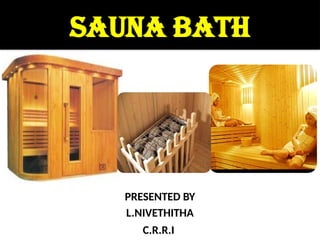
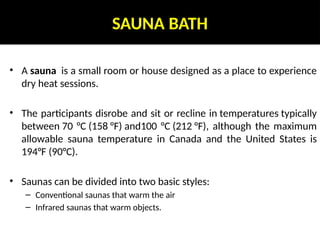
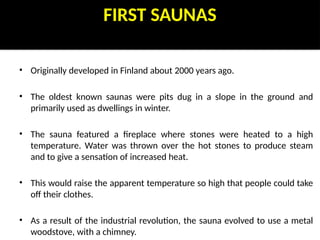
• Asauna is a small room or house designed as a place to experience
dry heat sessions.
• The participants disrobe and sit or recline in temperatures typically
between 70 °C (158 °F) and100 °C (212 °F), although the maximum
allowable sauna temperature in Canada and the United States is
194°F (90°C).
• Saunas can be divided into two basic styles:
– Conventional saunas that warm the air
– Infrared saunas that warm objects.
4.
FIRST SAUNAS
• Originallydeveloped in Finland about 2000 years ago.
• The oldest known saunas were pits dug in a slope in the ground and
primarily used as dwellings in winter.
• The sauna featured a fireplace where stones were heated to a high
temperature. Water was thrown over the hot stones to produce steam
and to give a sensation of increased heat.
• This would raise the apparent temperature so high that people could take
off their clothes.
• As a result of the industrial revolution, the sauna evolved to use a metal
woodstove, with a chimney.
5.
• Air temperaturesaveraged around 70–80 degrees Celsius
(160–180 degrees Fahrenheit) but sometimes exceeded 90 °C
(200 °F) in a traditional Finnish sauna.
• The steam and high heat caused bathers to perspire.
• Although the culture of sauna nowadays is more or less
related to Finnish culture.
• It is important to note that the evolution of sauna has
happened around the same time both in Finland and the
Baltic countries sharing the same meaning and importance of
sauna in daily life.
• The same sauna culture is shared in both places still to this
day.
6.
MODERN SAUNAS
• Undermany circumstances, temperatures approaching and
exceeding 100 °C (212 °F) would be completely intolerable.
• Saunas overcome this problem by controlling the humidity. The
hottest Finnish saunas have relatively low humidity levels in which
steam is generated by pouring water on the hot stones.
• This allows air temperatures that could boil water to be tolerated
and even enjoyed for longer periods of time.
• Steam baths where the humidity approaches 100%, will be set to a
much lower temperature of around 40 °C (104 °F) to compensate.
7.
• The "wetheat" would cause scalding if the temperature were
set much higher.
• Many North American, Western European, Russian, and South
African public sport centres and gyms include sauna facilities.
• The Sauna (pronounced sow-nah) has been used for
centuries, not only as a place to bathe, but as a place for
healing, relaxing and enjoyment.
8.
PROCEDURE
• A saunais usually done in courses; a short time in the sauna to
heat up and begin to sweat, followed by a cooling off outside the
sauna.
• Patient lies upon the slab in a small room filled with steam, being
rubbed at intervals by an attendant so as to promote the early
appearance of perspiration.
• The temperature of room is from 115o
-120o
; 140o
is barely
endurable, but can not be continued for length of time with out
danger.
• Duration: 10- 20 minutes.
• Shampoo and cold shower or plunge will be Followed by this
bath.
9.
• Leave yourcloths in dressing room
• Drink 1-2 glass of water or any sports drink (avoid caffeine) which has
electrolytes. Shower first, as this is to moisten the skin and to remove
any possible body or fragrant odours, which do not belong to the sauna.
• Take a sauna bath for over 10-15 minutes.
• Exit the sauna bath if you feel uncomfortable or become sleepy.
• Cool off with cool fresh air and cool water without shocking the system
and avoid shivering-take a warm foot bath if you have cold feet and then
repeat the session, do not take more than 3 sessions at a time in the
sauna bath.
• Make sure you are not allergic to any aromatherapy oils before use.
10.
PHYSIOLOGICAL EFFECTS
• Rapidand considerable raise of body temperature.
• Oxidation of nitrogen increased
• Increase the peripheral blood flow
• Enhance the activity of sweat glands
• Promote perspiration and eliminate the toxin
• Activate the pain gate mechanism because of changes in the skin
temperature ( activation of large nerve fiber so the suppression of
the small nerve fiber which carry the pain sensation)
11.
• Decrease theperipheral residence
• Promote the cardiac function
• Enhance the o2 intake and co2 elimination
• Reduces the renal work load
12.
PRECAUTIONS FOR SAUNABATH
• Do not use alcohol prior to or during a sauna bath, alcohols (it dehydrates your
body) can cause drowsiness and or the ability to determine the effects of the sauna
bath.
• After a workout, give your body adequate time to cool down, before you expose it
to the heat of a sauna to avoid heat stroke. You must rest for at least 20 minutes.
• Drink plenty of water before and after the sauna bath to replace fluids lost during
the treatment.
• Limit sauna/steam time to 10 to 15 minutes. Drink plenty of water or herbal tea
before and after the sweat bath to replace fluids lost during the treatment.
• The sweat glands can secrete up to 30 grams of sweat per minute, or almost one
pint per 15 minutes, so dehydration is a very real possibility, if you are not careful.
13.
• Fatigue andother indications of dehydration can occur with as
little as 1 to 2% loss in body weight. Symptoms of too much
dehydration include dizziness, vertigo, rapid heartbeat, or
excessive thirst.
• Also, make sure not to eat any large meals beforehand, and drink
plenty of water to ensure that you don't get dehydrated.
• Person with low blood pressure(as sauna bath decreases blood
pressure) Pregnant women should not use a sauna. High
temperatures can harm your foetus or cause you to faint.
• Children's ability to tolerate heat is limited, since their skin
area/body mass-ratio is high, sweating system is immature and fat
layer is thin. Children can, however, take sauna baths totally safely,
if some precautions are taken into account.
14.
BENEFITS OF SAUNABATH
• In sauna bathers, Blood vessels become more flexible and there is increased circulation
to the extremities. During a sauna bath, blood flow to the skin increases to as high as
50-70% of cardiac output (compared to the standard 5-10%).
• This brings nutrients to subcutaneous and surface tissue resulting in glowing healthy
skin.
• Sauna provides a cardiovascular workout--helps condition the heart.
• Sauna heat puts the body into an artificial fever state (hyperthermia). Fever is part of
the body's natural healing process. This "fake fever" stimulates the immune system
resulting in an increased production of disease fighting white blood cells and
antibodies. While the growth of bacteria and virus is forced to slow down.
• Athletes use Saunas to loosen tight muscles after a hard workout.
15.
• Sauna bathmakes you feel rejuvenated and have increased energy
levels. The Sauna helps many get a more restful sleep.
• In the hydrotherapeutic tradition used at European and America spas,
sweat therapy is used in preparation for massage as a means of
increasing the suppleness of the muscles and creating a deep sense of
relaxation in body and mind.
• A sauna bath opens skin pores, soothes sore muscles, and increases
circulation. However, more than common metabolic waste products
are secreted through the skin.
• Note-The Sauna should not, of course, be used as a weight loss aid by
itself, but when used with a good diet and exercise program, a Sauna
can help burn more calories. Weight is lost in a Sauna, but most of it is
water loss from sweating.
16.
• Hydrate andcirculate:
– Sauna baths hydrate your skin with heat and steam. Blood flows instantly to the
skin’s surface, enriching it with oxygen and stripping it of dead skin cells. The
improved circulation and exfoliating action works wonders for your skin. The result:
Sauna baths make skin look healthy and smooth and can help you defy the aging
process.
• Banish acne:
– If you suffer from blemishes, blackheads, or whiteheads, a sauna bath can purge
the oils from your skin, open your clogged pores, and help eliminate your pimples
altogether.
• Sweat it out:
– Saunas make you sweat, and sweat purges toxins from your body, such as bacteria,
infections, accumulated fat, and other contaminants.
• Relax your muscles:
– As the heat soaks into your skin, your muscles relax. This is critical for more than just
pleasure. Sauna baths help relieve muscle spasms, soothe muscle injuries, and heal
pulled tendons and ligament strains.
17.
Lower your bloodpressure:
• One key benefit of sauna baths is their effect on your blood
pressure. Your heart gets a real workout in the heat of the
sauna, yet your blood pressure decreases. This is great for
healing various ailments, but be careful when standing up to
get out of the bath, as lower blood pressure might make you
feel dizzy temporarily.
Blast away fat:
• While your heart rate increases in the sauna bath, your excess
weight melts away. Some studies show that women burn about
300 calories in a typical sauna session. That’s about the same as
walking briskly for up to two hours, but a lot more relaxing.
Boost your immune system:
• Some say that sauna baths improve your immune system and
are the best way to ward off a cold, flu, or upper respiratory
infection. At the first sign of symptoms, get in the sauna and
purge the germs from your insides.
18.
Relieve some stress:
Asauna bath can improve your state of mind, and
stress relief is the key to managing a variety of
illnesses. In addition, the heat produces endorphins
that can help relieve symptoms of depression.
• Manage chronic illness:
– Many chronic illnesses can reap the rewards of
sauna baths
19.
DISEASES AND CONDITIONSTHAT BENEFIT
TREMENDOUSLY FROM SAUNA BATHS
• Chronic fatigue syndrome
• Asthma
• Fibromyalgia
• Glaucoma
• Anorexia nervosa
• Herniated disks and other spinal injuries
• Diabetes
• Walking pneumonia
• Obesity
• Hypertension
• Insomnia
• Psoriasis
• Arthritis pain, especially as a result of rheumatoid arthritis
• Postpartum recovery
• Bronchitis
• Sinusitis
• Laryngitis
• Headaches
Effect of repeatedsauna treatment on exercise tolerance
and endothelial function in patients with chronic heart
failure
• Am J Cardiol. 2012 Jan 1;109(1):100-4. Epub 2011 Sep 23.
• Ohori T, Nozawa T, Ihori H, Shida T, Sobajima M, Matsuki A, Yasumura
S, Inoue H.
CONCLUSION:
Repeated sauna therapy in patients with chronic heart
failure improves exercise tolerance in association with
improvement in endothelial function.
23.
Sauna: cardiac andvascular benefits and risks
Presse Med. 2011 Oct;40(10):895-9. Epub 2011 Mar 17
Kluger N.
Abstract
• results from recent Japanese studies seem to point out
potential benefits for patients with
chronic congestive heart failure, but the results
need confirmation.
24.
Changes in thelipid profile of blood serum in
women taking sauna baths of various duration
• Int J Occup Med Environ Health. 2010;23(2):167-74. Pilch
W, Szyguła Z, Klimek AT, Pałka T, Cisoń T, Pilch P, Torii M.
• CONCLUSION:
– After 2 weeks of repeated sauna session some changes in
total cholesterol and concentration of LDLC were observed,
while concentration of HDLC increased after 7th sauna
bath in group I. Those kinds of changes may be good
prognoses of ischemic heart disease prevention, but further
research on the influence of sauna on fat metabolism is
needed.
25.
Sauna as avaluable clinical tool for cardiovascular,
autoimmune, toxicant- induced and other chronic
health problems.
• Altern Med Rev. 2011 Sep;16(3):215-25. Crinnion WJ.
CONCLUSION:
– regular sauna therapy (either radiant heat or far-infrared
units) appears to be safe and offers multiple health
benefits to regular users. One potential area of concern is
sauna use in early pregnancy because of evidence
suggesting that hyperthermia might be teratogenic.
26.
Waon therapy forcardiovascular disease:
innovative therapy for the 21st century
• irc J. 2010 Apr;74(4):617-21. Epub 2010 Feb 13. Miyata M, Tei C.
• Waon therapy is a form of thermal treatment in a dry sauna
maintained at a temperature of 60 degrees C, which slightly
differs from the traditional sauna.
• Conclusion:
– Waon therapy is an innovative and highly promising
strategy for treating CHF and PAD (peripheral
arterial disease) .