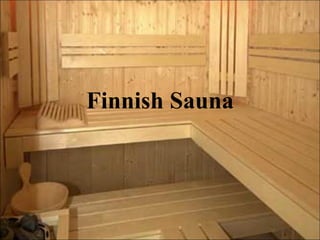
Finnish Sauna
Definition A  sauna  is a small room or house designed as a place to experience dry or wet heat sessions, or an establishment with one or more of these and auxiliary facilities. The word "sauna" is also used figuratively to describe an unusually hot or humid environment. The temperature is usually between 80 °C and 110 °C 5 million people vs. 2 million saunas Finns built the first wooden saunas in the 5th or 8th century Not luxury -> necessity : place to gave birth
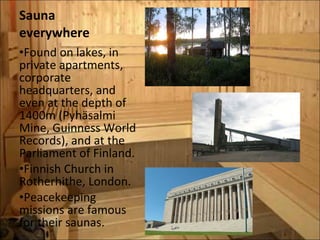
Sauna everywhere Found on  lakes, in private apartments, corporate headquarters, and even at the depth of 1400m (Pyhäsalmi Mine,  Guinness World Records ), and at the Parliament of Finland. Finnish Church in Rotherhithe, London. Peacekeeping missions are famous for their saunas.
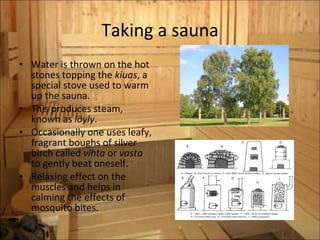
Taking a sauna Water is thrown on the hot stones topping the  kiuas , a special stove used to warm up the sauna.  This produces steam, known as  löyly . Occasionally one uses leafy, fragrant boughs of silver birch called  vihta  or  vasta  to gently beat oneself.  Relaxing effect on the muscles and helps in calming the effects of mosquito bites.
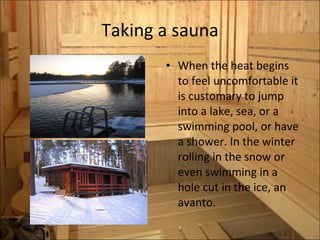
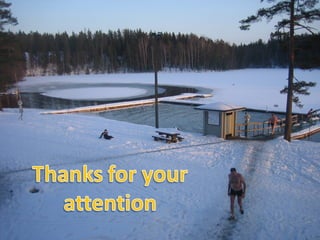
Taking a sauna When the heat begins to feel uncomfortable it is customary to jump into a lake, sea, or a swimming pool, or have a shower. In the winter rolling in the snow or even swimming in a hole cut in the ice, an avanto.
Uses of sauna Bathing : Finns were cleaning themselves in saunas at least once a week. Moving :the first thing they did was build a sauna, to live, make food in the stove, bathing and give birth in an almost sterile environment.(The sauna smoke contained tannic acid, an anti-bacterial polymer) Almost endless resources of wood to burn.  Feel warm at least for a short period of time.
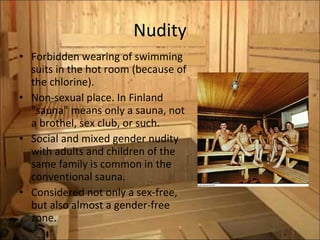
Nudity Forbidden wearing of swimming suits in the hot room (because of the  chlorine). Non-sexual place. In Finland "sauna" means only a sauna, not a brothel, sex club, or such. Social and mixed gender nudity with adults and children of the same family is common in the conventional sauna.  Considered not only a sex-free, but also almost a gender-free zone.
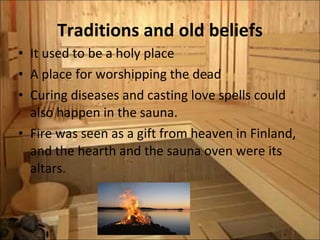
Traditions and old beliefs It used to be a holy place A place for worshipping the dead Curing diseases and casting love spells could also happen in the sauna.  Fire was seen as a gift from heaven in Finland, and the hearth and the sauna oven were its altars.
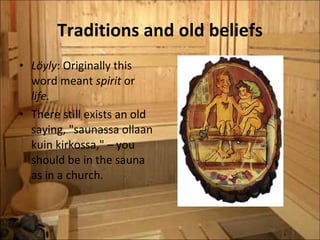
Traditions and old beliefs Löyly : Originally this word meant  spirit  or  life. There still exists an old saying, "saunassa ollaan kuin kirkossa," – you should be in the sauna as in a church.
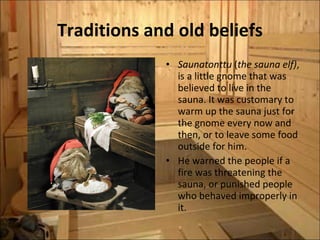
Traditions and old beliefs Saunatonttu  ( the sauna elf) , is a little gnome that was believed to live in the sauna. It was customary to warm up the sauna just for the gnome every now and then, or to leave some food outside for him.  He warned the people if a fire was threatening the sauna, or punished people who behaved improperly in it.
Traditions and old beliefs In Finland, the sauna was thought of as a healing refreshment. The old saying goes: "Jos ei viina, terva tai sauna auta, tauti on kuolemaksi." ("If booze, tar, or the sauna won't help, the illness is fatal.")  The Finnish sauna is not thought as an easy way to get physical exercise or weight loss.
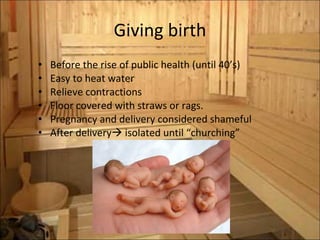
Giving birth Before the rise of public health (until 40’s) Easy to heat water Relieve contractions Floor covered with straws or rags. Pregnancy and delivery considered shameful After delivery   isolated until “churching”
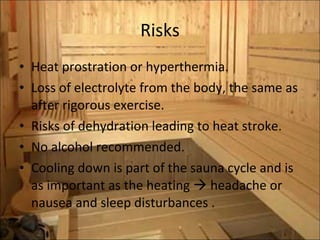
Risks Heat prostration or hyperthermia.  Loss of electrolyte from the body, the same as after rigorous exercise.  Risks of dehydration leading to heat stroke. No alcohol recommended. Cooling down is part of the sauna cycle and is as important as the heating    headache or nausea and sleep disturbances .
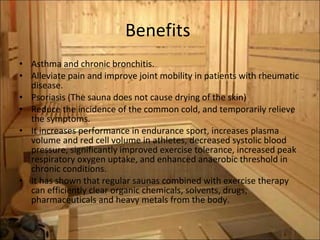
Benefits  Asthma and chronic bronchitis. Alleviate pain and improve joint mobility in patients with rheumatic disease.  Psoriasis (The sauna does not cause drying of the skin) Reduce the incidence of the common cold, and temporarily relieve the symptoms.  It increases performance in endurance sport, increases plasma volume and red cell volume in athletes, decreased systolic blood pressure, significantly improved exercise tolerance, increased peak respiratory oxygen uptake, and enhanced anaerobic threshold in chronic conditions. It has shown that regular saunas combined with exercise therapy can efficiently clear organic chemicals, solvents, drugs, pharmaceuticals and heavy metals from the body.
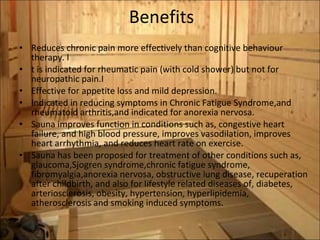
Benefits Reduces chronic pain more effectively than cognitive behaviour therapy. I t is indicated for rheumatic pain (with cold shower) but not for neuropathic pain.I Effective for appetite loss and mild depression.  Indicated in reducing symptoms in Chronic Fatigue Syndrome,and rheumatoid arthritis,and indicated for anorexia nervosa. Sauna improves function in conditions such as, congestive heart failure, and high blood pressure, improves vasodilation, improves heart arrhythmia, and reduces heart rate on exercise.  Sauna has been proposed for treatment of other conditions such as, glaucoma,Sjogren syndrome,chronic fatigue syndrome, fibromyalgia,anorexia nervosa, obstructive lung disease, recuperation after childbirth, and also for lifestyle related diseases of, diabetes, arteriosclerosis, obesity, hypertension, hyperlipidemia, atherosclerosis and smoking induced symptoms.
http://en.wikipedia.org/wiki/Sauna http://en.wikipedia.org/wiki/Finnish_sauna http://www.helsinki.fi/lehdet/uh/498b.htm http://cankar.org/sauna/index.html Videos: http://www.youtube.com/watch?v=517dwuOodA8  taxes http://www.youtube.com/watch?v=g9rX8mpVZKA  sauna championship http://www.youtube.com/watch?v=IdYBmdfQvFo McDonald´s
 

Finnish Sauna

  • 1.
  • 2.
    Definition A sauna is a small room or house designed as a place to experience dry or wet heat sessions, or an establishment with one or more of these and auxiliary facilities. The word "sauna" is also used figuratively to describe an unusually hot or humid environment. The temperature is usually between 80 °C and 110 °C 5 million people vs. 2 million saunas Finns built the first wooden saunas in the 5th or 8th century Not luxury -> necessity : place to gave birth
  • 3.
    Sauna everywhere Foundon lakes, in private apartments, corporate headquarters, and even at the depth of 1400m (Pyhäsalmi Mine, Guinness World Records ), and at the Parliament of Finland. Finnish Church in Rotherhithe, London. Peacekeeping missions are famous for their saunas.
  • 4.
    Taking a saunaWater is thrown on the hot stones topping the kiuas , a special stove used to warm up the sauna. This produces steam, known as löyly . Occasionally one uses leafy, fragrant boughs of silver birch called vihta or vasta to gently beat oneself. Relaxing effect on the muscles and helps in calming the effects of mosquito bites.
  • 5.
    Taking a saunaWhen the heat begins to feel uncomfortable it is customary to jump into a lake, sea, or a swimming pool, or have a shower. In the winter rolling in the snow or even swimming in a hole cut in the ice, an avanto.
  • 6.
    Uses of saunaBathing : Finns were cleaning themselves in saunas at least once a week. Moving :the first thing they did was build a sauna, to live, make food in the stove, bathing and give birth in an almost sterile environment.(The sauna smoke contained tannic acid, an anti-bacterial polymer) Almost endless resources of wood to burn. Feel warm at least for a short period of time.
  • 7.
    Nudity Forbidden wearingof swimming suits in the hot room (because of the chlorine). Non-sexual place. In Finland "sauna" means only a sauna, not a brothel, sex club, or such. Social and mixed gender nudity with adults and children of the same family is common in the conventional sauna. Considered not only a sex-free, but also almost a gender-free zone.
  • 8.
    Traditions and oldbeliefs It used to be a holy place A place for worshipping the dead Curing diseases and casting love spells could also happen in the sauna. Fire was seen as a gift from heaven in Finland, and the hearth and the sauna oven were its altars.
  • 9.
    Traditions and oldbeliefs Löyly : Originally this word meant spirit or life. There still exists an old saying, "saunassa ollaan kuin kirkossa," – you should be in the sauna as in a church.
  • 10.
    Traditions and oldbeliefs Saunatonttu ( the sauna elf) , is a little gnome that was believed to live in the sauna. It was customary to warm up the sauna just for the gnome every now and then, or to leave some food outside for him. He warned the people if a fire was threatening the sauna, or punished people who behaved improperly in it.
  • 11.
    Traditions and oldbeliefs In Finland, the sauna was thought of as a healing refreshment. The old saying goes: "Jos ei viina, terva tai sauna auta, tauti on kuolemaksi." ("If booze, tar, or the sauna won't help, the illness is fatal.") The Finnish sauna is not thought as an easy way to get physical exercise or weight loss.
  • 12.
    Giving birth Beforethe rise of public health (until 40’s) Easy to heat water Relieve contractions Floor covered with straws or rags. Pregnancy and delivery considered shameful After delivery  isolated until “churching”
  • 13.
    Risks Heat prostrationor hyperthermia. Loss of electrolyte from the body, the same as after rigorous exercise. Risks of dehydration leading to heat stroke. No alcohol recommended. Cooling down is part of the sauna cycle and is as important as the heating  headache or nausea and sleep disturbances .
  • 14.
    Benefits Asthmaand chronic bronchitis. Alleviate pain and improve joint mobility in patients with rheumatic disease. Psoriasis (The sauna does not cause drying of the skin) Reduce the incidence of the common cold, and temporarily relieve the symptoms. It increases performance in endurance sport, increases plasma volume and red cell volume in athletes, decreased systolic blood pressure, significantly improved exercise tolerance, increased peak respiratory oxygen uptake, and enhanced anaerobic threshold in chronic conditions. It has shown that regular saunas combined with exercise therapy can efficiently clear organic chemicals, solvents, drugs, pharmaceuticals and heavy metals from the body.
  • 15.
    Benefits Reduces chronicpain more effectively than cognitive behaviour therapy. I t is indicated for rheumatic pain (with cold shower) but not for neuropathic pain.I Effective for appetite loss and mild depression. Indicated in reducing symptoms in Chronic Fatigue Syndrome,and rheumatoid arthritis,and indicated for anorexia nervosa. Sauna improves function in conditions such as, congestive heart failure, and high blood pressure, improves vasodilation, improves heart arrhythmia, and reduces heart rate on exercise. Sauna has been proposed for treatment of other conditions such as, glaucoma,Sjogren syndrome,chronic fatigue syndrome, fibromyalgia,anorexia nervosa, obstructive lung disease, recuperation after childbirth, and also for lifestyle related diseases of, diabetes, arteriosclerosis, obesity, hypertension, hyperlipidemia, atherosclerosis and smoking induced symptoms.
  • 16.
    http://en.wikipedia.org/wiki/Sauna http://en.wikipedia.org/wiki/Finnish_sauna http://www.helsinki.fi/lehdet/uh/498b.htmhttp://cankar.org/sauna/index.html Videos: http://www.youtube.com/watch?v=517dwuOodA8 taxes http://www.youtube.com/watch?v=g9rX8mpVZKA sauna championship http://www.youtube.com/watch?v=IdYBmdfQvFo McDonald´s
  • 17.