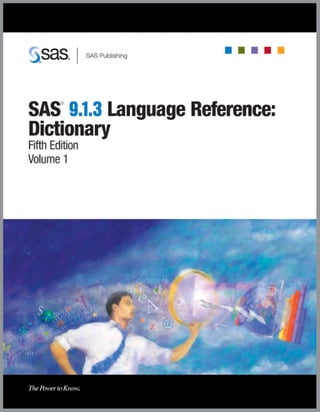
Sas 913 Language Reference Dictionary 5th Ed Sas
Publishing download
https://ebookbell.com/product/sas-913-language-reference-
dictionary-5th-ed-sas-publishing-929812
Explore and download more ebooks at ebookbell.com
Here are some recommended products that we believe you will be
interested in. You can click the link to download.
Sas 913 Language Reference Dictionary
https://ebookbell.com/product/sas-913-language-reference-
dictionary-1223480
Sas 913 Language Reference Concepts Sas Publishing
https://ebookbell.com/product/sas-913-language-reference-concepts-sas-
publishing-982070
Sas 913 Output Delivery System Users Guide Volumes 1 And 2 Publishing
Sas Publishing
https://ebookbell.com/product/sas-913-output-delivery-system-users-
guide-volumes-1-and-2-publishing-sas-publishing-2167408
Sas 913 Intelligence Platform Web Application Administration Guide
Third Edition 3rd Edition Sas Publishing
https://ebookbell.com/product/sas-913-intelligence-platform-web-
application-administration-guide-third-edition-3rd-edition-sas-
publishing-2198890
Sas 9 1 3 Management Console Users Guide Sas Publishing
https://ebookbell.com/product/sas-9-1-3-management-console-users-
guide-sas-publishing-996618
Sas 913 Etl Studio Users Guide Sas Publishing
https://ebookbell.com/product/sas-913-etl-studio-users-guide-sas-
publishing-982068
Sasr 913 Intelligence Platform Security Administration Guide Sas
Publishing
https://ebookbell.com/product/sasr-913-intelligence-platform-security-
administration-guide-sas-publishing-2004206
Sasaccess 913 For Relational Databases Reference 3rd Edition 3rd
Edition The Sas Technical Team Writers
https://ebookbell.com/product/sasaccess-913-for-relational-databases-
reference-3rd-edition-3rd-edition-the-sas-technical-team-
writers-2161692
Sas Access 913 Supplement For Mysql Sas Access For Relational
Databases The Sas Technical Team Writers
https://ebookbell.com/product/sas-access-913-supplement-for-mysql-sas-
access-for-relational-databases-the-sas-technical-team-writers-2162690
SAS®
Publishing
SAS
®
9.1.3
Language Reference: Dictionary
Fifth Edition
The correct bibliographic citation for this manual is as follows: SAS Institute Inc. 2006.
SAS ® 9.1.3 Language Reference: Dictionary, Fifth Edition, Volumes 1-4. Cary, NC: SAS
Institute Inc.
SAS® 9.1.3 Language Reference: Dictionary, Fifth Edition, Volumes 1-4
Copyright © 2002-2006, SAS Institute Inc., Cary, NC, USA
ISBN-13: 978-1-59994-098-4
ISBN-10: 1-59994-098-1
All rights reserved. Produced in the United States of America.
For a hard-copy book: No part of this publication may be reproduced, stored in a
retrieval system, or transmitted, in any form or by any means, electronic, mechanical,
photocopying, or otherwise, without the prior written permission of the publisher, SAS
Institute Inc.
For a Web download or e-book: Your use of this publication shall be governed by the
terms established by the vendor at the time you acquire this publication.
U.S. Government Restricted Rights Notice. Use, duplication, or disclosure of this
software and related documentation by the U.S. government is subject to the Agreement
with SAS Institute and the restrictions set forth in FAR 52.227-19 Commercial Computer
Software-Restricted Rights (June 1987).
SAS Institute Inc., SAS Campus Drive, Cary, North Carolina 27513.
1st printing, July 2006
2nd printing, August 2006
SAS® Publishing provides a complete selection of books and electronic products to help
customers use SAS software to its fullest potential. For more information about our
e-books, e-learning products, CDs, and hard-copy books, visit the SAS Publishing Web site
at support.sas.com/pubs or call 1-800-727-3228.
SAS® and all other SAS Institute Inc. product or service names are registered trademarks
or trademarks of SAS Institute Inc. in the USA and other countries.
® indicates USA registration.
Other brand and product names are registered trademarks or trademarks of their
respective companies.
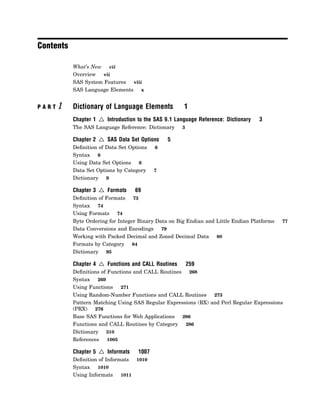
Contents
What’s New vii
Overview vii
SAS System Features viii
SAS Language Elements x
P A R T 1 Dictionary of Language Elements 1
Chapter 1 4 Introduction to the SAS 9.1 Language Reference: Dictionary 3
The SAS Language Reference: Dictionary 3
Chapter 2 4 SAS Data Set Options 5
Definition of Data Set Options 6
Syntax 6
Using Data Set Options 6
Data Set Options by Category 7
Dictionary 9
Chapter 3 4 Formats 69
Definition of Formats 73
Syntax 74
Using Formats 74
Byte Ordering for Integer Binary Data on Big Endian and Little Endian Platforms 77
Data Conversions and Encodings 79
Working with Packed Decimal and Zoned Decimal Data 80
Formats by Category 84
Dictionary 95
Chapter 4 4 Functions and CALL Routines 259
Definitions of Functions and CALL Routines 268
Syntax 269
Using Functions 271
Using Random-Number Functions and CALL Routines 273
Pattern Matching Using SAS Regular Expressions (RX) and Perl Regular Expressions
(PRX) 276
Base SAS Functions for Web Applications 286
Functions and CALL Routines by Category 286
Dictionary 310
References 1005
Chapter 5 4 Informats 1007
Definition of Informats 1010
Syntax 1010
Using Informats 1011
iv
Byte Ordering for Integer Binary Data on Big Endian and Little Endian
Platforms 1013
Working with Packed Decimal and Zoned Decimal Data 1015
Informats by Category 1019
Dictionary 1026
Chapter 6 4 SAS ARM Macros 1137
Definition of ARM Macros 1137
Using ARM Macros 1138
Defining User Metrics in ARM Macros 1145
Defining Correlators in ARM Macros 1146
Enabling ARM Macro Execution 1147
Setting the Macro Environment 1149
Using ARM Post-Processing Macros 1150
Troubleshooting Error Messages 1151
ARM Macros by Category 1152
Dictionary 1153
Chapter 7 4 Statements 1171
Definition of Statements 1174
DATA Step Statements 1174
Global Statements 1179
Dictionary 1184
Chapter 8 4 SAS System Options 1549
Definition of System Options 1553
Syntax 1553
Using SAS System Options 1553
Comparisons 1558
SAS System Options by Category 1559
Dictionary 1568
P A R T 2 Appendixes 1763
Appendix 1 4 DATA Step Object Attributes and Methods 1765
The DATA Step Component Object Interface 1765
Dot Notation and DATA Step Component Objects 1766
Dictionary 1767
Appendix 2 4 DATA Step Debugger 1793
Introduction 1794
Basic Usage 1795
Advanced Usage: Using the Macro Facility with the Debugger 1796
Examples 1797
Commands 1809
Dictionary 1810
v
Appendix 3 4 SAS Utility Macro 1827
Appendix 4 4 Recommended Reading 1831
Recommended Reading 1831
Index 1833
vi
vii
What’s New
Overview
New and enhanced features in Base SAS save you time, effort, and system resources
by providing faster processing and easier data access and management, more robust
analysis, and improved data presentation.
3 By using new SAS system options that enable threading and the use of multiple
CPUs, the following SAS procedures take advantage of multi-processing I/O:
SORT, SQL, MEANS, TABULATE, and REPORT.
3 The LIBNAME statement now supports secure access to SAS libraries on a
WebDAV server.
3 You can now use longer, easier-to-read names for user-created formats and
informats. See “Rules for Words and Names in the SAS Language” in SAS
Language Reference: Concepts.
3 Two pre-defined component objects for the DATA step enable you to quickly store,
search, and retrieve data based on lookup keys.
3 The FILENAME statement now supports directory services, multiple FTP service
commands, and Secure Sockets Layering (SSL).
3 The Application Response Measurement (ARM) system enables you to monitor the
availability and performance of transactions within and across diverse applications.
3 The Perl regular expression (PRX) functions and CALL routines use a modified
version of Perl as a pattern-matching language to enhance search-and-replace
operations on text.
3 New character functions search and compare character strings in addition to
concatenating character strings.
3 There are several new descriptive statistic functions and mathematical functions.
3 New formats, informats, and functions support international and local values for
money, datetime, and Unicode values. All data set options, formats, informats,
functions, and system options that relate to national language support are
documented in the new SAS National Language Support (NLS): User’s Guide.
3 A new ODS statement enables you to render multiple ODS output formats without
re-running a PROC or a DATA step. See the SAS Output Delivery System: User’s
Guide.
viii What’s New
Note:
3 This section describes the features of Base SAS that are new or enhanced since
SAS 8.2.
3 z/OS is the successor to the OS/390 operating system. SAS 9.1 (and later) is
supported on both OS/390 and z/OS operating systems and, throughout this
document, any reference to z/OS also applies to OS/390, unless otherwise stated.
4
SAS System Features
Application Response Measurement (ARM)
Application Response Measurement (ARM) enables you to monitor the availability
and performance of transactions within and across diverse applications. The SAS ARM
interface consists of the implementation of the ARM API as ARM macros and an ARM
agent. An ARM agent generates calls to the ARM macros. New ARM system options
enable you to manage the ARM environment and to log internal SAS processing
transactions. See “Monitoring Performance Using Application Response Measurement
(ARM)” in SAS Language Reference: Concepts, “ARM Macros” on page xx, and “System
Options” on page xxi.
Cross-Environment Data Access (CEDA)
CEDA processes SAS files that were created on a different host. This is especially
useful if you have upgraded from a 32–bit platform to a 64–bit platform. Messages in
the SAS log notify you when CEDA is being used to process a SAS file. See “Processing
Data Using Cross-Environment Data Access (CEDA)” in SAS Language Reference:
Concepts.
DATA Step Object Attributes and Methods
SAS now provides two pre-defined component objects for use in a DATA step: the
hash object and the hash iterator object. These objects enable you to quickly and
efficiently store, search, and retrieve data based on lookup keys.
The DATA step component object interface enables you to create and manipulate
these component objects by using statements, attributes, and methods. You use the
DATA step object dot notation to access the component object’s attributes and methods.
The hash and hash iterator objects have one attribute, fourteen methods, and two
statements associated with them. See Appendix 1, “DATA Step Object Attributes and
Methods,” on page 1765.
Engines
3 The default BASE engine in SAS supports longer format and informat names,
thread-enabled procedures such as the SORT and SUMMARY procedures, and
more than 32,767 variables in a SAS data set.
3 The metadata LIBNAME engine enables you to use metadata in order to access
and augment data that is identified by the metadata. The metadata engine
What’s New ix
retrieves information about the target SAS data library from metadata objects in a
specified SAS Metadata Repository on the SAS Metadata Server. The metadata
engine provides a consistent method for accessing many data sources. That is,
SAS provides different engines that have different options, behavior, and tuning
requirements. By taking advantage of metadata, the necessary information that is
required to access data can be created in one central location so that applications
can use the metadata engine to access different sources of data, without having to
understand the differences and details of each SAS engine. See the SAS Metadata
LIBNAME Engine: User’s Guide.
3 The XML LIBNAME engine imports and exports a broader variety of XML
documents. The XMLMAP= option specifies a separate XML document that
contains specific XMLMap syntax. The XMLMap syntax, Version 1.2, tells the
XML engine how to interpret the XML markup in order to successfully import an
XML document. See the SAS Metadata LIBNAME Engine: User’s Guide.
3 The new SASEDOC LIBNAME engine enables you to bind output objects that
persist in an ODS document. See the SAS Output Delivery System: User’s Guide.
3 The new SAS Information Maps LIBNAME Engine provides a read-only way to
access data that is generated from a SAS Information Map and to bring it into a
SAS session. After you retrieve the data, you can run almost any SAS procedure
against it. See the Base SAS Guide to Information Maps.
3 The new character variable padding (CVP) engine expands character variable
lengths, using a specified expansion amount, so that character data truncation
does not occur when a file requires transcoding. Character data truncation can
occur when the number of bytes for a character in one encoding is different from
the number of bytes for the same character in another encoding, such as when a
single-byte character set (SBCS) is transcoded to a double-byte character set
(DBCS). See the SAS National Language Support (NLS): User’s Guide.
Indexing
When creating an index that requires sorting, SAS tries to sort the data by using the
thread-enabled sort. By dividing the sorting task into separately executable processes,
the time that is required to sort the data can be reduced. See the topic “Creating an
Index” in Understanding SAS Indexes in SAS Language Reference: Concepts.
Integrity Constraints
Variables in a SAS data file can now be part of both a primary key (general integrity
constraint) and a foreign key (referential integrity constraint). However, there are
restrictions when defining a primary key constraint and a foreign key constraint that
use the same variables. See the topic “Overlapping Primary Key and Foreign Key
Constraints” in Understanding Integrity Constraints in SAS Language Reference:
Concepts.
Restricted System Options
System administrators can restrict system options from being modified by a user.
You can use the RESTRICT option in the OPTIONS procedure to list the restricted
options. The implementation of restricted options is specific to the operating
environment. For details about how to restrict options, see the configuration guide for
your operating environment. For information about listing restricted options, see the
OPTIONS procedure in the Base SAS Procedures Guide.
x What’s New
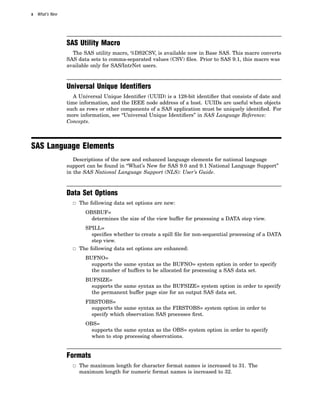
SAS Utility Macro
The SAS utility macro, %DS2CSV, is available now in Base SAS. This macro converts
SAS data sets to comma-separated values (CSV) files. Prior to SAS 9.1, this macro was
available only for SAS/IntrNet users.
Universal Unique Identifiers
A Universal Unique Identifier (UUID) is a 128-bit identifier that consists of date and
time information, and the IEEE node address of a host. UUIDs are useful when objects
such as rows or other components of a SAS application must be uniquely identified. For
more information, see “Universal Unique Identifiers” in SAS Language Reference:
Concepts.
SAS Language Elements
Descriptions of the new and enhanced language elements for national language
support can be found in “What’s New for SAS 9.0 and 9.1 National Language Support”
in the SAS National Language Support (NLS): User’s Guide.
Data Set Options
3 The following data set options are new:
OBSBUF=
determines the size of the view buffer for processing a DATA step view.
SPILL=
specifies whether to create a spill file for non-sequential processing of a DATA
step view.
3 The following data set options are enhanced:
BUFNO=
supports the same syntax as the BUFNO= system option in order to specify
the number of buffers to be allocated for processing a SAS data set.
BUFSIZE=
supports the same syntax as the BUFSIZE= system option in order to specify
the permanent buffer page size for an output SAS data set.
FIRSTOBS=
supports the same syntax as the FIRSTOBS= system option in order to
specify which observation SAS processes first.
OBS=
supports the same syntax as the OBS= system option in order to specify
when to stop processing observations.
Formats
3 The maximum length for character format names is increased to 31. The
maximum length for numeric format names is increased to 32.
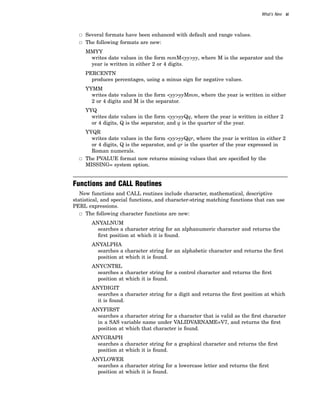
What’s New xi
3 Several formats have been enhanced with default and range values.
3 The following formats are new:
MMYY
writes date values in the form mmM<yy>yy, where M is the separator and the
year is written in either 2 or 4 digits.
PERCENTN
produces percentages, using a minus sign for negative values.
YYMM
writes date values in the form <yy>yyMmm, where the year is written in either
2 or 4 digits and M is the separator.
YYQ
writes date values in the form <yy>yyQq, where the year is written in either 2
or 4 digits, Q is the separator, and q is the quarter of the year.
YYQR
writes date values in the form <yy>yyQqr, where the year is written in either 2
or 4 digits, Q is the separator, and qr is the quarter of the year expressed in
Roman numerals.
3 The PVALUE format now returns missing values that are specified by the
MISSING= system option.
Functions and CALL Routines
New functions and CALL routines include character, mathematical, descriptive
statistical, and special functions, and character-string matching functions that can use
PERL expressions.
3 The following character functions are new:
ANYALNUM
searches a character string for an alphanumeric character and returns the
first position at which it is found.
ANYALPHA
searches a character string for an alphabetic character and returns the first
position at which it is found.
ANYCNTRL
searches a character string for a control character and returns the first
position at which it is found.
ANYDIGIT
searches a character string for a digit and returns the first position at which
it is found.
ANYFIRST
searches a character string for a character that is valid as the first character
in a SAS variable name under VALIDVARNAME=V7, and returns the first
position at which that character is found.
ANYGRAPH
searches a character string for a graphical character and returns the first
position at which it is found.
ANYLOWER
searches a character string for a lowercase letter and returns the first
position at which it is found.
xii What’s New
ANYNAME
searches a character string for a character that is valid in a SAS variable
name under VALIDVARNAME=V7, and returns the first position at which
that character is found.
ANYPRINT
searches a character string for a printable character and returns the first
position at which it is found.
ANYPUNCT
searches a character string for a punctuation character and returns the first
position at which it is found.
ANYSPACE
searches a character string for a white-space character (blank, horizontal tab,
vertical tab, carriage return, line feed, or form feed), and returns the first
position at which it is found.
ANYUPPER
searches a character string for an uppercase letter and returns the first
position at which it is found.
ANYXDIGIT
searches a character string for a hexadecimal character that represents a
digit and returns the first position at which that character is found.
CAT
concatenates character strings without removing leading or trailing blanks.
CATS
concatenates character strings and removes leading and trailing blanks.
CATT
concatenates character strings and removes trailing blanks only.
CATX
concatenates character strings, removes leading and trailing blanks, and
inserts separators.
CHOOSEC
returns a character value that represents the results of choosing from a list of
arguments.
CHOOSEN
returns a numeric value that represents the results of choosing from a list of
arguments.
COMPARE
returns the position of the left-most character by which two strings differ, or
returns 0 if there is no difference.
COMPGED
compares two strings by computing the generalized edit distance.
COMPLEV
compares two strings by computing the Levenshtein edit distance.
COUNT
counts the number of times that a specific substring of characters appears
within a character string that you specify.
What’s New xiii
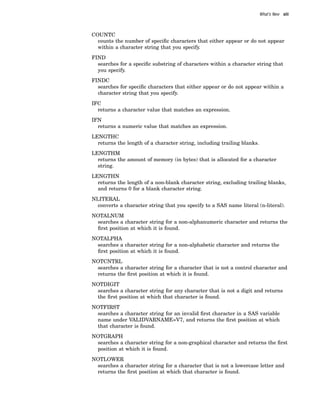
COUNTC
counts the number of specific characters that either appear or do not appear
within a character string that you specify.
FIND
searches for a specific substring of characters within a character string that
you specify.
FINDC
searches for specific characters that either appear or do not appear within a
character string that you specify.
IFC
returns a character value that matches an expression.
IFN
returns a numeric value that matches an expression.
LENGTHC
returns the length of a character string, including trailing blanks.
LENGTHM
returns the amount of memory (in bytes) that is allocated for a character
string.
LENGTHN
returns the length of a non-blank character string, excluding trailing blanks,
and returns 0 for a blank character string.
NLITERAL
converts a character string that you specify to a SAS name literal (n-literal).
NOTALNUM
searches a character string for a non-alphanumeric character and returns the
first position at which it is found.
NOTALPHA
searches a character string for a non-alphabetic character and returns the
first position at which it is found.
NOTCNTRL
searches a character string for a character that is not a control character and
returns the first position at which it is found.
NOTDIGIT
searches a character string for any character that is not a digit and returns
the first position at which that character is found.
NOTFIRST
searches a character string for an invalid first character in a SAS variable
name under VALIDVARNAME=V7, and returns the first position at which
that character is found.
NOTGRAPH
searches a character string for a non-graphical character and returns the first
position at which it is found.
NOTLOWER
searches a character string for a character that is not a lowercase letter and
returns the first position at which that character is found.
xiv What’s New
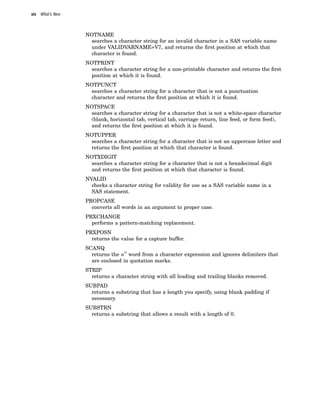
NOTNAME
searches a character string for an invalid character in a SAS variable name
under VALIDVARNAME=V7, and returns the first position at which that
character is found.
NOTPRINT
searches a character string for a non-printable character and returns the first
position at which it is found.
NOTPUNCT
searches a character string for a character that is not a punctuation
character and returns the first position at which it is found.
NOTSPACE
searches a character string for a character that is not a white-space character
(blank, horizontal tab, vertical tab, carriage return, line feed, or form feed),
and returns the first position at which it is found.
NOTUPPER
searches a character string for a character that is not an uppercase letter and
returns the first position at which that character is found.
NOTXDIGIT
searches a character string for a character that is not a hexadecimal digit
and returns the first position at which that character is found.
NVALID
checks a character string for validity for use as a SAS variable name in a
SAS statement.
PROPCASE
converts all words in an argument to proper case.
PRXCHANGE
performs a pattern-matching replacement.
PRXPOSN
returns the value for a capture buffer.
SCANQ
returns the n
th
word from a character expression and ignores delimiters that
are enclosed in quotation marks.
STRIP
returns a character string with all leading and trailing blanks removed.
SUBPAD
returns a substring that has a length you specify, using blank padding if
necessary.
SUBSTRN
returns a substring that allows a result with a length of 0.
What’s New xv
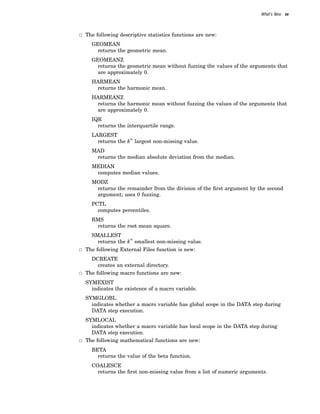
3 The following descriptive statistics functions are new:
GEOMEAN
returns the geometric mean.
GEOMEANZ
returns the geometric mean without fuzzing the values of the arguments that
are approximately 0.
HARMEAN
returns the harmonic mean.
HARMEANZ
returns the harmonic mean without fuzzing the values of the arguments that
are approximately 0.
IQR
returns the interquartile range.
LARGEST
returns the k
th
largest non-missing value.
MAD
returns the median absolute deviation from the median.
MEDIAN
computes median values.
MODZ
returns the remainder from the division of the first argument by the second
argument; uses 0 fuzzing.
PCTL
computes percentiles.
RMS
returns the root mean square.
SMALLEST
returns the k
th
smallest non-missing value.
3 The following External Files function is new:
DCREATE
creates an external directory.
3 The following macro functions are new:
SYMEXIST
indicates the existence of a macro variable.
SYMGLOBL
indicates whether a macro variable has global scope in the DATA step during
DATA step execution.
SYMLOCAL
indicates whether a macro variable has local scope in the DATA step during
DATA step execution.
3 The following mathematical functions are new:
BETA
returns the value of the beta function.
COALESCE
returns the first non-missing value from a list of numeric arguments.
xvi What’s New
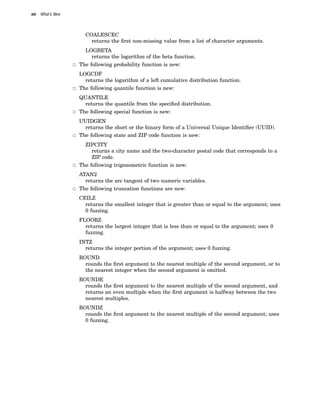
COALESCEC
returns the first non-missing value from a list of character arguments.
LOGBETA
returns the logarithm of the beta function.
3 The following probability function is new:
LOGCDF
returns the logarithm of a left cumulative distribution function.
3 The following quantile function is new:
QUANTILE
returns the quantile from the specified distribution.
3 The following special function is new:
UUIDGEN
returns the short or the binary form of a Universal Unique Identifier (UUID).
3 The following state and ZIP code function is new:
ZIPCITY
returns a city name and the two-character postal code that corresponds to a
ZIP code.
3 The following trigonometric function is new:
ATAN2
returns the arc tangent of two numeric variables.
3 The following truncation functions are new:
CEILZ
returns the smallest integer that is greater than or equal to the argument; uses
0 fuzzing.
FLOORZ
returns the largest integer that is less than or equal to the argument; uses 0
fuzzing.
INTZ
returns the integer portion of the argument; uses 0 fuzzing.
ROUND
rounds the first argument to the nearest multiple of the second argument, or to
the nearest integer when the second argument is omitted.
ROUNDE
rounds the first argument to the nearest multiple of the second argument, and
returns an even multiple when the first argument is halfway between the two
nearest multiples.
ROUNDZ
rounds the first argument to the nearest multiple of the second argument; uses
0 fuzzing.
What’s New xvii
3 The following variable information functions are new:
VVALUE
returns the formatted value that is associated with the variable that you specify.
VVALUEX
returns the formatted value that is associated with the argument that you
specify.
3 Using Perl regular expression (PRX) functions and CALL routines is new. The
following PRX functions are new. For more information, see “Pattern Matching
Using SAS Regular Expressions (RX) and Perl Regular Expressions (PRX)” on
page 276.
PRXMATCH
searches for a pattern match and returns the position at which the pattern is
found.
PRXPAREN
returns the last bracket match for which there is a match in a pattern.
PRXPARSE
compiles a Perl regular expression that can be used for pattern-matching a
character value.
CALL PRXCHANGE
performs a pattern-matching substitution.
CALL PRXDEBUG
enables Perl regular expressions in a DATA step to send debug output to the
SAS log.
CALL PRXFREE
frees unneeded memory that was allocated for a Perl regular expression.
CALL PRXNEXT
returns the position and length of a substring that matches a pattern and
iterates over multiple matches within one string.
CALL PRXPOSN
returns the start position and length for a capture buffer.
CALL PRXSUBSTR
returns the position and length of a substring that matches a pattern.
3 The following CALL routines are new:
CALL ALLPERM
generates all permutations of the values of several variables.
CALL CATS
concatenates character strings and removes leading and trailing blanks.
CALL CATT
concatenates character strings and removes trailing blanks only.
CALL CATX
concatenates character strings, removes leading and trailing blanks, and
inserts separators.
CALL COMPCOST
sets the costs of operations for later use by the COMPGED function.
xviii What’s New
CALL LOGISTIC
returns the logistic value of each argument.
CALL MISSING
assigns a missing value to specified character or numeric variables.
CALL RANPERK
randomly permutes the values of the arguments and returns a permutation
of k out of n values.
CALL RANPERM
randomly permutes the values of the arguments.
CALL SCAN
returns the position and length of a given word in a character expression.
CALL SCANQ
returns the position and length of a given word in a character expression, and
ignores delimiters that are enclosed in quotation marks.
CALL SOFTMAX
returns the softmax value for each argument.
CALL STDIZE
standardizes the values of one or more variables.
CALL STREAMINIT
specifies a seed value to use for subsequent random number generation by
the RAND function.
CALL SYMPUTX
assigns a value to a macro variable and removes both leading and trailing
blanks.
CALL TANH
returns the hyperbolic tangent of each argument.
CALL VNEXT
returns the name, type, and length of a variable that is used in a DATA step.
What’s New xix
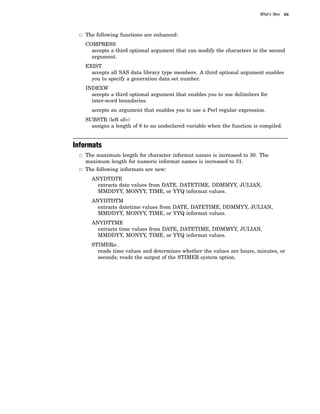
3 The following functions are enhanced:
COMPRESS
accepts a third optional argument that can modify the characters in the second
argument.
EXIST
accepts all SAS data library type members. A third optional argument enables
you to specify a generation data set number.
INDEXW
accepts a third optional argument that enables you to use delimiters for
inter-word boundaries.
accepts an argument that enables you to use a Perl regular expression.
SUBSTR (left of=)
assigns a length of 8 to an undeclared variable when the function is compiled.
Informats
3 The maximum length for character informat names is increased to 30. The
maximum length for numeric informat names is increased to 31.
3 The following informats are new:
ANYDTDTE
extracts date values from DATE, DATETIME, DDMMYY, JULIAN,
MMDDYY, MONYY, TIME, or YYQ informat values.
ANYDTDTM
extracts datetime values from DATE, DATETIME, DDMMYY, JULIAN,
MMDDYY, MONYY, TIME, or YYQ informat values.
ANYDTTME
extracts time values from DATE, DATETIME, DDMMYY, JULIAN,
MMDDYY, MONYY, TIME, or YYQ informat values.
STIMERw.
reads time values and determines whether the values are hours, minutes, or
seconds; reads the output of the STIMER system option.
xx What’s New
ARM Macros
%ARMCONV, the new ARM macro, converts an ARM log that is created in SAS 9.0
and later, which uses a simple format, into the ARM log format that is used in SAS 8.2,
which is more detailed.
SAS Utility Macro
%DS2CSV, the new SAS utility macro, converts SAS data sets to comma-separated
values (CSV) files.
Statements
3 The following statements are new:
ODS Statements
control different features of the Output Delivery System. For more
information about these statements, see the SAS Output Delivery System:
User’s Guide.
LIBNAME Statement for WebDAV Server Access
associates a libref with a SAS library on a WebDAV server.
Beginning with SAS 9.1.3 Service Pack 4, the following option is new:
PROXY=
specifies the Uniform Resource Locator (URL) for the proxy server.
FILENAME, CLIPBAORD Access Method
enables you to read text data from and write text data to the clipboard on the
host machine.
FILENAME, WebDAV Access Method
Enables you to access remote files by using the WebDAV protocol.
DECLARE
declares a DATA step component object; creates an instance of and initializes
data for a DATA step component object.
_NEW_
creates an instance of a DATA step component object.
PUTLOG
writes a message to the SAS log.
3 The following statements are enhanced:
FILENAME, FTP Access Method
supports directory services and multiple FTP service commands.
FILENAME, URL Access Method
supports Secure Sockets Layering (SSL).
What’s New xxi
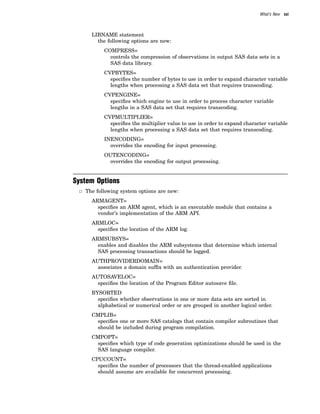
LIBNAME statement
the following options are new:
COMPRESS=
controls the compression of observations in output SAS data sets in a
SAS data library.
CVPBYTES=
specifies the number of bytes to use in order to expand character variable
lengths when processing a SAS data set that requires transcoding.
CVPENGINE=
specifies which engine to use in order to process character variable
lengths in a SAS data set that requires transcoding.
CVPMULTIPLIER=
specifies the multiplier value to use in order to expand character variable
lengths when processing a SAS data set that requires transcoding.
INENCODING=
overrides the encoding for input processing.
OUTENCODING=
overrides the encoding for output processing.
System Options
3 The following system options are new:
ARMAGENT=
specifies an ARM agent, which is an executable module that contains a
vendor’s implementation of the ARM API.
ARMLOC=
specifies the location of the ARM log.
ARMSUBSYS=
enables and disables the ARM subsystems that determine which internal
SAS processing transactions should be logged.
AUTHPROVIDERDOMAIN=
associates a domain suffix with an authentication provider.
AUTOSAVELOC=
specifies the location of the Program Editor autosave file.
BYSORTED
specifies whether observations in one or more data sets are sorted in
alphabetical or numerical order or are grouped in another logical order.
CMPLIB=
specifies one or more SAS catalogs that contain compiler subroutines that
should be included during program compilation.
CMPOPT=
specifies which type of code generation optimizations should be used in the
SAS language compiler.
CPUCOUNT=
specifies the number of processors that the thread-enabled applications
should assume are available for concurrent processing.
xxii What’s New
DMSLOGSIZE=
specifies the maximum number of rows that can be displayed in the Log
window in the SAS windowing environment.
DMSOUTSIZE=
specifies the maximum number of rows that can be displayed in the Output
window in the SAS windowing environment .
DMSSYNCHK
enables syntax checking for multiple steps in the SAS windowing
environment.
DTRESET
updates the date and the time in the SAS log and in the listing file.
EMAILAUTHPROTOCOL=
specifies the authentication protocol for SMTP e-mail.
EMAILID=
specifies the identity of the individual who is sending e-mail from within SAS.
EMAILPW=
specifies your e-mail login password.
ERRORBYABEND
specifies how SAS responds to BY-group error conditions.
FONTSLOC=
specifies the location that contains the SAS fonts that are loaded by a printer
to use with Universal Printing.
HELPENCMD
specifies whether SAS uses the English version or the translated version of
the keyword list for the command–line Help.
IBUFSIZE=
specifies the buffer page size for an index file.
LOGPARM=
controls when SAS log files are opened and closed and (in conjunction with
the LOG= system option) how they are named.
METAAUTORESOURCES=
identifies which resources should be assigned at SAS initialization.
METACONNECT=
identifies which named connection from the metadata user profiles should be
used as the default value for logging into the SAS Metadata Server.
METAENCRYPTALT=
specifies which type of encryption should be used when communicating with a
SAS Metadata Server.
METAENCRYPTLEVEL=
specifies what should be encrypted when communicating with a SAS
Metadata Server.
METAID=
identifies the current SAS version that is installed on the SAS Metadata
Server.
METAPASSWORD=
specifies the default password for the SAS Metadata Server.
What’s New xxiii
METAPORT=
specifies the TCP port for the SAS Metadata Server.
METAPROFILE=
specifies which file contains the SAS Metadata Server user profiles.
METAPROTOCOL=
specifies which network protocol should be used for communicating with the
SAS Metadata Server.
METAREPOSITORY=
specifies which default SAS Metadata Repository should be used on the SAS
Metadata Server.
METASERVER=
specifies the address of the SAS Metadata Server.
METAUSER=
specifies the default user ID for logging on to the SAS Metadata Server.
PAGEBREAKINITIAL
begins the SAS log and listing files on a new page.
QUOTELENMAX
specifies that SAS write a warning to the SAS log about the maximum length
that can be used for strings that are enclosed in quotation marks.
SORTEQUALS
controls the order in which PROC SORT arranges observations that have
identical BY values in the output data set.
SYSPRINTFONT
specifies the font for the current default printer.
SYNTAXCHECK
specifies whether to validate SAS program syntax.
TERMSTMT=
specifies which SAS statements should be executed when the SAS session is
terminated.
TEXTURELOC=
specifies the location of textures and images that are used by ODS styles.
THREADS
specifies that SAS use threaded processing if it is available.
TOOLSMENU
specifies whether to include or to suppress the Tools menu in windows that
display SAS menus.
UUIDCOUNT
specifies the number of UUIDs that should be acquired each time the UUID
Generator Daemon is used.
UUIDGENHOST
identifies the host and the port for the UUID Generator Daemon.
UTILLOC=
specifies a set of file system locations in which applications can store utility
files.
xxiv What’s New
VALIDFMTNAME=
specifies the length of format and informat names that can be used when
creating new SAS data sets and format catalogs.
VIEWMENU
specifies whether to include or to suppress the View menu in windows that
display menus.
V6CREATEUPDATE=
controls or monitors the creation of new, version 6 SAS data sets or the
updating of existing, version 6 SAS data sets.
3 The following system options have been enhanced:
CMPOPT=
specifies which type of code generation optimizations should be used in the
SAS language compiler.
SORTSIZE=
specifies the amount of memory that is available when using the SORT
procedure.
1
P A R T
1
Dictionary of Language Elements
Chapter 1. . . . . . . . . .Introduction to the SAS 9.1 Language Reference:
Dictionary 3
Chapter 2. . . . . . . . . .SAS Data Set Options 5
Chapter 3. . . . . . . . . .Formats 69
Chapter 4. . . . . . . . . .Functions and CALL Routines 259
Chapter 5. . . . . . . . . .Informats 1007
Chapter 6. . . . . . . . . .SAS ARM Macros 1137
Chapter 7. . . . . . . . . .Statements 1171
Chapter 8. . . . . . . . . .SAS System Options 1549
2
3
C H A P T E R
1
Introduction to the SAS 9.1
Language Reference: Dictionary
The SAS Language Reference: Dictionary 3
The SAS Language Reference: Dictionary
SAS Language Reference: Dictionary provides detailed reference information for the
major language elements of Base SAS software:
3 data set options
3 formats
3 functions and CALL routines
3 informats
3 Application Response Measurement (ARM) macros
3 statements
3 SAS system options.
It also includes the following four appendixes:
3 DATA Step Object Attributes and Methods
3 ENCODING= values for SAS commands and statements
3 DATA step debugger
3 Recommended reading.
For extensive conceptual information about the SAS System and the SAS language,
including the DATA step, see SAS Language Reference: Concepts.
4
5
C H A P T E R
2
SAS Data Set Options
Definition of Data Set Options 6
Syntax 6
Using Data Set Options 6
Using Data Set Options with Input or Output SAS Data Sets 6
How Data Set Options Interact with System Options 7
Data Set Options by Category 7
Dictionary 9
ALTER= Data Set Option 9
BUFNO= Data Set Option 10
BUFSIZE= Data Set Option 12
CNTLLEV= Data Set Option 13
COMPRESS= Data Set Option 15
DLDMGACTION= Data Set Option 17
DROP= Data Set Option 18
ENCODING= Data Set Option 19
ENCRYPT= Data Set Option 19
FILECLOSE= Data Set Option 21
FIRSTOBS= Data Set Option 22
GENMAX= Data Set Option 23
GENNUM= Data Set Option 24
IDXNAME= Data Set Option 26
IDXWHERE= Data Set Option 27
IN= Data Set Option 29
INDEX= Data Set Option 30
KEEP= Data Set Option 31
LABEL= Data Set Option 32
OBS= Data Set Option 34
OBSBUF= Data Set Option 39
OUTREP= Data Set Option 41
POINTOBS= Data Set Option 43
PW= Data Set Option 44
PWREQ= Data Set Option 45
READ= Data Set Option 46
RENAME= Data Set Option 47
REPEMPTY= Data Set Option 49
REPLACE= Data Set Option 50
REUSE= Data Set Option 51
SORTEDBY= Data Set Option 52
SORTSEQ= Data Set Option 54
SPILL= Data Set Option 55
TOBSNO= Data Set Option 62
6 Definition of Data Set Options 4 Chapter 2
TYPE= Data Set Option 62
WHERE= Data Set Option 63
WHEREUP= Data Set Option 65
WRITE= Data Set Option 67
Definition of Data Set Options
Data set options specify actions that apply only to the SAS data set with which they
appear. They let you perform such operations as
3 renaming variables
3 selecting only the first or last n observations for processing
3 dropping variables from processing or from the output data set
3 specifying a password for a data set.
Syntax
Specify a data set option in parentheses after a SAS data set name. To specify
several data set options, separate them with spaces.
(option-1=value-1<...option-n=value-n>)
These examples show data set options in SAS statements:
3 data scores(keep=team game1 game2 game3);
3 proc print data=new(drop=year);
3 set old(rename=(date=Start_Date));
Using Data Set Options
Using Data Set Options with Input or Output SAS Data Sets
Most SAS data set options can apply to either input or output SAS data sets in DATA
steps or procedure (PROC) steps. If a data set option is associated with an input data
set, the action applies to the data set that is being read. If the option appears in the
DATA statement or after an output data set specification in a PROC step, SAS applies
the action to the output data set. In the DATA step, data set options for output data
sets must appear in the DATA statement, not in any OUTPUT statements that may be
present.
Some data set options, such as COMPRESS=, are meaningful only when you create a
SAS data set because they set attributes that exist for the life of the data set. To
change or cancel most data set options, you must re-create the data set. You can change
other options (such as PW= and LABEL=) with PROC DATASETS. For more
information, see the “DATASETS Procedure” in Base SAS Procedures Guide.
When data set options appear on both input and output data sets in the same DATA
or PROC step, SAS applies data set options to input data sets before it evaluates
programming statements or before it applies data set options to output data sets.
Likewise, data set options that are specified for the data set being created are applied
after programming statements are processed. For example, when using the RENAME=
data set option, the new names are not associated with the variables until the DATA
step ends.
SAS Data Set Options 4 Data Set Options by Category 7
In some instances, data set options conflict when they are used in the same
statement. For example, you cannot specify both the DROP= and KEEP= data set
options for the same variable in the same statement. Timing can also be an issue in
some cases. For example, if using KEEP= and RENAME= on a data set specified in the
SET statement, KEEP= needs to use the original variable names, because SAS will
process KEEP= before the data set is read. The new names specified in RENAME= will
apply to the programming statements that follow the SET statement.
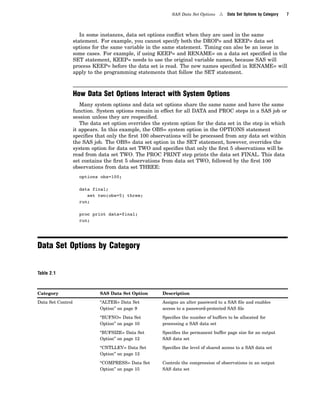
How Data Set Options Interact with System Options
Many system options and data set options share the same name and have the same
function. System options remain in effect for all DATA and PROC steps in a SAS job or
session unless they are respecified.
The data set option overrides the system option for the data set in the step in which
it appears. In this example, the OBS= system option in the OPTIONS statement
specifies that only the first 100 observations will be processed from any data set within
the SAS job. The OBS= data set option in the SET statement, however, overrides the
system option for data set TWO and specifies that only the first 5 observations will be
read from data set TWO. The PROC PRINT step prints the data set FINAL. This data
set contains the first 5 observations from data set TWO, followed by the first 100
observations from data set THREE:
options obs=100;
data final;
set two(obs=5) three;
run;
proc print data=final;
run;
Data Set Options by Category
Table 2.1
Category SAS Data Set Option Description
Data Set Control “ALTER= Data Set
Option” on page 9
Assigns an alter password to a SAS file and enables
access to a password-protected SAS file
“BUFNO= Data Set
Option” on page 10
Specifies the number of buffers to be allocated for
processing a SAS data set
“BUFSIZE= Data Set
Option” on page 12
Specifies the permanent buffer page size for an output
SAS data set
“CNTLLEV= Data Set
Option” on page 13
Specifies the level of shared access to a SAS data set
“COMPRESS= Data Set
Option” on page 15
Controls the compression of observations in an output
SAS data set
8 Data Set Options by Category 4 Chapter 2
Category SAS Data Set Option Description
“DLDMGACTION= Data
Set Option” on page 17
Specifies what type of action to take when a SAS data set
in a SAS data library is detected as damaged
“ENCODING= Data Set
Option” on page 19
Overrides the encoding to use for reading or writing a
SAS data set
“ENCRYPT= Data Set
Option” on page 19
Encrypts SAS data files
“GENMAX= Data Set
Option” on page 23
Requests generations for a data set and specifies the
maximum number of versions
“GENNUM= Data Set
Option” on page 24
References a specific generation of a data set
“INDEX= Data Set Option”
on page 30
Defines indexes when a SAS data set is created
“LABEL= Data Set
Option” on page 32
Specifies a label for the SAS data set
“OBSBUF= Data Set
Option” on page 39
Determines the size of the view buffer for processing a
DATA step view
“OUTREP= Data Set
Option” on page 41
Specifies the data representation for the output SAS data
set
“PW= Data Set Option” on
page 44
Assigns a read, write, or alter password to a SAS file and
enables access to a password-protected SAS file
“PWREQ= Data Set
Option” on page 45
Controls the pop up of a requestor window for a data set
password
“READ= Data Set Option”
on page 46
Assigns a read password to a SAS file and enables access
to a read-protected SAS file
“REPEMPTY= Data Set
Option” on page 49
Controls replacement of like-named temporary or
permanent SAS data sets when the new one is empty
“REPLACE= Data Set
Option” on page 50
Controls replacement of like-named temporary or
permanent SAS data sets
“REUSE= Data Set
Option” on page 51
Specifies whether new observations are written to free
space in compressed SAS data sets
“SORTEDBY= Data Set
Option” on page 52
Specifies how the data set is currently sorted
“SORTSEQ= Data Set
Option” on page 54
Specifies a language-specific collation sequence for the
SORT procedure to use for the specified SAS data set
“SPILL= Data Set Option”
on page 55
Specifies whether to create a spill file for non-sequential
processing of a DATA step view
“TOBSNO= Data Set
Option” on page 62
Specifies the number of observations to be transmitted in
each multi-observation exchange with a SAS server
“TYPE= Data Set Option”
on page 62
Specifies the data set type for a specially structured SAS
data set
“WRITE= Data Set
Option” on page 67
Assigns a write password to a SAS file and enables
access to a write-protected SAS file
Miscellaneous “FILECLOSE= Data Set
Option” on page 21
Specifies how a tape is positioned when a SAS file on the
tape is closed
SAS Data Set Options 4 ALTER= Data Set Option 9
Category SAS Data Set Option Description
Observation Control “FIRSTOBS= Data Set
Option” on page 22
Specifies which observation SAS processes first
“IN= Data Set Option” on
page 29
Creates a variable that indicates whether the data set
contributed data to the current observation
“OBS= Data Set Option”
on page 34
Specifies when to stop processing observations
“POINTOBS= Data Set
Option” on page 43
Controls whether a compressed data set can be processed
with random access (by observation number) rather than
with sequential access only
“WHERE= Data Set
Option” on page 63
Selects observations that meet the specified condition
“WHEREUP= Data Set
Option” on page 65
Specifies whether to evaluate added observations and
modified observations against a WHERE expression
User Control of SAS Index
Usage
“IDXNAME= Data Set
Option” on page 26
Directs SAS to use a specific index to satisfy the
conditions of a WHERE expression
“IDXWHERE= Data Set
Option” on page 27
Overrides the SAS decision about whether to use an
index to satisfy the conditions of a WHERE expression
Variable Control “DROP= Data Set Option”
on page 18
Excludes variables from processing or from output SAS
data sets
“KEEP= Data Set Option”
on page 31
Specifies variables for processing or for writing to output
SAS data sets
“RENAME= Data Set
Option” on page 47
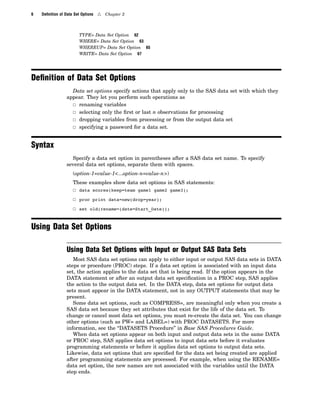
Changes the name of a variable
Dictionary
ALTER= Data Set Option
Assigns an alter password to a SAS file and enables access to a password-protected SAS file
Valid in: DATA step and PROC steps
Category: Data Set Control
See: ALTER= Data Set Option in the documentation for your operating environment.
Syntax
ALTER=alter-password
10 BUFNO= Data Set Option 4 Chapter 2
Syntax Description
alter-password
must be a valid SAS name. See “Rules for Words and Names in the SAS Language”
in SAS Language Reference: Concepts.
Details
The ALTER= option applies to all types of SAS files except catalogs. You can use this
option to assign an alter-password to a SAS file or to access a read-protected,
write-protected, or alter-protected SAS file.
When replacing a SAS data set that is alter protected, the new data set inherits the
alter password. To change the alter password for the new data set, use the MODIFY
statement in the DATASETS procedure.
Note: A SAS password does not control access to a SAS file beyond the SAS system.
You should use the operating system-supplied utilities and file-system security controls
in order to control access to SAS files outside of SAS. 4
See Also
Data Set Options:
“ENCRYPT= Data Set Option” on page 19
“PW= Data Set Option” on page 44
“READ= Data Set Option” on page 46
“WRITE= Data Set Option” on page 67
“File Protection” in SAS Language Reference: Concepts
“Manipulating Passwords” in “The DATASETS Procedure” in Base SAS Procedures
Guide
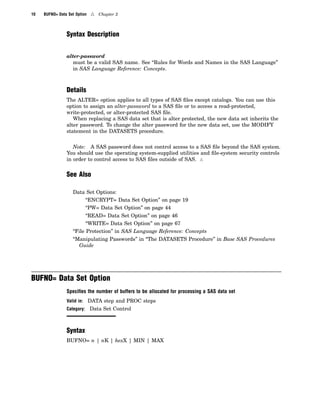
BUFNO= Data Set Option
Specifies the number of buffers to be allocated for processing a SAS data set
Valid in: DATA step and PROC steps
Category: Data Set Control
Syntax
BUFNO= n | nK | hexX | MIN | MAX
SAS Data Set Options 4 BUFNO= Data Set Option 11
Syntax Description
n | nK
specifies the number of buffers in multiples of 1 (bytes); 1,024 (kilobytes). For
example, a value of 8 specifies 8 buffers, and a value of 1k specifies 1024 buffers.
hex
specifies the number of buffers as a hexadecimal value. You must specify the value
beginning with a number (0-9), followed by an X. For example, the value 2dx sets the
number of buffers to 45 buffers.
MIN
sets the minimum number of buffers to 0, which causes SAS to use the minimum
optimal value for the operating environment. This is the default.
MAX
sets the number of buffers to the maximum possible number in your operating
environment, up to the largest four-byte, signed integer, which is 2
31
-1, or
approximately 2 billion.
Details
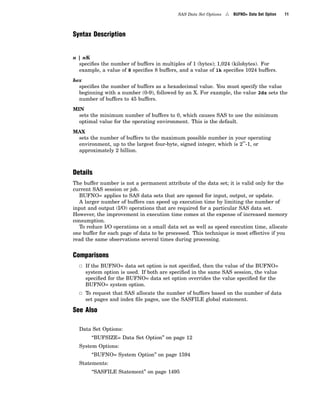
The buffer number is not a permanent attribute of the data set; it is valid only for the
current SAS session or job.
BUFNO= applies to SAS data sets that are opened for input, output, or update.
A larger number of buffers can speed up execution time by limiting the number of
input and output (I/O) operations that are required for a particular SAS data set.
However, the improvement in execution time comes at the expense of increased memory
consumption.
To reduce I/O operations on a small data set as well as speed execution time, allocate
one buffer for each page of data to be processed. This technique is most effective if you
read the same observations several times during processing.
Comparisons
3 If the BUFNO= data set option is not specified, then the value of the BUFNO=
system option is used. If both are specified in the same SAS session, the value
specified for the BUFNO= data set option overrides the value specified for the
BUFNO= system option.
3 To request that SAS allocate the number of buffers based on the number of data
set pages and index file pages, use the SASFILE global statement.
See Also
Data Set Options:
“BUFSIZE= Data Set Option” on page 12
System Options:
“BUFNO= System Option” on page 1594
Statements:
“SASFILE Statement” on page 1495
12 BUFSIZE= Data Set Option 4 Chapter 2
BUFSIZE= Data Set Option
Specifies the permanent buffer page size for an output SAS data set
Valid in: DATA step and PROC steps
Category: Data Set Control
Restriction: Use with output data sets only.
See: BUFSIZE= Data Set Option in the documentation for your operating environment.
Syntax
BUFSIZE= n | nK | nM | nG | hexX | MAX
Syntax Description
n | nK | nM | nG
specifies the page size in multiples of 1 (bytes); 1,024 (kilobytes); 1,048,576
(megabytes); or 1,073,741,824 (gigabytes). For example, a value of 8 specifies a page
size of 8 bytes, and a value of 4k specifies a page size of 4096 bytes.
The default is 0, which causes SAS to use the minimum optimal page size for the
operating environment.
hexX
specifies the page size as a hexadecimal value. You must specify the value beginning
with a number (0-9), followed by an X. For example, the value 2dx sets the page size
to 45 bytes.
MAX
sets the page size to the maximum possible number in your operating environment,
up to the largest four-byte, signed integer, which is 2
31
-1, or approximately 2 billion
bytes.
Details
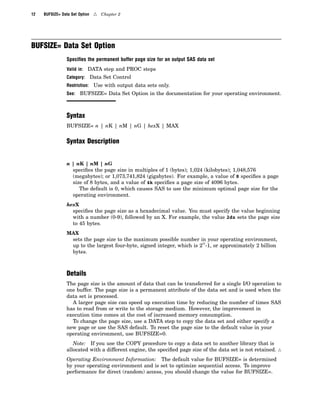
The page size is the amount of data that can be transferred for a single I/O operation to
one buffer. The page size is a permanent attribute of the data set and is used when the
data set is processed.
A larger page size can speed up execution time by reducing the number of times SAS
has to read from or write to the storage medium. However, the improvement in
execution time comes at the cost of increased memory consumption.
To change the page size, use a DATA step to copy the data set and either specify a
new page or use the SAS default. To reset the page size to the default value in your
operating environment, use BUFSIZE=0.
Note: If you use the COPY procedure to copy a data set to another library that is
allocated with a different engine, the specified page size of the data set is not retained. 4
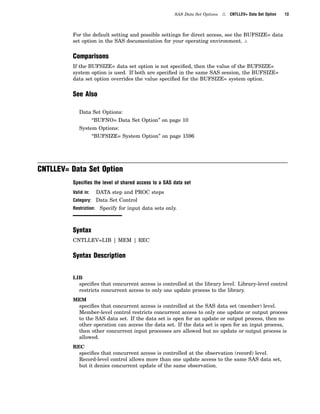
Operating Environment Information: The default value for BUFSIZE= is determined
by your operating environment and is set to optimize sequential access. To improve
performance for direct (random) access, you should change the value for BUFSIZE=.
SAS Data Set Options 4 CNTLLEV= Data Set Option 13
For the default setting and possible settings for direct access, see the BUFSIZE= data
set option in the SAS documentation for your operating environment. 4
Comparisons
If the BUFSIZE= data set option is not specified, then the value of the BUFSIZE=
system option is used. If both are specified in the same SAS session, the BUFSIZE=
data set option overrides the value specified for the BUFSIZE= system option.
See Also
Data Set Options:
“BUFNO= Data Set Option” on page 10
System Options:
“BUFSIZE= System Option” on page 1596
CNTLLEV= Data Set Option
Specifies the level of shared access to a SAS data set
Valid in: DATA step and PROC steps
Category: Data Set Control
Restriction: Specify for input data sets only.
Syntax
CNTLLEV=LIB | MEM | REC
Syntax Description
LIB
specifies that concurrent access is controlled at the library level. Library-level control
restricts concurrent access to only one update process to the library.
MEM
specifies that concurrent access is controlled at the SAS data set (member) level.
Member-level control restricts concurrent access to only one update or output process
to the SAS data set. If the data set is open for an update or output process, then no
other operation can access the data set. If the data set is open for an input process,
then other concurrent input processes are allowed but no update or output process is
allowed.
REC
specifies that concurrent access is controlled at the observation (record) level.
Record-level control allows more than one update access to the same SAS data set,
but it denies concurrent update of the same observation.
14 CNTLLEV= Data Set Option 4 Chapter 2
Details
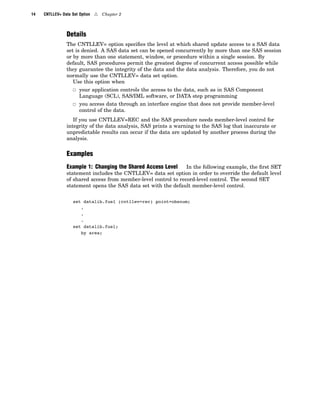
The CNTLLEV= option specifies the level at which shared update access to a SAS data
set is denied. A SAS data set can be opened concurrently by more than one SAS session
or by more than one statement, window, or procedure within a single session. By
default, SAS procedures permit the greatest degree of concurrent access possible while
they guarantee the integrity of the data and the data analysis. Therefore, you do not
normally use the CNTLLEV= data set option.
Use this option when
3 your application controls the access to the data, such as in SAS Component
Language (SCL), SAS/IML software, or DATA step programming
3 you access data through an interface engine that does not provide member-level
control of the data.
If you use CNTLLEV=REC and the SAS procedure needs member-level control for
integrity of the data analysis, SAS prints a warning to the SAS log that inaccurate or
unpredictable results can occur if the data are updated by another process during the
analysis.
Examples
Example 1: Changing the Shared Access Level In the following example, the first SET
statement includes the CNTLLEV= data set option in order to override the default level
of shared access from member-level control to record-level control. The second SET
statement opens the SAS data set with the default member-level control.
set datalib.fuel (cntllev=rec) point=obsnum;
.
.
.
set datalib.fuel;
by area;
SAS Data Set Options 4 COMPRESS= Data Set Option 15
COMPRESS= Data Set Option
Controls the compression of observations in an output SAS data set
Valid in: DATA step and PROC steps
Category: Data Set Control
Restriction: Use with output data sets only.
Syntax
COMPRESS=NO | YES | CHAR | BINARY
Syntax Description
NO
specifies that the observations in a newly created SAS data set are uncompressed
(fixed-length records).
YES | CHAR
specifies that the observations in a newly created SAS data set are compressed
(variable-length records) by SAS using RLE (Run Length Encoding). RLE compresses
observations by reducing repeated consecutive characters (including blanks) to
two-byte or three-byte representations.
Alias: ON
Tip: Use this compression algorithm for character data.
Note: COMPRESS=CHAR is accepted by Version 7 and later versions. 4
BINARY
specifies that the observations in a newly created SAS data set are compressed
(variable-length records) by SAS using RDC (Ross Data Compression). RDC
combines run-length encoding and sliding-window compression to compress the file.
Tip: This method is highly effective for compressing medium to large (several
hundred bytes or larger) blocks of binary data (numeric variables). Because the
compression function operates on a single record at a time, the record length needs
to be several hundred bytes or larger for effective compression.
16 COMPRESS= Data Set Option 4 Chapter 2
Details
Compressing a file is a process that reduces the number of bytes required to represent
each observation. Advantages of compressing a file include reduced storage
requirements for the file and fewer I/O operations necessary to read or write to the data
during processing. However, more CPU resources are required to read a compressed file
(because of the overhead of uncompressing each observation), and there are situations
where the resulting file size might increase rather than decrease.
Use the COMPRESS= data set option to compress an individual file. Specify the
option for output data sets only—that is, data sets named in the DATA statement of a
DATA step or in the OUT= option of a SAS procedure. Use the COMPRESS= data set
option only when you are creating a SAS data file (member type DATA). You cannot
compress SAS views, because they contain no data.
After a file is compressed, the setting is a permanent attribute of the file, which
means that to change the setting, you must re-create the file. That is, to uncompress a
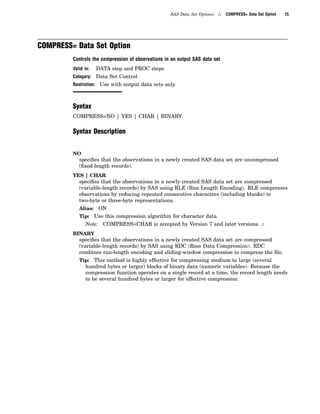
file, specify COMPRESS=NO for a DATA step that copies the compressed file.
Comparisons
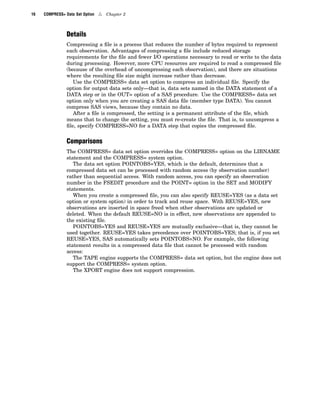
The COMPRESS= data set option overrides the COMPRESS= option on the LIBNAME
statement and the COMPRESS= system option.
The data set option POINTOBS=YES, which is the default, determines that a
compressed data set can be processed with random access (by observation number)
rather than sequential access. With random access, you can specify an observation
number in the FSEDIT procedure and the POINT= option in the SET and MODIFY
statements.
When you create a compressed file, you can also specify REUSE=YES (as a data set
option or system option) in order to track and reuse space. With REUSE=YES, new
observations are inserted in space freed when other observations are updated or
deleted. When the default REUSE=NO is in effect, new observations are appended to
the existing file.
POINTOBS=YES and REUSE=YES are mutually exclusive—that is, they cannot be
used together. REUSE=YES takes precedence over POINTOBS=YES; that is, if you set
REUSE=YES, SAS automatically sets POINTOBS=NO. For example, the following
statement results in a compressed data file that cannot be processed with random
access:
The TAPE engine supports the COMPRESS= data set option, but the engine does not
support the COMPRESS= system option.
The XPORT engine does not support compression.
SAS Data Set Options 4 DLDMGACTION= Data Set Option 17
See Also
Data Set Options:
“POINTOBS= Data Set Option” on page 43
“REUSE= Data Set Option” on page 51
Statements:
“LIBNAME Statement” on page 1381
System Options:
“COMPRESS= System Option” on page 1614
“REUSE= System Option” on page 1715
“Compressing Data Files” in SAS Language Reference: Concepts
DLDMGACTION= Data Set Option
Specifies what type of action to take when a SAS data set in a SAS data library is detected as
damaged
Valid in: DATA step and PROC steps
Category: Data Set Control
Syntax
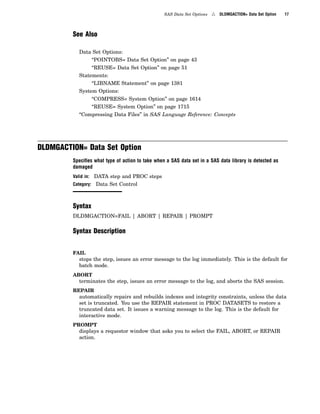
DLDMGACTION=FAIL | ABORT | REPAIR | PROMPT
Syntax Description
FAIL
stops the step, issues an error message to the log immediately. This is the default for
batch mode.
ABORT
terminates the step, issues an error message to the log, and aborts the SAS session.
REPAIR
automatically repairs and rebuilds indexes and integrity constraints, unless the data
set is truncated. You use the REPAIR statement in PROC DATASETS to restore a
truncated data set. It issues a warning message to the log. This is the default for
interactive mode.
PROMPT
displays a requestor window that asks you to select the FAIL, ABORT, or REPAIR
action.
18 DROP= Data Set Option 4 Chapter 2
DROP= Data Set Option
Excludes variables from processing or from output SAS data sets
Valid in: DATA step and PROC steps
Category: Variable Control
Syntax
DROP=variable(s)
Syntax Description
variable(s)
lists one or more variable names. You can list the variables in any form that SAS
allows.
Details
If the option is associated with an input data set, the variables are not available for
processing. If the DROP= data set option is associated with an output data set, SAS
does not write the variables to the output data set, but they are available for processing.
Comparisons
3 The DROP= data set option differs from the DROP statement in these ways:
3 In DATA steps, the DROP= data set option can apply to both input and
output data sets. The DROP statement applies only to output data sets.
3 In DATA steps, when you create multiple output data sets, use the DROP=
data set option to write different variables to different data sets. The DROP
statement applies to all output data sets.
3 In PROC steps, you can use only the DROP= data set option, not the DROP
statement.
3 The KEEP= data set option specifies a list of variables to be included in processing
or to be written to the output data set.
Examples
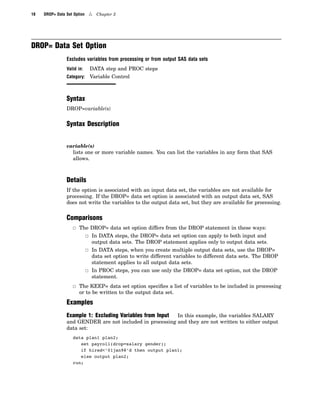
Example 1: Excluding Variables from Input In this example, the variables SALARY
and GENDER are not included in processing and they are not written to either output
data set:
data plan1 plan2;
set payroll(drop=salary gender);
if hired<’01jan98’d then output plan1;
else output plan2;
run;
SAS Data Set Options 4 ENCRYPT= Data Set Option 19
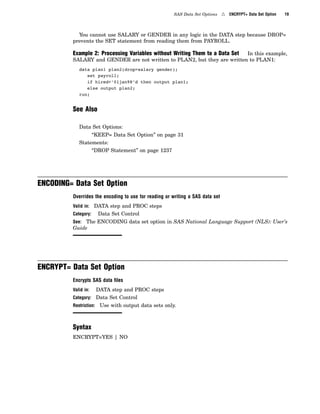
You cannot use SALARY or GENDER in any logic in the DATA step because DROP=
prevents the SET statement from reading them from PAYROLL.
Example 2: Processing Variables without Writing Them to a Data Set In this example,
SALARY and GENDER are not written to PLAN2, but they are written to PLAN1:
data plan1 plan2(drop=salary gender);
set payroll;
if hired<’01jan98’d then output plan1;
else output plan2;
run;
See Also
Data Set Options:
“KEEP= Data Set Option” on page 31
Statements:
“DROP Statement” on page 1237
ENCODING= Data Set Option
Overrides the encoding to use for reading or writing a SAS data set
Valid in: DATA step and PROC steps
Category: Data Set Control
See: The ENCODING data set option in SAS National Language Support (NLS): User’s
Guide
ENCRYPT= Data Set Option
Encrypts SAS data files
Valid in: DATA step and PROC steps
Category: Data Set Control
Restriction: Use with output data sets only.
Syntax
ENCRYPT=YES | NO
20 ENCRYPT= Data Set Option 4 Chapter 2
Syntax Description
YES
encrypts the file. The encryption method uses passwords. At a minimum, you must
specify the READ= or the PW= data set option at the same time that you specify
ENCRYPT=YES. Because the encryption method uses passwords, you cannot change
any password on an encrypted data set without re-creating the data set.
NO
does not encrypt the file.
CAUTION:
Record all passwords. If you forget the password, you cannot reset it without
assistance from SAS. The process is time-consuming and resource-intensive. 4
Details
3 You can use the ENCRYPT= option only when you are creating a SAS data file.
3 In order to copy an encrypted SAS data file, the output engine must support
encryption. Otherwise, the data file is not copied.
3 Encrypted files work only in Release 6.11 or in later releases of SAS.
3 You cannot encrypt SAS data views or stored programs because they contain no
data.
3 If the data file is encrypted, all associated indexes are also encrypted.
3 Encryption requires roughly the same amount of CPU resources as compression.
3 You cannot use PROC CPORT on encrypted SAS data files.
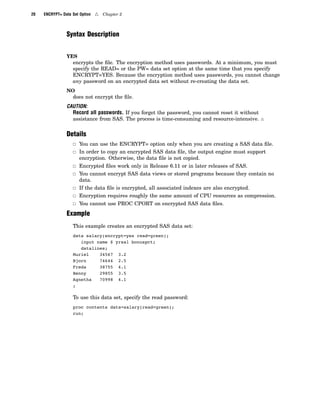
Example
This example creates an encrypted SAS data set:
data salary(encrypt=yes read=green);
input name $ yrsal bonuspct;
datalines;
Muriel 34567 3.2
Bjorn 74644 2.5
Freda 38755 4.1
Benny 29855 3.5
Agnetha 70998 4.1
;
To use this data set, specify the read password:
proc contents data=salary(read=green);
run;
SAS Data Set Options 4 FILECLOSE= Data Set Option 21
See Also
Data Set Options:
“ALTER= Data Set Option” on page 9
“PW= Data Set Option” on page 44
“READ= Data Set Option” on page 46
“WRITE= Data Set Option” on page 67
“SAS Data File Encryption” in SAS Language Reference: Concepts
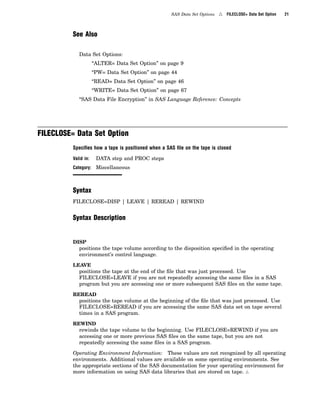
FILECLOSE= Data Set Option
Specifies how a tape is positioned when a SAS file on the tape is closed
Valid in: DATA step and PROC steps
Category: Miscellaneous
Syntax
FILECLOSE=DISP | LEAVE | REREAD | REWIND
Syntax Description
DISP
positions the tape volume according to the disposition specified in the operating
environment’s control language.
LEAVE
positions the tape at the end of the file that was just processed. Use
FILECLOSE=LEAVE if you are not repeatedly accessing the same files in a SAS
program but you are accessing one or more subsequent SAS files on the same tape.
REREAD
positions the tape volume at the beginning of the file that was just processed. Use
FILECLOSE=REREAD if you are accessing the same SAS data set on tape several
times in a SAS program.
REWIND
rewinds the tape volume to the beginning. Use FILECLOSE=REWIND if you are
accessing one or more previous SAS files on the same tape, but you are not
repeatedly accessing the same files in a SAS program.
Operating Environment Information: These values are not recognized by all operating
environments. Additional values are available on some operating environments. See
the appropriate sections of the SAS documentation for your operating environment for
more information on using SAS data libraries that are stored on tape. 4
22 FIRSTOBS= Data Set Option 4 Chapter 2
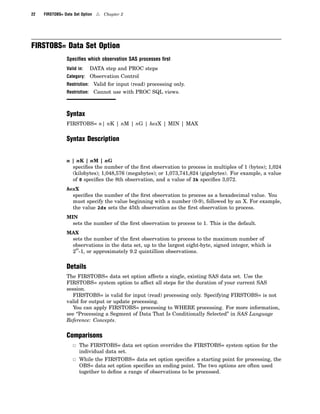
FIRSTOBS= Data Set Option
Specifies which observation SAS processes first
Valid in: DATA step and PROC steps
Category: Observation Control
Restriction: Valid for input (read) processing only.
Restriction: Cannot use with PROC SQL views.
Syntax
FIRSTOBS= n| nK | nM | nG | hexX | MIN | MAX
Syntax Description
n | nK | nM | nG
specifies the number of the first observation to process in multiples of 1 (bytes); 1,024
(kilobytes); 1,048,576 (megabytes); or 1,073,741,824 (gigabytes). For example, a value
of 8 specifies the 8th observation, and a value of 3k specifies 3,072.
hexX
specifies the number of the first observation to process as a hexadecimal value. You
must specify the value beginning with a number (0-9), followed by an X. For example,
the value 2dx sets the 45th observation as the first observation to process.
MIN
sets the number of the first observation to process to 1. This is the default.
MAX
sets the number of the first observation to process to the maximum number of
observations in the data set, up to the largest eight-byte, signed integer, which is
2
63
-1, or approximately 9.2 quintillion observations.
Details
The FIRSTOBS= data set option affects a single, existing SAS data set. Use the
FIRSTOBS= system option to affect all steps for the duration of your current SAS
session.
FIRSTOBS= is valid for input (read) processing only. Specifying FIRSTOBS= is not
valid for output or update processing.
You can apply FIRSTOBS= processing to WHERE processing. For more information,
see “Processing a Segment of Data That Is Conditionally Selected” in SAS Language
Reference: Concepts.
Comparisons
3 The FIRSTOBS= data set option overrides the FIRSTOBS= system option for the
individual data set.
3 While the FIRSTOBS= data set option specifies a starting point for processing, the
OBS= data set option specifies an ending point. The two options are often used
together to define a range of observations to be processed.
SAS Data Set Options 4 GENMAX= Data Set Option 23
3 When external files are read, the FIRSTOBS= option in the INFILE statement
specifies which record to read first.
Examples
This PROC step prints the data set STUDY beginning with observation 20:
proc print data=study(firstobs=20);
run;
This SET statement uses both FIRSTOBS= and OBS= to read only observations 5
through 10 from the data set STUDY. Data set NEW contains six observations.
data new;
set study(firstobs=5 obs=10);
run;
See Also
Data Set Options:
“OBS= Data Set Option” on page 34
Statements:
“INFILE Statement” on page 1318
“WHERE Statement” on page 1529
System Options:
“FIRSTOBS= System Option” on page 1646
GENMAX= Data Set Option
Requests generations for a data set and specifies the maximum number of versions
Valid in: DATA step and PROC steps
Category: Data Set Control
Restriction: Use with output data sets only.
Syntax
GENMAX=number-of-generations
Syntax Description
number-of-generations
requests generations for a data set and specifies the maximum number of versions to
maintain. The value can be from 0 to 1000. The default is GENMAX=0, which means
that no generation data sets are requested..
24 GENNUM= Data Set Option 4 Chapter 2
Details
You use GENMAX= to request generations for a new data set and to modify the number
of generations on an existing data set. The first time the data set is replaced, SAS
keeps the replaced version and appends a four-character version number to its member
name, which includes # and a three-digit number. For example, for a data set named A,
a historical version would be A#001.
Once generations of a data set is requested, its member name is limited to 28
characters (rather than 32), because the last four characters are reserved for the
appended version number. When the GENMAX= data set option is set to 0, the member
name can be up to 32 characters.
If you reduce the number of generations on an existing data set, SAS deletes the
oldest version(s) above the new limit.
Examples
Example 1: Requesting Generations When You Create a Data Set This example shows
how to request generations for a new data set. The DATA step creates a data set named
WORK.A that can have as many as 10 generations (one current version and nine
historical versions):
data a(genmax=10);
x=1;
output;
run;
Example 2: Modifying the Number of Generations on an Existing Data Set This
example shows how to change the number of generations on the data set MYLIB.A to 4:
proc datasets lib=mylib;
modify a(genmax=4);
run;
See Also
Data Set Option:
“GENNUM= Data Set Option” on page 24
“Generation Data Sets” in “SAS Data Sets” in SAS Language Reference: Concepts
GENNUM= Data Set Option
References a specific generation of a data set
Valid in: DATA step and PROC steps
Category: Data Set Control
Restriction: Use with input data sets only.
Syntax
GENNUM=integer
SAS Data Set Options 4 GENNUM= Data Set Option 25
Syntax Description
integer
is a number that references a specific version from a generation group. Specifying a
positive number is an absolute reference to a specific generation number that is
appended to a data set’s name. Specifying a negative number is a relative reference
to a historical version in relation to the base version, from the youngest to the oldest.
Typically, a value of 0 refers to the current (base) version.
Note: The DATASETS procedure provides a variety of statements for which
specifying GENNUM= has additional functionality:
3 For the DATASETS and DELETE statements, GENNUM= supports the
additional values ALL, HIST, and REVERT.
3 For the CHANGE statement, GENNUM= supports the additional value ALL.
3 For the CHANGE statement, specifying GENNUM=0 refers to all versions
rather than just the base version.
4
Details
After generations for a data set have been requested using the GENMAX= data set
option, use GENNUM= to request a specific version. For example, specifying
GENNUM=3 refers to the historical version #003, while specifying GENNUM=-1 refers
to the youngest historical version.
Note that after 999 replacements, the youngest version would be #999. After 1,000
replacements, SAS rolls over the youngest version number to #000. Therefore, if you
want the historical version #000, specify GENNUM=1000.
Both an absolute reference and a relative reference refer to a specific version. A
relative reference does not skip deleted versions. Therefore, when working with a
generation group that includes one or more deleted versions, using a relative reference
will result in an error if the version being referenced has been deleted. For example, if
you have the base version AIR and three historical versions (AIR#001, AIR#002, and
AIR#003) and you delete AIR#002, the following statements return an error, because
AIR#002 does not exist. SAS does not assume you mean AIR#003:
proc print data=air (gennum= -2);
run;
Examples
Example 1: Requesting a Version Using an Absolute Reference This example prints
the historical version #003 for data set A, using an absolute reference:
proc print data=a(gennum=3);
run;
Example 2: Requesting A Version Using a Relative Reference The following PRINT
procedure prints the data set three versions back from the base version:
proc print data=a(gennum=-3);
run;
Exploring the Variety of Random
Documents with Different Content
disposition, even the most delicate and most fluid representations of
conditions, do not free us from the chaos of the time: they might
easily bind us still more strongly to it, since they weaken the power,
indeed the tendency to energetic concentration, and increase the
tendency to degenerate into a state of weakness and decay; while to
overcome these dangers it is necessary primarily to increase our
activity, to win again an active relation to reality. Art cannot free
itself from that condition of feebleness without entering into a close
relation with the central task of life and acknowledging a spirituality
transcending the subjective circumstances and interests of mere
man. If these requirements are not satisfied, no talent can prevent a
decline of art into a more refined Epicureanism.
But where such a spiritual life is acknowledged, and at the same
time there arises the task of winning for man a new life, a new
spiritual reality, art inevitably acquires a great significance, and
becomes absolutely indispensable. Without the liberation which it
brings, and its presentation of things in a harmony, how could a
whole with definite character be raised? How could the new that
hovers before us acquire form and exert a penetrating power
without the help of a constructive imagination which precedes its
realisation? How could the soul’s innermost experience permeate life
as a whole, and ennoble its whole structure without the help of art?
The higher we place the ideal of life, the more does the spiritual
content which immediate existence manifests become a mere sense
form, the more is æsthetic activity necessary to prevent disunion of
life, in the midst of all oppositions to give it some kind of unity, and
in the midst of the passion of conflict some rest within itself. But, to
achieve this, art may not purpose to form an oasis in a wilderness of
life, but, hand-in-hand with other activities, must fight for spiritual
experience and a genuine meaning of life as a whole.
(d) POLITICAL AND SOCIAL LIFE
To treat of the complicated problems of the political and social life
of the present does not come within our purpose; we can consider
them only so far as the task of the construction of an independent
spiritual world is affected either for good or evil by the nature of
their solution.
In contrast to the epoch of the Enlightenment, the nineteenth
century brought about a transition from the individual to society:
social life has developed in numerous branches, has disclosed a
superabundance of new facts, and has set us new tasks. But this
development has also brought much perplexity with it. It becomes
evident in this development also, that each spiritual movement that
attains power experiences in its further course limitations, and is
degraded by its contact with human conditions. Along with the social
movement there has been the often-discussed change by which life
from being centred in an invisible world becomes occupied with the
visible one, and by which all departments of life are given a
naturalistic, realistic character and tendency. There has been no lack
of opposition to the movement to make society the first
consideration; the opposition has gone even so far as to dispute the
right of the whole. Further, the earlier and the later conception of
society, the idealistic and the realistic, are often confused; and from
this confusion contradictions arise that not only confuse our ideas
but also degrade our life. There is a danger that a zealous and
excited occupation with nothing but individual tasks may take our
attention from the whole, and that the problems which the inner
condition of man involves may not obtain due consideration.
This turning to society is most manifest in the powerful advance of
the state. In this, an inner longing for a more social life, as Hegel
especially philosophically advocated it; and actual changes of
conditions operated together, and strengthened one another. The
more definite manifestation of individuality on the part of nations
and the sharper division between them; the active interest of wider
circles in political problems; the mechanical organisation of work,
with its more exact differentiation and its more rigid organisation of
forces; but primarily the longing, which grows out of the ceaselessly
increasing economical and social perplexities, for a power superior to
the parties in dispute and acting as arbitrator—all these have
immeasurably increased the power of the state in different degrees
among different peoples, but in general through the whole civilised
world.
The freedom of the individual, therefore, cannot but suffer from
manifold limitations; there arises a danger that the individual may
gradually lose all initiative, and expect all stimulation from the state.
The spontaneity and the wealth of life suffer from the tendency to
increase the power of the state, and a bureaucracy which delights in
correct forms, but which spiritually is entirely unproductive, indeed
even indifferent, appropriates more and more to itself. The
substance of the spiritual life is also threatened by the fact that the
omnipotent state is inclined to treat that life, with all its branches, as
a mere means in the attainment of its own particular aims; to look
upon science and art, and chiefly religion and education, especially
with regard to that which they achieve for the aims of the state, and
to shape them as much as possible in accordance with these aims.
There is also a strong tendency to follow the same course to
accomplish the ends of the contemporary form of government. An
independent and genuine spiritual life can hardly offer too great an
opposition to such a perversion, with its deification of human forms.
But the matter is by no means simple; for not the will of single
individuals and parties, but the whole tendency of modern life has
given this power to the state; indeed, on the economic side the state
will soon experience a further increase of power. The more the
guidance on this side belongs to the state, the more necessary is a
free movement of spiritual culture in opposition to it; the more
urgent is the demand that the amalgamation of church and state
should be discontinued—an amalgamation which, by the growing
disputes that arise from it, forces religion into an undignified
position; the more definitely is a greater independence to be desired
for school organisation in all its branches. The Germans especially
have much to do in this matter; and there is much at stake. For, with
the limitations of our spatial extension, we can be a permanent
determining factor in world-culture only by giving our culture the
greatest intensity; but this requires a calling forth of the complete
power and of the spontaneity of individuals. Ultimately, in this matter
also, the chief thing proves to be the taking up again of central
problems and the realisation of human being in its innermost depths
as an unconditional end in itself and the bearer of an infinite life. No
conception can guard us from sinking to the position of puppets of
the soulless mechanism of the state, if we do not find the power to
give soul to our life and to maintain it against all attempted
limitation.
The longing for more freedom and independence has therefore an
indisputable validity. But this acknowledgment may easily lead to
new complications by freedom and independence being conceived in
a manner much too external, and also by a really questionable
association of these ideas with the problem of equality. The
conviction of the modern man concerning the world on the one
hand, and the demands of life on the other, are often in direct
contradiction with regard to the conception of equality. We become
aware of our limitation on all sides: we are represented simply as a
product of heredity and environment: all possibility of making a
decision for ourselves is rejected as a delusion. If thus we are
deprived of all independence and all spontaneity of life, then even in
social life we shall become mere bearers of a rôle imposed upon us
by a dark fate. One does not see how freedom could retain a value,
arouse enthusiasm, and lead to sacrifice in such a case. If the whole
is a soulless mechanism, in which only the excess of existent power
is the cause of decisions, then we ourselves cannot be exceptions.
Other complications have their origin in the democratic tendency
which permeates not only our political endeavour but also our whole
life of culture. How far-reaching a change, indeed how complete a
revolution, has been accomplished by this tendency in opposition to
a condition of things which has stood for hundreds or rather
thousands of years, is but seldom fully appreciated. In the earlier
form of social life spiritual work was the chief matter only of a
limited and exclusive circle; to the people as a whole it was only
secondary, and the benefit that they received from it was often of
the most meagre character. Even the Reformation left this
aristocratic form of life as it was; for as certainly as it made the care
for every individual member of the church more urgent, that care
was bestowed from above in an authoritative manner. The earlier
Enlightenment, as it was represented, for example, by Bayle, was of
the conviction that the deliverance from delusion and superstition
would always be limited to a small circle of those standing spiritually
high, and would never reach the masses. We know how this has
changed; how the masses are determined to form a mere dependent
body of the so-called higher classes no longer, but to take the
problem of life independently into their own hands, and how they
obtain their representation of the world and the task of their life
from that which is more immediately present to them and directly
concerns their welfare; and how in this way they are inclined to look
upon themselves as the whole of humanity. We have already
referred to the danger that culture as a whole will thus be made
shallow—a danger that arises from the fact that here the decision is
made by those who scarcely participate in the work of history, and
who depend almost entirely upon the immediate impression. Further,
we have already contended that only a simplification and
rejuvenation of culture are able to cope with this danger. The fact is
important that this democratic movement appeals to the equality of
all who bear human features. Here again there appears to be a
direct contradiction between theoretical conviction and actual
conditions. Experience everywhere shows a pronounced inequality
among men; it shows this not only in the traditional social
relationships but also in the organisation of modern industry. More,
however, than all social arrangements, nature shows the greatest
inequality amongst men; and the actual relation of individuals in
work and idleness, in love and hate, in independent thinking and
blind subordination shows it none the less. From the point of view of
experience the idea of equality seems to be an empty phrase. If it is
more than this, if we recognise in it a truth that we cannot afford to
lose, then it implies the conviction that humanity has spiritual
relations; that each has a significance in a spiritual nature, and that
there is a universal life present everywhere which opposes the guilt
and folly of the individual and even in spite of himself gives him a
value. Thus we have seen that in history, religion and ideal culture
were the first to bring the idea of equality into good repute. But to-
day the champions of equality turn with particular keenness against
religion and ideal culture, and are not aware that in so doing they
are destroying the foundations of their own belief.
These inconsistencies are not felt, chiefly because of the power
which abstractions usually exercise over men in the present day. A
faith in abstractions reigns amongst us which is capable of far
greater things than faith in religion or faith in reason. We are
surrounded by the bustle of a fierce and ceaselessly increasing
struggle for existence: ideas are overgrown by interests; the motives
of people in general are trivial, and all spiritual aspiration is feeble,
and along with this there is an unutterable amount of pretence
which permeates and distorts all conduct. Yet the disagreeable
aspect of this condition seems to vanish as soon as the mere word
“humanity” is mentioned. But what is humanity from the point of
view of Naturalism other than a collection of beings of nature? How
can a power to elevate and to strengthen proceed from this
conception, which in the naturalistic context signifies no more than
the subjective unification of the individuals? Or, again, the idea of a
ceaseless progress of humanity is placed in opposition to the
confusions which exist in the present. But how can this idea be
established if a compelling reason is not active within man? How
could the present be so incomplete and so full of perplexity as it
seems, especially to the advocates of the idea of progress, if century
after century had made progress upon progress? Rather, if man has
such a noble nature as he is assumed to have, life should be full of
reason and bliss. The old faith saved man by resorting to an invisible
world; it required a firm confidence in that which one did not see.
The new faith, which denies an invisible world, desires more: it
desires that we should be convinced of the direct opposite of that
which we see and comprehend. These considerations in no way
signify a depreciation on our part of the effort to attain freedom and
equality—an effort that has an indisputable validity. But this validity
must be based upon a whole of life and be more definitely
determined, otherwise the effort is stifled by the inconsistencies in
which the conceptions of freedom and equality are involved in the
minds of their advocates.
The independence of the individual and the spontaneity of the
spiritual life are endangered not only by the mechanism of a
bureaucracy indifferent to spiritual values but also none the less by
the movements of the masses, which in modern life in particular
surround and browbeat the individual. The man of the present day
often believes that he has gained freedom when in reality he has
only changed the nature of his dependence. What makes the
movements of the masses, with their so-called public opinion, so
irksome is the falsehood that is generally contained in this opinion,
which is presented as proceeding from the experience and decision
of a great majority, and therefore as having a definite presupposition
of truth. The fact, as a rule, is that a few venture an assertion and
urge it upon the others with unobserved compulsion, since they
proclaim as already existent the agreement that they are only
seeking. Of course sometimes there is much more in public opinion;
it may be the expression of a spiritual necessity which subjects to
itself the dispositions of men. Whether public opinion is to be an
interpreter of truth or a mere product of man remains to be decided;
and this decision can rest only with the individual. He will be equal
to making this decision if he possesses a spiritual experience, and
has in this a touchstone by which to distinguish the genuine from
the false.
Philosophy can maintain the rights of the individual only so far as
he is rooted in spiritual relationships and derives power from them;
it must absolutely oppose all glorification of the natural, spiritually
destitute individual. We find such a glorification to-day more
especially in that which, with particular emphasis, is called “modern”
morality, but which in fact threatens rather to be a complete
negation of morality; even though this negation is against the
intentions of its advocates, mostly women, who display great
enthusiasm for this “modern” morality. It seems as though life is
limited and degraded because society, particularly in the matter of
the sexual life, prescribes rigid statutes which, if they were not
irrational at the beginning, have nevertheless become irrational, and
tend to brand the right as wrong and the wrong as right. The
shaking off of these restrictions and of the pressure of society in
general seems to promise a form of life incomparably more powerful,
sincere, and individual: this life is also to offer more beauty, for to-
day generally the idea of beauty is emphasised with great partiality
where life has no clear ideas and no significant content.
This criticism of the statutes of society is not entirely without
reason. Such statutes do not in themselves constitute a morality, as
it is easy to imagine they do; but they only advocate a morality; as
life undergoes such far-reaching changes, these statutes must
continually be examined anew as to their validity and value. But this
relativity does not make them worthless, and does not justify their
complete rejection in favour of an absolute freedom on the part of
individuals. We could expect an elevation of life by such an effort for
freedom only if we might assume that the individuals are thoroughly
noble, energetic, and spiritually rich, and if in the relations between
the sexes a state of paradisiacal innocence reigned which only the
evil arrangements of society had disturbed. But this is a way of
thinking which does more honour to the hearts than to the heads of
its advocates. He who takes men as they really are and does not
paint them in romantic colours, and who at the same time
recognises the dangers of a highly developed, pleasure-seeking, and
over-refined state of culture, will not despise those social
arrangements, notwithstanding their relativity, but value them as an
indispensable safeguard against the selfishness, the greed for
pleasure, and the instability of the mere individual—a safeguard not
only against the tyranny of externals but also for the individual
against himself. It is unfortunate enough that such safeguards are
necessary; but, as they are necessary, it is better to preserve and
improve them as much as possible than to reject them, and to
expose humanity to dangers that might throw it back into the
condition of the animals. Man is not better because he is painted
more beautifully; rather Pascal is right when he says: “L’homme n’est
ni ange ni bête, et le malheur veut, que qui veut faire l’ange fait la
bête.”
The tendency to think that man may be transformed inwardly and
the whole condition of life raised by changes in external organisation
is most definitely felt in the social movements of the age. In this
there is a clearly marked opposition to the earlier mode of thought,
which, placing a low estimate upon everything external, and finding
greatness too easily in disposition, overlooked how much the
organisation of the conditions of life means for men in whom the
spiritual is only in process of development; and, further, failed to
notice that there is also a strong movement from external to
internal. Nevertheless, the fact cannot be denied, notwithstanding all
this, that the problems of the whole and of man’s inner nature
require to be treated as of chief importance. Otherwise, as Aristotle
suggested, notwithstanding all the alteration of conditions, the old
problems will continually make their appearance anew, and the
substance of life might easily suffer from that which was intended to
improve its condition.
In conclusion, we may briefly consider the problems that have
been raised in the nineteenth century by the increased emphasis on
the idea of nationality. Influences of an idealistic nature first raised
the cultivation and establishment of a particular national character to
the position of a matter of the greatest importance. This character
appeared to be an extremely valuable form of individualisation of the
spiritual life, a form in which that life attains to concreteness and
greater definiteness and penetration. The co-existence of these
individual nationalities gave promise of an incomparably richer
formation of the life of humanity as a whole: the inner development
of their peculiar natures, and their lofty rivalry, also promised to
bring a wealth of arousing and elevating motives. The nineteenth
century has, indeed, won an incalculable amount through this
movement; to take up an abstract cosmopolitanism again would be
decidedly retrograde.
But the more the idea of nationality has been brought from its
high place in the realm of thought to the domain of human
circumstance, the more has it been debased and the more dangers
has it produced. If previously the cultivation of an ideal type of life
was most prominent, and if the nations could thus permit one
another to follow their own courses peacefully, this has become less
and less the case in face of the desire and effort for power and
expansion in the visible world; and owing to the narrowness of
physical space occupied by the nations, the different strivings have
clashed together more and more severely. If this tendency continues
without the counteraction of an inner task common to humanity as a
whole, and of unifying and elevating ideas, it is hardly possible to
avoid mutual hostility, a degeneration into obstinacy and injustice.
The idea of nationality may therefore become a danger to the ethical
character of life. This is the case if, by milder or by severer means,
one nation tries to force its own character and speech upon another.
The mode of thought based on the old cujus regio ejus natio is in no
way better than that based on the old cujus regio ejus religio, which
we are now accustomed to regard with contempt as a piece of
barbarism. The desire for external power at the same time tends to
lessen the attention to the inner development and unification of
nationality, without which ultimately little progress can be made in
the development of power. It is through a common national
character, with its unification of the feelings and efforts of the
individuals, that a people is first elevated into a genuine nation; it is
a character such as this that gives to a people a power of influencing
humanity as a whole; it is a character such as this that gives to the
individuals the consciousness of being “members one of another,”
and with this a stability and a joy in life and activity. Such a national
character necessitates certain natural conditions, that are like the
veins in marble which prescribe a certain direction to the work of the
artist. But these conditions must first be organised and by the
complete elevation of their nature spiritually unified; and this cannot
be achieved otherwise than through our own work, which through
common events and experiences follows its ideal. So far, therefore,
national character is not a gift of nature but a task which presents
itself distinctively to each people according to its nature and
conditions. In this matter a people must always in the first place
realise a unity in its own nature.
In the fulfilment of this task hardly any other people has had to
contend with keener opposition, both external and internal, than the
Germans. Our physical environment does not direct us so definitely
into distinctive paths as is the case with other peoples. But our inner
nature contains, before all else, harsh antitheses. Our strength lies
chiefly in arousing to life depths of the soul otherwise undreamt of.
Thus in music and in poetry we have been able to surpass all other
peoples; again, we have been able to give to religion a wonderful
inwardness, and in education to evolve the leading ideas. At the
same time, however, we are driven to the physical world to take
possession of and to shape things; we are not the Hindus of Europe,
as other people indeed previously called us. We came into history by
achievements in war, and the desire for conflict and victory has been
maintained through all the phases of our varied history. By the
continued diligence of our citizens in work we have subordinated the
world around us to our aims; our capacity for organisation has been
most marked, as the present state of industry and trade shows.
However, not only have these movements towards inwardness, and
towards the world, a strong tendency to oppose one another, but
also, in contrast with these magnificent gifts, there are many defects
and tendencies that make the development of a powerful and unified
life exceedingly difficult. We show a want of form and taste, a
heaviness and formality, a tendency to occupation with detail and, in
general, with what is petty in life, and, as a result of this, an
uncultured “Philistinism” in all spheres of society, and along with this
the inclination on the part of individuals to insist on the correctness
of their positions, and thus to cause division; finally—and this is the
worst of all—much envy and jealousy. None of these features can be
denied. There is an infinite amount which must be altered and
overcome amongst us if we are to become what we are capable of
becoming, and if we are to reach the highest in our nature. The
limitations that have been brought about by our history, which on
the whole has not been a happy one, constitute an important
determining factor in this matter. The more problems we bear within
us, the more possibilities of genuine creation that exist within us,
and the more we may be to humanity in the future, the more painful
is it if attention and activity are diverted from the chief task, and if
an externalising of the idea of nationality allows us to consider
ourselves great rather than lead us to strive for true greatness. The
people that has produced Luther and Bach, Kant and Goethe, cannot
be devoid of true greatness, if it only remains faithful to its own
nature, and if it concentrates its power and treats the chief thing
really as such.
(e) THE LIFE OF THE INDIVIDUAL
The problems and antitheses that are to be found in the life of the
present penetrate deeply into the life of the individual, and often
make their appearance within him with a particular power. The
antithesis that exists between the conceptions of the world and the
demands of life is especially harsh. The tendency of the age is to
form a conception of the world which reduces the status of the
individual in the greatest degree: from the point of view of nature
and of society, he seems to be no more than a fleeting appearance,
a matter of indifference, and to show no independence, and never to
be able to take part with spontaneous activity in the course of
events. On the other hand, the contemporary form of life demands
the greatest independence and freedom of the individual. We see in
him the chief bearer of life, and we expect salvation from the severe
perplexities of the time, primarily from his strengthening. This state
of inconsistency cannot be tolerated for long; either the degradation
of the individual, that is found in the conceptions of the world, must
be applied to life, and lead it to a resigned submission to an
impenetrable world-process, or the positive estimate of the
individual which governs conduct must be acknowledged in the
conviction concerning reality as a whole: only a weakness of
disposition and a feebleness of thought can divide our existence
between the one conviction and the other.
The course which our investigation has taken cannot leave any
possible doubt as to the direction which our conviction points out to
us in this matter: however much we also demand an energetic
development of the individual, that the stagnation of the age may be
overcome, at the same time we insist upon a necessary condition of
this, on his inner strengthening by an inner world present to him, on
his elevation by a spirituality transcending nature. Only if he thus
acquires an inner relation to infinity, and becomes an independent
centre of life, can he satisfy the demands that are generally made
upon him, and, remarkably enough, especially by those who
theoretically deny the inner world as a whole, and hail a most
shallow Naturalism as a deliverance.
Of course that inner elevation of the individual by no means lifts
him gently and simply out of all the confusion that the experience of
our existence shows; at the first glance it may even seem to make
the confusion greater. For, if each individual can become a co-
operator in the building up of a new world, and if his activity thereby
acquires a value for the whole, then the complete indifference with
which, according to our human impression, the individual is treated
by the course of the physical world, the inflexibility and injustice that
he often experiences in this world, the defect of love and justice in
this world, in which the bad so often obtain the victory and the good
are led to destruction, are all the greater mystery. The more the
development of the spiritual life widens the field of vision; the more
it leads us beyond a lifeless resignation to the question of the
rationality of events and compels us to compare the destiny of one
man with that of another, the deeper must that feeling of mystery
become. All attempts at a theodicy founder on this difficulty; we
must inevitably submit to the view that with regard to this problem
all is obscure to the eyes of man. There is, however, no need on this
account to doubt and to regard our life as hopeless; our
investigation also has shown this. For, in contrast with the obscurity
of the world around us, we are able to set the fact of the emergence
of a new world within us. Great things take place within us; not only
does a new world appear, but we are called by an inner necessity of
our own being to co-operate in its development, and this co-
operation is not limited to individual activities, but involves our being
as a whole. For it was just in this that we were able to recognise the
development of being as the essence of the spiritual life—that the
chief movement of our life is to win a genuine being, and that in the
development of personality and spiritual individuality such a being is
in question. We saw clearly enough that we are not personalities and
individuals from the beginning; but that nature gives us only the
possibility of becoming this. To realise this possibility our own activity
is necessary; and this activity is not a sudden resolution, but
requires a revolution of our being and the development of a new
nature; and this can only be achieved by a faithful and zealous life-
work, and even then only approximately. Thus life as a whole is a
task which includes all multiplicity within it, the task of winning our
own being completely, and just in this way to increase the kingdom
of the spirit at our point.
This task cannot be completely recognised and adopted without
making a great divergence from the aim, harsh oppositions and
difficult conflicts, manifest in the inner recesses of the soul. If our
life, therefore, appears to be in the highest degree incomplete, a
mere beginning, then this increase of the task demonstrates more
than anything else that, in this matter, we are concerned not with
phantoms and imaginations, but with realities: so here,
notwithstanding all our incompleteness, we can obtain the certainty
of a spiritual existence, and even become strengthened by the direct
resistance of the external world, because that world is henceforth
reduced to the secondary position. Thus, as we saw, the question
upon which minds separate into irreconcilable opposition is whether
they acknowledge in the inwardness of being itself not merely
individual problems but a universal task; if this is the case, the
seriousness of the task will give to them an unshakable stability of
possession and a security superior to all attacks; if it is not the case,
the spiritual world is an unintelligible paradox, because the want of
an independent inner life means that there is no basis for the
development of an organ for the comprehension of a world of
inwardness. In this matter there is no possibility of a direct
agreement; only the proof of the spirit and of power can decide.
But where the life of the individual acquires a genuine being and a
connection with the realm of self-consciousness, then,
notwithstanding all that is fleeting and insubstantial, the individual
cannot regard himself as a transitory appearance in the whole, even
in the ultimate basis of his being. Where, in contrast with all the
meaninglessness of mere nature and all the pretence of mere
society, a movement towards inner unity and substantial being
emerges, the individual will be elevated into a time-transcendent
order, and must necessarily acquire some position within it. The
whole movement towards spirituality in the human sphere would be
vain, and all distinctively human life would be a meaningless
contradiction, if the individuals in whom alone the spiritual life
breaks forth spontaneously were included solely and entirely in the
stream of the process of nature. If the spiritual life has once
revealed itself to us, so far as to begin an independent and
distinctive being within us, then this being will assert itself in some
way. This does not imply agreement with the usual belief in
immortality, which would preserve man just as he is through all
eternity, and thus condemn him to the torture of rigid continuance in
the same form; a state that would, indeed, be as unbearable as the
pain of the traditional hell. As the world as a whole is in the highest
degree mysterious to us, so our future is veiled in the deepest
obscurity. But, if with the essence of our being we are elevated into
a universal spiritual life, and if in the innermost basis of our life we
participate in an eternal order, then the time-transcendence of this
life assures to us also some kind of time-transcendence in our being.
So löst sich jene grosse Frage
Nach unserm zweiten Vaterland,
Denn das Beständige der ird’schen Tage
Verbürgt uns ewigen Bestand.
Goethe
CONCLUSION
In conclusion a few words will suffice. The last section showed that
the present sets great problems and reveals possibilities in every
department of life; but that we men are very far from being equal to
cope with these problems. We are limited especially by the fact that
we are incapable of elevating ourselves inwardly above the present;
that we do not take possession of it sufficiently as a whole, and find
an inner independence in relation to it; and that therefore we do not
enter with the necessary vigour into the conflict against the trivial
and the poor-spirited, the decadent and the sceptical that the
present contains. To point out the way to attain such independence
appeared to us to be the chief task of philosophy in the present. In
the service of this task, which cannot be achieved without the
manifestation of a new actuality, without a fundamental deepening
of our reality, we have made our investigation, which contains a
distinctive conception of the spiritual life. In that everywhere we
have pressed back from the results to the experience, and from the
wealth of achievement to the generating basis, we have seen
nature, history, culture, and human nature as a whole in a new light.
We have hoped, by widening and strengthening life itself from
within, to supply a substitute for the external supports that life has
lost. How far we have succeeded in our endeavour is another
question; we shall be satisfied even if our work only contributes to
bring the present to a clearer consciousness of the state of spiritual
crisis in which it exists and concerning the seriousness of which it
deceives itself in a thousand ways. There is an enormous amount of
vigorous activity and efficient work, of honest endeavour and serious
disposition, in our time, and the tendency to make life more spiritual
is also evident. But the movement is still far from attaining the depth
which is necessary to the chief question of our spiritual existence;
thus the conflict, instead of being between whole and whole, is
divided; that which is significant and valuable in the endeavour of
the time is in danger of becoming problematic, and of producing the
opposite of what it purposes, because it does not fit itself into a
universal life, and in this realise its limitations and at the same time
its right. A more energetic concentration of life in itself is therefore
the first condition of transcending the chaos of the life of the present
and of preventing spiritual degeneration in the midst of too intense
an occupation with externals. As for the rest, we may say with
Plotinus: “The doctrine serves to point the way and guide the
traveller; the vision, however, is for him who will see it.”
INDEX
Abstractions; their power in modern life, 362 ff.
Activism; profession of faith in, 255 ff.; how it differs from a system of mere
force, 255 ff.; its ethical character, 256; how it differs from Voluntarism
and Pragmatism, 256 ff.
Æsthetic Individualism, 61 ff.
Æstheticism; its antithesis to Activism, 258 ff.
Antiquity; its distinctive synthesis of life, 208 ff.
A priori; its validity and its limitations, 234
Archimedean point in the spiritual life; its impossibility, 94 ff., 154
Art and literature, condition and tasks in the present, 354 ff.
Ascetic organisation of life; rejected, 281 ff.
Being, development of; as a system of life, 212 ff., 314
Catholicism; different tendencies in, 328 ff.
Christianity; its unique character, 6; the opposition to, 7 ff.; its permanent
truth, 331 ff.; changes necessary to it, 332 ff.; Christian and Greek forms
of life, 283 ff.
“Classical,” the; its significance, 192
Concentration of life (within the whole), 156 ff., 160
Conscience; its significance, 129 ff.
Critical character of modern work; its presuppositions, 250 ff.
Culture, 110 ff.; genuine and apparent, 269 ff.; requirements of a new type,
298 ff.; organisation of, 315 ff.
Democratic tendency of modern culture, 361 ff.
Departments of life; their relation to life as a whole, 316 ff.
Dogmatic sectarian point of view; rejected, 328
Duty; significance of the idea, 184 ff., 231
Education; problems in the present state of, 343 ff.
Enlightenment, the; its synthesis of life, 209 ff.; how far problematic, 249;
relation of the present to it, 347 ff.
Equality; problems of the present conception of, 362
Eternity; how far implied in the life of the individual, 372
Ethical character of life; how to be understood, 256, 258; of spiritual culture,
309 ff.; its necessity, 337 ff.
Ethics (morality); different types in the present time, 336 ff.; conditions of a
morality, 338 ff.; requirements of morality in a spiritual culture, 339 ff.
Evil; the problem of, 263 ff.; the way in which it is solved, 279 ff.
Evolution, doctrine of; spiritual, its limitations, 194 ff., 257 ff.
Experience; its significance for the spiritual life in man, 235 ff.
Freedom; its nature, 174 ff.; its conflict with destiny, 181 ff.; genuine and
false, 323 ff.; inconsistency in contemporary treatment of the problem,
360 ff.
German character; its greatness and its dangers, 317 ff., 368 ff.
Goethe; characteristic influence, 299
Good, the (idea of the good); how it differs from the Useful, 119 ff.; apparent
inconsistency, 138 ff.; more detailed determination, 185 ff.
Great man, the; his relation to his time, 292
Greek and Christian forms of life, 283 ff.
Hegel; relation of the present to him indefinite, 348
Historical and social organisation of life; its limitations, 200
Historical Relativism; rejected, 290 ff., 323 ff.
History; the spiritual conception of, its conditions, 188 ff.; esoteric and
exoteric history, 243 ff.
Human life; how far it is from the spiritual life, 161 ff.
Idealisation, false; of immediate existence, 83 ff., 362 ff.
Idealism and Realism; their unification in a spiritual culture, 312 ff.
Ideas in history; their unique character, 126 ff., 188 ff.
Imagination; indispensable in all departments of life, 239
Immanent Idealism, its rise and fall, 15 ff.
Immanental treatment (from the life-process), 107 ff.
Individual, the, and the Society; problems of their relation, 364 ff.
Individual, the; his significance in the new relations, 246, 369 ff.
Individual, life of the; its form in the new system, 369 ff.
Individuality (spiritual); as a problem, 132 ff., 181 ff., 370
Instruction; problems in the present time with reference to, 343 ff.
Inwardness; its attainment of independence in man, 123 ff., 146 ff.; as the
inner life of reality, 148 ff.; inwardness and the inner world, 303
Irrationality, of existence; in what manner overcome, 279
Kant; inconsistency in the relation to him in the present time, 348
Knowledge; its form in the new system, 351
Life; its detachment from the mere individual, 119 ff.; the two movements in
it, 282 ff.
Life-process; as the fundamental principle of investigation, 104 ff., 305 ff., 349
ff.
Life’s attainment of greatness, 240 ff.
Life-work; its significance in acquiring stability, 253
Love; as a witness to the union with the whole, 231
Man; as a being of nature, 110 ff.; growing beyond nature, 113 ff.; his union
with the whole, 226 ff.
Masses, the culture of the; its problems, 89 ff.
Mass-movements; their dangers and limitations, 363 ff.
Metaphysic; in what sense necessary, 141 ff.
“Modern,” the; double meaning, 296
Modern Age, the (in a broad sense); the characteristic in its nature, 9 ff.
“Modern” Morality; discussed and rejected, 364 ff.
Movement, of the spiritual life in man; its uniqueness, 233 ff.; its increase in
the new system of life, 247 ff.
Mysticism; in what sense justifiable, 246
National Character, 198, 367 ff.
Nationality, the idea of; its problems, 366 ff.
Naturalism; its significance and its limitations, 24 ff.
Nature and Spirit, 270 ff.
Negation; impossibility of an absolute, 267 ff.
Newer Systems of Life; what they have in common, 22 ff., 81 ff.
Noölogical Method; distinguished from the psychological and the
cosmological, 243, 352
Norms; their significance, 184
Pantheism; vague character of the general conception of it, 84
Past; impossibility of flight to the, 93 ff.
People and nation, 366 ff.
Personal conviction, concerning reality as a whole; where the decision is
made, 253, 281, 311 ff., 340, 372
Personality; the difficulty of the conception, 95 ff.; no mere gift of nature,
311, 370
Philosophy; its present position, 346 ff.; its three main tendencies in the
present time, 347 ff.; chief demands, 349 ff.
Philosophy of life; the conception of a, 3 ff.
Political and social life; condition and tasks in the present time, 358 ff.
Present, the; difficulties of determining its extent, 289 ff.
Protestantism; the different tendencies in it, 329
Public opinion; manner of its formation, 364
Reality; difficulty of the conception, 84 ff.; longing for, 159 ff.; new conception
of, 220 ff.
Relation (fundamental), of man to reality; new, from the point of view of the
spiritual life, 152 ff.
Religion; the system of life of, 6 ff.; its form and its justification, 273 ff.; its
necessity in a spiritual culture, 312 ff.; its present condition, 324; its
requirements in a spiritual culture, 330 ff.; specific religious system of life
rejected, 281 ff.
Romanticism; its significance and its limitations, 258 ff.
Science; its present greatness and problems, 345 ff.
Self-preservation, spiritual; distinguished from natural self-preservation, 126
Sense; its estimate, 260
Simplification (in revivals), 128
Socialistic system; its significance and its limitations, 41 ff.
Society; the spiritual conception of, 196 ff.; emphasis upon society in the
nineteenth century, 358 ff.
Spiritual culture, and human culture, 308 ff.
Spiritual life; its independence a necessity, 141 ff.; as the fundamental
principle of a new organisation of the individual departments of life, 157
ff., 244 ff.
Spiritual work; its relation to time, 290 ff.
Stability in life; how won, 251 ff.
State, the; the greater emphasis upon it in the nineteenth century, 359 ff.
Suffering and spiritual destitution, 314
Syntheses of life; in history, 207 ff.
Theodicy; rejected, 279 ff., 371
Thought; its relation to life, 108, 126 ff., 141 ff., 349 ff.; its unique operation
(in distinction from association), 125 ff.
Time; fundamental relation of man to, 116 ff.
Transcendent Spirituality; as the fundamental principle of religion, 278 ff.
Transcendental method; in what sense justifiable, 248
Truth, conception of; its history, 138; new conception, 216 ff.
Work; its distinctive character, 122; its power to develop, 201 ff.; the world of
work, 201 ff.
World, conceptions of the; chief types, 353 ff.
Printed by
BALLANTYNE & COMPANY LTD
Tavistock Street Covent Garden
London
BY RUDOLF EUCKEN
THE MEANING AND
VALUE OF LIFE
TRANSLATED BY
LUCY JUDGE GIBSON & W. R. BOYCE GIBSON, M.A.
SECOND EDITION
Crown 8vo,
Cloth
Price 3s. 6d. net
By Post
3s. 9d.
FROM THE TRANSLATORS’ PREFACE
Eucken’s influence as a thinker has for long been felt far beyond
the borders of his native land. Translations of his books have
appeared in many foreign languages, including French, Italian,
Swedish, Finnish and Russian. In our own country such articles on
Eucken’s works as have appeared quite recently in the Times, the
Guardian, and the Inquirer are significantly sympathetic and
appreciative. ‘It seems likely,’ writes the reviewer in the Guardian,
‘that for the next decade Eucken will be the leading guide for the
pilgrims of thought who walk on the Idealist Road.’
PRESS OPINION
“There are scores of passages throughout the volume one would like to quote—
the thinking of a man of clearest vision and loftiest outlook on the fabric of life as
men are fashioning it to-day. It is a volume for Churchmen and politicians of all
shades and parties, for the student and for the man of business, for the workshop
as well—a volume for every one who is seriously interested in the great business
of life.”—Aberdeen Journal.
Welcome to our website – the perfect destination for book lovers and
knowledge seekers. We believe that every book holds a new world,
offering opportunities for learning, discovery, and personal growth.
That’s why we are dedicated to bringing you a diverse collection of
books, ranging from classic literature and specialized publications to
self-development guides and children's books.
More than just a book-buying platform, we strive to be a bridge
connecting you with timeless cultural and intellectual values. With an
elegant, user-friendly interface and a smart search system, you can
quickly find the books that best suit your interests. Additionally,
our special promotions and home delivery services help you save time
and fully enjoy the joy of reading.
Join us on a journey of knowledge exploration, passion nurturing, and
personal growth every day!
ebookbell.com

Sas 913 Language Reference Dictionary 5th Ed Sas Publishing

  • 1.
    Sas 913 LanguageReference Dictionary 5th Ed Sas Publishing download https://ebookbell.com/product/sas-913-language-reference- dictionary-5th-ed-sas-publishing-929812 Explore and download more ebooks at ebookbell.com
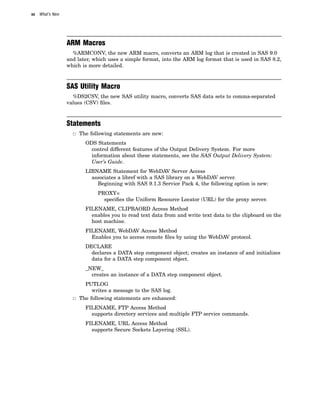
  • 2.
    Here are somerecommended products that we believe you will be interested in. You can click the link to download. Sas 913 Language Reference Dictionary https://ebookbell.com/product/sas-913-language-reference- dictionary-1223480 Sas 913 Language Reference Concepts Sas Publishing https://ebookbell.com/product/sas-913-language-reference-concepts-sas- publishing-982070 Sas 913 Output Delivery System Users Guide Volumes 1 And 2 Publishing Sas Publishing https://ebookbell.com/product/sas-913-output-delivery-system-users- guide-volumes-1-and-2-publishing-sas-publishing-2167408 Sas 913 Intelligence Platform Web Application Administration Guide Third Edition 3rd Edition Sas Publishing https://ebookbell.com/product/sas-913-intelligence-platform-web- application-administration-guide-third-edition-3rd-edition-sas- publishing-2198890
  • 3.
    Sas 9 13 Management Console Users Guide Sas Publishing https://ebookbell.com/product/sas-9-1-3-management-console-users- guide-sas-publishing-996618 Sas 913 Etl Studio Users Guide Sas Publishing https://ebookbell.com/product/sas-913-etl-studio-users-guide-sas- publishing-982068 Sasr 913 Intelligence Platform Security Administration Guide Sas Publishing https://ebookbell.com/product/sasr-913-intelligence-platform-security- administration-guide-sas-publishing-2004206 Sasaccess 913 For Relational Databases Reference 3rd Edition 3rd Edition The Sas Technical Team Writers https://ebookbell.com/product/sasaccess-913-for-relational-databases- reference-3rd-edition-3rd-edition-the-sas-technical-team- writers-2161692 Sas Access 913 Supplement For Mysql Sas Access For Relational Databases The Sas Technical Team Writers https://ebookbell.com/product/sas-access-913-supplement-for-mysql-sas- access-for-relational-databases-the-sas-technical-team-writers-2162690
  • 6.
  • 7.
    The correct bibliographiccitation for this manual is as follows: SAS Institute Inc. 2006. SAS ® 9.1.3 Language Reference: Dictionary, Fifth Edition, Volumes 1-4. Cary, NC: SAS Institute Inc. SAS® 9.1.3 Language Reference: Dictionary, Fifth Edition, Volumes 1-4 Copyright © 2002-2006, SAS Institute Inc., Cary, NC, USA ISBN-13: 978-1-59994-098-4 ISBN-10: 1-59994-098-1 All rights reserved. Produced in the United States of America. For a hard-copy book: No part of this publication may be reproduced, stored in a retrieval system, or transmitted, in any form or by any means, electronic, mechanical, photocopying, or otherwise, without the prior written permission of the publisher, SAS Institute Inc. For a Web download or e-book: Your use of this publication shall be governed by the terms established by the vendor at the time you acquire this publication. U.S. Government Restricted Rights Notice. Use, duplication, or disclosure of this software and related documentation by the U.S. government is subject to the Agreement with SAS Institute and the restrictions set forth in FAR 52.227-19 Commercial Computer Software-Restricted Rights (June 1987). SAS Institute Inc., SAS Campus Drive, Cary, North Carolina 27513. 1st printing, July 2006 2nd printing, August 2006 SAS® Publishing provides a complete selection of books and electronic products to help customers use SAS software to its fullest potential. For more information about our e-books, e-learning products, CDs, and hard-copy books, visit the SAS Publishing Web site at support.sas.com/pubs or call 1-800-727-3228. SAS® and all other SAS Institute Inc. product or service names are registered trademarks or trademarks of SAS Institute Inc. in the USA and other countries. ® indicates USA registration. Other brand and product names are registered trademarks or trademarks of their respective companies.
  • 8.
    Contents What’s New vii Overviewvii SAS System Features viii SAS Language Elements x P A R T 1 Dictionary of Language Elements 1 Chapter 1 4 Introduction to the SAS 9.1 Language Reference: Dictionary 3 The SAS Language Reference: Dictionary 3 Chapter 2 4 SAS Data Set Options 5 Definition of Data Set Options 6 Syntax 6 Using Data Set Options 6 Data Set Options by Category 7 Dictionary 9 Chapter 3 4 Formats 69 Definition of Formats 73 Syntax 74 Using Formats 74 Byte Ordering for Integer Binary Data on Big Endian and Little Endian Platforms 77 Data Conversions and Encodings 79 Working with Packed Decimal and Zoned Decimal Data 80 Formats by Category 84 Dictionary 95 Chapter 4 4 Functions and CALL Routines 259 Definitions of Functions and CALL Routines 268 Syntax 269 Using Functions 271 Using Random-Number Functions and CALL Routines 273 Pattern Matching Using SAS Regular Expressions (RX) and Perl Regular Expressions (PRX) 276 Base SAS Functions for Web Applications 286 Functions and CALL Routines by Category 286 Dictionary 310 References 1005 Chapter 5 4 Informats 1007 Definition of Informats 1010 Syntax 1010 Using Informats 1011
  • 9.
    iv Byte Ordering forInteger Binary Data on Big Endian and Little Endian Platforms 1013 Working with Packed Decimal and Zoned Decimal Data 1015 Informats by Category 1019 Dictionary 1026 Chapter 6 4 SAS ARM Macros 1137 Definition of ARM Macros 1137 Using ARM Macros 1138 Defining User Metrics in ARM Macros 1145 Defining Correlators in ARM Macros 1146 Enabling ARM Macro Execution 1147 Setting the Macro Environment 1149 Using ARM Post-Processing Macros 1150 Troubleshooting Error Messages 1151 ARM Macros by Category 1152 Dictionary 1153 Chapter 7 4 Statements 1171 Definition of Statements 1174 DATA Step Statements 1174 Global Statements 1179 Dictionary 1184 Chapter 8 4 SAS System Options 1549 Definition of System Options 1553 Syntax 1553 Using SAS System Options 1553 Comparisons 1558 SAS System Options by Category 1559 Dictionary 1568 P A R T 2 Appendixes 1763 Appendix 1 4 DATA Step Object Attributes and Methods 1765 The DATA Step Component Object Interface 1765 Dot Notation and DATA Step Component Objects 1766 Dictionary 1767 Appendix 2 4 DATA Step Debugger 1793 Introduction 1794 Basic Usage 1795 Advanced Usage: Using the Macro Facility with the Debugger 1796 Examples 1797 Commands 1809 Dictionary 1810
  • 10.
    v Appendix 3 4SAS Utility Macro 1827 Appendix 4 4 Recommended Reading 1831 Recommended Reading 1831 Index 1833
  • 11.
  • 12.
    vii What’s New Overview New andenhanced features in Base SAS save you time, effort, and system resources by providing faster processing and easier data access and management, more robust analysis, and improved data presentation. 3 By using new SAS system options that enable threading and the use of multiple CPUs, the following SAS procedures take advantage of multi-processing I/O: SORT, SQL, MEANS, TABULATE, and REPORT. 3 The LIBNAME statement now supports secure access to SAS libraries on a WebDAV server. 3 You can now use longer, easier-to-read names for user-created formats and informats. See “Rules for Words and Names in the SAS Language” in SAS Language Reference: Concepts. 3 Two pre-defined component objects for the DATA step enable you to quickly store, search, and retrieve data based on lookup keys. 3 The FILENAME statement now supports directory services, multiple FTP service commands, and Secure Sockets Layering (SSL). 3 The Application Response Measurement (ARM) system enables you to monitor the availability and performance of transactions within and across diverse applications. 3 The Perl regular expression (PRX) functions and CALL routines use a modified version of Perl as a pattern-matching language to enhance search-and-replace operations on text. 3 New character functions search and compare character strings in addition to concatenating character strings. 3 There are several new descriptive statistic functions and mathematical functions. 3 New formats, informats, and functions support international and local values for money, datetime, and Unicode values. All data set options, formats, informats, functions, and system options that relate to national language support are documented in the new SAS National Language Support (NLS): User’s Guide. 3 A new ODS statement enables you to render multiple ODS output formats without re-running a PROC or a DATA step. See the SAS Output Delivery System: User’s Guide.
  • 13.
    viii What’s New Note: 3This section describes the features of Base SAS that are new or enhanced since SAS 8.2. 3 z/OS is the successor to the OS/390 operating system. SAS 9.1 (and later) is supported on both OS/390 and z/OS operating systems and, throughout this document, any reference to z/OS also applies to OS/390, unless otherwise stated. 4 SAS System Features Application Response Measurement (ARM) Application Response Measurement (ARM) enables you to monitor the availability and performance of transactions within and across diverse applications. The SAS ARM interface consists of the implementation of the ARM API as ARM macros and an ARM agent. An ARM agent generates calls to the ARM macros. New ARM system options enable you to manage the ARM environment and to log internal SAS processing transactions. See “Monitoring Performance Using Application Response Measurement (ARM)” in SAS Language Reference: Concepts, “ARM Macros” on page xx, and “System Options” on page xxi. Cross-Environment Data Access (CEDA) CEDA processes SAS files that were created on a different host. This is especially useful if you have upgraded from a 32–bit platform to a 64–bit platform. Messages in the SAS log notify you when CEDA is being used to process a SAS file. See “Processing Data Using Cross-Environment Data Access (CEDA)” in SAS Language Reference: Concepts. DATA Step Object Attributes and Methods SAS now provides two pre-defined component objects for use in a DATA step: the hash object and the hash iterator object. These objects enable you to quickly and efficiently store, search, and retrieve data based on lookup keys. The DATA step component object interface enables you to create and manipulate these component objects by using statements, attributes, and methods. You use the DATA step object dot notation to access the component object’s attributes and methods. The hash and hash iterator objects have one attribute, fourteen methods, and two statements associated with them. See Appendix 1, “DATA Step Object Attributes and Methods,” on page 1765. Engines 3 The default BASE engine in SAS supports longer format and informat names, thread-enabled procedures such as the SORT and SUMMARY procedures, and more than 32,767 variables in a SAS data set. 3 The metadata LIBNAME engine enables you to use metadata in order to access and augment data that is identified by the metadata. The metadata engine
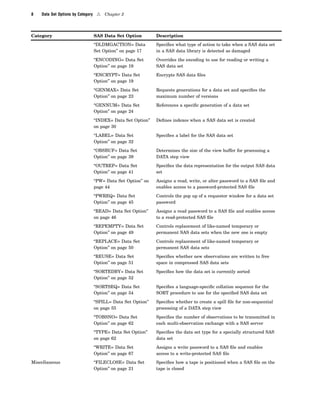
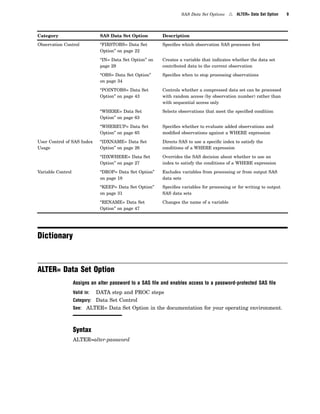
  • 14.
    What’s New ix retrievesinformation about the target SAS data library from metadata objects in a specified SAS Metadata Repository on the SAS Metadata Server. The metadata engine provides a consistent method for accessing many data sources. That is, SAS provides different engines that have different options, behavior, and tuning requirements. By taking advantage of metadata, the necessary information that is required to access data can be created in one central location so that applications can use the metadata engine to access different sources of data, without having to understand the differences and details of each SAS engine. See the SAS Metadata LIBNAME Engine: User’s Guide. 3 The XML LIBNAME engine imports and exports a broader variety of XML documents. The XMLMAP= option specifies a separate XML document that contains specific XMLMap syntax. The XMLMap syntax, Version 1.2, tells the XML engine how to interpret the XML markup in order to successfully import an XML document. See the SAS Metadata LIBNAME Engine: User’s Guide. 3 The new SASEDOC LIBNAME engine enables you to bind output objects that persist in an ODS document. See the SAS Output Delivery System: User’s Guide. 3 The new SAS Information Maps LIBNAME Engine provides a read-only way to access data that is generated from a SAS Information Map and to bring it into a SAS session. After you retrieve the data, you can run almost any SAS procedure against it. See the Base SAS Guide to Information Maps. 3 The new character variable padding (CVP) engine expands character variable lengths, using a specified expansion amount, so that character data truncation does not occur when a file requires transcoding. Character data truncation can occur when the number of bytes for a character in one encoding is different from the number of bytes for the same character in another encoding, such as when a single-byte character set (SBCS) is transcoded to a double-byte character set (DBCS). See the SAS National Language Support (NLS): User’s Guide. Indexing When creating an index that requires sorting, SAS tries to sort the data by using the thread-enabled sort. By dividing the sorting task into separately executable processes, the time that is required to sort the data can be reduced. See the topic “Creating an Index” in Understanding SAS Indexes in SAS Language Reference: Concepts. Integrity Constraints Variables in a SAS data file can now be part of both a primary key (general integrity constraint) and a foreign key (referential integrity constraint). However, there are restrictions when defining a primary key constraint and a foreign key constraint that use the same variables. See the topic “Overlapping Primary Key and Foreign Key Constraints” in Understanding Integrity Constraints in SAS Language Reference: Concepts. Restricted System Options System administrators can restrict system options from being modified by a user. You can use the RESTRICT option in the OPTIONS procedure to list the restricted options. The implementation of restricted options is specific to the operating environment. For details about how to restrict options, see the configuration guide for your operating environment. For information about listing restricted options, see the OPTIONS procedure in the Base SAS Procedures Guide.
  • 15.
    x What’s New SASUtility Macro The SAS utility macro, %DS2CSV, is available now in Base SAS. This macro converts SAS data sets to comma-separated values (CSV) files. Prior to SAS 9.1, this macro was available only for SAS/IntrNet users. Universal Unique Identifiers A Universal Unique Identifier (UUID) is a 128-bit identifier that consists of date and time information, and the IEEE node address of a host. UUIDs are useful when objects such as rows or other components of a SAS application must be uniquely identified. For more information, see “Universal Unique Identifiers” in SAS Language Reference: Concepts. SAS Language Elements Descriptions of the new and enhanced language elements for national language support can be found in “What’s New for SAS 9.0 and 9.1 National Language Support” in the SAS National Language Support (NLS): User’s Guide. Data Set Options 3 The following data set options are new: OBSBUF= determines the size of the view buffer for processing a DATA step view. SPILL= specifies whether to create a spill file for non-sequential processing of a DATA step view. 3 The following data set options are enhanced: BUFNO= supports the same syntax as the BUFNO= system option in order to specify the number of buffers to be allocated for processing a SAS data set. BUFSIZE= supports the same syntax as the BUFSIZE= system option in order to specify the permanent buffer page size for an output SAS data set. FIRSTOBS= supports the same syntax as the FIRSTOBS= system option in order to specify which observation SAS processes first. OBS= supports the same syntax as the OBS= system option in order to specify when to stop processing observations. Formats 3 The maximum length for character format names is increased to 31. The maximum length for numeric format names is increased to 32.
  • 16.
    What’s New xi 3Several formats have been enhanced with default and range values. 3 The following formats are new: MMYY writes date values in the form mmM<yy>yy, where M is the separator and the year is written in either 2 or 4 digits. PERCENTN produces percentages, using a minus sign for negative values. YYMM writes date values in the form <yy>yyMmm, where the year is written in either 2 or 4 digits and M is the separator. YYQ writes date values in the form <yy>yyQq, where the year is written in either 2 or 4 digits, Q is the separator, and q is the quarter of the year. YYQR writes date values in the form <yy>yyQqr, where the year is written in either 2 or 4 digits, Q is the separator, and qr is the quarter of the year expressed in Roman numerals. 3 The PVALUE format now returns missing values that are specified by the MISSING= system option. Functions and CALL Routines New functions and CALL routines include character, mathematical, descriptive statistical, and special functions, and character-string matching functions that can use PERL expressions. 3 The following character functions are new: ANYALNUM searches a character string for an alphanumeric character and returns the first position at which it is found. ANYALPHA searches a character string for an alphabetic character and returns the first position at which it is found. ANYCNTRL searches a character string for a control character and returns the first position at which it is found. ANYDIGIT searches a character string for a digit and returns the first position at which it is found. ANYFIRST searches a character string for a character that is valid as the first character in a SAS variable name under VALIDVARNAME=V7, and returns the first position at which that character is found. ANYGRAPH searches a character string for a graphical character and returns the first position at which it is found. ANYLOWER searches a character string for a lowercase letter and returns the first position at which it is found.
  • 17.
    xii What’s New ANYNAME searchesa character string for a character that is valid in a SAS variable name under VALIDVARNAME=V7, and returns the first position at which that character is found. ANYPRINT searches a character string for a printable character and returns the first position at which it is found. ANYPUNCT searches a character string for a punctuation character and returns the first position at which it is found. ANYSPACE searches a character string for a white-space character (blank, horizontal tab, vertical tab, carriage return, line feed, or form feed), and returns the first position at which it is found. ANYUPPER searches a character string for an uppercase letter and returns the first position at which it is found. ANYXDIGIT searches a character string for a hexadecimal character that represents a digit and returns the first position at which that character is found. CAT concatenates character strings without removing leading or trailing blanks. CATS concatenates character strings and removes leading and trailing blanks. CATT concatenates character strings and removes trailing blanks only. CATX concatenates character strings, removes leading and trailing blanks, and inserts separators. CHOOSEC returns a character value that represents the results of choosing from a list of arguments. CHOOSEN returns a numeric value that represents the results of choosing from a list of arguments. COMPARE returns the position of the left-most character by which two strings differ, or returns 0 if there is no difference. COMPGED compares two strings by computing the generalized edit distance. COMPLEV compares two strings by computing the Levenshtein edit distance. COUNT counts the number of times that a specific substring of characters appears within a character string that you specify.
  • 18.
    What’s New xiii COUNTC countsthe number of specific characters that either appear or do not appear within a character string that you specify. FIND searches for a specific substring of characters within a character string that you specify. FINDC searches for specific characters that either appear or do not appear within a character string that you specify. IFC returns a character value that matches an expression. IFN returns a numeric value that matches an expression. LENGTHC returns the length of a character string, including trailing blanks. LENGTHM returns the amount of memory (in bytes) that is allocated for a character string. LENGTHN returns the length of a non-blank character string, excluding trailing blanks, and returns 0 for a blank character string. NLITERAL converts a character string that you specify to a SAS name literal (n-literal). NOTALNUM searches a character string for a non-alphanumeric character and returns the first position at which it is found. NOTALPHA searches a character string for a non-alphabetic character and returns the first position at which it is found. NOTCNTRL searches a character string for a character that is not a control character and returns the first position at which it is found. NOTDIGIT searches a character string for any character that is not a digit and returns the first position at which that character is found. NOTFIRST searches a character string for an invalid first character in a SAS variable name under VALIDVARNAME=V7, and returns the first position at which that character is found. NOTGRAPH searches a character string for a non-graphical character and returns the first position at which it is found. NOTLOWER searches a character string for a character that is not a lowercase letter and returns the first position at which that character is found.
  • 19.
    xiv What’s New NOTNAME searchesa character string for an invalid character in a SAS variable name under VALIDVARNAME=V7, and returns the first position at which that character is found. NOTPRINT searches a character string for a non-printable character and returns the first position at which it is found. NOTPUNCT searches a character string for a character that is not a punctuation character and returns the first position at which it is found. NOTSPACE searches a character string for a character that is not a white-space character (blank, horizontal tab, vertical tab, carriage return, line feed, or form feed), and returns the first position at which it is found. NOTUPPER searches a character string for a character that is not an uppercase letter and returns the first position at which that character is found. NOTXDIGIT searches a character string for a character that is not a hexadecimal digit and returns the first position at which that character is found. NVALID checks a character string for validity for use as a SAS variable name in a SAS statement. PROPCASE converts all words in an argument to proper case. PRXCHANGE performs a pattern-matching replacement. PRXPOSN returns the value for a capture buffer. SCANQ returns the n th word from a character expression and ignores delimiters that are enclosed in quotation marks. STRIP returns a character string with all leading and trailing blanks removed. SUBPAD returns a substring that has a length you specify, using blank padding if necessary. SUBSTRN returns a substring that allows a result with a length of 0.
  • 20.
    What’s New xv 3The following descriptive statistics functions are new: GEOMEAN returns the geometric mean. GEOMEANZ returns the geometric mean without fuzzing the values of the arguments that are approximately 0. HARMEAN returns the harmonic mean. HARMEANZ returns the harmonic mean without fuzzing the values of the arguments that are approximately 0. IQR returns the interquartile range. LARGEST returns the k th largest non-missing value. MAD returns the median absolute deviation from the median. MEDIAN computes median values. MODZ returns the remainder from the division of the first argument by the second argument; uses 0 fuzzing. PCTL computes percentiles. RMS returns the root mean square. SMALLEST returns the k th smallest non-missing value. 3 The following External Files function is new: DCREATE creates an external directory. 3 The following macro functions are new: SYMEXIST indicates the existence of a macro variable. SYMGLOBL indicates whether a macro variable has global scope in the DATA step during DATA step execution. SYMLOCAL indicates whether a macro variable has local scope in the DATA step during DATA step execution. 3 The following mathematical functions are new: BETA returns the value of the beta function. COALESCE returns the first non-missing value from a list of numeric arguments.
  • 21.
    xvi What’s New COALESCEC returnsthe first non-missing value from a list of character arguments. LOGBETA returns the logarithm of the beta function. 3 The following probability function is new: LOGCDF returns the logarithm of a left cumulative distribution function. 3 The following quantile function is new: QUANTILE returns the quantile from the specified distribution. 3 The following special function is new: UUIDGEN returns the short or the binary form of a Universal Unique Identifier (UUID). 3 The following state and ZIP code function is new: ZIPCITY returns a city name and the two-character postal code that corresponds to a ZIP code. 3 The following trigonometric function is new: ATAN2 returns the arc tangent of two numeric variables. 3 The following truncation functions are new: CEILZ returns the smallest integer that is greater than or equal to the argument; uses 0 fuzzing. FLOORZ returns the largest integer that is less than or equal to the argument; uses 0 fuzzing. INTZ returns the integer portion of the argument; uses 0 fuzzing. ROUND rounds the first argument to the nearest multiple of the second argument, or to the nearest integer when the second argument is omitted. ROUNDE rounds the first argument to the nearest multiple of the second argument, and returns an even multiple when the first argument is halfway between the two nearest multiples. ROUNDZ rounds the first argument to the nearest multiple of the second argument; uses 0 fuzzing.
  • 22.
    What’s New xvii 3The following variable information functions are new: VVALUE returns the formatted value that is associated with the variable that you specify. VVALUEX returns the formatted value that is associated with the argument that you specify. 3 Using Perl regular expression (PRX) functions and CALL routines is new. The following PRX functions are new. For more information, see “Pattern Matching Using SAS Regular Expressions (RX) and Perl Regular Expressions (PRX)” on page 276. PRXMATCH searches for a pattern match and returns the position at which the pattern is found. PRXPAREN returns the last bracket match for which there is a match in a pattern. PRXPARSE compiles a Perl regular expression that can be used for pattern-matching a character value. CALL PRXCHANGE performs a pattern-matching substitution. CALL PRXDEBUG enables Perl regular expressions in a DATA step to send debug output to the SAS log. CALL PRXFREE frees unneeded memory that was allocated for a Perl regular expression. CALL PRXNEXT returns the position and length of a substring that matches a pattern and iterates over multiple matches within one string. CALL PRXPOSN returns the start position and length for a capture buffer. CALL PRXSUBSTR returns the position and length of a substring that matches a pattern. 3 The following CALL routines are new: CALL ALLPERM generates all permutations of the values of several variables. CALL CATS concatenates character strings and removes leading and trailing blanks. CALL CATT concatenates character strings and removes trailing blanks only. CALL CATX concatenates character strings, removes leading and trailing blanks, and inserts separators. CALL COMPCOST sets the costs of operations for later use by the COMPGED function.
  • 23.
    xviii What’s New CALLLOGISTIC returns the logistic value of each argument. CALL MISSING assigns a missing value to specified character or numeric variables. CALL RANPERK randomly permutes the values of the arguments and returns a permutation of k out of n values. CALL RANPERM randomly permutes the values of the arguments. CALL SCAN returns the position and length of a given word in a character expression. CALL SCANQ returns the position and length of a given word in a character expression, and ignores delimiters that are enclosed in quotation marks. CALL SOFTMAX returns the softmax value for each argument. CALL STDIZE standardizes the values of one or more variables. CALL STREAMINIT specifies a seed value to use for subsequent random number generation by the RAND function. CALL SYMPUTX assigns a value to a macro variable and removes both leading and trailing blanks. CALL TANH returns the hyperbolic tangent of each argument. CALL VNEXT returns the name, type, and length of a variable that is used in a DATA step.
  • 24.
    What’s New xix 3The following functions are enhanced: COMPRESS accepts a third optional argument that can modify the characters in the second argument. EXIST accepts all SAS data library type members. A third optional argument enables you to specify a generation data set number. INDEXW accepts a third optional argument that enables you to use delimiters for inter-word boundaries. accepts an argument that enables you to use a Perl regular expression. SUBSTR (left of=) assigns a length of 8 to an undeclared variable when the function is compiled. Informats 3 The maximum length for character informat names is increased to 30. The maximum length for numeric informat names is increased to 31. 3 The following informats are new: ANYDTDTE extracts date values from DATE, DATETIME, DDMMYY, JULIAN, MMDDYY, MONYY, TIME, or YYQ informat values. ANYDTDTM extracts datetime values from DATE, DATETIME, DDMMYY, JULIAN, MMDDYY, MONYY, TIME, or YYQ informat values. ANYDTTME extracts time values from DATE, DATETIME, DDMMYY, JULIAN, MMDDYY, MONYY, TIME, or YYQ informat values. STIMERw. reads time values and determines whether the values are hours, minutes, or seconds; reads the output of the STIMER system option.
  • 25.
    xx What’s New ARMMacros %ARMCONV, the new ARM macro, converts an ARM log that is created in SAS 9.0 and later, which uses a simple format, into the ARM log format that is used in SAS 8.2, which is more detailed. SAS Utility Macro %DS2CSV, the new SAS utility macro, converts SAS data sets to comma-separated values (CSV) files. Statements 3 The following statements are new: ODS Statements control different features of the Output Delivery System. For more information about these statements, see the SAS Output Delivery System: User’s Guide. LIBNAME Statement for WebDAV Server Access associates a libref with a SAS library on a WebDAV server. Beginning with SAS 9.1.3 Service Pack 4, the following option is new: PROXY= specifies the Uniform Resource Locator (URL) for the proxy server. FILENAME, CLIPBAORD Access Method enables you to read text data from and write text data to the clipboard on the host machine. FILENAME, WebDAV Access Method Enables you to access remote files by using the WebDAV protocol. DECLARE declares a DATA step component object; creates an instance of and initializes data for a DATA step component object. _NEW_ creates an instance of a DATA step component object. PUTLOG writes a message to the SAS log. 3 The following statements are enhanced: FILENAME, FTP Access Method supports directory services and multiple FTP service commands. FILENAME, URL Access Method supports Secure Sockets Layering (SSL).
  • 26.
    What’s New xxi LIBNAMEstatement the following options are new: COMPRESS= controls the compression of observations in output SAS data sets in a SAS data library. CVPBYTES= specifies the number of bytes to use in order to expand character variable lengths when processing a SAS data set that requires transcoding. CVPENGINE= specifies which engine to use in order to process character variable lengths in a SAS data set that requires transcoding. CVPMULTIPLIER= specifies the multiplier value to use in order to expand character variable lengths when processing a SAS data set that requires transcoding. INENCODING= overrides the encoding for input processing. OUTENCODING= overrides the encoding for output processing. System Options 3 The following system options are new: ARMAGENT= specifies an ARM agent, which is an executable module that contains a vendor’s implementation of the ARM API. ARMLOC= specifies the location of the ARM log. ARMSUBSYS= enables and disables the ARM subsystems that determine which internal SAS processing transactions should be logged. AUTHPROVIDERDOMAIN= associates a domain suffix with an authentication provider. AUTOSAVELOC= specifies the location of the Program Editor autosave file. BYSORTED specifies whether observations in one or more data sets are sorted in alphabetical or numerical order or are grouped in another logical order. CMPLIB= specifies one or more SAS catalogs that contain compiler subroutines that should be included during program compilation. CMPOPT= specifies which type of code generation optimizations should be used in the SAS language compiler. CPUCOUNT= specifies the number of processors that the thread-enabled applications should assume are available for concurrent processing.
  • 27.
    xxii What’s New DMSLOGSIZE= specifiesthe maximum number of rows that can be displayed in the Log window in the SAS windowing environment. DMSOUTSIZE= specifies the maximum number of rows that can be displayed in the Output window in the SAS windowing environment . DMSSYNCHK enables syntax checking for multiple steps in the SAS windowing environment. DTRESET updates the date and the time in the SAS log and in the listing file. EMAILAUTHPROTOCOL= specifies the authentication protocol for SMTP e-mail. EMAILID= specifies the identity of the individual who is sending e-mail from within SAS. EMAILPW= specifies your e-mail login password. ERRORBYABEND specifies how SAS responds to BY-group error conditions. FONTSLOC= specifies the location that contains the SAS fonts that are loaded by a printer to use with Universal Printing. HELPENCMD specifies whether SAS uses the English version or the translated version of the keyword list for the command–line Help. IBUFSIZE= specifies the buffer page size for an index file. LOGPARM= controls when SAS log files are opened and closed and (in conjunction with the LOG= system option) how they are named. METAAUTORESOURCES= identifies which resources should be assigned at SAS initialization. METACONNECT= identifies which named connection from the metadata user profiles should be used as the default value for logging into the SAS Metadata Server. METAENCRYPTALT= specifies which type of encryption should be used when communicating with a SAS Metadata Server. METAENCRYPTLEVEL= specifies what should be encrypted when communicating with a SAS Metadata Server. METAID= identifies the current SAS version that is installed on the SAS Metadata Server. METAPASSWORD= specifies the default password for the SAS Metadata Server.
  • 28.
    What’s New xxiii METAPORT= specifiesthe TCP port for the SAS Metadata Server. METAPROFILE= specifies which file contains the SAS Metadata Server user profiles. METAPROTOCOL= specifies which network protocol should be used for communicating with the SAS Metadata Server. METAREPOSITORY= specifies which default SAS Metadata Repository should be used on the SAS Metadata Server. METASERVER= specifies the address of the SAS Metadata Server. METAUSER= specifies the default user ID for logging on to the SAS Metadata Server. PAGEBREAKINITIAL begins the SAS log and listing files on a new page. QUOTELENMAX specifies that SAS write a warning to the SAS log about the maximum length that can be used for strings that are enclosed in quotation marks. SORTEQUALS controls the order in which PROC SORT arranges observations that have identical BY values in the output data set. SYSPRINTFONT specifies the font for the current default printer. SYNTAXCHECK specifies whether to validate SAS program syntax. TERMSTMT= specifies which SAS statements should be executed when the SAS session is terminated. TEXTURELOC= specifies the location of textures and images that are used by ODS styles. THREADS specifies that SAS use threaded processing if it is available. TOOLSMENU specifies whether to include or to suppress the Tools menu in windows that display SAS menus. UUIDCOUNT specifies the number of UUIDs that should be acquired each time the UUID Generator Daemon is used. UUIDGENHOST identifies the host and the port for the UUID Generator Daemon. UTILLOC= specifies a set of file system locations in which applications can store utility files.
  • 29.
    xxiv What’s New VALIDFMTNAME= specifiesthe length of format and informat names that can be used when creating new SAS data sets and format catalogs. VIEWMENU specifies whether to include or to suppress the View menu in windows that display menus. V6CREATEUPDATE= controls or monitors the creation of new, version 6 SAS data sets or the updating of existing, version 6 SAS data sets. 3 The following system options have been enhanced: CMPOPT= specifies which type of code generation optimizations should be used in the SAS language compiler. SORTSIZE= specifies the amount of memory that is available when using the SORT procedure.
  • 30.
    1 P A RT 1 Dictionary of Language Elements Chapter 1. . . . . . . . . .Introduction to the SAS 9.1 Language Reference: Dictionary 3 Chapter 2. . . . . . . . . .SAS Data Set Options 5 Chapter 3. . . . . . . . . .Formats 69 Chapter 4. . . . . . . . . .Functions and CALL Routines 259 Chapter 5. . . . . . . . . .Informats 1007 Chapter 6. . . . . . . . . .SAS ARM Macros 1137 Chapter 7. . . . . . . . . .Statements 1171 Chapter 8. . . . . . . . . .SAS System Options 1549
  • 31.
  • 32.
    3 C H AP T E R 1 Introduction to the SAS 9.1 Language Reference: Dictionary The SAS Language Reference: Dictionary 3 The SAS Language Reference: Dictionary SAS Language Reference: Dictionary provides detailed reference information for the major language elements of Base SAS software: 3 data set options 3 formats 3 functions and CALL routines 3 informats 3 Application Response Measurement (ARM) macros 3 statements 3 SAS system options. It also includes the following four appendixes: 3 DATA Step Object Attributes and Methods 3 ENCODING= values for SAS commands and statements 3 DATA step debugger 3 Recommended reading. For extensive conceptual information about the SAS System and the SAS language, including the DATA step, see SAS Language Reference: Concepts.
  • 33.
  • 34.
    5 C H AP T E R 2 SAS Data Set Options Definition of Data Set Options 6 Syntax 6 Using Data Set Options 6 Using Data Set Options with Input or Output SAS Data Sets 6 How Data Set Options Interact with System Options 7 Data Set Options by Category 7 Dictionary 9 ALTER= Data Set Option 9 BUFNO= Data Set Option 10 BUFSIZE= Data Set Option 12 CNTLLEV= Data Set Option 13 COMPRESS= Data Set Option 15 DLDMGACTION= Data Set Option 17 DROP= Data Set Option 18 ENCODING= Data Set Option 19 ENCRYPT= Data Set Option 19 FILECLOSE= Data Set Option 21 FIRSTOBS= Data Set Option 22 GENMAX= Data Set Option 23 GENNUM= Data Set Option 24 IDXNAME= Data Set Option 26 IDXWHERE= Data Set Option 27 IN= Data Set Option 29 INDEX= Data Set Option 30 KEEP= Data Set Option 31 LABEL= Data Set Option 32 OBS= Data Set Option 34 OBSBUF= Data Set Option 39 OUTREP= Data Set Option 41 POINTOBS= Data Set Option 43 PW= Data Set Option 44 PWREQ= Data Set Option 45 READ= Data Set Option 46 RENAME= Data Set Option 47 REPEMPTY= Data Set Option 49 REPLACE= Data Set Option 50 REUSE= Data Set Option 51 SORTEDBY= Data Set Option 52 SORTSEQ= Data Set Option 54 SPILL= Data Set Option 55 TOBSNO= Data Set Option 62
  • 35.
    6 Definition ofData Set Options 4 Chapter 2 TYPE= Data Set Option 62 WHERE= Data Set Option 63 WHEREUP= Data Set Option 65 WRITE= Data Set Option 67 Definition of Data Set Options Data set options specify actions that apply only to the SAS data set with which they appear. They let you perform such operations as 3 renaming variables 3 selecting only the first or last n observations for processing 3 dropping variables from processing or from the output data set 3 specifying a password for a data set. Syntax Specify a data set option in parentheses after a SAS data set name. To specify several data set options, separate them with spaces. (option-1=value-1<...option-n=value-n>) These examples show data set options in SAS statements: 3 data scores(keep=team game1 game2 game3); 3 proc print data=new(drop=year); 3 set old(rename=(date=Start_Date)); Using Data Set Options Using Data Set Options with Input or Output SAS Data Sets Most SAS data set options can apply to either input or output SAS data sets in DATA steps or procedure (PROC) steps. If a data set option is associated with an input data set, the action applies to the data set that is being read. If the option appears in the DATA statement or after an output data set specification in a PROC step, SAS applies the action to the output data set. In the DATA step, data set options for output data sets must appear in the DATA statement, not in any OUTPUT statements that may be present. Some data set options, such as COMPRESS=, are meaningful only when you create a SAS data set because they set attributes that exist for the life of the data set. To change or cancel most data set options, you must re-create the data set. You can change other options (such as PW= and LABEL=) with PROC DATASETS. For more information, see the “DATASETS Procedure” in Base SAS Procedures Guide. When data set options appear on both input and output data sets in the same DATA or PROC step, SAS applies data set options to input data sets before it evaluates programming statements or before it applies data set options to output data sets. Likewise, data set options that are specified for the data set being created are applied after programming statements are processed. For example, when using the RENAME= data set option, the new names are not associated with the variables until the DATA step ends.
  • 36.
    SAS Data SetOptions 4 Data Set Options by Category 7 In some instances, data set options conflict when they are used in the same statement. For example, you cannot specify both the DROP= and KEEP= data set options for the same variable in the same statement. Timing can also be an issue in some cases. For example, if using KEEP= and RENAME= on a data set specified in the SET statement, KEEP= needs to use the original variable names, because SAS will process KEEP= before the data set is read. The new names specified in RENAME= will apply to the programming statements that follow the SET statement. How Data Set Options Interact with System Options Many system options and data set options share the same name and have the same function. System options remain in effect for all DATA and PROC steps in a SAS job or session unless they are respecified. The data set option overrides the system option for the data set in the step in which it appears. In this example, the OBS= system option in the OPTIONS statement specifies that only the first 100 observations will be processed from any data set within the SAS job. The OBS= data set option in the SET statement, however, overrides the system option for data set TWO and specifies that only the first 5 observations will be read from data set TWO. The PROC PRINT step prints the data set FINAL. This data set contains the first 5 observations from data set TWO, followed by the first 100 observations from data set THREE: options obs=100; data final; set two(obs=5) three; run; proc print data=final; run; Data Set Options by Category Table 2.1 Category SAS Data Set Option Description Data Set Control “ALTER= Data Set Option” on page 9 Assigns an alter password to a SAS file and enables access to a password-protected SAS file “BUFNO= Data Set Option” on page 10 Specifies the number of buffers to be allocated for processing a SAS data set “BUFSIZE= Data Set Option” on page 12 Specifies the permanent buffer page size for an output SAS data set “CNTLLEV= Data Set Option” on page 13 Specifies the level of shared access to a SAS data set “COMPRESS= Data Set Option” on page 15 Controls the compression of observations in an output SAS data set
  • 37.
    8 Data SetOptions by Category 4 Chapter 2 Category SAS Data Set Option Description “DLDMGACTION= Data Set Option” on page 17 Specifies what type of action to take when a SAS data set in a SAS data library is detected as damaged “ENCODING= Data Set Option” on page 19 Overrides the encoding to use for reading or writing a SAS data set “ENCRYPT= Data Set Option” on page 19 Encrypts SAS data files “GENMAX= Data Set Option” on page 23 Requests generations for a data set and specifies the maximum number of versions “GENNUM= Data Set Option” on page 24 References a specific generation of a data set “INDEX= Data Set Option” on page 30 Defines indexes when a SAS data set is created “LABEL= Data Set Option” on page 32 Specifies a label for the SAS data set “OBSBUF= Data Set Option” on page 39 Determines the size of the view buffer for processing a DATA step view “OUTREP= Data Set Option” on page 41 Specifies the data representation for the output SAS data set “PW= Data Set Option” on page 44 Assigns a read, write, or alter password to a SAS file and enables access to a password-protected SAS file “PWREQ= Data Set Option” on page 45 Controls the pop up of a requestor window for a data set password “READ= Data Set Option” on page 46 Assigns a read password to a SAS file and enables access to a read-protected SAS file “REPEMPTY= Data Set Option” on page 49 Controls replacement of like-named temporary or permanent SAS data sets when the new one is empty “REPLACE= Data Set Option” on page 50 Controls replacement of like-named temporary or permanent SAS data sets “REUSE= Data Set Option” on page 51 Specifies whether new observations are written to free space in compressed SAS data sets “SORTEDBY= Data Set Option” on page 52 Specifies how the data set is currently sorted “SORTSEQ= Data Set Option” on page 54 Specifies a language-specific collation sequence for the SORT procedure to use for the specified SAS data set “SPILL= Data Set Option” on page 55 Specifies whether to create a spill file for non-sequential processing of a DATA step view “TOBSNO= Data Set Option” on page 62 Specifies the number of observations to be transmitted in each multi-observation exchange with a SAS server “TYPE= Data Set Option” on page 62 Specifies the data set type for a specially structured SAS data set “WRITE= Data Set Option” on page 67 Assigns a write password to a SAS file and enables access to a write-protected SAS file Miscellaneous “FILECLOSE= Data Set Option” on page 21 Specifies how a tape is positioned when a SAS file on the tape is closed
  • 38.
    SAS Data SetOptions 4 ALTER= Data Set Option 9 Category SAS Data Set Option Description Observation Control “FIRSTOBS= Data Set Option” on page 22 Specifies which observation SAS processes first “IN= Data Set Option” on page 29 Creates a variable that indicates whether the data set contributed data to the current observation “OBS= Data Set Option” on page 34 Specifies when to stop processing observations “POINTOBS= Data Set Option” on page 43 Controls whether a compressed data set can be processed with random access (by observation number) rather than with sequential access only “WHERE= Data Set Option” on page 63 Selects observations that meet the specified condition “WHEREUP= Data Set Option” on page 65 Specifies whether to evaluate added observations and modified observations against a WHERE expression User Control of SAS Index Usage “IDXNAME= Data Set Option” on page 26 Directs SAS to use a specific index to satisfy the conditions of a WHERE expression “IDXWHERE= Data Set Option” on page 27 Overrides the SAS decision about whether to use an index to satisfy the conditions of a WHERE expression Variable Control “DROP= Data Set Option” on page 18 Excludes variables from processing or from output SAS data sets “KEEP= Data Set Option” on page 31 Specifies variables for processing or for writing to output SAS data sets “RENAME= Data Set Option” on page 47 Changes the name of a variable Dictionary ALTER= Data Set Option Assigns an alter password to a SAS file and enables access to a password-protected SAS file Valid in: DATA step and PROC steps Category: Data Set Control See: ALTER= Data Set Option in the documentation for your operating environment. Syntax ALTER=alter-password
  • 39.
    10 BUFNO= DataSet Option 4 Chapter 2 Syntax Description alter-password must be a valid SAS name. See “Rules for Words and Names in the SAS Language” in SAS Language Reference: Concepts. Details The ALTER= option applies to all types of SAS files except catalogs. You can use this option to assign an alter-password to a SAS file or to access a read-protected, write-protected, or alter-protected SAS file. When replacing a SAS data set that is alter protected, the new data set inherits the alter password. To change the alter password for the new data set, use the MODIFY statement in the DATASETS procedure. Note: A SAS password does not control access to a SAS file beyond the SAS system. You should use the operating system-supplied utilities and file-system security controls in order to control access to SAS files outside of SAS. 4 See Also Data Set Options: “ENCRYPT= Data Set Option” on page 19 “PW= Data Set Option” on page 44 “READ= Data Set Option” on page 46 “WRITE= Data Set Option” on page 67 “File Protection” in SAS Language Reference: Concepts “Manipulating Passwords” in “The DATASETS Procedure” in Base SAS Procedures Guide BUFNO= Data Set Option Specifies the number of buffers to be allocated for processing a SAS data set Valid in: DATA step and PROC steps Category: Data Set Control Syntax BUFNO= n | nK | hexX | MIN | MAX
  • 40.
    SAS Data SetOptions 4 BUFNO= Data Set Option 11 Syntax Description n | nK specifies the number of buffers in multiples of 1 (bytes); 1,024 (kilobytes). For example, a value of 8 specifies 8 buffers, and a value of 1k specifies 1024 buffers. hex specifies the number of buffers as a hexadecimal value. You must specify the value beginning with a number (0-9), followed by an X. For example, the value 2dx sets the number of buffers to 45 buffers. MIN sets the minimum number of buffers to 0, which causes SAS to use the minimum optimal value for the operating environment. This is the default. MAX sets the number of buffers to the maximum possible number in your operating environment, up to the largest four-byte, signed integer, which is 2 31 -1, or approximately 2 billion. Details The buffer number is not a permanent attribute of the data set; it is valid only for the current SAS session or job. BUFNO= applies to SAS data sets that are opened for input, output, or update. A larger number of buffers can speed up execution time by limiting the number of input and output (I/O) operations that are required for a particular SAS data set. However, the improvement in execution time comes at the expense of increased memory consumption. To reduce I/O operations on a small data set as well as speed execution time, allocate one buffer for each page of data to be processed. This technique is most effective if you read the same observations several times during processing. Comparisons 3 If the BUFNO= data set option is not specified, then the value of the BUFNO= system option is used. If both are specified in the same SAS session, the value specified for the BUFNO= data set option overrides the value specified for the BUFNO= system option. 3 To request that SAS allocate the number of buffers based on the number of data set pages and index file pages, use the SASFILE global statement. See Also Data Set Options: “BUFSIZE= Data Set Option” on page 12 System Options: “BUFNO= System Option” on page 1594 Statements: “SASFILE Statement” on page 1495
  • 41.
    12 BUFSIZE= DataSet Option 4 Chapter 2 BUFSIZE= Data Set Option Specifies the permanent buffer page size for an output SAS data set Valid in: DATA step and PROC steps Category: Data Set Control Restriction: Use with output data sets only. See: BUFSIZE= Data Set Option in the documentation for your operating environment. Syntax BUFSIZE= n | nK | nM | nG | hexX | MAX Syntax Description n | nK | nM | nG specifies the page size in multiples of 1 (bytes); 1,024 (kilobytes); 1,048,576 (megabytes); or 1,073,741,824 (gigabytes). For example, a value of 8 specifies a page size of 8 bytes, and a value of 4k specifies a page size of 4096 bytes. The default is 0, which causes SAS to use the minimum optimal page size for the operating environment. hexX specifies the page size as a hexadecimal value. You must specify the value beginning with a number (0-9), followed by an X. For example, the value 2dx sets the page size to 45 bytes. MAX sets the page size to the maximum possible number in your operating environment, up to the largest four-byte, signed integer, which is 2 31 -1, or approximately 2 billion bytes. Details The page size is the amount of data that can be transferred for a single I/O operation to one buffer. The page size is a permanent attribute of the data set and is used when the data set is processed. A larger page size can speed up execution time by reducing the number of times SAS has to read from or write to the storage medium. However, the improvement in execution time comes at the cost of increased memory consumption. To change the page size, use a DATA step to copy the data set and either specify a new page or use the SAS default. To reset the page size to the default value in your operating environment, use BUFSIZE=0. Note: If you use the COPY procedure to copy a data set to another library that is allocated with a different engine, the specified page size of the data set is not retained. 4 Operating Environment Information: The default value for BUFSIZE= is determined by your operating environment and is set to optimize sequential access. To improve performance for direct (random) access, you should change the value for BUFSIZE=.
  • 42.
    SAS Data SetOptions 4 CNTLLEV= Data Set Option 13 For the default setting and possible settings for direct access, see the BUFSIZE= data set option in the SAS documentation for your operating environment. 4 Comparisons If the BUFSIZE= data set option is not specified, then the value of the BUFSIZE= system option is used. If both are specified in the same SAS session, the BUFSIZE= data set option overrides the value specified for the BUFSIZE= system option. See Also Data Set Options: “BUFNO= Data Set Option” on page 10 System Options: “BUFSIZE= System Option” on page 1596 CNTLLEV= Data Set Option Specifies the level of shared access to a SAS data set Valid in: DATA step and PROC steps Category: Data Set Control Restriction: Specify for input data sets only. Syntax CNTLLEV=LIB | MEM | REC Syntax Description LIB specifies that concurrent access is controlled at the library level. Library-level control restricts concurrent access to only one update process to the library. MEM specifies that concurrent access is controlled at the SAS data set (member) level. Member-level control restricts concurrent access to only one update or output process to the SAS data set. If the data set is open for an update or output process, then no other operation can access the data set. If the data set is open for an input process, then other concurrent input processes are allowed but no update or output process is allowed. REC specifies that concurrent access is controlled at the observation (record) level. Record-level control allows more than one update access to the same SAS data set, but it denies concurrent update of the same observation.
  • 43.
    14 CNTLLEV= DataSet Option 4 Chapter 2 Details The CNTLLEV= option specifies the level at which shared update access to a SAS data set is denied. A SAS data set can be opened concurrently by more than one SAS session or by more than one statement, window, or procedure within a single session. By default, SAS procedures permit the greatest degree of concurrent access possible while they guarantee the integrity of the data and the data analysis. Therefore, you do not normally use the CNTLLEV= data set option. Use this option when 3 your application controls the access to the data, such as in SAS Component Language (SCL), SAS/IML software, or DATA step programming 3 you access data through an interface engine that does not provide member-level control of the data. If you use CNTLLEV=REC and the SAS procedure needs member-level control for integrity of the data analysis, SAS prints a warning to the SAS log that inaccurate or unpredictable results can occur if the data are updated by another process during the analysis. Examples Example 1: Changing the Shared Access Level In the following example, the first SET statement includes the CNTLLEV= data set option in order to override the default level of shared access from member-level control to record-level control. The second SET statement opens the SAS data set with the default member-level control. set datalib.fuel (cntllev=rec) point=obsnum; . . . set datalib.fuel; by area;
  • 44.
    SAS Data SetOptions 4 COMPRESS= Data Set Option 15 COMPRESS= Data Set Option Controls the compression of observations in an output SAS data set Valid in: DATA step and PROC steps Category: Data Set Control Restriction: Use with output data sets only. Syntax COMPRESS=NO | YES | CHAR | BINARY Syntax Description NO specifies that the observations in a newly created SAS data set are uncompressed (fixed-length records). YES | CHAR specifies that the observations in a newly created SAS data set are compressed (variable-length records) by SAS using RLE (Run Length Encoding). RLE compresses observations by reducing repeated consecutive characters (including blanks) to two-byte or three-byte representations. Alias: ON Tip: Use this compression algorithm for character data. Note: COMPRESS=CHAR is accepted by Version 7 and later versions. 4 BINARY specifies that the observations in a newly created SAS data set are compressed (variable-length records) by SAS using RDC (Ross Data Compression). RDC combines run-length encoding and sliding-window compression to compress the file. Tip: This method is highly effective for compressing medium to large (several hundred bytes or larger) blocks of binary data (numeric variables). Because the compression function operates on a single record at a time, the record length needs to be several hundred bytes or larger for effective compression.
  • 45.
    16 COMPRESS= DataSet Option 4 Chapter 2 Details Compressing a file is a process that reduces the number of bytes required to represent each observation. Advantages of compressing a file include reduced storage requirements for the file and fewer I/O operations necessary to read or write to the data during processing. However, more CPU resources are required to read a compressed file (because of the overhead of uncompressing each observation), and there are situations where the resulting file size might increase rather than decrease. Use the COMPRESS= data set option to compress an individual file. Specify the option for output data sets only—that is, data sets named in the DATA statement of a DATA step or in the OUT= option of a SAS procedure. Use the COMPRESS= data set option only when you are creating a SAS data file (member type DATA). You cannot compress SAS views, because they contain no data. After a file is compressed, the setting is a permanent attribute of the file, which means that to change the setting, you must re-create the file. That is, to uncompress a file, specify COMPRESS=NO for a DATA step that copies the compressed file. Comparisons The COMPRESS= data set option overrides the COMPRESS= option on the LIBNAME statement and the COMPRESS= system option. The data set option POINTOBS=YES, which is the default, determines that a compressed data set can be processed with random access (by observation number) rather than sequential access. With random access, you can specify an observation number in the FSEDIT procedure and the POINT= option in the SET and MODIFY statements. When you create a compressed file, you can also specify REUSE=YES (as a data set option or system option) in order to track and reuse space. With REUSE=YES, new observations are inserted in space freed when other observations are updated or deleted. When the default REUSE=NO is in effect, new observations are appended to the existing file. POINTOBS=YES and REUSE=YES are mutually exclusive—that is, they cannot be used together. REUSE=YES takes precedence over POINTOBS=YES; that is, if you set REUSE=YES, SAS automatically sets POINTOBS=NO. For example, the following statement results in a compressed data file that cannot be processed with random access: The TAPE engine supports the COMPRESS= data set option, but the engine does not support the COMPRESS= system option. The XPORT engine does not support compression.
  • 46.
    SAS Data SetOptions 4 DLDMGACTION= Data Set Option 17 See Also Data Set Options: “POINTOBS= Data Set Option” on page 43 “REUSE= Data Set Option” on page 51 Statements: “LIBNAME Statement” on page 1381 System Options: “COMPRESS= System Option” on page 1614 “REUSE= System Option” on page 1715 “Compressing Data Files” in SAS Language Reference: Concepts DLDMGACTION= Data Set Option Specifies what type of action to take when a SAS data set in a SAS data library is detected as damaged Valid in: DATA step and PROC steps Category: Data Set Control Syntax DLDMGACTION=FAIL | ABORT | REPAIR | PROMPT Syntax Description FAIL stops the step, issues an error message to the log immediately. This is the default for batch mode. ABORT terminates the step, issues an error message to the log, and aborts the SAS session. REPAIR automatically repairs and rebuilds indexes and integrity constraints, unless the data set is truncated. You use the REPAIR statement in PROC DATASETS to restore a truncated data set. It issues a warning message to the log. This is the default for interactive mode. PROMPT displays a requestor window that asks you to select the FAIL, ABORT, or REPAIR action.
  • 47.
    18 DROP= DataSet Option 4 Chapter 2 DROP= Data Set Option Excludes variables from processing or from output SAS data sets Valid in: DATA step and PROC steps Category: Variable Control Syntax DROP=variable(s) Syntax Description variable(s) lists one or more variable names. You can list the variables in any form that SAS allows. Details If the option is associated with an input data set, the variables are not available for processing. If the DROP= data set option is associated with an output data set, SAS does not write the variables to the output data set, but they are available for processing. Comparisons 3 The DROP= data set option differs from the DROP statement in these ways: 3 In DATA steps, the DROP= data set option can apply to both input and output data sets. The DROP statement applies only to output data sets. 3 In DATA steps, when you create multiple output data sets, use the DROP= data set option to write different variables to different data sets. The DROP statement applies to all output data sets. 3 In PROC steps, you can use only the DROP= data set option, not the DROP statement. 3 The KEEP= data set option specifies a list of variables to be included in processing or to be written to the output data set. Examples Example 1: Excluding Variables from Input In this example, the variables SALARY and GENDER are not included in processing and they are not written to either output data set: data plan1 plan2; set payroll(drop=salary gender); if hired<’01jan98’d then output plan1; else output plan2; run;
  • 48.
    SAS Data SetOptions 4 ENCRYPT= Data Set Option 19 You cannot use SALARY or GENDER in any logic in the DATA step because DROP= prevents the SET statement from reading them from PAYROLL. Example 2: Processing Variables without Writing Them to a Data Set In this example, SALARY and GENDER are not written to PLAN2, but they are written to PLAN1: data plan1 plan2(drop=salary gender); set payroll; if hired<’01jan98’d then output plan1; else output plan2; run; See Also Data Set Options: “KEEP= Data Set Option” on page 31 Statements: “DROP Statement” on page 1237 ENCODING= Data Set Option Overrides the encoding to use for reading or writing a SAS data set Valid in: DATA step and PROC steps Category: Data Set Control See: The ENCODING data set option in SAS National Language Support (NLS): User’s Guide ENCRYPT= Data Set Option Encrypts SAS data files Valid in: DATA step and PROC steps Category: Data Set Control Restriction: Use with output data sets only. Syntax ENCRYPT=YES | NO
  • 49.
    20 ENCRYPT= DataSet Option 4 Chapter 2 Syntax Description YES encrypts the file. The encryption method uses passwords. At a minimum, you must specify the READ= or the PW= data set option at the same time that you specify ENCRYPT=YES. Because the encryption method uses passwords, you cannot change any password on an encrypted data set without re-creating the data set. NO does not encrypt the file. CAUTION: Record all passwords. If you forget the password, you cannot reset it without assistance from SAS. The process is time-consuming and resource-intensive. 4 Details 3 You can use the ENCRYPT= option only when you are creating a SAS data file. 3 In order to copy an encrypted SAS data file, the output engine must support encryption. Otherwise, the data file is not copied. 3 Encrypted files work only in Release 6.11 or in later releases of SAS. 3 You cannot encrypt SAS data views or stored programs because they contain no data. 3 If the data file is encrypted, all associated indexes are also encrypted. 3 Encryption requires roughly the same amount of CPU resources as compression. 3 You cannot use PROC CPORT on encrypted SAS data files. Example This example creates an encrypted SAS data set: data salary(encrypt=yes read=green); input name $ yrsal bonuspct; datalines; Muriel 34567 3.2 Bjorn 74644 2.5 Freda 38755 4.1 Benny 29855 3.5 Agnetha 70998 4.1 ; To use this data set, specify the read password: proc contents data=salary(read=green); run;
  • 50.
    SAS Data SetOptions 4 FILECLOSE= Data Set Option 21 See Also Data Set Options: “ALTER= Data Set Option” on page 9 “PW= Data Set Option” on page 44 “READ= Data Set Option” on page 46 “WRITE= Data Set Option” on page 67 “SAS Data File Encryption” in SAS Language Reference: Concepts FILECLOSE= Data Set Option Specifies how a tape is positioned when a SAS file on the tape is closed Valid in: DATA step and PROC steps Category: Miscellaneous Syntax FILECLOSE=DISP | LEAVE | REREAD | REWIND Syntax Description DISP positions the tape volume according to the disposition specified in the operating environment’s control language. LEAVE positions the tape at the end of the file that was just processed. Use FILECLOSE=LEAVE if you are not repeatedly accessing the same files in a SAS program but you are accessing one or more subsequent SAS files on the same tape. REREAD positions the tape volume at the beginning of the file that was just processed. Use FILECLOSE=REREAD if you are accessing the same SAS data set on tape several times in a SAS program. REWIND rewinds the tape volume to the beginning. Use FILECLOSE=REWIND if you are accessing one or more previous SAS files on the same tape, but you are not repeatedly accessing the same files in a SAS program. Operating Environment Information: These values are not recognized by all operating environments. Additional values are available on some operating environments. See the appropriate sections of the SAS documentation for your operating environment for more information on using SAS data libraries that are stored on tape. 4
  • 51.
    22 FIRSTOBS= DataSet Option 4 Chapter 2 FIRSTOBS= Data Set Option Specifies which observation SAS processes first Valid in: DATA step and PROC steps Category: Observation Control Restriction: Valid for input (read) processing only. Restriction: Cannot use with PROC SQL views. Syntax FIRSTOBS= n| nK | nM | nG | hexX | MIN | MAX Syntax Description n | nK | nM | nG specifies the number of the first observation to process in multiples of 1 (bytes); 1,024 (kilobytes); 1,048,576 (megabytes); or 1,073,741,824 (gigabytes). For example, a value of 8 specifies the 8th observation, and a value of 3k specifies 3,072. hexX specifies the number of the first observation to process as a hexadecimal value. You must specify the value beginning with a number (0-9), followed by an X. For example, the value 2dx sets the 45th observation as the first observation to process. MIN sets the number of the first observation to process to 1. This is the default. MAX sets the number of the first observation to process to the maximum number of observations in the data set, up to the largest eight-byte, signed integer, which is 2 63 -1, or approximately 9.2 quintillion observations. Details The FIRSTOBS= data set option affects a single, existing SAS data set. Use the FIRSTOBS= system option to affect all steps for the duration of your current SAS session. FIRSTOBS= is valid for input (read) processing only. Specifying FIRSTOBS= is not valid for output or update processing. You can apply FIRSTOBS= processing to WHERE processing. For more information, see “Processing a Segment of Data That Is Conditionally Selected” in SAS Language Reference: Concepts. Comparisons 3 The FIRSTOBS= data set option overrides the FIRSTOBS= system option for the individual data set. 3 While the FIRSTOBS= data set option specifies a starting point for processing, the OBS= data set option specifies an ending point. The two options are often used together to define a range of observations to be processed.
  • 52.
    SAS Data SetOptions 4 GENMAX= Data Set Option 23 3 When external files are read, the FIRSTOBS= option in the INFILE statement specifies which record to read first. Examples This PROC step prints the data set STUDY beginning with observation 20: proc print data=study(firstobs=20); run; This SET statement uses both FIRSTOBS= and OBS= to read only observations 5 through 10 from the data set STUDY. Data set NEW contains six observations. data new; set study(firstobs=5 obs=10); run; See Also Data Set Options: “OBS= Data Set Option” on page 34 Statements: “INFILE Statement” on page 1318 “WHERE Statement” on page 1529 System Options: “FIRSTOBS= System Option” on page 1646 GENMAX= Data Set Option Requests generations for a data set and specifies the maximum number of versions Valid in: DATA step and PROC steps Category: Data Set Control Restriction: Use with output data sets only. Syntax GENMAX=number-of-generations Syntax Description number-of-generations requests generations for a data set and specifies the maximum number of versions to maintain. The value can be from 0 to 1000. The default is GENMAX=0, which means that no generation data sets are requested..
  • 53.
    24 GENNUM= DataSet Option 4 Chapter 2 Details You use GENMAX= to request generations for a new data set and to modify the number of generations on an existing data set. The first time the data set is replaced, SAS keeps the replaced version and appends a four-character version number to its member name, which includes # and a three-digit number. For example, for a data set named A, a historical version would be A#001. Once generations of a data set is requested, its member name is limited to 28 characters (rather than 32), because the last four characters are reserved for the appended version number. When the GENMAX= data set option is set to 0, the member name can be up to 32 characters. If you reduce the number of generations on an existing data set, SAS deletes the oldest version(s) above the new limit. Examples Example 1: Requesting Generations When You Create a Data Set This example shows how to request generations for a new data set. The DATA step creates a data set named WORK.A that can have as many as 10 generations (one current version and nine historical versions): data a(genmax=10); x=1; output; run; Example 2: Modifying the Number of Generations on an Existing Data Set This example shows how to change the number of generations on the data set MYLIB.A to 4: proc datasets lib=mylib; modify a(genmax=4); run; See Also Data Set Option: “GENNUM= Data Set Option” on page 24 “Generation Data Sets” in “SAS Data Sets” in SAS Language Reference: Concepts GENNUM= Data Set Option References a specific generation of a data set Valid in: DATA step and PROC steps Category: Data Set Control Restriction: Use with input data sets only. Syntax GENNUM=integer
  • 54.
    SAS Data SetOptions 4 GENNUM= Data Set Option 25 Syntax Description integer is a number that references a specific version from a generation group. Specifying a positive number is an absolute reference to a specific generation number that is appended to a data set’s name. Specifying a negative number is a relative reference to a historical version in relation to the base version, from the youngest to the oldest. Typically, a value of 0 refers to the current (base) version. Note: The DATASETS procedure provides a variety of statements for which specifying GENNUM= has additional functionality: 3 For the DATASETS and DELETE statements, GENNUM= supports the additional values ALL, HIST, and REVERT. 3 For the CHANGE statement, GENNUM= supports the additional value ALL. 3 For the CHANGE statement, specifying GENNUM=0 refers to all versions rather than just the base version. 4 Details After generations for a data set have been requested using the GENMAX= data set option, use GENNUM= to request a specific version. For example, specifying GENNUM=3 refers to the historical version #003, while specifying GENNUM=-1 refers to the youngest historical version. Note that after 999 replacements, the youngest version would be #999. After 1,000 replacements, SAS rolls over the youngest version number to #000. Therefore, if you want the historical version #000, specify GENNUM=1000. Both an absolute reference and a relative reference refer to a specific version. A relative reference does not skip deleted versions. Therefore, when working with a generation group that includes one or more deleted versions, using a relative reference will result in an error if the version being referenced has been deleted. For example, if you have the base version AIR and three historical versions (AIR#001, AIR#002, and AIR#003) and you delete AIR#002, the following statements return an error, because AIR#002 does not exist. SAS does not assume you mean AIR#003: proc print data=air (gennum= -2); run; Examples Example 1: Requesting a Version Using an Absolute Reference This example prints the historical version #003 for data set A, using an absolute reference: proc print data=a(gennum=3); run; Example 2: Requesting A Version Using a Relative Reference The following PRINT procedure prints the data set three versions back from the base version: proc print data=a(gennum=-3); run;
  • 55.
    Exploring the Varietyof Random Documents with Different Content
  • 56.
    disposition, even themost delicate and most fluid representations of conditions, do not free us from the chaos of the time: they might easily bind us still more strongly to it, since they weaken the power, indeed the tendency to energetic concentration, and increase the tendency to degenerate into a state of weakness and decay; while to overcome these dangers it is necessary primarily to increase our activity, to win again an active relation to reality. Art cannot free itself from that condition of feebleness without entering into a close relation with the central task of life and acknowledging a spirituality transcending the subjective circumstances and interests of mere man. If these requirements are not satisfied, no talent can prevent a decline of art into a more refined Epicureanism. But where such a spiritual life is acknowledged, and at the same time there arises the task of winning for man a new life, a new spiritual reality, art inevitably acquires a great significance, and becomes absolutely indispensable. Without the liberation which it brings, and its presentation of things in a harmony, how could a whole with definite character be raised? How could the new that hovers before us acquire form and exert a penetrating power without the help of a constructive imagination which precedes its realisation? How could the soul’s innermost experience permeate life as a whole, and ennoble its whole structure without the help of art? The higher we place the ideal of life, the more does the spiritual content which immediate existence manifests become a mere sense form, the more is æsthetic activity necessary to prevent disunion of life, in the midst of all oppositions to give it some kind of unity, and in the midst of the passion of conflict some rest within itself. But, to achieve this, art may not purpose to form an oasis in a wilderness of life, but, hand-in-hand with other activities, must fight for spiritual experience and a genuine meaning of life as a whole.
  • 57.
    (d) POLITICAL ANDSOCIAL LIFE To treat of the complicated problems of the political and social life of the present does not come within our purpose; we can consider them only so far as the task of the construction of an independent spiritual world is affected either for good or evil by the nature of their solution. In contrast to the epoch of the Enlightenment, the nineteenth century brought about a transition from the individual to society: social life has developed in numerous branches, has disclosed a superabundance of new facts, and has set us new tasks. But this development has also brought much perplexity with it. It becomes evident in this development also, that each spiritual movement that attains power experiences in its further course limitations, and is degraded by its contact with human conditions. Along with the social movement there has been the often-discussed change by which life from being centred in an invisible world becomes occupied with the visible one, and by which all departments of life are given a naturalistic, realistic character and tendency. There has been no lack of opposition to the movement to make society the first consideration; the opposition has gone even so far as to dispute the right of the whole. Further, the earlier and the later conception of society, the idealistic and the realistic, are often confused; and from this confusion contradictions arise that not only confuse our ideas but also degrade our life. There is a danger that a zealous and excited occupation with nothing but individual tasks may take our attention from the whole, and that the problems which the inner condition of man involves may not obtain due consideration.
  • 58.
    This turning tosociety is most manifest in the powerful advance of the state. In this, an inner longing for a more social life, as Hegel especially philosophically advocated it; and actual changes of conditions operated together, and strengthened one another. The more definite manifestation of individuality on the part of nations and the sharper division between them; the active interest of wider circles in political problems; the mechanical organisation of work, with its more exact differentiation and its more rigid organisation of forces; but primarily the longing, which grows out of the ceaselessly increasing economical and social perplexities, for a power superior to the parties in dispute and acting as arbitrator—all these have immeasurably increased the power of the state in different degrees among different peoples, but in general through the whole civilised world. The freedom of the individual, therefore, cannot but suffer from manifold limitations; there arises a danger that the individual may gradually lose all initiative, and expect all stimulation from the state. The spontaneity and the wealth of life suffer from the tendency to increase the power of the state, and a bureaucracy which delights in correct forms, but which spiritually is entirely unproductive, indeed even indifferent, appropriates more and more to itself. The substance of the spiritual life is also threatened by the fact that the omnipotent state is inclined to treat that life, with all its branches, as a mere means in the attainment of its own particular aims; to look upon science and art, and chiefly religion and education, especially with regard to that which they achieve for the aims of the state, and to shape them as much as possible in accordance with these aims. There is also a strong tendency to follow the same course to accomplish the ends of the contemporary form of government. An independent and genuine spiritual life can hardly offer too great an
  • 59.
    opposition to sucha perversion, with its deification of human forms. But the matter is by no means simple; for not the will of single individuals and parties, but the whole tendency of modern life has given this power to the state; indeed, on the economic side the state will soon experience a further increase of power. The more the guidance on this side belongs to the state, the more necessary is a free movement of spiritual culture in opposition to it; the more urgent is the demand that the amalgamation of church and state should be discontinued—an amalgamation which, by the growing disputes that arise from it, forces religion into an undignified position; the more definitely is a greater independence to be desired for school organisation in all its branches. The Germans especially have much to do in this matter; and there is much at stake. For, with the limitations of our spatial extension, we can be a permanent determining factor in world-culture only by giving our culture the greatest intensity; but this requires a calling forth of the complete power and of the spontaneity of individuals. Ultimately, in this matter also, the chief thing proves to be the taking up again of central problems and the realisation of human being in its innermost depths as an unconditional end in itself and the bearer of an infinite life. No conception can guard us from sinking to the position of puppets of the soulless mechanism of the state, if we do not find the power to give soul to our life and to maintain it against all attempted limitation. The longing for more freedom and independence has therefore an indisputable validity. But this acknowledgment may easily lead to new complications by freedom and independence being conceived in a manner much too external, and also by a really questionable association of these ideas with the problem of equality. The conviction of the modern man concerning the world on the one
  • 60.
    hand, and thedemands of life on the other, are often in direct contradiction with regard to the conception of equality. We become aware of our limitation on all sides: we are represented simply as a product of heredity and environment: all possibility of making a decision for ourselves is rejected as a delusion. If thus we are deprived of all independence and all spontaneity of life, then even in social life we shall become mere bearers of a rôle imposed upon us by a dark fate. One does not see how freedom could retain a value, arouse enthusiasm, and lead to sacrifice in such a case. If the whole is a soulless mechanism, in which only the excess of existent power is the cause of decisions, then we ourselves cannot be exceptions. Other complications have their origin in the democratic tendency which permeates not only our political endeavour but also our whole life of culture. How far-reaching a change, indeed how complete a revolution, has been accomplished by this tendency in opposition to a condition of things which has stood for hundreds or rather thousands of years, is but seldom fully appreciated. In the earlier form of social life spiritual work was the chief matter only of a limited and exclusive circle; to the people as a whole it was only secondary, and the benefit that they received from it was often of the most meagre character. Even the Reformation left this aristocratic form of life as it was; for as certainly as it made the care for every individual member of the church more urgent, that care was bestowed from above in an authoritative manner. The earlier Enlightenment, as it was represented, for example, by Bayle, was of the conviction that the deliverance from delusion and superstition would always be limited to a small circle of those standing spiritually high, and would never reach the masses. We know how this has changed; how the masses are determined to form a mere dependent body of the so-called higher classes no longer, but to take the
  • 61.
    problem of lifeindependently into their own hands, and how they obtain their representation of the world and the task of their life from that which is more immediately present to them and directly concerns their welfare; and how in this way they are inclined to look upon themselves as the whole of humanity. We have already referred to the danger that culture as a whole will thus be made shallow—a danger that arises from the fact that here the decision is made by those who scarcely participate in the work of history, and who depend almost entirely upon the immediate impression. Further, we have already contended that only a simplification and rejuvenation of culture are able to cope with this danger. The fact is important that this democratic movement appeals to the equality of all who bear human features. Here again there appears to be a direct contradiction between theoretical conviction and actual conditions. Experience everywhere shows a pronounced inequality among men; it shows this not only in the traditional social relationships but also in the organisation of modern industry. More, however, than all social arrangements, nature shows the greatest inequality amongst men; and the actual relation of individuals in work and idleness, in love and hate, in independent thinking and blind subordination shows it none the less. From the point of view of experience the idea of equality seems to be an empty phrase. If it is more than this, if we recognise in it a truth that we cannot afford to lose, then it implies the conviction that humanity has spiritual relations; that each has a significance in a spiritual nature, and that there is a universal life present everywhere which opposes the guilt and folly of the individual and even in spite of himself gives him a value. Thus we have seen that in history, religion and ideal culture were the first to bring the idea of equality into good repute. But to- day the champions of equality turn with particular keenness against
  • 62.
    religion and idealculture, and are not aware that in so doing they are destroying the foundations of their own belief. These inconsistencies are not felt, chiefly because of the power which abstractions usually exercise over men in the present day. A faith in abstractions reigns amongst us which is capable of far greater things than faith in religion or faith in reason. We are surrounded by the bustle of a fierce and ceaselessly increasing struggle for existence: ideas are overgrown by interests; the motives of people in general are trivial, and all spiritual aspiration is feeble, and along with this there is an unutterable amount of pretence which permeates and distorts all conduct. Yet the disagreeable aspect of this condition seems to vanish as soon as the mere word “humanity” is mentioned. But what is humanity from the point of view of Naturalism other than a collection of beings of nature? How can a power to elevate and to strengthen proceed from this conception, which in the naturalistic context signifies no more than the subjective unification of the individuals? Or, again, the idea of a ceaseless progress of humanity is placed in opposition to the confusions which exist in the present. But how can this idea be established if a compelling reason is not active within man? How could the present be so incomplete and so full of perplexity as it seems, especially to the advocates of the idea of progress, if century after century had made progress upon progress? Rather, if man has such a noble nature as he is assumed to have, life should be full of reason and bliss. The old faith saved man by resorting to an invisible world; it required a firm confidence in that which one did not see. The new faith, which denies an invisible world, desires more: it desires that we should be convinced of the direct opposite of that which we see and comprehend. These considerations in no way signify a depreciation on our part of the effort to attain freedom and
  • 63.
    equality—an effort thathas an indisputable validity. But this validity must be based upon a whole of life and be more definitely determined, otherwise the effort is stifled by the inconsistencies in which the conceptions of freedom and equality are involved in the minds of their advocates. The independence of the individual and the spontaneity of the spiritual life are endangered not only by the mechanism of a bureaucracy indifferent to spiritual values but also none the less by the movements of the masses, which in modern life in particular surround and browbeat the individual. The man of the present day often believes that he has gained freedom when in reality he has only changed the nature of his dependence. What makes the movements of the masses, with their so-called public opinion, so irksome is the falsehood that is generally contained in this opinion, which is presented as proceeding from the experience and decision of a great majority, and therefore as having a definite presupposition of truth. The fact, as a rule, is that a few venture an assertion and urge it upon the others with unobserved compulsion, since they proclaim as already existent the agreement that they are only seeking. Of course sometimes there is much more in public opinion; it may be the expression of a spiritual necessity which subjects to itself the dispositions of men. Whether public opinion is to be an interpreter of truth or a mere product of man remains to be decided; and this decision can rest only with the individual. He will be equal to making this decision if he possesses a spiritual experience, and has in this a touchstone by which to distinguish the genuine from the false. Philosophy can maintain the rights of the individual only so far as he is rooted in spiritual relationships and derives power from them;
  • 64.
    it must absolutelyoppose all glorification of the natural, spiritually destitute individual. We find such a glorification to-day more especially in that which, with particular emphasis, is called “modern” morality, but which in fact threatens rather to be a complete negation of morality; even though this negation is against the intentions of its advocates, mostly women, who display great enthusiasm for this “modern” morality. It seems as though life is limited and degraded because society, particularly in the matter of the sexual life, prescribes rigid statutes which, if they were not irrational at the beginning, have nevertheless become irrational, and tend to brand the right as wrong and the wrong as right. The shaking off of these restrictions and of the pressure of society in general seems to promise a form of life incomparably more powerful, sincere, and individual: this life is also to offer more beauty, for to- day generally the idea of beauty is emphasised with great partiality where life has no clear ideas and no significant content. This criticism of the statutes of society is not entirely without reason. Such statutes do not in themselves constitute a morality, as it is easy to imagine they do; but they only advocate a morality; as life undergoes such far-reaching changes, these statutes must continually be examined anew as to their validity and value. But this relativity does not make them worthless, and does not justify their complete rejection in favour of an absolute freedom on the part of individuals. We could expect an elevation of life by such an effort for freedom only if we might assume that the individuals are thoroughly noble, energetic, and spiritually rich, and if in the relations between the sexes a state of paradisiacal innocence reigned which only the evil arrangements of society had disturbed. But this is a way of thinking which does more honour to the hearts than to the heads of its advocates. He who takes men as they really are and does not
  • 65.
    paint them inromantic colours, and who at the same time recognises the dangers of a highly developed, pleasure-seeking, and over-refined state of culture, will not despise those social arrangements, notwithstanding their relativity, but value them as an indispensable safeguard against the selfishness, the greed for pleasure, and the instability of the mere individual—a safeguard not only against the tyranny of externals but also for the individual against himself. It is unfortunate enough that such safeguards are necessary; but, as they are necessary, it is better to preserve and improve them as much as possible than to reject them, and to expose humanity to dangers that might throw it back into the condition of the animals. Man is not better because he is painted more beautifully; rather Pascal is right when he says: “L’homme n’est ni ange ni bête, et le malheur veut, que qui veut faire l’ange fait la bête.” The tendency to think that man may be transformed inwardly and the whole condition of life raised by changes in external organisation is most definitely felt in the social movements of the age. In this there is a clearly marked opposition to the earlier mode of thought, which, placing a low estimate upon everything external, and finding greatness too easily in disposition, overlooked how much the organisation of the conditions of life means for men in whom the spiritual is only in process of development; and, further, failed to notice that there is also a strong movement from external to internal. Nevertheless, the fact cannot be denied, notwithstanding all this, that the problems of the whole and of man’s inner nature require to be treated as of chief importance. Otherwise, as Aristotle suggested, notwithstanding all the alteration of conditions, the old problems will continually make their appearance anew, and the
  • 66.
    substance of lifemight easily suffer from that which was intended to improve its condition. In conclusion, we may briefly consider the problems that have been raised in the nineteenth century by the increased emphasis on the idea of nationality. Influences of an idealistic nature first raised the cultivation and establishment of a particular national character to the position of a matter of the greatest importance. This character appeared to be an extremely valuable form of individualisation of the spiritual life, a form in which that life attains to concreteness and greater definiteness and penetration. The co-existence of these individual nationalities gave promise of an incomparably richer formation of the life of humanity as a whole: the inner development of their peculiar natures, and their lofty rivalry, also promised to bring a wealth of arousing and elevating motives. The nineteenth century has, indeed, won an incalculable amount through this movement; to take up an abstract cosmopolitanism again would be decidedly retrograde. But the more the idea of nationality has been brought from its high place in the realm of thought to the domain of human circumstance, the more has it been debased and the more dangers has it produced. If previously the cultivation of an ideal type of life was most prominent, and if the nations could thus permit one another to follow their own courses peacefully, this has become less and less the case in face of the desire and effort for power and expansion in the visible world; and owing to the narrowness of physical space occupied by the nations, the different strivings have clashed together more and more severely. If this tendency continues without the counteraction of an inner task common to humanity as a whole, and of unifying and elevating ideas, it is hardly possible to
  • 67.
    avoid mutual hostility,a degeneration into obstinacy and injustice. The idea of nationality may therefore become a danger to the ethical character of life. This is the case if, by milder or by severer means, one nation tries to force its own character and speech upon another. The mode of thought based on the old cujus regio ejus natio is in no way better than that based on the old cujus regio ejus religio, which we are now accustomed to regard with contempt as a piece of barbarism. The desire for external power at the same time tends to lessen the attention to the inner development and unification of nationality, without which ultimately little progress can be made in the development of power. It is through a common national character, with its unification of the feelings and efforts of the individuals, that a people is first elevated into a genuine nation; it is a character such as this that gives to a people a power of influencing humanity as a whole; it is a character such as this that gives to the individuals the consciousness of being “members one of another,” and with this a stability and a joy in life and activity. Such a national character necessitates certain natural conditions, that are like the veins in marble which prescribe a certain direction to the work of the artist. But these conditions must first be organised and by the complete elevation of their nature spiritually unified; and this cannot be achieved otherwise than through our own work, which through common events and experiences follows its ideal. So far, therefore, national character is not a gift of nature but a task which presents itself distinctively to each people according to its nature and conditions. In this matter a people must always in the first place realise a unity in its own nature. In the fulfilment of this task hardly any other people has had to contend with keener opposition, both external and internal, than the Germans. Our physical environment does not direct us so definitely
  • 68.
    into distinctive pathsas is the case with other peoples. But our inner nature contains, before all else, harsh antitheses. Our strength lies chiefly in arousing to life depths of the soul otherwise undreamt of. Thus in music and in poetry we have been able to surpass all other peoples; again, we have been able to give to religion a wonderful inwardness, and in education to evolve the leading ideas. At the same time, however, we are driven to the physical world to take possession of and to shape things; we are not the Hindus of Europe, as other people indeed previously called us. We came into history by achievements in war, and the desire for conflict and victory has been maintained through all the phases of our varied history. By the continued diligence of our citizens in work we have subordinated the world around us to our aims; our capacity for organisation has been most marked, as the present state of industry and trade shows. However, not only have these movements towards inwardness, and towards the world, a strong tendency to oppose one another, but also, in contrast with these magnificent gifts, there are many defects and tendencies that make the development of a powerful and unified life exceedingly difficult. We show a want of form and taste, a heaviness and formality, a tendency to occupation with detail and, in general, with what is petty in life, and, as a result of this, an uncultured “Philistinism” in all spheres of society, and along with this the inclination on the part of individuals to insist on the correctness of their positions, and thus to cause division; finally—and this is the worst of all—much envy and jealousy. None of these features can be denied. There is an infinite amount which must be altered and overcome amongst us if we are to become what we are capable of becoming, and if we are to reach the highest in our nature. The limitations that have been brought about by our history, which on the whole has not been a happy one, constitute an important
  • 69.
    determining factor inthis matter. The more problems we bear within us, the more possibilities of genuine creation that exist within us, and the more we may be to humanity in the future, the more painful is it if attention and activity are diverted from the chief task, and if an externalising of the idea of nationality allows us to consider ourselves great rather than lead us to strive for true greatness. The people that has produced Luther and Bach, Kant and Goethe, cannot be devoid of true greatness, if it only remains faithful to its own nature, and if it concentrates its power and treats the chief thing really as such. (e) THE LIFE OF THE INDIVIDUAL The problems and antitheses that are to be found in the life of the present penetrate deeply into the life of the individual, and often make their appearance within him with a particular power. The antithesis that exists between the conceptions of the world and the demands of life is especially harsh. The tendency of the age is to form a conception of the world which reduces the status of the individual in the greatest degree: from the point of view of nature and of society, he seems to be no more than a fleeting appearance, a matter of indifference, and to show no independence, and never to be able to take part with spontaneous activity in the course of events. On the other hand, the contemporary form of life demands the greatest independence and freedom of the individual. We see in him the chief bearer of life, and we expect salvation from the severe perplexities of the time, primarily from his strengthening. This state of inconsistency cannot be tolerated for long; either the degradation of the individual, that is found in the conceptions of the world, must
  • 70.
    be applied tolife, and lead it to a resigned submission to an impenetrable world-process, or the positive estimate of the individual which governs conduct must be acknowledged in the conviction concerning reality as a whole: only a weakness of disposition and a feebleness of thought can divide our existence between the one conviction and the other. The course which our investigation has taken cannot leave any possible doubt as to the direction which our conviction points out to us in this matter: however much we also demand an energetic development of the individual, that the stagnation of the age may be overcome, at the same time we insist upon a necessary condition of this, on his inner strengthening by an inner world present to him, on his elevation by a spirituality transcending nature. Only if he thus acquires an inner relation to infinity, and becomes an independent centre of life, can he satisfy the demands that are generally made upon him, and, remarkably enough, especially by those who theoretically deny the inner world as a whole, and hail a most shallow Naturalism as a deliverance. Of course that inner elevation of the individual by no means lifts him gently and simply out of all the confusion that the experience of our existence shows; at the first glance it may even seem to make the confusion greater. For, if each individual can become a co- operator in the building up of a new world, and if his activity thereby acquires a value for the whole, then the complete indifference with which, according to our human impression, the individual is treated by the course of the physical world, the inflexibility and injustice that he often experiences in this world, the defect of love and justice in this world, in which the bad so often obtain the victory and the good are led to destruction, are all the greater mystery. The more the
  • 71.
    development of thespiritual life widens the field of vision; the more it leads us beyond a lifeless resignation to the question of the rationality of events and compels us to compare the destiny of one man with that of another, the deeper must that feeling of mystery become. All attempts at a theodicy founder on this difficulty; we must inevitably submit to the view that with regard to this problem all is obscure to the eyes of man. There is, however, no need on this account to doubt and to regard our life as hopeless; our investigation also has shown this. For, in contrast with the obscurity of the world around us, we are able to set the fact of the emergence of a new world within us. Great things take place within us; not only does a new world appear, but we are called by an inner necessity of our own being to co-operate in its development, and this co- operation is not limited to individual activities, but involves our being as a whole. For it was just in this that we were able to recognise the development of being as the essence of the spiritual life—that the chief movement of our life is to win a genuine being, and that in the development of personality and spiritual individuality such a being is in question. We saw clearly enough that we are not personalities and individuals from the beginning; but that nature gives us only the possibility of becoming this. To realise this possibility our own activity is necessary; and this activity is not a sudden resolution, but requires a revolution of our being and the development of a new nature; and this can only be achieved by a faithful and zealous life- work, and even then only approximately. Thus life as a whole is a task which includes all multiplicity within it, the task of winning our own being completely, and just in this way to increase the kingdom of the spirit at our point. This task cannot be completely recognised and adopted without making a great divergence from the aim, harsh oppositions and
  • 72.
    difficult conflicts, manifestin the inner recesses of the soul. If our life, therefore, appears to be in the highest degree incomplete, a mere beginning, then this increase of the task demonstrates more than anything else that, in this matter, we are concerned not with phantoms and imaginations, but with realities: so here, notwithstanding all our incompleteness, we can obtain the certainty of a spiritual existence, and even become strengthened by the direct resistance of the external world, because that world is henceforth reduced to the secondary position. Thus, as we saw, the question upon which minds separate into irreconcilable opposition is whether they acknowledge in the inwardness of being itself not merely individual problems but a universal task; if this is the case, the seriousness of the task will give to them an unshakable stability of possession and a security superior to all attacks; if it is not the case, the spiritual world is an unintelligible paradox, because the want of an independent inner life means that there is no basis for the development of an organ for the comprehension of a world of inwardness. In this matter there is no possibility of a direct agreement; only the proof of the spirit and of power can decide. But where the life of the individual acquires a genuine being and a connection with the realm of self-consciousness, then, notwithstanding all that is fleeting and insubstantial, the individual cannot regard himself as a transitory appearance in the whole, even in the ultimate basis of his being. Where, in contrast with all the meaninglessness of mere nature and all the pretence of mere society, a movement towards inner unity and substantial being emerges, the individual will be elevated into a time-transcendent order, and must necessarily acquire some position within it. The whole movement towards spirituality in the human sphere would be vain, and all distinctively human life would be a meaningless
  • 73.
    contradiction, if theindividuals in whom alone the spiritual life breaks forth spontaneously were included solely and entirely in the stream of the process of nature. If the spiritual life has once revealed itself to us, so far as to begin an independent and distinctive being within us, then this being will assert itself in some way. This does not imply agreement with the usual belief in immortality, which would preserve man just as he is through all eternity, and thus condemn him to the torture of rigid continuance in the same form; a state that would, indeed, be as unbearable as the pain of the traditional hell. As the world as a whole is in the highest degree mysterious to us, so our future is veiled in the deepest obscurity. But, if with the essence of our being we are elevated into a universal spiritual life, and if in the innermost basis of our life we participate in an eternal order, then the time-transcendence of this life assures to us also some kind of time-transcendence in our being. So löst sich jene grosse Frage Nach unserm zweiten Vaterland, Denn das Beständige der ird’schen Tage Verbürgt uns ewigen Bestand. Goethe
  • 74.
    CONCLUSION In conclusion afew words will suffice. The last section showed that the present sets great problems and reveals possibilities in every department of life; but that we men are very far from being equal to cope with these problems. We are limited especially by the fact that we are incapable of elevating ourselves inwardly above the present; that we do not take possession of it sufficiently as a whole, and find an inner independence in relation to it; and that therefore we do not enter with the necessary vigour into the conflict against the trivial and the poor-spirited, the decadent and the sceptical that the present contains. To point out the way to attain such independence appeared to us to be the chief task of philosophy in the present. In the service of this task, which cannot be achieved without the manifestation of a new actuality, without a fundamental deepening of our reality, we have made our investigation, which contains a distinctive conception of the spiritual life. In that everywhere we have pressed back from the results to the experience, and from the wealth of achievement to the generating basis, we have seen nature, history, culture, and human nature as a whole in a new light. We have hoped, by widening and strengthening life itself from
  • 75.
    within, to supplya substitute for the external supports that life has lost. How far we have succeeded in our endeavour is another question; we shall be satisfied even if our work only contributes to bring the present to a clearer consciousness of the state of spiritual crisis in which it exists and concerning the seriousness of which it deceives itself in a thousand ways. There is an enormous amount of vigorous activity and efficient work, of honest endeavour and serious disposition, in our time, and the tendency to make life more spiritual is also evident. But the movement is still far from attaining the depth which is necessary to the chief question of our spiritual existence; thus the conflict, instead of being between whole and whole, is divided; that which is significant and valuable in the endeavour of the time is in danger of becoming problematic, and of producing the opposite of what it purposes, because it does not fit itself into a universal life, and in this realise its limitations and at the same time its right. A more energetic concentration of life in itself is therefore the first condition of transcending the chaos of the life of the present and of preventing spiritual degeneration in the midst of too intense an occupation with externals. As for the rest, we may say with Plotinus: “The doctrine serves to point the way and guide the traveller; the vision, however, is for him who will see it.”
  • 76.
    INDEX Abstractions; their powerin modern life, 362 ff. Activism; profession of faith in, 255 ff.; how it differs from a system of mere force, 255 ff.; its ethical character, 256; how it differs from Voluntarism and Pragmatism, 256 ff. Æsthetic Individualism, 61 ff. Æstheticism; its antithesis to Activism, 258 ff. Antiquity; its distinctive synthesis of life, 208 ff. A priori; its validity and its limitations, 234 Archimedean point in the spiritual life; its impossibility, 94 ff., 154 Art and literature, condition and tasks in the present, 354 ff. Ascetic organisation of life; rejected, 281 ff. Being, development of; as a system of life, 212 ff., 314 Catholicism; different tendencies in, 328 ff. Christianity; its unique character, 6; the opposition to, 7 ff.; its permanent truth, 331 ff.; changes necessary to it, 332 ff.; Christian and Greek forms of life, 283 ff. “Classical,” the; its significance, 192 Concentration of life (within the whole), 156 ff., 160 Conscience; its significance, 129 ff. Critical character of modern work; its presuppositions, 250 ff.
  • 77.
    Culture, 110 ff.;genuine and apparent, 269 ff.; requirements of a new type, 298 ff.; organisation of, 315 ff. Democratic tendency of modern culture, 361 ff. Departments of life; their relation to life as a whole, 316 ff. Dogmatic sectarian point of view; rejected, 328 Duty; significance of the idea, 184 ff., 231 Education; problems in the present state of, 343 ff. Enlightenment, the; its synthesis of life, 209 ff.; how far problematic, 249; relation of the present to it, 347 ff. Equality; problems of the present conception of, 362 Eternity; how far implied in the life of the individual, 372 Ethical character of life; how to be understood, 256, 258; of spiritual culture, 309 ff.; its necessity, 337 ff. Ethics (morality); different types in the present time, 336 ff.; conditions of a morality, 338 ff.; requirements of morality in a spiritual culture, 339 ff. Evil; the problem of, 263 ff.; the way in which it is solved, 279 ff. Evolution, doctrine of; spiritual, its limitations, 194 ff., 257 ff. Experience; its significance for the spiritual life in man, 235 ff. Freedom; its nature, 174 ff.; its conflict with destiny, 181 ff.; genuine and false, 323 ff.; inconsistency in contemporary treatment of the problem, 360 ff. German character; its greatness and its dangers, 317 ff., 368 ff.
  • 78.
    Goethe; characteristic influence,299 Good, the (idea of the good); how it differs from the Useful, 119 ff.; apparent inconsistency, 138 ff.; more detailed determination, 185 ff. Great man, the; his relation to his time, 292 Greek and Christian forms of life, 283 ff. Hegel; relation of the present to him indefinite, 348 Historical and social organisation of life; its limitations, 200 Historical Relativism; rejected, 290 ff., 323 ff. History; the spiritual conception of, its conditions, 188 ff.; esoteric and exoteric history, 243 ff. Human life; how far it is from the spiritual life, 161 ff. Idealisation, false; of immediate existence, 83 ff., 362 ff. Idealism and Realism; their unification in a spiritual culture, 312 ff. Ideas in history; their unique character, 126 ff., 188 ff. Imagination; indispensable in all departments of life, 239 Immanent Idealism, its rise and fall, 15 ff. Immanental treatment (from the life-process), 107 ff. Individual, the, and the Society; problems of their relation, 364 ff. Individual, the; his significance in the new relations, 246, 369 ff. Individual, life of the; its form in the new system, 369 ff. Individuality (spiritual); as a problem, 132 ff., 181 ff., 370 Instruction; problems in the present time with reference to, 343 ff.
  • 79.
    Inwardness; its attainmentof independence in man, 123 ff., 146 ff.; as the inner life of reality, 148 ff.; inwardness and the inner world, 303 Irrationality, of existence; in what manner overcome, 279 Kant; inconsistency in the relation to him in the present time, 348 Knowledge; its form in the new system, 351 Life; its detachment from the mere individual, 119 ff.; the two movements in it, 282 ff. Life-process; as the fundamental principle of investigation, 104 ff., 305 ff., 349 ff. Life’s attainment of greatness, 240 ff. Life-work; its significance in acquiring stability, 253 Love; as a witness to the union with the whole, 231 Man; as a being of nature, 110 ff.; growing beyond nature, 113 ff.; his union with the whole, 226 ff. Masses, the culture of the; its problems, 89 ff. Mass-movements; their dangers and limitations, 363 ff. Metaphysic; in what sense necessary, 141 ff. “Modern,” the; double meaning, 296 Modern Age, the (in a broad sense); the characteristic in its nature, 9 ff. “Modern” Morality; discussed and rejected, 364 ff. Movement, of the spiritual life in man; its uniqueness, 233 ff.; its increase in the new system of life, 247 ff. Mysticism; in what sense justifiable, 246
  • 80.
    National Character, 198,367 ff. Nationality, the idea of; its problems, 366 ff. Naturalism; its significance and its limitations, 24 ff. Nature and Spirit, 270 ff. Negation; impossibility of an absolute, 267 ff. Newer Systems of Life; what they have in common, 22 ff., 81 ff. Noölogical Method; distinguished from the psychological and the cosmological, 243, 352 Norms; their significance, 184 Pantheism; vague character of the general conception of it, 84 Past; impossibility of flight to the, 93 ff. People and nation, 366 ff. Personal conviction, concerning reality as a whole; where the decision is made, 253, 281, 311 ff., 340, 372 Personality; the difficulty of the conception, 95 ff.; no mere gift of nature, 311, 370 Philosophy; its present position, 346 ff.; its three main tendencies in the present time, 347 ff.; chief demands, 349 ff. Philosophy of life; the conception of a, 3 ff. Political and social life; condition and tasks in the present time, 358 ff. Present, the; difficulties of determining its extent, 289 ff. Protestantism; the different tendencies in it, 329 Public opinion; manner of its formation, 364
  • 81.
    Reality; difficulty ofthe conception, 84 ff.; longing for, 159 ff.; new conception of, 220 ff. Relation (fundamental), of man to reality; new, from the point of view of the spiritual life, 152 ff. Religion; the system of life of, 6 ff.; its form and its justification, 273 ff.; its necessity in a spiritual culture, 312 ff.; its present condition, 324; its requirements in a spiritual culture, 330 ff.; specific religious system of life rejected, 281 ff. Romanticism; its significance and its limitations, 258 ff. Science; its present greatness and problems, 345 ff. Self-preservation, spiritual; distinguished from natural self-preservation, 126 Sense; its estimate, 260 Simplification (in revivals), 128 Socialistic system; its significance and its limitations, 41 ff. Society; the spiritual conception of, 196 ff.; emphasis upon society in the nineteenth century, 358 ff. Spiritual culture, and human culture, 308 ff. Spiritual life; its independence a necessity, 141 ff.; as the fundamental principle of a new organisation of the individual departments of life, 157 ff., 244 ff. Spiritual work; its relation to time, 290 ff. Stability in life; how won, 251 ff. State, the; the greater emphasis upon it in the nineteenth century, 359 ff. Suffering and spiritual destitution, 314 Syntheses of life; in history, 207 ff.
  • 82.
    Theodicy; rejected, 279ff., 371 Thought; its relation to life, 108, 126 ff., 141 ff., 349 ff.; its unique operation (in distinction from association), 125 ff. Time; fundamental relation of man to, 116 ff. Transcendent Spirituality; as the fundamental principle of religion, 278 ff. Transcendental method; in what sense justifiable, 248 Truth, conception of; its history, 138; new conception, 216 ff. Work; its distinctive character, 122; its power to develop, 201 ff.; the world of work, 201 ff. World, conceptions of the; chief types, 353 ff. Printed by BALLANTYNE & COMPANY LTD Tavistock Street Covent Garden London BY RUDOLF EUCKEN
  • 83.
    THE MEANING AND VALUEOF LIFE TRANSLATED BY LUCY JUDGE GIBSON & W. R. BOYCE GIBSON, M.A. SECOND EDITION Crown 8vo, Cloth Price 3s. 6d. net By Post 3s. 9d. FROM THE TRANSLATORS’ PREFACE Eucken’s influence as a thinker has for long been felt far beyond the borders of his native land. Translations of his books have appeared in many foreign languages, including French, Italian, Swedish, Finnish and Russian. In our own country such articles on Eucken’s works as have appeared quite recently in the Times, the Guardian, and the Inquirer are significantly sympathetic and appreciative. ‘It seems likely,’ writes the reviewer in the Guardian, ‘that for the next decade Eucken will be the leading guide for the pilgrims of thought who walk on the Idealist Road.’ PRESS OPINION “There are scores of passages throughout the volume one would like to quote— the thinking of a man of clearest vision and loftiest outlook on the fabric of life as men are fashioning it to-day. It is a volume for Churchmen and politicians of all shades and parties, for the student and for the man of business, for the workshop as well—a volume for every one who is seriously interested in the great business of life.”—Aberdeen Journal.
  • 84.
    Welcome to ourwebsite – the perfect destination for book lovers and knowledge seekers. We believe that every book holds a new world, offering opportunities for learning, discovery, and personal growth. That’s why we are dedicated to bringing you a diverse collection of books, ranging from classic literature and specialized publications to self-development guides and children's books. More than just a book-buying platform, we strive to be a bridge connecting you with timeless cultural and intellectual values. With an elegant, user-friendly interface and a smart search system, you can quickly find the books that best suit your interests. Additionally, our special promotions and home delivery services help you save time and fully enjoy the joy of reading. Join us on a journey of knowledge exploration, passion nurturing, and personal growth every day! ebookbell.com