SAP Financial Reporting
• Aims & Objectives
– Introduction to SAP financial modules
– Understanding of SAP cost objects
– Overview of University accounting structure
– Outline of available reports
– Confidence in using reports
SAP Help
• Documentation
• ISS website
http://www.leeds.ac.uk/iss/infosystems/
• SAP on-line help
• Superusers
• Helpdesk  33333
What is SAP?
• Enterprise Resource Planning system
• SAP world’s largest ERP software supplier
• Based in Walldorf, Germany
• Implemented at Leeds in April 1999
• Continuing programme of development
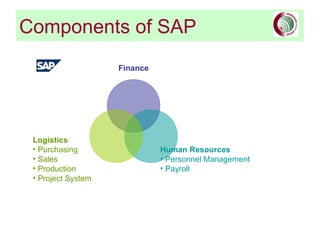
Components of SAP
Finance
Human Resources
• Personnel Management
• Payroll
Logistics
• Purchasing
• Sales
• Production
• Project System
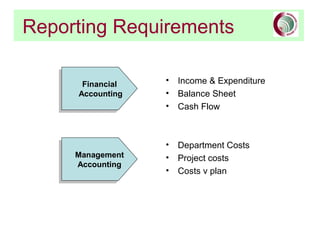
Reporting Requirements
• Income & Expenditure
• Balance Sheet
• Cash Flow
• Department Costs
• Project costs
• Costs v plan
Financial
Accounting
Financial
Accounting
Management
Accounting
Management
Accounting
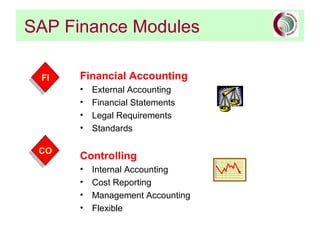
SAP Finance Modules
Financial Accounting
• External Accounting
• Financial Statements
• Legal Requirements
• Standards
Controlling
• Internal Accounting
• Cost Reporting
• Management Accounting
• Flexible
FIFI
COCO
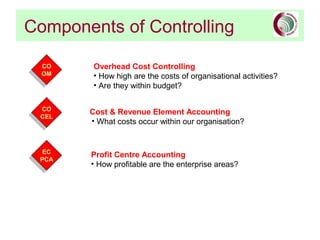
Components of Controlling
Overhead Cost Controlling
• How high are the costs of organisational activities?
• Are they within budget?
CO
OM
CO
OM
Cost & Revenue Element Accounting
• What costs occur within our organisation?
CO
CEL
CO
CEL
Profit Centre Accounting
• How profitable are the enterprise areas?
EC
PCA
EC
PCA
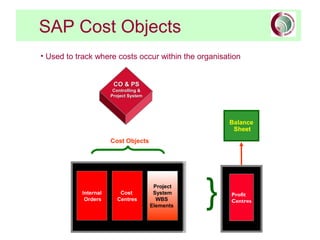
SAP Cost Objects
• Used to track where costs occur within the organisation
Cost
Centres
Internal
Orders
Project
System
WBS
Elements
CO & PSCO & PS
Controlling &Controlling &
Project SystemProject System
Cost Objects
}
Balance
Sheet
Profit
Centres
Cost Centres
• An organisational unit within SAP to which costs (and income) can
be assigned
• Six digit number e.g. 252000
• Used to track costs of departments/major activities
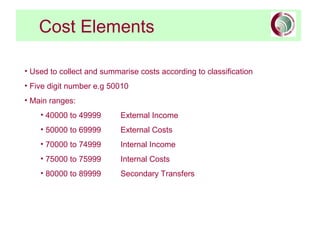
Cost Elements
• Used to collect and summarise costs according to classification
• Five digit number e.g 50010
• Main ranges:
• 40000 to 49999 External Income
• 50000 to 69999 External Costs
• 70000 to 74999 Internal Income
• 75000 to 75999 Internal Costs
• 80000 to 89999 Secondary Transfers
Cost Element Groups
• Cost elements can be combined into groups of the same type
• Used to create reports
• Standard reporting group REP_01
• Displays costs within main University budget headings
Example
• KAH3 - Display cost element group
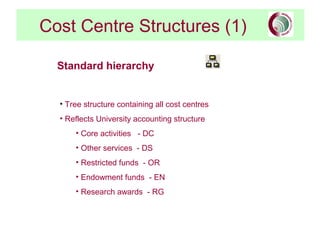
Cost Centre Structures (1)
Standard hierarchy
• Tree structure containing all cost centres
• Reflects University accounting structure
• Core activities - DC
• Other services - DS
• Restricted funds - OR
• Endowment funds - EN
• Research awards - RG
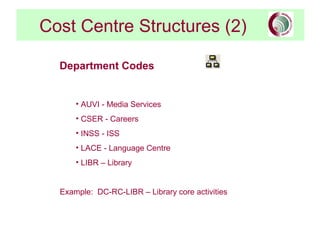
Cost Centre Structures (2)
Department Codes
• AUVI - Media Services
• CSER - Careers
• INSS - ISS
• LACE - Language Centre
• LIBR – Library
Example: DC-RC-LIBR – Library core activities
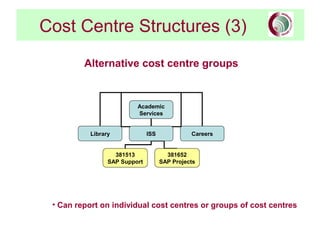
Cost Centre Structures (3)
Academic
Services
Library CareersISS
381513
SAP Support
381652
SAP Projects
• Can report on individual cost centres or groups of cost centres
Alternative cost centre groups
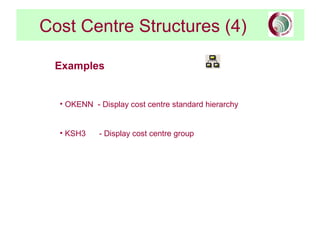
Cost Centre Structures (4)
Examples
• OKENN - Display cost centre standard hierarchy
• KSH3 - Display cost centre group
Internal Orders
• Cost object used to monitor costs at a detailed level
• Eight digit number e.g. 95000001
• Linked to cost centre – provides sub-analysis
• Simplifies cost centre structure
• Used to track costs of individual activities e.g. projects, short courses
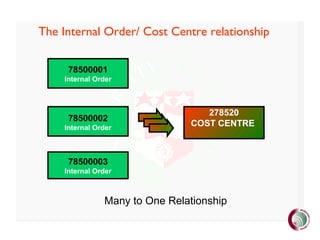
The Internal Order/ Cost Centre relationship
78500001
Internal Order
78500002
Internal Order
78500003
Internal Order
278520
COST CENTRE
Many to One Relationship
Internal Order Groups
• Orders can be grouped into a structure
• Many levels as required
• Maintained by departments – no standard hierarchy
• Used for planning and reporting
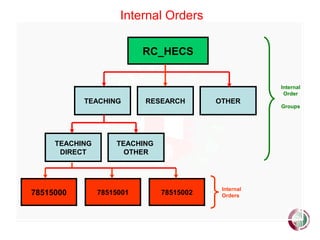
Internal Orders
RC_HECS
TEACHING RESEARCH OTHER
78515000 78515001 78515002
Internal
Orders
Internal
Order
Groups
TEACHING
DIRECT
TEACHING
OTHER
Internal Orders
Examples
• KO03 - Display internal order master data
• KOH3 - Display internal order group
Reports
• Cost centre reports
• Internal order reports
• Report navigation
• Printing reports
• Exporting to Excel

Sap financial reporting

  • 1.
    SAP Financial Reporting •Aims & Objectives – Introduction to SAP financial modules – Understanding of SAP cost objects – Overview of University accounting structure – Outline of available reports – Confidence in using reports
  • 2.
    SAP Help • Documentation •ISS website http://www.leeds.ac.uk/iss/infosystems/ • SAP on-line help • Superusers • Helpdesk  33333
  • 3.
    What is SAP? •Enterprise Resource Planning system • SAP world’s largest ERP software supplier • Based in Walldorf, Germany • Implemented at Leeds in April 1999 • Continuing programme of development
  • 4.
    Components of SAP Finance HumanResources • Personnel Management • Payroll Logistics • Purchasing • Sales • Production • Project System
  • 5.
    Reporting Requirements • Income& Expenditure • Balance Sheet • Cash Flow • Department Costs • Project costs • Costs v plan Financial Accounting Financial Accounting Management Accounting Management Accounting
  • 6.
    SAP Finance Modules FinancialAccounting • External Accounting • Financial Statements • Legal Requirements • Standards Controlling • Internal Accounting • Cost Reporting • Management Accounting • Flexible FIFI COCO
  • 7.
    Components of Controlling OverheadCost Controlling • How high are the costs of organisational activities? • Are they within budget? CO OM CO OM Cost & Revenue Element Accounting • What costs occur within our organisation? CO CEL CO CEL Profit Centre Accounting • How profitable are the enterprise areas? EC PCA EC PCA
  • 8.
    SAP Cost Objects •Used to track where costs occur within the organisation Cost Centres Internal Orders Project System WBS Elements CO & PSCO & PS Controlling &Controlling & Project SystemProject System Cost Objects } Balance Sheet Profit Centres
  • 9.
    Cost Centres • Anorganisational unit within SAP to which costs (and income) can be assigned • Six digit number e.g. 252000 • Used to track costs of departments/major activities
  • 10.
    Cost Elements • Usedto collect and summarise costs according to classification • Five digit number e.g 50010 • Main ranges: • 40000 to 49999 External Income • 50000 to 69999 External Costs • 70000 to 74999 Internal Income • 75000 to 75999 Internal Costs • 80000 to 89999 Secondary Transfers
  • 11.
    Cost Element Groups •Cost elements can be combined into groups of the same type • Used to create reports • Standard reporting group REP_01 • Displays costs within main University budget headings Example • KAH3 - Display cost element group
  • 12.
    Cost Centre Structures(1) Standard hierarchy • Tree structure containing all cost centres • Reflects University accounting structure • Core activities - DC • Other services - DS • Restricted funds - OR • Endowment funds - EN • Research awards - RG
  • 13.
    Cost Centre Structures(2) Department Codes • AUVI - Media Services • CSER - Careers • INSS - ISS • LACE - Language Centre • LIBR – Library Example: DC-RC-LIBR – Library core activities
  • 14.
    Cost Centre Structures(3) Academic Services Library CareersISS 381513 SAP Support 381652 SAP Projects • Can report on individual cost centres or groups of cost centres Alternative cost centre groups
  • 15.
    Cost Centre Structures(4) Examples • OKENN - Display cost centre standard hierarchy • KSH3 - Display cost centre group
  • 16.
    Internal Orders • Costobject used to monitor costs at a detailed level • Eight digit number e.g. 95000001 • Linked to cost centre – provides sub-analysis • Simplifies cost centre structure • Used to track costs of individual activities e.g. projects, short courses
  • 17.
    The Internal Order/Cost Centre relationship 78500001 Internal Order 78500002 Internal Order 78500003 Internal Order 278520 COST CENTRE Many to One Relationship
  • 18.
    Internal Order Groups •Orders can be grouped into a structure • Many levels as required • Maintained by departments – no standard hierarchy • Used for planning and reporting
  • 19.
    Internal Orders RC_HECS TEACHING RESEARCHOTHER 78515000 78515001 78515002 Internal Orders Internal Order Groups TEACHING DIRECT TEACHING OTHER
  • 20.
    Internal Orders Examples • KO03- Display internal order master data • KOH3 - Display internal order group
  • 21.
    Reports • Cost centrereports • Internal order reports • Report navigation • Printing reports • Exporting to Excel

Editor's Notes

  • #18 We saw earlier when you post to a cost center, the system generates a statistical posting into a profit center, there’s relationship between the two areas. In the same way, there is a relationship between internal orders and cost centers. Each time a transaction is posted to an internal order, the sap system creates two entries to the management accounting information system.It posts a statistical entry to the order and an actual entry to the cost center. Once again there is the potential to have a many to one relationship between the order and the cost center.
  • #20 The University uses internal orders in order to provide more detailed analysis of expenditure at resource center level. Once again, it is possible to set up internal order groups in order to facilitate reporting and there are no constraints as to the combination of order groups you can create.