SM-N9005

User Manual

www.samsung.com
About this manual
This device provides high quality mobile communication and entertainment using Samsung’s
high standards and technological expertise. This user manual is specially designed to detail
the device’s functions and features.
Please read this manual before using the device to ensure safe and proper use.
Descriptions are based on the device’s default settings.
Images and screenshots may differ in appearance from the actual product.
Content may differ from the final product, or from software provided by service providers
or carriers, and is subject to change without prior notice. For the latest version of the
manual, refer to the Samsung website, www.samsung.com.
Content (high quality content) that requires high CPU and RAM usage will affect the
overall performance of the device. Applications related to the content may not work
properly depending on the device’s specifications and the environment that it is used in.
Available features and additional services may vary by device, software, or service
provider.
Applications and their functions may vary by country, region, or hardware specifications.
Samsung is not liable for performance issues caused by applications from any provider
other than Samsung.
Samsung is not liable for performance issues or incompatibilities caused by edited
registry settings or modified operating system software. Attempting to customise the
operating system may cause the device or applications to work improperly.
Software, sound sources, wallpapers, images, and other media provided with this device
are licensed for limited use. Extracting and using these materials for commercial or other
purposes is an infringement of copyright laws. Users are entirely responsible for illegal
use of media.
You may incur additional charges for data services, such as messaging, uploading and
downloading, auto-syncing, or using location services. To avoid additional charges, select
an appropriate data tariff plan. For details, contact your service provider.

2
About this manual

Default applications that come with the device are subject to updates and may no longer
be supported without prior notice. If you have questions about an application provided
with the device, contact a Samsung Service Centre. For user-installed applications,
contact service providers.
Modifying the device’s operating system or installing softwares from unofficial sources
may result in device malfunctions and data corruption or loss. These actions are violations
of your Samsung licence agreement and will void your warranty.

Instructional icons
Warning: situations that could cause injury to yourself or others
Caution: situations that could cause damage to your device or other equipment
Note: notes, usage tips, or additional information

Copyright
Copyright © 2013 Samsung Electronics
This guide is protected under international copyright laws.
No part of this guide may be reproduced, distributed, translated, or transmitted in any form or
by any means, electronic or mechanical, including photocopying, recording, or storing in any
information storage and retrieval system, without the prior written permission of Samsung
Electronics.

3
About this manual

Trademarks
SAMSUNG and the SAMSUNG logo are registered trademarks of Samsung Electronics.
The Android logo, Google™, Google Maps™, Google Mail™, YouTube™, Google Play™
Store, and Google Talk™ are trademarks of Google, Inc.
Bluetooth® is a registered trademark of Bluetooth SIG, Inc. worldwide.
Wi-Fi®, Wi-Fi Protected Setup™, Wi-Fi Direct™, Wi-Fi CERTIFIED™, and the Wi-Fi logo are
registered trademarks of the Wi-Fi Alliance.
All other trademarks and copyrights are the property of their respective owners.

4
Table of Contents
40
40
41
42
44
46
48
48
49
50
50
53
54
55
57
59

Getting started
8
9
10
10
11
14
17
19
20
21
21
21

Device layout
Buttons
S Pen
Package contents
Installing the SIM or USIM card and
battery
Charging the battery
Inserting a memory card
Replacing the S Pen nib
Turning the device on and off
Holding the device
Adjusting the volume
Switching to silent mode

Samsung Smart Scroll
Increasing touch screen sensitivity
Activating Multi Window
Notifications
Home screen
Locked screen
Using applications
Applications screen
Help
One-handed operation
Entering text
Connecting to a Wi-Fi network
Setting up accounts
Transferring files
Securing the device
Upgrading the device

Basics
22
23
27
30
31
34
37
38
39

Indicator icons
Using the touch screen
Control motions
Palm motions
Air Gesture
Using the S Pen
S Pen keeper
Air view
Samsung Smart Pause

Communication
60
66
70
72
74
76
76

5

Phone
Contacts
Messages
Email
Google Mail
Hangouts
ChatON
Table of Contents

114 Play Movies
114 Play Music
114 Play Games

Web & network
77
78
79
80
81
82
84
86
87

Internet
Chrome
Bluetooth
Screen Mirroring
Samsung Link
Group Play
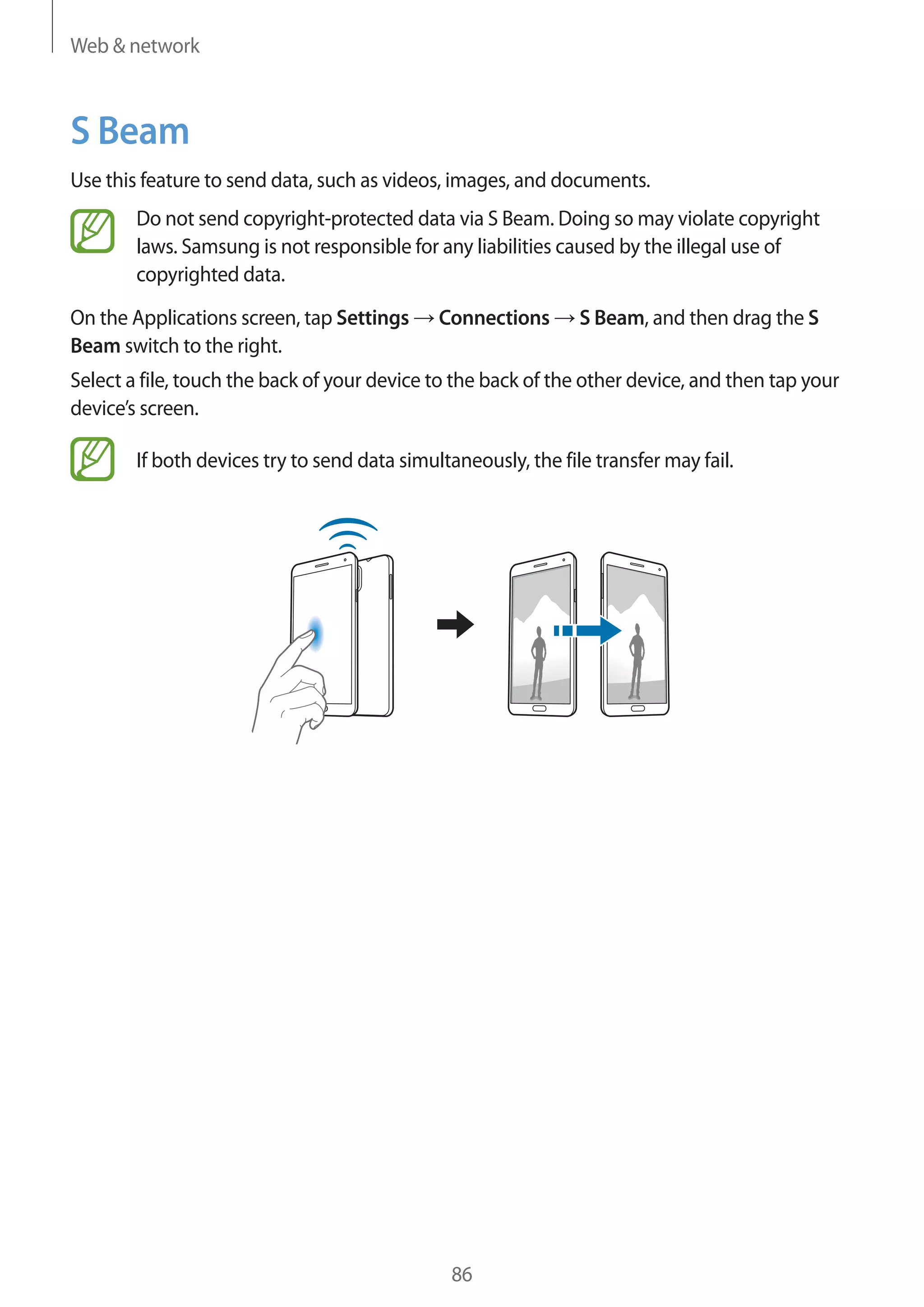
NFC
S Beam
WatchON

Utilities
115
122
124
125
126
128
128
136
136
138
140
141
142
142
143
144
144
144
145

Media
88
90
98
102
106
108
109
110
111
111

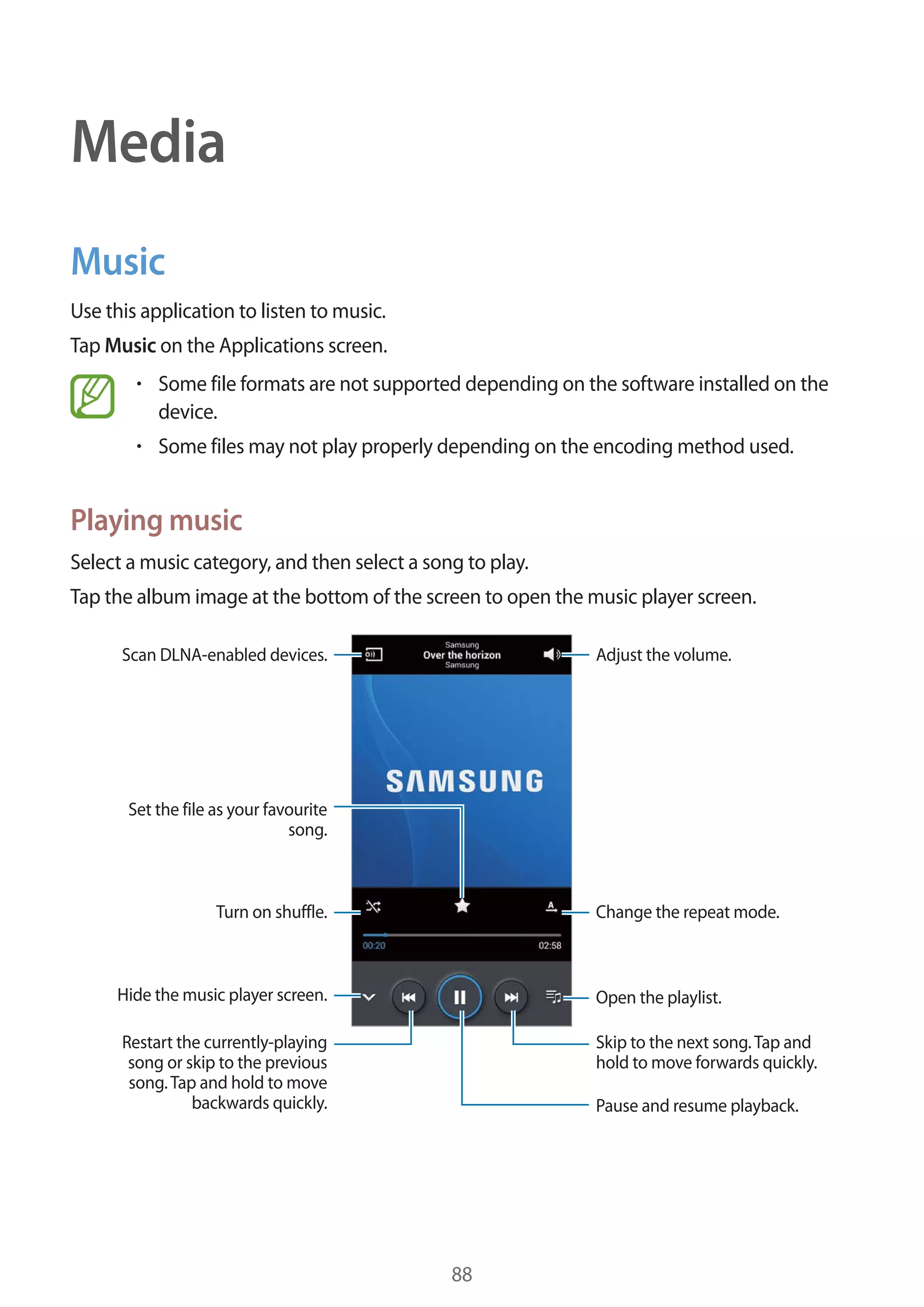
Music
Camera
Gallery
Story Album
Video
YouTube
My Magazine
Flipboard
SketchBook for Galaxy
Bloomberg+

S Note
S Planner
Dropbox
Cloud
Clock
Calculator
S Health
S Translator
Voice Recorder
S Voice
S Finder
Google
Scrapbook
Voice Search
My Files
Downloads
TripAdvisor
Evernote
KNOX

Application & media stores
112
113
113
114

Play Store
Samsung Hub
Samsung Apps
Play Books

Travel & local
146 Maps

6
Table of Contents

Settings
147
147
151
159
165

About Settings
Connections
Device
Controls
General

Troubleshooting

7
Getting started
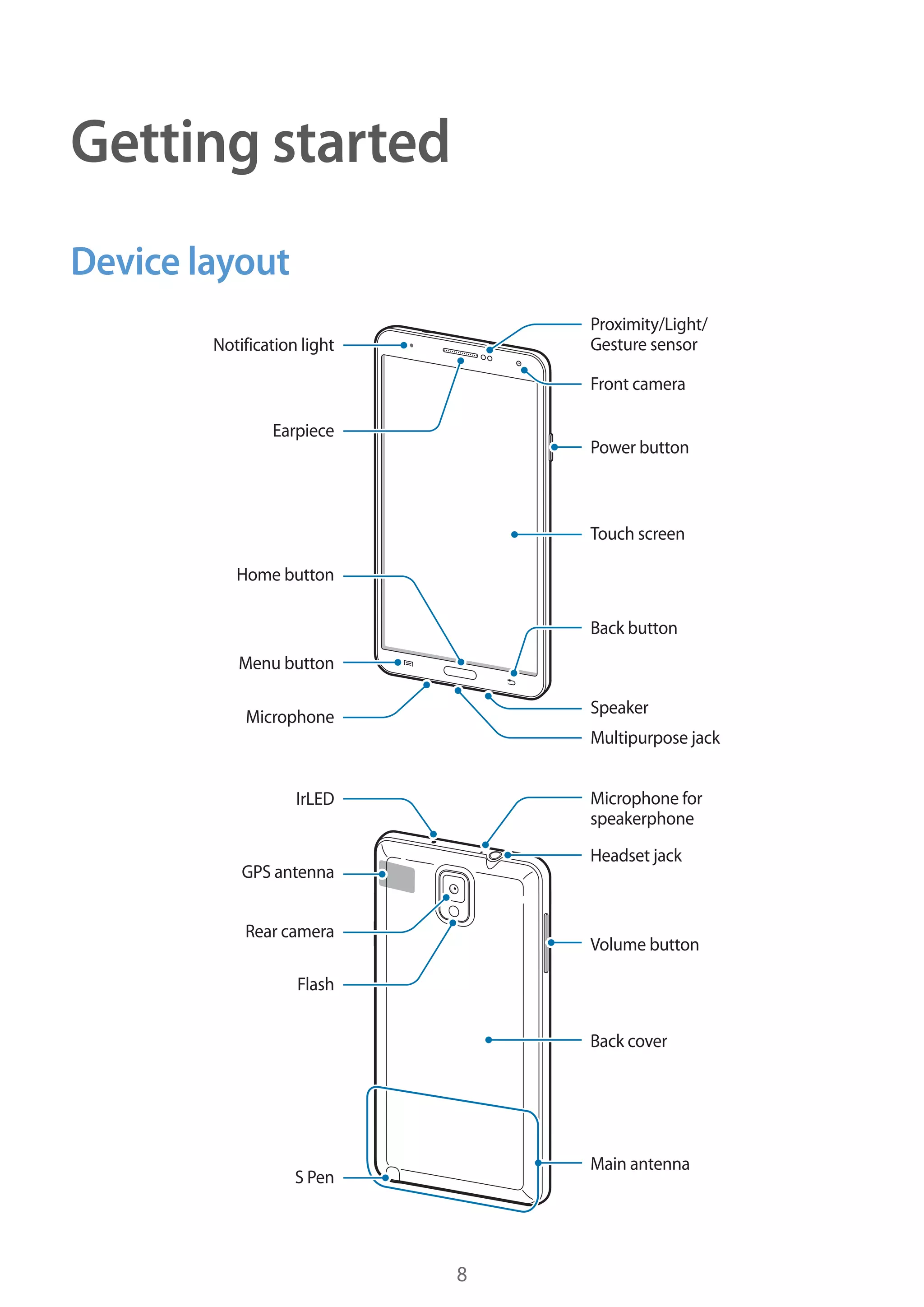
Device layout
Proximity/Light/
Gesture sensor

Notification light

Front camera
Earpiece

Power button

Touch screen
Home button
Back button
Menu button
Speaker

Microphone

Multipurpose jack
Microphone for
speakerphone

IrLED

Headset jack

GPS antenna
Rear camera

Volume button

Flash
Back cover

Main antenna

S Pen

8
Getting started

The microphone at the top of the device is active only when you use the speakerphone or
take videos.
Do not cover the antenna area with your hands or other objects. This may cause
connectivity problems or drain the battery.
Do not use a screen protector. This causes sensor malfunctions.
Do not allow water to contact the touch screen. The touch screen may malfunction
in humid conditions or when exposed to water.

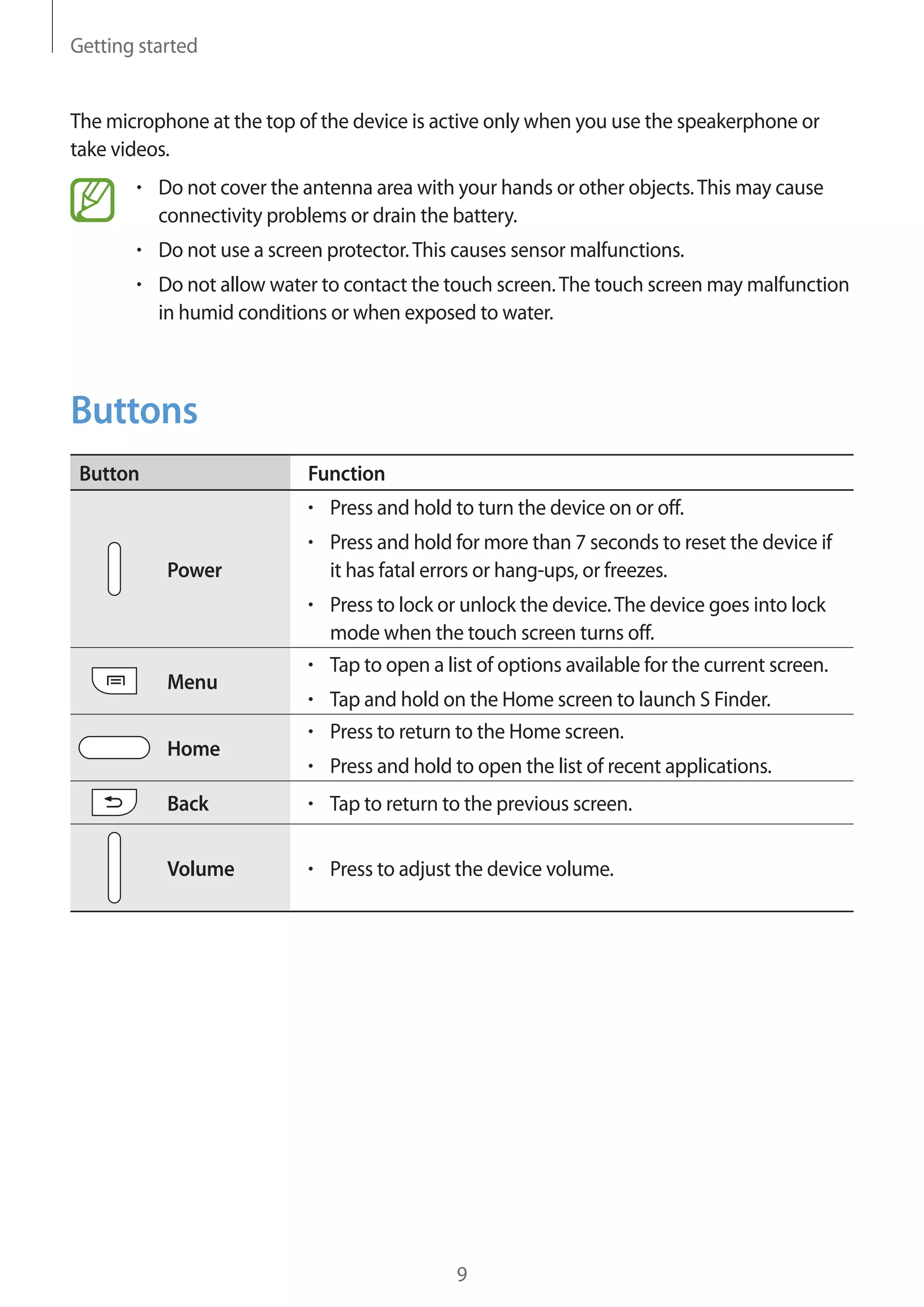
Buttons
Button

Function
Press and hold to turn the device on or off.
Power

Menu
Home

Press and hold for more than 7 seconds to reset the device if
it has fatal errors or hang-ups, or freezes.
Press to lock or unlock the device. The device goes into lock
mode when the touch screen turns off.
Tap to open a list of options available for the current screen.
Tap and hold on the Home screen to launch S Finder.
Press to return to the Home screen.
Press and hold to open the list of recent applications.

Back

Tap to return to the previous screen.

Volume

Press to adjust the device volume.

9
Getting started

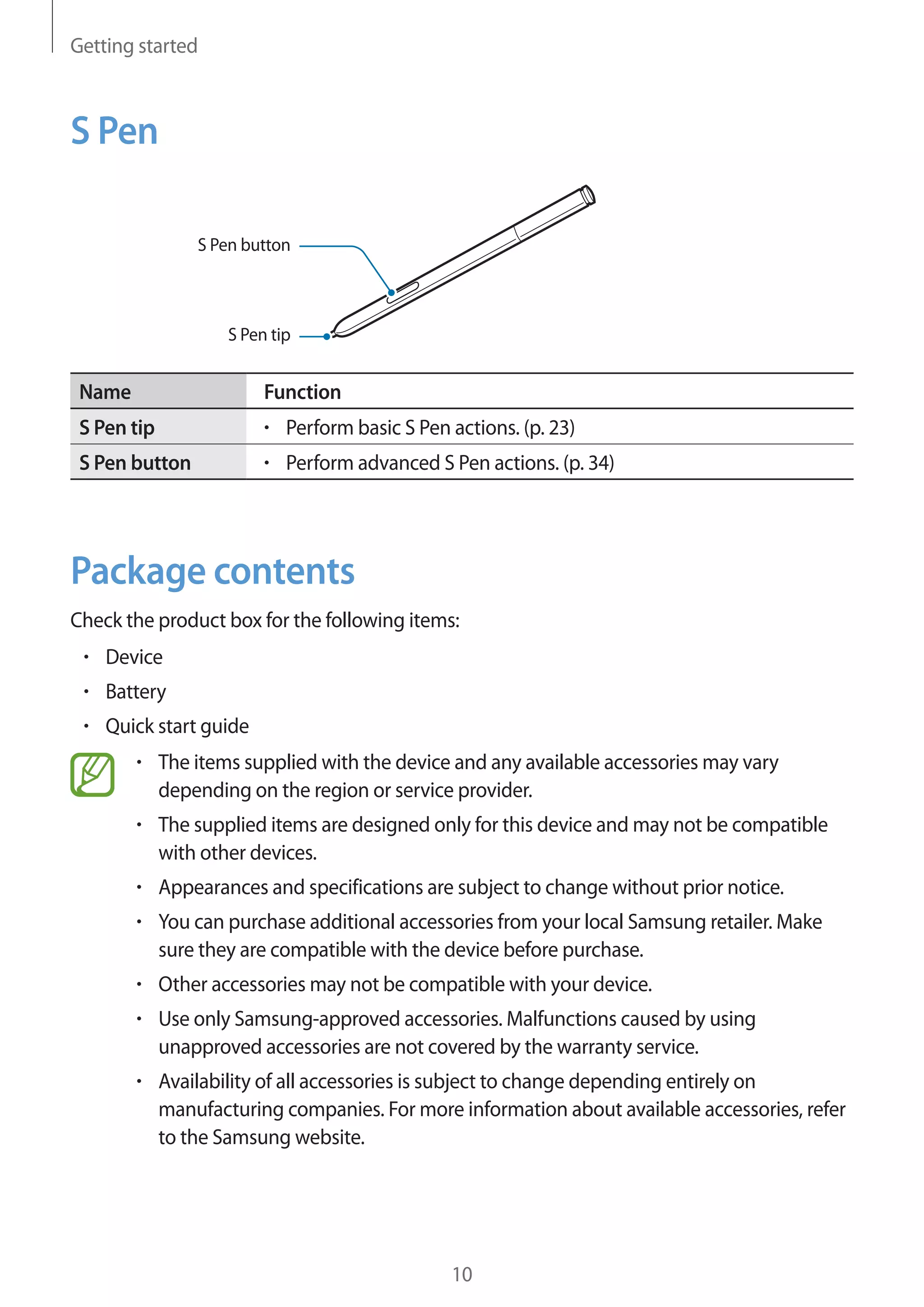
S Pen
S Pen button

S Pen tip

Name

Function

S Pen tip

Perform basic S Pen actions. (p. 23)

S Pen button

Perform advanced S Pen actions. (p. 34)

Package contents
Check the product box for the following items:
Device
Battery
Quick start guide
The items supplied with the device and any available accessories may vary
depending on the region or service provider.
The supplied items are designed only for this device and may not be compatible
with other devices.
Appearances and specifications are subject to change without prior notice.
You can purchase additional accessories from your local Samsung retailer. Make
sure they are compatible with the device before purchase.
Other accessories may not be compatible with your device.
Use only Samsung-approved accessories. Malfunctions caused by using
unapproved accessories are not covered by the warranty service.
Availability of all accessories is subject to change depending entirely on
manufacturing companies. For more information about available accessories, refer
to the Samsung website.

10
Getting started

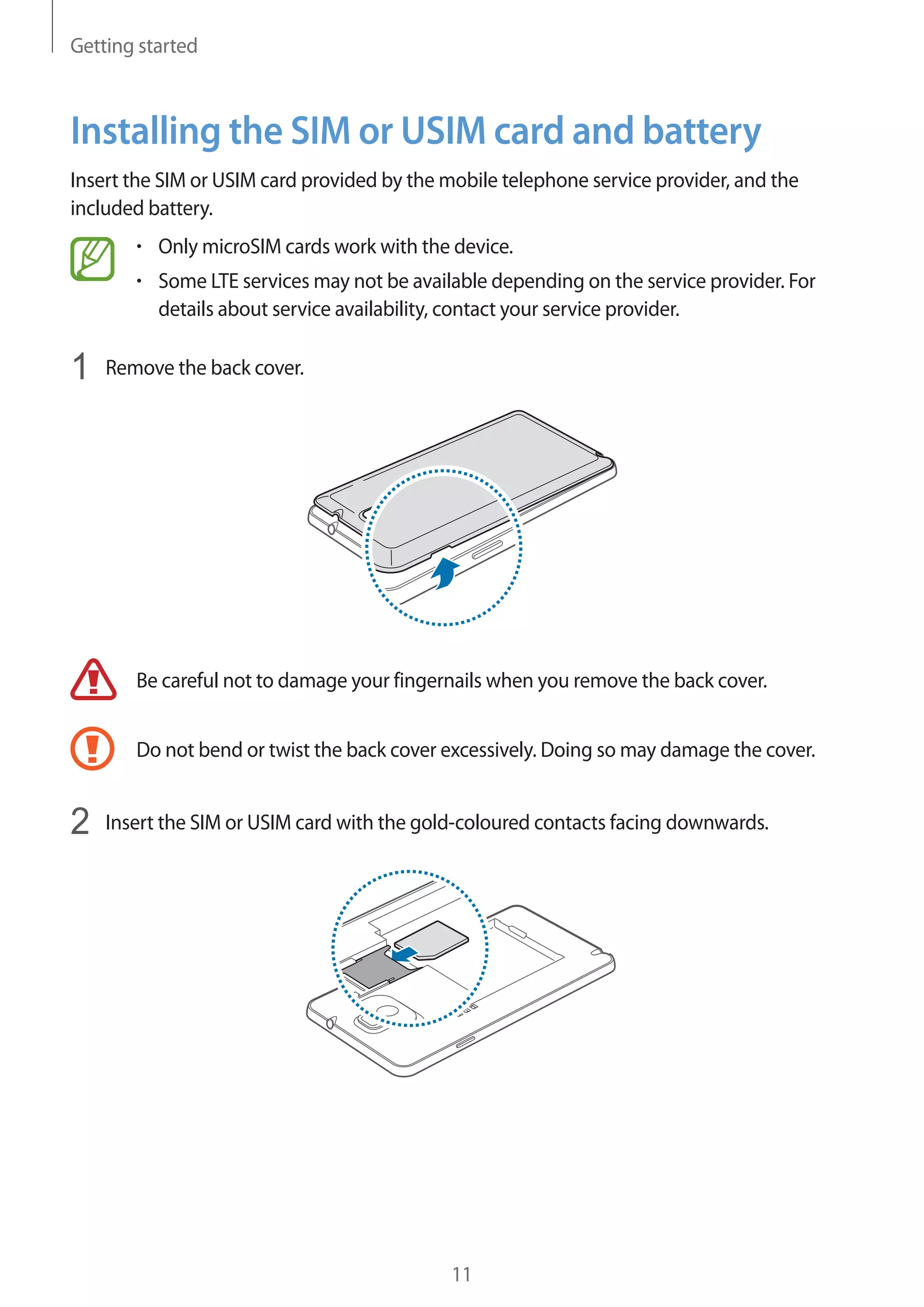
Installing the SIM or USIM card and battery
Insert the SIM or USIM card provided by the mobile telephone service provider, and the
included battery.
Only microSIM cards work with the device.
Some LTE services may not be available depending on the service provider. For
details about service availability, contact your service provider.

1

Remove the back cover.

Be careful not to damage your fingernails when you remove the back cover.
Do not bend or twist the back cover excessively. Doing so may damage the cover.

2

Insert the SIM or USIM card with the gold-coloured contacts facing downwards.

11
Getting started

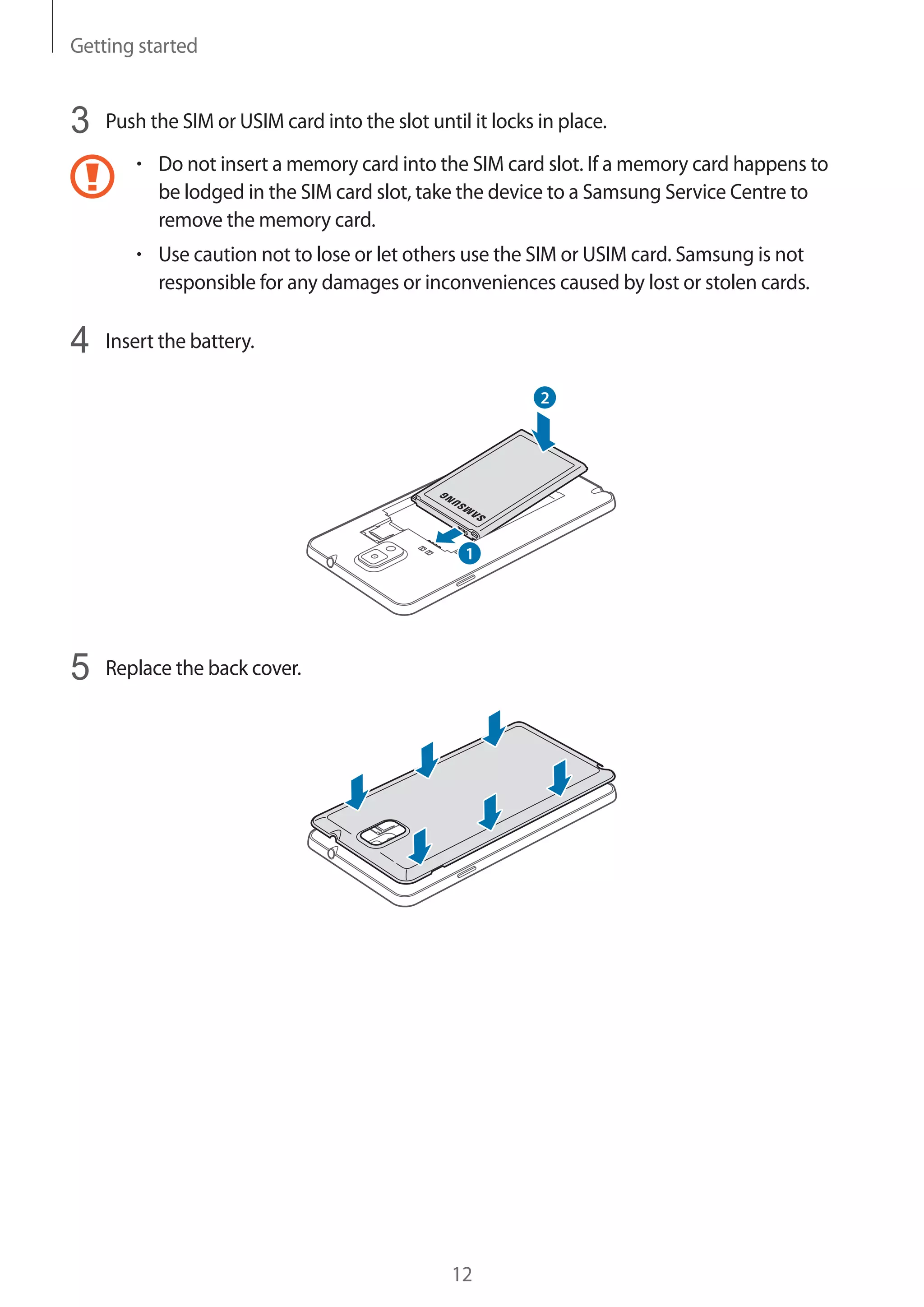
3

Push the SIM or USIM card into the slot until it locks in place.
Do not insert a memory card into the SIM card slot. If a memory card happens to
be lodged in the SIM card slot, take the device to a Samsung Service Centre to
remove the memory card.
Use caution not to lose or let others use the SIM or USIM card. Samsung is not
responsible for any damages or inconveniences caused by lost or stolen cards.

4

Insert the battery.

5

Replace the back cover.

12
Getting started

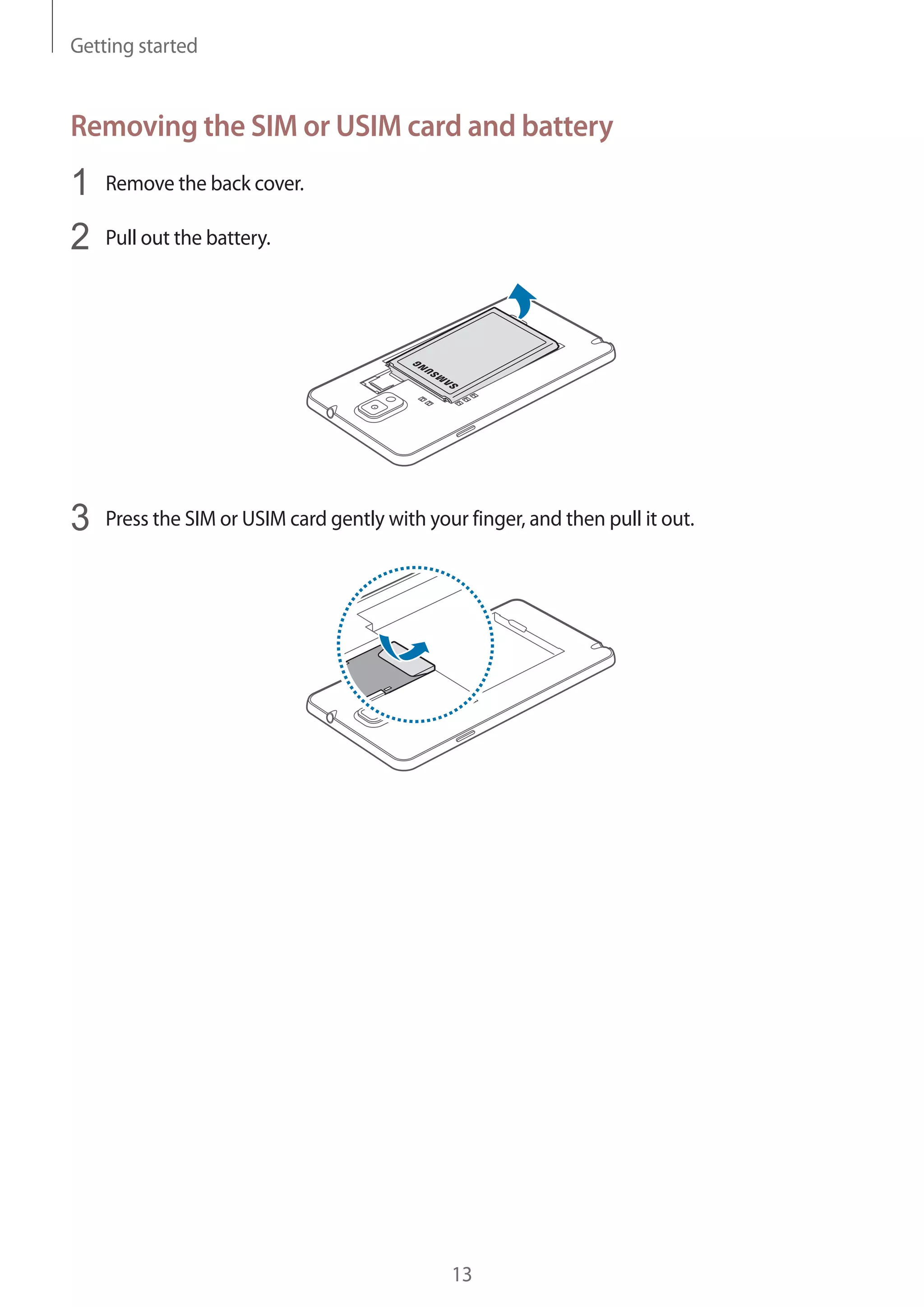
Removing the SIM or USIM card and battery

1
2

Remove the back cover.

3

Press the SIM or USIM card gently with your finger, and then pull it out.

Pull out the battery.

13
Getting started

Charging the battery
Use the charger to charge the battery before using it for the first time. A computer can be also
used to charge the device by connecting them via the USB cable.
Use only Samsung-approved chargers, batteries, and cables. Unapproved chargers or
cables can cause the battery to explode or damage the device.
When the battery power is low, the device emits a warning tone and displays a low
battery power message.
If the battery is completely discharged, the device cannot be turned on
immediately when the charger is connected. Allow a depleted battery to charge for
a few minutes before turning on the device.
If you use multiple applications at once, network applications, or applications
that need a connection to another device, the battery will drain quickly. To avoid
disconnecting from the network or losing power during a data transfer, always use
these applications after fully charging the battery.

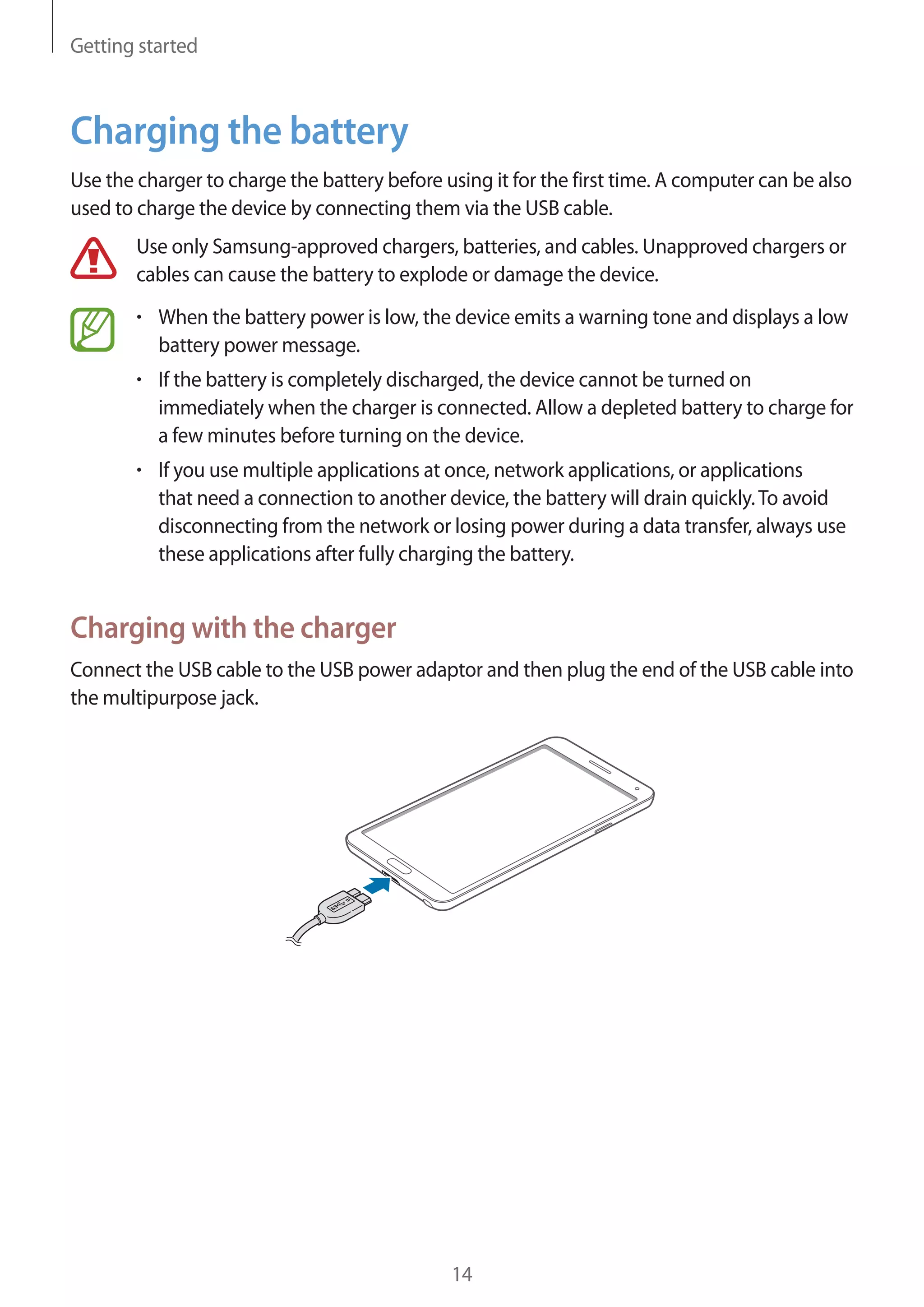
Charging with the charger
Connect the USB cable to the USB power adaptor and then plug the end of the USB cable into
the multipurpose jack.

14
Getting started

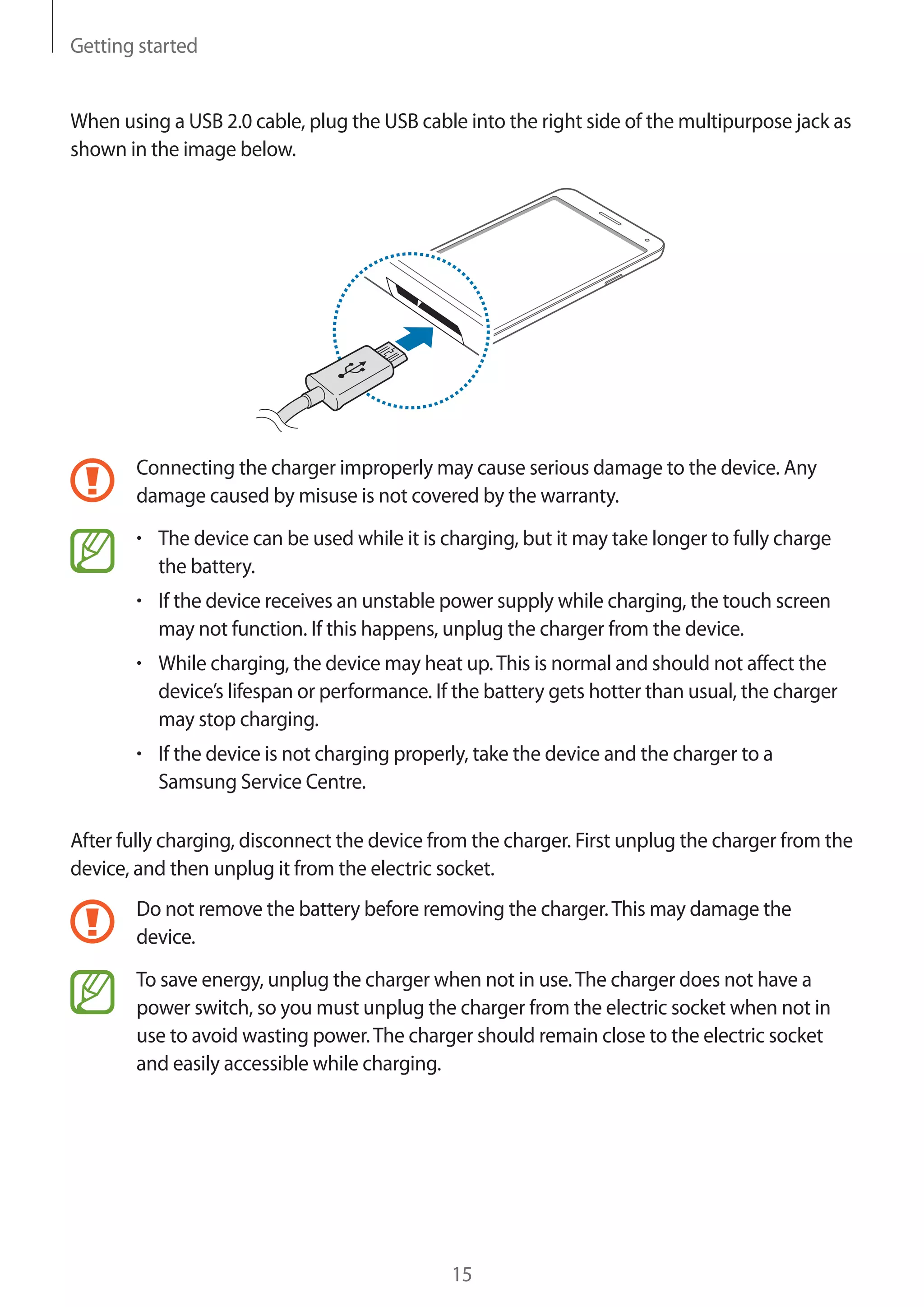
When using a USB 2.0 cable, plug the USB cable into the right side of the multipurpose jack as
shown in the image below.

Connecting the charger improperly may cause serious damage to the device. Any
damage caused by misuse is not covered by the warranty.
The device can be used while it is charging, but it may take longer to fully charge
the battery.
If the device receives an unstable power supply while charging, the touch screen
may not function. If this happens, unplug the charger from the device.
While charging, the device may heat up. This is normal and should not affect the
device’s lifespan or performance. If the battery gets hotter than usual, the charger
may stop charging.
If the device is not charging properly, take the device and the charger to a
Samsung Service Centre.
After fully charging, disconnect the device from the charger. First unplug the charger from the
device, and then unplug it from the electric socket.
Do not remove the battery before removing the charger. This may damage the
device.
To save energy, unplug the charger when not in use. The charger does not have a
power switch, so you must unplug the charger from the electric socket when not in
use to avoid wasting power. The charger should remain close to the electric socket
and easily accessible while charging.

15
Getting started

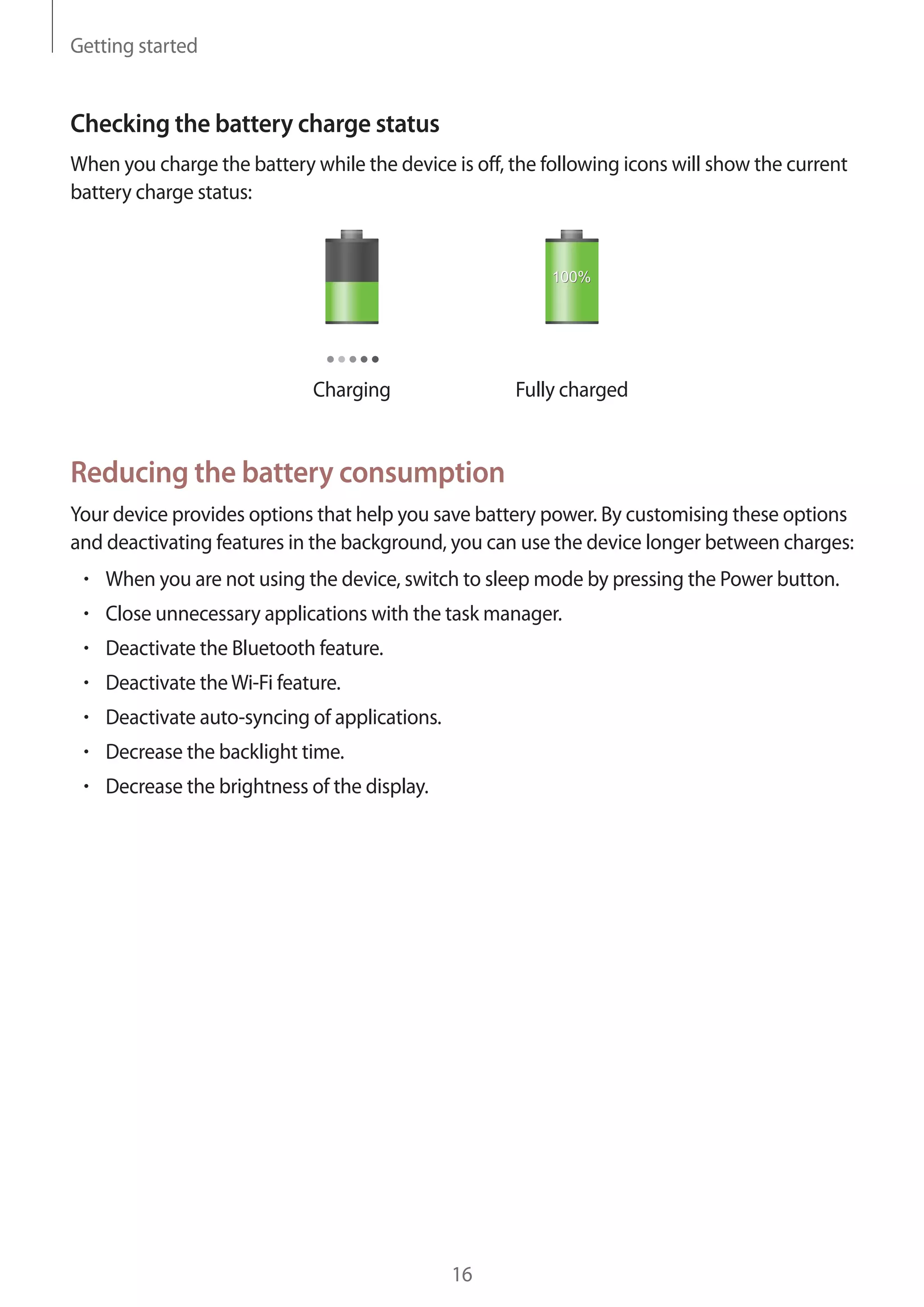
Checking the battery charge status
When you charge the battery while the device is off, the following icons will show the current
battery charge status:

Charging

Fully charged

Reducing the battery consumption
Your device provides options that help you save battery power. By customising these options
and deactivating features in the background, you can use the device longer between charges:
When you are not using the device, switch to sleep mode by pressing the Power button.
Close unnecessary applications with the task manager.
Deactivate the Bluetooth feature.
Deactivate the Wi-Fi feature.
Deactivate auto-syncing of applications.
Decrease the backlight time.
Decrease the brightness of the display.

16
Getting started

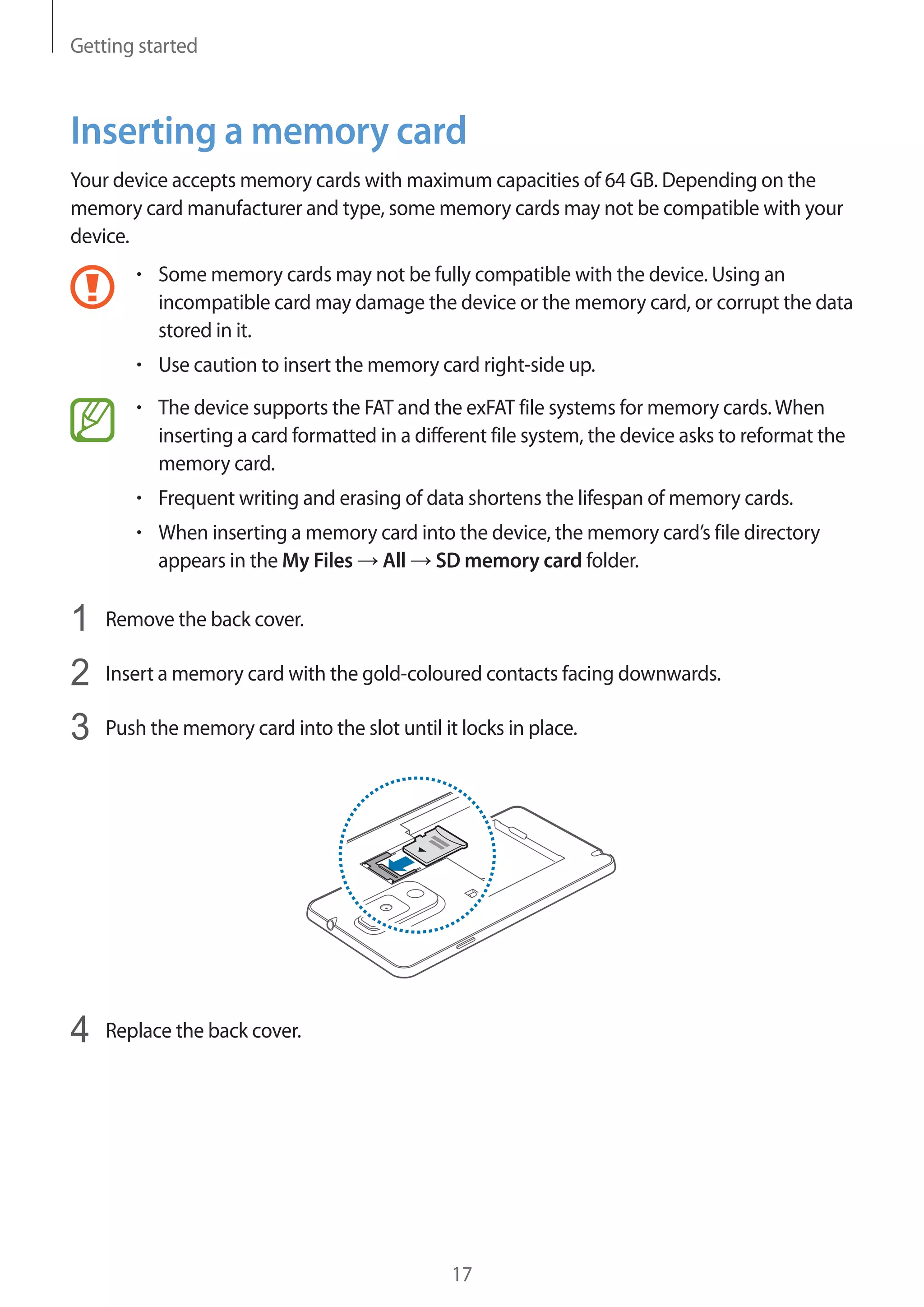
Inserting a memory card
Your device accepts memory cards with maximum capacities of 64 GB. Depending on the
memory card manufacturer and type, some memory cards may not be compatible with your
device.
Some memory cards may not be fully compatible with the device. Using an
incompatible card may damage the device or the memory card, or corrupt the data
stored in it.
Use caution to insert the memory card right-side up.
The device supports the FAT and the exFAT file systems for memory cards. When
inserting a card formatted in a different file system, the device asks to reformat the
memory card.
Frequent writing and erasing of data shortens the lifespan of memory cards.
When inserting a memory card into the device, the memory card’s file directory
appears in the My Files All SD memory card folder.

1
2
3

Remove the back cover.

4

Replace the back cover.

Insert a memory card with the gold-coloured contacts facing downwards.
Push the memory card into the slot until it locks in place.

17
Getting started

Removing the memory card
Before removing the memory card, first unmount it for safe removal. On the Home screen, tap
Apps Settings General Storage Unmount SD card.

1
2
3

Remove the back cover.
Push the memory card until it disengages from the device, and then pull it out.
Replace the back cover.
Do not remove the memory card while the device is transferring or accessing
information. Doing so can cause data to be lost or corrupted or damage to the
memory card or device. Samsung is not responsible for losses that result from the
misuse of damaged memory cards, including the loss of data.

Formatting the memory card
A memory card formatted on a computer may not be compatible with the device. Format the
memory card on the device.
On the Home screen, tap Apps Settings
Format SD card Erase everything.

General

Storage

Format SD card

Before formatting the memory card, remember to make backup copies of all
important data stored on the device. The manufacturer’s warranty does not cover loss
of data resulting from user actions.

18
Getting started

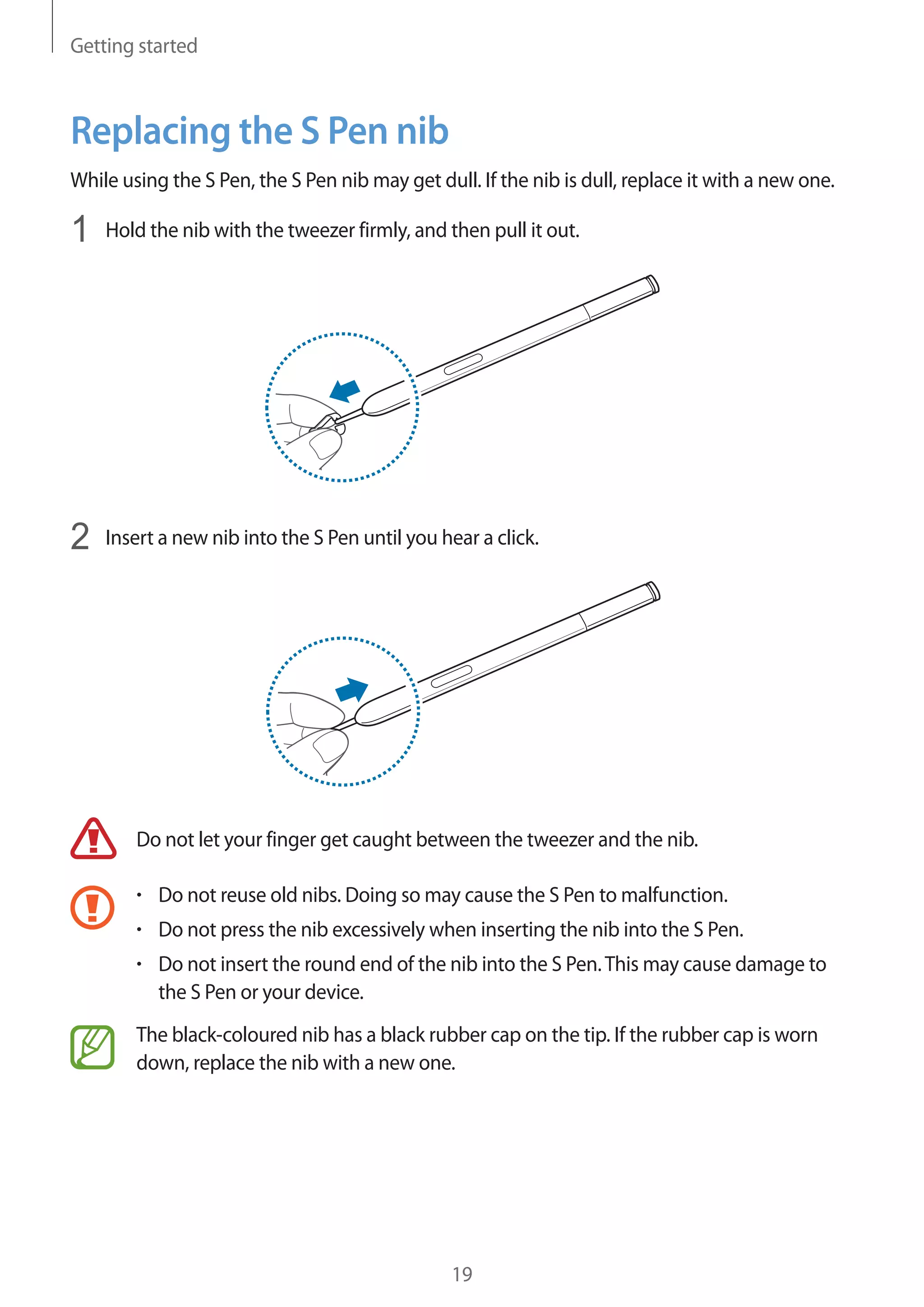
Replacing the S Pen nib
While using the S Pen, the S Pen nib may get dull. If the nib is dull, replace it with a new one.

1

Hold the nib with the tweezer firmly, and then pull it out.

2

Insert a new nib into the S Pen until you hear a click.

Do not let your finger get caught between the tweezer and the nib.
Do not reuse old nibs. Doing so may cause the S Pen to malfunction.
Do not press the nib excessively when inserting the nib into the S Pen.
Do not insert the round end of the nib into the S Pen. This may cause damage to
the S Pen or your device.
The black-coloured nib has a black rubber cap on the tip. If the rubber cap is worn
down, replace the nib with a new one.

19
Getting started

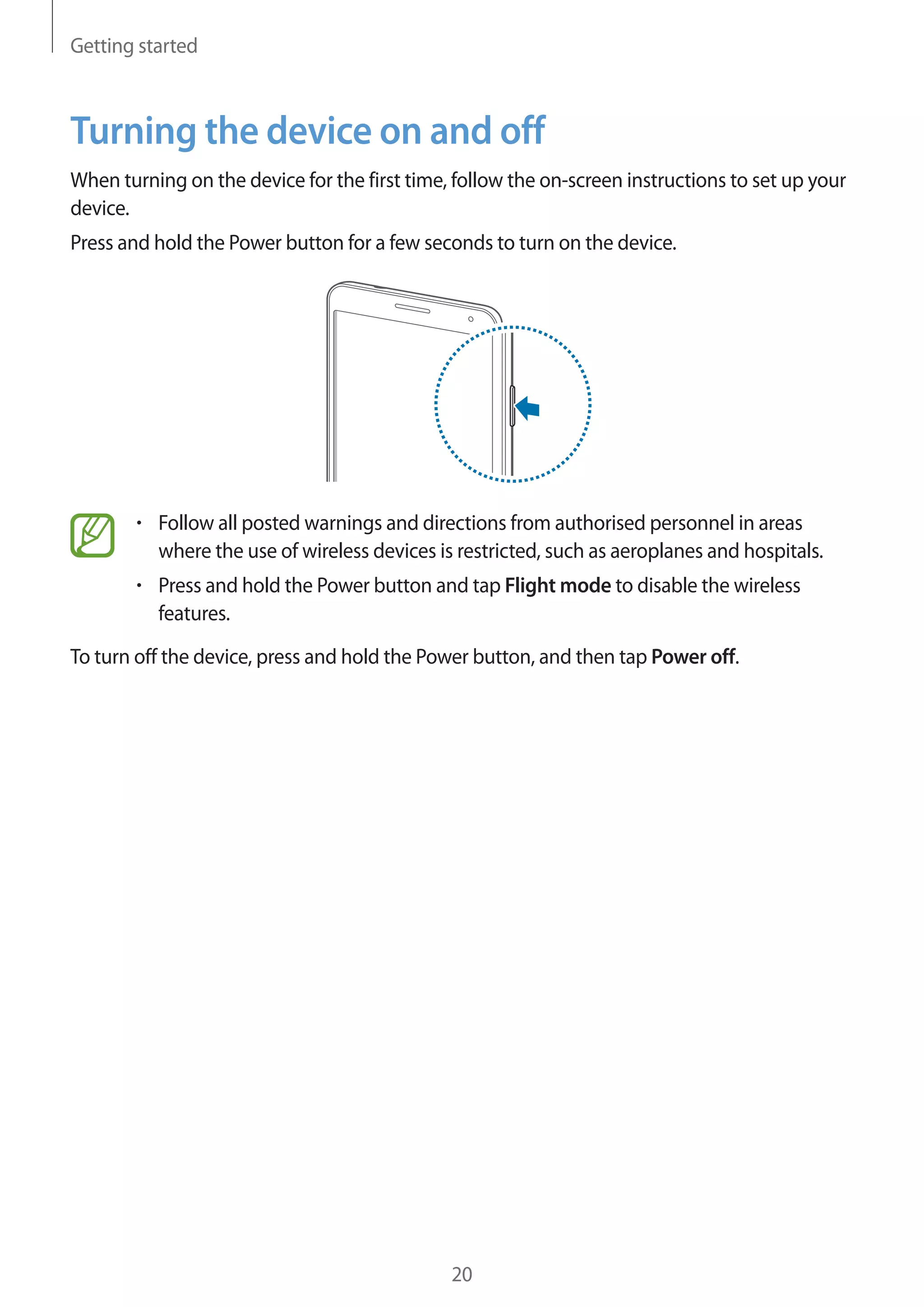
Turning the device on and off
When turning on the device for the first time, follow the on-screen instructions to set up your
device.
Press and hold the Power button for a few seconds to turn on the device.

Follow all posted warnings and directions from authorised personnel in areas
where the use of wireless devices is restricted, such as aeroplanes and hospitals.
Press and hold the Power button and tap Flight mode to disable the wireless
features.
To turn off the device, press and hold the Power button, and then tap Power off.

20
Getting started

Holding the device
Do not cover the antenna area with your hands or other objects. This may cause connectivity
problems or drain the battery.

Adjusting the volume
Press the Volume button up or down to adjust the ringtone volume, or to adjust the sound
volume when playing music or video.

Switching to silent mode
Use one of the following methods:
Press and hold the Volume button down until it switches to silent mode.
Press and hold the Power button, and then tap Mute or Vibrate.
Open the notifications panel at the top of the screen, and then tap Sound or Vibrate.

21
Basics
Indicator icons
The icons displayed at the top of the screen provide information about the status of the
device. The icons listed in the table below are most common.
Icon

Meaning
No signal
Signal strength
Roaming (outside of normal service area)
GPRS network connected
EDGE network connected
UMTS network connected
HSDPA network connected
HSPA+ network connected
LTE network connected
Wi-Fi connected
Bluetooth feature activated
GPS activated
Call in progress
Missed call
Air gesture feature activated
Smart screen feature activated
Synced with the web
Connected to computer
No SIM or USIM card
New text or multimedia message
Alarm activated
S Pen removed

22
Basics

Icon

Meaning
Silent mode activated
Vibration mode activated
Flight mode activated
Error occurred or caution required
Battery power level

Using the touch screen
Use only fingers or the S Pen to use the touch screen.
Do not allow the touch screen to come into contact with other electrical devices.
Electrostatic discharges can cause the touch screen to malfunction.
To avoid damaging the touch screen, do not tap it with anything sharp or apply
excessive pressure to it with your fingertips.
The device may not recognise touch inputs close to the edges of the screen, which
are outside of the touch input area.
Leaving the touch screen idle for extended periods may result in afterimages
(screen burn-in) or ghosting. Turn off the touch screen when you do not use the
device.

23
Basics

Finger gestures
Tapping
To open an application, to select a menu item, to press an on-screen button, or to enter a
character using the on-screen keyboard, tap it with a finger.

Tapping and holding
Tap and hold an item for more than 2 seconds to access available options.

24
Basics

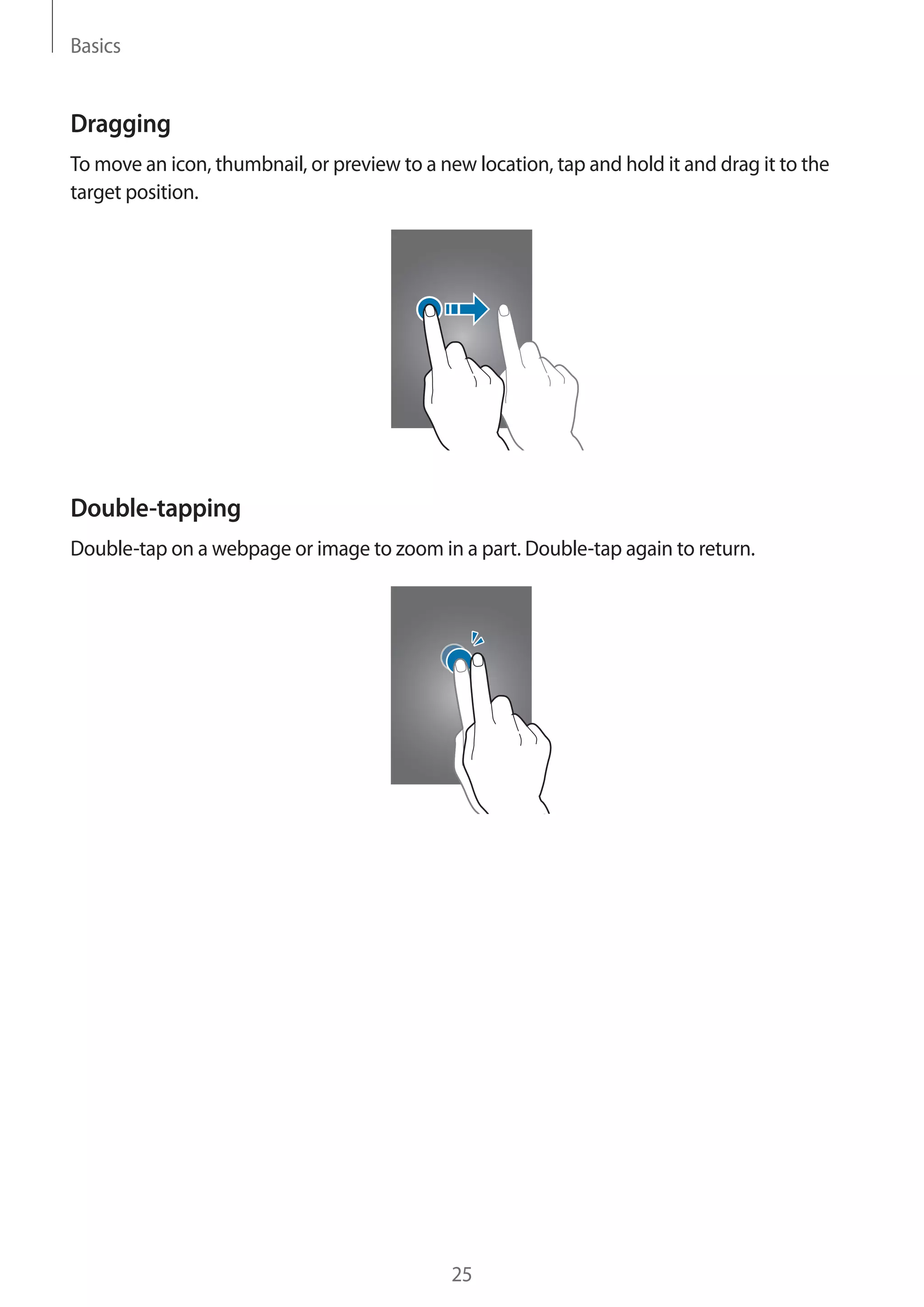
Dragging
To move an icon, thumbnail, or preview to a new location, tap and hold it and drag it to the
target position.

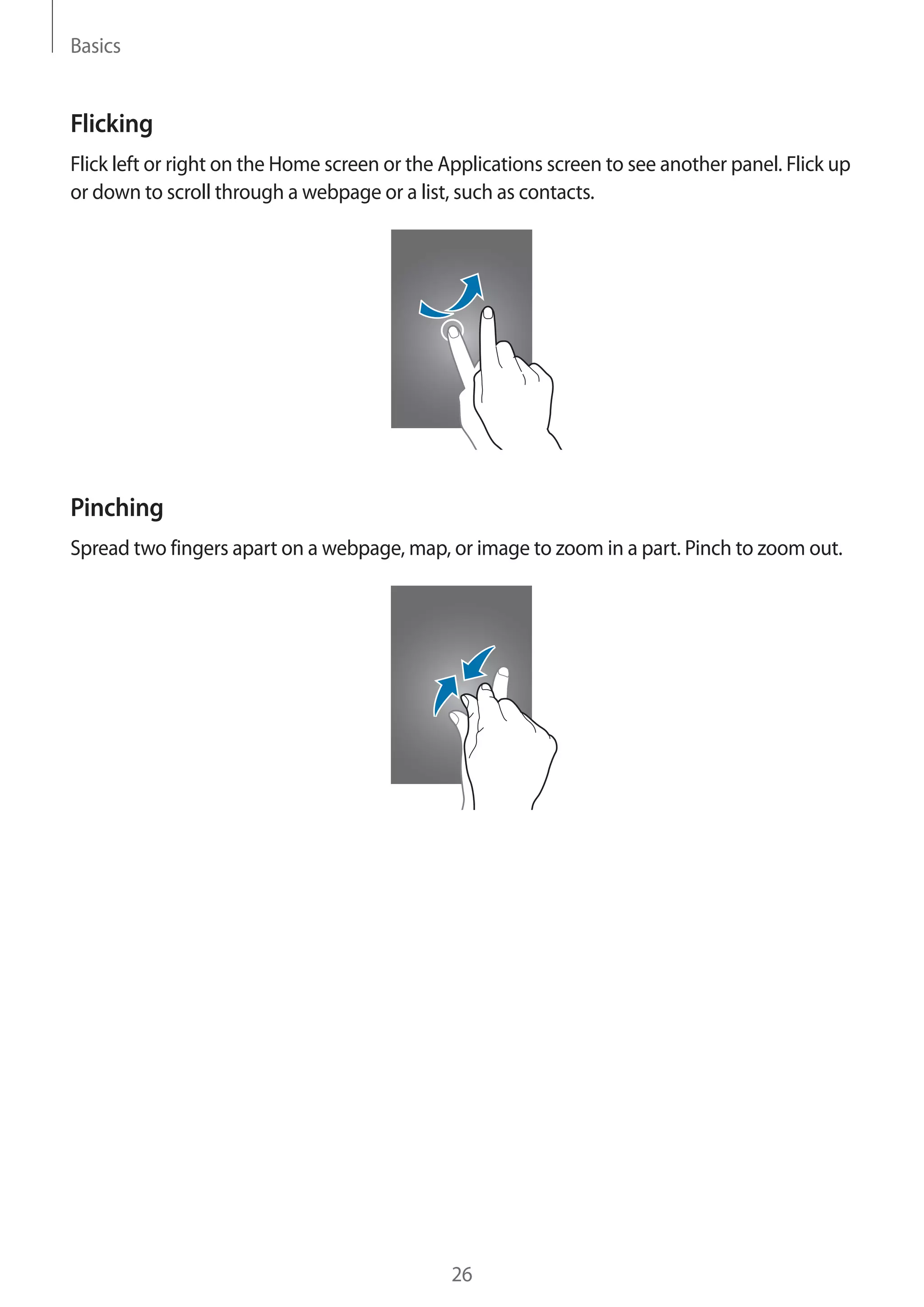
Double-tapping
Double-tap on a webpage or image to zoom in a part. Double-tap again to return.

25
Basics

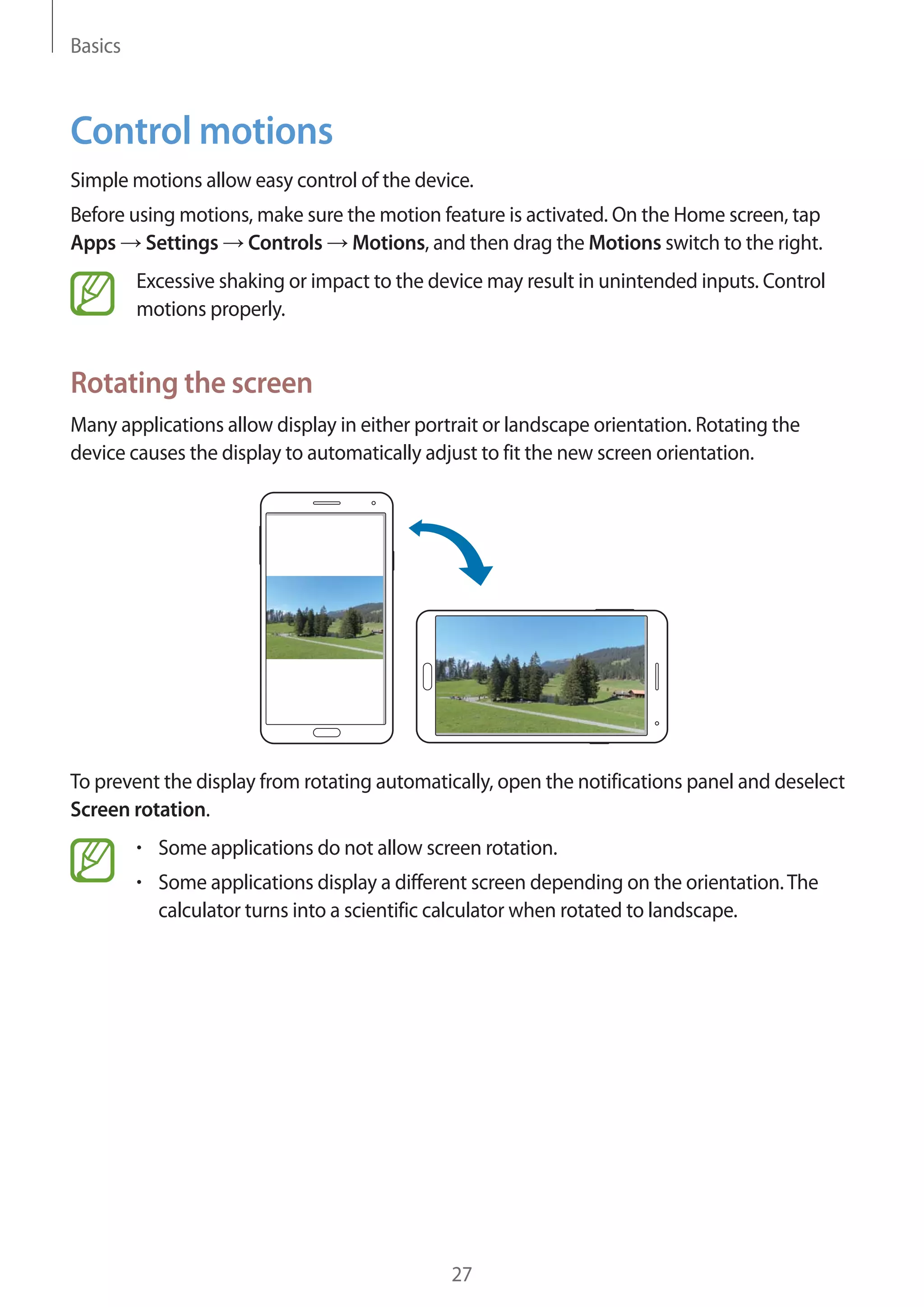
Flicking
Flick left or right on the Home screen or the Applications screen to see another panel. Flick up
or down to scroll through a webpage or a list, such as contacts.

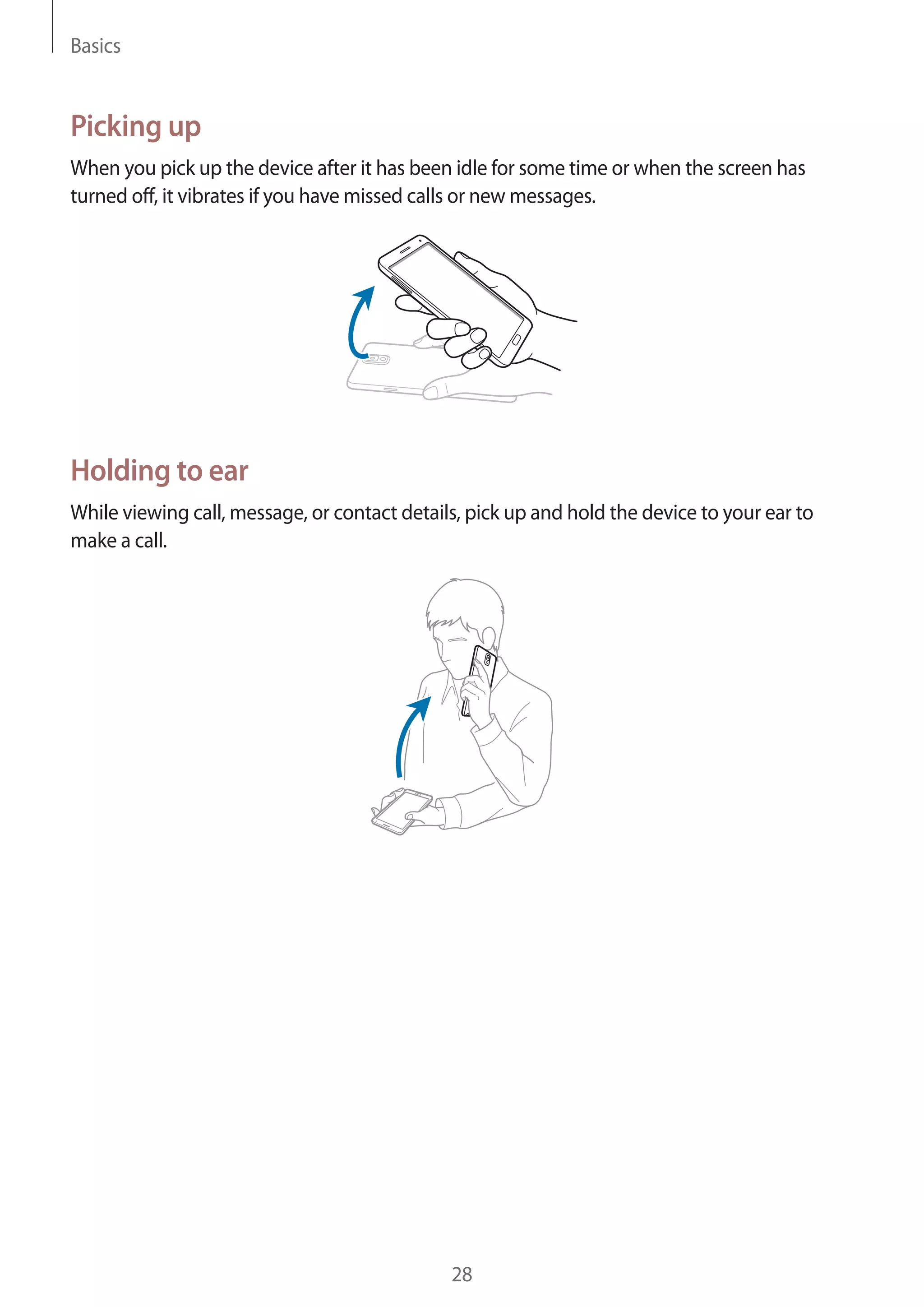
Pinching
Spread two fingers apart on a webpage, map, or image to zoom in a part. Pinch to zoom out.

26
Basics

Control motions
Simple motions allow easy control of the device.
Before using motions, make sure the motion feature is activated. On the Home screen, tap
Apps Settings Controls Motions, and then drag the Motions switch to the right.
Excessive shaking or impact to the device may result in unintended inputs. Control
motions properly.

Rotating the screen
Many applications allow display in either portrait or landscape orientation. Rotating the
device causes the display to automatically adjust to fit the new screen orientation.

To prevent the display from rotating automatically, open the notifications panel and deselect
Screen rotation.
Some applications do not allow screen rotation.
Some applications display a different screen depending on the orientation. The
calculator turns into a scientific calculator when rotated to landscape.

27
Basics

Picking up
When you pick up the device after it has been idle for some time or when the screen has
turned off, it vibrates if you have missed calls or new messages.

Holding to ear
While viewing call, message, or contact details, pick up and hold the device to your ear to
make a call.

28
Basics

Panning to browse
When an image is zoomed in, tap and hold a point on the screen, and then move the device
in any direction to browse the image.

Turning over
Turn over the device to mute ringtone or pause media playback.

29
Basics

Tilting
Tap and hold two points on the screen, and then tilt the device back and forth to zoom in or
out.

Palm motions
Use palm motions to control the device by touching the screen.
Before using motions, make sure the palm motion feature is activated. On the Home screen,
tap Apps Settings Controls Palm motion, and then drag the Palm motion switch
to the right.

Sweeping
Sweep your hand across the screen to capture a screenshot. The image is saved in Gallery
Screenshots. It is not possible to capture a screenshot while using some applications.

30
Basics

Covering
Cover the screen with a palm to pause media playback.

Air Gesture
Use this feature to control functions without touching the screen.
Before using this feature, make sure the air gesture feature is activated. On the Home screen,
tap Apps Settings Controls Air gesture, and then drag the Air gesture switch to the
right.
The device may not recognise your gestures if you perform them too far from the
device or while wearing dark-coloured clothes, such as gloves.

Quick glance
When the screen is turned off, move your hand above the sensor to view notifications, missed
calls, new messages, time and date, and more.

31
Basics

Air jump
While viewing emails or webpages, move your hand up or down across the sensor to scroll
the page up or down.

Air browse
Move your hand to the left or right across the sensor to browse images, webpages, songs, or
memos.

32
Basics

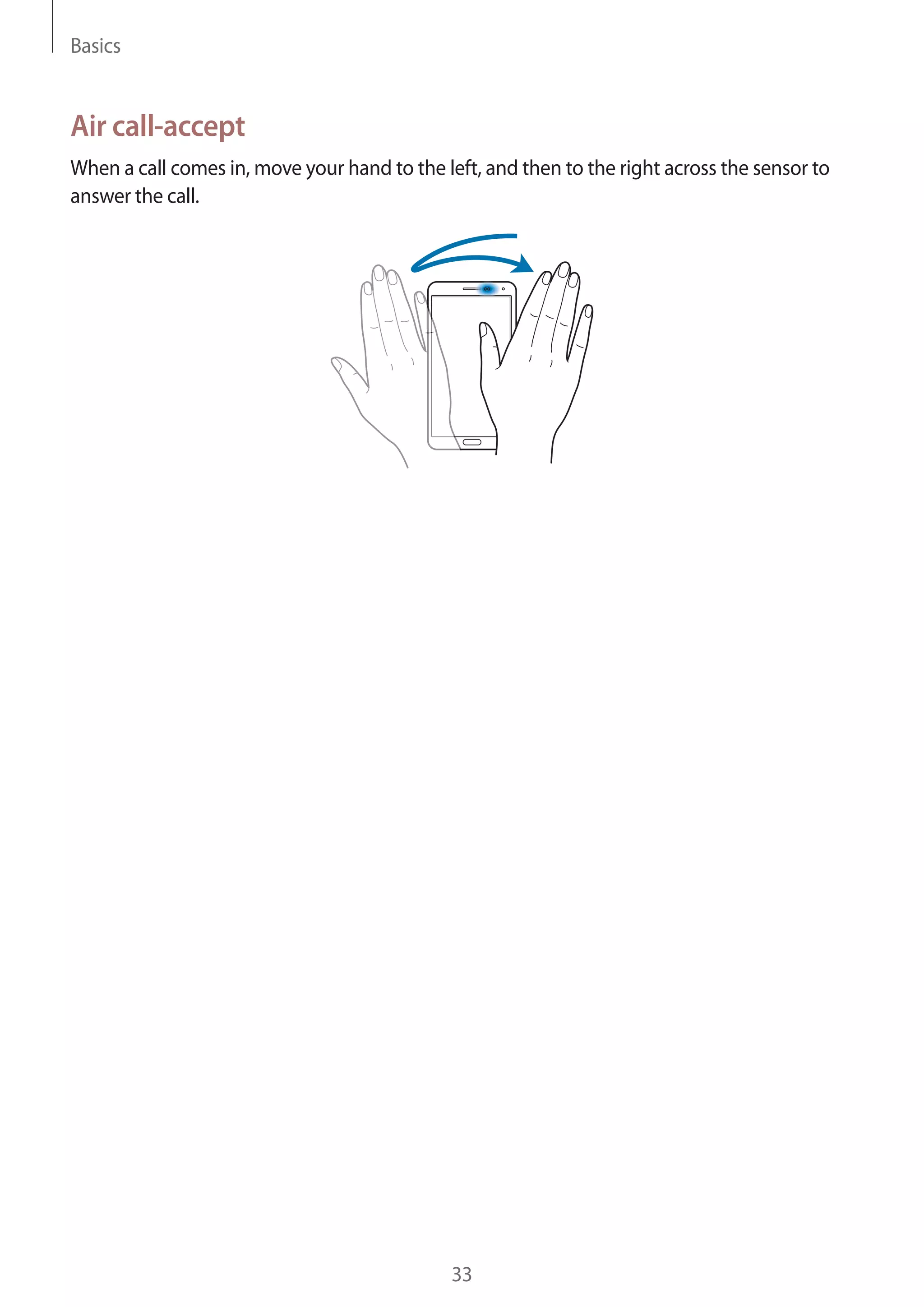
Air call-accept
When a call comes in, move your hand to the left, and then to the right across the sensor to
answer the call.

33
Basics

Using the S Pen
The included S Pen can be used to easily select items or perform functions. Actions using the
S Pen with the button pressed provide additional conveniences, such as screen capture.
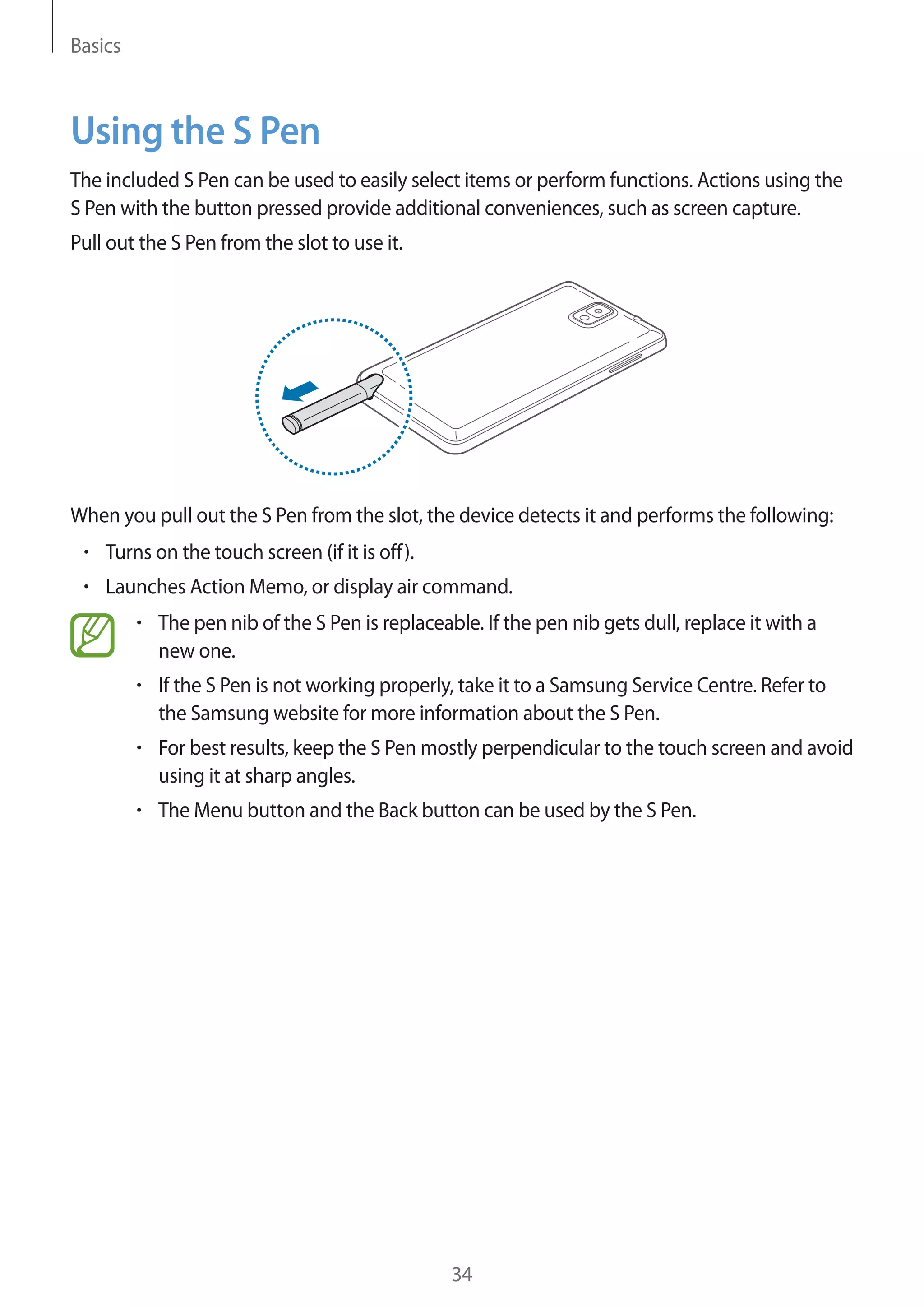
Pull out the S Pen from the slot to use it.

When you pull out the S Pen from the slot, the device detects it and performs the following:
Turns on the touch screen (if it is off).
Launches Action Memo, or display air command.
The pen nib of the S Pen is replaceable. If the pen nib gets dull, replace it with a
new one.
If the S Pen is not working properly, take it to a Samsung Service Centre. Refer to
the Samsung website for more information about the S Pen.
For best results, keep the S Pen mostly perpendicular to the touch screen and avoid
using it at sharp angles.
The Menu button and the Back button can be used by the S Pen.

34
Basics

Air command
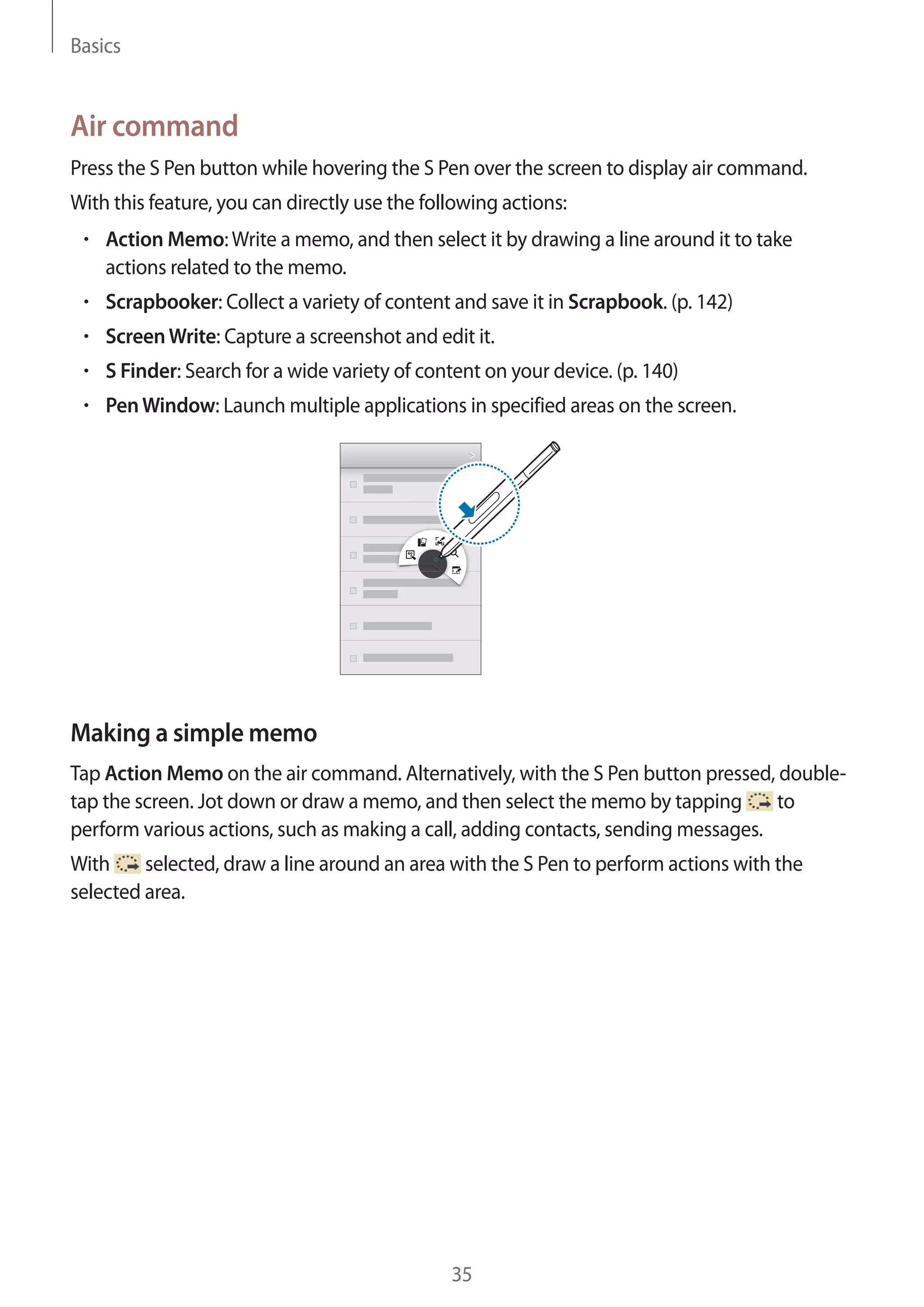
Press the S Pen button while hovering the S Pen over the screen to display air command.
With this feature, you can directly use the following actions:
Action Memo: Write a memo, and then select it by drawing a line around it to take
actions related to the memo.
Scrapbooker: Collect a variety of content and save it in Scrapbook. (p. 142)
Screen Write: Capture a screenshot and edit it.
S Finder: Search for a wide variety of content on your device. (p. 140)
Pen Window: Launch multiple applications in specified areas on the screen.

Making a simple memo
Tap Action Memo on the air command. Alternatively, with the S Pen button pressed, doubleto
tap the screen. Jot down or draw a memo, and then select the memo by tapping
perform various actions, such as making a call, adding contacts, sending messages.
With
selected, draw a line around an area with the S Pen to perform actions with the
selected area.

35
Basics

Capturing screenshots
Tap Screen Write on the air command. Alternatively, with the S Pen button pressed, touch the
screen until you hear a click. It is possible to draw or write on or to crop a screenshot.
The screenshot is saved in the Gallery

Screenshots folder.

It is not possible to capture a screenshot while using some applications.

Launching multiple applications
Tap Pen Window on the air command. Draw a line around an area, and then select an
application. The application is launched in the area that you have drawn. To minimise the
application, tap . Minimised applications are always displayed on top.
To close the applications, tap

.

Opening available options
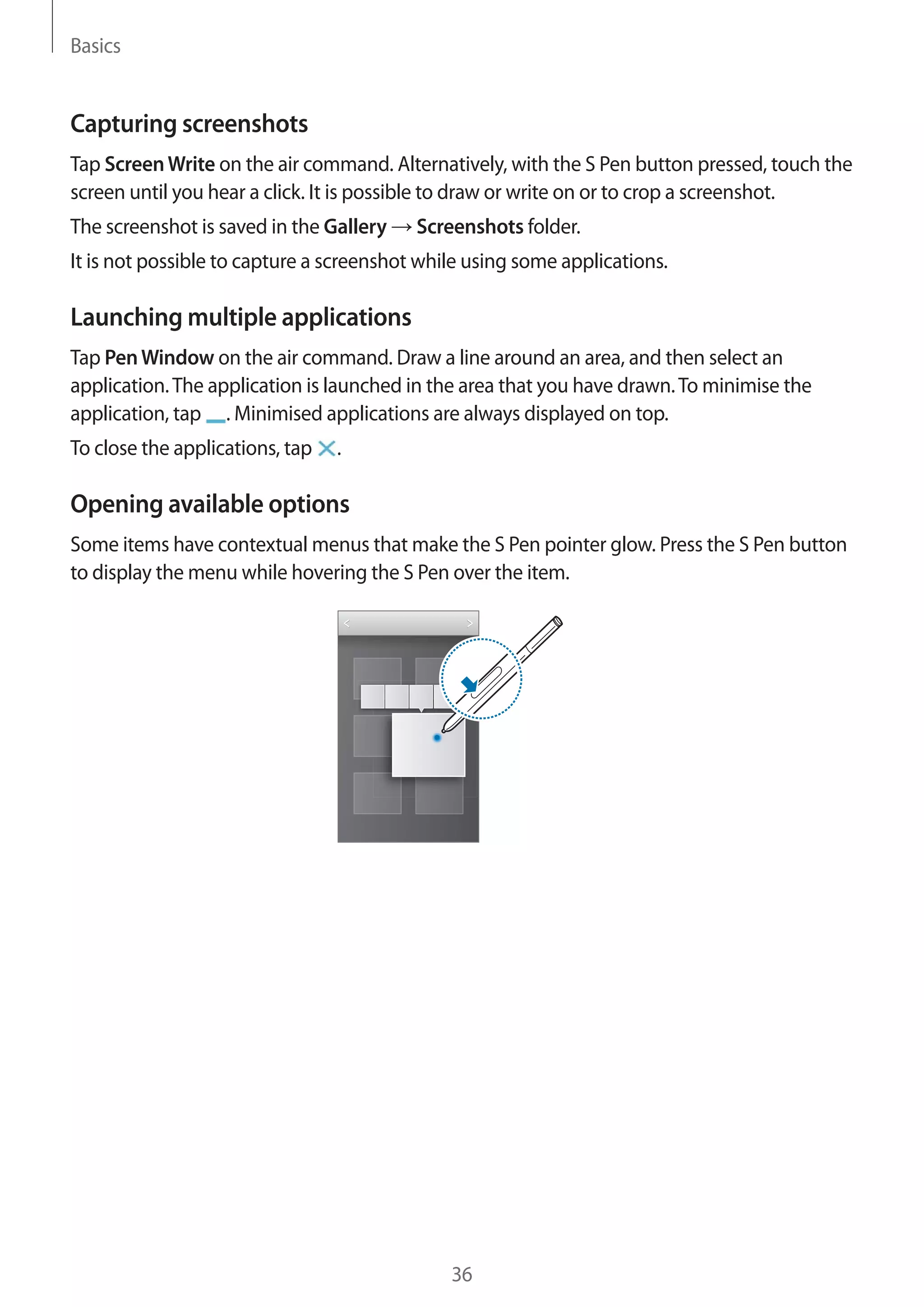
Some items have contextual menus that make the S Pen pointer glow. Press the S Pen button
to display the menu while hovering the S Pen over the item.

36
Basics

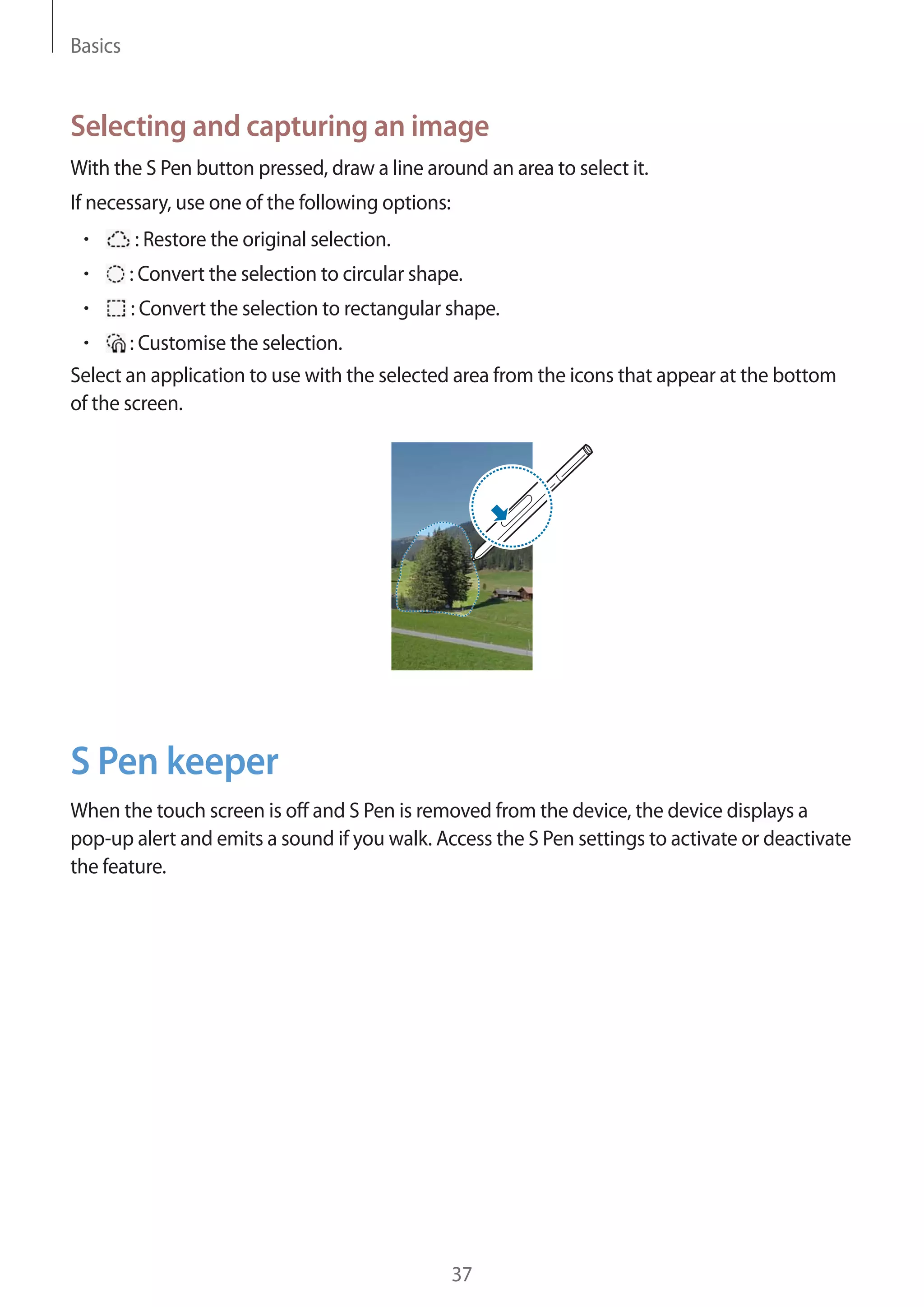
Selecting and capturing an image
With the S Pen button pressed, draw a line around an area to select it.
If necessary, use one of the following options:
: Restore the original selection.
: Convert the selection to circular shape.
: Convert the selection to rectangular shape.
: Customise the selection.
Select an application to use with the selected area from the icons that appear at the bottom
of the screen.

S Pen keeper
When the touch screen is off and S Pen is removed from the device, the device displays a
pop-up alert and emits a sound if you walk. Access the S Pen settings to activate or deactivate
the feature.

37
Basics

Air view
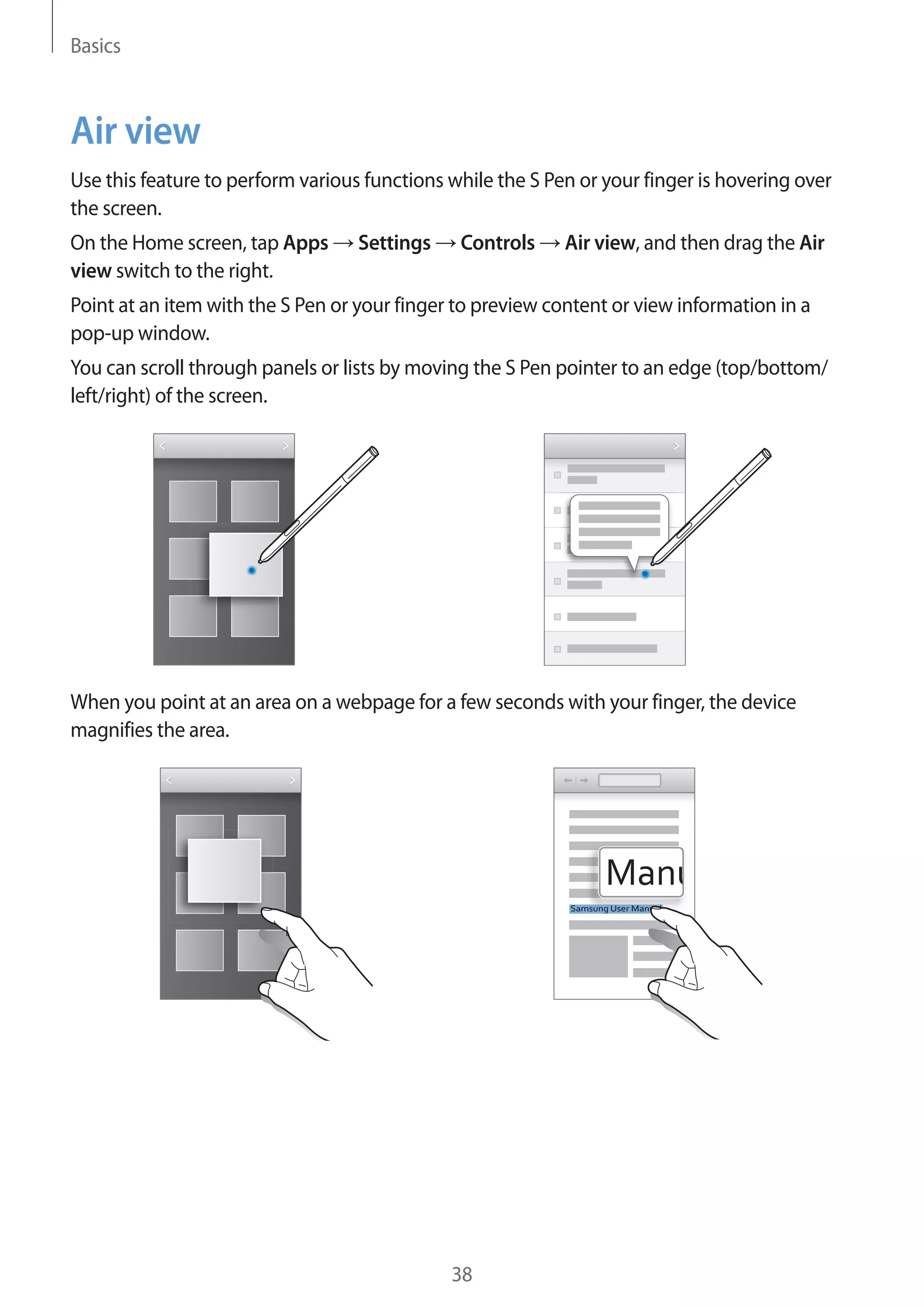
Use this feature to perform various functions while the S Pen or your finger is hovering over
the screen.
On the Home screen, tap Apps
view switch to the right.

Settings

Controls

Air view, and then drag the Air

Point at an item with the S Pen or your finger to preview content or view information in a
pop-up window.
You can scroll through panels or lists by moving the S Pen pointer to an edge (top/bottom/
left/right) of the screen.

When you point at an area on a webpage for a few seconds with your finger, the device
magnifies the area.

Samsung User Manu l
msung User Manu
sung
Manual

38
Basics

Samsung Smart Pause
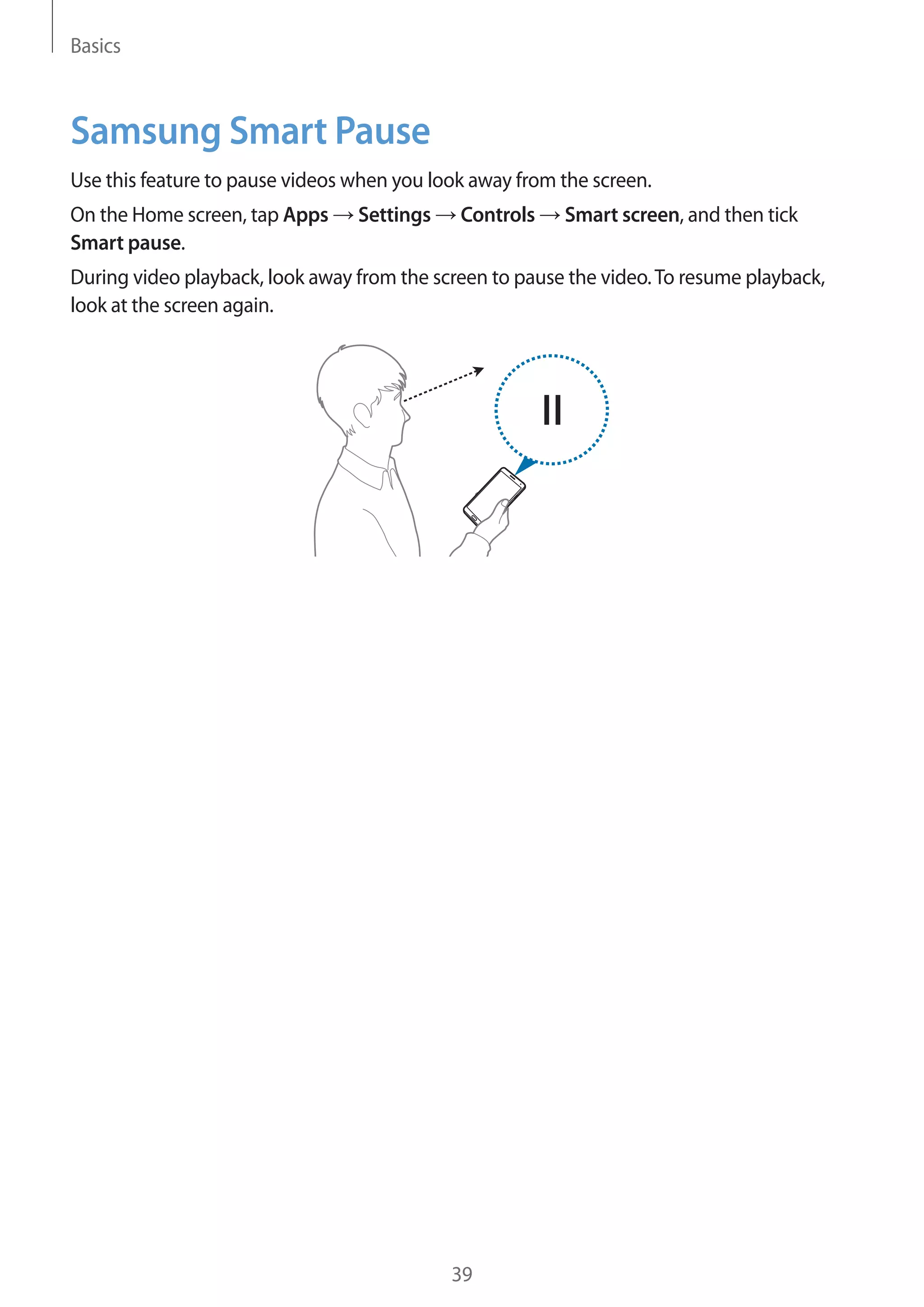
Use this feature to pause videos when you look away from the screen.
On the Home screen, tap Apps
Smart pause.

Settings

Controls

Smart screen, and then tick

During video playback, look away from the screen to pause the video. To resume playback,
look at the screen again.

39
Basics

Samsung Smart Scroll
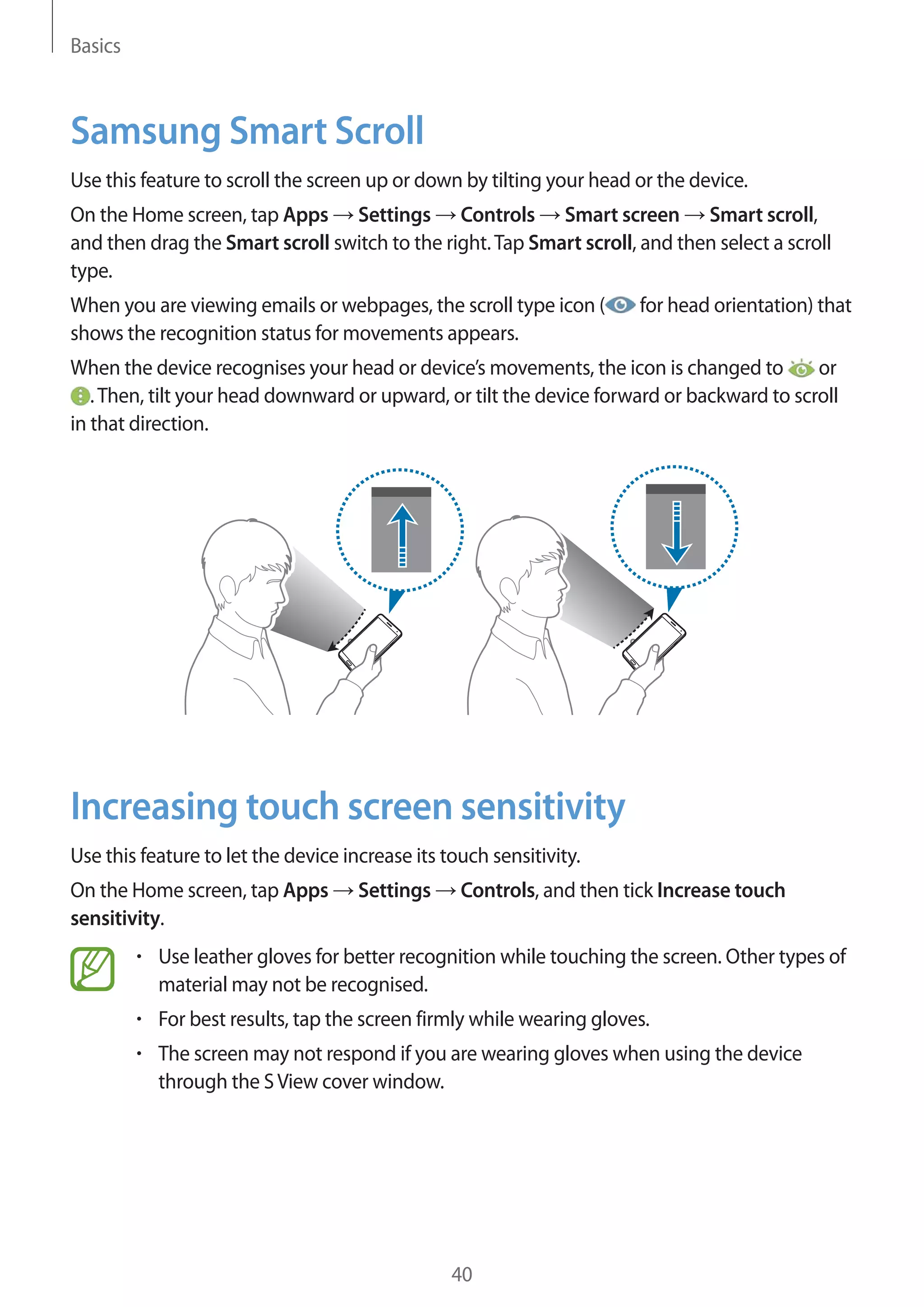
Use this feature to scroll the screen up or down by tilting your head or the device.
On the Home screen, tap Apps Settings Controls Smart screen Smart scroll,
and then drag the Smart scroll switch to the right. Tap Smart scroll, and then select a scroll
type.
When you are viewing emails or webpages, the scroll type icon (
shows the recognition status for movements appears.

for head orientation) that

When the device recognises your head or device’s movements, the icon is changed to
or
. Then, tilt your head downward or upward, or tilt the device forward or backward to scroll
in that direction.

Increasing touch screen sensitivity
Use this feature to let the device increase its touch sensitivity.
On the Home screen, tap Apps
sensitivity.

Settings

Controls, and then tick Increase touch

Use leather gloves for better recognition while touching the screen. Other types of
material may not be recognised.
For best results, tap the screen firmly while wearing gloves.
The screen may not respond if you are wearing gloves when using the device
through the S View cover window.

40
Basics

Activating Multi Window
Use this feature to run two applications on the screen at the same time.
Only applications on the Multi Window panel can run.
When launching applications that contain multimedia files, such as music or
videos, sound from both files will be played.
This feature may not be available depending on the region or service provider.
To use Multi Window, on the Applications screen, tap Settings

Device

Multi window.

Using the Multi Window panel
To show the Multi Window panel, tap and hold . The Multi Window panel appears at the
left side of the screen. Select one application, and then drag another application to a new
location. You can launch the same application on the two windows at the same time. To hide
again.
the Multi Window panel, tap and hold

Drag the circle between the application panels up or down to adjust the size of the panels.
Tap the panel handle to hide or show the panel. When a panel is open, tap and hold the
handle and drag it to the left or right edge of the screen to move the panel. When a panel is
hidden, tap and hold the handle and drag it up or down to move the handle.

41
Basics

Using Multi Window applications
While using Multi Window applications, select an application window, tap the circle between
the application windows, and then use one of the following:
: Open a list of recently-used applications in the selected window.
: Switch locations between Multi Window applications.
: Share items between the application windows. Drag an item to share from one
window to another. Some applications may not support this feature.
: Close the application.

Sharing files
Drag an item you want to share to the other window to share the item from one window to
another. Some applications may not support this feature.

Creating a paired window
Use this feature to save the combination of current running Multi Window applications.
On the Multi Window panel, tap

Create, enter a title, and then tap OK.

Notifications
Notification icons appear on the status bar at the top of the screen to report missed calls, new
messages, calendar events, device status, and more. Drag down from the status bar to open
the notifications panel. Scroll the list to see additional alerts. To close the notifications panel,
drag up the bar that is at the bottom of the screen.
From the notifications panel, you can view your device’s current settings. Drag down from the
status bar, and then tap to use the following options:
Wi-Fi: Activate or deactivate the Wi-Fi feature.
GPS: Activate or deactivate the GPS feature.
Sound: Activate or deactivate silent mode. You can vibrate or mute your device in silent
mode.

42
Basics

Screen rotation: Allow or prevent the interface from rotating when you rotate the device.
Bluetooth: Activate or deactivate the Bluetooth feature.
Reading mode: Activate or deactivate reading mode. In reading mode, the device helps
protect your eyes when reading at night. To select which applications will be used for, tap
Settings Device Display Reading mode.
Mobile data: Activate or deactivate the data connection.
Blocking mode: Activate or deactivate blocking mode. In blocking mode, your device
will block notifications. To select which notifications will be blocked, tap Settings
Device Blocking mode.
Power saving: Activate or deactivate power-saving mode.
Multi window: Set to use Multi Window.
Screen Mirroring: Activate or deactivate the screen mirroring feature.
Wi-Fi hotspot: Activate or deactivate the Wi-Fi tethering feature.
S Beam: Activate or deactivate the S Beam feature.
NFC: Activate or deactivate the NFC feature.
Air view: Activate or deactivate the air view feature.
Air gesture: Activate or deactivate the air gesture feature.
Hands-free mode: Activate or deactivate driving mode.
Smart stay: Activate or deactivate the smart stay feature.
Smart pause: Activate or deactivate the smart pause feature.
Smart scroll: Activate or deactivate the smart scroll feature.
Sync: Activate or deactivate auto-syncing of applications.
Flight mode: Activate or deactivate flight mode.
The available options may vary depending on the region or service provider.
To rearrange the options on the notifications panel, open the notifications panel, tap
tap and hold an item, and then drag the item to another location.

43

,
Basics

Home screen
The Home screen is the starting point to access all of the device’s features. It displays indicator
icons, widgets, shortcuts to applications, and others.
The Home screen can have multiple panels. To view other panels, scroll left or right.

Changing the Home screen mode
The Home screen has standard and easy modes. In easy mode, you can easily access your
favourite contacts, applications, and settings by adding shortcuts to the Home screen.
To switch to easy mode, on the Home screen, tap Apps
and then drag the Easy mode switch to the right.

Settings

Device

Easy mode,

Rearranging items
Adding an application icon
On the Home screen, tap Apps, tap and hold an application icon, and then drag it into a panel
preview.

Adding an item
Customise the Home screen by adding widgets, folders, or panels.
Tap and hold the empty area on the Home screen, and then select one of the following
categories:
Apps and widgets: Add widgets or applications to the Home screen.
Folder: Create a new folder.
Page: Rearrange panels on the Home screen.

44
Basics

Moving an item
Tap and hold an item and drag it to a new location. To move it to another panel, drag it to the
side of the screen.

Removing an item
Tap and hold an item, and drag it to the rubbish bin that appears at the top of the Home
screen. When the rubbish bin turns red, release the item.

Rearranging panels
Adding a new panel
Tap

Edit page

.

Moving a panel
Tap

Edit page, tap and hold a panel preview, and then drag it to a new location.

Removing a panel
Tap
Edit page, tap and hold a panel preview, and then drag it to the rubbish bin at the
top of the screen.

Setting wallpaper
Set an image or photo stored in the device as wallpaper for the Home screen.
On the Home screen, tap
following:

Set wallpaper

Home screen, and then select one of the

Gallery: See photos taken by the device’s camera or images downloaded from the
Internet.
Live wallpapers: See animated images.
Wallpapers: See wallpaper images.
Then, select an image and tap Set wallpaper. Or, select an image, resize it by dragging the
frame, and then tap Done.

45
Basics

Using widgets
Widgets are small applications that provide convenient functions and information on your
Home screen. To use them, add widgets from the widgets panel to the Home screen.
Some widgets connect to web services. Using a web-based widget may result in
additional charges.
The widgets available may vary depending on the region or service provider.

Adding widgets to the Home screen
On the Home screen, tap Apps Widgets. Scroll left or right on the widgets panel, and then
tap and hold a widget to add it to the Home screen. Put it on a location you want, resize it by
dragging the frame if necessary, and then tap anywhere on the screen to save the location of
the widget.

Locked screen
The locked screen prevents the device from unwanted operation when not in use and also
allows you to add convenient widgets.

Locking and unlocking the device
Pressing the Power button turns off the screen and puts the device into lock mode. The
device automatically gets locked if it is not used for a specified period.
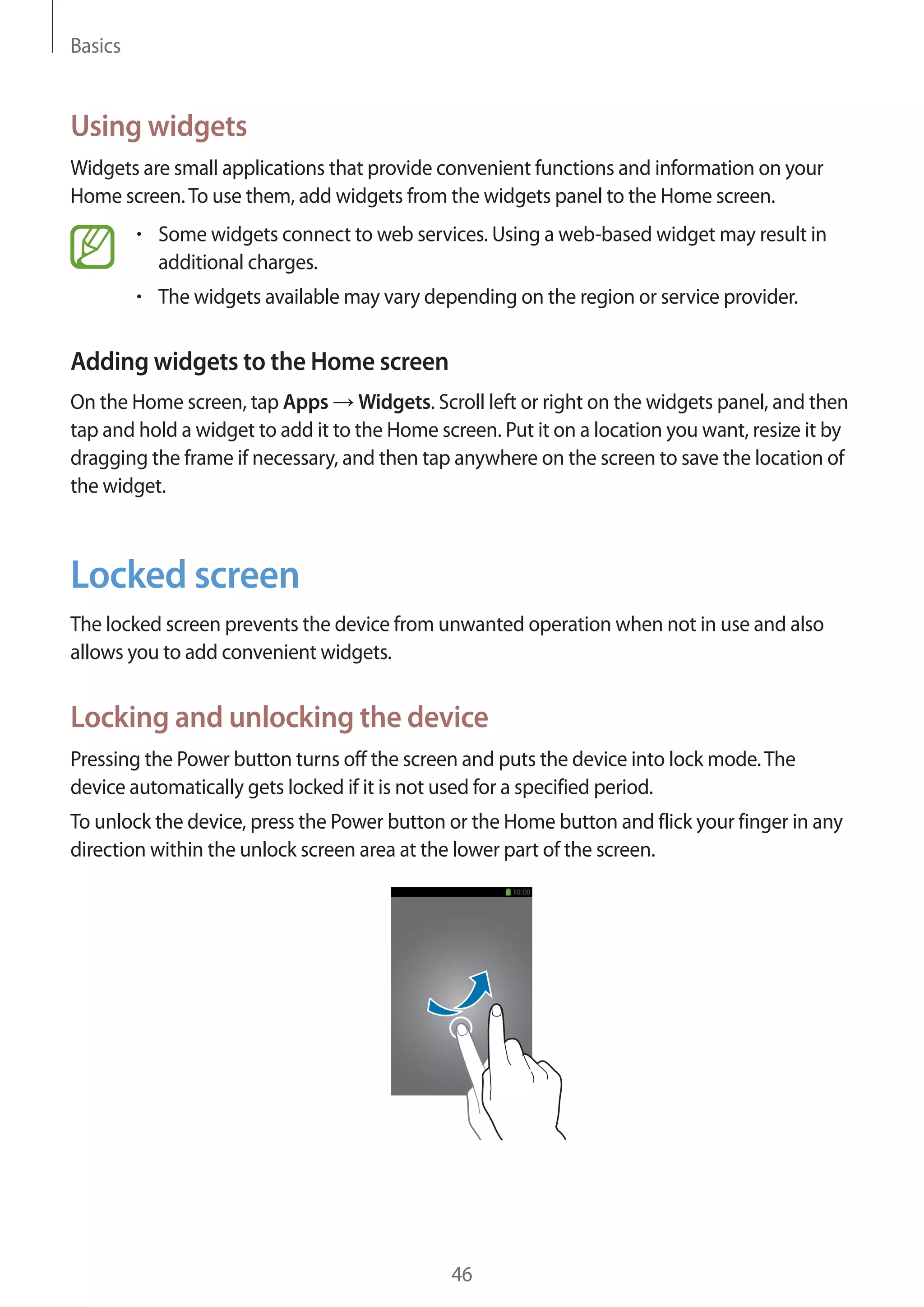
To unlock the device, press the Power button or the Home button and flick your finger in any
direction within the unlock screen area at the lower part of the screen.

46
Basics

Adding widgets
To use widgets when the screen is locked, tap Apps Settings Device
Multiple widgets and then drag the Multiple widgets switch to the right.

Lock screen

You cannot use widgets on the locked screen in easy mode.
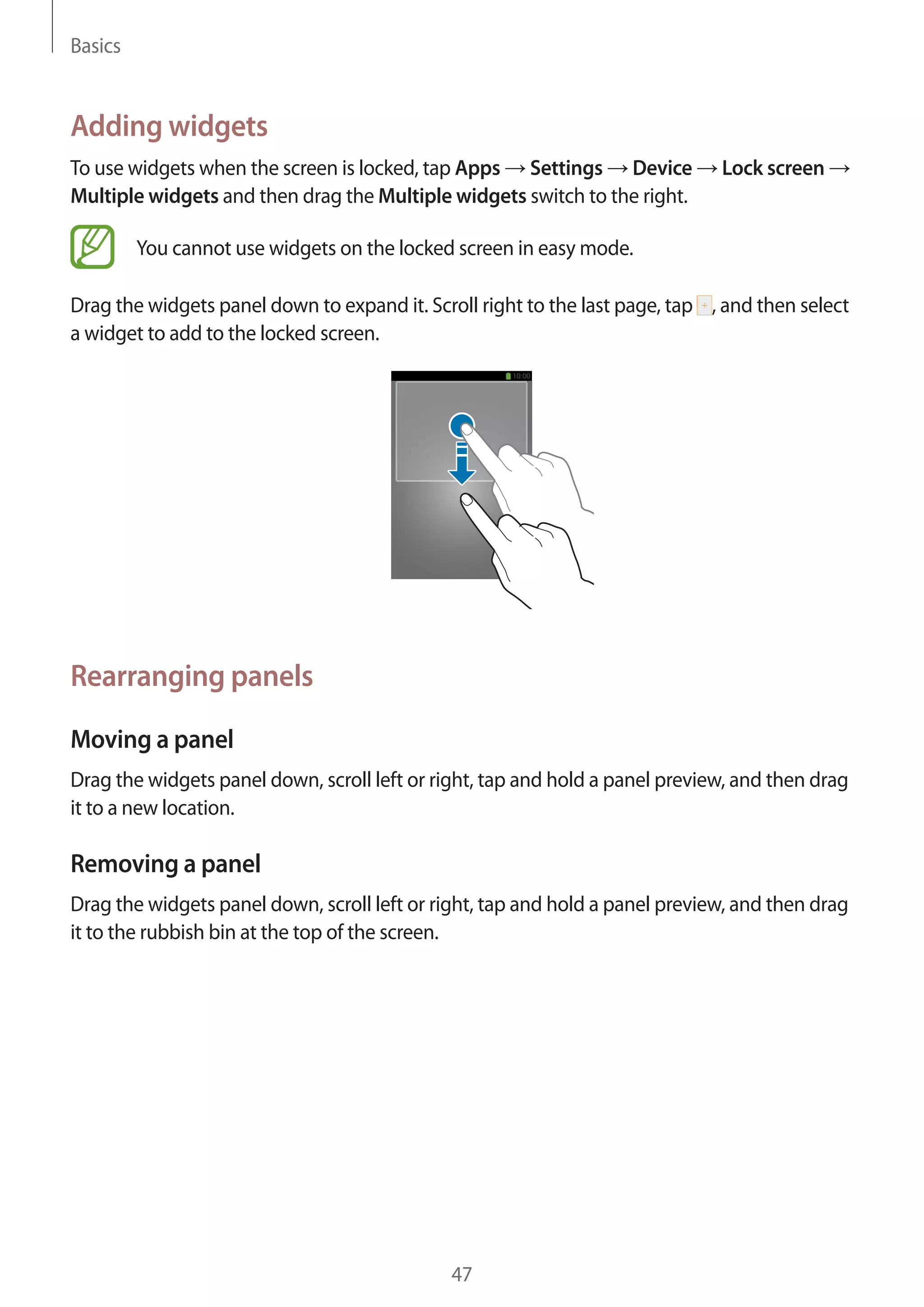
Drag the widgets panel down to expand it. Scroll right to the last page, tap , and then select
a widget to add to the locked screen.

Rearranging panels
Moving a panel
Drag the widgets panel down, scroll left or right, tap and hold a panel preview, and then drag
it to a new location.

Removing a panel
Drag the widgets panel down, scroll left or right, tap and hold a panel preview, and then drag
it to the rubbish bin at the top of the screen.

47
Basics

Using applications
This device can run many different types of applications, ranging from media to Internet
applications.

Opening an application
On the Home screen or the Applications screen, select an application icon to open it.
Some applications are grouped into folders. Tap a folder, and then tap an application
to open it.

Opening from recently-used applications
Press and hold the Home button to open the list of recently-used applications.
Select an application icon to open.

Closing an application
Close applications not in use to save battery power and maintain device performance.
Press and hold the Home button, tap , and then tap End next to an application to close it.
To close all running applications, tap End all. Alternatively, press and hold the Home button,
and then tap .

Applications screen
The Applications screen displays icons for all applications, including any new applications
installed.
On the Home screen, tap Apps to open the Applications screen.
To view other panels, scroll left or right.

Rearranging applications
Tap
Edit, tap and hold an application, and then drag it to a new location. To move it to
another panel, drag it to the side of the screen.

48
Basics

Organising with folders
Put related applications together in a folder for convenience.
Tap
Edit, tap and hold an application, and then drag it to Create folder. Enter a folder
name and then tap OK. Put applications into the new folder by dragging, and then tap Save
to save the arrangement.

Rearranging panels
Pinch on the screen, tap and hold a panel preview, and then drag it to a new location.

Installing applications
Use application stores, such as Samsung Apps, to download and install applications.

Uninstalling applications
Tap

Uninstall/disable apps, and then select an application to uninstall it.
Default applications that come with the device cannot be uninstalled.

Help
Access help information to learn how to use the device and applications or configure
important settings.
Tap Help on the Applications screen. Select a category to view tips.
To sort categories by an alphabetical order, tap
To search for keywords, tap

.

49

.
Basics

One-handed operation
You can activate one-handed operation mode for your convenience. In this mode, application
interfaces are modified for easy use with one hand.
On the Applications screen, tap Settings Controls
applications or features to use with the mode.

One-handed operation. Tick

Entering text
Use the Samsung keyboard or the voice input feature to enter text.
Text entry is not supported in some languages. To enter text, you must change the
input language to one of the supported languages.

Changing the keyboard type
Tap any text field, open the notifications panel, tap Choose input method, and then select
the type of keyboard to use.

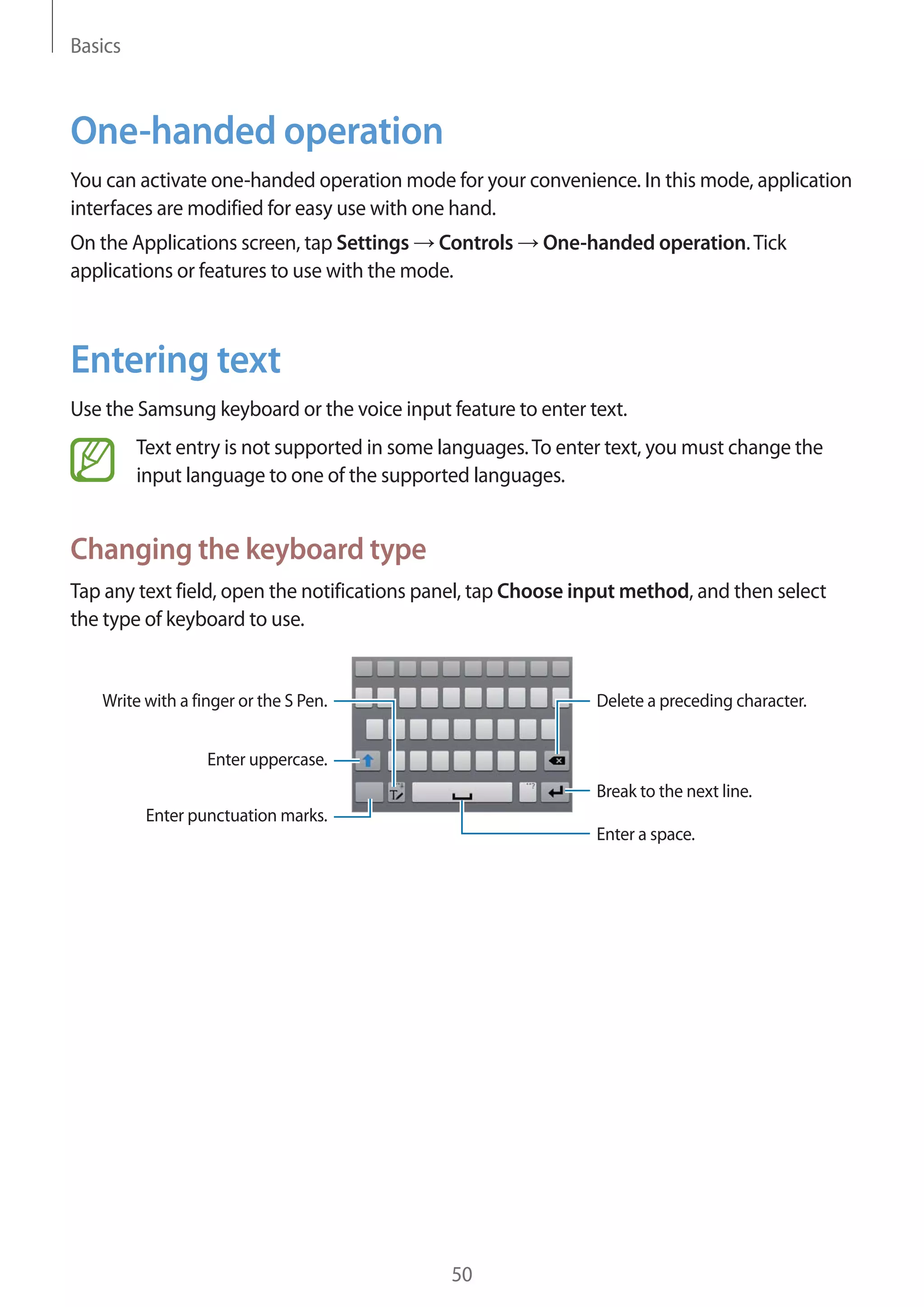
Write with a finger or the S Pen.

Delete a preceding character.

Enter uppercase.
Break to the next line.
Enter punctuation marks.
Enter a space.

50
Basics

Entering uppercase
Tap

before entering a character. For all caps, tap it twice.

Changing the keyboard type
Tap and hold

, and then tap

to change the keyboard type.

Changing language keyboards
Add languages to the keyboard, and then slide the space key left or right to change language
keyboards.

Handwriting
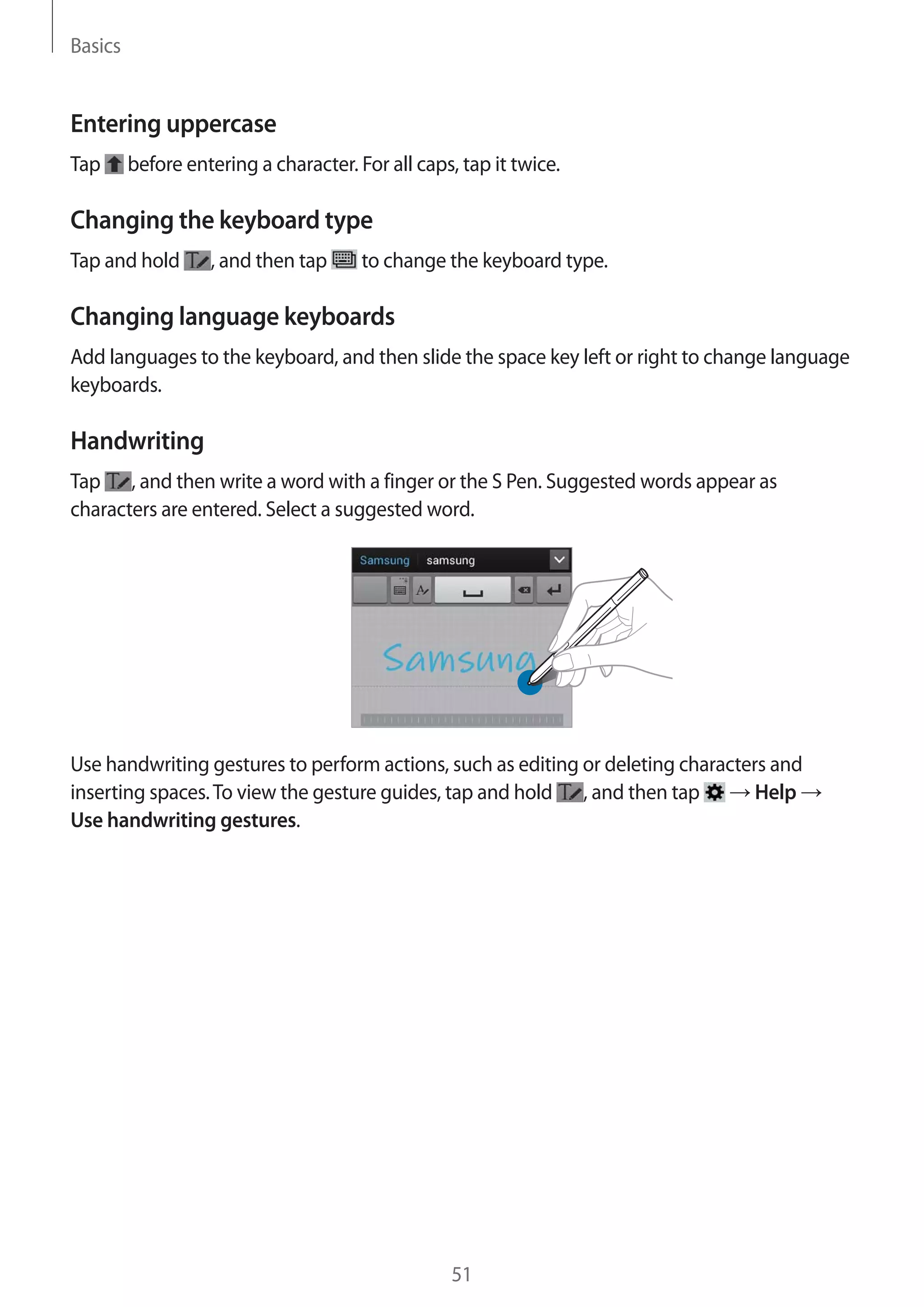
Tap , and then write a word with a finger or the S Pen. Suggested words appear as
characters are entered. Select a suggested word.

Use handwriting gestures to perform actions, such as editing or deleting characters and
Help
inserting spaces. To view the gesture guides, tap and hold , and then tap
Use handwriting gestures.

51
Basics

Direct pen input
On the Applications screen, tap Settings Controls
drag the Direct pen input switch to the right.

S Pen

Direct pen input, and then

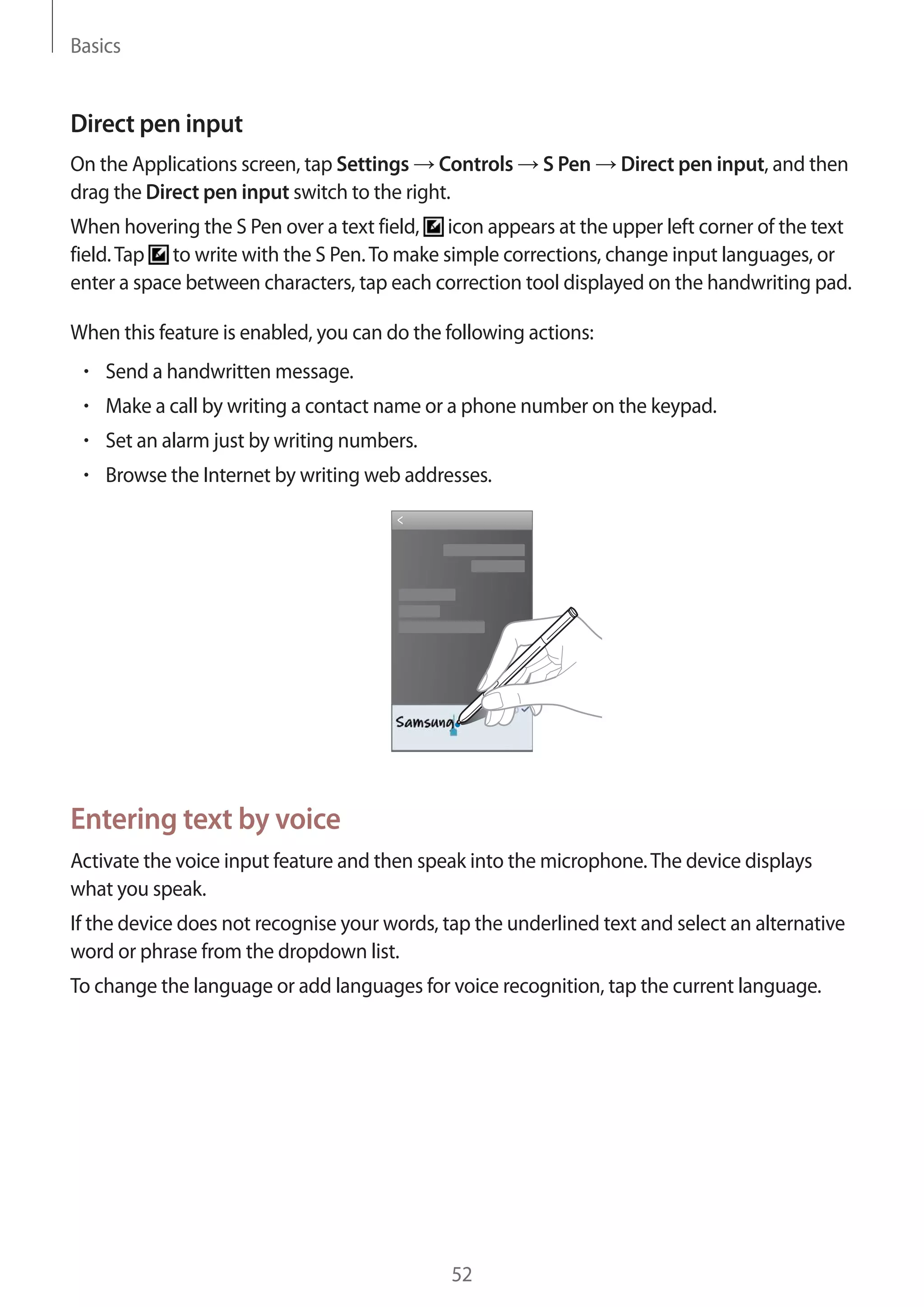
When hovering the S Pen over a text field, icon appears at the upper left corner of the text
field. Tap to write with the S Pen. To make simple corrections, change input languages, or
enter a space between characters, tap each correction tool displayed on the handwriting pad.
When this feature is enabled, you can do the following actions:
Send a handwritten message.
Make a call by writing a contact name or a phone number on the keypad.
Set an alarm just by writing numbers.
Browse the Internet by writing web addresses.

Entering text by voice
Activate the voice input feature and then speak into the microphone. The device displays
what you speak.
If the device does not recognise your words, tap the underlined text and select an alternative
word or phrase from the dropdown list.
To change the language or add languages for voice recognition, tap the current language.

52
Basics

Copying and pasting
Tap and hold over text, drag or to select more or less text, and then tap Copy to copy or
Cut to cut. The selected text is copied to the clipboard.
To paste it into a text entry field, tap and hold at the point where it should be inserted, and
then tap Paste.

Connecting to a Wi-Fi network
Connect the device to a Wi-Fi network to use the Internet or share media files with other
devices. (p. 147)

Turning Wi-Fi on and off
Open the notifications panel, and then tap Wi-Fi to turn it on or off.
Your device uses a non-harmonised frequency and is intended for use in all
European countries. The WLAN can be operated in the EU without restriction
indoors, but cannot be operated outdoors.
Turn off Wi-Fi to save the battery when not in use.

Joining Wi-Fi networks
On the Applications screen, tap Settings
switch to the right.

Connections

Wi-Fi, and then drag the Wi-Fi

Select a network from the list of detected Wi-Fi networks, enter a password if necessary, and
then tap Connect. Networks that require a password appear with a lock icon. After the device
connects to a Wi-Fi network, the device will automatically connect to it any time it is available.

53
Basics

Adding Wi-Fi networks
If the desired network does not appear in the networks list, tap Add Wi-Fi network at the
bottom of the networks list. Enter the network name in Network SSID, select the security
type and enter the password if it is not an open network, and then tap Connect.

Forgetting Wi-Fi networks
Any network that has ever been used, including the current network, can be forgotten so the
device will not automatically connect to it. Select the network in the networks list, and then
tap Forget.

Setting up accounts
Google applications, such as Play Store, require a Google account, and Samsung Apps
requires a Samsung account. Create Google and Samsung accounts to have the best
experience with the device.

Adding accounts
Follow the instructions that appear when opening a Google application without signing in to
set up a Google account.
To sign in with or sign up for a Google account, on the Applications screen, tap Settings
General Accounts Add account Google. After that, tap New to sign up, or tap
Existing, and then follow on-screen instructions to complete the account setup. More than
one Google account can be used on the device.
Set up a Samsung account as well.

Removing accounts
On the Applications screen, tap Settings General Accounts, select an account name
under My accounts, select the account to remove, and then tap Remove account.

54
Basics

Transferring files
Move audio, video, image, or other types of files from the device to the computer, or vice
versa.
The following file formats are supported by some applications. Some file formats
are not supported depending on the version of the device’s software or the
computer operating system.
– Music: mp3, m4a, mp4, 3gp, 3ga, wma, ogg, oga, aac, and flac
– Image: bmp, gif, jpg, and png
– Video: avi, wmv, asf, flv, mkv, mp4, 3gp, webm, and ts
– Document: doc, docx, xls, xlsx, ppt, pptx, pdf, and txt
Some file formats, such as DivX or AC3, are not supported. To play these files, install
an application which supports them.
This device is compatible with USB 3.0 and under devices. When using a USB 3.0
device, make sure to use a USB 3.0 cable.
USB 3.0 speeds up data transfers, but it may sometimes interfere with calls or data
when it is in use. It will turn off automatically after 10 minutes if it is not being used,
and your connection will switch to using USB 2.0.

Connecting with Samsung Kies
Samsung Kies is a computer application that manages media contents and personal
information with Samsung devices. Download the latest Samsung Kies from the Samsung
website.

1

Connect the device to the computer using the USB cable.
Samsung Kies launches on the computer automatically. If Samsung Kies does not launch,
double-click the Samsung Kies icon on the computer.

2

Transfer files between your device and the computer.
Refer to the Samsung Kies help for more information.

55
Basics

Connecting with Windows Media Player
Ensure that Windows Media Player is installed on the computer.

1
2

Connect the device to the computer using the USB cable.
Open Windows Media Player and sync music files.

Connecting as a media device

1
2

Connect the device to the computer using the USB cable.
Open the notifications panel, and then tap Connected as a media device
device (MTP).

Media

Tap Camera (PTP) if your computer does not support Media Transfer Protocol (MTP) or
not have any appropriate driver installed.

3

Transfer files between your device and the computer.

56
Basics

Securing the device
Prevent others from using or accessing personal data and information stored in the device by
using the security features. The device requires an unlock code whenever unlocking it.

Setting a signature
On the Applications screen, tap Settings
Signature.

Device

Lock screen

Screen lock

Draw your signature with the S Pen, and then draw the signature two more times to verify it.
Set a backup unlock PIN to unlock the screen when you forget the signature.
When drawing your signature to unlock the device, use the same posture as when
you registered your signature with the device.

Setting a pattern
On the Applications screen, tap Settings
Pattern.

Device

Lock screen

Screen lock

Draw a pattern by connecting four dots or more, and then draw the pattern again to verify it.
Set a backup unlock PIN to unlock the screen when you forget the pattern.

57
Basics

Setting a PIN
On the Applications screen, tap Settings

Device

Lock screen

Screen lock

PIN.

Enter at least four numbers, and then enter the password again to verify it.

Setting a password
On the Applications screen, tap Settings
Password.

Device

Lock screen

Screen lock

Enter at least four characters including numbers and symbols, and then enter the password
again to verify it.

Unlocking the device
Turn on the screen by pressing the Power button or the Home button, and enter the unlock
code.
If the unlock code is forgotten, take the device to a Samsung Service Centre to reset it.

58
Basics

Upgrading the device
The device can be upgraded to the latest software.
This feature may not be available depending on the region or service provider.

Upgrading with Samsung Kies
Launch Samsung Kies and connect the device to the computer. Samsung Kies automatically
recognises the device and shows available updates in a dialogue box, if any. Click the Update
button in the dialogue box to start upgrading. Refer to the Samsung Kies help for details on
how to upgrade.
Do not turn off the computer or disconnect the USB cable while the device is
upgrading.
While upgrading the device, do not connect other media devices to the computer.
Doing so may interfere with the update process.

Upgrading over the air
The device can be directly upgraded to the latest software by the firmware over-the-air
(FOTA) service.
On the Applications screen, tap Settings
Update.

General

59

About device

Software update
Communication
Phone
Use this application to make or answer a call.
Tap Phone on the Applications screen.

Making calls
Making a call
Use one of the following methods:
Keypad: Enter the number using the keypad, and then tap .
Logs: Make a call from the history of incoming and outgoing calls and messages.
Favourites: Make a call from the list of favourite contacts.
Contacts: Make a call from the contacts list.

Speed dial numbers
For speed dial numbers, tap and hold the corresponding digit.

Number prediction
When entering numbers on the keypad, automatic predictions appear. Select one of these to
make a call.

60
Communication

Finding contacts
Enter a name, phone number, or email address to find a contact in the contacts list. As
characters are entered, predicted contacts appear. Select one to place a call to it.

Making an international call
Tap and hold 0 until the + sign appears. Enter the country code, area code, and phone
number, and then tap .

During a call
The following actions are available:
: Select an equaliser option for use during a call.
: Deactivate the noise reduction feature that removes background noise so that the
other party can hear you more clearly.
: Increase the volume.
Hold: Hold a call. Tap Unhold to retrieve the held call.
Add call: Dial a second call.
Keypad: Open the keypad.
End call: End the current call.
Speaker: Activate the speakerphone. Keep the device away from your ears when using
the speakerphone.
Mute: Turn off the microphone so that the other party cannot hear you.
Headset: Switch to a Bluetooth headset if it is connected to the device.
Swap: Switch between two calls.
Merge: Make a multiparty call when connected to two calls. Repeat this to add more
parties. This feature is available only if the multiparty call service is active.

61
Communication

Contacts: Open the contacts list.
Action Memo: Launch Action Memo.
Message: Send a message.
Transfer: Connect the first party to the second party. This disconnects you from
the conversation.
Manage conference call: Have a private conversation with one party during a
multiparty call or disconnect one party form the multiparty call.

Adding contacts
To add a phone number to the contacts list from the keypad, enter the number and tap Add
to contacts.

Viewing call logs
Tap Logs to view the history of incoming and outgoing calls.
To filter a call log, tap

View, and then select an option.

Fixed dialling number
The device can be set to restrict outgoing calls only to numbers with specified prefixes. Those
prefixes are stored in the SIM or USIM card.
Tap
Call settings Additional settings Fixed Dialling Numbers Enable FDN,
and then enter the PIN2 supplied with the SIM or USIM card. Tap FDN list and add numbers.

Call barring
The device can be set to prevent certain calls from being made. For example, international
calling can be disabled.
Tap
Call settings Additional settings
barring option, and then enter a password.

62

Call barring, select a call type, select a call
Communication

Receiving calls
Answering a call
When a call comes in, drag

outside the large circle.

If the call waiting service is active, another call can be made. When the second call is
answered, the first call is put on hold.

Rejecting a call
When a call comes in, drag

outside the large circle.

To send a message when rejecting an incoming call, drag the reject message bar upwards. To
create the rejection message, tap
Call settings Set up call reject messages.

Automatically rejecting calls from unwanted numbers
Tap
Call settings Call rejection Auto reject mode Auto reject numbers, and
then tap Auto reject list. Tap Create, enter a number, assign a category, and then tap Save.

Missed calls
If a call is missed,
missed calls.

appears on the status bar. Open the notifications panel to view the list of

Call waiting
Call waiting is a service provided by the service provider. A user can use this service to
suspend a current call and switch to an incoming call. This service is not available for video
calls.
To make use of this service, tap
waiting.

Call settings

63

Additional settings, and then tick Call
Communication

Call forwarding
The device can be set to send incoming calls to a specified number.
Tap
Call settings Additional settings Call forwarding, and then select a call
type and condition. Enter a number and tap Enable.

Video calls
Making a video call
Enter the number or select a contact from the contacts list, and then tap
call.

to make a video

During a video call
The following actions are available:
Switch camera: Switch between the front and rear camera.
Mute: Turn off the microphone so that the other party cannot hear you.
End call: End the current call.
Hide me: Hide your image from the other party.
Outgoing image: Select an image to show it to the other party.
Keypad: Open the keypad.
Switch to headset: Switch to a Bluetooth headset if it is connected to the device.
Speaker off: Deactivate the speakerphone feature.
Animated emotions: Apply emotional icons to your image.
Theme view: Apply decorative icons to your image.
Enable cartoon view: Change the view mode to the cartoon view.
Enable dual camera: Use the front and rear cameras so that the other party can
see you and your surroundings.
Video calling with dual camera mode will be provided for up to 3 minutes. After
3 minutes the device will turn off the rear camera for optimal performance.

64
Communication

Tap and hold the other party’s image to access the following options:
Capture image: Capture the other party’s image.
Record video: Take a video of the other party’s images.
It is illegal in many countries to record a call without the other party’s prior
permission.
Tap and hold your image to access the following options:
Switch camera: Switch between the front and rear camera.
Outgoing image: Select an image to show it to the other party.

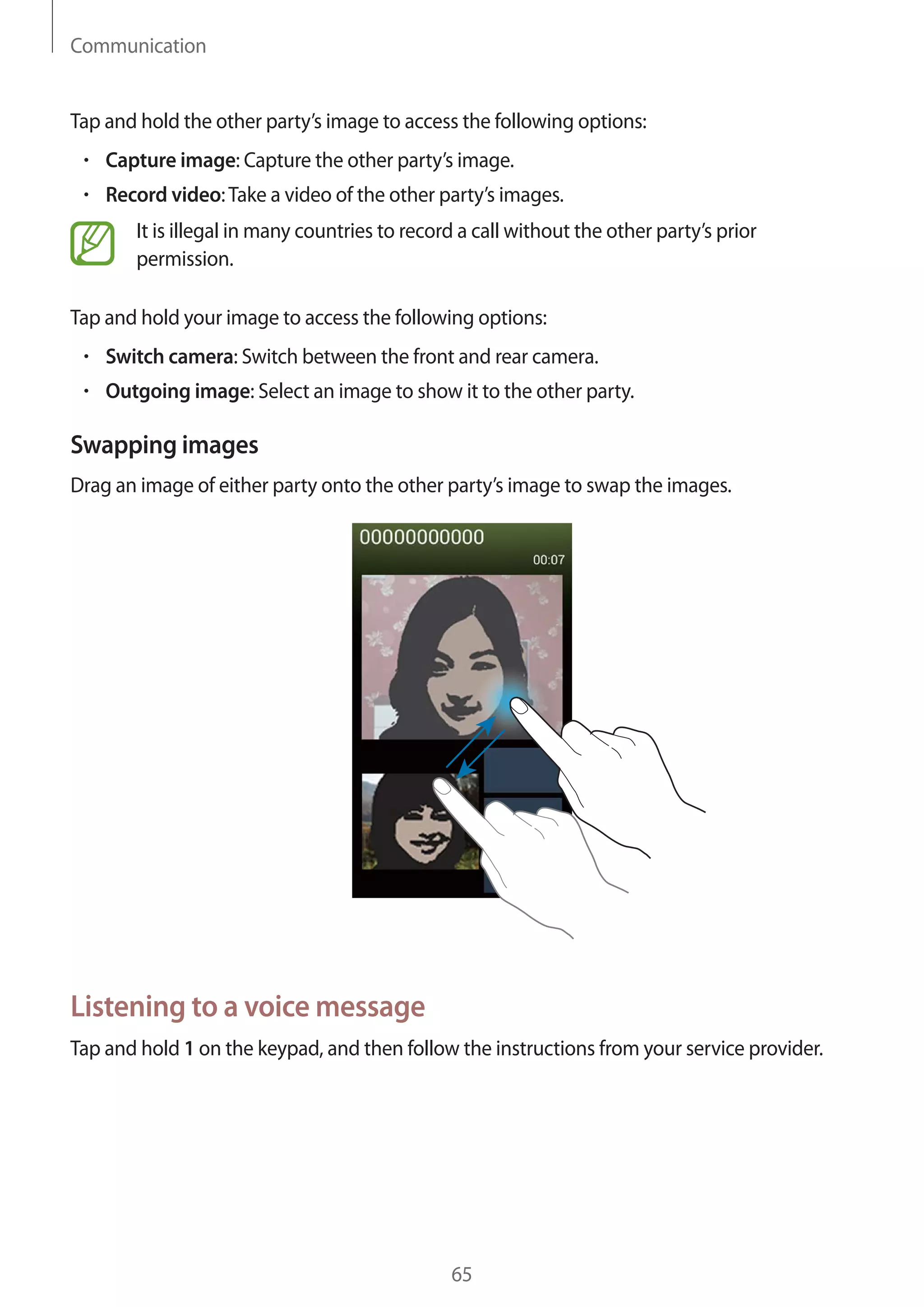
Swapping images
Drag an image of either party onto the other party’s image to swap the images.

Listening to a voice message
Tap and hold 1 on the keypad, and then follow the instructions from your service provider.

65
Communication

Contacts
Use this application to manage contacts, including phone numbers, email addresses, and
others.
Tap Contacts on the Applications screen.

Managing contacts
Tap Contacts.

Creating a contact
Tap

and enter contact information.
: Add an image.
/

: Add or delete a contact field.

Editing a contact
Select a contact to edit, and then tap

.

Deleting a contact
Tap

Delete.

Setting a speed dial number
Tap
Speed dial setting, select a speed dial number, and then select a contact for it. To
remove a speed dial number, tap and hold it, and then tap Remove.

66
Communication

Searching for contacts
Tap Contacts.
Use one of the following search methods:
Scroll up or down the contacts list.
Use the index at the right side of the contacts list for quick scrolling, by dragging a finger
along it.
Tap the search field at the top of the contacts list and enter search criteria.
Once a contact is selected, take one of the following actions:
: Add to favourite contacts.
/

: Make a voice or video call.
: Compose a message.
: Compose an email.

Displaying contacts
Tap Contacts.
By default, the device shows all saved contacts.
Tap

Contacts to display, and then select a location where contacts are saved.

Moving contacts
Tap Contacts.

Moving contacts to Google
Tap

Merge accounts

Merge with Google.

Contacts moved to Google Contacts appear with

in the contacts list.

Moving contacts to Samsung
Tap

Merge accounts

Merge with Samsung.

Contacts moved to Samsung Contacts appear with

67

in the contacts list.
Communication

Importing and exporting contacts
Tap Contacts.

Importing contacts
Tap
Import/Export
USB storage.

Import from SIM card, Import from SD card, or Import from

Exporting contacts
Tap
Import/Export
storage.

Export to SIM card, Export to SD card, or Export to USB

Sharing contacts
Tap

Share namecard via, select contacts, tap Done, and then select a sharing method.

Favourite contacts
Tap Favourites.
Tap

, and then take one of the following actions:
Search: Search for contacts.
Add to favourites: Add contacts to favourites.
Remove from favourites: Remove contacts from favourites.
Grid view / List view: View contacts in grid or list form.
Help: Access help information about using contacts.

68
Communication

Contact groups
Tap Groups.

Adding contacts to a group
Select a group, and then tap

. Select contacts to add, and then tap Done.

Managing groups
Tap

, and then take one of the following actions:
Create: Make a new group.
Search: Search for contacts.
Change order: Tap and hold
position, and then tap Done.

next to the group name, drag it up or down to another

Delete groups: Select user-added groups, and then tap Delete. Default groups cannot be
deleted.
Help: Access help information about using contacts.

Sending a message or email to a group’s members
Select a group, tap

Send message or Send email, select members, and then tap Done.

Business card
Tap Contacts.
Create a business card and send it to others.
Tap Set up my profile, enter details, such as phone number, email address, and postal
address, and then tap Save. If user information has been saved when you set up the device,
select the business card in ME, and then tap to edit.
Tap

Share namecard via, and then select a sharing method.

69
Communication

Messages
Use this application to send text messages (SMS) or multimedia messages (MMS).
Tap Messages on the Applications screen.
You may incur additional charges for sending or receiving messages while you are
outside your home service area. For details, contact your service provider.

Sending messages
Tap

, add recipients, enter a message, and then tap

.

Use the following methods to add recipients:
Enter a phone number.
Tap

, select contacts, and then tap Done.

Hover the S Pen over
appears.

, and then press the S Pen button. Recently-used contacts list

Use the following methods to make a multimedia message:
Tap
Tap

and attach images, videos, contacts, notes, events, and others.
Add subject to enter a subject.

Hover the S Pen over

, and then press the S Pen button. Recently-added images appear.

Sending handwritten messages
When hovering the S Pen over a text field, icon appears at the upper left corner of the text
field. Tap , and tap to enter a handwritten message with the S Pen.

70
Communication

Sending scheduled messages
While composing a message, tap
Scheduling. Set a time and date, and then tap Done.
The device will send the message at the specified time and date.
If the device is turned off at the scheduled time, is not connected to the network,
or the network is unstable, the message will not be sent.
This feature is based on the time and date set on the device. The time and date
may be incorrect if you move across time zones and the network does not update
the information.

Translating and sending messages
To use the translating feature while composing a message, tap
Translate switch to the right, set a language pair, and then tap OK.

Translate, drag the

To use this feature, you need to download and install S Translator. On the Applications
screen, tap S Translator Install, and then follow the on-screen instruction.
Tap to translate the message, and then tap Done. The translated message will replace the
message of the source language.

Viewing incoming messages
Incoming messages are grouped into message threads by contact.
Select a contact to view the person’s message.

71
Communication

Email
Use this application to send or view email messages.
Tap Email on the Applications screen.

Setting up email accounts
Set up an email account when opening Email for the first time.
Enter the email address and password. Tap Next for a private email account, such as Google
Mail, or tap Manual setup for a company email account. After that, follow on-screen
instructions to complete the setup.
To set up another email account, tap

Settings

Add account.

Sending messages
Tap the email account to use, and then tap
subject, and message, and then tap .

at the bottom of the screen. Enter recipients,

Tap

to add a recipient from the contacts list.

Tap

to attach images, videos, contacts, memos, events, and others.

Tap
message.

to insert images, events, contacts, location information, and others into the

Sending scheduled messages
While composing a message, tap
Scheduled email. Tick Scheduled email, set a time
and date, and then tap Done. The device will send the message at the specified time and
date.
If the device is turned off at the scheduled time, is not connected to the network,
or the network is unstable, the message will not be sent.
This feature is based on the time and date set on the device. The time and date
may be incorrect if you move across time zones and the network does not update
the information.

72
Communication

Reading messages
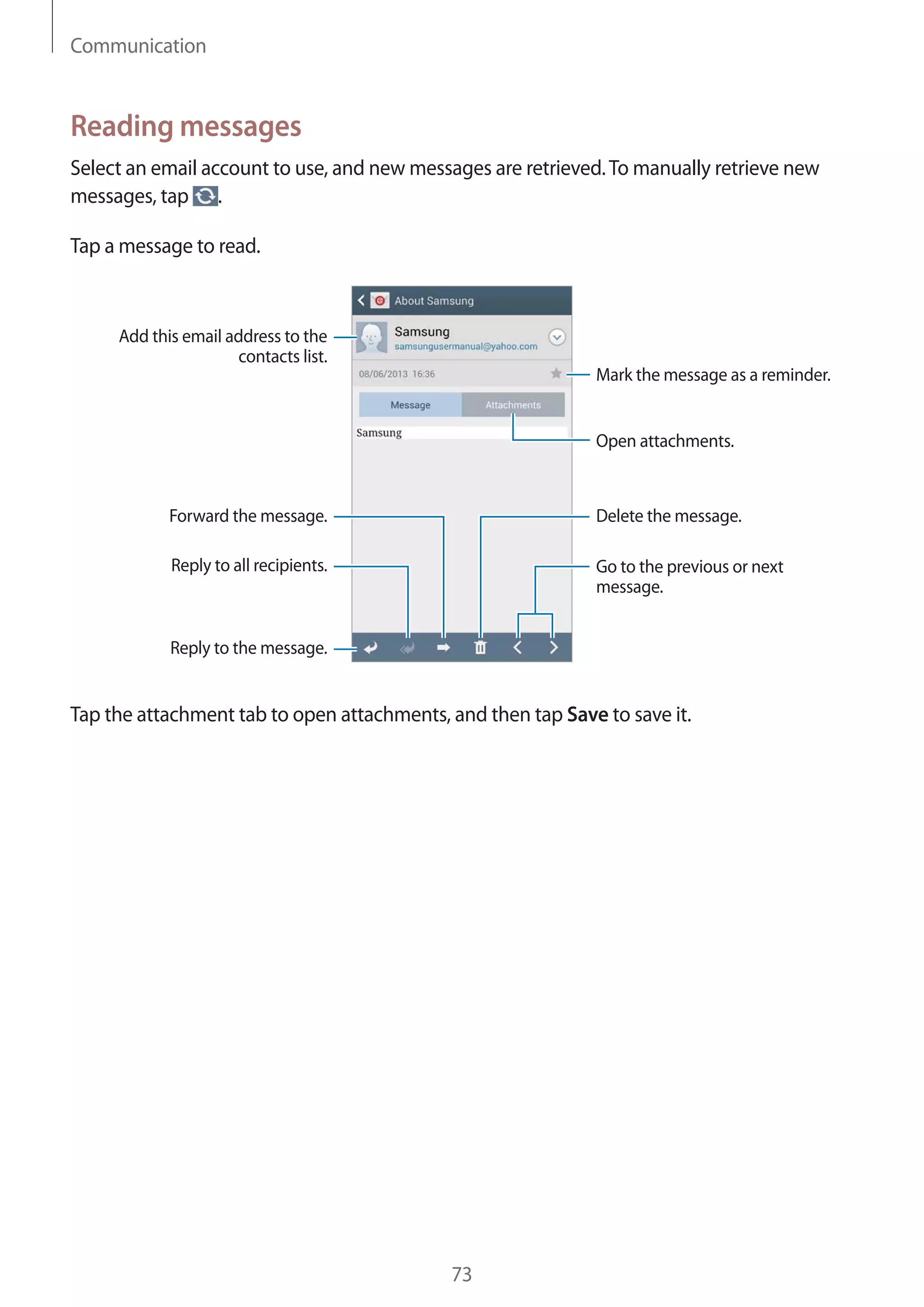
Select an email account to use, and new messages are retrieved. To manually retrieve new
messages, tap .
Tap a message to read.

Add this email address to the
contacts list.
Mark the message as a reminder.

Open attachments.

Forward the message.

Delete the message.

Reply to all recipients.

Go to the previous or next
message.

Reply to the message.

Tap the attachment tab to open attachments, and then tap Save to save it.

73
Communication

Google Mail
Use this application to quickly and directly access the Google Mail service.
Tap Google Mail on the Applications screen.
This application may not be available depending on the region or service provider.
This application may be labelled differently depending on the region or service
provider.

Sending messages
In any mailbox, tap

, enter recipients, a subject, and a message, and then tap

Tap

Attach picture to attach images.

Tap

Attach video to attach videos.

Tap

Add Cc/Bcc to add more recipients.

Tap

Save draft to save the message for later delivery.

Tap

Discard to start over.

Tap

Settings to change the Google Mail settings.

Tap

Send feedback to report your opinions for application development.

Tap

Help to access help information for the Google Mail.

74

.
Communication

Reading messages
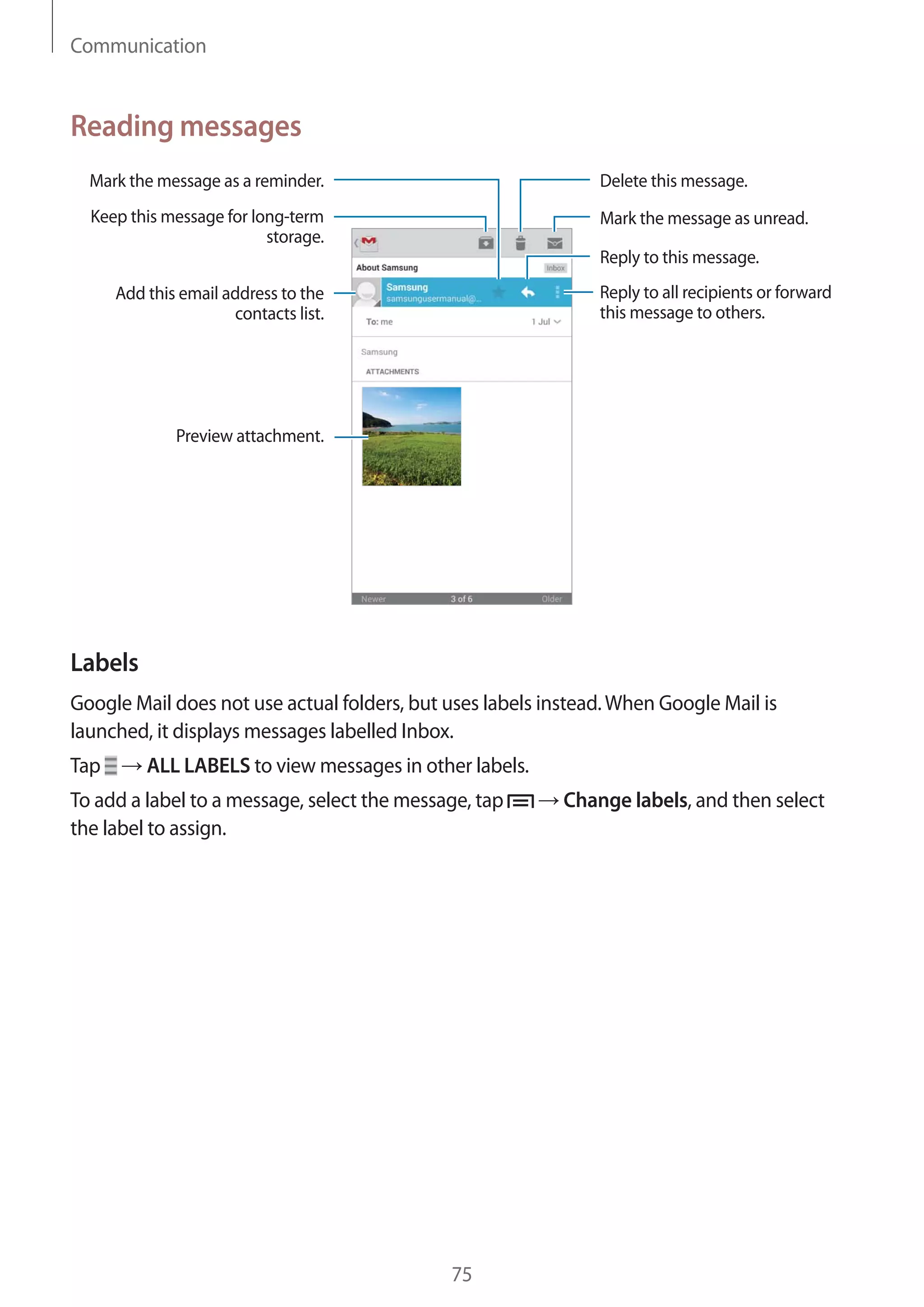
Mark the message as a reminder.

Delete this message.

Keep this message for long-term
storage.

Mark the message as unread.
Reply to this message.
Reply to all recipients or forward
this message to others.

Add this email address to the
contacts list.

Preview attachment.

Labels
Google Mail does not use actual folders, but uses labels instead. When Google Mail is
launched, it displays messages labelled Inbox.
Tap

ALL LABELS to view messages in other labels.

To add a label to a message, select the message, tap
the label to assign.

75

Change labels, and then select
Communication

Hangouts
Use this application to chat with others.
Tap Hangouts on the Applications screen.
This application may not be available depending on the region or service provider.
Select a friend from the friends list or enter data to search and select a friend from the results
to start chatting.

ChatON
Use this application to chat with any device. To use this application, you must sign in to your
Samsung account or verify your phone number.
Tap ChatON on the Applications screen.
This application may not be available depending on the region or service provider.
Create a buddies list by entering phone numbers or Samsung account email addresses, or
Contact sync to
by selecting buddies from the list of suggestions. Alternatively, tap
manually sync contacts from the device.
Tap

Start chat and select a buddy to start chatting.

To start voice or video chat, tap

ChatON Voice Chat or ChatON Video Chat.

Video chatting with dual camera mode will be provided for up to 3 minutes. After
3 minutes the device will turn off the rear camera for optimal performance.

76
Web & network
Internet
Use this application to browse the Internet.
Tap Internet on the Applications screen.

Viewing webpages
Tap the address field, enter the web address, and then tap Go.
Tap

to share or print the current webpage while viewing a webpage.

To change the search engine, tap the address field, and then tap the search engine icon next
to the web address.

Opening a new page
Tap

New window.

To go to another webpage, tap

, and then tap the page to select it.

Bookmarks
To bookmark the current webpage, tap
bookmark and tap Save.

Add bookmark, and then enter a title for the

To open a bookmarked webpage, tap , and then select one.

77
Web & network

History
Tap
History to open a webpage from the list of recently-visited webpages. To clear the
Clear history.
history, tap

Links
Tap and hold a link on the webpage to open it in a new page, save, or copy.
To view saved links, use Downloads. (p. 144)

Sharing webpages
To share a webpage address with others, tap

Share via.

To share a part of a webpage, tap and hold the desired text, and then tap Share via.

Chrome
Use this application to search for information and browse webpages.
Tap Chrome on the Applications screen.
This application may not be available depending on the region or service provider.

Viewing webpages
Tap the address field, and then enter a web address or search criteria.

Opening a new page
Tap

New tab.

To go to another webpage, tap

a webpage.

78
Web & network

Searching the web by voice
Tap the address field, tap , speak a keyword, and then select one of the suggested keywords
that appear.

Syncing with other devices
Sync open tabs and bookmarks to use with Chrome on another device, when you are logged
in with the same Google account.
To view open tabs on other devices, tap
To view bookmarks, tap

Other devices. Select a webpage to open.

.

Bluetooth
Bluetooth creates a direct wireless connection between two devices over short distances. Use
Bluetooth to exchange data or media files with other devices.
Samsung is not responsible for the loss, interception, or misuse of data sent or
received via the Bluetooth feature.
Always ensure that you share and receive data with devices that are trusted
and properly secured. If there are obstacles between the devices, the operating
distance may be reduced.
Some devices, especially those that are not tested or approved by the Bluetooth
SIG, may be incompatible with your device.
Do not use the Bluetooth feature for illegal purposes (for example, pirating copies
of files or illegally tapping communications for commercial purposes).
Samsung is not responsible for the repercussion of illegal use of the Bluetooth
feature.
To activate Bluetooth, on the Applications screen, tap Settings
Bluetooth, and then drag the Bluetooth switch to the right.

79

Connections
Web & network

Pairing with other Bluetooth devices
On the Applications screen, tap Settings Connections Bluetooth Scan, and
detected devices are listed. Select the device you want to pair with, and then accept the
auto-generated passkey on both devices to confirm.

Sending and receiving data
Many applications support data transfer via Bluetooth. An example is Gallery. Open Gallery,
Bluetooth, and then select one of the Bluetooth devices. After
select an image, tap
that, accept the Bluetooth authorisation request on the other device to receive the image.
The transferred file is saved in the Bluetooth folder. If a contact is received, it is added to the
contacts list automatically.

Screen Mirroring
Use this feature to connect your device to a large screen with an AllShare Cast dongle or
HomeSync and then share your contents. You can also use this feature with other devices that
support the Wi-Fi Miracast feature.
This feature may not be available depending on the region or service provider.
Miracast-enabled devices that do not support High-bandwidth Digital Content
Protection (HDCP 2.X) may not be compatible with this feature.
Some files may be buffered during playback, depending on the network
connection.
To save energy, deactivate this feature when not in use.
If you specify a Wi-Fi frequency, AllShare Cast dongles or HomeSync may not be
discovered or connected.
If you play videos or games on a TV, select an appropriate TV mode to get the best
experience.
On the Applications screen, tap Settings Connections Screen Mirroring. Select a
device, open or play a file, and then control the display with the keys on your device. To
connect to a device using a PIN, tap and hold the device name to enter the PIN.

80
Web & network

Samsung Link
Use this application to play contents saved on remotely located devices or web storage
services over the Internet. You can play and send multimedia files on your device to another
device or web storage service.
To use this application, you must sign in to your Samsung account and register two or more
devices. The registration methods may vary depending on the device type.
Tap Samsung Link on the Applications screen.
This application may not be available depending on the region or service provider.
When opening this application, all the content from your registered devices and storage
services will appear. You can browse and play them. To start sharing files, scroll left or right to
select a media category and then, select a file.

Sending files
Send files to other devices or upload them to web storage services.
Tap to select a device or web storage and scroll left or right to select a media category.
Then, tap

, select files, and then tap

.

Sharing files
Tap to select a device or web storage and scroll left or right to select a media category.
Then tap

, select files, tap

, and then select a sharing method.

Playing files on a remote device
Tap to select a device or web storage and scroll left or right to select a media category.
Then tap

, select files, tap

, and then select a device.

Supported file formats may differ depending on connected devices as a media
player.
Some files may be buffered while playing depending on the network connection.

81
Web & network

Managing contents on a web storage service
Select a web storage service, and then view and manage your files.
To transfer files between your device and a web storage service, tap
tap .
To register web storage services to the device, tap
storage service.

, select files, and then

Add storage, and then select a web

Group Play
Use this application to enjoy moments with your friends by sharing and playing content.
Create or join a Group Play session, and then share content, such as images or music.
Tap Group Play on the Applications screen.
This application may not be available depending on the region or service provider.
While using this application, you cannot access the Internet through the Wi-Fi
network.

Join a Group Play session.

Create a Group Play session.
Set whether or not to require a
group password.

82
Web & network

Creating a group for Group Play
When you create a Group Play session, other devices can join the session and share the
content.
When you use a password for a Group Play session, other devices must enter the password to
join the session. To use a password, tick Set group password.
Tap Create group, set a password, and then use the following features:
Share music: Connect two or more devices and use them to achieve a surround sound
effect when sharing music.
Share pictures: Select images to share.
Share video: Connect two or more devices to share a video or combine the devices
into a larger display. Each device displays parts of the video at the same time, which can
be played together, to create a large display showing the whole video. To activate this
while sharing a video.
feature, tap
Share documents: Select documents to share.
Play games and more: Play online games with friends.

Joining Group Play
Join a Group Play session created by another device.
Tap Join group, select a Group Play session to join, and then enter the password for the
group if necessary. Select a media category and the content that is currently being shared
will appear on the device.
Activate the NFC feature. On the Home screen, touch the back of your device to the back
of another device that is opening a session. (p. 84)

83
Web & network

Using additional features in a Group Play session
While sharing music files, images, videos, or documents with other devices, use the following
features:
: Change the speaker settings for each connected device.
: Adjust the volume.
: Set the device to use all connected devices as stereo speakers.
: Combine connected devices’ screen to show a larger display.
: Spilt the combined screen.
: Adjust the volume.
: Write a note or draw on the screen. All participants can see what you create.
: View all shared images in mosaic layout.
/

: Select more images or documents.

: View the group participants.

NFC
Your device allows you to read near field communication (NFC) tags that contain information
about products. You can also use this feature to make payments and buy tickets for
transportation or events after downloading the required applications.
The battery contains a built-in NFC antenna. Handle the battery carefully to avoid
damaging the NFC antenna.
If the screen is locked, your device will not read NFC tags or receive data.
To activate the NFC feature, on the Applications screen, tap Settings
Drag the NFC switch to the right.

84

Connections

NFC.
Web & network

Reading information from an NFC tag
Place the device near an NFC tag. The information from the tag will appear.

Making a purchase with the NFC feature
Before you can use the NFC feature to make payments, you must register for the mobile
payment service. To register or get details about the service, contact your service provider.
Touch the back of your device to the NFC card reader.
To use a SIM or USIM card as the default payment method, on the Applications screen, tap
Settings Connections NFC NFC secure storage Manual.

Sending data via Android Beam
Use the Android Beam feature to send data, such as webpages and contacts, to NFC-enabled
devices.
On the Applications screen, tap Settings
switch to the right.

Connections

NFC. Drag the Android Beam

Select an item, find the location of the NFC antenna on the other device, touch the other
device’s antenna with your device’s antenna, and then tap your device’s screen.

85
Web & network

S Beam
Use this feature to send data, such as videos, images, and documents.
Do not send copyright-protected data via S Beam. Doing so may violate copyright
laws. Samsung is not responsible for any liabilities caused by the illegal use of
copyrighted data.
On the Applications screen, tap Settings
Beam switch to the right.

Connections

S Beam, and then drag the S

Select a file, touch the back of your device to the back of the other device, and then tap your
device’s screen.
If both devices try to send data simultaneously, the file transfer may fail.

86
Web & network

WatchON
Use this application to connect to a TV to watch your favourite shows and movies.
Tap WatchON on the Applications screen.
You must first connect the device to a network and ensure that the device’s infrared port is
facing the TV.

Connecting to a TV
Connect to a TV to display the device’s screen onto a large surface and control the TV
remotely with the device.
Select a country, region, and broadcast service. Tap
Set Up Now, and then follow the onscreen instructions to register the TV to the device. The steps vary depending on the options
you choose.
To connect to other devices, tap

Settings

My room

Add devices.

Watching TV
Select from the TV programme suggestions based on your choice when registering a TV or
select a category at the top of the screen. Select a TV programme and then tap Watch now.
The selected programme will show up on the connected TV.
Tap and open the control panel to control the TV.

Setting programme reminders
Tap the time at the bottom of the screen and select a time for a TV programme you want to
watch. Select a programme, tap Reminder, and then set an alarm time to remind you of the
TV programme.

87
Media
Music
Use this application to listen to music.
Tap Music on the Applications screen.
Some file formats are not supported depending on the software installed on the
device.
Some files may not play properly depending on the encoding method used.

Playing music
Select a music category, and then select a song to play.
Tap the album image at the bottom of the screen to open the music player screen.
Adjust the volume.

Scan DLNA-enabled devices.

Set the file as your favourite
song.

Turn on shuffle.

Change the repeat mode.

Hide the music player screen.

Open the playlist.

Restart the currently-playing
song or skip to the previous
song. Tap and hold to move
backwards quickly.

Skip to the next song. Tap and
hold to move forwards quickly.
Pause and resume playback.

88
Media

To listen to songs at equal volume levels, tap

Settings

Smart volume.

Smart volume may not be activated for some files.
When Smart volume is activated, the volume may end up louder than the device
volume level. Use caution to avoid long-term exposure to loud sounds to prevent
damage to your hearing.
Settings
To set a personalised sound while listening to songs with a headset, tap
Adapt Sound On. When you turn the volume up to level 14 or higher, the adapt sound
option is not applied to music playback. If you turn the volume down to level 13 or lower, the
option is reapplied.

Setting a song as ringtone
To use the currently-playing song as ringtone, tap

Set as

Phone ringtone.

Listening to a song with others
To share the currently-playing song with others, tap

Play via Group Play.

Creating playlists
Make an own selection of songs.
Tap Playlists, and then tap
Create playlist. Enter a title and tap OK. Tap Add music,
select songs to include, and then tap Done.
To add the currently-playing song to a playlist, tap

Add to playlist.

Playing music by mood
Play music grouped by mood. The playlist is automatically created by the device.
To use this feature, set the music square menu to appear at the top of the music library by
tapping
Settings Music menu, and tick Music square, and then tap Done.
Tap Music square at the top of the screen, and select a cell of mood. Or select multiple cells
by dragging your finger.

89
Media

Camera
Use this application to take photos or videos.
Use Gallery to view photos and videos taken with the device’s camera. (p. 98)
Tap Camera on the Applications screen.
The camera automatically shuts off when unused.
Make sure that the lens is clean. Otherwise, the device may not work properly in
some modes that require high resolutions.
Camera etiquette
Do not take photos or videos of other people without their permission.
Do not take photos or videos where legally prohibited.
Do not take photos or videos in places where you may violate other people’s privacy.

Taking photos
Taking a photo
Tap the image on the preview screen where the camera should focus. When the subject is in
to take the photo.
focus, the focus frame turns green. Tap
View more options.
Switch to dual
camera mode.

Display current
mode.

Switch between the
front and rear
camera.

Start taking a video.

Change the
shooting mode.

Open Gallery to
view photos and
videos.

Select among
various effects that
are available.

90
Media

Shooting mode
Several photo effects are available.
Tap MODE, and then scroll up or down the screen at the right side of the screen.
Auto: Use this to allow the camera to evaluate the surroundings and determine the ideal
mode for the photo.
Beauty face: Take a photo with lightened faces for gentler images.
Best photo: Take a series of photos, and then save the best one.
Best face: Use this to take multiple group shots at the same time and combine them to
create the best possible image.
Tap
to take multiple photos. To get the best shot, hold the camera steady and remain
still while taking photos. When Gallery opens, tap the yellow frame on each face, and
choose the best individual pose for the subject. After choosing a pose for each individual,
tap to merge the images into a single photo, and save it.
Sound & shot: Use this to take a photo with sound.
Tap

to take a photo. The device records a few seconds of audio after taking a photo.
While taking photos in this mode, sound is recorded by the internal microphone.

Drama: Use this to take a series of photos and combine them to create an image that
shows trails of the movement.
To get the best shot, follow these tips. The device may not take photos properly in other
shooting conditions.
– Hold the camera steady and remain still while taking photos.
– Take photos of a subject that is moving in one direction.
– Take photos with backgrounds that are free of moving objects.
– Avoid taking photos of a subject and background with similar colours.
– Avoid taking photos of a subject that is too close or too far away to fit within the
viewfinder or that is too long such as a bus or a train.

91
Media

Animated photo: Use this to create animated photos from a video.
Golf: Use this setting to take a radial image of a complete golf swing, combining several
images together to make one composite view.
Rich tone (HDR): Use this to take photos without losing details in bright and dark areas.
Eraser: Use this to erase the movements of moving subjects in the background.
Tap
to take a series of photos. The device erases traces of movement from a moving
subject. To restore the original photo, tap , and then tap the highlighted area.
To get the best shot, follow these tips.
– Hold the camera steady and remain still while taking photos.
– When taking photos of an object and background with similar colours, the camera
may not recognise all of the movement.
– When taking photos of a subject that is moving very little or moving a great deal, the
camera may not recognise all of the movements.
– If there are multiple subjects moving in the background, the camera may not
recognise all of the movement.
Panorama: Take a photo composed of many photos strung together.
To get the best shot, follow these tips.
– Move the camera slowly in one direction.
– Keep the camera’s viewfinder within the guide frame.
– Avoid taking photos of a subject in front of unrecognisable backgrounds, such as
empty skies or plain walls.
Surround shot: Use this to take a 360-degree panoramic photo.
Sports: Use this setting for fast-moving subjects.

92
Media

Panoramic photos
A panoramic photo is a wide landscape image consisting of multiple shots.
Tap MODE

Panorama.

Tap
and move the camera in one direction. When the blue frame aligns with the
viewfinder, the camera automatically takes another shot in a panoramic sequence. To stop
.
shooting, tap
If the viewfinder is out of the direction, the device stops shooting.

Applying filter effects
Use the filter effects to take unique photos or videos.
Tap

and select a filter effect. The available options vary by mode.

Taking videos
Taking a video
Tap

to take a video. To pause recording, tap

. To stop recording, tap

.

Press the Shutter button to take photos while taking a video.

While recording, use the following actions:
To change the focus, tap where you want to focus. To focus on the centre of the screen,
tap .
To capture an image from the video while recording, tap

93

.
Media

Recording mode
Tap

to change the recording mode.
Normal: Use this mode for normal quality.
Limit for MMS: Use this mode to lower quality for sending via messages.
Slow motion: Use this mode to take a video of a moving subject. The device will play the
video in slow motion.
Fast motion: Use this mode to take a video of a moving subject. The device will play the
video in fast motion.
Smooth motion: Use this mode to take a video of a moving subject. The device will play
the video in high quality.

Zooming in and out

Use one of the following methods:
Use the Volume button to zoom in or out.
Spread two fingers apart on the screen to zoom in, and pinch to zoom out.
The zoom in/out effect is available when using the zoom feature while shooting
video.

94
Media

Dual Camera mode
When you take a landscape photo with the rear camera, the photo or video captured by the
front camera appears in an inset window, or vice versa. Use this feature to take a beautiful
landscape photo and a self-portrait simultaneously.
Tap

to switch to dual camera mode. Tap

to take a photo or tap

to take a video.

Tap to resize it or
move the location.

Select among
various styles that
are available.

You can record videos in dual camera mode for up to 5 minutes in Full HD and up
to 10 minutes in HD.
While taking videos in this mode, sound is recorded by the internal microphone.

Share shot
Tap

, and then select one of the following:
Share shot: Send a photo directly to another device via Wi-Fi Direct or NFC.
Buddy photo share: Set the device to recognise a person’s face that you have tagged in a
photo and send it to that person.
ChatON photo share: Send a photo to another device via ChatON.
Remote viewfinder: Set a device to control the camera remotely.

95
Media

Controlling the camera remotely
Set a device as a viewfinder to control the camera remotely.
Tap
Remote viewfinder, and then connect the device and the camera using
to take a photo remotely using the device as a viewfinder.
Wi-Fi Direct or NFC. Tap

Configuring settings for Camera
Tap
to configure settings for Camera. Not all of the following options are available
in both still camera and video camera modes. The available options vary depending on the
mode used.
Photo size / Video size: Select a resolution. Use higher resolution for higher quality. But it
takes up more memory.
Burst shot: Take a series of photos of moving subjects.
Tap to take pics: Tap the image on the preview screen to take photos.
Face detection: Set the device to recognise people’s faces and help you take photos of
them.
Metering: Select a metering method. This determines how light values are calculated.
Centre-weighted measures background light in the centre of the scene. Spot measures
the light value at a specific location. Matrix averages the entire scene.
ISO: Select an ISO value. This controls camera light sensitivity. It is measured in filmcamera equivalents. Low values are for stationary or brightly-lit objects. Higher values are
for fast-moving or poorly-lit objects.
Video stabilisation: Activate or deactivate anti-shake. Anti-shake helps focus when the
camera is moving.
Smart stabilisation: Set the device to automatically detect darker conditions and adjust
the brightness of the photo without the flash.
Save as: Set the device to delete the original photo when taking photos with rich tone
mode.

96
Media

Audio zoom: Make louder the sound from the zoomed subject while recording.
Location tag: Attach a GPS location tag to the photo. Activate this feature when taking
photos to create albums in Story Album.
To improve GPS signals, avoid shooting in locations where the signal may be
obstructed, such as between buildings or in low-lying areas, or in poor weather
conditions.
Your location may appear on your photos when you upload them to the Internet.
To avoid this, deactivate the GPS tag setting.
Review: Briefly display photos taken.
Volume key: Set the device to use the Volume button to control the shutter or zoom
function.
Timer: Use this for delayed-time shots.
White balance: Select an appropriate white balance, so images have a true-to-life colour
range. The settings are designed for specific lighting situations. These settings are similar
to the heat range for white-balance exposure in professional cameras.
Exposure value: Change the exposure value. This determines how much light the
camera’s sensor receives. For low-light situations, use a higher exposure.
Guidelines: Display viewfinder guides to help composition when selecting subjects.
Flash: Activate or deactivate the flash.
Voice control: Set the camera to take photos with voice commands.
Contextual filename: Set the camera to display contextual tags. Activate this to use Tag
Buddy in Gallery and Story Album.
Save as flipped: Invert the image to create a mirror-image of the original scene.
Storage: Select the memory location for storage.
Reset: Reset the camera settings.

Shortcuts
Reorganise shortcuts for easy access to the camera’s various options.
Tap

Edit quick settings.

Tap and hold an option and drag it to a slot at the top of the screen. The other icons can be
moved within the list by tapping and dragging them.

97
Media

Gallery
Use this application to view images and videos.
Tap Gallery on the Applications screen.
Some file formats are not supported depending on the software installed on the
device.
Some files may not play properly depending on the encoding method used.

Viewing images
Launching Gallery displays available folders. When another application, such as Email, saves
an image, the Download folder is automatically created to contain the image. Likewise,
capturing a screenshot automatically creates the Screenshots folder. Select a folder to open
it.
In a folder, images are displayed by creation date. Select an image to view it in full screen.
Scroll left or right to view the next or previous image.

Zooming in and out
Use one of the following methods to zoom in an image:
Double-tap anywhere to zoom in.
Spread two fingers apart on any place to zoom in. Pinch to zoom out, or double-tap to
return.

Viewing images using the motion feature
Use the motion feature to execute a function with particular motion.
On the Applications screen, tap Settings Controls Motions, drag the Motions switch to
the right, and then turn on the switch for each feature.
To stop using a motion feature, turn off the switch for the feature.

Playing videos
Video files show the

icon on the preview. Select a video to watch it and tap

98

.
Media

Trimming segments of a video
Select a video, and then tap . Move the start bracket to the desired starting point, move the
end bracket to the desired ending point, and then save the video.

Editing images
When viewing an image, tap

and use the following functions:

Favourite: Add to the favourites list.
Slideshow: Start a slideshow with the images in the current folder.
Photo frame: Use this to add a frame and a note to an image. The edited image is saved
in the Photo frame folder.
Photo note: Use this to write a note on the back of the image.
Signature: Use this to draw your signature on the image.
Copy to clipboard: Copy to clipboard.
Print: Print the image via a USB or Wi-Fi connection. Some printers may not be
compatible with the device.
Rename: Rename the file.
Buddy photo share: Send the image to a person whose face is tagged in the image.
Rotate left: Rotate anticlockwise.
Rotate right: Rotate clockwise.
Crop: Resize the blue frame to crop and save the image in it.
Edit weather tag: Edit the tag of the image providing weather information.
Get directions: View the shooting location on the map. When taking a photo or video,
enable geotagging to attach GPS location tag with the photo or video. If there is no GPS
location tag to attach, this option does not appear.
Set as: Set the image as wallpaper or a contact image.
Details: View image details.
Settings: Change the Gallery settings.

99
Media

Modifying images
When viewing an image, tap

and use the following functions:

Rotate: Rotate the image.
Crop: Crop the image.
Colour: Adjust the saturation or brightness of the image.
Effect: Apply effects to the image.
Portrait: Correct red-eye, adjust and retouch faces, or make background blurry.
Sticker: Attach stickers.
Drawing: Draw on the image.
Frame: Apply frames to the image.

Favourite images
When viewing an image, tap

Favourite to add the image to the favourites list.

Making video clips
In a folder, tap

Create video clip, select images or videos by ticking, and then tap

Enter a title, select an effect option, and then tap
video clip.
To add images or videos, tap
To delete images or videos, tap
To change the order of items, tap

.

. The video clip is saved in Gallery

.
.
, tap and hold an item, and then drag it to a new location.

To add a drawing or note to the beginning of the video clip, tap

100

.
Media

Making image collages
In a folder, tap
Select item, select two to four images by ticking, and then tap
Create collage. Select a style at the bottom of the screen, and then tap .
To add images, tap
To delete images, tap

.
.

To change the split type, tap .

Deleting images
Use one of the following methods:
In a folder, tap

Select item, select images by ticking, and then tap

When viewing an image, tap

.

.

Sharing images
Use one of the following methods:
In a folder, tap
Select item, select images by ticking, and then tap
to others or share them via social network services.
When viewing an image, tap

to send them

to send it to others or share it via social network services.

Setting as wallpaper
When viewing an image, tap
contact.

Set as to set the image as wallpaper or to assign it to a

101
Media

Tagging faces
Tap
Settings, and then tick Face tag. A yellow frame appears around the recognised
face. Tap the face, tap Add name, and then select or add a contact.
When the face tag appears on an image, tap the face tag and use available options, such as
making calls or sending messages.
Face recognition may fail depending on the face angle, face size, skin colour, facial
expression, light conditions, or accessories the subject is wearing.

Using Tag buddy
Tap
Settings Tag buddy, and then drag the Tag buddy switch to the right to
display a contextual tag (weather, location, date, and person’s name) when opening an image.

Organising with folders
Create a folder to organise images or videos stored in the device. You can copy or move files
from one folder to another.
To create a new folder, tap . Enter a name for the folder, tap OK, and then tick images or
videos. Tap and hold any selected image or video, drag it to the new folder, and then tap
Done. Tap Copy to copy or Move to move.

Story Album
Use this application to create your own digital album to keep your stories by organising the
images neatly and automatically.
Tap Story Album on the Applications screen.
To start Story Album, you need to download and install the application. Tap Install, and then
follow the on-screen instruction.
You may incur additional charges when downloading this application via the mobile
network. To avoid additional charges, contact your service provider.

102
Media

Creating story albums
Create story albums by selecting images from Gallery or images sorted by tag information.
Tap

, and then select an option.

Select images from Gallery.
Select images by tag
information.

Creating albums from Gallery
Tap From Gallery, select a folder, select images, and then tap . Enter a title for the album,
select a theme and a cover image, and then tap Create album.

Creating albums by tag information
Create albums by sorting photos by tag information, such as the location where an image
was taken, subjects, or time.
Tap By tag information, and then set the following tag options:
Location: Specify a location. The device sorts images from the location. To use location
tags, activate the GPS tag setting in Camera before taking photos. (p. 97)
People: Select people from tagged images. The device sorts images taken with the
people. To use people tags, add tags to images in Gallery. (p. 97)
Time: Specify a period of time. The device sorts images taken during the period you set.
After the setting is finished, tap Find pictures. Enter a title for the album, select a theme, and
then tap Create album.

103
Media

Viewing story albums
Select a story album. The cover image appears on the first page. Scroll left or right to view
images in the story album.
On a page of the album, tap
depending on the page.

and use the following functions. The available options vary

Edit title: Rename the album.
Add content: Add more content to the current page.
Remove content: Delete content on the current page.
Edit: Change the layout of the current page.
Change theme: Change the theme for the album.
Change cover image: Change the cover image of the album.
Slideshow: Start a slideshow with the images in the current album.
Share via: Send the album to others.
Export: Export the album to other storage locations.
Print: Print the album via a USB or Wi-Fi connection. Some printers may not be
compatible with the device.
Order photo book: Place an order for a printed album.
Delete page: Delete the page.

104
Media

Editing images
Tap the image of the page in an album.
Delete the image.
Add a caption.

Send the image to others.

Select among various effects
that are available.

Tap

, and then use the following functions:
Slideshow: Start a slideshow or change the slideshow settings.
Set as cover: Set the image as an album cover image.
Rotate left: Rotate the image anticlockwise.
Rotate right: Rotate the image clockwise.

105
Media

Creating albums with recommended photos
When you take multiple photos in a location, the device suggests creating a new album
based on the location. This feature helps you create photo albums conveniently when you
have daily events or travel.

Setting your home city
Set your home city to let the device recognise whether you at home or travelling. The device
suggests creating event or travel albums based on your location. For example, when taking
photos outside of the home city, the device suggests creating a travel album.
Tap

Settings

Home city, select a setting method, and then tap Save.

Setting a minimum number of photos
Tap
Settings, and then drag the switch next to an album type under Suggestions to
the right. Select the album type, and then set the minimum number of photos.
When you take photos that meet the criteria you set, the device will suggest creating an
album.
The device will recommend creating story albums when you surpass the preset
specified number of photos in a single day.

Creating an event or travel album
Tap
album.

From suggestions. Select an album, enter a title for the album, and then tap Create

Video
Use this application to play video files.
Tap Video on the Applications screen.
Some file formats are not supported depending on the device's software.
Some files may not play properly depending on how they are encoded.

106
Media

Playing videos
Select a video to play.
Scan DLNA-enabled
devices.

Adjust the volume.

Move forwards or
backwards by
dragging the bar.

Skip to the next
video. Tap and hold
to move forwards
quickly.

Change screen ratio.

Switch to floating
screen mode.

Restart the current
video or skip to the
previous video. Tap
and hold to move
backwards quickly.

Pause and resume
playback.

Deleting videos
Tap

Delete, select videos by ticking, and then tap Delete.

Sharing videos
Tap

Share via, select videos by ticking, tap Done, and then select a sharing method.

Using Popup Video player
Use this feature to use other applications without closing the video player. While watching
videos, tap to use the pop-up player.
Spread two fingers apart on the screen to enlarge the player or pinch to reduce it. To move
the player, drag the player to another location.

Purchasing videos
Scroll the screen to the left or right, and then select a video.
This service may not be available depending on the region or service provider.

107
Media

YouTube
Use this application to watch videos from the YouTube website.
Tap YouTube on the Applications screen.
This application may not be available depending on the region or service provider.

Watching videos
Tap

, and then enter a keyword. Select one of the returned search results to watch a video.

Rotate the device to landscape orientation to display full screen.
Add the video to
the playlist.
Search for videos.
Send the URL to
others.

Pause or resume
playback.
Move forwards or
backwards by
dragging the bar.
Change display
quality.

Sharing videos
Select the video to view, tap

, and then select a sharing method.

Uploading videos
Tap

Uploads

, select a video, enter information for the video, and then tap

108

.
Media

My Magazine
Use this applications to make your own social magazine.
On the Home screen, flick your finger up from the bottom of the screen, or press the Home
button.
When running My magazine for the first time, tap Next, read and agree to the terms
and conditions, and then tap Start.
To set up your magazine, tap , and then tick categories. Tap , select new topics, and then
tap .
Flick left or right to change the category, flick up or down to turn over magazine pages, and
then select an article to read.
While viewing a page, tap

to use the following application:

: Make a call.
: Launch Camera.
: Send a message.
: Launch Google search.
: Open the web browser.
: Open the Applications screen.
While reading an article, use the following icons:
: Go to the previous page.
: Set the article as your likes in Facebook.
: View others’ comments about the article.
: Set the article as your likes in Flipboard.
: Add the article to your Flipboard magazine.
: Share the article with others.

109
Media

Flipboard
Use this application to access your personalised magazines.
Tap Flipboard on the Applications screen.
This application may not be available depending on the region or service provider.
To start your Flipboard, flick up on the greeting page, select news topics, and then tap Build
Your Flipboard.
Select a cover story or a topic, flick through the Flipboard pages, and then select an article to
read.
While reading an article, use the following icons:
: Go to the previous page.
: Set the article as your likes in Facebook.
: View others’ comments about the article.
: Set the article as your likes in Flipboard.
: Add the article to your Flipboard magazine.
: Share the article with others.

110
Media

SketchBook for Galaxy
Use this application to create a quick concept or sketch out your idea for a project.
On the Applications screen, tap SketchBook for Galaxy.
Use artistic tools to draw and paint your digital art. The image is saved in Gallery.
To start SketchBook for Galaxy, you need to download and install the application. Tap Install,
and then follow the on-screen instructions.
This application may not be available depending on the region or service provider.
You may incur additional charges when downloading this application via the
mobile network. To avoid additional charges, contact your service provider.

Bloomberg+
Use this application to get the latest news about finance, business, market data, and more.
Tap Bloomberg+ on the Applications screen.
This application may not be available depending on the region or service provider.

111
Application & media stores
Play Store
Use this application to purchase and download applications and games that are able to run
on the device.
Tap Play Store on the Applications screen.
This application may not be available depending on the region or service provider.

Installing applications
Browse applications by category, or tap

to search with a keyword.

Select an application to view information. To download it, tap INSTALL. If there is a charge
for the application, tap the price, and follow on-screen instructions to complete the purchase
process.
When a new version is available for any installed application, an update icon
appears at the top of the screen to alert you to the update. Open the notifications
panel and tap the icon to update the application.
To install applications that you downloaded from other sources, on the
Applications screen, tap Settings General Security Unknown sources.

Uninstalling applications
Uninstall the applications purchased from Play Store.
Tap
My apps, select an application to delete in the list of installed applications, and
then tap UNINSTALL.

112
Application & media stores

Samsung Hub
Use this application to purchase, enjoy, and manage digital media content. Samsung Hub
also promotes and recommends content that you may like.
Tap Samsung Hub on the Applications screen.
The types of content provided may vary depending on the region or service provider.

Purchasing multimedia content
Select a service category, select media content, and then complete the purchase process.

Managing content on the device
Select a service category, scroll left, and then manage content on the device.

Samsung Apps
Use this application to purchase and download dedicated Samsung applications. For more
information, visit www.samsungapps.com.
Tap Samsung Apps on the Applications screen.
This application may not be available depending on the region or service provider.

Installing applications
Browse applications by category. Tap CATEGORY to select a category.
To search for an application, tap
search field.

at the top of the screen, and then enter a keyword in the

Select an application to view information. To download it, tap Free. If there is a charge for
the application, tap the price, and follow on-screen instructions to complete the purchase
process.

113
Application & media stores

Play Books
Use this application to read and download book files.
Tap Play Books on the Applications screen.
This application may not be available depending on the region or service provider.

Play Movies
Use this application to watch, download, and rent movies or TV shows.
Tap Play Movies on the Applications screen.
This application may not be available depending on the region or service provider.

Play Music
Use this application to listen to music from the device or stream music from the Google cloud
service.
Tap Play Music on the Applications screen.
This application may not be available depending on the region or service provider.

Play Games
Use this application to download and play games.
Tap Play Games on the Applications screen.
This application may not be available depending on the region or service provider.

114
Utilities
S Note
Use this application to create a note using multimedia files or voice recordings.
Tap S Note on the Applications screen.

Creating notes
When running S Note for the first time, tap Start to set the default covers and a template.
Follow the on-screen instruction to complete the setup.

Composing notes
Create notes with enriched content by adding multimedia files or voice memos.
Tap

to write or draw on the screen, or tap

to enter text with the keyboard.

Erase the note.

Select the note.

Enter a note.

Undo and redo the last action.

Write a note.

Switch to view mode.

Switch to S Pen mode or finger
mode.

Append another page to the
current note.

Insert a multimedia file.

Change page options.

115
Utilities

When using the templates that have image frames, tap and hold an image frame, and then
tap Images or Take picture to add an image.
To delete a frame, tap and hold the frame, and then tap Delete.
When jotting down a note, tap
colour.

once more to change the pen type, line thickness, or pen

Save the current setting as a pen
profile.

Change the pen type.
Change the line thickness.
Change the pen colour.
Add a new colour based on the
colour picker.

To zoom in or out the screen, spread two fingers apart or pinch them.
To add a new page, tap

Add page.

To delete the page, tap

Delete page.

To add a tag to the page, tap
To add an index to the page, tap
To change the page template, tap

Add tag.
Index page.
Add template.

To change the background of the page, tap
To display a grid on the page, tap

Background.

Show grid.

116
Utilities

Using the eraser tool
A drawn line is not recognized as a series of dots but short strokes. For this reason, you can
select a whole line and delete, move or transform it. However, you may happen to even erase
unintended part of a line, or may not able to erase intensive or overlapped lines when using
the eraser tool.
To reduce the case of erasing unintended parts, adjust the eraser’s size by tapping

.

To clear the note, tap Clear all.
Even with a smaller eraser, you may not be able to precisely erase the intended part.

Editing handwritten notes
Select a handwritten note to cut, move, resize, or transform it. When jotting down or drawing
a note, tap . Then, tap the note or draw a line around it to select and edit it.
To move the note to another location, select the note, and then drag it to a new location.
To resize the note, select the note, and then drag the frame.

With a handwritten note selected, use the following options:
Properties: Change the note properties such as layout, size, colour, or thickness.
Transform into: Convert a drawn shape or handwritten note to a well-organised one.
Cut: Cut the note. To paste it to another location, tap and hold the location, and then tap
Paste.
Copy: Copy the note. To paste it to another location, tap and hold the location, and then
tap Paste.
Delete: Delete the note.

117
Utilities

Inserting multimedia files
Tap

to insert images, videos, voice memos, and more.

Inserting an idea sketch
Tap

Idea Sketch, and then write a keyword or select category to search for images.

To add your own sketches to the list, tap

, and then draw an image in the sketch panel.

Inserting an image or video with frame
Tap

Images or Video

Photo frame or Record video on canvas.

Draw a frame on the note, and then tap inside the frame with the S Pen or your finger to take
a photo or video.

Inserting map information
Tap

Maps, scroll through the maps or tap

to search for a place, and then tap Capture.

To view the location in full screen, tap and hold the map, and then tap Open map.
To share the map information with others, tap
method.

118

Share via, and select a sharing
Utilities

Creating and managing charts
Making a table
Tap
Easy chart
tap Done.

Table, set the number of rows and columns for the table, and then

To enter data in the table, tap a table cell.
To add or delete columns, tap
To add or delete rows, tap

Add dataset or Delete dataset.
Add item or Delete item.

Making a chart
To make a chart, tap
dividers on the chart.

Easy chart, and then select a chart type. Then, draw bars, lines, or

To make a chart from the data in the table, tap and hold the table, tap Edit chart
then select a chart.

119

, and
Utilities

Editing a chart
To edit a chart, tap and hold a chart or table, tap Edit chart, and then use the following
options:
Tap

at the top left of the screen to change the chart type.

Tap an item, and tap

, and then write values, to correct with your finger or the S Pen.

The available options may vary depending on the chart type.

Viewing note pages
When viewing pages, tap

to use the following options:

Delete: Delete the page.
Share via: Send the page to others.
Export: Export the page as an image file or a PDF file.
Edit pages: Change the layout of the pages, or import pages from other notes.
Add tag: Add a tag to the page.
Index page: Add an index to the page.
Add shortcut to home: Add a shortcut to the page on the Home screen.
Print: Print the page via a USB or Wi-Fi connection. Some printers may not be compatible
with the device.
Save as: Save the page with a different name.
Set as: Set the page as wallpaper or a contact image.

120
Utilities

Viewing pages preview
Drag down a note to preview the pages above the note.

Tap

on the note cover to access the following options:
Delete: Delete the note.
Share via: Share the note with others.
Export: Export the note as an image file or a PDF file.
Rename: Rename the note.
Edit cover: Change the note cover.
Add to favourites: Add the note to the favourites list.
Lock: Lock the note so that others cannot view it.
Add shortcut to home: Add a shortcut to the note on the Home screen.

Searching for notes
Use this feature to search for a note by entering search criteria, such as names, tags, text, or
handwritten words.
Tap

, tap the search field at the top of the screen, and then enter search criteria.

121
Utilities

S Planner
Use this application to manage events and tasks.
Tap S Planner on the Applications screen.

Creating events or tasks
Tap

, and then use one of the following methods:
Add event: Enter an event with an optional repeat setting.

Add task: Enter a task with an optional priority setting.
To add an event or task more briefly, tap a date to select it and tap it again.

Enter a title and specify which calendar to use or sync with. Then tap Edit event details or
Edit task details to add more details, such as how often the event repeats, when it has an
advance alert, or where it takes place.
Invite others to the event by sending a message or email. Enter the phone number or email
address to the Participants field, or tap to open the contacts list.
Attach a map showing the location of the event. Enter the location in the Location field, tap
next to the field, and then pinpoint the precise location by tapping and holding on the
map that appears.

122
Utilities

Syncing with Google Calendar
On the Applications screen, tap Settings General Accounts Google under My
accounts a Google account, tick Sync Calendar, and then tap Sync now.
To manually sync for updating, on the Applications screen, tap S Planner
To display synced events or tasks, tap

Sync.

Calendars, and then tick the Google account.

Handwriting on Month view
On month view screen, tap
portrait mode.

to activate this feature. This is only available in month view in

Changing calendar type
Select one from among different types of calendars including year, month, week, and others
at the right side of the screen.

Searching for events
Tap

Search, and then enter a keyword to search for.

To view today’s events, tap Today at the top of the screen.

Deleting events
Select an event or task, and then tap

Delete

OK.

Sharing events
Select an event or task, tap

, and then select a sharing method.

123
Utilities

Dropbox
Use this application to save and share files with others via the Dropbox cloud storage. When
you save files to Dropbox, your device automatically syncs with the web server and any other
computers that have Dropbox installed.
Tap Dropbox on the Applications screen.
This application may not be available depending on the region or service provider.
Once Dropbox is activated, photos and videos taken with the device’s camera are uploaded to
Dropbox automatically. To view the uploaded photos or videos, tap . To share or delete files
or create albums, tap , and then select files.
To upload files to Dropbox, tap
To open files in Dropbox, select a file.
While viewing images or videos, tap
favourites list, tap .

Upload here

Photos or videos or Other files.

to add it to the favourites list. To open files in the

124
Utilities

Cloud
Use this feature to sync files or back up settings and application data with your Samsung
account or Dropbox.
On the Applications screen, tap Settings

General

Cloud.

This feature may not be available depending on the region or service provider.

Syncing with the Samsung account
Tap your Samsung account or Sync settings to sync files.

Backing up or restoring data
Tap Backup to back up or tap Restore to restore data with your Samsung account.

Syncing with Dropbox
Tap Link Dropbox account, and then enter the Dropbox account. Follow the on-screen
instructions to complete the setup.
Once you sign in, tap Allow and the device automatically syncs files with Dropbox whenever
you make some changes.

125
Utilities

Clock
Use this application to set alarms, check the time of many major cities in the world, measure
the duration of an event, or set a timer.
Tap Clock on the Applications screen.

Turn this alarm on or off.

Alarm
Setting alarms
Tap Create alarm, set a time for the alarm to go off, select days for the alarm to repeat, and
then tap Save. You can also set an alarm by writing numbers with the S Pen.
Location alarm: Set a location. The alarm goes off only when you are in the location.
Snooze: Set an interval and the number of times for the alarm to repeat after the preset
time.
Smart alarm: Set a time for the alarm to go off before the preset time.

126
Utilities

Stopping alarms
Drag outside the large circle to stop an alarm. Drag
the alarm after a specified length of time.

outside the large circle to repeat

Deleting alarms
Tap and hold the alarm, and then tap Delete.

World clock
Creating clocks
Tap Add city, and then enter a city name or select a city from the cities list.
To apply summer time, tap and hold a clock, and then tap DST settings.

Deleting clocks
Tap and hold the clock, and then tap Delete.

Stopwatch
Tap Start to time an event. Tap Lap to record lap times.
Tap Reset to clear lap time records.

Timer
Set the duration, and then tap Start.
Drag

outside the large circle when the timer goes off.

127
Utilities

Calculator
Use this application for simple or complex calculations.
Tap Calculator on the Applications screen.
Rotate the device to landscape orientation to display the scientific calculator. If Screen
Scientific calculator.
rotation is disabled, tap
To see the calculation history, tap
To clear the history, tap

to hide the keypad.

Clear history.

To set the calculator for convenient use with one hand, tap

One-handed operation on.

S Health
Use this application to monitor your health by managing intake or burnt calories.
Tap S Health on the Applications screen.

Starting S Health
When opening this application for the first time, follow the on-screen instructions, and then
enter your physical statistics to complete the setup. Then, the S Health menu screen appears
on the screen.

Access to the S Health home
screen.

Manage calories.

View the comfort level of your
current place.
Manage weight.
Configure settings for S Health.

128
Utilities

To edit the profile, tap Settings

Edit profile.

Based on your physical statistics, the device calculates your basal metabolic rate
(BMR) and recommends a daily caloric intake. The recommendation may not be
accurate for all ages, body compositions, or nutritional needs.

Checking your health information
View your information on the S Health home screen.
On the S Health menu screen, tap Home.
Access the S Health menu
screen.

View how many calories you
have burned.

View how many calories you
have ingested.
Weight data

View your health board data on
a graph.

To enter burned calories, tap Calories burnt.
To enter calories ingested, tap Calorie intake.

129
Utilities

Using the Walking mate
Set a target number of steps and track your daily steps and burned calories.
On the S Health home screen, tap

Walking mate.

Access the S Health menu
screen.

View the logs of your daily steps.

Move to a specific date of step
count records.

Step counts
Target number of steps

How many calories you have
burned

How far you have walked

View your step count on a graph.

Start your step count.

Tap Start to count your steps. Tap Pause to save the records.
To change the target number of steps, tap

Set goal, enter a target, and then tap Done.

You may experience a brief delay while the walking mate monitors your steps and
then displays your step count.
If you use the walking mate while travelling by car or train, vibration may affect
your step count.

130
Utilities

Using the Exercise mate
Set an exercise goal and monitor your calories burned.
On the S Health home screen, tap

Exercise mate.
View the logs of your daily
exercise.

Access the S Health menu
screen.

View and manage accessory
device connections.
Move to a specific date of
exercise records.

How many calories you have
burned

How much time you have
exercised
View exercise records on a
graph.

Tap Go to workout to set an exercise goal such as distance, time, calories, or intensity, and
then tap Start.
Tap to records the exercise you did. Select a sport, set a duration for the exercise period,
and then tap Done.

131
Utilities

Using the Food tracker
Set a calorie goal and record your daily caloric intake.
On the S Health home screen, tap

Food tracker.

Access the S Health menu
screen.

View the logs of your daily
caloric intake.
Move to a specific date of caloric
intake records.

Calories intake

Enter mealtime information.

View your caloric intake on a
graph.

Tap Add meal to enter the caloric intake. Enter the mealtime information, and then tap Save.
To change a caloric intake goal, tap
tap Done.

Set goal, enter a daily caloric intake goal, and then

132
Utilities

Checking the comfort level of the current place
View the temperature and humidity of a place and compare the comfort level to preset
conditions.
On the S Health home screen, tap

Comfort level.

Access the S Health menu
screen.

Current date

Current comfort level

Ideal temperature

Ideal humidity

To change the range for the ideal temperature or humidity, tap

Adjust comfort range.

Measure the temperature and humidity in a stable indoor environment.
The temperature and humidity may vary depending on the ambient environment,
device temperature, or your physical contact with the device.
Measurements may take some time if there are sudden changes in temperature or
humidity.
For accurate measurements, use a thermo-hygrometer.

133
Utilities

Managing weight
Record your weight changes and manage the weight data.
On the S Health home screen, tap

Weight.
View the logs of your daily
weight.

Access the S Health menu
screen.

View and manage accessory
device connections.
Move to a specific date of weight
data records.

Weight data

Height data

Enter weight data.

View your weight changes on a
graph.

Tap Update to enter the weight data. Enter a value, and then tap Done. Whenever you
change the weight data, the device applies the data to your profile.
You can connect a measuring device and record your weight. Tap
Scan, select a
measuring device, and then follow the on-screen instructions to connect the measuring
device.

134
Utilities

Configuring settings for S Health
On the S Health home screen, tap

Settings, and then select one of the following:

Edit profile: Edit your physical statistics.
Accounts: Manage S Health data by signing in to Samsung account.
Security: Set a PIN to lock or unlock S Health.
Unit settings: Set unit options.
Notification: Set the device to display new events.
Lock time zone: Set to leave the time zone setting unchanged when moving across time
zones.
Select time zone: Set the time zone.
My accessories: View and manage accessory device connections.
Compatible accessories: View accessories that are compatible with the device or
manage connected accessories.
Reset data: Reset S Health data.
Check for updates: Check the current version of S Health.
Terms of use: View the terms and conditions, including personal information and data
retention policies.
About S Health: View information about S Health.

135
Utilities

S Translator
Use this application to translate text into other languages.
Tap S Translator on the Applications screen.
To start S Translator, you need to download and install the application. Tap Install, and then
follow the on-screen instructions.
You may incur additional charges when downloading this application via the mobile
network. To avoid additional charges, contact your service provider.

Voice Recorder
Use this application to record or play voice memos.
Tap Voice Recorder on the Applications screen.

Recording voice memos
Tap to start recording. Speak into the microphone at the top of the device. Tap to
pause recording. Tap to finish recording. While recording a voice memo, tap to insert a
bookmark.

Recording elapsed time

Display the list of voice memos.

Change the recording mode.

Start recording.

136
Utilities

Changing the recording mode
Change the recording mode to record voice memo more clearly with predefined settings for
various situations.
Tap , and select one of the recording mode.

Playing voice memos
Select a voice memo to play.
: Trim the voice memo.
: Set a portion of the recording for looped play.
: Adjust the playback speed.
: Skip a silent portion in the voice memo.
: Make bookmarks on the voice memo.
: Pause playback.
/ : Skip to the previous or next voice memo.
To send a voice memo to others, tap
Share via, and then select a sharing method.

Managing voice memos
In the list of voice memos, tap

and select one of the following:

Share via: Send voice memos to others.
Delete: Delete voice memos.
Change category: Change the category of memos.
Sort by: Sort memos by date, title, or category.
Search: Search for voice memos.
Manage categories: Add, delete, or rename categories.
Settings: Change the voice recorder settings.
End: Close the voice recorder.

137
Utilities

Saving files with contextual tags
In the list of voice memos, tap

Settings, and then tick Contextual filename.

Managing categories
Creating a category
In the list of voice memos, tap
a colour, and then tap Done.

Manage categories

. Enter a category name, select

Changing a category
In the list of voice memos, tap
select a category to change.

Change category, select memos, tap Done, and then

Viewing the Bookmarks list
While playing a voice memo that has bookmark points, tap
details.

Bookmarks to view the

S Voice
Use this application to command the device by voice to dial a number, send a message, write
a memo, and more.
Tap S Voice on the Applications screen. Alternatively, press the Home button twice.
This application may not be available depending on the region or service provider.
This application is not supported in some languages.

138
Utilities

Here are several examples of spoken commands:
Open music
Launch calculator
Call Lulu mobile
Dial Lulu work
Check schedule
Tips for better voice recognition
Speak clearly.
Speak in quiet places.
Do not use offensive or slang words.
Avoid speaking in dialectal accents.
The device may not recognise your commands or may perform unwanted commands
depending on your surroundings or how you speak.

Hands-free mode
In hands-free mode, the device will read content aloud when you have incoming calls,
messages, and notifications so you can use the device without hands while driving. For
example, the device will read aloud the caller’s name or phone number when a call comes in.
To activate hands-free mode, say “Hands-free mode on” or tap
mode.

Turn on Hands-free

To activate hands free mode automatically in specific places, in hands-free mode, tap
Connect to vehicle Select method.
Deactivate hands-free mode when not in use to prevent the device from reading
Turn off Hands-free mode.
content aloud. To deactivate hands-free mode, tap

139
Utilities

Waking up the device with voice
When the screen is turned off, you can launch S Voice with a voice command. Say “Hi Galaxy”
to the device to launch S Voice.
To activate this feature, tap

Settings, and then tick Voice wake-up.

Using wake-up commands on the locked screen
On the locked screen, you can use various functions with preset wake-up commands.
To activate this feature, on the Applications screen, tap Settings
and then drag the Wake up in lock screen switch to the right.

Device

Lock screen,

S Finder
Use this application to search for a wide variety of items on the device, including emails,
documents, images, music, applications, and more.
Tap and hold

to launch S Finder. Alternatively, tap S Finder on the air command.

Tap the search field, and then enter search criteria. Alternatively, tap , and then speak a
keyword to search for. You can also use this feature to search for the handwritten content in
the device.

140
Utilities

Google
Use this application to search not only the Internet, but also applications and their contents
on the device as well.
Tap Google on the Applications screen.
This application may not be available depending on the region or service provider.

Searching the device
Tap the search field, and then enter a keyword. Alternatively, tap , and then speak a
keyword.
If no results are returned from the applications, the web browser appears, displaying the
search results.

Search scope
To select what applications to search, tap
items to search for.

Settings

Phone search, and then tick the

Google Now
Launch Google search to view Google Now cards that show the current weather, public
transit info, your next appointment, and more when you are most likely to need it.
Join Google Now when opening Google search for the first time. To change Google Now
Settings Google Now.
settings, tap

141
Utilities

Scrapbook
Use this application to create your own digital scrapbook with content from webpages,
videos and more.
Tap Scrapbook on the Applications screen.
This application may not be available depending on the region or service provider.

Creating categories
Tap

Create category, select a layout from the list, enter a name, and then tap OK.

Collecting items
While viewing webpages, or videos, with the S Pen button pressed, draw a line around an
area to select it. Tap Scrapbook from the list of applications that appears at the bottom of the
screen, and then select a category to add the selected area.
Alternatively, tap Scrapbooker on the air command, draw a line around an area, and then tap
.

Viewing items
Select a category, and then select an item. While viewing an item, tap an icon at the top right
of the screen to go to the source it was collected from.

Voice Search
Use this application to search webpages by speaking.
Tap Voice Search on the Applications screen.
This application may not be available depending on the region or service provider.
Speak a keyword or phrase when Speak now appears on the screen.

142
Utilities

My Files
Use this application to access all kinds of files stored in the device, including images, videos,
songs, and sound clips.
Tap My Files on the Applications screen.

Viewing files
Select a category and then tap a folder to open it. To view the uploaded photos or videos in
Dropbox, tap Dropbox, and then sign in to your Dropbox account.
In a folder, tap

, and then use one of the following options:

Select item: Select files or folders.
Create folder: Create a folder.
View as: Change the view mode.
Sort by: Sort files or folders.
Add shortcut: Add a shortcut of the folder to the shortcuts area.
Settings: Change the file manager settings.

Searching for a file
Tap

, and then enter search criteria.

Adding shortcuts to folders
Add a shortcut of frequently-used folders to the shortcuts area. Tap
OK, select a folder, and then tap Done.

Add shortcut

Adding FTP server shortcut to the device
Add a FTP server shortcut to the shortcuts area. Tap
Add FTP
as server address, user name, and password, and then tap Done.

143

OK, enter details such
Utilities

Downloads
Use this application to see what files are downloaded through the applications.
Tap Downloads on the Applications screen.
This application may not be available depending on the region or service provider.
Select a file to open it with an appropriate application.
To sort the files by size, tap Sort by size.
To sort the files by date, tap Sort by date.

TripAdvisor
Use this application to get travel information such as destination or hotel. You can also book
for a room and share your reviews with others.
Tap TripAdvisor on the Applications screen.
To start TripAdvisor, you need to download and install the application. Tap Install, and then
follow the on-screen instructions.
This application may not be available depending on the region or service provider.
You may incur additional charges when downloading this application via the
mobile network. To avoid additional charges, contact your service provider.

Evernote
Use this application to create, synchronise, and share multimedia notes that you create. You
can add tags to the notes, or sort the notes into a notebook so that you can manage your
ideas efficiently.
Tap Evernote on the Applications screen.
This application may not be available depending on the region or service provider.

144
Utilities

KNOX
Use this application freely use your device for both work and personal use.
Tap KNOX on the Applications screen.
To start KNOX, you need to download and install the application. Tap Install, and then follow
the on-screen instructions.
This application may not be available depending on the region or service provider.
To secure your data, KNOX and associated data is deleted when the password is
entered incorrectly several times.
You may incur additional charges when downloading this application via the
mobile network. To avoid additional charges, contact your service provider.

145
Travel & local
Maps
Use this application to pinpoint the location of the device, search for places, or get directions.
Tap Maps on the Applications screen.
This application may not be available depending on the region or service provider.

Searching for locations
Search for locations by entering an address or a keyword. Once the location is found, select a
location to view the detailed information. Refer to the help for more information.

Getting directions for a destination
Tap to set starting and ending locations, and then select a travel method. The device
shows the routes to get to the destination.

146
Settings
About Settings
Use this application to configure the device, set application options, and add accounts.
Tap Settings on the Applications screen.

Connections
Wi-Fi
Activate the Wi-Fi feature to connect to a Wi-Fi network and access the Internet or other
network devices.
To use options, tap Wi-Fi

.

Advanced: Customise Wi-Fi settings.
WPS push button: Connect to a secured Wi-Fi network with a WPS button.
WPS PIN entry: Connect to a secured Wi-Fi network with a WPS PIN.
Help: Access help information for Wi-Fi.

Setting Wi-Fi sleep policy
Tap Wi-Fi

Advanced

Keep Wi-Fi on during sleep.

When the screen is turned off, the device automatically turns off Wi-Fi connections.
When this happens, the device automatically accesses data networks if it is set to use
them. This may incur data transfer fees. To avoid data-usage bills, set this option to
Always.

147
Settings

Setting Network notification
The device can detect open Wi-Fi networks and display an icon on the status bar to notify
when available.
Tap Wi-Fi

Advanced and tick Network notification to activate this feature.

Wi-Fi Direct
Wi-Fi Direct connects two devices directly via a Wi-Fi network without requiring an access
point.
Tap Wi-Fi

Wi-Fi Direct.

Bluetooth
Activate the Bluetooth feature to exchange information over short distances.
To use more options, tap

.

Visibility timeout: Set duration that the device is visible.
Received files: View received files via the Bluetooth feature.
Help: Access help information for Bluetooth.

Tethering and portable hotspot
Portable Wi-Fi hotspot: Use the portable Wi-Fi hotspot to share the device’s mobile
network connection with computers or other devices through the Wi-Fi network.
USB tethering: Use USB tethering to share the device’s mobile network connection with
a computer via USB. When connected to a computer, the device is used as a wireless
modem for the computer.
Bluetooth tethering: Use Bluetooth tethering to share the device’s mobile network
connection with computers or other devices via Bluetooth.

148
Settings

Flight mode
This disables all wireless functions on your device. You can use only non-network services.

Data usage
Keep track of your data usage amount, and customise the settings for the limitation.
Mobile data: Set the device to use data connections on any mobile network.
Set mobile data limit: Set a limit for the mobile data usage.
Data usage cycle: Enter monthly reset date to monitor your data usage.
To use more options, tap

.

Data roaming: Set the device to use data connections when you are roaming.
Restrict background data: Set the device to disable sync in the background while using
a mobile network.
Auto sync data: Activate or deactivate auto-syncing of applications. You can select what
information to sync for each account in Settings General Accounts.
Show Wi-Fi usage: Set the device to show your data usage via Wi-Fi.
Mobile hotspots: Select Wi-Fi hotspots to prevent applications that are running in the
background from using them.

Location services
Change settings for location information permissions.
Access to my location: Set the device to allow applications to use your current location
information.
Use GPS satellites: Set the device to use the GPS satellite for finding the current location.
Use wireless networks: Set the device to allow location data collection or to determine
the location of your lost or stolen device via Wi-Fi.
My places: Set up profiles that will be used for specific locations when you use GPS, Wi-Fi,
or Bluetooth features to find your current location.

149
Settings

More networks
Customise settings to control networks.

Mobile networks
Mobile data: Use to allow packet switching data networks for network services.
Data roaming: Use the device to connect to another network when you are roaming or
your home network is not available.
Access Point Names: Set up access point names (APNs).
Network mode: Select a network type.
Network operators: Search for available networks and select a network for roaming.

VPN
Set up and connect to virtual private networks (VPNs).

NFC
Activate the NFC feature to read or write NFC tags that contain information.
Android Beam: Turn on the Android Beam feature to send data, such as webpages and
contacts, to NFC-enabled devices.
NFC secure storage: Set the storage to be used for important NFC data such as NFC
payment information.

S Beam
Activate the S Beam feature to send data, such as videos, images, and documents, to devices
that support NFC and Wi-Fi Direct.

150
Settings

Nearby devices
Device name: Enter a media server name for your device.
Shared contents: Set the device to share your content with other devices.
Allowed devices list: View the list of devices that can access your device.
Not-allowed devices list: View the list of devices that are blocked from accessing your
device.
Download to: Select a memory location for saving media files.
Upload from other devices: Set the device to accept uploads from other devices.

Screen Mirroring
Activate the screen mirroring feature and share your display with others.

Device
Sound
Change settings for various sounds on the device.
Volume: Adjust the volume level for call ringtones, music and videos, system sounds, and
notifications.
Vibration intensity: Adjust the force of the vibration notification.
Ringtones: Add or select a ringtone to alert you to incoming calls.
Vibrations: Add or select a vibration pattern.
Default notification sound: Select a ringtone for events, such as incoming messages and
missed calls.
Vibrate when ringing: Set the device to vibrate and play a ringtone for incoming calls.
Dialling keypad tone: Set the device to sound when tapping the buttons on the keypad.
Touch sounds: Set the device to sound when selecting an application or option on the
touch screen.

151
Settings

Screen lock sound: Set the device to sound when locking or unlocking the touch screen.
Haptic feedback: Set the device to vibrate when touching keys.
Pen attach/detach sound: Set the device to emit a sound when the S Pen is inserted or
pulled out from the slot.
Sound: Set the device to sound when a key is touched.
Vibrate: Set the device to vibrate when a key is touched.
Audio output: Select a sound output format to use when connecting your device to
HDMI devices. Some devices may not support the surround sound setting.
Adapt Sound: Personalise the sound for the ear you use most during calls or while
listening to music.

Display
Brightness: Set the brightness of the display.
Screen timeout: Set the length of time the device waits before turning off the display’s
backlight.
Touch key light duration: Set the duration for the touch button backlight.
Screen mode:
– Adapt display: Use this mode for optimising the display according to the display
settings.
– Dynamic: Use this mode to make the display tone more vivid.
– Standard: Use this mode for normal surroundings.
– Professional photo: Use this mode to make the display tone look like real colours.
– Movie: Use this mode for dim surroundings, such as in a dark room.
Reading mode: Select which applications will use reading mode. In reading mode, the
device helps protect your eyes when reading at night.
Auto adjust screen tone: Set the device to save power by adjusting the brightness of the
display.
Daydream: Set the device to launch a screensaver when your device is connected to a
desktop dock or charging.
Auto rotate screen: Set the content to rotate automatically when the device is turned.
Display battery percentage: Set the device to display the remaining battery life.
Edit after screen capture: Set the device to edit the screenshot after capturing it.

152
Settings

Multi window
Set the device to use Multi Window.

LED indicator
Charging: Set the device to turn on the notification light while you are charging the
battery.
Low battery: Set the device to turn on the notification light when the battery is low.
Notifications: Set the device to turn on the notification light when you have missed calls,
messages, or notifications.
Voice recording: Set the device to turn on the notification light when you record voice
memos.

Lock screen
Change settings for the locked screen.
Screen lock: Activate the screen lock feature. The following options may vary depending
on the screen lock feature selected.
Multiple widgets: Set the device to allow use of widgets on the locked screen.
Clock widget options: Configure settings for the clock widget.
– Dual clock: Set the device to show the dual clock.
– Clock size: Change the size of the clock.
– Show date: Set the device to show the date with the clock.
– Weather: Set the device to show weather information on the locked screen.
Shortcuts: Set the device to show and edit application shortcuts on the locked screen.
This feature may not be available depending on the region or service provider.
Personal message: Edit the personal message.
Owner information: Enter your information that is shown with the clock.
Unlock effect: Select an effect when you unlock the screen.

153
Settings

Ink effect: Change the colour for the ink effect. The ink effect is available only with the
S Pen.
Wake up in lock screen: Set the device to recognise your wake up command when the
screen is locked.
Action Memo on lock screen: Set the device to launch Action Memo when you doubletap the locked screen with the S Pen button pressed.
Help text: Set the device to show the help text on the locked screen.

Wallpaper
Change the settings for the wallpaper.
Home screen: Select a background image for the Home screen.
Lock screen: Select a background image for the locked screen.
Home and lock screens: Select a background image for the Home screen and the locked
screen.

Font
Change the settings for the font.
Font style: Change the font type for display text.
Font size: Change the font size.

Notification panel
Customise the items that appear on the notifications panel.
Brightness adjustment: Adjust the brightness of the display.
Set the quick setting buttons: Rearrange the quick setting buttons displayed on the
notifications panel.

Easy mode
Set the device to Easy mode.

154
Settings

Accessibility
Accessibility services are special features for those with certain physical disabilities. Access
and alert the following settings to improve accessibility to the device.
Auto rotate screen: Set the interface to rotate automatically when you rotate the device.
Screen timeout: Set the length of time the device waits before turning off the display’s
backlight.
Speak passwords: Set the device to read aloud passwords you enter with Talkback.
Answering/ending calls:
– The home key answers calls: Set the device to answer an incoming call when
pressing the Home button.
– Voice control: Set the device to answer or reject an incoming call with voice
commands.
– The power key ends calls: Set the device to end a call when pressing the Power
button.
Easy touch mode: Set this to control incoming calls or notifications by tapping the
button instead of dragging it.
Show shortcut: Add a shortcut to Accessibility on the quick menu that appears when
you press and hold the Power button.
Manage accessibility: Export or import the accessibility settings to share them with
other devices.
– Export: Export the current accessibility settings as a file.
– Update: Import the current accessibility settings as a file.
– Share via: Share a accessibility settings file to others.
– Android Beam: Share a accessibility settings file to NFC-enabled devices.
TalkBack: Activate Talkback, which provides voice feedback.
Font size: Change the font size.

155
Settings

Magnification gestures: Set the device to zoom in and out with finger gestures.
Negative colours: Reverse the display colours to improve visibility.
Colour adjustment: Adjust the colour scheme for the screen when the device determines
that you are colour blind or having difficulty reading content.
Notification reminder: Activate or deactivate beep sounds for new notifications.
Accessibility shortcut: Set the device to activate Talkback when you press and hold the
Power button, and then tap and hold the screen with two fingers.
Text-to-speech options:
– Preferred TTS engine: Select a speech synthesis engine. To change the settings for
speech synthesis engines, tap .
– Speech rate: Select a speed for the text-to-speech feature.
– Listen to an example: Listen to the spoken text for an example.
Sound balance: Adjust the sound balance when using a dual headset.
Mono audio: Enable mono sound when listening to audio with one earbud.
Turn off all sounds: Mute all device sounds.
Flash notification: Set the flash to blink when you have incoming calls, new messages, or
notifications.
Assistant menu: Set the device to show the assistive shortcut icon that helps you access
functions supported by external buttons or features on the notifications panel. You can
also edit the menu on the shortcut icon.
– Dominant hand: Select the left or right hand for easy assistant menu use.
– Edit: Customise the items that appear on the assistant menu.
Tap and hold delay: Set the recognition time for tapping and holding the screen.
Interaction control: Set an area of the screen to be excluded from touch inputs.

156
Settings

Call
Customise the settings for calling features.
Call rejection: Reject calls from specified phone numbers automatically. Add phone
numbers to the reject list.
Set up call reject messages: Add or edit the message sent when you reject a call.
Answering/ending calls:
– The home key answers calls: Set the device to answer an incoming call when
pressing the Home button.
– Voice control: Set the device to answer or reject an incoming call with voice
commands.
– The power key ends calls: Set the device to end a call when pressing the Power
button.
Turn off screen during calls: Set the device to turn on the proximity sensor during a call.
Call alerts:
– Answer vibration: Set the device to vibrate when the other party answers a call.
– Call end vibration: Set the device to vibrate when the other party ends a call.
– Call connect tone: Activate or deactivate the call connection tone.
– Minute minder: Activate or deactivate the minute minder tone.
– Call end tone: Activate or deactivate the call disconnection tone.
– Alerts during calls: Set the device to alert you to events during a call.
Incoming call notifications: Set the device to display a pop-up notification when a call
comes in.
Call accessories:
– Automatic answering: Set the device to answer automatically after a specified period
(available only when a headset is connected).
– Automatic answering timer: Select the length of time that the device waits before
answering calls.
– Outgoing call conditions: Set the device to allow outgoing calls with a Bluetooth
headset, even when your device is locked.
– Outgoing call type: Select the type of outgoing calls to make you use a Bluetooth
headset.

157
Settings

Additional settings:
– Caller ID: Display your caller ID to other parties for outgoing calls.
– Call forwarding: Divert incoming calls to another number.
– Auto area code: Set the device to insert a prefix (area or country code) automatically
before a phone number.
– Call barring: Block incoming or outgoing calls.
– Call waiting: Allow incoming call alerts when a call is in progress.
– Auto redial: Activate auto redial for calls that were not connected or that were cut off.
– Fixed Dialling Numbers: Activate or deactivate FDN mode to restrict calls to numbers
in the FDN list. Enter the PIN2 supplied with your SIM or USIM card.
Ringtones and keypad tones:
– Ringtones: Select a ringtone to alert you to incoming calls.
– Vibrations: Add or select a vibration pattern.
– Vibrate when ringing: Set the device to vibrate and play a ringtone for incoming calls.
– Keypad tones: Set the device to sound when tapping the buttons on the keypad.
Personalise call sound: Select a type of call sound to use with a headset.
Noise reduction: Set the device to remove background noise so that the other party can
hear you more clearly.
Increase volume in pocket: Set the device to raise the ringtone volume when the device
is in an enclosed, such as a bag or pocket.
Video call image: Select an image to be shown to the other party.
Use call fail options: Choose to try a voice call when a video call fails to connect.
Voicemail service: Select or set your voicemail service provider.
Voicemail settings: Enter the number to access the voicemail service. Obtain this number
from the service provider.
Sound: Select a ringtone to alert you to new voicemails.
Vibrate: Set the device to vibrate when voicemails are received.
Accounts: Set the device to accept IP calls and set up your accounts for IP call services.
Use Internet calling: Set whether to use IP call services for all calls or only for IP calls.

158
Settings

Blocking mode
Select which notifications will be blocked or set to allow notifications for calls from specified
contacts in blocking mode.

Controls
Language and input
Change the settings for text input. Some options may not be available depending on the
selected language.

Language
Select a display language for all menus and applications.

Default
Select a default keyboard type for text input.

Samsung keyboard
To change the Samsung keyboard settings, tap

.

The available options may vary depending on the region or service provider.
Input languages: Select languages for text input.
Predictive text: Activate predictive text mode to predict words based on your input and
show word suggestions. You can also customise the word prediction settings.
Auto replacement: Set the device to correct misspelled and incomplete words by
tapping the space bar or punctuation mark.
Auto capitalisation: Set the device to automatically capitalise the first character after a
final punctuation mark, such as a full stop, question mark, or exclamation mark.
Auto spacing: Set the device to automatically insert a space between words.

159
Settings

Auto-punctuate: Set the device to insert a full stop when you double-tap the space bar.
None: Set the device to deactivate the keyboard swipe feature.
Continuous input: Set the device to enter text by sweeping on the keyboard.
Cursor control: Enable the smart keyboard navigation feature to move the cursor by
scrolling the keyboard.
Sound: Set the device to sound when a key is touched.
Vibration: Set the device to vibrate when a key is touched.
Character preview: Set the device to display a large image of each character tapped.
Pen detection: Set the device to open the handwriting panel when the field is tapped
with the S Pen.
Help: Access help information for using the Samsung keyboard.
Reset settings: Reset Samsung keyboard settings.

Google voice typing
To change the voice input settings, tap

.

Choose input languages: Select input languages for text input.
Block offensive words: Set the device to prevent the device from recognising offensive
words in voice inputs.
Download offline speech recognition: Download and install language data for offline
voice input.

Handwriting recognition
Select a search language for handwriting search.

Voice search
Language: Select a language for the voice recognition.
Speech output: Set the device to provide voice feedback to alert you to the current
action.
Block offensive words: Hide offensive words from voice search results.
Download offline speech recognition: Download and install language data for offline
voice input.
Bluetooth headset: Set the device to allow a voice search with a Bluetooth headset,
when it is connected to the device.

160
Settings

Text-to-speech options
Preferred TTS engine: Select a speech synthesis engine. To change the settings for
speech synthesis engines, tap .
Speech rate: Select a speed for the text-to-speech feature.
Listen to an example: Listen to the spoken text for an example.

Pointer speed
Adjust the pointer speed for the mouse or trackpad connected to your device.

Voice control
Set the device to recognise voice commands for controlling your device. You can select the
features to control with voice commands.
If Vibrate when ringing is activated, the device will not be able to recognise voice
commands when a call comes in.

Hands-free mode
Set the device to read contents aloud and specify applications to use in hands-free mode.

S Pen
Change the settings for using the S Pen.
Disable pen detection: Set the screen not to respond when inserting or removing the
S Pen.
S Pen keeper: Set the device to display a pop-up alert and emit a sound if you walk when
the touch screen is off and S Pen is removed from the device.
Pointer: Set the device to display the S Pen pointer when hovering the S Pen over the
screen.
Direct pen input: Set the device to launch handwriting pad when hovering the S Pen
over a text input field.
Pen detachment options: Set the device to launch Action Memo or display air command
when the S Pen is pulled out from the slot.
Pen attach/detach sound: Set the device to emit a sound when the S Pen is inserted or
pulled out from the slot.

161
Settings

One-handed operation
Activate one-handed operation mode for your convenience when using the device with one
hand.
Use for all screens: Set the device to adjust the size and position of the current screen.
You can scale down device’s screen with simple gestures.
Keypad and in-call buttons: Set the device to adjust the size and position of the keypad.
Samsung keyboard: Set the device to adjust the size and position of the Samsung
keyboard.
Calculator: Set the device to adjust the size and position of the calculator.
Unlock pattern: Set the device to adjust the size and position of the unlock pattern
screen.
Learn about one-handed operation: View the tutorial for one-handed operation.

Air gesture
Activate the air gesture feature to control the device without touching the screen.
Learn about sensor and icon: View information about the gesture sensor and the
indicator that appears while using the air gesture feature.
Quick glance: When the screen is turned off, move your hand above the sensor to view
notifications, missed calls, new messages, time and date, and more.
Air jump: While viewing emails or webpages, move your hand up or down across the
sensor to scroll the page up or down.
Air browse: Move your hand to the left or right across the sensor to browse images,
webpages, songs, or notes.
Air call-accept: When a call comes in, move your hand to the left, and then to the right
across the sensor to answer the call.

162
Settings

Air view
Preview content or view information in a pop-up window by pointing at an item with your
finger or the S Pen.
Air view mode: Select an air view mode to use.
Air view pen options:
– Information preview: View information in a pop-up window by pointing at items with
the S Pen.
– Progress preview: While playing music or videos, preview a scene or view the elapsed
time by pointing at the progress bar with the S Pen.
– Speed dial preview: View contact information of speed dial numbers in a pop-up
window by pointing at a speed dial number with the S Pen.
– Icon labels (by pen nib): View simple information for an item in a pop-up window by
pointing at the item with the S Pen.
– List scrolling: While viewing emails or webpages, hold the S Pen over the edge of the
screen to scroll through the page.
– Sound and haptic feedback: Set the device to sound and vibrate when pointing at
items with the S Pen.
Air view finger options:
– Information preview: View information in a pop-up window by pointing at items with
your finger.
– Progress preview: While playing music or videos, preview a scene or view the elapsed
time by pointing at the progress bar with your finger.
– Speed dial preview: View contact information of speed dial numbers in a pop-up
window by pointing at a speed dial number with your finger.
– Webpage magnifier: While browsing the Internet, magnify the content by pointing at
the screen.
– Sound and haptic feedback: Set the device to sound and vibrate when pointing at
items with your finger.

163
Settings

Air command
Activate the air command feature to take various actions directly with the S Pen button
pressed.

Motions
Activate the motion recognition feature and change the settings that control motion
recognition on your device.
Direct call: Set the device to make a voice call by picking up and holding the device near
your ear while viewing call, message, or contact details.
Smart alert: Set the device to alert you if you have missed calls or new messages when
you pick up the device.
Zoom: Set the device to zoom in or out while viewing images in Gallery or browsing
webpages, when you tap and hold two points with your fingers and then tilt the device
back and forth.
Browse an image: Set the device to scroll through an image by moving the device in any
direction when the image is zoomed in.
Mute/Pause: Set the device to mute incoming calls, alarms, and music by placing the
device face down.

Palm motion
Activate the palm motion feature to control the device by touching the screen.
Capture screen: Set the device to capture an image of the screen when you sweep your
hand to the left or right across the screen.
Mute/Pause: Set the device to pause media playback when you touch the screen with
your palm.

164
Settings

Smart screen
Smart stay: Set the device to prevent the display backlight from turning off while you are
looking at the display.
Smart rotation: Set the interface not to rotate according to the orientation of your face.
Smart pause: Set the device to pause video playback when you look away from the
screen.
Smart scroll:
– Scroll by: Select a method to scroll the screen up or down.
– Speed: Adjust the speed for scrolling the screen.
– Visual Feedback display: Set the device to display a signal icon when the device
recognises your action.
This feature may not work properly in bright light, in dark conditions, or when the
device is being moved or shaken.

Increase touch sensitivity
Set the device to increase its touch sensitivity.
Depending on the type of material you wear while touching the device, some
commands may not be recognised.

General
Accounts
Add email or SNS accounts.

Cloud
Change settings for syncing data or files with your Samsung account or Dropbox cloud
storage.

165
Settings

Backup and reset
Change the settings for managing settings and data.
Back up my data: Set the device to back up settings and application data to the Google
server.
Backup account: Set up or edit your Google backup account.
Automatic restore: Set the device to restore settings and application data when the
applications are reinstalled on the device.
Factory data reset: Reset settings to the factory default values and delete all data.

Date and time
Access and alter the following settings to control how the device displays the time and date.
If the battery remains fully discharged or removed from the device, the time and date
is reset.
Automatic date and time: Automatically update the time and date when moving across
time zones.
Set date: Set the current date manually.
Set time: Set the current time manually.
Automatic time zone: Set the device to receive time zone information from the network
when you move across time zones.
Select time zone: Set the home time zone.
Use 24-hour format: Display time in 24-hour format.
Select date format: Select a date format.

166
Settings

Safety assistance
Set the device to send a message to recipients in an emergency. Press and hold the both sides
of the Volume button for 3 seconds to send the message.
Edit emergency message: Edit the message that will be sent when you are in an
emergency.
Send emergency pictures: Set the device to take photos and send them along with the
message to the recipients.
This feature may not be available depending on the region or service provider.
Message interval: Set an interval for resending the message.
Emergency contacts: Select or edit the recipients for the message.

Accessory
Change the accessory settings.
Dock sound: Set the device to play a sound when your device is connected to or
removed from a desktop dock.
Audio output mode: Set the device to use the dock speaker when your device is
connected to a desktop dock.
Desk home screen display: Set the device to show the desk clock when your device is
connected to a desktop dock.
Automatic unlock: Set the device to unlock automatically when the cover is flipped
open.
S View window colour: Select a background colour for the S view cover screen.
Select info shown cover: Customise the information that appears on the S view cover
screen.
Audio output: Select a sound output format to use when connecting your device to
HDMI devices. Some devices may not support the surround sound setting.

167
Settings

Application manager
View and manage the applications on your device.

Battery
View the amount of battery power consumed by your device.

Power saving mode
Activate power-saving mode and change the settings for power-saving mode.
CPU power saving: Set the device to limit some system resource usage.
Screen power saving: Set the device to decrease the brightness of the display.
Turn off haptic feedback: Set the device to turn off the vibration when touching keys.
Learn about Power saving: Discover how to reduce battery consumption.

Storage
View memory information for your device and memory card, or format a memory card.
Formatting a memory card permanently deletes all data from it.
The actual available capacity of the internal memory is less than the specified
capacity because the operating system and default applications occupy part of the
memory. The available capacity may change when you upgrade the device.

Security
Change settings for securing the device and the SIM or USIM card.
Encrypt device: Set a password to encrypt data saved on the device. You must enter the
password each time you turn on the device.
Charge the battery before enabling this setting because it may take more than an
hour to encrypt your data.

168
Settings

Encrypt external SD card: Set the device to encrypt files on a memory card.
If you reset your device to the factory defaults with this setting enabled, the device
will not be able to read your encrypted files. Disable this setting before resetting the
device.
Remote controls: Set the device to allow control of your lost or stolen device remotely
via the Internet. To use this feature, you must sign in to your Samsung account.
– Account registration: Add or view your Samsung account.
– Use wireless networks: Set the device to allow location data collection or to
determine the location of your lost or stolen device via Wi-Fi or mobile network.
SIM Change Alert: Activate or deactivate the Find my mobile feature which helps locate
the device when lost or stolen.
Go to the find my mobile webpage: Access the Find my mobile website
(findmymobile.samsung.com). You can track and control your lost or stolen device on the
Find my mobile website.
Reactivation lock: Set the device to require your Samsung account after the device has
been reset to prevent others from reactivating the device.
Set up SIM card lock:
– Lock SIM card: Activate or deactivate the PIN lock feature to require the PIN before
using the device.
– Change SIM PIN: Change the PIN used to access SIM or USIM data.
Make passwords visible: By default, the device hides passwords for security. Set the
device to display passwords as they are entered.
Device administrators: View device administrators installed on the device. You can allow
device administrators to apply new policies to the device.
Unknown sources: Choose to install applications from any source. If not chosen,
download applications only from Play Store.
Verify apps: Set the device to allow Google to check the application for harmful
behaviour before installing it.
Change security level: Select the level for actions under security policy.
Auto update security: Set the device to check and download security updates
automatically.

169
Settings

Via Wi-Fi only: Set the device to download security updates automatically only when the
device is connected to a Wi-Fi network.
Storage type: Set a storage type for credential files.
Trusted credentials: Use certificates and credentials to ensure secure use of various
applications.
Install from device storage: Install encrypted certificates stored on the USB storage.
Clear credentials: Erase the credential contents from the device and reset the password.

About device
Access device information and update device software.

Google Settings
Use this application to configure settings for some features provided by Google.
Tap Google Settings on the Applications screen.

170
Troubleshooting
Before contacting a Samsung Service Centre, please attempt the following solutions. Some
situations may not apply to your device.

When you turn on your device or while you are using the device, it
prompts you to enter one of the following codes:
Password: When the device lock feature is enabled, you must enter the password you set
for the device.
PIN: When using the device for the first time or when the PIN requirement is enabled, you
must enter the PIN supplied with the SIM or USIM card. You can disable this feature by
using the Lock SIM card menu.
PUK: Your SIM or USIM card is blocked, usually as a result of entering your PIN incorrectly
several times. You must enter the PUK supplied by your service provider.
PIN2: When you access a menu requiring the PIN2, you must enter the PIN2 supplied with
the SIM or USIM card. For details, contact your service provider.

Your device displays network or service error messages
When you are in areas with weak signals or poor reception, you may lose reception. Move
to another area and try again. While moving, error messages may appear repeatedly.
You cannot access some options without a subscription. Contact your service provider for
more details.

Your device does not turn on
When the battery is completely discharged, your device will not turn on. Charge the
battery completely before turning on the device.
The battery may not be inserted properly. Insert the battery again.
Wipe both gold-coloured contacts and insert the battery again.

171
Troubleshooting

The touch screen responds slowly or improperly
If you attach a protective cover or optional accessories to the touch screen, the touch
screen may not function properly.
If you are wearing gloves, if your hands are not clean while touching the touch screen,
or if you tap the screen with sharp objects or your fingertips, the touch screen may
malfunction.
The touch screen may malfunction in humid conditions or when exposed to water.
Restart your device to clear any temporary software bugs.
Ensure that your device software is upgraded to the latest version.
If the touch screen is scratched or damaged, visit a Samsung Service Centre.

Your device freezes or has fatal errors
If your device freezes or hangs, you may need to close applications or reinsert the battery and
turn on the device to regain functionality. If your device is frozen and unresponsive, press and
hold the Power button for more than 7 seconds to reboot.
If this does not solve the problem, perform a factory data reset. On the Applications screen,
tap Settings General Backup and reset Factory data reset Reset device
Erase everything. Before performing the factory data reset, remember to make back-up
copies of all important data stored on the device.
If the problem is still not resolved, contact a Samsung Service Centre.

Calls are not connected
Ensure that you have accessed the right cellular network.
Ensure that you have not set call barring for the phone number you are dialling.
Ensure that you have not set call barring for the incoming phone number.

Others cannot hear you speaking on a call
Ensure that you are not covering the built-in microphone.
Ensure that the microphone is close to your mouth.
If using a headset, ensure that it is properly connected.

172
Troubleshooting

Sound echoes during a call
Adjust the volume by pressing the Volume button or move to another area.

A cellular network or the Internet is often disconnected or audio
quality is poor
Ensure that you are not blocking the device’s internal antenna.
When you are in areas with weak signals or poor reception, you may lose reception. You
may have connectivity problems due to issues with the service provider’s base station.
Move to another area and try again.
When using the device while moving, wireless network services may be disabled due to
issues with the service provider’s network.

The battery icon is empty
Your battery is low. Recharge or replace the battery.

The battery does not charge properly (For Samsung-approved
chargers)
Ensure that the charger is connected properly.
If the battery terminals are dirty, the battery may not charge properly or the device may
turn off. Wipe both gold-coloured contacts and try charging the battery again.
The batteries in some devices are not user-replaceable. To have the battery replaced, visit
a Samsung Service Centre.

The battery depletes faster than when first purchased
When you expose the battery to very cold or very hot temperatures, the useful charge
may be reduced.
Battery consumption increases when you use messaging features or some applications,
such as games or the Internet.
The battery is consumable and the useful charge will get shorter over time.

173
Troubleshooting

Your device is hot to the touch
When you use applications that require more power or use applications on your device for an
extended period of time, your device may feel hot to the touch. This is normal and should not
affect your device’s lifespan or performance.

Error messages appear when launching the camera
Your device must have sufficient available memory and battery power to operate the camera
application. If you receive error messages when launching the camera, try the following:
Charge the battery or replace it with a battery that is fully charged.
Free some memory by transferring files to a computer or deleting files from your device.
Restart the device. If you are still having trouble with the camera application after trying
these tips, contact a Samsung Service Centre.

Photo quality is poorer than the preview
The quality of your photos may vary, depending on the surroundings and the
photography techniques you use.
If you take photos in dark areas, at night, or indoors, image noise may occur or images
may be out of focus.

Error messages appear when opening multimedia files
If you receive error messages or files do not play, when opening multimedia files on your
device, try the following:
Free some memory by transferring files to a computer or deleting files from your device.
Ensure that the music file is not Digital Rights Management (DRM)-protected. If the file is
DRM-protected, ensure that you have the appropriate licence or key to play the file.
Ensure that your device supports the file type.

174
Troubleshooting

Your device supports photos and videos captured with the device. Photos and videos
captured by other devices may not work properly.
Your device supports multimedia files that are authorised by your network service
provider or providers of additional services. Some content circulated on the Internet,
such as ringtones, videos, or wallpapers, may not work properly.

Another Bluetooth device is not located
Ensure that the Bluetooth wireless feature is activated on your device.
Ensure that the Bluetooth wireless feature is activated on the device you wish to connect
to.
Ensure that your device and the other Bluetooth device are within the maximum
Bluetooth range (10 m).
If the tips above do not solve the problem, contact a Samsung Service Centre.

A connection is not established when you connect the device to a
computer
Ensure that the USB cable you are using is compatible with your device.
Ensure that you have the proper driver installed and updated on your computer.
If you are a Windows XP user, ensure that you have Windows XP Service Pack 3 or higher
installed on your computer.
Ensure that you have Samsung Kies or Windows Media Player 10 or higher installed on
your computer.

Your device cannot find your current location
GPS signals may be obstructed in some locations, such as indoors. Set the device to use Wi-Fi
or a mobile network to find your current location in these situations.

175
Troubleshooting

Data stored on the device has been lost
Always make backup copies of all important data stored on the device. Otherwise, you
cannot restore data if it is corrupted or lost. Samsung is not responsible for the loss of data
stored on the device.

A small gap appears around the outside of the device case
This gap is a necessary manufacturing feature and some minor rocking or vibration of
parts may occur.
Over time, friction between parts may cause this gap to expand slightly.

176
Some content may differ from your device depending on the region, service provider, or
software version, and is subject to change without prior notice.

www.samsung.com

English (EU). 09/2013. Rev. 1.1

Samsung Galaxy Note 3 User Guide

  • 1.
  • 2.
    About this manual Thisdevice provides high quality mobile communication and entertainment using Samsung’s high standards and technological expertise. This user manual is specially designed to detail the device’s functions and features. Please read this manual before using the device to ensure safe and proper use. Descriptions are based on the device’s default settings. Images and screenshots may differ in appearance from the actual product. Content may differ from the final product, or from software provided by service providers or carriers, and is subject to change without prior notice. For the latest version of the manual, refer to the Samsung website, www.samsung.com. Content (high quality content) that requires high CPU and RAM usage will affect the overall performance of the device. Applications related to the content may not work properly depending on the device’s specifications and the environment that it is used in. Available features and additional services may vary by device, software, or service provider. Applications and their functions may vary by country, region, or hardware specifications. Samsung is not liable for performance issues caused by applications from any provider other than Samsung. Samsung is not liable for performance issues or incompatibilities caused by edited registry settings or modified operating system software. Attempting to customise the operating system may cause the device or applications to work improperly. Software, sound sources, wallpapers, images, and other media provided with this device are licensed for limited use. Extracting and using these materials for commercial or other purposes is an infringement of copyright laws. Users are entirely responsible for illegal use of media. You may incur additional charges for data services, such as messaging, uploading and downloading, auto-syncing, or using location services. To avoid additional charges, select an appropriate data tariff plan. For details, contact your service provider. 2
  • 3.
    About this manual Defaultapplications that come with the device are subject to updates and may no longer be supported without prior notice. If you have questions about an application provided with the device, contact a Samsung Service Centre. For user-installed applications, contact service providers. Modifying the device’s operating system or installing softwares from unofficial sources may result in device malfunctions and data corruption or loss. These actions are violations of your Samsung licence agreement and will void your warranty. Instructional icons Warning: situations that could cause injury to yourself or others Caution: situations that could cause damage to your device or other equipment Note: notes, usage tips, or additional information Copyright Copyright © 2013 Samsung Electronics This guide is protected under international copyright laws. No part of this guide may be reproduced, distributed, translated, or transmitted in any form or by any means, electronic or mechanical, including photocopying, recording, or storing in any information storage and retrieval system, without the prior written permission of Samsung Electronics. 3
  • 4.
    About this manual Trademarks SAMSUNGand the SAMSUNG logo are registered trademarks of Samsung Electronics. The Android logo, Google™, Google Maps™, Google Mail™, YouTube™, Google Play™ Store, and Google Talk™ are trademarks of Google, Inc. Bluetooth® is a registered trademark of Bluetooth SIG, Inc. worldwide. Wi-Fi®, Wi-Fi Protected Setup™, Wi-Fi Direct™, Wi-Fi CERTIFIED™, and the Wi-Fi logo are registered trademarks of the Wi-Fi Alliance. All other trademarks and copyrights are the property of their respective owners. 4
  • 5.
    Table of Contents 40 40 41 42 44 46 48 48 49 50 50 53 54 55 57 59 Gettingstarted 8 9 10 10 11 14 17 19 20 21 21 21 Device layout Buttons S Pen Package contents Installing the SIM or USIM card and battery Charging the battery Inserting a memory card Replacing the S Pen nib Turning the device on and off Holding the device Adjusting the volume Switching to silent mode Samsung Smart Scroll Increasing touch screen sensitivity Activating Multi Window Notifications Home screen Locked screen Using applications Applications screen Help One-handed operation Entering text Connecting to a Wi-Fi network Setting up accounts Transferring files Securing the device Upgrading the device Basics 22 23 27 30 31 34 37 38 39 Indicator icons Using the touch screen Control motions Palm motions Air Gesture Using the S Pen S Pen keeper Air view Samsung Smart Pause Communication 60 66 70 72 74 76 76 5 Phone Contacts Messages Email Google Mail Hangouts ChatON
  • 6.
    Table of Contents 114Play Movies 114 Play Music 114 Play Games Web & network 77 78 79 80 81 82 84 86 87 Internet Chrome Bluetooth Screen Mirroring Samsung Link Group Play NFC S Beam WatchON Utilities 115 122 124 125 126 128 128 136 136 138 140 141 142 142 143 144 144 144 145 Media 88 90 98 102 106 108 109 110 111 111 Music Camera Gallery Story Album Video YouTube My Magazine Flipboard SketchBook for Galaxy Bloomberg+ S Note S Planner Dropbox Cloud Clock Calculator S Health S Translator Voice Recorder S Voice S Finder Google Scrapbook Voice Search My Files Downloads TripAdvisor Evernote KNOX Application & media stores 112 113 113 114 Play Store Samsung Hub Samsung Apps Play Books Travel & local 146 Maps 6
  • 7.
    Table of Contents Settings 147 147 151 159 165 AboutSettings Connections Device Controls General Troubleshooting 7
  • 8.
    Getting started Device layout Proximity/Light/ Gesturesensor Notification light Front camera Earpiece Power button Touch screen Home button Back button Menu button Speaker Microphone Multipurpose jack Microphone for speakerphone IrLED Headset jack GPS antenna Rear camera Volume button Flash Back cover Main antenna S Pen 8
  • 9.
    Getting started The microphoneat the top of the device is active only when you use the speakerphone or take videos. Do not cover the antenna area with your hands or other objects. This may cause connectivity problems or drain the battery. Do not use a screen protector. This causes sensor malfunctions. Do not allow water to contact the touch screen. The touch screen may malfunction in humid conditions or when exposed to water. Buttons Button Function Press and hold to turn the device on or off. Power Menu Home Press and hold for more than 7 seconds to reset the device if it has fatal errors or hang-ups, or freezes. Press to lock or unlock the device. The device goes into lock mode when the touch screen turns off. Tap to open a list of options available for the current screen. Tap and hold on the Home screen to launch S Finder. Press to return to the Home screen. Press and hold to open the list of recent applications. Back Tap to return to the previous screen. Volume Press to adjust the device volume. 9
  • 10.
    Getting started S Pen SPen button S Pen tip Name Function S Pen tip Perform basic S Pen actions. (p. 23) S Pen button Perform advanced S Pen actions. (p. 34) Package contents Check the product box for the following items: Device Battery Quick start guide The items supplied with the device and any available accessories may vary depending on the region or service provider. The supplied items are designed only for this device and may not be compatible with other devices. Appearances and specifications are subject to change without prior notice. You can purchase additional accessories from your local Samsung retailer. Make sure they are compatible with the device before purchase. Other accessories may not be compatible with your device. Use only Samsung-approved accessories. Malfunctions caused by using unapproved accessories are not covered by the warranty service. Availability of all accessories is subject to change depending entirely on manufacturing companies. For more information about available accessories, refer to the Samsung website. 10
  • 11.
    Getting started Installing theSIM or USIM card and battery Insert the SIM or USIM card provided by the mobile telephone service provider, and the included battery. Only microSIM cards work with the device. Some LTE services may not be available depending on the service provider. For details about service availability, contact your service provider. 1 Remove the back cover. Be careful not to damage your fingernails when you remove the back cover. Do not bend or twist the back cover excessively. Doing so may damage the cover. 2 Insert the SIM or USIM card with the gold-coloured contacts facing downwards. 11
  • 12.
    Getting started 3 Push theSIM or USIM card into the slot until it locks in place. Do not insert a memory card into the SIM card slot. If a memory card happens to be lodged in the SIM card slot, take the device to a Samsung Service Centre to remove the memory card. Use caution not to lose or let others use the SIM or USIM card. Samsung is not responsible for any damages or inconveniences caused by lost or stolen cards. 4 Insert the battery. 5 Replace the back cover. 12
  • 13.
    Getting started Removing theSIM or USIM card and battery 1 2 Remove the back cover. 3 Press the SIM or USIM card gently with your finger, and then pull it out. Pull out the battery. 13
  • 14.
    Getting started Charging thebattery Use the charger to charge the battery before using it for the first time. A computer can be also used to charge the device by connecting them via the USB cable. Use only Samsung-approved chargers, batteries, and cables. Unapproved chargers or cables can cause the battery to explode or damage the device. When the battery power is low, the device emits a warning tone and displays a low battery power message. If the battery is completely discharged, the device cannot be turned on immediately when the charger is connected. Allow a depleted battery to charge for a few minutes before turning on the device. If you use multiple applications at once, network applications, or applications that need a connection to another device, the battery will drain quickly. To avoid disconnecting from the network or losing power during a data transfer, always use these applications after fully charging the battery. Charging with the charger Connect the USB cable to the USB power adaptor and then plug the end of the USB cable into the multipurpose jack. 14
  • 15.
    Getting started When usinga USB 2.0 cable, plug the USB cable into the right side of the multipurpose jack as shown in the image below. Connecting the charger improperly may cause serious damage to the device. Any damage caused by misuse is not covered by the warranty. The device can be used while it is charging, but it may take longer to fully charge the battery. If the device receives an unstable power supply while charging, the touch screen may not function. If this happens, unplug the charger from the device. While charging, the device may heat up. This is normal and should not affect the device’s lifespan or performance. If the battery gets hotter than usual, the charger may stop charging. If the device is not charging properly, take the device and the charger to a Samsung Service Centre. After fully charging, disconnect the device from the charger. First unplug the charger from the device, and then unplug it from the electric socket. Do not remove the battery before removing the charger. This may damage the device. To save energy, unplug the charger when not in use. The charger does not have a power switch, so you must unplug the charger from the electric socket when not in use to avoid wasting power. The charger should remain close to the electric socket and easily accessible while charging. 15
  • 16.
    Getting started Checking thebattery charge status When you charge the battery while the device is off, the following icons will show the current battery charge status: Charging Fully charged Reducing the battery consumption Your device provides options that help you save battery power. By customising these options and deactivating features in the background, you can use the device longer between charges: When you are not using the device, switch to sleep mode by pressing the Power button. Close unnecessary applications with the task manager. Deactivate the Bluetooth feature. Deactivate the Wi-Fi feature. Deactivate auto-syncing of applications. Decrease the backlight time. Decrease the brightness of the display. 16
  • 17.
    Getting started Inserting amemory card Your device accepts memory cards with maximum capacities of 64 GB. Depending on the memory card manufacturer and type, some memory cards may not be compatible with your device. Some memory cards may not be fully compatible with the device. Using an incompatible card may damage the device or the memory card, or corrupt the data stored in it. Use caution to insert the memory card right-side up. The device supports the FAT and the exFAT file systems for memory cards. When inserting a card formatted in a different file system, the device asks to reformat the memory card. Frequent writing and erasing of data shortens the lifespan of memory cards. When inserting a memory card into the device, the memory card’s file directory appears in the My Files All SD memory card folder. 1 2 3 Remove the back cover. 4 Replace the back cover. Insert a memory card with the gold-coloured contacts facing downwards. Push the memory card into the slot until it locks in place. 17
  • 18.
    Getting started Removing thememory card Before removing the memory card, first unmount it for safe removal. On the Home screen, tap Apps Settings General Storage Unmount SD card. 1 2 3 Remove the back cover. Push the memory card until it disengages from the device, and then pull it out. Replace the back cover. Do not remove the memory card while the device is transferring or accessing information. Doing so can cause data to be lost or corrupted or damage to the memory card or device. Samsung is not responsible for losses that result from the misuse of damaged memory cards, including the loss of data. Formatting the memory card A memory card formatted on a computer may not be compatible with the device. Format the memory card on the device. On the Home screen, tap Apps Settings Format SD card Erase everything. General Storage Format SD card Before formatting the memory card, remember to make backup copies of all important data stored on the device. The manufacturer’s warranty does not cover loss of data resulting from user actions. 18
  • 19.
    Getting started Replacing theS Pen nib While using the S Pen, the S Pen nib may get dull. If the nib is dull, replace it with a new one. 1 Hold the nib with the tweezer firmly, and then pull it out. 2 Insert a new nib into the S Pen until you hear a click. Do not let your finger get caught between the tweezer and the nib. Do not reuse old nibs. Doing so may cause the S Pen to malfunction. Do not press the nib excessively when inserting the nib into the S Pen. Do not insert the round end of the nib into the S Pen. This may cause damage to the S Pen or your device. The black-coloured nib has a black rubber cap on the tip. If the rubber cap is worn down, replace the nib with a new one. 19
  • 20.
    Getting started Turning thedevice on and off When turning on the device for the first time, follow the on-screen instructions to set up your device. Press and hold the Power button for a few seconds to turn on the device. Follow all posted warnings and directions from authorised personnel in areas where the use of wireless devices is restricted, such as aeroplanes and hospitals. Press and hold the Power button and tap Flight mode to disable the wireless features. To turn off the device, press and hold the Power button, and then tap Power off. 20
  • 21.
    Getting started Holding thedevice Do not cover the antenna area with your hands or other objects. This may cause connectivity problems or drain the battery. Adjusting the volume Press the Volume button up or down to adjust the ringtone volume, or to adjust the sound volume when playing music or video. Switching to silent mode Use one of the following methods: Press and hold the Volume button down until it switches to silent mode. Press and hold the Power button, and then tap Mute or Vibrate. Open the notifications panel at the top of the screen, and then tap Sound or Vibrate. 21
  • 22.
    Basics Indicator icons The iconsdisplayed at the top of the screen provide information about the status of the device. The icons listed in the table below are most common. Icon Meaning No signal Signal strength Roaming (outside of normal service area) GPRS network connected EDGE network connected UMTS network connected HSDPA network connected HSPA+ network connected LTE network connected Wi-Fi connected Bluetooth feature activated GPS activated Call in progress Missed call Air gesture feature activated Smart screen feature activated Synced with the web Connected to computer No SIM or USIM card New text or multimedia message Alarm activated S Pen removed 22
  • 23.
    Basics Icon Meaning Silent mode activated Vibrationmode activated Flight mode activated Error occurred or caution required Battery power level Using the touch screen Use only fingers or the S Pen to use the touch screen. Do not allow the touch screen to come into contact with other electrical devices. Electrostatic discharges can cause the touch screen to malfunction. To avoid damaging the touch screen, do not tap it with anything sharp or apply excessive pressure to it with your fingertips. The device may not recognise touch inputs close to the edges of the screen, which are outside of the touch input area. Leaving the touch screen idle for extended periods may result in afterimages (screen burn-in) or ghosting. Turn off the touch screen when you do not use the device. 23
  • 24.
    Basics Finger gestures Tapping To openan application, to select a menu item, to press an on-screen button, or to enter a character using the on-screen keyboard, tap it with a finger. Tapping and holding Tap and hold an item for more than 2 seconds to access available options. 24
  • 25.
    Basics Dragging To move anicon, thumbnail, or preview to a new location, tap and hold it and drag it to the target position. Double-tapping Double-tap on a webpage or image to zoom in a part. Double-tap again to return. 25
  • 26.
    Basics Flicking Flick left orright on the Home screen or the Applications screen to see another panel. Flick up or down to scroll through a webpage or a list, such as contacts. Pinching Spread two fingers apart on a webpage, map, or image to zoom in a part. Pinch to zoom out. 26
  • 27.
    Basics Control motions Simple motionsallow easy control of the device. Before using motions, make sure the motion feature is activated. On the Home screen, tap Apps Settings Controls Motions, and then drag the Motions switch to the right. Excessive shaking or impact to the device may result in unintended inputs. Control motions properly. Rotating the screen Many applications allow display in either portrait or landscape orientation. Rotating the device causes the display to automatically adjust to fit the new screen orientation. To prevent the display from rotating automatically, open the notifications panel and deselect Screen rotation. Some applications do not allow screen rotation. Some applications display a different screen depending on the orientation. The calculator turns into a scientific calculator when rotated to landscape. 27
  • 28.
    Basics Picking up When youpick up the device after it has been idle for some time or when the screen has turned off, it vibrates if you have missed calls or new messages. Holding to ear While viewing call, message, or contact details, pick up and hold the device to your ear to make a call. 28
  • 29.
    Basics Panning to browse Whenan image is zoomed in, tap and hold a point on the screen, and then move the device in any direction to browse the image. Turning over Turn over the device to mute ringtone or pause media playback. 29
  • 30.
    Basics Tilting Tap and holdtwo points on the screen, and then tilt the device back and forth to zoom in or out. Palm motions Use palm motions to control the device by touching the screen. Before using motions, make sure the palm motion feature is activated. On the Home screen, tap Apps Settings Controls Palm motion, and then drag the Palm motion switch to the right. Sweeping Sweep your hand across the screen to capture a screenshot. The image is saved in Gallery Screenshots. It is not possible to capture a screenshot while using some applications. 30
  • 31.
    Basics Covering Cover the screenwith a palm to pause media playback. Air Gesture Use this feature to control functions without touching the screen. Before using this feature, make sure the air gesture feature is activated. On the Home screen, tap Apps Settings Controls Air gesture, and then drag the Air gesture switch to the right. The device may not recognise your gestures if you perform them too far from the device or while wearing dark-coloured clothes, such as gloves. Quick glance When the screen is turned off, move your hand above the sensor to view notifications, missed calls, new messages, time and date, and more. 31
  • 32.
    Basics Air jump While viewingemails or webpages, move your hand up or down across the sensor to scroll the page up or down. Air browse Move your hand to the left or right across the sensor to browse images, webpages, songs, or memos. 32
  • 33.
    Basics Air call-accept When acall comes in, move your hand to the left, and then to the right across the sensor to answer the call. 33
  • 34.
    Basics Using the SPen The included S Pen can be used to easily select items or perform functions. Actions using the S Pen with the button pressed provide additional conveniences, such as screen capture. Pull out the S Pen from the slot to use it. When you pull out the S Pen from the slot, the device detects it and performs the following: Turns on the touch screen (if it is off). Launches Action Memo, or display air command. The pen nib of the S Pen is replaceable. If the pen nib gets dull, replace it with a new one. If the S Pen is not working properly, take it to a Samsung Service Centre. Refer to the Samsung website for more information about the S Pen. For best results, keep the S Pen mostly perpendicular to the touch screen and avoid using it at sharp angles. The Menu button and the Back button can be used by the S Pen. 34
  • 35.
    Basics Air command Press theS Pen button while hovering the S Pen over the screen to display air command. With this feature, you can directly use the following actions: Action Memo: Write a memo, and then select it by drawing a line around it to take actions related to the memo. Scrapbooker: Collect a variety of content and save it in Scrapbook. (p. 142) Screen Write: Capture a screenshot and edit it. S Finder: Search for a wide variety of content on your device. (p. 140) Pen Window: Launch multiple applications in specified areas on the screen. Making a simple memo Tap Action Memo on the air command. Alternatively, with the S Pen button pressed, doubleto tap the screen. Jot down or draw a memo, and then select the memo by tapping perform various actions, such as making a call, adding contacts, sending messages. With selected, draw a line around an area with the S Pen to perform actions with the selected area. 35
  • 36.
    Basics Capturing screenshots Tap ScreenWrite on the air command. Alternatively, with the S Pen button pressed, touch the screen until you hear a click. It is possible to draw or write on or to crop a screenshot. The screenshot is saved in the Gallery Screenshots folder. It is not possible to capture a screenshot while using some applications. Launching multiple applications Tap Pen Window on the air command. Draw a line around an area, and then select an application. The application is launched in the area that you have drawn. To minimise the application, tap . Minimised applications are always displayed on top. To close the applications, tap . Opening available options Some items have contextual menus that make the S Pen pointer glow. Press the S Pen button to display the menu while hovering the S Pen over the item. 36
  • 37.
    Basics Selecting and capturingan image With the S Pen button pressed, draw a line around an area to select it. If necessary, use one of the following options: : Restore the original selection. : Convert the selection to circular shape. : Convert the selection to rectangular shape. : Customise the selection. Select an application to use with the selected area from the icons that appear at the bottom of the screen. S Pen keeper When the touch screen is off and S Pen is removed from the device, the device displays a pop-up alert and emits a sound if you walk. Access the S Pen settings to activate or deactivate the feature. 37
  • 38.
    Basics Air view Use thisfeature to perform various functions while the S Pen or your finger is hovering over the screen. On the Home screen, tap Apps view switch to the right. Settings Controls Air view, and then drag the Air Point at an item with the S Pen or your finger to preview content or view information in a pop-up window. You can scroll through panels or lists by moving the S Pen pointer to an edge (top/bottom/ left/right) of the screen. When you point at an area on a webpage for a few seconds with your finger, the device magnifies the area. Samsung User Manu l msung User Manu sung Manual 38
  • 39.
    Basics Samsung Smart Pause Usethis feature to pause videos when you look away from the screen. On the Home screen, tap Apps Smart pause. Settings Controls Smart screen, and then tick During video playback, look away from the screen to pause the video. To resume playback, look at the screen again. 39
  • 40.
    Basics Samsung Smart Scroll Usethis feature to scroll the screen up or down by tilting your head or the device. On the Home screen, tap Apps Settings Controls Smart screen Smart scroll, and then drag the Smart scroll switch to the right. Tap Smart scroll, and then select a scroll type. When you are viewing emails or webpages, the scroll type icon ( shows the recognition status for movements appears. for head orientation) that When the device recognises your head or device’s movements, the icon is changed to or . Then, tilt your head downward or upward, or tilt the device forward or backward to scroll in that direction. Increasing touch screen sensitivity Use this feature to let the device increase its touch sensitivity. On the Home screen, tap Apps sensitivity. Settings Controls, and then tick Increase touch Use leather gloves for better recognition while touching the screen. Other types of material may not be recognised. For best results, tap the screen firmly while wearing gloves. The screen may not respond if you are wearing gloves when using the device through the S View cover window. 40
  • 41.
    Basics Activating Multi Window Usethis feature to run two applications on the screen at the same time. Only applications on the Multi Window panel can run. When launching applications that contain multimedia files, such as music or videos, sound from both files will be played. This feature may not be available depending on the region or service provider. To use Multi Window, on the Applications screen, tap Settings Device Multi window. Using the Multi Window panel To show the Multi Window panel, tap and hold . The Multi Window panel appears at the left side of the screen. Select one application, and then drag another application to a new location. You can launch the same application on the two windows at the same time. To hide again. the Multi Window panel, tap and hold Drag the circle between the application panels up or down to adjust the size of the panels. Tap the panel handle to hide or show the panel. When a panel is open, tap and hold the handle and drag it to the left or right edge of the screen to move the panel. When a panel is hidden, tap and hold the handle and drag it up or down to move the handle. 41
  • 42.
    Basics Using Multi Windowapplications While using Multi Window applications, select an application window, tap the circle between the application windows, and then use one of the following: : Open a list of recently-used applications in the selected window. : Switch locations between Multi Window applications. : Share items between the application windows. Drag an item to share from one window to another. Some applications may not support this feature. : Close the application. Sharing files Drag an item you want to share to the other window to share the item from one window to another. Some applications may not support this feature. Creating a paired window Use this feature to save the combination of current running Multi Window applications. On the Multi Window panel, tap Create, enter a title, and then tap OK. Notifications Notification icons appear on the status bar at the top of the screen to report missed calls, new messages, calendar events, device status, and more. Drag down from the status bar to open the notifications panel. Scroll the list to see additional alerts. To close the notifications panel, drag up the bar that is at the bottom of the screen. From the notifications panel, you can view your device’s current settings. Drag down from the status bar, and then tap to use the following options: Wi-Fi: Activate or deactivate the Wi-Fi feature. GPS: Activate or deactivate the GPS feature. Sound: Activate or deactivate silent mode. You can vibrate or mute your device in silent mode. 42
  • 43.
    Basics Screen rotation: Allowor prevent the interface from rotating when you rotate the device. Bluetooth: Activate or deactivate the Bluetooth feature. Reading mode: Activate or deactivate reading mode. In reading mode, the device helps protect your eyes when reading at night. To select which applications will be used for, tap Settings Device Display Reading mode. Mobile data: Activate or deactivate the data connection. Blocking mode: Activate or deactivate blocking mode. In blocking mode, your device will block notifications. To select which notifications will be blocked, tap Settings Device Blocking mode. Power saving: Activate or deactivate power-saving mode. Multi window: Set to use Multi Window. Screen Mirroring: Activate or deactivate the screen mirroring feature. Wi-Fi hotspot: Activate or deactivate the Wi-Fi tethering feature. S Beam: Activate or deactivate the S Beam feature. NFC: Activate or deactivate the NFC feature. Air view: Activate or deactivate the air view feature. Air gesture: Activate or deactivate the air gesture feature. Hands-free mode: Activate or deactivate driving mode. Smart stay: Activate or deactivate the smart stay feature. Smart pause: Activate or deactivate the smart pause feature. Smart scroll: Activate or deactivate the smart scroll feature. Sync: Activate or deactivate auto-syncing of applications. Flight mode: Activate or deactivate flight mode. The available options may vary depending on the region or service provider. To rearrange the options on the notifications panel, open the notifications panel, tap tap and hold an item, and then drag the item to another location. 43 ,
  • 44.
    Basics Home screen The Homescreen is the starting point to access all of the device’s features. It displays indicator icons, widgets, shortcuts to applications, and others. The Home screen can have multiple panels. To view other panels, scroll left or right. Changing the Home screen mode The Home screen has standard and easy modes. In easy mode, you can easily access your favourite contacts, applications, and settings by adding shortcuts to the Home screen. To switch to easy mode, on the Home screen, tap Apps and then drag the Easy mode switch to the right. Settings Device Easy mode, Rearranging items Adding an application icon On the Home screen, tap Apps, tap and hold an application icon, and then drag it into a panel preview. Adding an item Customise the Home screen by adding widgets, folders, or panels. Tap and hold the empty area on the Home screen, and then select one of the following categories: Apps and widgets: Add widgets or applications to the Home screen. Folder: Create a new folder. Page: Rearrange panels on the Home screen. 44
  • 45.
    Basics Moving an item Tapand hold an item and drag it to a new location. To move it to another panel, drag it to the side of the screen. Removing an item Tap and hold an item, and drag it to the rubbish bin that appears at the top of the Home screen. When the rubbish bin turns red, release the item. Rearranging panels Adding a new panel Tap Edit page . Moving a panel Tap Edit page, tap and hold a panel preview, and then drag it to a new location. Removing a panel Tap Edit page, tap and hold a panel preview, and then drag it to the rubbish bin at the top of the screen. Setting wallpaper Set an image or photo stored in the device as wallpaper for the Home screen. On the Home screen, tap following: Set wallpaper Home screen, and then select one of the Gallery: See photos taken by the device’s camera or images downloaded from the Internet. Live wallpapers: See animated images. Wallpapers: See wallpaper images. Then, select an image and tap Set wallpaper. Or, select an image, resize it by dragging the frame, and then tap Done. 45
  • 46.
    Basics Using widgets Widgets aresmall applications that provide convenient functions and information on your Home screen. To use them, add widgets from the widgets panel to the Home screen. Some widgets connect to web services. Using a web-based widget may result in additional charges. The widgets available may vary depending on the region or service provider. Adding widgets to the Home screen On the Home screen, tap Apps Widgets. Scroll left or right on the widgets panel, and then tap and hold a widget to add it to the Home screen. Put it on a location you want, resize it by dragging the frame if necessary, and then tap anywhere on the screen to save the location of the widget. Locked screen The locked screen prevents the device from unwanted operation when not in use and also allows you to add convenient widgets. Locking and unlocking the device Pressing the Power button turns off the screen and puts the device into lock mode. The device automatically gets locked if it is not used for a specified period. To unlock the device, press the Power button or the Home button and flick your finger in any direction within the unlock screen area at the lower part of the screen. 46
  • 47.
    Basics Adding widgets To usewidgets when the screen is locked, tap Apps Settings Device Multiple widgets and then drag the Multiple widgets switch to the right. Lock screen You cannot use widgets on the locked screen in easy mode. Drag the widgets panel down to expand it. Scroll right to the last page, tap , and then select a widget to add to the locked screen. Rearranging panels Moving a panel Drag the widgets panel down, scroll left or right, tap and hold a panel preview, and then drag it to a new location. Removing a panel Drag the widgets panel down, scroll left or right, tap and hold a panel preview, and then drag it to the rubbish bin at the top of the screen. 47
  • 48.
    Basics Using applications This devicecan run many different types of applications, ranging from media to Internet applications. Opening an application On the Home screen or the Applications screen, select an application icon to open it. Some applications are grouped into folders. Tap a folder, and then tap an application to open it. Opening from recently-used applications Press and hold the Home button to open the list of recently-used applications. Select an application icon to open. Closing an application Close applications not in use to save battery power and maintain device performance. Press and hold the Home button, tap , and then tap End next to an application to close it. To close all running applications, tap End all. Alternatively, press and hold the Home button, and then tap . Applications screen The Applications screen displays icons for all applications, including any new applications installed. On the Home screen, tap Apps to open the Applications screen. To view other panels, scroll left or right. Rearranging applications Tap Edit, tap and hold an application, and then drag it to a new location. To move it to another panel, drag it to the side of the screen. 48
  • 49.
    Basics Organising with folders Putrelated applications together in a folder for convenience. Tap Edit, tap and hold an application, and then drag it to Create folder. Enter a folder name and then tap OK. Put applications into the new folder by dragging, and then tap Save to save the arrangement. Rearranging panels Pinch on the screen, tap and hold a panel preview, and then drag it to a new location. Installing applications Use application stores, such as Samsung Apps, to download and install applications. Uninstalling applications Tap Uninstall/disable apps, and then select an application to uninstall it. Default applications that come with the device cannot be uninstalled. Help Access help information to learn how to use the device and applications or configure important settings. Tap Help on the Applications screen. Select a category to view tips. To sort categories by an alphabetical order, tap To search for keywords, tap . 49 .
  • 50.
    Basics One-handed operation You canactivate one-handed operation mode for your convenience. In this mode, application interfaces are modified for easy use with one hand. On the Applications screen, tap Settings Controls applications or features to use with the mode. One-handed operation. Tick Entering text Use the Samsung keyboard or the voice input feature to enter text. Text entry is not supported in some languages. To enter text, you must change the input language to one of the supported languages. Changing the keyboard type Tap any text field, open the notifications panel, tap Choose input method, and then select the type of keyboard to use. Write with a finger or the S Pen. Delete a preceding character. Enter uppercase. Break to the next line. Enter punctuation marks. Enter a space. 50
  • 51.
    Basics Entering uppercase Tap before enteringa character. For all caps, tap it twice. Changing the keyboard type Tap and hold , and then tap to change the keyboard type. Changing language keyboards Add languages to the keyboard, and then slide the space key left or right to change language keyboards. Handwriting Tap , and then write a word with a finger or the S Pen. Suggested words appear as characters are entered. Select a suggested word. Use handwriting gestures to perform actions, such as editing or deleting characters and Help inserting spaces. To view the gesture guides, tap and hold , and then tap Use handwriting gestures. 51
  • 52.
    Basics Direct pen input Onthe Applications screen, tap Settings Controls drag the Direct pen input switch to the right. S Pen Direct pen input, and then When hovering the S Pen over a text field, icon appears at the upper left corner of the text field. Tap to write with the S Pen. To make simple corrections, change input languages, or enter a space between characters, tap each correction tool displayed on the handwriting pad. When this feature is enabled, you can do the following actions: Send a handwritten message. Make a call by writing a contact name or a phone number on the keypad. Set an alarm just by writing numbers. Browse the Internet by writing web addresses. Entering text by voice Activate the voice input feature and then speak into the microphone. The device displays what you speak. If the device does not recognise your words, tap the underlined text and select an alternative word or phrase from the dropdown list. To change the language or add languages for voice recognition, tap the current language. 52
  • 53.
    Basics Copying and pasting Tapand hold over text, drag or to select more or less text, and then tap Copy to copy or Cut to cut. The selected text is copied to the clipboard. To paste it into a text entry field, tap and hold at the point where it should be inserted, and then tap Paste. Connecting to a Wi-Fi network Connect the device to a Wi-Fi network to use the Internet or share media files with other devices. (p. 147) Turning Wi-Fi on and off Open the notifications panel, and then tap Wi-Fi to turn it on or off. Your device uses a non-harmonised frequency and is intended for use in all European countries. The WLAN can be operated in the EU without restriction indoors, but cannot be operated outdoors. Turn off Wi-Fi to save the battery when not in use. Joining Wi-Fi networks On the Applications screen, tap Settings switch to the right. Connections Wi-Fi, and then drag the Wi-Fi Select a network from the list of detected Wi-Fi networks, enter a password if necessary, and then tap Connect. Networks that require a password appear with a lock icon. After the device connects to a Wi-Fi network, the device will automatically connect to it any time it is available. 53
  • 54.
    Basics Adding Wi-Fi networks Ifthe desired network does not appear in the networks list, tap Add Wi-Fi network at the bottom of the networks list. Enter the network name in Network SSID, select the security type and enter the password if it is not an open network, and then tap Connect. Forgetting Wi-Fi networks Any network that has ever been used, including the current network, can be forgotten so the device will not automatically connect to it. Select the network in the networks list, and then tap Forget. Setting up accounts Google applications, such as Play Store, require a Google account, and Samsung Apps requires a Samsung account. Create Google and Samsung accounts to have the best experience with the device. Adding accounts Follow the instructions that appear when opening a Google application without signing in to set up a Google account. To sign in with or sign up for a Google account, on the Applications screen, tap Settings General Accounts Add account Google. After that, tap New to sign up, or tap Existing, and then follow on-screen instructions to complete the account setup. More than one Google account can be used on the device. Set up a Samsung account as well. Removing accounts On the Applications screen, tap Settings General Accounts, select an account name under My accounts, select the account to remove, and then tap Remove account. 54
  • 55.
    Basics Transferring files Move audio,video, image, or other types of files from the device to the computer, or vice versa. The following file formats are supported by some applications. Some file formats are not supported depending on the version of the device’s software or the computer operating system. – Music: mp3, m4a, mp4, 3gp, 3ga, wma, ogg, oga, aac, and flac – Image: bmp, gif, jpg, and png – Video: avi, wmv, asf, flv, mkv, mp4, 3gp, webm, and ts – Document: doc, docx, xls, xlsx, ppt, pptx, pdf, and txt Some file formats, such as DivX or AC3, are not supported. To play these files, install an application which supports them. This device is compatible with USB 3.0 and under devices. When using a USB 3.0 device, make sure to use a USB 3.0 cable. USB 3.0 speeds up data transfers, but it may sometimes interfere with calls or data when it is in use. It will turn off automatically after 10 minutes if it is not being used, and your connection will switch to using USB 2.0. Connecting with Samsung Kies Samsung Kies is a computer application that manages media contents and personal information with Samsung devices. Download the latest Samsung Kies from the Samsung website. 1 Connect the device to the computer using the USB cable. Samsung Kies launches on the computer automatically. If Samsung Kies does not launch, double-click the Samsung Kies icon on the computer. 2 Transfer files between your device and the computer. Refer to the Samsung Kies help for more information. 55
  • 56.
    Basics Connecting with WindowsMedia Player Ensure that Windows Media Player is installed on the computer. 1 2 Connect the device to the computer using the USB cable. Open Windows Media Player and sync music files. Connecting as a media device 1 2 Connect the device to the computer using the USB cable. Open the notifications panel, and then tap Connected as a media device device (MTP). Media Tap Camera (PTP) if your computer does not support Media Transfer Protocol (MTP) or not have any appropriate driver installed. 3 Transfer files between your device and the computer. 56
  • 57.
    Basics Securing the device Preventothers from using or accessing personal data and information stored in the device by using the security features. The device requires an unlock code whenever unlocking it. Setting a signature On the Applications screen, tap Settings Signature. Device Lock screen Screen lock Draw your signature with the S Pen, and then draw the signature two more times to verify it. Set a backup unlock PIN to unlock the screen when you forget the signature. When drawing your signature to unlock the device, use the same posture as when you registered your signature with the device. Setting a pattern On the Applications screen, tap Settings Pattern. Device Lock screen Screen lock Draw a pattern by connecting four dots or more, and then draw the pattern again to verify it. Set a backup unlock PIN to unlock the screen when you forget the pattern. 57
  • 58.
    Basics Setting a PIN Onthe Applications screen, tap Settings Device Lock screen Screen lock PIN. Enter at least four numbers, and then enter the password again to verify it. Setting a password On the Applications screen, tap Settings Password. Device Lock screen Screen lock Enter at least four characters including numbers and symbols, and then enter the password again to verify it. Unlocking the device Turn on the screen by pressing the Power button or the Home button, and enter the unlock code. If the unlock code is forgotten, take the device to a Samsung Service Centre to reset it. 58
  • 59.
    Basics Upgrading the device Thedevice can be upgraded to the latest software. This feature may not be available depending on the region or service provider. Upgrading with Samsung Kies Launch Samsung Kies and connect the device to the computer. Samsung Kies automatically recognises the device and shows available updates in a dialogue box, if any. Click the Update button in the dialogue box to start upgrading. Refer to the Samsung Kies help for details on how to upgrade. Do not turn off the computer or disconnect the USB cable while the device is upgrading. While upgrading the device, do not connect other media devices to the computer. Doing so may interfere with the update process. Upgrading over the air The device can be directly upgraded to the latest software by the firmware over-the-air (FOTA) service. On the Applications screen, tap Settings Update. General 59 About device Software update
  • 60.
    Communication Phone Use this applicationto make or answer a call. Tap Phone on the Applications screen. Making calls Making a call Use one of the following methods: Keypad: Enter the number using the keypad, and then tap . Logs: Make a call from the history of incoming and outgoing calls and messages. Favourites: Make a call from the list of favourite contacts. Contacts: Make a call from the contacts list. Speed dial numbers For speed dial numbers, tap and hold the corresponding digit. Number prediction When entering numbers on the keypad, automatic predictions appear. Select one of these to make a call. 60
  • 61.
    Communication Finding contacts Enter aname, phone number, or email address to find a contact in the contacts list. As characters are entered, predicted contacts appear. Select one to place a call to it. Making an international call Tap and hold 0 until the + sign appears. Enter the country code, area code, and phone number, and then tap . During a call The following actions are available: : Select an equaliser option for use during a call. : Deactivate the noise reduction feature that removes background noise so that the other party can hear you more clearly. : Increase the volume. Hold: Hold a call. Tap Unhold to retrieve the held call. Add call: Dial a second call. Keypad: Open the keypad. End call: End the current call. Speaker: Activate the speakerphone. Keep the device away from your ears when using the speakerphone. Mute: Turn off the microphone so that the other party cannot hear you. Headset: Switch to a Bluetooth headset if it is connected to the device. Swap: Switch between two calls. Merge: Make a multiparty call when connected to two calls. Repeat this to add more parties. This feature is available only if the multiparty call service is active. 61
  • 62.
    Communication Contacts: Open thecontacts list. Action Memo: Launch Action Memo. Message: Send a message. Transfer: Connect the first party to the second party. This disconnects you from the conversation. Manage conference call: Have a private conversation with one party during a multiparty call or disconnect one party form the multiparty call. Adding contacts To add a phone number to the contacts list from the keypad, enter the number and tap Add to contacts. Viewing call logs Tap Logs to view the history of incoming and outgoing calls. To filter a call log, tap View, and then select an option. Fixed dialling number The device can be set to restrict outgoing calls only to numbers with specified prefixes. Those prefixes are stored in the SIM or USIM card. Tap Call settings Additional settings Fixed Dialling Numbers Enable FDN, and then enter the PIN2 supplied with the SIM or USIM card. Tap FDN list and add numbers. Call barring The device can be set to prevent certain calls from being made. For example, international calling can be disabled. Tap Call settings Additional settings barring option, and then enter a password. 62 Call barring, select a call type, select a call
  • 63.
    Communication Receiving calls Answering acall When a call comes in, drag outside the large circle. If the call waiting service is active, another call can be made. When the second call is answered, the first call is put on hold. Rejecting a call When a call comes in, drag outside the large circle. To send a message when rejecting an incoming call, drag the reject message bar upwards. To create the rejection message, tap Call settings Set up call reject messages. Automatically rejecting calls from unwanted numbers Tap Call settings Call rejection Auto reject mode Auto reject numbers, and then tap Auto reject list. Tap Create, enter a number, assign a category, and then tap Save. Missed calls If a call is missed, missed calls. appears on the status bar. Open the notifications panel to view the list of Call waiting Call waiting is a service provided by the service provider. A user can use this service to suspend a current call and switch to an incoming call. This service is not available for video calls. To make use of this service, tap waiting. Call settings 63 Additional settings, and then tick Call
  • 64.
    Communication Call forwarding The devicecan be set to send incoming calls to a specified number. Tap Call settings Additional settings Call forwarding, and then select a call type and condition. Enter a number and tap Enable. Video calls Making a video call Enter the number or select a contact from the contacts list, and then tap call. to make a video During a video call The following actions are available: Switch camera: Switch between the front and rear camera. Mute: Turn off the microphone so that the other party cannot hear you. End call: End the current call. Hide me: Hide your image from the other party. Outgoing image: Select an image to show it to the other party. Keypad: Open the keypad. Switch to headset: Switch to a Bluetooth headset if it is connected to the device. Speaker off: Deactivate the speakerphone feature. Animated emotions: Apply emotional icons to your image. Theme view: Apply decorative icons to your image. Enable cartoon view: Change the view mode to the cartoon view. Enable dual camera: Use the front and rear cameras so that the other party can see you and your surroundings. Video calling with dual camera mode will be provided for up to 3 minutes. After 3 minutes the device will turn off the rear camera for optimal performance. 64
  • 65.
    Communication Tap and holdthe other party’s image to access the following options: Capture image: Capture the other party’s image. Record video: Take a video of the other party’s images. It is illegal in many countries to record a call without the other party’s prior permission. Tap and hold your image to access the following options: Switch camera: Switch between the front and rear camera. Outgoing image: Select an image to show it to the other party. Swapping images Drag an image of either party onto the other party’s image to swap the images. Listening to a voice message Tap and hold 1 on the keypad, and then follow the instructions from your service provider. 65
  • 66.
    Communication Contacts Use this applicationto manage contacts, including phone numbers, email addresses, and others. Tap Contacts on the Applications screen. Managing contacts Tap Contacts. Creating a contact Tap and enter contact information. : Add an image. / : Add or delete a contact field. Editing a contact Select a contact to edit, and then tap . Deleting a contact Tap Delete. Setting a speed dial number Tap Speed dial setting, select a speed dial number, and then select a contact for it. To remove a speed dial number, tap and hold it, and then tap Remove. 66
  • 67.
    Communication Searching for contacts TapContacts. Use one of the following search methods: Scroll up or down the contacts list. Use the index at the right side of the contacts list for quick scrolling, by dragging a finger along it. Tap the search field at the top of the contacts list and enter search criteria. Once a contact is selected, take one of the following actions: : Add to favourite contacts. / : Make a voice or video call. : Compose a message. : Compose an email. Displaying contacts Tap Contacts. By default, the device shows all saved contacts. Tap Contacts to display, and then select a location where contacts are saved. Moving contacts Tap Contacts. Moving contacts to Google Tap Merge accounts Merge with Google. Contacts moved to Google Contacts appear with in the contacts list. Moving contacts to Samsung Tap Merge accounts Merge with Samsung. Contacts moved to Samsung Contacts appear with 67 in the contacts list.
  • 68.
    Communication Importing and exportingcontacts Tap Contacts. Importing contacts Tap Import/Export USB storage. Import from SIM card, Import from SD card, or Import from Exporting contacts Tap Import/Export storage. Export to SIM card, Export to SD card, or Export to USB Sharing contacts Tap Share namecard via, select contacts, tap Done, and then select a sharing method. Favourite contacts Tap Favourites. Tap , and then take one of the following actions: Search: Search for contacts. Add to favourites: Add contacts to favourites. Remove from favourites: Remove contacts from favourites. Grid view / List view: View contacts in grid or list form. Help: Access help information about using contacts. 68
  • 69.
    Communication Contact groups Tap Groups. Addingcontacts to a group Select a group, and then tap . Select contacts to add, and then tap Done. Managing groups Tap , and then take one of the following actions: Create: Make a new group. Search: Search for contacts. Change order: Tap and hold position, and then tap Done. next to the group name, drag it up or down to another Delete groups: Select user-added groups, and then tap Delete. Default groups cannot be deleted. Help: Access help information about using contacts. Sending a message or email to a group’s members Select a group, tap Send message or Send email, select members, and then tap Done. Business card Tap Contacts. Create a business card and send it to others. Tap Set up my profile, enter details, such as phone number, email address, and postal address, and then tap Save. If user information has been saved when you set up the device, select the business card in ME, and then tap to edit. Tap Share namecard via, and then select a sharing method. 69
  • 70.
    Communication Messages Use this applicationto send text messages (SMS) or multimedia messages (MMS). Tap Messages on the Applications screen. You may incur additional charges for sending or receiving messages while you are outside your home service area. For details, contact your service provider. Sending messages Tap , add recipients, enter a message, and then tap . Use the following methods to add recipients: Enter a phone number. Tap , select contacts, and then tap Done. Hover the S Pen over appears. , and then press the S Pen button. Recently-used contacts list Use the following methods to make a multimedia message: Tap Tap and attach images, videos, contacts, notes, events, and others. Add subject to enter a subject. Hover the S Pen over , and then press the S Pen button. Recently-added images appear. Sending handwritten messages When hovering the S Pen over a text field, icon appears at the upper left corner of the text field. Tap , and tap to enter a handwritten message with the S Pen. 70
  • 71.
    Communication Sending scheduled messages Whilecomposing a message, tap Scheduling. Set a time and date, and then tap Done. The device will send the message at the specified time and date. If the device is turned off at the scheduled time, is not connected to the network, or the network is unstable, the message will not be sent. This feature is based on the time and date set on the device. The time and date may be incorrect if you move across time zones and the network does not update the information. Translating and sending messages To use the translating feature while composing a message, tap Translate switch to the right, set a language pair, and then tap OK. Translate, drag the To use this feature, you need to download and install S Translator. On the Applications screen, tap S Translator Install, and then follow the on-screen instruction. Tap to translate the message, and then tap Done. The translated message will replace the message of the source language. Viewing incoming messages Incoming messages are grouped into message threads by contact. Select a contact to view the person’s message. 71
  • 72.
    Communication Email Use this applicationto send or view email messages. Tap Email on the Applications screen. Setting up email accounts Set up an email account when opening Email for the first time. Enter the email address and password. Tap Next for a private email account, such as Google Mail, or tap Manual setup for a company email account. After that, follow on-screen instructions to complete the setup. To set up another email account, tap Settings Add account. Sending messages Tap the email account to use, and then tap subject, and message, and then tap . at the bottom of the screen. Enter recipients, Tap to add a recipient from the contacts list. Tap to attach images, videos, contacts, memos, events, and others. Tap message. to insert images, events, contacts, location information, and others into the Sending scheduled messages While composing a message, tap Scheduled email. Tick Scheduled email, set a time and date, and then tap Done. The device will send the message at the specified time and date. If the device is turned off at the scheduled time, is not connected to the network, or the network is unstable, the message will not be sent. This feature is based on the time and date set on the device. The time and date may be incorrect if you move across time zones and the network does not update the information. 72
  • 73.
    Communication Reading messages Select anemail account to use, and new messages are retrieved. To manually retrieve new messages, tap . Tap a message to read. Add this email address to the contacts list. Mark the message as a reminder. Open attachments. Forward the message. Delete the message. Reply to all recipients. Go to the previous or next message. Reply to the message. Tap the attachment tab to open attachments, and then tap Save to save it. 73
  • 74.
    Communication Google Mail Use thisapplication to quickly and directly access the Google Mail service. Tap Google Mail on the Applications screen. This application may not be available depending on the region or service provider. This application may be labelled differently depending on the region or service provider. Sending messages In any mailbox, tap , enter recipients, a subject, and a message, and then tap Tap Attach picture to attach images. Tap Attach video to attach videos. Tap Add Cc/Bcc to add more recipients. Tap Save draft to save the message for later delivery. Tap Discard to start over. Tap Settings to change the Google Mail settings. Tap Send feedback to report your opinions for application development. Tap Help to access help information for the Google Mail. 74 .
  • 75.
    Communication Reading messages Mark themessage as a reminder. Delete this message. Keep this message for long-term storage. Mark the message as unread. Reply to this message. Reply to all recipients or forward this message to others. Add this email address to the contacts list. Preview attachment. Labels Google Mail does not use actual folders, but uses labels instead. When Google Mail is launched, it displays messages labelled Inbox. Tap ALL LABELS to view messages in other labels. To add a label to a message, select the message, tap the label to assign. 75 Change labels, and then select
  • 76.
    Communication Hangouts Use this applicationto chat with others. Tap Hangouts on the Applications screen. This application may not be available depending on the region or service provider. Select a friend from the friends list or enter data to search and select a friend from the results to start chatting. ChatON Use this application to chat with any device. To use this application, you must sign in to your Samsung account or verify your phone number. Tap ChatON on the Applications screen. This application may not be available depending on the region or service provider. Create a buddies list by entering phone numbers or Samsung account email addresses, or Contact sync to by selecting buddies from the list of suggestions. Alternatively, tap manually sync contacts from the device. Tap Start chat and select a buddy to start chatting. To start voice or video chat, tap ChatON Voice Chat or ChatON Video Chat. Video chatting with dual camera mode will be provided for up to 3 minutes. After 3 minutes the device will turn off the rear camera for optimal performance. 76
  • 77.
    Web & network Internet Usethis application to browse the Internet. Tap Internet on the Applications screen. Viewing webpages Tap the address field, enter the web address, and then tap Go. Tap to share or print the current webpage while viewing a webpage. To change the search engine, tap the address field, and then tap the search engine icon next to the web address. Opening a new page Tap New window. To go to another webpage, tap , and then tap the page to select it. Bookmarks To bookmark the current webpage, tap bookmark and tap Save. Add bookmark, and then enter a title for the To open a bookmarked webpage, tap , and then select one. 77
  • 78.
    Web & network History Tap Historyto open a webpage from the list of recently-visited webpages. To clear the Clear history. history, tap Links Tap and hold a link on the webpage to open it in a new page, save, or copy. To view saved links, use Downloads. (p. 144) Sharing webpages To share a webpage address with others, tap Share via. To share a part of a webpage, tap and hold the desired text, and then tap Share via. Chrome Use this application to search for information and browse webpages. Tap Chrome on the Applications screen. This application may not be available depending on the region or service provider. Viewing webpages Tap the address field, and then enter a web address or search criteria. Opening a new page Tap New tab. To go to another webpage, tap a webpage. 78
  • 79.
    Web & network Searchingthe web by voice Tap the address field, tap , speak a keyword, and then select one of the suggested keywords that appear. Syncing with other devices Sync open tabs and bookmarks to use with Chrome on another device, when you are logged in with the same Google account. To view open tabs on other devices, tap To view bookmarks, tap Other devices. Select a webpage to open. . Bluetooth Bluetooth creates a direct wireless connection between two devices over short distances. Use Bluetooth to exchange data or media files with other devices. Samsung is not responsible for the loss, interception, or misuse of data sent or received via the Bluetooth feature. Always ensure that you share and receive data with devices that are trusted and properly secured. If there are obstacles between the devices, the operating distance may be reduced. Some devices, especially those that are not tested or approved by the Bluetooth SIG, may be incompatible with your device. Do not use the Bluetooth feature for illegal purposes (for example, pirating copies of files or illegally tapping communications for commercial purposes). Samsung is not responsible for the repercussion of illegal use of the Bluetooth feature. To activate Bluetooth, on the Applications screen, tap Settings Bluetooth, and then drag the Bluetooth switch to the right. 79 Connections
  • 80.
    Web & network Pairingwith other Bluetooth devices On the Applications screen, tap Settings Connections Bluetooth Scan, and detected devices are listed. Select the device you want to pair with, and then accept the auto-generated passkey on both devices to confirm. Sending and receiving data Many applications support data transfer via Bluetooth. An example is Gallery. Open Gallery, Bluetooth, and then select one of the Bluetooth devices. After select an image, tap that, accept the Bluetooth authorisation request on the other device to receive the image. The transferred file is saved in the Bluetooth folder. If a contact is received, it is added to the contacts list automatically. Screen Mirroring Use this feature to connect your device to a large screen with an AllShare Cast dongle or HomeSync and then share your contents. You can also use this feature with other devices that support the Wi-Fi Miracast feature. This feature may not be available depending on the region or service provider. Miracast-enabled devices that do not support High-bandwidth Digital Content Protection (HDCP 2.X) may not be compatible with this feature. Some files may be buffered during playback, depending on the network connection. To save energy, deactivate this feature when not in use. If you specify a Wi-Fi frequency, AllShare Cast dongles or HomeSync may not be discovered or connected. If you play videos or games on a TV, select an appropriate TV mode to get the best experience. On the Applications screen, tap Settings Connections Screen Mirroring. Select a device, open or play a file, and then control the display with the keys on your device. To connect to a device using a PIN, tap and hold the device name to enter the PIN. 80
  • 81.
    Web & network SamsungLink Use this application to play contents saved on remotely located devices or web storage services over the Internet. You can play and send multimedia files on your device to another device or web storage service. To use this application, you must sign in to your Samsung account and register two or more devices. The registration methods may vary depending on the device type. Tap Samsung Link on the Applications screen. This application may not be available depending on the region or service provider. When opening this application, all the content from your registered devices and storage services will appear. You can browse and play them. To start sharing files, scroll left or right to select a media category and then, select a file. Sending files Send files to other devices or upload them to web storage services. Tap to select a device or web storage and scroll left or right to select a media category. Then, tap , select files, and then tap . Sharing files Tap to select a device or web storage and scroll left or right to select a media category. Then tap , select files, tap , and then select a sharing method. Playing files on a remote device Tap to select a device or web storage and scroll left or right to select a media category. Then tap , select files, tap , and then select a device. Supported file formats may differ depending on connected devices as a media player. Some files may be buffered while playing depending on the network connection. 81
  • 82.
    Web & network Managingcontents on a web storage service Select a web storage service, and then view and manage your files. To transfer files between your device and a web storage service, tap tap . To register web storage services to the device, tap storage service. , select files, and then Add storage, and then select a web Group Play Use this application to enjoy moments with your friends by sharing and playing content. Create or join a Group Play session, and then share content, such as images or music. Tap Group Play on the Applications screen. This application may not be available depending on the region or service provider. While using this application, you cannot access the Internet through the Wi-Fi network. Join a Group Play session. Create a Group Play session. Set whether or not to require a group password. 82
  • 83.
    Web & network Creatinga group for Group Play When you create a Group Play session, other devices can join the session and share the content. When you use a password for a Group Play session, other devices must enter the password to join the session. To use a password, tick Set group password. Tap Create group, set a password, and then use the following features: Share music: Connect two or more devices and use them to achieve a surround sound effect when sharing music. Share pictures: Select images to share. Share video: Connect two or more devices to share a video or combine the devices into a larger display. Each device displays parts of the video at the same time, which can be played together, to create a large display showing the whole video. To activate this while sharing a video. feature, tap Share documents: Select documents to share. Play games and more: Play online games with friends. Joining Group Play Join a Group Play session created by another device. Tap Join group, select a Group Play session to join, and then enter the password for the group if necessary. Select a media category and the content that is currently being shared will appear on the device. Activate the NFC feature. On the Home screen, touch the back of your device to the back of another device that is opening a session. (p. 84) 83
  • 84.
    Web & network Usingadditional features in a Group Play session While sharing music files, images, videos, or documents with other devices, use the following features: : Change the speaker settings for each connected device. : Adjust the volume. : Set the device to use all connected devices as stereo speakers. : Combine connected devices’ screen to show a larger display. : Spilt the combined screen. : Adjust the volume. : Write a note or draw on the screen. All participants can see what you create. : View all shared images in mosaic layout. / : Select more images or documents. : View the group participants. NFC Your device allows you to read near field communication (NFC) tags that contain information about products. You can also use this feature to make payments and buy tickets for transportation or events after downloading the required applications. The battery contains a built-in NFC antenna. Handle the battery carefully to avoid damaging the NFC antenna. If the screen is locked, your device will not read NFC tags or receive data. To activate the NFC feature, on the Applications screen, tap Settings Drag the NFC switch to the right. 84 Connections NFC.
  • 85.
    Web & network Readinginformation from an NFC tag Place the device near an NFC tag. The information from the tag will appear. Making a purchase with the NFC feature Before you can use the NFC feature to make payments, you must register for the mobile payment service. To register or get details about the service, contact your service provider. Touch the back of your device to the NFC card reader. To use a SIM or USIM card as the default payment method, on the Applications screen, tap Settings Connections NFC NFC secure storage Manual. Sending data via Android Beam Use the Android Beam feature to send data, such as webpages and contacts, to NFC-enabled devices. On the Applications screen, tap Settings switch to the right. Connections NFC. Drag the Android Beam Select an item, find the location of the NFC antenna on the other device, touch the other device’s antenna with your device’s antenna, and then tap your device’s screen. 85
  • 86.
    Web & network SBeam Use this feature to send data, such as videos, images, and documents. Do not send copyright-protected data via S Beam. Doing so may violate copyright laws. Samsung is not responsible for any liabilities caused by the illegal use of copyrighted data. On the Applications screen, tap Settings Beam switch to the right. Connections S Beam, and then drag the S Select a file, touch the back of your device to the back of the other device, and then tap your device’s screen. If both devices try to send data simultaneously, the file transfer may fail. 86
  • 87.
    Web & network WatchON Usethis application to connect to a TV to watch your favourite shows and movies. Tap WatchON on the Applications screen. You must first connect the device to a network and ensure that the device’s infrared port is facing the TV. Connecting to a TV Connect to a TV to display the device’s screen onto a large surface and control the TV remotely with the device. Select a country, region, and broadcast service. Tap Set Up Now, and then follow the onscreen instructions to register the TV to the device. The steps vary depending on the options you choose. To connect to other devices, tap Settings My room Add devices. Watching TV Select from the TV programme suggestions based on your choice when registering a TV or select a category at the top of the screen. Select a TV programme and then tap Watch now. The selected programme will show up on the connected TV. Tap and open the control panel to control the TV. Setting programme reminders Tap the time at the bottom of the screen and select a time for a TV programme you want to watch. Select a programme, tap Reminder, and then set an alarm time to remind you of the TV programme. 87
  • 88.
    Media Music Use this applicationto listen to music. Tap Music on the Applications screen. Some file formats are not supported depending on the software installed on the device. Some files may not play properly depending on the encoding method used. Playing music Select a music category, and then select a song to play. Tap the album image at the bottom of the screen to open the music player screen. Adjust the volume. Scan DLNA-enabled devices. Set the file as your favourite song. Turn on shuffle. Change the repeat mode. Hide the music player screen. Open the playlist. Restart the currently-playing song or skip to the previous song. Tap and hold to move backwards quickly. Skip to the next song. Tap and hold to move forwards quickly. Pause and resume playback. 88
  • 89.
    Media To listen tosongs at equal volume levels, tap Settings Smart volume. Smart volume may not be activated for some files. When Smart volume is activated, the volume may end up louder than the device volume level. Use caution to avoid long-term exposure to loud sounds to prevent damage to your hearing. Settings To set a personalised sound while listening to songs with a headset, tap Adapt Sound On. When you turn the volume up to level 14 or higher, the adapt sound option is not applied to music playback. If you turn the volume down to level 13 or lower, the option is reapplied. Setting a song as ringtone To use the currently-playing song as ringtone, tap Set as Phone ringtone. Listening to a song with others To share the currently-playing song with others, tap Play via Group Play. Creating playlists Make an own selection of songs. Tap Playlists, and then tap Create playlist. Enter a title and tap OK. Tap Add music, select songs to include, and then tap Done. To add the currently-playing song to a playlist, tap Add to playlist. Playing music by mood Play music grouped by mood. The playlist is automatically created by the device. To use this feature, set the music square menu to appear at the top of the music library by tapping Settings Music menu, and tick Music square, and then tap Done. Tap Music square at the top of the screen, and select a cell of mood. Or select multiple cells by dragging your finger. 89
  • 90.
    Media Camera Use this applicationto take photos or videos. Use Gallery to view photos and videos taken with the device’s camera. (p. 98) Tap Camera on the Applications screen. The camera automatically shuts off when unused. Make sure that the lens is clean. Otherwise, the device may not work properly in some modes that require high resolutions. Camera etiquette Do not take photos or videos of other people without their permission. Do not take photos or videos where legally prohibited. Do not take photos or videos in places where you may violate other people’s privacy. Taking photos Taking a photo Tap the image on the preview screen where the camera should focus. When the subject is in to take the photo. focus, the focus frame turns green. Tap View more options. Switch to dual camera mode. Display current mode. Switch between the front and rear camera. Start taking a video. Change the shooting mode. Open Gallery to view photos and videos. Select among various effects that are available. 90
  • 91.
    Media Shooting mode Several photoeffects are available. Tap MODE, and then scroll up or down the screen at the right side of the screen. Auto: Use this to allow the camera to evaluate the surroundings and determine the ideal mode for the photo. Beauty face: Take a photo with lightened faces for gentler images. Best photo: Take a series of photos, and then save the best one. Best face: Use this to take multiple group shots at the same time and combine them to create the best possible image. Tap to take multiple photos. To get the best shot, hold the camera steady and remain still while taking photos. When Gallery opens, tap the yellow frame on each face, and choose the best individual pose for the subject. After choosing a pose for each individual, tap to merge the images into a single photo, and save it. Sound & shot: Use this to take a photo with sound. Tap to take a photo. The device records a few seconds of audio after taking a photo. While taking photos in this mode, sound is recorded by the internal microphone. Drama: Use this to take a series of photos and combine them to create an image that shows trails of the movement. To get the best shot, follow these tips. The device may not take photos properly in other shooting conditions. – Hold the camera steady and remain still while taking photos. – Take photos of a subject that is moving in one direction. – Take photos with backgrounds that are free of moving objects. – Avoid taking photos of a subject and background with similar colours. – Avoid taking photos of a subject that is too close or too far away to fit within the viewfinder or that is too long such as a bus or a train. 91
  • 92.
    Media Animated photo: Usethis to create animated photos from a video. Golf: Use this setting to take a radial image of a complete golf swing, combining several images together to make one composite view. Rich tone (HDR): Use this to take photos without losing details in bright and dark areas. Eraser: Use this to erase the movements of moving subjects in the background. Tap to take a series of photos. The device erases traces of movement from a moving subject. To restore the original photo, tap , and then tap the highlighted area. To get the best shot, follow these tips. – Hold the camera steady and remain still while taking photos. – When taking photos of an object and background with similar colours, the camera may not recognise all of the movement. – When taking photos of a subject that is moving very little or moving a great deal, the camera may not recognise all of the movements. – If there are multiple subjects moving in the background, the camera may not recognise all of the movement. Panorama: Take a photo composed of many photos strung together. To get the best shot, follow these tips. – Move the camera slowly in one direction. – Keep the camera’s viewfinder within the guide frame. – Avoid taking photos of a subject in front of unrecognisable backgrounds, such as empty skies or plain walls. Surround shot: Use this to take a 360-degree panoramic photo. Sports: Use this setting for fast-moving subjects. 92
  • 93.
    Media Panoramic photos A panoramicphoto is a wide landscape image consisting of multiple shots. Tap MODE Panorama. Tap and move the camera in one direction. When the blue frame aligns with the viewfinder, the camera automatically takes another shot in a panoramic sequence. To stop . shooting, tap If the viewfinder is out of the direction, the device stops shooting. Applying filter effects Use the filter effects to take unique photos or videos. Tap and select a filter effect. The available options vary by mode. Taking videos Taking a video Tap to take a video. To pause recording, tap . To stop recording, tap . Press the Shutter button to take photos while taking a video. While recording, use the following actions: To change the focus, tap where you want to focus. To focus on the centre of the screen, tap . To capture an image from the video while recording, tap 93 .
  • 94.
    Media Recording mode Tap to changethe recording mode. Normal: Use this mode for normal quality. Limit for MMS: Use this mode to lower quality for sending via messages. Slow motion: Use this mode to take a video of a moving subject. The device will play the video in slow motion. Fast motion: Use this mode to take a video of a moving subject. The device will play the video in fast motion. Smooth motion: Use this mode to take a video of a moving subject. The device will play the video in high quality. Zooming in and out Use one of the following methods: Use the Volume button to zoom in or out. Spread two fingers apart on the screen to zoom in, and pinch to zoom out. The zoom in/out effect is available when using the zoom feature while shooting video. 94
  • 95.
    Media Dual Camera mode Whenyou take a landscape photo with the rear camera, the photo or video captured by the front camera appears in an inset window, or vice versa. Use this feature to take a beautiful landscape photo and a self-portrait simultaneously. Tap to switch to dual camera mode. Tap to take a photo or tap to take a video. Tap to resize it or move the location. Select among various styles that are available. You can record videos in dual camera mode for up to 5 minutes in Full HD and up to 10 minutes in HD. While taking videos in this mode, sound is recorded by the internal microphone. Share shot Tap , and then select one of the following: Share shot: Send a photo directly to another device via Wi-Fi Direct or NFC. Buddy photo share: Set the device to recognise a person’s face that you have tagged in a photo and send it to that person. ChatON photo share: Send a photo to another device via ChatON. Remote viewfinder: Set a device to control the camera remotely. 95
  • 96.
    Media Controlling the cameraremotely Set a device as a viewfinder to control the camera remotely. Tap Remote viewfinder, and then connect the device and the camera using to take a photo remotely using the device as a viewfinder. Wi-Fi Direct or NFC. Tap Configuring settings for Camera Tap to configure settings for Camera. Not all of the following options are available in both still camera and video camera modes. The available options vary depending on the mode used. Photo size / Video size: Select a resolution. Use higher resolution for higher quality. But it takes up more memory. Burst shot: Take a series of photos of moving subjects. Tap to take pics: Tap the image on the preview screen to take photos. Face detection: Set the device to recognise people’s faces and help you take photos of them. Metering: Select a metering method. This determines how light values are calculated. Centre-weighted measures background light in the centre of the scene. Spot measures the light value at a specific location. Matrix averages the entire scene. ISO: Select an ISO value. This controls camera light sensitivity. It is measured in filmcamera equivalents. Low values are for stationary or brightly-lit objects. Higher values are for fast-moving or poorly-lit objects. Video stabilisation: Activate or deactivate anti-shake. Anti-shake helps focus when the camera is moving. Smart stabilisation: Set the device to automatically detect darker conditions and adjust the brightness of the photo without the flash. Save as: Set the device to delete the original photo when taking photos with rich tone mode. 96
  • 97.
    Media Audio zoom: Makelouder the sound from the zoomed subject while recording. Location tag: Attach a GPS location tag to the photo. Activate this feature when taking photos to create albums in Story Album. To improve GPS signals, avoid shooting in locations where the signal may be obstructed, such as between buildings or in low-lying areas, or in poor weather conditions. Your location may appear on your photos when you upload them to the Internet. To avoid this, deactivate the GPS tag setting. Review: Briefly display photos taken. Volume key: Set the device to use the Volume button to control the shutter or zoom function. Timer: Use this for delayed-time shots. White balance: Select an appropriate white balance, so images have a true-to-life colour range. The settings are designed for specific lighting situations. These settings are similar to the heat range for white-balance exposure in professional cameras. Exposure value: Change the exposure value. This determines how much light the camera’s sensor receives. For low-light situations, use a higher exposure. Guidelines: Display viewfinder guides to help composition when selecting subjects. Flash: Activate or deactivate the flash. Voice control: Set the camera to take photos with voice commands. Contextual filename: Set the camera to display contextual tags. Activate this to use Tag Buddy in Gallery and Story Album. Save as flipped: Invert the image to create a mirror-image of the original scene. Storage: Select the memory location for storage. Reset: Reset the camera settings. Shortcuts Reorganise shortcuts for easy access to the camera’s various options. Tap Edit quick settings. Tap and hold an option and drag it to a slot at the top of the screen. The other icons can be moved within the list by tapping and dragging them. 97
  • 98.
    Media Gallery Use this applicationto view images and videos. Tap Gallery on the Applications screen. Some file formats are not supported depending on the software installed on the device. Some files may not play properly depending on the encoding method used. Viewing images Launching Gallery displays available folders. When another application, such as Email, saves an image, the Download folder is automatically created to contain the image. Likewise, capturing a screenshot automatically creates the Screenshots folder. Select a folder to open it. In a folder, images are displayed by creation date. Select an image to view it in full screen. Scroll left or right to view the next or previous image. Zooming in and out Use one of the following methods to zoom in an image: Double-tap anywhere to zoom in. Spread two fingers apart on any place to zoom in. Pinch to zoom out, or double-tap to return. Viewing images using the motion feature Use the motion feature to execute a function with particular motion. On the Applications screen, tap Settings Controls Motions, drag the Motions switch to the right, and then turn on the switch for each feature. To stop using a motion feature, turn off the switch for the feature. Playing videos Video files show the icon on the preview. Select a video to watch it and tap 98 .
  • 99.
    Media Trimming segments ofa video Select a video, and then tap . Move the start bracket to the desired starting point, move the end bracket to the desired ending point, and then save the video. Editing images When viewing an image, tap and use the following functions: Favourite: Add to the favourites list. Slideshow: Start a slideshow with the images in the current folder. Photo frame: Use this to add a frame and a note to an image. The edited image is saved in the Photo frame folder. Photo note: Use this to write a note on the back of the image. Signature: Use this to draw your signature on the image. Copy to clipboard: Copy to clipboard. Print: Print the image via a USB or Wi-Fi connection. Some printers may not be compatible with the device. Rename: Rename the file. Buddy photo share: Send the image to a person whose face is tagged in the image. Rotate left: Rotate anticlockwise. Rotate right: Rotate clockwise. Crop: Resize the blue frame to crop and save the image in it. Edit weather tag: Edit the tag of the image providing weather information. Get directions: View the shooting location on the map. When taking a photo or video, enable geotagging to attach GPS location tag with the photo or video. If there is no GPS location tag to attach, this option does not appear. Set as: Set the image as wallpaper or a contact image. Details: View image details. Settings: Change the Gallery settings. 99
  • 100.
    Media Modifying images When viewingan image, tap and use the following functions: Rotate: Rotate the image. Crop: Crop the image. Colour: Adjust the saturation or brightness of the image. Effect: Apply effects to the image. Portrait: Correct red-eye, adjust and retouch faces, or make background blurry. Sticker: Attach stickers. Drawing: Draw on the image. Frame: Apply frames to the image. Favourite images When viewing an image, tap Favourite to add the image to the favourites list. Making video clips In a folder, tap Create video clip, select images or videos by ticking, and then tap Enter a title, select an effect option, and then tap video clip. To add images or videos, tap To delete images or videos, tap To change the order of items, tap . . The video clip is saved in Gallery . . , tap and hold an item, and then drag it to a new location. To add a drawing or note to the beginning of the video clip, tap 100 .
  • 101.
    Media Making image collages Ina folder, tap Select item, select two to four images by ticking, and then tap Create collage. Select a style at the bottom of the screen, and then tap . To add images, tap To delete images, tap . . To change the split type, tap . Deleting images Use one of the following methods: In a folder, tap Select item, select images by ticking, and then tap When viewing an image, tap . . Sharing images Use one of the following methods: In a folder, tap Select item, select images by ticking, and then tap to others or share them via social network services. When viewing an image, tap to send them to send it to others or share it via social network services. Setting as wallpaper When viewing an image, tap contact. Set as to set the image as wallpaper or to assign it to a 101
  • 102.
    Media Tagging faces Tap Settings, andthen tick Face tag. A yellow frame appears around the recognised face. Tap the face, tap Add name, and then select or add a contact. When the face tag appears on an image, tap the face tag and use available options, such as making calls or sending messages. Face recognition may fail depending on the face angle, face size, skin colour, facial expression, light conditions, or accessories the subject is wearing. Using Tag buddy Tap Settings Tag buddy, and then drag the Tag buddy switch to the right to display a contextual tag (weather, location, date, and person’s name) when opening an image. Organising with folders Create a folder to organise images or videos stored in the device. You can copy or move files from one folder to another. To create a new folder, tap . Enter a name for the folder, tap OK, and then tick images or videos. Tap and hold any selected image or video, drag it to the new folder, and then tap Done. Tap Copy to copy or Move to move. Story Album Use this application to create your own digital album to keep your stories by organising the images neatly and automatically. Tap Story Album on the Applications screen. To start Story Album, you need to download and install the application. Tap Install, and then follow the on-screen instruction. You may incur additional charges when downloading this application via the mobile network. To avoid additional charges, contact your service provider. 102
  • 103.
    Media Creating story albums Createstory albums by selecting images from Gallery or images sorted by tag information. Tap , and then select an option. Select images from Gallery. Select images by tag information. Creating albums from Gallery Tap From Gallery, select a folder, select images, and then tap . Enter a title for the album, select a theme and a cover image, and then tap Create album. Creating albums by tag information Create albums by sorting photos by tag information, such as the location where an image was taken, subjects, or time. Tap By tag information, and then set the following tag options: Location: Specify a location. The device sorts images from the location. To use location tags, activate the GPS tag setting in Camera before taking photos. (p. 97) People: Select people from tagged images. The device sorts images taken with the people. To use people tags, add tags to images in Gallery. (p. 97) Time: Specify a period of time. The device sorts images taken during the period you set. After the setting is finished, tap Find pictures. Enter a title for the album, select a theme, and then tap Create album. 103
  • 104.
    Media Viewing story albums Selecta story album. The cover image appears on the first page. Scroll left or right to view images in the story album. On a page of the album, tap depending on the page. and use the following functions. The available options vary Edit title: Rename the album. Add content: Add more content to the current page. Remove content: Delete content on the current page. Edit: Change the layout of the current page. Change theme: Change the theme for the album. Change cover image: Change the cover image of the album. Slideshow: Start a slideshow with the images in the current album. Share via: Send the album to others. Export: Export the album to other storage locations. Print: Print the album via a USB or Wi-Fi connection. Some printers may not be compatible with the device. Order photo book: Place an order for a printed album. Delete page: Delete the page. 104
  • 105.
    Media Editing images Tap theimage of the page in an album. Delete the image. Add a caption. Send the image to others. Select among various effects that are available. Tap , and then use the following functions: Slideshow: Start a slideshow or change the slideshow settings. Set as cover: Set the image as an album cover image. Rotate left: Rotate the image anticlockwise. Rotate right: Rotate the image clockwise. 105
  • 106.
    Media Creating albums withrecommended photos When you take multiple photos in a location, the device suggests creating a new album based on the location. This feature helps you create photo albums conveniently when you have daily events or travel. Setting your home city Set your home city to let the device recognise whether you at home or travelling. The device suggests creating event or travel albums based on your location. For example, when taking photos outside of the home city, the device suggests creating a travel album. Tap Settings Home city, select a setting method, and then tap Save. Setting a minimum number of photos Tap Settings, and then drag the switch next to an album type under Suggestions to the right. Select the album type, and then set the minimum number of photos. When you take photos that meet the criteria you set, the device will suggest creating an album. The device will recommend creating story albums when you surpass the preset specified number of photos in a single day. Creating an event or travel album Tap album. From suggestions. Select an album, enter a title for the album, and then tap Create Video Use this application to play video files. Tap Video on the Applications screen. Some file formats are not supported depending on the device's software. Some files may not play properly depending on how they are encoded. 106
  • 107.
    Media Playing videos Select avideo to play. Scan DLNA-enabled devices. Adjust the volume. Move forwards or backwards by dragging the bar. Skip to the next video. Tap and hold to move forwards quickly. Change screen ratio. Switch to floating screen mode. Restart the current video or skip to the previous video. Tap and hold to move backwards quickly. Pause and resume playback. Deleting videos Tap Delete, select videos by ticking, and then tap Delete. Sharing videos Tap Share via, select videos by ticking, tap Done, and then select a sharing method. Using Popup Video player Use this feature to use other applications without closing the video player. While watching videos, tap to use the pop-up player. Spread two fingers apart on the screen to enlarge the player or pinch to reduce it. To move the player, drag the player to another location. Purchasing videos Scroll the screen to the left or right, and then select a video. This service may not be available depending on the region or service provider. 107
  • 108.
    Media YouTube Use this applicationto watch videos from the YouTube website. Tap YouTube on the Applications screen. This application may not be available depending on the region or service provider. Watching videos Tap , and then enter a keyword. Select one of the returned search results to watch a video. Rotate the device to landscape orientation to display full screen. Add the video to the playlist. Search for videos. Send the URL to others. Pause or resume playback. Move forwards or backwards by dragging the bar. Change display quality. Sharing videos Select the video to view, tap , and then select a sharing method. Uploading videos Tap Uploads , select a video, enter information for the video, and then tap 108 .
  • 109.
    Media My Magazine Use thisapplications to make your own social magazine. On the Home screen, flick your finger up from the bottom of the screen, or press the Home button. When running My magazine for the first time, tap Next, read and agree to the terms and conditions, and then tap Start. To set up your magazine, tap , and then tick categories. Tap , select new topics, and then tap . Flick left or right to change the category, flick up or down to turn over magazine pages, and then select an article to read. While viewing a page, tap to use the following application: : Make a call. : Launch Camera. : Send a message. : Launch Google search. : Open the web browser. : Open the Applications screen. While reading an article, use the following icons: : Go to the previous page. : Set the article as your likes in Facebook. : View others’ comments about the article. : Set the article as your likes in Flipboard. : Add the article to your Flipboard magazine. : Share the article with others. 109
  • 110.
    Media Flipboard Use this applicationto access your personalised magazines. Tap Flipboard on the Applications screen. This application may not be available depending on the region or service provider. To start your Flipboard, flick up on the greeting page, select news topics, and then tap Build Your Flipboard. Select a cover story or a topic, flick through the Flipboard pages, and then select an article to read. While reading an article, use the following icons: : Go to the previous page. : Set the article as your likes in Facebook. : View others’ comments about the article. : Set the article as your likes in Flipboard. : Add the article to your Flipboard magazine. : Share the article with others. 110
  • 111.
    Media SketchBook for Galaxy Usethis application to create a quick concept or sketch out your idea for a project. On the Applications screen, tap SketchBook for Galaxy. Use artistic tools to draw and paint your digital art. The image is saved in Gallery. To start SketchBook for Galaxy, you need to download and install the application. Tap Install, and then follow the on-screen instructions. This application may not be available depending on the region or service provider. You may incur additional charges when downloading this application via the mobile network. To avoid additional charges, contact your service provider. Bloomberg+ Use this application to get the latest news about finance, business, market data, and more. Tap Bloomberg+ on the Applications screen. This application may not be available depending on the region or service provider. 111
  • 112.
    Application & mediastores Play Store Use this application to purchase and download applications and games that are able to run on the device. Tap Play Store on the Applications screen. This application may not be available depending on the region or service provider. Installing applications Browse applications by category, or tap to search with a keyword. Select an application to view information. To download it, tap INSTALL. If there is a charge for the application, tap the price, and follow on-screen instructions to complete the purchase process. When a new version is available for any installed application, an update icon appears at the top of the screen to alert you to the update. Open the notifications panel and tap the icon to update the application. To install applications that you downloaded from other sources, on the Applications screen, tap Settings General Security Unknown sources. Uninstalling applications Uninstall the applications purchased from Play Store. Tap My apps, select an application to delete in the list of installed applications, and then tap UNINSTALL. 112
  • 113.
    Application & mediastores Samsung Hub Use this application to purchase, enjoy, and manage digital media content. Samsung Hub also promotes and recommends content that you may like. Tap Samsung Hub on the Applications screen. The types of content provided may vary depending on the region or service provider. Purchasing multimedia content Select a service category, select media content, and then complete the purchase process. Managing content on the device Select a service category, scroll left, and then manage content on the device. Samsung Apps Use this application to purchase and download dedicated Samsung applications. For more information, visit www.samsungapps.com. Tap Samsung Apps on the Applications screen. This application may not be available depending on the region or service provider. Installing applications Browse applications by category. Tap CATEGORY to select a category. To search for an application, tap search field. at the top of the screen, and then enter a keyword in the Select an application to view information. To download it, tap Free. If there is a charge for the application, tap the price, and follow on-screen instructions to complete the purchase process. 113
  • 114.
    Application & mediastores Play Books Use this application to read and download book files. Tap Play Books on the Applications screen. This application may not be available depending on the region or service provider. Play Movies Use this application to watch, download, and rent movies or TV shows. Tap Play Movies on the Applications screen. This application may not be available depending on the region or service provider. Play Music Use this application to listen to music from the device or stream music from the Google cloud service. Tap Play Music on the Applications screen. This application may not be available depending on the region or service provider. Play Games Use this application to download and play games. Tap Play Games on the Applications screen. This application may not be available depending on the region or service provider. 114
  • 115.
    Utilities S Note Use thisapplication to create a note using multimedia files or voice recordings. Tap S Note on the Applications screen. Creating notes When running S Note for the first time, tap Start to set the default covers and a template. Follow the on-screen instruction to complete the setup. Composing notes Create notes with enriched content by adding multimedia files or voice memos. Tap to write or draw on the screen, or tap to enter text with the keyboard. Erase the note. Select the note. Enter a note. Undo and redo the last action. Write a note. Switch to view mode. Switch to S Pen mode or finger mode. Append another page to the current note. Insert a multimedia file. Change page options. 115
  • 116.
    Utilities When using thetemplates that have image frames, tap and hold an image frame, and then tap Images or Take picture to add an image. To delete a frame, tap and hold the frame, and then tap Delete. When jotting down a note, tap colour. once more to change the pen type, line thickness, or pen Save the current setting as a pen profile. Change the pen type. Change the line thickness. Change the pen colour. Add a new colour based on the colour picker. To zoom in or out the screen, spread two fingers apart or pinch them. To add a new page, tap Add page. To delete the page, tap Delete page. To add a tag to the page, tap To add an index to the page, tap To change the page template, tap Add tag. Index page. Add template. To change the background of the page, tap To display a grid on the page, tap Background. Show grid. 116
  • 117.
    Utilities Using the erasertool A drawn line is not recognized as a series of dots but short strokes. For this reason, you can select a whole line and delete, move or transform it. However, you may happen to even erase unintended part of a line, or may not able to erase intensive or overlapped lines when using the eraser tool. To reduce the case of erasing unintended parts, adjust the eraser’s size by tapping . To clear the note, tap Clear all. Even with a smaller eraser, you may not be able to precisely erase the intended part. Editing handwritten notes Select a handwritten note to cut, move, resize, or transform it. When jotting down or drawing a note, tap . Then, tap the note or draw a line around it to select and edit it. To move the note to another location, select the note, and then drag it to a new location. To resize the note, select the note, and then drag the frame. With a handwritten note selected, use the following options: Properties: Change the note properties such as layout, size, colour, or thickness. Transform into: Convert a drawn shape or handwritten note to a well-organised one. Cut: Cut the note. To paste it to another location, tap and hold the location, and then tap Paste. Copy: Copy the note. To paste it to another location, tap and hold the location, and then tap Paste. Delete: Delete the note. 117
  • 118.
    Utilities Inserting multimedia files Tap toinsert images, videos, voice memos, and more. Inserting an idea sketch Tap Idea Sketch, and then write a keyword or select category to search for images. To add your own sketches to the list, tap , and then draw an image in the sketch panel. Inserting an image or video with frame Tap Images or Video Photo frame or Record video on canvas. Draw a frame on the note, and then tap inside the frame with the S Pen or your finger to take a photo or video. Inserting map information Tap Maps, scroll through the maps or tap to search for a place, and then tap Capture. To view the location in full screen, tap and hold the map, and then tap Open map. To share the map information with others, tap method. 118 Share via, and select a sharing
  • 119.
    Utilities Creating and managingcharts Making a table Tap Easy chart tap Done. Table, set the number of rows and columns for the table, and then To enter data in the table, tap a table cell. To add or delete columns, tap To add or delete rows, tap Add dataset or Delete dataset. Add item or Delete item. Making a chart To make a chart, tap dividers on the chart. Easy chart, and then select a chart type. Then, draw bars, lines, or To make a chart from the data in the table, tap and hold the table, tap Edit chart then select a chart. 119 , and
  • 120.
    Utilities Editing a chart Toedit a chart, tap and hold a chart or table, tap Edit chart, and then use the following options: Tap at the top left of the screen to change the chart type. Tap an item, and tap , and then write values, to correct with your finger or the S Pen. The available options may vary depending on the chart type. Viewing note pages When viewing pages, tap to use the following options: Delete: Delete the page. Share via: Send the page to others. Export: Export the page as an image file or a PDF file. Edit pages: Change the layout of the pages, or import pages from other notes. Add tag: Add a tag to the page. Index page: Add an index to the page. Add shortcut to home: Add a shortcut to the page on the Home screen. Print: Print the page via a USB or Wi-Fi connection. Some printers may not be compatible with the device. Save as: Save the page with a different name. Set as: Set the page as wallpaper or a contact image. 120
  • 121.
    Utilities Viewing pages preview Dragdown a note to preview the pages above the note. Tap on the note cover to access the following options: Delete: Delete the note. Share via: Share the note with others. Export: Export the note as an image file or a PDF file. Rename: Rename the note. Edit cover: Change the note cover. Add to favourites: Add the note to the favourites list. Lock: Lock the note so that others cannot view it. Add shortcut to home: Add a shortcut to the note on the Home screen. Searching for notes Use this feature to search for a note by entering search criteria, such as names, tags, text, or handwritten words. Tap , tap the search field at the top of the screen, and then enter search criteria. 121
  • 122.
    Utilities S Planner Use thisapplication to manage events and tasks. Tap S Planner on the Applications screen. Creating events or tasks Tap , and then use one of the following methods: Add event: Enter an event with an optional repeat setting. Add task: Enter a task with an optional priority setting. To add an event or task more briefly, tap a date to select it and tap it again. Enter a title and specify which calendar to use or sync with. Then tap Edit event details or Edit task details to add more details, such as how often the event repeats, when it has an advance alert, or where it takes place. Invite others to the event by sending a message or email. Enter the phone number or email address to the Participants field, or tap to open the contacts list. Attach a map showing the location of the event. Enter the location in the Location field, tap next to the field, and then pinpoint the precise location by tapping and holding on the map that appears. 122
  • 123.
    Utilities Syncing with GoogleCalendar On the Applications screen, tap Settings General Accounts Google under My accounts a Google account, tick Sync Calendar, and then tap Sync now. To manually sync for updating, on the Applications screen, tap S Planner To display synced events or tasks, tap Sync. Calendars, and then tick the Google account. Handwriting on Month view On month view screen, tap portrait mode. to activate this feature. This is only available in month view in Changing calendar type Select one from among different types of calendars including year, month, week, and others at the right side of the screen. Searching for events Tap Search, and then enter a keyword to search for. To view today’s events, tap Today at the top of the screen. Deleting events Select an event or task, and then tap Delete OK. Sharing events Select an event or task, tap , and then select a sharing method. 123
  • 124.
    Utilities Dropbox Use this applicationto save and share files with others via the Dropbox cloud storage. When you save files to Dropbox, your device automatically syncs with the web server and any other computers that have Dropbox installed. Tap Dropbox on the Applications screen. This application may not be available depending on the region or service provider. Once Dropbox is activated, photos and videos taken with the device’s camera are uploaded to Dropbox automatically. To view the uploaded photos or videos, tap . To share or delete files or create albums, tap , and then select files. To upload files to Dropbox, tap To open files in Dropbox, select a file. While viewing images or videos, tap favourites list, tap . Upload here Photos or videos or Other files. to add it to the favourites list. To open files in the 124
  • 125.
    Utilities Cloud Use this featureto sync files or back up settings and application data with your Samsung account or Dropbox. On the Applications screen, tap Settings General Cloud. This feature may not be available depending on the region or service provider. Syncing with the Samsung account Tap your Samsung account or Sync settings to sync files. Backing up or restoring data Tap Backup to back up or tap Restore to restore data with your Samsung account. Syncing with Dropbox Tap Link Dropbox account, and then enter the Dropbox account. Follow the on-screen instructions to complete the setup. Once you sign in, tap Allow and the device automatically syncs files with Dropbox whenever you make some changes. 125
  • 126.
    Utilities Clock Use this applicationto set alarms, check the time of many major cities in the world, measure the duration of an event, or set a timer. Tap Clock on the Applications screen. Turn this alarm on or off. Alarm Setting alarms Tap Create alarm, set a time for the alarm to go off, select days for the alarm to repeat, and then tap Save. You can also set an alarm by writing numbers with the S Pen. Location alarm: Set a location. The alarm goes off only when you are in the location. Snooze: Set an interval and the number of times for the alarm to repeat after the preset time. Smart alarm: Set a time for the alarm to go off before the preset time. 126
  • 127.
    Utilities Stopping alarms Drag outsidethe large circle to stop an alarm. Drag the alarm after a specified length of time. outside the large circle to repeat Deleting alarms Tap and hold the alarm, and then tap Delete. World clock Creating clocks Tap Add city, and then enter a city name or select a city from the cities list. To apply summer time, tap and hold a clock, and then tap DST settings. Deleting clocks Tap and hold the clock, and then tap Delete. Stopwatch Tap Start to time an event. Tap Lap to record lap times. Tap Reset to clear lap time records. Timer Set the duration, and then tap Start. Drag outside the large circle when the timer goes off. 127
  • 128.
    Utilities Calculator Use this applicationfor simple or complex calculations. Tap Calculator on the Applications screen. Rotate the device to landscape orientation to display the scientific calculator. If Screen Scientific calculator. rotation is disabled, tap To see the calculation history, tap To clear the history, tap to hide the keypad. Clear history. To set the calculator for convenient use with one hand, tap One-handed operation on. S Health Use this application to monitor your health by managing intake or burnt calories. Tap S Health on the Applications screen. Starting S Health When opening this application for the first time, follow the on-screen instructions, and then enter your physical statistics to complete the setup. Then, the S Health menu screen appears on the screen. Access to the S Health home screen. Manage calories. View the comfort level of your current place. Manage weight. Configure settings for S Health. 128
  • 129.
    Utilities To edit theprofile, tap Settings Edit profile. Based on your physical statistics, the device calculates your basal metabolic rate (BMR) and recommends a daily caloric intake. The recommendation may not be accurate for all ages, body compositions, or nutritional needs. Checking your health information View your information on the S Health home screen. On the S Health menu screen, tap Home. Access the S Health menu screen. View how many calories you have burned. View how many calories you have ingested. Weight data View your health board data on a graph. To enter burned calories, tap Calories burnt. To enter calories ingested, tap Calorie intake. 129
  • 130.
    Utilities Using the Walkingmate Set a target number of steps and track your daily steps and burned calories. On the S Health home screen, tap Walking mate. Access the S Health menu screen. View the logs of your daily steps. Move to a specific date of step count records. Step counts Target number of steps How many calories you have burned How far you have walked View your step count on a graph. Start your step count. Tap Start to count your steps. Tap Pause to save the records. To change the target number of steps, tap Set goal, enter a target, and then tap Done. You may experience a brief delay while the walking mate monitors your steps and then displays your step count. If you use the walking mate while travelling by car or train, vibration may affect your step count. 130
  • 131.
    Utilities Using the Exercisemate Set an exercise goal and monitor your calories burned. On the S Health home screen, tap Exercise mate. View the logs of your daily exercise. Access the S Health menu screen. View and manage accessory device connections. Move to a specific date of exercise records. How many calories you have burned How much time you have exercised View exercise records on a graph. Tap Go to workout to set an exercise goal such as distance, time, calories, or intensity, and then tap Start. Tap to records the exercise you did. Select a sport, set a duration for the exercise period, and then tap Done. 131
  • 132.
    Utilities Using the Foodtracker Set a calorie goal and record your daily caloric intake. On the S Health home screen, tap Food tracker. Access the S Health menu screen. View the logs of your daily caloric intake. Move to a specific date of caloric intake records. Calories intake Enter mealtime information. View your caloric intake on a graph. Tap Add meal to enter the caloric intake. Enter the mealtime information, and then tap Save. To change a caloric intake goal, tap tap Done. Set goal, enter a daily caloric intake goal, and then 132
  • 133.
    Utilities Checking the comfortlevel of the current place View the temperature and humidity of a place and compare the comfort level to preset conditions. On the S Health home screen, tap Comfort level. Access the S Health menu screen. Current date Current comfort level Ideal temperature Ideal humidity To change the range for the ideal temperature or humidity, tap Adjust comfort range. Measure the temperature and humidity in a stable indoor environment. The temperature and humidity may vary depending on the ambient environment, device temperature, or your physical contact with the device. Measurements may take some time if there are sudden changes in temperature or humidity. For accurate measurements, use a thermo-hygrometer. 133
  • 134.
    Utilities Managing weight Record yourweight changes and manage the weight data. On the S Health home screen, tap Weight. View the logs of your daily weight. Access the S Health menu screen. View and manage accessory device connections. Move to a specific date of weight data records. Weight data Height data Enter weight data. View your weight changes on a graph. Tap Update to enter the weight data. Enter a value, and then tap Done. Whenever you change the weight data, the device applies the data to your profile. You can connect a measuring device and record your weight. Tap Scan, select a measuring device, and then follow the on-screen instructions to connect the measuring device. 134
  • 135.
    Utilities Configuring settings forS Health On the S Health home screen, tap Settings, and then select one of the following: Edit profile: Edit your physical statistics. Accounts: Manage S Health data by signing in to Samsung account. Security: Set a PIN to lock or unlock S Health. Unit settings: Set unit options. Notification: Set the device to display new events. Lock time zone: Set to leave the time zone setting unchanged when moving across time zones. Select time zone: Set the time zone. My accessories: View and manage accessory device connections. Compatible accessories: View accessories that are compatible with the device or manage connected accessories. Reset data: Reset S Health data. Check for updates: Check the current version of S Health. Terms of use: View the terms and conditions, including personal information and data retention policies. About S Health: View information about S Health. 135
  • 136.
    Utilities S Translator Use thisapplication to translate text into other languages. Tap S Translator on the Applications screen. To start S Translator, you need to download and install the application. Tap Install, and then follow the on-screen instructions. You may incur additional charges when downloading this application via the mobile network. To avoid additional charges, contact your service provider. Voice Recorder Use this application to record or play voice memos. Tap Voice Recorder on the Applications screen. Recording voice memos Tap to start recording. Speak into the microphone at the top of the device. Tap to pause recording. Tap to finish recording. While recording a voice memo, tap to insert a bookmark. Recording elapsed time Display the list of voice memos. Change the recording mode. Start recording. 136
  • 137.
    Utilities Changing the recordingmode Change the recording mode to record voice memo more clearly with predefined settings for various situations. Tap , and select one of the recording mode. Playing voice memos Select a voice memo to play. : Trim the voice memo. : Set a portion of the recording for looped play. : Adjust the playback speed. : Skip a silent portion in the voice memo. : Make bookmarks on the voice memo. : Pause playback. / : Skip to the previous or next voice memo. To send a voice memo to others, tap Share via, and then select a sharing method. Managing voice memos In the list of voice memos, tap and select one of the following: Share via: Send voice memos to others. Delete: Delete voice memos. Change category: Change the category of memos. Sort by: Sort memos by date, title, or category. Search: Search for voice memos. Manage categories: Add, delete, or rename categories. Settings: Change the voice recorder settings. End: Close the voice recorder. 137
  • 138.
    Utilities Saving files withcontextual tags In the list of voice memos, tap Settings, and then tick Contextual filename. Managing categories Creating a category In the list of voice memos, tap a colour, and then tap Done. Manage categories . Enter a category name, select Changing a category In the list of voice memos, tap select a category to change. Change category, select memos, tap Done, and then Viewing the Bookmarks list While playing a voice memo that has bookmark points, tap details. Bookmarks to view the S Voice Use this application to command the device by voice to dial a number, send a message, write a memo, and more. Tap S Voice on the Applications screen. Alternatively, press the Home button twice. This application may not be available depending on the region or service provider. This application is not supported in some languages. 138
  • 139.
    Utilities Here are severalexamples of spoken commands: Open music Launch calculator Call Lulu mobile Dial Lulu work Check schedule Tips for better voice recognition Speak clearly. Speak in quiet places. Do not use offensive or slang words. Avoid speaking in dialectal accents. The device may not recognise your commands or may perform unwanted commands depending on your surroundings or how you speak. Hands-free mode In hands-free mode, the device will read content aloud when you have incoming calls, messages, and notifications so you can use the device without hands while driving. For example, the device will read aloud the caller’s name or phone number when a call comes in. To activate hands-free mode, say “Hands-free mode on” or tap mode. Turn on Hands-free To activate hands free mode automatically in specific places, in hands-free mode, tap Connect to vehicle Select method. Deactivate hands-free mode when not in use to prevent the device from reading Turn off Hands-free mode. content aloud. To deactivate hands-free mode, tap 139
  • 140.
    Utilities Waking up thedevice with voice When the screen is turned off, you can launch S Voice with a voice command. Say “Hi Galaxy” to the device to launch S Voice. To activate this feature, tap Settings, and then tick Voice wake-up. Using wake-up commands on the locked screen On the locked screen, you can use various functions with preset wake-up commands. To activate this feature, on the Applications screen, tap Settings and then drag the Wake up in lock screen switch to the right. Device Lock screen, S Finder Use this application to search for a wide variety of items on the device, including emails, documents, images, music, applications, and more. Tap and hold to launch S Finder. Alternatively, tap S Finder on the air command. Tap the search field, and then enter search criteria. Alternatively, tap , and then speak a keyword to search for. You can also use this feature to search for the handwritten content in the device. 140
  • 141.
    Utilities Google Use this applicationto search not only the Internet, but also applications and their contents on the device as well. Tap Google on the Applications screen. This application may not be available depending on the region or service provider. Searching the device Tap the search field, and then enter a keyword. Alternatively, tap , and then speak a keyword. If no results are returned from the applications, the web browser appears, displaying the search results. Search scope To select what applications to search, tap items to search for. Settings Phone search, and then tick the Google Now Launch Google search to view Google Now cards that show the current weather, public transit info, your next appointment, and more when you are most likely to need it. Join Google Now when opening Google search for the first time. To change Google Now Settings Google Now. settings, tap 141
  • 142.
    Utilities Scrapbook Use this applicationto create your own digital scrapbook with content from webpages, videos and more. Tap Scrapbook on the Applications screen. This application may not be available depending on the region or service provider. Creating categories Tap Create category, select a layout from the list, enter a name, and then tap OK. Collecting items While viewing webpages, or videos, with the S Pen button pressed, draw a line around an area to select it. Tap Scrapbook from the list of applications that appears at the bottom of the screen, and then select a category to add the selected area. Alternatively, tap Scrapbooker on the air command, draw a line around an area, and then tap . Viewing items Select a category, and then select an item. While viewing an item, tap an icon at the top right of the screen to go to the source it was collected from. Voice Search Use this application to search webpages by speaking. Tap Voice Search on the Applications screen. This application may not be available depending on the region or service provider. Speak a keyword or phrase when Speak now appears on the screen. 142
  • 143.
    Utilities My Files Use thisapplication to access all kinds of files stored in the device, including images, videos, songs, and sound clips. Tap My Files on the Applications screen. Viewing files Select a category and then tap a folder to open it. To view the uploaded photos or videos in Dropbox, tap Dropbox, and then sign in to your Dropbox account. In a folder, tap , and then use one of the following options: Select item: Select files or folders. Create folder: Create a folder. View as: Change the view mode. Sort by: Sort files or folders. Add shortcut: Add a shortcut of the folder to the shortcuts area. Settings: Change the file manager settings. Searching for a file Tap , and then enter search criteria. Adding shortcuts to folders Add a shortcut of frequently-used folders to the shortcuts area. Tap OK, select a folder, and then tap Done. Add shortcut Adding FTP server shortcut to the device Add a FTP server shortcut to the shortcuts area. Tap Add FTP as server address, user name, and password, and then tap Done. 143 OK, enter details such
  • 144.
    Utilities Downloads Use this applicationto see what files are downloaded through the applications. Tap Downloads on the Applications screen. This application may not be available depending on the region or service provider. Select a file to open it with an appropriate application. To sort the files by size, tap Sort by size. To sort the files by date, tap Sort by date. TripAdvisor Use this application to get travel information such as destination or hotel. You can also book for a room and share your reviews with others. Tap TripAdvisor on the Applications screen. To start TripAdvisor, you need to download and install the application. Tap Install, and then follow the on-screen instructions. This application may not be available depending on the region or service provider. You may incur additional charges when downloading this application via the mobile network. To avoid additional charges, contact your service provider. Evernote Use this application to create, synchronise, and share multimedia notes that you create. You can add tags to the notes, or sort the notes into a notebook so that you can manage your ideas efficiently. Tap Evernote on the Applications screen. This application may not be available depending on the region or service provider. 144
  • 145.
    Utilities KNOX Use this applicationfreely use your device for both work and personal use. Tap KNOX on the Applications screen. To start KNOX, you need to download and install the application. Tap Install, and then follow the on-screen instructions. This application may not be available depending on the region or service provider. To secure your data, KNOX and associated data is deleted when the password is entered incorrectly several times. You may incur additional charges when downloading this application via the mobile network. To avoid additional charges, contact your service provider. 145
  • 146.
    Travel & local Maps Usethis application to pinpoint the location of the device, search for places, or get directions. Tap Maps on the Applications screen. This application may not be available depending on the region or service provider. Searching for locations Search for locations by entering an address or a keyword. Once the location is found, select a location to view the detailed information. Refer to the help for more information. Getting directions for a destination Tap to set starting and ending locations, and then select a travel method. The device shows the routes to get to the destination. 146
  • 147.
    Settings About Settings Use thisapplication to configure the device, set application options, and add accounts. Tap Settings on the Applications screen. Connections Wi-Fi Activate the Wi-Fi feature to connect to a Wi-Fi network and access the Internet or other network devices. To use options, tap Wi-Fi . Advanced: Customise Wi-Fi settings. WPS push button: Connect to a secured Wi-Fi network with a WPS button. WPS PIN entry: Connect to a secured Wi-Fi network with a WPS PIN. Help: Access help information for Wi-Fi. Setting Wi-Fi sleep policy Tap Wi-Fi Advanced Keep Wi-Fi on during sleep. When the screen is turned off, the device automatically turns off Wi-Fi connections. When this happens, the device automatically accesses data networks if it is set to use them. This may incur data transfer fees. To avoid data-usage bills, set this option to Always. 147
  • 148.
    Settings Setting Network notification Thedevice can detect open Wi-Fi networks and display an icon on the status bar to notify when available. Tap Wi-Fi Advanced and tick Network notification to activate this feature. Wi-Fi Direct Wi-Fi Direct connects two devices directly via a Wi-Fi network without requiring an access point. Tap Wi-Fi Wi-Fi Direct. Bluetooth Activate the Bluetooth feature to exchange information over short distances. To use more options, tap . Visibility timeout: Set duration that the device is visible. Received files: View received files via the Bluetooth feature. Help: Access help information for Bluetooth. Tethering and portable hotspot Portable Wi-Fi hotspot: Use the portable Wi-Fi hotspot to share the device’s mobile network connection with computers or other devices through the Wi-Fi network. USB tethering: Use USB tethering to share the device’s mobile network connection with a computer via USB. When connected to a computer, the device is used as a wireless modem for the computer. Bluetooth tethering: Use Bluetooth tethering to share the device’s mobile network connection with computers or other devices via Bluetooth. 148
  • 149.
    Settings Flight mode This disablesall wireless functions on your device. You can use only non-network services. Data usage Keep track of your data usage amount, and customise the settings for the limitation. Mobile data: Set the device to use data connections on any mobile network. Set mobile data limit: Set a limit for the mobile data usage. Data usage cycle: Enter monthly reset date to monitor your data usage. To use more options, tap . Data roaming: Set the device to use data connections when you are roaming. Restrict background data: Set the device to disable sync in the background while using a mobile network. Auto sync data: Activate or deactivate auto-syncing of applications. You can select what information to sync for each account in Settings General Accounts. Show Wi-Fi usage: Set the device to show your data usage via Wi-Fi. Mobile hotspots: Select Wi-Fi hotspots to prevent applications that are running in the background from using them. Location services Change settings for location information permissions. Access to my location: Set the device to allow applications to use your current location information. Use GPS satellites: Set the device to use the GPS satellite for finding the current location. Use wireless networks: Set the device to allow location data collection or to determine the location of your lost or stolen device via Wi-Fi. My places: Set up profiles that will be used for specific locations when you use GPS, Wi-Fi, or Bluetooth features to find your current location. 149
  • 150.
    Settings More networks Customise settingsto control networks. Mobile networks Mobile data: Use to allow packet switching data networks for network services. Data roaming: Use the device to connect to another network when you are roaming or your home network is not available. Access Point Names: Set up access point names (APNs). Network mode: Select a network type. Network operators: Search for available networks and select a network for roaming. VPN Set up and connect to virtual private networks (VPNs). NFC Activate the NFC feature to read or write NFC tags that contain information. Android Beam: Turn on the Android Beam feature to send data, such as webpages and contacts, to NFC-enabled devices. NFC secure storage: Set the storage to be used for important NFC data such as NFC payment information. S Beam Activate the S Beam feature to send data, such as videos, images, and documents, to devices that support NFC and Wi-Fi Direct. 150
  • 151.
    Settings Nearby devices Device name:Enter a media server name for your device. Shared contents: Set the device to share your content with other devices. Allowed devices list: View the list of devices that can access your device. Not-allowed devices list: View the list of devices that are blocked from accessing your device. Download to: Select a memory location for saving media files. Upload from other devices: Set the device to accept uploads from other devices. Screen Mirroring Activate the screen mirroring feature and share your display with others. Device Sound Change settings for various sounds on the device. Volume: Adjust the volume level for call ringtones, music and videos, system sounds, and notifications. Vibration intensity: Adjust the force of the vibration notification. Ringtones: Add or select a ringtone to alert you to incoming calls. Vibrations: Add or select a vibration pattern. Default notification sound: Select a ringtone for events, such as incoming messages and missed calls. Vibrate when ringing: Set the device to vibrate and play a ringtone for incoming calls. Dialling keypad tone: Set the device to sound when tapping the buttons on the keypad. Touch sounds: Set the device to sound when selecting an application or option on the touch screen. 151
  • 152.
    Settings Screen lock sound:Set the device to sound when locking or unlocking the touch screen. Haptic feedback: Set the device to vibrate when touching keys. Pen attach/detach sound: Set the device to emit a sound when the S Pen is inserted or pulled out from the slot. Sound: Set the device to sound when a key is touched. Vibrate: Set the device to vibrate when a key is touched. Audio output: Select a sound output format to use when connecting your device to HDMI devices. Some devices may not support the surround sound setting. Adapt Sound: Personalise the sound for the ear you use most during calls or while listening to music. Display Brightness: Set the brightness of the display. Screen timeout: Set the length of time the device waits before turning off the display’s backlight. Touch key light duration: Set the duration for the touch button backlight. Screen mode: – Adapt display: Use this mode for optimising the display according to the display settings. – Dynamic: Use this mode to make the display tone more vivid. – Standard: Use this mode for normal surroundings. – Professional photo: Use this mode to make the display tone look like real colours. – Movie: Use this mode for dim surroundings, such as in a dark room. Reading mode: Select which applications will use reading mode. In reading mode, the device helps protect your eyes when reading at night. Auto adjust screen tone: Set the device to save power by adjusting the brightness of the display. Daydream: Set the device to launch a screensaver when your device is connected to a desktop dock or charging. Auto rotate screen: Set the content to rotate automatically when the device is turned. Display battery percentage: Set the device to display the remaining battery life. Edit after screen capture: Set the device to edit the screenshot after capturing it. 152
  • 153.
    Settings Multi window Set thedevice to use Multi Window. LED indicator Charging: Set the device to turn on the notification light while you are charging the battery. Low battery: Set the device to turn on the notification light when the battery is low. Notifications: Set the device to turn on the notification light when you have missed calls, messages, or notifications. Voice recording: Set the device to turn on the notification light when you record voice memos. Lock screen Change settings for the locked screen. Screen lock: Activate the screen lock feature. The following options may vary depending on the screen lock feature selected. Multiple widgets: Set the device to allow use of widgets on the locked screen. Clock widget options: Configure settings for the clock widget. – Dual clock: Set the device to show the dual clock. – Clock size: Change the size of the clock. – Show date: Set the device to show the date with the clock. – Weather: Set the device to show weather information on the locked screen. Shortcuts: Set the device to show and edit application shortcuts on the locked screen. This feature may not be available depending on the region or service provider. Personal message: Edit the personal message. Owner information: Enter your information that is shown with the clock. Unlock effect: Select an effect when you unlock the screen. 153
  • 154.
    Settings Ink effect: Changethe colour for the ink effect. The ink effect is available only with the S Pen. Wake up in lock screen: Set the device to recognise your wake up command when the screen is locked. Action Memo on lock screen: Set the device to launch Action Memo when you doubletap the locked screen with the S Pen button pressed. Help text: Set the device to show the help text on the locked screen. Wallpaper Change the settings for the wallpaper. Home screen: Select a background image for the Home screen. Lock screen: Select a background image for the locked screen. Home and lock screens: Select a background image for the Home screen and the locked screen. Font Change the settings for the font. Font style: Change the font type for display text. Font size: Change the font size. Notification panel Customise the items that appear on the notifications panel. Brightness adjustment: Adjust the brightness of the display. Set the quick setting buttons: Rearrange the quick setting buttons displayed on the notifications panel. Easy mode Set the device to Easy mode. 154
  • 155.
    Settings Accessibility Accessibility services arespecial features for those with certain physical disabilities. Access and alert the following settings to improve accessibility to the device. Auto rotate screen: Set the interface to rotate automatically when you rotate the device. Screen timeout: Set the length of time the device waits before turning off the display’s backlight. Speak passwords: Set the device to read aloud passwords you enter with Talkback. Answering/ending calls: – The home key answers calls: Set the device to answer an incoming call when pressing the Home button. – Voice control: Set the device to answer or reject an incoming call with voice commands. – The power key ends calls: Set the device to end a call when pressing the Power button. Easy touch mode: Set this to control incoming calls or notifications by tapping the button instead of dragging it. Show shortcut: Add a shortcut to Accessibility on the quick menu that appears when you press and hold the Power button. Manage accessibility: Export or import the accessibility settings to share them with other devices. – Export: Export the current accessibility settings as a file. – Update: Import the current accessibility settings as a file. – Share via: Share a accessibility settings file to others. – Android Beam: Share a accessibility settings file to NFC-enabled devices. TalkBack: Activate Talkback, which provides voice feedback. Font size: Change the font size. 155
  • 156.
    Settings Magnification gestures: Setthe device to zoom in and out with finger gestures. Negative colours: Reverse the display colours to improve visibility. Colour adjustment: Adjust the colour scheme for the screen when the device determines that you are colour blind or having difficulty reading content. Notification reminder: Activate or deactivate beep sounds for new notifications. Accessibility shortcut: Set the device to activate Talkback when you press and hold the Power button, and then tap and hold the screen with two fingers. Text-to-speech options: – Preferred TTS engine: Select a speech synthesis engine. To change the settings for speech synthesis engines, tap . – Speech rate: Select a speed for the text-to-speech feature. – Listen to an example: Listen to the spoken text for an example. Sound balance: Adjust the sound balance when using a dual headset. Mono audio: Enable mono sound when listening to audio with one earbud. Turn off all sounds: Mute all device sounds. Flash notification: Set the flash to blink when you have incoming calls, new messages, or notifications. Assistant menu: Set the device to show the assistive shortcut icon that helps you access functions supported by external buttons or features on the notifications panel. You can also edit the menu on the shortcut icon. – Dominant hand: Select the left or right hand for easy assistant menu use. – Edit: Customise the items that appear on the assistant menu. Tap and hold delay: Set the recognition time for tapping and holding the screen. Interaction control: Set an area of the screen to be excluded from touch inputs. 156
  • 157.
    Settings Call Customise the settingsfor calling features. Call rejection: Reject calls from specified phone numbers automatically. Add phone numbers to the reject list. Set up call reject messages: Add or edit the message sent when you reject a call. Answering/ending calls: – The home key answers calls: Set the device to answer an incoming call when pressing the Home button. – Voice control: Set the device to answer or reject an incoming call with voice commands. – The power key ends calls: Set the device to end a call when pressing the Power button. Turn off screen during calls: Set the device to turn on the proximity sensor during a call. Call alerts: – Answer vibration: Set the device to vibrate when the other party answers a call. – Call end vibration: Set the device to vibrate when the other party ends a call. – Call connect tone: Activate or deactivate the call connection tone. – Minute minder: Activate or deactivate the minute minder tone. – Call end tone: Activate or deactivate the call disconnection tone. – Alerts during calls: Set the device to alert you to events during a call. Incoming call notifications: Set the device to display a pop-up notification when a call comes in. Call accessories: – Automatic answering: Set the device to answer automatically after a specified period (available only when a headset is connected). – Automatic answering timer: Select the length of time that the device waits before answering calls. – Outgoing call conditions: Set the device to allow outgoing calls with a Bluetooth headset, even when your device is locked. – Outgoing call type: Select the type of outgoing calls to make you use a Bluetooth headset. 157
  • 158.
    Settings Additional settings: – CallerID: Display your caller ID to other parties for outgoing calls. – Call forwarding: Divert incoming calls to another number. – Auto area code: Set the device to insert a prefix (area or country code) automatically before a phone number. – Call barring: Block incoming or outgoing calls. – Call waiting: Allow incoming call alerts when a call is in progress. – Auto redial: Activate auto redial for calls that were not connected or that were cut off. – Fixed Dialling Numbers: Activate or deactivate FDN mode to restrict calls to numbers in the FDN list. Enter the PIN2 supplied with your SIM or USIM card. Ringtones and keypad tones: – Ringtones: Select a ringtone to alert you to incoming calls. – Vibrations: Add or select a vibration pattern. – Vibrate when ringing: Set the device to vibrate and play a ringtone for incoming calls. – Keypad tones: Set the device to sound when tapping the buttons on the keypad. Personalise call sound: Select a type of call sound to use with a headset. Noise reduction: Set the device to remove background noise so that the other party can hear you more clearly. Increase volume in pocket: Set the device to raise the ringtone volume when the device is in an enclosed, such as a bag or pocket. Video call image: Select an image to be shown to the other party. Use call fail options: Choose to try a voice call when a video call fails to connect. Voicemail service: Select or set your voicemail service provider. Voicemail settings: Enter the number to access the voicemail service. Obtain this number from the service provider. Sound: Select a ringtone to alert you to new voicemails. Vibrate: Set the device to vibrate when voicemails are received. Accounts: Set the device to accept IP calls and set up your accounts for IP call services. Use Internet calling: Set whether to use IP call services for all calls or only for IP calls. 158
  • 159.
    Settings Blocking mode Select whichnotifications will be blocked or set to allow notifications for calls from specified contacts in blocking mode. Controls Language and input Change the settings for text input. Some options may not be available depending on the selected language. Language Select a display language for all menus and applications. Default Select a default keyboard type for text input. Samsung keyboard To change the Samsung keyboard settings, tap . The available options may vary depending on the region or service provider. Input languages: Select languages for text input. Predictive text: Activate predictive text mode to predict words based on your input and show word suggestions. You can also customise the word prediction settings. Auto replacement: Set the device to correct misspelled and incomplete words by tapping the space bar or punctuation mark. Auto capitalisation: Set the device to automatically capitalise the first character after a final punctuation mark, such as a full stop, question mark, or exclamation mark. Auto spacing: Set the device to automatically insert a space between words. 159
  • 160.
    Settings Auto-punctuate: Set thedevice to insert a full stop when you double-tap the space bar. None: Set the device to deactivate the keyboard swipe feature. Continuous input: Set the device to enter text by sweeping on the keyboard. Cursor control: Enable the smart keyboard navigation feature to move the cursor by scrolling the keyboard. Sound: Set the device to sound when a key is touched. Vibration: Set the device to vibrate when a key is touched. Character preview: Set the device to display a large image of each character tapped. Pen detection: Set the device to open the handwriting panel when the field is tapped with the S Pen. Help: Access help information for using the Samsung keyboard. Reset settings: Reset Samsung keyboard settings. Google voice typing To change the voice input settings, tap . Choose input languages: Select input languages for text input. Block offensive words: Set the device to prevent the device from recognising offensive words in voice inputs. Download offline speech recognition: Download and install language data for offline voice input. Handwriting recognition Select a search language for handwriting search. Voice search Language: Select a language for the voice recognition. Speech output: Set the device to provide voice feedback to alert you to the current action. Block offensive words: Hide offensive words from voice search results. Download offline speech recognition: Download and install language data for offline voice input. Bluetooth headset: Set the device to allow a voice search with a Bluetooth headset, when it is connected to the device. 160
  • 161.
    Settings Text-to-speech options Preferred TTSengine: Select a speech synthesis engine. To change the settings for speech synthesis engines, tap . Speech rate: Select a speed for the text-to-speech feature. Listen to an example: Listen to the spoken text for an example. Pointer speed Adjust the pointer speed for the mouse or trackpad connected to your device. Voice control Set the device to recognise voice commands for controlling your device. You can select the features to control with voice commands. If Vibrate when ringing is activated, the device will not be able to recognise voice commands when a call comes in. Hands-free mode Set the device to read contents aloud and specify applications to use in hands-free mode. S Pen Change the settings for using the S Pen. Disable pen detection: Set the screen not to respond when inserting or removing the S Pen. S Pen keeper: Set the device to display a pop-up alert and emit a sound if you walk when the touch screen is off and S Pen is removed from the device. Pointer: Set the device to display the S Pen pointer when hovering the S Pen over the screen. Direct pen input: Set the device to launch handwriting pad when hovering the S Pen over a text input field. Pen detachment options: Set the device to launch Action Memo or display air command when the S Pen is pulled out from the slot. Pen attach/detach sound: Set the device to emit a sound when the S Pen is inserted or pulled out from the slot. 161
  • 162.
    Settings One-handed operation Activate one-handedoperation mode for your convenience when using the device with one hand. Use for all screens: Set the device to adjust the size and position of the current screen. You can scale down device’s screen with simple gestures. Keypad and in-call buttons: Set the device to adjust the size and position of the keypad. Samsung keyboard: Set the device to adjust the size and position of the Samsung keyboard. Calculator: Set the device to adjust the size and position of the calculator. Unlock pattern: Set the device to adjust the size and position of the unlock pattern screen. Learn about one-handed operation: View the tutorial for one-handed operation. Air gesture Activate the air gesture feature to control the device without touching the screen. Learn about sensor and icon: View information about the gesture sensor and the indicator that appears while using the air gesture feature. Quick glance: When the screen is turned off, move your hand above the sensor to view notifications, missed calls, new messages, time and date, and more. Air jump: While viewing emails or webpages, move your hand up or down across the sensor to scroll the page up or down. Air browse: Move your hand to the left or right across the sensor to browse images, webpages, songs, or notes. Air call-accept: When a call comes in, move your hand to the left, and then to the right across the sensor to answer the call. 162
  • 163.
    Settings Air view Preview contentor view information in a pop-up window by pointing at an item with your finger or the S Pen. Air view mode: Select an air view mode to use. Air view pen options: – Information preview: View information in a pop-up window by pointing at items with the S Pen. – Progress preview: While playing music or videos, preview a scene or view the elapsed time by pointing at the progress bar with the S Pen. – Speed dial preview: View contact information of speed dial numbers in a pop-up window by pointing at a speed dial number with the S Pen. – Icon labels (by pen nib): View simple information for an item in a pop-up window by pointing at the item with the S Pen. – List scrolling: While viewing emails or webpages, hold the S Pen over the edge of the screen to scroll through the page. – Sound and haptic feedback: Set the device to sound and vibrate when pointing at items with the S Pen. Air view finger options: – Information preview: View information in a pop-up window by pointing at items with your finger. – Progress preview: While playing music or videos, preview a scene or view the elapsed time by pointing at the progress bar with your finger. – Speed dial preview: View contact information of speed dial numbers in a pop-up window by pointing at a speed dial number with your finger. – Webpage magnifier: While browsing the Internet, magnify the content by pointing at the screen. – Sound and haptic feedback: Set the device to sound and vibrate when pointing at items with your finger. 163
  • 164.
    Settings Air command Activate theair command feature to take various actions directly with the S Pen button pressed. Motions Activate the motion recognition feature and change the settings that control motion recognition on your device. Direct call: Set the device to make a voice call by picking up and holding the device near your ear while viewing call, message, or contact details. Smart alert: Set the device to alert you if you have missed calls or new messages when you pick up the device. Zoom: Set the device to zoom in or out while viewing images in Gallery or browsing webpages, when you tap and hold two points with your fingers and then tilt the device back and forth. Browse an image: Set the device to scroll through an image by moving the device in any direction when the image is zoomed in. Mute/Pause: Set the device to mute incoming calls, alarms, and music by placing the device face down. Palm motion Activate the palm motion feature to control the device by touching the screen. Capture screen: Set the device to capture an image of the screen when you sweep your hand to the left or right across the screen. Mute/Pause: Set the device to pause media playback when you touch the screen with your palm. 164
  • 165.
    Settings Smart screen Smart stay:Set the device to prevent the display backlight from turning off while you are looking at the display. Smart rotation: Set the interface not to rotate according to the orientation of your face. Smart pause: Set the device to pause video playback when you look away from the screen. Smart scroll: – Scroll by: Select a method to scroll the screen up or down. – Speed: Adjust the speed for scrolling the screen. – Visual Feedback display: Set the device to display a signal icon when the device recognises your action. This feature may not work properly in bright light, in dark conditions, or when the device is being moved or shaken. Increase touch sensitivity Set the device to increase its touch sensitivity. Depending on the type of material you wear while touching the device, some commands may not be recognised. General Accounts Add email or SNS accounts. Cloud Change settings for syncing data or files with your Samsung account or Dropbox cloud storage. 165
  • 166.
    Settings Backup and reset Changethe settings for managing settings and data. Back up my data: Set the device to back up settings and application data to the Google server. Backup account: Set up or edit your Google backup account. Automatic restore: Set the device to restore settings and application data when the applications are reinstalled on the device. Factory data reset: Reset settings to the factory default values and delete all data. Date and time Access and alter the following settings to control how the device displays the time and date. If the battery remains fully discharged or removed from the device, the time and date is reset. Automatic date and time: Automatically update the time and date when moving across time zones. Set date: Set the current date manually. Set time: Set the current time manually. Automatic time zone: Set the device to receive time zone information from the network when you move across time zones. Select time zone: Set the home time zone. Use 24-hour format: Display time in 24-hour format. Select date format: Select a date format. 166
  • 167.
    Settings Safety assistance Set thedevice to send a message to recipients in an emergency. Press and hold the both sides of the Volume button for 3 seconds to send the message. Edit emergency message: Edit the message that will be sent when you are in an emergency. Send emergency pictures: Set the device to take photos and send them along with the message to the recipients. This feature may not be available depending on the region or service provider. Message interval: Set an interval for resending the message. Emergency contacts: Select or edit the recipients for the message. Accessory Change the accessory settings. Dock sound: Set the device to play a sound when your device is connected to or removed from a desktop dock. Audio output mode: Set the device to use the dock speaker when your device is connected to a desktop dock. Desk home screen display: Set the device to show the desk clock when your device is connected to a desktop dock. Automatic unlock: Set the device to unlock automatically when the cover is flipped open. S View window colour: Select a background colour for the S view cover screen. Select info shown cover: Customise the information that appears on the S view cover screen. Audio output: Select a sound output format to use when connecting your device to HDMI devices. Some devices may not support the surround sound setting. 167
  • 168.
    Settings Application manager View andmanage the applications on your device. Battery View the amount of battery power consumed by your device. Power saving mode Activate power-saving mode and change the settings for power-saving mode. CPU power saving: Set the device to limit some system resource usage. Screen power saving: Set the device to decrease the brightness of the display. Turn off haptic feedback: Set the device to turn off the vibration when touching keys. Learn about Power saving: Discover how to reduce battery consumption. Storage View memory information for your device and memory card, or format a memory card. Formatting a memory card permanently deletes all data from it. The actual available capacity of the internal memory is less than the specified capacity because the operating system and default applications occupy part of the memory. The available capacity may change when you upgrade the device. Security Change settings for securing the device and the SIM or USIM card. Encrypt device: Set a password to encrypt data saved on the device. You must enter the password each time you turn on the device. Charge the battery before enabling this setting because it may take more than an hour to encrypt your data. 168
  • 169.
    Settings Encrypt external SDcard: Set the device to encrypt files on a memory card. If you reset your device to the factory defaults with this setting enabled, the device will not be able to read your encrypted files. Disable this setting before resetting the device. Remote controls: Set the device to allow control of your lost or stolen device remotely via the Internet. To use this feature, you must sign in to your Samsung account. – Account registration: Add or view your Samsung account. – Use wireless networks: Set the device to allow location data collection or to determine the location of your lost or stolen device via Wi-Fi or mobile network. SIM Change Alert: Activate or deactivate the Find my mobile feature which helps locate the device when lost or stolen. Go to the find my mobile webpage: Access the Find my mobile website (findmymobile.samsung.com). You can track and control your lost or stolen device on the Find my mobile website. Reactivation lock: Set the device to require your Samsung account after the device has been reset to prevent others from reactivating the device. Set up SIM card lock: – Lock SIM card: Activate or deactivate the PIN lock feature to require the PIN before using the device. – Change SIM PIN: Change the PIN used to access SIM or USIM data. Make passwords visible: By default, the device hides passwords for security. Set the device to display passwords as they are entered. Device administrators: View device administrators installed on the device. You can allow device administrators to apply new policies to the device. Unknown sources: Choose to install applications from any source. If not chosen, download applications only from Play Store. Verify apps: Set the device to allow Google to check the application for harmful behaviour before installing it. Change security level: Select the level for actions under security policy. Auto update security: Set the device to check and download security updates automatically. 169
  • 170.
    Settings Via Wi-Fi only:Set the device to download security updates automatically only when the device is connected to a Wi-Fi network. Storage type: Set a storage type for credential files. Trusted credentials: Use certificates and credentials to ensure secure use of various applications. Install from device storage: Install encrypted certificates stored on the USB storage. Clear credentials: Erase the credential contents from the device and reset the password. About device Access device information and update device software. Google Settings Use this application to configure settings for some features provided by Google. Tap Google Settings on the Applications screen. 170
  • 171.
    Troubleshooting Before contacting aSamsung Service Centre, please attempt the following solutions. Some situations may not apply to your device. When you turn on your device or while you are using the device, it prompts you to enter one of the following codes: Password: When the device lock feature is enabled, you must enter the password you set for the device. PIN: When using the device for the first time or when the PIN requirement is enabled, you must enter the PIN supplied with the SIM or USIM card. You can disable this feature by using the Lock SIM card menu. PUK: Your SIM or USIM card is blocked, usually as a result of entering your PIN incorrectly several times. You must enter the PUK supplied by your service provider. PIN2: When you access a menu requiring the PIN2, you must enter the PIN2 supplied with the SIM or USIM card. For details, contact your service provider. Your device displays network or service error messages When you are in areas with weak signals or poor reception, you may lose reception. Move to another area and try again. While moving, error messages may appear repeatedly. You cannot access some options without a subscription. Contact your service provider for more details. Your device does not turn on When the battery is completely discharged, your device will not turn on. Charge the battery completely before turning on the device. The battery may not be inserted properly. Insert the battery again. Wipe both gold-coloured contacts and insert the battery again. 171
  • 172.
    Troubleshooting The touch screenresponds slowly or improperly If you attach a protective cover or optional accessories to the touch screen, the touch screen may not function properly. If you are wearing gloves, if your hands are not clean while touching the touch screen, or if you tap the screen with sharp objects or your fingertips, the touch screen may malfunction. The touch screen may malfunction in humid conditions or when exposed to water. Restart your device to clear any temporary software bugs. Ensure that your device software is upgraded to the latest version. If the touch screen is scratched or damaged, visit a Samsung Service Centre. Your device freezes or has fatal errors If your device freezes or hangs, you may need to close applications or reinsert the battery and turn on the device to regain functionality. If your device is frozen and unresponsive, press and hold the Power button for more than 7 seconds to reboot. If this does not solve the problem, perform a factory data reset. On the Applications screen, tap Settings General Backup and reset Factory data reset Reset device Erase everything. Before performing the factory data reset, remember to make back-up copies of all important data stored on the device. If the problem is still not resolved, contact a Samsung Service Centre. Calls are not connected Ensure that you have accessed the right cellular network. Ensure that you have not set call barring for the phone number you are dialling. Ensure that you have not set call barring for the incoming phone number. Others cannot hear you speaking on a call Ensure that you are not covering the built-in microphone. Ensure that the microphone is close to your mouth. If using a headset, ensure that it is properly connected. 172
  • 173.
    Troubleshooting Sound echoes duringa call Adjust the volume by pressing the Volume button or move to another area. A cellular network or the Internet is often disconnected or audio quality is poor Ensure that you are not blocking the device’s internal antenna. When you are in areas with weak signals or poor reception, you may lose reception. You may have connectivity problems due to issues with the service provider’s base station. Move to another area and try again. When using the device while moving, wireless network services may be disabled due to issues with the service provider’s network. The battery icon is empty Your battery is low. Recharge or replace the battery. The battery does not charge properly (For Samsung-approved chargers) Ensure that the charger is connected properly. If the battery terminals are dirty, the battery may not charge properly or the device may turn off. Wipe both gold-coloured contacts and try charging the battery again. The batteries in some devices are not user-replaceable. To have the battery replaced, visit a Samsung Service Centre. The battery depletes faster than when first purchased When you expose the battery to very cold or very hot temperatures, the useful charge may be reduced. Battery consumption increases when you use messaging features or some applications, such as games or the Internet. The battery is consumable and the useful charge will get shorter over time. 173
  • 174.
    Troubleshooting Your device ishot to the touch When you use applications that require more power or use applications on your device for an extended period of time, your device may feel hot to the touch. This is normal and should not affect your device’s lifespan or performance. Error messages appear when launching the camera Your device must have sufficient available memory and battery power to operate the camera application. If you receive error messages when launching the camera, try the following: Charge the battery or replace it with a battery that is fully charged. Free some memory by transferring files to a computer or deleting files from your device. Restart the device. If you are still having trouble with the camera application after trying these tips, contact a Samsung Service Centre. Photo quality is poorer than the preview The quality of your photos may vary, depending on the surroundings and the photography techniques you use. If you take photos in dark areas, at night, or indoors, image noise may occur or images may be out of focus. Error messages appear when opening multimedia files If you receive error messages or files do not play, when opening multimedia files on your device, try the following: Free some memory by transferring files to a computer or deleting files from your device. Ensure that the music file is not Digital Rights Management (DRM)-protected. If the file is DRM-protected, ensure that you have the appropriate licence or key to play the file. Ensure that your device supports the file type. 174
  • 175.
    Troubleshooting Your device supportsphotos and videos captured with the device. Photos and videos captured by other devices may not work properly. Your device supports multimedia files that are authorised by your network service provider or providers of additional services. Some content circulated on the Internet, such as ringtones, videos, or wallpapers, may not work properly. Another Bluetooth device is not located Ensure that the Bluetooth wireless feature is activated on your device. Ensure that the Bluetooth wireless feature is activated on the device you wish to connect to. Ensure that your device and the other Bluetooth device are within the maximum Bluetooth range (10 m). If the tips above do not solve the problem, contact a Samsung Service Centre. A connection is not established when you connect the device to a computer Ensure that the USB cable you are using is compatible with your device. Ensure that you have the proper driver installed and updated on your computer. If you are a Windows XP user, ensure that you have Windows XP Service Pack 3 or higher installed on your computer. Ensure that you have Samsung Kies or Windows Media Player 10 or higher installed on your computer. Your device cannot find your current location GPS signals may be obstructed in some locations, such as indoors. Set the device to use Wi-Fi or a mobile network to find your current location in these situations. 175
  • 176.
    Troubleshooting Data stored onthe device has been lost Always make backup copies of all important data stored on the device. Otherwise, you cannot restore data if it is corrupted or lost. Samsung is not responsible for the loss of data stored on the device. A small gap appears around the outside of the device case This gap is a necessary manufacturing feature and some minor rocking or vibration of parts may occur. Over time, friction between parts may cause this gap to expand slightly. 176
  • 177.
    Some content maydiffer from your device depending on the region, service provider, or software version, and is subject to change without prior notice. www.samsung.com English (EU). 09/2013. Rev. 1.1