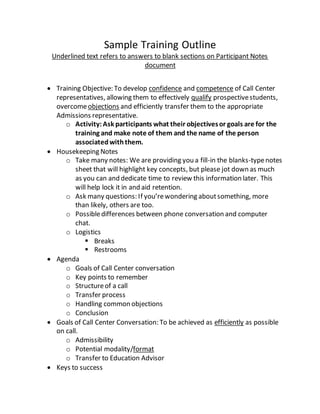
Sample Training Outline
Underlined text refers to answers to blank sections on Participant Notes
document
 Training Objective: To develop confidence and competence of Call Center
representatives, allowing them to effectively qualify prospectivestudents,
overcomeobjections and efficiently transfer them to the appropriate
Admissions representative.
o Activity:Ask participants what their objectivesor goals are for the
training and make note of them and the name of the person
associatedwiththem.
 Housekeeping Notes
o Take many notes: We are providing you a fill-in the blanks-typenotes
sheet that will highlight key concepts, but please jot down as much
as you can and dedicate time to review this information later. This
will help lock it in and aid retention.
o Ask many questions: If you’rewondering aboutsomething, more
than likely, others are too.
o Possibledifferences between phone conversation and computer
chat.
o Logistics
 Breaks
 Restrooms
 Agenda
o Goals of Call Center conversation
o Key points to remember
o Structureof a call
o Transfer process
o Handling common objections
o Conclusion
 Goals of Call Center Conversation: To be achieved as efficiently as possible
on call.
o Admissibility
o Potential modality/format
o Transfer to Education Advisor
 Keys to success
o Prospectivestudent’s mindset
 They weren’texpecting a call, so they may not be receptive:
Students often know they need a degree, but when reality is
on the other line with them, they often react with
apprehension.
 Activity:Put participants intosmall groups andgive themfive
minutes toshare their experiencesinteracting withpeople
making calls to themand their perceptions of them. Have one
spokespersonfor eachgroupbriefly share common themes.
 Their (unspoken) questions: Our mostsuccessful
representatives see the world through their student’s eyes,
anticipate challenges and proactively address them in the call.
This perspectivehas informed the script we’vecreated.
 “Who are you?”
 “Why are you calling?”
 “Should I bother talking to you (or go back to what I was
doing before)?
o The three “B’s”: Ideally, calls should be fromthree to five minutes
long.
 Be brief
 Be brilliant
 Be gone
o Confidence is critical
 Confidence comes from competence. Competence comes from
repetition.
 The key is to practice on your own, in the car, with your
significant other, with your dog.
 Think of an actor on stage. The time to practice your
lines is not when the curtain goes up. You can only
breathe life into a role when you’veinternalized your
lines and made them your own.
 Remember your motivation. You’re there to serve.
 Knowing that you’relooking to help the student achieve
their stated goal is key, especially when dealing with
students who are afraid to take the next step and
respond negatively to your outreach.
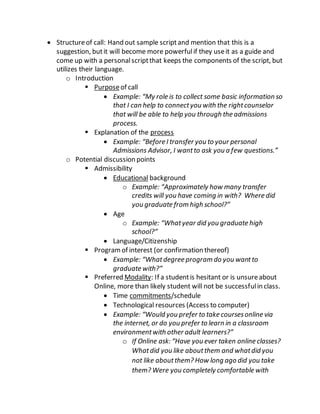
 Structureof call: Hand out sample scriptand mention that this is a
suggestion, butit will become more powerfulif they useit as a guide and
come up with a personalscriptthat keeps the components of the script, but
utilizes their language.
o Introduction
 Purposeof call
 Example: “My role is to collect some basic information so
that I can help to connectyou with the rightcounselor
that will be able to help you through the admissions
process.
 Explanation of the process
 Example: “Before I transfer you to your personal
Admissions Advisor, I wantto ask you a few questions.”
o Potential discussion points
 Admissibility
 Educational background
o Example: “Approximately how many transfer
credits will you have coming in with? Where did
you graduate from high school?”
 Age
o Example: “Whatyear did you graduate high
school?”
 Language/Citizenship
 Programof interest (or confirmation thereof)
 Example: “Whatdegree program do you wantto
graduate with?”
 Preferred Modality: If a studentis hesitant or is unsureabout
Online, more than likely student will not be successfulin class.
 Time commitments/schedule
 Technological resources (Access to computer)
 Example: “Would you prefer to take coursesonline via
the internet, or do you prefer to learn in a classroom
environmentwith other adult learners?”
o If Online ask: “Have you ever taken online classes?
Whatdid you like aboutthem and whatdid you
not like aboutthem? How long ago did you take
them? Were you completely comfortable with
online classes? Do you have access to a computer?
How are they with computer skills?”
o If face to face, discuss their location, work and
family schedule, and any other obstacles that may
preventthem from attending one night a week
 Example: “Where do you reside? Tell me
aboutyour schedule and time
commitments.”
o Activity:Ask students towork individually andspendfive minutes
reviewing the script andcircle any phrases or words that they might
consider revising or rephrasing.
 Transfer process
o Structure
 IntroduceEA to student
 Give EA student’s programof interest
 Excuse yourself fromconversation
o Example: “Thank you Gregg, letme connectyou with your Enrollment
Advisor, Natalie. Hi Natalie, I have Gregg on the line. Gregg, can you
hear me? Great. Natalie, Gregg is currently looking for some
information on our Business Managementprograms. Would you be
able to help him out with that? Perfect! Gregg, is wasa pleasure
speaking with you, and I know Natalie will take greatcare of
you. Have a greatday!”
 Handling common objections
o Layered approach:In mostcases, it is necessary to break down
severallayers of objection. In order to accomplish this,
representatives musthave the courageto ask thoughtful questions
to seemingly simple responses fromthe candidate to initial inquiries.
This approach is critical because, more often than not, the first
responserepresentatives receivewill be “no”. Taking a layered
approach to denials will allow for respectfulinteractions that lead to
conversions with people they would not convertotherwise.
 Example, if a potential student says: “I am not interested right
now”, an appropriate response would be “Tell me aboutthat.
Whathas caused you to change your mind?” Similarly, if asked
why they are interested in getting their degree and the student
cites earning more money, a potentialresponse could be,
“Whataboutmaking more money hasyou inspired to get your
degree?” or “Tell me more aboutthat. What will making more
money do for you in your life?”
o Common Objections: Wehave included a sheet with common
objections and appropriateresponses thatboth acknowledgethe
student’s issuewhile still moving the conversation toward a
conversation with an Advisor.
o Activity:Put participants intosmall groups (different fromfirst
exercise) andhave themreviewthe objections handout and
brainstormone concernthat isn’t includedanda possible response.
Have a spokespersonbriefly share their findings.
 Conclusion
o Internalizethe process to create a foundation of competence and
confidence
 Be patient with yourself, butbe diligent in honing your skills:
Students respond to confidence and conviction and it takes
time to develop these traits, but you can speed up that process
by practicing constantly. Itwill be worth it.
o Remember your goals: The acronym“AFT” will help. Of course,
rapportis a given in every call. Be warm, be cordial and be natural.
 Admissibility
 Format
 Transfer
o Peel back layers by asking clarifying questions: This takes courage.
o Activity:Gothroughlist of participant’s objectives/goals for training
and ask them if they were addressed. If not, discuss themin detail.

Sample Training Outline

  • 1.
    Sample Training Outline Underlinedtext refers to answers to blank sections on Participant Notes document  Training Objective: To develop confidence and competence of Call Center representatives, allowing them to effectively qualify prospectivestudents, overcomeobjections and efficiently transfer them to the appropriate Admissions representative. o Activity:Ask participants what their objectivesor goals are for the training and make note of them and the name of the person associatedwiththem.  Housekeeping Notes o Take many notes: We are providing you a fill-in the blanks-typenotes sheet that will highlight key concepts, but please jot down as much as you can and dedicate time to review this information later. This will help lock it in and aid retention. o Ask many questions: If you’rewondering aboutsomething, more than likely, others are too. o Possibledifferences between phone conversation and computer chat. o Logistics  Breaks  Restrooms  Agenda o Goals of Call Center conversation o Key points to remember o Structureof a call o Transfer process o Handling common objections o Conclusion  Goals of Call Center Conversation: To be achieved as efficiently as possible on call. o Admissibility o Potential modality/format o Transfer to Education Advisor  Keys to success
  • 2.
    o Prospectivestudent’s mindset They weren’texpecting a call, so they may not be receptive: Students often know they need a degree, but when reality is on the other line with them, they often react with apprehension.  Activity:Put participants intosmall groups andgive themfive minutes toshare their experiencesinteracting withpeople making calls to themand their perceptions of them. Have one spokespersonfor eachgroupbriefly share common themes.  Their (unspoken) questions: Our mostsuccessful representatives see the world through their student’s eyes, anticipate challenges and proactively address them in the call. This perspectivehas informed the script we’vecreated.  “Who are you?”  “Why are you calling?”  “Should I bother talking to you (or go back to what I was doing before)? o The three “B’s”: Ideally, calls should be fromthree to five minutes long.  Be brief  Be brilliant  Be gone o Confidence is critical  Confidence comes from competence. Competence comes from repetition.  The key is to practice on your own, in the car, with your significant other, with your dog.  Think of an actor on stage. The time to practice your lines is not when the curtain goes up. You can only breathe life into a role when you’veinternalized your lines and made them your own.  Remember your motivation. You’re there to serve.  Knowing that you’relooking to help the student achieve their stated goal is key, especially when dealing with students who are afraid to take the next step and respond negatively to your outreach.
  • 3.
     Structureof call:Hand out sample scriptand mention that this is a suggestion, butit will become more powerfulif they useit as a guide and come up with a personalscriptthat keeps the components of the script, but utilizes their language. o Introduction  Purposeof call  Example: “My role is to collect some basic information so that I can help to connectyou with the rightcounselor that will be able to help you through the admissions process.  Explanation of the process  Example: “Before I transfer you to your personal Admissions Advisor, I wantto ask you a few questions.” o Potential discussion points  Admissibility  Educational background o Example: “Approximately how many transfer credits will you have coming in with? Where did you graduate from high school?”  Age o Example: “Whatyear did you graduate high school?”  Language/Citizenship  Programof interest (or confirmation thereof)  Example: “Whatdegree program do you wantto graduate with?”  Preferred Modality: If a studentis hesitant or is unsureabout Online, more than likely student will not be successfulin class.  Time commitments/schedule  Technological resources (Access to computer)  Example: “Would you prefer to take coursesonline via the internet, or do you prefer to learn in a classroom environmentwith other adult learners?” o If Online ask: “Have you ever taken online classes? Whatdid you like aboutthem and whatdid you not like aboutthem? How long ago did you take them? Were you completely comfortable with
  • 4.
    online classes? Doyou have access to a computer? How are they with computer skills?” o If face to face, discuss their location, work and family schedule, and any other obstacles that may preventthem from attending one night a week  Example: “Where do you reside? Tell me aboutyour schedule and time commitments.” o Activity:Ask students towork individually andspendfive minutes reviewing the script andcircle any phrases or words that they might consider revising or rephrasing.  Transfer process o Structure  IntroduceEA to student  Give EA student’s programof interest  Excuse yourself fromconversation o Example: “Thank you Gregg, letme connectyou with your Enrollment Advisor, Natalie. Hi Natalie, I have Gregg on the line. Gregg, can you hear me? Great. Natalie, Gregg is currently looking for some information on our Business Managementprograms. Would you be able to help him out with that? Perfect! Gregg, is wasa pleasure speaking with you, and I know Natalie will take greatcare of you. Have a greatday!”  Handling common objections o Layered approach:In mostcases, it is necessary to break down severallayers of objection. In order to accomplish this, representatives musthave the courageto ask thoughtful questions to seemingly simple responses fromthe candidate to initial inquiries. This approach is critical because, more often than not, the first responserepresentatives receivewill be “no”. Taking a layered approach to denials will allow for respectfulinteractions that lead to conversions with people they would not convertotherwise.  Example, if a potential student says: “I am not interested right now”, an appropriate response would be “Tell me aboutthat. Whathas caused you to change your mind?” Similarly, if asked why they are interested in getting their degree and the student cites earning more money, a potentialresponse could be,
  • 5.
    “Whataboutmaking more moneyhasyou inspired to get your degree?” or “Tell me more aboutthat. What will making more money do for you in your life?” o Common Objections: Wehave included a sheet with common objections and appropriateresponses thatboth acknowledgethe student’s issuewhile still moving the conversation toward a conversation with an Advisor. o Activity:Put participants intosmall groups (different fromfirst exercise) andhave themreviewthe objections handout and brainstormone concernthat isn’t includedanda possible response. Have a spokespersonbriefly share their findings.  Conclusion o Internalizethe process to create a foundation of competence and confidence  Be patient with yourself, butbe diligent in honing your skills: Students respond to confidence and conviction and it takes time to develop these traits, but you can speed up that process by practicing constantly. Itwill be worth it. o Remember your goals: The acronym“AFT” will help. Of course, rapportis a given in every call. Be warm, be cordial and be natural.  Admissibility  Format  Transfer o Peel back layers by asking clarifying questions: This takes courage. o Activity:Gothroughlist of participant’s objectives/goals for training and ask them if they were addressed. If not, discuss themin detail.