
SahanaEden :
Introduction & Simulation A
2 November 2010, SahanaCamp
Michael Howden
michael@sahanafoundation.org
Applications
• Organisation Registry
• Inventory/Warehouse Management
• Incident Reporting
• Request Management
• Assessments
• Project Tracking
Additional Applications
• Volunteer Management
• Missing Persons
• Disaster Victims
• Hospital Management
• Budgeting Module
• Delphi Decision Support
Application Review
• What decisions does it support?
• Who would use it?
• Where would they use it?
• When would they use it?
CoreFeatures
• Rapid Application Development
• Mapping
• Messaging (SMS, Email, Twitter)
• Web Services
• Data Standards Support (XML, JSON,
PFIF, EDXL-HAVE…)
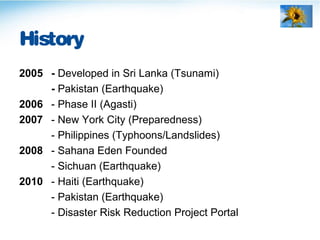
History
2005 - Developed in Sri Lanka (Tsunami)
- Pakistan (Earthquake)
2006 - Phase II (Agasti)
2007 - New York City (Preparedness)
- Philippines (Typhoons/Landslides)
2008 - Sahana Eden Founded
- Sichuan (Earthquake)
2010 - Haiti (Earthquake)
- Pakistan (Earthquake)
- Disaster Risk Reduction Project Portal
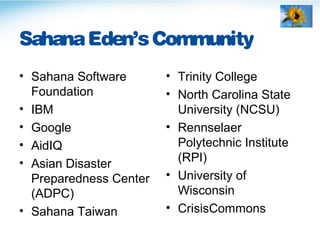
SahanaEden’sCommunity
• Sahana Software
Foundation
• IBM
• Google
• AidIQ
• Asian Disaster
Preparedness Center
(ADPC)
• Sahana Taiwan
• Trinity College
• North Carolina State
University (NCSU)
• Rennselaer
Polytechnic Institute
(RPI)
• University of
Wisconsin
• CrisisCommons

Sahana Eden : Introduction and Simulation A (SahanaCamp 1.2)

  • 1.
    SahanaEden : Introduction &Simulation A 2 November 2010, SahanaCamp Michael Howden michael@sahanafoundation.org
  • 2.
    Applications • Organisation Registry •Inventory/Warehouse Management • Incident Reporting • Request Management • Assessments • Project Tracking
  • 3.
    Additional Applications • VolunteerManagement • Missing Persons • Disaster Victims • Hospital Management • Budgeting Module • Delphi Decision Support
  • 4.
    Application Review • Whatdecisions does it support? • Who would use it? • Where would they use it? • When would they use it?
  • 5.
    CoreFeatures • Rapid ApplicationDevelopment • Mapping • Messaging (SMS, Email, Twitter) • Web Services • Data Standards Support (XML, JSON, PFIF, EDXL-HAVE…)
  • 6.
    History 2005 - Developedin Sri Lanka (Tsunami) - Pakistan (Earthquake) 2006 - Phase II (Agasti) 2007 - New York City (Preparedness) - Philippines (Typhoons/Landslides) 2008 - Sahana Eden Founded - Sichuan (Earthquake) 2010 - Haiti (Earthquake) - Pakistan (Earthquake) - Disaster Risk Reduction Project Portal
  • 7.
    SahanaEden’sCommunity • Sahana Software Foundation •IBM • Google • AidIQ • Asian Disaster Preparedness Center (ADPC) • Sahana Taiwan • Trinity College • North Carolina State University (NCSU) • Rennselaer Polytechnic Institute (RPI) • University of Wisconsin • CrisisCommons

Editor's Notes

  • #7 Just like Wikipedia, the power of crowd-sourcing for creating Accurate, up-to-date content is incredible. The fact that anyone can edit would seem to suggest that the data will be unreliable, but actually the opposite turns out to be true – there are more honest people than vandals. Not having a hard system of classification allows it to adapt rapidly which is especially useful for Local contexts. This doesn’t mean that there is anarchy – using agreed tags means that the various rendering engines will display them properly.