Safety Management Systems
A discourse on Construction Safety
in Sri Lanka
Presented By Indunil M Weerasinghe
On the 27th of March, 2013
At the Advanced Construction Training Academy, Sri Lanka
A seminar sponsored by:
Orca Aviation Analytics
And hosted by:
Signature Events
Boston, 2006
10 ton construction platform collapses onto traffic, killing three instantly
© 2013 Orca Aviation Analytics 2
Bellevue, 2006
A crane collapses onto an apartment building, killing 1 man in his home
© 2013 Orca Aviation Analytics 3
Manilla, 2011
10 workers dies after an elevator plunges 25 floors
© 2013 Orca Aviation Analytics 4
© 2013 Orca Aviation Analytics 5
The Construction sector has the
highest number of work related
accidents in Sri Lanka
Department of Labour (2012)
Colombo District Factory Inspection Engineer AW
Alahakoon in an interview to The Island Financial Review
Safety Performance of the Sri
Lankan construction industry
© 2013 Orca Aviation Analytics 6
Statistics from the Department of Labour
Safety Performance of the Sri
Lankan construction industry
* GDP & Employment statistics quoted from ICRA Lanka report (2011)
© 2013 Orca Aviation Analytics 7
8% 7% 5%
27%
0%
25%
50%
75%
100%
GDP Employment Non-fatal
accidents
Fatal accidents
National index
Construction Industry
1 of 6 (labour) accidents
and 25 of 40 deaths
in construction
are due to negligence
or carelessness
Statistics from the
International Labour Organisation
as quoted by Karunasena et al. (2013)
(University Of Moratuwa)
© 2013 Orca Aviation Analytics 8
© 2013 Orca Aviation Analytics 9
74% of contractors [in Sri Lanka]
have safety policies for their sites
Most incidents & injuries at construction
sites are a direct result of not adhering to
established safety procedures
Karunasena et al. (2013)
(Uni. Of Moratuwa)
Dissanayake et al.
(Uni. Of Peradeniya)
“Policy and procedure” alone is not enough...
We need to breed a culture of safety,
from board-room to brick-layer,
to take a holistic
system-wide approach to safety.
i.e.
Implement a robust, “Safety Management System”
© 2013 Orca Aviation Analytics 10
Overview
1. Why is “Safety” Important?
2. The "Management Paradox"
3. A Systemic Approach to Safety
4. Implementation Framework
5. Risk Management
6. Promoting a Culture of Safety
7. Summary
© 2013 Orca Aviation Analytics 11
WHY IS “SAFETY” IMPORTANT?
Part 1
© 2013 Orca Aviation Analytics 12
1. Ethical obligations
2. Regulatory obligations
3. Organizational benefits:
– Better morale
– Increased productivity & efficiency
– Lower staff turnover
– Protect brand equity
4. Financial benefits:
– Reduced schedule disruptions
– Reduced workers’ compensation
– Lower insurance premiums
– Lower legal fees
© 2013 Orca Aviation Analytics 13
Why is “Safety” Important?
Work-days lost in Sri Lanka
• ILO estimates for Sri Lanka:
– 4,000 accidents per year
(taking into account under-reporting)
– 600,000 work-days lost
• Based on this, we can infer that accidents cost
the Sri Lankan construction industry an
estimated 40,000 work-days.
© 2013 Orca Aviation Analytics 14
© 2013 Orca Aviation Analytics 15
Employee injuries accounting for 6-9% of
project costs can be reduced to just 2.5%
with a well-implemented safety program.
Mark Steinhofer (2013)
Safety Management Group, USA
Companies can expect a return
of $4 to $6 for every dollar
invested in a safety program
THE “MANAGEMENT PARADOX”
Part 2
© 2013 Orca Aviation Analytics 16
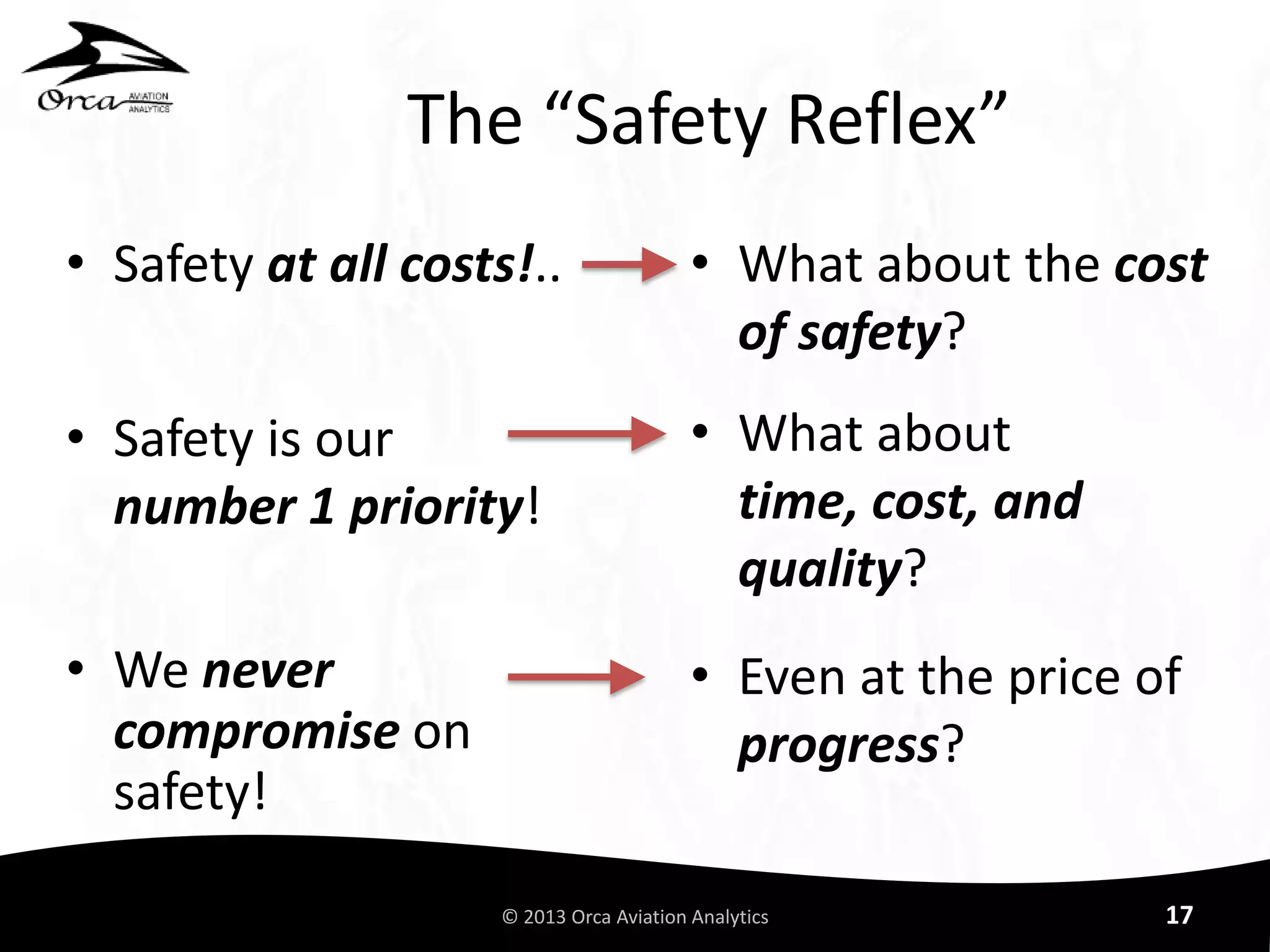
The “Safety Reflex”
• We never
compromise on
safety!
© 2013 Orca Aviation Analytics 17
• What about the cost
of safety?
• What about
time, cost, and
quality?
• Even at the price of
progress?
• Safety at all costs!..
• Safety is our
number 1 priority!
[Safety] compliance should not create an
additional financial burden on an
organisation if it provides little or no
safety benefit.
Ron Bartsch (2007)
Aviation Law Assoc. Of Australia & NZ
© 2013 Orca Aviation Analytics 18
Safety benefit
Cost of
implementation
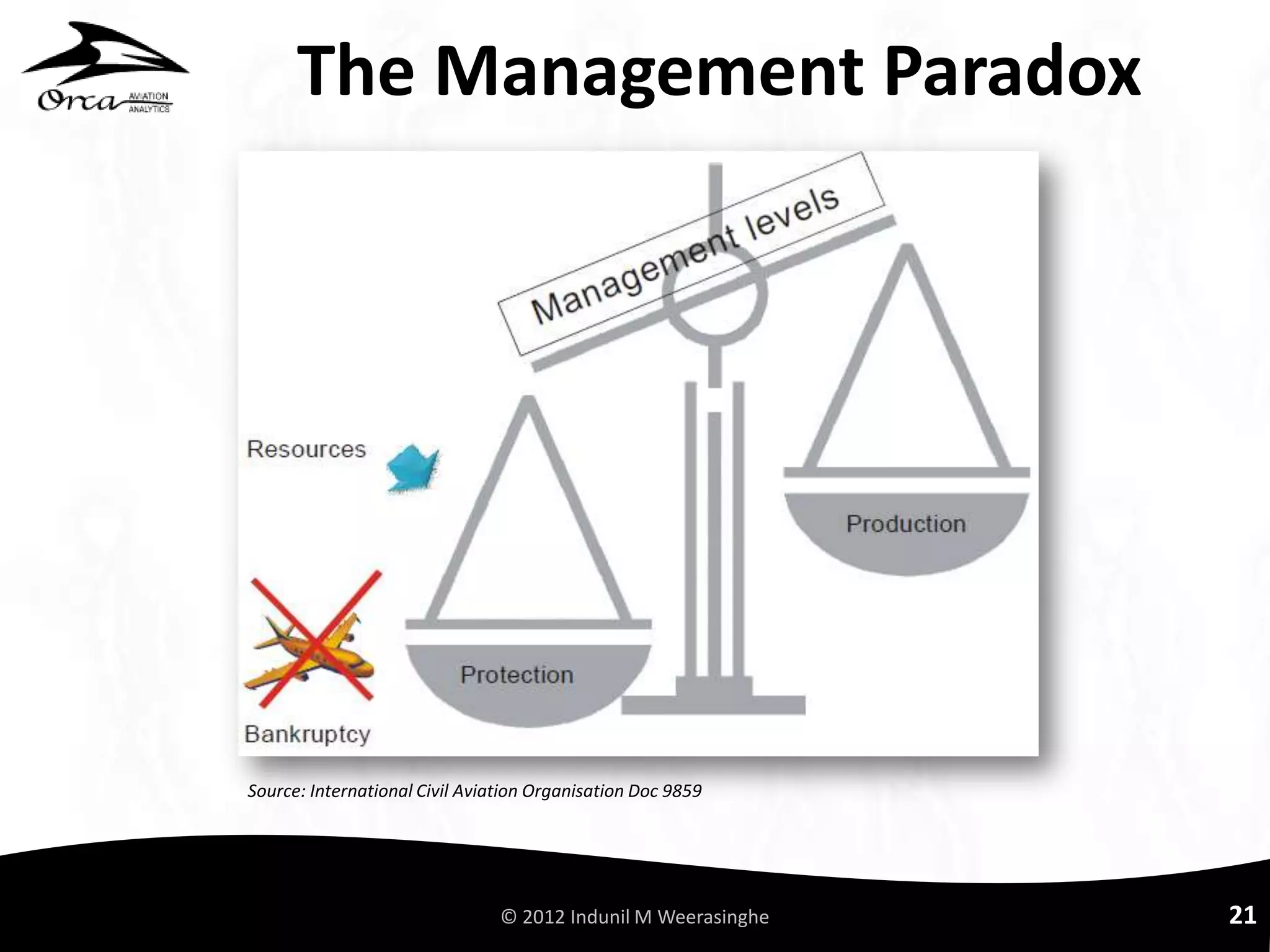
The Management Paradox
• Limited resources to be balanced between:
– Protection vs. Production
Source: International Civil Aviation Organisation Doc 9859
19© 2012 Indunil M Weerasinghe
The Management Paradox
Source: International Civil Aviation Organisation Doc 9859
20© 2012 Indunil M Weerasinghe
The Management Paradox
Source: International Civil Aviation Organisation Doc 9859
21© 2012 Indunil M Weerasinghe
Solving the Management Paradox
• Acknowledge that safety issues are:
a) a by-product of producing goods or services
b) to be managed as a “business function”, much like
operations, finances, HR, IT etc
 A well-implemented Safety Management System will:
– Complement the corporate Quality Management System
– Be an explicit element of the management activities
– Set out the company’s safety policy
– Standardize processes to ensure acceptable safety outcomes
22© 2012 Indunil M Weerasinghe
Solving the Management Paradox
23© 2012 Indunil M Weerasinghe
• Management of quality is about:
compliance to existing standards
• Management of safety is about:
asking what risks are involved in meeting
those standards?
What can we do to mitigate them?
A SYSTEMIC APPROACH TO SAFETY
Part 3
© 2013 Orca Aviation Analytics 24
© 2012 Indunil M Weerasinghe 25
The “Organisational Accident”
Prof James Reason (Uni. Of Manchester)
• Sometimes known as the “ ”
Source: Australian Civil Aviation Safety Authority, “SMS for Aviation – A Practical Guide”
© 2012 Indunil M Weerasinghe 26
The “Organisational Accident”
UNSAFE ACTS
(Errors)
(Violations)
Unfavourable
CONDITIONS
PROCESSES
(Goals)
(Structure)
(Culture)
(Decisions)
DEFENCES
ORGANISATION WORKPLACE INDIVIDUALS
ACCIDENT
The “Organisational Accident”
• Safety management objective:
– Break the chain of conditions/events pro-actively
27© 2012 Indunil M Weerasinghe
IMPLEMENTATION FRAMEWORK
Part 4
© 2013 Orca Aviation Analytics 28
Implementing a Safety
Management System
• Cooperative Research Centre for Construction
Innovation:
• Safety principles to be applied at four key
project phases:
1. Planning
2. Design
3. Construction
4. Post-construction
© 2013 Orca Aviation Analytics 29
© 2012 Indunil M Weerasinghe 30
The ICAO Framework
SMS framework established by the
International Civil Aviation Organisation:
1. Safety policy & objectives
2. Safety risk management
3. Safety assurance
4. Safety promotion
© 2012 Indunil M Weerasinghe 31
1. Safety policy & objectives:
– Defines the “way we do business”
– Safety as a means to meet the production goals
– Relationship with QMS
The ICAO Framework
2. Safety risk management:
– Identifying hazards
– Assessing and managing risk
© 2012 Indunil M Weerasinghe 32
3. Safety assurance:
– Audits
– Investigations
4. Safety promotion:
– Training
– Campaigns
– Walking the talk!
The ICAO Framework
RISK MANAGEMENT
Part 5
© 2013 Orca Aviation Analytics 33
Risk Management Objective
• Risk management forms one of the
fundamental tenets of a Safety Management
System
• Control risk exposure to be within acceptable
limits
© 2013 Orca Aviation Analytics 34
© 2012 Indunil M Weerasinghe 35
1. Identify hazards
2. Assessing and managing risk:
– What is the likelihood of it actually occurring?
– What are the consequences/impact if it does?
Safety risk management
© 2012 Indunil M Weerasinghe 36
“Acceptable” Levels of Risk
• Risks should be controlled to be ALaRP:
– As Low as Reasonably Practicable
Source: International Civil Aviation Organisation Doc 9859
ILO Guidelines for
Construction Sites
International Labour Organisation (ILO)
The Safety and Health in Construction
Convention, 1988 (No. 167)
&
Safety and Health in Construction
Recommendations, 1988 (No. 175)
© 2013 Orca Aviation Analytics 37
Preventive Measures
• Work to be planned such that:
a) risks liable to arise at the workplace are prevented as soon as
possible;
b) excessively or unnecessarily strenuous work positions and
movements are avoided;
c) organization of work takes into account the safety and health of
workers;
d) materials and products are used which are suitable from a safety
and health point of view;
e) working methods are employed which protect workers against
the harmful effects of chemical, physical and biological agents.
© 2013 Orca Aviation Analytics 38
Common Risks
• Common risks at most construction sites
• As a minimum, should be addressed through both safety
policy as well as risk assessment & management plan:
– Scaffolds
– Lifting appliances & lifting gear
– Excavations, shafts, earthworks, underground works & tunnels
– Work in compressed air
– Pile driving
– Work over water
– Health hazards
– Dangerous atmospheres
– Fire precautions
– Radiation hazards
© 2013 Orca Aviation Analytics 39
Risk Management Process
• Common methodology
applied in aviation
– System & task analysis
– Risk assessment
– Risk management
– Risk monitoring
– Safety assurance
– Continuous
improvement
© 2013 Orca Aviation Analytics 40
Process Overview
© 2013 Orca Aviation Analytics 41
System & task
analysis
Day to day
operations
Safety policy &
objectives
Risk
Management
Plan
Assess risks
Identify
associated risks
Identify hazards
Monitor
Continuous
improvement
PROMOTING A CULTURE OF SAFETY
Part 6
© 2013 Orca Aviation Analytics 42
© 2012 Indunil M Weerasinghe 43
Walking the Talk!
• Safety is everyone's business!
• The success of a Safety Management System
requires buy-in from all levels in the
organization:
• Directors to set the correct policies
• Senior management for resource allocation
• Operational management for procedures &
oversight
• Employees for implementation
What is “Culture”?
• A collective way of thinking
• Influenced by our social environment, namely:
© 2013 Orca Aviation Analytics 44
NATIONAL
PROFESSIONAL
ORGANISATION
Illustration adapted from ICAO Doc 9859
© 2012 Indunil M Weerasinghe 45
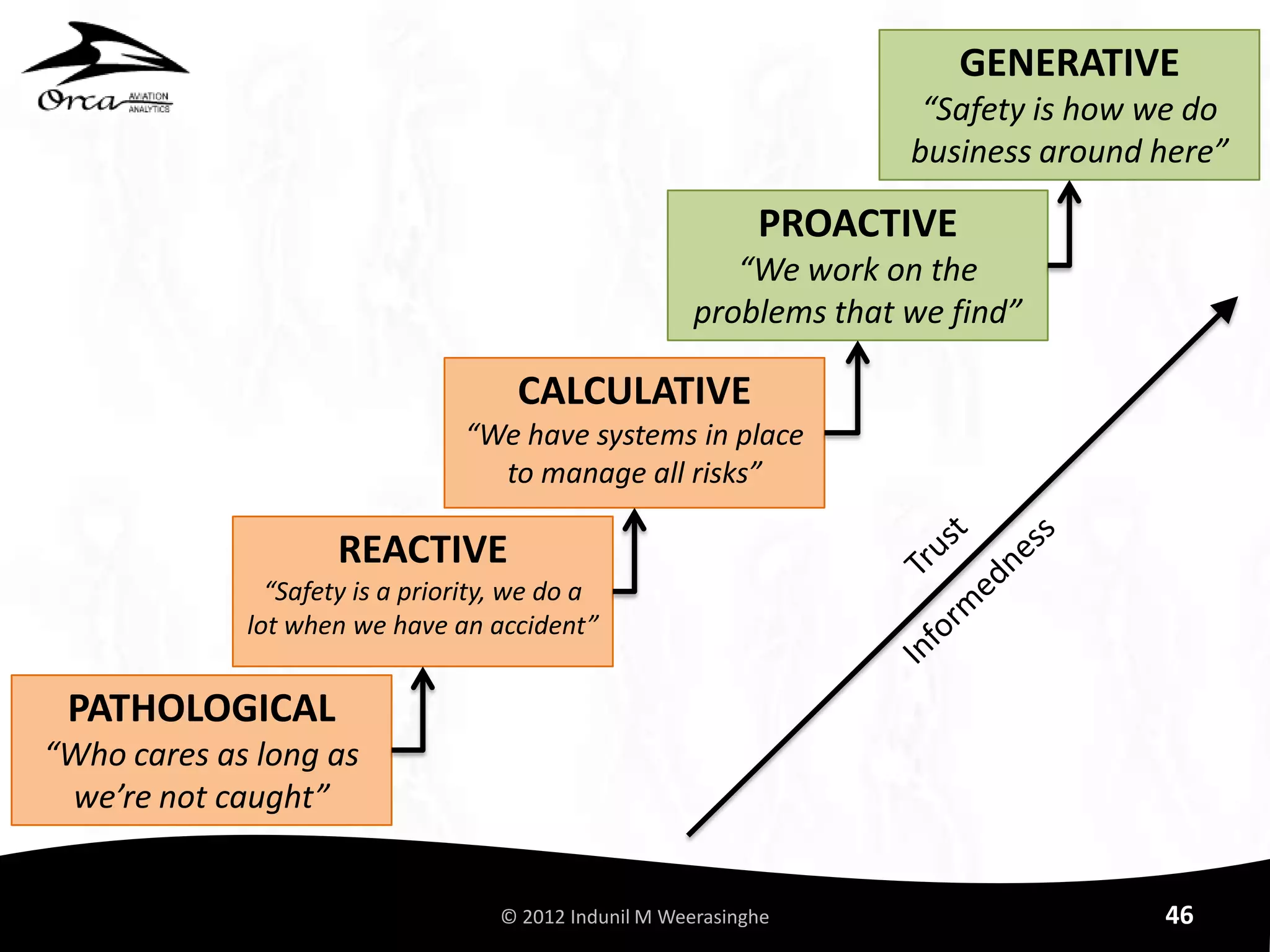
The Evolution of Safety Culture
Safety cultures evolve through five stages:
1. Pathological
2. Reactive
3. Calculative
4. Proactive
5. Generative
Patrick Hudson
(As published in
Flight Safety Australia)
Where does your
organization stand???
© 2012 Indunil M Weerasinghe 46
GENERATIVE
“Safety is how we do
business around here”
CALCULATIVE
“We have systems in place
to manage all risks”
PROACTIVE
“We work on the
problems that we find”
REACTIVE
“Safety is a priority, we do a
lot when we have an accident”
PATHOLOGICAL
“Who cares as long as
we’re not caught”
© 2012 Indunil M Weerasinghe 47
A “Good” Safety Culture is...
1. Informed
2. Reporting
3. Just
4. Flexible
5. Learning
Prof James Reason
(Uni. Of Manchester)
SUMMARY
Part 7
© 2013 Orca Aviation Analytics 48
Summary
• 27% of labour-related deaths in Sri Lanka take
place in the Construction industry
- Dept of Labour statistics, averaged between 2002 - 2007
• Implementation of Safety Management Systems
can improve safety performance, yielding multiple
benefits.
• Key aspects of successful Safety Management are:
– Risk management
– Safety Culture
© 2013 Orca Aviation Analytics 49
Benefits of Safety Management
• Protect employees, customers, and the general
public from sources of harm
• Protect the public image and share value of the
organization
• Make safety an integral part of how business is
done
• Improve operational efficiencies through better
productivity and lower downtimes
© 2013 Orca Aviation Analytics 50
And most importantly...
• Contribute to the company’s financial
performance:
© 2013 Orca Aviation Analytics 51
Employee injuries accounting for 6-9% of
project costs can be reduced to just 2.5%
with a well-implemented safety program.
Mark Steinhofer (2013)
Safety Management Group, USA
Thank you...
For more information, please feel free to contact:
Orca Aviation Analytics
Indunil M Weerasinghe
Tel: 077 352 5623
Email: indunil.w@OrcaAnalytics.com
www.OrcaAnalytics.com
Signature Events
Ramani Peiris
Tel: 077 580 5229
Email: ramani.peiris@signatureevents.lk
© 2013 Orca Aviation Analytics 52

Safety Management Systems - Discourse on safety in the Sri Lankan Construction Industry on 27-Mar-2013

  • 1.
    Safety Management Systems Adiscourse on Construction Safety in Sri Lanka Presented By Indunil M Weerasinghe On the 27th of March, 2013 At the Advanced Construction Training Academy, Sri Lanka A seminar sponsored by: Orca Aviation Analytics And hosted by: Signature Events
  • 2.
    Boston, 2006 10 tonconstruction platform collapses onto traffic, killing three instantly © 2013 Orca Aviation Analytics 2
  • 3.
    Bellevue, 2006 A cranecollapses onto an apartment building, killing 1 man in his home © 2013 Orca Aviation Analytics 3
  • 4.
    Manilla, 2011 10 workersdies after an elevator plunges 25 floors © 2013 Orca Aviation Analytics 4
  • 5.
    © 2013 OrcaAviation Analytics 5 The Construction sector has the highest number of work related accidents in Sri Lanka Department of Labour (2012) Colombo District Factory Inspection Engineer AW Alahakoon in an interview to The Island Financial Review
  • 6.
    Safety Performance ofthe Sri Lankan construction industry © 2013 Orca Aviation Analytics 6 Statistics from the Department of Labour
  • 7.
    Safety Performance ofthe Sri Lankan construction industry * GDP & Employment statistics quoted from ICRA Lanka report (2011) © 2013 Orca Aviation Analytics 7 8% 7% 5% 27% 0% 25% 50% 75% 100% GDP Employment Non-fatal accidents Fatal accidents National index Construction Industry
  • 8.
    1 of 6(labour) accidents and 25 of 40 deaths in construction are due to negligence or carelessness Statistics from the International Labour Organisation as quoted by Karunasena et al. (2013) (University Of Moratuwa) © 2013 Orca Aviation Analytics 8
  • 9.
    © 2013 OrcaAviation Analytics 9 74% of contractors [in Sri Lanka] have safety policies for their sites Most incidents & injuries at construction sites are a direct result of not adhering to established safety procedures Karunasena et al. (2013) (Uni. Of Moratuwa) Dissanayake et al. (Uni. Of Peradeniya)
  • 10.
    “Policy and procedure”alone is not enough... We need to breed a culture of safety, from board-room to brick-layer, to take a holistic system-wide approach to safety. i.e. Implement a robust, “Safety Management System” © 2013 Orca Aviation Analytics 10
  • 11.
    Overview 1. Why is“Safety” Important? 2. The "Management Paradox" 3. A Systemic Approach to Safety 4. Implementation Framework 5. Risk Management 6. Promoting a Culture of Safety 7. Summary © 2013 Orca Aviation Analytics 11
  • 12.
    WHY IS “SAFETY”IMPORTANT? Part 1 © 2013 Orca Aviation Analytics 12
  • 13.
    1. Ethical obligations 2.Regulatory obligations 3. Organizational benefits: – Better morale – Increased productivity & efficiency – Lower staff turnover – Protect brand equity 4. Financial benefits: – Reduced schedule disruptions – Reduced workers’ compensation – Lower insurance premiums – Lower legal fees © 2013 Orca Aviation Analytics 13 Why is “Safety” Important?
  • 14.
    Work-days lost inSri Lanka • ILO estimates for Sri Lanka: – 4,000 accidents per year (taking into account under-reporting) – 600,000 work-days lost • Based on this, we can infer that accidents cost the Sri Lankan construction industry an estimated 40,000 work-days. © 2013 Orca Aviation Analytics 14
  • 15.
    © 2013 OrcaAviation Analytics 15 Employee injuries accounting for 6-9% of project costs can be reduced to just 2.5% with a well-implemented safety program. Mark Steinhofer (2013) Safety Management Group, USA Companies can expect a return of $4 to $6 for every dollar invested in a safety program
  • 16.
    THE “MANAGEMENT PARADOX” Part2 © 2013 Orca Aviation Analytics 16
  • 17.
    The “Safety Reflex” •We never compromise on safety! © 2013 Orca Aviation Analytics 17 • What about the cost of safety? • What about time, cost, and quality? • Even at the price of progress? • Safety at all costs!.. • Safety is our number 1 priority!
  • 18.
    [Safety] compliance shouldnot create an additional financial burden on an organisation if it provides little or no safety benefit. Ron Bartsch (2007) Aviation Law Assoc. Of Australia & NZ © 2013 Orca Aviation Analytics 18 Safety benefit Cost of implementation
  • 19.
    The Management Paradox •Limited resources to be balanced between: – Protection vs. Production Source: International Civil Aviation Organisation Doc 9859 19© 2012 Indunil M Weerasinghe
  • 20.
    The Management Paradox Source:International Civil Aviation Organisation Doc 9859 20© 2012 Indunil M Weerasinghe
  • 21.
    The Management Paradox Source:International Civil Aviation Organisation Doc 9859 21© 2012 Indunil M Weerasinghe
  • 22.
    Solving the ManagementParadox • Acknowledge that safety issues are: a) a by-product of producing goods or services b) to be managed as a “business function”, much like operations, finances, HR, IT etc  A well-implemented Safety Management System will: – Complement the corporate Quality Management System – Be an explicit element of the management activities – Set out the company’s safety policy – Standardize processes to ensure acceptable safety outcomes 22© 2012 Indunil M Weerasinghe
  • 23.
    Solving the ManagementParadox 23© 2012 Indunil M Weerasinghe • Management of quality is about: compliance to existing standards • Management of safety is about: asking what risks are involved in meeting those standards? What can we do to mitigate them?
  • 24.
    A SYSTEMIC APPROACHTO SAFETY Part 3 © 2013 Orca Aviation Analytics 24
  • 25.
    © 2012 IndunilM Weerasinghe 25 The “Organisational Accident” Prof James Reason (Uni. Of Manchester) • Sometimes known as the “ ” Source: Australian Civil Aviation Safety Authority, “SMS for Aviation – A Practical Guide”
  • 26.
    © 2012 IndunilM Weerasinghe 26 The “Organisational Accident” UNSAFE ACTS (Errors) (Violations) Unfavourable CONDITIONS PROCESSES (Goals) (Structure) (Culture) (Decisions) DEFENCES ORGANISATION WORKPLACE INDIVIDUALS ACCIDENT
  • 27.
    The “Organisational Accident” •Safety management objective: – Break the chain of conditions/events pro-actively 27© 2012 Indunil M Weerasinghe
  • 28.
    IMPLEMENTATION FRAMEWORK Part 4 ©2013 Orca Aviation Analytics 28
  • 29.
    Implementing a Safety ManagementSystem • Cooperative Research Centre for Construction Innovation: • Safety principles to be applied at four key project phases: 1. Planning 2. Design 3. Construction 4. Post-construction © 2013 Orca Aviation Analytics 29
  • 30.
    © 2012 IndunilM Weerasinghe 30 The ICAO Framework SMS framework established by the International Civil Aviation Organisation: 1. Safety policy & objectives 2. Safety risk management 3. Safety assurance 4. Safety promotion
  • 31.
    © 2012 IndunilM Weerasinghe 31 1. Safety policy & objectives: – Defines the “way we do business” – Safety as a means to meet the production goals – Relationship with QMS The ICAO Framework 2. Safety risk management: – Identifying hazards – Assessing and managing risk
  • 32.
    © 2012 IndunilM Weerasinghe 32 3. Safety assurance: – Audits – Investigations 4. Safety promotion: – Training – Campaigns – Walking the talk! The ICAO Framework
  • 33.
    RISK MANAGEMENT Part 5 ©2013 Orca Aviation Analytics 33
  • 34.
    Risk Management Objective •Risk management forms one of the fundamental tenets of a Safety Management System • Control risk exposure to be within acceptable limits © 2013 Orca Aviation Analytics 34
  • 35.
    © 2012 IndunilM Weerasinghe 35 1. Identify hazards 2. Assessing and managing risk: – What is the likelihood of it actually occurring? – What are the consequences/impact if it does? Safety risk management
  • 36.
    © 2012 IndunilM Weerasinghe 36 “Acceptable” Levels of Risk • Risks should be controlled to be ALaRP: – As Low as Reasonably Practicable Source: International Civil Aviation Organisation Doc 9859
  • 37.
    ILO Guidelines for ConstructionSites International Labour Organisation (ILO) The Safety and Health in Construction Convention, 1988 (No. 167) & Safety and Health in Construction Recommendations, 1988 (No. 175) © 2013 Orca Aviation Analytics 37
  • 38.
    Preventive Measures • Workto be planned such that: a) risks liable to arise at the workplace are prevented as soon as possible; b) excessively or unnecessarily strenuous work positions and movements are avoided; c) organization of work takes into account the safety and health of workers; d) materials and products are used which are suitable from a safety and health point of view; e) working methods are employed which protect workers against the harmful effects of chemical, physical and biological agents. © 2013 Orca Aviation Analytics 38
  • 39.
    Common Risks • Commonrisks at most construction sites • As a minimum, should be addressed through both safety policy as well as risk assessment & management plan: – Scaffolds – Lifting appliances & lifting gear – Excavations, shafts, earthworks, underground works & tunnels – Work in compressed air – Pile driving – Work over water – Health hazards – Dangerous atmospheres – Fire precautions – Radiation hazards © 2013 Orca Aviation Analytics 39
  • 40.
    Risk Management Process •Common methodology applied in aviation – System & task analysis – Risk assessment – Risk management – Risk monitoring – Safety assurance – Continuous improvement © 2013 Orca Aviation Analytics 40
  • 41.
    Process Overview © 2013Orca Aviation Analytics 41 System & task analysis Day to day operations Safety policy & objectives Risk Management Plan Assess risks Identify associated risks Identify hazards Monitor Continuous improvement
  • 42.
    PROMOTING A CULTUREOF SAFETY Part 6 © 2013 Orca Aviation Analytics 42
  • 43.
    © 2012 IndunilM Weerasinghe 43 Walking the Talk! • Safety is everyone's business! • The success of a Safety Management System requires buy-in from all levels in the organization: • Directors to set the correct policies • Senior management for resource allocation • Operational management for procedures & oversight • Employees for implementation
  • 44.
    What is “Culture”? •A collective way of thinking • Influenced by our social environment, namely: © 2013 Orca Aviation Analytics 44 NATIONAL PROFESSIONAL ORGANISATION Illustration adapted from ICAO Doc 9859
  • 45.
    © 2012 IndunilM Weerasinghe 45 The Evolution of Safety Culture Safety cultures evolve through five stages: 1. Pathological 2. Reactive 3. Calculative 4. Proactive 5. Generative Patrick Hudson (As published in Flight Safety Australia) Where does your organization stand???
  • 46.
    © 2012 IndunilM Weerasinghe 46 GENERATIVE “Safety is how we do business around here” CALCULATIVE “We have systems in place to manage all risks” PROACTIVE “We work on the problems that we find” REACTIVE “Safety is a priority, we do a lot when we have an accident” PATHOLOGICAL “Who cares as long as we’re not caught”
  • 47.
    © 2012 IndunilM Weerasinghe 47 A “Good” Safety Culture is... 1. Informed 2. Reporting 3. Just 4. Flexible 5. Learning Prof James Reason (Uni. Of Manchester)
  • 48.
    SUMMARY Part 7 © 2013Orca Aviation Analytics 48
  • 49.
    Summary • 27% oflabour-related deaths in Sri Lanka take place in the Construction industry - Dept of Labour statistics, averaged between 2002 - 2007 • Implementation of Safety Management Systems can improve safety performance, yielding multiple benefits. • Key aspects of successful Safety Management are: – Risk management – Safety Culture © 2013 Orca Aviation Analytics 49
  • 50.
    Benefits of SafetyManagement • Protect employees, customers, and the general public from sources of harm • Protect the public image and share value of the organization • Make safety an integral part of how business is done • Improve operational efficiencies through better productivity and lower downtimes © 2013 Orca Aviation Analytics 50
  • 51.
    And most importantly... •Contribute to the company’s financial performance: © 2013 Orca Aviation Analytics 51 Employee injuries accounting for 6-9% of project costs can be reduced to just 2.5% with a well-implemented safety program. Mark Steinhofer (2013) Safety Management Group, USA
  • 52.
    Thank you... For moreinformation, please feel free to contact: Orca Aviation Analytics Indunil M Weerasinghe Tel: 077 352 5623 Email: indunil.w@OrcaAnalytics.com www.OrcaAnalytics.com Signature Events Ramani Peiris Tel: 077 580 5229 Email: ramani.peiris@signatureevents.lk © 2013 Orca Aviation Analytics 52