Functional Systems
of Fall Protection
Reporter:
Roxienette D. Hirang
FALL PROTECTION CLASSIFIED INTO TWO:
PASSIVE
doesn't require any interaction with the workers
once installed
ACTIVE
requires active participation from workers
workers must choose to use them and know how
to use it properly
Active fall protection four basic categories:
1. Fall Arrest OSHA 1926.502(d)
Fall arrest systems are required whenever a worker is
exposed to a fall hazard. In the construction industry, OSHA
defines a fall hazard as a drop of 6 feet or more from a
working/walking surface to a lower level or grade. Some
exceptions exist, including (but not limited to) ladders,
scaffolding, and steelwork. Common fall arrest equipment
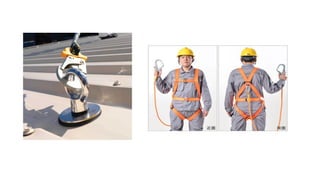
includes an anchor point, body harness, and connector
(such as a lanyard or self-retracting lifeline.)
(NOTE: OSHA – Occupational Safety and Health Administration)
a. Full Body Harness
– a piece of equipment worn by the worker to support their body in case of
a fall. Must be capable of supporting a person and their tools, with a total
weight of 310 lbs. and must be used in conjunction with an anchorage and
deceleration device that limits the impact forces of fall to 1,800 lbs. or less.
b. Lanyard
– are the safety straps that connect your harness to a secure anchor point.
They come in different lengths, from a 50-foot self-retracting lanyard (SRL) to a
2-foot webbed lanyard. Each type of lanyard serves a specific purpose
depending on the job and safety needs.
c. Anchor points
– are the critical part that your safety harness and lanyard attach to. They
must be strong enough to hold 5,000 lbs or double the weight of a person
falling 6 feet. It’s important that a qualified expert, as defined by OSHA, installs
these anchor points to make sure they won't fail during a fall. Even the best
harness and lanyard won't protect you if the anchor point isn't secure.
2. Positioning OSHA 1926.502(e)
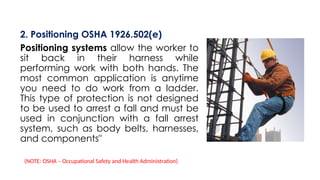
Positioning systems allow the worker to
sit back in their harness while
performing work with both hands. The
most common application is anytime
you need to do work from a ladder.
This type of protection is not designed
to be used to arrest a fall and must be
used in conjunction with a fall arrest
system, such as body belts, harnesses,
and components"
(NOTE: OSHA – Occupational Safety and Health Administration)
3. Retrieval OSHA 1926.502(d)(20)
Otherwise known as a rescue plan, retrieval is a crucial step
in the development of a fall protection plan. This system
covers the post-fall scenario of retrieving a worker who has
fallen. OSHA does not give any instructions regarding how
to accomplish this but does say that there must be a plan in
place.
(NOTE: OSHA – Occupational Safety and Health Administration)
4. Suspension OSHA 1926.452(o)
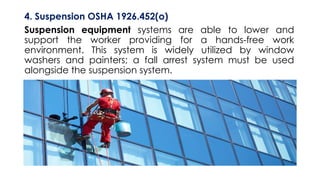
Suspension equipment systems are able to lower and
support the worker providing for a hands-free work
environment. This system is widely utilized by window
washers and painters; a fall arrest system must be used
alongside the suspension system.

Safety Engineering-Functional-Systems-Safety-eng..pptx

  • 1.
    Functional Systems of FallProtection Reporter: Roxienette D. Hirang
  • 2.
    FALL PROTECTION CLASSIFIEDINTO TWO: PASSIVE doesn't require any interaction with the workers once installed ACTIVE requires active participation from workers workers must choose to use them and know how to use it properly
  • 3.
    Active fall protectionfour basic categories: 1. Fall Arrest OSHA 1926.502(d) Fall arrest systems are required whenever a worker is exposed to a fall hazard. In the construction industry, OSHA defines a fall hazard as a drop of 6 feet or more from a working/walking surface to a lower level or grade. Some exceptions exist, including (but not limited to) ladders, scaffolding, and steelwork. Common fall arrest equipment includes an anchor point, body harness, and connector (such as a lanyard or self-retracting lifeline.) (NOTE: OSHA – Occupational Safety and Health Administration)
  • 4.
    a. Full BodyHarness – a piece of equipment worn by the worker to support their body in case of a fall. Must be capable of supporting a person and their tools, with a total weight of 310 lbs. and must be used in conjunction with an anchorage and deceleration device that limits the impact forces of fall to 1,800 lbs. or less. b. Lanyard – are the safety straps that connect your harness to a secure anchor point. They come in different lengths, from a 50-foot self-retracting lanyard (SRL) to a 2-foot webbed lanyard. Each type of lanyard serves a specific purpose depending on the job and safety needs. c. Anchor points – are the critical part that your safety harness and lanyard attach to. They must be strong enough to hold 5,000 lbs or double the weight of a person falling 6 feet. It’s important that a qualified expert, as defined by OSHA, installs these anchor points to make sure they won't fail during a fall. Even the best harness and lanyard won't protect you if the anchor point isn't secure.
  • 6.
    2. Positioning OSHA1926.502(e) Positioning systems allow the worker to sit back in their harness while performing work with both hands. The most common application is anytime you need to do work from a ladder. This type of protection is not designed to be used to arrest a fall and must be used in conjunction with a fall arrest system, such as body belts, harnesses, and components" (NOTE: OSHA – Occupational Safety and Health Administration)
  • 7.
    3. Retrieval OSHA1926.502(d)(20) Otherwise known as a rescue plan, retrieval is a crucial step in the development of a fall protection plan. This system covers the post-fall scenario of retrieving a worker who has fallen. OSHA does not give any instructions regarding how to accomplish this but does say that there must be a plan in place. (NOTE: OSHA – Occupational Safety and Health Administration)
  • 8.
    4. Suspension OSHA1926.452(o) Suspension equipment systems are able to lower and support the worker providing for a hands-free work environment. This system is widely utilized by window washers and painters; a fall arrest system must be used alongside the suspension system.