Headboard
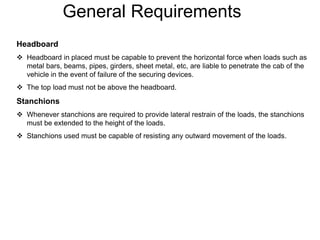
 Headboard in placed must be capable to prevent the horizontal force when loads such as
metal bars, beams, pipes, girders, sheet metal, etc, are liable to penetrate the cab of the
vehicle in the event of failure of the securing devices.
 The top load must not be above the headboard.
Stanchions
 Whenever stanchions are required to provide lateral restrain of the loads, the stanchions
must be extended to the height of the loads.
 Stanchions used must be capable of resisting any outward movement of the loads.
General Requirements
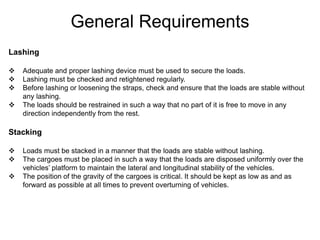
Lashing
 Adequate and proper lashing device must be used to secure the loads.
 Lashing must be checked and retightened regularly.
 Before lashing or loosening the straps, check and ensure that the loads are stable without
any lashing.
 The loads should be restrained in such a way that no part of it is free to move in any
direction independently from the rest.
Stacking
 Loads must be stacked in a manner that the loads are stable without lashing.
 The cargoes must be placed in such a way that the loads are disposed uniformly over the
vehicles’ platform to maintain the lateral and longitudinal stability of the vehicles.
 The position of the gravity of the cargoes is critical. It should be kept as low as and as
forward as possible at all times to prevent overturning of vehicles.
Steel plates
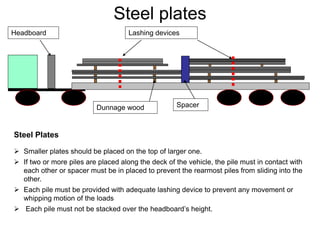
Steel Plates
 Smaller plates should be placed on the top of larger one.
 If two or more piles are placed along the deck of the vehicle, the pile must in contact with
each other or spacer must be in placed to prevent the rearmost piles from sliding into the
other.
 Each pile must be provided with adequate lashing device to prevent any movement or
whipping motion of the loads
 Each pile must not be stacked over the headboard’s height.
Headboard Lashing devices
Spacer
Dunnage wood
Metal Sheet Coil
FWD
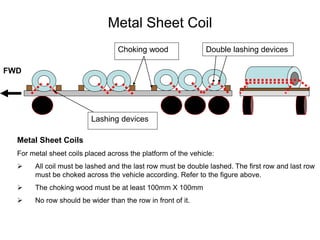
Metal Sheet Coils
For metal sheet coils placed across the platform of the vehicle:
 All coil must be lashed and the last row must be double lashed. The first row and last row
must be choked across the vehicle according. Refer to the figure above.
 The choking wood must be at least 100mm X 100mm
 No row should be wider than the row in front of it.
Lashing devices
Choking wood Double lashing devices
Metal Sheet Coil
FWD
End view
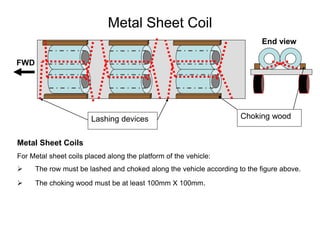
Metal Sheet Coils
For Metal sheet coils placed along the platform of the vehicle:
 The row must be lashed and choked along the vehicle according to the figure above.
 The choking wood must be at least 100mm X 100mm.
Lashing devices Choking wood
Metal Sheet Coil (Palletised)
Metal Sheet Coils
For metal sheet coils strapped on pallet placed along the platform of the vehicle:
 The first most and last row must be lashed.
 Each row pallet must be in contact with the one in front of it.
Lashing devices
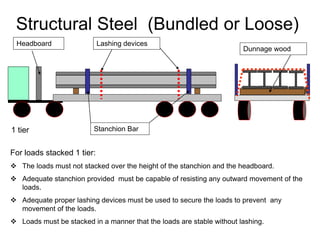
Headboard
Dunnage wood
1 tier Stanchion Bar
Structural Steel (Bundled or Loose)
For loads stacked 1 tier:
 The loads must not stacked over the height of the stanchion and the headboard.
 Adequate stanchion provided must be capable of resisting any outward movement of the
loads.
 Adequate proper lashing devices must be used to secure the loads to prevent any
movement of the loads.
 Loads must be stacked in a manner that the loads are stable without lashing.
Lashing devices
Headboard
Stanchion Bar
Dunnage wood
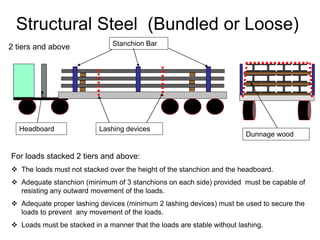
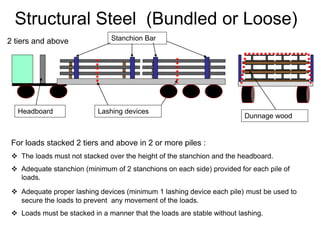
2 tiers and above
Structural Steel (Bundled or Loose)
For loads stacked 2 tiers and above:
 The loads must not stacked over the height of the stanchion and the headboard.
 Adequate stanchion (minimum of 3 stanchions on each side) provided must be capable of
resisting any outward movement of the loads.
 Adequate proper lashing devices (minimum 2 lashing devices) must be used to secure the
loads to prevent any movement of the loads.
 Loads must be stacked in a manner that the loads are stable without lashing.
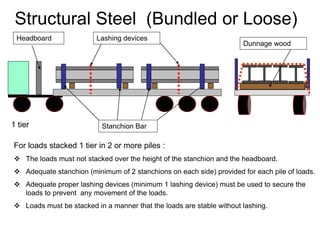
Structural Steel (Bundled or Loose)
Lashing devices
Headboard
Dunnage wood
1 tier Stanchion Bar
For loads stacked 1 tier in 2 or more piles :
 The loads must not stacked over the height of the stanchion and the headboard.
 Adequate stanchion (minimum of 2 stanchions on each side) provided for each pile of loads.
 Adequate proper lashing devices (minimum 1 lashing device) must be used to secure the
loads to prevent any movement of the loads.
 Loads must be stacked in a manner that the loads are stable without lashing.
Structural Steel (Bundled or Loose)
Lashing devices
Headboard
Stanchion Bar
Dunnage wood
2 tiers and above
For loads stacked 2 tiers and above in 2 or more piles :
 The loads must not stacked over the height of the stanchion and the headboard.
 Adequate stanchion (minimum of 2 stanchions on each side) provided for each pile of
loads.
 Adequate proper lashing devices (minimum 1 lashing device each pile) must be used to
secure the loads to prevent any movement of the loads.
 Loads must be stacked in a manner that the loads are stable without lashing.
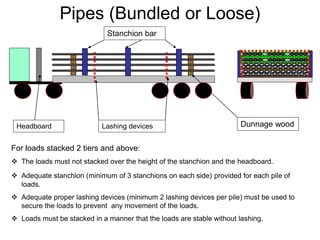
Pipes (Bundled or Loose)
Stanchion bar
Headboard Lashing devices Dunnage wood
For loads stacked 2 tiers and above:
 The loads must not stacked over the height of the stanchion and the headboard.
 Adequate stanchion (minimum of 3 stanchions on each side) provided for each pile of
loads.
 Adequate proper lashing devices (minimum 2 lashing devices per pile) must be used to
secure the loads to prevent any movement of the loads.
 Loads must be stacked in a manner that the loads are stable without lashing.
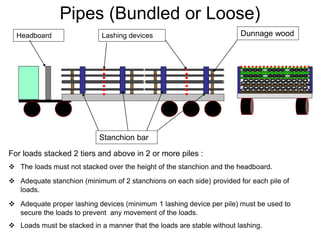
Pipes (Bundled or Loose)
Headboard Lashing devices
Stanchion bar
Dunnage wood
For loads stacked 2 tiers and above in 2 or more piles :
 The loads must not stacked over the height of the stanchion and the headboard.
 Adequate stanchion (minimum of 2 stanchions on each side) provided for each pile of
loads.
 Adequate proper lashing devices (minimum 1 lashing device per pile) must be used to
secure the loads to prevent any movement of the loads.
 Loads must be stacked in a manner that the loads are stable without lashing.
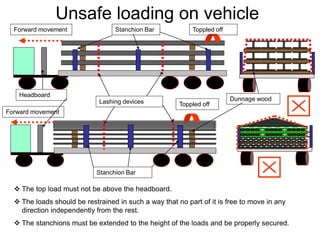
Unsafe loading on vehicle
Lashing devices
Headboard
Stanchion Bar
Dunnage wood
Stanchion Bar
Toppled off
Forward movement
Forward movement
Toppled off
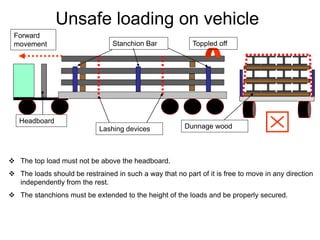
 The top load must not be above the headboard.
 The loads should be restrained in such a way that no part of it is free to move in any
direction independently from the rest.
 The stanchions must be extended to the height of the loads and be properly secured.
Lashing devices
Headboard
Stanchion Bar
Dunnage wood
Unsafe loading on vehicle
Forward
movement Toppled off
 The top load must not be above the headboard.
 The loads should be restrained in such a way that no part of it is free to move in any direction
independently from the rest.
 The stanchions must be extended to the height of the loads and be properly secured.
Placement of Cargo on Trailer
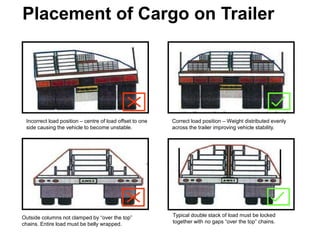
Incorrect load position – centre of load offset to one
side causing the vehicle to become unstable.
Correct load position – Weight distributed evenly
across the trailer improving vehicle stability.
Outside columns not clamped by “over the top”
chains. Entire load must be belly wrapped.
Typical double stack of load must be locked
together with no gaps “over the top” chains.
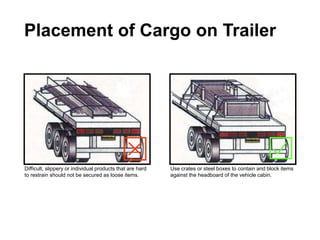
Difficult, slippery or individual products that are hard
to restrain should not be secured as loose items.
Use crates or steel boxes to contain and block items
against the headboard of the vehicle cabin.
Placement of Cargo on Trailer
Timber Cargoes
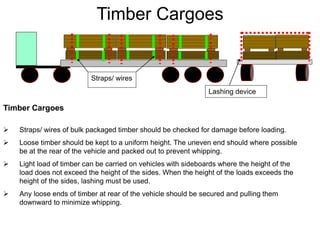
Timber Cargoes
 Straps/ wires of bulk packaged timber should be checked for damage before loading.
 Loose timber should be kept to a uniform height. The uneven end should where possible
be at the rear of the vehicle and packed out to prevent whipping.
 Light load of timber can be carried on vehicles with sideboards where the height of the
load does not exceed the height of the sides. When the height of the loads exceeds the
height of the sides, lashing must be used.
 Any loose ends of timber at rear of the vehicle should be secured and pulling them
downward to minimize whipping.
Straps/ wires
Lashing device
Timber Cargoes (Side Protruding
Outward)
 The vehicle must be fitted with side stanchions to prevent the loads for toppling when the
types of planed timber loads with its side protruding outward is loaded.
 The loads should be restrained in such a way that no part of it is free to move in any
direction independently from the rest.
 The stanchions must be extended to the height of the loads and be properly secured.
Straps/ wires
Lashing device
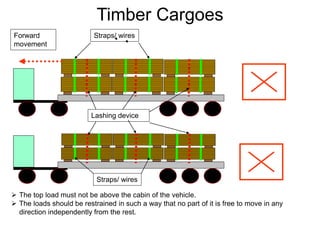
Timber Cargoes
Forward
movement
Straps/ wires
Lashing device
Straps/ wires
 The top load must not be above the cabin of the vehicle.
 The loads should be restrained in such a way that no part of it is free to move in any
direction independently from the rest.
Drums / Cylindrical Cargoes
For Drum /Cylindrical loads placed on the end:
 If they are on the end, they should have at least one lashing device for the front more and
rear more rows.
 All drums/ cylindrical cargoes must be in contact with each other in front.
 Each lashing line securing the side of the coil must pass approximately over the centre height
of the drums/ cylindrical cargoes
Lashing device
Headboard
Drums / Cylindrical Cargoes
If the drums/ cylindrical loads placed along the axis:
 Rolls or cylindrical cargoes should be placed with their axis across the vehicle in order that
the rolling tendency will be to the front or rear.
 If the length of the cylinder is less than twice the diameter they should be placed on the end.
 If the length of the cylinder is greater than twice the diameter but less than the width of the
vehicle, they must be positioned so as to roll forwards. Each row must contact the one in
front, and the front and rear one must be choked to prevent rolling backwards or forwards.
 Each lashing line securing the side of the coil must pass approximately over the centre
height of the drums/ cylindrical cargoes.
 Stanchions used must be able to resist any outward movement of the cargoes.
Stanchion Bar
Choking wood
Lashing device
Headboard
Palletized Cargo
Palletized Cargo
 The cargoes stacked on the pallet must be stable and secured.
 The pallet used must have sufficient strength to withstand the weight of the cargoes they
carried and in good conditions.
 Unless the pallets are adequately constrained by the body, sideboards and headboards of
the vehicle, additional mean of restraining the horizontal and vertical movement of the
pallets should be provided.
 The layer of pallet should be stable without any lashing device.
 When pallets are stacked on open platform vehicles, restraining devices must be used to
prevent movement of each layer of pallets carried.
Lashing device
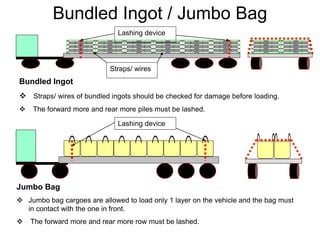
Bundled Ingot / Jumbo Bag
Bundled Ingot
 Straps/ wires of bundled ingots should be checked for damage before loading.
 The forward more and rear more piles must be lashed.
Lashing device
Straps/ wires
Lashing device
Jumbo Bag
 Jumbo bag cargoes are allowed to load only 1 layer on the vehicle and the bag must
in contact with the one in front.
 The forward more and rear more row must be lashed.
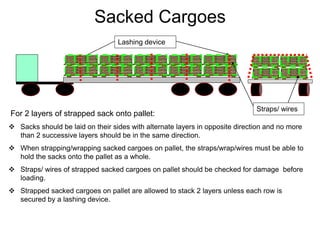
Sacked Cargoes
Straps/ wires
Lashing device
For 2 layers of strapped sack onto pallet:
 Sacks should be laid on their sides with alternate layers in opposite direction and no more
than 2 successive layers should be in the same direction.
 When strapping/wrapping sacked cargoes on pallet, the straps/wrap/wires must be able to
hold the sacks onto the pallet as a whole.
 Straps/ wires of strapped sacked cargoes on pallet should be checked for damage before
loading.
 Strapped sacked cargoes on pallet are allowed to stack 2 layers unless each row is
secured by a lashing device.
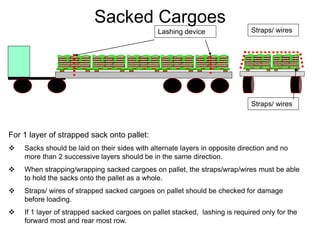
Sacked Cargoes
For 1 layer of strapped sack onto pallet:
 Sacks should be laid on their sides with alternate layers in opposite direction and no
more than 2 successive layers should be in the same direction.
 When strapping/wrapping sacked cargoes on pallet, the straps/wrap/wires must be able
to hold the sacks onto the pallet as a whole.
 Straps/ wires of strapped sacked cargoes on pallet should be checked for damage
before loading.
 If 1 layer of strapped sacked cargoes on pallet stacked, lashing is required only for the
forward most and rear most row.
Straps/ wires
Lashing device
Straps/ wires
Odd size cargoes / Bundled waste paper
Cargoes with different sizes
 All cargoes must be secured by at least a lashing device.
Bundled waste paper
 Each row of bundled waste paper must be secured by at least a lashing device when
stacked to 2 layers.
Tires
 Each row of types must be lashed and must not stacked above the driver’s cabin.
Safe loading -master.ppt

Safe loading -master.ppt

  • 1.
    Headboard  Headboard inplaced must be capable to prevent the horizontal force when loads such as metal bars, beams, pipes, girders, sheet metal, etc, are liable to penetrate the cab of the vehicle in the event of failure of the securing devices.  The top load must not be above the headboard. Stanchions  Whenever stanchions are required to provide lateral restrain of the loads, the stanchions must be extended to the height of the loads.  Stanchions used must be capable of resisting any outward movement of the loads. General Requirements
  • 2.
    General Requirements Lashing  Adequateand proper lashing device must be used to secure the loads.  Lashing must be checked and retightened regularly.  Before lashing or loosening the straps, check and ensure that the loads are stable without any lashing.  The loads should be restrained in such a way that no part of it is free to move in any direction independently from the rest. Stacking  Loads must be stacked in a manner that the loads are stable without lashing.  The cargoes must be placed in such a way that the loads are disposed uniformly over the vehicles’ platform to maintain the lateral and longitudinal stability of the vehicles.  The position of the gravity of the cargoes is critical. It should be kept as low as and as forward as possible at all times to prevent overturning of vehicles.
  • 3.
    Steel plates Steel Plates Smaller plates should be placed on the top of larger one.  If two or more piles are placed along the deck of the vehicle, the pile must in contact with each other or spacer must be in placed to prevent the rearmost piles from sliding into the other.  Each pile must be provided with adequate lashing device to prevent any movement or whipping motion of the loads  Each pile must not be stacked over the headboard’s height. Headboard Lashing devices Spacer Dunnage wood
  • 4.
    Metal Sheet Coil FWD MetalSheet Coils For metal sheet coils placed across the platform of the vehicle:  All coil must be lashed and the last row must be double lashed. The first row and last row must be choked across the vehicle according. Refer to the figure above.  The choking wood must be at least 100mm X 100mm  No row should be wider than the row in front of it. Lashing devices Choking wood Double lashing devices
  • 5.
    Metal Sheet Coil FWD Endview Metal Sheet Coils For Metal sheet coils placed along the platform of the vehicle:  The row must be lashed and choked along the vehicle according to the figure above.  The choking wood must be at least 100mm X 100mm. Lashing devices Choking wood
  • 6.
    Metal Sheet Coil(Palletised) Metal Sheet Coils For metal sheet coils strapped on pallet placed along the platform of the vehicle:  The first most and last row must be lashed.  Each row pallet must be in contact with the one in front of it.
  • 7.
    Lashing devices Headboard Dunnage wood 1tier Stanchion Bar Structural Steel (Bundled or Loose) For loads stacked 1 tier:  The loads must not stacked over the height of the stanchion and the headboard.  Adequate stanchion provided must be capable of resisting any outward movement of the loads.  Adequate proper lashing devices must be used to secure the loads to prevent any movement of the loads.  Loads must be stacked in a manner that the loads are stable without lashing.
  • 8.
    Lashing devices Headboard Stanchion Bar Dunnagewood 2 tiers and above Structural Steel (Bundled or Loose) For loads stacked 2 tiers and above:  The loads must not stacked over the height of the stanchion and the headboard.  Adequate stanchion (minimum of 3 stanchions on each side) provided must be capable of resisting any outward movement of the loads.  Adequate proper lashing devices (minimum 2 lashing devices) must be used to secure the loads to prevent any movement of the loads.  Loads must be stacked in a manner that the loads are stable without lashing.
  • 9.
    Structural Steel (Bundledor Loose) Lashing devices Headboard Dunnage wood 1 tier Stanchion Bar For loads stacked 1 tier in 2 or more piles :  The loads must not stacked over the height of the stanchion and the headboard.  Adequate stanchion (minimum of 2 stanchions on each side) provided for each pile of loads.  Adequate proper lashing devices (minimum 1 lashing device) must be used to secure the loads to prevent any movement of the loads.  Loads must be stacked in a manner that the loads are stable without lashing.
  • 10.
    Structural Steel (Bundledor Loose) Lashing devices Headboard Stanchion Bar Dunnage wood 2 tiers and above For loads stacked 2 tiers and above in 2 or more piles :  The loads must not stacked over the height of the stanchion and the headboard.  Adequate stanchion (minimum of 2 stanchions on each side) provided for each pile of loads.  Adequate proper lashing devices (minimum 1 lashing device each pile) must be used to secure the loads to prevent any movement of the loads.  Loads must be stacked in a manner that the loads are stable without lashing.
  • 11.
    Pipes (Bundled orLoose) Stanchion bar Headboard Lashing devices Dunnage wood For loads stacked 2 tiers and above:  The loads must not stacked over the height of the stanchion and the headboard.  Adequate stanchion (minimum of 3 stanchions on each side) provided for each pile of loads.  Adequate proper lashing devices (minimum 2 lashing devices per pile) must be used to secure the loads to prevent any movement of the loads.  Loads must be stacked in a manner that the loads are stable without lashing.
  • 12.
    Pipes (Bundled orLoose) Headboard Lashing devices Stanchion bar Dunnage wood For loads stacked 2 tiers and above in 2 or more piles :  The loads must not stacked over the height of the stanchion and the headboard.  Adequate stanchion (minimum of 2 stanchions on each side) provided for each pile of loads.  Adequate proper lashing devices (minimum 1 lashing device per pile) must be used to secure the loads to prevent any movement of the loads.  Loads must be stacked in a manner that the loads are stable without lashing.
  • 13.
    Unsafe loading onvehicle Lashing devices Headboard Stanchion Bar Dunnage wood Stanchion Bar Toppled off Forward movement Forward movement Toppled off  The top load must not be above the headboard.  The loads should be restrained in such a way that no part of it is free to move in any direction independently from the rest.  The stanchions must be extended to the height of the loads and be properly secured.
  • 14.
    Lashing devices Headboard Stanchion Bar Dunnagewood Unsafe loading on vehicle Forward movement Toppled off  The top load must not be above the headboard.  The loads should be restrained in such a way that no part of it is free to move in any direction independently from the rest.  The stanchions must be extended to the height of the loads and be properly secured.
  • 15.
    Placement of Cargoon Trailer Incorrect load position – centre of load offset to one side causing the vehicle to become unstable. Correct load position – Weight distributed evenly across the trailer improving vehicle stability. Outside columns not clamped by “over the top” chains. Entire load must be belly wrapped. Typical double stack of load must be locked together with no gaps “over the top” chains.
  • 16.
    Difficult, slippery orindividual products that are hard to restrain should not be secured as loose items. Use crates or steel boxes to contain and block items against the headboard of the vehicle cabin. Placement of Cargo on Trailer
  • 17.
    Timber Cargoes Timber Cargoes Straps/ wires of bulk packaged timber should be checked for damage before loading.  Loose timber should be kept to a uniform height. The uneven end should where possible be at the rear of the vehicle and packed out to prevent whipping.  Light load of timber can be carried on vehicles with sideboards where the height of the load does not exceed the height of the sides. When the height of the loads exceeds the height of the sides, lashing must be used.  Any loose ends of timber at rear of the vehicle should be secured and pulling them downward to minimize whipping. Straps/ wires Lashing device
  • 18.
    Timber Cargoes (SideProtruding Outward)  The vehicle must be fitted with side stanchions to prevent the loads for toppling when the types of planed timber loads with its side protruding outward is loaded.  The loads should be restrained in such a way that no part of it is free to move in any direction independently from the rest.  The stanchions must be extended to the height of the loads and be properly secured. Straps/ wires Lashing device
  • 19.
    Timber Cargoes Forward movement Straps/ wires Lashingdevice Straps/ wires  The top load must not be above the cabin of the vehicle.  The loads should be restrained in such a way that no part of it is free to move in any direction independently from the rest.
  • 20.
    Drums / CylindricalCargoes For Drum /Cylindrical loads placed on the end:  If they are on the end, they should have at least one lashing device for the front more and rear more rows.  All drums/ cylindrical cargoes must be in contact with each other in front.  Each lashing line securing the side of the coil must pass approximately over the centre height of the drums/ cylindrical cargoes Lashing device Headboard
  • 21.
    Drums / CylindricalCargoes If the drums/ cylindrical loads placed along the axis:  Rolls or cylindrical cargoes should be placed with their axis across the vehicle in order that the rolling tendency will be to the front or rear.  If the length of the cylinder is less than twice the diameter they should be placed on the end.  If the length of the cylinder is greater than twice the diameter but less than the width of the vehicle, they must be positioned so as to roll forwards. Each row must contact the one in front, and the front and rear one must be choked to prevent rolling backwards or forwards.  Each lashing line securing the side of the coil must pass approximately over the centre height of the drums/ cylindrical cargoes.  Stanchions used must be able to resist any outward movement of the cargoes. Stanchion Bar Choking wood Lashing device Headboard
  • 22.
    Palletized Cargo Palletized Cargo The cargoes stacked on the pallet must be stable and secured.  The pallet used must have sufficient strength to withstand the weight of the cargoes they carried and in good conditions.  Unless the pallets are adequately constrained by the body, sideboards and headboards of the vehicle, additional mean of restraining the horizontal and vertical movement of the pallets should be provided.  The layer of pallet should be stable without any lashing device.  When pallets are stacked on open platform vehicles, restraining devices must be used to prevent movement of each layer of pallets carried. Lashing device
  • 23.
    Bundled Ingot /Jumbo Bag Bundled Ingot  Straps/ wires of bundled ingots should be checked for damage before loading.  The forward more and rear more piles must be lashed. Lashing device Straps/ wires Lashing device Jumbo Bag  Jumbo bag cargoes are allowed to load only 1 layer on the vehicle and the bag must in contact with the one in front.  The forward more and rear more row must be lashed.
  • 24.
    Sacked Cargoes Straps/ wires Lashingdevice For 2 layers of strapped sack onto pallet:  Sacks should be laid on their sides with alternate layers in opposite direction and no more than 2 successive layers should be in the same direction.  When strapping/wrapping sacked cargoes on pallet, the straps/wrap/wires must be able to hold the sacks onto the pallet as a whole.  Straps/ wires of strapped sacked cargoes on pallet should be checked for damage before loading.  Strapped sacked cargoes on pallet are allowed to stack 2 layers unless each row is secured by a lashing device.
  • 25.
    Sacked Cargoes For 1layer of strapped sack onto pallet:  Sacks should be laid on their sides with alternate layers in opposite direction and no more than 2 successive layers should be in the same direction.  When strapping/wrapping sacked cargoes on pallet, the straps/wrap/wires must be able to hold the sacks onto the pallet as a whole.  Straps/ wires of strapped sacked cargoes on pallet should be checked for damage before loading.  If 1 layer of strapped sacked cargoes on pallet stacked, lashing is required only for the forward most and rear most row. Straps/ wires Lashing device Straps/ wires
  • 26.
    Odd size cargoes/ Bundled waste paper Cargoes with different sizes  All cargoes must be secured by at least a lashing device. Bundled waste paper  Each row of bundled waste paper must be secured by at least a lashing device when stacked to 2 layers.
  • 27.
    Tires  Each rowof types must be lashed and must not stacked above the driver’s cabin.