Foundation Analysis and
Design: Single Piles
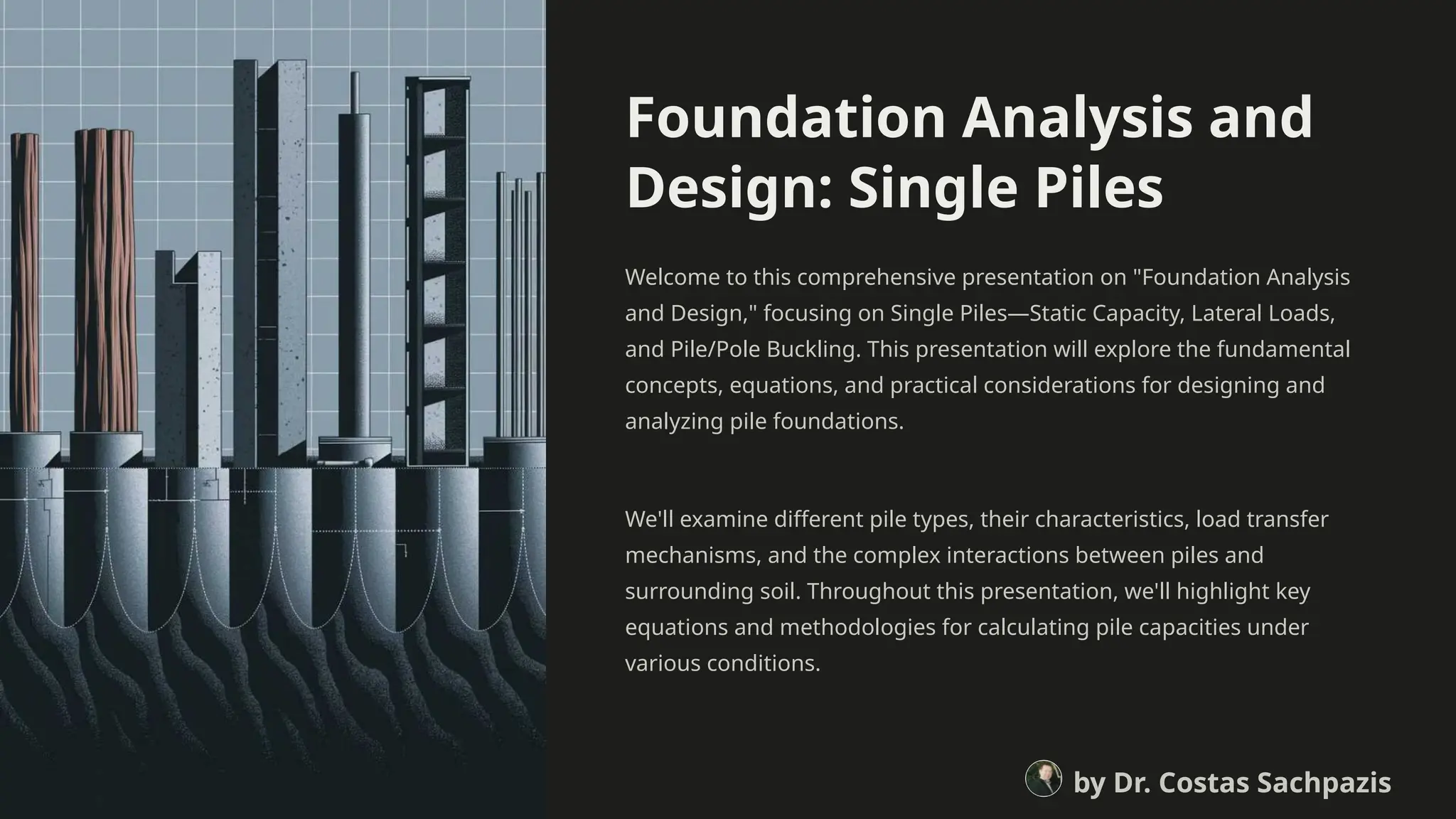
Welcome to this comprehensive presentation on "Foundation Analysis
and Design," focusing on Single Piles—Static Capacity, Lateral Loads,
and Pile/Pole Buckling. This presentation will explore the fundamental
concepts, equations, and practical considerations for designing and
analyzing pile foundations.
We'll examine different pile types, their characteristics, load transfer
mechanisms, and the complex interactions between piles and
surrounding soil. Throughout this presentation, we'll highlight key
equations and methodologies for calculating pile capacities under
various conditions.
by Dr. Costas Sachpazis
Introduction to Pile Foundations
1 Definition and Purpose
Piles are structural elements made
from timber, concrete, or steel
designed to transmit surface loads
to deeper soil layers. They provide
foundation support when surface
soils are inadequate for
conventional spread footings or mat
foundations.
2 Load Transfer Classification
Piles are classified based on their
load transfer mechanisms as either
friction (floating) piles, end-bearing
(point) piles, or combinations of
both. This classification determines
how loads are distributed through
the pile into the surrounding soil.
3 Economic Considerations
Pile foundations typically cost more than spread footings or mats, necessitating
careful economic analysis and thorough soil property determination before
selection. The higher initial investment must be justified by performance
requirements.
Common Applications of Pile Foundations
Superstructure
Support
Piles carry loads from
buildings and other
structures through weak
surface soils to stronger,
deeper strata. This is
particularly important in
areas with poor surface soil
conditions or high water
tables.
Uplift Resistance
Piles resist uplift or
overturning forces in
structures subjected to
lateral loads, such as wind
or seismic forces. This
anchoring function is critical
for tall structures or those in
high-wind or seismic zones.
Machine Foundations
Piles stiffen soil beneath
machine foundations to
reduce vibration and
provide stability. This
application is essential for
precision equipment and
heavy machinery that
requires minimal
settlement.
Bridge Support
Piles provide additional
safety beneath bridges,
especially in areas where
scour or erosion may occur.
They transfer loads to stable
soil layers below potential
erosion zones.
Timber Piles: Characteristics and Applications
Material Properties
Timber piles are natural wood
elements, typically treated with
preservatives to prevent decay. They
offer good flexibility and are relatively
easy to handle during installation.
Their natural taper provides increased
bearing capacity at the tip.
Dimensional Specifications
Timber piles have typical dimensions
and minimum requirements specified
in building codes. The natural taper of
trees results in a larger diameter at
the butt end (top) and smaller at the
tip, which must meet minimum
diameter requirements.
Common Challenges
Key problems with timber piles
include vulnerability to decay in
fluctuating groundwater conditions
and potential damage during driving.
Fiber crushing (brooming) at the pile
head during installation requires
special attention and mitigation
techniques.
Timber Pile Design Equation
Allowable Design Load
The allowable design load for
timber piles is calculated using
Equation 16-1: Pa = Apfa, where Pa
is the allowable design load based
on pile material, Ap is the average
pile cross-sectional area at the pile
cap, and fa is the allowable design
stress for the type of timber.
Material Considerations
The allowable design stress (fa)
varies by timber species and is
specified in building codes. This
value accounts for long-term
loading effects and environmental
factors that may affect the timber's
strength over time.
Safety Factors
Design values incorporate safety
factors to account for natural
variations in timber properties,
potential decay over time, and
uncertainties in loading conditions.
These factors ensure the pile
performs reliably throughout its
service life.
Precast and Prestressed Concrete Piles
1
Manufacturing
Precast concrete piles are manufactured in controlled
environments, allowing for consistent quality and strength.
They are cast in forms, cured, and then transported to the
construction site for installation.
2 Prestressing Process
Prestressed concrete piles utilize tensioned steel strands or
wires that compress the concrete when released, increasing
the pile's ability to resist tensile stresses during handling
and driving. This process significantly enhances the pile's
structural performance.
3
Installation
During installation, special attention must be paid to
handling stresses, as precast piles can crack if improperly
supported. Driving stresses must be carefully monitored to
prevent damage to the pile structure. 4 Long-term Performance
Over time, prestressed piles may experience stress loss due
to concrete creep and steel relaxation. These factors must
be accounted for in the design to ensure long-term
structural integrity.
Prestressed Concrete Pile Design Equation
0.33
Concrete Factor
The factor 0.33 applied to concrete
compressive strength (f'c) represents
the allowable stress ratio for concrete
under compression in the design
equation.
0.27
Prestress Factor
The factor 0.27 applied to effective
prestress (fpe) accounts for the
contribution of prestressing to the
pile's load-carrying capacity.
5
Typical Prestress Loss (MPa)
After accounting for losses due to
creep, shrinkage, and steel relaxation,
the effective prestress typically reduces
by approximately 5 MPa from the initial
value.
The allowable design load for prestressed concrete piles is calculated using Equation 16-2: Pa = Ag(0.33f'c - 0.27fpe), where
Ag is the gross concrete cross-sectional area, f'c is the concrete compressive strength, and fpe is the effective prestress after
losses.
Cast-in-Place Concrete Piles
Site Preparation
The process begins with site preparation and layout of pile locations according to foundation plans. Proper site preparation
ensures accurate pile positioning and alignment with the structural design.
Installation Methods
Cast-in-place piles can be installed through various methods: drilling, driven shells or casings, mandrel-driven casings, or auger-
placed pressure-injected concrete. Each method has specific applications based on soil conditions and project requirements.
Concrete Placement
After creating the void or casing, concrete is placed either by free-fall (in dry conditions) or tremie methods (in wet conditions).
Quality control during concrete placement is critical to ensure pile integrity and strength.
Curing and Testing
After placement, concrete must cure properly before loading. Integrity testing may be performed to verify the absence of defects
such as necking, voids, or inclusions that could compromise structural performance.
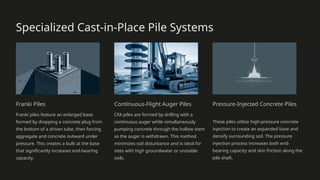
Specialized Cast-in-Place Pile Systems
Franki Piles
Franki piles feature an enlarged base
formed by dropping a concrete plug from
the bottom of a driven tube, then forcing
aggregate and concrete outward under
pressure. This creates a bulb at the base
that significantly increases end-bearing
capacity.
Continuous-Flight Auger Piles
CFA piles are formed by drilling with a
continuous auger while simultaneously
pumping concrete through the hollow stem
as the auger is withdrawn. This method
minimizes soil disturbance and is ideal for
sites with high groundwater or unstable
soils.
Pressure-Injected Concrete Piles
These piles utilize high-pressure concrete
injection to create an expanded base and
densify surrounding soil. The pressure
injection process increases both end-
bearing capacity and skin friction along the
pile shaft.
Non-Prestressed Concrete Pile Design Equation
Combined Material
Approach
The allowable design load for non-
prestressed concrete piles is
calculated using Equation 16-3: Pa
= Acfc + Asfs, which accounts for
the contribution of both concrete
and steel components to the pile's
capacity.
Concrete Contribution
The term Acfc represents the load-
carrying capacity of the concrete
portion, where Ac is the concrete
cross-sectional area and fc is the
allowable concrete stress, typically
a fraction of the concrete's
compressive strength.
Steel Contribution
The term Asfs accounts for the
load-carrying capacity of any steel
reinforcement or shell, where As is
the steel cross-sectional area and fs
is the allowable steel stress, usually
between 0.33 and 0.5 of the yield
strength.
Steel Piles: Types and Characteristics
HP Shapes
HP (H-Pile) shapes are rolled steel
sections with parallel flanges
designed specifically for deep
foundation applications. They offer
high strength-to-weight ratios and
excellent driving characteristics. HP
piles primarily transfer loads through
end bearing rather than
displacement.
Pipe Piles
Steel pipe piles are hollow cylindrical
sections that can be driven open-
ended or closed with a plate at the
bottom. Open-ended pipes may form
soil plugs during driving, increasing
their end-bearing capacity. They can
be filled with concrete after driving
for additional strength.
Installation Considerations
Steel piles can withstand high driving
stresses, making them suitable for
penetrating dense or hard strata.
Special reinforcement at pile tips may
be necessary when driving through
soils containing boulders or into
weathered rock.
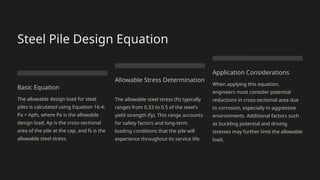
Steel Pile Design Equation
Basic Equation
The allowable design load for steel
piles is calculated using Equation 16-4:
Pa = Apfs, where Pa is the allowable
design load, Ap is the cross-sectional
area of the pile at the cap, and fs is the
allowable steel stress.
Allowable Stress Determination
The allowable steel stress (fs) typically
ranges from 0.33 to 0.5 of the steel's
yield strength (fy). This range accounts
for safety factors and long-term
loading conditions that the pile will
experience throughout its service life.
Application Considerations
When applying this equation,
engineers must consider potential
reductions in cross-sectional area due
to corrosion, especially in aggressive
environments. Additional factors such
as buckling potential and driving
stresses may further limit the allowable
load.
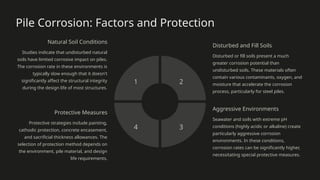
Pile Corrosion: Factors and Protection
Natural Soil Conditions
Studies indicate that undisturbed natural
soils have limited corrosive impact on piles.
The corrosion rate in these environments is
typically slow enough that it doesn't
significantly affect the structural integrity
during the design life of most structures.
1
Disturbed and Fill Soils
Disturbed or fill soils present a much
greater corrosion potential than
undisturbed soils. These materials often
contain various contaminants, oxygen, and
moisture that accelerate the corrosion
process, particularly for steel piles.
2
Aggressive Environments
Seawater and soils with extreme pH
conditions (highly acidic or alkaline) create
particularly aggressive corrosion
environments. In these conditions,
corrosion rates can be significantly higher,
necessitating special protective measures.
3
Protective Measures
Protective strategies include painting,
cathodic protection, concrete encasement,
and sacrificial thickness allowances. The
selection of protection method depends on
the environment, pile material, and design
life requirements.
4
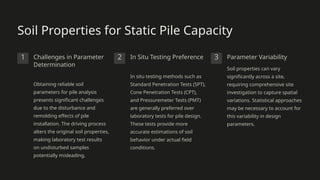
Soil Properties for Static Pile Capacity
1 Challenges in Parameter
Determination
Obtaining reliable soil
parameters for pile analysis
presents significant challenges
due to the disturbance and
remolding effects of pile
installation. The driving process
alters the original soil properties,
making laboratory test results
on undisturbed samples
potentially misleading.
2 In Situ Testing Preference
In situ testing methods such as
Standard Penetration Tests (SPT),
Cone Penetration Tests (CPT),
and Pressuremeter Tests (PMT)
are generally preferred over
laboratory tests for pile design.
These tests provide more
accurate estimations of soil
behavior under actual field
conditions.
3 Parameter Variability
Soil properties can vary
significantly across a site,
requiring comprehensive site
investigation to capture spatial
variations. Statistical approaches
may be necessary to account for
this variability in design
parameters.
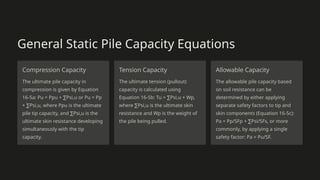
General Static Pile Capacity Equations
Compression Capacity
The ultimate pile capacity in
compression is given by Equation
16-5a: Pu = Ppu + Psi,u or Pu = Pp
∑
+ Psi,u, where Ppu is the ultimate
∑
pile tip capacity, and Psi,u is the
∑
ultimate skin resistance developing
simultaneously with the tip
capacity.
Tension Capacity
The ultimate tension (pullout)
capacity is calculated using
Equation 16-5b: Tu = Psi,u + Wp,
∑
where Psi,u is the ultimate skin
∑
resistance and Wp is the weight of
the pile being pulled.
Allowable Capacity
The allowable pile capacity based
on soil resistance can be
determined by either applying
separate safety factors to tip and
skin components (Equation 16-5c):
Pa = Pp/SFp + Psi/SFs, or more
∑
commonly, by applying a single
safety factor: Pa = Pu/SF.
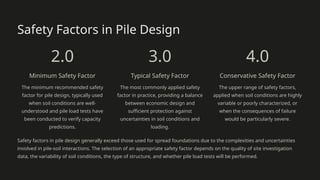
Safety Factors in Pile Design
2.0
Minimum Safety Factor
The minimum recommended safety
factor for pile design, typically used
when soil conditions are well-
understood and pile load tests have
been conducted to verify capacity
predictions.
3.0
Typical Safety Factor
The most commonly applied safety
factor in practice, providing a balance
between economic design and
sufficient protection against
uncertainties in soil conditions and
loading.
4.0
Conservative Safety Factor
The upper range of safety factors,
applied when soil conditions are highly
variable or poorly characterized, or
when the consequences of failure
would be particularly severe.
Safety factors in pile design generally exceed those used for spread foundations due to the complexities and uncertainties
involved in pile-soil interactions. The selection of an appropriate safety factor depends on the quality of site investigation
data, the variability of soil conditions, the type of structure, and whether pile load tests will be performed.
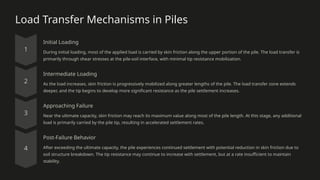
Load Transfer Mechanisms in Piles
Initial Loading
During initial loading, most of the applied load is carried by skin friction along the upper portion of the pile. The load transfer is
primarily through shear stresses at the pile-soil interface, with minimal tip resistance mobilization.
Intermediate Loading
As the load increases, skin friction is progressively mobilized along greater lengths of the pile. The load transfer zone extends
deeper, and the tip begins to develop more significant resistance as the pile settlement increases.
Approaching Failure
Near the ultimate capacity, skin friction may reach its maximum value along most of the pile length. At this stage, any additional
load is primarily carried by the pile tip, resulting in accelerated settlement rates.
Post-Failure Behavior
After exceeding the ultimate capacity, the pile experiences continued settlement with potential reduction in skin friction due to
soil structure breakdown. The tip resistance may continue to increase with settlement, but at a rate insufficient to maintain
stability.
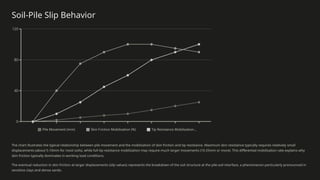
Soil-Pile Slip Behavior
Pile Movement (mm) Skin Friction Mobilization (%) Tip Resistance Mobilization...
The chart illustrates the typical relationship between pile movement and the mobilization of skin friction and tip resistance. Maximum skin resistance typically requires relatively small
displacements (about 5-10mm for most soils), while full tip resistance mobilization may require much larger movements (10-25mm or more). This differential mobilization rate explains why
skin friction typically dominates in working load conditions.
The eventual reduction in skin friction at larger displacements (slip values) represents the breakdown of the soil structure at the pile-soil interface, a phenomenon particularly pronounced in
sensitive clays and dense sands.
Ultimate Static Pile Point Capacity
General Equation
The ultimate static pile point
capacity is calculated using
Equation 16-6: Ppu = Ap(cN'cdcsc +
qN'qdqsq + ½γ'BpNγsγ), where Ap
is the effective area of the pile
point, and the other terms
represent soil properties and
bearing capacity factors.
Simplified Form
For practical applications, a
simplified form is often used
(Equation 16-6a): Ppu = Ap[cN'cdc +
q(N'q-1)dq], which neglects the Nγ
term as its contribution is typically
small for deep foundations.
Cohesive Soils
For pure cohesive soils (φ = 0), the
equation simplifies further to
Equation 16-6b: Ppu = Ap(9su),
where su is the undrained shear
strength of the soil beneath the pile
tip.
Bearing Capacity Factors: Vesic Method
Cohesive Soils
For cohesive soils with internal
friction angle φ > 0, Vesic provides
Equation 16-7a: N'c = (Nq-1)cot φ to
calculate the bearing capacity factor
N'c.
1
Undrained Conditions
When undrained conditions apply (φ
= 0), Vesic suggests Equation 16-7b:
N'c = [1+⅔ln Irr]+1+⅔(π/2) for
calculating the bearing capacity
factor.
2
Rigidity Index
The reduced rigidity index Irr is
calculated using Equation 16-7c: Irr =
Ir/(1+evIr), where Ir is the rigidity
index and ev is the volumetric strain.
3
Shear Modulus Relation
The rigidity index Ir is determined
using Equation 16-7d: Ir = G'/(c+q tan
φ) = G'/s, where G' is the shear
modulus and s is the shear strength
of the soil.
4
Using Penetration Test Data for Pile Design
Standard Penetration Test
(SPT)
Meyerhof suggested using SPT data
to estimate pile capacity with
Equation 16-8: Ppu = Ap(40N)Lb/B ≤
Ap[38N(Lb/B)], where N is the SPT
blow count, Lb is the pile embedment
depth, and B is the pile width.
Cone Penetration Test (CPT)
CPT data provides more continuous
soil profile information and can be
directly correlated to pile capacity.
The cone resistance is particularly
useful for estimating both tip
resistance and skin friction along the
pile shaft.
Japanese Method
Shioi and Fukui (1982) proposed
Equation 16-9 for Japanese practice:
Ppu = quitAp, where quit is the
ultimate bearing pressure
determined from either Dutch or
Electric CPT cones or SPT tests.
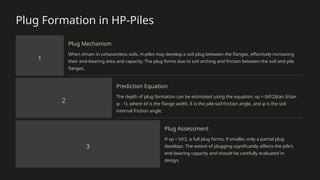
Plug Formation in HP-Piles
1
Plug Mechanism
When driven in cohesionless soils, H-piles may develop a soil plug between the flanges, effectively increasing
their end-bearing area and capacity. The plug forms due to soil arching and friction between the soil and pile
flanges.
2
Prediction Equation
The depth of plug formation can be estimated using the equation: xp = (bf/2)(tan δ/tan
φ - 1), where bf is the flange width, δ is the pile-soil friction angle, and φ is the soil
internal friction angle.
3
Plug Assessment
If xp > bf/2, a full plug forms; if smaller, only a partial plug
develops. The extent of plugging significantly affects the pile's
end-bearing capacity and should be carefully evaluated in
design.
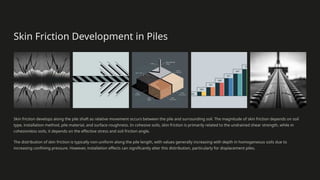
Skin Friction Development in Piles
Skin friction develops along the pile shaft as relative movement occurs between the pile and surrounding soil. The magnitude of skin friction depends on soil
type, installation method, pile material, and surface roughness. In cohesive soils, skin friction is primarily related to the undrained shear strength, while in
cohesionless soils, it depends on the effective stress and soil friction angle.
The distribution of skin friction is typically non-uniform along the pile length, with values generally increasing with depth in homogeneous soils due to
increasing confining pressure. However, installation effects can significantly alter this distribution, particularly for displacement piles.
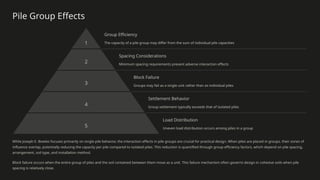
Pile Group Effects
1
Group Efficiency
The capacity of a pile group may differ from the sum of individual pile capacities
2
Spacing Considerations
Minimum spacing requirements prevent adverse interaction effects
3
Block Failure
Groups may fail as a single unit rather than as individual piles
4
Settlement Behavior
Group settlement typically exceeds that of isolated piles
5
Load Distribution
Uneven load distribution occurs among piles in a group
While Joseph E. Bowles focuses primarily on single pile behavior, the interaction effects in pile groups are crucial for practical design. When piles are placed in groups, their zones of
influence overlap, potentially reducing the capacity per pile compared to isolated piles. This reduction is quantified through group efficiency factors, which depend on pile spacing,
arrangement, soil type, and installation method.
Block failure occurs when the entire group of piles and the soil contained between them move as a unit. This failure mechanism often governs design in cohesive soils when pile
spacing is relatively close.
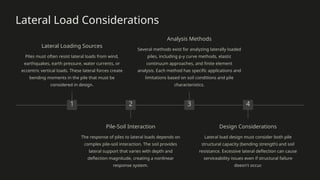
Lateral Load Considerations
1
Lateral Loading Sources
Piles must often resist lateral loads from wind,
earthquakes, earth pressure, water currents, or
eccentric vertical loads. These lateral forces create
bending moments in the pile that must be
considered in design.
2
Pile-Soil Interaction
The response of piles to lateral loads depends on
complex pile-soil interaction. The soil provides
lateral support that varies with depth and
deflection magnitude, creating a nonlinear
response system.
3
Analysis Methods
Several methods exist for analyzing laterally loaded
piles, including p-y curve methods, elastic
continuum approaches, and finite element
analysis. Each method has specific applications and
limitations based on soil conditions and pile
characteristics.
4
Design Considerations
Lateral load design must consider both pile
structural capacity (bending strength) and soil
resistance. Excessive lateral deflection can cause
serviceability issues even if structural failure
doesn't occur.
Pile Buckling Considerations
Slenderness Ratio
The slenderness ratio
(length/radius of gyration) is
a critical parameter for
assessing buckling
potential. Piles with high
slenderness ratios are more
susceptible to buckling
failure, particularly when
they extend through weak
soils or water.
Lateral Support
The surrounding soil
provides lateral support that
helps prevent buckling. The
degree of support depends
on soil stiffness, with stiffer
soils providing greater
resistance to lateral
deformation and thus
higher critical buckling
loads.
Risk Conditions
Buckling risk is highest for
long, slender piles in very
soft soils, liquefiable soils
during earthquakes, or piles
extending through water or
air. These conditions reduce
lateral support and increase
effective length for buckling
calculations.
Analysis Methods
Buckling analysis typically
involves modeling the pile
as a beam-column with
elastic support. The critical
buckling load depends on
pile stiffness, soil support
characteristics, and
boundary conditions at the
pile ends.
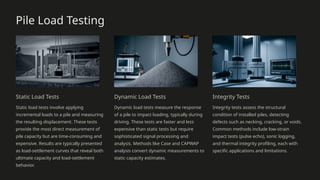
Pile Load Testing
Static Load Tests
Static load tests involve applying
incremental loads to a pile and measuring
the resulting displacement. These tests
provide the most direct measurement of
pile capacity but are time-consuming and
expensive. Results are typically presented
as load-settlement curves that reveal both
ultimate capacity and load-settlement
behavior.
Dynamic Load Tests
Dynamic load tests measure the response
of a pile to impact loading, typically during
driving. These tests are faster and less
expensive than static tests but require
sophisticated signal processing and
analysis. Methods like Case and CAPWAP
analysis convert dynamic measurements to
static capacity estimates.
Integrity Tests
Integrity tests assess the structural
condition of installed piles, detecting
defects such as necking, cracking, or voids.
Common methods include low-strain
impact tests (pulse echo), sonic logging,
and thermal integrity profiling, each with
specific applications and limitations.
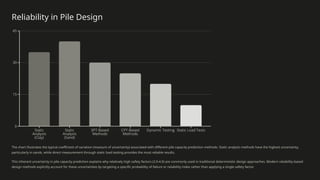
Reliability in Pile Design
The chart illustrates the typical coefficient of variation (measure of uncertainty) associated with different pile capacity prediction methods. Static analysis methods have the highest uncertainty,
particularly in sands, while direct measurement through static load testing provides the most reliable results.
This inherent uncertainty in pile capacity prediction explains why relatively high safety factors (2.0-4.0) are commonly used in traditional deterministic design approaches. Modern reliability-based
design methods explicitly account for these uncertainties by targeting a specific probability of failure or reliability index rather than applying a single safety factor.
Practical Design Considerations
1 Site Investigation
Thorough site investigation is essential for reliable pile
design. The investigation should characterize soil
stratigraphy, engineering properties, groundwater
conditions, and potential obstructions. The extent and
detail of investigation should be proportional to the
project complexity and soil variability.
2 Pile Selection
Pile type selection should consider soil conditions, loading
requirements, construction constraints, environmental
factors, and economic considerations. Different pile types
perform optimally in different situations, and the selection
process should evaluate multiple viable options.
3 Installation Effects
Installation methods significantly affect pile performance.
Displacement piles densify surrounding granular soils but
may cause remolding and temporary strength reduction in
clays. Non-displacement piles minimize soil disturbance
but may have reduced skin friction in some conditions.
4 Quality Control
Rigorous quality control during installation is critical for
ensuring that piles achieve their design capacity. This
includes monitoring driving resistance, maintaining
installation tolerances, and verifying pile integrity after
installation through appropriate testing methods.
Summary and Key Takeaways
Pile Types and Materials
We've explored various pile types including timber,
concrete (precast, prestressed, and cast-in-place), and
steel piles. Each material has specific design equations,
advantages, limitations, and applications based on soil
conditions and structural requirements.
Capacity Calculation Methods
Multiple approaches exist for calculating pile capacity,
from theoretical bearing capacity equations to empirical
methods based on in-situ tests. The selection of
appropriate methods depends on soil type, available
data, and project requirements.
Load Transfer Mechanisms
Understanding the complex load transfer mechanisms
between piles and soil is fundamental to proper design.
The relative contributions of tip resistance and skin
friction vary with pile type, soil conditions, and loading
magnitude.
Uncertainty Management
Pile design inherently involves significant uncertainties
due to soil variability and installation effects. These
uncertainties are managed through appropriate safety
factors, reliability-based design approaches, and field
verification through pile load testing.
Thank You for Your Attention
Dr. Costas Sachpazis
Civil & Geotechnical Engineer
Specialized in foundation engineering with expertise in pile
design and analysis.
Available for consultation on your next geotechnical
engineering project.

Sachpazis: Foundation Analysis and Design: Single Piles

  • 1.
    Foundation Analysis and Design:Single Piles Welcome to this comprehensive presentation on "Foundation Analysis and Design," focusing on Single Piles—Static Capacity, Lateral Loads, and Pile/Pole Buckling. This presentation will explore the fundamental concepts, equations, and practical considerations for designing and analyzing pile foundations. We'll examine different pile types, their characteristics, load transfer mechanisms, and the complex interactions between piles and surrounding soil. Throughout this presentation, we'll highlight key equations and methodologies for calculating pile capacities under various conditions. by Dr. Costas Sachpazis
  • 2.
    Introduction to PileFoundations 1 Definition and Purpose Piles are structural elements made from timber, concrete, or steel designed to transmit surface loads to deeper soil layers. They provide foundation support when surface soils are inadequate for conventional spread footings or mat foundations. 2 Load Transfer Classification Piles are classified based on their load transfer mechanisms as either friction (floating) piles, end-bearing (point) piles, or combinations of both. This classification determines how loads are distributed through the pile into the surrounding soil. 3 Economic Considerations Pile foundations typically cost more than spread footings or mats, necessitating careful economic analysis and thorough soil property determination before selection. The higher initial investment must be justified by performance requirements.
  • 3.
    Common Applications ofPile Foundations Superstructure Support Piles carry loads from buildings and other structures through weak surface soils to stronger, deeper strata. This is particularly important in areas with poor surface soil conditions or high water tables. Uplift Resistance Piles resist uplift or overturning forces in structures subjected to lateral loads, such as wind or seismic forces. This anchoring function is critical for tall structures or those in high-wind or seismic zones. Machine Foundations Piles stiffen soil beneath machine foundations to reduce vibration and provide stability. This application is essential for precision equipment and heavy machinery that requires minimal settlement. Bridge Support Piles provide additional safety beneath bridges, especially in areas where scour or erosion may occur. They transfer loads to stable soil layers below potential erosion zones.
  • 4.
    Timber Piles: Characteristicsand Applications Material Properties Timber piles are natural wood elements, typically treated with preservatives to prevent decay. They offer good flexibility and are relatively easy to handle during installation. Their natural taper provides increased bearing capacity at the tip. Dimensional Specifications Timber piles have typical dimensions and minimum requirements specified in building codes. The natural taper of trees results in a larger diameter at the butt end (top) and smaller at the tip, which must meet minimum diameter requirements. Common Challenges Key problems with timber piles include vulnerability to decay in fluctuating groundwater conditions and potential damage during driving. Fiber crushing (brooming) at the pile head during installation requires special attention and mitigation techniques.
  • 5.
    Timber Pile DesignEquation Allowable Design Load The allowable design load for timber piles is calculated using Equation 16-1: Pa = Apfa, where Pa is the allowable design load based on pile material, Ap is the average pile cross-sectional area at the pile cap, and fa is the allowable design stress for the type of timber. Material Considerations The allowable design stress (fa) varies by timber species and is specified in building codes. This value accounts for long-term loading effects and environmental factors that may affect the timber's strength over time. Safety Factors Design values incorporate safety factors to account for natural variations in timber properties, potential decay over time, and uncertainties in loading conditions. These factors ensure the pile performs reliably throughout its service life.
  • 6.
    Precast and PrestressedConcrete Piles 1 Manufacturing Precast concrete piles are manufactured in controlled environments, allowing for consistent quality and strength. They are cast in forms, cured, and then transported to the construction site for installation. 2 Prestressing Process Prestressed concrete piles utilize tensioned steel strands or wires that compress the concrete when released, increasing the pile's ability to resist tensile stresses during handling and driving. This process significantly enhances the pile's structural performance. 3 Installation During installation, special attention must be paid to handling stresses, as precast piles can crack if improperly supported. Driving stresses must be carefully monitored to prevent damage to the pile structure. 4 Long-term Performance Over time, prestressed piles may experience stress loss due to concrete creep and steel relaxation. These factors must be accounted for in the design to ensure long-term structural integrity.
  • 7.
    Prestressed Concrete PileDesign Equation 0.33 Concrete Factor The factor 0.33 applied to concrete compressive strength (f'c) represents the allowable stress ratio for concrete under compression in the design equation. 0.27 Prestress Factor The factor 0.27 applied to effective prestress (fpe) accounts for the contribution of prestressing to the pile's load-carrying capacity. 5 Typical Prestress Loss (MPa) After accounting for losses due to creep, shrinkage, and steel relaxation, the effective prestress typically reduces by approximately 5 MPa from the initial value. The allowable design load for prestressed concrete piles is calculated using Equation 16-2: Pa = Ag(0.33f'c - 0.27fpe), where Ag is the gross concrete cross-sectional area, f'c is the concrete compressive strength, and fpe is the effective prestress after losses.
  • 8.
    Cast-in-Place Concrete Piles SitePreparation The process begins with site preparation and layout of pile locations according to foundation plans. Proper site preparation ensures accurate pile positioning and alignment with the structural design. Installation Methods Cast-in-place piles can be installed through various methods: drilling, driven shells or casings, mandrel-driven casings, or auger- placed pressure-injected concrete. Each method has specific applications based on soil conditions and project requirements. Concrete Placement After creating the void or casing, concrete is placed either by free-fall (in dry conditions) or tremie methods (in wet conditions). Quality control during concrete placement is critical to ensure pile integrity and strength. Curing and Testing After placement, concrete must cure properly before loading. Integrity testing may be performed to verify the absence of defects such as necking, voids, or inclusions that could compromise structural performance.
  • 9.
    Specialized Cast-in-Place PileSystems Franki Piles Franki piles feature an enlarged base formed by dropping a concrete plug from the bottom of a driven tube, then forcing aggregate and concrete outward under pressure. This creates a bulb at the base that significantly increases end-bearing capacity. Continuous-Flight Auger Piles CFA piles are formed by drilling with a continuous auger while simultaneously pumping concrete through the hollow stem as the auger is withdrawn. This method minimizes soil disturbance and is ideal for sites with high groundwater or unstable soils. Pressure-Injected Concrete Piles These piles utilize high-pressure concrete injection to create an expanded base and densify surrounding soil. The pressure injection process increases both end- bearing capacity and skin friction along the pile shaft.
  • 10.
    Non-Prestressed Concrete PileDesign Equation Combined Material Approach The allowable design load for non- prestressed concrete piles is calculated using Equation 16-3: Pa = Acfc + Asfs, which accounts for the contribution of both concrete and steel components to the pile's capacity. Concrete Contribution The term Acfc represents the load- carrying capacity of the concrete portion, where Ac is the concrete cross-sectional area and fc is the allowable concrete stress, typically a fraction of the concrete's compressive strength. Steel Contribution The term Asfs accounts for the load-carrying capacity of any steel reinforcement or shell, where As is the steel cross-sectional area and fs is the allowable steel stress, usually between 0.33 and 0.5 of the yield strength.
  • 11.
    Steel Piles: Typesand Characteristics HP Shapes HP (H-Pile) shapes are rolled steel sections with parallel flanges designed specifically for deep foundation applications. They offer high strength-to-weight ratios and excellent driving characteristics. HP piles primarily transfer loads through end bearing rather than displacement. Pipe Piles Steel pipe piles are hollow cylindrical sections that can be driven open- ended or closed with a plate at the bottom. Open-ended pipes may form soil plugs during driving, increasing their end-bearing capacity. They can be filled with concrete after driving for additional strength. Installation Considerations Steel piles can withstand high driving stresses, making them suitable for penetrating dense or hard strata. Special reinforcement at pile tips may be necessary when driving through soils containing boulders or into weathered rock.
  • 12.
    Steel Pile DesignEquation Basic Equation The allowable design load for steel piles is calculated using Equation 16-4: Pa = Apfs, where Pa is the allowable design load, Ap is the cross-sectional area of the pile at the cap, and fs is the allowable steel stress. Allowable Stress Determination The allowable steel stress (fs) typically ranges from 0.33 to 0.5 of the steel's yield strength (fy). This range accounts for safety factors and long-term loading conditions that the pile will experience throughout its service life. Application Considerations When applying this equation, engineers must consider potential reductions in cross-sectional area due to corrosion, especially in aggressive environments. Additional factors such as buckling potential and driving stresses may further limit the allowable load.
  • 13.
    Pile Corrosion: Factorsand Protection Natural Soil Conditions Studies indicate that undisturbed natural soils have limited corrosive impact on piles. The corrosion rate in these environments is typically slow enough that it doesn't significantly affect the structural integrity during the design life of most structures. 1 Disturbed and Fill Soils Disturbed or fill soils present a much greater corrosion potential than undisturbed soils. These materials often contain various contaminants, oxygen, and moisture that accelerate the corrosion process, particularly for steel piles. 2 Aggressive Environments Seawater and soils with extreme pH conditions (highly acidic or alkaline) create particularly aggressive corrosion environments. In these conditions, corrosion rates can be significantly higher, necessitating special protective measures. 3 Protective Measures Protective strategies include painting, cathodic protection, concrete encasement, and sacrificial thickness allowances. The selection of protection method depends on the environment, pile material, and design life requirements. 4
  • 14.
    Soil Properties forStatic Pile Capacity 1 Challenges in Parameter Determination Obtaining reliable soil parameters for pile analysis presents significant challenges due to the disturbance and remolding effects of pile installation. The driving process alters the original soil properties, making laboratory test results on undisturbed samples potentially misleading. 2 In Situ Testing Preference In situ testing methods such as Standard Penetration Tests (SPT), Cone Penetration Tests (CPT), and Pressuremeter Tests (PMT) are generally preferred over laboratory tests for pile design. These tests provide more accurate estimations of soil behavior under actual field conditions. 3 Parameter Variability Soil properties can vary significantly across a site, requiring comprehensive site investigation to capture spatial variations. Statistical approaches may be necessary to account for this variability in design parameters.
  • 15.
    General Static PileCapacity Equations Compression Capacity The ultimate pile capacity in compression is given by Equation 16-5a: Pu = Ppu + Psi,u or Pu = Pp ∑ + Psi,u, where Ppu is the ultimate ∑ pile tip capacity, and Psi,u is the ∑ ultimate skin resistance developing simultaneously with the tip capacity. Tension Capacity The ultimate tension (pullout) capacity is calculated using Equation 16-5b: Tu = Psi,u + Wp, ∑ where Psi,u is the ultimate skin ∑ resistance and Wp is the weight of the pile being pulled. Allowable Capacity The allowable pile capacity based on soil resistance can be determined by either applying separate safety factors to tip and skin components (Equation 16-5c): Pa = Pp/SFp + Psi/SFs, or more ∑ commonly, by applying a single safety factor: Pa = Pu/SF.
  • 16.
    Safety Factors inPile Design 2.0 Minimum Safety Factor The minimum recommended safety factor for pile design, typically used when soil conditions are well- understood and pile load tests have been conducted to verify capacity predictions. 3.0 Typical Safety Factor The most commonly applied safety factor in practice, providing a balance between economic design and sufficient protection against uncertainties in soil conditions and loading. 4.0 Conservative Safety Factor The upper range of safety factors, applied when soil conditions are highly variable or poorly characterized, or when the consequences of failure would be particularly severe. Safety factors in pile design generally exceed those used for spread foundations due to the complexities and uncertainties involved in pile-soil interactions. The selection of an appropriate safety factor depends on the quality of site investigation data, the variability of soil conditions, the type of structure, and whether pile load tests will be performed.
  • 17.
    Load Transfer Mechanismsin Piles Initial Loading During initial loading, most of the applied load is carried by skin friction along the upper portion of the pile. The load transfer is primarily through shear stresses at the pile-soil interface, with minimal tip resistance mobilization. Intermediate Loading As the load increases, skin friction is progressively mobilized along greater lengths of the pile. The load transfer zone extends deeper, and the tip begins to develop more significant resistance as the pile settlement increases. Approaching Failure Near the ultimate capacity, skin friction may reach its maximum value along most of the pile length. At this stage, any additional load is primarily carried by the pile tip, resulting in accelerated settlement rates. Post-Failure Behavior After exceeding the ultimate capacity, the pile experiences continued settlement with potential reduction in skin friction due to soil structure breakdown. The tip resistance may continue to increase with settlement, but at a rate insufficient to maintain stability.
  • 18.
    Soil-Pile Slip Behavior PileMovement (mm) Skin Friction Mobilization (%) Tip Resistance Mobilization... The chart illustrates the typical relationship between pile movement and the mobilization of skin friction and tip resistance. Maximum skin resistance typically requires relatively small displacements (about 5-10mm for most soils), while full tip resistance mobilization may require much larger movements (10-25mm or more). This differential mobilization rate explains why skin friction typically dominates in working load conditions. The eventual reduction in skin friction at larger displacements (slip values) represents the breakdown of the soil structure at the pile-soil interface, a phenomenon particularly pronounced in sensitive clays and dense sands.
  • 19.
    Ultimate Static PilePoint Capacity General Equation The ultimate static pile point capacity is calculated using Equation 16-6: Ppu = Ap(cN'cdcsc + qN'qdqsq + ½γ'BpNγsγ), where Ap is the effective area of the pile point, and the other terms represent soil properties and bearing capacity factors. Simplified Form For practical applications, a simplified form is often used (Equation 16-6a): Ppu = Ap[cN'cdc + q(N'q-1)dq], which neglects the Nγ term as its contribution is typically small for deep foundations. Cohesive Soils For pure cohesive soils (φ = 0), the equation simplifies further to Equation 16-6b: Ppu = Ap(9su), where su is the undrained shear strength of the soil beneath the pile tip.
  • 20.
    Bearing Capacity Factors:Vesic Method Cohesive Soils For cohesive soils with internal friction angle φ > 0, Vesic provides Equation 16-7a: N'c = (Nq-1)cot φ to calculate the bearing capacity factor N'c. 1 Undrained Conditions When undrained conditions apply (φ = 0), Vesic suggests Equation 16-7b: N'c = [1+⅔ln Irr]+1+⅔(π/2) for calculating the bearing capacity factor. 2 Rigidity Index The reduced rigidity index Irr is calculated using Equation 16-7c: Irr = Ir/(1+evIr), where Ir is the rigidity index and ev is the volumetric strain. 3 Shear Modulus Relation The rigidity index Ir is determined using Equation 16-7d: Ir = G'/(c+q tan φ) = G'/s, where G' is the shear modulus and s is the shear strength of the soil. 4
  • 21.
    Using Penetration TestData for Pile Design Standard Penetration Test (SPT) Meyerhof suggested using SPT data to estimate pile capacity with Equation 16-8: Ppu = Ap(40N)Lb/B ≤ Ap[38N(Lb/B)], where N is the SPT blow count, Lb is the pile embedment depth, and B is the pile width. Cone Penetration Test (CPT) CPT data provides more continuous soil profile information and can be directly correlated to pile capacity. The cone resistance is particularly useful for estimating both tip resistance and skin friction along the pile shaft. Japanese Method Shioi and Fukui (1982) proposed Equation 16-9 for Japanese practice: Ppu = quitAp, where quit is the ultimate bearing pressure determined from either Dutch or Electric CPT cones or SPT tests.
  • 22.
    Plug Formation inHP-Piles 1 Plug Mechanism When driven in cohesionless soils, H-piles may develop a soil plug between the flanges, effectively increasing their end-bearing area and capacity. The plug forms due to soil arching and friction between the soil and pile flanges. 2 Prediction Equation The depth of plug formation can be estimated using the equation: xp = (bf/2)(tan δ/tan φ - 1), where bf is the flange width, δ is the pile-soil friction angle, and φ is the soil internal friction angle. 3 Plug Assessment If xp > bf/2, a full plug forms; if smaller, only a partial plug develops. The extent of plugging significantly affects the pile's end-bearing capacity and should be carefully evaluated in design.
  • 23.
    Skin Friction Developmentin Piles Skin friction develops along the pile shaft as relative movement occurs between the pile and surrounding soil. The magnitude of skin friction depends on soil type, installation method, pile material, and surface roughness. In cohesive soils, skin friction is primarily related to the undrained shear strength, while in cohesionless soils, it depends on the effective stress and soil friction angle. The distribution of skin friction is typically non-uniform along the pile length, with values generally increasing with depth in homogeneous soils due to increasing confining pressure. However, installation effects can significantly alter this distribution, particularly for displacement piles.
  • 24.
    Pile Group Effects 1 GroupEfficiency The capacity of a pile group may differ from the sum of individual pile capacities 2 Spacing Considerations Minimum spacing requirements prevent adverse interaction effects 3 Block Failure Groups may fail as a single unit rather than as individual piles 4 Settlement Behavior Group settlement typically exceeds that of isolated piles 5 Load Distribution Uneven load distribution occurs among piles in a group While Joseph E. Bowles focuses primarily on single pile behavior, the interaction effects in pile groups are crucial for practical design. When piles are placed in groups, their zones of influence overlap, potentially reducing the capacity per pile compared to isolated piles. This reduction is quantified through group efficiency factors, which depend on pile spacing, arrangement, soil type, and installation method. Block failure occurs when the entire group of piles and the soil contained between them move as a unit. This failure mechanism often governs design in cohesive soils when pile spacing is relatively close.
  • 25.
    Lateral Load Considerations 1 LateralLoading Sources Piles must often resist lateral loads from wind, earthquakes, earth pressure, water currents, or eccentric vertical loads. These lateral forces create bending moments in the pile that must be considered in design. 2 Pile-Soil Interaction The response of piles to lateral loads depends on complex pile-soil interaction. The soil provides lateral support that varies with depth and deflection magnitude, creating a nonlinear response system. 3 Analysis Methods Several methods exist for analyzing laterally loaded piles, including p-y curve methods, elastic continuum approaches, and finite element analysis. Each method has specific applications and limitations based on soil conditions and pile characteristics. 4 Design Considerations Lateral load design must consider both pile structural capacity (bending strength) and soil resistance. Excessive lateral deflection can cause serviceability issues even if structural failure doesn't occur.
  • 26.
    Pile Buckling Considerations SlendernessRatio The slenderness ratio (length/radius of gyration) is a critical parameter for assessing buckling potential. Piles with high slenderness ratios are more susceptible to buckling failure, particularly when they extend through weak soils or water. Lateral Support The surrounding soil provides lateral support that helps prevent buckling. The degree of support depends on soil stiffness, with stiffer soils providing greater resistance to lateral deformation and thus higher critical buckling loads. Risk Conditions Buckling risk is highest for long, slender piles in very soft soils, liquefiable soils during earthquakes, or piles extending through water or air. These conditions reduce lateral support and increase effective length for buckling calculations. Analysis Methods Buckling analysis typically involves modeling the pile as a beam-column with elastic support. The critical buckling load depends on pile stiffness, soil support characteristics, and boundary conditions at the pile ends.
  • 27.
    Pile Load Testing StaticLoad Tests Static load tests involve applying incremental loads to a pile and measuring the resulting displacement. These tests provide the most direct measurement of pile capacity but are time-consuming and expensive. Results are typically presented as load-settlement curves that reveal both ultimate capacity and load-settlement behavior. Dynamic Load Tests Dynamic load tests measure the response of a pile to impact loading, typically during driving. These tests are faster and less expensive than static tests but require sophisticated signal processing and analysis. Methods like Case and CAPWAP analysis convert dynamic measurements to static capacity estimates. Integrity Tests Integrity tests assess the structural condition of installed piles, detecting defects such as necking, cracking, or voids. Common methods include low-strain impact tests (pulse echo), sonic logging, and thermal integrity profiling, each with specific applications and limitations.
  • 28.
    Reliability in PileDesign The chart illustrates the typical coefficient of variation (measure of uncertainty) associated with different pile capacity prediction methods. Static analysis methods have the highest uncertainty, particularly in sands, while direct measurement through static load testing provides the most reliable results. This inherent uncertainty in pile capacity prediction explains why relatively high safety factors (2.0-4.0) are commonly used in traditional deterministic design approaches. Modern reliability-based design methods explicitly account for these uncertainties by targeting a specific probability of failure or reliability index rather than applying a single safety factor.
  • 29.
    Practical Design Considerations 1Site Investigation Thorough site investigation is essential for reliable pile design. The investigation should characterize soil stratigraphy, engineering properties, groundwater conditions, and potential obstructions. The extent and detail of investigation should be proportional to the project complexity and soil variability. 2 Pile Selection Pile type selection should consider soil conditions, loading requirements, construction constraints, environmental factors, and economic considerations. Different pile types perform optimally in different situations, and the selection process should evaluate multiple viable options. 3 Installation Effects Installation methods significantly affect pile performance. Displacement piles densify surrounding granular soils but may cause remolding and temporary strength reduction in clays. Non-displacement piles minimize soil disturbance but may have reduced skin friction in some conditions. 4 Quality Control Rigorous quality control during installation is critical for ensuring that piles achieve their design capacity. This includes monitoring driving resistance, maintaining installation tolerances, and verifying pile integrity after installation through appropriate testing methods.
  • 30.
    Summary and KeyTakeaways Pile Types and Materials We've explored various pile types including timber, concrete (precast, prestressed, and cast-in-place), and steel piles. Each material has specific design equations, advantages, limitations, and applications based on soil conditions and structural requirements. Capacity Calculation Methods Multiple approaches exist for calculating pile capacity, from theoretical bearing capacity equations to empirical methods based on in-situ tests. The selection of appropriate methods depends on soil type, available data, and project requirements. Load Transfer Mechanisms Understanding the complex load transfer mechanisms between piles and soil is fundamental to proper design. The relative contributions of tip resistance and skin friction vary with pile type, soil conditions, and loading magnitude. Uncertainty Management Pile design inherently involves significant uncertainties due to soil variability and installation effects. These uncertainties are managed through appropriate safety factors, reliability-based design approaches, and field verification through pile load testing.
  • 31.
    Thank You forYour Attention Dr. Costas Sachpazis Civil & Geotechnical Engineer Specialized in foundation engineering with expertise in pile design and analysis. Available for consultation on your next geotechnical engineering project.