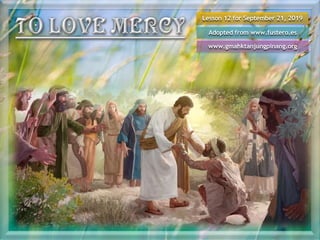
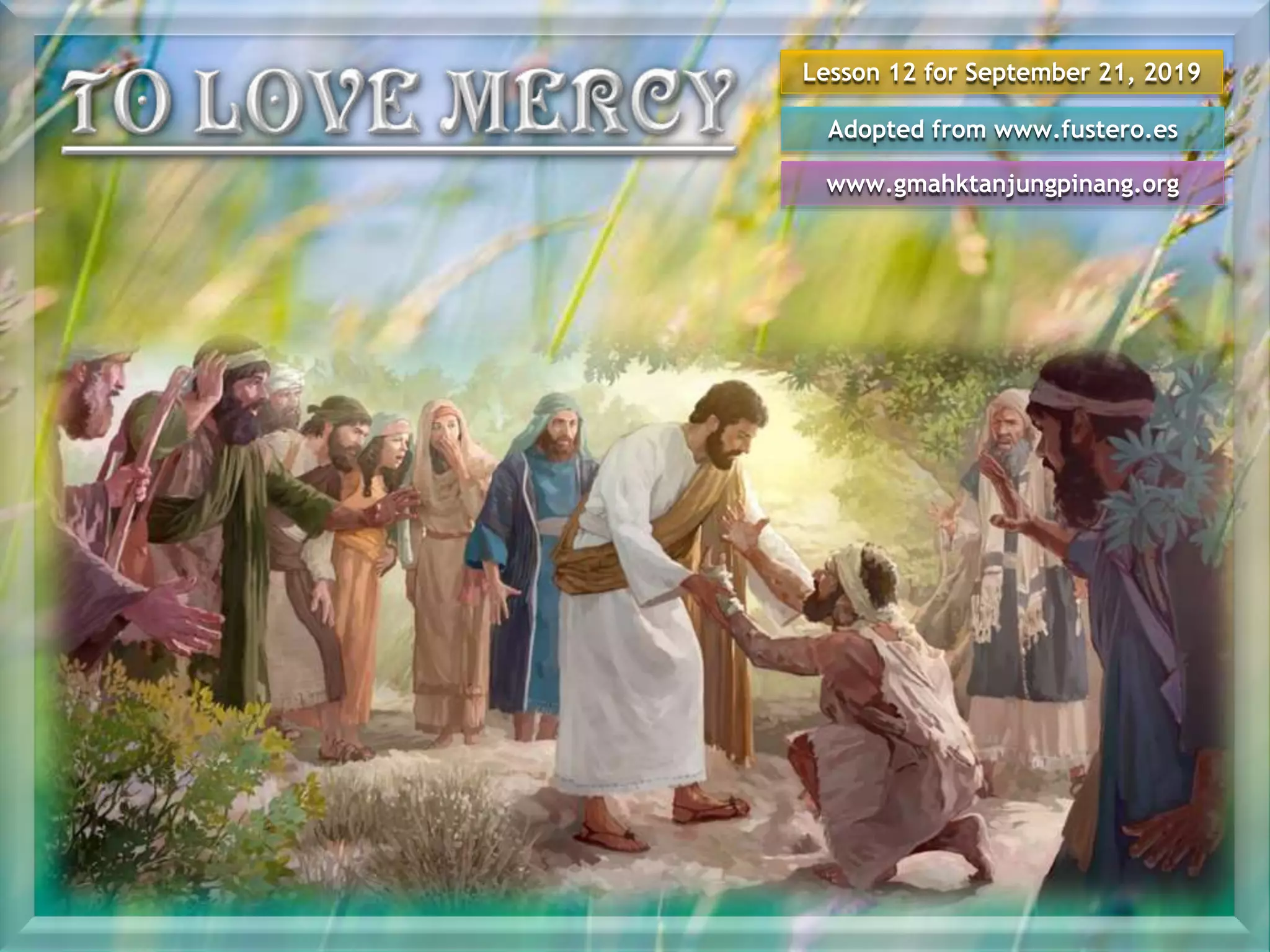
Lesson 12 for September 21, 2019
Adopted from www.fustero.es
www.gmahktanjungpinang.org
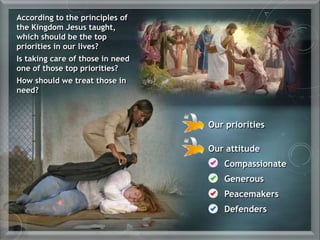
Our priorities
Our attitude
Compassionate
Generous
Peacemakers
Defenders
According to the principles of
the Kingdom Jesus taught,
which should be the top
priorities in our lives?
Is taking care of those in need
one of those top priorities?
How should we treat those in
need?
OUR PRIORITIES “But seek first the kingdom of God and
His righteousness, and all these things
shall be added to you.” (Matthew 6:33)
Jesus listed the main priorities of the citizens of the Kingdom of Heaven:
Taking care of our basic needs (Matthew 6:25-32)
• Don't be overwhelmed by them. God always supplies.
Seeking the Kingdom of God (Matthew 6:33)
• The Kingdom of God is at the center, not us.
Seeking the justice of the Kingdom (Matthew 6:33)
• Helping those in need and the oppressed.
Obeying the authorities (Matthew 22:21)
• Submitting to the authorities (Romans 13:1-7), except if they go
against God's Law (Acts 5:29).
1
2
3
4
What should we do when priorities 3 and 4 are in conflict?
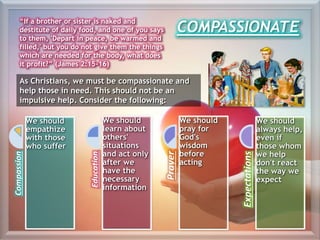
COMPASSIONATE
“If a brother or sister is naked and
destitute of daily food, and one of you says
to them, 'Depart in peace, be warmed and
filled,' but you do not give them the things
which are needed for the body, what does
it profit?” (James 2:15-16)
As Christians, we must be compassionate and
help those in need. This should not be an
impulsive help. Consider the following:
Compassion
We should
empathize
with those
who suffer
Education
We should
learn about
others'
situations
and act only
after we
have the
necessary
information
Prayer
We should
pray for
God's
wisdom
before
acting
Expectations
We should
always help,
even if
those whom
we help
don't react
the way we
expect
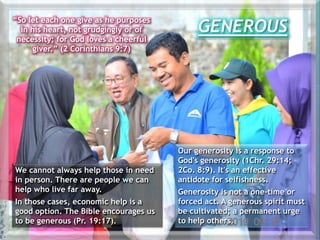
GENEROUS
“So let each one give as he purposes
in his heart, not grudgingly or of
necessity; for God loves a cheerful
giver.” (2 Corinthians 9:7)
We cannot always help those in need
in person. There are people we can
help who live far away.
In those cases, economic help is a
good option. The Bible encourages us
to be generous (Pr. 19:17).
Our generosity is a response to
God's generosity (1Chr. 29:14;
2Co. 8:9). It's an effective
antidote for selfishness.
Generosity is not a one-time or
forced act. A generous spirit must
be cultivated; a permanent urge
to help others.
“Blessed are the peacemakers, for they
shall be called sons of God.” (Matthew 5:9)
There are political, economic and hate
conflicts between nations, tribes, ethnic
groups or communities that bring suffering
and the need for humanitarian aid.
We are called to respond to those needs and
to bring peace in the conflict to the best of
our abilities.
Jesus taught us to avoid beginning conflicts:
don't get angry, don't hold in resentment,
love your enemies, pray for those who
persecute you…
The "gospel of peace" shapes our thoughts
about other people and how we treat them.
DEFENDERS “Cry aloud, spare not; lift up your voice like a
trumpet; tell My people their transgression, and the
house of Jacob their sins.” (Isaiah 58:1)
We are the hands and feet of Jesus on
Earth which should do good to those in
need. We are also called to be the voice
of Jesus to cry out for justice.
As the old prophets, we must be the
voice of those who don't have one. We
must speak up to defend the defenseless.
Our single voice may not
change a specific situation,
but we cannot say nothing.
In addition, our voice as a
local, national and global
church is stronger.
Poverty is present in every society. Poverty robs human beings of
their most basic rights. It keeps people hungry; it deprives them of
medical care, clean water, an education, the opportunity to work, and
often results in a sense of powerlessness, hopelessness, and
inequality. Every day, more than 24,000 children die due to
preventable conditions created by poverty.
Seventh-day Adventists believe that actions to reduce poverty and its
attendant injustices are an important part of Christian social
responsibility. The Bible clearly reveals God's special interest in the
poor and His expectations as to how His followers should respond to
those who are unable to care for themselves. All human beings bear
the image of God and are the recipients of God's blessing (Luke 6:20).
In working with the poor we follow the example and teaching of Jesus
(Matthew 25:35, 36). As a spiritual community Seventh-day Adventists
advocate justice for the poor and "speak up for those who cannot
speak for themselves" (Proverbs 31:8 NIV) and against those who
"deprive the poor of their rights" (Isaiah 10:2 NIV). We participate
with God who "secures justice for the poor" (Psalm 140:12 NIV).
SDA STATEMENT ON GLOBAL PROVERTY
Working to reduce poverty and hunger means more than showing
sympathy for the poor. It means advocating for public policy that
offers justice and fairness to the poor, for their empowerment and
human rights. It means sponsoring and participating in programs
that address the causes of poverty and hunger, helping people to
build sustainable lives. This commitment to justice is an act of
love (Micah 6:8). Seventh-day Adventists believe it is also a call to
live lives of simplicity and modesty that witness against
materialism and a culture of affluence.
Seventh-day Adventists join the global community in supporting
the United Nations' Millennium Development Goals for reducing
poverty by at least 50 percent by 2015.
In furtherance of this, Seventh-day Adventists partner with civil
society, governments and others, working together locally and
globally to participate in God's work of establishing enduring
justice in a broken world.
SDA STATEMENT ON GLOBAL PROVERTY
As followers of Christ we engage this task with determined
hope, energized by God's visionary promise of a new heaven and
a new earth where there is no poverty or injustice. Seventh-day
Adventists are called to live imaginatively and faithfully inside
that vision of God's Kingdom by acting to end poverty now.
This statement was approved and voted by the Executive Committee of
the General Conference of Seventh-day Adventists on June 23, 2010, and
released at the General Conference Session in Atlanta, Georgia, June 24-
July 3, 2010.
SDA STATEMENT ON GLOBAL PROVERTY
“The tender sympathies of our Saviour were aroused
for fallen and suffering humanity. If you would be His
followers, you must cultivate compassion and
sympathy. Indifference to human woes must give
place to lively interest in the sufferings of others. The
widow, the orphan, the sick and the dying, will always
need help. Here is an opportunity to proclaim the
gospel—to hold up Jesus, the hope and consolation of
all men. When the suffering body has been relieved,
and you have shown a lively interest in the afflicted,
the heart is opened, and you can pour in the
heavenly balm. If you are looking to Jesus and
drawing from Him knowledge and strength and grace,
you can impart His consolation to others, because the
Comforter is with you.”
E.G.W. (Counsels on Health, p. 34)

Sabbath school lesson 12, 3rd quarter 2019

  • 1.
    Lesson 12 forSeptember 21, 2019 Adopted from www.fustero.es www.gmahktanjungpinang.org
  • 2.
    Our priorities Our attitude Compassionate Generous Peacemakers Defenders Accordingto the principles of the Kingdom Jesus taught, which should be the top priorities in our lives? Is taking care of those in need one of those top priorities? How should we treat those in need?
  • 3.
    OUR PRIORITIES “Butseek first the kingdom of God and His righteousness, and all these things shall be added to you.” (Matthew 6:33) Jesus listed the main priorities of the citizens of the Kingdom of Heaven: Taking care of our basic needs (Matthew 6:25-32) • Don't be overwhelmed by them. God always supplies. Seeking the Kingdom of God (Matthew 6:33) • The Kingdom of God is at the center, not us. Seeking the justice of the Kingdom (Matthew 6:33) • Helping those in need and the oppressed. Obeying the authorities (Matthew 22:21) • Submitting to the authorities (Romans 13:1-7), except if they go against God's Law (Acts 5:29). 1 2 3 4 What should we do when priorities 3 and 4 are in conflict?
  • 4.
    COMPASSIONATE “If a brotheror sister is naked and destitute of daily food, and one of you says to them, 'Depart in peace, be warmed and filled,' but you do not give them the things which are needed for the body, what does it profit?” (James 2:15-16) As Christians, we must be compassionate and help those in need. This should not be an impulsive help. Consider the following: Compassion We should empathize with those who suffer Education We should learn about others' situations and act only after we have the necessary information Prayer We should pray for God's wisdom before acting Expectations We should always help, even if those whom we help don't react the way we expect
  • 5.
    GENEROUS “So let eachone give as he purposes in his heart, not grudgingly or of necessity; for God loves a cheerful giver.” (2 Corinthians 9:7) We cannot always help those in need in person. There are people we can help who live far away. In those cases, economic help is a good option. The Bible encourages us to be generous (Pr. 19:17). Our generosity is a response to God's generosity (1Chr. 29:14; 2Co. 8:9). It's an effective antidote for selfishness. Generosity is not a one-time or forced act. A generous spirit must be cultivated; a permanent urge to help others.
  • 6.
    “Blessed are thepeacemakers, for they shall be called sons of God.” (Matthew 5:9) There are political, economic and hate conflicts between nations, tribes, ethnic groups or communities that bring suffering and the need for humanitarian aid. We are called to respond to those needs and to bring peace in the conflict to the best of our abilities. Jesus taught us to avoid beginning conflicts: don't get angry, don't hold in resentment, love your enemies, pray for those who persecute you… The "gospel of peace" shapes our thoughts about other people and how we treat them.
  • 7.
    DEFENDERS “Cry aloud,spare not; lift up your voice like a trumpet; tell My people their transgression, and the house of Jacob their sins.” (Isaiah 58:1) We are the hands and feet of Jesus on Earth which should do good to those in need. We are also called to be the voice of Jesus to cry out for justice. As the old prophets, we must be the voice of those who don't have one. We must speak up to defend the defenseless. Our single voice may not change a specific situation, but we cannot say nothing. In addition, our voice as a local, national and global church is stronger.
  • 8.
    Poverty is presentin every society. Poverty robs human beings of their most basic rights. It keeps people hungry; it deprives them of medical care, clean water, an education, the opportunity to work, and often results in a sense of powerlessness, hopelessness, and inequality. Every day, more than 24,000 children die due to preventable conditions created by poverty. Seventh-day Adventists believe that actions to reduce poverty and its attendant injustices are an important part of Christian social responsibility. The Bible clearly reveals God's special interest in the poor and His expectations as to how His followers should respond to those who are unable to care for themselves. All human beings bear the image of God and are the recipients of God's blessing (Luke 6:20). In working with the poor we follow the example and teaching of Jesus (Matthew 25:35, 36). As a spiritual community Seventh-day Adventists advocate justice for the poor and "speak up for those who cannot speak for themselves" (Proverbs 31:8 NIV) and against those who "deprive the poor of their rights" (Isaiah 10:2 NIV). We participate with God who "secures justice for the poor" (Psalm 140:12 NIV). SDA STATEMENT ON GLOBAL PROVERTY
  • 9.
    Working to reducepoverty and hunger means more than showing sympathy for the poor. It means advocating for public policy that offers justice and fairness to the poor, for their empowerment and human rights. It means sponsoring and participating in programs that address the causes of poverty and hunger, helping people to build sustainable lives. This commitment to justice is an act of love (Micah 6:8). Seventh-day Adventists believe it is also a call to live lives of simplicity and modesty that witness against materialism and a culture of affluence. Seventh-day Adventists join the global community in supporting the United Nations' Millennium Development Goals for reducing poverty by at least 50 percent by 2015. In furtherance of this, Seventh-day Adventists partner with civil society, governments and others, working together locally and globally to participate in God's work of establishing enduring justice in a broken world. SDA STATEMENT ON GLOBAL PROVERTY
  • 10.
    As followers ofChrist we engage this task with determined hope, energized by God's visionary promise of a new heaven and a new earth where there is no poverty or injustice. Seventh-day Adventists are called to live imaginatively and faithfully inside that vision of God's Kingdom by acting to end poverty now. This statement was approved and voted by the Executive Committee of the General Conference of Seventh-day Adventists on June 23, 2010, and released at the General Conference Session in Atlanta, Georgia, June 24- July 3, 2010. SDA STATEMENT ON GLOBAL PROVERTY
  • 11.
    “The tender sympathiesof our Saviour were aroused for fallen and suffering humanity. If you would be His followers, you must cultivate compassion and sympathy. Indifference to human woes must give place to lively interest in the sufferings of others. The widow, the orphan, the sick and the dying, will always need help. Here is an opportunity to proclaim the gospel—to hold up Jesus, the hope and consolation of all men. When the suffering body has been relieved, and you have shown a lively interest in the afflicted, the heart is opened, and you can pour in the heavenly balm. If you are looking to Jesus and drawing from Him knowledge and strength and grace, you can impart His consolation to others, because the Comforter is with you.” E.G.W. (Counsels on Health, p. 34)