Pedagogical Retooling in Mathematics, Languages, and
Science
for Junior High School
Too Many Triangles
(Understanding Trigonometric Functions)
(Adapted fromToo ManyTriangles:UnderstandingTrigonometric Functions,
aTrainer’sTraining Resource Package by Mr.John Joseph P.Lontoc and Mrs.Marjorie Salcedo-Javier)
BRENLY B. MENDOZA
Ligao National High School
Ligao City Division
Region V
1. explore basic concepts on trigonometry using storytelling
2. analyze situations, check for limitations, and examine appropriate methods of
solutions using trigonometry
3. practice manipulating trigonometric functions and in substituting equivalent
expressions
4. use trigonometric relationships to determine lengths and angle measures
5. demonstrate understanding that the essence of knowledge and relationship of the
components is structure
6. work in small groups encouraging others and communicating thoughts
OBJECTIVES
Storytelling
Characters:
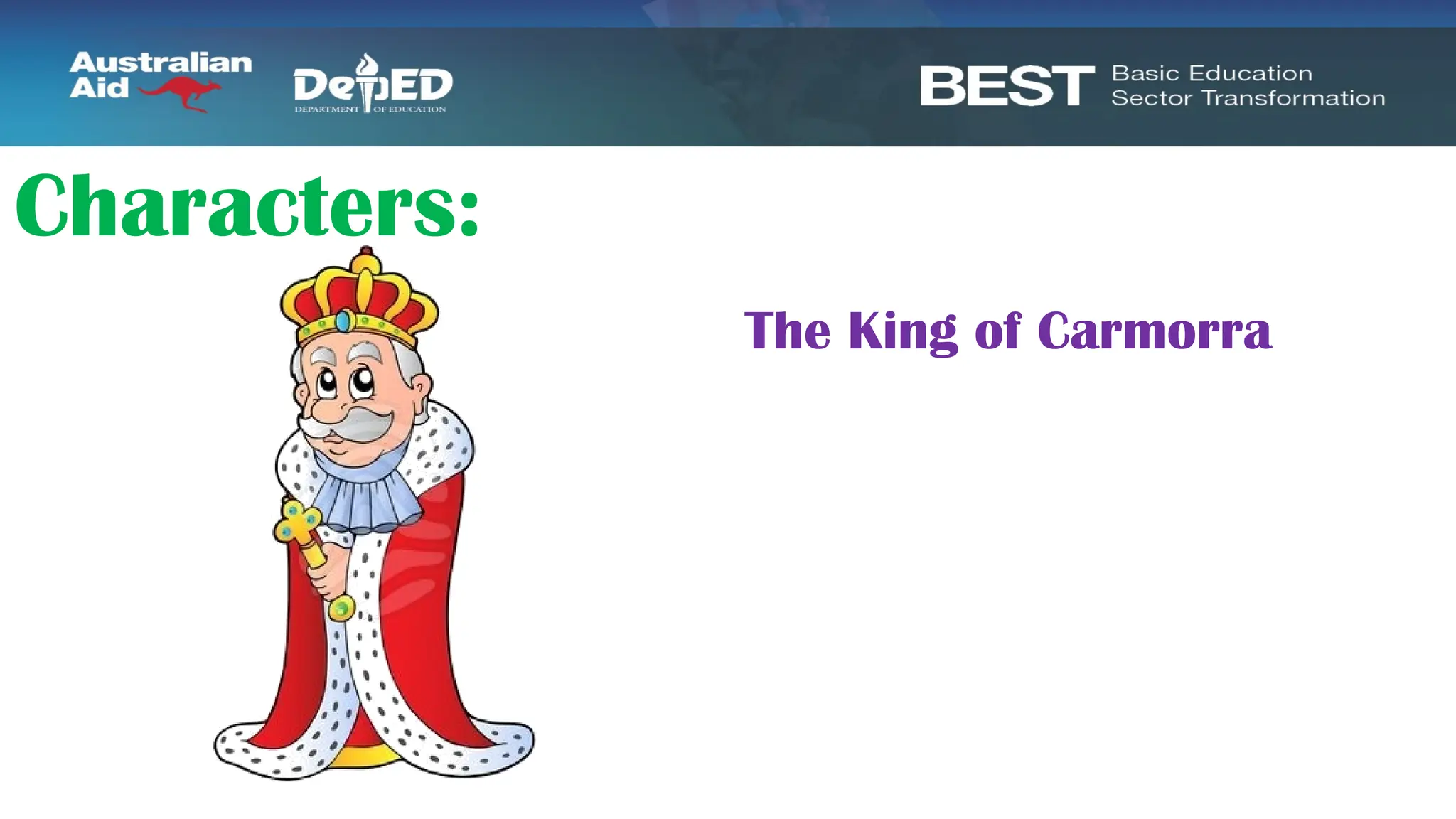
The King of Carmorra
Characters:
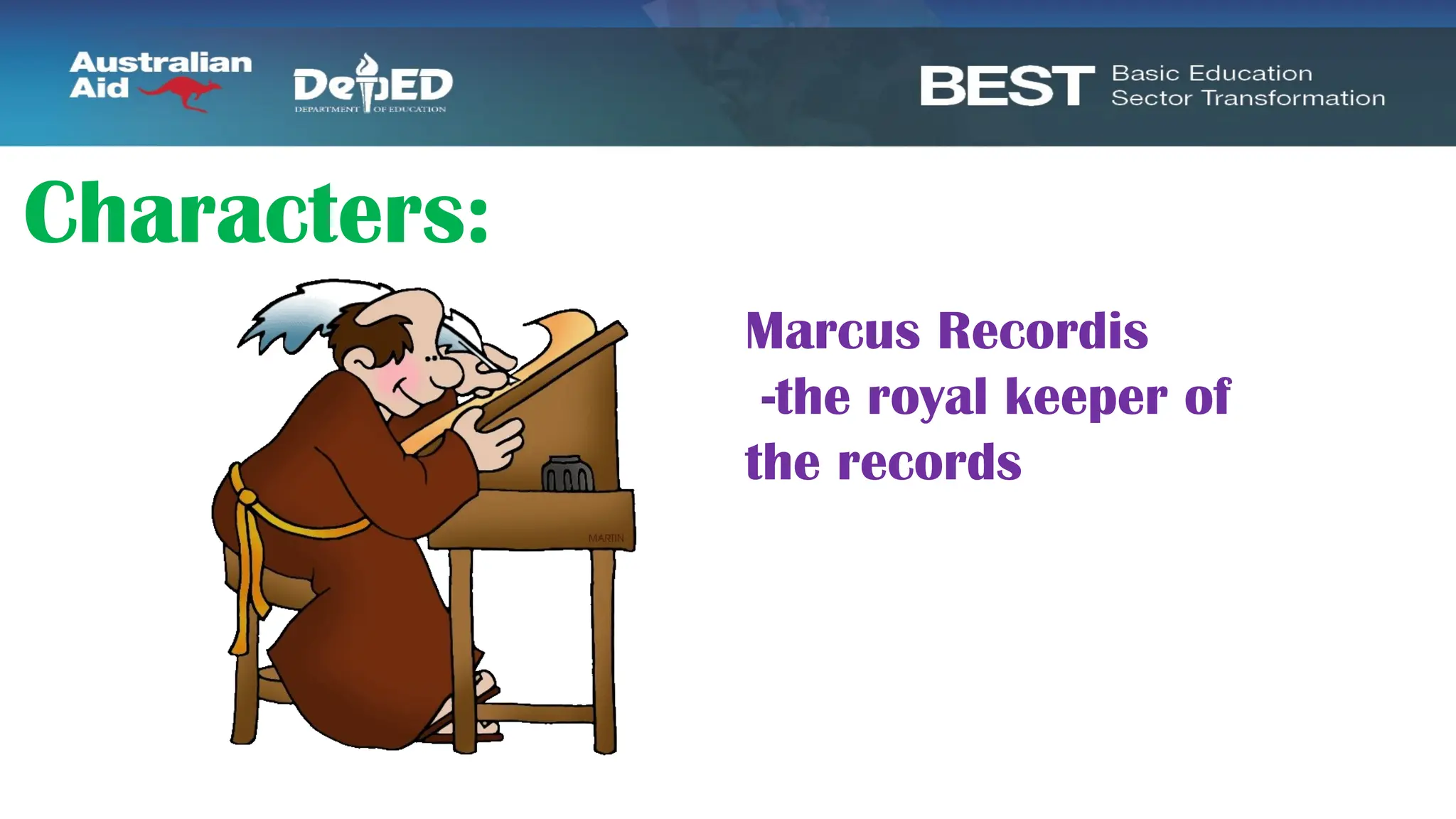
Marcus Recordis
-the royal keeper of
the records
Characters:
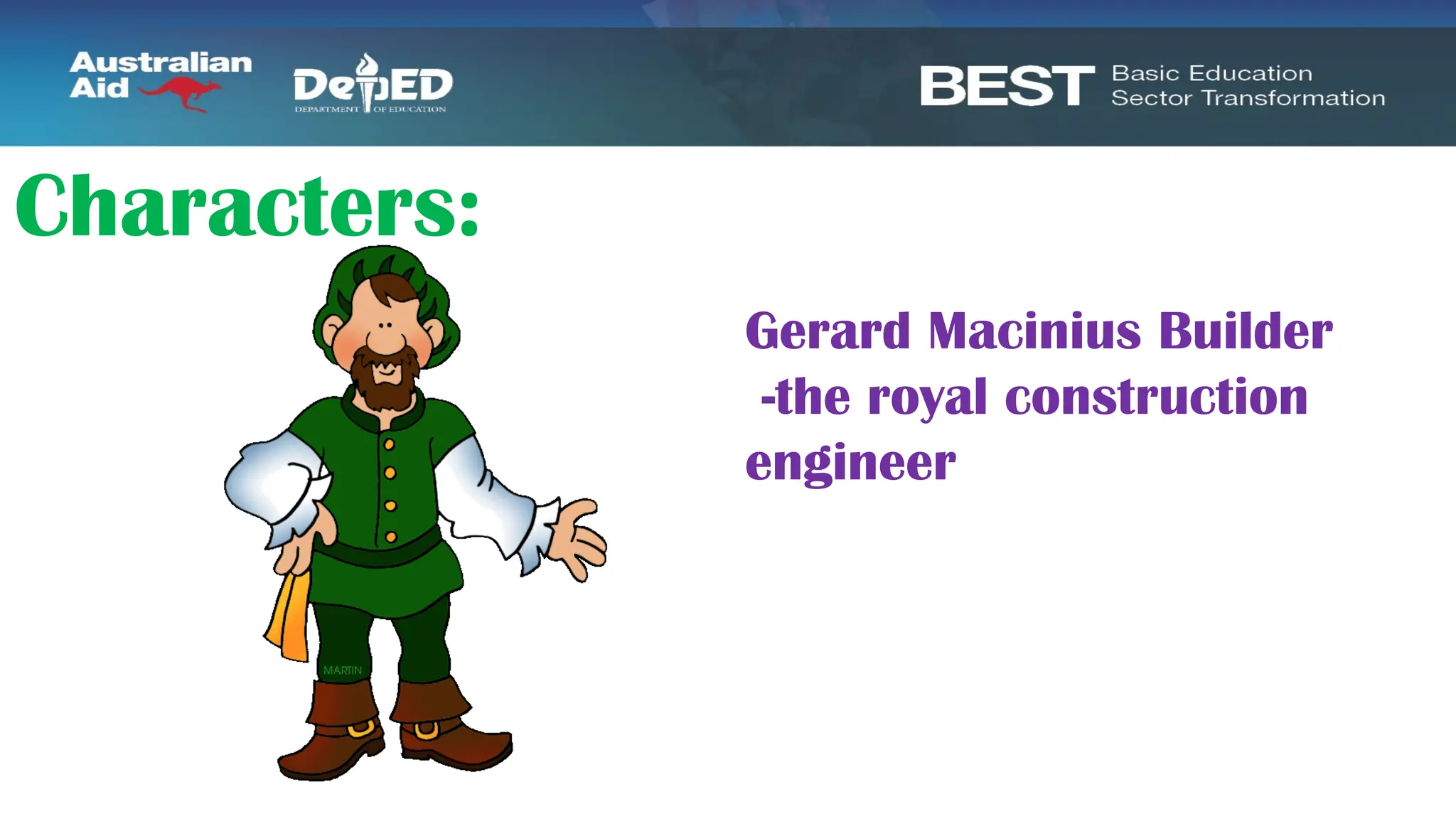
Gerard Macinius Builder
-the royal construction
engineer
Characters:
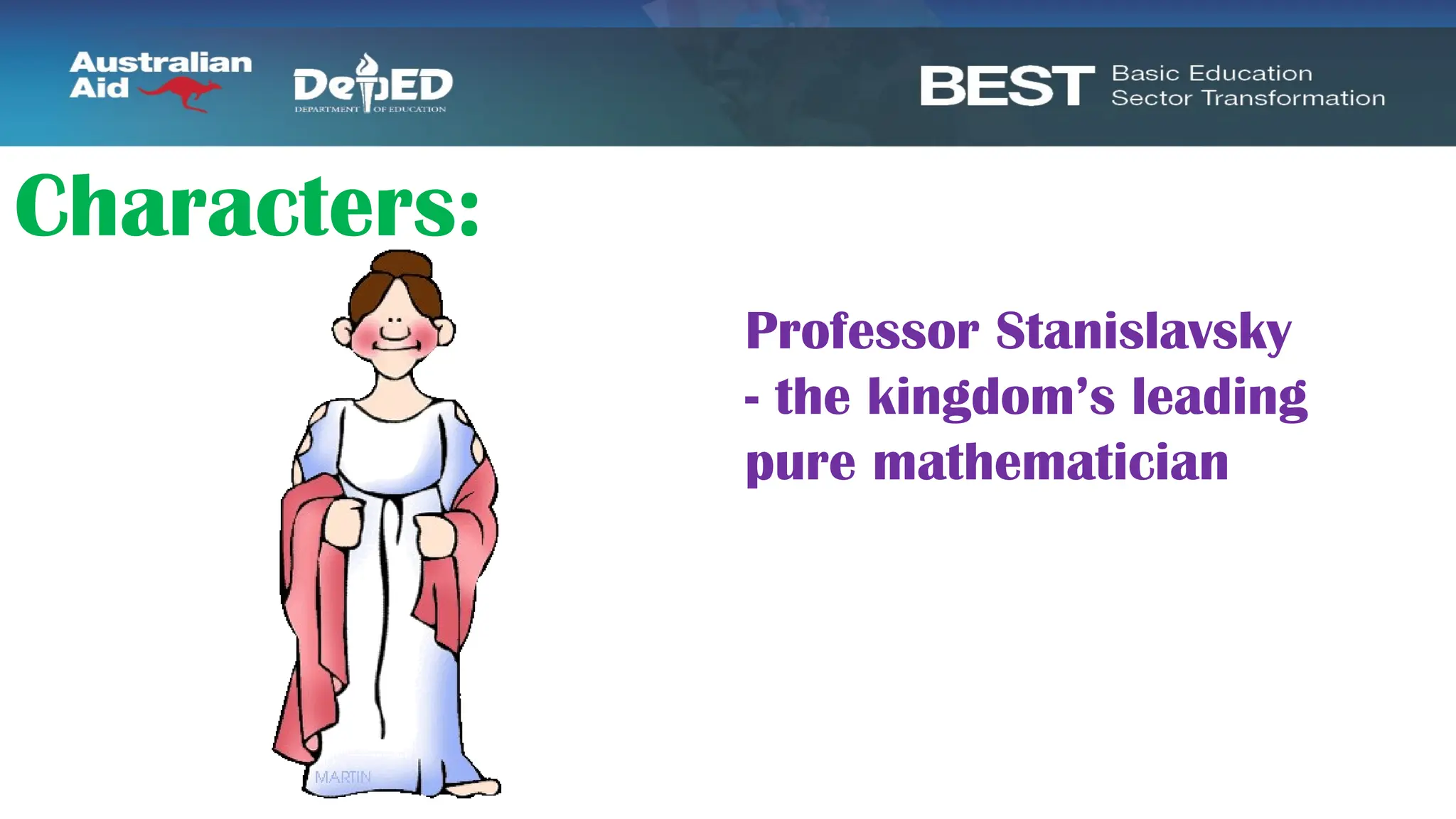
Professor Stanislavsky
- the kingdom’s leading
pure mathematician
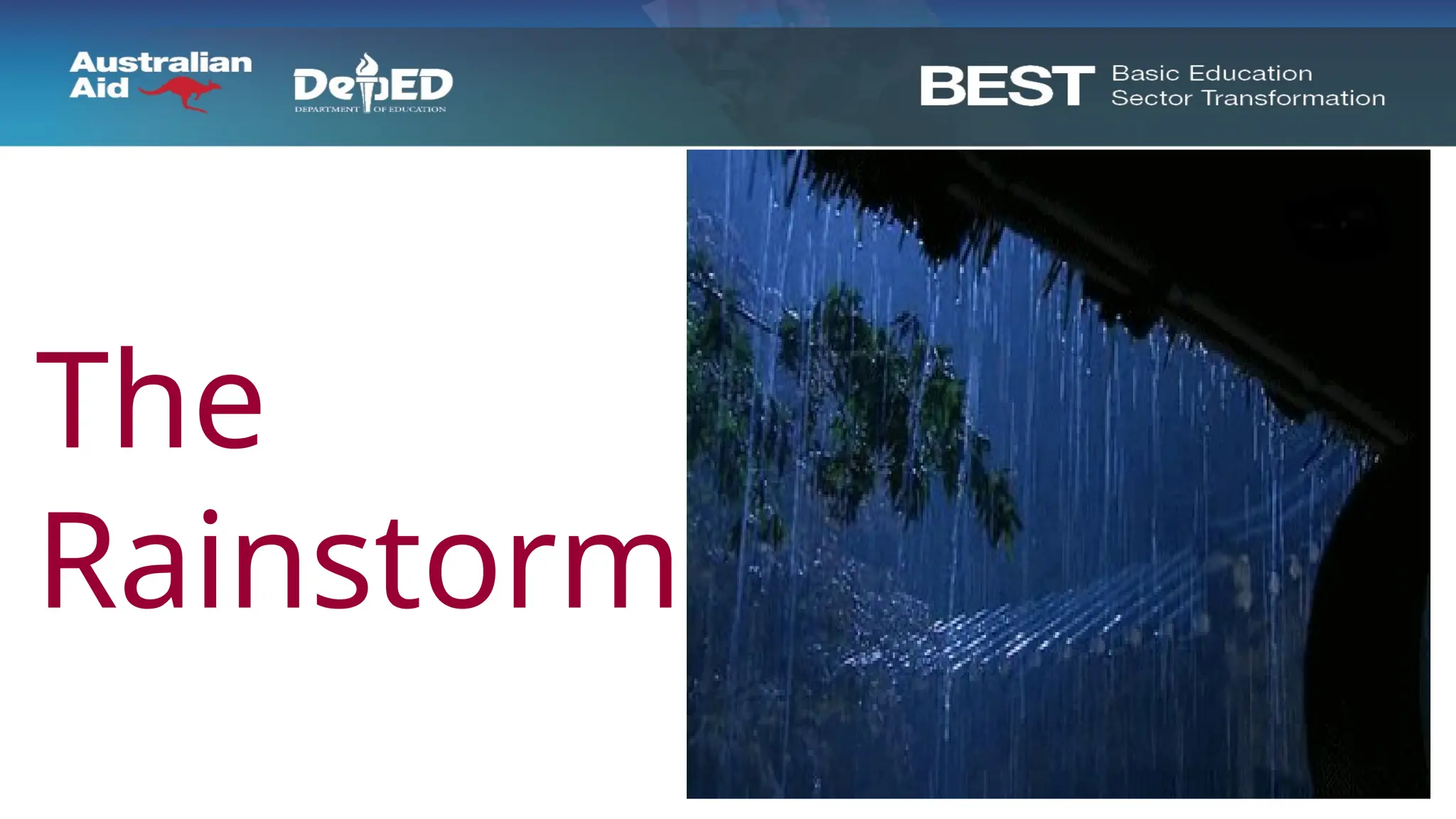
The
Rainstorm
Once upon a time…
…in a faraway Kingdom of Carmorra it rained for days.
Everybody in the entire kingdom of Carmorra was
forced to stay inside to avoid the drenching downpour.
I took refuge in the king’s palace along with the other
members of the Royal Court.
I had been residing in the palace since I’d been
stranded in the strange faraway land of Carmorra by a
shipwreck. Marcus Recordis- the Royal keeper of the
records starred dolefully out the main conference
room window.
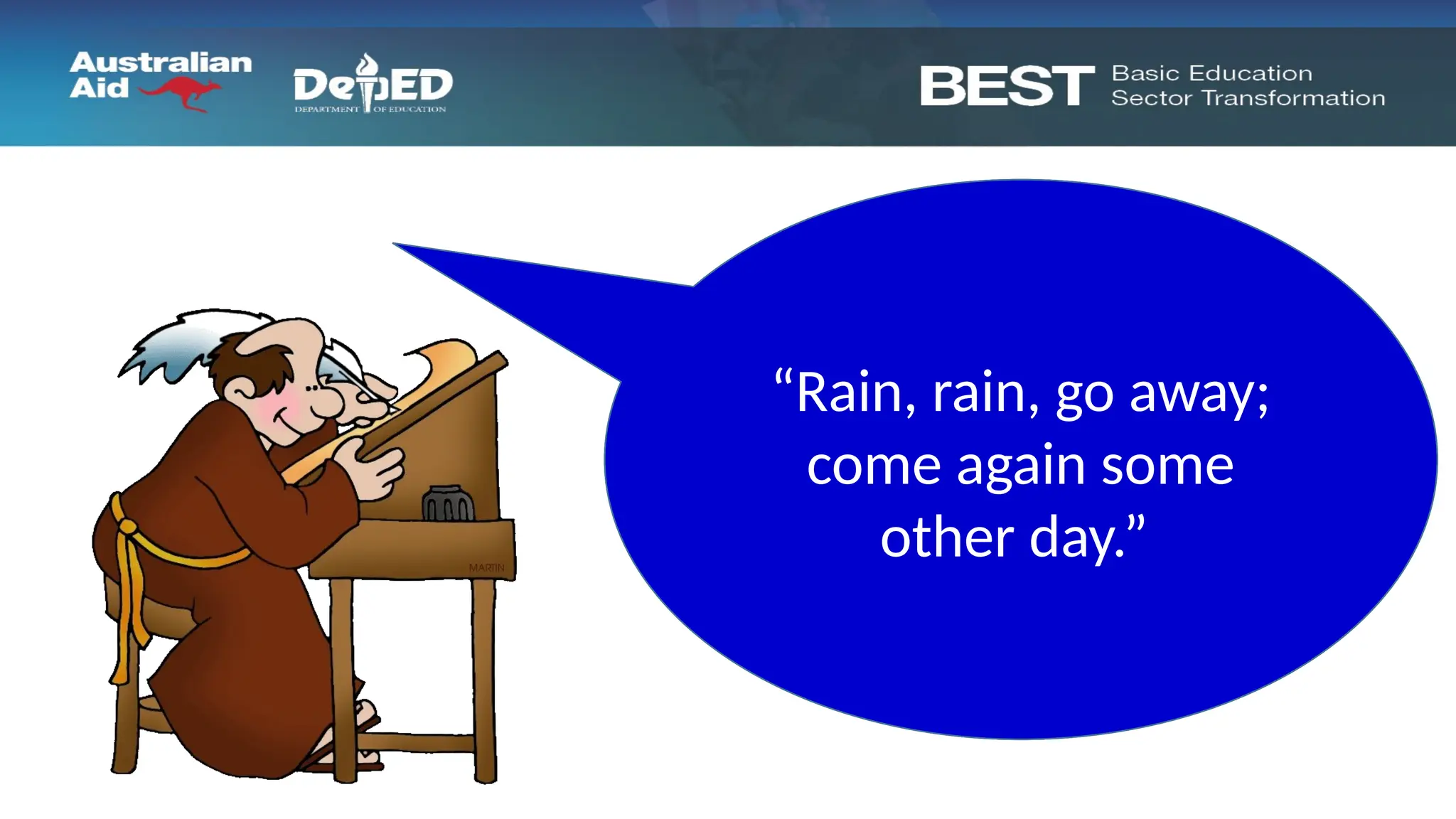
“Rain, rain, go away;
come again some
other day,”
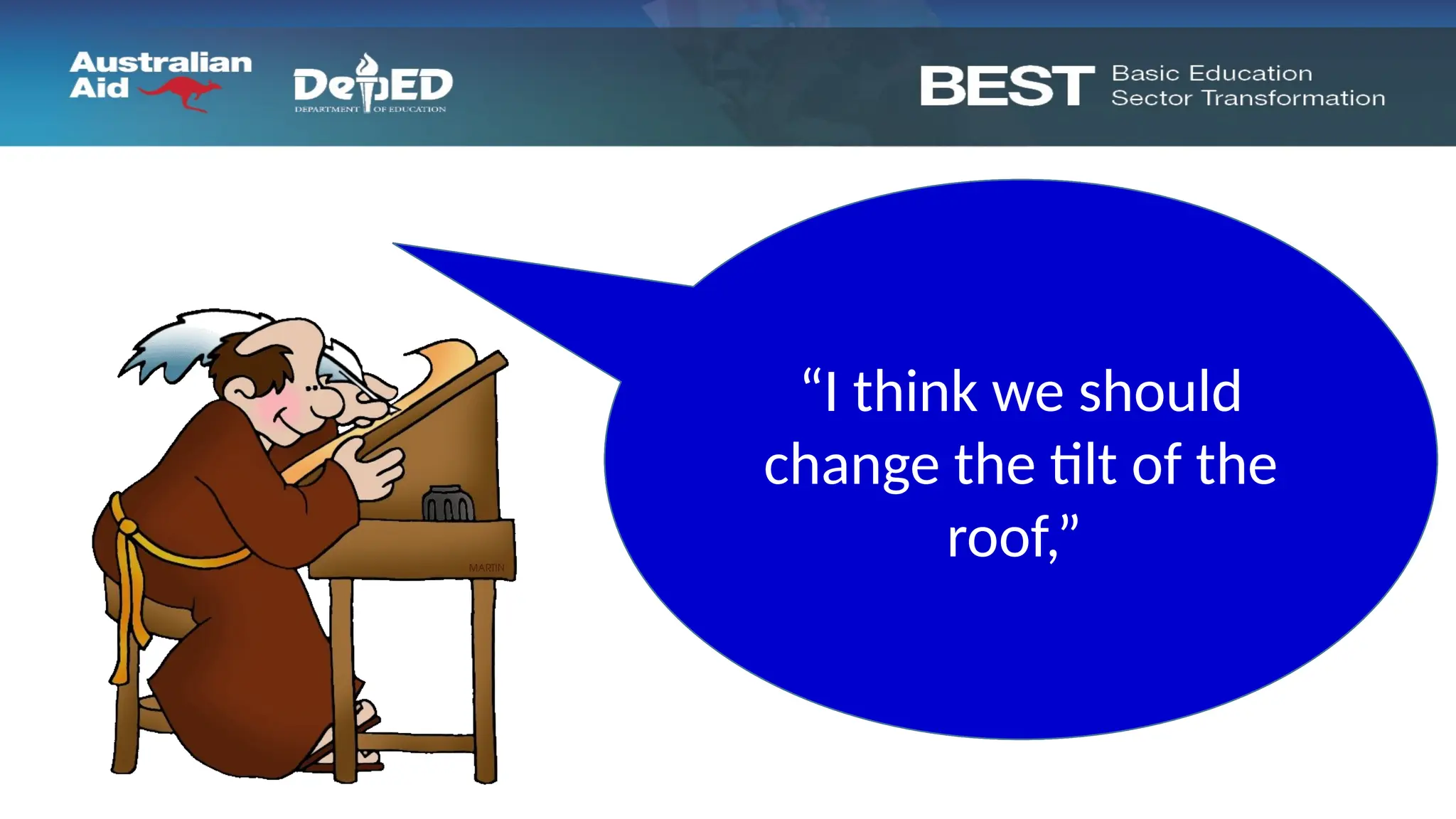
“I think we should
change the tilt of the
roof,”
“Rain, rain, go away;
come again some
other day.”
he sighed. He watched the rainwater slide off the
sloped roof of the palace.
“Rain, rain, go away;
come again some
other day,”
“I think we should
change the tilt of the
roof,”
“I think we should
change the tilt of the
roof,”
he remarked
“Rain, rain, go away;
come again some
other day,”
“I think we should
change the tilt of the
roof,”
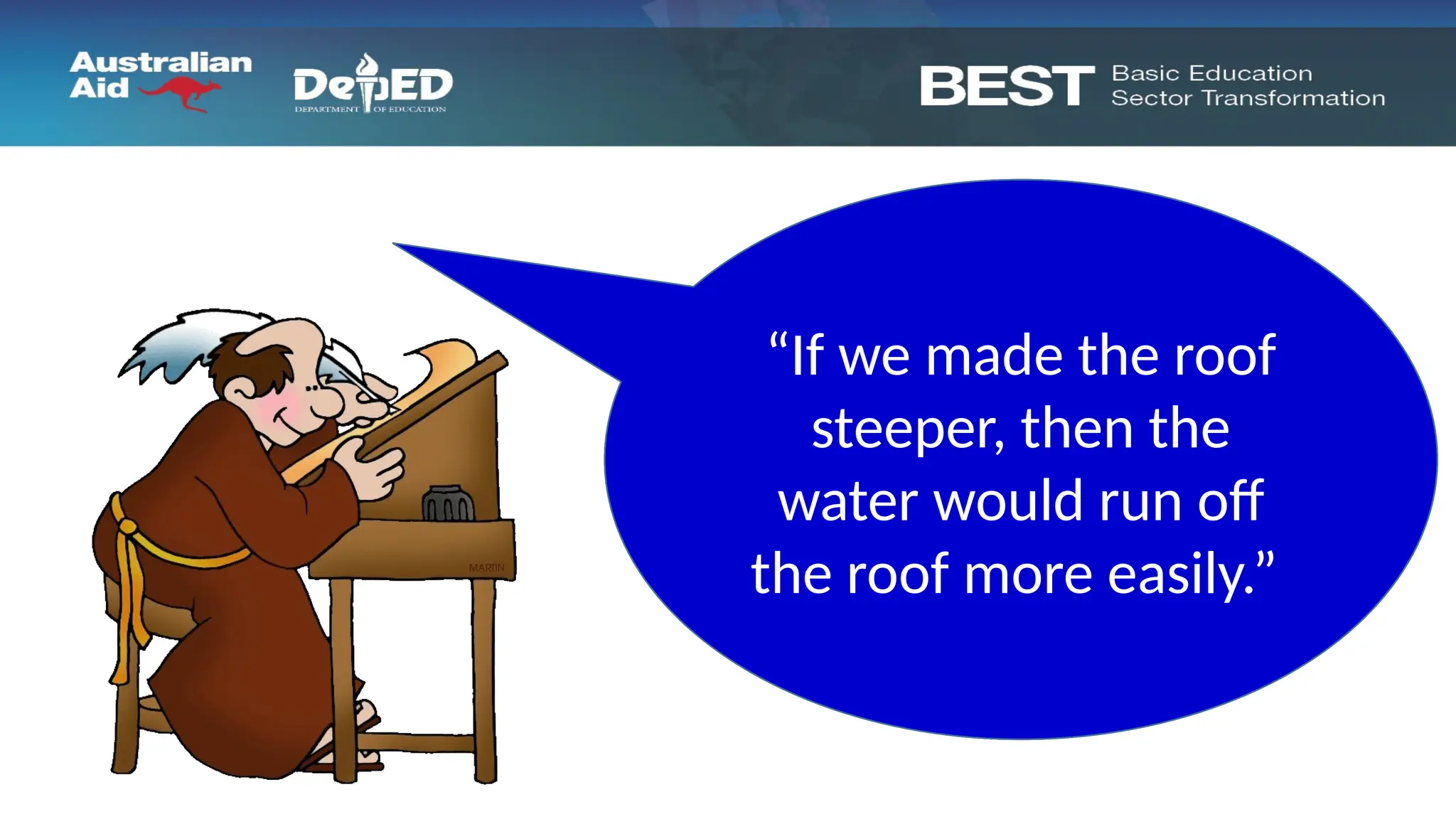
“If we made the roof
steeper, then the
water would run off
the roof more easily.”
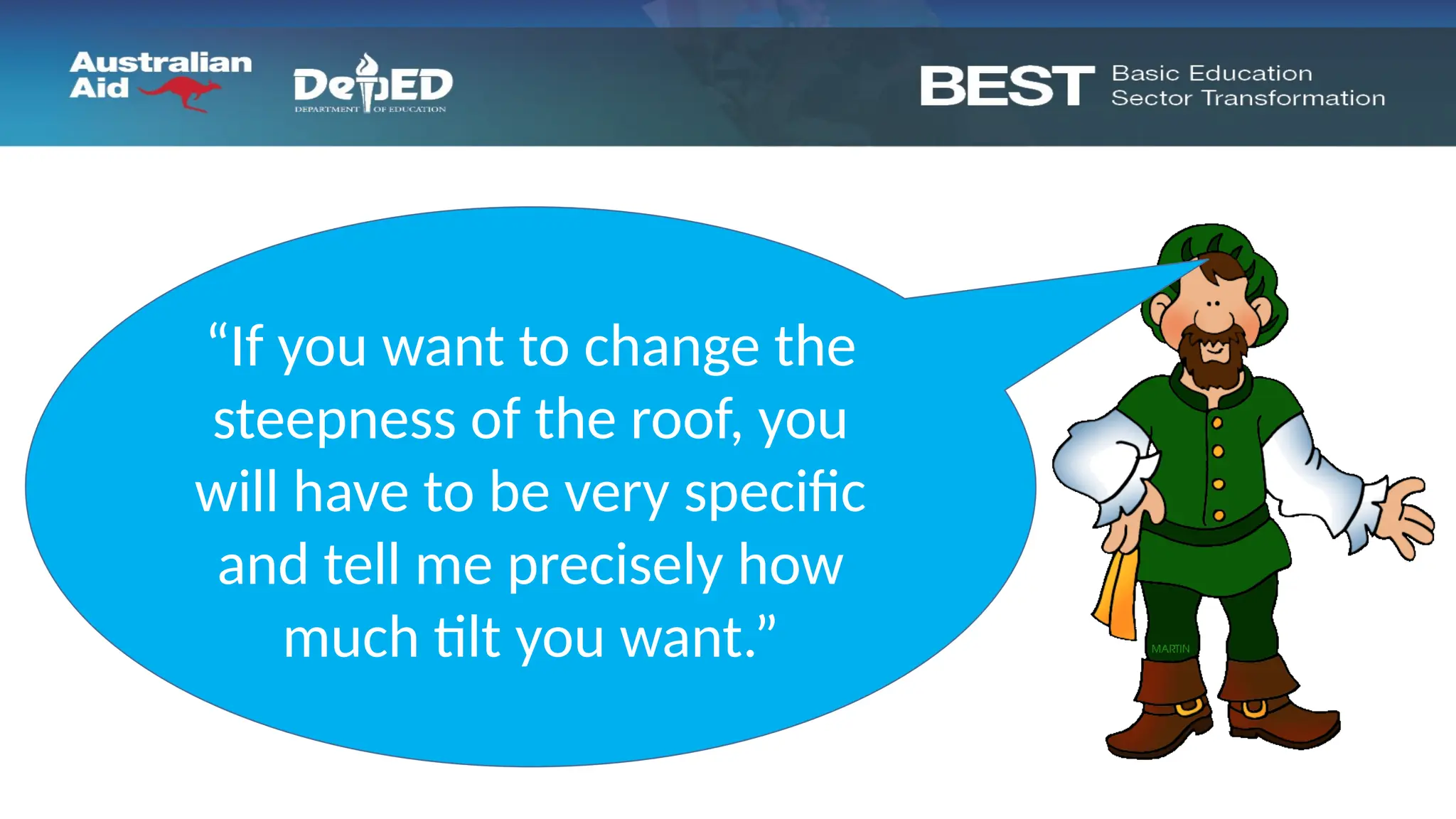
“If you want to change the
steepness of the roof, you
will have to be very specific
and tell me precisely how
much tilt you want.”
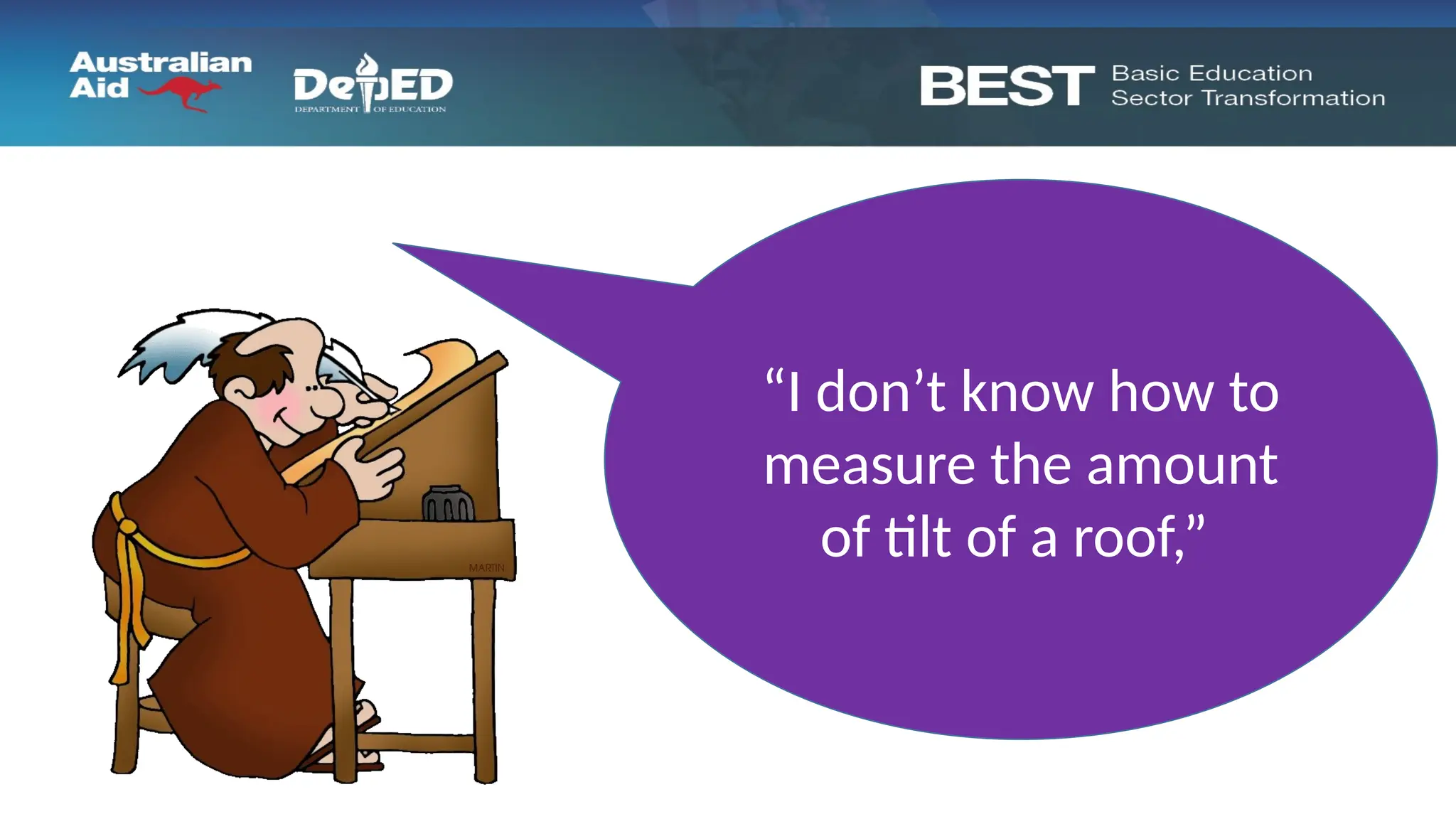
“I don’t know how to
measure the amount
of tilt of a roof,”
“Most of the walls in this
building will meet to form
square corners,”
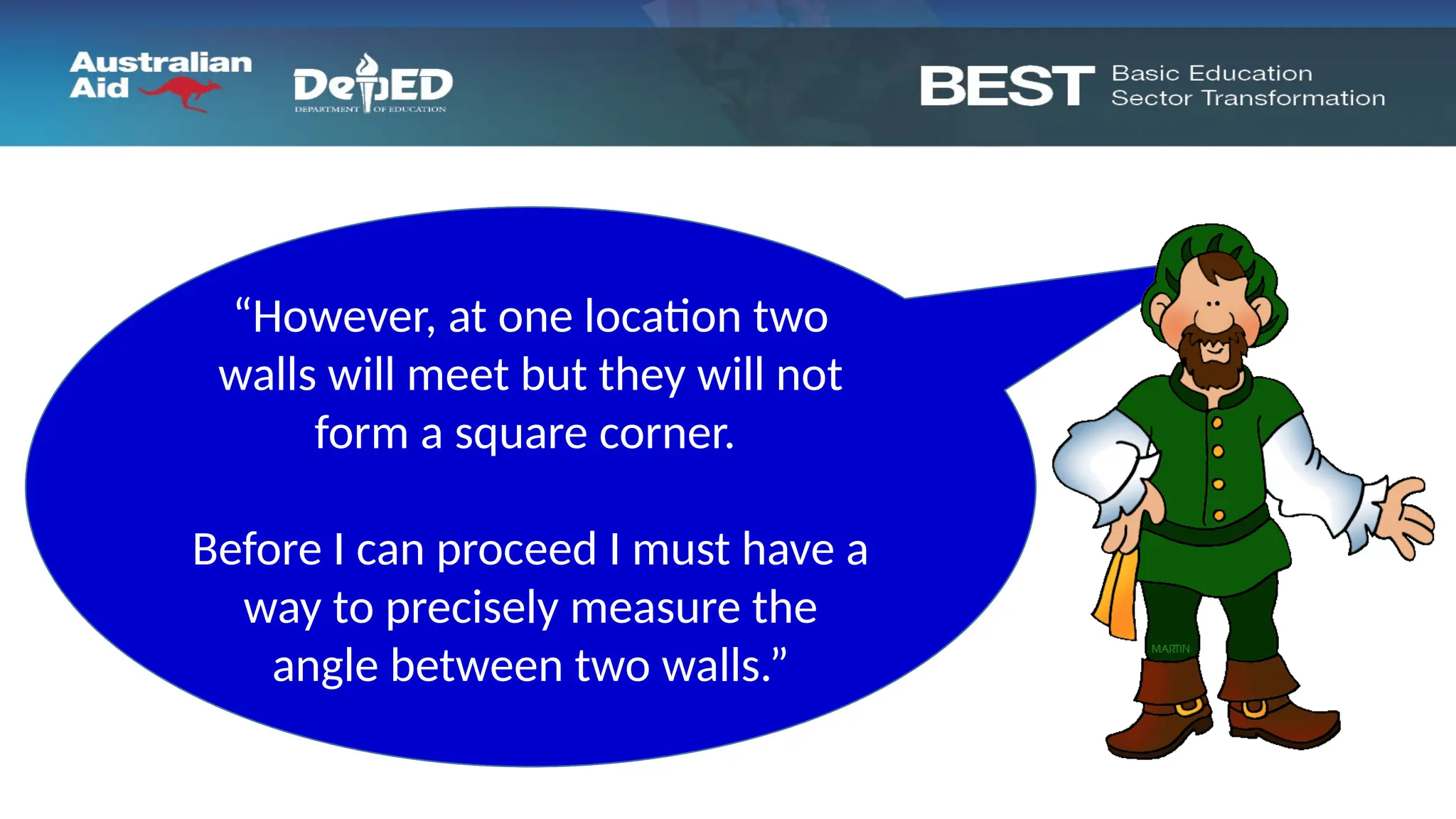
“However, at one location two
walls will meet but they will not
form a square corner.
Before I can proceed I must have a
way to precisely measure the
angle between two walls.”
“I need to hit the cue ball
against the wall and have
it bounce back to hit the
eight ball“
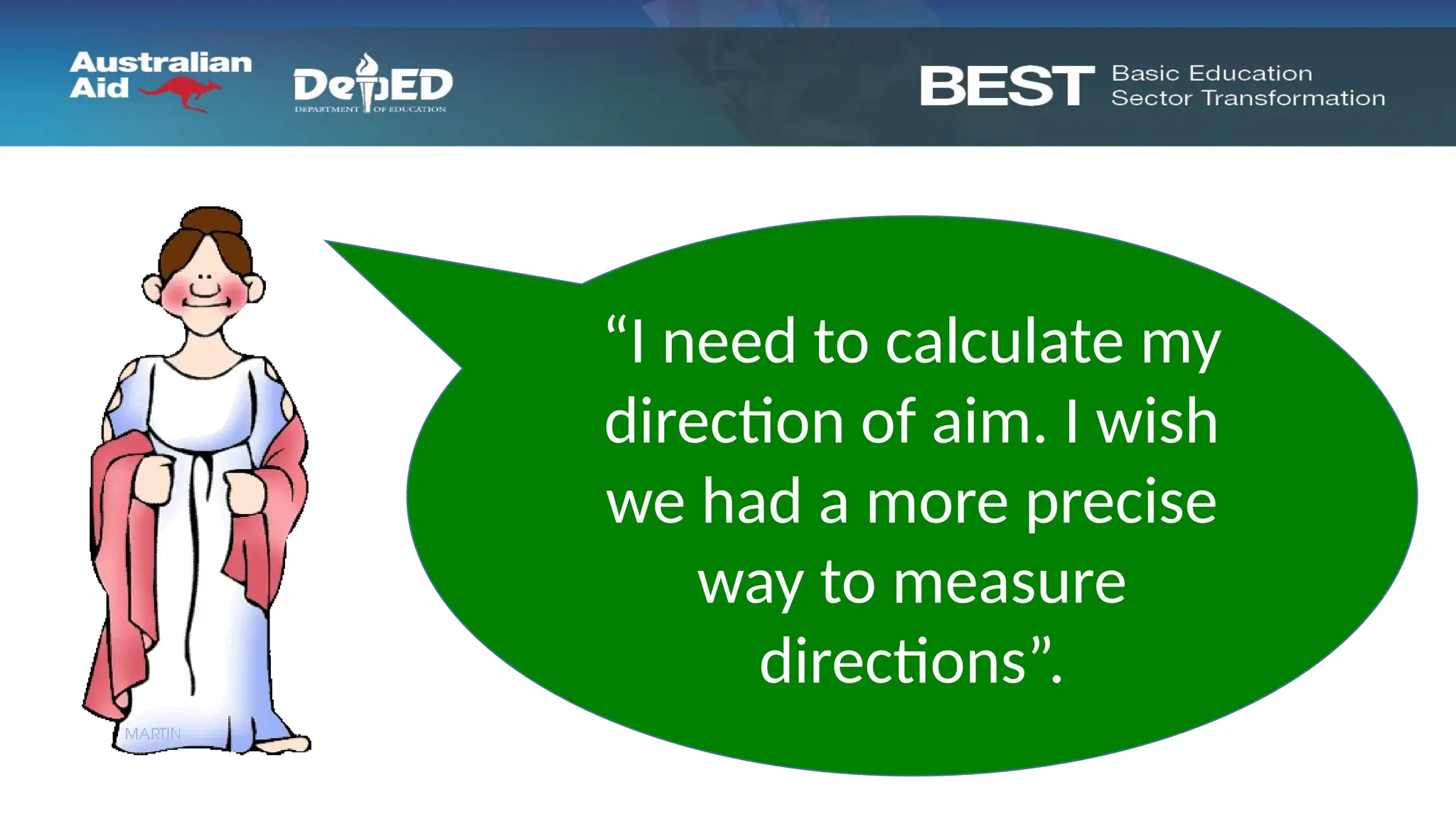
“I need to calculate my
direction of aim. I wish
we had a more precise
way to measure
directions”.
“I know how to find the
solution to all these
problems,”
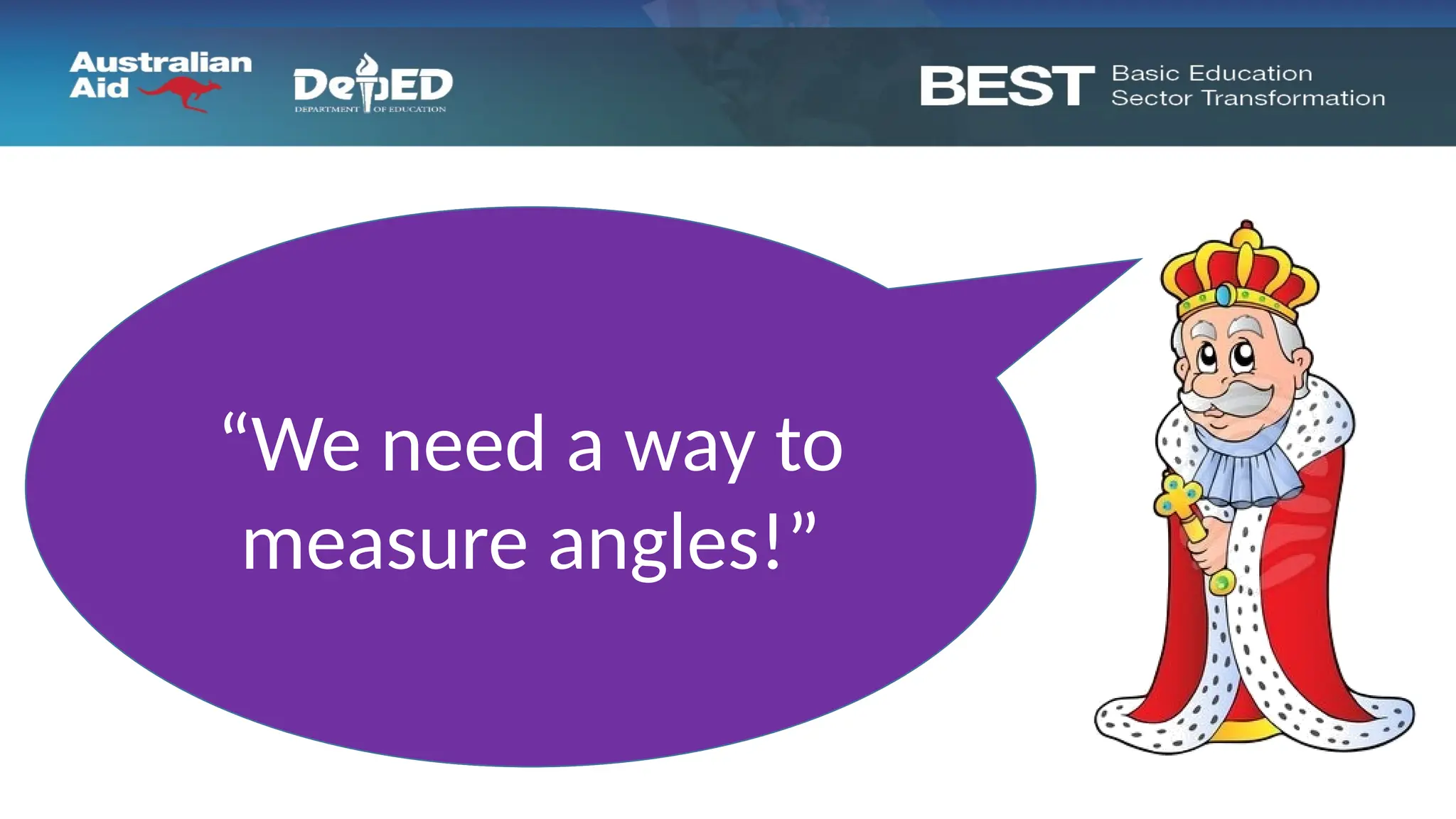
“We need a way to
measure angles!”
“First we had better
define precisely what we
mean by the word angle”
“That’s easy,”
“An angle is a place
where two lines cross
each other”
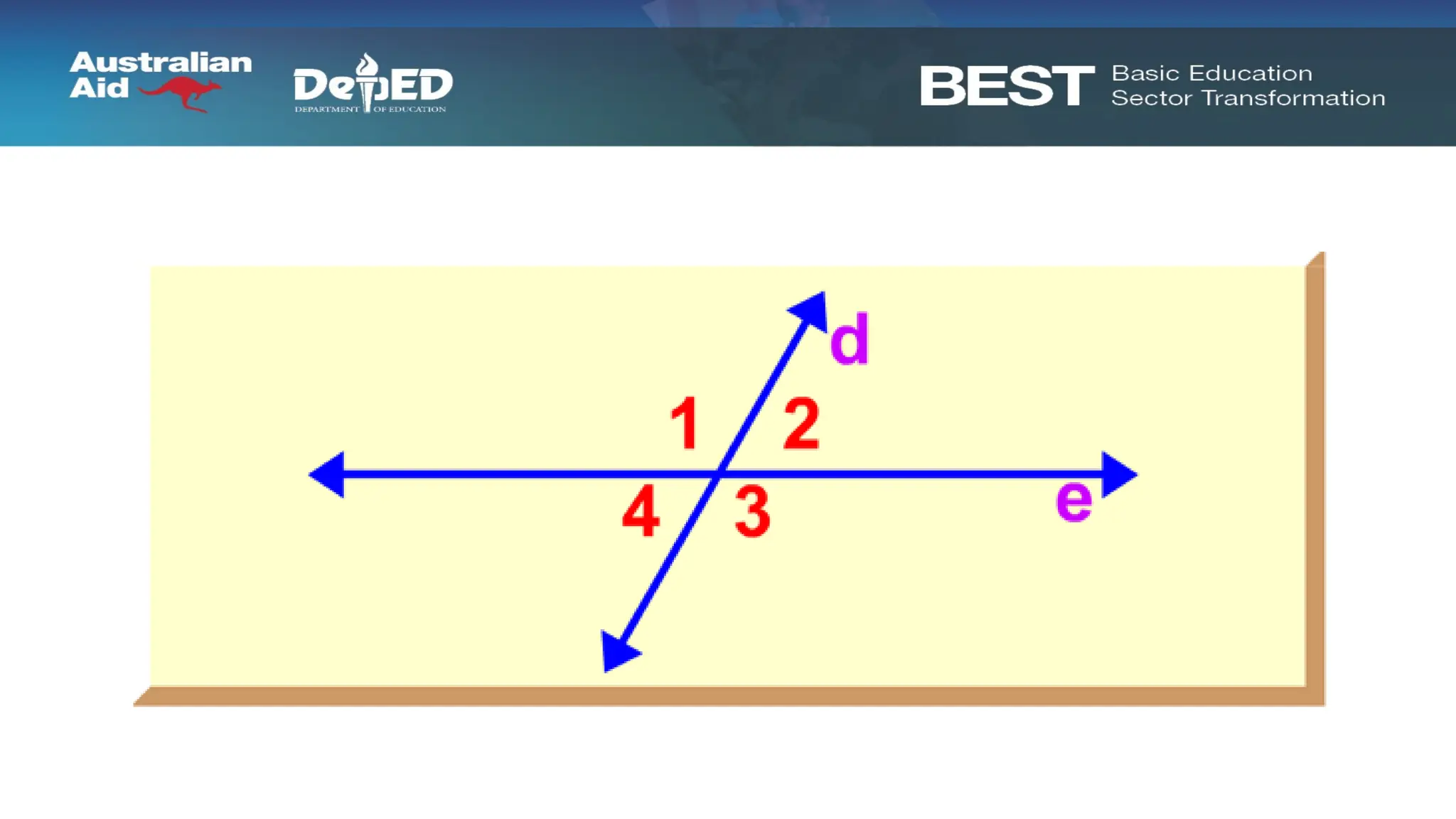
“It looks to me as if a
crossing place between two
lines forms four angles “
“To avoid that problem
we will say that an angle
is a place where the end
points of two rays meet
each other”
“Remember that a ray is like half a
line. A line goes off to infinity in
two directions, but a ray has one
end point and then it goes off to
infinity in one direction”.
“Ah! the beam of light
from Pal’s toy ray gun
is like a ray”
“The beam starts at
the gun and then goes
off to infinity in a
straight line”
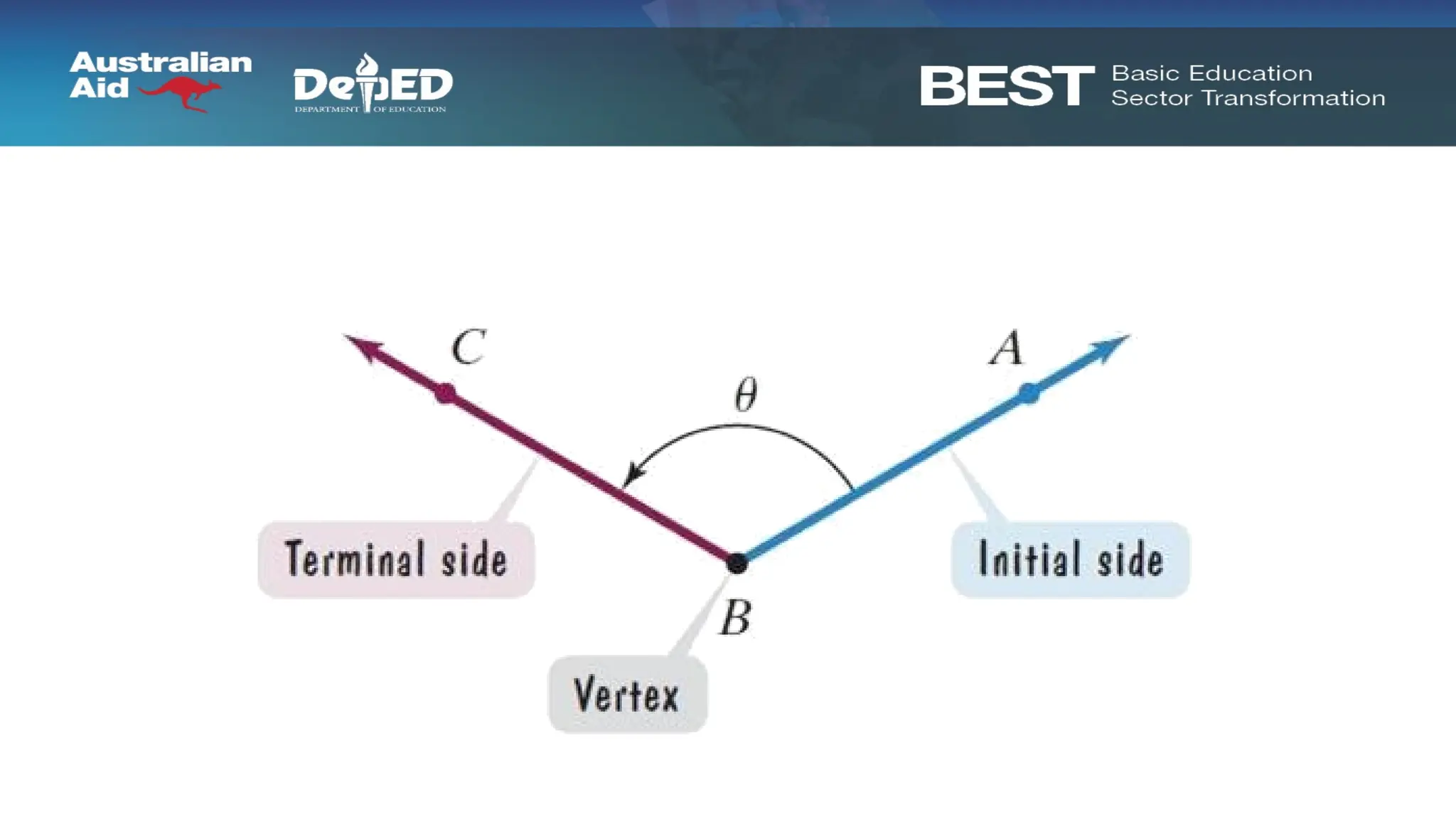
“We’ll call the point
where the two rays meet
the vertex of the angle “
“We will call one of the
rays the initial side and
the other ray the
terminal side”
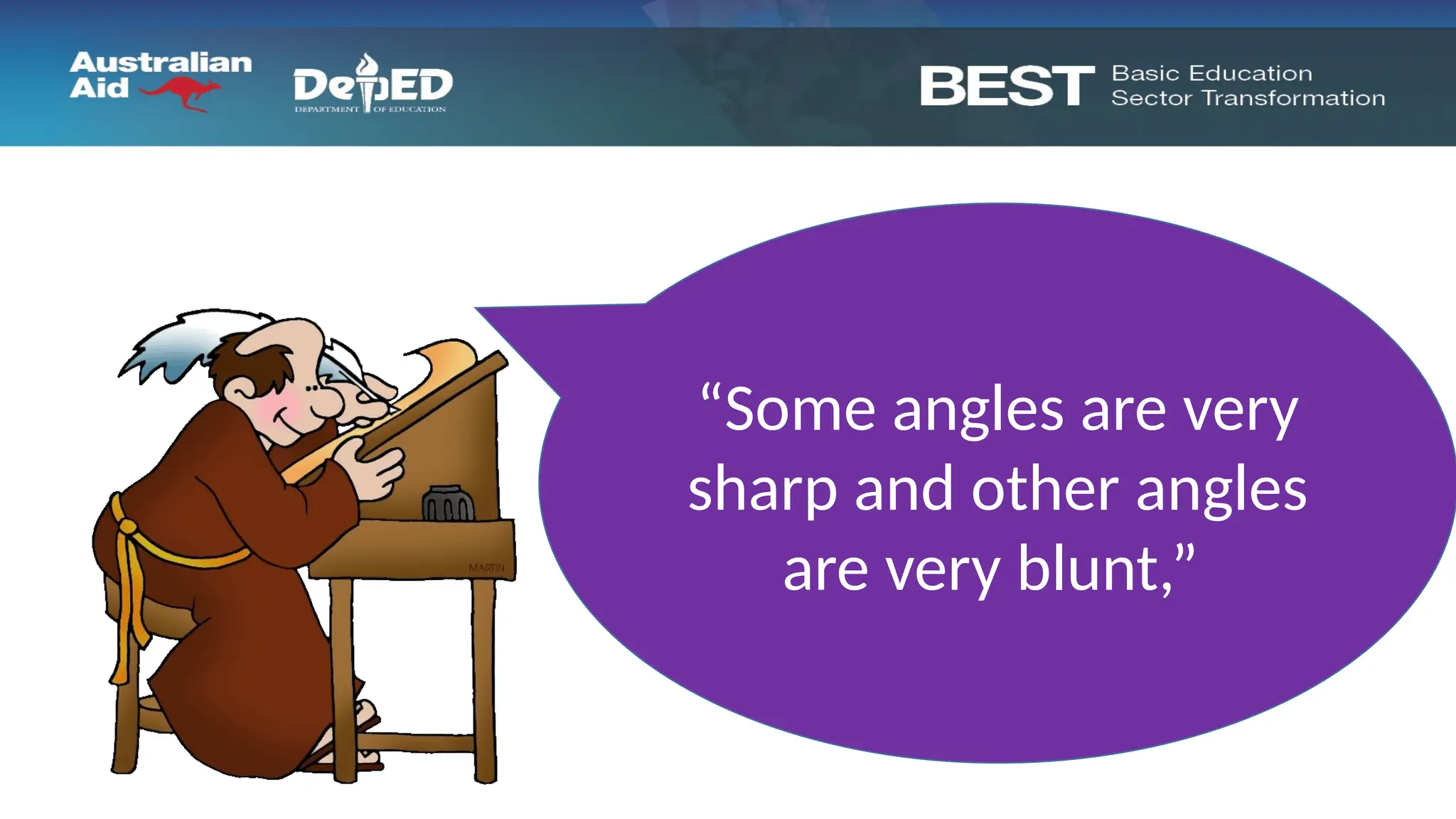
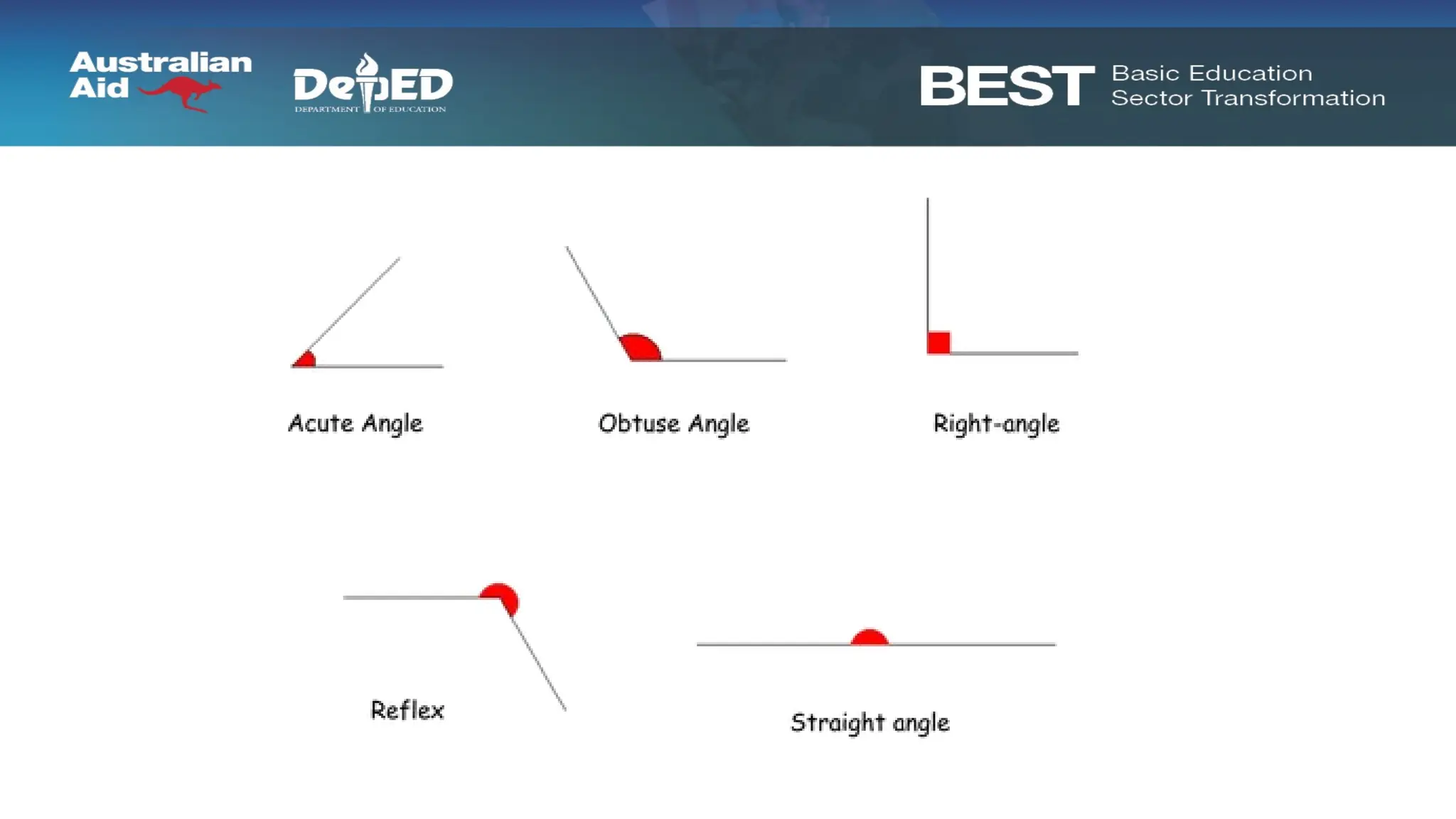
“Some angles are very
sharp and other angles
are very blunt,”
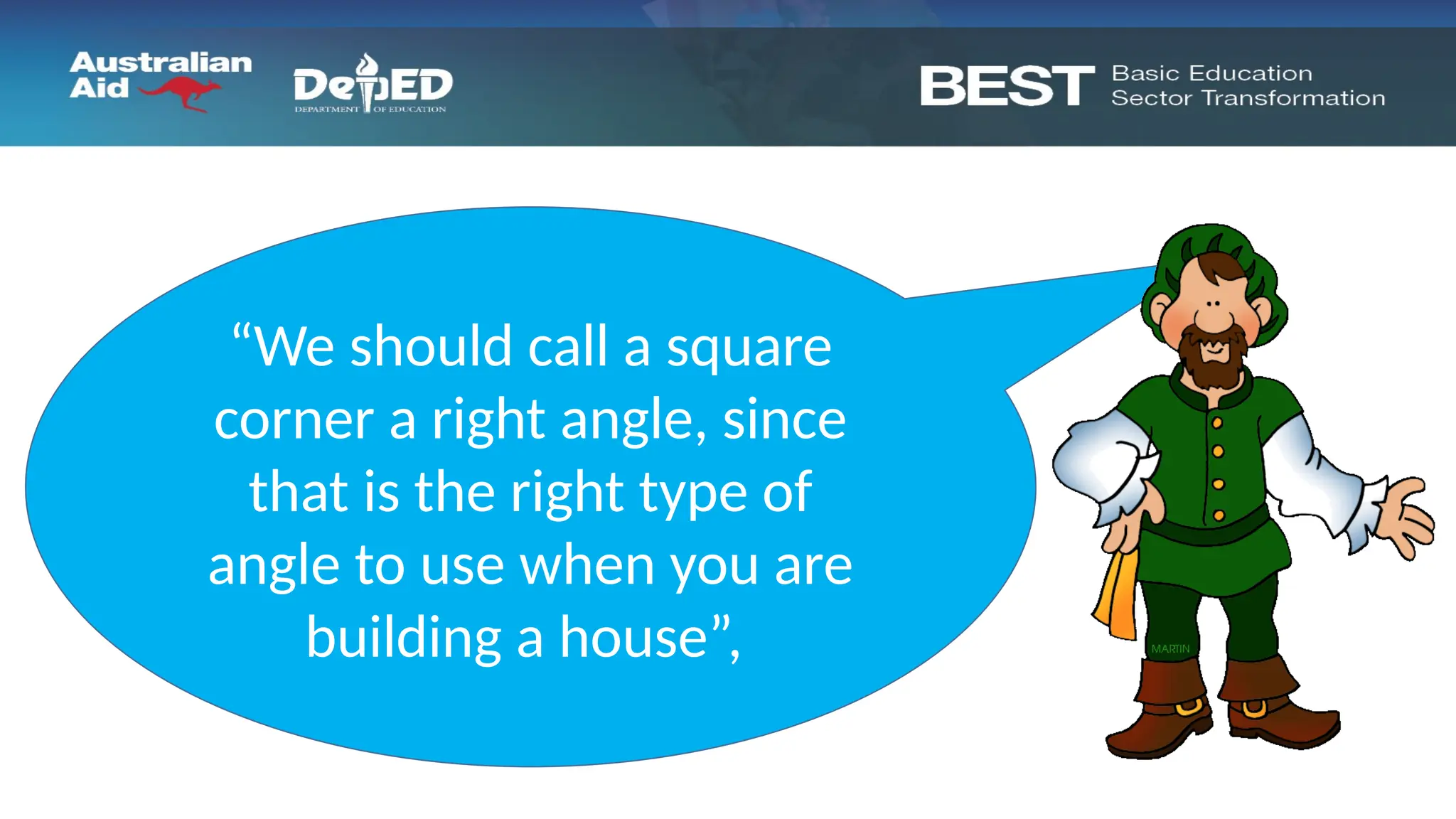
“We should call a square
corner a right angle, since
that is the right type of
angle to use when you are
building a house”,
We decided to use the term acute angle for an angle sharper than a right
angle. We also coined the term obtuse angle for an angle larger than a
right angle.
“You get a very strange
angle if the two rays
point in the opposite
directions”
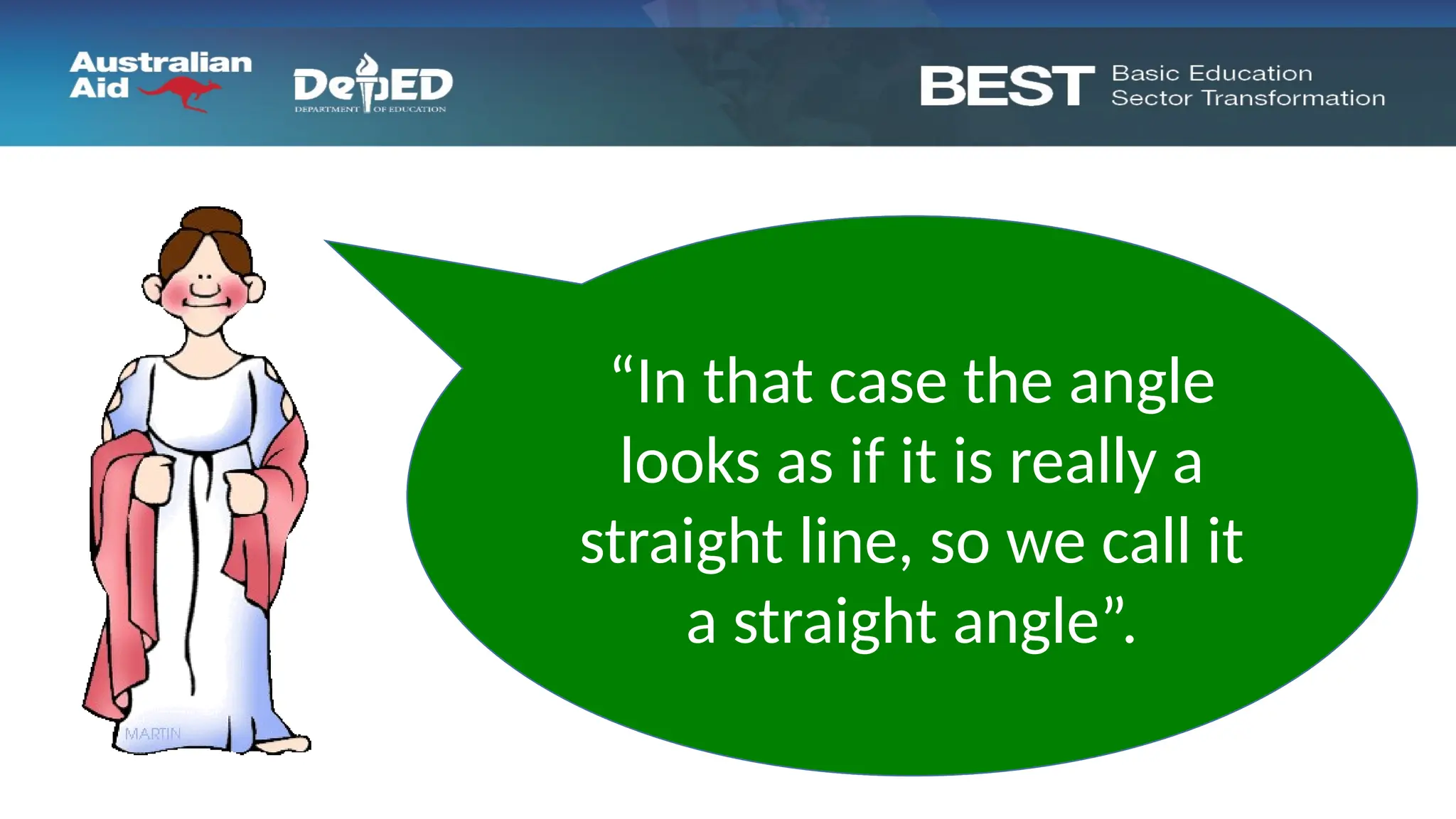
“In that case the angle
looks as if it is really a
straight line, so we call it
a straight angle”.
“We can measure angles
by stating what fraction
of a straight angle the
angle fills”
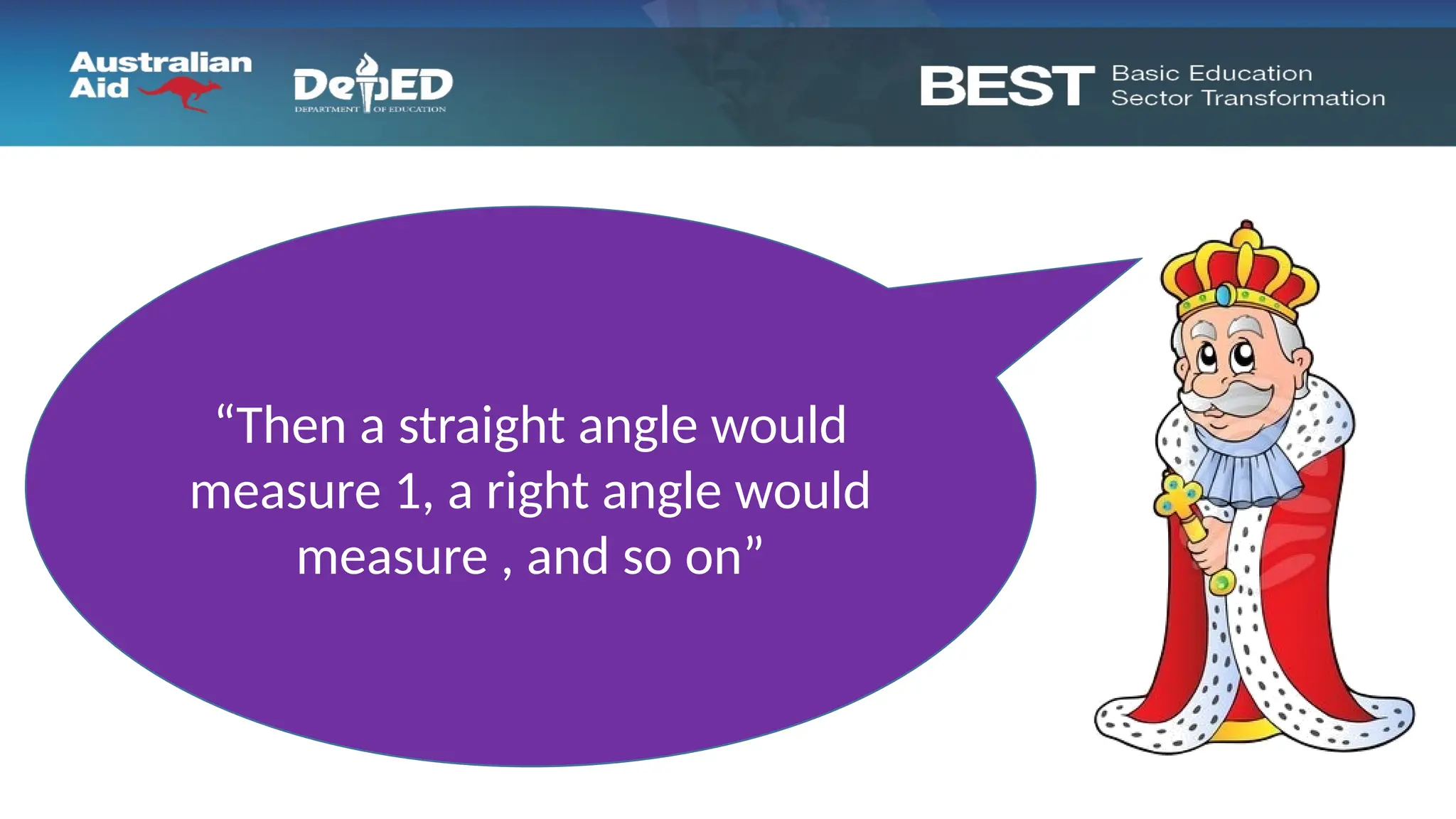
“Then a straight angle would
measure 1, a right angle would
measure , and so on”
“That method will
involve too many
fractions!”
“I would much prefer a system
in which the most commonly
used angles, such as half of a
straight angle, one-third of a
straight angle, and so on, are all
represented by whole
numbers.
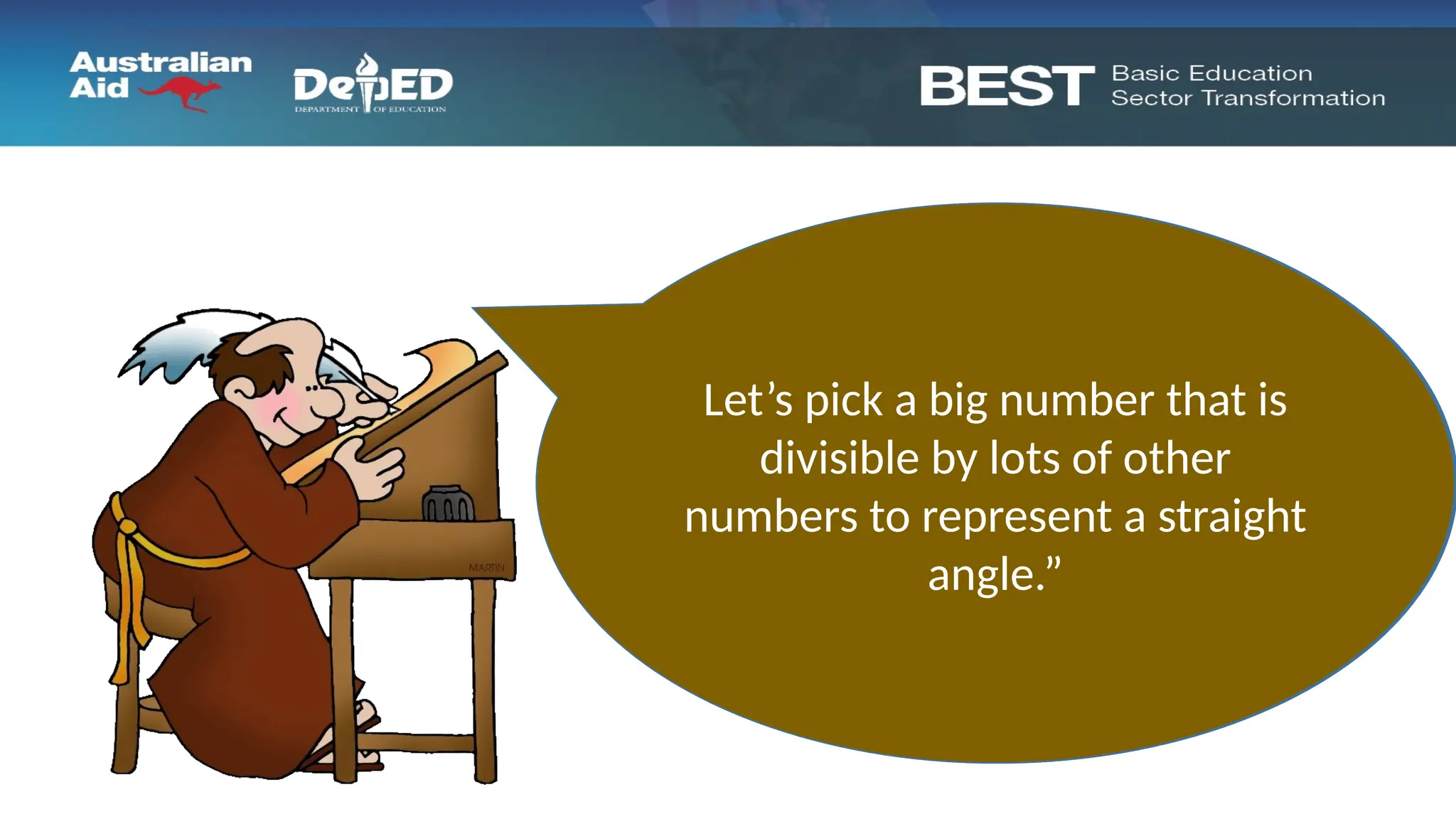
Let’s pick a big number that is
divisible by lots of other
numbers to represent a straight
angle.”
Recordis decided that he wanted to use a number
divisible by all these numbers: 2, 3, 4, 5, 6, 9, 10, 12,
and 15. After some calculation we found that 180
was the smallest number divisible by all these
numbers, so the king issued a Royal Decree.
A straight angle will have a measure of 180
degrees, which we will write as 1800
. A right
angle measures 900
; an angle that is one-
quarter of a straight angle measures 450
; an
angle that is one-sixth of a straight angle
measures 300
; and so on.
40
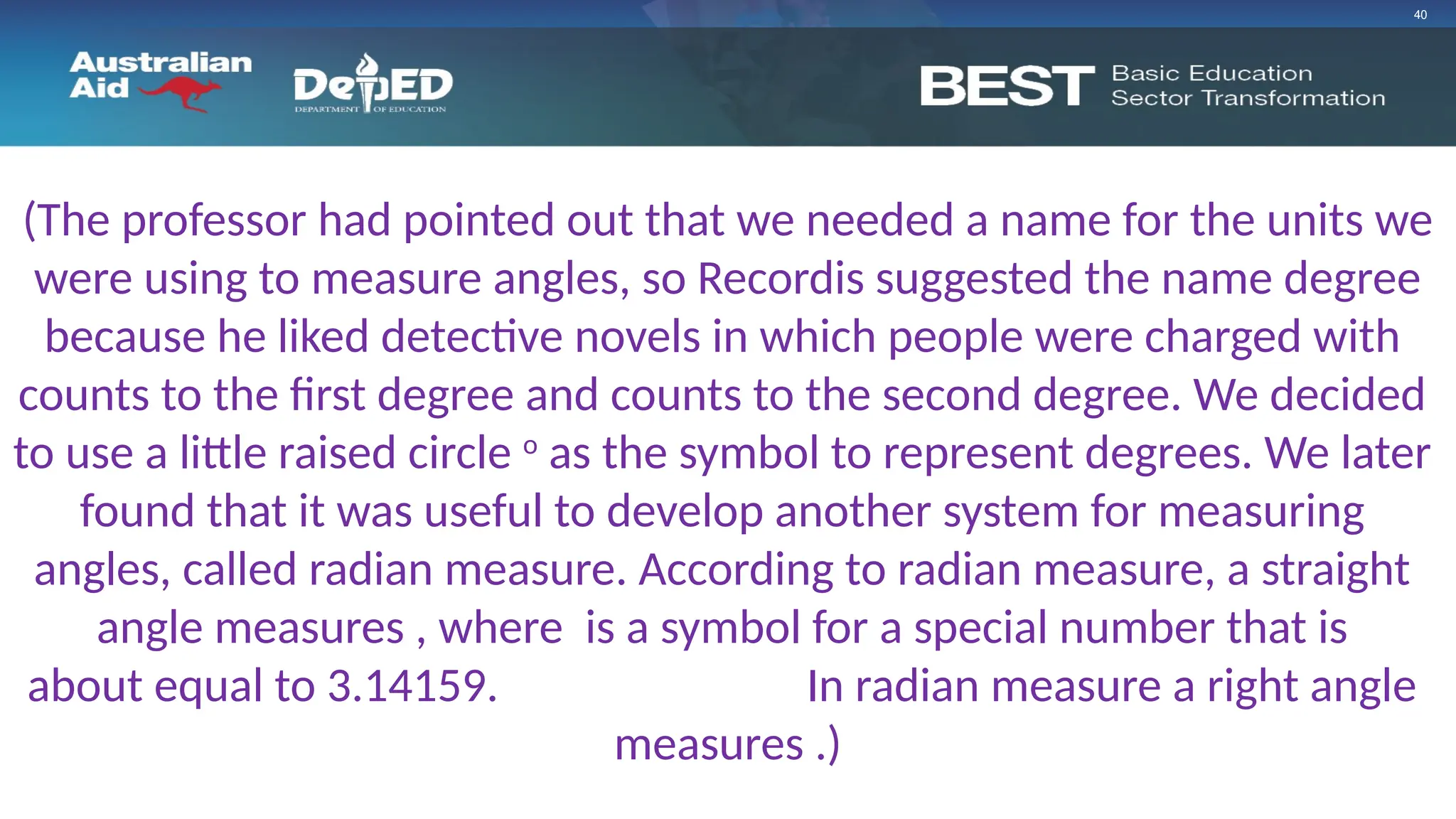
(The professor had pointed out that we needed a name for the units we
were using to measure angles, so Recordis suggested the name degree
because he liked detective novels in which people were charged with
counts to the first degree and counts to the second degree. We decided
to use a little raised circle o
as the symbol to represent degrees. We later
found that it was useful to develop another system for measuring
angles, called radian measure. According to radian measure, a straight
angle measures , where is a symbol for a special number that is
about equal to 3.14159. See Chapter 5. In radian measure a right angle
measures .)
“Now we need to invent
a device that we can use
to measure angles”
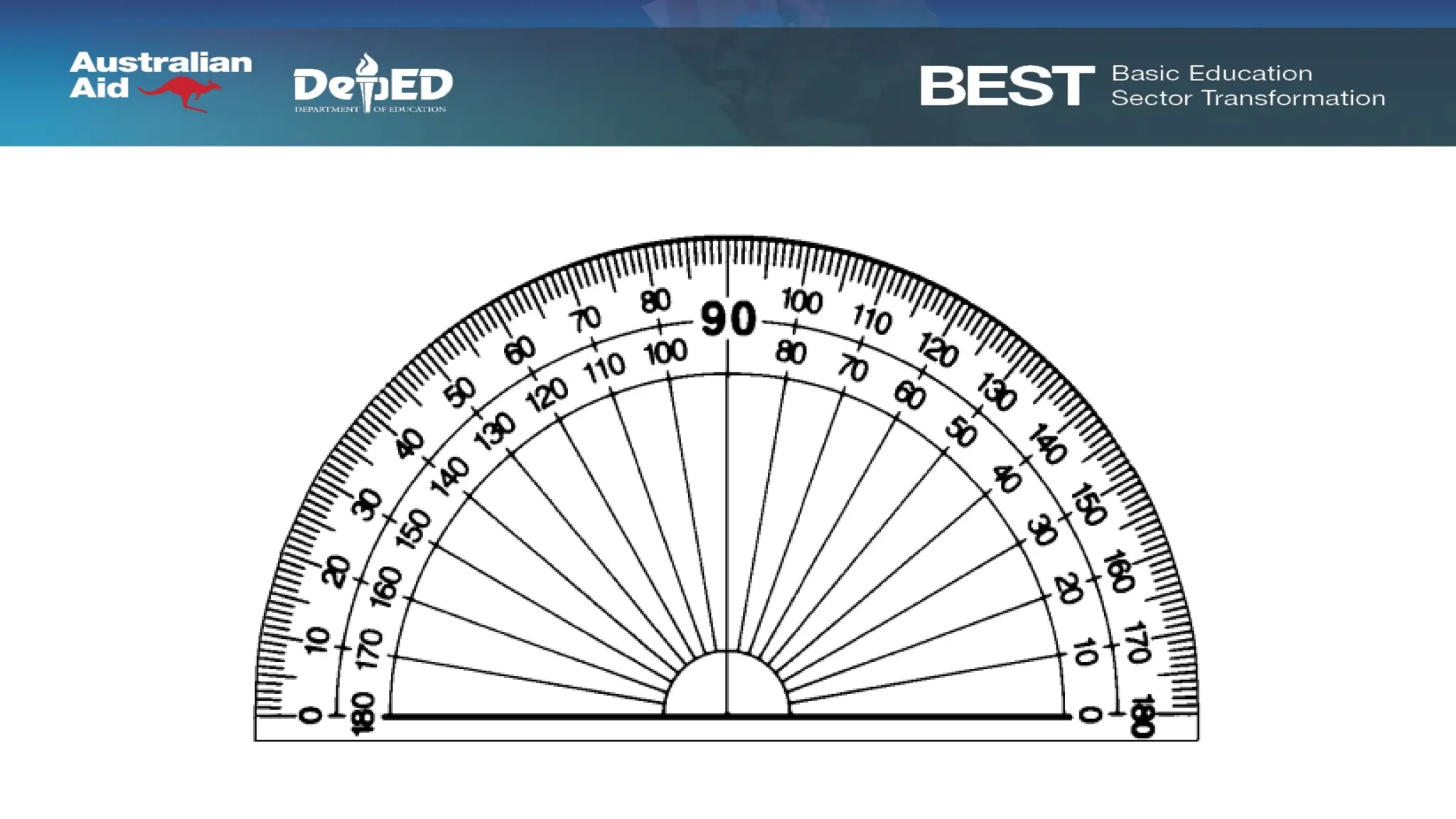
After some discussion, we designed a device shaped like a semicircle
with numbers running from 0 to 180 along the edge. We called this
device a protractor.
The professor wanted to try her new device, so she quickly measured
every angle in sight. Soon she had measured every single angle in the
Royal Palace, so she had to wait for the end of the storm before she
could go outside and measure more angles.
However, as soon as the rain stopped, catastrophe struck. The waters of
the Raging River started to rise, threatening to flood the distant town of
Peaceful Bay.
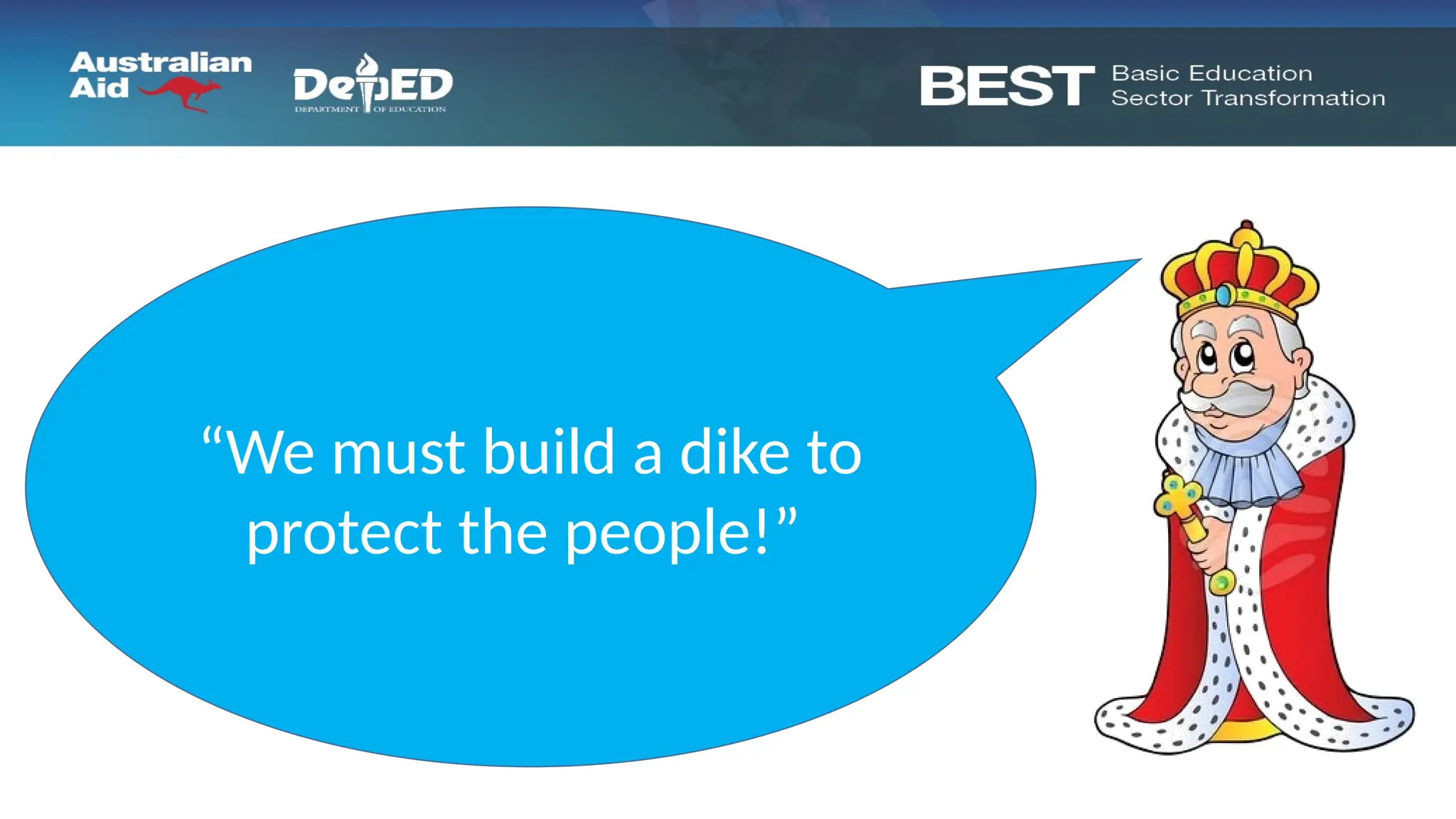
“We must build a dike to
protect the people!”
Builder quickly sprang into action and built a dike.
However, the waters pushed against the dike and the dike
began to tilt dangerously.
“I need a more rigid
shape!”
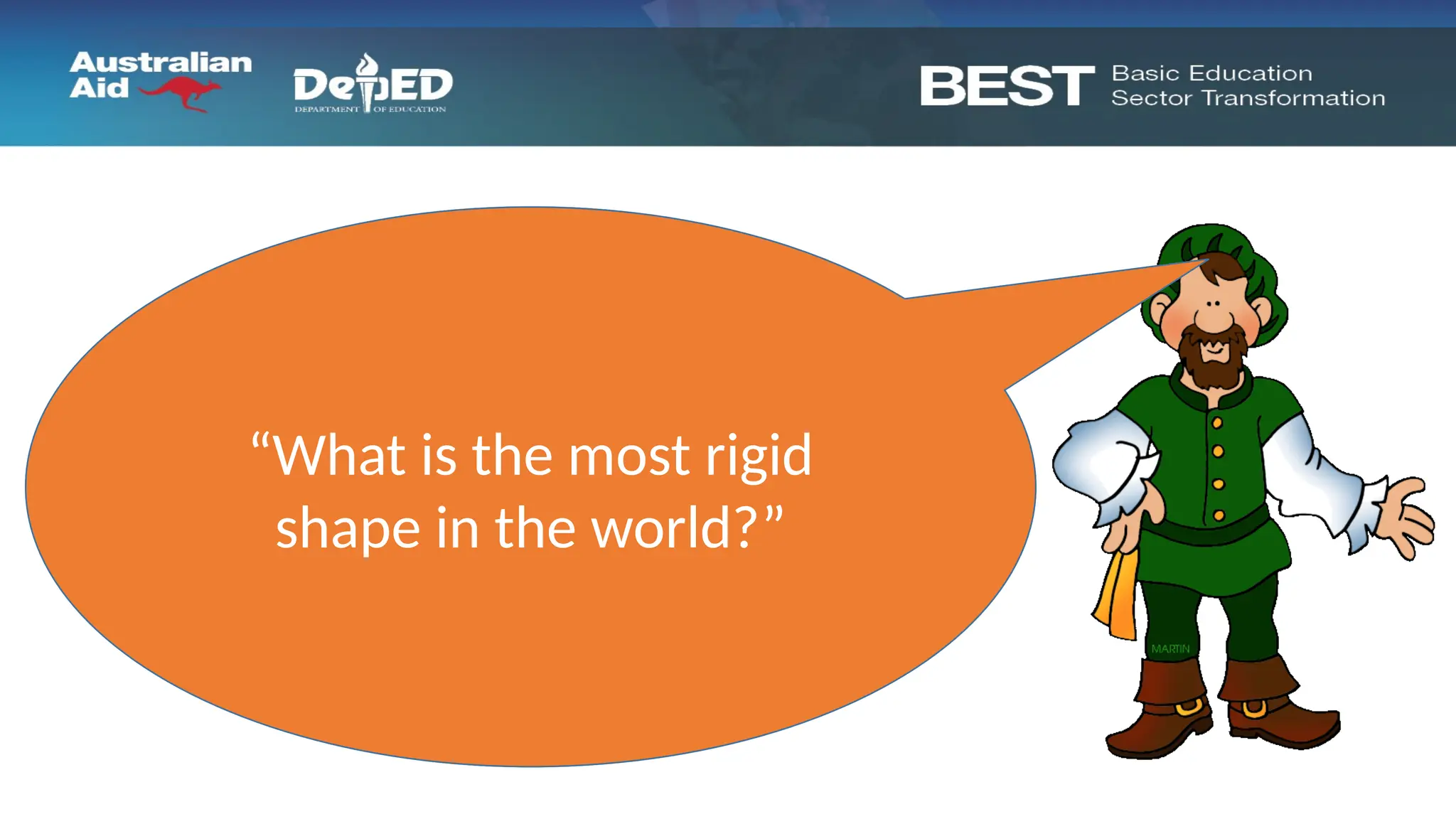
“What is the most rigid
shape in the world?”
We quickly constructed several test shapes. We
constructed squares, pentagons, hexagons, decagons, and
many others. Each shape had unbending sides but flexible
hinges at each vertex, and Pal had no trouble bending
each one out of shape.
“There’s only one
shape we haven’t tried
yet”
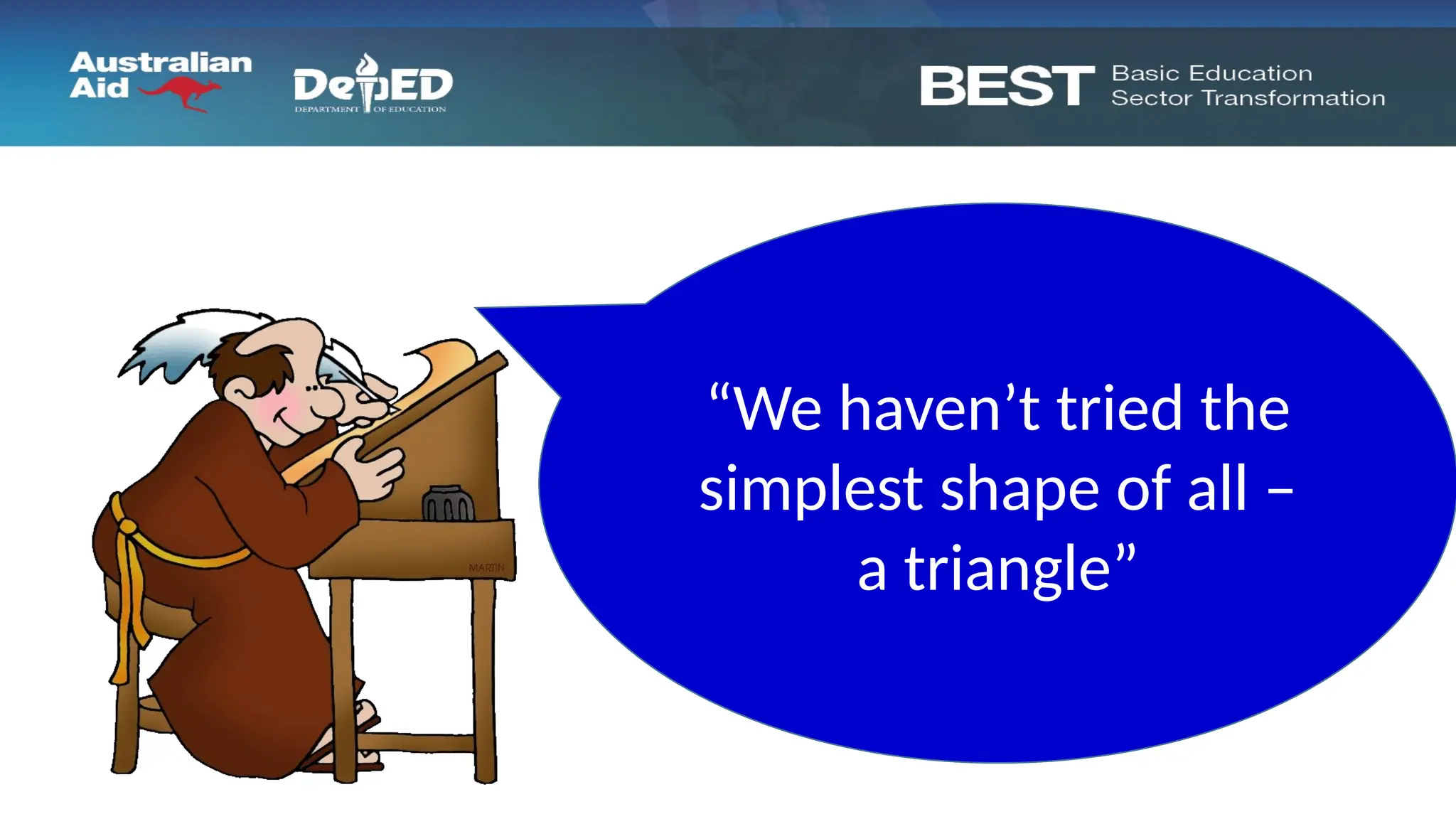
“We haven’t tried the
simplest shape of all –
a triangle”
“A triangle?”
However, Builder quickly constructed a triangle and Pal
was unable to bend it out of shape.
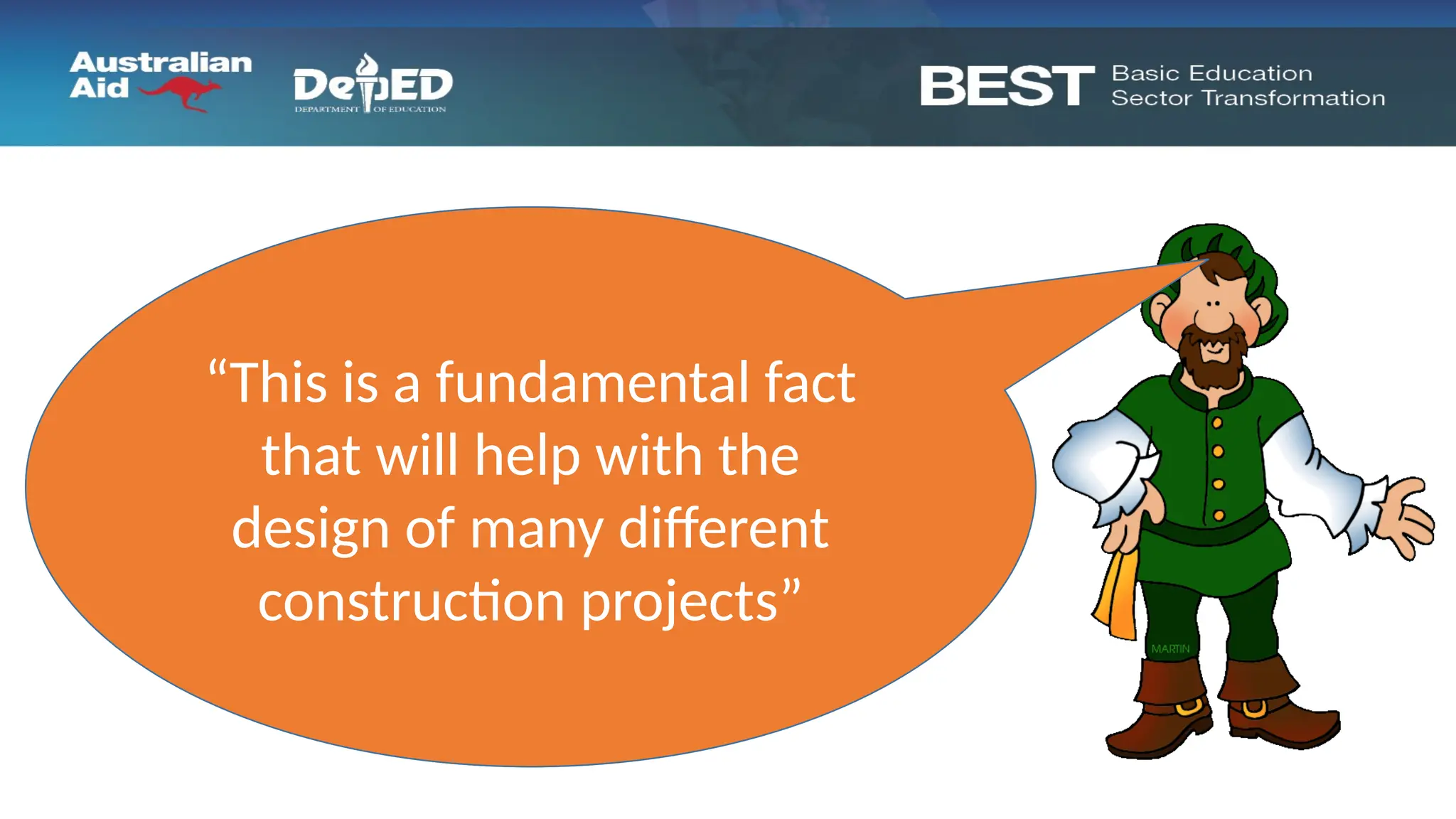
“The triangle is perfectly
rigid!”
“This is a fundamental fact
that will help with the
design of many different
construction projects”
Builder quickly constructed a triangularly shaped support
tower for the dike, and the waters were brought under
control. The town was saved.
In honor of the triangle, we constructed a new park in the middle of
Capital City called Central Plaza Triangle. The professor suddenly became
interested in the entire subject of triangles. Previously she had scorned
triangles as being too simple to be worthy of serious scientific
investigation. However, during the next week she conducted a very
detailed investigation of all types of triangles.
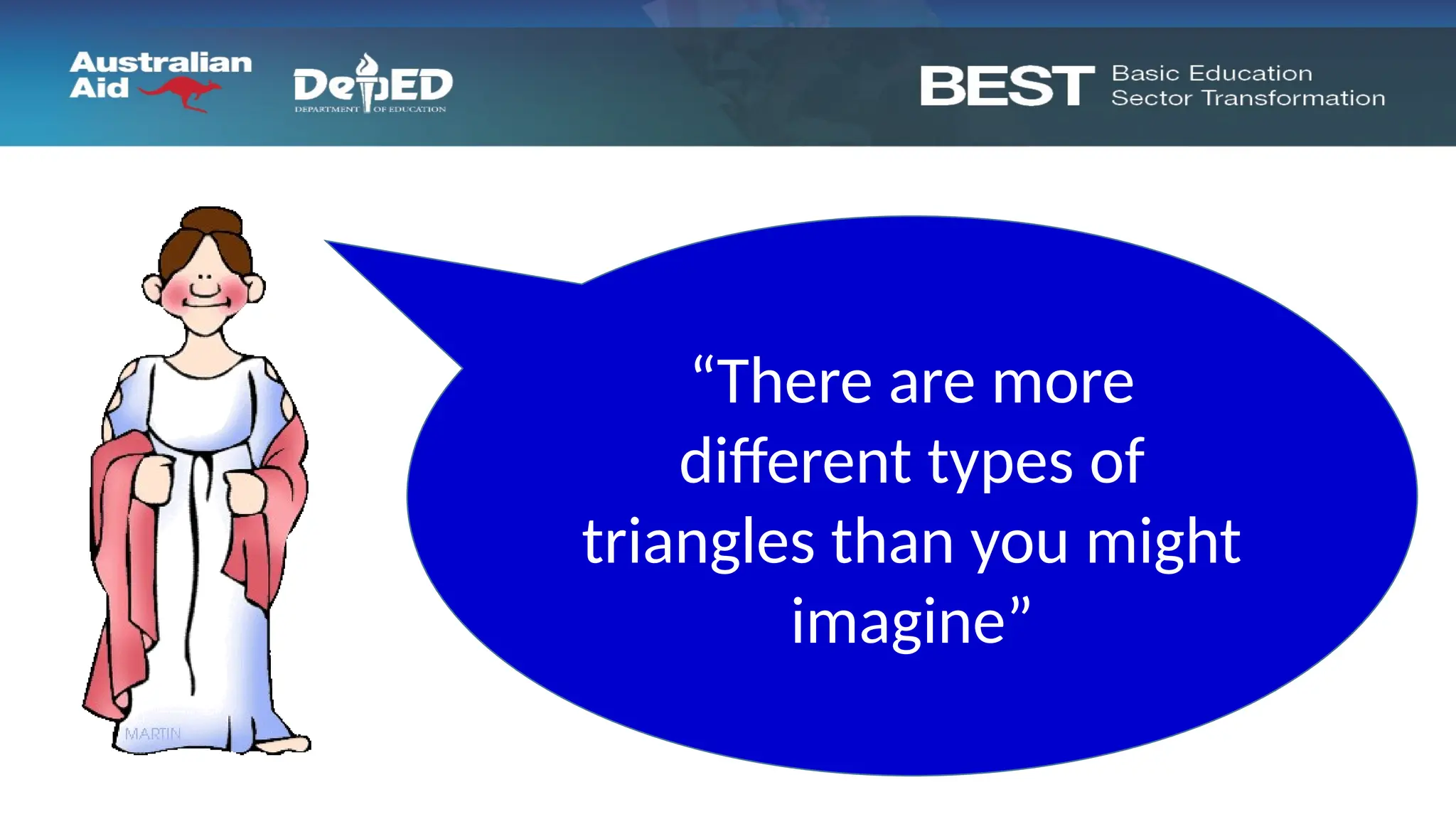
“There are more
different types of
triangles than you might
imagine”
She decided to write a book on triangles. The writing process took a long
time, since she told us that she spent hours contemplating each word.
Finally she was finished, and we were all impressed when she gave us
the first copy of the book to put in the Royal Library. She graciously gave
me permission to reprint the book.
Little did we suspect at the time that this was just the beginning of a
rather remarkable set of adventure. We started out studying triangles,
but along the way we made many other discoveries that were only
slightly related to triangles.
adventures ahead to be continued…
Activity : Too Many Triangles
Activity: Sidewalk Triangle
Activity : Trigonometry Square
• Activity: Triangle Properties Square
1. How did you find the first activity?
2. What are the benefits of storytelling?
3. What helped/hindered you in accomplishing the activity -
Sidewalk Triangle? Trigonometry Square? Triangle Properties
Square?
Questions:
Pre-Viewing Question:
What are the benefits of storytelling?
VIDEO
What can story telling do for your class?
Teachers employ storytelling techniques
for a myriad of reasons, to liven up a
class or to explain a difficult topic.
Benefits of Storytelling
Encourages Discussion
 Storytelling captures children’s imagination, gets them interested and
excited and therefore happy to engage in purposeful talking.
 Storytelling makes children feel safer and more willing to speak out.
Benefits of Storytelling
Creates Enthusiasm and Excitement for Reading
 Storytelling inspires children to read additional texts and find
stories of their own.
 Early development of good reading skills is imperative for
children's development.
Benefits of Storytelling
Improves Listening Skills
 Storytelling is a fantastic way to keep the whole class engaged,
and if you tell a story well they will be hanging on your every
word!
Benefits of Storytelling
Develops Creativity
 Storytelling allows for freedom of expression and use of
imagination.
When I learned about the benefits of storytelling, I realized that
________________________________________________________
________________________________________________________
________________________________________________________
___________________________________________ therefore I will
________________________________________________________
________________________________________________________
________________________________________________________
__________________________________________________.
Reflection:
Application:
Make a flow chart of steps you will undertake to encourage
storytelling in the classroom.
S17 - Too Many Triangles,, Understanding Trigonometric Functions.pptx

S17 - Too Many Triangles,, Understanding Trigonometric Functions.pptx

  • 1.
    Pedagogical Retooling inMathematics, Languages, and Science for Junior High School
  • 2.
    Too Many Triangles (UnderstandingTrigonometric Functions) (Adapted fromToo ManyTriangles:UnderstandingTrigonometric Functions, aTrainer’sTraining Resource Package by Mr.John Joseph P.Lontoc and Mrs.Marjorie Salcedo-Javier) BRENLY B. MENDOZA Ligao National High School Ligao City Division Region V
  • 3.
    1. explore basicconcepts on trigonometry using storytelling 2. analyze situations, check for limitations, and examine appropriate methods of solutions using trigonometry 3. practice manipulating trigonometric functions and in substituting equivalent expressions 4. use trigonometric relationships to determine lengths and angle measures 5. demonstrate understanding that the essence of knowledge and relationship of the components is structure 6. work in small groups encouraging others and communicating thoughts OBJECTIVES
  • 4.
  • 5.
  • 6.
  • 7.
    Characters: Gerard Macinius Builder -theroyal construction engineer
  • 8.
    Characters: Professor Stanislavsky - thekingdom’s leading pure mathematician
  • 9.
  • 10.
    Once upon atime…
  • 11.
    …in a farawayKingdom of Carmorra it rained for days. Everybody in the entire kingdom of Carmorra was forced to stay inside to avoid the drenching downpour. I took refuge in the king’s palace along with the other members of the Royal Court.
  • 12.
    I had beenresiding in the palace since I’d been stranded in the strange faraway land of Carmorra by a shipwreck. Marcus Recordis- the Royal keeper of the records starred dolefully out the main conference room window.
  • 13.
    “Rain, rain, goaway; come again some other day,” “I think we should change the tilt of the roof,” “Rain, rain, go away; come again some other day.”
  • 14.
    he sighed. Hewatched the rainwater slide off the sloped roof of the palace.
  • 15.
    “Rain, rain, goaway; come again some other day,” “I think we should change the tilt of the roof,” “I think we should change the tilt of the roof,”
  • 16.
  • 17.
    “Rain, rain, goaway; come again some other day,” “I think we should change the tilt of the roof,” “If we made the roof steeper, then the water would run off the roof more easily.”
  • 18.
    “If you wantto change the steepness of the roof, you will have to be very specific and tell me precisely how much tilt you want.”
  • 19.
    “I don’t knowhow to measure the amount of tilt of a roof,”
  • 20.
    “Most of thewalls in this building will meet to form square corners,” “However, at one location two walls will meet but they will not form a square corner. Before I can proceed I must have a way to precisely measure the angle between two walls.”
  • 21.
    “I need tohit the cue ball against the wall and have it bounce back to hit the eight ball“ “I need to calculate my direction of aim. I wish we had a more precise way to measure directions”.
  • 22.
    “I know howto find the solution to all these problems,” “We need a way to measure angles!”
  • 23.
    “First we hadbetter define precisely what we mean by the word angle”
  • 24.
    “That’s easy,” “An angleis a place where two lines cross each other”
  • 26.
    “It looks tome as if a crossing place between two lines forms four angles “
  • 27.
    “To avoid thatproblem we will say that an angle is a place where the end points of two rays meet each other” “Remember that a ray is like half a line. A line goes off to infinity in two directions, but a ray has one end point and then it goes off to infinity in one direction”.
  • 28.
    “Ah! the beamof light from Pal’s toy ray gun is like a ray” “The beam starts at the gun and then goes off to infinity in a straight line”
  • 29.
    “We’ll call thepoint where the two rays meet the vertex of the angle “ “We will call one of the rays the initial side and the other ray the terminal side”
  • 31.
    “Some angles arevery sharp and other angles are very blunt,”
  • 32.
    “We should calla square corner a right angle, since that is the right type of angle to use when you are building a house”,
  • 33.
    We decided touse the term acute angle for an angle sharper than a right angle. We also coined the term obtuse angle for an angle larger than a right angle.
  • 34.
    “You get avery strange angle if the two rays point in the opposite directions” “In that case the angle looks as if it is really a straight line, so we call it a straight angle”.
  • 36.
    “We can measureangles by stating what fraction of a straight angle the angle fills” “Then a straight angle would measure 1, a right angle would measure , and so on”
  • 37.
    “That method will involvetoo many fractions!” “I would much prefer a system in which the most commonly used angles, such as half of a straight angle, one-third of a straight angle, and so on, are all represented by whole numbers. Let’s pick a big number that is divisible by lots of other numbers to represent a straight angle.”
  • 38.
    Recordis decided thathe wanted to use a number divisible by all these numbers: 2, 3, 4, 5, 6, 9, 10, 12, and 15. After some calculation we found that 180 was the smallest number divisible by all these numbers, so the king issued a Royal Decree.
  • 39.
    A straight anglewill have a measure of 180 degrees, which we will write as 1800 . A right angle measures 900 ; an angle that is one- quarter of a straight angle measures 450 ; an angle that is one-sixth of a straight angle measures 300 ; and so on.
  • 40.
    40 (The professor hadpointed out that we needed a name for the units we were using to measure angles, so Recordis suggested the name degree because he liked detective novels in which people were charged with counts to the first degree and counts to the second degree. We decided to use a little raised circle o as the symbol to represent degrees. We later found that it was useful to develop another system for measuring angles, called radian measure. According to radian measure, a straight angle measures , where is a symbol for a special number that is about equal to 3.14159. See Chapter 5. In radian measure a right angle measures .)
  • 41.
    “Now we needto invent a device that we can use to measure angles”
  • 42.
    After some discussion,we designed a device shaped like a semicircle with numbers running from 0 to 180 along the edge. We called this device a protractor.
  • 44.
    The professor wantedto try her new device, so she quickly measured every angle in sight. Soon she had measured every single angle in the Royal Palace, so she had to wait for the end of the storm before she could go outside and measure more angles. However, as soon as the rain stopped, catastrophe struck. The waters of the Raging River started to rise, threatening to flood the distant town of Peaceful Bay.
  • 45.
    “We must builda dike to protect the people!”
  • 46.
    Builder quickly spranginto action and built a dike. However, the waters pushed against the dike and the dike began to tilt dangerously.
  • 47.
    “I need amore rigid shape!” “What is the most rigid shape in the world?”
  • 48.
    We quickly constructedseveral test shapes. We constructed squares, pentagons, hexagons, decagons, and many others. Each shape had unbending sides but flexible hinges at each vertex, and Pal had no trouble bending each one out of shape.
  • 49.
    “There’s only one shapewe haven’t tried yet” “We haven’t tried the simplest shape of all – a triangle”
  • 50.
  • 51.
    However, Builder quicklyconstructed a triangle and Pal was unable to bend it out of shape.
  • 52.
    “The triangle isperfectly rigid!” “This is a fundamental fact that will help with the design of many different construction projects”
  • 53.
    Builder quickly constructeda triangularly shaped support tower for the dike, and the waters were brought under control. The town was saved.
  • 54.
    In honor ofthe triangle, we constructed a new park in the middle of Capital City called Central Plaza Triangle. The professor suddenly became interested in the entire subject of triangles. Previously she had scorned triangles as being too simple to be worthy of serious scientific investigation. However, during the next week she conducted a very detailed investigation of all types of triangles.
  • 55.
    “There are more differenttypes of triangles than you might imagine”
  • 56.
    She decided towrite a book on triangles. The writing process took a long time, since she told us that she spent hours contemplating each word. Finally she was finished, and we were all impressed when she gave us the first copy of the book to put in the Royal Library. She graciously gave me permission to reprint the book.
  • 57.
    Little did wesuspect at the time that this was just the beginning of a rather remarkable set of adventure. We started out studying triangles, but along the way we made many other discoveries that were only slightly related to triangles. adventures ahead to be continued…
  • 58.
    Activity : TooMany Triangles
  • 59.
  • 61.
  • 62.
    • Activity: TriangleProperties Square
  • 63.
    1. How didyou find the first activity? 2. What are the benefits of storytelling? 3. What helped/hindered you in accomplishing the activity - Sidewalk Triangle? Trigonometry Square? Triangle Properties Square? Questions:
  • 64.
    Pre-Viewing Question: What arethe benefits of storytelling?
  • 65.
  • 66.
    What can storytelling do for your class? Teachers employ storytelling techniques for a myriad of reasons, to liven up a class or to explain a difficult topic.
  • 67.
    Benefits of Storytelling EncouragesDiscussion  Storytelling captures children’s imagination, gets them interested and excited and therefore happy to engage in purposeful talking.  Storytelling makes children feel safer and more willing to speak out.
  • 68.
    Benefits of Storytelling CreatesEnthusiasm and Excitement for Reading  Storytelling inspires children to read additional texts and find stories of their own.  Early development of good reading skills is imperative for children's development.
  • 69.
    Benefits of Storytelling ImprovesListening Skills  Storytelling is a fantastic way to keep the whole class engaged, and if you tell a story well they will be hanging on your every word!
  • 70.
    Benefits of Storytelling DevelopsCreativity  Storytelling allows for freedom of expression and use of imagination.
  • 71.
    When I learnedabout the benefits of storytelling, I realized that ________________________________________________________ ________________________________________________________ ________________________________________________________ ___________________________________________ therefore I will ________________________________________________________ ________________________________________________________ ________________________________________________________ __________________________________________________. Reflection:
  • 72.
    Application: Make a flowchart of steps you will undertake to encourage storytelling in the classroom.

Editor's Notes

  • #1 Good ______ everyone. I am __________ of ____________. Welcome to an exciting LAC session 17. Our topic for today is “ Too Many Triangles (Understanding Trigonometric Funstions).
  • #57 Activity #1: Too many Triangles Activity #2: Sidewalk Triangle
  • #58 Distribute the activity sheet. Perform that individually. Mam May will facilitate the next activity.
  • #59 Mam May will facilitate the next activity.
  • #60 Before we perform the next activity, let’s watch this video
  • #62 FUNCTION HEXAGON
  • #65 Let’s watch and listen to the video of Teacher Marj.