A growing number of top W. P. Carey
finance students are running with the bulls
on Wall Street during summer internships.
And they are performing so well that many
of them are offered full-time jobs in New
York City after graduation.
One of the main reasons for their success
is the ASU Investment Banking Industry
Scholars program (IBIS), which teaches
students the inner workings of the finance
industry and helps prepare them for the
super-competitive atmosphere in high-
powered Wall Street banking and
investment firms.
Three of the latest finance graduates
to make the transition from Tempe to
Manhattan are Aaron Gladstone, Colby Wise
and Jesse Mayfield, who were roommates
in New York during their internships in the
summer of 2009. Now they are rooming
together again in the Big Apple and working
full-time jobs on Wall Street.
“It’s very difficult to achieve success
on your own, which is why we are
sticking together,” says Gladstone, who is
working in the mergers and acquisitions
division at London-based HSBC, one
of the world’s largest banking groups.
“We have amazing chemistry as a
team, and can tackle problems and
ideas together. Three heads are
better than one, and we will do as
much as possible to keep this team
environment of support together.”
Mayfield, like Gladstone, did his
internship at HSBC. But he decided to accept
a full-time position as an analyst in the Sales
and Trading Division at Citigroup.
Wise was hired by Goldman Sachs & Co.
as a trading analyst in the Global Interest
Rate Products Group. He had interned with
Goldman Sachs in the summer of 2009 and,
before that, with J.P. Morgan in 2008.
Mayfield believes he and his friends had
to work harder to land positions in New York
City because ASU is not one of the “core”
schools that are usually recruited by East
Coast firms. Once on the job, they made sure
they were first at work each morning, last to
leave at night and brought to the job the same
passion they had shown in securing those
internships.
“We didn’t take our internships for
granted,” Mayfield says. “We worked
hard to get there, and that work ethic
carried over.”
All three W. P. Carey graduates also
believe that they had two things going for
them that helped them stand out among
the students from elite schools: a top-notch
education in the Finance Department and
their participation in IBIS. Their finance
classes taught them basic but powerful
analytical skills and fostered the same
kind of teamwork and open discussion they
experienced during their internships, giving
them an advantage over students from
schools with a different learning style.
“I’d heard more, I’d seen more,” Wise
says. In his new job, he adds, “I will feel
confident because of my education.”
All three W. P. Carey graduates also credit
IBIS with their success in landing investment
banking internships and then jobs. “IBIS
shows students that although there
may be an uphill battle in obtaining
an internship on Wall Street, the
battle is a feasible one,” Mayfield says.
“It just takes a lot of hard work and personal
sacrifice. The program teaches new members
how big investment banks recruit and it
utilizes past member experiences to enhance
the program.”
W. P. Carey students who participate
in IBIS stack up well when compared to
graduates of Wharton, Columbia, Harvard
and other East Coast schools whose students
are recruited for Wall Street jobs. And they
enjoy a near-100 percent placement rate.
“I would say our IBIS members
are at least equally qualified from an
academic standpoint,” says Clinical
Associate Professor of Finance Werner
Bonadurer, a faculty advisor in the program.
“They have no problem competing.”
Continued on the next page
Alumni Running with the Bulls
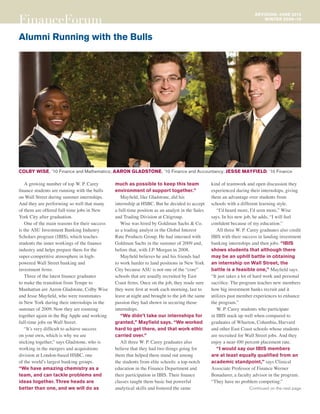
COLBY WISE, ’10 Finance and Mathematics; AARON GLADSTONE, ’10 Finance and Accountancy; JESSE MAYFIELD, ’10 Finance
REVISION: JUNE 2010
WINTER 2009–10
FinanceForum
Gladstone, Wise and Mayfield were more
than just members of IBIS. They also helped
make it better. When they joined IBIS, they
immediately saw ways they could improve
the organization by shifting the structure,
says Rey Santos, undergraduate career
consultant and coordinator of IBIS.
In order to prepare students for careers
in high finance, they assisted in further
developing a curriculum that focuses in part
on interview techniques, networking and
resume writing – so-called “soft skills,”
Bonadurer says. In addition, IBIS members
learn the inner workings of the industry,
its structure and trading strategies. He
calls it the “inside information” outside of
FinanceForum
Continued from previous page
Running with the Bulls
coursework that helps prepare students for a
competitive industry.
IBIS draws the most committed investment
banking students, Bonadurer says. “It’s the
cream of the investment-banking-oriented
group. It is clearly one of the strongest
possible signals one might see on a resume.”
Each IBIS meeting covers such topics
as sell side, buy side and recruitment.
Conference calls from East Coast banking
firms connect IBIS members with
professionals, including prominent ASU
alumni.
IBIS students also rely on each other to
share personal experiences.
REVISION: JUNE 2010
WINTER 2009–10
“The great thing about the program is we
start students early, ideally as freshmen and
sophomores, and by the time they’re juniors
and seniors they have gotten that experience
and can give back to younger students,”
Santos says. “That’s the cycle we hope to
continue.”
Gladstone, Wise and Mayfield also put
together a 50-page guidebook of information
students need to enter the investment
banking field. Hours of work went into
improving IBIS, but the three believe it’s their
responsibility to give back.
“It’s a rewarding feeling watching
other people succeed as well,”
Mayfield says.

Running with the Bulls_ASU

  • 1.
    A growing numberof top W. P. Carey finance students are running with the bulls on Wall Street during summer internships. And they are performing so well that many of them are offered full-time jobs in New York City after graduation. One of the main reasons for their success is the ASU Investment Banking Industry Scholars program (IBIS), which teaches students the inner workings of the finance industry and helps prepare them for the super-competitive atmosphere in high- powered Wall Street banking and investment firms. Three of the latest finance graduates to make the transition from Tempe to Manhattan are Aaron Gladstone, Colby Wise and Jesse Mayfield, who were roommates in New York during their internships in the summer of 2009. Now they are rooming together again in the Big Apple and working full-time jobs on Wall Street. “It’s very difficult to achieve success on your own, which is why we are sticking together,” says Gladstone, who is working in the mergers and acquisitions division at London-based HSBC, one of the world’s largest banking groups. “We have amazing chemistry as a team, and can tackle problems and ideas together. Three heads are better than one, and we will do as much as possible to keep this team environment of support together.” Mayfield, like Gladstone, did his internship at HSBC. But he decided to accept a full-time position as an analyst in the Sales and Trading Division at Citigroup. Wise was hired by Goldman Sachs & Co. as a trading analyst in the Global Interest Rate Products Group. He had interned with Goldman Sachs in the summer of 2009 and, before that, with J.P. Morgan in 2008. Mayfield believes he and his friends had to work harder to land positions in New York City because ASU is not one of the “core” schools that are usually recruited by East Coast firms. Once on the job, they made sure they were first at work each morning, last to leave at night and brought to the job the same passion they had shown in securing those internships. “We didn’t take our internships for granted,” Mayfield says. “We worked hard to get there, and that work ethic carried over.” All three W. P. Carey graduates also believe that they had two things going for them that helped them stand out among the students from elite schools: a top-notch education in the Finance Department and their participation in IBIS. Their finance classes taught them basic but powerful analytical skills and fostered the same kind of teamwork and open discussion they experienced during their internships, giving them an advantage over students from schools with a different learning style. “I’d heard more, I’d seen more,” Wise says. In his new job, he adds, “I will feel confident because of my education.” All three W. P. Carey graduates also credit IBIS with their success in landing investment banking internships and then jobs. “IBIS shows students that although there may be an uphill battle in obtaining an internship on Wall Street, the battle is a feasible one,” Mayfield says. “It just takes a lot of hard work and personal sacrifice. The program teaches new members how big investment banks recruit and it utilizes past member experiences to enhance the program.” W. P. Carey students who participate in IBIS stack up well when compared to graduates of Wharton, Columbia, Harvard and other East Coast schools whose students are recruited for Wall Street jobs. And they enjoy a near-100 percent placement rate. “I would say our IBIS members are at least equally qualified from an academic standpoint,” says Clinical Associate Professor of Finance Werner Bonadurer, a faculty advisor in the program. “They have no problem competing.” Continued on the next page Alumni Running with the Bulls COLBY WISE, ’10 Finance and Mathematics; AARON GLADSTONE, ’10 Finance and Accountancy; JESSE MAYFIELD, ’10 Finance REVISION: JUNE 2010 WINTER 2009–10 FinanceForum
  • 2.
    Gladstone, Wise andMayfield were more than just members of IBIS. They also helped make it better. When they joined IBIS, they immediately saw ways they could improve the organization by shifting the structure, says Rey Santos, undergraduate career consultant and coordinator of IBIS. In order to prepare students for careers in high finance, they assisted in further developing a curriculum that focuses in part on interview techniques, networking and resume writing – so-called “soft skills,” Bonadurer says. In addition, IBIS members learn the inner workings of the industry, its structure and trading strategies. He calls it the “inside information” outside of FinanceForum Continued from previous page Running with the Bulls coursework that helps prepare students for a competitive industry. IBIS draws the most committed investment banking students, Bonadurer says. “It’s the cream of the investment-banking-oriented group. It is clearly one of the strongest possible signals one might see on a resume.” Each IBIS meeting covers such topics as sell side, buy side and recruitment. Conference calls from East Coast banking firms connect IBIS members with professionals, including prominent ASU alumni. IBIS students also rely on each other to share personal experiences. REVISION: JUNE 2010 WINTER 2009–10 “The great thing about the program is we start students early, ideally as freshmen and sophomores, and by the time they’re juniors and seniors they have gotten that experience and can give back to younger students,” Santos says. “That’s the cycle we hope to continue.” Gladstone, Wise and Mayfield also put together a 50-page guidebook of information students need to enter the investment banking field. Hours of work went into improving IBIS, but the three believe it’s their responsibility to give back. “It’s a rewarding feeling watching other people succeed as well,” Mayfield says.