









BART
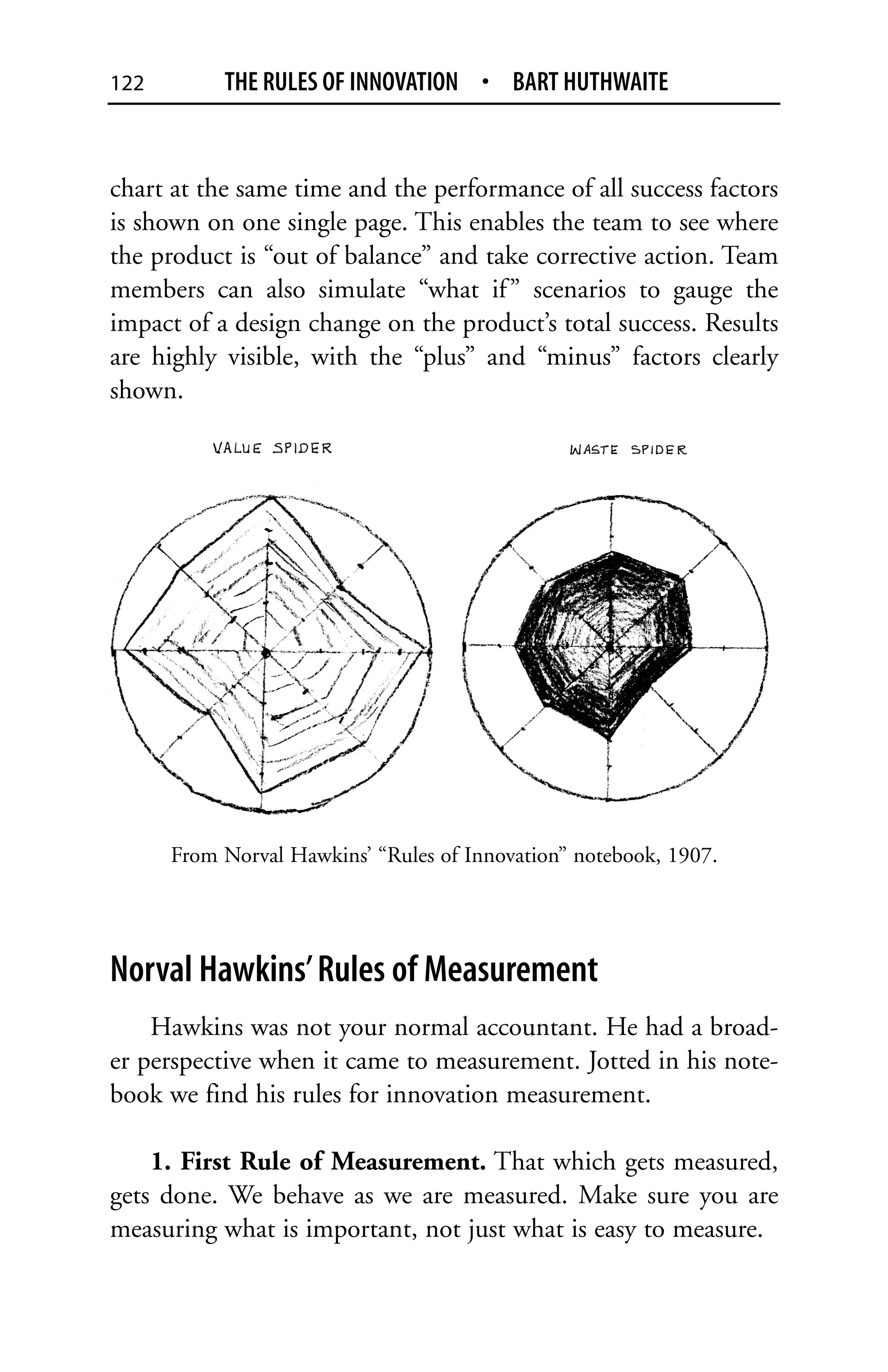
HUTHWAITE
 INSTITUTE FOR LEAN INNOVATION
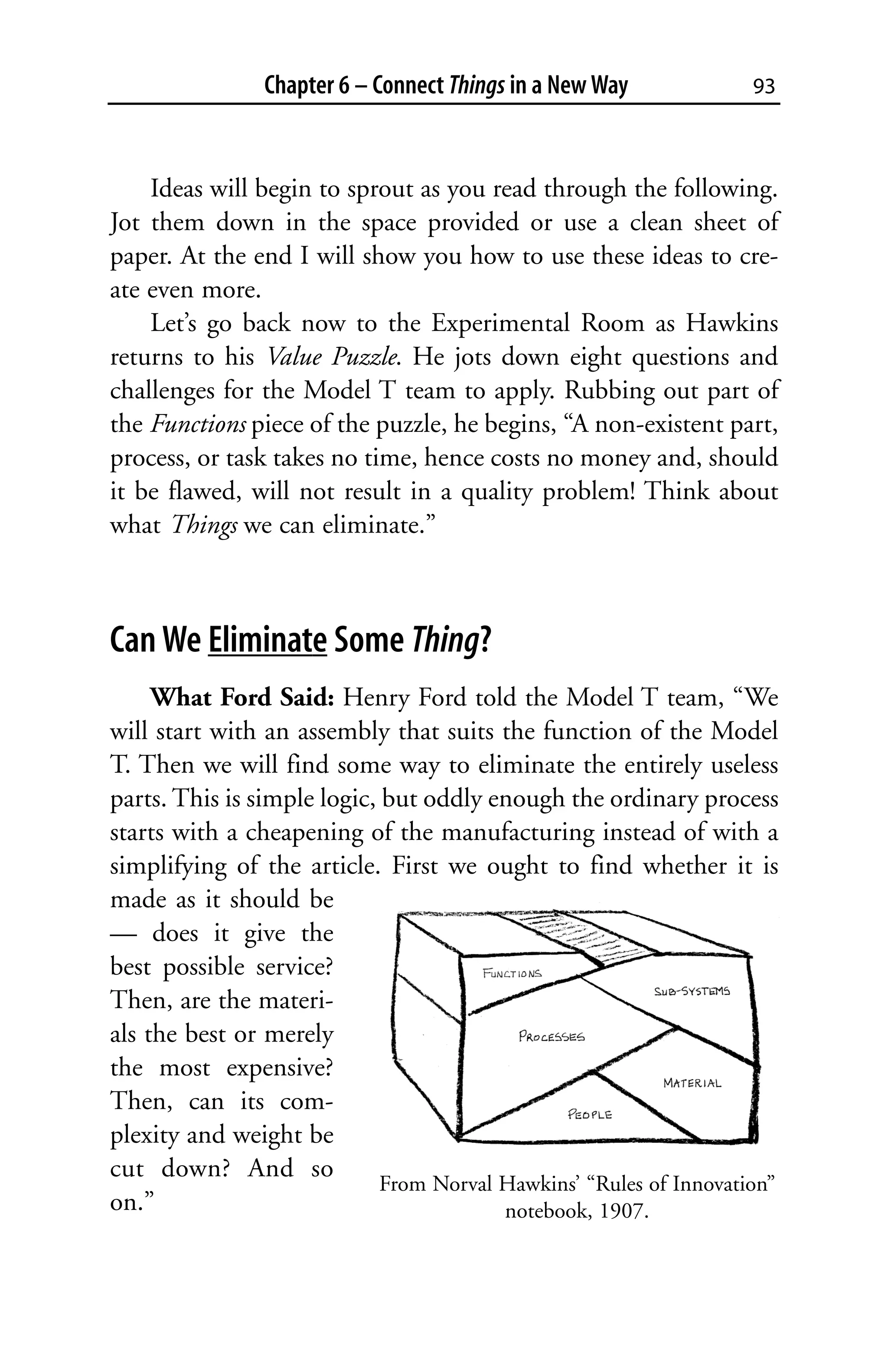
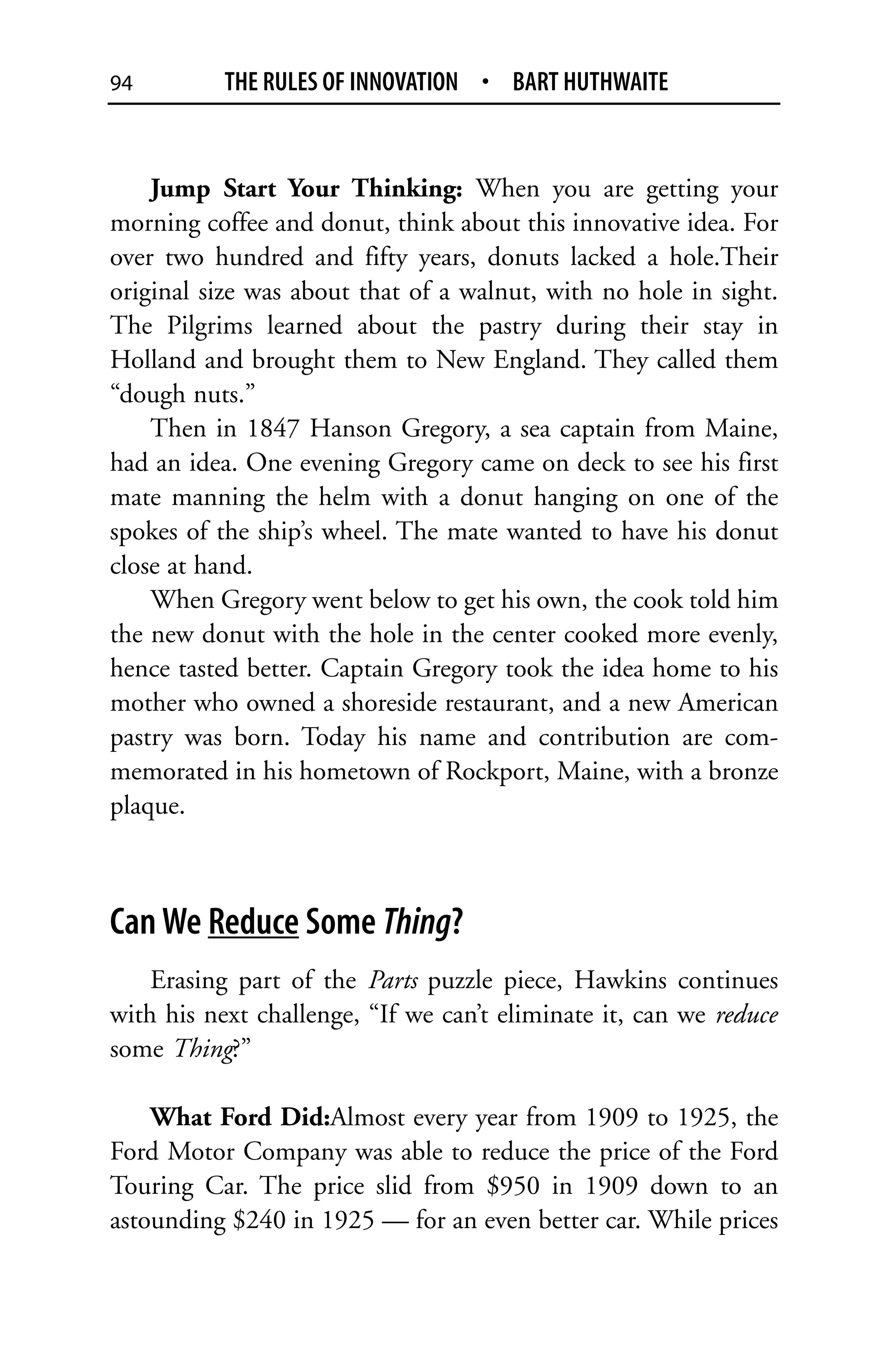
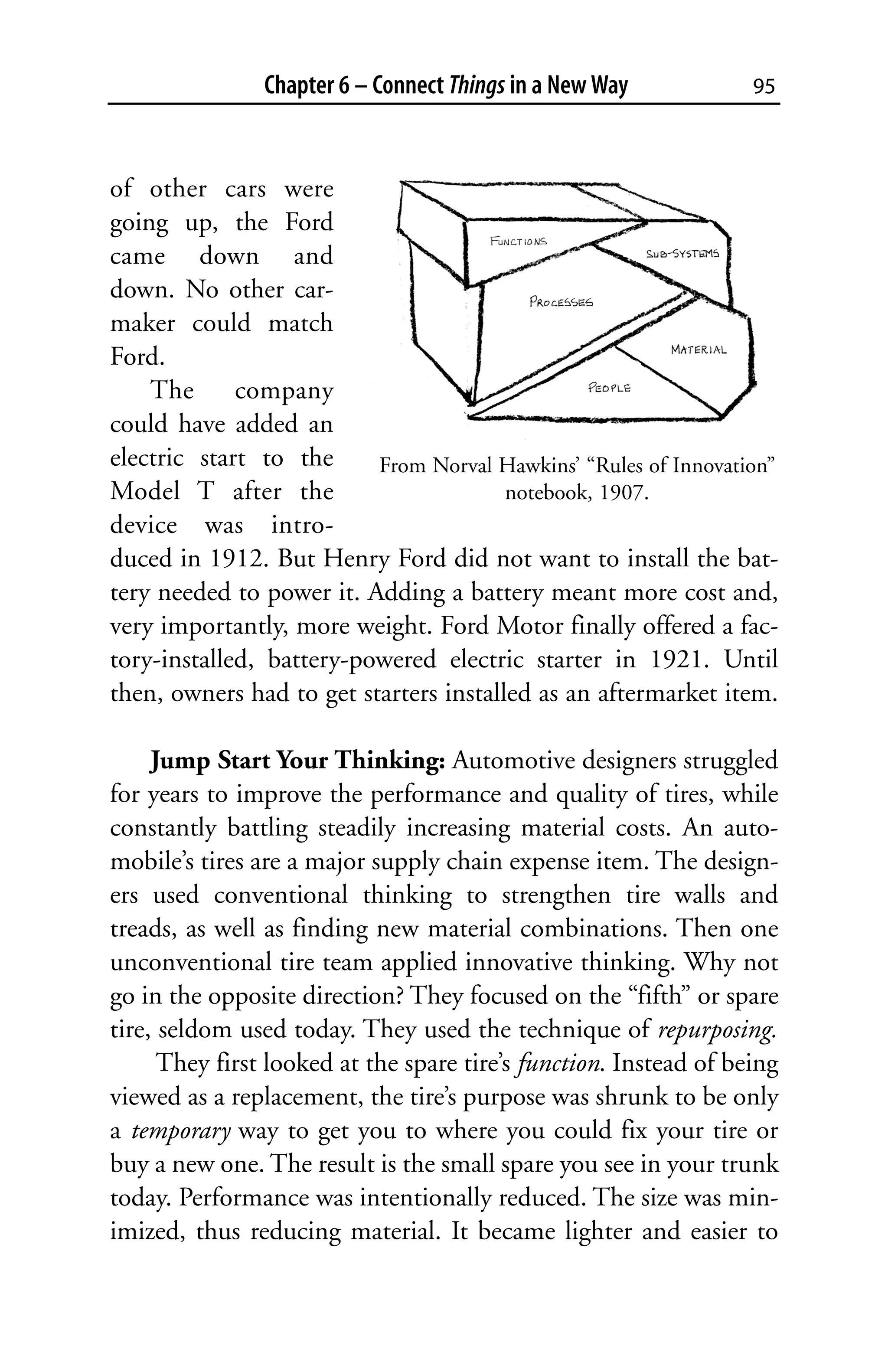
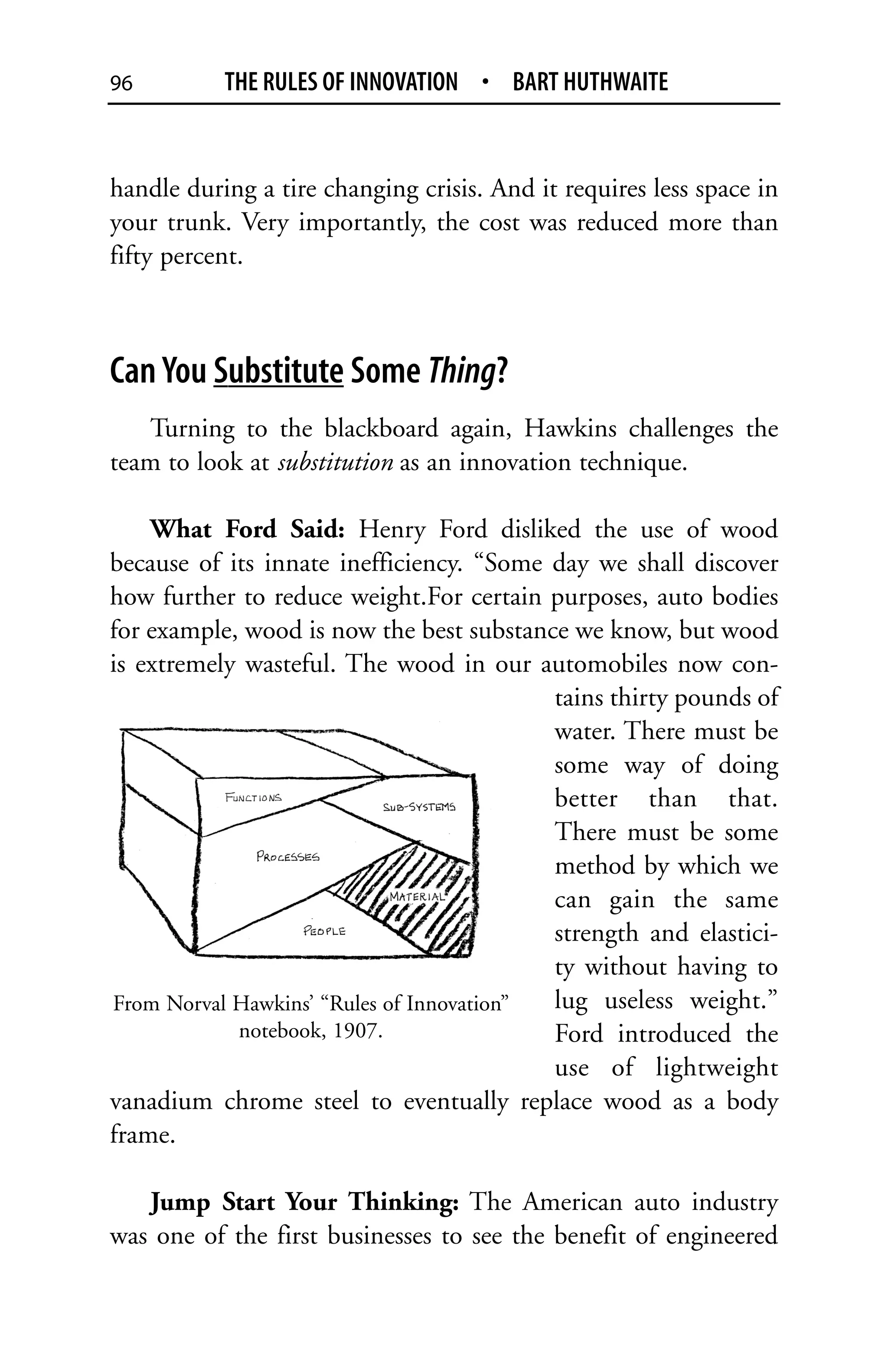
   MACKINAC ISLAND, MICHIGAN
              2007
Copyright © 2007 by Bart Huthwaite, Sr. All rights reserved. No part of
this material may be reproduced, stored in a retrieval system, or transmitted
in any form, or by any means without the express written permission of the
Institute for Lean Innovation. InnovationCUBE© process patent pending.


Published by
Institute for Lean Innovation
P.O. Box 1999
Mackinac Island, Michigan

906-847-6094
www.InnovationCube.com


ISBN 13: 978-0-9712210-4-8


Cover and interior design and layout by Lee Lewis Walsh,
Words Plus Design,www.wordsplusdesign.com


Manufactured in the United States of America
Dedication

This book is dedicated to our five grandchildren, who will be
  the best to judge whether the innovations of today have
       brought happiness to their lives of tomorrow.

                     Kate Huthwaite
                 Charles Barton Huthwaite

                      Caroline Martin
                       Aidan Martin
                       Avery Martin
CONTENTS

Acknowledgements..........................................................................................ix
Preface...............................................................................................................xi

Introduction.......................................................................................................1
    Innovation as the ultimate leadership skill… Lessons from the Model
    T… A short “Rules of Innovation” glossary… What you will learn in
    this book

Part I – How to Find Your Best Opportunities...............................................13

Chapter 1 – Recognize Ripening Bananas ....................................................15
    The best competition is no competition… Why you must detect
    opportunities and threats while they are still green… Growth oppor-
    tunities are not created; they are discovered and exploited... All new
    Things, or solutions, come from recombining existing knowledge in
    new ways… The three forces of change keep the doorway of opportu-
    nity constantly open… How to recognize these “sharks” and leverage
    them to your advantage

Chapter 2 – Think Backwards.........................................................................33
    Start with the end-in-view… Why you must climb your mountain in
    reverse… How to apply “effect-to-cause” thinking… Why identical
    innovations occur at the same time… Importance of speed-to-mar-
    ket…. Why a stakeholder who is not part of the solution will become
    part of the problem… How to get all stakeholders climbing your same
    mountain… Why your first ideas are never the best… How to move
    back and forth between opportunities and solutions to find the best
    path up your mountain

Chapter 3 – Explore for Hidden Wants ..........................................................50
    Why you must listen to the “Voice of the Customer” with caution…
    Why ninety percent of all opportunity lies hidden beneath the sur-
    face… Don’t compete, differentiate… How to use Darwinian diver-
    gence to your advantage… Where to start your search for value…
    The eight values every customer wants and how to use them at the
    beginning of your search
Chapter 4 – Stop Waste Before It Starts........................................................60
    What is Waste? The importance of “fire prevention” versus “fire fight-
    ing”… Why everything is the sum of individual tasks or “Ings”… The
    seven types of solutions that create eighty percent — or more — of
    high cost, poor quality and slow time to market

Part II – How to Find Your Optimum Solutions.............................................75

Chapter 5 – Search Outside Your Shell...........................................................77
    The three ways of thinking you must use to have breakthrough
    insights… When you change the way you look at the world, the
    world you look at can change… How you can extract new ideas from
    any experience… Nature has already solved many of our problems…
    Leonardo’s Rule… Start your search for new ideas there… Insights
    happen when you explore new territories… How to go off your beat-
    en paths to find creative insights

Chapter 6 – Connect Things in a New Way....................................................91
    How to go beyond traditional “brainstorming” to focus your idea
    search for effectiveness and efficiency… The Rule of “Can We?”...
    Since we tend to use the same problem-solving approaches repeatedly,
    we usually come up with the same answers… How to find new solu-
    tions by looking at your opportunity in many different ways, yet
    without losing strategic focus… New solutions emerge re-combining
    both old and new ideas… How to systematically combine different
    ideas to form new solutions

Chapter 7 – Measure to Learn......................................................................110
    Why you must measure to learn, not to “prove”… How to build your
    measurement system… How you can measure what is meaningful,
    not just what is easy to measure… Make sure you are headed in the
    right direction first; think about precision later… Avoid sub-optimiza-
    tion… Measure both your Ilities and Ings… Countering measurement
    excuses
Part III – The Rest of the Story.....................................................................127

Chapter 8 – Henry Ford Stumbles................................................................129
    Model T dominates auto industry… How Henry Ford broke his own
    rules and nearly lost an empire… How General Motors recognized
    the newly ripening bananas

Chapter 9 – The InnovationCUBE©..............................................................133
    What is the InnovationCUBE©? How you can use the CUBE as
    your “innovation template” for projects such as cost reduction, value
    improvement, trade-off decision-making and much more

Appendix I – A Guide to Current Innovation Terminology.........................137
    Innovation terms you should know as you move ahead in your jour-
    ney

Appendix II – Further Reading for Innovation Leaders .............................145
    An annotated list of more than 100 books and articles you can use to
    broaden your understanding and skill

About the Author ..........................................................................................155
Acknowledgements

    It is impossible to thank all of the individuals and more than
1,000 companies that I have had the pleasure of working with
for the past twenty-five years and who contributed to the Rules
in this book. Just a few of the companies include General
Electric, Microsoft, Zodiac ESCO, Raytheon, NCR, Siemens,
Eaton Corporation, Johnson & Johnson, General Dynamics,
Briggs & Stratton, Motorola, SKF, Masco, Ford Motor
Company, US Navy, Weyerhaeuser, and many, many more.
    A special thanks to my wife, Nina, for her common sense
and guidance. Additional thanks go to Emily McCreary, Andy
Rynberg, John Keogh, Bart Huthwaite, Jr. and all the Institute
for Lean Innovation associates, clients and friends who have
helped shape the Rules in this book.


                                ix
Preface


I
    nnovation leadership is the ultimate personal skill. Knowing
    how to apply it well will give you a clear advantage. The pur-
    pose of this book is to give you a step-by-step system for
doing just that. It will enable you to change innovation from a
mysterious process to a repeatable method. Think of what you
read here not only as your personal guide, but also as a model
you can use in any organizational setting.
    Winding through this book is the story of Henry Ford and
the Model T automobile. The narrative device I use is to look at
Henry Ford, the innovation giant of his time, to teach us lessons
for the future. Why look to the past to prepare for the future?
James Burke in his book on the history of innovation,
Connections, answers this question bluntly: “Because there is
nowhere else to look.” The past contains clues to the future. The
story of Henry Ford, the creation of the innovative Model T, and
the near-disaster that befell Ford Motor when Ford broke his
own rules of innovation holds plenty of clues. Although the core

                                xi
xii        THE RULES OF INNOVATION • BART HUTHWAITE


events I discuss actually happened, what you will read here is my
fictionalized account of those events.
     What Henry Ford was struggling with was that while inno-
vation is difficult to do, it is even more difficult to manage. It
requires a leadership process. Ford and his team surely would
have agreed with Peter F. Drucker, often called the father of mod-
ern business management. More than twenty years ago, Drucker
wrote in his book, Innovation and Entrepreneurship, that innova-
tion is “neither a science nor an art but a practice,” capable of
being organized as systematic work. In his book, Drucker writes
about the “what, when and why” of innovation but, he admits,
leaves for others the task of “how to.”


Framework for Growth
    This book starts where Drucker left off. It will give you the
“how to” for making innovation a systematic process. This book is
not theory. It is based on what I have learned “hands on” from
thousands of innovation teams over a span of twenty-five years.
The lessons here are also rooted in the history of innovation
through the ages. By “systematic work” I don’t mean your com-
pany’s “tool box,” “phase gate” process, or portfolio of new prod-
ucts or strategies. I mean what Drucker called for when he used
the word “practice” — a systematic, repeatable and measurable
process capable of being done as daily work. This book will give
you a visible, understandable process you can use to lead a team,
a project or your entire enterprise.


Learn and Use in Less Than a Day
    No “culture change” is needed for getting you started down
the road of innovation excellence. You can use what you learn
Preface                           xiii


here to rough out your innovation strategy in less than a day. The
source of the rules and tools in this book is the
InnovationCUBE©, a digital tool for leaders and teams,
described in Chapter 9. The secrets of the CUBE have been used
for thousands of years by great thinkers, inventors, and corporate
leaders, dating all the way back to the Greeks. The CUBE con-
verts their thinking into an innovation leadership process you
can use for any project.
     The best of success to you on your journey to innovation
excellence.


   Bart Huthwaite, Sr.
   Mackinac Island, Michigan
   June, 2007
Introduction


Y
       our first leadership challenge is to clearly explain the def-
       inition of “innovation.” Don’t rush for Webster’s or
       Wikipedia. They may confuse rather can clarify.
Innovation is certainly about new ideas. However, new ideas, as
Henry Ford once said, are as “common as ticks on a hound’s
back.” Ideas are good for conversation, but that’s about all. They
must be converted into practical solutions. What about inven-
tions? Inventions are not innovations. Only a very small per-
centage of inventions ever succeed in the marketplace. The U.S.
Patent Office digital files are overloaded with solutions still look-
ing for customers. Patents are not a good measure of corporate
innovation capability.
    Innovation is the process of creating new value with a mini-
mum of waste. By “new value” I mean things that will benefit
both your customer and your enterprise. By “minimum waste” I
mean intentionally delivering that value with the absolute mini-
mum of cost and quality loss. I don’t mean the “fire fighting” of
Lean and Six Sigma on the factory floor. What I do mean is the

                                 1
2          THE RULES OF INNOVATION • BART HUTHWAITE


“fire prevention” of lower cost and better quality created through
smarter, innovative thinking.


A Natural Talent?
     I have met many folks who can generate a lot of creative
ideas. I have met fewer folks who can shape these into unique
inventions. However, the task of converting these ideas and
inventions into successful innovations, with minimum cost and
the best quality, is the real challenge today. During my twenty-
five years working with innovation teams I have encountered
some people who have this natural talent. You may be one of
them. But if you are, you are a very rare bird.
     Should you have this natural talent, it can work to your dis-
advantage. Your innate skill can make a job look so easy that oth-
ers fail to understand how you do it. Another problem with such
talent is that you can find it nearly impossible to teach those who
would learn from you. How can you teach what you know
instinctively and never had to learn? What you need is the “how
to” both for you and others to convert the abstraction called
“innovation” into a step-by-step way of thinking and working.
The intent of this book is to do just that.


Lessons of the Model T
    I have chosen to steer clear from using examples of the pres-
ent to explain the Rules described here. The reason? Not enough
time has passed to rub away the surface success — or failure —
to expose the root causes below. (Indeed, many of today’s suc-
Introduction                        3


cesses may eventually become tomorrow’s failures.) The story of
Henry Ford and the Model T will illustrate many critical points.
The first Model T was shipped in October 1908, and the last
came off the line in May 1927. Over that span of time, the root
causes of Ford’s innovation success, and eventual failure, became
very clear.
     Almost 100 years have passed since the creation of this
remarkable automobile. The modern day corporate practices of
lean enterprise, six sigma quality and many others all have roots
in the design of the Model T and its production processes. Very
importantly, the Model T triggered entirely new ways of think-
ing about transactional processes — how we conduct our day-to-
day business practices.
     The story begins on a winter Detroit day in early January,
1907. That is when Henry Ford and his team crystallized the
ideas that would lead to the launch of the Model T automobile
over a year and a half later. Henry Ford was in a fix. A perfec-
tionist by nature, Ford had spent more than a year trying to
bring together in his mind what he called the “automobile for the
common man.” He was going nowhere, so he finally turned to
Norval A. Hawkins, whom he called his “process person,” for
help.
     Ford realized that he needed far more than just an automo-
bile. He had to have an end-to-end system that integrated his
dealers, plant, suppliers and design department in one seamless
system. Hawkins had straightened out the Ford Motor account-
ing procedures a few months before and would later create the
Model T worldwide marketing process that would sell more than
fifteen million “Tin Lizzies” by 1927. It was Hawkins who came
up with the process that enabled Ford and his team to realize
their vision.
4           THE RULES OF INNOVATION • BART HUTHWAITE


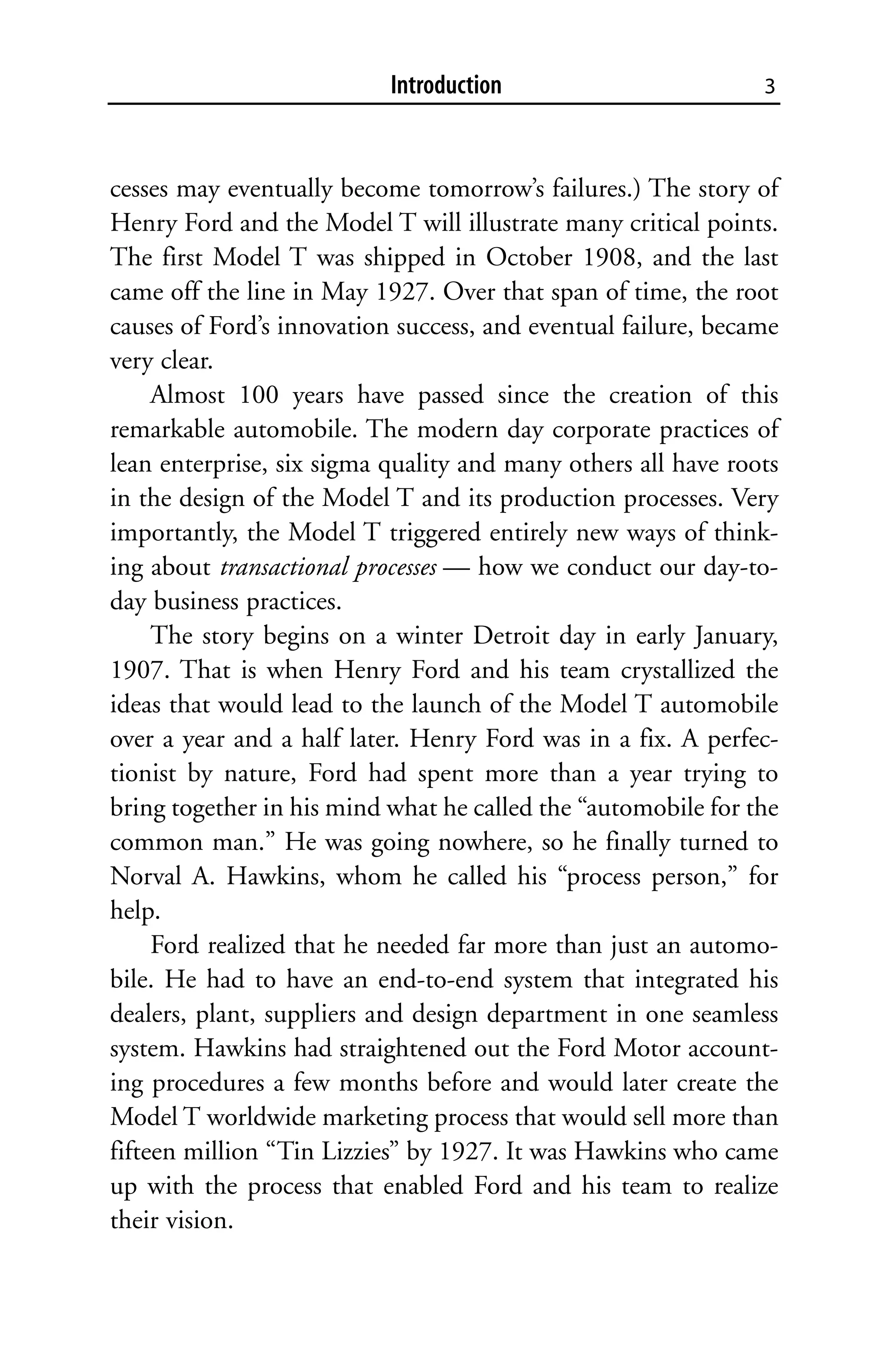
    Henry Ford with his Model T and Norval Hawkins’ innovation cube
                        visible under his left arm.


    I must say at this point that while Norval Hawkins was a real
person, his Rules of Innovation notebook with its process steps
and sketches, and the “innovation cube” tool are my own inven-
tion based on the historical data and what I know of both
Hawkins and Ford. I do believe, however, that Hawkins would
smile and nod his head in agreement with everything in this
book.
    Ford and his team worked in the cramped “Experimental
Room” at the Ford Motor Piquette Avenue plant, tucked away
on the building’s third floor, away from prying eyes. What went
on in that room during those early days has always been a mys-
tery. It is rumored that Henry Ford used a method given to him
by his marketing genius, Norval Hawkins, so let’s assume that to
be true. Let’s further imagine that Hawkins also gave Ford what
Introduction                        5


he called an “innovation
cube.” Ford disliked blue-
prints and papers. He always
asked his pattern makers to
convert an idea into a wood-
en model. Hawkins knew
this and created a four-inch
cube to illustrate the process
that Ford and Hawkins used
during those momentous
days to launch history’s most
famous vehicle — the Model
T. (More on that cube later.)
     Henry Ford needed a
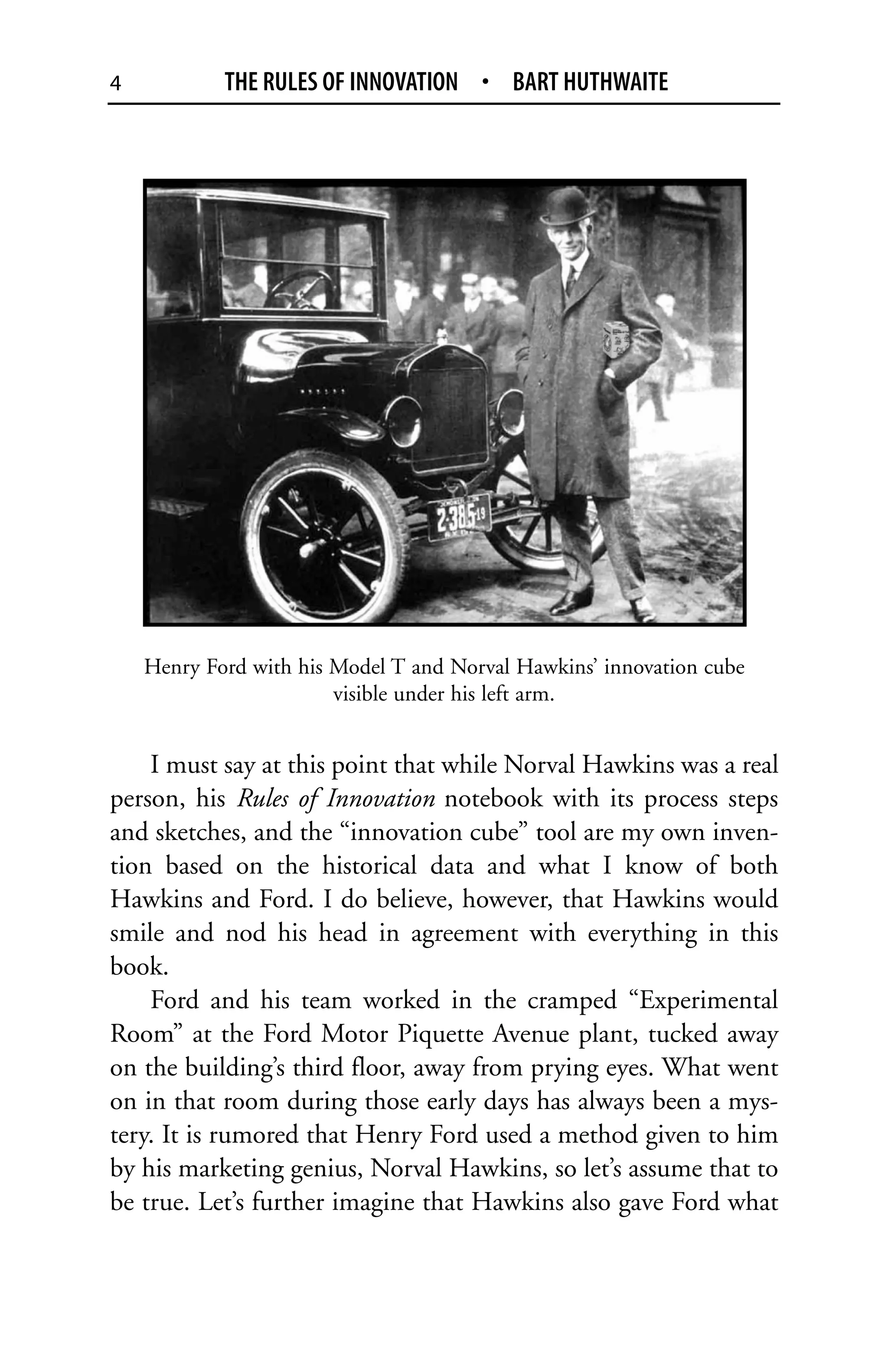
person like Norval Hawkins.              Norval A. Hawkins
Ford disliked financial
accounting as much as he did financiers. He relied on year-end
bank statements to let him know whether or not the company
was making money. Norval Hawkins first arrived on the Ford
scene around 1904. James Couzens hired him as a consultant to
straighten out the Ford Company accounting system. Hiring
him, in itself, was of note. Hawkins had been convicted on
embezzlement charges in 1894, having taken $8,000 as a cashier
at the Standard Oil Company. But Hawkins was not your typi-
cal ex-con. He was colorful, charming and incisive. On the day
he emerged from prison, a crowd of old friends was waiting on
the street to cheer him on to better times. Hawkins immediately
built a successful consulting and accounting practice in Detroit.
     The notes and sketches in Hawkins’ Rules of Innovation black
book, described in the following pages, show that by January
1907 Hawkins had moved from improving Ford’s accounting
6          THE RULES OF INNOVATION • BART HUTHWAITE


system to helping Ford straighten out his Model T development
process. Hawkins was “process” minded. He laid out a step-by-
step process that enabled Henry Ford and his Piquette Avenue
plant team to build a strategy for the Model T.
    He was so successful that by autumn of 1907, Hawkins was
hired full time as the Ford sales and commercial manager. Once
again, he shifted his process mind to the task of selling Model T
autos. Hawkins crafted a selling process that enabled Ford Motor
to sell all the autos it could produce. Hawkins stayed with Ford
Motor until 1919, and then like many of the original Model T
team members, quietly left to join General Motors.
    Ralph Waldo Emerson wisely wrote, “Every institution is the
lengthened shadow of one man.” You will learn how Henry Ford
applied the secrets of Norval Hawkins’ innovation cube — and
then abandoned them, one by one, bringing his company to the
brink of disaster.


A Short “Rules of Innovation” Glossary
    Hawkins believed that using well worn words can trap us
into old ruts of thinking, while new words force our minds to
think along different paths. The following list is from his Rules
of Innovation notebook.

Ilities. High-level attributes of value. The use of Ility words
     enables you to abstract your thinking to a higher, wider plane
     of thought. Examples: marketability, manufacturability,
     affordability and maintainability.
Ings. Steps that must be done to deliver an Ility value. Each Ing
    takes time, hence costs money and, if done poorly, can result
Introduction                         7


   in a quality flaw. Fewer are always better. Examples: design-
   ing, testing, manufacturing, installing, maintaining, and
   more.
Sweet Spot. An innovation “bull’s eye.” Point at which human
   Insight makes the correct connection between what the mar-
   ket wants and the correct solution for it.
Insight. The human ability to simultaneously combine
    Hindsight (experience) and Foresight (imagination) with
    Outsight, the ability to find new knowledge, to create a com-
    pletely new synthesis of thought.
Outsight. The ability to extract new ideas from experiences out-
   side one’s normal range of knowledge. All successful innova-
   tions result from a high level of Outsight.
The Four Domains. The four life cycle sectors of any offering.
   These include: Customer Domain, Design Domain, Supply
   Domain, and Operations Domain. Stakeholders from all
   four must be part of an innovation effort right at the start. A
   successful innovation must consider all of these simultane-
   ously.
The Three Sharks. The three forces of constant change:
   Marketplace, Technology, and Competition. These sharks
   create both threats and opportunities.
Thing. A solution to a Want. Things can include products,
   processes, services, policies and more.
Want. A spoken, or unspoken, value that is desirable. Needs are
  a subset of Wants. Most of the Things we want are not
  “needs.”
Waste. A collective word for poor quality, high cost, long time.
  The creation of all Waste starts in the innovation concept
8             THE RULES OF INNOVATION • BART HUTHWAITE


      stage. Seven types of solutions universally drive eighty per-
      cent of all downstream Waste.
Zeitgeist. Historical period when simultaneous bursts of innova-
   tive thinking occur across many fields. These periods are typ-
   ically triggered by worldwide change.


What You Will Learn in The Rules of Innovation
Chapter 1. Recognize Ripening Bananas
    Fatal Flaw: We fail to see opportunities before they are fully ripe.

    Timing is everything. This is true whether you are trying to
create a technology breakthrough or upgrading an existing prod-
uct or service to make it more competitive. You do not create
opportunities; instead, you must recognize and satisfy them.
Henry Ford and his Model T did not create a demand for low
cost, family transportation. The Model T met an emerging want.
The creators of YouTube met an emerging want. These entrepre-
neurs saw opportunities before they fully ripened, when they
were still green. They were then first in line to pick them when
they were ripe. This chapter will show you how to find green
bananas.


Chapter 2. Think Backwards
               Fatal Flaw: You use conventional thinking.
Introduction                          9


    The innovation process requires you to visualize your goal,
no matter how fuzzy that may be. It calls for the ability to see the
end from the beginning. Then you must climb your mountain in
reverse. This is the opposite of how we normally work in the cor-
porate world. You must learn to think from the future to the pres-
ent. It is “backwards thinking.” Or, as a savvy engineer from
General Electric once described the process to me, “You can’t get
there from here, but you can get from there to here.” This chap-
ter will show you how to do this.


Chapter 3. Discover Hidden Wants
            Fatal Flaw: You fail to find new “value gaps”
                     to understand and exploit.

    Be very cautious when you listen to the voice of your cus-
tomer. You will not hear the real “truth.” Present day markets do
not speak well about what they will want in the future.
Homemakers were not shouting out for a microwave oven that
could cook a dinner in fifteen minutes. It was just beyond their
comprehension. Similarly, customers are limited by their vision
of the present. This chapter will show you how to systematically
discover opportunities long before your competitors do.


Chapter 4. Stop Waste Before It Starts
            Fatal Flaw: You fail to understand and attack
           the creators of “hidden” cost and poor quality.

    I am always amazed how the incandescent light bulb is used
as the symbol of innovation. It is actually one of the most ineffi-
10          THE RULES OF INNOVATION • BART HUTHWAITE


cient devices known to man and should be the poster child for
Waste. Just touch an incandescent light bulb and see why. Over
ninety percent of the energy used is expended in heat, not light.
Remember the definition of a real innovation: “Something that
meets an unmet need with high quality and low cost.” In this
chapter you will learn how to identify and defeat the creators of
high cost and poor quality before you ever go to market.


Chapter 5. Search Outside Your Shell
     Fatal Flaw: You fail to get out of the ruts of your experience.

    New ideas seldom arrive in old directions. The digital watch
did not come from established watch companies. The calculator
didn’t come from the slide rule or adding machine companies.
The Internet browser didn’t come from Microsoft. This chapter
will give you a way to systematically mine new territory for new
ideas. It will show you how to break apart any product, service
or business practice to find ideas you can borrow, adapt and
shape into groundbreaking innovations. The most fertile
grounds, you will learn, lie outside your normal experience.


Chapter 6. Connect Things in a New Way
              Fatal Flaw: You have no systematic way to
               combine new ideas into new solutions.

    Breakthrough innovations come when you combine existing
— even old — things in a new way. Like the creative child with
a pail of Legos, you and your team must constantly combine and
recombine ideas into different combinations. You must build
Introduction                         11


many “solution sets” to eventually find the best one. You can do
this without the expense of prototypes and testing. This chapter
shows you how.


Chapter 7. Measure to Learn
    Fatal Flaw: You don’t apply measurement in a positive way.

    That which gets measured gets understood. Innovation
measurement must be all about learning. Yet most corporate
metrics are really history lessons. They give us information after
the “horse is out of the barn.” This chapter shows you how to use
“real time” measurement to your best advantage.


Chapter 8. Henry Ford Stumbles
           Fatal Flaw: You don’t link these Rules into an
                   actionable, repeatable process.

    Every innovation begins to degrade the day it is launched.
This chapter will show you how to link all of the Rules into a
seamless innovation process. Henry Ford applied the secrets of
the InnovationCUBE© to build his automobile empire. He then
broke them one-by-one. This chapter is a sobering account of
how success can carry within it the seeds of its own destruction.


Chapter 9. Using the InnovationCUBE©
    The InnovationCUBE© integrates the Rules of Innovation
into a step-by-step, easy to use process. The CUBE is available on
a USB “stick” or installed on an intranet. It is being used today
12         THE RULES OF INNOVATION • BART HUTHWAITE


to reduce cost, improve transactional processes, solve quality
problems, improve management strategies, and for many other
purposes where a higher level of innovation is needed.


Appendix I. A Guide to Current Innovation Terminology
    You can use this as a summary of what innovation thought
leaders and practitioners are using today. And you can be certain
about one thing — this list will already be out of date by the time
you read this book.


Appendix II. Further Reading for Innovation Leaders
    This is an annotated listing of more than 100 books you may
wish to read on your journey to corporate innovation leadership.
I have never read a book on innovation, creativity, the history of
ideas, inventions, or similar that I have not enjoyed. Some are
heavy lifting, while others can be squeezed into a flight from
New York to Chicago. This list will enable you to tell one from
the other.
PART I


How to Find Your Best
   Opportunities


          13
CHAPTER ONE


        Recognize Ripening Bananas


  Fatal Flaw: We fail to see opportunities before they are fully ripe.

         T best competition is no competition… Why
          he
     you must detect opportunities and threats while
     they are still green… Growth opportunities are not
     created; they are discovered and exploited... All new
     Things, or solutions, come from recombining exist-
     ing knowledge in new ways… T three forces of
                                       he
     change keep the doorway of opportunity constant-
     ly open… How to recognize these “sharks” and
     leverage them to your advantage.


I
    nvention is not the mother of necessity. You do not create
    growth opportunities. Instead, you must discover and exploit
    them. You must spot new opportunities while they are still
“green bananas.” These are markets that have yet to ripen. By
spotting them first, you will have an advantage. Innovation as the

                                  15
16         THE RULES OF INNOVATION • BART HUTHWAITE


ultimate business weapon begins with the skill of seeing green
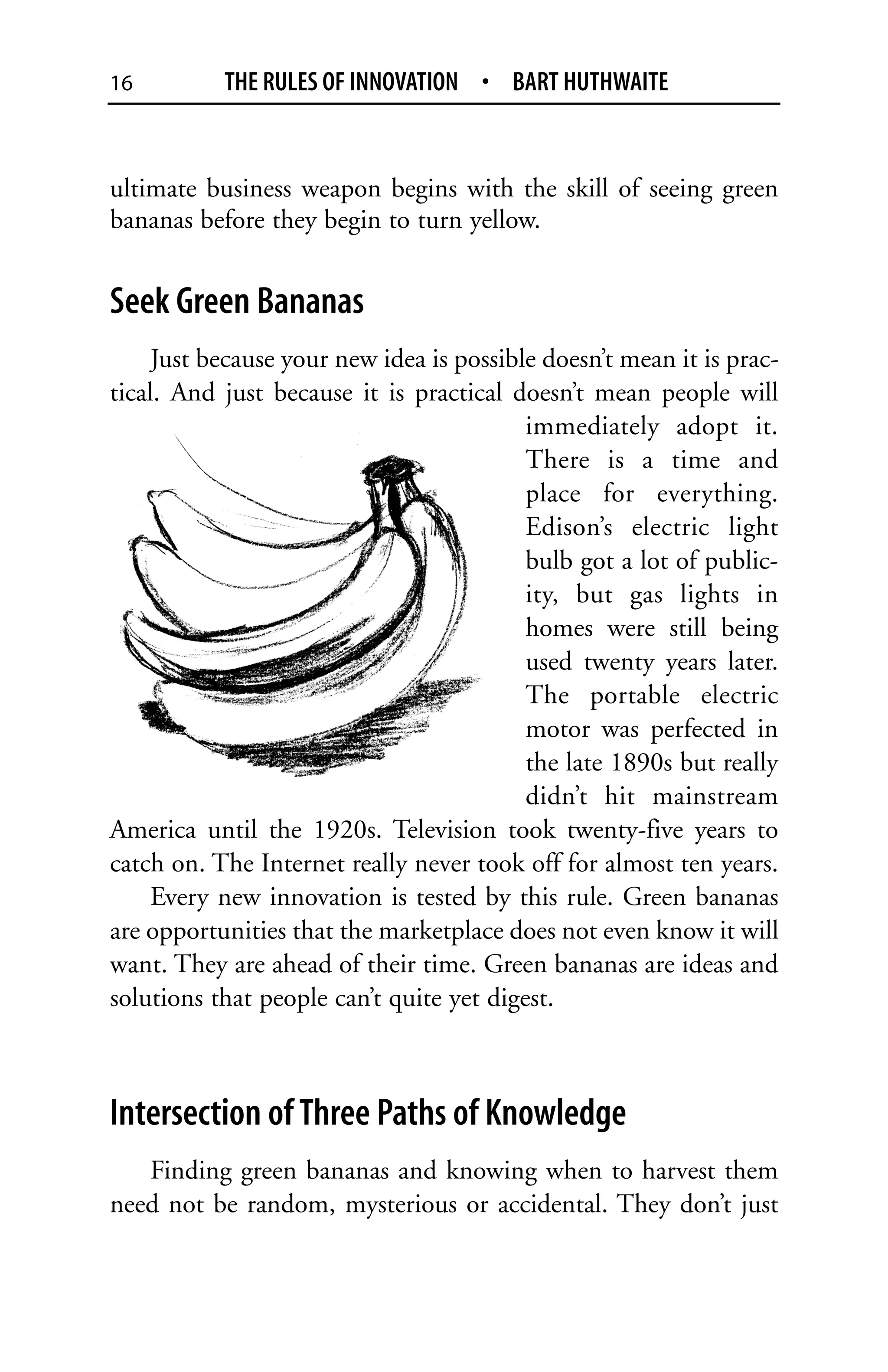
bananas before they begin to turn yellow.


Seek Green Bananas
     Just because your new idea is possible doesn’t mean it is prac-
tical. And just because it is practical doesn’t mean people will
                                          immediately adopt it.
                                          There is a time and
                                          place for everything.
                                          Edison’s electric light
                                          bulb got a lot of public-
                                          ity, but gas lights in
                                          homes were still being
                                          used twenty years later.
                                          The portable electric
                                          motor was perfected in
                                          the late 1890s but really
                                          didn’t hit mainstream
America until the 1920s. Television took twenty-five years to
catch on. The Internet really never took off for almost ten years.
     Every new innovation is tested by this rule. Green bananas
are opportunities that the marketplace does not even know it will
want. They are ahead of their time. Green bananas are ideas and
solutions that people can’t quite yet digest.


Intersection of Three Paths of Knowledge
   Finding green bananas and knowing when to harvest them
need not be random, mysterious or accidental. They don’t just
Chapter 1 – Recognize Ripening Bananas             17


happen “out of thin air.” With training, you can see them com-
ing. You can also help ripen and harvest them. An Innovation
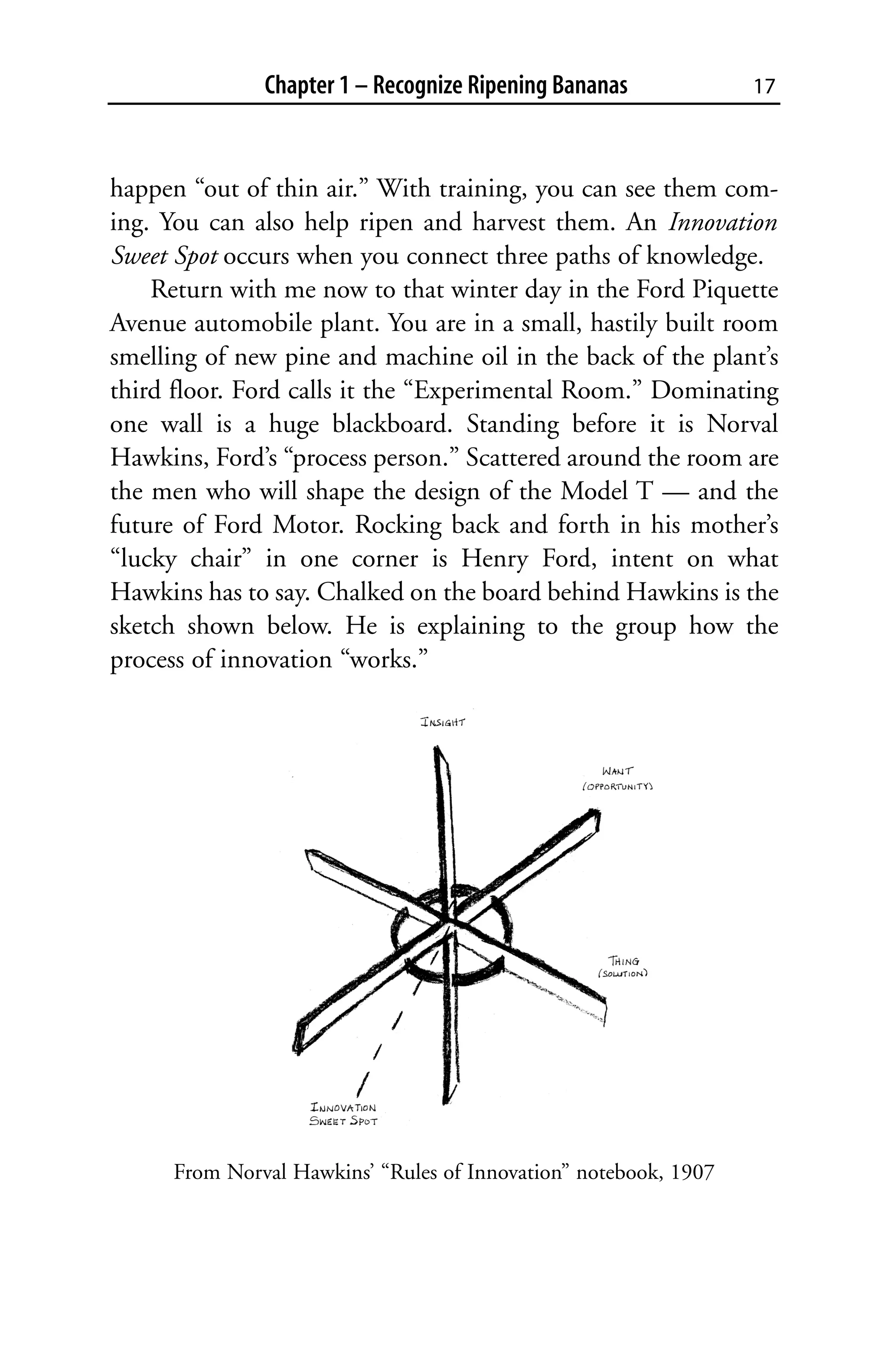
Sweet Spot occurs when you connect three paths of knowledge.
    Return with me now to that winter day in the Ford Piquette
Avenue automobile plant. You are in a small, hastily built room
smelling of new pine and machine oil in the back of the plant’s
third floor. Ford calls it the “Experimental Room.” Dominating
one wall is a huge blackboard. Standing before it is Norval
Hawkins, Ford’s “process person.” Scattered around the room are
the men who will shape the design of the Model T — and the
future of Ford Motor. Rocking back and forth in his mother’s
“lucky chair” in one corner is Henry Ford, intent on what
Hawkins has to say. Chalked on the board behind Hawkins is the
sketch shown below. He is explaining to the group how the
process of innovation “works.”


     From Norval Hawkins’ “Rules of Innovation” notebook, 1907
18          THE RULES OF INNOVATION • BART HUTHWAITE


     • Real Want. A spoken, or unspoken, value that is desir-
       able. Needs are a subset of Wants. Most of the Things we
       want are not “needs.”
     • New Thing. A solution to a Want. Things can include
       products, processes, services, policies and more.
     • Insight. The human ability to simultaneously combine
       Hindsight (experience) and Foresight (imagination) with
       Outsight (new experiences) to create a completely new syn-
       thesis of thought.

     The purpose of Hawkins’ sketch is to explain how successful
innovations, or “sweet spots,” happen. Think of three lines inter-
secting in a three dimensional space. One is the knowledge of a
Want. Innovative companies see and exploit Wants; they do not
“create” them. Wants may be spoken or unspoken. The best are
the unspoken ones that you can see early and exploit. A second
path of knowledge is the knowledge of a solution, or what I call
a Thing. A Thing may be something physical, like a product, or
it can be a process, a system or a business strategy.
     Some innovations can start with a Thing looking for a Want.
Corporate attics are stuffed with Things that have never really
effectively gone looking for a Want. However, it is the third path
of knowledge that must be in place to develop both Wants and
Things to create the intersection called an innovation. This third
path is Insight. This is the unique human characteristic of “see-
ing” an untapped Want or an underdeveloped Thing (solution)
and connecting them to creating something new. This is some-
times called the Eureka Moment, the spark that ignites all inno-
vation successes.
     A successful innovation comes when you use your skill of
Insight to find and connect a real Want with a real Thing. Just
Chapter 1 – Recognize Ripening Bananas           19


having the Insight to create a new Thing, or technology, is only
part of the equation. You must have a real Want, that is, a Want
that is ripe. Think of this ripeness as being a “gap” in the mind
of your consumer. It may be latent or just emerging. However,
without such a gap, your new idea has little chance of success.
You are trying to put a square peg into a non-existent hole. You
have a green banana.
     Green bananas try to force their way into our minds when we
are not quite ready to accept them. Take the example of
microwave cooking. This technology was well developed by the
late 1950s. But homemakers were not ready to accept the radical
idea of bombarding food with World War II radar technology.
     Only when homemakers began to see microwave cooking
not as a technology, but as a way to reduce time in the kitchen
did the microwave oven market begin to accelerate. This acceler-
ation enabled low cost production, which in turn drove down
costs to make microwave ovens a part of everyone’s kitchen. This
same story is true of early television, personal computers and a
myriad of other innovations. Green banana innovations are solv-
ing Wants that have yet to mature.
     Some innovations are so green and seem so far ahead of their
time that even their contemporaries are unable to understand
them. Consider the case of Leonardo DaVinci. We stand in
amazement of Leonardo’s ability to sketch helicopters, sub-
marines and parachutes. Yet there wasn’t even the hint at his time
that there was a Want for these ideas. What was even more dis-
tant was that the Things, or technologies, for converting his ideas
to reality would only come after hundreds of years of technology
advancement.
     Trying to digest a green banana before it is ripe can create a
bad case of innovation indigestion. Cultivate them, care for
them, but don’t harvest them until the time is ripe.
20         THE RULES OF INNOVATION • BART HUTHWAITE


Avoid Brown Bananas
     Brown bananas are at the opposite end of the ripening scale.
Brown bananas are ideas trying to squeeze themselves into an
already crowded market space. Their chances for success are slim.
Their time is past. Many of these ideas just rot on the tree.
      It is true, as President Abraham Lincoln once noted, that
“the patent system adds the fuel of interest to the fire of genius.”
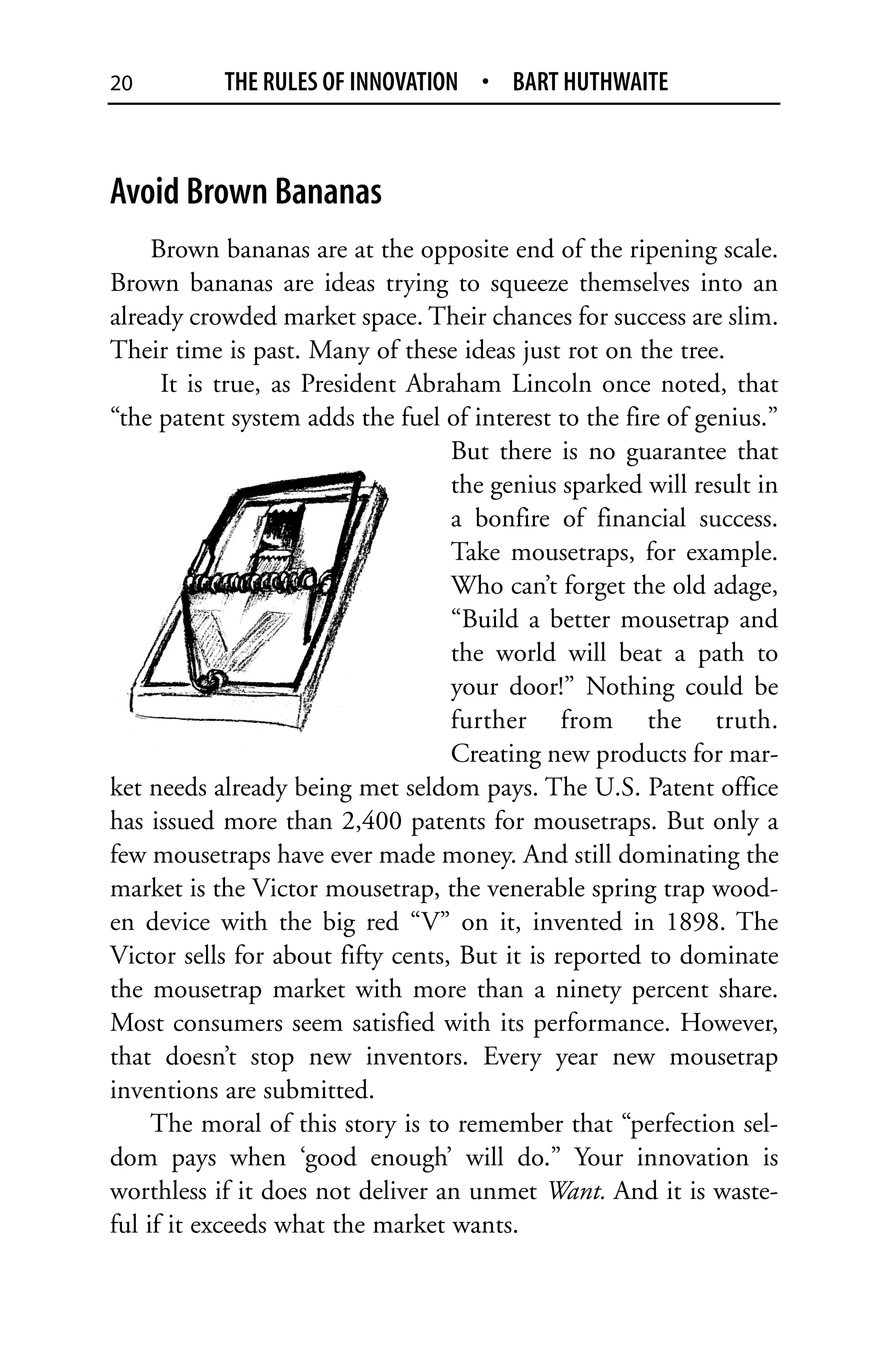
                                   But there is no guarantee that
                                   the genius sparked will result in
                                   a bonfire of financial success.
                                   Take mousetraps, for example.
                                   Who can’t forget the old adage,
                                   “Build a better mousetrap and
                                   the world will beat a path to
                                   your door!” Nothing could be
                                   further from the truth.
                                   Creating new products for mar-
ket needs already being met seldom pays. The U.S. Patent office
has issued more than 2,400 patents for mousetraps. But only a
few mousetraps have ever made money. And still dominating the
market is the Victor mousetrap, the venerable spring trap wood-
en device with the big red “V” on it, invented in 1898. The
Victor sells for about fifty cents, But it is reported to dominate
the mousetrap market with more than a ninety percent share.
Most consumers seem satisfied with its performance. However,
that doesn’t stop new inventors. Every year new mousetrap
inventions are submitted.
     The moral of this story is to remember that “perfection sel-
dom pays when ‘good enough’ will do.” Your innovation is
worthless if it does not deliver an unmet Want. And it is waste-
ful if it exceeds what the market wants.
Chapter 1 – Recognize Ripening Bananas            21


Ripe Yellow Bananas
     Ripe yellow bananas are the ideas that are ready for digestion.
These new ideas don’t even need to use a new, untried technolo-
gy. And they can simply be filling an undetected Want.
     All bananas in a bunch do not ripen at the same time.
Technology does not develop in a straight line. Innovations hap-
pen in jerks, stops and starts. Things and Wants must both be
mature, or near to maturity.
     Bananas ripen faster these days. For centuries, inventions
have typically taken twenty to thirty years to go from the first
patent or prototype to a widely used product. It took the UPC
bar code twenty years before it was finally adopted in 1973. The
microwave was developed for cooking shortly after World War II
but it took another twenty years before consumers began to buy
it in 1967.
     The opposite is the story of YouTube, Time Magazine’s
Invention of the Year. More than 70,000 home videos are now
uploaded to YouTube every day by people all over the world. The
idea of YouTube was a perfectly ripe banana. This phenomenal
website went from an idea hatched by three twenty-something
guys at a Silicon Valley dinner party to become an immediate
market place hit. Why so?
     Time says the founders “stumbled” onto the intersection of
three revolutions. I like to say they struck their gold at the Sweet
Spot of Wants, Things and Insight.
     The Want is our desire to create and share information
together, much like MySpace and Wikipedia. Many consumers
are impatient with mainstream media.
     The Things is the revolution in cheap camcorders and easy-
to-use video software. Video production is now so simple and
22         THE RULES OF INNOVATION • BART HUTHWAITE


costs so little that it’s within the reach of the mass market. The
YouTube guys had the Insight to connect a Want with a Thing to
reap a $1.6 billion dollar sellout to Google in a little more than
a year after its launch. That’s a lot of bananas. YouTube had very
low barriers standing in the way of its use. Its time was truly ripe.
     Your challenge as an innovation leader, at the time I am writ-
ing this book, is much like a green banana, perhaps only tinged
with a few flecks of yellow. The idea of innovation as a systemat-
ic, organized, measurable process that can be universally applied
to any product, service or business process is only beginning to
ripen. Most corporate innovation initiatives are piecemeal com-
pilations of idea collection, portfolio management, techniques
for “open source innovation” and other high level tactics. Your
opportunity is to take innovation to the core of your enterprise
— to make it a management process that is doable, repeatable
and sustainable.
     So how do you recognize ripening bananas? The following
Rule of Wants helps you do just that.


The Rule of Wants
         No new idea springs full-blown from a void.
     New innovations emerge from conditions in which
     old ideas no longer work.
                                — Hawkins’ notebook

    The most profitable Wants are those yet unspoken. These are
the Wants that have yet to enter the daily mind of the con-
sumer—or your competition. Those who tap into an unspoken
Want first, and successfully defend their new territory, will be the
Chapter 1 – Recognize Ripening Bananas           23


winners. And that’s what Henry Ford did with his Model T for
the masses. The Model T tapped into Wants that the average
American could not even imagine being able to afford. His com-
petition was also caught sleeping. In 1907 the demand for high-
er priced automobiles was increasing. According to his competi-
tors, Ford was “way off track.”
    At first “horseless carriages” had a bad reputation. Farmers
hated them. Automobiles frightened their horses. Known as
“child killers,” automobiles careened down streets with ill expe-
rienced drivers at the wheel, with brakes that often failed, and
with poor tiller-type steering.
    Ford “re-purposed” his automobile to meet an untapped
want. Ford was a farmer in his youth and he hated farming. Ford
always maintained the Model T was designed to help the farmer
to get his products to market and ease the tedium of his life. Ford
also developed the first mass produced, practical tractor. The
Fordson tractor took the technology of the auto and hooked it to
a plow.


Timing is Everything
    Timing is everything. The market has to be ready, the tech-
nology affordable, and the competition sleeping. There is a time
for every idea, and when the time comes, the idea springs into
the minds of several people simultaneously. The “ripeness” of a
culture for a new solution is reflected in the recurrent phenome-
non of multiple discovery.
    When bananas start to ripen, there are many ways to harvest
them. Take for example the case of Wil Durant, the founder of
General Motors. While Henry Ford was assembling his first
24         THE RULES OF INNOVATION • BART HUTHWAITE


Model T in 1908, Durant was assembling a number of different
fledgling auto companies and heading into a different direction.
    For Durant, building General Motors was simply an exten-
sion of his earlier career in horse-drawn vehicles. The Durant-
Dort Carriage Company, with its coast-to-coast business and its
components and assembly plants across the country, was the
General Motors of the buggy industry. Durant was applying a
successful solution to a new industry by establishing a family of
closely related businesses in the motor car industry.
    But that concept was still a green banana, requiring more
maturing before it could be done well.
    The Durant concept and that of Henry Ford were diametri-
cally opposed. Ford “re- purposed” the automobile to meet an
untapped Want. Ford was completely dedicated to the concept of
building a single car capable of meeting basic Wants. Ford’s idea
was that high volume could reduce production costs and, ulti-
mately, the price of the car. This single idea drove his creation of
the Model T.
    Durant believed that the future would belong to the organi-
zation that produced a line of automobiles ranging from light,
inexpensive ones which he called Chevrolet (after a famous race
driver of his time), to large, expensive automobiles like
Oldsmobile (named after Ransom Olds), Buick and Cadillac.
    Durant was right but, unfortunately, too far ahead of his
time. His concept was still a green banana, requiring more
maturing before it could be done well. Durant eventually lost
control of General Motors, which struggled until the early 1920s
to really find its way.
    However, Ford’s single car strategy began to fail in the early
1920s. General Motors, now under the direction of Alfred E.
Sloan, picked up where Durant left off. As automobile buyers
Chapter 1 – Recognize Ripening Bananas          25


moved into their second or third cars, they began to want more
than utility. The market was mature enough for a range of cars,
as Sloan said, “built for every purse.” Ford’s Model T banana was
turning brown and his company never again dominated the
industry.
    But Wants are only a part of as successful innovation. You
must also be delivering the right Things to meet those Wants.
That is the reason for The Rule of Things that I will turn to now.


The Rule of Things
     Thing. A solution to a Want. Things can include products,
processes, services, policies and more.
     Please keep in mind that Things may be more than just phys-
ical objects. We don’t want a 3/8” drill bit. We want a 3/8” hole.
Physical objects can only meet part of a Want. Also needed are a
wide range of tasks throughout a product’s life cycle. These
include designing, manufacturing, marketing, servicing, learn-
ing… the number of tasks—or what I call ings—is endless.
     By technology I mean the processes — such as information,
labor, materials and money — that convert the Thing into prod-
ucts, services, or processes with a higher value. Technology goes
well beyond that associated with engineering and manufactur-
ing.
     You need not change the physical object much to create a
new innovation. Starbucks took what was perceived as a com-
modity, then added other Things such as diversity, location, and
ambiance to it to become a worldwide leader.
     An innovation is a valued leap from the viewpoint of the
consumers. Technology may have nothing to do with its success.
26         THE RULES OF INNOVATION • BART HUTHWAITE


It can come from your ability to find non-obvious opportunity
in what, after the fact, seems obvious and much wanted by every-
one. It can be as simple as noticing what others have overlooked.
    Take for example the incandescent light bulb. Roy H.
Williams, in his book The Wizard of Ads, tells the story of Swan
and Sawyer, two brilliant inventors working on opposite sides of
the Atlantic. Each of them had plans to produce electric light by
running a current through a filament in a vacuum. But it is
Thomas Edison who first announced the discovery and who
received all the fame and fortune. It doesn’t matter that both
Swan and Sawyer were further advanced in their experiments, or
that it was more than a year later that Edison publicly produced
electric light. Edison had the courage to claim he could do it.
Sawyer and Swan did not.


Leverage the Three Sharks
     How can you recognize these green bananas? One way is to
understand and apply the Rule of the Three Sharks. Most times
the future is under our very noses. You don’t have to be a palm
reader to see it, nor do you need a crystal ball. What you do need
is a method for seeing what will destroy the present. Whether we
want to believe it or not, all products and services begin to com-
petitively degrade the very day they are created. By understand-
ing these forces of destruction, we can anticipate them, plan for
them and, best of all, shape them to our advantage. The good
news is that while these forces are attacking you, they are also
attacking your competition. By recognizing and reacting to them
sooner, you can achieve advantages, as well as gain footholds in
Chapter 1 – Recognize Ripening Bananas          27


promising new markets. My purpose here is to show you, as a
front line innovation leader, how to do this.
    These destructive forces are three in number. I call them the
Three Sharks of Change.
    The first is the Shark of the Marketplace. The second is the
Shark of Technology. The third is the most vicious of them all,
the Shark of Competition.
    By understanding where these sharks are circling now, you
can begin to systematically project where and when they will
attack in the future. You don’t have to lock yourself in an under-
water cage. You can swim with these sharks, learn their ways and
use them to your benefit.


The Shark of the Marketplace
    The Marketplace Shark is driven by ever-changing human
Wants. Recall that Wants are not “needs.” Needs are basic. Wants
are driven by shifting tastes and changing status symbols. No
market ever stands still. Consumers are always demanding some-
thing that is “better.” The trick is to anticipate and respond to
these changes before your competitor does. New products and
services are continually challenging the dominance of mainstay
offerings. For example, the Internet forced Microsoft to entirely
revamp its product strategy. Microsoft saw the Internet coming
but reacted at only the last minute. And then there are the exam-
ples of YouTube, Google and other new products and services
that branch out to create new categories of growth, while larger
companies look on.
28          THE RULES OF INNOVATION • BART HUTHWAITE


The Shark of Technology
    The Technology Shark is always on the move. It can quickly
devour you. Remember that when I use the word “technology” I
mean the processes that convert existing Things, such as infor-
mation, labor, materials, and money, into new Things of higher
value to meet existing or new Wants. New technology goes well
beyond Things associated with engineering and manufacturing
to include services and even business policies. Take for example
the story of the leading manufacturer of slide rules, as described
in Steven P. Schnaar’s book Megamistakes. The company, Keuffel
& Esser, was commissioned in 1967 to study the future. Its study
produced many interesting findings, some of which came to
fruition, but most of which did not. Astonishingly, one of the
things it failed to foresee was that within five years the company’s
own slide rule product would be obsolete, the victim of a substi-
tute product, the electronic calculator. K&E ceased production
only a few years later. This perfectly illustrates the fact that tech-
nologies go well beyond the engineering and manufacturing of a
given product.


The Shark of Competition
    The Shark of Competition is the most vicious of all. It can
suddenly arrive from many different directions. Please remember
that when I use the word “competition,” I do not mean your
existing competitors. Bob Seidensticker, in his book FutureHype,
reminds us that the most significant new Things are likely to
come from unexpected sources. Odd as it may seem, the most
profitable innovations rarely come from companies that would
seem the most likely sources. The digital watch did not come
from the established watch companies. Video games didn’t come
Chapter 1 – Recognize Ripening Bananas            29


from Parker Brothers or Mattel. The ball-point pen did not come
from the fountain-pen industry. The Internet didn’t come from
Microsoft.
     Why did these well-established companies fail to anticipate
the attack of the Three Sharks of Change? We may never know
the real answers. However, we can guess that none of them used
what I call a Shark Chart, which is included in our
InnovationCUBE© tool. No new project should ever be
launched without some prediction about the Three Sharks.The
Shark Chart predicts, across three time dimensions, where threats
and opportunities will come from.
     Why use a Shark Chart in your job as a front line innovator?
Surely your corporate staff has applied all of the latest scientific
studies without having you get involved, right? Not necessarily.
Common sense is not so common. Your front line team will raise
scenarios never imagined by “professional forecasters.” And here
is a second reason for creating a Shark Chart: You must always
have your team think in three time dimensions in order to avoid
designing yourself into a dead end. One of the best ways to see
the future is to use the collective eyes of your front line project
team innovators. Always benefit from them.
     Don’t ever be concerned about a lack of ripening bananas.
The Three Sharks assure that green bananas are constantly ripen-
ing around us. While these Three Sharks may appear to act inde-
pendently, there is a rhythm to their speed. This is due in part to
an industry’s ability to convert or the marketplace’s ability to
“digest” a new Thing. Just because a new idea is possible doesn’t
mean people will immediately adopt it. One thing you will want
to do want to do with your new idea is to apply the Rule of the
Ripe Banana: Marketplace Wants, technology and the competi-
30         THE RULES OF INNOVATION • BART HUTHWAITE


tive environment have to be in the right alignment. New ideas
seldom arrive at precisely the right time.

         T bottom line about bananas: T banana
          he                                 he
     continues to overcome huge hurdles of time and
     travel. A typical banana travels 4,000 miles from
     a tropical plantation before being eaten. But, over-
     coming all these obstacles, they remain near the
     top of the food hit parade. Americans eat 12 billion
     bananas a year.


Henry Ford Swam with the Sharks
    In the early years of Ford Motor, Henry Ford understood
three things that escaped most of his competitors — he knew
how to read the Three Sharks. Ford saw a huge market in the vast
area and scattered population of the United States. While his
competitors saw mid- to high-range cars as the real opportunity,
Ford moved ahead with a low-priced vehicle for the mass market.
    Ford clearly understood that, while the internal combustion
engine had some way to go in reliability compared to steam and
electric, that gasoline was plentiful and cheap. Gasoline was also
portable, which meant traveling longer distances was possible.
Lastly, Ford understood the competition. There were more than
200 auto manufacturers in the United States when he launched
the Model T in 1908. He knew the Model T would have to
decrease in price every year to keep the competition out of his mass
market domain. While competitors were adding features to justify
maintaining or raising prices, Ford did the opposite. He stripped
the Model T of features, invested in machinery to reduce cost, and
drove production higher every month to force costs down even
Chapter 1 – Recognize Ripening Bananas          31


further. He saw his category as being the “utility” auto, with its
purpose being dependable, low cost, family transportation.


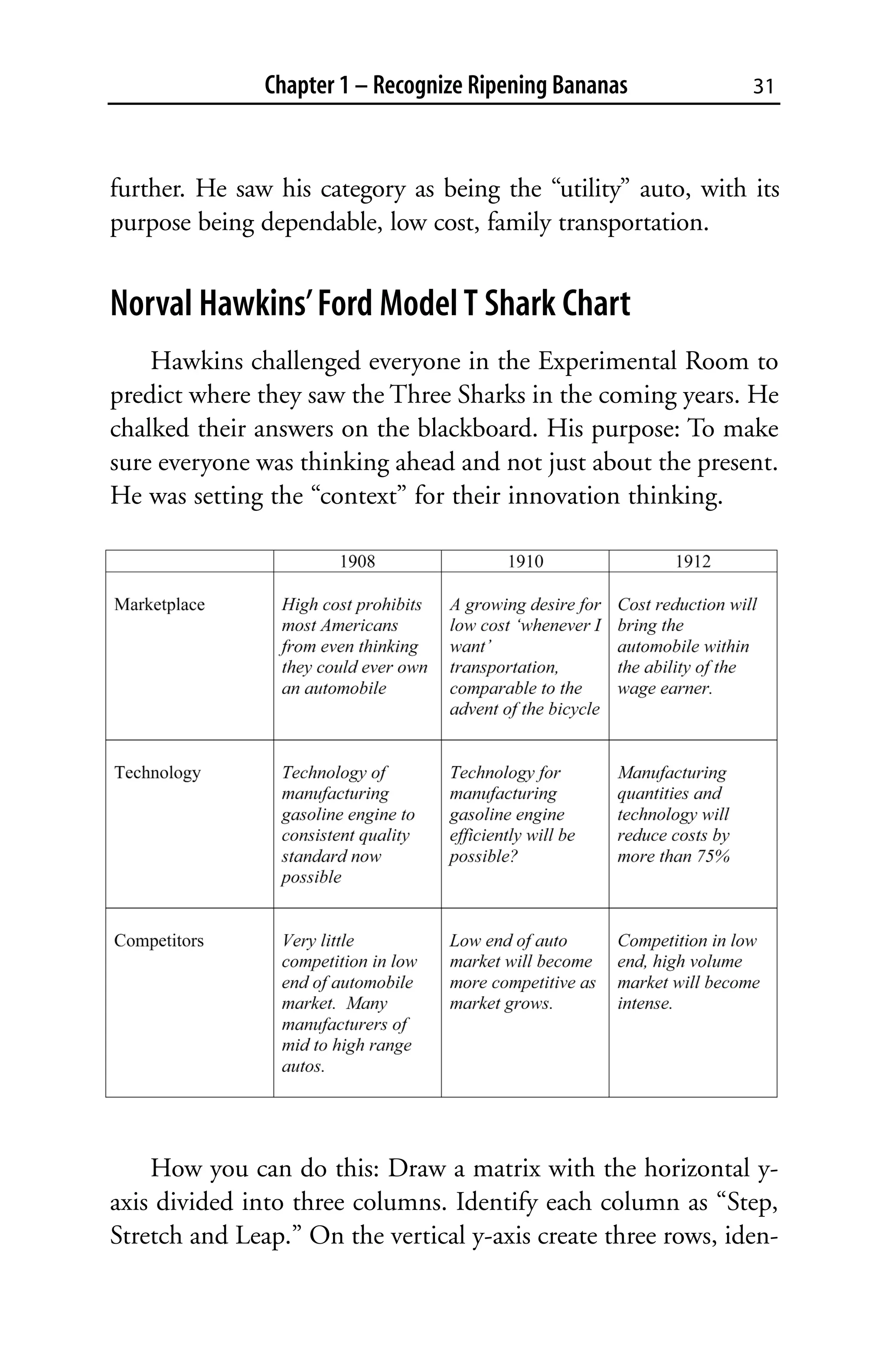
Norval Hawkins’ Ford Model T Shark Chart
    Hawkins challenged everyone in the Experimental Room to
predict where they saw the Three Sharks in the coming years. He
chalked their answers on the blackboard. His purpose: To make
sure everyone was thinking ahead and not just about the present.
He was setting the “context” for their innovation thinking.


    How you can do this: Draw a matrix with the horizontal y-
axis divided into three columns. Identify each column as “Step,
Stretch and Leap.” On the vertical y-axis create three rows, iden-
32          THE RULES OF INNOVATION • BART HUTHWAITE


tified as “Marketplace, Technology and Competition.” Draw a
third line, or z-axis, at an angle where the x and y lines intersect.
On this z-axis line use a verb and noun to describe your product
or service. Then challenge your team to fill the boxes with bullet
statements of possible scenarios. Ask them to use question marks
behind these to encourage them to use their imagination. Do
this individually first, and then discuss these scenarios as a team.


Summary
     • Innovation opportunities are like a bunch of bananas:
       They are either ripening, ripe or rotten. Early discovery of
       green bananas gives you time to take action before your
       competitors.
     • Marketplace Wants are both spoken and unspoken.
       Spoken Wants are out in the open, with every competitor
       on the field. Unspoken Wants are hidden from view.
       Recognizing these and quickly taking action in their direc-
       tion enables you to be the category leader.
     • Things are solutions for Wants. They include new prod-
       ucts, services, transactional processes, and policies. They
       can be technical or non-technical, or a combination of
       both. Breakthrough Things do not normally come from a
       marketplace leader.
     • Three forces of change begin to defeat any innovation
       from the day it is born. These include the constantly
       changing Wants of the marketplace, improved technology,
       and new competitive threats. The Shark Chart gives you a
       way to predict emerging Wants and Things.
CHAPTER TWO


                   Think Backwards


 Fatal Flaw: We limit our success by starting in the wrong direction.

         Start with your end-in-view… Why you must
     climb your mountain in reverse… How to apply
     “effect-to-cause” thinking… Why identical inno-
     vations occur at the same time… Importance of
     speed-to-market… Why a stakeholder who is not
     part of the solution will become part of the prob-
     lem… How to get all stakeholders climbing the
     same mountain… Why your first ideas are never
     the best… How to move back and forth between
     opportunities and solutions to find the best path
     up your mountain.


T
    ake yourself back again to that January day in Detroit over
    100 years ago. You are in a cramped room smelling of
    machine oil and sweat in the back of the Ford Motor Car
Company’s Piquette plant. A wiry Henry Ford in his early forties

                                 33
34         THE RULES OF INNOVATION • BART HUTHWAITE


is standing in front of a huge blackboard in the Experimental
Room. On the table in front of him lies a bunch of green, unripe
bananas.Ford chalks the number $500 on the board for all to see.
     Imagine that Ford is addressing the team members in the
room: “We have to lower the price of the new Model T to $500
— or less. Remember, gentlemen, that the average wage of
mechanics, clerks, small shopkeepers, school teachers, and min-
isters is between $600 and $900 per year. A $2,500 auto is just
too expensive to reach this huge market.
     “And let’s remember another thing,” Ford continued, “main-
tenance costs of most cars today would make even a Vanderbilt
wince. We want to make our parts as reliable and as well supplied
— at the lowest possible cost — as a Singer sewing machine. The
banana of opportunity is ripening fast. If we build the Model T
right, the world will buy it.”
     History shows that people who have accomplished anything
usually did not know exactly how they were going to do it. They
only knew they were going to do it. You must do the same.
Innovation leadership requires that you see the end before the
beginning. You then must be able to communicate your vision to
the people who will work with you to make it a reality. Your
vision of your mountaintop might be somewhat fuzzy at first and
will certainly change. But don’t be too concerned about that. The
records show that no company ever ended up at the same desti-
nation first aimed for.


Start With Your End-In-View
    You first must make sure those you are relying on understand
the concept of “reverse thinking.” This is much like climbing a
Chapter 2 – Think Backwards                 35


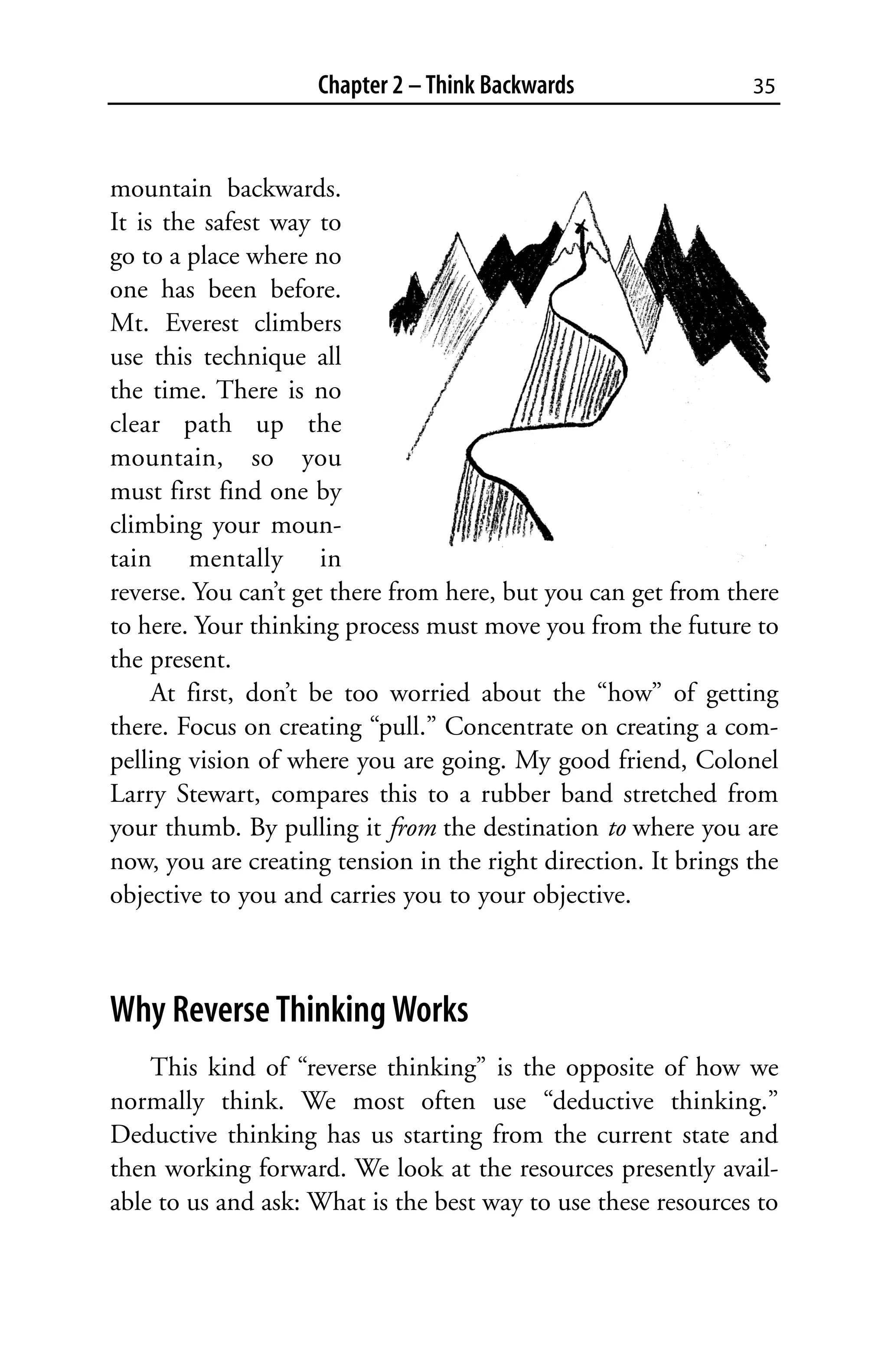
mountain backwards.
It is the safest way to
go to a place where no
one has been before.
Mt. Everest climbers
use this technique all
the time. There is no
clear path up the
mountain, so you
must first find one by
climbing your moun-
tain mentally in
reverse. You can’t get there from here, but you can get from there
to here. Your thinking process must move you from the future to
the present.
     At first, don’t be too worried about the “how” of getting
there. Focus on creating “pull.” Concentrate on creating a com-
pelling vision of where you are going. My good friend, Colonel
Larry Stewart, compares this to a rubber band stretched from
your thumb. By pulling it from the destination to where you are
now, you are creating tension in the right direction. It brings the
objective to you and carries you to your objective.


Why Reverse Thinking Works
    This kind of “reverse thinking” is the opposite of how we
normally think. We most often use “deductive thinking.”
Deductive thinking has us starting from the current state and
then working forward. We look at the resources presently avail-
able to us and ask: What is the best way to use these resources to
36         THE RULES OF INNOVATION • BART HUTHWAITE


achieve possible outcomes? But when we work backward, we
must first determine the goal that’s worthy of our efforts, and
then we get to the point of asking: What resources must we cur-
rently develop to achieve our goal? When we work forward, we
work only within our means. When we work backwards, we may
find ourselves stretching our resources and having to work
beyond our means, but in so doing we reach heights we never
could have achieved through conventional planning.
    By working backwards you will find yourself creating ways to
do more with less — finding ways to work smarter rather than
harder. Working backwards is a way of forcing more of the prob-
lems to the surface at the outset rather than at the end — creat-
ing chaos at the beginning to help order emerge at the end. Of
course, delivering an innovation requires both inductive and
deductive thinking. However, inductive thinking must always
precede deductive thinking.


How Ford Did It
    Henry Ford had the intuitive ability to do this. In his early
days, he never lacked for help. He attracted others to his cause
like a magnet. In the 1890s Ford had five people working with
him on his “quadricycle” at no cost to him. Ford historian Allan
Nevins, in his classic book Ford: The Times, The Man, The
Company, describes Ford’s mentality well: “It was his instinct, in
the drive toward his dream, to harness anyone who could help
pull him in that direction.”
    Another Ford historian, Douglas Brinkley agrees: “What
Henry Ford could do, brilliantly, was lead. It was he who foresaw
the growth of the automobile market. He pushed his company
Chapter 2 – Think Backwards                 37


incessantly toward higher and higher production to meet this
growth. Although he was known for mumbling and stammering
through any sort of public speaking engagement, Ford had no
trouble communicating his grand plans to his employees at Ford
Motor and inspiring them thereby to greater achievements.”
     Henry Ford recognized that the world was changing rapidly.
The mass of Americans would not be satisfied to watch only the
rich afford the ability to go where and when they wished. Years
earlier, the bicycle had democratized the idea of personal trans-
portation. Ford’s idea was to “democratize” the automobile by
making it affordable by the average American family. Ford saw a
world most of his automobile competitors could not even imag-
ine.


The Spirit of Innovation
    Steven Schnaars, in his book Megamistakes, uses the German
word Zeitgeist to describe the phenomenon of innovation begin-
ning to happen simultaneously worldwide. The idea of the
Zeitgeist holds that there is a characteristic “spirit of the times”
marked by social, technical, intellectual and political trends of
that era. These are ideas whose time has come. It means that the
conditions for germinating new ideas are ripening, like Henry
Ford’s bunch of green bananas.
     In the Middle Ages, a Zeitgeist occurred when the Turks in
1470 disrupted the overland trade routes to Europe and the Far
East. This shut down the European supply of pepper, the spice
that stood between meat-eating Europeans and starvation. No
spice except pepper made heavily salted meat edible, and salting
was the dominant form of meat preservation. This caused pepper
38         THE RULES OF INNOVATION • BART HUTHWAITE


to be in short supply and prices skyrocketed. As a result,
European explorers sailed west and south in search of new sea
passages to the Orient. The discovery of America by Columbus
was a by-product of this search for pepper.
     Similarly, in the early 1930s, gathering war clouds sparked a
leap in aviation technology. Sir Frank Whittle, the famous
British inventor, successfully demonstrated in 1937 the first jet
aircraft engine. By coincidence, Hans von Ohain, a German sci-
entist, built a similar jet engine that same year. Only after the end
of World War II, when the two inventors finally met one anoth-
er, did they learn they had reached the same technical solution
through separate thought. When asked how two scientists —
unknown to each other and unaware of each other’s work —
could develop the same device, Whittle replied, “The tree of sci-
entific knowledge tends to bear its fruit at the same time.”
     It was the same with the birth of the automobile industry.It
is estimated that, by 1895, more than fifty people were inde-
pendently working on automobiles across America, most think-
ing that they were the sole leader in this idea. Why did so many
different and widely separated persons have the same thoughts at
the same time?


The Bicycle Triggers a Zeitgiest
    If pepper set in motion the Zeitgiest of world discovery, the
bicycle did the same for the automobile industry. It is a common
misconception that the internal combustion gasoline engine cre-
ated the burst of energy that led to the automobile phenomenon.
Nothing could be further from the truth — it was the bicycle.
Chapter 2 – Think Backwards                 39


    Hiram Maxim, an early automobile pioneer, said that the
emergence of the low-cost bicycle directly led to the automobile.
The bicycle “directed men’s minds to the possibilities of inde-
pendent, long distance travel over ordinary roads.” The low cost
bicycle also ignited bursts of innovation. All the major automo-
bile innovators, from Daimler to Ford, started with the bicycle as
their mass production model. Even Wilbur and Orville Wright
were bicycle builders.
    Prior to the bicycle, the only means of transportation free-
dom was the horse.Horse-drawn carriages were expensive,
though, and horses were costly to keep and produced several
pounds of manure a day.Horses were out of the question for the
ordinary city dweller due to space constraints and sanitation
issues. Farmers had horses for work and transportation to town,
but they also had grazing ground and room for stables.
    The bicycle, on the other hand, was a cheap, clean and effi-
cient mode of personal transportation. The bicycle was first pop-
ularized in Paris in the 1860s and by the 1880s the bicycle craze
was sweeping across America. The mass production of the drive
chain “safety bicycle” meant that both men and women were free
to go wherever they wanted, whenever they wanted.
    For speed, efficiency and cost, a bicycle will beat a horse or a
horse-drawn carriage every time. I can state this as an absolute
fact. I live on Mackinac Island, Michigan, where all forms of
motorized transportation are absolutely banned.In 1901, our
City Council passed an ordinance banning motorized vehicles.
The instigators of this ordinance were the horse-drawn tour driv-
ers who wanted no competition from the downstate Detroit
“horseless carriages.” The result is a transportation economy
frozen at the turn of the twentieth century. My world is one of
bicycles and horse-drawn taxis and drays.
40         THE RULES OF INNOVATION • BART HUTHWAITE


     While the owners of the present-day horse-drawn taxi com-
pany are our friends, I much prefer riding my bicycle. The rea-
son? I can go wherever I want, when I want, in one-third the
time and at no cost. I conduct this experiment of bicycle against
horse every day, and the bicycle always wins. The only downside
is that the bicycle requires manpower to propel it.
     The arrival of the bicycle in late nineteenth-century America
created the Want of freedom of personal transportation. This, in
turn, stimulated the quest for Things that could provide this free-
dom for even greater distances and speed. Thus the automobile
began as an extension of the bicycle. Ford’s initial idea was to
build a two-cylinder engine to propel a bicycle. In Germany,
Daimler was also experimenting with a motorized bicycle. In
1891, Ransom Olds built a steam-powered tricycle. A while later,
Henry Ford built his gasoline powered Quadricycle.
     The French coined the word “automobile” and it stuck.
Ford’s product became for a time the “Fordmobile,” which was
short-lived. But the name “Oldsmobile,” named after its creator,
Ransom Olds, did stick. This points out that a common trait: we
are slow to leave the comfort of our old paradigms. We use terms
that we know to describe things that we don’t know or are not
sure of.
     Ford’s challenge to his team in the Experimental Room was
different than that of other auto manufacturers: “The question is
not, ‘How much can we get for this car?’ but ‘How low can we
sell it and make a small margin on each one? How many cars
must be turned out to get the lowest cost per car, and will the
demand absorb this tremendous output?’”
     Ford focused on all the Things that had to be accomplished
to mass produce the Model T while reducing it to an affordable
price range and thus creating the new category of the family car.
Chapter 2 – Think Backwards                  41


His insight was to recognize that mass production is more than
quantity production. It means the integration of design simplifi-
cation, part standardization, precision machining, coordinated
production, continuous motion, and the reduction of labor of all
kinds anywhere, including the user of the automobile.
    Ford was so confident that he began advertising the (as yet
undeveloped) features of the Model T, a full year before the
Model T entered into design. “Our idea,” he told the press, “is
to build a high-grade, practical automobile, one that will do any
reasonable service, that can be maintained at a reasonable
expense, and at as near $500 as it is possible to make it, thus rais-
ing the automobile out of the list of luxuries and bringing it to
the point where the average American citizen may own and enjoy
his automobile.”


Get Your Stakeholders on Board
    When a Zeitgeist erupts, it offers opportunities across an
entire value chain. These opportunities range from customers all
the way back to your company and then further back to your
supply chain. If you don’t invite these “stakeholders” into your
creative process, you will miss out on including their ideas.
What’s worse, a stakeholder who is not part of the solution can
turn into part of the problem later. Disgruntled stakeholders can
even turn into resistors and saboteurs. You must engage stake-
holders in your innovation process right from the beginning. If
the goal is meaningful to them, they will become enthusiastic.
People only support what they create.
42         THE RULES OF INNOVATION • BART HUTHWAITE


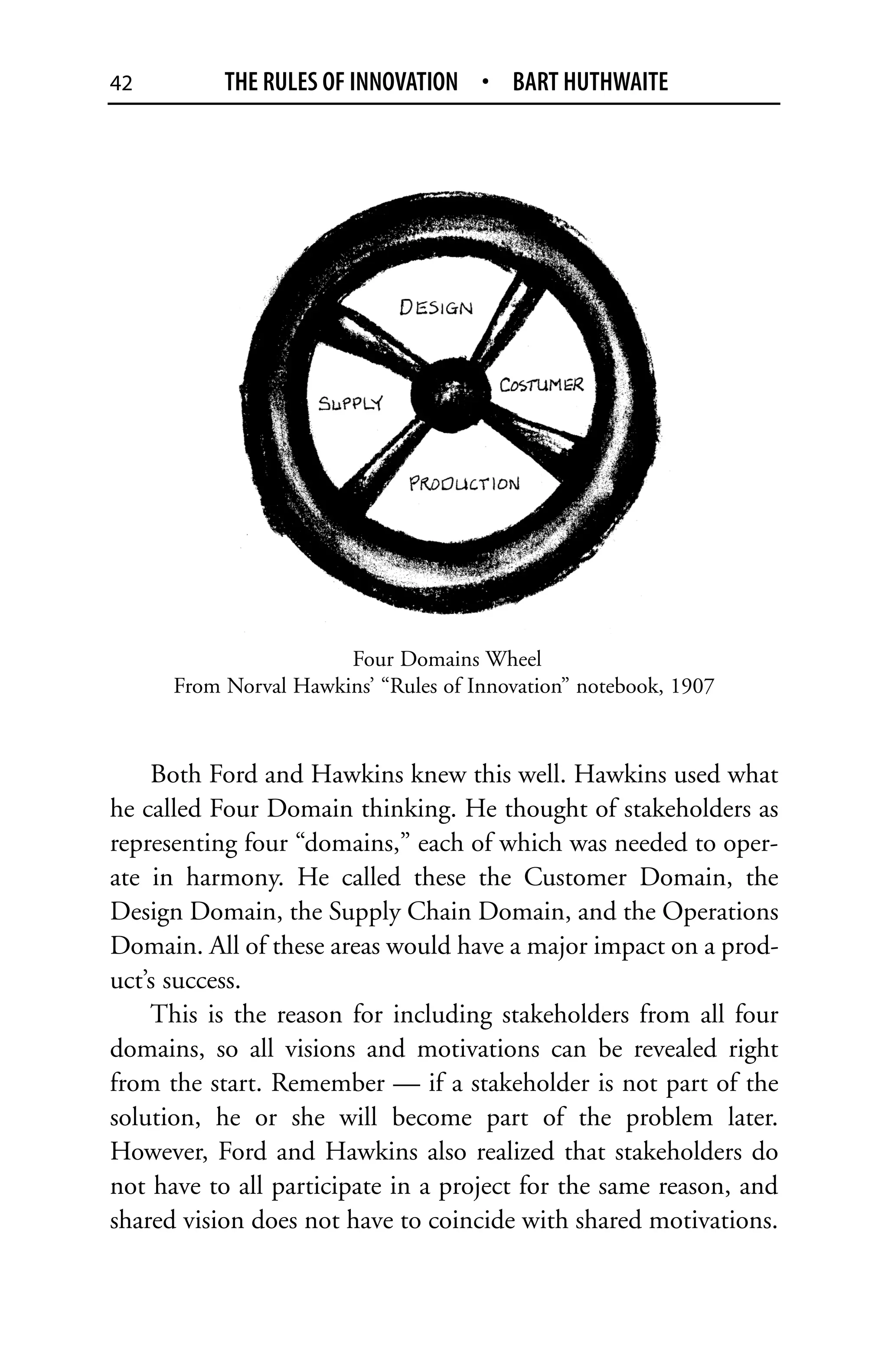
                       Four Domains Wheel
      From Norval Hawkins’ “Rules of Innovation” notebook, 1907


    Both Ford and Hawkins knew this well. Hawkins used what
he called Four Domain thinking. He thought of stakeholders as
representing four “domains,” each of which was needed to oper-
ate in harmony. He called these the Customer Domain, the
Design Domain, the Supply Chain Domain, and the Operations
Domain. All of these areas would have a major impact on a prod-
uct’s success.
    This is the reason for including stakeholders from all four
domains, so all visions and motivations can be revealed right
from the start. Remember — if a stakeholder is not part of the
solution, he or she will become part of the problem later.
However, Ford and Hawkins also realized that stakeholders do
not have to all participate in a project for the same reason, and
shared vision does not have to coincide with shared motivations.
Chapter 2 – Think Backwards                 43


    For example, the two Dodge brothers, Horace and John,
were part of the Experimental Room team right from the start.
They supplied all the engines and drive trains to Ford’s specifica-
tions. Ford also invited Harvey Firestone in. His Firestone Tire
Company would supply all the Model T tires. The team also
included Alfred E. Sloan, president of the Hyatt Roller Bearing
Company (who later became president of General Motors).
Hyatt Roller Bearings were a critical component if the Model T,
used to counter the abuse of rough country roads. All these sup-
pliers had separate motives, but all were united in the idea of
making the Model T the world’s dominant automobile.
    Stakeholders are more easily convinced by what they them-
selves discover than by what you direct them to do. The trick is
to get stakeholders meaningfully involved at the front end of any
project, and then keep them involved without long, exhausting
meetings.
    Ford knew that getting the right stakeholders involved at the
start of the Model T development was essential. He knew that
sometimes the most seemingly insignificant stakeholder can have
a major impact on a product’s success. While innovation is a
highly creative human process that is often individualistic in its
source, it requires the organized efforts of many others to be
effective. When you include stakeholders from all domains in
decision-making, don’t be too concerned about having total
agreement at the start. Perception of what is “right” is a matter of
interpretation, which means that different points of view are
going to be part of every interaction.
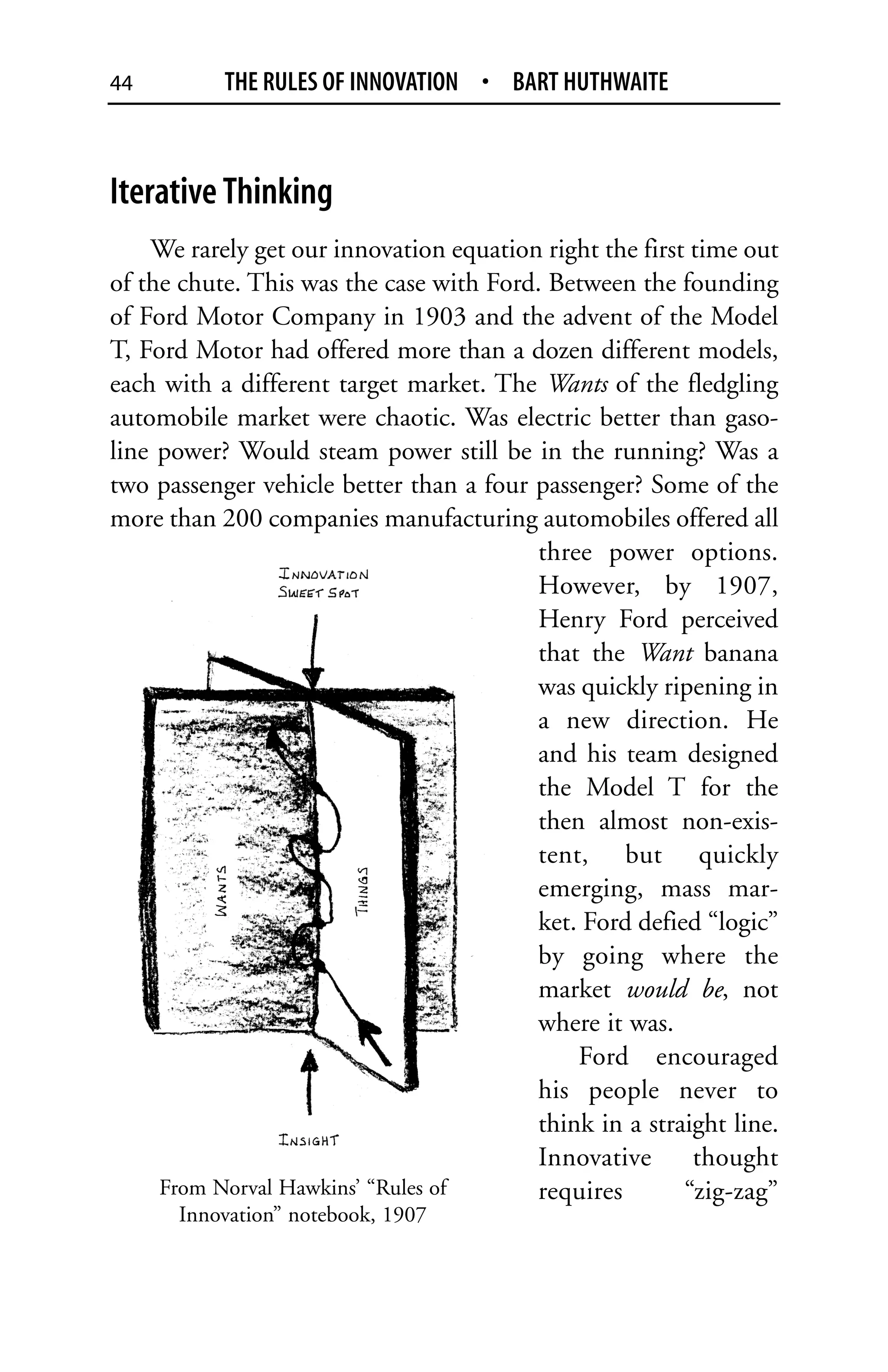
44         THE RULES OF INNOVATION • BART HUTHWAITE


Iterative Thinking
    We rarely get our innovation equation right the first time out
of the chute. This was the case with Ford. Between the founding
of Ford Motor Company in 1903 and the advent of the Model
T, Ford Motor had offered more than a dozen different models,
each with a different target market. The Wants of the fledgling
automobile market were chaotic. Was electric better than gaso-
line power? Would steam power still be in the running? Was a
two passenger vehicle better than a four passenger? Some of the
more than 200 companies manufacturing automobiles offered all
                                         three power options.
                                         However, by 1907,
                                         Henry Ford perceived
                                         that the Want banana
                                         was quickly ripening in
                                         a new direction. He
                                         and his team designed
                                         the Model T for the
                                         then almost non-exis-
                                         tent, but quickly
                                         emerging, mass mar-
                                         ket. Ford defied “logic”
                                         by going where the
                                         market would be, not
                                         where it was.
                                             Ford encouraged
                                         his people never to
                                         think in a straight line.
                                         Innovative       thought
     From Norval Hawkins’ “Rules of      requires        “zig-zag”
      Innovation” notebook, 1907
Chapter 2 – Think Backwards                 45


thinking. Your mind must constantly move between different def-
initions of the problem (the Want) and the solution (the Thing)
until an Insight (a Eureka!) is discovered to connect one to the
other. Research suggests that in over ninety percent of all success-
ful new businesses, historically, the strategy that the founders had
originally decided to pursue was not the strategy that ultimately
led to the business’s success. Intel, Wal-Mart, and a host of other
companies each saw a viable strategy emerge that was substantial-
ly different than their founders had envisioned. But once the
model was clear, they executed that strategy aggressively.
     Such iterative “zig-zag” thinking is contrary to our usual pat-
tern of thought and can seem like scratching your nails across a
chalkboard. . We see a problem, usually well defined, and we sys-
tematically apply time-tested theories and tools to solve it. So
your first task is not so much to come up with new ideas, but to
first escape from the clutches of old ones. Innovative thinking
starts with breaking the tight bonds of our present frames of
thinking.


Messy Business
    Problem and solution (Wants and Things) must co-evolve in
the innovation process.
    This makes parallel thinking messy business. Nigel Cross, in
his classic Engineering Design Methods: Strategies for Product
Design, explains the dilemma well. He says that even a fairly pre-
cise problem statement gives little indication of what a solution
must be. Problem and solution must be developed in parallel,
sometimes leading to a creative redefinition of the problem, or to
a solution that lies outside the boundaries of what was previously
46         THE RULES OF INNOVATION • BART HUTHWAITE


assumed to be possible. This makes innovation also a messy busi-
ness. Your difficulties are twofold: understanding the problem
(the Want) and finding a solution (the Thing). They both occupy
a space that is initially undefined. The key to successful innova-
tion is the effective, and efficient, management of this dual explo-
ration of both the “problem space” and the “solution space.”
     A grandstand view of history shows that connecting even
known Wants with known Things is not so obvious. New Things
have languished for decades before they were recognized as being
valuable. Likewise, new Wants emerge and exist for decades before
some combination of Things is found to satisfy them. The time
span between the invention of canned food and the can opener
was more than fifty years. What was used during this technology
gap? Labels on cans advised using a “hammer and chisel”!
     We get ourselves in trouble when we are overly rigid in defin-
ing either the Wants or the Things to satisfy them. We end up in a
blind alley at one or another of these dual planes. The Things that
you find may be something completely different or never imagined
possible. Or they can be the discovery of Wants you never realized
that the market wanted. It is this kind of uncertainly that makes
innovation such a challenging activity. The Three Sharks assure
that Wants and Things are both constantly changing. Despite his
early success, Henry Ford’s critical mistake was failing to change
the Model T when the market changed. He tenaciously clung to
its “one for all” design while General Motors was moving down the
path of “an auto for every pocket and purse.”


Surface Boundaries and Hurdles
   The Boundaries and Hurdles Tool gets you and your stake-
holders headed in the right direction. Boundaries help set the
Chapter 2 – Think Backwards                  47


margins of your ascent. Going beyond them is wasteful and even
dangerous. The architect Frank Lloyd Wright always told his stu-
dents, “Limits are an artist’s best friend.” Tight limits force us to
think beyond conventional solutions and find answers we might
not have otherwise discovered. When you are challenged to
deliver a new innovation with a small budget and tight deadline,
you have probably found that you were more resourceful than if
you had been granted a lot of money and time.
    Hurdles are challenges that you must overcome to reach your
mountaintop. Identifying them early gives you time to solve
them, and gets everybody roped together and prepared to head
for the correct mountaintop.


Hawkins’ Boundaries and Hurdles Blackboard Tool
48         THE RULES OF INNOVATION • BART HUTHWAITE


     Like all the tools you will learn in this book, think of it as a
three dimensional matrix. On the horizontal Z axis draw two
columns, one headed with the word “Boundaries,” and the other
with “Hurdles.” Boundaries set the margins of your ascent;
remember that going beyond them is wasteful and can be dan-
gerous. Hurdles are challenges that you must overcome to reach
your mountaintop; remember that identifying them early gives
you time to solve them. On the vertical Y axis, list the Four
Stakeholder Domains of Customer, Design, Supply Chain and
Operations. On the Z axis, describe your objective in a few bul-
let points, each of which is at a high level. Then ask each of your
stakeholders and team members to individually write bullet
points in each box. Question marks should be used when a per-
son is uncertain about his or her bullet point. Then integrate all
of these thoughts into one summary. You will be amazed at how
different each stakeholder perspective varies from one domain to
another. Benefits of this tool include:
     • Surfacing misalignments with your goal
     • Understanding individual fears and concerns so that you
       can deal with them effectively
     • Discovering false boundaries that limit possibilities.


     • A supplier who is not part of the solution (design) will
       be part of the problem (production) later.
     • To go to a new destination you must first leave an old
       one.
     • T best way up a mountain is never a straight line.
        he
     • If man had never charted a path into the unknown, he
       would never have discovered the known.
                                —From Hawkins’ notebook
Chapter 2 – Think Backwards              49


Summary
  • Innovation requires “inductive” thinking. You set a goal
    and then work backward to the present to discover the
    best way to climb your mountain. This frees you of your
    current resource constraints.
  • Any innovation requires speed. The idea of Zeitgeist says
    that the things that have awakened you to a new opportu-
    nity have also done that to others.
  • Stakeholders who are not part of defining and solving your
    innovation challenge will become part of the problem
    later. Get them on board immediately by using the
    Boundaries and Hurdles tool.
  • Iterative “zig-zag” thinking is a hallmark of innovation.
    You must explain that innovation is “messy business.” It
    requires moving constantly between re-defining the Wants
    and the Things to answer them. The route to a profitable
    solution has many twists and turns.
CHAPTER THREE


           Explore for Hidden Wants


        Fatal Flaw: We Fail to Discover New Values to Deliver

          Why you must listen to the “Voice of the
     Customer” with caution… Why ninety percent of
     all opportunity lies hidden beneath the surface…
     Don’t compete, differentiate… How to use
     Darwinian divergence to your advantage… Where
     to start your search for value… T eight values
                                       he
     every customer wants and how to use them at the
     beginning of your search.


T
       his chapter will show you how to discover hidden Wants.
       The most promising kinds of Wants are those that are
       unspoken. If you have the power of hearing unspoken
wants before anyone else, and developing the right Things to sat-
isfy them, you will be a winner.


                                 50
Chapter 3 – Explore for Hidden Wants           51


     Yellow banana
innovation strate-
gies exploit a
change that has
already occurred.
They satisfy a need
that already exists.
But in green
banana strategy,
you         identify
emerging Wants
and bring them to
the surface. Your aim is exploiting this kind of hidden Want. The
trick is to have some idea about when the Want is going to be
“ripe.” Is the user going to be receptive, indifferent, or actively
resistant?


Hear Unspoken Wants
     Be cautious when you listen to the voice of the customer.
Customers do not tell you the entire truth. They don’t intend to
hold their Wants back; it’s just that they don’t realize they have
them, or are unable to express them in words.
     Roy H. Williams, in his book The Wizard of Ads, expresses
this well: “There is a profound difference between what a cus-
tomer says she wants and what she truly wants. The diamond
buyer says she wants a GIA certificate diamond of G color and
VVS clarity when all she really wants is to see people’s eyebrows
jump to their foreheads as they exclaim, ‘Is that real?’ Similarly,
a customer may say he wants a car wax when all he really wants
is a shiny car!
52         THE RULES OF INNOVATION • BART HUTHWAITE


    The marketplace seldom speaks the “real” truth about its real
Wants. The reason? Customers typically speak in the present
tense. They describe what they would like today and, most times,
don’t do a very good job of expressing their real needs. Your chal-
lenge is to discover these unspoken Wants.


Starting Your Exploration
    Your exploration for hidden Wants must begin with “value
abstraction.” Value abstraction is the technique of going to a
high enough altitude to see the forest, not just the trees. When
you go high enough, you are able to see opportunities you never
imagined before. It’s much like the Civil War balloonist who saw
a pattern of battle evolving and opportunities arising that no one
could ever imagine.
    Take, for example, Henry Ford and his idea of a “universal
car.” Most automakers in 1907 saw the market as being those
who were able to pay $2,500 or more for a car. They were look-
ing at only five percent of the U.S. population.Ford’s thinking
went high enough to see the other ninety-five percent of the pop-
ulation who would be able to afford a car if he could get the price
below $500. Ford’s competitors defined “affordability” as a min-
imum of $2,500. Ford took a higher view and eventually drove
down the price of a Model T to less than $350. It is when you
begin at too low an altitude that you get in trouble. You limit
your possibilities and you may miss major opportunities.
Chapter 3 – Explore for Hidden Wants             53


The Eight Basic Value Questions
     There are two main reasons why many value searches floun-
der. The first is that you may start at too low a level. Specific
problem statements can lead to quicker solutions, but less con-
ceptual creativity. You constrain your search by using specifica-
tions rather than abstractions. For example, you define “per-
formance” within a narrow band of technical constraints. Such
constraints leave you little room for looking at a wide range of
alternatives and you are forced to see only the trees, not the entire
forest.
     The second reason is that you do not have a starting point.
Value abstraction must be high enough to encompass all cus-
tomer Wants; however, the abstractions must be clear enough to
act as a starting point for finding new value. For example, “cus-
tomer satisfaction” is an abstraction you most certainly believe
in, but the term is at too high a level to act as a beginning point.
      Every quest for the right value set must have a starting point.
My experience shows that there are eight universal “core values”
all customers want. These may be stated in different words or
languages; however our experience over the past twenty-five years
consistently shows these eight are basic. You can use them as a
first step in defining your overarching value search.
       Let’s return again to Ford’s Experimental Room where
Norval Hawkins chalked these eight terms on the blackboard
and is challenging everyone in the room, including Henry Ford,
to define them for the Model T.
54         THE RULES OF INNOVATION • BART HUTHWAITE


Performability
Hawkins’ Notes: T Model T must be able to go anywhere
                    he
and anytime. T goal will be utility. We will build it light,
                he
with a lot of road clearance. We will reduce weight to the
absolute minimum. T means we can build an auto of
                       his
twenty horsepower that can run circles around a heavier one
with twice the horsepower.

Ask yourself: What defines performance in the context of the
customers we are attempting to reach? Are we putting in too
much performance?


Affordability
Hawkins’ Notes: T Model T will be the lowest priced auto
                   he
on the market. Mr. Ford wants to drive the selling price down
below $500! His goal is to ship 1,000 Model Ts a day!

Ask yourself: Cost is always relative to the value received.
However, value is always defined by the customer. Are we deliv-
ering too much value, more than the customer really wants for
the price?


Featurability
Hawkins’ Notes: Mr. Ford wants to strip the Model T to the
basics. Should buyers want “extras,” they can have them
installed after their purchase.

Ask yourself: What features can we eliminate without a major
decrease in value? Consider that every feature, whether it is asso-
Chapter 3 – Explore for Hidden Wants          55


ciated with a product or a service, takes time, hence costs money,
and if done wrong can create a quality flaw (more on this in
Chapter 4, “Stop Waste Before It Starts”).


Deliverability
Hawkins’ Notes: Mr. Ford insists on no special orders. We
will set our production for the year and stick to it. Volume,
volume, volume, he says. Only that way will we be able to
drive the price down to the lowest in the marketplace.

Ask yourself: Can we deliver our offering precisely when it is
needed? Can we gain a competitive advantage by doing this?
How must we structure our service or product’s architecture to
make sure we meet the right tempo of our customers’ demands?


Useability
Hawkins’ Notes: Mr. Ford believes the ideal number of pages
in an instruction manual is zero. His challenge: How can
we design the Model T so consumers can learn how to drive
it and maintain it in minutes?

Ask yourself: What can we do to eliminate the need for learn-
ing? How can make our product as easy as possible to use? Can
we eliminate the need for skill?
56           THE RULES OF INNOVATION • BART HUTHWAITE


Maintainability
Hawkins’ Notes: Mr. Ford wants the Model T to be so simple
that it can be serviced by a city person with normal tools. He
wants it built light to reduce wear on tires.

Ask yourself: Can we gain a competitive advantage by reducing
all skill required for maintenance, or eliminating maintenance
entirely?


Durability
Hawkins’ Notes: Mr. Ford wants the Model T to be a farmer’s
auto, able to go across any road or field. He wants it built
light with a high clearance. T will make it easier to get
                              his
out of ruts.

Ask yourself: Is there a competitive advantage to making our
product more durable? Is it too durable?


Imageability
Hawkins’ Notes: You never get a second chance to make a
first impression. Mr. Ford wants the Model T to convey the
image of trust and quality. He says we will enter every
endurance race in America and Europe to demonstrate this.
He has no interest in style.

Ask yourself: What is the fundamental image that our offering
now conveys? How can we change this? Should we change it?
Chapter 3 – Explore for Hidden Wants           57


Why Ilities ?
    The use of abstractive words such as “Ilities” enables you to
apply the principle of problem restructuring. For example, the
standard procedure in physical science is to make observations or
collect systematic data and to derive principles and theories from
them. This imposes limitations on the breadth of your innova-
tion thinking. Albert Einstein despaired of creating new knowl-
edge from already existing knowledge. How, he said, can the con-
clusion go beyond the premises? So he reversed this procedure
and worked at a higher level of abstraction. This bold stance
enabled him to create theories others could not. Einstein took an
abstraction as his starting premise and simply reasoned from the
abstractions to a theory. This approach ran counter to what oth-
ers were unwilling to accept because such abstractions could not
be proven by experiments of the day.
    You may ask, why use only eight attributes? Too many choic-
es in value abstraction often leads to taking the easy way out.
Focus is needed. A good photographer will get much closer to his
subject, excluding everything from the picture except what mat-
ters most. The principle of focus is to exclude by choice that
which matters less, so that we may give our undivided attention
to that which matters most. Our experience shows that eight is
the maximum number of values that can be juggled at one time.


Ford’s Value Abstraction
    A Ford designer said, “Mr. Ford wanted everybody to ‘see’
the values first, and then design the car to meet those values.”
While other manufacturers made running changes to meet what
58         THE RULES OF INNOVATION • BART HUTHWAITE


their salesmen told them their wealthy customers wanted, right
from the start the Model T team stepped up higher to get a clear-
er view. Ford once said, “Our effort must be in the direction of
simplicity. People in general have so little and it costs so much to
buy even the barest necessities, because nearly everything that we
make is much more complex than it needs to be.”


Hawkins’ Ility Chart Blackboard Tool


    Hawkins chalked the eight “universal customer values” on
the blackboard. He then challenged the Model T team to come
up with definitions for each. He had Henry Ford start the dis-
cussion, with each person, in turn, adding his thoughts. When
the process was done, the Model T team had a high level, unified
view of what the ideal Model T would be. While there would be
many arguments about specific requirements, the entire team
never questioned this overall view they had originally agreed to.
Chapter 3 – Explore for Hidden Wants           59


Summary
  • Be cautious when listening to the voice of the customer.
    Customers have a limited view of what is really possible.
  • The best kinds of Wants are the unspoken ones. When you
    can find and deliver them before your competitor, you will
    gain a distinctive advantage.
  • Don’t compete, differentiate. Explore for advantages that
    may take you in an opposite direction than where the mar-
    ket is going.
  • All customers want eight basic values. Use these as a start-
    ing point and find new definitions for each of them.
CHAPTER FOUR


          Stop Waste Before It Starts


        Fatal Flaw: You fail to find and attack the creators of
                    hidden cost and poor quality.

         What is Waste?… T importance of “fire pre-
                              he
     vention” versus “fire fighting”… Why everything
     is the sum of individual tasks or “Ings”… T      he
     seven types of solutions that create eighty percent
     — or more — of high cost, poor quality and slow
     time to market


A
       Want is like a two-sided coin. One is the side of Value,
       the Ilities that your customer seeks. The other is the side
       of Ings, the tasks that must be done to deliver that Want.
Your goal must be to optimize the Ilities and minimize the Ings.
For example, Ford constantly struggled to reduce to an absolute
minimum the number of steps required to operate a Model T.
He wanted easy “operate-ability.” If the Model T was truly to be

                                  60
Chapter 4 – Stop Waste Before It Starts          61


an auto for the masses, Ford knew he had to minimize the “learn-
ings” of what was normally considered to be a high tech
machine.
    Many times you can get the Value side correct, but create
flaws by imbedding the wastes of high cost and poor quality.
Wastes, like Values, are set in motion at the early conceptual, or
incubation, stage. Most of such wastes are hidden from view. You
cannot “see” them in the usual sense of the word since they have
not “hardened” into drawings or prototypes. So they are missed,
only to emerge into realities on the factory floor or in your cus-
tomer’s domain. In this chapter you will learn how to “see” and
attack such hidden Waste.


Be an Ing Thinker
     Begin by thinking of all Things as the sum of their collective
Ings. These are the tasks, or “jobs to be done,” in order to create,
sustain, and even dispose of a product, process or service along
its life cycle. They occur in all the Four Domains described in
Chapter 2. Waste prevention begins with imagining all these
Ings.Your goal is to deliver value, or Wants, with as few Ings as
possible. Why is this so? As I mentioned in the previous chapter,
each of these tasks takes time, hence costs money, but also, if
done improperly, can create a quality flaw. A very basic waste
reduction technique is simply to reduce process steps. These
include “hard” processes such as manufacturing as well as “soft”
processes in the transactional areas, such as back office operations
and marketing functions.
     Think of Ings as being the molecules that can be combined
to create the Ilities you desire. The problem is that many of these
62         THE RULES OF INNOVATION • BART HUTHWAITE


Ings are invisible, like molecules, at the concept stage of your
effort. They only become visible downstream where they are
combined and used to create and sustain your offering.
     Henry Ford was an intuitive Ing thinker. He saw cost where
others saw nothing. Ford believed that the Model T would be the
sum of the tasks required to create it, manufacture it, and sustain
it in the customer’s domain. Ford Motor consistently beat out its
competitors because of his relentless attack on what he called the
“unseen creators of waste.” These were the evils of sorting, han-
dling, fitting, fine-tuning, inspecting and many hundreds more.
Ford’s greatest contribution was not the moving assembly line, as
most think. It was his ability to see the Model T as a system of
tasks, from beginning to end. He would constantly try to inte-
grate these tasks into one continuing process, from growing the
trees for his wooden body parts to converting the wood waste
into charcoal briquettes so that it could be reused.
     Ford himself regarded his greatest contribution to automo-
tive history as the design of the Model T. He saw the production
of the Model T flowing naturally from its simplicity of concept
and design. Even when the moving assembly line did arrive at
Ford Motor in 1914, seven years after the design of the Model T,
it was the modularization of the design, elimination of manual
precision, standardization of parts, and similar ideas that enabled
the moving assembly line, as well as all the other sub-assembly
lines feeding it, to become a reality. Other auto manufacturers
attempted to apply moving assembly but struggled and failed
due to the design of their vehicles.
     According to Norval Hawkins’ notebook, Henry Ford him-
self created the idea of “Ing thinking.” On the Experimental
Room blackboard, Ford drew a cluster of circles, both large and
Chapter 4 – Stop Waste Before It Starts          63


small. Some he chalked in solid and then connected those with
lines. The others were left floating in the space of the huge board.
    “Gentlemen,” he said, “the total of what I have drawn here is
our present Model N auto. Each of these circles represents a task,
or Ing, that must be done either in our factory or by our cus-
tomers. We will be successful when we have eliminated a mini-
mum of fifty percent of these tasks, leaving only the ones I have
chalked in and connected to one another. The unconnected cir-
cles are waste. We will eliminate them by design!” Ford then
grabbed a rag and vigorously erased the unconnected circles. He
raised Ing thinking to a new level, by taking complexity reduc-
tion to the early innovation phase.


Prevent Waste
     Remember that there is nothing as wasteful as doing some-
thing with great efficiency that need not be done at all. We
unknowingly create the environment for waste downstream in
the factory and in the marketplace. The reason: We have few
ways at the incubation stage to illuminate, or predict, what kind
of Waste will occur. Once imbedded in a product or service,
Waste is tough to eliminate.
     Corporate America has spent billions of dollars on curing
manufacturing and customer service problems that could have
been avoided in the early innovation stage. Lean manufacturing
is focused on eliminating non-value tasks on the factory floor.
This includes identifying and reducing such “hidden” process
steps as part moving, storing, inspecting, and many more.
Manufacturing complexity reduction is the primary target. Six
Sigma tools, and the cadres of Black Belts who administer them,
64         THE RULES OF INNOVATION • BART HUTHWAITE


are aimed at identifying the root cause drivers of quality failures
both on the factory floor and beyond. Product and process vari-
ability is the chief enemy.
     What is needed today is a stronger dose of waste prevention.
Many products are designed with value in mind; however, little
thought is given to waste prevention. One reason is that the
kinds of waste these products create are well off the corporate
accounting radar screen. There has been no system for detecting
their potential and reducing their effect at the early concept
stage. Remember that your concept stage will drive most of your
success. Once your concept hardens into a prototype, or solidi-
fies in the minds of your team and management, your flexibility
and receptivity for change shrinks rapidly. The pressures of time
and money demand that you “get on with it.” You enter into a
stage of fine-tuning and implementing, rather than innovating.
     “Fire prevention always beats fire fighting” is another way of
looking at it. I am a great believer in both Six Sigma and Lean.
The past years have been a gigantic learning experience. Six
Sigma gave us tools and a philosophy for systematically identify-
ing the creators of poor quality and eliminating them. Lean gave
us the Toyota-type tools for identifying waste on the factory
floor. Both have begun the climb upstream to the real cause of
the problems of poor quality and cost — the concept phase of
any improvement effort.
     However, like many philosophies and tools that are stretched
beyond their capabilities, both techniques are encountering dif-
ficulty when it comes to their application to front end innova-
tion. While no new idea ever begins with a blank sheet of paper,
the front end of any new product or service is hazy and unde-
fined. Six Sigma and Lean tools work well on improving the
known, but there must be a product, a process, or some Thing to
Chapter 4 – Stop Waste Before It Starts          65


analyze and improve. They are analytical tools that rely on
deductive reasoning. They are not inductive tools.


Visualize Hidden Waste
     Ford once said, “We swim in a sea of unseen waste. The
worst waste is not the machining chips on the factor floor, but
the unseen waste of time.” Bruce A. Henderson and Jorge L.
Larco explain this concept well in their book Lean
Transformation. Traditional cost accounting processes are gener-
ally not lean, either in theory or practice. Most are standard cost-
ing systems that may look good on paper, but rarely give an accu-
rate measure of product cost. They draw careful distinctions
between direct and so-called indirect labor costs.
     Direct labor is usually defined as the people actually working
on the product — as compared to maintenance people or mate-
rial handlers who are considered to be “indirect.” Since indirect
costs cannot be precisely assigned to labor or material, they are
collected in vast overhead pools and a method is devised to
spread these indirect costs over the supposedly “productive direct
labor.” The result is the “peanut butter effect.” The causal driv-
ers of indirect cost are lost as they are spread over all products.
We end up seeing the effect, but not the cause. It’s like a doctor
treating your stomachache with some aspirin, without really
understanding — and curing — the root cause.
     And while accounting practices do a poor job in treating our
internal corporate stomach pains, they do little, or nothing, for
spotting and curing aches in the external domains of supply
chain and customer space.
66         THE RULES OF INNOVATION • BART HUTHWAITE


Attack the Seven Creators of all Waste

          If it is bolted, try riveting it. If it is riveted,
     design it for welding. If it is welded, try bending.
     If it is bent, try making it flat. If it is thick, make
     it thin!
               –Sign in Ford’s Model T Experimental Room

    The design of the Model T, and all the transactional process-
es that surrounded it, testify to Henry Ford’s obsession with
Waste prevention through the use of better front end innovation.
Ford’s challenge to his team was to find all the opportunities for
waste reduction, before they leaped to solutions.
    Imagine Norval Hawkins holding his innovation cube in his
hand. writing down what he called the real causes of the “stom-
ach aches” of the automotive business. He was providing his
team with a “lens” for looking at the current Ford Model N in a
completely new way. He used “waste abstraction” and gave the
Ford team a high enough perspective to see the creators of Waste
in all their forms.

                  From…            …To
                  Complex          Simple
                  Precise          Adaptable
                  Variable         Unchanging
                  Sensitive        Robust
                  Immature         Proven
                  Dangerous        Safe
                  High Skill       Low Skill
Chapter 4 – Stop Waste Before It Starts        67


     Ford’s challenge to his Model T team still holds true today.
Experience now shows that over eighty percent of all poor qual-
ity, high cost and excess time is set in motion by seven types of
innovation decisions.
     Want the same challenge? Take a piece of paper and list
Ford’s “Creators of Waste” on the left side. On the right, list an
example of each of the seven in your own offering — or that of
your competitor. Finding unseen Waste can be the start to a
breakaway product.


Complexity
    This is the use of many process steps and parts when fewer
would suffice.
    Ford knew every manufacturing process step required time
and money, and if done wrong, could lead to a quality flaw. He
also knew this was true for the customer in maintaining his auto.
The key was to reduce the number and complexity of all these
Ings or steps. One way he did it was to simplify the Model T
product architecture through standardization and modulariza-
tion. This approach can pay hefty dividends both in the factory,
in shipping costs, and in customer repair.
    Example: The Model T had forty percent fewer parts than
its predecessor, the Model N. Since rail freight was based on
space used, not weight, components were shipped in modules for
completion at assembly plants.

Ask yourself: What Ings can we eliminate in our value chain to
reduce complexity?
68            THE RULES OF INNOVATION • BART HUTHWAITE


Precision
     A precision process is one that demands that everything go
just right or the entire process will go wrong. Precision is costly
in terms of machines, tooling, skilled employees and scrap. Ford
was not a great fan of unnecessary precision. He sought the
opposite of a precision process. He wanted a “robust” solution,
one that is tolerant of wide variation.
     Example: Ford believed that when you cannot minimize pre-
cision, you must transfer it from human hands to machines. “Let
the machinery deliver the precision; let man do the work not
requiring precision,” he said. Ford was the leader in the use of
advanced machine tools.

Ask yourself: What precision Ings can we take out of our value
chain? Can we reduce the precision our customer must apply to
use our offering?


Variability
     In the early auto manufacturing days, a special category of
workers were the highest paid and the most in demand — the
“fitters.” They were the factory floor craftsmen who filed, shaped
and hammered parts together. This “craftsmanship” then rolled
on into the customer’s domain, where an equal amount of skill
was needed to replace a part.
     Example: Ford set the standard for the Model T with the
promise, “We will build the Model T with absolutely inter-
changeable parts. All parts will be as nearly alike as chemical
analysis, the finest machinery, and the finest workmanship can
make them. No fitting of any kind will be required.” Customers
Chapter 4 – Stop Waste Before It Starts        69


were confident they could get replacement parts that fit the first
time.

Ask yourself: How variable are our products, processes or serv-
ices? Where can we eliminate variability?


Sensitivity
    Ford knew the Model T would have to be robust in order to
survive the country roads of his day. Most automobiles at that
time were low slung, heavy, and never dared venture off city
streets without some fear of damage. To emphasize the compa-
ny’s focus on durability, Ford admen entered the Model T into
one of the first cross-continent races. The new Model T took first
and second place.
    Example: Ford raised the ground clearance of the Model T.
He reduced its weight and used a new three-point suspension to
provide more flexibility for rocking out of snow and mud.

Ask yourself: How can we make our offering more robust?
Where are our points of sensitivity to failure?


Immaturity
    Ford liked to say there was nothing absolutely new about the
Model T, “just a lot of improvements combined in the best way.”
Other manufacturers would offer new features every year, but
Ford saw a high degree of “newness” in a vehicle as being risky.
He was willing to constantly experiment with new techniques for
manufacturing and selling his Model T. However, he was almost
paranoid about changing the basic design.
70         THE RULES OF INNOVATION • BART HUTHWAITE


    Example: Ford designers had a new version of the Model T,
unknown to him, ready for Ford when he returned from a
European trip. When he saw it, Ford went into a fit of rage,
grabbed a sledgehammer and completely destroyed the proto-
type. This resistance to changing anything about his beloved
Model T would eventually almost destroy his company.

Ask yourself: What new idea can we use with minimum risk?


Danger
    Automobiles in 1907 were considered to be dangerous, both
for those riding in them as well as for pedestrians. Steering and
braking were major problems. Ford worked on both in the
design of the Model T. Up to that time, you could have either
right hand or left hand drive for your vehicle. Right hand drive
was a favored approach as it let you see how close you were to the
edge of the road — or ditch. The Model T changed that
approach forever in America.
    Example: Ford believed left hand drive was the safest
approach to steering. He foresaw the day when two-way traffic
would be the real safety problem. He standardized left hand drive
and drove costs down due to this common design.Ford now had
one single chassis to manufacturer. Other manufacturers soon
followed his lead.

Ask yourself: Think of danger as being more than danger to
humans. Think of danger to the environment too. Where can we
gain a competitive advantage?
Chapter 4 – Stop Waste Before It Starts        71


Skill Intensive
     The key to low cost mass production wasn’t the moving
assembly line, as many people then and now believe. Rather, it
was the complete and consistent interchangeability of parts and
the simplicity of attaching them to each other. The automobile
boom soon outstripped the pool of skilled labor. Ford knew he
would have to design the Model T, and all the transactional
processes associated with it, so that unskilled labor could per-
form them.
     Example: After reducing the number of parts in the Model
T, Ford then went to work on reducing the skill required to man-
ufacture and service each. His accountant, James Couzens,
applied the same tactic by simplifying the purchasing of compo-
nents. He used single source purchasing to reduce the number of
transactions, and promised his suppliers higher volumes if they
would lower their prices. Thus, Ford Motor was able to relent-
lessly drive down the selling price of the Model T every year.

Ask yourself: Where can we eliminate skill in our offering? Are
there opportunities in reducing the skill needed to use our serv-
ice or product?

    To identify and attack creators of Waste, Ford used the same
approach Norvel Hawkins suggested for finding the best Model
T values. In this case, Hawkins called it the Waste Seeker Tool. Its
purpose was to surface and focus attention on the Ings the
Model T would have to avoid to be a success. He listed all main
creators of waste and then how these created problems for the
company.
72            THE RULES OF INNOVATION • BART HUTHWAITE


1907 Ford Model N Waste Seeker Tool

Waste Creators           Why?

Complexity               Five different models. Many different
                         parts. Multiple colors. Learning to drive
                         is complicated for new auto user.

Precision                Precision tolerances, especially with
                         engine parts. Hand fitting of parts is
                         necessary.

Variability              Different suppliers with quality, delivery
                         variables between them. Much hand fit-
                         ting and sorting. Need for standards,
                         common parts

Sensitivity              Low chassis clearance. Difficult for
                         country road driving.

Immaturity               High learning curve with multiple mod-
                         els. Too much experimentation going
                         on all at once.

Danger                   Factory injuries too high. Not enough
                         driver protection.

High Skill               Transmission shifting difficult to learn.
Chapter 4 – Stop Waste Before It Starts         73


Summary

  • All value comes at a price. They are the tasks, or Ings, that
    must be performed to deliver that value. Your goal must be
    to meet your stakeholders’ Wants, the values they seek,
    using the absolute minimum of tasks along the entire life
    cycle of that value.
  • Every Ing (task) required to create your innovative solu-
    tion(Thing) takes time, hence costs money, and, if per-
    formed improperly, will result in a quality flaw. You must
    apply “fire prevention” rather than “fire fighting” by elim-
    inating as many Ings as you can, right at the start of your
    innovation effort.
  • Conventional accounting is a poor guide to waste preven-
    tion. It provides guidance on the “visible” costs of labor
    and material. However, transactional costs and most over-
    heads are lumped together and are almost impossible to
    separate to find their root causes. The causes of these Ings
    are hidden from your view.
  • Seven kinds of solutions create more than eighty percent
    of all high cost, poor quality, and slow time to market. You
    can use these seven common waste creators to analyze cur-
    rent offerings for improvement, probe your competitors’
    products for weak points, and predict “leanness” as you
    develop your own offering.
74         THE RULES OF INNOVATION • BART HUTHWAITE


Summary of Part One
How to Find Your Best Opportunities
    Remember that a successful innovation happens when three
paths of knowledge intersect. Think of these as three lines inter-
secting in a three dimensional space. One is the knowledge of a
Want. Wants may be spoken or unspoken. The best are the
unspoken ones that you can see early and exploit. A second path
of knowledge is the solution, or what is called a Thing. A Thing
may be something physical, like a product, or it can be a process,
a system or a business strategy. A third path of knowledge is your
ability to apply your Insight to re-shape and make a connection
between Wants and Things.
    Chapters 1 through 4 gave you a systematic way to begin
finding the right Wants. An innovation will be successful when
you are able to use your best thinking to find a real Want and
connect it to a real solution, or Thing.


Coming in Part Two – How to Find Your Optimum Solutions
    Part Two, Chapters 5 though 7, will give you rules for search-
ing for and finding your optimum solutions. These are the Things
you need to have to meet the Wants you have identified. You will
learn a systematic way for developing your Insight to do this.
PART II


 How to Find Your
Optimum Solutions


        75
CHAPTER FIVE


          Search Outside Your Shell


        Fatal Flaw: We fail to explore beyond the grooves of
                      our known experience.

         How to create breakthroughs… How you can
     extract new ideas from any experience… Nature
     has already solved many of our problems…
     Leonardo’s Rule… Insights happen when you
     explore new territories… How to go off your beaten
     path to find creative insights


I
    n this chapter you will learn how to move from identifying
    Wants, or opportunities, to how to apply your Insight and
    find real Things, or solutions. Don’t just see innovation as
being “technology.” Remember that Things are any kind of solu-
tion. The computer, cell phone and Internet are all highly visible
technologies. But innovations in insurance, banking, services,
and many other non-technical areas are also solutions.

                                77
78         THE RULES OF INNOVATION • BART HUTHWAITE


Grooves of Experience
     We spend most of our waking lives thinking in the ruts of
our experience. When life presents us with a problem or an
opportunity, we “solve” it in accordance with the code of rules
that we used with similar problems in the past.
     Arthur Koestler, in his classic The Act of Creation, compares
these ruts to a train engineer who must drive his train along fixed
rails according to a fixed timetable. The same ideas, verbal con-
cepts, visual forms, and mathematical entities are used. The train
journey is comfortable, seemingly risk free, and without stress.
However, there is nothing remotely new or spontaneous about it.
     Many times your toughest task is not just coming up with
new ideas. It’s the difficulty of escaping from the clutches of old
ones. We must temporarily discard old solutions and think in a
completely different manner. Creative thinking is contrary to our
usual pattern of thought. Normally we see a problem, usually
well defined, and we systematically apply time-tested theories
and tools to solve it. It was Albert Einstein who said, “The prob-
lems we face today cannot be solved on the same level of think-
ing we were at when we created them.”


Condition Yourself to Recognize Insights
     Researchers tell us that we have at least 60,000 thoughts per
day. Most of these are along the well-worn grooves of our daily
life. An Insight happens when you experience a sudden shift in
your pattern of thinking, taking you out of these grooves. A new
pattern of thought erupts that enables you to “see” something
from a totally different perspective. Yet breakthrough Insights
Chapter 5 – Search Outside Your Shell          79


need not be accidental or mysterious. You can create a mental
framework for attracting them.
    To understand how to do this, you must first know how
Insights occur. An Insight happens when three other “sights” over-
lap. The first is Foresight, the ability to imagine what might be.
Another is Hindsight, the experience of the past. And the third is
Outsight, your ability to stretch your mind beyond the bounds of
your present experience to “borrow” new ideas from different
places.
    Exploiting an Insight means the risk of leaving the present for
the unknown future. Some are unwilling to make that leap, but
Henry Ford did just that. Return with me for a moment to
Henry Ford’s Experimental Room in 1907.


Henry Ford’s Great Leap
    “We are going to beg or borrow every good idea from any-
where,” Henry Ford abruptly announced. On the Experimental
Room blackboard, Norval Hawkins had chalked what looked
like a three-bladed propeller.
    The room went silent as Hawkins began, “Foresight is our
ability to imagine what could be, that which does not exist today.
I think everybody in this room agrees the time is ripe for a new
category of automobile, the car for the common man.” Hawkins,
forever the accountant, held up the sales numbers for the current
Model N. At one point Ford Motor had been unable to meet the
demand for this precursor of the Model T.
    Hawkins continued, “Hindsight is our experience and knowl-
edge, what we know. We are the best in the business.” He looked
80          THE RULES OF INNOVATION • BART HUTHWAITE


      From Norval Hawkins’ “Rules of Innovation” notebook, 1907


around the room to see the Dodge Brothers nodding their heads
in unison. Alfred E. Sloan also gave a slight nod.
    Hawkins went on, “But we need far more. We need Outsight.
We know our current Model N will not take us to where our
Foresight tells us we must go. We need new ideas, but new ideas
seldom come from just doing our everyday work. We have to
apply Outsight. This means going beyond your experience and
knowledge to explore new ideas from different industries that
have already solved the problems we are just now facing.
Outsight is our ‘peripheral vision,’ the ability to see things outside
our normal experiences.”
    At this point, Ford jumped up from his grandmother’s rock-
ing chair. “It’s like riding on the passenger side,” he exclaimed.
“Driving takes a lot of Foresight and Hindsight, but you don’t
Chapter 5 – Search Outside Your Shell           81


have much time to see what’s on either side of you. When you
are a passenger, you suddenly see new things you have never seen
before.
    “The air is full of ideas,” Ford continued. “They are knock-
ing you in the head all the time. You only have to know what you
want, then forget it and go about your business. Suddenly, the
idea will come through. It was there all the time.”


Insight in Action
     Many times the most powerful Insights are right in front of
us. Take for example the history, not of the car, but of its prede-
cessor the bicycle. The first ones had two identical wheels. The
rider sat on a seat and powered it by pushing it along with long
strides.
     Then somebody had an idea. Why not put pedals on the
front wheel? This would mean the rider could go faster with less
effort. Then the idea came to enlarge the front wheel for even
faster speed and less effort. Since there was no drive train on the
bicycle, the only way to make the bike go faster was to make the
front wheel bigger.
     Bicycle manufacturers began to try to outdo each other. The
back wheel was shrunk to only a tenth of the size of the front
wheel, which kept growing ever larger. The result was the “penny
farthing bicycle,” so named for the English coins, one large and
one small. Things worked well, although the penny farthing bike
was dangerous if you fell, and ladies shied away from riding it.
     A tattered photo of one of these early bicycle plants shows all
the factory employees standing in front of their lathes. On the
left hand side of the shop are the employees manufacturing the
82         THE RULES OF INNOVATION • BART HUTHWAITE


large wheels. On the right are all the employees manufacturing
the small wheels. Above them whirred the overhead belts that
transferred power to drive the lathes, a system that had been in
use for decades. It converted the slow rotational power from the
water wheel in the sluice through a series of sheaves to the high
speed needed for the lathes.
    One day an unnamed employee looked up and asked, “Why
not use the same drive train idea to power the rear bicycle
wheel?” Within only weeks, this safer model with a chain drive
and equal-sized wheels replaced the penny farthing and the “safe-
ty bicycle” was born. The employee had used Outsight, the abili-
ty to extract an idea from one experience and use it in another.


Outsight is the Toughest Skill
    Every innovation requires some degree of Outsight. The more
you get out of your shell to explore new disciplines, the faster you
will discover ideas to create new Insights. You connect bits of your
Hindsight with your new Outsights. You reconfigure ideas to have
them emerge as something new. Solutions are assembled from
the pieces of the past and the present. Guttenberg took the idea
of separate letters from a coin stamping plant to come up with
the Insight of moveable type. He looked at a wine press the same
day and came up with the idea of a printing press.
    A World War I military designer saw the art of Picasso and
came up with a better camouflage pattern for guns and tanks —
a classic case of successfully combining two unrelated things. In
an example of similar thinking, the “unbreakable” U.S. military
code used in World War II was based on the Navajo language.
Chapter 5 – Search Outside Your Shell           83


    It’s impossible to think innovatively by looking harder and
longer in the same direction. New solutions seldom arrive from
the same point on the compass. It was Henry Ford who wrote,
“Men have a great love for regularity. They fall into the half-alive
habit. Seldom does the cobbler take up with the new-fangled
way of soling shoes, and seldom does the artisan willingly take up
with new methods in his trade. Habit leads to a certain inertia,
and any disturbance of it affects the mind like trouble. Many live
in well-worn grooves in which they have become accustomed to
move.”
    Outsight is the most important of the Three Sights. It is not
easy to do. Some of us have it naturally, while others struggle to
do it. Yet everyone is capable of developing Outsight when you
treat it as a systematic process.


Crack Things Open
     We typically never borrow things from other domains in
their entirety. We borrow pieces. We then assemble these pieces
with other parts to form new Things to meet the real Wants peo-
ple seek. The new is built from the pieces of the present and the
past. When you are able to break apart the familiar things of life
to examine them in a new way, you can find new ideas.
     Take for example, the story of White OutTM, sometimes
called “liquid paper.” You would think it originated in a paper
company lab. Not at all. White Out began with a very clear
Want. Bette Nesmith, a typist, was the inventor of liquid paper.
Bette was working as a secretary when she wondered why artists
could paint over their mistakes but typists could not. Using her
kitchen blender, Bette mixed up a batch of water-based paint to
84         THE RULES OF INNOVATION • BART HUTHWAITE


match the company stationery and poured it into an empty nail
polish bottle. She then took it to work. Using the small brush,
she could paint over and fix typos. White Out was born. She had
borrowed an idea from another domain to solve her problem, as
well as created an entirely new product. Gillette later bought her
company for $48 million.
     Creative ideas can just as easily come from nature. The
winged structure of an elm tree’s seeds inspired the engineering
applications of an improved windmill design, safer helicopters,
and improved ski design. The fly’s vertical take-off inspired ver-
tical take-off aircraft, while the burdock burr’s hooked spines
provided the basis for Velcro fasteners.
     Every product, process or system we work with in our every-
day lives has ideas we can adapt to our own challenges. The hur-
dle, though, is that we have no way to systematically break
Things apart to find ideas we can use. Things outside our normal
scope of experience do not give up their secrets easily. You must
have a method for quickly breaking them apart to look for the
ideas within. Without a systematic way for doing this, you can
wander aimlessly, looking for ideas that don’t really meet your
purpose. You can stumble over a diamond in the rough without
recognizing what it is, pick yourself up, brush yourself off and
continue on your way as though nothing happened.


How to Break Things Apart to Find Ideas
    The secret to finding new ideas is knowing how to do it.
Think of Value, what our customers really want, as being made
up of five core elements. You can break anything into these five
parts and systematically probe each for ideas you can use.
Chapter 5 – Search Outside Your Shell           85


     Let’s return again to Ford’s Experimental Room, where
Norval Hawkins has chalked a large box divided into five parts,
much like a puzzle.
     “To achieve our Model T goals we have to think differently,”
Hawkins says. “Just copying what others are doing won’t give us
an advantage.
Everything is the
sum of five ele-
ments, and it
doesn’t matter
whether it is your
home, your bicy-
cle or your insur-
ance        policy.
When we break
                                Norval Hawkins’ Value Puzzle.
apart Things into         From Norval Hawkins’ “Rules of Innovation”
these five ele-                       notebook, 1907.
ments we can
begin to see how other industries are using each of them.”
     Hawkins continues, “We have to use Outsight to arrange
these pieces in different ways. We must look at what other indus-
tries are doing and learn from them.”
     Here are the questions Hawkins challenged the Model T
team to think about as he reviewed the Five Elements of hisValue
Puzzle.

    1. Functions. These are the “purposes” of any product or
service. They collectively define Value. Are there any new
functions we can adopt from another industry?
    Functions are the “jobs” that your offering delivers. Think of
your car. It conveys you and your family from point to point. It
86         THE RULES OF INNOVATION • BART HUTHWAITE


also protects you from the environment (rain and snow) as well
as other cars that might crash into you. Your car also provides
you an “image.”
     Ford stripped all but the barest functionality from the Model
T. While other manufacturers were beginning to add features
and styling, the Model T went in the opposite direction. The
Model T’s functions basically stayed the same for the nineteen
years it was manufactured.
     Functions are best expressed as a verb and a noun. There is
no product, service or business transaction that has only one
function.
     How to Start Looking: Select a product or service similar
to yours but not in your competitive space. For example, if you
are in the banking field, look at the insurance business, or vice
versa. Use a verb and noun to list all the functions that adjacent
field is providing with its service. Then ask yourself, “Can we
borrow some functional ideas?”

    2. Sub-Systems (Parts). These are the elements that
embody and deliver Functions. Are there any sub-system
ideas we can adopt from another industry?
    Think of your car as the sum of “hard” sub-systems such as
the drive train, engine, body, and many more. However, it is also
made up of “soft” sub-systems such as your warranty, payment or
lease plan, and service parts policy.
    Some of the greatest innovations in the auto industry have
been on the “soft side.” Ford deliberately designed the Model T
as a group of sub-systems for easy outsourcing. The Model T
team then took a sub-system view to develop systems for pur-
chasing, marketing, and manufacturing. The Model T was a “sys-
tem of systems,” both “hard” and “soft.” This enabled it to be
Chapter 5 – Search Outside Your Shell           87


built on a massive scale not known before in any consumer
industry.
    How to Start Looking: Break your product or service into
the sub-systems that comprise it. For example, Dell Computers
did this in its early days and copied outsourcing and assembly
sub-system ideas from a wide array of industries.

    3. Materials. Think of materials as being everything that
is needed to create and maintain the Sub-systems described
above. Are there any ideas we can borrow from adjacent busi-
nesses?
    Ford saw materials as being not only the steel and wood used
to build the Model T, but the fuel and oil to operate it. In a peri-
od when the New York Times was reporting that it cost $1,500
per year to operate an automobile, Model T owners could boast
of annual operating expenses of less than $100. A well-kept Ford
was said to cost about a penny per mile to run — or as one
thrifty fellow noted in the March 1912 Ford Times magazine,
one-fourth of a penny when he took his entire family along. Ford
borrowed the idea of a new, lightweight steel called vanadium
from a French car manufacturer. This enabled him to reduce
weight without compromising strength. The result was a more
durable auto with higher speed and lower horsepower.
    How to Start Looking: Materials are fertile ground for idea
exploration, both in their hard and soft versions. Most project
teams do a good job of recognizing and improving Sub-Systems
and Materials. Most are visible. We have corporate measurements
for them and innovation teams are held accountable for improv-
ing them. Are any new materials being used in industries adja-
cent to yours?
88         THE RULES OF INNOVATION • BART HUTHWAITE


    4. Processes. These are the “jobs to be done” to convert
Materials into Sub-Systems that deliver Value. These “jobs to
be done” are both “visible” and “invisible.” Visible processes are
the –Ings, such as manufacturing, assembling, packaging and
many others. The invisible processes include inspecting, check-
ing, delivering, repairing, among others. Henry Ford was an
intuitive Ing thinker. He had the ability to “see” these “jobs to be
done” where others did not.
    How to Start Looking: The lean manufacturing revolution
in the American auto industry began when it recognized that
Toyota was attacking the “hidden” process costs on the auto fac-
tory floor. Dell Computer’s success in the computer market was
driven by a focus on the process of delivery, driven by a stream-
lined supply chain. Ford borrowed the concept of the moving
assembly line from the moving disassembly line of a Chicago meat
packing plant.

    5. People. People are fundamentally at the core of any
offering, and their skills are a part of your Value Chain. What
businesses are applying peoples’ skills in a different way?
    Ford believed the Model T was all about people. “You start
with the value that people want, and you work all the way back,”
he once said. This is the last and most important of the Five
Elements to explore outside your domain of normal experience.
People must perform all the processes required to deliver value.
    How to Start Looking: Ford integrated machines with men.
He used the most advanced machine tools to provide precision,
and relied on people to maintain, load and unload those
machines. The current trend of outsourcing “back office”
processes to India is an example of how companies are utilizing
cheap communication to use people in a new way.
Chapter 5 – Search Outside Your Shell           89


Norval Hawkins’ Outsight Tool
    The following are the three industries the Model T team first
explored for new ideas. Norval Hawkins captured these Outsight
ideas in his notebook.


Summary
   • “Eureka!” moments, or Insights, occur when your
     Hindsight, Foresight and Outsight converge. Hindsight is
     your experience of the past. Foresight is your imagination
     of the future. And Outsight is your ability to extract new
     ideas from different fields of knowledge.
   • Outsight is by far the most difficult of the three skills. You
     can improve your Outsight by breaking any product or
     process into its five basic elements. This trick of “cracking
     open” anything reveals new ideas. When you change your
90          THE RULES OF INNOVATION • BART HUTHWAITE


       way of looking at Things, the Things you are looking at
       change.
     • Nature has already solved many of our problems. Start
       your search for new ideas there. How has Nature done the
       task? What plants, animals, insects and more can you look
       at for inspiration?
     • Insights seldom happen when you are in familiar circum-
       stances. They arrive when you explore new territories. All
       humans have the capacity for creative activity. However,
       this is often suppressed by automatic patterns of thought
       and routine behavior of daily life. Breaking out of the ruts
       of daily life by using the Outsight tool described in this
       chapter will enable you to see Things as you never have
       imagined them before.
CHAPTER SIX


    Connect Things in a New Way


         Fatal Flaw: You have no systematic way to
          combine new ideas into new solutions.

    How to go beyond traditional “brainstorming”
to focus your idea search for effectiveness and effi-
ciency… T important Rule of Can We?... Since
           he
we tend to use the same problem-solving approach-
es repeatedly, we usually come up with the same
answers… How to find new solutions by looking
at your opportunity in many different ways, yet
without losing strategic focus…New solutions
emerge re-combining both old and new ideas…
How to systematically combine different ideas to
create new solutions


C
    reative thinking is like a salad bowl. It has you mixing old
    ideas with new ones to come up with a wonderfully
    improved recipe. You may not remember how you did it,

                            91
92         THE RULES OF INNOVATION • BART HUTHWAITE


but you know it happened. All decisive advances in the history
of scientific thought happened the same way. Breakthroughs
come from mental cross-fertilization between different disci-
plines. The mind connects different things in a new way. Think
of your world in this way: the future is already here. You have just
not found all the ingredients and added them to your salad bowl.


Find Many Ideas
     A great innovation begins with a lot of ideas. It involves com-
bining and recombining ideas, images, and thoughts into differ-
ent configurations. This happens in our conscious as well as sub-
conscious mind.
     Consider Einstein’s equation, E=mc2. Einstein did not
invent the concepts of energy, mass, or speed of light. Rather, by
combining these concepts in a novel way, he was able to look at
the same world as everyone else and see something different.
Einstein vaguely referred to the way he thought as “combinatory
play.”
     Ideas start with the recognition that a gap exists between a
Want, whether hidden or open, and a Thing available to meet that
Want. A lack of good ideas is rarely the problem in a company
striving for growth. The challenge lies in selecting the good from
the bad and then shaping them into a real product or service.


Ask “Can We?”
    Since we tend to use the same problem-solving approaches
repeatedly, we usually come up with the same answers. The Rule
of “Can We?” forces us to look at our problems in a way we might
not have done.
Chapter 6 – Connect Things in a New Way             93


    Ideas will begin to sprout as you read through the following.
Jot them down in the space provided or use a clean sheet of
paper. At the end I will show you how to use these ideas to cre-
ate even more.
    Let’s go back now to the Experimental Room as Hawkins
returns to his Value Puzzle. He jots down eight questions and
challenges for the Model T team to apply. Rubbing out part of
the Functions piece of the puzzle, he begins, “A non-existent part,
process, or task takes no time, hence costs no money and, should
it be flawed, will not result in a quality problem! Think about
what Things we can eliminate.”


Can We Eliminate Some Thing?
     What Ford Said: Henry Ford told the Model T team, “We
will start with an assembly that suits the function of the Model
T. Then we will find some way to eliminate the entirely useless
parts. This is simple logic, but oddly enough the ordinary process
starts with a cheapening of the manufacturing instead of with a
simplifying of the article. First we ought to find whether it is
made as it should be
— does it give the
best possible service?
Then, are the materi-
als the best or merely
the most expensive?
Then, can its com-
plexity and weight be
cut down? And so
                             From Norval Hawkins’ “Rules of Innovation”
on.”                                     notebook, 1907.
94         THE RULES OF INNOVATION • BART HUTHWAITE


    Jump Start Your Thinking: When you are getting your
morning coffee and donut, think about this innovative idea. For
over two hundred and fifty years, donuts lacked a hole.Their
original size was about that of a walnut, with no hole in sight.
The Pilgrims learned about the pastry during their stay in
Holland and brought them to New England. They called them
“dough nuts.”
    Then in 1847 Hanson Gregory, a sea captain from Maine,
had an idea. One evening Gregory came on deck to see his first
mate manning the helm with a donut hanging on one of the
spokes of the ship’s wheel. The mate wanted to have his donut
close at hand.
    When Gregory went below to get his own, the cook told him
the new donut with the hole in the center cooked more evenly,
hence tasted better. Captain Gregory took the idea home to his
mother who owned a shoreside restaurant, and a new American
pastry was born. Today his name and contribution are com-
memorated in his hometown of Rockport, Maine, with a bronze
plaque.


Can We Reduce Some Thing?
    Erasing part of the Parts puzzle piece, Hawkins continues
with his next challenge, “If we can’t eliminate it, can we reduce
some Thing?”

    What Ford Did:Almost every year from 1909 to 1925, the
Ford Motor Company was able to reduce the price of the Ford
Touring Car. The price slid from $950 in 1909 down to an
astounding $240 in 1925 — for an even better car. While prices
Chapter 6 – Connect Things in a New Way            95


of other cars were
going up, the Ford
came down and
down. No other car-
maker could match
Ford.
    The      company
could have added an
electric start to the     From Norval Hawkins’ “Rules of Innovation”
Model T after the                       notebook, 1907.
device was intro-
duced in 1912. But Henry Ford did not want to install the bat-
tery needed to power it. Adding a battery meant more cost and,
very importantly, more weight. Ford Motor finally offered a fac-
tory-installed, battery-powered electric starter in 1921. Until
then, owners had to get starters installed as an aftermarket item.

     Jump Start Your Thinking: Automotive designers struggled
for years to improve the performance and quality of tires, while
constantly battling steadily increasing material costs. An auto-
mobile’s tires are a major supply chain expense item. The design-
ers used conventional thinking to strengthen tire walls and
treads, as well as finding new material combinations. Then one
unconventional tire team applied innovative thinking. Why not
go in the opposite direction? They focused on the “fifth” or spare
tire, seldom used today. They used the technique of repurposing.
      They first looked at the spare tire’s function. Instead of being
viewed as a replacement, the tire’s purpose was shrunk to be only
a temporary way to get you to where you could fix your tire or
buy a new one. The result is the small spare you see in your trunk
today. Performance was intentionally reduced. The size was min-
imized, thus reducing material. It became lighter and easier to
96         THE RULES OF INNOVATION • BART HUTHWAITE


handle during a tire changing crisis. And it requires less space in
your trunk. Very importantly, the cost was reduced more than
fifty percent.


Can You Substitute Some Thing?
   Turning to the blackboard again, Hawkins challenges the
team to look at substitution as an innovation technique.

    What Ford Said: Henry Ford disliked the use of wood
because of its innate inefficiency. “Some day we shall discover
how further to reduce weight.For certain purposes, auto bodies
for example, wood is now the best substance we know, but wood
is extremely wasteful. The wood in our automobiles now con-
                                           tains thirty pounds of
                                           water. There must be
                                           some way of doing
                                           better than that.
                                           There must be some
                                           method by which we
                                           can gain the same
                                           strength and elastici-
                                           ty without having to
From Norval Hawkins’ “Rules of Innovation” lug useless weight.”
            notebook, 1907.                Ford introduced the
                                           use of lightweight
vanadium chrome steel to eventually replace wood as a body
frame.

   Jump Start Your Thinking: The American auto industry
was one of the first businesses to see the benefit of engineered
Chapter 6 – Connect Things in a New Way            97


plastics. Plastics enabled parts to be lighter weight. They also
enabled several functions to be integrated into one part. The sub-
stitution of injection molded plastic for steel reduced the process
steps needed for production. Substitution is also going on in the
transactional process of buying and selling cars. The Internet is
being substituted for face-to-face purchasing.


Can You Separate Some Thing?
     Hawkins moved to his next challenge, “Can we separate one
or more of the pieces of the puzzle to gain an advantage?”
Redrawing the materials piece, he challenged, “Can we separate
the Model T into sub-systems for assembly nearer to the cus-
tomer?”
     Separation is the tactic of dividing any of the five elements
into smaller “chunks”
that can be easier to
outsource, assemble
or maintain in the
field. With transac-
tional processes, it is
the idea of breaking
large, complex and
cumbersome steps
into smaller, simpler       From Norval Hawkins’ “Rules of Innovation”
ones that can be bet-                   notebook, 1907.
ter automated and
delivered.

    What Ford Did: The Model T had a new engine, along a
design previously thought unworkable. The top part, or head, was
98         THE RULES OF INNOVATION • BART HUTHWAITE


removable. This meant easier servicing, without having to remove
the entire engine. Norval Hawkins came up with another idea.
He asked, “Can we ship separate components to our distributors
for their assembly to cut down on railroad shipping costs?” The
result grew into the technique of building major components in
Detroit and then shipping them to assembly plants across the
country. Freight costs were cut byseventy-five percent.

    Jump Start Your Thinking: The birth of the flashlight came
from the idea of separation. When Russian immigrant Conrad
Hubert arrived in New York in the 1890s, he took a job with
Joshua Lionel Cowen, the man who would one day create Lionel
trains. Cowen had just perfected what he called the “electric
flowerpot.” It consisted of a slender battery in a tube with a light
bulb at one end. The tube rose up through the center of a flower
pot to light up an artificial plant. Hubert believed in the com-
mercial potential of the electric flowerpot and convinced his boss
to sell him the patent rights. But when the novelty item failed to
catch on, Hubert was left with a large overstock.
    In an attempt to salvage his investment, he separated the
lights from the pots, lengthened the design of the cylinder, and
received his own patent for a “portable electric light.” The light
sold so well that Hubert named his new company Eveready
Flashlight Company.When he died in 1928, Hubert was able to
leave six million dollars to charity. He had applied separation
thinking to his failed flowerpots.


Can We Integrate Some Things?
    Hawkins challenged the Model T team to examine all five
parts of the Value Puzzle and ask the question, “Can we integrate
Chapter 6 – Connect Things in a New Way            99


any of the five to create more Value? Can we integrate the sales
process to make it easier for customers to buy a Model T? Can
we integrate purchasing processes to eliminate paperwork? Can
we integrate parts of
the auto to make
them stronger, yet
easier to manufac-
ture?”

    What Ford Did:
The Model T engine
was ahead of its time.
                           From Norval Hawkins’ “Rules of Innovation”
The four cylinders it                  notebook, 1907.
enclosed reflected a
major innovation. All were cast from one block of metal. These
changes made the cylinder block stronger and lighter, yet easier
to service. Another integration idea was encasing the rear axle in
a vanadium steel housing with compensating gears in the center.
This made for better reliability on bad roads. Yet another inte-
gration tactic enclosed the motor, transmission, and flywheel so
that their lubrication system could be shared. The Model T was
one of the strongest — if not the strongest — cars in production
in 1908.

     Jump Start Your Thinking: Ice cream has been around since
2000 B.C. and is now rated America’s favorite dessert. But it was-
n’t until 1904 that the ice cream cone was born, at the St. Louis
World’s Fair. Working side by side in one food area was a Syrian
baker, Ernest Hamwi, specializing in waffles, and a French-
American ice cream vendor, Arnold Fornachou. The story goes
that the ice cream vendor ran out of paper ice cream dishes and
100        THE RULES OF INNOVATION • BART HUTHWAITE


rolled one of the waffle maker’s waffles into a cone. The result
was an immediate hit and a World’s Fair sensation. Only ten
years after the World’s Fair, over one-third of all the ice cream
consumed in the United States was eaten atop cones.


Can You Re-Use Some Things?
    Next, Hawkins challenged the group with,“Can we re-use
existing, proven solutions from our present Model N in the new
Model T?”

   What Ford Did: Henry Ford was proud to say that most of
                                           the systems in the
                                           new Model T were
                                           just improvements of
                                           the existing Model N
                                           solutions. For exam-
                                           ple, the dual braking
                                           system of the Model
                                           N was identical to
                                           that incorporated in
From Norval Hawkins’ “Rules of Innovation” the Model T.
            notebook, 1907.


    Jump Start Your Thinking: On November 30, 1903, a lit-
tle more than two weeks before their epic flight, the Wright
Brothers faced a dilemma in Kitty Hawk. They were having trou-
ble securing the sprockets to their propeller shaft. Orville tells
how they solved the problem: “While in the bicycle business we
had become well acquainted with the use of hard tire cement for
Chapter 6 – Connect Things in a New Way          101


fastening tires on the rims. We had once used it successfully for
repairing a stop watch after several watchsmiths had told us it
could not be repaired. If the tire cement was good for fastening
hands on a stop watch, why should it not be good for fastening
the sprockets on the propeller shaft of a flying machine?”
     It worked. Seventeen days later, on December 17, 1903, the
cement held up well enough to enable the Wrights to make four
flights against twenty-one mile per hour winds, with an average
air speed of thirty-one miles per hour and the longest flight on
record of fifty-seven seconds.


Can We Standardize Some Things?
    What Ford Did: It was John Dodge who came up with the
suggestion of standardizing on left hand drive. The Dodge
Brothers built the
steering mechanisms;
some were left drive,
others right. The
Model T was the first
product model to
feature      standard
steering on the left.
When traveling on
dirt roads with ditch-    From Norval Hawkins’ “Rules of Innovation”
es, drivers preferred                  notebook, 1907.
to steer on the right
so that they could see how close they were to running in the
ditch. However, Ford foresaw the advent of two-way traffic and
standardized on left hand steering so the driver was better placed
102        THE RULES OF INNOVATION • BART HUTHWAITE


to watch out for oncoming traffic. All other manufacturers soon
followed suit.

     Jump Start Your Thinking: The container ship is a classic
case of standardization. In the early 1950s the ocean-going
freighter was believed to be growing obsolete. The idea was that
it would be replaced by airfreight except for bulk commodities.
The costs of ocean freight were rising at a fast clip and it took
longer and longer to get merchandise delivered by a freighter as
one port after another became badly congested. This also
increased pilferage at the docks as merchandise piled up, waiting
to be loaded, when vessels could not make it to the pier.
      The basic reason for this was that the shipping industry had
misdirected its efforts for many years. It had tried to design and
build faster ships that required less fuel and smaller crews. It con-
centrated on the economics of the ship while at sea and in tran-
sit from one port to another; however, a ship is capital equip-
ment and for all capital equipment the biggest cost is the cost of
not working.
     Everybody in the industry knew that the main expense of a
ship is interest on the investment. Yet the industry kept on con-
centrating its efforts on costs that were already quite low: the
costs of the ship while at sea.
     Another solution, which in retrospect seems simple, arose —
to uncouple or separate the stowage from the loading. The idea
of a container is to do the loading on land — in fact, at the very
point of manufacture, where there is space and time for it to be
performed — before the ship reaches port. All that has to be
done in port is to put on the container and remove the preloaded
freight. This solution was focused on the cost of not working
rather than on the cost of working. The answer was the roll-
Chapter 6 – Connect Things in a New Way           103


on/roll-off loading of the container ship. The result of this stan-
dardization has been startling: freighter traffic in recent years has
increased up to five-fold or more, costs overall are down sixty
percent or more, and port time has been cut by three quarters in
many cases — and with it congestion and pilferage.


Can We Increase Some Thing?
    What Ford Did:
It was Henry Ford
who asked the ques-
tion,     “Can     we
increase the distance
from the ground to
the bottom of the
chassis to make the T
adaptable to the
muddiest, rockiest,        From Norval Hawkins’ “Rules of Innovation”
snow filled roads in                    notebook, 1907.
America?”
    In 1908-1909, more than eighty percent of the roads used by
automobiles were neither paved nor graded. Many were merely
ruts in the dirt. The Model T was ready for them. It was built
high off the ground, giving it what one person called a “clunky
silhouette,” but that kept its belly out of the mud. It also had a
three-point suspension that allowed the chassis to twist. By doing
so, as the wheels pulled the car out of a rut, they would stay in
contact with the ground. As a joke ran about the man trying to
explain why he wanted to be buried in his Model T: “I ain’t never
seen a hole yet she couldn’t get outta.”
104        THE RULES OF INNOVATION • BART HUTHWAITE


Ford Model T “Seed Bed”
    Norville Hawkins described the “Can We” questions as a
“seed bed” for ideas.


    Breakthrough innovations come from breaking apart and
recombining existing knowledge in a new way. Arthur Koestler,
in his classic book The Act of Creation, states this well: “The cre-
ative act is not an act of creation in the sense of the Old
Testament. It does not create something out of nothing. It
uncovers, selects, re-shuffles, combines, synthesizes already exist-
ing facts, ideas, faculties and skills.”
Chapter 6 – Connect Things in a New Way        105


     The first purpose of Norval Hawkins’ idea “seed bed” was to
create many new ideas. The second purpose was to link ideas in
new ways. Notice that his “seed bed” has the possibility of forty
ideas. However, when you apply this template to each of the
eight Ilities, or Values they chose for the Model T, they had a
matrix of 320 “seed bed” ideas. Add the seven Ing Wastes to these
eight Ilities and you have the possibility of 600 ideas!
     The next step is to connect these “seed bed” ideas in new
ways. You can do this by using the framework of the five ele-
ments, Functions, Sub-Systems, Materials, Processes, and People.
Doing this manually is a daunting task. However, using the dig-
ital InnovationCUBE described in Chapter 9 makes it an easy
one.
     James Burke, in his series Connections, says that new innova-
tions are simply the rearrangement of old or existing ideas in a
new way. He finds that such recombination should be no sur-
prise, as it conforms to the operating mode of the human brain.
The human brain is composed of one hundred billion neurons,
each linked by up to fifty thousand dendrites, each capable of
linking to fifty thousand other dendrites, indicating a possible
total number of ten trillion cerebral connections. This means
that the number of ways a signal (a thought) can go in the brain
is greater than the number of atoms in the universe. All innova-
tions are the result of connecting Things differently.
     German auto engineer Wilhelm Maybach did just that. He
put together the idea of his wife’s perfume spray with the need
for spraying gasoline into a carburetor and came up with a reli-
able system.
106        THE RULES OF INNOVATION • BART HUTHWAITE


Think End-To-End
    It was Thomas Edison who said, “All parts of the system
must be constructed with reference to all other parts, since, in
one sense, all the parts form one machine.” Keep in mind that
your total project solution depends more on how each sub-solu-
tion interacts with other solutions, rather than on how these
solutions act independently. When one project solution is
improved independent of another, the total project solution can
actually suffer. That’s why problems and solutions (Wants and
Things) must co-evolve in the innovation process. You must
develop them in parallel, sometimes leading to a creative redefi-
nition of the problem or to a solution that lies outside the
boundaries of what was previously assumed to be possible.
    And remember that bananas do not all ripen at the same
time. New technologies do not happen in a straight line; there
are many pauses, turns, and blind alleys along the way.When
Johann Gutenberg invented the printing press with loose type in
the fifteenth century, he cleared the way for the rapid growth of
the printed word. It would seem an obvious second step to use
the printing technology to create a machine that could take over
the cumbersome task of writing by hand. The engineers and
inventors of the day were clever enough. A clock, after all, has a
mechanism that would seem far more complex than that of a
typewriter. So why didn’t they build one until 400 years later?
    The answer is simple enough. There was no need for type-
writers in a world where cheap labor was abundant and where
machines were expensive. It was not until the nineteenth centu-
ry, when industrial production was automated and boomed, that
the time was ripe for the typewriter.
    New technologies are especially notorious for the time it
takes for them to ripen. Fuel cells were first demonstrated in
Chapter 6 – Connect Things in a New Way           107


1839 and have been promoted as an energy solution for decades,
but they still have a long way to go to be viable in the main-
stream market. Solar cells are another case of slow ripening; the
photovoltaic effect that underlies their operation was first noted
over 150 years ago. Batteries have also been a slow mover since
their invention in 1799. More than 200 years later, a modern AA
alkaline battery holds less energy than that in a gram of sugar,
and costs fifteen thousand times more per energy unit than elec-
tricity from your local power company.
     Every innovation must “fit” into the existing world. Thomas
Edison knew that. He didn’t just invent a product; he also
invented a business system. The product was the light bulb, but
the innovation was the business system. You do not develop a
product in isolation from the system, and you do not develop a
system in isolation from the product.
     Failures in innovations happen when you focus only on the
product and ignore the system — for example , the London
inventor Swan, who created the light bulb at the same time
Edison was developing his idea. While Edison’s team at Menlo
Park was performing experiments on the incandescent bulb,
Edison himself was developing the business system around the
light bulb. He was finding answers to system questions. These
were the daunting tasks of getting electrical lines into offices,
how he was going to provide financing, what kind of fixtures he
would use so people wouldn’t be frightened to have electricity in
their homes, and so on. Swan did nothing about his business sys-
tem; he only worked on the light bulb itself.
     In the U.S., cities were using incandescent lighting a year
after Edison perfected the bulb.London didn’t begin to use elec-
tric lighting in the city until the turn of the twentieth century. It
continued to rely on gas lights. The lesson is that we have to be
108        THE RULES OF INNOVATION • BART HUTHWAITE


thinking in the spheres of business systems, processes, and prod-
uct simultaneously.
     Toyota followers call this practice “set-based” design. Toyota
has one of the most successful product development organiza-
tions in the world. Academics and practitioners alike attribute
much of their success to what is called “set-based concurrent
engineering.” This is the practice of looking at many different
kinds of solutions, or “sets,” before making a final choice. Many
solution sets are carried well into the prototype stage before this
final selection is made. As an innovation leader, never be satisfied
with one initial solution.
     The practice of set-based engineering begins by clearly map-
ping the solution space and broadly considering sets of possible
solutions. These are gradually narrowed to converge on a final
solution. Casting a wide net from the start and then gradually
eliminating the weak or risky solutions makes finding the best
option more likely. At first glance you may think this means
unnecessary expense, but Toyota doesn’t think so. The prototype
designs that are not selected may be usable at a future date, or
some of the knowledge gained from them can be very useful in
terms of what not to do. Knowledge has a high value at Toyota.
The data gained from such advanced prototyping is carefully
documented and made available to all engineers.
     Remember that all solutions, no matter how ideal they may
seem at the time, are merely transitional steps. The Three Sharks
of change are constantly shifting marketplace, technology and
competition to alter your original purpose and possibilities. So
all innovations must be formed with the probability of change in
mind.
Chapter 6 – Connect Things in a New Way       109


Summary
  • The route to great ideas is finding many ideas. Think of
    how to go beyond traditional “brainstorming” to focus
    your idea search for maximum effectiveness and efficiency.
  • Since we tend to use the same problem-solving approach-
    es repeatedly, we usually come up with the same answers.
    Consider how to find new solutions by looking at your
    opportunity in many different ways without losing strate-
    gic focus.
  • New solutions emerge from mixing old and new ideas.
    Think of how best to systematically combine different
    ideas to form new solutions.
  • Think end-to-end. See the total system you must build to
    be successful.
CHAPTER SEVEN


                 Measure to Learn


    Fatal Flaw: You don’t apply measurement in a positive way.

         Why you must measure to learn, not to
     “prove”… How to build your measurement sys-
     tem… How you can measure what is meaningful,
     not just what is easy to measure… Make sure you
     are headed in the right direction first; think about
     precision later… Avoid sub-optimization…
     Measure both your Ilities and Ings… Countering
     measurement excuses


T
       he purpose of this chapter is to show you how to create a
       meaningful measurement system at the very front end of
       your project. Too many leaders stumble because they do
not clearly understand, or communicate well to their team and
management, how measurement works and the value of doing it.


                               110
Chapter 7 – Measure to Learn                111


Past Tense Metrics Not Helpful
     Feedback is the primary benefit of measurement. Feedback
tells you how to make course corrections to assure your innova-
tion strategy is on the right course. This feedback, however, must
be in real time. You don’t want to learn, after losing the battle,
where you should have gone.
     Unfortunately, most corporate innovation metrics don’t do
this. They are what I call “post process” measurements. They are
like the World War II reconnaissance plane taking photos after a
bombing raid. In direct contrast, more modern weaponry gives
feedback for course correction. The missile heads in the general
direction of the target. It then gets more feedback along the way
to enable it to precisely enter a target’s doorway. This is the kind
of measurement system you must have to succeed.
     Running a project without real time measurement can be
dangerous to the health of your organization .By “real time” I
mean measuring how well you are doing while your project is
underway. I don’t mean “past tense” measurements that show
how well your product performs once it is out in the market-
place. Neither do I mean measurements that show quality and
cost performance on your factory floor.
     These metrics are what is known in the business as “lagging”
indicators. They describe the past tense. They are not predictive.
While they are useful for analysis of past work, they offer little or
no guidance for you in your struggle to go to a place no one has
been before.
112        THE RULES OF INNOVATION • BART HUTHWAITE


How to Measure
     I am now going to show you a way to build your own meas-
urement system starting on Day One. It will give you real time
feedback on finding your innovation “sweet spot” and enable you
to measure the gap between the Wants and the Things you are
trying to connect. And it will sharpen your Insight to help you
make that connection faster.
     But I must give you fair warning. You will initially encounter
a lot of resistance to the method I’m about to describe. Why? The
fact is that most people do not understand the basic concept of
innovation measurement, both in terms of its limits and its pos-
sibilities. You will find that we all carry with us a paradigm for
measurement. However, most of these paradigms are not appli-
cable to the front end of an innovation effort. For example, in
the scientific and engineering world, measurement is all about
precision and the application of instruments to do the measur-
ing. These extremely precise instruments remove variation and
human judgment. The Things that are being measured are well
understood and the metrics for doing the measuring are known
to all. These are what I call “hard measurements.” I say that with
tongue in cheek because, in reality, they are the easiest measure-
ments to perform.
     In your battle for innovation supremacy, you must be meas-
uring how well the Wants you are aiming for are being met by the
Things you are developing. The purpose is to give you more
Insight into how best to reach your Innovation Sweet Spot.
Chapter 7 – Measure to Learn                113


Three Data Points
     All forms of measurement require three data points. The
same is true of the InnovationCUBE measurement system. The
first data point, and the one most commonly understood, is the
need for a goal. A goal is a destination. While innovative project
goals may be fuzzy at first, they still are needed in order to give
you directional guidance. In point of fact, it is best that they are
fuzzy. Rigid goals never work since innovation is a constant back-
and-forth journey from defining the right Wants to finding the
right Things, or solutions. Rigid goals can drive you into blind
alleys with no way of escape.
     The second data point is your place of departure. This
answers the question, “Where are we now?” For example, imag-
ine you are flying to Los Angeles from New York. You could
know the precise GPS coordinates of Los Angeles, your goal, but
if you did not know the coordinates of New York, your departure
point, you might head east rather than west.
     The third data point is where you are in your transit from
your departure point to your destination. This tells you whether
you are moving forward, backward or sideways. None of these
three points need be “precise” in the early stages of your innova-
tion challenge; they need only be directional. It is more impor-
tant to know that you are generally headed north than whether
you are precisely on track.


What You Must Measure
    I started out this book by explaining that a successful inno-
vation happens when three paths of knowledge connect, leaving
114        THE RULES OF INNOVATION • BART HUTHWAITE


no gap between them. This is when your sweet spot of innova-
tion occurs. But how can we know we are moving in the right
direction with all three paths?
     You must use measurement as an Insight tool for finding new
Wants and delivering the best Things. That is why you must
measure what is important — not just what is well known and
easy to measure. We often spend most of our time measuring
those things we understand well and can measure them precise-
ly, yet these are not the ones that are most important for success.
     You must first determine the conditions for success, the
Wants, and then use your Insight to try various Things to bring
them in alignment with the Wants. Along the journey, there will
be many twists and turns. What can help keep you on track is the
application of measurement.
     Author Roger von Oech points out that some Things don’t
come into existence unless the right conditions are brought
together. Solar eclipses only occur when the sun, moon and earth
are aligned. Rainbows only occur when the sun is behind the
observer, less than forty-two degrees above the horizon, and shin-
ing into the rain. Political revolutions only happen when there is
an economic downturn, vast social inequity, and an attractive
ideology. Likewise, you must find the right combination of
Things that will align with the right Wants to create an
Innovation Sweet Spot.
     As you learned in Chapter 3, the best place to start discover-
ing the right Wants is with the eight fundamental values, or
Ilities, that all customers seek. Because all ideas start with the
recognition of gaps, all processes for identifying great ideas must
be aimed at creating perspectives that make the gaps and holes
visible. Apple saw gaps in the way people acquired and used
music (accessibility and use-ability) and created the iPod and
Chapter 7 – Measure to Learn               115


iTunes. Southwest Airlines saw “affordability” gaps in the price of
service for airline travel, and designed an approach that delivered
no-frills service at significantly reduced fares.
    That which gets measured, gets done. We all perform as we
are measured. Using wrong measurements will deliver wrong
results. A doctor who incorrectly diagnoses a disease won’t pre-
scribe the right treatment.


Measure Wants to Find Gaps
    Because all ideas start with the recognition of gaps, all
processes for identifying great ideas must be aimed at creating
perspectives that make the gaps and holes visible.
    The reason why so many leaders do not use innovation meas-
urement is that they simply do not know where to start. They
measure what is easy and well known, not what is meaningful.
Measures must be linked to the factors needed for success, the
key business drivers. Fewer are better. Concentrate on the vital
few rather than the trivial many. Align your project metrics with
what you want to deliver to your customer and yourself. Identify
your stakeholders then consider measuring what they need to
meet their needs.
    The Wastes of quality, cost and time can be identified and
proactively attacked at the very front end of any project. The
InnovationCUBE method described in Chapter 9 begins with
you looking at an existing product, or one of your competitor’s,
through the lens of the seven creators of waste described in
Chapter 4. Measure Things to see your progress and make deci-
sions. Measure to see where you are, then improve it again.
116        THE RULES OF INNOVATION • BART HUTHWAITE


Measure Things to Discover the Best Alternatives
     Innovation is the commitment of present resources to future
expectations. The value of a company’s stock placed on it by Wall
Street is the commitment of present dollars to future expecta-
tions. That means opening your organization to uncertainly and
risk. In order to minimize uncertainty and risk, we must have
some sort of measurement to ensure we are at least headed in the
best direction.
     David Kelly of IDEO once said, “Enlightened trial and error
outperforms the planning of flawless intellects.” What he was
advocating was the technique of “failing fast.” This is the rapid
prototyping of ideas to determine whether they have validity.
     Successful leaders “balance” their product development
efforts. They identify the key success factors and make sure that
one is not optimized to the detriment of another. You must take
a systems approach, optimizing the total product and not just one
success factor.


Who Should Select the Metrics and
Do the Measuring?
    In the introduction to his bestselling book, The Wisdom of
Crowds, author James Surowiecki describes an event in the fall of
1906 that began to get people thinking differently about group
intelligence. During that time, the prevailing opinion was that
only a few people had the characteristics to make good decisions.
    It seems the British social scientist, Francis Galton, was visit-
ing a country fair. Galton had spent most of his career trying to
isolate those decision-making characteristics to prove that the
Chapter 7 – Measure to Learn               117


vast majority of people did not have them. Only if power and
control stayed in the hands of the select, well-bred few, Galton
believed, could a society remain healthy and strong. As he walked
through the fair that day, he came upon an ox weight judging
contest. All sorts of people, young and old, farmer and non-
farmer, were lining up to guess the weight of the ox after it had
been “slaughtered and dressed.” Winners would receive prizes.
     Galton joined the other eight hundred people who tried their
luck. Then he seized upon the opportunity to prove his political
theory that the “average person,” like the “average voter,” was not
as capable as the “expert.” When the contest was over and the
prizes awarded, Galton borrowed the tickets and ran a series of
statistical tests on them. He arranged the guesses in order from
highest to lowest and graphed them to see if they would form a
bell curve. Then, among other things, he added all the contest-
ants’ estimates, and calculated the mean of the group’s guesses.
The number represented, you could say, the collective wisdom of
the contestants. “If the crowd were a single person,” Surowiecki
explains, “that was how much it would have guessed the ox
weighed.”
     Galton thought the average guess of the group would be way
off the mark. “After all, according to his belief, mix a few very
smart people with some mediocre people and a lot of dumb peo-
ple, and it seems likely you’d end up with a dumb answer,”
Surowiecki writes. But Galton was way off the mark. The collec-
tive “dumb” crowd had guessed that the ox, after it had been
slaughtered and dressed, would weight 1,197 pounds. It ended
up weighing 1,198 pounds. In other words, the crowd’s judg-
ment was essentially perfect.
118         THE RULES OF INNOVATION • BART HUTHWAITE


Build Measurement Ownership Right at the Start
    Those who will be measured must create the measurements.
Make sure your entire team buys into your measurement system
and goals before you begin using them. The first purpose of the
measurement creation process is to help your team understand
and agree on what problems must be solved. Make sure your
entire team agrees on the problems before you ask them to begin
solving them.
    When product delivery teams create their own measurement
systems, they will “own” and use the measurements.
Management’s role is to set key product goals. Teams then use
these goals as a framework for building their own measurement
system. The team then takes its goals and measurement system
back to management for their understanding and approval.


Try This as an Experiment
    The next time you are in a new restaurant with your friends,
build a measurement system for rating the value you receive.
First ask what your companions consider the attributes of an
excellent restaurant. Almost immediately you will hear categories
like affordability, friendliness of service, speed of delivery, clean-
liness, atmosphere, quality of food, selection of food, and more.
Then ask your friends to individually rate your new restaurant
on each of these attributes using a scale of 1 through10, with 10
being perfection and 1 a non-starter. Ask them also to explain the
“why” behind each of their ratings. Make sure they do this with-
out revealing their rating and reasons to each other. Then have
each person reveal his or her rating and individually give you
Chapter 7 – Measure to Learn               119


their reasons for it. You will be surprised at how consistent their
findings are. While we all rate things differently, we generally
have the same reasons for doing so.


Countering Measurement Excuses
Excuse #1 – “We are already doing it.”
    There are three real time metrics that are always used in any
project. I always ask folks at my workshops what these “common
three” are. In a snap the answer comes back: “schedule, budget
and requirements.” These three are well known, precisely meas-
urable and easily tracked. We understand them. We are comfort-
able with them. It always seems we end up tracking what we
understand well and can precisely measure, even though these are
not the factors that can kill our project.
     InnovationCUBE measurement goes well beyond these to
answer the questions, “Are we delivering the right value, mini-
mizing risk, and preventing the creation of poor quality and high
cost?” CUBE metrics tell you if your business strategy is working
while you still have time to make course corrections. What you
need, if you are truly going to reach your innovation destination,
is a way to leverage measurement for rapid learning. The real
power of measurement is not to “prove” but to “improve.”
    What you must measure, in addition to the “common three,”
is whether you are on track in optimizing total value and mini-
mizing waste. Both value and waste are measurable and pre-
dictable starting at your early concept stage. You don’t have to
wait until your idea has hardened into a prototype or detailed
drawing. In fact, by then the human mind, battered by a shrink-
120        THE RULES OF INNOVATION • BART HUTHWAITE


ing schedule and evaporating dollars, has little tolerance for
change.


Excuse #2 – “Some things can’t be measured.”
     It was Albert Einstein who once remarked, “Not everything
that can be measured is worth measuring, and not everything
worth measuring can be measured.” He was dead right on the
first part, but way off the mark on the second. Everything can be
measured. It really depends on what you mean by “measure-
ment.” Einstein’s measurement paradigm was constrained by his
precise world of physics and mathematics. However, ask an auto-
mobile designer, fashion stylist, Olympic judge, art collector or
any number of other experts about how they measure success. Be
prepared for a deep lesson in the reality of measurement. You
may not find a micrometer being used, but you will always find
a metric.


Excuse #3 – “Measurement requires data. We don’t have
data.”
     There are two worlds of measurement. One is the world we
can measure with precision. The other is subjective, the world we
know in our minds and experience to be true. Both are impor-
tant in the world of corporate innovation. And if I had to place
my bet on either of them, I would choose the second.
    When it comes to front end innovation, relevancy is far more
important than accuracy. Precise data is usually not available at
the “fuzzy front end” of an innovation effort. However, it is far
better to confirm that you are directionally correct, rather than
Chapter 7 – Measure to Learn               121


waiting until you have all the precise data you desire. Measure for
direction first.
    I sometimes encounter managers who believe that a metric is
invalid if it cannot be quantified with scientific precision. We
must constantly remember what Peter Drucker said so long ago,
“Innovation is not a science. Nor is it an art. It is a practice.”
    In the field of “hard” science we are accustomed to using pre-
cise instruments of measurement. We think in two decimal
places. We discount anything that is not based on “hard data.”
Yet, when you really think about innovation, there is seldom any
real “hard data” available at the front end of your quest.
Innovation begins with theory. We suppose something might be
possible and then we pursue it to see if it is so. We move ahead
based on very little data, hoping to find validation along the way.
We use what is called “soft data.” These are suppositions,
assumptions and ideas based on what we feel might be true. If we
have no hard data, we plow ahead anyway, knowing that all the
“hard data” of science will eventually be overcome in the future
with new discovery.


Excuse #4 – “No group of people can ever agree on the same
measurement, so why measure?”
    The measurement we are talking about here is a communi-
cation tool. It helps share data, ask the unasked questions, and
get people thinking from different directions.
    Norval Hawkins used “spider” charting, or what we call
today “radar” charts, to rate all of Ford’s lean product attributes
concurrently. Such a chart visually shows in one graphic the size
of gaps among a number of both current and future product per-
formance standards. All success factors are measured on the same
122        THE RULES OF INNOVATION • BART HUTHWAITE


chart at the same time and the performance of all success factors
is shown on one single page. This enables the team to see where
the product is “out of balance” and take corrective action. Team
members can also simulate “what if ” scenarios to gauge the
impact of a design change on the product’s total success. Results
are highly visible, with the “plus” and “minus” factors clearly
shown.


      From Norval Hawkins’ “Rules of Innovation” notebook, 1907.


Norval Hawkins’ Rules of Measurement
    Hawkins was not your normal accountant. He had a broad-
er perspective when it came to measurement. Jotted in his note-
book we find his rules for innovation measurement.

    1. First Rule of Measurement. That which gets measured,
gets done. We behave as we are measured. Make sure you are
measuring what is important, not just what is easy to measure.
Chapter 7 – Measure to Learn               123


     2. Rule of Real Time. Measure in “real time,” so that you
still have time for corrective actions.

    3. Rule of the Easy Three. Go well beyond “schedule, budg-
et and technical specs” to measure strategic values, key success
factors, and other “drivers” of success.

    4. Rule of Intent. Measure primarily to improve, not to
“prove.” First use measurement to understand.

    5. Rule of Simplicity. Fewer is better. Measure the impor-
tant few, not the trivial many.

   6. Rule of Ownership. Never adopt a measurement system,
metric or goal without first attempting to make sure all the stake-
holders agree it is the correct one.

    7. Rule of Relevancy. Relevancy is more important than
accuracy. Rough indicators are OK if absolute data is not yet
available.

    8. Rule of Direction. Measure only to the precision
required. Make sure you are headed in the right direction before
you begin tracking precise degrees. Rough indicators are OK,
especially at the beginning of a project.

   9. Rule of Stakeholder Expectations. Surface all measure-
ment expectations, or “pet metrics,” as early as possible. Try to
make sure everyone is using the same “yardstick.”

   10. Rule of Uncommon Sense. We often spend most of our
time measuring those things we understand well and can meas-
124         THE RULES OF INNOVATION • BART HUTHWAITE


ure precisely, even though they are not the elements that are most
important for success.

    11. Rule of Concurrent Measurement. Measure all key
metrics concurrently.Spider charting is a way to do this. Take a
“systems view.” One measurement goal typically impacts others.

     12. Rule of Measurement Alignment. Make sure your met-
rics are aligned with your customers’ goals and your company’s
goals.

    13. Rule of Measurement Iteration. You will never get the
right metrics the first time. Be willing to change. Iterate and fine
tune.

    14. Rule of Knowing Where You Are Now. First baseline
where you are now.Understand what you are about to change
before you change it. All measurement requires three points: a
starting point, a goal, and a progress point.

      15. Rule of Totality. Everything can be measured.

   16. Rule of Knowledge. Measurement brings knowledge,
no matter how coarse the data.

    17. Rule of Framework First. Build your measurement sys-
tem in an orderly way: Measurement system framework, metrics,
goals and baselines. Do these steps in that order.

    18. Rule of Visual Metrics. Use highly visual metrics which
can be grasped quickly; they will have high impact.
Chapter 7 – Measure to Learn                125


   19. Rule of the Clock. Set time limits, no matter how small
the measurement task. Time measurement reduces wasteful
meetings.

    20. Rule of Value Measurement. Don’t ever measure any-
thing where the benefit is less than the cost of capturing the data.

    21. Rule of Guidance. Create a measurement system that
guides you, not one that rates you!
PART III


The Rest of the Story


         127
CHAPTER EIGHT


               Henry Ford Stumbles


 Fatal Flaw: You fail to convert the Rules into a sustainable process.


U
         p to 1915, the story of Henry Ford and the Model T was
         a happy and extraordinary one. The Ford Motor
         Company had written one of the most brilliant chapters
of industrial history. A few men, starting with a pittance, had in
those years built an industrial empire on the foundation of the
Model T. They had done more than all other manufacturers
combined to make the automobile a “democratic possession.”
On May 31, 1921, the Ford Motor Company turned out car No.
5,000,000. The Model T had changed, at least in the mind of the
marketplace, very little. Ford begrudgingly added a starter —
and a battery to start it. But he was proud to say that the changes
brought to the Model T were in the “making and not through
any change in the basic design, which I take to be an important
fact that, given a good idea to start with, it is better to concen-
trate on perfecting it than to hunt around for a new idea. One
idea at a time is about as much as anyone can handle.”

                                 129
130        THE RULES OF INNOVATION • BART HUTHWAITE


    Two-thirds of all the automobiles registered in the United
States in 1923-1924 were Ford Model Ts, fondly called Tin
Lizzies. By then the world did not Want cars — it had already
come to need them. The Model T held a virtual monopoly on
America’s new household necessity.


No Sustainable Innovation Process
     Yet Ford had no sustainable, systematic innovation process in
place to replicate his early success. There was no corporate archi-
tecture to perpetuate his early genius. Ford Motor began to slide
into an innovation rut, lost market share and almost faced obliv-
ion. Ironically, the leaders who had worked with him on the
design of the Model T left Ford and became Henry Ford’s tough-
est competitors at General Motors.
     Over its nineteen-year life span, changes in the Model T
design were barely perceptible. Henry Ford had mandated it so.
To Ford, the Tin Lizzie was perfection. The company’s efforts
went into producing more cars at lower cost. A humorist of the
time noted, “Two flies can manufacture 48,876,532,154 new
flies in six months. But they have nothing on those two Ford fac-
tories.”
     But Ford’s green banana of 1908, when the first of the Model
T autos were shipped, was definitely turning into one with grow-
ing flecks of brown. The attraction of the Model T was begin-
ning to dim. In its place was emerging a new green banana.
Chapter 8 – Henry Ford Stumbles              131


How Ford Stumbled
    It was Henry Ford himself who said, “Businessmen go down
with their businesses because they like the old way so well they
cannot bring themselves to change. One sees them all about —
men who do not know that yesterday is past, and who woke up
this morning with their last year’s ideas.”
    In his early automotive days, Henry Ford was superb leader.
The design of the Model T, the development of the moving
assembly line, and the genius of doubling the wage of his
employees to five dollars a day, all had the imprint of his personal
leadership. But then things began to slip.His personal leadership
shadow was not long enough to reach across his widening enter-
prise.
    Henry Ford had applied Norval Hawkins’ Rules of Innovation
to build his automobile empire. He then broke Hawkins’ rules
one after another. The story of Ford is a sobering account of how
success can carry within it the seeds of its own destruction. Every
innovation begins to degrade the day it is launched… many
times even before it is introduced to the marketplace.


How Ford Failed Step-by-Step
    Ford failed to recognize that the public was beginning to
want more than his strictly utilitarian Model T. He had mandat-
ed all Model Ts would be painted black to increase production
schedules. Chevrolet moved ahead by offering multiple colors
and features not offered in the Model T.
    Ford became stuck in the past. While the Ford Motor
Company consistently improved its production techniques, the
132        THE RULES OF INNOVATION • BART HUTHWAITE


car itself was unchanged. Henry Ford set no new goals for it nor
even entertained the idea of a multiple car line. And he forgot his
own rules.
    Ford even violated his first rule about building a car under
one roof. He had once said, “The most economical manufactur-
ing of the future will be that in which the whole of an article is
not made under one roof—unless, of course, it be a very simple
article. The modern — or better, the future — method is to have
each part made where it may best be made and then assemble the
parts into a complete unit at the points of consumption. That is
the method we are now following and expect to extend.” He
built the River Rouge, Michigan production complex and inte-
grated all manufacturing from the growing of his own trees to
the disposal of his own waste. Ford Motor fell into a “competen-
cy trap.”
    Remember the Three Sharks of the changing Marketplace,
Technology and Competition. The marketplace is always chang-
ing, wanting yet something else that is new, while not adapting
to changing technology can be suicide. A prime example is
Henry Ford’s refusal to include an electric starter and battery.
Consumers wanted the convenience, and the technology was
available, but Ford actually created competitors by encouraging
his top managers to leave Ford Motor. They took their Ford
experience and quickly applied it at General Motors and
Chrysler Corporation.Norval Hawkins was one of them. In
1919, Hawkins left Ford Motor for General Motors.
CHAPTER NINE


              The InnovationCUBE©


T
        he InnovationCUBE© integrates all the Rules in this
        book into a systematic process you can use to lead any
        project team to success. It is contained on a USB “stick.”
You can use the CUBE as an “innovation roadmap” for any kind
of project.
     The CUBE is not a box of old tools packaged in a new way.
It is a process you can apply to optimize your chances for success.
Its principles, rules and steps have been used intuitively for cen-
turies. All the CUBE does is to bring these together in a seam-
less, step-by-step manner.


Reduce Cost by Thirty-five Percent or More
    A leading Navy shipbuilder is now using the CUBE to reduce
costs by thirty-five to seventy-five percent. Project teams use the
Rule “Stop Waste Before It Starts,” with its description of the

                               133
134         THE RULES OF INNOVATION • BART HUTHWAITE


“Evil Ings” (Chapter 4) as a lens to identify the primary causes of
poor quality and high cost in the present ship design. They use
the rule “Measure to Learn,” (Chapter 7) to quantitatively base-
line the existing design. Their objective is “fire prevention, not fire
fighting.” New designs are evaluated against this baseline. This
same technique can be used with transactional processes.


Validate Product Strategy
    A leading software company wanted to validate its strategy
for reaching emerging markets. Were they on the right track?
The project team elevated their thinking from product require-
ments to the level of the eight Values they considered the criteria
for success. Using the rule “Discover Hidden Wants” (Chapter
3), they found that the Values they thought were correct were
way off base.


Look for New Market Opportunities
     A banking company wanted to seek new market opportuni-
ties. They used the InnovationCUBE to benchmark their com-
petitors and looked for “gaps” that they could fill with new serv-
ices. The result: a forty percent increase in business in one serv-
ice line.


Use Measurement to Compare Alternatives
    A senior management team was having difficulty making
decisions between alternate portfolio strategies. They had no way
to compare several approaches. They used the measurement fea-
Chapter 9 – The InnovationCUBE©          135


tures of the InnovationCUBE (see Chapter 7) to create a system
for quantitatively arriving at the best business decision.
    For more information on the InnovationCUBE, contact the
Institute for Lean Innovation, 9 French Outpost, Mackinac
Island, Michigan 49757, or visit www.InnovationCube.com.
APPENDIX I


               A Guide to Current
             Innovation Terminology


Blue Ocean Strategy. “Blue oceans” are uncontested market space, far
   removed from the “red oceans” of hotly contested market space.
   Term comes from the book Blue Ocean Strategy by W. Chan Kim
   and Renee Mauborgne, who maintain that market leaders succeed
   not by battling competitors, but by finding uncontested markets
   ripe for growth.
Collaborative Innovation. Term used to describe involvement of all
    stakeholders beginning with a project’s concept phase. This term is
    also used to describe collaboration with an outside supplier or
    another company, either on a formal or informal basis.
Competency Trap. Potential for an organization to become so com-
   petent in its product and sphere of business that it falls prey to
   thinking its skills and expertise will last forever. The company loses
   the desire and flexibility to seek new markets and skills. Ford
   became so invested, both from the standpoint of culture and cap-
   ital, that it was unable to adjust quickly to the changing automo-
   bile market.


                                  137
138         THE RULES OF INNOVATION • BART HUTHWAITE


Critical to Quality (CTQ). Term typically used to describe technical
    characteristics of a product or service offering.
Design for Manufacture & Assembly (DFMA). Technique of focus-
   ing on the manufacturing and assembly processes to reduce cost
   and improve quality. Term reportedly first used during the design
   of the Ford Taurus.
Design for Six Sigma (DFSS). Well known process for using Six
   Sigma techniques to improve a product in the early development
   stage.
Design for X (DFX). Term used to describe the practice of designing
   for all-important attributes beyond manufacturability and assem-
   ble-ability to include “Ilities” such as post process maintainability,
   serviceability, install-ability and others.
Disruptive Innovation. Concept that new organizations can use rel-
   atively simple, convenient, and low-cost innovations to create
   growth and triumph over established companies. Author Clayton
   M. Christensen put forth this theory in his book The Innovator’s
   Dilemma. Existing companies have a high probability of beating
   back new entrants when the contest is about sustaining innovations,
   but are relatively weak in reorganizing themselves to meet radical-
   ly new threats.
Divergence Strategy. Concept that says if you want to create a pow-
   erful new brand, you should look for ways that your product or
   service can diverge from an existing category. This strategy is
   expounded by authors Al and Laura Ries, in their book The Origin
   of Brands, who argue that the best way to build a brand is not by
   going after an existing category, but by creating a new category you
   can be first in.
Early Adopters. Term used to describe consumers, including corpora-
    tions, that lead the marketplace in the adoption of new products
    or processes. Six Sigma early adopters were Motorola, ABB and
Appendix I – A Guide to Current Innovation Terminology       139


    General Electric. Lean manufacturing, or Toyota Production
    System, early adopters included automotive companies such as
    Ford Motor. However, to call Ford Motor an “early adopter” of
    lean manufacturing would be erroneous, since lean manufacturing
    in the true sense of the word began in the Ford Piquette manufac-
    turing plant and was fine-tuned in the Ford Highland Park plants.
Empathetic Design. An idea-generating technique where innovators
  systematically observe how people use existing products and serv-
  ices in their own environments.
Eureka Moment. Concept that a “Eureka Moment” or Insight is the
   combination of three “sights” or skills: Foresight, Hindsight and
   Outsight.
Evil Ings. Processes that create potential for quality loss, high cost, and
    slow time to market. The term is used to describe no-value
    processes such as inspect-ing, fix-ing, repair-ing, and other non-
    value-added tasks. Concept of ing elimination based on fact that
    all products, services and processes are combinations of tasks, or
    ings.
Fuzzy Front End. Term used to describe the conceptual phase of a
   project when goals, data and problems are all unclear. First used
   more than twenty years ago to emphasize the importance of con-
   ceptual thinking.
Idea Funnel. A metaphor for the practice of “pouring in” a large vol-
    ume of ideas and then using a screening process to sort the good
    from the bad.
Ideation. Most times used to describe the “front end” of a project
    when ideas are used to create solutions.
Ilities. Attributes that define positive characteristics of a product, serv-
     ice, transactional process, or strategy. Sometimes referred to as Key
     Success Factors (KSFs) or Critical To Quality (CTQs).
140         THE RULES OF INNOVATION • BART HUTHWAITE


Ings. Tasks used to create value, products or services from all Four
    Domains, such as designing, manufacturing, supplying, market-
    ing, and all the sub-tasks of these.
Innovation Process Management. Organizations often try to start
   new-growth businesses using processes that were designed to make
   their mainstream business run effectively. Innovation Process
   Management is a growing body of knowledge and methods focused
   on making innovation understandable, repeatable, scaleable and
   measurable.
Insights. Insights are created at the intersection of what this book calls
    the “Three Sights.” Foresight is the ability to “see” unmet Wants of
    the present or future. Hindsight is the ability to draw upon the
    knowledge and experience of the past. And Outsight is the ability
    to tap into different disciplines outside the scope of one’s normal
    experience. These three skills are learnable, repeatable and man-
    ageable within the modern corporate environment. See also
    “Eureka Moment.”
Lead Users. Customers who are the first to adopt a new product, serv-
   ice or system. Lead users typically modify offerings to customize to
   their wants. Observing these lead users and learning why and how
   they adapt a new offering give clues as to how to improve an inno-
   vation.
Lean Innovation. Term given to a new product, process or business
   system that focuses on delivering new value with far less cost, bet-
   ter quality and faster time to market.
Lean Sigma. Term used by companies in the process of merging the
   discipline of lean thinking with the quality mindset of Six Sigma.
Medici Effect. Describes the concept that world-changing discoveries
   will come from the intersections of disciplines, not from within
   them. Term was popularized in the book by Frans Johansson, The
   Medici Effect. It refers to a remarkable burst of creativity in fif-
Appendix I – A Guide to Current Innovation Terminology      141


    teenth-century Renaissance Italy, funded by the wealthy Medici
    family in Florence, who brought together a diverse combination of
    cultures, ideas and concepts.
Open Innovation. The practice of gaining competitive advantage
   from leveraging the discoveries of others. Term used by Henry
   Chesbrough in his book Open Innovation. He convincingly argues
   that successful businesses today must organize themselves to use
   both internal and external sources of ideas in order to stay com-
   petitive. See Chapter 5 and the rule “Search Outside Your Shell”
   for how to systematically do this.
Organic Growth. Term used to describe top line growth from internal
   resources, primarily from new, innovative products and services.
   The opposite of Organic Growth is growth through acquisitions.
   Wall Street is increasingly using Organic Growth as a measure of a
   company’s future potential.
Overshot. Word used to describe products that deliver more than the
   marketplace wants or is willing to pay for. The opposite is
   “Undershot,” not providing the marketplace enough value.
Phase Gate. A linear process for assuring certain criteria are met at spe-
   cific times during a project development effort. The intent is to
   surface problems or uncertainties before moving to the next stage
   of development.
Process Excellence. The practice of seeing business as a series of
   processes, each of which can be constantly improved. For example,
   Henry Ford considered his company to be the master of manufac-
   turing process excellence. He saw Model T production as tapping
   into the “natural code” of process excellence.
Real Time Metrics. Sometimes referred to as “Predictive
   Measurements.”This term refers to metrics that are used to track a
   project’s potential for success from the early concept phase. These
   typically go beyond the “Common Three Metrics” of schedule,
   performance and budget.
142         THE RULES OF INNOVATION • BART HUTHWAITE


S-Curve. Plot of typical product showing acceptance on the Y axis and
   time on the X axis with acceptance flattening and then dropping
   as new technology emerges.
Set Based Design. The practice of developing several solutions, or
    “sets,” at the same time. The objective is to look at many
    approaches before making the decision to arrive at a final
    approach. The opposite of this is “point based design,” where a
    decision is made early to focus on one approach. The term “set
    based design” is attributed to Toyota’s design approach in the auto-
    motive industry.
Spider Charting. Use of “radar” or “spider” charts to measure project
    progress against baseline metrics.
Sweet Spot. Analogy taken from golf, where the club head strikes the
   ball with the correct timing, speed and angle. You have struck the
   innovation “sweet spot” when you find and match a marketplace
   Want with a timely solution (Thing) through the use of your
   Insight.
Systematic Corporate Innovation. The process of systematically
    replicating how innovations can occur within, and outside, an
    organization structure. The term “systematic innovation” was first
    used by Peter F. Drucker in his book, Innovation and
    Entrepreneurship, published in 1985. Drucker contended that
    innovation is neither a science nor an art, but a practice that can
    be organized as day-to-day work.
Technology Brokering. The process of creating networks of ideas
    between separate industries in order to create breakthrough inno-
    vations. The term was coined by Andrew Hargadon in his book
    How Breakthroughs Happen.
Technology Transfer. Term used to describe movement of one tech-
    nology to another, sometimes completely new field. An example is
    the technology transfer of email order patterns from the
Appendix I – A Guide to Current Innovation Terminology    143


    Amazon.com commercial goods domain to the technology of
    automotive model ordering prediction.
Things. Term used in this book to encourage the reader to see the total
   universe of innovation solutions, including but not restricted to
   technologies, processes, and policies. All Things are the integration
   of the “tasks to be done” to deliver a value. “Tasks to be done” are
   all the processes required to create “any-thing.” Thus, Things are
   the sum of their “-ings,” or total tasks.
Three Sharks. Idea that three forces of constant change begin to obso-
   lete any innovation the day it is introduced. These Three Sharks,
   as described in Bart Huthwaite’s book The Lean Design Solution,
   are (1) The marketplace’s constant appetite for something new and
   better; (2) New technology; and (3) New competitive threats.
   Knowing the way these Three Sharks are headed can help you
   develop both a defense and an offensive strategy for dealing with
   them.
Tipping Point. Term popularized and applied to daily life by Malcolm
   Gladwell’s book, The Tipping Point: How Little Things Can Make
   a Big Difference. The concept has been applied to any process in
   which, beyond a certain point, the rate at which the process moves
   forward increases dramatically. The explosive growth of a new style
   is used as a common example.
TRIZ. A Russian acronym for “Teoriya Resheniya Izobretatelskikh
   Zadatch” a theory of solving inventive problems developed by
   Genrich Altshuller, a Russian, and his colleagues since 1946. TRIZ
   is an engineering tool that uses an algorithmic approach to the
   invention of new systems and the refinement of old systems.
Undershot. Word coined by author Clayton Christensen to describe a
   product or service offering that is below a customer’s expectations.
   See “Sweet Spot” for a definition of the ideal value customers seek.
144        THE RULES OF INNOVATION • BART HUTHWAITE


Wants. Term used in this book to prompt the reader to think beyond
  marketplace “needs” to discover untapped or unmet desires. The
  most profitable innovation successes come from discovering, meet-
  ing, and exciting new Wants with the hope of converting them to
  “needs.” At first we don’t “need” Starbucks Coffee, laptop com-
  puters, flat screen television, and cell phones.
APPENDIX II


                 Further Reading for
                 Innovation Leaders


Innovation Management
Anderson, Chris. The Long Tail: Why the Future of Business is Selling
   Less of More. New York: Hyperon Press, 2006.
    The theory of Anderson’s Long Tail is that our economy is increas-
    ingly shifting away from a focus on a relatively small number of
    mainstream hits and markets at the head of the demand curve and
    moving towards a large number of niches at the tail. The long tail
    of small niches, Anderson maintains, is equal to the large head of
    the demand curve.
Christensen, Clayton M. The Innovator’s Dilemma. Boston: Harvard
   Business School Press, 1997.
Christensen, Clayton M. and Michael E. Raynor. The Innovator’s
   Solution: Creating and Sustaining Successful Growth. Boston:
   Harvard Business School Press, 2003.
Conner, Clifford D. A People’s History of Science: Miners, Midwives, and
   “Low Mechanicks.” New York: Nation Books, 2005.

                                  145
146          THE RULES OF INNOVATION • BART HUTHWAITE


Davila, Tony, Marc J. Epstein, and Robert Shelton. Making Innovation
   Work: How to Manage It, Measure It, and Profit from It. Upper
   Saddle River, NJ: Wharton School Publishing, 2006.
Drucker, Peter F. Innovation and Entrepreneurship: Practice and
   Principles. New York: HarperBusiness, 1986.
Edersheim, Elizabeth Haas The Definitive Drucker. New York:
   McGraw-Hill, 2007.
Gourville, John T. “Eager Sellers and Stony Buyers: Understanding the
   Psychology of New-Product Adoption.” Harvard Business Review,
   June 2006, pp. 98-106.
Hargadon, Andrew. How Breakthroughs Happen: The Surprising Truth
   About How Companies Innovate. Boston: Harvard Business School
   Press, 2003.
      Andrew Hargadon reaches back into history to argue that revolu-
      tionary innovations do not result from flashes of brilliance by one
      inventor or organization. He says innovation is really about cre-
      atively recombining ideas, people, and objects from past technolo-
      gies in ways that spare new technological revolutions. He coins the
      term “technology brokering” to explain the networked, social
      nature of the innovation process.
Henderson, Bruce A. and Jorge L. Larco. Lean Transformation: How to
   Change Your Business into a Lean Enterprise. Richmond, VA: The
   Oaklea Press, 2000.
      This is an easy-to-read, practical guide for applying the Toyota
      lean principles. The authors go beyond the manufacturing floor to
      show how lean thinking can be applied to transactional processes.
Huthwaite, Bart.The Lean Design Solution: A Practical Guide to
   Streamlining Product Design and Development. Mackinac Island,
   MI: Institute for Lean Innovation Press, 2004.
Appendix II – Further Reading for Innovation Leaders    147


Immelt, Jeff. “Growth as a Process,” Interview of Jeff Immelt, CEO of
   General Electric.Harvard Business Review, June 2006, pp. 60-70.
Johansson, Frans. The Medici Effect: Breakthrough Insights at the
    Intersection of Ideas, Concepts, and Cultures. Boston: Harvard
    Business School Press, 2004.
Kim, W. Chan and Renee Mauborgne. Blue Ocean Strategy: How to
   Create Uncontested Market Space and Make the Competition
   Irrelevant. Boston: Harvard Business School Press, 2005.
    The authors challenge companies to break out of the “red ocean”
    of bloody competition by creating uncontested market space that
    makes competition irrelevant. Instead of dividing up existing
    demand and benchmarking competitors, Kim and Mauborgne
    argue for developing a “blue ocean” strategy for growing demand
    and breaking away from competitors.
Koestler, Arthur. The Act of Creation. London: Penguin Books, 1989.
    Koestler affirms that all humans have the capacity for creative
    activity, frequently suppressed by the automatic routines of
    thought and behavior of daily life. He examines what he terms
    “bisociative” thinking — the linking of different planes of refer-
    ence by the mind to make the creative leap that gives rise to new
    and startling perceptions and glimpses of reality.
Minsky, Marvin. Thee Society of the Mind. New York: Simon &
   Schuster, 1988.
    A brilliant series of essays on how the mind works. Minsky is con-
    sidered one of the fathers of computer science and is a co-founder
    of the Artificial Intelligence Laboratory at MIT. The book was
    named a “Notable Book of the Year” by the New York Times Book
    Review.
Moore, Geoffrey A. Dealing with Darwin: How Great Companies
   Evolution. New York: Penguin, 2005.
148           THE RULES OF INNOVATION • BART HUTHWAITE


Nadler Gerald and Shozo Hibino. Breakthrough Thinking: Why We
   Must Change the Way We Solve Problems, and the Seven Principles to
   Achieve This. Rockland, CA: Prima Publishing and
   Communications, 1990.
      This book describes how to innovate using what the authors call
      the solution-after-next principle. They say that an innovative solu-
      tion cannot be bolted in place like a piece of equipment but
      should be introduced as part of an ongoing process. Due thought
      must be given to transitional phases. They point out that before we
      do something new, we must undo something old. The authors’
      solution-after-next approach says that the solution-after-next is
      simply what your competitor comes up with after you think you’ve
      “finished” a project. This problem arises due to neglecting to look
      beyond the immediate problem and the solution-after-next.
Ries, Al and Laura. The Origin of Brands: How Product Evolution
    Creates Endless Possibilities for New Brands. New York: Harper
    Collins Publishers, 2004.
Rubenstein, Moshe F. and Iris R. Firstenberg. The Minding
   Organization: Bring the Future to the Present and Turn Creative
   Ideas into Business Solutions. New York: John Wiley & Sons, 1999.
      The authors use the metaphor of the human body to describe how
      organizations must act in an increasingly chaotic world. Every
      individual has a mind, used to perceive, judge, make decisions and
      adapt. The analogy between the human and the “minding organi-
      zation” begins with the mind. A minding organization must have
      a sense of purpose and articulate the sense of purpose throughout.
      The minding organization must focus on the future it wants to
      create. The book is mainly directed toward senior leadership.
Schwartz, Evan I. Juice: The Creative Fuel that Drives World-Class
   Inventors. Boston: Harvard Business School Press, 2004.
Appendix II – Further Reading for Innovation Leaders         149


Seidensticker, Bob. Future Hype: The Myths of Technology Change. San
    Francisco: Barrett-Keohler Publishers, Inc., 2006.
    One of my favorite books. I call the author a “technology bubble
    buster.” Seidensticker will recalibrate your thinking by looking at
    how technology change really happens. The popular perception of
    modern technology is inflated and out of step with reality. We
    overestimate the importance of new and exciting inventions and
    underestimate those we’ve grown up with. He gives valuable les-
    sons in how technology emerges in fits and starts and how it can
    “bite back.”
Surowiecki, James. The Wisdom of Crowds. New York: Anchor Books,
    2004.
    Surowiecki explores a deceptively simple idea: Large groups of
    people are smarter than an elite few, no matter how brilliant. They
    are better at solving problems, fostering innovation, coming to
    wise decisions and even predicting the future. The author is a staff
    writer at The New Yorker where writes the business column, “The
    Financial Page.”
Trout, Jack with Steve Rivkin. Differentiate or Die: Survival in Our Era
    of Killer Competition. New York: John Wiley & Sons, 2000.
    The average supermarket has 40,000 brands on its shelves, and car
    shoppers can wander through the showrooms of more than 20,000
    automobile makers; in today’s ultra-competitive world the amount
    of opportunities is dazzling. Trout points out that any product or
    service has to clearly differentiate itself if it wants a chance to sur-
    vive. Just being creative is not enough, and just being innovative is
    not enough. What a product or service has to do is to differentiate
    itself.
Utterback, James M. Mastering the Dynamics of Innovation: How
    Companies Can Seize Opportunities in the Face of Technological
    Change. Boston: Harvard Business School Press, 1994.
150           THE RULES OF INNOVATION • BART HUTHWAITE


Vogel, Craig M., Jonathan Cagan, and Peter Boatwright. The Design of
   Things to Come: How Ordinary People Create Extraordinary
   Products.Upper Saddle River, NJ: Wharton School Publishing,
   2005.
Williams, Roy H. The Wizard of Ads. Austin, TX: Bard Press, 1998.
Womack, James P., Daniel T. Jones, and Daniel Roos,. The Machine
  That Changed the World. New York: Macmillan Publishing
  Company, 1990.


History of Innovation
Asimov, Isaac. Asimov’s Biographical Encyclopedia of Science and
    Technology: The Lives and Achievements of 1510 Great Scientists
    from Ancient Times to the Present Chronologically Arranged. New
    York: Doubleday & Company, 1982.
Burke, James, Connections. Boston: Little, Brown and Company, 1978.
      This is a brilliant recounting of the ideas, inventions, and coinci-
      dences that have led to the great technological achievements of
      today. This book was the basis for a series on PBS in 1979. Burke
      untangles the pattern of interconnecting events that gave rise to
      the development of science.
Conner, Clifford D. A People’s History of Science: Miners, Midwives, and
   “Low Mechaniks.” New York: Nation Books, 2005.
      Conner presents startling new historical data that shows that sci-
      ence has always been a collective endeavor with many people play-
      ing a role.
Heilbron, J.L. Elements of Early Modern Physics. Berkeley: University of
    California Press, 1982.
Levy, Joel. Really Useful: The Origins of Everyday Things. Willowdale,
    Ontario: Firefly Books Ltd., 2002.
Appendix II – Further Reading for Innovation Leaders       151


    Having explored centuries of innovation, Levy points out that the
    real driving forces behind invention and innovation are social and
    cultural ones. He emphasizes that nothing is really new; it’s all sim-
    ply re-combinations and modifications of things from the past.
Pinati, Charles. Extraordinary Origins of Everyday Things. New York:
    Harper & Row, 1987.
    This book is for those who want examples of how innovation real-
    ly happened. In its 463 pages, Panati reveals innovation through
    examplesthat include the invention of the pretzel, the hoola hoop,
    the magazine, the band aid, buttons, zippers, and Velcro. All of
    these stories have a common theme that resonates directly with the
    fundamental dynamics of innovation.


Creativity Tools
Ritter, Diane and Michael Brassard. The Creativity Tools Memory Jogger.
    Salem, NH: Goal/QPC, 2006.
Maxwell, John C. Thinking for a Change: 11 Ways Highly Successful
   People Approach Life and Work. New York: Warner Business Books,
   2003.
Michalko, Michael. Cracking Creativity: The Secrets of Creative Genius.
   Berkeley, CA: Ten Speed Press, 2001.
    Each chapter gives a different creative thinking strategy to help
    you reorganize the way you think. A well-written book for build-
    ing your idea generating horsepower.
Papageorge, Andrew. GoInnovate! A Practical Guide to Swift, Continual
    and Effective Innovation. San Diego, CA: GoInnovate! Publishing,
    2004.
    Papageorge tells us that everyone in an organization has two jobs:
    one is working on the business of today while the other is inno-
    vating, or creating, the business of tomorrow.
152           THE RULES OF INNOVATION • BART HUTHWAITE


Root-Bernstein, Robert and Michele. Sparks of Genius: The 13
   Thinking Tools of the World’s Most Creative People. Boston:
   Houghton Mifflin Company, 2001.
Stauffer, Dennis Thinking Clockwise: A Field Guide for the Innovative
    Leader. Minneapolis, MN: MinneApplePress, 2005
      Dennis Stauffer designed this small book (104 pages) to be a sim-
      ple, user-friendly guide to both individual innovative thinking as
      well as leadership. He uses the clock as his metaphor. Clockwise
      thinking is positive, self-reinforcing and creative.
Usher, Abbot Payson. A History of Mechanical Inventions, revised ed.
   Dover Publications, 1954.
Von Oech, Roger. A Kick in the Seat of the Pants. New York: Harper &
   Row, 1986.
      A classic that is a “must” for your bookshelf.
Von Oech, Roger. A Whack on the Side of the Head, revised ed. New
   York: Warner Books, 1990
      Another of von Oech’s classics. A deep mine of ways to challenge
      “stuck in a rut” thinking.
Von Oech, Roger. Expect the Unexpected or You Won’t Find It. San
   Francisco, CA: Berrett-Koehler Publishers, 2002.
       A creativity tool based on the thinking of Heraclitus, a Greek
      philosopher who lived 2,500 years ago.
Watson, Peter. Ideas: A History of Thought and Invention, from Fire to
   Freud. New York: HarperCollins Publishers, 2005.
      This book is a grand sweep of the ideas that have shaped our civi-
      lization, from deep antiquity to the present day. Watson’s monu-
      mental work of 822 pages clearly reveals how all ideas are in some
      way linked and why “new ideas” may not be so new. This book is
      excellent for your reference shelf but would be a tough read on
      your next flight.
Appendix II – Further Reading for Innovation Leaders     153


Henry Ford
Bryan, Ford R. Beyond the Model T: The Other Ventures of Henry
    Ford,revised ed. Detroit, MI: Wayne State University Press, 1997.
Bryan, Ford R. Henry’s Attic: Some Fascinating Gifts to Henry Ford and
    His Museum. Detroit, MI: Wayne State University Press, 2006.
Bryan, Ford R. Henry’s Lieutenants. Detroit, MI: Wayne State
    University Press, 1993.
    This book is a treasure trove of biographical sketches of the people
    who contributed to Henry Ford’s fame. The author obtained
    much of the material from the oral reminiscences of the subjects
    themselves.
Brinkley, Douglas. Wheels for the World: Henry Ford, His Company, and
    a Century of Progress, 1903-2003. New York: Penguin Books,
    2003.
    One of the best sources for anyone wanting to grasp the historical
    scope of the Ford Motor Company. This 858-page history was
    published in 2003, the year the Ford Motor Company celebrated
    its one hundredth anniversary. I agree with the review by Business
    Week, which called it “A meticulously annotated, highly readable,
    and engrossing book… Brinkley’s warts-and-all account of Henry
    Ford and his company is a winner…T o his credit, Brinkley deft-
    ly and even-handedly captures many of the contradictions of the
    brilliant inventor, manufacturing genius, abysmal businessman,
    and stubborn iconoclast who nearly ran his company into the
    ground several times.”
Brown, Mark Graham. Keeping Score: Using the Right Metrics to Drive
   World-Class Performance. New York: Quality Resources, 1996.
Crabb, Richard. Birth of a Giant: The Men and Incidents That Gave
   America the Motorcar. New York: Chilton Book Company, 1969.
154          THE RULES OF INNOVATION • BART HUTHWAITE


      A well written narrative on the men who shaped the early auto
      industry in America. Crabb cracks open the minds of such auto
      greats as Duryea, Olds, Chrevrolet, Durant, Leland, the Dodge
      Brothers, Chrysler and Henry Ford.
Edison & Ford Quote Book, The. Edison and Ford Winter Estates, Ft.
    Myers, Florida, 2004.
Ford, Henry and Samuel Crowther. My Life and Work. Kessinger
    Publishing Rare Reprints.
Head, Jeanine M. and William S. Pretzer. Henry Ford: A Pictorial
   Biography. Dearborn, MI: Henry Ford Museum & Greenfield
   Village, 1990.
Lacy, Robert. Ford: The Men and the Machine. Boston: Little, Brown
    and Company, 1986.”
      Covers four generations of Fords with all the characters that sur-
      rounded them.
Managing Creativity and Innovation.Harvard Business Essentials.
   Boston: Harvard Business School Publishing, 2003.
Nevins, Allan. Ford: The Times, The Man, The Company. New York:
   Charles Scribner’s Sons, 1954.
      A “must read” classic that sets the tale of Henry Ford within the
      context of his times. Nevins seamlessly stitches the man into his
      surrounding environment to help the reader better understand
      what drove his leadership. This 668-page well-written history cov-
      ers the formative Ford Motor Car period from its founding in
      1903 to 1915, when Ford, the man, began to shift his leadership
      style to that of an autocrat.
Olson, Sidney. Young Henry Ford: A Picture History of the First Forty
    Years, revised ed. Detroit, MI: Wayne State University Press, 1997.
      A visual look at Henry Ford from his birth up to the formation of
      the Ford Motor Company in 1903.
About the Author


    Bart Huthwaite, Sr. is a world
renowned expert in innovation lead-
ership. He is the founder of the
Institute for Lean Innovation and
the thought leader in the emerging
business process known as
“Sustainable Corporate Inno-          Bart Huthwaite, Sr.
vation.” This is a method for giving  Founder, Institute for Lean
managers the knowledge to make        Innovation
corporate innovation understand-      Lecturer, University of
able, repeatable and, very impor-     Michigan College of
tantly, measurable.                   Engineering
    The University of Michigan
College of Engineering has adopted Huthwaite’s work and is
now offering courses in it at the U-M Center for Professional
Development.


                              155
Huthwaite has mentored managers and teams in corporate
innovation worldwide at more than 1,000 companies over the
past twenty-five years.
    His last book, The Lean Design Solution: A Practical
Guide to Streamlining Product Design and Development, is
available on Amazon.com. Huthwaite is also the author of
Engineering Change, a “how to” guide for re-inventing your
product development process, Strategic Design, a step-by-step
road map for product teams, and Lean Innovation User’s
Guide.
Institute for Lean Innovation Services

On-Site Workshops: One, two, or three-day on-site workshops
for 25-30 participants based on the Rules and
InnovationCUBE© described in this book. All workshops are
“hands on” with participants working on their own products,
processes or services. The Institute has trained over 300,000 peo-
ple at more than 1,000 leading companies. This workshop is
excellent for launching project teams. All workshops are cus-
tomized for your product and industry and are guaranteed to
deliver immediate results.

Needs Assessment: In-depth reviews of your organization’s
innovation capability, followed by a “no holds barred” presenta-
tion to your senior executives on how your company compares
to others.

Consulting & Coaching: On-site leadership coaching and con-
sulting in how to build a stronger innovation culture.

Institute for Lean Innovation
P.O. Box 1999
9 French Outpost
Mackinac Island, Michigan 49757
www.innovationcube.com
906-847-6094
Rules+Of+Innovation   Copy (2)

Rules+Of+Innovation Copy (2)

  • 1.
    BART HUTHWAITE INSTITUTE FORLEAN INNOVATION MACKINAC ISLAND, MICHIGAN 2007
  • 2.
    Copyright © 2007by Bart Huthwaite, Sr. All rights reserved. No part of this material may be reproduced, stored in a retrieval system, or transmitted in any form, or by any means without the express written permission of the Institute for Lean Innovation. InnovationCUBE© process patent pending. Published by Institute for Lean Innovation P.O. Box 1999 Mackinac Island, Michigan 906-847-6094 www.InnovationCube.com ISBN 13: 978-0-9712210-4-8 Cover and interior design and layout by Lee Lewis Walsh, Words Plus Design,www.wordsplusdesign.com Manufactured in the United States of America
  • 3.
    Dedication This book isdedicated to our five grandchildren, who will be the best to judge whether the innovations of today have brought happiness to their lives of tomorrow. Kate Huthwaite Charles Barton Huthwaite Caroline Martin Aidan Martin Avery Martin
  • 5.
    CONTENTS Acknowledgements..........................................................................................ix Preface...............................................................................................................xi Introduction.......................................................................................................1 Innovation as the ultimate leadership skill… Lessons from the Model T… A short “Rules of Innovation” glossary… What you will learn in this book Part I – How to Find Your Best Opportunities...............................................13 Chapter 1 – Recognize Ripening Bananas ....................................................15 The best competition is no competition… Why you must detect opportunities and threats while they are still green… Growth oppor- tunities are not created; they are discovered and exploited... All new Things, or solutions, come from recombining existing knowledge in new ways… The three forces of change keep the doorway of opportu- nity constantly open… How to recognize these “sharks” and leverage them to your advantage Chapter 2 – Think Backwards.........................................................................33 Start with the end-in-view… Why you must climb your mountain in reverse… How to apply “effect-to-cause” thinking… Why identical innovations occur at the same time… Importance of speed-to-mar- ket…. Why a stakeholder who is not part of the solution will become part of the problem… How to get all stakeholders climbing your same mountain… Why your first ideas are never the best… How to move back and forth between opportunities and solutions to find the best path up your mountain Chapter 3 – Explore for Hidden Wants ..........................................................50 Why you must listen to the “Voice of the Customer” with caution… Why ninety percent of all opportunity lies hidden beneath the sur- face… Don’t compete, differentiate… How to use Darwinian diver- gence to your advantage… Where to start your search for value… The eight values every customer wants and how to use them at the beginning of your search
  • 6.
    Chapter 4 –Stop Waste Before It Starts........................................................60 What is Waste? The importance of “fire prevention” versus “fire fight- ing”… Why everything is the sum of individual tasks or “Ings”… The seven types of solutions that create eighty percent — or more — of high cost, poor quality and slow time to market Part II – How to Find Your Optimum Solutions.............................................75 Chapter 5 – Search Outside Your Shell...........................................................77 The three ways of thinking you must use to have breakthrough insights… When you change the way you look at the world, the world you look at can change… How you can extract new ideas from any experience… Nature has already solved many of our problems… Leonardo’s Rule… Start your search for new ideas there… Insights happen when you explore new territories… How to go off your beat- en paths to find creative insights Chapter 6 – Connect Things in a New Way....................................................91 How to go beyond traditional “brainstorming” to focus your idea search for effectiveness and efficiency… The Rule of “Can We?”... Since we tend to use the same problem-solving approaches repeatedly, we usually come up with the same answers… How to find new solu- tions by looking at your opportunity in many different ways, yet without losing strategic focus… New solutions emerge re-combining both old and new ideas… How to systematically combine different ideas to form new solutions Chapter 7 – Measure to Learn......................................................................110 Why you must measure to learn, not to “prove”… How to build your measurement system… How you can measure what is meaningful, not just what is easy to measure… Make sure you are headed in the right direction first; think about precision later… Avoid sub-optimiza- tion… Measure both your Ilities and Ings… Countering measurement excuses
  • 7.
    Part III –The Rest of the Story.....................................................................127 Chapter 8 – Henry Ford Stumbles................................................................129 Model T dominates auto industry… How Henry Ford broke his own rules and nearly lost an empire… How General Motors recognized the newly ripening bananas Chapter 9 – The InnovationCUBE©..............................................................133 What is the InnovationCUBE©? How you can use the CUBE as your “innovation template” for projects such as cost reduction, value improvement, trade-off decision-making and much more Appendix I – A Guide to Current Innovation Terminology.........................137 Innovation terms you should know as you move ahead in your jour- ney Appendix II – Further Reading for Innovation Leaders .............................145 An annotated list of more than 100 books and articles you can use to broaden your understanding and skill About the Author ..........................................................................................155
  • 9.
    Acknowledgements It is impossible to thank all of the individuals and more than 1,000 companies that I have had the pleasure of working with for the past twenty-five years and who contributed to the Rules in this book. Just a few of the companies include General Electric, Microsoft, Zodiac ESCO, Raytheon, NCR, Siemens, Eaton Corporation, Johnson & Johnson, General Dynamics, Briggs & Stratton, Motorola, SKF, Masco, Ford Motor Company, US Navy, Weyerhaeuser, and many, many more. A special thanks to my wife, Nina, for her common sense and guidance. Additional thanks go to Emily McCreary, Andy Rynberg, John Keogh, Bart Huthwaite, Jr. and all the Institute for Lean Innovation associates, clients and friends who have helped shape the Rules in this book. ix
  • 11.
    Preface I nnovation leadership is the ultimate personal skill. Knowing how to apply it well will give you a clear advantage. The pur- pose of this book is to give you a step-by-step system for doing just that. It will enable you to change innovation from a mysterious process to a repeatable method. Think of what you read here not only as your personal guide, but also as a model you can use in any organizational setting. Winding through this book is the story of Henry Ford and the Model T automobile. The narrative device I use is to look at Henry Ford, the innovation giant of his time, to teach us lessons for the future. Why look to the past to prepare for the future? James Burke in his book on the history of innovation, Connections, answers this question bluntly: “Because there is nowhere else to look.” The past contains clues to the future. The story of Henry Ford, the creation of the innovative Model T, and the near-disaster that befell Ford Motor when Ford broke his own rules of innovation holds plenty of clues. Although the core xi
  • 12.
    xii THE RULES OF INNOVATION • BART HUTHWAITE events I discuss actually happened, what you will read here is my fictionalized account of those events. What Henry Ford was struggling with was that while inno- vation is difficult to do, it is even more difficult to manage. It requires a leadership process. Ford and his team surely would have agreed with Peter F. Drucker, often called the father of mod- ern business management. More than twenty years ago, Drucker wrote in his book, Innovation and Entrepreneurship, that innova- tion is “neither a science nor an art but a practice,” capable of being organized as systematic work. In his book, Drucker writes about the “what, when and why” of innovation but, he admits, leaves for others the task of “how to.” Framework for Growth This book starts where Drucker left off. It will give you the “how to” for making innovation a systematic process. This book is not theory. It is based on what I have learned “hands on” from thousands of innovation teams over a span of twenty-five years. The lessons here are also rooted in the history of innovation through the ages. By “systematic work” I don’t mean your com- pany’s “tool box,” “phase gate” process, or portfolio of new prod- ucts or strategies. I mean what Drucker called for when he used the word “practice” — a systematic, repeatable and measurable process capable of being done as daily work. This book will give you a visible, understandable process you can use to lead a team, a project or your entire enterprise. Learn and Use in Less Than a Day No “culture change” is needed for getting you started down the road of innovation excellence. You can use what you learn
  • 13.
    Preface xiii here to rough out your innovation strategy in less than a day. The source of the rules and tools in this book is the InnovationCUBE©, a digital tool for leaders and teams, described in Chapter 9. The secrets of the CUBE have been used for thousands of years by great thinkers, inventors, and corporate leaders, dating all the way back to the Greeks. The CUBE con- verts their thinking into an innovation leadership process you can use for any project. The best of success to you on your journey to innovation excellence. Bart Huthwaite, Sr. Mackinac Island, Michigan June, 2007
  • 15.
    Introduction Y our first leadership challenge is to clearly explain the def- inition of “innovation.” Don’t rush for Webster’s or Wikipedia. They may confuse rather can clarify. Innovation is certainly about new ideas. However, new ideas, as Henry Ford once said, are as “common as ticks on a hound’s back.” Ideas are good for conversation, but that’s about all. They must be converted into practical solutions. What about inven- tions? Inventions are not innovations. Only a very small per- centage of inventions ever succeed in the marketplace. The U.S. Patent Office digital files are overloaded with solutions still look- ing for customers. Patents are not a good measure of corporate innovation capability. Innovation is the process of creating new value with a mini- mum of waste. By “new value” I mean things that will benefit both your customer and your enterprise. By “minimum waste” I mean intentionally delivering that value with the absolute mini- mum of cost and quality loss. I don’t mean the “fire fighting” of Lean and Six Sigma on the factory floor. What I do mean is the 1
  • 16.
    2 THE RULES OF INNOVATION • BART HUTHWAITE “fire prevention” of lower cost and better quality created through smarter, innovative thinking. A Natural Talent? I have met many folks who can generate a lot of creative ideas. I have met fewer folks who can shape these into unique inventions. However, the task of converting these ideas and inventions into successful innovations, with minimum cost and the best quality, is the real challenge today. During my twenty- five years working with innovation teams I have encountered some people who have this natural talent. You may be one of them. But if you are, you are a very rare bird. Should you have this natural talent, it can work to your dis- advantage. Your innate skill can make a job look so easy that oth- ers fail to understand how you do it. Another problem with such talent is that you can find it nearly impossible to teach those who would learn from you. How can you teach what you know instinctively and never had to learn? What you need is the “how to” both for you and others to convert the abstraction called “innovation” into a step-by-step way of thinking and working. The intent of this book is to do just that. Lessons of the Model T I have chosen to steer clear from using examples of the pres- ent to explain the Rules described here. The reason? Not enough time has passed to rub away the surface success — or failure — to expose the root causes below. (Indeed, many of today’s suc-
  • 17.
    Introduction 3 cesses may eventually become tomorrow’s failures.) The story of Henry Ford and the Model T will illustrate many critical points. The first Model T was shipped in October 1908, and the last came off the line in May 1927. Over that span of time, the root causes of Ford’s innovation success, and eventual failure, became very clear. Almost 100 years have passed since the creation of this remarkable automobile. The modern day corporate practices of lean enterprise, six sigma quality and many others all have roots in the design of the Model T and its production processes. Very importantly, the Model T triggered entirely new ways of think- ing about transactional processes — how we conduct our day-to- day business practices. The story begins on a winter Detroit day in early January, 1907. That is when Henry Ford and his team crystallized the ideas that would lead to the launch of the Model T automobile over a year and a half later. Henry Ford was in a fix. A perfec- tionist by nature, Ford had spent more than a year trying to bring together in his mind what he called the “automobile for the common man.” He was going nowhere, so he finally turned to Norval A. Hawkins, whom he called his “process person,” for help. Ford realized that he needed far more than just an automo- bile. He had to have an end-to-end system that integrated his dealers, plant, suppliers and design department in one seamless system. Hawkins had straightened out the Ford Motor account- ing procedures a few months before and would later create the Model T worldwide marketing process that would sell more than fifteen million “Tin Lizzies” by 1927. It was Hawkins who came up with the process that enabled Ford and his team to realize their vision.
  • 18.
    4 THE RULES OF INNOVATION • BART HUTHWAITE Henry Ford with his Model T and Norval Hawkins’ innovation cube visible under his left arm. I must say at this point that while Norval Hawkins was a real person, his Rules of Innovation notebook with its process steps and sketches, and the “innovation cube” tool are my own inven- tion based on the historical data and what I know of both Hawkins and Ford. I do believe, however, that Hawkins would smile and nod his head in agreement with everything in this book. Ford and his team worked in the cramped “Experimental Room” at the Ford Motor Piquette Avenue plant, tucked away on the building’s third floor, away from prying eyes. What went on in that room during those early days has always been a mys- tery. It is rumored that Henry Ford used a method given to him by his marketing genius, Norval Hawkins, so let’s assume that to be true. Let’s further imagine that Hawkins also gave Ford what
  • 19.
    Introduction 5 he called an “innovation cube.” Ford disliked blue- prints and papers. He always asked his pattern makers to convert an idea into a wood- en model. Hawkins knew this and created a four-inch cube to illustrate the process that Ford and Hawkins used during those momentous days to launch history’s most famous vehicle — the Model T. (More on that cube later.) Henry Ford needed a person like Norval Hawkins. Norval A. Hawkins Ford disliked financial accounting as much as he did financiers. He relied on year-end bank statements to let him know whether or not the company was making money. Norval Hawkins first arrived on the Ford scene around 1904. James Couzens hired him as a consultant to straighten out the Ford Company accounting system. Hiring him, in itself, was of note. Hawkins had been convicted on embezzlement charges in 1894, having taken $8,000 as a cashier at the Standard Oil Company. But Hawkins was not your typi- cal ex-con. He was colorful, charming and incisive. On the day he emerged from prison, a crowd of old friends was waiting on the street to cheer him on to better times. Hawkins immediately built a successful consulting and accounting practice in Detroit. The notes and sketches in Hawkins’ Rules of Innovation black book, described in the following pages, show that by January 1907 Hawkins had moved from improving Ford’s accounting
  • 20.
    6 THE RULES OF INNOVATION • BART HUTHWAITE system to helping Ford straighten out his Model T development process. Hawkins was “process” minded. He laid out a step-by- step process that enabled Henry Ford and his Piquette Avenue plant team to build a strategy for the Model T. He was so successful that by autumn of 1907, Hawkins was hired full time as the Ford sales and commercial manager. Once again, he shifted his process mind to the task of selling Model T autos. Hawkins crafted a selling process that enabled Ford Motor to sell all the autos it could produce. Hawkins stayed with Ford Motor until 1919, and then like many of the original Model T team members, quietly left to join General Motors. Ralph Waldo Emerson wisely wrote, “Every institution is the lengthened shadow of one man.” You will learn how Henry Ford applied the secrets of Norval Hawkins’ innovation cube — and then abandoned them, one by one, bringing his company to the brink of disaster. A Short “Rules of Innovation” Glossary Hawkins believed that using well worn words can trap us into old ruts of thinking, while new words force our minds to think along different paths. The following list is from his Rules of Innovation notebook. Ilities. High-level attributes of value. The use of Ility words enables you to abstract your thinking to a higher, wider plane of thought. Examples: marketability, manufacturability, affordability and maintainability. Ings. Steps that must be done to deliver an Ility value. Each Ing takes time, hence costs money and, if done poorly, can result
  • 21.
    Introduction 7 in a quality flaw. Fewer are always better. Examples: design- ing, testing, manufacturing, installing, maintaining, and more. Sweet Spot. An innovation “bull’s eye.” Point at which human Insight makes the correct connection between what the mar- ket wants and the correct solution for it. Insight. The human ability to simultaneously combine Hindsight (experience) and Foresight (imagination) with Outsight, the ability to find new knowledge, to create a com- pletely new synthesis of thought. Outsight. The ability to extract new ideas from experiences out- side one’s normal range of knowledge. All successful innova- tions result from a high level of Outsight. The Four Domains. The four life cycle sectors of any offering. These include: Customer Domain, Design Domain, Supply Domain, and Operations Domain. Stakeholders from all four must be part of an innovation effort right at the start. A successful innovation must consider all of these simultane- ously. The Three Sharks. The three forces of constant change: Marketplace, Technology, and Competition. These sharks create both threats and opportunities. Thing. A solution to a Want. Things can include products, processes, services, policies and more. Want. A spoken, or unspoken, value that is desirable. Needs are a subset of Wants. Most of the Things we want are not “needs.” Waste. A collective word for poor quality, high cost, long time. The creation of all Waste starts in the innovation concept
  • 22.
    8 THE RULES OF INNOVATION • BART HUTHWAITE stage. Seven types of solutions universally drive eighty per- cent of all downstream Waste. Zeitgeist. Historical period when simultaneous bursts of innova- tive thinking occur across many fields. These periods are typ- ically triggered by worldwide change. What You Will Learn in The Rules of Innovation Chapter 1. Recognize Ripening Bananas Fatal Flaw: We fail to see opportunities before they are fully ripe. Timing is everything. This is true whether you are trying to create a technology breakthrough or upgrading an existing prod- uct or service to make it more competitive. You do not create opportunities; instead, you must recognize and satisfy them. Henry Ford and his Model T did not create a demand for low cost, family transportation. The Model T met an emerging want. The creators of YouTube met an emerging want. These entrepre- neurs saw opportunities before they fully ripened, when they were still green. They were then first in line to pick them when they were ripe. This chapter will show you how to find green bananas. Chapter 2. Think Backwards Fatal Flaw: You use conventional thinking.
  • 23.
    Introduction 9 The innovation process requires you to visualize your goal, no matter how fuzzy that may be. It calls for the ability to see the end from the beginning. Then you must climb your mountain in reverse. This is the opposite of how we normally work in the cor- porate world. You must learn to think from the future to the pres- ent. It is “backwards thinking.” Or, as a savvy engineer from General Electric once described the process to me, “You can’t get there from here, but you can get from there to here.” This chap- ter will show you how to do this. Chapter 3. Discover Hidden Wants Fatal Flaw: You fail to find new “value gaps” to understand and exploit. Be very cautious when you listen to the voice of your cus- tomer. You will not hear the real “truth.” Present day markets do not speak well about what they will want in the future. Homemakers were not shouting out for a microwave oven that could cook a dinner in fifteen minutes. It was just beyond their comprehension. Similarly, customers are limited by their vision of the present. This chapter will show you how to systematically discover opportunities long before your competitors do. Chapter 4. Stop Waste Before It Starts Fatal Flaw: You fail to understand and attack the creators of “hidden” cost and poor quality. I am always amazed how the incandescent light bulb is used as the symbol of innovation. It is actually one of the most ineffi-
  • 24.
    10 THE RULES OF INNOVATION • BART HUTHWAITE cient devices known to man and should be the poster child for Waste. Just touch an incandescent light bulb and see why. Over ninety percent of the energy used is expended in heat, not light. Remember the definition of a real innovation: “Something that meets an unmet need with high quality and low cost.” In this chapter you will learn how to identify and defeat the creators of high cost and poor quality before you ever go to market. Chapter 5. Search Outside Your Shell Fatal Flaw: You fail to get out of the ruts of your experience. New ideas seldom arrive in old directions. The digital watch did not come from established watch companies. The calculator didn’t come from the slide rule or adding machine companies. The Internet browser didn’t come from Microsoft. This chapter will give you a way to systematically mine new territory for new ideas. It will show you how to break apart any product, service or business practice to find ideas you can borrow, adapt and shape into groundbreaking innovations. The most fertile grounds, you will learn, lie outside your normal experience. Chapter 6. Connect Things in a New Way Fatal Flaw: You have no systematic way to combine new ideas into new solutions. Breakthrough innovations come when you combine existing — even old — things in a new way. Like the creative child with a pail of Legos, you and your team must constantly combine and recombine ideas into different combinations. You must build
  • 25.
    Introduction 11 many “solution sets” to eventually find the best one. You can do this without the expense of prototypes and testing. This chapter shows you how. Chapter 7. Measure to Learn Fatal Flaw: You don’t apply measurement in a positive way. That which gets measured gets understood. Innovation measurement must be all about learning. Yet most corporate metrics are really history lessons. They give us information after the “horse is out of the barn.” This chapter shows you how to use “real time” measurement to your best advantage. Chapter 8. Henry Ford Stumbles Fatal Flaw: You don’t link these Rules into an actionable, repeatable process. Every innovation begins to degrade the day it is launched. This chapter will show you how to link all of the Rules into a seamless innovation process. Henry Ford applied the secrets of the InnovationCUBE© to build his automobile empire. He then broke them one-by-one. This chapter is a sobering account of how success can carry within it the seeds of its own destruction. Chapter 9. Using the InnovationCUBE© The InnovationCUBE© integrates the Rules of Innovation into a step-by-step, easy to use process. The CUBE is available on a USB “stick” or installed on an intranet. It is being used today
  • 26.
    12 THE RULES OF INNOVATION • BART HUTHWAITE to reduce cost, improve transactional processes, solve quality problems, improve management strategies, and for many other purposes where a higher level of innovation is needed. Appendix I. A Guide to Current Innovation Terminology You can use this as a summary of what innovation thought leaders and practitioners are using today. And you can be certain about one thing — this list will already be out of date by the time you read this book. Appendix II. Further Reading for Innovation Leaders This is an annotated listing of more than 100 books you may wish to read on your journey to corporate innovation leadership. I have never read a book on innovation, creativity, the history of ideas, inventions, or similar that I have not enjoyed. Some are heavy lifting, while others can be squeezed into a flight from New York to Chicago. This list will enable you to tell one from the other.
  • 27.
    PART I How toFind Your Best Opportunities 13
  • 29.
    CHAPTER ONE Recognize Ripening Bananas Fatal Flaw: We fail to see opportunities before they are fully ripe. T best competition is no competition… Why he you must detect opportunities and threats while they are still green… Growth opportunities are not created; they are discovered and exploited... All new Things, or solutions, come from recombining exist- ing knowledge in new ways… T three forces of he change keep the doorway of opportunity constant- ly open… How to recognize these “sharks” and leverage them to your advantage. I nvention is not the mother of necessity. You do not create growth opportunities. Instead, you must discover and exploit them. You must spot new opportunities while they are still “green bananas.” These are markets that have yet to ripen. By spotting them first, you will have an advantage. Innovation as the 15
  • 30.
    16 THE RULES OF INNOVATION • BART HUTHWAITE ultimate business weapon begins with the skill of seeing green bananas before they begin to turn yellow. Seek Green Bananas Just because your new idea is possible doesn’t mean it is prac- tical. And just because it is practical doesn’t mean people will immediately adopt it. There is a time and place for everything. Edison’s electric light bulb got a lot of public- ity, but gas lights in homes were still being used twenty years later. The portable electric motor was perfected in the late 1890s but really didn’t hit mainstream America until the 1920s. Television took twenty-five years to catch on. The Internet really never took off for almost ten years. Every new innovation is tested by this rule. Green bananas are opportunities that the marketplace does not even know it will want. They are ahead of their time. Green bananas are ideas and solutions that people can’t quite yet digest. Intersection of Three Paths of Knowledge Finding green bananas and knowing when to harvest them need not be random, mysterious or accidental. They don’t just
  • 31.
    Chapter 1 –Recognize Ripening Bananas 17 happen “out of thin air.” With training, you can see them com- ing. You can also help ripen and harvest them. An Innovation Sweet Spot occurs when you connect three paths of knowledge. Return with me now to that winter day in the Ford Piquette Avenue automobile plant. You are in a small, hastily built room smelling of new pine and machine oil in the back of the plant’s third floor. Ford calls it the “Experimental Room.” Dominating one wall is a huge blackboard. Standing before it is Norval Hawkins, Ford’s “process person.” Scattered around the room are the men who will shape the design of the Model T — and the future of Ford Motor. Rocking back and forth in his mother’s “lucky chair” in one corner is Henry Ford, intent on what Hawkins has to say. Chalked on the board behind Hawkins is the sketch shown below. He is explaining to the group how the process of innovation “works.” From Norval Hawkins’ “Rules of Innovation” notebook, 1907
  • 32.
    18 THE RULES OF INNOVATION • BART HUTHWAITE • Real Want. A spoken, or unspoken, value that is desir- able. Needs are a subset of Wants. Most of the Things we want are not “needs.” • New Thing. A solution to a Want. Things can include products, processes, services, policies and more. • Insight. The human ability to simultaneously combine Hindsight (experience) and Foresight (imagination) with Outsight (new experiences) to create a completely new syn- thesis of thought. The purpose of Hawkins’ sketch is to explain how successful innovations, or “sweet spots,” happen. Think of three lines inter- secting in a three dimensional space. One is the knowledge of a Want. Innovative companies see and exploit Wants; they do not “create” them. Wants may be spoken or unspoken. The best are the unspoken ones that you can see early and exploit. A second path of knowledge is the knowledge of a solution, or what I call a Thing. A Thing may be something physical, like a product, or it can be a process, a system or a business strategy. Some innovations can start with a Thing looking for a Want. Corporate attics are stuffed with Things that have never really effectively gone looking for a Want. However, it is the third path of knowledge that must be in place to develop both Wants and Things to create the intersection called an innovation. This third path is Insight. This is the unique human characteristic of “see- ing” an untapped Want or an underdeveloped Thing (solution) and connecting them to creating something new. This is some- times called the Eureka Moment, the spark that ignites all inno- vation successes. A successful innovation comes when you use your skill of Insight to find and connect a real Want with a real Thing. Just
  • 33.
    Chapter 1 –Recognize Ripening Bananas 19 having the Insight to create a new Thing, or technology, is only part of the equation. You must have a real Want, that is, a Want that is ripe. Think of this ripeness as being a “gap” in the mind of your consumer. It may be latent or just emerging. However, without such a gap, your new idea has little chance of success. You are trying to put a square peg into a non-existent hole. You have a green banana. Green bananas try to force their way into our minds when we are not quite ready to accept them. Take the example of microwave cooking. This technology was well developed by the late 1950s. But homemakers were not ready to accept the radical idea of bombarding food with World War II radar technology. Only when homemakers began to see microwave cooking not as a technology, but as a way to reduce time in the kitchen did the microwave oven market begin to accelerate. This acceler- ation enabled low cost production, which in turn drove down costs to make microwave ovens a part of everyone’s kitchen. This same story is true of early television, personal computers and a myriad of other innovations. Green banana innovations are solv- ing Wants that have yet to mature. Some innovations are so green and seem so far ahead of their time that even their contemporaries are unable to understand them. Consider the case of Leonardo DaVinci. We stand in amazement of Leonardo’s ability to sketch helicopters, sub- marines and parachutes. Yet there wasn’t even the hint at his time that there was a Want for these ideas. What was even more dis- tant was that the Things, or technologies, for converting his ideas to reality would only come after hundreds of years of technology advancement. Trying to digest a green banana before it is ripe can create a bad case of innovation indigestion. Cultivate them, care for them, but don’t harvest them until the time is ripe.
  • 34.
    20 THE RULES OF INNOVATION • BART HUTHWAITE Avoid Brown Bananas Brown bananas are at the opposite end of the ripening scale. Brown bananas are ideas trying to squeeze themselves into an already crowded market space. Their chances for success are slim. Their time is past. Many of these ideas just rot on the tree. It is true, as President Abraham Lincoln once noted, that “the patent system adds the fuel of interest to the fire of genius.” But there is no guarantee that the genius sparked will result in a bonfire of financial success. Take mousetraps, for example. Who can’t forget the old adage, “Build a better mousetrap and the world will beat a path to your door!” Nothing could be further from the truth. Creating new products for mar- ket needs already being met seldom pays. The U.S. Patent office has issued more than 2,400 patents for mousetraps. But only a few mousetraps have ever made money. And still dominating the market is the Victor mousetrap, the venerable spring trap wood- en device with the big red “V” on it, invented in 1898. The Victor sells for about fifty cents, But it is reported to dominate the mousetrap market with more than a ninety percent share. Most consumers seem satisfied with its performance. However, that doesn’t stop new inventors. Every year new mousetrap inventions are submitted. The moral of this story is to remember that “perfection sel- dom pays when ‘good enough’ will do.” Your innovation is worthless if it does not deliver an unmet Want. And it is waste- ful if it exceeds what the market wants.
  • 35.
    Chapter 1 –Recognize Ripening Bananas 21 Ripe Yellow Bananas Ripe yellow bananas are the ideas that are ready for digestion. These new ideas don’t even need to use a new, untried technolo- gy. And they can simply be filling an undetected Want. All bananas in a bunch do not ripen at the same time. Technology does not develop in a straight line. Innovations hap- pen in jerks, stops and starts. Things and Wants must both be mature, or near to maturity. Bananas ripen faster these days. For centuries, inventions have typically taken twenty to thirty years to go from the first patent or prototype to a widely used product. It took the UPC bar code twenty years before it was finally adopted in 1973. The microwave was developed for cooking shortly after World War II but it took another twenty years before consumers began to buy it in 1967. The opposite is the story of YouTube, Time Magazine’s Invention of the Year. More than 70,000 home videos are now uploaded to YouTube every day by people all over the world. The idea of YouTube was a perfectly ripe banana. This phenomenal website went from an idea hatched by three twenty-something guys at a Silicon Valley dinner party to become an immediate market place hit. Why so? Time says the founders “stumbled” onto the intersection of three revolutions. I like to say they struck their gold at the Sweet Spot of Wants, Things and Insight. The Want is our desire to create and share information together, much like MySpace and Wikipedia. Many consumers are impatient with mainstream media. The Things is the revolution in cheap camcorders and easy- to-use video software. Video production is now so simple and
  • 36.
    22 THE RULES OF INNOVATION • BART HUTHWAITE costs so little that it’s within the reach of the mass market. The YouTube guys had the Insight to connect a Want with a Thing to reap a $1.6 billion dollar sellout to Google in a little more than a year after its launch. That’s a lot of bananas. YouTube had very low barriers standing in the way of its use. Its time was truly ripe. Your challenge as an innovation leader, at the time I am writ- ing this book, is much like a green banana, perhaps only tinged with a few flecks of yellow. The idea of innovation as a systemat- ic, organized, measurable process that can be universally applied to any product, service or business process is only beginning to ripen. Most corporate innovation initiatives are piecemeal com- pilations of idea collection, portfolio management, techniques for “open source innovation” and other high level tactics. Your opportunity is to take innovation to the core of your enterprise — to make it a management process that is doable, repeatable and sustainable. So how do you recognize ripening bananas? The following Rule of Wants helps you do just that. The Rule of Wants No new idea springs full-blown from a void. New innovations emerge from conditions in which old ideas no longer work. — Hawkins’ notebook The most profitable Wants are those yet unspoken. These are the Wants that have yet to enter the daily mind of the con- sumer—or your competition. Those who tap into an unspoken Want first, and successfully defend their new territory, will be the
  • 37.
    Chapter 1 –Recognize Ripening Bananas 23 winners. And that’s what Henry Ford did with his Model T for the masses. The Model T tapped into Wants that the average American could not even imagine being able to afford. His com- petition was also caught sleeping. In 1907 the demand for high- er priced automobiles was increasing. According to his competi- tors, Ford was “way off track.” At first “horseless carriages” had a bad reputation. Farmers hated them. Automobiles frightened their horses. Known as “child killers,” automobiles careened down streets with ill expe- rienced drivers at the wheel, with brakes that often failed, and with poor tiller-type steering. Ford “re-purposed” his automobile to meet an untapped want. Ford was a farmer in his youth and he hated farming. Ford always maintained the Model T was designed to help the farmer to get his products to market and ease the tedium of his life. Ford also developed the first mass produced, practical tractor. The Fordson tractor took the technology of the auto and hooked it to a plow. Timing is Everything Timing is everything. The market has to be ready, the tech- nology affordable, and the competition sleeping. There is a time for every idea, and when the time comes, the idea springs into the minds of several people simultaneously. The “ripeness” of a culture for a new solution is reflected in the recurrent phenome- non of multiple discovery. When bananas start to ripen, there are many ways to harvest them. Take for example the case of Wil Durant, the founder of General Motors. While Henry Ford was assembling his first
  • 38.
    24 THE RULES OF INNOVATION • BART HUTHWAITE Model T in 1908, Durant was assembling a number of different fledgling auto companies and heading into a different direction. For Durant, building General Motors was simply an exten- sion of his earlier career in horse-drawn vehicles. The Durant- Dort Carriage Company, with its coast-to-coast business and its components and assembly plants across the country, was the General Motors of the buggy industry. Durant was applying a successful solution to a new industry by establishing a family of closely related businesses in the motor car industry. But that concept was still a green banana, requiring more maturing before it could be done well. The Durant concept and that of Henry Ford were diametri- cally opposed. Ford “re- purposed” the automobile to meet an untapped Want. Ford was completely dedicated to the concept of building a single car capable of meeting basic Wants. Ford’s idea was that high volume could reduce production costs and, ulti- mately, the price of the car. This single idea drove his creation of the Model T. Durant believed that the future would belong to the organi- zation that produced a line of automobiles ranging from light, inexpensive ones which he called Chevrolet (after a famous race driver of his time), to large, expensive automobiles like Oldsmobile (named after Ransom Olds), Buick and Cadillac. Durant was right but, unfortunately, too far ahead of his time. His concept was still a green banana, requiring more maturing before it could be done well. Durant eventually lost control of General Motors, which struggled until the early 1920s to really find its way. However, Ford’s single car strategy began to fail in the early 1920s. General Motors, now under the direction of Alfred E. Sloan, picked up where Durant left off. As automobile buyers
  • 39.
    Chapter 1 –Recognize Ripening Bananas 25 moved into their second or third cars, they began to want more than utility. The market was mature enough for a range of cars, as Sloan said, “built for every purse.” Ford’s Model T banana was turning brown and his company never again dominated the industry. But Wants are only a part of as successful innovation. You must also be delivering the right Things to meet those Wants. That is the reason for The Rule of Things that I will turn to now. The Rule of Things Thing. A solution to a Want. Things can include products, processes, services, policies and more. Please keep in mind that Things may be more than just phys- ical objects. We don’t want a 3/8” drill bit. We want a 3/8” hole. Physical objects can only meet part of a Want. Also needed are a wide range of tasks throughout a product’s life cycle. These include designing, manufacturing, marketing, servicing, learn- ing… the number of tasks—or what I call ings—is endless. By technology I mean the processes — such as information, labor, materials and money — that convert the Thing into prod- ucts, services, or processes with a higher value. Technology goes well beyond that associated with engineering and manufactur- ing. You need not change the physical object much to create a new innovation. Starbucks took what was perceived as a com- modity, then added other Things such as diversity, location, and ambiance to it to become a worldwide leader. An innovation is a valued leap from the viewpoint of the consumers. Technology may have nothing to do with its success.
  • 40.
    26 THE RULES OF INNOVATION • BART HUTHWAITE It can come from your ability to find non-obvious opportunity in what, after the fact, seems obvious and much wanted by every- one. It can be as simple as noticing what others have overlooked. Take for example the incandescent light bulb. Roy H. Williams, in his book The Wizard of Ads, tells the story of Swan and Sawyer, two brilliant inventors working on opposite sides of the Atlantic. Each of them had plans to produce electric light by running a current through a filament in a vacuum. But it is Thomas Edison who first announced the discovery and who received all the fame and fortune. It doesn’t matter that both Swan and Sawyer were further advanced in their experiments, or that it was more than a year later that Edison publicly produced electric light. Edison had the courage to claim he could do it. Sawyer and Swan did not. Leverage the Three Sharks How can you recognize these green bananas? One way is to understand and apply the Rule of the Three Sharks. Most times the future is under our very noses. You don’t have to be a palm reader to see it, nor do you need a crystal ball. What you do need is a method for seeing what will destroy the present. Whether we want to believe it or not, all products and services begin to com- petitively degrade the very day they are created. By understand- ing these forces of destruction, we can anticipate them, plan for them and, best of all, shape them to our advantage. The good news is that while these forces are attacking you, they are also attacking your competition. By recognizing and reacting to them sooner, you can achieve advantages, as well as gain footholds in
  • 41.
    Chapter 1 –Recognize Ripening Bananas 27 promising new markets. My purpose here is to show you, as a front line innovation leader, how to do this. These destructive forces are three in number. I call them the Three Sharks of Change. The first is the Shark of the Marketplace. The second is the Shark of Technology. The third is the most vicious of them all, the Shark of Competition. By understanding where these sharks are circling now, you can begin to systematically project where and when they will attack in the future. You don’t have to lock yourself in an under- water cage. You can swim with these sharks, learn their ways and use them to your benefit. The Shark of the Marketplace The Marketplace Shark is driven by ever-changing human Wants. Recall that Wants are not “needs.” Needs are basic. Wants are driven by shifting tastes and changing status symbols. No market ever stands still. Consumers are always demanding some- thing that is “better.” The trick is to anticipate and respond to these changes before your competitor does. New products and services are continually challenging the dominance of mainstay offerings. For example, the Internet forced Microsoft to entirely revamp its product strategy. Microsoft saw the Internet coming but reacted at only the last minute. And then there are the exam- ples of YouTube, Google and other new products and services that branch out to create new categories of growth, while larger companies look on.
  • 42.
    28 THE RULES OF INNOVATION • BART HUTHWAITE The Shark of Technology The Technology Shark is always on the move. It can quickly devour you. Remember that when I use the word “technology” I mean the processes that convert existing Things, such as infor- mation, labor, materials, and money, into new Things of higher value to meet existing or new Wants. New technology goes well beyond Things associated with engineering and manufacturing to include services and even business policies. Take for example the story of the leading manufacturer of slide rules, as described in Steven P. Schnaar’s book Megamistakes. The company, Keuffel & Esser, was commissioned in 1967 to study the future. Its study produced many interesting findings, some of which came to fruition, but most of which did not. Astonishingly, one of the things it failed to foresee was that within five years the company’s own slide rule product would be obsolete, the victim of a substi- tute product, the electronic calculator. K&E ceased production only a few years later. This perfectly illustrates the fact that tech- nologies go well beyond the engineering and manufacturing of a given product. The Shark of Competition The Shark of Competition is the most vicious of all. It can suddenly arrive from many different directions. Please remember that when I use the word “competition,” I do not mean your existing competitors. Bob Seidensticker, in his book FutureHype, reminds us that the most significant new Things are likely to come from unexpected sources. Odd as it may seem, the most profitable innovations rarely come from companies that would seem the most likely sources. The digital watch did not come from the established watch companies. Video games didn’t come
  • 43.
    Chapter 1 –Recognize Ripening Bananas 29 from Parker Brothers or Mattel. The ball-point pen did not come from the fountain-pen industry. The Internet didn’t come from Microsoft. Why did these well-established companies fail to anticipate the attack of the Three Sharks of Change? We may never know the real answers. However, we can guess that none of them used what I call a Shark Chart, which is included in our InnovationCUBE© tool. No new project should ever be launched without some prediction about the Three Sharks.The Shark Chart predicts, across three time dimensions, where threats and opportunities will come from. Why use a Shark Chart in your job as a front line innovator? Surely your corporate staff has applied all of the latest scientific studies without having you get involved, right? Not necessarily. Common sense is not so common. Your front line team will raise scenarios never imagined by “professional forecasters.” And here is a second reason for creating a Shark Chart: You must always have your team think in three time dimensions in order to avoid designing yourself into a dead end. One of the best ways to see the future is to use the collective eyes of your front line project team innovators. Always benefit from them. Don’t ever be concerned about a lack of ripening bananas. The Three Sharks assure that green bananas are constantly ripen- ing around us. While these Three Sharks may appear to act inde- pendently, there is a rhythm to their speed. This is due in part to an industry’s ability to convert or the marketplace’s ability to “digest” a new Thing. Just because a new idea is possible doesn’t mean people will immediately adopt it. One thing you will want to do want to do with your new idea is to apply the Rule of the Ripe Banana: Marketplace Wants, technology and the competi-
  • 44.
    30 THE RULES OF INNOVATION • BART HUTHWAITE tive environment have to be in the right alignment. New ideas seldom arrive at precisely the right time. T bottom line about bananas: T banana he he continues to overcome huge hurdles of time and travel. A typical banana travels 4,000 miles from a tropical plantation before being eaten. But, over- coming all these obstacles, they remain near the top of the food hit parade. Americans eat 12 billion bananas a year. Henry Ford Swam with the Sharks In the early years of Ford Motor, Henry Ford understood three things that escaped most of his competitors — he knew how to read the Three Sharks. Ford saw a huge market in the vast area and scattered population of the United States. While his competitors saw mid- to high-range cars as the real opportunity, Ford moved ahead with a low-priced vehicle for the mass market. Ford clearly understood that, while the internal combustion engine had some way to go in reliability compared to steam and electric, that gasoline was plentiful and cheap. Gasoline was also portable, which meant traveling longer distances was possible. Lastly, Ford understood the competition. There were more than 200 auto manufacturers in the United States when he launched the Model T in 1908. He knew the Model T would have to decrease in price every year to keep the competition out of his mass market domain. While competitors were adding features to justify maintaining or raising prices, Ford did the opposite. He stripped the Model T of features, invested in machinery to reduce cost, and drove production higher every month to force costs down even
  • 45.
    Chapter 1 –Recognize Ripening Bananas 31 further. He saw his category as being the “utility” auto, with its purpose being dependable, low cost, family transportation. Norval Hawkins’ Ford Model T Shark Chart Hawkins challenged everyone in the Experimental Room to predict where they saw the Three Sharks in the coming years. He chalked their answers on the blackboard. His purpose: To make sure everyone was thinking ahead and not just about the present. He was setting the “context” for their innovation thinking. How you can do this: Draw a matrix with the horizontal y- axis divided into three columns. Identify each column as “Step, Stretch and Leap.” On the vertical y-axis create three rows, iden-
  • 46.
    32 THE RULES OF INNOVATION • BART HUTHWAITE tified as “Marketplace, Technology and Competition.” Draw a third line, or z-axis, at an angle where the x and y lines intersect. On this z-axis line use a verb and noun to describe your product or service. Then challenge your team to fill the boxes with bullet statements of possible scenarios. Ask them to use question marks behind these to encourage them to use their imagination. Do this individually first, and then discuss these scenarios as a team. Summary • Innovation opportunities are like a bunch of bananas: They are either ripening, ripe or rotten. Early discovery of green bananas gives you time to take action before your competitors. • Marketplace Wants are both spoken and unspoken. Spoken Wants are out in the open, with every competitor on the field. Unspoken Wants are hidden from view. Recognizing these and quickly taking action in their direc- tion enables you to be the category leader. • Things are solutions for Wants. They include new prod- ucts, services, transactional processes, and policies. They can be technical or non-technical, or a combination of both. Breakthrough Things do not normally come from a marketplace leader. • Three forces of change begin to defeat any innovation from the day it is born. These include the constantly changing Wants of the marketplace, improved technology, and new competitive threats. The Shark Chart gives you a way to predict emerging Wants and Things.
  • 47.
    CHAPTER TWO Think Backwards Fatal Flaw: We limit our success by starting in the wrong direction. Start with your end-in-view… Why you must climb your mountain in reverse… How to apply “effect-to-cause” thinking… Why identical inno- vations occur at the same time… Importance of speed-to-market… Why a stakeholder who is not part of the solution will become part of the prob- lem… How to get all stakeholders climbing the same mountain… Why your first ideas are never the best… How to move back and forth between opportunities and solutions to find the best path up your mountain. T ake yourself back again to that January day in Detroit over 100 years ago. You are in a cramped room smelling of machine oil and sweat in the back of the Ford Motor Car Company’s Piquette plant. A wiry Henry Ford in his early forties 33
  • 48.
    34 THE RULES OF INNOVATION • BART HUTHWAITE is standing in front of a huge blackboard in the Experimental Room. On the table in front of him lies a bunch of green, unripe bananas.Ford chalks the number $500 on the board for all to see. Imagine that Ford is addressing the team members in the room: “We have to lower the price of the new Model T to $500 — or less. Remember, gentlemen, that the average wage of mechanics, clerks, small shopkeepers, school teachers, and min- isters is between $600 and $900 per year. A $2,500 auto is just too expensive to reach this huge market. “And let’s remember another thing,” Ford continued, “main- tenance costs of most cars today would make even a Vanderbilt wince. We want to make our parts as reliable and as well supplied — at the lowest possible cost — as a Singer sewing machine. The banana of opportunity is ripening fast. If we build the Model T right, the world will buy it.” History shows that people who have accomplished anything usually did not know exactly how they were going to do it. They only knew they were going to do it. You must do the same. Innovation leadership requires that you see the end before the beginning. You then must be able to communicate your vision to the people who will work with you to make it a reality. Your vision of your mountaintop might be somewhat fuzzy at first and will certainly change. But don’t be too concerned about that. The records show that no company ever ended up at the same desti- nation first aimed for. Start With Your End-In-View You first must make sure those you are relying on understand the concept of “reverse thinking.” This is much like climbing a
  • 49.
    Chapter 2 –Think Backwards 35 mountain backwards. It is the safest way to go to a place where no one has been before. Mt. Everest climbers use this technique all the time. There is no clear path up the mountain, so you must first find one by climbing your moun- tain mentally in reverse. You can’t get there from here, but you can get from there to here. Your thinking process must move you from the future to the present. At first, don’t be too worried about the “how” of getting there. Focus on creating “pull.” Concentrate on creating a com- pelling vision of where you are going. My good friend, Colonel Larry Stewart, compares this to a rubber band stretched from your thumb. By pulling it from the destination to where you are now, you are creating tension in the right direction. It brings the objective to you and carries you to your objective. Why Reverse Thinking Works This kind of “reverse thinking” is the opposite of how we normally think. We most often use “deductive thinking.” Deductive thinking has us starting from the current state and then working forward. We look at the resources presently avail- able to us and ask: What is the best way to use these resources to
  • 50.
    36 THE RULES OF INNOVATION • BART HUTHWAITE achieve possible outcomes? But when we work backward, we must first determine the goal that’s worthy of our efforts, and then we get to the point of asking: What resources must we cur- rently develop to achieve our goal? When we work forward, we work only within our means. When we work backwards, we may find ourselves stretching our resources and having to work beyond our means, but in so doing we reach heights we never could have achieved through conventional planning. By working backwards you will find yourself creating ways to do more with less — finding ways to work smarter rather than harder. Working backwards is a way of forcing more of the prob- lems to the surface at the outset rather than at the end — creat- ing chaos at the beginning to help order emerge at the end. Of course, delivering an innovation requires both inductive and deductive thinking. However, inductive thinking must always precede deductive thinking. How Ford Did It Henry Ford had the intuitive ability to do this. In his early days, he never lacked for help. He attracted others to his cause like a magnet. In the 1890s Ford had five people working with him on his “quadricycle” at no cost to him. Ford historian Allan Nevins, in his classic book Ford: The Times, The Man, The Company, describes Ford’s mentality well: “It was his instinct, in the drive toward his dream, to harness anyone who could help pull him in that direction.” Another Ford historian, Douglas Brinkley agrees: “What Henry Ford could do, brilliantly, was lead. It was he who foresaw the growth of the automobile market. He pushed his company
  • 51.
    Chapter 2 –Think Backwards 37 incessantly toward higher and higher production to meet this growth. Although he was known for mumbling and stammering through any sort of public speaking engagement, Ford had no trouble communicating his grand plans to his employees at Ford Motor and inspiring them thereby to greater achievements.” Henry Ford recognized that the world was changing rapidly. The mass of Americans would not be satisfied to watch only the rich afford the ability to go where and when they wished. Years earlier, the bicycle had democratized the idea of personal trans- portation. Ford’s idea was to “democratize” the automobile by making it affordable by the average American family. Ford saw a world most of his automobile competitors could not even imag- ine. The Spirit of Innovation Steven Schnaars, in his book Megamistakes, uses the German word Zeitgeist to describe the phenomenon of innovation begin- ning to happen simultaneously worldwide. The idea of the Zeitgeist holds that there is a characteristic “spirit of the times” marked by social, technical, intellectual and political trends of that era. These are ideas whose time has come. It means that the conditions for germinating new ideas are ripening, like Henry Ford’s bunch of green bananas. In the Middle Ages, a Zeitgeist occurred when the Turks in 1470 disrupted the overland trade routes to Europe and the Far East. This shut down the European supply of pepper, the spice that stood between meat-eating Europeans and starvation. No spice except pepper made heavily salted meat edible, and salting was the dominant form of meat preservation. This caused pepper
  • 52.
    38 THE RULES OF INNOVATION • BART HUTHWAITE to be in short supply and prices skyrocketed. As a result, European explorers sailed west and south in search of new sea passages to the Orient. The discovery of America by Columbus was a by-product of this search for pepper. Similarly, in the early 1930s, gathering war clouds sparked a leap in aviation technology. Sir Frank Whittle, the famous British inventor, successfully demonstrated in 1937 the first jet aircraft engine. By coincidence, Hans von Ohain, a German sci- entist, built a similar jet engine that same year. Only after the end of World War II, when the two inventors finally met one anoth- er, did they learn they had reached the same technical solution through separate thought. When asked how two scientists — unknown to each other and unaware of each other’s work — could develop the same device, Whittle replied, “The tree of sci- entific knowledge tends to bear its fruit at the same time.” It was the same with the birth of the automobile industry.It is estimated that, by 1895, more than fifty people were inde- pendently working on automobiles across America, most think- ing that they were the sole leader in this idea. Why did so many different and widely separated persons have the same thoughts at the same time? The Bicycle Triggers a Zeitgiest If pepper set in motion the Zeitgiest of world discovery, the bicycle did the same for the automobile industry. It is a common misconception that the internal combustion gasoline engine cre- ated the burst of energy that led to the automobile phenomenon. Nothing could be further from the truth — it was the bicycle.
  • 53.
    Chapter 2 –Think Backwards 39 Hiram Maxim, an early automobile pioneer, said that the emergence of the low-cost bicycle directly led to the automobile. The bicycle “directed men’s minds to the possibilities of inde- pendent, long distance travel over ordinary roads.” The low cost bicycle also ignited bursts of innovation. All the major automo- bile innovators, from Daimler to Ford, started with the bicycle as their mass production model. Even Wilbur and Orville Wright were bicycle builders. Prior to the bicycle, the only means of transportation free- dom was the horse.Horse-drawn carriages were expensive, though, and horses were costly to keep and produced several pounds of manure a day.Horses were out of the question for the ordinary city dweller due to space constraints and sanitation issues. Farmers had horses for work and transportation to town, but they also had grazing ground and room for stables. The bicycle, on the other hand, was a cheap, clean and effi- cient mode of personal transportation. The bicycle was first pop- ularized in Paris in the 1860s and by the 1880s the bicycle craze was sweeping across America. The mass production of the drive chain “safety bicycle” meant that both men and women were free to go wherever they wanted, whenever they wanted. For speed, efficiency and cost, a bicycle will beat a horse or a horse-drawn carriage every time. I can state this as an absolute fact. I live on Mackinac Island, Michigan, where all forms of motorized transportation are absolutely banned.In 1901, our City Council passed an ordinance banning motorized vehicles. The instigators of this ordinance were the horse-drawn tour driv- ers who wanted no competition from the downstate Detroit “horseless carriages.” The result is a transportation economy frozen at the turn of the twentieth century. My world is one of bicycles and horse-drawn taxis and drays.
  • 54.
    40 THE RULES OF INNOVATION • BART HUTHWAITE While the owners of the present-day horse-drawn taxi com- pany are our friends, I much prefer riding my bicycle. The rea- son? I can go wherever I want, when I want, in one-third the time and at no cost. I conduct this experiment of bicycle against horse every day, and the bicycle always wins. The only downside is that the bicycle requires manpower to propel it. The arrival of the bicycle in late nineteenth-century America created the Want of freedom of personal transportation. This, in turn, stimulated the quest for Things that could provide this free- dom for even greater distances and speed. Thus the automobile began as an extension of the bicycle. Ford’s initial idea was to build a two-cylinder engine to propel a bicycle. In Germany, Daimler was also experimenting with a motorized bicycle. In 1891, Ransom Olds built a steam-powered tricycle. A while later, Henry Ford built his gasoline powered Quadricycle. The French coined the word “automobile” and it stuck. Ford’s product became for a time the “Fordmobile,” which was short-lived. But the name “Oldsmobile,” named after its creator, Ransom Olds, did stick. This points out that a common trait: we are slow to leave the comfort of our old paradigms. We use terms that we know to describe things that we don’t know or are not sure of. Ford’s challenge to his team in the Experimental Room was different than that of other auto manufacturers: “The question is not, ‘How much can we get for this car?’ but ‘How low can we sell it and make a small margin on each one? How many cars must be turned out to get the lowest cost per car, and will the demand absorb this tremendous output?’” Ford focused on all the Things that had to be accomplished to mass produce the Model T while reducing it to an affordable price range and thus creating the new category of the family car.
  • 55.
    Chapter 2 –Think Backwards 41 His insight was to recognize that mass production is more than quantity production. It means the integration of design simplifi- cation, part standardization, precision machining, coordinated production, continuous motion, and the reduction of labor of all kinds anywhere, including the user of the automobile. Ford was so confident that he began advertising the (as yet undeveloped) features of the Model T, a full year before the Model T entered into design. “Our idea,” he told the press, “is to build a high-grade, practical automobile, one that will do any reasonable service, that can be maintained at a reasonable expense, and at as near $500 as it is possible to make it, thus rais- ing the automobile out of the list of luxuries and bringing it to the point where the average American citizen may own and enjoy his automobile.” Get Your Stakeholders on Board When a Zeitgeist erupts, it offers opportunities across an entire value chain. These opportunities range from customers all the way back to your company and then further back to your supply chain. If you don’t invite these “stakeholders” into your creative process, you will miss out on including their ideas. What’s worse, a stakeholder who is not part of the solution can turn into part of the problem later. Disgruntled stakeholders can even turn into resistors and saboteurs. You must engage stake- holders in your innovation process right from the beginning. If the goal is meaningful to them, they will become enthusiastic. People only support what they create.
  • 56.
    42 THE RULES OF INNOVATION • BART HUTHWAITE Four Domains Wheel From Norval Hawkins’ “Rules of Innovation” notebook, 1907 Both Ford and Hawkins knew this well. Hawkins used what he called Four Domain thinking. He thought of stakeholders as representing four “domains,” each of which was needed to oper- ate in harmony. He called these the Customer Domain, the Design Domain, the Supply Chain Domain, and the Operations Domain. All of these areas would have a major impact on a prod- uct’s success. This is the reason for including stakeholders from all four domains, so all visions and motivations can be revealed right from the start. Remember — if a stakeholder is not part of the solution, he or she will become part of the problem later. However, Ford and Hawkins also realized that stakeholders do not have to all participate in a project for the same reason, and shared vision does not have to coincide with shared motivations.
  • 57.
    Chapter 2 –Think Backwards 43 For example, the two Dodge brothers, Horace and John, were part of the Experimental Room team right from the start. They supplied all the engines and drive trains to Ford’s specifica- tions. Ford also invited Harvey Firestone in. His Firestone Tire Company would supply all the Model T tires. The team also included Alfred E. Sloan, president of the Hyatt Roller Bearing Company (who later became president of General Motors). Hyatt Roller Bearings were a critical component if the Model T, used to counter the abuse of rough country roads. All these sup- pliers had separate motives, but all were united in the idea of making the Model T the world’s dominant automobile. Stakeholders are more easily convinced by what they them- selves discover than by what you direct them to do. The trick is to get stakeholders meaningfully involved at the front end of any project, and then keep them involved without long, exhausting meetings. Ford knew that getting the right stakeholders involved at the start of the Model T development was essential. He knew that sometimes the most seemingly insignificant stakeholder can have a major impact on a product’s success. While innovation is a highly creative human process that is often individualistic in its source, it requires the organized efforts of many others to be effective. When you include stakeholders from all domains in decision-making, don’t be too concerned about having total agreement at the start. Perception of what is “right” is a matter of interpretation, which means that different points of view are going to be part of every interaction.
  • 58.
    44 THE RULES OF INNOVATION • BART HUTHWAITE Iterative Thinking We rarely get our innovation equation right the first time out of the chute. This was the case with Ford. Between the founding of Ford Motor Company in 1903 and the advent of the Model T, Ford Motor had offered more than a dozen different models, each with a different target market. The Wants of the fledgling automobile market were chaotic. Was electric better than gaso- line power? Would steam power still be in the running? Was a two passenger vehicle better than a four passenger? Some of the more than 200 companies manufacturing automobiles offered all three power options. However, by 1907, Henry Ford perceived that the Want banana was quickly ripening in a new direction. He and his team designed the Model T for the then almost non-exis- tent, but quickly emerging, mass mar- ket. Ford defied “logic” by going where the market would be, not where it was. Ford encouraged his people never to think in a straight line. Innovative thought From Norval Hawkins’ “Rules of requires “zig-zag” Innovation” notebook, 1907
  • 59.
    Chapter 2 –Think Backwards 45 thinking. Your mind must constantly move between different def- initions of the problem (the Want) and the solution (the Thing) until an Insight (a Eureka!) is discovered to connect one to the other. Research suggests that in over ninety percent of all success- ful new businesses, historically, the strategy that the founders had originally decided to pursue was not the strategy that ultimately led to the business’s success. Intel, Wal-Mart, and a host of other companies each saw a viable strategy emerge that was substantial- ly different than their founders had envisioned. But once the model was clear, they executed that strategy aggressively. Such iterative “zig-zag” thinking is contrary to our usual pat- tern of thought and can seem like scratching your nails across a chalkboard. . We see a problem, usually well defined, and we sys- tematically apply time-tested theories and tools to solve it. So your first task is not so much to come up with new ideas, but to first escape from the clutches of old ones. Innovative thinking starts with breaking the tight bonds of our present frames of thinking. Messy Business Problem and solution (Wants and Things) must co-evolve in the innovation process. This makes parallel thinking messy business. Nigel Cross, in his classic Engineering Design Methods: Strategies for Product Design, explains the dilemma well. He says that even a fairly pre- cise problem statement gives little indication of what a solution must be. Problem and solution must be developed in parallel, sometimes leading to a creative redefinition of the problem, or to a solution that lies outside the boundaries of what was previously
  • 60.
    46 THE RULES OF INNOVATION • BART HUTHWAITE assumed to be possible. This makes innovation also a messy busi- ness. Your difficulties are twofold: understanding the problem (the Want) and finding a solution (the Thing). They both occupy a space that is initially undefined. The key to successful innova- tion is the effective, and efficient, management of this dual explo- ration of both the “problem space” and the “solution space.” A grandstand view of history shows that connecting even known Wants with known Things is not so obvious. New Things have languished for decades before they were recognized as being valuable. Likewise, new Wants emerge and exist for decades before some combination of Things is found to satisfy them. The time span between the invention of canned food and the can opener was more than fifty years. What was used during this technology gap? Labels on cans advised using a “hammer and chisel”! We get ourselves in trouble when we are overly rigid in defin- ing either the Wants or the Things to satisfy them. We end up in a blind alley at one or another of these dual planes. The Things that you find may be something completely different or never imagined possible. Or they can be the discovery of Wants you never realized that the market wanted. It is this kind of uncertainly that makes innovation such a challenging activity. The Three Sharks assure that Wants and Things are both constantly changing. Despite his early success, Henry Ford’s critical mistake was failing to change the Model T when the market changed. He tenaciously clung to its “one for all” design while General Motors was moving down the path of “an auto for every pocket and purse.” Surface Boundaries and Hurdles The Boundaries and Hurdles Tool gets you and your stake- holders headed in the right direction. Boundaries help set the
  • 61.
    Chapter 2 –Think Backwards 47 margins of your ascent. Going beyond them is wasteful and even dangerous. The architect Frank Lloyd Wright always told his stu- dents, “Limits are an artist’s best friend.” Tight limits force us to think beyond conventional solutions and find answers we might not have otherwise discovered. When you are challenged to deliver a new innovation with a small budget and tight deadline, you have probably found that you were more resourceful than if you had been granted a lot of money and time. Hurdles are challenges that you must overcome to reach your mountaintop. Identifying them early gives you time to solve them, and gets everybody roped together and prepared to head for the correct mountaintop. Hawkins’ Boundaries and Hurdles Blackboard Tool
  • 62.
    48 THE RULES OF INNOVATION • BART HUTHWAITE Like all the tools you will learn in this book, think of it as a three dimensional matrix. On the horizontal Z axis draw two columns, one headed with the word “Boundaries,” and the other with “Hurdles.” Boundaries set the margins of your ascent; remember that going beyond them is wasteful and can be dan- gerous. Hurdles are challenges that you must overcome to reach your mountaintop; remember that identifying them early gives you time to solve them. On the vertical Y axis, list the Four Stakeholder Domains of Customer, Design, Supply Chain and Operations. On the Z axis, describe your objective in a few bul- let points, each of which is at a high level. Then ask each of your stakeholders and team members to individually write bullet points in each box. Question marks should be used when a per- son is uncertain about his or her bullet point. Then integrate all of these thoughts into one summary. You will be amazed at how different each stakeholder perspective varies from one domain to another. Benefits of this tool include: • Surfacing misalignments with your goal • Understanding individual fears and concerns so that you can deal with them effectively • Discovering false boundaries that limit possibilities. • A supplier who is not part of the solution (design) will be part of the problem (production) later. • To go to a new destination you must first leave an old one. • T best way up a mountain is never a straight line. he • If man had never charted a path into the unknown, he would never have discovered the known. —From Hawkins’ notebook
  • 63.
    Chapter 2 –Think Backwards 49 Summary • Innovation requires “inductive” thinking. You set a goal and then work backward to the present to discover the best way to climb your mountain. This frees you of your current resource constraints. • Any innovation requires speed. The idea of Zeitgeist says that the things that have awakened you to a new opportu- nity have also done that to others. • Stakeholders who are not part of defining and solving your innovation challenge will become part of the problem later. Get them on board immediately by using the Boundaries and Hurdles tool. • Iterative “zig-zag” thinking is a hallmark of innovation. You must explain that innovation is “messy business.” It requires moving constantly between re-defining the Wants and the Things to answer them. The route to a profitable solution has many twists and turns.
  • 64.
    CHAPTER THREE Explore for Hidden Wants Fatal Flaw: We Fail to Discover New Values to Deliver Why you must listen to the “Voice of the Customer” with caution… Why ninety percent of all opportunity lies hidden beneath the surface… Don’t compete, differentiate… How to use Darwinian divergence to your advantage… Where to start your search for value… T eight values he every customer wants and how to use them at the beginning of your search. T his chapter will show you how to discover hidden Wants. The most promising kinds of Wants are those that are unspoken. If you have the power of hearing unspoken wants before anyone else, and developing the right Things to sat- isfy them, you will be a winner. 50
  • 65.
    Chapter 3 –Explore for Hidden Wants 51 Yellow banana innovation strate- gies exploit a change that has already occurred. They satisfy a need that already exists. But in green banana strategy, you identify emerging Wants and bring them to the surface. Your aim is exploiting this kind of hidden Want. The trick is to have some idea about when the Want is going to be “ripe.” Is the user going to be receptive, indifferent, or actively resistant? Hear Unspoken Wants Be cautious when you listen to the voice of the customer. Customers do not tell you the entire truth. They don’t intend to hold their Wants back; it’s just that they don’t realize they have them, or are unable to express them in words. Roy H. Williams, in his book The Wizard of Ads, expresses this well: “There is a profound difference between what a cus- tomer says she wants and what she truly wants. The diamond buyer says she wants a GIA certificate diamond of G color and VVS clarity when all she really wants is to see people’s eyebrows jump to their foreheads as they exclaim, ‘Is that real?’ Similarly, a customer may say he wants a car wax when all he really wants is a shiny car!
  • 66.
    52 THE RULES OF INNOVATION • BART HUTHWAITE The marketplace seldom speaks the “real” truth about its real Wants. The reason? Customers typically speak in the present tense. They describe what they would like today and, most times, don’t do a very good job of expressing their real needs. Your chal- lenge is to discover these unspoken Wants. Starting Your Exploration Your exploration for hidden Wants must begin with “value abstraction.” Value abstraction is the technique of going to a high enough altitude to see the forest, not just the trees. When you go high enough, you are able to see opportunities you never imagined before. It’s much like the Civil War balloonist who saw a pattern of battle evolving and opportunities arising that no one could ever imagine. Take, for example, Henry Ford and his idea of a “universal car.” Most automakers in 1907 saw the market as being those who were able to pay $2,500 or more for a car. They were look- ing at only five percent of the U.S. population.Ford’s thinking went high enough to see the other ninety-five percent of the pop- ulation who would be able to afford a car if he could get the price below $500. Ford’s competitors defined “affordability” as a min- imum of $2,500. Ford took a higher view and eventually drove down the price of a Model T to less than $350. It is when you begin at too low an altitude that you get in trouble. You limit your possibilities and you may miss major opportunities.
  • 67.
    Chapter 3 –Explore for Hidden Wants 53 The Eight Basic Value Questions There are two main reasons why many value searches floun- der. The first is that you may start at too low a level. Specific problem statements can lead to quicker solutions, but less con- ceptual creativity. You constrain your search by using specifica- tions rather than abstractions. For example, you define “per- formance” within a narrow band of technical constraints. Such constraints leave you little room for looking at a wide range of alternatives and you are forced to see only the trees, not the entire forest. The second reason is that you do not have a starting point. Value abstraction must be high enough to encompass all cus- tomer Wants; however, the abstractions must be clear enough to act as a starting point for finding new value. For example, “cus- tomer satisfaction” is an abstraction you most certainly believe in, but the term is at too high a level to act as a beginning point. Every quest for the right value set must have a starting point. My experience shows that there are eight universal “core values” all customers want. These may be stated in different words or languages; however our experience over the past twenty-five years consistently shows these eight are basic. You can use them as a first step in defining your overarching value search. Let’s return again to Ford’s Experimental Room where Norval Hawkins chalked these eight terms on the blackboard and is challenging everyone in the room, including Henry Ford, to define them for the Model T.
  • 68.
    54 THE RULES OF INNOVATION • BART HUTHWAITE Performability Hawkins’ Notes: T Model T must be able to go anywhere he and anytime. T goal will be utility. We will build it light, he with a lot of road clearance. We will reduce weight to the absolute minimum. T means we can build an auto of his twenty horsepower that can run circles around a heavier one with twice the horsepower. Ask yourself: What defines performance in the context of the customers we are attempting to reach? Are we putting in too much performance? Affordability Hawkins’ Notes: T Model T will be the lowest priced auto he on the market. Mr. Ford wants to drive the selling price down below $500! His goal is to ship 1,000 Model Ts a day! Ask yourself: Cost is always relative to the value received. However, value is always defined by the customer. Are we deliv- ering too much value, more than the customer really wants for the price? Featurability Hawkins’ Notes: Mr. Ford wants to strip the Model T to the basics. Should buyers want “extras,” they can have them installed after their purchase. Ask yourself: What features can we eliminate without a major decrease in value? Consider that every feature, whether it is asso-
  • 69.
    Chapter 3 –Explore for Hidden Wants 55 ciated with a product or a service, takes time, hence costs money, and if done wrong can create a quality flaw (more on this in Chapter 4, “Stop Waste Before It Starts”). Deliverability Hawkins’ Notes: Mr. Ford insists on no special orders. We will set our production for the year and stick to it. Volume, volume, volume, he says. Only that way will we be able to drive the price down to the lowest in the marketplace. Ask yourself: Can we deliver our offering precisely when it is needed? Can we gain a competitive advantage by doing this? How must we structure our service or product’s architecture to make sure we meet the right tempo of our customers’ demands? Useability Hawkins’ Notes: Mr. Ford believes the ideal number of pages in an instruction manual is zero. His challenge: How can we design the Model T so consumers can learn how to drive it and maintain it in minutes? Ask yourself: What can we do to eliminate the need for learn- ing? How can make our product as easy as possible to use? Can we eliminate the need for skill?
  • 70.
    56 THE RULES OF INNOVATION • BART HUTHWAITE Maintainability Hawkins’ Notes: Mr. Ford wants the Model T to be so simple that it can be serviced by a city person with normal tools. He wants it built light to reduce wear on tires. Ask yourself: Can we gain a competitive advantage by reducing all skill required for maintenance, or eliminating maintenance entirely? Durability Hawkins’ Notes: Mr. Ford wants the Model T to be a farmer’s auto, able to go across any road or field. He wants it built light with a high clearance. T will make it easier to get his out of ruts. Ask yourself: Is there a competitive advantage to making our product more durable? Is it too durable? Imageability Hawkins’ Notes: You never get a second chance to make a first impression. Mr. Ford wants the Model T to convey the image of trust and quality. He says we will enter every endurance race in America and Europe to demonstrate this. He has no interest in style. Ask yourself: What is the fundamental image that our offering now conveys? How can we change this? Should we change it?
  • 71.
    Chapter 3 –Explore for Hidden Wants 57 Why Ilities ? The use of abstractive words such as “Ilities” enables you to apply the principle of problem restructuring. For example, the standard procedure in physical science is to make observations or collect systematic data and to derive principles and theories from them. This imposes limitations on the breadth of your innova- tion thinking. Albert Einstein despaired of creating new knowl- edge from already existing knowledge. How, he said, can the con- clusion go beyond the premises? So he reversed this procedure and worked at a higher level of abstraction. This bold stance enabled him to create theories others could not. Einstein took an abstraction as his starting premise and simply reasoned from the abstractions to a theory. This approach ran counter to what oth- ers were unwilling to accept because such abstractions could not be proven by experiments of the day. You may ask, why use only eight attributes? Too many choic- es in value abstraction often leads to taking the easy way out. Focus is needed. A good photographer will get much closer to his subject, excluding everything from the picture except what mat- ters most. The principle of focus is to exclude by choice that which matters less, so that we may give our undivided attention to that which matters most. Our experience shows that eight is the maximum number of values that can be juggled at one time. Ford’s Value Abstraction A Ford designer said, “Mr. Ford wanted everybody to ‘see’ the values first, and then design the car to meet those values.” While other manufacturers made running changes to meet what
  • 72.
    58 THE RULES OF INNOVATION • BART HUTHWAITE their salesmen told them their wealthy customers wanted, right from the start the Model T team stepped up higher to get a clear- er view. Ford once said, “Our effort must be in the direction of simplicity. People in general have so little and it costs so much to buy even the barest necessities, because nearly everything that we make is much more complex than it needs to be.” Hawkins’ Ility Chart Blackboard Tool Hawkins chalked the eight “universal customer values” on the blackboard. He then challenged the Model T team to come up with definitions for each. He had Henry Ford start the dis- cussion, with each person, in turn, adding his thoughts. When the process was done, the Model T team had a high level, unified view of what the ideal Model T would be. While there would be many arguments about specific requirements, the entire team never questioned this overall view they had originally agreed to.
  • 73.
    Chapter 3 –Explore for Hidden Wants 59 Summary • Be cautious when listening to the voice of the customer. Customers have a limited view of what is really possible. • The best kinds of Wants are the unspoken ones. When you can find and deliver them before your competitor, you will gain a distinctive advantage. • Don’t compete, differentiate. Explore for advantages that may take you in an opposite direction than where the mar- ket is going. • All customers want eight basic values. Use these as a start- ing point and find new definitions for each of them.
  • 74.
    CHAPTER FOUR Stop Waste Before It Starts Fatal Flaw: You fail to find and attack the creators of hidden cost and poor quality. What is Waste?… T importance of “fire pre- he vention” versus “fire fighting”… Why everything is the sum of individual tasks or “Ings”… T he seven types of solutions that create eighty percent — or more — of high cost, poor quality and slow time to market A Want is like a two-sided coin. One is the side of Value, the Ilities that your customer seeks. The other is the side of Ings, the tasks that must be done to deliver that Want. Your goal must be to optimize the Ilities and minimize the Ings. For example, Ford constantly struggled to reduce to an absolute minimum the number of steps required to operate a Model T. He wanted easy “operate-ability.” If the Model T was truly to be 60
  • 75.
    Chapter 4 –Stop Waste Before It Starts 61 an auto for the masses, Ford knew he had to minimize the “learn- ings” of what was normally considered to be a high tech machine. Many times you can get the Value side correct, but create flaws by imbedding the wastes of high cost and poor quality. Wastes, like Values, are set in motion at the early conceptual, or incubation, stage. Most of such wastes are hidden from view. You cannot “see” them in the usual sense of the word since they have not “hardened” into drawings or prototypes. So they are missed, only to emerge into realities on the factory floor or in your cus- tomer’s domain. In this chapter you will learn how to “see” and attack such hidden Waste. Be an Ing Thinker Begin by thinking of all Things as the sum of their collective Ings. These are the tasks, or “jobs to be done,” in order to create, sustain, and even dispose of a product, process or service along its life cycle. They occur in all the Four Domains described in Chapter 2. Waste prevention begins with imagining all these Ings.Your goal is to deliver value, or Wants, with as few Ings as possible. Why is this so? As I mentioned in the previous chapter, each of these tasks takes time, hence costs money, but also, if done improperly, can create a quality flaw. A very basic waste reduction technique is simply to reduce process steps. These include “hard” processes such as manufacturing as well as “soft” processes in the transactional areas, such as back office operations and marketing functions. Think of Ings as being the molecules that can be combined to create the Ilities you desire. The problem is that many of these
  • 76.
    62 THE RULES OF INNOVATION • BART HUTHWAITE Ings are invisible, like molecules, at the concept stage of your effort. They only become visible downstream where they are combined and used to create and sustain your offering. Henry Ford was an intuitive Ing thinker. He saw cost where others saw nothing. Ford believed that the Model T would be the sum of the tasks required to create it, manufacture it, and sustain it in the customer’s domain. Ford Motor consistently beat out its competitors because of his relentless attack on what he called the “unseen creators of waste.” These were the evils of sorting, han- dling, fitting, fine-tuning, inspecting and many hundreds more. Ford’s greatest contribution was not the moving assembly line, as most think. It was his ability to see the Model T as a system of tasks, from beginning to end. He would constantly try to inte- grate these tasks into one continuing process, from growing the trees for his wooden body parts to converting the wood waste into charcoal briquettes so that it could be reused. Ford himself regarded his greatest contribution to automo- tive history as the design of the Model T. He saw the production of the Model T flowing naturally from its simplicity of concept and design. Even when the moving assembly line did arrive at Ford Motor in 1914, seven years after the design of the Model T, it was the modularization of the design, elimination of manual precision, standardization of parts, and similar ideas that enabled the moving assembly line, as well as all the other sub-assembly lines feeding it, to become a reality. Other auto manufacturers attempted to apply moving assembly but struggled and failed due to the design of their vehicles. According to Norval Hawkins’ notebook, Henry Ford him- self created the idea of “Ing thinking.” On the Experimental Room blackboard, Ford drew a cluster of circles, both large and
  • 77.
    Chapter 4 –Stop Waste Before It Starts 63 small. Some he chalked in solid and then connected those with lines. The others were left floating in the space of the huge board. “Gentlemen,” he said, “the total of what I have drawn here is our present Model N auto. Each of these circles represents a task, or Ing, that must be done either in our factory or by our cus- tomers. We will be successful when we have eliminated a mini- mum of fifty percent of these tasks, leaving only the ones I have chalked in and connected to one another. The unconnected cir- cles are waste. We will eliminate them by design!” Ford then grabbed a rag and vigorously erased the unconnected circles. He raised Ing thinking to a new level, by taking complexity reduc- tion to the early innovation phase. Prevent Waste Remember that there is nothing as wasteful as doing some- thing with great efficiency that need not be done at all. We unknowingly create the environment for waste downstream in the factory and in the marketplace. The reason: We have few ways at the incubation stage to illuminate, or predict, what kind of Waste will occur. Once imbedded in a product or service, Waste is tough to eliminate. Corporate America has spent billions of dollars on curing manufacturing and customer service problems that could have been avoided in the early innovation stage. Lean manufacturing is focused on eliminating non-value tasks on the factory floor. This includes identifying and reducing such “hidden” process steps as part moving, storing, inspecting, and many more. Manufacturing complexity reduction is the primary target. Six Sigma tools, and the cadres of Black Belts who administer them,
  • 78.
    64 THE RULES OF INNOVATION • BART HUTHWAITE are aimed at identifying the root cause drivers of quality failures both on the factory floor and beyond. Product and process vari- ability is the chief enemy. What is needed today is a stronger dose of waste prevention. Many products are designed with value in mind; however, little thought is given to waste prevention. One reason is that the kinds of waste these products create are well off the corporate accounting radar screen. There has been no system for detecting their potential and reducing their effect at the early concept stage. Remember that your concept stage will drive most of your success. Once your concept hardens into a prototype, or solidi- fies in the minds of your team and management, your flexibility and receptivity for change shrinks rapidly. The pressures of time and money demand that you “get on with it.” You enter into a stage of fine-tuning and implementing, rather than innovating. “Fire prevention always beats fire fighting” is another way of looking at it. I am a great believer in both Six Sigma and Lean. The past years have been a gigantic learning experience. Six Sigma gave us tools and a philosophy for systematically identify- ing the creators of poor quality and eliminating them. Lean gave us the Toyota-type tools for identifying waste on the factory floor. Both have begun the climb upstream to the real cause of the problems of poor quality and cost — the concept phase of any improvement effort. However, like many philosophies and tools that are stretched beyond their capabilities, both techniques are encountering dif- ficulty when it comes to their application to front end innova- tion. While no new idea ever begins with a blank sheet of paper, the front end of any new product or service is hazy and unde- fined. Six Sigma and Lean tools work well on improving the known, but there must be a product, a process, or some Thing to
  • 79.
    Chapter 4 –Stop Waste Before It Starts 65 analyze and improve. They are analytical tools that rely on deductive reasoning. They are not inductive tools. Visualize Hidden Waste Ford once said, “We swim in a sea of unseen waste. The worst waste is not the machining chips on the factor floor, but the unseen waste of time.” Bruce A. Henderson and Jorge L. Larco explain this concept well in their book Lean Transformation. Traditional cost accounting processes are gener- ally not lean, either in theory or practice. Most are standard cost- ing systems that may look good on paper, but rarely give an accu- rate measure of product cost. They draw careful distinctions between direct and so-called indirect labor costs. Direct labor is usually defined as the people actually working on the product — as compared to maintenance people or mate- rial handlers who are considered to be “indirect.” Since indirect costs cannot be precisely assigned to labor or material, they are collected in vast overhead pools and a method is devised to spread these indirect costs over the supposedly “productive direct labor.” The result is the “peanut butter effect.” The causal driv- ers of indirect cost are lost as they are spread over all products. We end up seeing the effect, but not the cause. It’s like a doctor treating your stomachache with some aspirin, without really understanding — and curing — the root cause. And while accounting practices do a poor job in treating our internal corporate stomach pains, they do little, or nothing, for spotting and curing aches in the external domains of supply chain and customer space.
  • 80.
    66 THE RULES OF INNOVATION • BART HUTHWAITE Attack the Seven Creators of all Waste If it is bolted, try riveting it. If it is riveted, design it for welding. If it is welded, try bending. If it is bent, try making it flat. If it is thick, make it thin! –Sign in Ford’s Model T Experimental Room The design of the Model T, and all the transactional process- es that surrounded it, testify to Henry Ford’s obsession with Waste prevention through the use of better front end innovation. Ford’s challenge to his team was to find all the opportunities for waste reduction, before they leaped to solutions. Imagine Norval Hawkins holding his innovation cube in his hand. writing down what he called the real causes of the “stom- ach aches” of the automotive business. He was providing his team with a “lens” for looking at the current Ford Model N in a completely new way. He used “waste abstraction” and gave the Ford team a high enough perspective to see the creators of Waste in all their forms. From… …To Complex Simple Precise Adaptable Variable Unchanging Sensitive Robust Immature Proven Dangerous Safe High Skill Low Skill
  • 81.
    Chapter 4 –Stop Waste Before It Starts 67 Ford’s challenge to his Model T team still holds true today. Experience now shows that over eighty percent of all poor qual- ity, high cost and excess time is set in motion by seven types of innovation decisions. Want the same challenge? Take a piece of paper and list Ford’s “Creators of Waste” on the left side. On the right, list an example of each of the seven in your own offering — or that of your competitor. Finding unseen Waste can be the start to a breakaway product. Complexity This is the use of many process steps and parts when fewer would suffice. Ford knew every manufacturing process step required time and money, and if done wrong, could lead to a quality flaw. He also knew this was true for the customer in maintaining his auto. The key was to reduce the number and complexity of all these Ings or steps. One way he did it was to simplify the Model T product architecture through standardization and modulariza- tion. This approach can pay hefty dividends both in the factory, in shipping costs, and in customer repair. Example: The Model T had forty percent fewer parts than its predecessor, the Model N. Since rail freight was based on space used, not weight, components were shipped in modules for completion at assembly plants. Ask yourself: What Ings can we eliminate in our value chain to reduce complexity?
  • 82.
    68 THE RULES OF INNOVATION • BART HUTHWAITE Precision A precision process is one that demands that everything go just right or the entire process will go wrong. Precision is costly in terms of machines, tooling, skilled employees and scrap. Ford was not a great fan of unnecessary precision. He sought the opposite of a precision process. He wanted a “robust” solution, one that is tolerant of wide variation. Example: Ford believed that when you cannot minimize pre- cision, you must transfer it from human hands to machines. “Let the machinery deliver the precision; let man do the work not requiring precision,” he said. Ford was the leader in the use of advanced machine tools. Ask yourself: What precision Ings can we take out of our value chain? Can we reduce the precision our customer must apply to use our offering? Variability In the early auto manufacturing days, a special category of workers were the highest paid and the most in demand — the “fitters.” They were the factory floor craftsmen who filed, shaped and hammered parts together. This “craftsmanship” then rolled on into the customer’s domain, where an equal amount of skill was needed to replace a part. Example: Ford set the standard for the Model T with the promise, “We will build the Model T with absolutely inter- changeable parts. All parts will be as nearly alike as chemical analysis, the finest machinery, and the finest workmanship can make them. No fitting of any kind will be required.” Customers
  • 83.
    Chapter 4 –Stop Waste Before It Starts 69 were confident they could get replacement parts that fit the first time. Ask yourself: How variable are our products, processes or serv- ices? Where can we eliminate variability? Sensitivity Ford knew the Model T would have to be robust in order to survive the country roads of his day. Most automobiles at that time were low slung, heavy, and never dared venture off city streets without some fear of damage. To emphasize the compa- ny’s focus on durability, Ford admen entered the Model T into one of the first cross-continent races. The new Model T took first and second place. Example: Ford raised the ground clearance of the Model T. He reduced its weight and used a new three-point suspension to provide more flexibility for rocking out of snow and mud. Ask yourself: How can we make our offering more robust? Where are our points of sensitivity to failure? Immaturity Ford liked to say there was nothing absolutely new about the Model T, “just a lot of improvements combined in the best way.” Other manufacturers would offer new features every year, but Ford saw a high degree of “newness” in a vehicle as being risky. He was willing to constantly experiment with new techniques for manufacturing and selling his Model T. However, he was almost paranoid about changing the basic design.
  • 84.
    70 THE RULES OF INNOVATION • BART HUTHWAITE Example: Ford designers had a new version of the Model T, unknown to him, ready for Ford when he returned from a European trip. When he saw it, Ford went into a fit of rage, grabbed a sledgehammer and completely destroyed the proto- type. This resistance to changing anything about his beloved Model T would eventually almost destroy his company. Ask yourself: What new idea can we use with minimum risk? Danger Automobiles in 1907 were considered to be dangerous, both for those riding in them as well as for pedestrians. Steering and braking were major problems. Ford worked on both in the design of the Model T. Up to that time, you could have either right hand or left hand drive for your vehicle. Right hand drive was a favored approach as it let you see how close you were to the edge of the road — or ditch. The Model T changed that approach forever in America. Example: Ford believed left hand drive was the safest approach to steering. He foresaw the day when two-way traffic would be the real safety problem. He standardized left hand drive and drove costs down due to this common design.Ford now had one single chassis to manufacturer. Other manufacturers soon followed his lead. Ask yourself: Think of danger as being more than danger to humans. Think of danger to the environment too. Where can we gain a competitive advantage?
  • 85.
    Chapter 4 –Stop Waste Before It Starts 71 Skill Intensive The key to low cost mass production wasn’t the moving assembly line, as many people then and now believe. Rather, it was the complete and consistent interchangeability of parts and the simplicity of attaching them to each other. The automobile boom soon outstripped the pool of skilled labor. Ford knew he would have to design the Model T, and all the transactional processes associated with it, so that unskilled labor could per- form them. Example: After reducing the number of parts in the Model T, Ford then went to work on reducing the skill required to man- ufacture and service each. His accountant, James Couzens, applied the same tactic by simplifying the purchasing of compo- nents. He used single source purchasing to reduce the number of transactions, and promised his suppliers higher volumes if they would lower their prices. Thus, Ford Motor was able to relent- lessly drive down the selling price of the Model T every year. Ask yourself: Where can we eliminate skill in our offering? Are there opportunities in reducing the skill needed to use our serv- ice or product? To identify and attack creators of Waste, Ford used the same approach Norvel Hawkins suggested for finding the best Model T values. In this case, Hawkins called it the Waste Seeker Tool. Its purpose was to surface and focus attention on the Ings the Model T would have to avoid to be a success. He listed all main creators of waste and then how these created problems for the company.
  • 86.
    72 THE RULES OF INNOVATION • BART HUTHWAITE 1907 Ford Model N Waste Seeker Tool Waste Creators Why? Complexity Five different models. Many different parts. Multiple colors. Learning to drive is complicated for new auto user. Precision Precision tolerances, especially with engine parts. Hand fitting of parts is necessary. Variability Different suppliers with quality, delivery variables between them. Much hand fit- ting and sorting. Need for standards, common parts Sensitivity Low chassis clearance. Difficult for country road driving. Immaturity High learning curve with multiple mod- els. Too much experimentation going on all at once. Danger Factory injuries too high. Not enough driver protection. High Skill Transmission shifting difficult to learn.
  • 87.
    Chapter 4 –Stop Waste Before It Starts 73 Summary • All value comes at a price. They are the tasks, or Ings, that must be performed to deliver that value. Your goal must be to meet your stakeholders’ Wants, the values they seek, using the absolute minimum of tasks along the entire life cycle of that value. • Every Ing (task) required to create your innovative solu- tion(Thing) takes time, hence costs money, and, if per- formed improperly, will result in a quality flaw. You must apply “fire prevention” rather than “fire fighting” by elim- inating as many Ings as you can, right at the start of your innovation effort. • Conventional accounting is a poor guide to waste preven- tion. It provides guidance on the “visible” costs of labor and material. However, transactional costs and most over- heads are lumped together and are almost impossible to separate to find their root causes. The causes of these Ings are hidden from your view. • Seven kinds of solutions create more than eighty percent of all high cost, poor quality, and slow time to market. You can use these seven common waste creators to analyze cur- rent offerings for improvement, probe your competitors’ products for weak points, and predict “leanness” as you develop your own offering.
  • 88.
    74 THE RULES OF INNOVATION • BART HUTHWAITE Summary of Part One How to Find Your Best Opportunities Remember that a successful innovation happens when three paths of knowledge intersect. Think of these as three lines inter- secting in a three dimensional space. One is the knowledge of a Want. Wants may be spoken or unspoken. The best are the unspoken ones that you can see early and exploit. A second path of knowledge is the solution, or what is called a Thing. A Thing may be something physical, like a product, or it can be a process, a system or a business strategy. A third path of knowledge is your ability to apply your Insight to re-shape and make a connection between Wants and Things. Chapters 1 through 4 gave you a systematic way to begin finding the right Wants. An innovation will be successful when you are able to use your best thinking to find a real Want and connect it to a real solution, or Thing. Coming in Part Two – How to Find Your Optimum Solutions Part Two, Chapters 5 though 7, will give you rules for search- ing for and finding your optimum solutions. These are the Things you need to have to meet the Wants you have identified. You will learn a systematic way for developing your Insight to do this.
  • 89.
    PART II Howto Find Your Optimum Solutions 75
  • 91.
    CHAPTER FIVE Search Outside Your Shell Fatal Flaw: We fail to explore beyond the grooves of our known experience. How to create breakthroughs… How you can extract new ideas from any experience… Nature has already solved many of our problems… Leonardo’s Rule… Insights happen when you explore new territories… How to go off your beaten path to find creative insights I n this chapter you will learn how to move from identifying Wants, or opportunities, to how to apply your Insight and find real Things, or solutions. Don’t just see innovation as being “technology.” Remember that Things are any kind of solu- tion. The computer, cell phone and Internet are all highly visible technologies. But innovations in insurance, banking, services, and many other non-technical areas are also solutions. 77
  • 92.
    78 THE RULES OF INNOVATION • BART HUTHWAITE Grooves of Experience We spend most of our waking lives thinking in the ruts of our experience. When life presents us with a problem or an opportunity, we “solve” it in accordance with the code of rules that we used with similar problems in the past. Arthur Koestler, in his classic The Act of Creation, compares these ruts to a train engineer who must drive his train along fixed rails according to a fixed timetable. The same ideas, verbal con- cepts, visual forms, and mathematical entities are used. The train journey is comfortable, seemingly risk free, and without stress. However, there is nothing remotely new or spontaneous about it. Many times your toughest task is not just coming up with new ideas. It’s the difficulty of escaping from the clutches of old ones. We must temporarily discard old solutions and think in a completely different manner. Creative thinking is contrary to our usual pattern of thought. Normally we see a problem, usually well defined, and we systematically apply time-tested theories and tools to solve it. It was Albert Einstein who said, “The prob- lems we face today cannot be solved on the same level of think- ing we were at when we created them.” Condition Yourself to Recognize Insights Researchers tell us that we have at least 60,000 thoughts per day. Most of these are along the well-worn grooves of our daily life. An Insight happens when you experience a sudden shift in your pattern of thinking, taking you out of these grooves. A new pattern of thought erupts that enables you to “see” something from a totally different perspective. Yet breakthrough Insights
  • 93.
    Chapter 5 –Search Outside Your Shell 79 need not be accidental or mysterious. You can create a mental framework for attracting them. To understand how to do this, you must first know how Insights occur. An Insight happens when three other “sights” over- lap. The first is Foresight, the ability to imagine what might be. Another is Hindsight, the experience of the past. And the third is Outsight, your ability to stretch your mind beyond the bounds of your present experience to “borrow” new ideas from different places. Exploiting an Insight means the risk of leaving the present for the unknown future. Some are unwilling to make that leap, but Henry Ford did just that. Return with me for a moment to Henry Ford’s Experimental Room in 1907. Henry Ford’s Great Leap “We are going to beg or borrow every good idea from any- where,” Henry Ford abruptly announced. On the Experimental Room blackboard, Norval Hawkins had chalked what looked like a three-bladed propeller. The room went silent as Hawkins began, “Foresight is our ability to imagine what could be, that which does not exist today. I think everybody in this room agrees the time is ripe for a new category of automobile, the car for the common man.” Hawkins, forever the accountant, held up the sales numbers for the current Model N. At one point Ford Motor had been unable to meet the demand for this precursor of the Model T. Hawkins continued, “Hindsight is our experience and knowl- edge, what we know. We are the best in the business.” He looked
  • 94.
    80 THE RULES OF INNOVATION • BART HUTHWAITE From Norval Hawkins’ “Rules of Innovation” notebook, 1907 around the room to see the Dodge Brothers nodding their heads in unison. Alfred E. Sloan also gave a slight nod. Hawkins went on, “But we need far more. We need Outsight. We know our current Model N will not take us to where our Foresight tells us we must go. We need new ideas, but new ideas seldom come from just doing our everyday work. We have to apply Outsight. This means going beyond your experience and knowledge to explore new ideas from different industries that have already solved the problems we are just now facing. Outsight is our ‘peripheral vision,’ the ability to see things outside our normal experiences.” At this point, Ford jumped up from his grandmother’s rock- ing chair. “It’s like riding on the passenger side,” he exclaimed. “Driving takes a lot of Foresight and Hindsight, but you don’t
  • 95.
    Chapter 5 –Search Outside Your Shell 81 have much time to see what’s on either side of you. When you are a passenger, you suddenly see new things you have never seen before. “The air is full of ideas,” Ford continued. “They are knock- ing you in the head all the time. You only have to know what you want, then forget it and go about your business. Suddenly, the idea will come through. It was there all the time.” Insight in Action Many times the most powerful Insights are right in front of us. Take for example the history, not of the car, but of its prede- cessor the bicycle. The first ones had two identical wheels. The rider sat on a seat and powered it by pushing it along with long strides. Then somebody had an idea. Why not put pedals on the front wheel? This would mean the rider could go faster with less effort. Then the idea came to enlarge the front wheel for even faster speed and less effort. Since there was no drive train on the bicycle, the only way to make the bike go faster was to make the front wheel bigger. Bicycle manufacturers began to try to outdo each other. The back wheel was shrunk to only a tenth of the size of the front wheel, which kept growing ever larger. The result was the “penny farthing bicycle,” so named for the English coins, one large and one small. Things worked well, although the penny farthing bike was dangerous if you fell, and ladies shied away from riding it. A tattered photo of one of these early bicycle plants shows all the factory employees standing in front of their lathes. On the left hand side of the shop are the employees manufacturing the
  • 96.
    82 THE RULES OF INNOVATION • BART HUTHWAITE large wheels. On the right are all the employees manufacturing the small wheels. Above them whirred the overhead belts that transferred power to drive the lathes, a system that had been in use for decades. It converted the slow rotational power from the water wheel in the sluice through a series of sheaves to the high speed needed for the lathes. One day an unnamed employee looked up and asked, “Why not use the same drive train idea to power the rear bicycle wheel?” Within only weeks, this safer model with a chain drive and equal-sized wheels replaced the penny farthing and the “safe- ty bicycle” was born. The employee had used Outsight, the abili- ty to extract an idea from one experience and use it in another. Outsight is the Toughest Skill Every innovation requires some degree of Outsight. The more you get out of your shell to explore new disciplines, the faster you will discover ideas to create new Insights. You connect bits of your Hindsight with your new Outsights. You reconfigure ideas to have them emerge as something new. Solutions are assembled from the pieces of the past and the present. Guttenberg took the idea of separate letters from a coin stamping plant to come up with the Insight of moveable type. He looked at a wine press the same day and came up with the idea of a printing press. A World War I military designer saw the art of Picasso and came up with a better camouflage pattern for guns and tanks — a classic case of successfully combining two unrelated things. In an example of similar thinking, the “unbreakable” U.S. military code used in World War II was based on the Navajo language.
  • 97.
    Chapter 5 –Search Outside Your Shell 83 It’s impossible to think innovatively by looking harder and longer in the same direction. New solutions seldom arrive from the same point on the compass. It was Henry Ford who wrote, “Men have a great love for regularity. They fall into the half-alive habit. Seldom does the cobbler take up with the new-fangled way of soling shoes, and seldom does the artisan willingly take up with new methods in his trade. Habit leads to a certain inertia, and any disturbance of it affects the mind like trouble. Many live in well-worn grooves in which they have become accustomed to move.” Outsight is the most important of the Three Sights. It is not easy to do. Some of us have it naturally, while others struggle to do it. Yet everyone is capable of developing Outsight when you treat it as a systematic process. Crack Things Open We typically never borrow things from other domains in their entirety. We borrow pieces. We then assemble these pieces with other parts to form new Things to meet the real Wants peo- ple seek. The new is built from the pieces of the present and the past. When you are able to break apart the familiar things of life to examine them in a new way, you can find new ideas. Take for example, the story of White OutTM, sometimes called “liquid paper.” You would think it originated in a paper company lab. Not at all. White Out began with a very clear Want. Bette Nesmith, a typist, was the inventor of liquid paper. Bette was working as a secretary when she wondered why artists could paint over their mistakes but typists could not. Using her kitchen blender, Bette mixed up a batch of water-based paint to
  • 98.
    84 THE RULES OF INNOVATION • BART HUTHWAITE match the company stationery and poured it into an empty nail polish bottle. She then took it to work. Using the small brush, she could paint over and fix typos. White Out was born. She had borrowed an idea from another domain to solve her problem, as well as created an entirely new product. Gillette later bought her company for $48 million. Creative ideas can just as easily come from nature. The winged structure of an elm tree’s seeds inspired the engineering applications of an improved windmill design, safer helicopters, and improved ski design. The fly’s vertical take-off inspired ver- tical take-off aircraft, while the burdock burr’s hooked spines provided the basis for Velcro fasteners. Every product, process or system we work with in our every- day lives has ideas we can adapt to our own challenges. The hur- dle, though, is that we have no way to systematically break Things apart to find ideas we can use. Things outside our normal scope of experience do not give up their secrets easily. You must have a method for quickly breaking them apart to look for the ideas within. Without a systematic way for doing this, you can wander aimlessly, looking for ideas that don’t really meet your purpose. You can stumble over a diamond in the rough without recognizing what it is, pick yourself up, brush yourself off and continue on your way as though nothing happened. How to Break Things Apart to Find Ideas The secret to finding new ideas is knowing how to do it. Think of Value, what our customers really want, as being made up of five core elements. You can break anything into these five parts and systematically probe each for ideas you can use.
  • 99.
    Chapter 5 –Search Outside Your Shell 85 Let’s return again to Ford’s Experimental Room, where Norval Hawkins has chalked a large box divided into five parts, much like a puzzle. “To achieve our Model T goals we have to think differently,” Hawkins says. “Just copying what others are doing won’t give us an advantage. Everything is the sum of five ele- ments, and it doesn’t matter whether it is your home, your bicy- cle or your insur- ance policy. When we break Norval Hawkins’ Value Puzzle. apart Things into From Norval Hawkins’ “Rules of Innovation” these five ele- notebook, 1907. ments we can begin to see how other industries are using each of them.” Hawkins continues, “We have to use Outsight to arrange these pieces in different ways. We must look at what other indus- tries are doing and learn from them.” Here are the questions Hawkins challenged the Model T team to think about as he reviewed the Five Elements of hisValue Puzzle. 1. Functions. These are the “purposes” of any product or service. They collectively define Value. Are there any new functions we can adopt from another industry? Functions are the “jobs” that your offering delivers. Think of your car. It conveys you and your family from point to point. It
  • 100.
    86 THE RULES OF INNOVATION • BART HUTHWAITE also protects you from the environment (rain and snow) as well as other cars that might crash into you. Your car also provides you an “image.” Ford stripped all but the barest functionality from the Model T. While other manufacturers were beginning to add features and styling, the Model T went in the opposite direction. The Model T’s functions basically stayed the same for the nineteen years it was manufactured. Functions are best expressed as a verb and a noun. There is no product, service or business transaction that has only one function. How to Start Looking: Select a product or service similar to yours but not in your competitive space. For example, if you are in the banking field, look at the insurance business, or vice versa. Use a verb and noun to list all the functions that adjacent field is providing with its service. Then ask yourself, “Can we borrow some functional ideas?” 2. Sub-Systems (Parts). These are the elements that embody and deliver Functions. Are there any sub-system ideas we can adopt from another industry? Think of your car as the sum of “hard” sub-systems such as the drive train, engine, body, and many more. However, it is also made up of “soft” sub-systems such as your warranty, payment or lease plan, and service parts policy. Some of the greatest innovations in the auto industry have been on the “soft side.” Ford deliberately designed the Model T as a group of sub-systems for easy outsourcing. The Model T team then took a sub-system view to develop systems for pur- chasing, marketing, and manufacturing. The Model T was a “sys- tem of systems,” both “hard” and “soft.” This enabled it to be
  • 101.
    Chapter 5 –Search Outside Your Shell 87 built on a massive scale not known before in any consumer industry. How to Start Looking: Break your product or service into the sub-systems that comprise it. For example, Dell Computers did this in its early days and copied outsourcing and assembly sub-system ideas from a wide array of industries. 3. Materials. Think of materials as being everything that is needed to create and maintain the Sub-systems described above. Are there any ideas we can borrow from adjacent busi- nesses? Ford saw materials as being not only the steel and wood used to build the Model T, but the fuel and oil to operate it. In a peri- od when the New York Times was reporting that it cost $1,500 per year to operate an automobile, Model T owners could boast of annual operating expenses of less than $100. A well-kept Ford was said to cost about a penny per mile to run — or as one thrifty fellow noted in the March 1912 Ford Times magazine, one-fourth of a penny when he took his entire family along. Ford borrowed the idea of a new, lightweight steel called vanadium from a French car manufacturer. This enabled him to reduce weight without compromising strength. The result was a more durable auto with higher speed and lower horsepower. How to Start Looking: Materials are fertile ground for idea exploration, both in their hard and soft versions. Most project teams do a good job of recognizing and improving Sub-Systems and Materials. Most are visible. We have corporate measurements for them and innovation teams are held accountable for improv- ing them. Are any new materials being used in industries adja- cent to yours?
  • 102.
    88 THE RULES OF INNOVATION • BART HUTHWAITE 4. Processes. These are the “jobs to be done” to convert Materials into Sub-Systems that deliver Value. These “jobs to be done” are both “visible” and “invisible.” Visible processes are the –Ings, such as manufacturing, assembling, packaging and many others. The invisible processes include inspecting, check- ing, delivering, repairing, among others. Henry Ford was an intuitive Ing thinker. He had the ability to “see” these “jobs to be done” where others did not. How to Start Looking: The lean manufacturing revolution in the American auto industry began when it recognized that Toyota was attacking the “hidden” process costs on the auto fac- tory floor. Dell Computer’s success in the computer market was driven by a focus on the process of delivery, driven by a stream- lined supply chain. Ford borrowed the concept of the moving assembly line from the moving disassembly line of a Chicago meat packing plant. 5. People. People are fundamentally at the core of any offering, and their skills are a part of your Value Chain. What businesses are applying peoples’ skills in a different way? Ford believed the Model T was all about people. “You start with the value that people want, and you work all the way back,” he once said. This is the last and most important of the Five Elements to explore outside your domain of normal experience. People must perform all the processes required to deliver value. How to Start Looking: Ford integrated machines with men. He used the most advanced machine tools to provide precision, and relied on people to maintain, load and unload those machines. The current trend of outsourcing “back office” processes to India is an example of how companies are utilizing cheap communication to use people in a new way.
  • 103.
    Chapter 5 –Search Outside Your Shell 89 Norval Hawkins’ Outsight Tool The following are the three industries the Model T team first explored for new ideas. Norval Hawkins captured these Outsight ideas in his notebook. Summary • “Eureka!” moments, or Insights, occur when your Hindsight, Foresight and Outsight converge. Hindsight is your experience of the past. Foresight is your imagination of the future. And Outsight is your ability to extract new ideas from different fields of knowledge. • Outsight is by far the most difficult of the three skills. You can improve your Outsight by breaking any product or process into its five basic elements. This trick of “cracking open” anything reveals new ideas. When you change your
  • 104.
    90 THE RULES OF INNOVATION • BART HUTHWAITE way of looking at Things, the Things you are looking at change. • Nature has already solved many of our problems. Start your search for new ideas there. How has Nature done the task? What plants, animals, insects and more can you look at for inspiration? • Insights seldom happen when you are in familiar circum- stances. They arrive when you explore new territories. All humans have the capacity for creative activity. However, this is often suppressed by automatic patterns of thought and routine behavior of daily life. Breaking out of the ruts of daily life by using the Outsight tool described in this chapter will enable you to see Things as you never have imagined them before.
  • 105.
    CHAPTER SIX Connect Things in a New Way Fatal Flaw: You have no systematic way to combine new ideas into new solutions. How to go beyond traditional “brainstorming” to focus your idea search for effectiveness and effi- ciency… T important Rule of Can We?... Since he we tend to use the same problem-solving approach- es repeatedly, we usually come up with the same answers… How to find new solutions by looking at your opportunity in many different ways, yet without losing strategic focus…New solutions emerge re-combining both old and new ideas… How to systematically combine different ideas to create new solutions C reative thinking is like a salad bowl. It has you mixing old ideas with new ones to come up with a wonderfully improved recipe. You may not remember how you did it, 91
  • 106.
    92 THE RULES OF INNOVATION • BART HUTHWAITE but you know it happened. All decisive advances in the history of scientific thought happened the same way. Breakthroughs come from mental cross-fertilization between different disci- plines. The mind connects different things in a new way. Think of your world in this way: the future is already here. You have just not found all the ingredients and added them to your salad bowl. Find Many Ideas A great innovation begins with a lot of ideas. It involves com- bining and recombining ideas, images, and thoughts into differ- ent configurations. This happens in our conscious as well as sub- conscious mind. Consider Einstein’s equation, E=mc2. Einstein did not invent the concepts of energy, mass, or speed of light. Rather, by combining these concepts in a novel way, he was able to look at the same world as everyone else and see something different. Einstein vaguely referred to the way he thought as “combinatory play.” Ideas start with the recognition that a gap exists between a Want, whether hidden or open, and a Thing available to meet that Want. A lack of good ideas is rarely the problem in a company striving for growth. The challenge lies in selecting the good from the bad and then shaping them into a real product or service. Ask “Can We?” Since we tend to use the same problem-solving approaches repeatedly, we usually come up with the same answers. The Rule of “Can We?” forces us to look at our problems in a way we might not have done.
  • 107.
    Chapter 6 –Connect Things in a New Way 93 Ideas will begin to sprout as you read through the following. Jot them down in the space provided or use a clean sheet of paper. At the end I will show you how to use these ideas to cre- ate even more. Let’s go back now to the Experimental Room as Hawkins returns to his Value Puzzle. He jots down eight questions and challenges for the Model T team to apply. Rubbing out part of the Functions piece of the puzzle, he begins, “A non-existent part, process, or task takes no time, hence costs no money and, should it be flawed, will not result in a quality problem! Think about what Things we can eliminate.” Can We Eliminate Some Thing? What Ford Said: Henry Ford told the Model T team, “We will start with an assembly that suits the function of the Model T. Then we will find some way to eliminate the entirely useless parts. This is simple logic, but oddly enough the ordinary process starts with a cheapening of the manufacturing instead of with a simplifying of the article. First we ought to find whether it is made as it should be — does it give the best possible service? Then, are the materi- als the best or merely the most expensive? Then, can its com- plexity and weight be cut down? And so From Norval Hawkins’ “Rules of Innovation” on.” notebook, 1907.
  • 108.
    94 THE RULES OF INNOVATION • BART HUTHWAITE Jump Start Your Thinking: When you are getting your morning coffee and donut, think about this innovative idea. For over two hundred and fifty years, donuts lacked a hole.Their original size was about that of a walnut, with no hole in sight. The Pilgrims learned about the pastry during their stay in Holland and brought them to New England. They called them “dough nuts.” Then in 1847 Hanson Gregory, a sea captain from Maine, had an idea. One evening Gregory came on deck to see his first mate manning the helm with a donut hanging on one of the spokes of the ship’s wheel. The mate wanted to have his donut close at hand. When Gregory went below to get his own, the cook told him the new donut with the hole in the center cooked more evenly, hence tasted better. Captain Gregory took the idea home to his mother who owned a shoreside restaurant, and a new American pastry was born. Today his name and contribution are com- memorated in his hometown of Rockport, Maine, with a bronze plaque. Can We Reduce Some Thing? Erasing part of the Parts puzzle piece, Hawkins continues with his next challenge, “If we can’t eliminate it, can we reduce some Thing?” What Ford Did:Almost every year from 1909 to 1925, the Ford Motor Company was able to reduce the price of the Ford Touring Car. The price slid from $950 in 1909 down to an astounding $240 in 1925 — for an even better car. While prices
  • 109.
    Chapter 6 –Connect Things in a New Way 95 of other cars were going up, the Ford came down and down. No other car- maker could match Ford. The company could have added an electric start to the From Norval Hawkins’ “Rules of Innovation” Model T after the notebook, 1907. device was intro- duced in 1912. But Henry Ford did not want to install the bat- tery needed to power it. Adding a battery meant more cost and, very importantly, more weight. Ford Motor finally offered a fac- tory-installed, battery-powered electric starter in 1921. Until then, owners had to get starters installed as an aftermarket item. Jump Start Your Thinking: Automotive designers struggled for years to improve the performance and quality of tires, while constantly battling steadily increasing material costs. An auto- mobile’s tires are a major supply chain expense item. The design- ers used conventional thinking to strengthen tire walls and treads, as well as finding new material combinations. Then one unconventional tire team applied innovative thinking. Why not go in the opposite direction? They focused on the “fifth” or spare tire, seldom used today. They used the technique of repurposing. They first looked at the spare tire’s function. Instead of being viewed as a replacement, the tire’s purpose was shrunk to be only a temporary way to get you to where you could fix your tire or buy a new one. The result is the small spare you see in your trunk today. Performance was intentionally reduced. The size was min- imized, thus reducing material. It became lighter and easier to
  • 110.
    96 THE RULES OF INNOVATION • BART HUTHWAITE handle during a tire changing crisis. And it requires less space in your trunk. Very importantly, the cost was reduced more than fifty percent. Can You Substitute Some Thing? Turning to the blackboard again, Hawkins challenges the team to look at substitution as an innovation technique. What Ford Said: Henry Ford disliked the use of wood because of its innate inefficiency. “Some day we shall discover how further to reduce weight.For certain purposes, auto bodies for example, wood is now the best substance we know, but wood is extremely wasteful. The wood in our automobiles now con- tains thirty pounds of water. There must be some way of doing better than that. There must be some method by which we can gain the same strength and elastici- ty without having to From Norval Hawkins’ “Rules of Innovation” lug useless weight.” notebook, 1907. Ford introduced the use of lightweight vanadium chrome steel to eventually replace wood as a body frame. Jump Start Your Thinking: The American auto industry was one of the first businesses to see the benefit of engineered
  • 111.
    Chapter 6 –Connect Things in a New Way 97 plastics. Plastics enabled parts to be lighter weight. They also enabled several functions to be integrated into one part. The sub- stitution of injection molded plastic for steel reduced the process steps needed for production. Substitution is also going on in the transactional process of buying and selling cars. The Internet is being substituted for face-to-face purchasing. Can You Separate Some Thing? Hawkins moved to his next challenge, “Can we separate one or more of the pieces of the puzzle to gain an advantage?” Redrawing the materials piece, he challenged, “Can we separate the Model T into sub-systems for assembly nearer to the cus- tomer?” Separation is the tactic of dividing any of the five elements into smaller “chunks” that can be easier to outsource, assemble or maintain in the field. With transac- tional processes, it is the idea of breaking large, complex and cumbersome steps into smaller, simpler From Norval Hawkins’ “Rules of Innovation” ones that can be bet- notebook, 1907. ter automated and delivered. What Ford Did: The Model T had a new engine, along a design previously thought unworkable. The top part, or head, was
  • 112.
    98 THE RULES OF INNOVATION • BART HUTHWAITE removable. This meant easier servicing, without having to remove the entire engine. Norval Hawkins came up with another idea. He asked, “Can we ship separate components to our distributors for their assembly to cut down on railroad shipping costs?” The result grew into the technique of building major components in Detroit and then shipping them to assembly plants across the country. Freight costs were cut byseventy-five percent. Jump Start Your Thinking: The birth of the flashlight came from the idea of separation. When Russian immigrant Conrad Hubert arrived in New York in the 1890s, he took a job with Joshua Lionel Cowen, the man who would one day create Lionel trains. Cowen had just perfected what he called the “electric flowerpot.” It consisted of a slender battery in a tube with a light bulb at one end. The tube rose up through the center of a flower pot to light up an artificial plant. Hubert believed in the com- mercial potential of the electric flowerpot and convinced his boss to sell him the patent rights. But when the novelty item failed to catch on, Hubert was left with a large overstock. In an attempt to salvage his investment, he separated the lights from the pots, lengthened the design of the cylinder, and received his own patent for a “portable electric light.” The light sold so well that Hubert named his new company Eveready Flashlight Company.When he died in 1928, Hubert was able to leave six million dollars to charity. He had applied separation thinking to his failed flowerpots. Can We Integrate Some Things? Hawkins challenged the Model T team to examine all five parts of the Value Puzzle and ask the question, “Can we integrate
  • 113.
    Chapter 6 –Connect Things in a New Way 99 any of the five to create more Value? Can we integrate the sales process to make it easier for customers to buy a Model T? Can we integrate purchasing processes to eliminate paperwork? Can we integrate parts of the auto to make them stronger, yet easier to manufac- ture?” What Ford Did: The Model T engine was ahead of its time. From Norval Hawkins’ “Rules of Innovation” The four cylinders it notebook, 1907. enclosed reflected a major innovation. All were cast from one block of metal. These changes made the cylinder block stronger and lighter, yet easier to service. Another integration idea was encasing the rear axle in a vanadium steel housing with compensating gears in the center. This made for better reliability on bad roads. Yet another inte- gration tactic enclosed the motor, transmission, and flywheel so that their lubrication system could be shared. The Model T was one of the strongest — if not the strongest — cars in production in 1908. Jump Start Your Thinking: Ice cream has been around since 2000 B.C. and is now rated America’s favorite dessert. But it was- n’t until 1904 that the ice cream cone was born, at the St. Louis World’s Fair. Working side by side in one food area was a Syrian baker, Ernest Hamwi, specializing in waffles, and a French- American ice cream vendor, Arnold Fornachou. The story goes that the ice cream vendor ran out of paper ice cream dishes and
  • 114.
    100 THE RULES OF INNOVATION • BART HUTHWAITE rolled one of the waffle maker’s waffles into a cone. The result was an immediate hit and a World’s Fair sensation. Only ten years after the World’s Fair, over one-third of all the ice cream consumed in the United States was eaten atop cones. Can You Re-Use Some Things? Next, Hawkins challenged the group with,“Can we re-use existing, proven solutions from our present Model N in the new Model T?” What Ford Did: Henry Ford was proud to say that most of the systems in the new Model T were just improvements of the existing Model N solutions. For exam- ple, the dual braking system of the Model N was identical to that incorporated in From Norval Hawkins’ “Rules of Innovation” the Model T. notebook, 1907. Jump Start Your Thinking: On November 30, 1903, a lit- tle more than two weeks before their epic flight, the Wright Brothers faced a dilemma in Kitty Hawk. They were having trou- ble securing the sprockets to their propeller shaft. Orville tells how they solved the problem: “While in the bicycle business we had become well acquainted with the use of hard tire cement for
  • 115.
    Chapter 6 –Connect Things in a New Way 101 fastening tires on the rims. We had once used it successfully for repairing a stop watch after several watchsmiths had told us it could not be repaired. If the tire cement was good for fastening hands on a stop watch, why should it not be good for fastening the sprockets on the propeller shaft of a flying machine?” It worked. Seventeen days later, on December 17, 1903, the cement held up well enough to enable the Wrights to make four flights against twenty-one mile per hour winds, with an average air speed of thirty-one miles per hour and the longest flight on record of fifty-seven seconds. Can We Standardize Some Things? What Ford Did: It was John Dodge who came up with the suggestion of standardizing on left hand drive. The Dodge Brothers built the steering mechanisms; some were left drive, others right. The Model T was the first product model to feature standard steering on the left. When traveling on dirt roads with ditch- From Norval Hawkins’ “Rules of Innovation” es, drivers preferred notebook, 1907. to steer on the right so that they could see how close they were to running in the ditch. However, Ford foresaw the advent of two-way traffic and standardized on left hand steering so the driver was better placed
  • 116.
    102 THE RULES OF INNOVATION • BART HUTHWAITE to watch out for oncoming traffic. All other manufacturers soon followed suit. Jump Start Your Thinking: The container ship is a classic case of standardization. In the early 1950s the ocean-going freighter was believed to be growing obsolete. The idea was that it would be replaced by airfreight except for bulk commodities. The costs of ocean freight were rising at a fast clip and it took longer and longer to get merchandise delivered by a freighter as one port after another became badly congested. This also increased pilferage at the docks as merchandise piled up, waiting to be loaded, when vessels could not make it to the pier. The basic reason for this was that the shipping industry had misdirected its efforts for many years. It had tried to design and build faster ships that required less fuel and smaller crews. It con- centrated on the economics of the ship while at sea and in tran- sit from one port to another; however, a ship is capital equip- ment and for all capital equipment the biggest cost is the cost of not working. Everybody in the industry knew that the main expense of a ship is interest on the investment. Yet the industry kept on con- centrating its efforts on costs that were already quite low: the costs of the ship while at sea. Another solution, which in retrospect seems simple, arose — to uncouple or separate the stowage from the loading. The idea of a container is to do the loading on land — in fact, at the very point of manufacture, where there is space and time for it to be performed — before the ship reaches port. All that has to be done in port is to put on the container and remove the preloaded freight. This solution was focused on the cost of not working rather than on the cost of working. The answer was the roll-
  • 117.
    Chapter 6 –Connect Things in a New Way 103 on/roll-off loading of the container ship. The result of this stan- dardization has been startling: freighter traffic in recent years has increased up to five-fold or more, costs overall are down sixty percent or more, and port time has been cut by three quarters in many cases — and with it congestion and pilferage. Can We Increase Some Thing? What Ford Did: It was Henry Ford who asked the ques- tion, “Can we increase the distance from the ground to the bottom of the chassis to make the T adaptable to the muddiest, rockiest, From Norval Hawkins’ “Rules of Innovation” snow filled roads in notebook, 1907. America?” In 1908-1909, more than eighty percent of the roads used by automobiles were neither paved nor graded. Many were merely ruts in the dirt. The Model T was ready for them. It was built high off the ground, giving it what one person called a “clunky silhouette,” but that kept its belly out of the mud. It also had a three-point suspension that allowed the chassis to twist. By doing so, as the wheels pulled the car out of a rut, they would stay in contact with the ground. As a joke ran about the man trying to explain why he wanted to be buried in his Model T: “I ain’t never seen a hole yet she couldn’t get outta.”
  • 118.
    104 THE RULES OF INNOVATION • BART HUTHWAITE Ford Model T “Seed Bed” Norville Hawkins described the “Can We” questions as a “seed bed” for ideas. Breakthrough innovations come from breaking apart and recombining existing knowledge in a new way. Arthur Koestler, in his classic book The Act of Creation, states this well: “The cre- ative act is not an act of creation in the sense of the Old Testament. It does not create something out of nothing. It uncovers, selects, re-shuffles, combines, synthesizes already exist- ing facts, ideas, faculties and skills.”
  • 119.
    Chapter 6 –Connect Things in a New Way 105 The first purpose of Norval Hawkins’ idea “seed bed” was to create many new ideas. The second purpose was to link ideas in new ways. Notice that his “seed bed” has the possibility of forty ideas. However, when you apply this template to each of the eight Ilities, or Values they chose for the Model T, they had a matrix of 320 “seed bed” ideas. Add the seven Ing Wastes to these eight Ilities and you have the possibility of 600 ideas! The next step is to connect these “seed bed” ideas in new ways. You can do this by using the framework of the five ele- ments, Functions, Sub-Systems, Materials, Processes, and People. Doing this manually is a daunting task. However, using the dig- ital InnovationCUBE described in Chapter 9 makes it an easy one. James Burke, in his series Connections, says that new innova- tions are simply the rearrangement of old or existing ideas in a new way. He finds that such recombination should be no sur- prise, as it conforms to the operating mode of the human brain. The human brain is composed of one hundred billion neurons, each linked by up to fifty thousand dendrites, each capable of linking to fifty thousand other dendrites, indicating a possible total number of ten trillion cerebral connections. This means that the number of ways a signal (a thought) can go in the brain is greater than the number of atoms in the universe. All innova- tions are the result of connecting Things differently. German auto engineer Wilhelm Maybach did just that. He put together the idea of his wife’s perfume spray with the need for spraying gasoline into a carburetor and came up with a reli- able system.
  • 120.
    106 THE RULES OF INNOVATION • BART HUTHWAITE Think End-To-End It was Thomas Edison who said, “All parts of the system must be constructed with reference to all other parts, since, in one sense, all the parts form one machine.” Keep in mind that your total project solution depends more on how each sub-solu- tion interacts with other solutions, rather than on how these solutions act independently. When one project solution is improved independent of another, the total project solution can actually suffer. That’s why problems and solutions (Wants and Things) must co-evolve in the innovation process. You must develop them in parallel, sometimes leading to a creative redefi- nition of the problem or to a solution that lies outside the boundaries of what was previously assumed to be possible. And remember that bananas do not all ripen at the same time. New technologies do not happen in a straight line; there are many pauses, turns, and blind alleys along the way.When Johann Gutenberg invented the printing press with loose type in the fifteenth century, he cleared the way for the rapid growth of the printed word. It would seem an obvious second step to use the printing technology to create a machine that could take over the cumbersome task of writing by hand. The engineers and inventors of the day were clever enough. A clock, after all, has a mechanism that would seem far more complex than that of a typewriter. So why didn’t they build one until 400 years later? The answer is simple enough. There was no need for type- writers in a world where cheap labor was abundant and where machines were expensive. It was not until the nineteenth centu- ry, when industrial production was automated and boomed, that the time was ripe for the typewriter. New technologies are especially notorious for the time it takes for them to ripen. Fuel cells were first demonstrated in
  • 121.
    Chapter 6 –Connect Things in a New Way 107 1839 and have been promoted as an energy solution for decades, but they still have a long way to go to be viable in the main- stream market. Solar cells are another case of slow ripening; the photovoltaic effect that underlies their operation was first noted over 150 years ago. Batteries have also been a slow mover since their invention in 1799. More than 200 years later, a modern AA alkaline battery holds less energy than that in a gram of sugar, and costs fifteen thousand times more per energy unit than elec- tricity from your local power company. Every innovation must “fit” into the existing world. Thomas Edison knew that. He didn’t just invent a product; he also invented a business system. The product was the light bulb, but the innovation was the business system. You do not develop a product in isolation from the system, and you do not develop a system in isolation from the product. Failures in innovations happen when you focus only on the product and ignore the system — for example , the London inventor Swan, who created the light bulb at the same time Edison was developing his idea. While Edison’s team at Menlo Park was performing experiments on the incandescent bulb, Edison himself was developing the business system around the light bulb. He was finding answers to system questions. These were the daunting tasks of getting electrical lines into offices, how he was going to provide financing, what kind of fixtures he would use so people wouldn’t be frightened to have electricity in their homes, and so on. Swan did nothing about his business sys- tem; he only worked on the light bulb itself. In the U.S., cities were using incandescent lighting a year after Edison perfected the bulb.London didn’t begin to use elec- tric lighting in the city until the turn of the twentieth century. It continued to rely on gas lights. The lesson is that we have to be
  • 122.
    108 THE RULES OF INNOVATION • BART HUTHWAITE thinking in the spheres of business systems, processes, and prod- uct simultaneously. Toyota followers call this practice “set-based” design. Toyota has one of the most successful product development organiza- tions in the world. Academics and practitioners alike attribute much of their success to what is called “set-based concurrent engineering.” This is the practice of looking at many different kinds of solutions, or “sets,” before making a final choice. Many solution sets are carried well into the prototype stage before this final selection is made. As an innovation leader, never be satisfied with one initial solution. The practice of set-based engineering begins by clearly map- ping the solution space and broadly considering sets of possible solutions. These are gradually narrowed to converge on a final solution. Casting a wide net from the start and then gradually eliminating the weak or risky solutions makes finding the best option more likely. At first glance you may think this means unnecessary expense, but Toyota doesn’t think so. The prototype designs that are not selected may be usable at a future date, or some of the knowledge gained from them can be very useful in terms of what not to do. Knowledge has a high value at Toyota. The data gained from such advanced prototyping is carefully documented and made available to all engineers. Remember that all solutions, no matter how ideal they may seem at the time, are merely transitional steps. The Three Sharks of change are constantly shifting marketplace, technology and competition to alter your original purpose and possibilities. So all innovations must be formed with the probability of change in mind.
  • 123.
    Chapter 6 –Connect Things in a New Way 109 Summary • The route to great ideas is finding many ideas. Think of how to go beyond traditional “brainstorming” to focus your idea search for maximum effectiveness and efficiency. • Since we tend to use the same problem-solving approach- es repeatedly, we usually come up with the same answers. Consider how to find new solutions by looking at your opportunity in many different ways without losing strate- gic focus. • New solutions emerge from mixing old and new ideas. Think of how best to systematically combine different ideas to form new solutions. • Think end-to-end. See the total system you must build to be successful.
  • 124.
    CHAPTER SEVEN Measure to Learn Fatal Flaw: You don’t apply measurement in a positive way. Why you must measure to learn, not to “prove”… How to build your measurement sys- tem… How you can measure what is meaningful, not just what is easy to measure… Make sure you are headed in the right direction first; think about precision later… Avoid sub-optimization… Measure both your Ilities and Ings… Countering measurement excuses T he purpose of this chapter is to show you how to create a meaningful measurement system at the very front end of your project. Too many leaders stumble because they do not clearly understand, or communicate well to their team and management, how measurement works and the value of doing it. 110
  • 125.
    Chapter 7 –Measure to Learn 111 Past Tense Metrics Not Helpful Feedback is the primary benefit of measurement. Feedback tells you how to make course corrections to assure your innova- tion strategy is on the right course. This feedback, however, must be in real time. You don’t want to learn, after losing the battle, where you should have gone. Unfortunately, most corporate innovation metrics don’t do this. They are what I call “post process” measurements. They are like the World War II reconnaissance plane taking photos after a bombing raid. In direct contrast, more modern weaponry gives feedback for course correction. The missile heads in the general direction of the target. It then gets more feedback along the way to enable it to precisely enter a target’s doorway. This is the kind of measurement system you must have to succeed. Running a project without real time measurement can be dangerous to the health of your organization .By “real time” I mean measuring how well you are doing while your project is underway. I don’t mean “past tense” measurements that show how well your product performs once it is out in the market- place. Neither do I mean measurements that show quality and cost performance on your factory floor. These metrics are what is known in the business as “lagging” indicators. They describe the past tense. They are not predictive. While they are useful for analysis of past work, they offer little or no guidance for you in your struggle to go to a place no one has been before.
  • 126.
    112 THE RULES OF INNOVATION • BART HUTHWAITE How to Measure I am now going to show you a way to build your own meas- urement system starting on Day One. It will give you real time feedback on finding your innovation “sweet spot” and enable you to measure the gap between the Wants and the Things you are trying to connect. And it will sharpen your Insight to help you make that connection faster. But I must give you fair warning. You will initially encounter a lot of resistance to the method I’m about to describe. Why? The fact is that most people do not understand the basic concept of innovation measurement, both in terms of its limits and its pos- sibilities. You will find that we all carry with us a paradigm for measurement. However, most of these paradigms are not appli- cable to the front end of an innovation effort. For example, in the scientific and engineering world, measurement is all about precision and the application of instruments to do the measur- ing. These extremely precise instruments remove variation and human judgment. The Things that are being measured are well understood and the metrics for doing the measuring are known to all. These are what I call “hard measurements.” I say that with tongue in cheek because, in reality, they are the easiest measure- ments to perform. In your battle for innovation supremacy, you must be meas- uring how well the Wants you are aiming for are being met by the Things you are developing. The purpose is to give you more Insight into how best to reach your Innovation Sweet Spot.
  • 127.
    Chapter 7 –Measure to Learn 113 Three Data Points All forms of measurement require three data points. The same is true of the InnovationCUBE measurement system. The first data point, and the one most commonly understood, is the need for a goal. A goal is a destination. While innovative project goals may be fuzzy at first, they still are needed in order to give you directional guidance. In point of fact, it is best that they are fuzzy. Rigid goals never work since innovation is a constant back- and-forth journey from defining the right Wants to finding the right Things, or solutions. Rigid goals can drive you into blind alleys with no way of escape. The second data point is your place of departure. This answers the question, “Where are we now?” For example, imag- ine you are flying to Los Angeles from New York. You could know the precise GPS coordinates of Los Angeles, your goal, but if you did not know the coordinates of New York, your departure point, you might head east rather than west. The third data point is where you are in your transit from your departure point to your destination. This tells you whether you are moving forward, backward or sideways. None of these three points need be “precise” in the early stages of your innova- tion challenge; they need only be directional. It is more impor- tant to know that you are generally headed north than whether you are precisely on track. What You Must Measure I started out this book by explaining that a successful inno- vation happens when three paths of knowledge connect, leaving
  • 128.
    114 THE RULES OF INNOVATION • BART HUTHWAITE no gap between them. This is when your sweet spot of innova- tion occurs. But how can we know we are moving in the right direction with all three paths? You must use measurement as an Insight tool for finding new Wants and delivering the best Things. That is why you must measure what is important — not just what is well known and easy to measure. We often spend most of our time measuring those things we understand well and can measure them precise- ly, yet these are not the ones that are most important for success. You must first determine the conditions for success, the Wants, and then use your Insight to try various Things to bring them in alignment with the Wants. Along the journey, there will be many twists and turns. What can help keep you on track is the application of measurement. Author Roger von Oech points out that some Things don’t come into existence unless the right conditions are brought together. Solar eclipses only occur when the sun, moon and earth are aligned. Rainbows only occur when the sun is behind the observer, less than forty-two degrees above the horizon, and shin- ing into the rain. Political revolutions only happen when there is an economic downturn, vast social inequity, and an attractive ideology. Likewise, you must find the right combination of Things that will align with the right Wants to create an Innovation Sweet Spot. As you learned in Chapter 3, the best place to start discover- ing the right Wants is with the eight fundamental values, or Ilities, that all customers seek. Because all ideas start with the recognition of gaps, all processes for identifying great ideas must be aimed at creating perspectives that make the gaps and holes visible. Apple saw gaps in the way people acquired and used music (accessibility and use-ability) and created the iPod and
  • 129.
    Chapter 7 –Measure to Learn 115 iTunes. Southwest Airlines saw “affordability” gaps in the price of service for airline travel, and designed an approach that delivered no-frills service at significantly reduced fares. That which gets measured, gets done. We all perform as we are measured. Using wrong measurements will deliver wrong results. A doctor who incorrectly diagnoses a disease won’t pre- scribe the right treatment. Measure Wants to Find Gaps Because all ideas start with the recognition of gaps, all processes for identifying great ideas must be aimed at creating perspectives that make the gaps and holes visible. The reason why so many leaders do not use innovation meas- urement is that they simply do not know where to start. They measure what is easy and well known, not what is meaningful. Measures must be linked to the factors needed for success, the key business drivers. Fewer are better. Concentrate on the vital few rather than the trivial many. Align your project metrics with what you want to deliver to your customer and yourself. Identify your stakeholders then consider measuring what they need to meet their needs. The Wastes of quality, cost and time can be identified and proactively attacked at the very front end of any project. The InnovationCUBE method described in Chapter 9 begins with you looking at an existing product, or one of your competitor’s, through the lens of the seven creators of waste described in Chapter 4. Measure Things to see your progress and make deci- sions. Measure to see where you are, then improve it again.
  • 130.
    116 THE RULES OF INNOVATION • BART HUTHWAITE Measure Things to Discover the Best Alternatives Innovation is the commitment of present resources to future expectations. The value of a company’s stock placed on it by Wall Street is the commitment of present dollars to future expecta- tions. That means opening your organization to uncertainly and risk. In order to minimize uncertainty and risk, we must have some sort of measurement to ensure we are at least headed in the best direction. David Kelly of IDEO once said, “Enlightened trial and error outperforms the planning of flawless intellects.” What he was advocating was the technique of “failing fast.” This is the rapid prototyping of ideas to determine whether they have validity. Successful leaders “balance” their product development efforts. They identify the key success factors and make sure that one is not optimized to the detriment of another. You must take a systems approach, optimizing the total product and not just one success factor. Who Should Select the Metrics and Do the Measuring? In the introduction to his bestselling book, The Wisdom of Crowds, author James Surowiecki describes an event in the fall of 1906 that began to get people thinking differently about group intelligence. During that time, the prevailing opinion was that only a few people had the characteristics to make good decisions. It seems the British social scientist, Francis Galton, was visit- ing a country fair. Galton had spent most of his career trying to isolate those decision-making characteristics to prove that the
  • 131.
    Chapter 7 –Measure to Learn 117 vast majority of people did not have them. Only if power and control stayed in the hands of the select, well-bred few, Galton believed, could a society remain healthy and strong. As he walked through the fair that day, he came upon an ox weight judging contest. All sorts of people, young and old, farmer and non- farmer, were lining up to guess the weight of the ox after it had been “slaughtered and dressed.” Winners would receive prizes. Galton joined the other eight hundred people who tried their luck. Then he seized upon the opportunity to prove his political theory that the “average person,” like the “average voter,” was not as capable as the “expert.” When the contest was over and the prizes awarded, Galton borrowed the tickets and ran a series of statistical tests on them. He arranged the guesses in order from highest to lowest and graphed them to see if they would form a bell curve. Then, among other things, he added all the contest- ants’ estimates, and calculated the mean of the group’s guesses. The number represented, you could say, the collective wisdom of the contestants. “If the crowd were a single person,” Surowiecki explains, “that was how much it would have guessed the ox weighed.” Galton thought the average guess of the group would be way off the mark. “After all, according to his belief, mix a few very smart people with some mediocre people and a lot of dumb peo- ple, and it seems likely you’d end up with a dumb answer,” Surowiecki writes. But Galton was way off the mark. The collec- tive “dumb” crowd had guessed that the ox, after it had been slaughtered and dressed, would weight 1,197 pounds. It ended up weighing 1,198 pounds. In other words, the crowd’s judg- ment was essentially perfect.
  • 132.
    118 THE RULES OF INNOVATION • BART HUTHWAITE Build Measurement Ownership Right at the Start Those who will be measured must create the measurements. Make sure your entire team buys into your measurement system and goals before you begin using them. The first purpose of the measurement creation process is to help your team understand and agree on what problems must be solved. Make sure your entire team agrees on the problems before you ask them to begin solving them. When product delivery teams create their own measurement systems, they will “own” and use the measurements. Management’s role is to set key product goals. Teams then use these goals as a framework for building their own measurement system. The team then takes its goals and measurement system back to management for their understanding and approval. Try This as an Experiment The next time you are in a new restaurant with your friends, build a measurement system for rating the value you receive. First ask what your companions consider the attributes of an excellent restaurant. Almost immediately you will hear categories like affordability, friendliness of service, speed of delivery, clean- liness, atmosphere, quality of food, selection of food, and more. Then ask your friends to individually rate your new restaurant on each of these attributes using a scale of 1 through10, with 10 being perfection and 1 a non-starter. Ask them also to explain the “why” behind each of their ratings. Make sure they do this with- out revealing their rating and reasons to each other. Then have each person reveal his or her rating and individually give you
  • 133.
    Chapter 7 –Measure to Learn 119 their reasons for it. You will be surprised at how consistent their findings are. While we all rate things differently, we generally have the same reasons for doing so. Countering Measurement Excuses Excuse #1 – “We are already doing it.” There are three real time metrics that are always used in any project. I always ask folks at my workshops what these “common three” are. In a snap the answer comes back: “schedule, budget and requirements.” These three are well known, precisely meas- urable and easily tracked. We understand them. We are comfort- able with them. It always seems we end up tracking what we understand well and can precisely measure, even though these are not the factors that can kill our project. InnovationCUBE measurement goes well beyond these to answer the questions, “Are we delivering the right value, mini- mizing risk, and preventing the creation of poor quality and high cost?” CUBE metrics tell you if your business strategy is working while you still have time to make course corrections. What you need, if you are truly going to reach your innovation destination, is a way to leverage measurement for rapid learning. The real power of measurement is not to “prove” but to “improve.” What you must measure, in addition to the “common three,” is whether you are on track in optimizing total value and mini- mizing waste. Both value and waste are measurable and pre- dictable starting at your early concept stage. You don’t have to wait until your idea has hardened into a prototype or detailed drawing. In fact, by then the human mind, battered by a shrink-
  • 134.
    120 THE RULES OF INNOVATION • BART HUTHWAITE ing schedule and evaporating dollars, has little tolerance for change. Excuse #2 – “Some things can’t be measured.” It was Albert Einstein who once remarked, “Not everything that can be measured is worth measuring, and not everything worth measuring can be measured.” He was dead right on the first part, but way off the mark on the second. Everything can be measured. It really depends on what you mean by “measure- ment.” Einstein’s measurement paradigm was constrained by his precise world of physics and mathematics. However, ask an auto- mobile designer, fashion stylist, Olympic judge, art collector or any number of other experts about how they measure success. Be prepared for a deep lesson in the reality of measurement. You may not find a micrometer being used, but you will always find a metric. Excuse #3 – “Measurement requires data. We don’t have data.” There are two worlds of measurement. One is the world we can measure with precision. The other is subjective, the world we know in our minds and experience to be true. Both are impor- tant in the world of corporate innovation. And if I had to place my bet on either of them, I would choose the second. When it comes to front end innovation, relevancy is far more important than accuracy. Precise data is usually not available at the “fuzzy front end” of an innovation effort. However, it is far better to confirm that you are directionally correct, rather than
  • 135.
    Chapter 7 –Measure to Learn 121 waiting until you have all the precise data you desire. Measure for direction first. I sometimes encounter managers who believe that a metric is invalid if it cannot be quantified with scientific precision. We must constantly remember what Peter Drucker said so long ago, “Innovation is not a science. Nor is it an art. It is a practice.” In the field of “hard” science we are accustomed to using pre- cise instruments of measurement. We think in two decimal places. We discount anything that is not based on “hard data.” Yet, when you really think about innovation, there is seldom any real “hard data” available at the front end of your quest. Innovation begins with theory. We suppose something might be possible and then we pursue it to see if it is so. We move ahead based on very little data, hoping to find validation along the way. We use what is called “soft data.” These are suppositions, assumptions and ideas based on what we feel might be true. If we have no hard data, we plow ahead anyway, knowing that all the “hard data” of science will eventually be overcome in the future with new discovery. Excuse #4 – “No group of people can ever agree on the same measurement, so why measure?” The measurement we are talking about here is a communi- cation tool. It helps share data, ask the unasked questions, and get people thinking from different directions. Norval Hawkins used “spider” charting, or what we call today “radar” charts, to rate all of Ford’s lean product attributes concurrently. Such a chart visually shows in one graphic the size of gaps among a number of both current and future product per- formance standards. All success factors are measured on the same
  • 136.
    122 THE RULES OF INNOVATION • BART HUTHWAITE chart at the same time and the performance of all success factors is shown on one single page. This enables the team to see where the product is “out of balance” and take corrective action. Team members can also simulate “what if ” scenarios to gauge the impact of a design change on the product’s total success. Results are highly visible, with the “plus” and “minus” factors clearly shown. From Norval Hawkins’ “Rules of Innovation” notebook, 1907. Norval Hawkins’ Rules of Measurement Hawkins was not your normal accountant. He had a broad- er perspective when it came to measurement. Jotted in his note- book we find his rules for innovation measurement. 1. First Rule of Measurement. That which gets measured, gets done. We behave as we are measured. Make sure you are measuring what is important, not just what is easy to measure.
  • 137.
    Chapter 7 –Measure to Learn 123 2. Rule of Real Time. Measure in “real time,” so that you still have time for corrective actions. 3. Rule of the Easy Three. Go well beyond “schedule, budg- et and technical specs” to measure strategic values, key success factors, and other “drivers” of success. 4. Rule of Intent. Measure primarily to improve, not to “prove.” First use measurement to understand. 5. Rule of Simplicity. Fewer is better. Measure the impor- tant few, not the trivial many. 6. Rule of Ownership. Never adopt a measurement system, metric or goal without first attempting to make sure all the stake- holders agree it is the correct one. 7. Rule of Relevancy. Relevancy is more important than accuracy. Rough indicators are OK if absolute data is not yet available. 8. Rule of Direction. Measure only to the precision required. Make sure you are headed in the right direction before you begin tracking precise degrees. Rough indicators are OK, especially at the beginning of a project. 9. Rule of Stakeholder Expectations. Surface all measure- ment expectations, or “pet metrics,” as early as possible. Try to make sure everyone is using the same “yardstick.” 10. Rule of Uncommon Sense. We often spend most of our time measuring those things we understand well and can meas-
  • 138.
    124 THE RULES OF INNOVATION • BART HUTHWAITE ure precisely, even though they are not the elements that are most important for success. 11. Rule of Concurrent Measurement. Measure all key metrics concurrently.Spider charting is a way to do this. Take a “systems view.” One measurement goal typically impacts others. 12. Rule of Measurement Alignment. Make sure your met- rics are aligned with your customers’ goals and your company’s goals. 13. Rule of Measurement Iteration. You will never get the right metrics the first time. Be willing to change. Iterate and fine tune. 14. Rule of Knowing Where You Are Now. First baseline where you are now.Understand what you are about to change before you change it. All measurement requires three points: a starting point, a goal, and a progress point. 15. Rule of Totality. Everything can be measured. 16. Rule of Knowledge. Measurement brings knowledge, no matter how coarse the data. 17. Rule of Framework First. Build your measurement sys- tem in an orderly way: Measurement system framework, metrics, goals and baselines. Do these steps in that order. 18. Rule of Visual Metrics. Use highly visual metrics which can be grasped quickly; they will have high impact.
  • 139.
    Chapter 7 –Measure to Learn 125 19. Rule of the Clock. Set time limits, no matter how small the measurement task. Time measurement reduces wasteful meetings. 20. Rule of Value Measurement. Don’t ever measure any- thing where the benefit is less than the cost of capturing the data. 21. Rule of Guidance. Create a measurement system that guides you, not one that rates you!
  • 141.
    PART III The Restof the Story 127
  • 143.
    CHAPTER EIGHT Henry Ford Stumbles Fatal Flaw: You fail to convert the Rules into a sustainable process. U p to 1915, the story of Henry Ford and the Model T was a happy and extraordinary one. The Ford Motor Company had written one of the most brilliant chapters of industrial history. A few men, starting with a pittance, had in those years built an industrial empire on the foundation of the Model T. They had done more than all other manufacturers combined to make the automobile a “democratic possession.” On May 31, 1921, the Ford Motor Company turned out car No. 5,000,000. The Model T had changed, at least in the mind of the marketplace, very little. Ford begrudgingly added a starter — and a battery to start it. But he was proud to say that the changes brought to the Model T were in the “making and not through any change in the basic design, which I take to be an important fact that, given a good idea to start with, it is better to concen- trate on perfecting it than to hunt around for a new idea. One idea at a time is about as much as anyone can handle.” 129
  • 144.
    130 THE RULES OF INNOVATION • BART HUTHWAITE Two-thirds of all the automobiles registered in the United States in 1923-1924 were Ford Model Ts, fondly called Tin Lizzies. By then the world did not Want cars — it had already come to need them. The Model T held a virtual monopoly on America’s new household necessity. No Sustainable Innovation Process Yet Ford had no sustainable, systematic innovation process in place to replicate his early success. There was no corporate archi- tecture to perpetuate his early genius. Ford Motor began to slide into an innovation rut, lost market share and almost faced obliv- ion. Ironically, the leaders who had worked with him on the design of the Model T left Ford and became Henry Ford’s tough- est competitors at General Motors. Over its nineteen-year life span, changes in the Model T design were barely perceptible. Henry Ford had mandated it so. To Ford, the Tin Lizzie was perfection. The company’s efforts went into producing more cars at lower cost. A humorist of the time noted, “Two flies can manufacture 48,876,532,154 new flies in six months. But they have nothing on those two Ford fac- tories.” But Ford’s green banana of 1908, when the first of the Model T autos were shipped, was definitely turning into one with grow- ing flecks of brown. The attraction of the Model T was begin- ning to dim. In its place was emerging a new green banana.
  • 145.
    Chapter 8 –Henry Ford Stumbles 131 How Ford Stumbled It was Henry Ford himself who said, “Businessmen go down with their businesses because they like the old way so well they cannot bring themselves to change. One sees them all about — men who do not know that yesterday is past, and who woke up this morning with their last year’s ideas.” In his early automotive days, Henry Ford was superb leader. The design of the Model T, the development of the moving assembly line, and the genius of doubling the wage of his employees to five dollars a day, all had the imprint of his personal leadership. But then things began to slip.His personal leadership shadow was not long enough to reach across his widening enter- prise. Henry Ford had applied Norval Hawkins’ Rules of Innovation to build his automobile empire. He then broke Hawkins’ rules one after another. The story of Ford is a sobering account of how success can carry within it the seeds of its own destruction. Every innovation begins to degrade the day it is launched… many times even before it is introduced to the marketplace. How Ford Failed Step-by-Step Ford failed to recognize that the public was beginning to want more than his strictly utilitarian Model T. He had mandat- ed all Model Ts would be painted black to increase production schedules. Chevrolet moved ahead by offering multiple colors and features not offered in the Model T. Ford became stuck in the past. While the Ford Motor Company consistently improved its production techniques, the
  • 146.
    132 THE RULES OF INNOVATION • BART HUTHWAITE car itself was unchanged. Henry Ford set no new goals for it nor even entertained the idea of a multiple car line. And he forgot his own rules. Ford even violated his first rule about building a car under one roof. He had once said, “The most economical manufactur- ing of the future will be that in which the whole of an article is not made under one roof—unless, of course, it be a very simple article. The modern — or better, the future — method is to have each part made where it may best be made and then assemble the parts into a complete unit at the points of consumption. That is the method we are now following and expect to extend.” He built the River Rouge, Michigan production complex and inte- grated all manufacturing from the growing of his own trees to the disposal of his own waste. Ford Motor fell into a “competen- cy trap.” Remember the Three Sharks of the changing Marketplace, Technology and Competition. The marketplace is always chang- ing, wanting yet something else that is new, while not adapting to changing technology can be suicide. A prime example is Henry Ford’s refusal to include an electric starter and battery. Consumers wanted the convenience, and the technology was available, but Ford actually created competitors by encouraging his top managers to leave Ford Motor. They took their Ford experience and quickly applied it at General Motors and Chrysler Corporation.Norval Hawkins was one of them. In 1919, Hawkins left Ford Motor for General Motors.
  • 147.
    CHAPTER NINE The InnovationCUBE© T he InnovationCUBE© integrates all the Rules in this book into a systematic process you can use to lead any project team to success. It is contained on a USB “stick.” You can use the CUBE as an “innovation roadmap” for any kind of project. The CUBE is not a box of old tools packaged in a new way. It is a process you can apply to optimize your chances for success. Its principles, rules and steps have been used intuitively for cen- turies. All the CUBE does is to bring these together in a seam- less, step-by-step manner. Reduce Cost by Thirty-five Percent or More A leading Navy shipbuilder is now using the CUBE to reduce costs by thirty-five to seventy-five percent. Project teams use the Rule “Stop Waste Before It Starts,” with its description of the 133
  • 148.
    134 THE RULES OF INNOVATION • BART HUTHWAITE “Evil Ings” (Chapter 4) as a lens to identify the primary causes of poor quality and high cost in the present ship design. They use the rule “Measure to Learn,” (Chapter 7) to quantitatively base- line the existing design. Their objective is “fire prevention, not fire fighting.” New designs are evaluated against this baseline. This same technique can be used with transactional processes. Validate Product Strategy A leading software company wanted to validate its strategy for reaching emerging markets. Were they on the right track? The project team elevated their thinking from product require- ments to the level of the eight Values they considered the criteria for success. Using the rule “Discover Hidden Wants” (Chapter 3), they found that the Values they thought were correct were way off base. Look for New Market Opportunities A banking company wanted to seek new market opportuni- ties. They used the InnovationCUBE to benchmark their com- petitors and looked for “gaps” that they could fill with new serv- ices. The result: a forty percent increase in business in one serv- ice line. Use Measurement to Compare Alternatives A senior management team was having difficulty making decisions between alternate portfolio strategies. They had no way to compare several approaches. They used the measurement fea-
  • 149.
    Chapter 9 –The InnovationCUBE© 135 tures of the InnovationCUBE (see Chapter 7) to create a system for quantitatively arriving at the best business decision. For more information on the InnovationCUBE, contact the Institute for Lean Innovation, 9 French Outpost, Mackinac Island, Michigan 49757, or visit www.InnovationCube.com.
  • 151.
    APPENDIX I A Guide to Current Innovation Terminology Blue Ocean Strategy. “Blue oceans” are uncontested market space, far removed from the “red oceans” of hotly contested market space. Term comes from the book Blue Ocean Strategy by W. Chan Kim and Renee Mauborgne, who maintain that market leaders succeed not by battling competitors, but by finding uncontested markets ripe for growth. Collaborative Innovation. Term used to describe involvement of all stakeholders beginning with a project’s concept phase. This term is also used to describe collaboration with an outside supplier or another company, either on a formal or informal basis. Competency Trap. Potential for an organization to become so com- petent in its product and sphere of business that it falls prey to thinking its skills and expertise will last forever. The company loses the desire and flexibility to seek new markets and skills. Ford became so invested, both from the standpoint of culture and cap- ital, that it was unable to adjust quickly to the changing automo- bile market. 137
  • 152.
    138 THE RULES OF INNOVATION • BART HUTHWAITE Critical to Quality (CTQ). Term typically used to describe technical characteristics of a product or service offering. Design for Manufacture & Assembly (DFMA). Technique of focus- ing on the manufacturing and assembly processes to reduce cost and improve quality. Term reportedly first used during the design of the Ford Taurus. Design for Six Sigma (DFSS). Well known process for using Six Sigma techniques to improve a product in the early development stage. Design for X (DFX). Term used to describe the practice of designing for all-important attributes beyond manufacturability and assem- ble-ability to include “Ilities” such as post process maintainability, serviceability, install-ability and others. Disruptive Innovation. Concept that new organizations can use rel- atively simple, convenient, and low-cost innovations to create growth and triumph over established companies. Author Clayton M. Christensen put forth this theory in his book The Innovator’s Dilemma. Existing companies have a high probability of beating back new entrants when the contest is about sustaining innovations, but are relatively weak in reorganizing themselves to meet radical- ly new threats. Divergence Strategy. Concept that says if you want to create a pow- erful new brand, you should look for ways that your product or service can diverge from an existing category. This strategy is expounded by authors Al and Laura Ries, in their book The Origin of Brands, who argue that the best way to build a brand is not by going after an existing category, but by creating a new category you can be first in. Early Adopters. Term used to describe consumers, including corpora- tions, that lead the marketplace in the adoption of new products or processes. Six Sigma early adopters were Motorola, ABB and
  • 153.
    Appendix I –A Guide to Current Innovation Terminology 139 General Electric. Lean manufacturing, or Toyota Production System, early adopters included automotive companies such as Ford Motor. However, to call Ford Motor an “early adopter” of lean manufacturing would be erroneous, since lean manufacturing in the true sense of the word began in the Ford Piquette manufac- turing plant and was fine-tuned in the Ford Highland Park plants. Empathetic Design. An idea-generating technique where innovators systematically observe how people use existing products and serv- ices in their own environments. Eureka Moment. Concept that a “Eureka Moment” or Insight is the combination of three “sights” or skills: Foresight, Hindsight and Outsight. Evil Ings. Processes that create potential for quality loss, high cost, and slow time to market. The term is used to describe no-value processes such as inspect-ing, fix-ing, repair-ing, and other non- value-added tasks. Concept of ing elimination based on fact that all products, services and processes are combinations of tasks, or ings. Fuzzy Front End. Term used to describe the conceptual phase of a project when goals, data and problems are all unclear. First used more than twenty years ago to emphasize the importance of con- ceptual thinking. Idea Funnel. A metaphor for the practice of “pouring in” a large vol- ume of ideas and then using a screening process to sort the good from the bad. Ideation. Most times used to describe the “front end” of a project when ideas are used to create solutions. Ilities. Attributes that define positive characteristics of a product, serv- ice, transactional process, or strategy. Sometimes referred to as Key Success Factors (KSFs) or Critical To Quality (CTQs).
  • 154.
    140 THE RULES OF INNOVATION • BART HUTHWAITE Ings. Tasks used to create value, products or services from all Four Domains, such as designing, manufacturing, supplying, market- ing, and all the sub-tasks of these. Innovation Process Management. Organizations often try to start new-growth businesses using processes that were designed to make their mainstream business run effectively. Innovation Process Management is a growing body of knowledge and methods focused on making innovation understandable, repeatable, scaleable and measurable. Insights. Insights are created at the intersection of what this book calls the “Three Sights.” Foresight is the ability to “see” unmet Wants of the present or future. Hindsight is the ability to draw upon the knowledge and experience of the past. And Outsight is the ability to tap into different disciplines outside the scope of one’s normal experience. These three skills are learnable, repeatable and man- ageable within the modern corporate environment. See also “Eureka Moment.” Lead Users. Customers who are the first to adopt a new product, serv- ice or system. Lead users typically modify offerings to customize to their wants. Observing these lead users and learning why and how they adapt a new offering give clues as to how to improve an inno- vation. Lean Innovation. Term given to a new product, process or business system that focuses on delivering new value with far less cost, bet- ter quality and faster time to market. Lean Sigma. Term used by companies in the process of merging the discipline of lean thinking with the quality mindset of Six Sigma. Medici Effect. Describes the concept that world-changing discoveries will come from the intersections of disciplines, not from within them. Term was popularized in the book by Frans Johansson, The Medici Effect. It refers to a remarkable burst of creativity in fif-
  • 155.
    Appendix I –A Guide to Current Innovation Terminology 141 teenth-century Renaissance Italy, funded by the wealthy Medici family in Florence, who brought together a diverse combination of cultures, ideas and concepts. Open Innovation. The practice of gaining competitive advantage from leveraging the discoveries of others. Term used by Henry Chesbrough in his book Open Innovation. He convincingly argues that successful businesses today must organize themselves to use both internal and external sources of ideas in order to stay com- petitive. See Chapter 5 and the rule “Search Outside Your Shell” for how to systematically do this. Organic Growth. Term used to describe top line growth from internal resources, primarily from new, innovative products and services. The opposite of Organic Growth is growth through acquisitions. Wall Street is increasingly using Organic Growth as a measure of a company’s future potential. Overshot. Word used to describe products that deliver more than the marketplace wants or is willing to pay for. The opposite is “Undershot,” not providing the marketplace enough value. Phase Gate. A linear process for assuring certain criteria are met at spe- cific times during a project development effort. The intent is to surface problems or uncertainties before moving to the next stage of development. Process Excellence. The practice of seeing business as a series of processes, each of which can be constantly improved. For example, Henry Ford considered his company to be the master of manufac- turing process excellence. He saw Model T production as tapping into the “natural code” of process excellence. Real Time Metrics. Sometimes referred to as “Predictive Measurements.”This term refers to metrics that are used to track a project’s potential for success from the early concept phase. These typically go beyond the “Common Three Metrics” of schedule, performance and budget.
  • 156.
    142 THE RULES OF INNOVATION • BART HUTHWAITE S-Curve. Plot of typical product showing acceptance on the Y axis and time on the X axis with acceptance flattening and then dropping as new technology emerges. Set Based Design. The practice of developing several solutions, or “sets,” at the same time. The objective is to look at many approaches before making the decision to arrive at a final approach. The opposite of this is “point based design,” where a decision is made early to focus on one approach. The term “set based design” is attributed to Toyota’s design approach in the auto- motive industry. Spider Charting. Use of “radar” or “spider” charts to measure project progress against baseline metrics. Sweet Spot. Analogy taken from golf, where the club head strikes the ball with the correct timing, speed and angle. You have struck the innovation “sweet spot” when you find and match a marketplace Want with a timely solution (Thing) through the use of your Insight. Systematic Corporate Innovation. The process of systematically replicating how innovations can occur within, and outside, an organization structure. The term “systematic innovation” was first used by Peter F. Drucker in his book, Innovation and Entrepreneurship, published in 1985. Drucker contended that innovation is neither a science nor an art, but a practice that can be organized as day-to-day work. Technology Brokering. The process of creating networks of ideas between separate industries in order to create breakthrough inno- vations. The term was coined by Andrew Hargadon in his book How Breakthroughs Happen. Technology Transfer. Term used to describe movement of one tech- nology to another, sometimes completely new field. An example is the technology transfer of email order patterns from the
  • 157.
    Appendix I –A Guide to Current Innovation Terminology 143 Amazon.com commercial goods domain to the technology of automotive model ordering prediction. Things. Term used in this book to encourage the reader to see the total universe of innovation solutions, including but not restricted to technologies, processes, and policies. All Things are the integration of the “tasks to be done” to deliver a value. “Tasks to be done” are all the processes required to create “any-thing.” Thus, Things are the sum of their “-ings,” or total tasks. Three Sharks. Idea that three forces of constant change begin to obso- lete any innovation the day it is introduced. These Three Sharks, as described in Bart Huthwaite’s book The Lean Design Solution, are (1) The marketplace’s constant appetite for something new and better; (2) New technology; and (3) New competitive threats. Knowing the way these Three Sharks are headed can help you develop both a defense and an offensive strategy for dealing with them. Tipping Point. Term popularized and applied to daily life by Malcolm Gladwell’s book, The Tipping Point: How Little Things Can Make a Big Difference. The concept has been applied to any process in which, beyond a certain point, the rate at which the process moves forward increases dramatically. The explosive growth of a new style is used as a common example. TRIZ. A Russian acronym for “Teoriya Resheniya Izobretatelskikh Zadatch” a theory of solving inventive problems developed by Genrich Altshuller, a Russian, and his colleagues since 1946. TRIZ is an engineering tool that uses an algorithmic approach to the invention of new systems and the refinement of old systems. Undershot. Word coined by author Clayton Christensen to describe a product or service offering that is below a customer’s expectations. See “Sweet Spot” for a definition of the ideal value customers seek.
  • 158.
    144 THE RULES OF INNOVATION • BART HUTHWAITE Wants. Term used in this book to prompt the reader to think beyond marketplace “needs” to discover untapped or unmet desires. The most profitable innovation successes come from discovering, meet- ing, and exciting new Wants with the hope of converting them to “needs.” At first we don’t “need” Starbucks Coffee, laptop com- puters, flat screen television, and cell phones.
  • 159.
    APPENDIX II Further Reading for Innovation Leaders Innovation Management Anderson, Chris. The Long Tail: Why the Future of Business is Selling Less of More. New York: Hyperon Press, 2006. The theory of Anderson’s Long Tail is that our economy is increas- ingly shifting away from a focus on a relatively small number of mainstream hits and markets at the head of the demand curve and moving towards a large number of niches at the tail. The long tail of small niches, Anderson maintains, is equal to the large head of the demand curve. Christensen, Clayton M. The Innovator’s Dilemma. Boston: Harvard Business School Press, 1997. Christensen, Clayton M. and Michael E. Raynor. The Innovator’s Solution: Creating and Sustaining Successful Growth. Boston: Harvard Business School Press, 2003. Conner, Clifford D. A People’s History of Science: Miners, Midwives, and “Low Mechanicks.” New York: Nation Books, 2005. 145
  • 160.
    146 THE RULES OF INNOVATION • BART HUTHWAITE Davila, Tony, Marc J. Epstein, and Robert Shelton. Making Innovation Work: How to Manage It, Measure It, and Profit from It. Upper Saddle River, NJ: Wharton School Publishing, 2006. Drucker, Peter F. Innovation and Entrepreneurship: Practice and Principles. New York: HarperBusiness, 1986. Edersheim, Elizabeth Haas The Definitive Drucker. New York: McGraw-Hill, 2007. Gourville, John T. “Eager Sellers and Stony Buyers: Understanding the Psychology of New-Product Adoption.” Harvard Business Review, June 2006, pp. 98-106. Hargadon, Andrew. How Breakthroughs Happen: The Surprising Truth About How Companies Innovate. Boston: Harvard Business School Press, 2003. Andrew Hargadon reaches back into history to argue that revolu- tionary innovations do not result from flashes of brilliance by one inventor or organization. He says innovation is really about cre- atively recombining ideas, people, and objects from past technolo- gies in ways that spare new technological revolutions. He coins the term “technology brokering” to explain the networked, social nature of the innovation process. Henderson, Bruce A. and Jorge L. Larco. Lean Transformation: How to Change Your Business into a Lean Enterprise. Richmond, VA: The Oaklea Press, 2000. This is an easy-to-read, practical guide for applying the Toyota lean principles. The authors go beyond the manufacturing floor to show how lean thinking can be applied to transactional processes. Huthwaite, Bart.The Lean Design Solution: A Practical Guide to Streamlining Product Design and Development. Mackinac Island, MI: Institute for Lean Innovation Press, 2004.
  • 161.
    Appendix II –Further Reading for Innovation Leaders 147 Immelt, Jeff. “Growth as a Process,” Interview of Jeff Immelt, CEO of General Electric.Harvard Business Review, June 2006, pp. 60-70. Johansson, Frans. The Medici Effect: Breakthrough Insights at the Intersection of Ideas, Concepts, and Cultures. Boston: Harvard Business School Press, 2004. Kim, W. Chan and Renee Mauborgne. Blue Ocean Strategy: How to Create Uncontested Market Space and Make the Competition Irrelevant. Boston: Harvard Business School Press, 2005. The authors challenge companies to break out of the “red ocean” of bloody competition by creating uncontested market space that makes competition irrelevant. Instead of dividing up existing demand and benchmarking competitors, Kim and Mauborgne argue for developing a “blue ocean” strategy for growing demand and breaking away from competitors. Koestler, Arthur. The Act of Creation. London: Penguin Books, 1989. Koestler affirms that all humans have the capacity for creative activity, frequently suppressed by the automatic routines of thought and behavior of daily life. He examines what he terms “bisociative” thinking — the linking of different planes of refer- ence by the mind to make the creative leap that gives rise to new and startling perceptions and glimpses of reality. Minsky, Marvin. Thee Society of the Mind. New York: Simon & Schuster, 1988. A brilliant series of essays on how the mind works. Minsky is con- sidered one of the fathers of computer science and is a co-founder of the Artificial Intelligence Laboratory at MIT. The book was named a “Notable Book of the Year” by the New York Times Book Review. Moore, Geoffrey A. Dealing with Darwin: How Great Companies Evolution. New York: Penguin, 2005.
  • 162.
    148 THE RULES OF INNOVATION • BART HUTHWAITE Nadler Gerald and Shozo Hibino. Breakthrough Thinking: Why We Must Change the Way We Solve Problems, and the Seven Principles to Achieve This. Rockland, CA: Prima Publishing and Communications, 1990. This book describes how to innovate using what the authors call the solution-after-next principle. They say that an innovative solu- tion cannot be bolted in place like a piece of equipment but should be introduced as part of an ongoing process. Due thought must be given to transitional phases. They point out that before we do something new, we must undo something old. The authors’ solution-after-next approach says that the solution-after-next is simply what your competitor comes up with after you think you’ve “finished” a project. This problem arises due to neglecting to look beyond the immediate problem and the solution-after-next. Ries, Al and Laura. The Origin of Brands: How Product Evolution Creates Endless Possibilities for New Brands. New York: Harper Collins Publishers, 2004. Rubenstein, Moshe F. and Iris R. Firstenberg. The Minding Organization: Bring the Future to the Present and Turn Creative Ideas into Business Solutions. New York: John Wiley & Sons, 1999. The authors use the metaphor of the human body to describe how organizations must act in an increasingly chaotic world. Every individual has a mind, used to perceive, judge, make decisions and adapt. The analogy between the human and the “minding organi- zation” begins with the mind. A minding organization must have a sense of purpose and articulate the sense of purpose throughout. The minding organization must focus on the future it wants to create. The book is mainly directed toward senior leadership. Schwartz, Evan I. Juice: The Creative Fuel that Drives World-Class Inventors. Boston: Harvard Business School Press, 2004.
  • 163.
    Appendix II –Further Reading for Innovation Leaders 149 Seidensticker, Bob. Future Hype: The Myths of Technology Change. San Francisco: Barrett-Keohler Publishers, Inc., 2006. One of my favorite books. I call the author a “technology bubble buster.” Seidensticker will recalibrate your thinking by looking at how technology change really happens. The popular perception of modern technology is inflated and out of step with reality. We overestimate the importance of new and exciting inventions and underestimate those we’ve grown up with. He gives valuable les- sons in how technology emerges in fits and starts and how it can “bite back.” Surowiecki, James. The Wisdom of Crowds. New York: Anchor Books, 2004. Surowiecki explores a deceptively simple idea: Large groups of people are smarter than an elite few, no matter how brilliant. They are better at solving problems, fostering innovation, coming to wise decisions and even predicting the future. The author is a staff writer at The New Yorker where writes the business column, “The Financial Page.” Trout, Jack with Steve Rivkin. Differentiate or Die: Survival in Our Era of Killer Competition. New York: John Wiley & Sons, 2000. The average supermarket has 40,000 brands on its shelves, and car shoppers can wander through the showrooms of more than 20,000 automobile makers; in today’s ultra-competitive world the amount of opportunities is dazzling. Trout points out that any product or service has to clearly differentiate itself if it wants a chance to sur- vive. Just being creative is not enough, and just being innovative is not enough. What a product or service has to do is to differentiate itself. Utterback, James M. Mastering the Dynamics of Innovation: How Companies Can Seize Opportunities in the Face of Technological Change. Boston: Harvard Business School Press, 1994.
  • 164.
    150 THE RULES OF INNOVATION • BART HUTHWAITE Vogel, Craig M., Jonathan Cagan, and Peter Boatwright. The Design of Things to Come: How Ordinary People Create Extraordinary Products.Upper Saddle River, NJ: Wharton School Publishing, 2005. Williams, Roy H. The Wizard of Ads. Austin, TX: Bard Press, 1998. Womack, James P., Daniel T. Jones, and Daniel Roos,. The Machine That Changed the World. New York: Macmillan Publishing Company, 1990. History of Innovation Asimov, Isaac. Asimov’s Biographical Encyclopedia of Science and Technology: The Lives and Achievements of 1510 Great Scientists from Ancient Times to the Present Chronologically Arranged. New York: Doubleday & Company, 1982. Burke, James, Connections. Boston: Little, Brown and Company, 1978. This is a brilliant recounting of the ideas, inventions, and coinci- dences that have led to the great technological achievements of today. This book was the basis for a series on PBS in 1979. Burke untangles the pattern of interconnecting events that gave rise to the development of science. Conner, Clifford D. A People’s History of Science: Miners, Midwives, and “Low Mechaniks.” New York: Nation Books, 2005. Conner presents startling new historical data that shows that sci- ence has always been a collective endeavor with many people play- ing a role. Heilbron, J.L. Elements of Early Modern Physics. Berkeley: University of California Press, 1982. Levy, Joel. Really Useful: The Origins of Everyday Things. Willowdale, Ontario: Firefly Books Ltd., 2002.
  • 165.
    Appendix II –Further Reading for Innovation Leaders 151 Having explored centuries of innovation, Levy points out that the real driving forces behind invention and innovation are social and cultural ones. He emphasizes that nothing is really new; it’s all sim- ply re-combinations and modifications of things from the past. Pinati, Charles. Extraordinary Origins of Everyday Things. New York: Harper & Row, 1987. This book is for those who want examples of how innovation real- ly happened. In its 463 pages, Panati reveals innovation through examplesthat include the invention of the pretzel, the hoola hoop, the magazine, the band aid, buttons, zippers, and Velcro. All of these stories have a common theme that resonates directly with the fundamental dynamics of innovation. Creativity Tools Ritter, Diane and Michael Brassard. The Creativity Tools Memory Jogger. Salem, NH: Goal/QPC, 2006. Maxwell, John C. Thinking for a Change: 11 Ways Highly Successful People Approach Life and Work. New York: Warner Business Books, 2003. Michalko, Michael. Cracking Creativity: The Secrets of Creative Genius. Berkeley, CA: Ten Speed Press, 2001. Each chapter gives a different creative thinking strategy to help you reorganize the way you think. A well-written book for build- ing your idea generating horsepower. Papageorge, Andrew. GoInnovate! A Practical Guide to Swift, Continual and Effective Innovation. San Diego, CA: GoInnovate! Publishing, 2004. Papageorge tells us that everyone in an organization has two jobs: one is working on the business of today while the other is inno- vating, or creating, the business of tomorrow.
  • 166.
    152 THE RULES OF INNOVATION • BART HUTHWAITE Root-Bernstein, Robert and Michele. Sparks of Genius: The 13 Thinking Tools of the World’s Most Creative People. Boston: Houghton Mifflin Company, 2001. Stauffer, Dennis Thinking Clockwise: A Field Guide for the Innovative Leader. Minneapolis, MN: MinneApplePress, 2005 Dennis Stauffer designed this small book (104 pages) to be a sim- ple, user-friendly guide to both individual innovative thinking as well as leadership. He uses the clock as his metaphor. Clockwise thinking is positive, self-reinforcing and creative. Usher, Abbot Payson. A History of Mechanical Inventions, revised ed. Dover Publications, 1954. Von Oech, Roger. A Kick in the Seat of the Pants. New York: Harper & Row, 1986. A classic that is a “must” for your bookshelf. Von Oech, Roger. A Whack on the Side of the Head, revised ed. New York: Warner Books, 1990 Another of von Oech’s classics. A deep mine of ways to challenge “stuck in a rut” thinking. Von Oech, Roger. Expect the Unexpected or You Won’t Find It. San Francisco, CA: Berrett-Koehler Publishers, 2002. A creativity tool based on the thinking of Heraclitus, a Greek philosopher who lived 2,500 years ago. Watson, Peter. Ideas: A History of Thought and Invention, from Fire to Freud. New York: HarperCollins Publishers, 2005. This book is a grand sweep of the ideas that have shaped our civi- lization, from deep antiquity to the present day. Watson’s monu- mental work of 822 pages clearly reveals how all ideas are in some way linked and why “new ideas” may not be so new. This book is excellent for your reference shelf but would be a tough read on your next flight.
  • 167.
    Appendix II –Further Reading for Innovation Leaders 153 Henry Ford Bryan, Ford R. Beyond the Model T: The Other Ventures of Henry Ford,revised ed. Detroit, MI: Wayne State University Press, 1997. Bryan, Ford R. Henry’s Attic: Some Fascinating Gifts to Henry Ford and His Museum. Detroit, MI: Wayne State University Press, 2006. Bryan, Ford R. Henry’s Lieutenants. Detroit, MI: Wayne State University Press, 1993. This book is a treasure trove of biographical sketches of the people who contributed to Henry Ford’s fame. The author obtained much of the material from the oral reminiscences of the subjects themselves. Brinkley, Douglas. Wheels for the World: Henry Ford, His Company, and a Century of Progress, 1903-2003. New York: Penguin Books, 2003. One of the best sources for anyone wanting to grasp the historical scope of the Ford Motor Company. This 858-page history was published in 2003, the year the Ford Motor Company celebrated its one hundredth anniversary. I agree with the review by Business Week, which called it “A meticulously annotated, highly readable, and engrossing book… Brinkley’s warts-and-all account of Henry Ford and his company is a winner…T o his credit, Brinkley deft- ly and even-handedly captures many of the contradictions of the brilliant inventor, manufacturing genius, abysmal businessman, and stubborn iconoclast who nearly ran his company into the ground several times.” Brown, Mark Graham. Keeping Score: Using the Right Metrics to Drive World-Class Performance. New York: Quality Resources, 1996. Crabb, Richard. Birth of a Giant: The Men and Incidents That Gave America the Motorcar. New York: Chilton Book Company, 1969.
  • 168.
    154 THE RULES OF INNOVATION • BART HUTHWAITE A well written narrative on the men who shaped the early auto industry in America. Crabb cracks open the minds of such auto greats as Duryea, Olds, Chrevrolet, Durant, Leland, the Dodge Brothers, Chrysler and Henry Ford. Edison & Ford Quote Book, The. Edison and Ford Winter Estates, Ft. Myers, Florida, 2004. Ford, Henry and Samuel Crowther. My Life and Work. Kessinger Publishing Rare Reprints. Head, Jeanine M. and William S. Pretzer. Henry Ford: A Pictorial Biography. Dearborn, MI: Henry Ford Museum & Greenfield Village, 1990. Lacy, Robert. Ford: The Men and the Machine. Boston: Little, Brown and Company, 1986.” Covers four generations of Fords with all the characters that sur- rounded them. Managing Creativity and Innovation.Harvard Business Essentials. Boston: Harvard Business School Publishing, 2003. Nevins, Allan. Ford: The Times, The Man, The Company. New York: Charles Scribner’s Sons, 1954. A “must read” classic that sets the tale of Henry Ford within the context of his times. Nevins seamlessly stitches the man into his surrounding environment to help the reader better understand what drove his leadership. This 668-page well-written history cov- ers the formative Ford Motor Car period from its founding in 1903 to 1915, when Ford, the man, began to shift his leadership style to that of an autocrat. Olson, Sidney. Young Henry Ford: A Picture History of the First Forty Years, revised ed. Detroit, MI: Wayne State University Press, 1997. A visual look at Henry Ford from his birth up to the formation of the Ford Motor Company in 1903.
  • 169.
    About the Author Bart Huthwaite, Sr. is a world renowned expert in innovation lead- ership. He is the founder of the Institute for Lean Innovation and the thought leader in the emerging business process known as “Sustainable Corporate Inno- Bart Huthwaite, Sr. vation.” This is a method for giving Founder, Institute for Lean managers the knowledge to make Innovation corporate innovation understand- Lecturer, University of able, repeatable and, very impor- Michigan College of tantly, measurable. Engineering The University of Michigan College of Engineering has adopted Huthwaite’s work and is now offering courses in it at the U-M Center for Professional Development. 155
  • 170.
    Huthwaite has mentoredmanagers and teams in corporate innovation worldwide at more than 1,000 companies over the past twenty-five years. His last book, The Lean Design Solution: A Practical Guide to Streamlining Product Design and Development, is available on Amazon.com. Huthwaite is also the author of Engineering Change, a “how to” guide for re-inventing your product development process, Strategic Design, a step-by-step road map for product teams, and Lean Innovation User’s Guide.
  • 171.
    Institute for LeanInnovation Services On-Site Workshops: One, two, or three-day on-site workshops for 25-30 participants based on the Rules and InnovationCUBE© described in this book. All workshops are “hands on” with participants working on their own products, processes or services. The Institute has trained over 300,000 peo- ple at more than 1,000 leading companies. This workshop is excellent for launching project teams. All workshops are cus- tomized for your product and industry and are guaranteed to deliver immediate results. Needs Assessment: In-depth reviews of your organization’s innovation capability, followed by a “no holds barred” presenta- tion to your senior executives on how your company compares to others. Consulting & Coaching: On-site leadership coaching and con- sulting in how to build a stronger innovation culture. Institute for Lean Innovation P.O. Box 1999 9 French Outpost Mackinac Island, Michigan 49757 www.innovationcube.com 906-847-6094