SSAAFFEETTYY WWAARRNNIINNGG
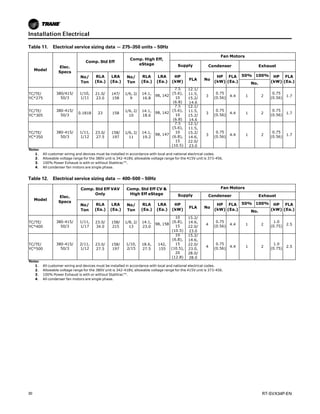
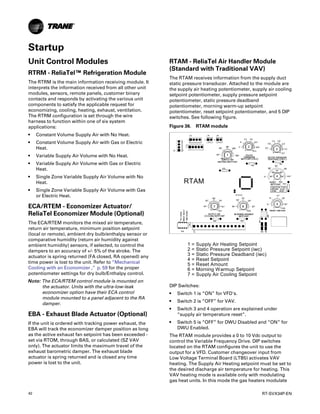
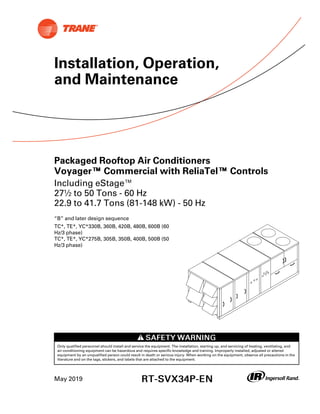
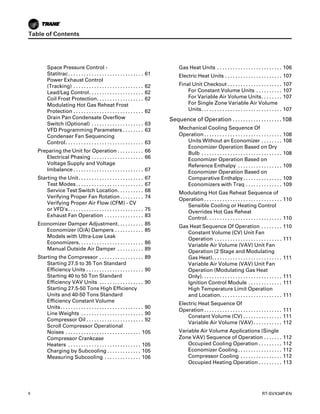
Only qualified personnel should install and service the equipment. The installation, starting up, and servicing of heating, ventilating, and
air-conditioning equipment can be hazardous and requires specific knowledge and training. Improperly installed, adjusted or altered
equipment by an unqualified person could result in death or serious injury. When working on the equipment, observe all precautions in the
literature and on the tags, stickers, and labels that are attached to the equipment.
May 2019 RRTT--SSVVXX3344PP--EENN
Packaged Rooftop Air Conditioners
Voyager™™ Commercial with ReliaTel™™ Controls
Including eStage™
27½ to 50 Tons - 60 Hz
22.9 to 41.7 Tons (81-148 kW) - 50 Hz
“B” and later design sequence
TC*, TE*, YC*330B, 360B, 420B, 480B, 600B (60
Hz/3 phase)
TC*, TE*, YC*275B, 305B, 350B, 400B, 500B (50
Hz/3 phase)
Installation, Operation,
and Maintenance
©2019 Ingersoll Rand RT-SVX34P-EN
Introduction
Read this manual thoroughly before operating or
servicing this unit.
Warnings, Cautions, and Notices
Safety advisories appear throughout this manual as
required. Your personal safety and the proper
operation of this machine depend upon the strict
observance of these precautions.
The three types of advisories are defined as follows:
WARNING
Indicates a potentially hazardous situation
which, if not avoided, could result in death or
serious injury.
CAUTION
Indicates a potentially hazardous situation
which, if not avoided, could result in minor or
moderate injury. It could also be used to alert
against unsafe practices.
NOTICE
Indicates a situation that could result in
equipment or property-damage only
accidents.
Important Environmental Concerns
Scientific research has shown that certain man-made
chemicals can affect the earth’s naturally occurring
stratospheric ozone layer when released to the
atmosphere. In particular, several of the identified
chemicals that may affect the ozone layer are
refrigerants that contain Chlorine, Fluorine and Carbon
(CFCs) and those containing Hydrogen, Chlorine,
Fluorine and Carbon (HCFCs). Not all refrigerants
containing these compounds have the same potential
impact to the environment. Trane advocates the
responsible handling of all refrigerants-including
industry replacements for CFCs and HCFCs such as
saturated or unsaturated HFCs and HCFCs.
Important Responsible Refrigerant
Practices
Trane believes that responsible refrigerant practices
are important to the environment, our customers, and
the air conditioning industry. All technicians who
handle refrigerants must be certified according to local
rules. For the USA, the Federal Clean Air Act (Section
608) sets forth the requirements for handling,
reclaiming, recovering and recycling of certain
refrigerants and the equipment that is used in these
service procedures. In addition, some states or
municipalities may have additional requirements that
must also be adhered to for responsible management
of refrigerants. Know the applicable laws and follow
them.
WWAARRNNIINNGG
PPrrooppeerr FFiieelldd WWiirriinngg aanndd GGrroouunnddiinngg
RReeqquuiirreedd!!
FFaaiilluurree ttoo ffoollllooww ccooddee ccoouulldd rreessuulltt iinn ddeeaatthh oorr
sseerriioouuss iinnjjuurryy..
AAllll ffiieelldd wwiirriinngg MMUUSSTT bbee ppeerrffoorrmmeedd bbyy qquuaalliiffiieedd
ppeerrssoonnnneell.. IImmpprrooppeerrllyy iinnssttaalllleedd aanndd ggrroouunnddeedd
ffiieelldd wwiirriinngg ppoosseess FFIIRREE aanndd EELLEECCTTRROOCCUUTTIIOONN
hhaazzaarrddss.. TToo aavvooiidd tthheessee hhaazzaarrddss,, yyoouu MMUUSSTT ffoollllooww
rreeqquuiirreemmeennttss ffoorr ffiieelldd wwiirriinngg iinnssttaallllaattiioonn aanndd
ggrroouunnddiinngg aass ddeessccrriibbeedd iinn NNEECC aanndd yyoouurr llooccaall//
ssttaattee//nnaattiioonnaall eelleeccttrriiccaall ccooddeess..
WWAARRNNIINNGG
PPeerrssoonnaall PPrrootteeccttiivvee EEqquuiippmmeenntt ((PPPPEE))
RReeqquuiirreedd!!
FFaaiilluurree ttoo wweeaarr pprrooppeerr PPPPEE ffoorr tthhee jjoobb bbeeiinngg
uunnddeerrttaakkeenn ccoouulldd rreessuulltt iinn ddeeaatthh oorr sseerriioouuss iinnjjuurryy..
TTeecchhnniicciiaannss,, iinn oorrddeerr ttoo pprrootteecctt tthheemmsseellvveess ffrroomm
ppootteennttiiaall eelleeccttrriiccaall,, mmeecchhaanniiccaall,, aanndd cchheemmiiccaall
hhaazzaarrddss,, MMUUSSTT ffoollllooww pprreeccaauuttiioonnss iinn tthhiiss mmaannuuaall
aanndd oonn tthhee ttaaggss,, ssttiicckkeerrss,, aanndd llaabbeellss,, aass wweellll aass tthhee
iinnssttrruuccttiioonnss bbeellooww::
•• BBeeffoorree iinnssttaalllliinngg//sseerrvviicciinngg tthhiiss uunniitt,,
tteecchhnniicciiaannss MMUUSSTT ppuutt oonn aallll PPPPEE rreeqquuiirreedd ffoorr
tthhee wwoorrkk bbeeiinngg uunnddeerrttaakkeenn ((EExxaammpplleess;; ccuutt
rreessiissttaanntt gglloovveess//sslleeeevveess,, bbuuttyyll gglloovveess,, ssaaffeettyy
ggllaasssseess,, hhaarrdd hhaatt//bbuummpp ccaapp,, ffaallll pprrootteeccttiioonn,,
eelleeccttrriiccaall PPPPEE aanndd aarrcc ffllaasshh ccllootthhiinngg))..
AALLWWAAYYSS rreeffeerr ttoo aapppprroopprriiaattee MMaatteerriiaall SSaaffeettyy
DDaattaa SShheeeettss ((MMSSDDSS))//SSaaffeettyy DDaattaa SShheeeettss
((SSDDSS)) aanndd OOSSHHAA gguuiiddeelliinneess ffoorr pprrooppeerr PPPPEE..
•• WWhheenn wwoorrkkiinngg wwiitthh oorr aarroouunndd hhaazzaarrddoouuss
cchheemmiiccaallss,, AALLWWAAYYSS rreeffeerr ttoo tthhee aapppprroopprriiaattee
MMSSDDSS//SSDDSS aanndd OOSSHHAA//GGHHSS ((GGlloobbaall
HHaarrmmoonniizzeedd SSyysstteemm ooff CCllaassssiiffiiccaattiioonn aanndd
LLaabbeelllliinngg ooff CChheemmiiccaallss)) gguuiiddeelliinneess ffoorr
iinnffoorrmmaattiioonn oonn aalllloowwaabbllee ppeerrssoonnaall eexxppoossuurree
lleevveellss,, pprrooppeerr rreessppiirraattoorryy pprrootteeccttiioonn aanndd
hhaannddlliinngg iinnssttrruuccttiioonnss..
•• IIff tthheerree iiss aa rriisskk ooff eenneerrggiizzeedd eelleeccttrriiccaall
ccoonnttaacctt,, aarrcc,, oorr ffllaasshh,, tteecchhnniicciiaannss MMUUSSTT ppuutt
oonn aallll PPPPEE iinn aaccccoorrddaannccee wwiitthh OOSSHHAA,, NNFFPPAA
7700EE,, oorr ootthheerr ccoouunnttrryy--ssppeecciiffiicc rreeqquuiirreemmeennttss
ffoorr aarrcc ffllaasshh pprrootteeccttiioonn,, PPRRIIOORR ttoo sseerrvviicciinngg
tthhee uunniitt.. NNEEVVEERR PPEERRFFOORRMM AANNYY SSWWIITTCCHHIINNGG,,
DDIISSCCOONNNNEECCTTIINNGG,, OORR VVOOLLTTAAGGEE TTEESSTTIINNGG
WWIITTHHOOUUTT PPRROOPPEERR EELLEECCTTRRIICCAALL PPPPEE AANNDD
AARRCC FFLLAASSHH CCLLOOTTHHIINNGG.. EENNSSUURREE
EELLEECCTTRRIICCAALL MMEETTEERRSS AANNDD EEQQUUIIPPMMEENNTT AARREE
PPRROOPPEERRLLYY RRAATTEEDD FFOORR IINNTTEENNDDEEDD
VVOOLLTTAAGGEE..
RT-SVX34P-EN 3
WWAARRNNIINNGG
FFoollllooww EEHHSS PPoolliicciieess!!
FFaaiilluurree ttoo ffoollllooww iinnssttrruuccttiioonnss bbeellooww ccoouulldd rreessuulltt iinn
ddeeaatthh oorr sseerriioouuss iinnjjuurryy..
•• AAllll IInnggeerrssoollll RRaanndd ppeerrssoonnnneell mmuusstt ffoollllooww
IInnggeerrssoollll RRaanndd EEnnvviirroonnmmeennttaall,, HHeeaalltthh aanndd
SSaaffeettyy ((EEHHSS)) ppoolliicciieess wwhheenn ppeerrffoorrmmiinngg wwoorrkk
ssuucchh aass hhoott wwoorrkk,, eelleeccttrriiccaall,, ffaallll pprrootteeccttiioonn,,
lloocckkoouutt//ttaaggoouutt,, rreeffrriiggeerraanntt hhaannddlliinngg,, eettcc.. AAllll
ppoolliicciieess ccaann bbee ffoouunndd oonn tthhee BBOOSS ssiittee.. WWhheerree
llooccaall rreegguullaattiioonnss aarree mmoorree ssttrriinnggeenntt tthhaann
tthheessee ppoolliicciieess,, tthhoossee rreegguullaattiioonnss ssuuppeerrsseeddee
tthheessee ppoolliicciieess..
•• NNoonn--IInnggeerrssoollll RRaanndd ppeerrssoonnnneell sshhoouulldd aallwwaayyss
ffoollllooww llooccaall rreegguullaattiioonnss..
Overview of Manual
One copy of the appropriate service literature ships
inside the control panel of each unit. The procedures
discussed in this manual should only be performed by
qualified, experienced HVAC technicians.
NNoottee:: Do not release refrigerant to the atmosphere! If
adding or removing refrigerant is required, the
service technician must comply with all federal,
state, and local laws.
This booklet describes the proper installation, startup,
operation, and maintenance procedures for TC_, TE_,
and YC_22.9 to 50 Ton CV (Constant Volume), VAV
(Variable Air Volume), and SZ VAV (Single Zone
Variable Air Volume) applications.
By carefully reviewing the information within this
manual and following the instructions, the risk of
improper operation and/or component damage will be
minimized.
It is important that periodic maintenance be performed
to help assure trouble free operation. A maintenance
schedule is provided at the end of this manual. Should
equipment failure occur, contact a qualified service
organization with qualified, experienced HVAC
technicians to properly diagnose and repair this
equipment.
Copyright
This document and the information in it are the
property of Trane, and may not be used or reproduced
in whole or in part without written permission. Trane
reserves the right to revise this publication at any time,
and to make changes to its content without obligation
to notify any person of such revision or change.
Trademarks
All trademarks referenced in this document are the
trademarks of their respective owners.
Factory Training
Factory training is available through Trane University™
to help you learn more about the operation and
maintenance of your equipment. To learn about
available training opportunities contact Trane
University™.
Online: www.trane.com/traneuniversity
Phone: 855-803-3563
Email: traneuniversity@trane.com
Revision History
• Added Space Pressure Setpoint and Space Pressure
Setpoint tables to Startup section
• Updated Unit Wiring Diagram Numbers
• Added “VFD Programming Parameters (Supply)”
Section
IInnttrroodduuccttiioonn
4 RT-SVX34P-EN
Model Number Description. . . . . . . . . . . . . . . . . 8
60 Hz Description . . . . . . . . . . . . . . . . . . . . . . . . . 8
50 Hz Description . . . . . . . . . . . . . . . . . . . . . . . . 10
General Information . . . . . . . . . . . . . . . . . . . . . . . 12
About the Unit. . . . . . . . . . . . . . . . . . . . . . . . . . . 12
Unit Inspection . . . . . . . . . . . . . . . . . . . . . . . . . . 12
Exterior Inspection . . . . . . . . . . . . . . . . . . . 12
Inspection for Concealed
Damage. . . . . . . . . . . . . . . . . . . . . . . . . . . . . 12
Repair. . . . . . . . . . . . . . . . . . . . . . . . . . . . . . . 12
Storage . . . . . . . . . . . . . . . . . . . . . . . . . . . . . . . . . 12
Unit Dimensions and Weights . . . . . . . . . . . . . 13
Recommended Clearances . . . . . . . . . . . . . . . 13
Roof Curb and Ductwork . . . . . . . . . . . . . . . . . 13
Horizontal Ductwork. . . . . . . . . . . . . . . . . . 13
Unit Dimensions. . . . . . . . . . . . . . . . . . . . . . . . . 14
Unit Rigging and Placement . . . . . . . . . . . . . . 19
Pre-Installation . . . . . . . . . . . . . . . . . . . . . . . . . . . . 22
General Unit Requirements. . . . . . . . . . . . . . . 22
Downflow/Upflow Models . . . . . . . . . . . . 22
All Units. . . . . . . . . . . . . . . . . . . . . . . . . . . . . 22
Electrical Requirements . . . . . . . . . . . . . . . . . . 22
Field Installed Control Wiring . . . . . . . . . 22
Gas Heat Requirements . . . . . . . . . . . . . . . . . . 22
Installation General Requirements. . . . . . . . . 23
Condensate Drain Connection . . . . . . . . . . . . 23
Condensate Overflow Switch . . . . . . . . . . . . . 23
O/A Sensor & Tubing Installation . . . . . . . . . 23
Units with Statitrac™ . . . . . . . . . . . . . . . . . . . . 24
Installation Electrical . . . . . . . . . . . . . . . . . . . . . . 26
Disconnect Switch External Handle
(Factory Mounted Option) . . . . . . . . . . . . . . . . 26
Main Power Wiring . . . . . . . . . . . . . . . . . . . . . . 26
Through-the-Base Electrical (Optional
Accessory) . . . . . . . . . . . . . . . . . . . . . . . . . . . . . . 28
Electrical Service Sizing Data . . . . . . . . . . . . . 28
Electrical Wire Sizing and Protection
Device Equations . . . . . . . . . . . . . . . . . . . . . . . . 31
Calculation #1 - TC*, YC* - 27.5 to 50
Ton Units. . . . . . . . . . . . . . . . . . . . . . . . . . . . 31
Calculation #2 - TE* - 27.5 to 50 Ton
Units. . . . . . . . . . . . . . . . . . . . . . . . . . . . . . . . 31
Disconnect Switch Sizing (DSS) . . . . . . . 32
Low Voltage Wiring. . . . . . . . . . . . . . . . . . . . . . 32
Control Power Transformer. . . . . . . . . . . . . . . 32
Field Installed AC Control Wiring. . . . . . . . . . 32
Field Installed DC Control Wiring. . . . . . . . . . 33
Remote Panels and Sensors . . . . . . . . . . . . . . 36
Constant Volume and Single Zone
VAV Control Options . . . . . . . . . . . . . . . . . 36
Variable Air Volume (non-SZ VAV)
Control Options. . . . . . . . . . . . . . . . . . . . . . 36
VAV Controls Available from the
Factory for Field Installation. . . . . . . . . . . 37
Constant Volume or VAV (Traditional
or Single Zone) Controls Available
from the Factory for Field
Installation . . . . . . . . . . . . . . . . . . . . . . . . . . 37
Space Temperature Averaging . . . . . . . . 39
Installation Piping . . . . . . . . . . . . . . . . . . . . . . . . . 40
General Requirements . . . . . . . . . . . . . . . . . . . 40
Connecting the Gas Supply Line to the
Furnace Gas Train . . . . . . . . . . . . . . . . . . . . . . . 40
Startup . . . . . . . . . . . . . . . . . . . . . . . . . . . . . . . . . . . . 42
Unit Control Modules . . . . . . . . . . . . . . . . . . . . 42
RTRM - ReliaTel™ Refrigeration
Module . . . . . . . . . . . . . . . . . . . . . . . . . . . . . 42
ECA/RTEM - Economizer Actuator/
ReliaTel Economizer Module
(Optional) . . . . . . . . . . . . . . . . . . . . . . . . . . . 42
EBA - Exhaust Blade Actuator
(Optional) . . . . . . . . . . . . . . . . . . . . . . . . . . . 42
RTAM - ReliaTel Air Handler Module
(Standard with Traditional VAV). . . . . . . 42
ReliaTel Ventilation Module
(RTVM). . . . . . . . . . . . . . . . . . . . . . . . . . . . . . 43
ReliaTel Dehumidification Module
(RTDM) . . . . . . . . . . . . . . . . . . . . . . . . . . . . . 44
Table of Contents
RT-SVX34P-EN 5
Conventional Thermostat
Connections (Available Only with
CV) . . . . . . . . . . . . . . . . . . . . . . . . . . . . . . . . . 44
TCI - Trane Communication Interface
(Optional) . . . . . . . . . . . . . . . . . . . . . . . . . . . 44
LCI - LonTalk® Communication
Interface (Optional). . . . . . . . . . . . . . . . . . . 44
BCI - BACnet® Communication
Interface (Optional). . . . . . . . . . . . . . . . . . . 44
WCI - Trane Air-Fi™ Wireless Comm
Interface (Optional). . . . . . . . . . . . . . . . . . . 44
TD5 Display - 5" Touchscreen
Display. . . . . . . . . . . . . . . . . . . . . . . . . . . . . . 44
System Operation . . . . . . . . . . . . . . . . . . . . . . . 44
Economizer Operation with a
Conventional Thermostat (CV
Only). . . . . . . . . . . . . . . . . . . . . . . . . . . . . . . . 44
Microelectronic Control
Features. . . . . . . . . . . . . . . . . . . . . . . . . . . . . 45
Economizer Operation with CV
Controls. . . . . . . . . . . . . . . . . . . . . . . . . . . . . 45
Modulating Power Exhaust . . . . . . . . . . . 46
Mechanical Cooling without an
Economizer (CV and SZ VAV) . . . . . . . . . 46
Zone Temperature - Occupied
Cooling (CV and SZVAV). . . . . . . . . . . . . . 47
Zone Temperature - Occupied
Heating (CV and SZVAV). . . . . . . . . . . . . . 47
Supply Fan (CV and SZ VAV) . . . . . . . . . . 47
Supply Air Tempering (CV and SZ
VAV) . . . . . . . . . . . . . . . . . . . . . . . . . . . . . . . . 47
Variable Air Volume Applications (SZ
VAV). . . . . . . . . . . . . . . . . . . . . . . . . . . . . . . . . . . . 48
Supply Fan Output Control. . . . . . . . . . . . 48
Minimum Supply Fan Output . . . . . . . . . 48
Supply Fan Mode Operation . . . . . . . . . . 49
Setpoint Arbitration . . . . . . . . . . . . . . . . . . 49
Units Configured with the Outside
Air Measurement (Traq) Option . . . . . . . 50
Sequence for Setting
Calibration . . . . . . . . . . . . . . . . . . . . . . . . . . 51
Ventilation Control . . . . . . . . . . . . . . . . . . . 53
Space Pressure Control. . . . . . . . . . . . . . . 55
Traq Overrides and Special
Considerations . . . . . . . . . . . . . . . . . . . . . . 56
Supply Air Temperature Control -
Heating and Cooling . . . . . . . . . . . . . . . . . 56
Variable Air Volume Applications (Traditional
VAV). . . . . . . . . . . . . . . . . . . . . . . . . . . . . . . . . . . . 57
Supply Air Temperature Control -
Occupied Cooling and Heating . . . . . . . . 57
Supply Air Temperature Control with
an Economizer. . . . . . . . . . . . . . . . . . . . . . . 57
VHR Relay Output . . . . . . . . . . . . . . . . . . . . 57
Zone Temperature Control without a
Night Setback Panel or ICS -
Unoccupied Cooling. . . . . . . . . . . . . . . . . . 57
Zone Temperature Control without a
Night Setback Panel or ICS -
Unoccupied Heating. . . . . . . . . . . . . . . . . . 57
Morning Warm-up (MWU)
Control. . . . . . . . . . . . . . . . . . . . . . . . . . . . . . 57
Daytime Warm-up (DWU)
Control. . . . . . . . . . . . . . . . . . . . . . . . . . . . . . 57
Supply Duct Static Pressure
Control. . . . . . . . . . . . . . . . . . . . . . . . . . . . . . 58
Supply Air Temperature Reset . . . . . . . . 58
VAV Supply Air Tempering (Only
Available with Modulating Gas
Heat). . . . . . . . . . . . . . . . . . . . . . . . . . . . . . . . 58
Constant Volume or Variable Air Volume
Applications (Single Zone or
Traditional) . . . . . . . . . . . . . . . . . . . . . . . . . . . . . 58
Off Mode . . . . . . . . . . . . . . . . . . . . . . . . . . . . 58
Zone Temperature - Unoccupied
Cooling (CV or SZ VAV Only). . . . . . . . . . 59
Zone Temperature - Unoccupied
Heating . . . . . . . . . . . . . . . . . . . . . . . . . . . . . 59
Mechanical Cooling with an
Economizer . . . . . . . . . . . . . . . . . . . . . . . . . 59
Gas Heat Control. . . . . . . . . . . . . . . . . . . . . 59
Electric Heat Control . . . . . . . . . . . . . . . . . 60
Clogged Filter Option. . . . . . . . . . . . . . . . . 60
Ventilation Override. . . . . . . . . . . . . . . . . . 60
Emergency Stop . . . . . . . . . . . . . . . . . . . . . 60
Phase Monitor . . . . . . . . . . . . . . . . . . . . . . . 60
Low Pressure Control . . . . . . . . . . . . . . . . 60
Hot Gas Reheat Low Pressure
Control. . . . . . . . . . . . . . . . . . . . . . . . . . . . . . 61
High Pressure Cutout and
Temperature Discharge Limit . . . . . . . . . 61
Power Exhaust Control
(Standard). . . . . . . . . . . . . . . . . . . . . . . . . . . 61
TTaabbllee ooff CCoonntteennttss
6 RT-SVX34P-EN
Space Pressure Control -
Statitrac. . . . . . . . . . . . . . . . . . . . . . . . . . . . . 61
Power Exhaust Control
(Tracking) . . . . . . . . . . . . . . . . . . . . . . . . . . . 62
Lead/Lag Control. . . . . . . . . . . . . . . . . . . . . 62
Coil Frost Protection. . . . . . . . . . . . . . . . . . 62
Modulating Hot Gas Reheat Frost
Protection . . . . . . . . . . . . . . . . . . . . . . . . . . . 62
Drain Pan Condensate Overflow
Switch (Optional) . . . . . . . . . . . . . . . . . . . . 63
VFD Programming Parameters . . . . . . . . 63
Condenser Fan Sequencing
Control. . . . . . . . . . . . . . . . . . . . . . . . . . . . . . 63
Preparing the Unit for Operation . . . . . . . . . . 66
Electrical Phasing . . . . . . . . . . . . . . . . . . . . 66
Voltage Supply and Voltage
Imbalance . . . . . . . . . . . . . . . . . . . . . . . . . . . 67
Starting the Unit. . . . . . . . . . . . . . . . . . . . . . . . . 67
Test Modes. . . . . . . . . . . . . . . . . . . . . . . . . . 67
Service Test Switch Location. . . . . . . . . . 68
Verifying Proper Fan Rotation . . . . . . . . . 74
Verifying Proper Air Flow (CFM) - CV
or VFD's. . . . . . . . . . . . . . . . . . . . . . . . . . . . . 75
Exhaust Fan Operation . . . . . . . . . . . . . . . 83
Economizer Damper Adjustment. . . . . . . . . . 85
Economizer (O/A) Dampers . . . . . . . . . . . 85
Models with Ultra-Low Leak
Economizers. . . . . . . . . . . . . . . . . . . . . . . . . 86
Manual Outside Air Damper . . . . . . . . . . 89
Starting the Compressor . . . . . . . . . . . . . . . . . 89
Starting 27.5 to 35 Ton Standard
Efficiency Units . . . . . . . . . . . . . . . . . . . . . . 90
Starting 40 to 50 Ton Standard
Efficiency VAV Units . . . . . . . . . . . . . . . . . 90
Starting 27.5-50 Tons High Efficiency
Units and 40-50 Tons Standard
Efficiency Constant Volume
Units. . . . . . . . . . . . . . . . . . . . . . . . . . . . . . . . 90
Line Weights . . . . . . . . . . . . . . . . . . . . . . . . 90
Compressor Oil . . . . . . . . . . . . . . . . . . . . . . 92
Scroll Compressor Operational
Noises . . . . . . . . . . . . . . . . . . . . . . . . . . . . . 105
Compressor Crankcase
Heaters . . . . . . . . . . . . . . . . . . . . . . . . . . . . 105
Charging by Subcooling . . . . . . . . . . . . . 105
Measuring Subcooling . . . . . . . . . . . . . . 106
Gas Heat Units . . . . . . . . . . . . . . . . . . . . . . . . . 106
Electric Heat Units . . . . . . . . . . . . . . . . . . . . . . 107
Final Unit Checkout . . . . . . . . . . . . . . . . . . . . . 107
For Constant Volume Units . . . . . . . . . . 107
For Variable Air Volume Units. . . . . . . . 107
For Single Zone Variable Air Volume
Units. . . . . . . . . . . . . . . . . . . . . . . . . . . . . . . 107
Sequence of Operation . . . . . . . . . . . . . . . . . . . 108
Mechanical Cooling Sequence Of
Operation . . . . . . . . . . . . . . . . . . . . . . . . . . . . . . 108
Units Without an Economizer . . . . . . . . 108
Economizer Operation Based on Dry
Bulb . . . . . . . . . . . . . . . . . . . . . . . . . . . . . . . 108
Economizer Operation Based on
Reference Enthalpy . . . . . . . . . . . . . . . . . 109
Economizer Operation Based on
Comparative Enthalpy. . . . . . . . . . . . . . . 109
Economizers with Traq . . . . . . . . . . . . . . 109
Modulating Hot Gas Reheat Sequence of
Operation . . . . . . . . . . . . . . . . . . . . . . . . . . . . . . 110
Sensible Cooling or Heating Control
Overrides Hot Gas Reheat
Control. . . . . . . . . . . . . . . . . . . . . . . . . . . . . 110
Gas Heat Sequence Of Operation . . . . . . . . 110
Constant Volume (CV) Unit Fan
Operation . . . . . . . . . . . . . . . . . . . . . . . . . . 111
Variable Air Volume (VAV) Unit Fan
Operation (2 Stage and Modulating
Gas Heat). . . . . . . . . . . . . . . . . . . . . . . . . . . 111
Variable Air Volume (VAV) Unit Fan
Operation (Modulating Gas Heat
Only). . . . . . . . . . . . . . . . . . . . . . . . . . . . . . . 111
Ignition Control Module . . . . . . . . . . . . . 111
High Temperature Limit Operation
and Location. . . . . . . . . . . . . . . . . . . . . . . . 111
Electric Heat Sequence Of
Operation . . . . . . . . . . . . . . . . . . . . . . . . . . . . . . 111
Constant Volume (CV) . . . . . . . . . . . . . . . 111
Variable Air Volume (VAV) . . . . . . . . . . . 112
Variable Air Volume Applications (Single
Zone VAV) Sequence of Operation . . . . . . . 112
Occupied Cooling Operation . . . . . . . . . 112
Economizer Cooling. . . . . . . . . . . . . . . . . 112
Compressor Cooling . . . . . . . . . . . . . . . . 112
Occupied Heating Operation . . . . . . . . . 113
TTaabbllee ooff CCoonntteennttss
RT-SVX34P-EN 7
Staged Heating Operation . . . . . . . . . . . 113
Modulating Heat Operation with
SZVAV Heating . . . . . . . . . . . . . . . . . . . . . 113
Unoccupied Cooling and Heating
Operation . . . . . . . . . . . . . . . . . . . . . . . . . . 113
Modulating Hot Gas Reheat
Operation . . . . . . . . . . . . . . . . . . . . . . . . . . 114
Failure and Overriding
Conditions . . . . . . . . . . . . . . . . . . . . . . . . . 114
Low Pressure Control (LPC) Sequence of
Operation (ReliaTel Control) . . . . . . . . . . . . . 115
High Pressure Control and Temperature
Discharge Limit (ReliaTel Control). . . . . . . . 115
Maintenance . . . . . . . . . . . . . . . . . . . . . . . . . . . . . 116
Fan Belt Adjustment . . . . . . . . . . . . . . . . . . . . 116
Monthly Maintenance. . . . . . . . . . . . . . . . . . . 118
Filters . . . . . . . . . . . . . . . . . . . . . . . . . . . . . . 118
Condensate Overflow Switch . . . . . . . . 118
Cooling Season . . . . . . . . . . . . . . . . . . . . . 119
Heating Season . . . . . . . . . . . . . . . . . . . . . 119
Coil Cleaning . . . . . . . . . . . . . . . . . . . . . . . . . . . 120
Refrigerant Coils . . . . . . . . . . . . . . . . . . . . 121
Microchannel Condenser Coil Repair
and Replacement . . . . . . . . . . . . . . . . . . . 121
Final Process . . . . . . . . . . . . . . . . . . . . . . . 121
Fall Restraint . . . . . . . . . . . . . . . . . . . . . . . . . . . 123
Refrigeration System . . . . . . . . . . . . . . . . . . . 123
Refrigerant Evacuation and
Charging . . . . . . . . . . . . . . . . . . . . . . . . . . . 123
Charge Storage . . . . . . . . . . . . . . . . . . . . . 124
Compressor Oil . . . . . . . . . . . . . . . . . . . . . 124
Compressor Replacements . . . . . . . . . . . . . . 124
Electrical Phasing . . . . . . . . . . . . . . . . . . . 124
Precision Suction Restrictor. . . . . . . . . . 124
VFD Programming Parameters
(Supply) . . . . . . . . . . . . . . . . . . . . . . . . . . . . . . . 125
Diagnostics. . . . . . . . . . . . . . . . . . . . . . . . . . . . . . . 129
System Status/Diagnostics . . . . . . . . . . . . . . 129
System Status / Diagnostics
Checkout Procedure (DC Voltmeter
Required) . . . . . . . . . . . . . . . . . . . . . . . . . . 129
Diagnostics (VAV only) . . . . . . . . . . . . . . 131
Resetting Cooling and Ignition
Lockouts . . . . . . . . . . . . . . . . . . . . . . . . . . . 131
Zone Temperature Sensor (ZSM)
Service Indicator . . . . . . . . . . . . . . . . . . . . 131
Economizer Actuator (ECA/RTEM) Test
Procedures. . . . . . . . . . . . . . . . . . . . . . . . . . . . . 134
Economizer Fault Detection and
Diagnostics . . . . . . . . . . . . . . . . . . . . . . . . 134
Verify Economizer Status by
Economizer Actuator (ECA/
RTEM) . . . . . . . . . . . . . . . . . . . . . . . . . . . . . 134
ReliaTel Air Module (RTAM) Tests. . . . . . . . 135
Test 1: Testing the Variable
Frequency Drive (VFD) Output. . . . . . . . 135
Test 2: Testing the Static Pressure
Transducer (SPT) Input . . . . . . . . . . . . . . 135
Test 3: Testing the VAV Setpoint
Potentiometers . . . . . . . . . . . . . . . . . . . . . 135
Test 4: Testing the VFD . . . . . . . . . . . . . . 135
ReliaTel Air Module (RTOM) Tests . . . . . . . 136
Test 1: Testing the Variable
Frequency Drive (VFD) Output. . . . . . . . 136
Test 2: Testing the VFD . . . . . . . . . . . . . . 136
Compressor—Blink Codes. . . . . . . . . . . . . . . 136
Troubleshooting. . . . . . . . . . . . . . . . . . . . . . . . 137
TR-200 VFD Programming
Parameters. . . . . . . . . . . . . . . . . . . . . . . . . . . . . 142
Unit Wiring Diagram Numbers . . . . . . . . . . . 144
Warranty and Liability Clause . . . . . . . . . . . . 152
COMMERCIAL EQUIPMENT - 20 TONS
AND LARGER AND RELATED
ACCESSORIES . . . . . . . . . . . . . . . . . . . . . . . . . 152
TTaabbllee ooff CCoonntteennttss
8 RT-SVX34P-EN
Model Number Description
60 Hz Description
Digit 1, 2 — Unit Function
TC = DX Cooling, No Heat
TE = DX Cooling, Electric Heat
YC = DX Cooling, Natural Gas Heat
Digit 3 — Unit Airflow Design
D = Downflow Supply and Upflow Return
H = Horizontal Supply and Horizontal Return
F = Horizontal Supply and Upflow Return
R = Downflow Supply and Horizontal Return
Digit 4, 5, 6 — Nominal Cooling
Capacity
330 = 27½ Tons
360 = 30 Tons
420 = 35 Tons
480 = 40 Tons
600 = 50 Tons
Digit 7 — Major Development
Sequence
B = R-410A Refrigerant
Digit 8 — Power Supply1
E = 208/60/3
F = 230/60/3
4 = 460/60/3
5 = 575/60/3
Digit 9 — Heating Capacity2
0 = No Heat (TC Only)
L = Low Heat (YC Only)
H = High Heat (YC Only)
J = Low Heat-Stainless Steel Gas Heat
Exchanger (YC Only)
K = High Heat-Stainless Steel Gas Heat
Exchangers (YC Only)
M = Low Heat-Stainless Steel Gas Heat
Exchanger w/ Modulating Control (27.5-35
Tons YC only)
P = High Heat-Stainless Steel Gas Heat
Exchangers w/ Modulating Control (27.5-35
Tons YC Only)
R = Low Heat-Stainless Steel Gas Heat
Exchanger w/ Modulating Control (40-50 Tons
YC Only)
T = High Heat-Stainless Steel Gas Heat
Exchangers w/ Modulating Control (40-50
Tons YC Only)
Note: When second digit is “E” for Electric
Heat, the following values apply in the
ninth digit.
A = 36 kW (27 kW for 208v)
B = 54 kW (41 kW for 208v)
C = 72 kW
D = 90 kW
E = 108 kW
Digit 10 — Design Sequence
A = First
Digit 11 — Exhaust4
0 = None
1 = Barometric Relief (Available w/
Economizer only)
2 = 100% Power Exhaust Fan (Available w/
Economizer Only)
3 = 50% Power Exhaust Fan (Available w/
Economizer Only)
4 = 100% Fresh Air Tracking Power Exhaust
Fan (Available w/ Economizer Only)
5 = 50% Fresh Air Tracking Power Exhaust
Fan (Available w/ Economizer Only)
6 = 100% Power Exhaust w/ Statitrac™
7 = 100% Power Exhaust Fan w/ Ultra Low
Leak Exhaust Damper (Available w/
Economizer Only)
8 = 50% Power Exhaust Fan w/ Ultra Low
Leak Exhaust Damper (Available w/
Economizer Only)
9 = 100% Power Exhaust w/ Ultra Low Leak
Exhaust Damper w/ Statitrac™
Digit 12 — Filter
A = 2” MERV 4, Std Eff, Throwaway Filters
B = 2” MERV 8, High Eff, Throwaway Filters
C = 4” MERV 8, High Eff, Throwaway Filters
D = 4” MERV 14, High Eff, Throwaway Filters
Digit 13 — Supply Fan Motor, HP
1 = 7.5 HP
2 = 10 HP
3 = 15 HP
4 = 20 HP
Digit 14 — Supply Air Fan Drive
Selections
A = 550 RPM
B = 600 RPM
C = 650 RPM
D = 700 RPM
E = 750 RPM
F = 790 RPM
G = 800 RPM
H = 500 RPM
J = 525 RPM
K = 575 RPM
L = 625 RPM
M = 675 RPM
N = 725 RPM
Digit 15 — Outside Air Selection
A = No Outside Air
B = 0-25% Manual Damper
C = 0-100% Economizer, Dry Bulb Control
D = 0-100% Economizer, Reference Enthalpy
Control
E = 0-100% Economizer, Differential
Enthalpy Control
F = “C” Option and Low Leak Fresh Air
Damper
G = “D” Option and Low Leak Fresh Air
Damper
H = “E” Option and Low Leak Fresh Air
Damper
J = “C” Option and Ultra Low Leak Outside Air
Damper
K = “D” Option and Ultra Low Leak Outside Air
Damper
L = “E” Option and Ultra Low Leak Outside Air
Damper
1 = Option “C” with Traq
2 = Option “D” with Traq
3 = Option “E” with Traq
4 = Option “F” with Traq
5 = Option “G” with Traq
6 = Option “H” with Traq
7 = Option “C” with Traq w/ Ultra Low Leak
Outside Air Damper
8 = Option “D” with Traq w/ Ultra Low Leak
Outside Air Damper
9 = Option “E” with Traq w/ Ultra Low Leak
Outside Air Damper
Digit 16 — System Control
1 = Constant Volume w/ Zone Temperature
Control
2 = Constant Volume w/ Discharge Air
Control
4 = VAV Supply Air Temperature Control w/
Variable Frequency Drive w/o Bypass
5 = VAV Supply Air Temperature Control w/
Variable Frequency Drive and Bypass
6 = Single Zone VAV w/ VFD w/o Bypass
7 = Single Zone VAV w/ VFD w/ Bypass
A = VAV Supply Air Temperature Control w/
VFD w/o Bypass w/ Motor Shaft Grounding
Ring
B = VAV Supply Air Temperature Control w/
VFD w/ Bypass w/ Motor Shaft Grounding
Ring
C = Single Zone VAV w/ VFD w/o Bypass w/
Motor Shaft Grounding Ring
D = Single Zone VAV w/ VFD w/ Bypass w/
Motor Shaft Grounding Ring
Note: Zone sensors are not included with
option and must be ordered as a
separate accessory.
RT-SVX34P-EN 9
Miscellaneous Options
Digit 17
0 = No Service Valves
A = Service Valves
Std efficiency units excluding 40/50T
std efficiency CV: If Digit 17 = 0, no valves
will be provided. If Digit 17= A, service valves
will be provided in the suction and discharge
lines. High efficiency units including 40/
50T std efficiency CV: Digit 17 is not
selectable. Suction and discharge service
valves are included.
Digit 18
B = Through the Base Electrical Provision
Digit 19
C = Non-Fused Disconnect Switch w/ External
Handle
Digit 20
D = Factory-Powered 15A GFI Convenience
Outlet and Non-Fused Disconnect Switch w/
External Handle
Digit 21
E = Field-Powered 15A GFI Convenience
Outlet
Digit 22
F = Trane Communication Interface (TCI)
Digit 23
G = Ventilation Override
Digit 24
H = Hinged Service Access
Digit 25
H = Condenser Hail Guards
J = Condenser Coil Guards
Digit 26
K = LCI (LonTalk)
B = BACnet Communications Interface (BCI)
Digit 27
0 = 5kA SCCR
D = High Fault 65kA SCCR Disconnect5
E = High Fault 65kA SCCR Disconnect w/
Powered Convenience Outlet5
Digit 28
0 = Standard Drain Pan
M = Stainless Steel Drain Pan
1 = Standard Drain Pan w/ Condensate
Overflow Switch
2 = Stainless Steel Drain Pan w/ Condensate
Overflow Switch
Digit 29 — Efficiency/ Condenser Coil
Options
0 = Standard Efficiency Unit
J = Standard Efficiency Unit w/ Corrosion
Protected Condenser Coil
K = High Efficiency Unit (eStage)
L = High Efficiency Unit (eStage) w/
Corrosion Protected Condenser Coil
Digit 30, 31 — Miscellaneous Options
P = Discharge Temperature Sensor
R = Clogged Filter Switch
Digit 32 — Modulating Hot Gas Reheat
Option
T = Modulating Hot Gas Reheat
Digit 33 — Human Interface
5 = Touchscreen Human Interface, 5"
Model Number Notes
Notes:
1. All voltages are across the line starting
only.
2. Electric Heat KW ratings are based upon
voltage ratings of 208/240/480/ 600 V.
For a 240 V heater derated to 208 V, the
resulting kW rating decreases from 36
kW to 27 kW, and from 54 kW to 41 kW.
Voltage offerings are shown in following
table (see Table 22, p. 56 for additional
information).
3. The service digit for each model number
contains 33 digits; all 33 digits must be
referenced.
4. Ventilation override exhaust mode is not
available for the exhaust fan with fresh
air tracking power exhaust. VOM is
available for the exhaust fan without
fresh air tracking power exhaust.
5. 575 VAC option is 25kA.
Tons Elec.
Heat-
er
Rated
Volt.
KW
27/
36
41/
54
72 90 108
27½
to 35
208 x x
240 x x
480 x x x x
600 x x x
40
and
50
208 x
240 x
480 x x x x
600 x x x x
MMooddeell NNuummbbeerr DDeessccrriippttiioonn
10 RT-SVX34P-EN
50 Hz Description
Digit 1, 2 — Unit Function
TC = DX Cooling, No Heat
TE = DX Cooling, Electric Heat
YC = DX Cooling, Natural Gas Heat
Digit 3 — Unit Airflow Design
D = Downflow Supply and Upflow Return
H = Horizontal Supply and Horizontal Return
F = Horizontal Supply and Upflow Return
R = Downflow Supply and Horizontal Return
Digit 4, 5, 6 — Nominal Cooling
Capacity
275 = 22.9 Tons (82 kW)
305 = 25.4 Tons (89 kW)
350 = 29.2 Tons (105 kW)
400 = 33.3 Tons (120 kW)
500 = 41.7 Tons (148 kW)
Digit 7 — Major Development
Sequence
B = R-410A Refrigerant
Digit 8 — Power Supply1
C = 380/50/3
D = 415/50/3
Digit 9 — Heating Capacity2
0 = No Heat (TC Only)
L = Low Heat (YC Only)
H = High Heat (YC Only)
Note: When second digit is “E” for Electric
Heat, the following values apply in the
ninth digit.
380V / 415V
A = 23 kW / 27 kW
B = 34 kW / 40 kW
C = 45 kW / 54 kW
D = 56 kW / 67 kW
E = 68 kW / 81 kW
Digit 10 — Design Sequence
A = First
Digit 11 — Exhaust4
0 = None
1 = Barometric Relief (Available w/
Economizer only)
2 = 100% Power Exhaust Fan (Available w/
Economizer Only)
3 = 50% Power Exhaust Fan (Available w/
Economizer Only)
4 = 100% Fresh Air Tracking Power Exhaust
Fan (Available w/ Economizer Only)
5 = 50% Fresh Air Tracking Power Exhaust
Fan (Available w/ Economizer Only)
6 = 100% Power Exhaust w/ Statitrac™
7 = 100% Power Exhaust Fan w/ Ultra Low
Leak Exhaust Damper (Available w/
Economizer Only)
8 = 50% Power Exhaust Fan w/ Ultra Low
Leak Exhaust Damper (Available w/
Economizer Only)
9 = 100% Power Exhaust w/ Ultra Low Leak
Exhaust Damper w/ Statitrac™
Digit 12 — Filter
A = 2” (51mm) MERV 4, Std Eff, Throwaway
Filters
B = 2” MERV (51mm) 8, High Eff, Throwaway
Filters
C = 4” (102mm) MERV 8, High Eff,
Throwaway Filters
D = 4” (102mm) MERV 14, High Eff,
Throwaway Filters
Digit 13 — Supply Fan Motor, HP
1 = 7.5 HP (5.6 Kw)
2 = 10 HP (7.5 kW)
3 = 15 HP (10 kW)
4 = 20 HP (15 kW)
Digit 14 — Supply Air Fan Drive
Selections
A = 458 RPM
B = 500 RPM
C = 541 RPM
D = 583 RPM
E = 625 RPM
F = 658 RPM
G = 664 RPM
H = 417 RPM
J = 437 RPM
K = 479 RPM
L = 521 RPM
M = 562 RPM
N = 604 RPM
Digit 15 — Outside Air Selection
A = No Outside Air
B = 0-25% Manual Damper
C = 0-100% Economizer, Dry Bulb Control
D = 0-100% Economizer, Reference Enthalpy
Control
E = 0-100% Economizer, Differential
Enthalpy Control
F = “C” Option and Low Leak Fresh Air
Damper
G = “D” Option and Low Leak Fresh Air
Damper
H = “E” Option and Low Leak Fresh Air
Damper
J = “C” Option and Ultra Low Leak Outside Air
Damper
K = “D” Option and Ultra Low Leak Outside Air
Damper
L = “E” Option and Ultra Low Leak Outside Air
Damper
1 = Option “C” with Traq
2 = Option “D” with Traq
3 = Option “E” with Traq
4 = Option “F” with Traq
5 = Option “G” with Traq
6 = Option “H” with Traq
7 = Option “C” with Traq w/ Ultra Low Leak
Outside Air Damper
8 = Option “D” with Traq w/ Ultra Low Leak
Outside Air Damper
9 = Option “E” with Traq w/ Ultra Low Leak
Outside Air Damper
Digit 16 — System Control
1 = Constant Volume w/ Zone Temperature
Control
2 = Constant Volume w/ Discharge Air
Control
4 = VAV Supply Air Temperature Control w/
Variable Frequency Drive w/o Bypass
5 = VAV Supply Air Temperature Control w/
Variable Frequency Drive and Bypass
6 = Single Zone VAV w/ VFD w/o Bypass
7 = Single Zone VAV w/ VFD w/ Bypass
A = VAV Supply Air Temperature Control w/
VFD w/o Bypass w/ Motor Shaft Grounding
Ring
B = VAV Supply Air Temperature Control w/
VFD w/ Bypass w/ Motor Shaft Grounding
Ring
C = Single Zone VAV w/ VFD w/o Bypass w/
Motor Shaft Grounding Ring
D = Single Zone VAV w/ VFD w/ Bypass w/
Motor Shaft Grounding Ring
Note: Zone sensors are not included with
option and must be ordered as a
separate accessory.
MMooddeell NNuummbbeerr DDeessccrriippttiioonn
RT-SVX34P-EN 11
Miscellaneous Options
Digit 17
0 = No Service Valves
A = Service Valves
Std efficiency units excluding 400/500
std efficiency CV: If Digit 17 = 0, no valves
will be provided. If Digit 17= A, service valves
will be provided in the suction and discharge
lines. High efficiency units including
400/500 std efficiency CV: Digit 17 is not
selectable. Suction and discharge service
valves are included.
Digit 18
B = Through the Base Electrical Provision
Digit 19
C = Non-Fused Disconnect Switch w/ External
Handle
Digit 20
* = Unused Digit
Digit 21
* = Unused Digit
Digit 22
F = Trane Communication Interface (TCI)
Digit 23
G = Ventilation Override
Digit 24
H = Hinged Service Access
Digit 25
H = Condenser Hail Guards
J = Condenser Coil Guards
Digit 26
K = LCI (LonTalk)
B = BACnet Communications Interface (BCI)
Digit 27
0 = 5kA SCCR
D = High Fault 65kA SCCR Disconnect
Digit 28
0 = Standard Drain Pan
M = Stainless Steel Drain Pan
1 = Standard Drain Pan w/ Condensate
Overflow Switch
2 = Stainless Steel Drain Pan w/ Condensate
Overflow Switch
Digit 29 — Efficiency/ Condenser Coil
Options
0 = Standard Efficiency Unit
J = Standard Efficiency Unit w/ Corrosion
Protected Condenser Coil
K = High Efficiency Unit (eStage)
L = High Efficiency Unit (eStage) w/
Corrosion Protected Condenser Coil
Digit 30, 31 — Miscellaneous Options
P = Discharge Temperature Sensor
R = Clogged Filter Switch
Digit 32 — Modulating Hot Gas Reheat
Option
T = Modulating Hot Gas Reheat
Digit 33 — Human Interface
5 = Touchscreen Human Interface, 5"
Model Number Notes
Notes:
1. All voltages are across the line starting
only.
2. Electric Heat KW ratings are based upon
voltage ratings of 380/415 V. Heaters A,
B, C, D are used with 22.9-29.2 ton (82-
105 kW) units only and heaters B, C, D, E
are used with 33.3-41.7 ton (120-148
kW) units only.
3. The service digit for each model number
contains 33 digits; all 33 digits must be
referenced.
4. Ventilation override exhaust mode is not
available for the exhaust fan with fresh
air tracking power exhaust. VOM is
available for the exhaust fan without
fresh air tracking power exhaust.
MMooddeell NNuummbbeerr DDeessccrriippttiioonn
12 RT-SVX34P-EN
General Information
About the Unit
Overall unit dimensional data is illustrated in “Unit
Dimensions and Weights,” p. 13. Each package rooftop
unit ships fully assembled and charged with the proper
refrigerant quantity from the factory. They are
controlled by a microelectronic unit control processor.
Several solid state modules are grouped to form the
“Control System”. The number of modules within any
given control system will be dependent upon the
options and accessories ordered with the unit.
Acronyms are used extensively throughout this manual
when referring to the “Control System”.
Basic unit components include:
• Scroll compressors
• One (1) Intertwined Evaporator Coil
• One (1) Supply Fan
• Three (3) to Four (4) Condenser Fans
• Microchannel Condenser Coils
• Filters (type is dependent on option selection)
Unit Inspection
To protect against loss due to damage incurred in
transit, perform inspection immediately upon receipt of
the unit.
Exterior Inspection
If the job site inspection reveals damage or material
shortages, file a claim with the carrier immediately.
Specify the type and extent of the damage on the bill of
lading before signing. Notify the appropriate sales
representative.
IImmppoorrttaanntt:: Do not proceed with installation of a
damaged unit without sales
representative’s approval.
• Visually inspect the complete exterior for signs of
shipping damages to unit or packing material.
• Verify that the nameplate data matches the sales
order and bill of lading.
• Verify that the unit is properly equipped and there
are no material shortages.
• Verify that the power supply complies with the unit
nameplate specifications.
Inspection for Concealed Damage
Visually inspect the components for concealed damage
as soon as possible after delivery and before it is
stored.
Do NOT walk on the sheet metal base pans. Bridging
between the unit’s main supports may consist of
multiple 2 by 12 boards or sheet metal grating.
WWAARRNNIINNGG
NNoo SStteepp SSuurrffaaccee!!
FFaaiilluurree ttoo ffoollllooww iinnssttrruuccttiioonn bbeellooww ccoouulldd rreessuulltt iinn
ddeeaatthh oorr sseerriioouuss iinnjjuurryy..
DDoo nnoott wwaallkk oonn tthhee sshheeeett mmeettaall ddrraaiinn ppaann.. WWaallkkiinngg
oonn tthhee ddrraaiinn ppaann ccoouulldd ccaauussee tthhee ssuuppppoorrttiinngg mmeettaall
ttoo ccoollllaappssee aanndd rreessuulltt iinn tthhee ooppeerraattoorr//tteecchhnniicciiaann
ffaalllliinngg..
If concealed damage is discovered:
• Notify the carrier’s terminal of the damage
immediately by phone and by mail.
• Concealed damage must be reported within 15
days.
• Request an immediate, joint inspection of the
damage with the carrier and consignee.
• Stop unpacking the unit.
• Do not remove damaged material from receiving
location.
• Take photos of the damage, if possible.
• The owner must provide reasonable evidence that
the damage did not occur after delivery.
Repair
Notify the appropriate sales representative before
arranging unit installation or repair.
IImmppoorrttaanntt:: Do not repair unit until the damage has
been inspected by the carrier’s
representative.
Storage
Store unit in a level and dry location. Use adequate
blocking under the base rail. If unit is not level and
supported adequately, damage may occur when
removing screws and opening doors.
Take precautions to prevent condensate formation
inside the unit electrical components and motors when:
• The unit is stored before it is installed; or,
• The unit is set on the roof curb and temporary
auxiliary heat is provided in the building.
Isolate all side panel service entrances and base pan
openings (e.g., conduit holes, S/A and R/A openings,
and flue openings) to minimize ambient air from
entering the unit until it is ready for startup.
NNoottee:: Do not use the unit heater as temporary heat
without completing the startup procedures
detailed under Startup information.
The manufacturer will not assume responsibility for
equipment damage resulting from accumulation of
condensate on the unit electrical components.
RT-SVX34P-EN 13
Unit Dimensions and Weights
Recommended Clearances
Adequate clearance around and above each Voyager
Commercial unit is required to ensure proper operation
and to allow sufficient access for servicing.
If the unit installation is higher than the typical curb
elevation, a field constructed catwalk around the unit is
recommended to provide safe, easy access for
maintenance and servicing. , p. 19 lists the
recommended clearances for single and multiple unit
installation. These clearances are necessary to assure
adequate serviceability, cataloged capacities, and peak
operating efficiency.
If the clearances available on the job site appear to be
inadequate, review them with your Trane sales
representative.
Roof Curb and Ductwork
The curbs for the 27.5 to 50 Tons commercial rooftop
units enclose the entire unit base area. They are
referred to as “full perimeter” type curbs.
Step-by-step instructions for the curb assembly and
installation with curb dimensions and curb
configuration for “A”, “B”, and “C” cabinets ship with
each Trane accessory roof curb kit. (See the latest
edition of the curb installation guide) Follow the
instructions carefully to assure proper fit when the unit
is set into place.
The S/A and R/A ductwork adjoining the roof curb must
be fabricated and installed by the installing contractor
before the unit is set into place. Trane curbs include
flanges around the openings to accommodate duct
attachment.
Ductwork installation recommendations are included in
the instruction booklet that ships with each Trane
accessory roof curb kit.
NNoottee:: For sound consideration, cut only the holes in the
roof deck for the supply and return duct
penetration. Do not remove the roof decking
from the inside perimeter of the curb.
IIff aa TTrraannee ccuurrbb aacccceessssoorryy kkiitt iiss nnoott uusseedd::
• The ductwork can be attached directly to the S/A
and R/A openings. Be sure to use a flexible duct
connector at the unit.
• For “built-up” curbs supplied by others, gaskets
must be installed around the curb perimeter flange,
Supply Air opening, and Return Air openings.
• Insulation must be installed on the bottom of the
condenser section of the unit.
Horizontal Ductwork
When attaching the ductwork to a horizontal supply or
horizontal return unit, provide a water tight flexible
connector at the unit to prevent noise transmission
from the unit into the ductwork. Refer to figures
beginning on page for the S/A and R/A opening
dimensions.
All outdoor ductwork between the unit and the
structure should be weather proofed after installation is
completed.
If optional power exhaust is selected, an access door
must be field-installed on the horizontal return
ductwork to provide access to exhaust fan motors.
14 RT-SVX34P-EN
Unit Dimensions
Figure 1. 60 Hz 27½-35, 50 Hz 23-29 Tons (TCD, TED, YCD low heat)
Figure 2. Rear view showing duct openings for horizontal supply and return, 60 Hz 27½-35, 50 Hz 23-29 Tons (TCH,
TEH, YCH low heat)
1 1/4
(32)
3 1/4
(81)
NNootteess::
• On horizontal units, the VFD is located between the supply and return ductwork, which makes access limited.
• For combination of horizontal and downflow openings (digit 3 = F or R) see for appropriate downflow/upflow
dimensions and Figure 2, p. 14 for appropriate horizontal dimensions.
UUnniitt DDiimmeennssiioonnss aanndd WWeeiigghhttss
RT-SVX34P-EN 15
Figure 3. 60 Hz 27½-35, 50 Hz 23-29 Tons (TC, TE, YC low heat)
NOTES:
1. SEE DETAIL HOOD DRAWING FOR HORIZONTAL /
DOWNFLOW UNITS FOR ADDITIONAL DIMENSION
AND LOCATION.
179 3/4"
4565.65mm
42"
1066.8mm
83 13/16"
2128.8mm
90 1/16"
2287.5mm
180 5/16"
4579.9mm
90 3/8"
2295.5mm
5 3/8"
136.5mm
7 9/16"
192.1mm
3.25 [82.55mm] TO TOP OF FAN GRILLE
70 7/16"
1789.1mm
40 3/16"
1020.7mm
6 7/8"
174.6mm
1 1/4" [31.7mm]
FEMALE PVC PIPE
3/4" [19.0mm] NPT
GAS INLET
SEE NOTE 2
CUSTOMER
CONNECTION POINT
NNoottee:: Dimensions in ( ) are mm, 1”= 25.4 mm.
Figure 4. 60 Hz 27½-35, 50 Hz 23-29 Tons (YCD high heat)
196
4991
UUnniitt DDiimmeennssiioonnss aanndd WWeeiigghhttss
16 RT-SVX34P-EN
Figure 5. Duct openings, 60 Hz 27½-35, 50 Hz 23-29 Tons (YCH high heat)
1 1/4
(32)
3 1/4
(81)
NNootteess::
• On horizontal units, the VFD is located between the supply and return ductwork, which makes access limited.
• For combination of horizontal and downflow openings (digit 3 = F or R) see Figure 4, p. 15 for appropriate
downflow/upflow dimensions and Figure 5, p. 16 for appropriate horizontal dimensions.
Figure 6. 60 Hz 27½-35, 50 Hz 23-29 Tons (YC high heat)
5270.5mm
207 1/2"
42"
5 3/8"
83 13/16"
2128.8mm
7 9/16"
208 1/16"
5284.7mm
90 5/8"
2301.8mm
90 1/16"
70 7/16"
40 3/16"
6 15/16"
PVC PIPE FEMALE
1" [25.4MM] NPT
GAS INLET
NOTES:
1. SEE ROOFCURB DRAWING FOR DETAILS
ON FIELD DUCT FITUP AND CONNECTIONS
2. SEE DETAIL HOOD DRAWING FOR HORIZONTAL /
DOWNFLOW UNITS FOR ADDITIONAL DIMENSION
AND LOCATION.
SEE NOTE 2
CUSTOMER
CONNECTION POINT
1066.8mm
2287.5mm
136.5m
192.1m
3.25 [82.55mm] TO
TOP OF FAN GRILLE
1789.1mm
1020.7mm
174.6mm
1 1/4" [31.7mm]
NNoottee:: Dimensions in ( ) are mm, 1”= 25.4 mm.
UUnniitt DDiimmeennssiioonnss aanndd WWeeiigghhttss
RT-SVX34P-EN 17
Figure 7. 60 Hz 40-50, 50 Hz 33-42 Tons (TCD, TCD, YCD low and high heat)
Figure 8. Duct openings, 60 Hz 40-50, 50 Hz 33-42 Tons (TH, TH, YH low and high heat)
1 1/4
(32)
3 1/4
(81)
NNootteess::
• On horizontal units, the VFD is located between the supply and return ductwork, which makes access limited.
• For combination of horizontal and downflow openings (digit 3 = F or R) see Figure 7, p. 17 for appropriate
downflow/upflow dimensions and Figure 8, p. 17 for appropriate horizontal dimensions.
UUnniitt DDiimmeennssiioonnss aanndd WWeeiigghhttss
18 RT-SVX34P-EN
Figure 9. 60 Hz 40-50, 50 Hz 33-42 Tons (TC, TE, YC low and high heat)
7 9/16"
232 3/8"
5902.3mm
232 3/4"
5911.8mm
90 5/8"
49 9/16"
1258.8mm
93 3/8"
2371.7mm
5 5/16"
90 1/16"
77"
1955.8mm
46 15/16"
1192.2mm
4 3/4"
120.6mm
NOTES:
1. SEE ROOFCURB DRAWING FOR DETAILS
ON FIELD DUCT FITUP AND CONNECTIONS
2. SEE DETAIL HOOD DRAWING FOR HORIZONTAL /
DOWNFLOW UNITS FOR ADDITIONAL DIMENSION
AND LOCATION.
SEE NOTE 2
CUSTOMER
CONNECTION POINT
2301.8mm
PVC PIPE FEMALE
1" [25.4MM] NPT
HIGH HEAT GAS INLET
2287.5mm
136.5m
192.1m
3.25 [82.55mm] TO
TOP OF FAN GRILLE
1 1/4" [31.7mm]
3/4" [19MM] NPT
LOW HEAT GAS INLET
NNoottee:: Dimensions in ( ) are mm, 1”= 25.4 mm.
Figure 10. Side view showing fresh air and power
exhaust hoods for downflow return (TC*, TE*, and YC*
units)
32 1/8"
(814)
2 7/16"
(62)
37 3/4"
(959)
Fresh Air
Hood
End of
Unit
Pow er
Exhaust
Hood
Figure 11. Side view showing power exhaust hoods
for horizontal return (TC*, TE*, and YC* units)
Pow er
Exhaust
Hoods End of
Unit
32 1/8”
(814)
2 7/16”
(62)
UUnniitt DDiimmeennssiioonnss aanndd WWeeiigghhttss
RT-SVX34P-EN 19
Figure 12. Location of “Ship With” items for TC*,
TE*, and YC* units
Unit Rigging and Placement
Use spreader bars as shown in the diagram. Refer to
the Installation manual or nameplate for unit weight.
Refer to the Installation instructions located inside the
control panel for further rigging information.
Verify that the roof curb has the proper gaskets
installed and is level and square to assure an adequate
curb-to-unit seal.
The units must be as level as possible in order to
assure proper condensate flow out of the unit. The
maximum side-to-side and end-to-end slope allowable
in any application is listed in Table 2, p. 19.
Figure 13. Unit rigging
Table 1. Minimum operating clearances installation
(horizontal, downflow, and mixed airflow
configurations)
Economizer/
Exhaust End
Condenser Coil
Orientation
End/Side
Service Side
Access
Single Unit
(Clearance)
6 feet 8 feet 4 feet
Multiple Units
(Distance
between
Units)
12 feet 16 feet 8 feet
Note: Condenser coil is located at the end and side of the unit.
Table 2. Maximum slope
Cabinet
End to End
(inches)
Side to
Side
(inches)
“A” (27.5 - 35 Ton Low Heat) 3 1/2 1 5/8
“B” (27.5 - 35 Ton High Heat) 4 1 5/8
“C” (All 40 and 50 Ton Units) 4 1/2 1 5/8
Note: Do not exceed these allowances. Correct the improper slope
by building up the curb base. The material used to raise the
base must be adequate to support both the curb and the
unit weight.
Table 3. Center of gravity
Unit
Model
Center-of-Gravity (inches)
YC Low Heat
Dimension
YC High
Heat
Dimension
TC/TE
Dimension
X Y Z X Y Z X Y Z
***330/
275*
41 76 33 41 84 33 42 76 33
***360/
305*
43 77 33 43 85 33 44 77 33
***420/
350*
42 78 33 42 86 33 43 78 33
***480/
400*
42
1-
11
35 42
1-
11
35 42
1-
11
35
***600/
500*
43
1-
08
35 43
1-
08
35 43
1-
08
35
Notes:
1. Center-of-gravity dimensions are approximate, and are
based on the unit equipped with: standard efficiency coils,
standard efficiency motors, economizer, and throwaway
filters.
2. Z dimension is upward from the base of the unit.
3. Example: Locating the center-of-gravity for a YC-360 MBH
High Heat unit with 100% exhaust; X = 43 inches inward
from the control panel side/ Y = 85 inches inward from the
compressor end/ Z = 33 inches upward from the base
UUnniitt DDiimmeennssiioonnss aanndd WWeeiigghhttss
20 RT-SVX34P-EN
Figure 14. Center of gravity
X
Y
Z (see note 2)
Table 4. Approximate units operating weights — lbs./kg
Unit
Model
(60Hz/
50Hz)
Basic Unit Weights
YC Low
Heat
YC High
Heat
TC TE
330/275 3720 / 1687 4150 / 1882 3590 / 1628 3610 / 1637.5
360/305 3795 / 1721 4225 / 1916 3665 / 1662 3685 / 1671.5
420/350 3876 / 1758 4306 / 1953 3746 / 1699 3766 / 1708
480/400 4825 / 2189 4950 / 2245 4565 / 2071 4600 / 2086.5
600/500 5077 / 2303 5202 / 2360
4827 /
2189.5
4852 / 2201
Note: Weights shown represent approximate operating weights and
have a ±10% accuracy. To calculate weight for a specific unit
configuration, utilize TOPSS™ or contact the local Trane® sales
representative. ACTUAL WEIGHTS ARE STAMPED ON THE UNIT
NAMEPLATE.
Table 5. Point loading average weight— lbs./kg
Unit
Model
(60Hz/
50Hz)
A B C D E F
330/275
852 /
386
695 /
315
754 /
342
740 /
335
602 /
273
504 /
228
360/305
878 /
398
681 /
309
750 /
340
713 /
323
577 /
262
622 /
282
420/350
841 /
381
842 /
382
669 /
303
735 /
333
582 /
264
634 /
287
480/400
835 /
378
869 /
394
950 /
431
748 /
339
769 /
349
776 /
352
600/500
882 /
400
931 /
422
954 /
433
740 /
336
844 /
382
847 /
384
Notes:
1. Point loading is identified with corner A being the corner
with the compressors. As you move clockwise around the
unit as viewed from the top, mid-point B, corner C, corner
D, mid-point E and corner F.
2. Point load calculations provided are based on the unit
weight for YC high heat gas models.
UUnniitt DDiimmeennssiioonnss aanndd WWeeiigghhttss
RT-SVX34P-EN 21
Table 6. Approximate operating weights— optional components — lbs./kg
Unit Model
(60Hz/50Hz)
Baro.
Relief
Power
Ex-
haust
0-25%
Man
Damp-
er
Econ.
Var. Freq.
Drives (VFD’s)
Serv.
Valves
Thru-
the
base
Elec.
Non-
Fused
Discon.
Switch
Factory
GFI
with
Discon.
Switch
Roof Curb HGRH
Coil
W/O With
Bypass Lo Hi
**(D,F)330/275 110/50 165/74 50/23 260/117 85/39 115/52 18/8 6/3 30/14 85/38 310/141 330/150 107/49
**(H,R)330/275 145/65 200/90 50/23 285/128 85/39 115/52 18/8 6/3 30/14 85/38 310/141 330/150 107/49
**(D,F)360/305 110/50 165/74 50/23 260/117 85/39 115/52 18/8 6/3 30/14 85/38 310/141 330/150 107/49
**(H,R)360/305 145/65 200/90 50/23 285/128 85/39 115/52 18/8 6/3 30/14 85/38 310/141 330/150 107/49
**(D,F)420/350 110/50 165/74 50/23 260/117 85/39 115/52 18/8 6/3 30/14 85/38 310/141 330/150 107/49
**(H,R)420/350 145/65 200/90 50/23 285/128 85/39 115/52 18/8 6/3 30/14 85/38 310/141 330/150 107/49
**(D,F)480/400 110/50 165/74 50/23 290/131 115/52 150/68 18/8 6/3 30/14 85/38 365/169 365/169 112/51
**(H,R)480/400 145/65 200/90 50/23 300/135 115/52 150/68 18/8 6/3 30/14 85/38 365/169 365/169 112/51
**(D,F)600/500 110/50 165/74 50/23 290/131 115/52 150/68 18/8 6/3 30/14 85/38 365/169 365/169 112/51
**(H,R)600/500 145/65 200/90 50/23 300/135 115/52 150/68 18/8 6/3 30/14 85/38 365/169 365/169 112/51
Unit Model
(60Hz/50Hz)
Con-
denser
Hail
Guards
Ultra
Low
Leak
Econ
Ultra
Low
Leak
50%
Ex-
haust
Ultra
Low
Leak
100%
Ex-
haust
High
Effi-
ciency
**(D,F)330/275 105/48 112/51 34 / 15 74 / 34 326/148
**(H,R)330/275 105/48 78/35 34 / 15 77 / 35 326/148
**(D,F)360/305 105/48 112/51 34 / 15 74 / 34 255/116
**(H,R)360/305 105/48 78 /35 34 / 15 77 / 35 255/116
**(D,F)420/350 105/48 112/51 34 / 15 74 / 34 173/78
**(H,R)420/350 105/48 78/35 34 / 15 77 / 35 173/78
**(D,F)480/400 130/59 114/52 34 / 15 74 / 34 241/109
**(H,R)480/400 130/59 100/45 34 / 15 84 / 38 241/109
**(D,F)600/500 130/59 114/52 34 / 15 74 / 34 -25/-11
**(H,R)600/500 130/59 100/45 34 / 15 84 / 38 -25/-11
Note: Basic unit weight includes minimum horsepower supply fan
motor.
UUnniitt DDiimmeennssiioonnss aanndd WWeeiigghhttss
22 RT-SVX34P-EN
Pre-Installation
The checklist listed below is a summary of the steps
required to successfully install a Voyager Commercial
rooftop unit. This checklist is intended to acquaint the
installing personnel with what is required in the
installation process. It does not replace the detailed
instructions called out in the applicable sections of this
manual.
General Unit Requirements
Downflow/Upflow Models
• An optional roof curb, specifically designed for the
Voyager commercial rooftop units is available from
Trane. The roof curb kit must be field assembled
and installed according to the latest edition of the
curb installation guide.
• Assemble and install the roof curb, including
necessary gaskets. Make sure the curb is level.
• Install and secure the ductwork to the curb.
All Units
• Check unit for shipping damage and material
shortage. (Refer to “General Information,” p. 12).
• Rigging the unit. Refer to Figure 13, p. 19.
• Placing the unit on curb; check for levelness.
• Ensure that the unit-to-curb seal is tight and without
buckles or cracks.
• Install an appropriate drain line to the evaporator
condensate drain connections, as required. Refer to
, p. 23.
• Service Valve Option; See “Starting the
Compressor,” p. 89.
• Return/Fresh-air damper adjustment. Refer to
“Economizer (O/A) Dampers,” p. 85.
• Exhaust Fan Damper Stop Adjustment. Refer to
Exhaust Damper Adjustment figures, beginning
with , p. 83.
Electrical Requirements
WWAARRNNIINNGG
PPrrooppeerr FFiieelldd WWiirriinngg aanndd GGrroouunnddiinngg
RReeqquuiirreedd!!
FFaaiilluurree ttoo ffoollllooww ccooddee ccoouulldd rreessuulltt iinn ddeeaatthh oorr
sseerriioouuss iinnjjuurryy..
AAllll ffiieelldd wwiirriinngg MMUUSSTT bbee ppeerrffoorrmmeedd bbyy qquuaalliiffiieedd
ppeerrssoonnnneell.. IImmpprrooppeerrllyy iinnssttaalllleedd aanndd ggrroouunnddeedd
ffiieelldd wwiirriinngg ppoosseess FFIIRREE aanndd EELLEECCTTRROOCCUUTTIIOONN
hhaazzaarrddss.. TToo aavvooiidd tthheessee hhaazzaarrddss,, yyoouu MMUUSSTT ffoollllooww
rreeqquuiirreemmeennttss ffoorr ffiieelldd wwiirriinngg iinnssttaallllaattiioonn aanndd
ggrroouunnddiinngg aass ddeessccrriibbeedd iinn NNEECC aanndd yyoouurr llooccaall//
ssttaattee//nnaattiioonnaall eelleeccttrriiccaall ccooddeess..
• Verify that the electrical power supply
characteristics comply with the unit nameplate
specifications.
• Inspect all control panel components; tighten any
loose connections.
• Connect properly sized and protected power supply
wiring to a field supplied/installed disconnect and
unit power terminal block HTB1, or to the optional
unit-mounted disconnect switch.
• Properly ground the unit.
Field Installed Control Wiring
Refer to , p. 33 and Figure 22, p. 35.
Complete the field wiring connections for the constant
volume and variable air volume controls as applicable.
Refer to “Low Voltage Wiring,” p. 32.
IImmppoorrttaanntt:: All field-installed wiring must comply with
NEC and applicable local codes.
Gas Heat Requirements
Refer to “Installation Piping,” p. 40.
• Gas supply line properly sized and connected to the
unit gas train.
• All gas piping joints properly sealed.
• Drip leg Installed in the gas piping near the unit.
• Gas piping leak checked with a soap solution. If
piping connections to the unit are complete, do not
pressurize piping in excess of 0.50 psig or 14 inches
w.c. to prevent component failure.
• Main supply gas pressure adequate.
• Flue Tubes clear of any obstructions.
RT-SVX34P-EN 23
Installation General Requirements
Condensate Drain Connection
Each commercial rooftop unit is equipped with one (1)
1-1/4 inch Female NPT (threaded) drain connection.
Refer to “Unit Dimensions and Weights,” p. 13 for the
location of the connector. A condensate trap must be
installed due to the drain connection being on the
“negative pressure” side of the fan. Install a P-Trap at
the unit using the guidelines in , p. 23.
Pitch the drain line at least 1/2 inch for every 10 feet of
horizontal run to assure proper condensate flow.
Ensure that all condensate drain line installations
comply with applicable building and waste disposal
codes.
NNootteess::
• For units with optional Condensate
Overflow Switch (COF), the switch will not
work properly if unit is not level or slightly
sloped toward switch.
• To ensure proper condensate flow during
operation the unit and the curb must be
level.
Figure 15. Condensate trap installation
Condensate Overflow Switch
This switch protects building from condensate
overflow damage. It is factory-installed and tested.
Figure 16. Condensate overflow switch location
O/A Sensor & Tubing
Installation
An Outside Air Pressure Sensor is shipped with all
units designed to operate on traditional variable air
volume applications (non-SZ VAV) and units with
Statitrac™.
A duct pressure transducer and the outside air sensor
is used to control the discharge duct static pressure to
within a customer-specified controlband. Refer to the
illustration in , p. 24 and the following steps to install
the sensor and the pneumatic tubing.
1. Remove the O/A pressure sensor kit located inside
the fan section. The kit contains the following items;
• an O/A static pressure sensor
• a sensor mounting bracket
• 50’ of 3/16” O.D. pneumatic tubing
• mounting hardware
2. Using two #10-32 x 1-3/4” screws provided, install
the sensor's mounting bracket to the factory
provided bracket (near the fan section).
3. Using the #10-32 x 1/2” screws provided, install the
O/A static pressure sensor vertically to the sensor
bracket.
4. Remove the dust cap from the tubing connector
located below the sensor in the vertical support.
5. Attach one end of the 50' x 3/16” O.D. factory
provided pneumatic tubing to the sensor's top port,
and the other end of the tubing to the connector in
the vertical support. Discard any excess tubing.
24 RT-SVX34P-EN
Units with Statitrac™™
1. Open the filter access door, and locate the Statitrac
Transducer Assembly illustrated in Figure 18, p. 25.
There are two tube connectors mounted on the left
of the solenoid and transducers. Connect one end
of the field provided 1/4” (length 50-100 ft.) or 3/8”
(length greater than 100 ft.) O.D. pneumatic tubing
for the space pressurization control to the fitting
indicated in the illustration.
2. Route the opposite end of the tubing to a suitable
location inside the building. This location should be
the largest open area that will not be affected by
sudden static pressure changes.
Figure 17. Pressure tubing
Atmospheric Pressure Sensing Kit
Top Port Connection
2’ X 3/16” OD
tubing factory
provided pneumatic
tubing field installed)
Tubing connector
(in vertical support)
Outside air
pressure sensor
Sensor mounting
bracket
Factory provided
bracket
Duct Pressure Transducer
Tubing Schematic
Duct static
transducer
Sensing tube
to outside air
reference
Sensing tube to
discharge static pressure
sensing location
Duct Pressure Control
Component Layout
Supply air
duct static
transducer
Atmospheric reference
tubing connects
here
IInnssttaallllaattiioonn GGeenneerraall RReeqquuiirreemmeennttss
RT-SVX34P-EN 25
Figure 18. Transducer assembly
LO HI
C NO
NC
Sensing Tube
to Traq LO Side
Pressure Port
Airflow
Transducer
Sensing Tube
to Traq HI Side
Pressure Port
NNoottee:: Statitrac and Traq transducer assembly shown.
IInnssttaallllaattiioonn GGeenneerraall RReeqquuiirreemmeennttss
26 RT-SVX34P-EN
Installation Electrical
WWAARRNNIINNGG
HHaazzaarrddoouuss VVoollttaaggee!!
FFaaiilluurree ttoo ddiissccoonnnneecctt ppoowweerr bbeeffoorree sseerrvviicciinngg ccoouulldd
rreessuulltt iinn ddeeaatthh oorr sseerriioouuss iinnjjuurryy..
DDiissccoonnnneecctt aallll eelleeccttrriicc ppoowweerr,, iinncclluuddiinngg rreemmoottee
ddiissccoonnnneeccttss bbeeffoorree sseerrvviicciinngg.. FFoollllooww pprrooppeerr
lloocckkoouutt//ttaaggoouutt pprroocceedduurreess ttoo eennssuurree tthhee ppoowweerr
ccaann nnoott bbee iinnaaddvveerrtteennttllyy eenneerrggiizzeedd.. VVeerriiffyy tthhaatt nnoo
ppoowweerr iiss pprreesseenntt wwiitthh aa vvoollttmmeetteerr..
Disconnect Switch External
Handle (Factory Mounted
Option)
Units ordered with the factory mounted disconnect
switch come equipped with an externally mounted
handle. This allows the operator to disconnect power
from the unit without having to open the control panel
door. The handle location and its three positions are
shown below;
• ON - Indicates that the disconnect switch is closed,
allowing the main power supply to be applied at the
unit.
• OFF - Indicates that the disconnect switch is open,
interrupting the main power supply at the unit.
• OPEN COVER/RESET - Turning the handle to this
position releases the handle from the disconnect
switch, allowing the control panel door to be
opened.
Once the door has been opened, it can be closed with
the handle in any one of the three positions outlined
above, provided it matches the disconnect switch
position. The handle can be locked in the “OFF”
position. While holding the handle in the “OFF”
position, push the spring loaded thumb key, attached
to the handle, into the base slot. Place the lock shackle
between the handle and the thumb key. This will
prevent it from springing out of position.
Figure 19. Disconnect switch
Disconnect switch
external handle
Locking
slot (OFF)
Locking
thumb key Control Panel
Compressor Panel
An overall layout of the field required power wiring is
illustrated in . To insure that the unit supply power
wiring is properly sized and installed, follow the
guidelines outlined below.
NNoottee:: All field installed wiring must conform to NEC
guidelines as well as State and Local codes.
Verify that the power supply available is compatible
with the unit's name plate ratings for all components.
The available power supply must be within 10% of the
rated voltage stamped on the nameplate. Use only
copper conductors to connect the 3-phase power
supply to the unit.
Main Power Wiring
WWAARRNNIINNGG
PPrrooppeerr FFiieelldd WWiirriinngg aanndd GGrroouunnddiinngg
RReeqquuiirreedd!!
FFaaiilluurree ttoo ffoollllooww ccooddee ccoouulldd rreessuulltt iinn ddeeaatthh oorr
sseerriioouuss iinnjjuurryy..
AAllll ffiieelldd wwiirriinngg MMUUSSTT bbee ppeerrffoorrmmeedd bbyy qquuaalliiffiieedd
ppeerrssoonnnneell.. IImmpprrooppeerrllyy iinnssttaalllleedd aanndd ggrroouunnddeedd
ffiieelldd wwiirriinngg ppoosseess FFIIRREE aanndd EELLEECCTTRROOCCUUTTIIOONN
hhaazzaarrddss.. TToo aavvooiidd tthheessee hhaazzaarrddss,, yyoouu MMUUSSTT ffoollllooww
rreeqquuiirreemmeennttss ffoorr ffiieelldd wwiirriinngg iinnssttaallllaattiioonn aanndd
ggrroouunnddiinngg aass ddeessccrriibbeedd iinn NNEECC aanndd yyoouurr llooccaall//
ssttaattee//nnaattiioonnaall eelleeccttrriiccaall ccooddeess..
NNOOTTIICCEE
UUssee CCooppppeerr CCoonndduuccttoorrss OOnnllyy!!
FFaaiilluurree ttoo uussee ccooppppeerr ccoonndduuccttoorrss ccoouulldd rreessuulltt iinn
eeqquuiippmmeenntt ddaammaaggee aass tthhee eeqquuiippmmeenntt wwaass nnoott
ddeessiiggnneedd oorr qquuaalliiffiieedd ttoo aacccceepptt ootthheerr ttyyppeess ooff
ccoonndduuccttoorrss..
RT-SVX34P-EN 27
• , p. 28 to Table 14, p. 31 list the electrical service
sizing data. The electrical service must be protected
from over current and short circuit conditions in
accordance with NEC requirements. Protection
devices must be sized according to the electrical
data on the nameplate. Refer to “Electrical Wire
Sizing and Protection Device Equations,” p. 31 for
determining:
– The appropriate electrical service wire size
based on “Minimum Circuit Ampacity” (MCA),
– The “Maximum Over current Protection” (MOP)
device.
– The “Recommended Dual Element fuse size”
(RDE).
• If the unit is not equipped with an optional factory
installed Nonfused disconnect switch, a field
supplied disconnect switch must be installed at or
near the unit in accordance with the National
Electrical Code (NEC latest edition). Refer to DSS
calculations “Electrical Wire Sizing and Protection
Device Equations,” p. 31 for determining correct
size.
Location for the electrical service entrance is
shown in the unit dimensional drawings
beginning with Figure 1, p. 14. Complete the
unit's power wiring connections onto either the
main terminal block HTB1, or the factory
mounted nonfused disconnect switch inside the
unit control panel.
NNoottee:: When the factory installed through-the-base
option is not used, the installing contractor is
required to seal any holes made in the base
of the unit to prevent water from leaking into
the building.
• Provide proper grounding for the unit in accordance
with local and national codes.
Figure 20. Typical field power wiring
IInnssttaallllaattiioonn EElleeccttrriiccaall
28 RT-SVX34P-EN
Through-the-Base Electrical
(Optional Accessory)
Liquid-tight conduit couplings are secured to the base
of the unit for both power and control wiring. Liquid-
tight conduit must be field installed between the
couplings and the unit control box to prevent water
leaks into the building.
NNoottee:: If the unit is set on the roof curb and temporary
auxiliary heat is provided in the building, it is
recommended that the electrical and control
wiring conduit opening in the control box be
temporarily sealed to provide a vapor barrier.
Electrical Service Sizing Data
Table 7. 27½-35 ton electrical service sizing data—60Hz
Model
Elec.
Specs
Allowa-
ble
Voltage
Range
Comp. Std Eff
Comp. High Eff,
eStage
Fan Motors
Supply Condenser Exhaust
No/
Ton
RLA
(Ea.)
LRA
(Ea.)
No/
Ton
RLA
(Ea.)
LRA
(Ea.)
HP FLA No HP
FLA
(Ea.)
50% 100%
HP
FLA
(Ea.)No.
TC/TE/
YC*330
208/60/3 187-229
1/12,
1/13
44.0/
50.5
304/
315
1/6,
2/9
28.0,
37.1
203,
267
7.5,
10
22.8,
29.5
3 1.1 7 1 2 1.0 4.1
230/60/3 207-253
1/12,
1/13
44.0/
50.5
304/
315
1/6,
2/9
28.0,
37.1
203,
267
7.5,
10
19.5,
25.2
3 1.1 7 1 2 1.0 4.1
460/60/3 414-506
1/12,
1/13
21.0/
23.0
147/
158
1/6,
2/9
14.1,
16.8
98,
142
7.5,
10
9.8,
12.6
3 1.1 3.5 1 2 1.0 1.8
575/60/3 517-633
1/12,
1/13
17.5/
19.0
122/
136
1/6,
2/9
12.2,
14.7
84,
103
7.5,
10
7.8,
10.1
3 1.1 2.8 1 2 1.0 1.4
TC/TE/
YC*360
208/60/3 187-229
0.15-
38
50.5
315/
315
1/6,
2/10
28.0,
40.9
203,
267
7.5,
10,
15
22.8,
29.5,
42.4
3 1.1 7 1 2 1.0 4.1
230/60/3 207-253
0.15-
38
50.5
315/
315
1/6,
2/10
28.0,
40.9
203,
267
7.5,
10,
15
19.5,
25.2,
36.0
3 1.1 7 1 2 1.0 4.1
460/60/3 414-506
0.15-
38
23
158/
158
1/6,
2/10
14.1,
18.6
98,
142
7.5,
10,
15
9.8,
12.6,
18.0
3 1.1 3.5 1 2 1.0 1.8
575/60/3 517-633
0.15-
38
19
136/
136
1/6,
2/10
12.2,
15.4
84,
103
7.5,
10,
15
7.8,
10.1,
15.0
3 1.1 2.8 1 2 1.0 1.4
TC/TE/
YC*420
208/60/3 187-229
1/13,
1/15
50.5/
56.0
315/
351
1/6,
2/11
28.0,
44.9
203,
304
7.5,
10,
15
22.8,
29.5,
42.4
3 1.1 7 1 2 1.0 4.1
230/60/3 207-253
1/13,
1/15
50.5/
56.0
315/
351
1/6,
2/11
28.0,
44.9
203,
304
7.5,
10,
15
19.5,
25.2,
36.0
3 1.1 7 1 2 1.0 4.1
460/60/3 414-506
1/13,
1/15
23.0/
27.5
158/
197
1/6,
2/11
14.1,
19.2
98,
147
7.5,
10,
15
9.8,
12.6,
18.0
3 1.1 3.5 1 2 1.0 1.8
575/60/3 517-633
1/13,
1/15
19.0/
23.0
136/
146
1/6,
2/11
12.2,
16.6
84,
122
7.5,
10,
15
7.8,
10.1,
15.0
3 1.1 2.8 1 2 1.0 1.4
Notes:
1. All customer wiring and devices must be installed in accordance with local and national electrical codes.
2. 100% Power Exhaust is with or without Statitrac™.
IInnssttaallllaattiioonn EElleeccttrriiccaall
RT-SVX34P-EN 29
Table 8. 40-50 ton electrical service sizing data—60Hz
Model
Elec.
Specs
Allowa-
ble
Voltage
Range
Comp. Std Eff VAV
Only
Comp. Std Eff CV
& High Eff
eStage
Fan Motors
Supply Condenser Exhaust
No/
Ton
RLA
(Ea.)
LRA
(Ea.)
No/
Ton
RLA
(Ea.)
LRA
(Ea.)
HP FLA No HP
FLA
(Ea.)
50% 100%
HP
FLA
(Ea.)No.
TC/TE/
YC*480
208/60/3 187-229
1/13,
1/20
50.5/
83.9
315/
485
1/8,
2/13
31.1,
50.5
203,
315
10,
15
29.5,
42.4
4 1.1 7 1 2 1.5 5.4
230/60/3 207-253
1/13,
1/20
50.5/
83.9
315/
485
1/8,
2/13
31.1,
50.5
203,
315
10,
15
25.2,
36.0
4 1.1 7 1 2 1.5 5.4
460/60/3 414-506
1/13,
1/20
23.0/
34.0
158/
215
1/8,
2/13
14.1,
23.0
98,
158
10,
15
12.6,
18.0
4 1.1 3.5 1 2 1.5 2.7
575/60/3 517-633
1/13,
1/20
19.0/
27.3
136/
175
1/8,
2/13
11.5,
19.0
84,
136
10,
15
10.1,
15.0
4 1.1 2.8 1 2 1.5 2.2
TC/TE/
YC*600
208/60/3 187-229
2/13,
1/15
50.5/
56.0
315/
351
1/10,
2/15
40.9,
58.5
267,
351
10,
15,
20
29.5,
42.4,
56.1
4 1.1 7 1 2 1.5 5.4
230/60/3 207-253
2/13,
1/15
50.5/
56.0
315/
351
1/10,
2/15
40.9,
58.5
267,
351
10,
15,
20
25.2,
36.0,
49.4
4 1.1 7 1 2 1.5 5.4
460/60/3 414-506
2/13,
1/15
23.0/
27.5
158/
197
1/10,
2/15
18.6,
27.5
142,
197
10,
15,
20
12.6,
18.0,
24.7
4 1.1 3.5 1 2 1.5 2.7
575/60/3 517-633
2/13,
1/15
19.0/
23.0
136/
146
1/10,
2/15
15.4,
23.0
103,
135
10,
15,
20
10.1,
15.0,
19.5
4 1.1 2.8 1 2 1.5 2.2
Notes:
1. All customer wiring and devices must be installed in accordance with local and national electrical codes.
2. 100% Power Exhaust is with or without Statitrac™.
Table 9. Electrical service sizing data — electric heat module (electric heat only) — 60 Hz
Models: TE(D,H,F,R) 330—600 Electric Heat FLA
Nominal
Unit Size
(Tons)
Nominal
Unit
Voltage
KW Heater (FLA)
36 54 72 90 108
27.5-35
208 74.9 112.4 NA NA NA
230 86.6 129.9 NA NA NA
460 43.3 65 86.6 108.3 NA
575 NA 52 69.3 86.6 NA
40-50
208 NA 112.4 NA NA NA
230 NA 129.9 NA NA NA
460 NA 65 86.6 108.3 129.9
575 NA 52 69.3 86.6 103.9
Note: All FLA in this table are based on heater operating at
208, 240, 480, and 600 volts.
Table 10. Electrical service sizing data — crankcase
heaters (heating mode only) — 60Hz
Nominal Unit
Size (Tons)
FLA Add Unit Voltage
200 230 460 575
27½ - 35 1 1 1 1
40, 50 2 2 1 1
IInnssttaallllaattiioonn EElleeccttrriiccaall
30 RT-SVX34P-EN
Table 11. Electrical service sizing data — 275–350 units – 50Hz
Model
Elec.
Specs
Comp. Std Eff
Comp. High Eff,
eStage
Fan Motors
Supply Condenser Exhaust
No/
Ton
RLA
(Ea.)
LRA
(Ea.)
No/
Ton
RLA
(Ea.)
LRA
(Ea.)
HP
(kW)
FLA No
HP
(kW)
FLA
(Ea.)
50% 100% HP
(kW)
FLA
(Ea.)No.
TC/TE/
YC*275
380/415/
50/3
1/10,
1/11
21.0/
23.0
147/
158
1/6, 2/
9
14.1,
16.8
98, 142
7.5
(5.6),
10
(6.8)
12.1/
11.5,
15.2/
14.6
3
0.75
(0.56)
4.4 1 2
0.75
(0.56)
1.7
TC/TE/
YC*305
380-415/
50/3
0.1818 23 158
1/6, 2/
10
14.1,
18.6
98, 142
7.5
(5.6),
10
(6.8)
12.1/
11.5,
15.2/
14.6
3
0.75
(0.56)
4.4 1 2
0.75
(0.56)
1.7
TC/TE/
YC*350
380-415/
50/3
1/11,
1/12
23.0/
27.5
158/
197
1/6, 2/
11
14.1,
19.2
98, 147
7.5
(5.6),
10
(6.8),
15
(10.5)
12.1/
11.5,
15.2/
14.6,
22.0/
23.0
3
0.75
(0.56)
4.4 1 2
0.75
(0.56)
1.7
Notes:
1. All customer wiring and devices must be installed in accordance with local and national electrical codes.
2. Allowable voltage range for the 380V unit is 342-418V, allowable voltage range for the 415V unit is 373-456.
3. 100% Power Exhaust is with or without Statitrac™.
4. All condenser fan motors are single phase.
Table 12. Electrical service sizing data — 400–500 – 50Hz
Model
Elec.
Specs
Comp. Std Eff VAV
Only
Comp. Std Eff CV &
High Eff eStage
Fan Motors
Supply Condenser Exhaust
No/
Ton
RLA
(Ea.)
LRA
(Ea.)
No/
Ton
RLA
(Ea.)
LRA
(Ea.)
HP
(kW)
FLA No
HP
(kW)
FLA
(Ea.)
50% 100% HP
(kW)
FLA
(Ea.)No.
TC/TE/
YC*400
380-415/
50/3
1/11,
1/17
23.0/
34.0
158/
215
1/8, 2/
13
14.1,
23.0
98, 158
10
(6.8),
15
(10.5)
15.2/
14.6,
22.0/
23.0
4
0.75
(0.56)
4.4 1 2
1.0
(0.75)
2.5
TC/TE/
YC*500
380-415/
50/3
2/11,
1/12
23.0/
27.5
158/
197
1/10,
2/15
18.6,
27.5
142,
155
10
(6.8),
15
(10.5),
20
(12.8)
15.2/
14.6,
22.0/
23.0,
28.0/
28.0
4
0.75
(0.56)
4.4 1 2
1.0
(0.75)
2.5
Notes:
1. All customer wiring and devices must be installed in accordance with local and national electrical codes.
2. Allowable voltage range for the 380V unit is 342-418V, allowable voltage range for the 415V unit is 373-456.
3. 100% Power Exhaust is with or without Statitrac™.
4. All condenser fan motors are single phase.
IInnssttaallllaattiioonn EElleeccttrriiccaall
RT-SVX34P-EN 31
Table 13. Electrical service sizing data – electric heat
module (electric heat units only)—50Hz
Models: TE(D,H,F,R) 275 through 500 Electric Heat
FLA
Nominal
Unit Size
(Tons)
Nominal
Unit
Voltage
KW Heater (380/415V)
23/
27
34/
40
45/
54
56/
67
68/
81
23-29
380 34.5 51.1 68.9 85.5 –
415 37.6 55.6 – – –
33, 42
380 – 51.1 68.9 85.5
103-
.4
415 – 55.6 75.1 93.2
112-
.7
Note: All FLA in this table are based on heater operating at 380
or 415 volts as shown above.
Table 14. Electrical service sizing data — crankcase
heaters (heating mode only) — 50Hz
Nominal Unit
Size (Tons)
FLA Add
Unit Voltage
380 415
23 - 29 1 1
33 - 42 1 1
Electrical Wire Sizing and
Protection Device Equations
To correctly size the main power wiring based on MCA
(Minimum Circuit Ampacity), use the appropriate
equation listed below. Read the definitions that follow
and then use Calculation #1 for determining MCA
(Minimum Circuit Ampacity), MOP (Maximum Over
current Protection), and RDE (Recommended Dual
Element fuse size) for TC (Cooling Only) units and YC
(Cooling with Gas Heat) units. Use Calculation #2 for TE
(Cooling with Electric Heat) units.
Load Definitions:
• LOAD 1 = CURRENT OF THE LARGEST MOTOR
(Compressor or Fan Motor)
• LOAD 2 = SUM OF THE CURRENTS OF ALL
REMAINING MOTORS
• LOAD 3 = FLA (Full Load Amps) OF THE ELECTRIC
HEATER
• LOAD 4 = ANY OTHER LOAD RATED AT 1 AMP OR
MORE
• CRANKCASE HEATERS FOR HEATING MODE
ONLY:
– 208/230 VOLT
• 27.5 - 35 Ton Units, Add 1 Amp
• 40 - 50 Ton Units, Add 2 Amps
– 460/575 VOLT
• 27.5 - 35 Tons Units, Add 1 Amp
• 40 - 50 Ton Units, Add 1 Amp
Calculation #1 - TC*, YC* - 27.5 to 50 Ton
Units
• MCA = (1.25 x Load 1) + Load 2 + Load 4
• MOP = (2.25 x Load 1) + Load 2 + Load 4 (See Note
1)
NNoottee:: Select an over current protection device
equal to the MOP value. If the calculated
MOP value does not equal a standard size
protection device listed in NEC 240-6, select
the next lower over current protection device.
If the calculated MOP value is less than the
MCA value, select the lowest over current
protection device which is equal to or larger
than the MCA, providing the selected over
current device does not exceed 800 amps.
• RDE = (1.5 x Load 1) + Load 2 + Load 4 (See Note 2)
NNoottee:: Select a Dual Element Fuse equal to the RDE
value. If the calculated RDE value does not
equal a standard dual element fuse size listed
in NEC 240-6, select the next higher fuse size.
If the calculated RDE value is greater than the
MOP value, select a Dual Element fuse equal
to the calculated MOP (Maximum Over
current Protection) value.
Calculation #2 - TE* - 27.5 to 50 Ton
Units
NNoottee:: The following applies to single source power
units (all voltages).
To calculate the correct MCA (Minimum Circuit
Ampacity), MOP (Maximum Over current Protection),
and RDE (Recommended Dual Element fuse size), two
(2) sets of calculations must be performed:
• Calculate the MCA, MOP and/or RDE values using
the above equation as if the unit is operating in the
cooling mode.
• Calculate the MCA, MOP and/or RDE values as if the
unit is operating in the heating mode, as follows:
NNoottee:: When determining loads, the compressors and
condenser fan motors do not operate during the
heating cycle.
Units with Less than 50 KW Heaters
MCA = 1.25 x (Load 1 + Load 2 + Load 4) + (1.25 x Load
3)
Units with 50 KW or Larger Heaters
• MCA = 1.25 x (Load 1 + Load 2 + Load 4) + Load 3
NNoottee:: The MCA value stamped on the nameplate is
the largest of the two calculated values.
IInnssttaallllaattiioonn EElleeccttrriiccaall
32 RT-SVX34P-EN
• MOP = (2.25 x Load 1) + Load 2 + Load 3 + Load 4
NNoottee:: The MOP value stamped on the nameplate is
the largest of the two calculated values.
• RDE = (1.5 x Load 1) + Load 2 + Load 3 + Load 4
NNoottee:: Select an over current protection device equal to
the MOP value. If the calculated MOP value does
not equal a standard size protection device listed
in NEC 240-6, select the next lower over current
protection device. If the calculated MOP value is
less than the MCA value, select the lowest over
current protection device which is equal to or
larger than the MCA, providing the selected over
current device does not exceed 800 amps.
NNoottee:: Select a Dual Element Fuse equal to the RDE
value. If the calculated RDE value does not equal
a standard dual element fuse size listed in NEC
240-6, select the next higher fuse size. If the
calculated RDE value is greater than the MOP
value, select a Dual Element fuse equal to the
calculated MOP (Maximum Over current
Protection) value.
Disconnect Switch Sizing (DSS)
• Calculation A — YC*, TC*, and TE* units:
– DSS = 1.15 X (LOAD1 + LOAD2 + LOAD4)
NNoottee:: For TE* units, use calculations A and B.
• Calculation B — TE* units:
– DSS = 1.15 X (LOAD3 + Supply Fan FLA +
Exhaust Fan FLA).
NNoottee:: Use the larger value of calculations A or B to size
the electrical disconnect switch.
Low Voltage Wiring
An overall layout of the various control options
available for a Constant Volume application is
illustrated in , p. 33. Figure 22, p. 35 illustrates the
various control options for a Variable Air Volume
application. The required number of conductors for
each control device are listed in the illustration.
A typical field connection diagram for the sensors and
other options are shown in the following section
“Remote Panels and Sensors”. These diagrams are
representative of standard applications and are
provided for general reference only. Always refer to the
wiring diagram that shipped with the unit for specific
electrical schematic and connection information.
NNoottee:: All field wiring must conform to NEC guidelines
as well as state and local codes.
Control Power Transformer
WWAARRNNIINNGG
HHaazzaarrddoouuss VVoollttaaggee!!
FFaaiilluurree ttoo ddiissccoonnnneecctt ppoowweerr bbeeffoorree sseerrvviicciinngg ccoouulldd
rreessuulltt iinn ddeeaatthh oorr sseerriioouuss iinnjjuurryy..
DDiissccoonnnneecctt aallll eelleeccttrriicc ppoowweerr,, iinncclluuddiinngg rreemmoottee
ddiissccoonnnneeccttss bbeeffoorree sseerrvviicciinngg.. FFoollllooww pprrooppeerr
lloocckkoouutt//ttaaggoouutt pprroocceedduurreess ttoo eennssuurree tthhee ppoowweerr
ccaann nnoott bbee iinnaaddvveerrtteennttllyy eenneerrggiizzeedd.. VVeerriiffyy tthhaatt nnoo
ppoowweerr iiss pprreesseenntt wwiitthh aa vvoollttmmeetteerr..
The 24 volt control power transformers are equipped
with internal circuit breakers. They are to be used only
with the accessories called out in this manual. If a
circuit breaker trips, be sure to turn off all power to the
unit before attempting to reset it.
On units equipped with the VFD option, an additional
control power transformer is used. The secondary is
protected with fuses. Should the fuse blow, be sure to
turn off all power to the unit before attempting to
replace it.
Field Installed AC Control Wiring
WWAARRNNIINNGG
HHaazzaarrddoouuss VVoollttaaggee!!
FFaaiilluurree ttoo ddiissccoonnnneecctt ppoowweerr bbeeffoorree sseerrvviicciinngg ccoouulldd
rreessuulltt iinn ddeeaatthh oorr sseerriioouuss iinnjjuurryy..
DDiissccoonnnneecctt aallll eelleeccttrriicc ppoowweerr,, iinncclluuddiinngg rreemmoottee
ddiissccoonnnneeccttss bbeeffoorree sseerrvviicciinngg.. FFoollllooww pprrooppeerr
lloocckkoouutt//ttaaggoouutt pprroocceedduurreess ttoo eennssuurree tthhee ppoowweerr
ccaann nnoott bbee iinnaaddvveerrtteennttllyy eenneerrggiizzeedd.. VVeerriiffyy tthhaatt nnoo
ppoowweerr iiss pprreesseenntt wwiitthh aa vvoollttmmeetteerr..
WWAARRNNIINNGG
PPrrooppeerr FFiieelldd WWiirriinngg aanndd GGrroouunnddiinngg
RReeqquuiirreedd!!
FFaaiilluurree ttoo ffoollllooww ccooddee ccoouulldd rreessuulltt iinn ddeeaatthh oorr
sseerriioouuss iinnjjuurryy..
AAllll ffiieelldd wwiirriinngg MMUUSSTT bbee ppeerrffoorrmmeedd bbyy qquuaalliiffiieedd
ppeerrssoonnnneell.. IImmpprrooppeerrllyy iinnssttaalllleedd aanndd ggrroouunnddeedd
ffiieelldd wwiirriinngg ppoosseess FFIIRREE aanndd EELLEECCTTRROOCCUUTTIIOONN
hhaazzaarrddss.. TToo aavvooiidd tthheessee hhaazzaarrddss,, yyoouu MMUUSSTT ffoollllooww
rreeqquuiirreemmeennttss ffoorr ffiieelldd wwiirriinngg iinnssttaallllaattiioonn aanndd
ggrroouunnddiinngg aass ddeessccrriibbeedd iinn NNEECC aanndd yyoouurr llooccaall//
ssttaattee//nnaattiioonnaall eelleeccttrriiccaall ccooddeess..
NNOOTTIICCEE
UUssee CCooppppeerr CCoonndduuccttoorrss OOnnllyy!!
FFaaiilluurree ttoo uussee ccooppppeerr ccoonndduuccttoorrss ccoouulldd rreessuulltt iinn
eeqquuiippmmeenntt ddaammaaggee aass tthhee eeqquuiippmmeenntt wwaass nnoott
ddeessiiggnneedd oorr qquuaalliiffiieedd ttoo aacccceepptt ootthheerr ttyyppeess ooff
ccoonndduuccttoorrss..
IInnssttaallllaattiioonn EElleeccttrriiccaall
RT-SVX34P-EN 33
NNOOTTIICCEE
CCoommppoonneenntt FFaaiilluurree!!
RReessiissttaannccee iinn eexxcceessss ooff 33 oohhmmss ppeerr ccoonndduuccttoorr
ccoouulldd rreessuulltt iinn ccoommppoonneenntt ffaaiilluurree dduuee ttoo
iinnssuuffffiicciieenntt AACC vvoollttaaggee ssuuppppllyy..
DDoo nnoott eexxcceeeedd tthhrreeee ((33)) oohhmmss ppeerr ccoonndduuccttoorr ffoorr
tthhee lleennggtthh ooff tthhee rruunn..
Before installing any connecting wiring, refer to Table
15, p. 33 for conductor sizing guidelines and;
• Use copper conductors unless otherwise specified.
• Ensure that the AC control voltage wiring between
the controls and the unit's termination point does
not exceed three (3) ohms/conductor for the length
of the run.
• Refer to dimensional information beginning with
Figure 1, p. 14 for the electrical access locations
provided on the unit.
• Do not run the AC low voltage wiring in the same
conduit with the high voltage power supply wiring.
Be sure to check all loads and conductors for grounds,
shorts, and miswiring. After correcting any
discrepancies, reset the circuit breakers by pressing the
black button located on the left side of the transformer.
Table 15. AC conductors size
Distance from unit to
control
Recommended wire
size
000-460 feet 18 gauge
461-732 feet 16 gauge
733-1000 feet 14 gauge
Field Installed DC Control Wiring
WWAARRNNIINNGG
HHaazzaarrddoouuss VVoollttaaggee!!
FFaaiilluurree ttoo ddiissccoonnnneecctt ppoowweerr bbeeffoorree sseerrvviicciinngg ccoouulldd
rreessuulltt iinn ddeeaatthh oorr sseerriioouuss iinnjjuurryy..
DDiissccoonnnneecctt aallll eelleeccttrriicc ppoowweerr,, iinncclluuddiinngg rreemmoottee
ddiissccoonnnneeccttss bbeeffoorree sseerrvviicciinngg.. FFoollllooww pprrooppeerr
lloocckkoouutt//ttaaggoouutt pprroocceedduurreess ttoo eennssuurree tthhee ppoowweerr
ccaann nnoott bbee iinnaaddvveerrtteennttllyy eenneerrggiizzeedd.. VVeerriiffyy tthhaatt nnoo
ppoowweerr iiss pprreesseenntt wwiitthh aa vvoollttmmeetteerr..
WWAARRNNIINNGG
PPrrooppeerr FFiieelldd WWiirriinngg aanndd GGrroouunnddiinngg
RReeqquuiirreedd!!
FFaaiilluurree ttoo ffoollllooww ccooddee ccoouulldd rreessuulltt iinn ddeeaatthh oorr
sseerriioouuss iinnjjuurryy..
AAllll ffiieelldd wwiirriinngg MMUUSSTT bbee ppeerrffoorrmmeedd bbyy qquuaalliiffiieedd
ppeerrssoonnnneell.. IImmpprrooppeerrllyy iinnssttaalllleedd aanndd ggrroouunnddeedd
ffiieelldd wwiirriinngg ppoosseess FFIIRREE aanndd EELLEECCTTRROOCCUUTTIIOONN
hhaazzaarrddss.. TToo aavvooiidd tthheessee hhaazzaarrddss,, yyoouu MMUUSSTT ffoollllooww
rreeqquuiirreemmeennttss ffoorr ffiieelldd wwiirriinngg iinnssttaallllaattiioonn aanndd
ggrroouunnddiinngg aass ddeessccrriibbeedd iinn NNEECC aanndd yyoouurr llooccaall//
ssttaattee//nnaattiioonnaall eelleeccttrriiccaall ccooddeess..
NNOOTTIICCEE
UUssee CCooppppeerr CCoonndduuccttoorrss OOnnllyy!!
FFaaiilluurree ttoo uussee ccooppppeerr ccoonndduuccttoorrss ccoouulldd rreessuulltt iinn
eeqquuiippmmeenntt ddaammaaggee aass tthhee eeqquuiippmmeenntt wwaass nnoott
ddeessiiggnneedd oorr qquuaalliiffiieedd ttoo aacccceepptt ootthheerr ttyyppeess ooff
ccoonndduuccttoorrss..
Before installing the connecting wiring between the
components utilizing a DC analog output/input signal
and the unit, refer to Table 16, p. 33 for conductor
sizing guidelines and;
• Use standard copper conductor thermostat wire
unless otherwise specified.
• Ensure that the wiring between the controls and the
unit's termination point does not exceed two and a
half (2-1/2) ohms/conductor for the length of the
run.
NNoottee:: Resistance in excess of 21/2 ohms per
conductor can cause deviations in the
accuracy of the controls.
• Refer to dimensional drawings beginning with
Figure 1, p. 14 for the electrical access locations
provided on the unit.
• Do not run the electrical wires transporting DC
signals in or around conduit housing high voltage
wires.
Table 16. DC conductors
Distance from unit to
control
Recommended wire
size
000-150 feet 22 gauge
151-240 feet 20 gauge
241-385 feet 18 gauge
386-610 feet 16 gauge
611-970 feet 14 gauge
Units equipped with the Trane Communication
Interface (TCI) option, which utilizes a serial
communication link;
IInnssttaallllaattiioonn EElleeccttrriiccaall
34 RT-SVX34P-EN
• Must be 18 AWG shielded twisted pair cable Belden
8760 or equivalent).
• Must not exceed 5,000 feet maximum for each link.
• Must not pass between buildings.
Figure 21. Typical field wiring requirements for CV and SZ VAV control options
Space
Humidity
Sensor
Space
Humidistat
RTRM J7 Thermostat Inputs N/A for SZ VAV
LTB3
LTB5
LTB4
LTB6
LTB1
IInnssttaallllaattiioonn EElleeccttrriiccaall
RT-SVX34P-EN 35
Figure 22. Typical field wiring requirements for traditional VAV control options
Customer
Changeover for
VAV Htg (MOD
GAS ONLY)
*VAV Mode input: RTRM J6-2 to RTRM J6-4
If the unit does not have a Mode (Off, Auto) input from another source,
the following default applies: Short from J6-2 to J6-4 = AUTO mode,
Open from J6-2 to J6-4 = OFF mode.
Space
Humidity
Sensor
Space
Humidistat
LTB3
LTB5
LTB4
LTB6
LTB1
IInnssttaallllaattiioonn EElleeccttrriiccaall
36 RT-SVX34P-EN
Figure 23. RTRM zone sensor/thermostat
connections
PROGRAMMABLE
ZSM INPUTS
CV/SZ VAV/VAV
CONVENTIONAL
THERMOSTAT (CV ONLY)
MECHANICAL
ZSM INPUTS
CONVENTIONAL
THERMOSTAT
INPUTS
Remote Panels and Sensors
Constant Volume and Single Zone VAV
Control Options
The RTRM must have a zone sensor or conventional
thermostat (CV only) to operate the rooftop unit. If
using a zone sensor, mode capability depends upon
the type of sensor and/or remote panel selected to
interface with the RTRM. The possibilities are: Fan
selection ON or AUTO, System selection HEAT, COOL,
AUTO, and OFF. Refer to Figure 23, p. 36 for
conventional thermostat connections on Constant
Volume units.
The following controls are available from the factory
for field installation on Constant Volume or Single
Zone VAV units.
Zone Panel (BAYSENS106*)
This electronic sensor features three system switch
settings (Heat, Cool, and Off) and two fan settings (On
and Auto). It is a manual changeover control with
single setpoint capability.
Figure 24. Zone panel (BAYSENS106*)
Zone Panel (BAYSENS108*)
This electronic sensor features four system switch
settings (Heat, Cool, Auto, and Off) and two fan settings
(On and Auto). It is a manual or auto changeover
control with dual setpoint capability. It can be used
with a remote zone temperature sensor BAYSENS077*.
Figure 25. Zone panel (BAYSENS108*)
Remote Panel W/O NSB (BAYSENS110*)
This electronic sensor features four system switch
settings (Heat, Cool, Auto, and Off) and two fan settings
(On and Auto) with four system status LED's. It is a
manual or auto changeover control with dual setpoint
capability. It can be used with a remote zone
temperature sensor BAYSENS077*.
Figure 26. Remote panel W/O NSB (BAYSENS110*)
Variable Air Volume (non-SZ VAV)
Control Options
The RTRM must have a mode input in order to operate
the rooftop unit. The normal mode selection used with
a remote panel with or without night setback, or ICS is
AUTO and OFF. , p. 37 lists the operating sequence
should a CV/SZ VAV zone sensor be applied to a
traditional VAV system having selectable modes; i.e.
Fan selection ON or AUTO. System selection HEAT,
COOL, AUTO, and OFF.
IInnssttaallllaattiioonn EElleeccttrriiccaall
RT-SVX34P-EN 37
Default Mode Input for Discharge Air Control
For unit stand-alone operation without a remote panel
or an ICS connected, jumper between terminals J6-2
and J6-4 on RTRM.
VHR Relay Output
For stand alone VAV unit operation, the VHR output
should be wired to drive VAV boxes to maximum
position during all heating modes and unoccupied
periods. The VHR contacts are shown in the de-
energized position and will switch (energize) during the
above mentioned operating modes.
Figure 27. VHR relay output
Heat mode/unoccupied mode relay output to VAV
Note:
Table 17. Variable air volume mode operation
System Mode Fan “Auto” Fan “On”
Heat
DWU Active DWU(a) DWU(a)
DWU Off Off(b) VAV Heating
(b)
Cool
VAV Cooling
(c)
VAV Cooling
Auto
DWU Active
DWU or
Cooling(c)(a)(b)
(d)
DWU or
Cooling(c)(a)(b)
(d)
DWU Off VAV Cooling
(c)
VAV Cooling
or Heating(c)
Off Off (b) Off (b)
(a) If Daytime Warmup is Activated, the supply fan will run continuously.
(b) The fan will be Off any time the system selection switch is “Off”.
(c) If Cooling is selected the supply fan will run continuously. If VAV
Heating is activated the supply fan will run continuously.
(d) Auto changeover between Cooling and Daytime Warmup depends
upon the DWU initiate setpoint.
VAV Controls Available from the Factory
for Field Installation
Remote Zone Sensor (BAYSENS016*)
This bullet type temperature sensor can be used for;
outside air (ambient) sensing, return air temperature
sensing, supply air temperature sensing, remote
temperature sensing (uncovered), and for VAV zone
reset. Wiring procedures vary according to the
particular application and equipment involved. Refer to
the unit wiring diagrams, engineering bulletins, and/or
any specific instructions for connections.
Remote Panel W/O NSB (BAYSENS021*)
This electronic sensor features two system switch
settings (Auto and Off), four system status LED's with
single setpoint capability. It can be used with a remote
zone temperature sensor BAYSENS077*.
Figure 28. Remote panel W/O NSB (BAYSENS021*)
CUT RESISTOR R69 LOCATED ON RTAM NEAR SUPPL Y AIR CO O LING
SETPOINT POTENTIOMETER WHEN OPTIONAL REMOTE PANEL IS USED.
CUT WIRE JUMPER ADJACENT T O THE TERMINAL 1 ON ZONE SENSOR
WHEN OPTIONAL REMOTE SENSOR IS USED.
1
2
*
Constant Volume or VAV (Traditional or
Single Zone) Controls Available from the
Factory for Field Installation
Remote Zone Sensor (BAYSENS073*)
This electronic sensor features remote zone sensing
and timed override with override cancellation. It is used
with a Trane Integrated Comfort™ building
management system.
Figure 29. Remote zone sensor (BAYSENS073*)
Remote Zone Sensor (BAYSENS074*)
This electronic sensor features single setpoint
capability and timed override with override
cancellation. It is used with a Trane Integrated
Comfort™ building management system.
IInnssttaallllaattiioonn EElleeccttrriiccaall
38 RT-SVX34P-EN
Figure 30. Remote zone sensor (BAYSENS074*)
Remote Zone Sensor (BAYSENS077*)
This electronic sensor can be used with BAYSENS106*,
108*, 110*, 119*, or 021* Remote Panels. When this
sensor is wired to a BAYSENS119* Remote Panel,
wiring must be 18 AWG Shielded Twisted Pair (Belden
8760 or equivalent). Refer to the specific Remote Panel
for wiring details.
Remote Panel with NSB (BAYSENS119*)
This 7 day programmable sensor features four periods
for Occupied/Unoccupied programming per day. Either
one or all four periods can be programmed. If the
power is interrupted, the program is retained in
permanent memory. If power is off longer than 2 hours,
only the clock and day may have to be reset.
The front panel allows selection of Occupied/
Unoccupied periods with two temperature inputs
(Cooling Supply Air Temperature and Heating Warm-
up temperature) per occupied period. The occupied
supply air cooling setpoint ranges between 40º and 80º
F. The warm-up setpoint ranges between 50º and 90º F
with a 2 degrees deadband. The unoccupied cooling
setpoint ranges between 45º and 98ºF. The unoccupied
heating setpoint ranges between 43º and 96ºF.
NNoottee:: In modulating gas heat units, the supply air
heating setpoint is the active setpoint with a
BAYSENS119* and must be set for the heater to
function properly. The modulating furnace will
not react to the Discharge Heating Setpoint on
the NSB.
The liquid crystal display (LCD) displays zone
temperature, temperature setpoints, week day, time,
and operational mode symbols.
The options menu is used to enable or disable these
applicable functions: Morning warm-up, economizer
minimum position override during unoccupied status,
heat installed, remote zone temperature sensor, 12/24
hour time display, and daytime warm-up. See , p. 39
for the Temp vs Resistance coefficient if an optional
remote sensor is used.
During an occupied period, an auxiliary relay rated for
1.25 amps @ 30 volts AC with one set of single pole
double throw contacts is activated.
Figure 31. Remote sensor with night setback
BAYSENS119
Twisted/Shielded
Run Shield to
terminal 11
RTRM
High Temperature Sensor (BAYFRST003*)
Provides high limit “shutdown” of the unit.
The sensor is used to detect high temperatures due to
fire in the air conditioning or ventilation ducts. The
sensor is designed to mount directly to the sheet metal
duct. Each kit contains two sensors. The return air duct
sensor (X1310004001) is set to open at 135ºF. The
supply air duct sensor (X1310004002) is set to open at
240ºF. The control can be reset after the temperature
has been lowered approximately 25ºF below the cutout
setpoint.
Figure 32. High temperature sensor (BAYFRST003*)
Control Box
Remove factory
supplied jumper
Return duct
high limit control
Supply duct
high limit control
Remote Minimum Position Potentiometer
(BAYSTAT023*)
This device can be used with units with an economizer.
It allows the operator to remotely set the position of the
economizer dampers from 0% to 50% of fresh air
entering the space.
IInnssttaallllaattiioonn EElleeccttrriiccaall
RT-SVX34P-EN 39
Figure 33. Remote minimum position potentiometer
(BAYSTAT023)
Space Temperature Averaging
Space temperature averaging is accomplished by
wiring a number of remote sensors in a series/parallel
circuit.
The fewest number of sensors required to accomplish
space temperature averaging is four. Example #1
illustrates two series circuits with two sensors in each
circuit wired in parallel. Any number squared, is the
number of remote sensors required. Example #2
illustrates three sensors squared in a series/parallel
circuit. NSB panel remote sensors must use twisted/
shielded cable.
Figure 34. Space temperature averaging
To RTRM J6-1 and J6-2
or to ZSM terminals 1
and 2 or NSB panel terminals
S1 and S2. Shield to terminal 11.
Example #1
Example #2
Remote Sensor #1 Remote Sensor #2
Remote Sensor #3 Remote Sensor #4
Remote Sensor #1 Remote Sensor #2 Remote Sensor #3
Remote Sensor #4 Remote Sensor #5 Remote Sensor #6
Remote Sensor #7 Remote Sensor #8 Remote Sensor #9
Table 18. Temperature vs. resistance (temperature
vs. resistance coefficient is negative)
Degrees F°
Nominal
Resistance
-20° 170.1 K - Ohms
-15° 143.5 K - Ohms
-10° 121.4 K - Ohms
-5° 103.0 K - Ohms
0° 87.56 K - Ohms
5° 74.65 K - Ohms
10° 63.80 K - Ohms
15° 54.66 K - Ohms
20° 46.94 K - Ohms
25° 40.40 K - Ohms
30° 34.85 K - Ohms
35° 30.18 K - Ohms
40° 26.22 K - Ohms
45° 22.85 K - Ohms
50° 19.96 K - Ohms
55° 17.47 K - Ohms
60° 15.33 K - Ohms
65° 13.49 K - Ohms
70° 11.89 K - Ohms
75° 10.50 K - Ohms
80° 9.297 K - Ohms
85° 8.247 K - Ohms
90° 7.330 K - Ohms
95° 6.528 K - Ohms
100° 5.824 K - Ohms
IInnssttaallllaattiioonn EElleeccttrriiccaall
40 RT-SVX34P-EN
Installation Piping
General Requirements
WWAARRNNIINNGG
HHaazzaarrddoouuss GGaasseess aanndd FFllaammmmaabbllee
VVaappoorrss!!
FFaaiilluurree ttoo oobbsseerrvvee tthhee ffoolllloowwiinngg iinnssttrruuccttiioonnss ccoouulldd
rreessuulltt iinn eexxppoossuurree ttoo hhaazzaarrddoouuss ggaasseess,, ffuueell
ssuubbssttaanncceess,, oorr ssuubbssttaanncceess ffrroomm iinnccoommpplleettee
ccoommbbuussttiioonn,, wwhhiicchh ccoouulldd rreessuulltt iinn ddeeaatthh oorr sseerriioouuss
iinnjjuurryy.. TThhee ssttaattee ooff CCaalliiffoorrnniiaa hhaass ddeetteerrmmiinneedd tthhaatt
tthheessee ssuubbssttaanncceess mmaayy ccaauussee ccaanncceerr,, bbiirrtthh ddeeffeeccttss,,
oorr ootthheerr rreepprroodduuccttiivvee hhaarrmm..
IImmpprrooppeerr iinnssttaallllaattiioonn,, aaddjjuussttmmeenntt,, aalltteerraattiioonn,,
sseerrvviiccee oorr uussee ooff tthhiiss pprroodduucctt ccoouulldd ccaauussee
ffllaammmmaabbllee mmiixxttuurreess oorr lleeaadd ttoo eexxcceessssiivvee ccaarrbboonn
mmoonnooxxiiddee.. TToo aavvooiidd hhaazzaarrddoouuss ggaasseess aanndd
ffllaammmmaabbllee vvaappoorrss ffoollllooww pprrooppeerr iinnssttaallllaattiioonn aanndd
sseettuupp ooff tthhiiss pprroodduucctt aanndd aallll wwaarrnniinnggss aass pprroovviiddeedd
iinn tthhiiss mmaannuuaall..
All internal gas piping for YC* rooftop units are factory
installed and leak tested. Once the unit is set into place,
a gas supply line must be field installed and connected
to the gas train located inside the gas heat
compartment.
Access holes are provided on the unit as shown in
Figure 12, p. 19 to accommodate side panel entry.
Following the guidelines listed below will enhance both
the installation and operation of the furnace.
NNoottee:: In the absence of local codes, the installation
must conform with the American National
Standard Z223.1a of the National Fuel Gas Code,
(latest edition).
1. To assure sufficient gas pressure at the unit, use to
determine the appropriate gas pipe size for the
heating capacity listed on the unit's nameplate.
If a gas line already exists, verify that it is sized
large enough () to handle the additional furnace
capacity.
2. Take all branch piping from any main gas line from
the top at 90 degrees or side at 45 degrees to
prevent moisture from being drawn in with the gas.
3. Ensure that all piping connections are adequately
coated with joint sealant and properly tightened.
Use a piping compound that is resistant to liquid
petroleum gases.
4. Provide a drip leg near the unit.
NNOOTTIICCEE
GGaass VVaallvvee DDaammaaggee!!
FFaaiilluurree ttoo ffoollllooww iinnssttrruuccttiioonnss bbeellooww ccoouulldd rreessuulltt iinn
ggaass vvaallvvee ddaammaaggee ffrroomm iinnccoorrrreecctt ggaass pprreessssuurreess,,
iirrrreegguullaarr ppuullssaattiinngg ffllaammee ppaatttteerrnnss,, bbuurrnneerr rruummbbllee,,
aanndd ppootteennttiiaall ffllaammee oouuttaaggeess..
UUssee aa pprreessssuurree rreegguullaattoorr ttoo pprrooppeerrllyy rreegguullaattee ggaass
pprreessssuurree.. DDOO NNOOTT oovveerrssiizzee tthhee rreegguullaattoorr..
5. Install a pressure regulator at the unit that is
adequate to maintain 6" w.c. for natural gas and 11"
w.c. for LP gas while the unit is operating in the
“High Heat” mode. A minimum inlet gas pressure
of 2.5" w.c. for natural gas and 8" w.c. for LP gas is
required while operating in the “High Heat” mode.
NNoottee:: Gas pressure in excess of 14" w.c. or 0.5 psig
will damage the gas train.
WWAARRNNIINNGG
EExxpplloossiioonn HHaazzaarrdd!!
FFaaiilluurree ttoo ffoollllooww ssaaffee lleeaakk tteesstt pprroocceedduurreess bbeellooww
ccoouulldd rreessuulltt iinn ddeeaatthh oorr sseerriioouuss iinnjjuurryy oorr
eeqquuiippmmeenntt oorr pprrooppeerrttyy--oonnllyy--ddaammaaggee..
NNeevveerr uussee aann ooppeenn ffllaammee ttoo ddeetteecctt ggaass lleeaakkss.. UUssee aa
lleeaakk tteesstt ssoolluuttiioonn ffoorr lleeaakk tteessttiinngg..
6. Leak test the gas supply line using a soap-and-
water solution or equivalent before connecting it to
the gas train.
7. Pressure test the supply line before connecting it to
the unit to prevent possible gas valve damage and
the unsafe operating conditions that will result.
NNoottee:: Do not rely on gas train shutoff valves to
isolate the unit while conducting gas
pressure/leak test. These valves are not
designed to withstand pressures in excess of
14" w.c. or 0.5 psig.
Connecting the Gas Supply Line
to the Furnace Gas Train
Follow the steps below to complete the installation
between the supply gas line and the furnace. Refer to
Figure 35, p. 41 for the Gas Train configuration.
1. Connect the supply gas piping using a “ground-
joint” type union to the furnace gas train and check
for leaks.
2. Provide adequate support for the field installed gas
piping to avoid stressing the gas train and controls.
3. Adjust the inlet supply gas pressure to the
recommended 6" for natural gas or 11" w.c. for LP
gas.
RT-SVX34P-EN 41
Table 19. Specific gravity multiplier
Specific Gravity Multiplier
0.5 1.1
0.55 1.04
Table 19. Specific gravity multiplier (continued)
Specific Gravity Multiplier
0.6 1
0.65 0.96
Table 20. Sizing natural gas pipe mains and branches
Gas Supply Pipe
Run (ft)
Gas Input (Cubic Feet/Hour)(a)
1-1/4” Pipe 1-1/2” Pipe 2" Pipe 2-1/2” Pipe 3"Pipe 4"Pipe
10 1050 1600 3050 4800 8500 17500
20 730 1100 2100 3300 5900 12000
30 590 890 1650 2700 4700 9700
40 500 760 1450 2300 4100 8300
50 440 670 1270 2000 3600 7400
60 400 610 1150 1850 3250 6800
70 370 560 1050 1700 3000 6200
80 350 530 990 1600 2800 5800
90 320 490 930 1500 2600 5400
100 305 460 870 1400 2500 5100
125 275 410 780 1250 2200 4500
150 250 380 710 1130 2000 4100
175 225 350 650 1050 1850 3800
200 210 320 610 980 1700 3500
Notes:
1. If more than one unit is served by the same main gas supply, consider the total gas input (cubic feet/hr.) and the total length when determining
the appropriate gas pipe size.
2. Obtain the Specific Gravity and BTU/Cu.Ft. from the gas company.
3. The following example demonstrates the considerations necessary when determining the actual pipe size. Example: A 40' pipe run is needed to
connect a unit with a 500 MBH furnace to a natural gas supply having a rating of 1,000 BTU/Cu.Ft. and a specific gravity of 0.60. Cu.Ft/Hour =
[(Furnace MBH Input) / (Gas BTU/Cu.Ft.)] X Multiplier. Cu.Ft/Hour = 500. This table indicates that a 1-1/4” pipe is required.
(a) Table is based on a specific gravity of 0.60. Use previous table or the specific gravity of the local gas supply.
Figure 35. Gas train configuration for low heat units
(high heat units utilize two gas trains.)
IInnssttaallllaattiioonn PPiippiinngg
42 RT-SVX34P-EN
Startup
Unit Control Modules
RTRM - ReliaTel™™ Refrigeration Module
The RTRM is the main information receiving module. It
interprets the information received from all other unit
modules, sensors, remote panels, customer binary
contacts and responds by activating the various unit
components to satisfy the applicable request for
economizing, cooling, heating, exhaust, ventilation.
The RTRM configuration is set through the wire
harness to function within one of six system
applications:
• Constant Volume Supply Air with No Heat.
• Constant Volume Supply Air with Gas or Electric
Heat.
• Variable Supply Air Volume with No Heat.
• Variable Supply Air Volume with Gas or Electric
Heat.
• Single Zone Variable Supply Air Volume with No
Heat.
• Single Zone Variable Supply Air Volume with Gas
or Electric Heat.
ECA/RTEM - Economizer Actuator/
ReliaTel Economizer Module (Optional)
The ECA/RTEM monitors the mixed air temperature,
return air temperature, minimum position setpoint
(local or remote), ambient dry bulb/enthalpy sensor or
comparative humidity (return air humidity against
ambient humidity) sensors, if selected, to control the
dampers to an accuracy of +/- 5% of the stroke. The
actuator is spring returned (FA closed, RA opened) any
time power is lost to the unit. Refer to “Mechanical
Cooling with an Economizer ,” p. 59 for the proper
potentiometer settings for dry bulb/Enthalpy control.
NNoottee:: The ECA/RTEM control module is mounted on
the actuator. Units with the ultra-low-leak
economizer option have their ECA control
module mounted to a panel adjacent to the RA
damper.
EBA - Exhaust Blade Actuator (Optional)
If the unit is ordered with tracking power exhaust, the
EBA will track the economizer damper position as long
as the active exhaust fan setpoint has been exceeded -
set via RTOM, through BAS, or calculated (SZ VAV
only). The actuator limits the maximum travel of the
exhaust barometric damper. The exhaust blade
actuator is spring returned and is closed any time
power is lost to the unit.
RTAM - ReliaTel Air Handler Module
(Standard with Traditional VAV)
The RTAM receives information from the supply duct
static pressure transducer. Attached to the module are
the supply air heating potentiometer, supply air cooling
setpoint potentiometer, supply pressure setpoint
potentiometer, static pressure deadband
potentiometer, morning warm-up setpoint
potentiometer, reset setpoint potentiometer, and 5 DIP
switches. See following figure.
Figure 36. RTAM module
DIP Switches:
• Switch 1 is “ON” for VFD's.
• Switch 2 is “OFF” for VAV.
• Switch 3 and 4 operation are explained under
“supply air temperature reset”.
• Switch 5 is “OFF” for DWU Disabled and “ON” for
DWU Enabled.
The RTAM module provides a 0 to 10 Vdc output to
control the Variable Frequency Drive. DIP switches
located on the RTAM configures the unit to use the
output for a VFD. Customer changeover input from
Low Voltage Terminal Board (LTB5) activates VAV
heating. The Supply Air Heating setpoint must be set to
the desired discharge air temperature for heating. This
VAV heating mode is available only with modulating
gas heat units. In this mode the gas heaters modulate
RT-SVX34P-EN 43
and the supply air pressure control remains active to
satisfy the zone settings.
For constant volume (CV) units with modulating gas
heat using a conventional thermostat or for Single
Zone VAV units with modulating gas heat, the
Discharge Air SP on the RTOM must be set to desired
discharge air temperature in order for the unit to
function properly. For VAV units with modulating gas
heat, the Supply Air Heating Setpoint on the RTAM is
used to control the heat setpoint in the changeover
heating mode.
Figure 37. RTOM module
J8 J4 J9 J10 J11
J12
J3
J6
J7J5
J1J2
DA COOL/FAN SPD
DA HEAT EXH
FAN
SA REHEAT
DEHUMID
1- 1 1 11-
1-
1-
1-
TP4
TP5
R41R130
R46
-1-1
-1
TB2TB1
R136 TP2 TP3
R42 R40
1 = Discharge Air Heat Setpoint**
2 = Exhaust Fan Enable Setpoint
3 = Supply Air Reheat Setpoint
4 = Dehumidification (%) Setpoint
5 = Discharge Air Cool Setpoint LL***
**Discharge Air Heat Setpoint is required for Single Zone
VAV units with modulating heat or traditional
Constant Volume units with modulating heat and a
conventional thermostat control.
***Discharge Air Cool Setpoint is required for Single
Zone VAV operation.
ReliaTel Ventilation Module (RTVM)
Figure 38. RTVM module
DA COOL/FAN SPD
SA REHEAT DEHUMID
SPC PRESS DB SPC PRESS
R136
J4 J9 J11
J12
J3
J1J2
TP2 TP3
R42 R40
1- 1 1
1-
TP4
TP5
R130 R41
TB2TB1
R46
-1
-1
J5
1-
1 = Space Pressure Deadband (iwc)
2 = Space Pressure Setpoint (iwc)
3* = R130 = Design minimum OA flow Setpoint
4* = R41 =DCV Minimum OA flow Setpoint
3** = R130 (SA REHEAT SP) = Design
Minimum Position at Minimum Fan
Speed Command
4** = R41 (DEHUMID) = DCV Minimum
Position at Minimum Fan Speed
Command
5** = R136 (DA COOL/FAN SPD) = Design
Minimum Position at 50% Fan Speed
Command
* Setpoints for units with TRAQ
** Setpoints only required for Single Zone VAV units with Demand
Controlled Ventilation installed.
The RTVM (Ventilation Module) provides a 2 to 10 Vdc
signal to control the Exhaust Blade Actuator in order to
relieve positive building pressure. The signal output
will be modulated based on the measured values from
the Space Pressure Transducer. The Space Pressure
Calibration Solenoid will ensure that the RTVM reads a
differential pressure between the building pressure and
atmospheric pressure. The Space Pressure Setpoint
and Space Pressure Deadband are set by adjusting
potentiometers located on the RTVM. Also, units
configured for Single Zone VAV control with Demand
Controlled ventilation will require an RTVM for the
additional, required Outside Air damper minimum
position setpoint potentiometers.
Units configured with the Fresh Air Measurement
(Traq) option will require a RTVM for required sensors
and setpoints to perform Traq airflow control. The
Airflow Sensor input, Minimum Outside Air CFM
Setpoints (Design and DCV), and Outside Airflow
Adjustment Setpoint are all provided by the RTVM. The
RTVM takes the airflow sensor voltage, converts it to
airflow (CFM) and calculates a Traq outside air
minimum OA damper position to maintain the desired
SSttaarrttuupp
44 RT-SVX34P-EN
adjustable CFM setpoint value. The airflow can be
adjusted for altitude differences with the Outside
Airflow Adjustment Setpoint.
ReliaTel Dehumidification Module
(RTDM)
Figure 39. RTDM module
The RTDM provides a pulsed signal output to control
the Cooling and Reheat Modulating Valves. The RTDM
will also monitor the Entering Evaporator Temperature
as well as protect against a low refrigerant pressure in
the reheat circuit.
Conventional Thermostat Connections
(Available Only with CV)
This feature allows conventional thermostats to be
used in conjunction with the RTRM on Constant
Volume Applications only. It utilizes the conventional
wiring scheme of R, Y1, Y2, W1, W2/X, and G. Refer to
Figure 23, p. 36 for conventional thermostat
connections. Applicable thermostats to be used with
the conventional thermostat inputs are:
Table 21. Thermostats
Vendor Part # Trane Part #
Honeywell T7300
Honeywell T874D1082 BAYSTAT011
Enerstat MS-1N BAYSTAT003
TCI - Trane Communication Interface
(Optional)
This module is used when the application calls for an
ICS building management type control system. It
allows the control and monitoring of the system
through a Trane Tracer™ panel. The module can be
ordered from the factory or ordered as a kit to be field
installed. Follow the installation instructions that ship
with each kit when field installation is necessary.
LCI - LonTalk® Communication Interface
(Optional)
This module is used when the application calls for a
LonTalk building management type control system. It
allows the control and monitoring of the system
through a Trane Tracer Summit panel or 3rd party
LonTalk system. The module can be ordered from the
factory or ordered as a kit to be field installed. Follow
the installation instructions that ship with each kit
when field installation is necessary.
BCI - BACnet® Communication Interface
(Optional)
This module is used when the application calls for a
BACnet building management type control system. It
allows the control and monitoring of the system
through a Trane Tracer SC panel or 3rd party BACnet
system. The module can be ordered from the factory or
ordered as a kit to be field installed. Follow the
installations instructions that ship with each kit when
field installation is necessary.
WCI - Trane Air-Fi™ Wireless Comm
Interface (Optional)
The Trane® Air-Fi Wireless Comm Interface (WCI) is the
perfect alternative to Trane’s BACnet™ wired
communication links (for example, Comm links
between a Tracer™ SC and a Tracer UC400).
Minimizing communication wire used between
terminal products, zone sensors, and system
controllers has substantial benefits. Installation time
and associated risks are reduced. Projects are
completed with fewer disruptions. Future re-
configurations, expansions, and upgrades are easier
and more cost effective.
TD5 Display - 5" Touchscreen Display
The Tracer TD5 display is an optional display module
that operates in conjunction with the ReliaTel
Controller and allows you to view data and make
operational changes. More information on the Tracer
TD5 Display can be found in Installation, Operation,
and Maintenance Manual, RT-SVX49*-EN.
System Operation
Economizer Operation with a
Conventional Thermostat (CV Only)
If the ambient conditions are suitable for economizer
operation, the economizer is activated as the 1st step of
cooling from Y1. The dampers are controlled to provide
a supply air temperature of 50° F +/- 5° F. If the
economizer is disabled due to ambient conditions, the
1st stage of mechanical cooling is activated.
While economizing, if an additional stage of cooling is
activated from Y2, the 1st stage of mechanical cooling
is activated. If the economizer is disabled due to
ambient conditions, the 2nd stage of mechanical
cooling is activated.
SSttaarrttuupp
RT-SVX34P-EN 45
The supply fan is activated from the G terminal and will
cycle with a call for heat or cooling if in the “Auto”
mode. It will run continuously in the “On” mode
regardless of any other system demand.
On gas heat units, first and second stages are activated
by the W1 and W2 terminals on the CTI. On electric
heat units, only two stages of heat are available. If the
W2 terminal is activated without activating the W1
terminal, the RTRM will bring on both stages of electric
heat.
The conventional thermostat connections can also be
utilized as a generic building automation system
interface for constant volume ICS applications. Due to
the limited heating and cooling steps when using a
conventional thermostat, compressor staging will vary
on units with three compressors.
NNoottee:: If a conventional thermostat is used with a unit
that has modulating gas heat, the unit will
control to the Discharge Air SP potentiometer on
the RTOM when heating with a W1 call only. The
unit will go to high fire with W1 + W2.
Microelectronic Control Features
Anti Short Cycle Timer (ASCT)
Compressor operation is programmed for 3 minutes of
minimum “ON” time, and 3 minutes of minimum
“OFF” time. Enhances compressor reliability, and
ensures proper oil return.
NNoottee:: Compressor cycle rate minimization, extends
compressor life expectancy, minimizes
damaging compressor inrush current, and
guards against short cycling.
Delay Between Stages Timer
When combined with a standard Zone Sensor Module,
the Reliatel Refrigeration Module (RTRM) provides a 10
second minimum “ON” delay for compressor staging.
Built-in Fan Delay Relay (Constant Volume
and Single Zone VAV Units)
When the fan mode switch on the Zone Sensor Module
is set in the auto position, the RTRM provides
individual supply fan timing sequences for each system
in heating and cooling. The RTRM provides different
timing sequences for Gas Heat units and Cooling only
units.
Low Ambient Cooling
Low ambient cooling to 0°F with Frostat™.
Built-in Electric Heat Staging
Provides a 10 second “ON” delay between resistance
heat stages.
Economizer Preferred Cooling
Allows fully integrated economizer operation with
mechanical cooling if actually needed.
On Constant Volume and Single Zone VAV
applications, a 3 minute delay allows the RTRM to
evaluate the rate of change in the zone. If the zone
temperature is dropping faster than acceptable
parameters, the compressor(s) will not be required to
operate.
Free Night Setback
Allows the unit to enter an unoccupied mode by simply
shorting across terminals RTRM J6-11 and J6-12. The
short can be achieved by a set of dry contacts or a time
clock. Once this short has been made the unit will close
the economizer dampers, go from continuous fan to
auto fan operation.
ON CV or SZ VAV units with mechanical ZSM:
• If the unit has a valid cooling and heating setpoint,
the setup/setback is a minimum of 7°F.
• If the unit does not have both setpoints, the setup/
setback is 0°.
• If the unit has neither setpoint, the unoccupied
cooling/heating setpoints will be 74°F/71°F.
• If the unit is configured as a Constant Volume unit
and a conventional thermostat is used, this input is
ignored and the unit will respond to thermostat
requests as during normal occupied mode.
• VAV unit w/o ICS or NSB energizes heating if the
space temperature drops to 10°F below the MWU
setpoint but not less than 50°F.
• This option can not be used with programmable
ZSM or with an ICSTM system.
Low Pressure Cutouts
Low pressure cutouts on all compressors have been
added to insure compressor reliability in low
refrigerant flow situations. The compressor(s) will
lockout after four consecutive low pressure control
trips during the compressor minimum 3 minute “on”
time. The lockout will have to be manual reset as
explained in this document.
Economizer Operation with CV Controls
The control point for the economizer is designed to
control at least 1.5°F below the cooling setpoint or 1.5°
F above the heating setpoint, whichever produces the
highest economizer control setpoint.
Example:
Heating Setpoint = 68°F
Cooling Setpoint = 70°F
The control temperature for the economizer will be 1.5°
F above the heating setpoint due to it producing the
least amount of offset.
Heating Setpoint = 55°F
Cooling Setpoint = 75°F
SSttaarrttuupp
46 RT-SVX34P-EN
Because of the spread between the heating and cooling
setpoints, the control will choose to control the
economizer at an offset temperature of 1.5°F below the
cooling setpoint. This will be the highest resulting
control setpoint temperature while maintaining the
least amount of offset.
The percentage that the economizer dampers open is
based on two factors:
• The zone temperature minus the economizer
setpoint, and,
• The zone temperature minus the outdoor air
temperature.
NNoottee:: The following table lists the percentages the
dampers will open based on these conditions.
Table 22. Percent of damper travel
Zone -
ODT
Zone Temp - Econ Setpoint °F
0.0-
0.5
0.5-
1.0
1.0-
2.0
2.0-
3.0
3.0-
5.0
>-
5.0
0 - 7°F 0% 3% 9% 30% 90%
10-
0%
7 - 14°F 0% 2% 6% 20% 60%
10-
0%
> 14°F 0% 1% 3% 10% 30%
10-
0%
While economizing, if the supply air temperature falls
below 50°F, the damper will not be allowed to open any
further until the supply air temperature rises above 50°
F. If the supply air temperature falls below 45°F, the
dampers will be driven to minimum position and held
there until the supply air temperature rises above 50°F.
The mechanical cooling is disabled while in an
economizing state until two conditions are met:
• The economizer dampers have been fully open for
three minutes, and;
• The calculated rate of change in the zone
temperature is less than 12°F per hour.
If the economizer is disabled due to unsuitable
conditions, the economizer is at the selected minimum
position when the supply fan is ““OOnn””, and is closed
when the supply fan is ““OOffff””. The mechanical cooling
will cycle as though the unit had no economizer.
Modulating Power Exhaust
If the unit is equipped with the modulating power
exhaust option, the power exhaust actuator will follow
the position of the economizer actuator.
Mechanical Cooling without an
Economizer (CV and SZ VAV)
Mechanical cooling is used to maintain the zone
temperature. The RTRM is designed to limit the
compressor cycle rates to within 10 cycles per hour
based on the minimum compressor “on” and “off”
times.
It stages the mechanical cooling to control the zone
temperature to within +/- 2°F of the sensor setpoint at
the sensed location. Table 23, p. 46 lists the
compressor staging sequence for standard efficiency
units.
For high efficiency units there are three separate
staging sequences which determine the staging of 3
compressors within each sequence. Each call for cool
will operate within a given sequence and the next call
for cool will operate in the next sequence. Lead/Lag
operation is taken into consideration with these 3
staging sequences and will be active when Lead/Lag is
configured. Table 24, p. 47 lists the compressor staging
sequence for high efficiency units.
Table 23. Compressor staging with lead/lag disabled
- std efficiency units (excluding 40–50T CV
units)
Unit
Model
“ON” “OFF”
Step
1
Step
2
Step
3
Step
3
Step
2
Step
1
27.5 - 35
CPR 1
(a)
CPR
1, 2
N/A N/A
CPR
1, 2
CPR 1
40
CPR 1
(b)
CPR 2
(c)
CPR
1, 2
CPR
1, 2
CPR 2
(c)
CPR 1
(b)
50
CPR 1
(b)
CPR
2,3(d)
CPR
1, 2,
3
CPR
1, 2,
3
CPR
2, 3(d)
CPR 1
(b)
(a) Single circuit, dual manifolded compressors
(b) Number one refrigeration circuit, Standalone compressor, is “On”.
(c) First stage is off. Number two refrigeration circuit, standalone
compressor, is “On”
(d) First Stage is “Off”, Number two refrigeration circuit, manifolded
compressor pair operating simultaneously, is “On”.
SSttaarrttuupp
RT-SVX34P-EN 47
Table 24. Compressor staging sequence - high
efficiency units and std eff. 40–50T CV units)
Sequence 1 Sequence 2
Sta-
ge
CPR
1
CPR
2
CPR
3
Sta-
ge
CPR
1
CPR
2
CPR
3
1 ON OFF OFF 1 Start at Stage 2
2 OFF ON OFF 2 OFF ON OFF
3 ON ON OFF 3 ON ON OFF
4 OFF ON ON 4 OFF ON ON
5 ON ON ON 5 ON ON ON
Sequence 3
Sta-
ge
CPR
1
CP-
R2
CP-
R3
1 Start at Stage 2
2 OFF OFF ON
3 ON OFF ON
4 OFF ON ON
5 ON ON ON
Figure 40. Compressors
40 Tons Std Eff. VAV Only27.5, 30, 35 Tons Std Eff.
50 Tons Std Eff. VAV Only 27.5-50 Tons High Eff. & 40-50 Tons
Std Eff. CV
Zone Temperature - Occupied Cooling
(CV and SZVAV)
When the unit is in the cooling mode and the zone
temperature raises above the cooling setpoint control
band, the economizer and the compressor stages will
be cycled as required by the zone sensor, remote panel,
or Tracer®. For SZ VAV control, the fan capacity will
also be controlled in order to meet the zone cooling
demand.
Zone Temperature - Occupied Heating
(CV and SZVAV)
When the unit is in the heating mode and the zone
temperature falls below the heating setpoint control
band, the necessary stages of heat will cycle to raise
the temperature to within the setpoint control band.
For SZ VAV, the fan capacity will also be controlled in
order to meet the zone heating demand.
Supply Fan (CV and SZ VAV)
When the Fan Selection Switch is in the “AUTO”
position and a call for cooling is initiated, the supply
fan will delay starting for approximately one second on
traditional CV units. For SZ VAV units, the supply fan
will be controlled ON based on the zone cooling
demand. Once ON, the unit will begin staging cooling
capacity (economizer and/or compressors) in order to
meet the discharge air requirements. Once the zone
has been satisfied, the supply fan will be controlled
OFF. When the Fan Selection Switch is in the “ON”
position, the supply fan will run continuously. If airflow
through the unit is not proven by the differential
pressure switch (factory setpoint 0.15“w.c.) within 40
seconds nominally, the RTRM will shut off all
mechanical operations, lock the system out, send a
diagnostic to ICS, and the SERVICE LED output will
pulse. The system will remain locked out until a reset is
initiated either manually or through ICS or a mode
transition from OFF to a non-OFF mode.
Supply Air Tempering (CV and SZ VAV)
CV Units with Staged Heat
This function allows the supply air temperature to be
maintained within a low limit parameter during
minimum ventilation periods. For CV units configured
with a Staged Heat design (Electric or Gas) and Supply
Air Tempering operation enabled, if the following items
are true, the unit will enter Supply Air Tempering
mode:
• The supply fan is ON.
• The unit is in Occupied mode.
• Zone Temp. is less than the active Cooling setpoint.
• The unit is in Heat mode but is not actively heating
OR
• The unit is in AUTO-COOL mode but not actively
cooling and cooling capacity has been OFF for 5
minutes.
Once the above conditions are met, if the supply air
temperature drops to 10°F BELOW the Occupied
Heating Zone Temperature Setpoint, the SA Tempering
function will bring ON one stage of gas or electric heat.
Once SA Tempering is active, heating will be turned
OFF if the Supply Air Temperature rises to 10°F ABOVE
the Active Occupied Zone Heating Setpoint, or the
Zone Temperature rises to the Active Zone Cooling
Setpoint. Also, if the Zone Heat Control function is
calling for 1 or more stages of Heat, Tempering will be
discontinued and the unit will stage additional heating
to meet the current demand.
When an economizer is installed, air tempering is
allowed with ICSTM when the fan system switch is in
the “ON” position with no call for heating. The same
SSttaarrttuupp
48 RT-SVX34P-EN
conditions must be met as described above for
entering and leaving Tempering operation.
CV Units with Modulating Heat
On units with Modulating Gas Heat, Supply Air
Tempering is inherent to the Modulating Heat design
and does not require any additional configuration/
enabling. Modulating Heat Tempering is accomplished
by allowing the unit to return to heating if the Zone is
marginally satisfied and the Supply Air temperature
begins to fall. The following conditions must be true to
enable the unit to perform “Tempering”:
• The supply fan is ON.
• The unit is in Occupied mode.
• Zone Temp. is less than the active Cooling setpoint.
• The unit is in Heat mode but is not actively heating
OR
• The unit is in AUTO-COOL mode but not actively
cooling and cooling capacity has been OFF for 5
minutes.
Once the above conditions are met, and the supply air
temperature drops below the ZHSP - 10°F, the unit will
transition back into active heating operation and will
begin to control the modulating heat output to
maintain the supply air temperature.
Once the unit has entered into Tempering mode, the
unit will leave active heating either by normal heat
termination as determined by the heating control
algorithm or when the Zone Temperature reaches the
active ZCSP.
SZ VAV Units with Staged Heat
For SZ VAV units configured with a Staged Heating
type, the Supply Air Tempering function will operate as
on a CV unit with Staged Heat.
SZ VAV Units with Modulating Heat
For units configured with a Modulating Heat type,
“Tempering” is an extension of normal Heating control
which allows a transition from inactive “Auto-Cool”
mode to Heating based on supply air temperature if the
Zone Temperature is in control. The following
conditions must be true to allow the unit to enter
Supply Air Tempering:
• Supply Fan is ON.
• The unit is in Occupied mode.
• The unit is operating in Auto-Cool Mode.
• Cooling has been inactive for 5 minutes.
When the above conditions are true, Tempering will be
allowed when the Supply Air Temperature falls below
the user selectable Minimum Supply Air Cooling
Setpoint (minus deadband) as long as the Zone
Temperature is < ZCSP - 1°F. Once the unit transitions
into “Tempering” the unit will transition to normal
heating control and will control the supply air
temperature between the minimum and maximum
supply air setpoints.
If the Zone Temperature rises above the ZCSP during
“Tempering” the unit will de-energize Heating and
“Tempering” will be disabled until conditions allow for
it again. Normal Auto-Changeover requirements will be
in control to allow the unit to transition into Active Cool
mode.
Variable Air Volume
Applications (SZ VAV)
Supply Fan Output Control
Units configured for Single Zone VAV will include a
VFD controlled supply fan motor which will be
controlled via the 0-10Vdc Indoor Fan Speed output
located on the RTOM and the RTRM Supply Fan output.
With the RTRM Supply Fan output energized and the
RTOM Indoor Fan Speed output at 0Vdc the fan speed
output is 33% (20Hz) for cooling mode and 58% (35Hz)
for heating modes from the VFD motor and at 10Vdc
the fan speed output is 100% (60Hz). The control will
scale the 0-10Vdc output from the RTOM linearly to
control to 38%-100% controllable range based on the
space heating or cooling demand.
Minimum Supply Fan Output
Refer to the table below for details on minimum supply
fan output signals associated with each unit function.
Note that each value represents the actual Fan Output
%.
Table 25. Fan output - standard efficiency
Function Minimum Fan Output %
Ventilation Only 58%
Economizer Cooling 58%
Cool 1 (C1 Energized) 58%
Cool 2 (C1 or C2) 67%
Cool 3 (C1 + C2 Energized) 67%
SZVAV Modulating Heat 58%
CV Staged Heat 100%
SZVAV Modulating Heat
Tempering
58%
CV Staged Heat Tempering 100%
Modulating Reheat 80%
Table 26. Fan output - high efficiency
Function Minimum Fan Output %
Ventilation Only 45%
Economizer Cooling 45%
SSttaarrttuupp
RT-SVX34P-EN 49
Table 26. Fan output - high efficiency (continued)
Function Minimum Fan Output %
Cool 1 45%
Cool 2 58%
Cool 3 67%
Cool 4 75%
Cool 5 75%
SZVAV Modulating Heat 58%
CV Staged Heat 100%
SZVAV Modulating Heat
Tempering
58%
CV Staged Heat Tempering 100%
Modulating Reheat 80%
Supply Fan Mode Operation
Units configured for Single Zone VAV control will
utilize Supply Fan Mode selection as is currently
implemented into ReliaTel controls for normal Zone
Control and will be selectable between AUTO and ON
via a connected Zone Sensor module or through BAS/
Network controllers.
Supply Fan Mode “Auto” Operation
For active Cooling, Heating, and Hot Gas Reheat
operation the Supply Fan will be commanded ON and
will ramp up to the appropriate minimum speed once
the unit determines that there is a request for capacity
control. Once the active request is cleared and all
capacity is de-energized normal supply fan off delays
as implemented on constant volume units will be in
effect. During the Supply Fan Off-Delay, the supply fan
will remain energized for the predetermined time at the
previous unit function's minimum speed. All other
cases which would bring the Supply Fan ON will
function as on non-Single Zone VAV units.
Supply Fan Mode “ON” Operation
For active unit control with the Supply Fan Mode set to
ON, the unit will energize the Supply Fan and hold the
Fan Speed output at minimum speed until there is a
request for the fan speed to increase. This will hold true
for all cases except during Unoccupied periods in
which the Supply Fan Mode is forced to AUTO and will
operate the Supply Fan as described above for all
Cooling, Heating, and Hot Gas Reheat requests.
Setpoint Arbitration
Single Zone VAV units will require traditional Zone
Heating (if heat installed) and Cooling setpoints that
are used for constant volume units in addition to two
new setpoints: Discharge Air Cool (DA Cool - Fan SPD)
and Discharge Air Heat (DA Heat) Setpoint limits. The
zone Heating and Cooling setpoints will be selectable
via the existing RTRM customer connections for a zone
sensor panel and the DA Heat and Cool setpoints will
be customer selectable via two onboard
potentiometers on the RTOM with ranges 50-150°F and
40-90°F respectively.
Table 27, p. 49 and Table 28, p. 49 can be used as a
reference when setting the DA Heat (R42) and DA Cool -
Fan SPD (R136) setpoints on the RTOM.
NNoottee:: The recommended settings for these setpoints is
100°F for the DA Heat Setpoint and 50°F for the
DA Cool - Fan SPD Setpoint.
Table 27. DA cool - fan SPD setpoint
°F VDC
40 <0.1
41 0.2
42 0.3
43 0.45
44 0.55
45 0.7
46 0.8
47 0.95
48 1.05
49 1.15
50 1.25
51 1.3
52 1.35
53 1.45
54 1.55
55 1.65
56 1.7
57 1.75
58 1.83
59 1.9
60 1.95
61 2
62 2.05
63 2.1
64 2.13
65 2.17
66 2.21
67 2.27
68 2.3
69 2.35
70 >2.40
Note: The potentiometer
voltage readings can be
verified via the
provided test points
located next to each
potentiometer. Use a
DC voltmeter to the Vdc
reading between those
points and common.
Table 28. DA heat setpoint
Voltage (Vdc) Setpoint (ºF)
0 50
0.09 51
0.13 52
0.16 53
0.2 54
0.24 55
0.28 56
SSttaarrttuupp
50 RT-SVX34P-EN
Table 28. DA heat setpoint (continued)
Voltage (Vdc) Setpoint (ºF)
0.31 57
0.35 58
0.42 60
0.46 61
0.5 62
0.53 63
0.57 64
0.61 65
0.65 66
0.68 67
0.72 68
0.76 69
0.79 70
0.83 71
0.87 72
0.9 73
0.94 74
0.98 75
1 76
1.03 77
1.06 78
1.08 79
1.11 80
1.13 81
1.16 82
1.18 83
1.21 84
1.23 85
1.26 86
1.28 87
1.31 88
1.33 89
1.36 90
1.38 91
1.41 92
1.43 93
1.46 94
1.48 95
1.51 96
1.53 97
1.56 98
1.58 99
1.61 100
1.63 101
1.66 102
1.69 103
1.71 104
1.72 105
1.74 106
1.76 107
1.78 108
1.79 109
1.81 110
1.83 111
1.84 112
1.86 113
1.88 114
1.89 115
1.91 116
1.93 117
1.95 118
1.96 119
1.98 120
Table 28. DA heat setpoint (continued)
Voltage (Vdc) Setpoint (ºF)
2 121
2.01 122
2.03 123
2.05 124
2.06 125
2.08 126
2.09 127
2.11 128
2.12 129
2.13 130
2.13 131
2.14 132
2.16 133
2.17 134
2.19 135
2.2 136
2.21 137
2.23 138
2.24 139
2.25 140
2.26 141
2.28 142
2.29 143
2.3 144
2.32 145
2.33 146
2.34 147
2.36 148
2.37 149
2.4 150
NNoottee:: The above potentiometer voltage readings can
be verified via the provided test points located
next to each potentiometer. Use a DC voltmeter
to the Vdc reading between those points and
common.
Units Configured with the Outside Air
Measurement (Traq) Option
To make a minor correction to the Traq airflow (CFM)
reading that is calculated internally by the ReliaTel
system, an adjustment pot is available on the RTVM.
This pot can be used to correct for static “local” factors
such as altitude. Variable factors such as drift,
temperature, humidity, and other changing
atmospheric conditions are corrected as part of the
conversion calculation.
The adjustment will typically be made in Service Test
mode in a step where the OA damper is being
commanded to the Traq OA Minimum Position Request
with all required Traq control inputs valid (i.e. sensors,
setpoints, RTVM board). The OA flow adjustment
setpoint potentiometer (R136) on the RTVM will be
used to adjust the value up to a factor of +/- 20% (0.80
to 1.20) Full counter-clockwise will be – 20% and full
clockwise will be + 20%. The potentiometer will be set
to the middle position (between full CCW and full CW)
in a “Deadband” area representing no adjustment 0%
(factor of 1.00) by default. The adjustment will be
SSttaarrttuupp
RT-SVX34P-EN 51
applied linearly across the sensing range of the airflow
sensor which may produce inaccuracies at airflow
levels not close to the value at which the calibration
adjustment was made.
Sequence for Setting Calibration
• If unit is configured with DCV, disconnect CO2
sensor prior to powering unit. After calibration
remove power from unit and reconnect CO2 sensor.
• Adjust the Design Minimum OA Flow Setpoint
potentiometer (R130/R41) on the RTVM to your
desired flow rate for minimum ventilation (See
Table 29, p. 51).
• Initiate service test and step to the minimum
ventilation step. This will set the unit into a constant
ID fan speed and OA damper request to minimum
position. Minimum position will be from the Traq
calculation to maintain the OA flow at the setpoint.
• Allow the damper position to settle to the desired
flow rate set by the setpoint.
• Measure the OA flow rate via an air balancing
instrument.
• Adjust the OA flow adjustment setpoint
potentiometer (R136) clockwise or counter-
clockwise to “dial in” the flow to match the
instrument in (See Table 30, p. 52).
Table 29. Design minimum OA flow setpoint
Design Min OA Flow
Setpoint (R130)
DCV Min OA Flow
Setpoint (R41)
Voltage
Reading
Airflow CFM Airflow CFM Voltage Vdc
1000 1000 0.2
1100 1100 0.22
1200 1200 0.24
1300 1300 0.26
1400 1400 0.28
1500 1500 0.3
1600 1600 0.32
1700 1700 0.34
1800 1800 0.36
1900 1900 0.38
2000 2000 0.4
2100 2100 0.42
2200 2200 0.44
2300 2300 0.46
2400 2400 0.48
2500 2500 0.5
2600 2600 0.52
2700 2700 0.54
2800 2800 0.56
2900 2900 0.58
3000 3000 0.6
3100 3100 0.62
3200 3200 0.64
3300 3300 0.66
3400 3400 0.68
3500 3500 0.7
3600 3600 0.72
3700 3700 0.74
Table 29. Design minimum OA flow setpoint
(continued)
Design Min OA Flow
Setpoint (R130)
DCV Min OA Flow
Setpoint (R41)
Voltage
Reading
Airflow CFM Airflow CFM Voltage Vdc
3800 3800 0.76
3900 3900 0.78
4000 4000 0.8
4100 4100 0.82
4200 4200 0.84
4300 4300 0.86
4400 4400 0.88
4500 4500 0.9
4600 4600 0.92
4700 4700 0.94
4800 4800 0.96
4900 4900 0.98
5000 5000 1
5100 5100 1.01
5200 5200 1.02
5300 5300 1.03
5400 5400 1.04
5500 5500 1.05
5600 5600 1.06
5700 5700 1.07
5800 5800 1.08
5900 5900 1.09
6000 6000 1.1
6100 6100 1.11
6200 6200 1.12
6300 6300 1.13
6400 6400 1.15
6500 6500 1.17
6600 6600 1.18
6700 6700 1.19
6800 6800 1.2
6900 6900 1.22
7000 7000 1.23
7100 7100 1.24
7200 7200 1.25
7300 7300 1.26
7400 7400 1.27
7500 7500 1.28
7600 7600 1.29
7700 7700 1.3
7800 7800 1.31
7900 7900 1.32
8000 8000 1.34
8100 8100 1.36
8200 8200 1.38
8300 8300 1.39
8400 8400 1.4
8500 8500 1.41
8600 8600 1.42
8700 8700 1.43
8800 8800 1.44
8900 8900 1.45
9000 9000 1.46
9100 9100 1.47
9200 9200 1.48
9300 9300 1.5
9400 9400 1.52
9500 9500 1.53
9600 9600 1.54
SSttaarrttuupp
52 RT-SVX34P-EN
Table 29. Design minimum OA flow setpoint
(continued)
Design Min OA Flow
Setpoint (R130)
DCV Min OA Flow
Setpoint (R41)
Voltage
Reading
Airflow CFM Airflow CFM Voltage Vdc
9700 9700 1.55
9800 9800 1.57
9900 9900 1.58
10000 10000 1.59
10100 10100 1.6
10200 10200 1.61
10300 10300 1.63
10400 10400 1.65
10500 10500 1.67
10600 10600 1.68
10700 10700 1.69
10800 10800 1.7
10900 10900 1.71
11000 11000 1.72
11100 11100 1.73
11200 11200 1.74
11300 11300 1.74
11400 11400 1.75
11500 11500 1.76
11600 11600 1.77
11700 11700 1.78
11800 11800 1.79
11900 11900 1.8
12000 12000 1.81
12100 12100 1.82
12200 12200 1.83
12300 12300 1.84
12400 12400 1.85
12500 12500 1.86
12600 12600 1.87
12700 12700 1.88
12800 12800 1.89
12900 12900 1.89
13000 13000 1.89
13100 13100 1.9
13200 13200 1.91
13300 13300 1.92
13400 13400 1.93
13500 13500 1.94
13600 13600 1.95
13700 13700 1.96
13800 13800 1.97
13900 13900 1.98
14000 14000 1.99
14100 14100 2
14200 14200 2.01
14300 14300 2.02
14400 14400 2.03
14500 14500 2.04
14600 14600 2.05
14700 14700 2.06
14800 14800 2.07
14900 14900 2.08
15000 15000 2.09
15100 15100 2.1
15200 15200 2.11
15300 15300 2.12
15400 15400 2.13
15500 15500 2.14
Table 29. Design minimum OA flow setpoint
(continued)
Design Min OA Flow
Setpoint (R130)
DCV Min OA Flow
Setpoint (R41)
Voltage
Reading
Airflow CFM Airflow CFM Voltage Vdc
15600 15600 2.15
15700 15700 2.16
15800 15800 2.17
15900 15900 2.18
16000 16000 2.19
16100 16100 2.2
16200 16200 2.21
16300 16300 2.22
16400 16400 2.23
16500 16500 2.24
16600 16600 2.25
16700 16700 2.26
16800 16800 2.27
16900 16900 2.28
17000 17000 2.29
17100 17100 2.3
17200 17200 2.31
17300 17300 2.32
17400 17400 2.33
17500 17500 2.34
17600 17600 2.35
17700 17700 2.36
17800 17800 2.37
17900 17900 2.38
18000 18000 2.39
18100 18100 2.4
18200 18200 2.41
18300 18300 2.42
18400 18400 2.43
18500 18500 2.44
18600 18600 2.45
18700 18700 2.46
18800 18800 2.47
18900 18900 2.48
19000 19000 2.49
Table 30. OA flow adjustment setpoint
OA Flow
Adjustment
(R136)
Voltage
Reading
Multiplier/
Adjustment
Vdc
0.8 0
0.81 0.05
0.82 0.14
0.83 0.22
0.84 0.3
0.85 0.35
0.86 0.43
0.87 0.51
0.88 0.57
0.89 0.64
0.9 0.72
0.91 0.78
0.92 0.88
0.93 0.94
0.94 1
0.95 1.06
SSttaarrttuupp
RT-SVX34P-EN 53
Table 30. OA flow adjustment setpoint (continued)
OA Flow
Adjustment
(R136)
Voltage
Reading
Multiplier/
Adjustment
Vdc
0.96 1.1
0.97 1.18
0.98 1.22
0.99 1.25
1 1.3 - 1.84
1.01 1.86
1.02 1.89
1.03 1.92
1.04 1.96
1.05 2
1.06 2.03
1.07 2.06
1.08 2.1
1.09 2.12
1.1 2.14
1.11 2.16
1.12 2.18
1.13 2.2
1.14 2.24
1.15 2.26
1.16 2.28
1.17 2.3
1.18 2.34
1.19 2.36
1.2 2.4
Ventilation Control
Units configured for Single Zone VAV control require
special handling of the OA Damper Minimum Position
control in order to compensate for the non-linearity of
airflow associated with the variable supply fan speed
and damper combinations.
Demand Controlled Ventilation
Units configured for SZVAV and Demand Controlled
Ventilation (CO2 sensor value available) require a new
control scheme comprised of 2 existing schemes that
have been traditionally mutually exclusive; DCV and
OA CFM Compensation.
Units configured with DCV will invoke the new Demand
Controlled Ventilation scheme which allows variable
Bldg. Design and DCV Minimum Positions and OA
Damper Position Target setpoints based on the supply
fan speed and space CO2 requirements.
This new scheme will require the setting of 5 OA
Damper position setpoints; 3 more than on non-SZ
VAV. These new setpoints are located on the RTVM
module:
• Design Min Position @ Minimum Fan Speed
Command (RTVM R130)
• Design Min Position @ Middle Fan Speed
Command (RTVM R136)
• Design Min Position @ Full Fan Speed Command
(RTEM Design Min Position)
• DCV Min Position @ Minimum Fan Speed
Command (RTVM R41)
• DCV Min position @ Full Fan Speed Command
(RTEM DCV Min Position)
As the supply fan speed command varies between
minimum and maximum, the Building Design and DCV
Minimum Position Targets will be calculated linearly
between the user selected setpoints based on the
instantaneous supply fan speed. The Bldg. Design and
DCV Minimum Position Targets will be used to
calculate the Active OA Damper Minimum Position
Target, as on traditional units, based on the Space CO2
relative to the active Design and DCV CO2 setpoints.
Refer to Figure 41, p. 54 for additional details on the
design.
The Design Minimum and DCV Minimum OA Damper
Position setpoints at Minimum Fan Speed Command
and the Design Minimum OA Damper Position setpoint
at Middle Fan Speed Command will have a range of 0-
100% while the Design Minimum and DCV Minimum
OA Damper Position setpoints at Full fan speed will
have a range of 0-50%. Note that as on non-Single
Zone VAV units, a 10% offset will be enforced between
the Design and DCV Minimum Positions throughout
the fan speed range.
By default, the Design Minimum Position schedule (red
line below) will be a linear line through all user
selectable Design Minimum Position setpoints. The
user will have the ability to set the Design Minimum
Position at Middle fan speed command to a point that
would be lower than the calculated linear line between
the Design Minimum Position setpoints at 0% and
100% fan speed command in order to compensate for
the non-linear outside airflow through the fan and
damper modulation range. However, if the Design
Minimum Position at Middle fan speed command is set
to a point that would be higher than the calculated
linear line between the Design Minimum Position
setpoints at Minimum and Full fan speed command,
the minimum position will be limited to the point that
would make the Design Minimum Position schedule
linear.
Provisions have been made in Service Test Mode to
allow for proper damper minimum position setup:
• To set the Design and DCV Minimum Position
setpoints at Minimum Fan Speed, set the unit to
operate at Step 1 (Fan ON) or Step 2 (Economizer
Open) and make the proper adjustments.
• To set the Design Minimum Position setpoint at
Middle Fan Speed, set the unit to operate at Step 3
(Cool 1) and make the proper adjustment.
• To set the Design and DCV Minimum Position
setpoints at Full Fan Speed, set the unit to operate
at Step 4 (Cool 2) and make the proper adjustments.
SSttaarrttuupp
54 RT-SVX34P-EN
Figure 41. SZVAV DCV with OA CFM
compensation
Full Fan SpeedMinimum Fan Speed
Design @ Middle Fan Speed
(RTVM R136)
Middle Fan Speed
OAD
PosiƟon
Setpoints Corresponds to Design
CO2 (DCV UL) Setpoint
Corresponds to DCV CO2 (DCV
LL) Setpoint
OAD Target
Setpoint
Increasing CO2
Design @ Minimum Fan Speed
(RTVM R130)
Design @ Full Fan Speed
(RTEM Design Min.)
DCV @ Minimum Fan Speed
(RTVM R41)
DCV @ Full Fan Speed
Units with Traq Sensor
The outside air enters the unit through the Traq Sensor
assembly and is measured by velocity pressure flow
rings. The velocity pressure flow rings are connected to
a pressure transducer/solenoid assembly.The solenoid
is used for calibration purposes to compensate for
temperature swings that could affect the transducer.
The ReliaTel Ventilation Module (RTVM) utilizes the
velocity pressure input, the outdoor air temperature
input, and the minimum outside air CFM setpoint to
modify the volume (CFM) of outside air entering the
unit as the measured airflow deviates from setpoint.
For units with Traq, when the optional CO2 sensor is
installed and Demand Controlled Ventilation is enabled
the Minimum Outside Air CFM Setpoint will be
adjusted linearly between two airflow setpoints, the
Design Minimum Outside Air (OA) CFM Setpoint (R130)
and the DCV Minimum Outside Air CFM (OA) Setpoint
(R41). The resulting calculated setpoint is the Minimum
OA CFM Target which is the setpoint used for active
airflow control. The Minimum OA CFM Target Setpoint
will vary proportionally between the DCV Minimum OA
Flow CFM Setpoint and the Design Minimum OA CFM
Setpoint as CO2 varies between the CO2 Lower Limit
Setpoint and the CO2 Upper Limit Setpoint as shown in
the following figure. The CO2 setpoints are set on the
RTEM as with normal DCV control without Traq option.
Figure 42. Minimum outside air CFM setpoint
Outside Air Damper Minimum Positions
without DCV
For units not configured with DCV (no CO2 sensor
value available), additional minimum position
setpoints to increase outdoor airflow accuracy will be
supported. The operation will be similar to OA CFM
Compensation on Traditional VAV units with the
addition of a Design Minimum Position setpoint at
Middle Fan Speed Command. The following setpoint
potentiometers will be used on the RTEM:
• Design Min at Minimum Fan Speed Command
(RTEM DCV Min)
• Design Min at Middle Fan Speed Command (RTEM
DCV Setpoint LL)
• Design Min at Full Fan Speed Command (RTEM
Design Min)
The controller will calculate the active OA Damper
Minimum position linearly between the user-selected
setpoints based on the supply fan speed command.
The range for the Design Min setpoints at Minimum
and Middle Fan Speed Command will be 0-100% while
the range for the Design Min at Full Fan Speed
Command setpoint will be 0-50%.
By default, the Design Minimum Position schedule (red
line below) will be a linear line through all user
selectable Design Minimum Position setpoints. As with
Demand Controlled Ventilation, if the Design Minimum
Position at Middle fan speed command is set to a point
that would be higher than the calculated linear line
between the Design Minimum Position setpoints at
Minimum and Maximum fan speed command, the
minimum position will be limited to the point that
would make the Design Minimum Position schedule
linear.
Provisions have been made in Service Test Mode to
allow for proper damper minimum position setup:
• To set the Design Minimum Position setpoint at
Minimum Fan Speed, set the unit to operate at Step
SSttaarrttuupp
RT-SVX34P-EN 55
1 (Fan ON) or Step 2 (Economizer Open) and make
the proper adjustment.
• To set the Design Minimum Position setpoint at
Middle Fan Speed, set the unit to operate at Step 3
(Cool 1) and make the proper adjustment.
• To set the Design Minimum Position setpoint at Full
Fan Speed, set the unit to operate at Step 4 (Cool 2)
and make the proper adjustment.
Figure 43. SZVAV OA damper min position w/ OA
CFM compensation
(RTEM DCV Min)
(RTEM Design Min)
(RTEM DCV Setpoint LL)
Minimum Fan
Speed
Middle Fan
Speed
Maximum Fan
Speed
Design @ Minimum
Fan Speed
OAD
Position
Setpoints
Design @ Middle
Fan Speed
Design @ Maximum
Fan Speed
Space Pressure Control
For units configured with an exhaust fan, with or
without Statitrac, the control described previously for
economizer minimum position handling requires
additional changes to the existing Space Pressure
Control scheme. The overall scheme will remain very
similar to non-Single Zone VAV units with Space
Pressure Control with the exception of a dynamic
Exhaust Enable Setpoint.
For Single Zone VAV the user will select an Exhaust
Enable Setpoint during the Maximum Fan Speed
Command. Once selected, the difference between the
Exhaust Enable Setpoint and Design OA Damper
Minimum Position at Maximum Fan Speed Command
will be calculated. The difference calculated will be
used as an offset to be added to the Active Building
Design OA Minimum Position Target to calculate the
dynamic Exhaust Enable Target to be used throughout
the Supply Fan Speed/OA Damper Position range.
The Exhaust Enable Target could be above or below
the Active Bldg Design OA Min Position Target
Setpoint based on the Active Exhaust Enable Setpoint
being set above or below the Bldg Design Min Position
at Full Fan Speed Command.
NNoottee:: An Exhaust Enable Setpoint of 0% will result in
the same effect on Exhaust Fan control as on
non-Single Zone VAV applications with and
without Statitrac.
Figure 44. Space pressure control graph
OAD
Position
Setpoints
Exhaust Enable Target
Exhaust Enable @
Maximum Fan Speed
Exhaust Enable @
Maximum Fan Speed
Design @ Maximum
Fan Speed
Minimum Fan Speed Maximum Fan SpeedMiddle Fan Speed
Fan Speed Algorithm Command
Exhaust Enable
Offset
Table 31. RTVM space pressure setpoint
Voltage (Vdc) Setpoint (IWC)
0.04 -0.2
0.118 -0.19
0.196 -0.18
0.274 -0.17
0.352 -0.16
0.43 -0.15
0.508 -0.14
0.586 -0.13
0.664 -0.12
0.742 -0.11
0.82 -0.1
0.898 -0.09
0.976 -0.08
1.02 -0.07
1.08 -0.06
1.129 -0.05
1.178 -0.04
1.227 -0.03
1.276 -0.02
1.325 -0.01
1.374 0
1.423 0.01
1.472 0.02
1.521 0.03
1.57 0.04
1.619 0.05
1.668 0.06
1.72 0.07
1.759 0.08
1.798 0.09
1.82 0.1
1.8565 0.11
1.893 0.12
1.9295 0.13
1.966 0.14
2.0025 0.15
2.039 0.16
2.0755 0.17
2.112 0.18
2.1485 0.19
2.15 0.2
2.17 0.21
2.19 0.22
2.22 0.23
SSttaarrttuupp
56 RT-SVX34P-EN
Table 31. RTVM space pressure setpoint (continued)
Voltage (Vdc) Setpoint (IWC)
2.25 0.24
2.275 0.25
2.3 0.26
2.325 0.27
2.35 0.28
2.375 0.29
2.42 0.3
Table 32. RTVM space pressure setpoint deadband
Voltage (Vdc) Setpoint (IWC)
0.2 0.02
0.35 0.03
0.53 0.04
0.71 0.05
0.91 0.06
1.1 0.07
1.235 0.08
1.37 0.09
1.505 0.1
1.65 0.11
1.75 0.12
1.85 0.13
1.95 0.14
2.05 0.15
2.13 0.16
2.21 0.17
2.28 0.18
2.35 0.19
2.42 0.2
Traq Overrides and Special
Considerations
Traq functionality is not used in unoccupied mode
since fresh air control is an occupied ventilation
function. Damper position will be set to 0% minimum
in Unoccupied as with other types of unit
configuration.
If the Remote Minimum Position pot on the RTEM is
shorted (as with NOVAR controls) the Traq minimum
damper position will be overridden to 0% as with other
unit configurations.
Traq functions and sensor value are only valid during
active Supply Fan operation therefore a value of "0
CFM" will be substituted for any low level (bleed
through) sensor value that may be sensed on the OA
Flow Sensor during "Fan OFF" periods. OA Damper
Minimum Position is only valid during active fan
operation in all configurations.
The Design Min OA Flow Setpoint will be limited to a
lower limit of 1,000 CFM and an upper limit of 20,000
CFM. Setting of values outside of this range, except for
"0 CFM", will result in the setting being clamped within
the range. A value of "0" CFM will be allowed and will
result in initialization of the Traq OA Damper Min
Position calculation, and an active value of “0%” will be
sent as the Active Traq setpoint. This allows the user to
set the damper closed by setting the flow setpoint to 0
CFM.
If Demand Controlled Ventilation is configured then the
lower limit of the Design Min OA Flow Setpoint will be
1,500 CFM to allow a gap to the DCV Min OA Flow
Setpoint of 500 CFM making its lower limit 1,000 CFM.
When the Design Min OA Flow Setpoint is greater than
1,500 CFM a minimum of 500 CFM offset will be
enforced between the DCV Min OA Flow Setpoint and
the Design Min OA Flow Setpoint.
If configured for Traq operation and OA CFM
Compensation, the unit will perform Traq control since
it will be the most accurate method of control. This
situation might occur if a unit is upgraded to Traq
control, but the OA CFM Compensation config jumper
on the RTEM is left on. It will be assumed by the
presence of a valid OA CFM Flow Sensor and the RTVM
version that supports Traq is accompanied by all the
necessary unit equipment upgrades.
Supply Air Temperature Control -
Heating and Cooling
For Cooling, Heating (Modulating Heat Only), and Hot
Gas Reheat operation the unit will control the active
capacity outputs to meet a varying, calculated
Discharge Air Setpoint that is calculated based on zone
conditions in order to maintain the Zone Temperature
to the active Zone Setpoint. Note that this setpoint will
be clamped between the user selected DA Heat and DA
Cool - Fan Speed setpoints that are set on the RTOM for
compressor and economizer control. In general, as the
zone temperature rises above the ZCSP, the Active
Discharge Air Setpoint will be calculated down and as
the zone temperature falls below the ZHSP Tset will be
calculated upward. This calculated setpoint is a direct
indication of space demand and is also used to
determine the proper supply fan speed to meet the
space requirements. During active capacity control, the
unit will utilize a +/- 3.5°F deadband around the active
Discharge Air Setpoint to determine when to request
additional heating or cooling capacity similarly to
traditional VAV control, as described below. If the unit
is maintaining the discharge air temperature within the
+/- 3.5°F deadband around the calculated discharge air
setpoint requirements, no additional capacity will be
requested.
The calculated setpoint will also be used for active
economizer control, but the economizer will utilize a
tighter control deadband (+/- 1.5°F) than that is used for
compressor output control. Also, as on Traditional VAV
units, mechanical cooling will be inhibited if
economizing is enabled until the economizer has been
full open for 3 minutes.
SSttaarrttuupp
RT-SVX34P-EN 57
Variable Air Volume
Applications (Traditional VAV)
Supply Air Temperature Control -
Occupied Cooling and Heating
The RTRM is designed to maintain a selectable supply
air temperature of 40°F to 90°F with a +/- 3.5°F
deadband. In cooling, if supply air temperature is more
than 3.5 degrees warmer than the selected
temperature, a stage of cooling will be turned “On” (if
available). Then if the supply air temperature is more
than 3.5 degrees cooler than the selected temperature,
a stage of cooling will be turned “Off”.
At very low airflows the unit may cycle stages “On”
and “Off” to maintain an average discharge air
temperature outside the 7 degree deadband.
If the unit has modulating heat, the unit can be made to
do discharge heating with VAV control. This is done by
placing a contact closure across the “Changeover
Input” on the RTAM. During this mode, the unit will
heat to the Supply Air Heating Setpoint +/- 3.5°F.
During low load or low airflow conditions the actual
temperature swing of the discharge air will likely be
greater.
The RTRM utilizes a proportional and integral control
scheme with the integration occurring when the supply
air temperature is outside the deadband. As long as the
supply air temperature is within the setpoint deadband,
the system is considered to be satisfied and no staging
up or down will occur.
Supply Air Temperature Control with an
Economizer
The economizer is utilized to control the supply air
cooling at +1.5°F around the supply air temperature
setpoint range of 40°F and 90°F providing the outside
air conditions are suitable.
While economizing, the mechanical cooling is disabled
until the economizer dampers have been fully open for
three minutes. If the economizer is disabled due to
unsuitable conditions, the mechanical cooling will
cycle as though the unit had no economizer.
VHR Relay Output
During unoccupied mode, daytime warm-up (DWU)
and morning warm-up (MWU) the VFD will open to
100%. All VAV boxes must be opened through an ICS
program or by the VHR wired to the VAV boxes. The
RTRM will delay 100% fan operation approximately 6.5
minutes when switching from occupied cooling mode
to a heating mode.
Zone Temperature Control without a
Night Setback Panel or ICS - Unoccupied
Cooling
When a field supplied occupied/unoccupied switching
device is connected between RTRM J6-11 and RTRM
J6-12, both the economizer and the mechanical cooling
will be disabled.
Zone Temperature Control without a
Night Setback Panel or ICS - Unoccupied
Heating
When a field supplied occupied/unoccupied switching
device is connected between RTRM J6-11 and J6-12
and DWU is enabled, the zone temperature will be
controlled at 10°F below the Morning Warm-up
setpoint, but not less than 50°F, by cycling one or two
stages of either gas or electric heat, whichever is
applicable.
Morning Warm-up (MWU) Control
Morning Warm-up is activated if the zone temperature
is at least 1.5°F below the MWU setpoint whenever the
system switches from Unoccupied to Occupied status.
The MWU setpoint may be set from the unit mounted
potentiometer or a remotely mounted potentiometer.
The setpoint ranges are from 50°F to 90°F. When the
zone temperature meets or exceeds the MWU setpoint,
the unit will switch to the “Cooling” mode. The
economizer will be held closed during the morning
warm-up cycle.
Daytime Warm-up (DWU) Control
Daytime Warm-up is applicable during occupied status
and when the zone temperature is below the initiation
temperature. It can be activated or deactivated through
ICS or a night setback zone sensor. If ICS or a night
setback zone sensor is not utilized, DWU can be
activated by setting the DWU enable DIP switch
(RTAM) to ON and supplying a valid morning warm-up
setpoint.
The unit is shipped with a Morning Warm-up setpoint
configured and the Daytime Warm-up function is
activated (switch on). Opening the DWU enable switch
will disable this function.
If the system control is local, the DWU initiation
setpoint is 3°F below the Morning Warm-up setpoint.
The termination setpoint is equal to the Morning
Warm-up setpoint.
If the system control is remote (Tracer™), the DWU
setpoint is equal to the Tracer Occupied heating
setpoint. The initiation and termination setpoints are
selectable setpoints designated by Tracer.
When the zone temperature meets or exceeds the
termination setpoint while the unit is in an Occupied,
“Auto” Mode or switched to the “Cooling” Mode, the
unit will revert to the cooling operation.
SSttaarrttuupp
58 RT-SVX34P-EN
If an Occupied “Heating” Mode is selected, the unit will
only function within the DWU perimeters until the
system is switched from the “Heat” Mode or enters an
Unoccupied status.
NNoottee:: When a LCI is installed on a VAV unit, the MWU
setpoint located on the RTAM board is ignored.
The MWU and DWU setpoints come from the
higher priority LCI-R DAC.
Supply Duct Static Pressure Control
The supply duct static pressure is measured by a
transducer with a 0.25 to 2.125 Vdc proportional output
which corresponds to an adjustable supply duct static
pressure of 0.3" w.c. to 2.5" w.c. respectively with a
deadband adjustment range from 0.2" w.c. to 1.0" w.c.
The setpoint is adjustable on the RTAM Static Pressure
Setpoint potentiometer or through ICS.
Example:
Supply Duct Static setpoint = 2.0" w.c. (RTAM)
Deadband = 0.2" w.c. (RTAM)
Duct Static Control Range = 1.9" w.c. to 2.1" w.c.
Figure 45. Output vs. input
Transducer Voltage Output vs Pressure Input
0.0
0.5
1.0
1.5
2.0
2.5
3.0
3.5
4.0
4.5
-0.5 0.0 0.5 1.0 1.5 2.0 2.5 3.0 3.5 4.0 4.5 5.0 5.5
Pressure (inches w.c.)
Volts
Supply Air Temperature Reset
The supply air temperature can be reset by using one
of four DIP switch configurations on the RTAM or
through ICS when a valid supply air reset setpoint with
a supply air reset amount is given. A selectable reset
amount of 0° F to 20°F via RTAM potentiometer or ICS
is permissible for each type of reset.
The amount of change applied to the supply air
temperature setpoint depends on how far the return
air, zone, or outdoor air temperature falls below the
reset temperature setpoint. If the return air, zone, or
outdoor air temperature is equal to or greater than the
reset temperature setpoint, the amount of change is
zero.
If the return air, or zone temperature falls 3°F below the
reset temperature setpoint, the amount of reset applied
to the supply air temperature will equal the maximum
amount of reset selected.
If the outdoor air temperature falls 20°F below the reset
temperature setpoint, the amount of reset applied to
the supply air temperature will equal the maximum
amount of reset selected. The four DIP switch
configurations are as follows:
• None - When RTAM DIP Switch #3 and #4 are in the
“Off” position, no reset will be allowed.
• Reset based on Return Air Temperature - When
RTAM DIP Switch #3 is “Off” and Switch #4 is “On”,
a selectable supply air reset setpoint of 50°F to 90°F
via a unit mounted potentiometer or Tracer™ is
permissible.
• Reset based on Zone Temperature - When RTAM
DIP Switch #3 is “On” and Switch #4 is “Off”, a
selectable supply air reset setpoint of 50°F to 90°F
via RTAM potentiometer or Tracer is permissible.
• Reset based on Outdoor Air Temperature - When
DIP Switch #3 and #4 are “On”, a selectable supply
air reset setpoint of 0°F to 100°F via RTAM
potentiometer or Tracer is permissible.
VAV Supply Air Tempering (Only
Available with Modulating Gas Heat)
The gas heater will be modulated to prevent the
Discharge Air Temperature from falling below the
Discharge Temperature Deadband. Upon satisfying the
Supply Air Tempering requirements, a 5 minute SA
Tempering Delay timer will start whenever the
modulating gas heat combustion blower is
commanded to 0 and must time out before the unit will
be allowed to re-enter “Cool” mode. This timer will be
reset to 5 minutes whenever there is an active call for
“Supply Air Tempering”. Tempering will be
discontinued whenever;
• The 5 minutes “Supply Air Tempering Delay” timer
has timed-out and;
• There is an active cooling request for VAV Occupied
Cooling.
Constant Volume or Variable Air
Volume Applications (Single
Zone or Traditional)
Off Mode
This mode is set at the zone sensor or by ICS. During
this status, no heating, ventilation, or mechanical
cooling is being performed. When switching the
“System” selector to the ““OOffff”” mode from any other
mode, any diagnostic data and diagnostic indication
signal will be retained as long as the system remains in
the ““OOffff”” status. Switching the “System” selector from
the ““OOffff”” mode back to any other mode of operation
will reset all diagnostics.
SSttaarrttuupp
RT-SVX34P-EN 59
Zone Temperature - Unoccupied Cooling
(CV or SZ VAV Only)
While a building is in an unoccupied period as
designated by a remote panel with night setback, ICS
or RTRM J6-11 and J6-12, the necessary cooling
capacity will be controlled to maintain the zone
temperature to within the unoccupied setpoint
deadband. If an economizer is enabled, it will modulate
in an attempt to maintain the zone temperature to
within the setpoint deadband.
NNoottee:: On SZ VAV units, the Supply Air Fan Speed will
be controlled as during normal occupied
conditions in order to meet the requirements of
the zone. Unoccupied mode does not require full
airflow on a SZ VAV unit during Cooling
operation.
Zone Temperature - Unoccupied Heating
While a building is in an unoccupied period as
designated by a remote panel with night setback or
ICS, the necessary heating capacity will be controlled
to maintain the zone temperature to within the
unoccupied setpoint deadband. For traditional VAV
systems, the VFD will operate at 100% during this
mode. It will be necessary to drive VAV boxes to their
maximum position through ICS programming or the
factory provided VHR relay. For SZ VAV systems, the
Supply Air Fan VFD will remain in control as during
normal occupied periods and will be controlled in order
to meet the space requirements. The minimum fan
speed will be based on the configured unit heating
type. For Modulating Heat units, Full Airflow is not
required for SZ VAV applications during Unoccupied
periods. For all Staged Heating types, the Supply Fan
will be controlled at maximum fan speed during active
heating operation as during Occupied periods.
Mechanical Cooling with an Economizer
The economizer is utilized to control the zone
temperature when the outside air conditions are
suitable. The method used to determine economizer
effectiveness, depending on the available data, is
described below in descending order of complexity.
The most sophisticated method available is always
used.
Table 33. Economizer effectiveness
Method used to
determine economizer
effectiveness Required
Comparative Enthalpy OAT, OAH, RAT, RAH
Reference Enthalpy OAT, OAH
Reference Dry Bulb OAT
Unable to determine
effectiveness
OAT data is invalid or
unavailable
Two of the three methods for determining the
suitability of the outside air can be selected utilizing the
potentiometer on the Economizer Actuator, as
described below:
• Ambient Temperature - controlling the economizing
cycle by sensing the outside air dry bulb
temperature. Table 34, p. 59 lists the selectable dry
bulb values by potentiometer setting.
• Reference Enthalpy - controlling the economizer
cycle by sensing the outdoor air humidity. Table
34, p. 59 lists the selectable enthalpy values by
potentiometer setting. If the outside air enthalpy
value is less than the selected value, the
economizer is allowed to operate.
• Comparative Enthalpy - By utilizing a humidity
sensor and a temperature sensor in both the return
air stream and the outdoor air stream, the
economizer will be able to establish which
conditions are best suited for maintaining the zone
temperature, i.e., indoor conditions or outdoor
conditions.
Table 34. Economizer configuration
Potentiometer
Setting Point
Dry bulb
changeover
Point
Reference
Enthalpy
A 73°F 27 BTU/lb.
B 70°F 25 BTU/lb.
C(a) 67°F 23 BTU/lb.
D 63°F 22 BTU/lb.
E 55ºF 19 BTU/lb.
(a) Factory setting
Gas Heat Control
The ignition sequence and timing are provided by a
separate heat control module. The RTRM only provides
the heating outputs to initiate 1st and 2nd stages and
control the combustion blower relays. Both stages of
the furnace, when initiated after each cycle, will start
and operate for one minute then cycle back if only one
stage is required. Units with modulating heat
capabilities will light on high fire for one minute and
then modulate to the appropriate heating rate for the
building load present.
When the fan selection switch is in the ““AAUUTTOO”” mode
and the unit is configured as a Constant Volume with
staged or modulating gas heat, or SZVAV with staged
gas heat, the fan will be delayed from coming on for
approximately 30 seconds after a call for heat has been
initiated. The fan will remain on for approximately 90
seconds after the heating setpoint has been satisfied. If
the unit is configured for SZ VAV with modulating heat,
the fan will be energized with the call for heating in
order to begin circulating airflow through the unit for
discharge air temperature control. Once the call for
SSttaarrttuupp
60 RT-SVX34P-EN
heating is removed, the fan will remain on for
approximately 90 seconds.
Electric Heat Control
The RTRM provides two heating outputs for 1st and
2nd stages that will be controlled with at least a 10
seconds delay between each stage. When the fan
selection switch is in the ““AAUUTTOO”” mode and the unit is
configured for Constant Volume, the fan will start
approximately 1 second before the 1st heater stage is
activated. The fan and heater will cycle off after the
heating setpoint has been satisfied. If the unit is
configured for SZ VAV control, the Supply Fan will
energize approximately 5 seconds prior to energizing
the electric heat outputs. Once the Zone Heating
requirements have been satisfied, the fan and heat
outputs will be controlled off.
Clogged Filter Option
The unit mounted clogged filter switch monitors the
pressure differential across the return air filters. It is
mounted in the filter section and is connected to the
RTOM. The switch is adjustable and can be set for a
particular application. The clogged filter switch is
normally open and will automatically close when the
pressure differential across the filters falls below the
clogged filter setpoint. The RTOM will generate a
SERVICE diagnostic that will be sent to the zone sensor
or remote panel when the clogged filter switch has
been closed for at least 2 minutes during supply fan
operation. The system will continue to operate
regardless of the status of the clogged filter switch.
Ventilation Override
NNoottee:: Applying 24 volts to one of the three Ventilation
Override Inputs manually activates ventilation
override. One input is provided to request the
Pressurize Mode, the second input the Purge
Mode, and the third input the Exhaust Mode.
When the Pressurize Mode is selected, activating
Ventilation Override will cause the supply fan to run,
the economizer to open to 100%, the exhaust fan to
turn (remain) off, or the VFD to run at full speed (SZ
VAV and Traditional VAV), and the VAV boxes to fully
open.
When Purge is selected, activating Ventilation Override
will cause the supply fan to run, the economizer to
open to 100%, the exhaust fan to run, or the VFD to run
at full speed (SZ VAV or Traditional VAV), and the VAV
boxes to fully open.
When Exhaust is selected, activating Ventilation
Override will cause the supply fan to turn off, the
economizer to close to 0%, the exhaust fan to run
(exhaust damper at 100% if configured for Statitrac), or
the VFD to stop, and the VAV boxes to operate
normally.
If more than one mode is requested at the same time,
the Pressurize request will have priority followed by
Purge. When any Ventilation Override Mode is active,
all heating and cooling is turned off. For the case where
the unit is required to turn off, the Emergency Stop
input is used. The ICS can also initiate any ventilation
override mode. Table 35, p. 60 lists the sequence of
events within the system for each ventilation mode.
Refer to the unit wiring diagram for contact switching
and wiring.
NNoottee:: Fresh air tracking will not work with VOM.
Table 35. Ventilation override sequence
Affected
Function
Mode and Priority
Pressurize Purge Exhaust(a)
1 2 3
Heat/Cool off off off
VFD full speed full speed full speed
Supply Fan on on off
Exhaust Fan off on(b) on
Economizer open open closed
VAV Boxes forced open forced open
normal
operation
(a) Exhaust mode 3 is not available with the tracking power exhaust
option.
(b) For units configured with the Statitrac option, the Exhaust Damper
will open during Ventilation Override modes that request the ex-
haust fan to operate.
Emergency Stop
When this binary input is opened, all outputs are
immediately turned off and the system will not be
allowed to restart until the binary input is closed for
approximately 5 seconds minimum. The shut down is
communicated to Tracer™ if applicable and the Heat
and Cool LED outputs (RTRM J6-7 and J6-8) will blink
at a nominal rate of 1 blink per second.
Phase Monitor
The Phase Monitor is a 3 phase line monitor module
that protects against phase loss, phase reversal and
phase unbalance. It is intended to protect compressors
from reverse rotation. It has an operating input voltage
range of 190-600 VAC, and LED indicators for ON and
FAULT. There are no field adjustments and the module
will automatically reset from a fault condition.
Low Pressure Control
This input incorporates the low pressure cutout of each
refrigeration circuit and can be activated by opening a
field supplied contact.
If this circuit is open before a compressor(s) is started,
neither compressor in that circuit will be allowed to
operate.
SSttaarrttuupp
RT-SVX34P-EN 61
Anytime this circuit is opened for 5 continuous
seconds, the compressor(s) in that circuit are turned off
immediately. The compressor(s) will not be allowed to
restart for a minimum of 3 minutes.
If four consecutive open conditions occur during the
first three minutes of operation, the compressor(s) in
that circuit will be locked out, a diagnostic
communicated to Tracer, and a manual reset will be
required to restart the compressor(s).
The hot gas reheat option has one reheat low pressure
cutout (RLP). The RLP is located on the reheat circuit.
Hot Gas Reheat Low Pressure Control
The RLP has been added to insure proper refrigerant
management during active modulating hot gas reheat
operation.
The RLP will be ignored for the first 10 minutes of
compressor run time during active hot gas reheat
operation. Anytime this circuit is opened for 5
continuous seconds, the compressor(s) in that circuit
are turned off immediately. The compressor(s) will not
be allowed to restart for a minimum of 3 minutes. If
four consecutive open conditions occur during active
hot gas reheat, the compressor(s) in that circuit will be
locked out.
High Pressure Cutout and Temperature
Discharge Limit
The high pressure controls and temperature discharge
limit are wired in series between the compressor
outputs on the RTRM and the compressor contactors.
On 27.5, 30, and 35 Ton units, if the high pressure
safety switch or temperature discharge limit opens, the
RTRM senses a lack of current while calling for cooling
and locks both compressors out with an auto reset. On
40 and 50 Ton units, if the high pressure safety or
temperature discharge limit opens, the compressor(s)
on the affected circuit is locked out. If the compressor
output circuit is opened four consecutive times during
compressor operation, the RTRM will generate a
manual reset lockout.
Power Exhaust Control (Standard)
The power exhaust fan is started whenever the position
of the economizer dampers meets or exceed the power
exhaust setpoint when the supply fan is on.
The setpoint potentiometer is on the RTOM and is
factory set at 25% for traditional constant volume and
variable air volume units.
For SZ VAV units the default power exhaust enable
setpoint will be 25% as on non-SZ VAV units. However,
for SZ VAV the Exhaust Enable Setpoint will need to be
adjusted for the proper setpoint during the maximum
Fan Speed Command for the unit. Once selected, the
difference between the Exhaust Enable Setpoint and
Design OA Damper Minimum Position at Full Fan
Speed Command will be calculated. The difference
calculated will be used as an offset to be added to the
Active Building Design OA Minimum Position target to
calculate the Dynamic Exhaust Enable Target to be
used throughout the Supply Fan Speed/OA Damper
Position range:
Exhaust Enable Target = Active Bldg Design OA Min
Position Target + (Active Exhaust Enable Setpoint –
Active Bldg Design OA Min Position @ Full Fan Speed
Command)
The Exhaust Enable Target could be above or below
the Active Bldg Design OA Min Position Target
Setpoint based on the Active Exhaust Enable Setpoint
being set above or below the Bldg Design Min Position
at Full Fan Speed Command. Note that an Exhaust
Enable Setpoint of 0% will result in the same effect on
Exhaust Fan control as on non-Single Zone VAV
applications with and without Statitrac; Exhaust Fan
ON. See Figure 46, p. 61 for how the exhaust enable
setpoint is modified throughout the OA damper
operating range.
Figure 46. SZ VAV exhaust
Maximum Fan SpeedMinimum Fan Speed Middle Fan Speed
OAD
PosiƟon
Setpoints
Design @ Full Fan Speed
Exhaust Enable
Offset
Exhaust Enable @ Full
Fan Speed
Exhaust Enable Target
Space Pressure Control - Statitrac
A pressure transducer is used to measure and report
direct space (building) static pressure. The user-defined
control parameters used in this control scheme are
Space Pressure Setpoint and Space Pressure
Deadband. As the Economizer opens, the building
pressure rises and enables the Exhaust Fan. The
Exhaust dampers will be modulated to maintain Space
Pressure within the Space Pressure Deadband.
NNoottee:: The Exhaust Enable setpoint will need to be
selected as on units with standard power
exhaust control.
SSttaarrttuupp
62 RT-SVX34P-EN
Figure 47. Transducer voltage output vs. pressure
input for building pressure
Power Exhaust Control (Tracking)
The power exhaust dampers proportionally track or
follow the fresh air (economizer) damper position. The
offset between the fresh air and the exhaust damper(s)
is adjustable, see figures beginning with , p. 83. Refer
to Power Exhaust Fan Performance” tables beginning
with Table 53, p. 83.
Lead/Lag Control
Lead/Lag is a selectable input located on the RTRM. On
2 & 3 stage standard efficiency units, the RTRM is
configured from the factory with the Lead/Lag control
disabled. To activate the Lead/Lag function, simply
remove the jumper connection J3-8 at the RTRM Lead/
Lag input. When it is activated, each time the
designated lead compressor(s) is shut off due to the
load being satisfied, the lead compressor or
refrigeration circuit switches. On the 5 stage high
efficiency units, the RTRM is configured from the
factory with the Lead/Lag control enabled. With it
active, each time the designated lead compressor is
shut off due to the load being satisfied, the controls will
switch to the next staging sequence. When the RTRM is
powered up, i.e. after a power failure, the control will
default to the number one compressor.
Table 36. Capacity steps with lead/lag enabled - std
Efficiency
Unit Size Step 1 Step 2 Step 3
TC*330
LEAD 48% 100%
LAG 52% 100%
TC*360
LEAD 50% 100%
LAG 50% 100%
TC*420
LEAD 47% 100%
LAG 53% 100%
TC*480 VAV
only
LEAD 40% 60%
100%
LAG 60% 100%
Table 36. Capacity steps with lead/lag enabled - std
Efficiency (continued)
Unit Size Step 1 Step 2 Step 3
TC*600 VAV
only
LEAD 32% 68%
100%
LAG 68% 100%
Table 37. Capacity staging sequence - high Efficiency
& 40–50 tons std eff CV
Steps
Unit Size Sequence 1 2 3 4 5
TC*330
1 25 37 63 75 100
2 37 63 75 100
3 37 63 75 100
TC*360
1 24 38 62 76 100
2 38 62 76 100
3 38 62 76 100
TC*420
1 22 39 61 78 100
2 39 61 78 100
3 39 61 78 100
TC*480
1 23 39 61 77 100
2 39 61 77 100
3 39 61 77 100
TC*600
1 25 38 62 75 100
2 38 62 75 100
3 38 62 75 100
Coil Frost Protection
The Frostat™ control monitors the suction line
temperature to prevent the evaporator from freezing
due to low operating temperatures whenever there is a
demand for cooling. When a closed circuit has
occurred for 5 seconds minimum, the RTRM turns off
all of the cooling outputs. The Supply Fan will be held
““OOnn”” until the Frostat has been open for 5 continuous
seconds or for 60 seconds after the last compressor
was shut ““OOffff””, whichever is the longest. The
compressor shutdown is communicated to Tracer, if
applicable. There is no local diagnostic for this
condition.
Modulating Hot Gas Reheat Frost
Protection
Two control schemes will be active on units configured
for Modulating Hot Gas Reheat. The first employs the
use of the Frostat function. The second scheme takes
precedence over Frostat. Operation will be as described
below.
The second scheme is in control during active hot gas
reheat or cooling and includes the use of an Entering
SSttaarrttuupp
RT-SVX34P-EN 63
Evaporator Temperature sensor (EET). If the EET drops
below 35°F for 10 continuous minutes compressors will
stage off. For dual circuit units one circuit will be
staged off initially, and then if the EET remains below
35ºF for an additional 10 minutes, the second circuit
will be staged off. For single circuit units one
compressor will be staged off initially, and then if the
EET remains below 35ºF for an additional 10 minutes,
the second circuit will be staged off. When the unit is
operating in hot gas reheat mode, only the reheat
circuit will be re-enabled if the EET rises above 45ºF.
The cooling circuit will not be re-enabled during hot
gas reheat until the unit leaves the current hot gas
reheat cycle or a dehumidification purge is initiated. If
the unit is operating in Cooling, the first circuit that de-
energized will be re-enabled when the EET rises above
45ºF. The second compressor will be allowed to re-
energize at 10 minutes after the EET rises above 45ºF or
if a purge cycle is initiated.
Drain Pan Condensate Overflow Switch
(Optional)
This input incorporates the Condensate Overflow
Switch (COF) mounted on the drain pan and the
ReliaTel Options Module (RTOM). When the
condensate level reaches the trip point for 6 continuous
seconds, the RTOM will shut down all unit function
until the overflow condition has cleared. The unit will
return to normal operation after 6 continuous seconds
with the COF in a non-tripped condition. If the
condensate level causes the unit to shutdown more
than 2 times in a 3 day period, the unit will be locked-
out of operation. A manual reset of the diagnostic
system through the Zone Sensor or Building
Automation System (BAS) will be required. Cycling unit
power will also clear the fault.
VFD Programming Parameters
See System Troubleshooting section.
Condenser Fan Sequencing Control
The condenser fans are cycled according to the
outdoor air temperature and the number of cooling
steps that are operating. Table 38, p. 63 and Table 39,
p. 65 list the temperatures at which the A and B
Condenser Fan Outputs on the RTRM switches the fans
“Off”. The fans are switched back “ON” when the
outdoor temperature rises approximately 5° F above
the “Off” temperature.
Figure 48, p. 63 shows the condenser fans as viewed
from the top of the unit facing the control panel.
Whenever a condenser fan is cycled back “On”, the
condenser fan Outputs A and B and the compressor
steps are de-energized for approximately seven
seconds to prevent problems with fan windmill.
Figure 48. Condenser fan location
Lead fan
continuous operation
Control box
Table 38. Condenser fan/compressor sequence - std efficiency
Unit Size
(Ton)
Compressor Staging Sequence Condenser Fan Output O/A Temp. (°F)
Step 1 Step2 Step 3 Output A Output B Fans “Off”
27.5 - 30
CPR1(a)
NA
Fan #2 70
Fan #3 90
CPR1, 2
Fan #2 -10
Fan #3 60
35
CPR1(a)
NA
Fan #2 65
Fan #3 85
CPR1, 2
Fan #2 -20
Fan #3 55
40 VAV only
CPR1(b)
Fan #2 50
Fan #3, 4 70
CPR2(c)
Fan #2 20
Fan #3, 4 60
CPR1, 2
Fan #2 -30
Fan #3, 4 50
SSttaarrttuupp
64 RT-SVX34P-EN
Table 38. Condenser fan/compressor sequence - std efficiency (continued)
Unit Size
(Ton)
Compressor Staging Sequence Condenser Fan Output O/A Temp. (°F)
Step 1 Step2 Step 3 Output A Output B Fans “Off”
50 VAV only
CPR1(b)
Fan #2 20
Fan #3, 4 60
CPR2, 3(d)
Fan #2 -10
Fan #3, 4 55
CPR1, 2, 3
Fan #2 -30
Fan #3, 4 50
Notes:
1. The compressor(s) listed under each step are the operating compressors. On 27.5 to 35 Ton units with Lead/Lag,
CPR1 will alternate but the fan sequence will remain the same. On 40 & 50 Ton units with Lead/Lag, the compressor
(s) in step 2 & 3 will alternate and the fan sequence listed for that step will be in operation.
2. Conventional thermostat sequence: Y1=CPR1, Y2=CPR2 (40 CPR 2 & 50 CPR 2,3), Y1 + Y2 = CPR1,2 (40 CPR 1,2 &
50 CPR 1,2,3)
3. During active hot gas reheat all compressors will be staged “On”. For units equipped with four condenser fans (40
and 50 Ton), the condenser fan output states will be controlled based on the O/A temperature. If O/A is above 85°F,
all condenser fan outputs will be energized. If O/A falls below 80°F, Output B will de-energize and will not re-
energize again until the O/A rises above 85°F. For units configured with three condenser fans (27.5 to 35 Ton), a
maximum of two condenser fans will energize. Output A will energize above 85°F and de-energize when the O/A
falls below 80°F; Output B will remain de-energized during active hot gas reheat. If O/A falls below 80°F, Output A
will de-energize and will not re-energize again until O/A rises above 85°F.
(a) Single circuit, manifolded compressors pair.
(b) First Stage, Number one refrigeration circuit, Standalone compressor is “On”.
(c) First Stage is “Off”, Number two refrigeration circuit, standalone compressor is “On”.
(d) First stage is “Off”, Number two refrigeration circuit, manifolded compressor pair is “On” operating simultaneously.
SSttaarrttuupp
RT-SVX34P-EN 65
Table 39. Condenser fan/compressor sequence - high efficiency
27.5-35 Ton High Efficiency
Compressor Stage 1 Compressor Stage 2
Fan #1 Fan #2 Fan #3
Ambient
Range (F)
# Cond
Fans On
Fan #1 Fan #2 Fan #3
Ambient
Range (F)
# Cond
Fans On
ON
OFF OFF 0-70 1
ON
OFF OFF 0-58 1
OFF OFF 70-75 1 or 2 OFF OFF 58-63 1 OR 2
ON OFF 75-80 2 ON OFF 63-70 2
ON OFF 80-85 2 or 3 ON OFF 70-75 2 OR 3
ON ON 85-115 3 ON ON 75-115 3
27.5-35 Ton High Efficiency
Compressor Stages 3 or 4 Compressor Stage 5
Fan #1 Fan #2 Fan #3
Ambient
Range (F)
# Cond
Fans On
Fan #1 Fan #2 Fan #3
Ambient
Range (F)
# Cond
Fans On
ON
OFF OFF 0-60 1
ON
OFF OFF 0-50 1
OFF OFF 60-65 1 OR 2 OFF OFF 50-55 1 OR 2
ON OFF 65-70 2 ON OFF 55-60 2
ON OFF 70-75 2 OR 3 ON OFF 60-65 2 OR 3
ON ON 75-115 3 ON ON 65-115 3
40 Ton High Eff. and Std Eff. CV
Compressor Stages 1 & 2 Compressor Stages 3 & 4
Fan #1 Fan #2 Fan #3 & 4
Ambient
Range (F)
# Cond
Fans On
Fan #1 Fan #2 Fan #3 & 4
Ambient
Range (F)
# Cond
Fans On
ON
OFF OFF 0-60 1
ON
OFF OFF 0-40 1
OFF OFF 60-70 1 or 2 OFF OFF 40-45 1 OR 2
ON OFF 70-80 2 ON OFF 45-75 2
ON OFF 80-85 2 or 4 ON OFF 75-80 2 OR 4
ON ON 85-115 4 ON ON 80-115 4
40 Ton High Eff. and Std Eff. CV 50 Ton High Eff. and Std Eff. CV
Compressor Stage 5 Compressor Stages 1 & 2
Fan #1 Fan #2 Fan #3 & 4
Ambient
Range (F)
# Cond
Fans On
Fan #1 Fan #2 Fan #3 & 4
Ambient
Range (F)
# Cond
Fans On
ON
OFF OFF 0-40 1
ON
OFF OFF 0-60 1
OFF OFF 40-45 1 OR 2 OFF OFF 60-65 1 or 2
ON OFF 45-65 2 ON OFF 65-75 2
ON OFF 65-70 2 OR 4 ON OFF 75-80 2 or 4
ON ON 70-115 4 ON ON 80-115 4
50 Ton High Eff. and Std Eff. CV
Compressor Stages 3 & 4 Compressor Stage 5
Fan #1 Fan #2 Fan #3 & 4
Ambient
Range (F)
# Cond
Fans On
Fan #1 Fan #2 Fan #3 & 4
Ambient
Range (F)
# Cond
Fans On
ON
OFF OFF 0-35 1
ON
OFF OFF 0-35 1
OFF OFF 35-40 1 OR 2 OFF OFF 35-40 1 OR 2
ON OFF 40-70 2 ON OFF 40-60 2
ON OFF 70-75 2 OR 4 ON OFF 60-65 2 OR 4
ON ON 75-115 4 ON ON 65-115 4
Notes:
1. Condenser fan will de-energize at 5ºF below the energizing temperature
2. Compressor Stage 1 = CPR1
3. Compressor Stage 2 = CPR2 or CPR3 depending on staging sequence
4. Compressor Stage 3 = CPR1 & CPR2 or CPR2 & CPR3 depending on staging sequence
5. Compressor Stage 4 = CPR2 & CPR3
6. Compressor Stage 5 = CPR1 & CPR2 & CPR3
7. Conventional three stage thermostat sequence: Y1=CPR1 (Stage 1), Y2=CPR1&2 (Stage 3), Y1 + Y2 = CPR1,2,3 (Stage 5)
8. During active hot gas reheat all compressors will be staged “On”. For units equipped with four condenser fans (40 and 50 Ton), the
condenser fan output states will be controlled based on the O/A temperature. If O/A is above 85°F, all condenser fan outputs will be
energized. If O/A falls below 80°F, Output B will de-energize and will not re-energize again until the O/A rises above 85°F. For units
configured with three condenser fans (27.5 to 35 Ton), a maximum of two condenser fans will energize. Output A will energize above 85°
F and de-energize when the O/A falls below 80°F; Output B will remain de-energized during active hot gas reheat. If O/A falls below 80°F,
Output A will de-energize and will not re-energize again until O/A rises above 85°F.
SSttaarrttuupp
66 RT-SVX34P-EN
Preparing the Unit for Operation
Be sure to complete all of the procedures described in
this section before starting the unit for the first time.
Use the checklist provided below in conjunction with
the “Installation Checklist” to ensure that the unit is
properly installed and ready for operation.
WWAARRNNIINNGG
HHaazzaarrddoouuss VVoollttaaggee!!
FFaaiilluurree ttoo ddiissccoonnnneecctt ppoowweerr bbeeffoorree sseerrvviicciinngg ccoouulldd
rreessuulltt iinn ddeeaatthh oorr sseerriioouuss iinnjjuurryy..
DDiissccoonnnneecctt aallll eelleeccttrriicc ppoowweerr,, iinncclluuddiinngg rreemmoottee
ddiissccoonnnneeccttss bbeeffoorree sseerrvviicciinngg.. FFoollllooww pprrooppeerr
lloocckkoouutt//ttaaggoouutt pprroocceedduurreess ttoo eennssuurree tthhee ppoowweerr
ccaann nnoott bbee iinnaaddvveerrtteennttllyy eenneerrggiizzeedd.. VVeerriiffyy tthhaatt nnoo
ppoowweerr iiss pprreesseenntt wwiitthh aa vvoollttmmeetteerr..
• Check all electrical connections for tightness and
“point of termination” accuracy.
• Verify that the condenser airflow will be
unobstructed.
• Check the compressor crankcase oil level. Oil
should be visible in the compressor oil sight glass.
The oil level may be above the sight glass prior to
the initial start. Use appropriate lighting (flashlight)
to verify the presence of oil.
• Prior to unit startup allow the crankcase heater to
operate a minimum of 8 hours to remove liquid
refrigerant from the compressor sump.
• Optional Service Valves - Verify that the discharge
service valve and suction service valve fully open
on each circuit.
NNoottee:: High Efficiency units come standard with
discharge service valves.
• Check the supply fan belts for proper tension and
the fan bearings for sufficient lubrication. If the
belts require adjustment, or if the bearings need
lubricating, refer to the Maintenance section of this
manual for instructions.
• Inspect the interior of the unit for tools and debris
and install all panels in preparation for starting the
unit.
Electrical Phasing
Unlike traditional reciprocating compressors, scroll
compressors are phase sensitive. Proper phasing of the
electrical supply to the unit is critical for proper
operation and reliability.
The compressor motor is internally connected for
clockwise rotation with the incoming power supply
phased as A, B, C. Proper electrical supply phasing can
be quickly determined and corrected before starting the
unit by using an instrument such as an Ideal - Sperry
61-520 Phase Sequence Indicator and following the
steps below:
WWAARRNNIINNGG
HHaazzaarrddoouuss VVoollttaaggee!!
FFaaiilluurree ttoo ddiissccoonnnneecctt ppoowweerr bbeeffoorree sseerrvviicciinngg ccoouulldd
rreessuulltt iinn ddeeaatthh oorr sseerriioouuss iinnjjuurryy..
DDiissccoonnnneecctt aallll eelleeccttrriicc ppoowweerr,, iinncclluuddiinngg rreemmoottee
ddiissccoonnnneeccttss bbeeffoorree sseerrvviicciinngg.. FFoollllooww pprrooppeerr
lloocckkoouutt//ttaaggoouutt pprroocceedduurreess ttoo eennssuurree tthhee ppoowweerr
ccaann nnoott bbee iinnaaddvveerrtteennttllyy eenneerrggiizzeedd.. VVeerriiffyy tthhaatt nnoo
ppoowweerr iiss pprreesseenntt wwiitthh aa vvoollttmmeetteerr..
• Open the disconnect switch or circuit protector
switch that provides the supply power to the unit's
power terminal block or to the unit mounted
disconnect switch.
• To be consistent with the compressor leads,
connect the phase sequence indicator leads to the
terminal block or unit mounted disconnect switch
as follows;
Table 40. Phase sequence leads
Phase Sequence Leads Unit Power Terminal
Red (phase A) L1
Blue (phase B) L2
Black (Phase C) L3
• Turn the “System” selection switch to the “Off”
position and the “Fan” selection switch (if
Applicable) to the “Auto” position.
• Close the disconnect switch or circuit protector
switch that provides the supply power to the unit's
power terminal block or unit mounted disconnect
switch.
WWAARRNNIINNGG
LLiivvee EElleeccttrriiccaall CCoommppoonneennttss!!
FFaaiilluurree ttoo ffoollllooww aallll eelleeccttrriiccaall ssaaffeettyy pprreeccaauuttiioonnss
wwhheenn eexxppoosseedd ttoo lliivvee eelleeccttrriiccaall ccoommppoonneennttss ccoouulldd
rreessuulltt iinn ddeeaatthh oorr sseerriioouuss iinnjjuurryy..
WWhheenn iitt iiss nneecceessssaarryy ttoo wwoorrkk wwiitthh lliivvee eelleeccttrriiccaall
ccoommppoonneennttss,, hhaavvee aa qquuaalliiffiieedd lliicceennsseedd eelleeccttrriicciiaann
oorr ootthheerr iinnddiivviidduuaall wwhhoo hhaass bbeeeenn pprrooppeerrllyy ttrraaiinneedd
iinn hhaannddlliinngg lliivvee eelleeccttrriiccaall ccoommppoonneennttss ppeerrffoorrmm
tthheessee ttaasskkss..
HIGH VOLTAGE IS PRESENT AT TERMINAL BLOCK
HTB1 OR UNIT DISCONNECT SWITCH.
• Observe the ABC and CBA phase indicator lights on
the face of the sequencer. The ABC indicator light
will glow if the phase is ABC. If the CBA indicator
light glows, open the disconnect switch or circuit
protection switch and reverse any two power wires.
• Restore main electrical power and recheck phasing.
If the phasing is correct, open the disconnect switch
or circuit protection switch and remove the phase
sequence indicator.
SSttaarrttuupp
RT-SVX34P-EN 67
Voltage Supply and Voltage Imbalance
Supply Voltage
Electrical power to the unit must meet stringent
requirements for the unit to operate properly. Measure
each leg (phase-to-phase) of the power supply. Each
reading must fall within the utilization range stamped
on the unit nameplate. If any of the readings do not fall
within the proper tolerances, notify the power
company to correct this situation before operating the
unit.
Voltage Imbalance
Excessive voltage imbalance between phases in a three
phase system will cause motors to overheat and
eventually fail. The maximum allowable voltage
imbalance is 2%. Measure and record the voltage
between phases 1, 2, and 3 and calculate the amount of
imbalance as follows:
% Voltage Imbalance = [(AV – VD)/AV] x 100 where;
AV (Average Voltage) = (Volt 1 + Volt 2 + Volt 3) / 3
Volt 1, Volt 2, Volt 3 = Line Voltage Readings
VD = Line Voltage reading that deviates the farthest
from the average voltage.
EExxaammppllee::
• If the voltage readings of the supply power
measured 221, 230, and 227, the average volts
would be: (221 + 230 + 227) / 3 = 226 Avg
• VD (reading farthest from average) = 221
• The percentage of imbalance equals: [(226–221) /
226] x 100 = 2.2%
The 2.2% imbalance in this example exceeds the
maximum allowable imbalance of 2.0%. This much
imbalance between phases can equal as much as a
20% current imbalance with a resulting increase in
motor winding temperatures that will decrease motor
life.
If the voltage imbalance at the job site is over 2%,
notify the proper agencies to correct the voltage
problem to within 2.0% before operating this
equipment.
Starting the Unit
Before closing the main power disconnect switch,
insure that the “System” selection switch is in the
“Off” position and the “Fan” selection switch for
Constant Volume or SZ VAV units is in the “Auto”
position.
Close the main power disconnect switch and the unit
mounted disconnect switch, if applicable.
WWAARRNNIINNGG
LLiivvee EElleeccttrriiccaall CCoommppoonneennttss!!
FFaaiilluurree ttoo ffoollllooww aallll eelleeccttrriiccaall ssaaffeettyy pprreeccaauuttiioonnss
wwhheenn eexxppoosseedd ttoo lliivvee eelleeccttrriiccaall ccoommppoonneennttss ccoouulldd
rreessuulltt iinn ddeeaatthh oorr sseerriioouuss iinnjjuurryy..
WWhheenn iitt iiss nneecceessssaarryy ttoo wwoorrkk wwiitthh lliivvee eelleeccttrriiccaall
ccoommppoonneennttss,, hhaavvee aa qquuaalliiffiieedd lliicceennsseedd eelleeccttrriicciiaann
oorr ootthheerr iinnddiivviidduuaall wwhhoo hhaass bbeeeenn pprrooppeerrllyy ttrraaiinneedd
iinn hhaannddlliinngg lliivvee eelleeccttrriiccaall ccoommppoonneennttss ppeerrffoorrmm
tthheessee ttaasskkss..
HIGH VOLTAGE IS PRESENT AT TERMINAL BLOCK
HTB1 OR UNIT DISCONNECT SWITCH.
Upon power initialization, the RTRM performs self-
diagnostic checks to insure that all internal controls are
functional. It also checks the configuration parameters
against the components connected to the system. The
LED located on the RTRM module is turned “On”
within one second of power-up if internal operation is
okay. The economizer dampers are driven open for 5
seconds then fully closed (if applicable).
When an economizer is installed DO NOT ENTER the
TEST mode until all calibration startup functions have
been completed. Otherwise, the economizer actuator
and power exhaust output may not function properly
during any of the test mode steps. Allow 2 minutes
after unit power up to complete economizer calibration
before entering the test mode function. Use the
following “Test” procedure to bypass some time
delays and to start the unit at the control panel. Each
step of unit operation can be activated individually by
temporarily shorting across the “Test” terminals for
two to three seconds. The LED located on the RTRM
module will blink when the test mode has been
initiated. The unit can be left in any “Test” step for up
to one hour before it will automatically terminate, or it
can be terminated by opening the main power
disconnect switch. Once the test mode has been
terminated, the LED will glow continuously and the unit
will revert to the “System” control, i.e. zone
temperature for constant volume units or discharge air
temperature for variable air volume units.
Test Modes
There are three methods in which the “Test” mode can
be cycled at LTB1-Test 1 and LTB1-Test 2.
NNoottee:: For Constant Volume or Variable Air Volume test
steps, test modes, and step resistance values to
cycle the various components, refer to , p. 68 -
Table 46, p. 74.
Step Test Mode
This method initiates the different components of the
unit, one at a time, by temporarily shorting across the
two test terminals for two to three seconds.
For the initial startup of either a Constant Volume or
Variable Air Volume (Single Zone or Traditional) unit,
SSttaarrttuupp
68 RT-SVX34P-EN
this method allows the technician to cycle a component
“on” and have up to one hour to complete the check.
Resistance Test Mode
This method can be used for startup providing a
decade box for variable resistance outputs is available.
This method initiates the different components of the
unit, one at a time, when a specific resistance value is
placed across the two test terminals. The unit will
remain in the specific test mode for approximately one
hour even though the resistance is left on the test
terminals.
Auto Test Mode
This method is not recommended for startup due to the
short timing between individual component steps. This
method initiates the different components of the unit,
one at a time, when a jumper is installed across the test
terminals. The unit will start the first test step and
change to the next step every 30 seconds. At the end of
the test mode, control of the unit will automatically
revert to the applied “System” control method.
Service Test Switch Location
A toggle service switch is offered as a standard feature
to provide hassle free startup option for the service
person in the field. This toggle switch is located in the
low voltage section of the control box.
Figure 49. Service test switch
SSttaarrttuupp
RT-SVX34P-EN 69
Table 41. Test mode states for traditional VAV units with modulating hot gas reheat and staged heat
TEST
STEP MODE FAN
VFD
COMMAND ECON
COMP
1
COMP
2
COMP
3
HEAT
1
HEAT
2
PUMP-
OUT
COOL
VAL-
VE
RE-
HEAT
VALVE
VAV
BOX
1
VFD
SIGNAL
100%
OFF
100%
(10VDC)
CLOSED OFF OFF OFF OFF OFF OFF 100% 0% ON
2
VFD
SIGNAL
0%
OFF 0% (0 VDC) CLOSED OFF OFF OFF OFF OFF OFF 100% 0% ON
3
MIN
VENT
ON
IN-
CONTROL
MIN OFF OFF OFF OFF OFF OFF 100% 0% ON
4
ECON
TEST
OPEN
ON
IN-
CONTROL
OPEN OFF OFF OFF OFF OFF OFF 100% 0% ON
5 COOL 1 ON
IN-
CONTROL
MIN ON OFF OFF OFF OFF
IN-
CON-
TROL
100% 0% ON
6 COOL 2 ON
IN-
CONTROL
MIN ON ON OFF OFF OFF
IN-
CON-
TROL
100% 0% ON
7 COOL 3 ON
IN-
CONTROL
MIN ON ON ON OFF OFF
IN-
CON-
TROL
100% 0% ON
8 REHEAT ON
IN-
CONTROL
MIN ON ON ON OFF OFF
IN-
CON-
TROL
50% 50% ON
9 HEAT 1 ON
IN-
CONTROL
MIN OFF OFF OFF ON OFF OFF 100% 0% ON
10 HEAT 2 ON
IN-
CONTROL
MIN OFF OFF OFF ON ON OFF 100% 0% ON
11 RESET
Notes:2 & 3 stage standard efficiency units (excluding 40–50T std eff. CV):
1. For Traditional VAV units, the VFD Command when “In-Control” will be controlled based on Supply Air Pressure Requirements. For SZ VAV units, the
VFD Command will be at discrete points during Test Mode.
2. For 27.5-35T units, both compressors will be energized during the Cool 2 Step. For 40-50T units, only Compressor 2 will be energized during the Cool 2
Step.
3. The Reheat Pumpout relay will be energized any time the Reheat circuit is energized in active Cooling Mode.
4. For units with Statitrac installed, the Exhaust Damper will track the Economizer position during Service Test Mode and the Exhaust Fan will be energized
once the Economizer rises above the Exhaust Enable Setpoint.
5. Heating will not be energized during Service Test until the 6 minute VAV Box ON timer has expired.
Notes:5 stage high efficiency units (including 40–50T std eff. CV):
1. Compressor 1 is the smaller compressor on the circuit.
2. Condenser fans are controlled as defined for normal operation.
3. Exhaust fan operates as defined for normal operation based on economizer position.
4. When Compressor 1 is energized with either C1, C2, or with both for 30 minutes continuously, C3 will be required to de-energize for 30 seconds.
SSttaarrttuupp
70 RT-SVX34P-EN
Table 42. Test mode states for CV units with modulating hot gas reheat and staged heat
TEST
STEP MODE FAN ECON
COMP
1
COMP
2
COMP
3
HEAT
1
HEAT
2 PUMPOUT
COOL
VAL-
VE
RE-
HEAT
VALVE
VAV
BOX
1 FAN ON ON MIN OFF OFF OFF OFF OFF OFF 100% 0% ON
2
ECONO-
MIZER
ON OPEN OFF OFF OFF OFF OFF OFF 100% 0% ON
3 COOL 1 ON MIN ON OFF OFF OFF OFF IN-CONTROL 100% 0% ON
4 COOL 2 ON MIN ON ON OFF OFF OFF IN-CONTROL 100% 0% ON
5 COOL 3 ON MIN ON ON ON OFF OFF IN-CONTROL 100% 0% ON
6 REHEAT ON MIN ON ON ON OFF OFF IN-CONTROL 50% 50% ON
7 HEAT 1 ON MIN OFF OFF OFF ON OFF OFF 100% 0% ON
8 HEAT 2 ON MIN OFF OFF OFF ON ON OFF 100% 0% ON
9 RESET
Notes:2 & 3 stage standard efficiency units (excluding 40–50T std eff. CV):
1. For 27.5-35T units, both compressors will be energized during the Cool 2 Step. For 40-50T units, only Compressor 2 will be energized during the Cool
2 Step.
2. The Reheat Pumpout relay will be energized any time the Reheat circuit is energized in active Cooling Mode.
3. For units with Statitrac installed, the Exhaust Damper will track the Economizer position during Service Test Mode and the Exhaust Fan will be
energized once the Economizer rises above the Exhaust Enable Setpoint.
4. Heating will not be energized during Service Test until the 6 minute VAV Box ON timer has expired.
Notes:5 stage high efficiency units (including 40–50T std eff. CV):
1. Compressor 1 is the smaller compressor on the circuit.
2. Condenser fans are controlled as defined for normal operation.
3. Exhaust fan operates as defined for normal operation based on economizer position.
4. When Compressor 1 is energized with either C1, C2, or with both for 30 minutes continuously, C3 will be required to de-energize for 30 seconds.
SSttaarrttuupp
RT-SVX34P-EN 71
Table 43. Test mode states for SZ VAV units with modulating hot gas reheat and staged heat
TEST
STEP MODE FAN
VFD
COMMAND ECON
COMP
1
COMP
2
COMP
3
HEAT
1
HEAT
2
PUMP-
OUT
COOL
VAL-
VE
RE-
HEAT
VALVE
1 FAN ON ON
45% (0
VDC)
MIN OFF OFF OFF OFF OFF OFF 100% 0%
2
ECONO-
MIZER
ON
45% (0
VDC)
OPEN OFF OFF OFF OFF OFF OFF 100% 0%
3 COOL 1 ON
80% (6.67
VDC)
MIN ON OFF OFF OFF OFF
IN-
CON-
TROL
100% 0%
4 COOL 2 ON
IN-
CONTROL
MIN ON ON OFF OFF OFF
IN-
CON-
TROL
100% 0%
5 COOL 3 ON
IN-
CONTROL
MIN ON ON ON OFF OFF
IN-
CON-
TROL
100% 0%
6 REHEAT ON
73% (5.24
VDC)
MIN ON ON ON OFF OFF
IN-
CON-
TROL
50% 50%
7 HEAT 1 ON
100% (10
VDC)
MIN OFF OFF OFF ON OFF OFF 100% 0%
8 HEAT 2 ON
100% (10
VDC)
MIN OFF OFF OFF ON ON OFF 100% 0%
9 RESET
Notes:2 & 3 stage standard efficiency units (excluding 40-50T Std Efficiency CV):
1. For Traditional VAV units, the VFD Command when “In-Control” will be controlled based on Supply Air Pressure Requirements. For SZ VAV units,
the VFD Command will be at discrete points during Test Mode.
2. For 27.5-35T units, both compressors will be energized during the Cool 2 Step. For 40-50T units, only Compressor 2 will be energized during the
Cool 2 Step.
3. The Reheat Pumpout relay will be energized any time the Reheat circuit is energized in active Cooling Mode.
4. For units with Statitrac installed, the Exhaust Damper will track the Economizer position during Service Test Mode and the Exhaust Fan will be
energized once the Economizer rises above the Exhaust Enable Setpoint.
Notes:5 stage high efficiency units (including 40-50T Std Efficiency CV):
1. Compressor 1 is the smaller compressor on the circuit.
2. Condenser fans are controlled as defined for normal operation.
3. Exhaust fan operates as defined for normal operation based on economizer position.
4. When Compressor 1 is energized with either C1, C2, or with both for 30 minutes continuously, C3 will be required to de-energize for 30 seconds.
SSttaarrttuupp
72 RT-SVX34P-EN
Table 44. Test mode states for traditional VAV units with modulating hot gas reheat and modulating heat
TEST
STEP MODE FAN
VFD
COMMAND ECON
COMP
1
COMP
2
COMP
3
HEAT
OUTPUT
PUMP-
OUT
COOL
VAL-
VE
RE-
HEAT
VALVE
VAV
BOX
1
VFD SIGNAL
100%
OFF
100%
(10VDC)
CLOSED OFF OFF OFF OFF OFF 100% 0% ON
2
VFD SIGNAL
0%
OFF 0% (0 VDC) CLOSED OFF OFF OFF OFF OFF 100% 0% ON
3 MIN VENT ON
IN-
CONTROL
MIN OFF OFF OFF OFF OFF 100% 0% ON
4
ECON TEST
OPEN
ON
IN-
CONTROL
OPEN OFF OFF OFF OFF OFF 100% 0% ON
5 COOL 1 ON
IN-
CONTROL
MIN ON OFF OFF OFF
IN-
CON-
TROL
100% 0% ON
6 COOL 2 ON
IN-
CONTROL
MIN ON ON OFF OFF
IN-
CON-
TROL
100% 0% ON
7 COOL 3 ON
IN-
CONTROL
MIN ON ON ON OFF
IN-
CON-
TROL
100% 0% ON
8 REHEAT ON
IN-
CONTROL
MIN ON ON ON OFF
IN-
CON-
TROL
50% 50% ON
9 HEAT 1 ON
IN-
CONTROL
MIN OFF OFF OFF 50% OFF 100% 0% ON
10 HEAT 2 ON
IN-
CONTROL
MIN OFF OFF OFF 100% OFF 100% 0% ON
11 RESET
Notes:2 & 3 stage standard efficiency units (excluding 40-50T Std Efficiency CV):
1. For Traditional VAV units, the VFD Command when “In-Control” will be controlled based on Supply Air Pressure Requirements. For SZ VAV units, the
VFD Command will be at discrete points during Test Mode.
2. For 27.5-35T units, both compressors will be energized during the Cool 2 Step. For 40-50T units, only Compressor 2 will be energized during the Cool
2 Step.
3. The Reheat Pumpout relay will be energized any time the Reheat circuit is energized in active Cooling Mode.
4. For units with Statitrac installed, the Exhaust Damper will track the Economizer position during Service Test Mode and the Exhaust Fan will be
energized once the Economizer rises above the Exhaust Enable Setpoint.
5. Heating will not be energized during Service Test until the 6 minute VAV Box ON timer has expired.
Notes:5 stage high efficiency units (including 40-50T Std Efficiency CV):
1. Compressor 1 is the smaller compressor on the circuit.
2. Condenser fans are controlled as defined for normal operation.
3. Exhaust fan operates as defined for normal operation based on economizer position.
4. When Compressor 1 is energized with either C1, C2, or with both for 30 minutes continuously, C3 will be required to de-energize for 30 seconds.
SSttaarrttuupp
RT-SVX34P-EN 73
Table 45. Test mode states for CV units with modulating hot gas reheat and modulating heat
TEST
STEP MODE FAN ECON
COMP
1
COMP
2
COMP
3
HEAT
OUTPUT
PUMP-
OUT
COOL
VALVE
RE-
HEAT
VALVE
VAV
BOX
1 FAN ON ON MIN OFF OFF OFF OFF OFF 100% 0% ON
2
ECONO-
MIZER
ON OPEN OFF OFF OFF OFF OFF 100% 0% ON
3 COOL 1 ON MIN ON OFF OFF OFF
IN-
CONTROL
100% 0% ON
4 COOL 2 ON MIN ON ON OFF OFF
IN-
CONTROL
100% 0% ON
5 COOL 3 ON MIN ON ON ON OFF
IN-
CONTROL
100% 0% ON
6 REHEAT ON MIN ON ON ON OFF
IN-
CONTROL
50% 50% ON
7 HEAT 1 ON MIN OFF OFF OFF 50% OFF 100% 0% ON
8 HEAT 2 ON MIN OFF OFF OFF 100% OFF 100% 0% ON
9 RESET
Notes:2 & 3 stage standard efficiency units (excluding 40-50T Std Efficiency CV):
1. For 27.5-35T units, both compressors will be energized during the Cool 2 Step. For 40-50T units, only Compressor 2 will be energized
during the Cool 2 Step.
2. The Reheat Pumpout relay will be energized any time the Reheat circuit is energized in active Cooling Mode.
3. For units with Statitrac installed, the Exhaust Damper will track the Economizer position during Service Test Mode and the Exhaust Fan
will be energized once the Economizer rises above the Exhaust Enable Setpoint.
4. Heating will not be energized during Service Test until the 6 minute VAV Box ON timer has expired.
Notes:5 stage high efficiency units (including 40-50T Std Efficiency CV):
1. Compressor 1 is the smaller compressor on the circuit.
2. Condenser fans are controlled as defined for normal operation.
3. Exhaust fan operates as defined for normal operation based on economizer position.
4. When Compressor 1 is energized with either C1, C2, or with both for 30 minutes continuously, C3 will be required to de-energize for 30
seconds.
SSttaarrttuupp
74 RT-SVX34P-EN
Table 46. Test mode states for SZ VAV units with modulating hot gas reheat and modulating heat
TEST
STEP MODE FAN
VFD
COMMAND ECON
COMP
1
COMP
2
COMP
3
HEAT
OUTPUT
PUMP-
OUT
COOL
VALVE
RE-
HEAT
VALVE
1 FAN ON ON
45% (0
VDC)
MIN OFF OFF OFF 0% OFF 100% 0%
2
ECONO-
MIZER
ON
45% (0
VDC)
OPEN OFF OFF OFF 0% OFF 100% 0%
3 COOL 1 ON
80% (6.67
VDC)
MIN ON OFF OFF 0%
IN-
CON-
TROL
100% 0%
4 COOL 2 ON
IN-
CONTROL
MIN ON ON OFF 0%
IN-
CON-
TROL
100% 0%
5 COOL 3 ON
IN-
CONTROL
MIN ON ON ON 0%
IN-
CON-
TROL
100% 0%
6 REHEAT ON
73% (5.24
VDC)
MIN ON ON ON 0%
IN-
CON-
TROL
50% 50%
7 HEAT 1 ON
100% (10
VDC)
MIN OFF OFF OFF 50% OFF 100% 0%
8 HEAT 2 ON
100% (10
VDC)
MIN OFF OFF OFF 100% OFF 100% 0%
9 RESET
Notes:2 & 3 stage standard efficiency units (excluding 40-50T Std Efficiency CV):
1. For Traditional VAV units, the VFD Command when “In-Control” will be controlled based on Supply Air Pressure Requirements. For SZ VAV
units, the VFD Command will be at discrete points during Test Mode.
2. For 27.5-35T units, both compressors will be energized during the Cool 2 Step. For 40-50T units, only Compressor 2 will be energized during
the Cool 2 Step.
3. The Reheat Pumpout relay will be energized any time the Reheat circuit is energized in active Cooling Mode.
4. For units with Statitrac installed, the Exhaust Damper will track the Economizer position during Service Test Mode and the Exhaust Fan will be
energized once the Economizer rises above the Exhaust Enable Setpoint.
Notes:5 stage high efficiency units (including 40-50T Std Efficiency CV):
1. Compressor 1 is the smaller compressor on the circuit.
2. Condenser fans are controlled as defined for normal operation.
3. Exhaust fan operates as defined for normal operation based on economizer position.
4. When Compressor 1 is energized with either C1, C2, or with both for 30 minutes continuously, C3 will be required to de-energize for 30
seconds.
Verifying Proper Fan Rotation
WWAARRNNIINNGG
RRoottaattiinngg CCoommppoonneennttss!!
FFaaiilluurree ttoo ddiissccoonnnneecctt ppoowweerr bbeeffoorree sseerrvviicciinngg ccoouulldd
rreessuulltt iinn rroottaattiinngg ccoommppoonneennttss ccuuttttiinngg aanndd ssllaasshhiinngg
tteecchhnniicciiaann wwhhiicchh ccoouulldd rreessuulltt iinn ddeeaatthh oorr sseerriioouuss
iinnjjuurryy..
DDiissccoonnnneecctt aallll eelleeccttrriicc ppoowweerr,, iinncclluuddiinngg rreemmoottee
ddiissccoonnnneeccttss bbeeffoorree sseerrvviicciinngg.. FFoollllooww pprrooppeerr
lloocckkoouutt//ttaaggoouutt pprroocceedduurreess ttoo eennssuurree tthhee ppoowweerr
ccaann nnoott bbee iinnaaddvveerrtteennttllyy eenneerrggiizzeedd..
Using , p. 68 to Table 46, p. 74 as a reference,
momentarily jump across the test terminals to start the
Minimum Ventilation Test.
The Exhaust Fan will start anytime the economizer
damper position is equal to or greater than the exhaust
fan setpoint.
The economizer will drive to the minimum position
setpoint, exhaust fans may start at random, and the
supply fan will start.
Once the supply fan has started, check for proper
rotation. The direction of rotation is indicated by an
arrow on the fan housing.
If the fan is rotating backwards, open the main power
disconnect switch upstream of the unit terminal block
or the unit factory mounted disconnect switch.
WWAARRNNIINNGG
HHaazzaarrddoouuss VVoollttaaggee!!
FFaaiilluurree ttoo ddiissccoonnnneecctt ppoowweerr bbeeffoorree sseerrvviicciinngg ccoouulldd
rreessuulltt iinn ddeeaatthh oorr sseerriioouuss iinnjjuurryy..
DDiissccoonnnneecctt aallll eelleeccttrriicc ppoowweerr,, iinncclluuddiinngg rreemmoottee
ddiissccoonnnneeccttss bbeeffoorree sseerrvviicciinngg.. FFoollllooww pprrooppeerr
lloocckkoouutt//ttaaggoouutt pprroocceedduurreess ttoo eennssuurree tthhee ppoowweerr
ccaann nnoott bbee iinnaaddvveerrtteennttllyy eenneerrggiizzeedd.. VVeerriiffyy tthhaatt nnoo
ppoowweerr iiss pprreesseenntt wwiitthh aa vvoollttmmeetteerr..
SSttaarrttuupp
RT-SVX34P-EN 75
Interchange any two of the field connected power wires
at the unit terminal block or factory mounted
disconnect switch.
NNoottee:: Interchanging “Load” side power wires at the
supply fan contactor will only affect the Fan
Rotation. Ensure that the voltage phase
sequence at the main unit terminal block or the
unit mounted disconnect switch is ABC as
outlined in “Electrical Phasing,” p. 66.
Verifying Proper Air Flow (CFM) - CV or
VFD's
1. All systems - Set the minimum position setting for
the economizer to 0º using the setpoint
potentiometer located on the Economizer Actuator
in the return section with the supply fan “On” and
rotating in the proper direction:
CV applications - Measure the amperage at the
supply fan contactor and compare it with the full
load amp (FLA) rating stamped on the motor
nameplate.
VFD's - With the O/A dampers fully closed, read the
amperage displayed on the VFD screen and
compare it to the motor nameplate.
NNoottee:: On VAV applications, the VFD will be under
control of the discharge Static Pressure
setpoint for the first six minutes of this test
mode. Verify that the VFD output is at 60 Hz
before measuring the fan motor amps.
If the actual amperage exceeds the nameplate
value, static pressure is less than design and air
flow is too high. If the actual amperage is below the
nameplate value, static pressure is greater than
design and air flow is too low.
2. To determine the actual CFM (within + 5%), plot the
fan's operating RPM and the theoretical BHP onto
the appropriate Fan Performance Curve in Figure
50, p. 75 to Figure 53, p. 77.
Theoretical BHP Formula: [(Actual Motor Amps)/
(Motor Nameplate Amps)] x 100
Where the two points intersect, read straight down
to the CFM line. Use Table 48, p. 79 or Table 52, p.
82 to select a new fan drive if the CFM is not within
specifications.
Figure 50. Supply fan performance curves 27.5 - 35 ton — 60Hz
SSttaarrttuupp
76 RT-SVX34P-EN
Figure 51. Supply fan performance curves 40 and 50 ton — 60Hz
Figure 52. Supply fan performance — 22.9-29.2 Tons — 50Hz
0 2000 4000 6000 8000 10000 12000 14000 16000 18000 20000 22000 24000 26000
0.0
0.5
1.0
1.5
2.0
2.5
3.0
3.5
4.0
(0.0)
(125)
(249)
(374)
(498)
(623)
(747)
(872)
(996)
L/S in 1000's
(0) (.94) (1.89) (2.83) (3.78) (4.72) (5.66) (6.61) (7.55) (8.5) (9.44) (10.38) (11.33) (12.27)
Supply Fan Performance
90%
W
OCFM
80%
W
OCFM
70%
W
OCFM
60%
W
OCFM
50%
WOCFM
15
HP
10
HP
7.5
HP
5
HP
3
HP
800RPM
700RPM
600RPM
500RPM
400RPM
Volumetric Airflow Rate(CFM)
StaticPresure(InWC)
SSttaarrttuupp
RT-SVX34P-EN 77
Figure 53. Supply fan performance — 33.3 and 41.7 Ton (IP) — 50Hz
0 2000 4000 6000 8000 10000 12000 14000 16000 18000 20000 22000 24000 26000 28000
0
1
2
3
4
5(1245)
(0.0)
(249)
(498)
(747)
(996)
L/S in 1000's
(0) (.94) (1.89) (2.83) (3.78) (4.72) (5.66) (6.61) (7.55) (8.5) (9.44) (10.38) (11.33) (12.27) (13.22)
90%WOCFM
80%
WOCFM
70%
W
OCFM
60%
W
OCFM
50%
W
OCFM
40%
WOCFM
20
HP
15
HP
10
HP
7.5
HP
800RPM
750RPM
700RPM
650RPM
600RPM
550RPM
500RPM
450RPM
400RPM
350RPM300RPM
Volumetric Airflow Rate(CFM)
StaticPresure(InWC)
SSttaarrttuupp
78 RT-SVX34P-EN
Table 47. TC*/YC*300–600 MBH economizer (R/A)
damper pressure drop – 60Hz
Unit Capacity Airflow (CFM) Pressure Drop (iwc)
8000 0.035
8500 0.038
9000 0.042
9500 0.046
10000 0.051
10500 0.056
11000 0.061
11500 0.067
12000 0.073
12500 0.080
30
9000 0.042
9500 0.046
10000 0.051
10500 0.056
11000 0.061
11500 0.067
12000 0.073
12500 0.080
13000 0.087
35
10000 0.051
10500 0.056
11000 0.061
11500 0.067
12000 0.073
12500 0.095
14000 0.103
14500 0.111
Table 47. TC*/YC*300–600 MBH economizer (R/A)
damper pressure drop – 60Hz (continued)
Unit Capacity Airflow (CFM) Pressure Drop (iwc)
40
12000 0.072
12500 0.075
13000 0.079
13500 0.083
14000 0.087
14500 0.092
15000 0.098
15500 0.104
16000 0.110
16500 0.117
17000 0.124
17500 0.132
18000 0.140
50
15000 0.098
15500 0.104
16000 0.110
16500 0.117
17000 0.124
17500 0.132
18000 0.140
18500 0.149
19000 0.159
19500 0.168
20000 0.179
Notes:
1. Static pressure drops for the return air damper must be
added to the system external static pressure as an
accessory when using the fan performance tables and the
fan curves to determine actual fan performance.
2. Pressure drops are listed in inches of water column.
SSttaarrttuupp
RT-SVX34P-EN 79
Table 48. Supply air fan drive selections — 60 Hz
Nominal
Tons
7.5 HP 10 HP 15 HP 20 HP
RPM Drive No. RPM Drive No. RPM Drive No. RPM Drive No.
27½
550 A
600 B
650 C
700 D
750(a) E
30
550 A
600 B
650 C
700 D
750 E 750 E
790(b) F
800(a) G
35
600 B
650 C
700 D
750 E 750 E
790(b) F
800(a) G
40
500 H
525 J
575 K
625 L
675 M
725 N
50
525 J
575 K
625 L
675 M 675 M
725 N
(a) For YC gas heat units only.
(b) For TC/TE Cooling only and Electric Heat units only.
SSttaarrttuupp
80 RT-SVX34P-EN
Table 49. Component static pressure drops (in. W.G.) — 60Hz
Nom.
Tons
CFM
Std Air
Heating System
Standard
Efficiency
ID Coil
High
Efficiency
ID Coil
Filters
Econo-
mizer
Hot Gas
Reheat
Coil
Gas Heat Electric Heat
Throw-
away
MERV 8 High Eff
MERV
14 High
Eff
Low High
1
Ele-
ment
2
Ele-
ments
Dry Wet Dry Wet 2" 2" 4" 4"
27½
8000 0.08 0.06 0.05 0.06 0.12 0.19 0.16 0.25 0.08 0.12 0.11 0.33 0.04 0.08
9000 0.1 0.08 0.07 0.07 0.14 0.22 0.19 0.29 0.09 0.14 0.13 0.39 0.04 0.10
10000 0.13 0.1 0.08 0.09 0.17 0.26 0.23 0.34 0.1 0.16 0.15 0.45 0.05 0.12
11000 0.15 0.12 0.1 0.11 0.20 0.30 0.27 0.39 0.12 0.2 0.17 0.52 0.06 0.14
12000 0.18 0.14 0.12 0.13 0.23 0.34 0.31 0.45 0.13 0.21 0.2 0.59 0.07 0.17
30
9000 0.1 0.08 0.07 0.07 0.14 0.22 0.19 0.29 0.09 0.14 0.13 0.39 0.04 0.10
10000 0.13 0.1 0.08 0.09 0.17 0.26 0.23 0.34 0.1 0.16 0.15 0.45 0.05 0.12
11000 0.15 0.12 0.1 0.11 0.20 0.30 0.27 0.39 0.12 0.2 0.17 0.52 0.06 0.14
12000 0.18 0.14 0.12 0.13 0.23 0.34 0.31 0.45 0.14 0.23 0.21 0.59 0.07 0.17
13000 0.21 0.16 0.14 0.15 0.27 0.38 0.35 0.50 0.15 0.26 0.23 0.66 0.09 0.20
35
10500 0.14 0.11 0.09 0.1 0.25 0.37 0.25 0.37 0.11 0.18 0.16 0.48 0.06 0.13
11500 0.17 0.13 0.11 0.12 0.29 0.42 0.29 0.42 0.13 0.21 0.19 0.55 0.07 0.16
12500 0.2 0.15 0.13 0.14 0.33 0.48 0.33 0.48 0.14 0.24 0.21 0.62 0.08 0.18
13500 0.23 0.18 0.15 0.16 0.38 0.53 0.38 0.53 0.15 0.26 0.23 0.70 0.1 0.22
14500 0.26 0.2 0.18 0.19 0.42 0.59 0.42 0.59 0.17 0.3 0.27 0.77 0.11 0.25
40
12000 0.01 0.03 0.08 0.13 0.24 0.36 0.30 0.45 0.1 0.19 0.17 0.48 0.07 0.06
13000 0.01 0.04 0.1 0.15 0.28 0.41 0.35 0.51 0.12 0.23 0.2 0.53 0.08 0.07
14000 0.02 0.05 0.11 0.18 0.31 0.46 0.39 0.57 0.13 0.25 0.22 0.59 0.09 0.08
15000 0.02 0.05 0.13 0.2 0.35 0.50 0.44 0.63 0.14 0.28 0.24 0.66 0.1 0.09
16000 0.02 0.06 0.15 0.23 0.39 0.55 0.49 0.69 0.15 0.31 0.27 0.72 0.11 0.10
17000 0.02 0.07 0.17 0.26 0.43 0.60 0.54 0.75 0.17 0.35 0.3 0.79 0.12 0.11
50
15000 0.02 0.05 0.13 0.2 0.44 0.63 0.44 0.63 0.14 0.28 0.24 0.66 0.1 0.09
16000 0.02 0.06 0.15 0.23 0.49 0.69 0.49 0.69 0.15 0.31 0.27 0.72 0.11 0.10
17000 0.02 0.07 0.17 0.26 0.54 0.75 0.54 0.75 0.17 0.35 0.3 0.79 0.12 0.11
18000 0.03 0.08 0.19 0.29 0.59 0.82 0.59 0.82 0.18 0.38 0.33 0.85 0.14 0.13
19000 0.03 0.08 0.21 0.32 0.65 0.89 0.65 0.89 0.19 0.42 0.35 0.92 0.16 0.14
20000 0.03 0.09 0.23 0.36 0.71 0.96 0.71 0.96 0.2 0.45 0.38 0.99 0.18 0.16
Note: Static pressure drops of accessory components must be added to external static pressure to enter fan selection tables.
Table 50. Component static pressure drops in. W.G (I-P) — 50Hz
Nom.
Tons
CFM
Std Air
Heating System
Standard
Efficiency
ID Coil
High
Efficiency
ID Coil
Filters
Econo-
mizer
Hot Gas
Reheat
Coil
Gas Heat Electric Heat
Throw-
away
MERV 8 High Eff
MERV
14 High
Eff
Low High
1
Ele-
ment
2
Ele-
ments
Dry Wet Dry Wet 2" 2" 4" 4"
23 (80)
6670 0.07 0.05 0.04 0.05 0.09 0.14 0.12 0.19 0.05 0.08 0.07 0.20 0.331 0.05
7500 0.08 0.07 0.06 0.06 0.11 0.17 0.14 0.23 0.07 0.11 0.1 0.24 0.04 0.07
8330 0.1 0.08 0.07 0.08 0.13 0.20 0.17 0.26 0.08 0.13 0.12 0.28 0.049 0.08
9170 0.13 0.1 0.08 0.09 0.15 0.23 0.20 0.30 0.09 0.15 0.14 0.32 0.059 0.10
10000 0.15 0.12 0.1 0.11 0.17 0.26 0.23 0.34 0.11 0.18 0.16 0.37 0.07 0.12
25 (88)
7500 0.08 0.07 0.06 0.06 0.11 0.17 0.14 0.23 0.07 0.11 0.1 0.24 0.04 0.07
8330 0.1 0.08 0.07 0.08 0.13 0.20 0.17 0.26 0.08 0.13 0.12 0.28 0.049 0.08
9170 0.13 0.1 0.08 0.09 0.15 0.23 0.20 0.30 0.09 0.15 0.14 0.32 0.059 0.10
10000 0.15 0.12 0.1 0.11 0.17 0.26 0.23 0.34 0.11 0.18 0.17 0.37 0.07 0.12
29
(103)
8750 0.11 0.09 0.08 0.08 0.18 0.28 0.18 0.28 0.09 0.15 0.13 0.30 0.054 0.09
9580 0.14 0.11 0.09 0.1 0.21 0.32 0.21 0.32 0.1 0.17 0.16 0.34 0.065 0.11
11200 0.19 0.15 0.13 0.14 0.28 0.41 0.28 0.41 0.12 0.21 0.19 0.43 0.077 0.15
12100 0.22 0.17 0.15 0.16 0.31 0.46 0.31 0.46 0.13 0.22 0.21 0.48 0.091 0.17
SSttaarrttuupp
RT-SVX34P-EN 81
Table 50. Component static pressure drops in. W.G (I-P) — 50Hz (continued)
Nom.
Tons
CFM
Std Air
Heating System
Standard
Efficiency
ID Coil
High
Efficiency
ID Coil
Filters
Econo-
mizer
Hot Gas
Reheat
Coil
Gas Heat Electric Heat
Throw-
away
MERV 8 High Eff
MERV
14 High
Eff
Low High
1
Ele-
ment
2
Ele-
ments
Dry Wet Dry Wet 2" 2" 4" 4"
33
(118)
10000 0.01 0.03 0.07 0.11 0.18 0.28 0.22 0.35 0.11 0.18 0.16 0.37 0.070 0.04
10800 0.01 0.03 0.08 0.13 0.20 0.31 0.25 0.39 0.12 0.21 0.18 0.41 0.076 0.05
11700 0.01 0.04 0.1 0.15 0.23 0.35 0.29 0.44 0.13 0.23 0.2 0.46 0.085 0.05
12500 0.01 0.04 0.11 0.17 0.26 0.39 0.32 0.48 0.14 0.26 0.23 0.50 0.096 0.06
13300 0.02 0.05 0.12 0.19 0.29 0.42 0.36 0.53 0.15 0.28 0.25 0.55 0.107 0.07
14200 0.02 0.06 0.14 0.22 0.32 0.46 0.40 0.58 0.17 0.32 0.28 0.61 0.12 0.08
42
(146)
12500 0.01 0.04 0.11 0.17 0.33 0.48 0.33 0.48 0.14 0.26 0.23 0.50 0.095 0.06
13300 0.02 0.05 0.12 0.19 0.36 0.53 0.36 0.53 0.15 0.28 0.25 0.55 0.108 0.07
14200 0.02 0.06 0.16 0.24 0.40 0.58 0.40 0.58 0.17 0.34 0.29 0.61 0.12 0.08
15800 0.02 0.07 0.18 0.27 0.48 0.68 0.48 0.68 0.19 0.38 0.34 0.71 0.136 0.10
16700 0.03 0.08 0.2 0.3 0.53 0.74 0.53 0.74 0.2 0.41 0.36 0.77 0.155 0.11
Note: Static pressure drops of accessory components must be added to external static pressure to enter fan performance tables.
Table 51. Component static pressure drops Pa (SI) — 50 Hz
Nom. Std
Tons
(kW)
L/s Std
Air
Heating System Standard
Efficiency ID
Coil
Filters
Econo-
mizer
Gas Heat Electric Heat
Throw-
away
MERV 8 High Eff
MERV 14
High Eff
Low High
1
Element
2
Elements
Dry Wet Adder 50mm 100mm 100mm
80 (23)
3150 17 13 11 12 21 34 12 19 17 38 8
3540 21 16 14 15 26 41 17 26 24 45 10
3930 26 20 17 19 30 48 19 31 29 50 12
4320 31 24 21 23 36 55 22 36 34 57 15
4720 37 29 25 27 41 62 26 43 38 65 17
88 (25)
3540 21 16 14 15 26 41 17 26 24 45 10
3930 26 20 17 19 30 48 19 31 29 50 12
4320 31 24 21 23 36 55 22 36 34 57 15
5120 44 34 29 32 41 62 26 43 41 67 17
103 (29)
4130 29 22 19 21 44 68 22 36 31 55 13
4520 34 27 23 25 51 78 24 41 38 62 16
4920 41 32 27 29 66 97 29 50 46 77 19
5310 47 37 32 34 75 109 31 53 50 86 23
118 (33)
4720 2 7 18 27 43 67 26 43 38 65 17
5120 3 8 21 32 49 75 29 50 43 69 19
5510 3 10 24 37 56 84 31 55 48 77 21
5900 4 11 27 42 62 92 34 62 55 84 24
6290 4 12 31 48 69 101 36 67 60 88 27
6680 5 14 35 54 77 111 41 77 67 98 30
SSttaarrttuupp
82 RT-SVX34P-EN
Table 51. Component static pressure drops Pa (SI) — 50 Hz (continued)
Nom. Std
Tons
(kW)
L/s Std
Air
Heating System Standard
Efficiency ID
Coil
Filters
Econo-
mizer
Gas Heat Electric Heat
Throw-
away
MERV 8 High Eff
MERV 14
High Eff
Low High
1
Element
2
Elements
Dry Wet Adder 50mm 100mm 100mm
146 (42)
5900 4 11 27 42 78 115 34 62 55 84 24
6290 4 12 31 48 86 126 36 67 60 88 27
6680 5 14 35 54 96 139 41 82 72 100 30
7070 5 16 39 60 115 162 46 91 82 112 34
7470 6 18 44 67 126 176 48 98 86 124 39
Note: Static pressure drops of accessory components must be added to external static pressure to enter fan selection tables.
Table 52. Supply air fan drive selections — 50 Hz
Nominal Tons
(kW)
7.5 hp (5.6 kW) 10 hp (7.5 kW) 15 hp (10 kW) 20 hp (15 kW)
rpm Drive No rpm Drive No rpm Drive No rpm Drive No
23 (80)
458 A — — — — — —
500 B — — — — — —
541 C — — — — — —
583 — 583 D — — — —
625 — 625(a) E — — — —
25 (88)
458 A — — — — — —
500 B — — — — — —
541 C — — — — — —
583 — 583 D — — — —
625 — 625 E — — — —
29 (103)
500 B — — — — — —
541 — 541 C — — — —
583 — 583 D — — — —
658 — — — 658(b) F — —
664 — — — 664(c) G — —
33 (118)
417 — 417 H — — — —
437 — 437 J — — — —
479 — 479 K — — — —
521 — — — 521 L — —
562 — — — 562 M — —
604 — — — 604 N — —
42 (146)
437 — 437 J — — — —
479 — 479 K — — — —
521 — — — 521 L — —
562 — — — 562 M — —
604 — — — — — 604 N
(a) For YC gas/electric only.
(b) For TC and TE Cooling only and with electric Heat units only.
(c) For YC gas/electric only.
SSttaarrttuupp
RT-SVX34P-EN 83
Exhaust Fan Operation
To start the optional power exhaust fans, use the
economizer test procedures in , p. 68 - Table 46, p. 74
to drive the economizer dampers to the open position.
The exhaust fans will start when the damper position is
equal to or greater than the exhaust fan setpoint. If
optional power exhaust is selected, an access door
must be field-installed on the horizontal return
ductwork to provide access to exhaust fan motors.
The exhaust fan will start anytime the economizer
damper position is equal to or greater than the exhaust
fan setpoint.
WWAARRNNIINNGG
RRoottaattiinngg CCoommppoonneennttss!!
FFaaiilluurree ttoo ddiissccoonnnneecctt ppoowweerr bbeeffoorree sseerrvviicciinngg ccoouulldd
rreessuulltt iinn rroottaattiinngg ccoommppoonneennttss ccuuttttiinngg aanndd ssllaasshhiinngg
tteecchhnniicciiaann wwhhiicchh ccoouulldd rreessuulltt iinn ddeeaatthh oorr sseerriioouuss
iinnjjuurryy..
DDiissccoonnnneecctt aallll eelleeccttrriicc ppoowweerr,, iinncclluuddiinngg rreemmoottee
ddiissccoonnnneeccttss bbeeffoorree sseerrvviicciinngg.. FFoollllooww pprrooppeerr
lloocckkoouutt//ttaaggoouutt pprroocceedduurreess ttoo eennssuurree tthhee ppoowweerr
ccaann nnoott bbee iinnaaddvveerrtteennttllyy eenneerrggiizzeedd..
Verify that the fans are operating properly and the CFM
is within the job specifications. Refer to power exhaust
fan performance tables beginning with Table 53, p. 83
for the exhaust fan performance characteristics.
Available power adjustments:
• The power exhaust fan(s) comes on based on the
position of the of the exhaust fan setpoint
potentiometer on the RTOM (Reliatel Options
Module). The setpoint is factory set at 25%. The
exhaust fan(s) will come on anytime the
economizer damper position is equal to or greater
than the active exhaust fan setpoint.
• Physical damper blade stops limit the amount of
exhaust airflow by limiting the maximum opening
of the damper blades. These stops (sliding brackets
secured with wing-nuts) are present under the rain
hood on the non-modulating power exhaust option.
There is one stop on each side of each damper. The
practical range of blade position control is between
1.5" and 4.0" blade opening. The damper is wide-
open at 4.0". The stops on each side of a damper
must be in the same position, such that the damper
blade connecting member contacts the stops at the
same time.
• The modulating power exhaust actuator tracks the
position of the economizer damper actuator such
that the power exhaust dampers proportionally
follow or track the fresh air damper position.
• When the Statitrac option is selected, the exhaust
actuator will operate independently of the
economizer in order to relieve positive building
pressure. If a Space Pressure Transducer failure
occurs, the unit will revert back to fresh air tracking
control.
• The proportional offset between the dampers is
adjustable. The adjustment is made under the rain
hood by hole position selection on the power
exhaust actuator jack shaft on the damper linkage
arm (Figure 54, p. 83). With direct-drive ultra-low-
leak exhaust options, actuator stroke can be
adjusted as described in “Economizer (O/A)
Dampers,” p. 85. The stroke limit can be set
between 33% and 100% of full stroke.
Figure 54. Exhaust damper linkage arm
NNoottee:: The barometric damper continues to function as
a pressure relief damper up to the maximum
stop position.
To adjust the damper blade stops, refer to
figures , p. 83 to Figure 58, p. 85.
If the fan speed needs to be changed from the current
operating speed, refer to the unit wiring diagram and
the XTB1 and XTB2 terminal strip located in the
economizer section.
Table 53. Power exhaust fan performance— 27.5-35
Ton — 60 Hz
Return
Duct Static
(in. wc)
Power Exhaust Selection
50% (min) 100% (max)
Damper Blade Open Distance (in)
(min) (max) (min) (max)
CFM
0.0 3812 6866 7624 13742
0.1 3497 5296 6995 10591
0.2 3190 4458 6325 9000
0.3 2884 3812 5768 7635
0.4 2621 3359 5241 6719
0.5 2342 2885 4683 5771
SSttaarrttuupp
84 RT-SVX34P-EN
Table 54. Power exhaust fan performance — 40-50
Ton — 60 Hz
Return Duct
Static (in.
wc)
Power Exhaust Selection
50% (min) 100% (max)
Damper Blade Open Distance (in)
(min) (max) (min) (max)
CFM
0.0 4854 8035 9708 16069
0.1 4575 7410 9151 14820
0.2 4262 6450 8552 13496
0.3 4011 6027 8021 12054
0.4 3718 5526 7436 11051
0.5 3467 5186 6933 10373
Table 55. Power exhaust fan performance — 22.9 -
29.2 Ton — 50 Hz
Return
Duct Static
(Pa)
Power Exhaust Selection
50% (min) 100% (max)
Damper Blade Open Distance (mm)
(min) (max) (min) (max)
L/s
0.0 1499 2701 2999 5405
24.9 1375 2083 2751 4166
49.8 1255 1753 2488 3540
74.7 1134 1499 2269 3003
99.6 1031 1321 2061 2643
124.5 921 1135 1842 2270
Table 56. Power exhaust fan performance — 33.3 -
41.7 Ton — 50 Hz
Return Duct
Static (Pa)
Power Exhaust Selection
50% (min) 100% (max)
Damper Blade Open Distance
(mm)
(min) (max) (min) (max)
L/s
0.0 1909 3160 3818 6321
24.9 1800 2915 3599 5829
49.8 1676 2537 3364 5308
74.7 1577 2371 3155 4741
99.6 1462 2173 2925 4347
124.5 1364 2040 2727 4080
Figure 55. (Upflow) Tracking exhaust damper
adjustment
Tracking
Damper Minimum
Adjustment Linkage
Figure 56. (Horizontal) Tracking exhaust damper
adjustment
Tracking Damper
Minimum
Adjustment
Linkage
Figure 57. (Upflow) Standard exhaust maximum
damper position
Less Exhaust
More Exhaust
SSttaarrttuupp
RT-SVX34P-EN 85
Figure 58. (Horizontal) Standard exhaust maximum
damper position
Less Exhaust
More Exhaust
Economizer Damper Adjustment
Economizer (O/A) Dampers
Arbitrarily adjusting the outside air dampers to open
fully when the return air dampers are fully closed can
overload the supply fan motor or deliver higher CFM to
the space than designed. This causes higher operating
duct static pressures and over pressurization of the
space when the unit is operating in the “economizer”
mode.
The purpose of adjusting the amount of O/A damper
travel is to maintain a balance or equal pressure
between the
O/A dampers and the pressure drop of the return air
system. For models with standard or low-leak
economizers, the O/A and R/A damper linkage is
attached to a plate with a series of holes that allows the
installer or operator to modify the O/A damper travel to
compensate for various RA duct losses. Figure 59, p. 85
illustrates the damper assembly and Table 57, p. 85
through Table 60, p. 86 list the various damper
positions based on the air flow (CFM) and the return
duct losses (static pressure) for Downflow and
Horizontal units.
To adjust the O/A damper for the correct pressure drop:
1. Measure the return duct static pressure.
2. Enter the calculated CFM from the previous section
“Verifying Proper Airflow” Table 47, p. 78 to obtain
the return air damper pressure drop.
3. Add the measured return duct static pressure and
the return air damper pressure drop together to
obtain the Total Return Static Pressure. Apply this
calculation and the calculated CFM to the
appropriate Table 57, p. 85 through Table 60, p. 86.
4. Set the drive rod swivel to the appropriate hole
according to Table 57, p. 85 through Table 60, p.
86. The units are shipped using hole “A” with no
reference to any specific operating condition.
Figure 59. Economizer (O/A) damper assembly
Table 57. 27.5 - 35 Ton downflow economizer (O/A)
damper static pressure setup
Sys-
tem
De-
sign
CFM
Return Air Duct Static + Return Air Damper
Static (Inches of Water)
0.2-
0
0.4-
0
0.6-
0
0.8-
0
1.0-
0
1.2-
0
1.4-
0
Drive Rod Position
8000 B E E E E E E
8500 B D E E E E E
9500 A C E E E E E
10000 A C D E E E E
10500 A C D E E E E
11000 A B D D E E E
11500 A B C D E E E
12000 A A C D E E E
12500 A A C D D E E
13000 A A B B C D E
Table 58. 27.5 - 35 Ton horizontal economizer (O/A)
damper static pressure setup
Sys-
tem
De-
sign
CFM
Return Air Duct Static + Return Air Damper
Static (Inches of Water)
0.2-
0
0.4-
0
0.6-
0
0.8-
0
1.0-
0
1.2-
0
1.4-
0
Drive Rod Position
8000 A F G G G G G
8500 A F G G G G G
9000 A E G G G G G
9500 A E F G G G G
10000 A D E G G G G
11000 A D E F G G G
11500 A B E F G G G
12000 A A D F G G G
12500 A A D E F G G
SSttaarrttuupp
86 RT-SVX34P-EN
Table 58. 27.5 - 35 Ton horizontal economizer (O/A)
damper static pressure setup (continued)
Sys-
tem
De-
sign
CFM
Return Air Duct Static + Return Air Damper
Static (Inches of Water)
0.2-
0
0.4-
0
0.6-
0
0.8-
0
1.0-
0
1.2-
0
1.4-
0
Drive Rod Position
13000 A A D E F G G
13500 A A C E F F G
14000 A A C D E F G
14500 A A B D E F F
Table 59. 40 - 50 Ton downflow economizer (O/A)
damper static pressure setup
Sys-
tem
De-
sign
CFM
Return Air Duct Static + Return Air Damper
Static (Inches of Water)
0.2-
0
0.4-
0
0.6-
0
0.8-
0
1.0-
0
1.2-
0
1.4-
0
Drive Rod Position
12000 A A C D E E E
12500 A A C D D E E
13000 A A B C D E E
13500 A A B C D D E
14000 A A B C C D E
14500 A A B B C D D
15000 A A A B C D D
15500 A A A B C D D
16000 A A A B C C D
16500 A A A B B C D
17000 A A A B B C C
17500 A A A A B C C
18000 A A A A B C C
18500 A A A A B B C
19000 A A A A B B C
19500 A A A A B B B
20000 A A A A A B B
Table 60. 40 - 50 Ton horizontal economizer (O/A)
damper static pressure setup
Sys-
tem
De-
sign
CFM
Return Air Duct Static + Return Air Damper
Static (Inches of Water)
0.2-
0
0.4-
0
0.6-
0
0.8-
0
1.0-
0
1.2-
0
1.4-
0
Drive Rod Position
12000 A B E F G G G
12500 A B D E F G G
13000 A A D E F G G
13500 A A D E F G G
14000 A A C E F F G
14500 A A C D E F F
15000 A A B D E F F
15500 A A B D E E F
16000 A A A C D E F
16500 A A A C D E F
17000 A A A B D E E
17500 A A A B D E E
18000 A A A B C D E
18500 A A A A C D E
19000 A A A A B D E
19500 A A A A B C E
20000 A A A A B C D
Models with Ultra-Low Leak
Economizers
The installer can adjust the stroke of the direct drive
actuator on the O/A damper to compensate for various
R/A duct losses. Figure 61, p. 87 and Figure 62, p. 87
illustrate the damper & actuator assembly and Table
61, p. 87 through Table 64, p. 88 list the various O/A
actuator limit positions based on the air flow (CFM) and
the return duct losses (static pressure) for Downflow
and Horizontal units. The actuator stroke limit can be
adjusted between 33% and 100% of full stroke. To
adjust the O/A damper for the correct pressure drop:
1. Measure the return duct static pressure.
2. Enter the calculated CFM from the previous section
“Verifying Proper Air Flow (CFM) - CV or VFD's,” p.
75 to obtain the return air damper pressure drop.
3. Add the measured return duct static pressure and
the return air damper pressure drop together to
obtain the Total Return Static Pressure. Apply this
calculation and the calculated CFM to the
appropriate table. See Table 61, p. 87 through Table
64, p. 88.
4. To set the actuator stroke limit:
SSttaarrttuupp
RT-SVX34P-EN 87
a. Loosen the screw that secures the angle of
rotation limiter on the actuator adjacent to the
damper drive shaft clamp.
b. Move the limiter to the desired % open position
and, making sure the limiter teeth are engaged,
retighten the screw. (See Figure 60, p. 87).
5. After setting the end stop, the actuator needs to be
cycled through its auto-adapt feature to re-scale the
control range. With 24 VAC power applied to the
actuator, turn the control signal reversing switch
forward and back again two times. Within a few
seconds, the actuator will cycle itself to the new
limiter position and then back to zero. This process
may take up to 5 minutes. The actuator will then be
set to respond to the 2-10 VDC control signal to
cycle within the new range of rotation set by the
limiter. Verify that the control signal reversing
switch is set back to its original default position - Y
= 0 - same direction as spring return. (See Figure
63, p. 87).
Figure 60. Actuator stroke limit adjustment
9
Philips screwdriver
Angle of Rotation
Limiter
Scale Shows % of
Full Stroke
Figure 61. Actuator for OA damper - Downflow
Actuator for Downflow
OA Damper
Figure 62. Actuator for OA damper - horizontal
Actuator for Horizontal OA Damper
Figure 63. Actuator auto-scaling feature details
Control Reversing Switch
Must Be Set to Match Spring
Return Direction
Table 61. 27.5 - 35 Ton downflow economizer (O/A) -
ultra-low leak economizer
Sys-
tem
De-
sign
CFM
Return Air Duct Static + Return Air Damper
Static (in WC)
0.2-
0
0.4-
0
0.6-
0
0.8-
0
1.0-
0
1.2-
0
1.4-
0
stroke limit setting % on OA damper
actuator
8000 75 55 55 55 55 55 55
8500 75 60 55 55 55 55 55
9500 100 65 55 55 55 55 55
10000 100 65 60 55 55 55 55
10500 100 65 60 60 55 55 55
11000 100 75 65 60 55 55 55
11500 100 75 65 60 55 55 55
12000 100 100 65 60 55 55 55
SSttaarrttuupp
88 RT-SVX34P-EN
Table 61. 27.5 - 35 Ton downflow economizer (O/A) -
ultra-low leak economizer (continued)
Sys-
tem
De-
sign
CFM
Return Air Duct Static + Return Air Damper
Static (in WC)
0.2-
0
0.4-
0
0.6-
0
0.8-
0
1.0-
0
1.2-
0
1.4-
0
stroke limit setting % on OA damper
actuator
12500 100 100 65 60 60 55 55
13000 100 100 75 75 65 60 55
Table 62. 27.5 - 35 Ton horizontal economizer (O/A) -
ultra-low-leak economizer
Sys-
tem
De-
sign
CFM
Return Air Duct Static + Return Air Damper
Static (in WC)
0.2-
0
0.4-
0
0.6-
0
0.8-
0
1.0-
0
1.2-
0
1.4-
0
stroke limit setting % on OA damper
actuator
8000 100 45 40 40 40 40 40
8500 100 45 40 40 40 40 40
9000 100 50 40 40 40 40 40
9500 100 50 45 40 40 40 40
10000 100 60 50 40 40 40 40
11000 100 60 50 45 40 40 40
11500 100 80 50 45 40 40 40
12000 100 100 60 45 40 40 40
12500 100 100 60 50 45 40 40
13000 100 100 60 50 45 40 40
13500 100 100 70 50 45 45 40
14000 100 100 70 60 50 45 40
14500 100 100 80 60 50 45 45
Table 63. 40 - 50 Ton downflow economizer (O/A) -
ultra-low-leak economizer
Sys-
tem
De-
sign
CFM
Return Air Duct Static + Return Air Damper
Static (in WC)
0.2-
0
0.4-
0
0.6-
0
0.8-
0
1.0-
0
1.2-
0
1.4-
0
stroke limit setting % on OA damper
actuator
12000 100 100 65 60 55 55 55
12500 100 100 65 60 60 55 55
13000 100 100 75 65 60 55 55
13500 100 100 75 65 60 60 55
14000 100 100 75 65 65 60 55
14500 100 100 75 75 65 60 60
Table 63. 40 - 50 Ton downflow economizer (O/A) -
ultra-low-leak economizer (continued)
Sys-
tem
De-
sign
CFM
Return Air Duct Static + Return Air Damper
Static (in WC)
0.2-
0
0.4-
0
0.6-
0
0.8-
0
1.0-
0
1.2-
0
1.4-
0
stroke limit setting % on OA damper
actuator
15000 100 100 100 75 65 60 60
15500 100 100 100 75 65 60 60
16000 100 100 100 75 65 65 60
16500 100 100 100 75 75 65 60
17000 100 100 100 75 75 65 65
17500 100 100 100 100 75 65 65
18000 100 100 100 100 75 65 65
18500 100 100 100 100 75 75 65
19000 100 100 100 100 75 75 65
19500 100 100 100 100 75 75 75
20000 100 100 100 100 100 75 75
Table 64. 40 - 50 Ton horizontal economizer (O/A) -
ultra-low-leak economizer
Sys-
tem
De-
sign
CFM
Return Air Duct Static + Return Air Damper
Static (in WC)
0.2-
0
0.4-
0
0.6-
0
0.8-
0
1.0-
0
1.2-
0
1.4-
0
stroke limit setting % on OA damper
actuator
12000 100 80 50 45 40 40 40
12500 100 80 60 50 45 40 40
13000 100 100 60 50 45 40 40
13500 100 100 60 50 45 40 40
14000 100 100 70 50 45 45 40
14500 100 100 70 60 50 45 45
15000 100 100 80 60 50 45 45
15500 100 100 80 60 50 50 45
16000 100 100 100 70 60 50 45
16500 100 100 100 70 60 50 45
17000 100 100 100 80 60 50 50
17500 100 100 100 80 60 50 50
18000 100 100 100 80 70 60 50
18500 100 100 100 100 70 60 50
19000 100 100 100 100 80 60 50
19500 100 100 100 100 80 70 50
20000 100 100 100 100 80 70 60
SSttaarrttuupp
RT-SVX34P-EN 89
Manual Outside Air Damper
Units ordered with the 25% manual outside air option
have two slidable dampers. By adjusting one or both,
the desired amount of fresh air entering the system can
be obtained.
To adjust the outside air damper;
1. Turn the “System” selection switch to the “Off”
position and the “Fan” selection switch (if
applicable) to the “Auto” position.
2. Close the disconnect switch or circuit protector
switch that provides the supply power to the unit's
power terminal block or the unit factory mounted
disconnect switch.
WWAARRNNIINNGG
LLiivvee EElleeccttrriiccaall CCoommppoonneennttss!!
FFaaiilluurree ttoo ffoollllooww aallll eelleeccttrriiccaall ssaaffeettyy pprreeccaauuttiioonnss
wwhheenn eexxppoosseedd ttoo lliivvee eelleeccttrriiccaall ccoommppoonneennttss ccoouulldd
rreessuulltt iinn ddeeaatthh oorr sseerriioouuss iinnjjuurryy..
WWhheenn iitt iiss nneecceessssaarryy ttoo wwoorrkk wwiitthh lliivvee eelleeccttrriiccaall
ccoommppoonneennttss,, hhaavvee aa qquuaalliiffiieedd lliicceennsseedd eelleeccttrriicciiaann
oorr ootthheerr iinnddiivviidduuaall wwhhoo hhaass bbeeeenn pprrooppeerrllyy ttrraaiinneedd
iinn hhaannddlliinngg lliivvee eelleeccttrriiccaall ccoommppoonneennttss ppeerrffoorrmm
tthheessee ttaasskkss..
HHIIGGHH VVOOLLTTAAGGEE IISS PPRREESSEENNTT AATT TTEERRMMIINNAALL
BBLLOOCCKK HHTTBB11 OORR UUNNIITT DDIISSCCOONNNNEECCTT SSWWIITTCCHH..
3. Remove the mist eliminator retainer bracket and the
mist eliminators from the fresh air hood.
4. Remove the five (5) screws in the top and bottom of
each fresh air damper located inside the hood area.
5. Using the Service Test guide in , p. 68 — Table 46,
p. 74, momentarily jump across the test terminals
one time for constant volume applications, or three
consecutive times for a variable air volume
application, to start the Minimum Ventilation Test.
6. With the supply fan “On” and rotating in the proper
direction, measure the return duct static pressure.
7. Using Table 65, p. 89, enter the desired amount of
fresh air and the return air static pressure reading to
obtain the proper damper opening dimension.
8. Loosen the adjustment screws on each side of the
damper and slide it downward to the required
opening.
9. Tighten the adjustment screws and re-install the
mist eliminators and the mist eliminator retainer
bracket.
10. Open the main power disconnect or the unit
mounted disconnect switch to shut the unit off and
to reset the RTRM.
11. Before closing the disconnect switch, ensure that
the compressor discharge service valve(s) and
suction service valve(s) are backseated.
Table 65. Damper adjustment
Damper Opening (In.) Return Air Static Pressure - Inches w.c.
Damper #1 Damper #2 -0.20 -0.40 -0.60 -0.80 -1.00 -1.20 -1.40 -1.60
2 0 430 590 725 840 950 1040 1120 740
4 0 780 1080 1330 1545 1730 1890 2035 2170
6 0 1185 1620 1990 2300 2575 2815 3030 3240
8 0 1530 2110 2600 3025 3390 3705 3985 4240
10 0 1930 2655 3270 3800 4250 4650 5005 5345
10 2 2295 3165 3910 4545 5095 5575 6010 6415
10 4 2660 3650 4510 5255 5905 6480 6995 7470
10 6 3010 4150 5130 5965 6690 7330 7900 8440
10 8 3345 4600 5680 6610 7410 8120 8765 9365
10 10 3690 5125 6350 7395 8295 9075 9775 10420
Starting the Compressor
Optional service valves must be fully opened before
startup (suction and discharge line).
NNoottee:: Suction and discharge service valves are
standard on high efficiency units and 40-50T
standard efficiency constant volume units.
NNOOTTIICCEE
CCoommpprreessssoorr FFaaiilluurree!!
FFaaiilluurree ttoo ffoollllooww iinnssttrruuccttiioonn bbeellooww ccoouulldd rreessuulltt iinn
ccoommpprreessssoorr ffaaiilluurree..
UUnniitt mmuusstt bbee ppoowweerreedd aanndd ccrraannkkccaassee hheeaatteerrss
eenneerrggiizzeedd aatt lleeaasstt 88 hhoouurrss BBEEFFOORREE ccoommpprreessssoorrss
aarree ssttaarrtteedd..
SSttaarrttuupp
90 RT-SVX34P-EN
Starting 27.5 to 35 Ton Standard
Efficiency Units
Install a set of service gauges onto the suction and
discharge service ports. To start the compressor test,
close the main power disconnect switch or the unit
mounted disconnect switch.
Jump across the “Test terminals” on LTB1 or toggle
the test switch three consecutive times if it is a constant
volume application, or five times if it is a variable air
volume application for two to three seconds per jump.
Refer to , p. 68 - Table 46, p. 74 for the Cooling Test
sequence.
IImmppoorrttaanntt:: The compressors are protected from
reverse rotation caused by improper
sequencing of the customer supplied unit
power wires by the unit phase monitor. It is
imperative to verify correct sequencing of
compressor power wires to prevent
compressor failure from reverse rotation.
Refer to the unit wiring schematic and/or
wire color markers vs. the compressor
terminal block color markers.
Figure 64. Compressor terminal block color markers
If a scroll compressor is rotating backwards, it will not
pump and a loud rattling sound can be observed. If
allowed to run backward for even a very short period of
time, internal compressor damage may occur and
compressor life may be reduced. If allowed to run
backwards for an extended period of time, the
compressor will likely fail or the motor windings will
overheat and cause the motor winding thermostats to
open. The opening of the motor winding thermostat
will cause a “compressor trip” diagnostic and stop the
compressor.
Starting 40 to 50 Ton Standard Efficiency
VAV Units
Install a set of service gauges onto the suction and
discharge service ports of each circuit. Follow the same
procedures as above to start the first stage of
compressor operation.
After the compressor and the condenser fans have
been operating for approximately 30 minutes, use , p.
92 through Figure 98, p. 105 to determine the proper
operating pressures for that circuit.
Jump across the “Test Terminals” once again. This will
allow the second stage compressors to start. The first
stage compressor will shut off providing the 3 minute
“On” time has elapsed.
NNoottee:: When the second refrigerant circuit is requested
to operate, both compressors of the 50 ton unit
will run simultaneously. Verify that the
compressors are rotating in the correct direction.
Observe the operation of the compressor(s) and the
system operating pressures. After compressors and
condenser fans for the circuit have been operating for
approximately 30 minutes, use , p. 92 through Figure
98, p. 105 to determine the proper operating pressures.
For subcooling guidelines, refer to “Measuring
Subcooling,” p. 106.
Units with Lead/Lag function disabled, jump across the
“Test Terminals” once again. This will allow the third
stage of cooling (number one circuit) to start providing
the 3 minute “Off” time has been satisfied.
Starting 27.5-50 Tons High Efficiency
Units and 40-50 Tons Standard Efficiency
Constant Volume Units
Install a set of service gauges onto the suction and
discharge service ports of the circuit. Jump across the
"Test Terminals" on LTB1 or toggle the test switch
three consecutive times if it is a constant volume
application, or five times if it is a variable air volume
application for two to three seconds per jump in order
to get to cooling stage 1.
Jump across the "Test Terminals" two more times for
full load cooling. After the compressor and the
condenser fans have been operating for approximately
30 minutes, use , p. 92 through Figure 98, p. 105 to
determine the proper operating pressures for that
circuit.
For subcooling guidelines, refer to “Measuring
Subcooling,” p. 106.
Line Weights
The standard and high efficiency units use line weights
to dampen vibration. Do not remove, relocate, or over-
torque these weights. The torque specification for the
attaching bolts is 6 ft-lbs ± 1.0 ft-lb.
The locations of the line weights are shown in the
following figures.
SSttaarrttuupp
RT-SVX34P-EN 91
Figure 65. Line weight locations TE, YC, TC*330, 360,
& 420 standard efficiency w/o service valves
0.75±0.250.75±0.25
Figure 66. Line weight location TE, YC, TC*330, 360,
& 420 standard efficiency with service valves
0.75±0.25
Figure 67. Line weight location TE, YC, TC*400
standard efficiency VAV w/o service valves
0.75±0.25
Figure 68. Line weight location TE, YC, TC*400 & 480
standard efficiency VAV with service valves & TE, YC,
TC*480 with reheat valve with service valves
0.25±0.25
Figure 69. Line weight locations TE, YC, TC*500 &
600 standard efficiency VAV w/o service valves
0.75±0.25
0.75±0.25
Figure 70. Line weight locations TE, YC, TC*500 &
600 standard efficiency VAV with service valves
0.25±0.25
0.75±0.25
Figure 71. Line weight location TE, YC, TC*600
standard efficiency VAV reheat with service valves
0.25±0.25
SSttaarrttuupp
92 RT-SVX34P-EN
Figure 72. Line weight location TE, YC, TC*275–500
high efficiency and 400, 500 standard efficiency CV
0.25±0.25
Top View
Compressor Oil
Once all of the compressors have been started, verify
that the oil level is visible through the sight glass or
above the sight glass. Use appropriate lighting (flash
light) to verify the presence of oil. A tandem manifold
set may have different oil heights, but still must be
visible in the sight glass or above the sight glass.
After shutting the compressors off, check the oil’s
appearance. Discoloration of the oil indicates that an
abnormal condition has occurred. If the oil is dark,
overheating may have occurred. Potential causes of
overheating: compressor is operating at extremely
high condensing temperatures; high superheat; a
compressor mechanical failure; or, occurrence of a
motor burnout. If the oil is black and contains metal
flakes, a mechanical failure has occurred. This
symptom is often accompanied by a high compressor
amperage draw.
Refer to the refrigeration system in the maintenance
section for details on testing and replacing oil.
Figure 73. 27.5 Ton operating pressure — standard efficiency (60Hz)
SSttaarrttuupp
RT-SVX34P-EN 93
Figure 74. 30 Ton operating pressure — standard efficiency (60 Hz)
Figure 75. 35 Ton operating pressure — standard efficiency (60 Hz)
SSttaarrttuupp
94 RT-SVX34P-EN
Figure 76. 40 Ton dual circuit operating pressure, Cir #1 — standard efficiency VAV (60 Hz)
Figure 77. 40 Ton dual circuit operating pressure Cir #2 — standard efficiency VAV (60 Hz)
SSttaarrttuupp
RT-SVX34P-EN 95
Figure 78. 40 Ton operating pressure — standard efficiency CV (60 Hz)
200
250
300
350
400
450
500
550
600
650
700
750
800
90 100 110 120 130 140 150 160 170 180 190 200
DischargePressure(Psig)
Suction Pressure (Psig)
55F OD Ambient
65F OD Ambient
75F OD Ambient
85F OD Ambient
95F OD Ambient
105F OD Ambient
115F OD Ambient
120F OD Ambient
68/57FID
DB/WB
74/62FID
DB/WB
80/67FID
DB/WB
86/72FID
DB/WB
Figure 79. 50 Ton dual circuit operating pressure Cir #1 — standard efficiency VAV (60 Hz)
SSttaarrttuupp
96 RT-SVX34P-EN
Figure 80. 50 Ton dual circuit operating pressure Cir #2 — standard efficiency VAV (60 Hz)
Figure 81. 27.5 Ton operating pressure — high efficiency (60 Hz)
SSttaarrttuupp
RT-SVX34P-EN 97
Figure 82. 30 Ton operating pressure — high efficiency (60 Hz)
Figure 83. 35 Ton operating pressure — high efficiency (60 Hz)
SSttaarrttuupp
98 RT-SVX34P-EN
Figure 84. 40 Ton operating pressure — high efficiency (60 Hz)
Figure 85. 50 Ton operating pressure — high efficiency and standard efficiency CV (60 Hz)
SSttaarrttuupp
RT-SVX34P-EN 99
Figure 86. 22.9 Ton operating pressure — standard efficiency (50 Hz)
Figure 87. 25.4 Ton operating pressure — standard efficiency (50 Hz)
SSttaarrttuupp
100 RT-SVX34P-EN
Figure 88. 29.2 Ton operating pressures — standard efficiency (50 Hz)
Figure 89. 33.3 Ton operating pressure — standard efficiency CV (50 Hz)
200
250
300
350
400
450
500
550
600
650
700
750
800
90 100 110 120 130 140 150 160 170 180 190 200
DischargePressure(Psig)
Suction Pressure (Psig)
55F OD Ambient
65F OD Ambient
75F OD Ambient
85F OD Ambient
95F OD Ambient
105F OD Ambient
115F OD Ambient
120F OD Ambient
68/57FID
DB/WB
74/62FID
DB/WB
80/67FID
DB/WB
86/72FID
DB/WB
SSttaarrttuupp
RT-SVX34P-EN 101
Figure 90. 33.3 Ton dual circuit operating pressure, circuit #1 — standard efficiency VAV (50 Hz)
Figure 91. 33.3 Ton dual circuit operating pressure, circuit #2 — standard efficiency VAV (50 Hz)
SSttaarrttuupp
102 RT-SVX34P-EN
Figure 92. 41.7 Ton dual circuit operating pressure, circuit #1 — standard efficiency VAV (50 Hz)
Figure 93. 41.7 Ton dual circuit operating pressure, circuit #2 — standard efficiency VAV (50 Hz)
SSttaarrttuupp
RT-SVX34P-EN 103
Figure 94. 22.9 Ton operating pressure — high efficiency (50 Hz)
Figure 95. 25.4 Ton operating pressure — high efficiency (50 Hz)
SSttaarrttuupp
104 RT-SVX34P-EN
Figure 96. 29.2 Ton operating pressure — high efficiency (50 Hz)
Figure 97. 33.3 Ton operating pressure — high efficiency (50 Hz)
SSttaarrttuupp
RT-SVX34P-EN 105
Figure 98. 41.7 Ton operating pressure — high efficiency and standard efficiency CV (50 Hz)
Scroll Compressor Operational Noises
Because the scroll compressor is designed to
accommodate liquids (both oil and refrigerant) and
solid particles without causing compressor damage,
there are some characteristic sounds that differentiate
it from those typically associated with a reciprocating
compressor. These sounds (which are described
below) are characteristic, and do not affect the
operation or reliability of the compressor.
At Shutdown
When a Scroll compressor shuts down, the gas within
the scroll compressor expands and causes momentary
reverse rotation until the discharge check valve closes.
This results in a “flutter” type sound.
At Low Ambient Startup
When the compressor starts up under low ambient
conditions, the initial flow rate of the compressor is low
due to the low condensing pressure. This causes a low
differential across the thermal expansion valve that
limits its capacity. Under these conditions, it is not
unusual to hear the compressor rattle until the suction
pressure climbs and the flow rate increases.
During Normal Operation
The scroll compressor emits a higher frequency tone
(sound) than a reciprocating compressor.
Compressor Crankcase Heaters
Each compressor is equipped with a crankcase heater.
When the compressor is “Off”, the crankcase heater is
energized. When the compressor is “On”, the
crankcase heater is de-energized. The proper operation
of the crankcase heater is important to maintain an
elevated compressor oil temperature during the “Off”
cycle which reduces the potential for refrigerant to
migrate into the compressor oil.
If present during a compressor start, liquid refrigerant
could damage compressor bearings due to reduced
lubrication and eventually could cause compressor
mechanical failures.
Prior to the initial start or when power to the unit has
been “Off” for an extended period, allow the crankcase
heater to operate a minimum of 8 hours before starting
the unit.
Charging by Subcooling
The unit is shipped with a complete refrigerant charge.
However, if it becomes necessary to add refrigerant, it
should be done so by adding charge to obtain an
acceptable subcooling as described below. Refer to the
maintenance section for proper refrigerant charging
practices.
The outdoor ambient temperature must be between
65° and 105° F and the relative humidity of the air
entering the evaporator must be above 40 percent.
When the temperatures are outside of these ranges,
SSttaarrttuupp
106 RT-SVX34P-EN
measuring the operating pressures can be
meaningless.
With the unit operating at “Full Circuit Capacity”,
acceptable subcooling ranges between 14° F to 22° F.
Measuring Subcooling
WWAARRNNIINNGG
RR--441100AA RReeffrriiggeerraanntt uunnddeerr HHiigghheerr
PPrreessssuurree tthhaann RR--2222!!
FFaaiilluurree ttoo uussee pprrooppeerr eeqquuiippmmeenntt oorr ccoommppoonneennttss aass
ddeessccrriibbeedd bbeellooww,, ccoouulldd rreessuulltt iinn eeqquuiippmmeenntt ffaaiilliinngg
aanndd ppoossssiibbllyy eexxppllooddiinngg,, wwhhiicchh ccoouulldd rreessuulltt iinn
ddeeaatthh,, sseerriioouuss iinnjjuurryy,, oorr eeqquuiippmmeenntt ddaammaaggee..
TThhee uunniittss ddeessccrriibbeedd iinn tthhiiss mmaannuuaall uussee RR--441100AA
rreeffrriiggeerraanntt wwhhiicchh ooppeerraatteess aatt hhiigghheerr pprreessssuurreess
tthhaann RR--2222.. UUssee OONNLLYY RR--441100AA rraatteedd sseerrvviiccee
eeqquuiippmmeenntt oorr ccoommppoonneennttss wwiitthh tthheessee uunniittss.. FFoorr
ssppeecciiffiicc hhaannddlliinngg ccoonncceerrnnss wwiitthh RR--441100AA,, pplleeaassee
ccoonnttaacctt yyoouurr llooccaall TTrraannee rreepprreesseennttaattiivvee..
1. Measure the liquid line pressure. Using a
Refrigerant R-410A pressure/temperature chart,
convert the pressure reading into the
corresponding saturated temperature.
2. Measure the actual liquid line temperature. To
ensure an accurate reading, clean the line
thoroughly where the temperature sensor will be
attached. After securing the sensor to the line,
insulate the sensor and line to isolate it from the
ambient air.
NNoottee:: Glass thermometers do not have sufficient
contact area to give an accurate reading.
3. Determine the system subcooling by subtracting
the actual liquid line temperature (measured in step
2) from the saturated liquid temperature (converted
in step 1).
Gas Heat Units
Open the main disconnect switch to shut the unit off
and to reset the RTRM.
Follow the Test Guide in , p. 68 to Table 46, p. 74 to
start the unit in the heating mode. Jumping the “Test”
terminals several times for two to three seconds will be
required.
When starting the unit for the first time or servicing the
heaters, it is a good practice to start the heater with the
main gas supply turned “Off”.
All heating units have either two stage or modulating
heat capabilities. The “High” heat models contain two
heat exchangers. In staged units, the heat exchangers
operate simultaneously at either the low or high fire
state. In modulating units, the modulating furnace fires
first and adjusts to the needed capacity. If more heat is
required than the modulating can provide, the second
bank is fired at full fire and the modulating bank again
adjusts to the heating load present.
Check both ignition systems (if applicable) when going
through the test procedures.
Once the ignition system and ignitors have been
checked, open the main power disconnect switch to
reset the RTRM.
WWAARRNNIINNGG
HHaazzaarrddoouuss GGaasseess aanndd FFllaammmmaabbllee
VVaappoorrss!!
FFaaiilluurree ttoo oobbsseerrvvee tthhee ffoolllloowwiinngg iinnssttrruuccttiioonnss ccoouulldd
rreessuulltt iinn eexxppoossuurree ttoo hhaazzaarrddoouuss ggaasseess,, ffuueell
ssuubbssttaanncceess,, oorr ssuubbssttaanncceess ffrroomm iinnccoommpplleettee
ccoommbbuussttiioonn,, wwhhiicchh ccoouulldd rreessuulltt iinn ddeeaatthh oorr sseerriioouuss
iinnjjuurryy.. TThhee ssttaattee ooff CCaalliiffoorrnniiaa hhaass ddeetteerrmmiinneedd tthhaatt
tthheessee ssuubbssttaanncceess mmaayy ccaauussee ccaanncceerr,, bbiirrtthh ddeeffeeccttss,,
oorr ootthheerr rreepprroodduuccttiivvee hhaarrmm..
IImmpprrooppeerr iinnssttaallllaattiioonn,, aaddjjuussttmmeenntt,, aalltteerraattiioonn,,
sseerrvviiccee oorr uussee ooff tthhiiss pprroodduucctt ccoouulldd ccaauussee
ffllaammmmaabbllee mmiixxttuurreess oorr lleeaadd ttoo eexxcceessssiivvee ccaarrbboonn
mmoonnooxxiiddee.. TToo aavvooiidd hhaazzaarrddoouuss ggaasseess aanndd
ffllaammmmaabbllee vvaappoorrss ffoollllooww pprrooppeerr iinnssttaallllaattiioonn aanndd
sseettuupp ooff tthhiiss pprroodduucctt aanndd aallll wwaarrnniinnggss aass pprroovviiddeedd
iinn tthhiiss mmaannuuaall..
Turn the main gas supply to the unit “On” and check
the gas pressure at the unit's gas train. Refer to
“Installation Piping,” p. 40 for the proper gas supply
pressure and Figure 35, p. 41 for the location of the gas
pressure taps.
Close the main power disconnect switch and start the
first stage heating Test again. Wait approximately 60
seconds for the heater to switch to low fire and check
the manifold gas pressure. The manifold pressure for a
two stage burner must be set at negative 0.2" w.c., +/-
0.05" w.c. The manifold pressure on a modulating
burner should be set at a positive 0.5" w.c., +/-0.05” w.
c. For modulating burners, expect to see the manifold
pressure reading fluctuate while the burner is
operating, but it should never read negative.
WWAARRNNIINNGG
HHoott SSuurrffaaccee!!
FFaaiilluurree ttoo ffoollllooww iinnssttrruuccttiioonnss bbeellooww ccoouulldd rreessuulltt iinn
sseevveerree bbuurrnnss..
SSuurrffaaccee tteemmppeerraattuurreess mmaayy eexxcceeeedd 330000°°FF ((115500°°CC))..
TToo aavvooiidd ppoossssiibbllee sskkiinn bbuurrnnss,, ssttaayy cclleeaarr ooff tthheessee
ssuurrffaacceess.. IIff ppoossssiibbllee,, aallllooww ssuurrffaacceess ttoo ccooooll bbeeffoorree
sseerrvviicciinngg.. IIff sseerrvviicciinngg iiss nneecceessssaarryy wwhhiillee ssuurrffaaccee
tteemmppeerraattuurreess aarree ssttiillll eelleevvaatteedd,, yyoouu MMUUSSTT ppuutt oonn
aallll PPeerrssoonnaall PPrrootteeccttiivvee EEqquuiippmmeenntt ((PPPPEE))..
Jump the test terminals momentarily to initiate second
stage heat operation. The combustion blower motor
should go to high speed. The second stage of heat in
units with modulating gas will initiate the second
SSttaarrttuupp
RT-SVX34P-EN 107
heater bank to fire and both banks will operate at high
fire. The manifold pressures of the two heater banks in
a high heat modulating unit will be different. The
pressure setting of the two stage burner will be a
negative 0.2" w.c., while the modulating burner will be
a positive 0.05" w.c.
NNoottee:: When firing a modulating unit for the first time, a
“humming”, or resonance sound may be heard.
This is an operational sound made by the burner
screen as it burns in. This sound is not a concern
unless it persists longer than the first few times
the unit is fired.
Electric Heat Units
Start the service test and check the amperage draw for
each heating stage. Refer to the heater electrical data in
Table 9, p. 29 (60 Hz) and Table 13, p. 31 (50 Hz) for the
full load amps of a specific heater size.
Once the operation of the heaters have been checked,
open the main power disconnect switch or the unit
mounted disconnect switch to shut the unit “Off” and
to reset the RTRM.
This concludes the setup and testing for the major
components and controls within the unit. Follow the
Test guide in , p. 68 - Table 46, p. 74 to verify that the
optional VFD, economizer actuator, and minimum
ventilation controls are functioning.
Final Unit Checkout
After completing all of the checkout and startup
procedures outlined in the previous sections (i.e.,
operating the unit in each of its modes through all
available stages of cooling and heating), perform these
final checks before leaving the unit:
Verify that the RTRM is in the normal operation mode.
The LED located on the UCP module is “on” and
glowing continuously.
For Variable Air Volume Units
For Constant Volume Units
Verify that the “Mode” selection switch and the “Zone
Temperature” setpoints are set and/or programmed at
the sensor modules.
For Variable Air Volume Units
The RTAM has input setpoint potentiometers inside the
control panel that are set at the factory which will allow
the unit to operate and maintain system control. For
specific job specifications;
• Verify that the control input potentiometers are set
according to the job specifications, i.e.;
– Outside air reset temperature - _______ Setpoint
– Reset amount °F. - _______ Setpoint
– Static pressure - _______ Setpoint
– Static pressure deadband - ________ Setpoint
– Discharge air temperature - _______Setpoint
– Morning warm up temperature - _______
Setpoint
– Exhaust Fan - _______ Setpoint
• Inspect the unit for misplaced tools, hardware and
debris.
• Verify that all unit exterior panels—including the
control panel doors—are secured in place.
For Single Zone Variable Air Volume
Units
Verify that the “Mode” selection switch and the “Zone
Temperature” setpoints are set and/or programmed at
the sensor modules.
The RTOM has input setpoint potentiometers inside the
control panel that are set at the factory which will allow
the unit to operate and maintain system control. For
specific job specifications:
• Verify that the control input potentiometers are set
according to the job specifications:
– DA Heat -_____Setpoint
– DA Cool - Fan SPD - _____Setpoint
– EXH Fan - _____Setpoint
• Inspect the unit for misplaced tools, hardware and
debris.
• Verify that all unit exterior panels—including the
control panel doors—are secured in place.
SSttaarrttuupp
108 RT-SVX34P-EN
Sequence of Operation
Mechanical Cooling Sequence Of
Operation
Time delays are built into the controls to increase
reliability and performance by protecting the
compressors and maximizing unit efficiency.
Units Without an Economizer
For 27.5 to 35 Ton units, when mechanical cooling is
required, the RTRM energizes the Compressor
Contactor (CC1) coil. When the CC1 contacts close, the
Compressor CPR1 and Outdoor Fan Motor (ODM1) will
start providing the 3 minute “off” time has elapsed.
ODM2 and ODM3 cycles off/on based on the outdoor
ambient temperature as measured by the Outdoor Air
Sensor (OAS). CPR1 cycles off as required providing
the 3 minute “on” time has elapsed.
With CPR1 operating for a minimum of 3 minutes. If
additional cooling is required, the RTRM energizes the
2nd compressor contactor (CC2) to bring on CPR2.
While CPR1 continues to run, CPR2 cycles on/off as
needed to meet the cooling requirements.
For 40 Ton constant volume and variable air volume
applications, once CPR1 has operated for a minimum
of 3 minutes, and additional cooling is required, the
RTRM cycles CPR1 off and energizes compressor
contactor CC2. If additional cooling is required, the
RTRM energizes compressor contactor (CC1) providing
CPR1 has been off for a minimum of 3 minutes. This
configuration will allow the dual circuit unit to operate
with three steps of cooling if CPR1 is the lead
compressor.
For 50 Ton constant volume and variable air volume
applications, once CPR1 has operated for a minimum
of 3 minutes, and additional cooling is required, the
RTRM cycles CPR1 off and energizes compressor
contactors CC2 and CC3 simultaneously. If additional
cooling is required, the RTRM energizes compressor
contactor (CC1) providing CPR1 has been off for a
minimum of 3 minutes. This configuration allow the
dual circuit unit to operate with three steps of cooling if
CPR1 is the lead compressor.
If the indoor Fan selection switch is set to the “AUTO”
position on constant volume applications, the RTRM
energizes the Indoor Fan Contactor (F) coil
approximately one second after energizing first stage
compressor contactor (CC1). When the cooling cycle is
complete and CC1 is de-energized, the RTRM keeps the
Fan on for approximately 60 seconds to enhance unit
efficiency. On variable air volume applications, the Fan
operates continuously.
Economizer Operation Based on Dry
Bulb
Standard economizer dry bulb change over has five
field selectable temperatures 55, 63, 67, 70, 73°F. Refer
to Table 34, p. 59 for the proper potentiometer setting
for each temperature selection.
The economizer option allows cooling utilizing outdoor
air when the temperature is below the specified dry
bulb setpoint (73° ±2°F factory setting). The air is drawn
into the unit through modulating dampers. The ECA
modulates the economizer dampers from minimum
position to full open based on a 1.5°F control point
below either the space temperature setpoint for
constant volume applications or 1.5°F around the
supply air temperature setpoint for variable air volume
applications.
If the Mixed Supply Air Sensor (MAS) senses that
supply air temperature is too cold, the dampers are
held in their current position until the supply air
temperature rises, or begin to modulate toward the
minimum position if the supply air temperature
continues to drop.
The economizer control allows fully integrated cooling
operation between the compressor(s) and the
economizer when needed to satisfy the cooling
setpoint. The RTRM will not allow a compressor to
operate until the economizer dampers have been fully
open for at least three minutes. The RTRM evaluates
the rate of temperature change during this delay and
will energize compressor(s) as needed to maintain
temperatures within setpoint deadbands.
If a power exhaust option is installed:
• The power exhaust fan(s) comes on based on the
position of the of the exhaust fan setpoint
potentiometer on the RTOM (ReliaTel Options
Module). The setpoint is factory set at 25%. The
exhaust fan(s) will come on anytime the
economizer damper position is equal to or greater
than the exhaust fan setpoint.
• The exhaust dampers have provisions to limit the
amount of exhaust airflow by limiting the
maximum opening of the damper blades.
Barometric dampers have physical damper blade
stops. These stops (sliding brackets secured with
wing-nuts) are present under the rain hood on the
non-modulating power exhaust option. There is
one stop on each side of each damper. The practical
range of blade position control is between 1.5" and
4.0" blade opening. The damper is wide-open at
4.0". The stops on each side of a damper must be in
the same position, such that the damper blade
connecting member contacts the stops at the same
time.
RT-SVX34P-EN 109
• The modulating power exhaust actuator is a slave
to the position of the economizer damper actuator
such that the power exhaust dampers
proportionally follow or track the fresh air damper
position. The proportional offset between the
dampers is adjustable. With barometric dampers
the offset between the dampers is adjusted under
the rain hood by hole position selection of the
power exhaust actuator jack shaft on the damper
linkage arm. With direct-drive ultra-low-leak
exhaust options, the actuator stroke can be
adjusted as described in “Economizer (O/A)
Dampers,” p. 85. The stroke limit can be set
between 33% and 100% of full stroke.
• When the Statitrac™ option is selected, the Exhaust
Blade Actuator will modulate independently to the
economizer in order the relieve positive building
pressure. If the space pressure transducer fails, the
unit will revert back to fresh air tracking control.
Economizer Operation Based on
Reference Enthalpy
Reference enthalpy is accomplished by using an
Outdoor Humidity Sensor (OHS). The reference
enthalpy is field selectable to one of five standard
enthalpies. Refer to Table 34, p. 59 for the proper
potentiometer setting for each enthalpy selection.
If the outdoor air enthalpy is greater than the selected
reference enthalpy, the economizer will not operate
and the damper will not open past the minimum
position setting.
If the outdoor air enthalpy is less than the reference
enthalpy, the dampers will modulate to maintain a 45°
to 55°F minimum supply air temperature (constant
volume or variable air volume applications). The ECA
modulates the economizer dampers from minimum
position to fully open based on a 1.5°F control point
below either the space temperature setpoint for
constant volume applications or 1.5° F below the
discharge air temperature setpoint for variable air
volume applications. With reference enthalpy control,
reference enthalpy is not allowed if the outdoor
temperature is below 32°F. Below 32°F, dry bulb
economizer control is enabled.
If communications between the Outdoor Humidity
Sensor (OHS) and the Economizer Actuator Control
(ECA) were to fail, the economizer will operate using
the dry bulb parameters.
Figure 99. Humidity vs. current input
Humidity in %RH
CurrentinmA
Economizer Operation Based on
Comparative Enthalpy
Comparative enthalpy is accomplished by using an
outdoor humidity sensor (OHS), return humidity sensor
(RHS), and the return air sensor (RAS).
If the outdoor air enthalpy is greater than the return air
enthalpy, the economizer will not operate and the
damper will not open past the minimum position
setting. The economizer will not operate at outdoor air
temperatures above 75°F.
If the outdoor air enthalpy is less than the return air
enthalpy, the dampers will modulate to maintain a 45°
to 55°F supply air temperature (constant volume or
variable air volume applications). The ECA modulates
the economizer dampers from minimum position to
fully open based on a 1.5°F control point below either
the space temperature setpoint for constant volume
applications or 1.5°F around the supply air temperature
setpoint for variable air volume applications. Refer to
Figure 99, p. 109 for the Humidity versus Voltage Input
Values.
If either or both the return air humidity sensor (RHS) or
the return air sensor (RAS) fails, the economizer will
operate using the reference enthalpy setpoint
perimeters.
Economizers with Traq
OA Damper Min Position Arbitration
The Economizer Minimum Position will be controlled to
maintain outdoor air CFM at a CFM control setpoint. Air
Velocity will be measured across the Traq assembly
utilizing a pressure transducer and will be calibrated
(zeroed) against ambient pressure to correct for
changing environmental conditions.
The local Minimum OA CFM Setpoint input (or a
calculated Min OA Flow Target Setpoint from the DCV
description below) is used unless a valid BAS/Network
Minimum OA CFM Setpoint has been selected and
received in which case the BAS/Network value is used.
The BAS/Network Minimum OA CFM Setpoint, if valid,
SSeeqquueennccee ooff OOppeerraattiioonn
110 RT-SVX34P-EN
overrides the DCV CO2 reset calculation of Min OA
Flow Target as well.
The measured OA CFM value from the local sensor
input will normally be used for this function. At this
time OA CFM value from other sources is not
supported.
The algorithm used for this function will be P+I, with
integration occurring only when outside the deadband.
As long as the measured airflow is within the
deadband, the control will be satisfied. When the OA
CFM value is above the upper deadband limit the
algorithm will decrease the Traq OA Min Damper
Position Request allowing less fresh air into the space.
When the OA CFM value is below the lower deadband
limit the algorithm will increase the Traq OA Damper
Min Position Request allowing more fresh air into the
space. The OA CFM Deadband will be hard coded to +/-
250 CFM.
Traq with Demand Controlled Ventilation
(DCV)
If Demand Controlled Ventilation is enabled, the
Minimum OA CFM control point will be modified by
high CO2 concentrations resetting the setpoint
between Design and DCV Minimum OA CFM setpoint
limits. The Traq airflow control functionality described
above will then use the calculated Min OA Flow Target
for determining the Traq OA Minimum Position
Request.
Modulating Hot Gas Reheat
Sequence of Operation
When the relative humidity in the controlled space (as
measured by the sensor assigned to space humidity
sensing) rises above the space humidity setpoint,
compressors and the supply fan will energize to reduce
the humidity in the space. All compressors on both
refrigerant circuits will be staged up during active hot
gas reheat.
A Voyager Commercial Rooftop unit can contain one or
two refrigerant circuits. Units with hot gas reheat will
have one circuit with an outdoor condenser coil located
in the outdoor section for normal head pressure control
and a reheat coil located in the indoor air stream
section for supply air reheat; both coils are for the
same circuit. For 40-50 ton Voyager Commercial units
the reheat circuit is circuit# 2. For 27.5-35 ton Voyager
Commercial units there is only one circuit.
During hot gas reheat mode, the CLV and RHP will
modulate which will allow refrigerant to flow through
both the condenser coil and the reheat coil. The RHP
will be de-energized when in hot gas reheat mode.
During hot gas reheat mode, the Supply Air
Temperature is controlled to the Supply Air Reheat
Setpoint by controlling the reheat and cooling
modulating valve position. The range for the Supply
Air Reheat Setpoint is 65°F to 80°F and the default is
70°F. The Supply Air Reheat Setpoint is adjusted by
using a potentiometer on the RTOM.
During cooling operation, the cooling valve (CLV) will
be open 100% and the reheat valve (RHV) will be closed
which will allow refrigerant to flow through the
condenser coil and not the reheat coil. During cooling
mode the reheat pump-out solenoid (RHP) will also be
energized to allow refrigerant to be removed from the
reheat coil.
During cooling or hot gas reheat mode, to ensure
proper oil distribution throughout the reheat and
cooling condenser circuits, a purge is initiated by a
hard coded purge interval timer. After the purge
interval timer reaches 60 minutes, the unit performs a
purge for a fixed 3-minute time period. During this
state the reheat and cooling valve will be driven 50%
and the reheat pump-out solenoid is energized.
See Hot Gas Reheat Low Pressure Control section for
the reheat low pressure control (RLP) function during
active dehumidification.
See Hot Gas Reheat Frost Protection section for the
control scheme during active dehumidification.
See the Condenser Fan / Compressor sequence section
for Condenser fan staging during active
dehumidification.
Sensible Cooling or Heating Control
Overrides Hot Gas Reheat Control
For both multi-circuit and single circuit units, any
sensible heating request will terminate hot gas reheat
control. If heating is active at the time a call for hot gas
reheat control is received the heating operation must
complete and an additional 5 minutes from the time
heat is terminated must elapse before hot gas reheat
will be allowed.
NNoottee:: Occupied VAV operation in cooling mode will
consider a critical zone temperature and when
the sensible cooling requirements of this zone
are not being met, the unit will terminate hot gas
reheat control.
NNoottee:: Occupied CV and all unoccupied operation will
terminate hot gas reheat if the sensible zone
cooling requirements exceeds one-half the
available cooling capacity of the unit.
Gas Heat Sequence Of Operation
When heating is required, the RTRM initiates the
heating cycle through the ignition control module
(IGN). The IGN normally open contacts close to start
the combustion blower motor (CBM) on high speed.
Next, the IGN control energizes the hot surface igniter
(IP) for 45 seconds. After a preheat period, the gas
valve (GV) is energized for approximately 7 seconds. If
the burner lights, the gas valve remains energized. If
the burner fails to ignite, the ignition module will
SSeeqquueennccee ooff OOppeerraattiioonn
RT-SVX34P-EN 111
attempt two retries and then lock out if flame is not
proven. The unit will attempt to ignite at 60 minute
intervals until the heating call is removed.
An IGN lockout due to flame loss can be reset by:
• Open and close the main power disconnect switch.
• Switch the MODE switch on the zone sensor to
“Off” and then to the desired position (VAV units –
remove and reapply the mode input).
• Allow the IGN to reset automatically after one hour.
When ignition takes place, the hot surface igniter (IP) is
de-energized and functions as the flame sensor.
Two Stage—If, after 60 seconds, the unit requires 1st
stage heating only, the IGN will change the combustion
blower from high speed to low speed. If additional
heating is required and first stage heat has been
operating for a minimum of 10 seconds, the IGN
inducer relay will change the combustion blower motor
(CBM) to high speed, delivering second stage heat
capacity.
Modulating—Units with modulating heat will fire the
modulating bank first at high fire for 60 seconds. The
unit will then modulate the heater to the necessary
rate. If the modulating heat bank cannot satisfy the
zone needs alone, the second bank will come on and
the modulating will find the appropriate operating
point.
Constant Volume (CV) Unit Fan
Operation
If the fan selection switch is in the “AUTO” position for
constant volume units, the RTRM will delay starting the
supply fan for 60 seconds to allow the heat exchanger
to warm up. When the zone temperature rises above
the heating setpoint, the IGN control module will
terminate the heat cycle. The supply fan remains
energized for an additional 90 seconds.
Variable Air Volume (VAV) Unit Fan
Operation (2 Stage and Modulating Gas
Heat)
During Unoccupied heating, Morning Warm up, and
Daytime Warm up mode, the VFD must be at 100%.
Therefore, before the unit can heat, the VHR relay must
have been energized for at least 6 minutes to ensure
that the VAV boxes have driven to maximum. For
example, 6 minutes after a Daytime Warm up mode is
initiated, the VFD output will go to 100% and then the
heat cycle will begin. The VHR relay is energized during
Unoccupied mode, Morning Warm up mode, and
Daytime Warm up mode.
Variable Air Volume (VAV) Unit Fan
Operation (Modulating Gas Heat Only)
During Changeover Heat (LTB5-1 shorted to LTB5-2),
the unit will heat to the Supply Air Heating Setpoint +/-
7ºF. The VFD will modulate to maintain the Static
Pressure Setpoint.
Ignition Control Module
There is a green LED located on the ignition module.
Any time the Ignition module is powered, the LED will
be on to provide status of the ignition system.
• Steady OFF - no power/ internal failure
• Steady ON - no diagnostic, no call for heat
• Slow flash rate ¾ second on, ¼ second off - normal
call for heat
Error Code Flashes
• One flash - Communication loss between RTRM
and IGN
• Two flashes - System lockout; failed to detect or
sustain flame (3 tries, lockout after 3rd try)
• Three flashes - Not used
• Four flashes - High limit switch TCO1, TCO2, or
TCO3 open (auto reset)
• Five flashes - Flame sensed and gas valve not
energized; or flame sensed and no call for heat
(auto reset)
The pause between groups of flashes is approximately
two seconds.
High Temperature Limit Operation and
Location
All of the heater limit controls are automatic reset. The
high limit cutouts (TCO1) and/or (TCO3) protect against
abnormally high supply air temperature. The fan failure
limit (TCO2) protects against abnormally high heat
build up due to excessive high limit (TCO1) (TCO3)
cycling if the indoor fan motor (IDM) fails. If TCO1,
TCO2, or TCO3 open during a heating call, the heat will
shut down and the supply fan will be forced to run. The
heat will automatically restart should the TCO circuit
re-close during an active heating call. While the TCO
circuit is open, a heat fail diagnostic will be sent from
the IGN to the RTRM.
The TCO1 and TCO3 is located in the bottom right
corner of the burner assemblies on both downflow and
horizontal units. TCO2 is located on the IDM partition
panel; below and to the right of the blower housing on
downflow units. On horizontal units, TCO2 is located
on the IDM partition panel above the blower housing.
Electric Heat Sequence Of
Operation
Constant Volume (CV)
When heat is required and the Fan selection switch is in
the “AUTO” position for constant volume applications,
the RTRM energizes the Supply Fan approximately one
SSeeqquueennccee ooff OOppeerraattiioonn
112 RT-SVX34P-EN
second before energizing the first stage electric heat
contactor (AH). A 10 seconds minimum “off” time
delay must elapse before the first stage heater is
activated. When the heating cycle is completed, the
RTRM de-energizes the Fan and the heater contactor
(AH) at the same time.
The RTRM cycles the first stage of heat as required to
maintain zone temperature. If the first stage cannot
satisfy the heating requirement, the RTRM energizes
the second stage electric heat contactors (BH) and (CH)
providing first stage has been on for at least 10
seconds or the second stage has been off for at least 10
seconds. (CH contactor is used on 54KW and larger
heaters.)
The RTRM cycles the second stage electric heat as
required to maintain the zone temperature.
Variable Air Volume (VAV)
During Unoccupied heating, Morning Warm up, or
Daytime Warm up, the VHR relay will be energized for
at least 6 minutes and the VFD output will go to 100%.
The heaters will stage on and off to satisfy the zone
temperature setpoint.
Variable Air Volume
Applications (Single Zone VAV)
Sequence of Operation
Occupied Cooling Operation
For normal Cooling operation, available Cooling
capacity will be staged or modulated in order to meet
the calculated discharge air setpoint between the user
selected upper and lower limits. If the current active
cooling capacity is controlling the discharge air within
the deadband no additional Cooling capacity change
will be requested. As the Discharge Air Temperature
rises above the deadband the control will request
additional capacity as required (additional compressor
operation or economizer). As the Discharge Air
Temperature falls below the deadband the algorithm
will request a reduction in active capacity.
Economizer Cooling
During normal Economizer Cooling, the fan speed will
operate at its minimum. However, if the economizer is
able to meet the demand alone, due to desirable
ambient conditions, the supply fan speed will be
allowed to increase above the minimum prior to
utilizing mechanical cooling. Note that Economizer
Enable/Disable decisions will be made based on the
previous sections, however, the economizer control
point will now be variable based on the zone cooling
demand.
Economizer Enabled at Cooling Start
Once the unit has a request for economizer cooling and
the unit has met all Cool mode transition requirements,
the Economizer will open beyond minimum position
with the Supply Fan Speed at 45% in order to meet the
calculated discharge air setpoint value. If the
economizer at 100% alone cannot meet the active
discharge air setpoint, the Supply Fan Speed will
increase to 100% for 3 minutes. Once the 3 minute
compressor inhibit delay has expired, compressors will
be allowed to energize to meet the space demand. The
supply fan speed output will continue to modulate in
order to meet the zone cooling requirements.
Once compressors are being utilized for additional
cooling capacity, the economizer will be forced to 100%
if enabled. As the cooling capacity begins to stage back
(less cooling load) the economizer will remain at 100%,
if enabled, until all compressors have de-energized.
Economizer Enabled to Disabled
If the economizer is enabled and the unit is actively
cooling with the economizer, if the economizer
becomes disabled the economizer will be closed to the
active minimum position and compressors will be
allowed to stage without delay if the minimum off
timers have expired and there is a Cooling demand
requesting compressor operation. During this
transition, the fan will continue to modulate in order to
meet the space demand.
Economizer Disabled to Enabled
If compressors are energized for Cooling and the
economizer was disabled, but becomes enabled due to
desirable ambient conditions, the economizer will be
forced to 100% as on traditional VAV units.
Compressor Cooling
Compressor output control and protection schemes
will function much like on non-SZ VAV units. Normal
compressor HPC and LPC control will remain in effect
as well as normal 3-minute minimum on, off, and inter-
stage timers. Also, the condenser fans will be
controlled as on non-SZ VAV units and compressor
staging sequences will be as described in Table 23, p.
46 and Table 24, p. 47 based on unit tonnage
configuration and lead/lag status.
Cooling Sequence
If the control determines that there is a need for
compressor stages in order to meet the discharge air
requirements, once supply fan proving has been made,
the unit will begin to stage compressors accordingly.
Note that a 5 second delay will be enforced between
the command for supply fan output operation and the
command for compressor output operation. This delay
is enforced to ensure that the supply fan is energized
and ramping up to operating speed prior to energizing
compressors.
SSeeqquueennccee ooff OOppeerraattiioonn
RT-SVX34P-EN 113
As the zone cooling demand continues to increase, if
additional capacity is required, the supply fan output
will be modulated above minimum speed in order to
meet the zone requirements.
NNoottee:: The supply fan speed will remain at the
compressor stage's associated minimum value
until the control requires additional capacity to
meet the zone demand.
As the cooling load in the zone decreases the control
will reduce the speed of the fan down to minimum per
compressor stage and control the compressor outputs
accordingly. As the compressors begin to de-energize,
the Supply Fan speed will fall back to the Cooling
Stage's associated minimum fan speed but not below.
As the load in the zone continues to drop, cooling
capacity will be reduced in order to maintain the
calculated discharge air setpoint.
Cooling Stages Minimum Fan Speed
As the unit begins to stage compressors to meet the
cooling demand, the following minimum Supply Fan
Speeds will be utilized for each corresponding Cooling
Stage. Note that the Supply Fan Speed will be allowed
to ramp up beyond the minimum speed in order to
meet the zone cooling demand.
2-Stage Cooling Units (27.5-35T Units)
The minimum fan speed for units with 2 stages of DX
Cooling will be 45% of the unit's full airflow capacity. At
Stage 1 of DX Cooling the Fan Speed will be at a
minimum of 45% and at Stage 2 of DX Cooling the Fan
Speed will be at a minimum of 67%.
3-Stage Cooling Units (40-50T Standard
Efficiency VAV Units)
The minimum fan speed for units with 3 stages of DX
Cooling will be 45% of the unit's full airflow capacity. At
Stage 1 of DX Cooling the Fan Speed will be at a
minimum of 45% and at Stages 2 and 3 of DX Cooling
the Fan Speed will be at a minimum of 67%.
5-Stage High Efficiency Cooling Units and 40-50T
Standard Efficiency CV Units
The minimum fan speed for units with 5 stages of DX
Cooling will be 33% of the unit's full airflow capacity. At
Stage 1 of DX Cooling the Fan Speed will be at a
minimum of 33%.
Add % for other stages 2-5.
Occupied Heating Operation
Occupied Heating operation on units configured with
Single Zone VAV control will utilize two separate
control methodologies based on heating
configurations. For all “Staged” Heating types (Electric
and Gas), the unit will utilize 100% full airflow during all
active heating periods like traditional Constant Volume
units. For Modulating Gas heat units, the unit will have
the ability to control the discharge air temperature to
the calculated discharge air heating setpoint in order to
maintain the Zone Temperature to the Zone Heating
setpoint.
Staged Heating Operation
For units configured with Staged Heat once the control
determines that there is an active heating capacity
request, the unit will energize the Supply Fan and ramp
up to full speed. The control methodology during
Active Heating on units configured with Staged Heat
types will be identical to traditional Constant Volume
units; heating stages will be energized/de-energized to
meet the Zone Heating demand. Note that all Electric
and Gas Heat staging sequences will be identical to as
on Constant Volume units.
Modulating Heat Operation with SZVAV
Heating
Units configured with Modulating Gas Heat will utilize
true Single Zone VAV control in the same manner as
during Active Cooling.
Heating Sequence
Once the unit has met all Auto-Changeover
requirements and the control determines that there is a
space heating demand, the unit will transition into zone
heating. Once the Discharge Air Temperature falls
below the calculated discharge air temperature
setpoint, the unit will initiate the Modulating Heat
output request and control the supply fan at minimum
speed. At this point, the Modulating Heat output will be
controlled to maintain the discharge air temperature
requirements and the supply fan speed will be
controlled between 58%-100% to meet the zone heating
requirements.
As the heating load in the zone decreases the fan speed
will decrease down to minimum (58%) and control the
modulating heat output as necessary to meet the
discharge air heating requirements. As the load in the
zone continues to drop the fan speed will be
maintained at this minimum airflow and the
modulating heat output will be controlled accordingly.
NNoottee:: The gas heat staging sequences will be the same
on SZ VAV units as on traditional CV units.
Unoccupied Cooling and Heating
Operation
For SZ VAV units, the unit will control Heating, Cool,
and Hot Gas Reheat as during Occupied periods using
the normal heating and cooling Single Zone VAV
algorithms. In Unoccupied periods the unit will utilize
setback setpoints, a 0% Minimum OA Damper position,
and Auto fan mode operation as on normal Constant
Volume units.
SSeeqquueennccee ooff OOppeerraattiioonn
114 RT-SVX34P-EN
Modulating Hot Gas Reheat Operation
Singe Zone VAV units support modulating hot gas
reheat operation. Most functions will be identical to hot
gas reheat control on CV and Traditional VAV units.
Entering Hot Gas Reheat
At startup a zone heating or cooling demand will
prevent hot gas reheat operation as on a non-Single
Zone VAV unit. At this point the unit will perform
normal sensible cooling or heating control until the
respective setpoint is satisfied.
After startup, the unit will monitor the unit conditions
to determine when to enter and leave hot gas reheat
mode. As long as the unit is not actively heating or
actively cooling with more than half the unit design
mechanical cooling capacity for Standard Efficient
units and have a call for stage 3 or below for High
Efficient units (5 stage units), hot gas reheat mode will
be allowed (also the unit has not been disabled due to
the override limits described below).
When hot gas reheat mode is entered the unit will:
• Energize the Supply Fan, if not already ON, and
ramp the Fan Speed output up to 80% airflow.
• Stage up all compressors with ~2 seconds between
stages.
• Command the OA damper to minimum position.
• The Supply Air Reheat setpoint (R130 located on
the RTOM) will become the maximum discharge air
control setpoint.
• The reheat and cooling valves will be modulated to
meet the calculated discharge air setpoint.
Leaving Hot Gas Reheat
On a call to leave hot gas reheat mode the unit will
perform the following:
• Mechanical cooling will stage back to 50% (Cool 1)
of the available capacity then will be released to
normal Single Zone VAV control to meet the space
demand.
• The economizer will be released to normal control.
• The Supply Fan output will be released to meet the
space load.
• The cooling valve will be driven to 100% and the
reheat valve will be driven to 0%.
• The Reheat Pumpout relay will be energized if the
reheat circuit is requested or de-energized if the
reheat circuit de-energizes.
Typical causes to leave hot gas reheat are:
• Space humidity levels have fallen below the Active
Occ/Unocc Dehumidification Setpoint -5%
Dehumidification Hysteresis Offset,
• The zone temperature has dropped too close to the
Zone Heating Setpoint in any unit mode (Zone
Temp. ? ZHSP + 0.5°F).
• The zone temperature rises above the Zone Cooling
Setpoint +2°F in any unit mode.
• Entering Evaporator Temperature falls too low or
Froststat input becomes active.
• Dehumidification/Reheat becomes disabled.
Hot Gas Reheat Overrides
Sensible cooling or heating control overrides hot gas
reheat control. Any heating request will terminate hot
gas reheat control. If heating is active at the time a call
for hot gas reheat control is received the heating
operation must complete and an additional 5 minutes
from the time heat is terminated must elapse before
hot gas reheat will be allowed. Hot gas reheat will also
be disabled if any of the functional disables that apply
to CV or traditional VAV have gone active.
Purge Mode (Comfort and Dehumidification)
Purge cycle operation will operate identically to Purge
on non-Single Zone VAV Hot Gas Reheat units; if the
Reheat Circuit operates in one mode (dehumidification
or cooling) for a cumulative 60 minutes the unit will
initiate a 3-minute Purge cycle with all compressors
energized, the Cooling and Reheat Valves at 50%, and
the Reheat Pumpout relay de-energized.
During an active Purge Cycle the Supply Fan Speed will
operate at the appropriate speed based on the active
compressor step. If a dehumidification purge is
initiated, the unit will run at 80%, if performing a
cooling purge the supply fan will track based on the
appropriate minimum speed for the associated number
of compressors energized. After the Purge Cycle is
complete, the Supply Fan will be released to normal
control based on the Cooling/Dehumidification
demand.
Hot Gas Reheat - Humidistat Operation
A humidistat input located on the Options module will
be supported as on non-SZ VAV.
Other Hot Gas Reheat Related Topics
The following aspects of Single Zone VAV units
configured with Modulating hot gas reheat will operate
identically to non-Single Zone VAV units:
• Outdoor Fan Control.
• Low Pressure/High Pressure Cutout input handling.
• Function Enable/Disable Details.
Failure and Overriding Conditions
Certain failure and overriding conditions require
special handling of the Supply Fan Speed on units
configured with Single Zone VAV. See below for a list
of these conditions:
• Supply Fan Proving Failure - If a Supply Fan Proving
failure is detected the Supply Fan will be de-
energized after 40s of run time and the Fan Speed
output will go to 0 Vdc (0%).
SSeeqquueennccee ooff OOppeerraattiioonn
RT-SVX34P-EN 115
• Ventilation Override Mode - If a VOM goes active in
which the Supply Fan is commanded ON (Purge,
Pressurize, etc.) the Supply Fan will be energized
and the Fan Speed output will ramp to 100%.
• Zone Temperature Sensor Failure - If the Active
Zone Temperature input goes out of range, the unit
will discontinue all Heating, Cooling, and Hot Gas
Reheat operation.
• Supply Air Temperature Sensor Failure - If the
Supply Air Temperature input goes out of range,
the unit will revert back to Full Airflow, Traditional
CV control. The unit will call out a Supply Air
Temperature Sensor Failure Alarm, the RTRM
System LED will flash the 2-blink error code, and
the Zone Sensor Heat (Modulating Heat Only) and
Cool LEDs will flash.
• Frostat Failure - If the unit has a Froststat Failure
occur, all active Heating, Cooling, and Hot Gas
Reheat will be de-energized immediately and the
Supply Fan will ramp up to 100%.
• Heat Failure (High Temp. Limit Trip) - If a unit
configured with Gas Heat has a High Temp. Limit
trip the Supply Fan will be requested to remain ON
and the Fan Speed output will ramp to full speed.
Low Pressure Control (LPC)
Sequence of Operation (ReliaTel
Control)
When the LPC is opened for one (1) continuous second,
the compressor for that circuit is turned off
immediately. The compressor will not be allowed to
restart for a minimum of three (3) minutes.
If four consecutive open conditions occur during the
first three minutes of operation, the compressor will be
locked out, a diagnostic communicated to ICSTM if
applicable, and a manual reset will be required to
restart the compressor.
High Pressure Control and
Temperature Discharge Limit
(ReliaTel Control)
The Temperature Discharge Limit (TDL) is located in
the Compressor Output circuit and is connected in
series with the High Pressure Control (HPC). The RTRM
will register an auto reset lockout if either the high
pressure control switch or the temperature discharge
limit opens during compressor operation. If the
compressor output circuit is opened four consecutive
times during compressor operation, the RTRM will
generate a manual reset lockout.
SSeeqquueennccee ooff OOppeerraattiioonn
116 RT-SVX34P-EN
Maintenance
Fan Belt Adjustment
The supply fan belts must be inspected periodically to
assure proper unit operation.
Replacement is necessary if the belts appear frayed or
worn. Units with dual belts require a matched set of
belts to ensure equal belt length. When installing new
belts, do not stretch them over the sheaves; instead,
loosen the adjustable motor-mounting base.
Once the new belts are installed, adjust the belt tension
using a Browning or Gates tension gauge (or
equivalent) illustrated in Figure 100, p. 116.
Figure 100. Typical belt tension gauge
Deflection = Belt Span (in.)
64
Deflection = Belt Span (mm)
152
Force Scale
Span Scale
Large
O-Ring
Small
O-RingBelt Span
WWAARRNNIINNGG
HHaazzaarrddoouuss VVoollttaaggee ww//CCaappaacciittoorrss!!
FFaaiilluurree ttoo ddiissccoonnnneecctt ppoowweerr aanndd ddiisscchhaarrggee
ccaappaacciittoorrss bbeeffoorree sseerrvviicciinngg ccoouulldd rreessuulltt iinn ddeeaatthh oorr
sseerriioouuss iinnjjuurryy..
DDiissccoonnnneecctt aallll eelleeccttrriicc ppoowweerr,, iinncclluuddiinngg rreemmoottee
ddiissccoonnnneeccttss aanndd ddiisscchhaarrggee aallll mmoottoorr ssttaarrtt//rruunn
ccaappaacciittoorrss bbeeffoorree sseerrvviicciinngg.. FFoollllooww pprrooppeerr
lloocckkoouutt//ttaaggoouutt pprroocceedduurreess ttoo eennssuurree tthhee ppoowweerr
ccaannnnoott bbee iinnaaddvveerrtteennttllyy eenneerrggiizzeedd.. FFoorr vvaarriiaabbllee
ffrreeqquueennccyy ddrriivveess oorr ootthheerr eenneerrggyy ssttoorriinngg
ccoommppoonneennttss pprroovviiddeedd bbyy TTrraannee oorr ootthheerrss,, rreeffeerr ttoo
tthhee aapppprroopprriiaattee mmaannuuffaaccttuurreerr’’ss lliitteerraattuurree ffoorr
aalllloowwaabbllee wwaaiittiinngg ppeerriiooddss ffoorr ddiisscchhaarrggee ooff
ccaappaacciittoorrss.. VVeerriiffyy wwiitthh aa CCAATT IIIIII oorr IIVV vvoollttmmeetteerr
rraatteedd ppeerr NNFFPPAA 7700EE tthhaatt aallll ccaappaacciittoorrss hhaavvee
ddiisscchhaarrggeedd..
FFoorr aaddddiittiioonnaall iinnffoorrmmaattiioonn rreeggaarrddiinngg tthhee ssaaffee
ddiisscchhaarrggee ooff ccaappaacciittoorrss,, sseeee PPRROODD--SSVVBB0066**--EENN..
1. To determine the appropriate belt deflection:
a. Measure the center-to-center distance, in
inches, between the fan sheave and the motor
sheave.
b. Divide the distance measured in Step 1a by 64;
the resulting value represents the amount of
belt deflection for the proper belt tension.
2. Set the large O-ring on the belt tension gauge at the
deflection value determined in Step 1b.
3. Set the small O-ring at zero on the force scale of the
gauge.
4. Place the large end of the gauge on the belt at the
center of the belt span. Depress the gauge plunger
until the large O-ring is even with the of the second
belt or even with a straightedge placed across the
sheaves.
5. Remove the tension gauge from the belt. Notice
that the small O-ring now indicates a value other
than zero on the force scale. This value represents
the force (in pounds) required to deflect the belt(s)
the proper distance when properly adjusted.
6. Compare the force scale reading in step 5 with the
appropriate “force” value in Table 66, p. 117. If the
force reading is outside of the listed range for the
type of belts used, either readjust the belt tension or
contact a qualified service representative.
NNoottee:: The actual belt deflection force must not
exceed the maximum value shown in Table
66, p. 117 .
7. Recheck the new belt's tension at least twice during
the first 2 to 3 days of operation. Readjust the belt
tension as necessary to correct for any stretching
that may have occurred. Until the new belts are
“run in”, the belt tension will decrease rapidly as
they stretch.
RT-SVX34P-EN 117
Table 66. Belt tension measurements and deflection forces
Belts
Cross
Section
Small P.D
Range
Deflection Force (Lbs.)
Super Gripbelts Gripnotch
Steel Cable
Gripbelts 358 Gripbelts
358 Gripnotch
Belts
Min. Max. Min. Max. Min. Max. Min. Max. Min. Max.
A
3.0 -3.6 3 4 1/2 3 7/8 5 1/2 3 1/4 4 — — — —
3.8 - 4.8 3 1/2 5 4 1/2 6 1/4 3 3/4 4 3/4 — — — —
5.0 - 7.0 4 5 1/2 5 6 7/8 4 1/4 5 1/4 — — — —
B
3.4 - 4.2 4 5 1/2 5 3/4 8 4 1/2 5 1/2 — — — —
4.4 - 5.6 5 1/8 7 1/8 6 1/2 9 1/8 5 3/4 7 1/4 — — — —
5.8 - 8.8 6 3/8 8 3/4 7 3/8 10 1/8 7 8 3/4 — — — —
5V
4.4 - 8.7 — — — — — — — — 10 15
7.1 - 10.9 — — — — — — 10 1/2 15 3/4 12 7/8 18 3/4
11.8 - 16.0 — — — — — — 13 19 1/2 15 22
Table 67. Supply fan sheave and belt
Tons
Mo-
tor RPM
Fan Sheave(a) (b) (c) Fan Bushing Motor Sheave (d) Motor Bushing (e)
Belt
Brown-
ing SST
Brown-
ing SST
Brown-
ing SST
Brown-
ing SST
27.5
& 30
7.5
hp
550
BK190 X 1
7/16
BK190-1-
7/16
BK62H BK62H H 1-3/8 H-1-3/8
BX108
Notched
600
BK160 X 1
7/16
BK160-1-
7/16
BK57H BK57H H 1-3/8 H-1-3/8
BX100
Notched
650
BK160 X 1
7/16
BK160-1-
7/16
BK62H BK62H H 1-3/8 H-1-3/8
BX103
Notched
27.5
& 30
10 hp
(f)
650
BK190 X 1
7/16
BK190-1-
7/16
BK75H BK75H H 1-3/8 H-1-3/8
BX108
Notched
700
BK160 X 1
7/16
BK160-1-
7/16
BK67H BK67H H 1-3/8 H-1-3/8
BX103
Notched
750
BK160 X 1
7/16
BK160-1-
7/16
BK72H BK72H H 1-3/8 H-1-3/8
BX103
Notched
35
7.5
hp
600
BK160 X 1
7/16
BK160-1-
7/16
BK57H BK57H H 1-3/8 H-1-3/8
BX100
Notched
10 hp
650
BK190 X 1
7/16
BK190-1-
7/16
BK75H BK75H H 1-3/8 H-1-3/8
BX108
Notched
700
BK160 X 1
7/16
BK160-1-
7/16
BK67H BK67H H 1-3/8 H-1-3/8
BX103
Notched
15 hp
(g)
790
BK160 X 1
7/16
BK160-1-
7/16
1B5V68 1B68SDS B 1 5/8 SDS 1 5/8
BX103
Notched
800
BK160 X 1
7/16
BK160-1-
7/16
1B5V70 1B70SDS B 1 5/8 SDS 1 5/8
BX103
Notched
MMaaiinntteennaannccee
118 RT-SVX34P-EN
Table 67. Supply fan sheave and belt (continued)
Tons
Mo-
tor RPM
Fan Sheave(a) (b) (c) Fan Bushing Motor Sheave (d) Motor Bushing (e)
Belt
Brown-
ing SST
Brown-
ing SST
Brown-
ing SST
Brown-
ing SST
40
10 hp
500 2B5V124 2B124SK B 1 11/16 SK 1 11/16 2BK36H 2BK36H H 1-3/8 H-1-3/8
BX95
Notched
525 2B5V124 2B124SK B 1 11/16 SK 1 11/16 2BK40H 2BK40H H 1-3/8 H-1-3/8
BX95
Notched
575 2B5V124 2B124SK B 1 11/16 SK 1 11/16 2BK45H 2BK45H H 1-3/8 H-1-3/8
BX95
Notched
15 hp
625 2B5V124 2B124SK B 1 11/16 SK 1 11/16 2B5V42 2B42SH P1 1-5/8 SH 1 5/8
BX95
Notched
675 2B5V136 2B136SK B 1 11/16 SK 1 11/16 2B5V50 2B50SDS B 1 5/8 SDS 1 5/8
BX97
Notched
725 2B5V136 2B136SK B 1 11/16 SK 1 11/16 2B5V54 2B54SDS B 1 5/8 SDS 1 5/8
BX97
Notched
50
10 hp
525 2B5V124 2B124SK B 1 11/16 SK 1 11/16 2BK40H 2BK40H H 1-3/8 H-1-3/8
BX95
Notched
575 2B5V124 2B124SK B 1 11/16 SK 1 11/16 2BK45H 2BK45H H 1-3/8 H-1-3/8
BX95
Notched
15 hp
625 2B5V124 2B124SK B 1 11/16 SK 1 11/16 2B5V42 2B42SH P1 1-5/8 SH 1 5/8
BX95Notc-
hed
675 2B5V136 2B136SK B 1 11/16 SK 1 11/16 2B5V50 2B50SDS B 1 5/8 SDS 1 5/8
BX97
Notched
20 hp 725 2B5V136 2B136SK B 1 11/16 SK 1 11/16 2B5V54 2B54SDS B 1 5/8 SDS 1 5/8
BX97
Notched
(a) Browning BK160 X 1 7/16 and SST BK160-1-7/16 sheaves are interchangeable.
(b) Browning BK190 X 1 7/16 and SST BK190-1-7/16 sheaves are interchangeable.
(c) All other sheaves & bushings are interchangeable only in sheave/bushing combination sets. Sets do not mix vendors.
(d) Browning and SST sheaves with identical numbers are interchangeable and can be used with each other's bushings.
(e) Browning H 1-3/8 and SST H-1-3/8 bushings are interchangeable and can be used with each other's sheaves.
(f) For YC gas/electric only.
(g) For TC and TE Cooling only and with electric heat units only.
Monthly Maintenance
WWAARRNNIINNGG
HHaazzaarrddoouuss VVoollttaaggee ww//CCaappaacciittoorrss!!
FFaaiilluurree ttoo ddiissccoonnnneecctt ppoowweerr aanndd ddiisscchhaarrggee
ccaappaacciittoorrss bbeeffoorree sseerrvviicciinngg ccoouulldd rreessuulltt iinn ddeeaatthh oorr
sseerriioouuss iinnjjuurryy..
DDiissccoonnnneecctt aallll eelleeccttrriicc ppoowweerr,, iinncclluuddiinngg rreemmoottee
ddiissccoonnnneeccttss aanndd ddiisscchhaarrggee aallll mmoottoorr ssttaarrtt//rruunn
ccaappaacciittoorrss bbeeffoorree sseerrvviicciinngg.. FFoollllooww pprrooppeerr
lloocckkoouutt//ttaaggoouutt pprroocceedduurreess ttoo eennssuurree tthhee ppoowweerr
ccaannnnoott bbee iinnaaddvveerrtteennttllyy eenneerrggiizzeedd.. FFoorr vvaarriiaabbllee
ffrreeqquueennccyy ddrriivveess oorr ootthheerr eenneerrggyy ssttoorriinngg
ccoommppoonneennttss pprroovviiddeedd bbyy TTrraannee oorr ootthheerrss,, rreeffeerr ttoo
tthhee aapppprroopprriiaattee mmaannuuffaaccttuurreerr’’ss lliitteerraattuurree ffoorr
aalllloowwaabbllee wwaaiittiinngg ppeerriiooddss ffoorr ddiisscchhaarrggee ooff
ccaappaacciittoorrss.. VVeerriiffyy wwiitthh aa CCAATT IIIIII oorr IIVV vvoollttmmeetteerr
rraatteedd ppeerr NNFFPPAA 7700EE tthhaatt aallll ccaappaacciittoorrss hhaavvee
ddiisscchhaarrggeedd..
FFoorr aaddddiittiioonnaall iinnffoorrmmaattiioonn rreeggaarrddiinngg tthhee ssaaffee
ddiisscchhaarrggee ooff ccaappaacciittoorrss,, sseeee PPRROODD--SSVVBB0066**--EENN..
Before completing the following checks, turn the unit
OOFFFF and lock the main power disconnect switch open.
Filters
Inspect the return air filters. Clean or replace them if
necessary. Refer to the table below for filter
information.
Table 68. Filters
Unit Model Quantity
Filter Dimension
(inches)(a)
TC, TE, YC*330 - 420 16 15½ X 19½ X 2 or 4*
TC, TE, YC*480 & 600 17 15½ X 19½ X 2 or 4*
(a) Filter dimensions are actual. Nominal filter size is 16 x 20.
Condensate Overflow Switch
During maintenance, the switch float (black ring) must
be checked to ensure free movement up and down.
MMaaiinntteennaannccee
RT-SVX34P-EN 119
Cooling Season
WWAARRNNIINNGG
HHaazzaarrddoouuss VVoollttaaggee!!
FFaaiilluurree ttoo ddiissccoonnnneecctt ppoowweerr bbeeffoorree sseerrvviicciinngg ccoouulldd
rreessuulltt iinn ddeeaatthh oorr sseerriioouuss iinnjjuurryy..
DDiissccoonnnneecctt aallll eelleeccttrriicc ppoowweerr,, iinncclluuddiinngg rreemmoottee
ddiissccoonnnneeccttss bbeeffoorree sseerrvviicciinngg.. FFoollllooww pprrooppeerr
lloocckkoouutt//ttaaggoouutt pprroocceedduurreess ttoo eennssuurree tthhee ppoowweerr
ccaann nnoott bbee iinnaaddvveerrtteennttllyy eenneerrggiizzeedd.. VVeerriiffyy tthhaatt nnoo
ppoowweerr iiss pprreesseenntt wwiitthh aa vvoollttmmeetteerr..
☐ Check the unit’s drain pans and condensate piping
to ensure that there are no blockages.
☐ Inspect the evaporator and condenser coils for dirt,
bent fins, etc. If the coils appear dirty, clean them
according to the instructions described in “Coil
Cleaning” later in this section.
☐ Inspect the F/A-R/A damper hinges and pins to
ensure that all moving parts are securely mounted.
Keep the blades clean as necessary.
WWAARRNNIINNGG
RRoottaattiinngg CCoommppoonneennttss!!
FFaaiilluurree ttoo ddiissccoonnnneecctt ppoowweerr bbeeffoorree sseerrvviicciinngg
ccoouulldd rreessuulltt iinn rroottaattiinngg ccoommppoonneennttss ccuuttttiinngg
aanndd ssllaasshhiinngg tteecchhnniicciiaann wwhhiicchh ccoouulldd rreessuulltt iinn
ddeeaatthh oorr sseerriioouuss iinnjjuurryy..
DDuurriinngg iinnssttaallllaattiioonn,, tteessttiinngg,, sseerrvviicciinngg aanndd
ttrroouubblleesshhoooottiinngg ooff tthhiiss pprroodduucctt iitt mmaayy bbee
nneecceessssaarryy ttoo wwoorrkk wwiitthh lliivvee aanndd eexxppoosseedd
rroottaattiinngg ccoommppoonneennttss.. HHaavvee aa qquuaalliiffiieedd oorr
lliicceennsseedd sseerrvviiccee iinnddiivviidduuaall wwhhoo hhaass bbeeeenn
pprrooppeerrllyy ttrraaiinneedd iinn hhaannddlliinngg eexxppoosseedd rroottaattiinngg
ccoommppoonneennttss,, ppeerrffoorrmm tthheessee ttaasskkss..
☐ Manually rotate the condenser fans to ensure free
movement and check motor bearings for wear.
Verify that all of the fan mounting hardware is tight.
☐ Verify that all damper linkages move freely;
lubricate with white grease, if necessary.
☐ Check supply fan motor bearings; repair or replace
the motor as necessary.
☐ Check the fan shaft bearings for wear. Replace the
bearings as necessary.
NNoottee:: These bearings are considered permanently
lubricated for normal operation. For severe
dirty applications, if relubrication becomes
necessary, use a lithium based grease. See
Table 69, p. 120 for recommended greases.
IImmppoorrttaanntt:: The bearings are manufactured using a
special synthetic lithium-based grease
designed for long life and minimum
relube intervals. Over lubrication can be
just as harmful as not enough.
☐ Use a hand grease gun to lubricate these bearings;
add grease until a light bead appears all around the
seal. Do not over lubricate! After greasing the
bearings, check the setscrews to ensure that the
shaft is held securely. Make sure that all bearing
braces are tight.
☐ Check the supply fan belt(s). If the belts are frayed
or worn, replace them. Refer to the “Fan Belt
Adjustment,” p. 116 for belt replacement and
adjustments.
☐ Check the condition of the gasket around the
control panel doors. These gaskets must fit
correctly and be in good condition to prevent water
leakage.
☐ Verify that all wire terminal connections are tight.
☐ Remove any corrosion present on the exterior
surfaces of the unit and repaint these areas.
☐ Generally inspect the unit for unusual conditions (e.
g., loose access panels, leaking piping connections,
etc.)
☐ Make sure that all retaining screws are reinstalled in
the unit access panels once these checks are
complete.
☐ With the unit running, check and record the
following:
– ambient temperature
– compressor oil level (each circuit)
– compressor suction and discharge pressures
(each circuit)
– superheat and subcooling (each circuit)
Record this data on an “operator’s maintenance log”
like the one shown in , p. 121. If the operating
pressures indicate a refrigerant shortage, measure the
system superheat and system subcooling. For
guidelines, refer to “Charging by Subcooling,” p. 105.
IImmppoorrttaanntt:: Do not release refrigerant to the
atmosphere! If adding or removing
refrigerant is required, the service
technician must comply with all federal,
state and local laws. Refer to general
service bulletin MSCU-SB-1 (latest edition).
Heating Season
WWAARRNNIINNGG
HHaazzaarrddoouuss VVoollttaaggee!!
FFaaiilluurree ttoo ddiissccoonnnneecctt ppoowweerr bbeeffoorree sseerrvviicciinngg ccoouulldd
rreessuulltt iinn ddeeaatthh oorr sseerriioouuss iinnjjuurryy..
DDiissccoonnnneecctt aallll eelleeccttrriicc ppoowweerr,, iinncclluuddiinngg rreemmoottee
ddiissccoonnnneeccttss bbeeffoorree sseerrvviicciinngg.. FFoollllooww pprrooppeerr
lloocckkoouutt//ttaaggoouutt pprroocceedduurreess ttoo eennssuurree tthhee ppoowweerr
ccaann nnoott bbee iinnaaddvveerrtteennttllyy eenneerrggiizzeedd.. VVeerriiffyy tthhaatt nnoo
ppoowweerr iiss pprreesseenntt wwiitthh aa vvoollttmmeetteerr..
MMaaiinntteennaannccee
120 RT-SVX34P-EN
Before completing the following checks, turn the unit
OOFFFF and lock the main power disconnect switch open.
☐ Inspect the unit air filters. If necessary, clean or
replace them.
☐ Check supply fan motor bearings; repair or replace
the motor as necessary.
☐ Check the fan shaft bearings for wear. Replace the
bearings as necessary.
NNoottee:: These bearing are considered permanently
lubricated for normal operation. For severe
dirty applications, if relubrication becomes
necessary, use a lithium based grease. See
Table 69, p. 120 for recommended greases.
IImmppoorrttaanntt:: The bearings are manufactured using a
special synthetic lithium-based grease
designed for long life and minimum
relube intervals. Over lubrication can be
just as harmful as not enough.
☐ Use a hand grease gun to lubricate these bearings;
add grease until a light bead appears all around the
seal. Do not over lubricate!
☐ After greasing the bearings, check the setscrews to
ensure that the shaft is held securely. Make sure
that all bearing braces are tight.
☐ Inspect both the main unit control panel and heat
section control box for loose electrical components
and terminal connections, as well as damaged wire
insulation. Make any necessary repairs.
☐ Gas units only - Check the heat exchanger(s) for any
corrosion, cracks, or holes.
☐ Check the combustion air blower for dirt or
blockage from animals or insects. Clean as
necessary.
NNoottee:: Typically, it is not necessary to clean the gas
furnace. However, if cleaning does become
necessary, remove the burner plate from the
front of the heat exchanger to access the
drum. Be sure to replace the existing gaskets
with new ones before reinstalling the burner.
☐ Open the main gas valve and apply power to the
unit heating section; then initiate a “Heat” test
using the startup procedure described in “Gas Heat
Units,” p. 106.
WWAARRNNIINNGG
HHaazzaarrddoouuss GGaasseess aanndd FFllaammmmaabbllee
VVaappoorrss!!
FFaaiilluurree ttoo oobbsseerrvvee tthhee ffoolllloowwiinngg iinnssttrruuccttiioonnss
ccoouulldd rreessuulltt iinn eexxppoossuurree ttoo hhaazzaarrddoouuss ggaasseess,,
ffuueell ssuubbssttaanncceess,, oorr ssuubbssttaanncceess ffrroomm
iinnccoommpplleettee ccoommbbuussttiioonn,, wwhhiicchh ccoouulldd rreessuulltt iinn
ddeeaatthh oorr sseerriioouuss iinnjjuurryy.. TThhee ssttaattee ooff CCaalliiffoorrnniiaa
hhaass ddeetteerrmmiinneedd tthhaatt tthheessee ssuubbssttaanncceess mmaayy
ccaauussee ccaanncceerr,, bbiirrtthh ddeeffeeccttss,, oorr ootthheerr
rreepprroodduuccttiivvee hhaarrmm..
IImmpprrooppeerr iinnssttaallllaattiioonn,, aaddjjuussttmmeenntt,, aalltteerraattiioonn,,
sseerrvviiccee oorr uussee ooff tthhiiss pprroodduucctt ccoouulldd ccaauussee
ffllaammmmaabbllee mmiixxttuurreess oorr lleeaadd ttoo eexxcceessssiivvee
ccaarrbboonn mmoonnooxxiiddee.. TToo aavvooiidd hhaazzaarrddoouuss ggaasseess
aanndd ffllaammmmaabbllee vvaappoorrss ffoollllooww pprrooppeerr
iinnssttaallllaattiioonn aanndd sseettuupp ooff tthhiiss pprroodduucctt aanndd aallll
wwaarrnniinnggss aass pprroovviiddeedd iinn tthhiiss mmaannuuaall..
☐ Verify that the ignition system operates properly.
Table 69. Grease recommendations
Recommended Grease
Recommended Operating
Range
Exxon Unirex #2
Mobil 532 -20 F to 250 F
Mobil SHC #220
Texaco Premium RB
Coil Cleaning
Regular coil maintenance, including annual cleaning
enhances the unit’s operating efficiency by minimizing
the following:
• Compressor head pressure and amperage draw
• Water carryover
• Fan brake horsepower
• Static pressure losses
At least once each year—or more often if the unit is
located in a “dirty” environment—clean the
evaporator, microchannel condenser, and reheat coils
using the instructions outlined below. Be sure to follow
these instructions as closely as possible to avoid
damaging the coils.
MMaaiinntteennaannccee
RT-SVX34P-EN 121
WWAARRNNIINNGG
HHaazzaarrddoouuss CChheemmiiccaallss!!
CCooiill cclleeaanniinngg aaggeennttss ccaann bbee eeiitthheerr aacciiddiicc oorr hhiigghhllyy
aallkkaalliinnee aanndd ccaann bbuurrnn sseevveerreellyy iiff ccoonnttaacctt wwiitthh sskkiinn
oorr eeyyeess ooccccuurrss..
HHaannddllee cchheemmiiccaall ccaarreeffuullllyy aanndd aavvooiidd ccoonnttaacctt wwiitthh
sskkiinn.. AALLWWAAYYSS wweeaarr PPeerrssoonnaall PPrrootteeccttiivvee
EEqquuiippmmeenntt ((PPPPEE)) iinncclluuddiinngg ggoogggglleess oorr ffaaccee sshhiieelldd,,
cchheemmiiccaall rreessiissttaanntt gglloovveess,, bboooottss,, aapprroonn oorr ssuuiitt aass
rreeqquuiirreedd.. FFoorr ppeerrssoonnaall ssaaffeettyy rreeffeerr ttoo tthhee cclleeaanniinngg
aaggeenntt mmaannuuffaaccttuurreerr’’ss MMaatteerriiaallss SSaaffeettyy DDaattaa SShheeeett
aanndd ffoollllooww aallll rreeccoommmmeennddeedd ssaaffee hhaannddlliinngg
pprraaccttiicceess..
Refrigerant Coils
To clean refrigerant coils, use a soft brush and a
sprayer.
IImmppoorrttaanntt:: DO NOT use any detergents with
microchannel condenser coils. Pressurized
water or air ONLY.
For evaporator and reheat coil cleaners, contact the
local Trane Parts Center for appropriate detergents.
1. Remove enough panels from the unit to gain safe
access to coils.
a. For the 50 ton unit with the 3rd coil closest to
the bulk-head, safe access can be gained by
removal of the unit side panels.
b. For the 40 ton and 50 ton units, access to the 2-
row microchannel condenser coils removal of
the corner posts will be necessary.
WWAARRNNIINNGG
NNoo SStteepp SSuurrffaaccee!!
FFaaiilluurree ttoo ffoollllooww iinnssttrruuccttiioonn bbeellooww ccoouulldd rreessuulltt
iinn ddeeaatthh oorr sseerriioouuss iinnjjuurryy..
DDoo nnoott wwaallkk oonn tthhee sshheeeett mmeettaall ddrraaiinn ppaann..
WWaallkkiinngg oonn tthhee ddrraaiinn ppaann ccoouulldd ccaauussee tthhee
ssuuppppoorrttiinngg mmeettaall ttoo ccoollllaappssee aanndd rreessuulltt iinn tthhee
ooppeerraattoorr//tteecchhnniicciiaann ffaalllliinngg..
NNoottee:: Before attempting to enter the unit,
bridge between the main supports.
Bridging may consist of multiple 2 by 12
boards or sheet metal grating.
2. Straighten any bent coil fins with a fin comb.
3. For accessible areas, remove loose dirt and debris
from both sides of the coil. For dual row
microchannel condenser coil applications, seek
pressure coil wand extension through the local
Trane Parts Center.
4. When cleaning evaporator and reheat coils, mix the
detergent with water according to the
manufacturer’s instructions. If desired, heat the
solution to 150° F maximum to improve its
cleansing capability.
IImmppoorrttaanntt:: DO NOT use any detergents with
microchannel coils. Pressurized water
or air ONLY.
5. Pour the cleaning solution into the sprayer. If a
high-pressure sprayer is used:
a. The minimum nozzle spray angle is 15 degrees.
b. Do not allow sprayer pressure to exceed 600 psi.
c. Spray the solution perpendicular (at 90 degrees)
to the coil face.
d. For evaporator and reheat coils, maintain a
minimum clearance of 6" between the sprayer
nozzle and the coil. For microchannel condenser
coils, optimum clearance between the sprayer
nozzle and the microchannel coil is 1"-3”.
6. Spray the leaving-airflow side of the coil first; then
spray the opposite side of the coil. For evaporator
and reheat coils, allow the cleaning solution to
stand on the coil for five minutes.
7. Rinse both sides of the coil with cool, clean water.
8. Inspect both sides of the coil; if it still appears to be
dirty, repeat Steps 6 and 7.
9. Reinstall all of the components and panels removed
in Step 1; then restore power to the unit.
10. For evaporator and reheat coils, use a fin comb to
straighten any coil fins which were inadvertently
bent during the cleaning process.
Microchannel Condenser Coil Repair and
Replacement
If microchannel condenser coil repair or replacement is
required, refer to General Service Bulletin RT-SVB83*-
EN for further details.
Final Process
Record the unit data in the blanks provided.
MMaaiinntteennaannccee
122 RT-SVX34P-EN
Table70.Samplemaintenancelog
Date
Current
Ambient
TempF/
C
RefrigerantCircuit#1RefrigerantCircuit#2
Compr.
OilLevel
Suct.
Press.
Psig/
kPa
Disch.
Press
Psig/
kPa
Liquid
Press
Psig/
kPa
Super-
heatF/C
Sub-
coolF/C
Compr.
OilLevel
Suct.
Press.
Psig/
kPa
Disch.
Press
Psig/
kPa
Liquid
Press
Psig/
kPa
Super-
heatF/C
Sub-
coolF/C
-ok
-low
-ok
-low
-ok
-low
-ok
-low
-ok
-low
-ok
-low
-ok
-low
-ok
-low
-ok
-low
-ok
-low
-ok
-low
-ok
-low
-ok
-low
-ok
-low
-ok
-low
-ok
-low
-ok
-low
-ok
-low
-ok
-low
-ok
-low
-ok
-low
-ok
-low
-ok
-low
-ok
-low
-ok
-low
-ok
-low
-ok
-low
-ok
-low
MMaaiinntteennaannccee
RT-SVX34P-EN 123
Fall Restraint
WWAARRNNIINNGG
FFaalllliinngg OOffff EEqquuiippmmeenntt!!
FFaaiilluurree ttoo ffoollllooww iinnssttrruuccttiioonnss bbeellooww ccoouulldd rreessuulltt iinn
ddeeaatthh oorr sseerriioouuss iinnjjuurryy..
TThhiiss uunniitt iiss bbuuiilltt wwiitthh ffaallll rreessttrraaiinntt sslloottss llooccaatteedd oonn
uunniitt ttoopp tthhaatt MMUUSSTT bbee uusseedd dduurriinngg sseerrvviicciinngg..
TThheessee sslloottss aarree ttoo bbee uusseedd wwiitthh ffaallll rreessttrraaiinntt
eeqquuiippmmeenntt tthhaatt wwiillll nnoott aallllooww aann iinnddiivviidduuaall ttoo
rreeaacchh tthhee uunniitt eeddggee.. HHoowweevveerr ssuucchh eeqquuiippmmeenntt wwiillll
NNOOTT pprreevveenntt ffaalllliinngg ttoo tthhee ggrroouunndd,, ffoorr tthheeyy aarree
NNOOTT ddeessiiggnneedd ttoo wwiitthhssttaanndd tthhee ffoorrccee ooff aa ffaalllliinngg
iinnddiivviidduuaall..
The fall restraint is located approximately 3 feet from
the unit edge.
Figure 101. Fall restraint
Fall Restraint
Refrigeration System
WWAARRNNIINNGG
RR--441100AA RReeffrriiggeerraanntt uunnddeerr HHiigghheerr
PPrreessssuurree tthhaann RR--2222!!
FFaaiilluurree ttoo uussee pprrooppeerr eeqquuiippmmeenntt oorr ccoommppoonneennttss aass
ddeessccrriibbeedd bbeellooww,, ccoouulldd rreessuulltt iinn eeqquuiippmmeenntt ffaaiilliinngg
aanndd ppoossssiibbllyy eexxppllooddiinngg,, wwhhiicchh ccoouulldd rreessuulltt iinn
ddeeaatthh,, sseerriioouuss iinnjjuurryy,, oorr eeqquuiippmmeenntt ddaammaaggee..
TThhee uunniittss ddeessccrriibbeedd iinn tthhiiss mmaannuuaall uussee RR--441100AA
rreeffrriiggeerraanntt wwhhiicchh ooppeerraatteess aatt hhiigghheerr pprreessssuurreess
tthhaann RR--2222.. UUssee OONNLLYY RR--441100AA rraatteedd sseerrvviiccee
eeqquuiippmmeenntt oorr ccoommppoonneennttss wwiitthh tthheessee uunniittss.. FFoorr
ssppeecciiffiicc hhaannddlliinngg ccoonncceerrnnss wwiitthh RR--441100AA,, pplleeaassee
ccoonnttaacctt yyoouurr llooccaall TTrraannee rreepprreesseennttaattiivvee..
WWAARRNNIINNGG
RReeffrriiggeerraanntt uunnddeerr HHiigghh PPrreessssuurree!!
FFaaiilluurree ttoo ffoollllooww iinnssttrruuccttiioonnss bbeellooww ccoouulldd rreessuulltt iinn
aann eexxpplloossiioonn wwhhiicchh ccoouulldd rreessuulltt iinn ddeeaatthh oorr
sseerriioouuss iinnjjuurryy oorr eeqquuiippmmeenntt ddaammaaggee..
SSyysstteemm ccoonnttaaiinnss rreeffrriiggeerraanntt uunnddeerr hhiigghh pprreessssuurree..
RReeccoovveerr rreeffrriiggeerraanntt ttoo rreelliieevvee pprreessssuurree bbeeffoorree
ooppeenniinngg tthhee ssyysstteemm.. SSeeee uunniitt nnaammeeppllaattee ffoorr
rreeffrriiggeerraanntt ttyyppee.. DDoo nnoott uussee nnoonn--aapppprroovveedd
rreeffrriiggeerraannttss,, rreeffrriiggeerraanntt ssuubbssttiittuutteess,, oorr rreeffrriiggeerraanntt
aaddddiittiivveess..
Refrigerant Evacuation and Charging
NNOOTTIICCEE
CCoommpprreessssoorr DDaammaaggee!!
FFaaiilluurree ttoo ffoollllooww iinnssttrruuccttiioonnss bbeellooww rreessuulltt iinn
ppeerrmmaanneenntt ddaammaaggee ttoo tthhee ccoommpprreessssoorr..
TThhee uunniitt iiss ffuullllyy cchhaarrggeedd wwiitthh RR--441100AA rreeffrriiggeerraanntt
ffrroomm tthhee ffaaccttoorryy.. HHoowweevveerr,, iiff iitt bbeeccoommeess nneecceessssaarryy
ttoo rreemmoovvee oorr rreecchhaarrggee tthhee ssyysstteemm wwiitthh rreeffrriiggeerraanntt,,
iitt iiss iimmppoorrttaanntt tthhaatt tthhee ffoolllloowwiinngg aaccttiioonnss aarree ttaakkeenn..
MMaaiinntteennaannccee
124 RT-SVX34P-EN
IImmppoorrttaanntt:: Do Not release refrigerant to the
atmosphere! If adding or removing
refrigerant is required, the service
technician must comply with all federal,
state, and local laws.
• To prevent cross contamination of
refrigerants and oils, use only dedicated
R-410A service equipment.
• Disconnect unit power before
evacuation and do not apply voltage to
compressor while under vacuum.
Failure to follow these instructions will
result in compressor failure.
• Due to the presence of POE oil,
minimize system open time. Do not
exceed 1 hour.
• When recharging R-410A refrigerant, it
should be charged in the liquid state.
• The compressor should be off when the
initial refrigerant recharge is performed.
• Charging to the liquid line is required
prior to starting the compressor to
minimize the potential damage to the
compressor due to refrigerant in the
compressor oil sump at startup.
• If suction line charging is needed to
complete the charging process, only do
so with the compressor operating. Do
not charge liquid refrigerant into the
suction line with the compressor off!
This increases both the probability that
the compressor will start with
refrigerant in the compressor oil sump
and the potential for compressor
damage.
• Allow the crankcase heater to operate a
minimum of 8 hours before starting the
unit.
Charge Storage
Due to the reduced capacity of the microchannel
condenser coil compared to the round tube plate fin
evaporator coil, pumping refrigerant into the
condenser coil to service the refrigerant system is no
longer an option.
Compressor Oil
If a motor burn out is suspected, use an acid test kit to
check the condition of the oil. Test results will indicate
an acid level has exceeded the limit if a burn out
occurred. Oil test kits must be used for POE oil
(OIL00079 for a quart container or OIL00080 for a gallon
container) to determine whether the oil is acid.
If a motor burn out has occurred, change the oil in both
compressors in a tandem set. This will require that the
oil equalizer tube be removed to suck the oil out of the
oil sump. A catch pan must be used to catch the oil
when the compressor oil equalizer line is loosened.
NNoottee:: Refrigerant oil is detrimental to some roofing
materials. Care must be taken to protect the roof
from oil leaks or spills.
Charge the new oil into the Schrader valve on the shell
of the compressor. Due to the moisture absorption
properties of POE oil, do not use POE oil from a
previously opened container. Also discard any excess
oil from the container that is not used.
Compressor model Oil amount
CSHD075-161 7.0 pts
CSHD183 7.6 pts
CSHN250 14.2 pts
Compressor Replacements
Electrical Phasing
If it becomes necessary to replace a compressor, it is
very important to review and follow the Electrical
Phasing procedure described in the startup procedure
of this manual.
If the compressors are allowed to run backward for
even a very short period of time, internal compressor
damage may occur and compressor life may be
reduced. If allowed to run backwards for an extended
period of time the motor windings can overheat and
cause the motor winding thermostats to open. This will
cause a “compressor trip” diagnostic and stop the
compressor.
If a scroll compressor is rotating backwards, it will not
pump and a loud rattling sound can be observed.
Check the electrical phasing at the compressor terminal
box. If the phasing is correct, before condemning the
compressor, interchange any two leads to check the
internal motor phasing.
Precision Suction Restrictor
Tandem manifold compressors that have unequal
capacity sizes use a precision suction restrictor to
balance the oil levels in the compressors (see figure
below). This restrictor is placed in the smaller capacity
compressor. When replacing this compressor, it is
imperative that the proper restrictor is selected from
those provided with the replacement compressor.
When the compressors are restarted, verify that correct
oil levels are obtained with both compressors
operating.
MMaaiinntteennaannccee
RT-SVX34P-EN 125
Figure 102. Precision suction restrictor
Compressor
Suction
Suction
Tube
Suction Restrictor
Table 71. Compressor restrictor location
Model
Efficien-
cy
Restrictor Location
CPR 1 CPR2 CPR 3
TC/TE/YC*275 &
330
Standard X
TC/TE/YC*350 &
420
Standard X
TC/TE/YC*500 &
600
Standard
VAV
X
TC/TE/YC*275 &
330
High X
TC/TE/YC*305 &
360
High X
TC/TE/YC*500 &
600
High & Std
CV
X
Figure 103. Compressors
40 Tons Std Eff. VAV Only27.5, 30, 35 Tons Std Eff.
50 Tons Std Eff. VAV Only 27.5-50 Tons High Eff. & 40-50 Tons
Std Eff. CV
VFD Programming Parameters
(Supply)
Units shipped with an optional variable frequency drive
(VFD) are preset and run tested at the factory. If a
problem with a VFD occurs, ensure that the
programmed parameters listed in Table 72, p. 127 have
been set before replacing the drive.
VVeerriiffyy PPaarraammeetteerrss
Verify parameter 1-23 is set to 60 Hz (or 50 Hz where
applicable) and that parameter 0-06 is set to the correct
supply voltage/frequency range.
1. To check parameter 1-23 press the Main Menu
button twice (if TR150 drive) (press the Back button
if the main menu does not display)
2. Scroll down to Load & Motor, press OK
3. Select 1-2, press OK
4. Press down until parameter 1-23 is displayed.
Parameter 1-23 can then be modified by pressing
OK and pressing the Up and Down buttons.
5. When the desired selection has been made, press
OK .
Should replacing the VFD become necessary, the
replacement is not configured with all of Trane's
operating parameters. The VFD must be programmed
before attempting to operate the unit.
To verify and/or program a VFD, use the following
steps:
1. To modify parameters:
a. Press Main Menu twice (if TR150 drive) (press
Back if the main menu does not display)
b. Use the Up and Down buttons to find the
parameter menu group (first part of parameter
number)
c. Press OK
d. Use the Up and Down buttons to select the
correct parameter sub-group (first digit of
second part of parameter number)
e. Press OK
f. Use the Up and Down buttons to select the
specific parameter
g. Press OK
h. To move to a different digit within a parameter
setting, use the Left and Right buttons
(Highlighted area indicates digit selected for
change)
i. Use the Up and Down buttons to adjust the digit
j. Press Cancel to disregard change, or press OK
to accept change and enter the new setting
2. Repeat previous step for each menu selection
setting in Table 72, p. 127.
3. To reset all programming parameters back to
default:
a. Go to parameter 14-22 Operation Mode
b. Press OK
c. Select Initialization
d. Press OK
e. Cut off the mains supply and wait until the
display turns off.
f. Reconnect the mains supply - the frequency
converter is now reset.
MMaaiinntteennaannccee
126 RT-SVX34P-EN
g. Ensure parameter 14-22 Operation Mode has
reverted back to “Normal Operation”.
NNootteess::
• Item 3 resets the drive to the default
factory settings. The program
parameters listed in Table 72, p. 127
will need to be verified or changed as
described in Items 1 and 2.
• Some of the parameters listed in the
table are motor specific. Due to
various motors and efficiencies
available, use only the values stamped
on the specific motor nameplate. Do
not use the Unit nameplate values.
• A backup copy of the current setup
may be saved to the LCP before
changing parameters or resetting the
drive using parameter 0-50 LCP Copy
(All to LCP to save all parameters to
keypad and All from LCP to download
all parameters into drive/replacement
drive).. See LCP Copy in the VFD
Operating Instructions for details.
4. Follow the start-up procedures for supply fan in the
“Variable Air Volume System” section.
5. After verifying that the VFD(s) are operating
properly, press the STOP key at the Human
Interface Module to stop the unit operation.
6. Follow the applicable steps in the “Final Unit
Checkout” section to return the unit to its normal
operating mode.
If a problem with a VFD occurs, ensure that the
programmed parameters listed for supply VFD have
been set before replacing the drive.
MMaaiinntteennaannccee
RT-SVX34P-EN 127
Table 72. Supply fan VFD programming parameters
Menu ID Name FC Unit
Operation/Display
0-01 Language English US
0-03 Regional Settings North America
0-06 (TR150 only) Grid Type
Set to applicable unit power
supply 200-240V/60Hz for 200 &
230V/60Hz units; 440-480V/
60Hz for 460V/60Hz units; 525-
600V/60Hz for 575V/60Hz units;
380-440V/50Hz for 380 & 415V/
50Hz supply.For IT Grid (no
ground connections) or corner-
grounded Delta power supply
systems, select the applicable
voltage/Hz and IT-Grid or Delta.
0-20 (TR200 only) Display Line 1.1 Small Analog Input 53
0-22 (TR200 only) Display Line 1.3 Small Input Power [hp]
0-40 [Hand on] Key on LCP Disabled
Load and Motor
1-03 Torque Characteristics Variable Torque
1-20 (TR150)1-21
(TR200)
Motor Power [HP] Per Motor Nameplate HP hp
1-22 Motor Voltage Per Motor Nameplate Voltage V
1-23 Motor Frequency Per Motor Nameplate Hz
1-24 Motor Current Per Motor Nameplate FLA A
1-25 Motor Nominal Speed
Per Motor Nameplate Rated
Speed
RPM
1-39 Motor Poles 4
1-73 Flying Start Enabled
1-90 Motor Thermal Protection ETR Trip1
Brakes
2-00 DC Hold/Preheat Current 0 %
2-01 DC Brake Current 0 %
2-04 DC Brake Cut In Speed [Hz] 10 Hz
Reference / Ramps
3-03 Maximum Reference 60 Hz
3-16 Reference 2 Source No function
3-17 Reference 3 Source No function
3-41 Ramp 1 Ramp up Time 30 s
3-42 Ramp 1 Ramp Down Time 30 s
Limits / Warnings
4-12 Motor Speed Low Limit [Hz] 35 Hz
4-14 Motor Speed High Limit [Hz] 60 Hz
4-18 Current Limit 100 %
4-19 Max Output Frequency 60 Hz
Digital In/Out
5-12 Terminal 27 Digital Input Coast inverse
5-13 Terminal 29 Digital Input No operation
5-40 Function Relay
Relay 1 active No alarm, Relay 2
active Motor Running (Relay 1
[160], Relay 2 [5])
MMaaiinntteennaannccee
128 RT-SVX34P-EN
Table 72. Supply fan VFD programming parameters (continued)
Menu ID Name FC Unit
Analog In/Out
6-14
Terminal 53 Low Ref./Feedb.
Value
35
6-15
Terminal 53 High Ref./Feedb.
Value
60
Special Function
14-01 Switching Frequency
8.0 kHz (drive dependant, set to
5kHz if 8kHz not available)
14-11 (TR200 only) Mains Voltage at Mains Fault
391V for 460V 60Hz unit, leave
at default otherwise
14-12 Function at Mains Imbalance Derate
14-20 Reset Mode Automatic reset x 5
14–27 Action at Inverter Fault Warning
14-50 RFI Filter Off
14-60 (TR200 only)
Function at Over
Temperature
Derate
14-61 (TR200 only) Function at Inverter Overload Derate
Note: For 50Hz units parameters 0-06 Grid Type (TR150s only) and 1-23 Motor Freq will need to be set accordingly.
MMaaiinntteennaannccee
RT-SVX34P-EN 129
Diagnostics
The RTRM has the ability to provide the service
personnel with some unit diagnostics and system
status information.
Before turning the main power disconnect switch
“Off”, follow the steps below to check the Unit Control.
All diagnostics and system status information stored in
the RTRM will be lost when the main power is turned
“Off”.
WWAARRNNIINNGG
LLiivvee EElleeccttrriiccaall CCoommppoonneennttss!!
FFaaiilluurree ttoo ffoollllooww aallll eelleeccttrriiccaall ssaaffeettyy pprreeccaauuttiioonnss
wwhheenn eexxppoosseedd ttoo lliivvee eelleeccttrriiccaall ccoommppoonneennttss ccoouulldd
rreessuulltt iinn ddeeaatthh oorr sseerriioouuss iinnjjuurryy..
WWhheenn iitt iiss nneecceessssaarryy ttoo wwoorrkk wwiitthh lliivvee eelleeccttrriiccaall
ccoommppoonneennttss,, hhaavvee aa qquuaalliiffiieedd lliicceennsseedd eelleeccttrriicciiaann
oorr ootthheerr iinnddiivviidduuaall wwhhoo hhaass bbeeeenn pprrooppeerrllyy ttrraaiinneedd
iinn hhaannddlliinngg lliivvee eelleeccttrriiccaall ccoommppoonneennttss ppeerrffoorrmm
tthheessee ttaasskkss..
HIGH VOLTAGE IS PRESENT AT TERMINAL BLOCK
HTB1 OR UNIT DISCONNECT SWITCH.
1. Verify that the LED on the RTRM is on. If the LED is
on or blinking (2 blinks every 2 seconds). If so, go to
step 3.
2. If the LED is not on, verify that 24 Vac is present
between RTRM J1-1 and J1-2. If 24 Vac is present,
proceed to Step 3. If 24 Vac is not present, check the
unit main power supply, check transformer (TNS1)
and fuse. If the LED is not on or blinking yet 24Vac
is present, the RTRM has failed and must be
replaced.
3. If the LED is blinking, a diagnostic is present. If the
LED is on, certain diagnostics may still be present.
Utilizing “System Status/Diagnostics,” p. 129,
check the following system status:
• Service status
• Heating status
• Cooling status
4. If any diagnostic is seen, refer to the appropriate
Diagnostics section for CV, SZ VAV, or Traditional
VAV units. Once the condition causing the
diagnostic is cleared, proceed to the next step.
5. If no diagnostics are present, use one of the TEST
mode procedures described in “Test Modes,” p. 67
to start the unit. This procedure will allow you to
check all of the RTRM outputs, and all of the
external controls (relays, contactors, etc.) that the
RTRM outputs energize, for each respective mode.
Proceed to the next step.
6. Step the system through all of the available modes
and verify operation of all outputs, controls, and
modes. If a problem in operation is noted in any
mode, you may leave the system in that mode for
up to one hour while troubleshooting. Refer to the
sequence of operations for each mode to assist in
verifying proper operation. Make the necessary
repairs and proceed to the next step.
7. If no abnormal operating conditions appear in the
test mode, exit the test mode by turning the power
“Off” at the main power disconnect switch.
8. Refer to the individual component test procedures if
other microelectronic components are suspect.
System Status/Diagnostics
System status and/or diagnostics can be observed at
the ZSM, through ICS, or at the unit by using a DC
voltmeter. The LED on the RTRM module does not
indicate whether diagnostics are present or not. This
RTRM LED is an indicator that the RTRM has power,
and it pulses during the TEST mode.
Figure 104. Terminal locations
System Status / Diagnostics Checkout
Procedure (DC Voltmeter Required)
The method described below to determine unit status
or to see if diagnostics are present assumes the Zone
Sensor or NSB panel is not within sight or close by or is
not being used. If a zone sensor is within sight
however, DC readings need not be taken - just look at
the LED or display and go to STEP 3.
1. Measure and record DC voltage from J6-6
(common) to each output: J6-7, J6-8, J6-9, and J6-
10.
2. Using the data below, determine if each output is
ON, OFF, or PULSING.
All voltages are approximate - this is a sensitive
circuit, so the type of voltmeter used, sensor
connections etc. may all slightly affect the reading.
ON = 30Vdc if no NSB or ZSM with LED's is
connected, 25 Vdc if NSB panel (BAYSENS119*) is
connected, 2Vdc if ZSM w/ LED's (BAYSENS110*,
BAYSENS021*) is connected.
OFF = 0.75 Vdc regardless of ZSM / NSB connection
PULSING (DIAGNOSTIC PRESENT) = A distinct
pulsing from 0.75 Vdc to 30 Vdc will be seen
130 RT-SVX34P-EN
depending on the type of meter used. Some meters
may only pulse between 20 and 30 volts DC.
3. Refer to the data in “What Outputs Mean” section
to determine course of action.
What Outputs Mean:
HEAT J6-7
• On = system is actively heating
• Off = system is not actively heating
• Pulsing = a diagnostic is present (see
DIAGNOSTICS section).
COOL J6-8
• On = system is actively cooling
• Off = system is not actively cooling
• Pulsing = a diagnostic is present (see
DIAGNOSTICS section).
SYSTEM J6-9
• On = RTRM has power
• Off = RTRM does not have power or has failed
• Pulsing = unit is in the TEST mode
SERVICE J6-10
• On = dirty air filter indication
• Off = normal operation
• Pulsing = a diagnostic is present (see
DIAGNOSTICS section).
NNoottee:: Diagnostics for CV/SZ VAV or VAV units are
listed separately. The same diagnostic may
have a different meaning depending on
whether the unit has VAV controls or CV/SZ
VAV controls.
Diagnostics (CV and SZ VAV Units Only)
If only one diagnostic is present, refer to that diagnostic
listing below. If more than one diagnostic is present,
refer to combination diagnostics such as COOL + HEAT
as appropriate. On a BAYSENS119*, the display will
show HEAT FAIL or COOL FAIL or SERVICE (or an
appropriate combination) if a diagnostic is present. If
the unit is using a conventional thermostat, diagnostics
are still available by using a DC voltmeter as described
above.
HEAT (YC only)
• TCO1, TCO2 or TCO3 has opened.
• IGN Module lockout (see gas heat section for
troubleshooting).
• Supply Air Temperature has Failed (SZ VAV Only
with Modulating Heat).
COOL
• Zone temp input (RTRM J6-1) is open, shorted, or
has failed after the RTRM sensed a valid input.
NNoottee:: Since CV units may use a conventional
thermostat, the RTRM will not send a
diagnostic if a zone sensor is not attached
when power is applied to the unit. Also, the
RTRM ignores a zone sensor if it is attached
to a powered-up unit. (after a brief time-out).
Therefore, always reset power after installing
a mechanical ZSM to terminals RTRM J6-1
through J6-5.
All units configured for SZ VAV will blink the
Cool indicator if there is a Zone Temp. input
failure because a valid Zone Temperature
reading is required for all SZ VAV operation.
• Cooling and heating setpoint inputs are both open,
shorted, or failed, but the unit has a valid zone temp
input.
• Programmable ZSM (BAYSENS119*) has failed to
communicate after successful communication has
occurred.
• CC1 or CC2 24 VAC control circuit has opened 3
times during a cooling mode. Check CC1, CC2 coils
or any controls in series with the coils (winding
thermostat, HPC, circuit breaker auxiliary contacts).
• LPC 1 or LPC 2 has opened during the 3 minute
minimum “on” time during 4 consecutive
compressor starts. Check LPC 1 circuit by
measuring voltage from RTRM J1-8 to chassis
ground. Check LPC 2 circuit by measuring voltage
from RTRM J3-2 to chassis ground. If 24 VAC is not
present, the circuit is open. 24 VAC should be
present at these terminals at all times.
• Discharge air sensor (DTS) input is open, shorted,
or has failed.
SERVICE
The supply fan proving switch (FFS) has failed to close
within 40 seconds after the fan starts or has closed
during fan operation.
HEAT + COOL
• The Emergency Stop input (LTB1-5 and LTB1-6) is
open. Check this input at the RTRM by measuring
voltage from RTRM J1-12 to chassis ground. 24
VAC should be present whenever the Emergency
Stop input is closed.
• Outdoor air sensor (OAS) input is open, shorted, or
has failed.
HEAT + COOL + SERVICE
• Smoke Detector input active.
• Supply Air Temperature Failure on units with
modulating hot gas reheat
• Entering Evaporator Temperature Failure on units
with modulating hot gas reheat.
• RTDM Communication Failure on units with
modulating hot gas reheat.
DDiiaaggnnoossttiiccss
RT-SVX34P-EN 131
Diagnostics (VAV only)
If only one diagnostic is present, refer to that
diagnostic. If more than one diagnostic is present, refer
to combination diagnostics such as COOL + HEAT as
appropriate. On a BAYSENS119*, the display will show
HEAT FAIL or COOL FAIL or SERVICE (or an appropriate
combination) if a diagnostic is present.
HEAT (YC only)
• TCO1, TCO2, or TCO3 has opened.
• IGN Module lockout (see gas heat section for
troubleshooting).
COOL
• Discharge air sensor (DTS) is open, shorted, or has
failed.
• Zone temp input (RTRM J6-1) is open, shorted, or
failed during an unoccupied mode. If the unit has a
default mode input (jumper from RTRM J6-2 to
RTRM J6-4, a valid zone temp input is needed for
unoccupied heating, MWU and DWU.
• CC1 or CC2 24 VAC control circuit has opened 3
times during a cooling mode. Check CC1, CC2 coils
or any controls in series with the coils (winding
thermostat, HPC, circuit breaker auxiliary contacts).
• LPC 1 or LPC 2 has opened during the 3 minute
minimum “on” time during 4 consecutive
compressor starts. Check LPC 1 circuit by
measuring voltage from RTRM J1-8 to chassis
ground. Check LPC 2 circuit by measuring voltage
from RTRM J3-2 to chassis ground. If 24 VAC is not
present, the circuit is open. 24 Vac should present at
these terminals at all times.
SERVICE
The supply fan proving switch (FFS) has failed to open
within 40 seconds after the fan starts or has closed
during fan operation.
COOL + SERVICE
Static Pressure Transducer output voltage at RTAM J1-
3 is less than 0.25Vdc. The transducer output is open,
shorted, or the transducer is reading a negative supply
air pressure.
HEAT + COOL
• The Emergency Stop input (TB1-5 and TB1-6) is
open. Check this input at the RTRM by measuring
voltage from RTRM J1-12 to chassis ground. 24 Vac
should be present whenever the Emergency Stop
input is closed.
• Outdoor air sensor (OAS) input is open, shorted, or
has failed.
HEAT + COOL + SERVICE
• Static Pressure High Duct Static Trip. The static
pressure has exceeded 3.5" W.C. three consecutive
times.
• Smoke Detector input active.
• Supply Air Temperature Failure on units with
modulating hot gas reheat.
• Entering Evaporator Temperature Failure on units
with modulating hot gas reheat.
• RTDM Communication Failure on units with
modulating hot gas reheat.
Resetting Cooling and Ignition Lockouts
Cooling Failures and Ignition Lockouts are reset in an
identical manner. Method 1 explains resetting the
system from the space; Method 2 explains resetting the
system at the unit.
NNoottee:: Before resetting Cooling Failures and Ignition
Lockouts check the Failure Status Diagnostics by
the methods previously explained. Diagnostics
will be lost when the power to the unit is
disconnected.
Method 1
To reset the system from the space, turn the “Mode”
selection switch at the zone sensor to the “Off”
position. After approximately 30 seconds, turn the
“Mode” selection switch to the desired mode, i.e. Heat,
Cool or Auto.
Method 2
To reset the system at the unit, cycle the unit power by
turning the disconnect switch “Off” and then “On”.
Lockouts can be cleared through the building
management system. Refer to the building
management system instructions for more
information.
Zone Temperature Sensor (ZSM) Service
Indicator
The ZSM SERVICE LED is used to indicate a clogged
filter, an active Smoke Detector, or a Fan Failure trip.
Clogged Filter Switch
This LED will remain on 2 minutes after the Normally
Open switch is closed. The LED will be turned off
immediately after resetting the switch (to the Normally
Open position), or any time that the IDM is turned off.
If the switch remains closed, and the IDM is turned on,
the SERVICE LED will be turned on again after the 2
(±1) minutes.
This LED being turned on will have no other affect on
unit operation. It is an indicator only.
DDiiaaggnnoossttiiccss
132 RT-SVX34P-EN
Smoke Detector Switch
The LED will flash anytime that the N.O. Smoke
Detector input is closed and will be reset anytime that
the input is returned to its N.O. state. During an Active
Smoke Detector trip the unit will be shut down.
Fan Failure Switch
The LED will flash 40 seconds after the fan is turned
“On” if the Fan Proving Switch is not made. This LED
will remain flashing until the unit is reset by means
explained above. If the “Fan Failure” switch opens for
at least 40 seconds during fan operation (indicating a
fan failure) the unit will stop.
Condensate Overflow Switch
When the condensate overflow switch is closed, a drain
pan overflow condition is indicated and it will shut unit
operations down.
RTRM Zone Sensor Module (ZSM) Tests
NNoottee:: These procedures are not for programmable or
digital models and are conducted with the Zone
Sensor Module electrically removed from the
system.
Table 73. Zone Sensor Module (ZSM) terminal
identification (constant volume only)
Terminal #
Terminal I.
D. Terminal #
Terminal I.
D.
J6-1 ZTEMP J6-6 LED COMMON
J6-2
SIGNAL
COMMON
J6-7 HEAT LED
J6-3 CSP* J6-8 COOL LED
J6-4 MODE J6-9 SYS ON LED
J6-5 HSP J6-10 SERVICE LED
Test 1: Zone Temperature Thermistor (ZTEMP)
This component is tested by measuring the resistance
between terminals 1 and 2 on the Zone Temperature
Sensor. The following are some typical indoor
temperatures, and corresponding resistive values.
Table 74. Resistance values
Zone or Set
Point
Temperature
Nominal ZTEMP
Resistance
Nominal CSP or
HSP Resistance
50° F 19.9 K-Ohms 889 Ohms
55° F 17.47 K-Ohms 812 Ohms
60° F 15.3 K-Ohms 695 Ohms
65° F 13.49 K-Ohms 597 Ohms
70° F 11.9 K-Ohms 500 Ohms
75° F 10.50 K-Ohms 403 Ohms
80° F 9.3 K-Ohms 305 Ohms
Table 74. Resistance values (continued)
Zone or Set
Point
Temperature
Nominal ZTEMP
Resistance
Nominal CSP or
HSP Resistance
85° F 8.25 K-Ohms 208 Ohms
90° F 7.3 K-Ohms 110 Ohms
Test 2: Cooling Set Point (CSP) and Heating Set
Point (HSP)
The resistance of these potentiometers are measured
between the following ZSM terminals. Refer to the
chart above for approximate resistances at the given
set points.
CSP = Terminals 2 and 3
Range = 100 to 900 Ohms approximate
HSP = Terminals 2 and 5
Range = 100 to 900 Ohms approximate
Test 3: System Mode and Fan Selection
The combined resistance of the Mode selection switch
and the Fan selection switch can be measured between
terminals 2 and 4 on the ZSM. The possible switch
combinations are listed below with their corresponding
resistance values.
Table 75. Nominal resistance
VAV
System
Switch
CV System
Switch
CV Fan
Switch
Nominal
Resistance
OFF
OFF AUTO 2.3 K-Ohms
COOL AUTO 4.9 K-Ohms
AUTO
AUTO AUTO 7.7 K-Ohms
OFF ON 11.0 K-Ohms
COOL ON 13.0 K-Ohms
AUTO ON 16.0 K-Ohms
HEAT AUTO 19.0 K-Ohms
HEAT ON 28.0 K-Ohms
Test 4: LED Indicator Tests (SYS ON, HEAT, COOL
& SERVICE)
• MMeetthhoodd 11:: Testing the LED using a meter with
diode test function. Test both forward and reverse
bias. Forward bias should measure a voltage drop
of 1.5 to 2.5 volts, depending on your meter.
Reverse bias will show an over load, or open circuit
indication if LED is functional.
• MMeetthhoodd 22:: Testing the LED with an analog
Ohmmeter. Connect Ohmmeter across LED in one
direction, then reverse the leads for the opposite
direction. The LED should have at least 100 times
more resistance in reverse direction, as compared
with the forward direction. If high resistance in both
DDiiaaggnnoossttiiccss
RT-SVX34P-EN 133
directions, LED is open. If low in both directions,
LED is shorted.
• MMeetthhoodd 33:: Testing the LED with an analog
Ohmmeter. Connect Ohmmeter across LED in one
direction, then reverse the leads for the opposite
direction. The LED should have at least 100 times
more resistance in reverse direction, as compared
with the forward direction. If high resistance in both
directions, LED is open. If low in both directions,
LED is shorted.
NNoottee:: Measurements should be made from LED
common (ZSM terminal 6 to respective LED
terminal). Refer to the Zone Sensor Module
(ZSM) Terminal Identification table at the
beginning of this section.
Programmable & Digital Zone Sensor Test
Testing serial communication voltage
1. Verify 24 VAC is present between terminals RTRM
J6-14 and RTRM J6-11.
2. Disconnect wires from RTRM J6-11 and RTRM J6-
12. Measure the voltage between RTRM J6-11 and
RTRM J6-12; it should be approximately 32 Vdc.
3. Reconnect wires to terminals RTRM J6-11 and
RTRM J6-12. Measure voltage again between RTRM
J6-11 and RTRM J6-12, voltage should flash high
and low every 0.5 seconds. The voltage on the low
end will measure about 19 Vdc, while the voltage
on the high end will measure from approximately
24 to 38 Vdc.
4. Verify all modes of operation, by running the unit
through all of the steps in “Test Modes,” p. 67.
5. After verifying proper unit operation, exit the test
mode. Turn the fan on continuously at the ZSM, by
pressing the button with the fan symbol. If the fan
comes on and runs continuously, the ZSM is good.
If you are not able to turn the fan on, the ZSM is
defective.
ReliaTel Refrigeration Module (RTRM)
Default Chart - CV and SZ VAV Units
If the RTRM loses input from the building management
system, the RTRM will control in the default mode after
approximately 15 minutes. If the RTRM loses the
Heating and Cooling Setpoint input from the
potentiometers, the RTRM will control in the default
mode instantaneously. The temperature sensing
thermistor in the Zone Sensor Module for CV
applications is the only component required for the
“Default Mode” to operate.
Table 76. Constant volume and single zone VAV
default operations
Component or
Function Default Operation
Cooling Setpoint
(CSP)
74°F
Heating Setpoint
(HSP) Economizer
71°F Normal Operation
Economizer
Minimum Position
Normal Operation
Mode
Normal operation, or auto if ZSM mode
switch has failed
Fan
Normal operation, or continuous if fan
mode switch on ZSM has failed
Night Setback Mode
Disabled - Used with Integrated
Comfort™ System and Programmable
ZSM’s only
Supply Air
Tempering
Disabled - Used with Integrated
Comfort™ Systems only
DA Cool Setpoint 50ºF (SZ VAV Only)
DA Heat Setpoint 100ºF (SZ VAV Only)
Default Chart - VAV Units
If the RTRM loses input from the building management
system, the RTRM will control in the default mode after
approximately 15 minutes. For VAV units, a “shorted”
mode input is the only input required for the “Default
Mode” to operate. If the RTRM loses setpoint inputs
from the RTAM due to remote setpoint input failure,
the RTRM will use default setpoint inputs as defined in
the default chart for VAV units.
Table 77. Variable air volume default operation
Component or Function Default Operation
Supply Air Cooling Setpoint Failure 55° F
Supply Air Reset Setpoint Failure Disable Reset
Supply Air Reset Amount Disable Reset
Supply Air Static
Setpoint Failure 0.5 IWC
Supply Air Static
Deadband Failure 0.5 IWC
Morning Warm-Up
Setpoint Failure Disable MWU and DWU
Mode Failure “Open “Unit Mode “Off”
Mode Failure “Shorted “Unit Mode “Auto”
DDiiaaggnnoossttiiccss
134 RT-SVX34P-EN
Economizer Actuator (ECA/
RTEM) Test Procedures
Economizer Fault Detection and
Diagnostics
Fault Detection of the Outdoor Air Damper will be
evaluated based on the commanded position of the
damper actuator compared to the feedback position
from the damper actuator. The damper is commanded
to a position based on a 2-10 VDC signal. If the damper
position is outside of ±10% of the commanded
position, a diagnostic is generated.
NNoottee:: Only one diagnostic will be active at any given
time.
Unit Not Economizing When it Should Be
The unit is operating in cooling mode, economizing is
enabled and/or mechanical cooling is enabled. If the
commanded economizer position is greater than the
current economizer feedback position +10% for 5
continuous minutes, a ‘Unit Not Economizing When it
Should Be’ diagnostic is generated.
Unit Economizing When it Should Not Be
The unit is operating in cooling mode, economizing is
enabled and/or mechanical cooling is enabled. If the
commanded economizer position is less than the
current economizer feedback position -10% for 5
continuous minutes, a ‘Unit Economizing When it
Should Not Be’ diagnostic is generated.
Outdoor Air Damper Not Modulating
If the unit is operating in ventilation only mode - not
attempting to economize - and the commanded
damper position is greater than the current damper
feedback position +10% for 5 continuous minutes, a
‘Outside Air Damper Not Modulating’ diagnostic is
generated.
Excessive Outdoor Air
If the unit is operating in ventilation only mode - not
attempting to economize - and the commanded
damper position is less than the current damper
feedback position -10% for 5 continuous minutes, a
‘Excessive Outdoor Air’ diagnostic is generated.
Mixed Air Temperature Low Limit Diagnostic
In all conditions on all ReliaTel controlled units, if the
Mixed Air Temperature falls below 45°F, the ‘Mixed Air
Temperature Low Limit’ diagnostic is active and the
economizer actuator will close to the active minimum
position. On Title 24 compliant units, ReliaTel will set
an Auto-Reset Diagnostic to be used by BAS and TD5
when the Mixed Air Temperature Low Limit is active.
The RTEM will revert to normal operation when the
Mixed Air Temperature rises above 48°F. The
Diagnostic will be reset when the Mixed Air
Temperature Low Limit is inactive.
Verify Economizer Status by Economizer
Actuator (ECA/RTEM)
LED indicator:
• OFF: No Power or Failure
• ON: Normal, OK to Economize
• Slow Flash: Normal, Not OK to Economize
• Fast Flash: ¼ Second ON/2 Seconds OFF
Communications Failure
• 1 Flash: Actuator Fault
• 2 Flashes: CO2 Sensor out of range
• 3 Flashes: RA Humidity Sensor out of range
• 4 Flashes: RA Temp Sensor out of range
• 6 Flashes: OA Humidity Sensor out of range
• 7 Flashes: OA Temp Sensor out of range
• 8 Flashes: MA Temp Sensor out of range
• 9-11 Flashes: Internal ECA failure
NNoottee:: The Outdoor Air Sensor (OAS) is also used
for the economizer operation. It is connected
to the RTRM.
Test 1: Voltage
Disconnect the OAS from the wires in the return air
section. Check the voltage at the wires going to the
RTRM. The voltage should be 5 (± 0.25) Vdc.
Check the resistance at the wires going to the OAS and
measure the temperature at the OAS location. Using
the Temperature versus Resistance chart, verify the
accuracy of the OAS.
If voltage specified is not present, the ECA has failed.
Test 2: Testing the ECA sensors
1. Testing the Mixed Air Sensor (MAS). Disconnect the
cable connected to MAT on the ECA. Using the
Thermistor Resistance / Temperature Chart (, p. 39):
a. Measure the resistance of the sensor between
the connector terminals P23-1 and P23-2.
b. Measure the temperature at the MAS location.
Using the Temperature versus Resistance chart,
verify the accuracy of the MAF.
Replace the sensor if it is out of range.
2. Testing the Return Air Sensor (RAS). Disconnect the
cable connected to RAT on the ECA. Using the
Thermistor Resistance / Temperature Chart (, p. 39):
a. Measure the resistance of the sensor between
the connector terminals P10-1 and P10-2.
b. Measure the temperature at the RAS location.
Using the Temperature versus Resistance chart,
verify the accuracy of the RAS.
DDiiaaggnnoossttiiccss
RT-SVX34P-EN 135
Replace the sensor if it is out of range.
3. Testing the Humidity Sensors.
a. Return Humidity Sensor (RHS). Leave the
sensor connected to the ECA, and measure the
operating current. The normal current range is 4
to 20 mA (milliampere). Replace the sensor if it
is out of range.
b. Outdoor Humidity Sensor (OHS). Leave the
sensor connected to the ECA, and measure the
operating current. The normal current range is 4
to 20 mA (milliampere). Replace the sensor if it
is out of range.
NNoottee:: Both the RHS and the OHS are polarity
sensitive. Verify that the polarity is correct
before condemning the sensor. Incorrect
wiring will not damage any of the controls,
but they will not function if wired
incorrectly.
ReliaTel Air Module (RTAM)
Tests
WWAARRNNIINNGG
LLiivvee EElleeccttrriiccaall CCoommppoonneennttss!!
FFaaiilluurree ttoo ffoollllooww aallll eelleeccttrriiccaall ssaaffeettyy pprreeccaauuttiioonnss
wwhheenn eexxppoosseedd ttoo lliivvee eelleeccttrriiccaall ccoommppoonneennttss ccoouulldd
rreessuulltt iinn ddeeaatthh oorr sseerriioouuss iinnjjuurryy..
WWhheenn iitt iiss nneecceessssaarryy ttoo wwoorrkk wwiitthh lliivvee eelleeccttrriiccaall
ccoommppoonneennttss,, hhaavvee aa qquuaalliiffiieedd lliicceennsseedd eelleeccttrriicciiaann
oorr ootthheerr iinnddiivviidduuaall wwhhoo hhaass bbeeeenn pprrooppeerrllyy ttrraaiinneedd
iinn hhaannddlliinngg lliivvee eelleeccttrriiccaall ccoommppoonneennttss ppeerrffoorrmm
tthheessee ttaasskkss..
Test 1: Testing the Variable Frequency
Drive (VFD) Output
1. Using the procedure for VAV applications outlined
in “Test Modes,” p. 67, step the unit to the first test
(Step 1). Verify that 10 Vdc is present between
terminals J4-2 and J4-1.
NNoottee:: If voltage is incorrect, verify RTAM DIP switch
settings.
2. If voltage to the VFD is not present, verify that the
wires are properly connected between the RTRM or
COMM (Communications Module) and the RTAM.
If Step 2 checks out and the voltage is still not
present at the VFD output, replace the RTAM.
Test 2: Testing the Static Pressure
Transducer (SPT) Input
1. With main power to the unit turned “Off”,
disconnect all of the tubing to the Static Pressure
Transducer.
2. With the system MODE “Off”, apply power to the
unit and measure the voltage between J1-4 and J1-
1 on the RTAM. The voltage should be
approximately 5 Vdc. If not, check the wiring
between the RTRM and the RTAM. If the wiring
checks good, replace RTAM.
3. Measure the voltage between J1-3 and J1-1 on the
RTAM. The voltage should be approximately 0.25
Vdc. If not, check the wiring between the RTAM and
the SPT. If the wiring checks good, replace the SPT.
4. Apply 2.0" w.c. pressure to the HI port on the static
pressure transducer (SPT). Measure the voltage
between J1-1 and J1-3. The voltage should be 1.75
(± 0.14) Vdc. If not, replace the SPT.
NNoottee:: The SPT is susceptible to interference from
VFD’s. Make sure the SPT is mounted on
plastic standoffs and is not touching any
sheet metal.
Test 3: Testing the VAV Setpoint
Potentiometers
Turn the main power disconnect switch “OFF”. Check
each potentiometer listed in the table below by
measuring resistance. These potentiometers are built
into the RTAM and are not replaceable.
Static Pressure
Setpoint
0-560 ohms
(Approximate) RTAM J7-1,2
Static Pressure Dead
band
0-560 ohms
(Approximate)
RTAM J7-7,8
Reset Setpoint
0-560 ohms
(Approximate)
RTAM J7-11,12
Reset Amount
0-560 ohms
(Approximate)
RTAM J7-5,6
Morning Warm-up
Setpoint
0-560 ohms
(Approximate)
RTAM J7-9,10
Supply Air Cooling
Setpoint
0-560 ohms
(Approximate)
RTAM J7-3,4
Supply Air Heating
Setpoint
0-560 ohms
(Approximate)
RTAM J7-13,14
Test 4: Testing the VFD
1. Verify that the keypad in control box is powered. If
not, check the power wires to the VFD and the
Keypad cable.
2. Using the procedure described in “Test Modes,” p.
67, verify that the fan starts and the speed increases
until the SA Pressure reaches the “Setpoint” on
VAV Setpoint panel. If the fan does not start, check
for “Fault Conditions” on the VFD Keypad.
3. If no “Fault Conditions” exist and the fan started
but did not ramp up to speed, verify the “speed
reference voltage” output from the RTAM between
terminals J4-1 and J4-2.
4. If no “Fault Conditions” exist and the fan did not
start, verify that the Fan relay is energized and the
DDiiaaggnnoossttiiccss
136 RT-SVX34P-EN
VFD “Start Command” is properly wired from the
Fan relay, (24 volts on the Logic Input 2 (LI2)
terminal). Verify that the jumper between +24V and
the LI1 terminal is properly connected.
5. Verify that 115 Vac is present from the transformer
on the VFD assembly panel.
NNootteess::
• Begin troubleshooting by checking for
any diagnostics. See System Status/
Diagnostics.
• Always verify the unit is operating in the
proper “MODE” when troubleshooting.
ReliaTel Air Module (RTOM)
Tests
Test 1: Testing the Variable Frequency
Drive (VFD) Output
1. Using the “Test Modes,” p. 67 procedure for SZ
VAV applications in the “Startup,” p. 42 section,
step the unit to the fourth test (Step 4). Verify that
10 Vdc is present between terminals J11-2 and J11-
1.
2. If the voltage to the VFD is not present, verify that
the wires are properly connected between the
RTRM or COMM (Communications Module) and the
RTOM.
3. If Step 2 checks out and the voltage is still not
present at the VFD output, replace the RTOM.
Test 2: Testing the VFD
1. Verify that the keypad in control box is powered. If
not, check the power wires to the VFD and the
Keypad cable.
2. Using the “Step Test Mode” procedure described in
the “Startup,” p. 42 section, step the unit to the
fourth test (Step 4). Verify that the fan starts and the
speed increases. If the fan does not start, check for
“Fault Conditions” on the VFD Keypad.
3. If no “Fault Conditions” exist and the fan started
but did not ramp up to speed, verify the “speed
reference voltage” output from the RTOM between
terminals J11-1 and J11-2.
4. If no “Fault Conditions” exist and the fan did not
start, verify that the Fan relay is energized and the
VFD “Start Command” is properly wired from the
Fan relay, (24 volts on the Logic Input 2 (LI2)
terminal). Verify that the jumper between +24V and
the LI1 terminal is properly connected.
5. Verify that 115 Vac is present from the transformer
on the VFD assembly panel.
NNootteess::
• Begin troubleshooting by checking for
any diagnostics. See System Status/
Diagnostics.
• Always verify the unit is operating in the
proper “MODE” when troubleshooting.
Compressor—Blink Codes
The CSHN*** large commercial compressors come
equipped with a compressor protection device capable
of detecting phase reversal, phase loss, and phase
unbalance. The compressor protection device uses a
green and red LED to indicate the compressor status. A
solid green LED denotes a fault-free condition; a
blinking red LED indicates an identifiable fault
condition.
NNoottee:: If the compressor has tripped, the resistance will
be 4500 ohms or greater; when reset, it will be
less than 2750 ohms.
The blink code consists of different on / off times of the
red LED which is repeated continuously until either the
fault is cleared or until power is cycled.
Table 78. Blink codes
Fault LED on LED off LED on LED off
PTC overheat or
PTC reset delay
active
short
blink
long
blink
short
blink
long
blink
Phase loss
long
blink
long
blink
long
blink
long
blink
Incorrect phase
sequence
short
blink
short
blink
short
blink
long
blink
DDiiaaggnnoossttiiccss
RT-SVX34P-EN 137
Troubleshooting
Table 79. Troubleshooting
SYMPTOM PROBABLE CAUSE RECOMMENDED ACTION
A. Unit will not operate. No Heat, No
Cool or No Fan operation.
1. No power to the Unit. 1. Check line voltage at service disconnect.
2. No power to the RTRM. 2. Check for 24 VAC at RTRM J1-1 to system ground.
3. Zone Sensor Module (ZSM) is defective or MODE
circuit is open. (VAV only)
3. See Zone Sensor Module (ZSM) Test Procedures or
short MODE input on VAV units.
4. RTRM is defective.
4. If 24 VAC is present at the RTRM J1-1 to ground,
the LED on the RTRM should be on. If the LED is not
lit, replace the RTRM.
5. Supply Fan Proving (FFS) switch has opened. 5. Check the IDM and belts, replace as necessary.
6. Emergency Stop input is open. 6. Check the Emergency Stop input.
CV or SZ VAV Units only
B. Unit will not Heat or Cool, but the
Fan switch operates.
1. Zone Sensor Module (ZSM) is defective.
1. Refer to the Zone Sensor Module (ZSM) Test
Procedures.
2. Problem in (ZSM) wiring.
2. Disconnect the ZSM wiring at RTRM and test the
wires using the Zone Sensor Test Procedures to
locate any wiring problems.
3. RTRM is defective.
3. Disconnect the ZSM wiring at the RTRM and
perform the Zone Sensor Module (ZSM) Test
Procedures. If within range, replace RTRM.
CV, SZ VAV or VAV (Unoccupied)
C. Unit heats and cools, but will not
control to set point.
1. Zone Sensor Module (ZSM) is defective.
1. Refer to the Zone Sensor Module (ZSM) Test
Procedures.Refer to the Default Chart.
2. Thermometer on the ZSM out of calibration. 2. Check and calibrate the thermometer.
D. CPR1 will not operate, ODM's will
operate.
1. Compressor failure.
1. Test compressor, mechanically and electrically.
Replace if necessary.
2. Wiring, terminal, or mechanical CC1 contactor
failure.
2. Check wires, terminals and CC1. Repair or replace
if necessary.
3. LPC1 has tripped
3. Leak check, repair, evacuate and recharge as
necessary. Check LPC1 operation.
E. CPR1 operates, ODM's will not
operate.
1. ODM has failed. 1. Check ODM's, replace if necessary.
2. ODM capacitor(s) has failed. 2. Check ODM capacitors, replace if necessary.
3. Wiring, terminal, or mechanical CC1 or CC2
contactor failure.
3. Check wires, terminals,CC1 and CC2. Repair or
replace if necessary.
4. ODF 20 or 34 relay has failed
4.Check for proper voltage and contact closure.
ODF20 and 34 have a 24 VAC holding Coil. If voltage
is present, replace relay.
5. RTRM is defective
5. Locate the P3 connector on the RTRM. Check for
24 VAC at terminal P3-6. If 24 VAC is not present,
replace RTRM.
F. CPR1 and ODM1 will not operate.
1. No power to CC1 coil. Possible Cool Failure
1. Check wiring, terminals and applicable controls
(CCB1, HPC1, TDL1, WTL1, LPC1)
2. CC1 coil defective. Cool Failure Indicated. 2. Check CC1 coil. If open or shorted, replace CC1.
3. CC1 contacts defective.
3. If 24 VAC is present at CC1coil, verify contact
closure.
4. RTRM is defective.
4. If 24 VAC is not present at CC1 coil, reset the Cool
Failure by cycling the main power disconnect switch.
Verify system MODE is set for cooling operation. If no
controls have opened, and CC1 will not close, replace
RTRM.
5. LPC1 has tripped
5. Leak check, repair, evacuate, and recharge as
necessary. Check LPC1 operation.
DDiiaaggnnoossttiiccss
138 RT-SVX34P-EN
Table 79. Troubleshooting (continued)
SYMPTOM PROBABLE CAUSE RECOMMENDED ACTION
G. ODM 3 and/or 4 will not cycle.
1. OAS has failed.
1. Perform OAS Resistance/Temperature check.
Replace if necessary.
2. ODM3 and/or 4 capacitor has failed. 2. Check ODM capacitor, replace if necessary.
3. Wiring, terminal, or CC2 contactor failure.
3. Check wires, terminals, and CC2. Repair or replace
if necessary.
4. ODM3 and/or 4 has failed. 4. Check ODM, replace if necessary.
5. RTRM is defective. 5. Replace RTRM module
6. ODF20 has failed.
6. Check for proper voltage and contact closure.
ODF20 relay has a 24 VAC holding coil. If voltage is
present, replace relay.
H. CPR2 and 3 (if applicable) will not
operate.
1. No power to CC2 and/or 3 coil. Cool Failure
Possible.
1. Check wiring, terminals and applicable controls
(CCB2, CCB3, HPC2, LPC2, WTL2, WTL3, TDL2 &
TDL3)
2. CC2 and/or 3 coil defective. Cool Failure Indicated.
2. Verify integrity of CC2 and/or 3 coil windings. If
open or shorted replace CC2 and/or CC3.
3. CC2 and/or 3 contacts defective.
3. If 24 VAC is present at CC2 and/or 3 coil, replace
relay.
4. RTRM is defective.
4. 24 VAC is not present at CC2 and/or 3 coil. Reset
the Cool Failure by cycling the service disconnect.
Place the unit into Cool Stage 2 Mode, step 4 for
constant Volume or step 6 for variable air volume, to
insure CPR2 and 3 Compressor operation. Check
input devices in #1 & #2 above, if no controls have
opened, and CC2 and/or 3 will not close, replace
RTRM.
5. DLT2 and DLT3 has tripped.
4. Check for leaks, Open wire connections, Lose
quick connect terminals, TDL2 and TDL3 resistance
check.
I. Indoor motor (IDM) will not operate
1. IDM has failed. 1. Check IDM, replace if necessary.
2. Wiring, terminal, or contactor failure.
2. Check wiring, terminals and F contactor. Repair or
replace wiring, terminals, or fan contactor F.
3. ZSM is defective.
3. Place unit in test mode. If the fan operates in the
test mode, test the ZSM using the appropriate test
procedures.
4. RTRM is defective.
4. Check the RTRM fan output. Locate P2-1 on the
RTRM. Measure voltage to ground. If 24 VAC is not
present on a call for fan, replace the RTRM.
5. Supply Fan Proving (FFS) switch has opened.
5. Check FFS and belts, repair or replace if
necessary.
J. No Heat (YC’s only) CFM will not
run, IP warms up, GV is energized
1. CFM has failed. 1. Check CFM, replace if necessary.
2. CFM capacitor has failed.
2. Disconnect BROWN wires from capacitor, test, and
replace if necessary.
3. Wiring, or terminal failure.
3. Check wiring, and terminals. Repair, or replace if
necessary.
4. TNS3 and/or 4 has failed. (460/575 V units only)
4. Check for 230 VAC at TNS3 and/or 4 secondary,
between Y1 and Y2. If 230 VAC is not present,
replace TNS3 and/or 4.
5. Modulating gas is not configured properly.
5. Check RTOM wiring and control board software
versions.
K. No Heat (YC’s only) CFM runs, GV
energizes, IP does not warm up.
1. TNS3 and/or 4 has failed.
1. Check for 115 VAC at TNS3 and/or 4 secondary,
between X1 and X2. If 115 VAC is not present,
replace TNS3 and/or 4.
2. Wiring or terminal failure.
2. Check wiring and terminals. Repair or replace if
necessary.
3. IP has failed.
3. With 115 VAC applied to IP, warm up should take
place. Cold resistance of IP should be a minimum of
50 Ohms. Nominal current should be 2.5 to 3.0
Amps.
L. No Heat (YC’s only) GV does not
energize, CFM runs, IP warms up
1. Wiring or terminal failure.
1. Verify presence of 24 VAC between IGN J1-7
terminal to ground, if not present, check wiring and
terminals. Repair or replace if necessary.
2. GV has failed, in two stage units
2. Measure voltage between TH and TR on the gas
valve (GV). If 24 VAC is present and the GV will not
open, replace the GV.
3. Pressure switch failure, in mod heat units
3. In mod heat units, verify the pressure switch is
wired correctly. If wired correctly, verify operation of
pressure switch.
DDiiaaggnnoossttiiccss
RT-SVX34P-EN 139
Table 79. Troubleshooting (continued)
SYMPTOM PROBABLE CAUSE RECOMMENDED ACTION
M. Low Heat Capacity Intermittent
Heat. (YC’s only) CFM runs in LO or HI
speed only, or; may not operate at all
in one speed or the other.
CFM has failed. Check CFM, test LO and HI speed windings.
N. No Heat (YC’s only) “Fan” selection
switch on the ZSM is in the “AUTO”
position and the fan runs
continuously.
TCO2 has opened. Heat Failure Indicated.
System Status Failure Diagnostic. Place the unit in
the Heating Test Mode, steps 6 & 7 for constant
volume or step 8 & 9 for variable air volume and
check the complete heating system for failure. Make
necessary repairs or adjustments to the unit.
O. No Heat (TE's only) Electric heat
will not operate.
1. Heater contactor(s) have failed.
1. Check for 24 VAC at AH, BH,CH, and DH contactor
coils. If 24 VAC is present on a call for heat, and the
contacts do not close, the contactor has failed.
2. Heater element temperature limit(s) is open.
2. Check line voltage between the element
temperature limit terminals located in heat section.
If line voltage is present, the limit is open. Repair
heating unit, or replace limit(s) as needed.
3. Wiring or terminal failure.
3. Check for wiring, or terminal failure in control and
power circuit. Repair or replace if necessary.
4. Heater Element(s) has failed.
4. Check element and circuit integrity. Repair or
replace as necessary. Replace open elements.
5. RTRM is defective.
5. Check RTRM heat outputs. “First stage”, locate P2
connector, connected to J2 on the RTRM. Locate wire
65E at terminal P2-9, measure between 65E and
ground. If 24 VAC is present, repeat #3 above. If 24
Vac is not present, the RTRM has failed. “Second
stage”, Locate 67B wire at terminal P2-8, measure
between 67B and ground. 24 Vac should be present.
If 24 Vac is not present, the RTRM has failed.
P. Evaporator coil freezes up during
low ambient operation.
1. System low on refrigerant charge.
1. Leak check, repair, evacuate, and recharge
system as necessary.
2. System low on air flow.
2. Check return air for obstruction or dirty filters.
Check fan wheels, motors, and belts.
3. Outdoor Air Sensor (OAS) has Failed.
3. Check OAS at connector P8 by disconnecting P8
from J8 on the RTRM. Check resistance between P8-1
and P8-2, refer to the Resistance versus
Temperature chart. Replace sensor if necessary.
4. Frostat™ has Failed 4. Check Frostat Switch
Q. Economizer will not operate.
1. Economizer connector not plugged into unit wiring
harness.
1. Check connector, and connect if necessary.
2. Economizer Actuator (ECA) has failed.
2. Verify that 24 VAC is present between ECA
terminals 24 VAC and Common. Place the unit in
econ test mode; economizer actuator should drive
open. In any other unit test mode, economizer
actuator should drive to minimum position. If ECA
does not drive as specified, replace ECA.
3. Wiring or terminal failure.
3. Check wiring and terminals. Repair or replace if
necessary.
4. ECA is defective.
4. Perform the ECA Test Procedures discussed
previously.
R. Minimum position is at zero, cannot
be adjusted. Economizer still
modulates.
1. Remote Minimum position potentiometer has
failed.
1. With the main power off, check the resistance
between terminals P and P1 at the ECA by rotating
the remote minimum position potentiometer knob.
Resistance should be 50 to 200 Ohms.
2. Minimum position potentiometer has failed.
2. Rotate the onboard minimum position
potentiometer knob. If ECA does not drive to
different minimum position, replace ECA.
S. Economizer goes to minimum
position, and will not modulate.
1. OAS has failed.
1. Check the OAS at connector P8 by disconnecting
P8 from J8 on the RTRM. Check resistance between
P8-1 and P8-2, refer to the Resistance versus
Temperature Chart. Replace sensor if necessary.
2. MAS has failed.
2. Check the MAS at connector P23 by disconnecting
P23 from MATon the ECA. “MAT” is marked on the
actuator. Check for resistance between P23-1 and
P23-2, refer to the Resistance versus Temperature
Chart. Replace sensor if necessary.
DDiiaaggnnoossttiiccss
140 RT-SVX34P-EN
Table 79. Troubleshooting (continued)
SYMPTOM PROBABLE CAUSE RECOMMENDED ACTION
T. Economizer modulates, but system
does not seem to operate as
efficiently as in the past.
1. Comparative enthalpy setup, RAS or RHS failed.
System is operating using Reference enthalpy.
1. Check the return air sensor (RAS) at connector
P10 by disconnecting P10 from RATon the ECA.
Check for resistance between P10-1 and P10-2, refer
to the Resistance versus Temperature Chart. Replace
the sensor if necessary. Check the return air
humidity sensor (RHS) by measuring the operating
current at terminals RAH-1 and RAH-2 on the ECA.
Normal operating current is 4 to 20 milliamps mA.
Note: The humidity sensors are polarity sensitive,
and will not operate if connected backwards.
2. Reference enthalpy setup, OHS has failed. System
is operating using dry bulb control.
2. Check the outside humidity sensor (OHS) by
measuring the operating current at terminals OAH-1,
and OAH-2 on the ECA. Normal operating current is 4
to 20 milliamps mA.
3. Comparative enthalpy setup, OHS has failed.
System is operating using dry bulb control.
3. Perform #2 above.
U. Power Exhaust will not operate.
1. Exhaust motor has failed.
1. Check the exhaust fan motor, and replace if
necessary.
2. XFR has failed.
2. Check the exhaust fan contactor (XFR). Replace if
necessary
3. ECA has failed.
3. Perform the ECA Test Procedures discussed
previously.
4. XFSP has Failed
4. Perform the Exhaust Fan Setpoint Test Procedures
discussed previously.
V. VFD will not operate properly
1. RTAM has Failed
1. Perform the RTAM Test Procedures discussed
previously.
2. VFD has Failure 2. Check the VFD
3. Setpoint Failure
3. Perform the VFD Setpoint Test Procedures
discussed previously.
4. RTOM has Failed
4. Perform the RTOM Test Procedures discussed
previously.
W. Power Exhaust Fan cycles ON/OFF
1. Space Pressure Deadband is too narrow 1. Increase the Space Pressure Deadband.
2. Space Pressure Setpoint is too high/low
2. Verify Building Pressure with maximum building
exhaust enabled. Adjust Space Pressure Setpoint
accordingly.
Table 80. Component failure mode
COMPONENT FAILURE RESPONSE NORMAL RANGE DIAGNOSTIC
(OAS) Outdoor Air Sensor
1. Economizer in minimum
position. Will not modulate.
-55 to 175F / 680K to 1.2K
Heat and cool failure output at RTRM J6-7
to J6-6 and RTRM J6-8 to J6-6. Heat and
cool LED's blink at ZSM. Check at RTRM
connector P8, between P8-1 & P8-2.
2. ODM3 will not cycle off
(runs continuously).
-55 to 175F / 680K to 1.2K Check at RTRM connector P8.
(RAS) Return Air Sensor
Economizer operates using
Reference Enthalpy
0 to 209 F / 90K to 7.1K
ECA LED 4 Flashes. Check at ECA
connector P1 between P10-1 & P10-2.
(MAS) Supply Air Sensor
Economizer in minimum
position, will not modulate.
0 to 209 F / 90K to 7.1K ECA 8 flashes.
(OHS) Outdoor Humidity
Sensor
Uses Dry Bulb operation and
economizes if below 60 F DB.
4 to 20 mA / 10 to 90% RH
Honeywell C7600A.
ECA 6 flashes. Check at ECA OAH-1 and
OAH-2 by measuring current draw.
(RHS) Return Humidity
Sensor
Economizer operates using
Reference Enthalpy.
4 to 20 mA / 10 to 90% RH
Honeywell C7600A.
Check at ECA ECA 3 flashes. RAH-1 and
RAH-2 by measuring current draw.
Remote Minimum position
Potentiometer
1Economizer modulates but
minimum position stays at
zero.
Potentiometer range 50 to
200 Ohms.
*NONE* Check resistance at ECA P and P1
50 to 200 Ohms.
Cooling Setpoint (CSP) for CV
or SZ VAV ZSM slide
potentiometer
Uses HSP and CSP CSP= HSP
+ 4 F or use RTRM Default
Mode.
100 to 900 Ohms Use ZSM
Test Procedures.
*NONE* Check at terminals 2 and 3 on
ZSM
Heating Setpoint (HSP) for CV
or SZ VAV ZSM slide
potentiometer
Uses CSP and HSP HSP= CSP -
4 F.
100 to 900 Ohms Use ZSM
Test Procedures.
*NONE* Check at terminals 2 and 5 on
ZSM.
TDL1, TDL2 or TDL3
(Temperature Discharge
Limit)
Comp1, Comp2 or Comp3 will
not operate.
Open 230 F +/- 6.5 F, Close
180 F +/- 12.5 F, Normally
closed
Cool Failure Output at RTRM J6-8 to J6-6
LED blinks at ZSM.
DDiiaaggnnoossttiiccss
RT-SVX34P-EN 141
Table 80. Component failure mode (continued)
COMPONENT FAILURE RESPONSE NORMAL RANGE DIAGNOSTIC
HSP and CSP for CV or SZ VAV
are both lost.
Cannot control at ZSM, unit
using RTRM Default Mode.
100 to 900 Ohms approx. Use
ZSM Test Procedures.
If a sensor is used at RTRM J6-1 and J6-2,
Cool Failure Output at RTRM J6-8 to J6-6
“COOL” LED Blinks at ZSM. If RTRM senses
a zone temp input and then it is lost,
(ZTEMP) Zone Temperature
Sensor CV, SZ VAV, or VAV
during Unoccupied mode.
No Heating or Cooling ZSM
“Fan” selection switch
operates IDM during
Unoccupied Mode.
-40 TO 150 F, 346K to 2.1K
CV Cool Failure Output at RTRM J6-8 to J6-
6 “COOL” LED Blinks at ZSM
TC01, TCO2, TC03 High Temp
Limit
Heat goes off, IDM runs
continuously.
Normally Closed, Open 135 F,
Reset 105 F.
Heat Failure Output at RTRM J6-7 to J6-6
“HEAT” LED Blinks at ZSM.
(LPC1) Low Pressure Control
Compressor CPR1 will not
operate.
Open 25 PSIG, Close 41 PSIG.
Possible Cool Failure at RTRM J1-8 to
Ground, 0 VAC. “COOL” LED Blinks at ZSM.
(LPC2) Low Pressure Control
Dual Circuits Only
Compressor CPR2 will not
operate.
Open 25 PSIG, Close 41 PSIG.
Possible Cool Failure at RTRM J3-2 to
Ground, 0 VAC. “COOL” LED blinks at ZSM.
(CCB1)
Compressor CPR1 will not
operate.
Normally Closed. range varies
by unit.
Cool Failure Output at RTRM J6-8 to J6-6
“COOL” LED blinks at ZSM.
(CCB2 or CCB3) Compressor
Overload
Compressor CPR2 or CPR3 will
not operate.
Normally Closed. range varies
by unit.
Cool Failure Output at RTRM J6-8 to J6-6
“COOL” LED blinks at ZSM.
(HPC1) High Pressure Control
Compressor CPR1 will not
operate.
Open 650 psig, Close 550 psig
Cool Failure Output at RTRM J6-8 to J6-6
“COOL” LED blinks at ZSM.
(HPC2) High Pressure Control
Compressor CPR2 or CPR3 will
not operate.
Open 650 psig, Close 550 psig
Cool Failure Output at RTRM J6-8 to J6-6
“COOL” LED blinks at ZSM.
(WTL1) Winding Temperature
Limit
Compressor CPR1 will not
operate.
Normally Closed
Cool Failure Output at RTRM J6-8 to J6-6
“COOL” LED blinks at ZSM.
(WTL2 or WTL3) Winding
Temperature Limit
Compressor CPR2 or CPR3 will
not operate.
Normally Closed
Cool Failure Output at RTRM J6-8 to J6-6
“COOL” LED blinks at ZSM.
(CC1) Compressor Contactor
24 VAC coil
Compressor CPR1 will not
operate.
Varies by unit
Cool Failure Output at RTRM J6-8 to J6-6
“COOL” LED blinks at ZSM.
(CC2 or CC3) Compressor
Contactor 24 VAC coil
Compressor CPR2 or CPR3 will
not operate.
Varies by unit
Cool Failure Output at RTRM J6-8 to J6-6
“COOL” LED blinks at ZSM.
(CFS) Clogged Filter Switch
This input is for “indication”
only and does not effect the
normal operation of the unit.
“Normal operation = 0 VAC
measured between terminals
J5-1 and Ground.
SERVICE LED ON 2-30 Vdc present at
RTRM J6-6 and J6-10.
(FFS) Supply Fan Proving
Switch
Unit will not operate in any
mode.
0.5" W.C. Normally Open
Service Failure Output at RTRM J6-6 to J6-
10 “SERVICE” LED blinks at ZSM.
(SPT) Static Pressure
Transducer VAV
Fan speed command remains
at 0%.
0.25 - 4 Vdc between J8 and
J9 on VAV
Heat and Cool Failure Output at RTRM J6-7
to J6-6 & RTRM J6-8 to J6-6 “HEAT” and
“COOL” LED's blink at ZSM.
Condensate Overflow Switch Closed - Unit will not operate N/A
Check to make sure the float position is not
in a tripped condition and verify an "open"
between wires connecting to RTOM J6-1,
J6-2.
Traq - CFM Setpoint and
airflow sensor
1. In the event a required Traq
control input is out of range
the Traq Minimum Position
Request will be disabled and a
static value of 10% will be
utilized for minimum position
at all times.
0 to 20000CFM
A diagnostic will be set via BAS
communication and the 2-blink code will be
initiated on the RTRM to indicate a
problem.
2. If BAS is in “remote control”
and sending a valid OA
Minimum Position Setpoint
that setpoint will be used for
OA Minimum Position,
however a diagnostic
indication will continue to be
set via the BAS and the 2-
blink code will be initiated on
the RTRM to indicate a
problem.
Traq - w/DCV loss of CO2
sensor or CO2 setpoint(s)
In the event of the loss of a
required control parameter for
DCV when paired with Traq
control the system will revert
to using on the Design
Minimum OA CFM Setpoint
and continue Traq control
functionality without DCV.
0 to 2500
The proper failure code will be set on the
RTEM and an indication of the failure will be
set via the BAS Communication packet.
DDiiaaggnnoossttiiccss
142 RT-SVX34P-EN
Table 80. Component failure mode (continued)
COMPONENT FAILURE RESPONSE NORMAL RANGE DIAGNOSTIC
Traq - RTVM Communications
Failure
In the event of the loss
communications with the
RTVM in a system previously
configured for Traq control a
static OA Minimum Position
value of 10% will be utilized at
all times.
N/A
A diagnostic will be set via BAS
communication and the 2-blink code will be
initiated on the RTRM to indicate a
problem.
Traq - RTEM Communications
Failure
In the event of the loss
communications with the
RTEM in a system previously
configured for Traq control the
RTEM will revert to the Local
Design OA Minimum Position
potentiometer on the RTEM as
a fail safe built into the RTEM.
The damper will remain at that
position until communications
is re-established to the RTEM
or the power is disconnected.
Traq control will be disabled
since it requires transmission
of the Traq OA Minimum
Position Request to the RTEM
via Modbus link.
N/A
The proper diagnostic will be set via BAS
communication and the 2-blink code will be
initiated on the RTRM to indicate a
problem.
Note: *NONE* = No LED indication
TR-200 VFD Programming
Parameters
Table 81. Supply and exhaust fan VFD programming
parameters for model TR-200
Menu
Pa-
ra-
me-
ter
De-
scrip-
tion Setting Description
Load &
Motor
1-21
Motor
Power
Set
Based on
Motor
Name-
plate
Set only for applications
using 3hp Hi-Efficiency
motors. Set to 2.2 kW/3
hp.
1-22
Motor
Volt-
age
Set
Based on
Motor
Name-
plate
Set only for 200/230v
60hz & 380/415 50hz
applications
1-24
Motor
Cur-
rent
Set
Based on
Motor
Name-
plate
Sets the motor FLA
1-25
Motor
RPM
Set
Based on
Motor
Name-
plate
Sets the motor RPM
Limits
and
Warn-
ings
4-18
Cur-
rent
Limit
100%
Rated
Current
Limits the maximum
current to motor
Units shipped with an optional variable frequency drive
(VFD) are preset and run tested at the factory. If a
problem with a VFD occurs, ensure that the
programmed parameters listed in the previous table
have been set before replacing the drive.
NNoottee:: Model TR-200—Check to make sure that
parameter 1-23 is set to 60 Hz. To check
parameter 1-23 press the [Main Menu] button
(press [Back] button if the main menu does not
display), use the [▼] button to scroll down to
Load & Motor, press OK, use the [▼] button to
select 1-2, press OK, and finally use the [▼]
button until parameter 1-23 is displayed.
Parameter 1-23 can then be modified by pressing
OK button and using [▼] and [▲] buttons. When
the desired selection has been made, press the
OK button.
Should replacing the a VFD become necessary, the
replacement is not configured with all of Trane's
operating parameters. The VFD must be programmed
before attempting to operate the unit.
To verify and/or program a VFD, use the following
steps:
1. Remove the mode input (RTRM J6-2 and J6-4) or
turn the NSB panel to OFF so that the fan will not
attempt to start during programming.
DDiiaaggnnoossttiiccss
RT-SVX34P-EN 143
WWAARRNNIINNGG
HHaazzaarrddoouuss VVoollttaaggee ww//CCaappaacciittoorrss!!
FFaaiilluurree ttoo ddiissccoonnnneecctt ppoowweerr aanndd ddiisscchhaarrggee
ccaappaacciittoorrss bbeeffoorree sseerrvviicciinngg ccoouulldd rreessuulltt iinn ddeeaatthh oorr
sseerriioouuss iinnjjuurryy..
DDiissccoonnnneecctt aallll eelleeccttrriicc ppoowweerr,, iinncclluuddiinngg rreemmoottee
ddiissccoonnnneeccttss aanndd ddiisscchhaarrggee aallll mmoottoorr ssttaarrtt//rruunn
ccaappaacciittoorrss bbeeffoorree sseerrvviicciinngg.. FFoollllooww pprrooppeerr
lloocckkoouutt//ttaaggoouutt pprroocceedduurreess ttoo eennssuurree tthhee ppoowweerr
ccaannnnoott bbee iinnaaddvveerrtteennttllyy eenneerrggiizzeedd.. FFoorr vvaarriiaabbllee
ffrreeqquueennccyy ddrriivveess oorr ootthheerr eenneerrggyy ssttoorriinngg
ccoommppoonneennttss pprroovviiddeedd bbyy TTrraannee oorr ootthheerrss,, rreeffeerr ttoo
tthhee aapppprroopprriiaattee mmaannuuffaaccttuurreerr’’ss lliitteerraattuurree ffoorr
aalllloowwaabbllee wwaaiittiinngg ppeerriiooddss ffoorr ddiisscchhaarrggee ooff
ccaappaacciittoorrss.. VVeerriiffyy wwiitthh aa CCAATT IIIIII oorr IIVV vvoollttmmeetteerr
rraatteedd ppeerr NNFFPPAA 7700EE tthhaatt aallll ccaappaacciittoorrss hhaavvee
ddiisscchhaarrggeedd..
FFoorr aaddddiittiioonnaall iinnffoorrmmaattiioonn rreeggaarrddiinngg tthhee ssaaffee
ddiisscchhaarrggee ooff ccaappaacciittoorrss,, sseeee PPRROODD--SSVVBB0066**--EENN..
HIGH VOLTAGE IS PRESENT AT TERMINAL BLOCK
1TB1 OR UNIT DISCONNECT SWITCH 1S14.
2. To modify TR-200 parameters:
a. Press Main Menu button (press [Back] button if
the main menu does not display)
b. Use the [▲] and [▼] buttons to find the
parameter menu group (first part of parameter
number)
c. Press [OK]
d. Use [▲] and [▼] buttons to select the correct
parameter sub-group (first digit of second part
of parameter number)
e. Press [OK]
f. Use [▲] and [▼] buttons to select the specific
parameter
g. Press [OK]
h. To move to a different digit within a parameter
setting, use the [►◄] buttons (Highlighted area
indicates digit selected for change)
i. Use [▲] and [▼] buttons to adjust the digit
j. Press [Cancel] button to disregard change, or
press [OK] to accept change and enter the new
setting
3. Repeat step two for each menu selection setting in
Table 81, p. 142.
4. To reset TR-200 programming parameters back to
the factory defaults:
a. Go to parameter 14-22 Operation Mode
b. Press [OK]
c. Select “Initialization”
d. Press [OK]
e. Cut off the mains supply and wait until the
display turns off.
f. Reconnect the mains supply - the frequency
converter is now reset.
g. Ensure parameter 14-22 Operation Mode has
reverted back to “Normal Operation”.
NNootteess::
• Steps 4 resets the drive to the default
factory settings. The program
parameters listed in Table 81, p. 142
will need to be verified or changed as
described in item 2.
• Some of the parameters listed in the
tables are motor specific. Due to
various motors and efficiencies
available, use only the values stamped
on the specific motor nameplate. Do
not use the Unit nameplate values.
• A backup copy of the current setup
may be saved to the LCP before
changing parameters or resetting the
drive. See LCP Copy in the VFD
Operating Instructions for details.
5. After verifying that the VFD(s) are operating
properly, put the unit into normal operation.
DDiiaaggnnoossttiiccss
144 RT-SVX34P-EN
Unit Wiring Diagram Numbers
Table 82. Wiring diagrams - TC/TE units - standard efficiency (excluding 40–50T CV units)
Type of Airflow Schematic Type Voltage
Diagram
Number
Description
Constant Volume, Variable
Air Volume, Single Zone
Variable Air Volume
Power 208-575 2313-1261 All Units - Standard Efficiency
Heat Power and
Controls
208-575 2313-1279 All Units - Cooling Only - Standard Efficiency
208-230 1213-3027 36kw and 54kw Electric Heat
380-575
1213-3028 36kw and 54kw Electric Heat
1213-3029 72kw/90kw/108kw Electric Heat
Refrigeration
Controls (RTRM,
Sensors)
208-575
2313-1263 27.5-35 ton Units
2313-1264 40 ton Units
2313-1265 50 ton Units
Constant Volume
Control Modules 208-575
2313-1267 All Units without Statitrac
2313-1269 All Units with Statitrac
Control Box
Connection Print
208-230
1213-3064 27.5-35 ton, 36KW-54KW Electric Heat
2313-0781 40 ton, 54KW Electric Heat
2313-0783 50 ton, 54KW Electric Heat
2313-0797 27.5-35 ton, Cooling Only
2313-0798 40 ton, Cooling Only
2313-0799 50 ton, Cooling Only
380-575
1213-3065 27.5-35 ton, 36KW-54KW Electric Heat
2313-0782 40 ton, 54KW Electric Heat
2313-0784 50 ton, 54KW Electric Heat
1213-3066 27.5-35 ton, 72KW-90KW Electric Heat
2313-0786 40 ton, 72KW-108KW Electric Heat
2313-0787 50 ton, 72KW-108KW Electric Heat
2313-0800 27.5-35 ton, Cooling Only
2313-1201 40 ton, Cooling Only
2313-1202 50 ton, Cooling Only
Raceway Devices
Connection Print
208-575
1213-3192 27.5-35 ton, 36KW-54KW
1213-3193 27.5-35 ton, 72KW-90KW
2313-1283 40 ton, 54KW-72KW
2313-1284 40 ton, 90KW-108KW
2313-1285 50 ton, 54KW-72KW
2313-1286 50 ton, 90KW-108KW
RT-SVX34P-EN 145
Table 82. Wiring diagrams - TC/TE units - standard efficiency (excluding 40–50T CV units) (continued)
Type of Airflow Schematic Type Voltage
Diagram
Number
Description
Variable Air Volume
Control Modules 208-575
2313-1268 All Units without Statitrac
2313-1270 All Units with Statitrac
Control Box
Connection Print
208-230
1213-3067 27.5-35 ton, 36KW-54KW Electric Heat
1213-3068 40 ton, 54KW Electric Heat
1213-3069 50 ton, 54KW Electric Heat
2313-1203 27.5-35 ton, Cooling Only
2313-1204 40 ton, Cooling Only
2313-1205 50 ton, Cooling Only
380-575
1213-3070 27.5-35 ton, 36KW-54KW Electric Heat
1213-3071 40 ton, 54KW Electric Heat
1213-3072 50 ton, 54KW Electric Heat
1213-3073 27.5-35 ton, 72KW-90KW Electric Heat
1213-3074 40 ton, 72KW-108KW Electric Heat
1213-3075 50 ton, 72KW-108KW Electric Heat
2313-1206 27.5-35 ton, Cooling Only
2313-1207 40 ton, Cooling Only
2313-1208 50 ton, Cooling Only
Raceway Devices
Connection Print
208-575
1213-3194 27.5-35 ton, 36KW-54KW
1213-3195 27.5-35 ton, 72KW-90KW
1213-3196 40 ton, 54KW-72KW
1213-3197 40 ton, 90KW-108KW
1213-3198 50 ton, 54KW-72KW
1213-3199 50 ton, 90KW-108KW
UUnniitt WWiirriinngg DDiiaaggrraamm NNuummbbeerrss
146 RT-SVX34P-EN
Table 82. Wiring diagrams - TC/TE units - standard efficiency (excluding 40–50T CV units) (continued)
Type of Airflow Schematic Type Voltage
Diagram
Number
Description
Single Zone Variable Air
Volume
Control Modules 208-575
2313-1268 All Units without Statitrac
2313-1270 All Units with Statitrac
Control Box
Connection Print
208-230
1213-3076 27.5-35 ton, 36KW/54KW Electric Heat
1213-3077 40 ton, 54KW Electric Heat
1213-3078 50 ton, 54KW Electric Heat
2313-1242 27.5-35 ton, Cooling Only
2313-1243 40 ton, Cooling Only
2313-1244 50 ton, Cooling Only
380-575
1213-3079 27.5-35 ton, 36KW/54KW Electric Heat
1213-3080 40 ton, 54KW Electric Heat
1213-3081 50 ton, 54KW Electric Heat
1213-3082 27.5-35 ton, 72KW/90KW Electric Heat
1213-3083 40 ton, 72KW-108KW Electric Heat
1213-3084 50 ton, 72KW-108KW Electric Heat
2313-1245 27.5-35 ton, Cooling Only
2313-1246 40 ton, Cooling Only
2313-1247 50 ton, Cooling Only
Raceway Devices
Connection Print
208-575
1213-3200 27.5-35 ton, 36KW/54KW Electric Heat
1213-3201
27.5-35 ton, 72KW/90KW Electric Heat/
Cooling Only
1213-3202 40 ton, 54KW/72KW Electric Heat
1213-3203
40 ton, 90KW/108KW Electric Heat/Cooling
Only
1213-3204 50 ton, 54KW/72KW Electric Heat
1213-3205
50 ton, 90KW/108KW Electric Heat/Cooling
Only
UUnniitt WWiirriinngg DDiiaaggrraamm NNuummbbeerrss
RT-SVX34P-EN 147
Table 83. Wiring diagrams - YC units - standard efficiency (excluding 40–50T CV units)
Type of Airflow Schematic Type Voltage
Diagram
Number
Description
Constant Volume, Variable
Air Volume, Single Zone
Variable Air Volume
Power 208-575 2313-1261 All Units - Standard Efficiency
Heat Power and
Controls
208-575
2313-1272 Low Heat Gas Units
2313-1273 High Heat Gas Units
2313-1274 Low Heat Modulating Gas Units
2313-1275 High Heat Modulating Gas Units
Refrigeration
Controls (RTRM,
Sensors)
208-575
2313-1263 27.5-35 ton Units
2313-1264 40 ton Units
2313-1265 50 ton Units
Constant Volume
Control Modules 208-575
2313-1267 All Units without Statitrac
2313-1269 All Units with Statitrac
Control Box
Connection Print
208-230
2313-1209 27.5-35 ton, 2 Stage Gas Heat
2313-1210 40 ton, 2 Stage Gas Heat
2313-1211 50 ton, 2 Stage Gas Heat
2313-1215 27.5-35 ton, Modulating Gas Heat
2313-1216 40 ton, Modulating Gas Heat
2313-1217 50 ton, Modulating Gas Heat
380-575
2313-1212 27.5-35 ton, 2 Stage Gas Heat
2313-1213 40 ton, 2 Stage Gas Heat
2313-1214 50 ton, 2 Stage Gas Heat
2313-1218 27.5-35 ton, Modulating Gas Heat
2313-1219 40 ton, Modulating Gas Heat
2313-1220 50 ton, Modulating Gas Heat
Raceway Devices
Connection Print
208-575
2313-1293 27.5-35 ton, 2 Stage Gas Heat
2313-1294 40 ton, 2 Stage Gas Heat
2313-1295 50 ton, 2 Stage Gas Heat
2313-1299 27.5-35 ton, Modulating Gas Heat
2313-1300 40 ton, Modulating Gas Heat
2313-1301 50 ton, Modulating Gas Heat
UUnniitt WWiirriinngg DDiiaaggrraamm NNuummbbeerrss
148 RT-SVX34P-EN
Table 83. Wiring diagrams - YC units - standard efficiency (excluding 40–50T CV units) (continued)
Type of Airflow Schematic Type Voltage
Diagram
Number
Description
Variable Air Volume
Control Modules 208-575
2313-1268 All Units without Statitrac
2313-1270 All Units with Statitrac
Control Box
Connection Print
208-230
2313-1221 27.5-35 ton, 2 Stage Gas Heat
2313-1222 40 ton, 2 Stage Gas Heat
2313-1223 50 ton, 2 Stage Gas Heat
2313-1227 27.5-35 ton, Modulating Gas Heat
2313-1228 40 ton, Modulating Gas Heat
2313-1229 50 ton, Modulating Gas Heat
380-575
2313-1224 27.5-35 ton, 2 Stage Gas Heat
2313-1225 40 ton, 2 Stage Gas Heat
2313-1226 50 ton, 2 Stage Gas Heat
2313-1230 27.5-35 ton, Modulating Gas Heat
2313-1231 40 ton, Modulating Gas Heat
2313-1232 50 ton, Modulating Gas Heat
Raceway Devices
Connection Print
208-575
2313-1296 27.5-35 ton, 2 Stage Gas Heat
2313-1297 40 ton, 2 Stage Gas Heat
2313-1298 50 ton, 2 Stage Gas Heat
2313-1302 27.5-35 ton, Modulating Gas Heat
2313-1303 40 ton, Modulating Gas Heat
2313-1304 50 ton, Modulating Gas Heat
Single Zone Variable Air
Volume
Control Modules 208-575
2313-1268 All Units without Statitrac
2313-1270 All Units with Statitrac
Control Box
Connection Print
208-230
2313-1248 27.5-35 ton, 2 Stage Gas Heat
2313-1249 40 ton, 2 Stage Gas Heat
2313-1250 50 ton, 2 Stage Gas Heat
2313-1254 27.5-35 ton, Modulating Gas Heat
2313-1255 40 ton, Modulating Gas Heat
2313-1256 50 ton, Modulating Gas Heat
380-575
2313-1251 27.5-35 ton, 2 Stage Gas Heat
2313-1252 40 ton, 2 Stage Gas Heat
2313-1253 50 ton, 2 Stage Gas Heat
2313-1257 27.5-35 ton, Modulating Gas Heat
2313-1258 40 ton, Modulating Gas Heat
2313-1259 50 ton, Modulating Gas Heat
Raceway Devices
Connection Print
208-575
2313-1311 27.5-35 ton, 2 Stage Gas Heat
2313-1312 40 ton, 2 Stage Gas Heat
2313-1313 50 ton, 2 Stage Gas Heat
2313-1314 27.5-35 ton, Modulating Gas Heat
2313-1315 40 ton, Modulating Gas Heat
2313-1316 50 ton, Modulating Gas Heat
UUnniitt WWiirriinngg DDiiaaggrraamm NNuummbbeerrss
RT-SVX34P-EN 149
Table 84. Wiring diagrams - TC/TE units - high efficiency & 40-50T standard efficiency CV
Type of Airflow Schematic Type Voltage
Diagram
Number
Description
Constant Volume, Variable
Air Volume, Single Zone
Variable Air Volume
Power 208-575 1213-0200 All Units - High Efficiency
Heat Power and
Controls
208-575 1213-0336 All Units - Cooling Only
208-230 1213-3030 36kw and 54kw Electric Heat
380-575
1213-3031 36kw and 54kw Electric Heat
1213-3032 72kw/90kw/108kw Electric Heat
Refrigeration
Controls
208-575 1213-0201 27.5-50 Ton Units
Constant Volume
Control Modules 208-575
1213-0203 All Units without Statitrac
1213-0205 All Units with Statitrac
Control Box
Connection Print
208-230
1213-0208 27.5-35T, 40Tand 50T - Cooling Only
1213-3045 27.5-35T, 36KW-54KW Electric Heat
1213-3054 40Tand 50T, 54KW Electric Heat
380-575
1213-0209 27.5-35T, 40Tand 50T - Cooling Only
1213-3046 27.5-35T, 36KW-54KW Electric Heat
1213-3047 27.5-35T, 72KW-90KW Electric Heat
1213-3055 40Tand 50T, 54KW Electric Heat
1213-3056 40Tand 50T, 72KW-108KW Electric Heat
Raceway Devices
Connection Print
208-575
1213-3180
27.5-35T, 36KW/54KW Electric Heat/Cooling
Only
1213-3181 27.5-35T, 72KW/90KW Electric Heat
1213-3182
40Tand 50T, 54KW/72KW Electric Heat/
Cooling Only
1213-3183 40Tand 50T, 90KW-108KW Electric Heat
Variable Air Volume
Control Modules 208-575
1213-0204 All Units without Statitrac
1213-0206 All Units with Statitrac
Control Box
Connection Print
208-230
1213-0212 27.5-35T, 40Tand 50T - Cooling Only
1213-3051 27.5-35T, 36KW-54KW Electric Heat
1213-3060 40Tand 50T, 54KW Electric Heat
380-575
1213-0213 27.5-35T, 40Tand 50T - Cooling Only
1213-3052 27.5-35T, 36KW-54KW Electric Heat
1213-3053 27.5-35T, 72KW-90KW Electric Heat
1213-3061 40Tand 50T, 54KW Electric Heat
1213-3062 40Tand 50T, 72KW-108KW Electric Heat
Raceway Devices
Connection Print
208-575
1213-3184
27.5-35T, 36KW/54KW Electric Heat/Cooling
Only
1213-3185 72KW/90KW Electric Heat
1213-3186
40Tand 50T, 54KW/72KW Electric Heat/
Cooling Only
1213-3187 40Tand 50T, 90KW-108KW Electric Heat
UUnniitt WWiirriinngg DDiiaaggrraamm NNuummbbeerrss
150 RT-SVX34P-EN
Table 84. Wiring diagrams - TC/TE units - high efficiency & 40-50T standard efficiency CV (continued)
Type of Airflow Schematic Type Voltage
Diagram
Number
Description
Single Zone Variable Air
Volume
Control Modules 208-575
1213-0204 All Units without Statitrac
1213-0206 All Units with Statitrac
Control Box
Connection Print
208-230
1213-0210 27.5-35T, 40Tand 50T - Cooling Only
1213-3048 27.5-35T, 36KW-54KW Electric Heat
1213-3057 40Tand 50T, 54KW Electric Heat
380-575
1213-0211 27.5-35T, 40Tand 50T - Cooling Only
1213-3049 27.5-35T, 36KW-54KW Electric Heat
1213-3050 27.5-35T, 72KW-90KW Electric Heat
1213-3058 40Tand 50T, 54KW Electric Heat
1213-3059 40Tand 50T, 72KW-108KW Electric Heat
Raceway Devices
Connection Print
208-575
1213-3188
27.5-35T, 36KW/54KW Electric Heat/Cooling
Only
1213-3189 72KW/90KW Electric Heat
1213-3190
40Tand 50T, 54KW/72KW Electric Heat/
Cooling Only
1213-3191 40Tand 50T, 90KW-108KW Electric Heat
Table 85. Wiring diagrams - YC units - high efficiency & 40-50T standard efficiency CV
Type of Airflow Schematic Type Voltage
Diagram
Number
Description
Constant Volume, Variable
Air Volume, Single Zone
Variable Air Volume
Power 208-575 1213-0200 All Units - High Efficiency
Heat Power and
Controls
208-575
1213-0329 Low Heat Gas Units
1213-0330 High Heat Gas Units
1213-0331 Low Heat Modulating Gas Units
1213-0332 High Heat Modulating Gas Units
Refrigeration
Controls
208-575 1213-0201 27.5-50 Ton Units
Constant Volume
Control Modules 208-575
1213-0203 All Units without Statitrac
1213-0205 All Units with Statitrac
Control Box
Connection Print
208-230
1213-0255 27.5-35T, 40Tand 50T, 2 Stage Gas Heat
1213-0257 27.5-35T, 40Tand 50T, Modulating Gas Heat
380-575
1213-0256 27.5-35T, 40Tand 50T, 2 Stage Gas Heat
1213-0258 27.5-35T, 40Tand 50T, Modulating Gas Heat
Raceway Devices
Connection Print
208-575
1213-0306 27.5-35 TON, 40Tand 50T, 2 Stage Gas Heat
1213-0312 27.5-35T, 40Tand 50T, Modulating Gas Heat
Variable Air Volume
Control Modules 208-575
1213-0204 All Units without Statitrac
1213-0206 All Units with Statitrac
Control Box
Connection Print
208-230
1213-0263 27.5-35T, 40Tand 50T, 2 Stage Gas Heat
1213-0265 27.5-35T, 40Tand 50T, Modulating Gas Heat
380-575
1213-0264 27.5-35T, 40Tand 50T, 2 Stage Gas Heat
1213-0266 27.5-35T, 40Tand 50T, Modulating Gas Heat
Raceway Devices
Connection Print
208-575
1213-0309 27.5-35 TON, 40Tand 50T, 2 Stage Gas Heat
1213-0313 27.5-35T, 40Tand 50T, Modulating Gas Heat
UUnniitt WWiirriinngg DDiiaaggrraamm NNuummbbeerrss
RT-SVX34P-EN 151
Table 85. Wiring diagrams - YC units - high efficiency & 40-50T standard efficiency CV (continued)
Type of Airflow Schematic Type Voltage
Diagram
Number
Description
Single Zone Variable Air
Volume
Control Modules 208-575
1213-0204 All Units without Statitrac
1213-0206 All Units with Statitrac
Control Box
Connection Print
208-230
1213-0259 27.5-35T, 40Tand 50T, 2 Stage Gas Heat
1213-0261 27.5-35T, 40Tand 50T, Modulating Gas Heat
380-575
1213-0260 27.5-35T, 40Tand 50T, 2 Stage Gas Heat
1213-0262 27.5-35T, 40Tand 50T, Modulating Gas Heat
Raceway Devices
Connection Print
208-575
1213-0322 27.5-35 TON, 40Tand 50T, 2 Stage Gas Heat
1213-0325 27.5-35T, 40Tand 50T, Modulating Gas Heat
UUnniitt WWiirriinngg DDiiaaggrraamm NNuummbbeerrss
152 RT-SVX34P-EN
Warranty and Liability Clause
COMMERCIAL EQUIPMENT - 20
TONS AND LARGER AND
RELATED ACCESSORIES
PRODUCTS COVERED - This warranty* is extended by
Trane Inc. and applies only to commercial equipment
rated 20 Tons and larger and related accessories.
The Company warrants for a period of 12 months from
initial startup or 18 months from date of shipment,
whichever is less, that the Company products covered
by this order (1) are free from defects in material and
workmanship and (2) have the capacities and ratings
set forth in the Company’s catalogs and bulletins,
provided that no warranty is made against corrosion,
erosion or deterioration. The Company’s obligations
and liabilities under this warranty are limited to
furnishing f.o.b. factory or warehouse at Company
designated shipping point, freight allowed to Buyer’s
city (or port of export for shipment outside the
conterminous United States) replacement equipment
(or at the option of the Company parts therefore) for all
Company products not conforming to this warranty
and which have been returned to the manufacturer.
The Company shall not be obligated to pay for the cost
of lost refrigerant. No liability whatever shall attach to
the Company until said products have been paid for
and then said liability shall be limited to the purchase
price of the equipment shown to be defective.
The Company makes certain further warranty
protection available on an optional extra-cost basis.
Any further warranty must be in writing, signed by an
officer of the Company.
The warranty and liability set forth herein are in lieu of
all other warranties and liabilities, whether in contract
or in negligence, express or implied, in law or in fact,
including implied warranties of merchantability and
fitness for particular use. In no event shall the
Company be liable for any incidental or consequential
damages.
THE WARRANTY AND LIABILITY SET FORTH HEREIN
ARE IN LIEU OF ALL OTHER WARRANTIES AND
LIABILITIES, WHETHER IN CONTRACT OR IN
NEGLIGENCE, EXPRESS OR IMPLIED, IN LAW OR IN
FACT, INCLUDING IMPLIED WARRANTIES OF
MERCHANTABILITY AND FITNESS FOR PARTICULAR
USE, IN NO EVENT SHALL WARRANTOR BE LIABLE
FOR ANY INCIDENTAL OR CONSEQUENTIAL
DAMAGES.
Manager - Product Service
Trane
Clarksville, Tn 37040-1008
PW-215-2688
*A 10 year limited warranty is provided on optional Full
Modulation Gas Heat Exchanger.
*Optional Extended Warranties are available for
compressors and heat exchangers of Combination
Gas-Electric Air Conditioning Units.
*A 5 year limited warranty is provided for optional
“AMCA 1A Ultra Low Leak” airfoil blade economizer
assemblies and the “AMCA 1A Ultra Low Leak”
economizer actuator.
RT-SVX34P-EN 153
NNootteess
154 RT-SVX34P-EN
NNootteess
RT-SVX34P-EN 155
NNootteess
Ingersoll Rand (NYSE: IR) advances the quality of life by creating comfortable, sustainable and efficient
environments. Our people and our family of brands — including Club Car®, Ingersoll Rand®, Thermo King® and
Trane® —work together to enhance the quality and comfort of air in homes and buildings; transport and protect
food and perishables; and increase industrial productivity and efficiency. We are a global business committed to a
world of sustainable progress and enduring results.
ingersollrand.com
Ingersoll Rand has a policy of continuous product and product data improvements and reserves the right to change design and specifications
without notice.
We are committed to using environmentally conscious print practices.
RT-SVX34P-EN 11 May 2019
Supersedes RT-SVX34N-EN (February 2019) ©2019 Ingersoll Rand

Rt svx34 p-en

  • 1.
    SSAAFFEETTYY WWAARRNNIINNGG Only qualifiedpersonnel should install and service the equipment. The installation, starting up, and servicing of heating, ventilating, and air-conditioning equipment can be hazardous and requires specific knowledge and training. Improperly installed, adjusted or altered equipment by an unqualified person could result in death or serious injury. When working on the equipment, observe all precautions in the literature and on the tags, stickers, and labels that are attached to the equipment. May 2019 RRTT--SSVVXX3344PP--EENN Packaged Rooftop Air Conditioners Voyager™™ Commercial with ReliaTel™™ Controls Including eStage™ 27½ to 50 Tons - 60 Hz 22.9 to 41.7 Tons (81-148 kW) - 50 Hz “B” and later design sequence TC*, TE*, YC*330B, 360B, 420B, 480B, 600B (60 Hz/3 phase) TC*, TE*, YC*275B, 305B, 350B, 400B, 500B (50 Hz/3 phase) Installation, Operation, and Maintenance
  • 2.
    ©2019 Ingersoll RandRT-SVX34P-EN Introduction Read this manual thoroughly before operating or servicing this unit. Warnings, Cautions, and Notices Safety advisories appear throughout this manual as required. Your personal safety and the proper operation of this machine depend upon the strict observance of these precautions. The three types of advisories are defined as follows: WARNING Indicates a potentially hazardous situation which, if not avoided, could result in death or serious injury. CAUTION Indicates a potentially hazardous situation which, if not avoided, could result in minor or moderate injury. It could also be used to alert against unsafe practices. NOTICE Indicates a situation that could result in equipment or property-damage only accidents. Important Environmental Concerns Scientific research has shown that certain man-made chemicals can affect the earth’s naturally occurring stratospheric ozone layer when released to the atmosphere. In particular, several of the identified chemicals that may affect the ozone layer are refrigerants that contain Chlorine, Fluorine and Carbon (CFCs) and those containing Hydrogen, Chlorine, Fluorine and Carbon (HCFCs). Not all refrigerants containing these compounds have the same potential impact to the environment. Trane advocates the responsible handling of all refrigerants-including industry replacements for CFCs and HCFCs such as saturated or unsaturated HFCs and HCFCs. Important Responsible Refrigerant Practices Trane believes that responsible refrigerant practices are important to the environment, our customers, and the air conditioning industry. All technicians who handle refrigerants must be certified according to local rules. For the USA, the Federal Clean Air Act (Section 608) sets forth the requirements for handling, reclaiming, recovering and recycling of certain refrigerants and the equipment that is used in these service procedures. In addition, some states or municipalities may have additional requirements that must also be adhered to for responsible management of refrigerants. Know the applicable laws and follow them. WWAARRNNIINNGG PPrrooppeerr FFiieelldd WWiirriinngg aanndd GGrroouunnddiinngg RReeqquuiirreedd!! FFaaiilluurree ttoo ffoollllooww ccooddee ccoouulldd rreessuulltt iinn ddeeaatthh oorr sseerriioouuss iinnjjuurryy.. AAllll ffiieelldd wwiirriinngg MMUUSSTT bbee ppeerrffoorrmmeedd bbyy qquuaalliiffiieedd ppeerrssoonnnneell.. IImmpprrooppeerrllyy iinnssttaalllleedd aanndd ggrroouunnddeedd ffiieelldd wwiirriinngg ppoosseess FFIIRREE aanndd EELLEECCTTRROOCCUUTTIIOONN hhaazzaarrddss.. TToo aavvooiidd tthheessee hhaazzaarrddss,, yyoouu MMUUSSTT ffoollllooww rreeqquuiirreemmeennttss ffoorr ffiieelldd wwiirriinngg iinnssttaallllaattiioonn aanndd ggrroouunnddiinngg aass ddeessccrriibbeedd iinn NNEECC aanndd yyoouurr llooccaall// ssttaattee//nnaattiioonnaall eelleeccttrriiccaall ccooddeess.. WWAARRNNIINNGG PPeerrssoonnaall PPrrootteeccttiivvee EEqquuiippmmeenntt ((PPPPEE)) RReeqquuiirreedd!! FFaaiilluurree ttoo wweeaarr pprrooppeerr PPPPEE ffoorr tthhee jjoobb bbeeiinngg uunnddeerrttaakkeenn ccoouulldd rreessuulltt iinn ddeeaatthh oorr sseerriioouuss iinnjjuurryy.. TTeecchhnniicciiaannss,, iinn oorrddeerr ttoo pprrootteecctt tthheemmsseellvveess ffrroomm ppootteennttiiaall eelleeccttrriiccaall,, mmeecchhaanniiccaall,, aanndd cchheemmiiccaall hhaazzaarrddss,, MMUUSSTT ffoollllooww pprreeccaauuttiioonnss iinn tthhiiss mmaannuuaall aanndd oonn tthhee ttaaggss,, ssttiicckkeerrss,, aanndd llaabbeellss,, aass wweellll aass tthhee iinnssttrruuccttiioonnss bbeellooww:: •• BBeeffoorree iinnssttaalllliinngg//sseerrvviicciinngg tthhiiss uunniitt,, tteecchhnniicciiaannss MMUUSSTT ppuutt oonn aallll PPPPEE rreeqquuiirreedd ffoorr tthhee wwoorrkk bbeeiinngg uunnddeerrttaakkeenn ((EExxaammpplleess;; ccuutt rreessiissttaanntt gglloovveess//sslleeeevveess,, bbuuttyyll gglloovveess,, ssaaffeettyy ggllaasssseess,, hhaarrdd hhaatt//bbuummpp ccaapp,, ffaallll pprrootteeccttiioonn,, eelleeccttrriiccaall PPPPEE aanndd aarrcc ffllaasshh ccllootthhiinngg)).. AALLWWAAYYSS rreeffeerr ttoo aapppprroopprriiaattee MMaatteerriiaall SSaaffeettyy DDaattaa SShheeeettss ((MMSSDDSS))//SSaaffeettyy DDaattaa SShheeeettss ((SSDDSS)) aanndd OOSSHHAA gguuiiddeelliinneess ffoorr pprrooppeerr PPPPEE.. •• WWhheenn wwoorrkkiinngg wwiitthh oorr aarroouunndd hhaazzaarrddoouuss cchheemmiiccaallss,, AALLWWAAYYSS rreeffeerr ttoo tthhee aapppprroopprriiaattee MMSSDDSS//SSDDSS aanndd OOSSHHAA//GGHHSS ((GGlloobbaall HHaarrmmoonniizzeedd SSyysstteemm ooff CCllaassssiiffiiccaattiioonn aanndd LLaabbeelllliinngg ooff CChheemmiiccaallss)) gguuiiddeelliinneess ffoorr iinnffoorrmmaattiioonn oonn aalllloowwaabbllee ppeerrssoonnaall eexxppoossuurree lleevveellss,, pprrooppeerr rreessppiirraattoorryy pprrootteeccttiioonn aanndd hhaannddlliinngg iinnssttrruuccttiioonnss.. •• IIff tthheerree iiss aa rriisskk ooff eenneerrggiizzeedd eelleeccttrriiccaall ccoonnttaacctt,, aarrcc,, oorr ffllaasshh,, tteecchhnniicciiaannss MMUUSSTT ppuutt oonn aallll PPPPEE iinn aaccccoorrddaannccee wwiitthh OOSSHHAA,, NNFFPPAA 7700EE,, oorr ootthheerr ccoouunnttrryy--ssppeecciiffiicc rreeqquuiirreemmeennttss ffoorr aarrcc ffllaasshh pprrootteeccttiioonn,, PPRRIIOORR ttoo sseerrvviicciinngg tthhee uunniitt.. NNEEVVEERR PPEERRFFOORRMM AANNYY SSWWIITTCCHHIINNGG,, DDIISSCCOONNNNEECCTTIINNGG,, OORR VVOOLLTTAAGGEE TTEESSTTIINNGG WWIITTHHOOUUTT PPRROOPPEERR EELLEECCTTRRIICCAALL PPPPEE AANNDD AARRCC FFLLAASSHH CCLLOOTTHHIINNGG.. EENNSSUURREE EELLEECCTTRRIICCAALL MMEETTEERRSS AANNDD EEQQUUIIPPMMEENNTT AARREE PPRROOPPEERRLLYY RRAATTEEDD FFOORR IINNTTEENNDDEEDD VVOOLLTTAAGGEE..
  • 3.
    RT-SVX34P-EN 3 WWAARRNNIINNGG FFoollllooww EEHHSSPPoolliicciieess!! FFaaiilluurree ttoo ffoollllooww iinnssttrruuccttiioonnss bbeellooww ccoouulldd rreessuulltt iinn ddeeaatthh oorr sseerriioouuss iinnjjuurryy.. •• AAllll IInnggeerrssoollll RRaanndd ppeerrssoonnnneell mmuusstt ffoollllooww IInnggeerrssoollll RRaanndd EEnnvviirroonnmmeennttaall,, HHeeaalltthh aanndd SSaaffeettyy ((EEHHSS)) ppoolliicciieess wwhheenn ppeerrffoorrmmiinngg wwoorrkk ssuucchh aass hhoott wwoorrkk,, eelleeccttrriiccaall,, ffaallll pprrootteeccttiioonn,, lloocckkoouutt//ttaaggoouutt,, rreeffrriiggeerraanntt hhaannddlliinngg,, eettcc.. AAllll ppoolliicciieess ccaann bbee ffoouunndd oonn tthhee BBOOSS ssiittee.. WWhheerree llooccaall rreegguullaattiioonnss aarree mmoorree ssttrriinnggeenntt tthhaann tthheessee ppoolliicciieess,, tthhoossee rreegguullaattiioonnss ssuuppeerrsseeddee tthheessee ppoolliicciieess.. •• NNoonn--IInnggeerrssoollll RRaanndd ppeerrssoonnnneell sshhoouulldd aallwwaayyss ffoollllooww llooccaall rreegguullaattiioonnss.. Overview of Manual One copy of the appropriate service literature ships inside the control panel of each unit. The procedures discussed in this manual should only be performed by qualified, experienced HVAC technicians. NNoottee:: Do not release refrigerant to the atmosphere! If adding or removing refrigerant is required, the service technician must comply with all federal, state, and local laws. This booklet describes the proper installation, startup, operation, and maintenance procedures for TC_, TE_, and YC_22.9 to 50 Ton CV (Constant Volume), VAV (Variable Air Volume), and SZ VAV (Single Zone Variable Air Volume) applications. By carefully reviewing the information within this manual and following the instructions, the risk of improper operation and/or component damage will be minimized. It is important that periodic maintenance be performed to help assure trouble free operation. A maintenance schedule is provided at the end of this manual. Should equipment failure occur, contact a qualified service organization with qualified, experienced HVAC technicians to properly diagnose and repair this equipment. Copyright This document and the information in it are the property of Trane, and may not be used or reproduced in whole or in part without written permission. Trane reserves the right to revise this publication at any time, and to make changes to its content without obligation to notify any person of such revision or change. Trademarks All trademarks referenced in this document are the trademarks of their respective owners. Factory Training Factory training is available through Trane University™ to help you learn more about the operation and maintenance of your equipment. To learn about available training opportunities contact Trane University™. Online: www.trane.com/traneuniversity Phone: 855-803-3563 Email: traneuniversity@trane.com Revision History • Added Space Pressure Setpoint and Space Pressure Setpoint tables to Startup section • Updated Unit Wiring Diagram Numbers • Added “VFD Programming Parameters (Supply)” Section IInnttrroodduuccttiioonn
  • 4.
    4 RT-SVX34P-EN Model NumberDescription. . . . . . . . . . . . . . . . . 8 60 Hz Description . . . . . . . . . . . . . . . . . . . . . . . . . 8 50 Hz Description . . . . . . . . . . . . . . . . . . . . . . . . 10 General Information . . . . . . . . . . . . . . . . . . . . . . . 12 About the Unit. . . . . . . . . . . . . . . . . . . . . . . . . . . 12 Unit Inspection . . . . . . . . . . . . . . . . . . . . . . . . . . 12 Exterior Inspection . . . . . . . . . . . . . . . . . . . 12 Inspection for Concealed Damage. . . . . . . . . . . . . . . . . . . . . . . . . . . . . 12 Repair. . . . . . . . . . . . . . . . . . . . . . . . . . . . . . . 12 Storage . . . . . . . . . . . . . . . . . . . . . . . . . . . . . . . . . 12 Unit Dimensions and Weights . . . . . . . . . . . . . 13 Recommended Clearances . . . . . . . . . . . . . . . 13 Roof Curb and Ductwork . . . . . . . . . . . . . . . . . 13 Horizontal Ductwork. . . . . . . . . . . . . . . . . . 13 Unit Dimensions. . . . . . . . . . . . . . . . . . . . . . . . . 14 Unit Rigging and Placement . . . . . . . . . . . . . . 19 Pre-Installation . . . . . . . . . . . . . . . . . . . . . . . . . . . . 22 General Unit Requirements. . . . . . . . . . . . . . . 22 Downflow/Upflow Models . . . . . . . . . . . . 22 All Units. . . . . . . . . . . . . . . . . . . . . . . . . . . . . 22 Electrical Requirements . . . . . . . . . . . . . . . . . . 22 Field Installed Control Wiring . . . . . . . . . 22 Gas Heat Requirements . . . . . . . . . . . . . . . . . . 22 Installation General Requirements. . . . . . . . . 23 Condensate Drain Connection . . . . . . . . . . . . 23 Condensate Overflow Switch . . . . . . . . . . . . . 23 O/A Sensor & Tubing Installation . . . . . . . . . 23 Units with Statitrac™ . . . . . . . . . . . . . . . . . . . . 24 Installation Electrical . . . . . . . . . . . . . . . . . . . . . . 26 Disconnect Switch External Handle (Factory Mounted Option) . . . . . . . . . . . . . . . . 26 Main Power Wiring . . . . . . . . . . . . . . . . . . . . . . 26 Through-the-Base Electrical (Optional Accessory) . . . . . . . . . . . . . . . . . . . . . . . . . . . . . . 28 Electrical Service Sizing Data . . . . . . . . . . . . . 28 Electrical Wire Sizing and Protection Device Equations . . . . . . . . . . . . . . . . . . . . . . . . 31 Calculation #1 - TC*, YC* - 27.5 to 50 Ton Units. . . . . . . . . . . . . . . . . . . . . . . . . . . . 31 Calculation #2 - TE* - 27.5 to 50 Ton Units. . . . . . . . . . . . . . . . . . . . . . . . . . . . . . . . 31 Disconnect Switch Sizing (DSS) . . . . . . . 32 Low Voltage Wiring. . . . . . . . . . . . . . . . . . . . . . 32 Control Power Transformer. . . . . . . . . . . . . . . 32 Field Installed AC Control Wiring. . . . . . . . . . 32 Field Installed DC Control Wiring. . . . . . . . . . 33 Remote Panels and Sensors . . . . . . . . . . . . . . 36 Constant Volume and Single Zone VAV Control Options . . . . . . . . . . . . . . . . . 36 Variable Air Volume (non-SZ VAV) Control Options. . . . . . . . . . . . . . . . . . . . . . 36 VAV Controls Available from the Factory for Field Installation. . . . . . . . . . . 37 Constant Volume or VAV (Traditional or Single Zone) Controls Available from the Factory for Field Installation . . . . . . . . . . . . . . . . . . . . . . . . . . 37 Space Temperature Averaging . . . . . . . . 39 Installation Piping . . . . . . . . . . . . . . . . . . . . . . . . . 40 General Requirements . . . . . . . . . . . . . . . . . . . 40 Connecting the Gas Supply Line to the Furnace Gas Train . . . . . . . . . . . . . . . . . . . . . . . 40 Startup . . . . . . . . . . . . . . . . . . . . . . . . . . . . . . . . . . . . 42 Unit Control Modules . . . . . . . . . . . . . . . . . . . . 42 RTRM - ReliaTel™ Refrigeration Module . . . . . . . . . . . . . . . . . . . . . . . . . . . . . 42 ECA/RTEM - Economizer Actuator/ ReliaTel Economizer Module (Optional) . . . . . . . . . . . . . . . . . . . . . . . . . . . 42 EBA - Exhaust Blade Actuator (Optional) . . . . . . . . . . . . . . . . . . . . . . . . . . . 42 RTAM - ReliaTel Air Handler Module (Standard with Traditional VAV). . . . . . . 42 ReliaTel Ventilation Module (RTVM). . . . . . . . . . . . . . . . . . . . . . . . . . . . . . 43 ReliaTel Dehumidification Module (RTDM) . . . . . . . . . . . . . . . . . . . . . . . . . . . . . 44 Table of Contents
  • 5.
    RT-SVX34P-EN 5 Conventional Thermostat Connections(Available Only with CV) . . . . . . . . . . . . . . . . . . . . . . . . . . . . . . . . . 44 TCI - Trane Communication Interface (Optional) . . . . . . . . . . . . . . . . . . . . . . . . . . . 44 LCI - LonTalk® Communication Interface (Optional). . . . . . . . . . . . . . . . . . . 44 BCI - BACnet® Communication Interface (Optional). . . . . . . . . . . . . . . . . . . 44 WCI - Trane Air-Fi™ Wireless Comm Interface (Optional). . . . . . . . . . . . . . . . . . . 44 TD5 Display - 5" Touchscreen Display. . . . . . . . . . . . . . . . . . . . . . . . . . . . . . 44 System Operation . . . . . . . . . . . . . . . . . . . . . . . 44 Economizer Operation with a Conventional Thermostat (CV Only). . . . . . . . . . . . . . . . . . . . . . . . . . . . . . . . 44 Microelectronic Control Features. . . . . . . . . . . . . . . . . . . . . . . . . . . . . 45 Economizer Operation with CV Controls. . . . . . . . . . . . . . . . . . . . . . . . . . . . . 45 Modulating Power Exhaust . . . . . . . . . . . 46 Mechanical Cooling without an Economizer (CV and SZ VAV) . . . . . . . . . 46 Zone Temperature - Occupied Cooling (CV and SZVAV). . . . . . . . . . . . . . 47 Zone Temperature - Occupied Heating (CV and SZVAV). . . . . . . . . . . . . . 47 Supply Fan (CV and SZ VAV) . . . . . . . . . . 47 Supply Air Tempering (CV and SZ VAV) . . . . . . . . . . . . . . . . . . . . . . . . . . . . . . . . 47 Variable Air Volume Applications (SZ VAV). . . . . . . . . . . . . . . . . . . . . . . . . . . . . . . . . . . . 48 Supply Fan Output Control. . . . . . . . . . . . 48 Minimum Supply Fan Output . . . . . . . . . 48 Supply Fan Mode Operation . . . . . . . . . . 49 Setpoint Arbitration . . . . . . . . . . . . . . . . . . 49 Units Configured with the Outside Air Measurement (Traq) Option . . . . . . . 50 Sequence for Setting Calibration . . . . . . . . . . . . . . . . . . . . . . . . . . 51 Ventilation Control . . . . . . . . . . . . . . . . . . . 53 Space Pressure Control. . . . . . . . . . . . . . . 55 Traq Overrides and Special Considerations . . . . . . . . . . . . . . . . . . . . . . 56 Supply Air Temperature Control - Heating and Cooling . . . . . . . . . . . . . . . . . 56 Variable Air Volume Applications (Traditional VAV). . . . . . . . . . . . . . . . . . . . . . . . . . . . . . . . . . . . 57 Supply Air Temperature Control - Occupied Cooling and Heating . . . . . . . . 57 Supply Air Temperature Control with an Economizer. . . . . . . . . . . . . . . . . . . . . . . 57 VHR Relay Output . . . . . . . . . . . . . . . . . . . . 57 Zone Temperature Control without a Night Setback Panel or ICS - Unoccupied Cooling. . . . . . . . . . . . . . . . . . 57 Zone Temperature Control without a Night Setback Panel or ICS - Unoccupied Heating. . . . . . . . . . . . . . . . . . 57 Morning Warm-up (MWU) Control. . . . . . . . . . . . . . . . . . . . . . . . . . . . . . 57 Daytime Warm-up (DWU) Control. . . . . . . . . . . . . . . . . . . . . . . . . . . . . . 57 Supply Duct Static Pressure Control. . . . . . . . . . . . . . . . . . . . . . . . . . . . . . 58 Supply Air Temperature Reset . . . . . . . . 58 VAV Supply Air Tempering (Only Available with Modulating Gas Heat). . . . . . . . . . . . . . . . . . . . . . . . . . . . . . . . 58 Constant Volume or Variable Air Volume Applications (Single Zone or Traditional) . . . . . . . . . . . . . . . . . . . . . . . . . . . . . 58 Off Mode . . . . . . . . . . . . . . . . . . . . . . . . . . . . 58 Zone Temperature - Unoccupied Cooling (CV or SZ VAV Only). . . . . . . . . . 59 Zone Temperature - Unoccupied Heating . . . . . . . . . . . . . . . . . . . . . . . . . . . . . 59 Mechanical Cooling with an Economizer . . . . . . . . . . . . . . . . . . . . . . . . . 59 Gas Heat Control. . . . . . . . . . . . . . . . . . . . . 59 Electric Heat Control . . . . . . . . . . . . . . . . . 60 Clogged Filter Option. . . . . . . . . . . . . . . . . 60 Ventilation Override. . . . . . . . . . . . . . . . . . 60 Emergency Stop . . . . . . . . . . . . . . . . . . . . . 60 Phase Monitor . . . . . . . . . . . . . . . . . . . . . . . 60 Low Pressure Control . . . . . . . . . . . . . . . . 60 Hot Gas Reheat Low Pressure Control. . . . . . . . . . . . . . . . . . . . . . . . . . . . . . 61 High Pressure Cutout and Temperature Discharge Limit . . . . . . . . . 61 Power Exhaust Control (Standard). . . . . . . . . . . . . . . . . . . . . . . . . . . 61 TTaabbllee ooff CCoonntteennttss
  • 6.
    6 RT-SVX34P-EN Space PressureControl - Statitrac. . . . . . . . . . . . . . . . . . . . . . . . . . . . . 61 Power Exhaust Control (Tracking) . . . . . . . . . . . . . . . . . . . . . . . . . . . 62 Lead/Lag Control. . . . . . . . . . . . . . . . . . . . . 62 Coil Frost Protection. . . . . . . . . . . . . . . . . . 62 Modulating Hot Gas Reheat Frost Protection . . . . . . . . . . . . . . . . . . . . . . . . . . . 62 Drain Pan Condensate Overflow Switch (Optional) . . . . . . . . . . . . . . . . . . . . 63 VFD Programming Parameters . . . . . . . . 63 Condenser Fan Sequencing Control. . . . . . . . . . . . . . . . . . . . . . . . . . . . . . 63 Preparing the Unit for Operation . . . . . . . . . . 66 Electrical Phasing . . . . . . . . . . . . . . . . . . . . 66 Voltage Supply and Voltage Imbalance . . . . . . . . . . . . . . . . . . . . . . . . . . . 67 Starting the Unit. . . . . . . . . . . . . . . . . . . . . . . . . 67 Test Modes. . . . . . . . . . . . . . . . . . . . . . . . . . 67 Service Test Switch Location. . . . . . . . . . 68 Verifying Proper Fan Rotation . . . . . . . . . 74 Verifying Proper Air Flow (CFM) - CV or VFD's. . . . . . . . . . . . . . . . . . . . . . . . . . . . . 75 Exhaust Fan Operation . . . . . . . . . . . . . . . 83 Economizer Damper Adjustment. . . . . . . . . . 85 Economizer (O/A) Dampers . . . . . . . . . . . 85 Models with Ultra-Low Leak Economizers. . . . . . . . . . . . . . . . . . . . . . . . . 86 Manual Outside Air Damper . . . . . . . . . . 89 Starting the Compressor . . . . . . . . . . . . . . . . . 89 Starting 27.5 to 35 Ton Standard Efficiency Units . . . . . . . . . . . . . . . . . . . . . . 90 Starting 40 to 50 Ton Standard Efficiency VAV Units . . . . . . . . . . . . . . . . . 90 Starting 27.5-50 Tons High Efficiency Units and 40-50 Tons Standard Efficiency Constant Volume Units. . . . . . . . . . . . . . . . . . . . . . . . . . . . . . . . 90 Line Weights . . . . . . . . . . . . . . . . . . . . . . . . 90 Compressor Oil . . . . . . . . . . . . . . . . . . . . . . 92 Scroll Compressor Operational Noises . . . . . . . . . . . . . . . . . . . . . . . . . . . . . 105 Compressor Crankcase Heaters . . . . . . . . . . . . . . . . . . . . . . . . . . . . 105 Charging by Subcooling . . . . . . . . . . . . . 105 Measuring Subcooling . . . . . . . . . . . . . . 106 Gas Heat Units . . . . . . . . . . . . . . . . . . . . . . . . . 106 Electric Heat Units . . . . . . . . . . . . . . . . . . . . . . 107 Final Unit Checkout . . . . . . . . . . . . . . . . . . . . . 107 For Constant Volume Units . . . . . . . . . . 107 For Variable Air Volume Units. . . . . . . . 107 For Single Zone Variable Air Volume Units. . . . . . . . . . . . . . . . . . . . . . . . . . . . . . . 107 Sequence of Operation . . . . . . . . . . . . . . . . . . . 108 Mechanical Cooling Sequence Of Operation . . . . . . . . . . . . . . . . . . . . . . . . . . . . . . 108 Units Without an Economizer . . . . . . . . 108 Economizer Operation Based on Dry Bulb . . . . . . . . . . . . . . . . . . . . . . . . . . . . . . . 108 Economizer Operation Based on Reference Enthalpy . . . . . . . . . . . . . . . . . 109 Economizer Operation Based on Comparative Enthalpy. . . . . . . . . . . . . . . 109 Economizers with Traq . . . . . . . . . . . . . . 109 Modulating Hot Gas Reheat Sequence of Operation . . . . . . . . . . . . . . . . . . . . . . . . . . . . . . 110 Sensible Cooling or Heating Control Overrides Hot Gas Reheat Control. . . . . . . . . . . . . . . . . . . . . . . . . . . . . 110 Gas Heat Sequence Of Operation . . . . . . . . 110 Constant Volume (CV) Unit Fan Operation . . . . . . . . . . . . . . . . . . . . . . . . . . 111 Variable Air Volume (VAV) Unit Fan Operation (2 Stage and Modulating Gas Heat). . . . . . . . . . . . . . . . . . . . . . . . . . . 111 Variable Air Volume (VAV) Unit Fan Operation (Modulating Gas Heat Only). . . . . . . . . . . . . . . . . . . . . . . . . . . . . . . 111 Ignition Control Module . . . . . . . . . . . . . 111 High Temperature Limit Operation and Location. . . . . . . . . . . . . . . . . . . . . . . . 111 Electric Heat Sequence Of Operation . . . . . . . . . . . . . . . . . . . . . . . . . . . . . . 111 Constant Volume (CV) . . . . . . . . . . . . . . . 111 Variable Air Volume (VAV) . . . . . . . . . . . 112 Variable Air Volume Applications (Single Zone VAV) Sequence of Operation . . . . . . . 112 Occupied Cooling Operation . . . . . . . . . 112 Economizer Cooling. . . . . . . . . . . . . . . . . 112 Compressor Cooling . . . . . . . . . . . . . . . . 112 Occupied Heating Operation . . . . . . . . . 113 TTaabbllee ooff CCoonntteennttss
  • 7.
    RT-SVX34P-EN 7 Staged HeatingOperation . . . . . . . . . . . 113 Modulating Heat Operation with SZVAV Heating . . . . . . . . . . . . . . . . . . . . . 113 Unoccupied Cooling and Heating Operation . . . . . . . . . . . . . . . . . . . . . . . . . . 113 Modulating Hot Gas Reheat Operation . . . . . . . . . . . . . . . . . . . . . . . . . . 114 Failure and Overriding Conditions . . . . . . . . . . . . . . . . . . . . . . . . . 114 Low Pressure Control (LPC) Sequence of Operation (ReliaTel Control) . . . . . . . . . . . . . 115 High Pressure Control and Temperature Discharge Limit (ReliaTel Control). . . . . . . . 115 Maintenance . . . . . . . . . . . . . . . . . . . . . . . . . . . . . 116 Fan Belt Adjustment . . . . . . . . . . . . . . . . . . . . 116 Monthly Maintenance. . . . . . . . . . . . . . . . . . . 118 Filters . . . . . . . . . . . . . . . . . . . . . . . . . . . . . . 118 Condensate Overflow Switch . . . . . . . . 118 Cooling Season . . . . . . . . . . . . . . . . . . . . . 119 Heating Season . . . . . . . . . . . . . . . . . . . . . 119 Coil Cleaning . . . . . . . . . . . . . . . . . . . . . . . . . . . 120 Refrigerant Coils . . . . . . . . . . . . . . . . . . . . 121 Microchannel Condenser Coil Repair and Replacement . . . . . . . . . . . . . . . . . . . 121 Final Process . . . . . . . . . . . . . . . . . . . . . . . 121 Fall Restraint . . . . . . . . . . . . . . . . . . . . . . . . . . . 123 Refrigeration System . . . . . . . . . . . . . . . . . . . 123 Refrigerant Evacuation and Charging . . . . . . . . . . . . . . . . . . . . . . . . . . . 123 Charge Storage . . . . . . . . . . . . . . . . . . . . . 124 Compressor Oil . . . . . . . . . . . . . . . . . . . . . 124 Compressor Replacements . . . . . . . . . . . . . . 124 Electrical Phasing . . . . . . . . . . . . . . . . . . . 124 Precision Suction Restrictor. . . . . . . . . . 124 VFD Programming Parameters (Supply) . . . . . . . . . . . . . . . . . . . . . . . . . . . . . . . 125 Diagnostics. . . . . . . . . . . . . . . . . . . . . . . . . . . . . . . 129 System Status/Diagnostics . . . . . . . . . . . . . . 129 System Status / Diagnostics Checkout Procedure (DC Voltmeter Required) . . . . . . . . . . . . . . . . . . . . . . . . . . 129 Diagnostics (VAV only) . . . . . . . . . . . . . . 131 Resetting Cooling and Ignition Lockouts . . . . . . . . . . . . . . . . . . . . . . . . . . . 131 Zone Temperature Sensor (ZSM) Service Indicator . . . . . . . . . . . . . . . . . . . . 131 Economizer Actuator (ECA/RTEM) Test Procedures. . . . . . . . . . . . . . . . . . . . . . . . . . . . . 134 Economizer Fault Detection and Diagnostics . . . . . . . . . . . . . . . . . . . . . . . . 134 Verify Economizer Status by Economizer Actuator (ECA/ RTEM) . . . . . . . . . . . . . . . . . . . . . . . . . . . . . 134 ReliaTel Air Module (RTAM) Tests. . . . . . . . 135 Test 1: Testing the Variable Frequency Drive (VFD) Output. . . . . . . . 135 Test 2: Testing the Static Pressure Transducer (SPT) Input . . . . . . . . . . . . . . 135 Test 3: Testing the VAV Setpoint Potentiometers . . . . . . . . . . . . . . . . . . . . . 135 Test 4: Testing the VFD . . . . . . . . . . . . . . 135 ReliaTel Air Module (RTOM) Tests . . . . . . . 136 Test 1: Testing the Variable Frequency Drive (VFD) Output. . . . . . . . 136 Test 2: Testing the VFD . . . . . . . . . . . . . . 136 Compressor—Blink Codes. . . . . . . . . . . . . . . 136 Troubleshooting. . . . . . . . . . . . . . . . . . . . . . . . 137 TR-200 VFD Programming Parameters. . . . . . . . . . . . . . . . . . . . . . . . . . . . . 142 Unit Wiring Diagram Numbers . . . . . . . . . . . 144 Warranty and Liability Clause . . . . . . . . . . . . 152 COMMERCIAL EQUIPMENT - 20 TONS AND LARGER AND RELATED ACCESSORIES . . . . . . . . . . . . . . . . . . . . . . . . . 152 TTaabbllee ooff CCoonntteennttss
  • 8.
    8 RT-SVX34P-EN Model NumberDescription 60 Hz Description Digit 1, 2 — Unit Function TC = DX Cooling, No Heat TE = DX Cooling, Electric Heat YC = DX Cooling, Natural Gas Heat Digit 3 — Unit Airflow Design D = Downflow Supply and Upflow Return H = Horizontal Supply and Horizontal Return F = Horizontal Supply and Upflow Return R = Downflow Supply and Horizontal Return Digit 4, 5, 6 — Nominal Cooling Capacity 330 = 27½ Tons 360 = 30 Tons 420 = 35 Tons 480 = 40 Tons 600 = 50 Tons Digit 7 — Major Development Sequence B = R-410A Refrigerant Digit 8 — Power Supply1 E = 208/60/3 F = 230/60/3 4 = 460/60/3 5 = 575/60/3 Digit 9 — Heating Capacity2 0 = No Heat (TC Only) L = Low Heat (YC Only) H = High Heat (YC Only) J = Low Heat-Stainless Steel Gas Heat Exchanger (YC Only) K = High Heat-Stainless Steel Gas Heat Exchangers (YC Only) M = Low Heat-Stainless Steel Gas Heat Exchanger w/ Modulating Control (27.5-35 Tons YC only) P = High Heat-Stainless Steel Gas Heat Exchangers w/ Modulating Control (27.5-35 Tons YC Only) R = Low Heat-Stainless Steel Gas Heat Exchanger w/ Modulating Control (40-50 Tons YC Only) T = High Heat-Stainless Steel Gas Heat Exchangers w/ Modulating Control (40-50 Tons YC Only) Note: When second digit is “E” for Electric Heat, the following values apply in the ninth digit. A = 36 kW (27 kW for 208v) B = 54 kW (41 kW for 208v) C = 72 kW D = 90 kW E = 108 kW Digit 10 — Design Sequence A = First Digit 11 — Exhaust4 0 = None 1 = Barometric Relief (Available w/ Economizer only) 2 = 100% Power Exhaust Fan (Available w/ Economizer Only) 3 = 50% Power Exhaust Fan (Available w/ Economizer Only) 4 = 100% Fresh Air Tracking Power Exhaust Fan (Available w/ Economizer Only) 5 = 50% Fresh Air Tracking Power Exhaust Fan (Available w/ Economizer Only) 6 = 100% Power Exhaust w/ Statitrac™ 7 = 100% Power Exhaust Fan w/ Ultra Low Leak Exhaust Damper (Available w/ Economizer Only) 8 = 50% Power Exhaust Fan w/ Ultra Low Leak Exhaust Damper (Available w/ Economizer Only) 9 = 100% Power Exhaust w/ Ultra Low Leak Exhaust Damper w/ Statitrac™ Digit 12 — Filter A = 2” MERV 4, Std Eff, Throwaway Filters B = 2” MERV 8, High Eff, Throwaway Filters C = 4” MERV 8, High Eff, Throwaway Filters D = 4” MERV 14, High Eff, Throwaway Filters Digit 13 — Supply Fan Motor, HP 1 = 7.5 HP 2 = 10 HP 3 = 15 HP 4 = 20 HP Digit 14 — Supply Air Fan Drive Selections A = 550 RPM B = 600 RPM C = 650 RPM D = 700 RPM E = 750 RPM F = 790 RPM G = 800 RPM H = 500 RPM J = 525 RPM K = 575 RPM L = 625 RPM M = 675 RPM N = 725 RPM Digit 15 — Outside Air Selection A = No Outside Air B = 0-25% Manual Damper C = 0-100% Economizer, Dry Bulb Control D = 0-100% Economizer, Reference Enthalpy Control E = 0-100% Economizer, Differential Enthalpy Control F = “C” Option and Low Leak Fresh Air Damper G = “D” Option and Low Leak Fresh Air Damper H = “E” Option and Low Leak Fresh Air Damper J = “C” Option and Ultra Low Leak Outside Air Damper K = “D” Option and Ultra Low Leak Outside Air Damper L = “E” Option and Ultra Low Leak Outside Air Damper 1 = Option “C” with Traq 2 = Option “D” with Traq 3 = Option “E” with Traq 4 = Option “F” with Traq 5 = Option “G” with Traq 6 = Option “H” with Traq 7 = Option “C” with Traq w/ Ultra Low Leak Outside Air Damper 8 = Option “D” with Traq w/ Ultra Low Leak Outside Air Damper 9 = Option “E” with Traq w/ Ultra Low Leak Outside Air Damper Digit 16 — System Control 1 = Constant Volume w/ Zone Temperature Control 2 = Constant Volume w/ Discharge Air Control 4 = VAV Supply Air Temperature Control w/ Variable Frequency Drive w/o Bypass 5 = VAV Supply Air Temperature Control w/ Variable Frequency Drive and Bypass 6 = Single Zone VAV w/ VFD w/o Bypass 7 = Single Zone VAV w/ VFD w/ Bypass A = VAV Supply Air Temperature Control w/ VFD w/o Bypass w/ Motor Shaft Grounding Ring B = VAV Supply Air Temperature Control w/ VFD w/ Bypass w/ Motor Shaft Grounding Ring C = Single Zone VAV w/ VFD w/o Bypass w/ Motor Shaft Grounding Ring D = Single Zone VAV w/ VFD w/ Bypass w/ Motor Shaft Grounding Ring Note: Zone sensors are not included with option and must be ordered as a separate accessory.
  • 9.
    RT-SVX34P-EN 9 Miscellaneous Options Digit17 0 = No Service Valves A = Service Valves Std efficiency units excluding 40/50T std efficiency CV: If Digit 17 = 0, no valves will be provided. If Digit 17= A, service valves will be provided in the suction and discharge lines. High efficiency units including 40/ 50T std efficiency CV: Digit 17 is not selectable. Suction and discharge service valves are included. Digit 18 B = Through the Base Electrical Provision Digit 19 C = Non-Fused Disconnect Switch w/ External Handle Digit 20 D = Factory-Powered 15A GFI Convenience Outlet and Non-Fused Disconnect Switch w/ External Handle Digit 21 E = Field-Powered 15A GFI Convenience Outlet Digit 22 F = Trane Communication Interface (TCI) Digit 23 G = Ventilation Override Digit 24 H = Hinged Service Access Digit 25 H = Condenser Hail Guards J = Condenser Coil Guards Digit 26 K = LCI (LonTalk) B = BACnet Communications Interface (BCI) Digit 27 0 = 5kA SCCR D = High Fault 65kA SCCR Disconnect5 E = High Fault 65kA SCCR Disconnect w/ Powered Convenience Outlet5 Digit 28 0 = Standard Drain Pan M = Stainless Steel Drain Pan 1 = Standard Drain Pan w/ Condensate Overflow Switch 2 = Stainless Steel Drain Pan w/ Condensate Overflow Switch Digit 29 — Efficiency/ Condenser Coil Options 0 = Standard Efficiency Unit J = Standard Efficiency Unit w/ Corrosion Protected Condenser Coil K = High Efficiency Unit (eStage) L = High Efficiency Unit (eStage) w/ Corrosion Protected Condenser Coil Digit 30, 31 — Miscellaneous Options P = Discharge Temperature Sensor R = Clogged Filter Switch Digit 32 — Modulating Hot Gas Reheat Option T = Modulating Hot Gas Reheat Digit 33 — Human Interface 5 = Touchscreen Human Interface, 5" Model Number Notes Notes: 1. All voltages are across the line starting only. 2. Electric Heat KW ratings are based upon voltage ratings of 208/240/480/ 600 V. For a 240 V heater derated to 208 V, the resulting kW rating decreases from 36 kW to 27 kW, and from 54 kW to 41 kW. Voltage offerings are shown in following table (see Table 22, p. 56 for additional information). 3. The service digit for each model number contains 33 digits; all 33 digits must be referenced. 4. Ventilation override exhaust mode is not available for the exhaust fan with fresh air tracking power exhaust. VOM is available for the exhaust fan without fresh air tracking power exhaust. 5. 575 VAC option is 25kA. Tons Elec. Heat- er Rated Volt. KW 27/ 36 41/ 54 72 90 108 27½ to 35 208 x x 240 x x 480 x x x x 600 x x x 40 and 50 208 x 240 x 480 x x x x 600 x x x x MMooddeell NNuummbbeerr DDeessccrriippttiioonn
  • 10.
    10 RT-SVX34P-EN 50 HzDescription Digit 1, 2 — Unit Function TC = DX Cooling, No Heat TE = DX Cooling, Electric Heat YC = DX Cooling, Natural Gas Heat Digit 3 — Unit Airflow Design D = Downflow Supply and Upflow Return H = Horizontal Supply and Horizontal Return F = Horizontal Supply and Upflow Return R = Downflow Supply and Horizontal Return Digit 4, 5, 6 — Nominal Cooling Capacity 275 = 22.9 Tons (82 kW) 305 = 25.4 Tons (89 kW) 350 = 29.2 Tons (105 kW) 400 = 33.3 Tons (120 kW) 500 = 41.7 Tons (148 kW) Digit 7 — Major Development Sequence B = R-410A Refrigerant Digit 8 — Power Supply1 C = 380/50/3 D = 415/50/3 Digit 9 — Heating Capacity2 0 = No Heat (TC Only) L = Low Heat (YC Only) H = High Heat (YC Only) Note: When second digit is “E” for Electric Heat, the following values apply in the ninth digit. 380V / 415V A = 23 kW / 27 kW B = 34 kW / 40 kW C = 45 kW / 54 kW D = 56 kW / 67 kW E = 68 kW / 81 kW Digit 10 — Design Sequence A = First Digit 11 — Exhaust4 0 = None 1 = Barometric Relief (Available w/ Economizer only) 2 = 100% Power Exhaust Fan (Available w/ Economizer Only) 3 = 50% Power Exhaust Fan (Available w/ Economizer Only) 4 = 100% Fresh Air Tracking Power Exhaust Fan (Available w/ Economizer Only) 5 = 50% Fresh Air Tracking Power Exhaust Fan (Available w/ Economizer Only) 6 = 100% Power Exhaust w/ Statitrac™ 7 = 100% Power Exhaust Fan w/ Ultra Low Leak Exhaust Damper (Available w/ Economizer Only) 8 = 50% Power Exhaust Fan w/ Ultra Low Leak Exhaust Damper (Available w/ Economizer Only) 9 = 100% Power Exhaust w/ Ultra Low Leak Exhaust Damper w/ Statitrac™ Digit 12 — Filter A = 2” (51mm) MERV 4, Std Eff, Throwaway Filters B = 2” MERV (51mm) 8, High Eff, Throwaway Filters C = 4” (102mm) MERV 8, High Eff, Throwaway Filters D = 4” (102mm) MERV 14, High Eff, Throwaway Filters Digit 13 — Supply Fan Motor, HP 1 = 7.5 HP (5.6 Kw) 2 = 10 HP (7.5 kW) 3 = 15 HP (10 kW) 4 = 20 HP (15 kW) Digit 14 — Supply Air Fan Drive Selections A = 458 RPM B = 500 RPM C = 541 RPM D = 583 RPM E = 625 RPM F = 658 RPM G = 664 RPM H = 417 RPM J = 437 RPM K = 479 RPM L = 521 RPM M = 562 RPM N = 604 RPM Digit 15 — Outside Air Selection A = No Outside Air B = 0-25% Manual Damper C = 0-100% Economizer, Dry Bulb Control D = 0-100% Economizer, Reference Enthalpy Control E = 0-100% Economizer, Differential Enthalpy Control F = “C” Option and Low Leak Fresh Air Damper G = “D” Option and Low Leak Fresh Air Damper H = “E” Option and Low Leak Fresh Air Damper J = “C” Option and Ultra Low Leak Outside Air Damper K = “D” Option and Ultra Low Leak Outside Air Damper L = “E” Option and Ultra Low Leak Outside Air Damper 1 = Option “C” with Traq 2 = Option “D” with Traq 3 = Option “E” with Traq 4 = Option “F” with Traq 5 = Option “G” with Traq 6 = Option “H” with Traq 7 = Option “C” with Traq w/ Ultra Low Leak Outside Air Damper 8 = Option “D” with Traq w/ Ultra Low Leak Outside Air Damper 9 = Option “E” with Traq w/ Ultra Low Leak Outside Air Damper Digit 16 — System Control 1 = Constant Volume w/ Zone Temperature Control 2 = Constant Volume w/ Discharge Air Control 4 = VAV Supply Air Temperature Control w/ Variable Frequency Drive w/o Bypass 5 = VAV Supply Air Temperature Control w/ Variable Frequency Drive and Bypass 6 = Single Zone VAV w/ VFD w/o Bypass 7 = Single Zone VAV w/ VFD w/ Bypass A = VAV Supply Air Temperature Control w/ VFD w/o Bypass w/ Motor Shaft Grounding Ring B = VAV Supply Air Temperature Control w/ VFD w/ Bypass w/ Motor Shaft Grounding Ring C = Single Zone VAV w/ VFD w/o Bypass w/ Motor Shaft Grounding Ring D = Single Zone VAV w/ VFD w/ Bypass w/ Motor Shaft Grounding Ring Note: Zone sensors are not included with option and must be ordered as a separate accessory. MMooddeell NNuummbbeerr DDeessccrriippttiioonn
  • 11.
    RT-SVX34P-EN 11 Miscellaneous Options Digit17 0 = No Service Valves A = Service Valves Std efficiency units excluding 400/500 std efficiency CV: If Digit 17 = 0, no valves will be provided. If Digit 17= A, service valves will be provided in the suction and discharge lines. High efficiency units including 400/500 std efficiency CV: Digit 17 is not selectable. Suction and discharge service valves are included. Digit 18 B = Through the Base Electrical Provision Digit 19 C = Non-Fused Disconnect Switch w/ External Handle Digit 20 * = Unused Digit Digit 21 * = Unused Digit Digit 22 F = Trane Communication Interface (TCI) Digit 23 G = Ventilation Override Digit 24 H = Hinged Service Access Digit 25 H = Condenser Hail Guards J = Condenser Coil Guards Digit 26 K = LCI (LonTalk) B = BACnet Communications Interface (BCI) Digit 27 0 = 5kA SCCR D = High Fault 65kA SCCR Disconnect Digit 28 0 = Standard Drain Pan M = Stainless Steel Drain Pan 1 = Standard Drain Pan w/ Condensate Overflow Switch 2 = Stainless Steel Drain Pan w/ Condensate Overflow Switch Digit 29 — Efficiency/ Condenser Coil Options 0 = Standard Efficiency Unit J = Standard Efficiency Unit w/ Corrosion Protected Condenser Coil K = High Efficiency Unit (eStage) L = High Efficiency Unit (eStage) w/ Corrosion Protected Condenser Coil Digit 30, 31 — Miscellaneous Options P = Discharge Temperature Sensor R = Clogged Filter Switch Digit 32 — Modulating Hot Gas Reheat Option T = Modulating Hot Gas Reheat Digit 33 — Human Interface 5 = Touchscreen Human Interface, 5" Model Number Notes Notes: 1. All voltages are across the line starting only. 2. Electric Heat KW ratings are based upon voltage ratings of 380/415 V. Heaters A, B, C, D are used with 22.9-29.2 ton (82- 105 kW) units only and heaters B, C, D, E are used with 33.3-41.7 ton (120-148 kW) units only. 3. The service digit for each model number contains 33 digits; all 33 digits must be referenced. 4. Ventilation override exhaust mode is not available for the exhaust fan with fresh air tracking power exhaust. VOM is available for the exhaust fan without fresh air tracking power exhaust. MMooddeell NNuummbbeerr DDeessccrriippttiioonn
  • 12.
    12 RT-SVX34P-EN General Information Aboutthe Unit Overall unit dimensional data is illustrated in “Unit Dimensions and Weights,” p. 13. Each package rooftop unit ships fully assembled and charged with the proper refrigerant quantity from the factory. They are controlled by a microelectronic unit control processor. Several solid state modules are grouped to form the “Control System”. The number of modules within any given control system will be dependent upon the options and accessories ordered with the unit. Acronyms are used extensively throughout this manual when referring to the “Control System”. Basic unit components include: • Scroll compressors • One (1) Intertwined Evaporator Coil • One (1) Supply Fan • Three (3) to Four (4) Condenser Fans • Microchannel Condenser Coils • Filters (type is dependent on option selection) Unit Inspection To protect against loss due to damage incurred in transit, perform inspection immediately upon receipt of the unit. Exterior Inspection If the job site inspection reveals damage or material shortages, file a claim with the carrier immediately. Specify the type and extent of the damage on the bill of lading before signing. Notify the appropriate sales representative. IImmppoorrttaanntt:: Do not proceed with installation of a damaged unit without sales representative’s approval. • Visually inspect the complete exterior for signs of shipping damages to unit or packing material. • Verify that the nameplate data matches the sales order and bill of lading. • Verify that the unit is properly equipped and there are no material shortages. • Verify that the power supply complies with the unit nameplate specifications. Inspection for Concealed Damage Visually inspect the components for concealed damage as soon as possible after delivery and before it is stored. Do NOT walk on the sheet metal base pans. Bridging between the unit’s main supports may consist of multiple 2 by 12 boards or sheet metal grating. WWAARRNNIINNGG NNoo SStteepp SSuurrffaaccee!! FFaaiilluurree ttoo ffoollllooww iinnssttrruuccttiioonn bbeellooww ccoouulldd rreessuulltt iinn ddeeaatthh oorr sseerriioouuss iinnjjuurryy.. DDoo nnoott wwaallkk oonn tthhee sshheeeett mmeettaall ddrraaiinn ppaann.. WWaallkkiinngg oonn tthhee ddrraaiinn ppaann ccoouulldd ccaauussee tthhee ssuuppppoorrttiinngg mmeettaall ttoo ccoollllaappssee aanndd rreessuulltt iinn tthhee ooppeerraattoorr//tteecchhnniicciiaann ffaalllliinngg.. If concealed damage is discovered: • Notify the carrier’s terminal of the damage immediately by phone and by mail. • Concealed damage must be reported within 15 days. • Request an immediate, joint inspection of the damage with the carrier and consignee. • Stop unpacking the unit. • Do not remove damaged material from receiving location. • Take photos of the damage, if possible. • The owner must provide reasonable evidence that the damage did not occur after delivery. Repair Notify the appropriate sales representative before arranging unit installation or repair. IImmppoorrttaanntt:: Do not repair unit until the damage has been inspected by the carrier’s representative. Storage Store unit in a level and dry location. Use adequate blocking under the base rail. If unit is not level and supported adequately, damage may occur when removing screws and opening doors. Take precautions to prevent condensate formation inside the unit electrical components and motors when: • The unit is stored before it is installed; or, • The unit is set on the roof curb and temporary auxiliary heat is provided in the building. Isolate all side panel service entrances and base pan openings (e.g., conduit holes, S/A and R/A openings, and flue openings) to minimize ambient air from entering the unit until it is ready for startup. NNoottee:: Do not use the unit heater as temporary heat without completing the startup procedures detailed under Startup information. The manufacturer will not assume responsibility for equipment damage resulting from accumulation of condensate on the unit electrical components.
  • 13.
    RT-SVX34P-EN 13 Unit Dimensionsand Weights Recommended Clearances Adequate clearance around and above each Voyager Commercial unit is required to ensure proper operation and to allow sufficient access for servicing. If the unit installation is higher than the typical curb elevation, a field constructed catwalk around the unit is recommended to provide safe, easy access for maintenance and servicing. , p. 19 lists the recommended clearances for single and multiple unit installation. These clearances are necessary to assure adequate serviceability, cataloged capacities, and peak operating efficiency. If the clearances available on the job site appear to be inadequate, review them with your Trane sales representative. Roof Curb and Ductwork The curbs for the 27.5 to 50 Tons commercial rooftop units enclose the entire unit base area. They are referred to as “full perimeter” type curbs. Step-by-step instructions for the curb assembly and installation with curb dimensions and curb configuration for “A”, “B”, and “C” cabinets ship with each Trane accessory roof curb kit. (See the latest edition of the curb installation guide) Follow the instructions carefully to assure proper fit when the unit is set into place. The S/A and R/A ductwork adjoining the roof curb must be fabricated and installed by the installing contractor before the unit is set into place. Trane curbs include flanges around the openings to accommodate duct attachment. Ductwork installation recommendations are included in the instruction booklet that ships with each Trane accessory roof curb kit. NNoottee:: For sound consideration, cut only the holes in the roof deck for the supply and return duct penetration. Do not remove the roof decking from the inside perimeter of the curb. IIff aa TTrraannee ccuurrbb aacccceessssoorryy kkiitt iiss nnoott uusseedd:: • The ductwork can be attached directly to the S/A and R/A openings. Be sure to use a flexible duct connector at the unit. • For “built-up” curbs supplied by others, gaskets must be installed around the curb perimeter flange, Supply Air opening, and Return Air openings. • Insulation must be installed on the bottom of the condenser section of the unit. Horizontal Ductwork When attaching the ductwork to a horizontal supply or horizontal return unit, provide a water tight flexible connector at the unit to prevent noise transmission from the unit into the ductwork. Refer to figures beginning on page for the S/A and R/A opening dimensions. All outdoor ductwork between the unit and the structure should be weather proofed after installation is completed. If optional power exhaust is selected, an access door must be field-installed on the horizontal return ductwork to provide access to exhaust fan motors.
  • 14.
    14 RT-SVX34P-EN Unit Dimensions Figure1. 60 Hz 27½-35, 50 Hz 23-29 Tons (TCD, TED, YCD low heat) Figure 2. Rear view showing duct openings for horizontal supply and return, 60 Hz 27½-35, 50 Hz 23-29 Tons (TCH, TEH, YCH low heat) 1 1/4 (32) 3 1/4 (81) NNootteess:: • On horizontal units, the VFD is located between the supply and return ductwork, which makes access limited. • For combination of horizontal and downflow openings (digit 3 = F or R) see for appropriate downflow/upflow dimensions and Figure 2, p. 14 for appropriate horizontal dimensions. UUnniitt DDiimmeennssiioonnss aanndd WWeeiigghhttss
  • 15.
    RT-SVX34P-EN 15 Figure 3.60 Hz 27½-35, 50 Hz 23-29 Tons (TC, TE, YC low heat) NOTES: 1. SEE DETAIL HOOD DRAWING FOR HORIZONTAL / DOWNFLOW UNITS FOR ADDITIONAL DIMENSION AND LOCATION. 179 3/4" 4565.65mm 42" 1066.8mm 83 13/16" 2128.8mm 90 1/16" 2287.5mm 180 5/16" 4579.9mm 90 3/8" 2295.5mm 5 3/8" 136.5mm 7 9/16" 192.1mm 3.25 [82.55mm] TO TOP OF FAN GRILLE 70 7/16" 1789.1mm 40 3/16" 1020.7mm 6 7/8" 174.6mm 1 1/4" [31.7mm] FEMALE PVC PIPE 3/4" [19.0mm] NPT GAS INLET SEE NOTE 2 CUSTOMER CONNECTION POINT NNoottee:: Dimensions in ( ) are mm, 1”= 25.4 mm. Figure 4. 60 Hz 27½-35, 50 Hz 23-29 Tons (YCD high heat) 196 4991 UUnniitt DDiimmeennssiioonnss aanndd WWeeiigghhttss
  • 16.
    16 RT-SVX34P-EN Figure 5.Duct openings, 60 Hz 27½-35, 50 Hz 23-29 Tons (YCH high heat) 1 1/4 (32) 3 1/4 (81) NNootteess:: • On horizontal units, the VFD is located between the supply and return ductwork, which makes access limited. • For combination of horizontal and downflow openings (digit 3 = F or R) see Figure 4, p. 15 for appropriate downflow/upflow dimensions and Figure 5, p. 16 for appropriate horizontal dimensions. Figure 6. 60 Hz 27½-35, 50 Hz 23-29 Tons (YC high heat) 5270.5mm 207 1/2" 42" 5 3/8" 83 13/16" 2128.8mm 7 9/16" 208 1/16" 5284.7mm 90 5/8" 2301.8mm 90 1/16" 70 7/16" 40 3/16" 6 15/16" PVC PIPE FEMALE 1" [25.4MM] NPT GAS INLET NOTES: 1. SEE ROOFCURB DRAWING FOR DETAILS ON FIELD DUCT FITUP AND CONNECTIONS 2. SEE DETAIL HOOD DRAWING FOR HORIZONTAL / DOWNFLOW UNITS FOR ADDITIONAL DIMENSION AND LOCATION. SEE NOTE 2 CUSTOMER CONNECTION POINT 1066.8mm 2287.5mm 136.5m 192.1m 3.25 [82.55mm] TO TOP OF FAN GRILLE 1789.1mm 1020.7mm 174.6mm 1 1/4" [31.7mm] NNoottee:: Dimensions in ( ) are mm, 1”= 25.4 mm. UUnniitt DDiimmeennssiioonnss aanndd WWeeiigghhttss
  • 17.
    RT-SVX34P-EN 17 Figure 7.60 Hz 40-50, 50 Hz 33-42 Tons (TCD, TCD, YCD low and high heat) Figure 8. Duct openings, 60 Hz 40-50, 50 Hz 33-42 Tons (TH, TH, YH low and high heat) 1 1/4 (32) 3 1/4 (81) NNootteess:: • On horizontal units, the VFD is located between the supply and return ductwork, which makes access limited. • For combination of horizontal and downflow openings (digit 3 = F or R) see Figure 7, p. 17 for appropriate downflow/upflow dimensions and Figure 8, p. 17 for appropriate horizontal dimensions. UUnniitt DDiimmeennssiioonnss aanndd WWeeiigghhttss
  • 18.
    18 RT-SVX34P-EN Figure 9.60 Hz 40-50, 50 Hz 33-42 Tons (TC, TE, YC low and high heat) 7 9/16" 232 3/8" 5902.3mm 232 3/4" 5911.8mm 90 5/8" 49 9/16" 1258.8mm 93 3/8" 2371.7mm 5 5/16" 90 1/16" 77" 1955.8mm 46 15/16" 1192.2mm 4 3/4" 120.6mm NOTES: 1. SEE ROOFCURB DRAWING FOR DETAILS ON FIELD DUCT FITUP AND CONNECTIONS 2. SEE DETAIL HOOD DRAWING FOR HORIZONTAL / DOWNFLOW UNITS FOR ADDITIONAL DIMENSION AND LOCATION. SEE NOTE 2 CUSTOMER CONNECTION POINT 2301.8mm PVC PIPE FEMALE 1" [25.4MM] NPT HIGH HEAT GAS INLET 2287.5mm 136.5m 192.1m 3.25 [82.55mm] TO TOP OF FAN GRILLE 1 1/4" [31.7mm] 3/4" [19MM] NPT LOW HEAT GAS INLET NNoottee:: Dimensions in ( ) are mm, 1”= 25.4 mm. Figure 10. Side view showing fresh air and power exhaust hoods for downflow return (TC*, TE*, and YC* units) 32 1/8" (814) 2 7/16" (62) 37 3/4" (959) Fresh Air Hood End of Unit Pow er Exhaust Hood Figure 11. Side view showing power exhaust hoods for horizontal return (TC*, TE*, and YC* units) Pow er Exhaust Hoods End of Unit 32 1/8” (814) 2 7/16” (62) UUnniitt DDiimmeennssiioonnss aanndd WWeeiigghhttss
  • 19.
    RT-SVX34P-EN 19 Figure 12.Location of “Ship With” items for TC*, TE*, and YC* units Unit Rigging and Placement Use spreader bars as shown in the diagram. Refer to the Installation manual or nameplate for unit weight. Refer to the Installation instructions located inside the control panel for further rigging information. Verify that the roof curb has the proper gaskets installed and is level and square to assure an adequate curb-to-unit seal. The units must be as level as possible in order to assure proper condensate flow out of the unit. The maximum side-to-side and end-to-end slope allowable in any application is listed in Table 2, p. 19. Figure 13. Unit rigging Table 1. Minimum operating clearances installation (horizontal, downflow, and mixed airflow configurations) Economizer/ Exhaust End Condenser Coil Orientation End/Side Service Side Access Single Unit (Clearance) 6 feet 8 feet 4 feet Multiple Units (Distance between Units) 12 feet 16 feet 8 feet Note: Condenser coil is located at the end and side of the unit. Table 2. Maximum slope Cabinet End to End (inches) Side to Side (inches) “A” (27.5 - 35 Ton Low Heat) 3 1/2 1 5/8 “B” (27.5 - 35 Ton High Heat) 4 1 5/8 “C” (All 40 and 50 Ton Units) 4 1/2 1 5/8 Note: Do not exceed these allowances. Correct the improper slope by building up the curb base. The material used to raise the base must be adequate to support both the curb and the unit weight. Table 3. Center of gravity Unit Model Center-of-Gravity (inches) YC Low Heat Dimension YC High Heat Dimension TC/TE Dimension X Y Z X Y Z X Y Z ***330/ 275* 41 76 33 41 84 33 42 76 33 ***360/ 305* 43 77 33 43 85 33 44 77 33 ***420/ 350* 42 78 33 42 86 33 43 78 33 ***480/ 400* 42 1- 11 35 42 1- 11 35 42 1- 11 35 ***600/ 500* 43 1- 08 35 43 1- 08 35 43 1- 08 35 Notes: 1. Center-of-gravity dimensions are approximate, and are based on the unit equipped with: standard efficiency coils, standard efficiency motors, economizer, and throwaway filters. 2. Z dimension is upward from the base of the unit. 3. Example: Locating the center-of-gravity for a YC-360 MBH High Heat unit with 100% exhaust; X = 43 inches inward from the control panel side/ Y = 85 inches inward from the compressor end/ Z = 33 inches upward from the base UUnniitt DDiimmeennssiioonnss aanndd WWeeiigghhttss
  • 20.
    20 RT-SVX34P-EN Figure 14.Center of gravity X Y Z (see note 2) Table 4. Approximate units operating weights — lbs./kg Unit Model (60Hz/ 50Hz) Basic Unit Weights YC Low Heat YC High Heat TC TE 330/275 3720 / 1687 4150 / 1882 3590 / 1628 3610 / 1637.5 360/305 3795 / 1721 4225 / 1916 3665 / 1662 3685 / 1671.5 420/350 3876 / 1758 4306 / 1953 3746 / 1699 3766 / 1708 480/400 4825 / 2189 4950 / 2245 4565 / 2071 4600 / 2086.5 600/500 5077 / 2303 5202 / 2360 4827 / 2189.5 4852 / 2201 Note: Weights shown represent approximate operating weights and have a ±10% accuracy. To calculate weight for a specific unit configuration, utilize TOPSS™ or contact the local Trane® sales representative. ACTUAL WEIGHTS ARE STAMPED ON THE UNIT NAMEPLATE. Table 5. Point loading average weight— lbs./kg Unit Model (60Hz/ 50Hz) A B C D E F 330/275 852 / 386 695 / 315 754 / 342 740 / 335 602 / 273 504 / 228 360/305 878 / 398 681 / 309 750 / 340 713 / 323 577 / 262 622 / 282 420/350 841 / 381 842 / 382 669 / 303 735 / 333 582 / 264 634 / 287 480/400 835 / 378 869 / 394 950 / 431 748 / 339 769 / 349 776 / 352 600/500 882 / 400 931 / 422 954 / 433 740 / 336 844 / 382 847 / 384 Notes: 1. Point loading is identified with corner A being the corner with the compressors. As you move clockwise around the unit as viewed from the top, mid-point B, corner C, corner D, mid-point E and corner F. 2. Point load calculations provided are based on the unit weight for YC high heat gas models. UUnniitt DDiimmeennssiioonnss aanndd WWeeiigghhttss
  • 21.
    RT-SVX34P-EN 21 Table 6.Approximate operating weights— optional components — lbs./kg Unit Model (60Hz/50Hz) Baro. Relief Power Ex- haust 0-25% Man Damp- er Econ. Var. Freq. Drives (VFD’s) Serv. Valves Thru- the base Elec. Non- Fused Discon. Switch Factory GFI with Discon. Switch Roof Curb HGRH Coil W/O With Bypass Lo Hi **(D,F)330/275 110/50 165/74 50/23 260/117 85/39 115/52 18/8 6/3 30/14 85/38 310/141 330/150 107/49 **(H,R)330/275 145/65 200/90 50/23 285/128 85/39 115/52 18/8 6/3 30/14 85/38 310/141 330/150 107/49 **(D,F)360/305 110/50 165/74 50/23 260/117 85/39 115/52 18/8 6/3 30/14 85/38 310/141 330/150 107/49 **(H,R)360/305 145/65 200/90 50/23 285/128 85/39 115/52 18/8 6/3 30/14 85/38 310/141 330/150 107/49 **(D,F)420/350 110/50 165/74 50/23 260/117 85/39 115/52 18/8 6/3 30/14 85/38 310/141 330/150 107/49 **(H,R)420/350 145/65 200/90 50/23 285/128 85/39 115/52 18/8 6/3 30/14 85/38 310/141 330/150 107/49 **(D,F)480/400 110/50 165/74 50/23 290/131 115/52 150/68 18/8 6/3 30/14 85/38 365/169 365/169 112/51 **(H,R)480/400 145/65 200/90 50/23 300/135 115/52 150/68 18/8 6/3 30/14 85/38 365/169 365/169 112/51 **(D,F)600/500 110/50 165/74 50/23 290/131 115/52 150/68 18/8 6/3 30/14 85/38 365/169 365/169 112/51 **(H,R)600/500 145/65 200/90 50/23 300/135 115/52 150/68 18/8 6/3 30/14 85/38 365/169 365/169 112/51 Unit Model (60Hz/50Hz) Con- denser Hail Guards Ultra Low Leak Econ Ultra Low Leak 50% Ex- haust Ultra Low Leak 100% Ex- haust High Effi- ciency **(D,F)330/275 105/48 112/51 34 / 15 74 / 34 326/148 **(H,R)330/275 105/48 78/35 34 / 15 77 / 35 326/148 **(D,F)360/305 105/48 112/51 34 / 15 74 / 34 255/116 **(H,R)360/305 105/48 78 /35 34 / 15 77 / 35 255/116 **(D,F)420/350 105/48 112/51 34 / 15 74 / 34 173/78 **(H,R)420/350 105/48 78/35 34 / 15 77 / 35 173/78 **(D,F)480/400 130/59 114/52 34 / 15 74 / 34 241/109 **(H,R)480/400 130/59 100/45 34 / 15 84 / 38 241/109 **(D,F)600/500 130/59 114/52 34 / 15 74 / 34 -25/-11 **(H,R)600/500 130/59 100/45 34 / 15 84 / 38 -25/-11 Note: Basic unit weight includes minimum horsepower supply fan motor. UUnniitt DDiimmeennssiioonnss aanndd WWeeiigghhttss
  • 22.
    22 RT-SVX34P-EN Pre-Installation The checklistlisted below is a summary of the steps required to successfully install a Voyager Commercial rooftop unit. This checklist is intended to acquaint the installing personnel with what is required in the installation process. It does not replace the detailed instructions called out in the applicable sections of this manual. General Unit Requirements Downflow/Upflow Models • An optional roof curb, specifically designed for the Voyager commercial rooftop units is available from Trane. The roof curb kit must be field assembled and installed according to the latest edition of the curb installation guide. • Assemble and install the roof curb, including necessary gaskets. Make sure the curb is level. • Install and secure the ductwork to the curb. All Units • Check unit for shipping damage and material shortage. (Refer to “General Information,” p. 12). • Rigging the unit. Refer to Figure 13, p. 19. • Placing the unit on curb; check for levelness. • Ensure that the unit-to-curb seal is tight and without buckles or cracks. • Install an appropriate drain line to the evaporator condensate drain connections, as required. Refer to , p. 23. • Service Valve Option; See “Starting the Compressor,” p. 89. • Return/Fresh-air damper adjustment. Refer to “Economizer (O/A) Dampers,” p. 85. • Exhaust Fan Damper Stop Adjustment. Refer to Exhaust Damper Adjustment figures, beginning with , p. 83. Electrical Requirements WWAARRNNIINNGG PPrrooppeerr FFiieelldd WWiirriinngg aanndd GGrroouunnddiinngg RReeqquuiirreedd!! FFaaiilluurree ttoo ffoollllooww ccooddee ccoouulldd rreessuulltt iinn ddeeaatthh oorr sseerriioouuss iinnjjuurryy.. AAllll ffiieelldd wwiirriinngg MMUUSSTT bbee ppeerrffoorrmmeedd bbyy qquuaalliiffiieedd ppeerrssoonnnneell.. IImmpprrooppeerrllyy iinnssttaalllleedd aanndd ggrroouunnddeedd ffiieelldd wwiirriinngg ppoosseess FFIIRREE aanndd EELLEECCTTRROOCCUUTTIIOONN hhaazzaarrddss.. TToo aavvooiidd tthheessee hhaazzaarrddss,, yyoouu MMUUSSTT ffoollllooww rreeqquuiirreemmeennttss ffoorr ffiieelldd wwiirriinngg iinnssttaallllaattiioonn aanndd ggrroouunnddiinngg aass ddeessccrriibbeedd iinn NNEECC aanndd yyoouurr llooccaall// ssttaattee//nnaattiioonnaall eelleeccttrriiccaall ccooddeess.. • Verify that the electrical power supply characteristics comply with the unit nameplate specifications. • Inspect all control panel components; tighten any loose connections. • Connect properly sized and protected power supply wiring to a field supplied/installed disconnect and unit power terminal block HTB1, or to the optional unit-mounted disconnect switch. • Properly ground the unit. Field Installed Control Wiring Refer to , p. 33 and Figure 22, p. 35. Complete the field wiring connections for the constant volume and variable air volume controls as applicable. Refer to “Low Voltage Wiring,” p. 32. IImmppoorrttaanntt:: All field-installed wiring must comply with NEC and applicable local codes. Gas Heat Requirements Refer to “Installation Piping,” p. 40. • Gas supply line properly sized and connected to the unit gas train. • All gas piping joints properly sealed. • Drip leg Installed in the gas piping near the unit. • Gas piping leak checked with a soap solution. If piping connections to the unit are complete, do not pressurize piping in excess of 0.50 psig or 14 inches w.c. to prevent component failure. • Main supply gas pressure adequate. • Flue Tubes clear of any obstructions.
  • 23.
    RT-SVX34P-EN 23 Installation GeneralRequirements Condensate Drain Connection Each commercial rooftop unit is equipped with one (1) 1-1/4 inch Female NPT (threaded) drain connection. Refer to “Unit Dimensions and Weights,” p. 13 for the location of the connector. A condensate trap must be installed due to the drain connection being on the “negative pressure” side of the fan. Install a P-Trap at the unit using the guidelines in , p. 23. Pitch the drain line at least 1/2 inch for every 10 feet of horizontal run to assure proper condensate flow. Ensure that all condensate drain line installations comply with applicable building and waste disposal codes. NNootteess:: • For units with optional Condensate Overflow Switch (COF), the switch will not work properly if unit is not level or slightly sloped toward switch. • To ensure proper condensate flow during operation the unit and the curb must be level. Figure 15. Condensate trap installation Condensate Overflow Switch This switch protects building from condensate overflow damage. It is factory-installed and tested. Figure 16. Condensate overflow switch location O/A Sensor & Tubing Installation An Outside Air Pressure Sensor is shipped with all units designed to operate on traditional variable air volume applications (non-SZ VAV) and units with Statitrac™. A duct pressure transducer and the outside air sensor is used to control the discharge duct static pressure to within a customer-specified controlband. Refer to the illustration in , p. 24 and the following steps to install the sensor and the pneumatic tubing. 1. Remove the O/A pressure sensor kit located inside the fan section. The kit contains the following items; • an O/A static pressure sensor • a sensor mounting bracket • 50’ of 3/16” O.D. pneumatic tubing • mounting hardware 2. Using two #10-32 x 1-3/4” screws provided, install the sensor's mounting bracket to the factory provided bracket (near the fan section). 3. Using the #10-32 x 1/2” screws provided, install the O/A static pressure sensor vertically to the sensor bracket. 4. Remove the dust cap from the tubing connector located below the sensor in the vertical support. 5. Attach one end of the 50' x 3/16” O.D. factory provided pneumatic tubing to the sensor's top port, and the other end of the tubing to the connector in the vertical support. Discard any excess tubing.
  • 24.
    24 RT-SVX34P-EN Units withStatitrac™™ 1. Open the filter access door, and locate the Statitrac Transducer Assembly illustrated in Figure 18, p. 25. There are two tube connectors mounted on the left of the solenoid and transducers. Connect one end of the field provided 1/4” (length 50-100 ft.) or 3/8” (length greater than 100 ft.) O.D. pneumatic tubing for the space pressurization control to the fitting indicated in the illustration. 2. Route the opposite end of the tubing to a suitable location inside the building. This location should be the largest open area that will not be affected by sudden static pressure changes. Figure 17. Pressure tubing Atmospheric Pressure Sensing Kit Top Port Connection 2’ X 3/16” OD tubing factory provided pneumatic tubing field installed) Tubing connector (in vertical support) Outside air pressure sensor Sensor mounting bracket Factory provided bracket Duct Pressure Transducer Tubing Schematic Duct static transducer Sensing tube to outside air reference Sensing tube to discharge static pressure sensing location Duct Pressure Control Component Layout Supply air duct static transducer Atmospheric reference tubing connects here IInnssttaallllaattiioonn GGeenneerraall RReeqquuiirreemmeennttss
  • 25.
    RT-SVX34P-EN 25 Figure 18.Transducer assembly LO HI C NO NC Sensing Tube to Traq LO Side Pressure Port Airflow Transducer Sensing Tube to Traq HI Side Pressure Port NNoottee:: Statitrac and Traq transducer assembly shown. IInnssttaallllaattiioonn GGeenneerraall RReeqquuiirreemmeennttss
  • 26.
    26 RT-SVX34P-EN Installation Electrical WWAARRNNIINNGG HHaazzaarrddoouussVVoollttaaggee!! FFaaiilluurree ttoo ddiissccoonnnneecctt ppoowweerr bbeeffoorree sseerrvviicciinngg ccoouulldd rreessuulltt iinn ddeeaatthh oorr sseerriioouuss iinnjjuurryy.. DDiissccoonnnneecctt aallll eelleeccttrriicc ppoowweerr,, iinncclluuddiinngg rreemmoottee ddiissccoonnnneeccttss bbeeffoorree sseerrvviicciinngg.. FFoollllooww pprrooppeerr lloocckkoouutt//ttaaggoouutt pprroocceedduurreess ttoo eennssuurree tthhee ppoowweerr ccaann nnoott bbee iinnaaddvveerrtteennttllyy eenneerrggiizzeedd.. VVeerriiffyy tthhaatt nnoo ppoowweerr iiss pprreesseenntt wwiitthh aa vvoollttmmeetteerr.. Disconnect Switch External Handle (Factory Mounted Option) Units ordered with the factory mounted disconnect switch come equipped with an externally mounted handle. This allows the operator to disconnect power from the unit without having to open the control panel door. The handle location and its three positions are shown below; • ON - Indicates that the disconnect switch is closed, allowing the main power supply to be applied at the unit. • OFF - Indicates that the disconnect switch is open, interrupting the main power supply at the unit. • OPEN COVER/RESET - Turning the handle to this position releases the handle from the disconnect switch, allowing the control panel door to be opened. Once the door has been opened, it can be closed with the handle in any one of the three positions outlined above, provided it matches the disconnect switch position. The handle can be locked in the “OFF” position. While holding the handle in the “OFF” position, push the spring loaded thumb key, attached to the handle, into the base slot. Place the lock shackle between the handle and the thumb key. This will prevent it from springing out of position. Figure 19. Disconnect switch Disconnect switch external handle Locking slot (OFF) Locking thumb key Control Panel Compressor Panel An overall layout of the field required power wiring is illustrated in . To insure that the unit supply power wiring is properly sized and installed, follow the guidelines outlined below. NNoottee:: All field installed wiring must conform to NEC guidelines as well as State and Local codes. Verify that the power supply available is compatible with the unit's name plate ratings for all components. The available power supply must be within 10% of the rated voltage stamped on the nameplate. Use only copper conductors to connect the 3-phase power supply to the unit. Main Power Wiring WWAARRNNIINNGG PPrrooppeerr FFiieelldd WWiirriinngg aanndd GGrroouunnddiinngg RReeqquuiirreedd!! FFaaiilluurree ttoo ffoollllooww ccooddee ccoouulldd rreessuulltt iinn ddeeaatthh oorr sseerriioouuss iinnjjuurryy.. AAllll ffiieelldd wwiirriinngg MMUUSSTT bbee ppeerrffoorrmmeedd bbyy qquuaalliiffiieedd ppeerrssoonnnneell.. IImmpprrooppeerrllyy iinnssttaalllleedd aanndd ggrroouunnddeedd ffiieelldd wwiirriinngg ppoosseess FFIIRREE aanndd EELLEECCTTRROOCCUUTTIIOONN hhaazzaarrddss.. TToo aavvooiidd tthheessee hhaazzaarrddss,, yyoouu MMUUSSTT ffoollllooww rreeqquuiirreemmeennttss ffoorr ffiieelldd wwiirriinngg iinnssttaallllaattiioonn aanndd ggrroouunnddiinngg aass ddeessccrriibbeedd iinn NNEECC aanndd yyoouurr llooccaall// ssttaattee//nnaattiioonnaall eelleeccttrriiccaall ccooddeess.. NNOOTTIICCEE UUssee CCooppppeerr CCoonndduuccttoorrss OOnnllyy!! FFaaiilluurree ttoo uussee ccooppppeerr ccoonndduuccttoorrss ccoouulldd rreessuulltt iinn eeqquuiippmmeenntt ddaammaaggee aass tthhee eeqquuiippmmeenntt wwaass nnoott ddeessiiggnneedd oorr qquuaalliiffiieedd ttoo aacccceepptt ootthheerr ttyyppeess ooff ccoonndduuccttoorrss..
  • 27.
    RT-SVX34P-EN 27 • ,p. 28 to Table 14, p. 31 list the electrical service sizing data. The electrical service must be protected from over current and short circuit conditions in accordance with NEC requirements. Protection devices must be sized according to the electrical data on the nameplate. Refer to “Electrical Wire Sizing and Protection Device Equations,” p. 31 for determining: – The appropriate electrical service wire size based on “Minimum Circuit Ampacity” (MCA), – The “Maximum Over current Protection” (MOP) device. – The “Recommended Dual Element fuse size” (RDE). • If the unit is not equipped with an optional factory installed Nonfused disconnect switch, a field supplied disconnect switch must be installed at or near the unit in accordance with the National Electrical Code (NEC latest edition). Refer to DSS calculations “Electrical Wire Sizing and Protection Device Equations,” p. 31 for determining correct size. Location for the electrical service entrance is shown in the unit dimensional drawings beginning with Figure 1, p. 14. Complete the unit's power wiring connections onto either the main terminal block HTB1, or the factory mounted nonfused disconnect switch inside the unit control panel. NNoottee:: When the factory installed through-the-base option is not used, the installing contractor is required to seal any holes made in the base of the unit to prevent water from leaking into the building. • Provide proper grounding for the unit in accordance with local and national codes. Figure 20. Typical field power wiring IInnssttaallllaattiioonn EElleeccttrriiccaall
  • 28.
    28 RT-SVX34P-EN Through-the-Base Electrical (OptionalAccessory) Liquid-tight conduit couplings are secured to the base of the unit for both power and control wiring. Liquid- tight conduit must be field installed between the couplings and the unit control box to prevent water leaks into the building. NNoottee:: If the unit is set on the roof curb and temporary auxiliary heat is provided in the building, it is recommended that the electrical and control wiring conduit opening in the control box be temporarily sealed to provide a vapor barrier. Electrical Service Sizing Data Table 7. 27½-35 ton electrical service sizing data—60Hz Model Elec. Specs Allowa- ble Voltage Range Comp. Std Eff Comp. High Eff, eStage Fan Motors Supply Condenser Exhaust No/ Ton RLA (Ea.) LRA (Ea.) No/ Ton RLA (Ea.) LRA (Ea.) HP FLA No HP FLA (Ea.) 50% 100% HP FLA (Ea.)No. TC/TE/ YC*330 208/60/3 187-229 1/12, 1/13 44.0/ 50.5 304/ 315 1/6, 2/9 28.0, 37.1 203, 267 7.5, 10 22.8, 29.5 3 1.1 7 1 2 1.0 4.1 230/60/3 207-253 1/12, 1/13 44.0/ 50.5 304/ 315 1/6, 2/9 28.0, 37.1 203, 267 7.5, 10 19.5, 25.2 3 1.1 7 1 2 1.0 4.1 460/60/3 414-506 1/12, 1/13 21.0/ 23.0 147/ 158 1/6, 2/9 14.1, 16.8 98, 142 7.5, 10 9.8, 12.6 3 1.1 3.5 1 2 1.0 1.8 575/60/3 517-633 1/12, 1/13 17.5/ 19.0 122/ 136 1/6, 2/9 12.2, 14.7 84, 103 7.5, 10 7.8, 10.1 3 1.1 2.8 1 2 1.0 1.4 TC/TE/ YC*360 208/60/3 187-229 0.15- 38 50.5 315/ 315 1/6, 2/10 28.0, 40.9 203, 267 7.5, 10, 15 22.8, 29.5, 42.4 3 1.1 7 1 2 1.0 4.1 230/60/3 207-253 0.15- 38 50.5 315/ 315 1/6, 2/10 28.0, 40.9 203, 267 7.5, 10, 15 19.5, 25.2, 36.0 3 1.1 7 1 2 1.0 4.1 460/60/3 414-506 0.15- 38 23 158/ 158 1/6, 2/10 14.1, 18.6 98, 142 7.5, 10, 15 9.8, 12.6, 18.0 3 1.1 3.5 1 2 1.0 1.8 575/60/3 517-633 0.15- 38 19 136/ 136 1/6, 2/10 12.2, 15.4 84, 103 7.5, 10, 15 7.8, 10.1, 15.0 3 1.1 2.8 1 2 1.0 1.4 TC/TE/ YC*420 208/60/3 187-229 1/13, 1/15 50.5/ 56.0 315/ 351 1/6, 2/11 28.0, 44.9 203, 304 7.5, 10, 15 22.8, 29.5, 42.4 3 1.1 7 1 2 1.0 4.1 230/60/3 207-253 1/13, 1/15 50.5/ 56.0 315/ 351 1/6, 2/11 28.0, 44.9 203, 304 7.5, 10, 15 19.5, 25.2, 36.0 3 1.1 7 1 2 1.0 4.1 460/60/3 414-506 1/13, 1/15 23.0/ 27.5 158/ 197 1/6, 2/11 14.1, 19.2 98, 147 7.5, 10, 15 9.8, 12.6, 18.0 3 1.1 3.5 1 2 1.0 1.8 575/60/3 517-633 1/13, 1/15 19.0/ 23.0 136/ 146 1/6, 2/11 12.2, 16.6 84, 122 7.5, 10, 15 7.8, 10.1, 15.0 3 1.1 2.8 1 2 1.0 1.4 Notes: 1. All customer wiring and devices must be installed in accordance with local and national electrical codes. 2. 100% Power Exhaust is with or without Statitrac™. IInnssttaallllaattiioonn EElleeccttrriiccaall
  • 29.
    RT-SVX34P-EN 29 Table 8.40-50 ton electrical service sizing data—60Hz Model Elec. Specs Allowa- ble Voltage Range Comp. Std Eff VAV Only Comp. Std Eff CV & High Eff eStage Fan Motors Supply Condenser Exhaust No/ Ton RLA (Ea.) LRA (Ea.) No/ Ton RLA (Ea.) LRA (Ea.) HP FLA No HP FLA (Ea.) 50% 100% HP FLA (Ea.)No. TC/TE/ YC*480 208/60/3 187-229 1/13, 1/20 50.5/ 83.9 315/ 485 1/8, 2/13 31.1, 50.5 203, 315 10, 15 29.5, 42.4 4 1.1 7 1 2 1.5 5.4 230/60/3 207-253 1/13, 1/20 50.5/ 83.9 315/ 485 1/8, 2/13 31.1, 50.5 203, 315 10, 15 25.2, 36.0 4 1.1 7 1 2 1.5 5.4 460/60/3 414-506 1/13, 1/20 23.0/ 34.0 158/ 215 1/8, 2/13 14.1, 23.0 98, 158 10, 15 12.6, 18.0 4 1.1 3.5 1 2 1.5 2.7 575/60/3 517-633 1/13, 1/20 19.0/ 27.3 136/ 175 1/8, 2/13 11.5, 19.0 84, 136 10, 15 10.1, 15.0 4 1.1 2.8 1 2 1.5 2.2 TC/TE/ YC*600 208/60/3 187-229 2/13, 1/15 50.5/ 56.0 315/ 351 1/10, 2/15 40.9, 58.5 267, 351 10, 15, 20 29.5, 42.4, 56.1 4 1.1 7 1 2 1.5 5.4 230/60/3 207-253 2/13, 1/15 50.5/ 56.0 315/ 351 1/10, 2/15 40.9, 58.5 267, 351 10, 15, 20 25.2, 36.0, 49.4 4 1.1 7 1 2 1.5 5.4 460/60/3 414-506 2/13, 1/15 23.0/ 27.5 158/ 197 1/10, 2/15 18.6, 27.5 142, 197 10, 15, 20 12.6, 18.0, 24.7 4 1.1 3.5 1 2 1.5 2.7 575/60/3 517-633 2/13, 1/15 19.0/ 23.0 136/ 146 1/10, 2/15 15.4, 23.0 103, 135 10, 15, 20 10.1, 15.0, 19.5 4 1.1 2.8 1 2 1.5 2.2 Notes: 1. All customer wiring and devices must be installed in accordance with local and national electrical codes. 2. 100% Power Exhaust is with or without Statitrac™. Table 9. Electrical service sizing data — electric heat module (electric heat only) — 60 Hz Models: TE(D,H,F,R) 330—600 Electric Heat FLA Nominal Unit Size (Tons) Nominal Unit Voltage KW Heater (FLA) 36 54 72 90 108 27.5-35 208 74.9 112.4 NA NA NA 230 86.6 129.9 NA NA NA 460 43.3 65 86.6 108.3 NA 575 NA 52 69.3 86.6 NA 40-50 208 NA 112.4 NA NA NA 230 NA 129.9 NA NA NA 460 NA 65 86.6 108.3 129.9 575 NA 52 69.3 86.6 103.9 Note: All FLA in this table are based on heater operating at 208, 240, 480, and 600 volts. Table 10. Electrical service sizing data — crankcase heaters (heating mode only) — 60Hz Nominal Unit Size (Tons) FLA Add Unit Voltage 200 230 460 575 27½ - 35 1 1 1 1 40, 50 2 2 1 1 IInnssttaallllaattiioonn EElleeccttrriiccaall
  • 30.
    30 RT-SVX34P-EN Table 11.Electrical service sizing data — 275–350 units – 50Hz Model Elec. Specs Comp. Std Eff Comp. High Eff, eStage Fan Motors Supply Condenser Exhaust No/ Ton RLA (Ea.) LRA (Ea.) No/ Ton RLA (Ea.) LRA (Ea.) HP (kW) FLA No HP (kW) FLA (Ea.) 50% 100% HP (kW) FLA (Ea.)No. TC/TE/ YC*275 380/415/ 50/3 1/10, 1/11 21.0/ 23.0 147/ 158 1/6, 2/ 9 14.1, 16.8 98, 142 7.5 (5.6), 10 (6.8) 12.1/ 11.5, 15.2/ 14.6 3 0.75 (0.56) 4.4 1 2 0.75 (0.56) 1.7 TC/TE/ YC*305 380-415/ 50/3 0.1818 23 158 1/6, 2/ 10 14.1, 18.6 98, 142 7.5 (5.6), 10 (6.8) 12.1/ 11.5, 15.2/ 14.6 3 0.75 (0.56) 4.4 1 2 0.75 (0.56) 1.7 TC/TE/ YC*350 380-415/ 50/3 1/11, 1/12 23.0/ 27.5 158/ 197 1/6, 2/ 11 14.1, 19.2 98, 147 7.5 (5.6), 10 (6.8), 15 (10.5) 12.1/ 11.5, 15.2/ 14.6, 22.0/ 23.0 3 0.75 (0.56) 4.4 1 2 0.75 (0.56) 1.7 Notes: 1. All customer wiring and devices must be installed in accordance with local and national electrical codes. 2. Allowable voltage range for the 380V unit is 342-418V, allowable voltage range for the 415V unit is 373-456. 3. 100% Power Exhaust is with or without Statitrac™. 4. All condenser fan motors are single phase. Table 12. Electrical service sizing data — 400–500 – 50Hz Model Elec. Specs Comp. Std Eff VAV Only Comp. Std Eff CV & High Eff eStage Fan Motors Supply Condenser Exhaust No/ Ton RLA (Ea.) LRA (Ea.) No/ Ton RLA (Ea.) LRA (Ea.) HP (kW) FLA No HP (kW) FLA (Ea.) 50% 100% HP (kW) FLA (Ea.)No. TC/TE/ YC*400 380-415/ 50/3 1/11, 1/17 23.0/ 34.0 158/ 215 1/8, 2/ 13 14.1, 23.0 98, 158 10 (6.8), 15 (10.5) 15.2/ 14.6, 22.0/ 23.0 4 0.75 (0.56) 4.4 1 2 1.0 (0.75) 2.5 TC/TE/ YC*500 380-415/ 50/3 2/11, 1/12 23.0/ 27.5 158/ 197 1/10, 2/15 18.6, 27.5 142, 155 10 (6.8), 15 (10.5), 20 (12.8) 15.2/ 14.6, 22.0/ 23.0, 28.0/ 28.0 4 0.75 (0.56) 4.4 1 2 1.0 (0.75) 2.5 Notes: 1. All customer wiring and devices must be installed in accordance with local and national electrical codes. 2. Allowable voltage range for the 380V unit is 342-418V, allowable voltage range for the 415V unit is 373-456. 3. 100% Power Exhaust is with or without Statitrac™. 4. All condenser fan motors are single phase. IInnssttaallllaattiioonn EElleeccttrriiccaall
  • 31.
    RT-SVX34P-EN 31 Table 13.Electrical service sizing data – electric heat module (electric heat units only)—50Hz Models: TE(D,H,F,R) 275 through 500 Electric Heat FLA Nominal Unit Size (Tons) Nominal Unit Voltage KW Heater (380/415V) 23/ 27 34/ 40 45/ 54 56/ 67 68/ 81 23-29 380 34.5 51.1 68.9 85.5 – 415 37.6 55.6 – – – 33, 42 380 – 51.1 68.9 85.5 103- .4 415 – 55.6 75.1 93.2 112- .7 Note: All FLA in this table are based on heater operating at 380 or 415 volts as shown above. Table 14. Electrical service sizing data — crankcase heaters (heating mode only) — 50Hz Nominal Unit Size (Tons) FLA Add Unit Voltage 380 415 23 - 29 1 1 33 - 42 1 1 Electrical Wire Sizing and Protection Device Equations To correctly size the main power wiring based on MCA (Minimum Circuit Ampacity), use the appropriate equation listed below. Read the definitions that follow and then use Calculation #1 for determining MCA (Minimum Circuit Ampacity), MOP (Maximum Over current Protection), and RDE (Recommended Dual Element fuse size) for TC (Cooling Only) units and YC (Cooling with Gas Heat) units. Use Calculation #2 for TE (Cooling with Electric Heat) units. Load Definitions: • LOAD 1 = CURRENT OF THE LARGEST MOTOR (Compressor or Fan Motor) • LOAD 2 = SUM OF THE CURRENTS OF ALL REMAINING MOTORS • LOAD 3 = FLA (Full Load Amps) OF THE ELECTRIC HEATER • LOAD 4 = ANY OTHER LOAD RATED AT 1 AMP OR MORE • CRANKCASE HEATERS FOR HEATING MODE ONLY: – 208/230 VOLT • 27.5 - 35 Ton Units, Add 1 Amp • 40 - 50 Ton Units, Add 2 Amps – 460/575 VOLT • 27.5 - 35 Tons Units, Add 1 Amp • 40 - 50 Ton Units, Add 1 Amp Calculation #1 - TC*, YC* - 27.5 to 50 Ton Units • MCA = (1.25 x Load 1) + Load 2 + Load 4 • MOP = (2.25 x Load 1) + Load 2 + Load 4 (See Note 1) NNoottee:: Select an over current protection device equal to the MOP value. If the calculated MOP value does not equal a standard size protection device listed in NEC 240-6, select the next lower over current protection device. If the calculated MOP value is less than the MCA value, select the lowest over current protection device which is equal to or larger than the MCA, providing the selected over current device does not exceed 800 amps. • RDE = (1.5 x Load 1) + Load 2 + Load 4 (See Note 2) NNoottee:: Select a Dual Element Fuse equal to the RDE value. If the calculated RDE value does not equal a standard dual element fuse size listed in NEC 240-6, select the next higher fuse size. If the calculated RDE value is greater than the MOP value, select a Dual Element fuse equal to the calculated MOP (Maximum Over current Protection) value. Calculation #2 - TE* - 27.5 to 50 Ton Units NNoottee:: The following applies to single source power units (all voltages). To calculate the correct MCA (Minimum Circuit Ampacity), MOP (Maximum Over current Protection), and RDE (Recommended Dual Element fuse size), two (2) sets of calculations must be performed: • Calculate the MCA, MOP and/or RDE values using the above equation as if the unit is operating in the cooling mode. • Calculate the MCA, MOP and/or RDE values as if the unit is operating in the heating mode, as follows: NNoottee:: When determining loads, the compressors and condenser fan motors do not operate during the heating cycle. Units with Less than 50 KW Heaters MCA = 1.25 x (Load 1 + Load 2 + Load 4) + (1.25 x Load 3) Units with 50 KW or Larger Heaters • MCA = 1.25 x (Load 1 + Load 2 + Load 4) + Load 3 NNoottee:: The MCA value stamped on the nameplate is the largest of the two calculated values. IInnssttaallllaattiioonn EElleeccttrriiccaall
  • 32.
    32 RT-SVX34P-EN • MOP= (2.25 x Load 1) + Load 2 + Load 3 + Load 4 NNoottee:: The MOP value stamped on the nameplate is the largest of the two calculated values. • RDE = (1.5 x Load 1) + Load 2 + Load 3 + Load 4 NNoottee:: Select an over current protection device equal to the MOP value. If the calculated MOP value does not equal a standard size protection device listed in NEC 240-6, select the next lower over current protection device. If the calculated MOP value is less than the MCA value, select the lowest over current protection device which is equal to or larger than the MCA, providing the selected over current device does not exceed 800 amps. NNoottee:: Select a Dual Element Fuse equal to the RDE value. If the calculated RDE value does not equal a standard dual element fuse size listed in NEC 240-6, select the next higher fuse size. If the calculated RDE value is greater than the MOP value, select a Dual Element fuse equal to the calculated MOP (Maximum Over current Protection) value. Disconnect Switch Sizing (DSS) • Calculation A — YC*, TC*, and TE* units: – DSS = 1.15 X (LOAD1 + LOAD2 + LOAD4) NNoottee:: For TE* units, use calculations A and B. • Calculation B — TE* units: – DSS = 1.15 X (LOAD3 + Supply Fan FLA + Exhaust Fan FLA). NNoottee:: Use the larger value of calculations A or B to size the electrical disconnect switch. Low Voltage Wiring An overall layout of the various control options available for a Constant Volume application is illustrated in , p. 33. Figure 22, p. 35 illustrates the various control options for a Variable Air Volume application. The required number of conductors for each control device are listed in the illustration. A typical field connection diagram for the sensors and other options are shown in the following section “Remote Panels and Sensors”. These diagrams are representative of standard applications and are provided for general reference only. Always refer to the wiring diagram that shipped with the unit for specific electrical schematic and connection information. NNoottee:: All field wiring must conform to NEC guidelines as well as state and local codes. Control Power Transformer WWAARRNNIINNGG HHaazzaarrddoouuss VVoollttaaggee!! FFaaiilluurree ttoo ddiissccoonnnneecctt ppoowweerr bbeeffoorree sseerrvviicciinngg ccoouulldd rreessuulltt iinn ddeeaatthh oorr sseerriioouuss iinnjjuurryy.. DDiissccoonnnneecctt aallll eelleeccttrriicc ppoowweerr,, iinncclluuddiinngg rreemmoottee ddiissccoonnnneeccttss bbeeffoorree sseerrvviicciinngg.. FFoollllooww pprrooppeerr lloocckkoouutt//ttaaggoouutt pprroocceedduurreess ttoo eennssuurree tthhee ppoowweerr ccaann nnoott bbee iinnaaddvveerrtteennttllyy eenneerrggiizzeedd.. VVeerriiffyy tthhaatt nnoo ppoowweerr iiss pprreesseenntt wwiitthh aa vvoollttmmeetteerr.. The 24 volt control power transformers are equipped with internal circuit breakers. They are to be used only with the accessories called out in this manual. If a circuit breaker trips, be sure to turn off all power to the unit before attempting to reset it. On units equipped with the VFD option, an additional control power transformer is used. The secondary is protected with fuses. Should the fuse blow, be sure to turn off all power to the unit before attempting to replace it. Field Installed AC Control Wiring WWAARRNNIINNGG HHaazzaarrddoouuss VVoollttaaggee!! FFaaiilluurree ttoo ddiissccoonnnneecctt ppoowweerr bbeeffoorree sseerrvviicciinngg ccoouulldd rreessuulltt iinn ddeeaatthh oorr sseerriioouuss iinnjjuurryy.. DDiissccoonnnneecctt aallll eelleeccttrriicc ppoowweerr,, iinncclluuddiinngg rreemmoottee ddiissccoonnnneeccttss bbeeffoorree sseerrvviicciinngg.. FFoollllooww pprrooppeerr lloocckkoouutt//ttaaggoouutt pprroocceedduurreess ttoo eennssuurree tthhee ppoowweerr ccaann nnoott bbee iinnaaddvveerrtteennttllyy eenneerrggiizzeedd.. VVeerriiffyy tthhaatt nnoo ppoowweerr iiss pprreesseenntt wwiitthh aa vvoollttmmeetteerr.. WWAARRNNIINNGG PPrrooppeerr FFiieelldd WWiirriinngg aanndd GGrroouunnddiinngg RReeqquuiirreedd!! FFaaiilluurree ttoo ffoollllooww ccooddee ccoouulldd rreessuulltt iinn ddeeaatthh oorr sseerriioouuss iinnjjuurryy.. AAllll ffiieelldd wwiirriinngg MMUUSSTT bbee ppeerrffoorrmmeedd bbyy qquuaalliiffiieedd ppeerrssoonnnneell.. IImmpprrooppeerrllyy iinnssttaalllleedd aanndd ggrroouunnddeedd ffiieelldd wwiirriinngg ppoosseess FFIIRREE aanndd EELLEECCTTRROOCCUUTTIIOONN hhaazzaarrddss.. TToo aavvooiidd tthheessee hhaazzaarrddss,, yyoouu MMUUSSTT ffoollllooww rreeqquuiirreemmeennttss ffoorr ffiieelldd wwiirriinngg iinnssttaallllaattiioonn aanndd ggrroouunnddiinngg aass ddeessccrriibbeedd iinn NNEECC aanndd yyoouurr llooccaall// ssttaattee//nnaattiioonnaall eelleeccttrriiccaall ccooddeess.. NNOOTTIICCEE UUssee CCooppppeerr CCoonndduuccttoorrss OOnnllyy!! FFaaiilluurree ttoo uussee ccooppppeerr ccoonndduuccttoorrss ccoouulldd rreessuulltt iinn eeqquuiippmmeenntt ddaammaaggee aass tthhee eeqquuiippmmeenntt wwaass nnoott ddeessiiggnneedd oorr qquuaalliiffiieedd ttoo aacccceepptt ootthheerr ttyyppeess ooff ccoonndduuccttoorrss.. IInnssttaallllaattiioonn EElleeccttrriiccaall
  • 33.
    RT-SVX34P-EN 33 NNOOTTIICCEE CCoommppoonneenntt FFaaiilluurree!! RReessiissttaanncceeiinn eexxcceessss ooff 33 oohhmmss ppeerr ccoonndduuccttoorr ccoouulldd rreessuulltt iinn ccoommppoonneenntt ffaaiilluurree dduuee ttoo iinnssuuffffiicciieenntt AACC vvoollttaaggee ssuuppppllyy.. DDoo nnoott eexxcceeeedd tthhrreeee ((33)) oohhmmss ppeerr ccoonndduuccttoorr ffoorr tthhee lleennggtthh ooff tthhee rruunn.. Before installing any connecting wiring, refer to Table 15, p. 33 for conductor sizing guidelines and; • Use copper conductors unless otherwise specified. • Ensure that the AC control voltage wiring between the controls and the unit's termination point does not exceed three (3) ohms/conductor for the length of the run. • Refer to dimensional information beginning with Figure 1, p. 14 for the electrical access locations provided on the unit. • Do not run the AC low voltage wiring in the same conduit with the high voltage power supply wiring. Be sure to check all loads and conductors for grounds, shorts, and miswiring. After correcting any discrepancies, reset the circuit breakers by pressing the black button located on the left side of the transformer. Table 15. AC conductors size Distance from unit to control Recommended wire size 000-460 feet 18 gauge 461-732 feet 16 gauge 733-1000 feet 14 gauge Field Installed DC Control Wiring WWAARRNNIINNGG HHaazzaarrddoouuss VVoollttaaggee!! FFaaiilluurree ttoo ddiissccoonnnneecctt ppoowweerr bbeeffoorree sseerrvviicciinngg ccoouulldd rreessuulltt iinn ddeeaatthh oorr sseerriioouuss iinnjjuurryy.. DDiissccoonnnneecctt aallll eelleeccttrriicc ppoowweerr,, iinncclluuddiinngg rreemmoottee ddiissccoonnnneeccttss bbeeffoorree sseerrvviicciinngg.. FFoollllooww pprrooppeerr lloocckkoouutt//ttaaggoouutt pprroocceedduurreess ttoo eennssuurree tthhee ppoowweerr ccaann nnoott bbee iinnaaddvveerrtteennttllyy eenneerrggiizzeedd.. VVeerriiffyy tthhaatt nnoo ppoowweerr iiss pprreesseenntt wwiitthh aa vvoollttmmeetteerr.. WWAARRNNIINNGG PPrrooppeerr FFiieelldd WWiirriinngg aanndd GGrroouunnddiinngg RReeqquuiirreedd!! FFaaiilluurree ttoo ffoollllooww ccooddee ccoouulldd rreessuulltt iinn ddeeaatthh oorr sseerriioouuss iinnjjuurryy.. AAllll ffiieelldd wwiirriinngg MMUUSSTT bbee ppeerrffoorrmmeedd bbyy qquuaalliiffiieedd ppeerrssoonnnneell.. IImmpprrooppeerrllyy iinnssttaalllleedd aanndd ggrroouunnddeedd ffiieelldd wwiirriinngg ppoosseess FFIIRREE aanndd EELLEECCTTRROOCCUUTTIIOONN hhaazzaarrddss.. TToo aavvooiidd tthheessee hhaazzaarrddss,, yyoouu MMUUSSTT ffoollllooww rreeqquuiirreemmeennttss ffoorr ffiieelldd wwiirriinngg iinnssttaallllaattiioonn aanndd ggrroouunnddiinngg aass ddeessccrriibbeedd iinn NNEECC aanndd yyoouurr llooccaall// ssttaattee//nnaattiioonnaall eelleeccttrriiccaall ccooddeess.. NNOOTTIICCEE UUssee CCooppppeerr CCoonndduuccttoorrss OOnnllyy!! FFaaiilluurree ttoo uussee ccooppppeerr ccoonndduuccttoorrss ccoouulldd rreessuulltt iinn eeqquuiippmmeenntt ddaammaaggee aass tthhee eeqquuiippmmeenntt wwaass nnoott ddeessiiggnneedd oorr qquuaalliiffiieedd ttoo aacccceepptt ootthheerr ttyyppeess ooff ccoonndduuccttoorrss.. Before installing the connecting wiring between the components utilizing a DC analog output/input signal and the unit, refer to Table 16, p. 33 for conductor sizing guidelines and; • Use standard copper conductor thermostat wire unless otherwise specified. • Ensure that the wiring between the controls and the unit's termination point does not exceed two and a half (2-1/2) ohms/conductor for the length of the run. NNoottee:: Resistance in excess of 21/2 ohms per conductor can cause deviations in the accuracy of the controls. • Refer to dimensional drawings beginning with Figure 1, p. 14 for the electrical access locations provided on the unit. • Do not run the electrical wires transporting DC signals in or around conduit housing high voltage wires. Table 16. DC conductors Distance from unit to control Recommended wire size 000-150 feet 22 gauge 151-240 feet 20 gauge 241-385 feet 18 gauge 386-610 feet 16 gauge 611-970 feet 14 gauge Units equipped with the Trane Communication Interface (TCI) option, which utilizes a serial communication link; IInnssttaallllaattiioonn EElleeccttrriiccaall
  • 34.
    34 RT-SVX34P-EN • Mustbe 18 AWG shielded twisted pair cable Belden 8760 or equivalent). • Must not exceed 5,000 feet maximum for each link. • Must not pass between buildings. Figure 21. Typical field wiring requirements for CV and SZ VAV control options Space Humidity Sensor Space Humidistat RTRM J7 Thermostat Inputs N/A for SZ VAV LTB3 LTB5 LTB4 LTB6 LTB1 IInnssttaallllaattiioonn EElleeccttrriiccaall
  • 35.
    RT-SVX34P-EN 35 Figure 22.Typical field wiring requirements for traditional VAV control options Customer Changeover for VAV Htg (MOD GAS ONLY) *VAV Mode input: RTRM J6-2 to RTRM J6-4 If the unit does not have a Mode (Off, Auto) input from another source, the following default applies: Short from J6-2 to J6-4 = AUTO mode, Open from J6-2 to J6-4 = OFF mode. Space Humidity Sensor Space Humidistat LTB3 LTB5 LTB4 LTB6 LTB1 IInnssttaallllaattiioonn EElleeccttrriiccaall
  • 36.
    36 RT-SVX34P-EN Figure 23.RTRM zone sensor/thermostat connections PROGRAMMABLE ZSM INPUTS CV/SZ VAV/VAV CONVENTIONAL THERMOSTAT (CV ONLY) MECHANICAL ZSM INPUTS CONVENTIONAL THERMOSTAT INPUTS Remote Panels and Sensors Constant Volume and Single Zone VAV Control Options The RTRM must have a zone sensor or conventional thermostat (CV only) to operate the rooftop unit. If using a zone sensor, mode capability depends upon the type of sensor and/or remote panel selected to interface with the RTRM. The possibilities are: Fan selection ON or AUTO, System selection HEAT, COOL, AUTO, and OFF. Refer to Figure 23, p. 36 for conventional thermostat connections on Constant Volume units. The following controls are available from the factory for field installation on Constant Volume or Single Zone VAV units. Zone Panel (BAYSENS106*) This electronic sensor features three system switch settings (Heat, Cool, and Off) and two fan settings (On and Auto). It is a manual changeover control with single setpoint capability. Figure 24. Zone panel (BAYSENS106*) Zone Panel (BAYSENS108*) This electronic sensor features four system switch settings (Heat, Cool, Auto, and Off) and two fan settings (On and Auto). It is a manual or auto changeover control with dual setpoint capability. It can be used with a remote zone temperature sensor BAYSENS077*. Figure 25. Zone panel (BAYSENS108*) Remote Panel W/O NSB (BAYSENS110*) This electronic sensor features four system switch settings (Heat, Cool, Auto, and Off) and two fan settings (On and Auto) with four system status LED's. It is a manual or auto changeover control with dual setpoint capability. It can be used with a remote zone temperature sensor BAYSENS077*. Figure 26. Remote panel W/O NSB (BAYSENS110*) Variable Air Volume (non-SZ VAV) Control Options The RTRM must have a mode input in order to operate the rooftop unit. The normal mode selection used with a remote panel with or without night setback, or ICS is AUTO and OFF. , p. 37 lists the operating sequence should a CV/SZ VAV zone sensor be applied to a traditional VAV system having selectable modes; i.e. Fan selection ON or AUTO. System selection HEAT, COOL, AUTO, and OFF. IInnssttaallllaattiioonn EElleeccttrriiccaall
  • 37.
    RT-SVX34P-EN 37 Default ModeInput for Discharge Air Control For unit stand-alone operation without a remote panel or an ICS connected, jumper between terminals J6-2 and J6-4 on RTRM. VHR Relay Output For stand alone VAV unit operation, the VHR output should be wired to drive VAV boxes to maximum position during all heating modes and unoccupied periods. The VHR contacts are shown in the de- energized position and will switch (energize) during the above mentioned operating modes. Figure 27. VHR relay output Heat mode/unoccupied mode relay output to VAV Note: Table 17. Variable air volume mode operation System Mode Fan “Auto” Fan “On” Heat DWU Active DWU(a) DWU(a) DWU Off Off(b) VAV Heating (b) Cool VAV Cooling (c) VAV Cooling Auto DWU Active DWU or Cooling(c)(a)(b) (d) DWU or Cooling(c)(a)(b) (d) DWU Off VAV Cooling (c) VAV Cooling or Heating(c) Off Off (b) Off (b) (a) If Daytime Warmup is Activated, the supply fan will run continuously. (b) The fan will be Off any time the system selection switch is “Off”. (c) If Cooling is selected the supply fan will run continuously. If VAV Heating is activated the supply fan will run continuously. (d) Auto changeover between Cooling and Daytime Warmup depends upon the DWU initiate setpoint. VAV Controls Available from the Factory for Field Installation Remote Zone Sensor (BAYSENS016*) This bullet type temperature sensor can be used for; outside air (ambient) sensing, return air temperature sensing, supply air temperature sensing, remote temperature sensing (uncovered), and for VAV zone reset. Wiring procedures vary according to the particular application and equipment involved. Refer to the unit wiring diagrams, engineering bulletins, and/or any specific instructions for connections. Remote Panel W/O NSB (BAYSENS021*) This electronic sensor features two system switch settings (Auto and Off), four system status LED's with single setpoint capability. It can be used with a remote zone temperature sensor BAYSENS077*. Figure 28. Remote panel W/O NSB (BAYSENS021*) CUT RESISTOR R69 LOCATED ON RTAM NEAR SUPPL Y AIR CO O LING SETPOINT POTENTIOMETER WHEN OPTIONAL REMOTE PANEL IS USED. CUT WIRE JUMPER ADJACENT T O THE TERMINAL 1 ON ZONE SENSOR WHEN OPTIONAL REMOTE SENSOR IS USED. 1 2 * Constant Volume or VAV (Traditional or Single Zone) Controls Available from the Factory for Field Installation Remote Zone Sensor (BAYSENS073*) This electronic sensor features remote zone sensing and timed override with override cancellation. It is used with a Trane Integrated Comfort™ building management system. Figure 29. Remote zone sensor (BAYSENS073*) Remote Zone Sensor (BAYSENS074*) This electronic sensor features single setpoint capability and timed override with override cancellation. It is used with a Trane Integrated Comfort™ building management system. IInnssttaallllaattiioonn EElleeccttrriiccaall
  • 38.
    38 RT-SVX34P-EN Figure 30.Remote zone sensor (BAYSENS074*) Remote Zone Sensor (BAYSENS077*) This electronic sensor can be used with BAYSENS106*, 108*, 110*, 119*, or 021* Remote Panels. When this sensor is wired to a BAYSENS119* Remote Panel, wiring must be 18 AWG Shielded Twisted Pair (Belden 8760 or equivalent). Refer to the specific Remote Panel for wiring details. Remote Panel with NSB (BAYSENS119*) This 7 day programmable sensor features four periods for Occupied/Unoccupied programming per day. Either one or all four periods can be programmed. If the power is interrupted, the program is retained in permanent memory. If power is off longer than 2 hours, only the clock and day may have to be reset. The front panel allows selection of Occupied/ Unoccupied periods with two temperature inputs (Cooling Supply Air Temperature and Heating Warm- up temperature) per occupied period. The occupied supply air cooling setpoint ranges between 40º and 80º F. The warm-up setpoint ranges between 50º and 90º F with a 2 degrees deadband. The unoccupied cooling setpoint ranges between 45º and 98ºF. The unoccupied heating setpoint ranges between 43º and 96ºF. NNoottee:: In modulating gas heat units, the supply air heating setpoint is the active setpoint with a BAYSENS119* and must be set for the heater to function properly. The modulating furnace will not react to the Discharge Heating Setpoint on the NSB. The liquid crystal display (LCD) displays zone temperature, temperature setpoints, week day, time, and operational mode symbols. The options menu is used to enable or disable these applicable functions: Morning warm-up, economizer minimum position override during unoccupied status, heat installed, remote zone temperature sensor, 12/24 hour time display, and daytime warm-up. See , p. 39 for the Temp vs Resistance coefficient if an optional remote sensor is used. During an occupied period, an auxiliary relay rated for 1.25 amps @ 30 volts AC with one set of single pole double throw contacts is activated. Figure 31. Remote sensor with night setback BAYSENS119 Twisted/Shielded Run Shield to terminal 11 RTRM High Temperature Sensor (BAYFRST003*) Provides high limit “shutdown” of the unit. The sensor is used to detect high temperatures due to fire in the air conditioning or ventilation ducts. The sensor is designed to mount directly to the sheet metal duct. Each kit contains two sensors. The return air duct sensor (X1310004001) is set to open at 135ºF. The supply air duct sensor (X1310004002) is set to open at 240ºF. The control can be reset after the temperature has been lowered approximately 25ºF below the cutout setpoint. Figure 32. High temperature sensor (BAYFRST003*) Control Box Remove factory supplied jumper Return duct high limit control Supply duct high limit control Remote Minimum Position Potentiometer (BAYSTAT023*) This device can be used with units with an economizer. It allows the operator to remotely set the position of the economizer dampers from 0% to 50% of fresh air entering the space. IInnssttaallllaattiioonn EElleeccttrriiccaall
  • 39.
    RT-SVX34P-EN 39 Figure 33.Remote minimum position potentiometer (BAYSTAT023) Space Temperature Averaging Space temperature averaging is accomplished by wiring a number of remote sensors in a series/parallel circuit. The fewest number of sensors required to accomplish space temperature averaging is four. Example #1 illustrates two series circuits with two sensors in each circuit wired in parallel. Any number squared, is the number of remote sensors required. Example #2 illustrates three sensors squared in a series/parallel circuit. NSB panel remote sensors must use twisted/ shielded cable. Figure 34. Space temperature averaging To RTRM J6-1 and J6-2 or to ZSM terminals 1 and 2 or NSB panel terminals S1 and S2. Shield to terminal 11. Example #1 Example #2 Remote Sensor #1 Remote Sensor #2 Remote Sensor #3 Remote Sensor #4 Remote Sensor #1 Remote Sensor #2 Remote Sensor #3 Remote Sensor #4 Remote Sensor #5 Remote Sensor #6 Remote Sensor #7 Remote Sensor #8 Remote Sensor #9 Table 18. Temperature vs. resistance (temperature vs. resistance coefficient is negative) Degrees F° Nominal Resistance -20° 170.1 K - Ohms -15° 143.5 K - Ohms -10° 121.4 K - Ohms -5° 103.0 K - Ohms 0° 87.56 K - Ohms 5° 74.65 K - Ohms 10° 63.80 K - Ohms 15° 54.66 K - Ohms 20° 46.94 K - Ohms 25° 40.40 K - Ohms 30° 34.85 K - Ohms 35° 30.18 K - Ohms 40° 26.22 K - Ohms 45° 22.85 K - Ohms 50° 19.96 K - Ohms 55° 17.47 K - Ohms 60° 15.33 K - Ohms 65° 13.49 K - Ohms 70° 11.89 K - Ohms 75° 10.50 K - Ohms 80° 9.297 K - Ohms 85° 8.247 K - Ohms 90° 7.330 K - Ohms 95° 6.528 K - Ohms 100° 5.824 K - Ohms IInnssttaallllaattiioonn EElleeccttrriiccaall
  • 40.
    40 RT-SVX34P-EN Installation Piping GeneralRequirements WWAARRNNIINNGG HHaazzaarrddoouuss GGaasseess aanndd FFllaammmmaabbllee VVaappoorrss!! FFaaiilluurree ttoo oobbsseerrvvee tthhee ffoolllloowwiinngg iinnssttrruuccttiioonnss ccoouulldd rreessuulltt iinn eexxppoossuurree ttoo hhaazzaarrddoouuss ggaasseess,, ffuueell ssuubbssttaanncceess,, oorr ssuubbssttaanncceess ffrroomm iinnccoommpplleettee ccoommbbuussttiioonn,, wwhhiicchh ccoouulldd rreessuulltt iinn ddeeaatthh oorr sseerriioouuss iinnjjuurryy.. TThhee ssttaattee ooff CCaalliiffoorrnniiaa hhaass ddeetteerrmmiinneedd tthhaatt tthheessee ssuubbssttaanncceess mmaayy ccaauussee ccaanncceerr,, bbiirrtthh ddeeffeeccttss,, oorr ootthheerr rreepprroodduuccttiivvee hhaarrmm.. IImmpprrooppeerr iinnssttaallllaattiioonn,, aaddjjuussttmmeenntt,, aalltteerraattiioonn,, sseerrvviiccee oorr uussee ooff tthhiiss pprroodduucctt ccoouulldd ccaauussee ffllaammmmaabbllee mmiixxttuurreess oorr lleeaadd ttoo eexxcceessssiivvee ccaarrbboonn mmoonnooxxiiddee.. TToo aavvooiidd hhaazzaarrddoouuss ggaasseess aanndd ffllaammmmaabbllee vvaappoorrss ffoollllooww pprrooppeerr iinnssttaallllaattiioonn aanndd sseettuupp ooff tthhiiss pprroodduucctt aanndd aallll wwaarrnniinnggss aass pprroovviiddeedd iinn tthhiiss mmaannuuaall.. All internal gas piping for YC* rooftop units are factory installed and leak tested. Once the unit is set into place, a gas supply line must be field installed and connected to the gas train located inside the gas heat compartment. Access holes are provided on the unit as shown in Figure 12, p. 19 to accommodate side panel entry. Following the guidelines listed below will enhance both the installation and operation of the furnace. NNoottee:: In the absence of local codes, the installation must conform with the American National Standard Z223.1a of the National Fuel Gas Code, (latest edition). 1. To assure sufficient gas pressure at the unit, use to determine the appropriate gas pipe size for the heating capacity listed on the unit's nameplate. If a gas line already exists, verify that it is sized large enough () to handle the additional furnace capacity. 2. Take all branch piping from any main gas line from the top at 90 degrees or side at 45 degrees to prevent moisture from being drawn in with the gas. 3. Ensure that all piping connections are adequately coated with joint sealant and properly tightened. Use a piping compound that is resistant to liquid petroleum gases. 4. Provide a drip leg near the unit. NNOOTTIICCEE GGaass VVaallvvee DDaammaaggee!! FFaaiilluurree ttoo ffoollllooww iinnssttrruuccttiioonnss bbeellooww ccoouulldd rreessuulltt iinn ggaass vvaallvvee ddaammaaggee ffrroomm iinnccoorrrreecctt ggaass pprreessssuurreess,, iirrrreegguullaarr ppuullssaattiinngg ffllaammee ppaatttteerrnnss,, bbuurrnneerr rruummbbllee,, aanndd ppootteennttiiaall ffllaammee oouuttaaggeess.. UUssee aa pprreessssuurree rreegguullaattoorr ttoo pprrooppeerrllyy rreegguullaattee ggaass pprreessssuurree.. DDOO NNOOTT oovveerrssiizzee tthhee rreegguullaattoorr.. 5. Install a pressure regulator at the unit that is adequate to maintain 6" w.c. for natural gas and 11" w.c. for LP gas while the unit is operating in the “High Heat” mode. A minimum inlet gas pressure of 2.5" w.c. for natural gas and 8" w.c. for LP gas is required while operating in the “High Heat” mode. NNoottee:: Gas pressure in excess of 14" w.c. or 0.5 psig will damage the gas train. WWAARRNNIINNGG EExxpplloossiioonn HHaazzaarrdd!! FFaaiilluurree ttoo ffoollllooww ssaaffee lleeaakk tteesstt pprroocceedduurreess bbeellooww ccoouulldd rreessuulltt iinn ddeeaatthh oorr sseerriioouuss iinnjjuurryy oorr eeqquuiippmmeenntt oorr pprrooppeerrttyy--oonnllyy--ddaammaaggee.. NNeevveerr uussee aann ooppeenn ffllaammee ttoo ddeetteecctt ggaass lleeaakkss.. UUssee aa lleeaakk tteesstt ssoolluuttiioonn ffoorr lleeaakk tteessttiinngg.. 6. Leak test the gas supply line using a soap-and- water solution or equivalent before connecting it to the gas train. 7. Pressure test the supply line before connecting it to the unit to prevent possible gas valve damage and the unsafe operating conditions that will result. NNoottee:: Do not rely on gas train shutoff valves to isolate the unit while conducting gas pressure/leak test. These valves are not designed to withstand pressures in excess of 14" w.c. or 0.5 psig. Connecting the Gas Supply Line to the Furnace Gas Train Follow the steps below to complete the installation between the supply gas line and the furnace. Refer to Figure 35, p. 41 for the Gas Train configuration. 1. Connect the supply gas piping using a “ground- joint” type union to the furnace gas train and check for leaks. 2. Provide adequate support for the field installed gas piping to avoid stressing the gas train and controls. 3. Adjust the inlet supply gas pressure to the recommended 6" for natural gas or 11" w.c. for LP gas.
  • 41.
    RT-SVX34P-EN 41 Table 19.Specific gravity multiplier Specific Gravity Multiplier 0.5 1.1 0.55 1.04 Table 19. Specific gravity multiplier (continued) Specific Gravity Multiplier 0.6 1 0.65 0.96 Table 20. Sizing natural gas pipe mains and branches Gas Supply Pipe Run (ft) Gas Input (Cubic Feet/Hour)(a) 1-1/4” Pipe 1-1/2” Pipe 2" Pipe 2-1/2” Pipe 3"Pipe 4"Pipe 10 1050 1600 3050 4800 8500 17500 20 730 1100 2100 3300 5900 12000 30 590 890 1650 2700 4700 9700 40 500 760 1450 2300 4100 8300 50 440 670 1270 2000 3600 7400 60 400 610 1150 1850 3250 6800 70 370 560 1050 1700 3000 6200 80 350 530 990 1600 2800 5800 90 320 490 930 1500 2600 5400 100 305 460 870 1400 2500 5100 125 275 410 780 1250 2200 4500 150 250 380 710 1130 2000 4100 175 225 350 650 1050 1850 3800 200 210 320 610 980 1700 3500 Notes: 1. If more than one unit is served by the same main gas supply, consider the total gas input (cubic feet/hr.) and the total length when determining the appropriate gas pipe size. 2. Obtain the Specific Gravity and BTU/Cu.Ft. from the gas company. 3. The following example demonstrates the considerations necessary when determining the actual pipe size. Example: A 40' pipe run is needed to connect a unit with a 500 MBH furnace to a natural gas supply having a rating of 1,000 BTU/Cu.Ft. and a specific gravity of 0.60. Cu.Ft/Hour = [(Furnace MBH Input) / (Gas BTU/Cu.Ft.)] X Multiplier. Cu.Ft/Hour = 500. This table indicates that a 1-1/4” pipe is required. (a) Table is based on a specific gravity of 0.60. Use previous table or the specific gravity of the local gas supply. Figure 35. Gas train configuration for low heat units (high heat units utilize two gas trains.) IInnssttaallllaattiioonn PPiippiinngg
  • 42.
    42 RT-SVX34P-EN Startup Unit ControlModules RTRM - ReliaTel™™ Refrigeration Module The RTRM is the main information receiving module. It interprets the information received from all other unit modules, sensors, remote panels, customer binary contacts and responds by activating the various unit components to satisfy the applicable request for economizing, cooling, heating, exhaust, ventilation. The RTRM configuration is set through the wire harness to function within one of six system applications: • Constant Volume Supply Air with No Heat. • Constant Volume Supply Air with Gas or Electric Heat. • Variable Supply Air Volume with No Heat. • Variable Supply Air Volume with Gas or Electric Heat. • Single Zone Variable Supply Air Volume with No Heat. • Single Zone Variable Supply Air Volume with Gas or Electric Heat. ECA/RTEM - Economizer Actuator/ ReliaTel Economizer Module (Optional) The ECA/RTEM monitors the mixed air temperature, return air temperature, minimum position setpoint (local or remote), ambient dry bulb/enthalpy sensor or comparative humidity (return air humidity against ambient humidity) sensors, if selected, to control the dampers to an accuracy of +/- 5% of the stroke. The actuator is spring returned (FA closed, RA opened) any time power is lost to the unit. Refer to “Mechanical Cooling with an Economizer ,” p. 59 for the proper potentiometer settings for dry bulb/Enthalpy control. NNoottee:: The ECA/RTEM control module is mounted on the actuator. Units with the ultra-low-leak economizer option have their ECA control module mounted to a panel adjacent to the RA damper. EBA - Exhaust Blade Actuator (Optional) If the unit is ordered with tracking power exhaust, the EBA will track the economizer damper position as long as the active exhaust fan setpoint has been exceeded - set via RTOM, through BAS, or calculated (SZ VAV only). The actuator limits the maximum travel of the exhaust barometric damper. The exhaust blade actuator is spring returned and is closed any time power is lost to the unit. RTAM - ReliaTel Air Handler Module (Standard with Traditional VAV) The RTAM receives information from the supply duct static pressure transducer. Attached to the module are the supply air heating potentiometer, supply air cooling setpoint potentiometer, supply pressure setpoint potentiometer, static pressure deadband potentiometer, morning warm-up setpoint potentiometer, reset setpoint potentiometer, and 5 DIP switches. See following figure. Figure 36. RTAM module DIP Switches: • Switch 1 is “ON” for VFD's. • Switch 2 is “OFF” for VAV. • Switch 3 and 4 operation are explained under “supply air temperature reset”. • Switch 5 is “OFF” for DWU Disabled and “ON” for DWU Enabled. The RTAM module provides a 0 to 10 Vdc output to control the Variable Frequency Drive. DIP switches located on the RTAM configures the unit to use the output for a VFD. Customer changeover input from Low Voltage Terminal Board (LTB5) activates VAV heating. The Supply Air Heating setpoint must be set to the desired discharge air temperature for heating. This VAV heating mode is available only with modulating gas heat units. In this mode the gas heaters modulate
  • 43.
    RT-SVX34P-EN 43 and thesupply air pressure control remains active to satisfy the zone settings. For constant volume (CV) units with modulating gas heat using a conventional thermostat or for Single Zone VAV units with modulating gas heat, the Discharge Air SP on the RTOM must be set to desired discharge air temperature in order for the unit to function properly. For VAV units with modulating gas heat, the Supply Air Heating Setpoint on the RTAM is used to control the heat setpoint in the changeover heating mode. Figure 37. RTOM module J8 J4 J9 J10 J11 J12 J3 J6 J7J5 J1J2 DA COOL/FAN SPD DA HEAT EXH FAN SA REHEAT DEHUMID 1- 1 1 11- 1- 1- 1- TP4 TP5 R41R130 R46 -1-1 -1 TB2TB1 R136 TP2 TP3 R42 R40 1 = Discharge Air Heat Setpoint** 2 = Exhaust Fan Enable Setpoint 3 = Supply Air Reheat Setpoint 4 = Dehumidification (%) Setpoint 5 = Discharge Air Cool Setpoint LL*** **Discharge Air Heat Setpoint is required for Single Zone VAV units with modulating heat or traditional Constant Volume units with modulating heat and a conventional thermostat control. ***Discharge Air Cool Setpoint is required for Single Zone VAV operation. ReliaTel Ventilation Module (RTVM) Figure 38. RTVM module DA COOL/FAN SPD SA REHEAT DEHUMID SPC PRESS DB SPC PRESS R136 J4 J9 J11 J12 J3 J1J2 TP2 TP3 R42 R40 1- 1 1 1- TP4 TP5 R130 R41 TB2TB1 R46 -1 -1 J5 1- 1 = Space Pressure Deadband (iwc) 2 = Space Pressure Setpoint (iwc) 3* = R130 = Design minimum OA flow Setpoint 4* = R41 =DCV Minimum OA flow Setpoint 3** = R130 (SA REHEAT SP) = Design Minimum Position at Minimum Fan Speed Command 4** = R41 (DEHUMID) = DCV Minimum Position at Minimum Fan Speed Command 5** = R136 (DA COOL/FAN SPD) = Design Minimum Position at 50% Fan Speed Command * Setpoints for units with TRAQ ** Setpoints only required for Single Zone VAV units with Demand Controlled Ventilation installed. The RTVM (Ventilation Module) provides a 2 to 10 Vdc signal to control the Exhaust Blade Actuator in order to relieve positive building pressure. The signal output will be modulated based on the measured values from the Space Pressure Transducer. The Space Pressure Calibration Solenoid will ensure that the RTVM reads a differential pressure between the building pressure and atmospheric pressure. The Space Pressure Setpoint and Space Pressure Deadband are set by adjusting potentiometers located on the RTVM. Also, units configured for Single Zone VAV control with Demand Controlled ventilation will require an RTVM for the additional, required Outside Air damper minimum position setpoint potentiometers. Units configured with the Fresh Air Measurement (Traq) option will require a RTVM for required sensors and setpoints to perform Traq airflow control. The Airflow Sensor input, Minimum Outside Air CFM Setpoints (Design and DCV), and Outside Airflow Adjustment Setpoint are all provided by the RTVM. The RTVM takes the airflow sensor voltage, converts it to airflow (CFM) and calculates a Traq outside air minimum OA damper position to maintain the desired SSttaarrttuupp
  • 44.
    44 RT-SVX34P-EN adjustable CFMsetpoint value. The airflow can be adjusted for altitude differences with the Outside Airflow Adjustment Setpoint. ReliaTel Dehumidification Module (RTDM) Figure 39. RTDM module The RTDM provides a pulsed signal output to control the Cooling and Reheat Modulating Valves. The RTDM will also monitor the Entering Evaporator Temperature as well as protect against a low refrigerant pressure in the reheat circuit. Conventional Thermostat Connections (Available Only with CV) This feature allows conventional thermostats to be used in conjunction with the RTRM on Constant Volume Applications only. It utilizes the conventional wiring scheme of R, Y1, Y2, W1, W2/X, and G. Refer to Figure 23, p. 36 for conventional thermostat connections. Applicable thermostats to be used with the conventional thermostat inputs are: Table 21. Thermostats Vendor Part # Trane Part # Honeywell T7300 Honeywell T874D1082 BAYSTAT011 Enerstat MS-1N BAYSTAT003 TCI - Trane Communication Interface (Optional) This module is used when the application calls for an ICS building management type control system. It allows the control and monitoring of the system through a Trane Tracer™ panel. The module can be ordered from the factory or ordered as a kit to be field installed. Follow the installation instructions that ship with each kit when field installation is necessary. LCI - LonTalk® Communication Interface (Optional) This module is used when the application calls for a LonTalk building management type control system. It allows the control and monitoring of the system through a Trane Tracer Summit panel or 3rd party LonTalk system. The module can be ordered from the factory or ordered as a kit to be field installed. Follow the installation instructions that ship with each kit when field installation is necessary. BCI - BACnet® Communication Interface (Optional) This module is used when the application calls for a BACnet building management type control system. It allows the control and monitoring of the system through a Trane Tracer SC panel or 3rd party BACnet system. The module can be ordered from the factory or ordered as a kit to be field installed. Follow the installations instructions that ship with each kit when field installation is necessary. WCI - Trane Air-Fi™ Wireless Comm Interface (Optional) The Trane® Air-Fi Wireless Comm Interface (WCI) is the perfect alternative to Trane’s BACnet™ wired communication links (for example, Comm links between a Tracer™ SC and a Tracer UC400). Minimizing communication wire used between terminal products, zone sensors, and system controllers has substantial benefits. Installation time and associated risks are reduced. Projects are completed with fewer disruptions. Future re- configurations, expansions, and upgrades are easier and more cost effective. TD5 Display - 5" Touchscreen Display The Tracer TD5 display is an optional display module that operates in conjunction with the ReliaTel Controller and allows you to view data and make operational changes. More information on the Tracer TD5 Display can be found in Installation, Operation, and Maintenance Manual, RT-SVX49*-EN. System Operation Economizer Operation with a Conventional Thermostat (CV Only) If the ambient conditions are suitable for economizer operation, the economizer is activated as the 1st step of cooling from Y1. The dampers are controlled to provide a supply air temperature of 50° F +/- 5° F. If the economizer is disabled due to ambient conditions, the 1st stage of mechanical cooling is activated. While economizing, if an additional stage of cooling is activated from Y2, the 1st stage of mechanical cooling is activated. If the economizer is disabled due to ambient conditions, the 2nd stage of mechanical cooling is activated. SSttaarrttuupp
  • 45.
    RT-SVX34P-EN 45 The supplyfan is activated from the G terminal and will cycle with a call for heat or cooling if in the “Auto” mode. It will run continuously in the “On” mode regardless of any other system demand. On gas heat units, first and second stages are activated by the W1 and W2 terminals on the CTI. On electric heat units, only two stages of heat are available. If the W2 terminal is activated without activating the W1 terminal, the RTRM will bring on both stages of electric heat. The conventional thermostat connections can also be utilized as a generic building automation system interface for constant volume ICS applications. Due to the limited heating and cooling steps when using a conventional thermostat, compressor staging will vary on units with three compressors. NNoottee:: If a conventional thermostat is used with a unit that has modulating gas heat, the unit will control to the Discharge Air SP potentiometer on the RTOM when heating with a W1 call only. The unit will go to high fire with W1 + W2. Microelectronic Control Features Anti Short Cycle Timer (ASCT) Compressor operation is programmed for 3 minutes of minimum “ON” time, and 3 minutes of minimum “OFF” time. Enhances compressor reliability, and ensures proper oil return. NNoottee:: Compressor cycle rate minimization, extends compressor life expectancy, minimizes damaging compressor inrush current, and guards against short cycling. Delay Between Stages Timer When combined with a standard Zone Sensor Module, the Reliatel Refrigeration Module (RTRM) provides a 10 second minimum “ON” delay for compressor staging. Built-in Fan Delay Relay (Constant Volume and Single Zone VAV Units) When the fan mode switch on the Zone Sensor Module is set in the auto position, the RTRM provides individual supply fan timing sequences for each system in heating and cooling. The RTRM provides different timing sequences for Gas Heat units and Cooling only units. Low Ambient Cooling Low ambient cooling to 0°F with Frostat™. Built-in Electric Heat Staging Provides a 10 second “ON” delay between resistance heat stages. Economizer Preferred Cooling Allows fully integrated economizer operation with mechanical cooling if actually needed. On Constant Volume and Single Zone VAV applications, a 3 minute delay allows the RTRM to evaluate the rate of change in the zone. If the zone temperature is dropping faster than acceptable parameters, the compressor(s) will not be required to operate. Free Night Setback Allows the unit to enter an unoccupied mode by simply shorting across terminals RTRM J6-11 and J6-12. The short can be achieved by a set of dry contacts or a time clock. Once this short has been made the unit will close the economizer dampers, go from continuous fan to auto fan operation. ON CV or SZ VAV units with mechanical ZSM: • If the unit has a valid cooling and heating setpoint, the setup/setback is a minimum of 7°F. • If the unit does not have both setpoints, the setup/ setback is 0°. • If the unit has neither setpoint, the unoccupied cooling/heating setpoints will be 74°F/71°F. • If the unit is configured as a Constant Volume unit and a conventional thermostat is used, this input is ignored and the unit will respond to thermostat requests as during normal occupied mode. • VAV unit w/o ICS or NSB energizes heating if the space temperature drops to 10°F below the MWU setpoint but not less than 50°F. • This option can not be used with programmable ZSM or with an ICSTM system. Low Pressure Cutouts Low pressure cutouts on all compressors have been added to insure compressor reliability in low refrigerant flow situations. The compressor(s) will lockout after four consecutive low pressure control trips during the compressor minimum 3 minute “on” time. The lockout will have to be manual reset as explained in this document. Economizer Operation with CV Controls The control point for the economizer is designed to control at least 1.5°F below the cooling setpoint or 1.5° F above the heating setpoint, whichever produces the highest economizer control setpoint. Example: Heating Setpoint = 68°F Cooling Setpoint = 70°F The control temperature for the economizer will be 1.5° F above the heating setpoint due to it producing the least amount of offset. Heating Setpoint = 55°F Cooling Setpoint = 75°F SSttaarrttuupp
  • 46.
    46 RT-SVX34P-EN Because ofthe spread between the heating and cooling setpoints, the control will choose to control the economizer at an offset temperature of 1.5°F below the cooling setpoint. This will be the highest resulting control setpoint temperature while maintaining the least amount of offset. The percentage that the economizer dampers open is based on two factors: • The zone temperature minus the economizer setpoint, and, • The zone temperature minus the outdoor air temperature. NNoottee:: The following table lists the percentages the dampers will open based on these conditions. Table 22. Percent of damper travel Zone - ODT Zone Temp - Econ Setpoint °F 0.0- 0.5 0.5- 1.0 1.0- 2.0 2.0- 3.0 3.0- 5.0 >- 5.0 0 - 7°F 0% 3% 9% 30% 90% 10- 0% 7 - 14°F 0% 2% 6% 20% 60% 10- 0% > 14°F 0% 1% 3% 10% 30% 10- 0% While economizing, if the supply air temperature falls below 50°F, the damper will not be allowed to open any further until the supply air temperature rises above 50° F. If the supply air temperature falls below 45°F, the dampers will be driven to minimum position and held there until the supply air temperature rises above 50°F. The mechanical cooling is disabled while in an economizing state until two conditions are met: • The economizer dampers have been fully open for three minutes, and; • The calculated rate of change in the zone temperature is less than 12°F per hour. If the economizer is disabled due to unsuitable conditions, the economizer is at the selected minimum position when the supply fan is ““OOnn””, and is closed when the supply fan is ““OOffff””. The mechanical cooling will cycle as though the unit had no economizer. Modulating Power Exhaust If the unit is equipped with the modulating power exhaust option, the power exhaust actuator will follow the position of the economizer actuator. Mechanical Cooling without an Economizer (CV and SZ VAV) Mechanical cooling is used to maintain the zone temperature. The RTRM is designed to limit the compressor cycle rates to within 10 cycles per hour based on the minimum compressor “on” and “off” times. It stages the mechanical cooling to control the zone temperature to within +/- 2°F of the sensor setpoint at the sensed location. Table 23, p. 46 lists the compressor staging sequence for standard efficiency units. For high efficiency units there are three separate staging sequences which determine the staging of 3 compressors within each sequence. Each call for cool will operate within a given sequence and the next call for cool will operate in the next sequence. Lead/Lag operation is taken into consideration with these 3 staging sequences and will be active when Lead/Lag is configured. Table 24, p. 47 lists the compressor staging sequence for high efficiency units. Table 23. Compressor staging with lead/lag disabled - std efficiency units (excluding 40–50T CV units) Unit Model “ON” “OFF” Step 1 Step 2 Step 3 Step 3 Step 2 Step 1 27.5 - 35 CPR 1 (a) CPR 1, 2 N/A N/A CPR 1, 2 CPR 1 40 CPR 1 (b) CPR 2 (c) CPR 1, 2 CPR 1, 2 CPR 2 (c) CPR 1 (b) 50 CPR 1 (b) CPR 2,3(d) CPR 1, 2, 3 CPR 1, 2, 3 CPR 2, 3(d) CPR 1 (b) (a) Single circuit, dual manifolded compressors (b) Number one refrigeration circuit, Standalone compressor, is “On”. (c) First stage is off. Number two refrigeration circuit, standalone compressor, is “On” (d) First Stage is “Off”, Number two refrigeration circuit, manifolded compressor pair operating simultaneously, is “On”. SSttaarrttuupp
  • 47.
    RT-SVX34P-EN 47 Table 24.Compressor staging sequence - high efficiency units and std eff. 40–50T CV units) Sequence 1 Sequence 2 Sta- ge CPR 1 CPR 2 CPR 3 Sta- ge CPR 1 CPR 2 CPR 3 1 ON OFF OFF 1 Start at Stage 2 2 OFF ON OFF 2 OFF ON OFF 3 ON ON OFF 3 ON ON OFF 4 OFF ON ON 4 OFF ON ON 5 ON ON ON 5 ON ON ON Sequence 3 Sta- ge CPR 1 CP- R2 CP- R3 1 Start at Stage 2 2 OFF OFF ON 3 ON OFF ON 4 OFF ON ON 5 ON ON ON Figure 40. Compressors 40 Tons Std Eff. VAV Only27.5, 30, 35 Tons Std Eff. 50 Tons Std Eff. VAV Only 27.5-50 Tons High Eff. & 40-50 Tons Std Eff. CV Zone Temperature - Occupied Cooling (CV and SZVAV) When the unit is in the cooling mode and the zone temperature raises above the cooling setpoint control band, the economizer and the compressor stages will be cycled as required by the zone sensor, remote panel, or Tracer®. For SZ VAV control, the fan capacity will also be controlled in order to meet the zone cooling demand. Zone Temperature - Occupied Heating (CV and SZVAV) When the unit is in the heating mode and the zone temperature falls below the heating setpoint control band, the necessary stages of heat will cycle to raise the temperature to within the setpoint control band. For SZ VAV, the fan capacity will also be controlled in order to meet the zone heating demand. Supply Fan (CV and SZ VAV) When the Fan Selection Switch is in the “AUTO” position and a call for cooling is initiated, the supply fan will delay starting for approximately one second on traditional CV units. For SZ VAV units, the supply fan will be controlled ON based on the zone cooling demand. Once ON, the unit will begin staging cooling capacity (economizer and/or compressors) in order to meet the discharge air requirements. Once the zone has been satisfied, the supply fan will be controlled OFF. When the Fan Selection Switch is in the “ON” position, the supply fan will run continuously. If airflow through the unit is not proven by the differential pressure switch (factory setpoint 0.15“w.c.) within 40 seconds nominally, the RTRM will shut off all mechanical operations, lock the system out, send a diagnostic to ICS, and the SERVICE LED output will pulse. The system will remain locked out until a reset is initiated either manually or through ICS or a mode transition from OFF to a non-OFF mode. Supply Air Tempering (CV and SZ VAV) CV Units with Staged Heat This function allows the supply air temperature to be maintained within a low limit parameter during minimum ventilation periods. For CV units configured with a Staged Heat design (Electric or Gas) and Supply Air Tempering operation enabled, if the following items are true, the unit will enter Supply Air Tempering mode: • The supply fan is ON. • The unit is in Occupied mode. • Zone Temp. is less than the active Cooling setpoint. • The unit is in Heat mode but is not actively heating OR • The unit is in AUTO-COOL mode but not actively cooling and cooling capacity has been OFF for 5 minutes. Once the above conditions are met, if the supply air temperature drops to 10°F BELOW the Occupied Heating Zone Temperature Setpoint, the SA Tempering function will bring ON one stage of gas or electric heat. Once SA Tempering is active, heating will be turned OFF if the Supply Air Temperature rises to 10°F ABOVE the Active Occupied Zone Heating Setpoint, or the Zone Temperature rises to the Active Zone Cooling Setpoint. Also, if the Zone Heat Control function is calling for 1 or more stages of Heat, Tempering will be discontinued and the unit will stage additional heating to meet the current demand. When an economizer is installed, air tempering is allowed with ICSTM when the fan system switch is in the “ON” position with no call for heating. The same SSttaarrttuupp
  • 48.
    48 RT-SVX34P-EN conditions mustbe met as described above for entering and leaving Tempering operation. CV Units with Modulating Heat On units with Modulating Gas Heat, Supply Air Tempering is inherent to the Modulating Heat design and does not require any additional configuration/ enabling. Modulating Heat Tempering is accomplished by allowing the unit to return to heating if the Zone is marginally satisfied and the Supply Air temperature begins to fall. The following conditions must be true to enable the unit to perform “Tempering”: • The supply fan is ON. • The unit is in Occupied mode. • Zone Temp. is less than the active Cooling setpoint. • The unit is in Heat mode but is not actively heating OR • The unit is in AUTO-COOL mode but not actively cooling and cooling capacity has been OFF for 5 minutes. Once the above conditions are met, and the supply air temperature drops below the ZHSP - 10°F, the unit will transition back into active heating operation and will begin to control the modulating heat output to maintain the supply air temperature. Once the unit has entered into Tempering mode, the unit will leave active heating either by normal heat termination as determined by the heating control algorithm or when the Zone Temperature reaches the active ZCSP. SZ VAV Units with Staged Heat For SZ VAV units configured with a Staged Heating type, the Supply Air Tempering function will operate as on a CV unit with Staged Heat. SZ VAV Units with Modulating Heat For units configured with a Modulating Heat type, “Tempering” is an extension of normal Heating control which allows a transition from inactive “Auto-Cool” mode to Heating based on supply air temperature if the Zone Temperature is in control. The following conditions must be true to allow the unit to enter Supply Air Tempering: • Supply Fan is ON. • The unit is in Occupied mode. • The unit is operating in Auto-Cool Mode. • Cooling has been inactive for 5 minutes. When the above conditions are true, Tempering will be allowed when the Supply Air Temperature falls below the user selectable Minimum Supply Air Cooling Setpoint (minus deadband) as long as the Zone Temperature is < ZCSP - 1°F. Once the unit transitions into “Tempering” the unit will transition to normal heating control and will control the supply air temperature between the minimum and maximum supply air setpoints. If the Zone Temperature rises above the ZCSP during “Tempering” the unit will de-energize Heating and “Tempering” will be disabled until conditions allow for it again. Normal Auto-Changeover requirements will be in control to allow the unit to transition into Active Cool mode. Variable Air Volume Applications (SZ VAV) Supply Fan Output Control Units configured for Single Zone VAV will include a VFD controlled supply fan motor which will be controlled via the 0-10Vdc Indoor Fan Speed output located on the RTOM and the RTRM Supply Fan output. With the RTRM Supply Fan output energized and the RTOM Indoor Fan Speed output at 0Vdc the fan speed output is 33% (20Hz) for cooling mode and 58% (35Hz) for heating modes from the VFD motor and at 10Vdc the fan speed output is 100% (60Hz). The control will scale the 0-10Vdc output from the RTOM linearly to control to 38%-100% controllable range based on the space heating or cooling demand. Minimum Supply Fan Output Refer to the table below for details on minimum supply fan output signals associated with each unit function. Note that each value represents the actual Fan Output %. Table 25. Fan output - standard efficiency Function Minimum Fan Output % Ventilation Only 58% Economizer Cooling 58% Cool 1 (C1 Energized) 58% Cool 2 (C1 or C2) 67% Cool 3 (C1 + C2 Energized) 67% SZVAV Modulating Heat 58% CV Staged Heat 100% SZVAV Modulating Heat Tempering 58% CV Staged Heat Tempering 100% Modulating Reheat 80% Table 26. Fan output - high efficiency Function Minimum Fan Output % Ventilation Only 45% Economizer Cooling 45% SSttaarrttuupp
  • 49.
    RT-SVX34P-EN 49 Table 26.Fan output - high efficiency (continued) Function Minimum Fan Output % Cool 1 45% Cool 2 58% Cool 3 67% Cool 4 75% Cool 5 75% SZVAV Modulating Heat 58% CV Staged Heat 100% SZVAV Modulating Heat Tempering 58% CV Staged Heat Tempering 100% Modulating Reheat 80% Supply Fan Mode Operation Units configured for Single Zone VAV control will utilize Supply Fan Mode selection as is currently implemented into ReliaTel controls for normal Zone Control and will be selectable between AUTO and ON via a connected Zone Sensor module or through BAS/ Network controllers. Supply Fan Mode “Auto” Operation For active Cooling, Heating, and Hot Gas Reheat operation the Supply Fan will be commanded ON and will ramp up to the appropriate minimum speed once the unit determines that there is a request for capacity control. Once the active request is cleared and all capacity is de-energized normal supply fan off delays as implemented on constant volume units will be in effect. During the Supply Fan Off-Delay, the supply fan will remain energized for the predetermined time at the previous unit function's minimum speed. All other cases which would bring the Supply Fan ON will function as on non-Single Zone VAV units. Supply Fan Mode “ON” Operation For active unit control with the Supply Fan Mode set to ON, the unit will energize the Supply Fan and hold the Fan Speed output at minimum speed until there is a request for the fan speed to increase. This will hold true for all cases except during Unoccupied periods in which the Supply Fan Mode is forced to AUTO and will operate the Supply Fan as described above for all Cooling, Heating, and Hot Gas Reheat requests. Setpoint Arbitration Single Zone VAV units will require traditional Zone Heating (if heat installed) and Cooling setpoints that are used for constant volume units in addition to two new setpoints: Discharge Air Cool (DA Cool - Fan SPD) and Discharge Air Heat (DA Heat) Setpoint limits. The zone Heating and Cooling setpoints will be selectable via the existing RTRM customer connections for a zone sensor panel and the DA Heat and Cool setpoints will be customer selectable via two onboard potentiometers on the RTOM with ranges 50-150°F and 40-90°F respectively. Table 27, p. 49 and Table 28, p. 49 can be used as a reference when setting the DA Heat (R42) and DA Cool - Fan SPD (R136) setpoints on the RTOM. NNoottee:: The recommended settings for these setpoints is 100°F for the DA Heat Setpoint and 50°F for the DA Cool - Fan SPD Setpoint. Table 27. DA cool - fan SPD setpoint °F VDC 40 <0.1 41 0.2 42 0.3 43 0.45 44 0.55 45 0.7 46 0.8 47 0.95 48 1.05 49 1.15 50 1.25 51 1.3 52 1.35 53 1.45 54 1.55 55 1.65 56 1.7 57 1.75 58 1.83 59 1.9 60 1.95 61 2 62 2.05 63 2.1 64 2.13 65 2.17 66 2.21 67 2.27 68 2.3 69 2.35 70 >2.40 Note: The potentiometer voltage readings can be verified via the provided test points located next to each potentiometer. Use a DC voltmeter to the Vdc reading between those points and common. Table 28. DA heat setpoint Voltage (Vdc) Setpoint (ºF) 0 50 0.09 51 0.13 52 0.16 53 0.2 54 0.24 55 0.28 56 SSttaarrttuupp
  • 50.
    50 RT-SVX34P-EN Table 28.DA heat setpoint (continued) Voltage (Vdc) Setpoint (ºF) 0.31 57 0.35 58 0.42 60 0.46 61 0.5 62 0.53 63 0.57 64 0.61 65 0.65 66 0.68 67 0.72 68 0.76 69 0.79 70 0.83 71 0.87 72 0.9 73 0.94 74 0.98 75 1 76 1.03 77 1.06 78 1.08 79 1.11 80 1.13 81 1.16 82 1.18 83 1.21 84 1.23 85 1.26 86 1.28 87 1.31 88 1.33 89 1.36 90 1.38 91 1.41 92 1.43 93 1.46 94 1.48 95 1.51 96 1.53 97 1.56 98 1.58 99 1.61 100 1.63 101 1.66 102 1.69 103 1.71 104 1.72 105 1.74 106 1.76 107 1.78 108 1.79 109 1.81 110 1.83 111 1.84 112 1.86 113 1.88 114 1.89 115 1.91 116 1.93 117 1.95 118 1.96 119 1.98 120 Table 28. DA heat setpoint (continued) Voltage (Vdc) Setpoint (ºF) 2 121 2.01 122 2.03 123 2.05 124 2.06 125 2.08 126 2.09 127 2.11 128 2.12 129 2.13 130 2.13 131 2.14 132 2.16 133 2.17 134 2.19 135 2.2 136 2.21 137 2.23 138 2.24 139 2.25 140 2.26 141 2.28 142 2.29 143 2.3 144 2.32 145 2.33 146 2.34 147 2.36 148 2.37 149 2.4 150 NNoottee:: The above potentiometer voltage readings can be verified via the provided test points located next to each potentiometer. Use a DC voltmeter to the Vdc reading between those points and common. Units Configured with the Outside Air Measurement (Traq) Option To make a minor correction to the Traq airflow (CFM) reading that is calculated internally by the ReliaTel system, an adjustment pot is available on the RTVM. This pot can be used to correct for static “local” factors such as altitude. Variable factors such as drift, temperature, humidity, and other changing atmospheric conditions are corrected as part of the conversion calculation. The adjustment will typically be made in Service Test mode in a step where the OA damper is being commanded to the Traq OA Minimum Position Request with all required Traq control inputs valid (i.e. sensors, setpoints, RTVM board). The OA flow adjustment setpoint potentiometer (R136) on the RTVM will be used to adjust the value up to a factor of +/- 20% (0.80 to 1.20) Full counter-clockwise will be – 20% and full clockwise will be + 20%. The potentiometer will be set to the middle position (between full CCW and full CW) in a “Deadband” area representing no adjustment 0% (factor of 1.00) by default. The adjustment will be SSttaarrttuupp
  • 51.
    RT-SVX34P-EN 51 applied linearlyacross the sensing range of the airflow sensor which may produce inaccuracies at airflow levels not close to the value at which the calibration adjustment was made. Sequence for Setting Calibration • If unit is configured with DCV, disconnect CO2 sensor prior to powering unit. After calibration remove power from unit and reconnect CO2 sensor. • Adjust the Design Minimum OA Flow Setpoint potentiometer (R130/R41) on the RTVM to your desired flow rate for minimum ventilation (See Table 29, p. 51). • Initiate service test and step to the minimum ventilation step. This will set the unit into a constant ID fan speed and OA damper request to minimum position. Minimum position will be from the Traq calculation to maintain the OA flow at the setpoint. • Allow the damper position to settle to the desired flow rate set by the setpoint. • Measure the OA flow rate via an air balancing instrument. • Adjust the OA flow adjustment setpoint potentiometer (R136) clockwise or counter- clockwise to “dial in” the flow to match the instrument in (See Table 30, p. 52). Table 29. Design minimum OA flow setpoint Design Min OA Flow Setpoint (R130) DCV Min OA Flow Setpoint (R41) Voltage Reading Airflow CFM Airflow CFM Voltage Vdc 1000 1000 0.2 1100 1100 0.22 1200 1200 0.24 1300 1300 0.26 1400 1400 0.28 1500 1500 0.3 1600 1600 0.32 1700 1700 0.34 1800 1800 0.36 1900 1900 0.38 2000 2000 0.4 2100 2100 0.42 2200 2200 0.44 2300 2300 0.46 2400 2400 0.48 2500 2500 0.5 2600 2600 0.52 2700 2700 0.54 2800 2800 0.56 2900 2900 0.58 3000 3000 0.6 3100 3100 0.62 3200 3200 0.64 3300 3300 0.66 3400 3400 0.68 3500 3500 0.7 3600 3600 0.72 3700 3700 0.74 Table 29. Design minimum OA flow setpoint (continued) Design Min OA Flow Setpoint (R130) DCV Min OA Flow Setpoint (R41) Voltage Reading Airflow CFM Airflow CFM Voltage Vdc 3800 3800 0.76 3900 3900 0.78 4000 4000 0.8 4100 4100 0.82 4200 4200 0.84 4300 4300 0.86 4400 4400 0.88 4500 4500 0.9 4600 4600 0.92 4700 4700 0.94 4800 4800 0.96 4900 4900 0.98 5000 5000 1 5100 5100 1.01 5200 5200 1.02 5300 5300 1.03 5400 5400 1.04 5500 5500 1.05 5600 5600 1.06 5700 5700 1.07 5800 5800 1.08 5900 5900 1.09 6000 6000 1.1 6100 6100 1.11 6200 6200 1.12 6300 6300 1.13 6400 6400 1.15 6500 6500 1.17 6600 6600 1.18 6700 6700 1.19 6800 6800 1.2 6900 6900 1.22 7000 7000 1.23 7100 7100 1.24 7200 7200 1.25 7300 7300 1.26 7400 7400 1.27 7500 7500 1.28 7600 7600 1.29 7700 7700 1.3 7800 7800 1.31 7900 7900 1.32 8000 8000 1.34 8100 8100 1.36 8200 8200 1.38 8300 8300 1.39 8400 8400 1.4 8500 8500 1.41 8600 8600 1.42 8700 8700 1.43 8800 8800 1.44 8900 8900 1.45 9000 9000 1.46 9100 9100 1.47 9200 9200 1.48 9300 9300 1.5 9400 9400 1.52 9500 9500 1.53 9600 9600 1.54 SSttaarrttuupp
  • 52.
    52 RT-SVX34P-EN Table 29.Design minimum OA flow setpoint (continued) Design Min OA Flow Setpoint (R130) DCV Min OA Flow Setpoint (R41) Voltage Reading Airflow CFM Airflow CFM Voltage Vdc 9700 9700 1.55 9800 9800 1.57 9900 9900 1.58 10000 10000 1.59 10100 10100 1.6 10200 10200 1.61 10300 10300 1.63 10400 10400 1.65 10500 10500 1.67 10600 10600 1.68 10700 10700 1.69 10800 10800 1.7 10900 10900 1.71 11000 11000 1.72 11100 11100 1.73 11200 11200 1.74 11300 11300 1.74 11400 11400 1.75 11500 11500 1.76 11600 11600 1.77 11700 11700 1.78 11800 11800 1.79 11900 11900 1.8 12000 12000 1.81 12100 12100 1.82 12200 12200 1.83 12300 12300 1.84 12400 12400 1.85 12500 12500 1.86 12600 12600 1.87 12700 12700 1.88 12800 12800 1.89 12900 12900 1.89 13000 13000 1.89 13100 13100 1.9 13200 13200 1.91 13300 13300 1.92 13400 13400 1.93 13500 13500 1.94 13600 13600 1.95 13700 13700 1.96 13800 13800 1.97 13900 13900 1.98 14000 14000 1.99 14100 14100 2 14200 14200 2.01 14300 14300 2.02 14400 14400 2.03 14500 14500 2.04 14600 14600 2.05 14700 14700 2.06 14800 14800 2.07 14900 14900 2.08 15000 15000 2.09 15100 15100 2.1 15200 15200 2.11 15300 15300 2.12 15400 15400 2.13 15500 15500 2.14 Table 29. Design minimum OA flow setpoint (continued) Design Min OA Flow Setpoint (R130) DCV Min OA Flow Setpoint (R41) Voltage Reading Airflow CFM Airflow CFM Voltage Vdc 15600 15600 2.15 15700 15700 2.16 15800 15800 2.17 15900 15900 2.18 16000 16000 2.19 16100 16100 2.2 16200 16200 2.21 16300 16300 2.22 16400 16400 2.23 16500 16500 2.24 16600 16600 2.25 16700 16700 2.26 16800 16800 2.27 16900 16900 2.28 17000 17000 2.29 17100 17100 2.3 17200 17200 2.31 17300 17300 2.32 17400 17400 2.33 17500 17500 2.34 17600 17600 2.35 17700 17700 2.36 17800 17800 2.37 17900 17900 2.38 18000 18000 2.39 18100 18100 2.4 18200 18200 2.41 18300 18300 2.42 18400 18400 2.43 18500 18500 2.44 18600 18600 2.45 18700 18700 2.46 18800 18800 2.47 18900 18900 2.48 19000 19000 2.49 Table 30. OA flow adjustment setpoint OA Flow Adjustment (R136) Voltage Reading Multiplier/ Adjustment Vdc 0.8 0 0.81 0.05 0.82 0.14 0.83 0.22 0.84 0.3 0.85 0.35 0.86 0.43 0.87 0.51 0.88 0.57 0.89 0.64 0.9 0.72 0.91 0.78 0.92 0.88 0.93 0.94 0.94 1 0.95 1.06 SSttaarrttuupp
  • 53.
    RT-SVX34P-EN 53 Table 30.OA flow adjustment setpoint (continued) OA Flow Adjustment (R136) Voltage Reading Multiplier/ Adjustment Vdc 0.96 1.1 0.97 1.18 0.98 1.22 0.99 1.25 1 1.3 - 1.84 1.01 1.86 1.02 1.89 1.03 1.92 1.04 1.96 1.05 2 1.06 2.03 1.07 2.06 1.08 2.1 1.09 2.12 1.1 2.14 1.11 2.16 1.12 2.18 1.13 2.2 1.14 2.24 1.15 2.26 1.16 2.28 1.17 2.3 1.18 2.34 1.19 2.36 1.2 2.4 Ventilation Control Units configured for Single Zone VAV control require special handling of the OA Damper Minimum Position control in order to compensate for the non-linearity of airflow associated with the variable supply fan speed and damper combinations. Demand Controlled Ventilation Units configured for SZVAV and Demand Controlled Ventilation (CO2 sensor value available) require a new control scheme comprised of 2 existing schemes that have been traditionally mutually exclusive; DCV and OA CFM Compensation. Units configured with DCV will invoke the new Demand Controlled Ventilation scheme which allows variable Bldg. Design and DCV Minimum Positions and OA Damper Position Target setpoints based on the supply fan speed and space CO2 requirements. This new scheme will require the setting of 5 OA Damper position setpoints; 3 more than on non-SZ VAV. These new setpoints are located on the RTVM module: • Design Min Position @ Minimum Fan Speed Command (RTVM R130) • Design Min Position @ Middle Fan Speed Command (RTVM R136) • Design Min Position @ Full Fan Speed Command (RTEM Design Min Position) • DCV Min Position @ Minimum Fan Speed Command (RTVM R41) • DCV Min position @ Full Fan Speed Command (RTEM DCV Min Position) As the supply fan speed command varies between minimum and maximum, the Building Design and DCV Minimum Position Targets will be calculated linearly between the user selected setpoints based on the instantaneous supply fan speed. The Bldg. Design and DCV Minimum Position Targets will be used to calculate the Active OA Damper Minimum Position Target, as on traditional units, based on the Space CO2 relative to the active Design and DCV CO2 setpoints. Refer to Figure 41, p. 54 for additional details on the design. The Design Minimum and DCV Minimum OA Damper Position setpoints at Minimum Fan Speed Command and the Design Minimum OA Damper Position setpoint at Middle Fan Speed Command will have a range of 0- 100% while the Design Minimum and DCV Minimum OA Damper Position setpoints at Full fan speed will have a range of 0-50%. Note that as on non-Single Zone VAV units, a 10% offset will be enforced between the Design and DCV Minimum Positions throughout the fan speed range. By default, the Design Minimum Position schedule (red line below) will be a linear line through all user selectable Design Minimum Position setpoints. The user will have the ability to set the Design Minimum Position at Middle fan speed command to a point that would be lower than the calculated linear line between the Design Minimum Position setpoints at 0% and 100% fan speed command in order to compensate for the non-linear outside airflow through the fan and damper modulation range. However, if the Design Minimum Position at Middle fan speed command is set to a point that would be higher than the calculated linear line between the Design Minimum Position setpoints at Minimum and Full fan speed command, the minimum position will be limited to the point that would make the Design Minimum Position schedule linear. Provisions have been made in Service Test Mode to allow for proper damper minimum position setup: • To set the Design and DCV Minimum Position setpoints at Minimum Fan Speed, set the unit to operate at Step 1 (Fan ON) or Step 2 (Economizer Open) and make the proper adjustments. • To set the Design Minimum Position setpoint at Middle Fan Speed, set the unit to operate at Step 3 (Cool 1) and make the proper adjustment. • To set the Design and DCV Minimum Position setpoints at Full Fan Speed, set the unit to operate at Step 4 (Cool 2) and make the proper adjustments. SSttaarrttuupp
  • 54.
    54 RT-SVX34P-EN Figure 41.SZVAV DCV with OA CFM compensation Full Fan SpeedMinimum Fan Speed Design @ Middle Fan Speed (RTVM R136) Middle Fan Speed OAD PosiƟon Setpoints Corresponds to Design CO2 (DCV UL) Setpoint Corresponds to DCV CO2 (DCV LL) Setpoint OAD Target Setpoint Increasing CO2 Design @ Minimum Fan Speed (RTVM R130) Design @ Full Fan Speed (RTEM Design Min.) DCV @ Minimum Fan Speed (RTVM R41) DCV @ Full Fan Speed Units with Traq Sensor The outside air enters the unit through the Traq Sensor assembly and is measured by velocity pressure flow rings. The velocity pressure flow rings are connected to a pressure transducer/solenoid assembly.The solenoid is used for calibration purposes to compensate for temperature swings that could affect the transducer. The ReliaTel Ventilation Module (RTVM) utilizes the velocity pressure input, the outdoor air temperature input, and the minimum outside air CFM setpoint to modify the volume (CFM) of outside air entering the unit as the measured airflow deviates from setpoint. For units with Traq, when the optional CO2 sensor is installed and Demand Controlled Ventilation is enabled the Minimum Outside Air CFM Setpoint will be adjusted linearly between two airflow setpoints, the Design Minimum Outside Air (OA) CFM Setpoint (R130) and the DCV Minimum Outside Air CFM (OA) Setpoint (R41). The resulting calculated setpoint is the Minimum OA CFM Target which is the setpoint used for active airflow control. The Minimum OA CFM Target Setpoint will vary proportionally between the DCV Minimum OA Flow CFM Setpoint and the Design Minimum OA CFM Setpoint as CO2 varies between the CO2 Lower Limit Setpoint and the CO2 Upper Limit Setpoint as shown in the following figure. The CO2 setpoints are set on the RTEM as with normal DCV control without Traq option. Figure 42. Minimum outside air CFM setpoint Outside Air Damper Minimum Positions without DCV For units not configured with DCV (no CO2 sensor value available), additional minimum position setpoints to increase outdoor airflow accuracy will be supported. The operation will be similar to OA CFM Compensation on Traditional VAV units with the addition of a Design Minimum Position setpoint at Middle Fan Speed Command. The following setpoint potentiometers will be used on the RTEM: • Design Min at Minimum Fan Speed Command (RTEM DCV Min) • Design Min at Middle Fan Speed Command (RTEM DCV Setpoint LL) • Design Min at Full Fan Speed Command (RTEM Design Min) The controller will calculate the active OA Damper Minimum position linearly between the user-selected setpoints based on the supply fan speed command. The range for the Design Min setpoints at Minimum and Middle Fan Speed Command will be 0-100% while the range for the Design Min at Full Fan Speed Command setpoint will be 0-50%. By default, the Design Minimum Position schedule (red line below) will be a linear line through all user selectable Design Minimum Position setpoints. As with Demand Controlled Ventilation, if the Design Minimum Position at Middle fan speed command is set to a point that would be higher than the calculated linear line between the Design Minimum Position setpoints at Minimum and Maximum fan speed command, the minimum position will be limited to the point that would make the Design Minimum Position schedule linear. Provisions have been made in Service Test Mode to allow for proper damper minimum position setup: • To set the Design Minimum Position setpoint at Minimum Fan Speed, set the unit to operate at Step SSttaarrttuupp
  • 55.
    RT-SVX34P-EN 55 1 (FanON) or Step 2 (Economizer Open) and make the proper adjustment. • To set the Design Minimum Position setpoint at Middle Fan Speed, set the unit to operate at Step 3 (Cool 1) and make the proper adjustment. • To set the Design Minimum Position setpoint at Full Fan Speed, set the unit to operate at Step 4 (Cool 2) and make the proper adjustment. Figure 43. SZVAV OA damper min position w/ OA CFM compensation (RTEM DCV Min) (RTEM Design Min) (RTEM DCV Setpoint LL) Minimum Fan Speed Middle Fan Speed Maximum Fan Speed Design @ Minimum Fan Speed OAD Position Setpoints Design @ Middle Fan Speed Design @ Maximum Fan Speed Space Pressure Control For units configured with an exhaust fan, with or without Statitrac, the control described previously for economizer minimum position handling requires additional changes to the existing Space Pressure Control scheme. The overall scheme will remain very similar to non-Single Zone VAV units with Space Pressure Control with the exception of a dynamic Exhaust Enable Setpoint. For Single Zone VAV the user will select an Exhaust Enable Setpoint during the Maximum Fan Speed Command. Once selected, the difference between the Exhaust Enable Setpoint and Design OA Damper Minimum Position at Maximum Fan Speed Command will be calculated. The difference calculated will be used as an offset to be added to the Active Building Design OA Minimum Position Target to calculate the dynamic Exhaust Enable Target to be used throughout the Supply Fan Speed/OA Damper Position range. The Exhaust Enable Target could be above or below the Active Bldg Design OA Min Position Target Setpoint based on the Active Exhaust Enable Setpoint being set above or below the Bldg Design Min Position at Full Fan Speed Command. NNoottee:: An Exhaust Enable Setpoint of 0% will result in the same effect on Exhaust Fan control as on non-Single Zone VAV applications with and without Statitrac. Figure 44. Space pressure control graph OAD Position Setpoints Exhaust Enable Target Exhaust Enable @ Maximum Fan Speed Exhaust Enable @ Maximum Fan Speed Design @ Maximum Fan Speed Minimum Fan Speed Maximum Fan SpeedMiddle Fan Speed Fan Speed Algorithm Command Exhaust Enable Offset Table 31. RTVM space pressure setpoint Voltage (Vdc) Setpoint (IWC) 0.04 -0.2 0.118 -0.19 0.196 -0.18 0.274 -0.17 0.352 -0.16 0.43 -0.15 0.508 -0.14 0.586 -0.13 0.664 -0.12 0.742 -0.11 0.82 -0.1 0.898 -0.09 0.976 -0.08 1.02 -0.07 1.08 -0.06 1.129 -0.05 1.178 -0.04 1.227 -0.03 1.276 -0.02 1.325 -0.01 1.374 0 1.423 0.01 1.472 0.02 1.521 0.03 1.57 0.04 1.619 0.05 1.668 0.06 1.72 0.07 1.759 0.08 1.798 0.09 1.82 0.1 1.8565 0.11 1.893 0.12 1.9295 0.13 1.966 0.14 2.0025 0.15 2.039 0.16 2.0755 0.17 2.112 0.18 2.1485 0.19 2.15 0.2 2.17 0.21 2.19 0.22 2.22 0.23 SSttaarrttuupp
  • 56.
    56 RT-SVX34P-EN Table 31.RTVM space pressure setpoint (continued) Voltage (Vdc) Setpoint (IWC) 2.25 0.24 2.275 0.25 2.3 0.26 2.325 0.27 2.35 0.28 2.375 0.29 2.42 0.3 Table 32. RTVM space pressure setpoint deadband Voltage (Vdc) Setpoint (IWC) 0.2 0.02 0.35 0.03 0.53 0.04 0.71 0.05 0.91 0.06 1.1 0.07 1.235 0.08 1.37 0.09 1.505 0.1 1.65 0.11 1.75 0.12 1.85 0.13 1.95 0.14 2.05 0.15 2.13 0.16 2.21 0.17 2.28 0.18 2.35 0.19 2.42 0.2 Traq Overrides and Special Considerations Traq functionality is not used in unoccupied mode since fresh air control is an occupied ventilation function. Damper position will be set to 0% minimum in Unoccupied as with other types of unit configuration. If the Remote Minimum Position pot on the RTEM is shorted (as with NOVAR controls) the Traq minimum damper position will be overridden to 0% as with other unit configurations. Traq functions and sensor value are only valid during active Supply Fan operation therefore a value of "0 CFM" will be substituted for any low level (bleed through) sensor value that may be sensed on the OA Flow Sensor during "Fan OFF" periods. OA Damper Minimum Position is only valid during active fan operation in all configurations. The Design Min OA Flow Setpoint will be limited to a lower limit of 1,000 CFM and an upper limit of 20,000 CFM. Setting of values outside of this range, except for "0 CFM", will result in the setting being clamped within the range. A value of "0" CFM will be allowed and will result in initialization of the Traq OA Damper Min Position calculation, and an active value of “0%” will be sent as the Active Traq setpoint. This allows the user to set the damper closed by setting the flow setpoint to 0 CFM. If Demand Controlled Ventilation is configured then the lower limit of the Design Min OA Flow Setpoint will be 1,500 CFM to allow a gap to the DCV Min OA Flow Setpoint of 500 CFM making its lower limit 1,000 CFM. When the Design Min OA Flow Setpoint is greater than 1,500 CFM a minimum of 500 CFM offset will be enforced between the DCV Min OA Flow Setpoint and the Design Min OA Flow Setpoint. If configured for Traq operation and OA CFM Compensation, the unit will perform Traq control since it will be the most accurate method of control. This situation might occur if a unit is upgraded to Traq control, but the OA CFM Compensation config jumper on the RTEM is left on. It will be assumed by the presence of a valid OA CFM Flow Sensor and the RTVM version that supports Traq is accompanied by all the necessary unit equipment upgrades. Supply Air Temperature Control - Heating and Cooling For Cooling, Heating (Modulating Heat Only), and Hot Gas Reheat operation the unit will control the active capacity outputs to meet a varying, calculated Discharge Air Setpoint that is calculated based on zone conditions in order to maintain the Zone Temperature to the active Zone Setpoint. Note that this setpoint will be clamped between the user selected DA Heat and DA Cool - Fan Speed setpoints that are set on the RTOM for compressor and economizer control. In general, as the zone temperature rises above the ZCSP, the Active Discharge Air Setpoint will be calculated down and as the zone temperature falls below the ZHSP Tset will be calculated upward. This calculated setpoint is a direct indication of space demand and is also used to determine the proper supply fan speed to meet the space requirements. During active capacity control, the unit will utilize a +/- 3.5°F deadband around the active Discharge Air Setpoint to determine when to request additional heating or cooling capacity similarly to traditional VAV control, as described below. If the unit is maintaining the discharge air temperature within the +/- 3.5°F deadband around the calculated discharge air setpoint requirements, no additional capacity will be requested. The calculated setpoint will also be used for active economizer control, but the economizer will utilize a tighter control deadband (+/- 1.5°F) than that is used for compressor output control. Also, as on Traditional VAV units, mechanical cooling will be inhibited if economizing is enabled until the economizer has been full open for 3 minutes. SSttaarrttuupp
  • 57.
    RT-SVX34P-EN 57 Variable AirVolume Applications (Traditional VAV) Supply Air Temperature Control - Occupied Cooling and Heating The RTRM is designed to maintain a selectable supply air temperature of 40°F to 90°F with a +/- 3.5°F deadband. In cooling, if supply air temperature is more than 3.5 degrees warmer than the selected temperature, a stage of cooling will be turned “On” (if available). Then if the supply air temperature is more than 3.5 degrees cooler than the selected temperature, a stage of cooling will be turned “Off”. At very low airflows the unit may cycle stages “On” and “Off” to maintain an average discharge air temperature outside the 7 degree deadband. If the unit has modulating heat, the unit can be made to do discharge heating with VAV control. This is done by placing a contact closure across the “Changeover Input” on the RTAM. During this mode, the unit will heat to the Supply Air Heating Setpoint +/- 3.5°F. During low load or low airflow conditions the actual temperature swing of the discharge air will likely be greater. The RTRM utilizes a proportional and integral control scheme with the integration occurring when the supply air temperature is outside the deadband. As long as the supply air temperature is within the setpoint deadband, the system is considered to be satisfied and no staging up or down will occur. Supply Air Temperature Control with an Economizer The economizer is utilized to control the supply air cooling at +1.5°F around the supply air temperature setpoint range of 40°F and 90°F providing the outside air conditions are suitable. While economizing, the mechanical cooling is disabled until the economizer dampers have been fully open for three minutes. If the economizer is disabled due to unsuitable conditions, the mechanical cooling will cycle as though the unit had no economizer. VHR Relay Output During unoccupied mode, daytime warm-up (DWU) and morning warm-up (MWU) the VFD will open to 100%. All VAV boxes must be opened through an ICS program or by the VHR wired to the VAV boxes. The RTRM will delay 100% fan operation approximately 6.5 minutes when switching from occupied cooling mode to a heating mode. Zone Temperature Control without a Night Setback Panel or ICS - Unoccupied Cooling When a field supplied occupied/unoccupied switching device is connected between RTRM J6-11 and RTRM J6-12, both the economizer and the mechanical cooling will be disabled. Zone Temperature Control without a Night Setback Panel or ICS - Unoccupied Heating When a field supplied occupied/unoccupied switching device is connected between RTRM J6-11 and J6-12 and DWU is enabled, the zone temperature will be controlled at 10°F below the Morning Warm-up setpoint, but not less than 50°F, by cycling one or two stages of either gas or electric heat, whichever is applicable. Morning Warm-up (MWU) Control Morning Warm-up is activated if the zone temperature is at least 1.5°F below the MWU setpoint whenever the system switches from Unoccupied to Occupied status. The MWU setpoint may be set from the unit mounted potentiometer or a remotely mounted potentiometer. The setpoint ranges are from 50°F to 90°F. When the zone temperature meets or exceeds the MWU setpoint, the unit will switch to the “Cooling” mode. The economizer will be held closed during the morning warm-up cycle. Daytime Warm-up (DWU) Control Daytime Warm-up is applicable during occupied status and when the zone temperature is below the initiation temperature. It can be activated or deactivated through ICS or a night setback zone sensor. If ICS or a night setback zone sensor is not utilized, DWU can be activated by setting the DWU enable DIP switch (RTAM) to ON and supplying a valid morning warm-up setpoint. The unit is shipped with a Morning Warm-up setpoint configured and the Daytime Warm-up function is activated (switch on). Opening the DWU enable switch will disable this function. If the system control is local, the DWU initiation setpoint is 3°F below the Morning Warm-up setpoint. The termination setpoint is equal to the Morning Warm-up setpoint. If the system control is remote (Tracer™), the DWU setpoint is equal to the Tracer Occupied heating setpoint. The initiation and termination setpoints are selectable setpoints designated by Tracer. When the zone temperature meets or exceeds the termination setpoint while the unit is in an Occupied, “Auto” Mode or switched to the “Cooling” Mode, the unit will revert to the cooling operation. SSttaarrttuupp
  • 58.
    58 RT-SVX34P-EN If anOccupied “Heating” Mode is selected, the unit will only function within the DWU perimeters until the system is switched from the “Heat” Mode or enters an Unoccupied status. NNoottee:: When a LCI is installed on a VAV unit, the MWU setpoint located on the RTAM board is ignored. The MWU and DWU setpoints come from the higher priority LCI-R DAC. Supply Duct Static Pressure Control The supply duct static pressure is measured by a transducer with a 0.25 to 2.125 Vdc proportional output which corresponds to an adjustable supply duct static pressure of 0.3" w.c. to 2.5" w.c. respectively with a deadband adjustment range from 0.2" w.c. to 1.0" w.c. The setpoint is adjustable on the RTAM Static Pressure Setpoint potentiometer or through ICS. Example: Supply Duct Static setpoint = 2.0" w.c. (RTAM) Deadband = 0.2" w.c. (RTAM) Duct Static Control Range = 1.9" w.c. to 2.1" w.c. Figure 45. Output vs. input Transducer Voltage Output vs Pressure Input 0.0 0.5 1.0 1.5 2.0 2.5 3.0 3.5 4.0 4.5 -0.5 0.0 0.5 1.0 1.5 2.0 2.5 3.0 3.5 4.0 4.5 5.0 5.5 Pressure (inches w.c.) Volts Supply Air Temperature Reset The supply air temperature can be reset by using one of four DIP switch configurations on the RTAM or through ICS when a valid supply air reset setpoint with a supply air reset amount is given. A selectable reset amount of 0° F to 20°F via RTAM potentiometer or ICS is permissible for each type of reset. The amount of change applied to the supply air temperature setpoint depends on how far the return air, zone, or outdoor air temperature falls below the reset temperature setpoint. If the return air, zone, or outdoor air temperature is equal to or greater than the reset temperature setpoint, the amount of change is zero. If the return air, or zone temperature falls 3°F below the reset temperature setpoint, the amount of reset applied to the supply air temperature will equal the maximum amount of reset selected. If the outdoor air temperature falls 20°F below the reset temperature setpoint, the amount of reset applied to the supply air temperature will equal the maximum amount of reset selected. The four DIP switch configurations are as follows: • None - When RTAM DIP Switch #3 and #4 are in the “Off” position, no reset will be allowed. • Reset based on Return Air Temperature - When RTAM DIP Switch #3 is “Off” and Switch #4 is “On”, a selectable supply air reset setpoint of 50°F to 90°F via a unit mounted potentiometer or Tracer™ is permissible. • Reset based on Zone Temperature - When RTAM DIP Switch #3 is “On” and Switch #4 is “Off”, a selectable supply air reset setpoint of 50°F to 90°F via RTAM potentiometer or Tracer is permissible. • Reset based on Outdoor Air Temperature - When DIP Switch #3 and #4 are “On”, a selectable supply air reset setpoint of 0°F to 100°F via RTAM potentiometer or Tracer is permissible. VAV Supply Air Tempering (Only Available with Modulating Gas Heat) The gas heater will be modulated to prevent the Discharge Air Temperature from falling below the Discharge Temperature Deadband. Upon satisfying the Supply Air Tempering requirements, a 5 minute SA Tempering Delay timer will start whenever the modulating gas heat combustion blower is commanded to 0 and must time out before the unit will be allowed to re-enter “Cool” mode. This timer will be reset to 5 minutes whenever there is an active call for “Supply Air Tempering”. Tempering will be discontinued whenever; • The 5 minutes “Supply Air Tempering Delay” timer has timed-out and; • There is an active cooling request for VAV Occupied Cooling. Constant Volume or Variable Air Volume Applications (Single Zone or Traditional) Off Mode This mode is set at the zone sensor or by ICS. During this status, no heating, ventilation, or mechanical cooling is being performed. When switching the “System” selector to the ““OOffff”” mode from any other mode, any diagnostic data and diagnostic indication signal will be retained as long as the system remains in the ““OOffff”” status. Switching the “System” selector from the ““OOffff”” mode back to any other mode of operation will reset all diagnostics. SSttaarrttuupp
  • 59.
    RT-SVX34P-EN 59 Zone Temperature- Unoccupied Cooling (CV or SZ VAV Only) While a building is in an unoccupied period as designated by a remote panel with night setback, ICS or RTRM J6-11 and J6-12, the necessary cooling capacity will be controlled to maintain the zone temperature to within the unoccupied setpoint deadband. If an economizer is enabled, it will modulate in an attempt to maintain the zone temperature to within the setpoint deadband. NNoottee:: On SZ VAV units, the Supply Air Fan Speed will be controlled as during normal occupied conditions in order to meet the requirements of the zone. Unoccupied mode does not require full airflow on a SZ VAV unit during Cooling operation. Zone Temperature - Unoccupied Heating While a building is in an unoccupied period as designated by a remote panel with night setback or ICS, the necessary heating capacity will be controlled to maintain the zone temperature to within the unoccupied setpoint deadband. For traditional VAV systems, the VFD will operate at 100% during this mode. It will be necessary to drive VAV boxes to their maximum position through ICS programming or the factory provided VHR relay. For SZ VAV systems, the Supply Air Fan VFD will remain in control as during normal occupied periods and will be controlled in order to meet the space requirements. The minimum fan speed will be based on the configured unit heating type. For Modulating Heat units, Full Airflow is not required for SZ VAV applications during Unoccupied periods. For all Staged Heating types, the Supply Fan will be controlled at maximum fan speed during active heating operation as during Occupied periods. Mechanical Cooling with an Economizer The economizer is utilized to control the zone temperature when the outside air conditions are suitable. The method used to determine economizer effectiveness, depending on the available data, is described below in descending order of complexity. The most sophisticated method available is always used. Table 33. Economizer effectiveness Method used to determine economizer effectiveness Required Comparative Enthalpy OAT, OAH, RAT, RAH Reference Enthalpy OAT, OAH Reference Dry Bulb OAT Unable to determine effectiveness OAT data is invalid or unavailable Two of the three methods for determining the suitability of the outside air can be selected utilizing the potentiometer on the Economizer Actuator, as described below: • Ambient Temperature - controlling the economizing cycle by sensing the outside air dry bulb temperature. Table 34, p. 59 lists the selectable dry bulb values by potentiometer setting. • Reference Enthalpy - controlling the economizer cycle by sensing the outdoor air humidity. Table 34, p. 59 lists the selectable enthalpy values by potentiometer setting. If the outside air enthalpy value is less than the selected value, the economizer is allowed to operate. • Comparative Enthalpy - By utilizing a humidity sensor and a temperature sensor in both the return air stream and the outdoor air stream, the economizer will be able to establish which conditions are best suited for maintaining the zone temperature, i.e., indoor conditions or outdoor conditions. Table 34. Economizer configuration Potentiometer Setting Point Dry bulb changeover Point Reference Enthalpy A 73°F 27 BTU/lb. B 70°F 25 BTU/lb. C(a) 67°F 23 BTU/lb. D 63°F 22 BTU/lb. E 55ºF 19 BTU/lb. (a) Factory setting Gas Heat Control The ignition sequence and timing are provided by a separate heat control module. The RTRM only provides the heating outputs to initiate 1st and 2nd stages and control the combustion blower relays. Both stages of the furnace, when initiated after each cycle, will start and operate for one minute then cycle back if only one stage is required. Units with modulating heat capabilities will light on high fire for one minute and then modulate to the appropriate heating rate for the building load present. When the fan selection switch is in the ““AAUUTTOO”” mode and the unit is configured as a Constant Volume with staged or modulating gas heat, or SZVAV with staged gas heat, the fan will be delayed from coming on for approximately 30 seconds after a call for heat has been initiated. The fan will remain on for approximately 90 seconds after the heating setpoint has been satisfied. If the unit is configured for SZ VAV with modulating heat, the fan will be energized with the call for heating in order to begin circulating airflow through the unit for discharge air temperature control. Once the call for SSttaarrttuupp
  • 60.
    60 RT-SVX34P-EN heating isremoved, the fan will remain on for approximately 90 seconds. Electric Heat Control The RTRM provides two heating outputs for 1st and 2nd stages that will be controlled with at least a 10 seconds delay between each stage. When the fan selection switch is in the ““AAUUTTOO”” mode and the unit is configured for Constant Volume, the fan will start approximately 1 second before the 1st heater stage is activated. The fan and heater will cycle off after the heating setpoint has been satisfied. If the unit is configured for SZ VAV control, the Supply Fan will energize approximately 5 seconds prior to energizing the electric heat outputs. Once the Zone Heating requirements have been satisfied, the fan and heat outputs will be controlled off. Clogged Filter Option The unit mounted clogged filter switch monitors the pressure differential across the return air filters. It is mounted in the filter section and is connected to the RTOM. The switch is adjustable and can be set for a particular application. The clogged filter switch is normally open and will automatically close when the pressure differential across the filters falls below the clogged filter setpoint. The RTOM will generate a SERVICE diagnostic that will be sent to the zone sensor or remote panel when the clogged filter switch has been closed for at least 2 minutes during supply fan operation. The system will continue to operate regardless of the status of the clogged filter switch. Ventilation Override NNoottee:: Applying 24 volts to one of the three Ventilation Override Inputs manually activates ventilation override. One input is provided to request the Pressurize Mode, the second input the Purge Mode, and the third input the Exhaust Mode. When the Pressurize Mode is selected, activating Ventilation Override will cause the supply fan to run, the economizer to open to 100%, the exhaust fan to turn (remain) off, or the VFD to run at full speed (SZ VAV and Traditional VAV), and the VAV boxes to fully open. When Purge is selected, activating Ventilation Override will cause the supply fan to run, the economizer to open to 100%, the exhaust fan to run, or the VFD to run at full speed (SZ VAV or Traditional VAV), and the VAV boxes to fully open. When Exhaust is selected, activating Ventilation Override will cause the supply fan to turn off, the economizer to close to 0%, the exhaust fan to run (exhaust damper at 100% if configured for Statitrac), or the VFD to stop, and the VAV boxes to operate normally. If more than one mode is requested at the same time, the Pressurize request will have priority followed by Purge. When any Ventilation Override Mode is active, all heating and cooling is turned off. For the case where the unit is required to turn off, the Emergency Stop input is used. The ICS can also initiate any ventilation override mode. Table 35, p. 60 lists the sequence of events within the system for each ventilation mode. Refer to the unit wiring diagram for contact switching and wiring. NNoottee:: Fresh air tracking will not work with VOM. Table 35. Ventilation override sequence Affected Function Mode and Priority Pressurize Purge Exhaust(a) 1 2 3 Heat/Cool off off off VFD full speed full speed full speed Supply Fan on on off Exhaust Fan off on(b) on Economizer open open closed VAV Boxes forced open forced open normal operation (a) Exhaust mode 3 is not available with the tracking power exhaust option. (b) For units configured with the Statitrac option, the Exhaust Damper will open during Ventilation Override modes that request the ex- haust fan to operate. Emergency Stop When this binary input is opened, all outputs are immediately turned off and the system will not be allowed to restart until the binary input is closed for approximately 5 seconds minimum. The shut down is communicated to Tracer™ if applicable and the Heat and Cool LED outputs (RTRM J6-7 and J6-8) will blink at a nominal rate of 1 blink per second. Phase Monitor The Phase Monitor is a 3 phase line monitor module that protects against phase loss, phase reversal and phase unbalance. It is intended to protect compressors from reverse rotation. It has an operating input voltage range of 190-600 VAC, and LED indicators for ON and FAULT. There are no field adjustments and the module will automatically reset from a fault condition. Low Pressure Control This input incorporates the low pressure cutout of each refrigeration circuit and can be activated by opening a field supplied contact. If this circuit is open before a compressor(s) is started, neither compressor in that circuit will be allowed to operate. SSttaarrttuupp
  • 61.
    RT-SVX34P-EN 61 Anytime thiscircuit is opened for 5 continuous seconds, the compressor(s) in that circuit are turned off immediately. The compressor(s) will not be allowed to restart for a minimum of 3 minutes. If four consecutive open conditions occur during the first three minutes of operation, the compressor(s) in that circuit will be locked out, a diagnostic communicated to Tracer, and a manual reset will be required to restart the compressor(s). The hot gas reheat option has one reheat low pressure cutout (RLP). The RLP is located on the reheat circuit. Hot Gas Reheat Low Pressure Control The RLP has been added to insure proper refrigerant management during active modulating hot gas reheat operation. The RLP will be ignored for the first 10 minutes of compressor run time during active hot gas reheat operation. Anytime this circuit is opened for 5 continuous seconds, the compressor(s) in that circuit are turned off immediately. The compressor(s) will not be allowed to restart for a minimum of 3 minutes. If four consecutive open conditions occur during active hot gas reheat, the compressor(s) in that circuit will be locked out. High Pressure Cutout and Temperature Discharge Limit The high pressure controls and temperature discharge limit are wired in series between the compressor outputs on the RTRM and the compressor contactors. On 27.5, 30, and 35 Ton units, if the high pressure safety switch or temperature discharge limit opens, the RTRM senses a lack of current while calling for cooling and locks both compressors out with an auto reset. On 40 and 50 Ton units, if the high pressure safety or temperature discharge limit opens, the compressor(s) on the affected circuit is locked out. If the compressor output circuit is opened four consecutive times during compressor operation, the RTRM will generate a manual reset lockout. Power Exhaust Control (Standard) The power exhaust fan is started whenever the position of the economizer dampers meets or exceed the power exhaust setpoint when the supply fan is on. The setpoint potentiometer is on the RTOM and is factory set at 25% for traditional constant volume and variable air volume units. For SZ VAV units the default power exhaust enable setpoint will be 25% as on non-SZ VAV units. However, for SZ VAV the Exhaust Enable Setpoint will need to be adjusted for the proper setpoint during the maximum Fan Speed Command for the unit. Once selected, the difference between the Exhaust Enable Setpoint and Design OA Damper Minimum Position at Full Fan Speed Command will be calculated. The difference calculated will be used as an offset to be added to the Active Building Design OA Minimum Position target to calculate the Dynamic Exhaust Enable Target to be used throughout the Supply Fan Speed/OA Damper Position range: Exhaust Enable Target = Active Bldg Design OA Min Position Target + (Active Exhaust Enable Setpoint – Active Bldg Design OA Min Position @ Full Fan Speed Command) The Exhaust Enable Target could be above or below the Active Bldg Design OA Min Position Target Setpoint based on the Active Exhaust Enable Setpoint being set above or below the Bldg Design Min Position at Full Fan Speed Command. Note that an Exhaust Enable Setpoint of 0% will result in the same effect on Exhaust Fan control as on non-Single Zone VAV applications with and without Statitrac; Exhaust Fan ON. See Figure 46, p. 61 for how the exhaust enable setpoint is modified throughout the OA damper operating range. Figure 46. SZ VAV exhaust Maximum Fan SpeedMinimum Fan Speed Middle Fan Speed OAD PosiƟon Setpoints Design @ Full Fan Speed Exhaust Enable Offset Exhaust Enable @ Full Fan Speed Exhaust Enable Target Space Pressure Control - Statitrac A pressure transducer is used to measure and report direct space (building) static pressure. The user-defined control parameters used in this control scheme are Space Pressure Setpoint and Space Pressure Deadband. As the Economizer opens, the building pressure rises and enables the Exhaust Fan. The Exhaust dampers will be modulated to maintain Space Pressure within the Space Pressure Deadband. NNoottee:: The Exhaust Enable setpoint will need to be selected as on units with standard power exhaust control. SSttaarrttuupp
  • 62.
    62 RT-SVX34P-EN Figure 47.Transducer voltage output vs. pressure input for building pressure Power Exhaust Control (Tracking) The power exhaust dampers proportionally track or follow the fresh air (economizer) damper position. The offset between the fresh air and the exhaust damper(s) is adjustable, see figures beginning with , p. 83. Refer to Power Exhaust Fan Performance” tables beginning with Table 53, p. 83. Lead/Lag Control Lead/Lag is a selectable input located on the RTRM. On 2 & 3 stage standard efficiency units, the RTRM is configured from the factory with the Lead/Lag control disabled. To activate the Lead/Lag function, simply remove the jumper connection J3-8 at the RTRM Lead/ Lag input. When it is activated, each time the designated lead compressor(s) is shut off due to the load being satisfied, the lead compressor or refrigeration circuit switches. On the 5 stage high efficiency units, the RTRM is configured from the factory with the Lead/Lag control enabled. With it active, each time the designated lead compressor is shut off due to the load being satisfied, the controls will switch to the next staging sequence. When the RTRM is powered up, i.e. after a power failure, the control will default to the number one compressor. Table 36. Capacity steps with lead/lag enabled - std Efficiency Unit Size Step 1 Step 2 Step 3 TC*330 LEAD 48% 100% LAG 52% 100% TC*360 LEAD 50% 100% LAG 50% 100% TC*420 LEAD 47% 100% LAG 53% 100% TC*480 VAV only LEAD 40% 60% 100% LAG 60% 100% Table 36. Capacity steps with lead/lag enabled - std Efficiency (continued) Unit Size Step 1 Step 2 Step 3 TC*600 VAV only LEAD 32% 68% 100% LAG 68% 100% Table 37. Capacity staging sequence - high Efficiency & 40–50 tons std eff CV Steps Unit Size Sequence 1 2 3 4 5 TC*330 1 25 37 63 75 100 2 37 63 75 100 3 37 63 75 100 TC*360 1 24 38 62 76 100 2 38 62 76 100 3 38 62 76 100 TC*420 1 22 39 61 78 100 2 39 61 78 100 3 39 61 78 100 TC*480 1 23 39 61 77 100 2 39 61 77 100 3 39 61 77 100 TC*600 1 25 38 62 75 100 2 38 62 75 100 3 38 62 75 100 Coil Frost Protection The Frostat™ control monitors the suction line temperature to prevent the evaporator from freezing due to low operating temperatures whenever there is a demand for cooling. When a closed circuit has occurred for 5 seconds minimum, the RTRM turns off all of the cooling outputs. The Supply Fan will be held ““OOnn”” until the Frostat has been open for 5 continuous seconds or for 60 seconds after the last compressor was shut ““OOffff””, whichever is the longest. The compressor shutdown is communicated to Tracer, if applicable. There is no local diagnostic for this condition. Modulating Hot Gas Reheat Frost Protection Two control schemes will be active on units configured for Modulating Hot Gas Reheat. The first employs the use of the Frostat function. The second scheme takes precedence over Frostat. Operation will be as described below. The second scheme is in control during active hot gas reheat or cooling and includes the use of an Entering SSttaarrttuupp
  • 63.
    RT-SVX34P-EN 63 Evaporator Temperaturesensor (EET). If the EET drops below 35°F for 10 continuous minutes compressors will stage off. For dual circuit units one circuit will be staged off initially, and then if the EET remains below 35ºF for an additional 10 minutes, the second circuit will be staged off. For single circuit units one compressor will be staged off initially, and then if the EET remains below 35ºF for an additional 10 minutes, the second circuit will be staged off. When the unit is operating in hot gas reheat mode, only the reheat circuit will be re-enabled if the EET rises above 45ºF. The cooling circuit will not be re-enabled during hot gas reheat until the unit leaves the current hot gas reheat cycle or a dehumidification purge is initiated. If the unit is operating in Cooling, the first circuit that de- energized will be re-enabled when the EET rises above 45ºF. The second compressor will be allowed to re- energize at 10 minutes after the EET rises above 45ºF or if a purge cycle is initiated. Drain Pan Condensate Overflow Switch (Optional) This input incorporates the Condensate Overflow Switch (COF) mounted on the drain pan and the ReliaTel Options Module (RTOM). When the condensate level reaches the trip point for 6 continuous seconds, the RTOM will shut down all unit function until the overflow condition has cleared. The unit will return to normal operation after 6 continuous seconds with the COF in a non-tripped condition. If the condensate level causes the unit to shutdown more than 2 times in a 3 day period, the unit will be locked- out of operation. A manual reset of the diagnostic system through the Zone Sensor or Building Automation System (BAS) will be required. Cycling unit power will also clear the fault. VFD Programming Parameters See System Troubleshooting section. Condenser Fan Sequencing Control The condenser fans are cycled according to the outdoor air temperature and the number of cooling steps that are operating. Table 38, p. 63 and Table 39, p. 65 list the temperatures at which the A and B Condenser Fan Outputs on the RTRM switches the fans “Off”. The fans are switched back “ON” when the outdoor temperature rises approximately 5° F above the “Off” temperature. Figure 48, p. 63 shows the condenser fans as viewed from the top of the unit facing the control panel. Whenever a condenser fan is cycled back “On”, the condenser fan Outputs A and B and the compressor steps are de-energized for approximately seven seconds to prevent problems with fan windmill. Figure 48. Condenser fan location Lead fan continuous operation Control box Table 38. Condenser fan/compressor sequence - std efficiency Unit Size (Ton) Compressor Staging Sequence Condenser Fan Output O/A Temp. (°F) Step 1 Step2 Step 3 Output A Output B Fans “Off” 27.5 - 30 CPR1(a) NA Fan #2 70 Fan #3 90 CPR1, 2 Fan #2 -10 Fan #3 60 35 CPR1(a) NA Fan #2 65 Fan #3 85 CPR1, 2 Fan #2 -20 Fan #3 55 40 VAV only CPR1(b) Fan #2 50 Fan #3, 4 70 CPR2(c) Fan #2 20 Fan #3, 4 60 CPR1, 2 Fan #2 -30 Fan #3, 4 50 SSttaarrttuupp
  • 64.
    64 RT-SVX34P-EN Table 38.Condenser fan/compressor sequence - std efficiency (continued) Unit Size (Ton) Compressor Staging Sequence Condenser Fan Output O/A Temp. (°F) Step 1 Step2 Step 3 Output A Output B Fans “Off” 50 VAV only CPR1(b) Fan #2 20 Fan #3, 4 60 CPR2, 3(d) Fan #2 -10 Fan #3, 4 55 CPR1, 2, 3 Fan #2 -30 Fan #3, 4 50 Notes: 1. The compressor(s) listed under each step are the operating compressors. On 27.5 to 35 Ton units with Lead/Lag, CPR1 will alternate but the fan sequence will remain the same. On 40 & 50 Ton units with Lead/Lag, the compressor (s) in step 2 & 3 will alternate and the fan sequence listed for that step will be in operation. 2. Conventional thermostat sequence: Y1=CPR1, Y2=CPR2 (40 CPR 2 & 50 CPR 2,3), Y1 + Y2 = CPR1,2 (40 CPR 1,2 & 50 CPR 1,2,3) 3. During active hot gas reheat all compressors will be staged “On”. For units equipped with four condenser fans (40 and 50 Ton), the condenser fan output states will be controlled based on the O/A temperature. If O/A is above 85°F, all condenser fan outputs will be energized. If O/A falls below 80°F, Output B will de-energize and will not re- energize again until the O/A rises above 85°F. For units configured with three condenser fans (27.5 to 35 Ton), a maximum of two condenser fans will energize. Output A will energize above 85°F and de-energize when the O/A falls below 80°F; Output B will remain de-energized during active hot gas reheat. If O/A falls below 80°F, Output A will de-energize and will not re-energize again until O/A rises above 85°F. (a) Single circuit, manifolded compressors pair. (b) First Stage, Number one refrigeration circuit, Standalone compressor is “On”. (c) First Stage is “Off”, Number two refrigeration circuit, standalone compressor is “On”. (d) First stage is “Off”, Number two refrigeration circuit, manifolded compressor pair is “On” operating simultaneously. SSttaarrttuupp
  • 65.
    RT-SVX34P-EN 65 Table 39.Condenser fan/compressor sequence - high efficiency 27.5-35 Ton High Efficiency Compressor Stage 1 Compressor Stage 2 Fan #1 Fan #2 Fan #3 Ambient Range (F) # Cond Fans On Fan #1 Fan #2 Fan #3 Ambient Range (F) # Cond Fans On ON OFF OFF 0-70 1 ON OFF OFF 0-58 1 OFF OFF 70-75 1 or 2 OFF OFF 58-63 1 OR 2 ON OFF 75-80 2 ON OFF 63-70 2 ON OFF 80-85 2 or 3 ON OFF 70-75 2 OR 3 ON ON 85-115 3 ON ON 75-115 3 27.5-35 Ton High Efficiency Compressor Stages 3 or 4 Compressor Stage 5 Fan #1 Fan #2 Fan #3 Ambient Range (F) # Cond Fans On Fan #1 Fan #2 Fan #3 Ambient Range (F) # Cond Fans On ON OFF OFF 0-60 1 ON OFF OFF 0-50 1 OFF OFF 60-65 1 OR 2 OFF OFF 50-55 1 OR 2 ON OFF 65-70 2 ON OFF 55-60 2 ON OFF 70-75 2 OR 3 ON OFF 60-65 2 OR 3 ON ON 75-115 3 ON ON 65-115 3 40 Ton High Eff. and Std Eff. CV Compressor Stages 1 & 2 Compressor Stages 3 & 4 Fan #1 Fan #2 Fan #3 & 4 Ambient Range (F) # Cond Fans On Fan #1 Fan #2 Fan #3 & 4 Ambient Range (F) # Cond Fans On ON OFF OFF 0-60 1 ON OFF OFF 0-40 1 OFF OFF 60-70 1 or 2 OFF OFF 40-45 1 OR 2 ON OFF 70-80 2 ON OFF 45-75 2 ON OFF 80-85 2 or 4 ON OFF 75-80 2 OR 4 ON ON 85-115 4 ON ON 80-115 4 40 Ton High Eff. and Std Eff. CV 50 Ton High Eff. and Std Eff. CV Compressor Stage 5 Compressor Stages 1 & 2 Fan #1 Fan #2 Fan #3 & 4 Ambient Range (F) # Cond Fans On Fan #1 Fan #2 Fan #3 & 4 Ambient Range (F) # Cond Fans On ON OFF OFF 0-40 1 ON OFF OFF 0-60 1 OFF OFF 40-45 1 OR 2 OFF OFF 60-65 1 or 2 ON OFF 45-65 2 ON OFF 65-75 2 ON OFF 65-70 2 OR 4 ON OFF 75-80 2 or 4 ON ON 70-115 4 ON ON 80-115 4 50 Ton High Eff. and Std Eff. CV Compressor Stages 3 & 4 Compressor Stage 5 Fan #1 Fan #2 Fan #3 & 4 Ambient Range (F) # Cond Fans On Fan #1 Fan #2 Fan #3 & 4 Ambient Range (F) # Cond Fans On ON OFF OFF 0-35 1 ON OFF OFF 0-35 1 OFF OFF 35-40 1 OR 2 OFF OFF 35-40 1 OR 2 ON OFF 40-70 2 ON OFF 40-60 2 ON OFF 70-75 2 OR 4 ON OFF 60-65 2 OR 4 ON ON 75-115 4 ON ON 65-115 4 Notes: 1. Condenser fan will de-energize at 5ºF below the energizing temperature 2. Compressor Stage 1 = CPR1 3. Compressor Stage 2 = CPR2 or CPR3 depending on staging sequence 4. Compressor Stage 3 = CPR1 & CPR2 or CPR2 & CPR3 depending on staging sequence 5. Compressor Stage 4 = CPR2 & CPR3 6. Compressor Stage 5 = CPR1 & CPR2 & CPR3 7. Conventional three stage thermostat sequence: Y1=CPR1 (Stage 1), Y2=CPR1&2 (Stage 3), Y1 + Y2 = CPR1,2,3 (Stage 5) 8. During active hot gas reheat all compressors will be staged “On”. For units equipped with four condenser fans (40 and 50 Ton), the condenser fan output states will be controlled based on the O/A temperature. If O/A is above 85°F, all condenser fan outputs will be energized. If O/A falls below 80°F, Output B will de-energize and will not re-energize again until the O/A rises above 85°F. For units configured with three condenser fans (27.5 to 35 Ton), a maximum of two condenser fans will energize. Output A will energize above 85° F and de-energize when the O/A falls below 80°F; Output B will remain de-energized during active hot gas reheat. If O/A falls below 80°F, Output A will de-energize and will not re-energize again until O/A rises above 85°F. SSttaarrttuupp
  • 66.
    66 RT-SVX34P-EN Preparing theUnit for Operation Be sure to complete all of the procedures described in this section before starting the unit for the first time. Use the checklist provided below in conjunction with the “Installation Checklist” to ensure that the unit is properly installed and ready for operation. WWAARRNNIINNGG HHaazzaarrddoouuss VVoollttaaggee!! FFaaiilluurree ttoo ddiissccoonnnneecctt ppoowweerr bbeeffoorree sseerrvviicciinngg ccoouulldd rreessuulltt iinn ddeeaatthh oorr sseerriioouuss iinnjjuurryy.. DDiissccoonnnneecctt aallll eelleeccttrriicc ppoowweerr,, iinncclluuddiinngg rreemmoottee ddiissccoonnnneeccttss bbeeffoorree sseerrvviicciinngg.. FFoollllooww pprrooppeerr lloocckkoouutt//ttaaggoouutt pprroocceedduurreess ttoo eennssuurree tthhee ppoowweerr ccaann nnoott bbee iinnaaddvveerrtteennttllyy eenneerrggiizzeedd.. VVeerriiffyy tthhaatt nnoo ppoowweerr iiss pprreesseenntt wwiitthh aa vvoollttmmeetteerr.. • Check all electrical connections for tightness and “point of termination” accuracy. • Verify that the condenser airflow will be unobstructed. • Check the compressor crankcase oil level. Oil should be visible in the compressor oil sight glass. The oil level may be above the sight glass prior to the initial start. Use appropriate lighting (flashlight) to verify the presence of oil. • Prior to unit startup allow the crankcase heater to operate a minimum of 8 hours to remove liquid refrigerant from the compressor sump. • Optional Service Valves - Verify that the discharge service valve and suction service valve fully open on each circuit. NNoottee:: High Efficiency units come standard with discharge service valves. • Check the supply fan belts for proper tension and the fan bearings for sufficient lubrication. If the belts require adjustment, or if the bearings need lubricating, refer to the Maintenance section of this manual for instructions. • Inspect the interior of the unit for tools and debris and install all panels in preparation for starting the unit. Electrical Phasing Unlike traditional reciprocating compressors, scroll compressors are phase sensitive. Proper phasing of the electrical supply to the unit is critical for proper operation and reliability. The compressor motor is internally connected for clockwise rotation with the incoming power supply phased as A, B, C. Proper electrical supply phasing can be quickly determined and corrected before starting the unit by using an instrument such as an Ideal - Sperry 61-520 Phase Sequence Indicator and following the steps below: WWAARRNNIINNGG HHaazzaarrddoouuss VVoollttaaggee!! FFaaiilluurree ttoo ddiissccoonnnneecctt ppoowweerr bbeeffoorree sseerrvviicciinngg ccoouulldd rreessuulltt iinn ddeeaatthh oorr sseerriioouuss iinnjjuurryy.. DDiissccoonnnneecctt aallll eelleeccttrriicc ppoowweerr,, iinncclluuddiinngg rreemmoottee ddiissccoonnnneeccttss bbeeffoorree sseerrvviicciinngg.. FFoollllooww pprrooppeerr lloocckkoouutt//ttaaggoouutt pprroocceedduurreess ttoo eennssuurree tthhee ppoowweerr ccaann nnoott bbee iinnaaddvveerrtteennttllyy eenneerrggiizzeedd.. VVeerriiffyy tthhaatt nnoo ppoowweerr iiss pprreesseenntt wwiitthh aa vvoollttmmeetteerr.. • Open the disconnect switch or circuit protector switch that provides the supply power to the unit's power terminal block or to the unit mounted disconnect switch. • To be consistent with the compressor leads, connect the phase sequence indicator leads to the terminal block or unit mounted disconnect switch as follows; Table 40. Phase sequence leads Phase Sequence Leads Unit Power Terminal Red (phase A) L1 Blue (phase B) L2 Black (Phase C) L3 • Turn the “System” selection switch to the “Off” position and the “Fan” selection switch (if Applicable) to the “Auto” position. • Close the disconnect switch or circuit protector switch that provides the supply power to the unit's power terminal block or unit mounted disconnect switch. WWAARRNNIINNGG LLiivvee EElleeccttrriiccaall CCoommppoonneennttss!! FFaaiilluurree ttoo ffoollllooww aallll eelleeccttrriiccaall ssaaffeettyy pprreeccaauuttiioonnss wwhheenn eexxppoosseedd ttoo lliivvee eelleeccttrriiccaall ccoommppoonneennttss ccoouulldd rreessuulltt iinn ddeeaatthh oorr sseerriioouuss iinnjjuurryy.. WWhheenn iitt iiss nneecceessssaarryy ttoo wwoorrkk wwiitthh lliivvee eelleeccttrriiccaall ccoommppoonneennttss,, hhaavvee aa qquuaalliiffiieedd lliicceennsseedd eelleeccttrriicciiaann oorr ootthheerr iinnddiivviidduuaall wwhhoo hhaass bbeeeenn pprrooppeerrllyy ttrraaiinneedd iinn hhaannddlliinngg lliivvee eelleeccttrriiccaall ccoommppoonneennttss ppeerrffoorrmm tthheessee ttaasskkss.. HIGH VOLTAGE IS PRESENT AT TERMINAL BLOCK HTB1 OR UNIT DISCONNECT SWITCH. • Observe the ABC and CBA phase indicator lights on the face of the sequencer. The ABC indicator light will glow if the phase is ABC. If the CBA indicator light glows, open the disconnect switch or circuit protection switch and reverse any two power wires. • Restore main electrical power and recheck phasing. If the phasing is correct, open the disconnect switch or circuit protection switch and remove the phase sequence indicator. SSttaarrttuupp
  • 67.
    RT-SVX34P-EN 67 Voltage Supplyand Voltage Imbalance Supply Voltage Electrical power to the unit must meet stringent requirements for the unit to operate properly. Measure each leg (phase-to-phase) of the power supply. Each reading must fall within the utilization range stamped on the unit nameplate. If any of the readings do not fall within the proper tolerances, notify the power company to correct this situation before operating the unit. Voltage Imbalance Excessive voltage imbalance between phases in a three phase system will cause motors to overheat and eventually fail. The maximum allowable voltage imbalance is 2%. Measure and record the voltage between phases 1, 2, and 3 and calculate the amount of imbalance as follows: % Voltage Imbalance = [(AV – VD)/AV] x 100 where; AV (Average Voltage) = (Volt 1 + Volt 2 + Volt 3) / 3 Volt 1, Volt 2, Volt 3 = Line Voltage Readings VD = Line Voltage reading that deviates the farthest from the average voltage. EExxaammppllee:: • If the voltage readings of the supply power measured 221, 230, and 227, the average volts would be: (221 + 230 + 227) / 3 = 226 Avg • VD (reading farthest from average) = 221 • The percentage of imbalance equals: [(226–221) / 226] x 100 = 2.2% The 2.2% imbalance in this example exceeds the maximum allowable imbalance of 2.0%. This much imbalance between phases can equal as much as a 20% current imbalance with a resulting increase in motor winding temperatures that will decrease motor life. If the voltage imbalance at the job site is over 2%, notify the proper agencies to correct the voltage problem to within 2.0% before operating this equipment. Starting the Unit Before closing the main power disconnect switch, insure that the “System” selection switch is in the “Off” position and the “Fan” selection switch for Constant Volume or SZ VAV units is in the “Auto” position. Close the main power disconnect switch and the unit mounted disconnect switch, if applicable. WWAARRNNIINNGG LLiivvee EElleeccttrriiccaall CCoommppoonneennttss!! FFaaiilluurree ttoo ffoollllooww aallll eelleeccttrriiccaall ssaaffeettyy pprreeccaauuttiioonnss wwhheenn eexxppoosseedd ttoo lliivvee eelleeccttrriiccaall ccoommppoonneennttss ccoouulldd rreessuulltt iinn ddeeaatthh oorr sseerriioouuss iinnjjuurryy.. WWhheenn iitt iiss nneecceessssaarryy ttoo wwoorrkk wwiitthh lliivvee eelleeccttrriiccaall ccoommppoonneennttss,, hhaavvee aa qquuaalliiffiieedd lliicceennsseedd eelleeccttrriicciiaann oorr ootthheerr iinnddiivviidduuaall wwhhoo hhaass bbeeeenn pprrooppeerrllyy ttrraaiinneedd iinn hhaannddlliinngg lliivvee eelleeccttrriiccaall ccoommppoonneennttss ppeerrffoorrmm tthheessee ttaasskkss.. HIGH VOLTAGE IS PRESENT AT TERMINAL BLOCK HTB1 OR UNIT DISCONNECT SWITCH. Upon power initialization, the RTRM performs self- diagnostic checks to insure that all internal controls are functional. It also checks the configuration parameters against the components connected to the system. The LED located on the RTRM module is turned “On” within one second of power-up if internal operation is okay. The economizer dampers are driven open for 5 seconds then fully closed (if applicable). When an economizer is installed DO NOT ENTER the TEST mode until all calibration startup functions have been completed. Otherwise, the economizer actuator and power exhaust output may not function properly during any of the test mode steps. Allow 2 minutes after unit power up to complete economizer calibration before entering the test mode function. Use the following “Test” procedure to bypass some time delays and to start the unit at the control panel. Each step of unit operation can be activated individually by temporarily shorting across the “Test” terminals for two to three seconds. The LED located on the RTRM module will blink when the test mode has been initiated. The unit can be left in any “Test” step for up to one hour before it will automatically terminate, or it can be terminated by opening the main power disconnect switch. Once the test mode has been terminated, the LED will glow continuously and the unit will revert to the “System” control, i.e. zone temperature for constant volume units or discharge air temperature for variable air volume units. Test Modes There are three methods in which the “Test” mode can be cycled at LTB1-Test 1 and LTB1-Test 2. NNoottee:: For Constant Volume or Variable Air Volume test steps, test modes, and step resistance values to cycle the various components, refer to , p. 68 - Table 46, p. 74. Step Test Mode This method initiates the different components of the unit, one at a time, by temporarily shorting across the two test terminals for two to three seconds. For the initial startup of either a Constant Volume or Variable Air Volume (Single Zone or Traditional) unit, SSttaarrttuupp
  • 68.
    68 RT-SVX34P-EN this methodallows the technician to cycle a component “on” and have up to one hour to complete the check. Resistance Test Mode This method can be used for startup providing a decade box for variable resistance outputs is available. This method initiates the different components of the unit, one at a time, when a specific resistance value is placed across the two test terminals. The unit will remain in the specific test mode for approximately one hour even though the resistance is left on the test terminals. Auto Test Mode This method is not recommended for startup due to the short timing between individual component steps. This method initiates the different components of the unit, one at a time, when a jumper is installed across the test terminals. The unit will start the first test step and change to the next step every 30 seconds. At the end of the test mode, control of the unit will automatically revert to the applied “System” control method. Service Test Switch Location A toggle service switch is offered as a standard feature to provide hassle free startup option for the service person in the field. This toggle switch is located in the low voltage section of the control box. Figure 49. Service test switch SSttaarrttuupp
  • 69.
    RT-SVX34P-EN 69 Table 41.Test mode states for traditional VAV units with modulating hot gas reheat and staged heat TEST STEP MODE FAN VFD COMMAND ECON COMP 1 COMP 2 COMP 3 HEAT 1 HEAT 2 PUMP- OUT COOL VAL- VE RE- HEAT VALVE VAV BOX 1 VFD SIGNAL 100% OFF 100% (10VDC) CLOSED OFF OFF OFF OFF OFF OFF 100% 0% ON 2 VFD SIGNAL 0% OFF 0% (0 VDC) CLOSED OFF OFF OFF OFF OFF OFF 100% 0% ON 3 MIN VENT ON IN- CONTROL MIN OFF OFF OFF OFF OFF OFF 100% 0% ON 4 ECON TEST OPEN ON IN- CONTROL OPEN OFF OFF OFF OFF OFF OFF 100% 0% ON 5 COOL 1 ON IN- CONTROL MIN ON OFF OFF OFF OFF IN- CON- TROL 100% 0% ON 6 COOL 2 ON IN- CONTROL MIN ON ON OFF OFF OFF IN- CON- TROL 100% 0% ON 7 COOL 3 ON IN- CONTROL MIN ON ON ON OFF OFF IN- CON- TROL 100% 0% ON 8 REHEAT ON IN- CONTROL MIN ON ON ON OFF OFF IN- CON- TROL 50% 50% ON 9 HEAT 1 ON IN- CONTROL MIN OFF OFF OFF ON OFF OFF 100% 0% ON 10 HEAT 2 ON IN- CONTROL MIN OFF OFF OFF ON ON OFF 100% 0% ON 11 RESET Notes:2 & 3 stage standard efficiency units (excluding 40–50T std eff. CV): 1. For Traditional VAV units, the VFD Command when “In-Control” will be controlled based on Supply Air Pressure Requirements. For SZ VAV units, the VFD Command will be at discrete points during Test Mode. 2. For 27.5-35T units, both compressors will be energized during the Cool 2 Step. For 40-50T units, only Compressor 2 will be energized during the Cool 2 Step. 3. The Reheat Pumpout relay will be energized any time the Reheat circuit is energized in active Cooling Mode. 4. For units with Statitrac installed, the Exhaust Damper will track the Economizer position during Service Test Mode and the Exhaust Fan will be energized once the Economizer rises above the Exhaust Enable Setpoint. 5. Heating will not be energized during Service Test until the 6 minute VAV Box ON timer has expired. Notes:5 stage high efficiency units (including 40–50T std eff. CV): 1. Compressor 1 is the smaller compressor on the circuit. 2. Condenser fans are controlled as defined for normal operation. 3. Exhaust fan operates as defined for normal operation based on economizer position. 4. When Compressor 1 is energized with either C1, C2, or with both for 30 minutes continuously, C3 will be required to de-energize for 30 seconds. SSttaarrttuupp
  • 70.
    70 RT-SVX34P-EN Table 42.Test mode states for CV units with modulating hot gas reheat and staged heat TEST STEP MODE FAN ECON COMP 1 COMP 2 COMP 3 HEAT 1 HEAT 2 PUMPOUT COOL VAL- VE RE- HEAT VALVE VAV BOX 1 FAN ON ON MIN OFF OFF OFF OFF OFF OFF 100% 0% ON 2 ECONO- MIZER ON OPEN OFF OFF OFF OFF OFF OFF 100% 0% ON 3 COOL 1 ON MIN ON OFF OFF OFF OFF IN-CONTROL 100% 0% ON 4 COOL 2 ON MIN ON ON OFF OFF OFF IN-CONTROL 100% 0% ON 5 COOL 3 ON MIN ON ON ON OFF OFF IN-CONTROL 100% 0% ON 6 REHEAT ON MIN ON ON ON OFF OFF IN-CONTROL 50% 50% ON 7 HEAT 1 ON MIN OFF OFF OFF ON OFF OFF 100% 0% ON 8 HEAT 2 ON MIN OFF OFF OFF ON ON OFF 100% 0% ON 9 RESET Notes:2 & 3 stage standard efficiency units (excluding 40–50T std eff. CV): 1. For 27.5-35T units, both compressors will be energized during the Cool 2 Step. For 40-50T units, only Compressor 2 will be energized during the Cool 2 Step. 2. The Reheat Pumpout relay will be energized any time the Reheat circuit is energized in active Cooling Mode. 3. For units with Statitrac installed, the Exhaust Damper will track the Economizer position during Service Test Mode and the Exhaust Fan will be energized once the Economizer rises above the Exhaust Enable Setpoint. 4. Heating will not be energized during Service Test until the 6 minute VAV Box ON timer has expired. Notes:5 stage high efficiency units (including 40–50T std eff. CV): 1. Compressor 1 is the smaller compressor on the circuit. 2. Condenser fans are controlled as defined for normal operation. 3. Exhaust fan operates as defined for normal operation based on economizer position. 4. When Compressor 1 is energized with either C1, C2, or with both for 30 minutes continuously, C3 will be required to de-energize for 30 seconds. SSttaarrttuupp
  • 71.
    RT-SVX34P-EN 71 Table 43.Test mode states for SZ VAV units with modulating hot gas reheat and staged heat TEST STEP MODE FAN VFD COMMAND ECON COMP 1 COMP 2 COMP 3 HEAT 1 HEAT 2 PUMP- OUT COOL VAL- VE RE- HEAT VALVE 1 FAN ON ON 45% (0 VDC) MIN OFF OFF OFF OFF OFF OFF 100% 0% 2 ECONO- MIZER ON 45% (0 VDC) OPEN OFF OFF OFF OFF OFF OFF 100% 0% 3 COOL 1 ON 80% (6.67 VDC) MIN ON OFF OFF OFF OFF IN- CON- TROL 100% 0% 4 COOL 2 ON IN- CONTROL MIN ON ON OFF OFF OFF IN- CON- TROL 100% 0% 5 COOL 3 ON IN- CONTROL MIN ON ON ON OFF OFF IN- CON- TROL 100% 0% 6 REHEAT ON 73% (5.24 VDC) MIN ON ON ON OFF OFF IN- CON- TROL 50% 50% 7 HEAT 1 ON 100% (10 VDC) MIN OFF OFF OFF ON OFF OFF 100% 0% 8 HEAT 2 ON 100% (10 VDC) MIN OFF OFF OFF ON ON OFF 100% 0% 9 RESET Notes:2 & 3 stage standard efficiency units (excluding 40-50T Std Efficiency CV): 1. For Traditional VAV units, the VFD Command when “In-Control” will be controlled based on Supply Air Pressure Requirements. For SZ VAV units, the VFD Command will be at discrete points during Test Mode. 2. For 27.5-35T units, both compressors will be energized during the Cool 2 Step. For 40-50T units, only Compressor 2 will be energized during the Cool 2 Step. 3. The Reheat Pumpout relay will be energized any time the Reheat circuit is energized in active Cooling Mode. 4. For units with Statitrac installed, the Exhaust Damper will track the Economizer position during Service Test Mode and the Exhaust Fan will be energized once the Economizer rises above the Exhaust Enable Setpoint. Notes:5 stage high efficiency units (including 40-50T Std Efficiency CV): 1. Compressor 1 is the smaller compressor on the circuit. 2. Condenser fans are controlled as defined for normal operation. 3. Exhaust fan operates as defined for normal operation based on economizer position. 4. When Compressor 1 is energized with either C1, C2, or with both for 30 minutes continuously, C3 will be required to de-energize for 30 seconds. SSttaarrttuupp
  • 72.
    72 RT-SVX34P-EN Table 44.Test mode states for traditional VAV units with modulating hot gas reheat and modulating heat TEST STEP MODE FAN VFD COMMAND ECON COMP 1 COMP 2 COMP 3 HEAT OUTPUT PUMP- OUT COOL VAL- VE RE- HEAT VALVE VAV BOX 1 VFD SIGNAL 100% OFF 100% (10VDC) CLOSED OFF OFF OFF OFF OFF 100% 0% ON 2 VFD SIGNAL 0% OFF 0% (0 VDC) CLOSED OFF OFF OFF OFF OFF 100% 0% ON 3 MIN VENT ON IN- CONTROL MIN OFF OFF OFF OFF OFF 100% 0% ON 4 ECON TEST OPEN ON IN- CONTROL OPEN OFF OFF OFF OFF OFF 100% 0% ON 5 COOL 1 ON IN- CONTROL MIN ON OFF OFF OFF IN- CON- TROL 100% 0% ON 6 COOL 2 ON IN- CONTROL MIN ON ON OFF OFF IN- CON- TROL 100% 0% ON 7 COOL 3 ON IN- CONTROL MIN ON ON ON OFF IN- CON- TROL 100% 0% ON 8 REHEAT ON IN- CONTROL MIN ON ON ON OFF IN- CON- TROL 50% 50% ON 9 HEAT 1 ON IN- CONTROL MIN OFF OFF OFF 50% OFF 100% 0% ON 10 HEAT 2 ON IN- CONTROL MIN OFF OFF OFF 100% OFF 100% 0% ON 11 RESET Notes:2 & 3 stage standard efficiency units (excluding 40-50T Std Efficiency CV): 1. For Traditional VAV units, the VFD Command when “In-Control” will be controlled based on Supply Air Pressure Requirements. For SZ VAV units, the VFD Command will be at discrete points during Test Mode. 2. For 27.5-35T units, both compressors will be energized during the Cool 2 Step. For 40-50T units, only Compressor 2 will be energized during the Cool 2 Step. 3. The Reheat Pumpout relay will be energized any time the Reheat circuit is energized in active Cooling Mode. 4. For units with Statitrac installed, the Exhaust Damper will track the Economizer position during Service Test Mode and the Exhaust Fan will be energized once the Economizer rises above the Exhaust Enable Setpoint. 5. Heating will not be energized during Service Test until the 6 minute VAV Box ON timer has expired. Notes:5 stage high efficiency units (including 40-50T Std Efficiency CV): 1. Compressor 1 is the smaller compressor on the circuit. 2. Condenser fans are controlled as defined for normal operation. 3. Exhaust fan operates as defined for normal operation based on economizer position. 4. When Compressor 1 is energized with either C1, C2, or with both for 30 minutes continuously, C3 will be required to de-energize for 30 seconds. SSttaarrttuupp
  • 73.
    RT-SVX34P-EN 73 Table 45.Test mode states for CV units with modulating hot gas reheat and modulating heat TEST STEP MODE FAN ECON COMP 1 COMP 2 COMP 3 HEAT OUTPUT PUMP- OUT COOL VALVE RE- HEAT VALVE VAV BOX 1 FAN ON ON MIN OFF OFF OFF OFF OFF 100% 0% ON 2 ECONO- MIZER ON OPEN OFF OFF OFF OFF OFF 100% 0% ON 3 COOL 1 ON MIN ON OFF OFF OFF IN- CONTROL 100% 0% ON 4 COOL 2 ON MIN ON ON OFF OFF IN- CONTROL 100% 0% ON 5 COOL 3 ON MIN ON ON ON OFF IN- CONTROL 100% 0% ON 6 REHEAT ON MIN ON ON ON OFF IN- CONTROL 50% 50% ON 7 HEAT 1 ON MIN OFF OFF OFF 50% OFF 100% 0% ON 8 HEAT 2 ON MIN OFF OFF OFF 100% OFF 100% 0% ON 9 RESET Notes:2 & 3 stage standard efficiency units (excluding 40-50T Std Efficiency CV): 1. For 27.5-35T units, both compressors will be energized during the Cool 2 Step. For 40-50T units, only Compressor 2 will be energized during the Cool 2 Step. 2. The Reheat Pumpout relay will be energized any time the Reheat circuit is energized in active Cooling Mode. 3. For units with Statitrac installed, the Exhaust Damper will track the Economizer position during Service Test Mode and the Exhaust Fan will be energized once the Economizer rises above the Exhaust Enable Setpoint. 4. Heating will not be energized during Service Test until the 6 minute VAV Box ON timer has expired. Notes:5 stage high efficiency units (including 40-50T Std Efficiency CV): 1. Compressor 1 is the smaller compressor on the circuit. 2. Condenser fans are controlled as defined for normal operation. 3. Exhaust fan operates as defined for normal operation based on economizer position. 4. When Compressor 1 is energized with either C1, C2, or with both for 30 minutes continuously, C3 will be required to de-energize for 30 seconds. SSttaarrttuupp
  • 74.
    74 RT-SVX34P-EN Table 46.Test mode states for SZ VAV units with modulating hot gas reheat and modulating heat TEST STEP MODE FAN VFD COMMAND ECON COMP 1 COMP 2 COMP 3 HEAT OUTPUT PUMP- OUT COOL VALVE RE- HEAT VALVE 1 FAN ON ON 45% (0 VDC) MIN OFF OFF OFF 0% OFF 100% 0% 2 ECONO- MIZER ON 45% (0 VDC) OPEN OFF OFF OFF 0% OFF 100% 0% 3 COOL 1 ON 80% (6.67 VDC) MIN ON OFF OFF 0% IN- CON- TROL 100% 0% 4 COOL 2 ON IN- CONTROL MIN ON ON OFF 0% IN- CON- TROL 100% 0% 5 COOL 3 ON IN- CONTROL MIN ON ON ON 0% IN- CON- TROL 100% 0% 6 REHEAT ON 73% (5.24 VDC) MIN ON ON ON 0% IN- CON- TROL 50% 50% 7 HEAT 1 ON 100% (10 VDC) MIN OFF OFF OFF 50% OFF 100% 0% 8 HEAT 2 ON 100% (10 VDC) MIN OFF OFF OFF 100% OFF 100% 0% 9 RESET Notes:2 & 3 stage standard efficiency units (excluding 40-50T Std Efficiency CV): 1. For Traditional VAV units, the VFD Command when “In-Control” will be controlled based on Supply Air Pressure Requirements. For SZ VAV units, the VFD Command will be at discrete points during Test Mode. 2. For 27.5-35T units, both compressors will be energized during the Cool 2 Step. For 40-50T units, only Compressor 2 will be energized during the Cool 2 Step. 3. The Reheat Pumpout relay will be energized any time the Reheat circuit is energized in active Cooling Mode. 4. For units with Statitrac installed, the Exhaust Damper will track the Economizer position during Service Test Mode and the Exhaust Fan will be energized once the Economizer rises above the Exhaust Enable Setpoint. Notes:5 stage high efficiency units (including 40-50T Std Efficiency CV): 1. Compressor 1 is the smaller compressor on the circuit. 2. Condenser fans are controlled as defined for normal operation. 3. Exhaust fan operates as defined for normal operation based on economizer position. 4. When Compressor 1 is energized with either C1, C2, or with both for 30 minutes continuously, C3 will be required to de-energize for 30 seconds. Verifying Proper Fan Rotation WWAARRNNIINNGG RRoottaattiinngg CCoommppoonneennttss!! FFaaiilluurree ttoo ddiissccoonnnneecctt ppoowweerr bbeeffoorree sseerrvviicciinngg ccoouulldd rreessuulltt iinn rroottaattiinngg ccoommppoonneennttss ccuuttttiinngg aanndd ssllaasshhiinngg tteecchhnniicciiaann wwhhiicchh ccoouulldd rreessuulltt iinn ddeeaatthh oorr sseerriioouuss iinnjjuurryy.. DDiissccoonnnneecctt aallll eelleeccttrriicc ppoowweerr,, iinncclluuddiinngg rreemmoottee ddiissccoonnnneeccttss bbeeffoorree sseerrvviicciinngg.. FFoollllooww pprrooppeerr lloocckkoouutt//ttaaggoouutt pprroocceedduurreess ttoo eennssuurree tthhee ppoowweerr ccaann nnoott bbee iinnaaddvveerrtteennttllyy eenneerrggiizzeedd.. Using , p. 68 to Table 46, p. 74 as a reference, momentarily jump across the test terminals to start the Minimum Ventilation Test. The Exhaust Fan will start anytime the economizer damper position is equal to or greater than the exhaust fan setpoint. The economizer will drive to the minimum position setpoint, exhaust fans may start at random, and the supply fan will start. Once the supply fan has started, check for proper rotation. The direction of rotation is indicated by an arrow on the fan housing. If the fan is rotating backwards, open the main power disconnect switch upstream of the unit terminal block or the unit factory mounted disconnect switch. WWAARRNNIINNGG HHaazzaarrddoouuss VVoollttaaggee!! FFaaiilluurree ttoo ddiissccoonnnneecctt ppoowweerr bbeeffoorree sseerrvviicciinngg ccoouulldd rreessuulltt iinn ddeeaatthh oorr sseerriioouuss iinnjjuurryy.. DDiissccoonnnneecctt aallll eelleeccttrriicc ppoowweerr,, iinncclluuddiinngg rreemmoottee ddiissccoonnnneeccttss bbeeffoorree sseerrvviicciinngg.. FFoollllooww pprrooppeerr lloocckkoouutt//ttaaggoouutt pprroocceedduurreess ttoo eennssuurree tthhee ppoowweerr ccaann nnoott bbee iinnaaddvveerrtteennttllyy eenneerrggiizzeedd.. VVeerriiffyy tthhaatt nnoo ppoowweerr iiss pprreesseenntt wwiitthh aa vvoollttmmeetteerr.. SSttaarrttuupp
  • 75.
    RT-SVX34P-EN 75 Interchange anytwo of the field connected power wires at the unit terminal block or factory mounted disconnect switch. NNoottee:: Interchanging “Load” side power wires at the supply fan contactor will only affect the Fan Rotation. Ensure that the voltage phase sequence at the main unit terminal block or the unit mounted disconnect switch is ABC as outlined in “Electrical Phasing,” p. 66. Verifying Proper Air Flow (CFM) - CV or VFD's 1. All systems - Set the minimum position setting for the economizer to 0º using the setpoint potentiometer located on the Economizer Actuator in the return section with the supply fan “On” and rotating in the proper direction: CV applications - Measure the amperage at the supply fan contactor and compare it with the full load amp (FLA) rating stamped on the motor nameplate. VFD's - With the O/A dampers fully closed, read the amperage displayed on the VFD screen and compare it to the motor nameplate. NNoottee:: On VAV applications, the VFD will be under control of the discharge Static Pressure setpoint for the first six minutes of this test mode. Verify that the VFD output is at 60 Hz before measuring the fan motor amps. If the actual amperage exceeds the nameplate value, static pressure is less than design and air flow is too high. If the actual amperage is below the nameplate value, static pressure is greater than design and air flow is too low. 2. To determine the actual CFM (within + 5%), plot the fan's operating RPM and the theoretical BHP onto the appropriate Fan Performance Curve in Figure 50, p. 75 to Figure 53, p. 77. Theoretical BHP Formula: [(Actual Motor Amps)/ (Motor Nameplate Amps)] x 100 Where the two points intersect, read straight down to the CFM line. Use Table 48, p. 79 or Table 52, p. 82 to select a new fan drive if the CFM is not within specifications. Figure 50. Supply fan performance curves 27.5 - 35 ton — 60Hz SSttaarrttuupp
  • 76.
    76 RT-SVX34P-EN Figure 51.Supply fan performance curves 40 and 50 ton — 60Hz Figure 52. Supply fan performance — 22.9-29.2 Tons — 50Hz 0 2000 4000 6000 8000 10000 12000 14000 16000 18000 20000 22000 24000 26000 0.0 0.5 1.0 1.5 2.0 2.5 3.0 3.5 4.0 (0.0) (125) (249) (374) (498) (623) (747) (872) (996) L/S in 1000's (0) (.94) (1.89) (2.83) (3.78) (4.72) (5.66) (6.61) (7.55) (8.5) (9.44) (10.38) (11.33) (12.27) Supply Fan Performance 90% W OCFM 80% W OCFM 70% W OCFM 60% W OCFM 50% WOCFM 15 HP 10 HP 7.5 HP 5 HP 3 HP 800RPM 700RPM 600RPM 500RPM 400RPM Volumetric Airflow Rate(CFM) StaticPresure(InWC) SSttaarrttuupp
  • 77.
    RT-SVX34P-EN 77 Figure 53.Supply fan performance — 33.3 and 41.7 Ton (IP) — 50Hz 0 2000 4000 6000 8000 10000 12000 14000 16000 18000 20000 22000 24000 26000 28000 0 1 2 3 4 5(1245) (0.0) (249) (498) (747) (996) L/S in 1000's (0) (.94) (1.89) (2.83) (3.78) (4.72) (5.66) (6.61) (7.55) (8.5) (9.44) (10.38) (11.33) (12.27) (13.22) 90%WOCFM 80% WOCFM 70% W OCFM 60% W OCFM 50% W OCFM 40% WOCFM 20 HP 15 HP 10 HP 7.5 HP 800RPM 750RPM 700RPM 650RPM 600RPM 550RPM 500RPM 450RPM 400RPM 350RPM300RPM Volumetric Airflow Rate(CFM) StaticPresure(InWC) SSttaarrttuupp
  • 78.
    78 RT-SVX34P-EN Table 47.TC*/YC*300–600 MBH economizer (R/A) damper pressure drop – 60Hz Unit Capacity Airflow (CFM) Pressure Drop (iwc) 8000 0.035 8500 0.038 9000 0.042 9500 0.046 10000 0.051 10500 0.056 11000 0.061 11500 0.067 12000 0.073 12500 0.080 30 9000 0.042 9500 0.046 10000 0.051 10500 0.056 11000 0.061 11500 0.067 12000 0.073 12500 0.080 13000 0.087 35 10000 0.051 10500 0.056 11000 0.061 11500 0.067 12000 0.073 12500 0.095 14000 0.103 14500 0.111 Table 47. TC*/YC*300–600 MBH economizer (R/A) damper pressure drop – 60Hz (continued) Unit Capacity Airflow (CFM) Pressure Drop (iwc) 40 12000 0.072 12500 0.075 13000 0.079 13500 0.083 14000 0.087 14500 0.092 15000 0.098 15500 0.104 16000 0.110 16500 0.117 17000 0.124 17500 0.132 18000 0.140 50 15000 0.098 15500 0.104 16000 0.110 16500 0.117 17000 0.124 17500 0.132 18000 0.140 18500 0.149 19000 0.159 19500 0.168 20000 0.179 Notes: 1. Static pressure drops for the return air damper must be added to the system external static pressure as an accessory when using the fan performance tables and the fan curves to determine actual fan performance. 2. Pressure drops are listed in inches of water column. SSttaarrttuupp
  • 79.
    RT-SVX34P-EN 79 Table 48.Supply air fan drive selections — 60 Hz Nominal Tons 7.5 HP 10 HP 15 HP 20 HP RPM Drive No. RPM Drive No. RPM Drive No. RPM Drive No. 27½ 550 A 600 B 650 C 700 D 750(a) E 30 550 A 600 B 650 C 700 D 750 E 750 E 790(b) F 800(a) G 35 600 B 650 C 700 D 750 E 750 E 790(b) F 800(a) G 40 500 H 525 J 575 K 625 L 675 M 725 N 50 525 J 575 K 625 L 675 M 675 M 725 N (a) For YC gas heat units only. (b) For TC/TE Cooling only and Electric Heat units only. SSttaarrttuupp
  • 80.
    80 RT-SVX34P-EN Table 49.Component static pressure drops (in. W.G.) — 60Hz Nom. Tons CFM Std Air Heating System Standard Efficiency ID Coil High Efficiency ID Coil Filters Econo- mizer Hot Gas Reheat Coil Gas Heat Electric Heat Throw- away MERV 8 High Eff MERV 14 High Eff Low High 1 Ele- ment 2 Ele- ments Dry Wet Dry Wet 2" 2" 4" 4" 27½ 8000 0.08 0.06 0.05 0.06 0.12 0.19 0.16 0.25 0.08 0.12 0.11 0.33 0.04 0.08 9000 0.1 0.08 0.07 0.07 0.14 0.22 0.19 0.29 0.09 0.14 0.13 0.39 0.04 0.10 10000 0.13 0.1 0.08 0.09 0.17 0.26 0.23 0.34 0.1 0.16 0.15 0.45 0.05 0.12 11000 0.15 0.12 0.1 0.11 0.20 0.30 0.27 0.39 0.12 0.2 0.17 0.52 0.06 0.14 12000 0.18 0.14 0.12 0.13 0.23 0.34 0.31 0.45 0.13 0.21 0.2 0.59 0.07 0.17 30 9000 0.1 0.08 0.07 0.07 0.14 0.22 0.19 0.29 0.09 0.14 0.13 0.39 0.04 0.10 10000 0.13 0.1 0.08 0.09 0.17 0.26 0.23 0.34 0.1 0.16 0.15 0.45 0.05 0.12 11000 0.15 0.12 0.1 0.11 0.20 0.30 0.27 0.39 0.12 0.2 0.17 0.52 0.06 0.14 12000 0.18 0.14 0.12 0.13 0.23 0.34 0.31 0.45 0.14 0.23 0.21 0.59 0.07 0.17 13000 0.21 0.16 0.14 0.15 0.27 0.38 0.35 0.50 0.15 0.26 0.23 0.66 0.09 0.20 35 10500 0.14 0.11 0.09 0.1 0.25 0.37 0.25 0.37 0.11 0.18 0.16 0.48 0.06 0.13 11500 0.17 0.13 0.11 0.12 0.29 0.42 0.29 0.42 0.13 0.21 0.19 0.55 0.07 0.16 12500 0.2 0.15 0.13 0.14 0.33 0.48 0.33 0.48 0.14 0.24 0.21 0.62 0.08 0.18 13500 0.23 0.18 0.15 0.16 0.38 0.53 0.38 0.53 0.15 0.26 0.23 0.70 0.1 0.22 14500 0.26 0.2 0.18 0.19 0.42 0.59 0.42 0.59 0.17 0.3 0.27 0.77 0.11 0.25 40 12000 0.01 0.03 0.08 0.13 0.24 0.36 0.30 0.45 0.1 0.19 0.17 0.48 0.07 0.06 13000 0.01 0.04 0.1 0.15 0.28 0.41 0.35 0.51 0.12 0.23 0.2 0.53 0.08 0.07 14000 0.02 0.05 0.11 0.18 0.31 0.46 0.39 0.57 0.13 0.25 0.22 0.59 0.09 0.08 15000 0.02 0.05 0.13 0.2 0.35 0.50 0.44 0.63 0.14 0.28 0.24 0.66 0.1 0.09 16000 0.02 0.06 0.15 0.23 0.39 0.55 0.49 0.69 0.15 0.31 0.27 0.72 0.11 0.10 17000 0.02 0.07 0.17 0.26 0.43 0.60 0.54 0.75 0.17 0.35 0.3 0.79 0.12 0.11 50 15000 0.02 0.05 0.13 0.2 0.44 0.63 0.44 0.63 0.14 0.28 0.24 0.66 0.1 0.09 16000 0.02 0.06 0.15 0.23 0.49 0.69 0.49 0.69 0.15 0.31 0.27 0.72 0.11 0.10 17000 0.02 0.07 0.17 0.26 0.54 0.75 0.54 0.75 0.17 0.35 0.3 0.79 0.12 0.11 18000 0.03 0.08 0.19 0.29 0.59 0.82 0.59 0.82 0.18 0.38 0.33 0.85 0.14 0.13 19000 0.03 0.08 0.21 0.32 0.65 0.89 0.65 0.89 0.19 0.42 0.35 0.92 0.16 0.14 20000 0.03 0.09 0.23 0.36 0.71 0.96 0.71 0.96 0.2 0.45 0.38 0.99 0.18 0.16 Note: Static pressure drops of accessory components must be added to external static pressure to enter fan selection tables. Table 50. Component static pressure drops in. W.G (I-P) — 50Hz Nom. Tons CFM Std Air Heating System Standard Efficiency ID Coil High Efficiency ID Coil Filters Econo- mizer Hot Gas Reheat Coil Gas Heat Electric Heat Throw- away MERV 8 High Eff MERV 14 High Eff Low High 1 Ele- ment 2 Ele- ments Dry Wet Dry Wet 2" 2" 4" 4" 23 (80) 6670 0.07 0.05 0.04 0.05 0.09 0.14 0.12 0.19 0.05 0.08 0.07 0.20 0.331 0.05 7500 0.08 0.07 0.06 0.06 0.11 0.17 0.14 0.23 0.07 0.11 0.1 0.24 0.04 0.07 8330 0.1 0.08 0.07 0.08 0.13 0.20 0.17 0.26 0.08 0.13 0.12 0.28 0.049 0.08 9170 0.13 0.1 0.08 0.09 0.15 0.23 0.20 0.30 0.09 0.15 0.14 0.32 0.059 0.10 10000 0.15 0.12 0.1 0.11 0.17 0.26 0.23 0.34 0.11 0.18 0.16 0.37 0.07 0.12 25 (88) 7500 0.08 0.07 0.06 0.06 0.11 0.17 0.14 0.23 0.07 0.11 0.1 0.24 0.04 0.07 8330 0.1 0.08 0.07 0.08 0.13 0.20 0.17 0.26 0.08 0.13 0.12 0.28 0.049 0.08 9170 0.13 0.1 0.08 0.09 0.15 0.23 0.20 0.30 0.09 0.15 0.14 0.32 0.059 0.10 10000 0.15 0.12 0.1 0.11 0.17 0.26 0.23 0.34 0.11 0.18 0.17 0.37 0.07 0.12 29 (103) 8750 0.11 0.09 0.08 0.08 0.18 0.28 0.18 0.28 0.09 0.15 0.13 0.30 0.054 0.09 9580 0.14 0.11 0.09 0.1 0.21 0.32 0.21 0.32 0.1 0.17 0.16 0.34 0.065 0.11 11200 0.19 0.15 0.13 0.14 0.28 0.41 0.28 0.41 0.12 0.21 0.19 0.43 0.077 0.15 12100 0.22 0.17 0.15 0.16 0.31 0.46 0.31 0.46 0.13 0.22 0.21 0.48 0.091 0.17 SSttaarrttuupp
  • 81.
    RT-SVX34P-EN 81 Table 50.Component static pressure drops in. W.G (I-P) — 50Hz (continued) Nom. Tons CFM Std Air Heating System Standard Efficiency ID Coil High Efficiency ID Coil Filters Econo- mizer Hot Gas Reheat Coil Gas Heat Electric Heat Throw- away MERV 8 High Eff MERV 14 High Eff Low High 1 Ele- ment 2 Ele- ments Dry Wet Dry Wet 2" 2" 4" 4" 33 (118) 10000 0.01 0.03 0.07 0.11 0.18 0.28 0.22 0.35 0.11 0.18 0.16 0.37 0.070 0.04 10800 0.01 0.03 0.08 0.13 0.20 0.31 0.25 0.39 0.12 0.21 0.18 0.41 0.076 0.05 11700 0.01 0.04 0.1 0.15 0.23 0.35 0.29 0.44 0.13 0.23 0.2 0.46 0.085 0.05 12500 0.01 0.04 0.11 0.17 0.26 0.39 0.32 0.48 0.14 0.26 0.23 0.50 0.096 0.06 13300 0.02 0.05 0.12 0.19 0.29 0.42 0.36 0.53 0.15 0.28 0.25 0.55 0.107 0.07 14200 0.02 0.06 0.14 0.22 0.32 0.46 0.40 0.58 0.17 0.32 0.28 0.61 0.12 0.08 42 (146) 12500 0.01 0.04 0.11 0.17 0.33 0.48 0.33 0.48 0.14 0.26 0.23 0.50 0.095 0.06 13300 0.02 0.05 0.12 0.19 0.36 0.53 0.36 0.53 0.15 0.28 0.25 0.55 0.108 0.07 14200 0.02 0.06 0.16 0.24 0.40 0.58 0.40 0.58 0.17 0.34 0.29 0.61 0.12 0.08 15800 0.02 0.07 0.18 0.27 0.48 0.68 0.48 0.68 0.19 0.38 0.34 0.71 0.136 0.10 16700 0.03 0.08 0.2 0.3 0.53 0.74 0.53 0.74 0.2 0.41 0.36 0.77 0.155 0.11 Note: Static pressure drops of accessory components must be added to external static pressure to enter fan performance tables. Table 51. Component static pressure drops Pa (SI) — 50 Hz Nom. Std Tons (kW) L/s Std Air Heating System Standard Efficiency ID Coil Filters Econo- mizer Gas Heat Electric Heat Throw- away MERV 8 High Eff MERV 14 High Eff Low High 1 Element 2 Elements Dry Wet Adder 50mm 100mm 100mm 80 (23) 3150 17 13 11 12 21 34 12 19 17 38 8 3540 21 16 14 15 26 41 17 26 24 45 10 3930 26 20 17 19 30 48 19 31 29 50 12 4320 31 24 21 23 36 55 22 36 34 57 15 4720 37 29 25 27 41 62 26 43 38 65 17 88 (25) 3540 21 16 14 15 26 41 17 26 24 45 10 3930 26 20 17 19 30 48 19 31 29 50 12 4320 31 24 21 23 36 55 22 36 34 57 15 5120 44 34 29 32 41 62 26 43 41 67 17 103 (29) 4130 29 22 19 21 44 68 22 36 31 55 13 4520 34 27 23 25 51 78 24 41 38 62 16 4920 41 32 27 29 66 97 29 50 46 77 19 5310 47 37 32 34 75 109 31 53 50 86 23 118 (33) 4720 2 7 18 27 43 67 26 43 38 65 17 5120 3 8 21 32 49 75 29 50 43 69 19 5510 3 10 24 37 56 84 31 55 48 77 21 5900 4 11 27 42 62 92 34 62 55 84 24 6290 4 12 31 48 69 101 36 67 60 88 27 6680 5 14 35 54 77 111 41 77 67 98 30 SSttaarrttuupp
  • 82.
    82 RT-SVX34P-EN Table 51.Component static pressure drops Pa (SI) — 50 Hz (continued) Nom. Std Tons (kW) L/s Std Air Heating System Standard Efficiency ID Coil Filters Econo- mizer Gas Heat Electric Heat Throw- away MERV 8 High Eff MERV 14 High Eff Low High 1 Element 2 Elements Dry Wet Adder 50mm 100mm 100mm 146 (42) 5900 4 11 27 42 78 115 34 62 55 84 24 6290 4 12 31 48 86 126 36 67 60 88 27 6680 5 14 35 54 96 139 41 82 72 100 30 7070 5 16 39 60 115 162 46 91 82 112 34 7470 6 18 44 67 126 176 48 98 86 124 39 Note: Static pressure drops of accessory components must be added to external static pressure to enter fan selection tables. Table 52. Supply air fan drive selections — 50 Hz Nominal Tons (kW) 7.5 hp (5.6 kW) 10 hp (7.5 kW) 15 hp (10 kW) 20 hp (15 kW) rpm Drive No rpm Drive No rpm Drive No rpm Drive No 23 (80) 458 A — — — — — — 500 B — — — — — — 541 C — — — — — — 583 — 583 D — — — — 625 — 625(a) E — — — — 25 (88) 458 A — — — — — — 500 B — — — — — — 541 C — — — — — — 583 — 583 D — — — — 625 — 625 E — — — — 29 (103) 500 B — — — — — — 541 — 541 C — — — — 583 — 583 D — — — — 658 — — — 658(b) F — — 664 — — — 664(c) G — — 33 (118) 417 — 417 H — — — — 437 — 437 J — — — — 479 — 479 K — — — — 521 — — — 521 L — — 562 — — — 562 M — — 604 — — — 604 N — — 42 (146) 437 — 437 J — — — — 479 — 479 K — — — — 521 — — — 521 L — — 562 — — — 562 M — — 604 — — — — — 604 N (a) For YC gas/electric only. (b) For TC and TE Cooling only and with electric Heat units only. (c) For YC gas/electric only. SSttaarrttuupp
  • 83.
    RT-SVX34P-EN 83 Exhaust FanOperation To start the optional power exhaust fans, use the economizer test procedures in , p. 68 - Table 46, p. 74 to drive the economizer dampers to the open position. The exhaust fans will start when the damper position is equal to or greater than the exhaust fan setpoint. If optional power exhaust is selected, an access door must be field-installed on the horizontal return ductwork to provide access to exhaust fan motors. The exhaust fan will start anytime the economizer damper position is equal to or greater than the exhaust fan setpoint. WWAARRNNIINNGG RRoottaattiinngg CCoommppoonneennttss!! FFaaiilluurree ttoo ddiissccoonnnneecctt ppoowweerr bbeeffoorree sseerrvviicciinngg ccoouulldd rreessuulltt iinn rroottaattiinngg ccoommppoonneennttss ccuuttttiinngg aanndd ssllaasshhiinngg tteecchhnniicciiaann wwhhiicchh ccoouulldd rreessuulltt iinn ddeeaatthh oorr sseerriioouuss iinnjjuurryy.. DDiissccoonnnneecctt aallll eelleeccttrriicc ppoowweerr,, iinncclluuddiinngg rreemmoottee ddiissccoonnnneeccttss bbeeffoorree sseerrvviicciinngg.. FFoollllooww pprrooppeerr lloocckkoouutt//ttaaggoouutt pprroocceedduurreess ttoo eennssuurree tthhee ppoowweerr ccaann nnoott bbee iinnaaddvveerrtteennttllyy eenneerrggiizzeedd.. Verify that the fans are operating properly and the CFM is within the job specifications. Refer to power exhaust fan performance tables beginning with Table 53, p. 83 for the exhaust fan performance characteristics. Available power adjustments: • The power exhaust fan(s) comes on based on the position of the of the exhaust fan setpoint potentiometer on the RTOM (Reliatel Options Module). The setpoint is factory set at 25%. The exhaust fan(s) will come on anytime the economizer damper position is equal to or greater than the active exhaust fan setpoint. • Physical damper blade stops limit the amount of exhaust airflow by limiting the maximum opening of the damper blades. These stops (sliding brackets secured with wing-nuts) are present under the rain hood on the non-modulating power exhaust option. There is one stop on each side of each damper. The practical range of blade position control is between 1.5" and 4.0" blade opening. The damper is wide- open at 4.0". The stops on each side of a damper must be in the same position, such that the damper blade connecting member contacts the stops at the same time. • The modulating power exhaust actuator tracks the position of the economizer damper actuator such that the power exhaust dampers proportionally follow or track the fresh air damper position. • When the Statitrac option is selected, the exhaust actuator will operate independently of the economizer in order to relieve positive building pressure. If a Space Pressure Transducer failure occurs, the unit will revert back to fresh air tracking control. • The proportional offset between the dampers is adjustable. The adjustment is made under the rain hood by hole position selection on the power exhaust actuator jack shaft on the damper linkage arm (Figure 54, p. 83). With direct-drive ultra-low- leak exhaust options, actuator stroke can be adjusted as described in “Economizer (O/A) Dampers,” p. 85. The stroke limit can be set between 33% and 100% of full stroke. Figure 54. Exhaust damper linkage arm NNoottee:: The barometric damper continues to function as a pressure relief damper up to the maximum stop position. To adjust the damper blade stops, refer to figures , p. 83 to Figure 58, p. 85. If the fan speed needs to be changed from the current operating speed, refer to the unit wiring diagram and the XTB1 and XTB2 terminal strip located in the economizer section. Table 53. Power exhaust fan performance— 27.5-35 Ton — 60 Hz Return Duct Static (in. wc) Power Exhaust Selection 50% (min) 100% (max) Damper Blade Open Distance (in) (min) (max) (min) (max) CFM 0.0 3812 6866 7624 13742 0.1 3497 5296 6995 10591 0.2 3190 4458 6325 9000 0.3 2884 3812 5768 7635 0.4 2621 3359 5241 6719 0.5 2342 2885 4683 5771 SSttaarrttuupp
  • 84.
    84 RT-SVX34P-EN Table 54.Power exhaust fan performance — 40-50 Ton — 60 Hz Return Duct Static (in. wc) Power Exhaust Selection 50% (min) 100% (max) Damper Blade Open Distance (in) (min) (max) (min) (max) CFM 0.0 4854 8035 9708 16069 0.1 4575 7410 9151 14820 0.2 4262 6450 8552 13496 0.3 4011 6027 8021 12054 0.4 3718 5526 7436 11051 0.5 3467 5186 6933 10373 Table 55. Power exhaust fan performance — 22.9 - 29.2 Ton — 50 Hz Return Duct Static (Pa) Power Exhaust Selection 50% (min) 100% (max) Damper Blade Open Distance (mm) (min) (max) (min) (max) L/s 0.0 1499 2701 2999 5405 24.9 1375 2083 2751 4166 49.8 1255 1753 2488 3540 74.7 1134 1499 2269 3003 99.6 1031 1321 2061 2643 124.5 921 1135 1842 2270 Table 56. Power exhaust fan performance — 33.3 - 41.7 Ton — 50 Hz Return Duct Static (Pa) Power Exhaust Selection 50% (min) 100% (max) Damper Blade Open Distance (mm) (min) (max) (min) (max) L/s 0.0 1909 3160 3818 6321 24.9 1800 2915 3599 5829 49.8 1676 2537 3364 5308 74.7 1577 2371 3155 4741 99.6 1462 2173 2925 4347 124.5 1364 2040 2727 4080 Figure 55. (Upflow) Tracking exhaust damper adjustment Tracking Damper Minimum Adjustment Linkage Figure 56. (Horizontal) Tracking exhaust damper adjustment Tracking Damper Minimum Adjustment Linkage Figure 57. (Upflow) Standard exhaust maximum damper position Less Exhaust More Exhaust SSttaarrttuupp
  • 85.
    RT-SVX34P-EN 85 Figure 58.(Horizontal) Standard exhaust maximum damper position Less Exhaust More Exhaust Economizer Damper Adjustment Economizer (O/A) Dampers Arbitrarily adjusting the outside air dampers to open fully when the return air dampers are fully closed can overload the supply fan motor or deliver higher CFM to the space than designed. This causes higher operating duct static pressures and over pressurization of the space when the unit is operating in the “economizer” mode. The purpose of adjusting the amount of O/A damper travel is to maintain a balance or equal pressure between the O/A dampers and the pressure drop of the return air system. For models with standard or low-leak economizers, the O/A and R/A damper linkage is attached to a plate with a series of holes that allows the installer or operator to modify the O/A damper travel to compensate for various RA duct losses. Figure 59, p. 85 illustrates the damper assembly and Table 57, p. 85 through Table 60, p. 86 list the various damper positions based on the air flow (CFM) and the return duct losses (static pressure) for Downflow and Horizontal units. To adjust the O/A damper for the correct pressure drop: 1. Measure the return duct static pressure. 2. Enter the calculated CFM from the previous section “Verifying Proper Airflow” Table 47, p. 78 to obtain the return air damper pressure drop. 3. Add the measured return duct static pressure and the return air damper pressure drop together to obtain the Total Return Static Pressure. Apply this calculation and the calculated CFM to the appropriate Table 57, p. 85 through Table 60, p. 86. 4. Set the drive rod swivel to the appropriate hole according to Table 57, p. 85 through Table 60, p. 86. The units are shipped using hole “A” with no reference to any specific operating condition. Figure 59. Economizer (O/A) damper assembly Table 57. 27.5 - 35 Ton downflow economizer (O/A) damper static pressure setup Sys- tem De- sign CFM Return Air Duct Static + Return Air Damper Static (Inches of Water) 0.2- 0 0.4- 0 0.6- 0 0.8- 0 1.0- 0 1.2- 0 1.4- 0 Drive Rod Position 8000 B E E E E E E 8500 B D E E E E E 9500 A C E E E E E 10000 A C D E E E E 10500 A C D E E E E 11000 A B D D E E E 11500 A B C D E E E 12000 A A C D E E E 12500 A A C D D E E 13000 A A B B C D E Table 58. 27.5 - 35 Ton horizontal economizer (O/A) damper static pressure setup Sys- tem De- sign CFM Return Air Duct Static + Return Air Damper Static (Inches of Water) 0.2- 0 0.4- 0 0.6- 0 0.8- 0 1.0- 0 1.2- 0 1.4- 0 Drive Rod Position 8000 A F G G G G G 8500 A F G G G G G 9000 A E G G G G G 9500 A E F G G G G 10000 A D E G G G G 11000 A D E F G G G 11500 A B E F G G G 12000 A A D F G G G 12500 A A D E F G G SSttaarrttuupp
  • 86.
    86 RT-SVX34P-EN Table 58.27.5 - 35 Ton horizontal economizer (O/A) damper static pressure setup (continued) Sys- tem De- sign CFM Return Air Duct Static + Return Air Damper Static (Inches of Water) 0.2- 0 0.4- 0 0.6- 0 0.8- 0 1.0- 0 1.2- 0 1.4- 0 Drive Rod Position 13000 A A D E F G G 13500 A A C E F F G 14000 A A C D E F G 14500 A A B D E F F Table 59. 40 - 50 Ton downflow economizer (O/A) damper static pressure setup Sys- tem De- sign CFM Return Air Duct Static + Return Air Damper Static (Inches of Water) 0.2- 0 0.4- 0 0.6- 0 0.8- 0 1.0- 0 1.2- 0 1.4- 0 Drive Rod Position 12000 A A C D E E E 12500 A A C D D E E 13000 A A B C D E E 13500 A A B C D D E 14000 A A B C C D E 14500 A A B B C D D 15000 A A A B C D D 15500 A A A B C D D 16000 A A A B C C D 16500 A A A B B C D 17000 A A A B B C C 17500 A A A A B C C 18000 A A A A B C C 18500 A A A A B B C 19000 A A A A B B C 19500 A A A A B B B 20000 A A A A A B B Table 60. 40 - 50 Ton horizontal economizer (O/A) damper static pressure setup Sys- tem De- sign CFM Return Air Duct Static + Return Air Damper Static (Inches of Water) 0.2- 0 0.4- 0 0.6- 0 0.8- 0 1.0- 0 1.2- 0 1.4- 0 Drive Rod Position 12000 A B E F G G G 12500 A B D E F G G 13000 A A D E F G G 13500 A A D E F G G 14000 A A C E F F G 14500 A A C D E F F 15000 A A B D E F F 15500 A A B D E E F 16000 A A A C D E F 16500 A A A C D E F 17000 A A A B D E E 17500 A A A B D E E 18000 A A A B C D E 18500 A A A A C D E 19000 A A A A B D E 19500 A A A A B C E 20000 A A A A B C D Models with Ultra-Low Leak Economizers The installer can adjust the stroke of the direct drive actuator on the O/A damper to compensate for various R/A duct losses. Figure 61, p. 87 and Figure 62, p. 87 illustrate the damper & actuator assembly and Table 61, p. 87 through Table 64, p. 88 list the various O/A actuator limit positions based on the air flow (CFM) and the return duct losses (static pressure) for Downflow and Horizontal units. The actuator stroke limit can be adjusted between 33% and 100% of full stroke. To adjust the O/A damper for the correct pressure drop: 1. Measure the return duct static pressure. 2. Enter the calculated CFM from the previous section “Verifying Proper Air Flow (CFM) - CV or VFD's,” p. 75 to obtain the return air damper pressure drop. 3. Add the measured return duct static pressure and the return air damper pressure drop together to obtain the Total Return Static Pressure. Apply this calculation and the calculated CFM to the appropriate table. See Table 61, p. 87 through Table 64, p. 88. 4. To set the actuator stroke limit: SSttaarrttuupp
  • 87.
    RT-SVX34P-EN 87 a. Loosenthe screw that secures the angle of rotation limiter on the actuator adjacent to the damper drive shaft clamp. b. Move the limiter to the desired % open position and, making sure the limiter teeth are engaged, retighten the screw. (See Figure 60, p. 87). 5. After setting the end stop, the actuator needs to be cycled through its auto-adapt feature to re-scale the control range. With 24 VAC power applied to the actuator, turn the control signal reversing switch forward and back again two times. Within a few seconds, the actuator will cycle itself to the new limiter position and then back to zero. This process may take up to 5 minutes. The actuator will then be set to respond to the 2-10 VDC control signal to cycle within the new range of rotation set by the limiter. Verify that the control signal reversing switch is set back to its original default position - Y = 0 - same direction as spring return. (See Figure 63, p. 87). Figure 60. Actuator stroke limit adjustment 9 Philips screwdriver Angle of Rotation Limiter Scale Shows % of Full Stroke Figure 61. Actuator for OA damper - Downflow Actuator for Downflow OA Damper Figure 62. Actuator for OA damper - horizontal Actuator for Horizontal OA Damper Figure 63. Actuator auto-scaling feature details Control Reversing Switch Must Be Set to Match Spring Return Direction Table 61. 27.5 - 35 Ton downflow economizer (O/A) - ultra-low leak economizer Sys- tem De- sign CFM Return Air Duct Static + Return Air Damper Static (in WC) 0.2- 0 0.4- 0 0.6- 0 0.8- 0 1.0- 0 1.2- 0 1.4- 0 stroke limit setting % on OA damper actuator 8000 75 55 55 55 55 55 55 8500 75 60 55 55 55 55 55 9500 100 65 55 55 55 55 55 10000 100 65 60 55 55 55 55 10500 100 65 60 60 55 55 55 11000 100 75 65 60 55 55 55 11500 100 75 65 60 55 55 55 12000 100 100 65 60 55 55 55 SSttaarrttuupp
  • 88.
    88 RT-SVX34P-EN Table 61.27.5 - 35 Ton downflow economizer (O/A) - ultra-low leak economizer (continued) Sys- tem De- sign CFM Return Air Duct Static + Return Air Damper Static (in WC) 0.2- 0 0.4- 0 0.6- 0 0.8- 0 1.0- 0 1.2- 0 1.4- 0 stroke limit setting % on OA damper actuator 12500 100 100 65 60 60 55 55 13000 100 100 75 75 65 60 55 Table 62. 27.5 - 35 Ton horizontal economizer (O/A) - ultra-low-leak economizer Sys- tem De- sign CFM Return Air Duct Static + Return Air Damper Static (in WC) 0.2- 0 0.4- 0 0.6- 0 0.8- 0 1.0- 0 1.2- 0 1.4- 0 stroke limit setting % on OA damper actuator 8000 100 45 40 40 40 40 40 8500 100 45 40 40 40 40 40 9000 100 50 40 40 40 40 40 9500 100 50 45 40 40 40 40 10000 100 60 50 40 40 40 40 11000 100 60 50 45 40 40 40 11500 100 80 50 45 40 40 40 12000 100 100 60 45 40 40 40 12500 100 100 60 50 45 40 40 13000 100 100 60 50 45 40 40 13500 100 100 70 50 45 45 40 14000 100 100 70 60 50 45 40 14500 100 100 80 60 50 45 45 Table 63. 40 - 50 Ton downflow economizer (O/A) - ultra-low-leak economizer Sys- tem De- sign CFM Return Air Duct Static + Return Air Damper Static (in WC) 0.2- 0 0.4- 0 0.6- 0 0.8- 0 1.0- 0 1.2- 0 1.4- 0 stroke limit setting % on OA damper actuator 12000 100 100 65 60 55 55 55 12500 100 100 65 60 60 55 55 13000 100 100 75 65 60 55 55 13500 100 100 75 65 60 60 55 14000 100 100 75 65 65 60 55 14500 100 100 75 75 65 60 60 Table 63. 40 - 50 Ton downflow economizer (O/A) - ultra-low-leak economizer (continued) Sys- tem De- sign CFM Return Air Duct Static + Return Air Damper Static (in WC) 0.2- 0 0.4- 0 0.6- 0 0.8- 0 1.0- 0 1.2- 0 1.4- 0 stroke limit setting % on OA damper actuator 15000 100 100 100 75 65 60 60 15500 100 100 100 75 65 60 60 16000 100 100 100 75 65 65 60 16500 100 100 100 75 75 65 60 17000 100 100 100 75 75 65 65 17500 100 100 100 100 75 65 65 18000 100 100 100 100 75 65 65 18500 100 100 100 100 75 75 65 19000 100 100 100 100 75 75 65 19500 100 100 100 100 75 75 75 20000 100 100 100 100 100 75 75 Table 64. 40 - 50 Ton horizontal economizer (O/A) - ultra-low-leak economizer Sys- tem De- sign CFM Return Air Duct Static + Return Air Damper Static (in WC) 0.2- 0 0.4- 0 0.6- 0 0.8- 0 1.0- 0 1.2- 0 1.4- 0 stroke limit setting % on OA damper actuator 12000 100 80 50 45 40 40 40 12500 100 80 60 50 45 40 40 13000 100 100 60 50 45 40 40 13500 100 100 60 50 45 40 40 14000 100 100 70 50 45 45 40 14500 100 100 70 60 50 45 45 15000 100 100 80 60 50 45 45 15500 100 100 80 60 50 50 45 16000 100 100 100 70 60 50 45 16500 100 100 100 70 60 50 45 17000 100 100 100 80 60 50 50 17500 100 100 100 80 60 50 50 18000 100 100 100 80 70 60 50 18500 100 100 100 100 70 60 50 19000 100 100 100 100 80 60 50 19500 100 100 100 100 80 70 50 20000 100 100 100 100 80 70 60 SSttaarrttuupp
  • 89.
    RT-SVX34P-EN 89 Manual OutsideAir Damper Units ordered with the 25% manual outside air option have two slidable dampers. By adjusting one or both, the desired amount of fresh air entering the system can be obtained. To adjust the outside air damper; 1. Turn the “System” selection switch to the “Off” position and the “Fan” selection switch (if applicable) to the “Auto” position. 2. Close the disconnect switch or circuit protector switch that provides the supply power to the unit's power terminal block or the unit factory mounted disconnect switch. WWAARRNNIINNGG LLiivvee EElleeccttrriiccaall CCoommppoonneennttss!! FFaaiilluurree ttoo ffoollllooww aallll eelleeccttrriiccaall ssaaffeettyy pprreeccaauuttiioonnss wwhheenn eexxppoosseedd ttoo lliivvee eelleeccttrriiccaall ccoommppoonneennttss ccoouulldd rreessuulltt iinn ddeeaatthh oorr sseerriioouuss iinnjjuurryy.. WWhheenn iitt iiss nneecceessssaarryy ttoo wwoorrkk wwiitthh lliivvee eelleeccttrriiccaall ccoommppoonneennttss,, hhaavvee aa qquuaalliiffiieedd lliicceennsseedd eelleeccttrriicciiaann oorr ootthheerr iinnddiivviidduuaall wwhhoo hhaass bbeeeenn pprrooppeerrllyy ttrraaiinneedd iinn hhaannddlliinngg lliivvee eelleeccttrriiccaall ccoommppoonneennttss ppeerrffoorrmm tthheessee ttaasskkss.. HHIIGGHH VVOOLLTTAAGGEE IISS PPRREESSEENNTT AATT TTEERRMMIINNAALL BBLLOOCCKK HHTTBB11 OORR UUNNIITT DDIISSCCOONNNNEECCTT SSWWIITTCCHH.. 3. Remove the mist eliminator retainer bracket and the mist eliminators from the fresh air hood. 4. Remove the five (5) screws in the top and bottom of each fresh air damper located inside the hood area. 5. Using the Service Test guide in , p. 68 — Table 46, p. 74, momentarily jump across the test terminals one time for constant volume applications, or three consecutive times for a variable air volume application, to start the Minimum Ventilation Test. 6. With the supply fan “On” and rotating in the proper direction, measure the return duct static pressure. 7. Using Table 65, p. 89, enter the desired amount of fresh air and the return air static pressure reading to obtain the proper damper opening dimension. 8. Loosen the adjustment screws on each side of the damper and slide it downward to the required opening. 9. Tighten the adjustment screws and re-install the mist eliminators and the mist eliminator retainer bracket. 10. Open the main power disconnect or the unit mounted disconnect switch to shut the unit off and to reset the RTRM. 11. Before closing the disconnect switch, ensure that the compressor discharge service valve(s) and suction service valve(s) are backseated. Table 65. Damper adjustment Damper Opening (In.) Return Air Static Pressure - Inches w.c. Damper #1 Damper #2 -0.20 -0.40 -0.60 -0.80 -1.00 -1.20 -1.40 -1.60 2 0 430 590 725 840 950 1040 1120 740 4 0 780 1080 1330 1545 1730 1890 2035 2170 6 0 1185 1620 1990 2300 2575 2815 3030 3240 8 0 1530 2110 2600 3025 3390 3705 3985 4240 10 0 1930 2655 3270 3800 4250 4650 5005 5345 10 2 2295 3165 3910 4545 5095 5575 6010 6415 10 4 2660 3650 4510 5255 5905 6480 6995 7470 10 6 3010 4150 5130 5965 6690 7330 7900 8440 10 8 3345 4600 5680 6610 7410 8120 8765 9365 10 10 3690 5125 6350 7395 8295 9075 9775 10420 Starting the Compressor Optional service valves must be fully opened before startup (suction and discharge line). NNoottee:: Suction and discharge service valves are standard on high efficiency units and 40-50T standard efficiency constant volume units. NNOOTTIICCEE CCoommpprreessssoorr FFaaiilluurree!! FFaaiilluurree ttoo ffoollllooww iinnssttrruuccttiioonn bbeellooww ccoouulldd rreessuulltt iinn ccoommpprreessssoorr ffaaiilluurree.. UUnniitt mmuusstt bbee ppoowweerreedd aanndd ccrraannkkccaassee hheeaatteerrss eenneerrggiizzeedd aatt lleeaasstt 88 hhoouurrss BBEEFFOORREE ccoommpprreessssoorrss aarree ssttaarrtteedd.. SSttaarrttuupp
  • 90.
    90 RT-SVX34P-EN Starting 27.5to 35 Ton Standard Efficiency Units Install a set of service gauges onto the suction and discharge service ports. To start the compressor test, close the main power disconnect switch or the unit mounted disconnect switch. Jump across the “Test terminals” on LTB1 or toggle the test switch three consecutive times if it is a constant volume application, or five times if it is a variable air volume application for two to three seconds per jump. Refer to , p. 68 - Table 46, p. 74 for the Cooling Test sequence. IImmppoorrttaanntt:: The compressors are protected from reverse rotation caused by improper sequencing of the customer supplied unit power wires by the unit phase monitor. It is imperative to verify correct sequencing of compressor power wires to prevent compressor failure from reverse rotation. Refer to the unit wiring schematic and/or wire color markers vs. the compressor terminal block color markers. Figure 64. Compressor terminal block color markers If a scroll compressor is rotating backwards, it will not pump and a loud rattling sound can be observed. If allowed to run backward for even a very short period of time, internal compressor damage may occur and compressor life may be reduced. If allowed to run backwards for an extended period of time, the compressor will likely fail or the motor windings will overheat and cause the motor winding thermostats to open. The opening of the motor winding thermostat will cause a “compressor trip” diagnostic and stop the compressor. Starting 40 to 50 Ton Standard Efficiency VAV Units Install a set of service gauges onto the suction and discharge service ports of each circuit. Follow the same procedures as above to start the first stage of compressor operation. After the compressor and the condenser fans have been operating for approximately 30 minutes, use , p. 92 through Figure 98, p. 105 to determine the proper operating pressures for that circuit. Jump across the “Test Terminals” once again. This will allow the second stage compressors to start. The first stage compressor will shut off providing the 3 minute “On” time has elapsed. NNoottee:: When the second refrigerant circuit is requested to operate, both compressors of the 50 ton unit will run simultaneously. Verify that the compressors are rotating in the correct direction. Observe the operation of the compressor(s) and the system operating pressures. After compressors and condenser fans for the circuit have been operating for approximately 30 minutes, use , p. 92 through Figure 98, p. 105 to determine the proper operating pressures. For subcooling guidelines, refer to “Measuring Subcooling,” p. 106. Units with Lead/Lag function disabled, jump across the “Test Terminals” once again. This will allow the third stage of cooling (number one circuit) to start providing the 3 minute “Off” time has been satisfied. Starting 27.5-50 Tons High Efficiency Units and 40-50 Tons Standard Efficiency Constant Volume Units Install a set of service gauges onto the suction and discharge service ports of the circuit. Jump across the "Test Terminals" on LTB1 or toggle the test switch three consecutive times if it is a constant volume application, or five times if it is a variable air volume application for two to three seconds per jump in order to get to cooling stage 1. Jump across the "Test Terminals" two more times for full load cooling. After the compressor and the condenser fans have been operating for approximately 30 minutes, use , p. 92 through Figure 98, p. 105 to determine the proper operating pressures for that circuit. For subcooling guidelines, refer to “Measuring Subcooling,” p. 106. Line Weights The standard and high efficiency units use line weights to dampen vibration. Do not remove, relocate, or over- torque these weights. The torque specification for the attaching bolts is 6 ft-lbs ± 1.0 ft-lb. The locations of the line weights are shown in the following figures. SSttaarrttuupp
  • 91.
    RT-SVX34P-EN 91 Figure 65.Line weight locations TE, YC, TC*330, 360, & 420 standard efficiency w/o service valves 0.75±0.250.75±0.25 Figure 66. Line weight location TE, YC, TC*330, 360, & 420 standard efficiency with service valves 0.75±0.25 Figure 67. Line weight location TE, YC, TC*400 standard efficiency VAV w/o service valves 0.75±0.25 Figure 68. Line weight location TE, YC, TC*400 & 480 standard efficiency VAV with service valves & TE, YC, TC*480 with reheat valve with service valves 0.25±0.25 Figure 69. Line weight locations TE, YC, TC*500 & 600 standard efficiency VAV w/o service valves 0.75±0.25 0.75±0.25 Figure 70. Line weight locations TE, YC, TC*500 & 600 standard efficiency VAV with service valves 0.25±0.25 0.75±0.25 Figure 71. Line weight location TE, YC, TC*600 standard efficiency VAV reheat with service valves 0.25±0.25 SSttaarrttuupp
  • 92.
    92 RT-SVX34P-EN Figure 72.Line weight location TE, YC, TC*275–500 high efficiency and 400, 500 standard efficiency CV 0.25±0.25 Top View Compressor Oil Once all of the compressors have been started, verify that the oil level is visible through the sight glass or above the sight glass. Use appropriate lighting (flash light) to verify the presence of oil. A tandem manifold set may have different oil heights, but still must be visible in the sight glass or above the sight glass. After shutting the compressors off, check the oil’s appearance. Discoloration of the oil indicates that an abnormal condition has occurred. If the oil is dark, overheating may have occurred. Potential causes of overheating: compressor is operating at extremely high condensing temperatures; high superheat; a compressor mechanical failure; or, occurrence of a motor burnout. If the oil is black and contains metal flakes, a mechanical failure has occurred. This symptom is often accompanied by a high compressor amperage draw. Refer to the refrigeration system in the maintenance section for details on testing and replacing oil. Figure 73. 27.5 Ton operating pressure — standard efficiency (60Hz) SSttaarrttuupp
  • 93.
    RT-SVX34P-EN 93 Figure 74.30 Ton operating pressure — standard efficiency (60 Hz) Figure 75. 35 Ton operating pressure — standard efficiency (60 Hz) SSttaarrttuupp
  • 94.
    94 RT-SVX34P-EN Figure 76.40 Ton dual circuit operating pressure, Cir #1 — standard efficiency VAV (60 Hz) Figure 77. 40 Ton dual circuit operating pressure Cir #2 — standard efficiency VAV (60 Hz) SSttaarrttuupp
  • 95.
    RT-SVX34P-EN 95 Figure 78.40 Ton operating pressure — standard efficiency CV (60 Hz) 200 250 300 350 400 450 500 550 600 650 700 750 800 90 100 110 120 130 140 150 160 170 180 190 200 DischargePressure(Psig) Suction Pressure (Psig) 55F OD Ambient 65F OD Ambient 75F OD Ambient 85F OD Ambient 95F OD Ambient 105F OD Ambient 115F OD Ambient 120F OD Ambient 68/57FID DB/WB 74/62FID DB/WB 80/67FID DB/WB 86/72FID DB/WB Figure 79. 50 Ton dual circuit operating pressure Cir #1 — standard efficiency VAV (60 Hz) SSttaarrttuupp
  • 96.
    96 RT-SVX34P-EN Figure 80.50 Ton dual circuit operating pressure Cir #2 — standard efficiency VAV (60 Hz) Figure 81. 27.5 Ton operating pressure — high efficiency (60 Hz) SSttaarrttuupp
  • 97.
    RT-SVX34P-EN 97 Figure 82.30 Ton operating pressure — high efficiency (60 Hz) Figure 83. 35 Ton operating pressure — high efficiency (60 Hz) SSttaarrttuupp
  • 98.
    98 RT-SVX34P-EN Figure 84.40 Ton operating pressure — high efficiency (60 Hz) Figure 85. 50 Ton operating pressure — high efficiency and standard efficiency CV (60 Hz) SSttaarrttuupp
  • 99.
    RT-SVX34P-EN 99 Figure 86.22.9 Ton operating pressure — standard efficiency (50 Hz) Figure 87. 25.4 Ton operating pressure — standard efficiency (50 Hz) SSttaarrttuupp
  • 100.
    100 RT-SVX34P-EN Figure 88.29.2 Ton operating pressures — standard efficiency (50 Hz) Figure 89. 33.3 Ton operating pressure — standard efficiency CV (50 Hz) 200 250 300 350 400 450 500 550 600 650 700 750 800 90 100 110 120 130 140 150 160 170 180 190 200 DischargePressure(Psig) Suction Pressure (Psig) 55F OD Ambient 65F OD Ambient 75F OD Ambient 85F OD Ambient 95F OD Ambient 105F OD Ambient 115F OD Ambient 120F OD Ambient 68/57FID DB/WB 74/62FID DB/WB 80/67FID DB/WB 86/72FID DB/WB SSttaarrttuupp
  • 101.
    RT-SVX34P-EN 101 Figure 90.33.3 Ton dual circuit operating pressure, circuit #1 — standard efficiency VAV (50 Hz) Figure 91. 33.3 Ton dual circuit operating pressure, circuit #2 — standard efficiency VAV (50 Hz) SSttaarrttuupp
  • 102.
    102 RT-SVX34P-EN Figure 92.41.7 Ton dual circuit operating pressure, circuit #1 — standard efficiency VAV (50 Hz) Figure 93. 41.7 Ton dual circuit operating pressure, circuit #2 — standard efficiency VAV (50 Hz) SSttaarrttuupp
  • 103.
    RT-SVX34P-EN 103 Figure 94.22.9 Ton operating pressure — high efficiency (50 Hz) Figure 95. 25.4 Ton operating pressure — high efficiency (50 Hz) SSttaarrttuupp
  • 104.
    104 RT-SVX34P-EN Figure 96.29.2 Ton operating pressure — high efficiency (50 Hz) Figure 97. 33.3 Ton operating pressure — high efficiency (50 Hz) SSttaarrttuupp
  • 105.
    RT-SVX34P-EN 105 Figure 98.41.7 Ton operating pressure — high efficiency and standard efficiency CV (50 Hz) Scroll Compressor Operational Noises Because the scroll compressor is designed to accommodate liquids (both oil and refrigerant) and solid particles without causing compressor damage, there are some characteristic sounds that differentiate it from those typically associated with a reciprocating compressor. These sounds (which are described below) are characteristic, and do not affect the operation or reliability of the compressor. At Shutdown When a Scroll compressor shuts down, the gas within the scroll compressor expands and causes momentary reverse rotation until the discharge check valve closes. This results in a “flutter” type sound. At Low Ambient Startup When the compressor starts up under low ambient conditions, the initial flow rate of the compressor is low due to the low condensing pressure. This causes a low differential across the thermal expansion valve that limits its capacity. Under these conditions, it is not unusual to hear the compressor rattle until the suction pressure climbs and the flow rate increases. During Normal Operation The scroll compressor emits a higher frequency tone (sound) than a reciprocating compressor. Compressor Crankcase Heaters Each compressor is equipped with a crankcase heater. When the compressor is “Off”, the crankcase heater is energized. When the compressor is “On”, the crankcase heater is de-energized. The proper operation of the crankcase heater is important to maintain an elevated compressor oil temperature during the “Off” cycle which reduces the potential for refrigerant to migrate into the compressor oil. If present during a compressor start, liquid refrigerant could damage compressor bearings due to reduced lubrication and eventually could cause compressor mechanical failures. Prior to the initial start or when power to the unit has been “Off” for an extended period, allow the crankcase heater to operate a minimum of 8 hours before starting the unit. Charging by Subcooling The unit is shipped with a complete refrigerant charge. However, if it becomes necessary to add refrigerant, it should be done so by adding charge to obtain an acceptable subcooling as described below. Refer to the maintenance section for proper refrigerant charging practices. The outdoor ambient temperature must be between 65° and 105° F and the relative humidity of the air entering the evaporator must be above 40 percent. When the temperatures are outside of these ranges, SSttaarrttuupp
  • 106.
    106 RT-SVX34P-EN measuring theoperating pressures can be meaningless. With the unit operating at “Full Circuit Capacity”, acceptable subcooling ranges between 14° F to 22° F. Measuring Subcooling WWAARRNNIINNGG RR--441100AA RReeffrriiggeerraanntt uunnddeerr HHiigghheerr PPrreessssuurree tthhaann RR--2222!! FFaaiilluurree ttoo uussee pprrooppeerr eeqquuiippmmeenntt oorr ccoommppoonneennttss aass ddeessccrriibbeedd bbeellooww,, ccoouulldd rreessuulltt iinn eeqquuiippmmeenntt ffaaiilliinngg aanndd ppoossssiibbllyy eexxppllooddiinngg,, wwhhiicchh ccoouulldd rreessuulltt iinn ddeeaatthh,, sseerriioouuss iinnjjuurryy,, oorr eeqquuiippmmeenntt ddaammaaggee.. TThhee uunniittss ddeessccrriibbeedd iinn tthhiiss mmaannuuaall uussee RR--441100AA rreeffrriiggeerraanntt wwhhiicchh ooppeerraatteess aatt hhiigghheerr pprreessssuurreess tthhaann RR--2222.. UUssee OONNLLYY RR--441100AA rraatteedd sseerrvviiccee eeqquuiippmmeenntt oorr ccoommppoonneennttss wwiitthh tthheessee uunniittss.. FFoorr ssppeecciiffiicc hhaannddlliinngg ccoonncceerrnnss wwiitthh RR--441100AA,, pplleeaassee ccoonnttaacctt yyoouurr llooccaall TTrraannee rreepprreesseennttaattiivvee.. 1. Measure the liquid line pressure. Using a Refrigerant R-410A pressure/temperature chart, convert the pressure reading into the corresponding saturated temperature. 2. Measure the actual liquid line temperature. To ensure an accurate reading, clean the line thoroughly where the temperature sensor will be attached. After securing the sensor to the line, insulate the sensor and line to isolate it from the ambient air. NNoottee:: Glass thermometers do not have sufficient contact area to give an accurate reading. 3. Determine the system subcooling by subtracting the actual liquid line temperature (measured in step 2) from the saturated liquid temperature (converted in step 1). Gas Heat Units Open the main disconnect switch to shut the unit off and to reset the RTRM. Follow the Test Guide in , p. 68 to Table 46, p. 74 to start the unit in the heating mode. Jumping the “Test” terminals several times for two to three seconds will be required. When starting the unit for the first time or servicing the heaters, it is a good practice to start the heater with the main gas supply turned “Off”. All heating units have either two stage or modulating heat capabilities. The “High” heat models contain two heat exchangers. In staged units, the heat exchangers operate simultaneously at either the low or high fire state. In modulating units, the modulating furnace fires first and adjusts to the needed capacity. If more heat is required than the modulating can provide, the second bank is fired at full fire and the modulating bank again adjusts to the heating load present. Check both ignition systems (if applicable) when going through the test procedures. Once the ignition system and ignitors have been checked, open the main power disconnect switch to reset the RTRM. WWAARRNNIINNGG HHaazzaarrddoouuss GGaasseess aanndd FFllaammmmaabbllee VVaappoorrss!! FFaaiilluurree ttoo oobbsseerrvvee tthhee ffoolllloowwiinngg iinnssttrruuccttiioonnss ccoouulldd rreessuulltt iinn eexxppoossuurree ttoo hhaazzaarrddoouuss ggaasseess,, ffuueell ssuubbssttaanncceess,, oorr ssuubbssttaanncceess ffrroomm iinnccoommpplleettee ccoommbbuussttiioonn,, wwhhiicchh ccoouulldd rreessuulltt iinn ddeeaatthh oorr sseerriioouuss iinnjjuurryy.. TThhee ssttaattee ooff CCaalliiffoorrnniiaa hhaass ddeetteerrmmiinneedd tthhaatt tthheessee ssuubbssttaanncceess mmaayy ccaauussee ccaanncceerr,, bbiirrtthh ddeeffeeccttss,, oorr ootthheerr rreepprroodduuccttiivvee hhaarrmm.. IImmpprrooppeerr iinnssttaallllaattiioonn,, aaddjjuussttmmeenntt,, aalltteerraattiioonn,, sseerrvviiccee oorr uussee ooff tthhiiss pprroodduucctt ccoouulldd ccaauussee ffllaammmmaabbllee mmiixxttuurreess oorr lleeaadd ttoo eexxcceessssiivvee ccaarrbboonn mmoonnooxxiiddee.. TToo aavvooiidd hhaazzaarrddoouuss ggaasseess aanndd ffllaammmmaabbllee vvaappoorrss ffoollllooww pprrooppeerr iinnssttaallllaattiioonn aanndd sseettuupp ooff tthhiiss pprroodduucctt aanndd aallll wwaarrnniinnggss aass pprroovviiddeedd iinn tthhiiss mmaannuuaall.. Turn the main gas supply to the unit “On” and check the gas pressure at the unit's gas train. Refer to “Installation Piping,” p. 40 for the proper gas supply pressure and Figure 35, p. 41 for the location of the gas pressure taps. Close the main power disconnect switch and start the first stage heating Test again. Wait approximately 60 seconds for the heater to switch to low fire and check the manifold gas pressure. The manifold pressure for a two stage burner must be set at negative 0.2" w.c., +/- 0.05" w.c. The manifold pressure on a modulating burner should be set at a positive 0.5" w.c., +/-0.05” w. c. For modulating burners, expect to see the manifold pressure reading fluctuate while the burner is operating, but it should never read negative. WWAARRNNIINNGG HHoott SSuurrffaaccee!! FFaaiilluurree ttoo ffoollllooww iinnssttrruuccttiioonnss bbeellooww ccoouulldd rreessuulltt iinn sseevveerree bbuurrnnss.. SSuurrffaaccee tteemmppeerraattuurreess mmaayy eexxcceeeedd 330000°°FF ((115500°°CC)).. TToo aavvooiidd ppoossssiibbllee sskkiinn bbuurrnnss,, ssttaayy cclleeaarr ooff tthheessee ssuurrffaacceess.. IIff ppoossssiibbllee,, aallllooww ssuurrffaacceess ttoo ccooooll bbeeffoorree sseerrvviicciinngg.. IIff sseerrvviicciinngg iiss nneecceessssaarryy wwhhiillee ssuurrffaaccee tteemmppeerraattuurreess aarree ssttiillll eelleevvaatteedd,, yyoouu MMUUSSTT ppuutt oonn aallll PPeerrssoonnaall PPrrootteeccttiivvee EEqquuiippmmeenntt ((PPPPEE)).. Jump the test terminals momentarily to initiate second stage heat operation. The combustion blower motor should go to high speed. The second stage of heat in units with modulating gas will initiate the second SSttaarrttuupp
  • 107.
    RT-SVX34P-EN 107 heater bankto fire and both banks will operate at high fire. The manifold pressures of the two heater banks in a high heat modulating unit will be different. The pressure setting of the two stage burner will be a negative 0.2" w.c., while the modulating burner will be a positive 0.05" w.c. NNoottee:: When firing a modulating unit for the first time, a “humming”, or resonance sound may be heard. This is an operational sound made by the burner screen as it burns in. This sound is not a concern unless it persists longer than the first few times the unit is fired. Electric Heat Units Start the service test and check the amperage draw for each heating stage. Refer to the heater electrical data in Table 9, p. 29 (60 Hz) and Table 13, p. 31 (50 Hz) for the full load amps of a specific heater size. Once the operation of the heaters have been checked, open the main power disconnect switch or the unit mounted disconnect switch to shut the unit “Off” and to reset the RTRM. This concludes the setup and testing for the major components and controls within the unit. Follow the Test guide in , p. 68 - Table 46, p. 74 to verify that the optional VFD, economizer actuator, and minimum ventilation controls are functioning. Final Unit Checkout After completing all of the checkout and startup procedures outlined in the previous sections (i.e., operating the unit in each of its modes through all available stages of cooling and heating), perform these final checks before leaving the unit: Verify that the RTRM is in the normal operation mode. The LED located on the UCP module is “on” and glowing continuously. For Variable Air Volume Units For Constant Volume Units Verify that the “Mode” selection switch and the “Zone Temperature” setpoints are set and/or programmed at the sensor modules. For Variable Air Volume Units The RTAM has input setpoint potentiometers inside the control panel that are set at the factory which will allow the unit to operate and maintain system control. For specific job specifications; • Verify that the control input potentiometers are set according to the job specifications, i.e.; – Outside air reset temperature - _______ Setpoint – Reset amount °F. - _______ Setpoint – Static pressure - _______ Setpoint – Static pressure deadband - ________ Setpoint – Discharge air temperature - _______Setpoint – Morning warm up temperature - _______ Setpoint – Exhaust Fan - _______ Setpoint • Inspect the unit for misplaced tools, hardware and debris. • Verify that all unit exterior panels—including the control panel doors—are secured in place. For Single Zone Variable Air Volume Units Verify that the “Mode” selection switch and the “Zone Temperature” setpoints are set and/or programmed at the sensor modules. The RTOM has input setpoint potentiometers inside the control panel that are set at the factory which will allow the unit to operate and maintain system control. For specific job specifications: • Verify that the control input potentiometers are set according to the job specifications: – DA Heat -_____Setpoint – DA Cool - Fan SPD - _____Setpoint – EXH Fan - _____Setpoint • Inspect the unit for misplaced tools, hardware and debris. • Verify that all unit exterior panels—including the control panel doors—are secured in place. SSttaarrttuupp
  • 108.
    108 RT-SVX34P-EN Sequence ofOperation Mechanical Cooling Sequence Of Operation Time delays are built into the controls to increase reliability and performance by protecting the compressors and maximizing unit efficiency. Units Without an Economizer For 27.5 to 35 Ton units, when mechanical cooling is required, the RTRM energizes the Compressor Contactor (CC1) coil. When the CC1 contacts close, the Compressor CPR1 and Outdoor Fan Motor (ODM1) will start providing the 3 minute “off” time has elapsed. ODM2 and ODM3 cycles off/on based on the outdoor ambient temperature as measured by the Outdoor Air Sensor (OAS). CPR1 cycles off as required providing the 3 minute “on” time has elapsed. With CPR1 operating for a minimum of 3 minutes. If additional cooling is required, the RTRM energizes the 2nd compressor contactor (CC2) to bring on CPR2. While CPR1 continues to run, CPR2 cycles on/off as needed to meet the cooling requirements. For 40 Ton constant volume and variable air volume applications, once CPR1 has operated for a minimum of 3 minutes, and additional cooling is required, the RTRM cycles CPR1 off and energizes compressor contactor CC2. If additional cooling is required, the RTRM energizes compressor contactor (CC1) providing CPR1 has been off for a minimum of 3 minutes. This configuration will allow the dual circuit unit to operate with three steps of cooling if CPR1 is the lead compressor. For 50 Ton constant volume and variable air volume applications, once CPR1 has operated for a minimum of 3 minutes, and additional cooling is required, the RTRM cycles CPR1 off and energizes compressor contactors CC2 and CC3 simultaneously. If additional cooling is required, the RTRM energizes compressor contactor (CC1) providing CPR1 has been off for a minimum of 3 minutes. This configuration allow the dual circuit unit to operate with three steps of cooling if CPR1 is the lead compressor. If the indoor Fan selection switch is set to the “AUTO” position on constant volume applications, the RTRM energizes the Indoor Fan Contactor (F) coil approximately one second after energizing first stage compressor contactor (CC1). When the cooling cycle is complete and CC1 is de-energized, the RTRM keeps the Fan on for approximately 60 seconds to enhance unit efficiency. On variable air volume applications, the Fan operates continuously. Economizer Operation Based on Dry Bulb Standard economizer dry bulb change over has five field selectable temperatures 55, 63, 67, 70, 73°F. Refer to Table 34, p. 59 for the proper potentiometer setting for each temperature selection. The economizer option allows cooling utilizing outdoor air when the temperature is below the specified dry bulb setpoint (73° ±2°F factory setting). The air is drawn into the unit through modulating dampers. The ECA modulates the economizer dampers from minimum position to full open based on a 1.5°F control point below either the space temperature setpoint for constant volume applications or 1.5°F around the supply air temperature setpoint for variable air volume applications. If the Mixed Supply Air Sensor (MAS) senses that supply air temperature is too cold, the dampers are held in their current position until the supply air temperature rises, or begin to modulate toward the minimum position if the supply air temperature continues to drop. The economizer control allows fully integrated cooling operation between the compressor(s) and the economizer when needed to satisfy the cooling setpoint. The RTRM will not allow a compressor to operate until the economizer dampers have been fully open for at least three minutes. The RTRM evaluates the rate of temperature change during this delay and will energize compressor(s) as needed to maintain temperatures within setpoint deadbands. If a power exhaust option is installed: • The power exhaust fan(s) comes on based on the position of the of the exhaust fan setpoint potentiometer on the RTOM (ReliaTel Options Module). The setpoint is factory set at 25%. The exhaust fan(s) will come on anytime the economizer damper position is equal to or greater than the exhaust fan setpoint. • The exhaust dampers have provisions to limit the amount of exhaust airflow by limiting the maximum opening of the damper blades. Barometric dampers have physical damper blade stops. These stops (sliding brackets secured with wing-nuts) are present under the rain hood on the non-modulating power exhaust option. There is one stop on each side of each damper. The practical range of blade position control is between 1.5" and 4.0" blade opening. The damper is wide-open at 4.0". The stops on each side of a damper must be in the same position, such that the damper blade connecting member contacts the stops at the same time.
  • 109.
    RT-SVX34P-EN 109 • Themodulating power exhaust actuator is a slave to the position of the economizer damper actuator such that the power exhaust dampers proportionally follow or track the fresh air damper position. The proportional offset between the dampers is adjustable. With barometric dampers the offset between the dampers is adjusted under the rain hood by hole position selection of the power exhaust actuator jack shaft on the damper linkage arm. With direct-drive ultra-low-leak exhaust options, the actuator stroke can be adjusted as described in “Economizer (O/A) Dampers,” p. 85. The stroke limit can be set between 33% and 100% of full stroke. • When the Statitrac™ option is selected, the Exhaust Blade Actuator will modulate independently to the economizer in order the relieve positive building pressure. If the space pressure transducer fails, the unit will revert back to fresh air tracking control. Economizer Operation Based on Reference Enthalpy Reference enthalpy is accomplished by using an Outdoor Humidity Sensor (OHS). The reference enthalpy is field selectable to one of five standard enthalpies. Refer to Table 34, p. 59 for the proper potentiometer setting for each enthalpy selection. If the outdoor air enthalpy is greater than the selected reference enthalpy, the economizer will not operate and the damper will not open past the minimum position setting. If the outdoor air enthalpy is less than the reference enthalpy, the dampers will modulate to maintain a 45° to 55°F minimum supply air temperature (constant volume or variable air volume applications). The ECA modulates the economizer dampers from minimum position to fully open based on a 1.5°F control point below either the space temperature setpoint for constant volume applications or 1.5° F below the discharge air temperature setpoint for variable air volume applications. With reference enthalpy control, reference enthalpy is not allowed if the outdoor temperature is below 32°F. Below 32°F, dry bulb economizer control is enabled. If communications between the Outdoor Humidity Sensor (OHS) and the Economizer Actuator Control (ECA) were to fail, the economizer will operate using the dry bulb parameters. Figure 99. Humidity vs. current input Humidity in %RH CurrentinmA Economizer Operation Based on Comparative Enthalpy Comparative enthalpy is accomplished by using an outdoor humidity sensor (OHS), return humidity sensor (RHS), and the return air sensor (RAS). If the outdoor air enthalpy is greater than the return air enthalpy, the economizer will not operate and the damper will not open past the minimum position setting. The economizer will not operate at outdoor air temperatures above 75°F. If the outdoor air enthalpy is less than the return air enthalpy, the dampers will modulate to maintain a 45° to 55°F supply air temperature (constant volume or variable air volume applications). The ECA modulates the economizer dampers from minimum position to fully open based on a 1.5°F control point below either the space temperature setpoint for constant volume applications or 1.5°F around the supply air temperature setpoint for variable air volume applications. Refer to Figure 99, p. 109 for the Humidity versus Voltage Input Values. If either or both the return air humidity sensor (RHS) or the return air sensor (RAS) fails, the economizer will operate using the reference enthalpy setpoint perimeters. Economizers with Traq OA Damper Min Position Arbitration The Economizer Minimum Position will be controlled to maintain outdoor air CFM at a CFM control setpoint. Air Velocity will be measured across the Traq assembly utilizing a pressure transducer and will be calibrated (zeroed) against ambient pressure to correct for changing environmental conditions. The local Minimum OA CFM Setpoint input (or a calculated Min OA Flow Target Setpoint from the DCV description below) is used unless a valid BAS/Network Minimum OA CFM Setpoint has been selected and received in which case the BAS/Network value is used. The BAS/Network Minimum OA CFM Setpoint, if valid, SSeeqquueennccee ooff OOppeerraattiioonn
  • 110.
    110 RT-SVX34P-EN overrides theDCV CO2 reset calculation of Min OA Flow Target as well. The measured OA CFM value from the local sensor input will normally be used for this function. At this time OA CFM value from other sources is not supported. The algorithm used for this function will be P+I, with integration occurring only when outside the deadband. As long as the measured airflow is within the deadband, the control will be satisfied. When the OA CFM value is above the upper deadband limit the algorithm will decrease the Traq OA Min Damper Position Request allowing less fresh air into the space. When the OA CFM value is below the lower deadband limit the algorithm will increase the Traq OA Damper Min Position Request allowing more fresh air into the space. The OA CFM Deadband will be hard coded to +/- 250 CFM. Traq with Demand Controlled Ventilation (DCV) If Demand Controlled Ventilation is enabled, the Minimum OA CFM control point will be modified by high CO2 concentrations resetting the setpoint between Design and DCV Minimum OA CFM setpoint limits. The Traq airflow control functionality described above will then use the calculated Min OA Flow Target for determining the Traq OA Minimum Position Request. Modulating Hot Gas Reheat Sequence of Operation When the relative humidity in the controlled space (as measured by the sensor assigned to space humidity sensing) rises above the space humidity setpoint, compressors and the supply fan will energize to reduce the humidity in the space. All compressors on both refrigerant circuits will be staged up during active hot gas reheat. A Voyager Commercial Rooftop unit can contain one or two refrigerant circuits. Units with hot gas reheat will have one circuit with an outdoor condenser coil located in the outdoor section for normal head pressure control and a reheat coil located in the indoor air stream section for supply air reheat; both coils are for the same circuit. For 40-50 ton Voyager Commercial units the reheat circuit is circuit# 2. For 27.5-35 ton Voyager Commercial units there is only one circuit. During hot gas reheat mode, the CLV and RHP will modulate which will allow refrigerant to flow through both the condenser coil and the reheat coil. The RHP will be de-energized when in hot gas reheat mode. During hot gas reheat mode, the Supply Air Temperature is controlled to the Supply Air Reheat Setpoint by controlling the reheat and cooling modulating valve position. The range for the Supply Air Reheat Setpoint is 65°F to 80°F and the default is 70°F. The Supply Air Reheat Setpoint is adjusted by using a potentiometer on the RTOM. During cooling operation, the cooling valve (CLV) will be open 100% and the reheat valve (RHV) will be closed which will allow refrigerant to flow through the condenser coil and not the reheat coil. During cooling mode the reheat pump-out solenoid (RHP) will also be energized to allow refrigerant to be removed from the reheat coil. During cooling or hot gas reheat mode, to ensure proper oil distribution throughout the reheat and cooling condenser circuits, a purge is initiated by a hard coded purge interval timer. After the purge interval timer reaches 60 minutes, the unit performs a purge for a fixed 3-minute time period. During this state the reheat and cooling valve will be driven 50% and the reheat pump-out solenoid is energized. See Hot Gas Reheat Low Pressure Control section for the reheat low pressure control (RLP) function during active dehumidification. See Hot Gas Reheat Frost Protection section for the control scheme during active dehumidification. See the Condenser Fan / Compressor sequence section for Condenser fan staging during active dehumidification. Sensible Cooling or Heating Control Overrides Hot Gas Reheat Control For both multi-circuit and single circuit units, any sensible heating request will terminate hot gas reheat control. If heating is active at the time a call for hot gas reheat control is received the heating operation must complete and an additional 5 minutes from the time heat is terminated must elapse before hot gas reheat will be allowed. NNoottee:: Occupied VAV operation in cooling mode will consider a critical zone temperature and when the sensible cooling requirements of this zone are not being met, the unit will terminate hot gas reheat control. NNoottee:: Occupied CV and all unoccupied operation will terminate hot gas reheat if the sensible zone cooling requirements exceeds one-half the available cooling capacity of the unit. Gas Heat Sequence Of Operation When heating is required, the RTRM initiates the heating cycle through the ignition control module (IGN). The IGN normally open contacts close to start the combustion blower motor (CBM) on high speed. Next, the IGN control energizes the hot surface igniter (IP) for 45 seconds. After a preheat period, the gas valve (GV) is energized for approximately 7 seconds. If the burner lights, the gas valve remains energized. If the burner fails to ignite, the ignition module will SSeeqquueennccee ooff OOppeerraattiioonn
  • 111.
    RT-SVX34P-EN 111 attempt tworetries and then lock out if flame is not proven. The unit will attempt to ignite at 60 minute intervals until the heating call is removed. An IGN lockout due to flame loss can be reset by: • Open and close the main power disconnect switch. • Switch the MODE switch on the zone sensor to “Off” and then to the desired position (VAV units – remove and reapply the mode input). • Allow the IGN to reset automatically after one hour. When ignition takes place, the hot surface igniter (IP) is de-energized and functions as the flame sensor. Two Stage—If, after 60 seconds, the unit requires 1st stage heating only, the IGN will change the combustion blower from high speed to low speed. If additional heating is required and first stage heat has been operating for a minimum of 10 seconds, the IGN inducer relay will change the combustion blower motor (CBM) to high speed, delivering second stage heat capacity. Modulating—Units with modulating heat will fire the modulating bank first at high fire for 60 seconds. The unit will then modulate the heater to the necessary rate. If the modulating heat bank cannot satisfy the zone needs alone, the second bank will come on and the modulating will find the appropriate operating point. Constant Volume (CV) Unit Fan Operation If the fan selection switch is in the “AUTO” position for constant volume units, the RTRM will delay starting the supply fan for 60 seconds to allow the heat exchanger to warm up. When the zone temperature rises above the heating setpoint, the IGN control module will terminate the heat cycle. The supply fan remains energized for an additional 90 seconds. Variable Air Volume (VAV) Unit Fan Operation (2 Stage and Modulating Gas Heat) During Unoccupied heating, Morning Warm up, and Daytime Warm up mode, the VFD must be at 100%. Therefore, before the unit can heat, the VHR relay must have been energized for at least 6 minutes to ensure that the VAV boxes have driven to maximum. For example, 6 minutes after a Daytime Warm up mode is initiated, the VFD output will go to 100% and then the heat cycle will begin. The VHR relay is energized during Unoccupied mode, Morning Warm up mode, and Daytime Warm up mode. Variable Air Volume (VAV) Unit Fan Operation (Modulating Gas Heat Only) During Changeover Heat (LTB5-1 shorted to LTB5-2), the unit will heat to the Supply Air Heating Setpoint +/- 7ºF. The VFD will modulate to maintain the Static Pressure Setpoint. Ignition Control Module There is a green LED located on the ignition module. Any time the Ignition module is powered, the LED will be on to provide status of the ignition system. • Steady OFF - no power/ internal failure • Steady ON - no diagnostic, no call for heat • Slow flash rate ¾ second on, ¼ second off - normal call for heat Error Code Flashes • One flash - Communication loss between RTRM and IGN • Two flashes - System lockout; failed to detect or sustain flame (3 tries, lockout after 3rd try) • Three flashes - Not used • Four flashes - High limit switch TCO1, TCO2, or TCO3 open (auto reset) • Five flashes - Flame sensed and gas valve not energized; or flame sensed and no call for heat (auto reset) The pause between groups of flashes is approximately two seconds. High Temperature Limit Operation and Location All of the heater limit controls are automatic reset. The high limit cutouts (TCO1) and/or (TCO3) protect against abnormally high supply air temperature. The fan failure limit (TCO2) protects against abnormally high heat build up due to excessive high limit (TCO1) (TCO3) cycling if the indoor fan motor (IDM) fails. If TCO1, TCO2, or TCO3 open during a heating call, the heat will shut down and the supply fan will be forced to run. The heat will automatically restart should the TCO circuit re-close during an active heating call. While the TCO circuit is open, a heat fail diagnostic will be sent from the IGN to the RTRM. The TCO1 and TCO3 is located in the bottom right corner of the burner assemblies on both downflow and horizontal units. TCO2 is located on the IDM partition panel; below and to the right of the blower housing on downflow units. On horizontal units, TCO2 is located on the IDM partition panel above the blower housing. Electric Heat Sequence Of Operation Constant Volume (CV) When heat is required and the Fan selection switch is in the “AUTO” position for constant volume applications, the RTRM energizes the Supply Fan approximately one SSeeqquueennccee ooff OOppeerraattiioonn
  • 112.
    112 RT-SVX34P-EN second beforeenergizing the first stage electric heat contactor (AH). A 10 seconds minimum “off” time delay must elapse before the first stage heater is activated. When the heating cycle is completed, the RTRM de-energizes the Fan and the heater contactor (AH) at the same time. The RTRM cycles the first stage of heat as required to maintain zone temperature. If the first stage cannot satisfy the heating requirement, the RTRM energizes the second stage electric heat contactors (BH) and (CH) providing first stage has been on for at least 10 seconds or the second stage has been off for at least 10 seconds. (CH contactor is used on 54KW and larger heaters.) The RTRM cycles the second stage electric heat as required to maintain the zone temperature. Variable Air Volume (VAV) During Unoccupied heating, Morning Warm up, or Daytime Warm up, the VHR relay will be energized for at least 6 minutes and the VFD output will go to 100%. The heaters will stage on and off to satisfy the zone temperature setpoint. Variable Air Volume Applications (Single Zone VAV) Sequence of Operation Occupied Cooling Operation For normal Cooling operation, available Cooling capacity will be staged or modulated in order to meet the calculated discharge air setpoint between the user selected upper and lower limits. If the current active cooling capacity is controlling the discharge air within the deadband no additional Cooling capacity change will be requested. As the Discharge Air Temperature rises above the deadband the control will request additional capacity as required (additional compressor operation or economizer). As the Discharge Air Temperature falls below the deadband the algorithm will request a reduction in active capacity. Economizer Cooling During normal Economizer Cooling, the fan speed will operate at its minimum. However, if the economizer is able to meet the demand alone, due to desirable ambient conditions, the supply fan speed will be allowed to increase above the minimum prior to utilizing mechanical cooling. Note that Economizer Enable/Disable decisions will be made based on the previous sections, however, the economizer control point will now be variable based on the zone cooling demand. Economizer Enabled at Cooling Start Once the unit has a request for economizer cooling and the unit has met all Cool mode transition requirements, the Economizer will open beyond minimum position with the Supply Fan Speed at 45% in order to meet the calculated discharge air setpoint value. If the economizer at 100% alone cannot meet the active discharge air setpoint, the Supply Fan Speed will increase to 100% for 3 minutes. Once the 3 minute compressor inhibit delay has expired, compressors will be allowed to energize to meet the space demand. The supply fan speed output will continue to modulate in order to meet the zone cooling requirements. Once compressors are being utilized for additional cooling capacity, the economizer will be forced to 100% if enabled. As the cooling capacity begins to stage back (less cooling load) the economizer will remain at 100%, if enabled, until all compressors have de-energized. Economizer Enabled to Disabled If the economizer is enabled and the unit is actively cooling with the economizer, if the economizer becomes disabled the economizer will be closed to the active minimum position and compressors will be allowed to stage without delay if the minimum off timers have expired and there is a Cooling demand requesting compressor operation. During this transition, the fan will continue to modulate in order to meet the space demand. Economizer Disabled to Enabled If compressors are energized for Cooling and the economizer was disabled, but becomes enabled due to desirable ambient conditions, the economizer will be forced to 100% as on traditional VAV units. Compressor Cooling Compressor output control and protection schemes will function much like on non-SZ VAV units. Normal compressor HPC and LPC control will remain in effect as well as normal 3-minute minimum on, off, and inter- stage timers. Also, the condenser fans will be controlled as on non-SZ VAV units and compressor staging sequences will be as described in Table 23, p. 46 and Table 24, p. 47 based on unit tonnage configuration and lead/lag status. Cooling Sequence If the control determines that there is a need for compressor stages in order to meet the discharge air requirements, once supply fan proving has been made, the unit will begin to stage compressors accordingly. Note that a 5 second delay will be enforced between the command for supply fan output operation and the command for compressor output operation. This delay is enforced to ensure that the supply fan is energized and ramping up to operating speed prior to energizing compressors. SSeeqquueennccee ooff OOppeerraattiioonn
  • 113.
    RT-SVX34P-EN 113 As thezone cooling demand continues to increase, if additional capacity is required, the supply fan output will be modulated above minimum speed in order to meet the zone requirements. NNoottee:: The supply fan speed will remain at the compressor stage's associated minimum value until the control requires additional capacity to meet the zone demand. As the cooling load in the zone decreases the control will reduce the speed of the fan down to minimum per compressor stage and control the compressor outputs accordingly. As the compressors begin to de-energize, the Supply Fan speed will fall back to the Cooling Stage's associated minimum fan speed but not below. As the load in the zone continues to drop, cooling capacity will be reduced in order to maintain the calculated discharge air setpoint. Cooling Stages Minimum Fan Speed As the unit begins to stage compressors to meet the cooling demand, the following minimum Supply Fan Speeds will be utilized for each corresponding Cooling Stage. Note that the Supply Fan Speed will be allowed to ramp up beyond the minimum speed in order to meet the zone cooling demand. 2-Stage Cooling Units (27.5-35T Units) The minimum fan speed for units with 2 stages of DX Cooling will be 45% of the unit's full airflow capacity. At Stage 1 of DX Cooling the Fan Speed will be at a minimum of 45% and at Stage 2 of DX Cooling the Fan Speed will be at a minimum of 67%. 3-Stage Cooling Units (40-50T Standard Efficiency VAV Units) The minimum fan speed for units with 3 stages of DX Cooling will be 45% of the unit's full airflow capacity. At Stage 1 of DX Cooling the Fan Speed will be at a minimum of 45% and at Stages 2 and 3 of DX Cooling the Fan Speed will be at a minimum of 67%. 5-Stage High Efficiency Cooling Units and 40-50T Standard Efficiency CV Units The minimum fan speed for units with 5 stages of DX Cooling will be 33% of the unit's full airflow capacity. At Stage 1 of DX Cooling the Fan Speed will be at a minimum of 33%. Add % for other stages 2-5. Occupied Heating Operation Occupied Heating operation on units configured with Single Zone VAV control will utilize two separate control methodologies based on heating configurations. For all “Staged” Heating types (Electric and Gas), the unit will utilize 100% full airflow during all active heating periods like traditional Constant Volume units. For Modulating Gas heat units, the unit will have the ability to control the discharge air temperature to the calculated discharge air heating setpoint in order to maintain the Zone Temperature to the Zone Heating setpoint. Staged Heating Operation For units configured with Staged Heat once the control determines that there is an active heating capacity request, the unit will energize the Supply Fan and ramp up to full speed. The control methodology during Active Heating on units configured with Staged Heat types will be identical to traditional Constant Volume units; heating stages will be energized/de-energized to meet the Zone Heating demand. Note that all Electric and Gas Heat staging sequences will be identical to as on Constant Volume units. Modulating Heat Operation with SZVAV Heating Units configured with Modulating Gas Heat will utilize true Single Zone VAV control in the same manner as during Active Cooling. Heating Sequence Once the unit has met all Auto-Changeover requirements and the control determines that there is a space heating demand, the unit will transition into zone heating. Once the Discharge Air Temperature falls below the calculated discharge air temperature setpoint, the unit will initiate the Modulating Heat output request and control the supply fan at minimum speed. At this point, the Modulating Heat output will be controlled to maintain the discharge air temperature requirements and the supply fan speed will be controlled between 58%-100% to meet the zone heating requirements. As the heating load in the zone decreases the fan speed will decrease down to minimum (58%) and control the modulating heat output as necessary to meet the discharge air heating requirements. As the load in the zone continues to drop the fan speed will be maintained at this minimum airflow and the modulating heat output will be controlled accordingly. NNoottee:: The gas heat staging sequences will be the same on SZ VAV units as on traditional CV units. Unoccupied Cooling and Heating Operation For SZ VAV units, the unit will control Heating, Cool, and Hot Gas Reheat as during Occupied periods using the normal heating and cooling Single Zone VAV algorithms. In Unoccupied periods the unit will utilize setback setpoints, a 0% Minimum OA Damper position, and Auto fan mode operation as on normal Constant Volume units. SSeeqquueennccee ooff OOppeerraattiioonn
  • 114.
    114 RT-SVX34P-EN Modulating HotGas Reheat Operation Singe Zone VAV units support modulating hot gas reheat operation. Most functions will be identical to hot gas reheat control on CV and Traditional VAV units. Entering Hot Gas Reheat At startup a zone heating or cooling demand will prevent hot gas reheat operation as on a non-Single Zone VAV unit. At this point the unit will perform normal sensible cooling or heating control until the respective setpoint is satisfied. After startup, the unit will monitor the unit conditions to determine when to enter and leave hot gas reheat mode. As long as the unit is not actively heating or actively cooling with more than half the unit design mechanical cooling capacity for Standard Efficient units and have a call for stage 3 or below for High Efficient units (5 stage units), hot gas reheat mode will be allowed (also the unit has not been disabled due to the override limits described below). When hot gas reheat mode is entered the unit will: • Energize the Supply Fan, if not already ON, and ramp the Fan Speed output up to 80% airflow. • Stage up all compressors with ~2 seconds between stages. • Command the OA damper to minimum position. • The Supply Air Reheat setpoint (R130 located on the RTOM) will become the maximum discharge air control setpoint. • The reheat and cooling valves will be modulated to meet the calculated discharge air setpoint. Leaving Hot Gas Reheat On a call to leave hot gas reheat mode the unit will perform the following: • Mechanical cooling will stage back to 50% (Cool 1) of the available capacity then will be released to normal Single Zone VAV control to meet the space demand. • The economizer will be released to normal control. • The Supply Fan output will be released to meet the space load. • The cooling valve will be driven to 100% and the reheat valve will be driven to 0%. • The Reheat Pumpout relay will be energized if the reheat circuit is requested or de-energized if the reheat circuit de-energizes. Typical causes to leave hot gas reheat are: • Space humidity levels have fallen below the Active Occ/Unocc Dehumidification Setpoint -5% Dehumidification Hysteresis Offset, • The zone temperature has dropped too close to the Zone Heating Setpoint in any unit mode (Zone Temp. ? ZHSP + 0.5°F). • The zone temperature rises above the Zone Cooling Setpoint +2°F in any unit mode. • Entering Evaporator Temperature falls too low or Froststat input becomes active. • Dehumidification/Reheat becomes disabled. Hot Gas Reheat Overrides Sensible cooling or heating control overrides hot gas reheat control. Any heating request will terminate hot gas reheat control. If heating is active at the time a call for hot gas reheat control is received the heating operation must complete and an additional 5 minutes from the time heat is terminated must elapse before hot gas reheat will be allowed. Hot gas reheat will also be disabled if any of the functional disables that apply to CV or traditional VAV have gone active. Purge Mode (Comfort and Dehumidification) Purge cycle operation will operate identically to Purge on non-Single Zone VAV Hot Gas Reheat units; if the Reheat Circuit operates in one mode (dehumidification or cooling) for a cumulative 60 minutes the unit will initiate a 3-minute Purge cycle with all compressors energized, the Cooling and Reheat Valves at 50%, and the Reheat Pumpout relay de-energized. During an active Purge Cycle the Supply Fan Speed will operate at the appropriate speed based on the active compressor step. If a dehumidification purge is initiated, the unit will run at 80%, if performing a cooling purge the supply fan will track based on the appropriate minimum speed for the associated number of compressors energized. After the Purge Cycle is complete, the Supply Fan will be released to normal control based on the Cooling/Dehumidification demand. Hot Gas Reheat - Humidistat Operation A humidistat input located on the Options module will be supported as on non-SZ VAV. Other Hot Gas Reheat Related Topics The following aspects of Single Zone VAV units configured with Modulating hot gas reheat will operate identically to non-Single Zone VAV units: • Outdoor Fan Control. • Low Pressure/High Pressure Cutout input handling. • Function Enable/Disable Details. Failure and Overriding Conditions Certain failure and overriding conditions require special handling of the Supply Fan Speed on units configured with Single Zone VAV. See below for a list of these conditions: • Supply Fan Proving Failure - If a Supply Fan Proving failure is detected the Supply Fan will be de- energized after 40s of run time and the Fan Speed output will go to 0 Vdc (0%). SSeeqquueennccee ooff OOppeerraattiioonn
  • 115.
    RT-SVX34P-EN 115 • VentilationOverride Mode - If a VOM goes active in which the Supply Fan is commanded ON (Purge, Pressurize, etc.) the Supply Fan will be energized and the Fan Speed output will ramp to 100%. • Zone Temperature Sensor Failure - If the Active Zone Temperature input goes out of range, the unit will discontinue all Heating, Cooling, and Hot Gas Reheat operation. • Supply Air Temperature Sensor Failure - If the Supply Air Temperature input goes out of range, the unit will revert back to Full Airflow, Traditional CV control. The unit will call out a Supply Air Temperature Sensor Failure Alarm, the RTRM System LED will flash the 2-blink error code, and the Zone Sensor Heat (Modulating Heat Only) and Cool LEDs will flash. • Frostat Failure - If the unit has a Froststat Failure occur, all active Heating, Cooling, and Hot Gas Reheat will be de-energized immediately and the Supply Fan will ramp up to 100%. • Heat Failure (High Temp. Limit Trip) - If a unit configured with Gas Heat has a High Temp. Limit trip the Supply Fan will be requested to remain ON and the Fan Speed output will ramp to full speed. Low Pressure Control (LPC) Sequence of Operation (ReliaTel Control) When the LPC is opened for one (1) continuous second, the compressor for that circuit is turned off immediately. The compressor will not be allowed to restart for a minimum of three (3) minutes. If four consecutive open conditions occur during the first three minutes of operation, the compressor will be locked out, a diagnostic communicated to ICSTM if applicable, and a manual reset will be required to restart the compressor. High Pressure Control and Temperature Discharge Limit (ReliaTel Control) The Temperature Discharge Limit (TDL) is located in the Compressor Output circuit and is connected in series with the High Pressure Control (HPC). The RTRM will register an auto reset lockout if either the high pressure control switch or the temperature discharge limit opens during compressor operation. If the compressor output circuit is opened four consecutive times during compressor operation, the RTRM will generate a manual reset lockout. SSeeqquueennccee ooff OOppeerraattiioonn
  • 116.
    116 RT-SVX34P-EN Maintenance Fan BeltAdjustment The supply fan belts must be inspected periodically to assure proper unit operation. Replacement is necessary if the belts appear frayed or worn. Units with dual belts require a matched set of belts to ensure equal belt length. When installing new belts, do not stretch them over the sheaves; instead, loosen the adjustable motor-mounting base. Once the new belts are installed, adjust the belt tension using a Browning or Gates tension gauge (or equivalent) illustrated in Figure 100, p. 116. Figure 100. Typical belt tension gauge Deflection = Belt Span (in.) 64 Deflection = Belt Span (mm) 152 Force Scale Span Scale Large O-Ring Small O-RingBelt Span WWAARRNNIINNGG HHaazzaarrddoouuss VVoollttaaggee ww//CCaappaacciittoorrss!! FFaaiilluurree ttoo ddiissccoonnnneecctt ppoowweerr aanndd ddiisscchhaarrggee ccaappaacciittoorrss bbeeffoorree sseerrvviicciinngg ccoouulldd rreessuulltt iinn ddeeaatthh oorr sseerriioouuss iinnjjuurryy.. DDiissccoonnnneecctt aallll eelleeccttrriicc ppoowweerr,, iinncclluuddiinngg rreemmoottee ddiissccoonnnneeccttss aanndd ddiisscchhaarrggee aallll mmoottoorr ssttaarrtt//rruunn ccaappaacciittoorrss bbeeffoorree sseerrvviicciinngg.. FFoollllooww pprrooppeerr lloocckkoouutt//ttaaggoouutt pprroocceedduurreess ttoo eennssuurree tthhee ppoowweerr ccaannnnoott bbee iinnaaddvveerrtteennttllyy eenneerrggiizzeedd.. FFoorr vvaarriiaabbllee ffrreeqquueennccyy ddrriivveess oorr ootthheerr eenneerrggyy ssttoorriinngg ccoommppoonneennttss pprroovviiddeedd bbyy TTrraannee oorr ootthheerrss,, rreeffeerr ttoo tthhee aapppprroopprriiaattee mmaannuuffaaccttuurreerr’’ss lliitteerraattuurree ffoorr aalllloowwaabbllee wwaaiittiinngg ppeerriiooddss ffoorr ddiisscchhaarrggee ooff ccaappaacciittoorrss.. VVeerriiffyy wwiitthh aa CCAATT IIIIII oorr IIVV vvoollttmmeetteerr rraatteedd ppeerr NNFFPPAA 7700EE tthhaatt aallll ccaappaacciittoorrss hhaavvee ddiisscchhaarrggeedd.. FFoorr aaddddiittiioonnaall iinnffoorrmmaattiioonn rreeggaarrddiinngg tthhee ssaaffee ddiisscchhaarrggee ooff ccaappaacciittoorrss,, sseeee PPRROODD--SSVVBB0066**--EENN.. 1. To determine the appropriate belt deflection: a. Measure the center-to-center distance, in inches, between the fan sheave and the motor sheave. b. Divide the distance measured in Step 1a by 64; the resulting value represents the amount of belt deflection for the proper belt tension. 2. Set the large O-ring on the belt tension gauge at the deflection value determined in Step 1b. 3. Set the small O-ring at zero on the force scale of the gauge. 4. Place the large end of the gauge on the belt at the center of the belt span. Depress the gauge plunger until the large O-ring is even with the of the second belt or even with a straightedge placed across the sheaves. 5. Remove the tension gauge from the belt. Notice that the small O-ring now indicates a value other than zero on the force scale. This value represents the force (in pounds) required to deflect the belt(s) the proper distance when properly adjusted. 6. Compare the force scale reading in step 5 with the appropriate “force” value in Table 66, p. 117. If the force reading is outside of the listed range for the type of belts used, either readjust the belt tension or contact a qualified service representative. NNoottee:: The actual belt deflection force must not exceed the maximum value shown in Table 66, p. 117 . 7. Recheck the new belt's tension at least twice during the first 2 to 3 days of operation. Readjust the belt tension as necessary to correct for any stretching that may have occurred. Until the new belts are “run in”, the belt tension will decrease rapidly as they stretch.
  • 117.
    RT-SVX34P-EN 117 Table 66.Belt tension measurements and deflection forces Belts Cross Section Small P.D Range Deflection Force (Lbs.) Super Gripbelts Gripnotch Steel Cable Gripbelts 358 Gripbelts 358 Gripnotch Belts Min. Max. Min. Max. Min. Max. Min. Max. Min. Max. A 3.0 -3.6 3 4 1/2 3 7/8 5 1/2 3 1/4 4 — — — — 3.8 - 4.8 3 1/2 5 4 1/2 6 1/4 3 3/4 4 3/4 — — — — 5.0 - 7.0 4 5 1/2 5 6 7/8 4 1/4 5 1/4 — — — — B 3.4 - 4.2 4 5 1/2 5 3/4 8 4 1/2 5 1/2 — — — — 4.4 - 5.6 5 1/8 7 1/8 6 1/2 9 1/8 5 3/4 7 1/4 — — — — 5.8 - 8.8 6 3/8 8 3/4 7 3/8 10 1/8 7 8 3/4 — — — — 5V 4.4 - 8.7 — — — — — — — — 10 15 7.1 - 10.9 — — — — — — 10 1/2 15 3/4 12 7/8 18 3/4 11.8 - 16.0 — — — — — — 13 19 1/2 15 22 Table 67. Supply fan sheave and belt Tons Mo- tor RPM Fan Sheave(a) (b) (c) Fan Bushing Motor Sheave (d) Motor Bushing (e) Belt Brown- ing SST Brown- ing SST Brown- ing SST Brown- ing SST 27.5 & 30 7.5 hp 550 BK190 X 1 7/16 BK190-1- 7/16 BK62H BK62H H 1-3/8 H-1-3/8 BX108 Notched 600 BK160 X 1 7/16 BK160-1- 7/16 BK57H BK57H H 1-3/8 H-1-3/8 BX100 Notched 650 BK160 X 1 7/16 BK160-1- 7/16 BK62H BK62H H 1-3/8 H-1-3/8 BX103 Notched 27.5 & 30 10 hp (f) 650 BK190 X 1 7/16 BK190-1- 7/16 BK75H BK75H H 1-3/8 H-1-3/8 BX108 Notched 700 BK160 X 1 7/16 BK160-1- 7/16 BK67H BK67H H 1-3/8 H-1-3/8 BX103 Notched 750 BK160 X 1 7/16 BK160-1- 7/16 BK72H BK72H H 1-3/8 H-1-3/8 BX103 Notched 35 7.5 hp 600 BK160 X 1 7/16 BK160-1- 7/16 BK57H BK57H H 1-3/8 H-1-3/8 BX100 Notched 10 hp 650 BK190 X 1 7/16 BK190-1- 7/16 BK75H BK75H H 1-3/8 H-1-3/8 BX108 Notched 700 BK160 X 1 7/16 BK160-1- 7/16 BK67H BK67H H 1-3/8 H-1-3/8 BX103 Notched 15 hp (g) 790 BK160 X 1 7/16 BK160-1- 7/16 1B5V68 1B68SDS B 1 5/8 SDS 1 5/8 BX103 Notched 800 BK160 X 1 7/16 BK160-1- 7/16 1B5V70 1B70SDS B 1 5/8 SDS 1 5/8 BX103 Notched MMaaiinntteennaannccee
  • 118.
    118 RT-SVX34P-EN Table 67.Supply fan sheave and belt (continued) Tons Mo- tor RPM Fan Sheave(a) (b) (c) Fan Bushing Motor Sheave (d) Motor Bushing (e) Belt Brown- ing SST Brown- ing SST Brown- ing SST Brown- ing SST 40 10 hp 500 2B5V124 2B124SK B 1 11/16 SK 1 11/16 2BK36H 2BK36H H 1-3/8 H-1-3/8 BX95 Notched 525 2B5V124 2B124SK B 1 11/16 SK 1 11/16 2BK40H 2BK40H H 1-3/8 H-1-3/8 BX95 Notched 575 2B5V124 2B124SK B 1 11/16 SK 1 11/16 2BK45H 2BK45H H 1-3/8 H-1-3/8 BX95 Notched 15 hp 625 2B5V124 2B124SK B 1 11/16 SK 1 11/16 2B5V42 2B42SH P1 1-5/8 SH 1 5/8 BX95 Notched 675 2B5V136 2B136SK B 1 11/16 SK 1 11/16 2B5V50 2B50SDS B 1 5/8 SDS 1 5/8 BX97 Notched 725 2B5V136 2B136SK B 1 11/16 SK 1 11/16 2B5V54 2B54SDS B 1 5/8 SDS 1 5/8 BX97 Notched 50 10 hp 525 2B5V124 2B124SK B 1 11/16 SK 1 11/16 2BK40H 2BK40H H 1-3/8 H-1-3/8 BX95 Notched 575 2B5V124 2B124SK B 1 11/16 SK 1 11/16 2BK45H 2BK45H H 1-3/8 H-1-3/8 BX95 Notched 15 hp 625 2B5V124 2B124SK B 1 11/16 SK 1 11/16 2B5V42 2B42SH P1 1-5/8 SH 1 5/8 BX95Notc- hed 675 2B5V136 2B136SK B 1 11/16 SK 1 11/16 2B5V50 2B50SDS B 1 5/8 SDS 1 5/8 BX97 Notched 20 hp 725 2B5V136 2B136SK B 1 11/16 SK 1 11/16 2B5V54 2B54SDS B 1 5/8 SDS 1 5/8 BX97 Notched (a) Browning BK160 X 1 7/16 and SST BK160-1-7/16 sheaves are interchangeable. (b) Browning BK190 X 1 7/16 and SST BK190-1-7/16 sheaves are interchangeable. (c) All other sheaves & bushings are interchangeable only in sheave/bushing combination sets. Sets do not mix vendors. (d) Browning and SST sheaves with identical numbers are interchangeable and can be used with each other's bushings. (e) Browning H 1-3/8 and SST H-1-3/8 bushings are interchangeable and can be used with each other's sheaves. (f) For YC gas/electric only. (g) For TC and TE Cooling only and with electric heat units only. Monthly Maintenance WWAARRNNIINNGG HHaazzaarrddoouuss VVoollttaaggee ww//CCaappaacciittoorrss!! FFaaiilluurree ttoo ddiissccoonnnneecctt ppoowweerr aanndd ddiisscchhaarrggee ccaappaacciittoorrss bbeeffoorree sseerrvviicciinngg ccoouulldd rreessuulltt iinn ddeeaatthh oorr sseerriioouuss iinnjjuurryy.. DDiissccoonnnneecctt aallll eelleeccttrriicc ppoowweerr,, iinncclluuddiinngg rreemmoottee ddiissccoonnnneeccttss aanndd ddiisscchhaarrggee aallll mmoottoorr ssttaarrtt//rruunn ccaappaacciittoorrss bbeeffoorree sseerrvviicciinngg.. FFoollllooww pprrooppeerr lloocckkoouutt//ttaaggoouutt pprroocceedduurreess ttoo eennssuurree tthhee ppoowweerr ccaannnnoott bbee iinnaaddvveerrtteennttllyy eenneerrggiizzeedd.. FFoorr vvaarriiaabbllee ffrreeqquueennccyy ddrriivveess oorr ootthheerr eenneerrggyy ssttoorriinngg ccoommppoonneennttss pprroovviiddeedd bbyy TTrraannee oorr ootthheerrss,, rreeffeerr ttoo tthhee aapppprroopprriiaattee mmaannuuffaaccttuurreerr’’ss lliitteerraattuurree ffoorr aalllloowwaabbllee wwaaiittiinngg ppeerriiooddss ffoorr ddiisscchhaarrggee ooff ccaappaacciittoorrss.. VVeerriiffyy wwiitthh aa CCAATT IIIIII oorr IIVV vvoollttmmeetteerr rraatteedd ppeerr NNFFPPAA 7700EE tthhaatt aallll ccaappaacciittoorrss hhaavvee ddiisscchhaarrggeedd.. FFoorr aaddddiittiioonnaall iinnffoorrmmaattiioonn rreeggaarrddiinngg tthhee ssaaffee ddiisscchhaarrggee ooff ccaappaacciittoorrss,, sseeee PPRROODD--SSVVBB0066**--EENN.. Before completing the following checks, turn the unit OOFFFF and lock the main power disconnect switch open. Filters Inspect the return air filters. Clean or replace them if necessary. Refer to the table below for filter information. Table 68. Filters Unit Model Quantity Filter Dimension (inches)(a) TC, TE, YC*330 - 420 16 15½ X 19½ X 2 or 4* TC, TE, YC*480 & 600 17 15½ X 19½ X 2 or 4* (a) Filter dimensions are actual. Nominal filter size is 16 x 20. Condensate Overflow Switch During maintenance, the switch float (black ring) must be checked to ensure free movement up and down. MMaaiinntteennaannccee
  • 119.
    RT-SVX34P-EN 119 Cooling Season WWAARRNNIINNGG HHaazzaarrddoouussVVoollttaaggee!! FFaaiilluurree ttoo ddiissccoonnnneecctt ppoowweerr bbeeffoorree sseerrvviicciinngg ccoouulldd rreessuulltt iinn ddeeaatthh oorr sseerriioouuss iinnjjuurryy.. DDiissccoonnnneecctt aallll eelleeccttrriicc ppoowweerr,, iinncclluuddiinngg rreemmoottee ddiissccoonnnneeccttss bbeeffoorree sseerrvviicciinngg.. FFoollllooww pprrooppeerr lloocckkoouutt//ttaaggoouutt pprroocceedduurreess ttoo eennssuurree tthhee ppoowweerr ccaann nnoott bbee iinnaaddvveerrtteennttllyy eenneerrggiizzeedd.. VVeerriiffyy tthhaatt nnoo ppoowweerr iiss pprreesseenntt wwiitthh aa vvoollttmmeetteerr.. ☐ Check the unit’s drain pans and condensate piping to ensure that there are no blockages. ☐ Inspect the evaporator and condenser coils for dirt, bent fins, etc. If the coils appear dirty, clean them according to the instructions described in “Coil Cleaning” later in this section. ☐ Inspect the F/A-R/A damper hinges and pins to ensure that all moving parts are securely mounted. Keep the blades clean as necessary. WWAARRNNIINNGG RRoottaattiinngg CCoommppoonneennttss!! FFaaiilluurree ttoo ddiissccoonnnneecctt ppoowweerr bbeeffoorree sseerrvviicciinngg ccoouulldd rreessuulltt iinn rroottaattiinngg ccoommppoonneennttss ccuuttttiinngg aanndd ssllaasshhiinngg tteecchhnniicciiaann wwhhiicchh ccoouulldd rreessuulltt iinn ddeeaatthh oorr sseerriioouuss iinnjjuurryy.. DDuurriinngg iinnssttaallllaattiioonn,, tteessttiinngg,, sseerrvviicciinngg aanndd ttrroouubblleesshhoooottiinngg ooff tthhiiss pprroodduucctt iitt mmaayy bbee nneecceessssaarryy ttoo wwoorrkk wwiitthh lliivvee aanndd eexxppoosseedd rroottaattiinngg ccoommppoonneennttss.. HHaavvee aa qquuaalliiffiieedd oorr lliicceennsseedd sseerrvviiccee iinnddiivviidduuaall wwhhoo hhaass bbeeeenn pprrooppeerrllyy ttrraaiinneedd iinn hhaannddlliinngg eexxppoosseedd rroottaattiinngg ccoommppoonneennttss,, ppeerrffoorrmm tthheessee ttaasskkss.. ☐ Manually rotate the condenser fans to ensure free movement and check motor bearings for wear. Verify that all of the fan mounting hardware is tight. ☐ Verify that all damper linkages move freely; lubricate with white grease, if necessary. ☐ Check supply fan motor bearings; repair or replace the motor as necessary. ☐ Check the fan shaft bearings for wear. Replace the bearings as necessary. NNoottee:: These bearings are considered permanently lubricated for normal operation. For severe dirty applications, if relubrication becomes necessary, use a lithium based grease. See Table 69, p. 120 for recommended greases. IImmppoorrttaanntt:: The bearings are manufactured using a special synthetic lithium-based grease designed for long life and minimum relube intervals. Over lubrication can be just as harmful as not enough. ☐ Use a hand grease gun to lubricate these bearings; add grease until a light bead appears all around the seal. Do not over lubricate! After greasing the bearings, check the setscrews to ensure that the shaft is held securely. Make sure that all bearing braces are tight. ☐ Check the supply fan belt(s). If the belts are frayed or worn, replace them. Refer to the “Fan Belt Adjustment,” p. 116 for belt replacement and adjustments. ☐ Check the condition of the gasket around the control panel doors. These gaskets must fit correctly and be in good condition to prevent water leakage. ☐ Verify that all wire terminal connections are tight. ☐ Remove any corrosion present on the exterior surfaces of the unit and repaint these areas. ☐ Generally inspect the unit for unusual conditions (e. g., loose access panels, leaking piping connections, etc.) ☐ Make sure that all retaining screws are reinstalled in the unit access panels once these checks are complete. ☐ With the unit running, check and record the following: – ambient temperature – compressor oil level (each circuit) – compressor suction and discharge pressures (each circuit) – superheat and subcooling (each circuit) Record this data on an “operator’s maintenance log” like the one shown in , p. 121. If the operating pressures indicate a refrigerant shortage, measure the system superheat and system subcooling. For guidelines, refer to “Charging by Subcooling,” p. 105. IImmppoorrttaanntt:: Do not release refrigerant to the atmosphere! If adding or removing refrigerant is required, the service technician must comply with all federal, state and local laws. Refer to general service bulletin MSCU-SB-1 (latest edition). Heating Season WWAARRNNIINNGG HHaazzaarrddoouuss VVoollttaaggee!! FFaaiilluurree ttoo ddiissccoonnnneecctt ppoowweerr bbeeffoorree sseerrvviicciinngg ccoouulldd rreessuulltt iinn ddeeaatthh oorr sseerriioouuss iinnjjuurryy.. DDiissccoonnnneecctt aallll eelleeccttrriicc ppoowweerr,, iinncclluuddiinngg rreemmoottee ddiissccoonnnneeccttss bbeeffoorree sseerrvviicciinngg.. FFoollllooww pprrooppeerr lloocckkoouutt//ttaaggoouutt pprroocceedduurreess ttoo eennssuurree tthhee ppoowweerr ccaann nnoott bbee iinnaaddvveerrtteennttllyy eenneerrggiizzeedd.. VVeerriiffyy tthhaatt nnoo ppoowweerr iiss pprreesseenntt wwiitthh aa vvoollttmmeetteerr.. MMaaiinntteennaannccee
  • 120.
    120 RT-SVX34P-EN Before completingthe following checks, turn the unit OOFFFF and lock the main power disconnect switch open. ☐ Inspect the unit air filters. If necessary, clean or replace them. ☐ Check supply fan motor bearings; repair or replace the motor as necessary. ☐ Check the fan shaft bearings for wear. Replace the bearings as necessary. NNoottee:: These bearing are considered permanently lubricated for normal operation. For severe dirty applications, if relubrication becomes necessary, use a lithium based grease. See Table 69, p. 120 for recommended greases. IImmppoorrttaanntt:: The bearings are manufactured using a special synthetic lithium-based grease designed for long life and minimum relube intervals. Over lubrication can be just as harmful as not enough. ☐ Use a hand grease gun to lubricate these bearings; add grease until a light bead appears all around the seal. Do not over lubricate! ☐ After greasing the bearings, check the setscrews to ensure that the shaft is held securely. Make sure that all bearing braces are tight. ☐ Inspect both the main unit control panel and heat section control box for loose electrical components and terminal connections, as well as damaged wire insulation. Make any necessary repairs. ☐ Gas units only - Check the heat exchanger(s) for any corrosion, cracks, or holes. ☐ Check the combustion air blower for dirt or blockage from animals or insects. Clean as necessary. NNoottee:: Typically, it is not necessary to clean the gas furnace. However, if cleaning does become necessary, remove the burner plate from the front of the heat exchanger to access the drum. Be sure to replace the existing gaskets with new ones before reinstalling the burner. ☐ Open the main gas valve and apply power to the unit heating section; then initiate a “Heat” test using the startup procedure described in “Gas Heat Units,” p. 106. WWAARRNNIINNGG HHaazzaarrddoouuss GGaasseess aanndd FFllaammmmaabbllee VVaappoorrss!! FFaaiilluurree ttoo oobbsseerrvvee tthhee ffoolllloowwiinngg iinnssttrruuccttiioonnss ccoouulldd rreessuulltt iinn eexxppoossuurree ttoo hhaazzaarrddoouuss ggaasseess,, ffuueell ssuubbssttaanncceess,, oorr ssuubbssttaanncceess ffrroomm iinnccoommpplleettee ccoommbbuussttiioonn,, wwhhiicchh ccoouulldd rreessuulltt iinn ddeeaatthh oorr sseerriioouuss iinnjjuurryy.. TThhee ssttaattee ooff CCaalliiffoorrnniiaa hhaass ddeetteerrmmiinneedd tthhaatt tthheessee ssuubbssttaanncceess mmaayy ccaauussee ccaanncceerr,, bbiirrtthh ddeeffeeccttss,, oorr ootthheerr rreepprroodduuccttiivvee hhaarrmm.. IImmpprrooppeerr iinnssttaallllaattiioonn,, aaddjjuussttmmeenntt,, aalltteerraattiioonn,, sseerrvviiccee oorr uussee ooff tthhiiss pprroodduucctt ccoouulldd ccaauussee ffllaammmmaabbllee mmiixxttuurreess oorr lleeaadd ttoo eexxcceessssiivvee ccaarrbboonn mmoonnooxxiiddee.. TToo aavvooiidd hhaazzaarrddoouuss ggaasseess aanndd ffllaammmmaabbllee vvaappoorrss ffoollllooww pprrooppeerr iinnssttaallllaattiioonn aanndd sseettuupp ooff tthhiiss pprroodduucctt aanndd aallll wwaarrnniinnggss aass pprroovviiddeedd iinn tthhiiss mmaannuuaall.. ☐ Verify that the ignition system operates properly. Table 69. Grease recommendations Recommended Grease Recommended Operating Range Exxon Unirex #2 Mobil 532 -20 F to 250 F Mobil SHC #220 Texaco Premium RB Coil Cleaning Regular coil maintenance, including annual cleaning enhances the unit’s operating efficiency by minimizing the following: • Compressor head pressure and amperage draw • Water carryover • Fan brake horsepower • Static pressure losses At least once each year—or more often if the unit is located in a “dirty” environment—clean the evaporator, microchannel condenser, and reheat coils using the instructions outlined below. Be sure to follow these instructions as closely as possible to avoid damaging the coils. MMaaiinntteennaannccee
  • 121.
    RT-SVX34P-EN 121 WWAARRNNIINNGG HHaazzaarrddoouuss CChheemmiiccaallss!! CCooiillcclleeaanniinngg aaggeennttss ccaann bbee eeiitthheerr aacciiddiicc oorr hhiigghhllyy aallkkaalliinnee aanndd ccaann bbuurrnn sseevveerreellyy iiff ccoonnttaacctt wwiitthh sskkiinn oorr eeyyeess ooccccuurrss.. HHaannddllee cchheemmiiccaall ccaarreeffuullllyy aanndd aavvooiidd ccoonnttaacctt wwiitthh sskkiinn.. AALLWWAAYYSS wweeaarr PPeerrssoonnaall PPrrootteeccttiivvee EEqquuiippmmeenntt ((PPPPEE)) iinncclluuddiinngg ggoogggglleess oorr ffaaccee sshhiieelldd,, cchheemmiiccaall rreessiissttaanntt gglloovveess,, bboooottss,, aapprroonn oorr ssuuiitt aass rreeqquuiirreedd.. FFoorr ppeerrssoonnaall ssaaffeettyy rreeffeerr ttoo tthhee cclleeaanniinngg aaggeenntt mmaannuuffaaccttuurreerr’’ss MMaatteerriiaallss SSaaffeettyy DDaattaa SShheeeett aanndd ffoollllooww aallll rreeccoommmmeennddeedd ssaaffee hhaannddlliinngg pprraaccttiicceess.. Refrigerant Coils To clean refrigerant coils, use a soft brush and a sprayer. IImmppoorrttaanntt:: DO NOT use any detergents with microchannel condenser coils. Pressurized water or air ONLY. For evaporator and reheat coil cleaners, contact the local Trane Parts Center for appropriate detergents. 1. Remove enough panels from the unit to gain safe access to coils. a. For the 50 ton unit with the 3rd coil closest to the bulk-head, safe access can be gained by removal of the unit side panels. b. For the 40 ton and 50 ton units, access to the 2- row microchannel condenser coils removal of the corner posts will be necessary. WWAARRNNIINNGG NNoo SStteepp SSuurrffaaccee!! FFaaiilluurree ttoo ffoollllooww iinnssttrruuccttiioonn bbeellooww ccoouulldd rreessuulltt iinn ddeeaatthh oorr sseerriioouuss iinnjjuurryy.. DDoo nnoott wwaallkk oonn tthhee sshheeeett mmeettaall ddrraaiinn ppaann.. WWaallkkiinngg oonn tthhee ddrraaiinn ppaann ccoouulldd ccaauussee tthhee ssuuppppoorrttiinngg mmeettaall ttoo ccoollllaappssee aanndd rreessuulltt iinn tthhee ooppeerraattoorr//tteecchhnniicciiaann ffaalllliinngg.. NNoottee:: Before attempting to enter the unit, bridge between the main supports. Bridging may consist of multiple 2 by 12 boards or sheet metal grating. 2. Straighten any bent coil fins with a fin comb. 3. For accessible areas, remove loose dirt and debris from both sides of the coil. For dual row microchannel condenser coil applications, seek pressure coil wand extension through the local Trane Parts Center. 4. When cleaning evaporator and reheat coils, mix the detergent with water according to the manufacturer’s instructions. If desired, heat the solution to 150° F maximum to improve its cleansing capability. IImmppoorrttaanntt:: DO NOT use any detergents with microchannel coils. Pressurized water or air ONLY. 5. Pour the cleaning solution into the sprayer. If a high-pressure sprayer is used: a. The minimum nozzle spray angle is 15 degrees. b. Do not allow sprayer pressure to exceed 600 psi. c. Spray the solution perpendicular (at 90 degrees) to the coil face. d. For evaporator and reheat coils, maintain a minimum clearance of 6" between the sprayer nozzle and the coil. For microchannel condenser coils, optimum clearance between the sprayer nozzle and the microchannel coil is 1"-3”. 6. Spray the leaving-airflow side of the coil first; then spray the opposite side of the coil. For evaporator and reheat coils, allow the cleaning solution to stand on the coil for five minutes. 7. Rinse both sides of the coil with cool, clean water. 8. Inspect both sides of the coil; if it still appears to be dirty, repeat Steps 6 and 7. 9. Reinstall all of the components and panels removed in Step 1; then restore power to the unit. 10. For evaporator and reheat coils, use a fin comb to straighten any coil fins which were inadvertently bent during the cleaning process. Microchannel Condenser Coil Repair and Replacement If microchannel condenser coil repair or replacement is required, refer to General Service Bulletin RT-SVB83*- EN for further details. Final Process Record the unit data in the blanks provided. MMaaiinntteennaannccee
  • 122.
  • 123.
    RT-SVX34P-EN 123 Fall Restraint WWAARRNNIINNGG FFaalllliinnggOOffff EEqquuiippmmeenntt!! FFaaiilluurree ttoo ffoollllooww iinnssttrruuccttiioonnss bbeellooww ccoouulldd rreessuulltt iinn ddeeaatthh oorr sseerriioouuss iinnjjuurryy.. TThhiiss uunniitt iiss bbuuiilltt wwiitthh ffaallll rreessttrraaiinntt sslloottss llooccaatteedd oonn uunniitt ttoopp tthhaatt MMUUSSTT bbee uusseedd dduurriinngg sseerrvviicciinngg.. TThheessee sslloottss aarree ttoo bbee uusseedd wwiitthh ffaallll rreessttrraaiinntt eeqquuiippmmeenntt tthhaatt wwiillll nnoott aallllooww aann iinnddiivviidduuaall ttoo rreeaacchh tthhee uunniitt eeddggee.. HHoowweevveerr ssuucchh eeqquuiippmmeenntt wwiillll NNOOTT pprreevveenntt ffaalllliinngg ttoo tthhee ggrroouunndd,, ffoorr tthheeyy aarree NNOOTT ddeessiiggnneedd ttoo wwiitthhssttaanndd tthhee ffoorrccee ooff aa ffaalllliinngg iinnddiivviidduuaall.. The fall restraint is located approximately 3 feet from the unit edge. Figure 101. Fall restraint Fall Restraint Refrigeration System WWAARRNNIINNGG RR--441100AA RReeffrriiggeerraanntt uunnddeerr HHiigghheerr PPrreessssuurree tthhaann RR--2222!! FFaaiilluurree ttoo uussee pprrooppeerr eeqquuiippmmeenntt oorr ccoommppoonneennttss aass ddeessccrriibbeedd bbeellooww,, ccoouulldd rreessuulltt iinn eeqquuiippmmeenntt ffaaiilliinngg aanndd ppoossssiibbllyy eexxppllooddiinngg,, wwhhiicchh ccoouulldd rreessuulltt iinn ddeeaatthh,, sseerriioouuss iinnjjuurryy,, oorr eeqquuiippmmeenntt ddaammaaggee.. TThhee uunniittss ddeessccrriibbeedd iinn tthhiiss mmaannuuaall uussee RR--441100AA rreeffrriiggeerraanntt wwhhiicchh ooppeerraatteess aatt hhiigghheerr pprreessssuurreess tthhaann RR--2222.. UUssee OONNLLYY RR--441100AA rraatteedd sseerrvviiccee eeqquuiippmmeenntt oorr ccoommppoonneennttss wwiitthh tthheessee uunniittss.. FFoorr ssppeecciiffiicc hhaannddlliinngg ccoonncceerrnnss wwiitthh RR--441100AA,, pplleeaassee ccoonnttaacctt yyoouurr llooccaall TTrraannee rreepprreesseennttaattiivvee.. WWAARRNNIINNGG RReeffrriiggeerraanntt uunnddeerr HHiigghh PPrreessssuurree!! FFaaiilluurree ttoo ffoollllooww iinnssttrruuccttiioonnss bbeellooww ccoouulldd rreessuulltt iinn aann eexxpplloossiioonn wwhhiicchh ccoouulldd rreessuulltt iinn ddeeaatthh oorr sseerriioouuss iinnjjuurryy oorr eeqquuiippmmeenntt ddaammaaggee.. SSyysstteemm ccoonnttaaiinnss rreeffrriiggeerraanntt uunnddeerr hhiigghh pprreessssuurree.. RReeccoovveerr rreeffrriiggeerraanntt ttoo rreelliieevvee pprreessssuurree bbeeffoorree ooppeenniinngg tthhee ssyysstteemm.. SSeeee uunniitt nnaammeeppllaattee ffoorr rreeffrriiggeerraanntt ttyyppee.. DDoo nnoott uussee nnoonn--aapppprroovveedd rreeffrriiggeerraannttss,, rreeffrriiggeerraanntt ssuubbssttiittuutteess,, oorr rreeffrriiggeerraanntt aaddddiittiivveess.. Refrigerant Evacuation and Charging NNOOTTIICCEE CCoommpprreessssoorr DDaammaaggee!! FFaaiilluurree ttoo ffoollllooww iinnssttrruuccttiioonnss bbeellooww rreessuulltt iinn ppeerrmmaanneenntt ddaammaaggee ttoo tthhee ccoommpprreessssoorr.. TThhee uunniitt iiss ffuullllyy cchhaarrggeedd wwiitthh RR--441100AA rreeffrriiggeerraanntt ffrroomm tthhee ffaaccttoorryy.. HHoowweevveerr,, iiff iitt bbeeccoommeess nneecceessssaarryy ttoo rreemmoovvee oorr rreecchhaarrggee tthhee ssyysstteemm wwiitthh rreeffrriiggeerraanntt,, iitt iiss iimmppoorrttaanntt tthhaatt tthhee ffoolllloowwiinngg aaccttiioonnss aarree ttaakkeenn.. MMaaiinntteennaannccee
  • 124.
    124 RT-SVX34P-EN IImmppoorrttaanntt:: DoNot release refrigerant to the atmosphere! If adding or removing refrigerant is required, the service technician must comply with all federal, state, and local laws. • To prevent cross contamination of refrigerants and oils, use only dedicated R-410A service equipment. • Disconnect unit power before evacuation and do not apply voltage to compressor while under vacuum. Failure to follow these instructions will result in compressor failure. • Due to the presence of POE oil, minimize system open time. Do not exceed 1 hour. • When recharging R-410A refrigerant, it should be charged in the liquid state. • The compressor should be off when the initial refrigerant recharge is performed. • Charging to the liquid line is required prior to starting the compressor to minimize the potential damage to the compressor due to refrigerant in the compressor oil sump at startup. • If suction line charging is needed to complete the charging process, only do so with the compressor operating. Do not charge liquid refrigerant into the suction line with the compressor off! This increases both the probability that the compressor will start with refrigerant in the compressor oil sump and the potential for compressor damage. • Allow the crankcase heater to operate a minimum of 8 hours before starting the unit. Charge Storage Due to the reduced capacity of the microchannel condenser coil compared to the round tube plate fin evaporator coil, pumping refrigerant into the condenser coil to service the refrigerant system is no longer an option. Compressor Oil If a motor burn out is suspected, use an acid test kit to check the condition of the oil. Test results will indicate an acid level has exceeded the limit if a burn out occurred. Oil test kits must be used for POE oil (OIL00079 for a quart container or OIL00080 for a gallon container) to determine whether the oil is acid. If a motor burn out has occurred, change the oil in both compressors in a tandem set. This will require that the oil equalizer tube be removed to suck the oil out of the oil sump. A catch pan must be used to catch the oil when the compressor oil equalizer line is loosened. NNoottee:: Refrigerant oil is detrimental to some roofing materials. Care must be taken to protect the roof from oil leaks or spills. Charge the new oil into the Schrader valve on the shell of the compressor. Due to the moisture absorption properties of POE oil, do not use POE oil from a previously opened container. Also discard any excess oil from the container that is not used. Compressor model Oil amount CSHD075-161 7.0 pts CSHD183 7.6 pts CSHN250 14.2 pts Compressor Replacements Electrical Phasing If it becomes necessary to replace a compressor, it is very important to review and follow the Electrical Phasing procedure described in the startup procedure of this manual. If the compressors are allowed to run backward for even a very short period of time, internal compressor damage may occur and compressor life may be reduced. If allowed to run backwards for an extended period of time the motor windings can overheat and cause the motor winding thermostats to open. This will cause a “compressor trip” diagnostic and stop the compressor. If a scroll compressor is rotating backwards, it will not pump and a loud rattling sound can be observed. Check the electrical phasing at the compressor terminal box. If the phasing is correct, before condemning the compressor, interchange any two leads to check the internal motor phasing. Precision Suction Restrictor Tandem manifold compressors that have unequal capacity sizes use a precision suction restrictor to balance the oil levels in the compressors (see figure below). This restrictor is placed in the smaller capacity compressor. When replacing this compressor, it is imperative that the proper restrictor is selected from those provided with the replacement compressor. When the compressors are restarted, verify that correct oil levels are obtained with both compressors operating. MMaaiinntteennaannccee
  • 125.
    RT-SVX34P-EN 125 Figure 102.Precision suction restrictor Compressor Suction Suction Tube Suction Restrictor Table 71. Compressor restrictor location Model Efficien- cy Restrictor Location CPR 1 CPR2 CPR 3 TC/TE/YC*275 & 330 Standard X TC/TE/YC*350 & 420 Standard X TC/TE/YC*500 & 600 Standard VAV X TC/TE/YC*275 & 330 High X TC/TE/YC*305 & 360 High X TC/TE/YC*500 & 600 High & Std CV X Figure 103. Compressors 40 Tons Std Eff. VAV Only27.5, 30, 35 Tons Std Eff. 50 Tons Std Eff. VAV Only 27.5-50 Tons High Eff. & 40-50 Tons Std Eff. CV VFD Programming Parameters (Supply) Units shipped with an optional variable frequency drive (VFD) are preset and run tested at the factory. If a problem with a VFD occurs, ensure that the programmed parameters listed in Table 72, p. 127 have been set before replacing the drive. VVeerriiffyy PPaarraammeetteerrss Verify parameter 1-23 is set to 60 Hz (or 50 Hz where applicable) and that parameter 0-06 is set to the correct supply voltage/frequency range. 1. To check parameter 1-23 press the Main Menu button twice (if TR150 drive) (press the Back button if the main menu does not display) 2. Scroll down to Load & Motor, press OK 3. Select 1-2, press OK 4. Press down until parameter 1-23 is displayed. Parameter 1-23 can then be modified by pressing OK and pressing the Up and Down buttons. 5. When the desired selection has been made, press OK . Should replacing the VFD become necessary, the replacement is not configured with all of Trane's operating parameters. The VFD must be programmed before attempting to operate the unit. To verify and/or program a VFD, use the following steps: 1. To modify parameters: a. Press Main Menu twice (if TR150 drive) (press Back if the main menu does not display) b. Use the Up and Down buttons to find the parameter menu group (first part of parameter number) c. Press OK d. Use the Up and Down buttons to select the correct parameter sub-group (first digit of second part of parameter number) e. Press OK f. Use the Up and Down buttons to select the specific parameter g. Press OK h. To move to a different digit within a parameter setting, use the Left and Right buttons (Highlighted area indicates digit selected for change) i. Use the Up and Down buttons to adjust the digit j. Press Cancel to disregard change, or press OK to accept change and enter the new setting 2. Repeat previous step for each menu selection setting in Table 72, p. 127. 3. To reset all programming parameters back to default: a. Go to parameter 14-22 Operation Mode b. Press OK c. Select Initialization d. Press OK e. Cut off the mains supply and wait until the display turns off. f. Reconnect the mains supply - the frequency converter is now reset. MMaaiinntteennaannccee
  • 126.
    126 RT-SVX34P-EN g. Ensureparameter 14-22 Operation Mode has reverted back to “Normal Operation”. NNootteess:: • Item 3 resets the drive to the default factory settings. The program parameters listed in Table 72, p. 127 will need to be verified or changed as described in Items 1 and 2. • Some of the parameters listed in the table are motor specific. Due to various motors and efficiencies available, use only the values stamped on the specific motor nameplate. Do not use the Unit nameplate values. • A backup copy of the current setup may be saved to the LCP before changing parameters or resetting the drive using parameter 0-50 LCP Copy (All to LCP to save all parameters to keypad and All from LCP to download all parameters into drive/replacement drive).. See LCP Copy in the VFD Operating Instructions for details. 4. Follow the start-up procedures for supply fan in the “Variable Air Volume System” section. 5. After verifying that the VFD(s) are operating properly, press the STOP key at the Human Interface Module to stop the unit operation. 6. Follow the applicable steps in the “Final Unit Checkout” section to return the unit to its normal operating mode. If a problem with a VFD occurs, ensure that the programmed parameters listed for supply VFD have been set before replacing the drive. MMaaiinntteennaannccee
  • 127.
    RT-SVX34P-EN 127 Table 72.Supply fan VFD programming parameters Menu ID Name FC Unit Operation/Display 0-01 Language English US 0-03 Regional Settings North America 0-06 (TR150 only) Grid Type Set to applicable unit power supply 200-240V/60Hz for 200 & 230V/60Hz units; 440-480V/ 60Hz for 460V/60Hz units; 525- 600V/60Hz for 575V/60Hz units; 380-440V/50Hz for 380 & 415V/ 50Hz supply.For IT Grid (no ground connections) or corner- grounded Delta power supply systems, select the applicable voltage/Hz and IT-Grid or Delta. 0-20 (TR200 only) Display Line 1.1 Small Analog Input 53 0-22 (TR200 only) Display Line 1.3 Small Input Power [hp] 0-40 [Hand on] Key on LCP Disabled Load and Motor 1-03 Torque Characteristics Variable Torque 1-20 (TR150)1-21 (TR200) Motor Power [HP] Per Motor Nameplate HP hp 1-22 Motor Voltage Per Motor Nameplate Voltage V 1-23 Motor Frequency Per Motor Nameplate Hz 1-24 Motor Current Per Motor Nameplate FLA A 1-25 Motor Nominal Speed Per Motor Nameplate Rated Speed RPM 1-39 Motor Poles 4 1-73 Flying Start Enabled 1-90 Motor Thermal Protection ETR Trip1 Brakes 2-00 DC Hold/Preheat Current 0 % 2-01 DC Brake Current 0 % 2-04 DC Brake Cut In Speed [Hz] 10 Hz Reference / Ramps 3-03 Maximum Reference 60 Hz 3-16 Reference 2 Source No function 3-17 Reference 3 Source No function 3-41 Ramp 1 Ramp up Time 30 s 3-42 Ramp 1 Ramp Down Time 30 s Limits / Warnings 4-12 Motor Speed Low Limit [Hz] 35 Hz 4-14 Motor Speed High Limit [Hz] 60 Hz 4-18 Current Limit 100 % 4-19 Max Output Frequency 60 Hz Digital In/Out 5-12 Terminal 27 Digital Input Coast inverse 5-13 Terminal 29 Digital Input No operation 5-40 Function Relay Relay 1 active No alarm, Relay 2 active Motor Running (Relay 1 [160], Relay 2 [5]) MMaaiinntteennaannccee
  • 128.
    128 RT-SVX34P-EN Table 72.Supply fan VFD programming parameters (continued) Menu ID Name FC Unit Analog In/Out 6-14 Terminal 53 Low Ref./Feedb. Value 35 6-15 Terminal 53 High Ref./Feedb. Value 60 Special Function 14-01 Switching Frequency 8.0 kHz (drive dependant, set to 5kHz if 8kHz not available) 14-11 (TR200 only) Mains Voltage at Mains Fault 391V for 460V 60Hz unit, leave at default otherwise 14-12 Function at Mains Imbalance Derate 14-20 Reset Mode Automatic reset x 5 14–27 Action at Inverter Fault Warning 14-50 RFI Filter Off 14-60 (TR200 only) Function at Over Temperature Derate 14-61 (TR200 only) Function at Inverter Overload Derate Note: For 50Hz units parameters 0-06 Grid Type (TR150s only) and 1-23 Motor Freq will need to be set accordingly. MMaaiinntteennaannccee
  • 129.
    RT-SVX34P-EN 129 Diagnostics The RTRMhas the ability to provide the service personnel with some unit diagnostics and system status information. Before turning the main power disconnect switch “Off”, follow the steps below to check the Unit Control. All diagnostics and system status information stored in the RTRM will be lost when the main power is turned “Off”. WWAARRNNIINNGG LLiivvee EElleeccttrriiccaall CCoommppoonneennttss!! FFaaiilluurree ttoo ffoollllooww aallll eelleeccttrriiccaall ssaaffeettyy pprreeccaauuttiioonnss wwhheenn eexxppoosseedd ttoo lliivvee eelleeccttrriiccaall ccoommppoonneennttss ccoouulldd rreessuulltt iinn ddeeaatthh oorr sseerriioouuss iinnjjuurryy.. WWhheenn iitt iiss nneecceessssaarryy ttoo wwoorrkk wwiitthh lliivvee eelleeccttrriiccaall ccoommppoonneennttss,, hhaavvee aa qquuaalliiffiieedd lliicceennsseedd eelleeccttrriicciiaann oorr ootthheerr iinnddiivviidduuaall wwhhoo hhaass bbeeeenn pprrooppeerrllyy ttrraaiinneedd iinn hhaannddlliinngg lliivvee eelleeccttrriiccaall ccoommppoonneennttss ppeerrffoorrmm tthheessee ttaasskkss.. HIGH VOLTAGE IS PRESENT AT TERMINAL BLOCK HTB1 OR UNIT DISCONNECT SWITCH. 1. Verify that the LED on the RTRM is on. If the LED is on or blinking (2 blinks every 2 seconds). If so, go to step 3. 2. If the LED is not on, verify that 24 Vac is present between RTRM J1-1 and J1-2. If 24 Vac is present, proceed to Step 3. If 24 Vac is not present, check the unit main power supply, check transformer (TNS1) and fuse. If the LED is not on or blinking yet 24Vac is present, the RTRM has failed and must be replaced. 3. If the LED is blinking, a diagnostic is present. If the LED is on, certain diagnostics may still be present. Utilizing “System Status/Diagnostics,” p. 129, check the following system status: • Service status • Heating status • Cooling status 4. If any diagnostic is seen, refer to the appropriate Diagnostics section for CV, SZ VAV, or Traditional VAV units. Once the condition causing the diagnostic is cleared, proceed to the next step. 5. If no diagnostics are present, use one of the TEST mode procedures described in “Test Modes,” p. 67 to start the unit. This procedure will allow you to check all of the RTRM outputs, and all of the external controls (relays, contactors, etc.) that the RTRM outputs energize, for each respective mode. Proceed to the next step. 6. Step the system through all of the available modes and verify operation of all outputs, controls, and modes. If a problem in operation is noted in any mode, you may leave the system in that mode for up to one hour while troubleshooting. Refer to the sequence of operations for each mode to assist in verifying proper operation. Make the necessary repairs and proceed to the next step. 7. If no abnormal operating conditions appear in the test mode, exit the test mode by turning the power “Off” at the main power disconnect switch. 8. Refer to the individual component test procedures if other microelectronic components are suspect. System Status/Diagnostics System status and/or diagnostics can be observed at the ZSM, through ICS, or at the unit by using a DC voltmeter. The LED on the RTRM module does not indicate whether diagnostics are present or not. This RTRM LED is an indicator that the RTRM has power, and it pulses during the TEST mode. Figure 104. Terminal locations System Status / Diagnostics Checkout Procedure (DC Voltmeter Required) The method described below to determine unit status or to see if diagnostics are present assumes the Zone Sensor or NSB panel is not within sight or close by or is not being used. If a zone sensor is within sight however, DC readings need not be taken - just look at the LED or display and go to STEP 3. 1. Measure and record DC voltage from J6-6 (common) to each output: J6-7, J6-8, J6-9, and J6- 10. 2. Using the data below, determine if each output is ON, OFF, or PULSING. All voltages are approximate - this is a sensitive circuit, so the type of voltmeter used, sensor connections etc. may all slightly affect the reading. ON = 30Vdc if no NSB or ZSM with LED's is connected, 25 Vdc if NSB panel (BAYSENS119*) is connected, 2Vdc if ZSM w/ LED's (BAYSENS110*, BAYSENS021*) is connected. OFF = 0.75 Vdc regardless of ZSM / NSB connection PULSING (DIAGNOSTIC PRESENT) = A distinct pulsing from 0.75 Vdc to 30 Vdc will be seen
  • 130.
    130 RT-SVX34P-EN depending onthe type of meter used. Some meters may only pulse between 20 and 30 volts DC. 3. Refer to the data in “What Outputs Mean” section to determine course of action. What Outputs Mean: HEAT J6-7 • On = system is actively heating • Off = system is not actively heating • Pulsing = a diagnostic is present (see DIAGNOSTICS section). COOL J6-8 • On = system is actively cooling • Off = system is not actively cooling • Pulsing = a diagnostic is present (see DIAGNOSTICS section). SYSTEM J6-9 • On = RTRM has power • Off = RTRM does not have power or has failed • Pulsing = unit is in the TEST mode SERVICE J6-10 • On = dirty air filter indication • Off = normal operation • Pulsing = a diagnostic is present (see DIAGNOSTICS section). NNoottee:: Diagnostics for CV/SZ VAV or VAV units are listed separately. The same diagnostic may have a different meaning depending on whether the unit has VAV controls or CV/SZ VAV controls. Diagnostics (CV and SZ VAV Units Only) If only one diagnostic is present, refer to that diagnostic listing below. If more than one diagnostic is present, refer to combination diagnostics such as COOL + HEAT as appropriate. On a BAYSENS119*, the display will show HEAT FAIL or COOL FAIL or SERVICE (or an appropriate combination) if a diagnostic is present. If the unit is using a conventional thermostat, diagnostics are still available by using a DC voltmeter as described above. HEAT (YC only) • TCO1, TCO2 or TCO3 has opened. • IGN Module lockout (see gas heat section for troubleshooting). • Supply Air Temperature has Failed (SZ VAV Only with Modulating Heat). COOL • Zone temp input (RTRM J6-1) is open, shorted, or has failed after the RTRM sensed a valid input. NNoottee:: Since CV units may use a conventional thermostat, the RTRM will not send a diagnostic if a zone sensor is not attached when power is applied to the unit. Also, the RTRM ignores a zone sensor if it is attached to a powered-up unit. (after a brief time-out). Therefore, always reset power after installing a mechanical ZSM to terminals RTRM J6-1 through J6-5. All units configured for SZ VAV will blink the Cool indicator if there is a Zone Temp. input failure because a valid Zone Temperature reading is required for all SZ VAV operation. • Cooling and heating setpoint inputs are both open, shorted, or failed, but the unit has a valid zone temp input. • Programmable ZSM (BAYSENS119*) has failed to communicate after successful communication has occurred. • CC1 or CC2 24 VAC control circuit has opened 3 times during a cooling mode. Check CC1, CC2 coils or any controls in series with the coils (winding thermostat, HPC, circuit breaker auxiliary contacts). • LPC 1 or LPC 2 has opened during the 3 minute minimum “on” time during 4 consecutive compressor starts. Check LPC 1 circuit by measuring voltage from RTRM J1-8 to chassis ground. Check LPC 2 circuit by measuring voltage from RTRM J3-2 to chassis ground. If 24 VAC is not present, the circuit is open. 24 VAC should be present at these terminals at all times. • Discharge air sensor (DTS) input is open, shorted, or has failed. SERVICE The supply fan proving switch (FFS) has failed to close within 40 seconds after the fan starts or has closed during fan operation. HEAT + COOL • The Emergency Stop input (LTB1-5 and LTB1-6) is open. Check this input at the RTRM by measuring voltage from RTRM J1-12 to chassis ground. 24 VAC should be present whenever the Emergency Stop input is closed. • Outdoor air sensor (OAS) input is open, shorted, or has failed. HEAT + COOL + SERVICE • Smoke Detector input active. • Supply Air Temperature Failure on units with modulating hot gas reheat • Entering Evaporator Temperature Failure on units with modulating hot gas reheat. • RTDM Communication Failure on units with modulating hot gas reheat. DDiiaaggnnoossttiiccss
  • 131.
    RT-SVX34P-EN 131 Diagnostics (VAVonly) If only one diagnostic is present, refer to that diagnostic. If more than one diagnostic is present, refer to combination diagnostics such as COOL + HEAT as appropriate. On a BAYSENS119*, the display will show HEAT FAIL or COOL FAIL or SERVICE (or an appropriate combination) if a diagnostic is present. HEAT (YC only) • TCO1, TCO2, or TCO3 has opened. • IGN Module lockout (see gas heat section for troubleshooting). COOL • Discharge air sensor (DTS) is open, shorted, or has failed. • Zone temp input (RTRM J6-1) is open, shorted, or failed during an unoccupied mode. If the unit has a default mode input (jumper from RTRM J6-2 to RTRM J6-4, a valid zone temp input is needed for unoccupied heating, MWU and DWU. • CC1 or CC2 24 VAC control circuit has opened 3 times during a cooling mode. Check CC1, CC2 coils or any controls in series with the coils (winding thermostat, HPC, circuit breaker auxiliary contacts). • LPC 1 or LPC 2 has opened during the 3 minute minimum “on” time during 4 consecutive compressor starts. Check LPC 1 circuit by measuring voltage from RTRM J1-8 to chassis ground. Check LPC 2 circuit by measuring voltage from RTRM J3-2 to chassis ground. If 24 VAC is not present, the circuit is open. 24 Vac should present at these terminals at all times. SERVICE The supply fan proving switch (FFS) has failed to open within 40 seconds after the fan starts or has closed during fan operation. COOL + SERVICE Static Pressure Transducer output voltage at RTAM J1- 3 is less than 0.25Vdc. The transducer output is open, shorted, or the transducer is reading a negative supply air pressure. HEAT + COOL • The Emergency Stop input (TB1-5 and TB1-6) is open. Check this input at the RTRM by measuring voltage from RTRM J1-12 to chassis ground. 24 Vac should be present whenever the Emergency Stop input is closed. • Outdoor air sensor (OAS) input is open, shorted, or has failed. HEAT + COOL + SERVICE • Static Pressure High Duct Static Trip. The static pressure has exceeded 3.5" W.C. three consecutive times. • Smoke Detector input active. • Supply Air Temperature Failure on units with modulating hot gas reheat. • Entering Evaporator Temperature Failure on units with modulating hot gas reheat. • RTDM Communication Failure on units with modulating hot gas reheat. Resetting Cooling and Ignition Lockouts Cooling Failures and Ignition Lockouts are reset in an identical manner. Method 1 explains resetting the system from the space; Method 2 explains resetting the system at the unit. NNoottee:: Before resetting Cooling Failures and Ignition Lockouts check the Failure Status Diagnostics by the methods previously explained. Diagnostics will be lost when the power to the unit is disconnected. Method 1 To reset the system from the space, turn the “Mode” selection switch at the zone sensor to the “Off” position. After approximately 30 seconds, turn the “Mode” selection switch to the desired mode, i.e. Heat, Cool or Auto. Method 2 To reset the system at the unit, cycle the unit power by turning the disconnect switch “Off” and then “On”. Lockouts can be cleared through the building management system. Refer to the building management system instructions for more information. Zone Temperature Sensor (ZSM) Service Indicator The ZSM SERVICE LED is used to indicate a clogged filter, an active Smoke Detector, or a Fan Failure trip. Clogged Filter Switch This LED will remain on 2 minutes after the Normally Open switch is closed. The LED will be turned off immediately after resetting the switch (to the Normally Open position), or any time that the IDM is turned off. If the switch remains closed, and the IDM is turned on, the SERVICE LED will be turned on again after the 2 (±1) minutes. This LED being turned on will have no other affect on unit operation. It is an indicator only. DDiiaaggnnoossttiiccss
  • 132.
    132 RT-SVX34P-EN Smoke DetectorSwitch The LED will flash anytime that the N.O. Smoke Detector input is closed and will be reset anytime that the input is returned to its N.O. state. During an Active Smoke Detector trip the unit will be shut down. Fan Failure Switch The LED will flash 40 seconds after the fan is turned “On” if the Fan Proving Switch is not made. This LED will remain flashing until the unit is reset by means explained above. If the “Fan Failure” switch opens for at least 40 seconds during fan operation (indicating a fan failure) the unit will stop. Condensate Overflow Switch When the condensate overflow switch is closed, a drain pan overflow condition is indicated and it will shut unit operations down. RTRM Zone Sensor Module (ZSM) Tests NNoottee:: These procedures are not for programmable or digital models and are conducted with the Zone Sensor Module electrically removed from the system. Table 73. Zone Sensor Module (ZSM) terminal identification (constant volume only) Terminal # Terminal I. D. Terminal # Terminal I. D. J6-1 ZTEMP J6-6 LED COMMON J6-2 SIGNAL COMMON J6-7 HEAT LED J6-3 CSP* J6-8 COOL LED J6-4 MODE J6-9 SYS ON LED J6-5 HSP J6-10 SERVICE LED Test 1: Zone Temperature Thermistor (ZTEMP) This component is tested by measuring the resistance between terminals 1 and 2 on the Zone Temperature Sensor. The following are some typical indoor temperatures, and corresponding resistive values. Table 74. Resistance values Zone or Set Point Temperature Nominal ZTEMP Resistance Nominal CSP or HSP Resistance 50° F 19.9 K-Ohms 889 Ohms 55° F 17.47 K-Ohms 812 Ohms 60° F 15.3 K-Ohms 695 Ohms 65° F 13.49 K-Ohms 597 Ohms 70° F 11.9 K-Ohms 500 Ohms 75° F 10.50 K-Ohms 403 Ohms 80° F 9.3 K-Ohms 305 Ohms Table 74. Resistance values (continued) Zone or Set Point Temperature Nominal ZTEMP Resistance Nominal CSP or HSP Resistance 85° F 8.25 K-Ohms 208 Ohms 90° F 7.3 K-Ohms 110 Ohms Test 2: Cooling Set Point (CSP) and Heating Set Point (HSP) The resistance of these potentiometers are measured between the following ZSM terminals. Refer to the chart above for approximate resistances at the given set points. CSP = Terminals 2 and 3 Range = 100 to 900 Ohms approximate HSP = Terminals 2 and 5 Range = 100 to 900 Ohms approximate Test 3: System Mode and Fan Selection The combined resistance of the Mode selection switch and the Fan selection switch can be measured between terminals 2 and 4 on the ZSM. The possible switch combinations are listed below with their corresponding resistance values. Table 75. Nominal resistance VAV System Switch CV System Switch CV Fan Switch Nominal Resistance OFF OFF AUTO 2.3 K-Ohms COOL AUTO 4.9 K-Ohms AUTO AUTO AUTO 7.7 K-Ohms OFF ON 11.0 K-Ohms COOL ON 13.0 K-Ohms AUTO ON 16.0 K-Ohms HEAT AUTO 19.0 K-Ohms HEAT ON 28.0 K-Ohms Test 4: LED Indicator Tests (SYS ON, HEAT, COOL & SERVICE) • MMeetthhoodd 11:: Testing the LED using a meter with diode test function. Test both forward and reverse bias. Forward bias should measure a voltage drop of 1.5 to 2.5 volts, depending on your meter. Reverse bias will show an over load, or open circuit indication if LED is functional. • MMeetthhoodd 22:: Testing the LED with an analog Ohmmeter. Connect Ohmmeter across LED in one direction, then reverse the leads for the opposite direction. The LED should have at least 100 times more resistance in reverse direction, as compared with the forward direction. If high resistance in both DDiiaaggnnoossttiiccss
  • 133.
    RT-SVX34P-EN 133 directions, LEDis open. If low in both directions, LED is shorted. • MMeetthhoodd 33:: Testing the LED with an analog Ohmmeter. Connect Ohmmeter across LED in one direction, then reverse the leads for the opposite direction. The LED should have at least 100 times more resistance in reverse direction, as compared with the forward direction. If high resistance in both directions, LED is open. If low in both directions, LED is shorted. NNoottee:: Measurements should be made from LED common (ZSM terminal 6 to respective LED terminal). Refer to the Zone Sensor Module (ZSM) Terminal Identification table at the beginning of this section. Programmable & Digital Zone Sensor Test Testing serial communication voltage 1. Verify 24 VAC is present between terminals RTRM J6-14 and RTRM J6-11. 2. Disconnect wires from RTRM J6-11 and RTRM J6- 12. Measure the voltage between RTRM J6-11 and RTRM J6-12; it should be approximately 32 Vdc. 3. Reconnect wires to terminals RTRM J6-11 and RTRM J6-12. Measure voltage again between RTRM J6-11 and RTRM J6-12, voltage should flash high and low every 0.5 seconds. The voltage on the low end will measure about 19 Vdc, while the voltage on the high end will measure from approximately 24 to 38 Vdc. 4. Verify all modes of operation, by running the unit through all of the steps in “Test Modes,” p. 67. 5. After verifying proper unit operation, exit the test mode. Turn the fan on continuously at the ZSM, by pressing the button with the fan symbol. If the fan comes on and runs continuously, the ZSM is good. If you are not able to turn the fan on, the ZSM is defective. ReliaTel Refrigeration Module (RTRM) Default Chart - CV and SZ VAV Units If the RTRM loses input from the building management system, the RTRM will control in the default mode after approximately 15 minutes. If the RTRM loses the Heating and Cooling Setpoint input from the potentiometers, the RTRM will control in the default mode instantaneously. The temperature sensing thermistor in the Zone Sensor Module for CV applications is the only component required for the “Default Mode” to operate. Table 76. Constant volume and single zone VAV default operations Component or Function Default Operation Cooling Setpoint (CSP) 74°F Heating Setpoint (HSP) Economizer 71°F Normal Operation Economizer Minimum Position Normal Operation Mode Normal operation, or auto if ZSM mode switch has failed Fan Normal operation, or continuous if fan mode switch on ZSM has failed Night Setback Mode Disabled - Used with Integrated Comfort™ System and Programmable ZSM’s only Supply Air Tempering Disabled - Used with Integrated Comfort™ Systems only DA Cool Setpoint 50ºF (SZ VAV Only) DA Heat Setpoint 100ºF (SZ VAV Only) Default Chart - VAV Units If the RTRM loses input from the building management system, the RTRM will control in the default mode after approximately 15 minutes. For VAV units, a “shorted” mode input is the only input required for the “Default Mode” to operate. If the RTRM loses setpoint inputs from the RTAM due to remote setpoint input failure, the RTRM will use default setpoint inputs as defined in the default chart for VAV units. Table 77. Variable air volume default operation Component or Function Default Operation Supply Air Cooling Setpoint Failure 55° F Supply Air Reset Setpoint Failure Disable Reset Supply Air Reset Amount Disable Reset Supply Air Static Setpoint Failure 0.5 IWC Supply Air Static Deadband Failure 0.5 IWC Morning Warm-Up Setpoint Failure Disable MWU and DWU Mode Failure “Open “Unit Mode “Off” Mode Failure “Shorted “Unit Mode “Auto” DDiiaaggnnoossttiiccss
  • 134.
    134 RT-SVX34P-EN Economizer Actuator(ECA/ RTEM) Test Procedures Economizer Fault Detection and Diagnostics Fault Detection of the Outdoor Air Damper will be evaluated based on the commanded position of the damper actuator compared to the feedback position from the damper actuator. The damper is commanded to a position based on a 2-10 VDC signal. If the damper position is outside of ±10% of the commanded position, a diagnostic is generated. NNoottee:: Only one diagnostic will be active at any given time. Unit Not Economizing When it Should Be The unit is operating in cooling mode, economizing is enabled and/or mechanical cooling is enabled. If the commanded economizer position is greater than the current economizer feedback position +10% for 5 continuous minutes, a ‘Unit Not Economizing When it Should Be’ diagnostic is generated. Unit Economizing When it Should Not Be The unit is operating in cooling mode, economizing is enabled and/or mechanical cooling is enabled. If the commanded economizer position is less than the current economizer feedback position -10% for 5 continuous minutes, a ‘Unit Economizing When it Should Not Be’ diagnostic is generated. Outdoor Air Damper Not Modulating If the unit is operating in ventilation only mode - not attempting to economize - and the commanded damper position is greater than the current damper feedback position +10% for 5 continuous minutes, a ‘Outside Air Damper Not Modulating’ diagnostic is generated. Excessive Outdoor Air If the unit is operating in ventilation only mode - not attempting to economize - and the commanded damper position is less than the current damper feedback position -10% for 5 continuous minutes, a ‘Excessive Outdoor Air’ diagnostic is generated. Mixed Air Temperature Low Limit Diagnostic In all conditions on all ReliaTel controlled units, if the Mixed Air Temperature falls below 45°F, the ‘Mixed Air Temperature Low Limit’ diagnostic is active and the economizer actuator will close to the active minimum position. On Title 24 compliant units, ReliaTel will set an Auto-Reset Diagnostic to be used by BAS and TD5 when the Mixed Air Temperature Low Limit is active. The RTEM will revert to normal operation when the Mixed Air Temperature rises above 48°F. The Diagnostic will be reset when the Mixed Air Temperature Low Limit is inactive. Verify Economizer Status by Economizer Actuator (ECA/RTEM) LED indicator: • OFF: No Power or Failure • ON: Normal, OK to Economize • Slow Flash: Normal, Not OK to Economize • Fast Flash: ¼ Second ON/2 Seconds OFF Communications Failure • 1 Flash: Actuator Fault • 2 Flashes: CO2 Sensor out of range • 3 Flashes: RA Humidity Sensor out of range • 4 Flashes: RA Temp Sensor out of range • 6 Flashes: OA Humidity Sensor out of range • 7 Flashes: OA Temp Sensor out of range • 8 Flashes: MA Temp Sensor out of range • 9-11 Flashes: Internal ECA failure NNoottee:: The Outdoor Air Sensor (OAS) is also used for the economizer operation. It is connected to the RTRM. Test 1: Voltage Disconnect the OAS from the wires in the return air section. Check the voltage at the wires going to the RTRM. The voltage should be 5 (± 0.25) Vdc. Check the resistance at the wires going to the OAS and measure the temperature at the OAS location. Using the Temperature versus Resistance chart, verify the accuracy of the OAS. If voltage specified is not present, the ECA has failed. Test 2: Testing the ECA sensors 1. Testing the Mixed Air Sensor (MAS). Disconnect the cable connected to MAT on the ECA. Using the Thermistor Resistance / Temperature Chart (, p. 39): a. Measure the resistance of the sensor between the connector terminals P23-1 and P23-2. b. Measure the temperature at the MAS location. Using the Temperature versus Resistance chart, verify the accuracy of the MAF. Replace the sensor if it is out of range. 2. Testing the Return Air Sensor (RAS). Disconnect the cable connected to RAT on the ECA. Using the Thermistor Resistance / Temperature Chart (, p. 39): a. Measure the resistance of the sensor between the connector terminals P10-1 and P10-2. b. Measure the temperature at the RAS location. Using the Temperature versus Resistance chart, verify the accuracy of the RAS. DDiiaaggnnoossttiiccss
  • 135.
    RT-SVX34P-EN 135 Replace thesensor if it is out of range. 3. Testing the Humidity Sensors. a. Return Humidity Sensor (RHS). Leave the sensor connected to the ECA, and measure the operating current. The normal current range is 4 to 20 mA (milliampere). Replace the sensor if it is out of range. b. Outdoor Humidity Sensor (OHS). Leave the sensor connected to the ECA, and measure the operating current. The normal current range is 4 to 20 mA (milliampere). Replace the sensor if it is out of range. NNoottee:: Both the RHS and the OHS are polarity sensitive. Verify that the polarity is correct before condemning the sensor. Incorrect wiring will not damage any of the controls, but they will not function if wired incorrectly. ReliaTel Air Module (RTAM) Tests WWAARRNNIINNGG LLiivvee EElleeccttrriiccaall CCoommppoonneennttss!! FFaaiilluurree ttoo ffoollllooww aallll eelleeccttrriiccaall ssaaffeettyy pprreeccaauuttiioonnss wwhheenn eexxppoosseedd ttoo lliivvee eelleeccttrriiccaall ccoommppoonneennttss ccoouulldd rreessuulltt iinn ddeeaatthh oorr sseerriioouuss iinnjjuurryy.. WWhheenn iitt iiss nneecceessssaarryy ttoo wwoorrkk wwiitthh lliivvee eelleeccttrriiccaall ccoommppoonneennttss,, hhaavvee aa qquuaalliiffiieedd lliicceennsseedd eelleeccttrriicciiaann oorr ootthheerr iinnddiivviidduuaall wwhhoo hhaass bbeeeenn pprrooppeerrllyy ttrraaiinneedd iinn hhaannddlliinngg lliivvee eelleeccttrriiccaall ccoommppoonneennttss ppeerrffoorrmm tthheessee ttaasskkss.. Test 1: Testing the Variable Frequency Drive (VFD) Output 1. Using the procedure for VAV applications outlined in “Test Modes,” p. 67, step the unit to the first test (Step 1). Verify that 10 Vdc is present between terminals J4-2 and J4-1. NNoottee:: If voltage is incorrect, verify RTAM DIP switch settings. 2. If voltage to the VFD is not present, verify that the wires are properly connected between the RTRM or COMM (Communications Module) and the RTAM. If Step 2 checks out and the voltage is still not present at the VFD output, replace the RTAM. Test 2: Testing the Static Pressure Transducer (SPT) Input 1. With main power to the unit turned “Off”, disconnect all of the tubing to the Static Pressure Transducer. 2. With the system MODE “Off”, apply power to the unit and measure the voltage between J1-4 and J1- 1 on the RTAM. The voltage should be approximately 5 Vdc. If not, check the wiring between the RTRM and the RTAM. If the wiring checks good, replace RTAM. 3. Measure the voltage between J1-3 and J1-1 on the RTAM. The voltage should be approximately 0.25 Vdc. If not, check the wiring between the RTAM and the SPT. If the wiring checks good, replace the SPT. 4. Apply 2.0" w.c. pressure to the HI port on the static pressure transducer (SPT). Measure the voltage between J1-1 and J1-3. The voltage should be 1.75 (± 0.14) Vdc. If not, replace the SPT. NNoottee:: The SPT is susceptible to interference from VFD’s. Make sure the SPT is mounted on plastic standoffs and is not touching any sheet metal. Test 3: Testing the VAV Setpoint Potentiometers Turn the main power disconnect switch “OFF”. Check each potentiometer listed in the table below by measuring resistance. These potentiometers are built into the RTAM and are not replaceable. Static Pressure Setpoint 0-560 ohms (Approximate) RTAM J7-1,2 Static Pressure Dead band 0-560 ohms (Approximate) RTAM J7-7,8 Reset Setpoint 0-560 ohms (Approximate) RTAM J7-11,12 Reset Amount 0-560 ohms (Approximate) RTAM J7-5,6 Morning Warm-up Setpoint 0-560 ohms (Approximate) RTAM J7-9,10 Supply Air Cooling Setpoint 0-560 ohms (Approximate) RTAM J7-3,4 Supply Air Heating Setpoint 0-560 ohms (Approximate) RTAM J7-13,14 Test 4: Testing the VFD 1. Verify that the keypad in control box is powered. If not, check the power wires to the VFD and the Keypad cable. 2. Using the procedure described in “Test Modes,” p. 67, verify that the fan starts and the speed increases until the SA Pressure reaches the “Setpoint” on VAV Setpoint panel. If the fan does not start, check for “Fault Conditions” on the VFD Keypad. 3. If no “Fault Conditions” exist and the fan started but did not ramp up to speed, verify the “speed reference voltage” output from the RTAM between terminals J4-1 and J4-2. 4. If no “Fault Conditions” exist and the fan did not start, verify that the Fan relay is energized and the DDiiaaggnnoossttiiccss
  • 136.
    136 RT-SVX34P-EN VFD “StartCommand” is properly wired from the Fan relay, (24 volts on the Logic Input 2 (LI2) terminal). Verify that the jumper between +24V and the LI1 terminal is properly connected. 5. Verify that 115 Vac is present from the transformer on the VFD assembly panel. NNootteess:: • Begin troubleshooting by checking for any diagnostics. See System Status/ Diagnostics. • Always verify the unit is operating in the proper “MODE” when troubleshooting. ReliaTel Air Module (RTOM) Tests Test 1: Testing the Variable Frequency Drive (VFD) Output 1. Using the “Test Modes,” p. 67 procedure for SZ VAV applications in the “Startup,” p. 42 section, step the unit to the fourth test (Step 4). Verify that 10 Vdc is present between terminals J11-2 and J11- 1. 2. If the voltage to the VFD is not present, verify that the wires are properly connected between the RTRM or COMM (Communications Module) and the RTOM. 3. If Step 2 checks out and the voltage is still not present at the VFD output, replace the RTOM. Test 2: Testing the VFD 1. Verify that the keypad in control box is powered. If not, check the power wires to the VFD and the Keypad cable. 2. Using the “Step Test Mode” procedure described in the “Startup,” p. 42 section, step the unit to the fourth test (Step 4). Verify that the fan starts and the speed increases. If the fan does not start, check for “Fault Conditions” on the VFD Keypad. 3. If no “Fault Conditions” exist and the fan started but did not ramp up to speed, verify the “speed reference voltage” output from the RTOM between terminals J11-1 and J11-2. 4. If no “Fault Conditions” exist and the fan did not start, verify that the Fan relay is energized and the VFD “Start Command” is properly wired from the Fan relay, (24 volts on the Logic Input 2 (LI2) terminal). Verify that the jumper between +24V and the LI1 terminal is properly connected. 5. Verify that 115 Vac is present from the transformer on the VFD assembly panel. NNootteess:: • Begin troubleshooting by checking for any diagnostics. See System Status/ Diagnostics. • Always verify the unit is operating in the proper “MODE” when troubleshooting. Compressor—Blink Codes The CSHN*** large commercial compressors come equipped with a compressor protection device capable of detecting phase reversal, phase loss, and phase unbalance. The compressor protection device uses a green and red LED to indicate the compressor status. A solid green LED denotes a fault-free condition; a blinking red LED indicates an identifiable fault condition. NNoottee:: If the compressor has tripped, the resistance will be 4500 ohms or greater; when reset, it will be less than 2750 ohms. The blink code consists of different on / off times of the red LED which is repeated continuously until either the fault is cleared or until power is cycled. Table 78. Blink codes Fault LED on LED off LED on LED off PTC overheat or PTC reset delay active short blink long blink short blink long blink Phase loss long blink long blink long blink long blink Incorrect phase sequence short blink short blink short blink long blink DDiiaaggnnoossttiiccss
  • 137.
    RT-SVX34P-EN 137 Troubleshooting Table 79.Troubleshooting SYMPTOM PROBABLE CAUSE RECOMMENDED ACTION A. Unit will not operate. No Heat, No Cool or No Fan operation. 1. No power to the Unit. 1. Check line voltage at service disconnect. 2. No power to the RTRM. 2. Check for 24 VAC at RTRM J1-1 to system ground. 3. Zone Sensor Module (ZSM) is defective or MODE circuit is open. (VAV only) 3. See Zone Sensor Module (ZSM) Test Procedures or short MODE input on VAV units. 4. RTRM is defective. 4. If 24 VAC is present at the RTRM J1-1 to ground, the LED on the RTRM should be on. If the LED is not lit, replace the RTRM. 5. Supply Fan Proving (FFS) switch has opened. 5. Check the IDM and belts, replace as necessary. 6. Emergency Stop input is open. 6. Check the Emergency Stop input. CV or SZ VAV Units only B. Unit will not Heat or Cool, but the Fan switch operates. 1. Zone Sensor Module (ZSM) is defective. 1. Refer to the Zone Sensor Module (ZSM) Test Procedures. 2. Problem in (ZSM) wiring. 2. Disconnect the ZSM wiring at RTRM and test the wires using the Zone Sensor Test Procedures to locate any wiring problems. 3. RTRM is defective. 3. Disconnect the ZSM wiring at the RTRM and perform the Zone Sensor Module (ZSM) Test Procedures. If within range, replace RTRM. CV, SZ VAV or VAV (Unoccupied) C. Unit heats and cools, but will not control to set point. 1. Zone Sensor Module (ZSM) is defective. 1. Refer to the Zone Sensor Module (ZSM) Test Procedures.Refer to the Default Chart. 2. Thermometer on the ZSM out of calibration. 2. Check and calibrate the thermometer. D. CPR1 will not operate, ODM's will operate. 1. Compressor failure. 1. Test compressor, mechanically and electrically. Replace if necessary. 2. Wiring, terminal, or mechanical CC1 contactor failure. 2. Check wires, terminals and CC1. Repair or replace if necessary. 3. LPC1 has tripped 3. Leak check, repair, evacuate and recharge as necessary. Check LPC1 operation. E. CPR1 operates, ODM's will not operate. 1. ODM has failed. 1. Check ODM's, replace if necessary. 2. ODM capacitor(s) has failed. 2. Check ODM capacitors, replace if necessary. 3. Wiring, terminal, or mechanical CC1 or CC2 contactor failure. 3. Check wires, terminals,CC1 and CC2. Repair or replace if necessary. 4. ODF 20 or 34 relay has failed 4.Check for proper voltage and contact closure. ODF20 and 34 have a 24 VAC holding Coil. If voltage is present, replace relay. 5. RTRM is defective 5. Locate the P3 connector on the RTRM. Check for 24 VAC at terminal P3-6. If 24 VAC is not present, replace RTRM. F. CPR1 and ODM1 will not operate. 1. No power to CC1 coil. Possible Cool Failure 1. Check wiring, terminals and applicable controls (CCB1, HPC1, TDL1, WTL1, LPC1) 2. CC1 coil defective. Cool Failure Indicated. 2. Check CC1 coil. If open or shorted, replace CC1. 3. CC1 contacts defective. 3. If 24 VAC is present at CC1coil, verify contact closure. 4. RTRM is defective. 4. If 24 VAC is not present at CC1 coil, reset the Cool Failure by cycling the main power disconnect switch. Verify system MODE is set for cooling operation. If no controls have opened, and CC1 will not close, replace RTRM. 5. LPC1 has tripped 5. Leak check, repair, evacuate, and recharge as necessary. Check LPC1 operation. DDiiaaggnnoossttiiccss
  • 138.
    138 RT-SVX34P-EN Table 79.Troubleshooting (continued) SYMPTOM PROBABLE CAUSE RECOMMENDED ACTION G. ODM 3 and/or 4 will not cycle. 1. OAS has failed. 1. Perform OAS Resistance/Temperature check. Replace if necessary. 2. ODM3 and/or 4 capacitor has failed. 2. Check ODM capacitor, replace if necessary. 3. Wiring, terminal, or CC2 contactor failure. 3. Check wires, terminals, and CC2. Repair or replace if necessary. 4. ODM3 and/or 4 has failed. 4. Check ODM, replace if necessary. 5. RTRM is defective. 5. Replace RTRM module 6. ODF20 has failed. 6. Check for proper voltage and contact closure. ODF20 relay has a 24 VAC holding coil. If voltage is present, replace relay. H. CPR2 and 3 (if applicable) will not operate. 1. No power to CC2 and/or 3 coil. Cool Failure Possible. 1. Check wiring, terminals and applicable controls (CCB2, CCB3, HPC2, LPC2, WTL2, WTL3, TDL2 & TDL3) 2. CC2 and/or 3 coil defective. Cool Failure Indicated. 2. Verify integrity of CC2 and/or 3 coil windings. If open or shorted replace CC2 and/or CC3. 3. CC2 and/or 3 contacts defective. 3. If 24 VAC is present at CC2 and/or 3 coil, replace relay. 4. RTRM is defective. 4. 24 VAC is not present at CC2 and/or 3 coil. Reset the Cool Failure by cycling the service disconnect. Place the unit into Cool Stage 2 Mode, step 4 for constant Volume or step 6 for variable air volume, to insure CPR2 and 3 Compressor operation. Check input devices in #1 & #2 above, if no controls have opened, and CC2 and/or 3 will not close, replace RTRM. 5. DLT2 and DLT3 has tripped. 4. Check for leaks, Open wire connections, Lose quick connect terminals, TDL2 and TDL3 resistance check. I. Indoor motor (IDM) will not operate 1. IDM has failed. 1. Check IDM, replace if necessary. 2. Wiring, terminal, or contactor failure. 2. Check wiring, terminals and F contactor. Repair or replace wiring, terminals, or fan contactor F. 3. ZSM is defective. 3. Place unit in test mode. If the fan operates in the test mode, test the ZSM using the appropriate test procedures. 4. RTRM is defective. 4. Check the RTRM fan output. Locate P2-1 on the RTRM. Measure voltage to ground. If 24 VAC is not present on a call for fan, replace the RTRM. 5. Supply Fan Proving (FFS) switch has opened. 5. Check FFS and belts, repair or replace if necessary. J. No Heat (YC’s only) CFM will not run, IP warms up, GV is energized 1. CFM has failed. 1. Check CFM, replace if necessary. 2. CFM capacitor has failed. 2. Disconnect BROWN wires from capacitor, test, and replace if necessary. 3. Wiring, or terminal failure. 3. Check wiring, and terminals. Repair, or replace if necessary. 4. TNS3 and/or 4 has failed. (460/575 V units only) 4. Check for 230 VAC at TNS3 and/or 4 secondary, between Y1 and Y2. If 230 VAC is not present, replace TNS3 and/or 4. 5. Modulating gas is not configured properly. 5. Check RTOM wiring and control board software versions. K. No Heat (YC’s only) CFM runs, GV energizes, IP does not warm up. 1. TNS3 and/or 4 has failed. 1. Check for 115 VAC at TNS3 and/or 4 secondary, between X1 and X2. If 115 VAC is not present, replace TNS3 and/or 4. 2. Wiring or terminal failure. 2. Check wiring and terminals. Repair or replace if necessary. 3. IP has failed. 3. With 115 VAC applied to IP, warm up should take place. Cold resistance of IP should be a minimum of 50 Ohms. Nominal current should be 2.5 to 3.0 Amps. L. No Heat (YC’s only) GV does not energize, CFM runs, IP warms up 1. Wiring or terminal failure. 1. Verify presence of 24 VAC between IGN J1-7 terminal to ground, if not present, check wiring and terminals. Repair or replace if necessary. 2. GV has failed, in two stage units 2. Measure voltage between TH and TR on the gas valve (GV). If 24 VAC is present and the GV will not open, replace the GV. 3. Pressure switch failure, in mod heat units 3. In mod heat units, verify the pressure switch is wired correctly. If wired correctly, verify operation of pressure switch. DDiiaaggnnoossttiiccss
  • 139.
    RT-SVX34P-EN 139 Table 79.Troubleshooting (continued) SYMPTOM PROBABLE CAUSE RECOMMENDED ACTION M. Low Heat Capacity Intermittent Heat. (YC’s only) CFM runs in LO or HI speed only, or; may not operate at all in one speed or the other. CFM has failed. Check CFM, test LO and HI speed windings. N. No Heat (YC’s only) “Fan” selection switch on the ZSM is in the “AUTO” position and the fan runs continuously. TCO2 has opened. Heat Failure Indicated. System Status Failure Diagnostic. Place the unit in the Heating Test Mode, steps 6 & 7 for constant volume or step 8 & 9 for variable air volume and check the complete heating system for failure. Make necessary repairs or adjustments to the unit. O. No Heat (TE's only) Electric heat will not operate. 1. Heater contactor(s) have failed. 1. Check for 24 VAC at AH, BH,CH, and DH contactor coils. If 24 VAC is present on a call for heat, and the contacts do not close, the contactor has failed. 2. Heater element temperature limit(s) is open. 2. Check line voltage between the element temperature limit terminals located in heat section. If line voltage is present, the limit is open. Repair heating unit, or replace limit(s) as needed. 3. Wiring or terminal failure. 3. Check for wiring, or terminal failure in control and power circuit. Repair or replace if necessary. 4. Heater Element(s) has failed. 4. Check element and circuit integrity. Repair or replace as necessary. Replace open elements. 5. RTRM is defective. 5. Check RTRM heat outputs. “First stage”, locate P2 connector, connected to J2 on the RTRM. Locate wire 65E at terminal P2-9, measure between 65E and ground. If 24 VAC is present, repeat #3 above. If 24 Vac is not present, the RTRM has failed. “Second stage”, Locate 67B wire at terminal P2-8, measure between 67B and ground. 24 Vac should be present. If 24 Vac is not present, the RTRM has failed. P. Evaporator coil freezes up during low ambient operation. 1. System low on refrigerant charge. 1. Leak check, repair, evacuate, and recharge system as necessary. 2. System low on air flow. 2. Check return air for obstruction or dirty filters. Check fan wheels, motors, and belts. 3. Outdoor Air Sensor (OAS) has Failed. 3. Check OAS at connector P8 by disconnecting P8 from J8 on the RTRM. Check resistance between P8-1 and P8-2, refer to the Resistance versus Temperature chart. Replace sensor if necessary. 4. Frostat™ has Failed 4. Check Frostat Switch Q. Economizer will not operate. 1. Economizer connector not plugged into unit wiring harness. 1. Check connector, and connect if necessary. 2. Economizer Actuator (ECA) has failed. 2. Verify that 24 VAC is present between ECA terminals 24 VAC and Common. Place the unit in econ test mode; economizer actuator should drive open. In any other unit test mode, economizer actuator should drive to minimum position. If ECA does not drive as specified, replace ECA. 3. Wiring or terminal failure. 3. Check wiring and terminals. Repair or replace if necessary. 4. ECA is defective. 4. Perform the ECA Test Procedures discussed previously. R. Minimum position is at zero, cannot be adjusted. Economizer still modulates. 1. Remote Minimum position potentiometer has failed. 1. With the main power off, check the resistance between terminals P and P1 at the ECA by rotating the remote minimum position potentiometer knob. Resistance should be 50 to 200 Ohms. 2. Minimum position potentiometer has failed. 2. Rotate the onboard minimum position potentiometer knob. If ECA does not drive to different minimum position, replace ECA. S. Economizer goes to minimum position, and will not modulate. 1. OAS has failed. 1. Check the OAS at connector P8 by disconnecting P8 from J8 on the RTRM. Check resistance between P8-1 and P8-2, refer to the Resistance versus Temperature Chart. Replace sensor if necessary. 2. MAS has failed. 2. Check the MAS at connector P23 by disconnecting P23 from MATon the ECA. “MAT” is marked on the actuator. Check for resistance between P23-1 and P23-2, refer to the Resistance versus Temperature Chart. Replace sensor if necessary. DDiiaaggnnoossttiiccss
  • 140.
    140 RT-SVX34P-EN Table 79.Troubleshooting (continued) SYMPTOM PROBABLE CAUSE RECOMMENDED ACTION T. Economizer modulates, but system does not seem to operate as efficiently as in the past. 1. Comparative enthalpy setup, RAS or RHS failed. System is operating using Reference enthalpy. 1. Check the return air sensor (RAS) at connector P10 by disconnecting P10 from RATon the ECA. Check for resistance between P10-1 and P10-2, refer to the Resistance versus Temperature Chart. Replace the sensor if necessary. Check the return air humidity sensor (RHS) by measuring the operating current at terminals RAH-1 and RAH-2 on the ECA. Normal operating current is 4 to 20 milliamps mA. Note: The humidity sensors are polarity sensitive, and will not operate if connected backwards. 2. Reference enthalpy setup, OHS has failed. System is operating using dry bulb control. 2. Check the outside humidity sensor (OHS) by measuring the operating current at terminals OAH-1, and OAH-2 on the ECA. Normal operating current is 4 to 20 milliamps mA. 3. Comparative enthalpy setup, OHS has failed. System is operating using dry bulb control. 3. Perform #2 above. U. Power Exhaust will not operate. 1. Exhaust motor has failed. 1. Check the exhaust fan motor, and replace if necessary. 2. XFR has failed. 2. Check the exhaust fan contactor (XFR). Replace if necessary 3. ECA has failed. 3. Perform the ECA Test Procedures discussed previously. 4. XFSP has Failed 4. Perform the Exhaust Fan Setpoint Test Procedures discussed previously. V. VFD will not operate properly 1. RTAM has Failed 1. Perform the RTAM Test Procedures discussed previously. 2. VFD has Failure 2. Check the VFD 3. Setpoint Failure 3. Perform the VFD Setpoint Test Procedures discussed previously. 4. RTOM has Failed 4. Perform the RTOM Test Procedures discussed previously. W. Power Exhaust Fan cycles ON/OFF 1. Space Pressure Deadband is too narrow 1. Increase the Space Pressure Deadband. 2. Space Pressure Setpoint is too high/low 2. Verify Building Pressure with maximum building exhaust enabled. Adjust Space Pressure Setpoint accordingly. Table 80. Component failure mode COMPONENT FAILURE RESPONSE NORMAL RANGE DIAGNOSTIC (OAS) Outdoor Air Sensor 1. Economizer in minimum position. Will not modulate. -55 to 175F / 680K to 1.2K Heat and cool failure output at RTRM J6-7 to J6-6 and RTRM J6-8 to J6-6. Heat and cool LED's blink at ZSM. Check at RTRM connector P8, between P8-1 & P8-2. 2. ODM3 will not cycle off (runs continuously). -55 to 175F / 680K to 1.2K Check at RTRM connector P8. (RAS) Return Air Sensor Economizer operates using Reference Enthalpy 0 to 209 F / 90K to 7.1K ECA LED 4 Flashes. Check at ECA connector P1 between P10-1 & P10-2. (MAS) Supply Air Sensor Economizer in minimum position, will not modulate. 0 to 209 F / 90K to 7.1K ECA 8 flashes. (OHS) Outdoor Humidity Sensor Uses Dry Bulb operation and economizes if below 60 F DB. 4 to 20 mA / 10 to 90% RH Honeywell C7600A. ECA 6 flashes. Check at ECA OAH-1 and OAH-2 by measuring current draw. (RHS) Return Humidity Sensor Economizer operates using Reference Enthalpy. 4 to 20 mA / 10 to 90% RH Honeywell C7600A. Check at ECA ECA 3 flashes. RAH-1 and RAH-2 by measuring current draw. Remote Minimum position Potentiometer 1Economizer modulates but minimum position stays at zero. Potentiometer range 50 to 200 Ohms. *NONE* Check resistance at ECA P and P1 50 to 200 Ohms. Cooling Setpoint (CSP) for CV or SZ VAV ZSM slide potentiometer Uses HSP and CSP CSP= HSP + 4 F or use RTRM Default Mode. 100 to 900 Ohms Use ZSM Test Procedures. *NONE* Check at terminals 2 and 3 on ZSM Heating Setpoint (HSP) for CV or SZ VAV ZSM slide potentiometer Uses CSP and HSP HSP= CSP - 4 F. 100 to 900 Ohms Use ZSM Test Procedures. *NONE* Check at terminals 2 and 5 on ZSM. TDL1, TDL2 or TDL3 (Temperature Discharge Limit) Comp1, Comp2 or Comp3 will not operate. Open 230 F +/- 6.5 F, Close 180 F +/- 12.5 F, Normally closed Cool Failure Output at RTRM J6-8 to J6-6 LED blinks at ZSM. DDiiaaggnnoossttiiccss
  • 141.
    RT-SVX34P-EN 141 Table 80.Component failure mode (continued) COMPONENT FAILURE RESPONSE NORMAL RANGE DIAGNOSTIC HSP and CSP for CV or SZ VAV are both lost. Cannot control at ZSM, unit using RTRM Default Mode. 100 to 900 Ohms approx. Use ZSM Test Procedures. If a sensor is used at RTRM J6-1 and J6-2, Cool Failure Output at RTRM J6-8 to J6-6 “COOL” LED Blinks at ZSM. If RTRM senses a zone temp input and then it is lost, (ZTEMP) Zone Temperature Sensor CV, SZ VAV, or VAV during Unoccupied mode. No Heating or Cooling ZSM “Fan” selection switch operates IDM during Unoccupied Mode. -40 TO 150 F, 346K to 2.1K CV Cool Failure Output at RTRM J6-8 to J6- 6 “COOL” LED Blinks at ZSM TC01, TCO2, TC03 High Temp Limit Heat goes off, IDM runs continuously. Normally Closed, Open 135 F, Reset 105 F. Heat Failure Output at RTRM J6-7 to J6-6 “HEAT” LED Blinks at ZSM. (LPC1) Low Pressure Control Compressor CPR1 will not operate. Open 25 PSIG, Close 41 PSIG. Possible Cool Failure at RTRM J1-8 to Ground, 0 VAC. “COOL” LED Blinks at ZSM. (LPC2) Low Pressure Control Dual Circuits Only Compressor CPR2 will not operate. Open 25 PSIG, Close 41 PSIG. Possible Cool Failure at RTRM J3-2 to Ground, 0 VAC. “COOL” LED blinks at ZSM. (CCB1) Compressor CPR1 will not operate. Normally Closed. range varies by unit. Cool Failure Output at RTRM J6-8 to J6-6 “COOL” LED blinks at ZSM. (CCB2 or CCB3) Compressor Overload Compressor CPR2 or CPR3 will not operate. Normally Closed. range varies by unit. Cool Failure Output at RTRM J6-8 to J6-6 “COOL” LED blinks at ZSM. (HPC1) High Pressure Control Compressor CPR1 will not operate. Open 650 psig, Close 550 psig Cool Failure Output at RTRM J6-8 to J6-6 “COOL” LED blinks at ZSM. (HPC2) High Pressure Control Compressor CPR2 or CPR3 will not operate. Open 650 psig, Close 550 psig Cool Failure Output at RTRM J6-8 to J6-6 “COOL” LED blinks at ZSM. (WTL1) Winding Temperature Limit Compressor CPR1 will not operate. Normally Closed Cool Failure Output at RTRM J6-8 to J6-6 “COOL” LED blinks at ZSM. (WTL2 or WTL3) Winding Temperature Limit Compressor CPR2 or CPR3 will not operate. Normally Closed Cool Failure Output at RTRM J6-8 to J6-6 “COOL” LED blinks at ZSM. (CC1) Compressor Contactor 24 VAC coil Compressor CPR1 will not operate. Varies by unit Cool Failure Output at RTRM J6-8 to J6-6 “COOL” LED blinks at ZSM. (CC2 or CC3) Compressor Contactor 24 VAC coil Compressor CPR2 or CPR3 will not operate. Varies by unit Cool Failure Output at RTRM J6-8 to J6-6 “COOL” LED blinks at ZSM. (CFS) Clogged Filter Switch This input is for “indication” only and does not effect the normal operation of the unit. “Normal operation = 0 VAC measured between terminals J5-1 and Ground. SERVICE LED ON 2-30 Vdc present at RTRM J6-6 and J6-10. (FFS) Supply Fan Proving Switch Unit will not operate in any mode. 0.5" W.C. Normally Open Service Failure Output at RTRM J6-6 to J6- 10 “SERVICE” LED blinks at ZSM. (SPT) Static Pressure Transducer VAV Fan speed command remains at 0%. 0.25 - 4 Vdc between J8 and J9 on VAV Heat and Cool Failure Output at RTRM J6-7 to J6-6 & RTRM J6-8 to J6-6 “HEAT” and “COOL” LED's blink at ZSM. Condensate Overflow Switch Closed - Unit will not operate N/A Check to make sure the float position is not in a tripped condition and verify an "open" between wires connecting to RTOM J6-1, J6-2. Traq - CFM Setpoint and airflow sensor 1. In the event a required Traq control input is out of range the Traq Minimum Position Request will be disabled and a static value of 10% will be utilized for minimum position at all times. 0 to 20000CFM A diagnostic will be set via BAS communication and the 2-blink code will be initiated on the RTRM to indicate a problem. 2. If BAS is in “remote control” and sending a valid OA Minimum Position Setpoint that setpoint will be used for OA Minimum Position, however a diagnostic indication will continue to be set via the BAS and the 2- blink code will be initiated on the RTRM to indicate a problem. Traq - w/DCV loss of CO2 sensor or CO2 setpoint(s) In the event of the loss of a required control parameter for DCV when paired with Traq control the system will revert to using on the Design Minimum OA CFM Setpoint and continue Traq control functionality without DCV. 0 to 2500 The proper failure code will be set on the RTEM and an indication of the failure will be set via the BAS Communication packet. DDiiaaggnnoossttiiccss
  • 142.
    142 RT-SVX34P-EN Table 80.Component failure mode (continued) COMPONENT FAILURE RESPONSE NORMAL RANGE DIAGNOSTIC Traq - RTVM Communications Failure In the event of the loss communications with the RTVM in a system previously configured for Traq control a static OA Minimum Position value of 10% will be utilized at all times. N/A A diagnostic will be set via BAS communication and the 2-blink code will be initiated on the RTRM to indicate a problem. Traq - RTEM Communications Failure In the event of the loss communications with the RTEM in a system previously configured for Traq control the RTEM will revert to the Local Design OA Minimum Position potentiometer on the RTEM as a fail safe built into the RTEM. The damper will remain at that position until communications is re-established to the RTEM or the power is disconnected. Traq control will be disabled since it requires transmission of the Traq OA Minimum Position Request to the RTEM via Modbus link. N/A The proper diagnostic will be set via BAS communication and the 2-blink code will be initiated on the RTRM to indicate a problem. Note: *NONE* = No LED indication TR-200 VFD Programming Parameters Table 81. Supply and exhaust fan VFD programming parameters for model TR-200 Menu Pa- ra- me- ter De- scrip- tion Setting Description Load & Motor 1-21 Motor Power Set Based on Motor Name- plate Set only for applications using 3hp Hi-Efficiency motors. Set to 2.2 kW/3 hp. 1-22 Motor Volt- age Set Based on Motor Name- plate Set only for 200/230v 60hz & 380/415 50hz applications 1-24 Motor Cur- rent Set Based on Motor Name- plate Sets the motor FLA 1-25 Motor RPM Set Based on Motor Name- plate Sets the motor RPM Limits and Warn- ings 4-18 Cur- rent Limit 100% Rated Current Limits the maximum current to motor Units shipped with an optional variable frequency drive (VFD) are preset and run tested at the factory. If a problem with a VFD occurs, ensure that the programmed parameters listed in the previous table have been set before replacing the drive. NNoottee:: Model TR-200—Check to make sure that parameter 1-23 is set to 60 Hz. To check parameter 1-23 press the [Main Menu] button (press [Back] button if the main menu does not display), use the [▼] button to scroll down to Load & Motor, press OK, use the [▼] button to select 1-2, press OK, and finally use the [▼] button until parameter 1-23 is displayed. Parameter 1-23 can then be modified by pressing OK button and using [▼] and [▲] buttons. When the desired selection has been made, press the OK button. Should replacing the a VFD become necessary, the replacement is not configured with all of Trane's operating parameters. The VFD must be programmed before attempting to operate the unit. To verify and/or program a VFD, use the following steps: 1. Remove the mode input (RTRM J6-2 and J6-4) or turn the NSB panel to OFF so that the fan will not attempt to start during programming. DDiiaaggnnoossttiiccss
  • 143.
    RT-SVX34P-EN 143 WWAARRNNIINNGG HHaazzaarrddoouuss VVoollttaaggeeww//CCaappaacciittoorrss!! FFaaiilluurree ttoo ddiissccoonnnneecctt ppoowweerr aanndd ddiisscchhaarrggee ccaappaacciittoorrss bbeeffoorree sseerrvviicciinngg ccoouulldd rreessuulltt iinn ddeeaatthh oorr sseerriioouuss iinnjjuurryy.. DDiissccoonnnneecctt aallll eelleeccttrriicc ppoowweerr,, iinncclluuddiinngg rreemmoottee ddiissccoonnnneeccttss aanndd ddiisscchhaarrggee aallll mmoottoorr ssttaarrtt//rruunn ccaappaacciittoorrss bbeeffoorree sseerrvviicciinngg.. FFoollllooww pprrooppeerr lloocckkoouutt//ttaaggoouutt pprroocceedduurreess ttoo eennssuurree tthhee ppoowweerr ccaannnnoott bbee iinnaaddvveerrtteennttllyy eenneerrggiizzeedd.. FFoorr vvaarriiaabbllee ffrreeqquueennccyy ddrriivveess oorr ootthheerr eenneerrggyy ssttoorriinngg ccoommppoonneennttss pprroovviiddeedd bbyy TTrraannee oorr ootthheerrss,, rreeffeerr ttoo tthhee aapppprroopprriiaattee mmaannuuffaaccttuurreerr’’ss lliitteerraattuurree ffoorr aalllloowwaabbllee wwaaiittiinngg ppeerriiooddss ffoorr ddiisscchhaarrggee ooff ccaappaacciittoorrss.. VVeerriiffyy wwiitthh aa CCAATT IIIIII oorr IIVV vvoollttmmeetteerr rraatteedd ppeerr NNFFPPAA 7700EE tthhaatt aallll ccaappaacciittoorrss hhaavvee ddiisscchhaarrggeedd.. FFoorr aaddddiittiioonnaall iinnffoorrmmaattiioonn rreeggaarrddiinngg tthhee ssaaffee ddiisscchhaarrggee ooff ccaappaacciittoorrss,, sseeee PPRROODD--SSVVBB0066**--EENN.. HIGH VOLTAGE IS PRESENT AT TERMINAL BLOCK 1TB1 OR UNIT DISCONNECT SWITCH 1S14. 2. To modify TR-200 parameters: a. Press Main Menu button (press [Back] button if the main menu does not display) b. Use the [▲] and [▼] buttons to find the parameter menu group (first part of parameter number) c. Press [OK] d. Use [▲] and [▼] buttons to select the correct parameter sub-group (first digit of second part of parameter number) e. Press [OK] f. Use [▲] and [▼] buttons to select the specific parameter g. Press [OK] h. To move to a different digit within a parameter setting, use the [►◄] buttons (Highlighted area indicates digit selected for change) i. Use [▲] and [▼] buttons to adjust the digit j. Press [Cancel] button to disregard change, or press [OK] to accept change and enter the new setting 3. Repeat step two for each menu selection setting in Table 81, p. 142. 4. To reset TR-200 programming parameters back to the factory defaults: a. Go to parameter 14-22 Operation Mode b. Press [OK] c. Select “Initialization” d. Press [OK] e. Cut off the mains supply and wait until the display turns off. f. Reconnect the mains supply - the frequency converter is now reset. g. Ensure parameter 14-22 Operation Mode has reverted back to “Normal Operation”. NNootteess:: • Steps 4 resets the drive to the default factory settings. The program parameters listed in Table 81, p. 142 will need to be verified or changed as described in item 2. • Some of the parameters listed in the tables are motor specific. Due to various motors and efficiencies available, use only the values stamped on the specific motor nameplate. Do not use the Unit nameplate values. • A backup copy of the current setup may be saved to the LCP before changing parameters or resetting the drive. See LCP Copy in the VFD Operating Instructions for details. 5. After verifying that the VFD(s) are operating properly, put the unit into normal operation. DDiiaaggnnoossttiiccss
  • 144.
    144 RT-SVX34P-EN Unit WiringDiagram Numbers Table 82. Wiring diagrams - TC/TE units - standard efficiency (excluding 40–50T CV units) Type of Airflow Schematic Type Voltage Diagram Number Description Constant Volume, Variable Air Volume, Single Zone Variable Air Volume Power 208-575 2313-1261 All Units - Standard Efficiency Heat Power and Controls 208-575 2313-1279 All Units - Cooling Only - Standard Efficiency 208-230 1213-3027 36kw and 54kw Electric Heat 380-575 1213-3028 36kw and 54kw Electric Heat 1213-3029 72kw/90kw/108kw Electric Heat Refrigeration Controls (RTRM, Sensors) 208-575 2313-1263 27.5-35 ton Units 2313-1264 40 ton Units 2313-1265 50 ton Units Constant Volume Control Modules 208-575 2313-1267 All Units without Statitrac 2313-1269 All Units with Statitrac Control Box Connection Print 208-230 1213-3064 27.5-35 ton, 36KW-54KW Electric Heat 2313-0781 40 ton, 54KW Electric Heat 2313-0783 50 ton, 54KW Electric Heat 2313-0797 27.5-35 ton, Cooling Only 2313-0798 40 ton, Cooling Only 2313-0799 50 ton, Cooling Only 380-575 1213-3065 27.5-35 ton, 36KW-54KW Electric Heat 2313-0782 40 ton, 54KW Electric Heat 2313-0784 50 ton, 54KW Electric Heat 1213-3066 27.5-35 ton, 72KW-90KW Electric Heat 2313-0786 40 ton, 72KW-108KW Electric Heat 2313-0787 50 ton, 72KW-108KW Electric Heat 2313-0800 27.5-35 ton, Cooling Only 2313-1201 40 ton, Cooling Only 2313-1202 50 ton, Cooling Only Raceway Devices Connection Print 208-575 1213-3192 27.5-35 ton, 36KW-54KW 1213-3193 27.5-35 ton, 72KW-90KW 2313-1283 40 ton, 54KW-72KW 2313-1284 40 ton, 90KW-108KW 2313-1285 50 ton, 54KW-72KW 2313-1286 50 ton, 90KW-108KW
  • 145.
    RT-SVX34P-EN 145 Table 82.Wiring diagrams - TC/TE units - standard efficiency (excluding 40–50T CV units) (continued) Type of Airflow Schematic Type Voltage Diagram Number Description Variable Air Volume Control Modules 208-575 2313-1268 All Units without Statitrac 2313-1270 All Units with Statitrac Control Box Connection Print 208-230 1213-3067 27.5-35 ton, 36KW-54KW Electric Heat 1213-3068 40 ton, 54KW Electric Heat 1213-3069 50 ton, 54KW Electric Heat 2313-1203 27.5-35 ton, Cooling Only 2313-1204 40 ton, Cooling Only 2313-1205 50 ton, Cooling Only 380-575 1213-3070 27.5-35 ton, 36KW-54KW Electric Heat 1213-3071 40 ton, 54KW Electric Heat 1213-3072 50 ton, 54KW Electric Heat 1213-3073 27.5-35 ton, 72KW-90KW Electric Heat 1213-3074 40 ton, 72KW-108KW Electric Heat 1213-3075 50 ton, 72KW-108KW Electric Heat 2313-1206 27.5-35 ton, Cooling Only 2313-1207 40 ton, Cooling Only 2313-1208 50 ton, Cooling Only Raceway Devices Connection Print 208-575 1213-3194 27.5-35 ton, 36KW-54KW 1213-3195 27.5-35 ton, 72KW-90KW 1213-3196 40 ton, 54KW-72KW 1213-3197 40 ton, 90KW-108KW 1213-3198 50 ton, 54KW-72KW 1213-3199 50 ton, 90KW-108KW UUnniitt WWiirriinngg DDiiaaggrraamm NNuummbbeerrss
  • 146.
    146 RT-SVX34P-EN Table 82.Wiring diagrams - TC/TE units - standard efficiency (excluding 40–50T CV units) (continued) Type of Airflow Schematic Type Voltage Diagram Number Description Single Zone Variable Air Volume Control Modules 208-575 2313-1268 All Units without Statitrac 2313-1270 All Units with Statitrac Control Box Connection Print 208-230 1213-3076 27.5-35 ton, 36KW/54KW Electric Heat 1213-3077 40 ton, 54KW Electric Heat 1213-3078 50 ton, 54KW Electric Heat 2313-1242 27.5-35 ton, Cooling Only 2313-1243 40 ton, Cooling Only 2313-1244 50 ton, Cooling Only 380-575 1213-3079 27.5-35 ton, 36KW/54KW Electric Heat 1213-3080 40 ton, 54KW Electric Heat 1213-3081 50 ton, 54KW Electric Heat 1213-3082 27.5-35 ton, 72KW/90KW Electric Heat 1213-3083 40 ton, 72KW-108KW Electric Heat 1213-3084 50 ton, 72KW-108KW Electric Heat 2313-1245 27.5-35 ton, Cooling Only 2313-1246 40 ton, Cooling Only 2313-1247 50 ton, Cooling Only Raceway Devices Connection Print 208-575 1213-3200 27.5-35 ton, 36KW/54KW Electric Heat 1213-3201 27.5-35 ton, 72KW/90KW Electric Heat/ Cooling Only 1213-3202 40 ton, 54KW/72KW Electric Heat 1213-3203 40 ton, 90KW/108KW Electric Heat/Cooling Only 1213-3204 50 ton, 54KW/72KW Electric Heat 1213-3205 50 ton, 90KW/108KW Electric Heat/Cooling Only UUnniitt WWiirriinngg DDiiaaggrraamm NNuummbbeerrss
  • 147.
    RT-SVX34P-EN 147 Table 83.Wiring diagrams - YC units - standard efficiency (excluding 40–50T CV units) Type of Airflow Schematic Type Voltage Diagram Number Description Constant Volume, Variable Air Volume, Single Zone Variable Air Volume Power 208-575 2313-1261 All Units - Standard Efficiency Heat Power and Controls 208-575 2313-1272 Low Heat Gas Units 2313-1273 High Heat Gas Units 2313-1274 Low Heat Modulating Gas Units 2313-1275 High Heat Modulating Gas Units Refrigeration Controls (RTRM, Sensors) 208-575 2313-1263 27.5-35 ton Units 2313-1264 40 ton Units 2313-1265 50 ton Units Constant Volume Control Modules 208-575 2313-1267 All Units without Statitrac 2313-1269 All Units with Statitrac Control Box Connection Print 208-230 2313-1209 27.5-35 ton, 2 Stage Gas Heat 2313-1210 40 ton, 2 Stage Gas Heat 2313-1211 50 ton, 2 Stage Gas Heat 2313-1215 27.5-35 ton, Modulating Gas Heat 2313-1216 40 ton, Modulating Gas Heat 2313-1217 50 ton, Modulating Gas Heat 380-575 2313-1212 27.5-35 ton, 2 Stage Gas Heat 2313-1213 40 ton, 2 Stage Gas Heat 2313-1214 50 ton, 2 Stage Gas Heat 2313-1218 27.5-35 ton, Modulating Gas Heat 2313-1219 40 ton, Modulating Gas Heat 2313-1220 50 ton, Modulating Gas Heat Raceway Devices Connection Print 208-575 2313-1293 27.5-35 ton, 2 Stage Gas Heat 2313-1294 40 ton, 2 Stage Gas Heat 2313-1295 50 ton, 2 Stage Gas Heat 2313-1299 27.5-35 ton, Modulating Gas Heat 2313-1300 40 ton, Modulating Gas Heat 2313-1301 50 ton, Modulating Gas Heat UUnniitt WWiirriinngg DDiiaaggrraamm NNuummbbeerrss
  • 148.
    148 RT-SVX34P-EN Table 83.Wiring diagrams - YC units - standard efficiency (excluding 40–50T CV units) (continued) Type of Airflow Schematic Type Voltage Diagram Number Description Variable Air Volume Control Modules 208-575 2313-1268 All Units without Statitrac 2313-1270 All Units with Statitrac Control Box Connection Print 208-230 2313-1221 27.5-35 ton, 2 Stage Gas Heat 2313-1222 40 ton, 2 Stage Gas Heat 2313-1223 50 ton, 2 Stage Gas Heat 2313-1227 27.5-35 ton, Modulating Gas Heat 2313-1228 40 ton, Modulating Gas Heat 2313-1229 50 ton, Modulating Gas Heat 380-575 2313-1224 27.5-35 ton, 2 Stage Gas Heat 2313-1225 40 ton, 2 Stage Gas Heat 2313-1226 50 ton, 2 Stage Gas Heat 2313-1230 27.5-35 ton, Modulating Gas Heat 2313-1231 40 ton, Modulating Gas Heat 2313-1232 50 ton, Modulating Gas Heat Raceway Devices Connection Print 208-575 2313-1296 27.5-35 ton, 2 Stage Gas Heat 2313-1297 40 ton, 2 Stage Gas Heat 2313-1298 50 ton, 2 Stage Gas Heat 2313-1302 27.5-35 ton, Modulating Gas Heat 2313-1303 40 ton, Modulating Gas Heat 2313-1304 50 ton, Modulating Gas Heat Single Zone Variable Air Volume Control Modules 208-575 2313-1268 All Units without Statitrac 2313-1270 All Units with Statitrac Control Box Connection Print 208-230 2313-1248 27.5-35 ton, 2 Stage Gas Heat 2313-1249 40 ton, 2 Stage Gas Heat 2313-1250 50 ton, 2 Stage Gas Heat 2313-1254 27.5-35 ton, Modulating Gas Heat 2313-1255 40 ton, Modulating Gas Heat 2313-1256 50 ton, Modulating Gas Heat 380-575 2313-1251 27.5-35 ton, 2 Stage Gas Heat 2313-1252 40 ton, 2 Stage Gas Heat 2313-1253 50 ton, 2 Stage Gas Heat 2313-1257 27.5-35 ton, Modulating Gas Heat 2313-1258 40 ton, Modulating Gas Heat 2313-1259 50 ton, Modulating Gas Heat Raceway Devices Connection Print 208-575 2313-1311 27.5-35 ton, 2 Stage Gas Heat 2313-1312 40 ton, 2 Stage Gas Heat 2313-1313 50 ton, 2 Stage Gas Heat 2313-1314 27.5-35 ton, Modulating Gas Heat 2313-1315 40 ton, Modulating Gas Heat 2313-1316 50 ton, Modulating Gas Heat UUnniitt WWiirriinngg DDiiaaggrraamm NNuummbbeerrss
  • 149.
    RT-SVX34P-EN 149 Table 84.Wiring diagrams - TC/TE units - high efficiency & 40-50T standard efficiency CV Type of Airflow Schematic Type Voltage Diagram Number Description Constant Volume, Variable Air Volume, Single Zone Variable Air Volume Power 208-575 1213-0200 All Units - High Efficiency Heat Power and Controls 208-575 1213-0336 All Units - Cooling Only 208-230 1213-3030 36kw and 54kw Electric Heat 380-575 1213-3031 36kw and 54kw Electric Heat 1213-3032 72kw/90kw/108kw Electric Heat Refrigeration Controls 208-575 1213-0201 27.5-50 Ton Units Constant Volume Control Modules 208-575 1213-0203 All Units without Statitrac 1213-0205 All Units with Statitrac Control Box Connection Print 208-230 1213-0208 27.5-35T, 40Tand 50T - Cooling Only 1213-3045 27.5-35T, 36KW-54KW Electric Heat 1213-3054 40Tand 50T, 54KW Electric Heat 380-575 1213-0209 27.5-35T, 40Tand 50T - Cooling Only 1213-3046 27.5-35T, 36KW-54KW Electric Heat 1213-3047 27.5-35T, 72KW-90KW Electric Heat 1213-3055 40Tand 50T, 54KW Electric Heat 1213-3056 40Tand 50T, 72KW-108KW Electric Heat Raceway Devices Connection Print 208-575 1213-3180 27.5-35T, 36KW/54KW Electric Heat/Cooling Only 1213-3181 27.5-35T, 72KW/90KW Electric Heat 1213-3182 40Tand 50T, 54KW/72KW Electric Heat/ Cooling Only 1213-3183 40Tand 50T, 90KW-108KW Electric Heat Variable Air Volume Control Modules 208-575 1213-0204 All Units without Statitrac 1213-0206 All Units with Statitrac Control Box Connection Print 208-230 1213-0212 27.5-35T, 40Tand 50T - Cooling Only 1213-3051 27.5-35T, 36KW-54KW Electric Heat 1213-3060 40Tand 50T, 54KW Electric Heat 380-575 1213-0213 27.5-35T, 40Tand 50T - Cooling Only 1213-3052 27.5-35T, 36KW-54KW Electric Heat 1213-3053 27.5-35T, 72KW-90KW Electric Heat 1213-3061 40Tand 50T, 54KW Electric Heat 1213-3062 40Tand 50T, 72KW-108KW Electric Heat Raceway Devices Connection Print 208-575 1213-3184 27.5-35T, 36KW/54KW Electric Heat/Cooling Only 1213-3185 72KW/90KW Electric Heat 1213-3186 40Tand 50T, 54KW/72KW Electric Heat/ Cooling Only 1213-3187 40Tand 50T, 90KW-108KW Electric Heat UUnniitt WWiirriinngg DDiiaaggrraamm NNuummbbeerrss
  • 150.
    150 RT-SVX34P-EN Table 84.Wiring diagrams - TC/TE units - high efficiency & 40-50T standard efficiency CV (continued) Type of Airflow Schematic Type Voltage Diagram Number Description Single Zone Variable Air Volume Control Modules 208-575 1213-0204 All Units without Statitrac 1213-0206 All Units with Statitrac Control Box Connection Print 208-230 1213-0210 27.5-35T, 40Tand 50T - Cooling Only 1213-3048 27.5-35T, 36KW-54KW Electric Heat 1213-3057 40Tand 50T, 54KW Electric Heat 380-575 1213-0211 27.5-35T, 40Tand 50T - Cooling Only 1213-3049 27.5-35T, 36KW-54KW Electric Heat 1213-3050 27.5-35T, 72KW-90KW Electric Heat 1213-3058 40Tand 50T, 54KW Electric Heat 1213-3059 40Tand 50T, 72KW-108KW Electric Heat Raceway Devices Connection Print 208-575 1213-3188 27.5-35T, 36KW/54KW Electric Heat/Cooling Only 1213-3189 72KW/90KW Electric Heat 1213-3190 40Tand 50T, 54KW/72KW Electric Heat/ Cooling Only 1213-3191 40Tand 50T, 90KW-108KW Electric Heat Table 85. Wiring diagrams - YC units - high efficiency & 40-50T standard efficiency CV Type of Airflow Schematic Type Voltage Diagram Number Description Constant Volume, Variable Air Volume, Single Zone Variable Air Volume Power 208-575 1213-0200 All Units - High Efficiency Heat Power and Controls 208-575 1213-0329 Low Heat Gas Units 1213-0330 High Heat Gas Units 1213-0331 Low Heat Modulating Gas Units 1213-0332 High Heat Modulating Gas Units Refrigeration Controls 208-575 1213-0201 27.5-50 Ton Units Constant Volume Control Modules 208-575 1213-0203 All Units without Statitrac 1213-0205 All Units with Statitrac Control Box Connection Print 208-230 1213-0255 27.5-35T, 40Tand 50T, 2 Stage Gas Heat 1213-0257 27.5-35T, 40Tand 50T, Modulating Gas Heat 380-575 1213-0256 27.5-35T, 40Tand 50T, 2 Stage Gas Heat 1213-0258 27.5-35T, 40Tand 50T, Modulating Gas Heat Raceway Devices Connection Print 208-575 1213-0306 27.5-35 TON, 40Tand 50T, 2 Stage Gas Heat 1213-0312 27.5-35T, 40Tand 50T, Modulating Gas Heat Variable Air Volume Control Modules 208-575 1213-0204 All Units without Statitrac 1213-0206 All Units with Statitrac Control Box Connection Print 208-230 1213-0263 27.5-35T, 40Tand 50T, 2 Stage Gas Heat 1213-0265 27.5-35T, 40Tand 50T, Modulating Gas Heat 380-575 1213-0264 27.5-35T, 40Tand 50T, 2 Stage Gas Heat 1213-0266 27.5-35T, 40Tand 50T, Modulating Gas Heat Raceway Devices Connection Print 208-575 1213-0309 27.5-35 TON, 40Tand 50T, 2 Stage Gas Heat 1213-0313 27.5-35T, 40Tand 50T, Modulating Gas Heat UUnniitt WWiirriinngg DDiiaaggrraamm NNuummbbeerrss
  • 151.
    RT-SVX34P-EN 151 Table 85.Wiring diagrams - YC units - high efficiency & 40-50T standard efficiency CV (continued) Type of Airflow Schematic Type Voltage Diagram Number Description Single Zone Variable Air Volume Control Modules 208-575 1213-0204 All Units without Statitrac 1213-0206 All Units with Statitrac Control Box Connection Print 208-230 1213-0259 27.5-35T, 40Tand 50T, 2 Stage Gas Heat 1213-0261 27.5-35T, 40Tand 50T, Modulating Gas Heat 380-575 1213-0260 27.5-35T, 40Tand 50T, 2 Stage Gas Heat 1213-0262 27.5-35T, 40Tand 50T, Modulating Gas Heat Raceway Devices Connection Print 208-575 1213-0322 27.5-35 TON, 40Tand 50T, 2 Stage Gas Heat 1213-0325 27.5-35T, 40Tand 50T, Modulating Gas Heat UUnniitt WWiirriinngg DDiiaaggrraamm NNuummbbeerrss
  • 152.
    152 RT-SVX34P-EN Warranty andLiability Clause COMMERCIAL EQUIPMENT - 20 TONS AND LARGER AND RELATED ACCESSORIES PRODUCTS COVERED - This warranty* is extended by Trane Inc. and applies only to commercial equipment rated 20 Tons and larger and related accessories. The Company warrants for a period of 12 months from initial startup or 18 months from date of shipment, whichever is less, that the Company products covered by this order (1) are free from defects in material and workmanship and (2) have the capacities and ratings set forth in the Company’s catalogs and bulletins, provided that no warranty is made against corrosion, erosion or deterioration. The Company’s obligations and liabilities under this warranty are limited to furnishing f.o.b. factory or warehouse at Company designated shipping point, freight allowed to Buyer’s city (or port of export for shipment outside the conterminous United States) replacement equipment (or at the option of the Company parts therefore) for all Company products not conforming to this warranty and which have been returned to the manufacturer. The Company shall not be obligated to pay for the cost of lost refrigerant. No liability whatever shall attach to the Company until said products have been paid for and then said liability shall be limited to the purchase price of the equipment shown to be defective. The Company makes certain further warranty protection available on an optional extra-cost basis. Any further warranty must be in writing, signed by an officer of the Company. The warranty and liability set forth herein are in lieu of all other warranties and liabilities, whether in contract or in negligence, express or implied, in law or in fact, including implied warranties of merchantability and fitness for particular use. In no event shall the Company be liable for any incidental or consequential damages. THE WARRANTY AND LIABILITY SET FORTH HEREIN ARE IN LIEU OF ALL OTHER WARRANTIES AND LIABILITIES, WHETHER IN CONTRACT OR IN NEGLIGENCE, EXPRESS OR IMPLIED, IN LAW OR IN FACT, INCLUDING IMPLIED WARRANTIES OF MERCHANTABILITY AND FITNESS FOR PARTICULAR USE, IN NO EVENT SHALL WARRANTOR BE LIABLE FOR ANY INCIDENTAL OR CONSEQUENTIAL DAMAGES. Manager - Product Service Trane Clarksville, Tn 37040-1008 PW-215-2688 *A 10 year limited warranty is provided on optional Full Modulation Gas Heat Exchanger. *Optional Extended Warranties are available for compressors and heat exchangers of Combination Gas-Electric Air Conditioning Units. *A 5 year limited warranty is provided for optional “AMCA 1A Ultra Low Leak” airfoil blade economizer assemblies and the “AMCA 1A Ultra Low Leak” economizer actuator.
  • 153.
  • 154.
  • 155.
  • 156.
    Ingersoll Rand (NYSE:IR) advances the quality of life by creating comfortable, sustainable and efficient environments. Our people and our family of brands — including Club Car®, Ingersoll Rand®, Thermo King® and Trane® —work together to enhance the quality and comfort of air in homes and buildings; transport and protect food and perishables; and increase industrial productivity and efficiency. We are a global business committed to a world of sustainable progress and enduring results. ingersollrand.com Ingersoll Rand has a policy of continuous product and product data improvements and reserves the right to change design and specifications without notice. We are committed to using environmentally conscious print practices. RT-SVX34P-EN 11 May 2019 Supersedes RT-SVX34N-EN (February 2019) ©2019 Ingersoll Rand