THE POCKET OXFORD
    THEATRE COMPANY


Presents

Romeo and Juliet                                                   PRIMARIA WORKPACK


Teachers' note: This didactic material consists of pre-show activities designed to help teachers prepare
the students for the experience of watching a piece of theatre in a foreign language.

Due to The Pocket Oxford Theatre Company's interactive style and use of audience participation,
certain details contained in this show will change over the course of the performance. The characters
and plot will remain unaffected.
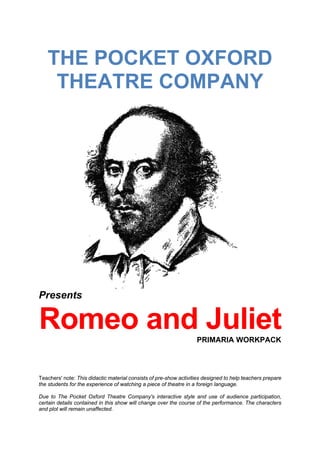
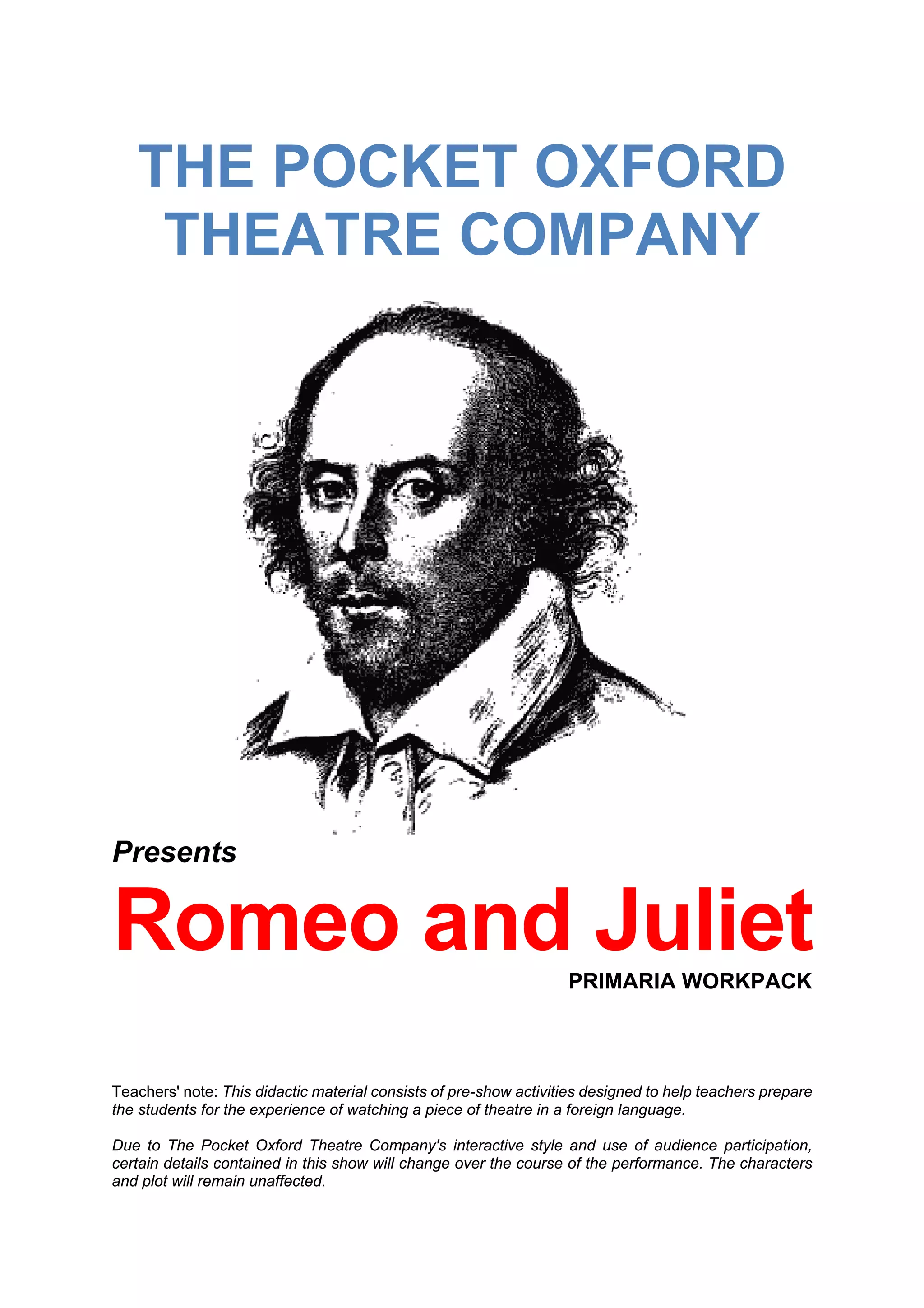
SHAKESPEARE (1564-1616)
William Shakespeare was born in Stratford-upon-Avon, England in 1564. His parents
were quite rich and he studied Greek and Latin. He married Anne Hathaway in 1582.
Shakespeare then moved to London to become a playwright and actor with the
successful theatre company The Lord Chamberlain's Men. Shakespeare remained
with the company until he retired in 1610.

Shakespeare wrote 37 plays in total and 154 sonnets (lyrical poems of 14 lines). His
plays are categorised into three genres; comedy, tragedy and history plays. The
tragedy, 'Romeo and Juliet' was one of Shakespeare's earliest plays (written between
1591-95), Romeo and Juliet is a play about two young lovers, who come from two
feuding families, the Montagues and the Capulets.Stratford,

Shakespeare was alive during the Elizabethan Era; as Queen Elizabeth I was Britain’s
first female queen, and a supporter of the theatre. Shakespeare died in 1616, aged 52.
He is still widely regarded as the greatest writer in the English language and the
world's greatest playwright, although he is often referred to as 'the bard', which simply
means the poet.


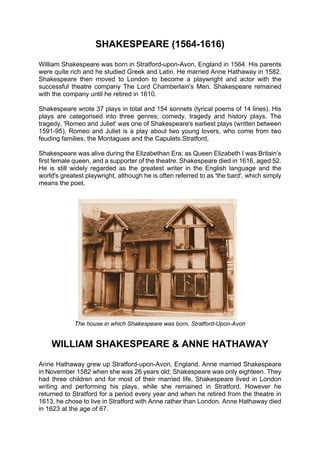
             The house in which Shakespeare was born, Stratford-Upon-Avon


    WILLIAM SHAKESPEARE & ANNE HATHAWAY
Anne Hathaway grew up Stratford-upon-Avon, England. Anne married Shakespeare
in November 1582 when she was 26 years old; Shakespeare was only eighteen. They
had three children and for most of their married life, Shakespeare lived in London
writing and performing his plays, while she remained in Stratford. However he
returned to Stratford for a period every year and when he retired from the theatre in
1613, he chose to live in Stratford with Anne rather than London. Anne Hathaway died
in 1623 at the age of 67.
THEATRES
Before the first theatres were built in England, actors travelled around the country in
groups known as 'players'. They travelled and performed in wagons and carried
portable stages, which the audience would stand around to watch their simple
productions, usually based on religious stories. The first purpose-built theatre was
erected in 1576 by James Burbage, and simply called 'The Theatre'. Due to its
popularity, by 1600 there were a number of playhouses in London. 'The Theatre' was
pulled down in 1598 and was rebuilt in a new location and renamed 'The Globe'. This
became the theatre where Shakespeare would perform and stage his plays.


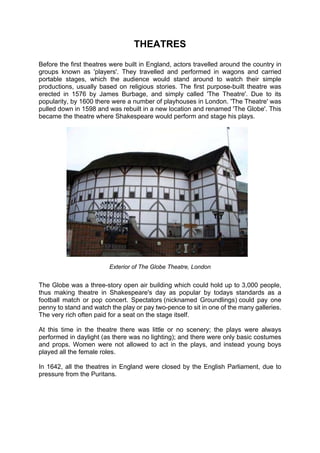
                         Exterior of The Globe Theatre, London


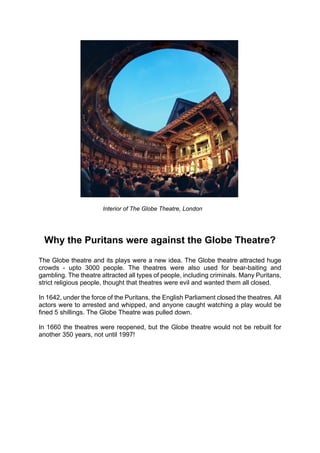
The Globe was a three-story open air building which could hold up to 3,000 people,
thus making theatre in Shakespeare's day as popular by todays standards as a
football match or pop concert. Spectators (nicknamed Groundlings) could pay one
penny to stand and watch the play or pay two-pence to sit in one of the many galleries.
The very rich often paid for a seat on the stage itself.

At this time in the theatre there was little or no scenery; the plays were always
performed in daylight (as there was no lighting); and there were only basic costumes
and props. Women were not allowed to act in the plays, and instead young boys
played all the female roles.

In 1642, all the theatres in England were closed by the English Parliament, due to
pressure from the Puritans.
Interior of The Globe Theatre, London


  Why the Puritans were against the Globe Theatre?
The Globe theatre and its plays were a new idea. The Globe theatre attracted huge
crowds - upto 3000 people. The theatres were also used for bear-baiting and
gambling. The theatre attracted all types of people, including criminals. Many Puritans,
strict religious people, thought that theatres were evil and wanted them all closed.

In 1642, under the force of the Puritans, the English Parliament closed the theatres. All
actors were to arrested and whipped, and anyone caught watching a play would be
fined 5 shillings. The Globe Theatre was pulled down.

In 1660 the theatres were reopened, but the Globe theatre would not be rebuilt for
another 350 years, not until 1997!
EXERCISE; FILL THE BLANKS
Fill in the blanks with the following words:

William / Shakespeare / The Globe / Juliet / Puritans / The Theatre / Anne

Capulets / Stratford-upon-Avon / 1591-95 / Players / 2 pence / young boys
/ 1616


1/ ____________ Shakespeare was married to _______ Hathaway.

2/ They lived in a place called _______________.

3/ One of Shakespeare's tragedies was called 'Romeo and _________'.

4/ Before theatres were built, actors travelled around the country in a wagon and were
called _____________.

5/ The first theatre built in England was called _________________.

6/ 'Romeo and Juliet' was written between _____________.

7/ In the Elizabethan era women were not allowed to perform on the stage so the
female roles were played by ______________.

8/ It cost ________ to sit in the gallery at the theatres.

9/ The theatre that Shakespeare worked at, and part owned, was called
________________.

10/ William _______________ died in _________.

11/ In 'Romeo and Juliet' there are two feuding families called the Montagues and the
___________.

12/ All the theatres were closed down in 1642 due to pressure from The
____________.
EXERCISE; TRUE or FALSE ??


1. Not many people went to the theatre.

2. Theatres only showed plays.

3. The Puritans were worried that theatres were a bad influence.

4. Puritans thought theatres were educational.

5. After 1642, Actors were whipped if they were caught.

6. The Globe theatre was demolished.

7. You cannot visit the Globe Theatre today.


Solutions; 1=F / 2=F / 3= T / 4= F/ 5=T/ 6=T/ 7=F
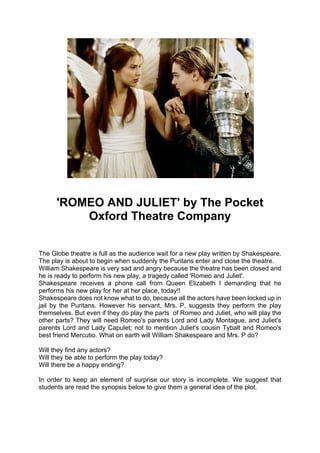
'ROMEO AND JULIET' by The Pocket
          Oxford Theatre Company


The Globe theatre is full as the audience wait for a new play written by Shakespeare.
The play is about to begin when suddenly the Puritans enter and close the theatre.
William Shakespeare is very sad and angry because the theatre has been closed and
he is ready to perform his new play, a tragedy called 'Romeo and Juliet'.
Shakespeare receives a phone call from Queen Elizabeth I demanding that he
performs his new play for her at her place, today!!
Shakespeare does not know what to do, because all the actors have been locked up in
jail by the Puritans. However his servant, Mrs. P, suggests they perform the play
themselves. But even if they do play the parts of Romeo and Juliet, who will play the
other parts? They will need Romeo's parents Lord and Lady Montague, and Juliet's
parents Lord and Lady Capulet; not to mention Juliet's cousin Tybalt and Romeo's
best friend Mercutio. What on earth will William Shakespeare and Mrs. P do?

Will they find any actors?
Will they be able to perform the play today?
Will there be a happy ending?

In order to keep an element of surprise our story is incomplete. We suggest that
students are read the synopsis below to give them a general idea of the plot.
'ROMEO AND JULIET' by William
            Shakespeare - A SYNOPSIS
A boy and a girl, from families who hate each other bitterly, fall in love but everything
goes wrong for them and they kill themselves rather than be parted. Most of the play
takes place in 'fair Verona' , an attractive little city in the north of Italy. The action
moves quickly from the streets to the hall of the Capulet's house, then to the orchard
below Juliet's balcony, to Friar Lawrences' lonely cell and finally to the vault where the
Capulets and the Monatgues view their dead children. The play starts on a Sunday
morning in the middle of July; less than five days later - just before dawn on the
following Thursday - it is all over.

Act 1
A fight between servants of two of the most important families, the Montagues and
the Capulets is broken up by the Prince. Romeo tells Benvolio that he is in love with
Rosaline. Lady Capulet tells Juliet that she is to marry Paris. Lord Capulet starts to
prepare for the celebrations.
A servant of Lord Capulet asks Romeo to read the invitation list. Romeo decides to
goto the ball to see Rosaline. At the ball Romeo meets and falls in love with Juliet,
only afterwards do they discover that their families are sworn enemies.
Tybalt recognises Romeo but is prevented from doing anything by Lord Capulet, who
does not want any trouble.

Act 2
Benvolio and Mercutio look for Romeo. Juliet tells Romeo that she loves him, and
they exchange vows. Romeo goes to see Friar Lawrence, who agrees to marry them
as it may help and end their families feud.
Meanwhile Tybalt makes it known that he wishes to challenge Romeo to a duel.
Romeo tells the Nurse of his plan to marry Juliet. Juliet blushes when she hears of
this news.
Romeo and Juliet meet at the Friar's cell and they are married in secret.

Act 3
The next day, Mercutio picks a fight with Tybalt. Romeo turns up and tries to
intervene.
Tybalt kills Mercutio. This makes Romeo angry and he then kills Tybalt.
Romeo is now a murderer and is banished from Verona.

Act 4
Paris goes to Friar Lawrence's cell. Paris announces that he is to marry Juliet on
Thursday. Juliet says that she will stab herself rather than marry Paris. The Friar
gives her a bottle of potion, that when she drinks it, will make her appear dead for 48
hours.
The Friar's plan is to write to Romeo so that he will be there when she wakes up.
Juliet agrees to marry Paris to please her father, who then brings the wedding day
forward to Wednesday.
Juliet takes the potion and her family mourn her death.

Act 5
Balthasar arrives in Mantua with news of Juliet's death. Romeo goes to an
apothecary to get some poison.
Friar Lawrence learns that his messanger did not get to Mantua to give Romeo his
message because of the Plague. Paris is at Juliet's tomb when Romeo arrives. They
fight and Romeo kills Paris. Romeo sees Juliet and thinks that she is dead so he
poisons himself. Friar Lawrence arrives too late to save Romeo. Juliet wakes to find
Romeo dead and kills herself with his dagger.
The Montagues and Capulets agree to end their feud and decide to put a statue of
pure gold in the town square.


Related Films
"Shakespeare: The Animated Tales" Romeo and Juliet (1992)
Shakespeare In Love (Gwyneth Paltrow, Judi Dench, 1998)
Romeo and Juliet (Leonardo DiCaprio, Claire Danes, Director - Baz Luhrmann, 1996)
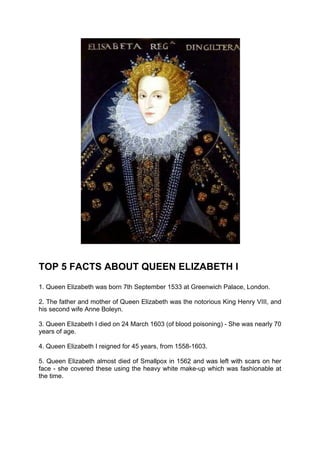
TOP 5 FACTS ABOUT QUEEN ELIZABETH I
1. Queen Elizabeth was born 7th September 1533 at Greenwich Palace, London.

2. The father and mother of Queen Elizabeth was the notorious King Henry VIII, and
his second wife Anne Boleyn.

3. Queen Elizabeth I died on 24 March 1603 (of blood poisoning) - She was nearly 70
years of age.

4. Queen Elizabeth I reigned for 45 years, from 1558-1603.

5. Queen Elizabeth almost died of Smallpox in 1562 and was left with scars on her
face - she covered these using the heavy white make-up which was fashionable at
the time.
QUESTION SHEET
1. Where was Queen Elizabeth I born?

2. Who were her father and mother?

3. How old was Queen Elizabeth I when she died

4. For how long did Queen Elizabeth I reign?

5. Why did Queen Elizabeth I wear such heavy white make-up?


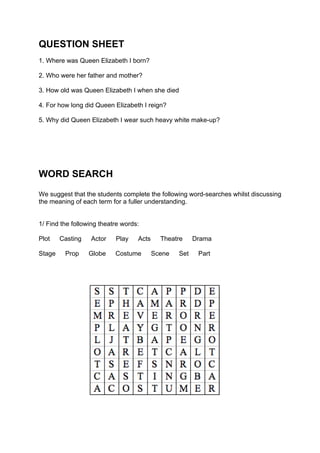
WORD SEARCH
We suggest that the students complete the following word-searches whilst discussing
the meaning of each term for a fuller understanding.


1/ Find the following theatre words:

Plot    Casting   Actor    Play    Acts     Theatre     Drama

Stage    Prop     Globe    Costume        Scene   Set    Part
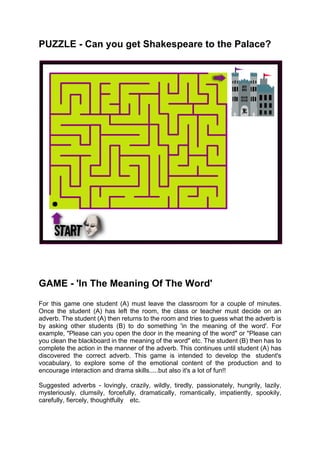
PUZZLE - Can you get Shakespeare to the Palace?


GAME - 'In The Meaning Of The Word'
For this game one student (A) must leave the classroom for a couple of minutes.
Once the student (A) has left the room, the class or teacher must decide on an
adverb. The student (A) then returns to the room and tries to guess what the adverb is
by asking other students (B) to do something 'in the meaning of the word'. For
example, "Please can you open the door in the meaning of the word" or "Please can
you clean the blackboard in the meaning of the word" etc. The student (B) then has to
complete the action in the manner of the adverb. This continues until student (A) has
discovered the correct adverb. This game is intended to develop the student's
vocabulary, to explore some of the emotional content of the production and to
encourage interaction and drama skills.....but also it's a lot of fun!!

Suggested adverbs - lovingly, crazily, wildly, tiredly, passionately, hungrily, lazily,
mysteriously, clumsily, forcefully, dramatically, romantically, impatiently, spookily,
carefully, fiercely, thoughtfully etc.
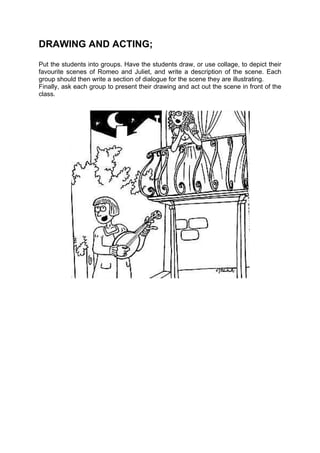
DRAWING AND ACTING;
Put the students into groups. Have the students draw, or use collage, to depict their
favourite scenes of Romeo and Juliet, and write a description of the scene. Each
group should then write a section of dialogue for the scene they are illustrating.
Finally, ask each group to present their drawing and act out the scene in front of the
class.
AFTER THE PLAY

The Pocket Oxford Theatre company hope that the students and teachers have
enjoyed the show. We would appreciate any feedback or suggestions. Any
contributions or comments students or teachers would like to make about the
production may now be made through our new Facebook page when you befriend
us at Pocket Oxford. Please stay in touch!

Pocket Oxford are a Professional theatre in Education company that tour throughout
Spain. Our current touring productions include 'Romeo and Juliet' (for Primary
students), 'The Taming of The Shrew' ('Taming Shakespeare') and Macbeth. We
develop a new production based on a Shakespeare play each academic year, which
can be made appropriate for students of all ages.


We look forward to visiting and entertaining you again in the future. Please contact us
at the address below.


Contact


                 The Pocket Oxford Theatre Company
                      info@factoriacultural.com

                               Tel – 971765622
                               Fax - 971765623

Romeo&juliet material did

  • 1.
    THE POCKET OXFORD THEATRE COMPANY Presents Romeo and Juliet PRIMARIA WORKPACK Teachers' note: This didactic material consists of pre-show activities designed to help teachers prepare the students for the experience of watching a piece of theatre in a foreign language. Due to The Pocket Oxford Theatre Company's interactive style and use of audience participation, certain details contained in this show will change over the course of the performance. The characters and plot will remain unaffected.
  • 2.
    SHAKESPEARE (1564-1616) William Shakespearewas born in Stratford-upon-Avon, England in 1564. His parents were quite rich and he studied Greek and Latin. He married Anne Hathaway in 1582. Shakespeare then moved to London to become a playwright and actor with the successful theatre company The Lord Chamberlain's Men. Shakespeare remained with the company until he retired in 1610. Shakespeare wrote 37 plays in total and 154 sonnets (lyrical poems of 14 lines). His plays are categorised into three genres; comedy, tragedy and history plays. The tragedy, 'Romeo and Juliet' was one of Shakespeare's earliest plays (written between 1591-95), Romeo and Juliet is a play about two young lovers, who come from two feuding families, the Montagues and the Capulets.Stratford, Shakespeare was alive during the Elizabethan Era; as Queen Elizabeth I was Britain’s first female queen, and a supporter of the theatre. Shakespeare died in 1616, aged 52. He is still widely regarded as the greatest writer in the English language and the world's greatest playwright, although he is often referred to as 'the bard', which simply means the poet. The house in which Shakespeare was born, Stratford-Upon-Avon WILLIAM SHAKESPEARE & ANNE HATHAWAY Anne Hathaway grew up Stratford-upon-Avon, England. Anne married Shakespeare in November 1582 when she was 26 years old; Shakespeare was only eighteen. They had three children and for most of their married life, Shakespeare lived in London writing and performing his plays, while she remained in Stratford. However he returned to Stratford for a period every year and when he retired from the theatre in 1613, he chose to live in Stratford with Anne rather than London. Anne Hathaway died in 1623 at the age of 67.
  • 3.
    THEATRES Before the firsttheatres were built in England, actors travelled around the country in groups known as 'players'. They travelled and performed in wagons and carried portable stages, which the audience would stand around to watch their simple productions, usually based on religious stories. The first purpose-built theatre was erected in 1576 by James Burbage, and simply called 'The Theatre'. Due to its popularity, by 1600 there were a number of playhouses in London. 'The Theatre' was pulled down in 1598 and was rebuilt in a new location and renamed 'The Globe'. This became the theatre where Shakespeare would perform and stage his plays. Exterior of The Globe Theatre, London The Globe was a three-story open air building which could hold up to 3,000 people, thus making theatre in Shakespeare's day as popular by todays standards as a football match or pop concert. Spectators (nicknamed Groundlings) could pay one penny to stand and watch the play or pay two-pence to sit in one of the many galleries. The very rich often paid for a seat on the stage itself. At this time in the theatre there was little or no scenery; the plays were always performed in daylight (as there was no lighting); and there were only basic costumes and props. Women were not allowed to act in the plays, and instead young boys played all the female roles. In 1642, all the theatres in England were closed by the English Parliament, due to pressure from the Puritans.
  • 4.
    Interior of TheGlobe Theatre, London Why the Puritans were against the Globe Theatre? The Globe theatre and its plays were a new idea. The Globe theatre attracted huge crowds - upto 3000 people. The theatres were also used for bear-baiting and gambling. The theatre attracted all types of people, including criminals. Many Puritans, strict religious people, thought that theatres were evil and wanted them all closed. In 1642, under the force of the Puritans, the English Parliament closed the theatres. All actors were to arrested and whipped, and anyone caught watching a play would be fined 5 shillings. The Globe Theatre was pulled down. In 1660 the theatres were reopened, but the Globe theatre would not be rebuilt for another 350 years, not until 1997!
  • 5.
    EXERCISE; FILL THEBLANKS Fill in the blanks with the following words: William / Shakespeare / The Globe / Juliet / Puritans / The Theatre / Anne Capulets / Stratford-upon-Avon / 1591-95 / Players / 2 pence / young boys / 1616 1/ ____________ Shakespeare was married to _______ Hathaway. 2/ They lived in a place called _______________. 3/ One of Shakespeare's tragedies was called 'Romeo and _________'. 4/ Before theatres were built, actors travelled around the country in a wagon and were called _____________. 5/ The first theatre built in England was called _________________. 6/ 'Romeo and Juliet' was written between _____________. 7/ In the Elizabethan era women were not allowed to perform on the stage so the female roles were played by ______________. 8/ It cost ________ to sit in the gallery at the theatres. 9/ The theatre that Shakespeare worked at, and part owned, was called ________________. 10/ William _______________ died in _________. 11/ In 'Romeo and Juliet' there are two feuding families called the Montagues and the ___________. 12/ All the theatres were closed down in 1642 due to pressure from The ____________.
  • 6.
    EXERCISE; TRUE orFALSE ?? 1. Not many people went to the theatre. 2. Theatres only showed plays. 3. The Puritans were worried that theatres were a bad influence. 4. Puritans thought theatres were educational. 5. After 1642, Actors were whipped if they were caught. 6. The Globe theatre was demolished. 7. You cannot visit the Globe Theatre today. Solutions; 1=F / 2=F / 3= T / 4= F/ 5=T/ 6=T/ 7=F
  • 7.
    'ROMEO AND JULIET'by The Pocket Oxford Theatre Company The Globe theatre is full as the audience wait for a new play written by Shakespeare. The play is about to begin when suddenly the Puritans enter and close the theatre. William Shakespeare is very sad and angry because the theatre has been closed and he is ready to perform his new play, a tragedy called 'Romeo and Juliet'. Shakespeare receives a phone call from Queen Elizabeth I demanding that he performs his new play for her at her place, today!! Shakespeare does not know what to do, because all the actors have been locked up in jail by the Puritans. However his servant, Mrs. P, suggests they perform the play themselves. But even if they do play the parts of Romeo and Juliet, who will play the other parts? They will need Romeo's parents Lord and Lady Montague, and Juliet's parents Lord and Lady Capulet; not to mention Juliet's cousin Tybalt and Romeo's best friend Mercutio. What on earth will William Shakespeare and Mrs. P do? Will they find any actors? Will they be able to perform the play today? Will there be a happy ending? In order to keep an element of surprise our story is incomplete. We suggest that students are read the synopsis below to give them a general idea of the plot.
  • 8.
    'ROMEO AND JULIET'by William Shakespeare - A SYNOPSIS A boy and a girl, from families who hate each other bitterly, fall in love but everything goes wrong for them and they kill themselves rather than be parted. Most of the play takes place in 'fair Verona' , an attractive little city in the north of Italy. The action moves quickly from the streets to the hall of the Capulet's house, then to the orchard below Juliet's balcony, to Friar Lawrences' lonely cell and finally to the vault where the Capulets and the Monatgues view their dead children. The play starts on a Sunday morning in the middle of July; less than five days later - just before dawn on the following Thursday - it is all over. Act 1 A fight between servants of two of the most important families, the Montagues and the Capulets is broken up by the Prince. Romeo tells Benvolio that he is in love with Rosaline. Lady Capulet tells Juliet that she is to marry Paris. Lord Capulet starts to prepare for the celebrations. A servant of Lord Capulet asks Romeo to read the invitation list. Romeo decides to goto the ball to see Rosaline. At the ball Romeo meets and falls in love with Juliet, only afterwards do they discover that their families are sworn enemies. Tybalt recognises Romeo but is prevented from doing anything by Lord Capulet, who does not want any trouble. Act 2 Benvolio and Mercutio look for Romeo. Juliet tells Romeo that she loves him, and they exchange vows. Romeo goes to see Friar Lawrence, who agrees to marry them as it may help and end their families feud. Meanwhile Tybalt makes it known that he wishes to challenge Romeo to a duel. Romeo tells the Nurse of his plan to marry Juliet. Juliet blushes when she hears of this news. Romeo and Juliet meet at the Friar's cell and they are married in secret. Act 3 The next day, Mercutio picks a fight with Tybalt. Romeo turns up and tries to intervene. Tybalt kills Mercutio. This makes Romeo angry and he then kills Tybalt. Romeo is now a murderer and is banished from Verona. Act 4 Paris goes to Friar Lawrence's cell. Paris announces that he is to marry Juliet on Thursday. Juliet says that she will stab herself rather than marry Paris. The Friar gives her a bottle of potion, that when she drinks it, will make her appear dead for 48 hours. The Friar's plan is to write to Romeo so that he will be there when she wakes up. Juliet agrees to marry Paris to please her father, who then brings the wedding day forward to Wednesday.
  • 9.
    Juliet takes thepotion and her family mourn her death. Act 5 Balthasar arrives in Mantua with news of Juliet's death. Romeo goes to an apothecary to get some poison. Friar Lawrence learns that his messanger did not get to Mantua to give Romeo his message because of the Plague. Paris is at Juliet's tomb when Romeo arrives. They fight and Romeo kills Paris. Romeo sees Juliet and thinks that she is dead so he poisons himself. Friar Lawrence arrives too late to save Romeo. Juliet wakes to find Romeo dead and kills herself with his dagger. The Montagues and Capulets agree to end their feud and decide to put a statue of pure gold in the town square. Related Films "Shakespeare: The Animated Tales" Romeo and Juliet (1992) Shakespeare In Love (Gwyneth Paltrow, Judi Dench, 1998) Romeo and Juliet (Leonardo DiCaprio, Claire Danes, Director - Baz Luhrmann, 1996)
  • 10.
    TOP 5 FACTSABOUT QUEEN ELIZABETH I 1. Queen Elizabeth was born 7th September 1533 at Greenwich Palace, London. 2. The father and mother of Queen Elizabeth was the notorious King Henry VIII, and his second wife Anne Boleyn. 3. Queen Elizabeth I died on 24 March 1603 (of blood poisoning) - She was nearly 70 years of age. 4. Queen Elizabeth I reigned for 45 years, from 1558-1603. 5. Queen Elizabeth almost died of Smallpox in 1562 and was left with scars on her face - she covered these using the heavy white make-up which was fashionable at the time.
  • 11.
    QUESTION SHEET 1. Wherewas Queen Elizabeth I born? 2. Who were her father and mother? 3. How old was Queen Elizabeth I when she died 4. For how long did Queen Elizabeth I reign? 5. Why did Queen Elizabeth I wear such heavy white make-up? WORD SEARCH We suggest that the students complete the following word-searches whilst discussing the meaning of each term for a fuller understanding. 1/ Find the following theatre words: Plot Casting Actor Play Acts Theatre Drama Stage Prop Globe Costume Scene Set Part
  • 12.
    PUZZLE - Canyou get Shakespeare to the Palace? GAME - 'In The Meaning Of The Word' For this game one student (A) must leave the classroom for a couple of minutes. Once the student (A) has left the room, the class or teacher must decide on an adverb. The student (A) then returns to the room and tries to guess what the adverb is by asking other students (B) to do something 'in the meaning of the word'. For example, "Please can you open the door in the meaning of the word" or "Please can you clean the blackboard in the meaning of the word" etc. The student (B) then has to complete the action in the manner of the adverb. This continues until student (A) has discovered the correct adverb. This game is intended to develop the student's vocabulary, to explore some of the emotional content of the production and to encourage interaction and drama skills.....but also it's a lot of fun!! Suggested adverbs - lovingly, crazily, wildly, tiredly, passionately, hungrily, lazily, mysteriously, clumsily, forcefully, dramatically, romantically, impatiently, spookily, carefully, fiercely, thoughtfully etc.
  • 13.
    DRAWING AND ACTING; Putthe students into groups. Have the students draw, or use collage, to depict their favourite scenes of Romeo and Juliet, and write a description of the scene. Each group should then write a section of dialogue for the scene they are illustrating. Finally, ask each group to present their drawing and act out the scene in front of the class.
  • 14.
    AFTER THE PLAY ThePocket Oxford Theatre company hope that the students and teachers have enjoyed the show. We would appreciate any feedback or suggestions. Any contributions or comments students or teachers would like to make about the production may now be made through our new Facebook page when you befriend us at Pocket Oxford. Please stay in touch! Pocket Oxford are a Professional theatre in Education company that tour throughout Spain. Our current touring productions include 'Romeo and Juliet' (for Primary students), 'The Taming of The Shrew' ('Taming Shakespeare') and Macbeth. We develop a new production based on a Shakespeare play each academic year, which can be made appropriate for students of all ages. We look forward to visiting and entertaining you again in the future. Please contact us at the address below. Contact The Pocket Oxford Theatre Company info@factoriacultural.com Tel – 971765622 Fax - 971765623