Role-­‐Based	
  Access	
  Control	
  
CS461/ECE422	
  
Spring	
  2012	
  
Reading	
  Material	
  
• Chapter	
  4,	
  sec?ons	
  4.5	
  and	
  4.6	
  
• [SFK00]	
  
DAC	
  vs	
  RBAC	
  
• DAC	
  
– Users,	
  Groups	
  à	
  Permissions	
  
• RBAC	
  
– Roles	
  à	
  Permissions	
  
– Users	
  à	
  Roles	
  
– Many-­‐to-­‐many	
  rela?ons	
  
• Difference	
  between	
  groups	
  and	
  roles?	
  
– Groups:	
  collec?on	
  of	
  users	
  
– Roles:	
  
• collec?on	
  of	
  permissions	
  and/or	
  users,	
  and	
  possibly	
  other	
  
roles	
  [S96]	
  
• job	
  func?on	
  within	
  an	
  organiza?on	
  [text]	
  
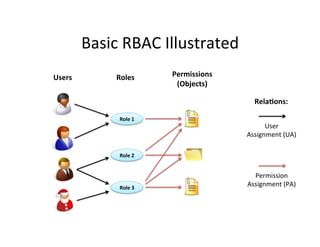
Basic	
  RBAC	
  Illustrated	
  
Role	
  1	
  
Role	
  2	
  
Role	
  3	
  
Users	
   Roles	
   Permissions	
  
(Objects)	
  
Rela8ons:	
  
User	
  
Assignment	
  (UA)	
  
Permission	
  
Assignment	
  (PA)	
  
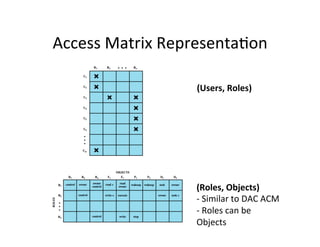
Access	
  Matrix	
  Representa?on	
  
(Users,	
  Roles)	
  
(Roles,	
  Objects)	
  
-­‐	
  Similar	
  to	
  DAC	
  ACM	
  
-­‐	
  Roles	
  can	
  be	
  
Objects	
  
RBAC	
  Reference	
  Models	
  [SCFY96]	
  
• RBAC0	
  
– Minimum	
  func?onality	
  
• RBAC1	
  
– RBAC0	
  +	
  Role	
  hierarchies	
  
• RBAC2	
  
– RBAC0	
  +	
  Constraints	
  
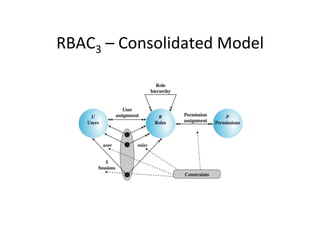
• RBAC3	
  
– RBAC0	
  +	
  RBAC1	
  +	
  RBAC2	
  
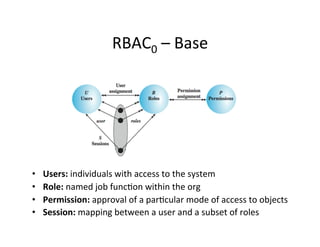
RBAC0	
  –	
  Base	
  
• Users:	
  individuals	
  with	
  access	
  to	
  the	
  system	
  
• Role:	
  named	
  job	
  func?on	
  within	
  the	
  org	
  
• Permission:	
  approval	
  of	
  a	
  par?cular	
  mode	
  of	
  access	
  to	
  objects	
  
• Session:	
  mapping	
  between	
  a	
  user	
  and	
  a	
  subset	
  of	
  roles	
  
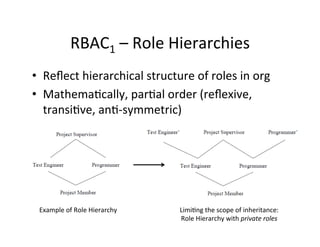
RBAC1	
  –	
  Role	
  Hierarchies	
  
• Reflect	
  hierarchical	
  structure	
  of	
  roles	
  in	
  org	
  
• Mathema?cally,	
  par?al	
  order	
  (reflexive,	
  
transi?ve,	
  an?-­‐symmetric)	
  
Example	
  of	
  Role	
  Hierarchy	
   Limi?ng	
  the	
  scope	
  of	
  inheritance:	
  
Role	
  Hierarchy	
  with	
  private	
  roles	
  
RBAC2	
  –	
  Constraints	
  
• Reflect	
  higher-­‐level	
  organiza?onal	
  policy	
  
• Mutually	
  exclusive	
  roles	
  (U	
  à	
  R	
  and	
  R	
  à	
  P)	
  
• Cardinality	
  –	
  maximum	
  number	
  with	
  respect	
  
to	
  role	
  
• Prerequisite	
  –	
  can	
  assign	
  role	
  only	
  if	
  already	
  
assigned	
  prerequisite	
  role	
  
– Remember,	
  no	
  hierarchies	
  in	
  RBAC2	
  
RBAC3	
  –	
  Consolidated	
  Model	
  
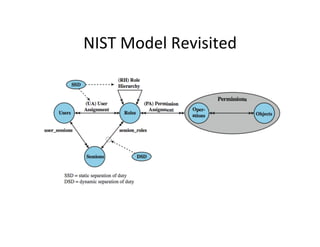
NIST	
  RBAC	
  Model	
  [SFK00]	
  
• RBAC	
  System	
  and	
  Administra?ve	
  Func?onal	
  
Specifica?on	
  
• Three	
  categories	
  of	
  features/func?ons:	
  
– Administra8ve	
  func8ons:	
  create,	
  delete,	
  maintain	
  
RBAC	
  elements	
  and	
  rela?ons	
  
– Suppor8ng	
  system	
  func8ons:	
  session	
  management,	
  
access	
  control	
  decisions	
  
– Review	
  func8ons:	
  query	
  opera?ons	
  on	
  RBAC	
  
elements	
  and	
  rela?ons	
  
• Four	
  components:	
  Core	
  RBAC,	
  Hierarchical	
  RBAC,	
  
Sta?c	
  and	
  Dynamic	
  Separa?on	
  of	
  Duty	
  (SSD,	
  DSD)	
  
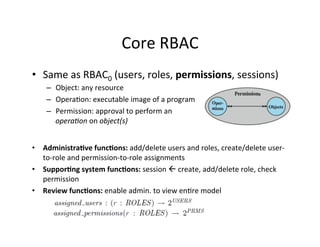
Core	
  RBAC	
  
• Same	
  as	
  RBAC0	
  (users,	
  roles,	
  permissions,	
  sessions)	
  
– Object:	
  any	
  resource	
  
– Opera?on:	
  executable	
  image	
  of	
  a	
  program	
  
– Permission:	
  approval	
  to	
  perform	
  an	
  
opera/on	
  on	
  object(s)	


• Administra8ve	
  func8ons:	
  add/delete	
  users	
  and	
  roles,	
  create/delete	
  user-­‐
to-­‐role	
  and	
  permission-­‐to-­‐role	
  assignments	
  
• Suppor8ng	
  system	
  func8ons:	
  session	
  ß	
  create,	
  add/delete	
  role,	
  check	
  
permission	
  
• Review	
  func8ons:	
  enable	
  admin.	
  to	
  view	
  en?re	
  model	
  
Hierarchical	
  RBAC	
  
• Similar	
  to	
  RBAC1	
  
• r1	
  is	
  a	
  descendant	
  of	
  r2	
  if:	
  
– r1	
  includes	
  all	
  permissions	
  from	
  r2	
  
– All	
  users	
  assigned	
  to	
  r1	
  are	
  also	
  assigned	
  to	
  r2	
  
• General	
  role	
  hierarchies	
  
– Arbitrary	
  par?al	
  order,	
  mul?ple	
  inheritance	
  
• Limited	
  role	
  hierarchies	
  
– Tree	
  structure,	
  single	
  descendant	
  allowed	


• Administra8ve	
  func8ons:	
  add/delete	
  immediate	
  inheritance	
  rela?onship,	
  
create	
  new	
  role	
  and	
  add	
  it	
  as	
  ascendant	
  or	
  descendant	
  
• Review	
  func8ons:	
  enable	
  admin.	
  to	
  view	
  users/permissions	
  directly	
  or	
  by	
  
inheritance.	
  
Sta?c	
  Separa?on	
  of	
  Duty	
  (SSD)	
  
• Prevents	
  conflict	
  of	
  interest	
  
• Cardinality	
  constraint	
  on	
  a	
  set	
  of	
  roles	
  
– SSD	
  :=	
  (role	
  set,	
  n)	
  where	
  no	
  user	
  is	
  assigned	
  to	
  n	
  
or	
  more	
  roles	
  from	
  the	
  role	
  set	
  
• Mutual	
  exclusive	
  roles	
  as	
  a	
  special	
  case:	
  
– SSD	
  :=	
  ({r1,	
  r2},	
  2)	


• Administra8ve	
  func8ons:	
  create/delete	
  role	
  sets,	
  add/delete	
  role	
  
members	
  
• Review	
  func8ons:	
  view	
  proper?es	
  of	
  SSD	
  sets	
  
Dynamic	
  Separa?on	
  of	
  Duty	
  (DSD)	
  
• Similar	
  to	
  SSD,	
  but	
  ac?vated	
  within	
  sessions	
  
• Typically	
  for	
  temporal	
  conflicts	
  of	
  interest	
  
• Defini?on	
  
– DSD	
  :=	
  (role	
  set,	
  n)	
  (n≥2)	
  no	
  user	
  session	
  may	
  
ac?vate	
  ≥n	
  roles	
  from	
  role	
  set	
  
• Example:	
  Author	
  and	
  PC	
  member	
  (conference)	
  
• Administra?ve	
  and	
  review	
  func?ons:	
  similar	
  to	
  SSD	
  
Unspecified	
  by	
  NIST	
  RBAC	
  
• Scalability	
  
• Authen?ca?on	
  
• Nega?ve	
  permissions	
  
• Nature	
  of	
  permissions	
  
• Discre?onary	
  role	
  ac?va?on	
  
• Role	
  engineering	
  
• Constraints	
  
• RBAC	
  administra?on	
  
• Role	
  revoca?on	
  
NIST	
  Model	
  Revisited	
  
Role	
  Engineering	
  (RE)	
  
• Defini?on	
  of	
  roles	
  can	
  be	
  difficult;	
  essen?ally	
  a	
  
requirements	
  engineering	
  process	
  
• RE	
  is	
  required	
  to	
  implement	
  an	
  abstract	
  model	
  
• Basic	
  process	
  [C96]	
  
• Role	
  predic?on	
  [Z+11]	
  
– Use	
  sta?s?cal	
  models	
  to	
  analyze	
  audit	
  logs	
  
– Predict	
  roles,	
  detect	
  anomalies	
  
– Refine	
  roles	
  (generalize	
  or	
  split)	
  
collect	
  
ac?vi?es	
  
group	
  into	
  
clusters	
  
name	
  
clusters	
  
describe	
  
remove	
  
duplicates	
  
iden?fy	
  minimal	
  set	
  
of	
  permissions	
  
simulate	
  
ac?vi?es	
  
role	
  
candidates	
  
Case	
  Study:	
  RBAC	
  for	
  a	
  Bank	
  [SMJ01]	
  
• Prior	
  to	
  1990	
  used	
  local	
  access	
  control	
  files	
  
– manually	
  administered	
  for	
  each	
  user,	
  applica?on,	
  
and	
  host	
  à	
  administra?ve	
  overhead,	
  error-­‐prone	
  
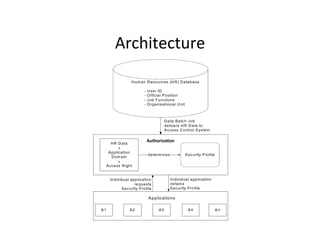
• Implemented	
  RBAC	
  scheme	
  (Authoriza?on)	
  
• Applica?ons	
  no	
  longer	
  make	
  AC	
  decisions;	
  
query	
  Authoriza?on	
  for	
  a	
  security	
  profile	
  
instead	
  
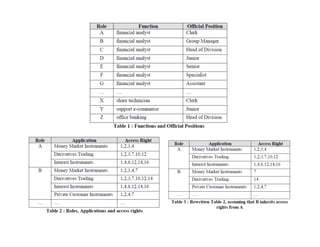
• Role	
  :=	
  (official	
  posi?on,	
  job	
  func?on)	
  
– (different	
  from	
  NIST	
  RBAC)	
  
Architecture	
  
Authoriza8on	
  
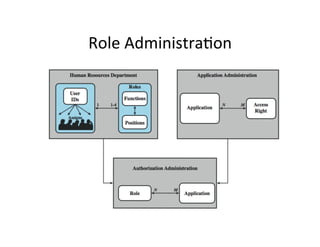
Role	
  Administra?on	
  
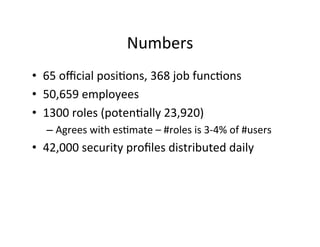
Numbers	
  
• 65	
  official	
  posi?ons,	
  368	
  job	
  func?ons	
  
• 50,659	
  employees	
  
• 1300	
  roles	
  (poten?ally	
  23,920)	
  
– Agrees	
  with	
  es?mate	
  –	
  #roles	
  is	
  3-­‐4%	
  of	
  #users	
  
• 42,000	
  security	
  profiles	
  distributed	
  daily	
  
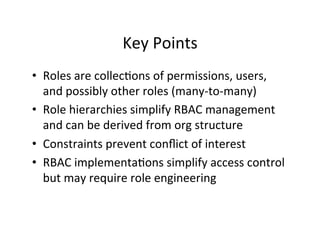
Key	
  Points	
  
• Roles	
  are	
  collec?ons	
  of	
  permissions,	
  users,	
  
and	
  possibly	
  other	
  roles	
  (many-­‐to-­‐many)	
  
• Role	
  hierarchies	
  simplify	
  RBAC	
  management	
  
and	
  can	
  be	
  derived	
  from	
  org	
  structure	
  
• Constraints	
  prevent	
  conflict	
  of	
  interest	
  
• RBAC	
  implementa?ons	
  simplify	
  access	
  control	
  
but	
  may	
  require	
  role	
  engineering	
  
References	
  
• [SCFY96]	
  Sandhu,	
  R.,	
  et	
  al.	
  “Role-­‐Based	
  Access	
  Control	
  Models.”	
  Computer,	
  
1994.	
  
• [S96]	
  Sandhu,	
  R.	
  Roles	
  versus	
  groups.	
  In	
  Proceedings	
  of	
  the	
  first	
  ACM	
  
Workshop	
  on	
  Role-­‐based	
  access	
  control	
  (RBAC	
  '95)	
  
• [SFK00]	
  Sandhu,	
  R.,	
  Ferraiolo,	
  D.F.	
  and	
  Kuhn,	
  D.R.	
  (July	
  2000).	
  
"The	
  NIST	
  Model	
  for	
  Role	
  Based	
  Access	
  Control:	
  Toward	
  a	
  Unified	
  Standard".	
  
5th	
  ACM	
  Workshop	
  Role-­‐Based	
  Access	
  Control	
  (RBAC	
  ‘00)	
  
• [C96]	
  Coyne,	
  E.	
  Role	
  engineering.	
  In	
  Proceedings	
  of	
  the	
  first	
  ACM	
  Workshop	
  on	
  
Role-­‐based	
  access	
  control	
  (RBAC	
  '95)	
  
• [Z+11]	
  Role	
  Predic?on	
  using	
  Electronic	
  Medical	
  Record	
  System	
  Audits	
  
Wen	
  Zhang,	
  Carl	
  A.	
  Gunter,	
  David	
  Liebovitz,	
  Jian	
  Tian,	
  and	
  Bradley	
  Malin	
  
AMIA	
  2011	
  Annual	
  Symposium,	
  Washington,	
  DC,	
  October	
  2011	
  
• [SMJ01]	
  Andreas	
  Schaad,	
  Jonathan	
  Moffey,	
  and	
  Jeremy	
  Jacob.	
  2001.	
  
The	
  role-­‐based	
  access	
  control	
  system	
  of	
  a	
  European	
  bank:	
  a	
  case	
  study	
  and	
  
discussion.	
  In	
  Proceedings	
  of	
  the	
  sixth	
  ACM	
  symposium	
  on	
  Access	
  control	
  
models	
  and	
  technologies	
  (SACMAT	
  '01)	
  

Role-­‐Based Access Control - Basic RBAC Illustrated

  • 1.
    Role-­‐Based  Access  Control   CS461/ECE422   Spring  2012  
  • 2.
    Reading  Material   •Chapter  4,  sec?ons  4.5  and  4.6   • [SFK00]  
  • 3.
    DAC  vs  RBAC   • DAC   – Users,  Groups  à  Permissions   • RBAC   – Roles  à  Permissions   – Users  à  Roles   – Many-­‐to-­‐many  rela?ons   • Difference  between  groups  and  roles?   – Groups:  collec?on  of  users   – Roles:   • collec?on  of  permissions  and/or  users,  and  possibly  other   roles  [S96]   • job  func?on  within  an  organiza?on  [text]  
  • 4.
    Basic  RBAC  Illustrated   Role  1   Role  2   Role  3   Users   Roles   Permissions   (Objects)   Rela8ons:   User   Assignment  (UA)   Permission   Assignment  (PA)  
  • 5.
    Access  Matrix  Representa?on   (Users,  Roles)   (Roles,  Objects)   -­‐  Similar  to  DAC  ACM   -­‐  Roles  can  be   Objects  
  • 6.
    RBAC  Reference  Models  [SCFY96]   • RBAC0   – Minimum  func?onality   • RBAC1   – RBAC0  +  Role  hierarchies   • RBAC2   – RBAC0  +  Constraints   • RBAC3   – RBAC0  +  RBAC1  +  RBAC2  
  • 7.
    RBAC0  –  Base   • Users:  individuals  with  access  to  the  system   • Role:  named  job  func?on  within  the  org   • Permission:  approval  of  a  par?cular  mode  of  access  to  objects   • Session:  mapping  between  a  user  and  a  subset  of  roles  
  • 8.
    RBAC1  –  Role  Hierarchies   • Reflect  hierarchical  structure  of  roles  in  org   • Mathema?cally,  par?al  order  (reflexive,   transi?ve,  an?-­‐symmetric)   Example  of  Role  Hierarchy   Limi?ng  the  scope  of  inheritance:   Role  Hierarchy  with  private  roles  
  • 9.
    RBAC2  –  Constraints   • Reflect  higher-­‐level  organiza?onal  policy   • Mutually  exclusive  roles  (U  à  R  and  R  à  P)   • Cardinality  –  maximum  number  with  respect   to  role   • Prerequisite  –  can  assign  role  only  if  already   assigned  prerequisite  role   – Remember,  no  hierarchies  in  RBAC2  
  • 10.
  • 11.
    NIST  RBAC  Model  [SFK00]   • RBAC  System  and  Administra?ve  Func?onal   Specifica?on   • Three  categories  of  features/func?ons:   – Administra8ve  func8ons:  create,  delete,  maintain   RBAC  elements  and  rela?ons   – Suppor8ng  system  func8ons:  session  management,   access  control  decisions   – Review  func8ons:  query  opera?ons  on  RBAC   elements  and  rela?ons   • Four  components:  Core  RBAC,  Hierarchical  RBAC,   Sta?c  and  Dynamic  Separa?on  of  Duty  (SSD,  DSD)  
  • 12.
    Core  RBAC   •Same  as  RBAC0  (users,  roles,  permissions,  sessions)   – Object:  any  resource   – Opera?on:  executable  image  of  a  program   – Permission:  approval  to  perform  an   opera/on  on  object(s)     • Administra8ve  func8ons:  add/delete  users  and  roles,  create/delete  user-­‐ to-­‐role  and  permission-­‐to-­‐role  assignments   • Suppor8ng  system  func8ons:  session  ß  create,  add/delete  role,  check   permission   • Review  func8ons:  enable  admin.  to  view  en?re  model  
  • 13.
    Hierarchical  RBAC   •Similar  to  RBAC1   • r1  is  a  descendant  of  r2  if:   – r1  includes  all  permissions  from  r2   – All  users  assigned  to  r1  are  also  assigned  to  r2   • General  role  hierarchies   – Arbitrary  par?al  order,  mul?ple  inheritance   • Limited  role  hierarchies   – Tree  structure,  single  descendant  allowed     • Administra8ve  func8ons:  add/delete  immediate  inheritance  rela?onship,   create  new  role  and  add  it  as  ascendant  or  descendant   • Review  func8ons:  enable  admin.  to  view  users/permissions  directly  or  by   inheritance.  
  • 14.
    Sta?c  Separa?on  of  Duty  (SSD)   • Prevents  conflict  of  interest   • Cardinality  constraint  on  a  set  of  roles   – SSD  :=  (role  set,  n)  where  no  user  is  assigned  to  n   or  more  roles  from  the  role  set   • Mutual  exclusive  roles  as  a  special  case:   – SSD  :=  ({r1,  r2},  2)     • Administra8ve  func8ons:  create/delete  role  sets,  add/delete  role   members   • Review  func8ons:  view  proper?es  of  SSD  sets  
  • 15.
    Dynamic  Separa?on  of  Duty  (DSD)   • Similar  to  SSD,  but  ac?vated  within  sessions   • Typically  for  temporal  conflicts  of  interest   • Defini?on   – DSD  :=  (role  set,  n)  (n≥2)  no  user  session  may   ac?vate  ≥n  roles  from  role  set   • Example:  Author  and  PC  member  (conference)   • Administra?ve  and  review  func?ons:  similar  to  SSD  
  • 16.
    Unspecified  by  NIST  RBAC   • Scalability   • Authen?ca?on   • Nega?ve  permissions   • Nature  of  permissions   • Discre?onary  role  ac?va?on   • Role  engineering   • Constraints   • RBAC  administra?on   • Role  revoca?on  
  • 17.
  • 18.
    Role  Engineering  (RE)   • Defini?on  of  roles  can  be  difficult;  essen?ally  a   requirements  engineering  process   • RE  is  required  to  implement  an  abstract  model   • Basic  process  [C96]   • Role  predic?on  [Z+11]   – Use  sta?s?cal  models  to  analyze  audit  logs   – Predict  roles,  detect  anomalies   – Refine  roles  (generalize  or  split)   collect   ac?vi?es   group  into   clusters   name   clusters   describe   remove   duplicates   iden?fy  minimal  set   of  permissions   simulate   ac?vi?es   role   candidates  
  • 19.
    Case  Study:  RBAC  for  a  Bank  [SMJ01]   • Prior  to  1990  used  local  access  control  files   – manually  administered  for  each  user,  applica?on,   and  host  à  administra?ve  overhead,  error-­‐prone   • Implemented  RBAC  scheme  (Authoriza?on)   • Applica?ons  no  longer  make  AC  decisions;   query  Authoriza?on  for  a  security  profile   instead   • Role  :=  (official  posi?on,  job  func?on)   – (different  from  NIST  RBAC)  
  • 21.
  • 22.
  • 23.
    Numbers   • 65  official  posi?ons,  368  job  func?ons   • 50,659  employees   • 1300  roles  (poten?ally  23,920)   – Agrees  with  es?mate  –  #roles  is  3-­‐4%  of  #users   • 42,000  security  profiles  distributed  daily  
  • 24.
    Key  Points   •Roles  are  collec?ons  of  permissions,  users,   and  possibly  other  roles  (many-­‐to-­‐many)   • Role  hierarchies  simplify  RBAC  management   and  can  be  derived  from  org  structure   • Constraints  prevent  conflict  of  interest   • RBAC  implementa?ons  simplify  access  control   but  may  require  role  engineering  
  • 25.
    References   • [SCFY96]  Sandhu,  R.,  et  al.  “Role-­‐Based  Access  Control  Models.”  Computer,   1994.   • [S96]  Sandhu,  R.  Roles  versus  groups.  In  Proceedings  of  the  first  ACM   Workshop  on  Role-­‐based  access  control  (RBAC  '95)   • [SFK00]  Sandhu,  R.,  Ferraiolo,  D.F.  and  Kuhn,  D.R.  (July  2000).   "The  NIST  Model  for  Role  Based  Access  Control:  Toward  a  Unified  Standard".   5th  ACM  Workshop  Role-­‐Based  Access  Control  (RBAC  ‘00)   • [C96]  Coyne,  E.  Role  engineering.  In  Proceedings  of  the  first  ACM  Workshop  on   Role-­‐based  access  control  (RBAC  '95)   • [Z+11]  Role  Predic?on  using  Electronic  Medical  Record  System  Audits   Wen  Zhang,  Carl  A.  Gunter,  David  Liebovitz,  Jian  Tian,  and  Bradley  Malin   AMIA  2011  Annual  Symposium,  Washington,  DC,  October  2011   • [SMJ01]  Andreas  Schaad,  Jonathan  Moffey,  and  Jeremy  Jacob.  2001.   The  role-­‐based  access  control  system  of  a  European  bank:  a  case  study  and   discussion.  In  Proceedings  of  the  sixth  ACM  symposium  on  Access  control   models  and  technologies  (SACMAT  '01)