Introductory Note
Assumption thatthe following knowledge gained from undergraduate
engineering studies:
Ø A basic understanding of the fundamental concepts and language in a
relevant engineering discipline;
Ø Some experience in laboratory experimentation including the application of
mathematical laws to plot and understand sets of results;
Ø A basic understanding of measurement theory, errors in measurements
and statistics;
Ø The efficient use of a method of analyzing and plotting data (e.g. Matlab or
MS Excel).
3.
Introductory Note
✓To plota set of
experimental data points
as points and to include
the line of best fit (usually
a straight line), calculate
the equation and the
correlation coefficient;
✓To find published scientific
papers using a keyword
search for a literature
review.
A failure to do these very
simple things in a research
report, thesis or research
paper suggests to the
reader that the author is not
a competent researcher.
Novice researchers must
gain good habits
if they are to become
efficient, rigorous members
of a research team.
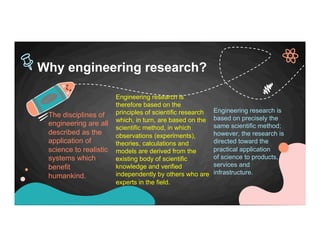
The disciplines of
engineeringare all
described as the
application of
science to realistic
systems which
benefit
humankind.
Engineering research is
based on precisely the
same scientific method;
however, the research is
directed toward the
practical application
of science to products,
services and
infrastructure.
Why engineering research?
Engineering research is
therefore based on the
principles of scientific research
which, in turn, are based on the
scientific method, in which
observations (experiments),
theories, calculations and
models are derived from the
existing body of scientific
knowledge and verified
independently by others who are
experts in the field.
6.
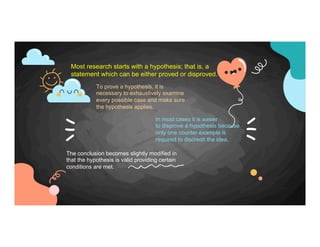
Most research startswith a hypothesis; that is, a
statement which can be either proved or disproved.
In most cases it is easier
to disprove a hypothesis because
only one counter example is
required to discredit the idea.
To prove a hypothesis, it is
necessary to exhaustively examine
every possible case and make sure
the hypothesis applies.
The conclusion becomes slightly modified in
that the hypothesis is valid providing certain
conditions are met.
8.
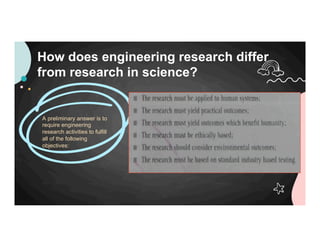
How does engineeringresearch differ
from research in science?
A preliminary answer is to
require engineering
research activities to fulfill
all of the following
objectives:
9.
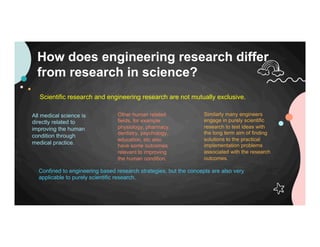
How does engineeringresearch differ
from research in science?
All medical science is
directly related to
improving the human
condition through
medical practice.
Other human related
fields, for example
physiology, pharmacy,
dentistry, psychology,
education, etc also
have some outcomes
relevant to improving
the human condition.
Similarly many engineers
engage in purely scientific
research to test ideas with
the long term aim of finding
solutions to the practical
implementation problems
associated with the research
outcomes.
Scientific research and engineering research are not mutually exclusive.
Confined to engineering based research strategies, but the concepts are also very
applicable to purely scientific research.
10.
Engineers, and henceengineering
research, are constrained by quite
formal codes of ethics.
Every discipline of engineering
has a code of ethics covering
engineering practice in one or
more different countries.
The codes should influence how the research is conducted and
ensure that the outcomes are improvements to humankind through
improved environmental outcomes and minimal risk to users of the
technology.
In particular the concept of economical engineering design must be
balanced with aspects of fail-safe and an understanding of
materials and product reliability.
11.
Only when theresearch outcomes have been reviewed by suitably
qualified peers can the researchers declare that new knowledge has
been created.
A research project is not complete until results have been
presented publicly for other experts in the field to comment and
review.
This means that work conducted in secret (for example in a military research facility, in a
high security research laboratory, or in other private venues), does not contribute to the
world-wide body of knowledge, and therefore cannot be described as research.
Similarly, a search of previous publications and patents does not constitute research.
This is an important distinction: research outcomes which are new to the researcher but are
well known to others does not constitute original, publishable research
As a logical consequence of this argument, any original research must clearly
identify all relevant prior work before the authors can claim to have developed new
knowledge.
12.
All research isbuilt on the background and understanding of science
developed over the centuries. When a person plans to engage in a research
project to create new knowledge, it is vital that a recent and thorough
understanding of the field is gained before designing the research project. A
new research project will be built on the work of others, from Newton and
Maxwell to Mohr and Edison. In addition, the research strategy and methods
applied should be well regarded by the world-wide community of scholars.
Next step research
13.
Next step research
(a)A new fundamental innovation that changes the way we think about the
world in scientific terms. This can be described as a paradigm shift,
In order to emphasise this concept, it is possible to describe two approaches to
research:
(b) A step forward in our understanding of the engineering world based on one or more of
the following ideas:
15.
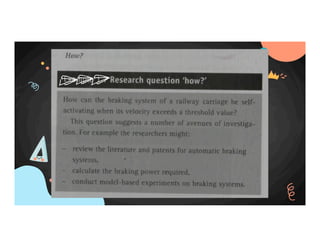
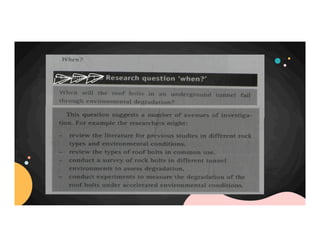
Research questions
The researchquestion will
directly lead to one or more methods
of investigation, and these can be
divided into a number of research
aims.
The research question can be phrased
using one of the following questioning
words:
A common method of focusing on a
research project is to phrase a research
question.
20.
These examples mightsuggest some of the work that has been previously
reported. A review of the literature will mean that the research team does not
have to ‘re-invent the wheel’, and can
build their research on the published reports of others.
A good literature review can impact positively on the research methods that the
research team might use. This is of significant value as the use of previously
reported and peer reviewed methods adds confidence about the reliability of the
research method and the subsequent independent review o f the journal and
conference papers arising from the research.
It is mandatory that more than one method of investigation is used in all
research projects in the hope that the results from a number of different
approaches can be used to substantiate the conclusions from the
project. This adds confidence in the research outcomes.
21.
What constitute aconclusive proof?
Research is designed to create new knowledge. This new knowledge
needs to be substantiated appropriately, initially by the research team,
and subsequently through the peer review process by the world-wide
community of scholars who are experts in this field. Thus novice
researchers must convince themselves that their results and
conclusions are valid and supported by strong
evidence.
22.
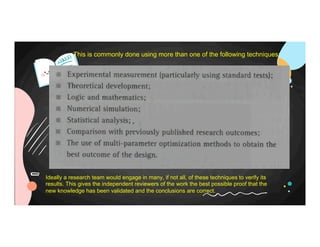
This is commonlydone using more than one of the following techniques:
Ideally a research team would engage in many, if not all, of these techniques to verify its
results. This gives the independent reviewers of the work the best possible proof that the
new knowledge has been validated and the conclusions are correct.
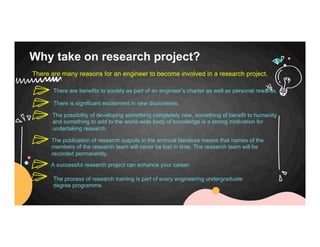
Why take onresearch project?
There are many reasons for an engineer to become involved in a research project.
There are benefits to society as part of an engineer’s charter as well as personal rewards.
There is significant excitement in new discoveries.
The possibility of developing something completely new, something of benefit to humanity
and something to add to the world-wide body of knowledge is a strong motivation for
undertaking research.
The publication of research outputs in the archival literature means that names of the
members of the research team will never be lost in time. The research team will be
recorded permanently.
A successful research project can enhance your career.
The process of research training is part of every engineering undergraduate
degree programme.
25.
Why take onresearch project?
There are many reasons for an engineer to become involved in a research project.
The process of research training is part of every engineering undergraduate degree
programme. Every laboratory experiment and every calculation is part of the development
of an engineer, and the skills learnt are part of the expertise that can be used
in research projects.
Resources
● Thiel, DavidV. (2014) Research Methods for Engineers. Cambridge
University Press.
● https://www.iedunote.com/engineering-research
28.
CREDITS: This presentationtemplate was
created by Slidesgo, including icon by Flaticon,
and infographics & images from Freepik
Thanks!
Please keep this slide for attribution