Is risk becoming too complex to manage? 
Examining the risk management challenges 
facing Japanese financial institutions 
A summary of the July 2nd Hitachi Consulting Risk Management Forum July 2014 
Supported by
Risk management is becoming more demanding 
for all financial institutions. On top of this, being a 
Japanese financial services provider, doing business 
in the UK brings another set of challenges. 
The July Risk Management Forum, 
sponsored and hosted by Hitachi 
Consulting, and supported by Hitachi 
Europe and Oracle examined the latest 
thinking in risk management as well as 
the unique challenges facing Japanese 
businesses in the UK. 
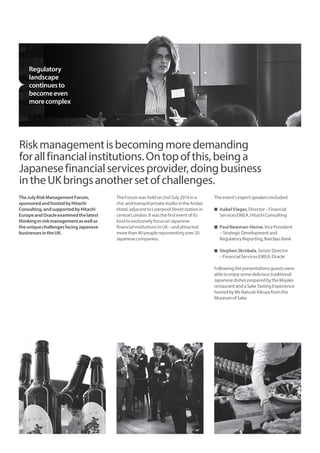
The Forum was held on 2nd July 2014 in a 
chic and tranquil private studio in the Andaz 
Hotel, adjacent to Liverpool Street station in 
central London. It was the first event of its 
kind to exclusively focus on Japanese 
financial institutions in UK – and attracted 
more than 40 people representing over 20 
Japanese companies. 
The event’s expert speakers included: 
■■ Isabel Viegas, Director – Financial 
Services EMEA, Hitachi Consulting 
■■ Paul Newman-Horne, Vice President 
– Strategic Development and 
Regulatory Reporting, Barclays Bank 
■■ Stephen Skrobala, Senior Director 
– Financial Services EMEA, Oracle 
Following the presentations guests were 
able to enjoy some delicious traditional 
Japanese dishes prepared by the Miyako 
restaurant and a Sake Tasting Experience 
hosted by Ms Natsuki Kikuya from the 
Museum of Sake. 
Regulatory 
landscape 
continues to 
become even 
more complex
The new era of 
risk management 
and regulatory 
reporting 
Isabel Viegas, Director Financial – 
Services EMEA, Hitachi Consulting 
The credit crisis undoubtedly rocked the UK 
economy and has left a legacy of volatility 
and uncertainty in the financial markets and 
the wider business community. In an 
attempt to stabilize the situation and 
prevent it from happening again, the 
regulatory landscape continues to become 
ever more complex, stringent – and 
intrusive. Risk management simply cannot 
be ignored and is now a central board-level 
issue in every financial organization. 
So what are the key risk 
management challenges for 
businesses operating in the UK? 
■■ The speed of regulatory change 
New legislation and regulatory 
requirements are arriving at a pace that 
makes them difficult to manage. Major 
changes are occurring simultaneously 
in Liquidity, Supervision, Capital, 
Governance and Conduct. This is 
putting a lot of pressure on companies, 
mainly in the areas of Regulatory 
Affairs, Senior Management, IT and 
Infrastructure and other key functions, 
like Risk, Finance and Treasury. 
■■ Changes in operating model 
Businesses are being driven to make 
organizational changes to cope with 
the demands of multiple local and 
international regulators. Assets are 
being split, with a significant focus 
on separating Retail and Investment 
banking activities, with the clear goal of 
reducing the size of the balance sheet to 
avoid institutions “too big to fail”. New 
Capital requirements and new Liquidity 
Ratios are re-shaping key areas, such 
as strategy, products development 
and pricing. These changes create new 
challenges for the Financial Institutions: 
–– Which businesses should be divested? 
–– How to return to acceptable 
levels of RoE? 
–– How to make these results consistent? 
These are the questions that all the 
Financial Institutions are trying to answer 
on a daily basis as risk management will 
be the centre piece while running a 
Financial services business. 
■■ Reporting requirements have increased 
exponentially in line with new regulatory 
requirements. Risk Units require timely 
and comprehensive data and it is 
essential that they have the ability to 
query and do ad-hoc analysis. It is the 
time to see the regulatory requirements 
not only as a mandatory request that 
Financial Institutions must comply 
with, but also as an opportunity 
to embed these on the day-to-day 
management and take advantage of 
all the information and data available. 
The revolution in risk management is here 
to stay. The Financial Institutions that can 
successfully cope with all of these 
challenges will be the ones that are agile 
and can quickly adapt to any new 
requirements. And that means having good 
quality data built on a comprehensive and 
flexible data platform, so that it is auditable 
and accessible and capable of feeding 
analytics, control and reporting, but still 
gives you the “big picture” to help drive 
business strategy and enable increased 
competitiveness. “Over the last couple of 
years, risk managers have 
been spending up to 70% of 
their time on regulations.” 
UK subsidiary of a Japanese Bank 
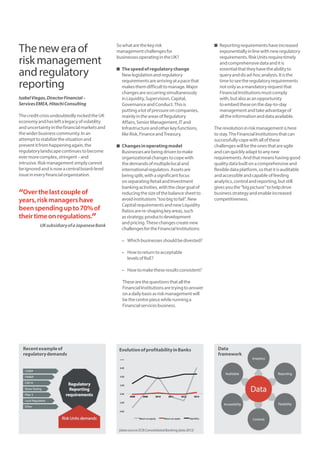
Evolution of profitability in Banks Data 
framework 
Recent example of 
regulatory demands 
(data source: ECB Consolidated Banking data 2013)
The challenges of 
compliance with 
different 
regulatory 
demands 
Paul Newman-Horne, Vice President – 
Strategic Development and Regulatory 
Reporting, Barclays Bank 
The onslaught of regulatory change is 
never ending – the number of applicable 
laws and regulations is in the tens of 
thousands. And things will only get 
worse. Especially as regulators now 
perform regular stress-test activities and 
are also demanding propriety, 
transparency, better risk management 
and, perhaps most important of all, 
accountable governance. 
So it is clear that the situation for many 
compliance functions is extremely serious. 
More DATA is required, more standardized 
and detailed CALCULATIONS are needed, 
more REPORTS will be generated and 
electronic SUBMISSIONS via XBRL will be 
required. Reporting is also becoming more 
granular, there is more emphasis on 
benchmarking and industry initiatives such 
as the EDTF (Enhanced Disclosure Task 
Force) are aimed at creating a more 
standardized way of reporting. 
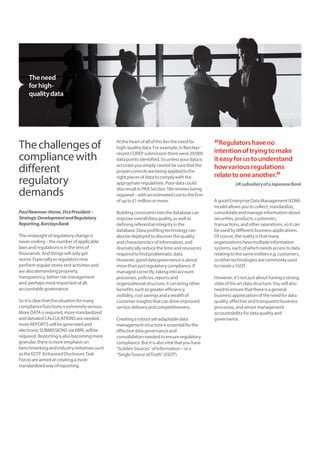
At the heart of all of this lies the need for 
high-quality data. For example, in Barclays’ 
recent COREP submission there were 29,000 
data points identified. So unless your data is 
accurate you simply cannot be sure that the 
proper controls are being applied to the 
right pieces of data to comply with the 
appropriate regulations. Poor data could 
also result in PRA Section 166 reviews being 
required – with an estimated cost to the firm 
of up to £1 million or more. 
Building constraints into the database can 
improve overall data quality, as well as 
defining referential integrity in the 
database. Data profiling technology can 
also be deployed to discover the quality 
and characteristics of information, and 
dramatically reduce the time and resources 
required to find problematic data. 
However, good data governance is about 
more than just regulatory compliance. If 
managed correctly, taking into account 
processes, policies, reports and 
organizational structure, it can bring other 
benefits, such as greater efficiency, 
visibility, cost savings and a wealth of 
customer insights that can drive improved 
service delivery and competitiveness. 
Creating a robust yet adaptable data 
management structure is essential for the 
effective data governance and 
consolidation needed to ensure regulatory 
compliance. But it is also vital that you have 
“Golden Sources” of information – or a 
“Single Source of Truth” (SSOT). 
“Regulators have no 
intention of trying to make 
it easy for us to understand 
how various regulations 
relate to one another.” 
UK subsidiary of a Japanese Bank 
A good Enterprise Data Management (EDM) 
model allows you to collect, standardize, 
consolidate and manage information about 
securities, products, customers, 
transactions, and other operations, so it can 
be used by different business applications. 
Of course, the reality is that many 
organizations have multiple information 
systems, each of which needs access to data 
relating to the same entities e.g. customers, 
so other technologies are commonly used 
to create a SSOT. 
However, it’s not just about having a strong, 
state of the art data structure. You will also 
need to ensure that there is a general 
business appreciation of the need for data 
quality, effective and transparent business 
processes, and senior management 
accountability for data quality and 
governance. 
The need 
for high-quality 
data
The business 
benefits of a 
comprehensive 
risk architecture 
Stephen Skrobala, Senior Director – 
Financial Services EMEA, Oracle 
When it comes to creating a risk 
management architecture one of the most 
important things is how you bring risk 
together, so that it’s managed institutionally 
rather than discretely, with pockets of risk 
across the organization. There are many 
different types of risk. For example, risk for 
trading transactions is different to credit 
risk, market risk, and interest rate risk. Some 
will build up over time, while others are 
more immediate. You can never fully 
eliminate those risks, but if you understand 
them you can mitigate them. 
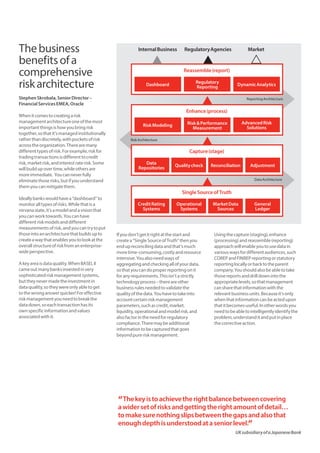
Ideally banks would have a “dashboard” to 
monitor all types of risks. While that is a 
nirvana state, it’s a model and a vision that 
you can work towards. You can have 
different risk models and different 
measurements of risk, and you can try to put 
those into an architecture that builds up to 
create a way that enables you to look at the 
overall structure of risk from an enterprise-wide 
perspective. 
A key area is data quality. When BASEL II 
came out many banks invested in very 
sophisticated risk management systems, 
but they never made the investment in 
data quality, so they were only able to get 
to the wrong answer quicker! For effective 
risk management you need to break the 
data down, so each transaction has its 
own specific information and values 
associated with it. 
Internal Business Regulatory Agencies Market 
Enhance (process) 
If you don’t get it right at the start and 
create a “Single Source of Truth” then you 
end up reconciling data and that’s much 
more time-consuming, costly and resource 
intensive. You also need ways of 
aggregating and checking all of your data, 
so that you can do proper reporting on it 
for any requirements. This isn’t a strictly 
technology process – there are other 
business rules needed to validate the 
quality of the data. You have to take into 
account certain risk management 
parameters, such as credit, market, 
liquidity, operational and model risk, and 
also factor in the need for regulatory 
compliance. There may be additional 
information to be captured that goes 
beyond pure risk management. 
Reporting Architecture 
Using the capture (staging), enhance 
(processing) and reassemble (reporting) 
approach will enable you to use data in 
various ways for different audiences, such 
COREP and FINREP reporting or statutory 
reporting locally or back to the parent 
company. You should also be able to take 
those reports and drill down into the 
appropriate levels, so that management 
can share that information with the 
relevant business units. Because it’s only 
when that information can be acted upon 
that it becomes useful. In other words you 
need to be able to intelligently identify the 
problem, understand it and put in place 
the corrective action. 
“The key is to achieve the right balance between covering 
a wider set of risks and getting the right amount of detail… 
to make sure nothing slips between the gaps and also that 
enough depth is understood at a senior level.” 
UK subsidiary of a Japanese Bank 
Reassemble (report) 
Capture (stage) 
Single Source of Truth 
Dashboard 
Data 
Repositories 
Credit Rating 
Systems 
Quality check 
Operational 
Systems 
Reconciliation 
Market Data 
Sources 
Adjustment 
General 
Ledger 
Risk Modeling 
Regulatory 
Reporting 
Risk & Performance 
Measurement 
Dynamic Analytics 
Advanced Risk 
Solutions 
Data Architecture 
Risk Architecture
The unique 
challenges facing 
Japanese financial 
institutions 
Shinji Kamata, Senior Manager – Social 
Innovation – Nikkei Business Service, 
Hitachi Consulting 
The risk management challenges for 
financial organizations are substantial 
and constantly shifting. For Japanese 
businesses operating in the UK the 
challenge is even more extreme. Not only 
are UK regulations the most stringent in 
the world, and far more demanding than 
what parent companies are normally 
used to, but the UK subsidiaries also face 
significant operational, cultural and 
management issues. 
On the operational side of things, the 
legal structure has a significant effect, 
because being classified as a Subsidiary 
or Branch does affect exactly how much 
you are governed by local regulations. 
The degree of dependence on HQ 
systems can also determine how much 
autonomy you have to act or whether 
you are directly governed from Japan, as 
you may not even have sufficient data 
granularity to operate effectively. 
If the business was acquired, rather than 
set up directly by the parent company 
then the people, processes and systems 
that were inherited will tend to give you 
more autonomy, but this may also lead to 
incompatibilities that cause problems 
reporting back and ensuring compliance 
to regulations. 
It is also important to understand exactly 
what the role and expectations of the HQ 
are. Do they want to have a strong input 
into the governance of the business? Or is 
there much scope to interpret and apply 
HQ policy locally? The nature of the UK 
business will probably also dictate what 
risks the operation need to manage, based 
on the types of customer e.g. whether 
they are retail or corporate, local or 
Japanese, the types of products e.g. 
derivatives or project finance, and also 
where the deals are booked e.g. locally or 
in Japan, and whether you need to worry 
about possible system errors. 
Culturally there are some important 
considerations. In particular, expectations 
on what is “good enough” may vary, which 
can create internal conflict. While 
regulations in Japan are not as stringent as 
the UK, any non–compliance is perceived as 
having a heavy reputational risk, so the 
parent company may exert pressure to 
strive for perfection, but this obviously 
entails a cost that the UK operation may not 
be prepared to pay. It’s also worth noting 
that the remuneration systems in each 
country will drive different behaviors, so 
western traders have a different risk 
appetite to those in Japan. 
Finally, there is likely to be a need to conduct 
dual reporting for regulatory compliance. 
So as well as meeting the needs of local 
authorities, the UK business will have to 
provide what the HQ needs to satisfy the 
Japanese financial authorities e.g. stress 
testing in Japan may require different data 
sets to the UK. 
In all of these areas effective governance of 
data is crucial, because whether the UK 
business operates autonomously or if more 
closely governed at a global level by the HQ, 
the same data pool will be used to meet the 
requirements of both parts of the 
organization. 
However, because the UK is operating under 
the most stringent regulatory conditions, 
the good news is that this also means that 
there is an opportunity to set the best 
practice standard within the organization. 
So the UK operation can become the 
“knowledge centre” for regulatory 
compliance within the group – and can help 
create a real competitive advantage for the 
entire business. 
“Risk management is no 
longer seen as an extension 
of internal audit, but as an 
educational role within the 
organization to establish 
competitive advantage for 
the business” 
Bridging 
Japanese 
business with 
the UK market
Summary 
Hitachi Consulting’s Risk Management 
Forum examined the key risk management 
challenges relating to financial regulatory 
reporting in the UK. The discussion was 
brought to life when the audience were able 
to hear about the practical challenges faced 
by Barclays and its approach to meeting the 
company’s reporting requirements. This 
highlighted that the key factor in 
overcoming many challenges of risk 
management is the quality of data, in terms 
of its architecture, accuracy and granularity. 
However, while most companies can realise 
immediate benefits by putting in place the 
right data architecture, having the right 
ethos for risk management is also very 
important – and can be the driver for overall 
business improvement and growth. Each 
business needs to be clear about the scope 
of the different risks it aims to cover and 
how proactive and holistic it wants to be in 
the way it manages risk. 
Of course, the question then is how 
should Japanese financial institutions in 
the UK go about achieving their vision of 
risk management, given the unique set of 
challenges they must address, which go 
above and beyond those faced by 
western institutions? 
As a global Japanese company, Hitachi is 
very familiar with challenges of achieving 
results in a local market, especially in the 
face of rigorous European regulations, 
while also satisfying the needs of the 
parent company. Hitachi Consulting also 
has considerable expertise and capabilities 
in the management of risk and can provide 
help in the areas of regularity reporting 
process and applications, system 
architecture and data modeling, system 
and data security and the use of Big Data. 
Finally, from the perspective of wider 
spectrum of risk management, the forum 
did not cover topics related to operational 
risks, including systems risks and emerging 
risks. Hitachi Consulting will provide further 
insights into these and other areas in future 
Forum events. 
To discover how we can assist your organization or to receive 
information about forthcoming events please contact 
financialservicesEMEA@hitachiconsulting.com
Hitachi Consulting is the global management consulting and IT services business of Hitachi Ltd., a global technology leader and a catalyst of sustainable societal change. In that same spirit - and building on its technology 
heritage - Hitachi Consulting is a catalyst of positive business change, propelling companies ahead by enabling superior operational performance. Working within their existing processes and focusing on targeted functional 
challenges, we help our clients respond to dynamic global change with insight and agility. Our unique approach delivers measurable, sustainable business results and a better consulting experience. 
www.hitachiconsulting.com

risk management POV Digital (V.08)

  • 1.
    Is risk becomingtoo complex to manage? Examining the risk management challenges facing Japanese financial institutions A summary of the July 2nd Hitachi Consulting Risk Management Forum July 2014 Supported by
  • 2.
    Risk management isbecoming more demanding for all financial institutions. On top of this, being a Japanese financial services provider, doing business in the UK brings another set of challenges. The July Risk Management Forum, sponsored and hosted by Hitachi Consulting, and supported by Hitachi Europe and Oracle examined the latest thinking in risk management as well as the unique challenges facing Japanese businesses in the UK. The Forum was held on 2nd July 2014 in a chic and tranquil private studio in the Andaz Hotel, adjacent to Liverpool Street station in central London. It was the first event of its kind to exclusively focus on Japanese financial institutions in UK – and attracted more than 40 people representing over 20 Japanese companies. The event’s expert speakers included: ■■ Isabel Viegas, Director – Financial Services EMEA, Hitachi Consulting ■■ Paul Newman-Horne, Vice President – Strategic Development and Regulatory Reporting, Barclays Bank ■■ Stephen Skrobala, Senior Director – Financial Services EMEA, Oracle Following the presentations guests were able to enjoy some delicious traditional Japanese dishes prepared by the Miyako restaurant and a Sake Tasting Experience hosted by Ms Natsuki Kikuya from the Museum of Sake. Regulatory landscape continues to become even more complex
  • 3.
    The new eraof risk management and regulatory reporting Isabel Viegas, Director Financial – Services EMEA, Hitachi Consulting The credit crisis undoubtedly rocked the UK economy and has left a legacy of volatility and uncertainty in the financial markets and the wider business community. In an attempt to stabilize the situation and prevent it from happening again, the regulatory landscape continues to become ever more complex, stringent – and intrusive. Risk management simply cannot be ignored and is now a central board-level issue in every financial organization. So what are the key risk management challenges for businesses operating in the UK? ■■ The speed of regulatory change New legislation and regulatory requirements are arriving at a pace that makes them difficult to manage. Major changes are occurring simultaneously in Liquidity, Supervision, Capital, Governance and Conduct. This is putting a lot of pressure on companies, mainly in the areas of Regulatory Affairs, Senior Management, IT and Infrastructure and other key functions, like Risk, Finance and Treasury. ■■ Changes in operating model Businesses are being driven to make organizational changes to cope with the demands of multiple local and international regulators. Assets are being split, with a significant focus on separating Retail and Investment banking activities, with the clear goal of reducing the size of the balance sheet to avoid institutions “too big to fail”. New Capital requirements and new Liquidity Ratios are re-shaping key areas, such as strategy, products development and pricing. These changes create new challenges for the Financial Institutions: –– Which businesses should be divested? –– How to return to acceptable levels of RoE? –– How to make these results consistent? These are the questions that all the Financial Institutions are trying to answer on a daily basis as risk management will be the centre piece while running a Financial services business. ■■ Reporting requirements have increased exponentially in line with new regulatory requirements. Risk Units require timely and comprehensive data and it is essential that they have the ability to query and do ad-hoc analysis. It is the time to see the regulatory requirements not only as a mandatory request that Financial Institutions must comply with, but also as an opportunity to embed these on the day-to-day management and take advantage of all the information and data available. The revolution in risk management is here to stay. The Financial Institutions that can successfully cope with all of these challenges will be the ones that are agile and can quickly adapt to any new requirements. And that means having good quality data built on a comprehensive and flexible data platform, so that it is auditable and accessible and capable of feeding analytics, control and reporting, but still gives you the “big picture” to help drive business strategy and enable increased competitiveness. “Over the last couple of years, risk managers have been spending up to 70% of their time on regulations.” UK subsidiary of a Japanese Bank Evolution of profitability in Banks Data framework Recent example of regulatory demands (data source: ECB Consolidated Banking data 2013)
  • 4.
    The challenges of compliance with different regulatory demands Paul Newman-Horne, Vice President – Strategic Development and Regulatory Reporting, Barclays Bank The onslaught of regulatory change is never ending – the number of applicable laws and regulations is in the tens of thousands. And things will only get worse. Especially as regulators now perform regular stress-test activities and are also demanding propriety, transparency, better risk management and, perhaps most important of all, accountable governance. So it is clear that the situation for many compliance functions is extremely serious. More DATA is required, more standardized and detailed CALCULATIONS are needed, more REPORTS will be generated and electronic SUBMISSIONS via XBRL will be required. Reporting is also becoming more granular, there is more emphasis on benchmarking and industry initiatives such as the EDTF (Enhanced Disclosure Task Force) are aimed at creating a more standardized way of reporting. At the heart of all of this lies the need for high-quality data. For example, in Barclays’ recent COREP submission there were 29,000 data points identified. So unless your data is accurate you simply cannot be sure that the proper controls are being applied to the right pieces of data to comply with the appropriate regulations. Poor data could also result in PRA Section 166 reviews being required – with an estimated cost to the firm of up to £1 million or more. Building constraints into the database can improve overall data quality, as well as defining referential integrity in the database. Data profiling technology can also be deployed to discover the quality and characteristics of information, and dramatically reduce the time and resources required to find problematic data. However, good data governance is about more than just regulatory compliance. If managed correctly, taking into account processes, policies, reports and organizational structure, it can bring other benefits, such as greater efficiency, visibility, cost savings and a wealth of customer insights that can drive improved service delivery and competitiveness. Creating a robust yet adaptable data management structure is essential for the effective data governance and consolidation needed to ensure regulatory compliance. But it is also vital that you have “Golden Sources” of information – or a “Single Source of Truth” (SSOT). “Regulators have no intention of trying to make it easy for us to understand how various regulations relate to one another.” UK subsidiary of a Japanese Bank A good Enterprise Data Management (EDM) model allows you to collect, standardize, consolidate and manage information about securities, products, customers, transactions, and other operations, so it can be used by different business applications. Of course, the reality is that many organizations have multiple information systems, each of which needs access to data relating to the same entities e.g. customers, so other technologies are commonly used to create a SSOT. However, it’s not just about having a strong, state of the art data structure. You will also need to ensure that there is a general business appreciation of the need for data quality, effective and transparent business processes, and senior management accountability for data quality and governance. The need for high-quality data
  • 5.
    The business benefitsof a comprehensive risk architecture Stephen Skrobala, Senior Director – Financial Services EMEA, Oracle When it comes to creating a risk management architecture one of the most important things is how you bring risk together, so that it’s managed institutionally rather than discretely, with pockets of risk across the organization. There are many different types of risk. For example, risk for trading transactions is different to credit risk, market risk, and interest rate risk. Some will build up over time, while others are more immediate. You can never fully eliminate those risks, but if you understand them you can mitigate them. Ideally banks would have a “dashboard” to monitor all types of risks. While that is a nirvana state, it’s a model and a vision that you can work towards. You can have different risk models and different measurements of risk, and you can try to put those into an architecture that builds up to create a way that enables you to look at the overall structure of risk from an enterprise-wide perspective. A key area is data quality. When BASEL II came out many banks invested in very sophisticated risk management systems, but they never made the investment in data quality, so they were only able to get to the wrong answer quicker! For effective risk management you need to break the data down, so each transaction has its own specific information and values associated with it. Internal Business Regulatory Agencies Market Enhance (process) If you don’t get it right at the start and create a “Single Source of Truth” then you end up reconciling data and that’s much more time-consuming, costly and resource intensive. You also need ways of aggregating and checking all of your data, so that you can do proper reporting on it for any requirements. This isn’t a strictly technology process – there are other business rules needed to validate the quality of the data. You have to take into account certain risk management parameters, such as credit, market, liquidity, operational and model risk, and also factor in the need for regulatory compliance. There may be additional information to be captured that goes beyond pure risk management. Reporting Architecture Using the capture (staging), enhance (processing) and reassemble (reporting) approach will enable you to use data in various ways for different audiences, such COREP and FINREP reporting or statutory reporting locally or back to the parent company. You should also be able to take those reports and drill down into the appropriate levels, so that management can share that information with the relevant business units. Because it’s only when that information can be acted upon that it becomes useful. In other words you need to be able to intelligently identify the problem, understand it and put in place the corrective action. “The key is to achieve the right balance between covering a wider set of risks and getting the right amount of detail… to make sure nothing slips between the gaps and also that enough depth is understood at a senior level.” UK subsidiary of a Japanese Bank Reassemble (report) Capture (stage) Single Source of Truth Dashboard Data Repositories Credit Rating Systems Quality check Operational Systems Reconciliation Market Data Sources Adjustment General Ledger Risk Modeling Regulatory Reporting Risk & Performance Measurement Dynamic Analytics Advanced Risk Solutions Data Architecture Risk Architecture
  • 6.
    The unique challengesfacing Japanese financial institutions Shinji Kamata, Senior Manager – Social Innovation – Nikkei Business Service, Hitachi Consulting The risk management challenges for financial organizations are substantial and constantly shifting. For Japanese businesses operating in the UK the challenge is even more extreme. Not only are UK regulations the most stringent in the world, and far more demanding than what parent companies are normally used to, but the UK subsidiaries also face significant operational, cultural and management issues. On the operational side of things, the legal structure has a significant effect, because being classified as a Subsidiary or Branch does affect exactly how much you are governed by local regulations. The degree of dependence on HQ systems can also determine how much autonomy you have to act or whether you are directly governed from Japan, as you may not even have sufficient data granularity to operate effectively. If the business was acquired, rather than set up directly by the parent company then the people, processes and systems that were inherited will tend to give you more autonomy, but this may also lead to incompatibilities that cause problems reporting back and ensuring compliance to regulations. It is also important to understand exactly what the role and expectations of the HQ are. Do they want to have a strong input into the governance of the business? Or is there much scope to interpret and apply HQ policy locally? The nature of the UK business will probably also dictate what risks the operation need to manage, based on the types of customer e.g. whether they are retail or corporate, local or Japanese, the types of products e.g. derivatives or project finance, and also where the deals are booked e.g. locally or in Japan, and whether you need to worry about possible system errors. Culturally there are some important considerations. In particular, expectations on what is “good enough” may vary, which can create internal conflict. While regulations in Japan are not as stringent as the UK, any non–compliance is perceived as having a heavy reputational risk, so the parent company may exert pressure to strive for perfection, but this obviously entails a cost that the UK operation may not be prepared to pay. It’s also worth noting that the remuneration systems in each country will drive different behaviors, so western traders have a different risk appetite to those in Japan. Finally, there is likely to be a need to conduct dual reporting for regulatory compliance. So as well as meeting the needs of local authorities, the UK business will have to provide what the HQ needs to satisfy the Japanese financial authorities e.g. stress testing in Japan may require different data sets to the UK. In all of these areas effective governance of data is crucial, because whether the UK business operates autonomously or if more closely governed at a global level by the HQ, the same data pool will be used to meet the requirements of both parts of the organization. However, because the UK is operating under the most stringent regulatory conditions, the good news is that this also means that there is an opportunity to set the best practice standard within the organization. So the UK operation can become the “knowledge centre” for regulatory compliance within the group – and can help create a real competitive advantage for the entire business. “Risk management is no longer seen as an extension of internal audit, but as an educational role within the organization to establish competitive advantage for the business” Bridging Japanese business with the UK market
  • 7.
    Summary Hitachi Consulting’sRisk Management Forum examined the key risk management challenges relating to financial regulatory reporting in the UK. The discussion was brought to life when the audience were able to hear about the practical challenges faced by Barclays and its approach to meeting the company’s reporting requirements. This highlighted that the key factor in overcoming many challenges of risk management is the quality of data, in terms of its architecture, accuracy and granularity. However, while most companies can realise immediate benefits by putting in place the right data architecture, having the right ethos for risk management is also very important – and can be the driver for overall business improvement and growth. Each business needs to be clear about the scope of the different risks it aims to cover and how proactive and holistic it wants to be in the way it manages risk. Of course, the question then is how should Japanese financial institutions in the UK go about achieving their vision of risk management, given the unique set of challenges they must address, which go above and beyond those faced by western institutions? As a global Japanese company, Hitachi is very familiar with challenges of achieving results in a local market, especially in the face of rigorous European regulations, while also satisfying the needs of the parent company. Hitachi Consulting also has considerable expertise and capabilities in the management of risk and can provide help in the areas of regularity reporting process and applications, system architecture and data modeling, system and data security and the use of Big Data. Finally, from the perspective of wider spectrum of risk management, the forum did not cover topics related to operational risks, including systems risks and emerging risks. Hitachi Consulting will provide further insights into these and other areas in future Forum events. To discover how we can assist your organization or to receive information about forthcoming events please contact financialservicesEMEA@hitachiconsulting.com
  • 8.
    Hitachi Consulting isthe global management consulting and IT services business of Hitachi Ltd., a global technology leader and a catalyst of sustainable societal change. In that same spirit - and building on its technology heritage - Hitachi Consulting is a catalyst of positive business change, propelling companies ahead by enabling superior operational performance. Working within their existing processes and focusing on targeted functional challenges, we help our clients respond to dynamic global change with insight and agility. Our unique approach delivers measurable, sustainable business results and a better consulting experience. www.hitachiconsulting.com