PURPOSE OF RISB
•TheRotters incomplete sentence blank is an attempt to
standardize the sentence completion method for the use
at college level. Forty stems are completed by the subject.
These completions are then scored by comparing them
against typical items in empirically derived scoring manuals
for men and women and by assigning to each response a
scale value from 0 to 6. The total score is an index of
maladjustment
3.
THE SENTENCE COMPLETIONMETHOD
• The sentence completion method of studying
personality is a semi structured projective
technique in which the subject is asked to finish a
sentence for which the first word or words are
supplied. As in other projective devices, it is
assumed that the subject reflects his own wishes,
desires, fears and attitudes in the sentences he
makes. Historically, the incomplete sentence
method is related most closely to the word
association test.
4.
THE SENTENCE COMPLETIONMETHOD
•In some test incomplete sentences tests only a
single word or brief response is called for; the
major differences appears to be in the length of
the stimulus. In the sentence completion tests,
tendencies to block and to twist the meaning of
the stimulus words appear and the responses
may be categorized in a somewhat similar fashion
to the word association method.
Development of ISB
•TheIncomplete Sentence Blank consists of forty items revised from a
form used by Rotter and Willermann (11) in the army. This form was, in
turn, a revision of blanks used by Shor (15), Hutt (5), and Holzberg (4) at
the Mason General Hospital. In the development of the ISB, two
objectives were kept in mind.
•One aim was to provide a technique which could be used objectively
for screening and experimental purposes. It was felt that this technique
should have at least some of the advantages of projective methods,
and also be economical from the point of view of administration and
scoring.
•A second goal was to obtain information of rather specific diagnostic
value for treatment purposes.
7.
Development of ISB
•TheIncomplete Sentence Blank can be used, of course, for general
interpretation with a variety of subjects in much the same manner that
a clinician trained in dynamic psychology uses any projective material.
•However, a feature of ISB is that one can derive a single over-all
adjustment score. This over-all adjustment score is of particular value
for screening purposes with college students and in experimental
studies.
•The ISB has also been used in a vocational guidance center to select
students requiring broader counseling than was usually given, in
experimental studies of the effect of psychotherapy and in
investigations of the relationship of adjustment to a variety of variables.
8.
PSYCHOMETRIC PROPERTIES
• Inter-scorerreliability for two scorer trained by
the authors was .91 when based on male records
and .96 for female records.
• Validity data were obtained for the two sexes separately
since the scoring manuals differ. The subjects include 82
females and 124 males who were classified as either
adjusted or maladjusted i.e., as needing personal
counseling or as not needing such counseling. A cutting
score of 135 provided a very sufficient separation of
adjusted and maladjusted students in the data collected
above
9.
Administration
• The printedinstructions are given on the page which
state complete these sentences to express your real
feelings. Try to do every one. Be sure to make a
complete sentence. No further instructions are given
except to repeat the printed instructions if necessary
and to urge subjects to complete all the items.
Administration to a group of any number of subjects is
possible. The approximate average time for
administration is twenty minutes.
10.
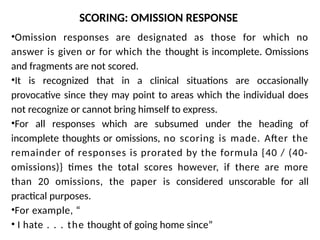
SCORING: OMISSION RESPONSE
•Omissionresponses are designated as those for which no
answer is given or for which the thought is incomplete. Omissions
and fragments are not scored.
•It is recognized that in a clinical situations are occasionally
provocative since they may point to areas which the individual does
not recognize or cannot bring himself to express.
•For all responses which are subsumed under the heading of
incomplete thoughts or omissions, no scoring is made. After the
remainder of responses is prorated by the formula {40 / (40-
omissions)} times the total scores however, if there are more
than 20 omissions, the paper is considered unscorable for all
practical purposes.
•For example, “
• I hate . . . the thought of going home since”
11.
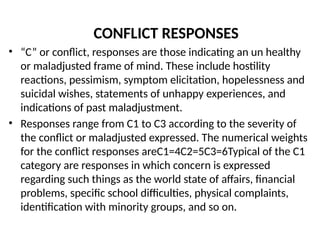
CONFLICT RESPONSES
• “C”or conflict, responses are those indicating an un healthy
or maladjusted frame of mind. These include hostility
reactions, pessimism, symptom elicitation, hopelessness and
suicidal wishes, statements of unhappy experiences, and
indications of past maladjustment.
• Responses range from C1 to C3 according to the severity of
the conflict or maladjusted expressed. The numerical weights
for the conflict responses areC1=4C2=5C3=6Typical of the C1
category are responses in which concern is expressed
regarding such things as the world state of affairs, financial
problems, specific school difficulties, physical complaints,
identification with minority groups, and so on.
12.
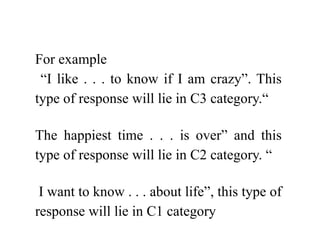
For example
“I like. . . to know if I am crazy”. This
type of response will lie in C3 category.“
The happiest time . . . is over” and this
type of response will lie in C2 category. “
I want to know . . . about life”, this type of
response will lie in C1 category
13.
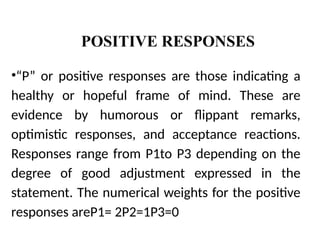
POSITIVE RESPONSES
•“P” orpositive responses are those indicating a
healthy or hopeful frame of mind. These are
evidence by humorous or flippant remarks,
optimistic responses, and acceptance reactions.
Responses range from P1to P3 depending on the
degree of good adjustment expressed in the
statement. The numerical weights for the positive
responses areP1= 2P2=1P3=0
14.
•In the P1class common responses are those which deal with
positive attitudes toward school, hobbies, sports, expression
interest in people, expression of warm feeling toward
some individual and so on.
•Generally found under the heading of P2 are those replies which
indicate a generalized positive feeling toward people, good social
adjustment, healthy family life, optimism and humor.
•Clear cut good natured humor, real optimism, and warm
acceptance are types of responses which are subsumed under the
P3 group. For example, “ I like. . . to have good time”, this type of
response will lie in P1 category. “
•The happiest time . . . is yet to come”, this type of response
will lie in P2 category. “
• Back home . . .are many friends”, this type of response will lie in
P3 category.
15.
NEUTRAL RESPONSES
• “N”or neutral responses are those not falling clearly into
either of the above categories. They are generally on a simple
descriptive level. Two general types of responses which
account for a large share of those that fall in the neutral
category. One group includes those lacking emotional tone or
personal reference. The other group is composed of many
responses which are found as often among maladjusted as
among adjusted individual and through clinical judgment
could not be legitimately place in either C or P group. All the N
responses are scored 3.For example, “
•Most girls . . . are females” or “
•When I was child . . . I spoke as a child”. These types of
responses will lie in neutral responses.
16.
• ADVANTAGES OFRISB
• The general advantages of the sentence completion method can
be summarized as follows
• •There is freedom of response. That is, the subject is not forced
to answer yes or no or? To the examiner question. He may
instead, in any way he desires.
• •Some disguise in the purpose of the test is present. Although the
subject may de aware of general intend, what constitutes a good
or bad answer is not readily apparent to most subjects.
• •Group administration is relatively efficient.
• •No special training is necessary for administration.
Interpretation depends on the examiner’s general clinical
experience, although the examiner does not need specific
training in the use of this method.
17.
•DISADVANTAGES OF RISB
••Thereis not as much disguise of purpose as in other projective
methods. Consequently, a sophisticated subject may be able to
keep the examiner from knowing what he does not wish to
reveal.
••Insufficient material is obtained in some cases, particularly
from illiterate, disturbed or uncooperative subjects.
•Application of the method as a group test also requires writing
and language skills and has not yet been adequately
evaluated for potential clinical usefulness for younger children