MAGAZINE
March 2017SEAVIEW
Cruise industry leaders
look ahead
River and expedition cruises:
a new frontier 
How to avoid
cyber risks
Contents
Welcome to Sea View, RINA’s annual magazine focused on the cruise market. Sustainable innovation and close collaboration are
recurring themes as we explore the opportunities and challenges that lie just over the horizon.
This issue, we offer insights into China’s booming cruise market and the fast growth of niches such as river and expedition cruises.
Interviews with leading players in the industry reveal more about the future of LNG-fuelled cruise ships and innovations in cruise ship
design and renovation. On the technology side, we provide a practical framework for combating cyber security threats, plus options
for enhancing fleet performance monitoring through our InfoSHIP® EGO system.
Thank you to CLIA Europe, Carnival Corporation, Holland America Group, Genova Industrie Navali and GEM Cruise Ship Design for
their contributions.
Editorial
SEAVIEW
10
Ferdinando
Garrè
12
Lorenzo
Mortola
08
Stein
Kruse
14
Seabourn Encore
showcases
innovation
15
River cruises:
intimate and
innovative
16
A modern
port for an
ancient island
19
Enhanced fleet
performance
monitoring
17
Expedition cruises:
a growing niche
18
Assessing
ships for the
Polar Code
20
A practical
approach to
cyber security
21
NEWS IN BRIEF
04
Kyriakos
Anastassiadis
02
China’s
booming
cruise market
06
Tom
Strang
01
Cruising
smoothly
into the future
a view on the marketSEAVIEW
1
Past, present and future, there’s much to be positive about in the
cruise sector. It has continued to expand globally, and is predicted
to carry on growing fast.It is resisting the difficult market conditions
currently experienced by other shipping sectors. It’s also winning
on land – growth in the cruise sector outpaces land-based holiday
options by a wide margin. Looking forwards, we see huge
potential in the fact that cruising still represents a small percentage
of tourism worldwide.
Why is the cruise sector expanding so successfully, from 15.8
million passengers in 2007 to an estimated 25.3 million in 2017,
according to the CLIA (see page 4)? One reason is that younger
generations are embracing cruising like never before, rating it
better than all-inclusive resorts,holiday home rentals,camping and
land tours.As these young people grow up, there’s every reason to
expect they will continue exploring the seas with their families and
after retirement.
Looking east, the Chinese cruise market is booming (see page 2).
Its phenomenal growth brings with it new customers, destinations,
ports and possibilities for both international and Chinese cruise
companies.
A third reason is diversification. Niches such as river cruising (see
page 17) and expedition cruising (see page 15) are opening up
fresh markets.Two new expedition ships,the “Celebrity Xperience”
and “Celebrity Xploration”, will explore the Galapagos in 2017.
Up in Alaska and British Columbia, Lindblad Expeditions has
partnered with National Geographic to operate the state-of-the-art
“National Geographic Quest”.
The industry’s rapid growth is boosting cruise shipbuilding. The
cruise ship order book for 2017 stands at 26 new builds, totalling
more than US$6.8 billion (€6.33 million). By 2026, we can expect
nearly 100 new cruise ships at an estimated investment of US$53
billion (€49.4 billion).
This good news brings capacity issues.Major cruise shipyards have
been full for years, with some consolidating in order to handle
demand for larger ships. Other yards have entered or re-entered
the sector, often aiming at the fast-growing market for river,
expedition and smaller luxury ships. We are also excited about
China’s long-awaited entry into the cruise shipbuilding sector.
Rather than order new ships with delivery dates after 2021, the
trend is now to upgrade and convert existing ships to meet rising
environmental standards and customer expectations (see page
12). Major brands including Holland America Line and Norwegian
Cruise Line are investing significantly in fleet-wide upgrades.
Crystal Cruises’ luxury “Crystal Symphony” will also get a makeover
this year, while Silversea Cruises’ “Silver Cloud” is set to embark on
a new life as an expedition vessel.
Nobody can predict with certainty what lies beyond the horizon.
For cruising, however, it looks like smooth sailing, favourable winds
and many new places to explore.
nn paolo.moretti@rina.org
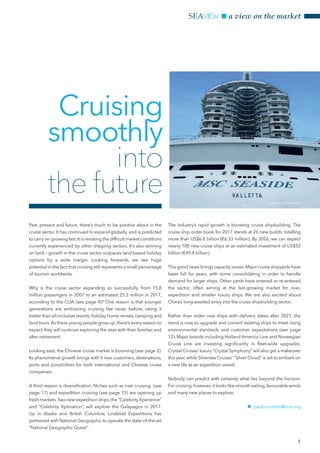
Cruising
smoothly
into
the future Courtesy of Fincantieri
a view on the market SEAVIEW
2
The cruise ship market in China continues to develop rapidly. In
2016, the number of Chinese travellers to take an overseas cruise
exceeded two million for the first time.This fast-growing interest in
cruising is stimulating other areas of the country’s cruise industry,
from shipbuilding to port construction.
Impressive statistics were issued recently by the China Cruise &
Yacht Industry Association (CCYIA). In 2016, mainland China’s
ten major port cities – Dalian, Tianjin, Yantai, Qingdao, Shanghai,
Zhoushan, Xiamen, Guangzhou, Haikou and Sanya – welcomed
996 cruise ships, a 58% year-on-year increase from 2015. Of these,
913 were calls at homeports, up 69% from the previous year, while
calls at visit ports fell 8% year-on-year to 83 voyages.
According to the CCYIA, the above-mentioned ten port cities
alone received 2,261,400 Chinese and foreigners travelling by
cruise ship in 2016. This represents an 82% increase from the
previous year. Among these travellers, the number of Chinese
tourists by outbound trip reached 2,122,600, up 91% from 2015.
The number of foreign travellers entering China by cruise ship
was 138,700, up 8%. The figures are doubled if one counts
outward and return visits.
China’s booming cruise market is spurring rapid development
in all sectors of the country’s cruise industry. In November 2016,
Shenzhen Prince Bay Cruise Homeport was officially opened in
Shekou, Shenzhen, and its three major cruise berths were put
into operation. Part of a transportation hub with extensive sea,
air, road and rail links, it will be the homeport of Silversea’s “Silver
Shadow”. The luxury cruise ship is the first of the Silversea fleet
to have its homeport in China, and will operate several routes
from the port.
First opened in 2007, the Sanya Phoenix Island International
Cruise Terminal in Hainan is currently undergoing major
expansion works. With an estimated annual passenger
throughput of one million people per year by 2021, it has the
potential to become the largest cruise port in Asia.
China’s
booming
cruise
market
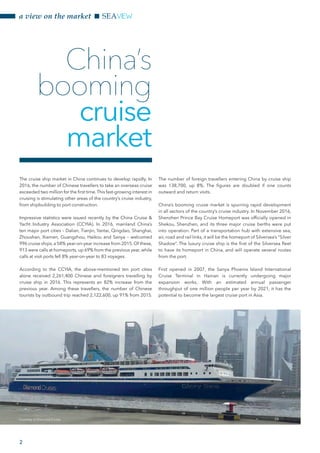
Courtesy of Diamond Cruise
3
Reliable sources of finance are crucial to this rapid development.
The first cruise industry development fund in China was officially
established on 28th December 2016. It will focus on investment in
China’s cruise ship design, construction, operation and supporting
services, in order to promote the Chinese domestic cruise industry.
The fund is led by the China State Shipbuilding Corporation
(CSSC Group), and was launched jointly with China Construction
Bank, Agricultural Bank of China, Bank of China, China Everbright
Bank and Industrial Bank. The first phase is 30 billion RMB. The
second phase will be decided in accordance with the needs of the
development of the Chinese cruise industry.
China’s domestic cruise shipbuilding industry is also going
according to plan. In July 2016, CSSC Group and Italian
shipbuilding company Fincantieri - Cantieri Navali Italiani officially
signed a joint venture agreement to establish the CSSC Fincantieri
Cruise Industry Company. In September 2016, CSSC Group,
Carnival Corporation and Fincantieri jointly signed a letter of intent
to build 2+2 units of 133,500 GT large cruise ships in Shanghai
Waigaoqiao Shipbuilding Co., which belongs to the CSSC Group.
Classed by RINA, the parent vessel of the project is currently under
construction in the Fincantieri shipyard in Trieste, Italy.
Formed in April 2016 from a partnership between three state-
owned enterprises, the Fujian Xiamen Luxury Cruise Investment
Company plans to build three 75,000 GT cruise ships in Xiamen.
Shanghai Merchant Ship Design And Research Institute (SDARI)
will act as a general contractor for the project’s design, while
Finnish design company FORESHIP is expected to complete the
conceptual design in early 2017.
China Travel Service (CTS) is planning to build one 50,000 GT
cruise ship. Currently, the project is at the stage of market research
and scheme demonstration. In a later stage, CTS intends to build
two 75,000 GT cruise ships as part of a joint venture with China
Communications Construction Company (CCCC) and the Sanya
government.
With RINA’s support, after the successful delivery of the “Glory
of the Seas” conversion project, the Shanghai-based Diamond
Cruise International Company approved a plan to build one
37,000 GT cruise ship in a Chinese shipyard. Currently, the
project is at the stage of design verification. The owner has
announced that the vessel will be classed with RINA.
RINA China and RINA Cruise Ships Excellence Centre have
been heavily involved with all of the above-mentioned cruise
projects, providing crucial technical support and consultancy
services. This includes significant amounts of training. Retired
senior experts from Fincantieri, RINA’s site manager in the
Mitsubishi cruise newbuilding project, as well as experts in the
RINA rules and regulations department, are among those who
have provided training and workshops to clients.
RINA China has also signed cruise cooperation agreements
with the Wuchang Shipbuilding Industry Group and Hubei
Chinese Institute of Marine & Offshore Engineering Company.A
strategic cruise cooperation agreement is in place with China’s
largest design company, SDARI, deepening collaboration
in the cruise field. Furthermore, RINA has submitted a cruise
consultancy service proposal plan to the Xiamen and CTS
cruise projects.
We at RINA China believe 2017 will be a remarkable year in the
Chinese cruise market and shipbuilding industry. We are proud
to have had some achievement in this exciting field and are
looking forward to the future.
nn zhiteng.cao@rina.org
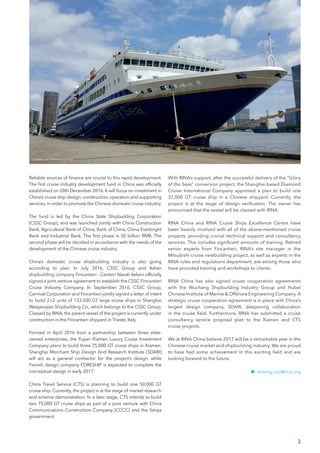
Courtesy of Diamond Cruise
a view on the market SEAVIEW
4
As the world’s largest cruise industry trade association, the CLIA’s membership
spans cruise lines, ports, suppliers, travel agencies and more. In Europe and
around the world, we are united around a common goal: to manage the rapid
growth of the cruise industry safely, sustainably, and to the benefit of travellers,
industry stakeholders and local communities.
The cruise industry is young but growing at a phenomenal pace. Almost 25
million people took a cruise in 2016, continuing an upward trend that has seen
ocean cruising grow 62% over ten years. In the context of vacation numbers in
general – 1.3 billion people in 2016 – cruising still has huge potential.
With this rapid expansion come new challenges. One is the sheer growth of
both ships and fleets. The cruise ship order book is at a record high of 26 new
builds for 2017. Ocean-going ships are also getting larger, often over 120,000
GT and carrying 4,000 passengers or more. Ports may need to upgrade their
infrastructure, with issues ranging from supply and security to the logistics of
getting passengers efficiently on and off ships.
In Europe in particular, these huge cruise ships regularly dock in historic ports in
the heart of a city. It’s inevitable that members of the local community sometimes
react defensively and pose questions. How sustainable are the ships? What
is the environmental impact? How about congestion caused by thousands of
passengers disembarking en masse?
We can answer truthfully that modern cruise vessels are at the cutting edge of
sustainable ship design and brim with eco-friendly technologies. Many new
builds will be fuelled by LNG, for example, and often exceed Europe’s strict
environmental standards. Moreover, cruise ships are disproportionately blamed
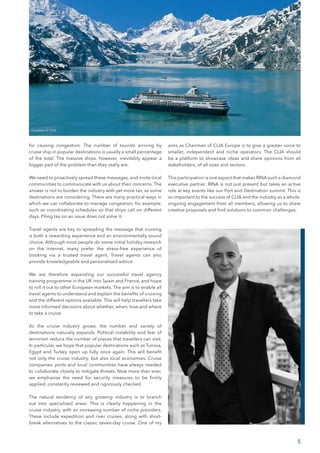
Kyriakos
Anastassiadis
BIOGRAPHY
Kyriakos (Kerry) Anastassiadis is the
CEO of Celestyal Cruises and the
current Chairman of CLIA (Cruise Lines
International Association) Europe. Prior
to taking the helm at Celestyal Cruises,
Kerry distinguished himself as General
Manager, CEO and President at renowned
corporations such as The Coca-Cola
Company, Procter & Gamble, Polaroid and
Aujan Industries.
Mr. Anastassiadis’s mother tongues are
Greek and English, and he is also fluent
in French, Italian and Portuguese. Born
in the Democratic Republic of Congo
and raised in Southern Africa, Kerry
studied Commerce at the University
of Witwatersrand and obtained his
postgraduate title in Market Research and
Advertising.
Sustainable growth benefits us all
Courtesy of CLIA
5
for causing congestion. The number of tourists arriving by
cruise ship in popular destinations is usually a small percentage
of the total. The massive ships, however, inevitably appear a
bigger part of the problem than they really are.
We need to proactively spread these messages, and invite local
communities to communicate with us about their concerns. The
answer is not to burden the industry with yet more tax, as some
destinations are considering. There are many practical ways in
which we can collaborate to manage congestion, for example,
such as coordinating schedules so that ships call on different
days. Piling tax on an issue does not solve it.
Travel agents are key to spreading the message that cruising
is both a rewarding experience and an environmentally sound
choice. Although most people do some initial holiday research
on the internet, many prefer the stress-free experience of
booking via a trusted travel agent. Travel agents can also
provide knowledgeable and personalised advice.
We are therefore expanding our successful travel agency
training programme in the UK into Spain and France, and hope
to roll it out to other European markets. The aim is to enable all
travel agents to understand and explain the benefits of cruising
and the different options available. This will help travellers take
more informed decisions about whether, when, how and where
to take a cruise.
As the cruise industry grows, the number and variety of
destinations naturally expands. Political instability and fear of
terrorism reduce the number of places that travellers can visit.
In particular, we hope that popular destinations such as Tunisia,
Egypt and Turkey open up fully once again. This will benefit
not only the cruise industry, but also local economies. Cruise
companies, ports and local communities have always needed
to collaborate closely to mitigate threats. Now more than ever,
we emphasise the need for security measures to be firmly
applied, constantly reviewed and rigorously checked.
The natural tendency of any growing industry is to branch
out into specialised areas. This is clearly happening in the
cruise industry, with an increasing number of niche providers.
These include expedition and river cruises, along with short-
break alternatives to the classic seven-day cruise. One of my
aims as Chairman of CLIA Europe is to give a greater voice to
smaller, independent and niche operators. The CLIA should
be a platform to showcase ideas and share opinions from all
stakeholders, of all sizes and sectors.
This participation is one aspect that makes RINA such a diamond
executive partner. RINA is not just present but takes an active
role at key events like our Port and Destination summit. This is
so important to the success of CLIA and the industry as a whole:
ongoing engagement from all members, allowing us to share
creative proposals and find solutions to common challenges.
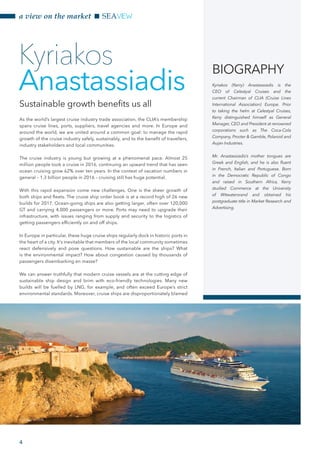
Courtesy of CLIA
a view on the market SEAVIEW
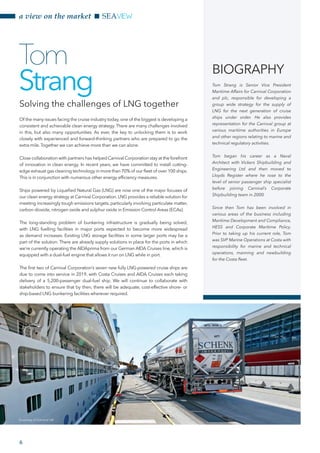
Of the many issues facing the cruise industry today, one of the biggest is developing a
consistent and achievable clean energy strategy. There are many challenges involved
in this, but also many opportunities. As ever, the key to unlocking them is to work
closely with experienced and forward-thinking partners who are prepared to go the
extra mile.Together we can achieve more than we can alone.
Close collaboration with partners has helped Carnival Corporation stay at the forefront
of innovation in clean energy. In recent years, we have committed to install cutting-
edge exhaust gas cleaning technology in more than 70% of our fleet of over 100 ships.
This is in conjunction with numerous other energy efficiency measures.
Ships powered by Liquefied Natural Gas (LNG) are now one of the major focuses of
our clean energy strategy at Carnival Corporation. LNG provides a reliable solution for
meeting increasingly tough emissions targets, particularly involving particulate matter,
carbon dioxide, nitrogen oxide and sulphur oxide in Emission Control Areas (ECAs).
The long-standing problem of bunkering infrastructure is gradually being solved,
with LNG fuelling facilities in major ports expected to become more widespread
as demand increases. Existing LNG storage facilities in some larger ports may be a
part of the solution. There are already supply solutions in place for the ports in which
we’re currently operating the AIDAprima from our German AIDA Cruises line, which is
equipped with a dual-fuel engine that allows it run on LNG while in port.
The first two of Carnival Corporation’s seven new fully LNG-powered cruise ships are
due to come into service in 2019, with Costa Cruises and AIDA Cruises each taking
delivery of a 5,200-passenger dual-fuel ship. We will continue to collaborate with
stakeholders to ensure that by then, there will be adequate, cost-effective shore- or
ship-based LNG bunkering facilities wherever required.
Tom
Strang
BIOGRAPHY
Tom Strang is Senior Vice President
Maritime Affairs for Carnival Corporation
and plc, responsible for developing a
group wide strategy for the supply of
LNG for the next generation of cruise
ships under order. He also provides
representation for the Carnival group at
various maritime authorities in Europe
and other regions relating to marine and
technical regulatory activities.
Tom began his career as a Naval
Architect with Vickers Shipbuilding and
Engineering Ltd and then moved to
Lloyds Register where he rose to the
level of senior passenger ship specialist
before joining Carnival’s Corporate
Shipbuilding team in 2000.
Since then Tom has been involved in
various areas of the business including
Maritime Development and Compliance,
HESS and Corporate Maritime Policy.
Prior to taking up his current role, Tom
was SVP Marine Operations at Costa with
responsibility for marine and technical
operations, manning and newbuilding
for the Costa fleet.
Solving the challenges of LNG together
Courtesy of Carnival UK
6
7
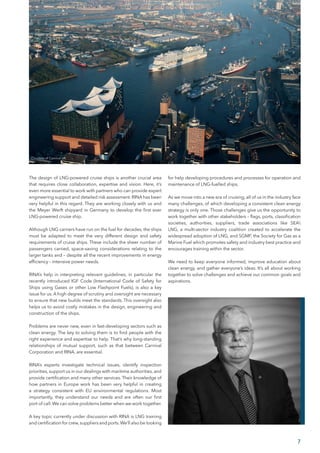
The design of LNG-powered cruise ships is another crucial area
that requires close collaboration, expertise and vision. Here, it’s
even more essential to work with partners who can provide expert
engineering support and detailed risk assessment. RINA has been
very helpful in this regard. They are working closely with us and
the Meyer Werft shipyard in Germany to develop the first ever
LNG-powered cruise ship.
Although LNG carriers have run on the fuel for decades, the ships
must be adapted to meet the very different design and safety
requirements of cruise ships. These include the sheer number of
passengers carried, space-saving considerations relating to the
larger tanks and – despite all the recent improvements in energy
efficiency – intensive power needs.
RINA’s help in interpreting relevant guidelines, in particular the
recently introduced IGF Code (International Code of Safety for
Ships using Gases or other Low Flashpoint Fuels), is also a key
issue for us. A high degree of scrutiny and oversight are necessary
to ensure that new builds meet the standards. This oversight also
helps us to avoid costly mistakes in the design, engineering and
construction of the ships.
Problems are never new, even in fast-developing sectors such as
clean energy. The key to solving them is to find people with the
right experience and expertise to help. That’s why long-standing
relationships of mutual support, such as that between Carnival
Corporation and RINA, are essential.
RINA’s experts investigate technical issues, identify inspection
priorities,support us in our dealings with maritime authorities, and
provide certification and many other services. Their knowledge of
how partners in Europe work has been very helpful in creating
a strategy consistent with EU environmental regulations. Most
importantly, they understand our needs and are often our first
port of call.We can solve problems better when we work together.
A key topic currently under discussion with RINA is LNG training
and certification for crew,suppliers and ports.We’ll also be looking
for help developing procedures and processes for operation and
maintenance of LNG-fuelled ships.
As we move into a new era of cruising, all of us in the industry face
many challenges, of which developing a consistent clean energy
strategy is only one. Those challenges give us the opportunity to
work together with other stakeholders – flags, ports, classification
societies, authorities, suppliers, trade associations like SEA
LNG, a multi-sector industry coalition created to accelerate the
widespread adoption of LNG, and SGMF, the Society for Gas as a
Marine Fuel which promotes safety and industry best practice and
encourages training within the sector.
We need to keep everyone informed, improve education about
clean energy, and gather everyone’s ideas. It’s all about working
together to solve challenges and achieve our common goals and
aspirations.
Courtesy of Carnival UK
We all know this, but it’s worth repeating. The cruise industry is the fastest growing
segment of the travel industry in North America and globally. Plus, it’s the segment
with the biggest potential to expand. In North America and Australia, the penetration
rate (cruise passengers divided by population) is around three percent. The growth
opportunity is tremendous.
If this were true in one or two regions alone, it would be exciting enough. In fact, the
same upward trend is happening all over the world.New markets are emerging,such
as China, Japan, Taiwan, and, to a lesser extent, India. Some non-traditional markets
like Argentina, Chile and Brazil are joining the party. There is also an expanded
presence in Russia and South Africa. A growing middle class fuels both affluence
and interest in travel. Cruising naturally becomes an attractive vacation choice.
Globalisation is a sign that the industry is maturing. In the coming years, we expect
to see a continued expansion of the global diversity of our guest base. This will drive
a broadening of our onboard offerings to meet the expectations of our multicultural
guests.
A key part of those expectations is technology, which is constantly evolving at an
ever-increasing pace. Guests are now demanding the same level of technology
onboard as they enjoy on land. It is a challenge to remain at the cutting edge,
delivering the latest technological experiences in an environment where structural
changes are limited and the product is always on the move.
Princess Cruises recently announced it will be the first Carnival Corp. brand to debut
the Ocean Medallion. This is a wearable, interactive device that enables a new level
of personalisation previously not available in the cruise industry. It will be a game-
changer.
Global growth, new technology
Stein
Kruse
BIOGRAPHY
Stein Kruse is CEO of Holland America
Group, a division of Carnival Corporation
& plc. He is also chairman of the board of
MANCO, a UK-based entity that oversees
the operations of Carnival Australia,
including P&O Cruises Australia.
Kruse joined Holland America Line in
1999 as senior VP, Fleet Operations, with
overall responsibility for operations and
new builds. He was named president and
COO in 2003, then CEO in 2004. In 2011
he was appointed chairman of Seabourn
Cruise Line. He became CEO of the
newly formed Holland America Group in
2013.
Before joining Holland America Line,
Kruse was senior VP and CFO of
North American Operations for global
Japanese shipping company “K” Line.
Prior to that, he was executive VP and
COO for Radisson Seven Seas Cruises,
and president and CEO of Seven Seas
Cruise Line.
A native of Oslo, Norway, he holds
a Bachelor of Science degree from
Purdue University and is a graduate of
Harvard Business School’s Advanced
Management Program.
Courtesy of Holland America Line
a view on the market SEAVIEW
8
Innovation in all other areas of the onboard experience will
continue to raise the game. New ships, new brand partnerships
and features not seen on ships before will reflect consumer trends
on land. This might be cuisine, entertainment, music, technology
or hardware installations that take eye-popping activities out to
sea. This competitive innovation is good for both the industry and
consumers.
Technology is helping to improve not only the guest experience
but also our ability to comply with increasingly strict environmental
regulations.Cruisingisoneof themostheavilyregulatedindustries
in the world. In addition, for such a globalised industry, there is a
remarkable lack of consistency in regulations between countries.
Emissioncontrolareasaretighteningandthecontrolrequirements
are broadening, in North America as well as Europe and other
areas of the world. We are looking at increased restrictions on
emissions by 2020. We are doing what we can to mitigate this.
Measures include minimising energy consumption, investing in
environmental technology and adjusting itineraries to maximise
efficiencies.
Driving performance and guiding the organisation through some
of the challenges mentioned above are key parts of my job as
CEO of Holland America Group. As leader of a diverse team of
more than 40,000 professionals across four brands worldwide, I’m
also responsible for ensuring safety.
In this regard, I am fortunate to have a very experienced team
working day-to-day with RINA. Ultimately, however, I am
responsible for the safety and security of our guests and crew.
I therefore take an active role in the technical operations and
certification of our vessels. Having spent many years at sea early in
my career, I have a strong understanding of the operational side
of our business.
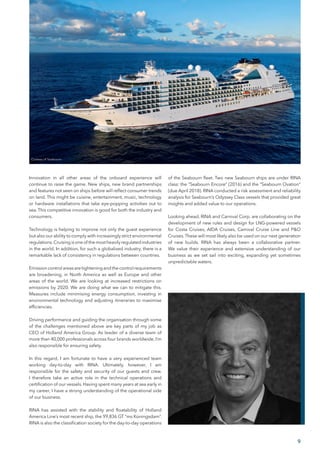
RINA has assisted with the stability and floatability of Holland
America Line’s most recent ship, the 99,836 GT “ms Koningsdam”.
RINA is also the classification society for the day-to-day operations
of the Seabourn fleet. Two new Seabourn ships are under RINA
class: the “Seabourn Encore” (2016) and the “Seabourn Ovation”
(due April 2018). RINA conducted a risk assessment and reliability
analysis for Seabourn’s Odyssey Class vessels that provided great
insights and added value to our operations.
Looking ahead, RINA and Carnival Corp. are collaborating on the
development of new rules and design for LNG-powered vessels
for Costa Cruises, AIDA Cruises, Carnival Cruise Line and P&O
Cruises.These will most likely also be used on our next generation
of new builds. RINA has always been a collaborative partner.
We value their experience and extensive understanding of our
business as we set sail into exciting, expanding yet sometimes
unpredictable waters.
Cortesy of Seabourn
9
Shiprecyclingandrepairareimportantgrowthsectors,presentingnewpossibilities
to Genova Industrie Navali (GIN) and to the industry as a whole. Working closely
with expert partners such as RINA, we are currently expanding operations in Italy
and France. Our aim is to build on our decades of experience and better serve the
global shipping industry with safe, sustainable recycling, repair and conversion.
Vessel demolition activity has been rising worldwide. There are too many ships
and not enough demand, partly as a result of the still-sluggish global economy.
This is good news for the ship recycling industry, but has also fuelled one of its
major challenges: cheap, unsafe and environmentally unsound ship breaking
on the beaches of South Asia. Only adequate regulation and enforcement can
counter this widespread, dangerous and unfair practice.
Our new shipyard in Tuscany, Piombino Industrie Marittime (PIM), is an important
step towards the development of an industry that meets the growing demand for
eco-friendly ship demolition in compliance with EU regulations. Expected to be
completed in the second half of 2017, it covers an area of over 100,000 square
metres and will employ around 200 engineers, technicians, administrative staff
and workers. When operational, it is our intention to join the European Union list
of facilities that meet or exceed strict European and international standards for
ship recycling, maintenance and refitting.
Ship repair and conversion are other major growth areas in which we are proud to
play a leading role.More and more merchant vessels are being built,and they have
an increasingly longer lifetime. This raises demand for conversion, transformation
and modernisation. The ships need to keep up with customer expectations, as
well as the growing requirements of environmental protection, climate protection,
energy efficiency and sustainability.
The future of green ship recycling
Ferdinando
Garrè
BIOGRAPHY
Ferdinando Garrè was born in Genoa on
April 20, 1957. Following his high school
diploma at the Naval Institute Morosini in
Venice, Garrè graduated in Mechanical
and Naval Engineering at the University
of Genoa.
He held a managing position at Officine
Meccaniche Navali e Fonderie San
Giorgio del Porto until 2000. From 2002
to 2004, he was appointed Technical
Director of the Prestige Cruises
Management, a company based in
Monaco. In the same period, he was
also Technical Director and Member
of the Board of Directors of Martinoli
Consulting in Genoa, company leader in
advising on technical shipbuilding and
expert management.
In 2004, he returned to San Giorgio del
Porto as its CEO, a position he still holds
today. Currently, Garrè is also member of
the Chantier Naval de Marseille’s Board
of Directors. Since the end of 2016,
Garrè is president of the shipbuilding
section of Confindustria Genova, the
local section of the national association
of entrepreneurs.
a view on the market SEAVIEW
10
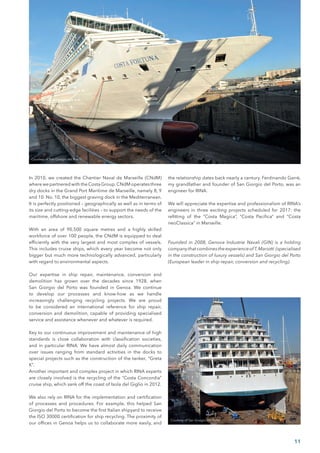
In 2010, we created the Chantier Naval de Marseille (CNdM)
where we partnered with the Costa Group.CNdM operates three
dry docks in the Grand Port Maritime de Marseille, namely 8, 9
and 10. No. 10, the biggest graving dock in the Mediterranean.
It is perfectly positioned – geographically as well as in terms of
its size and cutting-edge facilities – to support the needs of the
maritime, offshore and renewable energy sectors.
With an area of 90,500 square metres and a highly skilled
workforce of over 100 people, the CNdM is equipped to deal
efficiently with the very largest and most complex of vessels.
This includes cruise ships, which every year become not only
bigger but much more technologically advanced, particularly
with regard to environmental aspects.
Our expertise in ship repair, maintenance, conversion and
demolition has grown over the decades since 1928, when
San Giorgio del Porto was founded in Genoa. We continue
to develop our processes and know-how as we handle
increasingly challenging recycling projects. We are proud
to be considered an international reference for ship repair,
conversion and demolition, capable of providing specialised
service and assistance whenever and whatever is required.
Key to our continuous improvement and maintenance of high
standards is close collaboration with classification societies,
and in particular RINA. We have almost daily communication
over issues ranging from standard activities in the docks to
special projects such as the construction of the tanker, “Greta
K”.
Another important and complex project in which RINA experts
are closely involved is the recycling of the “Costa Concordia”
cruise ship, which sank off the coast of Isola del Giglio in 2012.
We also rely on RINA for the implementation and certification
of processes and procedures. For example, this helped San
Giorgio del Porto to become the first Italian shipyard to receive
the ISO 30000 certification for ship recycling. The proximity of
our offices in Genoa helps us to collaborate more easily, and
the relationship dates back nearly a century. Ferdinando Garrè,
my grandfather and founder of San Giorgio del Porto, was an
engineer for RINA.
We will appreciate the expertise and professionalism of RINA’s
engineers in three exciting projects scheduled for 2017: the
refitting of the “Costa Magica”, “Costa Pacifica” and “Costa
neoClassica” in Marseille.
Founded in 2008, Genova Industrie Navali (GIN) is a holding
companythatcombinestheexperienceofT.Mariotti (specialised
in the construction of luxury vessels) and San Giorgio del Porto
(European leader in ship repair, conversion and recycling).
Courtesy of San Giorgio del Porto
11
12
a view on the market SEAVIEW
Cruise ships are evolving fast and in every direction, from size and technology
to passenger expectations. In addition, interior design trends are constantly
transforming the way we think and feel about space. Combining these two
evolving worlds is our challenge as an architectural firm specialised in cruise ship
design and production management.
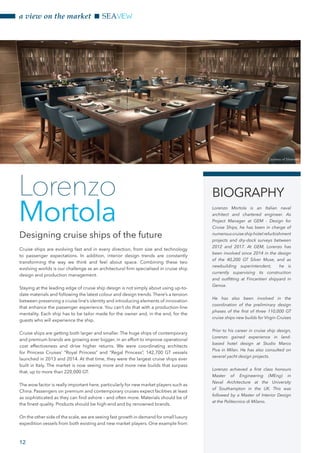
Staying at the leading edge of cruise ship design is not simply about using up-to-
date materials and following the latest colour and design trends. There’s a tension
between preserving a cruise line’s identity and introducing elements of innovation
that enhance the passenger experience. You can’t do that with a production-line
mentality. Each ship has to be tailor made for the owner and, in the end, for the
guests who will experience the ship.
Cruise ships are getting both larger and smaller. The huge ships of contemporary
and premium brands are growing ever bigger, in an effort to improve operational
cost effectiveness and drive higher returns. We were coordinating architects
for Princess Cruises’ “Royal Princess” and “Regal Princess”, 142,700 GT vessels
launched in 2013 and 2014. At that time, they were the largest cruise ships ever
built in Italy. The market is now seeing more and more new builds that surpass
that, up to more than 220,000 GT.
The wow factor is really important here, particularly for new market players such as
China. Passengers on premium and contemporary cruises expect facilities at least
as sophisticated as they can find ashore – and often more. Materials should be of
the finest quality. Products should be high-end and by renowned brands.
On the other side of the scale, we are seeing fast growth in demand for small luxury
expedition vessels from both existing and new market players. One example from
Designing cruise ships of the future
Lorenzo
Mortola
BIOGRAPHY
Lorenzo Mortola is an Italian naval
architect and chartered engineer. As
Project Manager at GEM - Design for
Cruise Ships, he has been in charge of
numerouscruiseshiphotelrefurbishment
projects and dry-dock surveys between
2012 and 2017. At GEM, Lorenzo has
been involved since 2014 in the design
of the 40,200 GT Silver Muse, and as
newbuilding superintendent, he is
currently supervising its construction
and outfitting at Fincantieri shipyard in
Genoa.
He has also been involved in the
coordination of the preliminary design
phases of the first of three 110,000 GT
cruise ships new builds for Virgin Cruises
Prior to his career in cruise ship design,
Lorenzo gained experience in land-
based hotel design at Studio Marco
Piva in Milan. He has also consulted on
several yacht design projects.
Lorenzo achieved a first class honours
Master of Engineering (MEng) in
Naval Architecture at the University
of Southampton in the UK. This was
followed by a Master of Interior Design
at the Politecnico di Milano.
Courtesy of Silversea
13
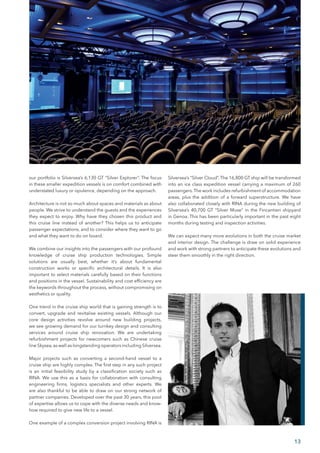
our portfolio is Silversea’s 6,130 GT “Silver Explorer”. The focus
in these smaller expedition vessels is on comfort combined with
understated luxury or opulence, depending on the approach.
Architecture is not so much about spaces and materials as about
people. We strive to understand the guests and the experiences
they expect to enjoy. Why have they chosen this product and
this cruise line instead of another? This helps us to anticipate
passenger expectations, and to consider where they want to go
and what they want to do on board.
We combine our insights into the passengers with our profound
knowledge of cruise ship production technologies. Simple
solutions are usually best, whether it’s about fundamental
construction works or specific architectural details. It is also
important to select materials carefully based on their functions
and positions in the vessel. Sustainability and cost efficiency are
the keywords throughout the process, without compromising on
aesthetics or quality.
One trend in the cruise ship world that is gaining strength is to
convert, upgrade and revitalise existing vessels. Although our
core design activities revolve around new building projects,
we see growing demand for our turnkey design and consulting
services around cruise ship renovation. We are undertaking
refurbishment projects for newcomers such as Chinese cruise
line Skysea,as well as longstanding operators including Silversea.
Major projects such as converting a second-hand vessel to a
cruise ship are highly complex. The first step in any such project
is an initial feasibility study by a classification society such as
RINA. We use this as a basis for collaboration with consulting
engineering firms, logistics specialists and other experts. We
are also thankful to be able to draw on our strong network of
partner companies. Developed over the past 30 years, this pool
of expertise allows us to cope with the diverse needs and know-
how required to give new life to a vessel.
One example of a complex conversion project involving RINA is
Silversea’s “Silver Cloud”. The 16,800 GT ship will be transformed
into an ice class expedition vessel carrying a maximum of 260
passengers.The work includes refurbishment of accommodation
areas, plus the addition of a forward superstructure. We have
also collaborated closely with RINA during the new building of
Silversea’s 40,700 GT “Silver Muse” in the Fincantieri shipyard
in Genoa. This has been particularly important in the past eight
months during testing and inspection activities.
We can expect many more evolutions in both the cruise market
and interior design. The challenge is draw on solid experience
and work with strong partners to anticipate these evolutions and
steer them smoothly in the right direction.
Courtesy of GEM Design for Cruise Ships
news SEAVIEW
14
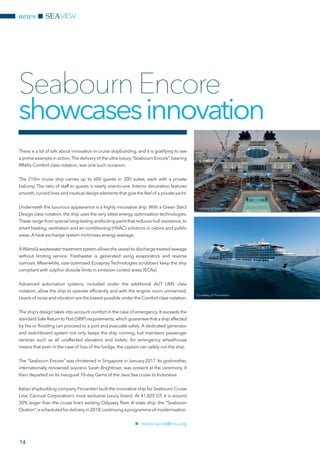
There is a lot of talk about innovation in cruise shipbuilding, and it is gratifying to see
a prime example in action.The delivery of the ultra-luxury “Seabourn Encore”,bearing
RINA’s Comfort class notation, was one such occasion.
The 210m cruise ship carries up to 600 guests in 300 suites, each with a private
balcony. The ratio of staff to guests is nearly one-to-one. Interior decoration features
smooth,curved lines and nautical design elements that give the feel of a private yacht.
Underneath the luxurious appearance is a highly innovative ship. With a Green Star3
Design class notation, the ship uses the very latest energy optimisation technologies.
These range from special long-lasting antifouling paint that reduces hull resistance, to
smart heating, ventilation and air conditioning (HVAC) solutions in cabins and public
areas. A heat exchange system minimises energy wastage.
AWärtsilä wastewater treatment system allows the vessel to discharge treated sewage
without limiting service. Freshwater is generated using evaporators and reverse
osmosis. Meanwhile, size-optimised Ecospray Technologies scrubbers keep the ship
compliant with sulphur dioxide limits in emission control areas (ECAs).
Advanced automation systems, included under the additional AUT UMS class
notation, allow the ship to operate efficiently and with the engine room unmanned.
Levels of noise and vibration are the lowest possible under the Comfort class notation.
The ship’s design takes into account comfort in the case of emergency. It exceeds the
standard Safe Return to Port (SRtP) requirements,which guarantee that a ship affected
by fire or flooding can proceed to a port and evacuate safely. A dedicated generator
and switchboard system not only keeps the ship running, but maintains passenger
services such as all unaffected elevators and toilets. An emergency wheelhouse
means that even in the case of loss of the bridge, the captain can safely run the ship.
The “Seabourn Encore” was christened in Singapore in January 2017. Its godmother,
internationally renowned soprano Sarah Brightman, was present at the ceremony. It
then departed on its inaugural 10-day Gems of the Java Sea cruise to Indonesia.
Italian shipbuilding company Fincantieri built the innovative ship for Seabourn Cruise
Line, Carnival Corporation’s most exclusive luxury brand. At 41,825 GT, it is around
30% larger than the cruise line’s existing Odyssey fleet. A sister ship, the “Seabourn
Ovation”,isscheduledfordeliveryin2018,continuingaprogrammeof modernisation.
nn marco.landa@rina.org
SeabournEncore
showcasesinnovation
Courtesy of Fincantieri
newsSEAVIEW
15
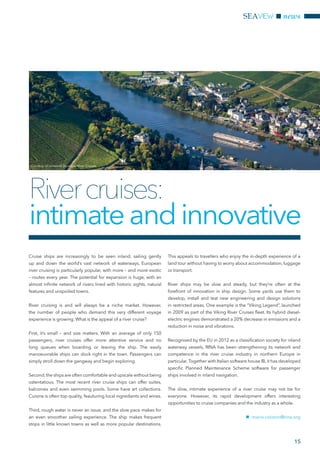
Cruise ships are increasingly to be seen inland, sailing gently
up and down the world’s vast network of waterways. European
river cruising is particularly popular, with more – and more exotic
– routes every year. The potential for expansion is huge, with an
almost infinite network of rivers lined with historic sights, natural
features and unspoiled towns.
River cruising is and will always be a niche market. However,
the number of people who demand this very different voyage
experience is growing. What is the appeal of a river cruise?
First, it’s small – and size matters. With an average of only 150
passengers, river cruises offer more attentive service and no
long queues when boarding or leaving the ship. The easily
manoeuvrable ships can dock right in the town. Passengers can
simply stroll down the gangway and begin exploring.
Second,the ships are often comfortable and upscale without being
ostentatious. The most recent river cruise ships can offer suites,
balconies and even swimming pools. Some have art collections.
Cuisine is often top quality, feauturing local ingredients and wines.
Third, rough water is never an issue, and the slow pace makes for
an even smoother sailing experience. The ship makes frequent
stops in little known towns as well as more popular destinations.
This appeals to travellers who enjoy the in-depth experience of a
land tour without having to worry about accommodation, luggage
or transport.
River ships may be slow and steady, but they’re often at the
forefront of innovation in ship design. Some yards use them to
develop, install and test new engineering and design solutions
in restricted areas. One example is the “Viking Legend”, launched
in 2009 as part of the Viking River Cruises fleet. Its hybrid diesel-
electric engines demonstrated a 20% decrease in emissions and a
reduction in noise and vibrations.
Recognised by the EU in 2012 as a classification society for inland
waterway vessels, RINA has been strengthening its network and
competence in the river cruise industry in northern Europe in
particular.Together with Italian software house IB, it has developed
specific Planned Maintenance Scheme software for passenger
ships involved in inland navigation.
The slow, intimate experience of a river cruise may not be for
everyone. However, its rapid development offers interesting
opportunities to cruise companies and the industry as a whole.
nn mario.colosini@rina.org
Rivercruises:
intimateandinnovative
Courtesy of Uniworld Boutique River Cruises
news SEAVIEW
16
Lying 20 km northeast of Kuwait, the small island of Failaka is known for its pleasant
climate and historical remains. Just a short ferry ride from the mainland, it’s an
increasingly popular getaway destination for both Kuwaiti and international tourists.
Visitors can take bus tours around the island to visit archaeological and wartime
sites, go fishing or practise water sports. To meet this rising demand, Failaka Island
is now improving its harbour facilities with the help of RINA.
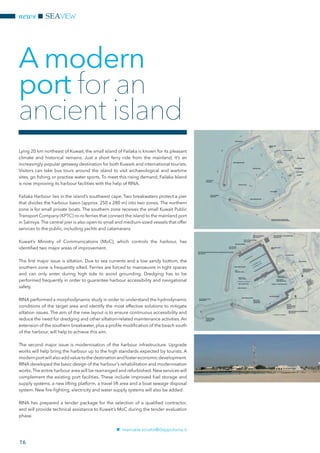
Failaka Harbour lies in the island’s southwest cape. Two breakwaters protect a pier
that divides the harbour basin (approx. 250 x 280 m) into two zones. The northern
zone is for small private boats. The southern zone receives the small Kuwait Public
Transport Company (KPTC) ro-ro ferries that connect the island to the mainland port
in Salmiya.The central pier is also open to small and medium-sized vessels that offer
services to the public, including yachts and catamarans.
Kuwait’s Ministry of Communications (MoC), which controls the harbour, has
identified two major areas of improvement.
The first major issue is siltation. Due to sea currents and a low sandy bottom, the
southern zone is frequently silted. Ferries are forced to manoeuvre in tight spaces
and can only enter during high tide to avoid grounding. Dredging has to be
performed frequently in order to guarantee harbour accessibility and navigational
safety.
RINA performed a morphodynamic study in order to understand the hydrodynamic
conditions of the target area and identify the most effective solutions to mitigate
siltation issues. The aim of the new layout is to ensure continuous accessibility and
reduce the need for dredging and other siltation-related maintenance activities. An
extension of the southern breakwater, plus a profile modification of the beach south
of the harbour, will help to achieve this aim.
The second major issue is modernisation of the harbour infrastructure. Upgrade
works will help bring the harbour up to the high standards expected by tourists. A
modernportwillalsoaddvaluetothedestinationandfostereconomicdevelopment.
RINA developed the basic design of the harbour’s rehabilitation and modernisation
works.The entire harbour area will be rearranged and refurbished. New services will
complement the existing port facilities. These include improved fuel storage and
supply systems, a new lifting platform, a travel lift area and a boat sewage disposal
system. New fire-fighting, electricity and water supply systems will also be added.
RINA has prepared a tender package for the selection of a qualified contractor,
and will provide technical assistance to Kuwait’s MoC during the tender evaluation
phase.
nn manuela.sciutto@dappolonia.it
A modern
port for an
ancient island
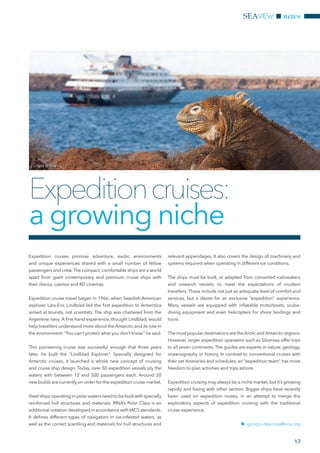
Expedition cruises promise adventure, exotic environments
and unique experiences shared with a small number of fellow
passengers and crew.The compact, comfortable ships are a world
apart from giant contemporary and premium cruise ships with
their discos, casinos and 4D cinemas.
Expedition cruise travel began in 1966, when Swedish-American
explorer Lars-Eric Lindblad led the first expedition to Antarctica
aimed at tourists, not scientists. The ship was chartered from the
Argentine navy. A first-hand experience, thought Lindblad, would
help travellers understand more about the Antarctic and its role in
the environment. “You can’t protect what you don’t know,” he said.
This pioneering cruise was successful enough that three years
later, he built the “Lindblad Explorer”. Specially designed for
Antarctic cruises, it launched a whole new concept of cruising
and cruise ship design. Today, over 50 expedition vessels ply the
waters with between 12 and 500 passengers each. Around 20
new builds are currently on order for the expedition cruise market.
Steel ships operating in polar waters need to be built with specially
reinforced hull structures and materials. RINA’s Polar Class is an
additional notation developed in accordance with IACS standards.
It defines different types of navigation in ice-infested waters, as
well as the correct scantling and materials for hull structures and
relevant appendages. It also covers the design of machinery and
systems required when operating in different ice conditions.
The ships must be built, or adapted from converted icebreakers
and research vessels, to meet the expectations of modern
travellers. These include not just an adequate level of comfort and
services, but a desire for an exclusive “expedition” experience.
Many vessels are equipped with inflatable motorboats, scuba-
diving equipment and even helicopters for shore landings and
tours.
The most popular destinations are theArctic andAntarctic regions.
However, larger expedition operators such as Silversea offer trips
to all seven continents. The guides are experts in nature, geology,
oceanography or history. In contrast to conventional cruises with
their set itineraries and schedules, an “expedition team” has more
freedom to plan activities and trips ashore.
Expedition cruising may always be a niche market, but it’s growing
rapidly and fusing with other sectors. Bigger ships have recently
been used on expedition routes, in an attempt to merge the
exploratory aspects of expedition cruising with the traditional
cruise experience.
nn giorgio.desciora@rina.org
Expeditioncruises:
a growing niche
SEAVIEW
17
news
Courtesy of Silversea
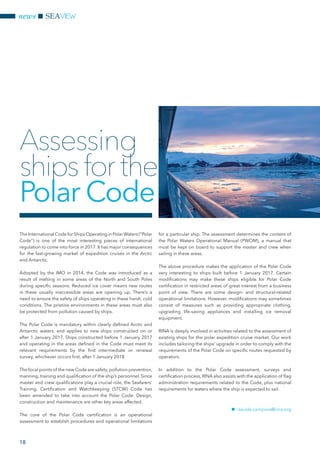
The International Code for Ships Operating in PolarWaters (“Polar
Code”) is one of the most interesting pieces of international
regulation to come into force in 2017. It has major consequences
for the fast-growing market of expedition cruises in the Arctic
and Antarctic.
Adopted by the IMO in 2014, the Code was introduced as a
result of melting in some areas of the North and South Poles
during specific seasons. Reduced ice cover means new routes
in these usually inaccessible areas are opening up. There’s a
need to ensure the safety of ships operating in these harsh, cold
conditions. The pristine environments in these areas must also
be protected from pollution caused by ships.
The Polar Code is mandatory within clearly defined Arctic and
Antarctic waters, and applies to new ships constructed on or
after 1 January 2017. Ships constructed before 1 January 2017
and operating in the areas defined in the Code must meet its
relevant requirements by the first intermediate or renewal
survey, whichever occurs first, after 1 January 2018.
The focal points of the new Code are safety, pollution prevention,
manning, training and qualification of the ship’s personnel. Since
master and crew qualifications play a crucial role, the Seafarers’
Training, Certification and Watchkeeping (STCW) Code has
been amended to take into account the Polar Code. Design,
construction and maintenance are other key areas affected.
The core of the Polar Code certification is an operational
assessment to establish procedures and operational limitations
for a particular ship. The assessment determines the content of
the Polar Waters Operational Manual (PWOM), a manual that
must be kept on board to support the master and crew when
sailing in these areas.
The above procedure makes the application of the Polar Code
very interesting to ships built before 1 January 2017. Certain
modifications may make these ships eligible for Polar Code
certification in restricted areas of great interest from a business
point of view. There are some design- and structural-related
operational limitations. However, modifications may sometimes
consist of measures such as providing appropriate clothing,
upgrading life-saving appliances and installing ice removal
equipment.
RINA is deeply involved in activities related to the assessment of
existing ships for the polar expedition cruise market. Our work
includes tailoring the ships’ upgrade in order to comply with the
requirements of the Polar Code on specific routes requested by
operators.
In addition to the Polar Code assessment, surveys and
certification process, RINA also assists with the application of flag
administration requirements related to the Code, plus national
requirements for waters where the ship is expected to sail.
nn davide.campora@rina.org
Assessing
ships for the
Polar Code
news SEAVIEW
18
SEAVIEW
19
news
In a time of rising fuel costs, strict environmental regulations and strong
competition, precise fleet performance monitoring is more essential than ever.
In the past, fleet performance monitoring and analysis were based on imprecise
manual reporting of fuel consumption (noon reports) and naval architecture
concepts. Nowadays automatic acquisition systems, continuously collecting data
from sensors on board, are more and more common.They can provide a complete
and accurate data set in order to analyse fleet performance.
InfoSHIP® EGO – Energy Governance is RINA’s sophisticated fleet performance
monitoring system. It unlocks the full potential of big data analysis applied to hull,
engine and propeller performance. The latest version of InfoSHIP® EGO comes
with many upgraded features. It tracks the ship’s route and alerts the user when
the ship enters ECA areas. It displays the engine load diagram with the real-
time (current) point at which the engine is operating and automatically detects
if the ship is drifting or at anchor. It also applies rules of alert to any signals or
combination of signals above or below a certain threshold, thus focusing the
user’s attention on critical issues just at the right time.
Furthermore, the ‘big data’ recorded by InfoSHIP® EGO allows the use of the latest
machine learning techniques to compute desired baselines. This is a new method
of performance prediction compared to classical ITTC formulas and corrections.
Typically, hull and propeller performance analysis is carried out by monitoring
speed through the water, propulsive power, and environmental and loading
conditions. The system benchmarks actual values from sensors with a target
computed by the system, accounting for different operative conditions.
Dry dock intervention analysis or degradation analysis due to hull fouling are
much simpler and more effective thanks to the new DSS (Decision Support
System) module, that guides the user step by step to the right conclusion. The
DSS module has been upgraded with a powerful scatter diagram dashboard that
can interpolate data with various trend lines and histogram plots. There are also
dashboards dedicated to emissions and the ship’s cargo and loading conditions.
RINA is investing significantly to enrich InfoSHIP® EGO with additional data
analysis services. Standard options are CFD analysis for trim optimisation, baseline
computations through machine learning techniques on the big data recorded,
and monthly analytics services. At the end of 2016, the number of installations on
board reached 200. Considering that InfoSHIP® EGO was rolled out in 2014, this
confirms it as one of the fastest growing fleet performance monitoring systems
on the market.
nn alessandro.pescetto@rina.org
Enhancedfleet
performance
monitoring
20
news SEAVIEW
Cyber security is one of the most critical – yet least well understood – topics in
the industry. We are increasingly dependent upon cyber systems, i.e. the use of
computers and networks to manage facilities, equipment, personnel, procedures
and communications. These systems facilitate data transfer and protect sensitive
digital information relating to the company, ship, crew, cargo and passengers. It’s a
mistake to consider cyber security as purely an IT issue.
The more dependent we are on these systems, the more urgently we need to make
sure they are safe and secure. Computers and networks can be hacked, attacked,
damaged or even shut down completely. Confidential data can be modified or
stolen. Communications can be intercepted. On ships and offshore units, a cyber
attack on operational technology could be extremely dangerous.
RINA has developed its own guidelines based on IMO recommendations, and
proposes a third-party service to support owners in minimising the cyber risk.
Adherence to the guidelines is recognised by a document of compliance.
The starting point is the identification of network access points such as ship-to-shore
communications, internet/WiFi systems, mobile devices and external hardware.
Where and how is a cyber incident possible? What is its potential impact? How can
we mitigate this? The first phase focuses on vital systems; the second extends to all
onboard information.
We recommend at least the following:
1.	 Study the IT system architecture.
2.	 Identify physical accessibility.
3.	 Evaluate the safety of the ship-shore information exchange.
4.	 Evaluate company policies on onboard software.
5.	 Check password and account management policies.
6.	 Evaluate and test backup management systems.
7.	 Verify procedures and records for tracking critical events.
8.	 Verify procedures and records for managing and tracking software
modifications.
9.	 Assess the security of the onboard network architecture.
10.	 Verify training measures to increase the awareness of potential cyber risks.
Most experts agree that the real question is not if, but when a cyber incident
happens. Taking the issues seriously and undertaking a thorough assessment will
help keep us all prepared.
nn andrea.cogliolo@rina.org
A practical
approach to
cyber security
news in briefSEAVIEW
21
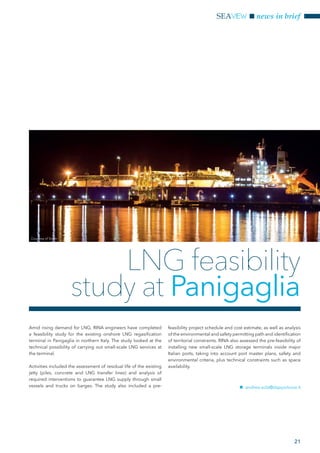
Amid rising demand for LNG, RINA engineers have completed
a feasibility study for the existing onshore LNG regasification
terminal in Panigaglia in northern Italy. The study looked at the
technical possibility of carrying out small-scale LNG services at
the terminal.
Activities included the assessment of residual life of the existing
jetty (piles, concrete and LNG transfer lines) and analysis of
required interventions to guarantee LNG supply through small
vessels and trucks on barges. The study also included a pre-
feasibility project schedule and cost estimate, as well as analysis
of the environmental and safety permitting path and identification
of territorial constraints. RINA also assessed the pre-feasibility of
installing new small-scale LNG storage terminals inside major
Italian ports, taking into account port master plans, safety and
environmental criteria, plus technical constraints such as space
availability.
nn andrea.sola@dappolonia.it
LNG feasibility
study at Panigaglia
Courtesy of Snam
RINA S.p.A. - Via Corsica 12, Genova, 16128
Ph. +39 010 53851 Fax +39 010 5351000 - E-mail: editorial@rina.org
WWW.RINAGROUP.ORG - WWW.RINA.ORG - WWW.DAPPOLONIA.IT
RINA Corporate Image©
SEAVIEW

RINA SEA VIEW

  • 1.
    MAGAZINE March 2017SEAVIEW Cruise industryleaders look ahead River and expedition cruises: a new frontier  How to avoid cyber risks
  • 2.
    Contents Welcome to SeaView, RINA’s annual magazine focused on the cruise market. Sustainable innovation and close collaboration are recurring themes as we explore the opportunities and challenges that lie just over the horizon. This issue, we offer insights into China’s booming cruise market and the fast growth of niches such as river and expedition cruises. Interviews with leading players in the industry reveal more about the future of LNG-fuelled cruise ships and innovations in cruise ship design and renovation. On the technology side, we provide a practical framework for combating cyber security threats, plus options for enhancing fleet performance monitoring through our InfoSHIP® EGO system. Thank you to CLIA Europe, Carnival Corporation, Holland America Group, Genova Industrie Navali and GEM Cruise Ship Design for their contributions. Editorial SEAVIEW 10 Ferdinando Garrè 12 Lorenzo Mortola 08 Stein Kruse 14 Seabourn Encore showcases innovation 15 River cruises: intimate and innovative 16 A modern port for an ancient island 19 Enhanced fleet performance monitoring 17 Expedition cruises: a growing niche 18 Assessing ships for the Polar Code 20 A practical approach to cyber security 21 NEWS IN BRIEF 04 Kyriakos Anastassiadis 02 China’s booming cruise market 06 Tom Strang 01 Cruising smoothly into the future
  • 3.
    a view onthe marketSEAVIEW 1 Past, present and future, there’s much to be positive about in the cruise sector. It has continued to expand globally, and is predicted to carry on growing fast.It is resisting the difficult market conditions currently experienced by other shipping sectors. It’s also winning on land – growth in the cruise sector outpaces land-based holiday options by a wide margin. Looking forwards, we see huge potential in the fact that cruising still represents a small percentage of tourism worldwide. Why is the cruise sector expanding so successfully, from 15.8 million passengers in 2007 to an estimated 25.3 million in 2017, according to the CLIA (see page 4)? One reason is that younger generations are embracing cruising like never before, rating it better than all-inclusive resorts,holiday home rentals,camping and land tours.As these young people grow up, there’s every reason to expect they will continue exploring the seas with their families and after retirement. Looking east, the Chinese cruise market is booming (see page 2). Its phenomenal growth brings with it new customers, destinations, ports and possibilities for both international and Chinese cruise companies. A third reason is diversification. Niches such as river cruising (see page 17) and expedition cruising (see page 15) are opening up fresh markets.Two new expedition ships,the “Celebrity Xperience” and “Celebrity Xploration”, will explore the Galapagos in 2017. Up in Alaska and British Columbia, Lindblad Expeditions has partnered with National Geographic to operate the state-of-the-art “National Geographic Quest”. The industry’s rapid growth is boosting cruise shipbuilding. The cruise ship order book for 2017 stands at 26 new builds, totalling more than US$6.8 billion (€6.33 million). By 2026, we can expect nearly 100 new cruise ships at an estimated investment of US$53 billion (€49.4 billion). This good news brings capacity issues.Major cruise shipyards have been full for years, with some consolidating in order to handle demand for larger ships. Other yards have entered or re-entered the sector, often aiming at the fast-growing market for river, expedition and smaller luxury ships. We are also excited about China’s long-awaited entry into the cruise shipbuilding sector. Rather than order new ships with delivery dates after 2021, the trend is now to upgrade and convert existing ships to meet rising environmental standards and customer expectations (see page 12). Major brands including Holland America Line and Norwegian Cruise Line are investing significantly in fleet-wide upgrades. Crystal Cruises’ luxury “Crystal Symphony” will also get a makeover this year, while Silversea Cruises’ “Silver Cloud” is set to embark on a new life as an expedition vessel. Nobody can predict with certainty what lies beyond the horizon. For cruising, however, it looks like smooth sailing, favourable winds and many new places to explore. nn paolo.moretti@rina.org Cruising smoothly into the future Courtesy of Fincantieri
  • 4.
    a view onthe market SEAVIEW 2 The cruise ship market in China continues to develop rapidly. In 2016, the number of Chinese travellers to take an overseas cruise exceeded two million for the first time.This fast-growing interest in cruising is stimulating other areas of the country’s cruise industry, from shipbuilding to port construction. Impressive statistics were issued recently by the China Cruise & Yacht Industry Association (CCYIA). In 2016, mainland China’s ten major port cities – Dalian, Tianjin, Yantai, Qingdao, Shanghai, Zhoushan, Xiamen, Guangzhou, Haikou and Sanya – welcomed 996 cruise ships, a 58% year-on-year increase from 2015. Of these, 913 were calls at homeports, up 69% from the previous year, while calls at visit ports fell 8% year-on-year to 83 voyages. According to the CCYIA, the above-mentioned ten port cities alone received 2,261,400 Chinese and foreigners travelling by cruise ship in 2016. This represents an 82% increase from the previous year. Among these travellers, the number of Chinese tourists by outbound trip reached 2,122,600, up 91% from 2015. The number of foreign travellers entering China by cruise ship was 138,700, up 8%. The figures are doubled if one counts outward and return visits. China’s booming cruise market is spurring rapid development in all sectors of the country’s cruise industry. In November 2016, Shenzhen Prince Bay Cruise Homeport was officially opened in Shekou, Shenzhen, and its three major cruise berths were put into operation. Part of a transportation hub with extensive sea, air, road and rail links, it will be the homeport of Silversea’s “Silver Shadow”. The luxury cruise ship is the first of the Silversea fleet to have its homeport in China, and will operate several routes from the port. First opened in 2007, the Sanya Phoenix Island International Cruise Terminal in Hainan is currently undergoing major expansion works. With an estimated annual passenger throughput of one million people per year by 2021, it has the potential to become the largest cruise port in Asia. China’s booming cruise market Courtesy of Diamond Cruise
  • 5.
    3 Reliable sources offinance are crucial to this rapid development. The first cruise industry development fund in China was officially established on 28th December 2016. It will focus on investment in China’s cruise ship design, construction, operation and supporting services, in order to promote the Chinese domestic cruise industry. The fund is led by the China State Shipbuilding Corporation (CSSC Group), and was launched jointly with China Construction Bank, Agricultural Bank of China, Bank of China, China Everbright Bank and Industrial Bank. The first phase is 30 billion RMB. The second phase will be decided in accordance with the needs of the development of the Chinese cruise industry. China’s domestic cruise shipbuilding industry is also going according to plan. In July 2016, CSSC Group and Italian shipbuilding company Fincantieri - Cantieri Navali Italiani officially signed a joint venture agreement to establish the CSSC Fincantieri Cruise Industry Company. In September 2016, CSSC Group, Carnival Corporation and Fincantieri jointly signed a letter of intent to build 2+2 units of 133,500 GT large cruise ships in Shanghai Waigaoqiao Shipbuilding Co., which belongs to the CSSC Group. Classed by RINA, the parent vessel of the project is currently under construction in the Fincantieri shipyard in Trieste, Italy. Formed in April 2016 from a partnership between three state- owned enterprises, the Fujian Xiamen Luxury Cruise Investment Company plans to build three 75,000 GT cruise ships in Xiamen. Shanghai Merchant Ship Design And Research Institute (SDARI) will act as a general contractor for the project’s design, while Finnish design company FORESHIP is expected to complete the conceptual design in early 2017. China Travel Service (CTS) is planning to build one 50,000 GT cruise ship. Currently, the project is at the stage of market research and scheme demonstration. In a later stage, CTS intends to build two 75,000 GT cruise ships as part of a joint venture with China Communications Construction Company (CCCC) and the Sanya government. With RINA’s support, after the successful delivery of the “Glory of the Seas” conversion project, the Shanghai-based Diamond Cruise International Company approved a plan to build one 37,000 GT cruise ship in a Chinese shipyard. Currently, the project is at the stage of design verification. The owner has announced that the vessel will be classed with RINA. RINA China and RINA Cruise Ships Excellence Centre have been heavily involved with all of the above-mentioned cruise projects, providing crucial technical support and consultancy services. This includes significant amounts of training. Retired senior experts from Fincantieri, RINA’s site manager in the Mitsubishi cruise newbuilding project, as well as experts in the RINA rules and regulations department, are among those who have provided training and workshops to clients. RINA China has also signed cruise cooperation agreements with the Wuchang Shipbuilding Industry Group and Hubei Chinese Institute of Marine & Offshore Engineering Company.A strategic cruise cooperation agreement is in place with China’s largest design company, SDARI, deepening collaboration in the cruise field. Furthermore, RINA has submitted a cruise consultancy service proposal plan to the Xiamen and CTS cruise projects. We at RINA China believe 2017 will be a remarkable year in the Chinese cruise market and shipbuilding industry. We are proud to have had some achievement in this exciting field and are looking forward to the future. nn zhiteng.cao@rina.org Courtesy of Diamond Cruise
  • 6.
    a view onthe market SEAVIEW 4 As the world’s largest cruise industry trade association, the CLIA’s membership spans cruise lines, ports, suppliers, travel agencies and more. In Europe and around the world, we are united around a common goal: to manage the rapid growth of the cruise industry safely, sustainably, and to the benefit of travellers, industry stakeholders and local communities. The cruise industry is young but growing at a phenomenal pace. Almost 25 million people took a cruise in 2016, continuing an upward trend that has seen ocean cruising grow 62% over ten years. In the context of vacation numbers in general – 1.3 billion people in 2016 – cruising still has huge potential. With this rapid expansion come new challenges. One is the sheer growth of both ships and fleets. The cruise ship order book is at a record high of 26 new builds for 2017. Ocean-going ships are also getting larger, often over 120,000 GT and carrying 4,000 passengers or more. Ports may need to upgrade their infrastructure, with issues ranging from supply and security to the logistics of getting passengers efficiently on and off ships. In Europe in particular, these huge cruise ships regularly dock in historic ports in the heart of a city. It’s inevitable that members of the local community sometimes react defensively and pose questions. How sustainable are the ships? What is the environmental impact? How about congestion caused by thousands of passengers disembarking en masse? We can answer truthfully that modern cruise vessels are at the cutting edge of sustainable ship design and brim with eco-friendly technologies. Many new builds will be fuelled by LNG, for example, and often exceed Europe’s strict environmental standards. Moreover, cruise ships are disproportionately blamed Kyriakos Anastassiadis BIOGRAPHY Kyriakos (Kerry) Anastassiadis is the CEO of Celestyal Cruises and the current Chairman of CLIA (Cruise Lines International Association) Europe. Prior to taking the helm at Celestyal Cruises, Kerry distinguished himself as General Manager, CEO and President at renowned corporations such as The Coca-Cola Company, Procter & Gamble, Polaroid and Aujan Industries. Mr. Anastassiadis’s mother tongues are Greek and English, and he is also fluent in French, Italian and Portuguese. Born in the Democratic Republic of Congo and raised in Southern Africa, Kerry studied Commerce at the University of Witwatersrand and obtained his postgraduate title in Market Research and Advertising. Sustainable growth benefits us all Courtesy of CLIA
  • 7.
    5 for causing congestion.The number of tourists arriving by cruise ship in popular destinations is usually a small percentage of the total. The massive ships, however, inevitably appear a bigger part of the problem than they really are. We need to proactively spread these messages, and invite local communities to communicate with us about their concerns. The answer is not to burden the industry with yet more tax, as some destinations are considering. There are many practical ways in which we can collaborate to manage congestion, for example, such as coordinating schedules so that ships call on different days. Piling tax on an issue does not solve it. Travel agents are key to spreading the message that cruising is both a rewarding experience and an environmentally sound choice. Although most people do some initial holiday research on the internet, many prefer the stress-free experience of booking via a trusted travel agent. Travel agents can also provide knowledgeable and personalised advice. We are therefore expanding our successful travel agency training programme in the UK into Spain and France, and hope to roll it out to other European markets. The aim is to enable all travel agents to understand and explain the benefits of cruising and the different options available. This will help travellers take more informed decisions about whether, when, how and where to take a cruise. As the cruise industry grows, the number and variety of destinations naturally expands. Political instability and fear of terrorism reduce the number of places that travellers can visit. In particular, we hope that popular destinations such as Tunisia, Egypt and Turkey open up fully once again. This will benefit not only the cruise industry, but also local economies. Cruise companies, ports and local communities have always needed to collaborate closely to mitigate threats. Now more than ever, we emphasise the need for security measures to be firmly applied, constantly reviewed and rigorously checked. The natural tendency of any growing industry is to branch out into specialised areas. This is clearly happening in the cruise industry, with an increasing number of niche providers. These include expedition and river cruises, along with short- break alternatives to the classic seven-day cruise. One of my aims as Chairman of CLIA Europe is to give a greater voice to smaller, independent and niche operators. The CLIA should be a platform to showcase ideas and share opinions from all stakeholders, of all sizes and sectors. This participation is one aspect that makes RINA such a diamond executive partner. RINA is not just present but takes an active role at key events like our Port and Destination summit. This is so important to the success of CLIA and the industry as a whole: ongoing engagement from all members, allowing us to share creative proposals and find solutions to common challenges. Courtesy of CLIA
  • 8.
    a view onthe market SEAVIEW Of the many issues facing the cruise industry today, one of the biggest is developing a consistent and achievable clean energy strategy. There are many challenges involved in this, but also many opportunities. As ever, the key to unlocking them is to work closely with experienced and forward-thinking partners who are prepared to go the extra mile.Together we can achieve more than we can alone. Close collaboration with partners has helped Carnival Corporation stay at the forefront of innovation in clean energy. In recent years, we have committed to install cutting- edge exhaust gas cleaning technology in more than 70% of our fleet of over 100 ships. This is in conjunction with numerous other energy efficiency measures. Ships powered by Liquefied Natural Gas (LNG) are now one of the major focuses of our clean energy strategy at Carnival Corporation. LNG provides a reliable solution for meeting increasingly tough emissions targets, particularly involving particulate matter, carbon dioxide, nitrogen oxide and sulphur oxide in Emission Control Areas (ECAs). The long-standing problem of bunkering infrastructure is gradually being solved, with LNG fuelling facilities in major ports expected to become more widespread as demand increases. Existing LNG storage facilities in some larger ports may be a part of the solution. There are already supply solutions in place for the ports in which we’re currently operating the AIDAprima from our German AIDA Cruises line, which is equipped with a dual-fuel engine that allows it run on LNG while in port. The first two of Carnival Corporation’s seven new fully LNG-powered cruise ships are due to come into service in 2019, with Costa Cruises and AIDA Cruises each taking delivery of a 5,200-passenger dual-fuel ship. We will continue to collaborate with stakeholders to ensure that by then, there will be adequate, cost-effective shore- or ship-based LNG bunkering facilities wherever required. Tom Strang BIOGRAPHY Tom Strang is Senior Vice President Maritime Affairs for Carnival Corporation and plc, responsible for developing a group wide strategy for the supply of LNG for the next generation of cruise ships under order. He also provides representation for the Carnival group at various maritime authorities in Europe and other regions relating to marine and technical regulatory activities. Tom began his career as a Naval Architect with Vickers Shipbuilding and Engineering Ltd and then moved to Lloyds Register where he rose to the level of senior passenger ship specialist before joining Carnival’s Corporate Shipbuilding team in 2000. Since then Tom has been involved in various areas of the business including Maritime Development and Compliance, HESS and Corporate Maritime Policy. Prior to taking up his current role, Tom was SVP Marine Operations at Costa with responsibility for marine and technical operations, manning and newbuilding for the Costa fleet. Solving the challenges of LNG together Courtesy of Carnival UK 6
  • 9.
    7 The design ofLNG-powered cruise ships is another crucial area that requires close collaboration, expertise and vision. Here, it’s even more essential to work with partners who can provide expert engineering support and detailed risk assessment. RINA has been very helpful in this regard. They are working closely with us and the Meyer Werft shipyard in Germany to develop the first ever LNG-powered cruise ship. Although LNG carriers have run on the fuel for decades, the ships must be adapted to meet the very different design and safety requirements of cruise ships. These include the sheer number of passengers carried, space-saving considerations relating to the larger tanks and – despite all the recent improvements in energy efficiency – intensive power needs. RINA’s help in interpreting relevant guidelines, in particular the recently introduced IGF Code (International Code of Safety for Ships using Gases or other Low Flashpoint Fuels), is also a key issue for us. A high degree of scrutiny and oversight are necessary to ensure that new builds meet the standards. This oversight also helps us to avoid costly mistakes in the design, engineering and construction of the ships. Problems are never new, even in fast-developing sectors such as clean energy. The key to solving them is to find people with the right experience and expertise to help. That’s why long-standing relationships of mutual support, such as that between Carnival Corporation and RINA, are essential. RINA’s experts investigate technical issues, identify inspection priorities,support us in our dealings with maritime authorities, and provide certification and many other services. Their knowledge of how partners in Europe work has been very helpful in creating a strategy consistent with EU environmental regulations. Most importantly, they understand our needs and are often our first port of call.We can solve problems better when we work together. A key topic currently under discussion with RINA is LNG training and certification for crew,suppliers and ports.We’ll also be looking for help developing procedures and processes for operation and maintenance of LNG-fuelled ships. As we move into a new era of cruising, all of us in the industry face many challenges, of which developing a consistent clean energy strategy is only one. Those challenges give us the opportunity to work together with other stakeholders – flags, ports, classification societies, authorities, suppliers, trade associations like SEA LNG, a multi-sector industry coalition created to accelerate the widespread adoption of LNG, and SGMF, the Society for Gas as a Marine Fuel which promotes safety and industry best practice and encourages training within the sector. We need to keep everyone informed, improve education about clean energy, and gather everyone’s ideas. It’s all about working together to solve challenges and achieve our common goals and aspirations. Courtesy of Carnival UK
  • 10.
    We all knowthis, but it’s worth repeating. The cruise industry is the fastest growing segment of the travel industry in North America and globally. Plus, it’s the segment with the biggest potential to expand. In North America and Australia, the penetration rate (cruise passengers divided by population) is around three percent. The growth opportunity is tremendous. If this were true in one or two regions alone, it would be exciting enough. In fact, the same upward trend is happening all over the world.New markets are emerging,such as China, Japan, Taiwan, and, to a lesser extent, India. Some non-traditional markets like Argentina, Chile and Brazil are joining the party. There is also an expanded presence in Russia and South Africa. A growing middle class fuels both affluence and interest in travel. Cruising naturally becomes an attractive vacation choice. Globalisation is a sign that the industry is maturing. In the coming years, we expect to see a continued expansion of the global diversity of our guest base. This will drive a broadening of our onboard offerings to meet the expectations of our multicultural guests. A key part of those expectations is technology, which is constantly evolving at an ever-increasing pace. Guests are now demanding the same level of technology onboard as they enjoy on land. It is a challenge to remain at the cutting edge, delivering the latest technological experiences in an environment where structural changes are limited and the product is always on the move. Princess Cruises recently announced it will be the first Carnival Corp. brand to debut the Ocean Medallion. This is a wearable, interactive device that enables a new level of personalisation previously not available in the cruise industry. It will be a game- changer. Global growth, new technology Stein Kruse BIOGRAPHY Stein Kruse is CEO of Holland America Group, a division of Carnival Corporation & plc. He is also chairman of the board of MANCO, a UK-based entity that oversees the operations of Carnival Australia, including P&O Cruises Australia. Kruse joined Holland America Line in 1999 as senior VP, Fleet Operations, with overall responsibility for operations and new builds. He was named president and COO in 2003, then CEO in 2004. In 2011 he was appointed chairman of Seabourn Cruise Line. He became CEO of the newly formed Holland America Group in 2013. Before joining Holland America Line, Kruse was senior VP and CFO of North American Operations for global Japanese shipping company “K” Line. Prior to that, he was executive VP and COO for Radisson Seven Seas Cruises, and president and CEO of Seven Seas Cruise Line. A native of Oslo, Norway, he holds a Bachelor of Science degree from Purdue University and is a graduate of Harvard Business School’s Advanced Management Program. Courtesy of Holland America Line a view on the market SEAVIEW 8
  • 11.
    Innovation in allother areas of the onboard experience will continue to raise the game. New ships, new brand partnerships and features not seen on ships before will reflect consumer trends on land. This might be cuisine, entertainment, music, technology or hardware installations that take eye-popping activities out to sea. This competitive innovation is good for both the industry and consumers. Technology is helping to improve not only the guest experience but also our ability to comply with increasingly strict environmental regulations.Cruisingisoneof themostheavilyregulatedindustries in the world. In addition, for such a globalised industry, there is a remarkable lack of consistency in regulations between countries. Emissioncontrolareasaretighteningandthecontrolrequirements are broadening, in North America as well as Europe and other areas of the world. We are looking at increased restrictions on emissions by 2020. We are doing what we can to mitigate this. Measures include minimising energy consumption, investing in environmental technology and adjusting itineraries to maximise efficiencies. Driving performance and guiding the organisation through some of the challenges mentioned above are key parts of my job as CEO of Holland America Group. As leader of a diverse team of more than 40,000 professionals across four brands worldwide, I’m also responsible for ensuring safety. In this regard, I am fortunate to have a very experienced team working day-to-day with RINA. Ultimately, however, I am responsible for the safety and security of our guests and crew. I therefore take an active role in the technical operations and certification of our vessels. Having spent many years at sea early in my career, I have a strong understanding of the operational side of our business. RINA has assisted with the stability and floatability of Holland America Line’s most recent ship, the 99,836 GT “ms Koningsdam”. RINA is also the classification society for the day-to-day operations of the Seabourn fleet. Two new Seabourn ships are under RINA class: the “Seabourn Encore” (2016) and the “Seabourn Ovation” (due April 2018). RINA conducted a risk assessment and reliability analysis for Seabourn’s Odyssey Class vessels that provided great insights and added value to our operations. Looking ahead, RINA and Carnival Corp. are collaborating on the development of new rules and design for LNG-powered vessels for Costa Cruises, AIDA Cruises, Carnival Cruise Line and P&O Cruises.These will most likely also be used on our next generation of new builds. RINA has always been a collaborative partner. We value their experience and extensive understanding of our business as we set sail into exciting, expanding yet sometimes unpredictable waters. Cortesy of Seabourn 9
  • 12.
    Shiprecyclingandrepairareimportantgrowthsectors,presentingnewpossibilities to Genova IndustrieNavali (GIN) and to the industry as a whole. Working closely with expert partners such as RINA, we are currently expanding operations in Italy and France. Our aim is to build on our decades of experience and better serve the global shipping industry with safe, sustainable recycling, repair and conversion. Vessel demolition activity has been rising worldwide. There are too many ships and not enough demand, partly as a result of the still-sluggish global economy. This is good news for the ship recycling industry, but has also fuelled one of its major challenges: cheap, unsafe and environmentally unsound ship breaking on the beaches of South Asia. Only adequate regulation and enforcement can counter this widespread, dangerous and unfair practice. Our new shipyard in Tuscany, Piombino Industrie Marittime (PIM), is an important step towards the development of an industry that meets the growing demand for eco-friendly ship demolition in compliance with EU regulations. Expected to be completed in the second half of 2017, it covers an area of over 100,000 square metres and will employ around 200 engineers, technicians, administrative staff and workers. When operational, it is our intention to join the European Union list of facilities that meet or exceed strict European and international standards for ship recycling, maintenance and refitting. Ship repair and conversion are other major growth areas in which we are proud to play a leading role.More and more merchant vessels are being built,and they have an increasingly longer lifetime. This raises demand for conversion, transformation and modernisation. The ships need to keep up with customer expectations, as well as the growing requirements of environmental protection, climate protection, energy efficiency and sustainability. The future of green ship recycling Ferdinando Garrè BIOGRAPHY Ferdinando Garrè was born in Genoa on April 20, 1957. Following his high school diploma at the Naval Institute Morosini in Venice, Garrè graduated in Mechanical and Naval Engineering at the University of Genoa. He held a managing position at Officine Meccaniche Navali e Fonderie San Giorgio del Porto until 2000. From 2002 to 2004, he was appointed Technical Director of the Prestige Cruises Management, a company based in Monaco. In the same period, he was also Technical Director and Member of the Board of Directors of Martinoli Consulting in Genoa, company leader in advising on technical shipbuilding and expert management. In 2004, he returned to San Giorgio del Porto as its CEO, a position he still holds today. Currently, Garrè is also member of the Chantier Naval de Marseille’s Board of Directors. Since the end of 2016, Garrè is president of the shipbuilding section of Confindustria Genova, the local section of the national association of entrepreneurs. a view on the market SEAVIEW 10
  • 13.
    In 2010, wecreated the Chantier Naval de Marseille (CNdM) where we partnered with the Costa Group.CNdM operates three dry docks in the Grand Port Maritime de Marseille, namely 8, 9 and 10. No. 10, the biggest graving dock in the Mediterranean. It is perfectly positioned – geographically as well as in terms of its size and cutting-edge facilities – to support the needs of the maritime, offshore and renewable energy sectors. With an area of 90,500 square metres and a highly skilled workforce of over 100 people, the CNdM is equipped to deal efficiently with the very largest and most complex of vessels. This includes cruise ships, which every year become not only bigger but much more technologically advanced, particularly with regard to environmental aspects. Our expertise in ship repair, maintenance, conversion and demolition has grown over the decades since 1928, when San Giorgio del Porto was founded in Genoa. We continue to develop our processes and know-how as we handle increasingly challenging recycling projects. We are proud to be considered an international reference for ship repair, conversion and demolition, capable of providing specialised service and assistance whenever and whatever is required. Key to our continuous improvement and maintenance of high standards is close collaboration with classification societies, and in particular RINA. We have almost daily communication over issues ranging from standard activities in the docks to special projects such as the construction of the tanker, “Greta K”. Another important and complex project in which RINA experts are closely involved is the recycling of the “Costa Concordia” cruise ship, which sank off the coast of Isola del Giglio in 2012. We also rely on RINA for the implementation and certification of processes and procedures. For example, this helped San Giorgio del Porto to become the first Italian shipyard to receive the ISO 30000 certification for ship recycling. The proximity of our offices in Genoa helps us to collaborate more easily, and the relationship dates back nearly a century. Ferdinando Garrè, my grandfather and founder of San Giorgio del Porto, was an engineer for RINA. We will appreciate the expertise and professionalism of RINA’s engineers in three exciting projects scheduled for 2017: the refitting of the “Costa Magica”, “Costa Pacifica” and “Costa neoClassica” in Marseille. Founded in 2008, Genova Industrie Navali (GIN) is a holding companythatcombinestheexperienceofT.Mariotti (specialised in the construction of luxury vessels) and San Giorgio del Porto (European leader in ship repair, conversion and recycling). Courtesy of San Giorgio del Porto Courtesy of San Giorgio del Porto 11
  • 14.
    12 a view onthe market SEAVIEW Cruise ships are evolving fast and in every direction, from size and technology to passenger expectations. In addition, interior design trends are constantly transforming the way we think and feel about space. Combining these two evolving worlds is our challenge as an architectural firm specialised in cruise ship design and production management. Staying at the leading edge of cruise ship design is not simply about using up-to- date materials and following the latest colour and design trends. There’s a tension between preserving a cruise line’s identity and introducing elements of innovation that enhance the passenger experience. You can’t do that with a production-line mentality. Each ship has to be tailor made for the owner and, in the end, for the guests who will experience the ship. Cruise ships are getting both larger and smaller. The huge ships of contemporary and premium brands are growing ever bigger, in an effort to improve operational cost effectiveness and drive higher returns. We were coordinating architects for Princess Cruises’ “Royal Princess” and “Regal Princess”, 142,700 GT vessels launched in 2013 and 2014. At that time, they were the largest cruise ships ever built in Italy. The market is now seeing more and more new builds that surpass that, up to more than 220,000 GT. The wow factor is really important here, particularly for new market players such as China. Passengers on premium and contemporary cruises expect facilities at least as sophisticated as they can find ashore – and often more. Materials should be of the finest quality. Products should be high-end and by renowned brands. On the other side of the scale, we are seeing fast growth in demand for small luxury expedition vessels from both existing and new market players. One example from Designing cruise ships of the future Lorenzo Mortola BIOGRAPHY Lorenzo Mortola is an Italian naval architect and chartered engineer. As Project Manager at GEM - Design for Cruise Ships, he has been in charge of numerouscruiseshiphotelrefurbishment projects and dry-dock surveys between 2012 and 2017. At GEM, Lorenzo has been involved since 2014 in the design of the 40,200 GT Silver Muse, and as newbuilding superintendent, he is currently supervising its construction and outfitting at Fincantieri shipyard in Genoa. He has also been involved in the coordination of the preliminary design phases of the first of three 110,000 GT cruise ships new builds for Virgin Cruises Prior to his career in cruise ship design, Lorenzo gained experience in land- based hotel design at Studio Marco Piva in Milan. He has also consulted on several yacht design projects. Lorenzo achieved a first class honours Master of Engineering (MEng) in Naval Architecture at the University of Southampton in the UK. This was followed by a Master of Interior Design at the Politecnico di Milano. Courtesy of Silversea
  • 15.
    13 our portfolio isSilversea’s 6,130 GT “Silver Explorer”. The focus in these smaller expedition vessels is on comfort combined with understated luxury or opulence, depending on the approach. Architecture is not so much about spaces and materials as about people. We strive to understand the guests and the experiences they expect to enjoy. Why have they chosen this product and this cruise line instead of another? This helps us to anticipate passenger expectations, and to consider where they want to go and what they want to do on board. We combine our insights into the passengers with our profound knowledge of cruise ship production technologies. Simple solutions are usually best, whether it’s about fundamental construction works or specific architectural details. It is also important to select materials carefully based on their functions and positions in the vessel. Sustainability and cost efficiency are the keywords throughout the process, without compromising on aesthetics or quality. One trend in the cruise ship world that is gaining strength is to convert, upgrade and revitalise existing vessels. Although our core design activities revolve around new building projects, we see growing demand for our turnkey design and consulting services around cruise ship renovation. We are undertaking refurbishment projects for newcomers such as Chinese cruise line Skysea,as well as longstanding operators including Silversea. Major projects such as converting a second-hand vessel to a cruise ship are highly complex. The first step in any such project is an initial feasibility study by a classification society such as RINA. We use this as a basis for collaboration with consulting engineering firms, logistics specialists and other experts. We are also thankful to be able to draw on our strong network of partner companies. Developed over the past 30 years, this pool of expertise allows us to cope with the diverse needs and know- how required to give new life to a vessel. One example of a complex conversion project involving RINA is Silversea’s “Silver Cloud”. The 16,800 GT ship will be transformed into an ice class expedition vessel carrying a maximum of 260 passengers.The work includes refurbishment of accommodation areas, plus the addition of a forward superstructure. We have also collaborated closely with RINA during the new building of Silversea’s 40,700 GT “Silver Muse” in the Fincantieri shipyard in Genoa. This has been particularly important in the past eight months during testing and inspection activities. We can expect many more evolutions in both the cruise market and interior design. The challenge is draw on solid experience and work with strong partners to anticipate these evolutions and steer them smoothly in the right direction. Courtesy of GEM Design for Cruise Ships
  • 16.
    news SEAVIEW 14 There isa lot of talk about innovation in cruise shipbuilding, and it is gratifying to see a prime example in action.The delivery of the ultra-luxury “Seabourn Encore”,bearing RINA’s Comfort class notation, was one such occasion. The 210m cruise ship carries up to 600 guests in 300 suites, each with a private balcony. The ratio of staff to guests is nearly one-to-one. Interior decoration features smooth,curved lines and nautical design elements that give the feel of a private yacht. Underneath the luxurious appearance is a highly innovative ship. With a Green Star3 Design class notation, the ship uses the very latest energy optimisation technologies. These range from special long-lasting antifouling paint that reduces hull resistance, to smart heating, ventilation and air conditioning (HVAC) solutions in cabins and public areas. A heat exchange system minimises energy wastage. AWärtsilä wastewater treatment system allows the vessel to discharge treated sewage without limiting service. Freshwater is generated using evaporators and reverse osmosis. Meanwhile, size-optimised Ecospray Technologies scrubbers keep the ship compliant with sulphur dioxide limits in emission control areas (ECAs). Advanced automation systems, included under the additional AUT UMS class notation, allow the ship to operate efficiently and with the engine room unmanned. Levels of noise and vibration are the lowest possible under the Comfort class notation. The ship’s design takes into account comfort in the case of emergency. It exceeds the standard Safe Return to Port (SRtP) requirements,which guarantee that a ship affected by fire or flooding can proceed to a port and evacuate safely. A dedicated generator and switchboard system not only keeps the ship running, but maintains passenger services such as all unaffected elevators and toilets. An emergency wheelhouse means that even in the case of loss of the bridge, the captain can safely run the ship. The “Seabourn Encore” was christened in Singapore in January 2017. Its godmother, internationally renowned soprano Sarah Brightman, was present at the ceremony. It then departed on its inaugural 10-day Gems of the Java Sea cruise to Indonesia. Italian shipbuilding company Fincantieri built the innovative ship for Seabourn Cruise Line, Carnival Corporation’s most exclusive luxury brand. At 41,825 GT, it is around 30% larger than the cruise line’s existing Odyssey fleet. A sister ship, the “Seabourn Ovation”,isscheduledfordeliveryin2018,continuingaprogrammeof modernisation. nn marco.landa@rina.org SeabournEncore showcasesinnovation Courtesy of Fincantieri Courtesy of Fincantieri
  • 17.
    newsSEAVIEW 15 Cruise ships areincreasingly to be seen inland, sailing gently up and down the world’s vast network of waterways. European river cruising is particularly popular, with more – and more exotic – routes every year. The potential for expansion is huge, with an almost infinite network of rivers lined with historic sights, natural features and unspoiled towns. River cruising is and will always be a niche market. However, the number of people who demand this very different voyage experience is growing. What is the appeal of a river cruise? First, it’s small – and size matters. With an average of only 150 passengers, river cruises offer more attentive service and no long queues when boarding or leaving the ship. The easily manoeuvrable ships can dock right in the town. Passengers can simply stroll down the gangway and begin exploring. Second,the ships are often comfortable and upscale without being ostentatious. The most recent river cruise ships can offer suites, balconies and even swimming pools. Some have art collections. Cuisine is often top quality, feauturing local ingredients and wines. Third, rough water is never an issue, and the slow pace makes for an even smoother sailing experience. The ship makes frequent stops in little known towns as well as more popular destinations. This appeals to travellers who enjoy the in-depth experience of a land tour without having to worry about accommodation, luggage or transport. River ships may be slow and steady, but they’re often at the forefront of innovation in ship design. Some yards use them to develop, install and test new engineering and design solutions in restricted areas. One example is the “Viking Legend”, launched in 2009 as part of the Viking River Cruises fleet. Its hybrid diesel- electric engines demonstrated a 20% decrease in emissions and a reduction in noise and vibrations. Recognised by the EU in 2012 as a classification society for inland waterway vessels, RINA has been strengthening its network and competence in the river cruise industry in northern Europe in particular.Together with Italian software house IB, it has developed specific Planned Maintenance Scheme software for passenger ships involved in inland navigation. The slow, intimate experience of a river cruise may not be for everyone. However, its rapid development offers interesting opportunities to cruise companies and the industry as a whole. nn mario.colosini@rina.org Rivercruises: intimateandinnovative Courtesy of Uniworld Boutique River Cruises
  • 18.
    news SEAVIEW 16 Lying 20km northeast of Kuwait, the small island of Failaka is known for its pleasant climate and historical remains. Just a short ferry ride from the mainland, it’s an increasingly popular getaway destination for both Kuwaiti and international tourists. Visitors can take bus tours around the island to visit archaeological and wartime sites, go fishing or practise water sports. To meet this rising demand, Failaka Island is now improving its harbour facilities with the help of RINA. Failaka Harbour lies in the island’s southwest cape. Two breakwaters protect a pier that divides the harbour basin (approx. 250 x 280 m) into two zones. The northern zone is for small private boats. The southern zone receives the small Kuwait Public Transport Company (KPTC) ro-ro ferries that connect the island to the mainland port in Salmiya.The central pier is also open to small and medium-sized vessels that offer services to the public, including yachts and catamarans. Kuwait’s Ministry of Communications (MoC), which controls the harbour, has identified two major areas of improvement. The first major issue is siltation. Due to sea currents and a low sandy bottom, the southern zone is frequently silted. Ferries are forced to manoeuvre in tight spaces and can only enter during high tide to avoid grounding. Dredging has to be performed frequently in order to guarantee harbour accessibility and navigational safety. RINA performed a morphodynamic study in order to understand the hydrodynamic conditions of the target area and identify the most effective solutions to mitigate siltation issues. The aim of the new layout is to ensure continuous accessibility and reduce the need for dredging and other siltation-related maintenance activities. An extension of the southern breakwater, plus a profile modification of the beach south of the harbour, will help to achieve this aim. The second major issue is modernisation of the harbour infrastructure. Upgrade works will help bring the harbour up to the high standards expected by tourists. A modernportwillalsoaddvaluetothedestinationandfostereconomicdevelopment. RINA developed the basic design of the harbour’s rehabilitation and modernisation works.The entire harbour area will be rearranged and refurbished. New services will complement the existing port facilities. These include improved fuel storage and supply systems, a new lifting platform, a travel lift area and a boat sewage disposal system. New fire-fighting, electricity and water supply systems will also be added. RINA has prepared a tender package for the selection of a qualified contractor, and will provide technical assistance to Kuwait’s MoC during the tender evaluation phase. nn manuela.sciutto@dappolonia.it A modern port for an ancient island
  • 19.
    Expedition cruises promiseadventure, exotic environments and unique experiences shared with a small number of fellow passengers and crew.The compact, comfortable ships are a world apart from giant contemporary and premium cruise ships with their discos, casinos and 4D cinemas. Expedition cruise travel began in 1966, when Swedish-American explorer Lars-Eric Lindblad led the first expedition to Antarctica aimed at tourists, not scientists. The ship was chartered from the Argentine navy. A first-hand experience, thought Lindblad, would help travellers understand more about the Antarctic and its role in the environment. “You can’t protect what you don’t know,” he said. This pioneering cruise was successful enough that three years later, he built the “Lindblad Explorer”. Specially designed for Antarctic cruises, it launched a whole new concept of cruising and cruise ship design. Today, over 50 expedition vessels ply the waters with between 12 and 500 passengers each. Around 20 new builds are currently on order for the expedition cruise market. Steel ships operating in polar waters need to be built with specially reinforced hull structures and materials. RINA’s Polar Class is an additional notation developed in accordance with IACS standards. It defines different types of navigation in ice-infested waters, as well as the correct scantling and materials for hull structures and relevant appendages. It also covers the design of machinery and systems required when operating in different ice conditions. The ships must be built, or adapted from converted icebreakers and research vessels, to meet the expectations of modern travellers. These include not just an adequate level of comfort and services, but a desire for an exclusive “expedition” experience. Many vessels are equipped with inflatable motorboats, scuba- diving equipment and even helicopters for shore landings and tours. The most popular destinations are theArctic andAntarctic regions. However, larger expedition operators such as Silversea offer trips to all seven continents. The guides are experts in nature, geology, oceanography or history. In contrast to conventional cruises with their set itineraries and schedules, an “expedition team” has more freedom to plan activities and trips ashore. Expedition cruising may always be a niche market, but it’s growing rapidly and fusing with other sectors. Bigger ships have recently been used on expedition routes, in an attempt to merge the exploratory aspects of expedition cruising with the traditional cruise experience. nn giorgio.desciora@rina.org Expeditioncruises: a growing niche SEAVIEW 17 news Courtesy of Silversea
  • 20.
    The International Codefor Ships Operating in PolarWaters (“Polar Code”) is one of the most interesting pieces of international regulation to come into force in 2017. It has major consequences for the fast-growing market of expedition cruises in the Arctic and Antarctic. Adopted by the IMO in 2014, the Code was introduced as a result of melting in some areas of the North and South Poles during specific seasons. Reduced ice cover means new routes in these usually inaccessible areas are opening up. There’s a need to ensure the safety of ships operating in these harsh, cold conditions. The pristine environments in these areas must also be protected from pollution caused by ships. The Polar Code is mandatory within clearly defined Arctic and Antarctic waters, and applies to new ships constructed on or after 1 January 2017. Ships constructed before 1 January 2017 and operating in the areas defined in the Code must meet its relevant requirements by the first intermediate or renewal survey, whichever occurs first, after 1 January 2018. The focal points of the new Code are safety, pollution prevention, manning, training and qualification of the ship’s personnel. Since master and crew qualifications play a crucial role, the Seafarers’ Training, Certification and Watchkeeping (STCW) Code has been amended to take into account the Polar Code. Design, construction and maintenance are other key areas affected. The core of the Polar Code certification is an operational assessment to establish procedures and operational limitations for a particular ship. The assessment determines the content of the Polar Waters Operational Manual (PWOM), a manual that must be kept on board to support the master and crew when sailing in these areas. The above procedure makes the application of the Polar Code very interesting to ships built before 1 January 2017. Certain modifications may make these ships eligible for Polar Code certification in restricted areas of great interest from a business point of view. There are some design- and structural-related operational limitations. However, modifications may sometimes consist of measures such as providing appropriate clothing, upgrading life-saving appliances and installing ice removal equipment. RINA is deeply involved in activities related to the assessment of existing ships for the polar expedition cruise market. Our work includes tailoring the ships’ upgrade in order to comply with the requirements of the Polar Code on specific routes requested by operators. In addition to the Polar Code assessment, surveys and certification process, RINA also assists with the application of flag administration requirements related to the Code, plus national requirements for waters where the ship is expected to sail. nn davide.campora@rina.org Assessing ships for the Polar Code news SEAVIEW 18
  • 21.
    SEAVIEW 19 news In a timeof rising fuel costs, strict environmental regulations and strong competition, precise fleet performance monitoring is more essential than ever. In the past, fleet performance monitoring and analysis were based on imprecise manual reporting of fuel consumption (noon reports) and naval architecture concepts. Nowadays automatic acquisition systems, continuously collecting data from sensors on board, are more and more common.They can provide a complete and accurate data set in order to analyse fleet performance. InfoSHIP® EGO – Energy Governance is RINA’s sophisticated fleet performance monitoring system. It unlocks the full potential of big data analysis applied to hull, engine and propeller performance. The latest version of InfoSHIP® EGO comes with many upgraded features. It tracks the ship’s route and alerts the user when the ship enters ECA areas. It displays the engine load diagram with the real- time (current) point at which the engine is operating and automatically detects if the ship is drifting or at anchor. It also applies rules of alert to any signals or combination of signals above or below a certain threshold, thus focusing the user’s attention on critical issues just at the right time. Furthermore, the ‘big data’ recorded by InfoSHIP® EGO allows the use of the latest machine learning techniques to compute desired baselines. This is a new method of performance prediction compared to classical ITTC formulas and corrections. Typically, hull and propeller performance analysis is carried out by monitoring speed through the water, propulsive power, and environmental and loading conditions. The system benchmarks actual values from sensors with a target computed by the system, accounting for different operative conditions. Dry dock intervention analysis or degradation analysis due to hull fouling are much simpler and more effective thanks to the new DSS (Decision Support System) module, that guides the user step by step to the right conclusion. The DSS module has been upgraded with a powerful scatter diagram dashboard that can interpolate data with various trend lines and histogram plots. There are also dashboards dedicated to emissions and the ship’s cargo and loading conditions. RINA is investing significantly to enrich InfoSHIP® EGO with additional data analysis services. Standard options are CFD analysis for trim optimisation, baseline computations through machine learning techniques on the big data recorded, and monthly analytics services. At the end of 2016, the number of installations on board reached 200. Considering that InfoSHIP® EGO was rolled out in 2014, this confirms it as one of the fastest growing fleet performance monitoring systems on the market. nn alessandro.pescetto@rina.org Enhancedfleet performance monitoring
  • 22.
    20 news SEAVIEW Cyber securityis one of the most critical – yet least well understood – topics in the industry. We are increasingly dependent upon cyber systems, i.e. the use of computers and networks to manage facilities, equipment, personnel, procedures and communications. These systems facilitate data transfer and protect sensitive digital information relating to the company, ship, crew, cargo and passengers. It’s a mistake to consider cyber security as purely an IT issue. The more dependent we are on these systems, the more urgently we need to make sure they are safe and secure. Computers and networks can be hacked, attacked, damaged or even shut down completely. Confidential data can be modified or stolen. Communications can be intercepted. On ships and offshore units, a cyber attack on operational technology could be extremely dangerous. RINA has developed its own guidelines based on IMO recommendations, and proposes a third-party service to support owners in minimising the cyber risk. Adherence to the guidelines is recognised by a document of compliance. The starting point is the identification of network access points such as ship-to-shore communications, internet/WiFi systems, mobile devices and external hardware. Where and how is a cyber incident possible? What is its potential impact? How can we mitigate this? The first phase focuses on vital systems; the second extends to all onboard information. We recommend at least the following: 1. Study the IT system architecture. 2. Identify physical accessibility. 3. Evaluate the safety of the ship-shore information exchange. 4. Evaluate company policies on onboard software. 5. Check password and account management policies. 6. Evaluate and test backup management systems. 7. Verify procedures and records for tracking critical events. 8. Verify procedures and records for managing and tracking software modifications. 9. Assess the security of the onboard network architecture. 10. Verify training measures to increase the awareness of potential cyber risks. Most experts agree that the real question is not if, but when a cyber incident happens. Taking the issues seriously and undertaking a thorough assessment will help keep us all prepared. nn andrea.cogliolo@rina.org A practical approach to cyber security
  • 23.
    news in briefSEAVIEW 21 Amidrising demand for LNG, RINA engineers have completed a feasibility study for the existing onshore LNG regasification terminal in Panigaglia in northern Italy. The study looked at the technical possibility of carrying out small-scale LNG services at the terminal. Activities included the assessment of residual life of the existing jetty (piles, concrete and LNG transfer lines) and analysis of required interventions to guarantee LNG supply through small vessels and trucks on barges. The study also included a pre- feasibility project schedule and cost estimate, as well as analysis of the environmental and safety permitting path and identification of territorial constraints. RINA also assessed the pre-feasibility of installing new small-scale LNG storage terminals inside major Italian ports, taking into account port master plans, safety and environmental criteria, plus technical constraints such as space availability. nn andrea.sola@dappolonia.it LNG feasibility study at Panigaglia Courtesy of Snam
  • 24.
    RINA S.p.A. -Via Corsica 12, Genova, 16128 Ph. +39 010 53851 Fax +39 010 5351000 - E-mail: editorial@rina.org WWW.RINAGROUP.ORG - WWW.RINA.ORG - WWW.DAPPOLONIA.IT RINA Corporate Image© SEAVIEW