Rigid-flex PCB manufacturer
sales12@hitechpcb.com
What are Rigid-Flex Circuit Boards?
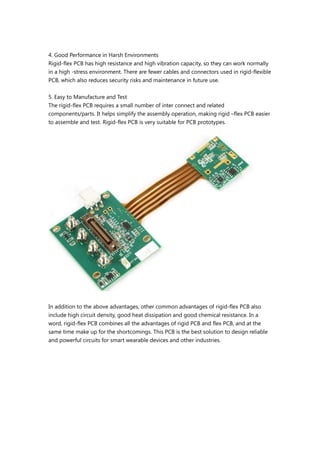
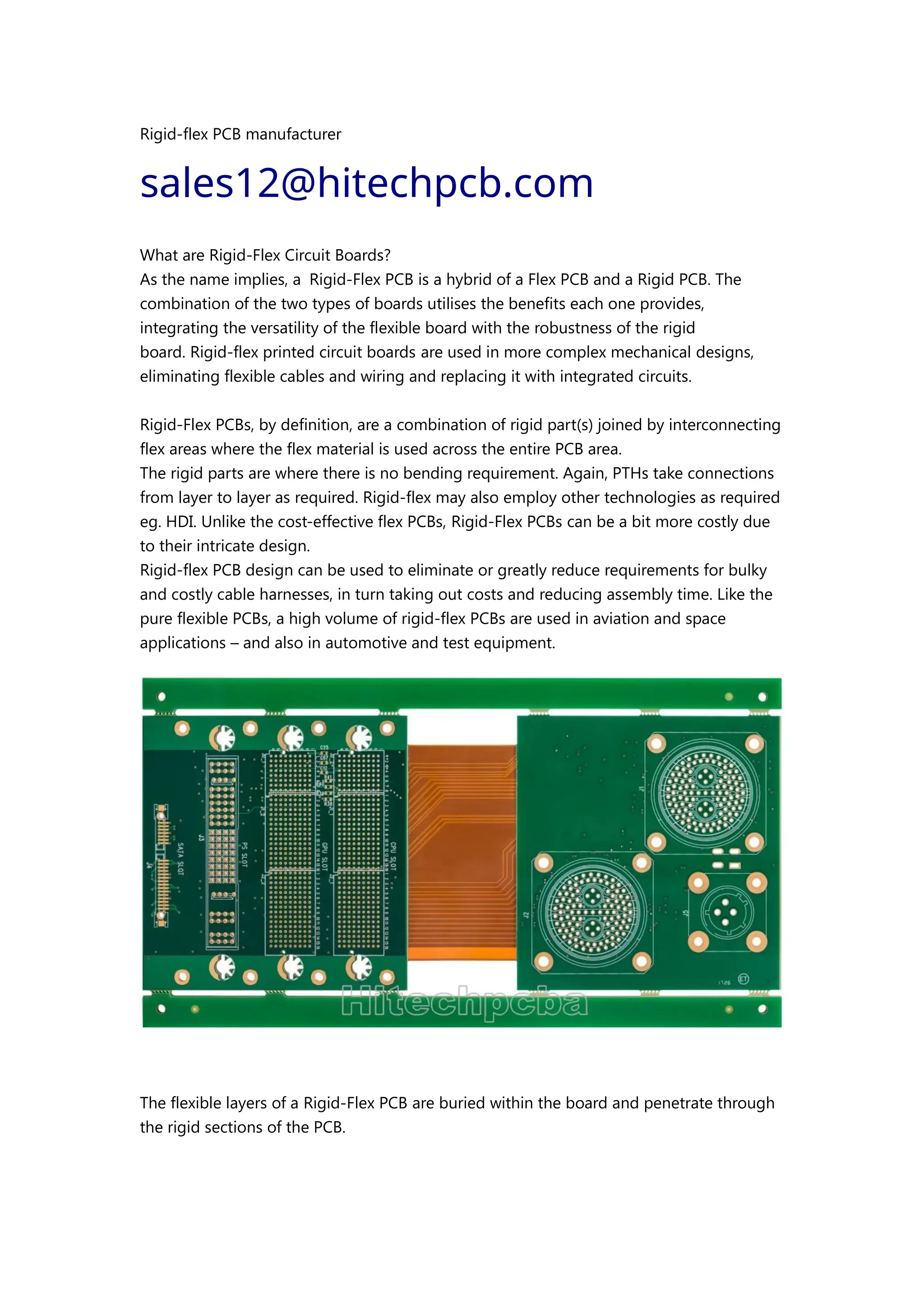
As the name implies, a Rigid-Flex PCB is a hybrid of a Flex PCB and a Rigid PCB. The
combination of the two types of boards utilises the benefits each one provides,
integrating the versatility of the flexible board with the robustness of the rigid
board. Rigid-flex printed circuit boards are used in more complex mechanical designs,
eliminating flexible cables and wiring and replacing it with integrated circuits.
Rigid-Flex PCBs, by definition, are a combination of rigid part(s) joined by interconnecting
flex areas where the flex material is used across the entire PCB area.
The rigid parts are where there is no bending requirement. Again, PTHs take connections
from layer to layer as required. Rigid-flex may also employ other technologies as required
eg. HDI. Unlike the cost-effective flex PCBs, Rigid-Flex PCBs can be a bit more costly due
to their intricate design.
Rigid-flex PCB design can be used to eliminate or greatly reduce requirements for bulky
and costly cable harnesses, in turn taking out costs and reducing assembly time. Like the
pure flexible PCBs, a high volume of rigid-flex PCBs are used in aviation and space
applications – and also in automotive and test equipment.
The flexible layers of a Rigid-Flex PCB are buried within the board and penetrate through
the rigid sections of the PCB.
The trend to miniaturization in electronics continues. Integrated circuit board solutions
are becoming more and more popular as a means of efficiently utilizing the even smaller
casing volume in all three dimensions.
A rigid-flex printed circuit board is unique as the rigid part of the circuitry can be placed
directly into the application. Then, the flexible section can be bent and even folded to fit
around components to make another direct connection. This aspect ensures a reliable
connection to parts for higher performance.
Some of the most common products that incorporate rigid-flex PCBs in their design
include laptop computers, smartphones, and wearable devices due to the bending
capabilities of rigid-flex.
Rigid-flex pcb boards are PCBs that have Flexible PCBs (FPC) and Rigid PCBs on the same
board, which are commonly employed to save space, remove wiring assemblies and can
also be welded with complex components. Combining other higher technology boards,
such as HDI, as a part of its packaging, is also a common design.
Rigid Flex PCB design
The designs of Rigid Flex PCBs are a little more complex as these boards are designed in
3D, which allows the board to be folded or twisted to create the desired shape for the
product. Designing a board in 3D means they can offer greater spatial efficiency and can
subsequently be used in special instances where space and weight reduction may be
necessary, such as in medical devices. By being able to design in three dimensions
designers can twist, fold and roll the flexible board substrates to achieve their desired
shape for the final application's package.
Rigid Flex PCBs are usually thinner than other boards, meaning it’s a great option for any
thin or light packaging needs your products may have. With thin copper layers and
adhesive-less laminates, it’s a great small, thin and light solution for your circuit design
needs.
Rigid-Flex PCBs Fabrication Applications:
Rigid-Flex PCBs offer a wide array of applications, ranging from smart devices to cell
phones and digital cameras. Increasingly, rigid-flex board fabrication has been used in
medical devices such as pacemakers for their space and weight reduction capabilities. The
same advantages for rigid-flex PCB usage can be applied to smart control systems.
In consumer products, rigid-flex doesn't just maximize space and weight but greatly
improves reliability, eliminating many needs for solder joints and delicate, fragile wiring
that are prone to connection issues. These are just some examples, but Rigid-Flex
PCBs can be used to benefit nearly all advanced electrical applications including testing
equipment, tools and automobiles.
Rigid-Flex PCB and Its Production Process
The development of FPC and PCB has spawned a new product that is called rigid-flex
PCB. Therefore, rigid- flex PCB is according to the relevant process requirements and
through the lamination process to combine rigid board and flex board to form a circuit
board with FPC characteristics and PCB characteristics.
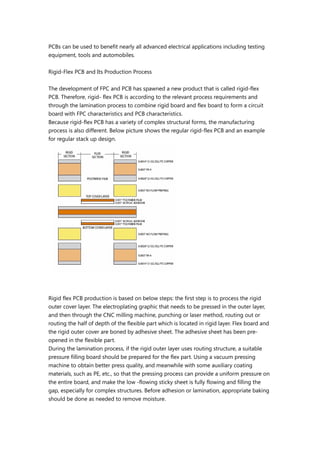
Because rigid-flex PCB has a variety of complex structural forms, the manufacturing
process is also different. Below picture shows the regular rigid-flex PCB and an example
for regular stack up design.
Rigid flex PCB production is based on below steps: the first step is to process the rigid
outer cover layer. The electroplating graphic that needs to be pressed in the outer layer,
and then through the CNC milling machine, punching or laser method, routing out or
routing the half of depth of the flexible part which is located in rigid layer. Flex board and
the rigid outer cover are boned by adhesive sheet. The adhesive sheet has been pre-
opened in the flexible part.
During the lamination process, if the rigid outer layer uses routing structure, a suitable
pressure filling board should be prepared for the flex part. Using a vacuum pressing
machine to obtain better press quality, and meanwhile with some auxiliary coating
materials, such as PE, etc., so that the pressing process can provide a uniform pressure on
the entire board, and make the low -flowing sticky sheet is fully flowing and filling the
gap, especially for complex structures. Before adhesion or lamination, appropriate baking
should be done as needed to remove moisture.
After lamination, the rigid- flex PCB can use a through hole treatment process which is
similar to a multi-layer rigid board, the different part is remove drilling dirt. The method
of removing drilling dirt depends on what materials used. Like the rigid board, drilling the
hole after fully baking, and then use the plasma etching process to remove the residue in
the hole wall. Before the plasma is treated, bake is also needed to remove water vapor.
Caval polyesterness is generally recommended to not exceed 13um. The pore -plating
process of conventional rigid board can be used, but the specific process parameters of
the electroplating should be determined according to the reliability test data of the pores.
The next process is similar to the multi -layer rigid board. The outer layer etching,
covering membrane (welded film), surface treatment, etc. can be used in similar
processes. When making outline of the rigid-flex PCB, remove the filling board in the
flexible part or depth control rigid outer cover in the flexible area can be formed into a
rigid-flex PCB.
Careful consideration of Rigid-Flex solutions and a proper assessment of the available
options at the early stages in the rigid-flex PCB design phase will return significant
benefits. The Rigid-Flex PCBs fabricator must be involved early in the design process to
ensure the design and fab portions are both in coordination and to account for final
product variations.
The Rigid-Flex manufacturing phase is also more complex and time-consuming than rigid
board fabrication. All the flexible components of the Rigid-Flex assembly have completely
different handling, etching, and soldering processes than rigid FR4 boards.
Benefits of Rigid Flex PCB
Space requirements can be minimized by applying 3D
By removing the need for connectors and cables between the individual rigid parts the
board size and overall system weight can be reduced.
By maximizing space, there is often a lower count in parts.
Less solder joints assure higher connection reliability.
Handling during assembly is easier in comparison with flexible boards.
Simplified PCB assembly processes.
Integrated ZIF contacts provide simple modular interfaces to the system environment.
Test conditions are simplified. A complete test prior to installation becomes possible.
Logistical and assembly costs are significantly reduced with flex-rigid boards.
It is possible to increase the complexity of mechanical designs, which also improves the
degree of freedom for optimized housing solutions.
Rigid Flex PCB Fabrication Applications
Rigid flexible PCBs offer a wide array of applications, ranging from military weaponry and
aerospace systems to cell phones and digital cameras. Increasingly, rigid flex board
fabrication has been used in medical devices such as pacemakers for their space and
weight reduction capabilities. The same advantages for rigid flex PCB usage can be
applied to military weaponry and weapon control systems
In consumer products, rigid flex doesn't just maximize space and weight but greatly
improves reliability, eliminating many needs for solder joints and delicate, fragile wiring
that are prone to connection issues. These are just some examples, but rigid flex PCBs
can be used to benefit nearly all advanced electrical applications including testing
equipment, tools and automobiles.
Available structures for rigid flex PCB
There are numerous, different structures available. The more common ones are defined
below:
Traditional rigid flex construction (IPC-6013 type 4) Multilayer rigid and flexible circuit
combination containing three or more layers with plated through holes.
Asymmetrical rigid flex construction, where the FPC is situated on the outer layer of the
rigid construction. Containing three or more layers with plated through holes.
Multilayer rigid flex construction with buried / blind via (microvia) as part of the rigid
construction. 2 layers of microvia are achievable. Construction may also include two rigid
structures as part of a homogeneous build.
Rigid Flex Printed Circuit Board Manufacturer
Rigid flex printed circuit boards (PCBs) are manufactured by combining rigid and flexible
board technologies. These circuit boards are made up of multiple flexible circuit inner
layers. An epoxy pre-preg bonding film is used to attach together these inner layers. The
key benefit of these boards is that they are a combination of the best quality of flexible
and rigid circuit boards. This can have several further benefits as far as stability, assembly,
signal transmission, and overall size of the circuit are concerned. Hitechpcb provides a
number of variants in rigid flex PCBs, which include 4 layer rigid flex with ENIG finish, 10
layer rigid flex with 4 layer flex, 12 layer rigid flex with heat sink, 14 layer rigid flex circuit
boards, and many more. It is one of the leading rigid flex PCB manufacturers.
Every printed circuit board depends on the copper for carrying electricity. We understand
that copper thickness plays a key role in the performance of these circuit boards. Thus, we
allow the customers to choose from a variety of copper thicknesses, including 0.5 OZ, 1.0
OZ, 2.0 OZ, 3.0 OZ, up to 6 OZ. The solder mask helps in improving the aesthetic appeal
of the components on the PCB. We can provide rigid flex printed circuit boards in various
solder mask colors, including white, black, blue, green, red, and Taiyo PSR4000 white. The
PCB can be availed in silkscreen colors – black and white.
Rigid flex printed circuit boards have minimal space requirements that are optimized by
3D application. These circuit boards require no cables or connectors between the rigid
parts. This helps reduce the board size, as well as overall system weight. These lesser
solder joints also help assure high connectivity. Additionally, these boards have ZIF
contacts that are integrated. These contacts help simplify the system interfacing. This 4
layer rigid flex PCB and other printed circuit boards are vacuum packed during the transit.
This helps us assure the quality, as well as working condition of the boards.
The Disadvantage and Advantage of Rigid-Flex PCB
Rigid-flex PCB has many production processes with the characteristic of superior difficulty
in production and high defect rate. Its biggest disadvantage is that the price is more
expensive than flex PCB or rigid PCB and long production cycle. Another disadvantage is
that both SMT and furnaces may need to use carrier to support the flex PCB which
virtually increases the SMT cost.
One of the key features of rigid-flex PCB is the thin profile and changeable shape, making
it an ideal solution for ultra -thin and ultra -light packaging. Although the rigid flex
PCB may be more expensive in design and manufacturing, they do have many
advantages and can solve many problems in traditional hardboard technology.
1. Small Size and Flexible Shape
The rigid- flex PCB is easier to install more components in smaller space, because they
can change the shape according to a specific contour. This technology will reduce the size
and weight of the final product and the overall system cost. At the same time, the
compact shape of rigid flex PCB makes it the best choice for fine lines and high -density
circuits in HDI technology.
2. Customized for Different Applications
Rigid-flex PCB has various packages, which can be customized for the application of many
industries such as aerospace, military, medical equipment and consumer electronics. They
can customize the size and shape to adapt to the shell design and 3D design, which
provides designers with more possibilities to meet different requirements in specific
applications.
3. Better Mechanical Stability
The stability of the rigid board and the flexibility of the flexible board form the stable
structure of the entire packaging, while retaining the reliability and flexibility required for
small space installation.
4. Good Performance in Harsh Environments
Rigid-flex PCB has high resistance and high vibration capacity, so they can work normally
in a high -stress environment. There are fewer cables and connectors used in rigid-flexible
PCB, which also reduces security risks and maintenance in future use.
5. Easy to Manufacture and Test
The rigid-flex PCB requires a small number of inter connect and related
components/parts. It helps simplify the assembly operation, making rigid –flex PCB easier
to assemble and test. Rigid-flex PCB is very suitable for PCB prototypes.
In addition to the above advantages, other common advantages of rigid-flex PCB also
include high circuit density, good heat dissipation and good chemical resistance. In a
word, rigid-flex PCB combines all the advantages of rigid PCB and flex PCB, and at the
same time make up for the shortcomings. This PCB is the best solution to design reliable
and powerful circuits for smart wearable devices and other industries.

Rigid-flex PCB factory manufacturer.docx

  • 1.
    Rigid-flex PCB manufacturer sales12@hitechpcb.com Whatare Rigid-Flex Circuit Boards? As the name implies, a Rigid-Flex PCB is a hybrid of a Flex PCB and a Rigid PCB. The combination of the two types of boards utilises the benefits each one provides, integrating the versatility of the flexible board with the robustness of the rigid board. Rigid-flex printed circuit boards are used in more complex mechanical designs, eliminating flexible cables and wiring and replacing it with integrated circuits. Rigid-Flex PCBs, by definition, are a combination of rigid part(s) joined by interconnecting flex areas where the flex material is used across the entire PCB area. The rigid parts are where there is no bending requirement. Again, PTHs take connections from layer to layer as required. Rigid-flex may also employ other technologies as required eg. HDI. Unlike the cost-effective flex PCBs, Rigid-Flex PCBs can be a bit more costly due to their intricate design. Rigid-flex PCB design can be used to eliminate or greatly reduce requirements for bulky and costly cable harnesses, in turn taking out costs and reducing assembly time. Like the pure flexible PCBs, a high volume of rigid-flex PCBs are used in aviation and space applications – and also in automotive and test equipment. The flexible layers of a Rigid-Flex PCB are buried within the board and penetrate through the rigid sections of the PCB.
  • 2.
    The trend tominiaturization in electronics continues. Integrated circuit board solutions are becoming more and more popular as a means of efficiently utilizing the even smaller casing volume in all three dimensions. A rigid-flex printed circuit board is unique as the rigid part of the circuitry can be placed directly into the application. Then, the flexible section can be bent and even folded to fit around components to make another direct connection. This aspect ensures a reliable connection to parts for higher performance. Some of the most common products that incorporate rigid-flex PCBs in their design include laptop computers, smartphones, and wearable devices due to the bending capabilities of rigid-flex. Rigid-flex pcb boards are PCBs that have Flexible PCBs (FPC) and Rigid PCBs on the same board, which are commonly employed to save space, remove wiring assemblies and can also be welded with complex components. Combining other higher technology boards, such as HDI, as a part of its packaging, is also a common design. Rigid Flex PCB design The designs of Rigid Flex PCBs are a little more complex as these boards are designed in 3D, which allows the board to be folded or twisted to create the desired shape for the product. Designing a board in 3D means they can offer greater spatial efficiency and can subsequently be used in special instances where space and weight reduction may be necessary, such as in medical devices. By being able to design in three dimensions designers can twist, fold and roll the flexible board substrates to achieve their desired shape for the final application's package. Rigid Flex PCBs are usually thinner than other boards, meaning it’s a great option for any thin or light packaging needs your products may have. With thin copper layers and adhesive-less laminates, it’s a great small, thin and light solution for your circuit design needs. Rigid-Flex PCBs Fabrication Applications: Rigid-Flex PCBs offer a wide array of applications, ranging from smart devices to cell phones and digital cameras. Increasingly, rigid-flex board fabrication has been used in medical devices such as pacemakers for their space and weight reduction capabilities. The same advantages for rigid-flex PCB usage can be applied to smart control systems. In consumer products, rigid-flex doesn't just maximize space and weight but greatly improves reliability, eliminating many needs for solder joints and delicate, fragile wiring that are prone to connection issues. These are just some examples, but Rigid-Flex
  • 3.
    PCBs can beused to benefit nearly all advanced electrical applications including testing equipment, tools and automobiles. Rigid-Flex PCB and Its Production Process The development of FPC and PCB has spawned a new product that is called rigid-flex PCB. Therefore, rigid- flex PCB is according to the relevant process requirements and through the lamination process to combine rigid board and flex board to form a circuit board with FPC characteristics and PCB characteristics. Because rigid-flex PCB has a variety of complex structural forms, the manufacturing process is also different. Below picture shows the regular rigid-flex PCB and an example for regular stack up design. Rigid flex PCB production is based on below steps: the first step is to process the rigid outer cover layer. The electroplating graphic that needs to be pressed in the outer layer, and then through the CNC milling machine, punching or laser method, routing out or routing the half of depth of the flexible part which is located in rigid layer. Flex board and the rigid outer cover are boned by adhesive sheet. The adhesive sheet has been pre- opened in the flexible part. During the lamination process, if the rigid outer layer uses routing structure, a suitable pressure filling board should be prepared for the flex part. Using a vacuum pressing machine to obtain better press quality, and meanwhile with some auxiliary coating materials, such as PE, etc., so that the pressing process can provide a uniform pressure on the entire board, and make the low -flowing sticky sheet is fully flowing and filling the gap, especially for complex structures. Before adhesion or lamination, appropriate baking should be done as needed to remove moisture.
  • 4.
    After lamination, therigid- flex PCB can use a through hole treatment process which is similar to a multi-layer rigid board, the different part is remove drilling dirt. The method of removing drilling dirt depends on what materials used. Like the rigid board, drilling the hole after fully baking, and then use the plasma etching process to remove the residue in the hole wall. Before the plasma is treated, bake is also needed to remove water vapor. Caval polyesterness is generally recommended to not exceed 13um. The pore -plating process of conventional rigid board can be used, but the specific process parameters of the electroplating should be determined according to the reliability test data of the pores. The next process is similar to the multi -layer rigid board. The outer layer etching, covering membrane (welded film), surface treatment, etc. can be used in similar processes. When making outline of the rigid-flex PCB, remove the filling board in the flexible part or depth control rigid outer cover in the flexible area can be formed into a rigid-flex PCB. Careful consideration of Rigid-Flex solutions and a proper assessment of the available options at the early stages in the rigid-flex PCB design phase will return significant benefits. The Rigid-Flex PCBs fabricator must be involved early in the design process to ensure the design and fab portions are both in coordination and to account for final product variations. The Rigid-Flex manufacturing phase is also more complex and time-consuming than rigid board fabrication. All the flexible components of the Rigid-Flex assembly have completely different handling, etching, and soldering processes than rigid FR4 boards.
  • 5.
    Benefits of RigidFlex PCB Space requirements can be minimized by applying 3D By removing the need for connectors and cables between the individual rigid parts the board size and overall system weight can be reduced. By maximizing space, there is often a lower count in parts. Less solder joints assure higher connection reliability. Handling during assembly is easier in comparison with flexible boards. Simplified PCB assembly processes. Integrated ZIF contacts provide simple modular interfaces to the system environment. Test conditions are simplified. A complete test prior to installation becomes possible. Logistical and assembly costs are significantly reduced with flex-rigid boards. It is possible to increase the complexity of mechanical designs, which also improves the degree of freedom for optimized housing solutions. Rigid Flex PCB Fabrication Applications Rigid flexible PCBs offer a wide array of applications, ranging from military weaponry and aerospace systems to cell phones and digital cameras. Increasingly, rigid flex board fabrication has been used in medical devices such as pacemakers for their space and weight reduction capabilities. The same advantages for rigid flex PCB usage can be applied to military weaponry and weapon control systems In consumer products, rigid flex doesn't just maximize space and weight but greatly improves reliability, eliminating many needs for solder joints and delicate, fragile wiring that are prone to connection issues. These are just some examples, but rigid flex PCBs can be used to benefit nearly all advanced electrical applications including testing equipment, tools and automobiles.
  • 6.
    Available structures forrigid flex PCB There are numerous, different structures available. The more common ones are defined below: Traditional rigid flex construction (IPC-6013 type 4) Multilayer rigid and flexible circuit combination containing three or more layers with plated through holes. Asymmetrical rigid flex construction, where the FPC is situated on the outer layer of the rigid construction. Containing three or more layers with plated through holes. Multilayer rigid flex construction with buried / blind via (microvia) as part of the rigid construction. 2 layers of microvia are achievable. Construction may also include two rigid structures as part of a homogeneous build. Rigid Flex Printed Circuit Board Manufacturer Rigid flex printed circuit boards (PCBs) are manufactured by combining rigid and flexible board technologies. These circuit boards are made up of multiple flexible circuit inner layers. An epoxy pre-preg bonding film is used to attach together these inner layers. The key benefit of these boards is that they are a combination of the best quality of flexible and rigid circuit boards. This can have several further benefits as far as stability, assembly, signal transmission, and overall size of the circuit are concerned. Hitechpcb provides a number of variants in rigid flex PCBs, which include 4 layer rigid flex with ENIG finish, 10 layer rigid flex with 4 layer flex, 12 layer rigid flex with heat sink, 14 layer rigid flex circuit boards, and many more. It is one of the leading rigid flex PCB manufacturers.
  • 7.
    Every printed circuitboard depends on the copper for carrying electricity. We understand that copper thickness plays a key role in the performance of these circuit boards. Thus, we allow the customers to choose from a variety of copper thicknesses, including 0.5 OZ, 1.0 OZ, 2.0 OZ, 3.0 OZ, up to 6 OZ. The solder mask helps in improving the aesthetic appeal of the components on the PCB. We can provide rigid flex printed circuit boards in various solder mask colors, including white, black, blue, green, red, and Taiyo PSR4000 white. The PCB can be availed in silkscreen colors – black and white. Rigid flex printed circuit boards have minimal space requirements that are optimized by 3D application. These circuit boards require no cables or connectors between the rigid parts. This helps reduce the board size, as well as overall system weight. These lesser solder joints also help assure high connectivity. Additionally, these boards have ZIF contacts that are integrated. These contacts help simplify the system interfacing. This 4 layer rigid flex PCB and other printed circuit boards are vacuum packed during the transit. This helps us assure the quality, as well as working condition of the boards. The Disadvantage and Advantage of Rigid-Flex PCB Rigid-flex PCB has many production processes with the characteristic of superior difficulty in production and high defect rate. Its biggest disadvantage is that the price is more expensive than flex PCB or rigid PCB and long production cycle. Another disadvantage is that both SMT and furnaces may need to use carrier to support the flex PCB which virtually increases the SMT cost. One of the key features of rigid-flex PCB is the thin profile and changeable shape, making it an ideal solution for ultra -thin and ultra -light packaging. Although the rigid flex PCB may be more expensive in design and manufacturing, they do have many advantages and can solve many problems in traditional hardboard technology. 1. Small Size and Flexible Shape The rigid- flex PCB is easier to install more components in smaller space, because they can change the shape according to a specific contour. This technology will reduce the size and weight of the final product and the overall system cost. At the same time, the compact shape of rigid flex PCB makes it the best choice for fine lines and high -density circuits in HDI technology.
  • 8.
    2. Customized forDifferent Applications Rigid-flex PCB has various packages, which can be customized for the application of many industries such as aerospace, military, medical equipment and consumer electronics. They can customize the size and shape to adapt to the shell design and 3D design, which provides designers with more possibilities to meet different requirements in specific applications. 3. Better Mechanical Stability The stability of the rigid board and the flexibility of the flexible board form the stable structure of the entire packaging, while retaining the reliability and flexibility required for small space installation.
  • 9.
    4. Good Performancein Harsh Environments Rigid-flex PCB has high resistance and high vibration capacity, so they can work normally in a high -stress environment. There are fewer cables and connectors used in rigid-flexible PCB, which also reduces security risks and maintenance in future use. 5. Easy to Manufacture and Test The rigid-flex PCB requires a small number of inter connect and related components/parts. It helps simplify the assembly operation, making rigid –flex PCB easier to assemble and test. Rigid-flex PCB is very suitable for PCB prototypes. In addition to the above advantages, other common advantages of rigid-flex PCB also include high circuit density, good heat dissipation and good chemical resistance. In a word, rigid-flex PCB combines all the advantages of rigid PCB and flex PCB, and at the same time make up for the shortcomings. This PCB is the best solution to design reliable and powerful circuits for smart wearable devices and other industries.