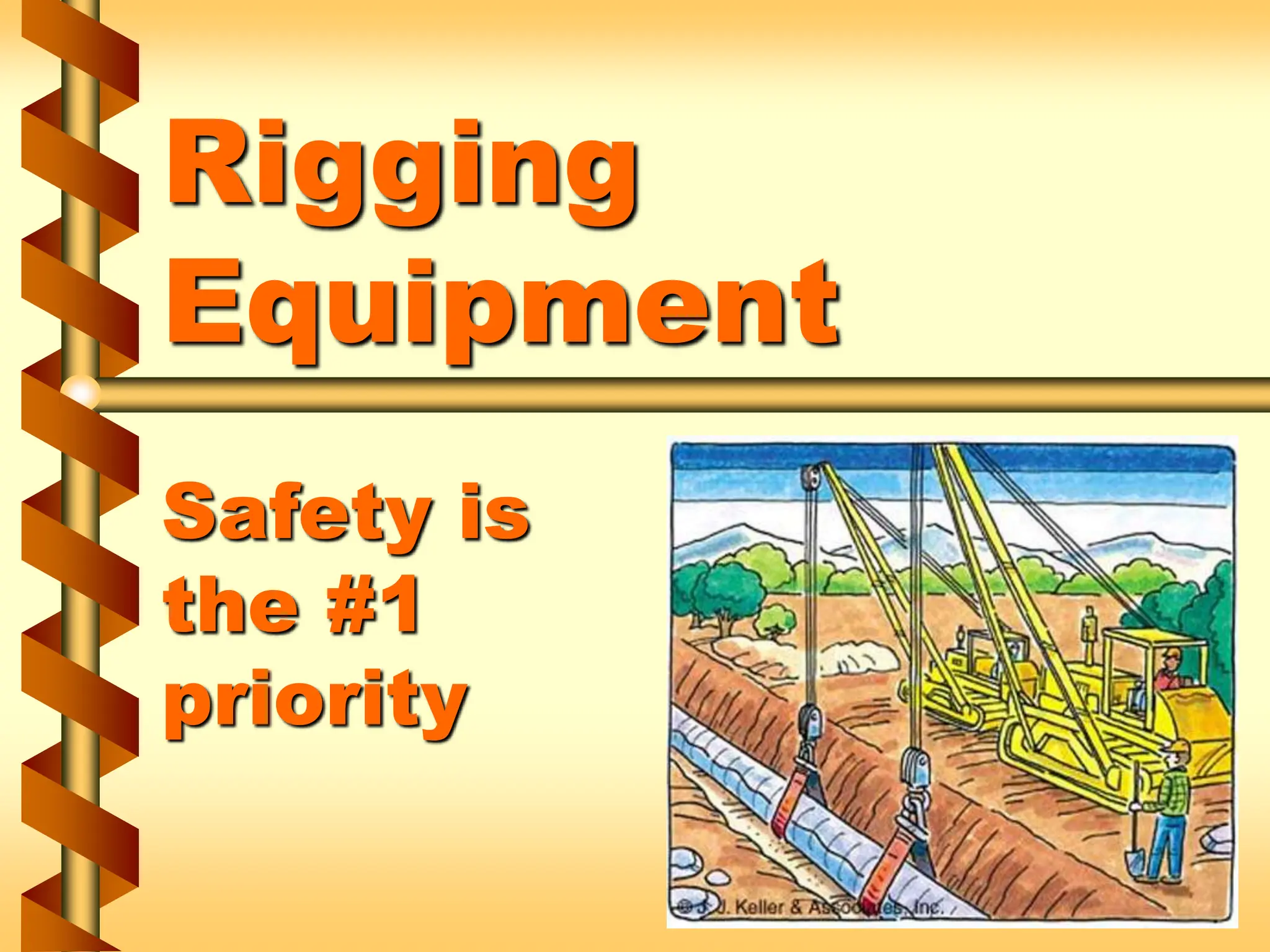
Rigging
Equipment
Safety is
the #1
priority
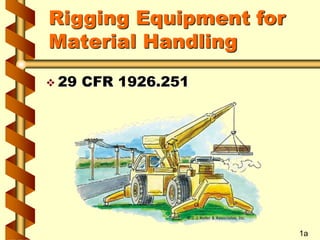
Rigging Equipment for
Material Handling
 29 CFR 1926.251
1a
Rigging equipment
 Inspect rigging equipment:
• Before each shift
• As necessary during use
 Remove rigging equipment:
• If defective
• When not in use
2a
Safe working load
 Recommended safe load
 Mark custom lifting accessories
 Proof test to 125 percent
2b
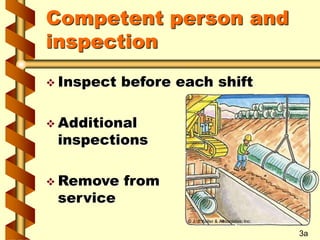
Competent person and
inspection
 Inspect before each shift
 Additional
inspections
 Remove from
service
3a
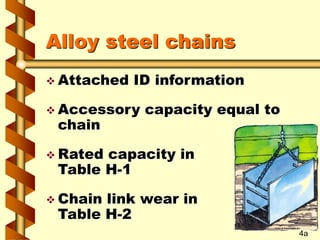
Alloy steel chains
 Attached ID information
 Accessory capacity equal to
chain
 Rated capacity in
Table H-1
 Chain link wear in
Table H-2
4a
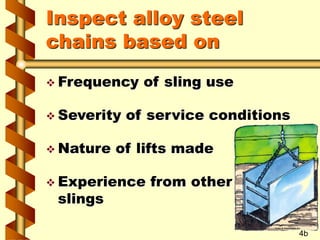
Inspect alloy steel
chains based on
 Frequency of sling use
 Severity of service conditions
 Nature of lifts made
 Experience from other
slings
4b
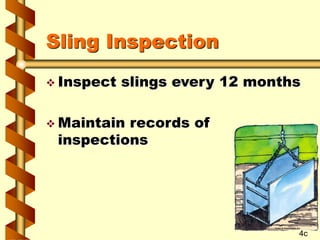
Sling Inspection
 Inspect slings every 12 months
 Maintain records of
inspections
4c
Wire rope
 Safe working load
 Protruding ends of stands
 Don’t use knots
 Visible broken wires
5a
U-bolts
 U-bolts use Table H-20
 “U” section
6a
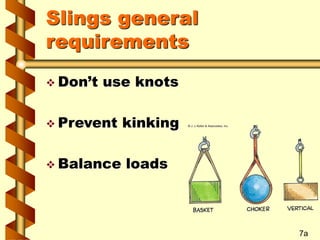
Slings general
requirements
 Don’t use knots
 Prevent kinking
 Balance loads
7a
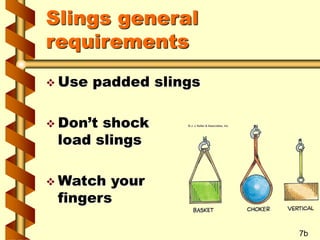
Slings general
requirements
 Use padded slings
 Don’t shock
load slings
 Watch your
fingers
7b
Sling attachments and
safe operation
 Fiber wire core rope slings
 Nonfiber core wire rope slings
 Proof test
8a
Natural or synthetic
fiber rope slings
 Table H-15, 16, 17, and 18 apply
 Follow mfg. recommendations
 Don’t use knots
 –20 degrees to 180 degrees
9a
Splicing natural or
synthetic slings
 Requirements for full tucks
 Don’t use knots
 Don’t use clamps
 Watch for sharp edges
10a
Remove natural or
synthetic slings
 Abnormal wear
 Powdered fiber
 Broken or cut fibers
10b
Remove natural or
synthetic slings
 Variations in size of strands
 Discoloration or rotting
 Distortion of hardware
10c
Marking/coding
synthetic webbing
 Name of manufacturer
 Rated capacity
 Type of material
11a
Synthetic webbing
requirements
 Don’t exceed capacity
 Uniform thickness
 Fittings as strong as sling
 Use stitching to attach fittings
11b
Synthetic webbing
precautions
 Fumes, vapors, sprays, mists,
liquids
 Nylon web slings
11c
Synthetic webbing
precautions
 Polyester and polypropylene
slings
 Aluminum fittings
 Temperature restrictions
11d
Remove synthetic
webbing
 Acid or caustic burns
 Melting or charring
 Snags, punctures, tears
 Distortion of fittings
11e
Shackles and hooks
 Table H-19 for safe working
loads
 Follow the manufacturer’s
recommendations
 Test hooks
12a

Rigging_Equipment_for_Material_Handling_in_Construction.ppt