Rhetoric Speech
of Adolf Gitler
PREPARED BY: SAPARMYRADOV ALLAYAR
INSTRUCTOR GOZEL PIRMUHAMMEDOVA
ABOUT
 A Brilliant Rhetorician, a Monster, or Both?
Monster, killer of the innocent, madman, bully, lunatic, and devil. A justification for a good God
not allowing all people into heaven. The name Adolf Hitler evokes repulsion, distrust, and anger
all over the world. Yet this man persuaded an entire population to follow him into the carnage of
World War II. Hitler’s speech before the German parliament, the Reichstag, on February 20, 1938,
explains why so many Germans were enthralled by this leader. Displaying the qualities of the most
persuasive rhetoricians, Hitler uses logos to builds his arguments, pathos to direct the emotions of
his audience, and ethos to strengthen and confirm each word he utters
HISTORY
 This article failed to meet Insider's editorial standards by omitting some
important context on Hitler's rise to power. Intimidation and violence were
central to his seizing power and imposing a dictatorship. Nor was his oratory
always persuasive. In 1928, Hitler was allowed to campaign freely and his Nazi
party only won 3% of the vote, showing "his speeches had no effect at all," said
Richard J. Evans, a leading historian of Nazi Germany and author of the acclaimed
"Third Reich Trilogy." Reparations from World War I were canceled before Hitler
took power. Indeed, Evans noted that Hitler never won more than 37.4% of the
vote in a free national election.
HISTORY
 One of the world's most influential orators created the largest German political party, conquered a
dozen nations, and slaughtered as many as 21 million people during his brutal 12-year Third Reich.
 In more than 5,000 persuasive speeches, Nazi leader Adolf Hitler bewitched his audiences and
promised them that his empire would reign for a thousand years
 Hitler's rhetoric found a German audience after the onset of the global Great Depression.
 "People were most willing to follow him, because he seemed to have the right answers" during
economic upheaval, a historian said.
 Hitler's oratory was not always persuasive. He also used intimidation and violence to seize power.
Hitler's Speech Rhetorical Analysis
He used ethos when he talked he
would start in a lower voice and
get higher while he made it sound
like was really looking out for the
German people. He wanted to gain
their trust
RHETORICAL SPEECH
RHETORICAL SPEECH
 Joseph Goebbels, the Nazi propaganda minister, wrote in his diary that Hitler was known
to write his own speeches and edit them up to five times.
 He would "work deep into the night, several evenings running, occupying three
secretaries taking dictation straight into the typewriters before carefully correcting the
drafts," according to British historian Ian Kershaw.
 "He simply did not want to rely on anyone to write his speeches," Loebs told Business
Insider. "For Adolf Hitler, public speaking was so important that he would never trust
anyone to write his speeches for him."
 Loebs also noted that Winston Churchill preferred to write his own speeches as well,
something rare among leaders of the time (and today).
HITLER SPEECH IN 1939
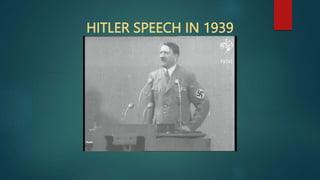
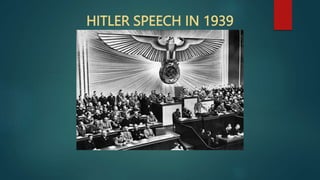
 On 30 January 1939, Nazi German dictator Adolf Hitler gave a speech in
the Kroll Opera House to the Reichstag delegates, which is best known for
the prediction he made that "the annihilation of the Jewish r
 Hitler accused Jews of having "nothing of their own, except for political and
sanitary diseases" and being parasites on the German nation, turning
Germans into "beggars in their own country". He asserted there had to be an
end to the misconception that "the good Lord had meant the Jewish nation to
live off the body and productive work of other nations", or else the Jews
would "succumb to a crisis of unimaginable severity“. Hitler claimed that the
Jews were trying to incite "millions among the masses of people into a
conflict that is utterly senseless for them and serves only Jewish
interests“. Hitler then arrived at his main pointace in Europe" would ensue if
another world war were to occur.
HITLER SPEECH IN 1939
 Adolf Hitler dealt with several rhetorically difficult situations in the years leading up
to Word War II. One was his announcement of the invasion of Poland in September
1939. This should not have been a well-received message—public sentiment and
general domestic conditions did not create a favorable environment for another
war—yet it was. The same phenomenon had occurred five years earlier, after the
Night of Long Knives, in July 1934. This analysis looks at the rhetorical strategies
Hitler employed in both speeches which contributed to his success, specifically in
the context of what Kenneth Burke refers to as Hitler’s “unifying device.” I conclude
by determining that Hitler’s use of several rhetorical strategies detailed by figures
such as Perelman and Olbrechts-Tyteca, Althusser, Koutsantoni, and Roberts-Miller
were key to his rhetorical success.
HITLER SPEECH IN 1939
RHETORICAL SPEECH SKILL
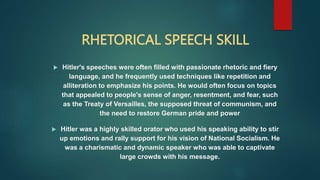
 Hitler's speeches were often filled with passionate rhetoric and fiery
language, and he frequently used techniques like repetition and
alliteration to emphasize his points. He would often focus on topics
that appealed to people's sense of anger, resentment, and fear, such
as the Treaty of Versailles, the supposed threat of communism, and
the need to restore German pride and power
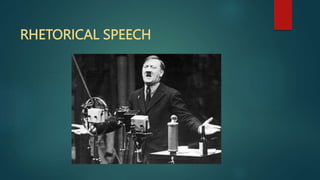
 Hitler was a highly skilled orator who used his speaking ability to stir
up emotions and rally support for his vision of National Socialism. He
was a charismatic and dynamic speaker who was able to captivate
large crowds with his message.
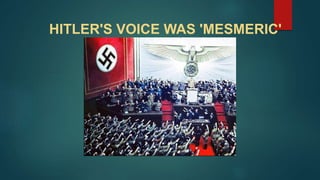
HITLER'S VOICE WAS 'MESMERIC'
 In Ron Rosenbaum's book "Explaining Hitler," French-American
novelist George Steiner describes the Nazi leader's voice as
overwhelmingly powerful and "spellbinding."
 "I was born in 1929, so from '33 on my earliest memories are sitting in
the kitchen hearing The Voice [of Hitler] on the radio," Steiner shared
with Rosenbaum.
 "It's a hard thing to describe, but the voice itself was mesmeric ... The
amazing thing is that the body comes through on the radio. I can't put it
any other way. You feel you're following the gestures," Steiner said.
 "In the German language, Hitler drew on a kind of rhetorical power
which — in a way is perhaps a little bit peculiar to German — allies
highly abstract concepts with political, physical violence in a most
unusual way. And Hitler was easily a genius at that, absolutely no
doubt about it."
HITLER'S VOICE WAS 'MESMERIC'
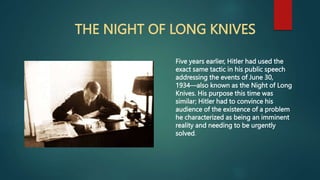
THE NIGHT OF LONG KNIVES
Five years earlier, Hitler had used the
exact same tactic in his public speech
addressing the events of June 30,
1934—also known as the Night of Long
Knives. His purpose this time was
similar; Hitler had to convince his
audience of the existence of a problem
he characterized as being an imminent
reality and needing to be urgently
solved.
THANKS FOR
YOUR ATTENTION!

Rhetoricc_Speeeech_Hitttttler_Adolf.pptx

  • 1.
    Rhetoric Speech of AdolfGitler PREPARED BY: SAPARMYRADOV ALLAYAR INSTRUCTOR GOZEL PIRMUHAMMEDOVA
  • 2.
    ABOUT  A BrilliantRhetorician, a Monster, or Both? Monster, killer of the innocent, madman, bully, lunatic, and devil. A justification for a good God not allowing all people into heaven. The name Adolf Hitler evokes repulsion, distrust, and anger all over the world. Yet this man persuaded an entire population to follow him into the carnage of World War II. Hitler’s speech before the German parliament, the Reichstag, on February 20, 1938, explains why so many Germans were enthralled by this leader. Displaying the qualities of the most persuasive rhetoricians, Hitler uses logos to builds his arguments, pathos to direct the emotions of his audience, and ethos to strengthen and confirm each word he utters
  • 3.
    HISTORY  This articlefailed to meet Insider's editorial standards by omitting some important context on Hitler's rise to power. Intimidation and violence were central to his seizing power and imposing a dictatorship. Nor was his oratory always persuasive. In 1928, Hitler was allowed to campaign freely and his Nazi party only won 3% of the vote, showing "his speeches had no effect at all," said Richard J. Evans, a leading historian of Nazi Germany and author of the acclaimed "Third Reich Trilogy." Reparations from World War I were canceled before Hitler took power. Indeed, Evans noted that Hitler never won more than 37.4% of the vote in a free national election.
  • 4.
    HISTORY  One ofthe world's most influential orators created the largest German political party, conquered a dozen nations, and slaughtered as many as 21 million people during his brutal 12-year Third Reich.  In more than 5,000 persuasive speeches, Nazi leader Adolf Hitler bewitched his audiences and promised them that his empire would reign for a thousand years  Hitler's rhetoric found a German audience after the onset of the global Great Depression.  "People were most willing to follow him, because he seemed to have the right answers" during economic upheaval, a historian said.  Hitler's oratory was not always persuasive. He also used intimidation and violence to seize power.
  • 5.
    Hitler's Speech RhetoricalAnalysis He used ethos when he talked he would start in a lower voice and get higher while he made it sound like was really looking out for the German people. He wanted to gain their trust
  • 6.
  • 7.
    RHETORICAL SPEECH  JosephGoebbels, the Nazi propaganda minister, wrote in his diary that Hitler was known to write his own speeches and edit them up to five times.  He would "work deep into the night, several evenings running, occupying three secretaries taking dictation straight into the typewriters before carefully correcting the drafts," according to British historian Ian Kershaw.  "He simply did not want to rely on anyone to write his speeches," Loebs told Business Insider. "For Adolf Hitler, public speaking was so important that he would never trust anyone to write his speeches for him."  Loebs also noted that Winston Churchill preferred to write his own speeches as well, something rare among leaders of the time (and today).
  • 8.
  • 9.
    HITLER SPEECH IN1939  On 30 January 1939, Nazi German dictator Adolf Hitler gave a speech in the Kroll Opera House to the Reichstag delegates, which is best known for the prediction he made that "the annihilation of the Jewish r  Hitler accused Jews of having "nothing of their own, except for political and sanitary diseases" and being parasites on the German nation, turning Germans into "beggars in their own country". He asserted there had to be an end to the misconception that "the good Lord had meant the Jewish nation to live off the body and productive work of other nations", or else the Jews would "succumb to a crisis of unimaginable severity“. Hitler claimed that the Jews were trying to incite "millions among the masses of people into a conflict that is utterly senseless for them and serves only Jewish interests“. Hitler then arrived at his main pointace in Europe" would ensue if another world war were to occur.
  • 10.
  • 11.
    HITLER SPEECH IN1939  Adolf Hitler dealt with several rhetorically difficult situations in the years leading up to Word War II. One was his announcement of the invasion of Poland in September 1939. This should not have been a well-received message—public sentiment and general domestic conditions did not create a favorable environment for another war—yet it was. The same phenomenon had occurred five years earlier, after the Night of Long Knives, in July 1934. This analysis looks at the rhetorical strategies Hitler employed in both speeches which contributed to his success, specifically in the context of what Kenneth Burke refers to as Hitler’s “unifying device.” I conclude by determining that Hitler’s use of several rhetorical strategies detailed by figures such as Perelman and Olbrechts-Tyteca, Althusser, Koutsantoni, and Roberts-Miller were key to his rhetorical success.
  • 12.
  • 13.
    RHETORICAL SPEECH SKILL Hitler's speeches were often filled with passionate rhetoric and fiery language, and he frequently used techniques like repetition and alliteration to emphasize his points. He would often focus on topics that appealed to people's sense of anger, resentment, and fear, such as the Treaty of Versailles, the supposed threat of communism, and the need to restore German pride and power  Hitler was a highly skilled orator who used his speaking ability to stir up emotions and rally support for his vision of National Socialism. He was a charismatic and dynamic speaker who was able to captivate large crowds with his message.
  • 14.
    HITLER'S VOICE WAS'MESMERIC'  In Ron Rosenbaum's book "Explaining Hitler," French-American novelist George Steiner describes the Nazi leader's voice as overwhelmingly powerful and "spellbinding."  "I was born in 1929, so from '33 on my earliest memories are sitting in the kitchen hearing The Voice [of Hitler] on the radio," Steiner shared with Rosenbaum.  "It's a hard thing to describe, but the voice itself was mesmeric ... The amazing thing is that the body comes through on the radio. I can't put it any other way. You feel you're following the gestures," Steiner said.  "In the German language, Hitler drew on a kind of rhetorical power which — in a way is perhaps a little bit peculiar to German — allies highly abstract concepts with political, physical violence in a most unusual way. And Hitler was easily a genius at that, absolutely no doubt about it."
  • 15.
  • 16.
    THE NIGHT OFLONG KNIVES Five years earlier, Hitler had used the exact same tactic in his public speech addressing the events of June 30, 1934—also known as the Night of Long Knives. His purpose this time was similar; Hitler had to convince his audience of the existence of a problem he characterized as being an imminent reality and needing to be urgently solved.
  • 17.