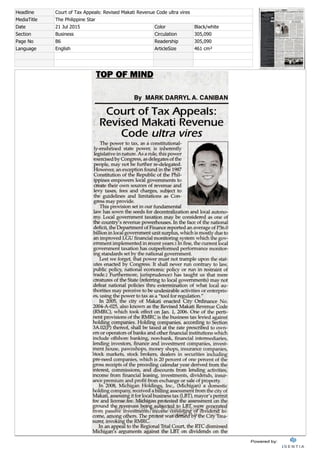
TOP OF MIND
Court of Tax Appeals:
Revised Makati Revenue
Code ultra vires
By MARK DARRYL A. CANIBAN
The power to tax, as a constitutional­
ly­enshrined state power, is inherently
legislative in nature. As a rule, this power
exercised by Congress, as delegates of the
people, may not be further re­delegated.
However, an exception found in the 1987
Constitution of the Republic of the Phil­
ippines empowers local governments to 
create their own sources of revenue and
levy taxes, fees and charges, subject to
the guidelines and limitations as Con­
gress may provide. |
This provision set in our fundamental
 has sown the seeds for decentralization an
my. Local government taxation may be considered as one of
the country's revenue powerhouses. In the face of the national
deficit, the Department of Finance reported an average of P36.0
billion in local government unit surplus, which is mostly due to
an improved LGU financial monitoring system which the gov­
ernment implemented in recent years.l In fine, the current local
government taxation has outperformed performance monitor­
ing standards set by the national government.
Lest we forget, that power must not trample upon the stat­
utes enacted by Congress. It shall never run contrary to law,
public polity, national economic policy or run in restraint of
trade.2 Furthermore, jurisprudences has taught us that mere
creatures of the State (referring to local governments) may not
defeat national policies thru extermination of what local au­
thorities may perceive to be undesirable activities or enterpris­
es, using the power to tax as a "tool for regulation."
In 2005, the city of Makati enacted City Ordinance No.
2004­A­025, also known as the Revised Makati Revenue Code
(RMRC), which took effect on Jan. 1, 2006. One of the perti­
nent provisions of the RMRC is the business tax levied against
holding companies. Holding companies, according to Section
3A.02(P) thereof, shall be taxed at the rate prescribed to own­
ers or operators of banks and other financial institutions which
include offshore banking, non­bank, financial intermediaries,
lending investors, finance and investment companies, invest­
ment house, pawnshops, money shops, insurance companies,
stock markets, stock brokers, dealers in securities including
pre­need companies, which is 20 percent of one percent of the
gross receipts of the preceding calendar year derived from the
interest, commissions, and discounts from lending activities,
income from financial leasing, investments, dividends, insur­
ance premium and profit from exchange or sale of property.
In 2008, Michigan Holdings, Inc., (Michigan) a domestic
holding company, received a billing assessment from the city of
Makati, assessing it for local business tax (LBT), mayor's permit
fee and license fee. Michigan protested the assessment on the
ground there^epu^ lj^e ^ybjgc^Jo geogratejJ
from passive mvesfiiienfe/ihtorne'ronstetiij^;<5r fevideha In­
come, among others. The protest wa^tftHiecfb^ the City Trea­
surer, invoking the RMRCsurer, invoking the 
In an appeal to the Regional Trial Court, the RTC dismissed
Michigan s arguments against the LBT on dividends on the
Headline Court of Tax Appeals: Revised Makati Revenue Code ultra vires
MediaTitle The Philippine Star
Date 21 Jul 2015 Color Black/white
Section Business Circulation 305,090
Page No B6 Readership 305,090
Language English ArticleSize 461 cm²
ground the appeal was directed not at the tax assessment, but
rather at the validity of the Section 3A.02(P) of the RMRC.
Hence, Michigan appealed the decision of the RTC to the Court
of Tax Appeals (CTA).
The CTA En Banc, in a decision dated June 17,2015, decided
in favor of petitioner Michigan. First, it noted the Local Gov­
ernment Code (LGC) provides a limitation to the taxing pow­
ers of LGUs ­ that the power shall not extend to the levy of
income tax, except those levied on banks and other financial
institutions. Going back to the provisions in the RMRC, it taxed
holding companies with the same tax rates levied on banks
and other financial institutions. The CTA ruled the definition
of "banks and other financial institutions" under the LGC is ex­
clusive and does not include a holding company. Inclusio unius
est exclusio alterius. What the law does not include, it excludes.
The CTA further ruled the business of holding companies is
not of the same class as that of banks and other financial insti­
tutions. As such, there is no reason for tax imposed on banks
and other financial institution to be made applicable to holding
companies.
Second, Section 27(D)(4) of the National Internal Revenue Code
of 1997, as amended (Tax Code), states dividends received by a
domestic corporation from another domestic corporation shall not
be subject to tax. As such, the CTA ruled the RMRC is an ultra vires
exercise of local taxing power, and cannot be given effect without
violating the principle an ordinance can neither amend nor repeal,
but must conform to a statute.
However, in this case, since the prayer of Michigan was to
invalidate the assessment and not to have the ordinance de­
clared unconstitutional, the CTA saw no need to remand the
case back to the RTC, and instead cancelled the assessment is­
sued by the city of Makati. The CTA recognized the doctrine
that a local ordinance may not be subject to a collateral attack,
however, an assessment can be successfully challenged with­
out attacking the ordinance on which it is based.
It is true under corporation law, an ultra vires act by a cor­
Eoration is merely voidable and may be subject to ratification.
Utra vires acts of corporations per se and municipal corpora­
tions like the city of Makati have substantially different effects
­ an ultra vires act by the latter is null and void and may not be
subject to ratification. It acquired no legal effect and conferred
no rights from its inception.
A municipal corporation, unlike a sovereign state, is clothed
with no inherent power of taxation. If granted under a charter
or a statute, and that power when granted is to be construed in
strictissimi juris. As such, in this case, any doubt or ambiguity
must be resolved against the city of Makati. City officials must
keep in mind tax ordinances, though well­meaning, reasonable
ana profitable, must conform to national law. Making sure our
ordinances are legally sound is necessary to protect the city
against vexing suits in the future and likewise encourage busi­
nesses instead of stunting them.
Mark Darryl A. Caniban is a supervisor from the tax group ofR.G.
Manabat & Co. (RGM&Co.), the Philippine member firm of KPMG
International.
This article is for general information purposes only and should
not be considered as professional advice to a specific issue or entity.
The views and opinions expressed herein are those of the author
and do not necessarily represent the views and opinions of KPMG
International or RGM&Co. For comments or inquiries, please email
ph­inquiry@kpmg.com or rgmanabat@knmg.com.
For more information on KPMG in the Philippines, you may visit
www.kpmg.com.ph..
1 DoF Governance and Fiscal Responsibility for Inclusive Growth I 2011
Annual Report." Department of Fiiianpe (DoF)." Department of
15 May 2011. Retrieved from http://www.dof.gov.ph/Wp­content/up­
loads /2011 /05/ DOF­AR20093.pdf
2 Section 130, Local Government Code of 1991.
3 Basco vs. PAGCOR, G.R. No. 91649, May 14,1991 citing US vs. Sanchez,
340 US 42
Headline Court of Tax Appeals: Revised Makati Revenue Code ultra vires
MediaTitle The Philippine Star
Date 21 Jul 2015 Color Black/white
Section Business Circulation 305,090
Page No B6 Readership 305,090
Language English ArticleSize 461 cm²

Revised Makati Revenue Code ultra vires