Bringing it all Together:
Luke Havergal, Richard Cory & Richard Bone
Art by M.C. Escher

(1898-1972)
Copyright©TheMcGraw-HillCompanies,Inc.
Lesson 9: Tone
Tone is the writer’s or speaker’s attitude toward the subject of the passage. Tone may be
communicated through words and details that express particular emotions and that evoke
an emotional response in the reader.
DIRECTIONS: Read the following excerpt from Gerald Durrell’s My Family and Other
Animals. Then answer the questions that follow it.
1 I grew very fond of these scorpions. I found them to be pleasant, unassuming
creatures, with, on the whole, the most charming habits. Provided you did nothing
silly or clumsy (like putting your hand on one), the scorpions treated you with
respect, their one desire being to get away and hide as quickly as possible. They must
have found me rather a trial, for I was always ripping sections of the plaster away so
that I could watch them, or capturing them and making them walk about in jam jars
so that I could see the way their feet moved. By means of my sudden and unexpected
assaults on the wall I discovered quite a bit about scorpions. I found that they would
eat bluebottles (though how they caught them was a mystery I never solved),
grasshoppers, moths, and lacewing flies. Several times I found one of them eating
another, a habit I found most distressing in a creature otherwise so impeccable.
2 By crouching under the wall at night with a torch, I managed to catch some brief
glimpses of the scorpions’ wonderful courtship dances. I saw them standing, claws
clasped, their bodies raised to the skies, their tails lovingly entwined; I saw them
waltzing slowly in circles among the moss cushions, claw in claw. But my view of
these performances was all too short, for almost as soon as I switched on the torch
the partners would stop, pause for a moment, and then, seeing that I was not going
to extinguish the light, would turn round and walk firmly away, claw in claw, side by
side. They were definitely beasts that believed in keeping themselves to themselves.
If I could have kept a colony in captivity I would probably have been able to see the
whole of the courtship, but the family had forbidden scorpions in the house, despite
my arguments in favor of them.
Lesson 9: Tone
Tone is the writer’s or speaker’s attitude toward the subject of the passage. Tone may be
communicated through words and details that express particular emotions and that evoke
an emotional response in the reader.
DIRECTIONS: Read the following excerpt from Gerald Durrell’s My Family and Other
Animals. Then answer the questions that follow it.
1 I grew very fond of these scorpions. I found them to be pleasant, unassuming
creatures, with, on the whole, the most charming habits. Provided you did nothing
silly or clumsy (like putting your hand on one), the scorpions treated you with
respect, their one desire being to get away and hide as quickly as possible. They must
have found me rather a trial, for I was always ripping sections of the plaster away so
that I could watch them, or capturing them and making them walk about in jam jars
so that I could see the way their feet moved. By means of my sudden and unexpected
assaults on the wall I discovered quite a bit about scorpions. I found that they would
eat bluebottles (though how they caught them was a mystery I never solved),
grasshoppers, moths, and lacewing flies. Several times I found one of them eating
another, a habit I found most distressing in a creature otherwise so impeccable.
2 By crouching under the wall at night with a torch, I managed to catch some brief
glimpses of the scorpions’ wonderful courtship dances. I saw them standing, claws
clasped, their bodies raised to the skies, their tails lovingly entwined; I saw them
waltzing slowly in circles among the moss cushions, claw in claw. But my view of
these performances was all too short, for almost as soon as I switched on the torch
the partners would stop, pause for a moment, and then, seeing that I was not going
to extinguish the light, would turn round and walk firmly away, claw in claw, side by
side. They were definitely beasts that believed in keeping themselves to themselves.
If I could have kept a colony in captivity I would probably have been able to see the
whole of the courtship, but the family had forbidden scorpions in the house, despite
my arguments in favor of them.
Copyright©TheMcGraw-HillCompan
Name ࿝࿝࿝࿝࿝࿝࿝࿝࿝࿝࿝࿝࿝࿝࿝࿝࿝࿝࿝࿝࿝࿝࿝࿝࿝࿝࿝࿝࿝࿝࿝࿝࿝࿝࿝࿝࿝࿝࿝࿝࿝࿝࿝࿝࿝࿝࿝࿝࿝࿝࿝࿝࿝࿝࿝࿝࿝࿝࿝࿝࿝࿝࿝࿝࿝࿝࿝࿝࿝࿝࿝ Date ࿝࿝࿝࿝࿝࿝࿝࿝࿝࿝࿝࿝࿝࿝࿝࿝࿝࿝࿝࿝࿝࿝࿝࿝࿝࿝࿝࿝
1. The author calls scorpions “pleasant, unassuming creatures with, on the whole, the
most charming habits.” Do you think he is being serious or joking? What does this
phrase tell you about the author’s tone?
2. Look up the word impeccable, which appears at the end of paragraph 1. Why do you
think the author used this word to describe a scorpion? What does this suggest about
the author’s tone?
3. Write down any observations you can make about the author’s style, and explain how
the author’s style relates to his purpose.
Luke Havergal

Edwin Arlington Robinson
Luke Havergal

Edwin Arlington Robinson
In order to examine tone, we
must identify the speaker
Again, tone is the writer’s or
speaker’s attitude toward the
subject of the passage. Tone
may be communicated through
words and details that express
particular emotions and that
evoke an emotional response
in the reader.
What is the tone of the
speaker?
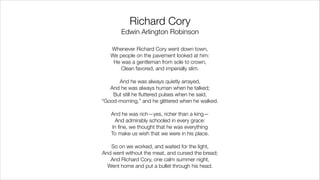
Richard Cory

Edwin Arlington Robinson
Whenever Richard Cory went down town,
We people on the pavement looked at him:
He was a gentleman from sole to crown,
Clean favored, and imperially slim.
!
And he was always quietly arrayed,
And he was always human when he talked;
But still he fluttered pulses when he said,
“Good-morning,” and he glittered when he walked.
!
And he was rich—yes, richer than a king—
And admirably schooled in every grace:
In fine, we thought that he was everything
To make us wish that we were in his place.
!
So on we worked, and waited for the light,
And went without the meat, and cursed the bread;
And Richard Cory, one calm summer night,
Went home and put a bullet through his head.
Richard Cory

Edwin Arlington Robinson
Whenever Richard Cory went down town,
We people on the pavement looked at him:
He was a gentleman from sole to crown,
Clean favored, and imperially slim.
!
And he was always quietly arrayed,
And he was always human when he talked;
But still he fluttered pulses when he said,
“Good-morning,” and he glittered when he walked.
!
And he was rich—yes, richer than a king—
And admirably schooled in every grace:
In fine, we thought that he was everything
To make us wish that we were in his place.
!
So on we worked, and waited for the light,
And went without the meat, and cursed the bread;
And Richard Cory, one calm summer night,
Went home and put a bullet through his head.
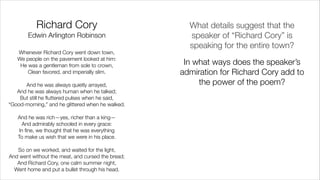
What details suggest that the
speaker of “Richard Cory” is
speaking for the entire town?
Richard Cory

Edwin Arlington Robinson
Whenever Richard Cory went down town,
We people on the pavement looked at him:
He was a gentleman from sole to crown,
Clean favored, and imperially slim.
!
And he was always quietly arrayed,
And he was always human when he talked;
But still he fluttered pulses when he said,
“Good-morning,” and he glittered when he walked.
!
And he was rich—yes, richer than a king—
And admirably schooled in every grace:
In fine, we thought that he was everything
To make us wish that we were in his place.
!
So on we worked, and waited for the light,
And went without the meat, and cursed the bread;
And Richard Cory, one calm summer night,
Went home and put a bullet through his head.
What details suggest that the
speaker of “Richard Cory” is
speaking for the entire town?
In what ways does the speaker’s
admiration for Richard Cory add to
the power of the poem?
Richard Cory

Edwin Arlington Robinson
Whenever Richard Cory went down town,
We people on the pavement looked at him:
He was a gentleman from sole to crown,
Clean favored, and imperially slim.
!
And he was always quietly arrayed,
And he was always human when he talked;
But still he fluttered pulses when he said,
“Good-morning,” and he glittered when he walked.
!
And he was rich—yes, richer than a king—
And admirably schooled in every grace:
In fine, we thought that he was everything
To make us wish that we were in his place.
!
So on we worked, and waited for the light,
And went without the meat, and cursed the bread;
And Richard Cory, one calm summer night,
Went home and put a bullet through his head.
What details suggest that the
speaker of “Richard Cory” is
speaking for the entire town?
In what ways does the speaker’s
admiration for Richard Cory add to
the power of the poem?
If Richard Cory spoke for himself,
how might the poem be different?
Richard Cory

Edwin Arlington Robinson
Whenever Richard Cory went down town,
We people on the pavement looked at him:
He was a gentleman from sole to crown,
Clean favored, and imperially slim.
!
And he was always quietly arrayed,
And he was always human when he talked;
But still he fluttered pulses when he said,
“Good-morning,” and he glittered when he walked.
!
And he was rich—yes, richer than a king—
And admirably schooled in every grace:
In fine, we thought that he was everything
To make us wish that we were in his place.
!
So on we worked, and waited for the light,
And went without the meat, and cursed the bread;
And Richard Cory, one calm summer night,
Went home and put a bullet through his head.
What details suggest that the
speaker of “Richard Cory” is
speaking for the entire town?
In what ways does the speaker’s
admiration for Richard Cory add to
the power of the poem?
If Richard Cory spoke for himself,
how might the poem be different?
In what way does the speaker’s
attitude toward Richard Cory differ
from Cory’s attitude toward
himself?
Richard Bone

Edgar Lee Masters
When I first came to Spoon River

I did not know whether what they told me

Was true or false.

They would bring me the epitaph

And stand around the shop while I worked

And say “He was so kind,” “He was wonderful,”

“She was the sweetest woman,” “He was a consistent Christian.”

And I chiseled for them whatever they wished,

All in ignorance of its truth.

But later, as I lived among the people here,

I knew how near to the life

Were the epitaphs that were ordered for them as they died.


But still I chiseled whatever they paid me to chisel

and made myself party to the false chronicles

Of the stones,

Even as the historian does who writes

Without knowing the truth,

Or because he is influenced to hide it.
Richard Bone

Edgar Lee Masters
When I first came to Spoon River

I did not know whether what they told me

Was true or false.

They would bring me the epitaph

And stand around the shop while I worked

And say “He was so kind,” “He was wonderful,”

“She was the sweetest woman,” “He was a consistent Christian.”

And I chiseled for them whatever they wished,

All in ignorance of its truth.

But later, as I lived among the people here,

I knew how near to the life

Were the epitaphs that were ordered for them as they died.


But still I chiseled whatever they paid me to chisel

and made myself party to the false chronicles

Of the stones,

Even as the historian does who writes

Without knowing the truth,

Or because he is influenced to hide it.
Identify and explain the attitude of
the speaker in “Richard Bone”
Richard Bone

Edgar Lee Masters
When I first came to Spoon River

I did not know whether what they told me

Was true or false.

They would bring me the epitaph

And stand around the shop while I worked

And say “He was so kind,” “He was wonderful,”

“She was the sweetest woman,” “He was a consistent Christian.”

And I chiseled for them whatever they wished,

All in ignorance of its truth.

But later, as I lived among the people here,

I knew how near to the life

Were the epitaphs that were ordered for them as they died.


But still I chiseled whatever they paid me to chisel

and made myself party to the false chronicles

Of the stones,

Even as the historian does who writes

Without knowing the truth,

Or because he is influenced to hide it.
Identify and explain the attitude of
the speaker in “Richard Bone”
Use this chart to describe Richard
Bone’s outlook on life
Tragedies Pleasures Opinions
Outlook on Life
Consider the ways in which these
characters deal with change and
explain other, healthier options

Review + Assess: Luke Havergal, Richard Cory, Richard Bone

  • 1.
    Bringing it allTogether: Luke Havergal, Richard Cory & Richard Bone Art by M.C. Escher (1898-1972)
  • 2.
    Copyright©TheMcGraw-HillCompanies,Inc. Lesson 9: Tone Toneis the writer’s or speaker’s attitude toward the subject of the passage. Tone may be communicated through words and details that express particular emotions and that evoke an emotional response in the reader. DIRECTIONS: Read the following excerpt from Gerald Durrell’s My Family and Other Animals. Then answer the questions that follow it. 1 I grew very fond of these scorpions. I found them to be pleasant, unassuming creatures, with, on the whole, the most charming habits. Provided you did nothing silly or clumsy (like putting your hand on one), the scorpions treated you with respect, their one desire being to get away and hide as quickly as possible. They must have found me rather a trial, for I was always ripping sections of the plaster away so that I could watch them, or capturing them and making them walk about in jam jars so that I could see the way their feet moved. By means of my sudden and unexpected assaults on the wall I discovered quite a bit about scorpions. I found that they would eat bluebottles (though how they caught them was a mystery I never solved), grasshoppers, moths, and lacewing flies. Several times I found one of them eating another, a habit I found most distressing in a creature otherwise so impeccable. 2 By crouching under the wall at night with a torch, I managed to catch some brief glimpses of the scorpions’ wonderful courtship dances. I saw them standing, claws clasped, their bodies raised to the skies, their tails lovingly entwined; I saw them waltzing slowly in circles among the moss cushions, claw in claw. But my view of these performances was all too short, for almost as soon as I switched on the torch the partners would stop, pause for a moment, and then, seeing that I was not going to extinguish the light, would turn round and walk firmly away, claw in claw, side by side. They were definitely beasts that believed in keeping themselves to themselves. If I could have kept a colony in captivity I would probably have been able to see the whole of the courtship, but the family had forbidden scorpions in the house, despite my arguments in favor of them.
  • 3.
    Lesson 9: Tone Toneis the writer’s or speaker’s attitude toward the subject of the passage. Tone may be communicated through words and details that express particular emotions and that evoke an emotional response in the reader. DIRECTIONS: Read the following excerpt from Gerald Durrell’s My Family and Other Animals. Then answer the questions that follow it. 1 I grew very fond of these scorpions. I found them to be pleasant, unassuming creatures, with, on the whole, the most charming habits. Provided you did nothing silly or clumsy (like putting your hand on one), the scorpions treated you with respect, their one desire being to get away and hide as quickly as possible. They must have found me rather a trial, for I was always ripping sections of the plaster away so that I could watch them, or capturing them and making them walk about in jam jars so that I could see the way their feet moved. By means of my sudden and unexpected assaults on the wall I discovered quite a bit about scorpions. I found that they would eat bluebottles (though how they caught them was a mystery I never solved), grasshoppers, moths, and lacewing flies. Several times I found one of them eating another, a habit I found most distressing in a creature otherwise so impeccable. 2 By crouching under the wall at night with a torch, I managed to catch some brief glimpses of the scorpions’ wonderful courtship dances. I saw them standing, claws clasped, their bodies raised to the skies, their tails lovingly entwined; I saw them waltzing slowly in circles among the moss cushions, claw in claw. But my view of these performances was all too short, for almost as soon as I switched on the torch the partners would stop, pause for a moment, and then, seeing that I was not going to extinguish the light, would turn round and walk firmly away, claw in claw, side by side. They were definitely beasts that believed in keeping themselves to themselves. If I could have kept a colony in captivity I would probably have been able to see the whole of the courtship, but the family had forbidden scorpions in the house, despite my arguments in favor of them. Copyright©TheMcGraw-HillCompan Name ࿝࿝࿝࿝࿝࿝࿝࿝࿝࿝࿝࿝࿝࿝࿝࿝࿝࿝࿝࿝࿝࿝࿝࿝࿝࿝࿝࿝࿝࿝࿝࿝࿝࿝࿝࿝࿝࿝࿝࿝࿝࿝࿝࿝࿝࿝࿝࿝࿝࿝࿝࿝࿝࿝࿝࿝࿝࿝࿝࿝࿝࿝࿝࿝࿝࿝࿝࿝࿝࿝࿝ Date ࿝࿝࿝࿝࿝࿝࿝࿝࿝࿝࿝࿝࿝࿝࿝࿝࿝࿝࿝࿝࿝࿝࿝࿝࿝࿝࿝࿝ 1. The author calls scorpions “pleasant, unassuming creatures with, on the whole, the most charming habits.” Do you think he is being serious or joking? What does this phrase tell you about the author’s tone? 2. Look up the word impeccable, which appears at the end of paragraph 1. Why do you think the author used this word to describe a scorpion? What does this suggest about the author’s tone? 3. Write down any observations you can make about the author’s style, and explain how the author’s style relates to his purpose.
  • 4.
  • 5.
    Luke Havergal
 Edwin ArlingtonRobinson In order to examine tone, we must identify the speaker Again, tone is the writer’s or speaker’s attitude toward the subject of the passage. Tone may be communicated through words and details that express particular emotions and that evoke an emotional response in the reader. What is the tone of the speaker?
  • 6.
    Richard Cory
 Edwin ArlingtonRobinson Whenever Richard Cory went down town, We people on the pavement looked at him: He was a gentleman from sole to crown, Clean favored, and imperially slim. ! And he was always quietly arrayed, And he was always human when he talked; But still he fluttered pulses when he said, “Good-morning,” and he glittered when he walked. ! And he was rich—yes, richer than a king— And admirably schooled in every grace: In fine, we thought that he was everything To make us wish that we were in his place. ! So on we worked, and waited for the light, And went without the meat, and cursed the bread; And Richard Cory, one calm summer night, Went home and put a bullet through his head.
  • 7.
    Richard Cory
 Edwin ArlingtonRobinson Whenever Richard Cory went down town, We people on the pavement looked at him: He was a gentleman from sole to crown, Clean favored, and imperially slim. ! And he was always quietly arrayed, And he was always human when he talked; But still he fluttered pulses when he said, “Good-morning,” and he glittered when he walked. ! And he was rich—yes, richer than a king— And admirably schooled in every grace: In fine, we thought that he was everything To make us wish that we were in his place. ! So on we worked, and waited for the light, And went without the meat, and cursed the bread; And Richard Cory, one calm summer night, Went home and put a bullet through his head. What details suggest that the speaker of “Richard Cory” is speaking for the entire town?
  • 8.
    Richard Cory
 Edwin ArlingtonRobinson Whenever Richard Cory went down town, We people on the pavement looked at him: He was a gentleman from sole to crown, Clean favored, and imperially slim. ! And he was always quietly arrayed, And he was always human when he talked; But still he fluttered pulses when he said, “Good-morning,” and he glittered when he walked. ! And he was rich—yes, richer than a king— And admirably schooled in every grace: In fine, we thought that he was everything To make us wish that we were in his place. ! So on we worked, and waited for the light, And went without the meat, and cursed the bread; And Richard Cory, one calm summer night, Went home and put a bullet through his head. What details suggest that the speaker of “Richard Cory” is speaking for the entire town? In what ways does the speaker’s admiration for Richard Cory add to the power of the poem?
  • 9.
    Richard Cory
 Edwin ArlingtonRobinson Whenever Richard Cory went down town, We people on the pavement looked at him: He was a gentleman from sole to crown, Clean favored, and imperially slim. ! And he was always quietly arrayed, And he was always human when he talked; But still he fluttered pulses when he said, “Good-morning,” and he glittered when he walked. ! And he was rich—yes, richer than a king— And admirably schooled in every grace: In fine, we thought that he was everything To make us wish that we were in his place. ! So on we worked, and waited for the light, And went without the meat, and cursed the bread; And Richard Cory, one calm summer night, Went home and put a bullet through his head. What details suggest that the speaker of “Richard Cory” is speaking for the entire town? In what ways does the speaker’s admiration for Richard Cory add to the power of the poem? If Richard Cory spoke for himself, how might the poem be different?
  • 10.
    Richard Cory
 Edwin ArlingtonRobinson Whenever Richard Cory went down town, We people on the pavement looked at him: He was a gentleman from sole to crown, Clean favored, and imperially slim. ! And he was always quietly arrayed, And he was always human when he talked; But still he fluttered pulses when he said, “Good-morning,” and he glittered when he walked. ! And he was rich—yes, richer than a king— And admirably schooled in every grace: In fine, we thought that he was everything To make us wish that we were in his place. ! So on we worked, and waited for the light, And went without the meat, and cursed the bread; And Richard Cory, one calm summer night, Went home and put a bullet through his head. What details suggest that the speaker of “Richard Cory” is speaking for the entire town? In what ways does the speaker’s admiration for Richard Cory add to the power of the poem? If Richard Cory spoke for himself, how might the poem be different? In what way does the speaker’s attitude toward Richard Cory differ from Cory’s attitude toward himself?
  • 11.
    Richard Bone
 Edgar LeeMasters When I first came to Spoon River
 I did not know whether what they told me
 Was true or false.
 They would bring me the epitaph
 And stand around the shop while I worked
 And say “He was so kind,” “He was wonderful,”
 “She was the sweetest woman,” “He was a consistent Christian.”
 And I chiseled for them whatever they wished,
 All in ignorance of its truth.
 But later, as I lived among the people here,
 I knew how near to the life
 Were the epitaphs that were ordered for them as they died.
 
 But still I chiseled whatever they paid me to chisel
 and made myself party to the false chronicles
 Of the stones,
 Even as the historian does who writes
 Without knowing the truth,
 Or because he is influenced to hide it.
  • 12.
    Richard Bone
 Edgar LeeMasters When I first came to Spoon River
 I did not know whether what they told me
 Was true or false.
 They would bring me the epitaph
 And stand around the shop while I worked
 And say “He was so kind,” “He was wonderful,”
 “She was the sweetest woman,” “He was a consistent Christian.”
 And I chiseled for them whatever they wished,
 All in ignorance of its truth.
 But later, as I lived among the people here,
 I knew how near to the life
 Were the epitaphs that were ordered for them as they died.
 
 But still I chiseled whatever they paid me to chisel
 and made myself party to the false chronicles
 Of the stones,
 Even as the historian does who writes
 Without knowing the truth,
 Or because he is influenced to hide it. Identify and explain the attitude of the speaker in “Richard Bone”
  • 13.
    Richard Bone
 Edgar LeeMasters When I first came to Spoon River
 I did not know whether what they told me
 Was true or false.
 They would bring me the epitaph
 And stand around the shop while I worked
 And say “He was so kind,” “He was wonderful,”
 “She was the sweetest woman,” “He was a consistent Christian.”
 And I chiseled for them whatever they wished,
 All in ignorance of its truth.
 But later, as I lived among the people here,
 I knew how near to the life
 Were the epitaphs that were ordered for them as they died.
 
 But still I chiseled whatever they paid me to chisel
 and made myself party to the false chronicles
 Of the stones,
 Even as the historian does who writes
 Without knowing the truth,
 Or because he is influenced to hide it. Identify and explain the attitude of the speaker in “Richard Bone” Use this chart to describe Richard Bone’s outlook on life Tragedies Pleasures Opinions Outlook on Life
  • 14.
    Consider the waysin which these characters deal with change and explain other, healthier options