INTERVIEW
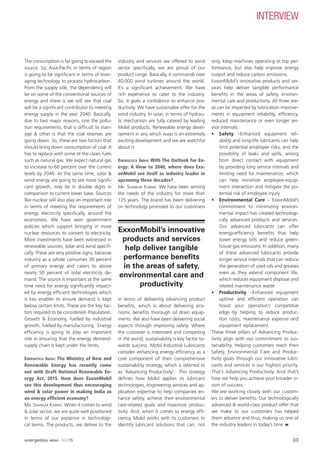
• Mr. Pete Kostic, Vice
President-Sales &
Marketing; Xcell
Automation, Inc
RENEWABLE ENERGY
• MNRE’s Draft National
Renewable Energy Act,
2015; Energetica India
• How Predictive Analytics
help grow Renewable
Energy Industry;
Ashwajit Wahane,
Machine Pulse
POWER SECTOR
• Overview of Energy
Sector in India; Dr.
Ahindra Chakrabarti;
Great Lakes Institute of
Management
# 52 August 2015
www.mobilindustrial.com
4 energetica INDIA · AUG15
Dear Reader,
Our August Edition will be distribut-
ed at the 9th Renewable Energy Expo
and Conference at Greater Noida in
September. Please drop by our Booth
at the expo for a Complimentary copy
and a tête-à-tête
The month of July and August saw
some interesting activity in the Renew-
able Energy Sector.
The Ministry of New and Renewa-
ble Energy (MNRE) has released a draft
of the “National Renewable Energy
Act”. The Policy aims to increase the
share of Renewables in the Country’s
Energy mix. While the Act looks at
drawing a “National Renewable Ener-
gy Fund” as a fixed portion from the
National Clean Energy Fund, it also
lays out a regulated structure to en-
force ‘RPO’.
Another positive development was
Gujarat state’s announcement of a
new solar policy. i.e. ‘Gujarat Solar
Power Policy 2015’. One of the ma-
jor highlights is the policy’s incentives
for Rooftop Solar PV systems with net
metering.
The August Edition brings Indus-
try Insights from Experts and Industry
Leaders –
• Mr. Shrinivas Chebbi, Vice-Pres-
ident, Partner and Buildings BU,
Schneider Electric India
• Pete Kostic, Vice President of Sales
& Marketing at Xcell Automation,
Inc.
• Mr. Ruchir Panwar, Business Head,
Green Factory Building, Mahindra
Susten Private Limited
• Mr. Sishir Goel, VP-Technology &
Marketing, Brij Encapsulants India
• Mr. Shankar Karnik, General Man-
ager- Industrial, ExxonMobil Lubri-
cants Private Limited
Highlights of the August Issue –
• “Quality of PV Modules to Define In-
dia’s Solar Dream” fromVikram Solar
Today, solar module manufacturers
stand at a critical position within the
industry, as they determine bench-
marks and quality and eventually de-
fine the future of Indian solar projects.
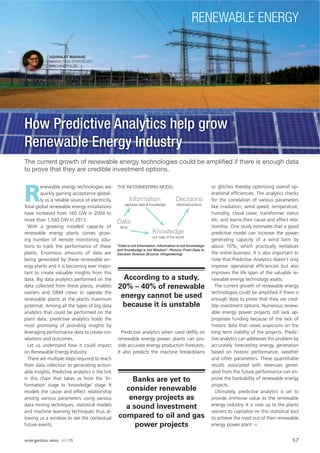
• “How Predictive Analytics help
grow Renewable Energy Industry”
from Machine Pulse
The Current Growth of Renewable En-
ergy Technologies could be amplified
if there is enough data to prove they
are credible investment options
• “Overview of Energy Sector in In-
dia”
Dr. Ahindra Chakrabarti writes that
the demand for Electricity in the
Country has been growing at a rapid
rate and is expected to grow further
in the years to come. The Indian Pow-
er Sector is one of the most diversi-
fied in the world, compared to many
developing countries where crude oil
and natural gas and renewables play
a major role.
We hope you enjoy reading our work.
EDITORIAL
Energetica India is member of the Spanish Editorials and
Newspapers publications Association. This association is
member of FIPP, EMMA, CEPYME and CEOE.
info@energetica-india.net|www.energetica-india.net
© 2011 Omnimedia SL
EDITOR. EUGENIO PÉREZ DE LEMA eugenio@energetica-india.net
DIRECTOR. GISELA BÜHL gisela@energetica-india.net
INDIA COUNTRY MANAGER, INDIA. SONAM RAINA Sonam.r@energetica-india.
netTel: + 91 22 6-9999-002
INTERNATIONAL SALES DEPT.. BELA ANGELOVA bela@energetica-india.net
JOURNALIST MOULIN OZA journalist@energetica-india.net
SPAIN. ALVARO LÓPEZ ala@energetica-india.net
FINANCIAL DIRECTOR. CARLOS FERNÁNDEZ carlos.f@energetica-india.net |
LAYOUT & DESIGN. DANIEL CONEJERO contras-t.com | PRINTER. GRAFISUR
Spain
The views expressed in the magazine are not necessarily those of the editor or publisher. The
magazine and all of the text and images contained therein are protected by copyright. If you
would like to use an article from Energetica India or our website www.energetica-india.net
you may obtain the rights by calling OMNIMEDIA, S.L.
OmnimediaGroup
INDIA
G2, Ground floor, of Trisandhya ‘B’
Dadasaheb Phalke Road,
Dadar (East), Mumbai – 400 014 INDIA
Tel: +91 22 6-9999-001
SPAIN
Rosa de Lima 1 bis, Edif. Alba, Office 104
28290 Las Matas. Madrid - Spain
Tel +34 916 308 591 | Fax +34 916 308 595
OUR ALLIANCE PARTNER
FORMERLY KOMAX SOLAR
20 Innovation Drive, York, PA 17402 (USA)
+1 717 755 6800
www.xcellautomation.com
Info.yok@xcellautomation.com
EXCLUSIVE
Continuous Stringing
Induction Coils
IMPROVED
AccuTrack
SIMPLER
6 energetica INDIA · AUG15
CONTENTS# 52 - AUGUST 2015
ON COVER FRONIUS
BIOMASS
• Biomass Characterization: Perspectives and Challenges; Yogender Singh, Y. K. Yadav; SSSNIBE . . . . . . . . . . . . . . . . . . . . . . . . 60
• Flexi Biogas Technology: An Alternate Low Cost Biogas Technology to Rural India;
Pradip Narale, Ramesh Choudhari, Prof. N.S. Rathore . . . . . . . . . . . . . . . . . . . . . . . . . . . . . . . . . . . . . . . . . . . . . . . . . . . . . . . . . . 62
ENERGY STORAGE
• Batteries: The only missing link in India Solar Energy Story; Mr. Vineet Mittal; Welspun Renewables . . . . . . . . . . . . . . . . . . . . . 58
INDUSTRY JEWEL
• Mr. Vineet Mittal, Director; Navitas Green Solutions Pvt. Ltd.. . . . . . . . . . . . . . . . . . . . . . . . . . . . . . . . . . . . . . . . . . . . . . . . . . . . . 76
INTERVIEW
• Mr. Shrinivas Chebbi, Vice-President, Partner and Buildings BU; Schneider Electric India. . . . . . . . . . . . . . . . . . . . . . . . . . . . . . . 24
• Mr. Pete Kostic, Vice President-Sales & Marketing; Xcell Automation, Inc . . . . . . . . . . . . . . . . . . . . . . . . . . . . . . . . . . . . . . . . . . . 26
• Mr. Ruchir Panwar, Business Head, Green Factory Building; Mahindra Susten Private Limited . . . . . . . . . . . . . . . . . . . . . . . . . . 28
• Mr. Sishir Goel, Vice-President-Technology & Marketing; Brij Encapsulants (India) . . . . . . . . . . . . . . . . . . . . . . . . . . . . . . . . . . . 30
• Mr. Shankar Karnik, General Manager- Industrial; ExxonMobil Lubricants Private Limited . . . . . . . . . . . . . . . . . . . . . . . . . . . . . . 32
POWER SECTOR
• Turbine Oil Testing; Mr. Shankar Karnik; Exxon Mobil Lubricants Private Limited . . . . . . . . . . . . . . . . . . . . . . . . . . . . . . . . . . . . . 66
• De-regulated Electricity Markets –Procurement Strategies and Beyond; Ankit Prabhash; Beroe Consulting . . . . . . . . . . . . . . . . 68
• Overview of Energy Sector in India; Dr. Ahindra Chakrabarti; Great Lakes Institute Of Management . . . . . . . . . . . . . . . . . . . . . . 72
RENEWABLE ENERGY
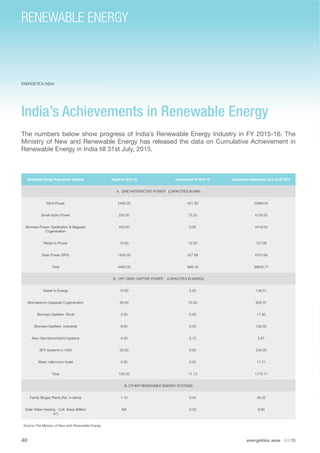
• MNRE Achievement; Energetica India . . . . . . . . . . . . . . . . . . . . . . . . . . . . . . . . . . . . . . . . . . . . . . . . . . . . . . . . . . . . . . . . . . . . . . 40
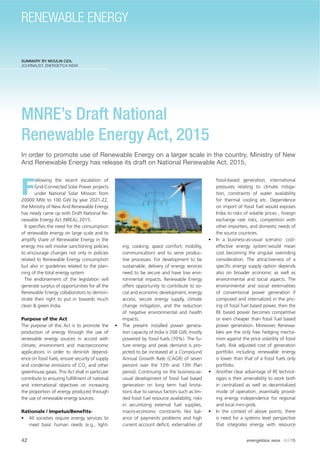
• MNRE’s Draft National Renewable Energy Act, 2015; Energetica India . . . . . . . . . . . . . . . . . . . . . . . . . . . . . . . . . . . . . . . . . . . . . 42
• What are Indian Renewable Energy Researchers working on?; Energetica India . . . . . . . . . . . . . . . . . . . . . . . . . . . . . . . . . . . . . 46
• GREEN CLIMATE FUND — A Way Forward to Aid Developing Countries to Switch to Renewable Energy; Energetica India . . . . . 50
• From Energetica India’s Blog Stable; August 2015 . . . . . . . . . . . . . . . . . . . . . . . . . . . . . . . . . . . . . . . . . . . . . . . . . . . . . . . . . . . . 54
• How Predictive Analytics help grow Renewable Energy Industry; Ashwajit Wahane, Machine Pulse . . . . . . . . . . . . . . . . . . . . . . 57
SOLAR POWER
• India’s Need For Water Free Solar Panel Cleansing; Anat Cohen Segev; Ecoppia . . . . . . . . . . . . . . . . . . . . . . . . . . . . . . . . . . . . . 34
• Quality of PV modules to define India’s Solar Dream Solar; Mr. Ivan Saha; Vikram Solar . . . . . . . . . . . . . . . . . . . . . . . . . . . . . . . 36
• Solar Water Pumping System for Agriculture; Pradip Narale, Prof. Narendra Singh Rathore . . . . . . . . . . . . . . . . . . . . . . . . . . . . 38
WIND ENERGY
• Is India Prepared for Offshore Wind Farm Development?;
Ms. Riya Rachel Mohan, Ms. Sandhya Sundararagavan, Mr. Ashish Nigam; CSTEP . . . . . . . . . . . . . . . . . . . . . . . . . . . . . . . . . . . 64
4. Editorial / 6. Contents / 8. Take advice / 10. Energy News / 78. Products
Flexible System Design is Possible.
pv-sales-india@fronius.com | www.fronius.com
ADVERTISERS
Bonfiglioli Inside back cover
Brij Encapsulants 55
Delta Inside front cover
Eco Expo Asia 2015 31
Envirotech Asia 2015 35
ELECRAMA 2016 53
Energetica India SME 45
Energy Storage India 2015 41
Exxon Mobil 7
Fronius Front cover
Global Zeus 3
Helioslite 79
InterSolar India 2015 19
Larsen & Toubro 11
Navitas Green Solutions Back cover
Renewable Energy India
Expo 2015 15
Smart Cities India 2016 Expo 27
Sustainable Smart Cities
India 2015 77
Trelleborg Sealing Solutions 82
Trina Solar 9
UL 13
Wastetech 2015 & Cleantech
2015 49
Xcell Automation 5
INTERVIEW
• Mr. Pete Kostic, Vice
President-Sales &
Marketing; Xcell
Automation, Inc
RENEWABLE ENERGY
• MNRE’s Draft National
Renewable Energy Act,
2015; Energetica India
• How Predictive Analytics
help grow Renewable
Energy Industry;
Ashwajit Wahane,
Machine Pulse
POWER SECTOR
• Overview of Energy
Sector in India; Dr.
Ahindra Chakrabarti;
Great Lakes Institute of
Management
#52August2015
# 52 August 2015
www.mo
bilindust
rial.com
8 energetica INDIA · AUG15
SUSTAINABLE SMART CITIES INDIA 2015
Date: 3-4 September, 2015
Place: Bengaluru, India
Organizer: Nispana Innovative Platforms
Tel: +91 8892718635
Email: soumenchakraborthy@nispana.com
Website: http://nispana.com/ssci/
9TH RENEWABLE ENERGY EXPO [REI]
2015
Date: 23-25 September, 2015
Place: Greater Noida, India
Organizer: UBM
Tel: +91 (0) 01244524215
Email:
Website: http://www.ubmindia.in/renewable_energy/
home
ECO EXPO ASIA – INTERNATIONAL TRADE
FAIR ON ENVIRONMENTAL PROTECTION
Date: 28-31 October, 2015
Place: Hong Kong, China
Organizer: HKTDC
Tel: 852-1830668
Email: exhibition@hktdc.org
Website: http://www.hktdc.com/fair/ecoexpoasia-
en/Eco-Expo-Asia-International-Trade-Fair-on-
Environmental-Protection.html?DCSext.dept=5&WT.
mc_id=1815680
INTERSOLAR INDIA 2015 CONFERENCE
AND EXHIBITION
Date: 18-20 November, 2015
Place: Mumbai, India
Organizer: MMI India Pvt. Ltd
Tel: +91 22 4255 4700
Email: info@mmi-india.in
Website: http://www.intersolar.in/en/home.html
ELECRAMA 2016
Date: 13-17 February, 2016
Place: Bengaluru, India
Organizer: IEEMA
Tel: 022-24930532
Email: shahid.akhtar@ieema.org
Website: https://elecrama.com/default.html
ENERGY STORAGE INDIA 2015
Date: 8-9 December, 2015
Place: New Delhi, India
Organizer: Messe Düsseldorf India
Tel: +91-0-48550000
Email:MalikS@md-india.com
Website: http://www.esiexpo.in/
IUKAN 2015
Date: 8th September, 2015
Place: New Delhi, India
Organizer: PMANIFOLD BUSINESS SOLUTIONS
Tel: +91 95992 46701
Email: isha.gupta@pmanifold.com
Website: http://www.iukan.in
WASTETECH & CLEANTECH INDIA 2015
Date: 29-30 September, 2015
Place: New Delhi, India
Organizer: Messe Frankfurt
Tel: +91 22 6757 5940
Email: rebello@india.messefrankfurt.com
Website:
http://cleantech
india.in.messefrankfurt.com/newdelhi/en/exhibitors/
welcome.html
COMSOL CONFERENCE 2015
Date: 29-30 October, 2015
Place: Pune, India
Organizer: COMSOL Multiphysics Pvt. Ltd.
Tel: 080 – 2559-7799
Email: deepa@comsol.com
Website: http://comsol.co.in/c/2hn9
ENVIROTECH ASIA 2015
Date: 1-3 December, 2015
Place:
Organizer: RADEECAL COMMUNICATIONS
Tel: +91 07926401101
Email: sales@envirotechasia.com
Website: http://www.envirotechasia.com/index.html
IPTEX & GRINDEX 2016
Date: 3-5 March, 2016
Place: Mumbai, India
Organizer: Virgo Communications And Exhibition
(P) Ltd.
Tel: 080-25357028
Email: azrael@virgo-comm.com
Website: http://www.iptexpo.com/index.html
SMART CITY LANDSCAPE 2015
Date: 10-11 September, 2015
Place: New Delhi, India
Organizer: Information Exchange Group
Tel: +97144364214
Email: scl2015@infoxg.com
Website: http://www.smartcitylandscape.com/
IFAT INDIA 2015
Date: 13-15 October, 2015
Place: Mumbai, India
Organizer: Messe Munchen
Tel: 022- 4255 4700
Email: daphne.fernandes@mmi-india.in
Website: http://www.ifat-india.com/
ACETECH 2015-16
Date: 29th October-1st November, 2015
Place: Mumbai, India
Organizer: ABEC Exhibitions & Conferences Pvt. Ltd
Tel: 022-66814900
Email: urvashi.c@abec.asia
Website: http://www.etacetech.com/
2ND SMART CITIES INDIA 2016 EXPO
Date: 11-13 May, 2016
Place: New Delhi, India
Organizer: Exhibition India Group
Tel: 011-4279 5185
Email: debashreep@eigroup.in
Website: http://www.smartcitiesindia.com/
TAKE ADVICE
NEWS
10 energetica INDIA · AUG15
RENEWABLE ENERGY
“Equal Focus on Various
Forms of Renewable
Power” says Piyush Goyal
Mr. Piyush Goyal, Minister of
State (IC) for Power, Coal & New
and Renewable Energy said that
the Union Government has
equal focus on various forms
of renewable power and does
not discriminate between solar,
wind or biogas power in terms
of providing support to these re-
newable sources. Mr. Goyal said
that the Government reinstat-
ed accelerated depreciation to
boost wind power sector in the
first budget of the new govern-
ment so that people can expand
and take benefits of the same.
He was speaking after launch-
ing Indian Wind Resource Atlas
at 100 metre level here today.
Mr.Piyush Goyal stated that
the Atlas will help policy makers
at Centre and State Govern-
ments to deal with issues relat-
ed to tariff fixation, transmis-
sion, grade frequency etc and
providing better infrastructure
for the investors. He said that he
is personally very delighted that
the ministry has provided such
crucial information in public do-
main at free of cost. He assured
that the Ministries of Coal, Pow-
er and New & Renewable Energy
will keep on providing more and
more data in public domain and
thus work on bringing transpar-
ency in the system. Mr. Saurabh
Patel, Gujarat Energy Minister,
Mr. Rajendra Shukla, Madhya
Pradesh Energy Minister, Mr.
Pushpendra Singh, Rajasthan
Energy Minister, Mr. D.K. Shiv-
kumar, Karnataka Energy Minis-
ter, senior officials from central
agencies, state government and
high level representatives of the
wind industry were also present
at the occasion.
The new Indian Wind Atlas is
an important online GIS (Ge-
ographic Information System)
tool for identification of the
regional and local wind energy
potential in India. It contains
average annual values of Wind
Speed (m/s), Wind Power Den-
sity and Capacity Utilization Fac-
tor (CUF) calculated for an av-
erage 2 MW turbine at 100 m.
In the atlas the resultant layers
are at very high resolution and
joint frequency tables have been
derived for the entire country at
500 m resolution. Also, high res-
olution Re-analysis data set has
been used for the study- NCEP/
CFSR which enhanced the accu-
racy of the mapping. The Atlas
uses dynamic meso-micro cou-
pled WRF modelling technique
Karnataka to get Rs.800 crore
under DDUGJY to provide 24
hours quality power supply
Union Government has an-
nounced that it will grant Rs.
800 crore under Deen Dayal
Upadhyay Gram Jyoti Yojana to
Karnataka for the setting up of
separate feeder line to provide
24 hours three-phase quality
power supply to the farmers.
Under the scheme, feeders have
specially designed transformers
to supply power to farmers said
Mr. Piyush Goyal , Union Minis-
ter of State (IC) for Power, Coal
and Renewable Energy.
Addressing the media per-
sons after the review meeting
of Power Projects in Karnataka,
Mr. Piyush Goyal said that the
centre is planning to give Rs.
1,700 crore additional fund un-
der DDUGJY to the state for the
electrification of 8 lakh house-
holds of rural Karnataka which
have not still been electrified.
24X7 power supply is the mis-
sion of the government and
state and centre should work
together to achieve the target
by 2019, he added.
Karnataka has bigger plans for
the new and renewable energy
sector as the state is embarking
on setting up of Asia’s largest
Solar Park of 2,000 MW, at
Tumkur, with the help of Gov-
ernment of India. This project is
a fitting example for the ‘Team
India’ working for the welfare
of the people in the true spirit
of cooperative federalism, Mr.
Goyal said.
Operational issues of power
transmission lines and transmis-
sion corridors have been sort-
ed out in the review meeting.
This will enable to have cheap-
er power, especially cheapest
power in South India, wherein
the input power cost will come
down by 50% Shri Goyal said.
The country is gearing up
to an installation capacity of
40,000MW of solar roof tower
power project which will be a
unique scheme in the country.
Government of India is giving
15% subsidy to the household
installation of solar roof tops.
Answering a question the
minister said that the coal block
allocation will be done in a sci-
entific manner and each state
will be allotted a separate block,
exclusively for the power needs
of the state. Additional coal
blocks will be allotted as per
the need after the next round
of allotment through transpar-
ent bidding process the minis-
ter added. Mr. D.K Shivkumar,
Energy Minister, Government of
Karnataka was also present.
Unique advantages for commercial projects
The efficiency level of 98.3
percent is unique in the pro-
ject area. Another highlight
is the ability to connect up
to six strings directly to the
inverter, meaning that the
system operator no longer
requires additional DC or
combiner boxes. The inte-
grated fuse holder provides
all-pole fuse protection for all
six strings, and optional over-
voltage protection is availa-
ble for the DC side.
Thanks to the exceptionally
high IP 66 protection class,
the device can be installed in
unsheltered indoor and out-
door locations. The Fronius
Eco even manages to deliv-
er maximum yields under
extreme climate conditions.
Due to the SnapINverter
technology2, the lowest ser-
vicing costs can be expected.
The optimised display nav-
igation simplifies servicing,
while the Setup wizard saves
time and money.
12 energetica INDIA · AUG15
INDIA
NEWS
Ministries of Power & Railways signs 3 MOU’s on
Cooperation in Electricity & Energy Efficiency
Four Memorandum of Under-
standing ( MoUs) were signed
between Ministry of Power ,
Ministry of New & Renewable
Energy (MNRE) and Ministry
of Railways for Cooperation
in the areas of Electricity
Transmission , Energy Efficien-
cy and promotion of Renewa-
ble Energy in Indian Railways
in the presence of Minister
of Railways, Mr. Suresh Prab-
hakar Prabhu and Minister of
State (IC) for Power, Coal and
New and Renewable Energy,
Mr. Piyush Goyal. The MoUs
provides a framework under
which both parties may col-
laborate and cooperate for
efficient, reliable and eco-
nomical generation, trans-
mission, distribution, trading,
supply, marketing of electric-
ity and energy efficiency in
Indian Railways.
Speaking on the occassion,
Mr. Piyush Goyal said that
this is momentous occa-
sion which transcends three
Ministries whereby a holistic
view is being taken on en-
ergy, green energy & energy
efficiency. Mr. Goyal further
added that these MoUs will
cater the ambitious targets
of lowering cost of electricity
and consumption in railways
and adoption of LED lighting
on large scale. Compliment-
ing Mr. Suresh Prabhu, he
said that today Indian rail-
way is moving towards green
energy and with this speed,
will soon become one of the
largest producers of renew-
able energy in the country.
Mr. Piyush Goyal informed
that the Railways has ambi-
tious targets of producing
Renewable Energy and it will
become largest Renewable
energy producer. He added
that all equipments will do-
mestically sourced which will
give boost to government’s
programmes like Make in In-
dia & Skill India.
While addressing the audi-
ence, Mr. Suresh Prabhu said
that as largest commercial
transporter, Indian Railway
feels responsible for working
towards minimising emmis-
sion of green house gases
and will become in near fu-
ture “ Green Transporter”.
He said that using clean fuel
is as important as transport-
ing goods and passengers
since clean environment is the
collective responsibility of all.
Shri Prabhu also stated that
the idea behind MoUs is to
generate cheaper, easier and
commercially viable renewa-
ble energy.
The areas of bilateral coop-
eration under the MoU are:
• Implementation of elec-
tricity and energy effi-
ciency projects for Indian
Railways.
• Cooperation for construc-
tion, operation and main-
tenance of transmission
lines.
• Sharing of information,
experience, knowledge
and training of staff and
officers of railways.
• Implementaiton of joint
research or technical pro-
jects for achieving energy
conservation in Indian
Railways.
• Implementation of energy
conservation projects for
targeted achievement of
energy savings in Indian
Railways.
Ministry of Railways and
Bureau of Energy Efficien-
cy also signed a Memoran-
dum of Understanding for
implementation of energy
efficiency projects in Indian
Railways. The MoU between
the Railways and the Bureau
of Energy Efficiency would fa-
cilitate the identification and
design of interventions (such
as energy audits) for enhanc-
ing energy efficiency. It would
also help in setting of targets
for traction energy efficiency
enhancement that the Rail-
ways would meet under the
Bureau’s Perform, Achieve,
and Trade programme.
A third MoU was signed
between Energy Efficiency
Services Ltd. (EESL) and Rail-
ways Energy Management
Company Ltd. (REMCL) for
implementation of energy
efficiency measures in Rail-
ways buildings. The REM-
CL-EESL MoU would enable
the two companies to work
together to enhance energy
efficiency in various Railway
buildings, and also expand
the Domestic Energy Effi-
cient Lighting Programme
(DELP) being carried out
across the country by EESL,
in Railway colonies. The first
joint project of these two
companies would be to up-
grade the energy using in-
frastructure in Rail Bhawan
within the next eight weeks
so as to secure a reduction of
at least 20% in the electricity
consumption in the building.
On this occasion, Ministry
of New & Renewable Energy
(MNRE) & Ministry of Rail-
ways also signed a MoU to
bring in a change in the en-
ergy mix and solarization of
Railways.
Future-proofing is our priority
Smart Grid Ready is a keyword
for future inverter applications.
So is plug-in card technology,
which enables the device to re-
spond flexibly to future require-
ments. “The best example for
this is our Fronius IG series. These
devices came onto the market
20 years ago and can easily be
made compatible for wireless
applications today. That’s what
we call future-proof,” explains
Martin Hackl. Optional plug-in
cards, such as the Fronius Sensor
Card, are easily integrated using
the Plug&Play feature and the
inverter is state-of-the-art once
again.
In addition to Modbus TCP and
RTU SunSpec, a Fronius Solar API
(JSON) interface is available. The
Fronius push service enables
system data to be sent to any
server. The online Fronius Solar.
web platform is also available for
comprehensive system monitor-
ing and can be used at the same
time as the open interfaces.
14 energetica INDIA · AUG15
INDIA
NEWS
India, United States Seek Proposals for
Innovative Off-Grid Clean Energy Projects
In another step forward for
the U.S.-India Partnership to
Advance Clean Energy (PACE),
U.S. Ambassador to India Rich-
ard Verma announced today
that up to $2 million in grants
will be made available for in-
novative, early-stage off-grid
clean energy projects in the
fi rst round of the PACEsetter
Fund, a joint 50 crore rupee
($7.9 million) fund established
in June by the Governments
of India and the United States
to accelerate the commerciali-
zation of off-grid clean energy
solutions. Initial expressions
of interest are due October
16,2015.
Speaking at the inaugural
India Off-Grid Energy Summit,
Ambassador Verma also an-
nounced the launch of a new
public-private partnership that
will work to mobilize $41 mil-
lion in finance to enable clean
energy entrepreneurs to sus-
tain and scale their business
models beyond the early stage
targeted by the PACEsetter
Fund. This effort, a partner-
ship between New Ventures
India, Insitor Management, the
Global Social Business Incuba-
tor at Santa Clara University,
and USAID/India, aims to help
1 million Indians gain access
to electricity through off-grid
clean energy solutions.
Taken together, these two
announcements advance
President Obama and Prime
Minister Modi’s commitment
to embark on a new and en-
hanced strategic partnership
on energy security, clean ener-
gy, and climate change. They
are major milestones for Pro-
moting Energy Access through
Clean Energy (PEACE), a PACE
initiative focused on harness-
ing commercial enterprise to
bring clean energy access to
unserved and underserved in-
dividuals and communities.
Fronius launches string
inverter solution for
PV projects in India
The solutions provider Fro-
nius is launching the latest
addition to the SnapINvert-
er range in May 20151.
Available in the 25.0 and
27.0 kVA power catego-
ries, the Fronius Eco string
inverter delivers maximum
yields, especially for large-
scale PV projects into the
megawatt range.
Thanks to the exception-
ally high IP 66 protection
class, the device can be
installed in unsheltered in-
door and outdoor locations.
Thanks to the exception-
ally high IP 66 protection
class, the device can be
installed in unsheltered in-
door and outdoor locations.
“The Fronius Eco is the
ideal project inverter. It is
easy to service, extremely
cost-effective and offers
the high quality associat-
ed with Fronius,” explains
Martin Hackl, head of the
Solar Energy Division at Fro-
nius International GmbH.
The compact design en-
sures maximum average
power density and maxi-
mum yields
Its lightweight design
(weighing just 35.7 kg) and
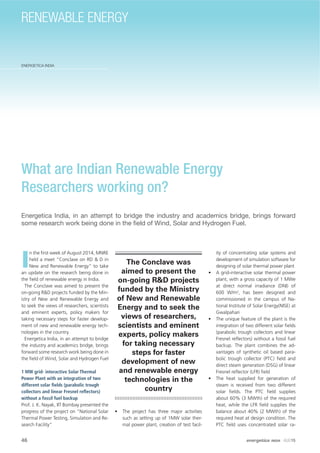
tried and tested SnapIN-
verter mounting technolo-
gy make for quick and easy
installation. With the high-
est average power density
in its power category, the
Fronius Eco is sure to im-
press.
The new MPP tracking
algorithm of the Dynamic
Peak Manager also plays an
important role in maxim-
ising yield. It automatically
checks the characteristic
curve at regular intervals,
ensuring that the inverter
finds the global maximum
and constantly operates at
the point of maximum out-
put, even in partial shading.
Waaree Energies
Receives ‘Make In
India Awards for
Excellence-2015’
Waaree Energies Limited
has announced that it has
been awarded the ‘Make In
India Awards for Excellence
– 2015’ by Krazy Mantra,
a leading IT organization
based out of Ahmedabad.
This award is an effort to
recognize the companies
who are executing our
Honorable Prime Minister
Mr. Narendra Modi’s vision
of ‘Make in India’ with ex-
cellence in their own do-
main. Waaree has received
this award for its manufac-
turing excellence in the re-
newable energy category.
Chief Guest for the
event, Shri. Kalraj Mishra
Union Minister for MSME,
and Shri Dhanraj Pillai the
legendary hockey player,
handed over the awards
to the winners. Mr. Ketan
Vora CEO Waaree Surya
Power LLP received the
award on behalf of Waaree
Energies Limited.
Hitesh Doshi, Chairman
and Managing Director,
at Waaree Energies com-
mented “It’s an honour
to be recognized for ex-
cellence in the field of
solar energy. Just as the
powerful sun reaches the
remotest corner of the
world, Waaree is deter-
mined to widen the solar
energy landscape in the
best possible way. These
recognitions go a long
way in keeping our mo-
rale high and motivate us
to keep up our quest for
excellence. I would like to
congratulate Krazy Man-
tra and their entire team
for conceptualising and
executing this initiative
successfully.”
16 energetica INDIA · AUG15
INDIA
NEWS
MNRE takes initiative for Low Cost
Financing for Renewable Energy
The Government has taken
following major initiatives in
coordination with different
Ministries/Departments for
mobilizing the low cost financ-
ing for renewable energy pro-
jects which inter-alia includes
low cost borrowing through
multi-lateral and bi-later-
al agencies i.e. World Bank,
Asian Development Bank, KfW
Germany, etc.; inclusion of
Renewable Energy Projects in
Priority Sector Lending Norms
of Commercial Banks; and ap-
proval for issuance of tax free
infrastructure bonds for fund-
ing renewable energy projects
during the FY 2015-16. This
was stated by Mr. Piyush Goyal,
Minister of State (IC) for Pow-
er, Coal & New and Renewable
Energy in a written reply to a
question in the Lok Sabha
The Minister further stated
that the Rural Electrification
Corporation (REC) is providing
Renewable Energy loans at the
rate of interest which is 0.75%
less than the Conventional
Generation Projects. Moreover,
there are no restrictions on the
loan amount for Renewable
Energy Projects and all pro-
jects found viable are eligible
for funding. Further, in remote
villages, Government is also
providing grant through REC
for Decentralized Distributed
Generation under Deendayal
Upadhyaya Gram Jyoti Yojana
(DDUGJY).
Swelect Energy Systems
Ltd. commissions 10 MW
SPV Farm in Tamil Nadu
SWELECT Energy Systems
Ltd., has announced that it
has recently commissioned
its 10 MW SPV Farm near-
Musiri Taluk, Trichy District,
Tamil Nadu. It is the state’s
first VGF(Viability Gap
Funding) Project under the
JNNSM Phase 2 and also the
only DCR (Domestic Con-
tent Requirement) project in
Tamil Nadu.
The highlight of this pro-
ject is that more than 55%
of the installed SPV mod-
ules were manufactured
in SWELECT owned mod-
ule manufacturing facility
at Bangalore (HHV Solar
Technologies Ltd) with the
SPV Cells manufactured in
India with 100% DCR com-
pliance. The SPV modules
used are high efficiency
240, 245, 250 and 255 Wp-
multi crystalline panels with
IEC certification and 750
kW high efficiency TMEiC
central inverters have been
used.
This has enabled SWELECT
to be in line with the‘Make in
India’ program as well as the
upcoming DCR programs.
SWELECT has installed over
1700 Roof top installations
for Process Industries, IT
campuses,University cam-
puses, Banks, ATM sites and
many other corporate cus-
tomers. SWELECT has been
ranked as No. 1 Rooftop
Solar company (source: Soft
Disk awards 2012, 13, 14)
for three consecutive years.
It is currently in the process
of developing a 20 MW SPV
Farm.
JinkoSolar connects 34.56MW
High Efficient Eagle Modules
in Lalitpur, Uttar Pradesh
JinkoSolar Holding Co., Ltd has
announced that its 34.56MW
Eagle PID-FREE modules have
been successfully connected in
Lalitpur, Uttar Pradesh.
These modules were deployed
to three projects in Lalitpur, a
district suffering from extreme
weather conditions, and have
proven their phenomenal ability
against high temperature and
humidity in summer and cold-
ness in winter.
In the hottest summer, Lal-
itpur’s temperature recorded
49°C, and the average relative
humidity in rain season goes
above 85%, posing a huge
challenge to regular solar pan-
els.
Jinko’s high efficient Eagle
modules are designed to coun-
ter these harsh conditions.
As the world’s first PID-FREE
modules that have past severe
test under the condition of
85°C/85%RH, Eagles are able
to perform to the best at any-
where in India, providing a re-
liable and stable high-efficient
power source for businesses
and communities.
Suzlon completes project for NSE
as it becomes 1st stock exchange
to invest in Wind Energy
India’s leading bourse Nation-
al Stock Exchange of India Ltd
(NSE) completed 6.25 MW
wind power project. Suzlon
Group, one of the leading wind
turbine manufacturer was the
technical partner for supply &
commissioning of the project.
The project completion is a
milestone achievement for NSE
and Suzlon since it is India’s
first Stock Exchange to deploy
wind energy to off-set its cap-
tive power usage. 65% of the
energy consumption of NSE of-
fice located at Exchange Plaza
building, Bandra-Kurla Com-
plex (BKC) Mumbai will be met
by this wind project.
Speaking on the occasion, Mr
Mahesh Haldipur, NSE spokes-
person said “The investment
in wind power project is part
of our long term focus on sus-
tainable development. We are
committed to conduct business
in a way that protects the en-
vironment by using green tech-
nology. Harnessing wind ener-
gy for our operations is a step in
that direction. This is in addition
to the various power saving and
energy efficient measures being
undertaken at the premises.”
Mr. Ishwar Mangal, Chief
Sales Officer, Suzlon Group
said, “The increased focus and
investment in wind energy is a
testament of efforts by corpo-
rates in India towards mitigat-
ing climate change and energy
security. NSE’s thrust on sustain-
able development and invest-
ments in wind energy will also
encourage other corporates
to harness wind energy for
meeting their energy require-
ments and to hedge power
cost for next 25 years thereby
contribute towards a greener
tomorrow. Suzlon’s ‘concept to
commissioning’ approach of-
fers convenience to customers
for setting up wind project for
captive use.” Suzlon leveraged
its end-to-end wind solutions
expertise to oversee the project
completion from start to end.
energetica INDIA · AUG15 17
INDIA
Inox Wind Bags 100 MW Order from OSTRO Energy
Inox Wind Limited has an-
nounced that it has bagged an
order for a 100 MW wind pow-
er project at Lahori, in the state
of Madhya Pradesh from Ostro
Energy. . Inox will supply and
install 50 units of its advanced
2MW DFIG 100 rotor dia Wind
Turbine Generators (WTGs) for
Ostro Energy, on a turnkey basis.
The 100 rotor dia WTG has one
of the highest swept areas, that
makes it ideally suited to max-
imise returns, especially in low
wind areas.
Inox Wind will be responsible
for the entire project lifecycle,
from development and con-
struction to commissioning and
has also been contracted to un-
dertake operations and mainte-
nance services of the project for
a multi year period, post com-
missioning. The 100 MW project
will be a part of the “Inox Wind
Park” of 200 MW capacity at La-
hori, one of many such “Wind
Parks” being developed by Inox
across the country.
At each such wind park, Inox
Wind is providing its customers
with end to end solutions includ-
ing wind resource assessment,
building the power evacuation
system, acquiring land, develop-
ing the entire site infrastructure,
supplying the WTGs, erection
and commissioning services as
well as long term operations and
maintenance services.
“These orders have further
boosted Inox’s strong order book
with major IPPs in India. Ostro
enjoys a position of pride in In-
dia’s renewable energy space.
We are happy that Ostro has
expressed faith in Inox’s technol-
ogy, capabilities and services and
we look forward to strengthen-
ing this relationship further in
the future. We are very pleased
to partner Ostro in providing
clean, sustainable and renewa-
ble power to the society at large,
and contributing to the nation’s
development in an environmen-
tally responsible manner” said
Mr. Kailash Tarachandani, Chief
Executive Officer of Inox Wind
Limited in his statement.
“The 100 MW Lahori project
is Ostro Energy’s first project
in Madhya Pradesh. It has a
challenging completion time-
line but we are confident that
Inox will deliver the project
safely, timely and of top notch
quality. We look forward to
building a long and fruit-
ful relationship with Inox on
the strong foundation of the
successful project in MP. This
project is another building
block in Ostro’s commitment
to clean energy and its goal
to reach 800 MW operating
capacity in next three years”
Ranjit Gupta, Chief Executive
Officer of Ostro Energy, said in
his statement.
AWS Truepower Announces Major
Expansion of its Due Diligence Team
AWS Truepower has an-
nounced that it has responded
to the growing success of its
due diligence services by ex-
panding its team with several
well-known industry veterans
and skilled specialists.
Starting August 24, Gill How-
ard Larsen assumed leadership
of the group as Director of Due
Diligence. Gill has long experi-
ence as a wind and IPP project
developer and owner includ-
ing with Edison Mission Ener-
gy and Cinergy (now Duke),
and since joining the company
last year has played a critical
role on the company’s Due
Diligence team, first as Senior
Project Manager, then Head of
Project Management.
“I’ve been enormously im-
pressed with Gill’s clear vision
for the due diligence business,
her huge passion for her work,
and her great project and client
management skills,” remarked
Michael Brower, President of
AWS Truepower. “We’re lucky
to have her.”
Chris Ziesler joined the team
in August as Manager of Tech-
nical Advisory Services. Chris
comes to AWS Truepower from
Wind Capital Group, a wind
developer and operator, where
he was Senior Vice President
until the company wound up
its assets in early 2015. Prior to
that he held senior positions at
Shell Wind Energy and Power-
gen Renewables.
Starting in September Emil
Moroz of EM Energy, LLC, will
be contributing to the AWS
Truepower team as Senior Tur-
bine Engineer. A well known
and respected figure in the
wind industry, Emil has held a
number of key senior positions
in wind turbine technology and
plant operations including Chief
Engineer with Garrad Hassan
America, Director of Technolo-
gy and Project Development for
DeWind, and Director of Wind
Turbine Technology for AES.
Also in September, Nestor
Castillo will be joining AWS
Truepower as Senior Electri-
cal Engineer. For the past two
years Nestor was a risk assess-
ment engineer for the Texas Re-
liability Entity, and before that
was Senior Electrical Engineer
for DNV GL for six years. In the
latter role he gained enormous
experience as an independent
engineer on utility-scale wind
projects, including performing
electrical design reviews and
construction monitoring.
Rounding out the group is
Cristian Algar, who joined
AWS Truepower in July as Pro-
ject Manager in the Barcelona
office. A mechanical engineer,
Cristian worked for more than
five years for Abantia, a solar
EPC company that developed
many different solar projects
in Mexico and South America,
and before that worked for a
year for Acciona Windpower
North America.
The new staff join an estab-
lished team whose skills have
been honed over the past two
years providing independent
engineering, owners engineer-
ing, and technical advisory ser-
vices, and who are supported
by AWS Truepower’s indus-
try-leading resource and ener-
gy consulting group.
“For over 30 years, the
growth of AWS Truepower has
been driven by its talented and
experienced staff,” remarked
Bruce Bailey, CEO. “With the
bolstering of the due diligence
team with such highly experi-
enced and talented industry
professionals, I’m confident
that AWS Truepower will ce-
ment its position as a leading
force in the wind and solar en-
ergy due diligence markets.”
18 energetica INDIA · AUG15
INDIA
NEWS
Global demand for energy is expected to increase
by more than 35% by 2040: ExxonMobil
ExxonMobil Lubricants Private
Limited shared a perspective
on effective lubrication prac-
tices and the need for guide-
lines on industrial lubrication in
India’. Every year ExxonMobil
produces an ‘Outlook for En-
ergy’ report - ‘The Outlook
for Energy: A View to 2040’,
which provides a window to
the future of the world’s ener-
gy needs. The Outlook for En-
ergy is used to guide strategies
and investments at ExxonMo-
bil. One of the key findings of
this report is the essential role
that energy efficiency will play
in the future to help solve ener-
gy challenges.
Companies in the industrial
sector are increasingly looking
at new technologies to reduce
their energy usage. One oppor-
tunity for energy conservation
that is often overlooked in in-
dustrial facilities isthe technol-
ogy behind the lubricant used.
Lubricants are often considered
as a negligible contributor to-
wards the annual profitability
of the plant. This is because of
lack of appropriate awareness
and quantification methods
that capture benefits associat-
ed with the proper usage of a
lubricant. ExxonMobil defines
Total Cost of Ownership (TCO)
as an effective way to consoli-
date key benefits. The concept
attempts to cover the complete
set of cost components from
‘Purchase to Disposal’. TCO
comprises capital expenses in-
curred in acquiring and install-
ing the equipment as well as
operating expenses including
operating cost, maintenance
and repair, downtime cost, en-
ergy cost, environment cost,
routine and overtime labor,
training and disposal cost etc.
High performance lubricants
with significant energy effi-
ciency benefits have the ability
to achieve potential savings in
energy, operation and mainte-
nance costs in Indian industry.
According to Dan Kellen,
Global Industrial Product Tech-
nology Manager, ExxonMobil
Fuels, Lubricants and Speciali-
ties Marketing Company, “The
science of tribology is growing
and will become increasingly
important in the future be-
cause of constantly increasing
demands of improved efficien-
cy from the industry. The lubri-
cants of the future have to be
more environmentally adapted
with a higher level of perfor-
mance, and lower total life cy-
cle cost (LCC) than commonly
used lubricants today. Looking
to the future, the trend is to-
ward lubricants and base oils
with even higher purity, lower
volatility and longer life.”
ExxonMobil continuously
analyzes trends that will impact
the industrial landscape and
also evaluates lubricant tech-
nologies and services that will
be needed in the future.Our
relationship with equipment
builders has given us the kind
of inputs required specifically
for investing in R&D to intro-
duce new products with new
technologies. In turn, we have
made sure that our mutual cus-
tomers’, i.e. our customers and
our equipment builder custom-
ers are benefitted from this.
Mr Glen Sharkowicz, Asia
Pacific Industrial Lubricants
Marketing Manager, Exxon-
Mobil Fuels & Lubricants said,
“Using energy efficient lubri-
cants will enable manufac-
turing facilities to operate at
maximum efficiency at optimal
cost. Whether for gearboxes,
engines or hydraulic systems,
energy efficient lubricants are
available, and with upto 6%
efficiency improvement having
been proven in some applica-
tions, they can be a very smart
investment.Improving energy
efficiency by utilizing energy
efficient lubricants has helped
ExxonMobil customers reduce
carbon footprint, increase pro-
ductivity and reduce overall op-
erating costs.”
Along with high performance
lubricants implementation of
sound lubrication practices
including preventative main-
tenance and monitoring pro-
grams are key to help extract
peak performance and maxi-
mum value. Effective lubrica-
tion practices play a valuable
role in improving equipment
performance, and therefore
overall equipment effective-
ness. To minimize the risk of
unplanned events and to help
improve equipment perfor-
mance, it is important to de-
velop and implement a robust,
solutions-oriented lubrication
program for operations, which
utilizes a combination of high
quality products and appropri-
ate technical services to better
protect and monitor any indus-
trial equipment.
According to Mr. Shankar
Karnik, General Manager In-
dustrial, ExxonMobil Lubricants
Pvt Ltd., Mr. Shankar Karnik,
“Validated data of real-time
case studies establishes that
energy efficient lubricants can
help in achieving productivity
improvement in various indus-
tries. Thus, we feel that there
is a need in the industry for
guidelines to support energy
audit. This will be a step for-
warding the right directionfor
the lubricant industry in India.”
FortumFinnSurya wins Asian Power Awards 2015 for Indian solar project
FortumFinnSurya Energy Pvt Ltd.
has announced that it has been
awarded with the prestigious so-
lar project of the year award by
Asian Power Awards 2015. The
award has been given in recog-
nition for the development of its
10MW solar PV plant located in
Kapeli, a village in Dist. Ujjain,
Madhya Pradesh. It was the first
plant to be commissioned under
the Jawaharlal Nehru National
Solar Mission (JNNSM) Phase II
initiative and developed under
the VGF scheme of Solar Energy
Corporation of India.
“The recognition from Asian
Power Awards not only signi-
fies our commitment to India,
but also connotes India’s efforts
towards building the nation’s
solar economy. We are grate-
ful to the Indian government,
state governments, Solar Ener-
gy Corporation of India and all
our partners and employees for
their continuous support in ena-
bling us to complete the project
well before the deadline. We are
hopeful that we will continue to
utilise innovation and technology
drawing from our global know-
how and thus contribute to the
Indian Government’s efforts in
carving a niche for India in the
international solar circuit” said
energetica INDIA · AUG15 19
INTERNATIONAL
India's Largest Exhibition and
Conference for the Solar Industry
Bombay Exhibition Centre,
Hall 1, Mumbai
Intersolar India is your gateway to one of the most
promising solar markets in the world!
Network with over 9,500 potential
business contacts from the Indian solar industry
Stay up to date with the latest trends
and technological developments
Boost your brand visibility with an established
B2B event
with special exhibition
Tata Power reaches the milestone
consumer base of 2 Million
Tata Power has an-
nounced that the Compa-
ny has increased its con-
sumer base to two million
consumers in FY15,
achieving 6.18 lakh con-
sumers in Mumbai and
over 14.4 lakh in Delhi.
Living by the vision of its
founders, the Company
has always been a pioneer
in providing reliable and
uninterrupted power to
its consumers. In line with
its commitment of light-
ing up lives, the Company
has steadily been adding
consumers across cate-
gories due to its diligent
customer service and the
most competitive tariff of-
fering to consumers with
a monthly consumption
of up to 300 units.
The increased Mumbai
consumer base of 6.18
lakhs was aided by the
addition of 19,000 direct
and 1,05,711 changeover
consumers during FY15.
In Delhi, Tata Power has a
registered consumer base
of 14.4 lakh, spanning
across an area of 510
sq. km. in Northern and
North Western Delhi.
Tata Power has always
enabled Mumbaikars with
the ‘Right to choose’ their
preferred power sup-
plier. To continue in its
endeavour to benefit its
Mumbai consumers, Tata
Power will continue to
provide the lowest tariff
for residential consum-
ers consuming up to 300
units and also in various
commercial and industrial
categories.
Speaking on this ac-
complishment, Mr. Anil
Sardana, MD and CEO,
Tata Power, stated, “Tata
Power has been a part
of India’s growth story
for a 100 years now. Our
journey over the years
has been incredible and
eventful, and we are
thrilled to have reached
the milestone of 2 million
consumers on our cente-
nary year of operations.
We wish to remain a rel-
evant part of the grow-
ing Incredible India story,
and reach new heights
through constant inno-
vation, and excellent ser-
vices. We are extremely
proud and happy to have
achieved this milestone
and stay committed to
delivering superior servic-
es at competitive prices.”
Mr. Sanjay Aggarwal, Manag-
ing Director, Fortum India.
The plant was commissioned
on 31st December 2014, four
months ahead of the deadline
set by the government. During
the construction phase, more
than 400 local people were
employed at the site. Fortum
has adopted a thin-film CdTe
technology with PV modules
mounted on fixed tilt struc-
tures and 15 central invertors,
which allows for better control
of carbon footprint, water use
and energy payback time. This
solar plant is Fortum’s second
investment in the Indian solar
sector. The 10 MW solar plant
shall offset more than 18000
tonnes of CO2
emissions equiv-
alent annually.
20 energetica INDIA · AUG15
INDIA
NEWS
CG wins INR 300 crore of orders from Power
Grid for transmission equipments
Avantha Group Company CG
has announced that it has
bagged INR 300 crores of or-
ders from Power Grid, the larg-
est transmission utility in India
for supply, erection, testing
and commissioning of power
transformers at various substa-
tions across India. The orders
include 765kV transformers
for the Chittorgarh and Ajmer
substations, both part of the
Green Energy Corridor, an in-
itiative by the Government of
India to facilitate evacuation
of renewable energy into the
national grid. CG has also
bagged orders for the supply
of 400kV transformers and re-
actors to Power Grid, a large
part of which is meant for the
Green Energy Corridor, for the
evacuation of Solar Power to
the 400kV grid in addition to
system strengthening projects.
The transformers and reactors
will be commissioned at Pow-
er Grid substations in Kunta,
Madhugiri, Narendra, Silchar,
Mandola, Manesar, Panchkula
and Damoh. The scope of work
for these orders won during
the first quarter of FY 15-16
include design, engineering,
manufacturing, supply, erec-
tion, testing, commissioning
and associated civil works. The
project commissioning sched-
ule is between the 4th quarter
of FY 15-16 and 4th quarter of
FY 16-17.
CG won these orders beating
stiff global competition, with
its technological capabilities to
provide optimal solutions to
its customer. With the contin-
ued thrust of the Indian Gov-
ernment on strengthening the
T&D network, CG with its vast
experience and complete port-
folio of products and solutions
across the voltage class is well
positioned to serve the market
needs. The transformers once
commissioned will strengthen
the national grid and help in
the evacuation of green energy.
The Indian Government is
expected to invest INR 1 tril-
lion over the next one year to
strengthen the power trans-
mission system in the coun-
try and CG with its complete
range of UHV products namely
Transformers, Reactors, Cur-
rent Transformers, Capacitive
Voltage Transformers, Circuit
Breakers and Surge Arresters,
is well poised to support the
initiative. CG has played an
integral role in building the
national transmission system,
be it in its transition to 765kV
or now with the integration
of renewable energy in the
national grid. CG assumes an
even more important role as a
key stakeholder to Power Grid
in its mission to establish the
Green Energy Corridor in the
country.
Commenting on the major
win, Avantha Group Com-
pany CG’s CEO & Managing
Director, Mr. Laurent Demor-
tier, said, “We thank Power
Grid for their continued trust
in our products and techno-
logical expertise. Our indige-
nous technology, customised
solutions and high quality
equipments define our value
proposition. A robust UHV in-
frastructure will be the key to
the future of the power sector
in India and CG has displayed
its superiority in manufactur-
ing and supplying high quality
equipments that make us the
partner of choice to build the
national transmission back-
bone. The CG edge is in pro-
viding the necessary support
to utilities with solutions that
offer a technological advan-
tage backed by high efficien-
cy, reliability and low life-cycle
cost”.
Disruptive small-scale hydropower technology
is set to make first steps in India
Despite the high output of
small-scale hydropower pro-
jects (from 500w Pico up to
100kW Micro), they often
fail to materialise because of
site constraints such as water
flow and height differential
that render projects unfea-
sible. Many opportunities
have been missed because
conventional hydro does not
operate efficiently with a fall
of less than 3m.
This is all now a thing of
the past with the advent of a
technology that takes advan-
tage of the rotational power
of earth: The Kouris Centri
Turbine (or KCT for short) can
operate with a minimum fall
height of just 0.6m while be-
ing very efficient under low
loads.
KCT takes advantage of
Earth’s rotational force (Co-
riolis force), just like a kitch-
en sink, to achieve more
efficient output and more
importantly the ability to
produce power from sites
that traditional technologies
could not take advantage of.
With this disruptive ability, a
number of additional advan-
tages are also very appealing:
“KCT is extremely efficient,
durable, and portable. The
design offers such versatility
that it’s hard to believe that
many features were the re-
sult of serendipity.” explains
KapaLamda MD, Spyros Lys-
soudis.
Having completed two sites
in Australia and the first com-
mercial installation in Greece,
India is the first stop of the
Australian-Greek led KCT in-
itiative. Lyssoudis adds: “We
believe we can really help
with the India’s goal to lower
production cost, to increase
reliability and maximize local
capacity opportunities and
that is why we are currently
growing our partnership net-
work in India”.
Paul Kouris, the inventor of
the technology explains: “We
find that the technology is so
different that experienced
engineers are astounded by
the physics behind it. We had
to develop www.KCThydro-
power.com, an online guide
that explains things in more
detail so that most questions
can be addressed early on.”
energetica INDIA · AUG15 21
INDIA
Suzlon delivers 205 MW volume with 15.3 % EBITDA margin
Suzlon Group has announced
its results for the first quarter
(Q1) of financial year 2015-16
(FY16).
Mr. Tulsi Tanti, Chairman,
Suzlon Group said: “Our Q1
performance reflects our turn-
around journey. Our strategic
vision incorporates the gov-
ernment’s renewable energy
target of 175 GW by 2022
and the conducive policy land-
scape.
With our technology pedi-
gree, comprehensive product
portfolio and over 14GW of
global installations, we are well
positioned to seize the market
opportunities in India and oth-
er core markets. We introduced
the next generation turbine,
the S111 - 2.1 MW for the
Indian market that is special-
ly designed for low wind sites
generating 20% higher energy
compared to S97. This year, we
expect to supply 100 turbines
of the S111. Our pan-India
presence and 1700 customers
across all segments give us the
competitive advantage to en-
hance our market share.”
Mr. Kirti Vagadia, Group Head
of Finance, Suzlon Group said,
“We demonstrated strong op-
erational performance after ad-
dressing our liquidity challenges
and delivered strong EBIDTA
margin of 15.3% on 205 MW
in the first quarter. Q1 witnessed
significant reduction in debt and
interest costs. Our key priority
is to execute strong order book
of 1107 MW and maintain mo-
mentum in the order intake.”
Key Updates:
1. Financial Performance:
Revenues
• Suzlon Wind Rs. 1542 crs
in Q1 FY16
• Delivered highest quarterly
volumes (205 MW) in India
since FY12
• Operating Performance
• Normalized EBITDA margin
improved to 15.3% in Q1
FY16; EBITDA of Rs.237
crs against negative EBIT-
DA of Rs 224 in Q4 FY15;
• Normalized EBIT margin
improves to 11.3% in Q1
FY16 with EBIT of Rs. 175
crs against negative YoY
and QoQ EBIT
Debt
• Consolidated Net Debt
(Excl. FCCB) down to Rs.
7,010 crs from Rs 14,821crs
as of 31st March 2015
• Interest cost down by 36%
QoQ
Liquidity
• Cash and cash equivalent
in excess of Rs. 3,000 crs
• Strong liquidity position to
capitalize on growth op-
portunities
2. Order Intake:
• Net Order intake at 188 MW,
up 28% YoY, 69% QoQ
• Order Book stands at 1.1
GW worth Rs. 6,839 crs
3. Order wins:
• 90MW order by Re-
New Power for project in
Madhya Pradesh. Suzlon
will install 43 WTGs of
S97_120m Hybrid Tow-
er with rated capacity of
2.1MW each
• 99MW order win from
Mytrah Energy project
in Telangana. Suzlon will
install 47 WTGs of the
S97_120m Hybrid Tow-
er with rated capacity of
2.1MW each
• Another order from Re-
New Power for 90.30 MW
project in Andhra Pradesh
to install 43 WTGS of
S97_90m hub height with
rated capacity of 2.1MW
Key priorities for Suzlon Group:
• Focus on the Indian market
as well as North America,
China and Brazil
• Focus on leveraging tech-
nology to reduce cost of
energy
• Remain focused to deliver
best-in-class service
• Investment to further build
our wind project pipeline
Brij releases whitepaper on
‘Considerations for Selection
of EVA Encapsulants’
Since decades, photo-
voltaic modules have
been encapsulated with
Crosslinked Ethylene Vi-
nyl Acetate (EVA) sheets
as they still provide the
most optimal solution
for packaging solar cells
with the required degree
of environmental protec-
tion. In the current Indian
price sensitive scenario, it
is important for manufac-
turers to carefully choose
a bill of material (BOM)
that not only meets the
required quality expec-
tations but also is price
competitive.
Brij has released its latest
white paper on ‘Consid-
erations for selection of
EVA Encapsulants’ which
discusses on some of the
important parameters of
a product that physical-
ly holds module compo-
nents in place ensuring
reliable module perfor-
mance for over 25 years.
Hero Future Energies commissions
10 MW solar plant in Karnataka
Hero Future Energies (HFE)
has announced thhe com-
missioning of a 10 MW solar
power project, spread over
50 acres of land in Chitra-
doorga district of Karnataka.
Rahul Munjal, Manag-
ing Director, Hero Future
Energies while affirming
this commencement men-
tioned, “We are happy to
announce that we now
have cumulatively commis-
sioned 60 MW of renewa-
ble energy projects in this
state. We believe Karnataka
offers exciting opportunities
for growth in renewable en-
ergy space.”
Sunil Jain, CEO, Hero Fu-
ture Energies said, “We have
deployed the best-in-class
technologies and once again
demonstrated our ability to
complete the project ahead
of schedule. This project
was executed by Clean Solar
Power, Hiriyur team in India
and is estimated to gener-
ate approximately 17 million
units of electricity annually,
which is sufficient to light
twenty thousand house-
holds.”
22 energetica INDIA · AUG15
INDIA
NEWS
Schneider Electric India launches its full
suite of Smart Homes solutions
Schneider Electric has an-
nounced the launch of its full
suite of integrated Smart Home
solutions to provide end to end
solutions for multi-dwelling &
independent home owners.
This Smart Home Solution en-
compasses home automation,
wiring devices, final distribution,
safety & energy management
technologies that capture mas-
sive efficiencies across the value
chain. As India seeks to manage
urbanization, digitisation, & the
rise of disposable incomes as
well as heightened middle-class
expectations via ambitious hous-
ing and infrastructure develop-
ment plans on the one hand,
while on the other, pressures
from land constraints, paucity
of modern infrastructure and
inadequate energy supplies are
expected to exacerbate. In such
an economically volatile scenar-
io, smart and sustainable homes
can be expected to be the need
of the hour as well as a valuable
investment for the future.
Elaborating on the Smart
Home suite of solutions,
Philippe Delorme, Executive
Vice-President, Buildings &
Partner Business – Schneider
Electric Global, said, “The
launch of integrated Smart
Homes ensure a further
strengthening of our position
as a global specialist in energy
management and automation.
The core of smart homes is the
fast-growing network of intelli-
gently connected devices, ma-
chines and objects, which we
call the “Internet of Things”.
Energy-efficient technologies
for homes, buildings and ve-
hicles can save upto $15 bil-
lion worth of energy annually.
Through smart metering India
can save $20 billion per year by
2025. Collectively, the applica-
tion of all these technologies
can have an economic impact
of $50 billion to $95 billion per
year in 2025 for India.”
In the coming decade, ur-
banisation, digitisation and in-
dustrialisation will be the three
main drivers requiring modern
infrastructure. Given its global
expertise in energy management
& automation solutions, Schnei-
der Electric is the only company
ideally positioned to offer one-
stop-shop design, supply and
after-sales service through its
strong partner network. Its com-
prehensive Smart Homes suite of-
fer includes Lighting Room Con-
trol (LRC), Wiring Devices (WD),
Surveillance and Security, Final
Distribution (FD), Energy Man-
agement and Renewable Energy
options. The protocols supported
will include all the popular ones,
including KNX, Zigbee and Mod-
bus. Tying all of these together
and placing unmatched power &
convenience in the hands of the
home-owner, is a specially devel-
oped app that can reside on any
smartphone or tablet.
Emphasizing the importance
of sustainable and value-pro-
tected Smart Homes in light of
the growing economic insecuri-
ties in today’s environment, Mr
Shrinivas Chebbi, Vice President,
Partner & Buildings – Schneider
Electric India, said, “Although
Smart Homes may require a
one-time initial investment, en-
hanced security, comfort and
convenience leads to value in
the long run. Retrofitting exist-
ing homes with Smart solutions
can cost much less – in some
cases, only one-hundredth the
cost of a newly-constructed
Smart Home. These offer mul-
tiple benefits that recover their
extra costs within a few years.”
Mr Chebbi also added that “In a
price sensitive market like India
value for money and the security
and stability of one’s investment
is paramount. “
Su-Kam Power Systems provides smart & innovative
solar power solutions to state of Haryana
Su-Kam Power Systems Ltd. has
announced that it is working
towards offering cutting-edge
solar solution to the residents of
Haryana. This is in line with the
state government’s initiative to
encourage people to switch to
solar to help improve the power
situation in the state.
Su-Kam has till date success-
fully implemented some major
projects in Gurgaon with an aim
of solarising the city and the en-
tire state. Key among them are
100KWp in State Bank Acade-
my (SBA), 90kwp in Engineering
India Limited (EIL) and 70kwp in
NHPC in Faridabad.
Su-Kam has been allotted a 1
MW project in Haryana by SECI
(Solar Energy Corporation of
India). Under this the compa-
ny has completed 100KWp in
State Bank Academy (SBA), 150
KWP Grid-tie solar plants in two
sites of IFFCO and 150 KWP so-
lar plants in the parking area of
ITM University, Gurgaon. Some
of the on-going projects are 65
Kwp at Jagatjeet Industries Ltd
in Gurgaon and another 135
KWp in Rani Polymers, Manesar
Gurgaon.
Mr. Kunwer Sachdev, Manag-
ing Director, Su-Kam said, “At
Su-Kam we have always be-
lieved that uninterrupted pow-
er solutions could hold the key
to the progress for an emerg-
ing economy like India. Solar
Power is the best suited energy
source for India and solar en-
ergy sector has been growing
rapidly in the recent years. To
make the state of Haryana a
solar state is what we aim at
and these initiatives are taken
in the same direction.”
150 KWP Grid-tie solar plants
in two sites of IFFCO
Under this project Su-Kam in-
stalled a 50 KWP solar power
plant in Sardar Patel Bhavan in
sector 32, Gurgaon and a 100
KWP solar plant in the parking
area of IIFCO tower in Sector
29, Gurgaon.
The 50 KWP grid-tie solar
power plants on the rooftop
of Sardar Patel Bhavan will
generate approximately one
lakh five thousand units of en-
ergy per year which will then
be converted to a saving of
nearly Rs. 6, 30,000 in a year.
Similarly, the 100 KWP grid-tie
solar plants in the parking area
of IFFCO tower will generate
approximately two lakh five
thousand units per year and a
saving of nearly RS. 12,60,000
per annum.
energetica INDIA · AUG15 23
INTERNATIONAL
PROINSO PV RACK to
launch in South Africa
PROINSO has announced
that it is set to strengthen
its presence and penetra-
tion in the South African
photovoltaic market with
the launch of PROINSO PV
RACK.
Drawing on a heritage of
over 1.7GW across projects
worldwide, PROINSO PV
RACK is one of simplest
roof top structures to as-
semble on the PV mar-
ket and takes just a few
minutes to construct and
mount. PROINSO PV RACK
will be available to install-
ers across South Africa
from September 2015.
Russell Varty, General
Manager at PROINSO Af-
rican Solar Energy, com-
mented, “The launch of
PROINSO PV RACK marks
a new era for PROINSO in
Southern Africa and we
believe this will benefit a
diverse range of consum-
ers throughout the region.
Southern Africa is an ex-
tremely variable solar mar-
ket with a need for quality
PV equipment together
with distributed and sus-
tainable supply. PROINSO
PV RACK adds exceptional
value by offering both ver-
satility and usability whilst
reducing the risk to the in-
staller, this all assists in the
successful implementation
of PV projects.
Mark Ryder, Commercial
Director at PROINSO, add-
ed, “We are delighted to
be launching our newest
PV mounting structure kit
in to the Southern African
residential and commer-
cial solar roof top market.
Southern Africa is one
of the most exciting and
emerging PV markets in
the world and we are in an
extremely strong position
to lead the market.”
Consul General of India, Mr Raveesh
Kumar visits SMA Solar Technology AG
SMA Solar Technology AG
(SMA) has announced that Mr.
Raveesh Kumar, Consul Gener-
al of India, made a visit to SMA
Solar Technology AG (SMA) on
18th August, 2015. Mr. Kumar
discussed the future perspec-
tives of the Indian PV mar-
ket with SMA’s CEO/CFO Mr.
Pierre-Pascal Urbon.
Being among the Earth’s re-
gions with the most hours of
sunshine per year, India is an
attractive market for SMA. The
demand for energy in this up-
and-coming emerging market
will continue to grow signifi-
cantly in the near future, and
photovoltaics will play an im-
portant role in satisfying this
growing demand. The Indian
government has stressed its
commitment to providing a
cost-effective, clean and sus-
tainable energy supply to the
country by introducing the Na-
tional Solar Mission in 2010. It
aims at installing 100 gigawatts
of PV power by 2022, thereby
considerably increasing solar
power’s share of the total en-
ergy production in the coming
years. “In light of these aspects,
we are very pleased to have
had the opportunity to discuss
the further development of the
Indian PV market and the role
of SMA with Mr. Kumar,” said
SMA Chief Executive Officer
and Chief Financial Officer
Pierre-Pascal Urbon.
“A reliable and sustainable
energy supply is essential for
India’s further economic devel-
opment. Photovoltaics will be
of great importance in this. I am
happy to note that SMA, with its
high-quality and technologically
advanced solutions, is commit-
ted to the Indian market and
could play an important role in
achieving the ambitious solar
energy target to ensure the fu-
ture energy supply of the coun-
try”, stated the Consul General
of India Raveesh Kumar.
Numerous PV projects have al-
ready been launched in India in
recent years using SMA inverter
technology. In addition to grid-
tied PV plants of every size, the
stand-alone and PV-diesel-hy-
brid solutions developed by
SMA play an important role in
providing electricity to remote
areas without access to the
power distribution grid as well
as to industrial enterprises in
areas with weak electricity sup-
ply. SMA is represented with an
own sales and service company
in India since 2010 and has a
market share in India of approx-
imately 25%.
Vikram Solar collaborates with UK’s largest electrical wholesaler
Vikram Solar has announced that
it has teamed up with Edmund-
son Electrical Greentech. As part
of the collaboration between
the two companies, Edmundson
Electrical Greentech has added
Vikram Solar’s photovoltaic mod-
ules to its product range. The
supply agreement covers Eldora
Ultima modules with a total an-
nual output of around 25 MW.
Founded over 200 years ago,
Edmundson Electrical boasts
some of the most extensive
experience of any wholesaler
in its field. The company has
launched its special brand for
renewable energy, Greentech,
in 24 locations across the UK.
Andrew Fawcett, Business
Development Manager at Ed-
mundson Electrical: “Vikram
Solar is the ideal partner for us.
Not only does the company’s
tier 1 status demonstrate its
future viability and efficiency,
but its Eldora Ultima modules
have also been proven to fulfil
our strict quality criteria. Last
but not least, we were also
impressed with the particularly
good price-performance ratio
and Vikram’s local presence in
Europe and especially the UK.”
Eldora Ultima modules are
available from 250 Wp to 265
Wp and certified to operate in
very harsh conditions. The UK’s
leading independent renewa-
ble energy auditor, OST Energy,
confirmed that, at the time of
the audit in October 2014, the
modules had the highest ef-
ficiency at nominal operating
cell temperature (NOCT) of any
comparable product it had au-
dited.
“Edmundson Electrical
Greentech provides local stock,
service, design and support and
is able to quickly and reliably
deal with all requests, no mat-
ter how big or small, through-
out the UK. Our collaboration
means that Vikram Solar mod-
ules can be quickly delivered for
use in projects throughout the
country,” adds Davide Marro,
Head of Sales & Business Devel-
opment at Vikram Solar.
24
Energetica India talks to Mr. Shrinivas Chebbi, Vice-President, Partner and Buildings BU,
Schneider Electric India about Schneider Electric India, its strategies to leverage Make In India
Initiative & India as one of the important market of operations.
“From establishing and sustaining large-scale manufacturing
projects to creating a robust power network, the Indian
economy will achieve healthy growth levels”
Mr. Shrinivas Chebbi,
Vice-President, Partner and Buildings BU, Schneider Electric India.
ENERGETICA INDIA: Please illuminate our
readers on Schneider’s global expertise
in energy efficiency and management?
MR. SHRINIVAS CHEBBI: Schneider Electric’s
smart solutions combine energy and IT in-
frastructure to integrate and inter-connect
all users (producers, operators, marketers,
consumers, etc.) with an end goal to ef-
ficiently balance demand and supply over
an increasingly complex network. The
smart solutions improve service continuity
while absorbing increasing demand and
peak loads and save energy by up to 30%.
We aim at offering smart city solutions
through a 5 step approach that delivers
the short-term, visible, measurable, low-
investment results that cities need. These
results include:
• up to 30% energy savings
• up to 15% reduction of water losses
• up to 20% reduction of travel time and
traffic delays
• social and economic benefits.
ENERGETICA INDIA: Please elaborate on the
way smart technology fits into smart
city concept and the way it fits into the
context of energy management?
MR. SHRINIVAS CHEBBI: The Central govern-
ment has definitely focused India’s atten-
tion on urbanisation and got the ‘smart
city’ concept buzzing. Smart city projects
essentially involve ICT enabled operation
and governance in terms of Waste water
management, efficient utilities (power
& water), intelligent buildings, efficient
transportation, and high safety & security
standards of public services. In essence,
smart technology makes these cities more
efficient, liveable and sustainable, both in
the short and long term. Smart systems
work for the benefit of the residents as
well as the environment. Electric grids,
gas and water distribution systems, public
and private transport systems, commercial
buildings, hospitals, homes – these form
the backbone of a city’s efficiency, live-
ability, and sustainability. Done in a step-
by-step manner, the improvement and
integration of these critical city systems
become the cornerstones to make a Smart
City a reality. The cities successfully making
the transition to ‘smart’ will be those that
improve their critical systems by combining
a bottom-up, systems-centric approach
with a top-down, data-centric one. At
Schneider Electric India we offer this entire
gamut of solutions which puts in place the
whole smart city value chain. Strengthen-
ing our presence further in the smart city
space and ensuring best quality products
to our customers always is our aim.
ENERGETICA INDIA: What are Schneider
strategies to leverage Make In India
Initiative?
MR. SHRINIVAS CHEBBI: Government’s ‘Make
in India ‘campaign will enable the coun-
try to unlock huge economic potential and
create unprecedented employment oppor-
tunities. From establishing and sustaining
large-scale manufacturing projects to cre-
ating a robust power network, the Indian
economy will achieve healthy growth lev-
els. India has to become a manufacturing
power house in order to drive the econ-
omy and generate many more employ-
Government’s ‘Make
in India ‘campaign will
enable the country to
unlock huge economic
potential and create
unprecedented
employment
opportunities
24 energetica INDIA · AUG15
INTERVIEW
ment opportunities for the large pool of
skilled and unskilled labour available here.
The Make in India campaign is aimed at
achieving this. What is needed from the
government now is a healthy business en-
vironment; clarity and smooth flow as far
as procedural and regulatory processes are
concerned, maintaining competitiveness
of manufacturing in India, focus on R&D
and high tech import etc.
ENERGETICA INDIA: In what way does Schnei-
der perceive India & its potential as one
of the important market of operations?
MR. SHRINIVAS CHEBBI: Schneider sees India as
an extremely important market considering
the business opportunities and volumes on
offer in the country. We also see a govern-
ment at the centre that understands what
technology can do to change the lives of
the people. The digital transformation that
is planned and has started taking place in
India is undoubtedly the most exciting de-
velopment in a long time. It is an impera-
tive need to address multiple challenges
facing the nation today: the rapid tsunami
of urbanisation, huge strain on the old ex-
isting infrastructure and compelling need
to shift to a manufacturing economy and
do all this ensuring an inclusive growth.
We are very excited about the whole mo-
mentum that is happening in the country
in the technology space. Major players in
various sectors understand that technol-
ogy is the key enabler now-a-days. That is
resulting in increase in spends in the IT.
ENERGETICA INDIA: What are the company’s
plans in regards to investment- Mone-
tary & Human Capital in India in upcom-
ing 2-5 years?
MR. SHRINIVAS CHEBBI: While as a company
policy we do not reveal numbers, we can
however; state that India is a very impor-
tant market for us. With Government of
India making robust plans for the country’s
development through various campaigns
such as Smart city and Digital India, Sch-
neider Electric is looking forward to join
hands to facilitate the initiatives and make
investments in every form
INTERVIEW
25energetica INDIA · AUG15
26
Energetica India talks to Mr. Pete Kostic,
Vice President- Sales & Marketing, Xcell
Automation, Inc about the ongoing trends
in India’s Solar Sector, X3 solar cell stringer,
Future goals & Recent achievements.
“The X3 is designed for
sustainable flexibility so
customers can have as many
processing capabilities
possible in a single machine
for a longer period of time,
compared to other stringers”
Mr. Pete Kostic
Vice President-Sales & Marketing, Xcell Automation, Inc
ENERGETICA INDIA: What are the current
trends in India’s solar industry?
MR. PETE KOSTIC: The Indian market is very
active, thanks to new players entering the
market and already-established EPC com-
panies expanding their value chain into
module production. We currently see more
interest in 4BB technology so it seems that
the market is beginning to transition from
3 BB to 4 BB in solar module manufactur-
ing. Although, the shift to 4BB is still slow
due to the limited amount of 4BB cells
available from the cell manufacturers.
For automated stringing equipment,
it seems the module manufacturers are
looking for flexibility. Since everyone
strives to offer and make a high efficient
solar module, our team at Xcell Automa-
tion developed the X3 solar cell stringer.
The X3 is designed for sustainable flex-
ibility so customers can have as many
processing capabilities possible in a sin-
gle machine for a longer period of time,
compared to other stringers. The X3 can
process 2/3/4/5 busbar cells and half cells.
It was designed with these requirements
in mind and therefore changes over times
are very short.
ENERGETICA INDIA: Please share with us
some of the recent past achievements of
Xcell in India?
MR. PETE KOSTIC: Xcell Automation is the
result of the management buyout (MBO)
of Komax Solar. Even though Xcell Au-
tomation is a new company with a new
name, most Komax Solar customers will
not notice much of a change. Our team
was one of the first stringer manufactur-
ers to supply automated stringing equip-
ment in India. Since our first installation,
we have earned the trust of our customers
as a reliable and dependable partner for
their automation needs. We are honored
that some of the largest players in the In-
dian solar module market are exclusively
using Xcell Automation stringers and we
like to thank them for their continued sup-
port and trust.
ENERGETICA INDIA: What are the goals of the
company over the next 2-3 years?
MR. PETE KOSTIC: The solar market is show-
ing strong growth indicators for the fore-
seeable future. Even if Japan slows down,
other regions are showing very aggressive
growth opportunities. Our goal at XA is to
continue our tradition and reputation as
the innovator and trend setter in the in-
dustry, to be prepared for what the market
may require in terms of geographical pres-
ence or technology shifts.
ENERGETICA INDIA: What kind of challenges
are you facing in India and Globally?
MR. PETE KOSTIC: Everybody in the industry is
under constant cost pressure. Continuous
improvements and cost reductions to our
product offering is essential
26 energetica INDIA · AUG15
INTERVIEW
28
Energetica India talks to Mr. Ruchir Panwar, Business Head, Green Factory Building, Mahindra
Susten Private Limited about Mahindra Susten, opportunities for sustainable development in
India, AMRUT, Smart Cities Mission & Housing for all initiatives.
“With ‘Make in India’ bringing in large format Industrial Parks
and manufacturing SEZs, 100 Smart Cities and 500 AMRUT
cities, there is clearly a tremendous opportunity for sustainable
development in this country”
Mr. Ruchir Panwar
Business Head, Green Factory Building, Mahindra Susten Private Limited
ENERGÉTICA INDIA: What kind of services
does Mahindra Susten offer in “Build
Solutions”?
MR. RUCHIR PANWAR: The “Build Solutions”
vertical was established based on the focus
of Mahindra, as a Company, on Clean-Tech
and Sustainability for its operations across
all group companies. We felt the need to
go beyond “Green” and focus on Sustain-
ability in a larger context as a ‘holistic’ ap-
proach. Understanding the complexities
of the construction industry and the frag-
mented, sequential processes from design
to construction where sustainability gets
‘lost in translation’, Mahindra Susten of-
fers ‘Sustainable Design-Build’ solutions
for Industrial, Logistics, Hospitality, Health-
care, Institutional and Affordable Housing
sectors. Sustainability is key to all our pro-
cesses during construction and establishing
the design parameters for the facility and its
systems during operation, addressing the
complete ‘life-cycle’ of the plant or build-
ing.In addition, on the need or requirement
of the client, the design can incorporate
‘active systems’ for enhanced energy effi-
ciency further reducing the energy and car-
bon footprint of the plant or building.
The entire project is audited and a sus-
tainability report is generated at the end
of each project, as it is our internal require-
ment for measurability and tracking of our
‘sustainability goals’ and the same can be
shared with our clients.
28 energetica INDIA · AUG15
INTERVIEW
ENERGÉTICA INDIA: What kind of opportuni-
ties do you foresee for sustainable de-
velopment in India?
MR. RUCHIR PANWAR: The opportunities are
tremendous; being a developing country
we can take advantage of learning from
the mistakes of the developed world and
get it right the first time. The challenge
is that we have to carefully select what
works for us and develop our own sys-
tems specific to our economic, cultural
and climatic / environmental needs. We
are an ‘infrastructure starved’ country
hence we have become the pioneers of
‘jugaad’ but now the combination of this
entrepreneurial and innovative ability with
the backing of the government there is a
very real possibility of a sea change in the
socio-economic landscape of India. All that
is required now is to follow this up with
an approach and attitude to develop this
sustainably.
With ‘Make in India’ bringing in large
format Industrial Parks and manufacturing
SEZs, 100 Smart Cities and 500 AMRUT
cities, there is clearly a tremendous oppor-
tunity for sustainable development in this
country.
WHERE DOES Mahindra Susten see itself in
Prime Minister’s missions-Rejuvenation
and Urban Transformation (AMRUT),
Smart Cities Mission and Housing for all?
MR. RUCHIR PANWAR: Mahindra Susten will
be participating as a ‘last mile service pro-
vider’ for sustainable build or design-build
solutions from infrastructure to plants and
buildings to affordable housing require-
ments. We shall also participate with our
group companies, taking advantage of our
synergies, for a larger scope as Mahindra
& Mahindra for integrated, end to end ser-
vices and solutions.
ENERGÉTICA INDIA: What kind of factors/ele-
ments need to be considered to make a
city “smart” and “sustainable”?
MR. RUCHIR PANWAR: The concept of a
“smart” city is an evolving one and cur-
rently there seem to be multiple ‘under-
standings’ of what makes a city “smart”
with technology being the forerunner
amongst these. We at Mahindra Susten
understand the importance of technol-
ogy as an ‘enabler’ to achieve the broader
planning goals based on the needs and
aspirations of communities. Using tech-
nology to make the city more liveable,
generating lesser waste and subsequently
pollution, reducing the energy footprint
through higher planning and operational
efficiencies resulting in accrual of savings
of resources and a lesser need for infra-
structure resulting in a lesser impact on the
environment.
Information Technology can further bring
the city and its systems to the fingertips of
the citizen to cater to ever changing indi-
vidual needs and requirements with quick
response times. The technology platforms
duly interfaced with the city’s infrastruc-
ture such as roads, services networks,
public transport, healthcare facilities, gov-
ernment agencies, law enforcement agen-
cies right up to disaster management and
emergency response teams, can then al-
low for an efficient and effective city wide
management to provide a safe, secure,
clean and healthy environment for every
individual in the city. Big data and the
right analytics will allow the city to ‘know’
where each individual is and what he or
she needs and respond to them immedi-
ately in a manner that is cognizant of their
security and privacy.
The use of technology judiciously, its in-
tegration with the city’s ‘brick and mortar’
infrastructure for seamless, efficient, real
time monitoring and operations, planned
to include every individual of the commu-
nity, in the context of local culture and cli-
mate, is what will make a city “smart” and
“sustainable”.
ENERGÉTICA INDIA: How can sustainable
smart cities help India achieve a better
standard of living for its citizens?
MR. RUCHIR PANWAR: Sustainability is a key
to having clean air, clean water, toxin free
food and an overall healthy stress free liv-
ing. Sustainable Smart Cities can trans-
form not just the urban environment but
also the surrounding areas and satellite
towns in their vicinity. Instead of being
high resource consumers, which adversely
impacts the regions around the city, they
can be resource ‘harnessing’ centres that
have a positive impact instead. The finan-
cial resources available for investment in
these urban centres are considerable and
can support the development of new
technology and systems that truly address
sustainability as a holistic approach in the
economic, cultural and environmental
contexts. Then surely the ‘quality’ of life,
in the area of ‘influence’ of such Smart Cit-
ies, will improve greatly.
ENERGÉTICA INDIA: What kind of role do you
see technology and renewable energy
playing in smart cities?
MR. RUCHIR PANWAR: Technology and renew-
able energy, both will play very key roles
in the design, planning and management
of the infrastructure systems. Renewable
energy will enable the city to ‘harness’ en-
ergy directly within the city and with smart
technology, distribute and manage it effi-
ciently. Imagine the amount of solar ener-
gy that can be harnessed from the roofs of
stadiums, exhibition centres, railway sta-
tions, large government facilities and even
inter and intra city bus stops! Similarly the
potential for rainwater harvesting!
Technology will have to be applied at
multiple levels right from the bottom up
with the development of new systems for
the city’s infrastructure which are sustain-
able or at the least ‘environment friendly’
to the top down ‘at your fingertips’ power
of smart-tech to select or choose what you
require from the city’s support infrastruc-
ture. In the middle it will take the form
of integrated ‘remote monitoring’ and
‘real-time management’ platforms. The
‘Big-data’ analytics of the operational in-
formation gathered from these platforms
will provide insights into consumption pat-
terns, peak times, lean times, etc. critical
to developing strategies for the city wide
management of resources and subsequent
targeted investment in the city’s future
growth
Mahindra Susten will be
participating as a ‘last
mile service provider’
for sustainable build or
design-build solutions
from infrastructure to
plants and buildings
to affordable housing
requirements
INTERVIEW
29energetica INDIA · AUG15
30
Energetica India talks to Mr. Sishir Goel, VP-Technology and Marketing of Brij Encapsulants
(India) to understand the market.
“A good quality encapsulant would not only lead to better and longer
module performance but also ensure healthy plant operation with
lower failure rates and higher return on investments”
Mr. Sishir Goel
Vice-President-Technology & Marketing, Brij Encapsulants (India)
ENERGETICA INDIA. Please introduce our
readers to the EVA Encapsulants of Brij.
MR. SHISHIR GOEL. Brij, India’s first and lead-
ing manufacturer of EVA Encapsulants,
started production in the year 2011 in
its fully automated production facility,
equipped with over 50,000 sq. metres. of
EVA warehousing capability to serve im-
mediate needs of its customers. Backed by
its 30 years of EVA processing experience,
the company has since been experiencing
exponential growth in volumes owing to
its growing base of satisfied customers,
top quality manufacturing practices and
strict control mechanisms.
ENERGETICA INDIA. Please elaborate on the
importance of investing in Good Quality
EVA Encapsulants.
MR. SHISHIR GOEL. Encapsulants are one of
the most important components of so-
lar module. They physically hold module
components in place, provide electrical
insulation, reduce moisture ingress, op-
tically couple superstrate materials (e.g.,
glass) to PV cells, protect components
from mechanical stress and protect ma-
terials from corrosion. In short, they en-
sure module performance, durability
and life of over 25 years. A good quality
encapsulant would not only lead to bet-
ter and longer module performance but
also ensure healthy plant operation with
lower failure rates and higher return on
investments.
ENERGETICA INDIA. What are the Parameters
to be considered while choosing EVA
Encapsulants?
MR. SHISHIR GOEL. To ensure all that is men-
tioned above, Encapsulants must adhere
well to all surfaces, remain compliant, and
transmit light after exposure to tempera-
ture, humidity, and UV radiation histories.
Some of the important parameters worth
considering are optical coupling, electri-
cal isolation, mechanical strength, thermal
conduction amongst others.
ENERGETICA INDIA. What have been the re-
cent good and bad developments for the
EVA Encapsulant Industry in India?
MR. SHISHIR GOEL. The recent excise duty ex-
emption came as a sigh of relief for the In-
dian encapsulant industry, otherwise ailing
from the inverted duty tax structure. Stiff
price competition from low quality imports
still poses some concerns for quality Indian
manufacturers.
ENERGETICA INDIA. What are the company’s
plans for the next 2-3 years?
MR. SHISHIR GOEL. Maintaining product quality
and ensuring customer satisfaction forms the
heart of Brij’s business practices. Having said
that, we see immense potential in the Indian
Solar manufacturing industry and we are very
positive in our mind regarding long-term ex-
pansion plans & growth projections
30 energetica INDIA · AUG15
INTERVIEW
32
Energetica India talks to Mr. Shankar Karnik,
General Manager- Industrial, ExxonMobil
Lubricants Private Limited about ExxonMobil’s
“The Outlook for Energy: A View to 2040”.
“The total energy demand is
projected to rise by about 35
percent through the year 2040.
However, in upcoming 25 years,
we expect industrial energy
demand growth to shift towards
the rest of the developing world as
China’s economy matures”
Mr. Shankar Karnik
General Manager- Industrial, ExxonMobil Lubricants Private Limited
ENERGETICA INDIA: Please tell our readers
about ExxonMobil’s “The Outlook for
Energy: A View to 2040”?
MR. SHANKAR KARNIK: The Outlook for En-
ergy is an investment of ExxonMobil to
understand and analyse the energy needs
around the globe. The way we go about
this, is that we analyse energy demand
versus supply in more than 100 economies
around the globe, and we also look at 15
different types of fuels (sources of energy)
which can make an impact in terms of en-
ergy supply-demand around the world. So,
the Outlook also looks at upcoming three
decades and ExxonMobil comes up with
this update on yearly basis considering the
changing environment, energy supply-de-
mand. This is the key aspect that has been
analysed in Outlook for Energy. The latest
edition has come out recently. The key as-
pect is that we have gone further in deep
understanding of specific geographies of
the world, with Asia-Pacific in focus. The
energy demands in Non-OECD countries
have been led by China & India. India, be-
ing one of the key markets, considering
India would grow over next three decades.
It becomes an important aspect to gain
better understanding of energy needs of
the country and the supply capability
around the world, so the Indian economy
grows. So, these are the aspects that are
analysed in the report in terms of country
perspective.
ENERGETICA INDIA: Considering India as key
market howhas the energy requirement
of India accelerated at present as per
the Outlook for Energy: A View to 2040?
MR. SHANKAR KARNIK: When you consider the
shifting dynamics, two keys factors comes
into play here, one is the Economic Growth,
propelled by the consumption in the coun-
try, which is again you need to consider
the population. India, being a populous
country, is expected to take over China by
the year 2030 in terms of population. Our
understanding is that China would pla-
teau in terms of no. of 1.4 billion by 2030,
while India would continue to grow and
then, become the world’s most populous
country, with an anticipated 1.6 billion
people by 2040, which in itself is a signifi-
cant area for energy consumption. Why it
is important? Look at our living standards
today, considering emerging economy and
the middle class forms a significant part of
the total population, which ensures pur-
chasing of wants, rather reaching out to
creating wealth for satisfying their needs.
So, middle class would then be the signifi-
cant consuming class in economies. That’s
why, it is a significant factor covered in the
report as well. Beyond this, as we look at
energy demands from various economies
& geographies, China & India are leading.
Besides that, a set of countries hailing
from Mexico, Brazil & some of the African
countries as well, which are emerging are
expected to consume energy and will form
a significant part in overall economics of
energy supply-demand globally in years to
come.
ENERGETICA INDIA: The Report talks of
emerging economies in terms of en-
ergy supply-demand. In what ways, can
the increasing demands be met without
hampering the present supply-demand
chain?
MR. SHANKAR KARNIK: In terms of India as one
of the economies, India is net importer of
energy. A significant portion of energy re-
quirements of the country is met by oil and
gas, which again is obtained and explored,
India is in deficit vis-a-vis demand. If you
look at the broader region, the Asia-Pacific
region, again most of the economies there
are consuming energy rather than having
geographical sources for obtaining energy.
32 energetica INDIA · AUG15
INTERVIEW
The consumption is far going to exceed the
source. So, Asia-Pacific in terms of region
is going to be significant in terms of lever-
aging technology to process hydrocarbon.
From the supply side, the dependency will
be on some of the conventional sources of
energy and there is we will see that coal
will be a significant contributor to meeting
energy supply in the year 2040. Basically,
due to two major reasons, one the pollu-
tion requirements, that is difficult to man-
age & other is that the coal reserves are
going down. So, these are two factors that
should bring down consumption of coal. It
has to replace with some of the clean fuels
such as natural gas. We expect natural gas
to increase to 60 percent over the current
levels by 2040. At the same time, solar &
wind energy are going to see more signifi-
cant growth, may be in double digits in
comparison to current lower base. Sources
like nuclear will also play an important role
in terms of meeting the requirements of
energy, electricity specifically, around the
economies. We have seen government
policies which support bringing in more
nuclear resources to convert to electricity.
More investments have been witnessed in
renewable sources, solar and wind specifi-
cally. These are very positive signs, because
industry as a whole consumes 30 percent
of primary energy and caters to above
nearly 50 percent of total electricity de-
mand. The source is important at the same
time need for energy significantly impact-
ed by energy efficient technologies which
is key enabler to ensure demand is kept
below certain limits. These are the key fac-
tors required to be considered- Population,
Growth & Economy, fuelled by industrial
growth, fuelled by manufacturing. Energy
efficiency is going to play an important
role in ensuring that the energy demand-
supply chain is kept under the limits.
ENERGETICA INDIA: The Ministry of New and
Renewable Energy has recently come
out with Draft National Renewable En-
ergy Act, 2015. How does ExxonMobil
see this development thus encouraging
wind & solar power in making India as
an energy efficient economy?
MR. SHANKAR KARNIK: When it comes to wind
& solar sector, we are quite well positioned
in terms of our presence in technologi-
cal terms. The products, we deliver to the
industry and services we offered to wind
sector specifically, we are proud of our
product range. Basically, it commands over
40,000 wind turbines around the world.
It’s a significant achievement. We have
rich experience to cater to the industry.
So, it gives a confidence to enhance pro-
ductivity. We have sustainable offer for the
wind industry. In solar, in terms of hydrau-
lic mechanism are fully catered by leading
Mobil products. Renewable energy devel-
opment in any which ways is an extremely
exciting development and we are watchful
about it.
ENERGETICA INDIA: With The Outlook for En-
ergy: A View to 2040, where does Exx-
onMobil see itself as industry leader in
upcoming three decades?
MR. SHANKAR KARNIK: We have been serving
the needs of the industry for more than
125 years. The brand has been delivering
on technology promised to our customers
in terms of delivering advancing product
benefits, which is about delivering eco-
nomic benefits thorough oil drain equip-
ments. We also have been delivering social
aspects through improving safety. Where
the customer is interested and competing
in the world, sustainability is key factor to-
wards success. Mobil Industrial Lubricants
consider enhancing energy efficiency as a
core component of their comprehensive
sustainability strategy, which is referred to
as ‘Advancing Productivity’. This strategy
defines how Mobil applies its lubricant
technologies, engineering services and ap-
plication expertise to help companies en-
hance safety, achieve their environmental
care-related goals and maximize produc-
tivity. And, when it comes to energy effi-
ciency, Mobil works with its customers to
identify lubricant solutions that can, not
only, keep machines operating at top per-
formance, but also help improve energy
output and reduce carbon emissions.
ExxonMobil’s innovative products and ser-
vices help deliver tangible performance
benefits in the areas of safety, environ-
mental care and productivity. All three are-
as can be impacted by lubrication improve-
ments in equipment reliability, efficiency,
reduced maintenance or even longer ser-
vice intervals.
• Safety –Enhanced equipment reli-
ability and long-life lubricants can help
limit potential employee risks, and the
possibility of leaks and spills, arising
from direct contact with equipment
by providing long service intervals and
limiting need for maintenance, which
can help minimize employee-equip-
ment interaction and mitigate the po-
tential risk of employee injury
• Environmental Care – ExxonMobil’s
commitment to minimizing environ-
mental impact has created technologi-
cally advanced products and services.
Our advanced lubricants can offer
energy-efficiency benefits that help
lower energy bills and reduce green-
house gas emissions. In addition, many
of these advanced lubricants provide
longer service intervals that can reduce
the generation of used oils and greases
even as they extend component life,
which reduces equipment disposal and
related maintenance waste
• Productivity –Enhanced equipment
uptime and efficient operation can
boost your operation’s competitive
edge by helping to reduce produc-
tion costs, maintenance expense and
equipment replacement
These three pillars of Advancing Produc-
tivity align with our commitment to sus-
tainability. Helping customers reach their
Safety, Environmental Care and Produc-
tivity goals through our innovative lubri-
cants and services is our highest priority.
That’s Advancing Productivity. And that’s
how we help you achieve your broader vi-
sion of success.
We are working closely with our custom-
ers to deliver benefits. Our technologically
advanced & world-class product offer that
we make to our customers has helped
them advance and thus, making us one of
the industry leaders in today’s time
ExxonMobil’s innovative
products and services
help deliver tangible
performance benefits
in the areas of safety,
environmental care and
productivity
INTERVIEW
33energetica INDIA · AUG15
ANAT COHEN SEGEV,
DIRECTOR OF MARKETING, ECOPPIA
India’s Need For Water Free
Solar Panel Cleansing
Increasing water scarcity could pose a severe constraint to energy supplies and solar expansion
in India.
T
he global drive to switch to cleaner
energy sources, has put the Indian
solar energy industry on a growth
trajectory.India has set a new solar target
of 100 GW to be achieved by 2022. This
target is aimed to address both domestic
energy demands while also tackling the
bigger issue of climate change. We note
that though most of the issues with regard
to solar power generation are addressed,
the one issue that is put on the backburner
is that increasing water scarcity could pose
a severe constraint to energy supplies and
solar expansion in India.
Water necessity for producing power from
solar energy using photovoltaic technology
is only a fraction of that used for coal, which
is India’s primary fuel. However, water scar-
city in India, which is a pertinent problem,
could still hamper the country’s solar plans.
This, keeping in mind that the locations
identified for large scale solar PV parks are
in water-scarce regions, here we must note
that 79 per cent of new energy capacity in
India is expected to be built in areas that
already face water scarcity or water stress,
according to a recent report from the World
Resource Institute. The issue only intensi-
fies with solar panels in arid and desert re-
gions as dust accumulates easily, drastically
decreasing efficiency.Solar panels require
constant cleaning to maintain efficiency.
CEEW estimates the water requirements
for operation and maintenance in India to
lie between 7000 and 20000 litres per MW
per wash, where panels are usually cleaned
on a weekly basis (though this amount will
vary with the scale and location of plants).
By not factoring in water constraints, the
amount of electricity generated by India’s
solar plants will be much lower.
While the other issues of solar infra-
structure may need to be addressed, the
solution to 100% water-free solar panel
cleansing technology is the need of the
hour, not just to increase efficiency, but
also work towards a sustainable solution
in a cost-effective manner. India’s eager-
ness to invite supporting technologies has
opened avenues for many innovative solu-
tions to be introduced into India to aid in
its ambitious solar targets and this technol-
ogy is just the beginning of our attempt
to a build a greener future for our future
generations
We note that though
most of the issues
with regard to solar
power generation
are addressed, the
one issue that is put
on the backburner is
that increasing water
scarcity could pose a
severe constraint to
energy supplies and
solar expansion in India
CEEW estimates the
water requirements
for operation and
maintenance in India to
lie between 7000 and
20000 litres per MW
per wash, where panels
are usually cleaned on
a weekly basis (though
this amount will vary
with the scale and
location of plants).By
not factoring in water
constraints, the amount
of electricity generated
by India’s solar plants
will be much lower.
34 energética INDIA · AUG15
SOLAR POWER
MR. IVAN SAHA
PRESIDENT-CTO, VIKRAM SOLAR
Quality of PV modules to define
India’s Solar Dream
Today, solar module manufacturers stand at a critical position within the industry, as they
determine benchmarks and quality and eventually define the future of Indian solar projects.
T
hough PV manufacturing industry
can now be safely termed as ‘ma-
ture’, the way modules are being
produced have changed significantly over
the past few decades and it continues to
change at a phenomenally rapid pace with
technology and the quality of raw materi-
als improving every year.
The lack of Quality Standards in the in-
dustry has a negative effect on the quality
of modules being installed in the country
today. All manufacturers build their mod-
ules in their own way with little standardi-
zation or adherence to quality processes
and methods, which are commonplace in
other manufacturing industries.
Investors, financiers and lenders stand the
most to gain from PV systems over the long-
term, but also the most to lose if the mod-
ules fail to perform. Investors, developers,
EPC, O&M must appreciate that manufac-
turing quality be taken more sincerely and
proactively or they are bound to face unto-
ward risks of failure all along the way. Ex-
cept for some seasoned veterans,many fail
to comprehensively evaluate the quality of
the module.Contrary to popular belief, PV
modules are not a commodity, and it must
be noted that modules of the same power
wattage can differ drastically in quality.
36 energética INDIA · AUG15
SOLAR POWER
SOLAR POWER
It is important to note that the majority
of failures seen in the solar projects are a
result of deviations in the manufacturing
process that contribute to product qual-
ity issues, and are typically not caused by
fundamental design flaws.
It must be clearly understood that IEC
type testing and design qualification test
protocols only take care of premature
failures of PV modules on the field, the
so called “Infant mortality zone” of the
reliability curve. Prediction of lifetime of
module on the field requires extended
reliability testing beyond IEC type test-
ing. In a recently published report by
TUV Rheinland PTL (ASU PV Test Lab) the
principal cause of failure of modules dur-
ing type testing are in the period 2007
-2009 are:
• Thermal cycling 16%
• Humidity freeze 14%
• Damp heat 11%
• Hot spot 9%
A comparative failure analysis testing
by TUV Rheinland PTL lab showed that
the fraction of new manufacturers who
failed type testing during the period
2005-2007 was 52% whereas the failure
rate during the period 1997-2005 was
about 30%. This can be attributed to a
number of new Chinese players who set
up manufacturing during 2005-07. The
failure rate post 2007 reduced to 39%
when these manufacturers had actually
matured their manufacturing capabili-
ties. The same analogy can now be ex-
tended to Indian manufacturing scenario
as new module manufacturer are setting
up capacities aggressively. The inves-
tor needs to be careful when choosing
modules from their manufacturing part-
ners.Else there will be serious generation
losses affecting return on investment.
Robust quality system needs to be in
place for performing vigorous material
level evaluation, production process and
post manufacturing module level reliabil-
ity evaluation.
Also, IEC / UL certifications evaluate the
quality and safety of a PV Module to an
extent, it is only tested on a miniscule
quantity of sample modules made with
care and attention and not on the daily
production volumes which can actually
differ in performance from the sample
lot tested at the labs. Conclusion on the
quality of PV modules shouldn’t be drawn
based on the Type Test certifications
alone.For several manufacturers, cost re-
duction targets can unambiguously affect
the quality of the PV module produced
across multiple manufacturing locations.
The use of new alternate low cost ma-
terials has had a significant impact on
the reliability of PV modules. There is a
need of a comprehensive material, pro-
cesses and infrastructure norms that have
to be established in order to safeguard
investments.
Another process that needs to be fol-
lowed is to choose modules from the ran-
dom production lot and subjecting then
to extended 3rd Party reliability programs
will determine the desired quality and
reliability of PV Module which can make
them last for 25 years and beyond. Pass-
ing these tests will require excellent mate-
rial evaluation techniques, comprehensive
process controls for good workmanship
qualities and final module level evalua-
tion. 95% of the module manufacturers
fail to pass these tests.
The modules sold will be under opera-
tion in various environmental and climatic
conditions exposed to different Humidity,
Different Temperatures, UV Radiations,
Wind Speed, Snow Loads, Chemical Ex-
posure, Salinity, etc. To evaluate the mod-
ules under all environmental conditions
an extended reliability program will en-
sure that they can withstand the harsh
environment conditions prevailing and
one can program the degradation of the
modules and subsequently calculate the
performance generation vis-à-vis with the
degradation of the module year on year.
Recommended best practices to be fol-
lowed by manufacturers can be listed as
follows:
1. Stringent IQC,IPQC ,FQC quality con-
trol with process CTQ monitoring
2. Rigorous RM evaluation process for
each raw material
3. 100% EL inspection of modules
4. Regular “out-of-box” testing
5. Established process FMEA in place
6. Adherence to statistical process
controls
At this critical point in India’s solar mis-
sion, it is necessary for the government to
instil and build investor confidence. The
first step that will help in achieving this is
to lay out a Quality Assurance Program by
defining “official quality parameters” and
issue the list of approved vendors under
A,B,C category (by National Institute of
Solar Energy -NISE). NISE should also is-
sue certificates to the approved vendors
for “quality products” in line with C-WET
for wind manufacturers.
Implementing a Quality Assurance Pro-
gram will efficiently diminish the tech-
nology risk associated with solar invest-
ment, further enabling the shift towards
solarand support its quest to become a
mainstream and bankable energy source.
Establishing such programs has a two-
pronged effect, as it enhances the reliabil-
ity of successive generations of the tech-
nology while also providing usable data
to aid substantiate financial investments
in current project development. As the
industry expands rapidly, and technology
evolves, it will be important to continue
to develop and deploy structured Qual-
ity Assurance Programs and to relay the
data collected into the next generation of
manufacturing
37
SOLAR POWER
energetica INDIA · AUG15
PRADIP NARALE & PROF. NARENDRA SINGH RATHORE
DEPARTMENT OF RENEWABLE ENERGY ENGINEERING,
MAHARANA PRATAP UNIVERSITY OF AGRICULTURE
AND TECHNOLOGY, UDAIPUR (RAJASTHAN)
Solar Water Pumping System for Agriculture
There are an estimated 21 million irrigation pumps in India out of which over 9 million run on
diesel and 12 million are on the electricity grid. Solar operated photovoltaic water pumping
system provides better sustainable alternative option to fulfill irrigation requirement of agriculture.
I
ndia is country of 638,000 villages and
more than seventy percent of India’s
population is involved in agriculture
and allied businesses. Small & subsistence
farmers are entirely dependent on variable
rainfall and groundwater to fulfill irrigation
need of their crops. In India, it is estimated,
government subsidizes electricity for irriga-
tion between Rs 30000 and 40000 corers
each year. There are an estimated 21 million
irrigation pumps in India out of which over
9 million run on diesel and 12 million are
on the electricity grid. Electricity consump-
tion by irrigation pump sets alone accounts
between 10-15% of India’s total electricity
consumption. India’s irrigation pumps are
also believed to be far less efficient than
those uses in other parts of the world. A
source of energy to pump water is also a
big problem in developing countries like
India. Developing a grid system is often
too expensive because rural villages are fre-
quently located too far away from existing
grid lines. Even if fuel is available within the
country, transporting that fuel to remote,
rural villages can be difficult. There are no
roads or supporting infrastructure in many
remote villages. The use of renewable en-
ergy is attractive for water pumping appli-
cations in remote areas of India. Transpor-
tation of renewable energy systems, such
as photovoltaic (PV) pumps, is much easier
than the other types because they can be
transported in pieces and reassembled on
site. Therefore solar operated photovoltaic
water pumping system provides better sus-
tainable alternative option to fulfill irriga-
tion requirement of agriculture.
Solar photovoltaic (PV) water pumping
has been recognized as suitable for grid-
isolated rural locations in poor countries
where there are high levels of solar radia-
tion. Solar photovoltaic water pumping
systems can provide drinking water with-
out the need for any kind of fuel or the ex-
tensive maintenance as required by diesel
pumps. They allow people to devote more
time to productive activities and thus im-
prove life style, health and economic con-
ditions. Additionally, they create new jobs
in remote rural areas of the country. The
drudgery of women and children who are
otherwise engaged in bringing water from
far of distances can be reduced significant-
ly. Although the cost of solar photovoltaic
water pumping systems is initially high,
they demand virtually no maintenance,
require no fuel and thus save on foreign
exchange. They are easy to install and op-
erate, highly reliable, durable and modular,
which enables its future expansion.
Operation of Solar Water Pumping
System
A solar photovoltaic array directly gener-
ates electricity from the sun’s light with no
moving or wearing parts. Here solar radia-
tions are converted in to direct current (DC
electricity) and this generated electricity is
used to pump water through groundwater
source. The size of the pump is designed
based on the total requirement of water
for irrigation of crop and total head. The
size of the solar array is designed consider-
ing availability of yearly solar radiations on
location, and power required to operate
water pump.
Components Involved in the
System
1. Solar PV array: The Solar PV array is a
set of photovoltaic modules connected
in series and possibly strings of
modules connected in parallel.
2. Controller: The Controller is an elec-
tronic device which matches the PV
power to the motor and regulates the
operation of the pump according to
the input from the solar PV array.
3. Pump Set: Pump sets generally com-
prise of the motor, which drives the op-
eration and the actual pump which
moves the water under pressure.
Advantages
1. Reliable and long life.
2. Produces water when it’s needed most.
3. Low labor and maintenance cost.
4. 4. No fuel costs.
Solar photovoltaic
(PV) water pumping
has been recognized
as suitable for grid-
isolated rural locations
in poor countries where
there are high levels of
solar radiation. Solar
photovoltaic water
pumping systems can
provide drinking water
without the need for
any kind of fuel or the
extensive maintenance
as required by diesel
pumps
38 energética INDIA · AUG15
SOLAR POWER
SOLAR POWER
5. Easy to remove, transport, and store.
6. Non-polluting.
Schemes of Government of India
Ministry of New and Renewable Energy
(MNRE) is the coordinating ministry to im-
plement solar water pumping systems in
India. Under this scheme MNRE is planning
to implement yearly 30,000 solar water
pumping systems in the field for irrigating
agriculture land. This programme is man-
aged and coordinated with the support of
NABARD. The following are some of the
highlights of the scheme,
• The 40% subsidy is given to the bor-
rower( farmer ,group of individuals ,
NGOs ,farmers’ club )
• The eligible borrowers shall apply to
the banks for sanction of the project.
The bank shall appraise the project as
per the norms and if found eligible,
sanction the loan excluding the mar-
gin subject to technical feasibility and
financial viability.
• The subsidy will be the same for all
categories of borrowers throughout
the country.
• The capital subsidy is applicable on
the system cost inclusive of installa-
tion, commissioning, transportation,
insurance, 5 year maintenance and tax
wherever applicable
Solar photovoltaic water pumping sys-
tem is more cost-competitive when used
to power a micro irrigation system as com-
pared to an overhead sprinkler system,
and traditional flood irrigation system. In
future, as prices of fossil fuels are increas-
ing hence photovoltaic generated power
will become more cost-competitive option
to irrigate agriculture crops.
Subsidy Structure
Sr. No SPV System Capacity Maximum subsidy (per hp)
1 DC Pumps
Up to 2 HP 57,600
>2 HP to 5 HP 54,000
2 AC Pumps
Up to 2 HP 50,400
>2 HP to 5 HP 43,200
3. For pumps >5 HP to 10 HP , Subsidy amount is fixed at Rs 1,94,400/- per pump
Solar water pumping systems installed for irrigating crops.
Ministry of New
and Renewable
Energy (MNRE) is the
coordinating ministry to
implement solar water
pumping systems in
India
39
SOLAR POWER
energetica INDIA · AUG15
ENERGETICA INDIA
India’s Achievements in Renewable Energy
The numbers below show progress of India’s Renewable Energy Industry in FY 2015-16. The
Ministry of New and Renewable Energy has released the data on Cumulative Achievement in
Renewable Energy in India till 31st July, 2015.
Renewable Energy Programme/ Systems Target for 2015-16 Achievement FY 2015-16 Cumulative achievement up to 31.07.2015
A. GRID-INTERACTIVE POWER (CAPACITIES IN MW)
Wind Power 2400.00 421.30 23864.91
Small Hydro Power 250.00 75.20 4130.55
Biomass Power, Gasification & Bagasse
Cogeneration
400.00 0.00 4418.55
Waste to Power 10.00 12.00 127.08
Solar Power (SPV) 1400.00 357.68 4101.68
Total 4460.00 866.18 36642.77
B. OFF-GRID/ CAPTIVE POWER (CAPACITIES IN MWEQ)
Waste to Energy 10.00 0.50 146.51
Biomass(non-bagasse) Cogeneration 60.00 10.50 602.37
Biomass Gasifiers -Rural 2.00 0.00 17.95
Biomass Gasifiers -Industrial 6.00 0.00 152.05
Aero-Genrators/Hybrid systems 0.50 0.13 2.67
SPV Systems (>1kW) 50.00 0.00 234.35
Water mills/micro hydel 2.00 0.00 17.21
Total 130.50 11.13 1173.11
III. OTHER RENEWABLE ENERGY SYSTEMS
Family Biogas Plants (No. in lakhs) 1.10 0.04 48.22
Solar Water Heating - Coll. Areas (Million
m2
)
NA 0.00 8.90
Source-The Ministry of New and Renewable Energy
40 energética INDIA · AUG15
RENEWABLE ENERGY
SUMMARY BY MOULIN OZA,
JOURNALIST, ENERGETICA INDIA
MNRE’s Draft National
Renewable Energy Act, 2015
In order to promote use of Renewable Energy on a larger scale in the country, Ministry of New
And Renewable Energy has release its draft on National Renewable Act, 2015.
F
ollowing the recent escalation of
Grid-Connected Solar Power projects
under National Solar Mission from
20000 MW to 100 GW by year 2021-22,
the Ministry of New And Renewable Energy
has newly came up with Draft National Re-
newable Energy Act (NREA), 2015.
It specifies the need for the consumption
of renewable energy on large scale and to
amplify share of Renewable Energy in the
energy mix will involve sanctioning policies
to encourage changes not only in policies
related to Renewable Energy consumption
but also in guidelines related to the plan-
ning of the total energy system
The endorsement of the legislation will
generate surplus of opportunities for all the
Renewable Energy collaborators to demon-
strate their right to put in towards much
clean & green India.
Purpose of the Act
The purpose of this Act is to promote the
production of energy through the use of
renewable energy sources in accord with
climate, environment and macroeconomic
applications in order to diminish depend-
ence on fossil fuels, ensure security of supply
and condense emissions of CO2
and other
greenhouse gases. This Act shall in particular
contribute to ensuring fulfillment of national
and international objectives on increasing
the proportion of energy produced through
the use of renewable energy sources.
Rationale / Impetus/Benefits-
• All societies require energy services to
meet basic human needs (e.g., light-
ing, cooking, space comfort, mobility,
communication) and to serve produc-
tive processes. For development to be
sustainable, delivery of energy services
need to be secure and have low envi-
ronmental impacts. Renewable Energy
offers opportunity to contribute to so-
cial and economic development, energy
access, secure energy supply, climate
change mitigation, and the reduction
of negative environmental and health
impacts.
• The present installed power genera-
tion capacity of India is 268 GW, mostly
powered by fossil fuels (70%). The fu-
ture energy and peak demand is pro-
jected to be increased at a Compound
Annual Growth Rate (CAGR) of seven
percent over the 12th and 13th Plan
period. Continuing on the business-as-
usual development of fossil fuel based
generation on long term had limita-
tions due to various factors such as lim-
ited fossil fuel resource availability, risks
in securitizing external fuel supplies,
macro-economic constraints like bal-
ance of payments problems and high
current account deficit, externalities of
fossil-based generation, international
pressures relating to climate mitiga-
tion, constraints of water availability
for thermal cooling etc. Dependence
on import of fossil fuel would exposes
India to risks of volatile prices , foreign
exchange rate risks, competition with
other importers, and domestic needs of
the source countries.
• In a business-as-usual scenario cost-
effective energy system‘would mean
cost becoming the singular overriding
consideration. The attractiveness of a
specific energy supply option depends
also on broader economic as well as
environmental and social aspects. The
environmental and social externalities
of conventional power generation if
computed and internalized in the pric-
ing of fossil fuel based power, then the
RE based power becomes competitive
or even cheaper than fossil fuel based
power generation. Moreover, Renewa-
bles are the only free hedging mecha-
nism against the price volatility of fossil
fuels. Risk adjusted cost of generation
portfolio including renewable energy
is lower than that of a fossil fuels only
portfolio.
• Another clear advantage of RE technol-
ogies is their amenability to work both
in centralized as well as decentralized
mode of operation, essentially provid-
ing energy independence for regional
and local mini-grids.
• In the context of above points, there
is need for a systems level perspective
that integrates energy with resource
42 energética INDIA · AUG15
RENEWABLE ENERGY
RENEWABLE ENERGY
planning in the form of an Integrated
Energy Resource Planning for securing
reliable and cost effective energy sourc-
es. Such a planning exercise should
examine all available energy resource
options, including supply side resource
options, the transmission and distribu-
tion networks and their operation, and
demand side resources like energy effi-
ciency, demand response etc. This plan-
ning exercise should explicitly account
for various risk factors such as fuel
availability, fuel costs and other possible
benefits, co-benefits, direct and indirect
costs, cost of externalities, and risks as-
sociated with each energy option. The
current way of thinking is not tuned to
this integrated way of looking at energy
and resources and needs to change.
Why is the Renewable Energy
Law Important?
The Electricity Act (Amendment) Bill 2015
(proposed) equips many essential provi-
sions for the encouragement of renewable
energy resources together with off-grid /
decentralised manner of renewable energy
production. There is also a need for a uni-
fied energy resource mapping and planning
with precise set of institutional and struc-
tural support mechanisms for which the Re-
newable Energy Law can be a fundamental
legislation.
The Renewable Energy Law intends to
have well-built association with diverse
other national objectives like:
• National Action plan for Climate
Change (NAPCC)
• National Mission on Enhanced Energy
Efficiency (NMEEE)
• National Electric Mobility Mission
(NEMM)
• National Wind & Waste Energy Mission
• National Manufacturing Policy
• National Skill Development Program
Therefore, the Renewable Energy Law
would convey a macroscopic harmony
across various national objectives and
hence a much synchronized and healthy
Renewable Energy growth model.
This Act is largely classified into the fol-
lowing sections:
1. Institutional Structure - The constitu-
tion of decision-making and advisory
bodies in the government, which en-
sure the development and implemen-
tation of a stable and conducive policy
regime to facilitate investments for
development of renewable energy
sources.
2. Supportive Eco – System: The develop-
ment of conducive ecosystem, which
promotes the utilization of RE sources
and permits investments. This includes,
RE Policy and Plan, Resource assess-
ment, policies on testing, monitoring
and verification, and indigenous man-
ufacturing of components.
3. Economic and Financial Framework:
Constitution and operation of Na-
tional and State level funds to support
achieving of the objectives of this Act.
4. RE Applications: This section covers
the application of the above described
framework to two main categories of
renewable sources:
a. Distributed Renewable Energy Ap-
plications and Energy Access
b. Grid connected Renewable
Electricity
Essential provisions under the
Renewable Energy Act-
A.INSTITUTIONAL
1. Entitling the Central Government for
- Devise, re-evaluate and scrutinize
National Renewable Energy Policy
& National Renewable Energy Plans
- increase National Green Energy
Fund
- Plan and implement nation-wide
programs on Renewable Energy
- Finance and develop R&D actions
and technical provision
- Offer sufficient support for Nation-
al Renewable Energy Committee,
National Renewable Energy Advi-
sory Group
- Create the procedure for State
Renewable Energy Policies and
system
2. Legitimizing the State Governments for
- Establish state green energy fund
- Create state Renewable Energy
Policy and Renewable Energy Plans
in co-ordination with National Re-
newable Energy Policy
- Expand policy and infrastructural
support for budding energy parks,
transmission development, energy
data management, resource man-
agement etc.
3. Implementing State Nodal Agencies for
Renewable Energy
- State agencies to be granted ade-
quate technical, administrative and
financial support.
4. Formation of National RE Committee
(NREC)
- To advise the Central Govt. and
broaden coordination for inter-
ministerial activities
- A National Think Tank on Renew-
able Energy
5. Foundation of National Renewable En-
ergy Advisory Group (NREAG)
- To be headed by an renowned per-
son in Renewable Energy
- MNRE Joint Secretary to act as
Member Secretary
- Three Members from State Agen-
cies and Govt. Bodies like IREDA,
RECI, and PGCIL etc.
- Six industry members representing
DISCOMs, RE Generators, Aca-
demia and RE Experts on special
invitation.
6. Establishment of Renewable Energy
Corporation of India (RECI)
- To facilitate solicitation of Renew-
able Energy
- To formulate Renewable Energy in-
vestment zones.
B. SUPPORT ECOSYSTEM
7. National Renewable Energy Policy
(NREP)
- To set up medium term and long
term principles for promotion of
electricity as well as non-electricity
based Renewable Energy systems.
- Renewable Energy system pricing
and compliances to be moved to
market based mechanism in long
run.
- Increase ecosystem for local man-
ufacturing, technology develop-
ment, financial support and energy
infrastructure sufficiency.
- Set up national targets for 5 years
(firm) and suggestive targets for
years. Given that the firm targets
shall not be revised descending
unless as acceptable carefully by
NREAG
- Expand a National Renewable En-
ergy Plan in co-ordination with
NREP.
43
RENEWABLE ENERGY
energetica INDIA · AUG15
8. Renewable Energy Resource Evaluation
- The MNRE to execute resource as-
sessment for all electric and non-
electric Renewable Energy systems
- The MNRE shall assign a nodal
agency for each resource (estab-
lished and budding).
- The resource evaluation data to be
made available to public as per Na-
tional Data Sharing & Accessibility
Policy (NDSAP) along with high reso-
lution GIS layers of transmission lines,
sub-stations,, roads, forests etc.
9. Manufacturing & Skill development
- Plan to set up national Renewable
Energy manufacturing zones
- Introduction of Renewable Energy
in educational programme
- Entrepreneurship development,
Evolution of start-ups, capital and
information support to new and
existing start-ups based on Renew-
able Energy technologies
10. Formation of Renewable Energy In-
vestment Zones and make technical,
performance and financial data avail-
able through NDSAP.
11. Model guiding principle for
- Decentralized generation and
incentives
- Land databases and fair compensa-
tion policy
- Process for local community approval
- Renewable Energy Infra parks
- Finest practices for various statu-
tory approvals
- Top practices for Grid Codes, Re-
newable Energy Incorporation to
the Grid, Data Management etc.
C. ECONOMIC & FINANCIAL STRUCTURE
12. National Renewable Energy Fund (NREF)
- Finance to be operated by the Cen-
tral Govt
- XX% of National Clean Energy
Fund proceeds to be designated to
NREF.
- Added amount to the fund may
be collected through international
finance, additional levy/cess, and
other climate agreement.
13. State Green Fund (SGF)
- The MNRE to propose starting
amount from NREF.
- States to be provided to improve
the SGF through diverse means.
- State Agencies to monitor the SGF
14. Low Cost Debt & Financing Support
- Flexible loans to Renewable Energy
projects, equipment manufactures
- Capacity building of banks and fi-
nancial institutions
D. DEVELOPMENTAL PLANS
15. Decentralized Generation
- Encouragement of grid interactive
Renewable Energy principally for
self-consumption
- Off-Grid systems, mini & micro
grids
- Heating and cooling applications
- Usage of Renewable Energy fuel
for transportation
- Recognition of villages for
such Renewable Energy system
applications
- National and state government in-
centives for project feasibility
- Decentralized power generation
technology and developmental
programs
- Monitoring and incessant assess-
ment programs
16. Grid Connected RE
- Obligatory Renewable Energy Tar-
gets & Consent
- A National, Uniform and Com-
pulsory Renewable Purchase Ob-
ligation within ONE Year from
announcement
- Obligations to be met through Re-
newable Energy Power Purchase or
through REC machinery
- Renewable Energy systems such as
off-grid generation, solar pumps,
solar lights etc. to be competent for
RPO fulfillment
- MNRE to fund sick DISCOMs to
help them acquire required amount
of Renewable Energy until grid par-
ity is achieved
- Central and State regulators further
provided for RPO enforcement
- Renewable Generation Obligation
for lignite and coal based plants to
the tune of 5% of installed capacity
- Penalties for non compliance of
RPO can also be the imprisonment
upto 3 months
- Acquisition of Renewable Energy
- All the regulated Obligated Enti-
ties to devise 5 Year plan to con-
vene their current and future RPO
trajectories.
- RPO costs to be passed on to the
consumers
- Centralized RPO monitoring outline
for proficient monitoring
- Competitive Bidding for RE
procurement
- Open Access consumers not to pay
surcharge for open access for pro-
curing RE
- Safe and timely payment provision
for Renewable Energy procurements
Grid Connectivity
• Compulsory grid connectivity provisions
for all the Renewable Energy genera-
tion units
• Network operators to guarantee trans-
mission/distribution networks are
primed in advance to accommodate
Renewable Energy
• Deemed Generation: Project developer
trailing behind generation prospect due
to unavailability of grid to be remuner-
ated in view of power to be deemed
generated and sold.
Forecasting
• Compulsory forecasting by the Nodal
Agency (POSOCO) for all Renewable
Energy Generation units connected to
the Grid
• All Renewable Energy generators to
grant production data to the nodal
agency and such data to be made ac-
cessible to the public on a single plat-
form
This Act shall in
particular contribute
to ensuring fulfillment
of national and
international objectives
on increasing the
proportion of energy
produced through
the use of renewable
energy sources
RENEWABLE ENERGY
44 energetica INDIA · AUG15
46
ENERGETICA INDIA
energetica INDIA · AUG15
RENEWABLE ENERGY
What are Indian Renewable Energy
Researchers working on?
Energetica India, in an attempt to bridge the industry and academics bridge, brings forward
some research work being done in the field of Wind, Solar and Hydrogen Fuel.
I
n the first week of August 2014, MNRE
held a meet “Conclave on RD & D in
New and Renewable Energy” to take
an update on the research being done in
the field of renewable energy in India.
The Conclave was aimed to present the
on-going R&D projects funded by the Min-
istry of New and Renewable Energy and
to seek the views of researchers, scientists
and eminent experts, policy makers for
taking necessary steps for faster develop-
ment of new and renewable energy tech-
nologies in the country.
Energetica India, in an attempt to bridge
the industry and academics bridge, brings
forward some research work being done in
the field of Wind, Solar and Hydrogen Fuel
1 MW grid- interactive Solar Thermal
Power Plant with an integration of two
different solar fields (parabolic trough
collectors and linear Fresnel reflectors)
without a fossil fuel backup
Prof. J. K. Nayak, IIT Bombay presented the
progress of the project on “National Solar
Thermal Power Testing, Simulation and Re-
search Facility”
• The project has three major activities
such as setting up of 1MW solar ther-
mal power plant, creation of test facil-
ity of concentrating solar systems and
development of simulation software for
designing of solar thermal power plant
• A grid-interactive solar thermal power
plant, with a gross capacity of 1 MWe
at direct normal irradiance (DNI) of
600 W/m2
, has been designed and
commissioned in the campus of Na-
tional Institute of Solar Energy(NISE) at
Gwalpahari
• The unique feature of the plant is the
integration of two different solar fields
(parabolic trough collectors and linear
Fresnel reflectors) without a fossil fuel
backup. The plant combines the ad-
vantages of synthetic oil based para-
bolic trough collector (PTC) field and
direct steam generation (DSG) of linear
Fresnel reflector (LFR) field
• The heat supplied for generation of
steam is received from two different
solar fields. The PTC field supplies
about 60% (3 MWth) of the required
heat, while the LFR field supplies the
balance about 40% (2 MWth) of the
required heat at design condition. The
PTC field uses concentrated solar ra-
The Conclave was
aimed to present the
on-going R&D projects
funded by the Ministry
of New and Renewable
Energy and to seek the
views of researchers,
scientists and eminent
experts, policy makers
for taking necessary
steps for faster
development of new
and renewable energy
technologies in the
country
47energetica INDIA · AUG15
RENEWABLE ENERGY
diation incident on it to generate high
temperature oil at 390ºC, which is fed
into the heat exchanger. Simultane-
ously, the LFR field generates saturated
steam at 44 bar and 256.1°C which is
added to the steam generator. At the
outlet of the LFR field a two-phase
mixture is obtained. The mixture enters
a drum, where the saturated steam is
sent to the heat exchanger and the liq-
uid is re-circulated to the LFR field inlet.
HTF is used for both steam generation
and superheating. The steam mass
flow rate, pressure and temperature at
the inlet of the turbine are 1.93 kg/s,
40 bar and 350ºC respectively
• The plant works when reasonable
quantity of solar radiation is available
and uses a small amount of thermal
energy storage (for about 20 min) as
transient back-up
• The test rig has been installed and
commissioned at project site. Thermal
performance of the paraboloid dish
has been evaluated
• Simulation software has been devel-
oped. The preliminary version of the
simulator was released in 2011. Now
version v2.0 of the software has been
released.
Prof. Nayak admitted that further
work will need to be done to assess the
market potential of concentrator solar
technologies.
Hydrogen as Fuel; Research by IIT Delhi
and Mahindra & Mahindra; Funded by
MNRE
Prof. L. M. Das of IIT Delhi and Dr. Mathew
Abraham, Mahindra & Mahindra made a
joint presentation on “Developments in
Utilization of Hydrogen: An Over view.
The research activities funded by MNRE
are being pursued jointly by IIT Delhi and
Mahindra & Mahindra Ltd.
Dr Das presented the work pursued in
hydrogen research at IIT Delhi, which in-
cluded utilization of hydrogen as fuel for
engines, general properties and character-
istics of hydrogen as fuel, technology for
transport application under R&D projects
supported by MNRE.
• Hydrogen can be used in engines as
neat hydrogen, hydrogen supplemen-
tation (i.e. hydrogen mixed with pet-
rol), hydrogen mixed with CNG and
dual fuddling (mixing hydrogen with
diesel).
• The performance testing for engine
system at lab scale gave a maximum
thermal efficiency of close to 44% at
lean engine operation.
• The technology has been transferred
from lab to land through demonstra-
tion for H2
– Fuelled Three Wheelers in
New Delhi in association with Mahin-
dra & Mahindra and Air Products.
• The engine optimization and perfor-
mance durability was done at IIT Delhi,
field trials and maintenance by M&M
and fuelling station of hydrogen supply
by Air Products.
• Field trials on hydrogen operated 3
wheelers for 30,000 km per vehicle is
being carried out.
Dr. Mathew Abraham, M&M presented
the work on hydrogen vehicle integra-
tion. He showed that HCNG-hydrogen
enrichment with CNG has been complet-
ed in association with different business
partners.
RENEWABLE ENERGY
48 energetica INDIA · AUG15
• Dr. Mathew highlighted the various is-
sues such as availability of HCNG in-
frastructure, hydrogen fuel availability,
regulations on HCNG as challenges.
• M&M is testing a 15kw fuel cell pro-
cured from Ballard. The stack was test-
ed and fitted on vehicle, which worked
successfully.
• M&M is actively making on CFCT fuel
cell for operating vehicles.
1 MWe Solar Thermal Power Plant with
16 hrs. thermal storage for continuous
operations
Shri B. K. Jayasimha of WRST, Brahma Ku-
maris, Rajasthan presented the project on “1
MWe Solar Thermal Power Plant with 16 hrs.
thermal storage for continuous operations”.
• The confi guration of power plant in-
cludes 770 nos of paraboloid reflec-
tors of 6om3
fully automatic network
enabled dual axis tracking provision,
supported with static cast iron cavity
receiver with thermal storage for 24
hours continuous operation
• The institution has created infrastruc-
ture for manufacturing of solar dish
including curving of mirrors
• All the 770 paraboloidal reflector has
been fabricated in their manufacturing
unit and installed
• The two-stage twin turbine generators
has been procured from Siemens to
generates 24 MWh electricity per day
and 10 lakh litres hot water.
Centre for Solar Passive Architecture and
Green Building Technologies
Dr. Yash Shukla, CEPT University,
Ahmedabad presented the progress under
the project “Centre for Solar Passive Archi-
tecture and Green Building Technologies”.
• A number of building materials have
been studied and have been catego-
ries in generic building materials and
industrial building materials
• They were further sub divided and
identified as IS standard as well as for
ISO ASTM testing protocol. 180 gener-
ic building materials and 190 finished
sample and 30 substrates have been
tested for thermal conductivity, specific
heat, diffusivity, transmittance, refl ec-
tance and absorptance
• Entire database have been placed in
online U value calculator tools to facili-
tate designers to take informed deci-
sion regarding selection of materials
for wall and roof.
NCPRE Project
Prof. Chetan Singh Solanki of IITB, made
presentation on the prestigious NCPRE
project. This is a five year project with
major objectives of development of 20%
crystalline Si solar cells, 5% thin film sen-
sitized cells, >90% efficiency power elec-
tronics, development of techniques for
characterization, simulation and modeling,
and a comprehensive education train-
ing programme in SPV. Following are the
major achievements presented during the
conclave:
• A 1000 class and semi-clean room
facilities established for preparation
of materials, devices & interfaces and
characterization facilities, modeling,
testing and energy storage purpose as
a part of the project
• The major facilities for Si fabrication
include diffusion furnace, PECVD and
edge isolation, screen printer, rapid
thermal processing, e-beam evapora-
tor, ALD facility for new materials and
devices. For materials and devices char-
acterization UV-Visible, FT IR spectro-
photometers, SEM, QE measurement
system, solar simulator, CoRRescan
and life time measurement set ups are
established. For indoor and outdoor
module characterization sun simulator
module tester, a multichannel I-V trac-
er, environmental chamber, EL and IR
set-ups, cell line checker, portable I-V
tracer are available at NCPRE
• As a part of PV crystalline Silicon so-
lar cell research, process is developed
for 14.9% efficiency Si solar cells
through surface passivation and im-
proved metal contacts, and solar cells
with 17.4% efficiency over 100cm2
and 16.4% over 156cm2
area are
developed using selective emitter,
advanced light trapping and using
new device structures. As a part re-
search on new materials ALD based
Sb2S3 sensitized solar cells of 1.8%
efficiency, and Organic solar cell of
efficiencies of 2.86% and 3.48% are
fabricated in both conventional and
inverted geometry respectively. Fur-
ther, Perovskite based solar cells with
11.5% efficiency are also fabricated
and reported
• A semi engineered product for two
standalone systems 500 VA and 300
VA is developed. For irrigation appli-
cation one semi engineered product
has been developed for induction
motor drive of 3 Hp capacity. De-
velopment of 1Hp Low Cost, High
Speed Submersible BLDC Motor for
deep well water pump is in progress.
Hardware development for two more
schemes are in progress. Semi engi-
neered product for a single phase 5
kVA grid feeding inverter is devel-
oped. Hardware development for one
three phase and one single phase grid
feeding scheme is in progress. Hard-
ware setup for analysis of transient
response in micro-gird is developed.
Low cost compact Solar Study Lamp
based on 0.5w LED is also developed
• An all India survey of PV module’s
degradation is under taken jointly by
NCPRE and NISE. As part of this sur-
vey, 56 modules from 26 sites cov-
ering 5 climatic zones are surveyed.
Maximum degradation rates of >1%
are reported from Hot and humid and
hot and dry. In the other zones the
rates are within the specified limits.
Experimental characteristics of wind
turbine blading over full 0-360 angle of
attack
Dr. A. P. Haran, Park College of Engineer-
ing & Technlogy, Coimbatore made a
presentation on the project “Experimen-
tal characteristics of wind turbine blading
over full 0-360 angle of attack”.
• The objective of the research is to pro-
vide the aerodynamic characteristics of
standard indigenously developed wind
turbine covering the stall regions, post
stall regimes and also the region of hys-
teresis to help indigenization of small
wind turbines suitable for low and mod-
erate wind regimes for a good starting
and performance characteristics.
• As an outcome of the project good
understanding has been developed
for starting capacity low speed per-
formance useful for selecting aerofoil
for HAWT and VAWT by knowing the
characteristics of the aerofoil at high
angle of attack and the hysteresis
National Summit on water, waste water treatment
& solid waste management
29 – 30 September 2015
Le Meridien, New Delhi
www.wwc-india.in
For more information, please contact:
Mahesh Thakur | mahesh.thakur@india.messefrankfurt.com | +91 22 6676 2360
Supporting association:
Disclaimer: The NSIC Logo support is granted without any financial
commitment on the part of NSIC
SUMMARIZED BY MOULIN OZA
ENERGETICA INDIA
GREEN CLIMATE FUND — A Way Forward to Aid
Developing Countries to Switch to Renewable Energy
The article introduces Green Climate Fund and traces it history and working methodologies.
T
he United Nations Framework Con-
vention on Climate Change (UNFC-
CC) established the Green Climate
Fund in 2010 as a means to facilitate de-
veloping countries to curtail their carbon
emissions. The fund takes assistance from
developed nations and allocates them to
developing countries to make up for the
costs of switching to renewable energy
sources and adapting to the effects of cli-
mate change.
The initiative is to aid restructuring of dis-
parity that numerous developing nations
feel is unjust. The enormous majority of
greenhouse gases at present in the atmos-
phere were put there by developed coun-
tries, whose economies are now steady
sufficient to begin cutting their emissions
and switching to renewable energy sourc-
es. The GCF is based in the new Songdo
district of Incheon, South Korea. It is gov-
erned by a Board of 24 members and origi-
nally supported by an Interim Secretariat.
How it started?
At Conference of Parties 16, Parties, de-
cision established a Green Climate Fund
(GCF) as an operating entity of the Finan-
cial Mechanism of the Convention under
Article 11. The GCF will support projects,
programmes, policies and other activities
in developing country Parties. The Fund is
governed by the GCF Board.
The assets of the GCF will be adminis-
tered by a trustee only for the purpose of,
and in accordance with, the relevant deci-
sions of the GCF Board. The World Bank
was invited by the Conference of Parties
to serve as the interim trustee of the GCF,
subject to a review three years after opera-
tionalization of the Fund. The Conference
of Parties also decided that the GCF was
to be designed by the Transitional Com-
mittee (TC). At Conference of Parties 17
held in Durban, the Conference of Parties
adopted in which Parties welcomed the
report of the TC and approved the Gov-
erning Instrument for the GCF. Parties, at
Conference of Parties 18, endorsed the
consensus decision of the GCF Board to
select Songdo, Incheon, and Republic of
Korea as the host of the GCF. At Confer-
ence of Parties, 19, Parties welcomed the
establishment of the independent GCF
secretariat and the selection of the Execu-
tive Director of the GCF by the GCF Board.
Furthermore, Parties provided initial guid-
ance to the GCF.
At Conference of Parties 20, Parties wel-
comed with appreciation the successful
and timely initial resource mobilization
process of the GCF that led to the mobiliza-
tion of USD 10.2 billion to date by contrib-
uting Parties, enabling the GCF to start its
activities in supporting developing country
Parties of the Convention, and making it
the largest dedicated climate fund. Parties
further requested the GCF to ensure that
the ongoing resource mobilization efforts
are commensurate with the ambitions of
the Fund, and called for contributions by
other developed country Parties, as well
as invites financial inputs from a variety of
other sources, public and private, includ-
ing alternative sources, throughout the ini-
tial resource mobilization process. Parties
urged the GCF, the Interim Trustee, and
contributors to confirm the pledges in the
form of fully executed contribution agree-
ments/arrangements, and took note of
GCF Board decisions regarding the formal
replenishment process for the Fund.
50 energética INDIA · AUG15
RENEWABLE ENERGY
RENEWABLE ENERGY
Conference of Parties 20 also requested
the Board to accelerate the operationaliza-
tion of the adaptation and mitigation win-
dows, and to ensure adequate resources
for capacity-building and technology de-
velopment and transfer, consistent with
paragraph 38 of the Governing Instru-
ment. In addition, the Conference Of Par-
ties requested the Board to accelerate the
operationalization of the private sector
facility, and to complete its work related
to policies and procedures to accept finan-
cial inputs from non-public and alternative
sources, the investment and risk manage-
ment frameworks of the GCF, the impact
analysis on its initial results areas, includ-
ing options for determining Board level
investment portfolios across the structure
of the Fund, and the approval process of
the Fund, including methodologies for se-
lecting programmes and projects that best
achieve the objectives of the Fund.
Additionally, the Board was requested
to, among other things, accelerate the im-
plementation of its work programme on
readiness and preparatory support, ensur-
ing that adequate resources are provided
for its execution, including from the initial
resource mobilization process, providing
urgent support to developing countries,
in particular the least developed coun-
tries, small island developing States and
African States, led by their national desig-
nated authorities or focal points to build
institutional capacities. Furthermore, The
Conference Of Parties requested the Board
to, in the implementation of the accredita-
tion framework, to pay adequate attention
to the priorities and needs of developing
country Parties, including the least devel-
oped countries, small island developing
States and African States, emphasizing the
need to provide readiness support to those
national and regional entities eligible for
fast-tracking that request it.
The GCF, as operating entity of the Fi-
nancial Mechanism, was also encouraged
to address, as appropriate, the recom-
mendations contained in the annex its fu-
ture work, particularly with regard to the
complementarily between the operating
entities of the Financial Mechanism. Fur-
thermore, the GCF was requested, as oper-
ating entity of the Financial Mechanism, to
consider the recommendations contained
in the annex to in the context of its work
on adaptation. Conference of Parties 20
also requested the Adaptation Committee
and the Least Developed Countries Expert
Group, in collaboration with the GCF, to
consider how to best support developing
countries Parties in accessing funding from
the GCF for the process to formulate and
implement national adaptation plans, and
to report thereon to the Subsidiary Body
for Implementation at its forty-second
session.
Agreement between the
Conference of the Parties and the
Green Climate Fund
At Conference of Parties 18 held in Doha,
Parties recognized that the provisions con-
tained in Article 11, paragraph 3, and de-
cision 3 and the governing instrument of
the GCF contained in the annex to form
the basis for the arrangements between
the Conference of Parties and the GCF.
The Conference of Parties requested the
Standing Committee on Finance and the
GCF Board to develop arrangements be-
tween the Conference of Parties and the
GCF for agreement by the Board and sub-
sequent agreement by Conference of Par-
ties 19.
At Conference Of Parties 19, Parties
agreed to arrangements between the
Conference Of Parties and the GCF to en-
sure that the GCF is accountable to and
functions under the guidance of the Con-
ference Of Parties to support projects, pro-
grammes, policies and other activities in
developing country Parties using thematic
funding windows, which were approved
by the GCF Board at its fifth meeting.
Objectives of GCF
• Given the urgency and seriousness of
climate change, the purpose of the
Fund is to make a significant and ambi-
tious contribution to the global efforts
towards attaining the goals set by the
international community to combat cli-
mate change.
• The Fund will contribute to the
achievement of the ultimate objec-
tive of the United Nations Framework
Convention on Climate Change (UN-
FCCC). In the context of sustainable
development, the Fund will promote
the paradigm shift towards low emis-
sion and climate-resilient development
pathways by providing support to de-
veloping countries to limit or reduce
their greenhouse gas emissions and
to adapt to the impacts of climate
change, taking into account the needs
of those developing countries particu-
larly vulnerable to the adverse effects
of climate change.
• The Fund will be guided by the princi-
ples and provisions of the Convention.
The Fund will operate in a transpar-
ent and accountable manner guided
by efficiency and effectiveness. The
Fund will play a key role in channelling
new, additional, adequate and predict-
able financial resources to developing
countries and will catalyse climate fi-
nance, both public and private, and at
the international and national levels.
The Fund will pursue a country-driven
approach and promote and strength-
en engagement at the country level
through effective involvement of rel-
evant institutions and stakeholders.
The Fund will be scalable and flexible
and will be a continuously learning
institution guided by processes for
monitoring and evaluation. The Fund
will strive to maximize the impact of
its funding for adaptation and mitiga-
tion, and seek a balance between the
two, while promoting environmental,
social, economic and development co-
benefits and taking a gender-sensitive
approach.
The Conference Of
Parties requested
the Board to, in the
implementation of
the accreditation
framework, to pay
adequate attention to
the priorities and needs
of developing country
Parties, including
the least developed
countries, small island
developing States and
African States
51
RENEWABLE ENERGY
energetica INDIA · AUG15
Board Members
The Board has 24 members, encompass
of an equal number of members from de-
veloping and developed country parties.
Representation from developing country
parties includes the representatives of sig-
nifi cant United Nations regional consor-
tium and representatives from Small Island
developing states and least developed
countries.
Each Board member has an alternate
member, with alternate members permit-
ted to participate in the meetings of the
Board only through the principal member,
without the right to vote, except they are
serving as the member. During the ab-
sence of the member from all or part of a
meeting of the Board, his or her alternate
serves as the member.
The members of the Board and their al-
ternates are selected by their respective
constituency or regional cluster within
a constituency. Members and alternate
members serve for a term of three years
and are entitled to serve additional terms
as determined by their constituency.
Two Co-Chairs of the Board are nomi-
nated by the Board members from within
their membership to serve for a period of
one year, with one being a member from
a developed country party and the other
being a member from a developing coun-
try party. At present, the Co-Chairs of the
Board are Mr. Henrik Harboe (Norway) and
Mr. Gabriel Quijandria (Peru).
Green Climate Fund & India-
In the context of the Green Climate Fund
(GCF), where India continues to play a sig-
nificant role in its operationalization, it is
vital that the ministries work intimately if
finance accessed through the GCF is to
make its way into domestic efforts on cli-
mate in a significant way.
One idea that has attracted a lot of inter-
est is the creation of a new National Climate
Fund, which could channel international
funding. However, India already has a lot of
climate funds – for instance, the coal cess-
driven National Clean Energy Fund that has
done little to scale up investment in clean
energy though it is now getting to work;
the National Adaptation Fund created dur-
ing the last national budget – and Indian
stakeholders will need to develop a strategy
for how best to make use of the available
funds to channel new and additional fund-
ing through international funds.
Ways forward on coordination
around climate finance in India
A concerted strategy needs to emerge
around how India could effectively link
existing channels of national and interna-
tional climate finance. One useful immedi-
ate step could be for the Climate Change
Finance Unit and MoEF to initiate a pro-
cess of engagement and interaction with
other line ministries, state government,
banks and businesses to consider options
for maximising strategies and optimising
the use of international finance from the
GCF. This could help the National Desig-
nated Authority of the GCF to develop
and maintain a steady roster of projects
or programmes that would require new or
supplemental funding.
The central objective of any national
coordination mechanisms around cli-
mate finance should be to encourage
the incubation of fundable ideas from
relevant actors, particularly beyond the
core governmental set up, about how to
take meaningful domestic actions on cli-
mate change. For India, engagement with
the GCF presents an opportunity to take
much needed steps to better integrate
international funding with emerging na-
tional development objectives in the con-
text of a climate response
Sources:
http://www.gcfund.org/
http://www.gcfund.org/board/composition.html
http://blog.climatefundsupdate.org/; Vyoma Jha, Centre
for Policy Research
A concerted strategy
needs to emerge
around how India could
effectively link existing
channels of national
and international
climate finance. One
useful immediate step
could be for the Climate
Change Finance Unit
and MoEF to initiate a
process of engagement
and interaction to
consider options for
maximising strategies
and optimising the use
of international finance
from the GCF
RENEWABLE ENERGY
52 energetica INDIA · AUG15
54 energetica INDIA · AUG15
ENERGETICA INDIA
RENEWABLE ENERGY
From Energetica India’s Blog Stable; August 2015
Energetica India brings forward the work of bloggers and contributors associated with Energetica
India. The article collates thoughts/ideas/concepts based on the writers’ industry experience.
SANJITH S. SHETTY
MANAGING DIRECTOR, SOHAM RENEWABLE ENERGY INDIA PRIVATE LIMITED
Re-energizing Renewables
There has been a rebound
of green energy investments
worldwide with a surge of
a solid 17% to $270 Billion
mainly driven by investments
in solar and wind energy. As
many are looking for new,
ethical and green ways to in-
vest their money. Investing in
renewable energy meets all
of those requirements. In the
world of corporate finance,
solar, wind and biomass tech-
nologies may be on the verge
of crossing a key threshold.
Bill Gates has promised to in-
vest $2billion in Renewables in
the next five years. Microsoft
founder Bill Gates has said
that innovation will be the key
to solving climate change, and
has pledged to invest $2bn in
developing renewable energy
technologies over the coming
five years. He said that he is
already investing in companies
working on battery storage,
next-generation nuclear, solar
and wind power, and carbon
capture.
Drawing a parallel with
the pharmaceutical industry,
which has a profit structure
that rewards research into
new medicines, he said that
currently the market would
not give much reward for
making an equivalent break-
through in energy generation.
At the same time, Bill Gates
rejected the idea of divesting
from fossil fuel companies
for resolving global climate
change. The Gates Foundation
currently has $1.4bn invested
in fossil fuel companies.
Hillary Clinton has pledged
recently that as president she
would put the United States
on a path toward generating
enough renewable energy
to power every home in the
country by 2027.Almost all
of the oil majors such as BP,
Shell, Total, Chevron etc too
have increased their activities
in renewable energy, either
through the revitalization of
earlier operations or new in-
vestments. Biofuels have been
a major target for oil compa-
nies, unsurprisingly given the
obvious overlap with their fuel
production and distribution
operations. Many also moved
into renewables with a more
tenuous connection with
their core activities, including
wind, solar, geothermal and
hydrogen, alongside associ-
ated technologies such as car-
bon capture and even nuclear
power.
Notable developments in-
cluded large-scale moves into
solar manufacturing (BP, Total),
wind power (BP, Shell), and
R&D on hydrogen/fuel cells
(BP, Shell and Total). Chevron,
meanwhile, continued to de-
velop its established geother-
mal energy operations (the
company is the world’s leading
geothermal operator
Future of Renewables I feel to
a great extent depends on the
cooperation between cor-
porate and government and
translation of new ideas
and new technologies from
R&D laboratory to the busi-
ness environment
55
RENEWABLE ENERGY
energetica INDIA · AUG15
URVISH DAVE
FOUNDER, URVISH DAVE ADVISORY
Overview of Rooftop-Solar for Upcoming 250 MW Solar Projects at
Charanka – Gujarat Solar Park under JNNSM P-II B-III Tranche II
Very recently the state of Guja-
rat came up with its new Gu-
jarat Solar Policy 2015 (Click
Here) & now we have allot-
ment of new solar projects
to the tune of 250 MW to be
set up at Gujarat Solar Park –
Charanka under the JNNSM
P-II B-III Tranche II.
As a part of JNNSM P-II B-III
Tranche II, the Solar Energy
Corporation of India (SECI) has
invited proposals from the de-
velopers to set up Solar PV pro-
jects in Gujarat Solar park on
the Built Own & Operate basis.
• Overview of the upcoming
250MW Solar Projects to
be set up in Gujarat :
• Projects to be set up under
the VGF mechanism.
• Total Capacity of Projects to
be allotted : 250MW at Gu-
jarat Solar Park – Charanka
• Part A – 1 x 25 MW solar
project under DCR cat-
egory
• Part 2 – 5 x 40 MW & 1 x
25 MW Solar Project under
Open Category
• Bidder can bid for max. 3
projects.
Eligibility Criteria:
• Indian & Foreign Compa-
nies can participate in the
bidding.
• Bidding Consortium is also
allowed.
PPA rates:
• SECI will enter into PPA at
Rs. 5.43/kWh with an an-
nual escalation of Rs. 0.05/
kWh for 20 years thus mak-
ing the levelized tariff at Rs.
5.79/kWh for a duration of
25 years.
• Developers will not be al-
lowed to take both VGF and
AD benefits thereby ensur-
ing that only the developers
who claim zero VGF or offer
discount in tariff can claim
AD benefits.
Upper Limits for VGF:
• Part A : Upper limit for VGF
Rs. 1.3 Cr per MW under
DCR &
• Part B : Upper limit for VGF
Rs. 1.0 Cr per MW under
Open Category
The developer will have to
demonstrate/infuse capital in
the form of his own equity of
at least 1.2 Cr per MW as be-
low:
• 20% at the time of signing
PPA
• 50% at the time of finan-
cial closure balance be-
fore disbursement of first
tranche of VGF
• EMD : Rs. 10 Lakh / MW in
form of BG
• PBG : Rs. 30 lakhs / MW
• Success Charge : Bidder
will have to pay Rs. 1.2 lakh
/ MW + service tax to SECI
towards admin overheads,
liaising, DISCOM, STU, pre-
commissioning & commis-
sioning expenses ;)
• Performance Guarantee
Deposit : Rs. 10L/MW for
25 years – without inter-
est ;)
• Last Date for Submission :
15/10/2015 & Bid Opening
: 16/10/2015
The above tender seems de-
veloper friendly and specially
for those who wanted to set
up the solar project in the state
of Gujarat and have waited
long for some new solar policy
announcement or solar pro-
jects announcements.
Meanwhile below is the cur-
rent solar projects scenario in
India:
• Total grid connected solar
projects installed till July
2015 in India : 4101.68
MW
• Total off-grid/captive solar
pv power systems till July
2015 in India : 234.35 MW
• Currently Open Solar Ten-
ders across India – 3960
MW
• Recently Allotted Solar Pro-
jects across India – 3540
MW
• Solar Projects Currently Un-
der Construction – 3180
MW
So it’s a solar flood in India!!
& friends it has just begun For
all solar project developers and
interested investors willing to
set up their solar projects in
Gujarat, don’t forget that as a
solar project consultant in Gu-
jarat we may help you with the
development of your proposed
solar project from the concept
till the commissioning
RENEWABLE ENERGY
56 energetica INDIA · AUG15
MADHAVAN NAMPOOTHIRI & HARI MANOHARAN
RESOLVE ENERGY CONSULTANTS
China’s Cruise Control Vs India’s Vertical Take-off
The Ministry of New and Renew-
able Energy (MNRE) has released
the year-wise target to achieve
the “100 GW by 2022” goal.
Last week, MNRE had released
the state-wise, month-wise tar-
gets of rooftop solar and the
announcement today includes
the ground-mounted solar in-
stallation targets. The targets are
given below. From a modest 2
GW target for the next 9 months
of this financial year, the target
for the next financial year jumps
six-fold and another 25% for the
subsequent year.
India Vs China – The
inevitable comparison
India’s 100 GW target is ex-
tremely ambitious, and no other
country other than China(and
perhaps USA) has such massive
targets. China’s target is a mini-
mum of 100 GW by December
2020, as against India’s 100 GW
by March 2022.
By 2021, the cumulative tar-
gets seem to converge, but the
current realities are starkly dif-
ferent. At the end of 2014, Chi-
na had a total installed capac-
ity of 28 GW as against India’s
close to 4 GW. For 2015, China
is targeting annual installations
of 17.8 GW, as against India’s
target of 2 GW as highlighted
above.
China will need to add 11 GW
per year for 5 years to reach 100
GW by December 2020, where-
as India will have to add about
16 GW per year for 6 years to
reach 100 GW by March 2022.
The targeted cumulative instal-
lation targets till 2021 are given
below.India Vs China
Conclusion
China is in a cruise-control mode,
having installed an average of 11
GW annually during the past 2
years, and possibly 17.8 GW this
year. Past track record suggests
that continuing to add 11 GW
per annum to reach 100 GW by
2020 is not unrealistic.
When it comes to India, the pic-
ture is completely different. In 5
years since 2009, India added less
than 1 GW per year to limp to the
4 GW mark. Now, to jump from
1-2 GW per annum to 16 GW per
annum and the take off vertically
needs much more than the cen-
tral government’s bravado. Like
many of the schemes, the targets
are set by the central government,
and the state governments are
expected to achieve those targets.
Given the state of the transmis-
sion infrastructure and the health
of state utilities/discoms, the verti-
cal takeoff will require some extra
heavy duty rocket boosters in the
form of massive fund infusions
into both evacuation infrastruc-
ture and discoms
NILESH PATEL
CEO, MOVYA CONSULTANCY PVT LTD.
Telangana Bid results for 2000 MW is out. Lowest bid is 5.1729/Kwh
The businessmen in the Game
of Consolidation sale of Re-
newable energy projects to
hedge funds and mutual funds
in 2025 or 2030 have passed
first level. Getting PPA in 100+
MW scale that project can be
build off which will be worthy
of much of money later.
Telangana is out now. it was
2000 MW auction. INDIA’s
first and largest selling of Solar
power project licenses gone to
bids month back and bid re-
sults declared now. Solar power
investor across the globe can
now start making their calcula-
tion whether they should have
made the bid or good they re-
frained from bidding in Telan-
gana solar power auction.
Unconfirmed report sug-
gests first 1300 MW of bid is
procured by only 6 companies.
Here again Skypower bid the
lowest of INR 5.1729 for 200
MW bid.
• SkyPower 200 MW
@5.1729 to 5.3791,
• Renew 400 MW @ 5.67 to
5.88,
• Mahindra 92 MW at
5.8387 to 5.8887,
• Sunedison 198 gvMW @
5.8788 to 5.8888,
• suzlon 245 MW @ 5.5171
to 5.8969,
• S&P 100 MW @5.336 and
50 MW @5.788
These results pour two
thoughts to my mind.
One, whether this tariff prices
become standard here forth to
all other state solar project auc-
tion bidding?
Two, How many of this 2000
MW (2 GW) actually see com-
missioning by end of 2016?
Now comes, a game of fund-
ing, selling licenses, land prices
inflation and gambling, acquir-
ing, procurement of panels, in-
verters, cables and BOS in time?
VIVA.. INDIA’s solar market at
least after some 3 year vaca-
tion, this big announcement
will certainly create movement
in renewable energy market
be it expertise equipment sup-
plier, labor, EPC, designer, Land
brokers and above all funding
agents.
Its monsoon blessing for
weak Indian industry
ASHWAJIT WAHANE
MARKETING STRATEGIST,
MACHINEPULSE
The current growth of renewable energy technologies could be amplified if there is enough data
to prove that they are credible investment options.
R
enewable energy technologies are
quickly gaining acceptance global-
ly as a reliable source of electricity.
Total global renewable energy installations
have increased from 160 GW in 2004 to
more than 1,560 GW in 2013.
With a growing installed capacity of
renewable energy plants comes grow-
ing number of remote monitoring solu-
tions to track the performance of these
plants. Enormous amounts of data are
being generated by these renewable en-
ergy plants and it is becoming ever impor-
tant to create valuable insights from this
data. Big data analytics performed on the
data collected from these plants, enables
owners and O&M crews to operate the
renewable plants at the plants maximum
potential. Among all the types of big data
analytics that could be performed on the
plant data, predictive analytics holds the
most promising of providing insights by
leveraging performance data to create cor-
relations and outcomes.
Let us understand how it could impact
on Renewable Energy Industry.
There are multiple steps required to reach
from data collection to generating action-
able insights. Predictive analytics is the link
in this chain that takes us from the ‘In-
formation’ stage to ‘knowledge’ stage. It
models the cause and effect relationship
among various parameters using various
data mining techniques, statistical models
and machine learning techniques thus al-
lowing us a window to see the contextual
future events.
Predictive analytics when used deftly on
renewable energy power plants can pro-
vide accurate energy production forecasts.
It also predicts the machine breakdowns
or glitches thereby optimizing overall op-
erational efficiencies. The analytics checks
for the correlation of various parameters
like irradiation, wind speed, temperature,
humidity, cloud cover, transformer status
etc. and learns their cause and effect rela-
tionship. One study estimates that a good
predictive model can increase the power
generating capacity of a wind farm by
about 10%, which practically revitalizes
the entire business. It is also important to
note that Predictive Analytics doesn’t only
improve operational efficiencies but also
improves the life span of the valuable re-
newable energy technology assets.
The current growth of renewable energy
technologies could be amplified if there is
enough data to prove that they are cred-
ible investment options. Numerous renew-
able energy power projects still lack ap-
propriate funding because of the lack of
historic data that raises suspicions on the
long term viability of the projects. Predic-
tive analytics can addresses this problem by
accurately forecasting energy generation
based on historic performance, weather
and other parameters. These quantifiable
results associated with revenues gener-
ated from the future performance can im-
prove the bankability of renewable energy
projects.
Ultimately, predictive analytics is set to
provide immense value to the renewable
energy industry. It is now up to the plants
owners to capitalize on this statistical tool
to achieve the most out of their renewable
energy power plant
According to a study,
20% – 40% of renewable
energy cannot be used
because it is unstable
Banks are yet to
consider renewable
energy projects as
a sound investment
compared to oil and gas
power projects
“Data is not Information, Information is not Knowledge
and Knowledge is not Wisdom”. Picture: From Data to
Decision Science (Source: infogineering)
Data
facts
Information
captured data & knowledge
Knowledge
our map of the world
THE INFOGINEERING MODEL
Decisions
informed actions
How Predictive Analytics help grow
Renewable Energy Industry
57energetica INDIA · AUG15
RENEWABLE ENERGY
MR. VINEET MITTAL
VICE CHAIRMAN, WELSPUN RENEWABLES
Batteries: The only missing link
in India solar energy story
The article looks at why evolution of energy storage technology is crucial to India’s Renewable
Energy Growth.
T
he renewable energy industry is reg-
istering an unprecedented, sharp
growth in India. The total renew-
able energy installed capacity in India at
the end of FY 2014-15 stood at 35.77
GW. The Indian government plans to in-
crease this capacity to 175 GW by end of
2022. India’s renewable energy market is
growing sharply as the installed capacity
jumped by 12.9% during the 12 months
to 31 March 2015. India added over 4 GW
renewable energy capacity in 2014-15, a
capacity addition of 8.5% more than the
targeted figure of 3.7 GW. All three lead-
ing sub-sectors in the renewable energy
(solar, wind and hydro) overachieved on
the allocated targets. Solar power regis-
tered a sharp growth and now has a share
of 10.5%, up from 8.3% at the end of FY
2013-14. India is poised to break into the
global top five solar producers in 2015.
The central and state governments have
made policies easy and friendly to encour-
age generation of renewable energy at all
levels. Under the Make in India initiative,
the government is offering easy financing,
exemption from excise duty on various so-
lar components and state governments are
drafting new net-metering laws to encour-
age investments in the sector.
At such a crucial juncture when all seems
to be going well with the renewable en-
ergy story in India, the only missing link is
a robust storage technology.
For a long time, solar power has suffered
the myth that it is only useful during the
day. We are the brink of busting this myth.
In the prevalent technologies, at average
irradiance, utility scale solar plants silently
powers grids during the day and turn ob-
solete in the night. But as the battery stor-
age technologies evolve, the solar energy
landscape is poised for a quantum leap
to light homes throughout the day. Once
cost-effective and high capacity batteries
become a reality, India would not be far
from achieving its 100 GW solar power
target (40 GW of which is rooftop solar for
which batteries are critical). This will also
finally eliminate terminologies like erratic,
irregular, intermittent and weather-de-
pendent from the renewable energy rhet-
oric. Batteries will allow the grid to power
streets even when the sun has turned its
face around or when wind has stopped
blowing. A few years ago, even such a
thought was inconceivable.
According to a study by the US govern-
ment’s Lawrence Livermore National Labo-
ratory, in Livermore, California, more than
60% of the energy we generate is lost
between the time it is generated and the
time it is consumed.
What solar energy, backed with storage
technology, can do must not be underes-
timated. A number of small and large, de-
veloped and developing nations are today
demonstrating that solar grid parity and a
sustainable green future are not ideas of
the past. Despite ordinary irradiance lev-
els, Australia added a rooftop solar system
every 2.8 minutes in 2014, rooftop capac-
ity in Germany crossed 8.5 GW mark in
2015 and has achieved grid parity. Israel
is working towards solar power since the
country is strategically vulnerable and an
attack could demolish its grid infrastruc-
ture. Saudi Arabia has announced an
investment of $16 billion into solar and
wind power. Many developed economies
including the USA are looking at a 20%
renewable energy target in its energy mix
which could be difficult to achieve without
a strong battery technology.
It would be appropriate to draw a paral-
lel between India’s mobile phone revolu-
tion with the work-in-progress solar bat-
tery revolution. An outgoing call from a
mobile phone cost a whopping USD 0.25
to 0.40 in the early 1990s and therefore
remained the luxury of a few. But the
public-private partnership in the telecom
sector, competitive market policies and
technological advancements brought the
costs significantly down. The mobile revo-
lution not only facilitated inexpensive com-
munication, but subsequently empowered
communities across economic sections in
profound ways. This revolution was pos-
sible because mobile technology did not
require telephone connectivity with towers
(enabling wireless connectivity) and users
could customize the phone according to
their personal calling, messaging and data
needs.
What is stopping a
battery revolution is
not a technological
breakthrough, but
a technological
advancement
58 energética INDIA · AUG15
ENERGY STORAGE
ENERGY STORAGE
Solar battery technology has a similar
advantage over the utility scale plants, but
on a much larger scale and towards an all-
encompassing goal. Solar battery storage
is the quickest energy remedy for over 100
million Indian households that continue
to remain alien to the grid infrastructure.
Over 300 million Indians are deprived of
regular electricity supply. Moreover, India’s
vast rural landscape has abundant rooftop
space. Many Indian states have already
passed net metering laws which would al-
low rooftop solar consumers to sell surplus
power to the state distribution companies.
Studies by the US Western Electricity Co-
ordinating Council have found that find-
ing better ways to store energy could cut
total transmission and distribution losses
by about 18% and boost the efficiency of
electricity use by up to 11%.
What is stopping a battery revolution is
not a technological breakthrough, but a
technological advancement. A solar bat-
tery costs around $450 for each kW hour
of storage. More than $3 trillion has al-
ready been invested in small-scale solar
and battery storage worldwide. Today the
solar battery market — estimated at $50
billion annually — is poised to increase 10-
fold in just three years to 2,400 MW. Even
without any special effort, lithium-ion bat-
teries would be cost-effective to be de-
ployed on a large scale within five years as
a result of a yearly cost reduction of 20%
to 30%. Battery costs have seen substan-
tial decline every decade since inception in
the early 1990s.
At least five major technology companies
are working towards making batteries last
long and make them affordable and en-
hance storage efficiency. Tesla in partner-
ship with Panasonic has already offered an
open market battery price of $350 per kilo
watt hour. While developed economies are
gradually accepting this cost model, for
most developing countries it is unafford-
able. But that should not be disappoint-
ing, because the battery costs are declin-
ing fast.
Tesla has invested $5 billion near a lith-
ium mine in Nevada (US) with an aim to
produce batteries that will cost 30% less.
The company has planned a 35-GWh an-
nual production capacity, which is more
than the total worldwide production of
lithium-ion batteries in 2013. US based
Aquion Energy which manufactures so-
dium ion battery systems has installed a
battery system in Hawaii which can store
electricity generated by 512 solar panels.
Batteries come at a cost which will soon
be affordable and finally end the cyclical
argument that solar power is not intermit-
tent or cost competitive with fossil fuels.
Solar’s time has come and the only fore-
seeable solution to the decade-long stum-
bling block that power consumption in
India peaks in the evening is to store the
clean solar energy
59
ENERGY STORAGE
energetica INDIA · AUG15
YOGENDER SINGH
POST-DOCTORAL FELLOW & Y. K. YADAV,
DIRECTOR GENERAL, SARDAR SWARAN SINGH
NATIONAL INSTITUTE OF BIO-ENERGY
Biomass Characterization:Perspectives and Challenges
The article explains and discusses the different perspectives, characterization viability &
challenges of bio-energy generation from available sources of biomass in the country
B
iomass is a readily available renew-
able resource of energy having po-
tential to replace conventional fuels
in many applications mainly as bio-fuels.
Biomass comprises of mainly three elemen-
tary components such as Carbon, Oxygen
and Hydrogen. The composition of each
biomass type varies depending on origin,
species, plant type, climatic conditions etc.
Heterogeneity is an inherent characteristic
of biomass materials. The constituents of
biomass fuel vary from region to region.
Constituents of biomass also depend upon
sources from which biomass is collected
and method of preparation of bio-fuels.
The viability and feasibility of bio-energy
generation from agricultural biomass de-
pends upon the characteristics of biomass
available. Biomass could be employed for
energy conversion by means of different
processes, such as chemical, biochemical,
thermal-chemical etc. The process choice
specifically depends on the biomass char-
acteristics; therefore biomass characteriza-
tion is essential to study various biomass
related properties, fuel value, ash han-
dling, combustion, information for design,
development and operation of biomass
conversion system.
Perspectives of biomass
characterization
During the past few decades the chang-
ing scenario of energy crisis, researchers
has shown remarkable interest in advance-
ment of bio-fuel production. Bio-energy
generation from biomass depends upon
the characteristics of biomass available to
accesses fuel value, ash handling, combus-
tion characteristics etc. The determination
of the different characteristics of biomass
requires analytical methods. The proximate
analysis is estimating the main constitu-
ents of biomass which have a direct influ-
ence on the combustion characteristics.
The advance instrumental analysis helps
to describe the compositional and process
validation.
Dimensional Analysis: The dimensional
characteristics are evaluated for three ma-
jor perpendicular dimensions of biomass
as length, breadth and thickness.
Density: Density of biomass is usually clas-
sified as bulk and true density. Density of
the biomass is the weight per unit volume
and it depends on the size, shape of the
biomass.
Angle of repose: The angle of repose is
the angle made by the biomass from the
horizontal to the sides of pile under free
falling conditions. It is a flow property of
the material.
Calorific value: Calorific value is the heat
released by the fuel under ideal combus-
tion conditions.
Moisture content: The moisture content
of the biomass can be determined by dry-
ing the sample in hot air oven till a con-
stant weight obtained.
Ash content: The ash content is deter-
mined by heating the sample in a tarred
silica crucible further placed in muffle fur-
nace at a temperature of about 600 °C till
a constant weight obtained.
Volatile Matter: The volatile matter of
biomass is that component of the carbon
present in the biomass, which, when heat-
ed converts to vapor.
Fixed Carbon Content: Fixed car-
bon is calculated by using mass balance
calculations.
Elemental analysis: Ultimate analysis gives
information regarding the elemental com-
position of carbon, hydrogen, nitrogen and
oxygen content of a biomass. CHNS analyser
is used for the analyses of carbon, hydrogen,
nitrogen and sulphur whereas oxygen can
be determined by the difference.
Advanced Instrumentation Techniques
Presently many advanced techniques are
available with us which can help us to
study precisely and efficiently the charac-
teristics of biomass in comparatively lesser
time than laboratory experiments. Some
such advanced techniques are discussed
below.
TGA-DTA: Thermo-gravimetric analysis
(TGA) provides information on weight
change as a function of temperature and
time whereas differential thermo-gravi-
metric analysis (DTG) as rate of weight
changes as function of time. It also gives
information on differential thermal analy-
sis (DTA), the type of reaction prevailing at
a specific temperature to know whether
the reaction is exothermic or endothermic.
The loss in weight and temperature or time
data can be used to exercise the quantities
of volatile matter, char and ash present
in the biomass. This data can further be
used to compute the thermal degradation
kinetics and other kinetic parameters such
as activation energy, order of reaction and
pre-exponential factor. Thermo-gravimet-
ric analysis is carried under non-isothermal
and isothermal conditions. In this process
the temperature increase is a pre-set, pro-
grammed or at linear heating rate and the
analysis is non-isothermal.
Differential Scanning Calorimetry
(DSC): Differential scanning calorimetry
(DSC) measures the energy transferred to
or from a sample undergoing a physical or
chemical change. It is a technique used to
measure thermal properties of polymers
based on the rate at which they absorb
heat energy compared to a reference ma-
terial. The DSC measure the difference
in the amount of energy, the heat flow,
needed to maintain the sample and the
reference at the same temperature. When
a physical or chemical change occurs in
60 energética INDIA · AUG15
BIOMASS
BIOMASS
the sample the sample either evolves or
absorbs energy, and the DSC measures
the difference in energy supplied to the
biomass sample and the reference sample.
This allows several properties of the ma-
terial to be ascertained; melting points,
enthalpies of melting, crystallisation tem-
peratures, glass transition temperatures
and degradation temperatures.
Typical Differential Scanning
Calorimetry curve
Fourier Transform Infra-red Spectros-
copy (FTIR): FTIR is a sensitive technique
particularly for identifying organic chemi-
cals in a whole range of applications al-
though it can also characterise some in-
organic. It is a particularly useful tool in
isolating and characterising organic con-
tamination. FTIR relies on the fact that the
most molecules absorb light in the infra-
red region of the electromagnetic spec-
trum. The frequency range is measured
as wave numbers typically over the range
4000 – 600 cm-1.
Challenges to biomass
characterization
It has been revealed that the commercial
exploitation of biomass energy suffers
from a number technological and other
challenges. The complexity of biomass,
seasonal availability, different origin/
sources, conversion process, and type of
bio-fuel are the critical challenges for bio-
energy production to be resolved care-
fully through biomass characterization. In
spite of all these problems, the focus is on
identifying and maintaining sustainable
approach for biomass characterization to
optimize the bio-energy technologies for
bio-fuels production. The major challenges
involves in biomass characterization for
bio-energy production are as follows:
• Nature of biomass feedstocks
• Multiphase conversion processes
• Type of bio-fuel
• Technological advancement
• Experiment validation
• Process optimization
• By-products utilization
There are several important issues that
could be solved out by biomass characteri-
zation concerning the bio-energy utiliza-
tion viz. biomass collection, handling, stor-
age, technology of conversion, economy
of fuel substitution which is expected to
vary throughout India. Through this ap-
proach a database also can be developed
on biomass characterization which can be
helpful to researchers, industries and rural
population of India to use the biomass for
specific purpose
Biomass Characterization
Physical Properties Elemental AnalysisProximate Analysis Thermal Properties
Moisture content
Ash Content
Fixed carbon
Dimensional Analysis C
Density H
Angle of Repose N
S
O
Exo
Heat
Flow
Endo
Temperature
Tc
Tg
Tm
61
BIOMASS
energetica INDIA · AUG15
PRADIP NARALE, RAMESH CHOUDHARI
& PROF. N.S. RATHORE
DEPARTMENT OF RENEWABLE ENERGY
ENGINEERING, CTAE, MAHARANA PRATAP
UNIVERSITY OF AGRICULTURE AND
TECHNOLOGY, UDAIPUR (RAJASTHAN)
Flexi Biogas Technology: An Alternate Low
Cost Biogas Technology to Rural India
The article highlights technology of flexi biogas plant, its comparison with Deenbandhu and KVIC
biogas plant, economic analysis and its advantages to peoples living in rural and remote areas
of India.
I
ndia installed 4.75 million biogas
plants by Dec 2014 and has poten-
tial to install 12.5 million plants.To
achieve this target and to provide alter-
nate cooking and lighting fuel to rural
peoples, it is necessary to speed up this
biogas installations.Deenbandhu and
KVIC plant involved civil constructional
work and required skilled labour for its
successful installation. The availability of
skilled labour and construction material
in the rural and remote areas is big prob-
lem of concern which inhibit the instal-
lation and use of biogas technology for
cooking purpose. The cost involved in the
development of Deenbandhu and KVIC
biogas plant is not affordable to rural
poor people which is also one reason for
its defame. Low cost advance flexi biogas
plant is the alternate solution to rural and
remote areas of India which required no
civil work and can be installed within day.
This article highlighted technology of flexi
biogas plant, its comparison with Deen-
bandhu and KVIC biogas plant, economic
analysis and its advantages to peoples liv-
ing in rural and remote areas of India.
Comparison of Flexi Biogas plant with KVIC & Deenbandhu Biogas plant
KVIC (Floating Drum) & Deenbandhu (Fixed Dome) Biogas Plant Flexi Biogas Plant
• Required high initial capital investment for both KVIC and Deenbandhu biogas plant
• Required to replace drum of KVIC plant after 5 years, which cost around 40% of
initial investment.
• Civil construction work is needed
• Required Skilled Labor for construction
• 30 to 45 days HRT (Hydraulic retention time) is required
• Maintenance is required to operate KVIC and Deenbandhu plant
• Less Initial Investment
• No civil construction work
• Installation can be done within 1 day
• No skilled labor is required
• HRT= 7-10 days
• Temperature is easily maintained in winter season by providing straw insulation
• Material is easily available in nearby market.
• Can be installed easily in hilly and remote areas.
• No additional maintenance is required
• Easy Operation
Flexi Biogas Model.
62 energética INDIA · AUG15
BIOMASS
BIOMASS
Technology of Flexi Biogas Plant
It is an air pillow type (flexi) prefabricated
domestic biogas digester with gas holder
made of high density polyethylene. PVC
coated fabric material is used for the fab-
rication of flexi biogas digester and gas
holder. The flexi digester has been placed
in earthen pit with the gas holder above
the ground. Biogas Digester is easy to
install with no requirement for civil con-
struction, and requires very little atten-
tion. There is no civil work involved in the
installation of 1m3
, 2m3
, and 3m3
biogas
plant whereas little civil work is needed
for the installation of 5m3
and larger size
flexi biogas plant. For 2m3
sized flexi bi-
ogas plant, the biogas digester consists of
3 inch inlet PVC pipe, 3 inch outlet PVC
pipe with 3 inch elbow, 6 inch feeding fun-
nel and 0.5 inch gas opening and closing
valve. A mixing tank (plastic drum) along
with hand operated agitator has been pro-
vided to mix cattle dung and water before
feeding. A 20 watt (200 V, 50 Hz) biogas
booster pump has been provided in kitch-
en to supply pressurized biogas to cook-
ing stove (Fig 1). The biogas outlet valve is
closed at the time of feeding of the plant.
The digested slurry flows out of the out-
let pipe into the slurry drying pit due to
pressure of the biogas that accumulates in
the gas holder.Flexi biogas models are the
most advanced technology and cheapest
in the market.
Substrates for 2 m3
Biogas
Production
• Farm manure up to 50 kg/day– poultry,
cattle, pig, horse, poultry(when mixed
with other) manure.
• Plant waste up to 55 kg/day – leaves,
twigs, little branches(shredded) waste.
• Food waste up to 18 kg/day raw and
40kg/ day cooked; from Restaurants,
Cafeterias, Groceries – food wastes
like leftover food, fruit and vegetable
peelings, over-ripped or spoiled fruits
and vegetables, date expired food
(shredded)waste.
Utilization of Biogas:
Cooking: Biogas can be used in a specially
designed burner for cooking purpose. A
biogas plant of 2 cubic metres capacity is
sufficient for providing cooking fuel needs
of a family of about five persons.
Lighting: Biogas is used in silk mantle
lamps for lighting purpose. The require-
ment of gas for powering a 100 candle
lamp (60 W) is 0.13 cubic metre per hour.
Power Generation: Biogas can be used
to operate a dual fuel engine to replace up
to 80 % of diesel-oil. Diesel engines have
been modified to run 100 per cent on bi-
ogas. Petrol and CNG engines can also be
modified easily to use biogas.
Flexi biogas plants are better low cost
alternate option to peoples living in rural
and remote areas. The Flexi biogas plant
is easy to install and operate. The gen-
erated biogas meets the cooking as well
as lighting need of rural family. Due to
less construction work, the plant can be
easily installed and repaired locally. Adap-
tion and utilization of flexi biogas plants
not only convert available organic waste
in to useful gaseous fuel but it also con-
tributes to reduce the global warming ef-
fect & harmful environmental emission.
The use of Flexi biogas technology would
help not only strengthen the energy se-
curity, create employment opportunities
and have environmental benefits but also
it helps to solve the waste management
problem and create a clean and hygienic
surrounding in rural and remote areas of
India
Economics of Flexi Biogas Plant
Sr. No Name of Item Price (approx), INR
1 1 m3
Flexi Biogas plant 12,500
2 2 m3
Flexi Biogas plant 15,000
3 3 m3
Flexi Biogas plant 17,500
4 5 m3
Flexi Biogas Plant 37,500
Low cost advance flexi
biogas plant is the
alternate solution to
rural and remote areas
of India which required
no civil work and can
be installed within day
Flexi biogas plants
are better low cost
alternate option to
peoples living in rural
and remote areas.
The Flexi biogas plant
is easy to install and
operate.Thegenerated
biogas meets the
cooking as well as
lighting need of rural
family
63
BIOMASS
energetica INDIA · AUG15
MS. RIYA RACHEL MOHAN, CONSULTANT; MS. SANDHYA SUNDARARAGAVAN,
RESEARCH SCIENTIST AND MR. ASHISH NIGAM, RESEARCH ENGINEER. CENTER
FOR STUDY OF SCIENCE, TECHNOLOGY AND POLICY (CSTEP)
Is India Prepared for Offshore
Wind Farm Development?
The offshore wind industry has significant potential as a long-term solution. However with the
current costs being high, we need to study the factors that will make it viable and plausibly
cheaper in the years to come.
I
ndia’s Ministry of New and Renewable
Energy (MNRE), National Institute of
Wind Energy (NIWE), and a consor-
tium of partners signed an agreement in
October 2014 to build the country’s first
offshore wind power project of 100 MW
capacity off the coast of Gujarat. This 100
MW demonstration project is expected to
act as the starting point for the future ex-
pansion of the offshore wind market in In-
dia. Further, the launch of a Draft National
Offshore Wind Energy Policy in 2013 set
the stage for initiating activities in this
domain.
Creation of new offshore infrastructure
is expected to throw up tantalising chal-
lenges if the tentative target of 1 GW is
to be achieved by 2022. A thorough scop-
ing of ground-level bottlenecks (in policy,
technology and administration) is neces-
sary before financial institutions and devel-
opers allocate resources towards achieving
the national objective of securing sustain-
able energy from offshore wind.
Offshore Wind – Why in India?
As of March, 2015, the onshore wind sec-
tor contributed 65% of India’s renewable
capacity. However, this sector still suffers
from inadequate grid connectivity, de-
lays in acquiring land, obtaining statutory
clearances, etc. With a national target of
installing 60 GW of wind power by 2022
and meeting the energy demand of con-
sumers, the existing scale of onshore wind
farms is inadequate. More than 85% of In-
dia’s wind farm projects were found to be
less than 10 MW in FY 2012-13. Further,
the size of onshore wind turbines is often
limited by restrictions on height and rotor
diameter, resulting in under-utilisation of
the country’s wind potential. Also, India
has a limited number of high on-shore
wind zone sites available, which are of-
ten embroiled in land-related conflicts. In
view of all these hurdles, it has become
extremely difficult for investors to set-up
large-scale onshore wind power projects
in India.
On the other hand, assessments con-
ducted by various agencies and institu-
tions like UNEP-NREL, DTU Riso, INCOIS,
etc. show that the Indian coastline does
have high-potential zones for offshore
wind development. According to the pre-
liminary assessment conducted by the
National Renewable Energy Laboratory
(NREL), India’s theoretical offshore wind
potential is estimated to be 1100 TWh.
This potential can be tapped using large-
scale turbines which would contribute a
high Plant Load Factor (PLF) as compared
to onshore wind turbines. Further, by pur-
suing the development of offshore wind,
challenges related to land availability can
be overcome. Although, environmental,
social and security aspects need to be
studied in detail as part of thorough fea-
sibility assessments.
Based on the preliminary findings of the
EU-funded offshore wind assessment pro-
ject, FOWIND, the areas below Saurashtra
in Gujarat and the stretch between Kanya-
kumari and Nagapattinam in Tamil Nadu
have been identified as potential areas forFigure 1: Offshore Wind Farm off the Coast of Denmark (Source: GWEC).
64 energética INDIA · AUG15
WIND ENERGY
WIND ENERGY
offshore wind development. The mean
wind speeds at 120 m hub height in the
zones off Gujarat and Tamil Nadu are 6.8-
7 m/s and 7.1–8.2 m/s, respectively. While
developers are continuing to explore on-
shore infrastructure development pros-
pects, stakeholders could be encouraged
to consider evaluating the possibility of
harnessing wind power in high-potential
offshore zones as well.
Infrastructure Development
Offshore wind project development can be
a complex puzzle for planners and policy
makers as it requires several seemingly
disparate pieces that need to fit together
perfectly. With offshore wind being a new
endeavour for India, proper power evacu-
ation facility, the possibility of expanding
the grid, vessels for transportation of wind
turbine components, and supply-chain lo-
gistics should be planned well in advance.
According to the NREL report, about
20% of the Levelised Cost of Energy
(LCOE) can be attributed to installation
activities like hiring installation vessels
and ports and staging activities. The non-
availability of sufficient infrastructure in
addition to delays in construction activi-
ties would not only halt progress but also
have an adverse impact on the overall
project costs.
The construction period of any port or
harbour requires a minimum of 4-6 years,
which can increase due to the complexity
of structures and foundations that have
to be laid and the hostile marine environ-
ment. At the same time, the construction
period of a 300 MW offshore wind farm
typically ranges between 2-6 years. Hence,
if India plans to achieve the tentative tar-
get of 1 GW of power from offshore wind
by 2022, then existing ports need to be
modified and if necessary expanded to fa-
cilitate the construction of offshore wind
farms. Alternatively, new ports can be
set-up which will also have other commer-
cial prospects in addition to the offshore
projects.
In the early years of offshore infrastruc-
ture development in Europe, developers
adopted practices implemented by com-
panies that were involved in manufac-
turing onshore wind components and
surveying the seabed for oil and gas avail-
ability through customised vessels. These
industries were already proficient in cer-
tain technical abilities such as windmill
component manufacturing, refurbishing
vessels for oil and gas industry sites, fabri-
cation facilities for foundation structures,
etc. Based on the lessons learned from
Europe, India’s upcoming offshore wind
industry may consider utilising the exist-
ing infrastructure assets of the oil and gas
industries in the near term. Nevertheless,
going for a dedicated supply chain and
building the necessary human resource
base for the construction of a large-scale
offshore wind farm might be required in
the long run.
India’s Status
Currently, there are 43 ports in Gujarat
and 26 ports in Tamil Nadu which could be
assessed for offshore wind development.
But there are several differences between
traditional port facility features and those
required for the delivery, storage, handling
and deployment of large offshore wind
farm components. Some of the key factors
for handling these heavy structures in the
ports and vessels with higher draft, such
as ground bearing capacity, water depths
in channels, channel width and distance
from the wind farm need to be assessed
right at the planning stage. Additionally,
identification of staging ports, availability
of transportation facilities to carry heavy
wind turbine components, and availability
of sufficient space to accommodate future
vessel movement for operations and main-
tenance activities need to be considered.
It would be desirable to have turbine
manufacturers, cable suppliers, vessel op-
erators and marine installation companies
situated close to the port to reduce trans-
portation time and cost. As of today, few
ports in Tamil Nadu have these facilities in
the near vicinity. The Central or State gov-
ernment could consider providing compre-
hensive incentive schemes for developing
a national manufacturing facility alongside
the proposed ports in the state.
Further, the development of port infra-
structure, operation and maintenance
activities and localisation of supply chain
could result in job creation and skill en-
hancement. Local bodies/agencies should
be encouraged to develop ports in view of
the job potential that will be created be-
cause of the offshore wind industry.
Summarising, the offshore wind industry
has significant potential as a long-term so-
lution. However with the current costs be-
ing high, we need to study the factors that
will make it viable and plausibly cheaper in
the years to come. Based on a preliminary
examination of existing port infrastructure
in India, it is evident that enormous rein-
forcement efforts will be required in order
to service our future offshore wind energy
projects along with establishing regula-
tory and institutional frameworks that will
guide the local stakeholders
Figure 2: Tuticorin Port, Tamil Nadu (Source: FOWIND).
65
WIND ENERGY
energetica INDIA · AUG15
MR. SHANKAR KARNIK
GENERAL MANAGER-INDUSTRIAL.
EXXONMOBIL LUBRICANTS PVT. LTD
Turbine Oil Testing
Used oil analysis is a useful tool, which can give you an indication
of what’s going on in the turbine and what condition the oil is in
Why Test Your Turbine Oil?
More and more builders and users of
steam and gas turbines are requiring an in-
creased level of oil analysis testing as part
of their preventive maintenance programs.
Oil analysis is used to determine not only
the oil’s current condition, but potential
existence of system problems. In addition,
many customers, particularly gas turbines
users are requiring some specific oilanaly-
sis tests to project the remaining life of the
used oil. The main purpose of a monitor-
ing program is to protect the equipment
and ensure long, trouble-free utilization of
the turbine, bearing and gear oils in ser-
vice. The life of oil varies with the severity
of the operation.The life of steam turbine
oil may be as long as 10 to 20 yearsor even
longer. The life may only be 10,000 to
30,000 hours for high-severity gas turbine
oil. Used oil analysis is a useful tool, which
can give you an indication of what’s going
on in the turbine and what condition the
oil is in. Specific benefits of oil analysis are:
• You can identify changes in your oil
and turbine operationor condition by
monitoring trends.
• Early warning of mechanical problems
so you can remedy thecondition be-
fore it becomes a serious problem re-
sulting insavings in maintenance and
downtime.
• Validate problems that are indicated
by other tools such asvibration analy-
sis, infrared heat detection and visual
inspections
• Determine the effectiveness of filtra-
tion, oil conditioningequipment and
contaminant removal.
• Determine the effectiveness of flushing
procedures.
For a small fee, ExxonMobil offers a full
range of oil analysis test capabilities to sat-
isfy customer and builder requirements.
Additional testing may involve a higher
charge because of the highcosts and/or
non-routine nature of these tests. A few
of these tests would beparticle counts,
RBOT’s, and ultracentrifuge tests. These
all provide additional insight to the oil’s
suitability for continued service as wellas
operational conditions that could lead to
shortened oil service life or even accelerat-
ed component wear.In well-operated and
maintained systems, this additional testing
may not be justifiable. Performing monthly
or even semi-annual extensive oil analysis
would be overkill and poor economics.
Onthe other hand, the user of a GE MS
7000 gas turbinemight seean advantage
to annual or semi-annual RBOT testing be-
cause ofthe severity of operation.
Used oil analysis has been proven to be
highly effective in many applications, but
used oil analysis has some limitations.
• It will not detect every problem. It was
designed to give quick basic info on oil
condition. Some problems like circula-
tion system deposits will not always be
evident inused oil results.
• The analytical tests themselves have
some limitations. For example, oxida-
tion and total acid number (TAN) tests
may be affected by interference from
oil additivesand contaminants.
• Used oil analysis does not hold all the
answers by itself,but it compliments
data from other equipment analyzers.
Monitoring of operating conditions vi-
bration and routine equipment inspec-
tions will help identify conditions that-
could shorten oil or equipment life.
Where, How and When to Sample
Many different opinions exist on where
samples should be taken. Some feel that
oil samples should be taken before cool-
ing and oil filters while others recommend
samples be taken after the oil filters. Some
even recommend taking amid-level sam-
ple from the oil reservoir. Tests have shown
that it does not make much difference
where the sample is taken as long as it is
taken at the same location each time.
While there are disagreements on where
to sample, there is almost universal agree-
ment on how to sample. To get representa-
tive oilsamples, the unit should be up to
normal temperature and operating condi-
tion or just following shut-down. The sam-
pling point should be clean and purged of
all stagnant or dirty oil that may be in the
lineand valve. Make sure the sample con-
tainer is clean. Correctly and completely
fill in the sample labels and mail as soon
as possible to the appropriate lab. Based
on the typical long life of high quality oils
in turbine applications, the frequency of
oil sampling should be adjusted accord-
ingly. For steam and gas turbines in utility
industry applications, it is recommended
that samples be analyzed ata minimum of
6 month intervals. This interval may have to
be adjusted based on the length of service
of the oil, the severity of the application or
if unexpected conditions indicate a need to
sample more frequently. In some instances,
the equipment builder may require more
frequent evaluations of the turbine oil.
Also, there maybe requirements based on
insurance policies.The first 4,000 hours for
a turbine is the most crucial period because
it is this time frame in which baselines are
established. A sufficiently detailed testing
program must occur during this period in
order toobtain reliable information on tur-
bine oil performance and establishbase
lines. Suggest samples be taken monthly
from bearing returnlines if possible with oil
circulating. The middle of the turbine lube
oil reservoir during agitation. As the oil ap-
proaches the end of its service life, increased
frequency of testing may be required in or-
der to determine, with some precision, the
point at which the oil shouldbe discarded.
Recommended Test Slates
In the absence of OEM specifications, here
are some suggested sample frequencies:
66 energética INDIA · AUG15
POWER SECTOR
POWER SECTOR
1. Daily Visual Examination:
• Appearance & Color
2. Monthly (or 750 operating hours)
Test Slate:
• Viscosity (cSt at 40ºC)
• Total Acid No.
• Contaminant, Additive and Wear Met-
als (ICP)
• Oxidation (FTIR)
• Water (Karl Fischer)
• ISO Particle Count
Please see our Technical Information
Sheet titled “Oil Analysis —The Basics” for
more specific information on each of the
above tests.
Advanced Testing
The following tests are recommended to
determine the oilcondition at a given time
AND help predict remaining oillife. Nor-
mally, this type of testing is only required
annually.However, special circumstances
may require more or lessfrequency. Con-
sult your ExxonMobil Lubrication engineer
formore guidance in this area.
Ultracentrifuge (UC) — The UC test is a
Mobil proprietarytest developed specifi-
cally for determining the depositformation
potential in critical close-clearance hy-
draulic servovalves. This test has the abil-
ity to pick up early indication ofoxidation
and nitration materials that could lead to
servo valvespool sticking. In gas turbines,
this test might be used to helpidentify oil
contaminants or degradation materials
that couldcause turbine control problems.
Rotary Bomb Oxidation Test (RBOT) — The
RBOT of aused turbine oil relative to the
RBOT of that same oil whenunused, is an
indication of the remaining oxidation life
ofthat oil. The “New Oil” RBOT level is not
the importantcharacteristic when select-
ing oil. The importantconsideration is the
rate at which RBOT decreases inservice.
RBOT levels decrease based on length of
oil service, temperatures and contamina-
tion. it would be advantageousto conduct
RBOT testing on at least an annual basis
untilRBOT results drop to < 50% of new
oil results. At that point anincreased fre-
quency of testing may be merited. One
key pointto remember is that a high initial
RBOT level on new oil doesnot necessarily
mean you will get more life out of that oil.
Theimportant criteria are the rate at which
that RBOT decreases over time to the 25%
level (GE’s/Mobil’s condemning level) that
determines oil service life.
Demulsibility — Demulsibility measures
the ability of a newor used oil sample to
separate water under specific laborato-
rytest conditions. The laboratory test re-
sults generally showsome correlation to
in-plant service conditions, but sincethis
laboratory test does not duplicate actual
plant conditions, this correlation may not
always exist. In steam turbinecirculation
systems, it is important to have the water
separatereadily while in gas turbine sys-
tems, it is not as importantbecause of the
higher temperatures generally involved in
gasturbine systems.
Test Hours: First 6-Months of Operation,
Normal Schedule, and Hours
UC: 744 hrs, Monthly–744 hrs
RBOT: 744 hrs, Yearly–8,700 hrs
Demulsibility: Upon Receipt of New Oil
67
POWER SECTOR
energetica INDIA · AUG15
ecoconstruction
INDIA sustainable building construction & infrastructure magazine
Sustainability in your hands
For more information visit www.ecoconstruction-india.com - Smart & Green Building Concepts
ANKIT PRABHASH,
SR. RESEARCH ANALYST, ENERGY &
SUSTAINABILITY; BEROE CONSULTING
De-regulated Electricity Markets –
Procurement Strategies and Beyond
Over the past 20 years there has been a significant surge in the number of countries moving from
regulated to fundamentals based de-regulated markets for energy commodities, in particular
electricity. The era of regulated utility monopolies in turn has been witnessing dip to see a
dawn of markets based on economics of supply and demand. Electricity being a quintessential
commodity - homogeneous in quality regardless of where or how it is generated attracts large
trade volumes. With the regulated tariff slowly becoming obsolete in the developed regions,
de-regulated markets continue to shield consumers from unjustified prices by monitoring the
market sentiments to assure the constancy of supply. The fundamentals of supply – demand has
taken a control of the market, making it run on a self-correctness mechanism. With a year-on-
year soaring electricity prices coupled with an ever growing demand and increasing vendata for
renewable based generation, businesses around the world has started feeling the heat. Procuring
electricity in competitive (de-regulated) markets has been turned into a difficult, challenging
endeavor although with a higher potential for cost savings and increased reliability.
Main
Procurement in Competitive Market is Complex
Procuring electricity in competitive mar-
kets is an oppurtunity in disguise for con-
sumers (commercial and industrtial) as it
act as an enabler to lower their cost but
at the same point understanding the tech-
nicalities involved and taking decisions
based on these analysis is complex and
time consuming. Missing the right timin-
ing (seasonality) or a co-relation of sup-
ply demand of your incumbent supplier
would mean a big blow to an industrial
consumer. De-regulated market demand
a clear demarcation of fundamentals and
analysis. Procurement risks (markets risks,
Source: EIA, BP statistical review, Eurostat, Beroe Analysis.
85% of U.S. companies
cite electricity costs
as essential to staying
financially competitive
Deloitte’s Resources 2014 study
68 energética INDIA · AUG15
POWER SECTOR
POWER SECTOR
buget risks, and risk tolerance) involved in
these market with n-number of suppliers
available make it a complex process.
Various procurement startegies are avail-
able in open markets providing a consum-
er mutiple option to choose from. These
options are outlined on priorities of supply
security and Price risk mitigation. But with
fluctuating risk spectrum in clear perview,
it becomes essential to think beyond these
procurement startegies.
Recommendation >> It’s a Crowded Market
There’s no shaortage of consultants, com-
panies and technologies capable of help-
ing businesses with energy procurement.
They facilitate the procurement of energy
supplies (Electricity & Gas) amongst their
clientele & energy suppliers. They work on
behalf of businesses, providing procure-
ment services (ConsultationRisk Manage-
mentLegal requirements etc.) in exchange
for commission (Brokerage Margin or
One-time Fee) from the energy Suppliers
or the consumer based on their engage-
ment model.
Keeping in view the complexity involved,
it is sometimes preferable to implement
outsourcing through a third party lever-
aging their proven capabilities and expe-
rience, to get a net saving & higher risk
mitigations.
Energy Third party Intermediaries
(TPI) – Savings beyond
Procurement Strategies
The energy procurement outsourcing
market is highly matured in de-regulated
economies due to the nature of the ener-
gy markets in these countries. The energy
markets are highly competitive as there
is huge participation from IPPs – Inde-
pendent Power Producers. This nature of
the energy markets gives space even for
smaller consumers to exercise the option
of outsourcing and think beyond fixed
contracts and work with hedge products
/ flexible products through Third Party
Intermediaries.
The major challenges in managing in-
house energy procurement include region-
al regulations, market volatility and as-
sociated risk, and contract management.
Each of these areas in energy procurement
requires a team of skilled consultants add-
ing to the personnel costs of the company
which is at times costlier than outsourcing
it to the TPIs.
Service offering | Help Making Informed
Decisions
A TPI offer services to help businesses re-
duce their overall energy costs and make
informed buying decisions. There services
range from basic market reseacrh to re-
ducing the carbon foot-printing of their
clientele. Some their services include (but
not limited to)
• Energy Market Research & Intelligence
• Energy Procurement and Sustainability
• Tariff Analysis
• Strategic Risk Analysis & Management
• Online Data Management & Reporting
• Carbon Benchmarking / Management
Growth of TPIs
Energy TPIs’ capabilities globally are con-
tinuing to mature & they are now engag-
ing with their clients to add value through-
out the procurement life-cycle including
The TPI Outsourcing Chain
69
POWER SECTOR
energetica INDIA · AUG15
transactional, analytical and consultative
services as seen in the graph on the right.
Various variants on a TPI
An Energy third party Intermediaries can
offer their services in any of the following
options based on their capabilities and re-
quirements of a consumers (see table).
Choosing the Best | Whims &
Fancies Outlined
Evaluating a potential TPI is not an laid-
back task; as it tend to determine the fu-
ture of one’s procurement savings. Indus-
try practices suggests to look for Certain
key attributes before choosing a strategic
partner/TPI’s to address one’s energy pro-
curement needs andmaximize the benefit
to the business. These includes:
1. Market Expertise
A clear understanding of key drivers of
market makes procurement a less com-
plex process and strategic partner having
an expertise in the area would be like a
cherry on the top. A well informed TPI
having an active presence in the market
wought make procurements process (ne-
gotiation of contracts; ensuring supply
security, etc.) easier and profitable for the
business.
2. Energy Management Expertise
Comprehensive energy management ca-
pabilities apart from supply procurement,
such as in demand or efficiencymanage-
ment, can be of prominent importance
in increasing the stabilityand lowering the
energy cost of a consumer. TPIs withan
dual expertise in both demand side man-
agement (DSM) and supply side manage-
ment (SSM) are best suitated to help their
clientele achieve their energy cost reduc-
tion goal.
On one side understanding the energy effi-
ciency data will help consumers to identify
and alleviate peak loads and in turn lower
their average energy consumption. Higher
load factor can also be used as a leverage
point during the negotiation phase.
While on the supply side understanding
the contracts structure would help make
informed and priortized decisions.
3. Neutrality
In a complicated and competative mar-
ket, a TPI neutrality would ensure a ad-
vice which would help consumers make
informed procurement decisions. Gener-
ally Brokers and Aggregators have affinity
towards a particular supplier, which would
hamper your chances to get the best deal
in the market. Getting an unbiased opin-
ion would help make most out of a pro-
curement process.
4. Competitive Pressure
When engaging directly with a single sup-
plier; leaves very less space for a competi-
tive pressure on the supplier to offer best
rates. A strategic partner having quotes
from various supplier enhances a con-
sumer chances to get the best deal in the
procurement process.
5. Transparency
Claim of providing best deals with lit-
tle or no transparency into their fees and
associated risk of energy purchasing may
put a consumer business at financial risk.
A strategic partner having a transparent
fee structure and contract negotiation are
go-to TPIs.
6. Clientele
Based on one’s energy demand, a consum-
er should look into a TPIs previous enga-
ments, it’s capabilities to cater to demand
profile as of their. Big demand profiles can
be a twister for a new enterants as a lack
What do they Do? Why Should? Why Shouldn’t?
AGGREGATORS
Aggregate loads across
various individual
consumers, and buys them
under singe purchasing
contract
Higher time efficiency for
small consumers, lower
risk, less paper work and
better negotiations
Generally for long-term,
fixed price contracts; no
customer service; some
accounts subsidize others
BROKERS
Don’t own generation;
negotiate on consumers
behalf; act as supplier/
consumers agent.
Saves times; reduces
negotiation process as they
negotiate on consumer
behalf to get them the best
deal; scrutinize various
options(suppliers) before
finalizing the deal.
No strategic energy
planning; fee structure can
create misalignment; may
have affinity for a particular
or set of supplier; limited
relationships across all
suppliers.
CONSULTANTS
Have no stake in generation
neither contact suppliers
directly; Works on behalf of
user to secure contracts
Neutral; independent
advice based on
qualitative and quantitative
market research; higher
transparency
Higher fee; not for small/
medium consumers
SUPPLIERS
Owns generation, can be
engaged directly to users
Higher negotiation options,
no middle management fee;
single point of contact
No transparency; difficult
negotiation process
in absence of data/
understanding
POWER SECTOR
70 energetica INDIA · AUG15
of experince would lead them to make a
baised decisions which would hamper a
consumer business in larger dimension.
The Consumer Journey through
TPIs
A consumer goes through several phase,
before he land upon its final procure-
ment contract through a TPI. The process
entails a clear undersatnding and a judg-
ment of the each phase of its life cycle. It
can become cumbersome if selection of
strategic partner itlelf lie within the faulty
line. Based on the consumer demand pro-
file and risk spectrum various choices are
made available along with recommenda-
tions. A consumers then decides among
bundle to choice give to him based on
its requirements and fundamental under-
standing of the markets.
Case Studies
Business Challenge
A Leading Global Publishing Group had
historically sourced fixed price contracts for
its energy usage in-house but was uncom-
fortable with the steep changes in pricing
which occurred upon contract renewals.
The client engaged a Leading TPI for man-
agement of its energy procurement ser-
vices, and to negotiate the contract terms
with the suppliers on their behalf so as to
get a better deal and realize the same in
form of savings / benefits.
Conclusion
With projection of a rising trend in the
fossil fuel prices & increasing green taxes
such as Climate Change Levy (CCL) in line
with the various Electricity Market Reform
globally; proposals promising a shift to-
wards low-carbon energy system, energy
management is becoming more complex
than it used to be few years ago. Use of
service(s) by TPIs will help consumers to
engage effectively with the market &
make positive & effective choices.
Choosing the right TPI would be the key
factor to hedge against the price volatil-
ity in the market and mitigate the associ-
ated power risks of the consumer’s energy
needs.
The only key lies in understanding the
applicability of these resources that is
available. Various key consumers in indus-
try such as have already realised the sav-
ing potential and have implemented that
same and reaped the much higher benefits
through reduction in their energy cost by
almost 5-20%
References
www.ofgem.gov.uk
http://www.consumerfocus.org.uk
http://www.uia.org.uk
www.Eia.gov.in
www.enernoc.com
http://economics.mit.edu/
www.greentechmedia.com
www.energysmart.com
Supplier Websites
Ankit Prabhash
Sr. Research Analyst
Ankit Prabhash is a Senior Research Analyst
with Beroe for more than two year, specialized in
tracking the energy and utilities market.
71
POWER SECTOR
energetica INDIA · AUG15
DR. AHINDRA CHAKRABARTI
PROF. FINANCE AND ENERGY, GREAT LAKES
INSTITUTE OF MANAGEMENT, GURGAON
Overview of Energy Sector in India
The demand for electricity in the country has been growing at a rapid rate and is expected to
grow further in the years to come. The Indian power sector is one of the most diversified in the
world, compared to many developing countries where crude oil and natural gas and renewables
play a major role.
E
lectricity underpins modern civiliza-
tion if we consider what would not
work and would not happen with-
out electric power. The demand for elec-
tricity in the country has been growing at a
rapid rate and is expected to grow further
in the years to come. The Indian power
sector is one of the most diversified in
the world, compared to many developing
countries where crude oil and natural gas
and renewables play a major role. Sources
for power generation in India range from
conventional sources like coal, lignite, nat-
ural gas, oil, hydro and nuclear power to
other viable nonconventional sources like
wind, solar and agriculture and domestic
waste. Because of insufficient fuel sup-
ply and power generation and transmis-
sion capacity, the country has problems of
electricity shortage.
As the growth of the economy in gen-
eral and the manufacturing sector in par-
ticular is largely dependent on creation of
suitable power/energy infrastructure, the
policy focus in India has been on infra-
structure and energy investment. Such in-
vestment has increased manifold over time
with increased private-sector participation
in the country. The Constitution of India
determines the jurisdiction over infrastruc-
ture sectors in the country exclusively for
Central (Union )Government (List –I), some
sectors exclusively for State Governments
(List –II), and some sectors for both Central
and State Governments commonly known
as concurrent lists (List III). Electricity is
under concurrent jurisdiction of the Union
and the State.
Energy sector is manged at the Central
Government level, by internal coordination
among five ministries: Ministry of Power,
Ministry of Coal, Ministry of Petroleum
and Natural Gas, Ministry of Renewable
Energy, Department of Atomic Energy.
Each state has their own power ministers
and related departments.
India’s commercial energy consumption
basket comprises of coal, oil, natural gas,
nuclear power, hydro electricity and renewa-
bles. In terms of million tonne oil equivalent
(MTOE) it has gone up from 320.8 in 2003-
04 to 595.0 MTOE in 2012-13. Table -1 be-
low shows over this period growth in the
commercial energy basket has registered a
CAGR of 6.37%; but highest growth has
taken place in renewables followed by coal,
hydro-electricity, nuclear, natural gas and
oil. Coal retains largest share in the com-
mercial energy consumption basket fol-
lowed by oil. Coal and Oil taken together
forms around 85% and 84% vin 2003 and
2013 respectively, though over this period
consumption of natural gas and hydro elec-
tricity has gone up substantially.
Installed Capacity and Generation of
Power
India has followed five-year plan based
economic growth model. As result of
this Central Government in collaboration
with the states has pursued development
of electricity in the country. In the first
five year plan country’s installed capacity
were 2.3 thousand megawatt of which
utilities would contribute 1.7 thousand
megawatt and non-utilities contributed
0.6 thousand megawatt. This capacity
has increased to 258701.46 megawatt at
the end of January 2015. Of this thermal
comprises of 180361.89 megawatt , hy-
dro electric 40867.43 megawatt; nuclear
5780.00 megawatt and renewable sourc-
es 31692.14 megawatt. Thermal genera-
tion capacity constitutes 69.72%; hydro
constitutes 15.80%; nuclear constitutes
2.23% and renewable constitute 12.25%
of the total. Among the thermal capacity
to produce power from coal is 60.37%;
gas 8.88% and diesel 0.46 %.
Generation of power was 6.6 Billion Kilo-
watt on 1950-51 increased to 1160.00 B
kwH by 2013-14. Latest information as
available show that at the end of Novem-
ber 2014 power generated was 846.4 B
kwH for eight month period. In all likeli-
hood the financial 1014-15 will generate
1269.6 BkwH. India has constantly been
plagued with a demand supply gap in
the Power sector. Such a gap is a major
hindrance to the growth of a developing
economy like India, though of late data
show that shortage is coming down with
increase in generation of electricity.
Consumer profile of India’s electricity is:
Industry 45% followed by 22% domestic
TABLE- 1: INDIA’S COMMERCIAL ENERGY CONSUMPTION BASKET
Consumption (MTOE)
Coal Oil Natural Gas Nuclear Hydro Electricity Renewables Total
2003 156.8 116.5 26.6 4.1 15.7 1.2 320.8
2013 324.3 175.2 46.3 7.5 29.8 11.7 595
Source: BP- World Energy Statistics 2030
72 energética INDIA · AUG15
POWER SECTOR
POWER SECTOR
consumers and 18% consumed by agricul-
ture sector. Rest of the Electricity is con-
sumed by commercial sector, railways and
others.
To fulfill the objectives of National Elec-
tricity Policy, a capacity addition of 78,700
MW had been proposed in the XI Five year
Plan. During Midterm appraisal carried out
by Planning Commission, the capacity ad-
dition target was revised to 62374 MW. In
actual terms capacity addition during XI
Five Year plan was 54964 MW.
In the 12th
Five year plan (2012-17),
country targeted to install 88537mega-
watt of power capacity with proposed
outlay of Rs.11,35,535 crores comprising
Rs. 124771crores from Government Budg-
etary Support and Rs. 10,10,764 crores
from Internal and Extra Budgetary Re-
sources (IBER).
Ultra Mega Power Project: To acceler-
ate power generation of power earlier
the Government of India had launched
an initiative for the development of coal-
based Ultra Mega Power Projects (UMPPs),
each with a capacity of 4,000 MW. The
TABLE-2: INSTALLED CAPACITY (IN MW) AS ON 31 JANUARY, 2015
Modewise Break Up
Ownership Thermal
Sector Coal Gas Diesel Total Nuclear Hydro Renewable Grand Total
State 55890.5 6974.42 602.61 63467.53 0 27482 3803.67 94753.2
Private 53525.38 8568 597.14 62690.52 0 2694 27888.47 93272.99
Central 46775.01 7428.83 0 54203.84 5780 10691.43 0 70675.27
Total 156190.89 22971.25 1199.75 180361.89 5780 40867.43 31692.14 258701.46
Source: CEA Report
TABLE- 3: AVERAGE TARIFF AND AVERAGE COST
Unit 2009-10 2010-11 2011-12 2012-13 2013-14
A.Average Tariff Paise 327 367 387 439 480
B.Average Cost Paise 471 506 570 593 593
C.Gap(A-B) Paise -56 -261 -183 -154 -113
D.Commercial Loss
Without Subsidy
Rs. in Crores 63914.9 65997 93868 86906.2 71270.8
Source: Annual Report (2013-14) on the working of State Power Utilities & Electricity Departments ; (Power & Energy Division) Planning Commission, February 2014. Pg. no. 159.
73
POWER SECTOR
energetica INDIA · AUG15
objective behind the initiative was to en-
sure cheaper tariffs utilizing economies of
scale, catering to the need of a number of
States and to mitigate the risk relating to
tie up of land, fuel, water and other statu-
tory clearances etc.
Transmission Sector: Development of
transmission sector did not get due impor-
tance earlier which has led to some imbal-
ances. Investments in the transmission sec-
tor have been therefore been inadequate
due to the heavy emphasis on generation
capacity. In most states, the existing dis-
tribution network has been formed by ex-
panding and interconnecting smaller and
disjointed networks. Consequently, there
are several deficiencies in the transmission
system, such as high losses and low reli-
ability. At the end of 31st December, 2014
total transformation capacity measured in
MVA were 2,19,579.2 spread over differ-
ent regions of the country.
Creation of National Grid: Develop-
ments in power sector emphasize the
need for accelerated implementation of
National Power Grid on priority to en-
able scheduled/unscheduled exchange of
power as well as for providing open ac-
cess to encourage competition in power
market. In view of above, nationwide
synchronous power grid, interconnecting
all the five regional grids of the country,
has been established on December 31,
2013. Powergrid Corporation, a cen-
tral level undertaking is strengthening its
transmission network to establish inter-
state and inter-regional links for enhanc-
ing the capacity of National Grid in a time
bound manner to ensure optimal utili-
zation of uneven distribution of energy
resources. As on December 31, 2014,
National Grid with inter-regional power
transfer capacity of about 46,450 MW
has been established. The inter-regional
power transfer capacity is envisaged
to be augmented to about 72,250MW
by the end of the XII Plan (2016-17).
Grid Code: The Indian Electricity Grid
Code (IEGC), a regulation made by the
Central Commission in exercise of powers
conferred under the Electricity Act 2003,
lays down the rules, guidelines and stand-
ards to be followed by various persons and
participants in the system to plan, develop,
maintain and operate the power system,
in the most secure, reliable, economic and
efficient manner, while facilitating healthy
competition in the generation and supply
of electricity.
Distribution Sector: Power being concur-
rent subject under Indian Constitution, the
responsibility for distribution and supply of
power to rural and urban consumers rests
with the states. The distribution arm of the
power sector had been the domain of the
SEBs for a very long time which faced fi-
nancial problems due to lack of efficient
pricing mechanism, its implementation
and collection of revenues. Over and above
distribution and supply losses also poses a
threat. Consequently the SEB’s financial
and technical difficulties led to financial
problems for generating companies also.
To alleviate this situation, SEBs were un-
bundled known as DISCOMs ; in some
cases were encouraged to be privatized.
Along with this to reduce transmission
and distribution losses, the Accelerated
Power Development & Reform Programme
TABLE -4 : TENTATIVE REGION-WISE BREAK-UP OF RENEWABLE POWER TARGET TO BE ACHIEVED BY THE YEAR 2022
Solar Power (MW) Wind (MW) SHP (MW) Biomass Power (MW)
Northern 31120 8600 2450 4149
Western 28410 22600 125 2875
Southern 26531 28200 1675 2612
Eastern 12237 135 244
North Eastern 1205 615
Island 31 600 120
All India 99533 60000 5000 10000
POWER SECTOR
74 energetica INDIA · AUG15
(APDRP) was launched in 2001, for the
strengthening of Sub Transmission and
Distribution network and reduction in
AT&C losses; which was relaunched af-
ter a period in the name of Restructured
–APDRP.
Performance of the State Power Utili-
ties: A cursory look at the Report by erst-
while Planning Commission show that the
average tariff over the past few years has
undoubtedly increased (see Table-3 be-
low), but the rise has not been commen-
surate with the increase in the cost of sup-
ply. As a result, the gap between the cost
of supply and the average tariff has been
widening over the years. The gap has in-
creased from 56 paise/kWh in 2009-10 to
183 paise/kWh in 2011-12. It is expected
to decline to 113 paise/kWh in 2013-14.
Commercial losses and Issue of Subsi-
dy: State governments provide Subsidy on
energy sales to the distribution companies,
where some of the States direct electric-
ity companies to provide electricity at sub-
sidized rates to agriculture and domestic
consumers. The gross subsidy on agricul-
ture, domestic and inter-state is likely to
increase from a level of Rs.70,012 crore in
2009-10 to Rs.1,19,621 crore in 2013-14
(AP). Distribution companies also make
efforts to recover the shortfall of revenue
due to the subsidized power supply, from
the industrial and commercial consumers
pay a tariff higher than the cost of supply.
Solar and renewable Energy: India
is endowed with a very vast solar en-
ergy potential. Most parts of the country
have about 300 sunny days. Hence solar
energy has high potential, which can be
utilized through solar photovoltaic tech-
nology which enables direct conversion
of sunlight into energy and solar thermal
technologies. Over the last three decades
several solar energy based systems and de-
vices have been developed and deployed
in India which are successfully providing
energy solutions for lighting, cooking, wa-
ter heating, air heating, drawing and elec-
tricity generation. The research and devel-
opment in this sector have also helped in
better efficiency, affordability and quality
of the products. As a result many solar en-
ergy systems and devices are commercially
available with affordable cost in the mar-
ket. Keeping this in view Jawaharlal Nehru
National Solar Mission was launched on
11th
January, 2010.
The Mission target included (i) deploy-
ment of 20,000 MW of grid connected
solar power by 2022, (ii) 2,000 MW of
off-grid solar applications including 20
million solar lights by 2022, (iii) 20 million
sq. m. solar thermal collector area, (iv) to
create favourable conditions for develop-
ing solar manufacturing capability in the
country; and (v) support R&D and capacity
building activities to achieve grid parity by
2022. The Mission was to be implemented
in three phases. For the first phase of the
Mission, the target was to achive Grid So-
lar Power 1100 MW and achievement was
1644.86 MW till March 2013. In addition,
a target for Off Grid Solar applications
of 200 MW capacity equivalent where
achievement were 252.5 MW and 7 mil-
lion square meter Solar Thermal Collector
area; the achievements were 7.01 million
sq mtrs.
New Government’s proactive stance:
With the new government assumed pow-
er in the centre, optimism grew all accorss
the sectors of the economy and power
sector in particular. The new government’s
aim is to achieve energy security and gen-
erate enough power to keep the country’s
economic engine chugging and at afford-
able price that would make the country
competitive in manufacturing arena. Cur-
rent focus of the power ministry is to put
national assets to good use to keep energy
costs affordable and address peak shortag-
es. The new government has taken a few
steps : To bring cohesiveness power, coal
and renewable ministry has been brought
under one minister to take a comprehen-
sive view about power sectors problem.
To reduce aggregate technical and com-
mercial losses established IT-enabled en-
ergy accounting /auditing, and improve
collective efficiency, a new scheme, which
subsumes the R-APDRP and named, as
Integrated Power Development Scheme
(IPDS). To boost agricultural production
and protect the interest of rural masses
a new programme has been launched
named Deendayal Upadhyaya Gram Jyoti
Yojana (DDUGJY) focuses on separating
agricultural and non-agricultural feeders
and strengthen rural electrification efforts
in the country. Taking advantage of the Su-
preme Court decision to cancel 214 coal-
mining licences granted between 1993
and 2010, the new government had in-
troduced a new regime of auctioning of
coal mines for power sector.
The new government marked a funda-
mental shift, a leap forward in the energy
policy, to promote solar and renewable
energy as the prime driver of energy se-
curity for the country. The government
plans to achieve 1,75,000 MW of power
by 2022, from current installed capacity of
31692.14 MW. Solar power will be around
56 % plus 99588 MW in the total. Below
presented (see Table -4) regional distribu-
tion of different renewable energy sources
the country wants to achieve.
Conclusion
Ever since Thomas Edison fired up his
power station in Lower Manhattan, the
world has become progressively more
electrified. In the developed part of the
world it is taken for granted and yet the
world cannot operate without it. For de-
veloping countries, shortages of electric-
ity take their toll on people’s lives and on
economic growth. India one of the world’s
biggest green house gas emitter after US
and China, when emphasizes on solar and
wind power is also expected to strengthen
the country’s standing at global climate
change negotiations. Meeting future
electricity needs means challenging and
sometimes wrenching decisions about the
choice of fuel required to keep the lights
on and power flowing
Application Segment Target For Phase I (2010-13) Achievements still March 2013
Grid Solar Power (large plants;roof top ;distribution grid plants) 1100 MW 1644.86 MW
Off Grid Solar Applications 200 MW 252.5 MW
Solar Thermal Collectors (Solar Cooking ;Solar Cooling ;SWHS;industrial
process heat applications)
7 million sq mtrs 7.01 million sq mtrs
75
POWER SECTOR
energetica INDIA · AUG15
INDUSTRY JEWELS
NAME:
• Mr. Vineet Mittal
EDUCATION
BACKGROUND:
• Mr. Vineet Mittal is a
Chartered Accountant
(CA). He has also gradu-
ated in Company Secre-
tary (CS). He has a de-
gree in Cost and Works
Accountant (CWA). He
also holds a Masters of
Business Administration
(MBA) degree.
WORK EXPERIENCE:
• Mr. Vineet Mittal has 7
years of enriching expe-
rience of serving across
varied Industries.
CURRENT DESIGNATION
& COMPANY:
• Director- Navitas Green
Solutions Pvt. Ltd.
CURRENT WORK GOALS
AND ACHIEVEMENTS:
• Recently, Navitas Solar
successfully established a
new 75MW P.A. Solar PV
module manufacturing
facility in Surat, Gujarat.
Their immediate goal is
to fill up the current ca-
pacity and go ahead with
expansion plans of reach-
ing a target of 300MW
p.a. To start with, they
have been successful in
bagging some orders
for supplying PV mod-
ules as well as rendering
EPC Services. Navitas is
targeting good orders in
upcoming DCR as well
as Rooftop Solar PV pro-
jects through their own
network and marketing
efforts. They are also fo-
cussing on growing BIPV
sector and have received
a good response to the
prototypes sent to their
customers for testing.
INDUSTRY OUTLOOK:
• The Indian solar market
is growing rapidly due
to the declining cost of
solar power and grow-
ing awareness of its us-
age. Also, due to some
tax benefits, it is becom-
ing increasingly popular
amongst various corpo-
rates at large. The cur-
rent Indian Government’s
drive to supply 24x7 elec-
tricity to entire nation will
be primarily driven by so-
lar power due to its inher-
ent characteristic of gen-
erating electricity at the
point of consumption,
without an expensive
and complex transmission
network. Globally too
the solar sector is poised
for a rapid growth and
every country is looking
to increase the share of
electricity generated from
renewables, mainly solar.
So the whole atmosphere
towards solar is becom-
ing positive for long term
investments with safe re-
turns
Mr.Vineet Mittal
Director. Navitas Green Solutions Pvt. Ltd.
In constant business meetings and deals, we forget the human aspect of business and are not able to get an opportunity to understand the human
being we are dealing with. Industry Jewel column helps the industry professional understand each other better.
76 energética INDIA · AUG15
www.nispana.com
Call/Email Today
Register your interest
Nispana - Call: +91 (80) 49331000 | Email: enquiries@nispana.com
Government Bodies, Regulatory Bodies, Local Authorities & Policy Makers (Ministers, Mayors,
Commissioners, Administrators, Municipalities, City Planners), Stakeholders of National Missions:
Smart Cities Mission, Atal Mission for Rejuvenation and Urban Transformation (AMRUT), Digital
India, Make In India and Swachh Bharat Abhiyan, Infrastructure development firms, Urban Planners,
Architects, Designers, Real Estate Developers, Project Management Consultants, Conglomerates,
Senior Stakeholders of Industrial Corridors, Public and Private Companies involved in Smart Cities
Public and Private Transport Operators, Metro Rail, Traffic Management, Gated Communities,
Business Parks, Tech Parks, Organisations with large office spaces Research & Development
Centre, Tourism, Hospitality, Entertainment, Citizen Communities (NGOs)
Who Should Attend:
Hospitality Partner Official MagazineOfficial Construction &
Technology Magazine
Partner
Media Partners Researched &
Developed by
Advisory Panel & Keynote Speakers
Karan Grover, Principal Architect
Karan Grover & Associates
Gautham RK, Head – Operations, Sustainability
Excellence, Cushman & Wakefield (I) Pvt Ltd
M Selvarasu, Director, LEAD Consultancy &
Engineering Services (India) Pvt Ltd
Dr. A. Ravindra IAS (Retd.), Chairman, Smart Cities India
Foundation, Former Chief Secretary, Government of Karnataka
Invited Chief Guest
Shri. Vinay Kumar Sorake
Honorable Minister for Urban Development, Govt. of Karnataka
Pratap Padode, Founder & Director,
Smart Cities Council India
Karuna Gopal, President,
Foundation for Futuristic Cities
To Register: +91 80 4933 1000 +91 80 4933 1003 enquiries@nispana.com www.nispana.com/ssci
Frans-Anton Vermast, Senior Strategy Advisor,
Low Carbon & Connected Urban Planning, Amsterdam Smart City
Zohar Sharon, Chief Knowledge Officer,
Tel Aviv-Yafo Municipality
Shyam Khandekar, Founder, My Liveable City
@Indiansmartcity
Dr. Pulak Ghosh, Professor, Quantitative Methods and Information
Systems,Indian Institute of Management Bangalore (IIMB)
Gopal Devanahalli, Sr Vice President, Business & Technology
Transformation, Manipal Health Enterprises & Manipal Hospitals
Conference Overview
Sustainable Smart Cities India Conference will bring in senior stake holders from both
public and private sectors who are involved in developing the cities under one roof. This
conference will create deliberations amongst government officials, private organizations
and technology providers on physical, social and institutional infrastructure to understand
how we can create smart Indian cities that are sustainable and improves the quality of life
of its citizens. This forum will also discuss on the business opportunities, growth and
barriers in the Indian Smart City Industry.
Last
few seats
Available
Register
Now
Rama NS, CEO, Electronics City
Industrial Township Authority
Benefits of Attending
Participate in envisioning smart and responsible cities
Understand the feasibility of building smart cities from existing unplanned cities
Identify ways to retain tradition and culture while developing futuristic cities
Learn from international case studies
Gain knowledge on the available technologies
Meet and network with the government authorities, corporate majors and
market experts
Take away sensible, tangible and actionable conclusions
Rajesh Phadke, Chief Architect Planner,
GIFT City
Dr. Ravindra Kumar, Principal Scientist, Transportation planning
division,CSIR-Central Road Research Institute
Supported by Smart City Partner Smart Lightning
Partner
Smart Suburb
Partner
Association
Partner
International Trade
Partner
Knowledge Partner
Sponsors & Partners
Associate Partner
Sustainable Smart Cities India
3 - 4 September 2015, Vivanta by Taj, Bengaluru, India
78 energetica INDIA · AUG15
PRODUCTS
RPI-M50A: Delta’s Fastest Selling Inverter Model
The RPI-M50A transformer-less
three phase inverter features a
nominal 50kVA output but ena-
bles maximum power output of
55 kVA. The wide input voltage
range (200V to 1000V) and two
Maximum Power Point Trackers
(MPPT) offer maximum flexibili-
ty for system design. The invert-
er is ideal for installations which
require multiple orientations as
it can accommodate asymmet-
rical loading (33/67 %). The
RPI-M50A comes with built in
PV fuse for both the positive
and negative strings. Also the
inverter has Type-2 Surge Pro-
tection Device (SPD)’s for both
the DC (One for each MPPT)
and AC inputs. The inverter
features an integrated AC/DC
switch, which helps to quickly
turn OFF the inverter when one
has to carry out routine main-
tenance work or activities like
replacement of the PV fuse or
SPD’s.The inverter is also rated
for protected outdoor (IP65)
installations, this helps plant
designers and EPC companies
offset the cost of the DC dis-
tribution box, thereby bringing
down project costs.
Maintaining the inverter is
simple and can be handled
by anyone with basic inverter
knowledge, this is a major ad-
vantage as availability of skilled
technicians in remote locations
is always a challenge in India.
Typically with a central inverter,
one has to wait for the service
engineer to arrive at the plant
to rectify any critical inverter
faults which translates into
costly downtime and heavy
revenue losses, whereas with
string inverters replacing in-
verters is quick and can be han-
dled with minimum manpower
available at site.
The inverter has received
wide acceptance in the Indian
market and has been perform-
ing well with record genera-
tions across installations. This
is also reflects on the market
trend towards decentralised
plant topology in utility (MW)
scale plants. Delta has com-
missioned the RPI-M50A at a 1
MWp solar plant at the prestig-
ious “Vaishno Devi Katra” rail-
way station located in the Jam-
mu & Kashmir state in North
India. Delta has supplied in-
verters along with SCADA and
weather sensors for monitor-
ing the plant performance. The
plant is located at an altitude
of 2670 feet and is one of the
first railway stations in India to
go solar. The RPI-M50A was
also recently commissioned at
the 2 MWp- TATA Motors plant
at Sanand, Gujarat.
Features
• Transformerless Inverter
• Dual MPP Trackers
• Peak Efficiency up to
98.6%
• Connects up to 10 Strings
• Ergonomic Grip Design
• Ultra Compact Size
• Built-in Energy-logger
• IP65 Protection Level
• Built-in AC/DC Switch
Delta RPI-M50A
Technical Data
INPUT(DC)
Max. DC Power 62.5 kWp
Max. Input Voltage 1000 V
DC Voltage Range 200 - 1000 V
MPPT Voltage Range 520 - 800 V
Start-up Voltage > 250 V
Nominal DC Voltage 600 V
Max. Input Current per MPPT 50 A
Total Input Current 100 A
No. of Independent MPP Trackers 2
Unbalanced Input (%) 33 / 67
Input Connection Type 10 pair MC4
DC Disconnection Switch Yes (Inbuilt)
OUTPUT (AC)
Rated Output Power 50 kVA
Max. Output Current 76 A
Nominal AC Voltage 3 Ph, 400 V
AC Voltage Range 400 V ± 20 % (320~480)
Nominal Frequency 50 Hz
Frequency Range 45 Hz - 55 Hz
Power Factor at Rated Power Unity
Reactive Power (Adjustable) 0.8 Lagging ~ 0.8 Leading
THD <3% at Rated Power
No. of Conductors (user settable) 4/5 Wire (L1,L2,L3,N,PE)
PRODUCTS
energetica INDIA · AUG15 79
www.helioslite.com
info@helioslite.com
MAXIMIZE ENERGY OUTPUT AND IMPROVE LCOE THANKS TO DUAL AXIS
TRACKING FOR ON & OFF GRID PROJECTS
To unlock the potential of solar ener-
gy worldwide, the market needs viable
long-term solutions for more reliable,
lower cost and bankable components.
A study by NREL measured an annual
increase in kWh above 40% compa-
is an international solar energy start-
system helps to open markets for solar
farms and brings solar power at a com-
petitive price worldwide for off-grid
projects.
HeliosLite’s distinctive features
• Metal/m² : 30 to 50% less metal than
pedestal trackers,
•
no heavy lift equipment,
• Reliability: highly proven linear actua-
tors,
•
power output, no sun sensor,
• Precision: validated by the CEA-INES,
•
hillside, displaceable,…
• International PCT patent pending,
•
IRESEN, Green Energy Park, Morocco.
Club Med, Cap Skirring Village, Sénégal.
PRODUCTS
80 energetica INDIA · AUG15
Trina Solar’s Duomax 60 Cell Multicrystalline Module
Trina Solar’s DUOMAX, is
a UL/IEC certifi ed framel-
ess module that needs no
grounding. DUOMAX com-
prises two layers of 2.5mm
heat-strengthened glass. By
replacing the plastic back-
sheet with heat-strengthened
glass, DUOMAX provides Fire
Class A safety and reduces
micro-cracking, PID, module
warping, UV aging, and cor-
rosion from sand, acid, alkali,
and salt mist.
Features
• More reliable frameless
design
- Anti-PID and free of
snail trails
- Reduced soiling due
to natural cleaning
- Cleaner aesthetics
• Enhanced Safety
- Fire class A certified
(TUV Rheinland)
• More Durable
- Robust package pro-
tects cells during me-
chanical loading and
shocks to minimize
micro-cracks
- Certified to withstand
the most challenging
environmental solu-
tions
• Certified to withstand the
most challenging envi-
ronmental solutions –
- Module coating resist-
ant to sand, acid, and
alkali
- 2400Pa wind load -
5400Pa snow load
- 35mm hail stones @
97Km/hr.
Trina Solar’s THE DUOMAX 60 CELL MULTICRYSTALLINE MODULE
Technical Data
Peak Power Watts-PMAX
(Wp)
250 255 260 265
Peak Power Watts-PMAX
(Wp)
0 ~ +3
Maximum Power Voltage-
VMPP (V)
30 30.3 30.5 30.8
Maximum Power Current-
IMPP (A)
8.34 8.42 8.52 8.62
Open Circuit Voltage-
VOC (V)
37.5 37.5 37.6 37.6
Short Circuit Current-
ISC (A)
8.97 9.01 9.10 9.20
Module Efficiency m (%) 15.2 15.5 15.8 16.1
Solar cells Multicrystalline 156 × 156 mm (6 inches)
Cell orientation 60 cells (6 × 10)
Weight 23.5 kg (51.8lb)
Front Glass
2.5 mm,High Transmission, AR Coated and Heat
Strengthened Glass
EVA White
Back Glass Heat Strengthened Glass, 2.5 mm
Frame Frameless
J-Box IP 65 or IP 67 rated
Cables
Photovoltaic Technology cable 4.0mm² (0.006
inches²),
Portrait:250/130mm, Landscape:1150/1150mm.
Connector MC4-EVO3
Compatible
ARIER NATURA AN14 Parabolic Solar Cooker
The AN14 dish solar cooker
is extensively used for faster
outdoor cooking. The AN-14
dish cooker with 1.4 meter
diameter dish is made with
the help of a single reflector
or by amalgamating together
smaller reflector pieces, fixed
to a rigid frame. When it is
exposed to Sun in the normal
direction; a point focus would
be formed for cooking food.
It consists of bright anodized
aluminium sheets of 0.4 mm
thick, a bowl supporting
frame, bowl stand, and man-
ual tracking mechanism.
Features
The AN14 Parabolic Solar
Cooker uses sunrays focussed
on to a refl ecting surface,
which concentrates at a fo-
cal point on which the black
painted cooking pot is placed.
The tracking position to-
wards sun is monitored with
the help of a tracking indica-
tor attached to the cooker,
tracking every 10-15 minutes
for higher efficiency.
High temperature is
achieved in this cooker and
generates about 700 watts
net power
in good sun-
shine. Very
high temper-
ature above
300°C can be
attained in this
cooker.
Ten litres of water in a sunny
day (atmospheric tempera-
ture 24°C) takes about 40-45
minutes to reach the boiling
temperature of 100°C.
Almost all types of cook-
ing such as boiling of water/
potato/eggs, cooking of rice/
pulses/vegetables/meat, fry-
ing of omelettes /meat, roast-
ing of meat, baking of bread/
cake, etc., can be done in
this cooker. Also the pressure
cooker can be used for
increased efficiency.
Minimum maintenance: It
does not require any recurring
cost except a nominal mainte-
nance of repainting the frame
and stand and keeping the re-
flector sheet clean.
The cooker can be used all
day long from sunrise to sun-
set. The cooking intensity is
high during daytime from
11.0 am to 1.0 pm because
of the high sunshine during
that time.
Due to its deeply curved
parabolic shape, the focal
point of the reflectors lies
inside the dish and does not
have the risk of burning to
the user.
INDIA
1 YEAR SUBSCRIPTION
2 YEARS SUBSCRIPTION
OPTION A
1600INR
3200INR 3000INR
save
200
8 ISSUES
16 ISSUES
1 YEAR SUBSCRIPTION
2 YEARS SUBSCRIPTION
OPTION B
800INR
1500INR1600INR
save
1008 ISSUES
4 ISSUES
1 YEAR SUBSCRIPTION
2 YEARS SUBSCRIPTION
COMBO OFFER (A+B)
2200INR
4500INR
save
200
save
300
12 ISSUES
24 ISSUES
Name/Institution:
Full Address:
City/State/Zip: Country:
Phone: Fax:
E-mail: Signature:
Date:Library / Organisation Personal
Amount:
DD No.: Dated: Drawn on Bank:
PAYMENT OPTIONS
Cheque / DD is enclosed (favouring APEX Subscription Pvt. Ltd.)
NEFT/RTGS: Bank: HDFC, Bank A/c Name: Apex Subscription Pvt. Ltd., A/c No: 02122320004035, IFSC: HDFC0000212, Branch: Goregaon (E)
2400INR
4800INR
As one of the world’s leading players in clean energy today, Bonfiglioli has
the innovative know-how and technical capacity to bring medium-large
and utility-scale PV installations to life.
Bonfiglioli designs and manufactures a wide range of hi-tech power
conversion systems up to 3 MW turnkey solutions inside the Bonfiglioli
Vectron center of excellence in Germany, ensuring an optimal return of
investment.
In-depth understanding of markets dynamics, 21 commercial subsidiaries,
four photovoltaic production centers on three continents and a wide range
of inverters, make Bonfiglioli a long-standing and riskless industry player
for photovoltaic field developments anywhere in the world.
The future is bright with Bonfiglioli!
Visit us at
Hall 3, Booth 3.41
Highest standards
for maximum productivity
Over 750 MW installed in India served by Bonfiglioli inverters
Bonfiglioli Renewable Power Conversion India (P) Ltd
No. 543, 14th Cross, 4th Phase, Peenya Industrial Area, Bangalore - 560 058
Ph: +91 80 2836 1014 / 2836 1015
Fax: +91 80 2836 1016
www.bonfiglioli.in
brpci@bonfiglioli.com
www.bonfiglioli.com
rev

rev

  • 1.
    INTERVIEW • Mr. PeteKostic, Vice President-Sales & Marketing; Xcell Automation, Inc RENEWABLE ENERGY • MNRE’s Draft National Renewable Energy Act, 2015; Energetica India • How Predictive Analytics help grow Renewable Energy Industry; Ashwajit Wahane, Machine Pulse POWER SECTOR • Overview of Energy Sector in India; Dr. Ahindra Chakrabarti; Great Lakes Institute of Management # 52 August 2015 www.mobilindustrial.com
  • 4.
    4 energetica INDIA· AUG15 Dear Reader, Our August Edition will be distribut- ed at the 9th Renewable Energy Expo and Conference at Greater Noida in September. Please drop by our Booth at the expo for a Complimentary copy and a tête-à-tête The month of July and August saw some interesting activity in the Renew- able Energy Sector. The Ministry of New and Renewa- ble Energy (MNRE) has released a draft of the “National Renewable Energy Act”. The Policy aims to increase the share of Renewables in the Country’s Energy mix. While the Act looks at drawing a “National Renewable Ener- gy Fund” as a fixed portion from the National Clean Energy Fund, it also lays out a regulated structure to en- force ‘RPO’. Another positive development was Gujarat state’s announcement of a new solar policy. i.e. ‘Gujarat Solar Power Policy 2015’. One of the ma- jor highlights is the policy’s incentives for Rooftop Solar PV systems with net metering. The August Edition brings Indus- try Insights from Experts and Industry Leaders – • Mr. Shrinivas Chebbi, Vice-Pres- ident, Partner and Buildings BU, Schneider Electric India • Pete Kostic, Vice President of Sales & Marketing at Xcell Automation, Inc. • Mr. Ruchir Panwar, Business Head, Green Factory Building, Mahindra Susten Private Limited • Mr. Sishir Goel, VP-Technology & Marketing, Brij Encapsulants India • Mr. Shankar Karnik, General Man- ager- Industrial, ExxonMobil Lubri- cants Private Limited Highlights of the August Issue – • “Quality of PV Modules to Define In- dia’s Solar Dream” fromVikram Solar Today, solar module manufacturers stand at a critical position within the industry, as they determine bench- marks and quality and eventually de- fine the future of Indian solar projects. • “How Predictive Analytics help grow Renewable Energy Industry” from Machine Pulse The Current Growth of Renewable En- ergy Technologies could be amplified if there is enough data to prove they are credible investment options • “Overview of Energy Sector in In- dia” Dr. Ahindra Chakrabarti writes that the demand for Electricity in the Country has been growing at a rapid rate and is expected to grow further in the years to come. The Indian Pow- er Sector is one of the most diversi- fied in the world, compared to many developing countries where crude oil and natural gas and renewables play a major role. We hope you enjoy reading our work. EDITORIAL Energetica India is member of the Spanish Editorials and Newspapers publications Association. This association is member of FIPP, EMMA, CEPYME and CEOE. info@energetica-india.net|www.energetica-india.net © 2011 Omnimedia SL EDITOR. EUGENIO PÉREZ DE LEMA eugenio@energetica-india.net DIRECTOR. GISELA BÜHL gisela@energetica-india.net INDIA COUNTRY MANAGER, INDIA. SONAM RAINA Sonam.r@energetica-india. netTel: + 91 22 6-9999-002 INTERNATIONAL SALES DEPT.. BELA ANGELOVA bela@energetica-india.net JOURNALIST MOULIN OZA journalist@energetica-india.net SPAIN. ALVARO LÓPEZ ala@energetica-india.net FINANCIAL DIRECTOR. CARLOS FERNÁNDEZ carlos.f@energetica-india.net | LAYOUT & DESIGN. DANIEL CONEJERO contras-t.com | PRINTER. GRAFISUR Spain The views expressed in the magazine are not necessarily those of the editor or publisher. The magazine and all of the text and images contained therein are protected by copyright. If you would like to use an article from Energetica India or our website www.energetica-india.net you may obtain the rights by calling OMNIMEDIA, S.L. OmnimediaGroup INDIA G2, Ground floor, of Trisandhya ‘B’ Dadasaheb Phalke Road, Dadar (East), Mumbai – 400 014 INDIA Tel: +91 22 6-9999-001 SPAIN Rosa de Lima 1 bis, Edif. Alba, Office 104 28290 Las Matas. Madrid - Spain Tel +34 916 308 591 | Fax +34 916 308 595 OUR ALLIANCE PARTNER
  • 5.
    FORMERLY KOMAX SOLAR 20Innovation Drive, York, PA 17402 (USA) +1 717 755 6800 www.xcellautomation.com Info.yok@xcellautomation.com EXCLUSIVE Continuous Stringing Induction Coils IMPROVED AccuTrack SIMPLER
  • 6.
    6 energetica INDIA· AUG15 CONTENTS# 52 - AUGUST 2015 ON COVER FRONIUS BIOMASS • Biomass Characterization: Perspectives and Challenges; Yogender Singh, Y. K. Yadav; SSSNIBE . . . . . . . . . . . . . . . . . . . . . . . . 60 • Flexi Biogas Technology: An Alternate Low Cost Biogas Technology to Rural India; Pradip Narale, Ramesh Choudhari, Prof. N.S. Rathore . . . . . . . . . . . . . . . . . . . . . . . . . . . . . . . . . . . . . . . . . . . . . . . . . . . . . . . . . . 62 ENERGY STORAGE • Batteries: The only missing link in India Solar Energy Story; Mr. Vineet Mittal; Welspun Renewables . . . . . . . . . . . . . . . . . . . . . 58 INDUSTRY JEWEL • Mr. Vineet Mittal, Director; Navitas Green Solutions Pvt. Ltd.. . . . . . . . . . . . . . . . . . . . . . . . . . . . . . . . . . . . . . . . . . . . . . . . . . . . . 76 INTERVIEW • Mr. Shrinivas Chebbi, Vice-President, Partner and Buildings BU; Schneider Electric India. . . . . . . . . . . . . . . . . . . . . . . . . . . . . . . 24 • Mr. Pete Kostic, Vice President-Sales & Marketing; Xcell Automation, Inc . . . . . . . . . . . . . . . . . . . . . . . . . . . . . . . . . . . . . . . . . . . 26 • Mr. Ruchir Panwar, Business Head, Green Factory Building; Mahindra Susten Private Limited . . . . . . . . . . . . . . . . . . . . . . . . . . 28 • Mr. Sishir Goel, Vice-President-Technology & Marketing; Brij Encapsulants (India) . . . . . . . . . . . . . . . . . . . . . . . . . . . . . . . . . . . 30 • Mr. Shankar Karnik, General Manager- Industrial; ExxonMobil Lubricants Private Limited . . . . . . . . . . . . . . . . . . . . . . . . . . . . . . 32 POWER SECTOR • Turbine Oil Testing; Mr. Shankar Karnik; Exxon Mobil Lubricants Private Limited . . . . . . . . . . . . . . . . . . . . . . . . . . . . . . . . . . . . . 66 • De-regulated Electricity Markets –Procurement Strategies and Beyond; Ankit Prabhash; Beroe Consulting . . . . . . . . . . . . . . . . 68 • Overview of Energy Sector in India; Dr. Ahindra Chakrabarti; Great Lakes Institute Of Management . . . . . . . . . . . . . . . . . . . . . . 72 RENEWABLE ENERGY • MNRE Achievement; Energetica India . . . . . . . . . . . . . . . . . . . . . . . . . . . . . . . . . . . . . . . . . . . . . . . . . . . . . . . . . . . . . . . . . . . . . . 40 • MNRE’s Draft National Renewable Energy Act, 2015; Energetica India . . . . . . . . . . . . . . . . . . . . . . . . . . . . . . . . . . . . . . . . . . . . . 42 • What are Indian Renewable Energy Researchers working on?; Energetica India . . . . . . . . . . . . . . . . . . . . . . . . . . . . . . . . . . . . . 46 • GREEN CLIMATE FUND — A Way Forward to Aid Developing Countries to Switch to Renewable Energy; Energetica India . . . . . 50 • From Energetica India’s Blog Stable; August 2015 . . . . . . . . . . . . . . . . . . . . . . . . . . . . . . . . . . . . . . . . . . . . . . . . . . . . . . . . . . . . 54 • How Predictive Analytics help grow Renewable Energy Industry; Ashwajit Wahane, Machine Pulse . . . . . . . . . . . . . . . . . . . . . . 57 SOLAR POWER • India’s Need For Water Free Solar Panel Cleansing; Anat Cohen Segev; Ecoppia . . . . . . . . . . . . . . . . . . . . . . . . . . . . . . . . . . . . . 34 • Quality of PV modules to define India’s Solar Dream Solar; Mr. Ivan Saha; Vikram Solar . . . . . . . . . . . . . . . . . . . . . . . . . . . . . . . 36 • Solar Water Pumping System for Agriculture; Pradip Narale, Prof. Narendra Singh Rathore . . . . . . . . . . . . . . . . . . . . . . . . . . . . 38 WIND ENERGY • Is India Prepared for Offshore Wind Farm Development?; Ms. Riya Rachel Mohan, Ms. Sandhya Sundararagavan, Mr. Ashish Nigam; CSTEP . . . . . . . . . . . . . . . . . . . . . . . . . . . . . . . . . . . 64 4. Editorial / 6. Contents / 8. Take advice / 10. Energy News / 78. Products Flexible System Design is Possible. pv-sales-india@fronius.com | www.fronius.com ADVERTISERS Bonfiglioli Inside back cover Brij Encapsulants 55 Delta Inside front cover Eco Expo Asia 2015 31 Envirotech Asia 2015 35 ELECRAMA 2016 53 Energetica India SME 45 Energy Storage India 2015 41 Exxon Mobil 7 Fronius Front cover Global Zeus 3 Helioslite 79 InterSolar India 2015 19 Larsen & Toubro 11 Navitas Green Solutions Back cover Renewable Energy India Expo 2015 15 Smart Cities India 2016 Expo 27 Sustainable Smart Cities India 2015 77 Trelleborg Sealing Solutions 82 Trina Solar 9 UL 13 Wastetech 2015 & Cleantech 2015 49 Xcell Automation 5 INTERVIEW • Mr. Pete Kostic, Vice President-Sales & Marketing; Xcell Automation, Inc RENEWABLE ENERGY • MNRE’s Draft National Renewable Energy Act, 2015; Energetica India • How Predictive Analytics help grow Renewable Energy Industry; Ashwajit Wahane, Machine Pulse POWER SECTOR • Overview of Energy Sector in India; Dr. Ahindra Chakrabarti; Great Lakes Institute of Management #52August2015 # 52 August 2015 www.mo bilindust rial.com
  • 8.
    8 energetica INDIA· AUG15 SUSTAINABLE SMART CITIES INDIA 2015 Date: 3-4 September, 2015 Place: Bengaluru, India Organizer: Nispana Innovative Platforms Tel: +91 8892718635 Email: soumenchakraborthy@nispana.com Website: http://nispana.com/ssci/ 9TH RENEWABLE ENERGY EXPO [REI] 2015 Date: 23-25 September, 2015 Place: Greater Noida, India Organizer: UBM Tel: +91 (0) 01244524215 Email: Website: http://www.ubmindia.in/renewable_energy/ home ECO EXPO ASIA – INTERNATIONAL TRADE FAIR ON ENVIRONMENTAL PROTECTION Date: 28-31 October, 2015 Place: Hong Kong, China Organizer: HKTDC Tel: 852-1830668 Email: exhibition@hktdc.org Website: http://www.hktdc.com/fair/ecoexpoasia- en/Eco-Expo-Asia-International-Trade-Fair-on- Environmental-Protection.html?DCSext.dept=5&WT. mc_id=1815680 INTERSOLAR INDIA 2015 CONFERENCE AND EXHIBITION Date: 18-20 November, 2015 Place: Mumbai, India Organizer: MMI India Pvt. Ltd Tel: +91 22 4255 4700 Email: info@mmi-india.in Website: http://www.intersolar.in/en/home.html ELECRAMA 2016 Date: 13-17 February, 2016 Place: Bengaluru, India Organizer: IEEMA Tel: 022-24930532 Email: shahid.akhtar@ieema.org Website: https://elecrama.com/default.html ENERGY STORAGE INDIA 2015 Date: 8-9 December, 2015 Place: New Delhi, India Organizer: Messe Düsseldorf India Tel: +91-0-48550000 Email:MalikS@md-india.com Website: http://www.esiexpo.in/ IUKAN 2015 Date: 8th September, 2015 Place: New Delhi, India Organizer: PMANIFOLD BUSINESS SOLUTIONS Tel: +91 95992 46701 Email: isha.gupta@pmanifold.com Website: http://www.iukan.in WASTETECH & CLEANTECH INDIA 2015 Date: 29-30 September, 2015 Place: New Delhi, India Organizer: Messe Frankfurt Tel: +91 22 6757 5940 Email: rebello@india.messefrankfurt.com Website: http://cleantech india.in.messefrankfurt.com/newdelhi/en/exhibitors/ welcome.html COMSOL CONFERENCE 2015 Date: 29-30 October, 2015 Place: Pune, India Organizer: COMSOL Multiphysics Pvt. Ltd. Tel: 080 – 2559-7799 Email: deepa@comsol.com Website: http://comsol.co.in/c/2hn9 ENVIROTECH ASIA 2015 Date: 1-3 December, 2015 Place: Organizer: RADEECAL COMMUNICATIONS Tel: +91 07926401101 Email: sales@envirotechasia.com Website: http://www.envirotechasia.com/index.html IPTEX & GRINDEX 2016 Date: 3-5 March, 2016 Place: Mumbai, India Organizer: Virgo Communications And Exhibition (P) Ltd. Tel: 080-25357028 Email: azrael@virgo-comm.com Website: http://www.iptexpo.com/index.html SMART CITY LANDSCAPE 2015 Date: 10-11 September, 2015 Place: New Delhi, India Organizer: Information Exchange Group Tel: +97144364214 Email: scl2015@infoxg.com Website: http://www.smartcitylandscape.com/ IFAT INDIA 2015 Date: 13-15 October, 2015 Place: Mumbai, India Organizer: Messe Munchen Tel: 022- 4255 4700 Email: daphne.fernandes@mmi-india.in Website: http://www.ifat-india.com/ ACETECH 2015-16 Date: 29th October-1st November, 2015 Place: Mumbai, India Organizer: ABEC Exhibitions & Conferences Pvt. Ltd Tel: 022-66814900 Email: urvashi.c@abec.asia Website: http://www.etacetech.com/ 2ND SMART CITIES INDIA 2016 EXPO Date: 11-13 May, 2016 Place: New Delhi, India Organizer: Exhibition India Group Tel: 011-4279 5185 Email: debashreep@eigroup.in Website: http://www.smartcitiesindia.com/ TAKE ADVICE
  • 10.
    NEWS 10 energetica INDIA· AUG15 RENEWABLE ENERGY “Equal Focus on Various Forms of Renewable Power” says Piyush Goyal Mr. Piyush Goyal, Minister of State (IC) for Power, Coal & New and Renewable Energy said that the Union Government has equal focus on various forms of renewable power and does not discriminate between solar, wind or biogas power in terms of providing support to these re- newable sources. Mr. Goyal said that the Government reinstat- ed accelerated depreciation to boost wind power sector in the first budget of the new govern- ment so that people can expand and take benefits of the same. He was speaking after launch- ing Indian Wind Resource Atlas at 100 metre level here today. Mr.Piyush Goyal stated that the Atlas will help policy makers at Centre and State Govern- ments to deal with issues relat- ed to tariff fixation, transmis- sion, grade frequency etc and providing better infrastructure for the investors. He said that he is personally very delighted that the ministry has provided such crucial information in public do- main at free of cost. He assured that the Ministries of Coal, Pow- er and New & Renewable Energy will keep on providing more and more data in public domain and thus work on bringing transpar- ency in the system. Mr. Saurabh Patel, Gujarat Energy Minister, Mr. Rajendra Shukla, Madhya Pradesh Energy Minister, Mr. Pushpendra Singh, Rajasthan Energy Minister, Mr. D.K. Shiv- kumar, Karnataka Energy Minis- ter, senior officials from central agencies, state government and high level representatives of the wind industry were also present at the occasion. The new Indian Wind Atlas is an important online GIS (Ge- ographic Information System) tool for identification of the regional and local wind energy potential in India. It contains average annual values of Wind Speed (m/s), Wind Power Den- sity and Capacity Utilization Fac- tor (CUF) calculated for an av- erage 2 MW turbine at 100 m. In the atlas the resultant layers are at very high resolution and joint frequency tables have been derived for the entire country at 500 m resolution. Also, high res- olution Re-analysis data set has been used for the study- NCEP/ CFSR which enhanced the accu- racy of the mapping. The Atlas uses dynamic meso-micro cou- pled WRF modelling technique Karnataka to get Rs.800 crore under DDUGJY to provide 24 hours quality power supply Union Government has an- nounced that it will grant Rs. 800 crore under Deen Dayal Upadhyay Gram Jyoti Yojana to Karnataka for the setting up of separate feeder line to provide 24 hours three-phase quality power supply to the farmers. Under the scheme, feeders have specially designed transformers to supply power to farmers said Mr. Piyush Goyal , Union Minis- ter of State (IC) for Power, Coal and Renewable Energy. Addressing the media per- sons after the review meeting of Power Projects in Karnataka, Mr. Piyush Goyal said that the centre is planning to give Rs. 1,700 crore additional fund un- der DDUGJY to the state for the electrification of 8 lakh house- holds of rural Karnataka which have not still been electrified. 24X7 power supply is the mis- sion of the government and state and centre should work together to achieve the target by 2019, he added. Karnataka has bigger plans for the new and renewable energy sector as the state is embarking on setting up of Asia’s largest Solar Park of 2,000 MW, at Tumkur, with the help of Gov- ernment of India. This project is a fitting example for the ‘Team India’ working for the welfare of the people in the true spirit of cooperative federalism, Mr. Goyal said. Operational issues of power transmission lines and transmis- sion corridors have been sort- ed out in the review meeting. This will enable to have cheap- er power, especially cheapest power in South India, wherein the input power cost will come down by 50% Shri Goyal said. The country is gearing up to an installation capacity of 40,000MW of solar roof tower power project which will be a unique scheme in the country. Government of India is giving 15% subsidy to the household installation of solar roof tops. Answering a question the minister said that the coal block allocation will be done in a sci- entific manner and each state will be allotted a separate block, exclusively for the power needs of the state. Additional coal blocks will be allotted as per the need after the next round of allotment through transpar- ent bidding process the minis- ter added. Mr. D.K Shivkumar, Energy Minister, Government of Karnataka was also present. Unique advantages for commercial projects The efficiency level of 98.3 percent is unique in the pro- ject area. Another highlight is the ability to connect up to six strings directly to the inverter, meaning that the system operator no longer requires additional DC or combiner boxes. The inte- grated fuse holder provides all-pole fuse protection for all six strings, and optional over- voltage protection is availa- ble for the DC side. Thanks to the exceptionally high IP 66 protection class, the device can be installed in unsheltered indoor and out- door locations. The Fronius Eco even manages to deliv- er maximum yields under extreme climate conditions. Due to the SnapINverter technology2, the lowest ser- vicing costs can be expected. The optimised display nav- igation simplifies servicing, while the Setup wizard saves time and money.
  • 12.
    12 energetica INDIA· AUG15 INDIA NEWS Ministries of Power & Railways signs 3 MOU’s on Cooperation in Electricity & Energy Efficiency Four Memorandum of Under- standing ( MoUs) were signed between Ministry of Power , Ministry of New & Renewable Energy (MNRE) and Ministry of Railways for Cooperation in the areas of Electricity Transmission , Energy Efficien- cy and promotion of Renewa- ble Energy in Indian Railways in the presence of Minister of Railways, Mr. Suresh Prab- hakar Prabhu and Minister of State (IC) for Power, Coal and New and Renewable Energy, Mr. Piyush Goyal. The MoUs provides a framework under which both parties may col- laborate and cooperate for efficient, reliable and eco- nomical generation, trans- mission, distribution, trading, supply, marketing of electric- ity and energy efficiency in Indian Railways. Speaking on the occassion, Mr. Piyush Goyal said that this is momentous occa- sion which transcends three Ministries whereby a holistic view is being taken on en- ergy, green energy & energy efficiency. Mr. Goyal further added that these MoUs will cater the ambitious targets of lowering cost of electricity and consumption in railways and adoption of LED lighting on large scale. Compliment- ing Mr. Suresh Prabhu, he said that today Indian rail- way is moving towards green energy and with this speed, will soon become one of the largest producers of renew- able energy in the country. Mr. Piyush Goyal informed that the Railways has ambi- tious targets of producing Renewable Energy and it will become largest Renewable energy producer. He added that all equipments will do- mestically sourced which will give boost to government’s programmes like Make in In- dia & Skill India. While addressing the audi- ence, Mr. Suresh Prabhu said that as largest commercial transporter, Indian Railway feels responsible for working towards minimising emmis- sion of green house gases and will become in near fu- ture “ Green Transporter”. He said that using clean fuel is as important as transport- ing goods and passengers since clean environment is the collective responsibility of all. Shri Prabhu also stated that the idea behind MoUs is to generate cheaper, easier and commercially viable renewa- ble energy. The areas of bilateral coop- eration under the MoU are: • Implementation of elec- tricity and energy effi- ciency projects for Indian Railways. • Cooperation for construc- tion, operation and main- tenance of transmission lines. • Sharing of information, experience, knowledge and training of staff and officers of railways. • Implementaiton of joint research or technical pro- jects for achieving energy conservation in Indian Railways. • Implementation of energy conservation projects for targeted achievement of energy savings in Indian Railways. Ministry of Railways and Bureau of Energy Efficien- cy also signed a Memoran- dum of Understanding for implementation of energy efficiency projects in Indian Railways. The MoU between the Railways and the Bureau of Energy Efficiency would fa- cilitate the identification and design of interventions (such as energy audits) for enhanc- ing energy efficiency. It would also help in setting of targets for traction energy efficiency enhancement that the Rail- ways would meet under the Bureau’s Perform, Achieve, and Trade programme. A third MoU was signed between Energy Efficiency Services Ltd. (EESL) and Rail- ways Energy Management Company Ltd. (REMCL) for implementation of energy efficiency measures in Rail- ways buildings. The REM- CL-EESL MoU would enable the two companies to work together to enhance energy efficiency in various Railway buildings, and also expand the Domestic Energy Effi- cient Lighting Programme (DELP) being carried out across the country by EESL, in Railway colonies. The first joint project of these two companies would be to up- grade the energy using in- frastructure in Rail Bhawan within the next eight weeks so as to secure a reduction of at least 20% in the electricity consumption in the building. On this occasion, Ministry of New & Renewable Energy (MNRE) & Ministry of Rail- ways also signed a MoU to bring in a change in the en- ergy mix and solarization of Railways. Future-proofing is our priority Smart Grid Ready is a keyword for future inverter applications. So is plug-in card technology, which enables the device to re- spond flexibly to future require- ments. “The best example for this is our Fronius IG series. These devices came onto the market 20 years ago and can easily be made compatible for wireless applications today. That’s what we call future-proof,” explains Martin Hackl. Optional plug-in cards, such as the Fronius Sensor Card, are easily integrated using the Plug&Play feature and the inverter is state-of-the-art once again. In addition to Modbus TCP and RTU SunSpec, a Fronius Solar API (JSON) interface is available. The Fronius push service enables system data to be sent to any server. The online Fronius Solar. web platform is also available for comprehensive system monitor- ing and can be used at the same time as the open interfaces.
  • 14.
    14 energetica INDIA· AUG15 INDIA NEWS India, United States Seek Proposals for Innovative Off-Grid Clean Energy Projects In another step forward for the U.S.-India Partnership to Advance Clean Energy (PACE), U.S. Ambassador to India Rich- ard Verma announced today that up to $2 million in grants will be made available for in- novative, early-stage off-grid clean energy projects in the fi rst round of the PACEsetter Fund, a joint 50 crore rupee ($7.9 million) fund established in June by the Governments of India and the United States to accelerate the commerciali- zation of off-grid clean energy solutions. Initial expressions of interest are due October 16,2015. Speaking at the inaugural India Off-Grid Energy Summit, Ambassador Verma also an- nounced the launch of a new public-private partnership that will work to mobilize $41 mil- lion in finance to enable clean energy entrepreneurs to sus- tain and scale their business models beyond the early stage targeted by the PACEsetter Fund. This effort, a partner- ship between New Ventures India, Insitor Management, the Global Social Business Incuba- tor at Santa Clara University, and USAID/India, aims to help 1 million Indians gain access to electricity through off-grid clean energy solutions. Taken together, these two announcements advance President Obama and Prime Minister Modi’s commitment to embark on a new and en- hanced strategic partnership on energy security, clean ener- gy, and climate change. They are major milestones for Pro- moting Energy Access through Clean Energy (PEACE), a PACE initiative focused on harness- ing commercial enterprise to bring clean energy access to unserved and underserved in- dividuals and communities. Fronius launches string inverter solution for PV projects in India The solutions provider Fro- nius is launching the latest addition to the SnapINvert- er range in May 20151. Available in the 25.0 and 27.0 kVA power catego- ries, the Fronius Eco string inverter delivers maximum yields, especially for large- scale PV projects into the megawatt range. Thanks to the exception- ally high IP 66 protection class, the device can be installed in unsheltered in- door and outdoor locations. Thanks to the exception- ally high IP 66 protection class, the device can be installed in unsheltered in- door and outdoor locations. “The Fronius Eco is the ideal project inverter. It is easy to service, extremely cost-effective and offers the high quality associat- ed with Fronius,” explains Martin Hackl, head of the Solar Energy Division at Fro- nius International GmbH. The compact design en- sures maximum average power density and maxi- mum yields Its lightweight design (weighing just 35.7 kg) and tried and tested SnapIN- verter mounting technolo- gy make for quick and easy installation. With the high- est average power density in its power category, the Fronius Eco is sure to im- press. The new MPP tracking algorithm of the Dynamic Peak Manager also plays an important role in maxim- ising yield. It automatically checks the characteristic curve at regular intervals, ensuring that the inverter finds the global maximum and constantly operates at the point of maximum out- put, even in partial shading. Waaree Energies Receives ‘Make In India Awards for Excellence-2015’ Waaree Energies Limited has announced that it has been awarded the ‘Make In India Awards for Excellence – 2015’ by Krazy Mantra, a leading IT organization based out of Ahmedabad. This award is an effort to recognize the companies who are executing our Honorable Prime Minister Mr. Narendra Modi’s vision of ‘Make in India’ with ex- cellence in their own do- main. Waaree has received this award for its manufac- turing excellence in the re- newable energy category. Chief Guest for the event, Shri. Kalraj Mishra Union Minister for MSME, and Shri Dhanraj Pillai the legendary hockey player, handed over the awards to the winners. Mr. Ketan Vora CEO Waaree Surya Power LLP received the award on behalf of Waaree Energies Limited. Hitesh Doshi, Chairman and Managing Director, at Waaree Energies com- mented “It’s an honour to be recognized for ex- cellence in the field of solar energy. Just as the powerful sun reaches the remotest corner of the world, Waaree is deter- mined to widen the solar energy landscape in the best possible way. These recognitions go a long way in keeping our mo- rale high and motivate us to keep up our quest for excellence. I would like to congratulate Krazy Man- tra and their entire team for conceptualising and executing this initiative successfully.”
  • 16.
    16 energetica INDIA· AUG15 INDIA NEWS MNRE takes initiative for Low Cost Financing for Renewable Energy The Government has taken following major initiatives in coordination with different Ministries/Departments for mobilizing the low cost financ- ing for renewable energy pro- jects which inter-alia includes low cost borrowing through multi-lateral and bi-later- al agencies i.e. World Bank, Asian Development Bank, KfW Germany, etc.; inclusion of Renewable Energy Projects in Priority Sector Lending Norms of Commercial Banks; and ap- proval for issuance of tax free infrastructure bonds for fund- ing renewable energy projects during the FY 2015-16. This was stated by Mr. Piyush Goyal, Minister of State (IC) for Pow- er, Coal & New and Renewable Energy in a written reply to a question in the Lok Sabha The Minister further stated that the Rural Electrification Corporation (REC) is providing Renewable Energy loans at the rate of interest which is 0.75% less than the Conventional Generation Projects. Moreover, there are no restrictions on the loan amount for Renewable Energy Projects and all pro- jects found viable are eligible for funding. Further, in remote villages, Government is also providing grant through REC for Decentralized Distributed Generation under Deendayal Upadhyaya Gram Jyoti Yojana (DDUGJY). Swelect Energy Systems Ltd. commissions 10 MW SPV Farm in Tamil Nadu SWELECT Energy Systems Ltd., has announced that it has recently commissioned its 10 MW SPV Farm near- Musiri Taluk, Trichy District, Tamil Nadu. It is the state’s first VGF(Viability Gap Funding) Project under the JNNSM Phase 2 and also the only DCR (Domestic Con- tent Requirement) project in Tamil Nadu. The highlight of this pro- ject is that more than 55% of the installed SPV mod- ules were manufactured in SWELECT owned mod- ule manufacturing facility at Bangalore (HHV Solar Technologies Ltd) with the SPV Cells manufactured in India with 100% DCR com- pliance. The SPV modules used are high efficiency 240, 245, 250 and 255 Wp- multi crystalline panels with IEC certification and 750 kW high efficiency TMEiC central inverters have been used. This has enabled SWELECT to be in line with the‘Make in India’ program as well as the upcoming DCR programs. SWELECT has installed over 1700 Roof top installations for Process Industries, IT campuses,University cam- puses, Banks, ATM sites and many other corporate cus- tomers. SWELECT has been ranked as No. 1 Rooftop Solar company (source: Soft Disk awards 2012, 13, 14) for three consecutive years. It is currently in the process of developing a 20 MW SPV Farm. JinkoSolar connects 34.56MW High Efficient Eagle Modules in Lalitpur, Uttar Pradesh JinkoSolar Holding Co., Ltd has announced that its 34.56MW Eagle PID-FREE modules have been successfully connected in Lalitpur, Uttar Pradesh. These modules were deployed to three projects in Lalitpur, a district suffering from extreme weather conditions, and have proven their phenomenal ability against high temperature and humidity in summer and cold- ness in winter. In the hottest summer, Lal- itpur’s temperature recorded 49°C, and the average relative humidity in rain season goes above 85%, posing a huge challenge to regular solar pan- els. Jinko’s high efficient Eagle modules are designed to coun- ter these harsh conditions. As the world’s first PID-FREE modules that have past severe test under the condition of 85°C/85%RH, Eagles are able to perform to the best at any- where in India, providing a re- liable and stable high-efficient power source for businesses and communities. Suzlon completes project for NSE as it becomes 1st stock exchange to invest in Wind Energy India’s leading bourse Nation- al Stock Exchange of India Ltd (NSE) completed 6.25 MW wind power project. Suzlon Group, one of the leading wind turbine manufacturer was the technical partner for supply & commissioning of the project. The project completion is a milestone achievement for NSE and Suzlon since it is India’s first Stock Exchange to deploy wind energy to off-set its cap- tive power usage. 65% of the energy consumption of NSE of- fice located at Exchange Plaza building, Bandra-Kurla Com- plex (BKC) Mumbai will be met by this wind project. Speaking on the occasion, Mr Mahesh Haldipur, NSE spokes- person said “The investment in wind power project is part of our long term focus on sus- tainable development. We are committed to conduct business in a way that protects the en- vironment by using green tech- nology. Harnessing wind ener- gy for our operations is a step in that direction. This is in addition to the various power saving and energy efficient measures being undertaken at the premises.” Mr. Ishwar Mangal, Chief Sales Officer, Suzlon Group said, “The increased focus and investment in wind energy is a testament of efforts by corpo- rates in India towards mitigat- ing climate change and energy security. NSE’s thrust on sustain- able development and invest- ments in wind energy will also encourage other corporates to harness wind energy for meeting their energy require- ments and to hedge power cost for next 25 years thereby contribute towards a greener tomorrow. Suzlon’s ‘concept to commissioning’ approach of- fers convenience to customers for setting up wind project for captive use.” Suzlon leveraged its end-to-end wind solutions expertise to oversee the project completion from start to end.
  • 17.
    energetica INDIA ·AUG15 17 INDIA Inox Wind Bags 100 MW Order from OSTRO Energy Inox Wind Limited has an- nounced that it has bagged an order for a 100 MW wind pow- er project at Lahori, in the state of Madhya Pradesh from Ostro Energy. . Inox will supply and install 50 units of its advanced 2MW DFIG 100 rotor dia Wind Turbine Generators (WTGs) for Ostro Energy, on a turnkey basis. The 100 rotor dia WTG has one of the highest swept areas, that makes it ideally suited to max- imise returns, especially in low wind areas. Inox Wind will be responsible for the entire project lifecycle, from development and con- struction to commissioning and has also been contracted to un- dertake operations and mainte- nance services of the project for a multi year period, post com- missioning. The 100 MW project will be a part of the “Inox Wind Park” of 200 MW capacity at La- hori, one of many such “Wind Parks” being developed by Inox across the country. At each such wind park, Inox Wind is providing its customers with end to end solutions includ- ing wind resource assessment, building the power evacuation system, acquiring land, develop- ing the entire site infrastructure, supplying the WTGs, erection and commissioning services as well as long term operations and maintenance services. “These orders have further boosted Inox’s strong order book with major IPPs in India. Ostro enjoys a position of pride in In- dia’s renewable energy space. We are happy that Ostro has expressed faith in Inox’s technol- ogy, capabilities and services and we look forward to strengthen- ing this relationship further in the future. We are very pleased to partner Ostro in providing clean, sustainable and renewa- ble power to the society at large, and contributing to the nation’s development in an environmen- tally responsible manner” said Mr. Kailash Tarachandani, Chief Executive Officer of Inox Wind Limited in his statement. “The 100 MW Lahori project is Ostro Energy’s first project in Madhya Pradesh. It has a challenging completion time- line but we are confident that Inox will deliver the project safely, timely and of top notch quality. We look forward to building a long and fruit- ful relationship with Inox on the strong foundation of the successful project in MP. This project is another building block in Ostro’s commitment to clean energy and its goal to reach 800 MW operating capacity in next three years” Ranjit Gupta, Chief Executive Officer of Ostro Energy, said in his statement. AWS Truepower Announces Major Expansion of its Due Diligence Team AWS Truepower has an- nounced that it has responded to the growing success of its due diligence services by ex- panding its team with several well-known industry veterans and skilled specialists. Starting August 24, Gill How- ard Larsen assumed leadership of the group as Director of Due Diligence. Gill has long experi- ence as a wind and IPP project developer and owner includ- ing with Edison Mission Ener- gy and Cinergy (now Duke), and since joining the company last year has played a critical role on the company’s Due Diligence team, first as Senior Project Manager, then Head of Project Management. “I’ve been enormously im- pressed with Gill’s clear vision for the due diligence business, her huge passion for her work, and her great project and client management skills,” remarked Michael Brower, President of AWS Truepower. “We’re lucky to have her.” Chris Ziesler joined the team in August as Manager of Tech- nical Advisory Services. Chris comes to AWS Truepower from Wind Capital Group, a wind developer and operator, where he was Senior Vice President until the company wound up its assets in early 2015. Prior to that he held senior positions at Shell Wind Energy and Power- gen Renewables. Starting in September Emil Moroz of EM Energy, LLC, will be contributing to the AWS Truepower team as Senior Tur- bine Engineer. A well known and respected figure in the wind industry, Emil has held a number of key senior positions in wind turbine technology and plant operations including Chief Engineer with Garrad Hassan America, Director of Technolo- gy and Project Development for DeWind, and Director of Wind Turbine Technology for AES. Also in September, Nestor Castillo will be joining AWS Truepower as Senior Electri- cal Engineer. For the past two years Nestor was a risk assess- ment engineer for the Texas Re- liability Entity, and before that was Senior Electrical Engineer for DNV GL for six years. In the latter role he gained enormous experience as an independent engineer on utility-scale wind projects, including performing electrical design reviews and construction monitoring. Rounding out the group is Cristian Algar, who joined AWS Truepower in July as Pro- ject Manager in the Barcelona office. A mechanical engineer, Cristian worked for more than five years for Abantia, a solar EPC company that developed many different solar projects in Mexico and South America, and before that worked for a year for Acciona Windpower North America. The new staff join an estab- lished team whose skills have been honed over the past two years providing independent engineering, owners engineer- ing, and technical advisory ser- vices, and who are supported by AWS Truepower’s indus- try-leading resource and ener- gy consulting group. “For over 30 years, the growth of AWS Truepower has been driven by its talented and experienced staff,” remarked Bruce Bailey, CEO. “With the bolstering of the due diligence team with such highly experi- enced and talented industry professionals, I’m confident that AWS Truepower will ce- ment its position as a leading force in the wind and solar en- ergy due diligence markets.”
  • 18.
    18 energetica INDIA· AUG15 INDIA NEWS Global demand for energy is expected to increase by more than 35% by 2040: ExxonMobil ExxonMobil Lubricants Private Limited shared a perspective on effective lubrication prac- tices and the need for guide- lines on industrial lubrication in India’. Every year ExxonMobil produces an ‘Outlook for En- ergy’ report - ‘The Outlook for Energy: A View to 2040’, which provides a window to the future of the world’s ener- gy needs. The Outlook for En- ergy is used to guide strategies and investments at ExxonMo- bil. One of the key findings of this report is the essential role that energy efficiency will play in the future to help solve ener- gy challenges. Companies in the industrial sector are increasingly looking at new technologies to reduce their energy usage. One oppor- tunity for energy conservation that is often overlooked in in- dustrial facilities isthe technol- ogy behind the lubricant used. Lubricants are often considered as a negligible contributor to- wards the annual profitability of the plant. This is because of lack of appropriate awareness and quantification methods that capture benefits associat- ed with the proper usage of a lubricant. ExxonMobil defines Total Cost of Ownership (TCO) as an effective way to consoli- date key benefits. The concept attempts to cover the complete set of cost components from ‘Purchase to Disposal’. TCO comprises capital expenses in- curred in acquiring and install- ing the equipment as well as operating expenses including operating cost, maintenance and repair, downtime cost, en- ergy cost, environment cost, routine and overtime labor, training and disposal cost etc. High performance lubricants with significant energy effi- ciency benefits have the ability to achieve potential savings in energy, operation and mainte- nance costs in Indian industry. According to Dan Kellen, Global Industrial Product Tech- nology Manager, ExxonMobil Fuels, Lubricants and Speciali- ties Marketing Company, “The science of tribology is growing and will become increasingly important in the future be- cause of constantly increasing demands of improved efficien- cy from the industry. The lubri- cants of the future have to be more environmentally adapted with a higher level of perfor- mance, and lower total life cy- cle cost (LCC) than commonly used lubricants today. Looking to the future, the trend is to- ward lubricants and base oils with even higher purity, lower volatility and longer life.” ExxonMobil continuously analyzes trends that will impact the industrial landscape and also evaluates lubricant tech- nologies and services that will be needed in the future.Our relationship with equipment builders has given us the kind of inputs required specifically for investing in R&D to intro- duce new products with new technologies. In turn, we have made sure that our mutual cus- tomers’, i.e. our customers and our equipment builder custom- ers are benefitted from this. Mr Glen Sharkowicz, Asia Pacific Industrial Lubricants Marketing Manager, Exxon- Mobil Fuels & Lubricants said, “Using energy efficient lubri- cants will enable manufac- turing facilities to operate at maximum efficiency at optimal cost. Whether for gearboxes, engines or hydraulic systems, energy efficient lubricants are available, and with upto 6% efficiency improvement having been proven in some applica- tions, they can be a very smart investment.Improving energy efficiency by utilizing energy efficient lubricants has helped ExxonMobil customers reduce carbon footprint, increase pro- ductivity and reduce overall op- erating costs.” Along with high performance lubricants implementation of sound lubrication practices including preventative main- tenance and monitoring pro- grams are key to help extract peak performance and maxi- mum value. Effective lubrica- tion practices play a valuable role in improving equipment performance, and therefore overall equipment effective- ness. To minimize the risk of unplanned events and to help improve equipment perfor- mance, it is important to de- velop and implement a robust, solutions-oriented lubrication program for operations, which utilizes a combination of high quality products and appropri- ate technical services to better protect and monitor any indus- trial equipment. According to Mr. Shankar Karnik, General Manager In- dustrial, ExxonMobil Lubricants Pvt Ltd., Mr. Shankar Karnik, “Validated data of real-time case studies establishes that energy efficient lubricants can help in achieving productivity improvement in various indus- tries. Thus, we feel that there is a need in the industry for guidelines to support energy audit. This will be a step for- warding the right directionfor the lubricant industry in India.” FortumFinnSurya wins Asian Power Awards 2015 for Indian solar project FortumFinnSurya Energy Pvt Ltd. has announced that it has been awarded with the prestigious so- lar project of the year award by Asian Power Awards 2015. The award has been given in recog- nition for the development of its 10MW solar PV plant located in Kapeli, a village in Dist. Ujjain, Madhya Pradesh. It was the first plant to be commissioned under the Jawaharlal Nehru National Solar Mission (JNNSM) Phase II initiative and developed under the VGF scheme of Solar Energy Corporation of India. “The recognition from Asian Power Awards not only signi- fies our commitment to India, but also connotes India’s efforts towards building the nation’s solar economy. We are grate- ful to the Indian government, state governments, Solar Ener- gy Corporation of India and all our partners and employees for their continuous support in ena- bling us to complete the project well before the deadline. We are hopeful that we will continue to utilise innovation and technology drawing from our global know- how and thus contribute to the Indian Government’s efforts in carving a niche for India in the international solar circuit” said
  • 19.
    energetica INDIA ·AUG15 19 INTERNATIONAL India's Largest Exhibition and Conference for the Solar Industry Bombay Exhibition Centre, Hall 1, Mumbai Intersolar India is your gateway to one of the most promising solar markets in the world! Network with over 9,500 potential business contacts from the Indian solar industry Stay up to date with the latest trends and technological developments Boost your brand visibility with an established B2B event with special exhibition Tata Power reaches the milestone consumer base of 2 Million Tata Power has an- nounced that the Compa- ny has increased its con- sumer base to two million consumers in FY15, achieving 6.18 lakh con- sumers in Mumbai and over 14.4 lakh in Delhi. Living by the vision of its founders, the Company has always been a pioneer in providing reliable and uninterrupted power to its consumers. In line with its commitment of light- ing up lives, the Company has steadily been adding consumers across cate- gories due to its diligent customer service and the most competitive tariff of- fering to consumers with a monthly consumption of up to 300 units. The increased Mumbai consumer base of 6.18 lakhs was aided by the addition of 19,000 direct and 1,05,711 changeover consumers during FY15. In Delhi, Tata Power has a registered consumer base of 14.4 lakh, spanning across an area of 510 sq. km. in Northern and North Western Delhi. Tata Power has always enabled Mumbaikars with the ‘Right to choose’ their preferred power sup- plier. To continue in its endeavour to benefit its Mumbai consumers, Tata Power will continue to provide the lowest tariff for residential consum- ers consuming up to 300 units and also in various commercial and industrial categories. Speaking on this ac- complishment, Mr. Anil Sardana, MD and CEO, Tata Power, stated, “Tata Power has been a part of India’s growth story for a 100 years now. Our journey over the years has been incredible and eventful, and we are thrilled to have reached the milestone of 2 million consumers on our cente- nary year of operations. We wish to remain a rel- evant part of the grow- ing Incredible India story, and reach new heights through constant inno- vation, and excellent ser- vices. We are extremely proud and happy to have achieved this milestone and stay committed to delivering superior servic- es at competitive prices.” Mr. Sanjay Aggarwal, Manag- ing Director, Fortum India. The plant was commissioned on 31st December 2014, four months ahead of the deadline set by the government. During the construction phase, more than 400 local people were employed at the site. Fortum has adopted a thin-film CdTe technology with PV modules mounted on fixed tilt struc- tures and 15 central invertors, which allows for better control of carbon footprint, water use and energy payback time. This solar plant is Fortum’s second investment in the Indian solar sector. The 10 MW solar plant shall offset more than 18000 tonnes of CO2 emissions equiv- alent annually.
  • 20.
    20 energetica INDIA· AUG15 INDIA NEWS CG wins INR 300 crore of orders from Power Grid for transmission equipments Avantha Group Company CG has announced that it has bagged INR 300 crores of or- ders from Power Grid, the larg- est transmission utility in India for supply, erection, testing and commissioning of power transformers at various substa- tions across India. The orders include 765kV transformers for the Chittorgarh and Ajmer substations, both part of the Green Energy Corridor, an in- itiative by the Government of India to facilitate evacuation of renewable energy into the national grid. CG has also bagged orders for the supply of 400kV transformers and re- actors to Power Grid, a large part of which is meant for the Green Energy Corridor, for the evacuation of Solar Power to the 400kV grid in addition to system strengthening projects. The transformers and reactors will be commissioned at Pow- er Grid substations in Kunta, Madhugiri, Narendra, Silchar, Mandola, Manesar, Panchkula and Damoh. The scope of work for these orders won during the first quarter of FY 15-16 include design, engineering, manufacturing, supply, erec- tion, testing, commissioning and associated civil works. The project commissioning sched- ule is between the 4th quarter of FY 15-16 and 4th quarter of FY 16-17. CG won these orders beating stiff global competition, with its technological capabilities to provide optimal solutions to its customer. With the contin- ued thrust of the Indian Gov- ernment on strengthening the T&D network, CG with its vast experience and complete port- folio of products and solutions across the voltage class is well positioned to serve the market needs. The transformers once commissioned will strengthen the national grid and help in the evacuation of green energy. The Indian Government is expected to invest INR 1 tril- lion over the next one year to strengthen the power trans- mission system in the coun- try and CG with its complete range of UHV products namely Transformers, Reactors, Cur- rent Transformers, Capacitive Voltage Transformers, Circuit Breakers and Surge Arresters, is well poised to support the initiative. CG has played an integral role in building the national transmission system, be it in its transition to 765kV or now with the integration of renewable energy in the national grid. CG assumes an even more important role as a key stakeholder to Power Grid in its mission to establish the Green Energy Corridor in the country. Commenting on the major win, Avantha Group Com- pany CG’s CEO & Managing Director, Mr. Laurent Demor- tier, said, “We thank Power Grid for their continued trust in our products and techno- logical expertise. Our indige- nous technology, customised solutions and high quality equipments define our value proposition. A robust UHV in- frastructure will be the key to the future of the power sector in India and CG has displayed its superiority in manufactur- ing and supplying high quality equipments that make us the partner of choice to build the national transmission back- bone. The CG edge is in pro- viding the necessary support to utilities with solutions that offer a technological advan- tage backed by high efficien- cy, reliability and low life-cycle cost”. Disruptive small-scale hydropower technology is set to make first steps in India Despite the high output of small-scale hydropower pro- jects (from 500w Pico up to 100kW Micro), they often fail to materialise because of site constraints such as water flow and height differential that render projects unfea- sible. Many opportunities have been missed because conventional hydro does not operate efficiently with a fall of less than 3m. This is all now a thing of the past with the advent of a technology that takes advan- tage of the rotational power of earth: The Kouris Centri Turbine (or KCT for short) can operate with a minimum fall height of just 0.6m while be- ing very efficient under low loads. KCT takes advantage of Earth’s rotational force (Co- riolis force), just like a kitch- en sink, to achieve more efficient output and more importantly the ability to produce power from sites that traditional technologies could not take advantage of. With this disruptive ability, a number of additional advan- tages are also very appealing: “KCT is extremely efficient, durable, and portable. The design offers such versatility that it’s hard to believe that many features were the re- sult of serendipity.” explains KapaLamda MD, Spyros Lys- soudis. Having completed two sites in Australia and the first com- mercial installation in Greece, India is the first stop of the Australian-Greek led KCT in- itiative. Lyssoudis adds: “We believe we can really help with the India’s goal to lower production cost, to increase reliability and maximize local capacity opportunities and that is why we are currently growing our partnership net- work in India”. Paul Kouris, the inventor of the technology explains: “We find that the technology is so different that experienced engineers are astounded by the physics behind it. We had to develop www.KCThydro- power.com, an online guide that explains things in more detail so that most questions can be addressed early on.”
  • 21.
    energetica INDIA ·AUG15 21 INDIA Suzlon delivers 205 MW volume with 15.3 % EBITDA margin Suzlon Group has announced its results for the first quarter (Q1) of financial year 2015-16 (FY16). Mr. Tulsi Tanti, Chairman, Suzlon Group said: “Our Q1 performance reflects our turn- around journey. Our strategic vision incorporates the gov- ernment’s renewable energy target of 175 GW by 2022 and the conducive policy land- scape. With our technology pedi- gree, comprehensive product portfolio and over 14GW of global installations, we are well positioned to seize the market opportunities in India and oth- er core markets. We introduced the next generation turbine, the S111 - 2.1 MW for the Indian market that is special- ly designed for low wind sites generating 20% higher energy compared to S97. This year, we expect to supply 100 turbines of the S111. Our pan-India presence and 1700 customers across all segments give us the competitive advantage to en- hance our market share.” Mr. Kirti Vagadia, Group Head of Finance, Suzlon Group said, “We demonstrated strong op- erational performance after ad- dressing our liquidity challenges and delivered strong EBIDTA margin of 15.3% on 205 MW in the first quarter. Q1 witnessed significant reduction in debt and interest costs. Our key priority is to execute strong order book of 1107 MW and maintain mo- mentum in the order intake.” Key Updates: 1. Financial Performance: Revenues • Suzlon Wind Rs. 1542 crs in Q1 FY16 • Delivered highest quarterly volumes (205 MW) in India since FY12 • Operating Performance • Normalized EBITDA margin improved to 15.3% in Q1 FY16; EBITDA of Rs.237 crs against negative EBIT- DA of Rs 224 in Q4 FY15; • Normalized EBIT margin improves to 11.3% in Q1 FY16 with EBIT of Rs. 175 crs against negative YoY and QoQ EBIT Debt • Consolidated Net Debt (Excl. FCCB) down to Rs. 7,010 crs from Rs 14,821crs as of 31st March 2015 • Interest cost down by 36% QoQ Liquidity • Cash and cash equivalent in excess of Rs. 3,000 crs • Strong liquidity position to capitalize on growth op- portunities 2. Order Intake: • Net Order intake at 188 MW, up 28% YoY, 69% QoQ • Order Book stands at 1.1 GW worth Rs. 6,839 crs 3. Order wins: • 90MW order by Re- New Power for project in Madhya Pradesh. Suzlon will install 43 WTGs of S97_120m Hybrid Tow- er with rated capacity of 2.1MW each • 99MW order win from Mytrah Energy project in Telangana. Suzlon will install 47 WTGs of the S97_120m Hybrid Tow- er with rated capacity of 2.1MW each • Another order from Re- New Power for 90.30 MW project in Andhra Pradesh to install 43 WTGS of S97_90m hub height with rated capacity of 2.1MW Key priorities for Suzlon Group: • Focus on the Indian market as well as North America, China and Brazil • Focus on leveraging tech- nology to reduce cost of energy • Remain focused to deliver best-in-class service • Investment to further build our wind project pipeline Brij releases whitepaper on ‘Considerations for Selection of EVA Encapsulants’ Since decades, photo- voltaic modules have been encapsulated with Crosslinked Ethylene Vi- nyl Acetate (EVA) sheets as they still provide the most optimal solution for packaging solar cells with the required degree of environmental protec- tion. In the current Indian price sensitive scenario, it is important for manufac- turers to carefully choose a bill of material (BOM) that not only meets the required quality expec- tations but also is price competitive. Brij has released its latest white paper on ‘Consid- erations for selection of EVA Encapsulants’ which discusses on some of the important parameters of a product that physical- ly holds module compo- nents in place ensuring reliable module perfor- mance for over 25 years. Hero Future Energies commissions 10 MW solar plant in Karnataka Hero Future Energies (HFE) has announced thhe com- missioning of a 10 MW solar power project, spread over 50 acres of land in Chitra- doorga district of Karnataka. Rahul Munjal, Manag- ing Director, Hero Future Energies while affirming this commencement men- tioned, “We are happy to announce that we now have cumulatively commis- sioned 60 MW of renewa- ble energy projects in this state. We believe Karnataka offers exciting opportunities for growth in renewable en- ergy space.” Sunil Jain, CEO, Hero Fu- ture Energies said, “We have deployed the best-in-class technologies and once again demonstrated our ability to complete the project ahead of schedule. This project was executed by Clean Solar Power, Hiriyur team in India and is estimated to gener- ate approximately 17 million units of electricity annually, which is sufficient to light twenty thousand house- holds.”
  • 22.
    22 energetica INDIA· AUG15 INDIA NEWS Schneider Electric India launches its full suite of Smart Homes solutions Schneider Electric has an- nounced the launch of its full suite of integrated Smart Home solutions to provide end to end solutions for multi-dwelling & independent home owners. This Smart Home Solution en- compasses home automation, wiring devices, final distribution, safety & energy management technologies that capture mas- sive efficiencies across the value chain. As India seeks to manage urbanization, digitisation, & the rise of disposable incomes as well as heightened middle-class expectations via ambitious hous- ing and infrastructure develop- ment plans on the one hand, while on the other, pressures from land constraints, paucity of modern infrastructure and inadequate energy supplies are expected to exacerbate. In such an economically volatile scenar- io, smart and sustainable homes can be expected to be the need of the hour as well as a valuable investment for the future. Elaborating on the Smart Home suite of solutions, Philippe Delorme, Executive Vice-President, Buildings & Partner Business – Schneider Electric Global, said, “The launch of integrated Smart Homes ensure a further strengthening of our position as a global specialist in energy management and automation. The core of smart homes is the fast-growing network of intelli- gently connected devices, ma- chines and objects, which we call the “Internet of Things”. Energy-efficient technologies for homes, buildings and ve- hicles can save upto $15 bil- lion worth of energy annually. Through smart metering India can save $20 billion per year by 2025. Collectively, the applica- tion of all these technologies can have an economic impact of $50 billion to $95 billion per year in 2025 for India.” In the coming decade, ur- banisation, digitisation and in- dustrialisation will be the three main drivers requiring modern infrastructure. Given its global expertise in energy management & automation solutions, Schnei- der Electric is the only company ideally positioned to offer one- stop-shop design, supply and after-sales service through its strong partner network. Its com- prehensive Smart Homes suite of- fer includes Lighting Room Con- trol (LRC), Wiring Devices (WD), Surveillance and Security, Final Distribution (FD), Energy Man- agement and Renewable Energy options. The protocols supported will include all the popular ones, including KNX, Zigbee and Mod- bus. Tying all of these together and placing unmatched power & convenience in the hands of the home-owner, is a specially devel- oped app that can reside on any smartphone or tablet. Emphasizing the importance of sustainable and value-pro- tected Smart Homes in light of the growing economic insecuri- ties in today’s environment, Mr Shrinivas Chebbi, Vice President, Partner & Buildings – Schneider Electric India, said, “Although Smart Homes may require a one-time initial investment, en- hanced security, comfort and convenience leads to value in the long run. Retrofitting exist- ing homes with Smart solutions can cost much less – in some cases, only one-hundredth the cost of a newly-constructed Smart Home. These offer mul- tiple benefits that recover their extra costs within a few years.” Mr Chebbi also added that “In a price sensitive market like India value for money and the security and stability of one’s investment is paramount. “ Su-Kam Power Systems provides smart & innovative solar power solutions to state of Haryana Su-Kam Power Systems Ltd. has announced that it is working towards offering cutting-edge solar solution to the residents of Haryana. This is in line with the state government’s initiative to encourage people to switch to solar to help improve the power situation in the state. Su-Kam has till date success- fully implemented some major projects in Gurgaon with an aim of solarising the city and the en- tire state. Key among them are 100KWp in State Bank Acade- my (SBA), 90kwp in Engineering India Limited (EIL) and 70kwp in NHPC in Faridabad. Su-Kam has been allotted a 1 MW project in Haryana by SECI (Solar Energy Corporation of India). Under this the compa- ny has completed 100KWp in State Bank Academy (SBA), 150 KWP Grid-tie solar plants in two sites of IFFCO and 150 KWP so- lar plants in the parking area of ITM University, Gurgaon. Some of the on-going projects are 65 Kwp at Jagatjeet Industries Ltd in Gurgaon and another 135 KWp in Rani Polymers, Manesar Gurgaon. Mr. Kunwer Sachdev, Manag- ing Director, Su-Kam said, “At Su-Kam we have always be- lieved that uninterrupted pow- er solutions could hold the key to the progress for an emerg- ing economy like India. Solar Power is the best suited energy source for India and solar en- ergy sector has been growing rapidly in the recent years. To make the state of Haryana a solar state is what we aim at and these initiatives are taken in the same direction.” 150 KWP Grid-tie solar plants in two sites of IFFCO Under this project Su-Kam in- stalled a 50 KWP solar power plant in Sardar Patel Bhavan in sector 32, Gurgaon and a 100 KWP solar plant in the parking area of IIFCO tower in Sector 29, Gurgaon. The 50 KWP grid-tie solar power plants on the rooftop of Sardar Patel Bhavan will generate approximately one lakh five thousand units of en- ergy per year which will then be converted to a saving of nearly Rs. 6, 30,000 in a year. Similarly, the 100 KWP grid-tie solar plants in the parking area of IFFCO tower will generate approximately two lakh five thousand units per year and a saving of nearly RS. 12,60,000 per annum.
  • 23.
    energetica INDIA ·AUG15 23 INTERNATIONAL PROINSO PV RACK to launch in South Africa PROINSO has announced that it is set to strengthen its presence and penetra- tion in the South African photovoltaic market with the launch of PROINSO PV RACK. Drawing on a heritage of over 1.7GW across projects worldwide, PROINSO PV RACK is one of simplest roof top structures to as- semble on the PV mar- ket and takes just a few minutes to construct and mount. PROINSO PV RACK will be available to install- ers across South Africa from September 2015. Russell Varty, General Manager at PROINSO Af- rican Solar Energy, com- mented, “The launch of PROINSO PV RACK marks a new era for PROINSO in Southern Africa and we believe this will benefit a diverse range of consum- ers throughout the region. Southern Africa is an ex- tremely variable solar mar- ket with a need for quality PV equipment together with distributed and sus- tainable supply. PROINSO PV RACK adds exceptional value by offering both ver- satility and usability whilst reducing the risk to the in- staller, this all assists in the successful implementation of PV projects. Mark Ryder, Commercial Director at PROINSO, add- ed, “We are delighted to be launching our newest PV mounting structure kit in to the Southern African residential and commer- cial solar roof top market. Southern Africa is one of the most exciting and emerging PV markets in the world and we are in an extremely strong position to lead the market.” Consul General of India, Mr Raveesh Kumar visits SMA Solar Technology AG SMA Solar Technology AG (SMA) has announced that Mr. Raveesh Kumar, Consul Gener- al of India, made a visit to SMA Solar Technology AG (SMA) on 18th August, 2015. Mr. Kumar discussed the future perspec- tives of the Indian PV mar- ket with SMA’s CEO/CFO Mr. Pierre-Pascal Urbon. Being among the Earth’s re- gions with the most hours of sunshine per year, India is an attractive market for SMA. The demand for energy in this up- and-coming emerging market will continue to grow signifi- cantly in the near future, and photovoltaics will play an im- portant role in satisfying this growing demand. The Indian government has stressed its commitment to providing a cost-effective, clean and sus- tainable energy supply to the country by introducing the Na- tional Solar Mission in 2010. It aims at installing 100 gigawatts of PV power by 2022, thereby considerably increasing solar power’s share of the total en- ergy production in the coming years. “In light of these aspects, we are very pleased to have had the opportunity to discuss the further development of the Indian PV market and the role of SMA with Mr. Kumar,” said SMA Chief Executive Officer and Chief Financial Officer Pierre-Pascal Urbon. “A reliable and sustainable energy supply is essential for India’s further economic devel- opment. Photovoltaics will be of great importance in this. I am happy to note that SMA, with its high-quality and technologically advanced solutions, is commit- ted to the Indian market and could play an important role in achieving the ambitious solar energy target to ensure the fu- ture energy supply of the coun- try”, stated the Consul General of India Raveesh Kumar. Numerous PV projects have al- ready been launched in India in recent years using SMA inverter technology. In addition to grid- tied PV plants of every size, the stand-alone and PV-diesel-hy- brid solutions developed by SMA play an important role in providing electricity to remote areas without access to the power distribution grid as well as to industrial enterprises in areas with weak electricity sup- ply. SMA is represented with an own sales and service company in India since 2010 and has a market share in India of approx- imately 25%. Vikram Solar collaborates with UK’s largest electrical wholesaler Vikram Solar has announced that it has teamed up with Edmund- son Electrical Greentech. As part of the collaboration between the two companies, Edmundson Electrical Greentech has added Vikram Solar’s photovoltaic mod- ules to its product range. The supply agreement covers Eldora Ultima modules with a total an- nual output of around 25 MW. Founded over 200 years ago, Edmundson Electrical boasts some of the most extensive experience of any wholesaler in its field. The company has launched its special brand for renewable energy, Greentech, in 24 locations across the UK. Andrew Fawcett, Business Development Manager at Ed- mundson Electrical: “Vikram Solar is the ideal partner for us. Not only does the company’s tier 1 status demonstrate its future viability and efficiency, but its Eldora Ultima modules have also been proven to fulfil our strict quality criteria. Last but not least, we were also impressed with the particularly good price-performance ratio and Vikram’s local presence in Europe and especially the UK.” Eldora Ultima modules are available from 250 Wp to 265 Wp and certified to operate in very harsh conditions. The UK’s leading independent renewa- ble energy auditor, OST Energy, confirmed that, at the time of the audit in October 2014, the modules had the highest ef- ficiency at nominal operating cell temperature (NOCT) of any comparable product it had au- dited. “Edmundson Electrical Greentech provides local stock, service, design and support and is able to quickly and reliably deal with all requests, no mat- ter how big or small, through- out the UK. Our collaboration means that Vikram Solar mod- ules can be quickly delivered for use in projects throughout the country,” adds Davide Marro, Head of Sales & Business Devel- opment at Vikram Solar.
  • 24.
    24 Energetica India talksto Mr. Shrinivas Chebbi, Vice-President, Partner and Buildings BU, Schneider Electric India about Schneider Electric India, its strategies to leverage Make In India Initiative & India as one of the important market of operations. “From establishing and sustaining large-scale manufacturing projects to creating a robust power network, the Indian economy will achieve healthy growth levels” Mr. Shrinivas Chebbi, Vice-President, Partner and Buildings BU, Schneider Electric India. ENERGETICA INDIA: Please illuminate our readers on Schneider’s global expertise in energy efficiency and management? MR. SHRINIVAS CHEBBI: Schneider Electric’s smart solutions combine energy and IT in- frastructure to integrate and inter-connect all users (producers, operators, marketers, consumers, etc.) with an end goal to ef- ficiently balance demand and supply over an increasingly complex network. The smart solutions improve service continuity while absorbing increasing demand and peak loads and save energy by up to 30%. We aim at offering smart city solutions through a 5 step approach that delivers the short-term, visible, measurable, low- investment results that cities need. These results include: • up to 30% energy savings • up to 15% reduction of water losses • up to 20% reduction of travel time and traffic delays • social and economic benefits. ENERGETICA INDIA: Please elaborate on the way smart technology fits into smart city concept and the way it fits into the context of energy management? MR. SHRINIVAS CHEBBI: The Central govern- ment has definitely focused India’s atten- tion on urbanisation and got the ‘smart city’ concept buzzing. Smart city projects essentially involve ICT enabled operation and governance in terms of Waste water management, efficient utilities (power & water), intelligent buildings, efficient transportation, and high safety & security standards of public services. In essence, smart technology makes these cities more efficient, liveable and sustainable, both in the short and long term. Smart systems work for the benefit of the residents as well as the environment. Electric grids, gas and water distribution systems, public and private transport systems, commercial buildings, hospitals, homes – these form the backbone of a city’s efficiency, live- ability, and sustainability. Done in a step- by-step manner, the improvement and integration of these critical city systems become the cornerstones to make a Smart City a reality. The cities successfully making the transition to ‘smart’ will be those that improve their critical systems by combining a bottom-up, systems-centric approach with a top-down, data-centric one. At Schneider Electric India we offer this entire gamut of solutions which puts in place the whole smart city value chain. Strengthen- ing our presence further in the smart city space and ensuring best quality products to our customers always is our aim. ENERGETICA INDIA: What are Schneider strategies to leverage Make In India Initiative? MR. SHRINIVAS CHEBBI: Government’s ‘Make in India ‘campaign will enable the coun- try to unlock huge economic potential and create unprecedented employment oppor- tunities. From establishing and sustaining large-scale manufacturing projects to cre- ating a robust power network, the Indian economy will achieve healthy growth lev- els. India has to become a manufacturing power house in order to drive the econ- omy and generate many more employ- Government’s ‘Make in India ‘campaign will enable the country to unlock huge economic potential and create unprecedented employment opportunities 24 energetica INDIA · AUG15 INTERVIEW
  • 25.
    ment opportunities forthe large pool of skilled and unskilled labour available here. The Make in India campaign is aimed at achieving this. What is needed from the government now is a healthy business en- vironment; clarity and smooth flow as far as procedural and regulatory processes are concerned, maintaining competitiveness of manufacturing in India, focus on R&D and high tech import etc. ENERGETICA INDIA: In what way does Schnei- der perceive India & its potential as one of the important market of operations? MR. SHRINIVAS CHEBBI: Schneider sees India as an extremely important market considering the business opportunities and volumes on offer in the country. We also see a govern- ment at the centre that understands what technology can do to change the lives of the people. The digital transformation that is planned and has started taking place in India is undoubtedly the most exciting de- velopment in a long time. It is an impera- tive need to address multiple challenges facing the nation today: the rapid tsunami of urbanisation, huge strain on the old ex- isting infrastructure and compelling need to shift to a manufacturing economy and do all this ensuring an inclusive growth. We are very excited about the whole mo- mentum that is happening in the country in the technology space. Major players in various sectors understand that technol- ogy is the key enabler now-a-days. That is resulting in increase in spends in the IT. ENERGETICA INDIA: What are the company’s plans in regards to investment- Mone- tary & Human Capital in India in upcom- ing 2-5 years? MR. SHRINIVAS CHEBBI: While as a company policy we do not reveal numbers, we can however; state that India is a very impor- tant market for us. With Government of India making robust plans for the country’s development through various campaigns such as Smart city and Digital India, Sch- neider Electric is looking forward to join hands to facilitate the initiatives and make investments in every form INTERVIEW 25energetica INDIA · AUG15
  • 26.
    26 Energetica India talksto Mr. Pete Kostic, Vice President- Sales & Marketing, Xcell Automation, Inc about the ongoing trends in India’s Solar Sector, X3 solar cell stringer, Future goals & Recent achievements. “The X3 is designed for sustainable flexibility so customers can have as many processing capabilities possible in a single machine for a longer period of time, compared to other stringers” Mr. Pete Kostic Vice President-Sales & Marketing, Xcell Automation, Inc ENERGETICA INDIA: What are the current trends in India’s solar industry? MR. PETE KOSTIC: The Indian market is very active, thanks to new players entering the market and already-established EPC com- panies expanding their value chain into module production. We currently see more interest in 4BB technology so it seems that the market is beginning to transition from 3 BB to 4 BB in solar module manufactur- ing. Although, the shift to 4BB is still slow due to the limited amount of 4BB cells available from the cell manufacturers. For automated stringing equipment, it seems the module manufacturers are looking for flexibility. Since everyone strives to offer and make a high efficient solar module, our team at Xcell Automa- tion developed the X3 solar cell stringer. The X3 is designed for sustainable flex- ibility so customers can have as many processing capabilities possible in a sin- gle machine for a longer period of time, compared to other stringers. The X3 can process 2/3/4/5 busbar cells and half cells. It was designed with these requirements in mind and therefore changes over times are very short. ENERGETICA INDIA: Please share with us some of the recent past achievements of Xcell in India? MR. PETE KOSTIC: Xcell Automation is the result of the management buyout (MBO) of Komax Solar. Even though Xcell Au- tomation is a new company with a new name, most Komax Solar customers will not notice much of a change. Our team was one of the first stringer manufactur- ers to supply automated stringing equip- ment in India. Since our first installation, we have earned the trust of our customers as a reliable and dependable partner for their automation needs. We are honored that some of the largest players in the In- dian solar module market are exclusively using Xcell Automation stringers and we like to thank them for their continued sup- port and trust. ENERGETICA INDIA: What are the goals of the company over the next 2-3 years? MR. PETE KOSTIC: The solar market is show- ing strong growth indicators for the fore- seeable future. Even if Japan slows down, other regions are showing very aggressive growth opportunities. Our goal at XA is to continue our tradition and reputation as the innovator and trend setter in the in- dustry, to be prepared for what the market may require in terms of geographical pres- ence or technology shifts. ENERGETICA INDIA: What kind of challenges are you facing in India and Globally? MR. PETE KOSTIC: Everybody in the industry is under constant cost pressure. Continuous improvements and cost reductions to our product offering is essential 26 energetica INDIA · AUG15 INTERVIEW
  • 28.
    28 Energetica India talksto Mr. Ruchir Panwar, Business Head, Green Factory Building, Mahindra Susten Private Limited about Mahindra Susten, opportunities for sustainable development in India, AMRUT, Smart Cities Mission & Housing for all initiatives. “With ‘Make in India’ bringing in large format Industrial Parks and manufacturing SEZs, 100 Smart Cities and 500 AMRUT cities, there is clearly a tremendous opportunity for sustainable development in this country” Mr. Ruchir Panwar Business Head, Green Factory Building, Mahindra Susten Private Limited ENERGÉTICA INDIA: What kind of services does Mahindra Susten offer in “Build Solutions”? MR. RUCHIR PANWAR: The “Build Solutions” vertical was established based on the focus of Mahindra, as a Company, on Clean-Tech and Sustainability for its operations across all group companies. We felt the need to go beyond “Green” and focus on Sustain- ability in a larger context as a ‘holistic’ ap- proach. Understanding the complexities of the construction industry and the frag- mented, sequential processes from design to construction where sustainability gets ‘lost in translation’, Mahindra Susten of- fers ‘Sustainable Design-Build’ solutions for Industrial, Logistics, Hospitality, Health- care, Institutional and Affordable Housing sectors. Sustainability is key to all our pro- cesses during construction and establishing the design parameters for the facility and its systems during operation, addressing the complete ‘life-cycle’ of the plant or build- ing.In addition, on the need or requirement of the client, the design can incorporate ‘active systems’ for enhanced energy effi- ciency further reducing the energy and car- bon footprint of the plant or building. The entire project is audited and a sus- tainability report is generated at the end of each project, as it is our internal require- ment for measurability and tracking of our ‘sustainability goals’ and the same can be shared with our clients. 28 energetica INDIA · AUG15 INTERVIEW
  • 29.
    ENERGÉTICA INDIA: Whatkind of opportuni- ties do you foresee for sustainable de- velopment in India? MR. RUCHIR PANWAR: The opportunities are tremendous; being a developing country we can take advantage of learning from the mistakes of the developed world and get it right the first time. The challenge is that we have to carefully select what works for us and develop our own sys- tems specific to our economic, cultural and climatic / environmental needs. We are an ‘infrastructure starved’ country hence we have become the pioneers of ‘jugaad’ but now the combination of this entrepreneurial and innovative ability with the backing of the government there is a very real possibility of a sea change in the socio-economic landscape of India. All that is required now is to follow this up with an approach and attitude to develop this sustainably. With ‘Make in India’ bringing in large format Industrial Parks and manufacturing SEZs, 100 Smart Cities and 500 AMRUT cities, there is clearly a tremendous oppor- tunity for sustainable development in this country. WHERE DOES Mahindra Susten see itself in Prime Minister’s missions-Rejuvenation and Urban Transformation (AMRUT), Smart Cities Mission and Housing for all? MR. RUCHIR PANWAR: Mahindra Susten will be participating as a ‘last mile service pro- vider’ for sustainable build or design-build solutions from infrastructure to plants and buildings to affordable housing require- ments. We shall also participate with our group companies, taking advantage of our synergies, for a larger scope as Mahindra & Mahindra for integrated, end to end ser- vices and solutions. ENERGÉTICA INDIA: What kind of factors/ele- ments need to be considered to make a city “smart” and “sustainable”? MR. RUCHIR PANWAR: The concept of a “smart” city is an evolving one and cur- rently there seem to be multiple ‘under- standings’ of what makes a city “smart” with technology being the forerunner amongst these. We at Mahindra Susten understand the importance of technol- ogy as an ‘enabler’ to achieve the broader planning goals based on the needs and aspirations of communities. Using tech- nology to make the city more liveable, generating lesser waste and subsequently pollution, reducing the energy footprint through higher planning and operational efficiencies resulting in accrual of savings of resources and a lesser need for infra- structure resulting in a lesser impact on the environment. Information Technology can further bring the city and its systems to the fingertips of the citizen to cater to ever changing indi- vidual needs and requirements with quick response times. The technology platforms duly interfaced with the city’s infrastruc- ture such as roads, services networks, public transport, healthcare facilities, gov- ernment agencies, law enforcement agen- cies right up to disaster management and emergency response teams, can then al- low for an efficient and effective city wide management to provide a safe, secure, clean and healthy environment for every individual in the city. Big data and the right analytics will allow the city to ‘know’ where each individual is and what he or she needs and respond to them immedi- ately in a manner that is cognizant of their security and privacy. The use of technology judiciously, its in- tegration with the city’s ‘brick and mortar’ infrastructure for seamless, efficient, real time monitoring and operations, planned to include every individual of the commu- nity, in the context of local culture and cli- mate, is what will make a city “smart” and “sustainable”. ENERGÉTICA INDIA: How can sustainable smart cities help India achieve a better standard of living for its citizens? MR. RUCHIR PANWAR: Sustainability is a key to having clean air, clean water, toxin free food and an overall healthy stress free liv- ing. Sustainable Smart Cities can trans- form not just the urban environment but also the surrounding areas and satellite towns in their vicinity. Instead of being high resource consumers, which adversely impacts the regions around the city, they can be resource ‘harnessing’ centres that have a positive impact instead. The finan- cial resources available for investment in these urban centres are considerable and can support the development of new technology and systems that truly address sustainability as a holistic approach in the economic, cultural and environmental contexts. Then surely the ‘quality’ of life, in the area of ‘influence’ of such Smart Cit- ies, will improve greatly. ENERGÉTICA INDIA: What kind of role do you see technology and renewable energy playing in smart cities? MR. RUCHIR PANWAR: Technology and renew- able energy, both will play very key roles in the design, planning and management of the infrastructure systems. Renewable energy will enable the city to ‘harness’ en- ergy directly within the city and with smart technology, distribute and manage it effi- ciently. Imagine the amount of solar ener- gy that can be harnessed from the roofs of stadiums, exhibition centres, railway sta- tions, large government facilities and even inter and intra city bus stops! Similarly the potential for rainwater harvesting! Technology will have to be applied at multiple levels right from the bottom up with the development of new systems for the city’s infrastructure which are sustain- able or at the least ‘environment friendly’ to the top down ‘at your fingertips’ power of smart-tech to select or choose what you require from the city’s support infrastruc- ture. In the middle it will take the form of integrated ‘remote monitoring’ and ‘real-time management’ platforms. The ‘Big-data’ analytics of the operational in- formation gathered from these platforms will provide insights into consumption pat- terns, peak times, lean times, etc. critical to developing strategies for the city wide management of resources and subsequent targeted investment in the city’s future growth Mahindra Susten will be participating as a ‘last mile service provider’ for sustainable build or design-build solutions from infrastructure to plants and buildings to affordable housing requirements INTERVIEW 29energetica INDIA · AUG15
  • 30.
    30 Energetica India talksto Mr. Sishir Goel, VP-Technology and Marketing of Brij Encapsulants (India) to understand the market. “A good quality encapsulant would not only lead to better and longer module performance but also ensure healthy plant operation with lower failure rates and higher return on investments” Mr. Sishir Goel Vice-President-Technology & Marketing, Brij Encapsulants (India) ENERGETICA INDIA. Please introduce our readers to the EVA Encapsulants of Brij. MR. SHISHIR GOEL. Brij, India’s first and lead- ing manufacturer of EVA Encapsulants, started production in the year 2011 in its fully automated production facility, equipped with over 50,000 sq. metres. of EVA warehousing capability to serve im- mediate needs of its customers. Backed by its 30 years of EVA processing experience, the company has since been experiencing exponential growth in volumes owing to its growing base of satisfied customers, top quality manufacturing practices and strict control mechanisms. ENERGETICA INDIA. Please elaborate on the importance of investing in Good Quality EVA Encapsulants. MR. SHISHIR GOEL. Encapsulants are one of the most important components of so- lar module. They physically hold module components in place, provide electrical insulation, reduce moisture ingress, op- tically couple superstrate materials (e.g., glass) to PV cells, protect components from mechanical stress and protect ma- terials from corrosion. In short, they en- sure module performance, durability and life of over 25 years. A good quality encapsulant would not only lead to bet- ter and longer module performance but also ensure healthy plant operation with lower failure rates and higher return on investments. ENERGETICA INDIA. What are the Parameters to be considered while choosing EVA Encapsulants? MR. SHISHIR GOEL. To ensure all that is men- tioned above, Encapsulants must adhere well to all surfaces, remain compliant, and transmit light after exposure to tempera- ture, humidity, and UV radiation histories. Some of the important parameters worth considering are optical coupling, electri- cal isolation, mechanical strength, thermal conduction amongst others. ENERGETICA INDIA. What have been the re- cent good and bad developments for the EVA Encapsulant Industry in India? MR. SHISHIR GOEL. The recent excise duty ex- emption came as a sigh of relief for the In- dian encapsulant industry, otherwise ailing from the inverted duty tax structure. Stiff price competition from low quality imports still poses some concerns for quality Indian manufacturers. ENERGETICA INDIA. What are the company’s plans for the next 2-3 years? MR. SHISHIR GOEL. Maintaining product quality and ensuring customer satisfaction forms the heart of Brij’s business practices. Having said that, we see immense potential in the Indian Solar manufacturing industry and we are very positive in our mind regarding long-term ex- pansion plans & growth projections 30 energetica INDIA · AUG15 INTERVIEW
  • 32.
    32 Energetica India talksto Mr. Shankar Karnik, General Manager- Industrial, ExxonMobil Lubricants Private Limited about ExxonMobil’s “The Outlook for Energy: A View to 2040”. “The total energy demand is projected to rise by about 35 percent through the year 2040. However, in upcoming 25 years, we expect industrial energy demand growth to shift towards the rest of the developing world as China’s economy matures” Mr. Shankar Karnik General Manager- Industrial, ExxonMobil Lubricants Private Limited ENERGETICA INDIA: Please tell our readers about ExxonMobil’s “The Outlook for Energy: A View to 2040”? MR. SHANKAR KARNIK: The Outlook for En- ergy is an investment of ExxonMobil to understand and analyse the energy needs around the globe. The way we go about this, is that we analyse energy demand versus supply in more than 100 economies around the globe, and we also look at 15 different types of fuels (sources of energy) which can make an impact in terms of en- ergy supply-demand around the world. So, the Outlook also looks at upcoming three decades and ExxonMobil comes up with this update on yearly basis considering the changing environment, energy supply-de- mand. This is the key aspect that has been analysed in Outlook for Energy. The latest edition has come out recently. The key as- pect is that we have gone further in deep understanding of specific geographies of the world, with Asia-Pacific in focus. The energy demands in Non-OECD countries have been led by China & India. India, be- ing one of the key markets, considering India would grow over next three decades. It becomes an important aspect to gain better understanding of energy needs of the country and the supply capability around the world, so the Indian economy grows. So, these are the aspects that are analysed in the report in terms of country perspective. ENERGETICA INDIA: Considering India as key market howhas the energy requirement of India accelerated at present as per the Outlook for Energy: A View to 2040? MR. SHANKAR KARNIK: When you consider the shifting dynamics, two keys factors comes into play here, one is the Economic Growth, propelled by the consumption in the coun- try, which is again you need to consider the population. India, being a populous country, is expected to take over China by the year 2030 in terms of population. Our understanding is that China would pla- teau in terms of no. of 1.4 billion by 2030, while India would continue to grow and then, become the world’s most populous country, with an anticipated 1.6 billion people by 2040, which in itself is a signifi- cant area for energy consumption. Why it is important? Look at our living standards today, considering emerging economy and the middle class forms a significant part of the total population, which ensures pur- chasing of wants, rather reaching out to creating wealth for satisfying their needs. So, middle class would then be the signifi- cant consuming class in economies. That’s why, it is a significant factor covered in the report as well. Beyond this, as we look at energy demands from various economies & geographies, China & India are leading. Besides that, a set of countries hailing from Mexico, Brazil & some of the African countries as well, which are emerging are expected to consume energy and will form a significant part in overall economics of energy supply-demand globally in years to come. ENERGETICA INDIA: The Report talks of emerging economies in terms of en- ergy supply-demand. In what ways, can the increasing demands be met without hampering the present supply-demand chain? MR. SHANKAR KARNIK: In terms of India as one of the economies, India is net importer of energy. A significant portion of energy re- quirements of the country is met by oil and gas, which again is obtained and explored, India is in deficit vis-a-vis demand. If you look at the broader region, the Asia-Pacific region, again most of the economies there are consuming energy rather than having geographical sources for obtaining energy. 32 energetica INDIA · AUG15 INTERVIEW
  • 33.
    The consumption isfar going to exceed the source. So, Asia-Pacific in terms of region is going to be significant in terms of lever- aging technology to process hydrocarbon. From the supply side, the dependency will be on some of the conventional sources of energy and there is we will see that coal will be a significant contributor to meeting energy supply in the year 2040. Basically, due to two major reasons, one the pollu- tion requirements, that is difficult to man- age & other is that the coal reserves are going down. So, these are two factors that should bring down consumption of coal. It has to replace with some of the clean fuels such as natural gas. We expect natural gas to increase to 60 percent over the current levels by 2040. At the same time, solar & wind energy are going to see more signifi- cant growth, may be in double digits in comparison to current lower base. Sources like nuclear will also play an important role in terms of meeting the requirements of energy, electricity specifically, around the economies. We have seen government policies which support bringing in more nuclear resources to convert to electricity. More investments have been witnessed in renewable sources, solar and wind specifi- cally. These are very positive signs, because industry as a whole consumes 30 percent of primary energy and caters to above nearly 50 percent of total electricity de- mand. The source is important at the same time need for energy significantly impact- ed by energy efficient technologies which is key enabler to ensure demand is kept below certain limits. These are the key fac- tors required to be considered- Population, Growth & Economy, fuelled by industrial growth, fuelled by manufacturing. Energy efficiency is going to play an important role in ensuring that the energy demand- supply chain is kept under the limits. ENERGETICA INDIA: The Ministry of New and Renewable Energy has recently come out with Draft National Renewable En- ergy Act, 2015. How does ExxonMobil see this development thus encouraging wind & solar power in making India as an energy efficient economy? MR. SHANKAR KARNIK: When it comes to wind & solar sector, we are quite well positioned in terms of our presence in technologi- cal terms. The products, we deliver to the industry and services we offered to wind sector specifically, we are proud of our product range. Basically, it commands over 40,000 wind turbines around the world. It’s a significant achievement. We have rich experience to cater to the industry. So, it gives a confidence to enhance pro- ductivity. We have sustainable offer for the wind industry. In solar, in terms of hydrau- lic mechanism are fully catered by leading Mobil products. Renewable energy devel- opment in any which ways is an extremely exciting development and we are watchful about it. ENERGETICA INDIA: With The Outlook for En- ergy: A View to 2040, where does Exx- onMobil see itself as industry leader in upcoming three decades? MR. SHANKAR KARNIK: We have been serving the needs of the industry for more than 125 years. The brand has been delivering on technology promised to our customers in terms of delivering advancing product benefits, which is about delivering eco- nomic benefits thorough oil drain equip- ments. We also have been delivering social aspects through improving safety. Where the customer is interested and competing in the world, sustainability is key factor to- wards success. Mobil Industrial Lubricants consider enhancing energy efficiency as a core component of their comprehensive sustainability strategy, which is referred to as ‘Advancing Productivity’. This strategy defines how Mobil applies its lubricant technologies, engineering services and ap- plication expertise to help companies en- hance safety, achieve their environmental care-related goals and maximize produc- tivity. And, when it comes to energy effi- ciency, Mobil works with its customers to identify lubricant solutions that can, not only, keep machines operating at top per- formance, but also help improve energy output and reduce carbon emissions. ExxonMobil’s innovative products and ser- vices help deliver tangible performance benefits in the areas of safety, environ- mental care and productivity. All three are- as can be impacted by lubrication improve- ments in equipment reliability, efficiency, reduced maintenance or even longer ser- vice intervals. • Safety –Enhanced equipment reli- ability and long-life lubricants can help limit potential employee risks, and the possibility of leaks and spills, arising from direct contact with equipment by providing long service intervals and limiting need for maintenance, which can help minimize employee-equip- ment interaction and mitigate the po- tential risk of employee injury • Environmental Care – ExxonMobil’s commitment to minimizing environ- mental impact has created technologi- cally advanced products and services. Our advanced lubricants can offer energy-efficiency benefits that help lower energy bills and reduce green- house gas emissions. In addition, many of these advanced lubricants provide longer service intervals that can reduce the generation of used oils and greases even as they extend component life, which reduces equipment disposal and related maintenance waste • Productivity –Enhanced equipment uptime and efficient operation can boost your operation’s competitive edge by helping to reduce produc- tion costs, maintenance expense and equipment replacement These three pillars of Advancing Produc- tivity align with our commitment to sus- tainability. Helping customers reach their Safety, Environmental Care and Produc- tivity goals through our innovative lubri- cants and services is our highest priority. That’s Advancing Productivity. And that’s how we help you achieve your broader vi- sion of success. We are working closely with our custom- ers to deliver benefits. Our technologically advanced & world-class product offer that we make to our customers has helped them advance and thus, making us one of the industry leaders in today’s time ExxonMobil’s innovative products and services help deliver tangible performance benefits in the areas of safety, environmental care and productivity INTERVIEW 33energetica INDIA · AUG15
  • 34.
    ANAT COHEN SEGEV, DIRECTOROF MARKETING, ECOPPIA India’s Need For Water Free Solar Panel Cleansing Increasing water scarcity could pose a severe constraint to energy supplies and solar expansion in India. T he global drive to switch to cleaner energy sources, has put the Indian solar energy industry on a growth trajectory.India has set a new solar target of 100 GW to be achieved by 2022. This target is aimed to address both domestic energy demands while also tackling the bigger issue of climate change. We note that though most of the issues with regard to solar power generation are addressed, the one issue that is put on the backburner is that increasing water scarcity could pose a severe constraint to energy supplies and solar expansion in India. Water necessity for producing power from solar energy using photovoltaic technology is only a fraction of that used for coal, which is India’s primary fuel. However, water scar- city in India, which is a pertinent problem, could still hamper the country’s solar plans. This, keeping in mind that the locations identified for large scale solar PV parks are in water-scarce regions, here we must note that 79 per cent of new energy capacity in India is expected to be built in areas that already face water scarcity or water stress, according to a recent report from the World Resource Institute. The issue only intensi- fies with solar panels in arid and desert re- gions as dust accumulates easily, drastically decreasing efficiency.Solar panels require constant cleaning to maintain efficiency. CEEW estimates the water requirements for operation and maintenance in India to lie between 7000 and 20000 litres per MW per wash, where panels are usually cleaned on a weekly basis (though this amount will vary with the scale and location of plants). By not factoring in water constraints, the amount of electricity generated by India’s solar plants will be much lower. While the other issues of solar infra- structure may need to be addressed, the solution to 100% water-free solar panel cleansing technology is the need of the hour, not just to increase efficiency, but also work towards a sustainable solution in a cost-effective manner. India’s eager- ness to invite supporting technologies has opened avenues for many innovative solu- tions to be introduced into India to aid in its ambitious solar targets and this technol- ogy is just the beginning of our attempt to a build a greener future for our future generations We note that though most of the issues with regard to solar power generation are addressed, the one issue that is put on the backburner is that increasing water scarcity could pose a severe constraint to energy supplies and solar expansion in India CEEW estimates the water requirements for operation and maintenance in India to lie between 7000 and 20000 litres per MW per wash, where panels are usually cleaned on a weekly basis (though this amount will vary with the scale and location of plants).By not factoring in water constraints, the amount of electricity generated by India’s solar plants will be much lower. 34 energética INDIA · AUG15 SOLAR POWER
  • 36.
    MR. IVAN SAHA PRESIDENT-CTO,VIKRAM SOLAR Quality of PV modules to define India’s Solar Dream Today, solar module manufacturers stand at a critical position within the industry, as they determine benchmarks and quality and eventually define the future of Indian solar projects. T hough PV manufacturing industry can now be safely termed as ‘ma- ture’, the way modules are being produced have changed significantly over the past few decades and it continues to change at a phenomenally rapid pace with technology and the quality of raw materi- als improving every year. The lack of Quality Standards in the in- dustry has a negative effect on the quality of modules being installed in the country today. All manufacturers build their mod- ules in their own way with little standardi- zation or adherence to quality processes and methods, which are commonplace in other manufacturing industries. Investors, financiers and lenders stand the most to gain from PV systems over the long- term, but also the most to lose if the mod- ules fail to perform. Investors, developers, EPC, O&M must appreciate that manufac- turing quality be taken more sincerely and proactively or they are bound to face unto- ward risks of failure all along the way. Ex- cept for some seasoned veterans,many fail to comprehensively evaluate the quality of the module.Contrary to popular belief, PV modules are not a commodity, and it must be noted that modules of the same power wattage can differ drastically in quality. 36 energética INDIA · AUG15 SOLAR POWER
  • 37.
    SOLAR POWER It isimportant to note that the majority of failures seen in the solar projects are a result of deviations in the manufacturing process that contribute to product qual- ity issues, and are typically not caused by fundamental design flaws. It must be clearly understood that IEC type testing and design qualification test protocols only take care of premature failures of PV modules on the field, the so called “Infant mortality zone” of the reliability curve. Prediction of lifetime of module on the field requires extended reliability testing beyond IEC type test- ing. In a recently published report by TUV Rheinland PTL (ASU PV Test Lab) the principal cause of failure of modules dur- ing type testing are in the period 2007 -2009 are: • Thermal cycling 16% • Humidity freeze 14% • Damp heat 11% • Hot spot 9% A comparative failure analysis testing by TUV Rheinland PTL lab showed that the fraction of new manufacturers who failed type testing during the period 2005-2007 was 52% whereas the failure rate during the period 1997-2005 was about 30%. This can be attributed to a number of new Chinese players who set up manufacturing during 2005-07. The failure rate post 2007 reduced to 39% when these manufacturers had actually matured their manufacturing capabili- ties. The same analogy can now be ex- tended to Indian manufacturing scenario as new module manufacturer are setting up capacities aggressively. The inves- tor needs to be careful when choosing modules from their manufacturing part- ners.Else there will be serious generation losses affecting return on investment. Robust quality system needs to be in place for performing vigorous material level evaluation, production process and post manufacturing module level reliabil- ity evaluation. Also, IEC / UL certifications evaluate the quality and safety of a PV Module to an extent, it is only tested on a miniscule quantity of sample modules made with care and attention and not on the daily production volumes which can actually differ in performance from the sample lot tested at the labs. Conclusion on the quality of PV modules shouldn’t be drawn based on the Type Test certifications alone.For several manufacturers, cost re- duction targets can unambiguously affect the quality of the PV module produced across multiple manufacturing locations. The use of new alternate low cost ma- terials has had a significant impact on the reliability of PV modules. There is a need of a comprehensive material, pro- cesses and infrastructure norms that have to be established in order to safeguard investments. Another process that needs to be fol- lowed is to choose modules from the ran- dom production lot and subjecting then to extended 3rd Party reliability programs will determine the desired quality and reliability of PV Module which can make them last for 25 years and beyond. Pass- ing these tests will require excellent mate- rial evaluation techniques, comprehensive process controls for good workmanship qualities and final module level evalua- tion. 95% of the module manufacturers fail to pass these tests. The modules sold will be under opera- tion in various environmental and climatic conditions exposed to different Humidity, Different Temperatures, UV Radiations, Wind Speed, Snow Loads, Chemical Ex- posure, Salinity, etc. To evaluate the mod- ules under all environmental conditions an extended reliability program will en- sure that they can withstand the harsh environment conditions prevailing and one can program the degradation of the modules and subsequently calculate the performance generation vis-à-vis with the degradation of the module year on year. Recommended best practices to be fol- lowed by manufacturers can be listed as follows: 1. Stringent IQC,IPQC ,FQC quality con- trol with process CTQ monitoring 2. Rigorous RM evaluation process for each raw material 3. 100% EL inspection of modules 4. Regular “out-of-box” testing 5. Established process FMEA in place 6. Adherence to statistical process controls At this critical point in India’s solar mis- sion, it is necessary for the government to instil and build investor confidence. The first step that will help in achieving this is to lay out a Quality Assurance Program by defining “official quality parameters” and issue the list of approved vendors under A,B,C category (by National Institute of Solar Energy -NISE). NISE should also is- sue certificates to the approved vendors for “quality products” in line with C-WET for wind manufacturers. Implementing a Quality Assurance Pro- gram will efficiently diminish the tech- nology risk associated with solar invest- ment, further enabling the shift towards solarand support its quest to become a mainstream and bankable energy source. Establishing such programs has a two- pronged effect, as it enhances the reliabil- ity of successive generations of the tech- nology while also providing usable data to aid substantiate financial investments in current project development. As the industry expands rapidly, and technology evolves, it will be important to continue to develop and deploy structured Qual- ity Assurance Programs and to relay the data collected into the next generation of manufacturing 37 SOLAR POWER energetica INDIA · AUG15
  • 38.
    PRADIP NARALE &PROF. NARENDRA SINGH RATHORE DEPARTMENT OF RENEWABLE ENERGY ENGINEERING, MAHARANA PRATAP UNIVERSITY OF AGRICULTURE AND TECHNOLOGY, UDAIPUR (RAJASTHAN) Solar Water Pumping System for Agriculture There are an estimated 21 million irrigation pumps in India out of which over 9 million run on diesel and 12 million are on the electricity grid. Solar operated photovoltaic water pumping system provides better sustainable alternative option to fulfill irrigation requirement of agriculture. I ndia is country of 638,000 villages and more than seventy percent of India’s population is involved in agriculture and allied businesses. Small & subsistence farmers are entirely dependent on variable rainfall and groundwater to fulfill irrigation need of their crops. In India, it is estimated, government subsidizes electricity for irriga- tion between Rs 30000 and 40000 corers each year. There are an estimated 21 million irrigation pumps in India out of which over 9 million run on diesel and 12 million are on the electricity grid. Electricity consump- tion by irrigation pump sets alone accounts between 10-15% of India’s total electricity consumption. India’s irrigation pumps are also believed to be far less efficient than those uses in other parts of the world. A source of energy to pump water is also a big problem in developing countries like India. Developing a grid system is often too expensive because rural villages are fre- quently located too far away from existing grid lines. Even if fuel is available within the country, transporting that fuel to remote, rural villages can be difficult. There are no roads or supporting infrastructure in many remote villages. The use of renewable en- ergy is attractive for water pumping appli- cations in remote areas of India. Transpor- tation of renewable energy systems, such as photovoltaic (PV) pumps, is much easier than the other types because they can be transported in pieces and reassembled on site. Therefore solar operated photovoltaic water pumping system provides better sus- tainable alternative option to fulfill irriga- tion requirement of agriculture. Solar photovoltaic (PV) water pumping has been recognized as suitable for grid- isolated rural locations in poor countries where there are high levels of solar radia- tion. Solar photovoltaic water pumping systems can provide drinking water with- out the need for any kind of fuel or the ex- tensive maintenance as required by diesel pumps. They allow people to devote more time to productive activities and thus im- prove life style, health and economic con- ditions. Additionally, they create new jobs in remote rural areas of the country. The drudgery of women and children who are otherwise engaged in bringing water from far of distances can be reduced significant- ly. Although the cost of solar photovoltaic water pumping systems is initially high, they demand virtually no maintenance, require no fuel and thus save on foreign exchange. They are easy to install and op- erate, highly reliable, durable and modular, which enables its future expansion. Operation of Solar Water Pumping System A solar photovoltaic array directly gener- ates electricity from the sun’s light with no moving or wearing parts. Here solar radia- tions are converted in to direct current (DC electricity) and this generated electricity is used to pump water through groundwater source. The size of the pump is designed based on the total requirement of water for irrigation of crop and total head. The size of the solar array is designed consider- ing availability of yearly solar radiations on location, and power required to operate water pump. Components Involved in the System 1. Solar PV array: The Solar PV array is a set of photovoltaic modules connected in series and possibly strings of modules connected in parallel. 2. Controller: The Controller is an elec- tronic device which matches the PV power to the motor and regulates the operation of the pump according to the input from the solar PV array. 3. Pump Set: Pump sets generally com- prise of the motor, which drives the op- eration and the actual pump which moves the water under pressure. Advantages 1. Reliable and long life. 2. Produces water when it’s needed most. 3. Low labor and maintenance cost. 4. 4. No fuel costs. Solar photovoltaic (PV) water pumping has been recognized as suitable for grid- isolated rural locations in poor countries where there are high levels of solar radiation. Solar photovoltaic water pumping systems can provide drinking water without the need for any kind of fuel or the extensive maintenance as required by diesel pumps 38 energética INDIA · AUG15 SOLAR POWER
  • 39.
    SOLAR POWER 5. Easyto remove, transport, and store. 6. Non-polluting. Schemes of Government of India Ministry of New and Renewable Energy (MNRE) is the coordinating ministry to im- plement solar water pumping systems in India. Under this scheme MNRE is planning to implement yearly 30,000 solar water pumping systems in the field for irrigating agriculture land. This programme is man- aged and coordinated with the support of NABARD. The following are some of the highlights of the scheme, • The 40% subsidy is given to the bor- rower( farmer ,group of individuals , NGOs ,farmers’ club ) • The eligible borrowers shall apply to the banks for sanction of the project. The bank shall appraise the project as per the norms and if found eligible, sanction the loan excluding the mar- gin subject to technical feasibility and financial viability. • The subsidy will be the same for all categories of borrowers throughout the country. • The capital subsidy is applicable on the system cost inclusive of installa- tion, commissioning, transportation, insurance, 5 year maintenance and tax wherever applicable Solar photovoltaic water pumping sys- tem is more cost-competitive when used to power a micro irrigation system as com- pared to an overhead sprinkler system, and traditional flood irrigation system. In future, as prices of fossil fuels are increas- ing hence photovoltaic generated power will become more cost-competitive option to irrigate agriculture crops. Subsidy Structure Sr. No SPV System Capacity Maximum subsidy (per hp) 1 DC Pumps Up to 2 HP 57,600 >2 HP to 5 HP 54,000 2 AC Pumps Up to 2 HP 50,400 >2 HP to 5 HP 43,200 3. For pumps >5 HP to 10 HP , Subsidy amount is fixed at Rs 1,94,400/- per pump Solar water pumping systems installed for irrigating crops. Ministry of New and Renewable Energy (MNRE) is the coordinating ministry to implement solar water pumping systems in India 39 SOLAR POWER energetica INDIA · AUG15
  • 40.
    ENERGETICA INDIA India’s Achievementsin Renewable Energy The numbers below show progress of India’s Renewable Energy Industry in FY 2015-16. The Ministry of New and Renewable Energy has released the data on Cumulative Achievement in Renewable Energy in India till 31st July, 2015. Renewable Energy Programme/ Systems Target for 2015-16 Achievement FY 2015-16 Cumulative achievement up to 31.07.2015 A. GRID-INTERACTIVE POWER (CAPACITIES IN MW) Wind Power 2400.00 421.30 23864.91 Small Hydro Power 250.00 75.20 4130.55 Biomass Power, Gasification & Bagasse Cogeneration 400.00 0.00 4418.55 Waste to Power 10.00 12.00 127.08 Solar Power (SPV) 1400.00 357.68 4101.68 Total 4460.00 866.18 36642.77 B. OFF-GRID/ CAPTIVE POWER (CAPACITIES IN MWEQ) Waste to Energy 10.00 0.50 146.51 Biomass(non-bagasse) Cogeneration 60.00 10.50 602.37 Biomass Gasifiers -Rural 2.00 0.00 17.95 Biomass Gasifiers -Industrial 6.00 0.00 152.05 Aero-Genrators/Hybrid systems 0.50 0.13 2.67 SPV Systems (>1kW) 50.00 0.00 234.35 Water mills/micro hydel 2.00 0.00 17.21 Total 130.50 11.13 1173.11 III. OTHER RENEWABLE ENERGY SYSTEMS Family Biogas Plants (No. in lakhs) 1.10 0.04 48.22 Solar Water Heating - Coll. Areas (Million m2 ) NA 0.00 8.90 Source-The Ministry of New and Renewable Energy 40 energética INDIA · AUG15 RENEWABLE ENERGY
  • 42.
    SUMMARY BY MOULINOZA, JOURNALIST, ENERGETICA INDIA MNRE’s Draft National Renewable Energy Act, 2015 In order to promote use of Renewable Energy on a larger scale in the country, Ministry of New And Renewable Energy has release its draft on National Renewable Act, 2015. F ollowing the recent escalation of Grid-Connected Solar Power projects under National Solar Mission from 20000 MW to 100 GW by year 2021-22, the Ministry of New And Renewable Energy has newly came up with Draft National Re- newable Energy Act (NREA), 2015. It specifies the need for the consumption of renewable energy on large scale and to amplify share of Renewable Energy in the energy mix will involve sanctioning policies to encourage changes not only in policies related to Renewable Energy consumption but also in guidelines related to the plan- ning of the total energy system The endorsement of the legislation will generate surplus of opportunities for all the Renewable Energy collaborators to demon- strate their right to put in towards much clean & green India. Purpose of the Act The purpose of this Act is to promote the production of energy through the use of renewable energy sources in accord with climate, environment and macroeconomic applications in order to diminish depend- ence on fossil fuels, ensure security of supply and condense emissions of CO2 and other greenhouse gases. This Act shall in particular contribute to ensuring fulfillment of national and international objectives on increasing the proportion of energy produced through the use of renewable energy sources. Rationale / Impetus/Benefits- • All societies require energy services to meet basic human needs (e.g., light- ing, cooking, space comfort, mobility, communication) and to serve produc- tive processes. For development to be sustainable, delivery of energy services need to be secure and have low envi- ronmental impacts. Renewable Energy offers opportunity to contribute to so- cial and economic development, energy access, secure energy supply, climate change mitigation, and the reduction of negative environmental and health impacts. • The present installed power genera- tion capacity of India is 268 GW, mostly powered by fossil fuels (70%). The fu- ture energy and peak demand is pro- jected to be increased at a Compound Annual Growth Rate (CAGR) of seven percent over the 12th and 13th Plan period. Continuing on the business-as- usual development of fossil fuel based generation on long term had limita- tions due to various factors such as lim- ited fossil fuel resource availability, risks in securitizing external fuel supplies, macro-economic constraints like bal- ance of payments problems and high current account deficit, externalities of fossil-based generation, international pressures relating to climate mitiga- tion, constraints of water availability for thermal cooling etc. Dependence on import of fossil fuel would exposes India to risks of volatile prices , foreign exchange rate risks, competition with other importers, and domestic needs of the source countries. • In a business-as-usual scenario cost- effective energy system‘would mean cost becoming the singular overriding consideration. The attractiveness of a specific energy supply option depends also on broader economic as well as environmental and social aspects. The environmental and social externalities of conventional power generation if computed and internalized in the pric- ing of fossil fuel based power, then the RE based power becomes competitive or even cheaper than fossil fuel based power generation. Moreover, Renewa- bles are the only free hedging mecha- nism against the price volatility of fossil fuels. Risk adjusted cost of generation portfolio including renewable energy is lower than that of a fossil fuels only portfolio. • Another clear advantage of RE technol- ogies is their amenability to work both in centralized as well as decentralized mode of operation, essentially provid- ing energy independence for regional and local mini-grids. • In the context of above points, there is need for a systems level perspective that integrates energy with resource 42 energética INDIA · AUG15 RENEWABLE ENERGY
  • 43.
    RENEWABLE ENERGY planning inthe form of an Integrated Energy Resource Planning for securing reliable and cost effective energy sourc- es. Such a planning exercise should examine all available energy resource options, including supply side resource options, the transmission and distribu- tion networks and their operation, and demand side resources like energy effi- ciency, demand response etc. This plan- ning exercise should explicitly account for various risk factors such as fuel availability, fuel costs and other possible benefits, co-benefits, direct and indirect costs, cost of externalities, and risks as- sociated with each energy option. The current way of thinking is not tuned to this integrated way of looking at energy and resources and needs to change. Why is the Renewable Energy Law Important? The Electricity Act (Amendment) Bill 2015 (proposed) equips many essential provi- sions for the encouragement of renewable energy resources together with off-grid / decentralised manner of renewable energy production. There is also a need for a uni- fied energy resource mapping and planning with precise set of institutional and struc- tural support mechanisms for which the Re- newable Energy Law can be a fundamental legislation. The Renewable Energy Law intends to have well-built association with diverse other national objectives like: • National Action plan for Climate Change (NAPCC) • National Mission on Enhanced Energy Efficiency (NMEEE) • National Electric Mobility Mission (NEMM) • National Wind & Waste Energy Mission • National Manufacturing Policy • National Skill Development Program Therefore, the Renewable Energy Law would convey a macroscopic harmony across various national objectives and hence a much synchronized and healthy Renewable Energy growth model. This Act is largely classified into the fol- lowing sections: 1. Institutional Structure - The constitu- tion of decision-making and advisory bodies in the government, which en- sure the development and implemen- tation of a stable and conducive policy regime to facilitate investments for development of renewable energy sources. 2. Supportive Eco – System: The develop- ment of conducive ecosystem, which promotes the utilization of RE sources and permits investments. This includes, RE Policy and Plan, Resource assess- ment, policies on testing, monitoring and verification, and indigenous man- ufacturing of components. 3. Economic and Financial Framework: Constitution and operation of Na- tional and State level funds to support achieving of the objectives of this Act. 4. RE Applications: This section covers the application of the above described framework to two main categories of renewable sources: a. Distributed Renewable Energy Ap- plications and Energy Access b. Grid connected Renewable Electricity Essential provisions under the Renewable Energy Act- A.INSTITUTIONAL 1. Entitling the Central Government for - Devise, re-evaluate and scrutinize National Renewable Energy Policy & National Renewable Energy Plans - increase National Green Energy Fund - Plan and implement nation-wide programs on Renewable Energy - Finance and develop R&D actions and technical provision - Offer sufficient support for Nation- al Renewable Energy Committee, National Renewable Energy Advi- sory Group - Create the procedure for State Renewable Energy Policies and system 2. Legitimizing the State Governments for - Establish state green energy fund - Create state Renewable Energy Policy and Renewable Energy Plans in co-ordination with National Re- newable Energy Policy - Expand policy and infrastructural support for budding energy parks, transmission development, energy data management, resource man- agement etc. 3. Implementing State Nodal Agencies for Renewable Energy - State agencies to be granted ade- quate technical, administrative and financial support. 4. Formation of National RE Committee (NREC) - To advise the Central Govt. and broaden coordination for inter- ministerial activities - A National Think Tank on Renew- able Energy 5. Foundation of National Renewable En- ergy Advisory Group (NREAG) - To be headed by an renowned per- son in Renewable Energy - MNRE Joint Secretary to act as Member Secretary - Three Members from State Agen- cies and Govt. Bodies like IREDA, RECI, and PGCIL etc. - Six industry members representing DISCOMs, RE Generators, Aca- demia and RE Experts on special invitation. 6. Establishment of Renewable Energy Corporation of India (RECI) - To facilitate solicitation of Renew- able Energy - To formulate Renewable Energy in- vestment zones. B. SUPPORT ECOSYSTEM 7. National Renewable Energy Policy (NREP) - To set up medium term and long term principles for promotion of electricity as well as non-electricity based Renewable Energy systems. - Renewable Energy system pricing and compliances to be moved to market based mechanism in long run. - Increase ecosystem for local man- ufacturing, technology develop- ment, financial support and energy infrastructure sufficiency. - Set up national targets for 5 years (firm) and suggestive targets for years. Given that the firm targets shall not be revised descending unless as acceptable carefully by NREAG - Expand a National Renewable En- ergy Plan in co-ordination with NREP. 43 RENEWABLE ENERGY energetica INDIA · AUG15
  • 44.
    8. Renewable EnergyResource Evaluation - The MNRE to execute resource as- sessment for all electric and non- electric Renewable Energy systems - The MNRE shall assign a nodal agency for each resource (estab- lished and budding). - The resource evaluation data to be made available to public as per Na- tional Data Sharing & Accessibility Policy (NDSAP) along with high reso- lution GIS layers of transmission lines, sub-stations,, roads, forests etc. 9. Manufacturing & Skill development - Plan to set up national Renewable Energy manufacturing zones - Introduction of Renewable Energy in educational programme - Entrepreneurship development, Evolution of start-ups, capital and information support to new and existing start-ups based on Renew- able Energy technologies 10. Formation of Renewable Energy In- vestment Zones and make technical, performance and financial data avail- able through NDSAP. 11. Model guiding principle for - Decentralized generation and incentives - Land databases and fair compensa- tion policy - Process for local community approval - Renewable Energy Infra parks - Finest practices for various statu- tory approvals - Top practices for Grid Codes, Re- newable Energy Incorporation to the Grid, Data Management etc. C. ECONOMIC & FINANCIAL STRUCTURE 12. National Renewable Energy Fund (NREF) - Finance to be operated by the Cen- tral Govt - XX% of National Clean Energy Fund proceeds to be designated to NREF. - Added amount to the fund may be collected through international finance, additional levy/cess, and other climate agreement. 13. State Green Fund (SGF) - The MNRE to propose starting amount from NREF. - States to be provided to improve the SGF through diverse means. - State Agencies to monitor the SGF 14. Low Cost Debt & Financing Support - Flexible loans to Renewable Energy projects, equipment manufactures - Capacity building of banks and fi- nancial institutions D. DEVELOPMENTAL PLANS 15. Decentralized Generation - Encouragement of grid interactive Renewable Energy principally for self-consumption - Off-Grid systems, mini & micro grids - Heating and cooling applications - Usage of Renewable Energy fuel for transportation - Recognition of villages for such Renewable Energy system applications - National and state government in- centives for project feasibility - Decentralized power generation technology and developmental programs - Monitoring and incessant assess- ment programs 16. Grid Connected RE - Obligatory Renewable Energy Tar- gets & Consent - A National, Uniform and Com- pulsory Renewable Purchase Ob- ligation within ONE Year from announcement - Obligations to be met through Re- newable Energy Power Purchase or through REC machinery - Renewable Energy systems such as off-grid generation, solar pumps, solar lights etc. to be competent for RPO fulfillment - MNRE to fund sick DISCOMs to help them acquire required amount of Renewable Energy until grid par- ity is achieved - Central and State regulators further provided for RPO enforcement - Renewable Generation Obligation for lignite and coal based plants to the tune of 5% of installed capacity - Penalties for non compliance of RPO can also be the imprisonment upto 3 months - Acquisition of Renewable Energy - All the regulated Obligated Enti- ties to devise 5 Year plan to con- vene their current and future RPO trajectories. - RPO costs to be passed on to the consumers - Centralized RPO monitoring outline for proficient monitoring - Competitive Bidding for RE procurement - Open Access consumers not to pay surcharge for open access for pro- curing RE - Safe and timely payment provision for Renewable Energy procurements Grid Connectivity • Compulsory grid connectivity provisions for all the Renewable Energy genera- tion units • Network operators to guarantee trans- mission/distribution networks are primed in advance to accommodate Renewable Energy • Deemed Generation: Project developer trailing behind generation prospect due to unavailability of grid to be remuner- ated in view of power to be deemed generated and sold. Forecasting • Compulsory forecasting by the Nodal Agency (POSOCO) for all Renewable Energy Generation units connected to the Grid • All Renewable Energy generators to grant production data to the nodal agency and such data to be made ac- cessible to the public on a single plat- form This Act shall in particular contribute to ensuring fulfillment of national and international objectives on increasing the proportion of energy produced through the use of renewable energy sources RENEWABLE ENERGY 44 energetica INDIA · AUG15
  • 46.
    46 ENERGETICA INDIA energetica INDIA· AUG15 RENEWABLE ENERGY What are Indian Renewable Energy Researchers working on? Energetica India, in an attempt to bridge the industry and academics bridge, brings forward some research work being done in the field of Wind, Solar and Hydrogen Fuel. I n the first week of August 2014, MNRE held a meet “Conclave on RD & D in New and Renewable Energy” to take an update on the research being done in the field of renewable energy in India. The Conclave was aimed to present the on-going R&D projects funded by the Min- istry of New and Renewable Energy and to seek the views of researchers, scientists and eminent experts, policy makers for taking necessary steps for faster develop- ment of new and renewable energy tech- nologies in the country. Energetica India, in an attempt to bridge the industry and academics bridge, brings forward some research work being done in the field of Wind, Solar and Hydrogen Fuel 1 MW grid- interactive Solar Thermal Power Plant with an integration of two different solar fields (parabolic trough collectors and linear Fresnel reflectors) without a fossil fuel backup Prof. J. K. Nayak, IIT Bombay presented the progress of the project on “National Solar Thermal Power Testing, Simulation and Re- search Facility” • The project has three major activities such as setting up of 1MW solar ther- mal power plant, creation of test facil- ity of concentrating solar systems and development of simulation software for designing of solar thermal power plant • A grid-interactive solar thermal power plant, with a gross capacity of 1 MWe at direct normal irradiance (DNI) of 600 W/m2 , has been designed and commissioned in the campus of Na- tional Institute of Solar Energy(NISE) at Gwalpahari • The unique feature of the plant is the integration of two different solar fields (parabolic trough collectors and linear Fresnel reflectors) without a fossil fuel backup. The plant combines the ad- vantages of synthetic oil based para- bolic trough collector (PTC) field and direct steam generation (DSG) of linear Fresnel reflector (LFR) field • The heat supplied for generation of steam is received from two different solar fields. The PTC field supplies about 60% (3 MWth) of the required heat, while the LFR field supplies the balance about 40% (2 MWth) of the required heat at design condition. The PTC field uses concentrated solar ra- The Conclave was aimed to present the on-going R&D projects funded by the Ministry of New and Renewable Energy and to seek the views of researchers, scientists and eminent experts, policy makers for taking necessary steps for faster development of new and renewable energy technologies in the country
  • 47.
    47energetica INDIA ·AUG15 RENEWABLE ENERGY diation incident on it to generate high temperature oil at 390ºC, which is fed into the heat exchanger. Simultane- ously, the LFR field generates saturated steam at 44 bar and 256.1°C which is added to the steam generator. At the outlet of the LFR field a two-phase mixture is obtained. The mixture enters a drum, where the saturated steam is sent to the heat exchanger and the liq- uid is re-circulated to the LFR field inlet. HTF is used for both steam generation and superheating. The steam mass flow rate, pressure and temperature at the inlet of the turbine are 1.93 kg/s, 40 bar and 350ºC respectively • The plant works when reasonable quantity of solar radiation is available and uses a small amount of thermal energy storage (for about 20 min) as transient back-up • The test rig has been installed and commissioned at project site. Thermal performance of the paraboloid dish has been evaluated • Simulation software has been devel- oped. The preliminary version of the simulator was released in 2011. Now version v2.0 of the software has been released. Prof. Nayak admitted that further work will need to be done to assess the market potential of concentrator solar technologies. Hydrogen as Fuel; Research by IIT Delhi and Mahindra & Mahindra; Funded by MNRE Prof. L. M. Das of IIT Delhi and Dr. Mathew Abraham, Mahindra & Mahindra made a joint presentation on “Developments in Utilization of Hydrogen: An Over view. The research activities funded by MNRE are being pursued jointly by IIT Delhi and Mahindra & Mahindra Ltd. Dr Das presented the work pursued in hydrogen research at IIT Delhi, which in- cluded utilization of hydrogen as fuel for engines, general properties and character- istics of hydrogen as fuel, technology for transport application under R&D projects supported by MNRE. • Hydrogen can be used in engines as neat hydrogen, hydrogen supplemen- tation (i.e. hydrogen mixed with pet- rol), hydrogen mixed with CNG and dual fuddling (mixing hydrogen with diesel). • The performance testing for engine system at lab scale gave a maximum thermal efficiency of close to 44% at lean engine operation. • The technology has been transferred from lab to land through demonstra- tion for H2 – Fuelled Three Wheelers in New Delhi in association with Mahin- dra & Mahindra and Air Products. • The engine optimization and perfor- mance durability was done at IIT Delhi, field trials and maintenance by M&M and fuelling station of hydrogen supply by Air Products. • Field trials on hydrogen operated 3 wheelers for 30,000 km per vehicle is being carried out. Dr. Mathew Abraham, M&M presented the work on hydrogen vehicle integra- tion. He showed that HCNG-hydrogen enrichment with CNG has been complet- ed in association with different business partners.
  • 48.
    RENEWABLE ENERGY 48 energeticaINDIA · AUG15 • Dr. Mathew highlighted the various is- sues such as availability of HCNG in- frastructure, hydrogen fuel availability, regulations on HCNG as challenges. • M&M is testing a 15kw fuel cell pro- cured from Ballard. The stack was test- ed and fitted on vehicle, which worked successfully. • M&M is actively making on CFCT fuel cell for operating vehicles. 1 MWe Solar Thermal Power Plant with 16 hrs. thermal storage for continuous operations Shri B. K. Jayasimha of WRST, Brahma Ku- maris, Rajasthan presented the project on “1 MWe Solar Thermal Power Plant with 16 hrs. thermal storage for continuous operations”. • The confi guration of power plant in- cludes 770 nos of paraboloid reflec- tors of 6om3 fully automatic network enabled dual axis tracking provision, supported with static cast iron cavity receiver with thermal storage for 24 hours continuous operation • The institution has created infrastruc- ture for manufacturing of solar dish including curving of mirrors • All the 770 paraboloidal reflector has been fabricated in their manufacturing unit and installed • The two-stage twin turbine generators has been procured from Siemens to generates 24 MWh electricity per day and 10 lakh litres hot water. Centre for Solar Passive Architecture and Green Building Technologies Dr. Yash Shukla, CEPT University, Ahmedabad presented the progress under the project “Centre for Solar Passive Archi- tecture and Green Building Technologies”. • A number of building materials have been studied and have been catego- ries in generic building materials and industrial building materials • They were further sub divided and identified as IS standard as well as for ISO ASTM testing protocol. 180 gener- ic building materials and 190 finished sample and 30 substrates have been tested for thermal conductivity, specific heat, diffusivity, transmittance, refl ec- tance and absorptance • Entire database have been placed in online U value calculator tools to facili- tate designers to take informed deci- sion regarding selection of materials for wall and roof. NCPRE Project Prof. Chetan Singh Solanki of IITB, made presentation on the prestigious NCPRE project. This is a five year project with major objectives of development of 20% crystalline Si solar cells, 5% thin film sen- sitized cells, >90% efficiency power elec- tronics, development of techniques for characterization, simulation and modeling, and a comprehensive education train- ing programme in SPV. Following are the major achievements presented during the conclave: • A 1000 class and semi-clean room facilities established for preparation of materials, devices & interfaces and characterization facilities, modeling, testing and energy storage purpose as a part of the project • The major facilities for Si fabrication include diffusion furnace, PECVD and edge isolation, screen printer, rapid thermal processing, e-beam evapora- tor, ALD facility for new materials and devices. For materials and devices char- acterization UV-Visible, FT IR spectro- photometers, SEM, QE measurement system, solar simulator, CoRRescan and life time measurement set ups are established. For indoor and outdoor module characterization sun simulator module tester, a multichannel I-V trac- er, environmental chamber, EL and IR set-ups, cell line checker, portable I-V tracer are available at NCPRE • As a part of PV crystalline Silicon so- lar cell research, process is developed for 14.9% efficiency Si solar cells through surface passivation and im- proved metal contacts, and solar cells with 17.4% efficiency over 100cm2 and 16.4% over 156cm2 area are developed using selective emitter, advanced light trapping and using new device structures. As a part re- search on new materials ALD based Sb2S3 sensitized solar cells of 1.8% efficiency, and Organic solar cell of efficiencies of 2.86% and 3.48% are fabricated in both conventional and inverted geometry respectively. Fur- ther, Perovskite based solar cells with 11.5% efficiency are also fabricated and reported • A semi engineered product for two standalone systems 500 VA and 300 VA is developed. For irrigation appli- cation one semi engineered product has been developed for induction motor drive of 3 Hp capacity. De- velopment of 1Hp Low Cost, High Speed Submersible BLDC Motor for deep well water pump is in progress. Hardware development for two more schemes are in progress. Semi engi- neered product for a single phase 5 kVA grid feeding inverter is devel- oped. Hardware development for one three phase and one single phase grid feeding scheme is in progress. Hard- ware setup for analysis of transient response in micro-gird is developed. Low cost compact Solar Study Lamp based on 0.5w LED is also developed • An all India survey of PV module’s degradation is under taken jointly by NCPRE and NISE. As part of this sur- vey, 56 modules from 26 sites cov- ering 5 climatic zones are surveyed. Maximum degradation rates of >1% are reported from Hot and humid and hot and dry. In the other zones the rates are within the specified limits. Experimental characteristics of wind turbine blading over full 0-360 angle of attack Dr. A. P. Haran, Park College of Engineer- ing & Technlogy, Coimbatore made a presentation on the project “Experimen- tal characteristics of wind turbine blading over full 0-360 angle of attack”. • The objective of the research is to pro- vide the aerodynamic characteristics of standard indigenously developed wind turbine covering the stall regions, post stall regimes and also the region of hys- teresis to help indigenization of small wind turbines suitable for low and mod- erate wind regimes for a good starting and performance characteristics. • As an outcome of the project good understanding has been developed for starting capacity low speed per- formance useful for selecting aerofoil for HAWT and VAWT by knowing the characteristics of the aerofoil at high angle of attack and the hysteresis
  • 49.
    National Summit onwater, waste water treatment & solid waste management 29 – 30 September 2015 Le Meridien, New Delhi www.wwc-india.in For more information, please contact: Mahesh Thakur | mahesh.thakur@india.messefrankfurt.com | +91 22 6676 2360 Supporting association: Disclaimer: The NSIC Logo support is granted without any financial commitment on the part of NSIC
  • 50.
    SUMMARIZED BY MOULINOZA ENERGETICA INDIA GREEN CLIMATE FUND — A Way Forward to Aid Developing Countries to Switch to Renewable Energy The article introduces Green Climate Fund and traces it history and working methodologies. T he United Nations Framework Con- vention on Climate Change (UNFC- CC) established the Green Climate Fund in 2010 as a means to facilitate de- veloping countries to curtail their carbon emissions. The fund takes assistance from developed nations and allocates them to developing countries to make up for the costs of switching to renewable energy sources and adapting to the effects of cli- mate change. The initiative is to aid restructuring of dis- parity that numerous developing nations feel is unjust. The enormous majority of greenhouse gases at present in the atmos- phere were put there by developed coun- tries, whose economies are now steady sufficient to begin cutting their emissions and switching to renewable energy sourc- es. The GCF is based in the new Songdo district of Incheon, South Korea. It is gov- erned by a Board of 24 members and origi- nally supported by an Interim Secretariat. How it started? At Conference of Parties 16, Parties, de- cision established a Green Climate Fund (GCF) as an operating entity of the Finan- cial Mechanism of the Convention under Article 11. The GCF will support projects, programmes, policies and other activities in developing country Parties. The Fund is governed by the GCF Board. The assets of the GCF will be adminis- tered by a trustee only for the purpose of, and in accordance with, the relevant deci- sions of the GCF Board. The World Bank was invited by the Conference of Parties to serve as the interim trustee of the GCF, subject to a review three years after opera- tionalization of the Fund. The Conference of Parties also decided that the GCF was to be designed by the Transitional Com- mittee (TC). At Conference of Parties 17 held in Durban, the Conference of Parties adopted in which Parties welcomed the report of the TC and approved the Gov- erning Instrument for the GCF. Parties, at Conference of Parties 18, endorsed the consensus decision of the GCF Board to select Songdo, Incheon, and Republic of Korea as the host of the GCF. At Confer- ence of Parties, 19, Parties welcomed the establishment of the independent GCF secretariat and the selection of the Execu- tive Director of the GCF by the GCF Board. Furthermore, Parties provided initial guid- ance to the GCF. At Conference of Parties 20, Parties wel- comed with appreciation the successful and timely initial resource mobilization process of the GCF that led to the mobiliza- tion of USD 10.2 billion to date by contrib- uting Parties, enabling the GCF to start its activities in supporting developing country Parties of the Convention, and making it the largest dedicated climate fund. Parties further requested the GCF to ensure that the ongoing resource mobilization efforts are commensurate with the ambitions of the Fund, and called for contributions by other developed country Parties, as well as invites financial inputs from a variety of other sources, public and private, includ- ing alternative sources, throughout the ini- tial resource mobilization process. Parties urged the GCF, the Interim Trustee, and contributors to confirm the pledges in the form of fully executed contribution agree- ments/arrangements, and took note of GCF Board decisions regarding the formal replenishment process for the Fund. 50 energética INDIA · AUG15 RENEWABLE ENERGY
  • 51.
    RENEWABLE ENERGY Conference ofParties 20 also requested the Board to accelerate the operationaliza- tion of the adaptation and mitigation win- dows, and to ensure adequate resources for capacity-building and technology de- velopment and transfer, consistent with paragraph 38 of the Governing Instru- ment. In addition, the Conference Of Par- ties requested the Board to accelerate the operationalization of the private sector facility, and to complete its work related to policies and procedures to accept finan- cial inputs from non-public and alternative sources, the investment and risk manage- ment frameworks of the GCF, the impact analysis on its initial results areas, includ- ing options for determining Board level investment portfolios across the structure of the Fund, and the approval process of the Fund, including methodologies for se- lecting programmes and projects that best achieve the objectives of the Fund. Additionally, the Board was requested to, among other things, accelerate the im- plementation of its work programme on readiness and preparatory support, ensur- ing that adequate resources are provided for its execution, including from the initial resource mobilization process, providing urgent support to developing countries, in particular the least developed coun- tries, small island developing States and African States, led by their national desig- nated authorities or focal points to build institutional capacities. Furthermore, The Conference Of Parties requested the Board to, in the implementation of the accredita- tion framework, to pay adequate attention to the priorities and needs of developing country Parties, including the least devel- oped countries, small island developing States and African States, emphasizing the need to provide readiness support to those national and regional entities eligible for fast-tracking that request it. The GCF, as operating entity of the Fi- nancial Mechanism, was also encouraged to address, as appropriate, the recom- mendations contained in the annex its fu- ture work, particularly with regard to the complementarily between the operating entities of the Financial Mechanism. Fur- thermore, the GCF was requested, as oper- ating entity of the Financial Mechanism, to consider the recommendations contained in the annex to in the context of its work on adaptation. Conference of Parties 20 also requested the Adaptation Committee and the Least Developed Countries Expert Group, in collaboration with the GCF, to consider how to best support developing countries Parties in accessing funding from the GCF for the process to formulate and implement national adaptation plans, and to report thereon to the Subsidiary Body for Implementation at its forty-second session. Agreement between the Conference of the Parties and the Green Climate Fund At Conference of Parties 18 held in Doha, Parties recognized that the provisions con- tained in Article 11, paragraph 3, and de- cision 3 and the governing instrument of the GCF contained in the annex to form the basis for the arrangements between the Conference of Parties and the GCF. The Conference of Parties requested the Standing Committee on Finance and the GCF Board to develop arrangements be- tween the Conference of Parties and the GCF for agreement by the Board and sub- sequent agreement by Conference of Par- ties 19. At Conference Of Parties 19, Parties agreed to arrangements between the Conference Of Parties and the GCF to en- sure that the GCF is accountable to and functions under the guidance of the Con- ference Of Parties to support projects, pro- grammes, policies and other activities in developing country Parties using thematic funding windows, which were approved by the GCF Board at its fifth meeting. Objectives of GCF • Given the urgency and seriousness of climate change, the purpose of the Fund is to make a significant and ambi- tious contribution to the global efforts towards attaining the goals set by the international community to combat cli- mate change. • The Fund will contribute to the achievement of the ultimate objec- tive of the United Nations Framework Convention on Climate Change (UN- FCCC). In the context of sustainable development, the Fund will promote the paradigm shift towards low emis- sion and climate-resilient development pathways by providing support to de- veloping countries to limit or reduce their greenhouse gas emissions and to adapt to the impacts of climate change, taking into account the needs of those developing countries particu- larly vulnerable to the adverse effects of climate change. • The Fund will be guided by the princi- ples and provisions of the Convention. The Fund will operate in a transpar- ent and accountable manner guided by efficiency and effectiveness. The Fund will play a key role in channelling new, additional, adequate and predict- able financial resources to developing countries and will catalyse climate fi- nance, both public and private, and at the international and national levels. The Fund will pursue a country-driven approach and promote and strength- en engagement at the country level through effective involvement of rel- evant institutions and stakeholders. The Fund will be scalable and flexible and will be a continuously learning institution guided by processes for monitoring and evaluation. The Fund will strive to maximize the impact of its funding for adaptation and mitiga- tion, and seek a balance between the two, while promoting environmental, social, economic and development co- benefits and taking a gender-sensitive approach. The Conference Of Parties requested the Board to, in the implementation of the accreditation framework, to pay adequate attention to the priorities and needs of developing country Parties, including the least developed countries, small island developing States and African States 51 RENEWABLE ENERGY energetica INDIA · AUG15
  • 52.
    Board Members The Boardhas 24 members, encompass of an equal number of members from de- veloping and developed country parties. Representation from developing country parties includes the representatives of sig- nifi cant United Nations regional consor- tium and representatives from Small Island developing states and least developed countries. Each Board member has an alternate member, with alternate members permit- ted to participate in the meetings of the Board only through the principal member, without the right to vote, except they are serving as the member. During the ab- sence of the member from all or part of a meeting of the Board, his or her alternate serves as the member. The members of the Board and their al- ternates are selected by their respective constituency or regional cluster within a constituency. Members and alternate members serve for a term of three years and are entitled to serve additional terms as determined by their constituency. Two Co-Chairs of the Board are nomi- nated by the Board members from within their membership to serve for a period of one year, with one being a member from a developed country party and the other being a member from a developing coun- try party. At present, the Co-Chairs of the Board are Mr. Henrik Harboe (Norway) and Mr. Gabriel Quijandria (Peru). Green Climate Fund & India- In the context of the Green Climate Fund (GCF), where India continues to play a sig- nificant role in its operationalization, it is vital that the ministries work intimately if finance accessed through the GCF is to make its way into domestic efforts on cli- mate in a significant way. One idea that has attracted a lot of inter- est is the creation of a new National Climate Fund, which could channel international funding. However, India already has a lot of climate funds – for instance, the coal cess- driven National Clean Energy Fund that has done little to scale up investment in clean energy though it is now getting to work; the National Adaptation Fund created dur- ing the last national budget – and Indian stakeholders will need to develop a strategy for how best to make use of the available funds to channel new and additional fund- ing through international funds. Ways forward on coordination around climate finance in India A concerted strategy needs to emerge around how India could effectively link existing channels of national and interna- tional climate finance. One useful immedi- ate step could be for the Climate Change Finance Unit and MoEF to initiate a pro- cess of engagement and interaction with other line ministries, state government, banks and businesses to consider options for maximising strategies and optimising the use of international finance from the GCF. This could help the National Desig- nated Authority of the GCF to develop and maintain a steady roster of projects or programmes that would require new or supplemental funding. The central objective of any national coordination mechanisms around cli- mate finance should be to encourage the incubation of fundable ideas from relevant actors, particularly beyond the core governmental set up, about how to take meaningful domestic actions on cli- mate change. For India, engagement with the GCF presents an opportunity to take much needed steps to better integrate international funding with emerging na- tional development objectives in the con- text of a climate response Sources: http://www.gcfund.org/ http://www.gcfund.org/board/composition.html http://blog.climatefundsupdate.org/; Vyoma Jha, Centre for Policy Research A concerted strategy needs to emerge around how India could effectively link existing channels of national and international climate finance. One useful immediate step could be for the Climate Change Finance Unit and MoEF to initiate a process of engagement and interaction to consider options for maximising strategies and optimising the use of international finance from the GCF RENEWABLE ENERGY 52 energetica INDIA · AUG15
  • 54.
    54 energetica INDIA· AUG15 ENERGETICA INDIA RENEWABLE ENERGY From Energetica India’s Blog Stable; August 2015 Energetica India brings forward the work of bloggers and contributors associated with Energetica India. The article collates thoughts/ideas/concepts based on the writers’ industry experience. SANJITH S. SHETTY MANAGING DIRECTOR, SOHAM RENEWABLE ENERGY INDIA PRIVATE LIMITED Re-energizing Renewables There has been a rebound of green energy investments worldwide with a surge of a solid 17% to $270 Billion mainly driven by investments in solar and wind energy. As many are looking for new, ethical and green ways to in- vest their money. Investing in renewable energy meets all of those requirements. In the world of corporate finance, solar, wind and biomass tech- nologies may be on the verge of crossing a key threshold. Bill Gates has promised to in- vest $2billion in Renewables in the next five years. Microsoft founder Bill Gates has said that innovation will be the key to solving climate change, and has pledged to invest $2bn in developing renewable energy technologies over the coming five years. He said that he is already investing in companies working on battery storage, next-generation nuclear, solar and wind power, and carbon capture. Drawing a parallel with the pharmaceutical industry, which has a profit structure that rewards research into new medicines, he said that currently the market would not give much reward for making an equivalent break- through in energy generation. At the same time, Bill Gates rejected the idea of divesting from fossil fuel companies for resolving global climate change. The Gates Foundation currently has $1.4bn invested in fossil fuel companies. Hillary Clinton has pledged recently that as president she would put the United States on a path toward generating enough renewable energy to power every home in the country by 2027.Almost all of the oil majors such as BP, Shell, Total, Chevron etc too have increased their activities in renewable energy, either through the revitalization of earlier operations or new in- vestments. Biofuels have been a major target for oil compa- nies, unsurprisingly given the obvious overlap with their fuel production and distribution operations. Many also moved into renewables with a more tenuous connection with their core activities, including wind, solar, geothermal and hydrogen, alongside associ- ated technologies such as car- bon capture and even nuclear power. Notable developments in- cluded large-scale moves into solar manufacturing (BP, Total), wind power (BP, Shell), and R&D on hydrogen/fuel cells (BP, Shell and Total). Chevron, meanwhile, continued to de- velop its established geother- mal energy operations (the company is the world’s leading geothermal operator Future of Renewables I feel to a great extent depends on the cooperation between cor- porate and government and translation of new ideas and new technologies from R&D laboratory to the busi- ness environment
  • 55.
    55 RENEWABLE ENERGY energetica INDIA· AUG15 URVISH DAVE FOUNDER, URVISH DAVE ADVISORY Overview of Rooftop-Solar for Upcoming 250 MW Solar Projects at Charanka – Gujarat Solar Park under JNNSM P-II B-III Tranche II Very recently the state of Guja- rat came up with its new Gu- jarat Solar Policy 2015 (Click Here) & now we have allot- ment of new solar projects to the tune of 250 MW to be set up at Gujarat Solar Park – Charanka under the JNNSM P-II B-III Tranche II. As a part of JNNSM P-II B-III Tranche II, the Solar Energy Corporation of India (SECI) has invited proposals from the de- velopers to set up Solar PV pro- jects in Gujarat Solar park on the Built Own & Operate basis. • Overview of the upcoming 250MW Solar Projects to be set up in Gujarat : • Projects to be set up under the VGF mechanism. • Total Capacity of Projects to be allotted : 250MW at Gu- jarat Solar Park – Charanka • Part A – 1 x 25 MW solar project under DCR cat- egory • Part 2 – 5 x 40 MW & 1 x 25 MW Solar Project under Open Category • Bidder can bid for max. 3 projects. Eligibility Criteria: • Indian & Foreign Compa- nies can participate in the bidding. • Bidding Consortium is also allowed. PPA rates: • SECI will enter into PPA at Rs. 5.43/kWh with an an- nual escalation of Rs. 0.05/ kWh for 20 years thus mak- ing the levelized tariff at Rs. 5.79/kWh for a duration of 25 years. • Developers will not be al- lowed to take both VGF and AD benefits thereby ensur- ing that only the developers who claim zero VGF or offer discount in tariff can claim AD benefits. Upper Limits for VGF: • Part A : Upper limit for VGF Rs. 1.3 Cr per MW under DCR & • Part B : Upper limit for VGF Rs. 1.0 Cr per MW under Open Category The developer will have to demonstrate/infuse capital in the form of his own equity of at least 1.2 Cr per MW as be- low: • 20% at the time of signing PPA • 50% at the time of finan- cial closure balance be- fore disbursement of first tranche of VGF • EMD : Rs. 10 Lakh / MW in form of BG • PBG : Rs. 30 lakhs / MW • Success Charge : Bidder will have to pay Rs. 1.2 lakh / MW + service tax to SECI towards admin overheads, liaising, DISCOM, STU, pre- commissioning & commis- sioning expenses ;) • Performance Guarantee Deposit : Rs. 10L/MW for 25 years – without inter- est ;) • Last Date for Submission : 15/10/2015 & Bid Opening : 16/10/2015 The above tender seems de- veloper friendly and specially for those who wanted to set up the solar project in the state of Gujarat and have waited long for some new solar policy announcement or solar pro- jects announcements. Meanwhile below is the cur- rent solar projects scenario in India: • Total grid connected solar projects installed till July 2015 in India : 4101.68 MW • Total off-grid/captive solar pv power systems till July 2015 in India : 234.35 MW • Currently Open Solar Ten- ders across India – 3960 MW • Recently Allotted Solar Pro- jects across India – 3540 MW • Solar Projects Currently Un- der Construction – 3180 MW So it’s a solar flood in India!! & friends it has just begun For all solar project developers and interested investors willing to set up their solar projects in Gujarat, don’t forget that as a solar project consultant in Gu- jarat we may help you with the development of your proposed solar project from the concept till the commissioning
  • 56.
    RENEWABLE ENERGY 56 energeticaINDIA · AUG15 MADHAVAN NAMPOOTHIRI & HARI MANOHARAN RESOLVE ENERGY CONSULTANTS China’s Cruise Control Vs India’s Vertical Take-off The Ministry of New and Renew- able Energy (MNRE) has released the year-wise target to achieve the “100 GW by 2022” goal. Last week, MNRE had released the state-wise, month-wise tar- gets of rooftop solar and the announcement today includes the ground-mounted solar in- stallation targets. The targets are given below. From a modest 2 GW target for the next 9 months of this financial year, the target for the next financial year jumps six-fold and another 25% for the subsequent year. India Vs China – The inevitable comparison India’s 100 GW target is ex- tremely ambitious, and no other country other than China(and perhaps USA) has such massive targets. China’s target is a mini- mum of 100 GW by December 2020, as against India’s 100 GW by March 2022. By 2021, the cumulative tar- gets seem to converge, but the current realities are starkly dif- ferent. At the end of 2014, Chi- na had a total installed capac- ity of 28 GW as against India’s close to 4 GW. For 2015, China is targeting annual installations of 17.8 GW, as against India’s target of 2 GW as highlighted above. China will need to add 11 GW per year for 5 years to reach 100 GW by December 2020, where- as India will have to add about 16 GW per year for 6 years to reach 100 GW by March 2022. The targeted cumulative instal- lation targets till 2021 are given below.India Vs China Conclusion China is in a cruise-control mode, having installed an average of 11 GW annually during the past 2 years, and possibly 17.8 GW this year. Past track record suggests that continuing to add 11 GW per annum to reach 100 GW by 2020 is not unrealistic. When it comes to India, the pic- ture is completely different. In 5 years since 2009, India added less than 1 GW per year to limp to the 4 GW mark. Now, to jump from 1-2 GW per annum to 16 GW per annum and the take off vertically needs much more than the cen- tral government’s bravado. Like many of the schemes, the targets are set by the central government, and the state governments are expected to achieve those targets. Given the state of the transmis- sion infrastructure and the health of state utilities/discoms, the verti- cal takeoff will require some extra heavy duty rocket boosters in the form of massive fund infusions into both evacuation infrastruc- ture and discoms NILESH PATEL CEO, MOVYA CONSULTANCY PVT LTD. Telangana Bid results for 2000 MW is out. Lowest bid is 5.1729/Kwh The businessmen in the Game of Consolidation sale of Re- newable energy projects to hedge funds and mutual funds in 2025 or 2030 have passed first level. Getting PPA in 100+ MW scale that project can be build off which will be worthy of much of money later. Telangana is out now. it was 2000 MW auction. INDIA’s first and largest selling of Solar power project licenses gone to bids month back and bid re- sults declared now. Solar power investor across the globe can now start making their calcula- tion whether they should have made the bid or good they re- frained from bidding in Telan- gana solar power auction. Unconfirmed report sug- gests first 1300 MW of bid is procured by only 6 companies. Here again Skypower bid the lowest of INR 5.1729 for 200 MW bid. • SkyPower 200 MW @5.1729 to 5.3791, • Renew 400 MW @ 5.67 to 5.88, • Mahindra 92 MW at 5.8387 to 5.8887, • Sunedison 198 gvMW @ 5.8788 to 5.8888, • suzlon 245 MW @ 5.5171 to 5.8969, • S&P 100 MW @5.336 and 50 MW @5.788 These results pour two thoughts to my mind. One, whether this tariff prices become standard here forth to all other state solar project auc- tion bidding? Two, How many of this 2000 MW (2 GW) actually see com- missioning by end of 2016? Now comes, a game of fund- ing, selling licenses, land prices inflation and gambling, acquir- ing, procurement of panels, in- verters, cables and BOS in time? VIVA.. INDIA’s solar market at least after some 3 year vaca- tion, this big announcement will certainly create movement in renewable energy market be it expertise equipment sup- plier, labor, EPC, designer, Land brokers and above all funding agents. Its monsoon blessing for weak Indian industry
  • 57.
    ASHWAJIT WAHANE MARKETING STRATEGIST, MACHINEPULSE Thecurrent growth of renewable energy technologies could be amplified if there is enough data to prove that they are credible investment options. R enewable energy technologies are quickly gaining acceptance global- ly as a reliable source of electricity. Total global renewable energy installations have increased from 160 GW in 2004 to more than 1,560 GW in 2013. With a growing installed capacity of renewable energy plants comes grow- ing number of remote monitoring solu- tions to track the performance of these plants. Enormous amounts of data are being generated by these renewable en- ergy plants and it is becoming ever impor- tant to create valuable insights from this data. Big data analytics performed on the data collected from these plants, enables owners and O&M crews to operate the renewable plants at the plants maximum potential. Among all the types of big data analytics that could be performed on the plant data, predictive analytics holds the most promising of providing insights by leveraging performance data to create cor- relations and outcomes. Let us understand how it could impact on Renewable Energy Industry. There are multiple steps required to reach from data collection to generating action- able insights. Predictive analytics is the link in this chain that takes us from the ‘In- formation’ stage to ‘knowledge’ stage. It models the cause and effect relationship among various parameters using various data mining techniques, statistical models and machine learning techniques thus al- lowing us a window to see the contextual future events. Predictive analytics when used deftly on renewable energy power plants can pro- vide accurate energy production forecasts. It also predicts the machine breakdowns or glitches thereby optimizing overall op- erational efficiencies. The analytics checks for the correlation of various parameters like irradiation, wind speed, temperature, humidity, cloud cover, transformer status etc. and learns their cause and effect rela- tionship. One study estimates that a good predictive model can increase the power generating capacity of a wind farm by about 10%, which practically revitalizes the entire business. It is also important to note that Predictive Analytics doesn’t only improve operational efficiencies but also improves the life span of the valuable re- newable energy technology assets. The current growth of renewable energy technologies could be amplified if there is enough data to prove that they are cred- ible investment options. Numerous renew- able energy power projects still lack ap- propriate funding because of the lack of historic data that raises suspicions on the long term viability of the projects. Predic- tive analytics can addresses this problem by accurately forecasting energy generation based on historic performance, weather and other parameters. These quantifiable results associated with revenues gener- ated from the future performance can im- prove the bankability of renewable energy projects. Ultimately, predictive analytics is set to provide immense value to the renewable energy industry. It is now up to the plants owners to capitalize on this statistical tool to achieve the most out of their renewable energy power plant According to a study, 20% – 40% of renewable energy cannot be used because it is unstable Banks are yet to consider renewable energy projects as a sound investment compared to oil and gas power projects “Data is not Information, Information is not Knowledge and Knowledge is not Wisdom”. Picture: From Data to Decision Science (Source: infogineering) Data facts Information captured data & knowledge Knowledge our map of the world THE INFOGINEERING MODEL Decisions informed actions How Predictive Analytics help grow Renewable Energy Industry 57energetica INDIA · AUG15 RENEWABLE ENERGY
  • 58.
    MR. VINEET MITTAL VICECHAIRMAN, WELSPUN RENEWABLES Batteries: The only missing link in India solar energy story The article looks at why evolution of energy storage technology is crucial to India’s Renewable Energy Growth. T he renewable energy industry is reg- istering an unprecedented, sharp growth in India. The total renew- able energy installed capacity in India at the end of FY 2014-15 stood at 35.77 GW. The Indian government plans to in- crease this capacity to 175 GW by end of 2022. India’s renewable energy market is growing sharply as the installed capacity jumped by 12.9% during the 12 months to 31 March 2015. India added over 4 GW renewable energy capacity in 2014-15, a capacity addition of 8.5% more than the targeted figure of 3.7 GW. All three lead- ing sub-sectors in the renewable energy (solar, wind and hydro) overachieved on the allocated targets. Solar power regis- tered a sharp growth and now has a share of 10.5%, up from 8.3% at the end of FY 2013-14. India is poised to break into the global top five solar producers in 2015. The central and state governments have made policies easy and friendly to encour- age generation of renewable energy at all levels. Under the Make in India initiative, the government is offering easy financing, exemption from excise duty on various so- lar components and state governments are drafting new net-metering laws to encour- age investments in the sector. At such a crucial juncture when all seems to be going well with the renewable en- ergy story in India, the only missing link is a robust storage technology. For a long time, solar power has suffered the myth that it is only useful during the day. We are the brink of busting this myth. In the prevalent technologies, at average irradiance, utility scale solar plants silently powers grids during the day and turn ob- solete in the night. But as the battery stor- age technologies evolve, the solar energy landscape is poised for a quantum leap to light homes throughout the day. Once cost-effective and high capacity batteries become a reality, India would not be far from achieving its 100 GW solar power target (40 GW of which is rooftop solar for which batteries are critical). This will also finally eliminate terminologies like erratic, irregular, intermittent and weather-de- pendent from the renewable energy rhet- oric. Batteries will allow the grid to power streets even when the sun has turned its face around or when wind has stopped blowing. A few years ago, even such a thought was inconceivable. According to a study by the US govern- ment’s Lawrence Livermore National Labo- ratory, in Livermore, California, more than 60% of the energy we generate is lost between the time it is generated and the time it is consumed. What solar energy, backed with storage technology, can do must not be underes- timated. A number of small and large, de- veloped and developing nations are today demonstrating that solar grid parity and a sustainable green future are not ideas of the past. Despite ordinary irradiance lev- els, Australia added a rooftop solar system every 2.8 minutes in 2014, rooftop capac- ity in Germany crossed 8.5 GW mark in 2015 and has achieved grid parity. Israel is working towards solar power since the country is strategically vulnerable and an attack could demolish its grid infrastruc- ture. Saudi Arabia has announced an investment of $16 billion into solar and wind power. Many developed economies including the USA are looking at a 20% renewable energy target in its energy mix which could be difficult to achieve without a strong battery technology. It would be appropriate to draw a paral- lel between India’s mobile phone revolu- tion with the work-in-progress solar bat- tery revolution. An outgoing call from a mobile phone cost a whopping USD 0.25 to 0.40 in the early 1990s and therefore remained the luxury of a few. But the public-private partnership in the telecom sector, competitive market policies and technological advancements brought the costs significantly down. The mobile revo- lution not only facilitated inexpensive com- munication, but subsequently empowered communities across economic sections in profound ways. This revolution was pos- sible because mobile technology did not require telephone connectivity with towers (enabling wireless connectivity) and users could customize the phone according to their personal calling, messaging and data needs. What is stopping a battery revolution is not a technological breakthrough, but a technological advancement 58 energética INDIA · AUG15 ENERGY STORAGE
  • 59.
    ENERGY STORAGE Solar batterytechnology has a similar advantage over the utility scale plants, but on a much larger scale and towards an all- encompassing goal. Solar battery storage is the quickest energy remedy for over 100 million Indian households that continue to remain alien to the grid infrastructure. Over 300 million Indians are deprived of regular electricity supply. Moreover, India’s vast rural landscape has abundant rooftop space. Many Indian states have already passed net metering laws which would al- low rooftop solar consumers to sell surplus power to the state distribution companies. Studies by the US Western Electricity Co- ordinating Council have found that find- ing better ways to store energy could cut total transmission and distribution losses by about 18% and boost the efficiency of electricity use by up to 11%. What is stopping a battery revolution is not a technological breakthrough, but a technological advancement. A solar bat- tery costs around $450 for each kW hour of storage. More than $3 trillion has al- ready been invested in small-scale solar and battery storage worldwide. Today the solar battery market — estimated at $50 billion annually — is poised to increase 10- fold in just three years to 2,400 MW. Even without any special effort, lithium-ion bat- teries would be cost-effective to be de- ployed on a large scale within five years as a result of a yearly cost reduction of 20% to 30%. Battery costs have seen substan- tial decline every decade since inception in the early 1990s. At least five major technology companies are working towards making batteries last long and make them affordable and en- hance storage efficiency. Tesla in partner- ship with Panasonic has already offered an open market battery price of $350 per kilo watt hour. While developed economies are gradually accepting this cost model, for most developing countries it is unafford- able. But that should not be disappoint- ing, because the battery costs are declin- ing fast. Tesla has invested $5 billion near a lith- ium mine in Nevada (US) with an aim to produce batteries that will cost 30% less. The company has planned a 35-GWh an- nual production capacity, which is more than the total worldwide production of lithium-ion batteries in 2013. US based Aquion Energy which manufactures so- dium ion battery systems has installed a battery system in Hawaii which can store electricity generated by 512 solar panels. Batteries come at a cost which will soon be affordable and finally end the cyclical argument that solar power is not intermit- tent or cost competitive with fossil fuels. Solar’s time has come and the only fore- seeable solution to the decade-long stum- bling block that power consumption in India peaks in the evening is to store the clean solar energy 59 ENERGY STORAGE energetica INDIA · AUG15
  • 60.
    YOGENDER SINGH POST-DOCTORAL FELLOW& Y. K. YADAV, DIRECTOR GENERAL, SARDAR SWARAN SINGH NATIONAL INSTITUTE OF BIO-ENERGY Biomass Characterization:Perspectives and Challenges The article explains and discusses the different perspectives, characterization viability & challenges of bio-energy generation from available sources of biomass in the country B iomass is a readily available renew- able resource of energy having po- tential to replace conventional fuels in many applications mainly as bio-fuels. Biomass comprises of mainly three elemen- tary components such as Carbon, Oxygen and Hydrogen. The composition of each biomass type varies depending on origin, species, plant type, climatic conditions etc. Heterogeneity is an inherent characteristic of biomass materials. The constituents of biomass fuel vary from region to region. Constituents of biomass also depend upon sources from which biomass is collected and method of preparation of bio-fuels. The viability and feasibility of bio-energy generation from agricultural biomass de- pends upon the characteristics of biomass available. Biomass could be employed for energy conversion by means of different processes, such as chemical, biochemical, thermal-chemical etc. The process choice specifically depends on the biomass char- acteristics; therefore biomass characteriza- tion is essential to study various biomass related properties, fuel value, ash han- dling, combustion, information for design, development and operation of biomass conversion system. Perspectives of biomass characterization During the past few decades the chang- ing scenario of energy crisis, researchers has shown remarkable interest in advance- ment of bio-fuel production. Bio-energy generation from biomass depends upon the characteristics of biomass available to accesses fuel value, ash handling, combus- tion characteristics etc. The determination of the different characteristics of biomass requires analytical methods. The proximate analysis is estimating the main constitu- ents of biomass which have a direct influ- ence on the combustion characteristics. The advance instrumental analysis helps to describe the compositional and process validation. Dimensional Analysis: The dimensional characteristics are evaluated for three ma- jor perpendicular dimensions of biomass as length, breadth and thickness. Density: Density of biomass is usually clas- sified as bulk and true density. Density of the biomass is the weight per unit volume and it depends on the size, shape of the biomass. Angle of repose: The angle of repose is the angle made by the biomass from the horizontal to the sides of pile under free falling conditions. It is a flow property of the material. Calorific value: Calorific value is the heat released by the fuel under ideal combus- tion conditions. Moisture content: The moisture content of the biomass can be determined by dry- ing the sample in hot air oven till a con- stant weight obtained. Ash content: The ash content is deter- mined by heating the sample in a tarred silica crucible further placed in muffle fur- nace at a temperature of about 600 °C till a constant weight obtained. Volatile Matter: The volatile matter of biomass is that component of the carbon present in the biomass, which, when heat- ed converts to vapor. Fixed Carbon Content: Fixed car- bon is calculated by using mass balance calculations. Elemental analysis: Ultimate analysis gives information regarding the elemental com- position of carbon, hydrogen, nitrogen and oxygen content of a biomass. CHNS analyser is used for the analyses of carbon, hydrogen, nitrogen and sulphur whereas oxygen can be determined by the difference. Advanced Instrumentation Techniques Presently many advanced techniques are available with us which can help us to study precisely and efficiently the charac- teristics of biomass in comparatively lesser time than laboratory experiments. Some such advanced techniques are discussed below. TGA-DTA: Thermo-gravimetric analysis (TGA) provides information on weight change as a function of temperature and time whereas differential thermo-gravi- metric analysis (DTG) as rate of weight changes as function of time. It also gives information on differential thermal analy- sis (DTA), the type of reaction prevailing at a specific temperature to know whether the reaction is exothermic or endothermic. The loss in weight and temperature or time data can be used to exercise the quantities of volatile matter, char and ash present in the biomass. This data can further be used to compute the thermal degradation kinetics and other kinetic parameters such as activation energy, order of reaction and pre-exponential factor. Thermo-gravimet- ric analysis is carried under non-isothermal and isothermal conditions. In this process the temperature increase is a pre-set, pro- grammed or at linear heating rate and the analysis is non-isothermal. Differential Scanning Calorimetry (DSC): Differential scanning calorimetry (DSC) measures the energy transferred to or from a sample undergoing a physical or chemical change. It is a technique used to measure thermal properties of polymers based on the rate at which they absorb heat energy compared to a reference ma- terial. The DSC measure the difference in the amount of energy, the heat flow, needed to maintain the sample and the reference at the same temperature. When a physical or chemical change occurs in 60 energética INDIA · AUG15 BIOMASS
  • 61.
    BIOMASS the sample thesample either evolves or absorbs energy, and the DSC measures the difference in energy supplied to the biomass sample and the reference sample. This allows several properties of the ma- terial to be ascertained; melting points, enthalpies of melting, crystallisation tem- peratures, glass transition temperatures and degradation temperatures. Typical Differential Scanning Calorimetry curve Fourier Transform Infra-red Spectros- copy (FTIR): FTIR is a sensitive technique particularly for identifying organic chemi- cals in a whole range of applications al- though it can also characterise some in- organic. It is a particularly useful tool in isolating and characterising organic con- tamination. FTIR relies on the fact that the most molecules absorb light in the infra- red region of the electromagnetic spec- trum. The frequency range is measured as wave numbers typically over the range 4000 – 600 cm-1. Challenges to biomass characterization It has been revealed that the commercial exploitation of biomass energy suffers from a number technological and other challenges. The complexity of biomass, seasonal availability, different origin/ sources, conversion process, and type of bio-fuel are the critical challenges for bio- energy production to be resolved care- fully through biomass characterization. In spite of all these problems, the focus is on identifying and maintaining sustainable approach for biomass characterization to optimize the bio-energy technologies for bio-fuels production. The major challenges involves in biomass characterization for bio-energy production are as follows: • Nature of biomass feedstocks • Multiphase conversion processes • Type of bio-fuel • Technological advancement • Experiment validation • Process optimization • By-products utilization There are several important issues that could be solved out by biomass characteri- zation concerning the bio-energy utiliza- tion viz. biomass collection, handling, stor- age, technology of conversion, economy of fuel substitution which is expected to vary throughout India. Through this ap- proach a database also can be developed on biomass characterization which can be helpful to researchers, industries and rural population of India to use the biomass for specific purpose Biomass Characterization Physical Properties Elemental AnalysisProximate Analysis Thermal Properties Moisture content Ash Content Fixed carbon Dimensional Analysis C Density H Angle of Repose N S O Exo Heat Flow Endo Temperature Tc Tg Tm 61 BIOMASS energetica INDIA · AUG15
  • 62.
    PRADIP NARALE, RAMESHCHOUDHARI & PROF. N.S. RATHORE DEPARTMENT OF RENEWABLE ENERGY ENGINEERING, CTAE, MAHARANA PRATAP UNIVERSITY OF AGRICULTURE AND TECHNOLOGY, UDAIPUR (RAJASTHAN) Flexi Biogas Technology: An Alternate Low Cost Biogas Technology to Rural India The article highlights technology of flexi biogas plant, its comparison with Deenbandhu and KVIC biogas plant, economic analysis and its advantages to peoples living in rural and remote areas of India. I ndia installed 4.75 million biogas plants by Dec 2014 and has poten- tial to install 12.5 million plants.To achieve this target and to provide alter- nate cooking and lighting fuel to rural peoples, it is necessary to speed up this biogas installations.Deenbandhu and KVIC plant involved civil constructional work and required skilled labour for its successful installation. The availability of skilled labour and construction material in the rural and remote areas is big prob- lem of concern which inhibit the instal- lation and use of biogas technology for cooking purpose. The cost involved in the development of Deenbandhu and KVIC biogas plant is not affordable to rural poor people which is also one reason for its defame. Low cost advance flexi biogas plant is the alternate solution to rural and remote areas of India which required no civil work and can be installed within day. This article highlighted technology of flexi biogas plant, its comparison with Deen- bandhu and KVIC biogas plant, economic analysis and its advantages to peoples liv- ing in rural and remote areas of India. Comparison of Flexi Biogas plant with KVIC & Deenbandhu Biogas plant KVIC (Floating Drum) & Deenbandhu (Fixed Dome) Biogas Plant Flexi Biogas Plant • Required high initial capital investment for both KVIC and Deenbandhu biogas plant • Required to replace drum of KVIC plant after 5 years, which cost around 40% of initial investment. • Civil construction work is needed • Required Skilled Labor for construction • 30 to 45 days HRT (Hydraulic retention time) is required • Maintenance is required to operate KVIC and Deenbandhu plant • Less Initial Investment • No civil construction work • Installation can be done within 1 day • No skilled labor is required • HRT= 7-10 days • Temperature is easily maintained in winter season by providing straw insulation • Material is easily available in nearby market. • Can be installed easily in hilly and remote areas. • No additional maintenance is required • Easy Operation Flexi Biogas Model. 62 energética INDIA · AUG15 BIOMASS
  • 63.
    BIOMASS Technology of FlexiBiogas Plant It is an air pillow type (flexi) prefabricated domestic biogas digester with gas holder made of high density polyethylene. PVC coated fabric material is used for the fab- rication of flexi biogas digester and gas holder. The flexi digester has been placed in earthen pit with the gas holder above the ground. Biogas Digester is easy to install with no requirement for civil con- struction, and requires very little atten- tion. There is no civil work involved in the installation of 1m3 , 2m3 , and 3m3 biogas plant whereas little civil work is needed for the installation of 5m3 and larger size flexi biogas plant. For 2m3 sized flexi bi- ogas plant, the biogas digester consists of 3 inch inlet PVC pipe, 3 inch outlet PVC pipe with 3 inch elbow, 6 inch feeding fun- nel and 0.5 inch gas opening and closing valve. A mixing tank (plastic drum) along with hand operated agitator has been pro- vided to mix cattle dung and water before feeding. A 20 watt (200 V, 50 Hz) biogas booster pump has been provided in kitch- en to supply pressurized biogas to cook- ing stove (Fig 1). The biogas outlet valve is closed at the time of feeding of the plant. The digested slurry flows out of the out- let pipe into the slurry drying pit due to pressure of the biogas that accumulates in the gas holder.Flexi biogas models are the most advanced technology and cheapest in the market. Substrates for 2 m3 Biogas Production • Farm manure up to 50 kg/day– poultry, cattle, pig, horse, poultry(when mixed with other) manure. • Plant waste up to 55 kg/day – leaves, twigs, little branches(shredded) waste. • Food waste up to 18 kg/day raw and 40kg/ day cooked; from Restaurants, Cafeterias, Groceries – food wastes like leftover food, fruit and vegetable peelings, over-ripped or spoiled fruits and vegetables, date expired food (shredded)waste. Utilization of Biogas: Cooking: Biogas can be used in a specially designed burner for cooking purpose. A biogas plant of 2 cubic metres capacity is sufficient for providing cooking fuel needs of a family of about five persons. Lighting: Biogas is used in silk mantle lamps for lighting purpose. The require- ment of gas for powering a 100 candle lamp (60 W) is 0.13 cubic metre per hour. Power Generation: Biogas can be used to operate a dual fuel engine to replace up to 80 % of diesel-oil. Diesel engines have been modified to run 100 per cent on bi- ogas. Petrol and CNG engines can also be modified easily to use biogas. Flexi biogas plants are better low cost alternate option to peoples living in rural and remote areas. The Flexi biogas plant is easy to install and operate. The gen- erated biogas meets the cooking as well as lighting need of rural family. Due to less construction work, the plant can be easily installed and repaired locally. Adap- tion and utilization of flexi biogas plants not only convert available organic waste in to useful gaseous fuel but it also con- tributes to reduce the global warming ef- fect & harmful environmental emission. The use of Flexi biogas technology would help not only strengthen the energy se- curity, create employment opportunities and have environmental benefits but also it helps to solve the waste management problem and create a clean and hygienic surrounding in rural and remote areas of India Economics of Flexi Biogas Plant Sr. No Name of Item Price (approx), INR 1 1 m3 Flexi Biogas plant 12,500 2 2 m3 Flexi Biogas plant 15,000 3 3 m3 Flexi Biogas plant 17,500 4 5 m3 Flexi Biogas Plant 37,500 Low cost advance flexi biogas plant is the alternate solution to rural and remote areas of India which required no civil work and can be installed within day Flexi biogas plants are better low cost alternate option to peoples living in rural and remote areas. The Flexi biogas plant is easy to install and operate.Thegenerated biogas meets the cooking as well as lighting need of rural family 63 BIOMASS energetica INDIA · AUG15
  • 64.
    MS. RIYA RACHELMOHAN, CONSULTANT; MS. SANDHYA SUNDARARAGAVAN, RESEARCH SCIENTIST AND MR. ASHISH NIGAM, RESEARCH ENGINEER. CENTER FOR STUDY OF SCIENCE, TECHNOLOGY AND POLICY (CSTEP) Is India Prepared for Offshore Wind Farm Development? The offshore wind industry has significant potential as a long-term solution. However with the current costs being high, we need to study the factors that will make it viable and plausibly cheaper in the years to come. I ndia’s Ministry of New and Renewable Energy (MNRE), National Institute of Wind Energy (NIWE), and a consor- tium of partners signed an agreement in October 2014 to build the country’s first offshore wind power project of 100 MW capacity off the coast of Gujarat. This 100 MW demonstration project is expected to act as the starting point for the future ex- pansion of the offshore wind market in In- dia. Further, the launch of a Draft National Offshore Wind Energy Policy in 2013 set the stage for initiating activities in this domain. Creation of new offshore infrastructure is expected to throw up tantalising chal- lenges if the tentative target of 1 GW is to be achieved by 2022. A thorough scop- ing of ground-level bottlenecks (in policy, technology and administration) is neces- sary before financial institutions and devel- opers allocate resources towards achieving the national objective of securing sustain- able energy from offshore wind. Offshore Wind – Why in India? As of March, 2015, the onshore wind sec- tor contributed 65% of India’s renewable capacity. However, this sector still suffers from inadequate grid connectivity, de- lays in acquiring land, obtaining statutory clearances, etc. With a national target of installing 60 GW of wind power by 2022 and meeting the energy demand of con- sumers, the existing scale of onshore wind farms is inadequate. More than 85% of In- dia’s wind farm projects were found to be less than 10 MW in FY 2012-13. Further, the size of onshore wind turbines is often limited by restrictions on height and rotor diameter, resulting in under-utilisation of the country’s wind potential. Also, India has a limited number of high on-shore wind zone sites available, which are of- ten embroiled in land-related conflicts. In view of all these hurdles, it has become extremely difficult for investors to set-up large-scale onshore wind power projects in India. On the other hand, assessments con- ducted by various agencies and institu- tions like UNEP-NREL, DTU Riso, INCOIS, etc. show that the Indian coastline does have high-potential zones for offshore wind development. According to the pre- liminary assessment conducted by the National Renewable Energy Laboratory (NREL), India’s theoretical offshore wind potential is estimated to be 1100 TWh. This potential can be tapped using large- scale turbines which would contribute a high Plant Load Factor (PLF) as compared to onshore wind turbines. Further, by pur- suing the development of offshore wind, challenges related to land availability can be overcome. Although, environmental, social and security aspects need to be studied in detail as part of thorough fea- sibility assessments. Based on the preliminary findings of the EU-funded offshore wind assessment pro- ject, FOWIND, the areas below Saurashtra in Gujarat and the stretch between Kanya- kumari and Nagapattinam in Tamil Nadu have been identified as potential areas forFigure 1: Offshore Wind Farm off the Coast of Denmark (Source: GWEC). 64 energética INDIA · AUG15 WIND ENERGY
  • 65.
    WIND ENERGY offshore winddevelopment. The mean wind speeds at 120 m hub height in the zones off Gujarat and Tamil Nadu are 6.8- 7 m/s and 7.1–8.2 m/s, respectively. While developers are continuing to explore on- shore infrastructure development pros- pects, stakeholders could be encouraged to consider evaluating the possibility of harnessing wind power in high-potential offshore zones as well. Infrastructure Development Offshore wind project development can be a complex puzzle for planners and policy makers as it requires several seemingly disparate pieces that need to fit together perfectly. With offshore wind being a new endeavour for India, proper power evacu- ation facility, the possibility of expanding the grid, vessels for transportation of wind turbine components, and supply-chain lo- gistics should be planned well in advance. According to the NREL report, about 20% of the Levelised Cost of Energy (LCOE) can be attributed to installation activities like hiring installation vessels and ports and staging activities. The non- availability of sufficient infrastructure in addition to delays in construction activi- ties would not only halt progress but also have an adverse impact on the overall project costs. The construction period of any port or harbour requires a minimum of 4-6 years, which can increase due to the complexity of structures and foundations that have to be laid and the hostile marine environ- ment. At the same time, the construction period of a 300 MW offshore wind farm typically ranges between 2-6 years. Hence, if India plans to achieve the tentative tar- get of 1 GW of power from offshore wind by 2022, then existing ports need to be modified and if necessary expanded to fa- cilitate the construction of offshore wind farms. Alternatively, new ports can be set-up which will also have other commer- cial prospects in addition to the offshore projects. In the early years of offshore infrastruc- ture development in Europe, developers adopted practices implemented by com- panies that were involved in manufac- turing onshore wind components and surveying the seabed for oil and gas avail- ability through customised vessels. These industries were already proficient in cer- tain technical abilities such as windmill component manufacturing, refurbishing vessels for oil and gas industry sites, fabri- cation facilities for foundation structures, etc. Based on the lessons learned from Europe, India’s upcoming offshore wind industry may consider utilising the exist- ing infrastructure assets of the oil and gas industries in the near term. Nevertheless, going for a dedicated supply chain and building the necessary human resource base for the construction of a large-scale offshore wind farm might be required in the long run. India’s Status Currently, there are 43 ports in Gujarat and 26 ports in Tamil Nadu which could be assessed for offshore wind development. But there are several differences between traditional port facility features and those required for the delivery, storage, handling and deployment of large offshore wind farm components. Some of the key factors for handling these heavy structures in the ports and vessels with higher draft, such as ground bearing capacity, water depths in channels, channel width and distance from the wind farm need to be assessed right at the planning stage. Additionally, identification of staging ports, availability of transportation facilities to carry heavy wind turbine components, and availability of sufficient space to accommodate future vessel movement for operations and main- tenance activities need to be considered. It would be desirable to have turbine manufacturers, cable suppliers, vessel op- erators and marine installation companies situated close to the port to reduce trans- portation time and cost. As of today, few ports in Tamil Nadu have these facilities in the near vicinity. The Central or State gov- ernment could consider providing compre- hensive incentive schemes for developing a national manufacturing facility alongside the proposed ports in the state. Further, the development of port infra- structure, operation and maintenance activities and localisation of supply chain could result in job creation and skill en- hancement. Local bodies/agencies should be encouraged to develop ports in view of the job potential that will be created be- cause of the offshore wind industry. Summarising, the offshore wind industry has significant potential as a long-term so- lution. However with the current costs be- ing high, we need to study the factors that will make it viable and plausibly cheaper in the years to come. Based on a preliminary examination of existing port infrastructure in India, it is evident that enormous rein- forcement efforts will be required in order to service our future offshore wind energy projects along with establishing regula- tory and institutional frameworks that will guide the local stakeholders Figure 2: Tuticorin Port, Tamil Nadu (Source: FOWIND). 65 WIND ENERGY energetica INDIA · AUG15
  • 66.
    MR. SHANKAR KARNIK GENERALMANAGER-INDUSTRIAL. EXXONMOBIL LUBRICANTS PVT. LTD Turbine Oil Testing Used oil analysis is a useful tool, which can give you an indication of what’s going on in the turbine and what condition the oil is in Why Test Your Turbine Oil? More and more builders and users of steam and gas turbines are requiring an in- creased level of oil analysis testing as part of their preventive maintenance programs. Oil analysis is used to determine not only the oil’s current condition, but potential existence of system problems. In addition, many customers, particularly gas turbines users are requiring some specific oilanaly- sis tests to project the remaining life of the used oil. The main purpose of a monitor- ing program is to protect the equipment and ensure long, trouble-free utilization of the turbine, bearing and gear oils in ser- vice. The life of oil varies with the severity of the operation.The life of steam turbine oil may be as long as 10 to 20 yearsor even longer. The life may only be 10,000 to 30,000 hours for high-severity gas turbine oil. Used oil analysis is a useful tool, which can give you an indication of what’s going on in the turbine and what condition the oil is in. Specific benefits of oil analysis are: • You can identify changes in your oil and turbine operationor condition by monitoring trends. • Early warning of mechanical problems so you can remedy thecondition be- fore it becomes a serious problem re- sulting insavings in maintenance and downtime. • Validate problems that are indicated by other tools such asvibration analy- sis, infrared heat detection and visual inspections • Determine the effectiveness of filtra- tion, oil conditioningequipment and contaminant removal. • Determine the effectiveness of flushing procedures. For a small fee, ExxonMobil offers a full range of oil analysis test capabilities to sat- isfy customer and builder requirements. Additional testing may involve a higher charge because of the highcosts and/or non-routine nature of these tests. A few of these tests would beparticle counts, RBOT’s, and ultracentrifuge tests. These all provide additional insight to the oil’s suitability for continued service as wellas operational conditions that could lead to shortened oil service life or even accelerat- ed component wear.In well-operated and maintained systems, this additional testing may not be justifiable. Performing monthly or even semi-annual extensive oil analysis would be overkill and poor economics. Onthe other hand, the user of a GE MS 7000 gas turbinemight seean advantage to annual or semi-annual RBOT testing be- cause ofthe severity of operation. Used oil analysis has been proven to be highly effective in many applications, but used oil analysis has some limitations. • It will not detect every problem. It was designed to give quick basic info on oil condition. Some problems like circula- tion system deposits will not always be evident inused oil results. • The analytical tests themselves have some limitations. For example, oxida- tion and total acid number (TAN) tests may be affected by interference from oil additivesand contaminants. • Used oil analysis does not hold all the answers by itself,but it compliments data from other equipment analyzers. Monitoring of operating conditions vi- bration and routine equipment inspec- tions will help identify conditions that- could shorten oil or equipment life. Where, How and When to Sample Many different opinions exist on where samples should be taken. Some feel that oil samples should be taken before cool- ing and oil filters while others recommend samples be taken after the oil filters. Some even recommend taking amid-level sam- ple from the oil reservoir. Tests have shown that it does not make much difference where the sample is taken as long as it is taken at the same location each time. While there are disagreements on where to sample, there is almost universal agree- ment on how to sample. To get representa- tive oilsamples, the unit should be up to normal temperature and operating condi- tion or just following shut-down. The sam- pling point should be clean and purged of all stagnant or dirty oil that may be in the lineand valve. Make sure the sample con- tainer is clean. Correctly and completely fill in the sample labels and mail as soon as possible to the appropriate lab. Based on the typical long life of high quality oils in turbine applications, the frequency of oil sampling should be adjusted accord- ingly. For steam and gas turbines in utility industry applications, it is recommended that samples be analyzed ata minimum of 6 month intervals. This interval may have to be adjusted based on the length of service of the oil, the severity of the application or if unexpected conditions indicate a need to sample more frequently. In some instances, the equipment builder may require more frequent evaluations of the turbine oil. Also, there maybe requirements based on insurance policies.The first 4,000 hours for a turbine is the most crucial period because it is this time frame in which baselines are established. A sufficiently detailed testing program must occur during this period in order toobtain reliable information on tur- bine oil performance and establishbase lines. Suggest samples be taken monthly from bearing returnlines if possible with oil circulating. The middle of the turbine lube oil reservoir during agitation. As the oil ap- proaches the end of its service life, increased frequency of testing may be required in or- der to determine, with some precision, the point at which the oil shouldbe discarded. Recommended Test Slates In the absence of OEM specifications, here are some suggested sample frequencies: 66 energética INDIA · AUG15 POWER SECTOR
  • 67.
    POWER SECTOR 1. DailyVisual Examination: • Appearance & Color 2. Monthly (or 750 operating hours) Test Slate: • Viscosity (cSt at 40ºC) • Total Acid No. • Contaminant, Additive and Wear Met- als (ICP) • Oxidation (FTIR) • Water (Karl Fischer) • ISO Particle Count Please see our Technical Information Sheet titled “Oil Analysis —The Basics” for more specific information on each of the above tests. Advanced Testing The following tests are recommended to determine the oilcondition at a given time AND help predict remaining oillife. Nor- mally, this type of testing is only required annually.However, special circumstances may require more or lessfrequency. Con- sult your ExxonMobil Lubrication engineer formore guidance in this area. Ultracentrifuge (UC) — The UC test is a Mobil proprietarytest developed specifi- cally for determining the depositformation potential in critical close-clearance hy- draulic servovalves. This test has the abil- ity to pick up early indication ofoxidation and nitration materials that could lead to servo valvespool sticking. In gas turbines, this test might be used to helpidentify oil contaminants or degradation materials that couldcause turbine control problems. Rotary Bomb Oxidation Test (RBOT) — The RBOT of aused turbine oil relative to the RBOT of that same oil whenunused, is an indication of the remaining oxidation life ofthat oil. The “New Oil” RBOT level is not the importantcharacteristic when select- ing oil. The importantconsideration is the rate at which RBOT decreases inservice. RBOT levels decrease based on length of oil service, temperatures and contamina- tion. it would be advantageousto conduct RBOT testing on at least an annual basis untilRBOT results drop to < 50% of new oil results. At that point anincreased fre- quency of testing may be merited. One key pointto remember is that a high initial RBOT level on new oil doesnot necessarily mean you will get more life out of that oil. Theimportant criteria are the rate at which that RBOT decreases over time to the 25% level (GE’s/Mobil’s condemning level) that determines oil service life. Demulsibility — Demulsibility measures the ability of a newor used oil sample to separate water under specific laborato- rytest conditions. The laboratory test re- sults generally showsome correlation to in-plant service conditions, but sincethis laboratory test does not duplicate actual plant conditions, this correlation may not always exist. In steam turbinecirculation systems, it is important to have the water separatereadily while in gas turbine sys- tems, it is not as importantbecause of the higher temperatures generally involved in gasturbine systems. Test Hours: First 6-Months of Operation, Normal Schedule, and Hours UC: 744 hrs, Monthly–744 hrs RBOT: 744 hrs, Yearly–8,700 hrs Demulsibility: Upon Receipt of New Oil 67 POWER SECTOR energetica INDIA · AUG15 ecoconstruction INDIA sustainable building construction & infrastructure magazine Sustainability in your hands For more information visit www.ecoconstruction-india.com - Smart & Green Building Concepts
  • 68.
    ANKIT PRABHASH, SR. RESEARCHANALYST, ENERGY & SUSTAINABILITY; BEROE CONSULTING De-regulated Electricity Markets – Procurement Strategies and Beyond Over the past 20 years there has been a significant surge in the number of countries moving from regulated to fundamentals based de-regulated markets for energy commodities, in particular electricity. The era of regulated utility monopolies in turn has been witnessing dip to see a dawn of markets based on economics of supply and demand. Electricity being a quintessential commodity - homogeneous in quality regardless of where or how it is generated attracts large trade volumes. With the regulated tariff slowly becoming obsolete in the developed regions, de-regulated markets continue to shield consumers from unjustified prices by monitoring the market sentiments to assure the constancy of supply. The fundamentals of supply – demand has taken a control of the market, making it run on a self-correctness mechanism. With a year-on- year soaring electricity prices coupled with an ever growing demand and increasing vendata for renewable based generation, businesses around the world has started feeling the heat. Procuring electricity in competitive (de-regulated) markets has been turned into a difficult, challenging endeavor although with a higher potential for cost savings and increased reliability. Main Procurement in Competitive Market is Complex Procuring electricity in competitive mar- kets is an oppurtunity in disguise for con- sumers (commercial and industrtial) as it act as an enabler to lower their cost but at the same point understanding the tech- nicalities involved and taking decisions based on these analysis is complex and time consuming. Missing the right timin- ing (seasonality) or a co-relation of sup- ply demand of your incumbent supplier would mean a big blow to an industrial consumer. De-regulated market demand a clear demarcation of fundamentals and analysis. Procurement risks (markets risks, Source: EIA, BP statistical review, Eurostat, Beroe Analysis. 85% of U.S. companies cite electricity costs as essential to staying financially competitive Deloitte’s Resources 2014 study 68 energética INDIA · AUG15 POWER SECTOR
  • 69.
    POWER SECTOR buget risks,and risk tolerance) involved in these market with n-number of suppliers available make it a complex process. Various procurement startegies are avail- able in open markets providing a consum- er mutiple option to choose from. These options are outlined on priorities of supply security and Price risk mitigation. But with fluctuating risk spectrum in clear perview, it becomes essential to think beyond these procurement startegies. Recommendation >> It’s a Crowded Market There’s no shaortage of consultants, com- panies and technologies capable of help- ing businesses with energy procurement. They facilitate the procurement of energy supplies (Electricity & Gas) amongst their clientele & energy suppliers. They work on behalf of businesses, providing procure- ment services (ConsultationRisk Manage- mentLegal requirements etc.) in exchange for commission (Brokerage Margin or One-time Fee) from the energy Suppliers or the consumer based on their engage- ment model. Keeping in view the complexity involved, it is sometimes preferable to implement outsourcing through a third party lever- aging their proven capabilities and expe- rience, to get a net saving & higher risk mitigations. Energy Third party Intermediaries (TPI) – Savings beyond Procurement Strategies The energy procurement outsourcing market is highly matured in de-regulated economies due to the nature of the ener- gy markets in these countries. The energy markets are highly competitive as there is huge participation from IPPs – Inde- pendent Power Producers. This nature of the energy markets gives space even for smaller consumers to exercise the option of outsourcing and think beyond fixed contracts and work with hedge products / flexible products through Third Party Intermediaries. The major challenges in managing in- house energy procurement include region- al regulations, market volatility and as- sociated risk, and contract management. Each of these areas in energy procurement requires a team of skilled consultants add- ing to the personnel costs of the company which is at times costlier than outsourcing it to the TPIs. Service offering | Help Making Informed Decisions A TPI offer services to help businesses re- duce their overall energy costs and make informed buying decisions. There services range from basic market reseacrh to re- ducing the carbon foot-printing of their clientele. Some their services include (but not limited to) • Energy Market Research & Intelligence • Energy Procurement and Sustainability • Tariff Analysis • Strategic Risk Analysis & Management • Online Data Management & Reporting • Carbon Benchmarking / Management Growth of TPIs Energy TPIs’ capabilities globally are con- tinuing to mature & they are now engag- ing with their clients to add value through- out the procurement life-cycle including The TPI Outsourcing Chain 69 POWER SECTOR energetica INDIA · AUG15
  • 70.
    transactional, analytical andconsultative services as seen in the graph on the right. Various variants on a TPI An Energy third party Intermediaries can offer their services in any of the following options based on their capabilities and re- quirements of a consumers (see table). Choosing the Best | Whims & Fancies Outlined Evaluating a potential TPI is not an laid- back task; as it tend to determine the fu- ture of one’s procurement savings. Indus- try practices suggests to look for Certain key attributes before choosing a strategic partner/TPI’s to address one’s energy pro- curement needs andmaximize the benefit to the business. These includes: 1. Market Expertise A clear understanding of key drivers of market makes procurement a less com- plex process and strategic partner having an expertise in the area would be like a cherry on the top. A well informed TPI having an active presence in the market wought make procurements process (ne- gotiation of contracts; ensuring supply security, etc.) easier and profitable for the business. 2. Energy Management Expertise Comprehensive energy management ca- pabilities apart from supply procurement, such as in demand or efficiencymanage- ment, can be of prominent importance in increasing the stabilityand lowering the energy cost of a consumer. TPIs withan dual expertise in both demand side man- agement (DSM) and supply side manage- ment (SSM) are best suitated to help their clientele achieve their energy cost reduc- tion goal. On one side understanding the energy effi- ciency data will help consumers to identify and alleviate peak loads and in turn lower their average energy consumption. Higher load factor can also be used as a leverage point during the negotiation phase. While on the supply side understanding the contracts structure would help make informed and priortized decisions. 3. Neutrality In a complicated and competative mar- ket, a TPI neutrality would ensure a ad- vice which would help consumers make informed procurement decisions. Gener- ally Brokers and Aggregators have affinity towards a particular supplier, which would hamper your chances to get the best deal in the market. Getting an unbiased opin- ion would help make most out of a pro- curement process. 4. Competitive Pressure When engaging directly with a single sup- plier; leaves very less space for a competi- tive pressure on the supplier to offer best rates. A strategic partner having quotes from various supplier enhances a con- sumer chances to get the best deal in the procurement process. 5. Transparency Claim of providing best deals with lit- tle or no transparency into their fees and associated risk of energy purchasing may put a consumer business at financial risk. A strategic partner having a transparent fee structure and contract negotiation are go-to TPIs. 6. Clientele Based on one’s energy demand, a consum- er should look into a TPIs previous enga- ments, it’s capabilities to cater to demand profile as of their. Big demand profiles can be a twister for a new enterants as a lack What do they Do? Why Should? Why Shouldn’t? AGGREGATORS Aggregate loads across various individual consumers, and buys them under singe purchasing contract Higher time efficiency for small consumers, lower risk, less paper work and better negotiations Generally for long-term, fixed price contracts; no customer service; some accounts subsidize others BROKERS Don’t own generation; negotiate on consumers behalf; act as supplier/ consumers agent. Saves times; reduces negotiation process as they negotiate on consumer behalf to get them the best deal; scrutinize various options(suppliers) before finalizing the deal. No strategic energy planning; fee structure can create misalignment; may have affinity for a particular or set of supplier; limited relationships across all suppliers. CONSULTANTS Have no stake in generation neither contact suppliers directly; Works on behalf of user to secure contracts Neutral; independent advice based on qualitative and quantitative market research; higher transparency Higher fee; not for small/ medium consumers SUPPLIERS Owns generation, can be engaged directly to users Higher negotiation options, no middle management fee; single point of contact No transparency; difficult negotiation process in absence of data/ understanding POWER SECTOR 70 energetica INDIA · AUG15
  • 71.
    of experince wouldlead them to make a baised decisions which would hamper a consumer business in larger dimension. The Consumer Journey through TPIs A consumer goes through several phase, before he land upon its final procure- ment contract through a TPI. The process entails a clear undersatnding and a judg- ment of the each phase of its life cycle. It can become cumbersome if selection of strategic partner itlelf lie within the faulty line. Based on the consumer demand pro- file and risk spectrum various choices are made available along with recommenda- tions. A consumers then decides among bundle to choice give to him based on its requirements and fundamental under- standing of the markets. Case Studies Business Challenge A Leading Global Publishing Group had historically sourced fixed price contracts for its energy usage in-house but was uncom- fortable with the steep changes in pricing which occurred upon contract renewals. The client engaged a Leading TPI for man- agement of its energy procurement ser- vices, and to negotiate the contract terms with the suppliers on their behalf so as to get a better deal and realize the same in form of savings / benefits. Conclusion With projection of a rising trend in the fossil fuel prices & increasing green taxes such as Climate Change Levy (CCL) in line with the various Electricity Market Reform globally; proposals promising a shift to- wards low-carbon energy system, energy management is becoming more complex than it used to be few years ago. Use of service(s) by TPIs will help consumers to engage effectively with the market & make positive & effective choices. Choosing the right TPI would be the key factor to hedge against the price volatil- ity in the market and mitigate the associ- ated power risks of the consumer’s energy needs. The only key lies in understanding the applicability of these resources that is available. Various key consumers in indus- try such as have already realised the sav- ing potential and have implemented that same and reaped the much higher benefits through reduction in their energy cost by almost 5-20% References www.ofgem.gov.uk http://www.consumerfocus.org.uk http://www.uia.org.uk www.Eia.gov.in www.enernoc.com http://economics.mit.edu/ www.greentechmedia.com www.energysmart.com Supplier Websites Ankit Prabhash Sr. Research Analyst Ankit Prabhash is a Senior Research Analyst with Beroe for more than two year, specialized in tracking the energy and utilities market. 71 POWER SECTOR energetica INDIA · AUG15
  • 72.
    DR. AHINDRA CHAKRABARTI PROF.FINANCE AND ENERGY, GREAT LAKES INSTITUTE OF MANAGEMENT, GURGAON Overview of Energy Sector in India The demand for electricity in the country has been growing at a rapid rate and is expected to grow further in the years to come. The Indian power sector is one of the most diversified in the world, compared to many developing countries where crude oil and natural gas and renewables play a major role. E lectricity underpins modern civiliza- tion if we consider what would not work and would not happen with- out electric power. The demand for elec- tricity in the country has been growing at a rapid rate and is expected to grow further in the years to come. The Indian power sector is one of the most diversified in the world, compared to many developing countries where crude oil and natural gas and renewables play a major role. Sources for power generation in India range from conventional sources like coal, lignite, nat- ural gas, oil, hydro and nuclear power to other viable nonconventional sources like wind, solar and agriculture and domestic waste. Because of insufficient fuel sup- ply and power generation and transmis- sion capacity, the country has problems of electricity shortage. As the growth of the economy in gen- eral and the manufacturing sector in par- ticular is largely dependent on creation of suitable power/energy infrastructure, the policy focus in India has been on infra- structure and energy investment. Such in- vestment has increased manifold over time with increased private-sector participation in the country. The Constitution of India determines the jurisdiction over infrastruc- ture sectors in the country exclusively for Central (Union )Government (List –I), some sectors exclusively for State Governments (List –II), and some sectors for both Central and State Governments commonly known as concurrent lists (List III). Electricity is under concurrent jurisdiction of the Union and the State. Energy sector is manged at the Central Government level, by internal coordination among five ministries: Ministry of Power, Ministry of Coal, Ministry of Petroleum and Natural Gas, Ministry of Renewable Energy, Department of Atomic Energy. Each state has their own power ministers and related departments. India’s commercial energy consumption basket comprises of coal, oil, natural gas, nuclear power, hydro electricity and renewa- bles. In terms of million tonne oil equivalent (MTOE) it has gone up from 320.8 in 2003- 04 to 595.0 MTOE in 2012-13. Table -1 be- low shows over this period growth in the commercial energy basket has registered a CAGR of 6.37%; but highest growth has taken place in renewables followed by coal, hydro-electricity, nuclear, natural gas and oil. Coal retains largest share in the com- mercial energy consumption basket fol- lowed by oil. Coal and Oil taken together forms around 85% and 84% vin 2003 and 2013 respectively, though over this period consumption of natural gas and hydro elec- tricity has gone up substantially. Installed Capacity and Generation of Power India has followed five-year plan based economic growth model. As result of this Central Government in collaboration with the states has pursued development of electricity in the country. In the first five year plan country’s installed capacity were 2.3 thousand megawatt of which utilities would contribute 1.7 thousand megawatt and non-utilities contributed 0.6 thousand megawatt. This capacity has increased to 258701.46 megawatt at the end of January 2015. Of this thermal comprises of 180361.89 megawatt , hy- dro electric 40867.43 megawatt; nuclear 5780.00 megawatt and renewable sourc- es 31692.14 megawatt. Thermal genera- tion capacity constitutes 69.72%; hydro constitutes 15.80%; nuclear constitutes 2.23% and renewable constitute 12.25% of the total. Among the thermal capacity to produce power from coal is 60.37%; gas 8.88% and diesel 0.46 %. Generation of power was 6.6 Billion Kilo- watt on 1950-51 increased to 1160.00 B kwH by 2013-14. Latest information as available show that at the end of Novem- ber 2014 power generated was 846.4 B kwH for eight month period. In all likeli- hood the financial 1014-15 will generate 1269.6 BkwH. India has constantly been plagued with a demand supply gap in the Power sector. Such a gap is a major hindrance to the growth of a developing economy like India, though of late data show that shortage is coming down with increase in generation of electricity. Consumer profile of India’s electricity is: Industry 45% followed by 22% domestic TABLE- 1: INDIA’S COMMERCIAL ENERGY CONSUMPTION BASKET Consumption (MTOE) Coal Oil Natural Gas Nuclear Hydro Electricity Renewables Total 2003 156.8 116.5 26.6 4.1 15.7 1.2 320.8 2013 324.3 175.2 46.3 7.5 29.8 11.7 595 Source: BP- World Energy Statistics 2030 72 energética INDIA · AUG15 POWER SECTOR
  • 73.
    POWER SECTOR consumers and18% consumed by agricul- ture sector. Rest of the Electricity is con- sumed by commercial sector, railways and others. To fulfill the objectives of National Elec- tricity Policy, a capacity addition of 78,700 MW had been proposed in the XI Five year Plan. During Midterm appraisal carried out by Planning Commission, the capacity ad- dition target was revised to 62374 MW. In actual terms capacity addition during XI Five Year plan was 54964 MW. In the 12th Five year plan (2012-17), country targeted to install 88537mega- watt of power capacity with proposed outlay of Rs.11,35,535 crores comprising Rs. 124771crores from Government Budg- etary Support and Rs. 10,10,764 crores from Internal and Extra Budgetary Re- sources (IBER). Ultra Mega Power Project: To acceler- ate power generation of power earlier the Government of India had launched an initiative for the development of coal- based Ultra Mega Power Projects (UMPPs), each with a capacity of 4,000 MW. The TABLE-2: INSTALLED CAPACITY (IN MW) AS ON 31 JANUARY, 2015 Modewise Break Up Ownership Thermal Sector Coal Gas Diesel Total Nuclear Hydro Renewable Grand Total State 55890.5 6974.42 602.61 63467.53 0 27482 3803.67 94753.2 Private 53525.38 8568 597.14 62690.52 0 2694 27888.47 93272.99 Central 46775.01 7428.83 0 54203.84 5780 10691.43 0 70675.27 Total 156190.89 22971.25 1199.75 180361.89 5780 40867.43 31692.14 258701.46 Source: CEA Report TABLE- 3: AVERAGE TARIFF AND AVERAGE COST Unit 2009-10 2010-11 2011-12 2012-13 2013-14 A.Average Tariff Paise 327 367 387 439 480 B.Average Cost Paise 471 506 570 593 593 C.Gap(A-B) Paise -56 -261 -183 -154 -113 D.Commercial Loss Without Subsidy Rs. in Crores 63914.9 65997 93868 86906.2 71270.8 Source: Annual Report (2013-14) on the working of State Power Utilities & Electricity Departments ; (Power & Energy Division) Planning Commission, February 2014. Pg. no. 159. 73 POWER SECTOR energetica INDIA · AUG15
  • 74.
    objective behind theinitiative was to en- sure cheaper tariffs utilizing economies of scale, catering to the need of a number of States and to mitigate the risk relating to tie up of land, fuel, water and other statu- tory clearances etc. Transmission Sector: Development of transmission sector did not get due impor- tance earlier which has led to some imbal- ances. Investments in the transmission sec- tor have been therefore been inadequate due to the heavy emphasis on generation capacity. In most states, the existing dis- tribution network has been formed by ex- panding and interconnecting smaller and disjointed networks. Consequently, there are several deficiencies in the transmission system, such as high losses and low reli- ability. At the end of 31st December, 2014 total transformation capacity measured in MVA were 2,19,579.2 spread over differ- ent regions of the country. Creation of National Grid: Develop- ments in power sector emphasize the need for accelerated implementation of National Power Grid on priority to en- able scheduled/unscheduled exchange of power as well as for providing open ac- cess to encourage competition in power market. In view of above, nationwide synchronous power grid, interconnecting all the five regional grids of the country, has been established on December 31, 2013. Powergrid Corporation, a cen- tral level undertaking is strengthening its transmission network to establish inter- state and inter-regional links for enhanc- ing the capacity of National Grid in a time bound manner to ensure optimal utili- zation of uneven distribution of energy resources. As on December 31, 2014, National Grid with inter-regional power transfer capacity of about 46,450 MW has been established. The inter-regional power transfer capacity is envisaged to be augmented to about 72,250MW by the end of the XII Plan (2016-17). Grid Code: The Indian Electricity Grid Code (IEGC), a regulation made by the Central Commission in exercise of powers conferred under the Electricity Act 2003, lays down the rules, guidelines and stand- ards to be followed by various persons and participants in the system to plan, develop, maintain and operate the power system, in the most secure, reliable, economic and efficient manner, while facilitating healthy competition in the generation and supply of electricity. Distribution Sector: Power being concur- rent subject under Indian Constitution, the responsibility for distribution and supply of power to rural and urban consumers rests with the states. The distribution arm of the power sector had been the domain of the SEBs for a very long time which faced fi- nancial problems due to lack of efficient pricing mechanism, its implementation and collection of revenues. Over and above distribution and supply losses also poses a threat. Consequently the SEB’s financial and technical difficulties led to financial problems for generating companies also. To alleviate this situation, SEBs were un- bundled known as DISCOMs ; in some cases were encouraged to be privatized. Along with this to reduce transmission and distribution losses, the Accelerated Power Development & Reform Programme TABLE -4 : TENTATIVE REGION-WISE BREAK-UP OF RENEWABLE POWER TARGET TO BE ACHIEVED BY THE YEAR 2022 Solar Power (MW) Wind (MW) SHP (MW) Biomass Power (MW) Northern 31120 8600 2450 4149 Western 28410 22600 125 2875 Southern 26531 28200 1675 2612 Eastern 12237 135 244 North Eastern 1205 615 Island 31 600 120 All India 99533 60000 5000 10000 POWER SECTOR 74 energetica INDIA · AUG15
  • 75.
    (APDRP) was launchedin 2001, for the strengthening of Sub Transmission and Distribution network and reduction in AT&C losses; which was relaunched af- ter a period in the name of Restructured –APDRP. Performance of the State Power Utili- ties: A cursory look at the Report by erst- while Planning Commission show that the average tariff over the past few years has undoubtedly increased (see Table-3 be- low), but the rise has not been commen- surate with the increase in the cost of sup- ply. As a result, the gap between the cost of supply and the average tariff has been widening over the years. The gap has in- creased from 56 paise/kWh in 2009-10 to 183 paise/kWh in 2011-12. It is expected to decline to 113 paise/kWh in 2013-14. Commercial losses and Issue of Subsi- dy: State governments provide Subsidy on energy sales to the distribution companies, where some of the States direct electric- ity companies to provide electricity at sub- sidized rates to agriculture and domestic consumers. The gross subsidy on agricul- ture, domestic and inter-state is likely to increase from a level of Rs.70,012 crore in 2009-10 to Rs.1,19,621 crore in 2013-14 (AP). Distribution companies also make efforts to recover the shortfall of revenue due to the subsidized power supply, from the industrial and commercial consumers pay a tariff higher than the cost of supply. Solar and renewable Energy: India is endowed with a very vast solar en- ergy potential. Most parts of the country have about 300 sunny days. Hence solar energy has high potential, which can be utilized through solar photovoltaic tech- nology which enables direct conversion of sunlight into energy and solar thermal technologies. Over the last three decades several solar energy based systems and de- vices have been developed and deployed in India which are successfully providing energy solutions for lighting, cooking, wa- ter heating, air heating, drawing and elec- tricity generation. The research and devel- opment in this sector have also helped in better efficiency, affordability and quality of the products. As a result many solar en- ergy systems and devices are commercially available with affordable cost in the mar- ket. Keeping this in view Jawaharlal Nehru National Solar Mission was launched on 11th January, 2010. The Mission target included (i) deploy- ment of 20,000 MW of grid connected solar power by 2022, (ii) 2,000 MW of off-grid solar applications including 20 million solar lights by 2022, (iii) 20 million sq. m. solar thermal collector area, (iv) to create favourable conditions for develop- ing solar manufacturing capability in the country; and (v) support R&D and capacity building activities to achieve grid parity by 2022. The Mission was to be implemented in three phases. For the first phase of the Mission, the target was to achive Grid So- lar Power 1100 MW and achievement was 1644.86 MW till March 2013. In addition, a target for Off Grid Solar applications of 200 MW capacity equivalent where achievement were 252.5 MW and 7 mil- lion square meter Solar Thermal Collector area; the achievements were 7.01 million sq mtrs. New Government’s proactive stance: With the new government assumed pow- er in the centre, optimism grew all accorss the sectors of the economy and power sector in particular. The new government’s aim is to achieve energy security and gen- erate enough power to keep the country’s economic engine chugging and at afford- able price that would make the country competitive in manufacturing arena. Cur- rent focus of the power ministry is to put national assets to good use to keep energy costs affordable and address peak shortag- es. The new government has taken a few steps : To bring cohesiveness power, coal and renewable ministry has been brought under one minister to take a comprehen- sive view about power sectors problem. To reduce aggregate technical and com- mercial losses established IT-enabled en- ergy accounting /auditing, and improve collective efficiency, a new scheme, which subsumes the R-APDRP and named, as Integrated Power Development Scheme (IPDS). To boost agricultural production and protect the interest of rural masses a new programme has been launched named Deendayal Upadhyaya Gram Jyoti Yojana (DDUGJY) focuses on separating agricultural and non-agricultural feeders and strengthen rural electrification efforts in the country. Taking advantage of the Su- preme Court decision to cancel 214 coal- mining licences granted between 1993 and 2010, the new government had in- troduced a new regime of auctioning of coal mines for power sector. The new government marked a funda- mental shift, a leap forward in the energy policy, to promote solar and renewable energy as the prime driver of energy se- curity for the country. The government plans to achieve 1,75,000 MW of power by 2022, from current installed capacity of 31692.14 MW. Solar power will be around 56 % plus 99588 MW in the total. Below presented (see Table -4) regional distribu- tion of different renewable energy sources the country wants to achieve. Conclusion Ever since Thomas Edison fired up his power station in Lower Manhattan, the world has become progressively more electrified. In the developed part of the world it is taken for granted and yet the world cannot operate without it. For de- veloping countries, shortages of electric- ity take their toll on people’s lives and on economic growth. India one of the world’s biggest green house gas emitter after US and China, when emphasizes on solar and wind power is also expected to strengthen the country’s standing at global climate change negotiations. Meeting future electricity needs means challenging and sometimes wrenching decisions about the choice of fuel required to keep the lights on and power flowing Application Segment Target For Phase I (2010-13) Achievements still March 2013 Grid Solar Power (large plants;roof top ;distribution grid plants) 1100 MW 1644.86 MW Off Grid Solar Applications 200 MW 252.5 MW Solar Thermal Collectors (Solar Cooking ;Solar Cooling ;SWHS;industrial process heat applications) 7 million sq mtrs 7.01 million sq mtrs 75 POWER SECTOR energetica INDIA · AUG15
  • 76.
    INDUSTRY JEWELS NAME: • Mr.Vineet Mittal EDUCATION BACKGROUND: • Mr. Vineet Mittal is a Chartered Accountant (CA). He has also gradu- ated in Company Secre- tary (CS). He has a de- gree in Cost and Works Accountant (CWA). He also holds a Masters of Business Administration (MBA) degree. WORK EXPERIENCE: • Mr. Vineet Mittal has 7 years of enriching expe- rience of serving across varied Industries. CURRENT DESIGNATION & COMPANY: • Director- Navitas Green Solutions Pvt. Ltd. CURRENT WORK GOALS AND ACHIEVEMENTS: • Recently, Navitas Solar successfully established a new 75MW P.A. Solar PV module manufacturing facility in Surat, Gujarat. Their immediate goal is to fill up the current ca- pacity and go ahead with expansion plans of reach- ing a target of 300MW p.a. To start with, they have been successful in bagging some orders for supplying PV mod- ules as well as rendering EPC Services. Navitas is targeting good orders in upcoming DCR as well as Rooftop Solar PV pro- jects through their own network and marketing efforts. They are also fo- cussing on growing BIPV sector and have received a good response to the prototypes sent to their customers for testing. INDUSTRY OUTLOOK: • The Indian solar market is growing rapidly due to the declining cost of solar power and grow- ing awareness of its us- age. Also, due to some tax benefits, it is becom- ing increasingly popular amongst various corpo- rates at large. The cur- rent Indian Government’s drive to supply 24x7 elec- tricity to entire nation will be primarily driven by so- lar power due to its inher- ent characteristic of gen- erating electricity at the point of consumption, without an expensive and complex transmission network. Globally too the solar sector is poised for a rapid growth and every country is looking to increase the share of electricity generated from renewables, mainly solar. So the whole atmosphere towards solar is becom- ing positive for long term investments with safe re- turns Mr.Vineet Mittal Director. Navitas Green Solutions Pvt. Ltd. In constant business meetings and deals, we forget the human aspect of business and are not able to get an opportunity to understand the human being we are dealing with. Industry Jewel column helps the industry professional understand each other better. 76 energética INDIA · AUG15
  • 77.
    www.nispana.com Call/Email Today Register yourinterest Nispana - Call: +91 (80) 49331000 | Email: enquiries@nispana.com Government Bodies, Regulatory Bodies, Local Authorities & Policy Makers (Ministers, Mayors, Commissioners, Administrators, Municipalities, City Planners), Stakeholders of National Missions: Smart Cities Mission, Atal Mission for Rejuvenation and Urban Transformation (AMRUT), Digital India, Make In India and Swachh Bharat Abhiyan, Infrastructure development firms, Urban Planners, Architects, Designers, Real Estate Developers, Project Management Consultants, Conglomerates, Senior Stakeholders of Industrial Corridors, Public and Private Companies involved in Smart Cities Public and Private Transport Operators, Metro Rail, Traffic Management, Gated Communities, Business Parks, Tech Parks, Organisations with large office spaces Research & Development Centre, Tourism, Hospitality, Entertainment, Citizen Communities (NGOs) Who Should Attend: Hospitality Partner Official MagazineOfficial Construction & Technology Magazine Partner Media Partners Researched & Developed by Advisory Panel & Keynote Speakers Karan Grover, Principal Architect Karan Grover & Associates Gautham RK, Head – Operations, Sustainability Excellence, Cushman & Wakefield (I) Pvt Ltd M Selvarasu, Director, LEAD Consultancy & Engineering Services (India) Pvt Ltd Dr. A. Ravindra IAS (Retd.), Chairman, Smart Cities India Foundation, Former Chief Secretary, Government of Karnataka Invited Chief Guest Shri. Vinay Kumar Sorake Honorable Minister for Urban Development, Govt. of Karnataka Pratap Padode, Founder & Director, Smart Cities Council India Karuna Gopal, President, Foundation for Futuristic Cities To Register: +91 80 4933 1000 +91 80 4933 1003 enquiries@nispana.com www.nispana.com/ssci Frans-Anton Vermast, Senior Strategy Advisor, Low Carbon & Connected Urban Planning, Amsterdam Smart City Zohar Sharon, Chief Knowledge Officer, Tel Aviv-Yafo Municipality Shyam Khandekar, Founder, My Liveable City @Indiansmartcity Dr. Pulak Ghosh, Professor, Quantitative Methods and Information Systems,Indian Institute of Management Bangalore (IIMB) Gopal Devanahalli, Sr Vice President, Business & Technology Transformation, Manipal Health Enterprises & Manipal Hospitals Conference Overview Sustainable Smart Cities India Conference will bring in senior stake holders from both public and private sectors who are involved in developing the cities under one roof. This conference will create deliberations amongst government officials, private organizations and technology providers on physical, social and institutional infrastructure to understand how we can create smart Indian cities that are sustainable and improves the quality of life of its citizens. This forum will also discuss on the business opportunities, growth and barriers in the Indian Smart City Industry. Last few seats Available Register Now Rama NS, CEO, Electronics City Industrial Township Authority Benefits of Attending Participate in envisioning smart and responsible cities Understand the feasibility of building smart cities from existing unplanned cities Identify ways to retain tradition and culture while developing futuristic cities Learn from international case studies Gain knowledge on the available technologies Meet and network with the government authorities, corporate majors and market experts Take away sensible, tangible and actionable conclusions Rajesh Phadke, Chief Architect Planner, GIFT City Dr. Ravindra Kumar, Principal Scientist, Transportation planning division,CSIR-Central Road Research Institute Supported by Smart City Partner Smart Lightning Partner Smart Suburb Partner Association Partner International Trade Partner Knowledge Partner Sponsors & Partners Associate Partner Sustainable Smart Cities India 3 - 4 September 2015, Vivanta by Taj, Bengaluru, India
  • 78.
    78 energetica INDIA· AUG15 PRODUCTS RPI-M50A: Delta’s Fastest Selling Inverter Model The RPI-M50A transformer-less three phase inverter features a nominal 50kVA output but ena- bles maximum power output of 55 kVA. The wide input voltage range (200V to 1000V) and two Maximum Power Point Trackers (MPPT) offer maximum flexibili- ty for system design. The invert- er is ideal for installations which require multiple orientations as it can accommodate asymmet- rical loading (33/67 %). The RPI-M50A comes with built in PV fuse for both the positive and negative strings. Also the inverter has Type-2 Surge Pro- tection Device (SPD)’s for both the DC (One for each MPPT) and AC inputs. The inverter features an integrated AC/DC switch, which helps to quickly turn OFF the inverter when one has to carry out routine main- tenance work or activities like replacement of the PV fuse or SPD’s.The inverter is also rated for protected outdoor (IP65) installations, this helps plant designers and EPC companies offset the cost of the DC dis- tribution box, thereby bringing down project costs. Maintaining the inverter is simple and can be handled by anyone with basic inverter knowledge, this is a major ad- vantage as availability of skilled technicians in remote locations is always a challenge in India. Typically with a central inverter, one has to wait for the service engineer to arrive at the plant to rectify any critical inverter faults which translates into costly downtime and heavy revenue losses, whereas with string inverters replacing in- verters is quick and can be han- dled with minimum manpower available at site. The inverter has received wide acceptance in the Indian market and has been perform- ing well with record genera- tions across installations. This is also reflects on the market trend towards decentralised plant topology in utility (MW) scale plants. Delta has com- missioned the RPI-M50A at a 1 MWp solar plant at the prestig- ious “Vaishno Devi Katra” rail- way station located in the Jam- mu & Kashmir state in North India. Delta has supplied in- verters along with SCADA and weather sensors for monitor- ing the plant performance. The plant is located at an altitude of 2670 feet and is one of the first railway stations in India to go solar. The RPI-M50A was also recently commissioned at the 2 MWp- TATA Motors plant at Sanand, Gujarat. Features • Transformerless Inverter • Dual MPP Trackers • Peak Efficiency up to 98.6% • Connects up to 10 Strings • Ergonomic Grip Design • Ultra Compact Size • Built-in Energy-logger • IP65 Protection Level • Built-in AC/DC Switch Delta RPI-M50A Technical Data INPUT(DC) Max. DC Power 62.5 kWp Max. Input Voltage 1000 V DC Voltage Range 200 - 1000 V MPPT Voltage Range 520 - 800 V Start-up Voltage > 250 V Nominal DC Voltage 600 V Max. Input Current per MPPT 50 A Total Input Current 100 A No. of Independent MPP Trackers 2 Unbalanced Input (%) 33 / 67 Input Connection Type 10 pair MC4 DC Disconnection Switch Yes (Inbuilt) OUTPUT (AC) Rated Output Power 50 kVA Max. Output Current 76 A Nominal AC Voltage 3 Ph, 400 V AC Voltage Range 400 V ± 20 % (320~480) Nominal Frequency 50 Hz Frequency Range 45 Hz - 55 Hz Power Factor at Rated Power Unity Reactive Power (Adjustable) 0.8 Lagging ~ 0.8 Leading THD <3% at Rated Power No. of Conductors (user settable) 4/5 Wire (L1,L2,L3,N,PE)
  • 79.
    PRODUCTS energetica INDIA ·AUG15 79 www.helioslite.com info@helioslite.com MAXIMIZE ENERGY OUTPUT AND IMPROVE LCOE THANKS TO DUAL AXIS TRACKING FOR ON & OFF GRID PROJECTS To unlock the potential of solar ener- gy worldwide, the market needs viable long-term solutions for more reliable, lower cost and bankable components. A study by NREL measured an annual increase in kWh above 40% compa- is an international solar energy start- system helps to open markets for solar farms and brings solar power at a com- petitive price worldwide for off-grid projects. HeliosLite’s distinctive features • Metal/m² : 30 to 50% less metal than pedestal trackers, • no heavy lift equipment, • Reliability: highly proven linear actua- tors, • power output, no sun sensor, • Precision: validated by the CEA-INES, • hillside, displaceable,… • International PCT patent pending, • IRESEN, Green Energy Park, Morocco. Club Med, Cap Skirring Village, Sénégal.
  • 80.
    PRODUCTS 80 energetica INDIA· AUG15 Trina Solar’s Duomax 60 Cell Multicrystalline Module Trina Solar’s DUOMAX, is a UL/IEC certifi ed framel- ess module that needs no grounding. DUOMAX com- prises two layers of 2.5mm heat-strengthened glass. By replacing the plastic back- sheet with heat-strengthened glass, DUOMAX provides Fire Class A safety and reduces micro-cracking, PID, module warping, UV aging, and cor- rosion from sand, acid, alkali, and salt mist. Features • More reliable frameless design - Anti-PID and free of snail trails - Reduced soiling due to natural cleaning - Cleaner aesthetics • Enhanced Safety - Fire class A certified (TUV Rheinland) • More Durable - Robust package pro- tects cells during me- chanical loading and shocks to minimize micro-cracks - Certified to withstand the most challenging environmental solu- tions • Certified to withstand the most challenging envi- ronmental solutions – - Module coating resist- ant to sand, acid, and alkali - 2400Pa wind load - 5400Pa snow load - 35mm hail stones @ 97Km/hr. Trina Solar’s THE DUOMAX 60 CELL MULTICRYSTALLINE MODULE Technical Data Peak Power Watts-PMAX (Wp) 250 255 260 265 Peak Power Watts-PMAX (Wp) 0 ~ +3 Maximum Power Voltage- VMPP (V) 30 30.3 30.5 30.8 Maximum Power Current- IMPP (A) 8.34 8.42 8.52 8.62 Open Circuit Voltage- VOC (V) 37.5 37.5 37.6 37.6 Short Circuit Current- ISC (A) 8.97 9.01 9.10 9.20 Module Efficiency m (%) 15.2 15.5 15.8 16.1 Solar cells Multicrystalline 156 × 156 mm (6 inches) Cell orientation 60 cells (6 × 10) Weight 23.5 kg (51.8lb) Front Glass 2.5 mm,High Transmission, AR Coated and Heat Strengthened Glass EVA White Back Glass Heat Strengthened Glass, 2.5 mm Frame Frameless J-Box IP 65 or IP 67 rated Cables Photovoltaic Technology cable 4.0mm² (0.006 inches²), Portrait:250/130mm, Landscape:1150/1150mm. Connector MC4-EVO3 Compatible ARIER NATURA AN14 Parabolic Solar Cooker The AN14 dish solar cooker is extensively used for faster outdoor cooking. The AN-14 dish cooker with 1.4 meter diameter dish is made with the help of a single reflector or by amalgamating together smaller reflector pieces, fixed to a rigid frame. When it is exposed to Sun in the normal direction; a point focus would be formed for cooking food. It consists of bright anodized aluminium sheets of 0.4 mm thick, a bowl supporting frame, bowl stand, and man- ual tracking mechanism. Features The AN14 Parabolic Solar Cooker uses sunrays focussed on to a refl ecting surface, which concentrates at a fo- cal point on which the black painted cooking pot is placed. The tracking position to- wards sun is monitored with the help of a tracking indica- tor attached to the cooker, tracking every 10-15 minutes for higher efficiency. High temperature is achieved in this cooker and generates about 700 watts net power in good sun- shine. Very high temper- ature above 300°C can be attained in this cooker. Ten litres of water in a sunny day (atmospheric tempera- ture 24°C) takes about 40-45 minutes to reach the boiling temperature of 100°C. Almost all types of cook- ing such as boiling of water/ potato/eggs, cooking of rice/ pulses/vegetables/meat, fry- ing of omelettes /meat, roast- ing of meat, baking of bread/ cake, etc., can be done in this cooker. Also the pressure cooker can be used for increased efficiency. Minimum maintenance: It does not require any recurring cost except a nominal mainte- nance of repainting the frame and stand and keeping the re- flector sheet clean. The cooker can be used all day long from sunrise to sun- set. The cooking intensity is high during daytime from 11.0 am to 1.0 pm because of the high sunshine during that time. Due to its deeply curved parabolic shape, the focal point of the reflectors lies inside the dish and does not have the risk of burning to the user.
  • 81.
    INDIA 1 YEAR SUBSCRIPTION 2YEARS SUBSCRIPTION OPTION A 1600INR 3200INR 3000INR save 200 8 ISSUES 16 ISSUES 1 YEAR SUBSCRIPTION 2 YEARS SUBSCRIPTION OPTION B 800INR 1500INR1600INR save 1008 ISSUES 4 ISSUES 1 YEAR SUBSCRIPTION 2 YEARS SUBSCRIPTION COMBO OFFER (A+B) 2200INR 4500INR save 200 save 300 12 ISSUES 24 ISSUES Name/Institution: Full Address: City/State/Zip: Country: Phone: Fax: E-mail: Signature: Date:Library / Organisation Personal Amount: DD No.: Dated: Drawn on Bank: PAYMENT OPTIONS Cheque / DD is enclosed (favouring APEX Subscription Pvt. Ltd.) NEFT/RTGS: Bank: HDFC, Bank A/c Name: Apex Subscription Pvt. Ltd., A/c No: 02122320004035, IFSC: HDFC0000212, Branch: Goregaon (E) 2400INR 4800INR
  • 83.
    As one ofthe world’s leading players in clean energy today, Bonfiglioli has the innovative know-how and technical capacity to bring medium-large and utility-scale PV installations to life. Bonfiglioli designs and manufactures a wide range of hi-tech power conversion systems up to 3 MW turnkey solutions inside the Bonfiglioli Vectron center of excellence in Germany, ensuring an optimal return of investment. In-depth understanding of markets dynamics, 21 commercial subsidiaries, four photovoltaic production centers on three continents and a wide range of inverters, make Bonfiglioli a long-standing and riskless industry player for photovoltaic field developments anywhere in the world. The future is bright with Bonfiglioli! Visit us at Hall 3, Booth 3.41 Highest standards for maximum productivity Over 750 MW installed in India served by Bonfiglioli inverters Bonfiglioli Renewable Power Conversion India (P) Ltd No. 543, 14th Cross, 4th Phase, Peenya Industrial Area, Bangalore - 560 058 Ph: +91 80 2836 1014 / 2836 1015 Fax: +91 80 2836 1016 www.bonfiglioli.in brpci@bonfiglioli.com www.bonfiglioli.com