Bernd Bruegge &Allen Dutoit Object-Oriented Software Engineering: Conquering Complex and Changing Systems 2
Object Design
Object design is the process of adding details to the
requirements analysis and making implementation decisions
The object designer must choose among different ways to
implement the analysis model with the goal to minimize
execution time, memory and other measures of cost.
Requirements Analysis: Use cases, functional and dynamic
model deliver operations for object model
Object Design:
- Iterates on the models, in particular the object model and
refine the models;
- Serves as the basis of implementation
Where is architectural design?
Cf. Shaw&Garlan - OO
Hence, OOAD (but without architecture)
3.
Bernd Bruegge &Allen Dutoit Object-Oriented Software Engineering: Conquering Complex and Changing Systems 3
Examples of Object Design Activities
Identification of existing components
Full definition of associations
Full definition of classes:
System Design => Service,
Object Design => API
Specifying the contract for each component
Choosing algorithms and data structures
Identifying possibilities of reuse
Detection of solution-domain classes
Optimization
Increase of inheritance
Decision on control
(Re-)Packaging
4.
Bernd Bruegge &Allen Dutoit Object-Oriented Software Engineering: Conquering Complex and Changing Systems 4
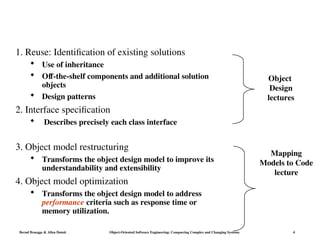
1. Reuse: Identification of existing solutions
Use of inheritance
Off-the-shelf components and additional solution
objects
Design patterns
2. Interface specification
Describes precisely each class interface
3. Object model restructuring
Transforms the object design model to improve its
understandability and extensibility
4. Object model optimization
Transforms the object design model to address
performance criteria such as response time or
memory utilization.
Object
Design
lectures
Mapping
Models to Code
lecture
5.
Bernd Bruegge &Allen Dutoit Object-Oriented Software Engineering: Conquering Complex and Changing Systems 5
Outline of Today
The use of inheritance
Implementation vs Interface Inheritance
Delegation
Documenting the Object Design
JavaDoc In Appendix
In Appendix
6.
Bernd Bruegge &Allen Dutoit Object-Oriented Software Engineering: Conquering Complex and Changing Systems 6
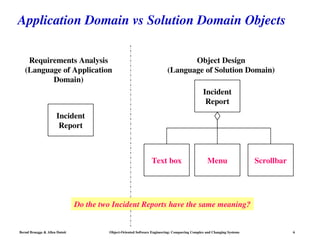
Application Domain vs Solution Domain Objects
Incident
Report
Requirements Analysis
(Language of Application
Domain)
Incident
Report
Object Design
(Language of Solution Domain)
Text box Menu Scrollbar
Do the two Incident Reports have the same meaning?
7.
Bernd Bruegge &Allen Dutoit Object-Oriented Software Engineering: Conquering Complex and Changing Systems 7
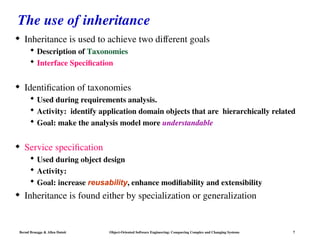
The use of inheritance
Inheritance is used to achieve two different goals
Description of Taxonomies
Interface Specification
Identification of taxonomies
Used during requirements analysis.
Activity: identify application domain objects that are hierarchically related
Goal: make the analysis model more understandable
Service specification
Used during object design
Activity:
Goal: increase reusability, enhance modifiability and extensibility
Inheritance is found either by specialization or generalization
8.
Bernd Bruegge &Allen Dutoit Object-Oriented Software Engineering: Conquering Complex and Changing Systems 8
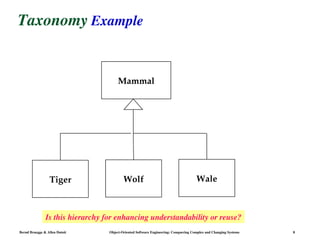
Taxonomy Example
Mammal
Tiger Wolf Wale
Is this hierarchy for enhancing understandability or reuse?
9.
Bernd Bruegge &Allen H. Dutoit Object-Oriented Software Engineering: Using UML, Patterns, and Java 9
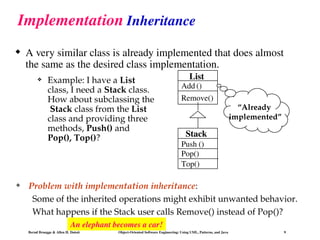
Problem with implementation inheritance:
Some of the inherited operations might exhibit unwanted behavior.
What happens if the Stack user calls Remove() instead of Pop()?
Example: I have a List
class, I need a Stack class.
How about subclassing the
Stack class from the List
class and providing three
methods, Push() and
Pop(), Top()?
Add ()
Remove()
List
Push ()
Pop()
Stack
Top()
“Already
implemented”
Implementation Inheritance
A very similar class is already implemented that does almost
the same as the desired class implementation.
An elephant becomes a car!
10.
Bernd Bruegge &Allen H. Dutoit Object-Oriented Software Engineering: Using UML, Patterns, and Java 10
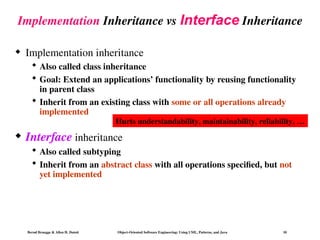
Implementation Inheritance vs Interface Inheritance
Implementation inheritance
Also called class inheritance
Goal: Extend an applications’ functionality by reusing functionality
in parent class
Inherit from an existing class with some or all operations already
implemented
Interface inheritance
Also called subtyping
Inherit from an abstract class with all operations specified, but not
yet implemented
Hurts understandability, maintainability, reliability, …
11.
Bernd Bruegge &Allen H. Dutoit Object-Oriented Software Engineering: Using UML, Patterns, and Java 11
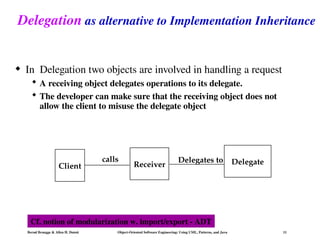
Client Receiver Delegate
Delegates to
calls
Delegation as alternative to Implementation Inheritance
In Delegation two objects are involved in handling a request
A receiving object delegates operations to its delegate.
The developer can make sure that the receiving object does not
allow the client to misuse the delegate object
Cf. notion of modularization w. import/export - ADT
12.
Bernd Bruegge &Allen H. Dutoit Object-Oriented Software Engineering: Using UML, Patterns, and Java 12
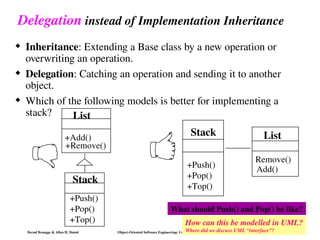
Delegation instead of Implementation Inheritance
Inheritance: Extending a Base class by a new operation or
overwriting an operation.
Delegation: Catching an operation and sending it to another
object.
Which of the following models is better for implementing a
stack?
+Add()
+Remove()
List
Stack
+Push()
+Pop()
+Top()
+Push()
+Pop()
+Top()
Stack
Add()
Remove()
List
What should Push() and Pop() be like?
How can this be modelled in UML?
Where did we discuss UML “interface”?
13.
Bernd Bruegge &Allen H. Dutoit Object-Oriented Software Engineering: Using UML, Patterns, and Java 13
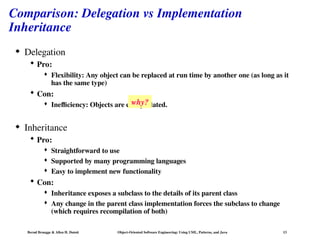
Comparison: Delegation vs Implementation
Inheritance
Delegation
Pro:
Flexibility: Any object can be replaced at run time by another one (as long as it
has the same type)
Con:
Inefficiency: Objects are encapsulated.
Inheritance
Pro:
Straightforward to use
Supported by many programming languages
Easy to implement new functionality
Con:
Inheritance exposes a subclass to the details of its parent class
Any change in the parent class implementation forces the subclass to change
(which requires recompilation of both)
why?
14.
Bernd Bruegge &Allen H. Dutoit Object-Oriented Software Engineering: Using UML, Patterns, and Java 14
Many design patterns use a
combination of inheritance and
delegation
Lecture on
Design Patterns
15.
Bernd Bruegge &Allen Dutoit Object-Oriented Software Engineering: Conquering Complex and Changing Systems 15
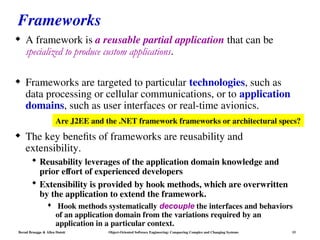
Frameworks
A framework is a reusable partial application that can be
specialized to produce custom applications.
Frameworks are targeted to particular technologies, such as
data processing or cellular communications, or to application
domains, such as user interfaces or real-time avionics.
The key benefits of frameworks are reusability and
extensibility.
Reusability leverages of the application domain knowledge and
prior effort of experienced developers
Extensibility is provided by hook methods, which are overwritten
by the application to extend the framework.
Hook methods systematically decouple the interfaces and behaviors
of an application domain from the variations required by an
application in a particular context.
Are J2EE and the .NET framework frameworks or architectural specs?
16.
Bernd Bruegge &Allen Dutoit Object-Oriented Software Engineering: Conquering Complex and Changing Systems 16
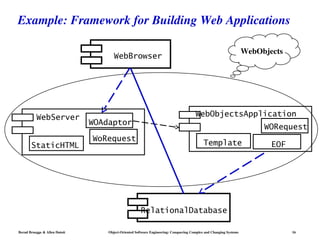
Example: Framework for Building Web Applications
WebBrowser
RelationalDatabase
StaticHTML
WOAdaptor
WebServer
WoRequest
Template
WebObjectsApplication
WORequest
EOF
WebObjects
17.
Bernd Bruegge &Allen Dutoit Object-Oriented Software Engineering: Conquering Complex and Changing Systems 17
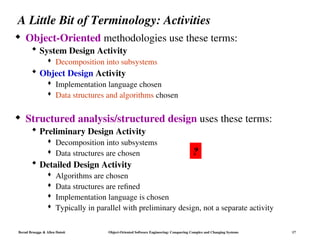
A Little Bit of Terminology: Activities
Object-Oriented methodologies use these terms:
System Design Activity
Decomposition into subsystems
Object Design Activity
Implementation language chosen
Data structures and algorithms chosen
Structured analysis/structured design uses these terms:
Preliminary Design Activity
Decomposition into subsystems
Data structures are chosen
Detailed Design Activity
Algorithms are chosen
Data structures are refined
Implementation language is chosen
Typically in parallel with preliminary design, not a separate activity
?
18.
Bernd Bruegge &Allen Dutoit Object-Oriented Software Engineering: Conquering Complex and Changing Systems 18
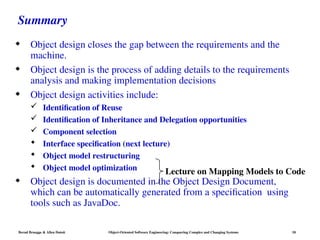
Summary
Object design closes the gap between the requirements and the
machine.
Object design is the process of adding details to the requirements
analysis and making implementation decisions
Object design activities include:
Identification of Reuse
Identification of Inheritance and Delegation opportunities
Component selection
Interface specification (next lecture)
Object model restructuring
Object model optimization
Object design is documented in the Object Design Document,
which can be automatically generated from a specification using
tools such as JavaDoc.
Lecture on Mapping Models to Code
19.
Bernd Bruegge &Allen Dutoit Object-Oriented Software Engineering: Conquering Complex and Changing Systems 19
Additional Slides
20.
Bernd Bruegge &Allen Dutoit Object-Oriented Software Engineering: Conquering Complex and Changing Systems 20
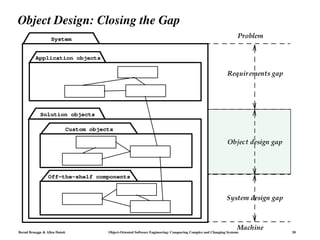
Object Design: Closing the Gap
Custom objects
Application objects
Off-the-shelf components
Solution objects
System Problem
Machine
System design gap
Object design gap
Requirements gap
21.
Bernd Bruegge &Allen Dutoit Object-Oriented Software Engineering: Conquering Complex and Changing Systems 21
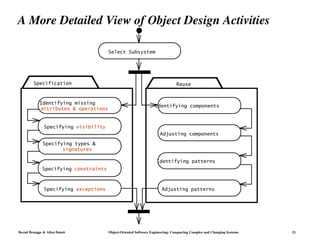
A More Detailed View of Object Design Activities
Specifying constraints
Specifying types &
signatures
Identifying patterns
Adjusting patterns
Identifying missing
attributes & operations
Specifying visibility
Specification
Specifying exceptions
Reuse
Identifying components
Adjusting components
Select Subsystem
22.
Bernd Bruegge &Allen Dutoit Object-Oriented Software Engineering: Conquering Complex and Changing Systems 22
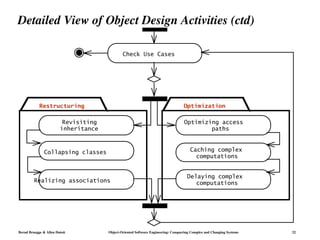
Detailed View of Object Design Activities (ctd)
Collapsing classes
Restructuring Optimization
Revisiting
inheritance
Optimizing access
paths
Caching complex
computations
Delaying complex
computations
Check Use Cases
Realizing associations
23.
Bernd Bruegge &Allen Dutoit Object-Oriented Software Engineering: Conquering Complex and Changing Systems 23
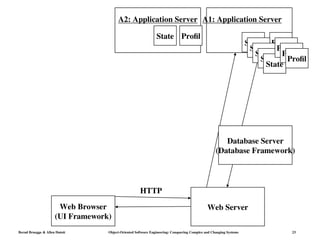
Web Browser
(UI Framework)
Web Server
HTTP
State Profil
A1: Application Server
State
State
State
State
State
A2: Application Server
Profil
Profil
Profil
Profil
Database Server
(Database Framework)
24.
Bernd Bruegge &Allen H. Dutoit Object-Oriented Software Engineering: Using UML, Patterns, and Java 24
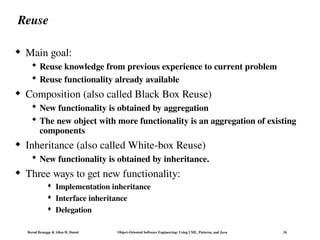
Reuse
Main goal:
Reuse knowledge from previous experience to current problem
Reuse functionality already available
Composition (also called Black Box Reuse)
New functionality is obtained by aggregation
The new object with more functionality is an aggregation of existing
components
Inheritance (also called White-box Reuse)
New functionality is obtained by inheritance.
Three ways to get new functionality:
Implementation inheritance
Interface inheritance
Delegation
25.
Bernd Bruegge &Allen Dutoit Object-Oriented Software Engineering: Conquering Complex and Changing Systems 25
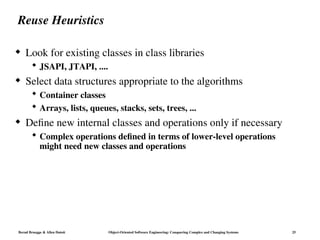
Reuse Heuristics
Look for existing classes in class libraries
JSAPI, JTAPI, ....
Select data structures appropriate to the algorithms
Container classes
Arrays, lists, queues, stacks, sets, trees, ...
Define new internal classes and operations only if necessary
Complex operations defined in terms of lower-level operations
might need new classes and operations
26.
Bernd Bruegge &Allen Dutoit Object-Oriented Software Engineering: Conquering Complex and Changing Systems 26
Reuse Concepts
Application objects versus solution objects
Specification inheritance and implementation inheritance
The Liskov Substitution Principle
Delegation (Section 8.3.3)
Delegation and inheritance in design patterns
27.
Bernd Bruegge &Allen Dutoit Object-Oriented Software Engineering: Conquering Complex and Changing Systems 27
Observation about Modeling of the Real World
[Gamma et al 94]:
Strict modeling of the real world leads to a system that reflects
today’s realities but not necessarily tomorrow’s.
There is a need for reusable and flexible designs
Design knowledge complements application domain
knowledge and solution domain knowledge.
28.
Bernd Bruegge &Allen Dutoit Object-Oriented Software Engineering: Conquering Complex and Changing Systems 28
Application domain vs solution domain objects
Application objects, also called domain objects, represent
concepts of the domain that are relevant to the system.
They are identified by the application domain specialists and by the
end users.
Solution objects represent concepts that do not have a
counterpart in the application domain,
They are identified by the developers
Examples: Persistent data stores, user interface objects,
middleware.
29.
Bernd Bruegge &Allen Dutoit Object-Oriented Software Engineering: Conquering Complex and Changing Systems 29
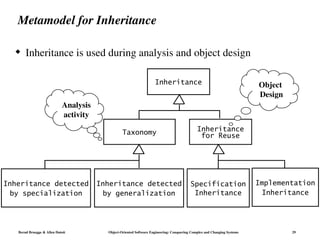
Metamodel for Inheritance
Inheritance is used during analysis and object design
Inheritance
Specification
Inheritance
Implementation
Inheritance
Inheritance
for Reuse
Taxonomy
Inheritance detected
by generalization
Inheritance detected
by specialization
Analysis
activity
Object
Design
30.
Bernd Bruegge &Allen Dutoit Object-Oriented Software Engineering: Conquering Complex and Changing Systems 30
Implementation of Application Domain Classes
New objects are often needed during object design:
The use of design patterns introduces new classes
The implementation of algorithms may necessitate objects to hold
values
New low-level operations may be needed during the decomposition
of high-level operations
Example: The EraseArea() operation in a drawing program.
Conceptually very simple
Implementation
Area represented by pixels
Repair () cleans up objects partially covered by the erased area
Redraw() draws objects uncovered by the erasure
Draw() erases pixels in background color not covered by other objects
31.
Bernd Bruegge &Allen Dutoit Object-Oriented Software Engineering: Conquering Complex and Changing Systems 31
Component Selection
Select existing
off-the-shelf class libraries
frameworks or
components
Adjust the class libraries, framework or components
Change the API if you have the source code.
Use the adapter or bridge pattern if you don’t have access
Architecture Driven Design
32.
Bernd Bruegge &Allen Dutoit Object-Oriented Software Engineering: Conquering Complex and Changing Systems 32
Classification of Frameworks
Frameworks can be classified by their position in the software
development process.
Frameworks can also be classified by the techniques used to
extend them.
Whitebox frameworks
Blackbox frameworks
33.
Bernd Bruegge &Allen Dutoit Object-Oriented Software Engineering: Conquering Complex and Changing Systems 33
Frameworks in the Development Process
Infrastructure frameworks aim to simplify the software
development process
System infrastructure frameworks are used internally within a
software project and are usually not delivered to a client.
Middleware frameworks are used to integrate existing
distributed applications and components.
Examples: MFC, DCOM, Java RMI, WebObjects, WebSphere,
WebLogic Enterprise Application [BEA].
Enterprise application frameworks are application specific and
focus on domains
Example domains: telecommunications, avionics, environmental
modeling, manufacturing, financial engineering, enterprise business
activities.
34.
Bernd Bruegge &Allen Dutoit Object-Oriented Software Engineering: Conquering Complex and Changing Systems 34
White-box and Black-Box Frameworks
Whitebox frameworks:
Extensibility achieved through inheritance and dynamic binding.
Existing functionality is extended by subclassing framework base
classes and overriding predefined hook methods
Often design patterns such as the template method pattern are used
to override the hook methods.
Blackbox frameworks
Extensibility achieved by defining interfaces for components that
can be plugged into the framework.
Existing functionality is reused by defining components that
conform to a particular interface
These components are integrated with the framework via
delegation.
35.
Bernd Bruegge &Allen Dutoit Object-Oriented Software Engineering: Conquering Complex and Changing Systems 35
Class libraries and Frameworks
Class Libraries:
Less domain specific
Provide a smaller scope of reuse.
Class libraries are passive; no constraint on control flow.
Framework:
Classes cooperate for a family of related applications.
Frameworks are active; affect the flow of control.
In practice, developers often use both:
Frameworks often use class libraries internally to simplify the
development of the framework.
Framework event handlers use class libraries to perform basic
tasks (e.g. string processing, file management, numerical analysis….
)
36.
Bernd Bruegge &Allen Dutoit Object-Oriented Software Engineering: Conquering Complex and Changing Systems 36
Components and Frameworks
Components
Self-contained instances of classes
Plugged together to form complete applications.
Blackbox that defines a cohesive set of operations,
Can be used based on the syntax and semantics of the interface.
Components can even be reused on the binary code level.
The advantage is that applications do not always have to be
recompiled when components change.
Frameworks:
Often used to develop components
Components are often plugged into blackbox frameworks.
37.
Bernd Bruegge &Allen Dutoit Object-Oriented Software Engineering: Conquering Complex and Changing Systems 37
Documenting the Object Design: The Object Design
Document (ODD)
Object design document
Same as the Requirements Analysis Document (RAD) plus...
… additions to object, functional and dynamic models (from solution
domain)
… navigational map for object model
… Javadoc documentation for all classes
ODD Management issues
Update the system models in the RAD?
Should the ODD be a separate document?
Who is the target audience for these documents (Customer, developer?)
If time is short: Focus on the Navigational Map and Javadoc
documentation?
ODD Template:
http://www.oose.org
38.
Bernd Bruegge &Allen Dutoit Object-Oriented Software Engineering: Conquering Complex and Changing Systems 38
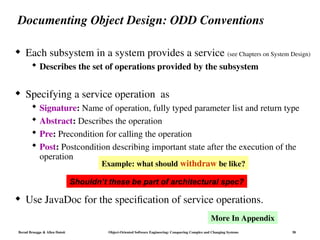
Documenting Object Design: ODD Conventions
Each subsystem in a system provides a service (see Chapters on System Design)
Describes the set of operations provided by the subsystem
Specifying a service operation as
Signature: Name of operation, fully typed parameter list and return type
Abstract: Describes the operation
Pre: Precondition for calling the operation
Post: Postcondition describing important state after the execution of the
operation
Use JavaDoc for the specification of service operations.
Shouldn’t these be part of architectural spec?
Example: what should withdraw be like?
More In Appendix
39.
Bernd Bruegge &Allen Dutoit Object-Oriented Software Engineering: Conquering Complex and Changing Systems 39
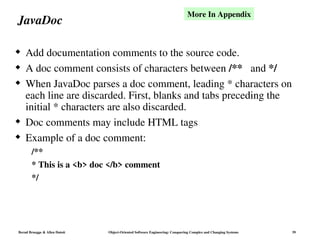
JavaDoc
Add documentation comments to the source code.
A doc comment consists of characters between /** and */
When JavaDoc parses a doc comment, leading * characters on
each line are discarded. First, blanks and tabs preceding the
initial * characters are also discarded.
Doc comments may include HTML tags
Example of a doc comment:
/**
* This is a <b> doc </b> comment
*/
More In Appendix
40.
Bernd Bruegge &Allen Dutoit Object-Oriented Software Engineering: Conquering Complex and Changing Systems 40
More on JavaDoc
Doc comments are only recognized when placed immediately
before class, interface, constructor, method or field
declarations.
When you embed HTML tags within a doc comment, you
should not use heading tags such as <h1> and <h2>, because
JavaDoc creates an entire structured document and these
structural tags interfere with the formatting of the generated
document.
Class and Interface Doc Tags
Constructor and Method Doc Tags
41.
Bernd Bruegge &Allen Dutoit Object-Oriented Software Engineering: Conquering Complex and Changing Systems 41
Class and Interface Doc Tags
@author name-text
Creates an “Author” entry.
@version version-text
Creates a “Version” entry.
@see classname
Creates a hyperlink “See Also classname”
@since since-text
Adds a “Since” entry. Usually used to specify that a feature or
change exists since the release number of the software specified in
the “since-text”
@deprecated deprecated-text
Adds a comment that this method can no longer be used.
Convention is to describe method that serves as replacement
Example: @deprecated Replaced by setBounds(int, int, int, int).
42.
Bernd Bruegge &Allen Dutoit Object-Oriented Software Engineering: Conquering Complex and Changing Systems 42
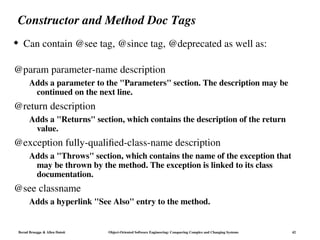
Constructor and Method Doc Tags
Can contain @see tag, @since tag, @deprecated as well as:
@param parameter-name description
Adds a parameter to the "Parameters" section. The description may be
continued on the next line.
@return description
Adds a "Returns" section, which contains the description of the return
value.
@exception fully-qualified-class-name description
Adds a "Throws" section, which contains the name of the exception that
may be thrown by the method. The exception is linked to its class
documentation.
@see classname
Adds a hyperlink "See Also" entry to the method.
43.
Bernd Bruegge &Allen Dutoit Object-Oriented Software Engineering: Conquering Complex and Changing Systems 43
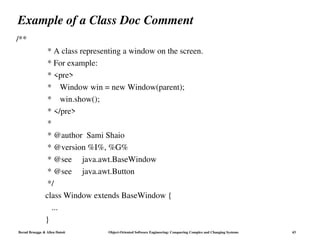
Example of a Class Doc Comment
/**
* A class representing a window on the screen.
* For example:
* <pre>
* Window win = new Window(parent);
* win.show();
* </pre>
*
* @author Sami Shaio
* @version %I%, %G%
* @see java.awt.BaseWindow
* @see java.awt.Button
*/
class Window extends BaseWindow {
...
}
44.
Bernd Bruegge &Allen Dutoit Object-Oriented Software Engineering: Conquering Complex and Changing Systems 44
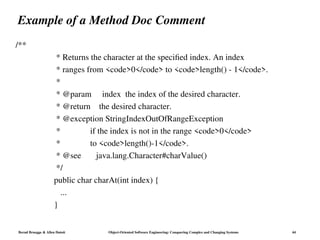
Example of a Method Doc Comment
/**
* Returns the character at the specified index. An index
* ranges from <code>0</code> to <code>length() - 1</code>.
*
* @param index the index of the desired character.
* @return the desired character.
* @exception StringIndexOutOfRangeException
* if the index is not in the range <code>0</code>
* to <code>length()-1</code>.
* @see java.lang.Character#charValue()
*/
public char charAt(int index) {
...
}
45.
Bernd Bruegge &Allen Dutoit Object-Oriented Software Engineering: Conquering Complex and Changing Systems 45
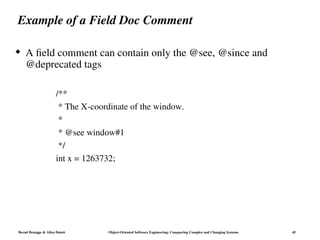
Example of a Field Doc Comment
A field comment can contain only the @see, @since and
@deprecated tags
/**
* The X-coordinate of the window.
*
* @see window#1
*/
int x = 1263732;
46.
Bernd Bruegge &Allen Dutoit Object-Oriented Software Engineering: Conquering Complex and Changing Systems 46
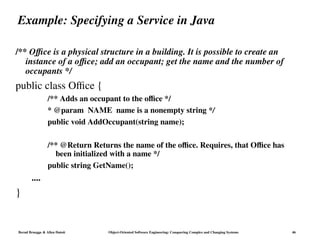
Example: Specifying a Service in Java
/** Office is a physical structure in a building. It is possible to create an
instance of a office; add an occupant; get the name and the number of
occupants */
public class Office {
/** Adds an occupant to the office */
* @param NAME name is a nonempty string */
public void AddOccupant(string name);
/** @Return Returns the name of the office. Requires, that Office has
been initialized with a name */
public string GetName();
....
}
47.
Bernd Bruegge &Allen Dutoit Object-Oriented Software Engineering: Conquering Complex and Changing Systems 47
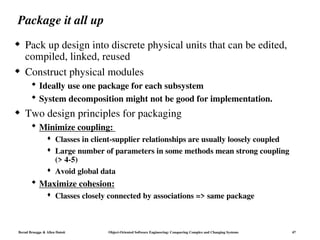
Package it all up
Pack up design into discrete physical units that can be edited,
compiled, linked, reused
Construct physical modules
Ideally use one package for each subsystem
System decomposition might not be good for implementation.
Two design principles for packaging
Minimize coupling:
Classes in client-supplier relationships are usually loosely coupled
Large number of parameters in some methods mean strong coupling
(> 4-5)
Avoid global data
Maximize cohesion:
Classes closely connected by associations => same package
48.
Bernd Bruegge &Allen Dutoit Object-Oriented Software Engineering: Conquering Complex and Changing Systems 48
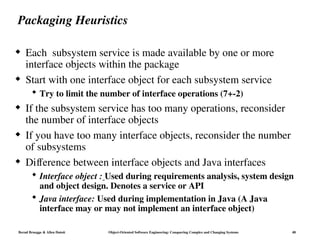
Packaging Heuristics
Each subsystem service is made available by one or more
interface objects within the package
Start with one interface object for each subsystem service
Try to limit the number of interface operations (7+-2)
If the subsystem service has too many operations, reconsider
the number of interface objects
If you have too many interface objects, reconsider the number
of subsystems
Difference between interface objects and Java interfaces
Interface object : Used during requirements analysis, system design
and object design. Denotes a service or API
Java interface: Used during implementation in Java (A Java
interface may or may not implement an interface object)
Editor's Notes
#3 The analysis phase determines what the implementation must do (What), and the system design phase formulates the plan of attack (How), but on a very high level (namely subsystems, layers and partitions). The object design phase carries out the plan of attack!
It determines the full definitions of classes and associations used in the implementation, as well as the interfaces and the algorithms of the methods used to implement operations.
The objects discovered during the analysis can be thought of as the skeleton of the final system, but new classes are needed. In particular, the operations found during analysis must be expressed as algorithms, the classes, associations and attributes must be implemented with specific data structures. New objects will be identifed during this activity. For example, intermediate results might have to be stored to avoid the need for recompilation. This is an important issue if we implement a distributed system. Maps retrieved by the UI from the database should be stored locally, so not every access is an access across processor boundaries.
The object design phases therefore addresses any internal objects needed for the implementation and optimizes data structures and algorithms.
Object design is the basis of implementation.
Note that there is no change of notation, we are still using object models, functional models and dynamic models as our main weapons.
#9 Inheritance is a generalization technique, in which the behavior of a superclass is shared by all its subclasses. Sometimes it is misused as an implementation technique.
Question: Can you give me an example for unwanted behavior?
#39 The specification of a class interface includes the class name and the superclass name. You should also include an overall description of the class here. The attributes of a given class (as defined in OMTool and later in C++) need not be given here since this is the interface to the outside world and attributes are considered private to each class. The class specification should also include the specification of each operation that can be performed on the class.
The specification of an operation consists of a header and a semantic part. The header contains the name of the operation and includes the number, order and types of its input parameters in standard C++ style. The semantic part defines the meaning of the operation and consists of three clauses, the requires, modifies and ensures clause. The requires clause states an assertion or list of assertions that are the preconditions of the operation. This expresses the condition under which the call to the routine is correct. [For example, if an array has to be sorted before the search() operation can be called, this would be in the requires section of search()]. The modifies clause lists the names of any input parameters that are modified by the operation. The ensures clause states an assertion or list of assertions that are the postconditions of the operation. This expresses the conditions that the operator will ensure when it returns, assuming it was called in a state satisfying the preconditions. All the clauses may be written in informal English or in C++ syntax where this is more concise.
#46 The specification of a class interface includes the class name and the superclass name. You should also include an overall description of the class here. The attributes of a given class (as defined in OMTool and later in C++) need not be given here since this is the interface to the outside world and attributes are considered private to each class. The class specification should also include the specification of each operation that can be performed on the class.
The specification of an operation consists of a header and a semantic part. The header contains the name of the operation and includes the number, order and types of its input parameters in standard C++ style. The semantic part defines the meaning of the operation and consists of three clauses, the requires, modifies and ensures clause. The requires clause states an assertion or list of assertions that are the preconditions of the operation. This expresses the condition under which the call to the routine is correct. [For example, if an array has to be sorted before the search() operation can be called, this would be in the requires section of search()]. The modifies clause lists the names of any input parameters that are modified by the operation. The ensures clause states an assertion or list of assertions that are the postconditions of the operation. This expresses the conditions that the operator will ensure when it returns, assuming it was called in a state satisfying the preconditions. All the clauses may be written in informal English or in C++ syntax where this is more concise.

![Bernd Bruegge & Allen Dutoit Object-Oriented Software Engineering: Conquering Complex and Changing Systems 27
Observation about Modeling of the Real World
[Gamma et al 94]:
Strict modeling of the real world leads to a system that reflects
today’s realities but not necessarily tomorrow’s.
There is a need for reusable and flexible designs
Design knowledge complements application domain
knowledge and solution domain knowledge.](https://image.slidesharecdn.com/ch08-reusepatterns-lect1-250609045806-9b349e7e/85/Reusing-Pattern-in-Object-Oriented-Design-27-320.jpg)
![Bernd Bruegge & Allen Dutoit Object-Oriented Software Engineering: Conquering Complex and Changing Systems 33
Frameworks in the Development Process
Infrastructure frameworks aim to simplify the software
development process
System infrastructure frameworks are used internally within a
software project and are usually not delivered to a client.
Middleware frameworks are used to integrate existing
distributed applications and components.
Examples: MFC, DCOM, Java RMI, WebObjects, WebSphere,
WebLogic Enterprise Application [BEA].
Enterprise application frameworks are application specific and
focus on domains
Example domains: telecommunications, avionics, environmental
modeling, manufacturing, financial engineering, enterprise business
activities.](https://image.slidesharecdn.com/ch08-reusepatterns-lect1-250609045806-9b349e7e/85/Reusing-Pattern-in-Object-Oriented-Design-33-320.jpg)