RETINALVASCULAR
DISORDERS
DIABETIC RETINOPATHY
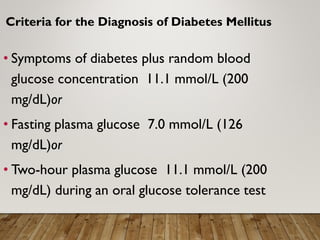
Criteria for the Diagnosis of Diabetes Mellitus
• Symptoms of diabetes plus random blood
glucose concentration 11.1 mmol/L (200
mg/dL)or
• Fasting plasma glucose 7.0 mmol/L (126
mg/dL)or
• Two-hour plasma glucose 11.1 mmol/L (200
mg/dL) during an oral glucose tolerance test
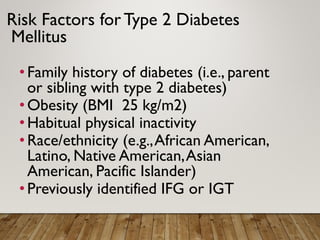
Risk Factors for Type 2 Diabetes
Mellitus
•Family history of diabetes (i.e., parent
or sibling with type 2 diabetes)
•Obesity (BMI 25 kg/m2)
•Habitual physical inactivity
•Race/ethnicity (e.g.,African American,
Latino, Native American,Asian
American, Pacific Islander)
•Previously identified IFG or IGT
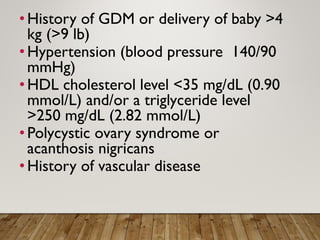
•History of GDM or delivery of baby >4
kg (>9 lb)
•Hypertension (blood pressure 140/90
mmHg)
•HDL cholesterol level <35 mg/dL (0.90
mmol/L) and/or a triglyceride level
>250 mg/dL (2.82 mmol/L)
•Polycystic ovary syndrome or
acanthosis nigricans
•History of vascular disease
• Note: BMI, body mass index; IFG, impaired fasting glucose;
IGT, impaired glucose tolerance; GDM, gestational diabetes
mellitus; HDL, high-density lipoprotein.
DIABETIC RETINOPATHY
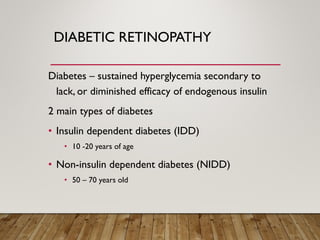
Diabetes – sustained hyperglycemia secondary to
lack, or diminished efficacy of endogenous insulin
2 main types of diabetes
• Insulin dependent diabetes (IDD)
• 10 -20 years of age
• Non-insulin dependent diabetes (NIDD)
• 50 – 70 years old
Diabetic retinopathy
• Leading cause of legal blindness in individuals between
the ages of 20 and 65 years
Risk factors for diabetic retinopathy
1.Duration of diabetes – most important factor
2.Poor metabolic control
3.Other factors – pregnancy, hypertension, renal
disease, anemia
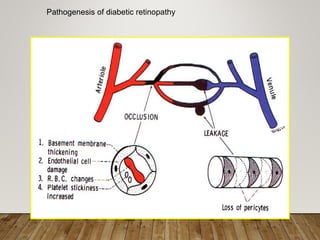
Pathogenesis of DR
DR is a microangiopathy affecting the retinal
precapillary arterioles, capillaries and venules.
Large vessels may also be involved. Retinopathy
has features of both microvascular occlusion
and leakage.
Microvascular occlusion:
• Thickening of basement membrane
• Capillary endothelial cell damage and
proliferation
• Changes in red blood cells leading to defective
oxygen transport
• Increased stickiness and aggregation of
platelets
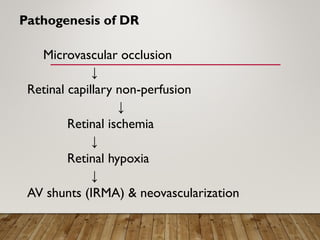
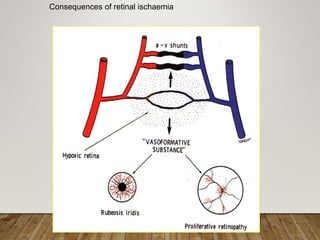
Pathogenesis of DR
Microvascular occlusion
↓
Retinal capillary non-perfusion
↓
Retinal ischemia
↓
Retinal hypoxia
↓
AV shunts (IRMA) & neovascularization
Pathogenesis of diabetic retinopathy
Consequences of retinal ischaemia
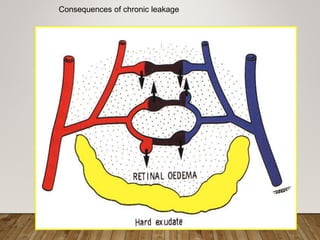
Consequences of chronic leakage
The hard exudates are composed of lipid
and proteinaceous material, such as
fibrinogen and albumin that leak from the
impaired blood–retinal barrier. They are
deposited primarily in the outer plexiform
layer of the retina.
Microvascular leakage
Pathogenesis
The cellular elements of retinal capillaries consists
of endothelial cells and pericytes.These elements
are responsible for the structural integrity of the
vessel wall.
In DM there is reduction of pericytes which causes
distention of capillary walls and breakdown of
blood retinal barrier, leading to leakage of plasma
constituents into the retina (increased vascular
permeability) leading to retinal edema.
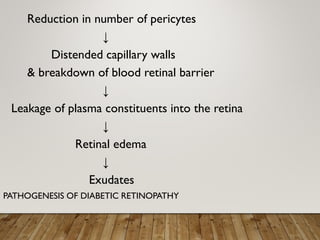
Reduction in number of pericytes
↓
Distended capillary walls
& breakdown of blood retinal barrier
↓
Leakage of plasma constituents into the retina
↓
Retinal edema
↓
Exudates
PATHOGENESIS OF DIABETIC RETINOPATHY
3 main types:
•Background retinopathy
•Pre-proliferative retinopathy
•Proliferative retinopathy
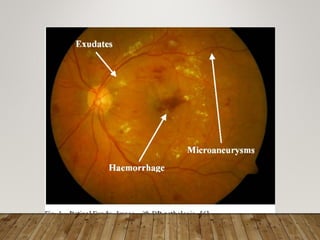
SIMPLE BACKGROUND DR
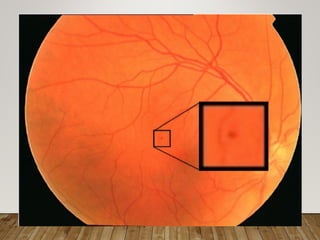
1. Microaneurysms (saccular pouches due to capillary
distention)
- First clinically detectable lesion of DR
- Small round dots usually temporal to the macula
2. Hemorrhages
3. Hard exudates – yellow waxy appearance with
distinct margins
4. Retinal edema
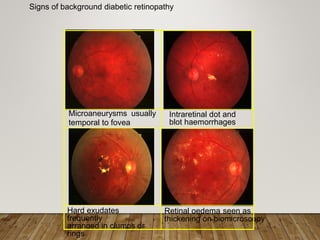
Signs of background diabetic retinopathy
Microaneurysms usually
temporal to fovea
Intraretinal dot and
blot haemorrhages
Hard exudates
frequently
arranged in clumps or
rings
Retinal oedema seen as
thickening on biomicroscopy
PREPROLIFERATIVE DR
- Lesions are caused by retinal ischemia
1. Vascular changes
2. Dark blot hemorrhages (hemorrhagic retinal infarcts)
3. Cotton wool spots caused by capillary occlusion
4. Intraretinal microvascular abnormalities
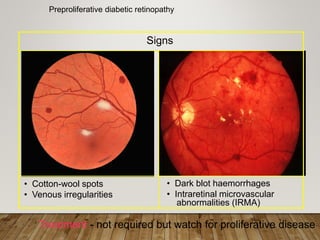
Preproliferative diabetic retinopathy
Treatment - not required but watch for proliferative disease
• Cotton-wool spots
• Venous irregularities
• Dark blot haemorrhages
• Intraretinal microvascular
abnormalities (IRMA)
Signs
PROLIFERATIVE DR
1. Neovascularization – hallmark of PDR
2. Vitreous detachment
3. Intragel hemorrhage
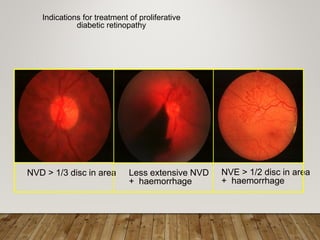
Indications for treatment of proliferative
diabetic retinopathy
NVD > 1/3 disc in area Less extensive NVD
+ haemorrhage
NVE > 1/2 disc in area
+ haemorrhage
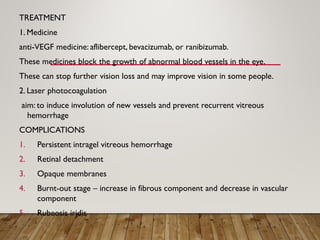
TREATMENT
1. Medicine
anti-VEGF medicine: aflibercept, bevacizumab, or ranibizumab.
These medicines block the growth of abnormal blood vessels in the eye.
These can stop further vision loss and may improve vision in some people.
2. Laser photocoagulation
aim: to induce involution of new vessels and prevent recurrent vitreous
hemorrhage
COMPLICATIONS
1. Persistent intragel vitreous hemorrhage
2. Retinal detachment
3. Opaque membranes
4. Burnt-out stage – increase in fibrous component and decrease in vascular
component
5. Rubeosis iridis
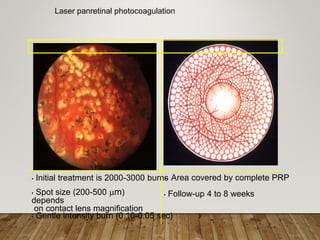
• Spot size (200-500 m)
depends
on contact lens magnification
• Gentle intensity burn (0.10-0.05 sec)
• Follow-up 4 to 8 weeks
• Area covered by complete PRP
• Initial treatment is 2000-3000 burns
Laser panretinal photocoagulation
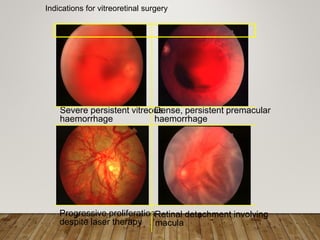
Indications for vitreoretinal surgery
Retinal detachment involving
macula
Severe persistent vitreous
haemorrhage
Dense, persistent premacular
haemorrhage
Progressive proliferation
despite laser therapy

RETINAL-VASCULAR-DISORDERS.pdf

  • 1.
  • 2.
  • 3.
    Criteria for theDiagnosis of Diabetes Mellitus • Symptoms of diabetes plus random blood glucose concentration 11.1 mmol/L (200 mg/dL)or • Fasting plasma glucose 7.0 mmol/L (126 mg/dL)or • Two-hour plasma glucose 11.1 mmol/L (200 mg/dL) during an oral glucose tolerance test
  • 4.
    Risk Factors forType 2 Diabetes Mellitus •Family history of diabetes (i.e., parent or sibling with type 2 diabetes) •Obesity (BMI 25 kg/m2) •Habitual physical inactivity •Race/ethnicity (e.g.,African American, Latino, Native American,Asian American, Pacific Islander) •Previously identified IFG or IGT
  • 5.
    •History of GDMor delivery of baby >4 kg (>9 lb) •Hypertension (blood pressure 140/90 mmHg) •HDL cholesterol level <35 mg/dL (0.90 mmol/L) and/or a triglyceride level >250 mg/dL (2.82 mmol/L) •Polycystic ovary syndrome or acanthosis nigricans •History of vascular disease
  • 6.
    • Note: BMI,body mass index; IFG, impaired fasting glucose; IGT, impaired glucose tolerance; GDM, gestational diabetes mellitus; HDL, high-density lipoprotein.
  • 7.
    DIABETIC RETINOPATHY Diabetes –sustained hyperglycemia secondary to lack, or diminished efficacy of endogenous insulin 2 main types of diabetes • Insulin dependent diabetes (IDD) • 10 -20 years of age • Non-insulin dependent diabetes (NIDD) • 50 – 70 years old
  • 8.
    Diabetic retinopathy • Leadingcause of legal blindness in individuals between the ages of 20 and 65 years Risk factors for diabetic retinopathy 1.Duration of diabetes – most important factor 2.Poor metabolic control 3.Other factors – pregnancy, hypertension, renal disease, anemia
  • 9.
    Pathogenesis of DR DRis a microangiopathy affecting the retinal precapillary arterioles, capillaries and venules. Large vessels may also be involved. Retinopathy has features of both microvascular occlusion and leakage.
  • 10.
    Microvascular occlusion: • Thickeningof basement membrane • Capillary endothelial cell damage and proliferation • Changes in red blood cells leading to defective oxygen transport • Increased stickiness and aggregation of platelets
  • 11.
    Pathogenesis of DR Microvascularocclusion ↓ Retinal capillary non-perfusion ↓ Retinal ischemia ↓ Retinal hypoxia ↓ AV shunts (IRMA) & neovascularization
  • 12.
  • 13.
  • 14.
  • 15.
    The hard exudatesare composed of lipid and proteinaceous material, such as fibrinogen and albumin that leak from the impaired blood–retinal barrier. They are deposited primarily in the outer plexiform layer of the retina.
  • 17.
    Microvascular leakage Pathogenesis The cellularelements of retinal capillaries consists of endothelial cells and pericytes.These elements are responsible for the structural integrity of the vessel wall. In DM there is reduction of pericytes which causes distention of capillary walls and breakdown of blood retinal barrier, leading to leakage of plasma constituents into the retina (increased vascular permeability) leading to retinal edema.
  • 18.
    Reduction in numberof pericytes ↓ Distended capillary walls & breakdown of blood retinal barrier ↓ Leakage of plasma constituents into the retina ↓ Retinal edema ↓ Exudates PATHOGENESIS OF DIABETIC RETINOPATHY
  • 19.
    3 main types: •Backgroundretinopathy •Pre-proliferative retinopathy •Proliferative retinopathy
  • 20.
    SIMPLE BACKGROUND DR 1.Microaneurysms (saccular pouches due to capillary distention) - First clinically detectable lesion of DR - Small round dots usually temporal to the macula 2. Hemorrhages 3. Hard exudates – yellow waxy appearance with distinct margins 4. Retinal edema
  • 23.
    Signs of backgrounddiabetic retinopathy Microaneurysms usually temporal to fovea Intraretinal dot and blot haemorrhages Hard exudates frequently arranged in clumps or rings Retinal oedema seen as thickening on biomicroscopy
  • 24.
    PREPROLIFERATIVE DR - Lesionsare caused by retinal ischemia 1. Vascular changes 2. Dark blot hemorrhages (hemorrhagic retinal infarcts) 3. Cotton wool spots caused by capillary occlusion 4. Intraretinal microvascular abnormalities
  • 25.
    Preproliferative diabetic retinopathy Treatment- not required but watch for proliferative disease • Cotton-wool spots • Venous irregularities • Dark blot haemorrhages • Intraretinal microvascular abnormalities (IRMA) Signs
  • 26.
    PROLIFERATIVE DR 1. Neovascularization– hallmark of PDR 2. Vitreous detachment 3. Intragel hemorrhage
  • 27.
    Indications for treatmentof proliferative diabetic retinopathy NVD > 1/3 disc in area Less extensive NVD + haemorrhage NVE > 1/2 disc in area + haemorrhage
  • 28.
    TREATMENT 1. Medicine anti-VEGF medicine:aflibercept, bevacizumab, or ranibizumab. These medicines block the growth of abnormal blood vessels in the eye. These can stop further vision loss and may improve vision in some people. 2. Laser photocoagulation aim: to induce involution of new vessels and prevent recurrent vitreous hemorrhage COMPLICATIONS 1. Persistent intragel vitreous hemorrhage 2. Retinal detachment 3. Opaque membranes 4. Burnt-out stage – increase in fibrous component and decrease in vascular component 5. Rubeosis iridis
  • 29.
    • Spot size(200-500 m) depends on contact lens magnification • Gentle intensity burn (0.10-0.05 sec) • Follow-up 4 to 8 weeks • Area covered by complete PRP • Initial treatment is 2000-3000 burns Laser panretinal photocoagulation
  • 30.
    Indications for vitreoretinalsurgery Retinal detachment involving macula Severe persistent vitreous haemorrhage Dense, persistent premacular haemorrhage Progressive proliferation despite laser therapy