2
What is or?
𝑹𝒆𝒔𝒖𝒎𝒆 𝑪𝒖𝒓𝒓𝒊𝒄𝒖𝒍𝒖𝒎 𝑽𝒊𝒕𝒂𝒆
• A formal summary of your education, skills, and experience.
• Serves as your personal marketing tool.
• Creates your first impression to the employer.
"Your resume is your first impression before you even enter the
interview room."
3.
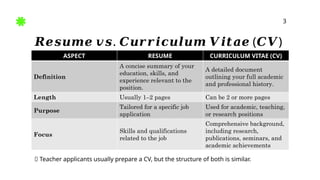
𝑹𝒆𝒔𝒖𝒎𝒆 𝒗𝒔. ()
𝑪𝒖𝒓𝒓𝒊𝒄𝒖𝒍𝒖𝒎 𝑽𝒊𝒕𝒂𝒆 𝑪𝑽
3
ASPECT RESUME CURRICULUM VITAE (CV)
Definition
A concise summary of your
education, skills, and
experience relevant to the
position.
A detailed document
outlining your full academic
and professional history.
Length Usually 1–2 pages Can be 2 or more pages
Purpose
Tailored for a specific job
application
Used for academic, teaching,
or research positions
Focus
Skills and qualifications
related to the job
Comprehensive background,
including research,
publications, seminars, and
academic achievements
📝 Teacher applicants usually prepare a CV, but the structure of both is similar.
4.
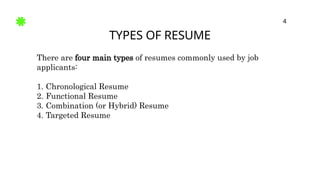
TYPES OF RESUME
4
Thereare four main types of resumes commonly used by job
applicants:
1. Chronological Resume
2. Functional Resume
3. Combination (or Hybrid) Resume
4. Targeted Resume
5.
TYPES OF RESUME
5
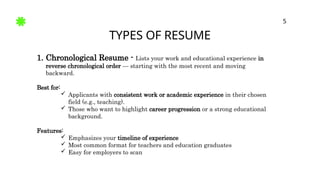
1.Chronological Resume - Lists your work and educational experience in
reverse chronological order — starting with the most recent and moving
backward.
Best for:
Applicants with consistent work or academic experience in their chosen
field (e.g., teaching).
Those who want to highlight career progression or a strong educational
background.
Features:
Emphasizes your timeline of experience
Most common format for teachers and education graduates
Easy for employers to scan
6.
TYPES OF RESUME
6
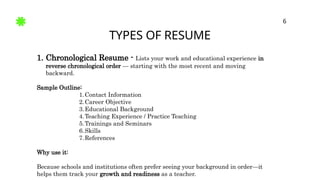
1.Chronological Resume - Lists your work and educational experience in
reverse chronological order — starting with the most recent and moving
backward.
Sample Outline:
1.Contact Information
2.Career Objective
3.Educational Background
4.Teaching Experience / Practice Teaching
5.Trainings and Seminars
6.Skills
7.References
Why use it:
Because schools and institutions often prefer seeing your background in order—it
helps them track your growth and readiness as a teacher.
7.
TYPES OF RESUME
7
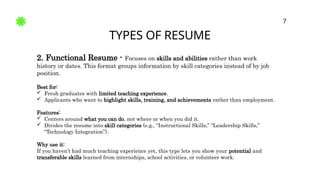
2.Functional Resume - Focuses on skills and abilities rather than work
history or dates. This format groups information by skill categories instead of by job
position.
Best for:
Fresh graduates with limited teaching experience.
Applicants who want to highlight skills, training, and achievements rather than employment.
Features:
Centers around what you can do, not where or when you did it.
Divides the resume into skill categories (e.g., “Instructional Skills,” “Leadership Skills,”
“Technology Integration”).
Why use it:
If you haven’t had much teaching experience yet, this type lets you show your potential and
transferable skills learned from internships, school activities, or volunteer work.
8.
TYPES OF RESUME
8
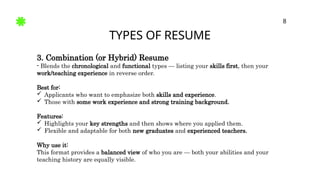
3.Combination (or Hybrid) Resume
- Blends the chronological and functional types — listing your skills first, then your
work/teaching experience in reverse order.
Best for:
Applicants who want to emphasize both skills and experience.
Those with some work experience and strong training background.
Features:
Highlights your key strengths and then shows where you applied them.
Flexible and adaptable for both new graduates and experienced teachers.
Why use it:
This format provides a balanced view of who you are — both your abilities and your
teaching history are equally visible.
9.
TYPES OF RESUME
9
4.Targeted Resume
- A customized resume written specifically for a certain job position or employer.
Every detail is tailored to fit the needs of that school or institution.
Best for:
Applicants applying for a specific teaching position or private school with clear job
requirements.
Features:
Focuses only on the experiences and skills relevant to that particular job.
Uses keywords and phrases from the job description.
Why use it:
A targeted resume shows that you’ve researched the school, understood their mission,
and made an effort to tailor your application — this demonstrates professionalism
and genuine interest.
10.
TYPES OF RESUME
10
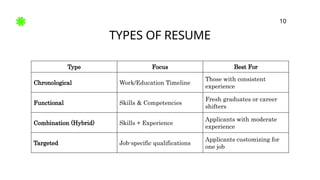
TypeFocus Best For
Chronological Work/Education Timeline
Those with consistent
experience
Functional Skills & Competencies
Fresh graduates or career
shifters
Combination (Hybrid) Skills + Experience
Applicants with moderate
experience
Targeted Job-specific qualifications
Applicants customizing for
one job
11.
Which type doyou think is best
for fresh graduates like you?
11
12.
The Purpose ofa Resume
12
To market yourself
– It sells your qualifications, achievements, and potential.
To provide an overview
– It helps the employer quickly know who you are.
To secure an interview
– It’s your ticket to the next stage: the job interview.
13.
Key Sections ofa Resume
13
1. Personal Information
Full Name
Address
Contact Number
Email Address (professional email preferred)
Optional: Date of Birth, Civil Status, and Nationality
✅ Tips:
Make sure your email looks professional (e.g., juan.delacruz@gmail.com).
Avoid using unnecessary details like height, weight, or religion unless specifically requested.
14.
Key Sections ofa Resume
14
2. Career Objective or Professional Summary
- this section expresses your career goals and what you hope to
contribute.
Example (for a beginning teacher):
“To obtain a teaching position where I can apply my skills and passion for education, foster student
growth, and contribute to the development of the school community.”
✅ Tips:
Keep it short (1–2 sentences).
Tailor it to the specific position or school.
15.
Key Sections ofa Resume
15
3. Educational Background
List your educational achievements in reverse chronological order
(from latest to earliest).
Example:
Bachelor of Physical Education – Philippine Advent College, 2025
Senior High School – Sindangan National High School, 2021
✅ Tips:
Include academic honors or awards (e.g., Dean’s Lister, With Honors).
You may also include your thesis title if relevant.
16.
Key Sections ofa Resume
16
4. Work Experience / Practice Teaching Experience
Even if you haven’t worked full-time, you can include your practice
teaching or internship experience.
Example:
Student Teacher, Sindangan National High School (January – April 2025)
Handled Grades 9–10 Physical Education classes, developed lesson plans, and facilitated sports
activities.
✅ Tips:
Emphasize roles, responsibilities, and achievements.
Use action verbs like facilitated, developed, organized, conducted, assessed.
17.
Key Sections ofa Resume
17
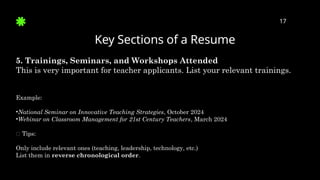
5. Trainings, Seminars, and Workshops Attended
This is very important for teacher applicants. List your relevant trainings.
Example:
•National Seminar on Innovative Teaching Strategies, October 2024
•Webinar on Classroom Management for 21st Century Teachers, March 2024
✅ Tips:
Only include relevant ones (teaching, leadership, technology, etc.)
List them in reverse chronological order.
18.
Key Sections ofa Resume
18
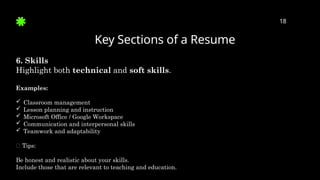
6. Skills
Highlight both technical and soft skills.
Examples:
Classroom management
Lesson planning and instruction
Microsoft Office / Google Workspace
Communication and interpersonal skills
Teamwork and adaptability
✅ Tips:
Be honest and realistic about your skills.
Include those that are relevant to teaching and education.
19.
Key Sections ofa Resume
19
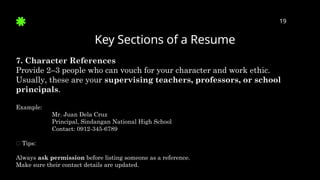
7. Character References
Provide 2–3 people who can vouch for your character and work ethic.
Usually, these are your supervising teachers, professors, or school
principals.
Example:
Mr. Juan Dela Cruz
Principal, Sindangan National High School
Contact: 0912-345-6789
✅ Tips:
Always ask permission before listing someone as a reference.
Make sure their contact details are updated.
20.
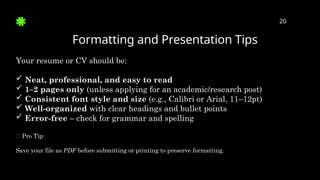
Formatting and PresentationTips
20
Your resume or CV should be:
Neat, professional, and easy to read
1–2 pages only (unless applying for an academic/research post)
Consistent font style and size (e.g., Calibri or Arial, 11–12pt)
Well-organized with clear headings and bullet points
Error-free – check for grammar and spelling
✅ Pro Tip:
Save your file as PDF before submitting or printing to preserve formatting.
21.
Common Mistakes toAvoid
21
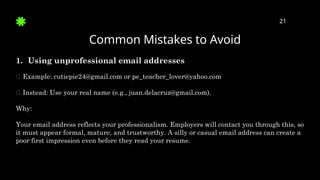
1. Using unprofessional email addresses
🛑 Example: cutiepie24@gmail.com or pe_teacher_lover@yahoo.com
✅ Instead: Use your real name (e.g., juan.delacruz@gmail.com).
Why:
Your email address reflects your professionalism. Employers will contact you through this, so
it must appear formal, mature, and trustworthy. A silly or casual email address can create a
poor first impression even before they read your resume.
22.
Common Mistakes toAvoid
22
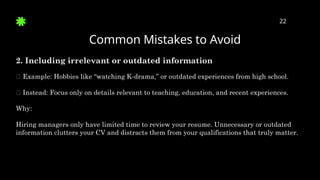
2. Including irrelevant or outdated information
🛑 Example: Hobbies like “watching K-drama,” or outdated experiences from high school.
✅ Instead: Focus only on details relevant to teaching, education, and recent experiences.
Why:
Hiring managers only have limited time to review your resume. Unnecessary or outdated
information clutters your CV and distracts them from your qualifications that truly matter.
23.
Common Mistakes toAvoid
23
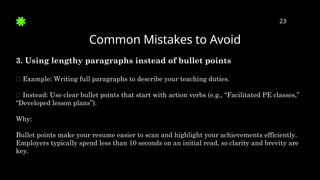
3. Using lengthy paragraphs instead of bullet points
🛑 Example: Writing full paragraphs to describe your teaching duties.
✅ Instead: Use clear bullet points that start with action verbs (e.g., “Facilitated PE classes,”
“Developed lesson plans”).
Why:
Bullet points make your resume easier to scan and highlight your achievements efficiently.
Employers typically spend less than 10 seconds on an initial read, so clarity and brevity are
key.
24.
Common Mistakes toAvoid
24
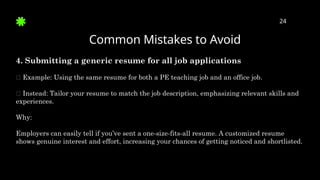
4. Submitting a generic resume for all job applications
🛑 Example: Using the same resume for both a PE teaching job and an office job.
✅ Instead: Tailor your resume to match the job description, emphasizing relevant skills and
experiences.
Why:
Employers can easily tell if you’ve sent a one-size-fits-all resume. A customized resume
shows genuine interest and effort, increasing your chances of getting noticed and shortlisted.
25.
Common Mistakes toAvoid
25
5. Having spelling and grammar errors
🛑 Example: “Developed lesson planns for studnts to particpate in.”
✅ Instead: Proofread your resume multiple times or have someone else check it.
Why:
Errors in spelling or grammar reflect carelessness and poor attention to detail. For teaching
applicants—especially in English proficiency contexts—this is a major red flag. Accuracy
shows you value quality and communication.
26.
Common Mistakes toAvoid
26
6. Adding false information — integrity matters!
🛑 Example: Claiming you attended a seminar or have skills you don’t actually possess.
✅ Instead: Be truthful and transparent about your credentials and experiences.
Why:
Employers verify your information through interviews and references. Lying can damage
your credibility and reputation, which are crucial in the teaching profession. Remember:
honesty builds long-term trust and respect.
27.
The Resume inthe Context of a Mock Job Interview
27
In your mock interview:
Your resume will be your script—it will guide the interviewer’s
questions.
Be familiar with everything written on your CV—you must be ready to
elaborate.
The way you present and explain your experiences shows your
confidence and communication skills, key aspects of English
proficiency.
Editor's Notes
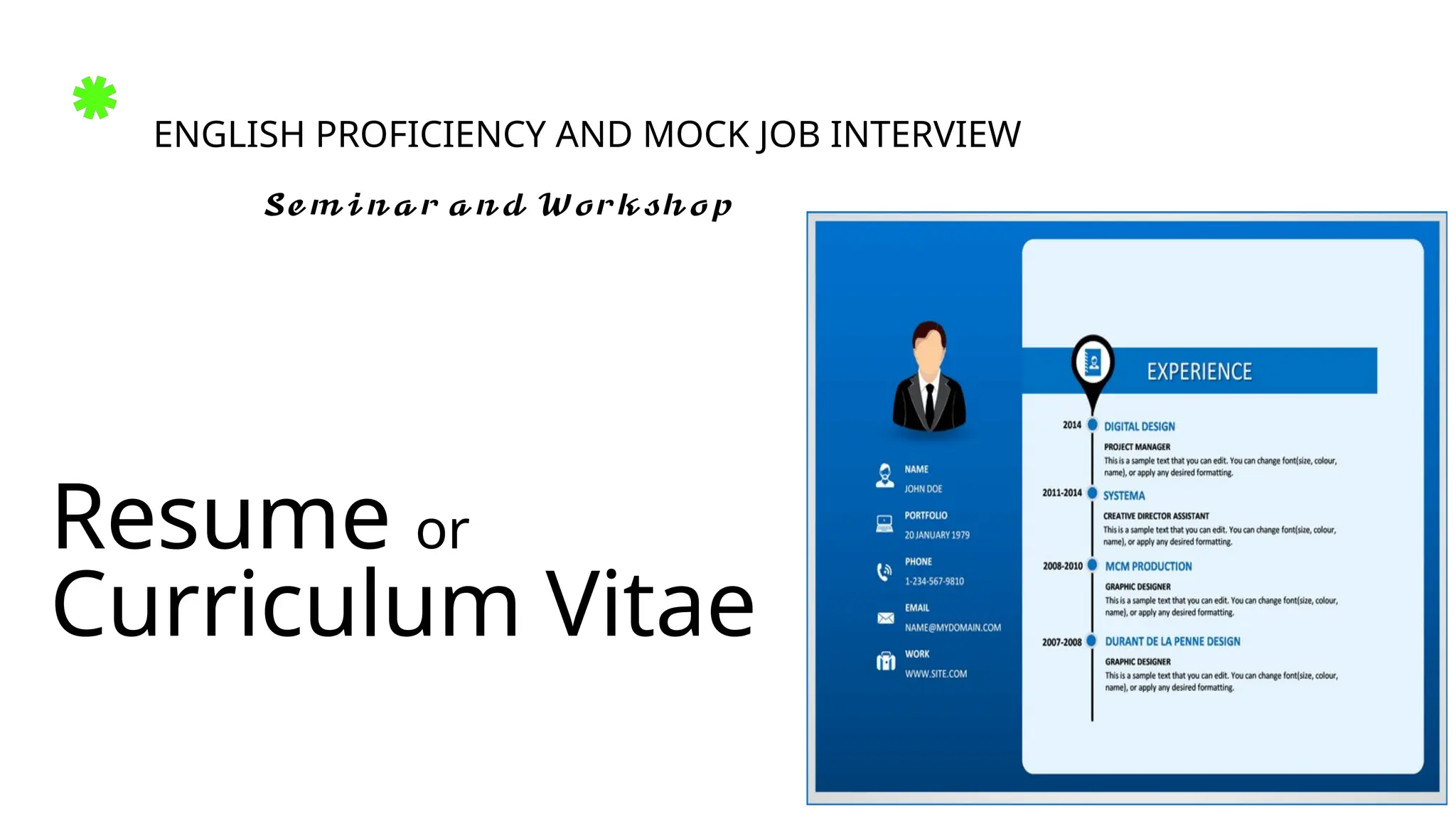
#1 When applying for a job, especially as future teachers, you’ll be asked to submit documents that describe your qualifications and experiences. The two most common are the Resume and the Curriculum Vitae, or CV.
Both have the same goal — to showcase your skills and convince employers you’re the best fit — but they differ in format, focus, and purpose.
#2 Before you face your mock job interview, one of the first things you must prepare is your Resume or Curriculum Vitae (CV).
This is your personal marketing tool—a summary of who you are, what you’ve achieved, and what you can offer to a potential employer.
#3 For Teacher Education graduates, both may be used
If you’re applying to a private school or company, you’ll usually need a resume. But if you’re applying for a teaching position in DepEd or a college, a CV is required because it includes more details about your education, seminars, and professional affiliations.
#4 Now that we understand what a resume is, let’s look at its four main types. Each type serves a different purpose depending on your experience and career goals.
A resume can take different forms depending on how you want to present your qualifications.
#5 A resume can take different forms depending on how you want to present your qualifications.
#6 A resume can take different forms depending on how you want to present your qualifications.
#7 A resume can take different forms depending on how you want to present your qualifications.
#8 A resume can take different forms depending on how you want to present your qualifications.
#9 A resume can take different forms depending on how you want to present your qualifications.
#10 A resume can take different forms depending on how you want to present your qualifications.
#11 So, those are the different types of resumes you can use depending on your purpose.
But remember, a Curriculum Vitae is different — it’s a more detailed version that includes everything about your academic and professional life.
You can think of the Resume as your ‘highlight reel,’ while the CV is your ‘complete story.
In the teaching profession, especially for DepEd and higher education institutions, the CV is the preferred document. But it’s still important to know how to write a strong Resume for job fairs, interviews, and private schools.
#12 Think of it as your professional story—but told briefly, clearly, and impressively.
#27 Your resume or CV is more than just a list of your experiences—it’s a reflection of your journey as a future educator. Make it truthful, organized, and impactful. Remember, a strong resume opens doors, but your personality and competence will keep them open.