Resilience in StudentsResilience in Students
Carissa ChaseCarissa Chase
Jessica EricksonJessica Erickson
Paula WolfePaula Wolfe
Resiliency in Students
• This portion of our presentation will help
to accomplish the following things:
– Inform you, the teacher, about what resiliency
means in terms of a student’s learning
experience.
– Equip you with the tools and knowledge to help
address resiliency issues among your students.
– Offer you the know-how so that you can help
to teach your students tips and skills in
resiliency.
Resiliency in Students
• Before we begin, we must first establish
exactly what resiliency means for a
student.
• Since our efforts and studies are geared
most toward the exceptional students who
cope with Emotional and Behavioral
Disorders, we will focus our perspective on
resiliency in students with EBDs.
What is Resiliency?
• Starting with the basics:
– We all have our own perceptions regarding
what exactly resiliency is.
• Resiliency can be interpreted in a physical sense, as
in bouncing back from an injury;
• Resiliency can also be defined as having the mental
capacity to endure hardship;
• Finally, resiliency to some is the ability to withstand
moments of temptation or difficulty.
– These are all correct definitions, depending
upon the person or situation offering the
definition.
What is Resiliency?
• To create an even playing field, let’s
establish a general definition of what
resiliency is. This will make for
applying the concept of resiliency to
our students an easier task.
What is Resiliency?
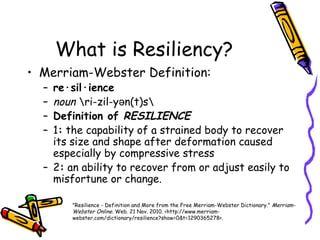
• Merriam-Webster Definition:
– re·sil·ience
– noun ri-zil-y n(t)sə
– Definition of RESILIENCE
– 1: the capability of a strained body to recover
its size and shape after deformation caused
especially by compressive stress
– 2: an ability to recover from or adjust easily to
misfortune or change.
"Resilience - Definition and More from the Free Merriam-Webster Dictionary." Merriam-
Webster Online. Web. 21 Nov. 2010. <http://www.merriam-
webster.com/dictionary/resilience?show=0&t=1290365278>.
Merriam-Webster
Definition Continued…
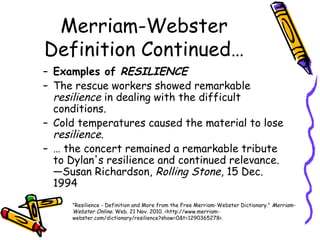
– Examples of RESILIENCE
– The rescue workers showed remarkable
resilience in dealing with the difficult
conditions.
– Cold temperatures caused the material to lose
resilience.
– … the concert remained a remarkable tribute
to Dylan's resilience and continued relevance.
—Susan Richardson, Rolling Stone, 15 Dec.
1994
"Resilience - Definition and More from the Free Merriam-Webster Dictionary." Merriam-
Webster Online. Web. 21 Nov. 2010. <http://www.merriam-
webster.com/dictionary/resilience?show=0&t=1290365278>.
What is Resiliency?
• Merriam-Webster’s definition
reinforces most individuals’ account
of what “resiliency” means, thanks to
its varied account of possible
meanings.
• But let’s continue to narrow it down…
What is Resiliency?
• The American Psychological Association
states the following thoughts on resiliency:
– “[Resiliency is] a personal journey.”
– “[Resiliency is] unique for each person.”
American Psychology Association. American Psychology Association. Bouncing Back"
Teaching Children Resilience Skills. American Psychology Association. Web. 1
Nov. 2010. <http://uwf.edu/cap/HCW/materials/PalomaresMay08.pdf>.
What is Resiliency?
• The APA published in their journal The Monitor, an article
by Karen Kersting that very accurately describes what
resiliency is and why both children and adults should work
toward achieving resiliency.
• “A question from APA psychologist Ron Palomares, PhD—’What are
some things that are tough to bounce back from?’--garnered a sea
of wiggly raised hands at Fort Belvoir Elementary School in
Virginia during an APA-sponsored school assembly in February.
‘When your best friend moves away,’ said a third-grade girl.
‘Hard tests in school,’ said a fourth-grade boy.
‘You're both right,’ said Palomares, who is APA's assistant
executive director for policy and advocacy in the schools. ‘But
there are things you can do about it.’ “
Kersting, Karen. "Resilience: The Mental Muscle Everyone Has." American Psychological
Association (APA). Apr. 2005. Web. 21 Nov. 2010.
<http://www.apa.org/monitor/apr05/resilience.aspx>.
Focusing on the Students
• Now that we have a clear idea of
what resiliency is, next let’s examine
how it can effect our students;
namely.
• The following information has been
accessed from the American
Psychology Association website:
American Psychology Association. American Psychology Association.
Bouncing Back" Teaching Children Resilience Skills. American
Psychology Association. Web. 1 Nov. 2010.
<http://uwf.edu/cap/HCW/materials/PalomaresMay08.pdf>.
“Bouncing Back” Teaching
Children Resilience Skills”
Ronald S. Palomares, Ph. E
American Psychology
Association
• “Why do we Need Resilience?
– Makes us stronger
– Better able to cope with life’s problems
– Helps manage during tough times”
“Bouncing Back” Teaching
Children Resilience Skills”
(Continued)
• “What is ‘Resilience?’”
– “The capacity to adapt well to trauma
and adversity”
– “Bouncing Back (Post Traumatic
Growth)”
The Bottom Line:
• The bottom line is this: It’s hard to be a kid in
today’s world. Students’ lives are dependent on a
consistent, secure, and loving home; a well
established support system both in and out of
school; trusting, approachable relationships with
teachers; and the courage to avoid making poor
decisions.
• As teachers we are well aware of how often our
students are lacking in these important areas.
Therefore, we must work to help teach our
students resilience skills. With these skills, our
students stand a chance at coping with the life
factors are not always within their own control.
Resiliency is Especially
Important for Students
with EBDs
• The National Center on Education, Disability, and
Juvenille Justice (EDJJ) has created a fantastic
powerpoint presentation that outlines the
importance of resiliency skills among students
with EBDs.
• EDJJ Presentation on Resiliency Among Students With
EBDs
• Christle, Christine, Kristine Jolivette, C. Michael Nelson, and Terrance M. Scott. Risk
and Resilience Factors. Risk and Resilience Factors and the Development of EBD.
University of Kentucky & University of Florida. Web. 21 Nov. 2010.
<www.edjj.org/prevention/docs/risk_factors.ppt>.
Addressing &Teaching
Resilience
• Now that we’ve established what
resiliency is and how it can effect
students, let’s discuss how teachers
can both address resiliency issues
and teach their students resiliency
skills.
Five Levels of Resiliency
• The Resiliency Center, developed by Al Seibert,
Ph. D., promotes the following five levels of
resiliency:
1) Maintaining Your Emotional Stability, Health,
and Well-Being
2) Focus Outward: Good Problem Solving Skills
3) Focus Inward: Strong Inner “Selfs”
4) Well-Developed Resiliency Skills
5) The Talent for Serendipity
• We will be tackling the topics of addressing &
teaching resiliency to students by following
these five levels.
Seibert, Al. "Resiliency Center: Thr Five Levels of Resiliency." The Resiliency Center:
Become Resilient, Learn to Resile, Develop Resilience, Find Resiliency Professionals.
Web. 21 Nov. 2010. <http://www.resiliencycenter.com/articles/5levels.shtml>.
Level 1: Maintaining Your
Emotional Stability, Health,
and Well-Being
• While addressing Level 1, we can begin by
considering the following areas (and please
remember that these are only examples,
there is always room for improvement in
the field of education)
– Health
– Sex Education
– Behavior Management
– Stress Management
– Establishing Caring Relationships
Level 1:
• Ronald Palomares states in his “Bouncing Back”
presentation that parents must make their homes
an emotionally safe place so that their students
can feel comfortable in developing emotionally.
This can ultimately lead to strong resiliency skills.
– Teachers possess a rather limited access of
power in regard to improving a student’s home
life, but teachers can aim to help by
establishing trusting relationships with their
students. This may encourage students to
openly discuss pertinent home issues, but will
most definitely help teachers when aiming to
initiate this type of discussion with their
students.
Level 1:
• Teach Students Self- Care:
– Depending upon your students’ ages,
self-care in the form of hygiene, sex
education, puberty, mental well-being,
diet, exercise, rest, etc. can serve as an
integral tool in building independent (and
subsequently, resiliency) skills.
American Psychology Association. American Psychology Association.
Bouncing Back" Teaching Children Resilience Skills. American Psychology
Association. Web. 1 Nov. 2010.
<http://uwf.edu/cap/HCW/materials/PalomaresMay08.pdf>.
Level 2: Focus Outward:
Good problem Solving Skills
• In regard to Level 2, we can help our
students by addressing and teaching skills
in the following areas:
– Conflict Resolution
– Communication Skills
– Interpersonal Communication Tips
– Study Skills
– Time Mangament
Level 2:
• The APA suggests in their article “10 Tips
for Building Resilience in Children and
Teens” that it’s necessary to establish and
promote a daily routine both in the
classroom and at home. This can help to
encourage organization, time management,
and overall stability.
• Coincidentally, the APA states in the same
article that it’s important to allow breaks
from routines. This teaches students that
overly worrying about routines can become
counter-productive.
"Resilience Guide for Parents & Teachers." American Psychological Association
(APA). Web. 21 Nov. 2010. <http://www.apa.org/helpcenter/resilience.aspx#>.
Level 3: Focus Inward:
Strong Inner “Selfs”
• Level 3 topics to address and teach
may include the following:
– Self-esteem
– Body Image
– Depression & Mental Health Topics
– Selecting Positive Friends & Companions
– Positive Role Models
Level 3:
• Excerpt from APA’s “10 Tips for Building
Resilience in Children and Teens”:
– “Move toward your goals. Teach your child to set
reasonable goals and then to move toward them one
step at a time. Moving toward that goal- even if it’s
a tiny step- and receiving praise for doing so will
focus your child on what he or she has accomplished
rather than on what hasn’t been accomplished, and
can help build the resilience to move forward in the
face of challenges.
• At school, break down large assignments into
small, achievable goals for younger children; and
for older children, acknowledge accomplishments
on the way to larger goals.”
American Psychology Association. American Psychology Association.
Bouncing Back" Teaching Children Resilience Skills. American Psychology
Association. Web. 1 Nov. 2010.
<http://uwf.edu/cap/HCW/materials/PalomaresMay08.pdf>.
Level 3:
• Ronald Palomares offers this advice in his
“Bouncing Back” presentation:
– Parents must talk with their children. Establish
open and honest relationships, but keep the
discussions age appropriate.
• This advice can also transcend into the classroom as
teachers aim to help students with resiliency.
– Palomares believes that resiliency begins at
home. Parents must create strong bonds with
their children, support and care for them both
physically and mentally, and show their children
love and trust.
• Teachers can aide in this process by establishing
frequent communication with parents, and offering
supplemental materials to parents that address
discussing relationships and resiliency at home.
American Psychology Association. American Psychology Association.
Bouncing Back" Teaching Children Resilience Skills. American Psychology
Association. Web. 1 Nov. 2010.
<http://uwf.edu/cap/HCW/materials/PalomaresMay08.pdf>.
Level 3:
• The American Psychology Association offers the
following advice to parents and teachers
regarding helping children and teens to select
positive friends:
– “Teach your child how to make friends, including the skill
of empathy… Encourage your child to be a friend in
order to get friends. Build a strong family network to
support your child through his or her inevitable
disappointments and hurts.
– At school, watch to make sure that one child is not
being isolated. Connecting with people provides social
support and strengthens resilience.
American Psychology Association. American Psychology Association.
Bouncing Back" Teaching Children Resilience Skills. American Psychology
Association. Web. 1 Nov. 2010.
<http://uwf.edu/cap/HCW/materials/PalomaresMay08.pdf>.
Level 4: Well-Developed
Resiliency Skills
• Level 4, while a culmination of all 5
steps in essence, may also allow
teachers to address and teach these
topics to their students:
– Recognition of Inner Strength
– Patience for Improvement
– Willingness to Learn
Level 4:
• Excerpt from APA’s “10 Tips for Building
Resilience in Children and Teens”:
– “Accept that change is part of living. Change
often can be scary for children and teens. Help
your child see that change is part of life and
new goals can replace goals that have become
unattainable.
– In school, point out how students have
changed as they moved up in grade levels and
discuss how that change has had an impact on
the students.”
American Psychology Association. American Psychology Association.
Bouncing Back" Teaching Children Resilience Skills. American Psychology
Association. Web. 1 Nov. 2010.
<http://uwf.edu/cap/HCW/materials/PalomaresMay08.pdf>.
Level 5: The Talent for
Serendipity
• Finally, Level 5 topics may lead
teachers to issues that relate to…
– Helping students to turn the negative
into the positive
– Service Learning
– Character Education
Level 5:
• Another great tip from the APA:
– Teach children how to look for moments of self-
discovery. Even as adults it can be extremely difficulty
in trying times to focus on the positive. However,
teaching students that every life experience is an
opportunity for learning can serve as an extremely
valuable life lesson; something that students can utilize
year after year.
• “At school, consider leading discussions of what each
student has learned after facing down a tough situation.”
• “Use history to show that life moves on after bad events.”
• “Help children see how their individual accomplishments
contribute to the wellbeing of the class as a whole.”
American Psychology Association. American Psychology Association.
Bouncing Back" Teaching Children Resilience Skills. American Psychology
Association. Web. 1 Nov. 2010.
<http://uwf.edu/cap/HCW/materials/PalomaresMay08.pdf>.
Level 5:
• Service-Learning and other forms of
volunteering can help students to gain a
sense of self achievement and
empowerment. Incorporating volunteer
opportunities into your classroom, can help
to encourage your students to help others.
This both teaches volunteerism and
citizenship, but also allows students
opportunities to witness the resiliency of
others.
Resources
• We’ve reached the final step of our
journey. We’ve established a definition of
what resiliency is, what it is important to
students, how it is especially important to
students with EBDs, and what teachers
can do to help establish and promote
resiliency among their students.
• Our final portion of this presentation will
offer you some informative and valuable
resources so that you may be well equipped
for addressing the topic of resiliency in
the classroom.
Resource #1: FOCUS
• The Bureau of Medicine and Surgery
has taken a supreme interest in the
concept of promoting resiliency in
children and families; the
organization has created a program
called FOCUS that aides families of
military members who have been
affected by combat injuries.
FOCUS
• Excerpt from FOCUS website:
• “When military parents fulfill occupational duties
during wartime, their children and families can face
many challenges, such as long separations, changes in
family routines, and dealing with concerns about the
safety of the parent who is deployed and about the
well-being of the parent who remains at home.
• There may be times when they find long and multiple
deployments more challenging than usual, particularly
if a parent is dealing with the effects of combat
stress and/or injuries.
• FOCUS is based on over 20 years of research with
children and families facing challenges and adversities
in many different settings. It has successfully
provided services to thousands of participants at
dozens of sites and continues to expand, including new
online availability for those who are remotely located.”
"FOCUS | What Is Resiliency?" FOCUS | Home. Web.
21 Nov. 2010. <http://www.focusproject.org/how-it-
works/resiliency-training>.
Resource #2: APA Help
Center
• The American Psychology Association offers a variety of
pamphlets, powerpoint presentations, and printable
activities for parents and teachers.
• I recommend the following links to areas of the site:
• Resilience Guide for Parents & Teachers:
– http://www.apa.org/helpcenter/resilience.aspx
• The Road to Resilience:
– http://www.apa.org/helpcenter/road-resilience.aspx
• Resilience in a Time of War: Tips for Parents & Teachers of
Middle School Students:
– http://www.apa.org/helpcenter/middle-school-resilience.aspx
Resource #2: APA Help
Center
• Resilience in a Time of War: Tips for
Parents & Teachers of Elementary
Students:
– http://www.apa.org/helpcenter/kids-
resilience.aspx
• Resilience for Teens:
– http://www.apa.org/helpcenter/resilience-
teens.aspx
• Resilience for Teens: Got Bounce?
– http://www.apa.org/helpcenter/bounce.aspx
Resource #3: Monitor
• APA’s journal The Monitor printed
this article, written again by Karen
Kersting, in 2003. The article, titled
“Lessons in Resilience”, offers tips
for working with students during
times of distinct stress:
– http://www.apa.org/monitor/sep03/less
ons.aspx
Resource #4: “Bouncing
Back: Teaching Children
Resiliency Skills”
• View Ron Palomares’ “Bouncing Back…”
powerpoint presentation in its
entirety:
– "Bouncing Back: Teaching Children
Resiliency" Presentation
Resource #5: Child
Development Institute
• Excellent Study Skills Tips, applicable for students of any
age:
– http://www.childdevelopmentinfo.com/learning/studytips.shtml
• Tips for Teaching Positive Self-Image:
– http://www.childdevelopmentinfo.com/disorders/self-
esteem.shtml
• “The Talk”- Tips on Tackling the Topic of Sex With Your
Child:
– http://www.childdevelopmentinfo.com/parenting/teen-
datingsex.shtml
• Talking to Your Child About Bullying:
– http://www.childdevelopmentinfo.com/parenting/teen-
bullying.shtml
Resource #6: Pacer
Teens Against Bullying
• This is a great tool for middle school
students. This interactive site breaches
the topic of bullying in a variety of means,
touching on cyber bullying, texting,
defining what bullying is and how it can
effect students, and equipping students
with the tools to help eradicate bullying in
their schools.
– http://www.pacerteensagainstbullying.org/
Resource #7: Resilience
Net
• This site provides teachers and
parents with some comprehensive
research so as to better inform
adults on the topic of resilience in
students.
– http://resilnet.uiuc.edu/library/dig126.h
tml

Resilience in students

  • 1.
    Resilience in StudentsResiliencein Students Carissa ChaseCarissa Chase Jessica EricksonJessica Erickson Paula WolfePaula Wolfe
  • 2.
    Resiliency in Students •This portion of our presentation will help to accomplish the following things: – Inform you, the teacher, about what resiliency means in terms of a student’s learning experience. – Equip you with the tools and knowledge to help address resiliency issues among your students. – Offer you the know-how so that you can help to teach your students tips and skills in resiliency.
  • 3.
    Resiliency in Students •Before we begin, we must first establish exactly what resiliency means for a student. • Since our efforts and studies are geared most toward the exceptional students who cope with Emotional and Behavioral Disorders, we will focus our perspective on resiliency in students with EBDs.
  • 4.
    What is Resiliency? •Starting with the basics: – We all have our own perceptions regarding what exactly resiliency is. • Resiliency can be interpreted in a physical sense, as in bouncing back from an injury; • Resiliency can also be defined as having the mental capacity to endure hardship; • Finally, resiliency to some is the ability to withstand moments of temptation or difficulty. – These are all correct definitions, depending upon the person or situation offering the definition.
  • 5.
    What is Resiliency? •To create an even playing field, let’s establish a general definition of what resiliency is. This will make for applying the concept of resiliency to our students an easier task.
  • 6.
    What is Resiliency? •Merriam-Webster Definition: – re·sil·ience – noun ri-zil-y n(t)sə – Definition of RESILIENCE – 1: the capability of a strained body to recover its size and shape after deformation caused especially by compressive stress – 2: an ability to recover from or adjust easily to misfortune or change. "Resilience - Definition and More from the Free Merriam-Webster Dictionary." Merriam- Webster Online. Web. 21 Nov. 2010. <http://www.merriam- webster.com/dictionary/resilience?show=0&t=1290365278>.
  • 7.
    Merriam-Webster Definition Continued… – Examplesof RESILIENCE – The rescue workers showed remarkable resilience in dealing with the difficult conditions. – Cold temperatures caused the material to lose resilience. – … the concert remained a remarkable tribute to Dylan's resilience and continued relevance. —Susan Richardson, Rolling Stone, 15 Dec. 1994 "Resilience - Definition and More from the Free Merriam-Webster Dictionary." Merriam- Webster Online. Web. 21 Nov. 2010. <http://www.merriam- webster.com/dictionary/resilience?show=0&t=1290365278>.
  • 8.
    What is Resiliency? •Merriam-Webster’s definition reinforces most individuals’ account of what “resiliency” means, thanks to its varied account of possible meanings. • But let’s continue to narrow it down…
  • 9.
    What is Resiliency? •The American Psychological Association states the following thoughts on resiliency: – “[Resiliency is] a personal journey.” – “[Resiliency is] unique for each person.” American Psychology Association. American Psychology Association. Bouncing Back" Teaching Children Resilience Skills. American Psychology Association. Web. 1 Nov. 2010. <http://uwf.edu/cap/HCW/materials/PalomaresMay08.pdf>.
  • 10.
    What is Resiliency? •The APA published in their journal The Monitor, an article by Karen Kersting that very accurately describes what resiliency is and why both children and adults should work toward achieving resiliency. • “A question from APA psychologist Ron Palomares, PhD—’What are some things that are tough to bounce back from?’--garnered a sea of wiggly raised hands at Fort Belvoir Elementary School in Virginia during an APA-sponsored school assembly in February. ‘When your best friend moves away,’ said a third-grade girl. ‘Hard tests in school,’ said a fourth-grade boy. ‘You're both right,’ said Palomares, who is APA's assistant executive director for policy and advocacy in the schools. ‘But there are things you can do about it.’ “ Kersting, Karen. "Resilience: The Mental Muscle Everyone Has." American Psychological Association (APA). Apr. 2005. Web. 21 Nov. 2010. <http://www.apa.org/monitor/apr05/resilience.aspx>.
  • 11.
    Focusing on theStudents • Now that we have a clear idea of what resiliency is, next let’s examine how it can effect our students; namely. • The following information has been accessed from the American Psychology Association website: American Psychology Association. American Psychology Association. Bouncing Back" Teaching Children Resilience Skills. American Psychology Association. Web. 1 Nov. 2010. <http://uwf.edu/cap/HCW/materials/PalomaresMay08.pdf>.
  • 12.
    “Bouncing Back” Teaching ChildrenResilience Skills” Ronald S. Palomares, Ph. E American Psychology Association • “Why do we Need Resilience? – Makes us stronger – Better able to cope with life’s problems – Helps manage during tough times”
  • 13.
    “Bouncing Back” Teaching ChildrenResilience Skills” (Continued) • “What is ‘Resilience?’” – “The capacity to adapt well to trauma and adversity” – “Bouncing Back (Post Traumatic Growth)”
  • 14.
    The Bottom Line: •The bottom line is this: It’s hard to be a kid in today’s world. Students’ lives are dependent on a consistent, secure, and loving home; a well established support system both in and out of school; trusting, approachable relationships with teachers; and the courage to avoid making poor decisions. • As teachers we are well aware of how often our students are lacking in these important areas. Therefore, we must work to help teach our students resilience skills. With these skills, our students stand a chance at coping with the life factors are not always within their own control.
  • 15.
    Resiliency is Especially Importantfor Students with EBDs • The National Center on Education, Disability, and Juvenille Justice (EDJJ) has created a fantastic powerpoint presentation that outlines the importance of resiliency skills among students with EBDs. • EDJJ Presentation on Resiliency Among Students With EBDs • Christle, Christine, Kristine Jolivette, C. Michael Nelson, and Terrance M. Scott. Risk and Resilience Factors. Risk and Resilience Factors and the Development of EBD. University of Kentucky & University of Florida. Web. 21 Nov. 2010. <www.edjj.org/prevention/docs/risk_factors.ppt>.
  • 16.
    Addressing &Teaching Resilience • Nowthat we’ve established what resiliency is and how it can effect students, let’s discuss how teachers can both address resiliency issues and teach their students resiliency skills.
  • 17.
    Five Levels ofResiliency • The Resiliency Center, developed by Al Seibert, Ph. D., promotes the following five levels of resiliency: 1) Maintaining Your Emotional Stability, Health, and Well-Being 2) Focus Outward: Good Problem Solving Skills 3) Focus Inward: Strong Inner “Selfs” 4) Well-Developed Resiliency Skills 5) The Talent for Serendipity • We will be tackling the topics of addressing & teaching resiliency to students by following these five levels. Seibert, Al. "Resiliency Center: Thr Five Levels of Resiliency." The Resiliency Center: Become Resilient, Learn to Resile, Develop Resilience, Find Resiliency Professionals. Web. 21 Nov. 2010. <http://www.resiliencycenter.com/articles/5levels.shtml>.
  • 18.
    Level 1: MaintainingYour Emotional Stability, Health, and Well-Being • While addressing Level 1, we can begin by considering the following areas (and please remember that these are only examples, there is always room for improvement in the field of education) – Health – Sex Education – Behavior Management – Stress Management – Establishing Caring Relationships
  • 19.
    Level 1: • RonaldPalomares states in his “Bouncing Back” presentation that parents must make their homes an emotionally safe place so that their students can feel comfortable in developing emotionally. This can ultimately lead to strong resiliency skills. – Teachers possess a rather limited access of power in regard to improving a student’s home life, but teachers can aim to help by establishing trusting relationships with their students. This may encourage students to openly discuss pertinent home issues, but will most definitely help teachers when aiming to initiate this type of discussion with their students.
  • 20.
    Level 1: • TeachStudents Self- Care: – Depending upon your students’ ages, self-care in the form of hygiene, sex education, puberty, mental well-being, diet, exercise, rest, etc. can serve as an integral tool in building independent (and subsequently, resiliency) skills. American Psychology Association. American Psychology Association. Bouncing Back" Teaching Children Resilience Skills. American Psychology Association. Web. 1 Nov. 2010. <http://uwf.edu/cap/HCW/materials/PalomaresMay08.pdf>.
  • 21.
    Level 2: FocusOutward: Good problem Solving Skills • In regard to Level 2, we can help our students by addressing and teaching skills in the following areas: – Conflict Resolution – Communication Skills – Interpersonal Communication Tips – Study Skills – Time Mangament
  • 22.
    Level 2: • TheAPA suggests in their article “10 Tips for Building Resilience in Children and Teens” that it’s necessary to establish and promote a daily routine both in the classroom and at home. This can help to encourage organization, time management, and overall stability. • Coincidentally, the APA states in the same article that it’s important to allow breaks from routines. This teaches students that overly worrying about routines can become counter-productive. "Resilience Guide for Parents & Teachers." American Psychological Association (APA). Web. 21 Nov. 2010. <http://www.apa.org/helpcenter/resilience.aspx#>.
  • 23.
    Level 3: FocusInward: Strong Inner “Selfs” • Level 3 topics to address and teach may include the following: – Self-esteem – Body Image – Depression & Mental Health Topics – Selecting Positive Friends & Companions – Positive Role Models
  • 24.
    Level 3: • Excerptfrom APA’s “10 Tips for Building Resilience in Children and Teens”: – “Move toward your goals. Teach your child to set reasonable goals and then to move toward them one step at a time. Moving toward that goal- even if it’s a tiny step- and receiving praise for doing so will focus your child on what he or she has accomplished rather than on what hasn’t been accomplished, and can help build the resilience to move forward in the face of challenges. • At school, break down large assignments into small, achievable goals for younger children; and for older children, acknowledge accomplishments on the way to larger goals.” American Psychology Association. American Psychology Association. Bouncing Back" Teaching Children Resilience Skills. American Psychology Association. Web. 1 Nov. 2010. <http://uwf.edu/cap/HCW/materials/PalomaresMay08.pdf>.
  • 25.
    Level 3: • RonaldPalomares offers this advice in his “Bouncing Back” presentation: – Parents must talk with their children. Establish open and honest relationships, but keep the discussions age appropriate. • This advice can also transcend into the classroom as teachers aim to help students with resiliency. – Palomares believes that resiliency begins at home. Parents must create strong bonds with their children, support and care for them both physically and mentally, and show their children love and trust. • Teachers can aide in this process by establishing frequent communication with parents, and offering supplemental materials to parents that address discussing relationships and resiliency at home. American Psychology Association. American Psychology Association. Bouncing Back" Teaching Children Resilience Skills. American Psychology Association. Web. 1 Nov. 2010. <http://uwf.edu/cap/HCW/materials/PalomaresMay08.pdf>.
  • 26.
    Level 3: • TheAmerican Psychology Association offers the following advice to parents and teachers regarding helping children and teens to select positive friends: – “Teach your child how to make friends, including the skill of empathy… Encourage your child to be a friend in order to get friends. Build a strong family network to support your child through his or her inevitable disappointments and hurts. – At school, watch to make sure that one child is not being isolated. Connecting with people provides social support and strengthens resilience. American Psychology Association. American Psychology Association. Bouncing Back" Teaching Children Resilience Skills. American Psychology Association. Web. 1 Nov. 2010. <http://uwf.edu/cap/HCW/materials/PalomaresMay08.pdf>.
  • 27.
    Level 4: Well-Developed ResiliencySkills • Level 4, while a culmination of all 5 steps in essence, may also allow teachers to address and teach these topics to their students: – Recognition of Inner Strength – Patience for Improvement – Willingness to Learn
  • 28.
    Level 4: • Excerptfrom APA’s “10 Tips for Building Resilience in Children and Teens”: – “Accept that change is part of living. Change often can be scary for children and teens. Help your child see that change is part of life and new goals can replace goals that have become unattainable. – In school, point out how students have changed as they moved up in grade levels and discuss how that change has had an impact on the students.” American Psychology Association. American Psychology Association. Bouncing Back" Teaching Children Resilience Skills. American Psychology Association. Web. 1 Nov. 2010. <http://uwf.edu/cap/HCW/materials/PalomaresMay08.pdf>.
  • 29.
    Level 5: TheTalent for Serendipity • Finally, Level 5 topics may lead teachers to issues that relate to… – Helping students to turn the negative into the positive – Service Learning – Character Education
  • 30.
    Level 5: • Anothergreat tip from the APA: – Teach children how to look for moments of self- discovery. Even as adults it can be extremely difficulty in trying times to focus on the positive. However, teaching students that every life experience is an opportunity for learning can serve as an extremely valuable life lesson; something that students can utilize year after year. • “At school, consider leading discussions of what each student has learned after facing down a tough situation.” • “Use history to show that life moves on after bad events.” • “Help children see how their individual accomplishments contribute to the wellbeing of the class as a whole.” American Psychology Association. American Psychology Association. Bouncing Back" Teaching Children Resilience Skills. American Psychology Association. Web. 1 Nov. 2010. <http://uwf.edu/cap/HCW/materials/PalomaresMay08.pdf>.
  • 31.
    Level 5: • Service-Learningand other forms of volunteering can help students to gain a sense of self achievement and empowerment. Incorporating volunteer opportunities into your classroom, can help to encourage your students to help others. This both teaches volunteerism and citizenship, but also allows students opportunities to witness the resiliency of others.
  • 32.
    Resources • We’ve reachedthe final step of our journey. We’ve established a definition of what resiliency is, what it is important to students, how it is especially important to students with EBDs, and what teachers can do to help establish and promote resiliency among their students. • Our final portion of this presentation will offer you some informative and valuable resources so that you may be well equipped for addressing the topic of resiliency in the classroom.
  • 33.
    Resource #1: FOCUS •The Bureau of Medicine and Surgery has taken a supreme interest in the concept of promoting resiliency in children and families; the organization has created a program called FOCUS that aides families of military members who have been affected by combat injuries.
  • 34.
    FOCUS • Excerpt fromFOCUS website: • “When military parents fulfill occupational duties during wartime, their children and families can face many challenges, such as long separations, changes in family routines, and dealing with concerns about the safety of the parent who is deployed and about the well-being of the parent who remains at home. • There may be times when they find long and multiple deployments more challenging than usual, particularly if a parent is dealing with the effects of combat stress and/or injuries. • FOCUS is based on over 20 years of research with children and families facing challenges and adversities in many different settings. It has successfully provided services to thousands of participants at dozens of sites and continues to expand, including new online availability for those who are remotely located.” "FOCUS | What Is Resiliency?" FOCUS | Home. Web. 21 Nov. 2010. <http://www.focusproject.org/how-it- works/resiliency-training>.
  • 35.
    Resource #2: APAHelp Center • The American Psychology Association offers a variety of pamphlets, powerpoint presentations, and printable activities for parents and teachers. • I recommend the following links to areas of the site: • Resilience Guide for Parents & Teachers: – http://www.apa.org/helpcenter/resilience.aspx • The Road to Resilience: – http://www.apa.org/helpcenter/road-resilience.aspx • Resilience in a Time of War: Tips for Parents & Teachers of Middle School Students: – http://www.apa.org/helpcenter/middle-school-resilience.aspx
  • 36.
    Resource #2: APAHelp Center • Resilience in a Time of War: Tips for Parents & Teachers of Elementary Students: – http://www.apa.org/helpcenter/kids- resilience.aspx • Resilience for Teens: – http://www.apa.org/helpcenter/resilience- teens.aspx • Resilience for Teens: Got Bounce? – http://www.apa.org/helpcenter/bounce.aspx
  • 37.
    Resource #3: Monitor •APA’s journal The Monitor printed this article, written again by Karen Kersting, in 2003. The article, titled “Lessons in Resilience”, offers tips for working with students during times of distinct stress: – http://www.apa.org/monitor/sep03/less ons.aspx
  • 38.
    Resource #4: “Bouncing Back:Teaching Children Resiliency Skills” • View Ron Palomares’ “Bouncing Back…” powerpoint presentation in its entirety: – "Bouncing Back: Teaching Children Resiliency" Presentation
  • 39.
    Resource #5: Child DevelopmentInstitute • Excellent Study Skills Tips, applicable for students of any age: – http://www.childdevelopmentinfo.com/learning/studytips.shtml • Tips for Teaching Positive Self-Image: – http://www.childdevelopmentinfo.com/disorders/self- esteem.shtml • “The Talk”- Tips on Tackling the Topic of Sex With Your Child: – http://www.childdevelopmentinfo.com/parenting/teen- datingsex.shtml • Talking to Your Child About Bullying: – http://www.childdevelopmentinfo.com/parenting/teen- bullying.shtml
  • 40.
    Resource #6: Pacer TeensAgainst Bullying • This is a great tool for middle school students. This interactive site breaches the topic of bullying in a variety of means, touching on cyber bullying, texting, defining what bullying is and how it can effect students, and equipping students with the tools to help eradicate bullying in their schools. – http://www.pacerteensagainstbullying.org/
  • 41.
    Resource #7: Resilience Net •This site provides teachers and parents with some comprehensive research so as to better inform adults on the topic of resilience in students. – http://resilnet.uiuc.edu/library/dig126.h tml