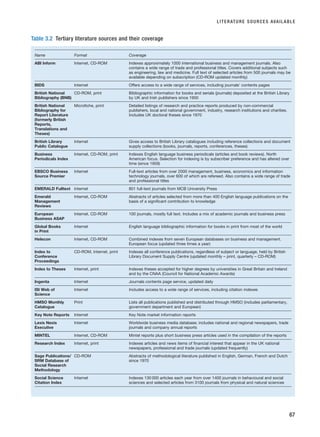
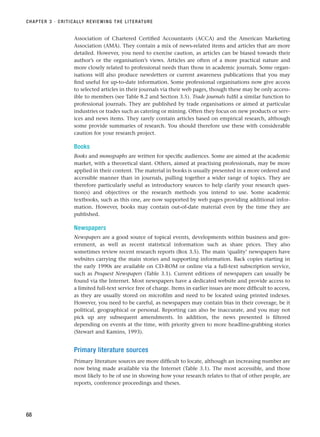
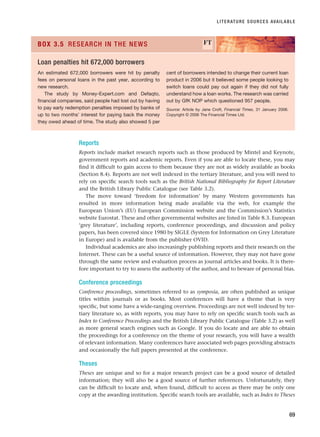
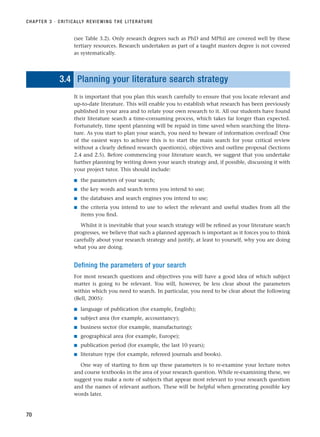
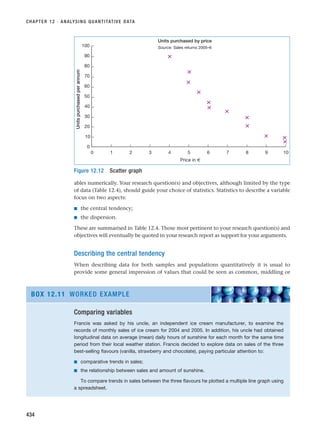
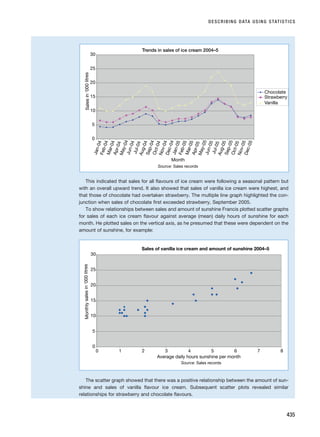
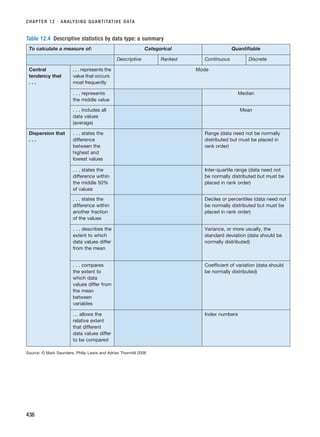
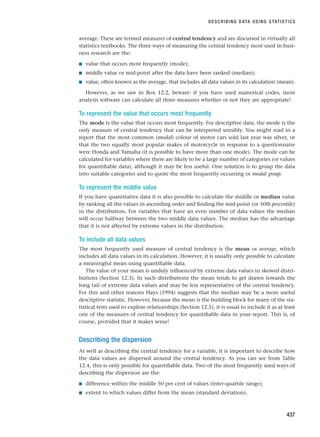
Mark Saunders
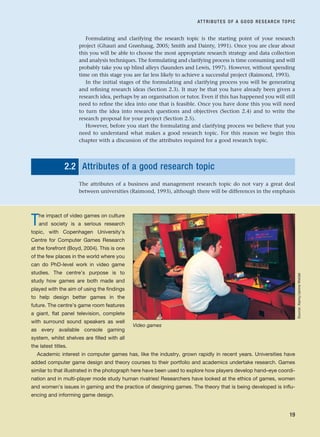
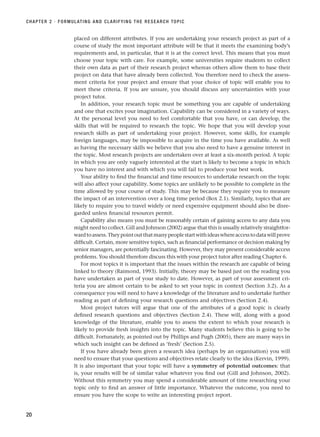
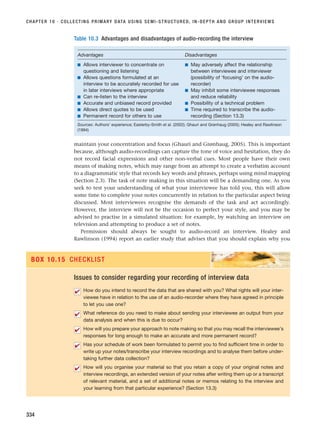
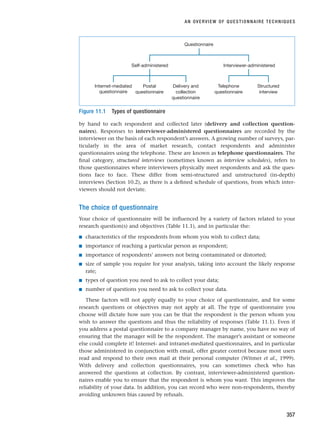
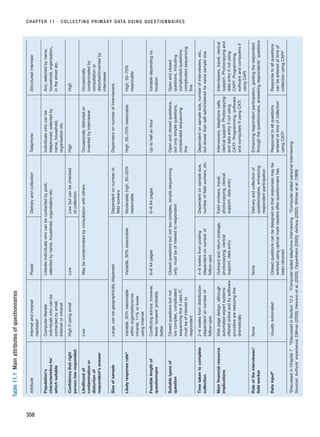
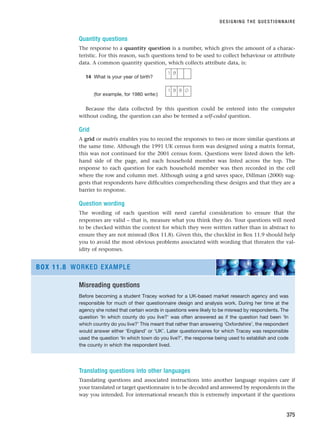
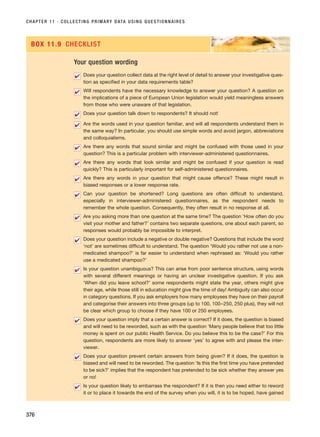
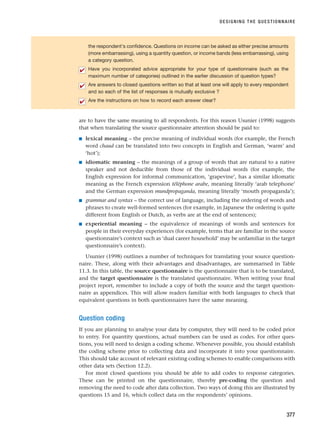
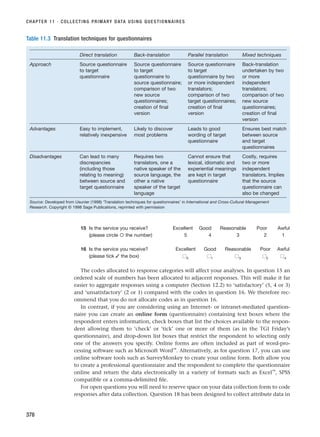
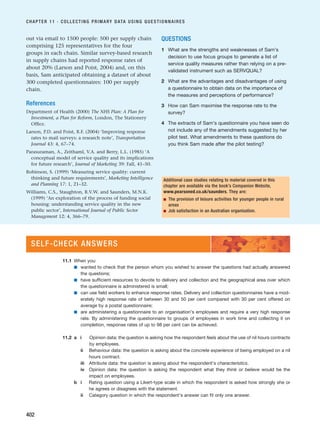
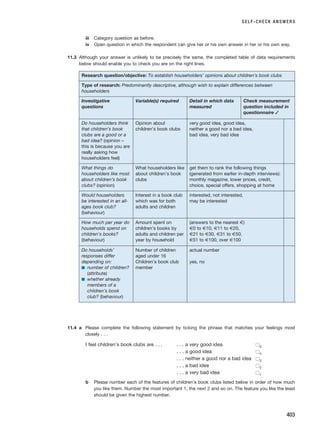
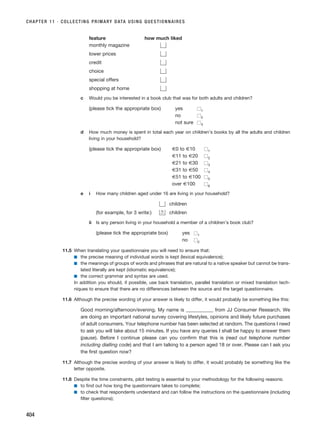
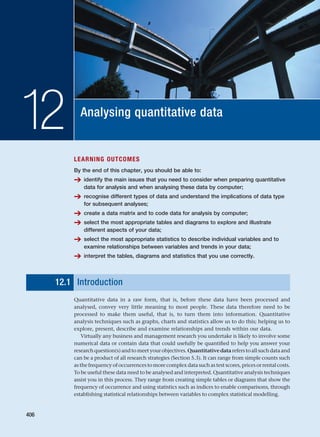
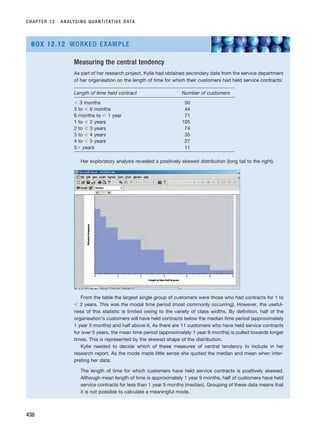
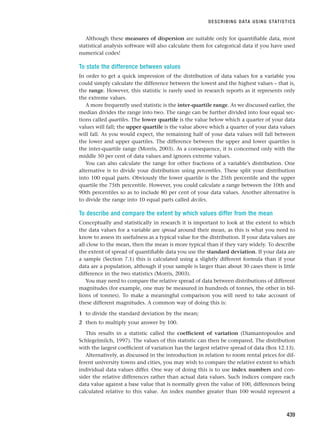
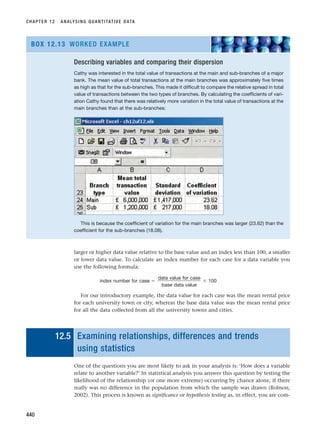
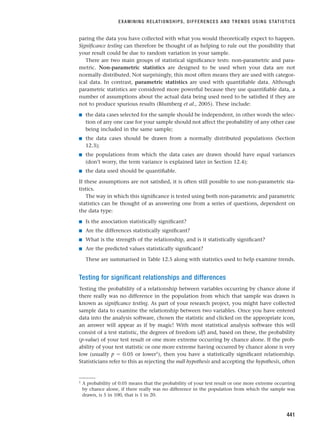
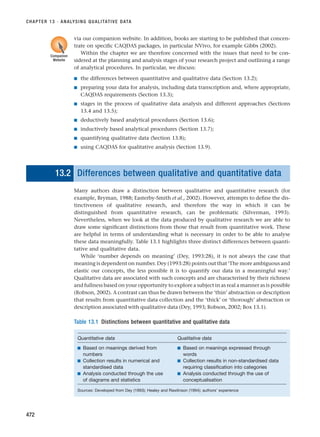
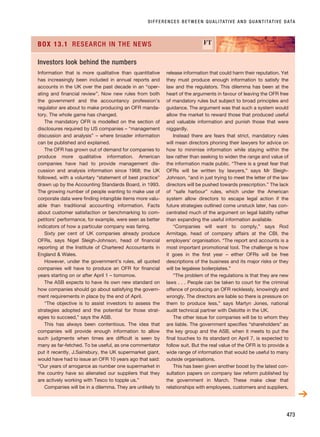
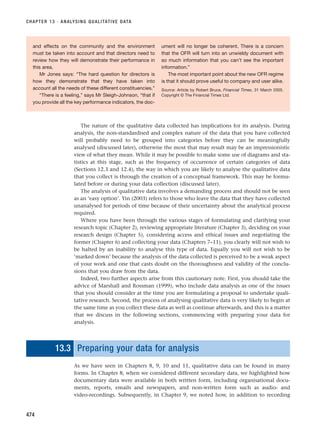
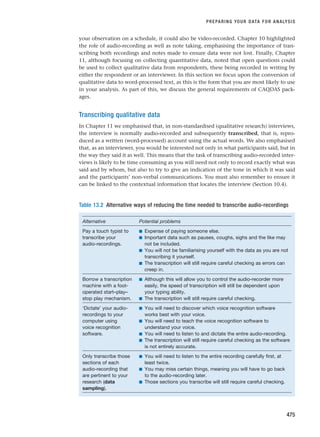
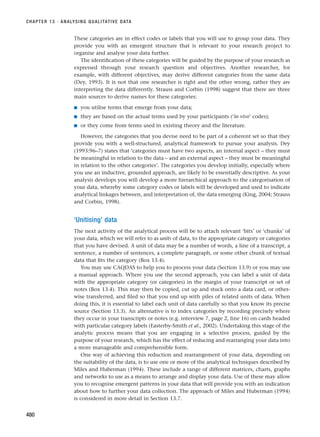
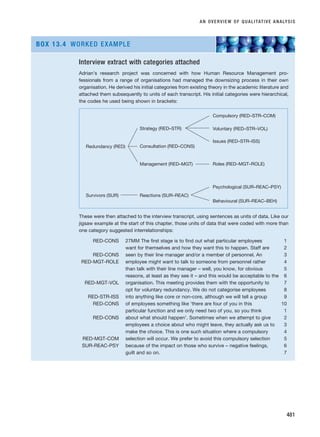
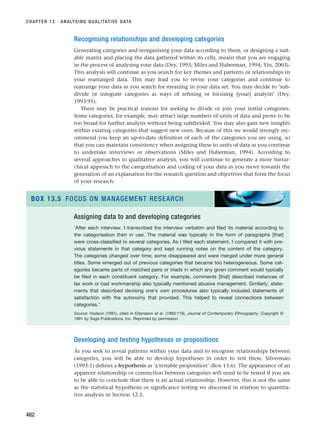
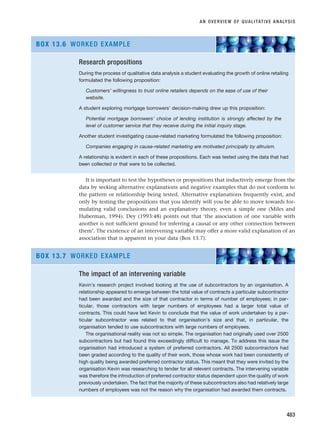
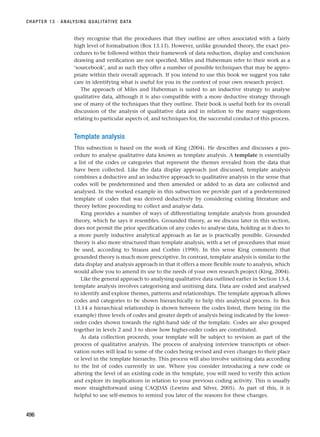
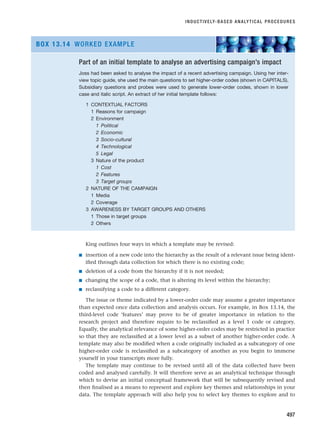
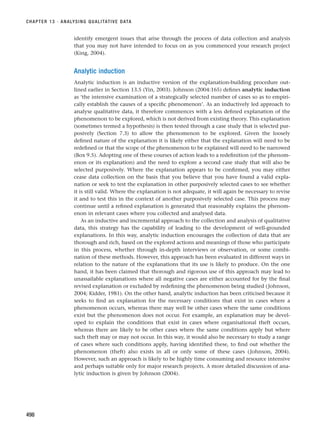
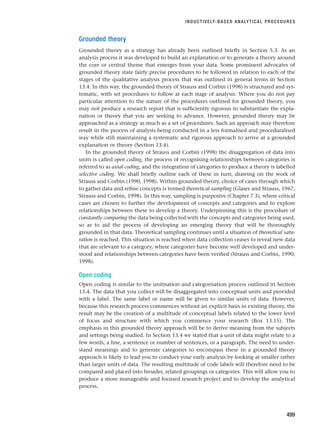
Philip Lewis
Adrian Thornhill
Research
Methods
for
Business
Students
Saunders,
Lewis
and
Thornhill
Fourth
Edition
Through a unique blend of practicality and rigour, the Saunders author team provide business and management
students with the knowledge, understanding and skills necessary to complete a successful research project.
The fourth edition of Research Methods for Business Students is a market-leading text which brings the theory,
philosophy and techniques of research to life and enables students to understand the practical relevance of the
research methods. A highly accessible style, logical structure, numerous examples and useful checklists provide
step-by-step guidance through the entire research process.
An imprint of
Additional student support at
www.pearsoned.co.uk/saunders
ISBN 0-273-70148-7
9 780273 701484
www.pearson-books.com
Cover image: © Getty Images
“I think this is a great book and so do my students. Everyone who read this book said they liked it
and that it really helped them to succeed in their project.”
Professor Veronica Liljander, Swedish School of Economics and Business Administration, Finland.
“What makes this book useful is that it is written from the viewpoint of the active student researcher.
It addresses the problems that students will meet, as they meet them, giving concrete examples
based on the work of student researchers.”
Helen Batley, Harrow Business School, University of Westminster.
Professor Mark Saunders is Head of Research at Oxford Brookes University Business School.
Dr Philip Lewis is Principal Lecturer, Gloucestershire Business School, University of Gloucestershire.
Dr Adrian Thornhill is Head of the Department of Human Resource Management,
Gloucestershire Business School, University of Gloucestershire.
Use this book to:
 Understand both the practical application and underlying philosophy of research methods in business.
 Learn from worked examples and case studies based on real student research, illustrating clearly what
to do and what not to do in your project.
 Gain rapid understanding and confidence in using the tools and techniques for analysis to undertake
successful research.
Log on to www.pearsoned.co.uk/saunders to:
 Get ahead with tutorials on software packages such
as SPSS and NVivo.
 Make the most of the Internet as an efficient and
effective research tool by using the Smarter Online
Searching Guide.
 Test your understanding with the multiple choice
questions for each chapter.
0273701487_COVER.qxd 13/7/06 13:36 Page 1
Research Methods for Business Students
Visit the Research Methods for Business Students, Fourth Edition
Companion Website at www.pearsoned.co.uk/saunders to find
valuable student learning material including:
■ Multiple choice questions to test your learning.
■ Tutorials on Excel, NVivo and SPSS.
■ Updated research datasets to practice with.
■ Updated additional case studies with accompanying questions.
■ Smarter Online Searching Guide – how to make the most of the
Internet in your research.
RESM_A01.QXP 9/29/07 9:29 AM Page i
We work with leading authors to develop the strongest
educational materials in business strategy, bringing
cutting-edge thinking and best learning practice to a
global market.
Under a range of well-known imprints, including
Financial Times Prentice Hall, we craft high quality
print and electronic publications which help readers
to understand and apply their content, whether
studying or at work.
To find out more about the complete range of our
publishing please visit us on the World Wide Web at:
www.pearsoned.co.uk
RESM_A01.QXP 9/29/07 9:29 AM Page ii
Research Methods for Business Students
Fourth Edition
Mark Saunders
Philip Lewis
Adrian Thornhill
RESM_A01.QXP 9/29/07 9:29 AM Page iii
Pearson Education Limited
Edinburgh Gate
Harlow
Essex CM20 2JE
England
and Associated Companies throughout the world
Visit us on the World Wide Web at:
www.pearsoned.co.uk
____________________
First published under the Pitman Publishing imprint in 1997
Second edition 2000
Third edition 2003
Fourth edition 2007
© Pearson Professional Limited 1997
© Pearson Education Limited 2000, 2003, 2007
The rights of Mark Saunders, Philip Lewis and Adrian Thornhill to be identified
as authors of this work have been asserted by them in accordance with the
Copyright, Designs and Patents Act 1988.
All rights reserved; no part of this publication may be reproduced, stored
in a retrieval system, or transmitted in any form or by any means, electronic,
mechanical, photocopying, recording or otherwise without either the prior
written permission of the publisher or a licence permitting restricted copying
in the United Kingdom issued by the Copyright Licensing Agency Ltd,
90 Tottenham Court Road, London W1T 4LP.
All trademarks used herein are the property of their respective owners. The use of any
trademark in this text does not vest in the author or publisher any trademark ownership
rights in such trademarks, nor does the use of such trademarks imply any affiliation
with or endorsement of this book by such owners.
ISBN: 978-0-273-70148-4
British Library Cataloguing-in-Publication Data
A catalogue record for this book is available from the British Library
Library of Congress Cataloging-in-Publication Data
A catalog record for this book is available from the Library of Congress
10 9 8 7 6 5 4 3
11 10 09 08 07
Typeset by 3
Printed and bound by Mateu Cromo, Artes Graficas, Spain
The publisher’s policy is to use paper manufactured from sustainable forests.
RESM_A01.QXP 9/29/07 9:29 AM Page iv
How to use this book xiii
Guided tour xvii
Preface xx
Contributors xxii
Publisher’s acknowledgements xxiv
1 The nature of business and management research and
structure of this book 2
Mark Saunders, Philip Lewis and Adrian Thornhill
Learning outcomes 2
1.1 Introduction 2
1.2 The nature of research 4
1.3 The nature of business and management research 5
1.4 The research process 8
1.5 The purpose and structure of this book 9
1.6 Summary 13
Self-check questions 14
Review and discussion questions 14
References 14
Further reading 15
Self-check answers 15
2 Formulating and clarifying the research topic 18
Mark Saunders, Philip Lewis and Adrian Thornhill
Learning outcomes 18
2.1 Introduction 18
2.2 Attributes of a good research topic 19
2.3 Generating and refining research ideas 21
2.4 Turning research ideas into research projects 30
2.5 Writing your research proposal 38
2.6 Summary 46
Self-check questions 46
Review and discussion questions 47
Progressing your research project: From research ideas to a research proposal 47
References 48
Further reading 49
Case 2: Catherine Chang and women in management 50
Mark Saunders, Philip Lewis and Adrian Thornhill
Self-check answers 51
v
Contents
RESM_A01.QXP 9/29/07 9:29 AM Page v
3 Critically reviewing the literature 54
Mark Saunders, Philip Lewis, Adrian Thornhill, Martin Jenkins and Darren Bolton
Learning outcomes 54
3.1 Introduction 54
3.2 The critical review 57
3.3 Literature sources available 64
3.4 Planning your literature search strategy 70
3.5 Conducting your literature search 74
3.6 Obtaining and evaluating the literature 86
3.7 Recording the literature 88
3.8 Summary 91
Self-check questions 92
Review and discussion questions 93
Progressing your research project: Critically reviewing the literature 93
References 94
Further reading 95
Case 3: National cultures and management styles 96
Mike Savvas
Self-check answers 97
4 Understanding research philosophies and approaches 100
Mark Saunders, Philip Lewis and Adrian Thornhill
Learning outcomes 100
4.1 Introduction 100
4.2 Understanding your research philosophy 101
4.3 Research approaches 117
4.4 Summary 121
Self-check questions 122
Review and discussion questions 122
Progressing your research project: Diagnosing your research philosophy 123
References 124
Further reading 125
Case 4: Marketing music products alongside emerging digital music channels 126
Rick Colbourne
Self-check answers 127
5 Formulating the research design 130
Mark Saunders, Philip Lewis and Adrian Thornhill
Learning outcomes 130
5.1 Introduction 130
5.2 The purpose of your research 132
5.3 The need for a clear research strategy 135
5.4 Multiple methods choices – combining quantitative and qualitative
techniques and procedures 145
5.5 Time horizons 148
CONTENTS
vi
RESM_A01.QXP 9/29/07 9:29 AM Page vi
5.6 The credibility of research findings 149
5.7 The ethics of research design 153
5.8 Summary 153
Self-check questions 154
Review and discussion questions 155
Progressing your research project: Deciding on your research design 155
References 155
Further reading 157
Case 5: The international marketing management decisions of UK ski
tour operators 158
Angela Roper
Self-check answers 160
6 Negotiating access and research ethics 162
Mark Saunders, Philip Lewis and Adrian Thornhill
Learning outcomes 162
6.1 Introduction 162
6.2 Problems associated with access 163
6.3 Strategies to gain access 167
6.4 Research ethics 178
6.5 Summary 195
Self-check questions 196
Review and discussion questions 196
Progressing your research project: Negotiating access and addressing
ethical issues 197
References 197
Further reading 198
Case 6: Mystery customer research in restaurant chains 199
Teresa Smallbone
Self-check answers 200
7 Selecting samples 204
Mark Saunders, Philip Lewis and Adrian Thornhill
Learning outcomes 204
7.1 Introduction 204
7.2 Probability sampling 208
7.3 Non-probability sampling 226
7.4 Summary 234
Self-check questions 235
Review and discussion questions 237
Progressing your research project: Using sampling as part of your research 238
References 238
Further reading 239
Case 7: Auditor independence and integrity in accounting firms 240
Christopher Cowton
Self-check answers 242
CONTENTS
vii
RESM_A01.QXP 9/29/07 9:29 AM Page vii
8 Using secondary data 246
Mark Saunders, Philip Lewis, Adrian Thornhill, Martin Jenkins and Darren Bolton
Learning outcomes 246
8.1 Introduction 246
8.2 Types of secondary data and uses in research 248
8.3 Locating secondary data 253
8.4 Advantages and disadvantages of secondary data 257
8.5 Evaluating secondary data sources 263
8.6 Summary 272
Self-check questions 273
Review and discussion questions 273
Progressing your research project: Assessing the suitability of secondary data
for your research 274
References 274
Further reading 276
Case 8: Small firms internationalisation 277
Sharon Loane
Self-check answers 279
9 Collecting primary data through observation 282
Mark Saunders, Philip Lewis and Adrian Thornhill
Learning outcomes 282
9.1 Introduction 282
9.2 Participant observation: an introduction 283
9.3 Participant observation: researcher roles 286
9.4 Participant observation: data collection and analysis 289
9.5 Structured observation: an introduction 293
9.6 Structured observation: data collection and analysis 297
9.7 Summary 302
Self-check questions 302
Review and discussion questions 303
Progressing your research project: Deciding on the appropriateness
of observation 303
References 304
Further reading 304
Case 9: Exploring service quality in bank customers’ face-to-face experiences 306
Cathy Leng
Self-check answers 308
10 Collecting primary data using semi-structured, in-depth
and group interviews 310
Mark Saunders, Philip Lewis and Adrian Thornhill
Learning outcomes 310
10.1 Introduction 310
10.2 Types of interview and their link to the purposes of research and
research strategy 311
CONTENTS
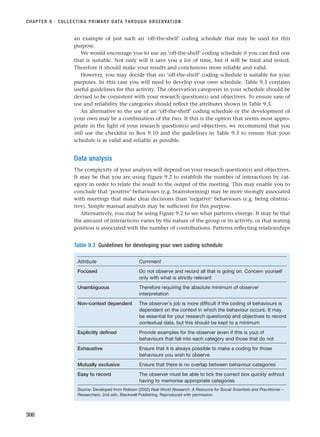
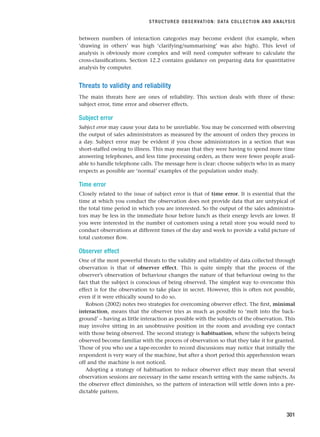
viii
RESM_A01.QXP 9/29/07 9:29 AM Page viii
10.3 Situations favouring non-standardised (qualitative) interviews 314
10.4 Data quality issues and preparing for the interview 317
10.5 Interviewing competence 329
10.6 Managing logistical and resource issues 335
10.7 Group interviews and focus groups 337
10.8 Telephone, Internet- and intranet-mediated interviews 341
10.9 Summary 344
Self-check questions 344
Review and discussion questions 345
Progressing your research project: Using semi-structured or in-depth
interviews in your research 346
References 346
Further reading 348
Case 10: Equal opportunities in the publishing industry 349
Catherine Cassell
Self-check answers 351
11 Collecting primary data using questionnaires 354
Mark Saunders, Philip Lewis and Adrian Thornhill
Learning outcomes 354
11.1 Introduction 354
11.2 An overview of questionnaire techniques 356
11.3 Deciding what data need to be collected 361
11.4 Designing the questionnaire 364
11.5 Administering the questionnaire 387
11.6 Summary 394
Self-check questions 394
Review and discussion questions 396
Progressing your research project: Using questionnaires in your research 397
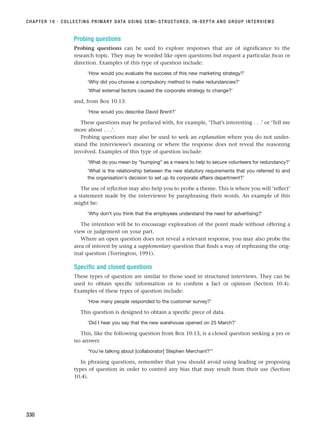
References 398
Further reading 399
Case 11: Service quality in health care supply chains 400
David Bryde and Joanne Meehan
Self-check answers 402
12 Analysing quantitative data 406
Mark Saunders, Philip Lewis, Adrian Thornhill and Catherine Wang
Learning outcomes 406
12.1 Introduction 406
12.2 Preparing, inputting and checking data 408
12.3 Exploring and presenting data 420
12.4 Describing data using statistics 433
12.5 Examining relationships, differences and trends using statistics 440
12.6 Summary 458
Self-check questions 459
Review and discussion questions 461
Progressing your research project: Analysing your data quantitatively 462
CONTENTS
ix
RESM_A01.QXP 9/29/07 9:29 AM Page ix
References 462
Further reading 464
Case 12: The impact of family ownership on financial performance 465
Aleksandar Šević and Željko Šević
Self-check answers 466
13 Analysing qualitative data 470
Mark Saunders, Philip Lewis and Adrian Thornhill
Learning outcomes 470
13.1 Introduction 470
13.2 Differences between qualitative and quantitative data 472
13.3 Preparing your data for analysis 474
13.4 An overview of qualitative analysis 478
13.5 Approaches to qualitative analysis 487
13.6 Deductively-based analytical procedures 489
13.7 Inductively-based analytical procedures 492
13.8 Quantifying your qualitative data 505
13.9 Using CAQDAS for qualitative analysis 505
13.10 Summary 508
Self-check questions 508
Review and discussion questions 508
Progressing your research project: Analysing your data qualitatively 509
References 510
Further reading 511
Case 13: Internet abuse in universities 512
Teresa Waring
Self-check answers 515
14 Writing and presenting your project report 518
Mark Saunders, Philip Lewis and Adrian Thornhill
Learning outcomes 518
14.1 Introduction 518
14.2 Getting started with writing 520
14.3 Structuring your project report 523
14.4 Organising the project report’s content 533
14.5 Developing an appropriate writing style 536
14.6 Meeting the assessment criteria 540
14.7 Oral presentation of the report 542
14.8 Summary 546
Self-check questions 546
Review and discussion questions 547
Progressing your research project: Writing your project report 547
References 548
Further reading 548
Case 14: Akasma’s draft disappointment 550
Mark Saunders, Philip Lewis and Adrian Thornhill
Self-check answers 551
CONTENTS
x
RESM_A01.QXP 9/29/07 9:29 AM Page x
Bibliography 553
Appendices
1 Example research project titles 567
2 Systems of referencing 578
3 Calculating the minimum sample size 585
4 Random sampling numbers 587
5 Guidelines for non-discriminatory language 588
Glossary 591
Index 615
CONTENTS
xi
Supporting resources
Visit www.pearsoned.co.uk/saunders to find valuable online resources:
Companion Website for students
■ Multiple choice questions to test your learning.
■ Tutorials on Excel, NVivo and SPSS.
■ Updated research datasets to practice with.
■ Updated additional case studies with accompanying questions.
■ Smarter Online Searching Guide – how to make the most of the Internet in your research.
For instructors
■ Complete, downloadable Instructor’s Manual.
■ PowerPoint slides that can be downloaded and used for presentations.
Also – the regularly maintained Companion Website provides the following features:
■ Search tool to help locate specific items of content.
■ E-mail results and profile tools to send results of quizzes to instructors.
■ Online help and support to assist with website usage and troubleshooting.
For more information please contact your local Pearson Education sales representative or visit
www.pearsoned.co.uk/saunders
OneKey: All you and your students need to succeed
OneKey is an exclusive new resource for instructors and students, giving you
access to the best online teaching and learning tools 24 hours a day, 7 days a
week.
OneKey means all your resources are in one place for maximum convenience,
simplicity and success.
A OneKey product is available for Research Methods for Business Students, Fourth Edition for use with
CourseCompass. In addition to the Companion Website material it contains:
■ Research Navigator access to help with your research;
■ Interactive Study Guide;
■ Further assignments and weblinks to aid understanding.
For more information about the OneKey product please contact your local Pearson Education sales
representative or visit www.pearsoned.co.uk/onekey
Convenience. Simplicity. Success.
RESM_A01.QXP 9/29/07 9:29 AM Page xi
RESM_A01.QXP 9/29/07 9:29 AM Page xii
This book is written with a progressive logic, which means that terms and concepts are
defined when they are first introduced. One implication of this is that it is sensible for
you to start at the beginning and to work your way through the text, various boxes, self-
check questions, review and discussion questions, case studies and case study questions.
You can do this in a variety of ways depending on your reasons for using this book.
However, this approach may not necessarily be suitable for your purposes, and you may
wish to read the chapters in a different order or just dip into particular sections of the
book. If this is true for you then you will probably need to use the glossary to check that
you understand some of the terms and concepts used in the chapters you read.
Suggestions for three of the more common ways in which you might wish to use this
book are given below.
As part of a research methods course or for self-study for your research project
If you are using this book as part of a research methods course the order in which you
read the chapters is likely to be prescribed by your tutors and dependent upon their per-
ceptions of your needs. Conversely, if you are pursuing a course of self-study for your
research project or dissertation the order in which you read the chapters is your own
choice. However, whichever of these you are, we would argue that the order in which you
read the chapters is dependent upon your recent academic experience.
For many students, such as those taking an undergraduate degree in business or man-
agement, the research methods course and associated project or dissertation comes in
either the second or the final year of study. In such situations it is probable that you will
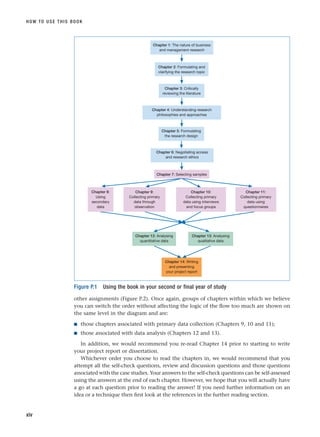
follow the chapter order quite closely (see Figure P.1). Groups of chapters within which
we believe you can switch the order without affecting the logic of the flow too much are
shown on the same level in this diagram and are:
■ those chapters associated with data collection (Chapters 8, 9, 10 and 11);
■ those associated with data analysis (Chapters 12 and 13).
In addition, you might wish to read the sections in Chapter 14 on writing prior to
starting to draft your critical review of the literature (Chapter 3).
Alternatively, you may be returning to academic study after a gap of some years, to
take a full-time or part-time course such as a Master of Business Administration, a Master
of Arts or a Master of Science with a Business and Management focus. Many students in
such situations need to refresh their study skills early in their programme, particularly
those associated with critical reading of academic literature and academic writing. If you
feel the need to do this, you may wish to start with those chapters that support you in
developing and refining these skills (Chapters 3 and 14), followed by Chapter 8, which
introduces you to the range of secondary data sources available that might be of use for
xiii
How to use this book
RESM_A01.QXP 9/29/07 9:29 AM Page xiii
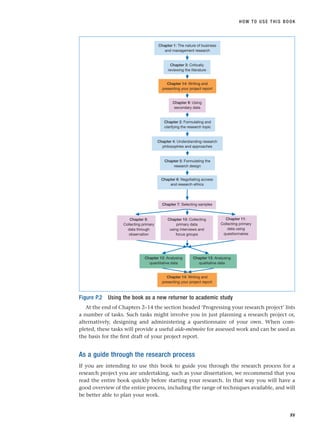
other assignments (Figure P.2). Once again, groups of chapters within which we believe
you can switch the order without affecting the logic of the flow too much are shown on
the same level in the diagram and are:
■ those chapters associated with primary data collection (Chapters 9, 10 and 11);
■ those associated with data analysis (Chapters 12 and 13).
In addition, we would recommend you re-read Chapter 14 prior to starting to write
your project report or dissertation.
Whichever order you choose to read the chapters in, we would recommend that you
attempt all the self-check questions, review and discussion questions and those questions
associated with the case studies. Your answers to the self-check questions can be self-assessed
using the answers at the end of each chapter. However, we hope that you will actually have
a go at each question prior to reading the answer! If you need further information on an
idea or a technique then first look at the references in the further reading section.
HOW TO USE THIS BOOK
xiv
Chapter 14: Writing
and presenting
your project report
Chapter 1: The nature of business
and management research
Chapter 2: Formulating and
clarifying the research topic
Chapter 3: Critically
reviewing the literature
Chapter 4: Understanding research
philosophies and approaches
Chapter 6: Negotiating access
and research ethics
Chapter 7: Selecting samples
Chapter 8:
Using
secondary
data
Chapter 9:
Collecting primary
data through
observation
Chapter 10:
Collecting primary
data using interviews
and focus groups
Chapter 11:
Collecting primary
data using
questionnaires
Chapter 12: Analysing
quantitative data
Chapter 13: Analysing
qualitative data
Chapter 5: Formulating
the research design
Figure P.1 Using the book in your second or final year of study
RESM_A01.QXP 9/29/07 9:29 AM Page xiv
At the end of Chapters 2–14 the section headed ‘Progressing your research project’ lists
a number of tasks. Such tasks might involve you in just planning a research project or,
alternatively, designing and administering a questionnaire of your own. When com-
pleted, these tasks will provide a useful aide-mémoire for assessed work and can be used as
the basis for the first draft of your project report.
As a guide through the research process
If you are intending to use this book to guide you through the research process for a
research project you are undertaking, such as your dissertation, we recommend that you
read the entire book quickly before starting your research. In that way you will have a
good overview of the entire process, including the range of techniques available, and will
be better able to plan your work.
HOW TO USE THIS BOOK
xv
Chapter 14: Writing and
presenting your project report
Chapter 1: The nature of business
and management research
Chapter 3: Critically
reviewing the literature
Chapter 14: Writing and
presenting your project report
Chapter 8: Using
secondary data
Chapter 4: Understanding research
philosophies and approaches
Chapter 7: Selecting samples
Chapter 9:
Collecting primary
data through
observation
Chapter 10: Collecting
primary data
using interviews and
focus groups
Chapter 11:
Collecting primary
data using
questionnaires
Chapter 12: Analysing
quantitative data
Chapter 13: Analysing
qualitative data
Chapter 2: Formulating and
clarifying the research topic
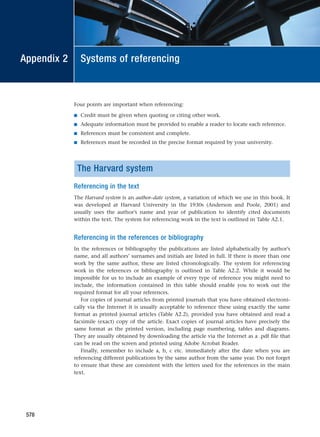
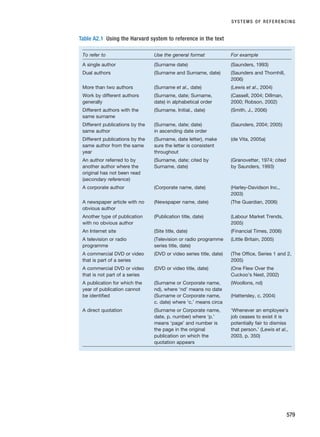
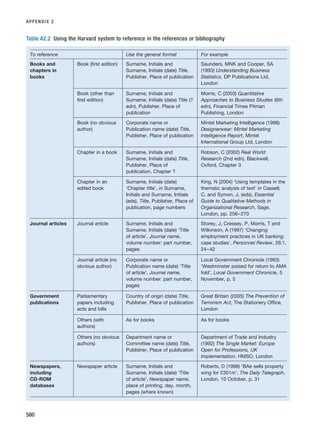
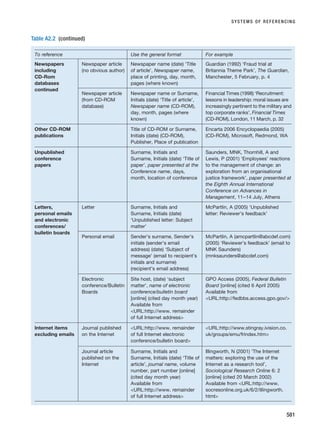
Chapter 6: Negotiating access
and research ethics
Chapter 5: Formulating the
research design
Figure P.2 Using the book as a new returner to academic study
RESM_A01.QXP 9/29/07 9:29 AM Page xv
After you have read the book once, we suggest that you work your way through the
book again following the chapter order. This time you should attempt the self-check
questions, review and discussion questions and those questions associated with each case
study to ensure that you have understood the material contained in each chapter prior
to applying it to your own research project. Your responses to self-check questions can be
assessed using the answers at the end of each chapter.
If you are still unsure as to whether particular techniques, procedures or ideas are rel-
evant then pay special attention to the ‘worked example’, ‘focus on management
research’ and ‘research in the news’ boxes. ‘Worked example’ boxes are based on actual
students’ experiences and illustrate how an issue has been addressed or a technique or
procedure used in a student’s research project. ‘Focus on management research’ boxes
discuss recent research articles in established refereed academic journals, allowing you to
see how research is undertaken successfully. These articles are easily accessible via online
databases. ‘Research in the news’ boxes provide topical news articles of how particular
research techniques, procedures and ideas are used in the business world. You can also
look in the ‘further reading’ for other examples of research where these have been used.
If you need further information on an idea, technique or procedure then, again, start
with the references in the further reading section.
Material in some of the chapters is likely to prove less relevant to some research topics
than others. However, you should beware of choosing techniques because you are happy
with them, if they are inappropriate. Completion of the tasks in the section headed
‘Progressing your research project’ at the end of Chapters 2–13 will enable you to gen-
erate all the material that you will need to include in your project report. This will also
help you to focus on the techniques and ideas that are most appropriate to your research.
When you have also completed these tasks for Chapter 14 you will have written your
project report.
As a reference source
It may be that you wish to use this book now or subsequently as a reference source. If
this is the case, an extensive index will point you to the appropriate page or pages. Often
you will find a ‘checklist’ box within these pages. ‘Checklist’ boxes are designed to
provide you with further guidance on the particular topic. You will also find the contents
pages and the glossary useful reference sources, the latter defining over 400 research
terms. In addition, we have tried to help you to use the book in this way by including
cross-references between sections in chapters as appropriate. Do follow these up as
necessary. If you need further information on an idea or a technique then begin by con-
sulting the references in the further reading section. Wherever possible we have tried to
reference books that are in print and readily available in university libraries.
HOW TO USE THIS BOOK
xvi
RESM_A01.QXP 9/29/07 9:29 AM Page xvi
xvii
Guided tour
Formulating the research design
5
LEARNING OUTCOMES
By the end of this chapter you should be able to:
➔ understand the importance of having thought carefully about your research
design;
➔ identify the main research strategies and explain why these should not be
thought of as mutually exclusive;
➔ explain the differences between quantitative and qualitative data collection
techniques and analysis procedures;
➔ explain the benefits of adopting multiple methods to the conduct of research;
➔ consider the implications of adopting different time horizons for your research
design;
➔ explain the concepts of validity and reliability and identify the main threats to
validity and reliability;
➔ understand some of the main ethical issues implied by the choice of research
strategy.
5.1 Introduction
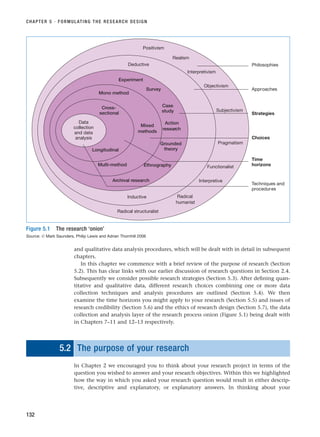
In Chapter 4 we introduced the research onion as a way of depicting the issues under-
lying your choice of data collection method or methods and peeled away the outer two
layers – research philosophies and research choices. In this chapter we uncover the next
three layers: research strategies, research choices and time horizons. These three layers
can be thought of as focusing on the process of research design, that is, turning your
research question into a research project (Robson, 2002). As we saw, the way you choose
to answer your research question will be influenced by your research philosophy and
approach. Your research question will subsequently inform your choice of research
strategy, your choices of collection techniques and analysis procedures, and the time
horizon over which you undertake your research project.
130
Your research design will be the general plan of how you will go about answering your
research question(s) (the importance of clearly defining the research question cannot be
overemphasised). It will contain clear objectives, derived from your research question(s),
specify the sources from which you intend to collect data, and consider the constraints
that you will inevitably have (for example, access to data, time, location and money) as
well as discussing ethical issues. Crucially, it should reflect the fact that you have thought
carefully about why you are employing your particular research design. It would be per-
fectly legitimate for your assessor to ask you why you chose to conduct your research in
a particular organisation, why you chose the particular department, why you chose to
talk to one group of staff rather than another. You must have valid reasons for all your
research design decisions. The justification should always be based on your research ques-
tion(s) and objectives as well as being consistent with your research philosophy.
At this point we should make a clear distinction between design and tactics. The
former is concerned with the overall plan for your research; the latter is about the finer
detail of data collection and analysis. Decisions about tactics will involve your being clear
about the different quantitative and qualitative data collection techniques (for example,
questionnaires, interviews, focus groups, published data) and subsequent quantitative
INTRODUCTION
131
Hakim (2000) compares a researcher designing a
research project with an architect designing a
building. This analogy is particularly useful when
thinking about your research project. Like an archi-
tect, your research design will need to fulfil a
particular purpose within the practical constraints of
time and money. The way in which you design your
research will depend upon your own preferences,
your research philosophy, and your ideas as to the
most appropriate strategy and choices of methods
for conducting your research. In addition, if you are
undertaking your research project for an organis-
ation, it may also be influenced by the preferences of
those who are paying for the work! This can be
likened to architects designing visually impressive
buildings at their clients’ requests. However, like the
architect, you will undoubtedly be aiming to produce
the best possible design guided by these constraints
and influences. For small-scale research projects,
such as the one you are likely to do as part of your
taught course, the person who designs the research
is nearly always the same as the person who undertakes the data collection, data analysis and subsequently
writes the project report. Continuing with our analogy, this can be likened to the architect and builder being the
same person. It also emphasises the need for you to spend time on ensuring that you have a good research
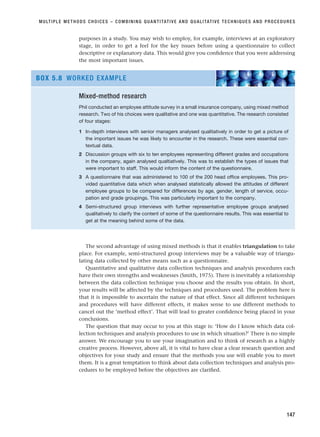
design in order to avoid what Robson (2002:80) describes as ‘the research equivalent of the many awful houses
put up by speculative builders without the benefit of architectural experience’. This is essential because good
research, like a good building, is attributed to its architect.
Selfridges Store, Birmingham’s Bullring, designed by Future
Systems
Source:
©
Mark
Saunders
2006
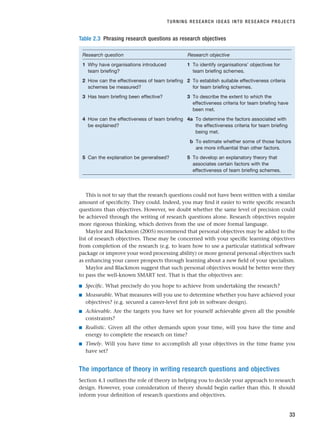
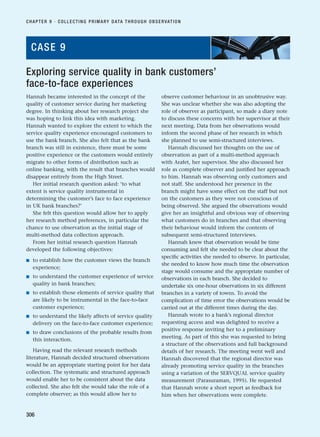
Hannah became interested in the concept of the
quality of customer service during her marketing
degree. In thinking about her research project she
was hoping to link this idea with marketing.
Hannah wanted to explore the extent to which the
service quality experience encouraged customers to
use the bank branch. She also felt that as the bank
branch was still in existence, there must be some
positive experience or the customers would entirely
migrate to other forms of distribution such as
online banking, with the result that branches would
disappear entirely from the High Street.
Her initial research question asked: ‘to what
extent is service quality instrumental in
determining the customer’s face to face experience
in UK bank branches?’
She felt this question would allow her to apply
her research method preferences, in particular the
chance to use observation as the initial stage of
multi-method data collection approach.
From her initial research question Hannah
developed the following objectives:
■ to establish how the customer views the branch
experience;
■ to understand the customer experience of service
quality in bank branches;
■ to establish those elements of service quality that
are likely to be instrumental in the face-to-face
customer experience;
■ to understand the likely affects of service quality
delivery on the face-to-face customer experience;
■ to draw conclusions of the probable results from
this interaction.
Having read the relevant research methods
literature, Hannah decided structured observations
would be an appropriate starting point for her data
collection. The systematic and structured approach
would enable her to be consistent about the data
collected. She also felt she would take the role of a
complete observer; as this would allow her to
observe customer behaviour in an unobtrusive way.
She was unclear whether she was also adopting the
role of observer as participant, so made a diary note
to discuss these concerns with her supervisor at their
next meeting. Data from her observations would
inform the second phase of her research in which
she planned to use semi-structured interviews.
Hannah discussed her thoughts on the use of
observation as part of a multi-method approach
with Arafet, her supervisor. She also discussed her
role as complete observer and justified her approach
to him. Hannah was observing only customers and
not staff. She understood her presence in the
branch might have some effect on the staff but not
on the customers as they were not conscious of
being observed. She argued the observations would
give her an insightful and obvious way of observing
what customers do in branches and that observing
their behaviour would inform the contents of
subsequent semi-structured interviews.
Hannah knew that observation would be time
consuming and felt she needed to be clear about the
specific activities she needed to observe. In particular,
she needed to know how much time the observation
stage would consume and the appropriate number of
observations in each branch. She decided to
undertake six one-hour observations in six different
branches in a variety of towns. To avoid the
complication of time error the observations would be
carried out at the different times during the day.
Hannah wrote to a bank’s regional director
requesting access and was delighted to receive a
positive response inviting her to a preliminary
meeting. As part of this she was requested to bring
a structure of the observations and full background
details of her research. The meeting went well and
Hannah discovered that the regional director was
already promoting service quality in the branches
using a variation of the SERVQUAL service quality
measurement (Parasuraman, 1995). He requested
that Hannah wrote a short report as feedback for
him when her observations were complete.
CHAPTER 9 · COLLECTING PRIMARY DATA THROUGH OBSERVATION
306
Exploring service quality in bank customers’
face-to-face experiences
CASE 9
Delivery and collection questionnaires
The administration of delivery and collection questionnaires is very similar to that of
postal questionnaires. However, you or field staff will deliver and call to collect the ques-
tionnaire. It is therefore important that your covering letter states when the
questionnaire is likely to be collected. As with postal questionnaires, follow-ups can be
used, calling at a variety of times of day and on different days to try to catch the respon-
dent.
CHAPTER 11 · COLLECTING PRIMARY DATA USING QUESTIONNAIRES
392
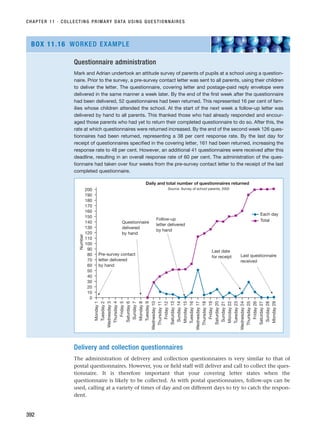
Questionnaire administration
Mark and Adrian undertook an attitude survey of parents of pupils at a school using a question-
naire. Prior to the survey, a pre-survey contact letter was sent to all parents, using their children
to deliver the letter. The questionnaire, covering letter and postage-paid reply envelope were
delivered in the same manner a week later. By the end of the first week after the questionnaire
had been delivered, 52 questionnaires had been returned. This represented 16 per cent of fam-
ilies whose children attended the school. At the start of the next week a follow-up letter was
delivered by hand to all parents. This thanked those who had already responded and encour-
aged those parents who had yet to return their completed questionnaire to do so. After this, the
rate at which questionnaires were returned increased. By the end of the second week 126 ques-
tionnaires had been returned, representing a 38 per cent response rate. By the last day for
receipt of questionnaires specified in the covering letter, 161 had been returned, increasing the
response rate to 48 per cent. However, an additional 41 questionnaires were received after this
deadline, resulting in an overall response rate of 60 per cent. The administration of the ques-
tionnaire had taken over four weeks from the pre-survey contact letter to the receipt of the last
completed questionnaire.
BOX 11.16 WORKED EXAMPLE
Monday
1
Tuesday
2
Wednesday
3
Thursday
4
Friday
5
Saturday
6
Sunday
7
Monday
8
Tuesday
9
Wednesday
10
Thursday
11
Friday
12
Saturday
13
Sunday
14
Monday
15
Tuesday
16
Wednesday
17
Thursday
18
Friday
19
Saturday
20
Sunday
21
Monday
22
Tuesday
23
Wednesday
24
Thursday
25
Friday
26
Saturday
27
Sunday
28
Monday
29
200
Daily and total number of questionnaires returned
190
180
170
160
150
140
130
120
110
100
90
80
70
60
50
40
30
20
10
0
Pre-survey contact
letter delivered
by hand
Questionnair
Source: Survey of school parents, 2002
e
delivered
by hand
Follow-up
letter delivered
by hand
Last date
for receipt Last questionnaire
received
Each day
Total
Number
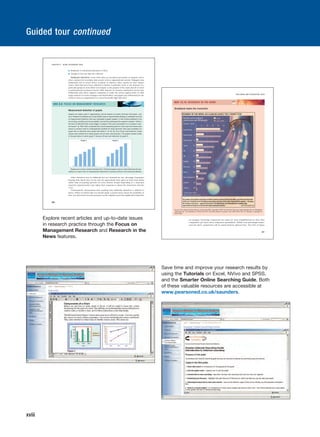
Chapter openers
provide a clear and
concise introduction
to the topics to be
covered, together
with a list of Learning
Outcomes that you
should have achieved
by the end of the
chapter.
Practical illustrations
bring to life some of
the issues and
challenges you will
encounter during
your course and
beyond. These
include short
Worked Examples
and longer Cases.
RESM_A01.QXP 9/29/07 9:29 AM Page xvii
xviii
Explore recent articles and up-to-date issues
in research practice through the Focus on
Management Research and Research in the
News features.
Save time and improve your research results by
using the Tutorials on Excel, NVivo and SPSS,
and the Smarter Online Searching Guide. Both
of these valuable resources are accessible at
www.pearsoned.co.uk/saunders.
EXPLORING AND PRESENTING DATA
431
Source: From article by Simon Briscoe, 2 November 2005. Copyright © 2005 The Financial Times Ltd. Graph adapted from 4a. Braodband
subscribers per 100 inhabitants in OECD and ICCP Committe observer countries. June 2005 OECD Key ICT Indicators. Copyrights ©
OECD 2005.
BOX 12.10 RESEARCH IN THE NEWS FT
Broadband makes the connection
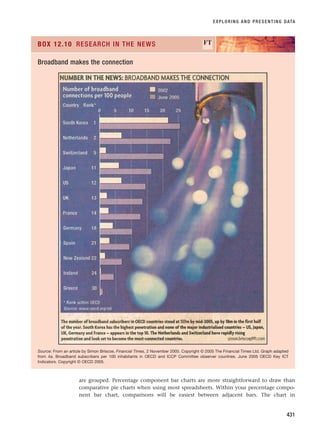
are grouped. Percentage component bar charts are more straightforward to draw than
comparative pie charts when using most spreadsheets. Within your percentage compo-
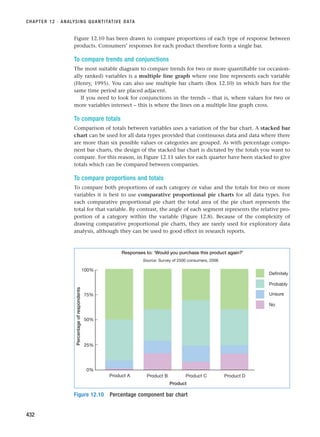
nent bar chart, comparisons will be easiest between adjacent bars. The chart in Figure
■ deliberate or intentional distortion of data;
■ changes in the way data are collected.
Deliberate distortion occurs when data are recorded inaccurately on purpose, and is
most common for secondary data sources such as organisational records. Managers may
deliberately fail to record minor accidents to improve safety reports for their depart-
ments. Data that have been collected to further a particular cause or the interests of a
particular group are more likely to be suspect as the purpose of the study may be to reach
a predetermined conclusion (Jacob, 1994). Reports of consumer satisfaction surveys may
deliberately play down negative comments to make the service appear better to their
target audience of senior managers and shareholders, and graphs may deliberately be dis-
torted to show an organisation in a more favourable light (Box 8.8).
CHAPTER 8 · USING SECONDARY DATA
268
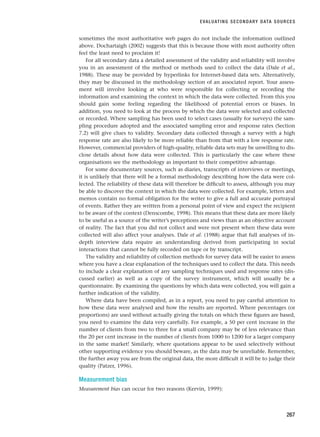
Measurement distortion of graphs
Graphs are widely used in organisations’ annual reports to portray financial information, over
time. Research by Beattie and Jones (2002) used an experimental strategy to establish the level
of measurement distortion that was noticeable to graph readers. In their article published in the
Accounting, Auditing and Accountability Journal they addressed the research question ‘What is
the level of distortion that would trigger a change in the user’s perception of a company’s per-
formance?’ (p. 553). Pairs of abstract bar charts presenting data for a five-year time series were
shown in random order to undergraduate students for three seconds. Each pair consisted of a
graph with no distortion and a graph with either 5, 10, 20, 30, 40 or 50 per cent distortion. Scale
values were omitted from these graphs and all were coloured blue. The graphs looked similar
to the pair below in which graph Y shows a 20 per cent distortion of graph X:
Beattie and Jones’s results indicated that, if financial graphs were to avoid distorting the per-
ceptions of users, then no measurement distortions in excess of 20 per cent should be allowed.
BOX 8.8 FOCUS ON MANAGEMENT RESEARCH
Graph X Graph Y
Other distortion may be deliberate but not intended for any advantage. Employees
keeping time diaries may record only the approximate time spent on their main duties
rather than accounting precisely for every minute. People responding to a structured
interview (questionnaire) may adjust their responses to please the interviewer (Section
11.2).
Unfortunately, measurement bias resulting from deliberate distortion is difficult to
detect. While we believe that you should adopt a neutral stance about the possibility of
bias, you still need to look for pressures on the original source that might have biased the
Guided tour continued
RESM_A01.QXP 9/29/07 9:29 AM Page xviii
xix
13.10 Summary
■ Qualitative data are non-numerical data that have not been quantified. They result from the
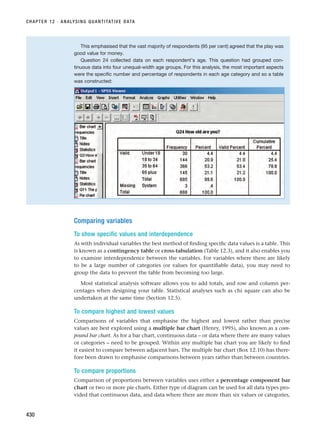
collection of non-standardised data that require classification and are analysed through the
use of conceptualisation.
■ The process of qualitative analysis generally involves the development of data categories,
allocating units of your original data to appropriate categories, recognising relationships
within and between categories of data, and developing and testing hypotheses or proposi-
tions to produce well-grounded conclusions.
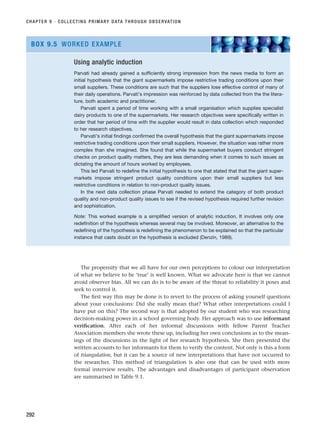
■ The process of data analysis and data collection is necessarily an interactive one.
■ There are a number of aids that you might use to help you through the process of qualitative
analysis, including interview, observation, document and interim summaries, self-memos
and maintaining a researcher’s diary.
■ Different qualitative analytical strategies can be identified, related to using either a deduc-
tively based or an inductively based approach to research. The use of these different
strategies has implications for the procedures involved in the analysis of qualitative data.
■ Quantifying some categories of qualitative data may help you to analyse this.
■ The use of computer-assisted qualitative data analysis software (CAQDAS) can help you
during qualitative analysis with regard to project management and data organisation,
keeping close to your data, exploration, coding and retrieval of your data, searching
and interrogating to build hypotheses and theorise, and recording your thoughts sys-
tematically.
CHAPTER 13 · ANALYSING QUALITATIVE DATA
508
SELF-CHECK QUESTIONS
Help with these questions is available at the end of the chapter.
13.1 Why do we describe qualitative analysis as an ‘interactive process’?
13.2 What types of data will you need to retain and file while you are undertaking qualitative
research?
13.3 How would you differentiate between a deductive and an inductive analytical approach?
13.4 What are the main implications of using a deductive analytical approach for the way in which you
conduct the process of qualitative analysis?
13.5 What are the main implications of using an inductive analytical approach for the way in which
you conduct the process of qualitative analysis?
13.6 With a friend, obtain a transcript of an interview that has already been undertaken. If your
university subscribes to online newspapers such as ft.com, these are a good source of business-
related transcripts. Alternatively, typing ‘interview transcript’ into a search engine such as Google
will generate numerous possibilities on a vast range of topics!
a With your friend, decide on the unit of analysis you wish to use. We suggest you use either
lines or paragraphs and subsequently agree on a coding template.
REVIEW AND DISCUSSION QUESTIONS
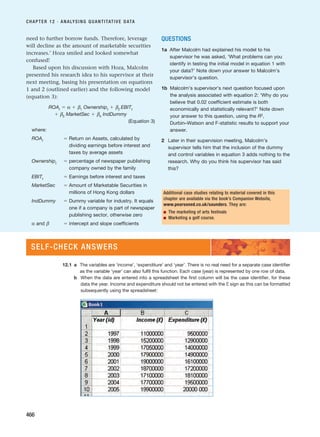
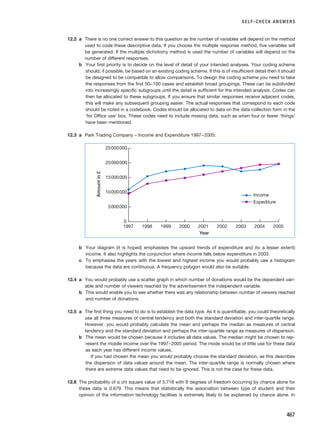
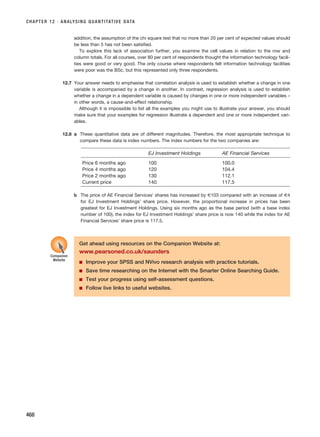
courses, are provided with a research idea by an organisation or their university. In the
initial stages of their research they are expected to refine this to a clear and feasible idea
that meets the requirements of the examining organisation. If you have already been
given a research idea we believe you will still find it useful to read the next subsection,
which deals with generating research ideas. Many of the techniques which can be used
for generating research ideas can also be used for the refining process.
Generating research ideas
If you have not been given an initial research idea there is a range of techniques that
can be used to find and select a topic that you would like to research. They can be
thought of as those that are predominantly rational thinking and those that involve
more creative thinking (Table 2.1). The precise techniques that you choose to use and
the order in which you use them are entirely up to you. However, like Raimond (1993),
we believe you should use both rational and creative techniques, choosing those that you
believe are going to be of most use to you and which you will enjoy using. By using one
or more creative techniques you are more likely to ensure that your heart as well as your
head is in your research project. In our experience, it is usually better to use a variety of
techniques. In order to do this you will need to have some understanding of the tech-
CHAPTER 2 · FORMULATING AND CLARIFYING THE RESEARCH TOPIC
22
Attributes of a good research topic
Capability: is it feasible?
Is the topic something with which you are really fascinated?
Do you have, or can you develop within the project time frame, the necessary research
skills to undertake the topic?
Is the research topic achievable within the available time?
Will the project still be current when you finish your project?
Is the research topic achievable within the financial resources that are likely to be available?
Are you reasonably certain of being able to gain access to data you are likely to require for
this topic?
Appropriateness: is it worth while?
Does the topic fit the specifications and meet the standards set by the examining institution?
Does your research topic contain issues that have a clear link to theory?
Are you able to state your research question(s) and objectives clearly?
Will your proposed research be able to provide fresh insights into this topic?
Does your research topic relate clearly to the idea you have been given (perhaps by an
organisation)?
Are the findings for this research topic likely to be symmetrical: that is, of similar value what-
ever the outcome?
Does the research topic match your career goals?
✔
✔
✔
✔
✔
✔
✔
✔
✔
✔
✔
✔
✔
BOX 2.2 CHECKLIST
You will be given lots of opportunities to review your
progress! Every chapter includes handy Checklists,
tips on Progressing Your Research Project, as well
as Self-Check Questions (at the end of the chapter).
There are additional interactive Multiple Choice
Questions on the Companion Website.
A Summary, Self-Check Questions
and Review and Discussion
Questions, and recommended
Further Reading at the end of each
chapter enable you to reflect upon
key points and pursue topics in
more depth.
PROGRESSING YOUR RESEARCH PROJECT
123
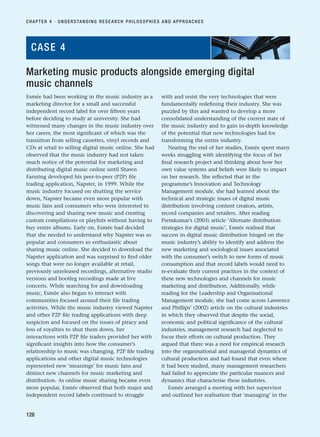
PROGRESSING YOUR RESEARCH PROJECT
Diagnosing your research philosophy
Indicate your agreement or disagreement with each of these statements.
There are no right or wrong answers.
strongly agree slightly slightly disagree strongly
agree agree disagree disagree
1 For the topic being researched there
is one single reality; the task of the
researcher is to discover it ■
■ ■
■ ■
■ ■
■ ■
■ ■
■
2 Business and management research
is value laden ■
■ ■
■ ■
■ ■
■ ■
■ ■
■
3 A researcher cannot be separated
from what is being researched and
so will inevitably be subjective ■
■ ■
■ ■
■ ■
■ ■
■ ■
■
4 A variety of data collection
techniques should be used, both
quantitative and qualitative ■
■ ■
■ ■
■ ■
■ ■
■ ■
■
5 The reality of what is being
researched exists independently of
people’s thoughts, beliefs and
knowledge of their existence ■
■ ■
■ ■
■ ■
■ ■
■ ■
■
6 Researchers must remain objective
and independent from the
phenomena they are studying,
ensuring that their own values do
not impact on data interpretation ■
■ ■
■ ■
■ ■
■ ■
■ ■
■
7 Business and management research
should be practical and applied,
integrating different perspectives to
help interpret the data ■
■ ■
■ ■
■ ■
■ ■
■ ■
■
8 Business and management
researchers need to employ
methods that allow in-depth
exploration of the details behind a
phenomenon ■
■ ■
■ ■
■ ■
■ ■
■ ■
■
Now discuss your answers with your colleagues. To guide your discussion you need to think
about:
What do you consider to be the nature of reality? Why?
To what extent do your own values influence your research? Why?
What do you consider to be acceptable knowledge in relation to your research? Why?
How might knowledge of this impact upon your own research?
Source: These questions were developed with the help of Judith Thomas.
RESM_A01.QXP 9/29/07 9:29 AM Page xix
In writing the fourth edition of Research Methods for Business Students we have responded
to the many comments we have received regarding previous editions. In particular this
has led us to research and write two new chapters: ‘Understanding research philosophies
and approaches’ (Chapter 4) and ‘Formulating the research design’ (Chapter 5), and to
substantially update Chapter 13 ‘Analysing qualitative data’. In addition, we have taken
into account the increasing importance of the Internet as a means of accessing academic
literature and research data sets. This, combined with the reality of relatively inexpensive
and easily accessible computer processing power for almost all students, has had signifi-
cant implications for business and management students’ research. As in previous
editions, we have taken a predominantly non-software-specific approach in our writing.
By doing this, we have been able to focus on the general principles needed to utilise a
range of analysis software and the Internet effectively for research. However, recognising
that many students have access to sophisticated data analysis software and may need
help in developing these skills, we have provided access to ‘teach yourself’ guides to SPSS,
Excel, NVivo and Internet searching via the book’s website (www.pearsoned.co.uk/
saunders). Where appropriate these guides are provided with data sets. Inevitably,
changes in the information available via the Internet have necessitated substantial
updating for Chapter 3, ‘Critically reviewing the literature’, and Chapter 8, ‘Using sec-
ondary data’. We have also taken the opportunity to revise the tables of Internet
addresses fully. In addition, we have taken the opportunity to further develop our dis-
cussions regarding issues associated with the use of email, Internet chat rooms and
Internet and intranet-mediated questionnaires.
In the preparation of the fourth edition we were fortunate to receive considerable feed-
back from colleagues in both UK and overseas universities. We are extremely grateful to
all the reviewers who gave their time and shared their ideas. Particular responses to this
feedback not outlined elsewhere have been the inclusion of sections on transcribing
audio-recorded interviews, discourse analysis, and personal safety when undertaking
research.
Inevitably the body of knowledge of research methods has developed since 2002, and
we have revised the chapters accordingly. Our experiences of teaching and supervising
students and working through the methods in classes have suggested alternative
approaches and the need to provide additional material. Consequently we have taken the
opportunity to update and refine existing worked examples and develop new ones where
appropriate. New case studies at the end of each chapter have been developed with col-
leagues, providing up-to-date scenarios through which to illustrate issues associated with
undertaking research. However, the basic structure remains much the same as the pre-
vious three editions.
Other minor changes and updating have been made throughout. Needless to say, any
errors of omission and commission are our responsibility.
As with previous editions, much of our updating has been guided by comments from
students and colleagues, to whom we are most grateful. We should like to thank students
xx
Preface
For WEB LINKS visit
www.pearsoned.co.uk/
saunders
RESM_A01.QXP 9/29/07 9:29 AM Page xx
at Oxford Brookes University, the University of Gloucestershire and on the research
methods’ summer schools for their comments on all of the chapters. Colleagues in both
our own and other universities have continued to provide helpful comments and advice.
We are particularly grateful to Krista Lee Bondy (Nottingham University), Frances
Brassington (Oxford Brookes University), Richard Charlesworth (London Metropolitan
University), Lisa Cowey (Oxford Brookes University), Tom Forbes (University of Stirling),
Tony Gibbs (Oxford Brookes University), Anne Munro (Napier University), Christopher
Napier (University of Southampton), Tracey Panther (Oxford Brookes University), Rose
Quan (Northumbria University), Judith Thomas (Oxford Brookes University), Eike
Wagner (Oxford Brookes University) and Robert Wapshott (Bradford University).
Colleagues and friends again deserve thanks for their assistance in providing examples of
research across the spectrum of business and management, in writing case studies and in
reviewing parts of this book, in particular Darren Bolton (University of Gloucestershire),
David Bryde (Liverpool John Moores University), Catherine Cassell (University of
Manchester), Rick Colbourne (Universities of Cambridge and Westminster), Christopher
Cowton (Huddersfield University), Martin Jenkins (University of Gloucestershire), Cathy
Leng (Bath Spa University), Sharon Loane (University of Ulster), Joanne Meehan
(Liverpool John Moores University), Angela Roper (University of Surrey), Michael Savvas
(University of Gloucestershire), Aleksandar Šević (University of Newcastle, Australia),
Željko Šević (University of Greenwich), Teresa Smallbone (Oxford Brookes University),
Catherine Wang (Brunel University) and Teresa Waring (University of Sunderland). The
contributions of Lynette Bailey to Chapter 3 and of Andrew Guppy to Chapter 12 in
earlier editions of this book are gratefully acknowledged.
We would also like to thank all of the staff at Pearson Education (both past and
present) who supported us through the process of writing the fourth edition. Our thanks
go in particular to Amanda McPartlin, our commissioning editor, for her excellent
support and enthusiasm throughout the process and to Stuart Hay for coordinating the
market research and for his innovative ideas. We would also like to express our thanks to
Sarah Wild as desk editor and Annette Abel as copy editor as well as Janey Webb.
Once again our thanks are due to Jane, Jenny, Jan, Jemma, Ben, Andrew and Katie,
who still allow us the time to absent ourselves to think and write.
MNKS
PL
AT
May 2006
PREFACE
xxi
RESM_A01.QXP 9/29/07 9:29 AM Page xxi
Mark N.K. Saunders BA, MSc, PGCE, PhD, MCIPD, is Professor of Business Research
Methods and Head of Research at Oxford Brookes University Business School. He is also
a visiting professor at Newcastle Business School, University of Northumbria. Prior to this
he was Head of the Human Resource Management Research Centre at Gloucestershire
Business School. He currently teaches research methods to masters and doctoral students
as well as supervising masters dissertations and research degrees. Mark has published a
number of articles on research methods, service quality, and trust and organisational
justice perspectives on the management of change. He is co-author with Phil and Adrian
of Employee Relations: Understanding the Employment Relationship and with Adrian, Phil
and Mike Millmore of Managing Change: A Human Resource Strategy Approach, both pub-
lished by Financial Times Prentice Hall, and has also co-authored a book on business
statistics. He has undertaken consultancy in public, private and not-for-profit sectors,
prior to which he had a variety of research jobs in local government.
Philip Lewis BA, PhD, MSc, MCIPD, PGDipM, Cert Ed, is a Principal Lecturer in Human
Resource Management (HRM) at Gloucestershire Business School, University of
Gloucestershire. He teaches HRM and research methods to postgraduate, undergraduate
and professional students, and is involved in research degree supervision. Phil’s research
interests are reward management and performance management, on which he has pub-
lished several articles. He is co-author with Mark and Adrian of Employee Relations:
Understanding the Employment Relationship and with Adrian, Mark and Mike Millmore of
Managing Change: A Human Resource Strategy Approach, both published by Financial Times
Prentice Hall. He has undertaken consultancy in both public and private sectors. Prior to
his career in higher education Phil was a training advisor with the Distributive Industry
Training Board.
Adrian Thornhill BA, PhD, PGCE, FCIPD, is Head of the Department of Human Resource
Management at Gloucestershire Business School, University of Gloucestershire. He
teaches HRM and research methods to postgraduate, undergraduate and professional stu-
dents, and is involved in research degree supervision. Adrian has published a number of
articles principally associated with employee and justice perspectives related to managing
change and the management of organisational downsizing and redundancy. He is co-
author with Phil and Mark of Employee Relations: Understanding the Employment
Relationship and with Mark, Phil and Mike Millmore of Managing Change: A Human
Resource Strategy Approach, both published by Financial Times Prentice Hall, and has also
co-authored a book on downsizing and redundancy. He has undertaken consultancy in
both public and private sectors.
Darren Bolton is Senior Information Advisor for Computing and Electronic Resources at
the University of Gloucestershire.
Dr David Bryde is a Reader in Project Management and Head of Research and Doctoral
Studies in the Faculty of Business and Law at Liverpool John Moores University.
xxii
Contributors
RESM_A01.QXP 9/29/07 9:29 AM Page xxii
Professor Catherine Cassell is Professor of Occupational Psychology in the People,
Management and Organizations Division at Manchester Business School, University of
Manchester.
Rick Colbourne is a final year Doctoral student at the Judge Business School, University
of Cambridge, and a Senior Lecturer in Leadership and Organisational Management,
Innovation and Technology Management and Research Methods at the University of
Westminster.
Professor Christopher Cowton is Professor of Accounting at Huddersfield University
Business School and Editor of Business Ethics: A European Review.
Martin Jenkins is Academic Manager of the Centre for Active Learning at the University
of Gloucestershire with a special interest in information literacy.
Cathy Leng is a Senior Lecturer in Business and Management in the School of Social
Sciences at Bath Spa University.
Dr Sharon Loane is a Lecturer in Business Economics at the School of International
Business, University of Ulster, Magee Campus.
Joanne Meehan is a Senior Lecturer in Supply Chain Management in the Faculty of
Business and Law at Liverpool John Moores University.
Dr Angela Roper is Savoy Educational Trust Senior Lecturer in Hospitality Management
in the School of Management at the University of Surrey.
Dr Michael Savvas is a Senior Lecturer in Human Resource Management at
Gloucestershire Business School, University of Gloucestershire.
Dr Aleksandar Šević is a Lecturer in Finance at Newcastle Graduate School of Business,
University of Newcastle, in Newcastle, Australia.
Professor Željko Šević is Professor of Accounting, Finance and Public Policy and Director
of Research, Outreach and European Affairs at the University of Greenwich Business
School.
Teresa Smallbone is a Senior Lecturer in Marketing at Oxford Brookes University
Business School and Chair of the University’s Research Ethics Committee.
Dr Catherine L. Wang is a Lecturer in Business and Management at Brunel University,
Brunel Business School.
Dr Teresa Waring is Associate Dean, Business and Management at the University of
Sunderland Business School.
CONTRIBUTORS
xxiii
RESM_A01.QXP 9/29/07 9:29 AM Page xxiii
Reviewers
We would like to express thanks to the reviewers who have been involved in the devel-
opment of this book. We are grateful for their insight and helpful recommendations.
Veronica Liljander (Swedish School of Economics, Finland)
Jill Pearson (Limerick University, Eire)
Pete Thomas (Central Lancashire University, UK)
Val Caven (Nottingham Trent University, UK)
Gabriele Vosseberg (Hull University, UK)
Helen Batley (Westminster University, UK)
David Smith (Nottingham Trent, UK)
Lynne Baxter (Heriot-Watt University, UK)
Dr Tan Juat Hong (University Tenaga Nasional, Malaysia)
Susan Kirk (Nottingham Trent, UK)
Tomas Blomquist (Umeå School of Business, Sweden)
Richard Hull (Newcastle University, UK)
John Lamb (Aberdeen University, UK)
Geoff Nichols (Sheffield University, UK)
Boris Blumberg (Maastricht University, Netherlands)
Charlene Lew (Damelin International College, South Africa)
Joan van Aken (Eindhoven University of Technology, Netherlands)
Martin Wetzels (Eindhoven University of Technology, Netherlands)
Jon Hindmarsh (Kings College London, UK)
Stephen Perkins (London Metropolitan University, UK)
Jane Farmer (Aberdeen University, UK)
Chris Hammond (Hull University, UK)
We are grateful to the following for permission to reproduce copyright material:
Illustrations
Figure 1.2: Copyright © 2006 Mark Saunders, Philip Lewis and Adrian Thornhill; Figure
3.1: Copyright © 2003 Mark Saunders, Philip Lewis, Adrian Thornhill and Martin
Jenkins; Box 3.11 screenshot from the EBSCO Information services website,
www.ebsco.com. Reproduced with permission; Figure 3.3: Copyright © 2003 Mark
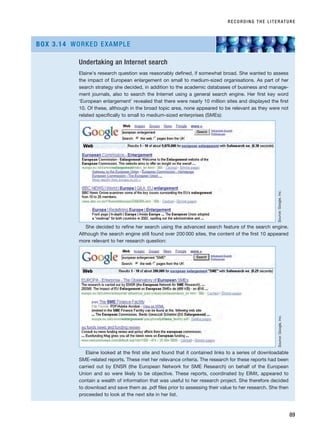
Saunders, Philip Lewis, Adrian Thornhill and Martin Jenkins; Chapter 3, unnumbered
screenshots in Box 3.14: Google, Inc., reproduced with permission; Figure 4.1: Copyright
© 2006 Mark Saunders, Philip Lewis and Adrian Thornhill; Figure 4.2: Burrell and Morgan
(1985) Sociological Paradigms and Organisational Analysis. Reproduced with permission of
the Ashgate Publishing Company; Box 8.9 screenshot from the Eurostat website,
http://epp.eurostat.cec.eu.int. Copyright © European Communities. Reproduced with
xxiv
Publisher’s acknowledgements
RESM_A01.QXP 9/29/07 9:29 AM Page xxiv
permission; Figure 9.2: From Laurie J. Mullins (1992) Management and Organisational
Behaviour, Sixth Edition, Harlow: Financial Times Prentice Hall. Copyright © 1992 Laurie
J. Mullins. Reprinted with permission of Pearson Education Ltd; Figure 11.2: From W.
Foddy (1994) Constructing Questions for Interviews and Questionnaires, Cambridge:
Cambridge University Press. Reproduced with permission; Chapter 11 unnumbered
figure, page 379: Question layout screenshot from SurveyMonkey (2005), reproduced
with permission; Figures 12.2 and 12.3: Adapted from original figures in European regional
and urban statistics – Reference guide, 2005 edition. © European Communities, 2005.
Reproduced with permission; Figures 12.5, 12.6 and 12.7: From the 2004 Harley-Davidson,
Inc. Annual Report. Reproduced with permission; Chapter 12, unnumbered figure in Box
12.10: Graph from Simon Briscoe ‘Number in the news: Broadband makes the connec-
tions’ adapted from: 4a Broadband subscribers per 100 inhabitants in OECD and ICCP
Committee observers countries, June 2005 OECD Key ICT Indicators,
www.oecd.org/sti/ICTindicators. Copyright © OECD 2005; Box 13.12, unnumbered
figure: From ATLAS.ti, with permission; Figure 14.2: Developed from Raimond, P. (1993)
Management Projects: Design, Research and Presentation, London: Chapman and Hall,
p. 175. Reproduced with permission of Thomson Publishing Services.
Tables
Table 3.1: Copyright © 2006 Mark Saunders, Philip Lewis, Adrian Thornhill and Martin
Jenkins; Table 7.2: Copyright © 2006 Mark Saunders, Philip Lewis and Adrian Thornhill;
Table 9.3: Developed from Robson, C. (2002) Real World Research: A Resource for Social
Scientists and Practitioner-Researchers, Second Edition, Oxford: Blackwell Publishers.
Reproduced with permission; Table 11.3: Usunier, J-C (1998) ‘Translation techniques for
questionnaires’, in International and Cross-Cultural Management Research. Copyright ©
1998 Sage Publications, reprinted with permission; Table 12.5: Copyright © 2006 Mark
Saunders, Philip Lewis and Adrian Thornhill; Appendix 4: Table from C. Morris (2003)
Quantitative Approached in Business Studies, Sixth Edition, Harlow: Financial Times
Prentice Hall. Copyright © 1993. Reprinted with permission of Pearson Education Ltd;
Table A5.1: Developed from the British Psychological Society (1988, 2004a) ‘Guidelines
for the use of non-sexist language’, The Psychologist, February, pp. 53–4 and ‘Language
and the BSA: Sex and Gender’ from www.britsoc.co.uk/user_doc/Non-sexist Language
.doc; Table A5.2 British Sociological Association (2004) ‘Disablist terms and non-disablist
alternatives’ from the British Sociological Association website, www.britsoc.co.uk.
Reproduced with permission.
Photos
Page 3: © Mark Saunders 2006; 19: Alamy / Janine Weidel; 55: Pearson Education Ltd.
Reproduced with permission; 101: Science Photo Library; 131: © Mark Saunders 2006;
163: Getty / Lifestock; 205: Rex Features / Giuseppe Aresu; 247: Alamy / Manor
Photography; 283: Empics; 311: Rex Features; 355: Copyright © TGI Friday’s 2005.
Reproduced with permission; 407: Alamy / Jeff Morgan; 471: Getty / Shannon Fagan;
519: Source: © Philip Lewis 2006; 550: Source: © Philip Lewis 2006.
Text
Box 3.4: Excerpt from Mark Saunders and Adrian Thornhill (2003) ‘Organisational
justice, trust and the management of change: an exploration’, Personnel Review 32: 3,
PUBLISHER’S ACKNOWLEDGEMENTS
xxv
RESM_A01.QXP 9/29/07 9:29 AM Page xxv
360–74. Copyright © 2003 MCB University Press Ltd (www.emeraldinsight.com/pr.htm).
Reproduced with permission of the publisher; Box 5.4: Roger Bray (2005) ‘Survey probes
shift to airline e-ticketing’ Financial Times, 8 September 2005. Copyright © 2005 Roger
Bray; Box 8.7: Patricia Hodgson (2005) ‘The first step in restoring public trust in statistics’
Financial Times, 1 December 2005. Copyright © 2005 Patricia Hodgson; Box 9.10:
Developed from Walker, R. (1985) Doing Research: A Handbook for Teachers, London:
Routledge. Reproduced with permission; Box 13.5: Hodson (1991) ‘The active worker:
compliance and autonomy in the workplace’, cited in Erlandson et al. (1993:119), Journal
of Contemporary Ethnography. Copyright © 1991 Sage Publications. Reprinted by permis-
sion; Box 14.2: Excerpt from Emerald Group Publishing Limited (2006) ‘Writing for an
Emerald Publication; instructions for writing a structured abstract for publishing” from
the Emerald website, www.emeraldinsight.com/info/authors/writing_for_emerald/submis-
sions/structured_abstracts.jsp, reproduced by permission; Box 14.3: Abridged abstract
from Higgins, M. and Gulati, R. (2006) ‘Stacking the deck: the effects of top management
backgrounds on investor decisions’, Strategic Management Journal 27:1, 1-25. Reproduced
with permission of John Wiley and Sons Ltd; Box 14.5: Robson, Colin (2002) Real World
Research, 2nd Edition, Oxford: Blackwell Publishing. Reproduced with permission of
Blackwell Publishing and Professor Colin Robson.
We are also grateful to the Financial Times Limited for permission to reprint the fol-
lowing material:
Box 1.1: Andrew Taylor, ‘Students “upset” by interview treatment’, Financial Times, 26
May 2005. Copyright © 2005 Financial Times Ltd; Box 2.6: Mure Dickie, ‘China’s chal-
lenge changes the rules of the game’, Financial Times, 19 October, 2005. Copyright © 2005
Financial Times Ltd; Box 2.9: Justine Lau ‘In Hong Kong women “just have to work
harder”’, Financial Times, 20 October, 2005. Copyright © 2005 Financial Times Ltd; Box
3.5: Jane Croft ‘Loan penalties hit 672,000 borrowers’, Financial Times, 31 January 2006.
Copyright © 2006 Financial Times Ltd; Box 3.12: Paul Taylor and Chris Nuttall, ‘Google
to scan universities’ library books’, Financial Times, 15 December 2004. Copyright © 2004
Financial Times Ltd; Box 4.2: Claire Dowdy, ‘Marketing: smoking out images of pipes and
slippers’, Financial Times, 7 November 2005. Copyright © 2005 Financial Times Ltd; Box
6.15: Andrew Jack, ‘Data protection system “causing deaths”’, Financial Times, 18 January
2006. Copyright © 2006 Financial Times Ltd; Box 7.3: Martin Dickson ‘In poll position’,
© Financial Times, 27 August 2005. Copyright © 2005 Financial Times Ltd; Box 7.12:
Excerpt from Simon Briscoe, ‘Why polls are in danger of missing the point,’ Financial
Times, 1 March 2005. Copyright © 2005 Financial Times Ltd; Box 8.3: Chris Giles ‘Interest
rate changes likely to follow pattern,’ Financial Times, 14 March 2005. Copyright © 2005
Financial Times Ltd; Box 9.9: Extract from American Society of Microbiology and the Soap
and Detergent Association, ‘Many adults report not washing their hands when they
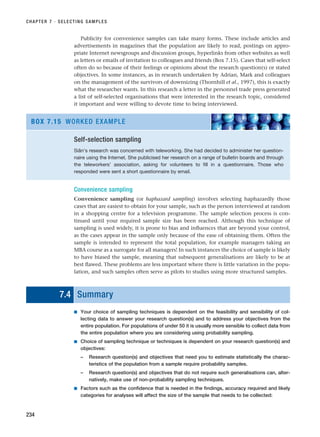
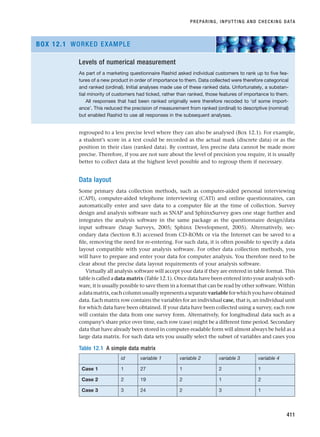
should, and more people claim to wash their hands than who actually do’, published by
PR Newswire, 14 December 2005. http://sev.prnewswire.com/publishing-information-
services/20051214/NYW14514122005-1.html; Box 10.13: Paige Williams ‘Office outing’,
Financial Times, 5 November 2002. Copyright © 2002 Financial Times Ltd; Box 10.18: Gary
Silverman ‘McDonalds finds ready appetite for fruit and veg’, Financial Times, 9 March
2005. Copyright © 2005 Financial Times Ltd; Box 11.5: ‘George Lucas is a god in Britain.
Literally’, Financial Times, 14 February 2003. Copyright © 2003 Financial Times Ltd; Box
11.15: Alison Maitland ‘Companies face an avalanche of questionnaires’, Financial Times,
26 March 2004. Copyright © 2004 Financial Times Ltd; Box 12.10: Simon Briscoe ‘Number
ACKNOWLEDGEMENTS
xxvi
For WEB LINKS visit
www.pearsoned.co.uk/
saunders
RESM_A01.QXP 9/29/07 9:29 AM Page xxvi
in the news: Broadband makes the connection’ Financial Times, 2 November 2005.
Copyright © 2005 Financial Times Ltd; Box 12.21: Chris Flood ‘FTSE 100 rallies to three-
year high point’, Financial Times, 18 June 2005. Copyright © 2005 Financial Times Ltd;
Box 13.1: Robert Bruce ‘Investors look behind the numbers’, Financial Times,
31 March 2005. Copyright © 2005 Financial Times Ltd; Box 13.8: Adrian Michaels and
Haig Simonian ‘E-mails reveal that Swatch feared tax challenge’, Financial Times, 13
August 2004. Copyright © 2004 Financial Times Ltd; Box 14.6: Clive Cookson and Andrew
Jack ‘Researchers scan caffeine boost’, Financial Times, 2 December 2005. Copyright ©
2005 Financial Times Ltd; Box: ‘Marketing: smoking out images of pipes and slippers’,
Financial Times, 7 November 2005. Copyright © 2005 Financial Times Ltd.
In some instances we have been unable to trace the owners of copyright material and we
would appreciate any information that would enable us to do so.
ACKNOWLEDGEMENTS
xxvii
RESM_A01.QXP 9/29/07 9:29 AM Page xxvii
RESM_A01.QXP 9/29/07 9:29 AM Page xii
The nature of business and management
research and structure of this book
1
LEARNING OUTCOMES
By the end of this chapter you should:
➔ be able to outline the purpose and distinct focus of management research;
➔ be able to place your research project on a basic–applied research continuum
according to its purpose and context;
➔ understand the stages you will need to complete (and revisit) as part of your
research process;
➔ have an overview of this book’s purpose, structure and features;
➔ be aware of some of the ways you can use this book.
1.1 Introduction
This book is designed to help you to undertake your research project, whether you are an
undergraduate or postgraduate student of business and management or a manager. It
provides a clear guide on how to undertake research as well as highlighting the realities
of undertaking research, including the more common pitfalls. The book is written as an
introductory text to provide you with a guide to the research process and with the
necessary knowledge and skills to undertake a piece of research from thinking of a
research topic to writing your project report. As such, you will find it useful as a manual
or handbook on how to tackle your research project.
After reading the book you will have been introduced to and explored a range of
approaches, strategies and methods with which you could tackle your research project.
Of equal importance, you will know that there is no one best way for undertaking all
research. Rather you will be aware of the choices you will have to make and how these
choices will impact upon what you can find out. This means you will be able to make an
informed choice about the approaches, strategies and methods that are most suitable to
your own research project and be able to justify this choice. In reading the book you will
have been introduced to the more frequently used techniques and procedures for col-
lecting and analysing different types of data, have had a chance to practise them, and be
2
RESM_C01.QXP 3/30/07 6:27 AM Page 2
able to make a reasoned choice regarding which to use. When selecting and using these
techniques you will be aware of the contribution that the appropriate use of information
technology can make to your research.
However, before you continue, a word of caution. In your study, you will inevitably
read a wide range of books and articles. In many of these the terms ‘research method’ and
‘research methodology’ will be used interchangeably, perhaps just using methodology as
a more verbose way of saying method. In this book we have been more precise in our use
of these terms. Throughout the book we use the term methods to refer to techniques and
procedures used to obtain and analyse data. This therefore includes questionnaires,
observation and interviews as well as both quantitative (statistical) and qualitative (non-
statistical) analysis techniques and, as you have probably gathered from the title, is the
main focus of this book. In contrast, the term methodology refers to the theory of how
research should be undertaken. We believe that it is important that you have some
INTRODUCTION
3
The Post-it®
note is one of the best
known and most widely used office
products in the world. Yet, despite the dis-
covery of the repositionable adhesive that
made the Post-it® note possible in 1968, it
was not until 1980 that the product was
introduced to the market (3M, 2006). In the
1960s 3M research scientist, Spence Silver,
was looking for ways to improve the adhe-
sive used in tapes. However, he discovered
something quite different from what he was
looking for, an adhesive that did not stick
strongly when coated onto the back of
tapes! What was unclear was how it might
be used. Over the next five years he dem-
onstrated and talked about his new
adhesive to people working within the
company.
Most people working for 3M know the story of what happened next and how the Post-it® note concept came
about. A new product development researcher working for 3M, Art Fry, was frustrated how the scraps of paper
he used as bookmarks kept falling out of his church choir hymn book. He realised that Silver’s adhesive would
mean his bookmarks would not fall out. Soon afterwards the Post-it® note concept was developed and market
research undertaken. This was extremely difficult as the product was revolutionary and was, in effect, designed
to replace pieces of torn scrap paper! However, despite some initial scepticism within the company, Post-it®
notes were launched in 1980. One year after their launch, they were named 3M’s outstanding new product.
Whilst your research project will be within the discipline business and management rather than natural science
(such as developing a new adhesive), our introductory example still offers a number of insights into the nature of
research and in particular the business and management research you will be undertaking. In particular, it high-
lights that when undertaking research we should be open to finding the unexpected and how sometimes the
applicability of our research findings may not be immediately obvious. It also emphasises the importance of dis-
cussing your ideas with other people.
Post-it®
notes in use
Source:
©
Mark
Saunders
2006
RESM_C01.QXP 3/30/07 6:27 AM Page 3
understanding of this so that you can make an informed choice about your research. For
this reason, we also discuss a range of philosophical assumptions upon which research
can be based and the implications of these for the method or methods adopted.
1.2 The nature of research
When listening to the radio, watching the television or reading a daily newspaper it is
difficult to avoid the term ‘research’. The results of ‘research’ are all around us. A debate
about the findings of a recent poll of people’s opinions inevitably includes a discussion
of ‘research’, normally referring to the way in which the data were collected. Politicians
often justify their policy decisions on the basis of ‘research’. Newspapers report the find-
ings of market research companies’ surveys (Box 1.1). Documentary programmes tell us
about ‘research findings’, and advertisers may highlight the ‘results of research’ to
encourage you to buy a particular product or brand. However, we believe that what these
examples really emphasise is the wide range of meanings given to the term ‘research’ in
everyday speech.
CHAPTER 1 · THE NATURE OF BUSINESS AND MANAGEMENT RESEARCH AND STRUCTURE OF THIS BOOK
4
More than 65 per cent of university students applying
for their first job were ‘upset by the way they were
treated by potential employers and shocked at their
poor graduate recruitment practices’, according to a
study published today.
The findings have emerged as students are con-
cerned there will be insufficient highly paid jobs to
satisfy the aspirations of a growing graduate popu-
lation.
The survey of more than 1,000 students, com-
missioned by GTI, the specialist graduates careers
publisher, found that most students were unwilling to
look beyond large employers. Only 9 per cent of stu-
dents were prepared to work for a smaller company,
even though “job opportunities and career prospects
could potentially be greater”, it said.
A separate study published last month by High Fliers
Research, an independent market research company,
reported only 36 per cent of university students
expected to find a degree-level job when they gradu-
ated this summer, compared with 49 per cent in 1998.
GTI said 44 per cent of students complained that
employers had either not bothered to reply to their
applications or took weeks, or even months, to
respond. Almost a third “were unimpressed by the
impersonal way they were communicated with, often
with generic e-mail”.
“Most worryingly a small number of students
claimed they had even been victims of blatant race or
sex discrimination. Some had to endure interviews
where they felt intimidated or largely ignored”, it said.
Some 32 per cent of graduates had applied to more
than 10 companies.
Chris Phillips, GTI publishing director, said the way
companies treated students risked damaging their
reputation. Some 71 per cent of students had gone on
to tell others about their bad experiences. Another 60
per cent said they had been put off dealing with that
employer in the future.
Source: Article by Andrew Taylor, Financial Times, 26 May 2005.
Copyright © 2005 The Financial Times Ltd.
BOX 1.1 RESEARCH IN THE NEWS FT
Students ‘upset’ by interview treatment
Walliman (2001) argues that many of these everyday uses of the term ‘research’ are not
research in the true meaning of the word. As part of this, he highlights ways in which
the term is used wrongly:
■ just collecting facts or information with no clear purpose;
RESM_C01.QXP 3/30/07 6:27 AM Page 4
■ reassembling and reordering facts or information without interpretation;
■ as a term to get your product or idea noticed and respected.
The first of these highlights the fact that, although research often involves the collec-
tion of information, it is more than just reading a few books or articles, talking to a few
people or asking people questions. While collecting data may be part of the research
process, if it is not undertaken in a systematic way, on its own and in particular with a
clear purpose, it will not be seen as research. The second of these is commonplace in
many reports. Data are collected, perhaps from a variety of different sources, and then
assembled in a single document with the sources of these data listed. However, there is
no interpretation of the data collected. Again, while the assembly of data from a variety
of sources may be part of the process of research, without interpretation it is not research.
Finally, the term ‘research’ can be used to get an idea or product noticed by people and
to suggest that people should have confidence in it. In such instances, when you ask for
details of the research process, these are either unclear or not forthcoming.
Based upon this brief discussion we can already see that research has a number of
characteristics:
■ Data are collected systematically.
■ Data are interpreted systematically.
■ There is a clear purpose: to find things out.
We can therefore define research as something that people undertake in order to find
out things in a systematic way, thereby increasing their knowledge. Two phrases are
important in this definition: ‘systematic research’ and ‘to find out things’. ‘Systematic’
suggests that research is based on logical relationships and not just beliefs (Ghauri and
Grønhaug, 2005). As part of this, your research will involve an explanation of the
methods used to collect the data, will argue why the results obtained are meaningful, and
will explain any limitations that are associated with them. ‘To find out things’ suggests
there are a multiplicity of possible purposes for your research. These may include
describing, explaining, understanding, criticising and analysing (Ghauri and Grønhaug,
2005). However, it also suggests that you have a clear purpose or set of ‘things’ that you
want to find out, such as the answer to a question or number of questions.
1 1.3 The nature of business and management research
Using our earlier definition of research it would seem sensible to define business and
management research as undertaking systematic research to find out things about busi-
ness and management.
Easterby-Smith et al. (2002) argue that three things combine to make business and
management a distinctive focus for research:
■ the way in which managers (and researchers) draw on knowledge developed by other
disciplines;
■ the fact that managers tend to be powerful and busy people. Therefore, they are
unlikely to allow research access unless they can see personal or commercial advantages;
■ the requirement for the research to have some practical consequence. This means it
either needs to contain the potential for taking some form of action or needs to take
account of the practical consequences of the findings.
THE NATURE OF BUSINESS AND MANAGEMENT RESEARCH
5
RESM_C01.QXP 3/30/07 6:27 AM Page 5
Ongoing debate within the British Academy of Management has explored the status
of management research. One feature, which has gained considerable support, is the
transdisciplinary nature of such research. While this has similarities to Easterby-Smith et
al.’s (2002) point regarding the use of knowledge from other disciplines, it also empha-
sises that the research ‘cannot be reduced to any sum of parts framed in terms of
contributions to associated disciplines’ (Tranfield and Starkey, 1998:352). In other words,
using knowledge from a range of disciplines enables management research to gain new
insights that cannot be obtained through all of these disciplines separately. Another
feature of management research highlighted in the debate is a belief that it should be able
to develop ideas and to relate them to practice. In particular, that research should com-
plete a virtuous circle of theory and practice (Tranfield and Starkey, 1998) through which
research on managerial practice informs practically derived theory. This in turn becomes
a blueprint for managerial practice, thereby increasing the stock of relevant and practical
management knowledge. Thus business and management research needs to engage with
both the world of theory and the world of practice. Consequently, the problems
addressed should grow out of interaction between these two worlds rather than either on
their own.
In recent years debate about the nature of management research has focused on how
it can meet the double hurdle of being both theoretically and methodologically rigorous,
while at the same time embracing the world of practice and being of practical relevance
(Hodgkinson et al., 2001, Box 1.2). Much of this debate has centred around Gibbons et
al.’s (1994) work on the production of knowledge, and in particular the concepts of Mode
1 and Mode 2 knowledge creation. Mode 1 knowledge creation emphasises research in
which the questions are set and solved by academic interests, emphasising a fundamental
rather than applied nature, where there is little if any focus on utilisation of the research
by practitioners. In contrast, Mode 2 emphasises a context for research governed by the
world of practice, highlighting the importance of collaboration both with and between
practitioners (Starkey and Madan, 2001) and the need for the production of practical rel-
evant knowledge. Based upon this Starkey and Madan (2001) observe that research
within the Mode 2 approach offers a way of bringing the supply side of knowledge rep-
resented by universities together with the demand side represented by businesses and
overcoming the double hurdle.
Drawing from these debates, it could be argued that business and management
research not only needs to provide findings that advance knowledge and understanding,
it also needs to address business issues and practical managerial problems. However, this
would negate the observation that Mode 2 practices develop from Mode 1. It might also
result in business and management research that did not have obvious commercial
benefit not being pursued. This, Huff and Huff (2001) argue, could jeopardise future
knowledge creation as research that is currently not valued commercially might have
value in the future. Building upon these ideas they highlight a further form of knowledge
production: Mode 3. Mode 3 knowledge production focuses on an appreciation of the
human condition as it is and as it might become, its purpose being to ‘assure survival and
promote the common good at various levels of social aggregation’ (Huff and Huff
2001:S53). This emphasises the importance of broader issues of human relevance of
research. Consequently, in addition to research that satisfies your intellectual curiosity
for its own sake, the findings of business and management research might also contain
practical implications, and these findings may have societal consequences far broader
and complex than perhaps envisaged by Mode 2.
Within these boundaries of advancing knowledge, addressing business issues, solving
managerial problems and promoting the common good, the purpose and the context of
CHAPTER 1 · THE NATURE OF BUSINESS AND MANAGEMENT RESEARCH AND STRUCTURE OF THIS BOOK
6
RESM_C01.QXP 3/30/07 6:27 AM Page 6
your research project can differ considerably. For some research projects your purpose
may be to understand and explain the impact of something, such as a particular policy.
You may undertake this research within an individual organisation and suggest appro-
priate action on the basis of your findings. For other research projects you may wish to
explore the ways in which various organisations do things differently. In such projects
your purpose may be to discover and understand better the underlying processes in a
wider context, thereby providing greater understanding for practitioners. For yet other
research projects you may wish to place an in-depth investigation of an organisation
within the context of a wider understanding of the processes that are operating.
Despite this variety, we believe that all business and management research projects can be
placed on a continuum (Figure 1.1) according to their purpose and context. At one extreme of
the continuum is research that is undertaken purely to understand the processes of business
and management and their outcomes. Such research is undertaken largely in universities and
largelyastheresultofanacademicagenda.Itskeyconsumeristheacademiccommunity,with
relatively little attention being given to its practical applications. This is often termed basic,
fundamental or pure research. Given our earlier discussion it is unlikely that Mode 2 and
Mode3businessandmanagementresearchwouldfulfilthesecriteriaduetoatleastsomecon-
sideration being made of the practical consequences. Through doing this, the research would
start to move towards the other end of the continuum (Figure 1.1). At this end is research that
is of direct and immediate relevance to managers, addresses issues that they see as important,
andispresentedinwaysthattheyunderstandandcanacton.Thisistermedappliedresearch.
Wherever your research project lies on this basic–applied continuum, we believe that
you should undertake your research with rigour. To do this you will need to pay careful
attention to the entire research process.
THE NATURE OF BUSINESS AND MANAGEMENT RESEARCH
7
Rigour and relevance
In their British Journal of Management paper Gerard Hodgkinson, Peter Herriot and Neil
Anderson (2001) offer a fourfold taxonomy of the varieties of managerial knowledge. Using the
dimensions of theoretical and methodological rigour and of practical relevance they identify four
quadrants:
Theoretical and methodological rigour Practical relevance Quadrant
higher lower pedantic science
lower higher popularist science
lower lower puerile science
higher higher pragmatic science
Pedantic science, they argue, is characterised by a focus on increasing methodological
rigour at the expense of results that are relevant and can sometimes be found in refereed aca-
demic journals. In contrast, popularist science is characterised by a focus on relevance and
usefulness whilst neglecting theoretical and methodological rigour, examples being found in
some books targeted at practising managers. Consequently, whilst findings might be useful to
managers, the research upon which they are based is unlikely to be valid or reliable. Puerile
science both lacks methodological rigour and is of limited practical relevance and, although
unlikely to be found in refereed academic journals, can be found in other media. Finally, prag-
matic science is both theoretically and methodologically rigorous and relevant.
BOX 1.2 FOCUS ON MANAGEMENT RESEARCH
RESM_C01.QXP 3/30/07 6:27 AM Page 7
Inevitably, your own beliefs and feelings will impact upon your research. Although
you might feel that your research will be value neutral (we will discuss this in greater
detail later, particularly in Chapter 4), it is unlikely that you will stop your own beliefs
and feelings influencing your research. Your choice of what to research is also likely to be
influenced by topics that excite you, and the way you collect and analyse your data by
the skills you have or are able to develop. Similarly, as we discuss in Chapter 2, practical
considerations such as access to data and the time and resources you have available will
also impact upon your research process.
1.4 The research process
Most research textbooks represent research as a multi-stage process that you must follow
in order to undertake and complete your research project. The precise number of stages
varies, but they usually include formulating and clarifying a topic, reviewing the litera-
ture, designing the research, collecting data, analysing data and writing up. In the
majority of these the research process, although presented with rationalised examples, is
described as a series of stages through which you must pass. Articles you have read may
also suggest that the research process is rational and straightforward. Unfortunately this
is very rarely true, and the reality is considerably messier, with what initially appear as
great ideas sometimes having little or no relevance (Saunders and Lewis, 1997). While
research is often depicted as moving through each of the stages outlined above, one after
the other, this is unlikely to be the case. In reality you will probably revisit each stage
more than once. Each time you revisit a stage you will need to reflect on the associated
issues and refine your ideas. In addition, as highlighted by some textbooks, you will need
to consider ethical and access issues during the process.
This textbook also presents the research process as a series of linked stages and gives
the appearance of being organised in a linear manner. However, as you use the book you
will see from the text, extensive use of cross-referencing, examples of research by well-
known researchers and how research is reported in the news, worked examples and case
studies that we have recognised the iterative nature of the process you will follow. As part
of this process, we believe that it is vital that you spend time formulating and clarifying
CHAPTER 1 · THE NATURE OF BUSINESS AND MANAGEMENT RESEARCH AND STRUCTURE OF THIS BOOK
8
Purpose:
• expand knowledge of processes of business
and management
• results in universal principles relating to the
process and its relationship to outcomes
• findings of significance and value to society
in general
Context:
• undertaken by people based in universities
• choice of topic and objectives determined
by the researcher
• flexible timescales
Purpose:
• improve understanding of particular business
or management problem
• results in solution to problem
• new knowledge limited to problem
• findings of practical relevance and value to
manager(s) in organisation(s)
Context:
• undertaken by people based in a variety of
settings, including organisations and universities
• objectives negotiated with originator
• tight timescales
Applied research
Basic research
Figure 1.1 Basic and applied research
Sources: Authors’ experience, Easterby-Smith et al., 2002, Hedrick et al., 1993
RESM_C01.QXP 3/30/07 6:27 AM Page 8
your research topic. This we believe should be expressed as one or more research ques-
tions that your research must answer, accompanied by a set of objectives that your
research must address. However, we would also stress the need to reflect on your ideas
continually and revise both these and the way in which you intend to progress your
research. Often this will involve revisiting stages (including your research question(s) and
objectives) and working through them again. There is also a need to plan ahead, thereby
ensuring that the necessary preliminary work for later stages has been undertaken. This
is emphasised by Figure 1.2, which also provides a schematic index to the remaining
chapters of the book. Within this flow chart (Figure 1.2) the stages you will need to com-
plete as part of your research project are emphasised in the centre of the chart. However,
be warned: the process is far messier than a brief glance at Figure 1.2 suggests!
1.5 The purpose and structure of this book
The purpose
As we stated earlier (Section 1.1), the overriding purpose of this book is to help you to
undertake research. This means that early on in your research project you will need to be
clear about what you are doing, why you are doing it, and the associated implications of
what you are seeking to do. You will also need to ensure that you can show how your
ideas relate to research that has already been undertaken in your topic area and that you
have a clear research design and have thought about how you will collect and analyse
your data. As part of this you will need to consider the validity and reliability of the data
you intend to use, along with associated ethical and access issues. The appropriateness
and suitability of the analytical techniques you choose to use will be of equal import-
ance. Finally, you will need to write and present your research project report as clearly
and precisely as possible.
The structure of each chapter
Each of the subsequent chapters deals with part of the research process outlined in Figure
1.2. The ideas, techniques and methods are discussed using as little jargon as is possible.
Where appropriate you will find summaries of these, using tables, checklists or diagrams.
When new terms are introduced for the first time they are shown in bold, and a defi-
nition or explanation follows shortly afterwards. They are also listed with a brief
definition in the glossary. The application of appropriate information technology is con-
sidered, in most instances as an integral part of the text. Discussion of information
technology is not software specific but is concerned with general principles. However, we
recognise that you may wish to find out more about how to use data analysis software
packages and so have included tutorials for the quantitative data analysis software SPSS™
and the qualitative data analysis software NVivo™
(with practice data sets) on this book’s
Companion Website. These will enable you to utilise whatever software you have avail-
able most effectively. We have also included the Smarter Online Searching Guide to help
you with your Internet searches. Chapters have been cross-referenced as appropriate, and
an index is provided to help you to find your way around the book.
Included within the text of each chapter is a series of boxed worked examples. These are
based on actual research projects, undertaken by students, in which points made in the
text are illustrated. In many instances these worked examples illustrate possible pitfalls
THE PURPOSE AND STRUCTURE OF THIS BOOK
9
Companion
Website
RESM_C01.QXP 3/30/07 6:27 AM Page 9
CHAPTER 1 · THE NATURE OF BUSINESS AND MANAGEMENT RESEARCH AND STRUCTURE OF THIS BOOK
10
Analyse your data using one or both of:
Quantitative methods
(Chapter 12)
Formulate and clarify your
research topic (Chapter 2)
Critically review the literature
(Chapter 3)
Understand your philosophy
and approach (Chapter 4)
Negotiate access and address
ethical issues (Chapter 6)
Wish to do
research
Plan your data collection and collect the data using one or more of:
Sampling
(Chapter 7)
Secondary
data
(Chapter 8)
Observation
(Chapter 9)
Semi-
structured
and in-depth
interviews
(Chapter 10)
Questionnaires
(Chapter 11)
Qualitative methods
(Chapter 13)
Write your project report
and prepare your presentation
(Chapter 14)
Submit your project
report and give
your presentation
forward
planning
reflection
and revision
Formulate your research
design (Chapter 5)
Figure 1.2 The research process
Source: © Mark Saunders, Philip Lewis and Adrian Thornhill 2006
RESM_C01.QXP 3/30/07 6:27 AM Page 10
you may come across while undertaking your research. Further illustrations are provided
by focus on management research and research in the news boxes. Focus on management
research boxes discuss recent research in business and management. These are normally
derived from refereed academic journal articles and you are likely to be able to download
the actual articles from online databases at your university. Research in the news boxes
provide topical newspaper articles that illustrate pertinent research-related issues. All
these will help you to understand the technique or idea and to assess its suitability or
appropriateness to your research. Where a pitfall has been illustrated, it will, it is hoped,
help you to avoid making the same mistake. There are also a series of boxed checklists to
provide you with further focused guidance for your own research. At the end of each
chapter there is a summary of key points, which you may look at before and after reading
the chapter to ensure that you have digested the main points.
To enable you to check that you have understood the chapter a series of self-check ques-
tions is included at the end. These can be answered without recourse to other (external)
resources. Answers are provided to all these self-check questions at the end of each
chapter. Self-check questions are followed by review and discussion questions. These suggest
a variety of activities you can undertake to help you further develop your knowledge and
understanding of the material in the chapter, often involving discussion with a friend.
Self-test multiple choice questions are available on this book’s companion website. Each
chapter also includes a section towards the end headed ‘Progressing your research
project’. This contains a series of questions that will help you to consider the implica-
tions of the material covered by the chapter for your research project. Answering the
questions in the section ‘Progressing your research project’ for each chapter will enable
you to generate all the material that you will need to include in your project report. Each
chapter’s questions involve you in undertaking activities that are more complex than
self-check questions, such as a library-based literature search or designing and piloting a
questionnaire. They are designed to help you to focus on the techniques that are most
appropriate to your research. However, as emphasised by Figure 1.2, you will almost cer-
tainly need to revisit and revise your answers as your research progresses.
Each chapter is also accompanied by references, further reading and a case study.
Further reading is included for two distinct reasons:
■ to direct you to other work on the ideas contained within the chapter;
■ to direct you to further examples of research where the ideas contained in the chapter
have been used.
The main reasons for our choice of further reading are therefore indicated.
The new case studies at the end of each chapter are drawn from a variety of business
and management research scenarios and have been based on the case study’s authors’
and students’ experiences when undertaking a research project. They have been written
to highlight real issues that occur when undertaking business and management
research. To help to focus your thoughts or discussion on some of the pertinent issues,
each case is followed by evaluative questions. Additional case studies relating to each
chapter are available from the book’s companion website. A case study follows every
chapter other than Chapter 1.
An outline of the chapters
The book is organised in the following way.
Chapter 2 is written to assist you in the generation of ideas, which will help you to
choose a suitable research topic, and offers advice on what makes a good research topic.
THE PURPOSE AND STRUCTURE OF THIS BOOK
11
Companion
Website
Companion
Website
RESM_C01.QXP 3/30/07 6:27 AM Page 11
If you have already been given a research topic, perhaps by an organisation or tutor, you
will need to refine it into one that is feasible, and should still therefore read this chapter.
After your idea has been generated and refined, the chapter discusses how to turn this
idea into clear research question(s) and objectives. (Research questions and objectives are
referred to throughout the book.) Finally, the chapter provides advice on how to write
your research proposal.
The importance of the critical literature review to your research is discussed in Chapter
3. This chapter outlines what a critical review needs to include and the range of primary,
secondary and tertiary literature sources available. The chapter explains the purpose of
reviewing the literature, discusses a range of search strategies, and contains advice on
how to plan and undertake your search and to write your review. The processes of ident-
ifying key words and searching using online databases and the Internet are outlined. It
also offers advice on how to record items and to evaluate their relevance.
Chapter 4 addresses the issue of understanding different research philosophies,
including positivism, realism, interpretivism, objectivism, subjectivism and pragmatism.
Within this the functionalist, interpretive, radical humanist and radical structuralist par-
adigms are discussed. Deductive and inductive approaches to research are also
considered. In this chapter we challenge you to think about your own values and how
you view the world and the impact this will have on the way you undertake your
research.
These ideas are developed further in Chapter 5 which explores formulating your
research design. As part of this, a range of research strategies are discussed and the differ-
ence between quantitative and qualitative methods explained. The use of multiple
methods is explored and consideration given to the implications of design choices for the
credibility of your research findings and conclusions.
Chapter 6 explores issues related to gaining access and to research ethics. It offers
advice on how to gain access both to organisations and to individuals. Potential ethical
issues are discussed in relation to each stage of the research process and different data col-
lection methods. Issues of data protection are also introduced.
A range of the probability and non-probability sampling techniques available for use
in your research is explained in Chapter 7. The chapter considers why sampling is
necessary, and looks at issues of sample size and response rates. Advice on how to relate
your choice of sampling techniques to your research topic is given, and techniques for
assessing the representativeness of those who respond are discussed.
Chapters 8, 9, 10 and 11 are concerned with different methods of obtaining data. The
use of secondary data is discussed in Chapter 8, which introduces the variety of data that
are likely to be available and suggests ways in which they can be used. Advantages and
disadvantages of secondary data are discussed, and a range of techniques for locating
these data, including using the Internet, is suggested. Chapter 8 also offers advice on how
to evaluate the suitability of secondary data for your research.
In contrast, Chapter 9 is concerned with collecting primary data through observation.
The chapter examines two types of observation: participant observation and structured
observation. Practical advice on using each is offered, and particular attention is given to
ensuring that the data you obtain are both valid and reliable.
Chapter 10 is also concerned with collecting primary data, this time using semi-struc-
tured, in-depth and group interviews. The appropriateness of using these interviews in
relation to your research strategy is discussed. Advice on how to undertake such inter-
views is offered, including the conduct of focus groups, Internet-mediated (including
online) and telephone interviews. Particular attention is given to ensuring that the data
collected are both reliable and valid.
CHAPTER 1 · THE NATURE OF BUSINESS AND MANAGEMENT RESEARCH AND STRUCTURE OF THIS BOOK
12
RESM_C01.QXP 3/30/07 6:27 AM Page 12
Chapter 11 is the final chapter concerned with collecting data. It introduces you to the
use of both self-administered and interviewer-administered questionnaires, and explores
their advantages and disadvantages. Practical advice is offered on the process of
designing, piloting and administering Internet-mediated, postal, delivery and collection,
and telephone questionnaires to enhance their response rates. Particular attention is
again given to ensuring that the data collected are both reliable and valid.
Analysis of data is covered in Chapters 12 and 13. Chapter 12 outlines and illustrates
the main issues that you need to consider when preparing data for quantitative analysis
and when analysing these data by computer. Different types of data are defined, and
advice is given on how to create a data matrix and to code data. Practical advice is also
offered on the analysis of these data using computerised analysis software. The most
appropriate diagrams to explore and illustrate data are discussed, and suggestions are
made about the most appropriate statistics to use to describe data, to explore relation-
ships and to examine trends.
Chapter 13 outlines and discusses the main approaches available to you to analyse
data qualitatively both manually and using computer aided qualitative data analysis soft-
ware (CAQDAS). The nature of qualitative data and issues associated with transcription
are discussed. Following an overview of the analysis process, the use of deductively based
and inductively based analytical procedures is discussed. These include pattern
matching, explanation building, data display and analysis, template analysis, analytic
induction, grounded theory, discourse analysis and narrative analysis.
Chapter 14 helps you with the structure, content and style of your final project report and
any associated oral presentations. Above all, it encourages you to see writing as an intrinsic
part of the research process that should not be left until everything else is completed.
Appendices and glossary
This book contains five appendices designed to support you at different stages of your
research project. In the early stages when you are thinking about possible research ideas,
you will find the list of new example research project titles in Appendix 1 helpful. As you
begin to read, you will need to keep a reference of what you have read using a recognised
system, the most frequently used of which are detailed in Appendix 2. When selecting
your sample you may need to calculate the minimum sample size required and use
random sampling numbers (Appendices 3 and 4). Finally, when designing your data col-
lection tools and writing your project report you will need to ensure that the language
you use is non-discriminatory. Guidelines for these are given in Appendix 5. A separate
glossary of over 400 research-methods-related terms is also included for quick reference.
1.6 Summary
■ This book is designed to help you to undertake a research project whether you are an under-
graduate or postgraduate student of business and management or a manager. It is designed
as an introductory text and will guide you through the entire research process.
■ Business and management research involves undertaking systematic research to find out
things. It is transdisciplinary, and engages with both theory and practice.
■ All business and management research projects can be placed on a basic–applied con-
tinuum according to their purpose and context.
SUMMARY
13
RESM_C01.QXP 3/30/07 6:27 AM Page 13
■ Wherever your research project lies on this continuum, you should undertake your research
with rigour. To do this you will need to pay careful attention to the entire research process.
■ In this book, research is represented as a multi-stage process; however, this process is
rarely straightforward and will involve both reflecting on and revising stages already under-
taken and forward planning.
■ The text of each chapter is supported through worked examples, focus on management
research and research in the news boxes, checklists, self-check questions and review and
discussion questions, an assignment and a case study with questions. Answers to all self-
check questions are at the end of the appropriate chapter.
■ Answering the questions in the section ‘Progressing your research project’ for Chapters
2–13 will enable you to generate all the material that you will need to include in your project
report. When you have also answered the questions in this section for Chapter 14, you will
have written your research report.
CHAPTER 1 · THE NATURE OF BUSINESS AND MANAGEMENT RESEARCH AND STRUCTURE OF THIS BOOK
14
SELF-CHECK QUESTIONS
Help with these questions is available at the end of the chapter.
1.1 Outline the features that can make business and management research distinctive from research
in other disciplines.
1.2 What are the key differences between basic and applied research?
1.3 Examine Figure 1.2. What does this suggest about the need to plan and to reflect on and revise
your ideas?
1.4 Agree with a friend to each read a different quality newspaper. Make a note of at least ten articles
in your newspaper that mention the word ‘research’. Now examine the articles one at a time. As
you examine each article, does the reference to research…
■ . . . refer to the collection of facts or information with no clear purpose?
■ . . . refer to the reassembling and reordering of facts or information without interpretation?
■ . . . provide a means of getting the reader to respect what is being written?
■ . . . refer to the systematic collection and interpretation of data with a clear purpose?
Discuss your answers with your friend.
1.5 Obtain a copy of one or two of the articles referred to in Section 1.3. Read the article carefully. To
what extent do you believe that business and management research should always meet the twin
requirements of rigour and relevance? Give reasons for your answer.
REVIEW AND DISCUSSION QUESTIONS
References
3M (2006) ‘Art Fry and the invention of Post-it® Notes’ [online] (cited 10 February 2006).
Available from URL:http://www.3m.com/about3M/pioneers/fry.jhtml.
Easterby-Smith, M., Thorpe, R. and Lowe, A. (2002) Management Research: An Introduction (2nd
edn), London, Sage.
RESM_C01.QXP 3/30/07 6:27 AM Page 14
Ghauri, P. and Grønhaug, K. (2005) Research Methods in Business Studies: A Practical Guide (3rd
edn), Harlow, Financial Times Prentice Hall.
Gibbons, M.L., Limoges, H., Nowotny, S., Schwartman, P., Scott, P. and Trow, M. (1994) The
New Production of Knowledge: The Dynamics of Science and Research in Contemporary Societies,
London, Sage.
Hedrick, T.E., Bickmann, L. and Rog, D.J. (1993) Applied Research Design, Newbury Park, CA, Sage.
Hodgkinson, G.P., Herriot, P. and Anderson, N. (2001) ‘Re-aligning the stakeholders in man-
agement research: lessons from industrial, work and organizational psychology’, British
Journal of Management 12, Special Issue, 41–8.
Huff, A.S. and Huff, J.O. (2001) ‘Re-focusing the business school agenda’, British Journal of
Management 12, Special Issue, 49–54.
Saunders, M.N.K. and Lewis, P. (1997) ‘Great ideas and blind alleys? A review of the literature
on starting research’, Management Learning 28: 3, 283–99.
Starkey, K. and Madan, P. (2001) ‘Bridging the relevance gap: aligning stakeholders in the
future of management research’, British Journal of Management 12, Special Issue, 3–26.
Taylor, A. (2005) ‘Students “upset” by interview treatment’, Financial Times, 26 May.
Tranfield, D. and Starkey, K. (1998) ‘The nature, social organization and promotion of man-
agement research: towards policy’, British Journal of Management 9, 341–53.
Walliman, N. (2001) Your Research Project: A Step by Step Guide for the First-Time Researcher,
London, Sage.
Further reading
Easterby-Smith, M., Thorpe, R. and Lowe, A. (2002) Management Research: An Introduction (2nd
edn), London, Sage. Chapter 1 provides a very clear and readable introduction to manage-
ment research and how it is distinct from other forms of research.
Starkey, K. and Madan, P. (2001) ‘Bridging the relevance gap: aligning stakeholders in the
future of management research’, British Journal of Management 12, Special Issue, 3–26. This
paper argues the need for relevant management research within a Mode 2 framework,
emphasising a need for research partnership.
SELF-CHECK ANSWERS
15
1.1 The features you outline are likely to include the:
■ transdisciplinary nature of business and management research;
■ development of ideas that are related to practice and in particular the requirement for the research to
have some practical consequence;
■ need for research to complete the virtuous circle of theory and practice;
■ addressing of problems that grow out of the interaction between the worlds of theory and practice.
1.2 The key differences between basic and applied research relate to both the purpose and the context in
which it is undertaken. They are summarised in Figure 1.1.
1.3 Figure 1.2 emphasises the importance of planning during your research project. Forward planning needs
to occur at all stages up to submission. In addition, you will need to reflect on and to revise your work
throughout the life of the research project. This reflection needs to have a wide focus. You should both
consider the stage you have reached and revisit earlier stages and work through them again. Reflection
may also lead you to amend your research plan. This should be expected, although large amendments
in the later stages of your research project are unlikely.
SELF-CHECK ANSWERS
For WEB LINKS visit
www.pearsoned.co.uk/
saunders
RESM_C01.QXP 3/30/07 6:27 AM Page 15
CHAPTER 1 · THE NATURE OF BUSINESS AND MANAGEMENT RESEARCH AND STRUCTURE OF THIS BOOK
16
Get ahead using resources on the Companion Website at:
www.pearsoned.co.uk/saunders
■ Improve your SPSS and NVivo research analysis with practice tutorials.
■ Save time researching on the Internet with the Smarter Online Searching Guide.
■ Test your progress using self-assessment questions.
■ Follow live links to useful websites.
Companion
Website
RESM_C01.QXP 3/30/07 6:27 AM Page 16
RESM_C01.QXP 3/30/07 6:27 AM Page 17
Formulating and clarifying the
research topic
2
LEARNING OUTCOMES
By the end of this chapter you should be able to:
➔ generate ideas that will help in the choice of a suitable research topic;
➔ identify the attributes of a good research topic;
➔ turn research ideas into a research project that has clear research question(s)
and objectives;
➔ draft a research proposal.
2.1 Introduction
Many students think that choosing their research topic is the most exciting part of their
course. After all, this is something that they get to decide for themselves rather than
having to complete a task decided by their tutors. We will stress in this chapter that it is
important to choose something that will sustain your interest throughout the months
that you will need to complete it. You may even decide to do some research that is some-
thing that forms part of your leisure activities, like playing video games!
Before you start your research you need to have at least some idea of what you want
to do. This is probably the most difficult, and yet the most important, part of your
research project. Up until now most of your studies have been concerned with answering
questions that other people have set. This chapter is concerned with how to formulate
and clarify your research topic and your research question. Without being clear about
what you are going to research it is difficult to plan how you are going to research it. This
reminds us of a favourite quote in Alice’s Adventures in Wonderland. This is part of Alice’s
conversation with the Cheshire Cat. In this Alice asks the Cat (Carroll, 1989:63–4):
‘Would you tell me, please, which way I ought to walk from here?’
‘That depends a good deal on where you want to get to’, said the Cat.
‘I don’t much care where’, said Alice.
‘Then it doesn’t matter which way you walk’, said the Cat.
18
RESM_C02.QXP 3/31/07 7:08 AM Page 18
Formulating and clarifying the research topic is the starting point of your research
project (Ghauri and Grønhaug, 2005; Smith and Dainty, 1991). Once you are clear about
this you will be able to choose the most appropriate research strategy and data collection
and analysis techniques. The formulating and clarifying process is time consuming and will
probably take you up blind alleys (Saunders and Lewis, 1997). However, without spending
time on this stage you are far less likely to achieve a successful project (Raimond, 1993).
In the initial stages of the formulating and clarifying process you will be generating
and refining research ideas (Section 2.3). It may be that you have already been given a
research idea, perhaps by an organisation or tutor. Even if this has happened you will still
need to refine the idea into one that is feasible. Once you have done this you will need
to turn the idea into research questions and objectives (Section 2.4) and to write the
research proposal for your project (Section 2.5).
However, before you start the formulating and clarifying process we believe that you
need to understand what makes a good research topic. For this reason we begin this
chapter with a discussion of the attributes required for a good research topic.
2.2 Attributes of a good research topic
The attributes of a business and management research topic do not vary a great deal
between universities (Raimond, 1993), although there will be differences in the emphasis
ATTRIBUTES OF A GOOD RESEARCH TOPIC
19
The impact of video games on culture
and society is a serious research
topic, with Copenhagen University’s
Centre for Computer Games Research
at the forefront (Boyd, 2004). This is one
of the few places in the world where you
can do PhD-level work in video game
studies. The centre’s purpose is to
study how games are both made and
played with the aim of using the findings
to help design better games in the
future. The centre’s game room features
a giant, flat panel television, complete
with surround sound speakers as well
as every available console gaming
system, whilst shelves are filled with all
the latest titles.
Academic interest in computer games has, like the industry, grown rapidly in recent years. Universities have
added computer game design and theory courses to their portfolio and academics undertake research. Games
similar to that illustrated in the photograph here have been used to explore how players develop hand–eye coordi-
nation and in multi-player mode study human rivalries! Researchers have looked at the ethics of games, women
and women’s issues in gaming and the practice of designing games. The theory that is being developed is influ-
encing and informing game design.
Video games
Source:
Alamy/Janine
Weidel
RESM_C02.QXP 3/31/07 7:08 AM Page 19
placed on different attributes. If you are undertaking your research project as part of a
course of study the most important attribute will be that it meets the examining body’s
requirements and, in particular, that it is at the correct level. This means that you must
choose your topic with care. For example, some universities require students to collect
their own data as part of their research project whereas others allow them to base their
project on data that have already been collected. You therefore need to check the assess-
ment criteria for your project and ensure that your choice of topic will enable you to
meet these criteria. If you are unsure, you should discuss any uncertainties with your
project tutor.
In addition, your research topic must be something you are capable of undertaking
and one that excites your imagination. Capability can be considered in a variety of ways.
At the personal level you need to feel comfortable that you have, or can develop, the
skills that will be required to research the topic. We hope that you will develop your
research skills as part of undertaking your project. However, some skills, for example
foreign languages, may be impossible to acquire in the time you have available. As well
as having the necessary skills we believe that you also need to have a genuine interest in
the topic. Most research projects are undertaken over at least a six-month period. A topic
in which you are only vaguely interested at the start is likely to become a topic in which
you have no interest and with which you will fail to produce your best work.
Your ability to find the financial and time resources to undertake research on the topic
will also affect your capability. Some topics are unlikely to be possible to complete in the
time allowed by your course of study. This may be because they require you to measure
the impact of an intervention over a long time period (Box 2.1). Similarly, topics that are
likely to require you to travel widely or need expensive equipment should also be disre-
garded unless financial resources permit.
Capability also means you must be reasonably certain of gaining access to any data you
might need to collect. Gill and Johnson (2002) argue that this is usually relatively straightfor-
wardtoassess.Theypointoutthatmanypeoplestartwithideaswhereaccesstodatawillprove
difficult. Certain, more sensitive topics, such as financial performance or decision making by
senior managers, are potentially fascinating. However, they may present considerable access
problems. You should therefore discuss this with your project tutor after reading Chapter 6.
For most topics it is important that the issues within the research are capable of being
linked to theory (Raimond, 1993). Initially, theory may be based just on the reading you
have undertaken as part of your study to date. However, as part of your assessment cri-
teria you are almost certain to be asked to set your topic in context (Section 3.2). As a
consequence you will need to have a knowledge of the literature and to undertake further
reading as part of defining your research questions and objectives (Section 2.4).
Most project tutors will argue that one of the attributes of a good topic is clearly
defined research questions and objectives (Section 2.4). These will, along with a good
knowledge of the literature, enable you to assess the extent to which your research is
likely to provide fresh insights into the topic. Many students believe this is going to be
difficult. Fortunately, as pointed out by Phillips and Pugh (2005), there are many ways in
which such insight can be defined as ‘fresh’ (Section 2.5).
If you have already been given a research idea (perhaps by an organisation) you will
need to ensure that your questions and objectives relate clearly to the idea (Kervin, 1999).
It is also important that your topic will have a symmetry of potential outcomes: that
is, your results will be of similar value whatever you find out (Gill and Johnson, 2002).
Without this symmetry you may spend a considerable amount of time researching your
topic only to find an answer of little importance. Whatever the outcome, you need to
ensure you have the scope to write an interesting project report.
CHAPTER 2 · FORMULATING AND CLARIFYING THE RESEARCH TOPIC
20
RESM_C02.QXP 3/31/07 7:08 AM Page 20
Finally, it is important to consider your career goals (Creswell, 2002). If you wish to
become an expert in a particular subject area or industry sector, it is sensible to use the
opportunity to develop this expertise.
It is almost inevitable that the extent to which these attributes apply to your research
topic will depend on your topic and the reasons for which you are undertaking the
research. However, most of these attributes will apply. For this reason it is important that
you check and continue to check any potential research topic against the summary
checklist contained in Box 2.2.
2.3 Generating and refining research ideas
Some business and management students are expected both to generate and to refine
their own research ideas. Others, particularly those on professional and post-experience
GENERATING AND REFINING RESEARCH IDEAS
21
The problem of timescale and resources in doing research
Andrew was a part-time student who worked in a large firm of consulting engineers with proj-
ects throughout Europe and Asia. The company undertook such major projects as the building
of a hospital in Asia and the construction of a major conference centre in a southern European
city. Andrew was an operations director and had had particular responsibility for introducing a
company intranet three months previous to the time of his research proposal. In part, the
intranet was introduced with the idea of forging a sense of shared community between the con-
sultants working on projects, whatever that project may be or wherever it was located. The
consultant engineers were from all parts of the world, although English was the language in
which the company’s business was conducted. English would therefore be the medium for the
intranet.
The specific ‘shared community’ objectives of the intranet were to reduce the feeling of iso-
lation among the engineers, give them an immediate source of important company and
technical information, and foster a sense of team spirit at both company and project level.
Andrew knew that the intranet was being used frequently and that informal feedback
suggested that people liked it and found it useful. However, he wanted ‘harder’ evidence that
the considerable resources the company had devoted to the introduction and implementation
of the intranet were worth while.
He drafted an outline proposal and took it along to the first meeting with Sarah, his project
tutor. To Andrew’s surprise Sarah was sceptical about his idea. She thought three months was
too short a timescale in which to judge the effects of the intranet in relation to the ‘softer’ antici-
pated outcomes of lack of isolation and fostering team spirit. She also thought that to meet the
objectives Andrew would need to do some qualitative work. That would involve talking to engi-
neers of different nationalities in different locations throughout the world. She felt that the
quality of the data from the questionnaire that Andrew had thought about was unlikely to meet
his objectives with sufficient authority.
Andrew felt dispirited when he left the meeting with Sarah. He’d agreed to think the matter
over and then they would meet again a week later. But Andrew felt that Sarah might be right in
her misgivings about the six-month period and he knew that he simply had insufficient time to
carry out the primary research in the way Sarah had suggested. Maybe he would have to think
of another approach . . . or another dissertation topic.
BOX 2.1 WORKED EXAMPLE
RESM_C02.QXP 3/31/07 7:08 AM Page 21
courses, are provided with a research idea by an organisation or their university. In the
initial stages of their research they are expected to refine this to a clear and feasible idea
that meets the requirements of the examining organisation. If you have already been
given a research idea we believe you will still find it useful to read the next subsection,
which deals with generating research ideas. Many of the techniques which can be used
for generating research ideas can also be used for the refining process.
Generating research ideas
If you have not been given an initial research idea there is a range of techniques that
can be used to find and select a topic that you would like to research. They can be
thought of as those that are predominantly rational thinking and those that involve
more creative thinking (Table 2.1). The precise techniques that you choose to use and
the order in which you use them are entirely up to you. However, like Raimond (1993),
we believe you should use both rational and creative techniques, choosing those that you
believe are going to be of most use to you and which you will enjoy using. By using one
or more creative techniques you are more likely to ensure that your heart as well as your
head is in your research project. In our experience, it is usually better to use a variety of
techniques. In order to do this you will need to have some understanding of the tech-
CHAPTER 2 · FORMULATING AND CLARIFYING THE RESEARCH TOPIC
22
Attributes of a good research topic
Capability: is it feasible?
Is the topic something with which you are really fascinated?
Do you have, or can you develop within the project time frame, the necessary research
skills to undertake the topic?
Is the research topic achievable within the available time?
Will the project still be current when you finish your project?
Is the research topic achievable within the financial resources that are likely to be available?
Are you reasonably certain of being able to gain access to data you are likely to require for
this topic?
Appropriateness: is it worth while?
Does the topic fit the specifications and meet the standards set by the examining institution?
Does your research topic contain issues that have a clear link to theory?
Are you able to state your research question(s) and objectives clearly?
Will your proposed research be able to provide fresh insights into this topic?
Does your research topic relate clearly to the idea you have been given (perhaps by an
organisation)?
Are the findings for this research topic likely to be symmetrical: that is, of similar value what-
ever the outcome?
Does the research topic match your career goals?
✔
✔
✔
✔
✔
✔
✔
✔
✔
✔
✔
✔
✔
BOX 2.2 CHECKLIST
RESM_C02.QXP 3/31/07 7:08 AM Page 22
niques and the ways in which they work. We therefore outline the techniques in Table
2.1 and suggest possible ways they might be used to generate research ideas. These tech-
niques will generate one of two outcomes:
■ one or more possible project ideas that you might undertake;
■ absolute panic because nothing in which you are interested or which seems suitable
has come to mind (Jankowicz, 2005).
In either instance, but especially the latter, we suggest that you talk to your project
tutor. Box 2.3 illustrates how ideas are at the heart of business and management life.
Examining own strengths and interests
It is important that you choose a topic in which you are likely to do well and, if possible,
already have some academic knowledge. Jankowicz (2005) suggests that one way of doing
this is to look at those assignments for which you have received good grades. For most
of these assignments they are also likely to be the topics in which you were interested
(Box 2.1). They will provide you with an area in which to search and find a research idea.
In addition you may, as part of your reading, be able to focus more precisely on the sort
of ideas about which you wish to conduct your research.
As noted in Section 2.2, there is the need to think about your future. If you plan to
work in financial management it would be sensible to choose a research project in the
financial management field. One part of your course that will inevitably be discussed at
any job interview is your research project. A project in the same field will provide you
with the opportunity to display clearly your depth of knowledge and your enthusiasm.
Looking at past project titles
Many of our students have found looking at past projects a useful way of generating
research ideas. For undergraduate and taught masters degrees these are often called dis-
sertations. For research degrees they are termed theses. A common way of doing this is
to scan a list of past project titles (such as those in Appendix 1) for anything that captures
your imagination. Titles that look interesting or which grab your attention should be
noted down, as should any thoughts you have about the title in relation to your own
research idea. In this process the fact that the title is poorly worded or the project report
received a low mark is immaterial. What matters is the fact that you have found a topic
that interests you. Based on this you can think of new ideas in the same general area that
will enable you to provide fresh insights.
Scanning actual research projects may also produce research ideas. However, you need
to beware. The fact that a project is in your library is no guarantee of the quality of the
arguments and observations it contains. In many universities all projects are placed in
the library whether they are bare passes or distinctions.
GENERATING AND REFINING RESEARCH IDEAS
23
Table 2.1 More frequently used techniques for generating and refining research ideas
Rational thinking Creative thinking
■ Examining your own strengths ■ Keeping a notebook of ideas
and interests ■ Exploring personal preferences using past projects
■ Looking at past project titles ■ Relevance trees
■ Discussion ■ Brainstorming
■ Searching the literature
RESM_C02.QXP 3/31/07 7:08 AM Page 23
CHAPTER 2 · FORMULATING AND CLARIFYING THE RESEARCH TOPIC
24
The role of ideas in the manager’s workplace
The conclusions in a 2004 article in Management Decision are not encouraging for part-time
students who are practising managers. In this article Rothberg (2004) explores the role of ideas
in organisations. He argues that ideas are critical for the ultimate success of organisations.
Indeed, they are an essential management resource. He notes that those managers who under-
stand what is happening to ideas in their workplace, and their organisation’s environment, will
be well placed to benefit from them.
In Rothberg’s view ideas may be implicit, taken for granted, encouraged or ignored. He
points out that ideas are understood relative to their framework. This includes the interaction of
ideas within the framework in use (such as accepted practice), against the framework in use
(such as unconventional or hostile activity) and in terms of shifting the framework (such as by
changing the rules).
Rothberg’s study is an interesting look at how to understand the role of ideas within and
upon management and the organisation. It is also a study of the way in which ideas are accom-
modated in the frameworks used by managers.
Rothberg addresses the topic in four stages: the available frameworks or mindsets within
which ideas are approached; the selective framework of mainstream management theory; a
survey of what happens to ideas in the workplace; and conclusions from the study.
A pilot survey about what happens to ideas in the workplace was undertaken among 49
managers participating in advanced management programmes at two Australian universities
during 2002 and 2003. The exploratory study focused upon the perceived assessment of ideas
in the organisations of these managers. The participants had no forewarning of the survey, nor
its intent. The managers were from different organisations. They voluntarily and anonymously
completed a questionnaire of 23 questions about what was happening to ideas in their organ-
isation. The managers were asked their views about themselves, their workplaces and their
managers.
Rothberg’s research suggests the following.
1 There is a clear dichotomy of support for ideas in the workplace; in effect, some workplaces
are considered friendly and others unfriendly to ideas. Only about half of the respondents
thought that it was possible to get ideas considered in their workplace. There was wide
reporting of a substantial lack of support, and lack of encouragement for ideas. A significant
minority of managers were reported never to offer support for ideas, with a sizable propor-
tion reporting equivocation about the availability of support.
2 The general environment for ideas appears disparate and lax, with managers contributing
considerably less than their potential to their enterprises and society. Based on the reported
dichotomy among the workplaces, clearly some organisations and their managers are con-
sistently un-engaged in implementing ideas. The findings suggest that the approach
managers use in their enterprises shows very wide variation to the point of suppressing,
ignoring and being indifferent to ideas.
3 In the functional areas of task and process, there is encouraging evidence that managers
know more about improving outcomes than they are sharing. While this may simply be a
boast, other evidence suggests that there is sub-optimal encouragement and reward for
ideas.
4 Colleagues are not overwhelmingly supportive of each other when it comes to approacha-
bility and follow-through with ideas. There is a lack of collegiate confidence, while
dependability offers scope for improvement.
BOX 2.3 FOCUS ON MANAGEMENT RESEARCH
RESM_C02.QXP 3/31/07 7:08 AM Page 24
Discussion
Colleagues, friends and university tutors are all good sources of possible project ideas.
Often project tutors will have ideas for possible student projects, which they will be
pleased to discuss with you. In addition, ideas can be obtained by talking to practitioners
and professional groups (Gill and Johnson, 2002). It is important that as well as dis-
cussing possible ideas you also make a note of them. What seemed like a good idea in the
coffee shop may not be remembered quite so clearly after the following lecture!
Searching the literature
Aspartofyourdiscussions,relevantliteraturemayalsobesuggested.Sharpetal.(2002)discuss
types of literature that are of particular use for generating research ideas. These include:
■ articles in academic and professional journals;
■ reports;
■ books.
Of particular use are academic review articles. These articles contain both a con-
sidered review of the state of knowledge in that topic area and pointers towards areas
where further research needs to be undertaken. In addition you can browse recent pub-
lications, in particular journals, for possible research ideas (Section 3.5). For many subject
areas your project tutor will be able to suggest possible recent review articles, or articles
that contain recommendations for further work. Reports may also be of use. The most
recently published are usually up to date and, again, often contain recommendations
that may form the basis of your research idea. Books by contrast are less up to date than
other written sources. They do, however, often contain a good overview of research that
has been undertaken, which may suggest ideas to you.
Searching for publications is only possible when you have at least some idea of the area
in which you wish to undertake your research. One way of obtaining this is to re-examine
your lecture notes and course textbooks and to note those subjects that appear most inter-
esting (discussed earlier in this section) and the names of relevant authors. This will give you
a basis on which to undertake a preliminary search (using techniques outlined in Sections
3.4 and 3.5). When the articles, reports and other items have been obtained it is often helpful
to look for unfounded assertions and statements on the absence of research (Raimond,
1993), as these are likely to contain ideas that will enable you to provide fresh insights.
Keeping a notebook of ideas
One of the more creative techniques that we all use is to keep a notebook of ideas. All
this involves is simply noting down any interesting research ideas as you think of them
and, of equal importance, what sparked off your thought. You can then pursue the idea
using more rational thinking techniques later. Mark keeps a notebook by his bed so he
can jot down any flashes of inspiration that occur to him in the middle of the night!
Exploring personal preferences using past projects
Another way of generating possible project ideas is to explore your personal preferences
using past project reports from your university. To do this Raimond (1993) suggests that
you:
1 Select six projects that you like.
2 For each of these six projects note down your first thoughts in response to three ques-
tions (if responses for different projects are the same this does not matter):
GENERATING AND REFINING RESEARCH IDEAS
25
RESM_C02.QXP 3/31/07 7:08 AM Page 25
a What appeals to you about the project?
b What is good about the project?
c Why is the project good?
3 Select three projects that you do not like.
4 For each of these three projects note down your first thoughts in response to three
questions (if responses for different projects are the same, or cannot be clearly
expressed, this does not matter; note them down anyway):
a What do you dislike about the project?
b What is bad about the project?
c Why is the project bad?
You now have a list of what you consider to be excellent and what you consider to
be poor in projects. This will not be the same as a list generated by anyone else. It is also
very unlikely to match the attributes of a good research project (Box 2.2). However, by
examining this list you will begin to understand those project characteristics that are
important to you and with which you feel comfortable. Of equal importance is that you
will have identified those that you are uncomfortable with and should avoid. These can
be used as the parameters against which to evaluate possible research ideas.
Relevance trees
Relevance trees may also prove useful in generating research topics. In this instance, their
use is similar to that of mind mapping (Buzan, 2006), in which you start with a broad
concept from which you generate further (usually more specific) topics. Each of these
topics forms a separate branch from which you can generate further, more detailed sub-
branches. As you proceed down the sub-branches more ideas are generated and recorded.
These can then be examined and a number selected and combined to provide a research
idea (Sharp et al., 2002). This technique is discussed in more detail in Section 3.4, which
also includes a worked example of a relevance tree.
Brainstorming
The technique of brainstorming (Box 2.4), taught as a problem-solving technique on
many business and management courses, can also be used to generate and refine research
ideas. It is best undertaken with a group of people, although you can brainstorm on your
own. To brainstorm, Moody (1988) suggests that you:
1 Define your problem – that is, the sorts of ideas you are interested in – as precisely as
possible. In the early stages of formulating a topic this may be as vague as ‘I am
interested in marketing but don’t know what to do for my research topic.’
2 Ask for suggestions, relating to the problem.
3 Record all suggestions, observing the following rules:
– No suggestion should be criticised or evaluated in any way before all ideas have
been considered.
– All suggestions, however wild, should be recorded and considered.
– As many suggestions as possible should be recorded.
4 Review all the suggestions and explore what is meant by each.
5 Analyse the list of suggestions and decide which appeal to you most as research ideas
and why.
CHAPTER 2 · FORMULATING AND CLARIFYING THE RESEARCH TOPIC
26
RESM_C02.QXP 3/31/07 7:08 AM Page 26
Refining research ideas
The Delphi technique
An additional approach that our students have found particularly useful in refining
their research ideas is the Delphi technique (Box 2.5). This involves using a group
of people who are either involved or interested in the research idea to generate and
choose a more specific research idea (Robson, 2002). To use this technique you
need:
1 to brief the members of the group about the research idea (they can make notes if they
wish);
2 at the end of the briefing to encourage group members to seek clarification and more
information as appropriate;
3 to ask each member of the group, including the originator of the research idea, to
generate independently up to three specific research ideas based on the idea that has
been described (they can also be asked to provide a justification for their specific
ideas);
4 to collect the research ideas in an unedited and non-attributable form and to distribute
them to all members of the group;
5 a second cycle of the process (steps 2 to 4) in which individuals comment on the
research ideas and revise their own contributions in the light of what others have said;
6 subsequent cycles of the process until a consensus is reached. These either follow a
similar pattern (steps 2 to 4) or use discussion, voting or some other method.
This process works well, not least because people enjoy trying to help one another. In
addition, it is very useful in moulding groups into a cohesive whole.
GENERATING AND REFINING RESEARCH IDEAS
27
Brainstorming
George’s main interest was football. When he finished university he wanted to work in mar-
keting, preferably for a sports goods manufacturer. He had examined his own strengths and
discovered that his best marks were in marketing. He wanted to do his research project on
some aspect of marketing, preferably linked to football, but had no real research idea. He asked
three friends, all taking business studies degrees, to help him brainstorm the problem.
George began by explaining the problem in some detail. At first the suggestions emerged
slowly. He noted them down on the whiteboard. Soon the board was covered with suggestions.
George counted these and discovered there were over 100.
Reviewing individual suggestions produced nothing that any of the group felt to be of suffi-
cient merit for a research project. However, one of George’s friends pointed out that combining
the suggestions of Premier League football, television rights and sponsorship might provide an
idea which satisfied the assessment requirements of the project.
They discussed the suggestion further, and George noted the research idea as ‘something
about how confining the rights to show live Premiership football to Sky TV would impact upon
the sale of Premiership club-specific merchandise’.
George arranged to see his project tutor to discuss how to refine the idea they had just
generated.
BOX 2.4 WORKED EXAMPLE
RESM_C02.QXP 3/31/07 7:08 AM Page 27
The preliminary study
Even if you have been given a research idea, it is still necessary to refine it in order to
turn it into a research project. Some authors, for example Bennett (1991), refer to this
process as a preliminary study. For some research ideas this will be no more than a
review of some of the literature, including news items (Box 2.6). This can be thought of
as the first iteration of your critical literature review (Figure 3.1). For others it may
include revisiting the techniques discussed earlier in this section as well as informal dis-
cussions with people who have personal experience of and knowledge about your
research ideas. In some cases shadowing employees who are likely to be important in
your research may also provide insights. If you are planning on undertaking your
research within an organisation it is important to gain a good understanding of your
host organisation (Kervin, 1999). However, whatever techniques you choose, the under-
lying purpose is to gain a greater understanding so that your research question can be
refined.
At this stage you need to be testing your research ideas against the checklist in Box 2.2
and where necessary changing them. It may be that after a preliminary study, or dis-
cussing your ideas with colleagues, you decide that the research idea is no longer feasible
in the form in which you first envisaged it. If this is the case, do not be too downhearted.
It is far better to revise your research ideas at this stage than to have to do it later, when
you have undertaken far more work.
CHAPTER 2 · FORMULATING AND CLARIFYING THE RESEARCH TOPIC
28
Using a Delphi Group
Tim explained to the group that his research idea was concerned with understanding the
decision-making processes associated with mortgage applications and loan advances. His
briefing to the three other group members, and the questions that they asked him, considered
aspects such as:
■ the influences on a potential first-time buyer to approach a specific financial institution;
■ the influence on decision making of face-to-face contact between potential borrowers and
potential lenders.
The group then moved on to generate a number of more specific research ideas, among
which were the following:
■ the factors that influenced potential first-time house purchasers to deal with particular
financial institutions;
■ the effect of interpersonal contact on mortgage decisions;
■ the qualities that potential applicants look for in mortgage advisers.
These were considered and commented on by all the group members. At the end of the
second cycle Tim had, with the other students’ agreement, refined his research idea to:
■ the way in which a range of factors influenced potential first-time buyers’ choice of lending
institution.
He now needed to pursue these ideas by undertaking a preliminary search of the literature.
BOX 2.5 WORKED EXAMPLE
RESM_C02.QXP 3/31/07 7:08 AM Page 28
Integrating ideas
The integration of ideas from these techniques is essential if your research is to have a
clear direction and not contain a mismatch between objectives and your final project
report. Jankowicz (2005:34–6) suggests an integrative process that our students have
found most useful. This he terms ‘working up and narrowing down’. It involves classi-
fying each research idea first into its area, then its field, and finally the precise aspect in
which you are interested. These represent an increasingly detailed description of the
research idea. Thus your initial area, based on examining your course work, might be
accountancy. After browsing some recent journals and discussion with colleagues this
becomes more focused on the field of financial accounting methods. With further
reading, the use of the Delphi technique and discussion with your project tutor you
decide to focus on the aspect of activity-based costing.
You will know when the process of generating and refining ideas is complete as you
will be able to say ‘I’d like to do some research on . . .’. Obviously there will still be a big
GENERATING AND REFINING RESEARCH IDEAS
29
Recent research by economist Jonathan Anderson of
UBS suggests that rather than taking over the role in IT
supply played by neighbours Japan, South Korea and
Taiwan, China has instead become a new link in the
supply chain that connects its neighbours to global
markets. “Based on broad trade data, China’s elec-
tronics growth still looks relatively ‘friendly’ for the rest
of the world,” Mr Anderson says.
Indeed, much of the shift of production to China has
been organised by foreign companies themselves, and
they dominate the industry. Overseas-invested
companies accounted for more than 87 per cent of
China’s 2004 exports of “new and high technology”
products, a category dominated by IT, according to
data from the Ministry of Commerce.
There are plenty of exceptions. Chinese telecoms
equipment manufacturers ZTE and Huawei, for
example, now compete internationally with global
giants such as Nokia and Lucent for contracts to build
the newest “third generation” mobile networks.
Both companies are making full use of their ability to
hire large corps of engineers for salaries just a fraction
of those commanded by counterparts in the US,
Europe or Japan.
ZTE and Huawei also spend 10 per cent or more of
their revenue on RD, allowing them to make up ground
rapidly on market leaders. Chinese companies can
spend less on RD but get more researchers, says Hou
Weigui, chairman of ZTE: “In some ways this is our
edge.”
The telecom equipment vendors are exceptions
however. Few Chinese companies are willing to put as
much into RD. Mr De Luca of Logitech for example,
notes that local competitors in the computer periph-
erals business usually spend less than 1 per cent, while
the Swiss-US market leader invests 5.5 per cent. That
means it can keep coming up with new features such as
laser-equipped mice that command higher prices and
fatter margins.
Chinese companies also have no monopoly of
access to the 300,000 or so engineers who graduate
from the country’s universities every year. Clusters of
well-funded foreign-owned RD centres are growing in
Beijing, Shanghai and in second-tier cities – and they
compete with local ventures for the best talent.
Mr Hou says ZTE’s two decades of experience in
Chinese RD is difficult to match, but he acknowledges
that this will not be true forever. “It’s hard to say for
sure, but our advantage will be relatively clear for the
next three to five years,” he says.
ZTE and its peers have already largely lost any edge
gained by using factories in China, as foreign IT manu-
facturers cut the numbers of their expatriate staff to
reduce costs, while often also benefiting from special
tax breaks and investment incentives.
Source: Article by Mure Dickie, Financial Times, 19 October 2005.
Copyright © 2005 The Financial Times Ltd.
BOX 2.6 RESEARCH IN THE NEWS FT
China’s increasing influence in IT research and manufacturing
RESM_C02.QXP 3/31/07 7:08 AM Page 29
gap between this and the point when you are ready to start serious work on your
research. Sections 2.4 and 2.5 will ensure that you are ready to bridge that gap.
Refining topics given by your employing organisation
If, as a part-time student, your manager gives you a topic, this may present particular
problems. It may be something in which you are not particularly interested. In this case
you will have to weigh the advantage of doing something useful to the organisation
against the disadvantage of a potential lack of personal motivation. You therefore need
to achieve a balance. Often the project your manager wishes you to undertake is larger
than that which is appropriate for your course project. In such cases, it may be possible
to complete both by isolating an element of the larger organisational project that you
find interesting and treating this as the project for your course.
One of our students was asked to do a preliminary investigation of the strengths and
weaknesses of her organisation’s pay system and then to recommend consultants to
design and implement a new system. She was not particularly interested in this project.
However, she was considering becoming a freelance personnel consultant. Therefore, for
her course project she decided to study the decision-making process in relation to the
appointment of personnel consultants. Her organisation’s decision on which consultant
to appoint, and why this decision was taken, proved to be a useful case study against
which to compare management decision-making theory.
In this event you would write a larger report for your organisation and a part of it for
your project report. Section 14.4 offers some guidance on writing two separate reports for
different audiences.
2.4 Turning research ideas into research projects
Writing research questions
Much is made in this book of the importance of defining clear research questions at the
beginning of the research process. The importance of this cannot be overemphasised.
One of the key criteria of your research success will be whether you have a set of clear
conclusions drawn from the data you have collected. The extent to which you can do
that will be determined largely by the clarity with which you have posed your initial
research questions (Box 2.7).
Defining research questions, rather like generating research ideas (Section 2.3), is not
a straightforward matter. It is important that the question is sufficiently involved to gen-
erate the sort of project that is consistent with the standards expected of you (Box 2.2).
A question that prompts a descriptive answer, for example ‘What is the proportion of
graduates entering the civil service who attended the old-established UK universities?’, is
far easier to answer than: ‘Why are graduates from old-established UK universities more
likely to enter the civil service than graduates from other universities?’ More will be said
about the importance of theory in defining the research question later in this section.
However, beware of research questions that are too easy.
It is perhaps more likely that you fall into the trap of asking research questions that
are too difficult. The question cited above, ‘Why are graduates from old-established UK
universities more likely to enter the civil service than graduates from other universities?’
is a case in point. It would probably be very difficult to gain sufficient access to the inner
portals of the civil service to get a good grasp of the subtle ‘unofficial’ processes that go
CHAPTER 2 · FORMULATING AND CLARIFYING THE RESEARCH TOPIC
30
RESM_C02.QXP 3/31/07 7:08 AM Page 30
on at staff selection which may favour one type of candidate over another. Over-reaching
yourself in the definition of research questions is a danger.
Clough and Nutbrown (2002) use what they call the ‘Goldilocks test’ to decide if
research questions are either ‘too big’, ‘too small’, ‘too hot’ or ‘just right’. Those that are
too big probably need significant research funding because they demand too many
resources. Questions that are too small are likely to be of insufficient substance, while
those that are too ‘hot’ may be so because of sensitivities that may be aroused as a result
of doing the research. This may be because of the timing of the research or the many
other reasons that may upset key people who have a role to play, either directly or
indirectly, in the research context. Research questions that are ‘just right’, note Clough
and Nutbrown (2002:34), are those that are ‘just right for investigation at this time, by
this researcher in this setting’.
The pitfall that you must avoid at all costs is asking research questions that will not
generate new insights (Box 2.2). This raises the question of the extent to which you have
consulted the relevant literature. It is perfectly legitimate to replicate research because
you have a genuine concern about its applicability to your research setting (for example,
your organisation). However, it certainly is not legitimate to display your ignorance of
the literature.
McNiff and Whitehead (2000) make the point that the research question may not
emerge until the research process has started and is therefore part of the process of ‘pro-
gressive illumination’. They note that this is particularly likely to be the case in practitioner
action research (Section 4.3).
It is often a useful starting point in the writing of research questions to begin with one
general focus research question that flows from your research idea. This may lead to
several more detailed questions or the definition of research objectives. Table 2.2 has
some examples of general focus research questions.
In order to clarify the research question Clough and Nutbrown (2002) talk of the Russian
doll principle. This means taking the research idea and ‘breaking down the research questions
from the original statement to something which strips away the complication of layers and
obscurities until the very essence – the heart – of the question can be expressed . . . just as the
Russian doll is taken apart to reveal a tiny doll at the centre’ (Clough and Nutbrown, 2002:34).
Writing your research questions will be, in most cases, your individual concern but it
is useful to get other people to help you. An obvious source of guidance is your project
TURNING RESEARCH IDEAS INTO RESEARCH PROJECTS
31
Defining the research question
Imran was studying for a BA in Business Studies and doing his placement year in an advanced
consumer electronics company. When he first joined the company he was surprised to note that
the company’s business strategy, which was announced in the company newsletter, seemed to
be inconsistent with what Imran knew of the product market.
Imran had become particularly interested in corporate strategy in his degree. He was fam-
iliar with some of the literature that suggested that corporate strategy should be linked to the
general external environment in which the organisation operated. He wanted to do some
research on corporate strategy in his organisation for his degree dissertation.
After talking this over with his project tutor Imran decided on the following research ques-
tion: ‘Why does [organisation’s name] corporate strategy not seem to reflect the major factors
in the external operating environment?’
BOX 2.7 WORKED EXAMPLE
RESM_C02.QXP 3/31/07 7:08 AM Page 31
tutor. Consulting your project tutor will avoid the pitfalls of the questions that are too
easy or too difficult or have been answered before. Discussing your area of interest with
your project tutor will lead to your research questions becoming much clearer.
Prior to discussion with your project tutor you may wish to conduct a brainstorming
session with your peers or use the Delphi technique (Section 2.3). Your research questions
may flow from your initial examination of the relevant literature. As outlined in Section
2.3, journal articles reporting primary research will often end with a conclusion that
includes the consideration by the author of the implications for future research of the
work in the article. This may be phrased in the form of research questions. However, even
if it is not, it may suggest pertinent research questions to you.
Writing research objectives
Your research may begin with a general focus research question that then generates more
detailed research questions, or you may use your general focus research question as a base
from which you write a set of research objectives. Objectives are more generally accept-
able to the research community as evidence of the researcher’s clear sense of purpose and
direction. It may be that either is satisfactory. Do check whether your examining body
has a preference.
We contend that research objectives are likely to lead to greater specificity than
research or investigative questions. Table 2.3 illustrates this point. It summarises the
objectives of some research conducted by one of our students. Expression of the first
research question as an objective prompted a consideration of the objectives of the
organisations. This was useful because it led to the finding that there often were no clear
objectives. This in itself was an interesting theoretical discovery.
The second and third objectives operationalise the matching research questions by
introducing the notion of explicit effectiveness criteria. In a similar way the fourth objec-
tive (parts a and b) and the fifth objective are specific about factors that lead to
effectiveness in question 4. The biggest difference between the questions and objectives
is illustrated by the way in which the fifth question becomes the fifth objective. They are
similar but differ in the way that the objective makes clear that a theory will be devel-
oped that will make a causal link between two sets of variables: effectiveness factors and
team briefing success.
CHAPTER 2 · FORMULATING AND CLARIFYING THE RESEARCH TOPIC
32
Table 2.2 Examples of research ideas and their derived focus research questions
Research idea General focus research questions
Advertising and share prices How does the running of a TV advertising
campaign designed to boost the image of a
company affect its share price?
Job recruitment via the Internet How effective is recruiting for new staff via the
Internet in comparison with traditional
methods?
The use of aromas as a marketing device In what ways does the use of specific aromas
in supermarkets affect buyer behaviour?
The use of internet banking What effect has the growth of Internet banking
had upon the uses customers make of branch
facilities?
RESM_C02.QXP 3/31/07 7:08 AM Page 32
This is not to say that the research questions could not have been written with a similar
amount of specificity. They could. Indeed, you may find it easier to write specific research
questions than objectives. However, we doubt whether the same level of precision could
be achieved through the writing of research questions alone. Research objectives require
more rigorous thinking, which derives from the use of more formal language.
Maylor and Blackmon (2005) recommend that personal objectives may be added to the
list of research objectives. These may be concerned with your specific learning objectives
from completion of the research (e.g. to learn how to use a particular statistical software
package or improve your word processing ability) or more general personal objectives such
as enhancing your career prospects through learning about a new field of your specialism.
Maylor and Blackmon suggest that such personal objectives would be better were they
to pass the well-known SMART test. That is that the objectives are:
■ Specific. What precisely do you hope to achieve from undertaking the research?
■ Measurable. What measures will you use to determine whether you have achieved your
objectives? (e.g. secured a career-level first job in software design).
■ Achievable. Are the targets you have set for yourself achievable given all the possible
constraints?
■ Realistic. Given all the other demands upon your time, will you have the time and
energy to complete the research on time?
■ Timely. Will you have time to accomplish all your objectives in the time frame you
have set?
The importance of theory in writing research questions and objectives
Section 4.1 outlines the role of theory in helping you to decide your approach to research
design. However, your consideration of theory should begin earlier than this. It should
inform your definition of research questions and objectives.
TURNING RESEARCH IDEAS INTO RESEARCH PROJECTS
33
Table 2.3 Phrasing research questions as research objectives
Research question Research objective
1 Why have organisations introduced 1 To identify organisations’ objectives for
team briefing? 1 team briefing schemes.
2 How can the effectiveness of team briefing 2 To establish suitable effectiveness criteria
schemes be measured? 2 for team briefing schemes.
3 Has team briefing been effective? 3 To describe the extent to which the
effectiveness criteria for team briefing have
been met.
4 How can the effectiveness of team briefing 4a To determine the factors associated with
be explained? 4a the effectiveness criteria for team briefing
being met.
4b To estimate whether some of those factors
are more influential than other factors.
5 Can the explanation be generalised? 5 To develop an explanatory theory that
associates certain factors with the
effectiveness of team briefing schemes.
RESM_C02.QXP 3/31/07 7:08 AM Page 33
Theory (Box 2.8) is defined by Gill and Johnson (2002:229) as ‘a formulation
regarding the cause and effect relationships between two or more variables, which may
or may not have been tested’.
CHAPTER 2 · FORMULATING AND CLARIFYING THE RESEARCH TOPIC
34
Clarifying what theory is not
Sutton and Staw (1995) make a useful contribution to the clarification of what theory is by
defining what it is not. In their view theory is not:
1 References. Listing references to existing theories and mentioning the names of such
theories may look impressive. But what is required if a piece of writing is to ‘contain theory’
is that a logical argument to explain the reasons for the described phenomena must be
included. The key word here is ‘why’: why did the things you describe occur? What is the
logical explanation?
2 Data. In a similar point to the one above, Sutton and Staw argue that data merely describe
which empirical patterns were observed: theory explains why these patterns were observed
or are expected to be observed. ‘The data do not generate theory – only researchers do that’
(Sutton and Staw, 1995:372).
3 Lists of variables. Sutton and Staw argue that a list of variables which constitutes a logical
attempt to cover the determinants of a given process or outcome do not comprise a theory.
Simply listing variables which may predict an outcome is insufficient: what is required for the
presence of theory is an explanation of why predictors are likely to be strong predictors.
4 Diagrams. Boxes and arrows can add order to a conception by illustrating patterns and
causal relationships but they rarely explain why the relationships have occurred. Indeed,
Sutton and Staw (1995:374) note that ‘a clearly written argument should preclude the inclu-
sion of the most complicated figures – those more closely resembling a complex wiring
diagram than a comprehensible theory’.
5 Hypotheses or predictions. Hypotheses can be part of a sound conceptual argument. But
they do not contain logical arguments about why empirical relationships are expected to
occur.
Sutton and Staw (1995:375) sum up by stating that ‘theory is about the connections between
phenomena, a story about why events, structure and thoughts occur. Theory emphasises the
nature of causal relationships, identifying what comes first as well as the timing of events.
Strong theory, in our view, delves into underlying processes so as to understand the system-
atic reasons for a particular occurrence or nonoccurrence’.
BOX 2.8 FOCUS ON MANAGEMENT RESEARCH
In a similar contribution to that of Sutton and Staw (1995), Whetten (1989) contends
that if the presence of theory is to be guaranteed, the researcher must ensure that what
is passing as good theory includes a plausible, coherent explanation for why certain
relationships should be expected in our data.
There is probably no word that is more misused and misunderstood in education than
the word ‘theory’. It is thought that material included in textbooks is ‘theory’ whereas
what is happening in the ‘real world’ is practice. Students who saw earlier drafts of this
book remarked that they were pleased that the book was not too ‘theoretical’. What they
meant was that the book concentrated on giving lots of practical advice. Yet the book is
full of theory. Advising you to carry out research in a particular way (variable A) is based
RESM_C02.QXP 3/31/07 7:08 AM Page 34
on the theory that this will yield effective results (variable B). This is the cause and effect
relationship referred to in the definition of theory cited above.
The definition demonstrates that ‘theory’ has a specific meaning. It refers to situations
where if A is introduced B will be the consequence. Therefore the marketing manager
may theorise that the introduction of loyalty cards by a supermarket will lead to cus-
tomers being less likely to shop regularly at a competitor supermarket. That is a theory.
Yet the marketing manager would probably not recognise it as such. He or she is still less
likely to refer to it as a theory, particularly in the company of fellow managers. Many
managers are very dismissive of any talk that smacks of ‘theory’. It is thought of as some-
thing that is all very well to learn about at business school but bears little relation to what
goes on in everyday organisational life. Yet the loyalty card example shows that it has
everything to do with what goes on in everyday organisational life.
Section 4.1 notes that every purposive decision we take is based on theory: that certain
consequences will flow from the decision. It follows from this that every managers’
meeting that features a number of decisions will be a meeting that is highly theory
dependent (Gill and Johnson, 2002). All that will be missing is a realisation of this fact.
So, if theory is something that is so rooted in our everyday lives it certainly is something
that we need not be apprehensive about. If it is implicit in all our decisions and actions,
then recognising its importance means making it explicit. In research the importance of
theory must be recognised: therefore it must be made explicit.
Kerlinger and Lee (2000) reinforce Gill and Johnson’s definition by noting that the
purpose of examining relationships between two or more variables is to explain and
predict these relationships. Gill and Johnson (2002:33) neatly tie these purposes of
theory to their definition:
. . . it is also evident that if we have the expectation that by doing A, B will happen, then
by manipulating the occurrence of A we can begin to predict and influence the occurrence
of B. In other words, theory is clearly enmeshed in practice since explanation enables pre-
diction which in turn enables control.
In our example, the marketing manager theorised that the introduction of loyalty
cards by a supermarket would lead to customers being less likely to shop regularly at a
competitor supermarket. Following Gill and Johnson’s (2002:33) point that ‘explanation
enables prediction which in turn enables control’, the supermarket would be well advised
to conduct research that yielded an explanation of why loyalty cards encourage loyalty.
Is it a purely economic rationale? Does it foster the ‘collector’ instinct in all of us? Does
it appeal to a sense of thrift in us that helps us cope with an ever more wasteful world?
These explanations are probably complex and interrelated. Reaching a better under-
standing of them would help the marketing manager to predict the outcome of any
changes to the scheme. Increasing the amount of points per item would be effective if
the economic explanation was valid. Increasing the range of products on which extra
points were offered might appeal to the ‘collector’ instinct. More accurate prediction
would offer the marketing manager increased opportunities for control.
The explanations for particular outcomes are a concern for Mackenzie (2000a, 2000b).
His argument is that much research (he used the example of employee opinion surveys)
yield ambiguous conclusions because they only ask questions which reveal the state of
affairs as they exist (in his example, the thinking of employees in regard to, say, their
pay). What they do not ask is questions which help those using the research results to
draw meaningful conclusions as to why the state of affairs is as it is. If meaningful con-
clusions cannot be drawn then appropriate actions cannot be taken to remedy such
deficiencies (or improve upon the efficiencies) that the research reveals. Usually such
TURNING RESEARCH IDEAS INTO RESEARCH PROJECTS
35
RESM_C02.QXP 3/31/07 7:08 AM Page 35
additional questions would involve discovering the key implementation processes (in the
case of pay these may be the way in which managers make and communicate pay distri-
bution decisions) which may shed light on the reasons why such deficiencies (or
efficiencies) exist.
Mackenzie used the metaphor of the knobs on an old-fashioned radio to illustrate his
argument. If the radio is playing a station and you are unhappy with what is being
received, you will turn the volume knob to alter the volume or the tuning knob to
change the station. He argues that the typical questionnaire survey is like the radio
without knobs. You cannot make the results more useful, by knowing more about their
causes, because you have no means to do so. All you have for your results is a series of
what Mackenzie (2000a:136) terms ‘knobless items’, in which you are asking for respon-
dents’ opinions without asking for the reasons why they hold these opinions. What
Mackenzie advocates is including ‘knobs’ in the data collection process so that the causal
relationship between a process and an outcome can be established.
Phillips and Pugh (2005) distinguish between research and what they call intelligence
gathering, using what Mackenzie (2000a, 2000b) calls ‘knobless items’. The latter is the
gathering of facts (Box 2.9). For example, what is the relative proportion of undergradu-
ates to postgraduates reading this book? What is the current spend per employee on
training in the UK? What provision do small businesses make for bad debts? This is often
called descriptive research (Section 4.2) and may form part of your research project.
Descriptive research would be the first step in our example of supermarket loyalty card
marketing. Establishing that there had been a change in customer behaviour following
the introduction of supermarket loyalty cards would be the first step prior to any attempt
at explanation.
Phillips and Pugh contrast such ‘what’ questions with ‘why’ questions. Examples of
these ‘why’ questions are as follows: Why do British organisations spend less per head on
training than German organisations? Why are new car purchasers reluctant to take out
extended warranties on their vehicles? Why do some travellers still prefer to use cross-
channel ferries as opposed to the Channel Tunnel? Such questions go ‘beyond
description and require analysis’. They look for ‘explanations, relationships, compari-
sons, predictions, generalisations and theories’ (Phillips and Pugh, 2005:48).
It is a short step from the ‘why’ research question to the testing of an existing theory
in a new situation or the development of your own theory. This may be expressed as a
hypothesis that is to be tested (Section 4.1), or the eventual answer to your research ques-
tion may be the development or amendment of a theory (Box 2.10).
Although intelligence gathering will play a part in your research, it is unlikely to be
enough. You should be seeking to explain phenomena, to analyse relationships, to
compare what is going on in different research settings, to predict outcomes and to gen-
CHAPTER 2 · FORMULATING AND CLARIFYING THE RESEARCH TOPIC
36
Grand
theories
Middle-range theories
Substantive theories
Increasing restrictions
in terms of general
applicability
Increasing capacity
to change the way
we think about
the world
Figure 2.1 Grand, middle range and substantive theories
RESM_C02.QXP 3/31/07 7:08 AM Page 36
TURNING RESEARCH IDEAS INTO RESEARCH PROJECTS
37
Although the role and status of women in Hong Kong
have come a long way and a growing number of suc-
cessful businesses are now run by women, some
executives say the territory’s corporate world is still
dominated by men. Women certainly make less money
on average.
According to a recent government report, the
number of female managers and administrators in Hong
Kong rose from 40,300 in 1993 to 73,900 in 2004, while
their male counterparts fell from 211,400 in 1993 to
202,000 in 2004.
Meanwhile, the number of male homemakers has
risen from 9,100 in 2000 to 11,800 last year, as the
number of housewives dropped from 730,000 to
647,500.
Women last year made up 26.8 per cent of all man-
agement positions in Hong Kong, compared with 16
per cent in 1993. And although the figure is quite low, it
is considered high in Asia.
According to the Switzerland based International
Labour Organisation, a quarter of legislators, senior
officials and managers in Hong Kong were women in
2003, higher than the 5 per cent in South Korea, 9 per
cent in Japan, 20 per cent in Malaysia and 24 per cent
in Singapore. The average in Denmark, Finland,
Sweden, Canada and the US was 32 per cent.
Executives and human resources professionals say
women in Hong Kong enjoy equal opportunities at
work. They also say Hong Kong is an easy place for
women to work even compared with Europe and the
US, thanks to the short distance between homes and
offices as well as the availability of domestic helpers
and, more importantly, parents. Many people in Hong
Kong live close to their parents after they marry, relying
on them for everything from meals to childcare.
But in spite of the growing status of women they still
earn less than men generally, says the government
report. The median monthly incomes for men and
women in 2004 were HK$11,000 and HK$8,000
respectively. While a typical female manager earned
HK$25,000 per month last year, her male counterpart
made HK$30,000. A women professional was paid
HK$28,000, but a male one received HK$30,000.
The most senior positions in Hong Kong are still
occupied by men. Only 4.5 per cent of board directors
in Hong Kong are women, compared with 6 per cent in
Singapore and 26.2 per cent in Norway, according to
the London-based Ethical Investment Research
Service.
A recent survey by the Hong Kong Institute of
Certified Public Accountants also shows that although
nearly half of the accounting jobs in Hong Kong are held
by women, only 22 per cent of the territory’s chief
financial officials are female.
Source: Article by Justine Lau, Financial Times, 20 October 2005.
Copyright © 2005 The Financial Times Ltd.
BOX 2.9 RESEARCH IN THE NEWS FT
The increasingly important role of women in Hong Kong business
eralise; then you will be working at the theoretical level. This is a necessary requirement
for most research projects.
You may still be concerned that the necessity to be theory dependent in your research
project means that you will have to develop a ground-breaking theory that will lead to a
whole new way of thinking about management. If this is the case you should take heart
from the threefold typology of theories summarised by Creswell (2002) (see Figure 2.1).
He talks of ‘grand theories’, usually thought to be the province of the natural scientists
(e.g. Darwin and Newton). He contrasts these with ‘middle-range theories’, which lack
the capacity to change the way in which we think about the world but are nonetheless
of significance. Some of the theories of human motivation well known to managers
would be in this category. However, most of us are concerned with ‘substantive theories’
that are restricted to a particular time, research setting, group or population or problem
(Creswell, 2002). For example, studying the reasons why a total quality initiative in a par-
ticular organisation failed would be an example of a substantive theory. Restricted they
may be, but a host of ‘substantive theories’ that present similar propositions may lead to
‘middle-range theories’. By developing ‘substantive theories’, however modest, we are
RESM_C02.QXP 3/31/07 7:08 AM Page 37
CHAPTER 2 · FORMULATING AND CLARIFYING THE RESEARCH TOPIC
38
Writing a research question based on theory
Justine was a final-year marketing undergraduate who was interested in the theory of cognitive
dissonance (Festinger, 1957). She wanted to apply this to the consumer purchasing decision in
the snack foods industry (for example, potato crisps) in the light of the adverse publicity that the
consumption of such foods was having as a result of the ‘healthy eating’ campaign.
Justine applied Festinger’s theory by arguing in her research project proposal that a con-
sumer who learns that snack over-eating is bad for her health will experience dissonance,
because the knowledge that snack over-eating is bad for her health is dissonant with the cog-
nition that she continues to over-eat snacks. She can reduce the dissonance by changing her
behaviour, i.e., she could stop over-eating. (This would be consonant with the cognition that
snack over-eating is bad for her health.) Alternatively, she could reduce dissonance by changing
her cognition about the effect of snack over-eating on health and persuade herself that snack
over-eating does not have a harmful effect on health. She would look for positive effects of
snack over-eating, e.g. by believing that snack over-eating is an important source of enjoyment
which outweighs any harmful effects. Alternatively she might persuade herself that the risk to
health from snack over-eating is negligible compared with the danger of car accidents (reducing
the importance of the dissonant cognition).
Justine’s research question was ‘How does the adverse “healthy eating” campaign publicity
affect the consumer’s decision to purchase snack foods?’
BOX 2.10 WORKED EXAMPLE
doing our bit as researchers to enhance our understanding of the world about us. A grand
claim, but a valid one!
This discussion of theory does assume that a clear theoretical position is developed
prior to the collection of data (the deductive approach). This will not always be the case.
It may be that your study is based on the principle of developing theory after the data
have been collected (the inductive approach). This is a fundamental difference in
research approach, and will be discussed in detail in Section 4.3.
2.5 Writing your research proposal
At the start of all courses or modules we give our students a plan of the work they will be
doing. It includes the learning objectives, the content, the assessment strategy and the
recommended reading. This is our statement of our side of the learning contract. Our stu-
dents have a right to expect this.
However, when we insist on a proposal for a dissertation that is often the equivalent
of at least two other modules, there is often a marked reluctance to produce anything
other than what is strictly necessary. This is unsatisfactory. It is unfair to your project
tutor because you are not making entirely clear what it is you intend to do in your
research. You are also being unfair to yourself because you are not giving yourself the
maximum opportunity to have your ideas and plans scrutinised and subjected to rig-
orous questioning.
Writing a research proposal is a crucial part of the research process. If you are applying
for research funding, or if your proposal is going before an academic research committee,
RESM_C02.QXP 3/31/07 7:08 AM Page 38
then you will know that you will need to put a great deal of time into the preparation of
your proposal. However, even if the official need for a proposal is not so vital it is still a
process that will repay very careful attention.
The purposes of the research proposal
Organising your ideas
Section 14.1 notes that writing can be the best way of clarifying our thoughts. This is a
valuable purpose of the proposal. Not only will it clarify your thoughts but it will help
you to organise your ideas into a coherent statement of your research intent. Your reader
will be looking for this.
Convincing your audience
However coherent your ideas and exciting your research plan, it counts for little if the
proposal reveals that what you are planning to do is simply not possible. As part of
research methods courses many tutors ask students to draft a research proposal. This is
then discussed with a tutor. What usually happens is that this discussion is about how
the proposed research can be amended so that something more modest in scope is
attempted. Initially work that is not achievable in the given timescale is proposed. The
student’s task is to amend their initial ideas and convince the module tutor that the pro-
posed research is achievable within the time and other resources available.
Contracting with your ‘client’
If you were asked to carry out a research project for a commercial client or your own
organisation it is unthinkable that you would go ahead without a clear proposal that you
would submit for approval. Acceptance of your proposal by the client would be part of
the contract that existed between you. So it is with your proposal to your project tutor
or academic committee. Acceptance implies that your proposal is satisfactory. While this
is obviously no guarantee of subsequent success, it is something of comfort to you to
know that at least you started your research journey with an appropriate destination and
journey plan. It is for you to ensure that you do not get lost!
The content of the research proposal
Title
This may be your first attempt at the title. It may change as your work progresses. At this
stage it should closely mirror the content of your proposal.
Background
This is an important part of the proposal. It should tell the reader why you feel the
research that you are planning is worth the effort. This may be expressed in the form of
a problem that needs solving or something that you find exciting and has aroused your
curiosity. The reader will be looking for evidence here that there is sufficient interest from
you to sustain you over the long months (or years) ahead.
This is also the section where you will demonstrate your knowledge of the relevant
literature. Moreover, it will clarify where your proposal fits into the debate in the literature.
You will be expected to show a clear link between the previous work that has been done
in your field of research interest and the content of your proposal. In short, the literature
WRITING YOUR RESEARCH PROPOSAL
39
RESM_C02.QXP 3/31/07 7:08 AM Page 39
should be your point of departure. This is not the same as the critical literature review
(Section 3.2) you will present in your final project report. It will just provide an overview
of the key literature sources from which you intend to draw.
Research questions and objectives
The background section should lead smoothly into a statement of your research ques-
tion(s) and objectives. These should leave the reader in no doubt as to precisely what it
is that your research seeks to achieve. Be careful here to ensure that your objectives are
precisely written and will lead to observable outcomes (look again at Table 2.3, e.g., ‘to
describe the extent to which the effectiveness criteria specified for the team briefing
scheme have been met’). Do not fall into the trap of stating general research aims that
are little more than statements of intent (e.g. ‘to discover the level of effectiveness of the
team briefing scheme’).
Method
This and the background sections will be the longest sections of the proposal. It will
detail precisely how you intend to go about achieving your research objectives. It will
also justify your choice of method in the light of those objectives. These two aims may
be met by dividing your method section into two parts: research design and data collec-
tion.
In the part on research design you will explain where you intend to carry out the
research. If your earlier coverage has pointed out that your research is a single-organis-
ation issue, then this will be self-evident. However, if your research topic is more generic
you will wish to explain, for example, which sector(s) of the economy you have chosen
to research and why you chose these sectors. You will also need to explain the identity
of your research population (for example, managers or trade union officials) and why you
chose this population.
This section should also include an explanation of the general way in which you
intend to carry out the research. Will it be based, for example, on a questionnaire, inter-
views, examination of secondary data or use a combination of data collection
techniques? Here again it is essential to explain why you have chosen your approach.
Your explanation should be based on the most effective way of meeting your research
objectives.
The research design section gives an overall view of the method chosen and the reason
for that choice. The data collection section goes into much more detail about how specifi-
cally the data are to be collected. For example, if you are using a survey strategy you should
specify your population and sample size. You should also clarify how the survey instru-
ment such as a questionnaire will be distributed and how the data will be analysed. If you
are using interviews you should explain how many interviews will be conducted, their
intended duration, whether they will be audio-recorded, and how they will be analysed. In
short, you should demonstrate to your reader that you have thought carefully about all the
issues regarding your method and their relationship to your research objectives. However,
it is normally not necessary in the proposal to include precise detail of the method you will
employ, for example the content of an observation schedule or questionnaire questions.
You will also need to include a statement about how you are going to adhere to any
ethical guidelines. This is particularly important in some research settings, such as those
involving medical patients or children.
CHAPTER 2 · FORMULATING AND CLARIFYING THE RESEARCH TOPIC
40
RESM_C02.QXP 3/31/07 7:08 AM Page 40
Timescale
This will help you and your reader to decide on the viability of your research proposal.
It will be helpful if you divide your research plan into stages. This will give you a clear
idea as to what is possible in the given timescale. Experience has shown that however
well the researcher’s time is organised the whole process seems to take longer than antici-
pated (Box 2.11).
WRITING YOUR RESEARCH PROPOSAL
41
Louisa’s research timescale
As part of the final year of her undergraduate business studies degree Louisa had to undertake
an 8000–10 000-word research project. In order to assist her with her time management she
discussed the following outline timescale with her tutor.
Target date Month number Task to be achieved
Start October 1 Start thinking about research ideas (latest start date)
End November 2 Literature read
Objectives clearly defined with reference to literature
End December 3 Literature review written
Methodology literature read for dissertations involving
secondary/primary data
End January 4 Secondary/primary data collected and analysed (analysis
techniques linked to methodology/research literature)
Literature review extended further
Mid-February 5 Further writing up and analysis
End March 6 Draft completed including formatting bibliography etc.
Mid-May 8 Draft revised as necessary
End May 8 Submission
BOX 2.11 WORKED EXAMPLE
As part of this section of their proposal, many researchers find it useful to produce
a schedule for their research using a Gantt chart. Developed by Henry Gantt in 1917,
this provides a simple visual representation of the tasks or activities that make up your
research project, each being plotted against a time line. The time we estimate each
task will take is represented by the length of an associated horizontal bar, whilst the
task’s start and finish times are represented by its position on the time line. Figure 2.2
shows a Gantt chart for a student’s research project. As we can see from the first bar
on this chart, the student has decided to schedule in two weeks of holiday. The first
of these occurs over the Christmas and New Year period, and the second occurs while
her tutor is reading a draft copy of the completed project in April. We can also see
from the second and fourth bar that, like many of our students, she intends to begin
to draft her literature review while she is still reading new articles and books. However,
she has also recognised that some activities must be undertaken sequentially. For
example, bars 9 and 10 highlight that before she can administer her questionnaire (bar
10) she must complete all the revisions highlighted as necessary by the pilot testing
(bar 9).
RESM_C02.QXP 3/31/07 7:08 AM Page 41
Resources
This is another facet of viability (Box 2.2). It will allow you and the reader to assess
whether what you are proposing can be resourced. Resource considerations may be cat-
egorised as finance, data access and equipment.
Conducting research costs money. This may be for travel, subsistence, help with data
analysis, or postage for questionnaires. Think through the expenses involved and ensure
that you can meet these expenses.
Assessors of your proposal will need to be convinced that you have access to the data
you need to conduct your research. This may be unproblematic if you are carrying out
research in your own organisation. Many academic committees wish to see written
approval from host organisations in which researchers are planning to conduct research.
You will also need to convince your reader of the likely response rate to any question-
naire that you send.
It is surprising how many research proposals have ambitious plans for large-scale data
collection with no thought given to how the data will be analysed. It is important that
you convince the reader of your proposal that you have access to the necessary computer
hardware and software to analyse your data. Moreover, it is necessary for you to demon-
strate that you have either the necessary skills to perform the analysis or can learn the
skills in an appropriate time, or you have access to help.
References
It is not necessary to try to impress your proposal reader with an enormous list of refer-
ences (Robson, 2002). A few key literature sources to which you have referred in the
CHAPTER 2 · FORMULATING AND CLARIFYING THE RESEARCH TOPIC
42
1 Holiday
2 Read literature
3 Finalise objectives
4 Draft literature review
5 Read methodology literature
6 Devise research approach
7 Draft research strategy and method
8 Develop questionnaire
9 Pilot test and revise questionnaire
10 Administer questionnaire
11 Enter data into computer
12 Analyse data
13 Draft findings chapter
14 Update literature read
15 Complete remaining chapters
16 Submit to tutor and await feedback
17 Revise draft, format for submission
18 Print, bind
19 Submit
Week number
Activity
1
2
3
4
5
6
7
8
9
10
11
12
13
14
15
16
17
18
19
20
21
22
23
24
25
26
27
28
29
30
31
32
33
34
35
36
October
November
December
January
February
March
April
May
Figure 2.2 Gantt chart for a research project
RESM_C02.QXP 3/31/07 7:08 AM Page 42
background section and which relate to the previous work that is directly informing your
own proposal should be all that is necessary.
Criteria for evaluating research proposals
The extent to which the components of the proposal fit together
Your rationale for conducting the research should include a study of the previous pub-
lished research, including relevant theories in the topic area. This study should inform
your research question(s) and objectives. Your proposed methodology should flow
directly from these research question(s) and objectives (Box 2.12). The time that you
have allocated should be a direct reflection of the methods you employ, as should the
resources that you need.
WRITING YOUR RESEARCH PROPOSAL
43
Fitting together the various components of the research proposal
Jenny was a middle manager in a large insurance company. She was very interested in the fact
that electronic forms of communication meant that organisations could move information-
based administrative work round different locations. Her company was scanning paper
applications for insurance policies onto their computer system and delivering these into a
central electronic bank of work. The company had employees in three different locations in the
UK, and work was drawn from the bank on the basis of workload existing in each particular
location. Recently senior management had been considering developing work locations in
South Asian cities, where it felt the standard of English meant that such functions could be ful-
filled effectively. Jenny anticipated that this would pose certain logistical problems, for example
staff training and communications. Knowledge of these problems would give her a clear picture
of the limit of complexity of the work that could be done. This was particularly important since
the complexity range went from the simple to the technically complex. Research into the litera-
ture on cross-cultural training justified Jenny’s concern. As a consequence of her thought and
reading she developed her research question as: ‘What cross-cultural problems may be posed
by international electronic work transfer in the insurance industry, and how may these problems
limit the complexity of the work that may be transferred?’
Through her reading of the practitioner journals Jenny was aware that some other financial
services organisations had been sending their work to Asia for some time. She decided that
approaching these companies and interviewing their key personnel would be a fruitful
approach. The main problem that Jenny would have with this research would be the time that
the interview work would take, given that such companies were located all over the UK and
North America. She was unsure how many interviews would be necessary. This would become
clearer as she progressed in the research. However, it was unlikely that fewer than 10
companies would yield sufficient valuable data. She thought that she could collect the
necessary data in a four-month period, which fitted in with her university deadline. There were
no specific resources that Jenny needed other than finance and time. Since her research would
be of immediate benefit to her employer she thought that neither would pose a problem.
BOX 2.12 WORKED EXAMPLE
The viability of the proposal
This is the answer to the question: ‘Can this research be carried out satisfactorily within
the timescale and with available resources?’
RESM_C02.QXP 3/31/07 7:08 AM Page 43
The absence of preconceived ideas
Your research should be an exciting journey into the unknown. Do not be like the
student who came to Phil to talk over a research proposal and said ‘Of course, I know
what the answer will be’. When asked to explain the purpose of doing the research if he
already knew the answer he became rather defensive and eventually looked for another
supervisor and, probably, another topic.
CHAPTER 2 · FORMULATING AND CLARIFYING THE RESEARCH TOPIC
44
A written research proposal
Puvadol was a student from Thailand who returned home from the UK to complete his MA dis-
sertation. His proposed dissertation concerned the applicability of Western methods of
involving employees in decision-making in Thai organisations.
An abbreviated version of Puvadol’s proposal follows:
Title
The influences of Thai culture on employee involvement.
Background
Involving employees in the decision making of their employing organisations has been increas-
ingly popular in Europe and North America in recent years. The influx of American organisations
into Thailand has meant that similar approaches are being adopted. However, this assumes that
Thai employees will respond to these techniques as readily as their European and American
counterparts.
Doubts about the validity of these assumptions derive from studies of Thai national culture
(Komin, 1990). Using Rokeach’s (1979) conceptual framework, Komin characterised Thai
culture in a number of ways. I have isolated those that relate to employee involvement. These
are that Thais wish to:
a save face, avoid criticism and show consideration to others;
b exhibit gratitude to those who have shown kindness and consideration;
c promote smooth, conflict-free interpersonal relations;
d interpret ‘rules’ in a flexible way with little concern for principles;
e promote interdependent social relations;
f be seen to be achieving success through good social relations rather than individual
success.
I intend to demonstrate in this section that these six cultural values contradict the values of
employee involvement (e.g. employee involvement may involve employees in openly criticising
managers, which directly contradicts a above).
Research objectives
1 To examine the assumptions behind the management technique of employee involvement.
2 To establish the characteristics of the Thai national culture.
3 To identify the opinions of Thai employees and their managers, working in American-owned
organisations in Thailand, towards values underpinning employee involvement.
4 To draw conclusions about the applicability of employee involvement to Thai employees.
BOX 2.13 WORKED EXAMPLE
RESM_C02.QXP 3/31/07 7:08 AM Page 44
WRITING YOUR RESEARCH PROPOSAL
45
Method
1 Conduct a review of the literatures on employee involvement and Thai national culture in
order to develop research hypotheses.
2 Carry out primary research in three American-owned petrochemical and manufacturing
organisations in Thailand to assess the opinions of Thai employees and their managers
towards values underpinning employee involvement. Informal approval has been gained
from three organisations. American-owned organisations are relevant because it is in these
that employee involvement is most likely to be found and values underpinning employee
involvement exhibited. Petrochemical and manufacturing organisations are chosen because
the occupations carried out in these organisations are likely to be similar, thus ensuring that
any differences are a function of Thai national culture rather than of occupational culture.
A questionnaire will be developed with questions based on the Thai values a–f in the
Background section above. Each value will lead to a hypothesis (e.g. employee involvement
may not be appropriate to Thai culture because it may mean that employees openly criticise
their managers). The questions in the questionnaire will seek to test these hypotheses. The
questionnaire will be distributed to a sample (size to be agreed) of employees and of managers
across all three organisations.
Data analysis will use the SPSS software. Statistical tests will be run to ensure that results
are a function of Thai cultural values rather than of values that relate to the individual organis-
ations.
Timescale
January–March 2006: review of literature
April 2006: draft literature review
May 2006: review research methods literature and agree research strategy
June 2006: agree formal access to three organisations for collection of primary data
July–August 2006: compile, pilot and revise questionnaire
September 2006: administer questionnaire
October–November 2006: final collection of questionnaires and analysis of data
November 2002–February 2007: completion of first draft of project report
March–May 2007: final writing of project report
Resources
I have access to computer hardware and software. Access to three organisations has been
negotiated, subject to confirmation. My employer has agreed to pay all incidental costs as part
of my course expenses.
References
Komin, S. (1990) Psychology of the Thai People: Values and Behavioral Patterns, Thailand,
National Institute of Development Administration (in Thai).
Rokeach,M.(1979)UnderstandingHumanValues:IndividualandSociety,NewYork,TheFreePress.
If it is absolutely crucial that your proposal is of the highest quality then you may
wish to use an expert system such as Peer Review Emulator™
. This software is available
either on its own or as part of the Methodologist’s Toolchest™
suite of programs. It asks
you a series of questions about your proposed research. The program then critiques
these answers to ensure that common research standards are achieved (idea Works,
2005).
RESM_C02.QXP 3/31/07 7:08 AM Page 45
2.6 Summary
■ The process of formulating and clarifying your research topic is the most important part of
your research topic.
■ Attributes of a research topic do not vary a great deal between universities. The most
important of these is that your research topic will meet the requirements of the examining
body.
■ Generating and refining research ideas makes use of a variety of techniques. It is important
that you use a variety of techniques, including those that involve rational thinking and those
that involve creative thinking.
■ The ideas generated can be integrated subsequently using a technique such as working up
and narrowing down.
■ Clear research questions, based on the relevant literature, will act as a focus for the research
that follows.
■ Research can be distinguished from intelligence gathering. Research is theory dependent.
■ Writing a research proposal helps you to organise your ideas, and can be thought of as a
contract between you and the reader.
■ The content of the research proposal should tell the reader what you want to do, why you
want to do it, what you are trying to achieve, and how you to plan to achieve it.
CHAPTER 2 · FORMULATING AND CLARIFYING THE RESEARCH TOPIC
46
SELF-CHECK QUESTIONS
Help with these questions is available at the end of the chapter.
2.1 For the workplace project for her professional course, Karen had decided to undertake a study of
the effectiveness of the joint consultative committee in her NHS Trust. Her title was ‘An evaluation
of the effectiveness of the Joint Consultative Committee in Anyshire’s Hospitals NHS Foundation
Trust’. Draft some objectives which Karen may adopt to complement her title.
2.2 You have decided to search the literature to ‘try to come up with some research ideas in the area
of Operations Management’. How will you go about this?
2.3 A colleague of yours wishes to generate a research idea in the area of accounting. He has
examined his own strengths and interests on the basis of his assignments and has read some
review articles, but has failed to find an idea about which he is excited. He comes and asks you
for advice. Suggest two techniques that your colleague could use, and justify your choice.
2.4 You are interested in doing some research on the interface between business organisations and
schools. Write three research questions that may be appropriate.
2.5 How may the formulation of an initial substantive theory help in the development of a research
proposal?
2.6 How would you demonstrate the influence of relevant theory in your research proposal?
RESM_C02.QXP 3/31/07 7:08 AM Page 46
PROGRESSING YOUR RESEARCH PROJECT
47
2.7 Together with your colleagues, decide on the extent to which a set of research topics constitute a
‘good research topic’ according to the checklist in Box 2.2. The set of topics you choose may be
past topics obtained from your tutor which relate to your course. Alternatively they may be those
which have been written by you and your colleagues as preparation for your project(s).
2.8 Look through several of the academic journals which relate to your subject area. Choose an article
which is based upon primary research. Assuming that the research question and objectives are
not made explicit, infer from the content of the article what the research question and objectives
may have been.
2.9 Watch the news on television. Most bulletins will contain stories on research which has been
carried out to report the current state of affairs in a particular field. Spend some time investigating
news sites on the Internet (for example http://www.news.google.com) in order to learn more about
the research which relates to the news story. Study the story carefully and decide what further
questions the report raises. Use this as the basis to draft an outline proposal to seek answers to
one (or more) of these questions.
REVIEW AND DISCUSSION QUESTIONS
PROGRESSING YOUR RESEARCH PROJECT
From research ideas to a research proposal
■
■ If you have not been given a research idea, consider the techniques available for generating
and refining research ideas. Choose a selection of those with which you feel most comfort-
able, making sure to include both rational and creative thinking techniques. Use these to try
to generate a research idea or ideas. Once you have got some research ideas, or if you have
been unable to find an idea, talk to your project tutor.
■
■ Evaluate your research ideas against the checklist of attributes of a good research project
(Box 2.2).
■
■ Refine your research ideas using a selection of the techniques available for generating and
refining research ideas. Re-evaluate your research ideas against the checklist of attributes of
a good research project (Box 2.2). Remember that it is better to revise (and in some situ-
ations to discard) ideas that do not appear to be feasible at this stage. Integrate your ideas
using the process of working up and narrowing down to form one research idea.
■
■ Use your research idea to write a general focus research question. Where possible this
should be a ‘why?’ or a ‘how?’ rather than a ‘what?’ question.
■
■ Use the general focus research question to write more detailed research questions and your
research objectives.
■
■ Write your research proposal making sure it includes a clear title and sections on:
■
■ the background to your research;
■
■ your research questions and objectives;
■
■ the method you intend to use;
■
■ the timescale for your research;
■
■ the resources you require;
■
■ references to any literature to which you have referred.
RESM_C02.QXP 3/31/07 7:08 AM Page 47
References
Bennett, R. (1991) ‘What is management research?’, in Smith, N.C. and Dainty, P. (eds) The
Management Research Handbook, London, Routledge, pp. 67–77.
Boyd, C. (2004) ‘Academics take on video games’, 21 October [online] (cited 11 February
2006). Available from URL:http://news.bbc.co.uk/1/hi/technology/3727932.stm.
Buzan, T. (2006) The Ultimate Book of Mind Maps, London, Harper Thorsons.
Carroll, L. (1989) Alice’s Adventures in Wonderland, London, Hutchinson.
Clough, P. and Nutbrown, C. (2002) A Student’s Guide to Methodology, London, Sage.
Creswell, J. (2002) Qualitative, Quantitative, and Mixed Methods Approaches (2nd edn), Thousand
Oaks, CA, Sage.
Dickie, M. (2005) China’s challenge changes the rules of the game, Financial Times, 18 October.
Festinger, L (1957) A Theory of Cognitive Dissonance, Stanford, CA, Stanford University Press.
Ghauri, P. and Grønhaug, K. (2005) Research Methods in Business Studies: A Practical Guide (3rd
edn), Harlow, Financial Times Prentice Hall.
Gill, J. and Johnson, P. (2002) Research Methods for Managers (3rd edn), London, Sage
Publications.
idea Works (2005) ‘Methodologist’s Toolchest features’ [online] (cited 11 February 2006).
Available from URL:http://www.ideaworks.com/MToolchestFeatures.shtml.
Jankowicz, A.D. (2005) Business Research Projects (4th edn), London, Thomson Learning.
Kerlinger, F. and Lee, H. (2000) Foundations of Behavioral Research (4th edn), Fort Worth, TX,
Harcourt College Publishers.
Kervin, J.B. (1999) Methods for Business Research (2nd edn), New York, HarperCollins.
Lau, J. (2005) ‘In Hong Kong, women “just have to work harder”’, Financial Times, 20 October.
Mackenzie, K.D. (2000a) ‘Knobby analyses of knobless survey items, part I: The approach’,
International Journal of Organizational Analysis 8: 2, 131–54.
Mackenzie, K.D. (2000b) ‘Knobby analyses of knobless survey items, part II: An application’,
International Journal of Organizational Analysis 8: 3, 238–61.
Maylor, H. and Blackmon, K. (2005) Researching Business and Management, Basingstoke,
Palgrave Macmillan.
McNiff, J. with Whitehead, J. (2000) Action Research in Organizations, London, Routledge.
Moody, P.E. (1988) Decision Making: Proven Methods for Better Decisions (2nd edn), Maidenhead,
McGraw-Hill.
Phillips, E.M. and Pugh, D.S. (2005) How to get a PhD (4th edn), Maidenhead, Open University
Press.
Raimond, P. (1993) Management Projects, London, Chapman  Hall.
Robson, C. (2002) Real World Research (2nd edn), Oxford, Blackwell.
Rothberg, G. (2004) ‘The role of ideas in the manager’s workplace: theory and practice’,
Management Decision 42: 9, 1060–81.
Saunders, M.N.K. and Lewis, P. (1997) ‘Great ideas and blind alleys? A review of the literature
on starting research’, Management Learning 28: 3, 283–99.
Sharp, J., Peters, J. and Howard, K. (2002) The Management of a Student Research Project (3rd
edn), Aldershot, Gower.
Smith, N.C. and Dainty, P. (1991) The Management Research Handbook, London, Routledge.
Sutton, R. and Staw, B. (1995) ‘What theory is not’, Administrative Science Quarterly 40: 3,
371–84.
CHAPTER 2 · FORMULATING AND CLARIFYING THE RESEARCH TOPIC
48
RESM_C02.QXP 3/31/07 7:08 AM Page 48
Whetten, D. (1989) ‘What constitutes a theoretical contribution?’, Academy of Management
Review 14: 4, 490–5.
Further reading
Fisher, C. (2004) Researching and Writing a Dissertation for Business Students, Harlow, Financial
Times Prentice Hall. Chapter 1 has some very practical tips on choosing your research topic.
Maylor, H. and Blackmon, K. (2005) Researching Business and Management, Basingstoke,
Palgrave Macmillan. Chapter 3 covers similar ground to this chapter and has some useful
ideas on generating research topics and some very interesting examples of student topics.
Sutton, R. and Staw, B. (1995) ‘What theory is not’, Administrative Science Quarterly 40: 3,
371–84. This is an excellent article which makes very clear what theory is by explaining
what theory is not. The authors draw on their experience as journal editors who constantly
have to examine articles submitted for publication. They report that the reason for refusals
is usually that there is no theory in the article. This leads to some very clear and practical
advice for us all to follow.
Whetten, D. (1989) ‘What constitutes a theoretical contribution?’, Academy of Management
Review 14: 4, 490–5. Whetten also comments as a journal editor and covers similar ground
to Sutton and Staw. Again, this is clear and straightforward advice and, read together with
Sutton and Staw, gives a pretty clear idea of how to avoid criticisms of a lack of theory in
research writing.
FURTHER READING
49
For WEB LINKS visit
www.pearsoned.co.uk/
saunders
RESM_C02.QXP 3/31/07 7:08 AM Page 49
Catherine Chang was a Chinese MBA student
studying at a large university in the North of
England. Her MBA was designed for international
students, most of whom were Chinese although
there were students from other Asian countries and
mainland Europe. Catherine’s specialist stream was
in accounting, but for her research project she
wanted to study the role of women in management
positions in Chinese organisations. In particular,
she was interested in difficulties women experience
in management positions.
Catherine arrived at the decision to study this
topic as a result of the difficulties she had
experienced in her employment in China. She had
been employed by a large organisation partly
owned by the State. Her organisation espoused
the principles of gender equality but the fact was
that very few of the senior management positions
in her organisation were occupied by women.
Management in her organisation was thought to be
largely a ‘man’s world’. At first she thought that this
topic would not be acceptable to the university,
partly because it did not relate to her specialism,
and partly because it seemed to her that it might
not be sufficiently ‘theoretical’. However, a brief
discussion with one of her tutors, who acted as a
one of a group of MBA project tutors, set her mind
at rest on both counts. She also valued the
encouragement from her fellow female Chinese
students, some of whom had noted similar
difficulties in their employment experience in
China.
The process of collecting ideas for the proposal
started with the perusal of books and journal
articles in the university library. Catherine found
many ideas from Maddock (1999), Moore and
Buttner (1997) and Marshall (1995) which she used
to build her research proposal. Although these were
Western books she found the ideas pertinent to the
changing social context in China. The process was
also helped by attendance at the MBA research
methods course which helped Catherine prepare
the proposal in the format required by the
university. Formal submission of the proposal was
required but this did not form part of the
assessment of the research methods course. Indeed,
the course was not assessed as such, only the
research project itself was the subject of formal
assessment.
After some practice drafts which she shared with
her fellow students, Catherine finally arrived at the
following title: ‘Women in management in China:
what role do they play and what problems are they
facing?’
The research objectives were:
1 To find out the reasons why so many women are
now working in Chinese organisations.
2 To identify what difficulties and problems
women face when they work in management.
3 To recommend actions that senior management
should take to overcome the problems women
face when they work in management.
4 To understand the barriers which women may
face when seeking top managerial jobs.
As well as the title and objectives, Catherine
included in her proposal the background to the
research. This included material on the problem
facing women managers in China and an
indication of the literature which she used in
preparing the proposal and would be used in
preparing the dissertation. In addition, Catherine
included some detail on the methods she would use
to collect her data (this was to be a questionnaire
and some follow-up interviews conducted on a
return visit to China).
Catherine submitted her proposal and waited for
the decision of the course tutor. It was made clear
to her and her fellow students that they should not
commence their research until such time as the
proposal was approved.
After three weeks’ waiting Catherine received
approval from the course tutor. She was pleased
CHAPTER 2 · FORMULATING AND CLARIFYING THE RESEARCH TOPIC
50
Catherine Chang and women in management
CASE 2
RESM_C02.QXP 3/31/07 7:08 AM Page 50
➔
that her proposal had been accepted but
disappointed to note that the proposal document
contained no indication of what the tutor thought
of the proposal. She found this demotivating at a
time when she felt her enthusiasm for the research
should be at its highest. It was little consolation to
her that her fellow students had also received little
or no feedback from the tutor. Nonetheless
Catherine forged ahead with her research.
References
Maddock, S. (1999) Challenging Women: Gender, Culture and
Organisation, London, Sage.
Marshall, J. (1995) Women Managers: Moving on: Exploring
Career and Life Choices, London, Thomson Learning.
Moore, D. and Buttner, H. (1997) Women Entrepreneurs:
Moving beyond the Glass Ceiling, Thousand Oaks, CA,
Sage.
QUESTIONS
1 How advisable do you think it was for Catherine to
concentrate her study in China?
2 Had you been Catherine’s course tutor, what
comments would you have made in response to her
proposal?
3 Why do you think Catherine was so disappointed to
receive no feedback from her tutor?
4 What difficulties, of both a theoretical and a practical
nature, would you alert Catherine to were you her
course tutor?
5 What specific comments would you make to Catherine
about the main source books she used in preparing
her proposal?
SELF-CHECK ANSWERS
51
Additional case studies relating to material covered in this
chapter are available via the book’s Companion Website,
www.pearsoned.co.uk/saunders. They are:
■ The use of internal and word of mouth recruitment methods
■ Strategic issues in the brewing industry.
2.1 These may include:
a Identify the management and trade union objectives for the Joint Consultative Committee and use this
to establish suitable effectiveness criteria.
b Review key literature on the use of Joint Consultative Committees.
c Carry out primary research in the organisation to measure the effectiveness of the Joint Consultative
Committee.
d Identify the strengths and weaknesses of the Joint Consultative Committee.
e Where necessary, make recommendations for action to ensure the effective function of the Joint
Consultative Committee.
2.2 One starting point would be to ask your project tutor for suggestions of possible recent review articles
or articles containing recommendations for further work that he or she has read. Another would be to
browse recent editions of operations management journals such as the International Journal of
Operations  Production Management for possible research ideas. These would include both statements
of the absence of research and unfounded assertions. Recent reports held in your library or on the
Internet may also be of use here. You could also scan one or two recently published operations manage-
ment textbooks for overviews of research that has been undertaken.
2.3 From the description given it would appear that your colleague has considered only rational thinking tech-
niques. It would therefore seem sensible to suggest two creative thinking techniques, as these would
hopefully generate an idea that would appeal to him. One technique that you could suggest is brain-
storming, perhaps emphasising the need to do it with other colleagues. Exploring past projects in the
accountancy area would be another possibility. You might also suggest that he keeps a notebook of ideas.
SELF-CHECK ANSWERS
RESM_C02.QXP 3/31/07 7:08 AM Page 51
CHAPTER 2 · FORMULATING AND CLARIFYING THE RESEARCH TOPIC
52
2.4 Your answer will probably differ from that below. However, the sorts of things you could be considering
include:
a How do business organisations benefit from their liaison with schools?
b Why do business organisations undertake school liaison activities?
c To what degree do business organisations receive value for money in their school liaison activities?
2.5 Let us go back to the example used in the chapter of the supermarket marketing manager who theorises
that the introduction of a loyalty card will mean that regular customers are less likely to shop at com-
petitor supermarkets. This could be the research proposal’s starting point, i.e. a hypothesis that the
introduction of a loyalty card will mean that regular customers are less likely to shop at competitor super-
markets. This prompts thoughts about the possible use of literature in the proposal and the research
project itself. This literature could have at least two strands. First, a practical strand which looks at the
research evidence which lends credence to the hypothesis. Second, a more abstract strand that studies
human consumer behaviour and looks at the cognitive processes which affect consumer purchasing
decisions.
This ensures that the proposal and resultant research project are both theory driven and also ensures
that relevant theory is covered in the literature.
2.6 Try including a subsection in the background section that is headed ‘how the previous published
research has informed my research questions and objectives’. Then show how, say, a gap in the pre-
vious research that is there because nobody has pursued a particular approach before has led to you
filling that gap.
Get ahead using resources on the Companion Website at:
www.pearsoned.co.uk/saunders
■ Improve your SPSS and NVivo research analysis with practice tutorials.
■ Save time researching on the Internet with the Smarter Online Searching Guide.
■ Test your progress using self-assessment questions.
■ Follow live links to useful websites.
Companion
Website
RESM_C02.QXP 3/31/07 7:08 AM Page 52
RESM_C02.QXP 3/31/07 7:08 AM Page 53
Critically reviewing the literature
3
LEARNING OUTCOMES
By the end of this chapter you should:
➔ understand the importance and purpose of the critical literature review to your
research project;
➔ know what you need to include when writing your critical review;
➔ be aware of the range of primary, secondary and tertiary literature sources
available;
➔ be able to identify key words and to undertake a literature search using a range
of methods including the Internet;
➔ be able to evaluate the relevance, value and sufficiency of the literature found;
➔ be able to reference the literature found accurately;
➔ be able to apply the knowledge, skills and understanding gained to your own
research project.
3.1 Introduction
As part of your studies, you have almost certainly already been asked by your tutors to
‘review the literature’, ‘write a literature review’ or ‘critically review the literature’ on
topics they have specified. Indeed, you may be like many students and have grown to
fear the literature review, not because of the associated reading but because of the require-
ment both to make judgements as to the value of each piece of work and to organise
those ideas and findings that are of value into a review. It is these two processes in par-
ticular that people find both difficult and time consuming.
Two major reasons exist for reviewing the literature (Sharp et al., 2002). The first, the
preliminary search that helps you to generate and refine your research ideas, has already
been discussed in Section 2.3. The second, often referred to as the critical review or
critical literature review, is part of your research project proper. Most research text-
books, as well as your project tutor, will argue that this critical review of the literature is
necessary. Although you may feel that you already have a good knowledge of your
54
RESM_C03.QXP 3/30/07 6:32 AM Page 54
research area, we believe that reviewing the literature is essential. Project assessment cri-
teria usually require you to demonstrate awareness of the current state of knowledge in
your subject, its limitations, and how your research fits in this wider context (Gill and
Johnson, 2002). In Jankowicz’s (2005:161) words:
There is little point in reinventing the wheel . . . the work that you do is not done in a
vacuum, but builds on the ideas of other people who have studied the field before you. This
requires you describe what has been published, and to marshal the information in a rel-
evant and critical way.
The significance of your research and what you find out will inevitably be judged in
relation to other people’s research and their findings. You therefore need both to ‘map
and assess the existing intellectual territory’ (Tranfield et al., 2003:208), establishing what
research has been published in your chosen area, and, if possible, to try to identify any
other research that might currently be in progress. Consequently, the items you read and
write about will enhance your subject knowledge and help you to clarify your research
question(s) further. This process is called critically reviewing the literature.
INTRODUCTION
55
Recently, we were discussing the difficulties students
have when writing their literature reviews for their
research projects. Mark summarised what he felt we and
fellow project tutors were saying:
‘So what happens sometimes is . . . a student comes to see
her or his project tutor having obviously done a great deal of
work. The student presents the tutor with what she or he
says is the finished literature review. Yet the purpose of their
review is unclear. It is little more than a summary of the
articles and books read, each article or book being given
one paragraph. Some students have arranged these para-
graphs alphabetically in author order, others have arranged
them in chronological order. None have linked or juxtaposed
the ideas. Their literature reviews look more like adjacent
pages from a catalogue rather than a critical review. Just like
the items on these pages, each article or book has some
similarities in terms of subject matter and so are grouped
together. As in the catalogue, the reasons for these group-
ings are not made explicit. In addition, like the summary
descriptions of items on the pages of a home shopping cat-
alogue, each book or article is accorded equal status rather
than the amount written reflecting its value to the student’s
research project.’
He concluded:
‘Whilst such an approach obviously makes good sense for a shopping catalogue, it does not work for the critical
review of the literature. We obviously need to explain better what we mean by a critical review of the literature to
our students.’
A page from a book catalogue
Source:
Pearson
Education
Ltd
RESM_C03.QXP 3/30/07 6:32 AM Page 55
For most research projects, your literature search will be an early activity. Despite this
early start, it is usually necessary to continue searching throughout your project’s life.
The process can be likened to an upward spiral, culminating in the final draft of a written
critical literature review (Figure 3.1). In the initial stage of your literature review, you will
start to define the parameters to your research question(s) and objectives (Section 3.4).
After generating key words and conducting your first search (Section 3.5), you will have
a list of references to authors who have published on these subjects. Once these have
been obtained, you can read and evaluate them (Section 3.6), record the ideas (Section
3.7) and start drafting your review. After the initial search, you will be able to redefine
your parameters more precisely and undertake further searches, keeping in mind your
research question(s) and objectives. As your thoughts develop, each subsequent search
will be focused more precisely on material that is likely to be relevant. At the same time,
you will probably be refining your research question(s) and objectives in the light of your
reading (Section 2.4).
CHAPTER 3 · CRITICALLY REVIEWING THE LITERATURE
56
Written critical review
of the literature
Generate and
refine keywords
Conduct
search
Redefine
parameters
Record
Evaluate
Obtain
literature
Update and
revise draft
Conduct
search
Obtain
literature
Generate and
refine keywords
Record
Evaluate
Redefine
parameters
Conduct
search
Obtain
literature
Evaluate
Record
Generate and
refine keywords
Start drafting
review
Define
parameters
Research questions
and objectives
Figure 3.1 The literature review process
Source: © Mark Saunders, Philip Lewis, Adrian Thornhill and Martin Jenkins 2003
RESM_C03.QXP 3/30/07 6:32 AM Page 56
Unlike some academic disciplines, business and management research makes use of a
wide range of literature. While your review is likely to include specific business disci-
plines such as finance, marketing and human resource management, it is also likely to
include other disciplines. Those most frequently consulted by our students include econ-
omics, psychology, sociology and geography. Given this, and the importance of the
review to your research, it is vital for you to be aware of what a critical literature review
is and the range of literature available before you start the reviewing process. For these
reasons, we start this chapter by outlining the purpose of your critical review of the litera-
ture, its content and what we mean by ‘critical’ (Section 3.2) and then discussing those
literature resources available (Section 3.3).
3.2 The critical review
The purpose of the critical review
Reviewing the literature critically will provide the foundation on which your research is
built. As you will have gathered from the introduction, its main purpose is to help you
to develop a good understanding and insight into relevant previous research and the
trends that have emerged. You would not expect a scientific researcher inquiring into the
causes of cot death to start his or her research without first reading about the findings of
other cot death research. Likewise you should not expect to start your research without
first reading what other researchers in your area have already found out.
The precise purpose of your reading of the literature will depend on the approach you
are intending to use in your research. For some research projects you will use the litera-
ture to help you to identify theories and ideas that you will test using data. This is known
as a deductive approach (Section 4.3) in which you develop a theoretical or conceptual
framework, which you subsequently test using data. For other research projects you will
be planning to explore your data and to develop theories from them that you will sub-
sequently relate to the literature. This is known as an inductive approach (Section 4.3)
and, although your research still has a clearly defined purpose with research question(s)
and objectives, you do not start with any predetermined theories or conceptual frame-
works. We believe such an approach cannot be taken without a competent knowledge of
your subject area. It is, however, impossible to review every single piece of the literature
before collecting your data. The purpose of your literature review is not to provide a
summary of everything that has been written on your research topic, but to review the
most relevant and significant research on your topic. If your analysis is effective, new
findings and theories will emerge that neither you nor anyone else has thought about
(Strauss and Corbin, 1998). Despite this, when you write your critical review, you will
need to show how your findings and the theories you have developed or are using relate
to the research that has gone before, thereby demonstrating that you are familiar with
what is already known about your research topic.
Your review also has a number of other purposes. Many of these have been highlighted
by Gall et al. (2002) in their book for students undertaking educational research and are,
we believe, of equal relevance to business and management researchers:
■ to help you to refine further your research question(s) and objectives;
■ to highlight research possibilities that have been overlooked implicitly in research to
date;
THE CRITICAL REVIEW
57
RESM_C03.QXP 3/30/07 6:32 AM Page 57
■ to discover explicit recommendations for further research. These can provide you with
a superb justification for your own research question(s) and objectives;
■ to help you to avoid simply repeating work that has been done already;
■ to sample current opinions in newspapers, professional and trade journals, thereby
gaining insights into the aspects of your research question(s) and objectives that are
considered newsworthy;
■ to discover and provide an insight into research approaches, strategies (Section 4.3)
and techniques that may be appropriate to your own research question(s) and objec-
tives.
The content of the critical review
As you begin to find, read and evaluate the literature, you will need to think how to
combine the academic theories and ideas about which you are reading to form the
critical review that will appear in your project report. Your review will need to evaluate
the research that has already been undertaken in the area of your research project, show
and explain the relationships between published research findings and reference the
literature in which they were reported (Appendix 2). It will draw out the key points and
trends (recognising any omissions and bias) and present them in a logical way which also
shows the relationship to your own research. In doing this you will provide readers of
your project report with the necessary background knowledge to your research
question(s) and objectives and establish the boundaries of your own research. Your
review will also enable the readers to see your ideas against the background of previous
published research in the area. This does not necessarily mean that your ideas must
extend, follow or approve those set out in the literature. You may be highly critical of the
earlier research reported in the literature and seek to discredit it. However, if you wish to
do this you must still review this literature, explain clearly why it is problematic, and
then justify your own ideas.
In considering the content of your critical review you will therefore need:
■ to include the key academic theories within your chosen area of research;
■ to demonstrate that your knowledge of your chosen area is up to date;
■ through clear referencing, enable those reading your project report to find the original
publications you cite.
In addition, by fully acknowledging the research of others you will avoid charges of
plagiarism and the associated penalties. The content of your critical review can be evalu-
ated using the checklist in Box 3.1.
What is really meant by being ‘critical’ about the content
Within the context of your course you have probably already been asked to take a critical
approach for previous assignments. However, it is worth considering what we mean by
critical within the context of your literature review. Mingers (2000:225–6) argues that
there are four aspects of a critical approach that should be fostered by management edu-
cation:
■ critique of rhetoric;
■ critique of tradition;
CHAPTER 3 · CRITICALLY REVIEWING THE LITERATURE
58
RESM_C03.QXP 3/30/07 6:32 AM Page 58
■ critique of authority;
■ critique of objectivity.
The first of these, the ‘critique of rhetoric’, means appraising or evaluating a problem
with effective use of language. In the context of your critical literature review, this
emphasises the need for you, as the reviewer, to use your skills both of making reasoned
judgements and of arguing effectively in writing. The other three aspects Mingers iden-
tifies also have implications for being critical when reading and writing about the work
of others. This includes you questioning, where justification exists to do so, the conven-
tional wisdom, the ‘critique of tradition’ and the dominant view portrayed in the
literature you are reading, the ‘critique of authority’. Finally, it is likely also to include
recognising in your review that the knowledge and information you are discussing are
not value free, the ‘critique of objectivity’.
Being critical in reviewing the literature is therefore a combination of your skills and
the attitude with which you read. In critically reviewing the literature, you need to read
the literature about your research topic with some scepticism and be willing to question
what you read. This means you need to be constantly considering and justifying with
clear arguments your own critical stance. You will therefore have to read widely on your
research topic and have a good understanding of the literature. Critically reviewing the
literature for your research project therefore requires you to have gained topic-based
background knowledge, understanding, the ability to reflect upon and to analyse the
literature and, based on this, to make reasoned judgements that are argued effectively.
When you use these skills to review the literature, the term ‘critical’ refers to the judge-
ment you exercise. It therefore describes the process of providing a detailed and justified
analysis of, and commentary on, the merits and faults of the key literature within your
chosen area. This means that, for your review to be critical, you will need to have shown
critical judgement.
Part of this judgement will inevitably mean being able to identify the most relevant
and significant theories and recognised experts highlighted in Box 3.1. In addition, Dees
(2003) suggests that this means you should:
■ refer to and assess research by recognised experts in your chosen area;
■ consider and discuss research that supports and research that opposes your ideas;
THE CRITICAL REVIEW
59
Evaluating the content of your critical literature review
Have you ensured that the literature covered relates clearly to your research question and
objectives?
Have you covered the most relevant and significant theories of recognised experts in the
area?
Have you covered the most relevant and significant literature or at least a representative
sample?
Have you included up-to-date literature?
Have you referenced all the literature used in the format prescribed in the assessment
criteria?
✔
✔
✔
✔
✔
BOX 3.1 CHECKLIST
RESM_C03.QXP 3/30/07 6:32 AM Page 59
■ make reasoned judgements regarding the value of others’ research, showing clearly
how it relates to your research;
■ justify your arguments with valid evidence in a logical manner;
■ distinguish clearly between fact and opinion.
These points are developed in Box 3.2, which contains a checklist to evaluate the extent
to which your literature review is critical. The more questions to which you can answer
‘yes’, the more likely your review will be critical!
CHAPTER 3 · CRITICALLY REVIEWING THE LITERATURE
60
Evaluating whether your literature review is critical
Have you shown how your research question relates to previous research reviewed?
Have you assessed the strengths and weaknesses of the previous research reviewed?
Have you been objective in your discussion and assessment of other people’s research?
Have you included references to research that is counter to your own opinion?
Have you distinguished clearly between facts and opinions?
Have you made reasoned judgements about the value and relevance of others’ research to
your own?
Have you justified clearly your own ideas?
Have you highlighted those areas where new research (yours!) is needed to provide fresh
insights and taken these into account in your arguments. In particular:
where there are inconsistencies in current knowledge and understanding?
where there are omissions or bias in published research?
where research findings need to be tested further?
where evidence is lacking, inconclusive, contradictory or limited?
Have you justified your arguments by referencing correctly published research?
✔
✔
✔
✔
✔
✔
✔
✔
✔
✔
✔
✔
✔
BOX 3.2 CHECKLIST
The structure of the critical review
The literature review that you write for your project report should therefore be a descrip-
tion and critical analysis of what other authors have written (Jankowicz, 2005). When
drafting your review you therefore need to focus on your research question(s) and objec-
tives. One way of helping you to focus is to think of your literature review as discussing
how far existing published research goes in answering your research question(s). The
shortfall in the literature will be addressed, at least partially, in the remainder of your
project report. Another way of helping you to focus is to ask yourself how your review
relates to your objectives. If it does not, or does only partially, there is a need for a clearer
focus on your objectives. The precise structure of the critical review is usually your
choice, although you should check, as it may be specified in the assessment criteria.
Three common structures are:
RESM_C03.QXP 3/30/07 6:32 AM Page 60
■ a single chapter;
■ a series of chapters;
■ throughout the project report as you tackle various issues.
In all project reports, you should return to the key issues from the literature in your
discussion and conclusions (Section 14.3).
Within your critical review, you will need to juxtapose different authors’ ideas and
form your own opinions and conclusions based on these. Although you will not be able
to start writing until you have undertaken some reading, we recommend that you start
drafting your review early (Figure 3.1). What you write can then be updated and revised
as you read more.
A common mistake with critical literature reviews, highlighted at the start of this
chapter, is that they become uncritical listings of previous research. Often they are little
more than annotated bibliographies (Hart, 1998), individual items being selected because
they fit with what the researcher is proposing (Greenhalgh, 1997). Although there is no
single structure that your critical review should take, our students have found it useful to
think of the review as a funnel in which you:
1 start at a more general level before narrowing down to your specific research ques-
tion(s) and objectives;
2 provide a brief overview of key ideas and themes;
3 summarise, compare and contrast the research of the key writers;
4 narrow down to highlight previous research work most relevant to your own research;
5 provide a detailed account of the findings of this research and show how they are
related;
6 highlight those aspects where your own research will provide fresh insights;
7 lead the reader into subsequent sections of your project report, which explore these
issues.
In addition, some writers argue that, in order to improve the transparency of your
review process, you should explain precisely how you searched for selected the literature
you have included in your review, outlining your choice of key words and of databases
used (Tranfield et al., 2003). Within the ‘funnel’ we have just proposed, this can be
thought of as step 0! This is discussed in more detail in sections 3.4 and 3.5.
Whichever way you structure your review you must demonstrate that you have read,
understood and evaluated the items you have located. The key to writing a critical litera-
ture review is therefore to link the different ideas you find in the literature to form a
coherent and cohesive argument, which sets in context and justifies your research.
Obviously, it should relate to your research question and objectives. It should show a
clear link from these as well as a clear link to the empirical work that will follow. Box 3.3
provides a checklist to help you ensure that the structure of your literature review sup-
ports this. Subsequent parts of your project report (Section 14.3) must follow on from
this.
THE CRITICAL REVIEW
61
RESM_C03.QXP 3/30/07 6:32 AM Page 61
CHAPTER 3 · CRITICALLY REVIEWING THE LITERATURE
62
Evaluating the structure of your literature review
Does your literature review have a clear title which describes the focus of your research
rather than just saying ‘literature review’?
Have you explained precisely how you searched the literature, and the criteria used to
select those studies included?
Does your review start at a more general level before narrowing down?
Is your literature review organised thematically around the ideas contained in the research
being reviewed rather than the researchers?
Are your arguments coherent and cohesive – do your ideas link in a way that will be logical
to your reader?
Have you used sub-headings within the literature review to help guide your reader?
Does the way you have structured your literature review draw your reader’s attention to
those issues which are going to be the focus of your research?
Does your literature review lead your reader into subsequent sections of your project
report?
✔
✔
✔
✔
✔
✔
✔
✔
BOX 3.3 CHECKLIST
Structure of the literature review
An article published by Mark and Adrian in Personnel Review (Saunders and Thornhill,
2003:361–2) includes a review of the literature on organisational justice and trust. The following
extract is taken from the introduction of this review and the first subsection. Although your
literature review will be longer than this, the extract illustrates:
■ the overall structure of starting at a more general level before narrowing down;
■ the provision of a brief overview of the key ideas;
■ the linking of ideas;
■ narrowing down to highlight that work which is most relevant to the research reported.
In their paper, Mark and Adrian subsequently provide more detail about the findings of that
research which is most relevant.
Organisational Justice, Trust and Change: An Overview
Organisational justice theory (Greenberg, 1987) focuses on perceptions of fairness in organisations,
by categorising employees’ views and feelings about their treatment and that of others within an
organisation. Three types of organisational justice theory have been identified in the literature
(Greenberg, 1987; Folger and Cropanzano, 1998). Perceptions about the outcomes of decisions
taken form the basis of distributive justice (Homans, 1961; Leventhal, 1976). Perceptions about the
processes used to arrive at, and to implement, these decisions form the basis of two further types
of justice that are often treated as one in the literature; these are procedural justice and interactional
justice (for example Cropanzano and Greenberg, 1997). Procedural justice focuses on employee
BOX 3.4 FOCUS ON MANAGEMENT RESEARCH
RESM_C03.QXP 3/30/07 6:32 AM Page 62
THE CRITICAL REVIEW
63
perceptions of the fairness of procedures used to make decisions (Thibaut and Walker, 1975). This
has been distinguished from interactional justice which focuses on employees’ perceptions about
the fairness of the interpersonal treatment received during implementation (Bies and Moag, 1986).
Development of trust theory has, to date, been more disparate focusing on a range of levels of
analysis from the interpersonal to the inter-organisational (e.g. Rousseau et al., 1998). Although
this has resulted in a variety of definitions of trust, these exhibit a number of common elements
including notions of ‘favourable expectations’ and a ‘willingness to become vulnerable’. Möllering
(2001) has sought to use and develop these elements, arguing that trust develops from favourable
expectations that are based upon interpretations of the reality to which trust relates, enabled by a
suspension of disbelief and a corresponding leap of faith. This suggests that the process through
which trust is developed is informed by socially constructed interpretations of reality that include
a willingness to make judgements about as yet unresolved situations and a leap of faith about
unknown ones. Trust, according to this approach, is based upon the acceptance of interpretations
that includes awareness that information is imperfect. Accordingly, a ‘mental leap of trust’ is made,
or required, from interpretation to expectation for trust to be developed (Möllering 2001: 412).
Herriot et al (1998)’s four manifestations of trust offer a means of relating Möllering’s (2001)
process based definition to organisational change. Their first manifestation emphasises confi-
dence that expectations of the outcomes of change will be favourable, namely that obligations
will be fulfilled. The second relates to a belief about not being deceived. For example, that man-
agers will not be selective with the truth or actively deceive those they manage. In contrast, the
third emphasises a willingness to become vulnerable, focusing on the trust placed in the abili-
ties of those managing the change process to undertake this role. Finally, the fourth deals with
trust originating from a belief that people are benevolent, will not harm employees (again
emphasising vulnerability) and may even care for their welfare during the change process
(implying an additional leap of faith). We consider each of the types of organisational justice in
turn alongside the likely implications for these manifestations of trust.
Distributive justice and trust
Within a change context, distributive justice is concerned with perceptions of fairness arising from
organisational allocations and outcomes. Pillai et al (2001) argue that when distributions of organis-
ational outcomes are considered fair, higher levels of trust are likely to ensue. In a similar way, Herriot
etal.’s(1998)firstmanifestationoftrustisbasedonthefulfilmentofperceivedobligations.According
totheseformulationstheexperienceoffulfilledobligationsisdirectlyrelatedtothegenerationoftrust.
Adams (1965) proposed that feelings of inequity would arise where the ratio of a person’s out-
comes in relation to their inputs from an exchange were perceived as disproportionate, as the result
of a comparison with others. Perceptions of unfairness may lead to positive inequity, where a person
perceives that another had a greater claim to a particular allocation leading to a feeling of guilt. In
this way an outcome may be favourable but it may not facilitate fairness or trust due to perceptions
about lack of integrity in relation to the process (e.g. Bews and Uys, 2002). Alternatively, perceptions
of unfairness may lead to negative inequity, where a person feels that they had a greater claim to an
outcome compared to the person receiving it, leading to feelings of anger and possibly mistrust.
Perceptions of distributive justice are based largely on comparisons with others (Adams,
1965; Cropanzano and Greenberg, 1997; Greenberg, 1987). Similarly, perceptions about obli-
gations and trust are likely to be related not just to an absolute measure, about whether
obligations have been fulfilled, but also to one or more relative, social comparisons. These are
termed referent comparisons or standards. Feelings of trust are therefore likely to be affected
by the relative treatment of others and by more generalised opportunities available within a
person’s occupational group, organisation or perhaps even another organisational context.
Source: Saunders and Thornhill (2003). Copyright © 2003 MCB University Press Ltd (www.emeraldinsight.
com/pr.htm). Reproduced by permission of the publisher.
RESM_C03.QXP 3/30/07 6:32 AM Page 63
3.3 Literature sources available
An overview
The literature sources available to help you to develop a good understanding of, and
insight into, previous research can be divided into three categories: primary (published
and unpublished), secondary, and tertiary (Figure 3.2). In reality these categories often
overlap: for example, primary literature sources, including conference proceedings, can
appear in journals, and some books contain indexes to primary and secondary literature.
The different categories of literature resources represent the flow of information from
the original source. Often as information flows from primary to secondary to tertiary
sources it becomes less detailed and authoritative but more easily accessible. It is because
primary literature sources can be difficult to trace that they are sometimes referred to as
grey literature. Recognising this information flow helps you to identify the most appro-
priate sources of literature for your needs. Some research projects may access only
secondary literature sources whereas others will necessitate the use of primary sources.
The nature of this information flow is typical of traditional printed publications.
However, the Internet is changing this situation, providing a more direct means of both
publishing and accessing information. Alongside this, moves toward ‘freedom of infor-
mation’ mean that what were traditionally ‘grey literature’, such as some government
publications, are increasingly being made available, usually via the Internet. The
majority of academic publications still exhibit this information flow, although the final
place of publication is increasingly the Internet.
Figure 3.2 also illustrates the reduced currency of secondary literature sources, which
are utilising information already published in primary sources. Because of the time taken
to publish, the information in these sources can be dated. Your literature review should
reflect current thinking as far as possible, so the limitations of such sources must be
recognised.
Primary literature sources (also known as grey literature) are the first occurrence of a
piece of work. They include published sources such as reports and some central and local
CHAPTER 3 · CRITICALLY REVIEWING THE LITERATURE
64
Reports
Primary
Theses
Unpublished
manuscript sources
Secondary Tertiary
Conference proceedings
Company reports
Some government
publications
Some government
publications
Books
Newspapers
Indexes
Abstracts
Bibliographies
Catalogues
Encyclopaedias
Dictionaries
Citation indexes
Increasing level of detail
Increasing time to publish
Emails Journals
Figure 3.2 Literature sources available
RESM_C03.QXP 3/30/07 6:32 AM Page 64
government publications such as White Papers and planning documents. They also
include unpublished manuscript sources such as letters, memos and committee minutes
that may be analysed as data in their own right (Section 8.2).
Secondary literature sources such as books and journals are the subsequent publi-
cation of primary literature. These publications are aimed at a wider audience. They are
easier to locate than primary literature as they are better covered by the tertiary literature.
Tertiary literature sources, also called search tools, are designed either to help to locate
primary and secondary literature or to introduce a topic. They therefore include indexes
and abstracts as well as encyclopaedias and bibliographies.
Your use of these literature sources will depend on your research question(s) and objec-
tives, the need for secondary data to answer them (Section 8.3) and the time available.
For some research projects you may use only tertiary and secondary literature; for others
you may need to locate primary literature as well. Most research projects will make the
greatest use of secondary literature, and so it is this we consider first, followed by the
primary literature. Tertiary literature sources are not discussed until Section 3.5, as their
major use is in conducting a literature search.
Secondary literature sources
The number of secondary literature sources available to you is expanding rapidly, especially
as new resources are developed or made available via the Internet. Your university’s librarians
are likely to be aware of a wide range of secondary literature in business and management that
can be accessed from your library, and will keep themselves up to date with new resources.
The main secondary literature sources that you are likely to use, along with those
primary sources most frequently used for a literature review, are outlined in Table 3.1.
The most important when placing your ideas in the context of earlier research are ref-
ereed academic journals. Books are, however, likely to be more important than
professional and trade journals in this context.
Journals
Journals are also known as periodicals, serials and magazines, and are published on a
regular basis. While most are still produced in printed form, many additionally provide
online access, via a subscription service. Journals are a vital literature source for any
research. The articles are easily accessible. They are well covered by tertiary literature, and
a good selection can be accessed from most university libraries either in print, for refer-
ence purposes, or via their online services. This online access is usually restricted to
members of the university (Table 3.1). Trade and some professional journals may be
covered only partially by the tertiary literature (Table 3.2). You therefore need to browse
these journals regularly to be sure of finding useful items. Many journals’ content pages
can also be browsed via the Internet (Section 3.5).
Articles in refereed academic journals (such as the Journal of Management Studies) are
evaluated by academic peers prior to publication, to assess their quality and suitability.
These are usually the most useful for research projects as they will contain detailed
reports of relevant earlier research. Not all academic journals are refereed. Most other aca-
demic journals will have an editor and possibly an editorial board with subject knowledge
to select articles. The relevance and usefulness of such journals varies considerably, and
occasionally you may need to be wary of possible bias (Section 3.6).
Professional journals (such as People Management) are produced for their members by
organisations such as the Chartered Institute of Personnel and Development (CIPD), the
LITERATURE SOURCES AVAILABLE
65
RESM_C03.QXP 3/30/07 6:32 AM Page 65
CHAPTER 3 · CRITICALLY REVIEWING THE LITERATURE
66
Table
3.1
Main
secondary
and
primary
literature
sources
Source
Frequency
of
publication
Format
of
publication
Coverage
by
abstracts
and
indexes
(tertiary
sources)
Likely
availability
Refereed
academic
journal
Other
academic
journal
Mainly
monthly
or
quarterly
Mainly
printed,
but
many
now
available
via
the
Internet.
Can
be
also
available
on
CD-ROM
Well
covered.
In
addition,
content
pages
often
available
for
searching
via
publishers’
websites
Kept
as
reference
in
most
university
libraries,
with
many
accessible
via
the
Internet
through
various
subscription
services.
Those
not
available
locally
can
usually
be
obtained
using
inter-library
loans.
Professional
organisations
may
also
provide
access
to
their
journals
via
their
own
web
pages
Professional
journal
Mainly
weekly
or
monthly
Increasingly
well
covered
by
services
such
as
ABI/Inform
and
Business
Source
Premier.
In
addition,
content
pages
often
available
for
searching
via
publishers’
websites
Trade
journal
Not
as
widely
available
in
university
libraries
as
academic
and
refereed
journals.
Can
be
obtained
using
inter-library
loans.
Most
trade
associations
will
have
an
associated
website
Books
Once;
subsequent
editions
may
be
published
Mainly
printed,
occasionally
available
via
the
Internet.
Can
also
be
available
on
CD-ROM
Well
covered
by
abstracts
and
indexes.
Searches
can
be
undertaken
on
remote
university
OPACs*
via
the
Internet
Widely
available.
Those
not
available
locally
can
be
obtained
using
inter-
library
loans
Newspapers
Mainly
daily
or
weekly
Most
‘quality’
newspapers
now
available
on
the
Internet
or
through
subscription
online
databases.
Also
available
on
CD-ROM
and
microfilm
(for
older
back-runs)
Specialised
indexes
available.
CD-
ROM
and
Internet
format
easy
to
search
using
key
words
Home
nation
‘quality’
newspapers
kept
as
reference
in
most
university
libraries.
Internet
access
to
stories,
often
with
additional
information
on
the
websites,
for
most
national
and
international
‘quality’
newspapers
Conference
proceedings
Dependent
on
the
conference,
sometimes
as
part
of
a
journal
As
for
refereed
academic
journals.
May
be
published
in
book
form
(e.g.
Index
to
Conference
Proceedings).
Some
conference
proceedings
or
abstracts
are
published
on
the
Internet
Depends
on
conference,
although
often
limited.
Specialist
indexes
sometimes
available
Not
widely
held
by
university
libraries.
May
be
possible
to
obtain
using
inter-library
loans
Reports
Once
As
for
refereed
academic
journals.
Government
reports
increasingly
accessible
via
the
Internet
Poor
compared
with
most
secondary
sources,
although
some
specialised
indexes
exist
Theses
On
the
awarding
of
the
research
degree
Mainly
printed
Good
for
PhD
and
MPhil
research
degrees,
otherwise
poor
Usually
obtained
using
inter-library
loans.
Often
only
one
copy
*OPAC,
Online
Public
Access
Catalogue
Source:
©
Mark
Saunders,
Philip
Lewis,
Adrian
Thornhill
and
Martin
Jenkins
2006
RESM_C03.QXP 3/30/07 6:32 AM Page 66
LITERATURE SOURCES AVAILABLE
67
Table 3.2 Tertiary literature sources and their coverage
Name Format Coverage
ABI Inform Internet, CD-ROM Indexes approximately 1000 international business and management journals. Also
contains a wide range of trade and professional titles. Covers additional subjects such
as engineering, law and medicine. Full text of selected articles from 500 journals may be
available depending on subscription (CD-ROM updated monthly)
BIDS Internet Offers access to a wide range of services, including journals’ contents pages
British National CD-ROM, print Bibliographic information for books and serials (journals) deposited at the British Library
Bibliography (BNB) by UK and Irish publishers since 1950
British National Microfiche, print Detailed listings of research and practice reports produced by non-commercial
Bibliography for publishers, local and national government, industry, research institutions and charities.
Report Literature Includes UK doctoral theses since 1970
(formerly British
Reports,
Translations and
Theses)
British Library Internet Gives access to British Library catalogues including reference collections and document
Public Catalogue supply collections (books, journals, reports, conferences, theses)
Business Internet, CD-ROM, print Indexes English language business periodicals (articles and book reviews). North
Periodicals Index American focus. Selection for indexing is by subscriber preference and has altered over
time (since 1959)
EBSCO Business Internet Full-text articles from over 2000 management, business, economics and information
Source Premier technology journals, over 600 of which are refereed. Also contains a wide range of trade
and professional titles
EMERALD Fulltext Internet 801 full-text journals from MCB University Press
Emerald Internet, CD-ROM Abstracts of articles selected from more than 400 English language publications on the
Management basis of a significant contribution to knowledge
Reviews
European Internet, CD-ROM 100 journals, mostly full text. Includes a mix of academic journals and business press
Business ASAP
Global Books Internet English language bibliographic information for books in print from most of the world
in Print
Helecon Internet, CD-ROM Combined indexes from seven European databases on business and management.
European focus (updated three times a year)
Index to CD-ROM, Internet, print Indexes all conference publications, regardless of subject or language, held by British
Conference Library Document Supply Centre (updated monthly – print, quarterly – CD-ROM)
Proceedings
Index to Theses Internet, print Indexes theses accepted for higher degrees by universities in Great Britain and Ireland
and by the CNAA (Council for National Academic Awards)
Ingenta Internet Journals contents page service, updated daily
ISI Web of Internet Includes access to a wide range of services, including citation indexes
Science
HMSO Monthly Print Lists all publications published and distributed through HMSO (includes parliamentary,
Catalogue government department and European)
Key Note Reports Internet Key Note market information reports
Lexis Nexis Internet Worldwide business media database; includes national and regional newspapers, trade
Executive journals and company annual reports
MINTEL Internet, CD-ROM Mintel reports plus short business press articles used in the compilation of the reports
Research Index Internet, print Indexes articles and news items of financial interest that appear in the UK national
newspapers, professional and trade journals (updated frequently)
Sage Publications/ CD-ROM Abstracts of methodological literature published in English, German, French and Dutch
SRM Database of since 1970
Social Research
Methodology
Social Science Internet Indexes 130 000 articles each year from over 1400 journals in behavioural and social
Citation Index sciences and selected articles from 3100 journals from physical and natural sciences
RESM_C03.QXP 3/30/07 6:32 AM Page 67
Association of Chartered Certified Accountants (ACCA) and the American Marketing
Association (AMA). They contain a mix of news-related items and articles that are more
detailed. However, you need to exercise caution, as articles can be biased towards their
author’s or the organisation’s views. Articles are often of a more practical nature and
more closely related to professional needs than those in academic journals. Some organ-
isations will also produce newsletters or current awareness publications that you may
find useful for up-to-date information. Some professional organisations now give access
to selected articles in their journals via their web pages, though these may be only access-
ible to members (see Table 8.2 and Section 3.5). Trade journals fulfil a similar function to
professional journals. They are published by trade organisations or aimed at particular
industries or trades such as catering or mining. Often they focus on new products or serv-
ices and news items. They rarely contain articles based on empirical research, although
some provide summaries of research. You should therefore use these with considerable
caution for your research project.
Books
Books and monographs are written for specific audiences. Some are aimed at the academic
market, with a theoretical slant. Others, aimed at practising professionals, may be more
applied in their content. The material in books is usually presented in a more ordered and
accessible manner than in journals, pulling together a wider range of topics. They are
therefore particularly useful as introductory sources to help clarify your research ques-
tion(s) and objectives or the research methods you intend to use. Some academic
textbooks, such as this one, are now supported by web pages providing additional infor-
mation. However, books may contain out-of-date material even by the time they are
published.
Newspapers
Newspapers are a good source of topical events, developments within business and gov-
ernment, as well as recent statistical information such as share prices. They also
sometimes review recent research reports (Box 3.5). The main ‘quality’ newspapers have
websites carrying the main stories and supporting information. Back copies starting in
the early 1990s are available on CD-ROM or online via a full-text subscription service,
such as Proquest Newspapers (Table 3.1). Current editions of newspapers can usually be
found via the Internet. Most newspapers have a dedicated website and provide access to
a limited full-text service free of charge. Items in earlier issues are more difficult to access,
as they are usually stored on microfilm and need to be located using printed indexes.
However, you need to be careful, as newspapers may contain bias in their coverage, be it
political, geographical or personal. Reporting can also be inaccurate, and you may not
pick up any subsequent amendments. In addition, the news presented is filtered
depending on events at the time, with priority given to more headline-grabbing stories
(Stewart and Kamins, 1993).
Primary literature sources
Primary literature sources are more difficult to locate, although an increasing number are
now being made available via the Internet (Table 3.1). The most accessible, and those
most likely to be of use in showing how your research relates to that of other people, are
reports, conference proceedings and theses.
CHAPTER 3 · CRITICALLY REVIEWING THE LITERATURE
68
RESM_C03.QXP 3/30/07 6:32 AM Page 68
Reports
Reports include market research reports such as those produced by Mintel and Keynote,
government reports and academic reports. Even if you are able to locate these, you may
find it difficult to gain access to them because they are not as widely available as books
(Section 8.4). Reports are not well indexed in the tertiary literature, and you will need to
rely on specific search tools such as the British National Bibliography for Report Literature
and the British Library Public Catalogue (see Table 3.2).
The move toward ‘freedom for information’ by many Western governments has
resulted in more information being made available via the web, for example the
European Union’s (EU) European Commission website and the Commission’s Statistics
website Eurostat. These and other governmental websites are listed in Table 8.3. European
‘grey literature’, including reports, conference proceedings, and discussion and policy
papers, has been covered since 1980 by SIGLE (System for Information on Grey Literature
in Europe) and is available from the publisher OVID.
Individual academics are also increasingly publishing reports and their research on the
Internet. These can be a useful source of information. However, they may not have gone
through the same review and evaluation process as journal articles and books. It is there-
fore important to try to assess the authority of the author, and to beware of personal bias.
Conference proceedings
Conference proceedings, sometimes referred to as symposia, are often published as unique
titles within journals or as books. Most conferences will have a theme that is very
specific, but some have a wide-ranging overview. Proceedings are not well indexed by ter-
tiary literature so, as with reports, you may have to rely on specific search tools such as
Index to Conference Proceedings and the British Library Public Catalogue (Table 3.2) as well
as more general search engines such as Google. If you do locate and are able to obtain
the proceedings for a conference on the theme of your research, you will have a wealth
of relevant information. Many conferences have associated web pages providing abstracts
and occasionally the full papers presented at the conference.
Theses
Theses are unique and so for a major research project can be a good source of detailed
information; they will also be a good source of further references. Unfortunately, they
can be difficult to locate and, when found, difficult to access as there may be only one
copy at the awarding institution. Specific search tools are available, such as Index to Theses
LITERATURE SOURCES AVAILABLE
69
An estimated 672,000 borrowers were hit by penalty
fees on personal loans in the past year, according to
new research.
The study by Money-Expert.com and Defaqto,
financial companies, said people had lost out by having
to pay early redemption penalties imposed by banks of
up to two months’ interest for paying back the money
they owed ahead of time. The study also showed 5 per
cent of borrowers intended to change their current loan
product in 2006 but it believed some people looking to
switch loans could pay out again if they did not fully
understand how a loan works. The research was carried
out by GfK NOP which questioned 957 people.
Source: Article by Jane Croft, Financial Times, 31 January 2006.
Copyright © 2006 The Financial Times Ltd.
BOX 3.5 RESEARCH IN THE NEWS FT
Loan penalties hit 672,000 borrowers
RESM_C03.QXP 3/30/07 6:32 AM Page 69
(see Table 3.2). Only research degrees such as PhD and MPhil are covered well by these
tertiary resources. Research undertaken as part of a taught masters degree is not covered
as systematically.
3.4 Planning your literature search strategy
It is important that you plan this search carefully to ensure that you locate relevant and
up-to-date literature. This will enable you to establish what research has been previously
published in your area and to relate your own research to it. All our students have found
their literature search a time-consuming process, which takes far longer than expected.
Fortunately, time spent planning will be repaid in time saved when searching the litera-
ture. As you start to plan your search, you need to beware of information overload! One
of the easiest ways to achieve this is to start the main search for your critical review
without a clearly defined research question(s), objectives and outline proposal (Sections
2.4 and 2.5). Before commencing your literature search, we suggest that you undertake
further planning by writing down your search strategy and, if possible, discussing it with
your project tutor. This should include:
■ the parameters of your search;
■ the key words and search terms you intend to use;
■ the databases and search engines you intend to use;
■ the criteria you intend to use to select the relevant and useful studies from all the
items you find.
Whilst it is inevitable that your search strategy will be refined as your literature search
progresses, we believe that such a planned approach is important as it forces you to think
carefully about your research strategy and justify, at least to yourself, why you are doing
what you are doing.
Defining the parameters of your search
For most research questions and objectives you will have a good idea of which subject
matter is going to be relevant. You will, however, be less clear about the parameters
within which you need to search. In particular, you need to be clear about the following
(Bell, 2005):
■ language of publication (for example, English);
■ subject area (for example, accountancy);
■ business sector (for example, manufacturing);
■ geographical area (for example, Europe);
■ publication period (for example, the last 10 years);
■ literature type (for example, refereed journals and books).
One way of starting to firm up these parameters is to re-examine your lecture notes
and course textbooks in the area of your research question. While re-examining these, we
suggest you make a note of subjects that appear most relevant to your research question
and the names of relevant authors. These will be helpful when generating possible key
words later.
CHAPTER 3 · CRITICALLY REVIEWING THE LITERATURE
70
RESM_C03.QXP 3/30/07 6:32 AM Page 70
For example, if your research was on the marketing benefits of arts sponsorship to UK
banking organisations you might identify the subject area as marketing and sponsorship.
Implicit in this is the need to think broadly. A common comment we hear from students
who have attempted a literature search is ‘there’s nothing written on my research topic’.
This is usually because they have identified one or more of their parameters too narrowly
(or chosen key words that do not match the control language, Section 3.5). We therefore
recommend that if you encounter this problem you broaden one or more of your par-
ameters to include material that your narrower search would not have located (Box 3.6).
PLANNING YOUR LITERATURE SEARCH STRATEGY
71
Defining parameters for a research question
Simon’s research question was ‘How have green issues influenced the way in which manufac-
turers advertise cars?’ To be certain of finding material he defined each parameter in narrow
and, in most instances, broader terms:
Parameter Narrow Broader
Language UK (e.g. car) UK and USA
(e.g. car and automobile)
Subject area Green issues Environmental issues
Motor industry Manufacturing
Advertising Marketing
Business sector Motor industry Manufacturing
Geographical area UK Europe and North America
Publication period Last 5 years Last 15 years
Literature type Refereed journals and books Journals and books
BOX 3.6 WORKED EXAMPLE
Generating your key words
It is important at this stage to read both articles by key authors and recent review articles
in the area of your research. This will help you to define your subject matter and to suggest
appropriate key words. Recent review articles in your research area are often helpful here as
they discuss the current state of research for a particular topic and can help you to refine
your key words. In addition, they will probably contain references to other work that is per-
tinent to your research question(s) and objectives (Box 3.7). If you are unsure about review
articles, your project tutor should be able to point you in the right direction. Another
potentially useful source of references is dissertations and theses in your university’s library.
After re-reading your lecture notes and textbooks and undertaking this limited reading
you will have a list of subjects that appear relevant to your research project. You now
need to define precisely what is relevant to your research in terms of key words.
The identification of key words or search terms is the most important part of planning
your search for relevant literature (Bell, 2005). Key words are the basic terms that describe
your research question(s) and objectives, and will be used to search the tertiary literature.
Key words (which can include authors’ surnames identified in the examination of your
lecture notes and course textbooks) can be identified using one or a number of different
techniques in combination. Those found most useful by our students include:
RESM_C03.QXP 3/30/07 6:32 AM Page 71
■ discussion with colleagues, your project tutor and librarians;
■ initial reading;
■ dictionaries, thesauruses, encyclopaedias and handbooks;
■ brainstorming;
■ relevance trees.
Discussion
We believe you should be taking every opportunity to discuss your research. In discussing
your work with others, whether face to face, by email or by letter, you will be sharing
your ideas, getting feedback and obtaining new ideas and approaches. This process will
help you to refine and clarify your topic.
CHAPTER 3 · CRITICALLY REVIEWING THE LITERATURE
72
Review articles and systematic review
The International Journal of Management Reviews is a major reviews journal in the field of busi-
ness management and covers all the main management sub-disciplines from accounting and
entrepreneurship to strategy and technology management. In 2004 the journal published a
special edition containing three reviews relating to innovation and productivity performance with
a focus on the United Kingdom (UK):
Edwards, T., Battisti, G. and Neely, A. (2004) ‘Value creation and the UK economy: a review of stra-
tegic options’, International Journal of Management Reviews 5: 34, 191–213.
Leseure, M.J., Birdi, K., Bauer, J., Neely, A. and Denyer, D. (2004) ‘Adoption of promising practices:
a systematic review of the evidence’, International Journal of Management Reviews 5: 34, 169–90.
Pittaway, L., Robertson, M., Munir, K., Denyer, D. and Neely, A. (2004) ‘Networking and innovation: a
systematic review of the evidence’, International Journal of Management Reviews 5: 34, 137–68.
As you can see from the titles, each of these literature reviews adopted a process known as
‘systematic review’ outlined by Tranfield et al. (2003). This process included (Denyer and Neely,
2004):
■ the development of clear and precise aims and objectives for the literature review;
■ pre-planned search methods;
■ a comprehensive search of all potentially relevant articles;
■ the use of clear assessment criteria in the selection of articles for review;
■ assessment of the quality of the research in each article and of the strength of the findings;
■ synthesising the individual studies using a clear framework;
■ presenting the results in a balanced, impartial and comprehensive manner.
Each of the three reviews in this special edition contains a section that outlines how the
review was undertaken. This includes how the key words used in the search were identified, and
what they were; how the key words were combined into search strings using Boolean opera-
tors; the databases searched and the total numbers of articles found; and appendices that list
the relevance criteria used to exclude and include articles in the review. Denyer and Neely argue
that this should enable readers to determine the reasonableness of the decisions taken by the
reviewers when writing their reviews as well as the appropriateness of the conclusions in each
review.
BOX 3.7 FOCUS ON MANAGEMENT RESEARCH
RESM_C03.QXP 3/30/07 6:32 AM Page 72
Initial reading, dictionaries, encyclopaedias, handbooks and thesauruses
To produce the most relevant key words you may need to build on your brainstorming
session with support materials such as dictionaries, encyclopaedias, handbooks and the-
sauruses, both general and subject specific. These are also good starting points for new
topics with which you may be unfamiliar and for related subject areas. Initial reading,
particularly of recent review articles, may also be of help here. Project tutors, colleagues
and librarians can also be useful sources of ideas.
It is also possible to obtain definitions via the Internet. The online search engine
Google offers a ‘define’ search option (by typing ‘Define:[enter term]’) that provides
links to websites providing definitions. Definitions are also offered in free online ency-
clopaedias such as Wikipedia.1 These are often available in multiple languages and,
although anyone is allowed to edit the entries, inappropriate changes are usually
removed quickly (Wikipedia, 2005). However, whilst these websites may be useful for a
quick reference or in helping to define keywords, your university will almost certainly
expect you to justify the definitions in your research project using refereed journal
articles or textbooks.
Brainstorming
Brainstorming has already been outlined as a technique for helping you to develop your
research question (Section 2.3). However, it is also helpful for generating key words.
Either individually or as part of a group, you write down all the words and short phrases
that come to mind on your research topic (Box 3.8). These are then evaluated and key
words (and phrases) selected.
PLANNING YOUR LITERATURE SEARCH STRATEGY
73
1 The Internet address for Wikipedia is http://www.wikipedia.org/.
Generating key words
Han’s research question was ‘How do the actual management requirements of a school pupil
record administration system differ from those suggested by the literature?’ She brainstormed
this question with her peer group, all of whom were teachers in Hong Kong. The resulting list
included the following key words and phrases:
schools, pupil records, administration, user requirements, computer, management infor-
mation system, access, legislation, information, database, security, UK, Hong Kong, theories
The group evaluated these and others. As a result, the following key words (and phrases) were
selected:
pupil records, management information system, computer, database, user requirement
Dictionaries and encyclopaedias were used subsequently to add to the choice of key words:
student record, MIS, security
Han made a note of these prior to using them in combination to search the tertiary literature
sources.
BOX 3.8 WORKED EXAMPLE
RESM_C03.QXP 3/30/07 6:32 AM Page 73
Relevance trees
Relevance trees provide a useful method of bringing some form of structure to your
literature search and of guiding your search process (Sharp et al., 2002). They look similar
to an organisation chart and are a hierarchical ‘graph-like’ arrangement of headings and
subheadings (Box 3.9). These headings and subheadings describe your research ques-
tion(s) and objectives and may be key words (including authors’ names) with which you
can search. Relevance trees are often constructed after brainstorming. They enable you to
decide either with help or on your own (Jankowicz, 2005):
■ which key words are directly relevant to your research question(s) and objectives;
■ which areas you will search first and which your search will use later;
■ which areas are more important – these tend to have more branches.
To construct a relevance tree:
1 Start with your research question or objective at the top level.
2 Identify two or more subject areas that you think are important.
3 Further subdivide each major subject area into sub-areas that you think are of rel-
evance.
4 Further divide the sub-areas into more precise sub-areas that you think are of rel-
evance.
5 Identify those areas that you need to search immediately and those that you particu-
larly need to focus on. Your project tutor will be of particular help here.
6 As your reading and reviewing progress, add new areas to your relevance tree.
Computer software to help generate relevance trees, such as Inspiration (2005) and
MindGenius (2005), is also increasingly available in universities. Using this software also
allows you to attach notes to your relevance tree and can help generate an initial struc-
ture for your literature review.
3.5 Conducting your literature search
Your literature search will probably be conducted using a variety of approaches:
■ searching using tertiary literature sources;
■ obtaining relevant literature (Section 3.6) referenced in books and journal articles you
have already read;
■ scanning and browsing secondary literature in your library;
■ searching using the Internet.
Eventually it is likely you will be using a variety of these in combination. However, we
suggest that you start your search by obtaining relevant literature that has been refer-
enced in books and articles you have already read. Although books are unlikely to give
adequate up-to-date coverage of your research question, they provide a useful starting
point and usually contain some references to further reading. Reading these will enable
you to refine your research question(s), objectives and the associated key words prior to
searching using tertiary literature sources. It will also help you to see more clearly how
your research relates to previous research, and will provide fresh insights.
CHAPTER 3 · CRITICALLY REVIEWING THE LITERATURE
74
RESM_C03.QXP 3/30/07 6:32 AM Page 74
Tertiary literature sources
Avarietyoftertiaryliteratureisavailabletohelpyouinyoursearch.Mostofthesepublications
are called indexes and abstracts, and a selection will be accessible via the Internet or held by
your university library. It is very tempting with easy access to the Internet to start your litera-
ture search with an Internet search engine. Whilst this can retrieve some useful information
it must be treated with care. Your project report is expected to be an academic piece of work
andhencemustuseacademicsources.Thereforeitisessentialthatyouusetertiarysourcesthat
provideaccesstoacademicliterature.ManyofthesecannowbeeasilyaccessedviatheInternet
anyway. An index will, as its name suggests, index articles from a range of journals and some-
times books, chapters from books, reports, theses, conferences and research. The information
provided will be sufficient to locate the item – for example, for journal articles:
■ author or authors of the article;
■ date of publication;
■ title of the article;
■ title of the journal;
■ volume and part number of the journal issue;
■ page numbers of the article.
CONDUCTING YOUR LITERATURE SEARCH
75
Using a relevance tree
Sadie’s research question asked ‘Is there a link between benchmarking and Total Quality
Management?’ After brainstorming her question, she decided to construct a relevance tree
using the key words and phrases that had been generated.
Using her relevance tree Sadie identified those areas that she needed to search immediately
(underlined) and those that she particularly needed to focus on (starred*):
BOX 3.9 WORKED EXAMPLE
Is there a link between benchmarking
and Total Quality Management?
Benchmarking Links between
BM and TQM
ISO 9000 TQM
Benchmarking
theory*
Benchmarking
practice*
Implementation Precise
standard
Implementation
process
Techniques Types Case studies
TQM in
practice*
TQM theory*
Case studies Duran Demming
RESM_C03.QXP 3/30/07 6:32 AM Page 75
Most index searches will be undertaken to find articles using key words, including the
author’s name. Occasionally you may wish to search by finding those authors who have
referenced (cited) a key article after it has been published. A citation index enables you to
do this as it lists by author the other authors who have cited that author’s publications
subsequent to their publication.
An abstract provides the same information as an index but also includes a summary
of the article, hence the term abstract. This abstract can be useful in helping you to assess
the content and relevance of an article to your research before obtaining a copy. You
should beware of using abstracts, as a substitute for the full article, as a source of infor-
mation for your research. They contain only a summary of the article and are likely to
exclude much of relevance.
Indexes and abstracts are produced in printed and electronic (computerised) formats,
the latter often being referred to as online databases. This is the term we shall use to refer
to all electronic information sources. With the increasing amount of information avail-
able electronically, printed indexes and abstracts are often overlooked. Yet they can still
provide a valuable resource, providing a varied and sometimes more specific range of
information. An increasing number of online databases contain full-text articles. This has
helped both to simplify literature searching and to make it a more seamless process, with
the searching and retrieval of the full text available from the same source. Most of these
online databases will allow you to print, save or email your results. The latter two options
will obviously help save you printing costs.
Access to the majority of databases that you will use via the Internet will be paid for
by a subscription from your university. There are, however, some pay-as-you-use data-
bases, where the cost of the search is passed on to the user. Online databases provide a
wealth of information. Whilst many online databases are intuitive to use, it is still advis-
able to obtain a librarian’s help or to attend a training session prior to your search to find
out about the specific features available. It is also vital that you plan and prepare your
search in advance so your time is not wasted. For many databases, access is now possible
from remote sites such as home or work as well as from your university. Some use a
generic username and password specific to your university, although many use the
ATHENS service. To gain access via the Internet you will need either your university’s
specific username and password or to set up an ATHENS account. Your librarian should
have more information on this. An additional source of information via the Internet,
which our students have found useful, is publishers’ web pages. These often include jour-
nals’ content pages (see Table 3.4 on page 80).
Most university library OPACs (online public access catalogues) are now accessible via
the Internet (see Table 3.5 on page 81). These provide a very useful means of locating
resources. If you identify useful collections of books and journals, it is possible to make
use of other university libraries in the vacations. Within the UK, the SCONUL Vacation
Access Scheme gives details of access policies of the libraries in UK higher-education insti-
tutions.2
To ensure maximum coverage in your search you need to use all appropriate abstracts
and indexes. One mistake many people make is to restrict their searches to one or two
business and management tertiary sources rather than to use a variety. The coverage of
each abstract and index differs in both geographical coverage and type of journal
(Section 3.3). In addition, an abstract or index may state that it indexes a particular
journal yet may do so only selectively. This emphasises the importance of using a range
of databases to ensure a wide coverage of available literature. Some of those more
CHAPTER 3 · CRITICALLY REVIEWING THE LITERATURE
76
2 Details of these can be found on the Internet at http://www.sconul.ac.uk/use_lib/vacation.html.
RESM_C03.QXP 3/30/07 6:32 AM Page 76
frequently used are outlined in Table 3.2. However, new databases are being developed
all the time so it is worth asking a librarian for advice.
Searching using tertiary literature
Once your key words have been identified, searching using tertiary literature is a rela-
tively straightforward process. You need to:
1 ensure your key words match the controlled index language (unless you can use free
text searching);
2 search appropriate printed and database sources;
3 note precise details, including the search strings used, of the actual searches you have
undertaken for each database;
4 note the full reference of each item found; this can normally be done by cutting and
pasting the references.
Tranfield et al. (2003), in their article on systematic review, emphasize the import-
ance of reporting your search strategy in sufficient detail to ensure that your search could
be replicated (Boxes 3.11, 3.7). Your review will be based on the subset of those items
found which you consider are relevant.
Printed sources
Searching printed indexes and abstracts requires a different technique from electronic
databases. The coverage of printed indexes tends to be smaller and possibly more special-
ised than that of databases. Unlike databases, it is normally only possible to search by
author or one broad subject heading, although some cross-references may be included.
Because they are paper based, each issue or annual accumulation must be searched indi-
vidually, which can be time consuming.
Databases
Most databases, in contrast, allow more precise searches using combinations of search
terms. These can include indexed key words, which will need to match the database’s
controlled index language of pre-selected terms and phrases or descriptors. These can
include specified subject words, author names, and journal titles. If your key words do
not match those in the controlled index language, your search will be unsuccessful. You
therefore need to check your key words with the index or browse option prior to
searching. This is especially useful to establish how an author is indexed or whether
hyphens should be used when entering specific terms. Some databases will also have a
thesaurus which links words in the controlled index language to other terms. Some the-
sauruses will provide a definition of the term used as well as indicating other broader
subject areas, more specific subject areas or subjects related to the original term. Despite
using these tools your searches may still be unsuccessful. The most frequent causes of
failure are summarised in Box 3.10 as a checklist.
Once individual key words have been checked, subsequent searches normally use a
combination of key words linked using Boolean logic. These are known as search
strings and enable you to combine, limit or widen the variety of items found using link
terms (Table 3.3). Boolean logic can also be used to construct search strings using dates,
journal titles and names of organisations or people. Initially it may be useful to limit your
search to journal titles to which your university subscribes. It may also be valuable to
narrow your search to specific years, especially if you are finding a wealth of items and
CONDUCTING YOUR LITERATURE SEARCH
77
RESM_C03.QXP 3/30/07 6:32 AM Page 77
need to concentrate on the most up to date. By contrast, searching by author allows you
to broaden your search to find other work by known researchers in your area.
You can also search just one or more specified fields in the database such as the author,
title or abstract. This may be useful if you wish to find articles by a key author in your
subject area. Alternatively, many databases allow you to search the entire database rather
than just the controlled vocabulary using free text searching. Free text searching is
CHAPTER 3 · CRITICALLY REVIEWING THE LITERATURE
78
Minimising problems with your key words
Is the spelling incorrect? Behaviour is spelt with a ‘u’ in the UK but without in the USA.
Is the language incorrect? Chemists in the UK but drug stores in the USA.
Are you using incorrect terminology? In recent years some terms have been replaced by
others, such as ‘redundancy’ being replaced by ‘downsizing’.
Are you using recognised acronyms and abbreviations? For example, UK for United
Kingdom or ICI instead of Imperial Chemical Industries.
Are you avoiding jargon and using accepted terminology? For example, downsizing rather
than redundancy.
Are you avoiding words that are not in the controlled index language?
✔
✔
✔
✔
✔
✔
BOX 3.10 CHECKLIST
Table 3.3 Common link terms that use Boolean logic
Link term Purpose Example Outcome
AND Narrows search Recruitment AND Only articles
interviewing AND containing all three
skills key words selected
OR Widens search Recruitment OR Articles with at least
selection one key word
selected
NOT Excludes terms from Recruitment NOT Selects articles
search selection containing the key
word ‘recruitment’
that do not contain
the key word
‘selection’
* (truncation) Uses word stems to Motivat* Selects articles
pick up different with:
words Motivate
Motivation
Motivating
? (wild card) Picks up different behavio?r Selects articles
spellings with:
Behavior
Behaviour
RESM_C03.QXP 3/30/07 6:32 AM Page 78
increasingly common for electronic publications both on CD-ROM and accessed via the
Internet, in particular quality newspapers and journals. These may not have a controlled
index language. There are, however, problems with using a free text search. In particular,
the context of a key word may be inappropriate, leading to retrieval of numerous irrel-
evant articles and information overload.
Scanning and browsing
Any search will find only some of the relevant literature. You will therefore also need to
scan and browse the literature. New publications such as journals are unlikely to be
indexed immediately in tertiary literature, so you will need to browse these publications
to gain an idea of their content. In contrast, scanning will involve you going through
individual items such as a journal article to pick out points that relate to your own
research. It is particularly important that you browse and scan trade and professional
journals, as these are less likely to be covered by the tertiary literature.
To make browsing and scanning easier you should:
■ identify when those journals that are the most relevant are published and regularly
browse them;
■ browse new book displays in libraries;
■ scan new book reviews in journals and newspapers;
■ scan publishers’ new book catalogues where available;
■ discuss your research with your project tutor and librarians, who may be aware of
other relevant literature.
Internet access to resources now allows you to browse journals that may not be
held in, or accessible from, your university library. Many publishers make the contents
pages of their journals available without charge on the web (Table 3.4) and may offer
an article alert service where they will provide a regular email update of articles in your
area of interest. Alternatively, databases such as Ingenta provide access to thousands
of journals’ contents pages (Table 3.2). Professional journals may also be accessible
through the web page of the professional organisation (Table 8.2). Many publishers
make their current book catalogues available on the Internet, and these can be
accessed either directly (Table 3.4) or through the publishers’ catalogues’ home page
information gateway (see Table 3.5). In addition, websites of bookshops such as
Amazon, Blackwell and the Internet Book Shop provide access to catalogues of books
in print. These can usually be searched by author, title and subject, and may have
reviews attached (Table 3.4). However, as when using electronic indexes and abstracts,
it is important that you keep full details of the literature you have scanned and
browsed (Box 3.11). As well as enabling you to outline the method you used for your
literature review, it will also help prevent you repeating searches you have already
undertaken.
Searching the Internet
The development of the Internet, a worldwide network of computers providing access to
a vast range of literature and other resources, has revolutionised information gathering,
including searching for literature. It will provide you with access to resources that may
be of use either for your literature review or as secondary data (Chapter 8). However, you
should beware, as these resources may be difficult to locate and the quality of the
CONDUCTING YOUR LITERATURE SEARCH
79
RESM_C03.QXP 3/30/07 6:32 AM Page 79
CHAPTER 3 · CRITICALLY REVIEWING THE LITERATURE
80
Table 3.4 Selected publishers’ and bookshops’ Internet addresses
Name Internet address Contents
Publishers
Blackwell Publishers http://www.blackwellpublishing.com Books and journals
Cambridge University Press http://www.cup.cam.ac.uk Books and journals; links to other
university presses and publishing-
related services
Pearson Education Limited http://www.pearsoned.co.uk Business and management books
for practitioners and students. Links
to book-specific web pages
Office of Public Sector Information http://www.opsi.gov.uk OPSI publications, including full text
of Statutory Instruments and Public
Acts
MCB University Press http://www.mcb.co.uk Over 100 professional and
academic management journals
Open University Press http://www.openup.co.uk Books and journals
Oxford University Press http://www.oup.co.uk Books and journals, including full-
text online journals, a database of
abstracts
Prentice Hall http://www.pearsoned.co.uk Books and other study materials
Routledge http://www.routledge.com Books
Sage http://www.sagepub.co.uk Books, journals, software,
CD-ROMs
Thomson http://www.thomsonlearning.co.uk Books, and other study materials
Bookshops
Amazon http://www.amazon.co.uk Searchable database principally of
books (UK site)
http://www.amazon.com Searchable database principally of
books (USA site)
Blackwell http://www.blackwell.co.uk Searchable database principally of
books
Internet Book Shop UK http://www.ibuk.com Searchable database principally of
books
The Book Place http://www.thebookplace.co.uk Searchable database principally of
books
TSO (The Stationery Office) http://www.tsoshop.co.uk Searchable database of UK books
in print. Especially useful for UK
government reports
NB. All services in this table were free at the time of writing.
material is highly variable. This is emphasised by Clausen (1996:4), who likens the
Internet to:
. . . a huge vandalized library where someone has destroyed the catalogue and removed the
front matter and indexes from most of the books. In addition thousands of unorganized
fragments are added daily by a myriad of cranks, sages and persons with time on their
hands who launch their unfiltered messages into cyberspace.
RESM_C03.QXP 3/30/07 6:32 AM Page 80
Table 3.5 Selected Internet search tools and their coverage
Name Internet address Comment
General search engines
Alta Vista Search http://www.altavista.com Searches web and Usenet newsgroups
http://uk.altavista.com Differentiates between simple and advanced searches and
between languages
Google http://www.google.com Access to over 3 billion documents
Google UK http://www.google.co.uk
Google Scholar http://scholar.google.com/ Access to academic journals, theses, books, journals and
abstracts from a limited number of academic and professional
organisations. Access to the full text is often dependent on an
institution’s subscription to a journal or service
HotBot http://www.hotbot.co.uk/ Searches web; useful features include sorting by date and media type
Lycos http://www.lycos.com Searches web, gopher and ftp sites; offers both key word and
subject searching
Meta search engines
Dogpile http://www.dogpile.com Searches a selection of search engines and subject directories,
including Yahoo, Lycos and Yellow Pages
Specialised search engines
UK government http://www.direct.gov.uk Searches central and local government websites and government
agencies
Information gateways
Biz/Ed http://www.bized.ac.uk Information service, links economics and business students and
teachers and information providers
BUBL subject tree http://bubl.ac.uk Links to a vast range of Internet resources by alphabetical subject
list or by class (subject) number order
Human Resource http://www.nbs.ntu.ac.uk/ Annotated list of links. List split into sub-categories, and provides
Management research/depts/hrm/links.php short description of content
Resources on
the Internet
HERO (UK Universities http://www.hero.ac.uk Links to UK university and college online public access (library)
and Colleges OPACs) catalogues (OPACs)
Pinakes http://www.hw.ac.uk/libWWW/ Links to major information gateways to Internet resources
irn/pinakes/pinakes.html (especially UK based)
Publishers’ catalogues http://www.lights.com/ Links to major publishers’ websites, listed alphabetically by
homepage publisher country
Resource Discovery http://www.rdn.ac.uk/ Subject-based information and Internet tutorials
Network
SOSIG UK Business http://www.sosig.ac.uk/ Detailed descriptions and links to UK business and industrial
and Industrial roads/subject-listing/ management sites
Management World-cat/busgen.html
Resources
Subject directories
Yahoo http://dir.yahoo.com/ Subject-based directory
Yahoo UK http://uk.yahoo.com Optionally limits searches to just Great Britain and Ireland
http://uk.dir.yahoo.com/ Comprehensive listing of newspapers available on the Internet,
news_and_media/ worldwide
newspapers
Yellow Pages UK http://www.yell.co.uk Telephone yellow pages with useful links to UK companies’ home
pages
CONDUCTING YOUR LITERATURE SEARCH
81
RESM_C03.QXP 3/30/07 6:32 AM Page 81
CHAPTER 3 · CRITICALLY REVIEWING THE LITERATURE
82
Searching electronic indexes and abstracts
Matthew described his research project using the key words ‘small business’ and ‘finance’.
Unfortunately, he encountered problems when carrying out his search using one of the online
databases of full text and abstracts for business, management and economics journals to which
his university subscribed:
■ When he entered the key word ‘small business’ he retrieved references to over 18,000 items
many of which were in trade magazines.
■ Hewasunsurehowtocombinehiskeywordsintosearchstringstomakehissearchmorespecific.
■ Full-text versions were not available for the many of the most recent items retrieved.
After discussing the problem, the librarian showed Matthew how to use the advanced search
option of the online database. Using this, Matthew first searched using the terms ‘small business’
and ‘finance’ combined as a search string. This resulted in nearly 500 items being highlighted.
He then refined his search further by limiting it to the collection of scholarly (peer reviewed) journals.
This resulted in just over 100 items being retrieved. Matthew made a note of the details of his search:
Database: Business Source Premier
Collection: Scholarly (peer reviewed) journals
Dates: 1980 to 2005
Search: small business AND finance
Fields searched: Abstract
Date of search: 30 November 2005
Total items retrieved: 103
He then copied the references for these items (articles) onto his USB mass storage device. As
Matthew scrolled through these he noted that some of them had direct links to copies of the full
text stored as a .pdf file. For many of the others, the librarian informed him that he could access
the full text using different online databases. However, he still needed to assess each article’s
relevance to his research.
BOX 3.11 WORKED EXAMPLE
Source: EBSCO Information Services, reproduced with permission
RESM_C03.QXP 3/30/07 6:32 AM Page 82
There are a variety of approaches you can use for searching the Internet. These are sum-
marised in Figure 3.3. Printed guides are available and can be a useful starting point for
information. However, because of the rate at which the Internet is growing and the fact
that material can literally disappear overnight, these guidebooks are likely to become out
of date extremely quickly. Alternatively you can use websites dedicated to providing
support information on searching the Internet. One such example that our students have
found useful is that provided by Phil Bradley, an information expert.3
This contains infor-
mation on different search engines, articles on Internet searching and web page and
website design and is regularly updated. Another useful site is hosted by RBA Information
Services.4
This contains an excellent directory of business-related websites as well as a
wealth of more generic information on searching the Internet. Once again, we recommend
that you keep full details of the Internet searches you have undertaken, making a note of:
■ the search engine used;
■ the precise search undertaken;
■ the date when the search was undertaken;
■ the total number of items retrieved.
Home pages
Addresses of Internet sites or home pages (such as http://www.brookes.ac.uk) can be the
quickest and most direct method of accessing these resources. Addresses can be obtained
from many sources, the most frequently used of which are guidebooks (for example,
Hahn, 2005), newspaper reviews, articles in journals, librarians and lecturers. Home
pages, which can have multiple linked pages and hypertext links whereby pointing and
clicking on the screen takes you to another website, are similar to a title or contents page.
Although home pages often contain publicity for a company or institution, they are an
excellent way of navigating around the Internet, as they bring a selection of Internet site
addresses and search tools together (Table 3.5). A problem with going directly to one
address is that your search is constrained by other people’s ideas. Similarly, hypertext
links are limited by other people’s ideas and the way they have linked pages.
Search tools
Search tools, often referred to as search engines, are probably the most important method
of Internet searching for your literature review as they will enable you to locate most
current and up-to-date items. Although normally accessed through home pages, each
search tool will have its own address (Table 3.5).
Most search tools search by key words or subject trees. A subject tree is similar to a con-
tents page or index. Some are in the form of alphabetical subject lists, whereas others are
in hierarchical groups of subjects that are then further subdivided with links to more nar-
rowly focused subject groups. It is vital that you do not rely on one search tool but use a
variety, noting and evaluating each as you use them. Each search tool will have different
interfaces, ways of searching and methods of displaying information. They will search
different areas of the Internet and are likely to display different results.
Search tools can be divided into four distinct categories (Figure 3.3, Table 3.5):
■ general search engines;
■ meta search engines;
CONDUCTING YOUR LITERATURE SEARCH
83
3
The Internet address of the home page of this site is http://www.philb.com/.
4
The Internet address of the home page of this site is http://www.rba.co.uk.
RESM_C03.QXP 3/30/07 6:32 AM Page 83
CHAPTER 3 · CRITICALLY REVIEWING THE LITERATURE
84
Bookmark the sites
that appear useful
Try specialised
search engines
– cater for
specific
subject areas
– need to define
subject/topic
clearly
Try meta search
engines
– good for
searching
multiple sites
– less easy to
control sites
retrieved
Try general search
engines
– good for key
word searches
– control range
of sites
Try information
gateways
– good for
academic
subject areas
– often well
evaluated
Try subject
directories
– good for
broad topics
– hierarchically
organised by
subject area
Is
the subject/
topic defined
clearly
?
Is there
a need to control
the range of sites
retrieved
?
Search using key words, free text or by selecting a topic
Enter site address
Access site
Note down the full address of all
material you intend to reference
Access the Internet
Access the Internet Access the Internet
Are
there specific
key words and a
clear topic
?
Are
specific site
addresses (URLs)
known
?
Is
there a
general subject
area or topic
?
Decide to search
the Internet
Search not
defined sufficiently
Yes Yes
No No
Yes
No
Yes Yes
No No
and the date accessed
Figure 3.3 Searching the Internet
Source: © Mark Saunders, Philip Lewis, Adrian Thornhill and Martin Jenkins, 2003
■ specialised search engines and information gateways;
■ subject directories.
Most search engines index every separate document. In contrast, subject directories
index only the ‘most important’ Internet documents. Therefore, if you are using a clear
term to search for an unknown vaguely described document, use a search engine. If you
RESM_C03.QXP 3/30/07 6:32 AM Page 84
are looking for a document about a particular topic, use a subject directory (Habrakan et
al., 2005).
General search engines such as Google and Google Scholar (Box 3.12) normally search
parts of the Internet using key words and Boolean logic (Table 3.3) or a phrase. Each
search engine uses an automated computer process to index and search, often resulting
in a very large number of sites being found. As people have not evaluated these sites,
many are usually inappropriate or unreliable. As no two general search engines search in
precisely the same way it is advisable (and often necessary) to use more than one. In con-
trast, meta search engines allow you to search using a selection of search engines at the
same time, using the same interface. This makes searching easier, and the search can be
faster. Unfortunately, it is less easy to control the sites that are retrieved. Consequently,
meta search engines often generate more inappropriate or unreliable sites than general
search engines.
CONDUCTING YOUR LITERATURE SEARCH
85
Google, the leading service for finding information on
the Internet, yesterday set out ambitious plans to
become a catalogue and digital library for world litera-
ture.
It said it had struck a deal with four leading univer-
sity libraries and the New York Public Library to scan
digitally tens of millions of books from their collections
so that users worldwide could search through them
using the Google service.
While company officials presented the move as a
philanthropic gesture, they also admitted there would
be revenue opportunities and that the increased quality
of their search results would maintain Google’s advan-
tage over its rivals.
In addition to the New York Public Library, books
from Harvard, Stanford, Michigan university libraries
and Oxford’s Bodleian Library will be scanned and
indexed as an extension of a project called Google
Print.
This year, it launched Google Scholar – a project
working with academic publishers to make scientific,
technical and medical journals searchable online.
“Even before we started Google, we dreamed of
making the incredible breadth of information that librar-
ians so lovingly organise searchable online,” said Larry
Page, Google co-founder.
Many libraries, including the Library of Congress,
have explored digitising part of their collections and
have carried out relatively small projects.
But most have been hampered by the cost involved
and the slow speed of the scanning technology they
have been using.
Google will undertake the scanning for the libraries
and significantly increase the amount of searchable
material through its engine.
Legally, the task is relatively easy for books pub-
lished before 1923. Such books are no longer protected
by copyright law and are in the public domain. Newer
books could be more problematic since Google will
have to obtain the permission from the publishers to
reproduce the books online.
However, Google hopes to persuade publishers and
authors that they will benefit because the scheme will
increase the visibility of in and out-of-print books, and
generate book sales via “Buy this Book” links, while
providing them with a revenue-share of associated
advertising.
Source: Article by Paul Taylor and Chris Nuttall, Financial Times, 15
December 2004. Copyright © 2004 The Financial Times Ltd.
BOX 3.12 RESEARCH IN THE NEWS FT
Google to scan universities’ library books
Specialised search engines cater for specific subject areas. To use these it is necessary to
define your general subject area prior to your search. Information gateways also require you
to define your subject area. Information gateways are often compiled by staff from depart-
ments in academic institutions. Although the number of websites obtained is fewer, they
can be far more relevant, as each site is evaluated prior to being added to the gateway.
RESM_C03.QXP 3/30/07 6:32 AM Page 85
Subject directories are hierarchically organised indexes categorised into subject areas,
and are useful for searching for broad topics. As people normally compile them, their
content has been partly censored and evaluated. Consequently, the number of sites
retrieved is fewer but they usually provide material that is more appropriate. Most of the
subject directories now offer some form of key word search and links to other search
tools.
Search tools are becoming more prolific and sophisticated all the time. Be careful: their
use can be extremely time consuming. Your search will probably locate a mass of
resources, many of which will be irrelevant to you. It is also easy to become sidetracked
to more interesting and glossy websites not relevant to your research needs! There are an
increasing number of web-based tutorials to help you learn to search the web. One of
these, Marketing Insights’ Smarter Online Searching Guide, is available via this book’s web
page. This highlights using search tools, including Advanced search in Google and online
e-business resources. Another, which our students have found useful and informative, is
hosted by Tilburg University in the Netherlands.5
This offers interactive tutorials on
searching as well as a brief history of the Internet and a glossary of terms.
Bookmarking
Once you have found a useful Internet site, you can note its address electronically. This
process is termed bookmarking or add to favourites depending on your Internet software. It
uses the software to note the Internet address, and means that you will be able to access
it again directly. The vast amount of resources available, and the fact that resources,
home pages and sites can be added and deleted by their producers, means it is vital to
keep a record of the addresses and a note of the date you accessed it (Section 3.7). These
will be needed to reference your sources when you write your critical review (Section 3.2).
When sufficient sites have been bookmarked, it is possible to arrange them in whatever
hierarchical way you wish.
3.6 Obtaining and evaluating the literature
Obtaining the literature
After your initial search of books and journal articles, tertiary literature will provide you
with details of what literature is available and where to locate it. The next stage (Figure
3.1) is to obtain these items. To do this you need to:
1 check your library catalogue to find out whether your library holds the appropriate
publication. Remember many libraries now hold publications such as journals and
newspapers in electronic form on CD-ROM or provide access via the Internet;
2 (for those publications that are held by your library or available via the Internet) note
their location and:
a find the publication and scan it to discover whether it is likely to be worth reading
thoroughly – for articles it is often possible to make a reasonable assessment of rel-
evance using the abstract; or
CHAPTER 3 · CRITICALLY REVIEWING THE LITERATURE
86
5 The Internet address of this site is: http://www.tilburguniversity.nl/services/library/instruction/
www/onlinecourse/.
Companion
Website
RESM_C03.QXP 3/30/07 6:32 AM Page 86
b browse other books and journals with similar class marks to see whether they may
also be of use;
3 (for those items that are not held by your library or available via the Internet) order
the item from another library on inter-library loan. This is not a free service so make
sure you really need it first. Our students have found that, in general, it is only worth-
while to use inter-library loan for articles from refereed journals and books.
Evaluating the literature
Two questions frequently asked by our students are ‘How do I know what I’m reading is
relevant?’ and ‘How do I know when I’ve read enough?’ Both of these are concerned with
the process of evaluation. They involve defining the scope of your review and assessing
the value of the items that you have obtained in helping you to answer your research
question(s). Although there are no set ways of approaching these questions, our students
have found the following advice helpful.
You should, of course, read all the literature that is closely related to your research
question(s) and objectives. The literature that is most likely to cause problems is that
which is less closely related (Gall et al., 2002). For some research questions, particularly
for new research areas, there is unlikely to be much closely related literature and so you
will have to review more broadly. For research questions where research has been going
on for some years you may be able to focus on more closely related literature.
Assessing relevance and value
Assessing the relevance of the literature you have collected to your research depends on
your research question(s) and objectives. Remember that you are looking for relevance,
not critically assessing the ideas contained within. When doing this, it helps to have
thought about and made a note of the criteria for inclusion and exclusion prior to
assessing each item of literature. In contrast, assessing the value of the literature you have
collected is concerned with the quality of the research that has been undertaken. As such
it is concerned with issues such as methodological rigour and theory robustness as well
as the quality of the arguments. For example, you need to beware of managerial autobi-
ographies, where a successful entrepreneur’s or managing director’s work experiences are
presented as the way to achieve business success (Fisher, 2004) and articles in trade mag-
azines. The knowledge presented in such books and articles may well be subjective rather
than based upon systematic research.
Box 3.13 provides a checklist to help you in this process.
Remember to make notes about the relevance of each item as you read it and the
reasons why you came to your conclusion. You may need to include your evaluation as
part of your critical review.
Assessing sufficiency
Your assessment of whether you have read a sufficient amount is even more complex. It
is impossible to read everything, as you would never start to write your critical review, let
alone your project report. Yet you need to be sure that your critical review discusses what
research has already been undertaken and that you have positioned your research project
in the wider context, citing the main writers in the field (Section 3.2). One clue that you
have achieved this is when further searches provide mainly references to items you have
already read. You also need to check what constitutes an acceptable amount of reading,
in terms of both quality and quantity, with your project tutor.
OBTAINING AND EVALUATING THE LITERATURE
87
RESM_C03.QXP 3/30/07 6:32 AM Page 87
CHAPTER 3 · CRITICALLY REVIEWING THE LITERATURE
88
Evaluating the relevance and value of literature to your research
Relevance
How recent is the item?
Is the item likely to have been superseded?
Are the research questions or objectives sufficiently close to your own to make it relevant
to your own research (in other words, does the item meet your relevance criteria for inclu-
sion)?
Is the context sufficiently different to make it marginal to your research question(s) and
objectives (in other words, is the item excluded by your relevance criteria)?
Have you seen references to this item (or its author) in other items that were useful?
Does the item support or contradict your arguments? For either it will probably be worth
reading!
Value
Does the item appear to be biased? For example, does it use an illogical argument, emo-
tionally toned words or appear to choose only those cases that support the point being
made? Even if it is, it may still be relevant to your critical review!
What are the methodological omissions within the work (for example, sample selection,
data collection, data analysis)? Even if there are many it still may be of relevance!
Is the precision sufficient? Even if it is imprecise it may be the only item you can find and
so still of relevance!
Does the item provide guidance for future research?
Sources: Authors’ experience; Bell (2005); Fisher (2004); Jankowicz (2005); McNeill (2005)
✔
✔
✔
✔
✔
✔
✔
✔
✔
✔
BOX 3.13 CHECKLIST
3.7 Recording the literature
The literature search, as you will now be aware, is a vital part of your research project, in
which you will invest a great deal of time and effort. As you read each item, you need to ask
yourself how it contributes to your research question(s) and objectives and to make notes with
this focus (Bell, 2005). When doing this, many students download and print copies of articles
or photocopy articles and pages from books to ensure that they have all the material. We
believe that, even if you print or photocopy, you still need to make notes. The process of note
making will help you to think through the ideas in the literature in relation to your research.
In addition to making notes, Sharp et al. (2002) identify three sets of information you
need to record. These are:
■ bibliographic details;
■ brief summary of content;
■ supplementary information.
Until the advent of inexpensive microcomputers it was usual to write this information
on index cards. Database software such as Microsoft’s Access™
or specialist bibliographic
RESM_C03.QXP 3/30/07 6:32 AM Page 88
RECORDING THE LITERATURE
89
Undertaking an Internet search
Elaine’s research question was reasonably defined, if somewhat broad. She wanted to assess
the impact of European enlargement on small to medium-sized organisations. As part of her
search strategy she decided, in addition to the academic databases of business and manage-
ment journals, also to search the Internet using a general search engine. Her first key word
‘European enlargement’ revealed that there were nearly 10 million sites and displayed the first
10. Of these, although in the broad topic area, none appeared to be relevant as they were not
related specifically to small to medium-sized enterprises (SMEs):
She decided to refine her search using the advanced search feature of the search engine.
Although the search engine still found over 200 000 sites, the content of the first 10 appeared
more relevant to her research question:
Elaine looked at the first site and found that it contained links to a series of downloadable
SME-related reports. These met her relevance criteria. The research for these reports had been
carried out by ENSR (the European Network for SME Research) on behalf of the European
Union and so were likely to be objective. These reports, coordinated by EIMit, appeared to
contain a wealth of information that was useful to her research project. She therefore decided
to download and save them as .pdf files prior to assessing their value to her research. She then
proceeded to look at the next site in her list.
BOX 3.14 WORKED EXAMPLE
Source:
Google,
Inc.
Source:
Google,
Inc.
RESM_C03.QXP 3/30/07 6:32 AM Page 89
software such as Reference Manager for Windows™
or EndNote™
provide a powerful and
flexible alternative method for recording the literature, although they will probably
mean noting it down and transferring it to your database later. Recording can seem very
tedious, but it must be done. We have seen many students frantically repeating searches
for items that are crucial to their research because they failed to record all the necessary
details in their database of references.
Bibliographic details
For some project reports you will be required to include a bibliography. Convention dic-
tates that this should include all the relevant items you consulted for your project,
including those not referred to directly in the text. For others, you will be asked to
include only a list of references for those items referred to directly in the text. The bib-
liographic details contained in both need to be sufficient to enable readers to find the
original items. These details are summarised in Table 3.6.
If an item has been taken from an electronic source you need to record as much of the
information in Table 3.6 as is available along with details of format (e.g. CD-ROM). If you
located the item via the Internet, you need to record the full address of the resource and
the date you accessed the information as well (Appendix 2). This address is often referred
to as the URL, the unique resource location or universal/uniform resource locator.
Most universities have a preferred referencing style that you must use in your project
report. This will normally be prescribed in your assessment criteria. Three of the most
common styles are the Harvard system (a version of which we have used in this book), the
American Psychological Association (APA) System and the Vancouver or footnotes system.
Guidelines on using each of these are given in Appendix 2.
Brief summary
A brief summary of the content of each item in your reference database will help you to
locate the relevant items and facilitate reference to your notes and photocopies. This can
be done by annotating each record with the key words used, to help locate the item and
the abstract. It will also help you to maintain consistency in your searches.
CHAPTER 3 · CRITICALLY REVIEWING THE LITERATURE
90
Table 3.6 Bibliographic details required
Journal Book Chapter in an edited book
■ Author(s) – surname, first ■ Author(s) – surname, first ■ Author(s) – surname, first
■ name initials ■ name initials ■ name initials
■ Year of publication ■ Year of publication ■ Year of publication
■ (in parentheses) ■ (in parentheses) ■ (in parentheses)
■ Title of article ■ Title and subtitle of book ■ Title of chapter
■ Title of journal ■ (underlined) ■ Author(s) of book – surname, first
■ (underlined) ■ Edition ■ name initials
■ Volume ■ Place of publication ■ Title and subtitle of book
■ Part/issue ■ Publisher ■ (underlined)
■ Page numbers (preceded by ‘p.’ ■ Edition
■ for page or ‘pp.’ for pages) ■ Place of publication
■ Publisher
■ Page numbers of chapter
RESM_C03.QXP 3/30/07 6:32 AM Page 90
Supplementary information
As well as recording the details discussed earlier, other information may also be worth
recording. These items can be anything you feel will be of value. In Table 3.7 we outline
those that we have found most useful.
SUMMARY
91
Table 3.7 Supplementary information
Information Reason
ISBN The identifier for any book, and useful if the
book has to be requested on inter-library loan
Class number (e.g. Dewey decimal) Useful to locate books in your university’s
library and as a pointer to finding other books
on the same subject
Quotations Always note useful quotations in full and with
the page number of the quote; if possible also
take a photocopy
Where it was found Noting where you found the item is useful,
especially if it is not in your university library
and you could only take notes
The tertiary resource used and the Useful to help identify resources for follow-up
key words used to locate it searches
Evaluative comments Your personal notes on the value of the item
to your research in relation to your relevance
and value criteria
When the item was consulted Especially important for items found via the
Internet as these may disappear without trace
3.8 Summary
■ A critical review of the literature is necessary to help you to develop a thorough under-
standing of, and insight into, previous research that relates to your research question(s) and
objectives. Your review will set your research in context by critically discussing and refer-
encing work that has already been undertaken, drawing out key points and presenting them
in a logically argued way, and highlighting those areas where you will provide fresh insights.
It will lead the reader into subsequent sections of your project report.
■ There is no one correct structure for a critical review, although it is helpful to think of it as a
funnel in which you start at a more general level prior to narrowing down to your specific
research question(s) and objectives.
■ Literature sources can be divided into three categories: primary, secondary and tertiary. In
reality, these categories often overlap. Your use of these resources will depend on your
research question(s) and objectives. Some may use only tertiary and secondary literature.
For others, you may need to locate primary literature as well.
■ When planning your literature search you need:
– to have clearly defined research question(s) and objectives;
– to define the parameters of your search;
RESM_C03.QXP 3/30/07 6:32 AM Page 91
– to generate key words and search terms;
– to discuss your ideas as widely as possible.
Techniques to help you in this include brainstorming and relevance trees.
■ Your literature search is likely to be undertaken using a variety of approaches in tandem.
These will include:
– searching using tertiary sources and the Internet;
– following up references in articles you have already read;
– scanning and browsing secondary literature in your library.
Don’t forget to make precise notes of the search processes you have used and their results.
■ Once obtained, the literature must be evaluated for its relevance to your research question(s)
and objectives using clearly defined criteria. This must include a consideration of each
item’s currency. Each item must be read and noted. Bibliographic details, a brief description
of the content and appropriate supplementary information should also be recorded.
CHAPTER 3 · CRITICALLY REVIEWING THE LITERATURE
92
SELF-CHECK QUESTIONS
Help with these questions is available at the end of the chapter.
3.1 The following extract and associated references are taken from the first draft of a critical literature
review. The research project was concerned with the impact of direct insurers on the traditional
motor insurer.
List the problems with this extract in terms of its:
a content;
b structure.
Jackson (1995) suggests that businesses must be developed from a customer rather than a product
perspective. Lindesfarne (1994) demonstrates that direct selling gives the consumer increased control as
it is up to them when and if they wish to respond to adverts or direct mail. MacKenzie (1995) comments
that free gifts are useful for getting responses to adverts, which is ultimately what all direct insurers
need. Bowen (1995) suggests that this type of company can be split into three equally important parts:
marketing, insurance and information technology. Motor insurance is particularly price sensitive because
of its compulsory nature and its perception by many to have no real ‘value’ to themselves.
Bowen, I. (1994) ‘Short cut to success’, Post Magazine 2, 26 July.
Jackson, D.R. (1995) ‘Prudential’s prudent parochialism’, Direct Marketing, 26–29 April.
Lindisfarne, I. (1995) ‘Death of a salesman’, Post Magazine 15, 30–31 June.
MacKenzie, G. (1995) ‘Rise of the freebie’, Post Magazine 2, 5–6 February.
3.2 Outline the advice you would give a colleague on:
a how to plan her search;
b which literature to search first.
3.3 Brainstorm at least one of the following research questions, either on your own or with a
colleague, and list the key words that you have generated.
a How effective is profit-related pay as a motivator?
b How do the opportunities available to a first-time house buyer through interpersonal discussion
influence the process of selecting a financial institution for the purposes of applying for a
house purchase loan?
c To what extent do new methods of direct selling of financial services pose a threat to existing
providers?
RESM_C03.QXP 3/30/07 6:32 AM Page 92
SUMMARY
93
3.4 You are having considerable problems with finding relevant material for your research when
searching online databases. Suggest possible reasons why this might be so.
3.5 Rewrite the following passage as part of a critical literature review using the Harvard system of
referencing:
From what I’ve read, the English Language Teaching market, which this company serves, remains
attractive for publishers despite a decline in growth as this quote shows: ‘Overall, the ELT materials
market has continued to show growth, because, globally, the demand for English learning persists, albeit
on a lower growth track than in the 1980s’.1 The latest published statistics that I’ve been able to find
(1999) tell us that there are 1,300 million ELT learners worldwide.2 I therefore think that the need for
good ELT authors is growing and, as Francis says: ‘the name of the author remains a critical success
factor, and an important sub-brand in many cases’.3
1
R. Francis, ‘Youngsters drive ELT growth’, Bookseller, 23 May 2003, p. 26.
2
Gasson, C. (ed.), Book Publishing in Britain (London: Bookseller Publications, 1999).
3
R. Francis ‘ELT Publishing’, p. 93 in C. Gasson (ed.), Book Publishing in Britain (London: Bookseller Publications,
1999) pp. 86–104.
3.6 Go to the website of the general search engine Google (http://www.google.com). Use the different
Google services such as ‘Google Search’, ‘Google Scholar’ and ‘University Search’ to search for
articles on a topic which you are currently studying as part of your course.
a Make notes regarding the types of items that each of these services finds.
b How do these services differ?
c Which service do you think is likely to prove most useful to your research project?
3.7 Agree with a friend to each review the same article from a refereed academic journal, which
contains a clear literature review section. Evaluate independently the literature review in your
chosen article with regard to its content, critical nature and structure using the checklists in Boxes
3.1, 3.2 and 3.3 respectively. Do not forget to make notes regarding your answers to each of the
points raised in the checklists. Discuss your answers with your friend.
3.8 Visit an online database or your university library and obtain a copy of an article that you think will
be of use to an assignment you are both currently working on. Use the checklist in Box 3.13 to
assess the relevance and value of the article to your assignment.
REVIEW AND DISCUSSION QUESTIONS
PROGRESSING YOUR RESEARCH PROJECT
Critically reviewing the literature
■
■ Consider your research questions and objectives. Use your lecture notes, course textbooks
and relevant review articles to define both narrow and broader parameters of your literature
search, considering language, subject area, business sector, geographical area, publication
period and literature type.
■
■ Generate key words and search terms using one or a variety of techniques such as reading,
brainstorming and relevance trees. Discuss your ideas widely, including with your project
tutor and colleagues.
RESM_C03.QXP 3/30/07 6:32 AM Page 93
References
Bell, J. (2005) Doing Your Research Project (4th edn), Maidenhead, Open University Press.
Clausen, H. (1996) ‘Web information quality as seen from libraries’, New Library World 97:
1130, 4–8.
Croft, J. (2006) ‘Loan penalties hit 672,000 borrowers’, Financial Times, 31 January.
Dees, R. (2003) Writing the Modern Research Paper (4th edn), Boston, MA, Allyn and
Bacon.
Denyer, D. and Neely, A. (2004) ‘Introduction to special issue: innovation and productivity
performance in the UK’, International Journal of Management Reviews 5/6: 34, 131–5.
Fisher, C. (2004) Researching and Writing a Dissertation for Business Students, Harlow, Financial
Times Prentice Hall.
Gall, M.D., Borg, W.R. and Gall, J.P. (2002) Educational Research: An Introduction (7th edn), New
York, Longman.
Gill, J. and Johnson, P. (2002) Research Methods for Managers (3rd edn), London, Paul
Chapman.
Greenhalgh, T. (1997) ‘Papers that summarize other papers (systematic reviews and meta-
analyses)’, British Medical Journal 315, 672–5.
Habrakan, A., Schmitz, R. and van Tilberg, P. (2005) ‘Searching the World Wide Web: a basic
tutorial’ [online](cited 27 November 2005). Available from URL:http://www.tilburguniver-
sity.nl/services/library/instruction/www/onlinecourse/.
Hahn, H. (2005) Harley Hahn’s Internet Yellow Pages [online] Accessed 22 November 2005.
Available from URL: http://www.harley.com/yp/home.html.
Hart, C. (1998) Doing a Literature Review, London, Sage.
Inspiration (2005) Inspiration homepage [online] (cited 27 November). Available from
URL:http://www.inspiration.com/
Jankowicz, A.D. (2005) Business Research Projects (4th edn), London, Thomson Learning.
McNeill, P. (2005) Research Methods (3rd edn), London, Routledge.
MindGenius (2005) MindGenius homepage [online] (cited 27 November). Available from
URL:http://www.mindgenius.com/.
Mingers, J. (2000) ‘What is it to be critical? Teaching a critical approach to management under-
graduates’, Management Learning 31: 2, 219–37.
CHAPTER 3 · CRITICALLY REVIEWING THE LITERATURE
94
■
■ Start your search using both database and printed tertiary sources to identify relevant sec-
ondary literature. Begin with those tertiary sources that abstract and index academic journal
articles and books. At the same time, obtain relevant literature that has been referenced in
articles you have already read. Do not forget to record your searches systematically and in
detail.
■
■ Expand your search via other sources such as the Internet and by browsing and scanning.
■
■ Obtain copies of items, evaluate them systematically and make notes. Remember also to
record bibliographic details, a brief description of the content and supplementary information
on an index card or in your reference database.
■
■ Start drafting your critical review as early as possible, keeping in mind its purpose.
■
■ Continue to search the literature throughout your research project to ensure that your review
remains up to date.
RESM_C03.QXP 3/30/07 6:32 AM Page 94
Saunders, M.N.K. and Thornhill, A. (2003) ‘Organisational justice, trust and the management
of change: an exploration’, Personnel Review 32: 3, 360–74.
Sharp, J.A., Peters, J. and Howard, K. (2002) The Management of a Student Research Project (3rd
edn), Aldershot, Gower.
Stewart, D.W. and Kamins, M.A. (1993) Secondary Research: Information Sources and Methods
(2nd edn), Newbury Park, CA, Sage.
Strauss, A. and Corbin, J. (1998) Basics of Qualitative Research (2nd edn), Newbury Park, CA,
Sage.
Taylor, P. and Nuttall, C. (2004) ‘Google to scan universities’ library books’, Financial Times, 15
December.
Tranfield, D., Denyer, D. and Smart, P. (2003) ‘Towards a methodology for developing evi-
dence-informed management knowledge by means of systematic review’, British Journal of
Management 14: 3, 207–22.
Wikipedia (2005) Wikipedia home page [online] (cited 27 November). Available from
URL:http://www.wikipedia.org/.
Further reading
Bell, J. (2005) Doing Your Research Project (4th edn), Maidenhead, Open University Press.
Chapter 6 provides a good introduction to the process of reviewing the literature. The
section on the critical review of the literature is especially helpful.
Habrakan, A., Schmitz, R. and van Tilberg, P. (2005) ‘Searching the World Wide Web: a basic
tutorial’ [online] (cited 27 November 2005). Available from URL:http://
www.tilburguniversity.nl/services/library/instruction/www/onlinecourse/. This website
provides an introduction to, and history of, the Internet and WWW along with an interac-
tive tutorial. The tutorial offers an explanation of different types of information that you
can find on the Internet and how to access them. It also contains a common-sense guide
to searching for particular websites.
Sharp, J.A., Peters, J. and Howard, K. (2002) The Management of a Student Research Project (3rd
edn), Aldershot, Gower. Chapter 4 contains a useful in-depth discussion of the use of rel-
evance trees in your literature search.
Tranfield, D., Denyer, D. and Smart, P. (2003) ‘Towards a methodology for developing evi-
dence-informed management knowledge by means of systematic review’, British Journal of
Management 14: 3, 207–22. This paper provides an excellent introduction to the process of
systematic review. Although a full systematic review as outlined in this paper may be too
time consuming for your research project, there are many useful points made regarding
how to plan your search strategy and explain in your project report how your review was
undertaken.
FURTHER READING
95
For WEB LINKS visit
www.pearsoned.co.uk/
saunders
RESM_C03.QXP 3/30/07 6:32 AM Page 95
Petro decided to research cross-cultural
management. He was interested particularly in
national cultures and wished to compare and
contrast differences between Britain, France and
Nigeria in terms of their management theory and
practices. He spent several days in the university
library searching the online catalogue for
information on national cultures in order to make
comparisons between the countries selected for his
project. He also used the Internet search engine
Google and was taken by surprise to find over 50
million hits on ‘national cultures’.
He was aware of the research of Hofstede and
Trompenaars from his third-year studies. Google
highlighted 159 000 hits on Hofstede and 77 000 on
Trompenaars. Given the numbers involved he
quickly realised how time consuming this would be.
Discussing this with a fellow student alerted him to
the problems of such data. Apart from the fact that
commercial and academic information was not
easily differentiated, much of the information was
not referenced in the way expected for his academic
project.
Nevertheless, given the problems he had in
selecting the appropriate data on cross-cultural
differences in management, he arrived at his first
tutorial with a range of material for his literature
review. This included photocopied extracts from
textbooks on management theories and practices
and copies of the articles from a variety of journals.
He realised that there was a lot more data on
Britain and France compared to Nigeria. However,
he perceived that his managerial experience in
Britain and France as well as his three years working
in Nigeria for a large multinational company would
give him insights that were valuable for his project.
Petro emailed his project tutor his written work so
far on his literature review. He was careful to make
what he thought were interesting and meaningful
comparisons between the three countries and
assembled them in chronological order of
publication. He felt pleased that he had already
written 3000 words towards the 10 000 words he
needed for his project report.
Petro then went to see his project tutor who gave
him some feedback on the information he had
gathered. The tutor felt much of the information
gathered was up to date and based partly on
material from the company he had worked for.
However, he now had to look critically at the
academic literature. He suggested that Petro begin
by reading recent books on the topic such as Mead
(2004) and Schneider and Barsoux (2003) as well as
an article by McSweeney (2002) that he felt would
be useful when thinking about Hofstede’s work. He
also emphasised that Petro should focus his search
on academic databases of peer-reviewed business
and management journals. Petro had led a busy life
in which he liked to solve practical problems as a
manager. He now realised that searching academic
literature would be extremely time consuming. His
tutor gave him some advice on learning to skim
CHAPTER 3 · CRITICALLY REVIEWING THE LITERATURE
96
National cultures and management styles
CASE 3
Source:
Google
Inc.
RESM_C03.QXP 3/30/07 6:32 AM Page 96
texts to speed up the process and to summarise the
main issues in his own words as well as keeping
careful notes of sources.
Petro searched for the textbooks and the refereed
journal article. As he read and began to make notes
on national cultures and their impact on
management, he noticed that what he was reading
was thematically organised with a clear framework.
This helped him begin to define the parameters for
his study. He began to make links between his
practical experiences of the other cultures he was
studying and concepts discussed in the books and
article.
Over the next few weeks he focused more on
peer-reviewed academic journals. The more he read
on the topic the more references he gathered by
other researchers. He noticed that in the journal
articles the authors not only applied the ideas on
values associated with national cultures to different
countries but that the ideas were explored in a
critical way. The ideas were also justified by
referring to named researchers in the field, many of
whose names he recognised. However, the style of
the writing made his task of reading for his
literature review seem impossible and he began to
worry about this. He even questioned his own
ability. Discussing these difficulties with other
students on his course made him realise that he was
not alone. They were also having problems, not
only understanding the material, but also
attempting to select what was appropriate and
relevant for their particular project.
Gradually Petro began to order his notes around
certain issues that kept recurring in the peer-
reviewed articles and textbooks he was reading.
Over the same period, he began to better
understand the practical problems he confronted
during his time as a manager in Britain, France and
Nigeria. The academic literature appeared to be
providing a theoretical framework and possible
explanations for his managerial experiences.
References
McSweeney, B. (2002) ‘Hofstede’s model of national
cultural differences and their consequences: A triumph
of faith – a failure of analysis’, Human Relations 55: 1,
89–118.
Mead, R. (2004) International Management: Cross-Cultural
Dimensions (3rd edn), Oxford, Blackwell.
Schneider, S.C. and Barsoux, J.-L. (2003) Managing across
Cultures (2nd edn), Harlow, FT Prentice Hall.
QUESTIONS
1 How do you think Petro’s understanding of the
literature review changed?
2 What particular skills did Petro develop in the
preparation of the review?
3 Do you think Petro would have benefited from the use
of mind-maps in researching his topic? Give reasons
for your answer.
4 What problems do you think he would have
anticipated in conducting research into national
cultures that his literature review may not have
highlighted?
SELF-CHECK ANSWERS
97
Additional case studies relating to material covered in this
chapter are available via the book’s Companion Website,
www.pearsoned.co.uk/saunders. They are:
■ The development of discount warehouse clubs
■ The problems of valuing intellectual capital.
SELF-CHECK ANSWERS
➔
3.1 There are numerous problems with the content and structure of this extract. Some of the more obvious
include:
a The content consists of predominantly trade magazines, in particular Post Magazine, and there are
no references of academic substance. Some of the references to individual authors have discrep-
ancies: for example, was the article by Lindisfarne (or is it Lindesfarne?) published in 1994 or
1995?
b The items referenced are from 1994 and 1995. It is likely that more recent items are available.
c There is no real structure or argument in the extract. The extract is a list of what people have written,
with no attempt to critically evaluate or juxtapose the ideas.
RESM_C03.QXP 3/30/07 6:32 AM Page 97
CHAPTER 3 · CRITICALLY REVIEWING THE LITERATURE
98
3.2 This is a difficult one without knowing her research question! However, you could still advise her on the
general principles. Your advice will probably include:
a Define the parameters of the research, considering language, subject area, business sector, geo-
graphical area, publication period and literature type. Generate key words and search terms using one
or a variety of techniques such as reading, brainstorming or relevance trees. Discuss her ideas as
widely as possible, including with her tutor, librarians and you.
b Start the search using tertiary sources to identify relevant secondary literature. She should commence
with those tertiary sources that abstract and index academic journal articles and books. At the same
time she should obtain relevant literature that has been referenced in articles that she has already
read.
3.3 There are no incorrect answers with brainstorming! However, you might like to check your key words for
suitability prior to using them to search an appropriate database. We suggest that you follow the
approach outlined in Section 3.5 under ‘searching using the tertiary literature’.
3.4 There are a variety of possible reasons, including:
■ One or more of the parameters of your search are defined too narrowly.
■ The key words you have chosen do not appear in the controlled index language.
■ Your spelling of the key word is incorrect.
■ The terminology you are using is incorrect.
■ The acronyms you have chosen are not used by databases.
■ You are using jargon rather than accepted terminology.
3.5 There are two parts to this answer: rewriting the text and using the Harvard system of referencing. Your
text will inevitably differ from the answer given below owing to your personal writing style. Don’t worry
about this too much as it is discussed in far more detail in Section 14.5. The references should follow the
same format.
Writing in the trade literature, Francis (2003:26) emphasizes that the English Language Teaching (ELT)
market remains attractive for publishers. He states: ‘Overall, the ELT materials market has continued
to show growth, because, globally, the demand for English learning persists, albeit on a lower growth
track than in the 1980s’. This assertion is supported by published statistics (Gasson, 1999), which indi-
cate that there are 1,300 million ELT learners worldwide. Alongside this, the need for good ELT authors
is growing, Francis (1999:93) asserting: ‘the name of the author remains a critical success factor, and
an important sub-brand in many cases’.
Gasson, C. (ed.) (1999) Book Publishing in Britain, London, Bookseller Publications.
Francis, R. (1999) ‘ELT Publishing’, in Gasson C. (ed.), Book Publishing in Britain, London, Bookseller
Publications, 86–104.
Francis, R. (2003) ‘Youngsters drive ELT growth’, Bookseller, 23 May, p. 26.
Get ahead using resources on the Companion Website at:
www.pearsoned.co.uk/saunders
■ Improve your SPSS and NVivo research analysis with practice tutorials.
■ Save time researching on the Internet with the Smarter Online Searching Guide.
■ Test your progress using self-assessment questions.
■ Follow live links to useful websites.
Companion
Website
RESM_C03.QXP 3/30/07 6:32 AM Page 98
RESM_C03.QXP 3/30/07 6:32 AM Page 99
Understanding research philosophies
and approaches
4
LEARNING OUTCOMES
By the end of this chapter you should be able to:
➔ define the key terms epistemology, ontology and axiology and explain their
relevance to business research;
➔ explain the relevance for business research of philosophical perspectives such
as positivism, realism, pragmatism, interpretivism, objectivism and
constructionism;
➔ understand the main research paradigms which are significant for business
research;
➔ distinguish between main research approaches: deductive and inductive;
➔ state your own epistemological, ontological and axiological positions.
4.1 Introduction
Much of this book is concerned with the way in which you collect data to answer your
research question. You are not unusual if you begin thinking about your research by con-
sidering whether you should, for example, administer a questionnaire or conduct
interviews. However, thoughts on this question belong in the centre of the research
‘onion’, by which means we have chosen to depict the issues underlying the choice of
data collection techniques and analysis procedures in Figure 4.1. Before coming to this
central point we argue that there are important layers of the onion that need to be peeled
away.
Indeed, some writers, such as Guba and Lincoln (1994:105), argue that questions of
research methods are of secondary importance to questions of which paradigm is appli-
cable to your research (we deal with paradigms later in this chapter). They note:
both qualitative and quantitative methods may be used appropriately with any research
paradigm. Questions of method are secondary to questions of paradigm, which we define
as the basic belief system or world view that guides the investigation, not only in choices
of method but in ontologically and epistemologically fundamental ways.
100
RESM_C04.QXP 3/31/07 7:13 AM Page 100
This chapter is concerned principally with the first two of the onion’s layers:
research philosophy and research approach. In the next chapter we examine what we
call research strategy, choices and time horizons. The sixth layer, data collection tech-
niques and analysis procedures, is dealt with in Chapters 7–13.
4.2 Understanding your research philosophy
In this first part of the chapter we examine research philosophy (Figure 4.1). This overar-
ching term relates to the development of knowledge and the nature of that knowledge.
At first reading this sounds rather profound. But the point is that this is precisely what
you are doing when embarking on research – developing knowledge in a particular field.
The knowledge development you are embarking upon may not be as dramatic as a new
theory of motivation. But even if the purpose has the relatively modest ambition of
answering a specific problem in a particular organisation it is, nonetheless, developing
new knowledge.
The research philosophy you adopt contains important assumptions about the way in
which you view the world. These assumptions will underpin your research strategy and
the methods you choose as part of that strategy. In part, the philosophy you adopt will
be influenced by practical considerations. However, the main influence is likely to be
UNDERSTANDING YOUR RESEARCH PHILOSOPHY
101
Our values can have an important impact
on the research we decide to pursue
and the way in which we pursue it. This
may not lead to any form of discord, but it
may mean that some observers accuse us
of untoward bias. In 2003 the British
Medical Journal reported that the leading
independent medical journal The Lancet
had taken the unprecedented step of
accusing a major European pharmaceutical
company of sponsoring biased research
into its new anti-cholesterol drug.
In his editorial in The Lancet, Richard
Horton, the journal’s editor, said the
company’s tactics ‘raise disturbing questions about how drugs enter clinical practice and what measures exist to
protect patients from inadequately investigated medicines’. He accused the clinical trials, which investigated the
efficacy of the new drug, of including ‘weak data’, ‘adventurous statistics’, and ‘marketing dressed up as
research’. The editorial argued ‘physicians must tell their patients the truth about the drug, that, compared with
competitors, it has an inferior evidence base supporting its safe use’.
In the same edition of The Lancet the company issued a furious response. ‘Regulators, doctors, and patients
as well as my company have been poorly served by your flawed and incorrect editorial’, wrote the CEO. He said
that he deplored the fact that a respected scientific journal should make such an outrageous critique of a serious,
well studied, and important medicine.’
Source: Dyer (2003:1005).
Source:
Science
Photo
Library
RESM_C04.QXP 3/31/07 7:13 AM Page 101
your particular view of the relationship between knowledge and the process by which it
is developed. The researcher who is concerned with facts, such as the resources needed
in a manufacturing process, is likely to have a very different view on the way research
should be conducted from the researcher concerned with the feelings and attitudes of the
workers towards their managers in that same manufacturing process. Not only will their
strategies and methods probably differ considerably, but so will their views on what is
important and, perhaps more significantly, what is useful.
In this discussion we examine three major ways of thinking about research philos-
ophy: epistemology, ontology and axiology. Each contains important differences which
will influence the way in which you think about the research process. This is the purpose
of this chapter. It is not to offer a shopping list from which you may wish to choose that
philosophy or approach that suits you best. It is to enhance your understanding of the
way in which we approach the study of our particular field of activity.
Epistemology
Epistemology concerns what constitutes acceptable knowledge in a field of study. The most
important distinction is one hinted at above in our example of two researchers’ views of what
they consider important in the study of the manufacturing process. The researcher (the
‘resources’ researcher) who considers data on resources needed is likely to be more akin to the
position of the natural scientist. This may be the position of the operations management
specialist who is comfortable with the collection and analysis of ‘facts’. For that researcher,
CHAPTER 4 · UNDERSTANDING RESEARCH PHILOSOPHIES AND APPROACHES
102
Data
collection
and data
analysis
Cross-
sectional
Longitudinal
Mono method
Survey
Case
study
Grounded
theory
Ethnography
Multi-method
Experiment
Positivism
Inductive
Archival research
Philosophies
Approaches
Strategies
Time
horizons
Techniques and
procedures
Deductive
Radical structuralist
Action
research
Radical
humanist
Interpretive
Functionalist
Pragmatism
Subjectivism
Objectivism
Interpretivism
Realism
Mixed
methods
Choices
Figure 4.1 The research ‘onion’
Source: © Mark Saunders, Philip Lewis and Adrian Thornhill 2006.
RESM_C04.QXP 3/31/07 7:13 AM Page 102
reality is represented by objects that are considered to be ‘real’, such as computers, trucks and
machines.Theseobjectshaveaseparateexistencetothatoftheresearcherandforthatreason,
this researcher would argue that the data collected are far less open to bias and therefore more
‘objective’. The ‘resources’ researcher would place much less authority on the data collected
by the ‘feelings’ researcher, who is concerned with the feelings and attitudes of the workers
towards their managers in that same manufacturing process. The ‘resources’ researcher would
view the objects studied by the ‘feelings’ researcher – feelings and attitudes – as social
phenomena which have no external reality. They cannot be seen, measured and modified like
computers, trucks and machines. You may argue, of course, that human feelings can be, and
frequently are, measured. Indeed the ‘resources’ researcher may place more authority on such
data were it to be presented in the form of a table of statistical data. This would lend the data
more objectivity in the view of the ‘resources’ researcher. But this raises the question of
whether those data presented in statistical form are any more deserving of authority than
those presented in a narrative, which may be the choice of the ‘feelings’ researcher.
The ‘resources’ researcher is embracing what is called the positivist position to the
development of knowledge whereas the ‘feelings’ researcher is adopting the interpretivist
perspective. We deal with both in the next section on epistemology, as well as the stance
of the researcher taking the position of the realist and the pragmatist.
Positivism
If your research philosophy reflects the principles of positivism then you will probably adopt
the philosophical stance of the natural scientist. You will prefer ‘working with an observable
social reality and that the end product of such research can be law-like generalisations similar
to those produced by the physical and natural scientists’ (Remenyi et al., 1998:32).
Like the ‘resources’ researcher earlier, only phenomena that you can observe will lead
to the production of credible data. To generate a research strategy to collect these data
you are likely to use existing theory to develop hypotheses. These hypotheses will be
tested and confirmed, in whole or part, or refuted, leading to the further development of
theory which then may be tested by further research.
The hypotheses developed, as in Box 4.1, lead to the gathering of facts that provide
the basis for subsequent hypothesis testing. Both the examples we have cited so far, that
of the ‘resources’ researcher and Brett in Box 4.1, will be concerned with facts rather than
impressions. Such facts are consistent with the notion of ‘observable social reality’ similar
to that employed by the physical and natural scientists to which we referred in Remenyi
et al.’s (1998) definition earlier.
Another important component of the positivist approach to research is that the
research is undertaken, as far as possible, in a value-free way. At first sight this is a plaus-
ible position, particularly when one contrasts the perspective of the ‘resources’ researcher
with the ‘feelings’ researcher in our earlier example. The ‘resources’ researcher would
claim to be external to the process of data collection in the sense that there is little that
can be done to alter the substance of the data collected. The assumption is that ‘the
researcher is independent of and neither affects nor is affected by the subject of the
research’ (Remenyi et al., 1998:33). After all, the ‘resources’ researcher cannot change the
fact that there are five trucks and ten computers. In Box 4.1 Brett would collect data that
would facilitate the estimation of quantitative cost estimates and allow the hypotheses
to be tested. The ‘resources’ researcher’s claim to be value free is, on the face of it, rather
stronger than that of the ‘feelings’ researcher. It may be argued that the ‘feelings’
researcher is part of the data collection process. It would be normal for at least part of the
process of data collection on the feelings and attitudes of the workers towards their man-
agers to include the personal involvement of the ‘feelings’ researcher with those workers.
UNDERSTANDING YOUR RESEARCH PHILOSOPHY
103
RESM_C04.QXP 3/31/07 7:13 AM Page 103
A personal interview, for example, will involve the ‘feelings’ researcher framing the ques-
tions to ask and interpreting the respondent’s examples. It is hard to imagine that the
‘feelings’ researcher would ask every respondent exactly the came question in exactly the
same way and interpret every response with computer-like consistency. The ‘feelings’
researcher is a human, not an automaton.
You may argue, of course, that complete freedom from the inclusion of our own values
as researchers is impossible. Even the researcher seeking to adopt a decided positivist
stance exercises choice in the issue to study, the research objectives to pursue and the
data to collect. Indeed, it could be argued that the decision to adopt a seemingly value-
free perspective suggests the existence of a certain value position.
It is frequently advocated that the positivist researcher will be likely to use a highly
structured methodology in order to facilitate replication (Gill and Johnson, 2002).
Furthermore, the emphasis will be on quantifiable observations that lend themselves to
statistical analysis. However, as you read through this chapter and the next you will note
that this may not necessarily be the case since it is perfectly possible to adopt some of
the characteristics of positivism in your research, for example hypothesis testing, and use
largely qualitative methods.
Realism
Realism is another epistemological position which relates to scientific enquiry. The
essence of realism is that what the senses show us as reality is the truth: that objects have
an existence independent of the human mind. The theory of realism is that there is a
reality quite independent of the mind. In this sense, realism is opposed to idealism, the
CHAPTER 4 · UNDERSTANDING RESEARCH PHILOSOPHIES AND APPROACHES
104
The development of hypotheses
Brett was conducting a piece of research for his dissertation on the economic benefits of
working from home for software developers. He studied the literature on home working in
general and read in detail two past dissertations in his university library that dealt with the same
phenomenon, albeit that they did not relate specifically to software developers. As a result of
his reading Brett developed a number of theoretical propositions, each of which contained
specific hypotheses. Listed below is that which Brett developed in relation to potential
increased costs, which may negate the economic gains of home working.
THEORETICAL PROPOSITION: Increased costs may negate the productivity gains from home
working.
Specific hypotheses:
1 Increased costs for computer hardware, software and telecommunications equipment will
negate the productivity gains from home working.
2 Home workers will require additional support from on-site employees, e.g. technicians,
which will negate the productivity gains from home working.
3 Work displaced to other employees and/or increased supervisory requirements will negate
the productivity gains from home working.
4 Reduced face-to-face access by home workers to colleagues will result in lost opportunities
to increase efficiencies, which will negate the productivity gains from home working.
Source: Developed from Westfall (1997).
BOX 4.1 WORKED EXAMPLE
RESM_C04.QXP 3/31/07 7:13 AM Page 104
theory that only the mind and its contents exist. Realism is a branch of epistemology
which is similar to positivism in that it assumes a scientific approach to the development
of knowledge. This assumption underpins the collection of data and the understanding
of those data. This meaning (and in particular the relevance of realism for business and
management research) becomes clearer when two forms of realism are contrasted.
The first type of realism is direct realism. Direct realism says that what you see is what
you get: what we experience through our senses portrays the world accurately. The
second kind of realism is called critical realism. Critical realists argue that what we
experience are sensations, the images of the things in the real world, not the things
directly. Critical realists point out how often our senses deceive us. For example, when
you next watch an international rugby or cricket match on television you are likely to
see an advertisement for the sponsor in a prominent position on the actual playing
surface. This looks like it is standing upright on the field. However, this is an illusion. It
is in fact painted on the grass. So what we really see are sensations, which are represen-
tations of what is real.
The direct realist would respond to the critical realist that what we call illusions are
actually due to the fact that we have insufficient information. We don’t perceive the
world in television images. We move around, move our eyes and ears, use all our senses.
In the case of the television advertisement, the complete experience of it would include
seeing it from all directions and angles.
A simple way to think about the difference between direct and critical realism is as
follows. Critical realism claims that there are two steps to experiencing the world. First,
there is the thing itself and the sensations it conveys. Second, there is the mental pro-
cessing that goes on sometime after that sensation meets our senses. Direct realism says
that the first step is enough. To pursue our cricket (or rugby) example, the umpire who
is the critical realist would say about his umpiring decisions: ‘I give them as I see them!’
The umpire who is a direct realist would say ‘I give them as they are!’
Business and management research is concerned with the social world in which we
live. So you may agree with writers such as Bhaskar (1989) who identify with the critical
realist epistemology. Their argument is that as researchers we will only be able to under-
stand what is going on in the social world if we understand the social structures that have
given rise to the phenomena that we are trying to understand. In other words, what we
see is only part of the bigger picture. Bhaskar (1989) argues that we can identify what we
don’t see through the practical and theoretical processes of the social sciences.
Thus the critical realist’s position is that our knowledge of reality is a result of social
conditioning (e.g. we know that if the rugby player runs into the advertisement that is
standing up he will fall over!) and cannot be understood independently of the social
actors involved in the knowledge derivation process (Dobson, 2002).
A further important point needs to be made about the distinction between direct and
critical realism, both of which are important in relation to the pursuit of business and
management research. The first relates the capacity of research to change the world
which it studies. The direct realist perspective would suggest the world is relatively
unchanging: that it operates, in the business context, at one level (the individual, the
group or the organisation). The critical realist, on the other hand, would recognize the
importance of multi-level study (for example, at the level of the individual, the group and
the organisation). Each of these levels has the capacity to change the researcher’s under-
standing of that which is being studied. This would be the consequence of the existence
of a greater variety of structures, procedures and processes and the capacity that these
structures, procedures and processes have to interact with one another. We would there-
fore argue that the critical realist’s position that the social world is constantly changing
UNDERSTANDING YOUR RESEARCH PHILOSOPHY
105
RESM_C04.QXP 3/31/07 7:13 AM Page 105
is much more in line with the purpose of business and management research which is
too often to understand the reason for phenomena as a precursor to recommending
change.
CHAPTER 4 · UNDERSTANDING RESEARCH PHILOSOPHIES AND APPROACHES
106
Look at television news stories about pensions and
pensioners and you are likely to see images of people
playing bowls, bingo and ballroom dancing. It seems
that we have been conditioned socially to associate
older people with activities such as these.
However, in January 2006 research results will be
published in the UK which define segments or niches
within the older age group. These are not about age but
about different life events, such as becoming a grand-
parent, finding new love, retirement, getting a new job,
or coping with bereavement. The difference is that in
the 1950s, today’s 50- and 60-year-olds were the ‘first’
teenagers, and as such are not carbon copies of their
own ageing parents.
Research from international design consultancy Ideo
into this age group backs these findings up. It found
that targeting older people alienates older people.
It recommended talking to their interests and aspira-
tions, not their age. Age, the agency concluded, is
increasingly an irrelevance. So advertising and mar-
keting that instead highlights these life events is
becoming more popular. Saatchi and Saatchi’s cam-
paign for Ameriprise Financial in the US focuses on the
idea that the baby boomer generation will approach
retirement very differently from previous generations.
Instead of using actors, Saatchi and Saatchi featured
true stories of people from that generation, in an
attempt to demonstrate their individuality.
Older celebrities, too, are not living up to the ageing
stereotypes, and that makes them ideal spokespeople
for this generation. US-based Fidelity Investments, for
example, has appointed Paul McCartney as
spokesperson. This may strike some consumers as a
bizarre move for the ex-Beatle, but with his second wife
and new baby, McCartney is seen as a realistic
example of a 20th century man in his 60s.
But not all the blame for older people being ignored
and patronised can be laid at the feet of the advertising
and marketing industries. They may have a lot of money
– they represent 50 per cent of total consumer
spending in the US – but they are not always in a rush
to spend it.
The biggest change for the ad industry to embrace is
that the so-called ‘grey market’ is no minority group. By
2041, more than 20m people in the UK will be over 60
– or 37 per cent of the population.
It seems that the grey market was the niche market.
But as one researcher pointed out, ‘it’s now more main-
stream, and the upshot is that youth has become the
niche’.
Source: Article by Claire Dowdy, Financial Times, 7 November
2005. Copyright © 2005 Financial Times Ltd.
BOX 4.2 RESEARCH IN THE NEWS FT
Ageing is not all bowls, bingo and ballroom dancing
Interpretivism
You may be critical of the positivist tradition and argue that the social world of business
and management is far too complex to lend itself to theorising by definite ‘laws’ in the
same way as the physical sciences. Those researchers critical of positivism argue that rich
insights into this complex world are lost if such complexity is reduced entirely to a series
of law-like generalisations. If you sympathise with such a view your research philosophy
is likely to be nearer to that of the interpretivist.
Interpretivism is an epistemology that advocates that it is necessary for the researcher
to understand differences between humans in our role as social actors. This emphasises
the difference between conducting research among people rather than objects such as
trucks and computers. The term ‘social actors’ is quite significant here. The metaphor of
the theatre suggests that as humans we play a part on the stage of human life. In the-
atrical productions, actors play a part which they interpret in a particular way (which
may be their own or that of the director) and act out their part in accordance with this
interpretation. In the same way we interpret our everyday social roles in accordance with
RESM_C04.QXP 3/31/07 7:13 AM Page 106
the meaning we give to these roles. In addition, we interpret the social roles of others in
accordance with our own set of meanings.
The heritage of this strand of interpretivism comes from two intellectual traditions:
phenomenology and symbolic interactionism (Chapter 9). Phenomenology refers to
the way in which we as humans make sense of the world around us. In symbolic inter-
actionism we are in a continual process of interpreting the social world around us (Box
4.3) in that we interpret the actions of others with whom we interact and this interpret-
ation leads to adjustment of our own meanings and actions.
Crucial to the interpretivist epistemology is that the researcher has to adopt an empa-
thetic stance. The challenge here is to enter the social world of our research subjects and
understand their world from their point of view.
Some would argue that an interpretivist perspective is highly appropriate in the case
of business and management research, particularly in such fields as organisational behav-
iour, marketing and human resource management. Not only are business situations
complex, they are also unique. They are a function of a particular set of circumstances
and individuals. This immediately raises questions about the generalisability of research
that aims to capture the rich complexity of social situations. However, the interpretivist
would argue that generalisability is not of crucial importance. We are constantly being
told of the ever-changing world of business organisations. If we accept that the circum-
stances of today may not apply in three months’ time then some of the value of
generalisation is lost. Similarly, if we accept that all organisations are unique, that too
renders generalisation less valuable.
UNDERSTANDING YOUR RESEARCH PHILOSOPHY
107
The motivation of knowledge workers in the Japanese financial
services industry
In their 2002 Journal of Knowledge Management study Kubo and Saka use an interpretive epis-
temology to study the motivation of knowledge workers in the Japanese financial services
industry. This, they felt, was a particularly interesting study in view of the fact that businesses
in Japan are being prompted to change their structure and management style with the rapid lib-
eralisation and the worldwide development of information technology. The traditional Japanese
management model, based on lifetime employment and seniority-based salary systems, is
under threat from ‘westernisation’ of the financial industry.
Kubo and Saka’s research is based on two data sources:
1 structured one-and-a-half and two-hour telephone interviews;
2 the primary researcher’s own on-site observations during her five-year employment as a
company analyst in a securities company.
Kubo and Saka’s research shows that there are three major factors that have an impact on
Japanese knowledge workers’ motivation to be committed to working at the same financial firm
for a long span of time. These are monetary incentives, human resource development or per-
sonal growth, and job autonomy or task achievement. Kubo and Saka conclude that these
findings raise considerable concerns about the ability of the traditional Japanese management
model to meet the expectations of their knowledge workers.
Source: Kubo and Saka (2002).
BOX 4.3 FOCUS ON MANAGEMENT RESEARCH
RESM_C04.QXP 3/31/07 7:13 AM Page 107
Ontology
We noted earlier that epistemology concerns what constitutes acceptable knowledge in a
field of study. The key epistemological question is ‘can the approach to the study of the
social world, including that of management and business, be the same as the approach
to studying the natural sciences?’ The answer to that question points the way to the
acceptability of the knowledge developed from the research process.
Ontology, on the other hand, is concerned with nature of reality. To a greater extent
than epistemological considerations, this raises questions of the assumptions researchers
have about the way the world operates and the commitment held to particular views.
The two aspects of ontology we describe here will both have their devotees among busi-
ness and management researchers. In addition, both are likely to be accepted as
producing valid knowledge by many researchers.
The first aspect of ontology we discuss is objectivism. This portrays the position that
social entities exist in reality external to social actors concerned with their existence. The
second aspect, subjectivism, holds that social phenomena are created from the percep-
tions and consequent actions of those social actors concerned with their existence.
Objectivism
This portrays the position that social entities exist in reality external to social actors. An
example of this may be management itself (Box 4.4). You may argue that management is
an objective entity and decide to adopt an objectivist stance to the study of particular
aspects of management in a specific organisation. In order to substantiate your view you
would say that the managers in your organisation have job descriptions which prescribe
their duties, there are operating procedures to which they are supposed to adhere, they
are part of a formal structure which locates them in a hierarchy with people reporting to
them and they in turn report to more senior managers. You may argue that managers in
an organisation you are studying are different from managers in another organisation.
For example, their duties may differ, and this points to the notion of management in
your organisation being the creation of those social actors concerned with its creation,
that is, the managers themselves. But this is to miss the point that management in your
organisation has a reality that is separate from the managers that inhabit that reality.
Subjectivism
The subjectivist view is that social phenomena are created from the perceptions and con-
sequent actions of social actors. What is more, this is a continual process in that through
the process of social interaction these social phenomena are in a constant state of revi-
sion.
Remenyi et al. (1998:35) stress the necessity to study ‘the details of the situation to
understand the reality or perhaps a reality working behind them’. This is often associated
with the term constructionism, or social constructionism. This follows from the inter-
pretivist position that it is necessary to explore the subjective meanings motivating the
actions of social actors in order for the researcher to be able to understand these actions.
Social constructionism views reality as being socially constructed. Social actors, such as
the customers you may plan to study in your organisation, may place many different
interpretations on the situations in which they find themselves. So individual customers
will perceive different situations in varying ways as a consequence of their own view of
the world. These different interpretations are likely to affect their actions and the nature
of their social interaction with others. In this sense, the customers you are studying not
only interact with their environment, they also seek to make sense of it through their
CHAPTER 4 · UNDERSTANDING RESEARCH PHILOSOPHIES AND APPROACHES
108
RESM_C04.QXP 3/31/07 7:13 AM Page 108
interpretation of events and the meanings that they draw from these events. In turn their
own actions may be seen by others as being meaningful in the context of these socially
constructed interpretations and meanings. Therefore, in the case of the customers you
are studying, it is your role as the researcher to seek to understand the subjective reality
of the customers in order to be able to make sense of and understand their motives,
actions and intentions in a way that is meaningful.
All this is some way from the position that customer service in an organisation has a
reality that is separate from the customers that perceive that reality. The subjectivist view
is that customer service is produced through the social interaction between service
providers and customers and is continually being revised as a result of this. In other
words, at no time is there a definitive entity called ‘customer service’. It is constantly
changing.
This objectivist–subjectivist debate is somewhat similar to the different ways in which
the theoretical and practical approaches to organisational culture have developed in
recent years. Smircich (1983) noted that objectivists would tend to view the culture of an
organisation as something that the organisation ‘has’. On the other hand the subjec-
tivist’s view would be that culture is something that the organisation ‘is’ as a result as a
process of continuing social enactment. Management theory and practice has leaned
towards treating organisation culture as a variable, something that the organisation ‘has’:
something that can be manipulated, changed in order to produce the sort of state desired
by managers. The subjectivist viewpoint would be to reject this as too simplistic and
argue that culture is something that is created and re-created through a complex array of
phenomena which include social interactions and physical factors such as office layout
to which individuals attach certain meanings, rituals and myths. It is the meanings that
are attached to these phenomena by social actors within the organisation that need to be
understood in order for the culture to be understood. Furthermore, because of the con-
tinual creation and re-creation of an organisation’s culture it is difficult for it to be
isolated, understood and then manipulated.
UNDERSTANDING YOUR RESEARCH PHILOSOPHY
109
A management exodus at On Tology
As part of a major organisational change all the managers in the marketing department of the
chemical manufacturer On Tology left the organisation. They were replaced by new managers
who were thought to be more in tune with the more commercially aggressive new culture that
the organisation was trying to create. The new managers entering the organisation filled the
roles of the managers who had left and had essentially the same job duties and procedures as
their predecessors.
John wanted to study the role of management in On Tology and in particular the way in
which managers liaised with external stakeholders. He decided to use the new managers in the
marketing department as his research subjects.
In his research proposal he decided to write a little about his research philosophy. He
defined his ontological position as that of the objectivist. His reasoning was that management
in On Tology had a reality that was separate from the managers that inhabit that reality. He
pointed to the fact that the formal management structure at On Tology was largely unchanged
from that which was practised by the managers that had left the organisation. The process of
management would continue in largely the same way in spite of the change in personnel.
BOX 4.4 WORKED EXAMPLE
RESM_C04.QXP 3/31/07 7:13 AM Page 109
Pragmatism
It is unavoidable that the debates on both epistemology and ontology have had a com-
petitive ring to them. The debate is often framed in terms of a choice between either the
positivist or the interpretivist research philosophy. Even if you accept the Guba and
Lincoln (1994) argument we noted earlier, that questions of method are secondary to
questions of epistemology and ontology, you would still be excused for thinking that
choosing between one position and the other is somewhat unrealistic in practice. If this
is your view then you would be adopting the position of the pragmatist. Pragmatism
argues that the most important determinant of the research philosophy adopted is the
research question – one approach may be ‘better’ than the other for answering particular
questions. Moreover, if the research question does not suggest unambiguously that either
a positivist or interpretivist philosophy is adopted, this confirms the pragmatist’s view
that it is perfectly possible to work with both philosophies. This mirrors a theme which
recurs in this book. This is that mixed methods, both qualitative and quantitative, are
possible, and possibly highly appropriate, within one study (see Section 5.4). Tashakkori
and Teddlie (1998) suggest that it is more appropriate for the researcher in a particular
study to think of the philosophy adopted as a continuum rather than opposite positions.
They note that ‘at some points the knower and the known must be interactive, while at
others, one may more easily stand apart from what one is studying’ (Tashakkori and
Teddlie, 1998:26).
Tashakkori and Teddlie (1998) contend that pragmatism is intuitively appealing,
largely because it avoids the researcher engaging in what they see as rather pointless
debates about such concepts as truth and reality. In their view you should ‘study what
interests you and is of value to you, study in the different ways in which you deem appro-
priate, and use the results in ways that can bring about positive consequences within
your value system’ (Tashakkori and Teddlie, 1998:30).
Axiology
Axiology is a branch of philosophy that studies judgements about value. Although this
may include values we posess in the fields of aesthetics and ethics, it is the process of
social enquiry with which we are concerned here. The role that your own values play in
all stages of the research process is of great importance if you wish your research results
to be credible. This is why we think it is worth noting this important topic here, particu-
larly through the example in Box 4.5.
Heron (1996) argues that our values are the guiding reason of all human action. He
further argues that researchers demonstrate axiological skill by being able to articulate
their values as a basis for making judgements about what research they are conducting
and how they go about doing it. After all, at all stages in the research process you will be
demonstrating your values. The example in Box 4.5 illustrates the relevance of values in
research topic selection. Choosing one topic rather than another suggests that you think
one of the topics is more important. Your choice of philosophical approach is a reflection
of your values, as is your choice of data collection techniques. For example, to conduct
a study where you place great importance on data collected through interview work sug-
gests that you value personal interaction with your respondents more highly than their
anonymous views expressed through a questionnaire.
An interesting idea which comes from Heron’s (1996) discussion of axiology is the
possibility of writing your own statement of personal values in relation to the topic you
are studying. This may be more evidently applicable to some research topics than others.
CHAPTER 4 · UNDERSTANDING RESEARCH PHILOSOPHIES AND APPROACHES
110
RESM_C04.QXP 3/31/07 7:13 AM Page 110
Those topics concerned with personal career development, for example, may be obvious
candidates for this process. For example, it would be an issue of personal value that it is
the responsibility of the individual to take charge of her own career development. In
areas of finance it may be a strongly held value of the researcher that as much infor-
mation as possible should be available to as many stakeholders as possible.
A statement of values may be of use both to you as the researcher and those parties
with whom you have contact in your research. The use to you would be a result of your
‘being honest with yourself’ about quite what your values are. This would, for example,
heighten your awareness of value judgements you are making in drawing conclusions
from your data. These value judgements may lead to the drawing of conclusions which
may be different from those drawn by researchers with other values. Other relevant
parties connected with your research may include any fellow researchers, your supervisor
and the university research ethics committee. This latter body may be of particular rel-
evance to thoughts about the role of values in research topic choice and ways of pursuing
research. Being clear about your own value position may help you in deciding what is
appropriate ethically and arguing your position in the event of queries about decisions
you have made. Chapter 6 goes into more detail about research ethics.
UNDERSTANDING YOUR RESEARCH PHILOSOPHY
111
There are some research topics which, by their very
nature, are certain to arouse strong emotions. Therefore
it is difficult to see how the research can be approached
in a value-free way. For example, who would argue that
endangering life while using a mobile phone when
driving is something that we do not have an opinion
about?
Recent research by researchers at the University of
Western Australia suggests that drivers are four times
more likely to crash when using mobile phones, even if
they use hands-free kits.
They reached their estimates by looking at the
phone bill records of 456 drivers needing hospital treat-
ment after road crashes in Perth, Australia.
For each driver, the researchers assessed phone
use immediately before a crash and on trips at the same
time of day 24 hours, three days, and seven days
before the crash for comparison. Mobile phone use in
the 10 minutes before a crash was associated with a
four-fold increased likelihood of crashing. This finding
was irrespective of whether the driver was using a
hand-held or hands-free phone. Similar results were
found for the interval up to five minutes before a crash.
Author Suzanne McEvoy and colleagues from the
University of Western Australia said: ‘More and more
new vehicles are being equipped with hands-free
phone technology.’
‘Although this may lead to fewer hand-held phones
used while driving in the future, our research indicates
that this may not eliminate the risk. Indeed, if this new
technology increases mobile phone use in cars, it could
contribute to even more crashes.’
A spokesman from the UK Royal Society for the
Prevention of Accidents said: ‘This is exactly what we
have said and have known for some time. We hope that
the people who callously think that their phone call is
more important than somebody’s life will get the
message eventually when they see more and more
research like this.’ He said the current ban on using
hand-held mobiles while driving in the UK, which can
carry the penalty of a fine and in the future possibly also
penalty points on the driver’s licence, should be
extended to hands-free phones. They said a possible
solution might be to change mobile phones so that they
cannot be used when vehicles are in motion, but added
that industry was unlikely to embrace this.
Source: BBC News Online (2005).
BOX 4.5 RESEARCH IN THE NEWS
It’s good to talk: but to drive at the same time?
RESM_C04.QXP 3/31/07 7:13 AM Page 111
Research paradigms
To draw this section on research philosophies together we explore research philosophy
further through the concept of research paradigms. Paradigm is a term frequently used
in the social sciences, but one which can lead to confusion because it tends to have mul-
tiple meanings. The definition we use here is that a paradigm is a way of examining social
phenomena from which particular understandings of these phenomena can be gained
and explanations attempted.
In our view the work of Burrell and Morgan (1979) is particularly helpful in sum-
marising and clarifying the epistemologies and ontologies we have covered above. In
addition, these writers have offered a categorisation of social science paradigms which
can be used in management and business research to generate fresh insights into real-life
issues and problems.
In Figure 4.2 we illustrate the four paradigms: functionalist; interpretive; radical
humanist; and radical structuralist.
Figure 4.2 shows that the four paradigms are arranged to correspond to four concep-
tual dimensions: radical change and regulation and subjectivist and objectivist. The latter
two terms are familiar to you from our discussion of ontology in the previous section. In
relation to business and management, radical change relates to a judgement about the
way organisational affairs should be conducted and suggests ways in which these affairs
may be conducted in order to make fundamental changes to the normal order of things.
In short, the radical change dimension adopts a critical perspective on organisational life.
The regulatory perspective is less judgemental and critical. Regulation seeks to explain
the way in which organisational affairs are regulated and offer suggestions as to how they
may be improved within the framework of the way things are done at present. In other
words, the radical change dimension approaches organisational problems from the view-
point of overturning the existing state of affairs; the regulatory dimension seeks to work
within the existing state of affairs.
Burrell and Morgan (1979) note that the purposes of the four paradigms are:
■ to help researchers clarify their assumptions about their view of the nature of science
and society;
CHAPTER 4 · UNDERSTANDING RESEARCH PHILOSOPHIES AND APPROACHES
112
Radical change
Regulation
Subjectivist Objectivist
Radical
humanist
Radical
structuralist
Interpretive Functionalist
Figure 4.2 Four paradigms for the analysis of social theory
Source: Developed from Burrell and Morgan (1979:22). Sociological Paradigms and Organisational Analysis.
Reproduced with permission of Ashgate Publishing Company.
RESM_C04.QXP 3/31/07 7:13 AM Page 112
■ to offer a useful way of understanding the way in which other researchers approach
their work;
■ to help researchers plot their own route through their research; to understand where
it is possible to go and where they are going.
In the bottom right corner of the quadrant is the functionalist paradigm. This is located
on the objectivist and regulatory dimensions. Objectivism is the ontological position you
are likely to adopt if you are operating with this paradigm. It is regulatory in that you
will probably be more concerned with a rational explanation of why a particular organ-
isational problem is occurring and developing a set of recommendations set within the
current structure of the organisation’s current management. This is the paradigm within
which most business and management research operates. As Burrell and Morgan
(1979:26) note: ‘it is often problem-oriented in approach, concerned to provide practical
solutions to practical problems’. Perhaps the key assumption you would be making here
is that organisations are rational entities, in which rational explanations offer solutions
to rational problems. A typical example of a management research project operating
within the functionalist paradigm would be an evaluation study of a communication
strategy to assess its effectiveness and make recommendations as to the way in which it
may be made more effective.
Contained in the bottom left corner of the quadrant is the interpretive paradigm. As
has been noted, the philosophical position to which this refers is the way we as humans
attempt to make sense of the world around us. The concern you would have working
within this paradigm would be to understand the fundamental meanings attached to
organisational life. Far from emphasizing rationality, it may be that the principal concern
you have here is discovering irrationalities. Concern with studying an organisation’s
communication strategy may soon turn to understanding the ways in which the inten-
tions of management become derailed for completely unseen reasons, maybe reasons
which are not apparent even to those involved with the strategy. This is likely to take you
into the realm of organisation politics and the way in which power is used. In Burrell and
Morgan’s (1979:31) words, ‘everyday life is accorded the status of a miraculous achieve-
ment’. Your concern here would not be to achieve change in the order of things, it would
be to understand and explain what is going on.
In the top left corner the radical humanist paradigm is located within the subjectivist
and radical change dimensions. As we said earlier, the radical change dimension adopts a
critical perspective on organisational life. As such, working within this paradigm you would
be concerned with changing the status quo, or in Burrell and Morgan’s (1979:32) words ‘to
articulate ways in which humans can transcend the spiritual bonds and fetters which tie
them into existing social patterns and thus realise their full potential’. The ontological per-
spective you would adopt here, as in the interpretivist paradigm, would be subjectivist.
Finally, in the top right corner of the quadrant is the radical structuralist paradigm.
Here your concern would be to approach your research with a view to achieving funda-
mental change based upon an analysis of such organisational phenomena as power
relationships and patterns of conflict. The radical structuralist paradigm is involved with
structural patterns with work organisations such as hierarchies and reporting relation-
ships and the extent to which these may produce dysfunctionalities. It adopts an
objectivist perspective because it is concerned with objective entities, unlike the radical
humanist paradigm which attempts to understand the meanings of social phenomena
from the subjective perspective of participating social actors.
To illustrate the difference between the radical humanist and radical structuralist par-
adigms we use issue of discrimination in the workplace in Box 4.6.
UNDERSTANDING YOUR RESEARCH PHILOSOPHY
113
RESM_C04.QXP 3/31/07 7:13 AM Page 113
CHAPTER 4 · UNDERSTANDING RESEARCH PHILOSOPHIES AND APPROACHES
114
Employment discrimination against African American males
Discrimination in employment presents a particularly good example of the radical humanist and
radical structuralist paradigms in business and management research. Assuming the existence
of discrimination, the explanation may be due to the structures that exist in organisations such
as the procedures used for advertising posts or conducting selection interviews. On the other
hand the explanation may be embedded in the processes used for managing particular groups
of employees. These are likely to focus on the informal way in which these procedures are con-
ducted by managers, and other employees. So the radical structuralist approach will
concentrate rather more on formal procedures (what should be done) than the radical humanist
paradigm, where attention will be on what is done.
Slonaker and Wendt (2003) portray the difference between structure and process in an inter-
esting way. They make the distinction between structural hiring activities (the front door) and
the treatment that employees receive in the ‘firing’ process (the back door).
As a result of studying over 8000 discrimination claims to the legal authority in Ohio,
Slonaker and Wendt’s contention is that American organisations pay far more attention to front-
door issues than those which focus on employment termination. To illustrate their point they
note that the US HRM Certification Institute devote nineteen pages to hiring issues in their
learning manual. Only four pages are devoted to involuntary terminations, including one para-
graph on discrimination.
Slonaker and Wendt’s findings show that only 7 per cent of the discrimination claims filed
between 1985 and 2001 related to discrimination in hiring. But 57 per cent of all claims derived
from discrimination in termination. Moreover, African American males filed more than eight
times the number of claims relating to termination as those that they filed which related to hiring.
The findings also showed that complainant African American males were in lower-graded
positions relative to non-African American males, had shorter employment duration, were more
likely to be dismissed by their immediate supervisor (rather than HR professionals) and more
likely to be dismissed due to ‘disruptive behaviour’. This latter finding, the authors suggest, may
be due to stereotyping on the part of organisational supervisors.
The authors conclude that these results indicate discrimination against African American
males. In addition, this discrimination occurs in the disciplinary processes adopted by supervi-
sors despite the procedures drawn up by the organisations’ HR professionals.
BOX 4.6 FOCUS ON MANAGEMENT RESEARCH
An outline research proposal on corporate social responsibility using
integrated paradigms
The purpose of Krista’s research is to understand how corporations implement corporate social
responsibility (CSR) codes of conduct. Inherent in this exploration is an understanding of the
following:
■ what role corporations believe they have in society;
■ how this impacts the types of CSR commitments they make in their codes of conduct;
■ how these commitments are operationalised;
■ how these actions are communicated to those who are asked or required to conduct them;
BOX 4.7 WORKED EXAMPLE
RESM_C04.QXP 3/31/07 7:13 AM Page 114
UNDERSTANDING YOUR RESEARCH PHILOSOPHY
115
■ how these individuals feel about their new responsibilities;
■ how the actions were in fact carried out;
■ what the targeted groups feel about the actions carried out;
■ the successes and failures experienced during these processes.
Integrated research paradigm
Krista anticipates using both qualitative and quantitative techniques to collect data. However,
she points out that the approach will not be from a positivist perspective, as she believes there
is no truth or absolute reality to be discovered. She argues that codes of conduct are a human
construct and the success or failure of implementing the code is dependent upon the perspec-
tive of the individuals or groups affected. Krista contends that this suggests a likely approach
of interpretivist/social constructivism/interactionism (Mertens, 1998; Denzin, 2001; Aram and
Salipante Jr., 2003). She notes that the individuals or groups affected by the codes of conduct
are also situated in historical and cultural contexts, which impact on how they perceive the
actions of the corporation and its value to them.
The focus of Krista’s research will be on the corporation and what it has learned and has yet
to learn about successful implementation of its code as defined by all affected groups, including
the marginalised, oppressed and least powerful.
Krista’s research is likely to be approached from primarily an interpretivist or social construc-
tionist perspective in that there are multiple realities to be understood and all impact the overall
success or failure of the code implementation efforts. Identifying and understanding the relation-
ships between multiple realities of code implementation will start to reveal the ‘underlying
patterns and order of the social world’ (Morgan, 1980:609) with regard to this phenomenon. She
argues that the patterns and order themselves can provide insight into more successful or
unsuccessful code implementation techniques and considerations. The end goals of Krista’s
research are twofold. The first goal is to help the corporation with its efforts to improve its social
responsibilities to society as are appropriate to its unique context. The second goal is to
empower stakeholder representatives to better communicate with the corporation in consensus-
building activities regarding needs and wants for both parties. Krista notes that the quantitative
element of this research will be used solely to determine the generalisability of this information
for other corporations around the world and will not impact on the overall perspective taken.
Owing to the exploratory and descriptive nature of this research (Robson, 2002), data col-
lection, organization and analysis will be guided primarily by a grounded theory, or inductive
perspective, whereby the collection, examination and process of continual re-examination of
data will determine the research findings.
As the social constructivist perspective is considered to be an integrated perspective, Krista
contends that it is appropriate also to use mixed methods. She will use qualitative methods in
the form of case studies to create an in-depth, rich account (Yin, 2003; Scholz and Tietje, 2002;
Rubin and Rubin, 1995) of how corporations implement their codes of conduct and what stake-
holders think about their efforts. The second phase of research will be used to determine
whether the code implementation practices identified in the case studies can be used to
describe successful or unsuccessful implementation of CSR codes within a more general group
of corporations. A survey will be conducted to determine whether the information found is more
generalisable or specific to certain unique corporations.
Bridging the relevance gap
Krista argues in her outline proposal that her research will attempt to help bridge the ‘relevance
gap’ between researchers and practitioners on CSR code implementation (Aram and Salipante,
2003; Tranfield and Starkey, 1998), by ensuring the research strategies (decided on in advance
➔
RESM_C04.QXP 3/31/07 7:13 AM Page 115
Which research philosophy is ‘better’?
It would be easy to fall into the trap of thinking that one research approach is ‘better’
than another. This would miss the point. They are ‘better’ at doing different things. As
always, which is ‘better’ depends on the research question(s) you are seeking to answer.
Of course, the practical reality is that research rarely falls neatly into only one philo-
sophical domain as suggested in the ‘onion’ (Figure 4.1). Business and management
research is often a mixture between positivist and interpretivist, perhaps reflecting the
stance of realism. Indeed, later in this chapter we shall also be encouraging you to think
in a more flexible way about the research approach and methods you adopt.
You may ask what practical use is an understanding of your philosophical position? Is
it as much use as the outer layer on a real onion, which is cast aside, with only the inner
layers retained? We think that it is of practical benefit to understand the taken-for-
granted assumptions that we all have about the way the world works. Only if we have
such an understanding can we examine these assumptions, challenge them if we think
it appropriate, and behave in a different way.
CHAPTER 4 · UNDERSTANDING RESEARCH PHILOSOPHIES AND APPROACHES
116
with the case study companies) and the outcomes are both rigorous and appropriate to solve
the unique corporation’s questions. Therefore, her research strategy will need to allow her to
provide both context-specific recommendations and conclusions the corporation can use and
data that is potentially generalisable to a wider range of corporations.
Krista points out that it is difficult at the earliest stages of her research to predict whether the
data collected from the study will be generalisable and that it is certain that the data will not be
reproducible. Tsoukas (1994) discusses the inherent nature of change in all human activity and
thus the expectation that change will occur in all systems, groups or individuals under study.
Therefore, Krista argues, conducting research from an interpretivist perspective assumes that
the research will be virtually impossible to reproduce.
Thus, Krista’s research is likely to be conducted from a social constructionist or interpretivist
perspective, integrating qualitative and quantitative data collection techniques and analysis
procedures to strengthen the validity and quality of data analysis and research findings. The
purpose is to understand the different perspectives or realities that are constructed during the
implementation of social issues, how history and culture impact these realities and how they
impact the overall ‘success’ of implementation through revealing underlying social patterns and
order.
References
Aram, J.D. and Salipante, P.F., Jr. (2003) ‘Bridging scholarship in management: epistemological reflections’,
British Journal of Management 14, 189–205.
Denzin, N.K. (2001) Interpretive Interactionism (2nd edn), London, Sage.
Mertens, D.M. (1998) Research Methods in Education and Psychology: Integrating Diversity with Quantitative
and Qualitative Approaches, London, Sage.
Morgan, G. (1980) ‘Paradigms, metaphors and puzzle solving in organization theory’, Administrative Science
Quarterly 25, 605–22.
Robson, C. (2002) Real World Research: A Resource for Social Scientists and Practitioner-Researchers (2nd
edn), Oxford, Blackwell.
Rubin. H.J. and Rubin, I.S. (1995) Qualitative Interviewing: The Art of Hearing Data, London, Sage.
Scholz, R.W. and Tietje, O. (2002) Embedded Case Study Methods: Integrating Quantitative and Qualitative
Knowledge, London, Sage.
Tranfield, D. and Starkey, K. (1998) ‘The nature, social organization and promotion of management research:
towards policy’, British Journal of Management 9, 341–53.
Tsoukas, H. (1994) ‘Refining common sense: types of knowledge in management studies’, Journal of
Management Studies 31, 761–80.
Yin, R.K. (2003) Case Study Research: Design and Methods (3rd edn), London, Sage.
RESM_C04.QXP 3/31/07 7:13 AM Page 116
4.3 Research approaches
Chapter 2 notes that your research project will involve the use of theory. That theory
may or may not be made explicit in the design of the research (Chapter 5), although it
will usually be made explicit in your presentation of the findings and conclusions. The
extent to which you are clear about the theory at the beginning of your research raises
an important question concerning the design of your research project. This is whether
your research should use the deductive approach, in which you develop a theory and
hypothesis (or hypotheses) and design a research strategy to test the hypothesis, or the
inductive approach, in which you would collect data and develop theory as a result of
your data analysis. Insofar as it is useful to attach these research approaches to the dif-
ferent research philosophies, deduction owes more to positivism and induction to
interpretivism, although we believe that such labelling is potentially misleading and of
no real practical value.
The next two sections of this chapter explain the differences between these two
approaches and the implications of these differences.
Deduction: testing theory
As noted earlier, deduction owes much to what we would think of as scientific research.
It involves the development of a theory that is subjected to a rigorous test. As such, it is
the dominant research approach in the natural sciences, where laws present the basis of
explanation, allow the anticipation of phenomena, predict their occurrence and there-
fore permit them to be controlled (Collis and Hussey, 2003).
Robson (2002) lists five sequential stages through which deductive research will
progress:
1 deducing a hypothesis (a testable proposition about the relationship between two or
more concepts or variables) from the theory;
2 expressing the hypothesis in operational terms (that is, indicating exactly how the
concepts or variables are to be measured), which propose a relationship between two
specific concepts or variables;
3 testing this operational hypothesis (this will involve one or more of the strategies
detailed in Chapter 5);
4 examining the specific outcome of the inquiry (it will either tend to confirm the
theory or indicate the need for its modification);
5 if necessary, modifying the theory in the light of the findings.
An attempt is then made to verify the revised theory by going back to the first step and
repeating the whole cycle.
Deduction possesses several important characteristics. First, there is the search to
explain causal relationships between variables. It may be that you wish to establish the
reasons for high employee absenteeism in a retail store. After studying absence patterns it
occurs to you that there seems to be a relationship between absence, the age of workers
and length of service. Consequently you develop a hypothesis that states that absenteeism
is more likely to be prevalent among younger workers who have worked for the organis-
ation for a relatively short period of time. To test this hypothesis you utilise another
characteristic, the collection of quantitative data. (This is not to say that a deductive
RESEARCH APPROACHES
117
RESM_C04.QXP 3/31/07 7:13 AM Page 117
approach may not use qualitative data.) It may be that there are important differences in
the way work is arranged in different stores: therefore you would need to employ a further
important characteristic of deduction approach, controls to allow the testing of
hypotheses. These controls would help to ensure that any change in absenteeism was a
function of worker age and length of service rather than any other aspect of the store, for
example the way in which people were managed. Your research would use a highly struc-
tured methodology to facilitate replication (Gill and Johnson, 2002), an important issue
to ensure reliability, as we shall emphasise in Section 5.6.
In order to pursue the principle of scientific rigour, deduction dictates that the
researcher should be independent of what is being observed. This is easy in our example
because it involves only the collection of absence data. It is also unproblematic if a postal
questionnaire is being administered, although the high level of objectivity this suggests
appears less convincing when one considers the element of subjectivity in the choice of
questions and the way these are phrased (Section 11.3).
An additional important characteristic of deduction is that concepts need to be oper-
ationalised in a way that enables facts to be measured quantitatively. In our example
above, the obvious one is absenteeism. Just what constitutes absenteeism would have to
be strictly defined: an absence for a complete day would probably count, but what about
absence for two hours? In addition, what would constitute a ‘short period of employ-
ment’ and ‘younger’ employees? What is happening here is that the principle of
reductionism is being followed. This holds that problems as a whole are better under-
stood if they are reduced to the simplest possible elements.
The final characteristic of deduction is generalisation. In order to be able to generalise
statistically about regularities in human social behaviour it is necessary to select samples
of sufficient numerical size. In our example above, research at a particular store would
allow us only to make inferences about that store; it would be dangerous to predict that
worker youth and short length of service lead to absenteeism in all cases. This is discussed
in more detail in Section 5.6.
Induction: building theory
An alternative approach to conducting research on DIY store employee absenteeism
would be to go on to the shopfloor and interview a sample of the employees and their
supervisors about the experience of working at the store. The purpose here would be to
get a feel of what was going on, so as to understand better the nature of the problem.
Your task then would be to make sense of the interview data you had collected by
analysing those data. The result of this analysis would be the formulation of a theory.
This may be that there is a relationship between absence and relatively short periods of
employment. Alternatively, you may discover that there are other competing reasons for
absence that may or may not be related to worker age or length of service. You may end
up with the same theory, but you would have gone about the production of that theory
using an inductive approach: theory would follow data rather than vice versa as with
deduction.
We noted earlier that deduction has its origins in research in the natural sciences.
However, the emergence of the social sciences in the 20th century led social science
researchers to be wary of deduction. They were critical of an approach that enabled a
cause–effect link to be made between particular variables without an understanding of
the way in which humans interpreted their social world. Developing such an under-
standing is, of course, the strength of an inductive approach. In our absenteeism example
we would argue that it is more realistic to treat workers as humans whose attendance
CHAPTER 4 · UNDERSTANDING RESEARCH PHILOSOPHIES AND APPROACHES
118
RESM_C04.QXP 3/31/07 7:13 AM Page 118
behaviour is a consequence of the way in which they perceive their work experience,
rather than as if they were unthinking research objects who respond in a mechanistic
way to certain circumstances.
Followers of induction would also criticise deduction because of its tendency to con-
struct a rigid methodology that does not permit alternative explanations of what is going
on. In that sense, there is an air of finality about the choice of theory and definition of
the hypothesis. Alternative theories may be suggested by deduction. However, these
would be within the limits set by the highly structured research design. In this respect, a
significant characteristic of the absenteeism research design noted above is that of the
operationalisation of concepts. As we saw in the absenteeism example, age was precisely
defined. However, a less structured approach might reveal alternative explanations of the
absenteeism–age relationship denied by a stricter definition of age.
Research using an inductive approach is likely to be particularly concerned with the
context in which such events were taking place. Therefore the study of a small sample of
subjects might be more appropriate than a large number as with the deductive approach.
As can be seen in Chapter 10, researchers in this tradition are more likely to work with
qualitative data and to use a variety of methods to collect these data in order to establish
different views of phenomena (Easterby-Smith et al., 2002).
At this stage you may be asking yourself: So what? Why is the choice that I make about
my research approach important? Easterby-Smith et al. (2002) suggest three reasons. First,
it enables you to take a more informed decision about your research design (Chapter 5),
which is more than just the techniques by which data are collected and procedures by
which they are analysed. It is the overall configuration of a piece of research involving
questions about what kind of evidence is gathered and from where, and how such evi-
dence is interpreted in order to provide good answers to your initial research question.
Second, it will help you to think about those research strategies and choices that will
work for you and, crucially, those that will not. For example, if you are particularly
interested in understanding why something is happening, rather than being able to
describe what is happening, it may be more appropriate to undertake your research
inductively rather than deductively.
Third, Easterby-Smith et al. (2002) argue that knowledge of the different research tra-
ditions enables you to adapt your research design to cater for constraints. These may be
practical, involving, say, limited access to data, or they may arise from a lack of prior
knowledge of the subject. You simply may not be in a position to frame a hypothesis
because you have insufficient understanding of the topic to do this.
Combining research approaches
So far we have conveyed the impression that there are rigid divisions between deduction
and induction. This would be misleading. Not only is it perfectly possible to combine
deduction and induction within the same piece of research, but also in our experience it
is often advantageous to do so.
We return to the topic of using multiple methods in Section 5.6. Table 4.1 summarises
some of the major differences between deduction and induction.
At this point you may be wondering whether your research will be deductive or induc-
tive. Creswell (1994) suggests a number of practical criteria. Perhaps the most important
of these is the nature of the research topic. A topic on which there is a wealth of litera-
ture from which you can define a theoretical framework and a hypothesis lends itself
more readily to deduction. With research into a topic that is new, is exciting much
debate, and on which there is little existing literature, it may be more appropriate to work
RESEARCH APPROACHES
119
RESM_C04.QXP 3/31/07 7:13 AM Page 119
CHAPTER 4 · UNDERSTANDING RESEARCH PHILOSOPHIES AND APPROACHES
120
Deductive and inductive research
Sadie decided to conduct a research project on violence at work and its effects on the stress
levels of staff. She considered the different ways she would approach the work were she to
adopt:
■ the deductive approach;
■ the inductive approach.
If she decided to adopt a deductive approach to her work she would have to:
1 start with the hypothesis that staff working with the public are more likely to experience the
threat or reality of violence and resultant stress;
2 decide to research a population in which she would have expected to find evidence of viol-
ence, for example a sizeable social security office;
3 administer a questionnaire to a large sample of staff in order to establish the extent of viol-
ence (either actually experienced or threatened) and the levels of stress experienced by
them;
4 be particularly careful about how she defined violence;
5 standardise the stress responses of the staff, for example days off sick or sessions with a
counsellor.
On the other hand, if she decided to adopt an inductive approach she might have decided
to interview some staff who had been subjected to violence at work. She might have been
interested in their feelings about the events that they had experienced, how they coped with the
problems they experienced, and their views about the possible causes of the violence.
Either approach would have yielded valuable data about this problem (indeed, both may be
used in this project, at different stages). Neither approach should be thought of as better than
the other. They are better at different things. It depends where her research emphasis lies.
BOX 4.8 WORKED EXAMPLE
Table 4.1 Major differences between deductive and inductive approaches to research
Deduction emphasises Induction emphasises
■ scientific principles ■ gaining an understanding of the meanings
■ moving from theory to data ■ humans attach to events
■ the need to explain causal relationships ■ a close understanding of the
■ between variables ■ research context
■ the collection of quantitative data ■ the collection of qualitative data
■ the application of controls to ensure ■ a more flexible structure to permit
■ validity of data ■ changes of research emphasis as the
■ the operationalisation of concepts to ■ research progresses
■ ensure clarity of definition ■ a realisation that the researcher is part of
■ a highly structured approach ■ the research process
■ researcher independence of what is ■ less concern with the need to generalise
■ being researched
■ the necessity to select samples of
■ sufficient size in order to
■ generalise conclusions
RESM_C04.QXP 3/31/07 7:13 AM Page 120
inductively by generating data and analysing and reflecting upon what theoretical
themes the data are suggesting.
The time you have available will be an issue. Deductive research can be quicker to
complete, albeit that time must be devoted to setting up the study prior to data collec-
tion and analysis. Data collection is often based on ‘one take’. It is normally possible to
predict the time schedules accurately. On the other hand, inductive research can be
much more protracted. Often the ideas, based on a much longer period of data collection
and analysis, have to emerge gradually. This leads to another important consideration,
the extent to which you are prepared to indulge in risk. Deduction can be a lower-risk
strategy, albeit that there are risks, such as the non-return of questionnaires. With induc-
tion you have constantly to live with the fear that no useful data patterns and theory will
emerge. Finally, there is the question of audience. In our experience, most managers are
familiar with deduction and much more likely to put faith in the conclusions emanating
from this approach. You may also wish to consider the preferences of the person marking
your research report. We all have our preferences about the approach to adopt. You may
be wise to establish these before nailing your colours too firmly to one mast.
This last point suggests that not all the decisions about the research approach that you
make should always be so practical. Hakim (2000) uses an architectural metaphor to illus-
trate the choice of approach. She introduces the notion of the researcher’s preferred style,
which, rather like the architect’s, may reflect ‘. . . the architect’s own preferences and
ideas . . . and the stylistic preferences of those who pay for the work and have to live with
the final result’ (Hakim, 2000:1). This echoes the feelings of Buchanan et al. (1988:59),
who argue that ‘needs, interests and preferences (of the researcher) . . . are typically over-
looked but are central to the progress of fieldwork’. However, a note of caution: it is
important that your preferences do not lead to your changing the essence of the research
question.
4.4 Summary
■ The term research philosophy relates to the development of knowledge and the nature of
that knowledge.
■ Your research philosophy contains important assumptions about the way in which you view
the world.
■ There are three major ways of thinking about research philosophy: epistemology, ontology
and axiology. Each contains important differences which will influence the way in which you
think about the research process.
■ Epistemology concerns what constitutes acceptable knowledge in a field of study.
■ Positivism relates to the philosophical stance of the natural scientist. This entails working
with an observable social reality and the end product can be law-like generalisations similar
to those in the physical and natural sciences.
■ The essence of realism is that what the senses show us is reality, is the truth: that objects
have an existence independent of the human mind.
■ Interpretivism is an epistemology that advocates that it is necessary for the researcher to
understand the differences between humans in our role as social actors.
■ Ontology is a branch of philosophy which is concerned with the nature of social phenomena
as entities.
SUMMARY
121
RESM_C04.QXP 3/31/07 7:13 AM Page 121
■ Objectivism is the ontological position which holds that social entities exist in reality external
to social actors whereas the subjectivist view is that social phenomena are created from the
perceptions and consequent actions of social actors.
■ Pragmatism holds that the most important determinant of the research philosophy adopted
is the research question.
■ Axiology is a branch of philosophy that studies judgements about value.
■ Social science paradigms can be used in management and business research to generate
fresh insights into real-life issues and problems. The four paradigms explained in the chapter
are: functionalist; interpretive; radical humanist; and radical structuralist.
■ There are two main research approaches: deduction and induction. With deduction a theory
and hypothesis (or hypotheses) are developed and a research strategy designed to test the
hypothesis. With induction, data are collected and a theory developed as a result of the data
analysis.
CHAPTER 4 · UNDERSTANDING RESEARCH PHILOSOPHIES AND APPROACHES
122
SELF-CHECK QUESTIONS
Help with these questions is available at the end of the chapter.
4.1 You have decided to undertake a project and have defined the main research question as ‘What
are the opinions of consumers to a 10% reduction in weight, with the price remaining the same, of
“Snackers” chocolate bars?’ Write a hypothesis that you could test in your project.
4.2 Why may it be argued that the concept of the manager is socially constructed rather than ‘real’?
4.3 Why are the radical paradigms relevant in business and management research given that most
managers would say that the purpose of organisational investigation is to develop
recommendations for action to solve problems without radical change?
4.4 If you were to follow up the Slonaker and Wendt (2003) study on discrimination against African
American males, what philosophical stance may underpin your research choice?
4.5 You have chosen to undertake your research project following a the deductive approach. What
factors may cause you to work inductively, although working deductively is your preferred choice?
4.6 Visit an online database or your university library and obtain a copy of a research-based refereed
journal article that you think will be of use to an assignment you are currently working on. Read
this article carefully. What research philosophy do you think the author has adopted? Use Section
4.2 to help you develop a clear justification for your answer.
4.7 Think about the last assignment you undertook for your course. In undertaking this assignment,
were you predominantly inductive or deductive? Discuss your thoughts with a friend who also
undertook this assignment.
4.8 Agree with a friend to watch the same television documentary.
a To what extent is the documentary inductive or deductive in its use of data?
b Have the documentary makers adopted a positivist, realist, interpretivist or pragmatist
philosophy?
Do not forget to make notes regarding your reasons for your answers to each of these questions
and to discuss your answers with your friend.
REVIEW AND DISCUSSION QUESTIONS
RESM_C04.QXP 3/31/07 7:13 AM Page 122
PROGRESSING YOUR RESEARCH PROJECT
123
PROGRESSING YOUR RESEARCH PROJECT
Diagnosing your research philosophy
Indicate your agreement or disagreement with each of these statements.
There are no right or wrong answers.
strongly agree slightly slightly disagree strongly
agree agree disagree disagree
1 For the topic being researched there
is one single reality; the task of the
researcher is to discover it ■
■ ■
■ ■
■ ■
■ ■
■ ■
■
2 Business and management research
is value laden ■
■ ■
■ ■
■ ■
■ ■
■ ■
■
3 A researcher cannot be separated
from what is being researched and
so will inevitably be subjective ■
■ ■
■ ■
■ ■
■ ■
■ ■
■
4 A variety of data collection
techniques should be used, both
quantitative and qualitative ■
■ ■
■ ■
■ ■
■ ■
■ ■
■
5 The reality of what is being
researched exists independently of
people’s thoughts, beliefs and
knowledge of their existence ■
■ ■
■ ■
■ ■
■ ■
■ ■
■
6 Researchers must remain objective
and independent from the
phenomena they are studying,
ensuring that their own values do
not impact on data interpretation ■
■ ■
■ ■
■ ■
■ ■
■ ■
■
7 Business and management research
should be practical and applied,
integrating different perspectives to
help interpret the data ■
■ ■
■ ■
■ ■
■ ■
■ ■
■
8 Business and management
researchers need to employ
methods that allow in-depth
exploration of the details behind a
phenomenon ■
■ ■
■ ■
■ ■
■ ■
■ ■
■
Now discuss your answers with your colleagues. To guide your discussion you need to think
about:
What do you consider to be the nature of reality? Why?
To what extent do your own values influence your research? Why?
What do you consider to be acceptable knowledge in relation to your research? Why?
How might knowledge of this impact upon your own research?
Source: These questions were developed with the help of Judith Thomas.
RESM_C04.QXP 3/31/07 7:13 AM Page 123
References
BBC News Online (2005) ‘Mobiles quadruple crash danger’, 11 July [online] (cited 11 February
2006). Available from URL:http://news.bbc.co.uk/1/hi/health/4672657.stm.
Bhaskar, R. (1989) Reclaiming Reality: A Critical Introduction to Contemporary Philosophy, London,
Verso.
Buchanan, D., Boddy, D. and McAlman, J. (1988) ‘Getting in, getting on, getting out and
getting back’, in Bryman, A. (ed.), Doing Research in Organisations, London, Routledge,
pp. 53–67.
Burrell, G. and Morgan, G. (1979) Sociological Paradigms and Organisational Analysis, London,
Heinemann.
Collis, J. and Hussey, R. (2003) Business Research: A Practical Guide for Undergraduate and
Postgraduate Students (2nd edn), Basingstoke, Palgrave Macmillan.
Creswell, J. (1994) Research Design: Quantitative and Qualitative Approaches, Thousand Oaks, CA,
Sage.
Dobson, P. (2002) ‘Critical realism and information systems research: why bother with philos-
ophy?’, Information Research 7: 2 [online] (cited 20 December 2005). Available from
URL:http://InformationR.net/ir/7-2/paper124.html.
Dowdy, C. (2005) ‘Marketing: smoking out images of pipes and slippers’, Financial Times, 7
November.
Dyer, O. (2003) ‘Lancet accuses AstraZeneca of sponsoring biased research’, British Medical
Journal 327, 1 November, p. 1005.
Easterby-Smith, M., Thorpe, R. and Lowe, A. (2002) Management Research: An Introduction (2nd
edn), London, Sage.
Gill, J. and Johnson, P. (2002) Research Methods for Managers (3rd edn), London, Sage
Publications.
Guba, E. and Lincoln, Y. (1994) ‘Competing paradigms in qualitative research’, in Denzin, N.K.
and Lincoln, Y.S. (eds), Handbook of Qualitative Research, London, Sage, pp. 105–17.
Hakim, C. (2000) Research Design: Successful Designs for Social and Economic Research (2nd edn),
London, Routledge.
Heron, J. (1996) Co-operative Inquiry: Research into the Human Condition, London, Sage.
Kubo, I. and Saka, A. (2002) ‘An inquiry into the motivations of knowledge workers in the
Japanese financial industry’, Journal of Knowledge Management 6: 3, 262–71.
Remenyi, D., Williams, B., Money, A. and Swartz, E. (1998) Doing Research in Business and
Management: An Introduction to Process and Method, London, Sage.
Robson, C. (2002) Real World Research (2nd edn), Oxford, Blackwell.
Slonaker, A. and Wendt, S. (2003) ‘African American males in the front door but out the back
door: monitor discharges’, Equal Opportunities International 22: 1, 1–12.
Smircich, L. (1983) ‘Concepts of culture and organisational analysis’, Administrative Science
Quarterly 28: 3, 339–58.
Tashakkori, A. and Teddlie, C. (1998) Mixed Methodology: Combining Qualitative and Quantitative
Approaches, Thousand Oaks, CA, Sage.
Westfall, R.D. (1997) ‘Does telecommuting really increase productivity? Fifteen rival
hypotheses’, AIS Americas Conference, Indianapolis, IN, 15–17 August.
CHAPTER 4 · UNDERSTANDING RESEARCH PHILOSOPHIES AND APPROACHES
124
RESM_C04.QXP 3/31/07 7:13 AM Page 124
Further reading
Burrell, G. and Morgan, G. (1979) Sociological Paradigms and Organisational Analysis, London,
Heinemann. This is an excellent book on paradigms which goes into far more detail than
space has allowed in this chapter.
Maylor, H. and Blackmon, K. (2005) Researching Business and Management, Basingstoke,
Palgrave Macmillan. Chapter 5 is a very approachable account of the major research
philosophies.
Tashakkori, A. and Teddlie, C. (1998) Mixed Methodology: Combining Qualitative and Quantitative
Approaches, Thousand Oaks, CA, Sage. There is some useful discussion relating to pragma-
tism in Chapter 2 of this book.
FURTHER READING
125
For WEB LINKS visit
www.pearsoned.co.uk/
saunders
RESM_C04.QXP 3/31/07 7:13 AM Page 125
Esmée had been working in the music industry as a
marketing director for a small and successful
independent record label for over fifteen years
before deciding to study at university. She had
witnessed many changes in the music industry over
her career, the most significant of which was the
transition from selling cassettes, vinyl records and
CDs at retail to selling digital music online. She had
observed that the music industry had not taken
much notice of the potential for marketing and
distributing digital music online until Shawn
Fanning developed his peer-to-peer (P2P) file
trading application, Napster, in 1999. While the
music industry focused on shutting the service
down, Napster became even more popular with
music fans and consumers who were interested in
discovering and sharing new music and creating
custom compilations or playlists without having to
buy entire albums. Early on, Esmée had decided
that she needed to understand why Napster was so
popular and consumers so enthusiastic about
sharing music online. She decided to download the
Napster application and was surprised to find older
songs that were no longer available at retail,
previously unreleased recordings, alternative studio
versions and bootleg recordings made at live
concerts. While searching for and downloading
music, Esmée also began to interact with
communities focused around their file trading
activities. While the music industry viewed Napster
and other P2P file trading applications with deep
suspicion and focused on the issues of piracy and
loss of royalties to shut them down, her
interactions with P2P file traders provided her with
significant insights into how the consumer’s
relationship to music was changing. P2P file trading
applications and other digital music technologies
represented new ‘meanings’ for music fans and
distinct new channels for music marketing and
distribution. As online music sharing became even
more popular, Esmée observed that both major and
independent record labels continued to struggle
with and resist the very technologies that were
fundamentally redefining their industry. She was
puzzled by this and wanted to develop a more
consolidated understanding of the current state of
the music industry and to gain in-depth knowledge
of the potential that new technologies had for
transforming the entire industry.
Nearing the end of her studies, Esmée spent many
weeks struggling with identifying the focus of her
final research project and thinking about how her
own value systems and beliefs were likely to impact
on her research. She reflected that in the
programme’s Innovation and Technology
Management module, she had learned about the
technical and strategic issues of digital music
distribution involving content creators, artists,
record companies and retailers. After reading
Premkumar’s (2003) article ‘Alternate distribution
strategies for digital music’, Esmée realised that
success in digital music distribution hinged on the
music industry’s ability to identify and address the
new marketing and sociological issues associated
with the consumer’s switch to new forms of music
consumption and that record labels would need to
re-evaluate their current practices in the context of
these new technologies and channels for music
marketing and distribution. Additionally, while
reading for the Leadership and Organisational
Management module, she had come across Lawrence
and Phillips’ (2002) article on the cultural industries
in which they observed that despite the social,
economic and political significance of the cultural
industries, management research had neglected to
focus their efforts on cultural production. They
argued that there was a need for empirical research
into the organisational and managerial dynamics of
cultural production and had found that even where
it had been studied, many management researchers
had failed to appreciate the particular nuances and
dynamics that characterise these industries.
Esmée arranged a meeting with her supervisor
and outlined her realisation that ‘managing’ in the
CHAPTER 4 · UNDERSTANDING RESEARCH PHILOSOPHIES AND APPROACHES
126
Marketing music products alongside emerging digital
music channels
CASE 4
RESM_C04.QXP 3/31/07 7:13 AM Page 126
cultural industries related less to producing
products and more to creating, managing and
maintaining the meaning or ‘symbolic aspect’ of
the product. She explained to him that this was
especially relevant to the music industry’s transition
to digital music technologies and that her final
project would focus on how traditional marketing
departments in record labels could approach
redefining their notions of ‘music products’ while
adapting to emerging digital music distribution
channels. This would entail understanding how the
process of symbol creation and the management of
meaning by record labels would need to be
managed in order to adapt to the emergence of new
symbols and potential meanings enabled by the
development of new digital music technologies. She
added that her experiences as a marketing director
provided her with unique insights that would
inform and guide her research. Her tutor responded
by commenting that her research project sounded
interesting and relevant and that, in his opinion,
the best way forward would be to adopt a positivist
research philosophy using a survey strategy and
administering a questionnaire to marketing
personnel across major and independent record
labels in order to produce data suitable for
statistical analysis. After the meeting, Esmée
reflected on her tutor’s comments. She was
surprised that he proposed adopting a positivist
philosophy. Based on her previous experiences with
peer-to-peer communities, she believed that
adopting an interpretivist philosophical stance and
using unstructured interviews would be more
suitable for her research project. Esmée
contemplated how she should communicate this to
her tutor and how she would be able to convince
him that approaching her research project as an
interpretivist and using unstructured interviews
would be preferable and just as rigorous an
undertaking.
References
Lawrence, T. and Phillips, N. (2002) ‘Understanding
cultural industries’, Journal of Management Inquiry 11: 4,
430–41.
Premkumar, G. (2003) ‘Alternate distribution strategies for
digital music’, Communications of the ACM 46: 9, 89–95.
QUESTIONS
1 Why is it important to consider epistemology and
ontology when undertaking research?
2 What will Esmée need to do in order to respond or
challenge her tutor’s assertion that she adopt a
quantitative methodology?
3 How does Esmée understand the role that her values
play with regard to her research project?
SELF-CHECK ANSWERS
127
SELF-CHECK ANSWERS
➔
4.1 Probably the most realistic hypothesis here would be ‘consumers of “Snackers” chocolate bars did not
notice the difference between the current bar and its reduced weight successor’. Doubtless that is what
the Snackers’ manufacturers would want confirmed!
4.2 Although you can see and touch a manager, you are only seeing and touching another human being. The
point is that the role of the manager is a socially constructed concept. What a manager is will differ
between different national and organisational cultures and will differ over time. Indeed, the concept of
the manager as we generally understand it is a relatively recent human invention, arriving at the same
time as the formal organisation in the past couple of hundred years.
4.3 The researcher working in the radical humanist or structuralist paradigms may argue that it is predictable
that managers would say that the purpose of organisational investigation is to develop recommen-
dations for action to solve problems without radical change because radical change may involve
changing managers! Radicalism implies root and branch investigation and possible change and most of
us prefer ‘fine tuning’ within the framework of what exists already, particularly if change threatens our
vested interests.
RESM_C04.QXP 3/31/07 7:13 AM Page 127
CHAPTER 4 · UNDERSTANDING RESEARCH PHILOSOPHIES AND APPROACHES
128
4.4 The study does seem to have thrown up some very useful data which indicated the likelihood of discrimi-
nation against African American males. However, the conclusions that the authors draw are tentative,
given that they are largely based on survey evidence. This seems like a piece of research that would
benefit from a study rooted in the radical humanist paradigm. Slonaker and Wendt may be perfectly jus-
tified in drawing the conclusions they draw. But what they do not do is explain what it is that the
supervisors actually do to generate the data which is evident. Neither do they explain what may motivate
the supervisors’ actions.
4.5 The question implies an either/or choice. But as you work through this chapter and, in particular, the next
on deciding your research design, you will see that life is rarely so clear cut! Perhaps the main factor that
would cause you to review the appropriateness of the deductive approach would be that the data you
collected might suggest an important hypothesis, which you did not envisage when you framed your
research objectives and hypotheses. This may entail going further with the data collection, perhaps by
engaging in some qualitative work, which would yield further data to answer the new hypothesis.
Get ahead using resources on the Companion Website at:
www.pearsoned.co.uk/saunders
■ Improve your SPSS and NVivo research analysis with practice tutorials.
■ Save time researching on the Internet with the Smarter Online Searching Guide.
■ Test your progress using self-assessment questions.
■ Follow live links to useful websites.
Companion
Website
RESM_C04.QXP 3/31/07 7:13 AM Page 128
RESM_C04.QXP 3/31/07 7:13 AM Page 129
Formulating the research design
5
LEARNING OUTCOMES
By the end of this chapter you should be able to:
➔ understand the importance of having thought carefully about your research
design;
➔ identify the main research strategies and explain why these should not be
thought of as mutually exclusive;
➔ explain the differences between quantitative and qualitative data collection
techniques and analysis procedures;
➔ explain the benefits of adopting multiple methods to the conduct of research;
➔ consider the implications of adopting different time horizons for your research
design;
➔ explain the concepts of validity and reliability and identify the main threats to
validity and reliability;
➔ understand some of the main ethical issues implied by the choice of research
strategy.
5.1 Introduction
In Chapter 4 we introduced the research onion as a way of depicting the issues under-
lying your choice of data collection method or methods and peeled away the outer two
layers – research philosophies and research choices. In this chapter we uncover the next
three layers: research strategies, research choices and time horizons. These three layers
can be thought of as focusing on the process of research design, that is, turning your
research question into a research project (Robson, 2002). As we saw, the way you choose
to answer your research question will be influenced by your research philosophy and
approach. Your research question will subsequently inform your choice of research
strategy, your choices of collection techniques and analysis procedures, and the time
horizon over which you undertake your research project.
130
RESM_C05.QXP 3/30/07 6:36 AM Page 130
Your research design will be the general plan of how you will go about answering your
research question(s) (the importance of clearly defining the research question cannot be
overemphasised). It will contain clear objectives, derived from your research question(s),
specify the sources from which you intend to collect data, and consider the constraints
that you will inevitably have (for example, access to data, time, location and money) as
well as discussing ethical issues. Crucially, it should reflect the fact that you have thought
carefully about why you are employing your particular research design. It would be per-
fectly legitimate for your assessor to ask you why you chose to conduct your research in
a particular organisation, why you chose the particular department, why you chose to
talk to one group of staff rather than another. You must have valid reasons for all your
research design decisions. The justification should always be based on your research ques-
tion(s) and objectives as well as being consistent with your research philosophy.
At this point we should make a clear distinction between design and tactics. The
former is concerned with the overall plan for your research; the latter is about the finer
detail of data collection and analysis. Decisions about tactics will involve your being clear
about the different quantitative and qualitative data collection techniques (for example,
questionnaires, interviews, focus groups, published data) and subsequent quantitative
INTRODUCTION
131
Hakim (2000) compares a researcher designing a
research project with an architect designing a
building. This analogy is particularly useful when
thinking about your research project. Like an archi-
tect, your research design will need to fulfil a
particular purpose within the practical constraints of
time and money. The way in which you design your
research will depend upon your own preferences,
your research philosophy, and your ideas as to the
most appropriate strategy and choices of methods
for conducting your research. In addition, if you are
undertaking your research project for an organis-
ation, it may also be influenced by the preferences of
those who are paying for the work! This can be
likened to architects designing visually impressive
buildings at their clients’ requests. However, like the
architect, you will undoubtedly be aiming to produce
the best possible design guided by these constraints
and influences. For small-scale research projects,
such as the one you are likely to do as part of your
taught course, the person who designs the research
is nearly always the same as the person who undertakes the data collection, data analysis and subsequently
writes the project report. Continuing with our analogy, this can be likened to the architect and builder being the
same person. It also emphasises the need for you to spend time on ensuring that you have a good research
design in order to avoid what Robson (2002:80) describes as ‘the research equivalent of the many awful houses
put up by speculative builders without the benefit of architectural experience’. This is essential because good
research, like a good building, is attributed to its architect.
Selfridges Store, Birmingham’s Bullring, designed by Future
Systems
Source:
©
Mark
Saunders
2006
RESM_C05.QXP 3/30/07 6:36 AM Page 131
and qualitative data analysis procedures, which will be dealt with in detail in subsequent
chapters.
In this chapter we commence with a brief review of the purpose of research (Section
5.2). This has clear links with our earlier discussion of research questions in Section 2.4.
Subsequently we consider possible research strategies (Section 5.3). After defining quan-
titative and qualitative data, different research choices combining one or more data
collection techniques and analysis procedures are outlined (Section 5.4). We then
examine the time horizons you might apply to your research (Section 5.5) and issues of
research credibility (Section 5.6) and the ethics of research design (Section 5.7), the data
collection and analysis layer of the research process onion (Figure 5.1) being dealt with
in Chapters 7–11 and 12–13 respectively.
5.2 The purpose of your research
In Chapter 2 we encouraged you to think about your research project in terms of the
question you wished to answer and your research objectives. Within this we highlighted
how the way in which you asked your research question would result in either descrip-
tive, descriptive and explanatory, or explanatory answers. In thinking about your
CHAPTER 5 · FORMULATING THE RESEARCH DESIGN
132
Data
collection
and data
analysis
Cross-
sectional
Longitudinal
Mono method
Survey
Case
study
Grounded
theory
Ethnography
Multi-method
Experiment
Positivism
Inductive
Archival research
Philosophies
Approaches
Strategies
Time
horizons
Techniques and
procedures
Deductive
Radical structuralist
Action
research
Radical
humanist
Interpretive
Functionalist
Pragmatism
Subjectivism
Objectivism
Interpretivism
Realism
Mixed
methods
Choices
Figure 5.1 The research ‘onion’
Source: © Mark Saunders, Philip Lewis and Adrian Thornhill 2006
RESM_C05.QXP 3/30/07 6:36 AM Page 132
research question, you inevitably have begun to think about the purpose of your
research. The classification of research purpose most often used in the research methods’
literature is the threefold one of exploratory, descriptive and explanatory. However, in
the same way as your research question can be both descriptive and explanatory, so your
research project may have more than one purpose. Indeed, as Robson (2002) points out,
the purpose of your enquiry may change over time.
Exploratory studies
An exploratory study is a valuable means of finding out ‘what is happening; to seek new
insights; to ask questions and to assess phenomena in a new light’ (Robson, 2002:59). It
is particularly useful if you wish to clarify your understanding of a problem, such as if
you are unsure of the precise nature of the problem (Box 5.1). It may well be that time is
well spent on exploratory research, as it may show that the research is not worth pur-
suing further!
There are three principal ways of conducting exploratory research:
■ a search of the literature;
■ interviewing ‘experts’ in the subject;
■ conducting focus group interviews.
THE PURPOSE OF YOUR RESEARCH
133
Exploratory research on marketing orientation and marketing practice
A study by Ellis (2005) published in the European Journal of Marketing explores the relative
merits of pursuing the marketing concept in a developing economy as external orientation
towards markets rather than internal marketing practice. In this journal article Ellis begins by
offering two definitions of market orientation (MO). The first defines a market-orientated
response as that resulting from the generation and dissemination of market intelligence
throughout an organisation. The second defines MO as the combination of customer orienta-
tion, competitor orientation and the inter-functional coordination of marketing activities.
Reviewing previous research he suggests that, whilst MO is a good predictor of firm perform-
ance in developed economies, this is not so for firms in developing economies.
Ellis then examines research which considers the link between marketing practice (MP), that
is, the effectiveness of a firm’s marketing activities rather than external orientation, and a firm’s
performance. This, he argues, shows that the practice of marketing is just as important in devel-
oping economies as in mature economies. Based upon this, Ellis (2005:634) develops three
research hypotheses, the first of which states: ‘In a developing economy, MP will be a better
predictor of business performance than MO.’
Using data collected by an interviewer-administered questionnaire from 57 firms in the
Chinese city of Xi’an in Shaanxi Province, Ellis found that MP generally had a greater impact on
business performance than MO. He suggests this was due, at least in part, to marketing man-
agers in developing economies encountering a number of institutional and environmental
barriers to gathering market intelligence. In subsequent discussion Ellis argues that his
exploratory research has taken the first steps towards integrating the MO and MP research
within the context of developing economies. He also highlights that further research in this area
is needed, offering suggestions regarding how this might be undertaken.
BOX 5.1 FOCUS ON MANAGEMENT RESEARCH
RESM_C05.QXP 3/30/07 6:36 AM Page 133
Exploratory research can be likened to the activities of the traveller or explorer (Adams
and Schvaneveldt, 1991). Its great advantage is that it is flexible and adaptable to change.
If you are conducting exploratory research you must be willing to change your direction
as a result of new data that appear and new insights that occur to you. A quotation from
the travel writer V.S. Naipaul (1989:222) illustrates this point beautifully:
I had been concerned, at the start of my own journey, to establish some lines of enquiry, to
define a theme. The approach had its difficulties. At the back of my mind was always a
worry that I would come to a place and all contacts would break down . . . If you travel on
a theme the theme has to develop with the travel. At the beginning your interests can be
broad and scattered. But then they must be more focused; the different stages of a journey
cannot simply be versions of one another. And . . . this kind of travel depended on luck. It
depended on the people you met, the little illuminations you had. As with the next day’s
issue of fast-moving daily newspapers, the shape of the character in hand was continually
being changed by accidents along the way.
Adams and Schvaneveldt (1991) reinforce this point by arguing that the flexibility
inherent in exploratory research does not mean absence of direction to the enquiry.
What it does mean is that the focus is initially broad and becomes progressively narrower
as the research progresses.
Descriptive studies
The object of descriptive research is ‘to portray an accurate profile of persons, events or
situations’ (Robson, 2002:59). This may be an extension of, or a forerunner to, a piece of
exploratory research or a piece of explanatory research. It is necessary to have a clear
picture of the phenomena on which you wish to collect data prior to the collection of
the data. One of the earliest well-known examples of a descriptive survey is the
Domesday Book, which described the population of England in 1085.
Often project tutors are rather wary of work that is too descriptive. There is a danger
of their saying ‘That’s very interesting . . . but so what?’ They will want you to go further
and draw conclusions from the data you are describing. They will encourage you to
develop the skills of evaluating data and synthesising ideas. These are higher-order skills
than those of accurate description. Description in management and business research has
a very clear place. However, it should be thought of as a means to an end rather than an
end in itself.
Explanatory studies
Studies that establish causal relationships between variables may be termed explanatory
studies. The emphasis here is on studying a situation or a problem in order to explain
the relationships between variables (Box 5.2). You may find, for example, that a cursory
analysis of quantitative data on manufacturing scrap rates shows a relationship between
scrap rates and the age of the machine being operated. You could go ahead and subject
the data to statistical tests such as correlation (discussed in Section 12.5) in order to get
a clearer view of the relationship. Alternatively you might collect qualitative data to
explain the reasons why customers of your company rarely pay their bills according to
the prescribed payment terms.
CHAPTER 5 · FORMULATING THE RESEARCH DESIGN
134
RESM_C05.QXP 3/30/07 6:36 AM Page 134
5.3 The need for a clear research strategy
The different research strategies
In this section we turn our attention to the research strategies you may employ. Each
strategy can be used for exploratory, descriptive and explanatory research (Yin, 2003).
Some of these clearly belong to the deductive approach, others to the inductive
approach. However, often allocating strategies to one approach or the other is unduly
simplistic. In addition, we must emphasise that no research strategy is inherently
superior or inferior to any other. Consequently, what is most important is not the label
that is attached to a particular strategy, but whether it will enable you to answer your par-
ticular research question(s) and meet your objectives. Your choice of research strategy will
be guided by your research question(s) and objectives, the extent of existing knowledge,
the amount of time and other resources you have available, as well as your own philo-
sophical underpinnings. Finally, it must be remembered that these strategies should not
be thought of as being mutually exclusive. For example, it is quite possible to use the
survey strategy as part of a case study.
In our discussion of research strategies we start with the experiment strategy. This is
because, although in their purest form experiments are infrequently used in manage-
ment research, their roots in natural science laboratory-based research and the precision
required mean that the ‘experiment’ is often the ‘gold standard’ against which the rigour
of other strategies is assessed. The strategies that we consider subsequently in this section
are:
■ experiment;
■ survey;
■ case study;
■ action research;
■ grounded theory;
■ ethnography;
■ archival research.
THE NEED FOR A CLEAR RESEARCH STRATEGY
135
An explanatory study
Jason’s research was about individual performance-related pay systems for managers. He was
interested in explaining the relationship between success (a concept that he needed to define
using the academic literature) of such systems and the factors that seemed to lead to such
success. His research adopted a case study strategy in examining three organisations in some
detail. The data collected were mainly qualitative (non-numerical), although some secondary
quantitative (numerical) data were used. What emerged was that the way in which implementing
managers conducted the processes of assessing the performance of their managers and trans-
lating these assessments into rewards was more important to the success of the
performance-related pay system than its actual design.
BOX 5.2 WORKED EXAMPLE
RESM_C05.QXP 3/30/07 6:36 AM Page 135
This is followed by a brief discussion of the role of practitioner–researcher. This is particu-
larly important if you are a part-time student, or intend to undertake the research for
your project using an organisation for whom you are working.
Experiment
Experiment is a classical form of research that owes much to the natural sciences,
although it features strongly in much social science research, particularly psychology.
The purpose of an experiment is to study causal links; whether a change in one inde-
pendent variable produces a change in another dependent variable (Hakim, 2000). The
simplest experiments are concerned with whether there is a link between two variables.
More complex experiments also consider the size of the change and the relative import-
ance of two or more independent variables. Experiments therefore tend to be used in
exploratory and explanatory research to answer ‘how’ and ‘why’ questions. In a classic
experiment (Figure 5.2), two groups are established and members assigned at random to
each. This means the two groups will be exactly similar in all aspects relevant to the
research other than whether or not they are exposed to the planned intervention or
manipulation. In the first of these groups, the experimental group, some form of
planned intervention or manipulation, such as a ‘buy two, get one free’ promotion, is
made subsequently. In the other group, the control group, no such intervention is made.
The dependent variable, in this example purchasing behaviour, is measured before and
after the manipulation of the independent variable (the use of the ‘buy two, get one free’
promotion) for both the experimental group and the control group. This means that a
before and after comparison can be undertaken. On the basis of this comparison, any dif-
ference between the experimental and control groups for the dependent variable
(purchasing behaviour) is attributed to the intervention, in our example the ‘buy two, get
one free’ promotion.
In assigning the members to the control and experimental groups at random and
using a control group, you try to control (that is, remove) the possible effects of an
alternative explanation to the planned intervention (manipulation) and eliminate
threats to internal validity. This is because the control group is subject to exactly the
same external influences as the experimental group other than the planned intervention
and, consequently, this intervention is the only explanation for any changes to the
dependent variable. By assigning the members of each group at random, changes cannot
be attributed to differences in the composition of the two groups. Therefore, in min-
imising threats to internal validity, you are minimising the extent to which the findings
can be attributed to any flaws in your research design rather than the planned interven-
tions.
CHAPTER 5 · FORMULATING THE RESEARCH DESIGN
136
Control group
Experimental group
Time (t) t0
t + 1
Group
members
assigned
at
random
Dependent
variable
measured
Intervention/
manipulation
of
dependent
variable
Dependent
variable
measured
Figure 5.2 A classic experiment strategy
RESM_C05.QXP 3/30/07 6:36 AM Page 136
Often experiments, including those in disciplines closely associated with business and
management such as organisational psychology, are conducted in laboratories rather
than in the field. This means that you have greater control over aspects of the research
process such as sample selection and the context within which the experiment occurs.
However, whilst this improves the internal validity of the experiment, that is, the extent
to which the findings can be attributed to the interventions rather than any flaws in your
research design, external validity is likely to be more difficult to establish (we discuss
issues of validity in Section 5.6). Laboratory settings, by their very nature, are unlikely to
be related to the real world of organisations. As a consequence, the extent to which the
findings from a laboratory experiment are able to be generalised to all organisations is
likely to be lower than for an organisation (field)-based experiment (Box 5.3).
In summary, an experiment will involve typically:
■ definition of a theoretical hypothesis (in our discussion: the introduction of a pro-
motion will result in a change in the number of sales);
■ selection of samples of individuals from known populations;
■ random allocation of samples to different experimental conditions, the experimental
group and the control group;
■ introduction of planned intervention or manipulation to one or more of the variables
(in our discussion, the introduction of the promotion);
■ measurement on a small number of dependent variables (in our discussion, pur-
chasing behaviour);
■ control of all other variables.
THE NEED FOR A CLEAR RESEARCH STRATEGY
137
Using an experimental strategy
Deci (1972) studied the effect of external rewards and controls on the intrinsic motivation of indi-
viduals. He set up a laboratory study in which each subject participated in three one-hour
sessions of puzzle solving. It had been established by an earlier experiment that the puzzles
were intrinsically interesting. There were two participant groups: the experimental group and the
control group. Both groups were asked to solve four puzzles during each of the three sessions.
The only difference between the two groups was that the experimental group was paid one
dollar per puzzle solved during the second session.
During each of the three sessions each group was left alone for an eight-minute ‘free-choice
period’. Deci reasoned that if the subjects continued puzzle solving in the ‘free-choice period’
(there were other activities to pursue, such as reading magazines) then they must be intrinsi-
cally motivated to do so. In the event, the experimental group that had been given the external
incentive spent less of their ‘free’ time puzzle solving. The result of this led to Deci theorising
that the introduction of external incentives to intrinsically interesting tasks will lead to a
decrease in intrinsic motivation, a theory that has interesting implications for those introducing
pay incentive schemes for employees who do jobs that they find intrinsically interesting!
BOX 5.3 FOCUS ON MANAGEMENT RESEARCH
Inevitably, an experimental strategy will not be feasible for many business and man-
agement research questions. For example, you could not, for ethical reasons, assign
employees to experience redundancy or small and medium-sized enterprises owners to
experience their banks foreclosing on business loans. Similarly, it may be considered
unfair to carry out experiments in relation to beneficial interventions such as providing
RESM_C05.QXP 3/30/07 6:36 AM Page 137
additional support to research project students only on the basis of them being selected
for the experimental group! Some people are not willing to participate in experiments
and so those who volunteer may not be representative. Because of this, the experiment
strategy is often used only on captive populations such as university students, employees
of a particular organisation and the like. As discussed earlier, the design requirements of
an experiment often mean that samples selected are both small and atypical, leading to
problems of external validity. Whilst you may be able to overcome this with a large and
representative sample (Section 7.2), Hakim (2000) advises that this is likely to be both
costly and complex.
Survey
The survey strategy is usually associated with the deductive approach. It is a popular and
common strategy in business and management research and is most frequently used to
answer who, what, where, how much and how many questions. It therefore tends to be
used for exploratory and descriptive research. Surveys are popular as they allow the col-
lection of a large amount of data from a sizeable population in a highly economical way.
Often obtained by using a questionnaire administered to a sample, these data are stan-
dardised, allowing easy comparison. In addition, the survey strategy is perceived as
authoritative by people in general and is both comparatively easy to explain and to
understand. Every day a news bulletin or a newspaper reports the results of a new survey
that indicates, for example, that a certain percentage of the population thinks or behaves
in a particular way (Box 5.4).
CHAPTER 5 · FORMULATING THE RESEARCH DESIGN
138
According to a new survey, fewer than 20 per cent of
European airlines have replaced magnetic strip
boarding passes with bar-coded versions, which can
be printed out by passengers at home. This compares
with 67 per cent of North American carriers. The study,
commissioned by Sita, the communications company,
and Airline Business magazine suggests that by 2007
common-use self-service kiosks, at which passengers
can check in regardless of the airline they are flying
with, will have become widely deployed at airports.
Meanwhile, more than one-quarter of European air-
lines have still not moved to electronic ticketing. The
International Air Transport Association aims to convert
the entire airline industry to e-tickets by the end of
2007.
The survey shows 63 per cent of North American
tickets are booked online, while in Europe and the Asia-
Pacific region, the respective figures are 24 and 10 per
cent. It forecasts that by the end of 2007, 44 per cent of
carriers will offer some form of communication between
air and ground, whether short messaging, e-mail, full
internet access or the ability to make mobile phone
calls.
Source: Article by Roger Bray, Financial Times, 8 September 2005.
Copyright © 2005 Roger Bray.
BOX 5.4 RESEARCH IN THE NEWS FT
Survey probes shift to airline e-ticketing
The survey strategy allows you to collect quantitative data which you can analyse
quantitatively using descriptive and inferential statistics (Sections 12.4 and 12.5). In
addition, the data collected using a survey strategy can be used to suggest possible
reasons for particular relationships between variables and to produce models of these
relationships. Using a survey strategy should give you more control over the research
process and, when sampling is used, it is possible to generate findings that are represen-
tative of the whole population at a lower cost than collecting the data for the whole
population (Section 7.2). You will need to spend time ensuring that your sample is rep-
RESM_C05.QXP 3/30/07 6:36 AM Page 138
resentative, designing and piloting your data collection instrument and trying to ensure
a good response rate. Analysing the results, even with readily available analysis software,
will also be time consuming. However, it will be your time and, once you have collected
your data, you will be independent. Many researchers complain that their progress is
delayed by their dependence on others for information.
The data collected by the survey strategy is unlikely to be as wide-ranging as those col-
lected by other research strategies. For example, there is a limit to the number of
questions that any questionnaire can contain if the goodwill of the respondent is not to
be presumed on too much. Despite this, perhaps the biggest drawback with using a ques-
tionnaire as part of a survey strategy is, as emphasised in Section 11.2, the capacity to do
it badly!
The questionnaire, however, is not the only data collection technique that belongs to
the survey strategy. Structured observation, of the type most frequently associated with
organisation and methods (OM) research, and structured interviews, where standard-
ised questions are asked of all interviewees, also often fall into this strategy. Observation
techniques are discussed in detail in Section 9.4.6 and structured interviews in Section
11.5.
Case study
Robson (2002:178) defines case study as ‘a strategy for doing research which involves an
empirical investigation of a particular contemporary phenomenon within its real life
context using multiple sources of evidence’. Yin (2003) also highlights the importance of
context, adding that, within a case study, the boundaries between the phenomenon
being studied and the context within which it is being studied are not clearly evident.
This is the complete opposite of the experimental strategy we outlined earlier, where the
research is undertaken within a highly controlled context. It also differs from the survey
strategy where, although the research is undertaken in context, the ability to explore and
understand this context is limited by the number of variables for which data can be col-
lected.
The case study strategy will be of particular interest to you if you wish to gain a rich
understanding of the context of the research and the processes being enacted (Morris and
Wood, 1991). The case study strategy also has considerable ability to generate answers to
the question ‘why?’ as well as the ‘what?’ and ‘how?’ questions, although ‘what?’ and
‘how?’ questions tend to be more the concern of the survey strategy. For this reason the
case study strategy is most often used in explanatory and exploratory research. The data
collection techniques employed may be various and are likely to be used in combination.
They may include, for example, interviews, observation, documentary analysis and (as if to
emphasise the dangers of constructing neat boxes in which to categorise approaches, strat-
egies and techniques) questionnaires. Consequently, if you are using a case study strategy
you are likely to need to use and triangulate multiple sources of data. Triangulation refers
to the use of different data collection techniques within one study in order to ensure that
the data are telling you what you think they are telling you. For example, qualitative data
collected using semi-structured group interviews may be a valuable way of triangulating
quantitative data collected by other means such as a questionnaire.
Yin (2003) distinguishes between four case study strategies based upon two discrete
dimensions:
■ single case v. multiple case;
■ holistic case v. embedded case.
THE NEED FOR A CLEAR RESEARCH STRATEGY
139
RESM_C05.QXP 3/30/07 6:36 AM Page 139
A single case is often used where it represents a critical case or, alternatively, an extreme
or unique case. Conversely, a single case may be selected because it is typical or because
it provides you with an opportunity to observe and analyse a phenomenon that few have
considered before (Section 7.3). Inevitably, an important aspect of using a single case is
defining the actual case. For many part-time students this is the organisation for which
they work. A case study strategy can also incorporate multiple cases, that is, more than
one case. The rationale for using multiple cases focuses upon the need to establish
whether the findings of the first case occur in other cases and, as a consequence, the need
to generalise from these findings. For this reason Yin (2003) argues that multiple case
studies may be preferable to a single case study and that, where you choose to use a single
case study, you will need to have a strong justification for this choice.
Yin’s second dimension, holistic v. embedded, refers to the unit of analysis. For
example, you may well have chosen to use an organisation by which you have been
employed or are currently employed as your case. If your research is concerned only with
the organisation as a whole then you are treating the organisation as a holistic case study.
Conversely, even though you are researching and are concerned with a single organis-
ation as a whole, if you wish to examine also a number of logical sub-units within the
organisation, perhaps departments or work groups, then your case will inevitably involve
more than one unit of analysis. Whatever way you select these units, this would be called
an embedded case study (Box 5.5).
You may be suspicious of using a case study strategy because of the ‘unscientific’ feel
it has. We would argue that a case study strategy can be a very worthwhile way of
exploring existing theory. In addition, a well-constructed case study strategy can enable
you to challenge an existing theory and also provide a source of new research questions.
CHAPTER 5 · FORMULATING THE RESEARCH DESIGN
140
Using a single organisation as a case study
Simon was interested in discovering how colleagues within his organisation were using a
recently introduced financial costing model in their day-to-day work. In discussion with his
project tutor he highlighted how he was interested in finding out how it was actually being used
in his organisation as a whole, as well as seeing if the use of the financial costing model differed
between senior managers, departmental managers and front-line operatives. Simon’s project
tutor suggested that he adopt a case study strategy, using his organisation as a single case
within which the senior managers’, departmental managers’ and front-line operatives’ groups
were embedded cases. He also highlighted that, given the different numbers of people in each
of the embedded cases, Simon would be likely to need to use different data collection tech-
niques with each.
BOX 5.5 WORKED EXAMPLE
Action research
Lewin first used the term ‘action research’ in 1946. It has been interpreted subsequently
by management researchers in a variety of ways, but there are four common themes
within the literature. The first focuses upon and emphasises the purpose of the research:
research in action rather than research about action (Coghlan and Brannick, 2005) so
that, for example, the research is concerned with the resolution of organisational issues
such as the implications of change together with those who experience the issues
directly. The second relates to the involvement of practitioners in the research and, in
particular, a collaborative democratic partnership between practitioners and researchers,
RESM_C05.QXP 3/30/07 6:36 AM Page 140
be they academics, other practitioners or internal or external consultants. Eden and
Huxham (1996:75) argue that the findings of action research result from ‘involvement
with members of an organization over a matter which is of genuine concern to them’.
Therefore the researcher is part of the organisation within which the research and the
change process are taking place (Coghlan and Brannick, 2005) rather than more typical
research or consultancy where, for example, employees are subjects or objects of study.
The third theme emphasises the iterative nature of the process of diagnosing, plan-
ning, taking action and evaluating (Figure 5.3). The action research spiral commences
within a specific context and with a clear purpose. This is likely to be expressed as an
objective (Robson, 2002). Diagnosis, sometimes referred to as fact finding and analysis,
is undertaken to enable action planning and a decision about the actions to be taken.
These are then taken and the actions evaluated (cycle 1). Subsequent cycles involve
further diagnosis, taking into account previous evaluations, planning further actions,
taking these actions and evaluating. The final theme suggests that action research should
have implications beyond the immediate project; in other words, it must be clear that
the results could inform other contexts. For academics undertaking action research, Eden
and Huxham (1996) link this to an explicit concern for the development of theory.
However, they emphasise that for consultants this is more likely to focus on the subse-
quent transfer of knowledge gained from one specific context to another. Such use of
knowledge to inform other contexts, we believe, also applies to others undertaking action
research, such as students undertaking research in their own organisations. Thus action
research differs from other research strategies because of its explicit focus on action, in
particular promoting change within the organisation. It is therefore particularly useful
for ‘how’ questions. In addition, the person undertaking the research is involved in this
action for change and subsequently application of the knowledge gained elsewhere. The
strengths of an action research strategy are a focus on change, the recognition that time
needs to be devoted to diagnosing, planning, taking action and evaluating and the
involving of employees (practitioners) throughout the process.
THE NEED FOR A CLEAR RESEARCH STRATEGY
141
Context
and
Purpose
Evaluating
Taking
action
Taking
action
Taking
action
Planning
Planning
Planning
Evaluating
Evaluating
Diagnosing
Diagnosing
Diagnosing
1
2
3
Figure 5.3 The action research spiral
RESM_C05.QXP 3/30/07 6:36 AM Page 141
Schein (1999) emphasises the importance of employee involvement throughout the
research process, as employees are more likely to implement change they have helped to
create. Once employees have identified a need for change and have widely shared this
need, it becomes difficult to ignore, and the pressure for change comes from within the
organisation. An action research strategy therefore combines both data gathering and
facilitation of change.
Action research can have two distinct foci (Schein, 1999). The first of these aims to
fulfil the agenda of those undertaking the research rather than that of the sponsor. This
does not, however, preclude the sponsor from also benefiting from the changes brought
about by the research process. The second focus starts with the needs of the sponsor and
involves those undertaking the research in the sponsor’s issues, rather than the sponsor
in their issues. These consultant activities are termed ‘process consultation’ by Schein
(1999). The consultant, he argues, assists the client to perceive, understand and act upon
the process events that occur within their environment in order to improve the situation
as the client sees it. (Within this definition the term ‘client’ refers to the persons or
person, often senior managers, who sponsor the research.) Using Schein’s analogy of a
clinician and clinical enquiry, the consultant (researcher) is involved by the sponsor in
the diagnosis (action research), which is driven by the sponsor’s needs. It therefore
follows that subsequent interventions are jointly owned by the consultant and the
sponsor, who is involved at all stages. The process consultant therefore helps the sponsor
to gain the skills of diagnosis and fixing organisational problems so that she or he can
develop autonomy in improving the organisation.
Grounded theory
Grounded theory (Glaser and Strauss, 1967) is often thought of as the best example of
the inductive approach, although this conclusion would be too simplistic. It is better to
think of it as ‘theory building’ through a combination of induction and deduction. A
grounded theory strategy is, according to Goulding (2002), particularly helpful for
research to predict and explain behaviour, the emphasis being upon developing and
building theory. As much of business and management is about people’s behaviours, for
example consumers’ or employees’, a grounded theory strategy can be used to explore a
wide range of business and management issues. Section 13.7 provides more detail about
grounded theory in relation to analysing data. Here all we shall do is outline briefly what
this strategy involves.
In grounded theory, data collection starts without the formation of an initial theor-
etical framework. Theory is developed from data generated by a series of observations.
These data lead to the generation of predictions which are then tested in further obser-
vations that may confirm, or otherwise, the predictions. Constant reference to the data
to develop and test theory leads Collis and Hussey (2003) to call grounded theory an
inductive/deductive approach, theory being grounded in such continual reference to the
data.
Ethnography
Ethnography is rooted firmly in the inductive approach. It emanates from the field of
anthropology. The purpose is to describe and explain the social world the research sub-
jects inhabit in the way in which they would describe and explain it. This is obviously a
research strategy that is very time consuming and takes place over an extended time
period as the researcher needs to immerse herself or himself in the social world being
CHAPTER 5 · FORMULATING THE RESEARCH DESIGN
142
RESM_C05.QXP 3/30/07 6:36 AM Page 142
researched as completely as possible. The research process needs to be flexible and
responsive to change since the researcher will constantly be developing new patterns of
thought about what is being observed.
Most books you read on ethnography emphasise that an ethnographic strategy is nat-
uralistic. This means that in adopting an ethnographic strategy, you will be researching
the phenomenon within the context in which it occurs and, in addition, not using data
collection techniques that oversimplify the complexities of everyday life. Given this, it is
not surprising that most ethnographic strategies involve extended participant obser-
vation (Section 9.2). However, you need to be mindful that the term naturalism also has
a contradictory meaning that is often associated with positivism. Within this context it
refers to the use of the principles of scientific method and the use of a scientific model
within research.
Although not a dominant research strategy in business, ethnography may be very
appropriate if you wish to gain insights about a particular context and better understand
and interpret it from the perspective(s) of those involved. However, there are a number
of issues that you need to consider. Prior to commencing research using this strategy, you
will need to find a setting or group that will enable you to answer your research question
and meet your research objectives and then negotiate full access (Sections 6.2 and 6.3).
Subsequently you will need to build a high degree of trust with your research participants
and, finally, develop strategies to cope with being both a full-time member of the social
context in which your research is set as well as undertaking the research.
Archival research
The final strategy we wish to consider, archival research, makes use of administrative
records and documents as the principal source of data. Although the term archival has
historical connotations, it can refer to recent as well as historical documents (Bryman,
1989). Whilst the availability of these data is outlined in Section 8.2, it is important that
an archival research strategy is not conflated with secondary data analysis discussed in
Chapter 8. As we will discuss in Chapter 8, all research that makes use of data contained
in administrative records is inevitably secondary data analysis. This is because these data
were originally collected for a different purpose, the administration of the organisation.
However, when these data are used in an archival research strategy they are analysed
because they are a product of day-to-day activities (Hakim, 2000). They are therefore part
of the reality being studied rather than being having been collected originally as data for
research purposes.
An archival research strategy allows research questions which focus upon the past and
changes over time to be answered, be they exploratory, descriptive or explanatory.
However, your ability to answer such questions will inevitably be constrained by the
nature of the administrative records and documents. Even where these records exist, they
may not contain the precise information needed to answer your research question(s) or
meet your objectives. Alternatively, data may be missing or you may be refused access or
your data censored for confidentiality reasons. Using an archival research strategy there-
fore necessitates you establishing what data are available and designing your research to
make the most of it. (See Box 5.6, page 144.)
Practitioner–researcher
If you are currently working in an organisation, you may choose to undertake your
research project within that organisation, thus adopting the role of the
THE NEED FOR A CLEAR RESEARCH STRATEGY
143
RESM_C05.QXP 3/30/07 6:36 AM Page 143
practitioner–researcher. As a part-time student, you will be surrounded by exciting
opportunities to pursue business and management research. You are unlikely to
encounter one of the most difficult hurdles that a researcher has to overcome: that of
negotiating research access (Sections 6.2 and 6.3). Indeed, like many people in such a
position, you may be asked to research a particular problem by your employer.
Another advantage is your knowledge of the organisation and all this implies about
understanding the complexity of what goes on in that organisation. It just is not
necessary to spend a good deal of valuable time in ‘learning the context’ in the same way
as the outsider does. However, that advantage carries with it a significant disadvantage.
You must be very conscious of the assumptions and preconceptions that you carry
around with you. This is an inevitable consequence of knowing the organisation well. It
can prevent you from exploring issues that would enrich the research.
Familiarity has other problems. When we were doing case study work in a manufac-
turing company, we found it very useful to ask ‘basic’ questions revealing our ignorance
about the industry and the organisation. These ‘basic’ questions are ones that as the prac-
titioner–researcher you would be less likely to ask because you, and your respondents,
would feel that you should know the answers already.
There is also the problem of status. If you are a junior employee you may feel that
working with more senior colleagues inhibits your interactions as researcher–practitioner.
The same may be true if you are more senior than your colleagues.
A more practical problem is that of time. Combining two roles at work is obviously
very demanding, particularly as it may involve you in much data recording ‘after hours’.
This activity is hidden from those who determine your workload. They may not
appreciate the demands that your researcher role is making on you. For this reason,
Robson (2002) makes much of practitioner–researchers negotiating a proportion of their
‘work time’ to devote to their research. There are no easy answers to these problems. All
CHAPTER 5 · FORMULATING THE RESEARCH DESIGN
144
Using an archival research strategy
Research by Slinn (2005) explores the origins of attempts to control the prices and consump-
tion of prescription medicines in the UK between 1948 and 1967. In her article in Business
History, Slinn examines the processes by which the Voluntary Price Regulation Scheme
between the Association of the British Pharmaceutical Industry and successive UK govern-
ments emerged as the means of control. Between 1948 and 1967 three UK government
committees investigated the cost of drugs, namely:
■ Guillebaud Committee reporting in 1956;
■ Hinchcliffe Committee reporting in 1959;
■ Sainsbury Committee reporting in 1967.
Using these committee papers and other government papers from that time, principally
although not exclusively from the Ministry of Health, Slinn was able to identify the positions
adopted by those responsible for the regulatory scheme over the period 1948–67 and the
reasons for these positions. Availability of data dictated the period about which this research
was undertaken. The year in which the cost of most prescribed drugs in the UK was first met
by the government was 1948, this being offset only in part by prescription charges since 1951.
The last year for which records of a full investigation into the pharmaceutical industry and pre-
scription medicine prices were available in the public domain was 1967.
BOX 5.6 FOCUS ON MANAGEMENT RESEARCH
RESM_C05.QXP 3/30/07 6:36 AM Page 144
you can do is be aware of the threats to the quality of your data by being too close to
your research setting.
5.4 Multiple methods choices – combining quantitative and
qualitative techniques and procedures
In our earlier discussion we have already referred to quantitative and qualitative data.
The terms quantitative and qualitative are used widely in business and management
research to differentiate both data collection techniques and data analysis procedures.
One way of distinguishing between the two is the focus on numeric (numbers) or non-
numeric (words) data. Quantitative is predominantly used as a synonym for any data
collection technique (such as a questionnaire) or data analysis procedure (such as graphs
or statistics) that generates or uses numerical data. In contrast, qualitative is used predom-
inantly as a synonym for any data collection technique (such as an interview) or data
analysis procedure (such as categorising data) that generates or use non-numerical data.
Qualitative therefore can refer to data other than words, such as pictures and video clips.
Within this book we refer to the way in which you choose to combine quantitative
and qualitative techniques and procedures as your research choice. However, it is worth
noting that some authors, for example Tashakkori and Teddlie (2003), use the more
generic term research design when referring to multiple methods. Individual quantitative
and qualitative techniques and procedures do not exist in isolation. In choosing your
research methods you will therefore either use a single data collection technique and cor-
responding analysis procedures (mono method) or use more than one data collection
technique and analysis procedures to answer your research question (multiple
methods). This choice is increasingly advocated within business and management
research (Curran and Blackburn, 2001), where a single research study may use quantita-
tive and qualitative techniques and procedures in combination as well as use primary
and secondary data.
If you choose to use a mono method you will combine either a single quantitative data
collection technique, such as questionnaires, with quantitative data analysis procedures;
or a single qualitative data collection technique, such as in-depth interviews, with quali-
tative data analysis procedures (Figure 5.4). In contrast, if you choose to combine data
collection techniques and procedures using some form of multiple methods design, there
are four different possibilities. The term multi-method refers to those combinations
where more than one data collection technique is used with associated analysis tech-
niques, but this is restricted within either a quantitative or qualitative world view
(Tashakkori and Teddlie, 2003). Thus you might choose to collect quantitative data using,
for example, both questionnaires and structured observation analysing these data using
statistical (quantitative) procedures, a multi-method quantitative study. Alternatively
you might choose to collect qualitative data using, for example, in-depth interviews and
diary accounts and analyse these data using non-numerical (qualitative) procedures, a
multi-method qualitative study (Box 5.7). Therefore, if you adopted multi-methods you
would not mix quantitative and qualitative techniques and procedures.
Mixed methods is the general term for when both quantitative and qualitative data
collection techniques and analysis procedures are used in a research design (Figure 5.4).
It is subdivided into two types. Mixed method research uses quantitative and qualitative
data collection techniques and analysis procedures either at the same time (parallel) or
MULTIPLE METHODS CHOICES – COMBINING QUANTITATIVE AND QUALITATIVE TECHNIQUES AND PROCEDURES
145
RESM_C05.QXP 3/30/07 6:36 AM Page 145
one after the other (sequential) but does not combine them (Box 5.8). This means that,
although mixed method research uses both quantitative and qualitative world views at
the research methods stage, quantitative data are analysed quantitatively and qualitative
data are analysed qualitatively. In addition, often either quantitative or qualitative tech-
niques and procedures predominate. In contrast, mixed model research combines
quantitative and qualitative data collection techniques and analysis procedures as well as
combining quantitative and qualitative approaches at other phases of the research such
as research question generation. This means that you may take quantitative data and
qualitise it, that is, convert it into narrative that can be analysed qualitatively.
Alternatively you may quantitise your qualitative data, converting it into to numerical
codes so that it can be analysed statistically.
Tashakkori and Teddlie (2003) argue that multiple methods are useful if they provide
better opportunities for you to answer your research questions and where they allow you
to better evaluate the extent to which your research findings can be trusted and infer-
ences made from them. There are two major advantages to choosing to use multiple
methods in the same research project. First, different methods can be used for different
CHAPTER 5 · FORMULATING THE RESEARCH DESIGN
146
Multi-method qualitative study
Darren wanted to establish how new supervisors learned to do the job. In order to do this he
thought it essential that he should have the clearest possible grasp of what the supervisor’s job
entailed.
This involved him in:
■ shadowing a new supervisor for a week (qualitative data);
■ interviewing a day and a night shift supervisor to establish any differences in approach (quali-
tative data);
■ interviewing the managers to whom these two supervisors reported (qualitative data).
This gave Darren a much better grasp of the content of the supervisor’s job. It also did much
to enhance his credibility in the eyes of the supervisors. He was then able to draw on the valu-
able data he had collected to complete his main research task: interviewing new supervisors to
discover how they learned to do the job. This provided further qualitative data.
BOX 5.7 WORKED EXAMPLE
Research choices
Multiple methods
Mono method
Multi-method
qualitative
studies
Multi-method
quantitative
studies
Mixed methods
Multi-methods
Mixed-method
research
Mixed-model
research
Figure 5.4 Research choices
RESM_C05.QXP 3/30/07 6:36 AM Page 146
purposes in a study. You may wish to employ, for example, interviews at an exploratory
stage, in order to get a feel for the key issues before using a questionnaire to collect
descriptive or explanatory data. This would give you confidence that you were addressing
the most important issues.
MULTIPLE METHODS CHOICES – COMBINING QUANTITATIVE AND QUALITATIVE TECHNIQUES AND PROCEDURES
147
Mixed-method research
Phil conducted an employee attitude survey in a small insurance company, using mixed method
research. Two of his choices were qualitative and one was quantitative. The research consisted
of four stages:
1 In-depth interviews with senior managers analysed qualitatively in order to get a picture of
the important issues he was likely to encounter in the research. These were essential con-
textual data.
2 Discussion groups with six to ten employees representing different grades and occupations
in the company, again analysed qualtiatively. This was to establish the types of issues that
were important to staff. This would inform the content of the questionnaire.
3 A questionnaire that was administered to 100 of the 200 head office employees. This pro-
vided quantitative data which when analysed statistically allowed the attitudes of different
employee groups to be compared for differences by age, gender, length of service, occu-
pation and grade groupings. This was particularly important to the company.
4 Semi-structured group interviews with further representative employee groups analysed
qualitatively to clarify the content of some of the questionnaire results. This was essential to
get at the meaning behind some of the data.
BOX 5.8 WORKED EXAMPLE
The second advantage of using mixed methods is that it enables triangulation to take
place. For example, semi-structured group interviews may be a valuable way of triangu-
lating data collected by other means such as a questionnaire.
Quantitative and qualitative data collection techniques and analysis procedures each
have their own strengths and weaknesses (Smith, 1975). There is inevitably a relationship
between the data collection technique you choose and the results you obtain. In short,
your results will be affected by the techniques and procedures used. The problem here is
that it is impossible to ascertain the nature of that effect. Since all different techniques
and procedures will have different effects, it makes sense to use different methods to
cancel out the ‘method effect’. That will lead to greater confidence being placed in your
conclusions.
The question that may occur to you at this stage is: ‘How do I know which data col-
lection techniques and analysis procedures to use in which situation?’ There is no simple
answer. We encourage you to use your imagination and to think of research as a highly
creative process. However, above all, it is vital to have clear a clear research question and
objectives for your study and ensure that the methods you use will enable you to meet
them. It is a great temptation to think about data collection techniques and analysis pro-
cedures to be employed before the objectives are clarified.
RESM_C05.QXP 3/30/07 6:36 AM Page 147
5.5 Time horizons
An important question to be asked in planning your research is ‘Do I want my research
to be a “snapshot” taken at a particular time or do I want it to be more akin to a “diary”
and be a representation of events over a given period?’ (As always, of course, the answer
should be ‘It depends on the research question.’) The ‘snapshot’ time horizon is what we
call here cross-sectional while the ‘diary’ perspective we call longitudinal.
We should emphasise here that these time horizons to research design are inde-
pendent of which research strategy you are pursuing or your choice of method. So, for
example, you may be studying the change in manufacturing processes in one company
over a period of a year. This would be a longitudinal case study.
Cross-sectional studies
It is probable that your research will be cross-sectional, the study of a particular phenom-
enon (or phenomena) at a particular time. We say this because we recognise that most
research projects undertaken for academic courses are necessarily time constrained.
However, the time horizons on many courses do allow sufficient time for a longitudinal
study, provided, of course, that you start it in plenty of time!
Cross-sectional studies often employ the survey strategy (Easterby-Smith et al., 2002;
Robson, 2002). They may be seeking to describe the incidence of a phenomenon (for
example, a survey of the IT skills possessed by managers in one organisation at a given
point in time) or to explain how factors are related in different organisations (for
example, the relationship between expenditure on customer care training for sales assis-
tants and sales revenue). However, they may also use qualitative methods. Many case
studies are based on interviews conducted over a short period of time.
Longitudinal studies
The main strength of longitudinal research is the capacity that it has to study change and
development. Adams and Schvaneveldt (1991) point out that in observing people or
events over time the researcher is able to exercise a measure of control over variables
being studied, provided that they are not affected by the research process itself. One of
the best-known examples of this type of research comes from outside the world of busi-
ness. It is the long-running television series Seven Up. This has charted the progress of a
cohort of people every seven years of their life. Not only is this fascinating television, it
has also provided the social scientist with a rich source of data on which to test and
develop theories of human development.
Even with time constraints it is possible to introduce a longitudinal element to your
research. As Section 8.2 indicates, there is a massive amount of published data collected
over time just waiting to be re-analysed! An example is the Workplace Employee
Relations Survey, which was conducted in 1980, 1984, 1990 (Millward et al., 1992), 1998
(Cully et al., 1999) and 2004 (Kersley et al., 2005). From these surveys you would be able
to gain valuable data, which would give you a powerful insight into developments in per-
sonnel management and employee relations over a period of wide-ranging change. In
longitudinal studies the basic question is ‘Has there been any change over a period of
time?’ (Bouma and Atkinson, 1995:114).
CHAPTER 5 · FORMULATING THE RESEARCH DESIGN
148
RESM_C05.QXP 3/30/07 6:36 AM Page 148
5.6 The credibility of research findings
Underpinning our earlier discussion on research design has been the issue of the credi-
bility of research findings. This is neatly expressed by Raimond (1993:55) when he
subjects findings to the ‘how do I know?’ test: ‘. . . will the evidence and my conclusions
stand up to the closest scrutiny?’ How do you know that the advertising campaign for a
new product has resulted in enhanced sales? How do you know that manual employees
in an electronics factory have more negative feelings towards their employer than their
clerical counterparts? The answer, of course, is that, in the literal sense of the question,
you cannot know. All you can do is reduce the possibility of getting the answer wrong.
This is why good research design is important. This is aptly summarised by Rogers (1961,
cited by Raimond 1993:55): ‘scientific methodology needs to be seen for what it truly is,
a way of preventing me from deceiving myself in regard to my creatively formed subjec-
tive hunches which have developed out of the relationship between me and my
material’.
Reducing the possibility of getting the answer wrong means that attention has to be
paid to two particular emphases on research design: reliability and validity.
Reliability
Reliability refers to the extent to which your data collection techniques or analysis pro-
cedures will yield consistent findings. It can be assessed by posing the following three
questions (Easterby-Smith et al., 2002:53):
1 Will the measures yield the same results on other occasions?
2 Will similar observations be reached by other observers?
3 Is there transparency in how sense was made from the raw data?
Threats to reliability
Robson (2002) asserts that there may be four threats to reliability. The first of these is
subject or participant error. If you are studying the degree of enthusiasm employees
have for their work and their employer it may be that you will find that a questionnaire
completed at different times of the week may generate different results. Friday afternoons
may show a different picture from Monday mornings! This should be easy to control. You
should choose a more ‘neutral’ time when employees may be expected to be neither on
a ‘high’, looking forward to the weekend, nor on a ‘low’ with the working week in front
of them.
Similarly, there may be subject or participant bias. Interviewees may have been
saying what they thought their bosses wanted them to say. This is a particular problem
in organisations that are characterised by an authoritarian management style or when
there is a threat of employment insecurity. Researchers should be aware of this potential
problem when designing research. For example, elaborate steps can be taken to ensure
the anonymity of respondents to questionnaires, as Section 11.4 indicates. Care should
also be taken when analysing the data to ensure that your data are telling you what you
think they are telling you.
Third, there may have been observer error. In one piece of research we undertook,
there were three of us conducting interviews with potential for at least three different
THE CREDIBILITY OF RESEARCH FINDINGS
149
RESM_C05.QXP 3/30/07 6:36 AM Page 149
ways of asking questions to elicit answers. Introducing a high degree of structure to the
interview schedule (Section 10.2) will lessen this threat to reliability.
Finally, there may have been observer bias. Here, of course, there may have been three
different ways of interpreting the replies!
There is more detail on how these threats to reliability may be reduced later in the
book in the chapters dealing with specific data collection techniques and analysis pro-
cedures.
Validity
Validity is concerned with whether the findings are really about what they appear to be
about. Is the relationship between two variables a causal relationship? For example, in
a study of an electronics factory we found that employees’ failure to look at new product
displays was caused not by employee apathy but by lack of opportunity (the displays
were located in a part of the factory that employees rarely visited). This potential lack of
validity in the conclusions was minimised by a research design that built in the oppor-
tunity for focus groups after the questionnaire results had been analysed.
Robson (2002) has also charted the threats to validity, which provides a useful way of
thinking about this important topic.
Threats to validity
History
You may decide to study the opinions that customers have about the quality of a par-
ticular product manufactured by a particular organisation. However, if the research is
conducted shortly after a major product recall this may well have a dramatic, and quite
misleading, effect on the findings (unless, of course, the specific objective of the research
was to find out about post-product recall opinions).
Testing
Your research may include measuring how long it takes telesales operators to deal with
customer enquiries. If the operators believe that the results of the research may disadvan-
tage them in some way, then this is likely to affect the results.
Instrumentation
In the above example, the telesales operators may have received an instruction that they
are to take every opportunity to sell new policies between the times you tested the first
and second batches of operators. Consequently, the calls are likely to last longer.
Mortality
This refers to participants dropping out of studies. This was a major problem for one of
our students, who was studying the effects on the management styles of managers
exposed to a year-long management development programme.
Maturation
In the earlier management development example above, it could be that other events
happening during the year have an effect on their management style.
CHAPTER 5 · FORMULATING THE RESEARCH DESIGN
150
RESM_C05.QXP 3/30/07 6:36 AM Page 150
Ambiguity about causal direction
This is a particularly difficult issue. One of our part-time students was studying the effec-
tiveness of performance appraisal in her organisation. One of her findings was that poor
performance ratings of employees were associated with a negative attitude about
appraisal among those same employees. What she was not clear about was whether the
poor performance ratings were causing the negative attitude to appraisal or whether the
negative attitude to appraisal was causing the poor performance ratings.
Generalisability
This is sometimes referred to as external validity. A concern you may have in the design
of your research is the extent to which your research results are generalisable: that is,
whether your findings may be equally applicable to other research settings, such as other
organisations. This may be a particular worry if you are conducting case study research
in one organisation, or a small number of organisations. It may also be important if the
organisation is markedly ‘different’ in some way.
In such cases the purpose of your research will not be to produce a theory that is gen-
eralisable to all populations. Your task will be simply to try to explain what is going on
in your particular research setting. It may be that you want to test the robustness of your
conclusions by exposing them to other research settings in a follow-up study. In short, as
long as you do not claim that your results, conclusions or theory can be generalised,
there is no problem.
Logic leaps and false assumptions
So far in this chapter we have shown that there is a host of research design decisions that
need to be made in order that your research project can yield sufficient data of the sort
that will result in valid conclusions being drawn. Those decisions necessitate careful
thought from you. However, more than just the quantity of thought is involved. It is vital
that your thought processes are of high quality. Your research design will be based on a
flow of logic and a number of assumptions, all of which must stand up to the closest scru-
tiny.
These points have been illustrated skilfully by Raimond (1993). Raimond takes the
research of Peters and Waterman on ‘excellent’ US companies and subjects it to just such
scrutiny. The ideas of Peters and Waterman (1982) have been enormously influential in
the past two decades. Their book is a management ‘cookbook’ that gives managers eight
principles to which they must adhere if their organisations are to be successful. As such,
it is fairly typical of a prescriptive type of writing in management books and journals that
suggests that ‘this is the way it should be done’.
Raimond’s (1993) analysis of Peters and Waterman can be categorised into four ‘logic
steps’.
Identification of the research population
This is similar to the point made about generalisability above. If the intention is to be
able to generalise the conclusions across the whole population (in the Peters and
Waterman case, all organisations), is the choice of population logical? If your research
project is in the National Health Service, for example, it would be fanciful to assume that
the findings were valid for software houses or advertising agencies.
THE CREDIBILITY OF RESEARCH FINDINGS
151
RESM_C05.QXP 3/30/07 6:36 AM Page 151
Data collection
Is it logical to assume that the way you are collecting your data is going to yield valid
data? If you interview top bosses you are likely to encounter the ‘good news’ syndrome.
If you collect press cuttings from newspapers, how can you assume there has been no pol-
itical bias put on them?
Data interpretation
It is here that there is probably the greatest danger of logic leaps and false assumptions.
You will need to move from a position where you have a mountain of data to one where
you write a set of conclusions that are presented coherently. This is at the same time an
intellectually challenging and highly creative and exciting process.
You are likely to be using a theoretical framework against which you will analyse your
data. If you are working deductively (from theory to data), this framework may have
given rise to the hypothesis that you are testing in your research. One of our students
studied the introduction of pay bonuses assessed by performance appraisal in the police
service. Her hypothesis was based on the Meyer et al. (1965) hypothesis that the non-pay
benefits of appraisal (such as improvement of job performance) will be prejudiced by the
introduction of pay considerations to the process, rendering the appraisal interview little
more than a salary discussion.
It is less likely that you will be working completely inductively where you collect your
data and then analyse it to see what theory emerges.
You may employ a hybrid approach. This could involve using an established theor-
etical construct to help you to make sense of your findings. For example, you may be
studying the way in which different companies within the group in which you work for-
mulate their business strategies. In order to structure your analysis you could use the
categorisation of different types of organisational strategy suggested by Mintzberg and
Waters (1989). This may lead you to conclude that the dominant strategy employed is a
mixture of those suggested by Mintzberg and Waters.
The important point here is that in both the deductive and the hybrid cases you are
making assumptions about the appropriateness of the theory that you are using. In both
cases it is clear that the theory with which you are working will shape your conclusions.
Therefore it is essential that you choose an appropriate theoretical framework. It is essen-
tial that you ask yourself ‘Why am I using this theory and not another which may be
equally, or more, appropriate?’
We are making the assumption here that you will use a theory to analyse your data.
For most undergraduate and postgraduate courses this is likely to be an assessment
requirement. Some professional courses may be more concerned with practical manage-
ment reports that emphasise the importance of the report making viable
recommendations, which are the result of clear conclusions based on a set of findings. It
is important that you clarify this point with the project tutor prior to commencing the
research.
Development of conclusions
The question to ask yourself here is ‘Do my conclusions (or does my theory) stand up to
the closest scrutiny?’ If the declared theory in the police appraisal study is that the intro-
duction of pay to appraisal will lead to the appraisal process being useful for pay purposes
only, does this apply to all police appraisals? Will it be true for younger as well as older
police and for all grades and locations? In other words, are you asking your readers to
make logic leaps?
CHAPTER 5 · FORMULATING THE RESEARCH DESIGN
152
RESM_C05.QXP 3/30/07 6:36 AM Page 152
5.7 The ethics of research design
Section 6.5 deals in more detail with the subject of research ethics. This has important
implications for the negotiation of access to people and organisations and the collection
of data. Here we shall address only the ethical issues that you should consider when
designing your research.
Your choice of topic will be governed by ethical considerations. You may be particu-
larly interested to study the consumer decision to buy flower bouquets. Although this
may provide some interesting data collection challenges (who buys, for whom and
why?), there are not the same ethical difficulties as will be involved in studying, say, the
funeral purchasing decision. Your research design in this case may have to concentrate
on data collection from the undertaker and, possibly, the purchaser at a time as distant
from the death as delicacy permits. The ideal population, of course, may be the purchaser
at a time as near as possible to the death. It is a matter of judgement as to whether the
strategy and data collection method(s) suggested by ethical considerations will yield data
that are valid. The general ethical issue here is that the research design should not subject
those you are researching (the research population) to embarrassment or any other
material disadvantage.
Your research design may need to consider the extent to which you should collect data
from a research population that is unaware of the fact they are the subject of research and
so have not consented. There was a dispute between solicitors and the Consumers’
Association (CA). Telephone enquiries were conducted by the CA with a sample of solic-
itors for the purpose of assessing the accuracy of legal advice given and the cost of
specified work. The calls were, allegedly, made without the CA’s identity, or the purpose
of the research, being disclosed (Gibb, 1995). Although it is for you to decide whether a
similar research design adopted in your project would be ethical, it is worth noting that
many University Research Ethics procedures preclude the use of covert research such as
this.
It may be quite a different matter if you are collecting data from individuals, rather
than from organisations as in the above example. This may be the case if you are con-
ducting your research while working as an employee in an organisation. It may also be
so if you are working on a student placement. In this case you would be researching as a
participant observer. If the topic you were researching was one where it might be benefi-
cial for your research that the fact that you were collecting data on individuals was not
disclosed, then this would pose a similar ethical dilemma. This will be discussed in more
detail when we deal with observation as a data collection method in Chapter 9.
5.8 Summary
■ Research projects are undertaken for different purposes. These can be categorised as
exploratory, descriptive and explanatory.
■ Research design focuses upon turning a research question and objectives into a research
project. It considers research strategies, choices and time horizons.
■ The main research strategies are experiment, survey, case study, action research, grounded
theory, ethnography and archival research. You should not think of these as discrete enti-
ties. They may be used in combination in the same research project.
SUMMARY
153
RESM_C05.QXP 3/30/07 6:36 AM Page 153
■ Using multiple methods can provide better opportunities to answer a research question and
to evaluate the extent to which findings may be trusted and inferences made.
■ Research projects may be cross-sectional or longitudinal.
■ You should take care to ensure that your results are valid and reliable.
■ You should always think carefully about the access and ethical issues implied by your
research design.
CHAPTER 5 · FORMULATING THE RESEARCH DESIGN
154
SELF-CHECK QUESTIONS
Help with these questions is available at the end of the chapter.
5.1 You are about to embark on a year-long study of customer service training for sales assistants in
two supermarket companies. The purpose of the research is to compare the way in which the
training develops and its effectiveness. What measures would you need to take in the research
design stage to ensure that the results were valid?
5.2 You are working in an organisation that has branches throughout the UK. The managing director
is mindful of the fact that managers of the branches need to talk over common problems on a
regular basis. That is why there have always been monthly meetings. However, she is becoming
increasingly concerned that these meetings are not cost-effective. Too many managers see them
as an unwelcome intrusion. They feel that their time would be better spent pursuing their principal
job objectives. Other managers see it as a ‘day off’: an opportunity to recharge the batteries.
She has asked you to carry out some research on the cost-effectiveness of the monthly
meetings. You have defined the research question you are seeking to answer as ‘What are the
managers’ opinions of the value of their monthly meetings?’
Your principal data collection method will be a questionnaire to all managers who attend the
monthly meetings. However, you are keen to triangulate your findings. How might you do this?
5.3 You have started conducting interviews in a university with the university’s hourly paid staff (such
as porters, gardeners and caterers). The research objective is to establish the extent to which
those employees feel a sense of ‘belonging’ to the university. You have negotiated access to your
interviewees through the head of each of the appropriate departments. In each case you have
been presented with a list of interviewees.
It soon becomes apparent to you that you are getting a rather rosier picture than you expected.
The interviewees are all very positive about their jobs, their managers and the university. This
makes you suspicious. Are all the hourly paid staff as positive as this? Are you being given only
the employees who can be relied on to tell the ‘good news’? Have they been ‘got at’ by their
manager?
There is a great risk that your results will not be valid. What can you do?
5.4 You wish to study the reasons why car owners join manufacturer-sponsored owners’ clubs. Your
chosen research design is to have unstructured discussions with some members of these owners’
clubs. You are asked by small group of marketing managers to explain why your chosen research
design is as valid as a questionnaire-based survey. What would be your answer?
RESM_C05.QXP 3/30/07 6:36 AM Page 154
References
Adams, G. and Schvaneveldt, J. (1991) Understanding Research Methods (2nd edn), New York,
Longman.
Bouma, G. and Atkinson, G. (1995) A Handbook of Social Science Research: A Comprehensive and
Practical Guide for Students (2nd edn), Oxford, Oxford University Press.
Bray, R. (2005) ‘Survey probes shift to airline e-ticketing’, Financial Times, 8 September.
Bryman, A. (1989) Research Methods and Organisation Studies, London, Unwin Hyman.
REFERENCES
155
5.5 Use the search facilities of an online database to search for scholarly (peer reviewed) articles
which have used firstly a case study, secondly action research and thirdly experiment research
strategy in an area of interest to you. Download a copy of each article. What reasons do the
articles’ authors give for the choice of strategy?
5.6 Agree with a friend to watch the same television documentary.
a To what extent is the purpose of the documentary exploratory, descriptive or explanatory?
b Does the documentary use a mono method, a multiple method or mixed methods?
Do not forget to make notes regarding your reasons for your answers to each of these questions
and to discuss your answers with your friend.
5.7 Visit the online gateway to the European Union (http://europa.eu.int/) and click on the website in
your own language. Discuss with a friend how you might you use the data available via links from
this web page in archival research. In particular, you should concentrate on the research
questions you might be able to answer using these data to represent part of the reality you would
be researching.
REVIEW AND DISCUSSION QUESTIONS
PROGRESSING YOUR RESEARCH PROJECT
Deciding on your research design
■
■ Revisit your research question and objectives. Make notes on the main purpose of your
research.
■
■ Decide which of the research strategies is most appropriate for your research question(s)
and objectives. Look at studies in the literature that are similar to your own. Which
strategies have been used? What explanations do the researchers give for their choice of
strategy?
■
■ How may you combine different research methods in your study? Make notes regarding
the advantages and disadvantages of using multi-methods.
■
■ Prepare notes on the constraints under which your research is being conducted. Do they,
for example, preclude the pursuit of longitudinal research?
■
■ List all the threats to reliability and validity contained in your research design.
RESM_C05.QXP 3/30/07 6:36 AM Page 155
Coghlan, D. and Brannick, T. (2005) Doing Action Research in Your Own Organisation (2nd edn),
London, Sage.
Collis, J. and Hussey, R. (2003) Business Research: A Practical Guide for Undergraduate and
Postgraduate Students (2nd edn), Basingstoke, Macmillan Business.
Cully, M., O’Reilly, A., Millward, N., Forth, J., Woodlands, S., Dix, G. and Bryson, A. (1999) The
1998 Workplace Employment Relations Survey: First Findings [online] (cited 28 July 2005).
Available from URL:http://www.dti.gov.uk/emar.
Curran, J. and Blackburn, R.A. (2001) Researching the Small Enterprise, London, Sage.
Deci, E.L. (1972) ‘The effects of contingent and non-contingent rewards and controls on
intrinsic motivation’, Organisational Behaviour and Human Performance 8, 217–19.
Easterby-Smith, M., Thorpe, R. and Lowe, A. (2002) Management Research: An Introduction (2nd
edn), London, Sage.
Eden, C. and Huxham, C. (1996) ‘Action research for management research’, British Journal of
Management 7: 1, 75–86.
Ellis, P.D. (2005) ‘Market orientation and marketing practice in a developing economy’,
European Journal of Marketing 39: 5/6, 629–45.
Gibb, F. (1995) ‘Consumer group accuses lawyers of shoddy service’, The Times, 5 October.
Glaser, B. and Strauss, A. (1967) The Discovery of Grounded Theory, Chicago, IL, Aldine.
Goulding, C. (2002) Grounded Theory: A Practical Guide for Management, Business and Market
Researchers, London, Sage.
Hakim, C. (2000) Research Design: Successful Designs for Social and Economic Research (2nd edn),
London, Routledge.
Kersley, B., Alpin, C., Forth, J., Bryson, A., Bewley, H., Dix, G. and Oxenbridge, S. (2005) Inside
the Workplace: First Findings from the 2004 Workplace Employee Relations Survey (WERS 2004)
[online] (cited 12 December 2005). Available from URL:http://www.dti.gov.uk/er/
insideWPfinalwebJune.pdf.
Meyer, H., Kay, E. and French, J. (1965) ‘Split roles in performance appraisal’, Harvard Business
Review 43: 1, 123–9.
Millward, N., Stevens, M., Smart, D. and Hawes, W.R. (1992) Workplace Industrial Relations in
Transition, Aldershot, Dartmouth.
Mintzberg, H. and Waters, J. (1989) ‘Of strategies, deliberate and emergent’, in Asch, D. and
Bowman,C.(eds),ReadingsinStrategicManagement,Basingstoke,MacmillanEducation,pp.4–19.
Morris, T. and Wood, S. (1991) ‘Testing the survey method: continuity and change in British
industrial relations’, Work Employment and Society 5: 2, 259–82.
Naipaul, V.S. (1989) A Turn in the South, London, Penguin.
Peters, T. and Waterman, R. (1982) In Search of Excellence, New York, Harper  Row.
Raimond, P. (1993) Management Projects, London, Chapman  Hall.
Robson, C. (2002) Real World Research (2nd edn), Oxford, Blackwell.
Rogers, C.R. (1961) On Becoming a Person, London, Constable.
Schein, E. (1999) Process Consultation Revisited: Building the Helping Relationship, Reading, MA,
Addison-Wesley.
Slinn, J. (2005) ‘Price control or control through prices? Regulating the cost and consumption
of prescription pharmaceuticals in the UK, 1948–67’, Business History 47: 3, 352–66.
Smith, H. (1975) Strategies of Social Research: The Methodological Imagination, Englewood Cliffs,
NJ, Prentice-Hall.
Tashakkori, A. and Teddlie, C. (eds) (2003) Handbook of Mixed Methods in Social and Behavioural
Research, Thousand Oaks, CA, Sage.
Yin, R,K. (2003) Case Study Research: Design and Method (3rd edn), London, Sage.
CHAPTER 5 · FORMULATING THE RESEARCH DESIGN
156
RESM_C05.QXP 3/30/07 6:36 AM Page 156
Further reading
Coghlan, D. and Brannick, T. (2005) Doing Action Research in Your Own Organisation (2nd edn),
London, Sage. A valuable guide for those wishing to conduct research in their own organ-
isation.
Hakim, C. (2000) Research Design: Successful Designs for Social and Economic Research (2nd edn),
London, Routledge. This book provides an extremely clear discussion of the issues associ-
ated with a range of research designs. It is particularly helpful with regard to how different
designs may be combined.
Quinton, S. and Smallbone, T. (2005) ‘The troublesome triplets: issues in teaching reliability,
validity and generalisation to business students’, Teaching in Higher Education 10: 3,
299–311. This article provides a useful discussion of how validity, reliability and generalis-
ability can be considered from positivist and phenomenological viewpoints.
Raimond, P. (1993) Management Projects, London, Chapman  Hall. Chapters 5 and 6 provide
an excellent insight into the issue of validity and reliability.
Robson, C. (2002) Real World Research (2nd edn), Oxford, Blackwell. Chapters 4–7 give an
excellent readable account of all the topics covered in this chapter. The examples are not
drawn principally from management and business. However, do not let that put you off.
Tashakkori, A. and Teddlie, C. (1998) Mixed Methodology: Combining Quantitative and Qualitative
Approaches, Thousand Oaks, CA, Sage. Chapters 1 to 3 of this book provide a useful intro-
duction to multiple methods.
FURTHER READING
157
For WEB LINKS visit
www.pearsoned.co.uk/
saunders
RESM_C05.QXP 3/30/07 6:36 AM Page 157
Elin was in the final year of her studies in
Marketing Management and had been considering
options for her project for some time. She was
particularly interested in researching more about
issues in International Marketing as she had gained
her best mark in a module on Global Marketing
Management. She therefore thought it best to play
to her strengths when choosing her project topic.
Whilst she was sure of the discipline focus of her
project she had struggled with thinking of any ideas
as to how she could apply international marketing
concepts, and to what, and using what research
method? She talked through these issues with her
Personal Tutor, who also happened to be a very
well-known marketing scholar. They talked about
her interests, which were varied, although most of
them were sports related. Elin waxed lyrical about
her love of skiing; in particular, about the time she
spent working in a French ski resort as a ‘chalet girl’
during most of her gap year before coming to
university. She was now hoping to work for one of
the main ski tour operators1
on graduating. Her
Tutor pointed out the obvious solution: why did
Elin not combine her interests in skiing, and ski
operators, with the topic of international
marketing? Elin left the meeting very happy; she
could envisage now spending her final year
researching something that she was very interested
in, had prior knowledge of and a topic that would
be helpful in her career pursuits.
Of course, she still had to find a suitable topic
within the International Marketing area. On
reading through her module notes and completed
assignments she came across one of the main
academic and practioner debates in the area, that of
whether to standardise or adapt international
marketing practices. Levitt (1983) was the first main
proponent of the expanded debate about
standardised global marketing planning. His
underlying message was that well-managed
international companies should move their
emphasis from customising items to offering
globally standardised products that are advanced,
functional, reliable and low priced. Meanwhile,
authors such as Wind (1986) argued the case for the
adaptation of marketing in the realisation that
there are strong obstacles to standardisation. The
debate is still very much a contemporary one: on
searching the online databases, Elin found up-to-
date refereed academic journal articles about
marketing standardisation; however, with the
exception of a few studies, there were very few on
the international marketing experiences of service
providers. Things were looking up; she had now
found a gap in previous research which her project
could potentially fill. In thinking back to her time
as a chalet girl, she remembered that the tour
operator she worked for not only offered skiing
packages in a number of countries worldwide, but
that they had operations in other European
countries. She had met, for example, their
customers from the UK, Spain, Italy, Portugal and
Russia. These tour operators were obviously
becoming major multinationals. Large numbers of
people in a number of markets were buying and
experiencing their products and services annually,
and many businesses in ski destinations relied on
them for their livelihood. In reviewing the literature
in the tourism field, Elin could find little about the
international marketing management activities of
ski tour operators. Once again, she had established
an identifiable gap in previous research. The aim of
her project was: ‘To investigate the international
marketing management decisions of UK ski tour
operators’. The issue was now to design and
implement an appropriate research strategy, in
consultation with her project tutor.
Elin decided to use a case study strategy for her
project, because on reading a few research methods
CHAPTER 5 · FORMULATING THE RESEARCH DESIGN
158
The international marketing management decisions of UK ski
tour operators
CASE 5
1 Holloway (1998) defines tour operators as companies that
purchase separate elements of transport, accommodation
and other services and combine them into a package,
which they then sell directly or indirectly to consumers.
RESM_C05.QXP 3/30/07 6:36 AM Page 158
textbooks (inherited from her older brother who
had completed a masters degree) she thought that
her research questions were most suited to be
answered via this strategy. For example, she wanted
to know ‘how’ ski tour operators made decisions
about marketing in the countries they operated in
and ‘why’ these decisions and not others. She was
directed by her tutor to read Yin’s (2003) book Case
Study Research. This text seemed to be one of the
definitive sources on using case studies in research.
She was particularly struck by his definition of case
study research, which she summarised as:
An empirical enquiry that:
■ investigates a phenomenon within its real-life
context,
■ copes with a technically distinctive situation
with many variables of interest, where the
researcher has little control over events, and
■ utilises multiple rather than one single source
of evidence.
Whilst she had first thought that she could
research a sample of operators from the ‘outside’
using secondary data such as company information,
industry reports, financial and marketing press, and
marketing literature (such as brochures, advertising
campaigns, etc.), she realised that she would need
to go inside these organisations in order to really
find out how and why decisions were made. In
wanting to know how and why managers and
organisations actually do things she realised she
would need to rely on interviews with relevant
managers and employees. Elin was excited by the
prospect of going into these companies and talking
to people; this fitted her personality and when
previously reading about research philosophy she
had very much identified herself as being more
comfortable with the interpretivist philosophy. In
addition, she also realised that she could make
some good contacts in these organisations which
might be helpful to her when applying later for
graduate training positions. She had become
terribly focused towards the end of her degree; this
was scary really!
In reviewing industry reports on the tour
operating industry, Elin found out that of the six
main companies offering ski packages, only four of
these were UK-owned. One of these was quite small
and specialised in selling ski packages to school
groups in the UK; she therefore eliminated this
from her population as it was not involved in
international marketing activities. This gave her
three UK-owned companies to investigate (one of
which was the tour operator she had worked for in
her gap year). Luckily Elin had recently read, for
another module, an article which discussed the
results of research into cruise ships and from this
she gained some useful insight into using case
studies. The researchers for this study had
interviewed a range of managers at different levels
in cruise ship companies and had also collected
internal documents. She could use this example in
her meeting with her project tutor that afternoon,
where he was expecting her to outline how she was
going to implement this research design. Elin
hoped he would approve of her ideas as she was
really looking forward to going out into the field.
References
Holloway, J.C. (1998) The Business of Tourism, New York,
Addison-Wesley Longman.
Levitt, T. (1983) ‘The globalization of markets’, Harvard
Business Review, May–June, 62–102.
Wind, Y. (1986) ‘The myth of globalization’, Journal of
Consumer Marketing 3, 23–6.
Yin, R.K. (2003) Case Study Research: Design and Methods
(3rd edn), London, Sage.
QUESTIONS
1 How should Elin justify her choice of a case study
research strategy to her project tutor?
2 Gaining and maintaining access to organisations is an
important aspect of a case study research project.
What obstacles may Elin encounter when trying to
gain access to these organisations? How should she
overcome them?
3 What skills will Elin need when carrying out case study
research in these three companies?
CASE 5
159
Additional case studies relating to material covered in this
chapter are available via the book’s Companion Website,
www.pearsoned.co.uk/saunders. They are:
■ The effectiveness of computer-based training at Falcon
Insurance Company
■ Embedded quality at Zarlink Semi-conductor.
RESM_C05.QXP 3/30/07 6:36 AM Page 159
CHAPTER 5 · FORMULATING THE RESEARCH DESIGN
160
5.1 This would be a longitudinal study. Therefore, the potential of some of the threats to validity explained in
Section 5.6 is greater simply because they have longer to develop. You would need to make sure that
most of these threats were controlled as much as possible. For example, you would need:
■ to account for the possibility of a major event during the period of the research (wide-scale redundan-
cies, which might affect employee attitudes) in one of the companies but not the other;
■ to ensure that you used the same data collection devices in both companies;
■ to be aware of the ‘mortality’ problem. Some of the sales assistants will leave. You would be advised
to replace them with assistants with similar characteristics, as far as possible.
5.2 The questionnaire will undoubtedly perform a valuable function in obtaining a comprehensive amount of data
that can be compared easily, say by district or age and gender. However, you would add to the understanding
of the problem if you observed managers’ meetings. Who does most of the talking? What are the non-verbal
behaviour patterns displayed by managers? Who turns up late, or does not turn up at all? You could also con-
sider talking to managers in groups or individually. Your decision here would be whether to talk to them before
or after the questionnaire, or both. In addition, you could study the minutes of the meetings to discover who
contributed the most. Who initiated the most discussions? What were the attendance patterns?
5.3 There is no easy answer to this question! You have to remember that access to organisations to research
is an act of goodwill on the part of managers, and they do like to retain a certain amount of control.
Selecting whom researchers may interview is a classic way of managers doing this. If this is the motive
of the managers concerned then they are unlikely to let you have free access to their employees.
What you could do is ask to see all the employees in a particular department rather than a sample of
employees. Alternatively, you could explain that your research was still uncovering new patterns of infor-
mation and more interviews were necessary. This way you would penetrate deeper into the core of the
employee group and might start seeing those who were rather less positive. All this assumes that you
have the time to do this!
You could also be perfectly honest with the managers and confess your concern. If you did a sound
job at the start of the research in convincing them that you are purely interested in academic research,
and that all data will be anonymous, then you may have less of a problem.
Of course, there is always the possibility that the employees generally are positive and feel as if they
really do ‘belong’!
5.4 You would need to stress here that your principal interest would be in getting a deep understanding why
car owners join manufacturer-sponsored owners’ clubs. You would discover why the owners joined these
clubs and what they thought of them. In other words, you would establish what you set out to establish
and, no doubt, a good deal besides. You will remember from Section 5.6 that validity is concerned with
whether the findings are really about what they appear to be about. There is no reason why your dis-
cussions with owners should not be as valid as a questionnaire survey. Your questioning should be skilful
enough to elicit rich responses from your interviewees (see Chapter 10). You should be sensitive to the
direction in which the discussion is moving. This will mean not being too directive, while still moving the
interview in the direction you as the interviewer want. Of course, you may alleviate any fears about validity
by administering a questionnaire and conducting interviews so that your findings may be triangulated!
SELF-CHECK ANSWERS
Get ahead using resources on the Companion Website at:
www.pearsoned.co.uk/saunders
■ Improve your SPSS and NVivo research analysis with practice tutorials.
■ Save time researching on the Internet with the Smarter Online Searching Guide.
■ Test your progress using self-assessment questions.
■ Follow live links to useful websites.
Companion
Website
RESM_C05.QXP 3/30/07 6:36 AM Page 160
RESM_C05.QXP 3/30/07 6:36 AM Page 161
Negotiating access and research ethics
6
LEARNING OUTCOMES
By the end of this chapter you should be:
➔ aware of issues related to gaining access and research ethics;
➔ able to evaluate a range of strategies to help you to gain access to
organisations and to individual participants;
➔ able to anticipate ethical issues at each stage of your research process and be
aware of a range of strategies to help you deal with these;
➔ able to evaluate the ethical issues associated with a range data collection
techniques, so that you can consider these in relation to your proposed
research methods.
6.1 Introduction
Many students want to start their research as soon as they have identified a topic area, for-
getting that access and ethics are critical aspects for the success of any research project. Like
the subcontractors used by Procter and Gamble (see vignette), you will need to think about
how you are going to gain access to the data you need (hopefully not by sorting through
an organisation’s rubbish bins!) and how you are going to explain to those from whom you
are obtaining data why you need that data. Consequently, you need to think carefully
about how you will gain access to undertake your research and about possible ethical con-
cerns that could arise in relation to the conduct of your entire research project. Without
paying careful attention to how you are going to gain access to the data you require and
acting ethically, what seem like good ideas for research may flounder and prove imprac-
tical or problematic once you attempt to carry them out. In thinking about these aspects
you need to be aware that an increasing number of organisations, particularly those
involved in health care, now require researchers to obtain ethical approval for their pro-
posed research, including their data collection techniques, prior to granting access.
In this chapter we start by considering the types and levels of access and the issues
associated with these (Section 6.2). Within this we explore issues of feasibility and suffi-
162
RESM_C06.QXP 4/25/07 3:36 PM Page 162
ciency in relation to gaining access and the impact of these on the nature and content
of your research question and objectives. In the following section (6.3) we offer a number
of proven strategies to help you to gain access to organisations and to your intended par-
ticipants within these organisations. Section 6.4 is devoted to a discussion of research
ethics and the issues that are likely to occur at the various stages of your research project
in relation to the use of particular data collection techniques.
6.2 Problems associated with access
Your ability to obtain both primary and secondary data will depend on you gaining
access to an appropriate source, or sources where there is a choice. The appropriateness
of a source will, of course, depend on your research question, related objectives and
research design (Chapter 5). The first level of access is physical access or entry
(Gummesson, 2000). Gaining physical access can be difficult for a number of reasons.
First, organisations or individuals may not be prepared to engage in additional, volun-
tary activities because of the time and resources required. Many organisations receive
frequent student requests for access and cooperation and would find it impossible to
agree to all or even some of these. Second, the request for access and cooperation may
PROBLEMS ASSOCIATED WITH ACCESS
163
Throughout the world companies are involved in
research, gathering information about their competi-
tors. Often they subcontract this research to other
organisations, who gather competitive intelligence pro-
viding them with a competitive analysis. In 1999 Procter
and Gamble (PG) hired subcontractors to obtain com-
petitive intelligence about other manufacturers’ hair care
products.
According to Fortune Magazine, at least one of these
subcontractors, in an attempt to gain information, sorted
through rubbish, trespassed at Unilever’s hair-care head-
quarters, and misrepresented himself to Unilever
employees (Serwer, 2001). PG confirm that sorting
through rubbish took place but deny that misrepresenta-
tion took place. The Chief Executive of PG was,
according to Fortune Magazine, ‘shocked’ by the tech-
niques used to obtain data on new product rollouts,
selling prices, margins and the like. In what Fortune
Magazine describe as ‘something almost unheard of in
corporate America’, PG informed Unilever of what had
happened. Subsequently, PG and Unilever have agreed
a settlement that ensures that none of the information obtained will ever be used. Those managers responsible
for hiring the subcontractors have been fired, a company spokeswoman stating that the activities undertaken had
violated PG’s strict guidelines regarding business policies.
Hair washing in progress
Source:
Getty/Lifestock
RESM_C06.QXP 4/25/07 3:36 PM Page 163
fail to interest the person who receives it or to reach the gatekeeper or broker who con-
trols research access and makes the final decision as to whether or not to allow the
researcher to undertake the research. This may be for a number of reasons, related to:
■ a lack of perceived value in relation to the work of the organisation or the individual;
■ the nature of the topic because of its potential sensitivity, or because of concerns about
the confidentiality of the information that would be required;
■ perceptions about your credibility and doubts about your competence.
Finally, the organisation may find itself in a difficult situation owing to external events
totally unrelated to any perceptions about the nature of the request or the person making
it, so that they have no choice but to refuse access. Even where a particular organisational
participant is prepared to offer access this may be overruled at a higher level in the organ-
isation. This may result in a ‘false start’ and an associated feeling of disappointment
(Johnson, 1975). Where you are unable to gain this type of access, you will need to find
another organisation, or even to modify your research question and objectives.
However, even where you are able to negotiate entry into an organisation there are
other levels of access that you will need to consider and plan for if your research strategy
is to be realised. Many writers see access as a continuing process and not just an initial or
single event (Gummesson, 2000; Marshall and Rossman, 1999). This may take two forms.
First, access may be an iterative process, so that you gain entry to carry out part of your
research and then seek further access in order to conduct another part. You may also seek
to repeat your collection of data in different parts of the organisation and therefore engage
in the negotiation of access in each part (Marshall and Rossman, 1999). Second, those
from whom you wish to collect data may be a different set of people from the gatekeeper
who considered and agreed to your request for access. Physical access to an organisation
will be formally granted through its management. However, it will also be necessary for
you to gain informal acceptance from intended participants within the organisation in
order to gain access to the data that they are able to provide (Robson, 2002).
Access may impact upon your ability to select a representative sample of participants,
or secondary data, in order to attempt to answer your research question and meet your
objectives in an unbiased way and to produce reliable and valid data (Sections 7.2 and
5.6 respectively, Box 6.1). This broader meaning of access is referred to as cognitive
access. Where you achieve this you will have gained access to the precise data that you
need your intended participants to share with you in order to be able to address your
research question and objectives. Simply obtaining physical access to an organisation is
likely to be inadequate unless you are also able to negotiate yourself into a position
where you can collect data that reveal the reality of what is occurring in relation to your
research question and objectives.
This fundamental point requires you to have established precisely what data you wish
to collect and the technique or techniques you intend to use to collect it. However, there
are two specific questions that we shall consider now:
■ Have you considered sufficiently, and therefore realised fully, the extent and nature of
the access that you will require in order to be able to answer your research question
and meet your objectives?
■ Are you able to gain sufficient access in practice to answer your research question and
meet your objectives?
These two questions may be linked in some instances. In particular, your clarity of
thought, which should result from sufficiently considering the nature of the access that
CHAPTER 6 · NEGOTIATING ACCESS AND RESEARCH ETHICS
164
RESM_C06.QXP 4/25/07 3:36 PM Page 164
you require, may be helpful in persuading organisations to grant entry since they are
more likely to be convinced about your credibility and competence.
Access is therefore likely to be problematic in terms of gaining permission for physical
access, maintaining that access, and being able to create sufficient scope to answer fully
the research question and meet the objectives that guide your research. This suggests that
the feasibility of your research will be important (Blumberg et al., 2005; Marshall and
Rossman, 1999; Sekaran, 2003). The issue of feasibility will determine the construction
or refinement of your research question and objectives, and may sometimes lead to a
clash with these hallmarks of good research. This has been recognised by Buchanan et al.
(1988:53–4):
Fieldwork is permeated with the conflict between what is theoretically desirable on the one
hand and what is practically possible on the other. It is desirable to ensure representative-
ness in the sample, uniformity of interview procedures, adequate data collection across the
range of topics to be explored, and so on. But the members of organisations block access to
information, constrain the time allowed for interviews, lose your questionnaires, go on
holiday, and join other organisations in the middle of your unfinished study. In the con-
flict between the desirable and the possible, the possible always wins.
The extent to which feasibility will affect the nature of your research, or at least the
approach that you adopt, is made clear by Johnson (1975). He recognises that the reality
of undertaking a research project may be to consider where you are likely to be able to
gain access and to develop a topic to fit the nature of that access.
Your request to undertake research may involve you seeking access to a range of par-
ticipants based on an organisational sample of, for example, customers, clients or
employees. In order to select such a sample you will require access to organisational data,
either directly or indirectly through a request that outlines precisely how you require the
sample to be selected (Chapter 7). Where you wish to undertake a longitudinal study
using primary data, you will require access to the organisation and your research partici-
pants on more than one occasion. The difficulty of obtaining access in relation to these
more intrusive methods and approaches has been recognised many times in the litera-
ture (for example: Buchanan et al., 1988; Johnson, 1975; Raimond, 1993).
The nature of these problems of access will vary in relation to your status as either a
full-time or a part-time student. As a full-time student, approaching an organisation
where you have no prior contact, you will be seeking to operate in the role of an external
researcher. You will need to negotiate access at each level discussed above (physical, con-
tinuing and cognitive). Operating as an external researcher is likely to pose problems,
PROBLEMS ASSOCIATED WITH ACCESS
165
Gaining access to a representative sample
Hans wished to discover how component suppliers viewed the just-in-time delivery require-
ments of large manufacturing organisations which they supplied. Two large manufacturing
organisations agreed to introduce him to a sample of their component suppliers whom Hans
could interview. Whilst undertaking the interviews, Hans noted that all of the interviewees’
responses were extremely positive about the just-in-time delivery requirements of both large
manufacturing organisations. As both manufacturing organisations had selected who would be
interviewed, Hans wondered whether these extremely positive responses were typical of all the
component suppliers used by these organisations, or whether they were providing an unreliable
and untypical picture.
BOX 6.1 WORKED EXAMPLE
RESM_C06.QXP 4/25/07 3:36 PM Page 165
although it may have some benefits. Your lack of status in relation to an organisation in
which you wish to conduct research will mean not only that gaining physical access is a
major issue to overcome but also that this concern will remain in relation to negotiating
continued and cognitive access (Box 6.2). Goodwill on the part of the organisation and
its participants is something that external researchers have to rely on at each level of
access. In this role, you need to remain sensitive to the issue of goodwill and seek to
foster it at each level. Your ability to demonstrate clearly your research competence and
integrity and in particular your ability to explain your research project clearly and con-
cisely will also be critical at each level of access. These are key issues of access faced by all
external researchers. Where you are able to demonstrate competence (see Chapters 9 to
11) and integrity, your role as an external researcher may prove to be beneficial. This is
because participants are willing to accept you as being objective and without a covert
organisational agenda, where they see your questions as being worthwhile and mean-
ingful. Many organisations are also well disposed to reasonable research approaches for
a number of reasons, some of which are discussed in the following section.
CHAPTER 6 · NEGOTIATING ACCESS AND RESEARCH ETHICS
166
The impact of the researcher’s organisational status
Dave recalls an amusing tale of being a research student several years ago. The project involved
gaining access to several employers’ and trade union organisations. Having gained access to
the regional office of one such organisation, Dave used various types of organisational docu-
mentation situated there over a period of a few days. During the first day Dave was located in
a large, comfortable room and frequently brought refreshments by the janitor of the building.
This appeared to Dave to be very kind treatment. However, Dave did not know that a rumour
had spread among some staff that he was from ‘head office’ and was there to ‘monitor’ in some
way the work of the office. On attending the second day, Dave was met by the janitor and taken
to a small, plain room, and no more refreshments appeared for the duration of the research visit.
The rumour had been corrected!
Of course, this example of the effect of the researcher’s (lack of) organisational status is
most unfair on the very considerable proportion of participants who treat very well those who
undertake research within their organisation in full knowledge of their status. However, it illus-
trates the way in which some participants may react to perceptions about status.
BOX 6.2 WORKED EXAMPLE
As a part-time student or an organisational employee operating in the role of an
internal researcher or a participant researcher, perhaps adopting an action research
strategy (Section 5.3), you are still likely to face problems of access to data, although
these may vary in relation to those faced by external researchers. As an internal
researcher you may still face the problem associated with negotiating physical or contin-
uing access, and may still need to obtain approval to undertake research in your ‘own
part’ of the organisation. In addition, your status in the organisation may pose particular
problems in relation to cognitive access. This may be related to suspicions about why you
are undertaking your research project and the use that will be made of the data, percep-
tions about the part of the organisation for which you work, and your grade status in
relation to those whom you wish to be your research participants. Any such problems
may be exacerbated if you are given a project to research, perhaps by your line manager
or mentor, where others are aware that this is an issue about which management would
like to implement change. This is particularly likely to be the case where resulting
change is perceived as being harmful to those whom you would wish to be your research
RESM_C06.QXP 4/25/07 3:36 PM Page 166
participants. This will not only provide a problem for you in terms of gaining cognitive
access but may also suggest ethical concerns as well (which we discuss in Section 6.4). As
an internal researcher, you will need to consider these issues and, where appropriate,
discuss them with those who wish to provide you with a project to research.
6.3 Strategies to gain access
The preceding section has outlined problems associated with gaining access. It has
stressed the need to identify a feasible research question and objectives, from the perspec-
tive of gaining access. This section will outline and discuss a number of strategies that
may help you to obtain physical and cognitive access to appropriate data. The discussion
in this section will be applicable to you where you wish to gain personal entry to an
organisation. It will be less applicable where you send a self-administered, postal or
Internet-mediated questionnaire, in situations where you do not need to gain physical
access in order to identify participants or the organisation’s permission to administer a
questionnaire. As Raimond (1993:67) recognises, ‘provided that people reply to the ques-
tionnaires, the problem of access to data is solved’. Even in this case, however, some of
the points that follow will still apply to the way in which you construct the pre-survey
contact and the written request to complete the questionnaire (Sections 11.4 and 11.5).
The applicability of these strategies will also vary in relation to your status as either an
internal or an external researcher. Self-check question 6.3 is specifically designed to allow
you to explore this aspect, and Box 6.7 on page 177 offers suggestions about the use of
these strategies in relation to the respective roles of internal and external researcher.
Strategies to help you to gain access, discussed in this section, are:
■ allowing yourself sufficient time;
■ using existing and developing new contacts;
■ providing a clear account of purpose and type of access required;
■ overcoming organisational concerns;
■ highlighting possible benefits to the organisation;
■ using suitable language;
■ facilitating replies;
■ developing access incrementally;
■ establishing credibility.
Allowing yourself sufficient time
Physical access may take weeks or even months to arrange, and in many cases the time
invested will not result in access being granted (Buchanan et al., 1988). An approach to
an organisation will result in either a reply or no response at all. A politely worded but
clearly reasoned refusal at least informs you that access will not be granted. The non-
reply situation means that, if you wish to pursue the possibility of gaining access to a
particular organisation, you will need to allow sufficient time before sending further cor-
respondence or making a follow-up telephone call. Easterby-Smith et al. (1991) report the
need to make up to four telephone calls in order to gain access. Great care must be taken
in relation to this type of activity so that no grounds for offence are given. Seeking access
STRATEGIES TO GAIN ACCESS
167
RESM_C06.QXP 4/25/07 3:36 PM Page 167
into a large, complex organisation, where you do not have existing contacts, may also
necessitate several telephone calls simply to establish who is the best person to ensure
that your request for access will be considered by the organisational gatekeeper. In our
experience this can take days or even a couple of weeks to achieve. You may also consider
using email where you have access to this as a way of obtaining a reply.
If you are able to contact a participant directly, such as a manager, an exchange of cor-
respondence may be sufficient to gain access. Here you should clearly set out what you
require from this person and persuade him or her of the value of your work and your
credibility. Even so, you will still need to allow time for your request to be received and
considered and an interview meeting to be arranged at a convenient time for your
research participant. This may take a number of weeks, and you may have to wait for
longer to schedule the actual interview.
Where you are seeking access to a range of organisational participants to conduct a
number of interviews, to undertake a questionnaire, to engage in observation or to use
secondary data, your request may be passed ‘up’ the organisation for approval and is
likely be considered by a number of people. Where you are able to use a known contact
in the organisation this may help, especially where they are willing to act as a sponsor
for your research. Even so, you will still need to allow for this process to take weeks rather
than days. Where the organisation is prepared to consider granting access it is likely that
you will be asked to attend a meeting to discuss your research. There may also be a period
of delay after this stage while the case that you have made for access is evaluated in terms
of its implications for the organisation, and it may be necessary to make a number of tele-
phone calls to pursue your request politely.
In the situation where your intended participants are not the same people who grant
you physical access, you will need to allow further time to gain their acceptance. This
may involve you making pre-survey contact by telephoning these intended participants
(Section 11.5), or engaging in correspondence or holding an explanatory meeting with
them (discussed later). You may well need to allow a couple of weeks or more to estab-
lish contact with your intended participants and to secure their cooperation, especially
given any operational constraints that restrict their availability.
Once you have gained physical access to the organisation and to your participants,
you will be concerned with gaining cognitive access. Whichever method you are using
to gather data will involve you in a time-consuming process, although some methods
will require that more of your time be spent within the organisation to understand what
is happening. The use of a questionnaire will mean less time spent in the organisation
compared with the use of non-standardised interviews, whereas the use of observation
techniques may result in even more time being spent to gather data (Bryman, 1988).
Where you are involved in a situation of continuing access, as outlined in this section,
there will also be an issue related to the time that is required to negotiate, or re-negotiate,
access at each stage. You will need to consider how careful planning may help to mini-
mise the possibility of any ‘stop–go’ approach to your research activity.
Using existing and developing new contacts
Most management and organisational researchers suggest that you are more likely to gain
access where you are able to use existing contacts (Buchanan et al., 1988; Easterby-Smith
et al., 2002; Johnson, 1975). Buchanan et al. (1988:56) say that ‘we have been most suc-
cessful where we have a friend, relative or student working in the organisation’. We have
also found this to be the case. In order to request access we have approached those whom
we would consider to be professional colleagues, who may also be present or past stu-
CHAPTER 6 · NEGOTIATING ACCESS AND RESEARCH ETHICS
168
RESM_C06.QXP 4/25/07 3:36 PM Page 168
dents, course advisers, external examiners, or otherwise known to us through local,
regional or national networks. Their knowledge of us means that they should be able to
trust our stated intentions and the assurances we give about the use that will be made of
any data provided. It can also be useful to start a research project by utilising these
existing contacts in order to establish a track record that you can refer to in approaches
that you make to other organisations where you do not have such contacts. This should
help your credibility with these new contacts.
The use of known contacts will depend largely on your choice of research strategy,
approach to selecting a sample, research question and objectives. It is likely to be easier
to use this approach where you are using a case-study, action research or ethnographic
research strategy (Section 5.3). This will certainly be likely where you undertake an in-
depth study that focuses on a small, purposively selected sample (Section 7.3). There will
clearly be a high level of convenience in terms of gaining access through contacts who
are familiar; however, these contacts may also be used as part of a quota sample, or in
relation to purposive or snowball sampling (Section 7.3).
Jankowicz (2005) refers to the possibility of using your work placement organisation
as a context for your research project, where this applies to your situation as a full-time
undergraduate or postgraduate student. Where you have enjoyed a successful work place-
ment, you will undoubtedly have made a number of contacts who may be able to be very
helpful in terms of cooperating with you and granting access to data. You may have
become interested in a particular topic because of the time that you spent in your place-
ment organisation. Where this is so, you can spend time reading theoretical work that
may be relevant to this topic, then identify a research question and objectives and plan
a research project to pursue your interest within the context of your placement organis-
ation. The combination of genuine interest in the topic and relatively easy access to
organisational participants should help towards the production of a good-quality and
useful piece of work.
Where you need to develop new contacts, consideration of the points discussed
throughout this section will help you to cultivate these. In addition, you will need to be
able to identify the most appropriate person to contact for help, either directly or
indirectly (Box 6.3). There may be a number of ways to seek to do this, depending on
your research topic. You may consider asking the local branch of an appropriate pro-
fessional association of whom you are a member for the names and business addresses of
key employees to contact in organisations where it would be suitable for you to conduct
research. You could also contact your professional association at national level, where
this is more appropriate to your research question and objectives. It might also be appro-
priate to contact either an employers’ association for a particular industry, or a trade
union, at local or national level. Alternatively, it might be appropriate for you to contact
one or more chambers of commerce, learning skills councils or other employers’ net-
works. However, you need to be mindful that such associations and organisations are
likely to receive literally hundreds of requests from students every year and so may have
insufficient time or resources to respond.
You may also consider making a direct approach to an organisation in an attempt to
identify the appropriate person to contact in relation to a particular research project. This
has the advantage of potentially providing access to organisations that you would like to
include in your research project; however, great care needs to be exercised at each stage
of this exercise.
Using the approach outlined in Box 6.3 may result in you obtaining the business email
addresses of possible organisational ‘leads’. In this case you will need to use the Internet
to send a written request to such a person. Where you consider this to be appropriate you
STRATEGIES TO GAIN ACCESS
169
RESM_C06.QXP 4/25/07 3:36 PM Page 169
will, of course, still need to follow the standards of care that you should use in drafting
and sending a letter. The ease of using email may tempt some to use a lower level of care
about the way their written communication is constructed. It may also lead to a tempta-
tion to send repeated messages. The use of email is considered later in our discussion
about ‘netiquette’; however, from a practical point of view it is also a possibility that
using this means to make contact may result in a greater danger that the recipient of your
request simply deletes the message! Those people who receive large numbers of email
every day may cope with these by deleting any that aren’t essential. It is possible that
sending a letter to a potential ‘lead’ may result in that person considering your request
more carefully!
Making the type of contact outlined in Box 6.3 may result in identifying the person
whom you wish to participate in your research. Alternatively, your reason for making
contact with this person may be to ask them to grant you access to others in the organ-
CHAPTER 6 · NEGOTIATING ACCESS AND RESEARCH ETHICS
170
Identifying possible contacts
Andrew identified a number of specific organisations that matched the criteria established for
the types of business he wished to include in his research project. Many of these were organ-
isations where he did not have an appropriate contact, or indeed any contact at all. The different
types of organisational structure in these organisations added to his difficulties in tracking down
the most appropriate employee to contact in order to request access.
Organisations’ websites were used to identify the corporate headquarters of each organis-
ation. This part of the organisation was contacted by telephone. When talking to each
organisation, Andrew explained that he was a student and gave the title of his course and the
name of his university. He also gave a very brief explanation of his research to help the person
who answered the telephone. This resulted in him being provided with a telephone number,
email address or connected to that part of the organisation that the person who answered the
telephone thought was appropriate (see next paragraph). Andrew always ended this initial tele-
phone conversation by thanking the person for the help that had been provided.
At the next stage, Andrew again explained that he was a student and gave the title of his
course and the name of his university. The purpose of the research was also explained briefly
to the personal assistant who inevitably answered the telephone. Andrew asked for the name
and business address of the person whom the personal assistant thought would be the most
appropriate person to write to. In most cases the people to whom he spoke at this stage were
most helpful and provided some excellent leads.
Sometimes, particularly in relation to complex organisations, Andrew found that he was not
talking to someone in the appropriate part of the organisation. He therefore asked the person
to help by transferring the telephone call. Sometimes this led to a series of calls to identify the
right person. Andrew always remained polite, thanking the person to whom he spoke for their
help. He always gave his name and that of his university to reduce the risk of appearing to be
threatening in any way. It was most important to create a positive attitude in what could be per-
ceived as a tiresome enquiry.
Andrew chose to ask for the name and business address of a hoped-for organisational
‘lead’. Using this he could send a written request to this person, which could be considered
when it was convenient, rather than attempt to talk to them at that point in time, when it might
well have not been a good time to make to such a request. This process resulted in many suc-
cesses, and Andrew added a number of good contacts to his previous list. However, the key
point to note is the great care that was exercised when using this approach.
BOX 6.3 WORKED EXAMPLE
RESM_C06.QXP 4/25/07 3:36 PM Page 170
isation whom you wish to be your participants, or to secondary data. This type of contact
may be the functional manager or director of those staff to whom you would like access.
Having identified an organisational gatekeeper you will have to persuade them about
your credibility, overcome any issues they have about the sensitivity of your research
project and demonstrate the potential value of this for them.
STRATEGIES TO GAIN ACCESS
171
Email requesting access
Annette was undertaking her research project on the use of lean production systems. Having
made telephone contact with the production controller’s personal assistant, she was asked to
send an email requesting access:
Unfortunately, Annette relied on her email software’s spell check to proof read her email. This
resulted in the production controller receiving an email containing three mistakes:
■ the addition of the word ‘I’ at the end of the first paragraph;
■ the phrase ‘between 30 minutes and half an hour’ instead of ‘between 30 minutes and an
hour’ at the end of the second paragraph;
■ two digits being transposed in the mobile telephone number at the end of the last paragraph.
Not surprisingly, Annette was denied access.
BOX 6.4 WORKED EXAMPLE
Providing a clear account of purpose and type of access required
Providing a clear account of your requirements will allow your intended participants to
be aware of what will be required from them (Robson, 2002). Asking for access and
cooperation without being specific about your requirements will probably lead to a cau-
tious attitude on their part since the amount of time that could be required might prove
to be disruptive. Even where the initial contact or request for access involves a telephone
call, it is still probably advisable to send a letter or email that outlines your proposed
RESM_C06.QXP 4/25/07 3:36 PM Page 171
research and requirements (Box 6.4). Your introductory letter requesting access should
outline in brief the purpose of your research, how the person being contacted might be
able to help, and what would be required. The success of this letter will be helped by the
use of short and clear sentences. Its tone should be polite, and it should seek to generate
interest on the part of intended respondents.
Establishing your credibility will be vital in order to gain access. The use of known
contacts will mean that you can seek to trade on your existing level of credibility.
However, when you are making contact with a potential participant for the first time, the
nature of your approach will be highly significant in terms of beginning to establish
credibility – or not doing so! Any telephone call or introductory letter will need to
demonstrate your clarity of thought and purpose. Any lack of preparation at this stage
will be apparent and is likely to reduce the possibility of gaining access. These issues are
discussed in more detail in Section 10.4.
The presentation of the introductory letter will also serve to establish credibility.
Healey (1991:210) says ‘a well-designed and presented letter, typed on headed note paper,
which is personally addressed with a hand-written signature, would seem to be a sensible
way of trying to persuade . . . managers of businesses to cooperate’.
Overcoming organisational concerns
Organisational concerns may be placed into one of three categories. First, concerns about
the amount of time or resources that will be involved in the request for access. Easterby-
Smith et al. (2002) suggest that your request for access is more likely to be accepted if the
amounts of time and resources you ask for are kept to a minimum. As a complementary
point to this, Healey (1991) reports earlier work that found that introductory letters con-
taining multiple requests are also less likely to be successful. However, while the
achievement of access may be more likely to be realised where your demands are kept to
a minimum, there is still a need to maintain honesty. For example, where you wish to
conduct an interview you may be more likely to gain access if the time requested is kept
within reason. However, falsely stating that it will last for only a short time and then
deliberately exceeding this is very likely to upset your participant and may prevent your
gaining further access.
The second area of concern is related to sensitivity about the topic. We have found that
organisations are less likely to cooperate where the topic of the research has negative
implications. Organisations do not normally wish to present themselves as not per-
forming well in any aspect of their business. If this is likely to be the case you will need
to consider carefully the way in which your proposed research topic may be perceived by
those whom you ask to grant access. In such cases you may be able to highlight a posi-
tive approach to the issue by, for example, emphasising that your work will be designed
to identify individual and organisational learning in relation to the topic (a positive
inference). You should avoid sending any request that appears to concentrate on aspects
associated with non-achievement or failure if you are to gain access. Your request for
access is therefore more likely to be favourably considered where you are able to outline
a research topic that does not appear to be sensitive to the organisation (Easterby-Smith
et al., 2002).
The third area of concern is related to the confidentiality of the data that would have
to be provided and the anonymity of the organisation or individual participants. To over-
come this concern, you will need to provide clear assurances about these aspects (Box
6.4). One advantage of using an introductory letter is to give this guarantee in writing at
the time of making the request for access, when this issue may be uppermost in the
CHAPTER 6 · NEGOTIATING ACCESS AND RESEARCH ETHICS
172
RESM_C06.QXP 4/25/07 3:36 PM Page 172
minds of those who will consider your approach. Once initial access has been granted
you will need to repeat any assurances about anonymity and confidentiality to those
who act as your participants. You will also need to consider how to maintain this when
you write up your work in situations where particular participants could be indirectly
identified (Bell, 2005) (Section 14.5). Illustrations of how not to do this are provided in
Box 6.16 (page 194)!
Possible benefits to the organisation
Apart from any general interest that is generated by the subject of your proposed
research, you may find that it will have some level of applicability to the jobs of those
whom you approach for access. Practitioners often wrestle with the same subject issues
as researchers and may therefore welcome the opportunity to discuss their own analysis
and course of action related to such an issue, in a non-threatening, non-judgemental
environment. A discussion may allow them to think through an issue and to reflect on
the action that they have adopted to manage it. In our own interviews with practitioners
we are pleased when told that the discussion has been of value to the interviewee,
because of this reason.
For those who work in organisations where they are perhaps the only subject practi-
tioner, this may be the first time they have had this type of opportunity. You therefore
need to consider whether your proposed research topic may provide some advantage to
those from whom you wish to gain access, although this does not mean that you should
attempt to ‘buy’ your way in based on some promise about the potential value of your
work. Where it is unlikely that your proposed research will suggest any advantage to
those whose cooperation you seek, you will need to consider what alternative course of
action to take. This may involve redesigning your research question and objectives before
seeking any access.
It may also help to offer a summary report of your findings to those who grant access.
The intention would be to provide each of your participants with something of value and
to fulfil any expectations about exchange between the provider and receiver of the
research data, thereby prompting some of those whom you approach to grant access
(Johnson, 1975). We believe it is essential that this summary report is designed specifi-
cally to be of use to those who participated rather than, say, a copy of the research report
you need to submit to your university. It is also possible that feedback from the organis-
ation about your report may help you further with your research.
Where access is granted in return for supplying a report of your findings it may be
important to devise a simple ‘contract’ to make clear what has been agreed. This should
make clear the broad form of the report and the nature and depth of the analysis that
you agree to include in it. This may vary from a summary report of key findings to a
much more in-depth analysis. For this reason it will be important to determine what will
be realistic to supply to those who grant you access.
Using suitable language
Some researchers advise against referring to certain terms used in relation to research
activity when making an approach to an organisation for access, because these may be
perceived as threatening or not interesting to the potential participant (e.g. Buchanan et
al., 1988; Easterby-Smith et al., 2002). Buchanan et al. (1988:57) suggest using ‘learn from
your experience’ in place of research, ‘conversation’ instead of interview and ‘write an
account’ rather than publish.
STRATEGIES TO GAIN ACCESS
173
RESM_C06.QXP 4/25/07 3:36 PM Page 173
Use of language will depend largely on the nature of the people you are contacting.
Your language should be appropriate to the type of person being contacted, without any
hint of being patronising, threatening or just boring. Given the vital role of initial tele-
phone conversations or introductory letters, we would suggest allowing adequate time to
consider and draft these and using someone to check through your message. You may
find Section 11.4, and in particular Box 11.14, helpful in this process. Do not forget that
you are intending to engender interest in your research project, and the initial point of
contact needs to convey this.
Facilitating replies
We have found that the inclusion of a simple pro forma for recipients of our written
requests for access to use generally ensures a reply (Box 6.5). It may not be suitable in all
cases, and should be designed to fit the data collection technique you intend to use.
Nevertheless, its use is worth considering. Inclusion of a stamped or freepost addressed
envelope, or a fax number or email address, may also facilitate a reply.
Developing access incrementally
We have already referred to the strategy of achieving access by stages, as a means of over-
coming organisational concerns about time-consuming, multiple requests. Johnson
(1975) provides an example of developing access on an incremental basis. He used a
three-stage strategy to achieve his desired depth of access. The first stage involved a
request to conduct interviews. This was the minimum requirement in order to com-
mence his research. The next stage involved negotiating access to undertake observation.
The final stage was in effect an extension to the second stage and involved gaining per-
mission to tape-record the interactions being observed.
There are potentially a number of advantages related to the use of this strategy. As
suggested above, a request to an organisation for multiple access may be sufficient to
cause them to decline entry. Using an incremental strategy at least gains you access to a
certain level of data. This strategy will also allow you the opportunity to develop a posi-
tive relationship with those who are prepared to grant initial access of a restricted nature.
As you establish your credibility, you can develop the possibility of achieving a fuller
level of access. A further advantage may follow from the opportunity that you have to
design your request for further access specifically to the situation and in relation to
opportunities that may become apparent from your initial level of access. On the other
hand, this incremental process will be time consuming, and you need to consider the
amount of time that you will have for your research project before embarking on such a
strategy. In addition, it can be argued that it is unethical not to explain your access
requirements fully.
Establishing your credibility
In Section 6.2 we differentiated between physical and cognitive access. Just because you
have been granted entry into an organisation, you will not be able to assume that those
whom you wish to interview, survey or observe will be prepared to provide their cooper-
ation. Indeed, assuming that this is going to happen raises an ethical issue that is
considered in the next section. Robson (2002) says that gaining cooperation from these
intended participants is a matter of developing relationships. This will mean repeating
much of the process that you will have used to gain entry into the organisation. You will
CHAPTER 6 · NEGOTIATING ACCESS AND RESEARCH ETHICS
174
RESM_C06.QXP 4/25/07 3:36 PM Page 174
STRATEGIES TO GAIN ACCESS
175
Using a pro forma to facilitate replies
Katie wished to gain access to organisations to discuss their marketing strategies. She used the
following pro forma to facilitate replies from those marketing managers whom she had asked to
participate in her research:
BOX 6.5 WORKED EXAMPLE
For the attention of Katie Thornhill
Dear Katie,
Implementing Marketing Strategies Research
I am able to talk to you about how my organisation is implementing its marketing
strategy and am available to meet you on the following dates:
Day: Time: Location:
Please contact me to arrange an appointment.
I also recommend that you speak with:
Name: Contact details:
I am unable to talk to you about how my organisation is implementing its marketing
strategy.
I recommend you that you speak with:
Name: Contact details:
Yours sincerely
Name:
Position:
Organisation:
Telephone:
Fax:
Email:
UofA
Anytown
Business
School
University of Anytown
Freepost 1234
Anytown
AN1 6RU
email 0654321@anytown.ac.uk
Tel: 0123 4567890
RESM_C06.QXP 4/25/07 3:36 PM Page 175
need to share with them the purpose of your research project, state how you believe that
they will be able to help your study, and provide assurances about confidentiality and
anonymity. This may involve writing to your intended participants or talking to them
individually or in a group. Which of these means you use will depend on the intended
data collection technique, your opportunity to make contact with them, the numbers of
participants involved, and the nature of the setting. However, your credibility and the
probability of individuals’ participation is likely to be enhanced if the request for partici-
pation is made jointly with a senior person from the organisation (Box 6.6). Where your
intended data collection technique may be considered intrusive, you may need to exer-
cise even greater care and take longer to gain acceptance. This might be the case, for
example, where you wish to undertake observation (Chapter 9). The extent to which you
succeed in gaining cognitive access will depend on this effort.
CHAPTER 6 · NEGOTIATING ACCESS AND RESEARCH ETHICS
176
Email request to participate in a focus group
Sara’s research project involved her in undertaking a communication audit for an organisation
near her university. As part of her research design she had chosen to use mixed method
research using focus groups followed by a questionnaire. Those selected to attend the focus
groups were invited by individual emails sent jointly from herself and a senior manager within
the organisation:
BOX 6.6 WORKED EXAMPLE
The strategies that we have outlined to help you to gain access to organisations and to
those whom you wish to participate in your research project are summarised as a check-
list in Box 6.7. Box 6.8 illustrates how they have been used in research on the use of codes
of conduct in e-business.
RESM_C06.QXP 4/25/07 3:36 PM Page 176
STRATEGIES TO GAIN ACCESS
177
To help to gain access
Have you allowed yourself plenty of time for the entire process?
Are you clear about the purpose of your research project?
Are you clear about your requirements when requesting access (at least your initial require-
ments)?
Can you use existing contacts, at least at the start of your research project, in order to gain
access and gather data?
(If you have been on a work placement) Is your work placement organisation an appropriate
setting for your research project?
Have you approached appropriate local and/or national employer, or employee, professional
or trade bodies to see if they can suggest contacts through whom you might gain access?
Have you considered making a direct approach to an organisation to identify the most
appropriate person to contact for access?
Have you identified the most appropriate person and been willing to keep on trying to make
contact?
Have you drafted a list of the points you wish to make, including your thanks to those to
whom you speak?
Have you considered and thought about how you will address likely organisational con-
cerns such as:
■ the amount of time or resources that would be involved on the part of the organisation;
■ the sensitivity of your research topic;
■ the need for confidentiality and/or anonymity?
Have you considered the possible benefits for the organisation should they grant access to
you, and the offer of a report summarising your findings to enhance your chance of
achieving access?
Are you willing to attend a meeting to present and discuss your request for access?
Where your initial request for access involves a telephone conversation, have you followed
this with an introductory letter to confirm your requirements?
Is the construction, tone and presentation of an introductory letter likely to support your
gaining access?
Have you ensured that your use of language is appropriate to the person who receives it
without any hint of being patronising, threatening or boring?
Have you considered including a simple pro forma for recipients to use to reply, as well as
a stamped or freepost addressed envelope, email address, and fax number where poss-
ible?
Are you prepared to work through organisational gatekeepers in order to gain access to
intended participants?
Have you allowed sufficient time to contact intended participants and gain their accept-
ance, once physical access has been granted?
Have you allowed sufficient time within your data collection to gain ‘cognitive access’ to
data?
✔
✔
✔
✔
✔
✔
✔
✔
✔
✔
✔
✔
✔
✔
✔
✔
✔
✔
✔
BOX 6.7 CHECKLIST
RESM_C06.QXP 4/25/07 3:36 PM Page 177
6.4 Research ethics
Defining research ethics
Ethical concerns will emerge as you plan your research, seek access to organisations and
to individuals, collect, analyse and report your data. In the context of research, ethics
refers to the appropriateness of your behaviour in relation to the rights of those who
become the subject of your work, or are affected by it. Blumberg et al. (2005:92) define
ethics as the ‘moral principles, norms or standards of behaviour that guide moral choices
about our behaviour and our relationships with others’. Research ethics therefore relates
to questions about how we formulate and clarify our research topic, design our research
and gain access, collect data, process and store our data, analyse data and write up our
research findings in a moral and responsible way. This means that you will have to ensure
that the way you design your research is both methodologically sound and morally
defensible to all those who are involved. Inevitably, what is morally defensible behaviour
as researchers will be affected by broader social norms of behaviour (Zikmund, 2000). A
social norm indicates the type of behaviour that a person ought to adopt in a particular
situation (Robson, 2002; Zikmund, 2000). However, as Blumberg et al. (2005) recognise,
the norms of behaviour that guide moral choices can in reality allow for a range of ethical
positions.
Within business and management research, there are two dominant philosophical
standpoints: deontology and teleology. The deontological view argues that the ends
served by the research can never justify the use of research which is unethical.
Consequently, if you adopted this view you would never use, for example, deception to
obtain your research data, even if deception was necessary to ensure the data were valid
and reliable. In contrast, the teleological view argues that the ends served by your
research justify the means. Consequently, the benefits of your research findings would be
weighed against the costs of acting unethically. This approach has an added complication
CHAPTER 6 · NEGOTIATING ACCESS AND RESEARCH ETHICS
178
Gaining access
Healy and Iles were interested in the use of codes of conduct for all employees in their use of
information technology within organisations and in particular the associated ethical issues. The
objectives of their research were to ‘determine the extent to which codes of conduct specifi-
cally tailored to information technology existed within organisations dependant upon
information technology, to measure awareness of both the scope and authorship of such
codes, and to ascertain if disciplinary action had been taken against employees who breached
such codes’ (Healy and Iles, 2001:208). In order to gain access to data from a variety of com-
mercial and not for profit organisations they decided to collect the data from their part-time
students who were studying for the Diploma in Personnel Management. As these students
came from a Human Resource Management background, it was felt they would be aware of the
ethical issues their research sought to address. Anonymous questionnaires were distributed to
120 students at the start of their evening class and were collected during their first break, the
students being encouraged to complete and return the questionnaire. Eighty questionnaires
were returned and, although a possible weakness was that students working for the same
organisation were allowed to submit questionnaires, such duplication was minimal.
BOX 6.8 FOCUS ON MANAGEMENT RESEARCH
RESM_C06.QXP 4/25/07 3:36 PM Page 178
as you also need to consider whether the benefits of the research are morally just.
Unfortunately, it is unlikely that a simple comparison between costs to one group and
benefits to another can provide you with a clear answer to such an ethical dilemma! Any
deviation from ethical standards therefore needs to be thought through and justified
extremely carefully. Not surprisingly, we recommend that you consider ethical issues
throughout the period of your research and remain sensitive to the impact (both positive
and negative) of your work on those whom you approach to help, those who provide
access and cooperation, and those affected by your results.
The conduct of your research is likely to be guided by your university’s code of ethics
or ethical guidelines. A code of ethics will provide you with a statement of principles and
procedures for the conduct of your research. This will be helpful and, where followed,
should ensure that you do not transgress the behavioural norms established by your uni-
versity or professional association. As a member of a university (and where appropriate a
professional association) you should seek out the existence of such ethical codes or ethical
guidelines for research. The Internet can also provide direct links to a number of very
useful codes of ethics and ethical guidelines. A selection of these is contained in Table 6.1.
You may also be required to submit your research proposal to a faculty or university
research ethics committee. Research ethics committees fulfil a number of objectives.
One of these may be a proactive or educational role, which would include constructing
an ethical code and disseminating advice about the ethical implications of design aspects
of research. An ethics committee may also adopt a reactive role in relation to the con-
sideration of research proposals and calls for advice arising from dilemmas that confront
researchers. A research ethics committee is likely to be composed of experienced
researchers from a variety of backgrounds, who are able to draw on their range of experi-
ence and knowledge of different ethical perspectives to provide advice. A committee may
also be used in particular cases to form a judgement about the undertaking of research
that appears to contain ethical dilemmas. In some cases you may also have to satisfy the
requirements of an ethics committee established in your host organisation as well as your
university. This is likely to apply where your research is based in the health service. For
example, many of our part-time students undertaking research within the UK’s National
Health Service (NHS) have had to meet the requirements established by their local NHS
Trust’s ethics committee. Such a requirement is often time consuming to meet.
RESEARCH ETHICS
179
Table 6.1 A selection of Internet locations for codes of ethics
Name Internet address
American Psychological Association’s Ethical http://www.apa.org/ethics/code.html
Principles of Psychologists and Code of
Conduct
British Psychological Society’s Ethical http://www.bps.org.uk/the-society/
Principles for conducting research with ethics-rules-charter-code-of-conduct/
human participants code-of-conduct/ethical-principles-for-
conducting-research-with-human-
participants.cfm
British Sociological Association’s Statement http://www.britsoc.co.uk/new_site/
of Ethical Practice index.php?area=equalityid=63
Social Research Association’s Ethical http://www.the-sra.org.uk/ethicals.htm
Guidelines
RESM_C06.QXP 4/25/07 3:36 PM Page 179
Even where you use a code of ethics in the design of your research and have submitted
your proposal to a research ethics committee for approval, this is unlikely to indicate the
end of your consideration of ethical issues. As we stated at the start of this section and can
be seen from Figure 6.1, ethical issues are likely to be of importance throughout your
research and require ethical integrity from you as researcher, your research sponsor (if any)
and the organisation’s gatekeeper. In the initial stages of formulating and clarifying your
research topic those upon whom you are researching have the right to expect quality
research which takes account of existing knowledge. Where you are undertaking research
for an organisation you will need to find the middle ground between the organisation’s
right for useful research and your right not to be coerced into researching a topic in which
you are not at all interested or that does not satisfy the assessment requirements of your
university. As we have already discussed (Section 6.2), the nature of business and manage-
ment research means that you are likely to be dependent on a gatekeeper for access. This
will inevitably lead to a range of ethical issues associated with research design and access.
The nature of power relationships in business and management research will raise ethical
CHAPTER 6 · NEGOTIATING ACCESS AND RESEARCH ETHICS
180
Stage of research
General
ethical issues
Stage-specific ethical issues
researcher’s right to absence of sponsor coercion,
sponsor’s right to useful research,
sponsor’s/gatekeeper’s/participant’s right to quality research
researcher’s right to absence of gatekeeper coercion.
participant’s/gatekeeper’s right to be fully informed,
participant’s right to privacy,
sponsor’s/gatekeeper’s/participant’s right to quality research
researcher’s right to absence of sponsor/gatekeeper coercion,
researcher’s right to safety,
participant’s right to informed consent,
participant’s right to withdraw,
participant’s deception,
participant’s right to confidentiality/anonymity, organisation’s
right to confidentiality anonymity, sponsor’s/gatekeepers/
participant’s right to quality research
participant’s right as an individual to the processing and
storing of their data
researcher’s right to absence of sponsor/gatekeeper coercion,
rights of organisation(s) to confidentiality/anonymity, participant’s
right to confidentiality/anonymity,
sponsor’s/gatekeepers/participant’s right to quality research
Privacy,
voluntary
nature,
consent,
deception,
confidentiality,
anonymity,
embarrassment,
stress,
harm,
discomfort,
pain.
objectivity,
quality
of
research
Formulating and
clarifying your
research topic
(Chapters 2 to 4)
Designing your
research and
gaining access
(Chapters 5 and 6)
Collecting your
data
(Chapters 7 to 11)
Processing and
storing your data
(Chapters 12
and 13)
Analysing your data
and reporting your
findings
(Chapters 12 to 14)
Figure 6.1 Ethical issues at different research stages
RESM_C06.QXP 4/25/07 3:36 PM Page 180
issues that also need to be considered. Organisational gatekeepers are in a very powerful
position in relation to researchers who request organisational access. They will remain in
a powerful position in terms of the nature and extent of the access that they allow in an
organisational setting. However, you need to be sensitive to the way in which the granting
of access affects this type of relationship. During data collection face-to-face interviews,
even with managers, will place you in a position of some ‘power’, albeit for a short time,
because you will be able to formulate questions, including probing ones, which may cause
discomfort or even stress. As a researcher in an organisation you will need to remain sen-
sitive to the fact that your presence is a temporary one, whereas the people from whom
you collect data will need to work together after you depart. This will have an impact on
the way in which you both analyse your data and report your research findings. In
addition, the way in which you process and store data you collect about individuals is
likely to be governed by data protection legislation. Such legislation provides protection
for individuals in relation to the processing and storing of personal data. There are there-
fore more general ethical issues as well as those arising at specific stages. It is to these that
we now turn, commencing with those issues that affect the process generally before
looking at those issues that are specific to the stages outlined in Figure 6.1.
General ethical issues
A number of key ethical issues arise across the stages and duration of a research project.
These relate to the:
■ privacy of possible and actual participants;
■ voluntary nature of participation and the right to withdraw partially or completely
from the process;
■ consent and possible deception of participants;
■ maintenance of the confidentiality of data provided by individuals or identifiable par-
ticipants and their anonymity;
■ reactions of participants to the way in which you seek to collect data, including
embarrassment, stress, discomfort, pain and harm;
■ effects on participants of the way in which you use, analyse and report your data, in
particular the avoidance of embarrassment, stress, discomfort, pain and harm;
■ behaviour and objectivity of you as researcher.
The avoidance of harm (non-maleficence) can be seen as the cornerstone of the
ethical issues that confront those who undertake research. For example, the way you
obtain consent, preserve confidentiality, collect your data from participants and the way
in which you use, analyse and report your data all have the capacity to cause harm to
participants. Observation, interviews and questionnaires can all be potentially intrusive
and provoke anxiety or stress in participants or involve stress. Box 6.9 provides a short
checklist for helping reduce the likelihood of your research harming your participants.
However, we would stress that in order to minimise the likelihood of causing harm, we
believe you should use this checklist in conjunction with the others in this section.
You may also consider using the Internet in relation to your research project. This
possibility will undoubtedly continue to generate a debate and evaluation about the
ethical use of this particular means to collect data. The expression netiquette has been
developed to provide a heading for a number of ‘rules’ or guidelines about how to act eth-
ically when using the Internet. As such it allows us to identify a range of potential ethical
issues that arise from using the Internet. The Internet may allow you to contact possible
RESEARCH ETHICS
181
RESM_C06.QXP 4/25/07 3:36 PM Page 181
participants more easily and even to do this repeatedly – a possibility that may be an
invasion of their privacy in a number of ways. Forms of covert observation that impinge
on the rights of ‘participants’ may also be possible (Blumberg et al., 2005), as may the
monitoring of individuals’ use of different websites or collecting data on customers’ pref-
erences. In general terms, you should apply the ethical principles that are discussed in this
chapter and elsewhere in this book when considering using the Internet as a means to
collect data. We return to other aspects of research netiquette later in this section and
offer particular advice about Internet-mediated questionnaires in Section 11.5.
Ethical issues during design and gaining access
A number of management researchers state that ethical problems should be anticipated
and dealt with during the design stage of any research project. This should be attempted
by planning to conduct the research project in line with the ethical principle of not
causing harm (discussed earlier) and by adapting your research strategy or choice of
methods where this is appropriate. Evidence that ethical issues have been considered and
evaluated at this stage is likely to be one of the criteria against which your research pro-
posal is judged (Blumberg et al., 2005; Marshall and Rossman, 1999).
One of the key stages at which you need to consider the potential for ethical problems
to arise is when you seek access (Box 6.10). As referred to earlier, you should not attempt
to apply any pressure on intended participants to grant access (Robson, 2002; Sekaran,
2003). This is unlikely to be the case where you are approaching a member of an organ-
isation’s management to request access. However, where you are undertaking a research
project as an internal researcher within your employing organisation (Section 6.3), in
relation to a part-time qualification, there may be a temptation to apply pressure to
others (colleagues or subordinates) to cooperate. Individuals have a right to privacy and
should not feel pressurised or coerced into participating. By not respecting this, you may
well be causing harm. Consequently, you will have to accept any refusal to take part
(Blumberg et al., 2005; Robson, 2002). Box 6.11 contains a short checklist to help you
ensure you are not putting pressure on individuals to participate. You may also cause
harm by the nature and timing of any approach that you make to intended participants
– perhaps by telephoning at ‘unsociable’ times, or, if possible, by ‘confronting’ those
from whom you intend to collect data. Access to secondary data may also raise ethical
issues in relation to harm. Where you happen to obtain access to personal data about
individuals who have not consented to let you have this (through personnel or client
records), you will be obliged to treat this in the strictest confidence and not to use it in
any way that might cause harm to these people.
Consent to participate in a research project is not a straightforward matter. In general
terms, an approach to a potential participant is an attempt to gain consent. However, this
CHAPTER 6 · NEGOTIATING ACCESS AND RESEARCH ETHICS
182
Assessing your research in relation to causing harm to participants
Is your research likely to affect negatively the well-being of those participating?
Have any potential risks to particpants that might arise during the course of your research
been identified?
Can you justify your research and, in particular, explain why alternatives that involve fewer
potential risks cannot be used?
✔
✔
✔
BOX 6.9 CHECKLIST
RESM_C06.QXP 4/25/07 3:36 PM Page 182
raises a question about the scope of any consent given. Where someone agrees to partici-
pate in a particular data collection method, this does not necessarily imply consent about
the way in which the data provided are subsequently used. Clearly, any assurances that
you provide about anonymity and confidentiality will help to develop an understanding
of the nature of the consent being entered into, but even this may be inadequate in terms
of clarifying the nature of that consent. This suggests a continuum that ranges across a lack
of consent, involving some form of deception, a lack of clarity about the nature of consent
so that the researcher implies consent from taking part, and consent that is fully informed
as well as freely given (known as informed consent). This is shown in Figure 6.2.
RESEARCH ETHICS
183
Not obtaining consent
Horwood and Moon (2003) proposed to undertake a study into underlying public attitudes
regarding future plans for mental health care facilities. Their review of the literature had high-
lighted the need for further research that, rather than asking respondents to recall their
attitudes, collected data on actual attitudes over time. This meant that they needed advance,
confidential knowledge of a proposed new facility prior to its becoming public knowledge. By
having this they could ensure that public knowledge of a proposed new development had not
impacted upon the initial underlying attitudes.
Access to undertake the research was requested from a UK National Health Service (NHS)
Trust who initially supported the proposal, providing advanced warning of two proposed appli-
cations to build new facilities. As part of their discussions, the researchers agreed to be
sensitive to any future negotiations between the NHS Trust and local residents and circulated
a ‘research protocol’ outlining how this would be managed. The NHS Trust’s response to this
protocol was unexpected, the letter concluding ‘I would therefore ask that you do not under-
take the research of the nature described in this area’ (Horwood and Moon, 2003, p. 106). The
letter also indicated that access to interview employees would no longer be possible. A subse-
quent meeting also revealed that, although the NHS Trust’s agreement was not necessary to
collect data from the local residents, any interviews undertaken with the general public would
jeopardise other research projects involving the University.
Horwood and Moon state that, although they could have continued their research covertly,
they decided not to do so. This was partly because of the negative impact on their research
design of not being able to interview employees but, more importantly, for moral and ethical
reasons. Included in these was the likely impact of continuing their research on the work of
other researchers.
BOX 6.10 FOCUS ON MANAGEMENT RESEARCH
Assessing your research in relation to not pressurising individuals to
participate
Have you made sure that no inducements (for example, financial payments), other than
reimbursement for travel expenses or in some cases time, are offered?
Have you checked that the risks involved in participation are likely to be acceptable to
those participating?
Are participants free to withdraw from your study at any time and have you informed them
of this?
✔
✔
✔
BOX 6.11 CHECKLIST
RESM_C06.QXP 4/25/07 3:36 PM Page 183
Three points are described in Figure 6.2, although in reality this is likely to operate as
a continuum as a multitude of positions are possible around the points described. For
example, research that is conducted with those who have agreed to participate can still
involve an attempt to deceive them in some way. This may be related to deceit over the
real purpose of the research (Sekaran, 2003), or in relation to some undeclared sponsor-
ship (Zikmund, 2000), or related to an association with another organisation that will use
any data gained for commercial advantage. Where this is the case, it could cause embar-
rassment or harm to those who promote your request for access within their employing
organisation, as well as to yourself.
There are a number of aspects that need to be considered when obtaining consent.
These are summarised in Box 6.12 as a checklist, the answers to these questions often
being drawn together in a participant information sheet. The extent of the detail of
informed consent that you will require will depend on the nature of your research
project. The nature of establishing informed consent will also vary. If you are intending
to collect data using a questionnaire, the return of a completed questionnaire by a
respondent is taken to have implied consent. Alternatively, when interviewing a senior
manager, correspondence may be exchanged, such as discussed in Section 6.3, to estab-
lish informed consent. When interviewing individuals, informed consent may be
supplemented by a more detailed written agreement, such as a consent form (Box 6.13),
signed by both parties. Informed consent may also be entered into through a verbal
agreement. You will also need to operate on the basis that informed consent is a contin-
uing requirement for your research. This, of course, will be particularly significant where
you seek to gain access on an incremental basis (Section 6.3). Although you may have
established informed consent through prior written correspondence, it is still worthwhile
to reinforce this at the point of collecting data. An example of this is provided in Box
10.8, which contains a worked example about opening a semi-structured interview. You
will also need to gain informed consent from those whom you wish to be your intended
participants as well as those who act as organisational gatekeepers, granting you access.
In the preceding section we discussed possible strategies to help you to gain access.
One of these was related to possible benefits to an organisation of granting you access.
You should be realistic about this. Where you are anxious to gain access, you may be
tempted to offer more than is feasible. Alternatively, you may offer to supply information
arising from your work without intending to do this. Such behaviour would clearly be
unethical, and to compound this the effect of such action (or inaction) may result in a
refusal to grant access to others who come after you.
CHAPTER 6 · NEGOTIATING ACCESS AND RESEARCH ETHICS
184
• Participant does not
fully understand her/
his rights
• Researcher implies
consent about use of
data from fact of
access or return of
questionnaire
• Participant lacks
knowledge
• Researcher uses
deception to
collect data
• Participant consent
given freely and
based on full
information
about participation
rights and use
of data
Implied
consent
Lack of
consent
Informed
consent
Figure 6.2 The nature of participant consent
RESM_C06.QXP 4/25/07 3:37 PM Page 184
RESEARCH ETHICS
185
Requirements for informed consent
Organisational ‘gatekeepers’ (discussed earlier in Section 6.3) and intended participants need
to be informed about the following aspects of the research. This information can be drawn
together in a participant information sheet.
About the nature of the research
What is its purpose?
Who is or will be undertaking it?
Is it being funded or sponsored – if so, by whom and why?
Who is being asked to participate – i.e. broad details about the sampling frame, sample
determination and size?
How far has the research project progressed?
About the requirements of taking part
What type of data will be required from those who agree to take part?
How will these data be collected (e.g. interview, observation or questionnaire)?
How much time will be required, and on how many occasions?
What are the target dates to undertake the research and for participation?
About the implications of taking part and participants’ rights
Recognition that participation is voluntary.
Recognition that participants have the right to decline to answer a question or set of ques-
tions, or to be observed in particular circumstances.
Recognition that participants have control over the right to record any of their responses
where a voice recorder is used.
Recognition that participants may withdraw at any time.
What are the consequences of participating – possible risks, depending on the nature of
the approach and purpose, and expected benefits?
What assurances will be provided about participant anonymity and data confidentiality?
About the use of the data collected and the way in which it will be reported
Who will have access to the data collected?
How will the results of the research project be disseminated?
How will assurances about anonymity and confidentiality be observed at this stage?
What will happen to the data collected after the project is completed?
Where data are to be preserved, what safeguards will be ‘built in’ to safeguard the future
anonymity and confidentiality of participants?
Whom to contact if there are any questions about the research
Have you established how you will provide the participant with a person to contact about
the research, including name, work address, email and contact telephone number?
✔
✔
✔
✔
✔
✔
✔
✔
✔
✔
✔
✔
✔
✔
✔
✔
✔
✔
✔
✔
✔
BOX 6.12 CHECKLIST
RESM_C06.QXP 4/25/07 3:37 PM Page 185
CHAPTER 6 · NEGOTIATING ACCESS AND RESEARCH ETHICS
186
Consent form
Mats’ research involved him in interviewing the employees of a large advertising agency. Prior
to commencing each interview, Mats gave each participant an information sheet that sum-
marised his research project, including the benefits and disadvantages of taking part. After
carefully explaining his research and emphasising that the individual was not obliged to partici-
pate unless they wished, Mats asked them if they wished to participate. Those who did were
asked to sign the following consent form:
BOX 6.13 WORKED EXAMPLE
CONSENT FORM
Title of research project:
The greening of automotive advertising
Name and position of researcher:
Mats Verhoeven, Final year student, Anytown Business School, University of Anytown
Please initial box
I confirm that I have read and understood the information sheet
for the above study and have had the opportunity to ask
questions.
I understand that my participation is voluntary and that I am free
to withdraw at any time without giving reason.
I am aware that whilst every effort will be made to maintain
confidentiality of the information I provide, this can only be
offered within the limitations of the law.
I agree to take part in the above study.
Name of participant: Date: Signature:
Mats Verhoeven (researcher) Date: Signature:
UofA
Anytown
Business
School
RESM_C06.QXP 4/25/07 3:37 PM Page 186
Ethical issues during data collection
As highlighted in Figure 6.1, the data collection stage is associated with a range of ethical
issues. Some of these are general issues that will apply to whichever technique is being
used to collect data. Other issues are more specifically related to a particular data collec-
tion technique. Finally, and of equal importance, there are issues associated with
ensuring your own safety whilst collecting your data.
Irrespective of data collection technique, there are a number of ethical principles to
which you need to adhere. In the previous subsection we referred to the importance of
not causing harm or intruding on an intended participant’s privacy. This was in relation
to the participant’s right not to take part. Once participants have consented to take part
in your research, they still maintain their rights. This means that they have the right to
withdraw as participants, and that they may decline to take part in a particular aspect of
your research. You should not ask them to participate in anything that will cause harm
or intrude on their privacy where this goes beyond the scope of the access agreed. We
also referred to rights in relation to deceit in the previous subsection. Once access has
been granted, you should remain within the aims of your research project that you
shared and agreed with your intended participant(s) (Zikmund, 2000). To do otherwise,
without raising this with your participant(s) and renegotiating access, would be, in effect,
another type of deceit. This would be likely to cause upset, and could result in the prema-
ture termination of your data collection. There are perhaps some situations where
deception may be accepted in relation to ‘covert’ research, and we shall discuss this later
in this subsection.
Another general ethical principle is related to the maintenance of your objectivity.
During the data collection stage this means making sure that you collect your data accu-
rately and fully – that you avoid exercising subjective selectivity in what you record. The
importance of this action also relates to the validity and reliability of your work, which
is discussed in Chapters 5 and 7–11. Without objectively collected data, your ability to
analyse and report your work accurately will also be impaired. We return to this as an
ethical issue in the next subsection. Obviously, any invention of data is also a totally
unacceptable and unethical course of action.
Confidentiality and anonymity have also been shown to be important in terms of
gaining access to organisations and individuals (Section 6.3). Once promises about con-
fidentiality and anonymity have been given, it is of great importance to make sure that
these are maintained. Easterby-Smith et al. (2002) raise the important point that, in an
interview-based approach to primary data collection, points of significance will emerge
as the research progresses, and this will probably lead you to wish to explore these with
other participants. However, Easterby-Smith et al. recognise that where you do this
within an organisation it may lead to participants indirectly identifying which person
was responsible for making the point that you wish to explore with them. This may result
in harmful repercussions for the person whose openness allowed you to identify this
point for exploration. Great care therefore needs to be exercised in maintaining each par-
ticipant’s right to anonymity. You will need to consider where the use of any data gained
may have harmful consequences for the disclosing participant. Where you wish to get
others to discuss such a potentially sensitive point you may attempt to steer the dis-
cussion to see if they will raise it without in any way making clear that one of the other
participants has already referred to it.
Use of the Internet and email during data collection will lead to the possibility of
serious ethical, or netiquette, issues related to confidentiality and anonymity. For
example, it would be technically possible to forward the email (or interview notes) of one
RESEARCH ETHICS
187
RESM_C06.QXP 4/25/07 3:37 PM Page 187
research participant to another participant in order to ask this second person to
comment on the issues being raised. Such an action would infringe the right to confiden-
tiality and anonymity, perhaps causing harm. It should definitely be avoided. Moreover,
it is also likely to lead to a data protection issue related to the use of personal data (dis-
cussed later). While the use of the Internet may allow you to correspond with
participants in distant locations, this approach may also be seen as intrusive and
demanding for any participant where they are expected to supply written answers via
this medium. Alternatively, the use of this means to collect data may adversely affect the
reliability of the data where participants are not able to devote the time required to
supply extensive written answers via their computer. Any consideration of the use of
Internet discussion forums or chat rooms to collect data is also likely to suggest ethical
and data protection issues related to confidentiality and anonymity, as well as potential
issues related to the reliability of any data (Section 10.8).
The ability to explore data or to seek explanations through interview-based techniques
means that there will be greater scope for ethical and other issues to arise in relation to
this approach to research (Easterby-Smith et al., 2002). The general ethical issues that we
considered above (see also Zikmund, 2000) may arise in relation to the use of question-
naires. However, in research the resulting personal contact, scope to use
non-standardised questions or to observe on a ‘face-to-face’ basis, and capacity to
develop your knowledge on an incremental basis mean that you will be able to exercise
a greater level of control (Chapter 10). This contrasts with the use of a quantitative
approach based on structured interviews or self-administered questionnaires (Chapter
11).
The relatively greater level of control associated with interview-based techniques
should be exercised with care so that your behaviour remains within appropriate and
acceptable parameters. In face-to-face interviews, you should avoid over-zealous ques-
tioning and pressing your participant for a response. Doing so may make the situation
stressful for your participant (Sekaran, 2003). You should also make clear to your inter-
view participant that they have the right to decline to respond to any question
(Blumberg et al., 2005). The nature of questions to be asked also requires consideration.
Sekaran (2003) states that you should avoid asking questions that are in any way
demeaning to your participant (Sections 10.4, 10.5, 10.7 and 10.8 provide a fuller con-
sideration of related issues). In face-to-face interviews it will clearly be necessary to
arrange a time that is convenient for your participant; however, where you seek to
conduct an interview by telephone (Sections 10.8, 11.2 and 11.5) you should not attempt
to do this at an unreasonable time of the day. In the interview situation, whether face to
face or using a telephone, it would also be unethical to attempt to prolong the discussion
when it is apparent that your participant needs to attend to the next part of their day’s
schedule (Zikmund, 2000).
The use of observation techniques raises its own ethical concerns (Section 9.3). The
boundaries of what is permissible to observe need to be clearly drawn. Without this type
of agreement the principal participants may find that their actions are being constrained
(Bryman, 1988). You should also avoid attempting to observe behaviour related to your
participant’s private life, such as personal telephone calls and so forth. Without this, the
relationship between observer and observed will break down, with the latter finding the
process to be an intrusion on their right to privacy. There is, however, a second problem
related to the use of this method. This is the issue of ‘“reactivity” – the reaction on the
part of those being investigated to the investigator and his or her research instruments’
(Bryman, 1988:112). This issue applies to a number of strategies and methods (Bryman,
1988) but is clearly a particular problem in observation.
CHAPTER 6 · NEGOTIATING ACCESS AND RESEARCH ETHICS
188
RESM_C06.QXP 4/25/07 3:37 PM Page 188
A solution to this problem might be to undertake a covert study so that those being
observed are not aware of this fact. In a situation of likely ‘reactivity’ to the presence of
an observer you might use this approach in a deceitful yet benign way, since to declare
your purpose at the outset of your work might lead to non-participation or to problems
related to validity and reliability if those being observed altered their behaviour (Bryman,
1988; Gummesson, 2000; Wells, 1994). The rationale for this choice of approach would
thus be related to a question of whether ‘the ends justify the means’, provided that other
ethical aspects are considered (Wells, 1994:284). However, the ethical concern with
deceiving those being observed may prevail over any pragmatic view (Bryman, 1988;
Blumberg et al., 2005). Indeed, the problem of reactivity may be a diminishing one where
those being observed adapt to your presence as declared observer (Bryman, 1988). This
adaptation is known as habituation (Section 9.6).
Where access is denied after being requested you may decide you have no other choice
but to carry out covert observation – where this is practical (Gummesson, 2000).
However, this course of action may prove to be a considerable source of irritation when
revealed, and you will need to evaluate this possibility very carefully. Indeed, many uni-
versities’ ethical codes prohibit any form of research being carried out if access has been
denied. Irrespective of the reason why a deception occurred, it is widely accepted that
after the observation has taken place you should inform those affected about what has
occurred and why. This process is known as debriefing.
One group who may consider using a covert approach are those of you to whom we
refer as internal or practitioner–researchers (see Sections 6.3 and 9.3). There are recog-
nised advantages and disadvantages associated with being an internal researcher
(Sections 6.3 and 9.3). One of the possible disadvantages is related to your relationship
with those from whom you will need to gain cooperation in order to gain cognitive
access to their data. This may be related to the fact that your status is relatively junior
to these colleagues, or that you are more senior to them. Any status difference may
impact negatively on your intended data collection. One solution would therefore be to
adopt a covert approach in order to seek to gain data. Thus you may decide to interview
subordinate colleagues, organise focus groups through your managerial status, or
observe interactions during meetings without declaring your research interest. The key
question to consider is: Will this approach be more likely to yield trustworthy data than
declaring your real purpose and acting overtly? The answer will depend on a number of
factors:
■ the existing nature of your relationships with those whom you wish to be your par-
ticipants;
■ the prevailing managerial style within the organisation or that part of it where these
people work;
■ the time and opportunity that you have to attempt to develop the trust and confi-
dence of these intended participants in order to gain their cooperation.
Absolute assurances about the use of the data collected may also be critical to gain
trust, and the time you invest in achieving this may be very worthwhile.
In comparison with the issues discussed in the preceding paragraphs, Dale et al. (1988)
believe that the ethical problems associated with questionnaires and other research using
the survey strategy are fewer. This is due to the nature of structured questions that are
clearly not designed to explore responses and the avoidance of the in-depth interview
situation, where the ability to use probing questions leads to more revealing information
(Dale et al., 1988). Zikmund (2000) believes that the ethical issues linked with a survey
RESEARCH ETHICS
189
RESM_C06.QXP 4/25/07 3:37 PM Page 189
strategy are those associated with more general issues discussed earlier: privacy, decep-
tion, openness, confidentiality and objectivity.
When thinking about avoiding harm, many researchers forget about themselves! The
possibility of harm to you as the researcher is an important ethical issue which you
should not ignore. This is important with regard to not divulging personal information
about yourself such as your home address or telephone number as well as when you are
collecting primary data which will involve you being alone with your participants. In dis-
cussing the latter with our students, we have found the guidance sheets provided by the
Suzy Lamplugh Trust (2003) extremely helpful (Box 6.14). As the Trust’s guidance sheets
emphasise, you should never allow your working practices (research design) to put your
own safety in danger.
CHAPTER 6 · NEGOTIATING ACCESS AND RESEARCH ETHICS
190
Personal safety when collecting primary data
In their guidance sheet Personal Safety when Alone in the Workplace the Suzy Lamplugh Trust
(2003) highlight how many people find themselves working alone in the workplace, emphasising
the corresponding need to make adequate arrangements to ensure they are safe at all times,
especially when clients visit. The advice offered by the Trust is also valid to you as a researcher
if you are intending to collect primary data. In particular, the Trust advises that you should:
let other people know whom you are meeting, when and where so that someone is looking
after your welfare;
set up a system where you contact someone every day with a full list of whom you are
meeting, where and at what times;
make a telephone call just after a visitor has arrived, telling someone at the other end of the
line that you will contact them again at a certain time after the visitor has left;
be careful not to tell anyone that you are alone in a workplace.
As part of this leaflet the Trust also offer the following general advice for anyone working alone:
Plan your first meeting with a person in a busy public place if at all possible.
Log your visits/meetings with someone and telephone them afterwards to let them know you
are safe.
Avoid situations that might be difficult or dangerous.
Never assume it will not happen to you.
However, as emphasised by the Trust, these are suggestions only and should not be regarded
as comprehensive sources of advice.
✔
✔
✔
✔
BOX 6.14 CHECKLIST
Ethical issues associated with data processing and storage
Within the European Union, issues of data protection have assumed an even greater
importance with the implementation of Directive 95/46/EC. This provides protection for
individuals in relation to the processing, storing and movement of personal data. Data
protection legislation is likely to exist in countries outside the European Union, and you
will need to be familiar with legislative requirements where you undertake your research
project.
Article 1 of Directive 95/46/EC requires Member States to protect individuals’ rights
and freedoms, including their right to privacy, with regard to the processing of personal
data. Article 2 provides a number of definitions related to the purpose of the Directive.
RESM_C06.QXP 4/25/07 3:37 PM Page 190
Personal data is defined as any information relating to identified or identifiable persons.
Where you process and control this type of data your research will become subject to the
provisions of the data protection legislation of the country in which you live. In the
context of UK legislation, this refers to the provisions of the Data Protection Act 1998
(The Stationery Office, 1998). This Act, in following the Articles of the Directive, outlines
the principles with which anyone processing personal data must comply. Although the
following list provides a summary of these principles, you are strongly advised to famil-
iarise yourself with the definitive legal version and to determine its implications for your
research project and the nature of data collection.
Personal data must be:
1 processed fairly and lawfully;
2 obtained for specified, explicit and lawful purposes and not processed further in a
manner incompatible with those purposes;
3 adequate, relevant and not excessive in relation to the purpose for which they are
processed;
4 accurate and, where necessary, kept up to date;
5 kept (in a form that allows identification of data subjects) for no longer than is
necessary;
6 processed in accordance with the rights granted to data subjects by the Act;
7 kept securely;
8 not transferred to a country outside the European Economic Area unless it ensures an
adequate level of protection in relation to the rights of data subjects.
These principles have implications for all research projects that involve the processing
of personal data. There are certain, limited exemptions to the second, fifth and seventh
data principles (and to Section 7 of the 1998 Act) related to the processing and use of per-
sonal data for research purposes. These are contained in Section 33 of the Data Protection
Act 1998. Where data are not processed to support measures or decisions with respect to
particular individuals and are not processed in a way that will cause substantial damage
or distress to a data subject:
■ personal data may be processed further for a research purpose, although it may be
necessary to inform data subjects about this new purpose and who controls these data;
■ personal data, where processed only for research purposes, may be kept indefinitely;
■ personal data that are processed only for research will be exempt from Section 7,
which provides data subjects with rights to request information, where the results of
the research including any statistics are not made available in a form that identifies
any data subject.
However, this brief summary of the legislation should be treated as providing a general
guidance only and not as providing advice. You should instead seek advice that is appro-
priate to the particular circumstances of your research project where this involves the
collection and processing of personal data. In addition, there is a further category of per-
sonal data, known as sensitive personal data, which covers information held about a
data subject’s racial or ethnic origin, political opinions, religious or other similar beliefs,
trade union membership and the like. This type of data may be processed only if at least
one of the conditions in Schedule 3 of the 1998 Act is met. The first of these conditions
refers to the data subject providing his or her explicit consent to the processing of such
RESEARCH ETHICS
191
RESM_C06.QXP 4/25/07 3:37 PM Page 191
data. Effective explicit consent is likely to mean clear and unambiguous written consent
in this context.
These legally based data protection concerns will be likely to focus all researchers’
minds on the question of keeping personal data and also on whether the use of their data
allows any participant to be identified (Box 6.15). Unless there is a clear reason for pro-
cessing these types of data, the best course of action is likely to be the adoption of a
research approach that leads to data that are completely and genuinely anonymised and
where any ‘key’ to identify data subjects is not retained by those who control these data.
Ethical issues related to analysis and reporting
The maintenance of your objectivity will be vital during the analysis stage to make sure
that you do not misrepresent the data collected. This will include not being selective
about which data to report or, where appropriate, misrepresenting its statistical accuracy
(Zikmund, 2000). A great deal of trust is placed in each researcher’s integrity, and it would
clearly be a major ethical issue were this to be open to question. This duty to represent
your data honestly extends to the analysis and reporting stage of your research. Lack of
objectivity at this stage will clearly distort your conclusions and any course of action that
appears to stem from your work.
The ethical issues of confidentiality and anonymity also come to the fore during the
reporting stage of your research. Wells (1994) recognises that it may be difficult to main-
tain the assurances that have been given. However, it is vital to attempt to ensure that
these are maintained. Allowing a participating organisation to be identified by those who
can ‘piece together’ the characteristics that you reveal may result in embarrassment and
also in access being refused to those who seek this after you. Great care therefore needs
to be exercised to avoid this situation. You also have the option of requesting permission
from the organisation to use their name. To gain this permission you will almost cer-
tainly need to let them read your work to understand the context within which they will
be named.
This level of care also needs to be exercised in making sure that the anonymity of indi-
viduals is maintained (Box 6.16). Embarrassment and even harm could result from
reporting data that are clearly attributable to a particular individual (Blumberg et al.,
2005; Robson, 2002). Care therefore needs to be taken to protect those who participated
in your research.
A further ethical concern stems from the use made by others of the conclusions that
you reach and any course of action that is explicitly referred to or implicitly suggested,
based on your research data. How ethical will it be to use the data collected from a group
of participants effectively to disadvantage them because of the decisions that are then
made in the light of your research? On the other hand, there is a view that says that while
the identity of your participants should not be revealed, they cannot be exempt from the
way in which research conclusions are then used to make decisions (Dale et al., 1988).
This is clearly a very complicated ethical issue!
Where you are aware that your findings may be used to make a decision that could
adversely affect the collective interests of those who were your participants, it may be
ethical to refer to this possibility even though it reduces the level of access that you
achieve. An alternative position is to construct your research question and objectives to
avoid this possibility, or so that decisions taken as a result of your research should have
only positive consequences for the collective interests of those who participate. You may
find that this alternative is not open to you, perhaps because you are a part-time student
in employment and your employing organisation directs your choice of research topic.
CHAPTER 6 · NEGOTIATING ACCESS AND RESEARCH ETHICS
192
RESM_C06.QXP 4/25/07 3:37 PM Page 192
RESEARCH ETHICS
193
Over-strict interpretation of data protection rules is sti-
fling health research and may be causing tens of
thousands of unnecessary deaths and injuries each
year, medical academics have warned.
New legislation, and draft wording in the govern-
ment’s planned information technology programme for
the National Health Service, designed to protect
privacy, are making it ever more difficult for researchers
to gain access to medical records, says the Academy of
Medicine in a report.
“Thousands and maybe tens of thousands of deaths
are occurring each year through over-defensive
interpretation of [the law],” said Rory Collins, professor
of medicine and epidemiology at the University of
Oxford. “There is not enough emphasis on the risks of
not doing research. Much disability could be avoided.”
The academy recommended the creation of clear,
simple guidelines on how to interpret the law so that
researchers could gain access to patient data without
jeopardising privacy.
Without reform, it warns that current practice risks
jeopardising the UK’s strong international position as a
centre for health research, underwritten by an unparal-
leled data base of patient information, which has
permitted pioneering studies including the link between
smoking and cancer.
The difficulties have come about through the intro-
duction of new laws including the 1998 Data Protection
Act, and the growth of a series of regulatory agencies
and individual health trusts responsible for the release
of patient information.
A new threat comes from the government’s pro-
posed NHS national IT programme “connecting for
health”, which will establish electronic records for all
patients, but which includes a draft “care record guar-
antee”, which could prevent researchers from
accessing the data.
“There is no question that researchers are finding it
increasingly difficult to get past regulators, to the detri-
ment of public health,” said Robert Souhami, emeritus
professor of medicine at University College London,
who chaired the academy’s working party. “It’s
becoming a quagmire to get through the regulatory
maze.”
He stressed that large scale research studies using
patient data were essential as a way to give objective
information both to doctors and to policymakers
deciding health policy priorities.
It was necessary to use data that were not anony-
mous, in part because studies often had to be
undertaken or repeated after several years, and per-
sonal information was required to track down patients
previously investigated and avoid double counting.
In cases where patients were contacted, as well as
patient groups for those with particular diseases, few
objected when they understood that the research could
help to improve their lives and those of others with
similar problems.
The academy said the law did not need to be
changed, but that it was often interpreted in widely dif-
fering ways and that there was little incentive for
employees in health authorities to approve research
when there were no obvious gains to them and they
could be held responsible in the event of problems.
The working party recommended that greater
emphasis should be placed on informing the public
about medical research.
It said the clinical researchers also needed to adhere
to strong ethical standards, and called for the develop-
ment of “good practice guidelines” governing the use of
patient data, to include assurances on confidentiality
and consent. It called on the UK Clinical Research
Collaboration, a partnership of the NHS with govern-
ment departments and leading academics and
company members, to co-ordinate policy changes.
Source: Article by Andrew Jack, Financial Times, 18 January 2006.
Copyright © 2006 The Financial Times Ltd.
BOX 6.15 RESEARCH IN THE NEWS FT
Data protection system ‘causing deaths’
If so, it will be more honest to concede to your participants that you are in effect acting
as an internal consultant rather than in a (dispassionate) researcher’s role.
This discussion about the impact of research on the collective interests of those who
participate brings us back to the reference made above to the particular ethical issues that
arise in relation to the analysis of secondary data derived from questionnaires. Dale et al.
(1988) point out that where questionnaire data are subsequently used as secondary data
RESM_C06.QXP 4/25/07 3:37 PM Page 193
the original assurances provided to those who participated in the research may be set
aside, with the result that the collective interests of participants may be disadvantaged
through this use of data. The use of data for secondary purposes therefore also leads to
ethical concerns of potentially significant proportions, and you will need to consider
these in the way in which you make use of this type of data.
A final checklist to help you anticipate and deal with ethical issues is given in Box
6.17.
CHAPTER 6 · NEGOTIATING ACCESS AND RESEARCH ETHICS
194
Inadvertently revealing participants’ identities
Over the years we have been fortunate to read a large number of student research projects. The
following examples, drawn from some of these, highlight how easy it is to inadvertently reveal
the identities of research participants when presenting your findings:
■ reporting a comment made by a female accounts manager when in fact there is only one
such person;
■ referring to a comment made by a member of the sales team, when only one salesperson
would have had access to the information referred to in the comment;
■ reporting data and comments related to a small section of staff, where you state the name
or job title of the one person interviewed from that section elsewhere in your research report;
■ referring to an ‘anonymous’ organisation by name on the copy of the questionnaire placed
in an appendix;
■ attributing comments to named employees;
■ thanking those who participated in the research by name;
■ using pseudonyms where the initials of the pseudonym – Mike Smith – are the same as those
of the actual person interviewed – Mark Saunders;
■ including a photograph of the interview site or interviewee in your project report.
BOX 6.16 WORKED EXAMPLE
To help anticipate and deal with ethical issues
Attempt to recognise potential ethical issues that will affect your proposed research.
Utilise your university’s code on research ethics to guide the design and conduct of your
research.
Anticipate ethical issues at the design stage of your research and discuss how you will seek
to control these in your research proposal.
Seek informed consent through the use of openness and honesty, rather than using decep-
tion.
Do not exaggerate the likely benefits of your research for participating organisations or indi-
viduals.
Respect others’ rights to privacy at all stages of your research project.
Maintain objectivity and quality in relation to the processes you use to collect data.
✔
✔
✔
✔
✔
✔
✔
BOX 6.17 CHECKLIST
RESM_C06.QXP 4/25/07 3:37 PM Page 194
SUMMARY
195
Recognise that the nature of an interview-based approach to research will mean that there
is greater scope for ethical issues to arise, and seek to avoid the particular problems related
to interviews and observation.
Avoid referring to data gained from a particular participant when talking to others, where
this would allow the individual to be identified with potentially harmful consequences to that
person.
Covert research should be considered only where reactivity is likely to be a significant issue
or where access is denied (and a covert presence is practical). However, other ethical
aspects of your research should still be respected when using this approach.
Maintain your objectivity during the stages of analysing and reporting your research.
Maintain the assurances that you gave to participating organisations with regard to confi-
dentiality of the data obtained and their organisational anonymity.
Consider the implications of using the Internet and email carefully in relation to the main-
tenance of confidentiality and anonymity of your research participants and their data,
before using this means to collect any data. Avoid using this technology to share any data
with other participants.
Protect individual participants by taking great care to ensure their anonymity in relation to
anything that you refer to in your research project report, dissertation or thesis.
Consider how the collective interests of your research participants may be adversely
affected by the nature of the data that you are proposing to collect, and alter the nature of
your research question and objectives where this possibility is likely. Alternatively, declare
this possibility to those whom you wish to participate in your proposed research.
Consider how you will use secondary data in order to protect the identities of those who
contributed to its collection or who are named within it.
Unless necessary, base your research on genuinely anonymised data. Where it is necessary
to process personal data, comply with all of the data protection legal requirements care-
fully.
✔
✔
✔
✔
✔
✔
✔
✔
✔
✔
6.5 Summary
■ Access and ethics are critical aspects for the conduct of research.
■ Different types and levels of access have been identified that help us to understand the
problem of gaining entry: physical access to an organisation; access to intended partici-
pants; continuing access in order to carry out further parts of your research or to be able to
repeat the collection of data in another part of the organisation; cognitive access in order to
get sufficiently close to find out valid and reliable data.
■ Feasibility has been recognised to be an important determinant of what you choose to
research and how you undertake the research.
■ Strategies to help you to gain access to organisations and to intended participants within
them have been described and discussed.
■ Research ethics refer to the appropriateness of your behaviour in relation to the rights of
those who become the subject of your work or are affected by the work.
■ Potential ethical issues should be recognised and considered from the outset of your
research and be one of the criteria against which your research proposal is judged.
RESM_C06.QXP 4/25/07 3:37 PM Page 195
■ Ethical concerns are likely to occur at all stages of your research project: when seeking
access, during data collection, as you analyse data and when you report them.
■ Qualitative research is likely to lead to a greater range of ethical concerns in comparison with
quantitative research, although all research methods have specific ethical issues associated
with them.
■ Ethical concerns are also associated with the ‘power relationship’ between the researcher
and those who grant access, and the researcher’s role (as external researcher, internal
researcher or internal consultant).
■ The use of the Internet and email to collect data may also generate ethical concerns.
■ The introduction of data protection legislation has led to this aspect of research assuming a
greater importance and to a need for researchers to comply carefully with a set of legal
requirements to protect the privacy and interests of their data subjects.
CHAPTER 6 · NEGOTIATING ACCESS AND RESEARCH ETHICS
196
SELF-CHECK QUESTIONS
Help with these questions is available at the end of the chapter.
6.1 How can you differentiate between types of access, and why is it important to do this?
6.2 What do you understand by the use of the terms ‘feasibility’ and ‘sufficiency’ when applied to the
question of access?
6.3 Which strategies to help to gain access are likely to apply to the following scenarios:
a an ‘external’ researcher seeking direct access to managers who will be the research
participants;
b an ‘external’ researcher seeking access through an organisational gatekeeper/broker to
her/his intended participants;
c an internal researcher planning to undertake a research project within her/his employing
organisation?
6.4 What are the principal ethical issues you will need to consider irrespective of the particular
research methods that you use?
6.5 What problems might you encounter in attempting to protect the interests of participating
organisations and individuals despite the assurances that you provide?
6.6 With a friend, discuss how you intend to gain access to the data you need for your research
project. In your discussion make a list of possible barriers to your gaining access and how these
might be overcome. Make sure that the ways you consider for overcoming these barriers are
ethical!
6.7 Agree with a friend to each obtain a copy of your university’s or your own professional
association’s ethical code. Make notes regarding those aspects of the ethical code you have
obtained that you feel are relevant to each other’s proposed research. Discuss your findings.
6.8 Visit the Suzy Lamplugh Trust website at http://www.suzylamplugh.org. and browse their
guidance leaflets. Make a list of the actions you should take to help ensure your own personal
safety when undertaking your research project. Make sure you actually put these into practice.
REVIEW AND DISCUSSION QUESTIONS
RESM_C06.QXP 4/25/07 3:37 PM Page 196
References
Bell, J. (2005) Doing your Research Project (4th edn), Buckingham, Open University Press.
Blumberg, B., Cooper, D.R. and Schindler, P.S. (2005) Business Research Methods, Maidenhead,
McGraw-Hill.
Bryman, A. (1988) Quantity and Quality in Social Research, London, Unwin Hyman.
Buchanan, D., Boddy, D. and McCalman, J. (1988) ‘Getting in, getting on, getting out and
getting back’, in Bryman, A. (ed.), Doing Research in Organisations, London, Routledge, pp.
53–67.
Dale, A., Arber, S. and Procter, M. (1988) Doing Secondary Research, London, Unwin Hyman.
Easterby-Smith, M., Thorpe, R. and Lowe, A. (1991) Management Research: An Introduction,
London, Sage.
Easterby-Smith, M., Thorpe, R. and Lowe, A. (2002) Management Research: An Introduction (2nd
edn), London, Sage.
Gummesson, E. (2000) Qualitative Methods in Management Research (2nd edn), Thousand Oaks,
CA, Sage.
Healy, M. and Iles, J. (2001) ‘Ethical aspects of e-business: the use of codes of conduct’, Business
Ethics: A European Review 10: 3, 206–12.
Healey, M.J. (1991) ‘Obtaining information from businesses’, in Healey, M.J. (ed.), Economic
Activity and Land Use, Harlow, Longman, pp. 193–251.
Horwood, J. and Moon, G. (2003) ‘Accessing the research setting: the politics of research and
the limits to enquiry’, Area 35: 1, 106–9.
Jack, A. (2006) ‘Data protection system “causing deaths”’, Financial Times, 18 January.
REFERENCES
197
PROGRESSING YOUR RESEARCH PROJECT
Negotiating access and addressing ethical issues
Consider the following aspects:
■
■ Which types of data will you require in order to be able to answer sufficiently your
proposed research question and objectives?
■
■ Which research methods will you attempt to use to yield this data?
■
■ What type(s) of access will you require in order to be able to collect data?
■
■ What problems are you likely to encounter in gaining access?
■
■ Which strategies to gain access will be useful to help you to overcome these problems?
■
■ Depending on the type of access envisaged and your research status (i.e. as external
researcher or practitioner–researcher), produce appropriate requests for organisational
access, together with a return pro forma, and/or requests to intended participants for their
cooperation.
■
■ Describe the ethical issues that are likely to affect your proposed research project,
including your own personal safety. Discuss how you might seek to overcome or control
these. This should be undertaken in relation to the various stages of your research project.
■
■ Note down your answers.
RESM_C06.QXP 4/25/07 3:37 PM Page 197
Jankowicz, A.D. (2005) Business Research Projects (4th edn), London, Business Press Thomson
Learning.
Johnson, J.M. (1975) Doing Field Research, New York, Free Press.
Marshall, C. and Rossman, G.B. (1999) Designing Qualitative Research (3rd edn), Thousand
Oaks, CA, Sage.
Raimond, P. (1993) Management Projects, London, Chapman  Hall.
Robson, C. (2002) Real World Research (2nd edn), Oxford, Blackwell.
Sekaran, U. (2003) Research Methods for Business: A Skill-Building Approach (4th edn), New York,
Wiley.
Serwer, A. (2001) ‘PG’s covert operation: an intelligence-gathering campaign against
Unilever went way too far’, Fortune Magazine, 17 September [online](accessed 12 January
2006). Available from URL:http://money.cnn.com/magazines/fortune/fortune_archive/
2001/09/17/310274/index.htm.
The Stationery Office (1998) Data Protection Act 1998, London, The Stationery Office.
The Suzy Lamplugh Trust (2003) Personal Safety when Alone in the Workplace [online]
(accessed 21 January 2006). Available from URL:http://www.suzylamplugh.org/tips/
aloneinworkplace.pdf.
Wells, P. (1994) ‘Ethics in business and management research’, in Wass, V.J. and Wells, P.E.
(eds), Principles and Practice in Business and Management Research, Aldershot, Dartmouth,
pp. 277–97.
Zikmund, W.G. (2000) Business Research Methods (6th edn), Fort Worth, TX, Dryden Press.
Further reading
Buchanan, D., Boddy, D. and McCalman, J. (1988) ‘Getting in, getting on, getting out and
getting back’, in Bryman, A. (ed.) Doing Research in Organisations, London, Routledge,
pp. 53–67. This provides a highly readable and very useful account of the negotiation of
access. Other chapters in Bryman’s book also consider issues related to access and research
ethics.
Gummesson, E. (2000) Qualitative Methods in Management Research (2nd edn), Thousand Oaks,
CA, Sage. Chapter 2 provides a very useful examination of access and researcher roles and
some highly valuable means of differentiating types of access.
Miles, M.B. and Huberman, A.M. (1994) Qualitative Data Analysis, Thousand Oaks, CA, Sage.
Chapter 11 provides a very useful examination of a range of ethical issues principally from
the perspective of their implications for data analysis.
The Suzy Lamplugh Trust (2006) Personal Safety Tips [online] (accessed 21 January 2006).
Available from URL:http://www.suzylamplugh.org/tips/index.shtml. This web page pro-
vides links to the Trust’s guidance sheets. These are designed to give you useful tips and
information to help improve your personal safety.
Zikmund, W.G. (2000) Business Research Methods (6th edn), Fort Worth, TX, Dryden Press.
Chapter 5 very usefully examines ethical issues associated with business research from the
perspective of the rights and obligations of participants, researchers and clients.
CHAPTER 6 · NEGOTIATING ACCESS AND RESEARCH ETHICS
198
For WEB LINKS visit
www.pearsoned.co.uk/
saunders
RESM_C06.QXP 4/25/07 3:37 PM Page 198
Jane was very enthusiastic as the course she was
studying involved a live research project. The whole
approach of her course, particularly the research
project, was to provide solutions to real-life
managerial issues, and she felt that this would
really help her career in the large restaurant chain
that was sponsoring her. The research project
seemed an ideal opportunity for her to collect data
from the head offices of competitor restaurant
chains while working as a student researcher. This
could enable her to establish what was really best
practice in terms of setting performance standards
and ensuring these were maintained in the chains
of restaurants run by these companies. Using
contacts she had made on the course and her own
knowledge of the industry, she was confident that
she could collect some really useful data that would
make a good research project and advance her
career with her sponsor.
Jane’s research plans involved talking to people
in the head offices of some of her employers’ major
competitors. She was not concerned that this was
unethical because while she was at university her
company was not actually employing her, even
though they were sponsoring her. She planned to
share the results of her research with her company
later on; indeed it was a condition of the
sponsorship that she do this.
Jane’s research involved two stages of data
gathering. She hoped to start by looking at service
standards in a number of restaurant chains. She
knew from her own working experience that
mystery customer monitoring of competitors’
service standards was a fairly common industry
practice. She therefore decided to start by devising a
checklist, drawn from her own experience of
working in the industry and from reading refereed
journal articles on service standards. Using this, she
planned a study that involved some participant
observation of service standards. She intended to
visit a number of different competing restaurant
chains as a mystery customer and to record her
experiences, if possible by using the video camera
in her mobile phone. The second stage of the
research would involve depth interviews with these
companies where she would ask them to comment
on some of the data she had collected.
Before she could start collecting data, Jane had to
write a research proposal that described and
justified her research methods in some detail, and
submit this to her research methods tutors for
approval. She also had to complete her Business
School’s research ethics checklist. This asked her to
provide a brief description of her research method,
which she duly did. It then asked her a number of
simple questions including:
Does your research involve any of the following:
Deception of participants? Yes/No
Financial inducements? Yes/No
Possible psychological stress? Yes/No
Access to confidential information? Yes/No
Any other special circumstances? Yes/No
Jane felt that she had to answer ‘yes’ to the
deception question, but justified her use of
deception as a standard industry practice, referring
to a recent search she had undertaken on Google,
which had revealed numerous ‘mystery customer’
companies offering their services of which she felt
her tutor would also be aware. She also cited two
refereed journal papers by Calvert (2005) and Erstad
(1998), which she said had used mystery customers.
When Jane got her research proposal back she
was horrified to discover that it had been referred
by her Research Methods tutor on ethical grounds.
The tutor had consulted the Business School
Research Ethics Officer (REO), whose views on the
ethics of Jane’s research were quite different from
what she had expected. The REO had advised that
the proposal amounted to deliberate deception of
participants, which was in breach of the
University’s Code of Practice on Ethical Standards
for Research involving Human Participants. This
stated that:
CASE 6
199
Mystery customer research in restaurant chains
CASE 6
RESM_C06.QXP 4/25/07 3:37 PM Page 199
– potential participants normally have the right to
receive clearly communicated information from
the researcher in advance,
– participants in a research study have the right to
give their informed consent before participating,
– honesty should be central to the relationship
between researcher, participant and institutional
representatives,
– the deception of participants should be avoided.
Jane assumed that the problem was with her
mystery shopper exercise, but as it turned out this
was only a minor part of her problem. The REO
agreed that the use of ‘mystery customers’ was
standard practice in this sector and therefore
permissible. However, Jane was asked to make it
clear that the restaurants being studied would not
be identified in the research project, and that it
must not be possible when she carried out the
interviews in the second stage that any of the staff
or customers involved could be personally
identified by industry insiders.
The REO was much more concerned about the
depth interviews in the second stage. In particular,
the REO was concerned that Jane proposed to
present herself as a student, although she was
collecting data that she was going to reveal to a
commercial competitor. It would be unethical and
unacceptable to use her role as a student at the
University in this way, and might well be viewed as
a form of industrial espionage.
References
Calvert, P. (2005) ‘It’s a mystery: mystery shopping in New
Zealand’s public libraries’, Library Review 54: 1, 24–35.
Erstad, M. (1998) ‘Mystery shopping programmes and
human resource management’, International Journal of
Contemporary Hospitality Management 10: 1, 34–8.
QUESTIONS
1 What is the main ethical issue with regard to Jane’s
proposed research project?
2 How can Jane change the design of her mystery
customer observation method to avoid ethical
problems?
3 How might Jane carry out the second part of her
research – with the companies’ head offices – in an
ethical manner?
4 Use online databases such as EBSCO Host and
Emerald to obtain copies of the two articles that Jane
used to justify her use of mystery shopping. To what
extent do you believe that these articles support
Jane’s belief that becoming a mystery customer is
ethical?
CHAPTER 6 · NEGOTIATING ACCESS AND RESEARCH ETHICS
200
Additional case studies relating to material covered in this
chapter are available via the book’s Companion Website,
www.pearsoned.co.uk/saunders. They are:
■ The effects of a merger in a major UK building society
■ The quality of service provided by the accounts department
■ Misreading issues related to access and ethics in a small-
scale enterprise.
6.1 The types of access that we have referred to in this chapter are: physical entry or initial access to an
organisational setting; continuing access, which recognises that researchers often need to develop their
access on an incremental basis; and cognitive access, where you will be concerned to gain the cooper-
ation of individual participants once you have achieved access to the organisation in which they work.
We also referred to personal access, which allows you to consider whether you actually need to meet
with participants in order to carry out an aspect of your research as opposed to corresponding with them
or sending them a self-administered, postal questionnaire. Access is strategically related to the success
of your research project and needs to be carefully planned. In relation to many research designs, it will
need to be thought of as a multifaceted aspect and not a single event.
6.2 Gaining access can be problematic for researchers for a number of reasons. The concept of feasibility
recognises this and suggests that in order to be able to conduct your research it will be necessary to
design it with access clearly in mind. You may care to look again at the references to the work of
Buchanan et al. (1988) and Johnson (1975) in Section 6.2, which demonstrate the relationship between
research design and feasibility. Sufficiency refers to another issue related to access. In Section 6.2 we
SELF-CHECK ANSWERS
RESM_C06.QXP 4/25/07 3:37 PM Page 200
stated that there are two aspects to the issue of sufficiency. The first of these relates to whether you have
sufficiently considered and therefore fully realised the extent and nature of the access that you will
require in order to be able to answer your research question and objectives. The second aspect relates
to whether you are able to gain sufficient access in practice in order to be able to answer your research
question and objectives.
6.3 We may consider the three particular scenarios outlined in the question through Table 6.2 on page 202.
6.4 The principal ethical issues you will need to consider irrespective of which research methods you use
are:
■ to respect intended and actual participants’ rights to not being harmed and privacy;
■ to avoid deceiving participants about why you are undertaking the research, its purpose and how the
data collected will be used;
■ maintaining your objectivity during the data collection, analysis and reporting stages;
■ respecting assurances provided to organisations about the confidentiality of (certain types of) data;
■ respecting assurances given to organisations and individuals about their anonymity;
■ considering the collective interests of participants in the way you use the data which they provide.
6.5 A number of ethical problems might emerge. These are considered in turn. You may wish to explore a
point made by one of your participants but to do so might lead to harmful consequences for this person
where the point was attributed to them. It may be possible for some people who read your work to
identify a participating organisation, although you do not actually name it. This may cause embarrass-
ment to the organisation. Individual participants may also be identified by the nature of the comments
that you report, again leading to harmful consequences for them. Your report may also lead to action
being taken within an organisation that adversely affects those who were kind enough to act as partici-
pants in your research. Finally, others may seek to reuse any survey data that you collect, and this might
be used to disadvantage those who provided the data by responding to your questionnaire.
SELF-CHECK ANSWERS
201
Get ahead using resources on the Companion Website at:
www.pearsoned.co.uk/saunders
■ Improve your SPSS and NVivo research analysis with practice tutorials.
■ Save time researching on the Internet with the Smarter Online Searching Guide.
■ Test your progress using self-assessment questions.
■ Follow live links to useful websites.
Companion
Website
RESM_C06.QXP 4/25/07 3:37 PM Page 201
CHAPTER 6 · NEGOTIATING ACCESS AND RESEARCH ETHICS
202
Table 6.2 Considering access
Scenario A Scenario B Scenario C
Allowing yourself sufficient
time to gain access
Universally true in all cases. The practitioner–researcher will be going through a very similar
process to those who wish to gain access from the outside in terms of contacting intended
participants, meeting with them to explain the research, providing assurances, etc. The only
exception will be related to a covert approach, although sufficient time for planning, etc,.
will of course still be required
Using any existing contacts Where possible Yes
Developing new contacts Probably necessary This may still apply within
large, complex
organisations, depending on
the nature of the research
Providing a clear account of
the purpose of your research
and what type of access you
require, with the intention of
establishing your credibility
Definitely necessary Still necessary although
easier to achieve (verbally or
internal memo) with familiar
colleagues. Less easy with
unfamiliar colleagues, which
suggests just as much care
as for external researchers
Overcoming organisational
concerns in relation to the
granting of access
Definitely necessary Absolutely necessary. This
may be the major problem to
overcome since you are
asking for access to a range
of employees
Should not be a problem
unless you propose to
undertake a topic that is
highly sensitive to the
organisation! We know of
students whose proposal
has been refused within their
organisation
Outlining possible benefits of
granting access to you and
any tangible outcome from
doing so
Probably useful Work-based research
projects contain material of
value to the organisation
although they may largely be
theoretically based
Using suitable language Definitely necessary Still necessary at the level of
participants in the
organisation
Facilitating ease of reply
when requesting access
Definitely useful Might be useful to consider
in relation to certain internal
participants
Developing your access on
an incremental basis
Should not be necessary,
although you may wish to
undertake subsequent work
Definitely worth considering Might be a useful strategy
depending on the nature of
the research and the work
setting
Establishing your credibility
in the eyes of your intended
participants
Access is not being sought
at ‘lower’ levels within the
organisation; however, there
is still a need to achieve
credibility in relation to those
to whom you are applying
directly
Definitely necessary May still be necessary with
unfamiliar participants in the
organisation
RESM_C06.QXP 4/25/07 3:37 PM Page 202
RESM_C06.QXP 4/25/07 3:37 PM Page 203
Selecting samples
7
LEARNING OUTCOMES
By the end of this chapter you should:
➔ understand the need for sampling in business and management research;
➔ be aware of a range of probability and non-probability sampling techniques and
the possible need to combine techniques within a research project;
➔ be able to select appropriate sampling techniques for a variety of research
scenarios and be able to justify their selection;
➔ be able to use a range of sampling techniques;
➔ be able to assess the representativeness of respondents;
➔ be able to assess the extent to which it is reasonable to generalise from a
sample;
➔ be able to apply the knowledge, skills and understanding gained to your own
research project.
7.1 Introduction
Whatever your research question(s) and objectives you will need to consider whether you
need to use sampling. Occasionally it may be possible to collect and analyse data from
every possible case or group member; this is termed a census. However, for many
research questions and objectives, such as those highlighted in the vignette, it will be
impossible for you either to collect or to analyse all the data available to you owing to
restrictions of time, money and often access. Sampling techniques provide a range of
methods that enable you to reduce the amount of data you need to collect by consid-
ering only data from a subgroup rather than all possible cases or elements (Figure 7.1).
Some research questions will require sample data to generalise about all the cases from
which your sample has been selected. For example, if you asked a sample of consumers
what they thought of a new chocolate bar and 75 per cent said that they thought it was
too expensive, you might infer that 75 per cent of all consumers felt that way. Other
research questions may not involve such generalisations. However, even if you are
204
RESM_C07.QXP 3/30/07 6:43 AM Page 204
adopting a case study strategy using one large organisation and collecting your data using
unstructured interviews, you will still need to select your case study (sample) organis-
ation and a group (sample) of employees and managers to interview. Techniques for
selecting samples will therefore still be important.
The full set of cases from which a sample is taken is called the population. In sam-
pling, the term ‘population’ is not used in its normal sense, as the full set of cases need
INTRODUCTION
205
Samples are used all around us. We read a newspaper article and
the reporter states that she or he talked to a group of
employees; advertisements inform us that, in tests, eight out of ten
owners said their pet preferred a particular brand of pet food. Less
obviously, television programmes offer us the top 100 best pop
songs or the top 100 most scary cinema film moments. Implicit in
these is the understanding that, as it is impossible to ask every
person these questions, data would have to have been collected
from individuals in some form of sample who were willing and able
to respond.
Towards the end of 2001 the BBC (British Broadcasting
Corporation) invited the British public to nominate their greatest-
ever Briton, encouraging nominations through a television
campaign and the BBC’s website. In the final listing of the top 100,

the highest-ranked business person/entrepreneur was Richard
Branson at position 85. Whilst it was not possible to discover how
representative the sample of tens of thousands of votes cast was,
an independent public opinion survey generated an almost iden-
tical top ten list (Cooper, 2002:6). Subsequently, a series of ten
one-hour television programmes, one for each of the top ten nominations, were broadcast and the public invited
to vote by telephone or Internet for the greatest Briton of all time. During and after the voting, numerous ques-
tions were raised regarding the extent to which the sample of those voting were representative of the British public
as well as there being allegations of vote rigging (Clennell, 2002). Overall, 1 622 648 votes were cast, Winston
Churchill polling the highest number: 456 498.
Richard Branson – highest-ranking
business person
Sample
Population
Case or element
Figure 7.1 Population, sample and individual cases
Source:
Rex
Features/Giuseppe
Aresu
RESM_C07.QXP 3/30/07 6:43 AM Page 205
not necessarily be people. For research to discover relative levels of service at burger bars
throughout a country, the population from which you would select your sample would
be all burger bars in that country. Alternatively, you might need to establish the normal
‘life’ of a long-life battery produced over the past month by a particular manufacturer.
Here the population would be all the long-life batteries produced over the past month by
that manufacturer.
The need to sample
For some research questions it is possible to collect data from an entire population as it
is of a manageable size. However, you should not assume that a census would necessarily
provide more useful results than collecting data from a sample which represents the
entire population. Sampling provides a valid alternative to a census when:
■ it would be impracticable for you to survey the entire population;
■ your budget constraints prevent you from surveying the entire population;
■ your time constraints prevent you from surveying the entire population;
■ you have collected all the data but need the results quickly.
For all research questions where it would be impracticable for you to collect data from
the entire population, you need to select a sample. This will be equally important
whether you are planning to use interviews, questionnaires, observation or some other
data collection technique. You might be able to obtain permission to collect data from
only two or three organisations. Alternatively, testing an entire population of products
to destruction, such as to establish the crash protection provided by cars, would be
impractical for any manufacturer.
With other research questions it might be theoretically possible for you to be able to
collect data from the entire population but the overall cost would prevent it. It is obvi-
ously cheaper for you to collect, enter (if you are analysing the data using a computer)
and check data from 250 customers than from 2500, even though the cost per case for
your study (in this example, customer) is likely to be higher than with a census. Your
costs will be made up of new costs such as sample selection, and the fact that overhead
costs such as questionnaire design and setting up computer software for data entry are
spread over a smaller number of cases.
Sampling also saves time, an important consideration when you have tight deadlines.
The organisation of data collection is more manageable as fewer people are involved. As
you have fewer data to enter, the results will be available more quickly. Occasionally, to
save time, questionnaires are used to collect data from the entire population but only a
sample of the data collected are analysed. For reasons of economy this procedure has
sometimes been adopted for coding open questions after the data have been collected,
such as the questions on each household member’s occupation and industry, in the
United Kingdom 1991 Census. Although data were collected from the total population
for all questions, for these hard-to-code questions, only 10 per cent of the data were
coded using a detailed coding scheme (Section 12.2). These 10 per cent were entered into
the computer and subsequently analysed, although it should be noted that, for the 2001
Census, advances in automated and computer assisted coding software meant that all
these data were coded (Teague, 2000).
Many researchers, for example Henry (1990), argue that using sampling makes poss-
ible a higher overall accuracy than a census. The smaller number of cases for which you
need to collect data means that more time can be spent designing and piloting the means
CHAPTER 7 · SELECTING SAMPLES
206
RESM_C07.QXP 3/30/07 6:43 AM Page 206
of collecting these data. Collecting data from fewer cases also means that you can collect
information that is more detailed. In addition, if you are employing people to collect the
data (perhaps as interviewers) you can use higher-quality staff. You also can devote more
time to trying to obtain data from the more difficult cases. Once your data have been col-
lected, proportionally more time can be devoted to checking and testing the data for
accuracy prior to analysis.
An overview of sampling techniques
The sampling techniques available to you can be divided into two types:
■ probability or representative sampling;
■ non-probability or judgemental sampling.
Those discussed in this chapter are highlighted in Figure 7.2. With probability
samples the chance, or probability, of each case being selected from the population is
known and is usually equal for all cases. This means that it is possible to answer research
questions and to achieve objectives that require you to estimate statistically the charac-
teristics of the population from the sample. Consequently, probability sampling is often
associated with survey and experimental research strategies (Section 5.3). For non-prob-
ability samples, the probability of each case being selected from the total population is
not known and it is impossible to answer research questions or to address objectives that
require you to make statistical inferences about the characteristics of the population. You
may still be able to generalise from non-probability samples about the population, but
not on statistical grounds. For this reason non-probability sampling (other than quota
sampling) is more frequently used when adopting a case study strategy (Section 5.3).
However, with both types of sample you can answer other forms of research questions
such as ‘What attributes attract people to jobs?’ or ‘How are financial services institutions
adapting the services they provide to meet recent legislation?’
Subsequent sections of this chapter outline the most frequently used probability (Section
7.2) and non-probability (Section 7.3) sampling techniques, discuss their advantages and
INTRODUCTION
207
Sampling
Non-probability
Probability
Snowball
Quota Convenience
Purposive Self-
selection
Systematic Cluster
Simple
random
Stratified
random
Homogeneous
Extreme
case
Typical
case
Heterogeneous Critical
case
Multi-
stage
Figure 7.2 Sampling techniques
RESM_C07.QXP 3/30/07 6:43 AM Page 207
disadvantages, and give examples of how and when you might use them. Although each
technique is discussed separately, for many research projects you will need to use a variety
of sampling techniques at different stages, some projects involving both probability and
non-probability sampling techniques.
7.2 Probability sampling
Probability sampling (or representative sampling) is most commonly associated with
survey-based research strategies where you need to make inferences from your sample
about a population to answer your research question(s) or to meet your objectives. The
process of probability sampling can be divided into four stages:
1 Identify a suitable sampling frame based on your research question(s) or objectives.
2 Decide on a suitable sample size.
3 Select the most appropriate sampling technique and select the sample.
4 Check that the sample is representative of the population.
Each of these stages will be considered in turn. However, for populations of less than
50 cases Henry (1990) advises against probability sampling. He argues that you should
collect data on the entire population as the influence of a single extreme case on subse-
quent statistical analyses is more pronounced than for larger samples.
Identifying a suitable sampling frame and the implications for
generalisability
The sampling frame for any probability sample is a complete list of all the cases in the
population from which your sample will be drawn. If your research question or objective
is concerned with members of a local golf club, your sampling frame will be the complete
membership list for that golf club. If your research question or objective is concerned
with registered childminders in a local area, your sampling frame will be the directory of
all registered childminders in this area. For both, you then select your sample from this
list. The completeness of your sampling frame is very important. An incomplete or inac-
curate list means that some cases will have been excluded and so it will be impossible for
every case in the population to have a chance of selection. Consequently your sample
may not be representative of the total population.
Where no suitable list exists you will have to compile your own sampling frame,
perhaps drawing upon existing lists (Box 7.1). It is important to ensure that the sampling
frame is unbiased, current and accurate. You might decide to use a telephone directory as
the sampling frame from which to select a sample of typical UK householders. However,
the telephone directory covers only subscribers in one geographical area who rent a tele-
phone landline. Your survey will therefore be biased towards householders who have a
landline telephone. Because the telephone directory is only published biennially, the sam-
pling frame will be out of date (non-current). As some householders choose to be
ex-directory, or only have mobile telephones, it will be inaccurate as it does not include
all those who own telephones. This means that you will be selecting a sample of telephone
subscribers at the date the directory was compiled who chose not to be ex-directory!
The way you define your sampling frame also has implications regarding the extent to
which you can generalise from your sample. As we have already discussed, sampling is
CHAPTER 7 · SELECTING SAMPLES
208
RESM_C07.QXP 3/30/07 6:43 AM Page 208
used when it is impracticable to collect data from the entire population. Within prob-
ability sampling, by defining the sampling frame you are defining the population about
which you want to generalise. This means that if your sampling frame is a list of all cus-
tomers of an organisation, strictly speaking you can only generalise, that is apply the
findings based upon your sample, to that population. Similarly, if your sampling frame
is all employees of an organisation (the list being the organisation’s payroll) you can only
generalise to employees of that organisation. This can create problems, as often we hope
that our findings have wider applicability than the population from which are sample
was selected. However, even if your probability sample has been selected from one large
multinational organisation, you should not claim that what you have found will also
occur in similar organisations. In other words, you should not generalise beyond your
sampling frame. Despite this, researchers often do make such claims, rather than placing
clear limits on the generalisability of the findings.
PROBABILITY SAMPLING
209
Selecting a suitable sampling frame
In their 2005 British Journal of Management paper ‘An analysis of the relationship between
environmental motivations and ISO14001 certification’ González-Benito and González-Benito
outline and justify how they selected their sample of Spanish companies in three industrial
sectors: chemicals, electronics and furniture manufacturing. They selected the chemical sector
because of the high level of resources devoted to addressing pollution, whilst electronics was
selected as it was facing up to increasingly stringent regulation. In contrast, they selected fur-
niture manufacturing because it was subject to relatively low levels of regulatory pressure.
Subsequently, lists of all companies in each of the three sectors employing 100 or more people
were extracted from the Dun  Bradstreet census of the 50 000 largest Spanish companies. In
creating their sampling frame, González-Benito and González-Benito excluded pharmaceutical
companies. They argued that, for these organisations, humanitarian objectives might be priori-
tised over environmental objectives, resulting in the pharmaceutical companies not be subject
to the same environmental pressures as others in the chemical sector. Their sampling frame
consisted of 428 companies, 156 in the chemical sector, 211 in the electronics sector and 61
in the furniture sector. From these 184 valid responses were received, an overall response rate
of 43 per cent.
Source: González-Benito and González-Benito (2005)
BOX 7.1 FOCUS ON MANAGEMENT RESEARCH
In recent years a number of organisations have been established that specialise in
selling lists of names, addresses and email addresses. These lists include a wide range of
people such as company directors, chief executives, marketing managers, production
managers and human resource managers, for public, private and non-profit-making
organisations. They are usually in a format suitable for being read by word-processing
and database computer software and can easily be merged into standard letters such as
those included with questionnaires (Section 11.4). Because you pay for such lists by the
case (individual address), the organisations that provide them usually select your sample.
It is therefore important to establish precisely how they will select your sample as well as
how the list was compiled and when it was last revised. For example, when obtaining a
list of email addresses you need to be aware that a certain proportion of Internet users
change their Internet Service Provider and also their email address regularly. This means
the sampling frame is likely to under-represent this group who, it might be argued, are
more likely to be price-sensitive consumers (Bradley, 1999). Whilst Internet users do not
RESM_C07.QXP 3/30/07 6:43 AM Page 209
differ from the total population in terms of sexual orientation, marital status, ethnicity,
education and religion, they do in terms of age and gender. In particular, Internet users
tend to be younger and have a greater proportion of males (Hewson et al., 2003). Box 7.2
provides a checklist against which to check your sampling frame.
CHAPTER 7 · SELECTING SAMPLES
210
Selecting your sampling frame
Are cases listed in the sampling frame relevant to your research topic, in other words will
they enable you to answer your research question and meet your objectives?
How recently was the sampling frame compiled, in particular is it up to date?
Does the sampling frame include all cases, in other words is it complete?
Does the sampling frame exclude irrelevant cases, in other words is it precise?
(For purchased lists) Can you establish and control precisely how the sample will be
selected?
✔
✔
✔
✔
✔
BOX 7.2 CHECKLIST
Deciding on a suitable sample size
Generalisations about populations from data collected using any probability sample are
based on statistical probability. The larger your sample’s size the lower the likely error in
generalising to the population. Probability sampling is therefore a compromise between
the accuracy of your findings and the amount of time and money you invest in col-
lecting, checking and analysing the data. Your choice of sample size within this
compromise is governed by:
■ the confidence you need to have in your data – that is, the level of certainty that the
characteristics of the data collected will represent the characteristics of the total popu-
lation;
■ the margin of error that you can tolerate – that is, the accuracy you require for any
estimates made from your sample;
■ the types of analyses you are going to undertake – in particular the number of cat-
egories into which you wish to subdivide your data, as many statistical techniques
have a minimum threshold of data cases for each cell (e.g. chi square, Section 12.5);
and to a lesser extent:
■ the size of the total population from which your sample is being drawn.
Given these competing influences it is not surprising that the final sample size is
almost always a matter of judgement as well as of calculation. For many research ques-
tions and objectives, your need to undertake particular statistical analyses (Section 12.5)
will determine the threshold sample size for individual categories. In particular, an exam-
ination of virtually any statistics textbook (or Sections 12.3 and 12.5 of this book) will
highlight that, in order to ensure spurious results do not occur, the data analysed must
be normally distributed. Whilst the normal distribution is discussed in Chapter 12, its
implications for sample size need to be considered here. Statisticians have proved that
the larger the absolute size of a sample, the more closely its distribution will be to the
normal distribution and thus the more robust it will be (Box 7.3). This relationship,
RESM_C07.QXP 3/30/07 6:43 AM Page 210
known as the central limit theorem, occurs even if the population from which the sample
is drawn is not normally distributed. Statisticians have also shown that a sample size of
30 or more will usually result in a sampling distribution for the mean that is very close
to a normal distribution. For this reason, Stutely’s (2003) advice of a minimum number
of 30 for statistical analyses provides a useful rule of thumb for the smallest number in
each category within your overall sample. Where the population in the category is less
than 30, and you wish to undertake your analysis at this level of detail, you should nor-
mally collect data from all cases in that category. Alternatively, you may have access to
an expert system such as Ex-Sample™
. This software calculates the minimum sample size
required for different statistical analyses as well as the maximum possible sample size
given resources such as time, money and response rates. In addition, it provides a report
justifying the sample size calculated (idea Works, 2005).
PROBABILITY SAMPLING
211
Politicians, it often seems, do not dare formulate a
policy these days without first testing public opinion.
Are fund managers going in the same direction?
Research published this week by Mori, the polling
company, purported to show that changes in satisfac-
tion ratings it recorded among the customers of
consumer companies such as Tesco and Vodafone
were reflected in the companies’ share price perform-
ance three to 12 months later.
One may question the statistical robustness of such
a link, particularly among such a small sample, but the
fact is that portfolio managers – particularly more
cutting edge hedge funds – increasingly appreciate that
private polling data like this can give you an investment
advantage.
It does not need to be limited to issues as simple as
consumer satisfaction.
For example, the City is divided over the outlook for
yellow pages companies. Do they have a bright future,
or will they be swept aside by Google and other Internet
operators? Market research into who uses yellow
pages, and how, might provide a better answer than gut
instinct, or pages of thumb sucking by brokers’ ana-
lysts.
It is a modern approach to the wise old investment
adage – promoted by the likes of Warren Buffett and
Peter Lynch, the legendary Fidelity fund manager – that
you should invest in what you know about.
Unfortunately, few of us can afford to employ the likes
of Mori.
Source: Article by Martin Dickson, Financial Times, 27 August 2005.
Copyright © 2005 The Financial Times Ltd.
BOX 7.3 RESEARCH IN THE NEWS FT
In poll position
It is likely that, if you are undertaking statistical analyses on your sample, you will be
drawing conclusions from these analyses about the population from which your sample
was selected. This process of coming up with conclusions about a population on the basis
of data describing the sample is called statistical inference and allows you to calculate
how probable it is that your result, given your sample size, could have been obtained by
chance. Such probabilities are usually calculated automatically by statistical analysis soft-
ware. However, it is worth remembering that, providing they are not biased, samples of
larger absolute size are more likely to be representative of the population from which
they are drawn than smaller samples and, in particular, the mean (average) calculated for
the sample is more likely to equal the mean for the population. This is known as the law
of large numbers.
Researchers normally work to a 95 per cent level of certainty. This means that if your
sample was selected 100 times, at least 95 of these samples would be certain to represent
the characteristics of the population. The margin of error describes the precision of your
estimates of the population. Table 7.1 provides a rough guide to the different minimum
RESM_C07.QXP 3/30/07 6:43 AM Page 211
sample sizes required from different sizes of population at the 95 per cent level of cer-
tainty. It assumes that data are collected from all cases in the sample (full details of the
calculation for minimum sample size and adjusted minimum sample size are given in
Appendix 3). For most business and management research, researchers are content to
estimate the population’s characteristics to within plus or minus 3 to 5 per cent of its true
values. This means that if 45 per cent of your sample are in a certain category then your
estimate for the total population within the same category will be 45 per cent plus or
minus the margin of error – somewhere between 42 and 48 per cent for a 3 per cent
margin of error.
As you can see from Table 7.1, the smaller the absolute size of the sample and, to a far
lesser extent, the smaller the relative proportion of the total population sampled, the
greater the margin of error. Within this, the impact of absolute sample size on the margin
of error decreases for larger sample sizes. deVaus (2002) argues that it is for this reason
that many market research companies limit their samples’ sizes to approximately 2000.
Unfortunately, from many samples, a 100 per cent response rate is unlikely and so your
sample will need to be larger to ensure sufficient responses for the margin of error you
require.
The importance of a high response rate
The most important aspect of a probability sample is that it represents the population. A
perfect representative sample is one that exactly represents the population from which
it is taken. If 60 per cent of your sample were small service sector companies then, pro-
vided that the sample was representative, you would expect 60 per cent of the population
to be small service sector companies. You therefore need to obtain as high a response rate
as possible to ensure that your sample is representative.
In reality, you are likely to have non-responses. Non-respondents are different from
the rest of the population because they have refused to be involved in your research for
whatever reason. Consequently, your respondents will not be representative of the total
CHAPTER 7 · SELECTING SAMPLES
212
Table 7.1 Sample sizes for different sizes of population at a 95 per cent level of certainty
(assuming data are collected from all cases in the sample)
Margin of error
Population 5% 3% 2% 1%
50 44 48 49 50
100 79 91 96 99
150 108 132 141 148
200 132 168 185 196
250 151 203 226 244
300 168 234 267 291
400 196 291 343 384
500 217 340 414 475
750 254 440 571 696
1 000 278 516 706 906
2 000 322 696 1091 1655
5 000 357 879 1622 3288
10 000 370 964 1936 4899
100 000 383 1056 2345 8762
1 000 000 384 1066 2395 9513
10 000 000 384 1067 2400 9595
RESM_C07.QXP 3/30/07 6:43 AM Page 212
population, and the data you collect may be biased. In addition, any non-responses will
necessitate extra respondents being found to reach the required sample size, thereby
increasing the cost of your data collection.
You should therefore analyse the refusals to respond to both individual questions and
entire questionnaires or interview schedules to check for bias (Section 12.2). Non-
response is due to four interrelated problems:
■ refusal to respond;
■ ineligibility to respond;
■ inability to locate respondent;
■ respondent located but unable to make contact.
The most common reason for non-response is that your respondent refuses to answer
all the questions or be involved in your research, but does not give a reason. Such non-
response can be minimised by paying careful attention to the methods used to collect
your data (Chapters 9, 10 and 11). Alternatively, some of your selected respondents may
not meet your research requirements and so will be ineligible to respond. Non-location
and non-contact create further problems; the fact that these respondents are unreach-
able means they will not be represented in the data you collect.
As part of your research report, you will need to include your response rate. Neumann
(2000) suggests that when you calculate this you should include all eligible respondents:
total response rate ⫽
This he calls the total response rate. A more common way of doing this excludes ineli-
gible respondents and those who, despite repeated attempts (Sections 10.3 and 11.5),
were unreachable. This is known as the active response rate:
active response rate ⫽
An example of the calculation of both the total response rate and the active response rate
is given in Box 7.4.
total number of responses
total number in sample ⫺ (ineligible ⫹ unreachable)
total number of responses
total number in sample ⫺ ineligible
PROBABILITY SAMPLING
213
Calculation of total and active response rates
Ming had decided to administer a telephone questionnaire to people who had left his
company’s employment over the past five years. He obtained a list of the 1034 people who had
left over this period (the total population) and selected a 50% sample. Unfortunately he could
obtain current telephone numbers for only 311 of the 517 ex-employees who made up his total
sample. Of these 311 people who were potentially reachable, he obtained a response from 147.
In addition, his list of people who had left his company was inaccurate, and nine of those he
contacted were ineligible to respond, having left the company over five years earlier.
His total response rate ⫽ ⫽ ⫽ 28.9%
His active response rate ⫽ ⫽ ⫽ 48.7%
147
302
147
311 ⫺ 9
147
508
147
517 ⫺ 9
BOX 7.4 WORKED EXAMPLE
RESM_C07.QXP 3/30/07 6:43 AM Page 213
Even after ineligible and unreachable respondents have been excluded, it is probable
that you will still have some non-responses. You therefore need to be able to assess how
representative your data are and to allow for the impact of non-response in your calcu-
lations of sample size. These issues are explored in subsequent sections.
Estimating response rates and actual sample size required
With all probability samples, it is important that your sample size is large enough to
provide you with the necessary confidence in your data. The margin of error must there-
fore be within acceptable limits, and you must ensure that you will be able to undertake
your analysis at the level of detail required. You therefore need to estimate the likely
response rate – that is, the proportion of cases from your sample who will respond or
from which data will be collected – and increase the sample size accordingly. Once you
have an estimate of the likely response rate and the minimum or the adjusted minimum
sample size, the actual sample size you require can be calculated using the following
formula:
na ⫽
where na is the actual sample size required,
n is the minimum (or adjusted minimum) sample size (see Table 7.1 or Appendix 3),
re% is the estimated response rate expressed as a percentage.
This calculation is shown in Box 7.5.
n ⫻ 100
re%
CHAPTER 7 · SELECTING SAMPLES
214
Calculation of actual sample size
Jan was a part-time student employed by a large manufacturing company. He had decided to
send a questionnaire to the company’s customers and calculated that an adjusted minimum
sample size of 439 was required. Jan estimated the response rate would be 30 per cent. From
this, he could calculate his actual sample size:
na
⫽
⫽
⫽ 1463
Jan’s actual sample therefore needed to be 1463 customers. Because of time and financial
constraints this was rounded down to 1400 customers. The likelihood of 70 per cent non-
response meant that Jan needed to include a means of checking that his sample was
representative when he designed his questionnaire.
43900
30
439 ⫻ 100
30
BOX 7.5 WORKED EXAMPLE
If you are collecting your sample data from a secondary source (Section 8.2) within an
organisation that has already granted you access, your response rate should be virtually
100 per cent. In research Mark undertook he established that all the data he required
were available from employees’ personnel files. Once access had been granted to these
files by the organisation he was ensured of virtually a 100 per cent response rate. His
actual sample size was therefore the same as his minimum sample size.
RESM_C07.QXP 3/30/07 6:43 AM Page 214
In contrast, estimating the likely response rate from a sample to whom you will be
sending a questionnaire or interviewing is more difficult. One way of obtaining this esti-
mate is to consider the response rates achieved for similar surveys that have already been
undertaken and base your estimate on these. Alternatively, you can err on the side of
caution. For most academic studies involving top management or organisations’ repre-
sentatives a response rate of approximately 35 per cent is reasonable (Baruch, 1999).
However, beware: response rates can vary considerably when collecting primary data.
Willimack et al. (2002) report response rates for North American university-based ques-
tionnaire surveys of business ranging from 50 to 65 per cent, with even higher
non-response for individual questions. Work by Healey (1991) also records a wide vari-
ation in response rates. He suggests average response rates of about 50 per cent for postal
surveys and 75 per cent for face-to-face interviews, principally in the UK. More recently,
Neuman (2000) suggests response rates of between 10 and 50 per cent for postal surveys
and up to 90 per cent for face-to-face interviews. The former rate concurs with a ques-
tionnaire survey we undertook for a multinational organisation that had an overall
response rate of 52 per cent. In our survey, response rates for individual sites varied from
41 to 100 per cent, again emphasising variability. Our examination of response rates to
recent business surveys reveals rates as low as 10–20 per cent for postal surveys, an impli-
cation being that respondents’ questionnaire fatigue was a contributory factor!
Fortunately a number of different techniques, depending on your data collection
method, can be used to enhance your response rate. These are discussed with the data
collection method in the appropriate sections (Sections 10.3 and 11.5).
Selecting the most appropriate sampling technique and the sample
Having chosen a suitable sampling frame and established the actual sample size required,
you need to select the most appropriate sampling technique to obtain a representative
sample. Five main techniques can be used to select a probability sample (Figure 7.3):
■ simple random;
■ systematic;
■ stratified random;
■ cluster;
■ multi-stage.
Your choice of probability sampling technique depends on your research question(s)
and your objectives. Subsequently, your need for face-to-face contact with respondents,
the geographical area over which the population is spread, and the nature of your sam-
pling frame will further influence your choice of probability sampling technique (Figure
7.3). The structure of the sampling frame, the size of sample you need and, if you are
using support workers, the ease with which the technique may be explained will also
influence your decision. The impact of each of these is summarised in Table 7.2.
Simple random sampling
Simple random sampling (sometimes called just random sampling) involves you
selecting the sample at random from the sampling frame using either random number
tables (Appendix 4) or a computer. To do this you:
1 Number each of the cases in your sampling frame with a unique number. The first case
is numbered 0, the second 1 and so on.
PROBABILITY SAMPLING
215
RESM_C07.QXP 3/30/07 6:43 AM Page 215
CHAPTER 7 · SELECTING SAMPLES
216
Must
statistical
inferences be made
from the
sample?
Decide to
consider sampling
Can
data be collected
from the entire
population?
Does
the research
require face-to-
face contact?
Is
population
geographically
concentrated?
Does
sampling
frame have
relevant
strata?
Does
sampling
frame contain
periodic
patterns?
Does
sampling
frame contain
periodic
patterns?
Is
population
in discrete
geographical
clusters?
Does
the sampling
frame have relevant
clusters or
strata?
Does
the sampling
frame contain
periodic
patterns?
Does
the sampling
frame contain
periodic
patterns?
There is no
need to sample
Use non-
probability
sampling
Use stratified
random sampling
Use stratified
systematic
sampling
Use simple
random sampling
Use systematic
sampling
Use cluster
sampling
Use mulit-stage
sampling
Use stratified
random sampling
Use stratified
systematic
sampling
Use cluster
sampling
Use simple
random sampling
Use systematic
sampling
Yes
Yes
Yes Yes
Yes
Yes
Yes
Yes
No
No
No
No
No
No
No
No
No
No
No
Yes
Yes
Yes, strata
Yes, clusters
Figure 7.3 Selecting a probability sample
(Note that random sampling requires ideally a sample size of over a few hundred)
2 Select cases using random numbers (Table 7.3, Appendix 4) until your actual sample
size is reached.
It is usual to select your first random number at random (closing your eyes and
pointing with your finger is a good way!) as this ensures that the set of random numbers
obtained for different samples is unlikely to be the same. If you do not, you will obtain
sets of numbers that are random but identical.
Starting with this number, you read off the random numbers (and select the cases) in
a regular and systematic manner until your sample size is reached. If the same number is
read off a second time it must be disregarded as you need different cases. This means that
you are not putting each case’s number back into the sampling frame after it has been
selected and is termed sampling without replacement. If a number is selected that is outside
the range of those in your sampling frame, you simply ignore it and continue reading off
numbers until your sample size is reached (Box 7.6).
You can use a computer program such as a spreadsheet to generate random numbers.
However, you must ensure that the numbers generated are within your range and that if
a number is repeated it is ignored and replaced. If details of the population are stored on
the computer it is possible to generate a sample of randomly selected cases. For telephone
interviews many market research companies now use computer-aided telephone inter-
RESM_C07.QXP 3/30/07 6:43 AM Page 216
PROBABILITY SAMPLING
217
Table
7.2
Impact
of
various
factors
on
choice
of
probability
sampling
techniques
Sample
technique
Sampling
frame
Size
of
sample
Geographical
area
Relative
cost
Easy
to
explain
to
Advantages
required
needed
to
which
suited
support
workers?
compared
with
simple
random
Simple
random
Accurate
and
easily
Better
with
over
a
Concentrated
if
High
if
large
sample
Relatively
difficult
–
accessible
few
hundred
face-to-face
contact
size
or
sampling
to
explain
required,
otherwise
frame
not
does
not
matter
computerised
Systematic
Accurate,
easily
Suitable
for
all
sizes
Concentrated
if
Low
Relatively
easy
Normally
no
accessible
and
not
face-to-face
contact
to
explain
difference
containing
periodic
required,
otherwise
patterns.
Actual
list
does
not
matter
not
always
needed
Stratified
random
Accurate,
easily
See
comments
for
Concentrated
if
Low,
provided
that
Relatively
difficult
to
Better
comparison
accessible,
divisible
simple
random
and
face-to-face
contact
lists
of
relevant
explain
(once
strata
and
hence
into
relevant
strata
systematic
as
required,
otherwise
strata
available
decided,
see
representation
(see
comments
for
appropriate
does
not
matter
comments
for
simple
across
strata.
simple
random
and
random
and
Differential
systematic
as
systematic
as
response
rates
appropriate)
appropriate)
may
necessitate
re-weighting
Cluster
Accurate,
easily
As
large
as
Dispersed
if
Low,
provided
that
Relatively
difficult
to
Quick
but
reduced
accessible,
relates
to
practicable
face-to-face
contact
lists
of
relevant
explain
until
clusters
precision
relevant
clusters,
not
required
and
clusters
available
selected
individual
population
geographically
based
members
clusters
used
Multi-stage
Initial
stages:
Initial
stages:
as
Dispersed
if
Low,
as
sampling
Initial
stages:
Difficult
to
adjust
geographical.
Final
large
as
practicable.
face-to-face
contact
frame
for
actual
relatively
difficult
to
for
differential
stage:
needed
only
Final
stage:
see
required,
otherwise
survey
population
explain.
Final
stage:
response
rates.
for
geographical
comments
for
simple
no
need
to
use
this
required
only
for
see
comments
for
Substantial
errors
areas
selected,
see
random
and
technique!
final
stage
simple
random
and
possible!
However,
comments
for
simple
systematic
as
systematic
as
often
only
random
and
appropriate
appropriate
practical
approach
systematic
as
when
sampling
a
appropriate
large
complicated
population
Source:
©
Mark
Saunders,
Philip
Lewis
and
Adrian
Thornhill
2006
RESM_C07.QXP 3/30/07 6:43 AM Page 217
viewing (CATI) software to select and dial telephone numbers at random from an existing
database or random digit dialling and to contact each respondent in turn.
Random numbers allow you to select your sample without bias. The sample selected
can therefore be said to be representative of the whole population. However, the selec-
tion that simple random sampling provides is more evenly dispersed throughout the
population for samples of more than a few hundred cases. The first few hundred cases
selected using simple random sampling normally consist of bunches of cases whose
numbers are close together followed by a gap and then further bunching. For over a few
hundred cases this pattern occurs far less frequently. Because of the technique’s random
nature it is therefore possible that the chance occurrence of such patterns will result in
certain parts of a population being over- or under-represented.
Simple random sampling is best used when you have an accurate and easily accessible
sampling frame that lists the entire population, preferably stored on a computer. While
you can often obtain these for employees within organisations or members of clubs or
societies, adequate lists are often not available for types of organisation. If your popu-
lation covers a large geographical area, random selection means that selected cases are
likely to be dispersed throughout the area. Consequently, this form of sampling is not
suitable if you are undertaking a survey that covers a large geographical area and requires
face-to-face contact, owing to the associated high travel costs. Simple random sampling
would still be suitable for a geographically dispersed area if you used an alternative tech-
nique of collecting data such as online or postal questionnaires or telephone
interviewing (Chapter 11).
Sampling frames used for telephone interviewing are being replaced increasingly by
random digital dialling. By selecting particular within-country area dialling codes this pro-
vides a chance to reach any household within that area represented by that code which
has a telephone, regardless of whether or not the number is ex-directory (Lavrakas, 1993).
However, care must be taken as, increasingly, households have more than one telephone
number as well. Consequently there is a higher probability of people in such households
being selected as part of the sample. In addition, such a sample would exclude people
who use only mobile telephones as their dialling codes are telephone network operator
rather than geographical area specific.
Systematic sampling
Systematic sampling involves you selecting the sample at regular intervals from the
sampling frame. To do this you:
1 Number each of the cases in your sampling frame with a unique number. The first case
is numbered 0, the second 1 and so on.
CHAPTER 7 · SELECTING SAMPLES
218
Table 7.3 Extract from random number tables
78 41 11 62 72 18 66 69 58 71 31 90 51 36 78 09 41 00
70 50 58 19 68 26 75 69 04 00 25 29 16 72 35 73 55 85
32 78 14 47 01 55 10 91 83 21 13 32 59 53 03 38 79 32
71 60 20 53 86 78 50 57 42 30 73 48 68 09 16 35 21 87
35 30 15 57 99 96 33 25 56 43 65 67 51 45 37 99 54 89
09 08 05 41 66 54 01 49 97 34 38 85 85 23 34 62 60 58
02 59 34 51 98 71 31 54 28 85 23 84 49 07 33 71 17 88
20 13 44 15 22 95
Source: Appendix 4
RESM_C07.QXP 3/30/07 6:43 AM Page 218
2 Select the first case using a random number.
3 Calculate the sampling fraction.
4 Select subsequent cases systematically using the sampling fraction to determine the
frequency of selection.
To calculate the sampling fraction – that is, the proportion of the total population
that you need to select – you use the formula
sampling fraction ⫽
If your sampling fraction is 1
⁄3 you need to select one in every three cases – that is, every
third case from the sampling frame. Unfortunately, your calculation will usually result in
a more complicated fraction. In these instances it is normally acceptable to round your
population down to the nearest 10 (or 100) and to increase your minimum sample size
until a simpler sampling fraction can be calculated.
On its own, selecting one in every three would not be random as every third case
would be bound to be selected, whereas those between would have no chance of selec-
tion. To overcome this a random number is used to decide where to start on the sampling
frame. If your sampling fraction is 1
⁄3 the starting point must be one of the first three cases.
You therefore select a random number (in this example a one-digit random number
between 0 and 2) as described earlier and use this as the starting point.
Once you have selected your first case at random you then select, in this example,
every third case until you have gone right through your sampling frame (Box 7.7). As
with simple random sampling, you can use a computer to generate the first random and
subsequent numbers that are in the sample.
actual sample size
total population
PROBABILITY SAMPLING
219
Simple random sampling
Jemma was undertaking her work placement at a large supermarket, where 5011 of the super-
market’s customers used the supermarket’s Internet purchase and delivery scheme. She was
asked to interview customers and find out why they used this scheme. As there was insufficient
time to interview all of them she decided to interview a sample using the telephone. Her calcu-
lations revealed that to obtain acceptable levels of confidence and accuracy she needed an
actual sample size of approximately 360 customers. She decided to select them using simple
random sampling.
Having obtained a list of Internet customers and their telephone numbers, Jemma gave each
of the cases (customers) in this sampling frame a unique number. In order that each number
was made up in exactly the same way she used 5011 four-digit numbers starting with 0000
through to 5010. So customer 677 was given the number 0676.
The first random number she selected was 55 (shown in bold and italics in Table 7.3).
Starting with this number she read off the random numbers in a regular and systematic manner
(in this example continuing along the line):
5510 9183 2113 3259 5303 3879 3271 6020
until 360 different cases had been selected. These formed her random sample. Numbers
selected that were outside the range of those in her sampling frame (such as 5510, 9183, 5303
and 6020) were simply ignored.
BOX 7.6 WORKED EXAMPLE
RESM_C07.QXP 3/30/07 6:43 AM Page 219
In some instances it is not necessary to construct a list for your sampling frame.
Research Mark undertook for a local authority required data to be collected about every
tenth client of a social services department. Although these data were not held on com-
puter they were available from each client’s manual record. The were stored in files in
alphabetical order and, once the first file (client) was selected at random, it was easy to
extract every tenth file (client) thereafter. This process had the additional advantage that
it was easy to explain to social services’ employees, although Mark still had to explain to
inquisitive employees that he needed a representative sample and so their ‘interesting’
clients might not be selected! For online questionnaires, such as pop-up questionnaires
that appear in a window on the computer screen, there is no need to create an actual list
if computer software is used to trigger an invitation to participate at random. For system-
atic sampling, the random selection could be triggered by some mechanism such as every
tenth visitor to the site over a specified time period (Bradley, 1999).
CHAPTER 7 · SELECTING SAMPLES
220
Systematic sampling
Stefan worked as a receptionist in a dental surgery with approximately 1500 patients. He
wished to find out their attitudes to the new automated appointments scheme. As there was
insufficient time and money to collect data from all patients using a questionnaire he decided
to send the questionnaire to a sample. The calculation of sample size revealed that to obtain
acceptable levels of confidence and accuracy he needed an actual sample size of approxi-
mately 300 patients. Using the patient files kept in the filing cabinet as a sampling frame he
decided to select his sample systematically.
First he calculated the sampling fraction:
⫽
This meant that he needed to select every fifth patient from the sampling frame.
Next he used a random number to decide where to start on his sampling frame. As the sam-
pling fraction was 1
⁄5, the starting point had to be one of the first five patients. He therefore
selected a one-digit random number between 0 and 4.
Once he had selected his first patient at random he continued to select every fifth patient
until he had gone right through his sampling frame (the filing cabinet). If the random number
Stefan had selected was 2, then he would have selected the following patient numbers:
2 7 12 17 22 27 32 37
and so on until 300 patients had been selected.
1
5
300
1500
BOX 7.7 WORKED EXAMPLE
Despite the advantages, you must be careful when using existing lists as sampling
frames. You need to ensure that the lists do not contain periodic patterns.
A high street bank needs you to administer a questionnaire to a sample of individual
customers with joint bank accounts. A sampling fraction of 1
⁄4 means that you will need
to select every fourth customer on the list. The names on the customer lists, which you
intend to use as the sampling frame, are arranged alphabetically by account with males
followed by females (Table 7.4). If you start with a male customer, all those in your
sample will be male. Conversely, if you start with a female customer, all those in your
sample will be female. Consequently your sample will be biased (Table 7.4). This sam-
pling frame is therefore not suitable without reordering or stratifying (discussed later).
RESM_C07.QXP 3/30/07 6:43 AM Page 220
Unlike simple random sampling, systematic sampling works equally well with a small
or large number of cases. However, if your population covers a large geographical area,
the random selection means that the sample cases are likely to be dispersed throughout
the area. Consequently systematic sampling is suitable for geographically dispersed cases
only if you do not require face-to-face contact when collecting your data.
Stratified random sampling
Stratified random sampling is a modification of random sampling in which you divide
the population into two or more relevant and significant strata based on one or a number
of attributes. In effect your sampling frame is divided into a number of subsets. A random
sample (simple or systematic) is then drawn from each of the strata. Consequently, strat-
ified sampling shares many of the advantages and disadvantages of simple random or
systematic sampling.
Dividing the population into a series of relevant strata means that the sample is more
likely to be representative, as you can ensure that each of the strata is represented pro-
portionally within your sample. However, it is only possible to do this if you are aware
of, and can easily distinguish, significant strata in your sampling frame. In addition, the
extra stage in the sampling procedure means that it is likely to take longer, to be more
expensive, and to be more difficult to explain than simple random or systematic sam-
pling.
In some instances, as pointed out by deVaus (2002), your sampling frame will already
be divided into strata. A sampling frame of employee names that is in alphabetical order
will automatically ensure that, if systematic sampling is used (discussed earlier),
employees will be sampled in the correct proportion to the letter with which their name
begins. Similarly, membership lists that are ordered by date of joining will automatically
result in stratification by length of membership if systematic sampling is used. However,
if you are using simple random sampling or your sampling frame contains periodic pat-
terns, you will need to stratify it. To do this you:
1 Choose the stratification variable or variables.
2 Divide the sampling frame into the discrete strata.
3 Number each of the cases within each stratum with a unique number, as discussed
earlier.
4 Select your sample using either simple random or systematic sampling, as discussed
earlier.
The stratification variable (or variables) chosen should represent the discrete charac-
teristic (or characteristics) for which you want to ensure correct representation within the
sample (Box 7.8).
PROBABILITY SAMPLING
221
Table 7.4 The impact of periodic patterns on systematic sampling
Number Customer Sample Number Customer Sample
000 Mr L. Baker M 006 Mr E. Saunders
001 Mrs B. Baker 007 Mrs M. Saunders F
002 Mr S. Davies 008 Mr J. Smith M
003 Mrs P. Davies F 009 Mrs K. Smith
004 Mr J. Lewis M 010 Mr J. Thornhill
005 Mrs P. Lewis 011 Mrs A. Thornhill F
M all male sample selected if start with 000, F all female sample selected if start with 003
RESM_C07.QXP 3/30/07 6:43 AM Page 221
Samples can be stratified using more than one characteristic. You may wish to stratify
a sample of an organisation’s employees by both department and salary grade. To do this
you would:
1 Divide the sampling frame into the discrete departments.
2 Within each department divide the sampling frame into discrete salary grades.
3 Number each of the cases within each salary grade within each department with a
unique number, as discussed earlier.
4 Select your sample using either simple random or systematic sampling, as discussed earlier.
In some instances the relative sizes of different strata mean that, in order to have suf-
ficient data for analysis, you need to select larger samples from the strata with smaller
populations. Here the different sample sizes must be taken into account when aggre-
gating data from each of the strata to obtain an overall picture. The more sophisticated
statistical analysis software packages enable you to do this by differentially weighting the
responses for each stratum (Section 12.2).
CHAPTER 7 · SELECTING SAMPLES
222
Stratified random sampling
Dilek worked for a major supplier of office supplies to public and private organisations. As part
of her research into her organisation’s customers she needed to ensure that both public and
private sector organisations were represented correctly. An important stratum was therefore the
sector of the organisation. Her sampling frame was thus divided into two discrete strata: public
sector and private sector. Within each stratum the individual cases were then numbered:
Public sector stratum Private sector stratum
Number Customer Selected Number Customer Selected
000 Anyshire County 000 ABC Automotive
Council manufacturer
001 Anyshire Hospital ✓ 001 Anytown printers and
Trust bookbinders
002 Newshire Army 002 Benjamin Toy
Training Barracks Company
003 Newshire Police Force 003 Jane’s Internet ✓
Flower shop
004 Newshire Housing 004 Multimedia
productions
005 St Peter’s Secondary ✓ 005 Roger’s Consulting
School
006 University of Anytown 006 The Paperless Office ✓
007 West Anyshire Council 007 U-need-us Ltd
She decided to select a systematic sample. A sampling fraction of 1
⁄4 meant that she needed
to select every fourth customer on the list. As indicated by the ticks (✓), random numbers were
used to select the first case in the public sector (001) and private sector (003) strata.
Subsequently every fourth customer in each stratum was selected.
BOX 7.8 WORKED EXAMPLE
RESM_C07.QXP 3/30/07 6:43 AM Page 222
Cluster sampling
Cluster sampling is, on the surface, similar to stratified sampling as you need to divide
the population into discrete groups prior to sampling (Henry, 1990). The groups are
termed clusters in this form of sampling and can be based on any naturally occurring
grouping. For example, you could group your data by type of manufacturing firm or geo-
graphical area (Box 7.9).
For cluster sampling your sampling frame is the complete list of clusters rather than a
complete list of individual cases within the population. You then select a few clusters,
normally using simple random sampling. Data are then collected from every case within
the selected clusters. The technique has three main stages:
1 Choose the cluster grouping for your sampling frame.
2 Number each of the clusters with a unique number. The first cluster is numbered 0, the
second 1 and so on.
3 Select your sample using some form of random sampling as discussed earlier.
Selecting clusters randomly makes cluster sampling a probability sampling technique.
Despite this, the technique normally results in a sample that represents the total popu-
lation less accurately than stratified random sampling. Restricting the sample to a few
relatively compact geographical subareas (clusters) maximises the number of interviews
you can undertake within the resources available. However, it may also reduce the repre-
sentativeness of your sample. For this reason you need to maximise the number of
subareas to allow for variations in the population within the available resources. Your
choice is between a large sample from a few discrete subgroups and a smaller sample dis-
tributed over the whole group. It is a trade-off between the amount of precision lost by
using a few subgroups and the amount gained from a larger sample size.
PROBABILITY SAMPLING
223
Cluster sampling
Ceri needed to select a sample of firms to undertake an interview-based survey about the use
of photocopiers. As she had limited resources with which to pay for travel and other associated
data collection costs, she decided to interview firms in four geographical areas selected from a
cluster grouping of local administrative areas. A list of all local administrative areas formed her
sampling frame. Each of the local administrative areas (clusters) was given a unique number,
the first being 0, the second 1 and so on. The four sample clusters were selected from this sam-
pling frame of local administrative areas using simple random sampling.
Ceri’s sample was all firms within the selected clusters. She decided that the appropriate
telephone directories would probably provide a suitable list of all firms in each cluster.
BOX 7.9 WORKED EXAMPLE
Multi-stage sampling
Multi-stage sampling, sometimes called multi-stage cluster sampling, is a development of
cluster sampling. It is normally used to overcome problems associated with a geographi-
cally dispersed population when face-to-face contact is needed or where it is expensive
and time consuming to construct a sampling frame for a large geographical area.
However, like cluster sampling, you can use it for any discrete groups, including those
that are not geographically based. The technique involves taking a series of cluster
samples, each involving some form of random sampling. This aspect is represented by
RESM_C07.QXP 3/30/07 6:43 AM Page 223
the dotted lines in Figure 7.1. It can be divided into four phases. These are outlined in
Figure 7.4.
Because multi-stage sampling relies on a series of different sampling frames, you need
to ensure that they are all appropriate and available. In order to minimise the impact of
selecting smaller and smaller subgroups on the representativeness of your sample, you
can apply stratified sampling techniques (discussed earlier). This technique can be further
refined to take account of the relative size of the subgroups by adjusting the sample size
for each subgroup. As you have selected your subareas using different sampling frames,
you only need a sampling frame that lists all the members of the population for those
subgroups you finally select (Box 7.10). This provides considerable savings in time and
money.
Checking the sample is representative
Often it is possible to compare data you collect from your sample with data from another
source for the population. For example, you can compare data on the age and socioeco-
nomic characteristics of respondents in a marketing survey with these characteristics for
the population in that country as recorded by the latest national census of population.
If there is no statistically significant difference then the sample is representative with
respect to these characteristics.
CHAPTER 7 · SELECTING SAMPLES
224
• Choose sampling frame of relevant discrete groups
• Number each group with a unique number. The first is numbered 0,
the second 2 and so on
• Select a small sample of relevant discrete groups using some form of
random sampling
Phase 1
• From these relevant discrete groups choose a sampling frame of
relevant discrete subgroups
• Number each subgroup with a unique number as described in phase 1
• Select a small sample of relevant discrete subgroups using some
form of random sampling
Phase 2
• From these relevant discrete subgroups choose a sampling frame
of relevant discrete sub-subgroups
• Number each sub-subgroup with a unique number as described in
phase 1
• Select your sample using some form of random sampling
Phase 4
• Repeat phase 2 if necessary
Phase 3
Figure 7.4 Phases of multi-stage sampling
RESM_C07.QXP 3/30/07 6:43 AM Page 224
When working within an organisation comparisons can also be made. In a recent
survey Mark and Adrian undertook of all types of employees in a large UK organisation
they asked closed questions about salary grade, gender, length of service and place of
work. Possible responses to each question were designed to provide sufficient detail to
compare the characteristics of the sample with the characteristics of the entire popu-
lation of employees as recorded by the organisation’s computerised personnel system. At
the same time they kept the categories sufficiently broad to preserve, and to be seen to
preserve, the confidentiality of individual respondents. The two questions on length of
service and salary grade from a questionnaire they developed illustrate this:
58 How long have you worked for organisation’s name?
up to 3 years ■
■ over 3 years to 10 years ■
■ over 10 years ■
■
59 Which one of the following best describes your job?
Clerical (grades 1–3) ■
■ Senior management (grades 12–14) ■
■
Supervisor (grades 4–5) ■
■ Directorate (grades 15–17) ■
■
Professional (grades 6–8) ■
■ Other (please say) ■
■
Management (grades 9–11) ■
■ …………………………………………......
Using the Kolmogorov test (Section 12.5) Mark and Adrian found there was no stat-
istically significant difference between the proportions of respondents in each of the
length of service groups and the data obtained from the organisation’s personnel data-
base for all employees. This meant that their sample was representative of all employees
with respect to length of service. However, those responding were (statistically) signifi-
cantly more likely to be in professional and managerial grades than in technical, clerical
PROBABILITY SAMPLING
225
Multi-stage sampling
Laura worked for a market research organisation who needed her to interview a sample of 400
households in England and Wales. She decided to use the electoral register as a sampling
frame. Laura knew that selecting 400 households using either systematic or simple random
sampling was likely to result in these 400 households being dispersed throughout England and
Wales, resulting in considerable amounts of time spent travelling between interviewees as well
as high travel costs. By using multi-stage sampling Laura felt these problems could be over-
come.
In her first stage the geographical area (England and Wales) was split into discrete subareas
(counties). These formed her sampling frame. After numbering all the counties, Laura selected
a small number of counties using simple random sampling. Since each case (household) was
located in a county, each had an equal chance of being selected for the final sample.
As the counties selected were still too large, each was subdivided into smaller geographi-
cally discrete areas (electoral wards). These formed the next sampling frame (stage 2). Laura
selected another simple random sample. This time she selected a larger number of wards to
allow for likely important variations in the nature of households between wards.
A sampling frame of the households in each of these wards was then generated using a
combination of the electoral register and the UK Royal Mail’s postcode address file. Laura
finally selected the actual cases (households) that she would interview using systematic sam-
pling.
BOX 7.10 WORKED EXAMPLE
RESM_C07.QXP 3/30/07 6:43 AM Page 225
or supervisory grades. They therefore added a note of caution about the representative-
ness of their findings.
You can also assess the representativeness of samples for longitudinal studies.
Obviously, it is still possible to compare respondent characteristics with data from
another source. In addition, the characteristics of those who responded can be compared
for different data collection periods. For example, you could compare the characteristics
of those in your sample who responded to a questionnaire at the start of a research
project with those who responded to a questionnaire six months later. We should like to
add a note of caution here. Such a comparison will enable you to discuss the extent to
which the groups of respondents differed for these characteristics over time. However,
depending on your choice of characteristics, these differences might be expected owing
to some form of managerial intervention or other change between these data collection
periods.
7.3 Non-probability sampling
The techniques for selecting samples discussed earlier have all been based on the assump-
tion that your sample will be chosen statistically at random. Consequently, it is possible
to specify the probability that any case will be included in the sample. However, within
business research, such as market surveys and case study research, this may either not be
possible (as you do not have a sampling frame) or appropriate to answering your research
question. This means your sample must be selected some other way. Non-probability
sampling (or non-random sampling) provides a range of alternative techniques to select
samples based on your subjective judgement. In the exploratory stages of some research
projects, such as a pilot survey, a non-probability sample may be the most practical,
although it will not allow the extent of the problem to be determined. Subsequent to
this, probability sampling techniques may be used. For other business and management
research projects your research question(s), objectives and choice of research strategy
(Sections 2.4, 5.3) may dictate non-probability sampling. To answer your research ques-
tion(s) and to meet your objectives you may need to undertake an in-depth study that
focuses on a small, perhaps one, case selected for a particular purpose. This sample would
provide you with an information-rich case study in which you explore your research
question. Alternatively, limited resources or the inability to specify a sampling frame may
dictate the use of one or a number of non-probability sampling techniques.
Selecting the most appropriate sampling technique and the sample
A range of non-probability sampling techniques is available that should not be dis-
counted as they can provide sensible alternatives to select cases to answer your research
question(s) and to address your objectives (Figure 7.2). At one end of this range is quota
sampling, which, like probability samples, tries to represent the total population. Quota
sampling has similar requirements for sample size as probabilistic sampling techniques.
At the other end of this range are techniques based on the need to obtain a sample as
quickly as possible where you have little control over the content and there is no attempt to
obtain a representative sample which will allow you to generalise in a statistical sense to a
population. These include convenience and self-selection sampling techniques. Purposive
sampling and snowball sampling techniques lie between these extremes (Table 7.5). For these
techniques the issue of sample size is ambiguous. Unlike quota and probability samples there
CHAPTER 7 · SELECTING SAMPLES
226
RESM_C07.QXP 3/30/07 6:43 AM Page 226
are no rules. Rather, sample size is dependent on your research question(s) and objectives –
in particular, what you need to find out, what will be useful, what will have credibility and
what can be done within your available resources (Patton, 2002). This is particularly so where
you are intending to collect qualitative data. The validity and understanding that you will
gain from your data will be more to do with your data collection and analysis skills than with
the size of your sample (Patton, 2002). As such, it is the logical relationship between your
sample selection technique and the purpose and focus of your research that is important
(Figure 7.5), generalisations being made to theory rather than a population. This means that
it is the quality of the theoretical inferences that can be made from data collected using non-
probability samples that is used to assess the extent to which generalisations can be made.
Quota sampling
Quota sampling is entirely non-random and is normally used for interview surveys. It is
based on the premise that your sample will represent the population as the variability in
your sample for various quota variables is the same as that in the population. Quota sam-
pling is therefore a type of stratified sample in which selection of cases within strata is
entirely non-random (Barnett, 1991). To select a quota sample you:
NON-PROBABILITY SAMPLING
227
Decide to
consider sampling
Is the
purpose just
exploratory?
Can
data be collected
from the entire
population?
Must
statistical
inferences be made
from the
sample?
Must
it be likely
that the sample is
representative?
Are
individual
cases difficult
to identify?
Is the
sample to be
selected very
small?
Are
relevant
quota variables
available?
Is
there little
variation in the
population?
Is
a suitable
sampling frame
available?
There is no
need to sample
Use
self-selection
sampling
Use snowball
sampling
Focus on
unusual/special:
use extreme
case sampling
Use convenience
sampling
Use quota
sampling
Use probability
sampling
Yes
Yes
Yes
Yes
No
No
No
No
No
No
Yes
Revisit
questions
above
Use purposive
sampling with an
appropriate focus
Uncertain that
sample will be
representative
Focus on
key themes: use
heterogeneous
sampling
Focus on
in-depth: use
homogeneous
sampling
Focus on
importance of
case: use critical
case sampling
Focus on
illustrative: use
typical case
sampling
No
No
No
Yes
Yes
Yes
Yes
Figure 7.5 Selecting a non-probability sampling technique
RESM_C07.QXP 3/30/07 6:43 AM Page 227
1 Divide the population into specific groups.
2 Calculate a quota for each group based on relevant and available data.
3 Give each interviewer an assignment, which states the number of cases in each quota
from which they must collect data.
4 Combine the data collected by interviewers to provide the full sample.
Quota sampling has a number of advantages over the probabilistic techniques. In par-
ticular, it is less costly and can be set up very quickly. If, as with television audience
research surveys, your data collection needs to be undertaken very quickly then quota
sampling may be the only possibility. In addition, it does not require a sampling frame
and may therefore be the only technique you can use if one is not available.
Quota sampling is normally used for large populations. For small populations it is
usually possible to obtain a sampling frame. Decisions on sample size are governed by
the need to have sufficient responses in each quota to enable subsequent statistical
analyses to be undertaken. This normally necessitates a sample size of between 2000 and
5000.
Calculations of quotas are based on relevant and available data and are usually relative
to the proportions in which they occur in the population (Box 7.11). Without sensible and
relevant quotas, data collected may be biased. For many market research projects, quotas
are derived from census data. Your choice of quota is dependent on two main factors:
CHAPTER 7 · SELECTING SAMPLES
228
Table 7.5 Impact of various factors on choice of non-probability sampling techniques
Sample type Likelihood of sample Types of research in Relative costs Control over
being representative which useful sample contents
Quota Reasonable to high, Where costs Moderately high to Relatively high
although dependent constrained or data reasonable
on selection of quota needed very quickly
variables so an alternative to
probability sampling
needed
Purposive Low, although Where working with Reasonable Reasonable
dependent on very small samples
researcher’s choices:
extreme case focus: unusual or
special
heterogeneous focus: key themes
homogeneous focus: in-depth
critical case focus: importance of
case
typical case focus: illustrative
Snowball Low, but cases will Where difficulties in Reasonable Quite low
have characteristics identifying cases
desired
Self-selection Low, but cases Where exploratory Low Low
self-selected research needed
Convenience Very low Where very little Low Low
variation in population
Source: Developed from Kervin (1999), Patton (2002)
RESM_C07.QXP 3/30/07 6:43 AM Page 228
■ usefulness as a means of stratifying the data;
■ ability to overcome likely variations between groups in their availability for interview.
Where people who are retired are likely to have different opinions from those in work,
a quota that does not ensure that these differences are captured may result in the data
being biased as it would probably be easier to collect the data from those people who are
retired. Quotas used in market research surveys and political opinion polls usually
include measures of age, gender and socioeconomic status or social class. These may be
supplemented by additional quotas dictated by the research question(s) and objectives
(Box 7.12).
Once you have given each interviewer their particular assignment, they decide whom
to interview until they have completed their quota. You then combine the data from this
assignment with those collected by other interviewers to provide the full sample. Because
the interviewer can choose within quota boundaries whom he or she interviews, your
quota sample may be subject to bias. Interviewers tend to choose respondents who are
easily accessible and who appear willing to answer the questions. Clear controls may
therefore be needed. In addition, it has been known for interviewers to fill in quotas
incorrectly. This is not to say that your quota sample will not produce good results; they
can and often do! However, you cannot measure the level of certainty or margins of error
as the sample is not probability based.
NON-PROBABILITY SAMPLING
229
Devising a quota sample
Mohammad was undertaking the data collection for his dissertation as part of his full-time
employment. For his research he needed to interview a sample of people representing those
aged 20–64 who were in work in his country. No sampling frame was available. Once the data
had been collected, he was going to disaggregate his findings into subgroups dependent on
respondents’ age and type of employment. Previous research had suggested that gender would
also have an impact on responses and so he needed to make sure that those interviewed in
each group also reflected the proportions of males and females in the population. Fortunately,
his country’s national census of population contained a breakdown of the number of people in
employment by gender, age and socioeconomic status. These formed the basis of the cat-
egories for his quotas:
gender ⫻ age group ⫻ socioeconomic status
male 20–29 professional
female 30–34 managers/employers
45–64 intermediate and junior non-manual
skilled manual
semi-skilled manual
unskilled manual
As he was going to analyse the data for individual age and socioeconomic status groups, it
was important that each of these categories had sufficient respondents (at least 30) to enable
meaningful statistical analyses. Mohammad calculated that a 0.5 per cent quota for each of the
groups would provide sufficient numbers for all groups, provided his analyses were not also dis-
aggregated by gender. This gave him the following quotas:
BOX 7.11 WORKED EXAMPLE
➔
RESM_C07.QXP 3/30/07 6:43 AM Page 229
CHAPTER 7 · SELECTING SAMPLES
230
Gender Age group Socioeconomic status Population Quota
(10% sample)
Male 20–29 Professional 11 210 56
Managers/employers 7 983 40
Intermediate and junior non-manual 9 107 43
Skilled manual 16 116 79
Semi-skilled manual 12 605 63
Unskilled manual 5 039 25
30–44 Professional 21 431 107
Managers/employers 23 274 116
Intermediate and junior non-manual 7 997 40
Skilled manual 21 410 107
Semi-skilled manual 19 244 96
Unskilled manual 4 988 25
45–64 Professional 16 612 83
Managers/employers 23 970 120
Intermediate and junior non-manual 9 995 49
Skilled manual 20 019 100
Semi-skilled manual 17 616 88
Unskilled manual 5 763 29
Female 20–29 Professional 8 811 44
Managers/employers 6 789 34
Intermediate and junior non-manual 21 585 108
Skilled manual 1 754 9
Semi-skilled manual 9 632 48
Unskilled manual 3 570 18
30–44 Professional 16 380 82
Managers/employers 9 765 49
Intermediate and junior non-manual 28 424 142
Skilled manual 2 216 11
Semi-skilled manual 11 801 59
Unskilled manual 8 797 41
45–64 Professional 8 823 44
Managers/employers 7 846 39
Intermediate and junior non-manual 21 974 110
Skilled manual 1 578 8
Semi-skilled manual 9 421 47
Unskilled manual 8 163 41
Total sample 441 604 2 200
These were then divided into assignments of 50 people for each interviewer.
Purposive sampling
Purposive or judgemental sampling enables you to use your judgement to select cases
that will best enable you to answer your research question(s) and to meet your objectives.
This form of sample is often used when working with very small samples such as in case
study research and when you wish to select cases that are particularly informative
(Neuman, 2000). Purposive sampling may also be used by researchers adopting the
grounded theory strategy. For such research, findings from data collected from your initial
sample inform the way you extend your sample into subsequent cases (Section 13.7). Such
samples cannot, however, be considered to be statistically representative of the total popu-
lation. The logic on which you base your strategy for selecting cases for a purposive sample
RESM_C07.QXP 3/30/07 6:43 AM Page 230
NON-PROBABILITY SAMPLING
231
In the past few days, volatile opinion poll results have
added a new frisson to the election campaign.
Using a rolling average of the latest five polls,
Labour’s lead over the past three months has remained
between 31
⁄2 and 61
⁄2 points, and is currently at the top
end of that range.
But last week there were two bad polls for Labour,
showing its lead shrinking to 3 percentage points or
fewer.
The other striking feature of the recent polls,
however, is that they have become more erratic. In
February, estimates of Labour’s lead ranged from 1 to
12 percentage points, compared with a range of 3 and
9 points during December.
The increased volatility of the results suggests that
some of the polls might be misjudging public opinion.
In the half century up to 1992, political polling looked
pretty easy. The gap between what the pollsters
expected the difference between the two parties to be
and the actual result had been more than 5 percentage
points only twice since 1945.
In 1992 it all went wrong. The polls were out by
nearly 9 points and the Conservatives squeezed home
against the odds. Since then there has been a range of
changes in polling methodology that are still keenly
debated.
The fear that the volatility might be pointing to a
repeat of 1992 means that polling techniques are now
coming under scrutiny.
Getting a representative sample is easier said than
done and is getting harder as voting patterns become
more complex.
Of the many pollsters doing surveys, only six
conduct monthly polls on voting intentions: ICM, Mori,
Populous, YouGov, NOP and Communicate Research.
Each has its own methods.
Framing the question is one of the most important
factors. There is a big difference for example, between
“Who will you vote for?” and “Will you vote for Labour,
Conservatives, Liberal Democrats or another party?”.
Where a question comes in a survey is also important.
Asking voting intention after questions about immigration
raises support for the UK Independence Party.
The standard method for all pollsters used to be
face-to-face quota sampling: selecting set numbers of
people by sex and age. But a review by the Market
Research Society after the 1992 disaster said that
quota sampling was too “down-market” and failed to
catch a representative selection of the middle classes.
It also said the problems reflected a late swing to the
right and the unwillingness of some Conservative sup-
porters to respond truthfully: a phenomenon that
became known as a “spiral of silence” or “shy Tories”.
Since 1992, interviewees have been selected more
finely – allowing for home ownership and other demo-
graphic variables – and the location of interviews has
been made more representative.
Some pollsters moved to telephone polling, which is
now the most commonly used method. Almost all
households have a phone.
But phone polling, too, is now under pressure. It
risks losing people who are rarely at home, use only a
mobile phone or who filter their phone calls.
The increased use of cold calling from salesmen has
also poisoned the phone for political polling.
But concerns about phone polling do not affect the
one organisation that does not use phones – YouGov,
which uses the internet.
It has been successful at accurately predicting
results and argues that respondents are more honest
on topics such as tax when responding on the internet
rather than to another person. The issue of turnout and
the “don’t knows” is also tricky – some pollsters show
a proportion of “don’t knows” voting as they did at the
previous election, others ignore them.
After doing very well in calling the 1997 election
result, the pollsters’ performance deteriorated again in
2001, although Labour’s lead was so huge that it barely
mattered.
However, we will have to wait for the results of the
next election to see whether the pollsters have really
managed to put the 1992 outcome behind them.
Source: Article by Simon Briscoe, Financial Times, 1 March 2005.
Copyright © 2005 The Financial Times Ltd.
BOX 7.12 RESEARCH IN THE NEWS FT
Why polls are in danger of missing the point
RESM_C07.QXP 3/30/07 6:43 AM Page 231
should be dependent on your research question(s) and objectives. Patton (2002) emphasises
this point by contrasting the need to select information-rich cases in purposive sampling
with the need to be statistically representative in probability sampling. The more common
purposive sampling strategies were outlined in Figure 7.2 and are discussed below:
■ Extreme case or deviant sampling focuses on unusual or special cases on the basis that
the data collected about these unusual or extreme outcomes will enable you to learn
the most and to answer your research question(s) and to meet your objectives most
effectively. This is often based on the premise that findings from extreme cases will be
relevant in understanding or explaining more typical cases (Patton, 2002). Peters and
Waterman’s (1982) research on excellent companies was based on a purposive sample
of extreme (excellent) companies.
■ Heterogeneous or maximum variation sampling enables you to collect data to describe
and explain the key themes that can be observed. Although this might appear a con-
tradiction, as a small sample may contain cases that are completely different, Patton
(2002) argues that this is in fact a strength. Any patterns that do emerge are likely to
be of particular interest and value and represent the key themes. In addition, the data
collected should enable you to document uniqueness. To ensure maximum variation
within a sample Patton (2002) suggests you identify your diverse characteristics
(sample selection criteria) prior to selecting your sample.
■ In direct contrast to heterogeneous sampling, homogeneous sampling focuses on one
particular subgroup in which all the sample members are similar. This enables you to
study the group in great depth.
■ Critical case sampling selects critical cases on the basis that they can make a point dra-
matically or because they are important. The focus of data collection is to understand
what is happening in each critical case so that logical generalisations can be made (Box
7.13). Patton (2002) outlines a number of clues that suggest critical cases. These can
be summarised by the questions such as:
– If it happens there, will it happen everywhere?
– If they are having problems, can you be sure that everyone will have problems?
– If they cannot understand the process, is it likely that no one will be able to under-
stand the process?
■ In contrast, typical case sampling is usually used as part of a research project to provide
an illustrative profile using a representative case. Such a sample enables you to provide
an illustration of what is ‘typical’ to those who will be reading your research report
and may be unfamiliar with the subject matter. It is not intended to be definitive.
Snowball sampling
Snowball sampling is commonly used when it is difficult to identify members of the
desired population, for example people who are working while claiming unemployment
benefit. You therefore need to:
1 Make contact with one or two cases in the population.
2 Ask these cases to identify further cases.
3 Ask these new cases to identify further new cases (and so on).
4 Stop when either no new cases are given or the sample is as large as is manageable.
The main problem is making initial contact. Once you have done this, these cases
identify further members of the population, who then identify further members, and so
CHAPTER 7 · SELECTING SAMPLES
232
RESM_C07.QXP 3/30/07 6:43 AM Page 232
the sample snowballs (Box 7.14). For such samples the problems of bias are huge, as
respondents are most likely to identify other potential respondents who are similar to
themselves, resulting in a homogeneous sample (Lee, 1993). The next problem is to find
these new cases. However, for populations that are difficult to identify, snowball sam-
pling may provide the only possibility.
NON-PROBABILITY SAMPLING
233
Purposive sampling
A paper by Mark and a colleague published in the Services Industries Journal reports on
research into an alternative process for measuring service users’ and deliverers’ perceptions of
service quality independently. Within this paper they provide examples of four service situations
in which the Extended Service Template Process was evaluated and explain how separate
samples of service users and deliverers were selected. In each example, purposive samples of
service users and deliverers were selected on the basis of their criticality to that service, it being
argued that these would enable the diversity and key dimensions of the service to be explored
and logical generalisations made regarding key themes. The service quality issues explored in
these examples included the need for improvements to the main reception of a large multi-site
public sector organisation. In this organisation three purposive samples were selected to enable
the views of the service users, the service deliverers and their manager to be explored and
understood:
■ six internal staff representing key service users of this reception service;
■ three receptionists employed at the main reception, these being the service deliverers;
■ the receptionist’s departmental manager.
Subsequently, separate group interviews were held with each of these parties to collect data.
Source: Williams and Saunders (2006)
BOX 7.13 FOCUS ON MANAGEMENT RESEARCH
Snowball sampling
Steve was a part-time student. His project was concerned with the career paths of managing
directors of large companies. As part of this, Steve needed to interview managing directors. He
arranged his first interview with the managing director of his own company. Towards the end of
the interview the managing director asked Steve whether he could be of further assistance. Two
other managing directors that Steve could interview were suggested. Steve’s managing director
offered to ‘introduce’ Steve to them and provided him with contact telephone numbers and the
names of their personal assistants. Steve’s sample had started to snowball!
BOX 7.14 WORKED EXAMPLE
Self-selection sampling
Self-selection sampling occurs when you allow each case, usually individuals, to
identify their desire to take part in the research. You therefore:
1 Publicise your need for cases, either by advertising through appropriate media or by
asking them to take part.
2 Collect data from those who respond.
RESM_C07.QXP 3/30/07 6:43 AM Page 233
Publicity for convenience samples can take many forms. These include articles and
advertisements in magazines that the population are likely to read, postings on appro-
priate Internet newsgroups and discussion groups, hyperlinks from other websites as well
as letters or emails of invitation to colleagues and friends (Box 7.15). Cases that self-select
often do so because of their feelings or opinions about the research question(s) or stated
objectives. In some instances, as in research undertaken by Adrian, Mark and colleagues
on the management of the survivors of downsizing (Thornhill et al., 1997), this is exactly
what the researcher wants. In this research a letter in the personnel trade press generated
a list of self-selected organisations that were interested in the research topic, considered
it important and were willing to devote time to being interviewed.
CHAPTER 7 · SELECTING SAMPLES
234
Self-selection sampling
Siân’s research was concerned with teleworking. She had decided to administer her question-
naire using the Internet. She publicised her research on a range of bulletin boards and through
the teleworkers’ association, asking for volunteers to fill in a questionnaire. Those who
responded were sent a short questionnaire by email.
BOX 7.15 WORKED EXAMPLE
Convenience sampling
Convenience sampling (or haphazard sampling) involves selecting haphazardly those
cases that are easiest to obtain for your sample, such as the person interviewed at random
in a shopping centre for a television programme. The sample selection process is con-
tinued until your required sample size has been reached. Although this technique of
sampling is used widely, it is prone to bias and influences that are beyond your control,
as the cases appear in the sample only because of the ease of obtaining them. Often the
sample is intended to represent the total population, for example managers taking an
MBA course as a surrogate for all managers! In such instances the choice of sample is likely
to have biased the sample, meaning that subsequent generalisations are likely to be at
best flawed. These problems are less important where there is little variation in the popu-
lation, and such samples often serve as pilots to studies using more structured samples.
7.4 Summary
■ Your choice of sampling techniques is dependent on the feasibility and sensibility of col-
lecting data to answer your research question(s) and to address your objectives from the
entire population. For populations of under 50 it is usually more sensible to collect data from
the entire population where you are considering using probability sampling.
■ Choice of sampling technique or techniques is dependent on your research question(s) and
objectives:
– Research question(s) and objectives that need you to estimate statistically the charac-
teristics of the population from a sample require probability samples.
– Research question(s) and objectives that do not require such generalisations can, alter-
natively, make use of non-probability sampling techniques.
■ Factors such as the confidence that is needed in the findings, accuracy required and likely
categories for analyses will affect the size of the sample that needs to be collected:
RESM_C07.QXP 3/30/07 6:43 AM Page 234
– Statistical analyses usually require a minimum sample size of 30.
– Research question(s) and objectives that do not require statistical estimation may need
far smaller samples.
■ Sample size and the technique used are also influenced by the availability of resources, in
particular financial support and time available to select the sample and to collect, enter into
a computer and analyse the data.
■ Probability sampling techniques all necessitate some form of sampling frame, so they are
often more time consuming than non-probability techniques.
■ Where it is not possible to construct a sampling frame you will need to use non-probability
sampling techniques.
■ Non-probability sampling techniques also provide you with the opportunity to select your
sample purposively and to reach difficult-to-identify members of the population.
■ For many research projects you will need to use a combination of different sampling tech-
niques.
■ All your choices will be dependent on your ability to gain access to organisations. The con-
siderations summarised earlier must therefore be tempered with an understanding of what
is practically possible.
SELF-CHECK QUESTIONS
235
SELF-CHECK QUESTIONS
Help with these questions is available at the end of the chapter.
7.1 Identify a suitable sampling frame for each of the following research questions:
a How do company directors of manufacturing firms of over 500 employees think a specified
piece of legislation will affect their companies?
b Which factors are important in accountants’ decisions regarding working in mainland Europe?
c How do employees at Cheltenham Gardens Ltd think the proposed introduction of compulsory
Saturday working will affect their working lives?
7.2 Lisa has emailed her tutor with the following query regarding sampling and dealing with non-
response. Imagine you are Lisa’s tutor. Draft a reply to answer her query.
7.3 You have been asked to select a sample of manufacturing firms using the sampling frame
below. This also lists the value of their annual output in tens of thousands of pounds over the
past year. To help you in selecting your sample the firms have been numbered from 0 to 99.
➔
RESM_C07.QXP 3/30/07 6:43 AM Page 235
CHAPTER 7 · SELECTING SAMPLES
236
Output Output Output Output Output
0 1163 20 1072 40 1257 60 1300 80 1034
1 10 21 7 41 29 61 39 81 55
2 57 22 92 42 84 62 73 82 66
3 149 23 105 43 97 63 161 83 165
4 205 24 157 44 265 64 275 84 301
5 163 25 214 45 187 65 170 85 161
6 1359 26 1440 46 1872 66 1598 86 1341
7 330 27 390 47 454 67 378 87 431
8 2097 28 1935 48 1822 68 1634 88 1756
9 1059 29 998 49 1091 69 1101 89 907
10 1037 30 1298 50 1251 70 1070 90 1158
11 59 31 10 51 9 71 37 91 27
12 68 32 70 52 93 72 88 92 66
13 166 33 159 53 103 73 102 93 147
14 302 34 276 54 264 74 157 94 203
15 161 35 215 55 189 75 168 95 163
16 1298 36 1450 56 1862 76 1602 96 1339
17 329 37 387 57 449 77 381 97 429
18 2103 38 1934 58 1799 78 1598 98 1760
19 1061 39 1000 59 1089 79 1099 99 898
a Select two simple random samples, each of 20 firms, and mark those firms selected for each
sample on the sampling frame.
b Describe and compare the pattern on the sampling frame of each of the samples selected.
c Calculate the average (mean) annual output in tens of thousands of pounds over the past year
for each of the samples selected.
d Given that the true average annual output is £6 608 900, is there any bias in either of the
samples selected?
7.4 You have been asked to select a 10 per cent sample of firms from the sampling frame used for
self-check question 7.3.
a Select a 10 per cent systematic sample and mark those firms selected for the sample on the
sampling frame.
b Calculate the average (mean) annual output in tens of thousands of pounds over the past year
for your sample.
c Given that the true average annual output is £6 608 900, why does systematic sampling provide
such a poor estimate of the annual output in this case?
7.5 You need to undertake a face-to-face interview survey of managing directors of small to
medium-sized organisations. From the data you collect you need to be able to generalise about
the attitude of such managing directors to recent changes in government policy towards these
firms. Your generalisations need to be accurate to within plus or minus 5 per cent.
Unfortunately, you have limited resources to pay for interviewers, travelling and other associated
costs.
a How many managing directors will you need to interview?
b You have been given the choice between cluster and multi-stage sampling. Which technique
would you choose for this research? You should give reasons for your choice.
7.6 You have been asked to undertake a survey of residents’ opinions regarding the siting of a new
supermarket in an inner city suburb (estimated catchment population 111 376 at the last
census). The age and gender distribution of the catchment population at the last census is listed
below:
RESM_C07.QXP 3/30/07 6:43 AM Page 236
REVIEW AND DISCUSSION QUESTIONS
237
Gender Age group
0–4 5–15 16–19 20–29 30–44 45–59/64* 60/65#
–74 75⫹
Males 3498 7106 4884 7656 9812 12892 4972 2684
Females 3461 6923 6952 9460 8152 9152 9284 4488
*59 females, 64 males; #60 females, 65 males
a Devise a quota for a quota sample using these data.
b What other data would you like to include to overcome likely variations between groups in their
availability for interview and replicate the total population more precisely? Give reasons for your
answer.
c What problems might you encounter in using interviewers?
7.7 For each of the following research questions it has not been possible for you to obtain a sampling
frame. Suggest the most suitable non-probability sampling technique to obtain the necessary
data, giving reasons for your choice.
a What support do people sleeping rough believe they require from social services?
b Which television advertisements do people remember watching last weekend?
c How do employers’ opinions vary regarding the impact of European Union legislation on
employee recruitment?
d How are manufacturing companies planning to respond to the introduction of road tolls?
e Would users of the squash club be prepared to pay a 10 per cent increase in subscriptions to
help fund two extra courts (answer needed by tomorrow morning!)?
7.8 With a friend or colleague choose one of the following research questions (or one of your own) in
which you are interested.
– What attributes attract people to jobs?
– How are financial institutions adapting the services they provide to meet recent legislation?
Use the flow charts for both probability sampling (Figure 7.3) and non-probability sampling (Figure 7.5)
to decide how you could use each type of sampling independently to answer the research question.
7.9 Agree with a colleague to watch a particular documentary or consumer rights programme on the
television. If possible, choose a documentary with a business or management focus. During the
documentary, pay special attention to the samples from which the data for the documentary are drawn.
Where possible, note down details of the sample such as who were interviewed, or who responded to
questionnaires and the reasons why these people were chosen. Where this is not possible, make a
note of the information you would have liked to have been given. Discuss your findings with your
colleague and come to a conclusion regarding the nature of the sample used, its representativeness
and the extent it was possible for the programme maker to generalise from that sample.
7.10 Obtain a copy of a quality daily newspaper and, within the newspaper, find an article which
discusses a ‘survey’ or ‘poll’. Share the article with a friend. Make notes of the process used to
select the sample for the ‘survey’ or ‘poll’. As you make your notes, note down any areas where
you feel there is insufficient information to fully understand the sampling process. Aspects for
which information may be lacking include the total population, size of sample, how the sample
were selected, representativeness and so on. Discuss your findings with your friend.
REVIEW AND DISCUSSION QUESTIONS
RESM_C07.QXP 3/30/07 6:43 AM Page 237
References
Barnett, V. (1991) Sample Survey Principles and Methods, London, Edward Arnold.
Baruch, Y. (1999) ‘Response rates in academic studies – a comparative analysis’, Human
Relations 52: 4, 421–38.
Bradley, N. (1999) ‘Sampling for Internet surveys: an examination of respondent selection for
Internet research’, Journal of the Market Research Society 41: 4, 387–95.
Briscoe, S. (2005) ‘Why polls are in danger of missing the point’, Financial Times, 1 March.
Clennell, A. (2002) ‘How Brunel lobby came off the rails’, The Guardian, 25 November.
Cooper, J. (2002) Great Britons, the Great Debate, London, National Portrait Gallery.
deVaus, D.A. (2002) Surveys in Social Research (5th edn), London, Routledge.
Dickson, M. (2005) ‘Companies UK: In poll position’, Financial Times, 27 August.
González-Benito, J. and González-Benito, O. (2005) ‘An analysis of the relationship between
environmental motivations and ISO14001 certification’, British Journal of Management 16: 2,
133–48.
Healey, M.J. (1991) ‘Obtaining information from businesses’, in Healey, M.J. (ed.), Economic
Activity and Land Use: The Changing Information Base for Local and Regional Studies, Harlow,
Longman, pp. 193–250.
Henry, G.T. (1990) Practical Sampling, Newbury Park, CA, Sage.
Hewson, C., Yule, P., Laurent, D. and Vogel, C. (2003) Internet Research Methods: A Practical
Guide for the Social and Behavioural Sciences, London, Sage.
idea Works (2005) ‘Methodologist’s Toolchest’ [online] (cited 27 October 2005). Available from
URL:http://www.ideaworks.com/MToolchest.shtml.
Kervin, J.B. (1999) Methods for Business Research (2nd edn), New York, HarperCollins.
CHAPTER 7 · SELECTING SAMPLES
238
PROGRESSING YOUR RESEARCH PROJECT
Using sampling as part of your research
■
■ Consider your research question(s) and objectives. You need to decide whether you will
be able to collect data on the entire population or will need to collect data from a sample.
■
■ If you decide that you need to sample, you must establish whether your research
question(s) and objectives require probability sampling. If they do, make sure that a
suitable sampling frame is available or can be devised, and calculate the actual sample
size required taking into account likely response rates. If your research question(s) and
objectives do not require probability sampling, or you are unable to obtain a suitable
sampling frame, you will need to use non-probability sampling.
■
■ Select the most appropriate sampling technique or techniques after considering the
advantages and disadvantages of all suitable techniques and undertaking further reading
as necessary.
■
■ Select your sample or samples following the technique or techniques as outlined in this
chapter.
■
■ Remember to note down the reasons for your choices when you make them, as you will
need to justify your choices when you write about your research method.
RESM_C07.QXP 3/30/07 6:43 AM Page 238
Lavrakas, P.J. (1993) Telephone Survey Methods: Sampling, Selection and Supervision (2nd edn),
Newbury Park, CA, Sage.
Lee, R.M. (1993) Doing Research on Sensitive Topics, London, Sage.
Neuman, W.L. (2000) Social Research Methods (2nd edn), London, Allyn and Bacon.
Patton, M.Q. (2002) Qualitative Research and Evaluation Methods (3rd edn), Thousand Oaks, CA,
Sage.
Peters, T. and Waterman, R. (1982) In Search of Excellence, New York, Harper  Row.
Stutely, M (2003) Numbers Guide: The Essentials of Business Numeracy, London, Bloomberg
Press.
Teague, A. (2000) ‘New methodologies for the 2001 Census in England and Wales’ [online]
(cited 11 February 2002). Available from URL:http://www.statistics.gov.uk/nsbase/
census2001/pdfs/NewMethodologies.pdf.
Thornhill, A., Saunders, M.N.K. and Stead, J. (1997) ‘Downsizing, delayering but where’s the
commitment? The development of a diagnostic tool to help manage survivors’, Personnel
Review 26: 1/2, 81–98.
Williams, C.S. and Saunders, M.N.K. (2006) ‘Developing the service template: from measure-
ment to agendas for improvement’, Service Industries Journal 26: 5.
Willimack, D.K., Nichols, E. and Sudman, S. (2002) ‘Understanding unit and item nonre-
sponse in business surveys’, in Dillman, D.A., Eltringe, J.L., Groves, J.L. and Little, R.J.A.
(eds) (2002) Survey Nonresponse, New York, Wiley Interscience, pp. 213–27.
Further reading
Barnett, V. (1991) Sample Survey Principles and Methods, London, Edward Arnold. Chapters 2, 5
and 6 provide an explanation of statistics behind probability sampling and quota sampling
as well as the techniques.
Baruch, Y. (1999) ‘Response rates in academic studies – a comparative analysis’, Human
Relations 52: 4, 421–38. This examines 175 different studies in which sampling was used
covering approximately 200 000 respondents. The paper suggests likely response rates
between studies and highlights a decline in response rates over the period 1975–95.
deVaus, D.A. (2002) Surveys in Social Research (5th edn), London, Routledge. Chapter 6 provides
a useful overview of both probability and non-probability sampling techniques.
Diamantopoulos, A. and Schlegelmilch, B.B. (1997) Taking the Fear Out of Data Analysis,
London, Dryden Press. Chapter 2 contains a clear, humorous discussion of both probability
and non-probability sampling.
Dillman, D.A., Eltringe, J.L., Groves, J.L. and Little, R.J.A. (eds) (2002) Survey Nonresponse, New
York, Wiley Interscience. This book contains a wealth of information on survey non-
response. Chapter 1 provides a useful overview in relation to the impact of survey design
on non-response. This is discussed in more detail in Chapters 7 to 17, Chapter 14 referring
specifically to business surveys and Chapter 15 to Internet-based surveys.
Patton, M.Q. (2002) Qualitative Research and Evaluation Methods (3rd edn), Thousand Oaks, CA,
Sage. Chapter 5, ‘Designing qualitative studies’, contains a useful discussion of non-prob-
ability sampling techniques, with examples.
FURTHER READING
239
For WEB LINKS visit
www.pearsoned.co.uk/
saunders
RESM_C07.QXP 3/30/07 6:43 AM Page 239
As soon as Andrea got back to the flat after the
afternoon’s lectures, she rushed to her computer
and switched it on. Would he have replied to her
email yet? Five days she’d been waiting for a reply
from Peter, a partner at a medium-sized, United
Kingdom (UK) based audit firm. She had sent him a
set of questions asking about the pressures he faced
from companies to agree or ‘sign off’ their annual
accounts when he was not entirely happy with
their treatment of certain accounting items. And
she wanted some answers. She couldn’t fabricate
her research material, but if she didn’t get some
more primary data soon, she couldn’t see how her
final-year research project was going to get the
grade she needed to ensure that she graduated with
a good degree.
The topic was certainly a good one, as her
project tutor had confirmed. From her reading of
auditing texts (for example: Gray and Manson,
2005; Millichamp, 2002; Porter et al., 2003), she
had established that the basic aim of an audit is to
express an independent, professional opinion on
the financial statements drawn up by, or on behalf
of, the directors of a company. However, recent
high-profile financial scandals involving companies
with a previous record of unqualified or ‘clean’
audit reports suggested that auditors were not
keeping ‘creative accounting’ under control. She
wanted to know about the threats to their
independence and integrity that auditors
experienced while conducting a company audit. As
a partner, Peter was an ideal source of information.
She had never met Peter. It was his suggestion to
have an electronic conversation about her research
into auditor independence and its importance for
professional integrity; when he ticked the box on
her questionnaire indicating he was willing to be
interviewed, he’d scribbled by the side of it, ‘Why
don’t we do this by email?’
She had originally mailed her questionnaire to
each of the top 50 audit firms, a list of which she’d
found while browsing through a copy of the weekly
professional publication, Accountancy Age (2005),
that her older, professionally qualified brother had
lent her. The table gave the names of the top 50 UK
auditing firms, ranked by total UK fee income.
She’d then looked up the main postal address of
each one on the Internet and sent one copy of her
questionnaire to each address, asking for the
questionnaire to be completed by one of their audit
engagement partners. Since these people (or
equivalent) are responsible for dealing with the
board of directors, senior management and audit
committee of the client company and will be a
senior person with substantial experience of
auditing, she considered them ideally qualified to
answer the kinds of questions she was asking.
Five weeks later, Peter’s was one of only 11
responses she had received, far short of the 25 she
had been hoping for. Most of those had arrived in
the third week after the mailing and she hadn’t had
anything in the post for nearly a week now. She
was also disappointed that the answers to the
closed questions showed a high degree of
homogeneity and many of the write-in answers to
the open questions didn’t say much at all. She’d
even thought about throwing the questionnaires
away and starting again, but it was getting too near
the submission deadline to do that. As far as Andrea
could see, the only useful thing to come out of the
questionnaire survey was the two interview leads.
At least it wasn’t going to take her long to analyse
the questionnaire responses, such as they were,
though it was a shame that she wouldn’t be able to
show off the statistical skills she had learnt the
previous year.
Given that only one other respondent had
volunteered to be interviewed, she had jumped at
the opportunity to get some more data for the
research project by ‘e-interviewing’ Peter (Bampton
and Cowton, 2002). With ethically sensitive issues
there is always the problem of whether people are
‘telling like it is’ (Randall and Fernandes, 1991), but
an interview seemed to offer the prospect of getting
CHAPTER 7 · SELECTING SAMPLES
240
Auditor independence and integrity in accounting firms
CASE 7
RESM_C07.QXP 3/30/07 6:43 AM Page 240
to the heart of ethical issues in a way that the
questionnaire couldn’t do (Liedtka, 1992) – and the
first round of questions and answers with Peter had
been encouraging. His replies had seemed to be
really open and candid, and he had made some
interesting remarks about the ‘real world’ of
auditing, not least the pressure not to lose a
particular audit engagement: push the client too
hard, and the directors of the company could well
be looking to appoint a new auditor next year.
Then you could say goodbye to the audit fee and
any additional consultancy services – and find
yourself telling some of your staff that they were
‘no longer required’. His comments had brought
home to her just how risky it could be to be over-
zealous in audit work, to stand up to a client who
was wanting to bend the financial reporting rules.
She wanted and needed to know more and had
immediately sent off the following open-ended
questions, to which she was still awaiting a
response:
■ Which items in the accounts cause you the most
problems as an auditor? Where are companies at
their most ‘creative’ with the figures?
■ Have you ever given an unqualified audit report
which you didn’t feel happy about at the time or
which you later regretted?
■ Have any companies threatened you with the
loss of an audit engagement? If so, how has this
been communicated to you?
■ What do you think should be done to ensure
that auditors act more ethically? How can
professional integrity be safeguarded?
Her ancient computer at last booted up and she
logged onto her email account. She opened the
inbox: still no reply from Peter. Her heart sank. She
wondered what was happening. She worried that
perhaps her follow-up questions had been too
probing. After all, with so many big accounting
scandals in recent years, the independence of
auditors and their professional integrity were a big
issue, and a sensitive one. Some of the excesses of
‘creative accounting’ were being blamed on auditors
who weren’t courageous or scrupulous enough to
stand up to corporate management. She could
imagine why he might be reluctant to answer some
of her questions. But then again, was she just being
unduly pessimistic or even paranoid? Was he
simply busy at the moment? A final-year student
project wouldn’t be his top priority. He might even
be on holiday. (At this point a picture formed in
her mind of a luxury villa on a sun-drenched island
and she began to dream of how she would love to
be there now. But then the reality of her research
project burst back in and she was back in her flat,
staring at the computer screen.)
What should she do now? What could she do?
Should she email him a reminder? That might seem
impudent. Should she try telephoning him? That
might seem pushy. Should she perhaps offer to visit
him in his office? But it was 140 miles to the firm’s
headquarters, a full day’s round trip, when she had
so many academic assignment deadlines to meet
and a part-time job to hold down – not to mention
the train fare to find out of her meagre financial
resources. And, after all, it was his idea to do the
interview by email. Perhaps it was best to leave it
another day and hope that he would get back to
her without any prompting. She turned off the
computer and headed for the kitchen and the
biscuits.
References
Accountancy Age (2005) ‘Top 50 accounting firms’
[online] (cited 27 November 2005). Available from
URL:http://www.accountancyage.com/resource/top50
Bampton, R. and Cowton, C.J. (2002) ‘The e-interview’,
Forum: Qualitative Social Research 3: 2 [online] (cited 27
November 2005). Available from
URL:http://www.qualitative-research.net/fqs/fqs-
e/inhalt2-02-e.htm.
Gray, I. and Manson, S. (2005) The Audit Process: Principles,
Practice and Cases (3rd edn), London, Thomson Learning
Liedtka, J.M. (1992) ‘Exploring ethical issues using
personal interviews’, Business Ethics Quarterly 2: 2,
161–81.
Millichamp, A.H. (2002) Auditing (8th edn), London,
Continuum.
Porter, B., Simon, J. and Hatherly, D.J. (2003) Principles of
External Auditing (2nd edn), Chichester, Wiley.
Randall, D.M. and Fernandes, M.F. (1991) ‘The social
desirability response bias in ethics research’, Journal of
Business Ethics 10: 11, 805–17.
QUESTIONS
1 From what you know of her research design and
approach, how appropriate do you consider Andrea’s
approach to sampling to be?
CASE 7
241
➔
RESM_C07.QXP 3/30/07 6:43 AM Page 241
2 How would you assess her current position in relation
to the number of responses and what advice could
you give her about possible options for improving her
chances of completing a reasonably successful
project?
3 What are the major benefits and drawbacks of seeking
to interview via email? What are the practical issues
that would need to be addressed when collecting data
through an ‘e-interview’?
4 How would you select a sample and research a
sensitive topic like auditor independence and
integrity?
CHAPTER 7 · SELECTING SAMPLES
242
Additional case studies relating to material covered in this
chapter are available via the book’s Companion Website,
www.pearsoned.co.uk/saunders. They are:
■ Change management at Hattersley Electronics
■ Employment networking in the Hollywood film industry.
7.1 a A complete list of all directors of large manufacturing firms could be purchased from an organis-
ation that specialised in selling such lists to use as the sampling frame. Alternatively, a list that
contained only those selected for the sample could be purchased to reduce costs. These data
are usually in a format suitable for being read by word-processing and database computer soft-
ware, and so they could easily be merged into standard letters such as those included with
questionnaires.
b A complete list of accountants, or one that contained only those selected for the sample, could be
purchased from an organisation that specialised in selling such lists. Care would need to be taken
regarding the precise composition of the list to ensure that it included those in private practice as well
as those working for organisations. Alternatively, if the research was interested only in qualified
accountants then the professional accountancy bodies’ yearbooks, which list all their members and
their addresses, could be used as the sampling frame.
c The personnel records or payroll of Cheltenham Gardens Ltd could be used. Either would provide an
up-to-date list of all employees with their addresses.
7.2 Your draft of Lisa’s tutor’s reply is unlikely to be worded the same way as the one below. However, it
should contain the same key points:
From: “tutor’s name” lisas.tutor@anytown.ac.uk
To: lisa@anytown.ac.uk
Sent: today’s date 7:06
Subject: Re: Help!!! Sampling non-response?
Hi Lisa
Many thanks for the email. This is not in the least unusual. I reckon to get about 1 in 20 interviews
which go this way and you just have to say ‘c’est la vie’. This is not a problem from a methods per-
spective as, in sampling terms, it can be treated as a non-response due to the person refusing to
respond to your questions. This would mean you could not use the material. However, if he answered
some other questions then you should treat this respondent as a partial non-response and just not
use those answers.
Hope this helps.
‘Tutor’s name’
SELF-CHECK ANSWERS
RESM_C07.QXP 3/30/07 6:43 AM Page 242
SELF-CHECK ANSWERS
243
7.3 a Your answer will depend on the random numbers you selected. However, the process you follow to
select the samples is likely to be similar to that outlined. Starting at randomly selected points, two
sets of 20 two-digit random numbers are read from the random number tables (Appendix 4). If a
number is selected twice it is disregarded. Two possible sets are:
Sample 1: 38 41 14 59 53 03 52 86 21 88 55 87 85 90 74 18 89 40 84 71
Sample 2: 28 00 06 70 81 76 36 65 30 27 92 73 20 87 58 15 69 22 77 31
These are then marked on the sampling frame (sample 1 is shaded blue, sample 2 is shaded orange)
as shown below:
0 1163 20 1072 40 1257 60 1300 80 1034
1 10 21 7 41 29 61 39 81 55
2 57 22 92 42 84 62 73 82 66
3 149 23 105 43 97 63 161 83 165
4 205 24 157 44 265 64 275 84 301
5 163 25 214 45 187 65 170 85 161
6 1359 26 1440 46 1872 66 1598 86 1341
7 330 27 390 47 454 67 378 87 431
8 2097 28 1935 48 1822 68 1634 88 1756
9 1059 29 998 49 1091 69 1101 89 907
10 1037 30 1298 50 1251 70 1070 90 1158
11 59 31 10 51 9 71 37 91 27
12 68 32 70 52 93 72 88 92 66
13 166 33 159 53 103 73 102 93 147
14 302 34 276 54 264 74 157 94 203
15 161 35 215 55 189 75 168 95 163
16 1298 36 1450 56 1862 76 1602 96 1339
17 329 37 387 57 449 77 381 97 429
18 2103 38 1934 58 1799 78 1598 98 1760
19 1061 39 1000 59 1089 79 1099 99 898
b Your samples will probably produce patterns that cluster around certain numbers in the sampling
frame, although the amount of clustering may differ, as illustrated by samples 1 and 2 above.
c The average (mean) annual output in tens of thousands of pounds will depend entirely upon your
sample. For the two samples selected the averages are:
Sample 1 (blue): £6 752 000
Sample 2 (orange): £7 853 500
d There is no bias in either of the samples, as both have been selected at random. However, the
average annual output calculated from sample 1 represents the total population more closely than
that calculated from sample 2, although this has occurred entirely at random.
7.4 a Your answer will depend on the random number you select as the starting point for your systematic
sample. However, the process you followed to select your sample is likely to be similar to that out-
lined. As a 10 per cent sample has been requested, the sampling fraction is 1
⁄10. Your starting point is
selected using a random number between 0 and 9, in this case 2. Once the firm numbered 2 has been
selected, every tenth firm is selected:
2 12 22 32 42 52 62 72 82 92
RESM_C07.QXP 3/30/07 6:43 AM Page 243
CHAPTER 7 · SELECTING SAMPLES
244
These are shaded orange on the sampling frame and will result in a regular pattern whatever the
starting point:
0 1163 20 1072 40 1257 60 1300 80 1034
1 10 21 7 41 29 61 39 81 55
2 57 22 92 42 84 62 73 82 66
3 149 23 105 43 97 63 161 83 165
4 205 24 157 44 265 64 275 84 301
5 163 25 214 45 187 65 170 85 161
6 1359 26 1440 46 1872 66 1598 86 1341
7 330 27 390 47 454 67 378 87 431
8 2097 28 1935 48 1822 68 1634 88 1756
9 1059 29 998 49 1091 69 1101 89 907
10 1037 30 1298 50 1251 70 1070 90 1158
11 59 31 10 51 9 71 37 91 27
12 68 32 70 52 93 72 88 92 66
13 166 33 159 53 103 73 102 93 147
14 302 34 276 54 264 74 157 94 203
15 161 35 215 55 189 75 168 95 163
16 1298 36 1450 56 1862 76 1602 96 1339
17 329 37 387 57 449 77 381 97 429
18 2103 38 1934 58 1799 78 1598 98 1760
19 1061 39 1000 59 1089 79 1099 99 898
b The average (mean) annual output of firms for your sample will depend upon where you started your
systematic sample. For the sample selected above it is £757 000.
c Systematic sampling has provided a poor estimate of the annual output because there is an under-
lying pattern in the data, which has resulted in firms with similar levels of output being selected.
7.5 a If you assume that there are at least 100 000 managing directors of small to medium-sized organis-
ations from which to select your sample, you will need to interview approximately 380 to make
generalisations that are accurate to within plus or minus 5 per cent (Table 7.1).
b Either cluster or multi-stage sampling could be suitable; what is important is the reasoning behind
your choice. This choice between cluster and multi-stage sampling is dependent on the amount of
limited resources and time you have available. Using multi-stage sampling will take longer than cluster
sampling as more sampling stages will need to be undertaken. However, the results are more likely
to be representative of the total population owing to the possibility of stratifying the samples from the
subareas.
7.6 a Prior to deciding on your quota you will need to consider the possible inclusion of residents who are
aged less than 16 in your quota. Often in such research projects residents aged under 5 (and those
aged 5–15) are excluded. You would need a quota of between 2000 and 5000 residents to obtain a
reasonable accuracy. These should be divided proportionally between the groupings as illustrated in
the possible quota below:
Gender Age group
16–19 20–29 30–44 45–59/64 60/65–74 75⫹
Males 108 169 217 285 110 59
Females 154 209 180 203 205 99
RESM_C07.QXP 3/30/07 6:43 AM Page 244
SELF-CHECK ANSWERS
245
b Data on social class, employment status, socioeconomic status or car ownership could also be used
as further quotas. These data are available from the Census and are likely to affect shopping habits.
c Interviewers might choose respondents who were easily accessible or appeared willing to answer the
questions. In addition, they might fill in their quota incorrectly or make up the data.
7.7 a Either snowball sampling as it would be difficult to identify members of the desired population or,
possibly, convenience sampling because of initial difficulties in finding members of the desired popu-
lation.
b Quota sampling to ensure that the variability in the population as a whole is represented.
c Purposive sampling to ensure that the full variety of responses are obtained from a range of respon-
dents from the population.
d Self-selection sampling as it requires people who are interested in the topic.
e Convenience sampling owing to the very short timescales available and the need to have at least
some idea of members’ opinions.
Get ahead using resources on the Companion Website at:
www.pearsoned.co.uk/saunders
■ Improve your SPSS and NVivo research analysis with practice tutorials.
■ Save time researching on the Internet with the Smarter Online Searching Guide.
■ Test your progress using self-assessment questions.
■ Follow live links to useful websites.
Companion
Website
RESM_C07.QXP 3/30/07 6:43 AM Page 245
Using secondary data
8
LEARNING OUTCOMES
By the end of this chapter you should be able to:
➔ identify the full variety of secondary data that are available;
➔ appreciate ways in which secondary data can be utilised to help to answer
research question(s) and to meet objectives;
➔ understand the advantages and disadvantages of using secondary data in
research projects;
➔ use a range of techniques, including published guides and the Internet, to
locate secondary data;
➔ evaluate the suitability of secondary data for answering research question(s)
and meeting objectives in terms of coverage, validity, reliability and
measurement bias;
➔ apply the knowledge, skills and understanding gained to your own research
project.
8.1 Introduction
When first considering how to answer their research question(s) or meet their objectives,
few of our students consider initially the possibility of reanalysing data that have already
been collected for some other purpose. Such data are known as secondary data. Most
automatically think in terms of collecting new (primary) data specifically for that
purpose. Yet, despite this, such secondary data can provide a useful source from which to
answer, or partially to answer, your research question(s).
Secondary data include both raw data and published summaries. Most organisations
collect and store a variety of data to support their operations: for example, payroll details,
copies of letters, minutes of meetings and accounts of sales of goods or services. Quality
daily newspapers contain a wealth of data, including reports about takeover bids and
companies’ share prices. Government departments undertake surveys and publish official
statistics covering social, demographic and economic topics. Consumer research organis-
246
RESM_C08.QXP 3/30/07 6:46 AM Page 246
ations collect data that are used subsequently by different clients. Trade organisations
collect data from their members on topics such as sales that are subsequently aggregated
and published.
Some of these data, in particular documents such as company minutes, are available
only from the organisations that produce them, and so access will need to be negotiated
(Section 6.3). Others, including government surveys such as a census of population, are
widely available in published form as well as via the Internet and on CD-ROM in univer-
sity libraries. A growing variety have been deposited in, and are available from, data
archives. In addition, the vast majority of companies and professional organisations have
their own Internet sites from which data may be obtained. Online computer databases
containing company information can be accessed via the Internet through information
gateways such as Biz/Ed (Table 3.5).
For certain types of research project, such as those requiring national or international
comparisons, secondary data will probably provide the main source to answer your
research question(s) and to address your objectives. However, if you are undertaking your
research project as part of a course of study, we recommend that you check the assess-
ment regulations before deciding to rely entirely on secondary data. You may be required
to collect primary data for your research project. Most research questions are answered
using some combination of secondary and primary data. Where limited appropriate sec-
ondary data are available, you will have to rely mainly on data you collect yourself.
INTRODUCTION
247
You, like all of us, probably receive ‘junk
mail’ through the post almost every
week. Such letters are clearly derived from
computer mailing lists and so your name
and address must be stored on a computer
somewhere. However, this is only the tip of
all the data that is likely to be stored about
every one of us. In addition to private
organisations, public sector organisations
such as central and local government, the
police, the Inland Revenue and the health
service all hold data about us electroni-
cally. Such data are obtained every time
we interact directly or indirectly with these
organisations’ electronic systems. Your
supermarket loyalty card allows every pur-
chase you make to be recorded against
your name, allowing the supermarket to predict your purchasing patters as well as target special offers; your pass-
port has a computer readable code that links to a central database and means that your travel movements across
borders can be recorded. These data are often reused for purposes other than that for which they were originally
collected. They are aggregated to provide information about, for example, different geographical regions or social
groups. They are merged with other data to form new data sets, the creation of these secondary data sets
allowing new relationships to be explored. They are also made available or sold to other people and organisations
for new purposes as secondary data, resulting perhaps in the creation of new mailing lists and more junk mail!
Junk mail
Source:
Alamy/Manor
Photography
RESM_C08.QXP 3/30/07 6:46 AM Page 247
In this chapter we examine the different types of secondary data that are likely to be
available to help you to answer your research question(s) and meet your objectives, how
you might use them (Section 8.2), and a range of methods, including published guides,
for locating these data (Section 8.3). We then consider the advantages and disadvantages
of using secondary data (Section 8.4) and discuss ways of evaluating their validity and
reliability (Section 8.5). We do not attempt to provide a comprehensive list of secondary
data sources, as this would be an impossible task within the space available.
8.2 Types of secondary data and uses in research
Secondary data include both quantitative and qualitative data (Section 5.4), and they are
used principally in both descriptive and explanatory research. The data you use may be
raw data, where there has been little if any processing, or compiled data that have
received some form of selection or summarising (Kervin, 1999). Within business and
management research such data are used most frequently as part of a case study or survey
research strategy. However, there is no reason not to include secondary data in other
research strategies, including archival research, action research and experimental
research.
Different researchers (for example, Bryman, 1989; Dale et al., 1988; Hakim, 1982,
2000; Robson, 2002) have generated a variety of classifications for secondary data. These
classifications do not, however, capture the full variety of data. We have therefore built
on their ideas to create three main subgroups of secondary data: documentary data,
survey-based data, and those compiled from multiple sources (Figure 8.1).
Documentary secondary data
Documentary secondary data are often used in research projects that also use primary
data collection methods. However, you can also use them on their own or with other
sources of secondary data, for example for business history research within an archival
research strategy (Box 5.6). Documentary secondary data include written materials such as
notices, correspondence, minutes of meetings, reports to shareholders, diaries, tran-
scripts of speeches and administrative and public records (Box 8.1). Written documents
can also include books, journal and magazine articles and newspapers. These can be
important raw data sources in their own right, as well as a storage medium for compiled
data. You could use written documents to provide qualitative data such as managers’
espoused reasons for decisions. They could also be used to generate statistical measures
such as data on absenteeism and profitability derived from company records (Bryman,
1989).
Documentary secondary data also include non-written materials (Figure 8.2) such as
voice and video recordings, pictures, drawings, films and television programmes
(Robson, 2002), DVDs (digital versatile disks) and CD-ROMs as well as organisations’
databases. These data can be analysed both quantitatively and qualitatively. In addition,
they can be used to help to triangulate findings based on other data such as written doc-
uments and primary data collected through observation, interviews or questionnaires
(Chapters 9, 10 and 11).
For your research project the documentary sources you have available will depend on
whether you have been granted access to an organisation’s records as well as on your
success in locating library, data archive and commercial sources (Section 8.3). Access to
CHAPTER 8 · USING SECONDARY DATA
248
RESM_C08.QXP 3/30/07 6:46 AM Page 248
an organisation’s data will be dependent on gatekeepers within that organisation
(Section 6.3). In our experience, those research projects that make use of documentary
secondary data often do so as part of a within-company action research project or a case
study of a particular organisation.
Survey-based secondary data
Survey-based secondary data refers to data collected using a survey strategy, usually by
questionnaires (Chapter 11) that have already been analysed for their original purpose.
Such data normally refer to organisations, people or households. They are made available
as compiled data tables or, increasingly frequently, as a downloadable matrix of raw data
(Section 12.2) for secondary analysis.
Survey-based secondary data will have been collected through one of three distinct
subtypes of survey strategy: censuses, continuous/regular surveys or ad hoc surveys
(Figure 8.1). Censuses are usually carried out by governments and are unique because,
unlike surveys, participation is obligatory (Hakim, 2000). Consequently, they provide
very good coverage of the population surveyed. They include censuses of population,
which have been carried out in many countries since the 18th century and in the UK
since 1801 (Office for National Statistics, 2001), and other surveys such as the UK Annual
Survey of Hours and Earnings. Published tabulations are available via the Internet for
more recent UK censuses, but it is now also possible to obtain the raw data 100 years after
census via the Internet (see Table 8.3 on page 258). In contrast, the UK Annual Survey of
TYPES OF SECONDARY DATA AND USES IN RESEARCH
249
Documentary
Secondary data
Written
materials
Non-written
materials
Censuses Ad hoc
surveys
Survey
Examples:
Organisations'
databases such
as personnel or
production.
Organisations'
communications
such as emails,
letters, memos.
Organisationsí
websites.
Reports and
minutes of
committees.
Journals.
Newspapers.
Diaries.
Interview
transcripts.
Examples:
Media
accounts
including
television
and radio.
Voice
recordings.
Video
recordings.
Examples:
Financial
Times country
reports.
Government
publications.
Books.
Journals.
Examples:
Industry
statistics and
reports.
Government
publications.
European
Union
publications.
Books.
Journals.
Examples:
Governments’
Censuses:
Census of
Population,
Census of
Employment.
Examples:
Government:
Family
Spending,
Labour market
trends.
Organisation:
BMRB
International’s
Target Group
Index,
Employee
attitude
surveys.
Examples:
Governments’
surveys.
Organisations’
surveys.
Academics’
surveys.
Multiple source
Area
based
Time series
based
Continuous
and regular
surveys
Figure 8.1 Types of secondary data
Source: © Mark Saunders, Philip Lewis and Adrian Thornhill, 2006
RESM_C08.QXP 3/30/07 6:46 AM Page 249
Hours and Earnings, which replaced the New Earnings Survey (1970–2003), provides
information on the levels, make-up and distribution of earnings as well as details of
hours worked and is only published online (Office for National Statistics, 2005). The data
from censuses conducted by many governments are intended to meet the needs of gov-
ernment departments as well as of local government. As a consequence they are usually
clearly defined, well documented and of a high quality. Such data are easily accessible in
compiled form, and are widely used by other organisations and individual researchers.
Continuous and regular surveys are those surveys, excluding censuses, that are repeated
over time (Hakim, 1982). They include surveys where data are collected throughout the
year, such as the UK’s General Household Survey (Walker, 2002), and those repeated at
regular intervals. The latter include the Labour Force Survey, which since 1998 has been
undertaken quarterly using a core set of questions by Member States throughout the
European Union. This means that some comparative data are available for Member
States, although access to these data is limited by European and individual countries’
legislation (Economic and Social Data Service, 2005). Non-governmental bodies also
carry out regular surveys. These include general-purpose market research surveys such as
BMRB International’s Target Group Index. Because of the Target Group Index’s commer-
cial nature, the data are very expensive. However, BMRB International has provided
copies of reports (usually over three years old) to between 20 and 30 UK university
libraries. Many large organisations undertake regular surveys, a common example being
the employee attitude survey. However, because of the sensitive nature of such infor-
mation it is often difficult to gain access to such survey data, especially in its raw form.
Census and continuous and regular survey data provide a useful resource with which
to compare or set in context your own research findings. Aggregate data are often avail-
able via the Internet, on CD-ROMs or in published form in libraries (Section 8.3), in
particular for government surveys. When using these data you need to check when they
were collected, as it often takes at least a year for publication to occur! If you are under-
taking research in one UK organisation you could use these data to place your case study
CHAPTER 8 · USING SECONDARY DATA
250
Using documentary secondary data
Sasha was interested in how her work placement organisation dealt with complaints by cus-
tomers. Her mentor within the organisation arranged for her to have access to the paper-based
files containing customers’ letters of complaint and the replies sent by the organisation’s cus-
tomer relations team (written documentary secondary data). Reading through the customer’s
letters, Sasha soon realised that many of these customers wrote to complain because they had
not received a satisfactory response when they had complained earlier by telephone. She there-
fore asked her mentor if records were kept of complaints made by customers by telephone. Her
mentor said that summary details of all telephone conversations by the customer relations
team, including complaints, were kept in their database (written documentary secondary data)
and offered to find out precisely what data were held. Her mentor was, however, doubtful as to
whether these data would be as detailed as the customers’ letters.
On receiving details of the data held in the customer relations database, Sasha realised that
the next stage would be to match the complaints data from the paper-based files with
telephone complaints data. The latter, she hoped, would enable her to to obtain a complete list
of all complaints and set the written complaints in context of all complaints received by the
organisation.
BOX 8.1 WORKED EXAMPLE
RESM_C08.QXP 3/30/07 6:46 AM Page 250
organisation within the context of its industry group or division using the Census of
Employment. Aggregated results of the Census of Employment can be found in Labour
Market Trends as well as via the UK government’s official statistics information gateway
national statistics. Alternatively, you might explore issues already highlighted by data
from an organisation survey through in-depth interviews.
Survey secondary data may be available in sufficient detail to provide the main data
set from which to answer your research question(s) and to meet your objectives.
Alternatively, they may be the only way in which you can obtain the required data. If
your research question is concerned with national variations in consumer spending it is
unlikely that you will be able to collect sufficient data. You will therefore need to rely on
secondary data such as those contained in Family Spending (formerly the Family
Expenditure Survey; Gibbins, 2005). This reports findings from the Expenditure and
Foods Survey. For some research questions and objectives suitable data will be available
in published form. For others, you may need more disaggregated data. This may be avail-
able via the Internet (Section 3.4), on CD-ROM, or from archives (Section 8.3). We have
found that for most business and management research involving secondary data you are
unlikely to find all the data you require from one source. Rather, your research project is
likely to involve detective work in which you build your own multiple-source data set
using different data items from a variety of secondary data sources and perhaps linking
these to primary data you have collected yourself (Box 8.2). Like all detective work,
finding data that help to answer a research question or meet an objective is immensely
satisfying.
Ad hoc surveys are usually one-off surveys and are far more specific in their subject
matter. They include data from questionnaires that have been undertaken by inde-
pendent researchers as well as interviews undertaken by organisations and governments.
Because of their ad hoc nature, you will probably find it more difficult to discover relevant
surveys. However, it may be that an organisation in which you are undertaking research
has conducted its own questionnaire, on an issue related to your research. Some organ-
isations will provide you with a report containing aggregated data; others may be willing
to let you reanalyse the raw data from this ad hoc survey. Alternatively, you may be able
to gain access to and use raw data from an ad hoc survey that has been deposited in an
archive (Section 8.3).
Multiple-source secondary data
Multiple-source secondary data can be based entirely on documentary or on survey sec-
ondary data, or can be an amalgam of the two. The key factor is that different data sets
have been combined to form another data set prior to your accessing the data. One of
the more common types of multiple-source data that you are likely to come across in doc-
ument form is various compilations of company information such as Europe’s 15,000
Largest Companies (ELC International, 2006). This contains comparable data on the top
15 000 European companies ranked by sales, profits and number of employees as well as
alphabetical listings. Other multiple-source secondary data include the various shares
price listings for different stock markets in the financial pages of quality newspapers.
These are available in most university libraries, including back copies on microfilm or
CD-ROM. However, you need to beware of relying on CD-ROM copies for tabular data or
diagrams as some still contain only the text of articles.
The way in which a multiple-source data set has been compiled will dictate the sorts
of research question(s) or objectives with which you can use it. One method of compi-
lation is to extract and combine selected comparable variables from a number of surveys
TYPES OF SECONDARY DATA AND USES IN RESEARCH
251
RESM_C08.QXP 3/30/07 6:46 AM Page 251
or from the same survey that has been repeated a number of times to provide a time
series of data. For many undergraduate and taught masters courses’ research projects, this
is one of the few ways in which you will be able to get data over a long period to under-
take a longitudinal study. Other ways of obtaining time-series data are to use a series of
company documents such as appointment letters or public and administrative records to
create your own longitudinal secondary data set. Examples include the UK Employment
Department’s stoppages at work data held by the Data Archive based at the University of
Essex and those derived by researchers from 19th-century population census returns,
which, in the UK, are accessible to the public after 100 years.
Data can also be compiled for the same population over time using a series of ‘snap-
shots’ to form cohort studies. Such studies are relatively rare, owing to the difficulty of
maintaining contact with members of the cohort from year to year. An example is the
television series Seven Up (already mentioned in Section 5.5), which has followed a cohort
since they were schoolchildren at seven-year intervals for over 40 years.
Secondary data from different sources can also be combined, if they have the same
geographical basis, to form area-based data sets (Hakim, 2000). Such data sets usually
draw together quantifiable information and statistics, and are commonly produced by
CHAPTER 8 · USING SECONDARY DATA
252
Combining secondary and primary data
Supplier branded products sold by major supermarkets have, in recent years, faced increased
competiton from supermarkets’ own brands. One consequence of this has been that ostensibly
similar products often sell at very different prices. Research by Davies and Brito (2004) pub-
lished in the European Journal of Marketing sought to answer the question ‘why?’ using the
concept of value systems.
Davies and Brito selected five product types for their research: washing-up liquids, corn-
flakes, margerine, mayonnaise, and cream crackers. Data were then gathered on the cost
structure of the various supply chains for each product type. Selling prices were obtained at
each stage in the value system: retail selling prices to customers for individual retailers were
obtained from secondary data held by two market research companies. These were combined
with primary data on purchase prices of retailers from manufacturers, obtained from interviews
with managers working for both the retailers and their suppliers.
Data on raw materials were derived from each product’s ‘ingredients’. These secondary data
were obtained from a variety of sources, including manufacturers, retailers (in the case of own
brands) and from the declared list of ingredients. Costs of these raw materials were then
obtained from the manufacturers and their suppliers. When combined with estimates of manu-
facturing costs, based on details of the manufacturing processes obtained from manufacturers
and university departments, Davies and Brito were able to calculate the raw material cost per
tonne of finished product. They verified all these data by checking each statistic with at least
one other source.
Based on their analyses of these secondary and primary data Davies and Brito concluded
that the main reason for differences in selling prices between supplier branded products and
supermarkets’ own brands was the internal costs (such as research and development) of indi-
vidual value system members (for example, manufacturers and retailers). In particular, the
internal costs of brand manufacturers were found to be the main source of their products’ price
differences when compared with supermarkets’ own brands. The only product type where the
price differential between the branded good and the supermarkets’ own brand could be justi-
fied in terms of quality was washing-up liquid.
BOX 8.2 FOCUS ON MANAGEMENT RESEARCH
RESM_C08.QXP 3/30/07 6:46 AM Page 252
governments for their country. Area-based multiple-source data sets are usually available
in published form for the countries and their component standard economic planning
regions. The more widely used by our students include the UK’s Annual Abstract of
Statistics (Penny, 2005), Europe in figures: Eurostat yearbook 2005 (Eurostat, 2005a) and the
journal Labour Market Trends. Area-based multiple-source data sets are also available from
data archives. These include data such as the Labour Force Survey (UK Data Archive,
2006) and Eurostat’s statistical data collections for member countries (Eurostat, 2005b).
8.3 Locating secondary data
Unless you are approaching your research project with the intention of analysing one
specific secondary data set that you already know well, your first step will be to ascertain
whether the data you need are available. Your research question(s), objectives and the
literature you have reviewed will guide this. For many research projects you are likely to
be unsure as to whether the data you require are available as secondary data. Fortunately,
there are a number of pointers to the sorts of data that are likely to be available.
The breadth of data discussed in the previous sections serves only to emphasise the
variety of possible locations in which such data may be found. Finding relevant sec-
ondary data requires detective work, which has two interlinked stages:
1 establishing that the sort of data you require are likely to be available as secondary data;
2 locating the precise data you require.
The availability of secondary data
There are a number of clues to whether the secondary data you require are likely to be
available. As part of your literature review you will have already read books and journal
articles on your chosen topic. Where these have made use of secondary data, they will
provide you with an idea of the sort of data that are available. In addition, these books
and articles should contain full references to the sources of the data. Where these refer
to published secondary data such as multiple-source or survey reports it is usually rela-
tively easy to track down the original source. Quality national newspapers are also often
a good source as they often report summary findings of recent government reports (Box
8.3). Your tutors have probably already suggested that you read a quality national news-
paper on a regular basis, advice we would fully endorse as it is an excellent way of
keeping up to date with recent events in the business world.
References for unpublished and documentary secondary data are often less specific,
referring to ‘unpublished survey results’ or an ‘in-house company survey’. Although
these may be insufficient to locate or access the actual secondary data, they still provide
useful clues about the sort of data that might be found within organisations and which
might prove useful. Subject-specific textbooks such as Curran and Blackburn’s (2001)
Researching the Small Enterprise can provide a clear indication of the secondary sources
available in your research area, in this instance small enterprises. Other textbooks, such
as Kingsbury’s (1997) IT Answers to HR Questions, can provide you with valuable clues
about the sort of documentary secondary data that are likely to exist within organis-
ations’ management information systems.
Tertiary literature such as indexes and catalogues can also help you to locate secondary
data (Sections 3.2–3.4). Data archive catalogues, such as for the UK Data Archive at the
LOCATING SECONDARY DATA
253
RESM_C08.QXP 3/30/07 6:46 AM Page 253
University of Essex, may prove a useful source of the sorts of secondary data available.1
This archive holds the UK’s largest collection of qualitative and quantitative digital social
science and humanities data sets for use by the research community (UK Data Archive,
2006). These data have been acquired from academic, commercial and government
sources, and relate mainly to post-war Britain. The complete catalogue of these can be
accessed and searched via the Internet (Section 3.5) through the Archive’s home page (see
Table 8.2 on page 257). However, it should be remembered that the supply of data and
documentation for all of the UK Data Archive’s data sets is charged at cost, and there may
be additional administrative and royalty charges.
More recently, online indexes and catalogues have become available with direct link-
ages to downloadable files, often in spreadsheet format. Government websites such as the
UK Government’s Directgov and the European Union’s Europa provide useful gateways to
a wide range of statistical data, reports and legislative documents. However, although
data from such government sources are usually of good quality, those from other sources
CHAPTER 8 · USING SECONDARY DATA
254
Interest rates are more likely to be changed in February,
May, August and November than at other times
because those are the months in which the Bank of
England’s monetary policy committee publishes its
quarterly inflation report, says Rachel Lomax, one of the
Bank’s deputy governors.
Since 2002, more than 70 per cent of rate changes
have occured in February, May, August or November.
Ms Lomax said there was “no necessary reason”
why interest rate changes should take place in inflation
report months, because “information accrues relatively
evenly over the year, and the committee goes through
the same decision taking process every month”.
But she added: “In non-inflation report months, the
MPC may sometimes decide to ‘wait and see’ – to
postpone a possible interest change until more evi-
dence has accumulated.”
Ms Lomax noted that the markets expected interest
rate changes to occur in months when there was an
inflation report and the MPC was known not to want to
surprise the markets if possible.
One implication of her remarks is that interest rates
are unlikely to rise until after a general election if, as is
widely expected, it is held on May 5.
Apart from the additional information that exists in
inflation report months, Ms Lomax pointed to two other
possible reasons why MPC’s behaviour had changed
since 2001: first, that there had been fewer economic
shocks that required interest rate moves and second
that current MPC members took a less activist view
than former members.
Articles published by the Bank today in its quarterly
bulletin show how the MPC is trying to deal with the
uncertainties created by revisions to official economic
data from the Office for National Statistics.
Bank officials found that some surveys of business
sentiment could “usefully augment that in official esti-
mates, particularly at the earlier stages of the ONS’s
data production cycle”.
Bank staff found that the CBI quarterly industrial
trends survey and the Chartered Institute of Purchasing
 Supply survey were best in helping to determine busi-
ness investment growth in the economy. Both were
better than initial estimates from the ONS.
“It seems that early ONS estimates of business
investment growth may not provide a very precise
guide to actual changes in business investment,” the
Bank officials wrote.
Source: Article by Chris Giles, Financial Times, 14 March 2005.
Copyright © 2005 The Financial Times Ltd.
BOX 8.3 RESEARCH IN THE NEWS FT
Interest rate changes likely to follow pattern
1 There are numerous other data archives in Europe and the USA. The UK Data Archive can provide
access to international data through cooperative agreements and memberships of data archives
throughout the world. It also provides a useful gateway to other data archives’ websites such as the
Danish Data Archive, DDA, and the Dutch Data Archive, Steinmetz (UK Data Archive, 2006).
RESM_C08.QXP 3/30/07 6:46 AM Page 254
may be neither valid nor reliable. It is therefore important that you evaluate the suit-
ability of such secondary data for your research (Section 8.5).
Informal discussions are also often a useful source. Acknowledged experts, colleagues,
librarians or your project tutor may well have knowledge of the sorts of data that might
be available. In addition, there is a range of published guides to secondary data sources.
Those business and management guides that we, and our students, have found most
useful are outlined in Table 8.1. However, there are also guides that provide more detail
on sources for specific subject areas such as marketing and finance.
Finding secondary data
Once you have ascertained that secondary data are likely to exist, you need to find their
precise location. For secondary data published by governments this will be quite easy.
Precise references are often given in published guides (Table 8.1) and, where other
researchers have made use of them, a full reference should exist. Locating published sec-
ondary data that are likely to be held by libraries or secondary data held in archives is
relatively straightforward (Box 8.4). Specialist libraries with specific subject collections
such as market research reports can usually be located using the Library Association’s
(2005) publication or guides by Dale (2004) and McKenzie (2003) (Table 8.1). If you are
unsure where to start, confess your ignorance and ask a librarian. This will usually result
in a great deal of helpful advice, as well as saving you time. Once the appropriate
abstracting tool or catalogue has been located and its use demonstrated, it can be
searched using similar techniques to those employed in your literature search (Section
3.5).
Data that are held by organisations are more difficult to locate. For within-organis-
ation data we have found that the information or data manager within the appropriate
LOCATING SECONDARY DATA
255
Table 8.1 Published guides to possible secondary data sources
Guide Coverage
Corris, A., Yin, B. and Ricketts, C. (2000) Guide to Official statistics produced by UK government
Official Statistics, London, Stationery Office Books
Mort, D. (2002) Business Information Handbook, Company and market information, online business
Headland, Headland Press information and a who’s who in business information
Mort, D. and Wilkins, W. (2000) Sources of Unofficial Unofficial UK statistics collected by major survey
United Kingdom Statistics (4th edn), Aldershot, Gower organisations; lists of who produces these data
Library Association (2005) Libraries in the United Lists of 3000 libraries in the UK and Eire
Kingdom and Republic of Ireland, London, Library
Association
Dale, P. (2004) Guide to Libraries and Information Units Lists libraries and information services in UK
in Government Departments and Other Organisations Government departments and related agencies
(34th edn), London, British Library Publishing
McKenzie, E. (2003) Guide to Libraries in Key UK Lists libraries in UK companies that are prepared to
Companies, London, British Library accept serious enquiries from outside
Patzer, G.L. (1996) Using Secondary Data in Marketing Includes lists of sources specific to marketing, global
Research: United States and World-wide, Westport, CT, information sources, US Census data, and more general
Quorum Books business-related sources
RESM_C08.QXP 3/30/07 6:46 AM Page 255
department is most likely to know the precise secondary data that are held. This is the
person who will also help or hinder your eventual access to the data and can be thought
of as the gatekeeper to the information (Section 6.3).
Data on the Internet can be located using information gateways such as the University
of Michigan’s Documents Center (Table 8.2), and search tools where you search for all
possible locations that match key words associated with your research question(s) or
objectives (Section 3.5). In some cases data will be located at sites hosted by companies
and professional organisations and trade associations such as those listed in Table 8.3. A
good way of finding an organisation’s home page is to use a general search engine (Table
3.5) or, in the case of UK-based companies, the links provided by the Yellow Pages UK
subject directory (Table 3.5). Additional guidance regarding how to use general search
engines such as Google is given in Marketing Insights’ Smarter Internet Searching Guide,
which is available via this book’s web page. However, searching for relevant data is often
very time consuming. In addition, although the amount of data on the Internet is
increasing rapidly, some of it is, in our experience, of dubious quality. The evaluation of
secondary data sources, including those available via the Internet, is discussed in Section
8.5.
Once you have located a possible secondary data set, you need to be certain that it will
meet your needs. For documentary data or data in a published form the easiest way is to
obtain and evaluate a sample copy of the data and a detailed description of how it was
collected. For survey data that are available in computer-readable form, this is likely to
involve some cost. One alternative is to obtain and evaluate detailed definitions for the
data set variables (which include how they are coded; Section 12.2) and the documen-
CHAPTER 8 · USING SECONDARY DATA
256
Establishing that the secondary data you require are available
Dunkerley (1988) undertook a three-year historical research project on the naval dockyard in the
Devonport area of the city of Plymouth, UK. The proposed research strategy used interviews
with dockyard workers as well as secondary data sources, including:
■ enumerators’ books for population censuses from 1851;
■ records relating to dockyard employment, labour relations and skills;
■ Admiralty and Treasury papers;
■ Poor Law records;
■ a sample of local newspapers.
Initially it had been assumed that these secondary data would be readily available.
Unfortunately, much of the secondary data that it had been assumed were available locally had
been destroyed during enemy action in the Second World War. In addition, data that still existed
had been obscurely catalogued in the Public Records Office at Kew, London. This made these
data difficult to find.
Although copies of enumerators’ books for the population censuses were available locally,
the use of census material ‘proved more difficult than had been imagined’ (Dunkerley, 1988:86).
Data collected differed between successive censuses. In addition, the 100-year confidentiality
rule meant that the enumerators’ books were not available for more recent censuses.
Because of these and other problems, a rethink of the aims and methods of the research was
undertaken prior to proceeding further.
BOX 8.4 FOCUS ON MANAGEMENT RESEARCH
Companion
Website
RESM_C08.QXP 3/30/07 6:46 AM Page 256
tation that describes how the data were collected. This evaluation process is discussed in
Section 8.5.
8.4 Advantages and disadvantages of secondary data
Advantages
May have fewer resource requirements
For many research questions and objectives the main advantage of using secondary data
is the enormous saving in resources, in particular your time and money (Ghauri and
ADVANTAGES AND DISADVANTAGES OF SECONDARY DATA
257
Table 8.2 Selected information gateways to secondary data on the Internet
Name Internet address Comment
Biz/ed http://www.bized.ac.uk Gateway for primary and
secondary business and
management information.
UK focus
Directgov http://www.direct.gov.uk/ UK government information
service with links to
government departments,
official statistics, etc.
Europa http://europa.eu.int Information (including press
releases, legislation, fact
sheets) published by
European Union. Links
include Eurostat statistics
information gateway
RBA Information Services http://www.rba.co.uk/ Business information
gateway with links to
business, statistical,
government and country
sites
SOSIG http://www.sosig.ac.uk Evaluates and describes
social science sites
including those with
statistical data. UK focus
UK Data Archive http://www.data-archive.ac.uk Collection of UK digital data
in the social science and
humanities fields. Links to
data archives worldwide
University of Michigan http://www.lib.umich.edu/ Although predominantly
govdocs/ American in focus, has
excellent annotated links to
international agencies, non-
American governments’
websites and their statistical
agencies
RESM_C08.QXP 3/30/07 6:46 AM Page 257
CHAPTER 8 · USING SECONDARY DATA
258
Table 8.3 Selected secondary data sites on the Internet
Name Internet address Comment
Economic and Social Data Service (ESDS) http://www.esds.ac.uk Access to and support for economic and social data,
both quantitative and qualitative for both the UK and
other countries
FT Info http://news.ft.com/ Company information on 11 000 companies, including
financial performance
Global Market Information Database http://www.gmid.euromonitor.com Produced by Euromonitor. Key business intelligence
on countries, companies, markets, and consumers
Hemscott http://www.hemscott.net Hemmington Scott’s guide to companies and investment
trusts, report service and market activity analysis
Hoover’s Online http://www.hoovers.com Company information on 12 000 US and international
companies
MIMAS http://www.mimas.ac.uk National data centre for UK higher education
institutions providing access to key data such as UK
census. NB: For some data sets you will need to
register through your university
Countries
European Union http://europa.eu.int/comm/eurostat/ Site of European Union’s statistical information service.
This site is available in English as well as other languages
France http://www.insee.fr Site of France’s National Institute for Statistics
including both statistics and government publications.
Much of this website is available in English
Germany http://www.destatis.de Site of Germany’s Federal Statistical Office with a
number of useful links. Much of this website is
available in English
Ireland (Eire) http://www.cso.ie Site of the Irish Central Statistical Office (CSO), the
government body responsible for compiling Irish
official statistics
Netherlands http://www.cbs.nl Site of Holland’s Central Bureau of Statistics (CBS).
Much of this website is available in English. Provides
access to StatLine, which contains statistical data that
can be downloaded free of charge
United Kingdom http://www.statistics.gov.uk The official UK statistics site containing official UK
statistics and information about statistics, which can
be accessed and downloaded free of charge
Organisations
Advertising Association http://www.adassoc.org.uk
Advertising Standards Authority http://www.asa.org.uk
Advisory, Conciliation and Arbitration Service http://www.acas.org.uk
American Marketing Association http://www.marketingpower.com
Association of Chartered Certified Accountants http://www.accaglobal.com
British Market Research Association http://www.bmra.org.uk/
Chartered Institute of Management Accountants http://www.cimaglobal.com
Chartered Institute of Marketing (CIM) http://www.cim.co.uk
Chartered Institute of Personnel and Development http://www.cipd.co.uk
Chartered Management Institute http://www.managers.org.uk/
Confederation of British Industry (CBI) http://www.cbi.org.uk
Department of Trade and Industry (UK) http://www.dti.gov.uk
Institute of Directors http://www.iod.com
Institute of Financial Services http://www.ifslearning.com
Institute of Practitioners in Advertising (IPA) http://www.ipa.co.uk
KPMG UK http://www.kpmg.co.uk
London Stock Exchange http://www.londonstockexchange.com
Organisation for Economic Cooperation and Development (OECD) http://www.oecd.org
Public Record Office (UK) http://www.nationalarchives.gov.uk
Trades Union Congress (TUC) http://www.tuc.org.uk
United Nations (UN) http://www.un.org
RESM_C08.QXP 3/30/07 6:46 AM Page 258
Grønhaug, 2005). In general, it is much less expensive to use secondary data than to
collect the data yourself. Consequently, you may be able to analyse far larger data sets
such as those collected by government surveys. You will also have more time to think
about theoretical aims and substantive issues, as your data will already be collected, and
subsequently you will be able to spend more time and effort analysing and interpreting
the data.
Unobtrusive
If you need your data quickly, secondary data may be the only viable alternative. In
addition, they are likely to be higher-quality data than could be obtained by collecting
your own (Stewart and Kamins, 1993). Using secondary data within organisations may
also have the advantage that, because they have already been collected, they provide an
unobtrusive measure. Cowton (1998) refers to this advantage as eavesdropping, empha-
sising its benefits for sensitive situations.
Longitudinal studies may be feasible
For many research projects time constraints mean that secondary data provide the only
possibility of undertaking longitudinal studies. This is possible either by creating your
own or by using an existing multiple-source data set (Section 8.2). Comparative research
may also be possible if comparable data are available. You may find this to be of particular
use for research questions and objectives that require regional or international compari-
sons. However, you need to ensure that the data you are comparing were collected and
recorded using methods that are comparable. Comparisons relying on unpublished data
or data that are currently unavailable in that format, such as the creation of new tables
from existing census data, are likely to be expensive, as such tabulations will have to be
specially prepared. In addition, your research is dependent on access being granted by
the owners of the data, principally governments (Dale et al., 1988), although this appears
to becoming easier as more data is made available via the Internet. In addition, many
countries are enshrining increased rights of access to information held by public auth-
orities through freedom of information legislation such as the UK’s Freedom of
Information Act 2005. This gives you a general right to access to recorded information
held by public authorities, although a charge may be payable (Information
Commissioner’s Office, 2005). However, this is dependent upon your request not being
contrary to relevant data protection legislation or agreements (Chapter 6.4).
Can provide comparative and contextual data
Often it can be useful to compare data that you have collected with secondary data. This
means that you can place your own findings within a more general context or, alterna-
tively, triangulate your findings (Section 5.3). If you have undertaken a sample survey,
perhaps of potential customers, secondary data such as the Census can be used to assess
the generalisability of findings, in other words how representative these data are of the
total population (Section 7.2).
Can result in unforeseen discoveries
Reanalysing secondary data can also lead to unforeseen or unexpected new discoveries.
Dale et al. (1988) cite establishing the link between smoking and lung cancer as an
example of such a serendipitous discovery. In this example the link was established
through secondary analysis of medical records that had not been collected with the
intention of exploring any such relationship.
ADVANTAGES AND DISADVANTAGES OF SECONDARY DATA
259
RESM_C08.QXP 3/30/07 6:46 AM Page 259
Permanence of data
Unlike data that you collect yourself, secondary data generally provide a source of data
that is both permanent and available in a form that may be checked relatively easily by
others (Denscombe, 1998). This means that the data and your research findings are more
open to public scrutiny.
Disadvantages
May be collected for a purpose that does not match your need
Data that you collect yourself will be collected with a specific purpose in mind: to answer
your research question(s) and to meet your objectives. Unfortunately, secondary data will
have been collected for a specific purpose that differs from your research question(s) or
objectives (Denscombe, 1998). Consequently, the data you are considering may be inap-
propriate to your research question. If this is the case then you need to find an alternative
source, or collect the data yourself! More probably, you will be able to answer your
research question or address your objective only partially. Common reasons for this
include the data being collected a few years earlier and so not being current, or the
methods of collection differing between the original data sources which have been amal-
gamated subsequently to form the secondary data set you intend to use (Box 8.5). Where
the data are non-current and you have access to primary data, such as in a research
project that is examining an issue within an organisation, you are likely to have to
combine secondary and primary data.
CHAPTER 8 · USING SECONDARY DATA
260
Making international comparisons
An article in Labour Market Trends (Davies, 2001) outlines the differences in definitions and cov-
erage of labour dispute statistics for the 23 Organisation for Economic Cooperation and
Development (OECD) countries. In this article, Davies argues that international comparisons
need to be made with care and that apparent differences between countries may not be signifi-
cant when the method of data collection and the coverage of the data are taken into account.
The differences she highlights in her article’s technical note are outlined for selected countries
in the table below:
Country How data collected Threshold for inclusion Sectors/types of
dispute excluded
Australia From Industrial 10 workdays not None mentioned
Relations Department, worked
employers, trades
unions and newspapers
Belgium Questionnaires to None Public sector
employers following stoppages,
police or media indirectly affected
coverage workers
France From labour inspectors’ 1 workday not worked None mentioned
reports
BOX 8.5 FOCUS ON MANAGEMENT RESEARCH
RESM_C08.QXP 3/30/07 6:46 AM Page 260
ADVANTAGES AND DISADVANTAGES OF SECONDARY DATA
261
Country How data collected Threshold for inclusion Sectors/types of
dispute excluded
Germany Compulsory notification 10 workers involved Public
by employers to local and of 1 day duration administration,
employment offices. unless 100 workdays indirectly affected
Pre-1993 data not worked workers
represents West
Germany only
Italy Not known None Indirectly affected
workers
Japan Legal requirement to 1
⁄2 day duration Unofficial disputes,
report to Labour indirectly affected
Commission workers
Netherlands Questionnaires to None None mentioned
employers following a
strike report news item
United Kingdom Initially from press 10 workers involved Political stoppages
reports, then contacts and of 1 day duration
with employers and unless 100 workdays
trades unions directly not worked
United States Reports from newspapers, 1 day or 1 shift duration Political stoppages
employers, trades unions and 1000 workers
and agencies involved
Based upon such differences, direct comparisons are in some instances not possible. For
example, although some countries, including Germany, Italy and Japan, exclude workers
indirectly affected by stoppages (that is, those who are unable to work because others at their
workplace are on strike), others such as the UK, France, Belgium and the Netherlands include
these workers in their statistics. Consequently, even though a country such as Germany has a
similar threshold for inclusion, the recorded number of workers involved in any one stoppage is
likely to be lower than in the UK.
Davies highlights the fact that, although the article covers data for a 10-year period, there
have been changes in the way the statistics have been collected and calculated and in their
coverage over time. For example, prior to 1993, data for Germany covered only West Germany
as opposed to the Federal Republic. In addition, she warns readers to be careful when com-
paring data in her article with that reported in earlier articles, as data on ‘working days lost’ or
‘employment’ are often revised, resulting in significant changes.
Access may be difficult or costly
Where data have been collected for commercial reasons, gaining access may be difficult
or costly. Market research reports, such as those produced by Mintel or KeyNote, may cost
a great deal. If the report(s) that you require are not available in your library, they can
rarely be accessed free of charge via the Internet or borrowed on inter-library loan and
you will need to identify (Section 8.3) and visit the library that holds that collection.
Aggregations and definitions may be unsuitable
The fact that secondary data were collected for a particular purpose may result in other,
including ethical (Section 6.4), problems. Much of the secondary data you use is likely to
RESM_C08.QXP 3/30/07 6:46 AM Page 261
be in published reports. As part of the compilation, process data will have been aggre-
gated in some way. These aggregations, while meeting the requirements of the original
research, may not be quite so suitable for your research (Box 8.6). The definitions of data
variables may not be the most appropriate for your research question(s) or objectives. In
addition, where you are intending to combine data sets, definitions may differ markedly
or have been revised over time. Alternatively, the documents you are using may repre-
sent the interpretations of those who produced them, rather than offer an objective
picture of reality.
CHAPTER 8 · USING SECONDARY DATA
262
Changing definitions
As part of his research, Jeremy wished to use longitudinal data on the numbers of males and
females disaggregated by some form of social grouping. Using the UK government’s national
statistics website (Table 8.3), he quickly found and downloaded data which classified males and
females using the National Statistics Socio-economic Classification (NS-SEC). However, this
classification appeared to have been used only from 2001. Prior to this date, two separate clas-
sifications had been used: social class (SC) and socio-economic group (SEG), for which much
longer time series of data were available. Before arranging an appointment with his project tutor
to discuss this potential problem, Jeremy made a note of the two classifications:
NS-SEC SC
1 Higher managerial and professional occupations I Professional
2 Lower managerial and professional occupations II Managerial and technical
3 Intermediate occupations IIIa Skilled non-manual
4 Small employers and own account workers IIIb Skilled manual
5 Lower supervisory and technical occupations IV Semi-skilled
6 Semi-routine occupations V Unskilled
7 Routine occupations
During their meeting later that week, Jeremy’s tutor referred him to research on the NS-SEC
which compared this with the old measures of SC and SEG and made suggestions regarding
the continuity of the measures. Jeremy noted down the reference:
Heath, A., Martin, J. and Beerten, R. (2003) ‘Old and new social class measures – a comparison’, in Rose, D. and
Pevalin, D.J. (eds), A Researcher’s Guide to the National Statistics Socio-economic Classification, London, Sage,
pp. 226–42.
BOX 8.6 WORKED EXAMPLE
No real control over data quality
Although many of the secondary data sets available from governments and data archives
are of higher quality than you could ever collect yourself, this is not always the case. For
this reason care must be taken and data sources must be evaluated carefully, as outlined
in Section 8.5.
Initial purpose may affect how data are presented
When using data that are presented as part of a report you also need to be aware of the
purpose of that report and the impact that this will have on the way the data are pre-
sented. This is especially so for internal organisational documents and external
documents such as published company reports and newspaper reports. Reichman (1962;
RESM_C08.QXP 3/30/07 6:46 AM Page 262
cited by Stewart and Kamins, 1993) emphasises this point referring to newspapers,
although the sentiments apply to many documents. He argues that newspapers select
what they consider to be the most significant points and emphasise these at the expense
of supporting data. This, Reichman states, is not a criticism as the purpose of the
reporting is to bring these points to the attention of readers rather than to provide a full
and detailed account. However, if we generalise from these ideas, we can see that the
culture, predispositions and ideals of those who originally collected and collated the sec-
ondary data will have influenced the nature of these data at least to some extent. For
these reasons you must evaluate carefully any secondary data you intend to use. Possible
ways of doing this are discussed in the next section.
8.5 Evaluating secondary data sources
Secondary data must be viewed with the same caution as any primary data that you
collect. You need to be sure that:
■ they will enable you to answer your research question(s) and to meet your objectives;
■ the benefits associated with their use will be greater than the costs;
■ you will be allowed access to the data (Section 6.3).
Secondary sources that appear relevant at first may not on closer examination be
appropriate to your research question(s) or objectives. It is therefore important to eval-
uate the suitability of secondary data sources for your research.
Stewart and Kamins (1993) argue that, if you are using secondary data, you are at an
advantage compared with researchers using primary data. Because the data already exist
you can evaluate them prior to use. The time you spend evaluating any potential sec-
ondary data source is time well spent, as rejecting unsuitable data earlier can save much
wasted time later! Such investigations are even more important when you have a number
of possible secondary data sources you could use. Most authors suggest a range of validity
and reliability (Section 5.6) criteria against which you can evaluate potential secondary
data. These, we believe, can be incorporated into a three-stage process (Figure 8.2).
Alongside this process you need also to consider the accessibility of the secondary
data. For some secondary data sources, in particular those available via the Internet or in
your library, this will not be a problem. It may, however, still necessitate long hours
working in the library if the sources are ‘for reference only’. For other data sources, such
as those within organisations, you need to obtain permission prior to gaining access. This
will be necessary even if you are working for the organisation. These issues are discussed
in Section 6.3, so we can now consider the evaluation process in more detail.
Overall suitability
Measurement validity
One of the most important criteria for the suitability of any data set is measurement
validity. Secondary data that fail to provide you with the information that you need to
answer your research question(s) or meet your objectives will result in invalid answers
(Kervin, 1999). Often when you are using secondary survey data you will find that the
measures used do not quite match those that you need (Jacob, 1994). For example, a
manufacturing organisation may record monthly sales whereas you are interested in
EVALUATING SECONDARY DATA SOURCES
263
RESM_C08.QXP 3/30/07 6:46 AM Page 263
monthly orders. This may cause you a problem when you undertake your analyses
believing that you have found a relationship with sales whereas in fact your relationship
is with the number of orders. Alternatively, you may be using minutes of company meet-
ings as a proxy for what actually happened in those meetings. These are likely to reflect
a particular interpretation of what happened, the events being recorded from a particular
viewpoint, often the chairperson’s. You therefore need to be cautious before accepting
such records at face value (Denscombe, 1998).
Unfortunately, there are no clear solutions to problems of measurement invalidity. All
you can do is try to evaluate the extent of the data’s validity and make your own
decision. A common way of doing this is to examine how other researchers have coped
with this problem for a similar secondary data set in a similar context. If they found that
the measures, while not exact, were suitable then you can be more certain that they will
be suitable for your research question(s) and objectives. If they had problems then you
may be able to incorporate their suggestions as to how to overcome them. Your literature
search (Sections 3.4 and 3.5) will probably have identified other such studies already.
Coverage and unmeasured variables
The other important suitability criterion is coverage. You need to be sure that the sec-
ondary data cover the population about which you need data, for the time period you
need, and contain data variables that will enable you to answer your research question(s)
and to meet your objectives. For all secondary data sets coverage will be concerned with
two issues:
■ ensuring that unwanted data are or can be excluded;
■ ensuring that sufficient data remain for analyses to be undertaken once unwanted data
have been excluded (Hakim, 2000).
CHAPTER 8 · USING SECONDARY DATA
264
1. Assess overall suitability of data to research question(s) and objectives
Pay particular attention to:
• measurement validity
• coverage including unmeasured variables
2. Evaluate precise suitability of data for analyses needed to answer
research question(s) and to meet objectives
Pay particular attention to:
• validity
• reliability
• measurement bias
3. Judge whether to use data based on an assessment of costs
and benefits in comparison with alternative sources
If you consider the data are
definitely unsuitable do not
proceed beyond this stage
Figure 8.2 Evaluating potential secondary data sources
RESM_C08.QXP 3/30/07 6:46 AM Page 264
When analysing secondary survey data you will need to exclude those data that are
not relevant to your research question(s) or objectives. Service companies, for example,
need to be excluded if you are concerned only with manufacturing companies. However,
in doing this it may be that insufficient data remain for you to undertake the quantita-
tive analyses you require (Sections 12.4 and 12.5). For documentary sources you will need
to ensure that the data contained relate to the population identified in your research. For
example, check that the minutes are of board meetings and that they cover the required
time period. Where you are intending to undertake a longitudinal study, you also need
to ensure that the data are available for the entire period in which you are interested.
Some secondary data sets, in particular those collected using a survey strategy, may not
include variables you have identified as necessary for your analysis. These are termed
unmeasured variables. Their absence may not be particularly important if you are under-
taking descriptive research. However, it could drastically affect the outcome of
explanatory research as a potentially important variable has been excluded.
Precise suitability
Reliability and validity
The reliability and validity (Section 5.6) you ascribe to secondary data are functions of the
method by which the data were collected and the source. You can make a quick assess-
ment of these by looking at the source of the data. Dochartaigh (2002) and others refer
to this as assessing the authority or reputation of the source. Survey data from large, well-
known organisations such as those found in Mintel and Key Note market research reports
are likely to be reliable and trustworthy. The continued existence of such organisations
is dependent on the credibility of their data. Consequently, their procedures for col-
lecting and compiling the data are likely to be well thought through and accurate. Survey
data from government organisations are also likely to be reliable, although they may not
always be perceived as such (Box 8.7). However, you will probably find the validity of
documentary data such as organisations’ records more difficult to assess. While organis-
ations may argue that their records are reliable, there are often inconsistencies and
inaccuracies. You therefore need also to examine the method by which the data were col-
lected and try to ascertain the precision needed by the original (primary) user.
Dochartaigh (2002) suggests a number of areas for initial assessment of the authority
of documents available via the Internet. These, we believe, can be adapted to assess the
authority of all types of secondary data. First, as suggested in the previous paragraph, it
is important to discover the person or organisation responsible for the data and to be able
to obtain additional information through which you can assess the reliability of the
source. For data in printed publications this is usually reasonably straightforward
(Section 3.6). However, for secondary data obtained via the Internet it may be more dif-
ficult. Although organisation names such as the ‘Center for Research into. . .’ or ‘Institute
for the Study of . . .’ may appear initially to be credible, publication via the Internet is
not controlled, and such names are sometimes used to suggest pseudo-academic credi-
bility. Dochartaigh (2002) therefore suggests that you look also for a copyright statement
and the existence of published documents relating to the data to help validation. The
former of these, when it exists, can provide an indication of who is responsible for the
data. The latter, he argues, reinforces the data’s authority, as printed publications are
regarded as more reliable. In addition, Internet sources often contain an email address or
other means of contacting the author for comments and questions about the Internet site
and its contents (Dees, 2000). However, beware of applying these criteria too rigidly as
EVALUATING SECONDARY DATA SOURCES
265
RESM_C08.QXP 3/30/07 6:46 AM Page 265
CHAPTER 8 · USING SECONDARY DATA
266
Gordon Brown announced this week that he would
introduce legislation to make the Office for National
Statistics independent. That is no small change.
Analogies with the Bank of England are misleading; the
last remotely comparable government body to have
been given statutory independence was the National
Audit Office more than 20 years ago. The ONS is as
integral to the weft and weave of government as the
NAO ever was, if not more so. The chancellor went
further, saying that he would make the governance of
official statistics the responsibility of this new, “wholly
separate” ONS.
That word “governance” is crucial. While the ONS
produces most of the key economic aggregates and a
mass of other data, many politically explosive figures
come out of Whitehall’s big battalions – crime statistics
from the Home Office, hospital waiting lists from the
health department and so on. Also, the administrations
in Scotland, Wales and Northern Ireland increasingly
run their own statistical shows.
Getting a grip on the governance of all these statis-
tics is needed both for good management and to give
the rest of us some reassurance that the whole statis-
tical system is being developed in the public interest,
not just on behalf of today’s departmental ministers. At
present, no one is in overall charge. The chancellor now
seems to have reached the welcome view that it is time
this was put right. In doing so he will need not only to
take a firm hand in Whitehall but also find a way of
respecting the independence, and needs, of devolved
administrations while ensuring that all parts of the UK
co-operate in fields such as health statistics where
comparable data are needed.
Somehow, Monday’s announcement managed to
skirt the uncomfortable topic of trust, referring instead
to “entrenching long-term stability”. But trust is what
this is about. In the government’s view, our official sta-
tistics are at least as good as anybody else’s: it is just
that they have become a political football. While the rest
of us might have a few quibbles, there is some truth in
this.
In February, the independent Statistics Commission
published a report, Official Statistics: Perceptions and
Trust. Two conclusions shone through. First, people
who use the data – from businessmen to journalists and
politicians – already have considerable regard for the
ONS’s honesty and professionalism. Of course, statis-
tics are complex and things sometimes go wrong. Yet
no one doubted the values that underpin the work. But,
second, there was huge cynicism about the use and
abuse of statistics by government, both among the
general public and those closer to policy. Only 17 per
cent of the public thought figures were produced
without political interference.
Statistics are now the currency of policymaking. This
government, in particular, has embraced evidence-
based decisions and target setting for public policy, so
that progress can be monitored. But, if the currency is
debased, then policies will not be rooted in reality. Trust
in government, let alone statistics, will be compromised.
The commission was set up after political controver-
sies during the previous government over, for example,
unemployment statistics. It was something of an experi-
ment, a non-statutory body, reporting to the Treasury
and charged with recommending how National Statistics
might develop. It has done good work, including pro-
posals for legislation of the kind to which the chancellor
is now committed, and recent reports on Managing the
Quality of Official Statistics and a statistical assessment
of public service agreement (or PSA) targets: things such
as hospital waiting lists. The growth of the target culture
puts a premium on data that are real and used sensibly.
The commission does not attempt to police political
debate. Rather, it tackles concern that, as the use of
statistics increases, so too does the scope to mislead
rather than inform. In all the excitement about changes
to the ONS, the value of this complementary audit and
oversight role must not be ignored.
Indeed, it needs strengthening. It cannot remain
dependent on individuals who come and go and could,
therefore, be subject to political appointment. Rather,
the commission should become, or be replaced by, a
body whose authority and independence, like that of
the new ONS, is rooted in statute and guaranteed by its
ability to report directly to parliament. The small print of
the chancellor’s announcement seems to point to such
a change. But we must wait on the details and not let
the opportunity slip past.
The writer, a founder member of the Statistics Commission, is just
completing her term of office.
Source: Article by Patricia Hodgson, Financial Times, 1 December
2005. Copyright © 2005 Patricia Hodgson.
BOX 8.7 RESEARCH IN THE NEWS FT
The first step in restoring public trust in statistics
RESM_C08.QXP 3/30/07 6:46 AM Page 266
sometimes the most authoritative web pages do not include the information outlined
above. Dochartaigh (2002) suggests that this is because those with most authority often
feel the least need to proclaim it!
For all secondary data a detailed assessment of the validity and reliability will involve
you in an assessment of the method or methods used to collect the data (Dale et al.,
1988). These may be provided by hyperlinks for Internet-based data sets. Alternatively,
they may be discussed in the methodology section of an associated report. Your assess-
ment will involve looking at who were responsible for collecting or recording the
information and examining the context in which the data were collected. From this you
should gain some feeling regarding the likelihood of potential errors or biases. In
addition, you need to look at the process by which the data were selected and collected
or recorded. Where sampling has been used to select cases (usually for surveys) the sam-
pling procedure adopted and the associated sampling error and response rates (Section
7.2) will give clues to validity. Secondary data collected through a survey with a high
response rate are also likely to be more reliable than from that with a low response rate.
However, commercial providers of high-quality, reliable data sets may be unwilling to dis-
close details about how data were collected. This is particularly the case where these
organisations see the methodology as important to their competitive advantage.
For some documentary sources, such as diaries, transcripts of interviews or meetings,
it is unlikely that there will be a formal methodology describing how the data were col-
lected. The reliability of these data will therefore be difficult to assess, although you may
be able to discover the context in which the data were collected. For example, letters and
memos contain no formal obligation for the writer to give a full and accurate portrayal
of events. Rather they are written from a personal point of view and expect the recipient
to be aware of the context (Denscombe, 1998). This means that these data are more likely
to be useful as a source of the writer’s perceptions and views than as an objective account
of reality. The fact that you did not collect and were not present when these data were
collected will also affect your analyses. Dale et al. (1988) argue that full analyses of in-
depth interview data require an understanding derived from participating in social
interactions that cannot be fully recorded on tape or by transcript.
The validity and reliability of collection methods for survey data will be easier to assess
where you have a clear explanation of the techniques used to collect the data. This needs
to include a clear explanation of any sampling techniques used and response rates (dis-
cussed earlier) as well as a copy of the survey instrument, which will usually be a
questionnaire. By examining the questions by which data were collected, you will gain a
further indication of the validity.
Where data have been compiled, as in a report, you need to pay careful attention to
how these data were analysed and how the results are reported. Where percentages (or
proportions) are used without actually giving the totals on which these figures are based,
you need to examine the data very carefully. For example, a 50 per cent increase in the
number of clients from two to three for a small company may be of less relevance than
the 20 per cent increase in the number of clients from 1000 to 1200 for a larger company
in the same market! Similarly, where quotations appear to be used selectively without
other supporting evidence you should beware, as the data may be unreliable. Remember,
the further away you are from the original data, the more difficult it will be to judge their
quality (Patzer, 1996).
Measurement bias
Measurement bias can occur for two reasons (Kervin, 1999):
EVALUATING SECONDARY DATA SOURCES
267
RESM_C08.QXP 3/30/07 6:46 AM Page 267
■ deliberate or intentional distortion of data;
■ changes in the way data are collected.
Deliberate distortion occurs when data are recorded inaccurately on purpose, and is
most common for secondary data sources such as organisational records. Managers may
deliberately fail to record minor accidents to improve safety reports for their depart-
ments. Data that have been collected to further a particular cause or the interests of a
particular group are more likely to be suspect as the purpose of the study may be to reach
a predetermined conclusion (Jacob, 1994). Reports of consumer satisfaction surveys may
deliberately play down negative comments to make the service appear better to their
target audience of senior managers and shareholders, and graphs may deliberately be dis-
torted to show an organisation in a more favourable light (Box 8.8).
CHAPTER 8 · USING SECONDARY DATA
268
Measurement distortion of graphs
Graphs are widely used in organisations’ annual reports to portray financial information, over
time. Research by Beattie and Jones (2002) used an experimental strategy to establish the level
of measurement distortion that was noticeable to graph readers. In their article published in the
Accounting, Auditing and Accountability Journal they addressed the research question ‘What is
the level of distortion that would trigger a change in the user’s perception of a company’s per-
formance?’ (p. 553). Pairs of abstract bar charts presenting data for a five-year time series were
shown in random order to undergraduate students for three seconds. Each pair consisted of a
graph with no distortion and a graph with either 5, 10, 20, 30, 40 or 50 per cent distortion. Scale
values were omitted from these graphs and all were coloured blue. The graphs looked similar
to the pair below in which graph Y shows a 20 per cent distortion of graph X:
Beattie and Jones’s results indicated that, if financial graphs were to avoid distorting the per-
ceptions of users, then no measurement distortions in excess of 20 per cent should be allowed.
BOX 8.8 FOCUS ON MANAGEMENT RESEARCH
Graph X Graph Y
Other distortion may be deliberate but not intended for any advantage. Employees
keeping time diaries may record only the approximate time spent on their main duties
rather than accounting precisely for every minute. People responding to a structured
interview (questionnaire) may adjust their responses to please the interviewer (Section
11.2).
Unfortunately, measurement bias resulting from deliberate distortion is difficult to
detect. While we believe that you should adopt a neutral stance about the possibility of
bias, you still need to look for pressures on the original source that might have biased the
RESM_C08.QXP 3/30/07 6:46 AM Page 268
EVALUATING SECONDARY DATA SOURCES
269
Assessing the suitability of data available via the Internet
As part of a research project on changing consumer spending patterns in Europe, Jocelyn
wished to establish how the cost of living had altered in the European Union since the acces-
sion of the 10 new Member States in 2004. Other research that she had read as part of her
literature review had utilised the European Union’s Harmonized Index of Consumer Prices
(HICPs). She therefore decided to see whether this information was available via the Internet
from the European Union’s Europa information gateway. On accessing the Eurostat home page
she noticed that there was a link to a report on ‘Harmonized Indices of Consumer Prices’ (see
screen shot [Eurostat, 2005b]).
Source: © European Communities, 2005. Reproduced with permission
Jocelyn clicked on this link and downloaded the report (Mejer, 2005), saving it onto her USB
mass storage device. The report contained the monthly HICPs for each of the 15 Member
States between January 2003 and April 2004 and, in addition, for the 10 new Member States
from May 2004. A brief look at these data suggested that it would be suitable in terms of cov-
erage for her research. It also contained a link to the Eurostat (2004) publication: Harmonized
Indices of Consumer Prices (HICPs): A short guide for users. She decided to download this pub-
lication to assess the precise suitability of these data.
Initial examination of this document to assess the data’s overall suitability revealed that the
source was credible, having been compiled for the European Union using data collected in each
of the Member States. She also discovered that the actual data collected were governed by a
series of European Union regulations.
In order to be certain about the precise suitability of the HICPs, Jocelyn needed to find out
exactly how the index had been calculated and how the data on which it was based had been
collected. The Eurostat publication provided an overview of how the index was calculated, sum-
marising the nature of goods and services that were included. The data for the HICPs were
collected in each Member State using a combination of visits to local retailers and service
providers and central collection (via mail, telephone, email and the Internet), over 1 million price
observations being used each month! One potential problem was also highlighted: there was
no uniform basket of goods and services applying to all Member States. Rather, the precise
BOX 8.9 WORKED EXAMPLE
➔
RESM_C08.QXP 3/30/07 6:46 AM Page 269
CHAPTER 8 · USING SECONDARY DATA
270
nature of some goods and services included in the HICPs varied from country to country,
reflecting the reality of expenditure in each of the countries. Jocelyn decided that this would not
present too great a problem as she was going to use these data only to contextualise her
research.
The Eurostat publication emphasised that the HICP was a price rather than a cost of living
index. However, it also emphasised that, despite conceptual differences between price and the
cost of living, there were unlikely to be substantial differences in practice. Jocelyn therefore
decided to use the HICPs as a surrogate for the cost of living.
Evaluating your secondary data sources
Overall suitability
Does the data set contain the information you require to answer your research question(s)
and meet your objectives?
Do the measures used match those you require?
Is the data set a proxy for the data you really need?
Does the data set cover the population that is the subject of your research?
Does the data set cover the geographical area that is the subject of your research?
Can data about the population that is the subject of your research be separated from
unwanted data?
Are the data for the right time period or sufficiently up to date?
Are data available for all the variables you require to answer your research question(s) and
meet your objectives?
Precise suitability
How reliable is the data set you are thinking of using?
How credible is the data source?
Is it clear what the source of the data is?
Do the credentials of the source of the data (author, institution or organisation sponsoring
the data) suggest it is likely to be reliable?
Do the data have an associated copyright statement?
Do associated published documents exist?
Does the source contain contact details for obtaining further information about the data?
Is the method clearly described?
If sampling was used, what was the procedure and what were the associated sampling
errors and response rates?
Who were responsible for collecting or recording the data?
(For surveys) Is a copy of the questionnaire or interview checklist included?
✔
✔
✔
✔
✔
✔
✔
✔
✔
✔
✔
✔
✔
✔
✔
✔
✔
✔
✔
BOX 8.10 CHECKLIST
RESM_C08.QXP 3/30/07 6:46 AM Page 270
EVALUATING SECONDARY DATA SOURCES
271
(For compiled data) Are you clear how the data were analysed and compiled?
Are the data likely to contain measurement bias?
What was the original purpose for which the data were collected?
Who was the target audience and what was their relationship to the data collector or com-
piler (were there any vested interests)?
Have there been any documented changes in the way the data are measured or recorded
including definition changes?
How consistent are the data obtained from this source when compared with data from
other sources?
Are you happy that the data have been recorded accurately?
Costs and benefits
What are the financial and time costs of obtaining these data?
Can the data be downloaded into a spreadsheet, statistical analysis software or word
processor?
Do the overall benefits of using these secondary data sources outweigh the associated
costs?
Sources: Authors’ experience; Blumberg et al. (2005); Dale et al. (1988); Dochartaigh (2002); Jacob (1994); Kervin
(1999); Stewart and Kamins (1993)
✔
✔
✔
✔
✔
✔
✔
✔
✔
✔
data. For written documents such as minutes, reports and memos the intended target
audience may suggest possible bias, as indicated earlier in this section. Therefore, where
possible you will need to triangulate the findings with other independent data sources.
This is sometimes referred to as a cross-check verification (Patzer, 1996). Where data from
two or more independent sources suggest similar conclusions, you can have more confi-
dence that the data on which they are based are not distorted. Conversely, where data
suggest different conclusions you need to be more wary of the results.
Changes in the way in which data were collected can also introduce changes in meas-
urement bias. Provided that the method of collecting data remains constant in terms of
the people collecting it and the procedures used, the measurement biases should remain
constant. Once the method is altered, perhaps through a new procedure of taking
minutes or a new data collection form, then the bias also changes. This is very important
for longitudinal data sets such as the UK’s Retail Price Index where you are interested in
trends rather than actual numbers. Your detection of biases is dependent on discovering
that the way data are recorded has changed. Within-company sources are less likely to
have documented these changes than government-sponsored sources.
Costs and benefits
Kervin (1999) argues that the final criterion for assessing secondary data is a comparison
of the costs of acquiring them with the benefits they will bring. Costs include both time
and financial resources that you will need to devote to obtaining the data. Some data will
be available in your local library and so will be free, although you will have to pay for
any photocopying you need. Other data will require lengthy negotiations before access
is granted (Section 6.3). Even then, the granting of access may not be certain (Stewart and
RESM_C08.QXP 3/30/07 6:46 AM Page 271
CHAPTER 8 · USING SECONDARY DATA
272
Kamins, 1993). Data from market research companies or special tabulations from govern-
ment surveys will have to be ordered specially and will normally be charged for:
consequently, these will be relatively costly.
Benefits from data can be assessed in terms of the extent to which they will enable
you to answer your research question(s) and meet your objectives. You will be able to
form a judgement on the benefits from your assessment of the data set’s overall and
precise suitability (discussed earlier in this section). This assessment is summarised as a
checklist of questions in Box 8.10. An important additional benefit is the form in which
you receive the data. If the data are already in computer-readable form this will save you
considerable time as you will not need to re-enter the data prior to analysis (Sections
12.2 and 13.3). However, when assessing the costs and benefits you must remember that
data that are not completely reliable and contain some bias are better than no data at
all, if they enable you to start to answer your research question(s) and achieve your
objectives.
8.6 Summary
■ Data that have already been collected for some other purpose, perhaps processed and sub-
sequently stored, are termed secondary data. There are three main types of secondary data:
documentary, survey and those from multiple sources.
■ Most research projects require some combination of secondary and primary data to answer
your research question(s) and to meet your objectives. You can use secondary data in a
variety of ways. These include:
– to provide your main data set;
– to provide longitudinal (time-series) data;
– to provide area-based data;
– to compare with, or set in context, your own research findings.
■ Any secondary data you use will have been collected for a specific purpose. This purpose
may not match that of your research. In addition, the secondary data are likely to be less
current than any data you collect yourself.
■ Finding the secondary data you require is a matter of detective work. This will involve you in:
– establishing whether the sort of data that you require are likely to be available;
– locating the precise data.
■ Once located, you must assess secondary data sources to ensure their overall suitability for
your research question(s) and objectives. In particular, you need to pay attention to the
measurement validity and coverage of the data.
■ You must also evaluate the precise suitability of the secondary data. Your evaluation should
include both reliability and any likely measurement bias. You can then make a judgement on
the basis of the costs and benefits of using the data in comparison with alternative sources.
■ When assessing costs and benefits you need to be mindful that secondary data that are not
completely reliable and contain some bias are better than no data at all if they enable you
partially to answer your research question(s) and to meet your objectives.
RESM_C08.QXP 3/30/07 6:46 AM Page 272
REVIEW AND DISCUSSION QUESTIONS
273
SELF-CHECK QUESTIONS
Help with these questions is available at the end of the chapter.
8.1 Give three examples of different situations where you might use secondary data as part of your
research.
8.2 You are undertaking a research project as part of your course. Your initial research question is
‘How has the UK’s import and export trade with other countries altered since its entry into the
European Union?’
List the arguments that you would use to convince someone of the suitability of using
secondary data to answer this research question.
8.3 Suggest possible secondary data that would help you answer the following research questions.
How would you locate these secondary data?
a To what extent do organisations’ employee relocation policies meet the needs of employees?
b How have consumer-spending patterns in your home country altered in the last 10 years?
c How have governments’ attitudes to the public sector altered since 1979?
8.4 As part of case study research based in a manufacturing company with over 500 customers you
have been given access to an internal market research report. This was undertaken by the
company’s marketing department. The report presents the results of a recent customer survey as
percentages. The section in the report that describes how the data were collected and analysed is
reproduced below:
Data were collected from a sample of current customers selected from our customer database.
The data were collected using an Internet-mediated questionnaire designed and administered via
the online software tool SurveyMonkey™. Twenty-five customers responded, resulting in a 12.5
per cent response rate. These data were analysed using the SNAP™ computer software.
Additional qualitative data based on in-depth interviews with customers were also included.
a Do you consider these data are likely to be reliable?
b Give reasons for your answer.
8.5 With a friend revisit Figure 8.1, types of secondary data, and reread the accompanying text in
Section 8.2. Agree to find and, where possible, make copies (either electronic or photocopy) of at
least two examples of secondary data for each of the seven sub-headings:
a written materials,
b non-written materials,
c area based,
d time series based,
e censuses,
f continuous and regular surveys,
g ad hoc surveys.
Compare and contrast the different examples of secondary data you have found.
8.6 Choose an appropriate information gateway from Table 8.2 to search the Internet for secondary
data on a topic which you are currently studying as part of your course.
a ‘Add to favourites’ (bookmark) those sites which you think appear most relevant.
b Make notes regarding any secondary data that are likely to prove useful to either seminars for
which you have to prepare or coursework you have still to undertake.
REVIEW AND DISCUSSION QUESTIONS
➔
RESM_C08.QXP 3/30/07 6:46 AM Page 273
CHAPTER 8 · USING SECONDARY DATA
274
8.7 Agree with a friend to each evaluate the same secondary data set obtained via the Internet. This
could be one of the data sets you found when undertaking question 8.6. Evaluate independently
your secondary data set with regard to its overall and precise suitability using the checklist in Box
8.10. Do not forget to make notes regarding your answers to each of the points raised in the
checklist. Discuss your answers with your friend.
PROGRESSING YOUR RESEARCH PROJECT
Assessing the suitability of secondary data for your research
■
■ Consider your research question(s) and objectives. Decide whether you need to use
secondary data or a combination of primary and secondary data to answer your research
question. (If you decide that you need only use secondary data and you are undertaking
this research as part of a course of study, check your course’s assessment regulations to
ensure that this is permissible.)
■
■ If you decide that you need to use secondary data, make sure that you are clear why and
how you intend to use these data.
■
■ Locate the secondary data that you require and make sure that permission for them to be
used for your research is likely to be granted. Evaluate the suitability of the data for
answering your research question and make your judgement based on assessment of its
suitability, other benefits and the associated costs.
■
■ Note down the reasons for your choices, including the possibilities and limitations of the
data. You will need to justify your choices when you write about your research methods.
References
Beattie, V. and Jones, M.J. (2002) ‘Measurement distortion of graphs in corporate reports: an
experimental study’, Accounting, Auditing and Accountability Journal 15: 4, 546–64.
Blumberg, B., Cooper, D.R. and Schindler, P.S. (2005) Business Research Methods, Maidenhead,
McGraw-Hill Education.
Bryman, A. (1989) Research Methods and Organisation Studies, London, Unwin Hyman.
Cowton, C.J. (1998) ‘The use of secondary data in business ethics research’, Journal of Business
Ethics 17: 4, 423–34.
Curran, J. and Blackburn, R.A. (2001) Researching the Small Enterprise, London, Sage.
Dale, A., Arber, S. and Proctor, M. (1988) Doing Secondary Analysis, London, Unwin Hyman.
Dale, P. (2004) Guide to Libraries and Information Units in Government Departments and Other
Organisations (4th edn), London, British Library Publishing.
Davies, G. and Brito, E. (2004) ‘Price and quality competition between brands and own brands:
a values systems perspective’, European Journal of Marketing 38: 1/2, 30–55.
Davies, J. (2001) ‘International comparisons of labour disputes in 1999’, Labour Market Trends
109: 4, 195–201.
Dees, R. (2000) Writing the Modern Research Paper, Boston, Allyn and Bacon.
RESM_C08.QXP 3/30/07 6:46 AM Page 274
Denscombe, M. (1998) The Good Research Guide, Buckingham, Open University Press.
Dochartaigh, N.O. (2002) The Internet Research Handbook: A Practical Guide for Students and
Researchers in the Social Sciences, London, Sage.
Dunkerley, D. (1988) ‘Historical methods and organizational analysis’, in Bryman, A. (ed.),
Doing Research in Organisations, London, Routledge, pp. 82–95.
Economic and Social Data Service (2005) ‘Labour Force Survey’ [online] (cited 19 December
2005). Available from URL:http://www.esds.ac.uk/government/lfs/.
ELC International (2006) Europe’s 15,000 Largest Companies (32nd edn), Oxford, ELC
International.
Eurostat (2004) Harmonized Indices of Consumer Prices (HICPs): A Short Guide for Users,
Luxembourg, Office for Official Publications of the European Communities.
Eurostat (2005a) Europe in Figures: Eurostat Yearbook 2005, Luxembourg, Office for Official
Publications of the European Communities.
Eurostat (2005b) Eurostat home page [online] (cited 23 December 2005). Available from
URL:http://epp.eurostat.cec.eu.int/portal/page?_pageid=1090,30070682,1090_30298591
_dad=portal_schema=PORTAL.
Ghauri, P. and Grønhaug, K. (2005) Research Methods in Business Studies: A Practical Guide (3rd
edn), Harlow, Financial Times Prentice Hall.
Gibbins, C. (ed.) (2005) Family Spending: A Report on the 2003–04 Family Expenditure and Food
Survey, London, Stationery Office.
Giles, C. (2005) ‘Interest rate changes likely to follow pattern’, Financial Times, 14 March.
Hakim, C. (1982) Secondary Analysis in Social Research, London, Allen  Unwin.
Hakim, C. (2000) Research Design: Successful Designs for Social and Economic Research (2nd edn),
London, Routledge.
Hodgson, P. (2005) ‘The first step in restoring public trust in statistics’, Financial Times, 1
December.
Information Commissioner’s Office (2005) ‘What is the Freedom of Information Act?’ [online]
(cited 19 December 2005). Available from URL:http://www.informationcommissioner.
gov.uk/eventual.aspx?id=6790expmovie=1.
Jacob, H. (1994) ‘Using published data: errors and remedies’, in Lewis-Beck, M.S. (ed.), Research
Practice, London, Sage and Toppan Publishing, pp. 339–89.
Kervin, J.B. (1999) Methods for Business Research (2nd edn), New York, HarperCollins.
Kingsbury, P. (1997) IT Answers to HR Questions, London, Institute of Personnel and
Development.
Library Association (2005) Libraries in the United Kingdom and Republic of Ireland, London,
Library Assocation.
McKenzie, E. (2003) Guide to Libraries in Key UK Companies, London, British Library.
Mejer, L. (2005) ‘Harmonized Indices of Consumer Prices October 2005’, Statistics in Focus:
Economy and Finance, No. 37 [online] (cited 23 December 2005). Available from
URL:http://epp.eurostat.cec.eu.int/portal/page?_pageid=1073,46587259_dad=portal_s
chema=PORTALp_product_code=KS-NJ-05-037.
Office for National Statistics (2001) ‘200 years of the Census’ [online] (cited 21 December
2005). Available from URL:http://www.statistics.gov.uk/census2001/bicentenary/pdfs/
200years.pdf.
Office for National Statistics (2005) ‘Annual Survey of Hours and Earnings (ASHE) 2005
Results’ [online] (cited 20 December 2005). Available from URL:http://www.statistics.
gov.uk/StatBase/Product.asp?vlnk=14203.
Patzer, G.L. (1996) Using Secondary Data in Market Research: United States and World-wide,
Westport, CT, Quorum Books.
REFERENCES
275
RESM_C08.QXP 3/30/07 6:46 AM Page 275
Penny, D. (ed.) (2005) Annual Abstract of Statistics No. 141: 2005, London, Stationery Office.
Reichman, C.S. (1962) Use and Abuse of Statistics, New York, Oxford University Press.
Robson, C. (2002) Real World Research (2nd edn), Oxford, Blackwell.
Stewart, D.W. and Kamins, M.A. (1993) Secondary Research: Information Sources and Methods
(2nd edn), Newbury Park, CA, Sage.
UK Data Archive (2006) ‘UK Data Archive’ [online] [cited 3 January]. Available from
URL:http://www.data-archive.ac.uk.
Walker, A. (2002) Living in Britain: Results from the 2000 General Household Survey, London,
Stationery Office.
Further reading
Hakim, C. (2000) Research Design: Successful Designs for Social and Economic Research (2nd edn),
London, Routledge. Chapter 4 contains a good discussion with a series of examples from
the social sciences regarding using administrative records and documents as secondary
data.
Levitas, R. and Guy, W. (eds) (1996) Interpreting Official Statistics, London, Routledge. Although
published a decade ago, this book provides a fascinating insight into UK published statis-
tics. Of particular interest are Chapter 1, which outlines the changes in UK statistics since
the 1980 Raynor review, Chapter 3, which looks at the measurement of unemployment, the
discussion in Chapter 6 of the measurement of industrial injuries and their limitations, and
Chapter 7, which examines gender segregation in the labour force, utilising data from the
Labour Force Survey.
Stewart, D.W. and Kamins, M.A. (1993) Secondary Research: Information Sources and Methods
(2nd edn), Newbury Park, CA, Sage. This provides a good discussion on the evaluation of
secondary data (Chapter 2). It also provides a wealth of information on American govern-
ment and non-government data sets and their acquisition.
CHAPTER 8 · USING SECONDARY DATA
276
For WEB LINKS visit
www.pearsoned.co.uk/
saunders
RESM_C08.QXP 3/30/07 6:46 AM Page 276
Alan was a part-time student who wanted to
investigate some aspect of small firm
internationalisation, as there was relatively little
existing research on the effects of globalisation and
falling trade barriers on small firms, and little was
known about how they related to a globalised
economy. From his studies he was aware that until
the mid-1990s small firms were regarded as only
minor players in international markets because of
their size and limited resources (Zaheer, 1995), but
that these views were changing.
From conducting a literature review Alan had
discovered that a particularly interesting type of
small firm had emerged which was active globally,
often from or close to inception (Coviello and
McAuley, 1999). Many of these small firms did not
conform to the received wisdom of
internationalisation ‘stage’ theories (Knight and
Cavusgil, 1996). He felt he had discovered an
emerging stream of research, where rapidly
internationalising small firms were the subject of
increased academic and public policy interest. Alan
decided to focus his research project on exploring
how such firms overcame their perceived liabilities
of age, size and scarce resources to compete
successfully internationally.
One of the most interesting developments in
Alan’s work life had been the continuing advances
in information communications technology (ICT).
From his literature review he was aware that web
technology and the Internet allowed firms in
different locations to interact with ease, often in
real time, and to adopt new business models and
practices (Hoffman and Novak, 1995; Indermaaur,
1997). He also observed that a website could give a
small firm global reach, allowing them to serve
even the narrowest of niche markets
internationally. It appeared that the Internet was an
indispensable technology that governments around
the world were encouraging small firms to adopt.
Alan decided that his research would examine
the internationalisation processes of small Internet-
enabled firms. However, as prior enquiries in this
area had tended to concentrate on single country
studies, particularly the United States or the United
Kingdom, he wanted to compare countries. He
decided to focus on Canada and Ireland. This
presented him with some difficulties, as he was a
part-time student with no flexibility to travel or the
funds to do so.
Alan decided that he needed a purposive sample
of Internet-enabled small firms for his study, but as
no easily identifiable databases existed he had to
construct his own sampling frame. From studying
country and industry reports obtained on the
Internet (Table 1) he discovered that there was a
cluster of potentially suitable firms in the ‘Canadian
Technology Triangle’ close to Waterloo, Ontario,
and also around the Greater Dublin and Belfast
areas of Ireland. He therefore concentrated his
search in those locations.
Once Alan established that there were sufficient
online resources from which he could build a
sample, he established the criteria each small firm
would have to meet in order to be included. In
particular, he was concerned that they were
independent. He then designed an information
sheet, with headings for each piece of information
he required. This contained sections on the profile
of the firm, its founding history, what funding had
been received, its export activities, its foreign
market entry modes, partnerships and alliances,
market spread, and other relevant information.
A lot of information was obtained initially from
firms’ websites, but Alan continued his searching
and found additional data on firms on export
promotion agency websites (for example,
http://strategis.ic.gc.ca), features in the business
press, industry-specific reports and lists of exporters
(for example, http://www.garywill.com/digest/
companies.htm). He explored each of these links
and then searched backwards for details on
customers’ or suppliers’ websites, media releases,
personal websites of the firms’ chief executive
CASE 8
277
Small firms internationalisation
CASE 8
RESM_C08.QXP 3/30/07 6:46 AM Page 277
officers and so on. Altogether, he screened almost
200 firms, in order to find 50 in each location that
met his selection criteria. All of the data were
collated onto his information sheet and, by this
stage, he had 80–90 per cent of the data he needed
for his study. However, some data gaps remained.
For example, he rarely found sales revenue figures
for firms and often could not find the year of entry
into the first export market. Despite this, he knew
that they had internationalised rapidly as they were
active in several countries by the time they were
two years old.
In the second stage of his research, Alan
contacted the firms’ chief executive officers by
telephone and explained the purpose of his study.
Chief executives were asked if they would complete
the information sheet on their small firm, which
was then e-mailed to them. The chief executives
corroborated the information already on the sheet,
addressed specific highlighted information gaps and
commented on various aspects of the firm’s
internationalisation behaviour and strategy. In
addition, some maintained an ongoing email
dialogue with Alan during the research period.
A total of 66 usable replies were obtained,
resulting in a response rate of 66 per cent, evenly
distributed across the two research locations. The
additional information gathered during this stage
were incorporated into Alan’s database and
analysed, generating profiles of the firms and
establishing patterns of internationalisation
behaviour. From these analyses he demonstrated
the crucial role the Internet played in the
internationalisation of these Canadian and Irish
firms.
References
Coviello, N.E. and McAuley, A. (1999)
‘Internationalisation and the smaller firm: a review of
contemporary empirical research’, Management
International Review 39: 2, 223–56.
Hoffman, D.L. and Novak, T.P. (1995) ‘Marketing in
hypermedia computer-mediated environments:
conceptual foundations’ [online] (accessed 21 March
2003). Available from
URL:http://www2000.ogsm.vanderbilt.edu/cmepaper.re
vision.july11.1995/cmepaper.html.
Indermaaur, K. (1997) ‘Behind the lines: managing a web
site for the long haul’, Internet Systems [online] (accessed
14 November 2005). Available from
URL:http://www.dbmsmag.com/9707i00.html.
Knight, G.A. and Cavusgil, S.T. (1996) ‘The born global
firm: a challenge to traditional internationalization
theory’, in Madsen, T.K. (ed.), Advances in International
Marketing: Export and Internationalization Research,
Enrichment and Challenges: Vol. 8, Greenwich, CT: JAI
Press, pp. 11–26.
Zaheer, S. (1995) ‘Overcoming the liability of foreignness’,
Academy of Management Journal 38: 2, 341–63.
QUESTIONS
1 What advantages do you think this method of
collecting data gave Alan when he was trying to
get chief executive officers to participate in his
study?
CHAPTER 8 · USING SECONDARY DATA
278
Table 1 Indicative sources of country/regional information
Canada Ireland
The Ontario Business report SiliconRepublic.com: Ireland’s technology news service
http://www.ontariocanada.com www.siliconrepublic.com
Canadian Technology Triangle technology report National Reports Ireland
www.ctttechnologyguide.com www.telework-mirti.org
Canada’s Export E business portal Technology Ireland
http://www.export.ca http://www.technologyireland.ie
The Record.com (Tech Spot) Invest Northern Ireland
http://www.therecord.com/business/techspot/ http://www.investni.com/keyexport/index_temp.htm
The Economist The Economist
www.economist.com http://www.economist.com
Communitech: Waterloo Region Technology Association TechCentral: Ireland’s technology website
http://www.communitech.ca/ http://www.techcentral.ie/
RESM_C08.QXP 3/30/07 6:46 AM Page 278
2 How else could Alan have accessed a suitable sample
of firms for his research?
3 Can you think of any potential pitfalls of using the
Internet to conduct research?
SELF-CHECK ANSWERS
279
Additional case studies relating to material covered in this
chapter are available via the book’s Companion Website,
www.pearsoned.co.uk/saunders. They are:
■ The involvement of auditors in preliminary profit
announcements
■ Research and development in the UK pharmaceutical industry.
8.1 Although it would be impossible to list all possible situations, the key features that should appear in your
examples are listed below:
■ to compare findings from your primary data;
■ to place findings from your primary data in a wider context;
■ to triangulate findings from other data sources;
■ to provide the main data set where you wish to undertake research over a long period, to undertake
historical research or to undertake comparative research on a national or international scale with
limited resources.
8.2 The arguments you have listed should focus on the following issues:
■ The study suggested by the research question requires historical data so that changes that have
already happened can be explored. These data will, by definition, have already been collected.
■ The timescale of the research (if part of a course) will be relatively short term. One solution for longi-
tudinal studies in a short time frame is to use secondary data.
■ The research question suggests an international comparative study. Given your likely limited
resources, secondary data will provide the only feasible data sources.
8.3 a The secondary data required for this research question relate to organisations’ employee relocation
policies. The research question assumes that these sorts of data are likely to be available from organ-
isations. Textbooks, research papers and informal discussions would enable you to confirm that
these data were likely to be available. Informal discussions with individuals responsible for the per-
sonnel function in organisations would also confirm the existence and availability for research of such
data.
b The secondary data required for this research question relate to consumer spending patterns in your
home country. As these appear to be the sort of data in which the government would be interested,
they may well be available via the Internet or in published form. For the UK, examination of various
published guides (both governmental and non-governmental sources) would reveal that these data
were collected by the annual Family Expenditure Survey, summary results of which are published (for
example, Gibbins, 2005). Summary data could then be downloaded via the UK government’s statis-
tics information gateway (Table 8.2). In addition, reports could be borrowed either from your university
library or by using inter-library loan.
c The secondary data required for this research question are less clear. What you require is some
source from which you can infer past and present government attitudes. Transcripts of ministers’
speeches and newspaper reports might prove useful. However, to establish suitable secondary
sources for this research question you would need to pay careful attention to those used by other
researchers. These would be outlined in research papers and textbooks. Informal discussions could
also prove useful.
8.4 a The data are unlikely to be reliable.
b Your judgement should be based on a combination of the following reasons:
■ Initial examination of the report reveals that it is an internally conducted survey. As this has been
undertaken by the marketing department of a large manufacturing company, you might assume
that those undertaking the research had considerable expertise. Consequently, you might con-
clude the report contains credible data. However:
SELF-CHECK ANSWERS
RESM_C08.QXP 3/30/07 6:46 AM Page 279
CHAPTER 8 · USING SECONDARY DATA
280
■ The methodology is not clearly described. In particular:
– The sampling procedure and associated sampling errors are not given.
– It does not appear to contain a copy of the questionnaire. This means that it is impossible to
check for bias in the way that questions were worded.
– The methodology for the qualitative in-depth interviews is not described.
■ In addition, the information provided in the methodology suggests that the data may be unreli-
able:
– The reported response rate of 12.5 per cent is very low for a telephone survey (Section 7.2).
– Responses from 25 people means that all tables and statistical analyses in the report are
based on a maximum of 25 people. This may be too few for reliable results (Sections 7.2 and
12.5).
Get ahead using resources on the Companion Website at:
www.pearsoned.co.uk/saunders
■ Improve your SPSS and NVivo research analysis with practice tutorials.
■ Save time researching on the Internet with the Smarter Online Searching Guide.
■ Test your progress using self-assessment questions.
■ Follow live links to useful websites.
Companion
Website
RESM_C08.QXP 3/30/07 6:46 AM Page 280
RESM_C08.QXP 3/30/07 6:46 AM Page 281
Collecting primary data through
observation
9
LEARNING OUTCOMES
By the end of this chapter you should be able to:
➔ understand the role that observation may play as a data collection method in
your research design;
➔ identify two types of observation, participant observation and structured
observation, and their differing origins and applications;
➔ adopt particular approaches to data collection and analysis for both participant
observation and structured observation;
➔ identify threats to validity and reliability faced by the two types of observation.
9.1 Introduction
Observation is a somewhat neglected aspect of research. Yet it can be rewarding and
enlightening to pursue and, what is more, add considerably to the richness of your
research data. It can even be fun, as the introductory example illustrates. If your research
question(s) and objectives are concerned with what people do, an obvious way in which
to discover this is to watch them do it. This is essentially what observation involves: the
systematic observation, recording, description, analysis and interpretation of people’s
behaviour.
The two types of observation examined in this chapter are very different. Participant
observation (Sections 9.2–9.4) is qualitative and derives from the work of social anthro-
pology earlier in the 20th century. Its emphasis is on discovering the meanings that
people attach to their actions. By contrast, structured observation (Sections 9.5–9.6) is
quantitative and is more concerned with the frequency of those actions.
A common theme in this book is our effort to discourage you from thinking of the
various research methods as the sole means you should employ in your study. This is also
true of observation methods. It may meet the demands of your research question(s) and
objectives to use both participant and structured observation in your study either as the
main methods of data collection or to supplement other methods.
282
RESM_C09.QXP 10/3/07 11:03 AM Page 282
9.2 Participant observation: an introduction
What is participant observation?
If you have studied sociology or anthropology in the past you are certain to be familiar
with participant observation. This is where ‘the researcher attempts to participate fully in
the lives and activities of subjects and thus becomes a member of their group, organis-
ation or community. This enables researchers to share their experiences by not merely
PARTICIPANT OBSERVATION: AN INTRODUCTION
283
Sociologist Roger Penn (2005) has been
examining the behaviour of football
spectators in England and Italy. His
research method makes considerable use
of photographs of football matches in both
countries. Such a method is both inno-
vative and based upon wider traditions of
observation within sociology. The recent
advent of digital camera technology has
encouraged a burgeoning use of visual
data as evidence. Such an approach is
particularly appropriate for an under-
standing of differences between
spectators in English and Italian football
stadia, since both the game and spectating
are central elements within the spectacle
of modern football.
The data formed part of a wider comparative approach to football in England and Italy. None of the photo-
graphs were staged: all were taken ‘in situ’ as matches unfolded. Penn presents them both as illustrative of much
wider structures and, in the opinion of the author, as typical of patterns of behaviour at major football matches in
the two countries.
Penn concluded that behaviour of fans in English and Italian football stadia is radically different. Nowadays the
main complaints about English football are the price of tickets and the lack of ‘atmosphere’ in the new stadia
rather than the behaviour of the fans. This represents a major change since the dark days of hooliganism in the
1970s and 1980s. Atmosphere is certainly not lacking in Italian stadia but also there is no shortage of major prob-
lems with spectators. Penn’s paper attempts to delineate and explain this difference in national forms of spectator
behaviour.
Clearly there are major differences in the organisation of football matches between England and Italy which
have a significant impact upon crowd behaviour. Italian football matches have a strong flavour of carnival and
transgression. Games in the English Premier League are more akin to opera or theatre. Each has its own set of
assumptions and each produces very different kinds of crowd behaviour. There was considerable irony – and not
a little paradox – in the reaction of the Italian sporting press to crowd problems in Italy in the spring of 2005. The
English ‘model’ was held up as an example for Italian football. This reveals the distance that English football has
travelled since the dark days of the 1980s.
Soccer fans during a game
Source:
Empics
RESM_C09.QXP 10/3/07 11:03 AM Page 283
observing what is happening but also feeling it’ (Gill and Johnson, 2002:144). It has been
used extensively in these disciplines to attempt to get to the root of ‘what is going on’ in
a wide range of social settings.
Participant observation has its roots in social anthropology, but it was the Chicago
school of social research that encouraged its students to study by observation the con-
stantly changing social phenomena of Chicago in the 1920s and 1930s.
Participant observation has been used much less in management and business
research. However, this does not mean to say that it has limited value for management
and business researchers. Indeed, it can be a very valuable tool, usually as the principal
research method, but possibly in combination with other methods.
Delbridge and Kirkpatrick (1994:37) note that participant observation implies a
research strategy of ‘immersion [by the researcher] in the research setting, with the objec-
tive of sharing in peoples’ lives while attempting to learn their symbolic world’. It is
worth dwelling on this explanation. Whichever role you adopt as the participant
observer (the choices open to you will be discussed later), there will be a high level of
immersion. This is quite different from data collection by means of questionnaire, where
you probably will know little of the context in which the respondents’ comments are set
or the delicate nuances of meaning with which the respondents garnish their responses.
In participant observation the purpose is to discover those delicate nuances of meaning.
As Delbridge and Kirkpatrick (1994:39) state: ‘in the social sciences we cannot hope to
adequately explain the behaviour of social actors unless we at least try to understand
their meanings’.
This last comment gives a clue to the point that Delbridge and Kirkpatrick make about
‘attempting to learn the [respondents’] symbolic world’. Some understanding of this
point is vital if you are to convince yourself and others of the value of using participant
observation.
The symbolic frame of reference is located within the school of sociology known as
symbolic interactionism. In symbolic interactionism the individual derives a sense of
identity from interaction and communication with others. Through this process of inter-
action and communication the individual responds to others and adjusts his or her
understandings and behaviour as a shared sense of order and reality is ‘negotiated’ with
others. Central to this process is the notion that people continually change in the light
of the social circumstances in which they find themselves. The transition from full-time
student to career employee is one example of this. (How often have you heard people say
‘she’s so different since she’s worked at that new place’?) The individual’s sense of
identity is constantly being constructed and reconstructed as he or she moves through
differing social contexts and encounters different situations and different people.
This is a necessarily brief explanation of symbolic interactionism. However, we hope
that you can see why Delbridge and Kirkpatrick (1994:37) think that participant obser-
vation is about ‘attempting to learn the [respondents’] symbolic world’. It is a quest for
understanding the identity of the individual, but, more importantly, it is about trying to
get to the bottom of the processes by which the individual constantly constructs and
reconstructs his or her identity. Examples of such processes which formed the basis of
research studies are illustrated in Boxes 9.1 and 9.2.
Situations in which participant observation has been used
One of the most famous examples of participant observation is that of Whyte (1955),
who lived among a poor American-Italian community in order to understand ‘street
corner society’. A celebrated business example is the work of Roy (1952). Roy worked in
CHAPTER 9 · COLLECTING PRIMARY DATA THROUGH OBSERVATION
284
RESM_C09.QXP 10/3/07 11:03 AM Page 284
a machine shop for 10 months as an employee. He wanted to understand how and why
his ‘fellow workers’ operated the piecework bonus system. Rather more colourfully, Rosen
(1991) worked as a participant observer in a Philadelphia advertising agency. Rosen was
working within the theoretical domain of dramaturgy. He wanted to understand how
organisations used social drama to create and sustain power relationships and social
structures.
These may strike you as rather elaborate examples that suggest little relevance to you
as you contemplate your own research project. Yet this would be a disappointing conclu-
sion. Box 9.2 contains an example of participant observation research which you will
find a little more familiar.
You may already be a member of an organisation that promises a fertile territory for
research. This may be your employing organisation or a social body of which you are a
member. One of Phil’s students undertook research in his church community. He was a
member of the church council and conducted observational research on the way in
which decisions were reached in council meetings. A more specific focus was adopted by
another of our students. She was a member of a school governing body. Her specific
hypothesis was that the focus of decision-making power was the head teacher. Her study
confirmed this hypothesis. All the significant decisions were in effect taken prior to gov-
ernors’ meetings as a consequence of the head teacher canvassing the support of those
committee members whom he defined as ‘influential’.
PARTICIPANT OBSERVATION: AN INTRODUCTION
285
Managers and their use of power: a cross-cultural approach
Mong was a young Chinese business graduate who had recently been working in a
Chinese/German joint venture in the automobile industry. She was located in the supply chain
department. Mong was completing the latter stages of a MBA at a British university. As part of
the course she had to submit a research project on a management topic of her choice.
Mong was fascinated by the international management component of her course that dealt
with cross-cultural matters. This was particularly significant in her case as she worked at a
company site that comprised both Chinese and German managers.
Mong felt that a body of theory that she could profitably link to the issue of cross-cultural
integration was that of power. With help from her project tutor she developed a research ques-
tion that was designed to explore the way in which Chinese and German managers used power
to ‘negotiate’ their relationships in a situation which was unfamiliar to both sets of managers.
Mong was fortunate that one of her duties was to take minutes at the twice-weekly manage-
ment meetings in the department. She decided to use these meetings as her major data
collection vehicle. She developed an observation schedule which related to her research objec-
tives and used this to collect data during each meeting.
Data collection was not easy for Mong as she had to take minutes in addition to noting the
type and frequency of responses of managers. However, as time progressed she became very
skilled at fulfilling both her minute-taking and data collection roles. At the end of four months,
when she had attended over 30 meetings, she had collected a wealth of data and was in a good
position to analyse them and draw some fascinating conclusions.
Mong’s observation role raised ethical questions as she did not reveal her researcher role to
the meeting delegates. She discussed these questions with her project tutor and completed the
necessary university ethics committee documentation. It was agreed by all concerned that
Mong’s research objectives justified the data collection approach chosen and that the univer-
sity’s ethics code had not been breached.
BOX 9.1 WORKED EXAMPLE
RESM_C09.QXP 10/3/07 11:03 AM Page 285
So, adopting the participant observer role as an existing member of an organisation
does present opportunities to you. However, it also has its dangers. We shall deal with
these later.
CHAPTER 9 · COLLECTING PRIMARY DATA THROUGH OBSERVATION
286
A participant observation study of software developers as an
occupational community
A typical participant observation study was carried out by Marschall (2001) at a US software
development firm which specialises in working in partnership with Internet start-up companies.
The purpose of the study was to establish the extent to which a group of skilled software
workers in the company constitute an ‘occupational community’.
Marschall made 34 visits to the company in a 13-month period. Data collected included
random observations which were recorded in field notes; observation of company meetings
which were attended by the staff being studied; numerous informal conversations with staff;
and perusal of internal documents and news publications.
Among the data collected Marschall found that the technologists:
■ were strongly encouraged to join the region’s technology community – ‘to get out and shake
some hands’; tell people why we’re cool and why they would want to work for us or hire us;
■ work hard and long hours and interact little with the rest of the firm;
■ need to fit into a tense and aggressive environment;
■ use language such as ‘our collective goal is ever more beauty, both a deeper beauty in
everything we do, and a greater volume of beauty delivered to the world’; ‘nurture the heart’;
and ‘chump-free zones’ (to depict those not in tune with Internet technologies, etc.);
■ name their workstations after characters from the X-Men comic book series;
■ dress in casual shirts and blue jeans.
Marschall concluded that the Internet technologists at the company share collaborative work
practices, identify closely with one another, adopt a distinctive use of language and dress, and
possess other characteristics indicating their participation in an occupational community.
BOX 9.2 FOCUS ON MANAGEMENT RESEARCH
9.3 Participant observation: researcher roles
We have explained what participant observation is, but we have not explained clearly
what participant observers do. A number of questions may have occurred to you. For
example, should the participant observer keep his or her purpose concealed? Does the
participant observer need to be an employee or an organisational member, albeit tem-
porarily? Can the participant observer just observe? The answers here are not
straightforward. The role you play as participant observer will be determined by a
number of factors. However, before examining those factors, we need to look at the dif-
ferent roles in which the participant observer may be cast.
Gill and Johnson (2002) develop a fourfold categorisation (Figure 9.1) of the role the
participant observer can adopt. The roles are:
■ complete participant;
■ complete observer;
RESM_C09.QXP 10/3/07 11:03 AM Page 286
■ observer as participant;
■ participant as observer.
The first two of these roles, the complete participant and the complete observer,
involve you as the researcher in concealing your identity. This has the significant advan-
tage of your not conditioning the behaviour of the research subjects you are studying.
The second two, observer as participant and participant as observer, entail you revealing
your purpose to those with whom you are mixing in the research setting. Ethically, the
latter two roles are less problematic.
Complete participant
The complete participant role sees you as the researcher attempting to become a
member of the group in which you are performing research. You do not reveal your true
purpose to the group members. You may be able to justify this role on pure research
grounds in the light of your research questions and objectives. For example, you may be
interested to know the extent of lunchtime drinking in a particular work setting. You
would probably be keen to discover which particular employees drink at lunchtimes,
what they drink, how much they drink, and how they explain their drinking. Were you
to explain your research objectives to the group you wished to study, it is rather unlikely
that they would cooperate since employers would usually discourage lunchtime
drinking. In addition, they might see your research activity as prying.
This example raises questions of ethics. You are in a position where you are ‘spying’
on people who have probably become your friends as well as colleagues. They may have
learned to trust you with information that they would not share were they to know your
true purpose. On these grounds alone you may agree with us that this is a role that the
researcher should not adopt.
There are also objections on pure research grounds. You may work so hard at gaining
the trust of your ‘colleagues’, and value that trust when it is gained, that you lose sight
of your research purpose. The objective, detached perspective that all researchers need
will be lost.
PARTICIPANT OBSERVATION: RESEARCHER ROLES
287
Researcher takes
part in activity
Researcher
observes activity
Researcherí s
identity is
revealed
Researcher’s
identity is
concealed
Observer
as participant
Complete
observer
Participant
as observer
Complete
participant
Figure 9.1 Typology of participant observation researcher roles
RESM_C09.QXP 10/3/07 11:03 AM Page 287
Complete observer
Here too you would not reveal the purpose of your activity to those you were observing.
However, unlike the complete participant role, you do not take part in the activities of
the group. For example, the complete observer role may be used in studying consumer
behaviour in supermarkets. Your research question may concern your wish to observe
consumers at the checkout. Which checkouts do they choose? How much interaction is
there with fellow shoppers and the cashier? How do they appear to be influenced by the
attitude of the cashier? What level of impatience is displayed when delays are experi-
enced? This behaviour may be observed by the researcher being located near the
checkout in an unobtrusive way. The patterns of behaviour displayed may be the pre-
cursor to research by structured observation (Section 9.5). This would be the exploratory
stage of this research.
Observer as participant
You might adopt the role of observer as participant in an outward-bound course to
assist team building if you were attending to observe without taking part in the activities
in the same way as the ‘real’ candidates (Box 9.3). In other words, you would be a ‘spec-
tator’. However, your identity as a researcher would be clear to all concerned. They would
know your purpose, as would the trainers running the course. This would present the
advantage of you being able to focus on your researcher role. For example, you would be
able to jot down insights as they occurred to you. You would be able to concentrate on
your discussions with the participants. What you would lose, of course, would be the
emotional involvement: really knowing what it feels like to be on the receiving end of
the experience.
Participant as observer
In the role of participant as observer you reveal your purpose as a researcher. Both you
and the subjects are aware of the fact that it is a fieldwork relationship (Ackroyd and
Hughes, 1992). You are particularly interested to gain the trust of the group. This was the
role adopted by the sociologist Punch (1993) in his study of police work in Amsterdam.
Because of the trust developed by Punch with police officers whom he was researching
he was able to gain admission to activities that otherwise would have been ‘out of
bounds’ to him. Because his identity as researcher was clear he could ask questions of his
subjects to enhance his understanding. Robson (2002) argues that this leads to another
advantage of this role. This is that key informants are likely to adopt a perspective of
analytic reflection on the processes in which they are involved.
Factors that will determine the choice of participant observer role
The purpose of your research
You should always be guided by the appropriateness of the method for your research
question(s) and objectives. A research question about developing an understanding of a
phenomenon about which the research subjects would be naturally defensive is one that
lends itself to the complete participant role. Discovering what it is like to be a participant
on a particular training course is more appropriate to the participant as observer role.
CHAPTER 9 · COLLECTING PRIMARY DATA THROUGH OBSERVATION
288
RESM_C09.QXP 10/3/07 11:03 AM Page 288
The time you have to devote to your research
Some of the roles covered above may be very time consuming. If you are really to develop
a rich and deep understanding of an organisational phenomenon it will need much
careful study. A period of attachment to the organisation will often be necessary.
However, many full-time courses have placement opportunities that may be used for this
purpose. In addition, most full-time students now have part-time jobs, which provide
wonderful opportunities to understand the ‘meanings’ that their fellow employees, for
whom the work is their main occupation, attach to a variety of organisational processes.
What is needed is a creative perspective on what constitutes research and research oppor-
tunities. The possibilities are endless.
The degree to which you feel suited to participant observation
Delbridge and Kirkpatrick (1994) note that not everybody is suited to this type of
research. Much of it relies on the building of relationships with others. A certain amount
of personal flexibility is also needed. As the participant observer you have to be ‘all things
to all people’. Your own personality must be suppressed to a greater extent. This is not
something with which you may feel comfortable.
Organisational access
This may present a problem for some researchers. It is obviously a key issue. More is said
about gaining access to organisations for research in Section 6.3.
Ethical considerations
The degree to which you reveal your identity as the researcher will be dictated by ethical
considerations. The topic of ethics in research is dealt with in detail in Section 6.4.
9.4 Participant observation: data collection and analysis
Delbridge and Kirkpatrick (1994) categorise the types of data generated by participant
observation as ‘primary’, ‘secondary’ and ‘experiential’.
PARTICIPANT OBSERVATION: DATA COLLECTION AND ANALYSIS
289
Observer effects on data collection
Rob’s research involved observing employees’ behaviours in a small business. Having obtained
written permission from the organisation’s owner manager and explained to those he was
observing that he would preserve confidentiality and anonymity, Rob began his observation. For
the first few days he wondered if his presence and, in particular, his overt note taking were
having an impact on the behaviours of the employees he was observing. Towards the end of
the third day of observation one of the employees spoke to Rob as he was leaving the busi-
ness’s premises. ‘At first we worried when we came in and you started writing things down;
however, now we don’t really notice you.’ Rob discussed this remark with his friends who felt
the remark suggested that, although he was likely to affect the way those he was observing
behaved, these effects were lessening as time progressed.
BOX 9.3 WORKED EXAMPLE
RESM_C09.QXP 10/3/07 11:03 AM Page 289
Primary observations are those where you would note what happened or what was
said at the time. Keeping a diary is a good way of doing this.
Secondary observations are statements by observers of what happened or was said.
This necessarily involves those observers’ interpretations.
Experiential data are those data on your perceptions and feelings as you experience
the process you are researching. Keeping a diary of these perceptions proves a valuable
source of data when the time comes to write up your research (Box 9.4). This may also
include notes on how you feel that your values have intervened, or changed, over the
research process.
Finally, you will also collect data on factors material to the research setting: for
example, roles played by key participants and how these may have changed; organis-
ational structures and communication patterns.
CHAPTER 9 · COLLECTING PRIMARY DATA THROUGH OBSERVATION
290
A diary account
For a period of ten months between 1944 and 1945 Donald Roy worked on the factory floor as
a production operative in order to study how workers restricted production. He kept a diary, an
extract of which is reproduced below as an example of a narrative account. The ‘technical’
content of the piece is irrelevant. What is important is to get a feel for narrative account.
On April 7 I was able to enjoy four hours of ‘free time’.
I turned out 43 pieces in the four hours from 3 to 7, averaging nearly 11 an hour (or $2.085
per hour). At 7 o’clock there were only 23 pieces left in the lot, and I knew there would be no
point in building up a kitty for Monday if Joe punched off the job before I got to work. I could
not go ahead with the next order . . . because the new ruling made presentation of a work
order to the stock-chaser necessary before material could be brought up. So I was stymied
and could do nothing for the rest of the day. I had 43 pieces plus 11 from yesterday’s kitty
to turn in for a total of 54.
Source: Roy (1952:432)
BOX 9.4 FOCUS ON MANAGEMENT RESEARCH
Data collection
What will be clear from the types of data you will collect as the participant observer is
that formal set-piece interviewing is unlikely to take place. Such ‘interviewing’ as does
take place is likely to be informal discussion. It will be part of the overall approach of
asking questions that should be adopted in this research method. These questions are of
two types (Robson, 2002): first, to informants to clarify the situations you have observed
and, second, to yourself to clarify the situation and the accounts given of the situation.
Of course, the data that you collect depend on your research question(s) and objec-
tives which have given a particular focus to your observation. Robson (2002:320)
suggests that your data may well be classed as ‘descriptive observation’ and ‘narrative
account’. In descriptive observation you may concentrate on observing the physical
setting, the key participants and their activities, particular events and their sequence and
the attendant processes and emotions involved. This description may be the basis for
your writing of a narrative account, in much the same way as an investigative journalist
would write one. However, Robson (2002) makes the point forcefully that the researcher
must go much further than the journalist. Your job as the researcher is to go on and
RESM_C09.QXP 10/3/07 11:03 AM Page 290
develop a framework of theory that will help you to understand, and to explain to others,
what is going on in the research setting you are studying.
How you record your data will depend to a great extent on the role you play as the
participant observer. The more ‘open’ you are the more possible it will be for you to make
notes at the time the event is being observed or reported. In any event, there is one
golden rule: recording must take place on the same day as the fieldwork in order that you
do not forget valuable data. The importance placed on this by one complete participant
observer, working in a bakery, is evident from the following quotation:
Right from the start I found it impossible to keep everything I wanted in my head until the
end of the day . . . and had to take rough notes as I was going along. But I was ‘stuck on
the line’, and had nowhere to retire to privately to note things down. Eventually, the
wheeze of using innocently provided lavatory cubicles occurred to me. Looking back, all
my notes for that third summer were on Bronco toilet paper! Apart from the awkward tend-
ency for pencilled notes to be self-erasing from hard toilet paper . . . my frequent requests
for ‘time out’ after interesting happenings or conversations in the bakehouse and the
amount of time that I was spending in the lavatory began to get noticed . . .
Ditton (1977), cited in Bryman (1989:145)
Data analysis
We deal with this in more depth in Chapters 12 and 13. However, you should bear in mind
that in participant observation research your data collection and analysis activity may be
part of the same process. That is, you will be carrying out analysis and collection of data sim-
ultaneously. Let us say you were acting as the complete participant observer in attempting
to establish ‘what is going on’ in terms of sex discrimination at the workplace in which you
were researching. You would observe informal banter, hear conversations of a discrimi-
natory nature, talk to those who ‘approved’ and ‘disapproved’ of the activity. All this would
be part of your everyday work. You might mix socially with colleagues in situations where
discriminatory attitudes and behaviour might be evident. All these events would yield data
that you would record, as far as possible, on the spot, or at least write up soon afterwards.
You would turn these rough notes into something rather more systematic along the lines of
the procedures suggested in Section 13.4. What would be emerging is what the investigative
journalist might call ‘promising lines of enquiry’ that you might wish to follow up in your
continued observation. However, remember that the journalist is interested in the story,
while you are interested in generating a theory to help you understand ‘what is going on’.
This will lead you to adopt the researcher’s equivalent of ‘promising lines of enquiry’. A
common approach to this is what is called analytic induction (Box 9.5).
Threats to reliability and validity
Participant observation is very high on ecological validity because it involves studying
social phenomena in their natural contexts. Nonetheless, participant observation is
subject to the same threats to validity as noted in Section 5.6 (for example, history and
maturation), although the fact that your study is likely to be over an extended time
period will overcome most of these.
The greatest threat to the reliability of your research conclusions produced as a result
of a participant observation study is that of observer bias. As Delbridge and Kirkpatrick
(1994:43) note, ‘because we are part of the social world we are studying we cannot detach
ourselves from it, or for that matter avoid relying on our common sense knowledge and
life experiences when we try to interpret it’.
PARTICIPANT OBSERVATION: DATA COLLECTION AND ANALYSIS
291
RESM_C09.QXP 10/3/07 11:03 AM Page 291
The propensity that we all have for our own perceptions to colour our interpretation
of what we believe to be ‘true’ is well known. What we advocate here is that we cannot
avoid observer bias. All we can do is to be aware of the threat to reliability it poses and
seek to control it.
The first way this may be done is to revert to the process of asking yourself questions
about your conclusions: Did she really mean that? What other interpretations could I
have put on this? The second way is that adopted by our student who was researching
decision-making power in a school governing body. Her approach was to use informant
verification. After each of her informal discussions with fellow Parent Teacher
Association members she wrote these up, including her own conclusions as to the mean-
ings of the discussions in the light of her research hypothesis. She then presented the
written accounts to her informants for them to verify the content. Not only is this a form
of triangulation, but it can be a source of new interpretations that have not occurred to
the researcher. This method of triangulation is also one that can be used with more
formal interview results. The advantages and disadvantages of participant observation
are summarised in Table 9.1.
CHAPTER 9 · COLLECTING PRIMARY DATA THROUGH OBSERVATION
292
Using analytic induction
Parvati had already gained a sufficiently strong impression from the news media to form an
initial hypothesis that the giant supermarkets impose restrictive trading conditions upon their
small suppliers. These conditions are such that the suppliers lose effective control of many of
their daily operations. Parvati’s impression was reinforced by data collected from the the litera-
ture, both academic and practitioner.
Parvati spent a period of time working with a small organisation which supplies specialist
dairy products to one of the supermarkets. Her research objectives were specifically written in
order that her period of time with the supplier would result in data collection which responded
to her research objectives.
Parvati’s initial findings confirmed the overall hypothesis that the giant supermarkets impose
restrictive trading conditions upon their small suppliers. However, the situation was rather more
complex than she imagined. She found that while the supermarket buyers conduct stringent
checks on product quality matters, they are less demanding when it comes to such issues as
dictating the amount of hours worked by employees.
This led Parvati to redefine the initial hypothesis to one that stated that that the giant super-
markets impose stringent product quality conditions upon their small suppliers but less
restrictive conditions in relation to non-product quality issues.
In the next data collection phase Parvati needed to extend the category of both product
quality and non-product quality issues to see if the revised hypothesis required further revision
and sophistication.
Note: This worked example is a simplified version of analytic induction. It involves only one
redefinition of the hypothesis whereas several may be involved. Moreover, an alternative to the
redefining of the hypothesis is redefining the phenomenon to be explained so that the particular
instance that casts doubt on the hypothesis is excluded (Denzin, 1989).
BOX 9.5 WORKED EXAMPLE
RESM_C09.QXP 10/3/07 11:03 AM Page 292
9.5 Structured observation: an introduction
So far this chapter might have given you the impression that research using observa-
tional techniques is unsystematic and unstructured. This need not be the case. A sound
research design based on clear research questions and objectives using participant obser-
vation should be highly systematic. However, it would be true to say that the degree of
predetermined structure in participant observation may not be that high. After all, one
of the strengths of this method is its responsiveness.
In contrast, structured observation is systematic and has a high level of predetermined
structure (Box 9.6). If you use this method in your data collection strategy you will be
adopting a more detached stance. Your concern would be in quantifying behaviour. As
such, structured observation may form only a part of your data collection approach
because its function is to tell you how often things happen rather than why they happen.
Once again we see that all research methods have their place in an overall research
strategy. What is important is choosing the method that meets the research questions
and objectives.
Situations in which structured observation may be used
The most powerful image that occurs to many people when they think of structured
observation is that of the ‘time-and-motion’ study expert. This inscrutable figure stalked
the factory floor, complete with clipboard and pencil, making notes on what tasks
machine operators were performing and how long these tasks took. This may seem to
you a long way from the definition of ‘research’ that we have assumed in this book. Is it
not simply fact-finding? Yes it is, but establishing straightforward facts may play an
important role in answering your research questions and meeting your objectives. This is
straightforward descriptive research, as we noted in Section 5.2. In recent years the call
STRUCTURED OBSERVATION: AN INTRODUCTION
293
Table 9.1 Advantages and disadvantages of participant observation
Advantages Disadvantages
■ It is good at explaining ‘what is going on’ ■ It can be very time consuming
■ in particular social situations ■ It can pose difficult ethical dilemmas for
■ It heightens the researcher’s awareness of ■ the researcher
■ significant social processes ■ There can be high levels of role conflict for
■ It is particularly useful for researchers ■ the researcher (e.g. ‘colleague’ versus
■ working within their own organisations ■ researcher)
■ Some participant observation affords the ■ The closeness of the researcher to the
■ opportunity for the researcher to ■ situation being observed can lead to
■ experience ‘for real’ the emotions of those ■ significant observer bias
■ who are being researched ■ The participant observer role is a very
■ Virtually all data collected are useful ■ demanding one, to which not all
■ researchers will be suited
■ Access to organisations may be
difficult
■ Data recording is often very difficult for the
researcher
RESM_C09.QXP 10/3/07 11:03 AM Page 293
CHAPTER 9 · COLLECTING PRIMARY DATA THROUGH OBSERVATION
294
Observing staff behaviours at Fastfoodchain
Fastfoodchain has restaurants all over the world. Central to its marketing strategy is that the
customer experienece should be the same in every restaurant in every country of the world. An
important part of this strategy is ensuring that customer-facing staff observe the same behav-
ioural stadards in every restaurant. This is achieved by the defining of standards of behaviour
that customers should experience in every transaction undertaken. These standards are used
in the training of staff and assessment of their performance. Reproduced below is part of the
section of the standards schedule concerned with dealing with the customer. (There are also
sections which deal with the behaviours needed to prepare for work, e.g. till readiness, and
general issues, e.g. hygiene.)
The standards schedule is as an observation document by trainers in order to evaluate the
degree to which their training is effective with individual employees. It is also used by managers
in their assessment of the performance of employees.
Section 2: Delighting the customer
BOX 9.6 WORKED EXAMPLE
Behaviour
Staff member:
Was the behaviour
observed?
Comments
Smiles and makes eye contact with the
customer
Greets the customer in a friendly manner
Gives the customer undivided attention
throughout the transaction
Suggests extra items that have not been
ordered by the customer
Places items on clean tray with trayliner facing
customer
Ensures customer is told where all relevant
extras (e.g. cream, sugar) are located
Explains to customer reasons for any delays
and indicates likely duration of delay
Neatly double-folds bags containing items with
the Fastfoodchain logo facing the customer
Price of order is stated and customer thanked
for payment
Lays all money notes across till drawer until
change is given and clearly states the
appropriate amount of change
Customer is finally thanked for transaction,
hope expressed that the meal will be enjoyed,
and an invitation to return to the restaurant
issued
RESM_C09.QXP 10/3/07 11:03 AM Page 294
STRUCTURED OBSERVATION: AN INTRODUCTION
295
The effects of monitoring on staff well-being in call centres
There has been much debate in recent years about the effects of the various forms of work
observation of call centre staff. This may take two forms. First, electronic performance moni-
toring involving the automatic and remote collection of quantitative data (e.g. call times, number
of sales, call type, time available to take calls) and the continuous monitoring of performance
through the IT system. The second form of observation may be traditional forms of monitoring
involving listening to calls. This can be conducted remotely (with or without the operator’s
knowledge) or side-by-side. New technologies now permit the continuous recording of all calls.
Holman et al. (2002) conducted a study to investigate the relationship between performance
monitoring and staff well-being. They also:
■ examined a mechanism, namely emotional labour, that might mediate the relationship
between performance monitoring and staff well-being;
■ assessed the effect of the work context on the relationship between performance monitoring
and staff well-being; and
■ examined the relative effects of performance monitoring and work context on staff well-
being.
Their research covered three aspects of performance monitoring: its performance-related
content (e.g. clarity of performance criteria), its beneficial purpose (i.e., developmental rather
than punitive aims), and its perceived intensity. The participants were 347 customer service
agents in two UK call centres who completed a battery of questionnaire scales. Holman et al.
found that the performance-related content and the beneficial purpose of monitoring were posi-
tively related to well-being, while perceived intensity had a strong negative association with
well-being. Emotional labour did not mediate the relationship between monitoring and well-
being in the form hypothesised, although it was related to these two factors. Work context (job
control, problem-solving demand, supervisory support) did not mediate the relationship
between monitoring and well-being, but job control and supervisory support did moderate the
relationship between perceived intensity and well-being. Relative to other study variables, per-
ceived intensity showed stronger associations with emotional exhaustion, while job control and
supervisory support tended to show stronger associations with depression and job satisfaction.
These findings tend to support the fears of critics of call centres. Such critics argue that per-
formance monitoring is intrinsically threatening to employees because the information gained
may affect employees’ remuneration or their relationship with their colleagues and supervisor.
Monitoring is also considered to intensify employees’ workload and to increase the level of work
demands. The net result is to reduce employee well-being.
BOX 9.7 FOCUS ON MANAGEMENT RESEARCH
centre has emerged as a focus for structured observation, as the research in Box 9.7
illustrates.
One of the best-known examples of managerial research that used structured obser-
vation as part of its data collection approach was the study of the work of senior
managers by Mintzberg (1973). This led to Mintzberg casting doubt on the long-held
theory that managerial work was a rational process of planning, controlling and
directing. Mintzberg studied what five chief executives actually did during one of each of
the executives’ working weeks. He did this by direct observation and the recording of
events on three predetermined coding schedules. This followed a period of ‘unstructured’
RESM_C09.QXP 10/3/07 11:03 AM Page 295
observation in which the categories of activity that formed the basis of the coding sched-
ules he used were developed. So Mintzberg ‘grounded’ (grounded theory is explained in
Section 13.7) his structured observation on data collected in the period of participant
observation.
Of course, studying what job-holders of the type not normally ‘observed’ actually do
in their everyday lives lends itself to approaches other than observation. Self-completion
of diaries is one approach that is often used. However, involvement of the researcher in
the process is one that lends a degree of impartiality and thoroughness. This has benefits
for reliability and validity that may not be evident when the job-holder is the ‘observer’.
Another well-known setting for structured observation is the large retail store, as Box
9.8 illustrates. This is not what we would think of as the sort of research which would
necessarily be the major focus of a student dissertation. The same could be said of the
research reported in Box 9.9. However, the data generated by both studies is useful for
the management of a variety of organisations.
CHAPTER 9 · COLLECTING PRIMARY DATA THROUGH OBSERVATION
296
We all know that supermarkets lead the way when it
comes to observing our shopping habits but perhaps
did not appreciate the lengths to which they go to learn
about what we buy in order that they can tailor their
marketing to our needs.
A recent BBC Money Programme revealed that the
observation tactics adopted extend to searching our
rubbish in the search for clues as to how we shop.
Garbology is a pseudo-science that focuses on the
analysis of waste packaging, left-over bits of food and
other rubbish in order to come up with a profile of the
shopper concerned.
Do you think it would take long to work out your
habits, your likes and dislikes just by looking at your
rubbish? It wouldn’t take as long as you think.
You may think that sifting through people’s rubbish
is at least unethical and may even be illegal. But
according to the programme, the legal position is clear
– we have no real rights. As the ‘garbologist’ states,
‘once your bin goes outside your boundary, it’s public
property’.
In addition, the UK High Street chains are using
‘observational market researchers’ who spend their
lives assessing how products and brands fit into
people’s lives by living and shopping with families to
see how they use them. These researchers draw on
household behaviour and video observations of the
most ordinary moments in people’s lives to come up
with new money-spinning product lines. The types of
product range enormously, from cosmetics, household
cleaners and baby care items to food, drinks and even
telecoms.
Source: BBC News Online (2004)
BOX 9.8 RESEARCH IN THE NEWS
Supermarket observational research is garbage!
The proliferation of the Internet has the potential for widening the scope for struc-
tured observation. Hewson et al. (2003:46) note that at present this may be restricted to
what they call ‘indirect observation’ by which they mean observation of the traces of
behaviour. The example which Hewson et al. use is observations of the traces of behav-
iour such as postings to newsgroups. Online retailers similarly use a form of indirect
observation of the buying behaviour of their customers (Box 14.6) and search engines
such as Google regularly do research on the search behaviour of their users. Hewson et al.
(2003) point out that using the Internet for structured observation offers researchers the
advantage of non-intrusiveness and the removal of possible observer bias. They also
mention the potential for observation of webcam technology, though note that the
use of this is very limited at present. The advantages and disadvantages of structured
observation are summarised in Table 9.2.
RESM_C09.QXP 10/3/07 11:03 AM Page 296
STRUCTURED OBSERVATION: DATA COLLECTION AND ANALYSIS
297
The management of hygiene in hospitals has become a
major concern for health services as the incidence of
Methicillin Resistant Staphylococcus Aureus (MSRA)
has spread in recent years.
Some worrying observational research has come
from a 2005 Harris Interactive survey, conducted for the
American Society for Microbiology and the Soap and
Detergent Association. The researchers argue that the
number of infections passed by unwashed hands is
probably much higher outside the hospital setting.
Infectious diseases, many caused by unclean hands,
are the leading causes of death and disease worldwide
and the third leading cause of death in the United
States. They report that the Center for Disease Control
and Prevention (CDC) says that ‘hand washing is the
single most important means of preventing the spread
of infection’.
The researchers note that the evidence on whether
things have changed for the better over the last few
years is not clear. On the one hand, the observation of
people using public restrooms suggests a five per-
centage point increase on hand washing (from 78% in
2003 to 83% in 2005). However, in four surveys con-
ducted between 1996 and 2005, the proportions of
adults who claim always to wash their hands have
either remained virtually unchanged or have declined
slightly.
The 2005 research is based on a nationwide survey
of 1,013 US adults surveyed by telephone in August
2005 and observation of 6,336 adults in public rest-
rooms in Atlanta, Chicago, New York City and San
Francisco observed in August 2005.
The key findings of the research are:
■ The 91 percent of adults who claim that they always
wash their hands after using public restrooms is
higher than the numbers of people (83%) who were
actually observed to do so.
■ Men are slightly less likely to claim that they always
wash their hands after using public restrooms than
are women (88% vs. 94%). They were also less likely
to be observed washing their hands (74% vs. 83%).
Those who claim always to wash their hands before
or after various other activities vary substantially. The
activities were: after using the bathroom at home
(83%); before handling or eating food (77%); after
changing a diaper (73%); after petting a cat or dog
(42%); after coughing or sneezing (32%); after handling
money (21%).
Source: PR Newswire (2005). Reproduced with permission.
BOX 9.9 RESEARCH IN THE NEWS
Observation of hand-washing habits reveals worrying trends
9.6 Structured observation: data collection and analysis
Using coding schedules to collect data
One of the key decisions you will need to make before undertaking structured obser-
vation is whether you use an ‘off-the-shelf’ coding schedule or design your own. You will
hardly be surprised to hear us say that this should depend on your research questions and
objectives. What follows are two sets of guidelines for assessing the suitability of existing
tailor-made coding schedules.
Choosing an ‘off-the-shelf’ coding schedule
There are a number of questions you should ask yourself when choosing an ‘off-the-shelf’
coding schedule. These are detailed in Box 9.10.
One of the most frequent uses of established coding schedules in management and
business is for recording interpersonal interactions in social situations such as meetings
or negotiations. This lends itself to structured observation particularly well. Figure 9.2 is
RESM_C09.QXP 10/3/07 11:03 AM Page 297
CHAPTER 9 · COLLECTING PRIMARY DATA THROUGH OBSERVATION
298
Table 9.2 Advantages and disadvantages of structured observation
Advantages
■ It can be used by anyone after suitable training in the use of the measuring instrument.
Therefore you could delegate this extremely time-consuming task. In addition, structured
observation may be carried out simultaneously in different locations. This would present
the opportunity of comparison between locations
■ It should yield highly reliable results by virtue of its replicability. We deal with threats to
reliability in Section 9.6 but suffice it to say here that the easier the observation instrument
to use and understand, the more reliable the results will be
■ Structured observation is capable of more than simply observing the frequency of events. It
is also possible to record the relationship between events. For example, is the visit to the
retail chemist’s counter to present a prescription preceded by an examination of
merchandise unrelated to the prescription transaction?
■ The method allows the collection of data at the time they occur in their natural setting.
Therefore there is no need to depend on ‘second-hand’ accounts of phenomena from
respondents who put their own interpretation on events
■ Structured observation secures information that most participants would ignore because to
them it was too mundane or irrelevant
Disadvantages
■ The observer must be in the research setting when the phenomena under study are taking
place
■ Research results are limited to overt action or surface indicators from which the observer
must make inferences
■ Data are slow and expensive to collect
Questions to ask when choosing an ‘off-the-shelf’ coding schedule
For what purpose was the coding schedule developed? Is it consistent with your research
question(s) and objectives? (It should be.)
Is there overlap between the behaviours to be observed? (There should not be.)
Are all behaviours in which you are interested covered by the schedule? (They should be.)
Are the behaviours sufficiently clearly specified so that all observers will place behaviours
in the same category? (They should be.)
Is any observer interpretation necessary? (It should not be.)
Are codes to be used indicated on the recording form to avoid the necessity for memorisa-
tion by the observer? (They should be.)
Will the behaviours to be observed be relevant to the inferences you make? (They should
be.)
Have all sources of observer bias been eliminated? (They should have been.)
Source: Developed from Walker (1985) Doing Research: A Handbook for Teachers, London: Routledge. Reproduced
with permission.
✔
✔
✔
✔
✔
✔
✔
✔
BOX 9.10 CHECKLIST
RESM_C09.QXP 10/3/07 11:03 AM Page 298
STRUCTURED OBSERVATION: DATA COLLECTION AND ANALYSIS
299
Taking initiative – e.g. attempted leadership,
seeking suggestions, offering directions
Nature of group:
Nature of activity:
Date: Name of observer:
Initial arrangement of group:
Name of group members (or reference letters)
A
B
C D
E
E
F
F
Brainstorming – e.g. offering ideas or
suggestions, however valid
Offering positive ideas – e.g. making helpful
suggestions, attempting to problem-solve
Drawing in others – e.g. encouraging
contributions, seeking ideas and opinions
Being responsive to others – e.g. giving
encouragement and support, building on ideas
Harmonising – e.g. acting as peacemaker,
calming things down, compromising
Challenging – e.g. seeking justification,
showing disagreement in a constructive way
Being obstructive – e.g. criticising, putting
others down, blocking contributions
Clarifying/summarising – e.g. linking ideas,
checking progress, clarifying
objectives/proposals
Performing group roles – e.g. spokesperson,
recorder, time-keeper, humorist
Other comments
A B C D
Figure 9.2 Recording sheet for observing behaviour in groups
Source: Mullins, L.J. (2002) Management and Organisational Behaviour, 6th edn, Financial Times Prentice Hall.
Copyright © L.J. Mullins 2002. Reprinted with permission of Pearson Education Ltd.
RESM_C09.QXP 10/3/07 11:04 AM Page 299
an example of just such an ‘off-the-shelf’ coding schedule that may be used for this
purpose.
We would encourage you to use an ‘off-the-shelf’ coding schedule if you can find one
that is suitable. Not only will it save you a lot of time, but it will be tried and tested.
Therefore it should make your results and conclusions more reliable and valid.
However, you may decide that no ‘off-the-shelf’ coding schedule is suitable for your
purposes. In this case you will need to develop your own schedule. Table 9.3 contains
useful guidelines for this activity. The observation categories in your schedule should be
devised to be consistent with your research question(s) and objectives. To ensure ease of
use and reliability the categories should reflect the attributes shown in Table 9.3.
An alternative to the use of an ‘off-the-shelf’ coding schedule or the development of
your own may be a combination of the two. If this is the option that seems most appro-
priate in the light of your research question(s) and objectives, we recommend that you
still use the checklist in Box 9.10 and the guidelines in Table 9.3 to ensure that your
schedule is as valid and reliable as possible.
Data analysis
The complexity of your analysis will depend on your research question(s) and objectives.
It may be that you are using Figure 9.2 to establish the number of interactions by cat-
egory in order to relate the result to the output of the meeting. This may enable you to
conclude that ‘positive’ behaviours (e.g. brainstorming) may be more strongly associated
with meetings that make clear decisions than ‘negative’ behaviours (e.g. being obstruc-
tive). Simple manual analysis may be sufficient for this purpose.
Alternatively, you may be using Figure 9.2 to see what patterns emerge. It may be that
the amount of interactions varies by the nature of the group or its activity, or that seating
position is associated with the number of contributions. Patterns reflecting relationships
CHAPTER 9 · COLLECTING PRIMARY DATA THROUGH OBSERVATION
300
Table 9.3 Guidelines for developing your own coding schedule
Attribute Comment
Focused Do not observe and record all that is going on. Concern yourself
only with what is strictly relevant
Unambiguous Therefore requiring the absolute minimum of observer
interpretation
Non-context dependent The observer’s job is more difficult if the coding of behaviours is
dependent on the context in which the behaviour occurs. It may
be essential for your research question(s) and objectives to record
contextual data, but this should be kept to a minimum
Explicitly defined Provide examples for the observer (even if this is you) of
behaviours that fall into each category and those that do not
Exhaustive Ensure that it is always possible to make a coding for those
behaviours you wish to observe
Mutually exclusive Ensure that there is no overlap between behaviour categories
Easy to record The observer must be able to tick the correct box quickly without
having to memorise appropriate categories
Source: Developed from Robson (2002) Real World Research: A Resource for Social Scientists and Practitioner –
Researchers, 2nd edn, Blackwell Publishing. Reproduced with permission.
RESM_C09.QXP 10/3/07 11:04 AM Page 300
between numbers of interaction categories may become evident (for example, when
‘drawing in others’ was high ‘clarifying/summarising’ was also high). This level of
analysis is obviously more complex and will need computer software to calculate the
cross-classifications. Section 12.2 contains guidance on preparing data for quantitative
analysis by computer.
Threats to validity and reliability
The main threats here are ones of reliability. This section deals with three of these:
subject error, time error and observer effects.
Subject error
Subject error may cause your data to be unreliable. You may be concerned with observing
the output of sales administrators as measured by the amount of orders they process in
a day. Subject error may be evident if you chose administrators in a section that was
short-staffed owing to illness. This may mean that they were having to spend more time
answering telephones, and less time processing orders, as there were fewer people avail-
able to handle telephone calls. The message here is clear: choose subjects who in as many
respects as possible are ‘normal’ examples of the population under study.
Time error
Closely related to the issue of subject error is that of time error. It is essential that the
time at which you conduct the observation does not provide data that are untypical of
the total time period in which you are interested. So the output of the sales administra-
tors may be less in the immediate hour before lunch as their energy levels are lower. If
you were interested in the number of customers using a retail store you would need to
conduct observations at different times of the day and week to provide a valid picture of
total customer flow.
Observer effect
One of the most powerful threats to the validity and reliability of data collected through
observation is that of observer effect. This is quite simply that the process of the
observer’s observation of behaviour changes the nature of that behaviour owing to the
fact that the subject is conscious of being observed. The simplest way to overcome this
effect is for the observation to take place in secret. However, this is often not possible,
even if it were ethically sound to do so.
Robson (2002) notes two strategies for overcoming observer effect. The first, minimal
interaction, means that the observer tries as much as possible to ‘melt into the back-
ground’ – having as little interaction as possible with the subjects of the observation. This
may involve sitting in an unobtrusive position in the room and avoiding eye contact
with those being observed. The second strategy is habituation, where the subjects being
observed become familiar with the process of observation so that they take it for granted.
Those of you who use a tape-recorder to record discussions may notice that initially the
respondent is very wary of the machine, but after a short period this apprehension wears
off and the machine is not noticed.
Adopting a strategy of habituation to reduce observer effect may mean that several
observation sessions are necessary in the same research setting with the same subjects. As
the observer effect diminishes, so the pattern of interaction will settle down into a pre-
dictable pattern.
STRUCTURED OBSERVATION: DATA COLLECTION AND ANALYSIS
301
RESM_C09.QXP 10/3/07 11:04 AM Page 301
9.7 Summary
■ Participant observation is a method in which the researcher participates in the lives and
activities of those whom they are studying. It is used to attempt to get to the root of ‘what is
going on’ in a wide range of social settings.
■ You may use the participant observation method in a student placement or you may already
be a member of an organisation that will enable you to adopt the role of the
practitioner–researcher.
■ Participant observation means that you adopt a number of potential roles differentiated by
the degree to which your identity is concealed from the subjects of the research and the
degree to which you participate in the events you are studying.
■ Participant observation must avoid the trap of mere storytelling. The purpose is to develop
theory.
■ A prevalent form of data analysis used in participant observation is analytic induction. This
may lead to an initial hypothesis being redeveloped more than once.
■ Structured observation is concerned with the frequency of events. It is characterised by a
high level of predetermined structure and quantitative analysis.
■ A choice may be made between ‘off-the-shelf’ coding schedules and a schedule that you
design for your own purpose. Alternatively, you may decide to use a ‘hybrid’.
■ The main threats to reliability and validity inherent in structured observation are subject
error, time error and observer effects.
CHAPTER 9 · COLLECTING PRIMARY DATA THROUGH OBSERVATION
302
SELF-CHECK QUESTIONS
Help with these questions is available at the end of the chapter.
9.1 You are a project manager responsible for the overall management of a large project to introduce
your company’s technology into the development of a new hospital. Most of the members of your
team and from UK, France and Germany. However, several of the engineers are from the newest
EU states, principally Poland. You notice at project meetings that the Polish engineers tend to be
far more reticent than the other team members in volunteering ideas for solving problems.
This issue has coincided with the arrival on the scene of a management student from the local
university who is keen to study a real-life management problem for her final-year undergraduate
dissertation. You have asked her to study the assimilation experience of ‘new EU member state’
engineers into your company with a view to recommending any changes that may be necessary to
change the programme designed to effect the assimilation process.
You ask her to start the research by sitting in on the project team meetings and, in particular,
observing the behaviour of the ‘new EU member state’ engineers. What suggestions would you
make to your student to help her structure her observation of the meetings?
9.2 You have been asked to give a presentation to a group of managers at the accountancy firm in
which you are hoping to negotiate access for research. You wish to pursue the research question,
‘What are the informal rules that govern the way in which trainee accountants work, and how do
they learn these rules?’
You realise that talk of ‘attempting to learn the trainee accountants’ symbolic world’ would do
little to help your cause with this group of non-research-minded business people. However, you
wish to point out some of the benefits to the organisation that your research may yield. Outline
what you believe these would be.
RESM_C09.QXP 10/3/07 11:04 AM Page 302
PROGRESSING YOUR RESEARCH PROJECT
303
9.3 You are a building society branch manager. You feel your staff are too reluctant to generate sales
‘leads’ from ordinary investors and borrowers, which may be passed on to the society’s
consultants in order that they can attempt to sell life insurance policies, pensions and unit trusts.
You would like to understand the reasons for their reluctance. As the participant observer, how
would you go about this?
How would you record your observations?
9.4 Look again at Box 9.10. Ask the questions contained in Box 9.10 in relation to the coding
schedule in Figure 9.2. How well does it match?
9.5 Compile a behaviour observation sheet similar to that in Box 9.6 in respect of either your job or
that of a friend. Use this to compile a record of the behaviours observed.
9.6 Choose an everyday example of social behaviour, such as the way that motorists park their cars in
‘open’ (not multi-storey) car parks. Observe this behaviour (for example, the distance from the
entrance/exit that they park) and draw general conclusions about observed behaviour patterns.
9.7 Video record a current affairs (or similar) discussion on television. Use the recording sheet in
Figure 9.2 to record the interactions and then assess interaction patterns.
REVIEW AND DISCUSSION QUESTIONS
PROGRESSING YOUR RESEARCH PROJECT
Deciding on the appropriateness of observation
■
■ Return to your research question(s) and objectives. Decide on how appropriate it would be
to use observation as part of your research strategy.
■
■ If you decide that this is appropriate, explain the relationship between your research ques-
tion(s) and objectives and observation. If you decide that using observation is not
appropriate, justify your decision.
■
■ Look again at the previous paragraph and ensure that you have responded for both partici-
pant observation and structured observation separately.
■
■ If you decide that participant observation is appropriate, what practical problems do you
foresee? Are you likely to be faced with any moral dilemmas? How might you overcome both
sets of problems?
■
■ If you decide that participant observation is appropriate, what threats to validity and relia-
bility are you likely to encounter? How might you overcome these?
■
■ If you decide that structured observation is appropriate, what practical problems do you
foresee? How might you overcome these?
■
■ If you decide that structured observation is appropriate, what threats to validity and reliability
are you likely to encounter? How might you overcome these?
■
■ If you decide that structured observation is appropriate, design your own research instru-
ment.
RESM_C09.QXP 10/3/07 11:04 AM Page 303
References
Ackroyd, S. and Hughes, J. (1992) Data Collection in Context (2nd edn), London, Longman.
BBC News Online (2004) ‘Shoppers in the wild’, 9 June [online] (cited 12 February 2006).
Available from URL: http://news.bbc.co.uk/1/hi/business/3086967.stm.
Bryman, A. (1989) Research Methods and Organisation Studies, London, Unwin Hyman.
Delbridge, R. and Kirkpatrick, I. (1994) ‘Theory and practice of participant observation’, in
Wass, V. and Wells, P. (eds), Principles and Practice in Business and Management Research,
Aldershot, Dartmouth, pp. 35–62.
Denzin, N. (1989) The Research Act: A Theoretical Introduction to Sociological Methods (3rd edn),
Englewood Cliffs, NJ, Prentice-Hall.
Ditton, J. (1977) Part-Time Crime: An Ethnography of Fiddling and Pilferage, London, Macmillan.
Gill, J. and Johnson, P. (2002) Research Methods for Managers (3rd edn), London, Sage
Publishing.
Hewson, C., Yule, P., Laurent, D. and Vogel, C. (2003) Internet Research Methods, London, Sage.
Holman, D., Chissick, C. and Totterdell, P. (2002) ‘The effects of performance monitoring on
emotional labour and well-being in call centres’, Motivation and Emotion 26: 1, 57–81.
Marschall, D. (2001) ‘Occupational technologist as an occupational community: ethnographic
evidence’, Information, Communication and Society 5: 1, 51–69.
Mintzberg, H. (1973) The Nature of Managerial Work, New York, Harper  Row.
Mullins, L. (2002) Management and Organisational Behaviour (6th edn), Harlow, Financial Times
Prentice Hall.
Penn, R. (2005) ‘Football spectators in English and Italian stadia’ [online] (cited 12 February
2006). Available from URL:http://www.cas.lancs.ac.uk/papers/roger/FootballSpectators/
Football_Spectators_in_English_and_Italian_Stadia.html.
PR Newswire (2005) ‘Many adults report not washing their hands when they should, and more
people claim to wash their hands than who actually do’, 14 December [online] (cited 12
February 2006). Available from URL:http://sev.prnewswire.com/publishing-information-
services/20051214/NYW14514122005-1.html.
Punch, M. (1993) ‘Observation and the police: the research experience’, in Hammersley, M.,
Social Research: Philosophy, Politics and Practice, London, Sage, pp. 181–99.
Robson, C. (2002) Real World Research: A Resource for Soical Scientists and Practitioner–
Researchers (2nd edn), Oxford, Blackwell.
Rosen, M. (1991) ‘Breakfast at Spiro’s dramaturgy and dominance’, in Frost, P., Moore, L.,
Louis, M., Lundberg, C. and Martin, J. (eds), Reframing Organisational Culture, Newbury Park,
CA, Sage, pp. 77–89.
Roy, D. (1952) ‘Quota restriction and goldbricking in a machine shop’, American Journal of
Sociology 57, 427–42.
Walker, R. (1985) Doing Research: A Handbook for Teachers, London, Methuen.
Whyte, W. (1955) Street Corner Society (2nd edn), Chicago, IL, University of Chicago Press.
Further reading
Ackroyd, S. and Hughes, J. (1992) Data Collection in Context (2nd edn), London, Longman.
Chapter 6 contains a helpful analysis of the origins of, and problems with, participant
observation. It also has a full analysis of symbolic interactionism.
CHAPTER 9 · COLLECTING PRIMARY DATA THROUGH OBSERVATION
304
RESM_C09.QXP 10/3/07 11:04 AM Page 304
Hammersley, M. and Atkinson, P. (1995) Ethnography Principles in Practice (2nd edn), London,
Routledge. Chapters 4 and 8 on field relations and data analysis in participant observation
are well worth reading.
Mintzberg, H. (1973) The Nature of Managerial Work, New York, Harper  Row. Appendix C has
a full account of the methodology that Mintzberg employed. You will be struck by how
such a seemingly simple methodology can lead to such important conclusions.
Punch, M. (1993) ‘Observation and the police: the research experience’, in Hammersley, M.
(ed.), Social Research: Philosophy, Politics and Practice, London, Sage, pp. 181–99. An
absorbing account of fieldwork experience with the Amsterdam police that makes riveting
reading; particularly good at the process of negotiating relationships with fellow partici-
pants.
Robson, C. (2002) Real World Research (2nd edn), Oxford, Blackwell. Chapter 11 is a most thor-
ough and practical guide to observational methods. There is an interesting section at the
end of the chapter on inter-observer reliability that you should look at if you intend to use
a number of observers.
Taylor, S. and Bogdan, R. (1984) Introduction to Qualitative Research Methods: A Guidebook and
Resource, New York, Wiley. Chapters 2 and 3 are very practical accounts of how to approach
and conduct participant observation.
FURTHER READING
305
For WEB LINKS visit
www.pearsoned.co.uk/
saunders
RESM_C09.QXP 10/3/07 11:04 AM Page 305
Hannah became interested in the concept of the
quality of customer service during her marketing
degree. In thinking about her research project she
was hoping to link this idea with marketing.
Hannah wanted to explore the extent to which the
service quality experience encouraged customers to
use the bank branch. She also felt that as the bank
branch was still in existence, there must be some
positive experience or the customers would entirely
migrate to other forms of distribution such as
online banking, with the result that branches would
disappear entirely from the High Street.
Her initial research question asked: ‘to what
extent is service quality instrumental in
determining the customer’s face to face experience
in UK bank branches?’
She felt this question would allow her to apply
her research method preferences, in particular the
chance to use observation as the initial stage of
multi-method data collection approach.
From her initial research question Hannah
developed the following objectives:
■ to establish how the customer views the branch
experience;
■ to understand the customer experience of service
quality in bank branches;
■ to establish those elements of service quality that
are likely to be instrumental in the face-to-face
customer experience;
■ to understand the likely affects of service quality
delivery on the face-to-face customer experience;
■ to draw conclusions of the probable results from
this interaction.
Having read the relevant research methods
literature, Hannah decided structured observations
would be an appropriate starting point for her data
collection. The systematic and structured approach
would enable her to be consistent about the data
collected. She also felt she would take the role of a
complete observer; as this would allow her to
observe customer behaviour in an unobtrusive way.
She was unclear whether she was also adopting the
role of observer as participant, so made a diary note
to discuss these concerns with her supervisor at their
next meeting. Data from her observations would
inform the second phase of her research in which
she planned to use semi-structured interviews.
Hannah discussed her thoughts on the use of
observation as part of a multi-method approach
with Arafet, her supervisor. She also discussed her
role as complete observer and justified her approach
to him. Hannah was observing only customers and
not staff. She understood her presence in the
branch might have some effect on the staff but not
on the customers as they were not conscious of
being observed. She argued the observations would
give her an insightful and obvious way of observing
what customers do in branches and that observing
their behaviour would inform the contents of
subsequent semi-structured interviews.
Hannah knew that observation would be time
consuming and felt she needed to be clear about the
specific activities she needed to observe. In particular,
she needed to know how much time the observation
stage would consume and the appropriate number of
observations in each branch. She decided to
undertake six one-hour observations in six different
branches in a variety of towns. To avoid the
complication of time error the observations would be
carried out at the different times during the day.
Hannah wrote to a bank’s regional director
requesting access and was delighted to receive a
positive response inviting her to a preliminary
meeting. As part of this she was requested to bring
a structure of the observations and full background
details of her research. The meeting went well and
Hannah discovered that the regional director was
already promoting service quality in the branches
using a variation of the SERVQUAL service quality
measurement (Parasuraman, 1995). He requested
that Hannah wrote a short report as feedback for
him when her observations were complete.
CHAPTER 9 · COLLECTING PRIMARY DATA THROUGH OBSERVATION
306
Exploring service quality in bank customers’
face-to-face experiences
CASE 9
RESM_C09.QXP 10/3/07 11:04 AM Page 306
The introduction letters to the branches would
be organised by the regional director, but Hannah
wanted to ensure that the staff would not be uneasy
about her presence in their branch. She therefore
offered to write a letter to each of the branch
managers introducing herself and setting out the
purpose of the observations. In her letter she also
offered to meet the branch manager and staff at the
branch prior to the visit in order to clarify any
points of concern.
The academic literature Hannah had read on
service quality measurement suggested there were
several approaches she could adopt as the structure
and framework for her observations. In particular, she
was interested in the frameworks offered by the work
of Shostack (1977), Clark (2002) and Bitner (1992).
Using these journal articles and the work of
Parasuraman (1995) Hannah designed a form to
record her observations. The recording form took
two weeks to design as it needed to be flexible
enough to account for the different customer
behaviours that were likely to occur during the
observation. The form’s headings were derived from
the literature she had read. Hannah wanted the
form to serve as a guide. She did not want the form
to be too prescriptive.
CASE 9
307
Floor plan: Branch name:
Date of observation:
Time of observation:
Environmental conditions and perceived servicescape
Ambient conditions Space/Function Sign, symbols, cues and artefacts
Temperature Layout Signage
Air quality Equipment Personal artefacts
Noise Furnishings Style and decor
Music
Odour
Customer response
Cognitive Emotional Physiological
Belief Mood Pain
Categorisation Attitude Comfort
Symbolic meaning Movement
Physical fitness
Customer behaviour
Approach Avoid
Attraction Not attracted
Stay/explore Walk
Spend purchase Not purchase
Return attraction Leave and not return
The recording form prior to pilot testing
RESM_C09.QXP 10/3/07 11:04 AM Page 307
In designing her recording form, Hannah
constantly referred back to the research objectives
to make sure the headings and structure of the form
would help in the collection of the relevant data.
She was particularly concerned that it allowed her
to measure the tangible and intangible elements of
service quality. The form also included a floor plan
and indicated where Hannah would sit in the bank
branch. She also decided to take photographs as
documentary evidence. These would provide a
visual reminder of each branch visit when
interpreting the data. Prior to using the form
Hannah decided to pilot test it.
References
Bitner, M.J. (1992) ‘Servicescapes: the impact of physical
surroundings on customers and employees’, Journal of
Marketing 58: April, 57–71.
Clark, M. (2002) ‘The relationship between employees’
perceptions of organizational climate and customer
retention rates in a major UK retail bank’, Journal of
Strategic Marketing 10: 1, 93–113.
Parasuraman, A. (1995) ‘Measuring and monitoring service
quality’, in Glynn, W.J and Barnes, J.G. (eds),
Understanding Services Management, Chichester, Wiley,
pp. 143–77.
Shostack, G.L. (1977) ‘Breaking free from product
marketing’, Journal of Marketing 41: April, 73–80.
QUESTIONS
1 How should Hannah justify to Arafet, her supervisor,
her role as a complete observer?
2 Imagine you are Arafet. How would you respond to the
question, ‘Do you think I am adopting the role of
observer as participant?’ Give reasons for your
response.
3 How do you think Hannah’s presence as an observer
might impact upon the data she collected?
4 Examine Hannah’s recording form (above). Outline
how you feel it could be improved.
CHAPTER 9 · COLLECTING PRIMARY DATA THROUGH OBSERVATION
308
Additional case studies relating to material covered in this
chapter are available via the book’s Companion Website,
www.pearsoned.co.uk/saunders. They are:
■ Manufacturing in a textile company
■ Customer satisfaction on a long-haul tour holiday
9.1 It may be as well to suggest to her that she start her attendance at meetings with an unstructured
approach in order to simply get the ‘feel’ of what is happening. She should make notes of her general
impressions of the ‘new EU member states’ team members’ general participation in meetings. She could
then analyse these data and develop an observational instrument which could be used in further meet-
ings she attends. This instrument would be based on a coding schedule that allowed her to record,
among other things, the amount of contribution by each person at the meeting and the content of that
contribution.
Data collection at the meetings does, of course, raise questions of research ethics. In our view, you,
as the project manager, should explain to the team the role that the researcher is playing at the meet-
ings. It would be quite truthful to say that the meeting participation of all team members is being
observed with the overall purpose of making the meetings more effective, although it need not be
emphasised what gave rise to the project manager’s initial concern.
9.2 The research question is very broad. It allows you plenty of scope to discover a host of interesting things
about the world of the trainee accountant. Without doubt, one of the things you will emerge with a clear
understanding of is what they like about their work and what they do not like. This has practical implica-
tions for the sort of people that the firm ought to recruit, how they should be trained and rewarded. You
may learn about some of the short cuts practised by all occupations that may not be in the interest of
the client. By the same token you will probably discover aspects of good practice that managers can dis-
seminate to other accountants. The list of practical implications is endless.
SELF-CHECK ANSWERS
RESM_C09.QXP 10/3/07 11:04 AM Page 308
SELF-CHECK ANSWERS
309
All this assumes, of course, that you will supply the managers with some post-research feedback. This
does raise issues of confidentiality, which you must have thought through beforehand.
9.3 This is a difficult one. The question of status may be a factor. However, this would depend on your
relationship with the staff. If you are, say, of similar age and have an open, friendly, ‘one of the team’
relationship with them, then it may not be too difficult. The element of threat that would attend a less
open relationship would not be present.
You could set aside a time each day to work on the counter in order really to get to know what life is
like for them. Even if you have done their job, you may have forgotten what it is like! It may have changed
since your day. Direct conversations about lead generation would probably not feature in your research
times. However, you would need to have a period of reflection after each ‘research session’ to think
about the implications for your research question of what you have just experienced.
9.4 Clearly there are some question marks about the coding schedule in Figure 9.2. There does appear to
be some overlap in the behavioural categories covered in the schedule. For example, it could be difficult
to distinguish between what is ‘offering directions’ (taking initiative) and ‘offering ideas’ (brainstorming).
It might be even more difficult to draw a distinction between ‘offering suggestions’ (brainstorming) and
‘making helpful suggestions’ (offering positive ideas). Similarly, there does not appear to be much differ-
ence between the behaviours in ‘drawing in others’ and ‘being responsive to others’. You may argue that
the first is defined by invitation, the second by response. But making the distinction when the interac-
tions are coming thick and fast in the research setting will be much less easy.
The point about all these potential confusions is that different observers may make different estima-
tions. This obviously has potentially harmful implications for the reliability of the coding schedule.
A much smaller point is: How does the observer indicate on the schedule the occurrence of a par-
ticular interaction?
Get ahead using resources on the Companion Website at:
www.pearsoned.co.uk/saunders
■ Improve your SPSS and NVivo research analysis with practice tutorials.
■ Save time researching on the Internet with the Smarter Online Searching Guide.
■ Test your progress using self-assessment questions.
■ Follow live links to useful websites.
Companion
Website
RESM_C09.QXP 10/3/07 11:04 AM Page 309
Collecting primary data using semi-
structured, in-depth and group interviews
10
LEARNING OUTCOMES
By the end of this chapter you should be:
➔ able to classify research interviews in order to help you to understand the
purpose of each type;
➔ aware of research situations favouring the use of semi-structured and in-depth
interviews, and their limitations;
➔ able to analyse potential data quality issues and evaluate how to overcome
these;
➔ able to consider the development of your competence to undertake semi-
structured and in-depth interviews, and the logistical and resource issues that
affect their use;
➔ aware of the relative advantages of using one-to-one and group interviews,
including focus groups, in particular contexts;
➔ aware of the issues and advantages of conducting interviews by telephone and
via the Internet or intranet.
10.1 Introduction
An interview is a purposeful discussion between two or more people (Kahn and Cannell,
1957). The use of interviews can help you to gather valid and reliable data that are relevant
to your research question(s) and objectives. Where you have not yet formulated such a
research question and objectives, an interview or interviews may help you to achieve this. In
reality, the research interview is a general term for several types of interview. This fact is sig-
nificant since the nature of any interview should be consistent with your research question(s)
and objectives, the purpose of your research and the research strategy that you have adopted.
We provide an overview of types of interview in the next section of this chapter (Section 10.2)
and show how these are related to particular research purposes. However, as indicated by this
chapter’s title, our main focus is semi-structured, in-depth and group interviews, structured
interviews (interviewer administered questionnaires) being discussed in Chapter 11.
310
RESM_C10.QXP 3/30/07 6:52 AM Page 310
Section 10.3 considers situations favouring the use of semi-structured and in-depth
interviews. The following three sections examine issues associated with the use of these
types of interview. Section 10.4 identifies data quality issues associated with their use and
discusses how to overcome them. Section 10.5 considers the areas of competence that
you will need to develop. Section 10.6 discusses logistical and resource issues and how to
manage these. Throughout the discussion of issues related to the use of semi-structured
and in-depth interviews our focus is on what you will need to think about in order to be
able to conduct these interviews. Section 10.7 considers the particular advantages and
issues associated with the use of group interviews and focus groups. Finally, Section 10.8
explores the advantages and issues associated with telephone, Internet and intranet-
mediated (electronic) interviews.
10.2 Types of interview and their link to the purposes of
research and research strategy
Types of interview
Interviews may be highly formalised and structured, using standardised questions for
each respondent (Section 11.2), or they may be informal and unstructured conversa-
tions. In between there are intermediate positions. One typology that is commonly used
is thus related to the level of formality and structure, whereby interviews may be categor-
ised as one of:
TYPES OF INTERVIEW AND THEIR LINK TO THE PURPOSES OF RESEARCH AND RESEARCH STRATEGY
311
There is probably not a day that goes by without you reading about,
listening to and watching interviews. We read interviews such as
those given by business leaders in quality newspapers, listen to inter-
views such as those with celebrities on radio programmes and watch
interviews such as those with politicians on television programmes.
However, despite the seeming ease with which they are conducted,
using the interview to collect research data requires considerable skills.
Interviewer skills are regularly demonstrated by presenters such as
the BBC’s Jeremy Paxman. His interview with the UK government’s
Home Secretary, Michael Howard, on 13 May 1997 is still remembered
as one of the toughest political interviews ever conducted (BBC, 2005)
and resulted subsequently in Paxman winning the 1998 Interviewer of
the Year award. During the interview, Paxman was questioning Howard
about the management of the UK Prison Service and, in particular, his
account of the recent dismissal of the Head of the Prison Service at that
time, Derek Lewis. During the interview Paxman asked the former Home
Secretary the question ‘Did you threaten to overrule him [i.e. Lewis]?’
twelve times, the question relating to a decision about a particular prison. Before moving on to the next part of
the interview Paxman commented: ‘With respect, you have not answered the question of whether you threatened
to overrule him.’ At the time, this interview and, in particular, Howard’s responses to this question were thought
likely to have contributed to the stalling of Howard’s political career.
Jeremy Paxman on Newsnight
Source:
Rex
Features
RESM_C10.QXP 3/30/07 6:52 AM Page 311
■ structured interviews;
■ semi-structured interviews;
■ unstructured or in-depth interviews.
Another typology (Healey, 1991; Healey and Rawlinson, 1993, 1994) differentiates
between:
■ standardised interviews;
■ non-standardised interviews.
Robson (2002), based on the work of Powney and Watts (1987), refers to a different
typology:
■ respondent interviews;
■ informant interviews.
There is overlap between these different typologies, although consideration of each
typology adds to our overall understanding of the nature of research interviews.
Structured interviews use questionnaires based on a predetermined and standardised
or identical set of questions and we refer to them as interviewer-administered question-
naires (Section 11.2). You read out each question and then record the response on a
standardised schedule, usually with pre-coded answers (Sections 11.4 and 12.2). While
there is social interaction between you and the respondent, such as the preliminary
explanations that you will need to provide, you should read out the questions exactly as
written and in the same tone of voice so that you do not indicate any bias. As structured
interviews are used to collect quantifiable data they are also referred to as quantitative
research interviews.
By comparison, semi-structured and in-depth (unstructured) interviews are non-stan-
dardised. These are often referred to as qualitative research interviews (King, 2004). In
semi-structured interviews the researcher will have a list of themes and questions to be
covered, although these may vary from interview to interview. This means that you may
omit some questions in particular interviews, given a specific organisational context that
is encountered in relation to the research topic. The order of questions may also be varied
depending on the flow of the conversation. On the other hand, additional questions may
be required to explore your research question and objectives given the nature of events
within particular organisations. The nature of the questions and the ensuing discussion
mean that data will be recorded by audio-recording the conversation or perhaps note
taking (Section 10.5).
Unstructured interviews are informal. You would use these to explore in depth a
general area in which you are interested. We therefore refer to these as in-depth interviews
in this chapter and elsewhere in this book. There is no predetermined list of questions to
work through in this situation, although you need to have a clear idea about the aspect
or aspects that you want to explore. The interviewee is given the opportunity to talk
freely about events, behaviour and beliefs in relation to the topic area, so that this type
of interaction is sometimes called non-directive. It has been labelled as an informant
interview since it is the interviewee’s perceptions that guide the conduct of the inter-
view. In comparison, a respondent interview is one where the interviewer directs the
interview and the interviewee responds to the questions of the researcher (Easterby-Smith
et al., 2002; Ghauri and Grønhaug, 2005; Healey and Rawlinson, 1994; Robson, 2002).
We can also differentiate between types of interview related to the nature of interac-
tion between the researcher and those who participate in this process. Interviews may be
CHAPTER 10 · COLLECTING PRIMARY DATA USING SEMI-STRUCTURED, IN-DEPTH AND GROUP INTERVIEWS
312
RESM_C10.QXP 3/30/07 6:52 AM Page 312
conducted on a one-to-one basis, between you and a single participant. Such interviews
are most commonly conducted by meeting your participant ‘face to face’, but there may
be some situations where you conduct an interview by telephone or electronically via the
Internet or an organisation’s intranet. There may be other situations where you conduct
a semi-structured or in-depth interview on a group basis, where you meet with a small
number of participants to explore an aspect of your research through a group discussion
that you facilitate. These forms of interview are summarised in Figure 10.1. The dis-
cussion throughout most of this chapter applies to each of these forms. However, the
final two sections (10.7 and 10.8) include specific consideration of the issues and advan-
tages related to the use of group interviews and focus groups and to the use of a
telephone and Internet-mediated interviews as an alternative to a ‘face-to-face’ meeting,
respectively.
Links to the purpose of research and research strategy
Each form of interview outlined above has a distinct purpose. Standardised interviews are
normally used to gather data, which will then be the subject of quantitative analysis
(Sections 12.3–12.5), for example as part of a survey strategy. Non-standardised (semi-
structured and in-depth) interviews are used to gather data, which are normally analysed
qualitatively (Sections 13.2–13.6), for example as part of a case study strategy. These data
are likely to be used not only to reveal and understand the ‘what’ and the ‘how’ but also
to place more emphasis on exploring the ‘why’.
In Chapter 5 we outlined how the purpose of your research could be classified as
exploratory, descriptive and explanatory studies (Section 5.2). By examining these cat-
egories we can see how the various types of interview may be used to gather information
for, and assist the progress of, each kind of study:
■ In an exploratory study, in-depth interviews can be very helpful to ‘find out what is
happening [and] to seek new insights’ (Robson, 2002:59) (Box 10.1). Semi-structured
interviews may also be used in relation to an exploratory study.
■ In descriptive studies, structured interviews (Section 11.2) can be used as a means to
identify general patterns.
TYPES OF INTERVIEW AND THEIR LINK TO THE PURPOSES OF RESEARCH AND RESEARCH STRATEGY
313
Interviews
Non-standardised
Standardised
Internet and
intranet-mediated
(electronic)
interviews
Face-to-face
interviews
One-to-many
One-to-one
Telephone
interviews
Focus groups
Interviewer-
administered
questionnaires
(Chapter 11)
Focus groups
Group
interviews
Internet and
intranet-mediated
(electronic) group
interviews
Figure 10.1 Forms of interview
RESM_C10.QXP 3/30/07 6:52 AM Page 313
■ In an explanatory study, semi-structured interviews may be used in order to under-
stand the relationships between variables, such as those revealed from a descriptive
study (Section 5.2). Structured interviews may also be used in relation to an explana-
tory study, in a statistical sense (Section 12.5).
This is summarised in Table 10.1.
Your research may incorporate more than one type of interview. As part of a survey
strategy, for example, you may decide to use in-depth or semi-structured interviews
initially to help identify the questions that should be asked in your questionnaire. The
data that you gather from such exploratory interviews will be used in the design of your
questionnaire or structured interview. Semi-structured interviews may be used to explore
and explain themes that have emerged from the use of your questionnaire (Wass and
Wells, 1994). In addition to this staged approach, Healey and Rawlinson (1994:130) state
that a combination of styles may be used within one interview: ‘one section of an inter-
view may ask a common set of factual questions . . . while in another section a
semi-structured qualitative approach may be used to explore [responses]’. Wass and Wells
(1994) make the point that interviews, presumably semi-structured or in-depth ones,
may also be used as a means to validate findings from the use of questionnaires. We can
therefore see that the various types of interview have a number of potentially valuable
uses in terms of undertaking your research project. The key point for you to consider is
the consistency between your research question and objectives, the strategy you will
employ and the methods of data collection you will use – their fitness for purpose.
10.3 Situations favouring non-standardised
(qualitative) interviews
There are many situations in which the use of non-standardised (qualitative) research
interviews as a method of data collection may be advantageous. These can be grouped
into four aspects related to interview:
■ the purpose of the research;
■ the significance of establishing personal contact;
■ the nature of the data collection questions;
■ length of time required and completeness of the process.
We examine each of these in turn.
CHAPTER 10 · COLLECTING PRIMARY DATA USING SEMI-STRUCTURED, IN-DEPTH AND GROUP INTERVIEWS
314
Table 10.1 Uses of different types of interview in each of the main research categories
Exploratory Descriptive Explanatory
Structured ✓✓ ✓
Semi-structured ✓ ✓✓
Unstructured ✓✓
✓✓ ⫽ more frequent, ✓ ⫽ less frequent
RESM_C10.QXP 3/30/07 6:52 AM Page 314
The purpose of the research
Where you are undertaking an exploratory study, or a study that includes an exploratory
element, it is likely that you will include non-standardised (qualitative) research inter-
views in your design (Blumberg et al., 2005). Similarly, an explanatory study is also likely
to include interviews in order for the researcher to be able to infer causal relationships
between variables (Sections 5.2 and 11.4). Essentially, where it is necessary for you to
understand the reasons for the decisions that your research participants have taken, or to
understand the reasons for their attitudes and opinions, it will be necessary for you to
conduct a qualitative interview.
Semi-structured and in-depth interviews provide you with the opportunity to ‘probe’
answers, where you want your interviewees to explain, or build on, their responses. This
is important if you are adopting an interpretivist epistemology, where you will be con-
cerned to understand the meanings that respondents ascribe to various phenomena
(Section 4.2). Interviewees may use words or ideas in a particular way, and the oppor-
tunity to probe these meanings will add significance and depth to the data you obtain.
It may also lead the discussion into areas that you had not previously considered but
SITUATIONS FAVOURING NON-STANDARDISED (QUALITATIVE) INTERVIEWS
315
Continuity and change in mergers and acquisitions
A recent paper by Johannes Ulrich, Jan Wieseke and Rolf Van Dick in the Journal of
Management Studies (2005) examines the role of a sense of continuity for employees’ organis-
ational indentification after an organisational merger in a Germany-based global organisation.
Prior to this, the two merged companies had been operating as competitors in the same market.
In-depth interviews were conducted with a probability sample of 16 top managers, 12 months
after the merger. This sample was drawn from a population of 50 managers identified as having
high potential by the company’s internal leadership development system. Nine of the sample
came from one of the merger partners and seven from the other.
The interview guide used in the research consisted of open-ended questions and brain-
storming cues. These were divided into four sections (2005:1556–7):
■ ‘feelings towards and acceptance of the new company structure’ – where participants were
encouraged to say what came into their mind but with a focus on emotional reactions,
acceptance of the new structure and issues associated with its implementation;
■ ‘hot spots’ – where respondents were asked to identify places on the new organisation chart
where things did not run smoothly;
■ ‘organisational identification’ – where participants were asked to describe how much they
and their subordinates identified with different foci before and after the merger;
■ ‘outlook’ – where participants were asked to project the future situation of the company in
12 months’ time and what they would have done differently if they had been in charge of cre-
ating the new company structure.
Interviews were conducted at five different company locations in Western Germany. Each
interview lasted between one and two hours, all but one being audio-recorded. All interviews
were voluntary, with assurances of confidentiality being given. Subsequently the interview find-
ings were discussed and validated by in-depth interviews with the company’s change agent
and triangulated using 40 company newspapers published both before, during and after the
merger.
BOX 10.1 FOCUS ON MANAGEMENT RESEARCH
RESM_C10.QXP 3/30/07 6:52 AM Page 315
which are significant for your understanding, and which help you to address your
research question and objectives, or indeed help you formulate such a question. They
also afford each interviewee an opportunity to hear herself or himself ‘thinking aloud’
about things she or he may not have previously thought about. The result should be that
you are able to collect a rich and detailed set of data.
The significance of establishing personal contact
We have found that managers are more likely to agree to be interviewed, rather than
complete a questionnaire, especially where the interview topic is seen to be interesting
and relevant to their current work. An interview provides them with an opportunity to
reflect on events without needing to write anything down. Other researchers report
similar conclusions, where participants prefer to be interviewed rather than fill in a ques-
tionnaire (North et al., 1983, cited in Healey, 1991). This situation also provides the
opportunity for interviewees to receive feedback and personal assurance about the way
in which information will be used (Sections 6.2 and 6.4, Box 6.1).
Potential research participants who receive a questionnaire through the post may be
reluctant to complete it for a number of reasons. They may feel that it is not appropriate
to provide sensitive and confidential information to someone they have never met. They
may also not completely trust the way in which the information they provide is used.
They may be reluctant to spend time providing written explanatory answers, where these
are requested, especially if the meaning of any question is not entirely clear. The use of
personal interviews, where appropriate, may therefore achieve a higher response rate
than using questionnaires. Healey (1991:206) also makes the point that ‘the interviewer
. . . has more control over who answers the questions’ in comparison with a question-
naire, which may be passed from one person to another.
The nature of the questions
An interview will undoubtedly be the most advantageous approach to attempt to obtain
data in the following circumstances (Easterby-Smith et al., 2002; Healey, 1991; Jankowicz,
2005):
■ where there are a large number of questions to be answered;
■ where the questions are either complex or open-ended;
■ where the order and logic of questioning may need to be varied (Box 10.2).
A semi-structured or in-depth interview will be most appropriate for the latter two
types of situation.
Length of time required and completeness of the process
Apart from the difficulty of trying to design a viable questionnaire schedule to cope with
issues that are complex, unclear, or large in number, the time needed for the respondent
to complete the questionnaire may mean that an interview is in any case the best or only
alternative. In our experience, where expectations have been clearly established about
the length of time required and participants understand and agree with the objectives of
the research interview, they have generally been willing to agree to be interviewed. Some
negotiation is, in any case, possible and the interview can be arranged at a time when the
interviewee will be under least pressure. We have found that our respondents tend to be
CHAPTER 10 · COLLECTING PRIMARY DATA USING SEMI-STRUCTURED, IN-DEPTH AND GROUP INTERVIEWS
316
RESM_C10.QXP 3/30/07 6:52 AM Page 316
generous with their time, and sometimes when interviews have been arranged to start at
mid-morning they often arrange for lunch, which can allow the discussion and explo-
ration of issues to continue. However, for those of you who fancy a free lunch, we do not
want to raise your expectations falsely, and the start time for an interview should not be
set with this in mind!
Your aim will be to obtain data to enable you to answer all your research questions,
allowing for the right of participants to decline to respond to any question you ask.
Where you conduct the event skilfully an interview is more likely to achieve this than
the use of a self-administered or interviewer-administered questionnaire. Where your
respondent does not provide an answer to a particular question or questions in a non-
standardised interview, you should be able to form some indication of why a response
could not be provided. This may even lead you to modify the question or to compose
another where this would be appropriate. Section 6.4 provides a consideration of the
ethical issues associated with seeking to obtain answers.
While there are a number of situations favouring the use of non-standardised (quali-
tative research) interviews, you still need to decide whether or not to use these types of
interview and to justify your choice. Box 10.3 provides a checklist to help you in your
deliberations.
10.4 Data quality issues and preparing for the interview
Data quality issues
A number of data quality issues can be identified in relation to the use of semi-structured
and in-depth interviews, related to:
■ reliability;
DATA QUALITY ISSUES AND PREPARING FOR THE INTERVIEW
317
The need to vary the order and logic of questioning
Val undertook a series of semi-structured interviews into the approach used to manage public
relations (PR) activities in 30 organisations. It soon became evident that it would not be mean-
ingful to ask exactly the same questions in each organisation. For example, some organisations
had centralised PR as part of the marketing function, whereas in other organisations it was
devolved to individual business units. Another significant variable was associated with the
public relations styles adopted. Some organisations adopted a ‘press agency’ approach where
the main focus was to get the organisation or product mentioned in the media as often as poss-
ible, the nature of the mention being of secondary importance. Others adopted a ‘public
information’ approach where the main aim was to get media exposure for the organisation or
product.
The impact of these and other variables meant that it was not sensible to ask exactly the
same questions at each interview, even though many questions remained applicable in all cases
and the underlying intention was to ensure consistency between interviews. It was not until
each interview had started that Val was able to learn which of these different variables operated
within the particular organisation. Fortunately, the flexibility offered by semi-structured inter-
views enabled her to do this.
BOX 10.2 WORKED EXAMPLE
RESM_C10.QXP 3/30/07 6:52 AM Page 317
■ forms of bias;
■ validity and generalisability.
These are discussed in turn.
The lack of standardisation in such interviews may lead to concerns about reliability.
In relation to qualitative research, reliability is concerned with whether alternative
researchers would reveal similar information (Easterby-Smith et al., 2002; Healey and
Rawlinson, 1994). The concern about reliability in these types of interview is also related
to issues of bias. There are various types of bias to consider. The first of these is related to
interviewer bias. This is where the comments, tone or non-verbal behaviour of the inter-
viewer creates bias in the way that interviewees respond to the questions being asked.
This may be where you attempt to impose your own beliefs and frame of reference
th
Research_Methods_for_Business_Students.pdf

Research_Methods_for_Business_Students.pdf

  • 1.
    Mark Saunders Philip Lewis AdrianThornhill Research Methods for Business Students Saunders, Lewis and Thornhill Fourth Edition Through a unique blend of practicality and rigour, the Saunders author team provide business and management students with the knowledge, understanding and skills necessary to complete a successful research project. The fourth edition of Research Methods for Business Students is a market-leading text which brings the theory, philosophy and techniques of research to life and enables students to understand the practical relevance of the research methods. A highly accessible style, logical structure, numerous examples and useful checklists provide step-by-step guidance through the entire research process. An imprint of Additional student support at www.pearsoned.co.uk/saunders ISBN 0-273-70148-7 9 780273 701484 www.pearson-books.com Cover image: © Getty Images “I think this is a great book and so do my students. Everyone who read this book said they liked it and that it really helped them to succeed in their project.” Professor Veronica Liljander, Swedish School of Economics and Business Administration, Finland. “What makes this book useful is that it is written from the viewpoint of the active student researcher. It addresses the problems that students will meet, as they meet them, giving concrete examples based on the work of student researchers.” Helen Batley, Harrow Business School, University of Westminster. Professor Mark Saunders is Head of Research at Oxford Brookes University Business School. Dr Philip Lewis is Principal Lecturer, Gloucestershire Business School, University of Gloucestershire. Dr Adrian Thornhill is Head of the Department of Human Resource Management, Gloucestershire Business School, University of Gloucestershire. Use this book to: Understand both the practical application and underlying philosophy of research methods in business. Learn from worked examples and case studies based on real student research, illustrating clearly what to do and what not to do in your project. Gain rapid understanding and confidence in using the tools and techniques for analysis to undertake successful research. Log on to www.pearsoned.co.uk/saunders to: Get ahead with tutorials on software packages such as SPSS and NVivo. Make the most of the Internet as an efficient and effective research tool by using the Smarter Online Searching Guide. Test your understanding with the multiple choice questions for each chapter. 0273701487_COVER.qxd 13/7/06 13:36 Page 1
  • 2.
    Research Methods forBusiness Students Visit the Research Methods for Business Students, Fourth Edition Companion Website at www.pearsoned.co.uk/saunders to find valuable student learning material including: ■ Multiple choice questions to test your learning. ■ Tutorials on Excel, NVivo and SPSS. ■ Updated research datasets to practice with. ■ Updated additional case studies with accompanying questions. ■ Smarter Online Searching Guide – how to make the most of the Internet in your research. RESM_A01.QXP 9/29/07 9:29 AM Page i
  • 3.
    We work withleading authors to develop the strongest educational materials in business strategy, bringing cutting-edge thinking and best learning practice to a global market. Under a range of well-known imprints, including Financial Times Prentice Hall, we craft high quality print and electronic publications which help readers to understand and apply their content, whether studying or at work. To find out more about the complete range of our publishing please visit us on the World Wide Web at: www.pearsoned.co.uk RESM_A01.QXP 9/29/07 9:29 AM Page ii
  • 4.
    Research Methods forBusiness Students Fourth Edition Mark Saunders Philip Lewis Adrian Thornhill RESM_A01.QXP 9/29/07 9:29 AM Page iii
  • 5.
    Pearson Education Limited EdinburghGate Harlow Essex CM20 2JE England and Associated Companies throughout the world Visit us on the World Wide Web at: www.pearsoned.co.uk ____________________ First published under the Pitman Publishing imprint in 1997 Second edition 2000 Third edition 2003 Fourth edition 2007 © Pearson Professional Limited 1997 © Pearson Education Limited 2000, 2003, 2007 The rights of Mark Saunders, Philip Lewis and Adrian Thornhill to be identified as authors of this work have been asserted by them in accordance with the Copyright, Designs and Patents Act 1988. All rights reserved; no part of this publication may be reproduced, stored in a retrieval system, or transmitted in any form or by any means, electronic, mechanical, photocopying, recording or otherwise without either the prior written permission of the publisher or a licence permitting restricted copying in the United Kingdom issued by the Copyright Licensing Agency Ltd, 90 Tottenham Court Road, London W1T 4LP. All trademarks used herein are the property of their respective owners. The use of any trademark in this text does not vest in the author or publisher any trademark ownership rights in such trademarks, nor does the use of such trademarks imply any affiliation with or endorsement of this book by such owners. ISBN: 978-0-273-70148-4 British Library Cataloguing-in-Publication Data A catalogue record for this book is available from the British Library Library of Congress Cataloging-in-Publication Data A catalog record for this book is available from the Library of Congress 10 9 8 7 6 5 4 3 11 10 09 08 07 Typeset by 3 Printed and bound by Mateu Cromo, Artes Graficas, Spain The publisher’s policy is to use paper manufactured from sustainable forests. RESM_A01.QXP 9/29/07 9:29 AM Page iv
  • 6.
    How to usethis book xiii Guided tour xvii Preface xx Contributors xxii Publisher’s acknowledgements xxiv 1 The nature of business and management research and structure of this book 2 Mark Saunders, Philip Lewis and Adrian Thornhill Learning outcomes 2 1.1 Introduction 2 1.2 The nature of research 4 1.3 The nature of business and management research 5 1.4 The research process 8 1.5 The purpose and structure of this book 9 1.6 Summary 13 Self-check questions 14 Review and discussion questions 14 References 14 Further reading 15 Self-check answers 15 2 Formulating and clarifying the research topic 18 Mark Saunders, Philip Lewis and Adrian Thornhill Learning outcomes 18 2.1 Introduction 18 2.2 Attributes of a good research topic 19 2.3 Generating and refining research ideas 21 2.4 Turning research ideas into research projects 30 2.5 Writing your research proposal 38 2.6 Summary 46 Self-check questions 46 Review and discussion questions 47 Progressing your research project: From research ideas to a research proposal 47 References 48 Further reading 49 Case 2: Catherine Chang and women in management 50 Mark Saunders, Philip Lewis and Adrian Thornhill Self-check answers 51 v Contents RESM_A01.QXP 9/29/07 9:29 AM Page v
  • 7.
    3 Critically reviewingthe literature 54 Mark Saunders, Philip Lewis, Adrian Thornhill, Martin Jenkins and Darren Bolton Learning outcomes 54 3.1 Introduction 54 3.2 The critical review 57 3.3 Literature sources available 64 3.4 Planning your literature search strategy 70 3.5 Conducting your literature search 74 3.6 Obtaining and evaluating the literature 86 3.7 Recording the literature 88 3.8 Summary 91 Self-check questions 92 Review and discussion questions 93 Progressing your research project: Critically reviewing the literature 93 References 94 Further reading 95 Case 3: National cultures and management styles 96 Mike Savvas Self-check answers 97 4 Understanding research philosophies and approaches 100 Mark Saunders, Philip Lewis and Adrian Thornhill Learning outcomes 100 4.1 Introduction 100 4.2 Understanding your research philosophy 101 4.3 Research approaches 117 4.4 Summary 121 Self-check questions 122 Review and discussion questions 122 Progressing your research project: Diagnosing your research philosophy 123 References 124 Further reading 125 Case 4: Marketing music products alongside emerging digital music channels 126 Rick Colbourne Self-check answers 127 5 Formulating the research design 130 Mark Saunders, Philip Lewis and Adrian Thornhill Learning outcomes 130 5.1 Introduction 130 5.2 The purpose of your research 132 5.3 The need for a clear research strategy 135 5.4 Multiple methods choices – combining quantitative and qualitative techniques and procedures 145 5.5 Time horizons 148 CONTENTS vi RESM_A01.QXP 9/29/07 9:29 AM Page vi
  • 8.
    5.6 The credibilityof research findings 149 5.7 The ethics of research design 153 5.8 Summary 153 Self-check questions 154 Review and discussion questions 155 Progressing your research project: Deciding on your research design 155 References 155 Further reading 157 Case 5: The international marketing management decisions of UK ski tour operators 158 Angela Roper Self-check answers 160 6 Negotiating access and research ethics 162 Mark Saunders, Philip Lewis and Adrian Thornhill Learning outcomes 162 6.1 Introduction 162 6.2 Problems associated with access 163 6.3 Strategies to gain access 167 6.4 Research ethics 178 6.5 Summary 195 Self-check questions 196 Review and discussion questions 196 Progressing your research project: Negotiating access and addressing ethical issues 197 References 197 Further reading 198 Case 6: Mystery customer research in restaurant chains 199 Teresa Smallbone Self-check answers 200 7 Selecting samples 204 Mark Saunders, Philip Lewis and Adrian Thornhill Learning outcomes 204 7.1 Introduction 204 7.2 Probability sampling 208 7.3 Non-probability sampling 226 7.4 Summary 234 Self-check questions 235 Review and discussion questions 237 Progressing your research project: Using sampling as part of your research 238 References 238 Further reading 239 Case 7: Auditor independence and integrity in accounting firms 240 Christopher Cowton Self-check answers 242 CONTENTS vii RESM_A01.QXP 9/29/07 9:29 AM Page vii
  • 9.
    8 Using secondarydata 246 Mark Saunders, Philip Lewis, Adrian Thornhill, Martin Jenkins and Darren Bolton Learning outcomes 246 8.1 Introduction 246 8.2 Types of secondary data and uses in research 248 8.3 Locating secondary data 253 8.4 Advantages and disadvantages of secondary data 257 8.5 Evaluating secondary data sources 263 8.6 Summary 272 Self-check questions 273 Review and discussion questions 273 Progressing your research project: Assessing the suitability of secondary data for your research 274 References 274 Further reading 276 Case 8: Small firms internationalisation 277 Sharon Loane Self-check answers 279 9 Collecting primary data through observation 282 Mark Saunders, Philip Lewis and Adrian Thornhill Learning outcomes 282 9.1 Introduction 282 9.2 Participant observation: an introduction 283 9.3 Participant observation: researcher roles 286 9.4 Participant observation: data collection and analysis 289 9.5 Structured observation: an introduction 293 9.6 Structured observation: data collection and analysis 297 9.7 Summary 302 Self-check questions 302 Review and discussion questions 303 Progressing your research project: Deciding on the appropriateness of observation 303 References 304 Further reading 304 Case 9: Exploring service quality in bank customers’ face-to-face experiences 306 Cathy Leng Self-check answers 308 10 Collecting primary data using semi-structured, in-depth and group interviews 310 Mark Saunders, Philip Lewis and Adrian Thornhill Learning outcomes 310 10.1 Introduction 310 10.2 Types of interview and their link to the purposes of research and research strategy 311 CONTENTS viii RESM_A01.QXP 9/29/07 9:29 AM Page viii
  • 10.
    10.3 Situations favouringnon-standardised (qualitative) interviews 314 10.4 Data quality issues and preparing for the interview 317 10.5 Interviewing competence 329 10.6 Managing logistical and resource issues 335 10.7 Group interviews and focus groups 337 10.8 Telephone, Internet- and intranet-mediated interviews 341 10.9 Summary 344 Self-check questions 344 Review and discussion questions 345 Progressing your research project: Using semi-structured or in-depth interviews in your research 346 References 346 Further reading 348 Case 10: Equal opportunities in the publishing industry 349 Catherine Cassell Self-check answers 351 11 Collecting primary data using questionnaires 354 Mark Saunders, Philip Lewis and Adrian Thornhill Learning outcomes 354 11.1 Introduction 354 11.2 An overview of questionnaire techniques 356 11.3 Deciding what data need to be collected 361 11.4 Designing the questionnaire 364 11.5 Administering the questionnaire 387 11.6 Summary 394 Self-check questions 394 Review and discussion questions 396 Progressing your research project: Using questionnaires in your research 397 References 398 Further reading 399 Case 11: Service quality in health care supply chains 400 David Bryde and Joanne Meehan Self-check answers 402 12 Analysing quantitative data 406 Mark Saunders, Philip Lewis, Adrian Thornhill and Catherine Wang Learning outcomes 406 12.1 Introduction 406 12.2 Preparing, inputting and checking data 408 12.3 Exploring and presenting data 420 12.4 Describing data using statistics 433 12.5 Examining relationships, differences and trends using statistics 440 12.6 Summary 458 Self-check questions 459 Review and discussion questions 461 Progressing your research project: Analysing your data quantitatively 462 CONTENTS ix RESM_A01.QXP 9/29/07 9:29 AM Page ix
  • 11.
    References 462 Further reading464 Case 12: The impact of family ownership on financial performance 465 Aleksandar Šević and Željko Šević Self-check answers 466 13 Analysing qualitative data 470 Mark Saunders, Philip Lewis and Adrian Thornhill Learning outcomes 470 13.1 Introduction 470 13.2 Differences between qualitative and quantitative data 472 13.3 Preparing your data for analysis 474 13.4 An overview of qualitative analysis 478 13.5 Approaches to qualitative analysis 487 13.6 Deductively-based analytical procedures 489 13.7 Inductively-based analytical procedures 492 13.8 Quantifying your qualitative data 505 13.9 Using CAQDAS for qualitative analysis 505 13.10 Summary 508 Self-check questions 508 Review and discussion questions 508 Progressing your research project: Analysing your data qualitatively 509 References 510 Further reading 511 Case 13: Internet abuse in universities 512 Teresa Waring Self-check answers 515 14 Writing and presenting your project report 518 Mark Saunders, Philip Lewis and Adrian Thornhill Learning outcomes 518 14.1 Introduction 518 14.2 Getting started with writing 520 14.3 Structuring your project report 523 14.4 Organising the project report’s content 533 14.5 Developing an appropriate writing style 536 14.6 Meeting the assessment criteria 540 14.7 Oral presentation of the report 542 14.8 Summary 546 Self-check questions 546 Review and discussion questions 547 Progressing your research project: Writing your project report 547 References 548 Further reading 548 Case 14: Akasma’s draft disappointment 550 Mark Saunders, Philip Lewis and Adrian Thornhill Self-check answers 551 CONTENTS x RESM_A01.QXP 9/29/07 9:29 AM Page x
  • 12.
    Bibliography 553 Appendices 1 Exampleresearch project titles 567 2 Systems of referencing 578 3 Calculating the minimum sample size 585 4 Random sampling numbers 587 5 Guidelines for non-discriminatory language 588 Glossary 591 Index 615 CONTENTS xi Supporting resources Visit www.pearsoned.co.uk/saunders to find valuable online resources: Companion Website for students ■ Multiple choice questions to test your learning. ■ Tutorials on Excel, NVivo and SPSS. ■ Updated research datasets to practice with. ■ Updated additional case studies with accompanying questions. ■ Smarter Online Searching Guide – how to make the most of the Internet in your research. For instructors ■ Complete, downloadable Instructor’s Manual. ■ PowerPoint slides that can be downloaded and used for presentations. Also – the regularly maintained Companion Website provides the following features: ■ Search tool to help locate specific items of content. ■ E-mail results and profile tools to send results of quizzes to instructors. ■ Online help and support to assist with website usage and troubleshooting. For more information please contact your local Pearson Education sales representative or visit www.pearsoned.co.uk/saunders OneKey: All you and your students need to succeed OneKey is an exclusive new resource for instructors and students, giving you access to the best online teaching and learning tools 24 hours a day, 7 days a week. OneKey means all your resources are in one place for maximum convenience, simplicity and success. A OneKey product is available for Research Methods for Business Students, Fourth Edition for use with CourseCompass. In addition to the Companion Website material it contains: ■ Research Navigator access to help with your research; ■ Interactive Study Guide; ■ Further assignments and weblinks to aid understanding. For more information about the OneKey product please contact your local Pearson Education sales representative or visit www.pearsoned.co.uk/onekey Convenience. Simplicity. Success. RESM_A01.QXP 9/29/07 9:29 AM Page xi
  • 13.
  • 14.
    This book iswritten with a progressive logic, which means that terms and concepts are defined when they are first introduced. One implication of this is that it is sensible for you to start at the beginning and to work your way through the text, various boxes, self- check questions, review and discussion questions, case studies and case study questions. You can do this in a variety of ways depending on your reasons for using this book. However, this approach may not necessarily be suitable for your purposes, and you may wish to read the chapters in a different order or just dip into particular sections of the book. If this is true for you then you will probably need to use the glossary to check that you understand some of the terms and concepts used in the chapters you read. Suggestions for three of the more common ways in which you might wish to use this book are given below. As part of a research methods course or for self-study for your research project If you are using this book as part of a research methods course the order in which you read the chapters is likely to be prescribed by your tutors and dependent upon their per- ceptions of your needs. Conversely, if you are pursuing a course of self-study for your research project or dissertation the order in which you read the chapters is your own choice. However, whichever of these you are, we would argue that the order in which you read the chapters is dependent upon your recent academic experience. For many students, such as those taking an undergraduate degree in business or man- agement, the research methods course and associated project or dissertation comes in either the second or the final year of study. In such situations it is probable that you will follow the chapter order quite closely (see Figure P.1). Groups of chapters within which we believe you can switch the order without affecting the logic of the flow too much are shown on the same level in this diagram and are: ■ those chapters associated with data collection (Chapters 8, 9, 10 and 11); ■ those associated with data analysis (Chapters 12 and 13). In addition, you might wish to read the sections in Chapter 14 on writing prior to starting to draft your critical review of the literature (Chapter 3). Alternatively, you may be returning to academic study after a gap of some years, to take a full-time or part-time course such as a Master of Business Administration, a Master of Arts or a Master of Science with a Business and Management focus. Many students in such situations need to refresh their study skills early in their programme, particularly those associated with critical reading of academic literature and academic writing. If you feel the need to do this, you may wish to start with those chapters that support you in developing and refining these skills (Chapters 3 and 14), followed by Chapter 8, which introduces you to the range of secondary data sources available that might be of use for xiii How to use this book RESM_A01.QXP 9/29/07 9:29 AM Page xiii
  • 15.
    other assignments (FigureP.2). Once again, groups of chapters within which we believe you can switch the order without affecting the logic of the flow too much are shown on the same level in the diagram and are: ■ those chapters associated with primary data collection (Chapters 9, 10 and 11); ■ those associated with data analysis (Chapters 12 and 13). In addition, we would recommend you re-read Chapter 14 prior to starting to write your project report or dissertation. Whichever order you choose to read the chapters in, we would recommend that you attempt all the self-check questions, review and discussion questions and those questions associated with the case studies. Your answers to the self-check questions can be self-assessed using the answers at the end of each chapter. However, we hope that you will actually have a go at each question prior to reading the answer! If you need further information on an idea or a technique then first look at the references in the further reading section. HOW TO USE THIS BOOK xiv Chapter 14: Writing and presenting your project report Chapter 1: The nature of business and management research Chapter 2: Formulating and clarifying the research topic Chapter 3: Critically reviewing the literature Chapter 4: Understanding research philosophies and approaches Chapter 6: Negotiating access and research ethics Chapter 7: Selecting samples Chapter 8: Using secondary data Chapter 9: Collecting primary data through observation Chapter 10: Collecting primary data using interviews and focus groups Chapter 11: Collecting primary data using questionnaires Chapter 12: Analysing quantitative data Chapter 13: Analysing qualitative data Chapter 5: Formulating the research design Figure P.1 Using the book in your second or final year of study RESM_A01.QXP 9/29/07 9:29 AM Page xiv
  • 16.
    At the endof Chapters 2–14 the section headed ‘Progressing your research project’ lists a number of tasks. Such tasks might involve you in just planning a research project or, alternatively, designing and administering a questionnaire of your own. When com- pleted, these tasks will provide a useful aide-mémoire for assessed work and can be used as the basis for the first draft of your project report. As a guide through the research process If you are intending to use this book to guide you through the research process for a research project you are undertaking, such as your dissertation, we recommend that you read the entire book quickly before starting your research. In that way you will have a good overview of the entire process, including the range of techniques available, and will be better able to plan your work. HOW TO USE THIS BOOK xv Chapter 14: Writing and presenting your project report Chapter 1: The nature of business and management research Chapter 3: Critically reviewing the literature Chapter 14: Writing and presenting your project report Chapter 8: Using secondary data Chapter 4: Understanding research philosophies and approaches Chapter 7: Selecting samples Chapter 9: Collecting primary data through observation Chapter 10: Collecting primary data using interviews and focus groups Chapter 11: Collecting primary data using questionnaires Chapter 12: Analysing quantitative data Chapter 13: Analysing qualitative data Chapter 2: Formulating and clarifying the research topic Chapter 6: Negotiating access and research ethics Chapter 5: Formulating the research design Figure P.2 Using the book as a new returner to academic study RESM_A01.QXP 9/29/07 9:29 AM Page xv
  • 17.
    After you haveread the book once, we suggest that you work your way through the book again following the chapter order. This time you should attempt the self-check questions, review and discussion questions and those questions associated with each case study to ensure that you have understood the material contained in each chapter prior to applying it to your own research project. Your responses to self-check questions can be assessed using the answers at the end of each chapter. If you are still unsure as to whether particular techniques, procedures or ideas are rel- evant then pay special attention to the ‘worked example’, ‘focus on management research’ and ‘research in the news’ boxes. ‘Worked example’ boxes are based on actual students’ experiences and illustrate how an issue has been addressed or a technique or procedure used in a student’s research project. ‘Focus on management research’ boxes discuss recent research articles in established refereed academic journals, allowing you to see how research is undertaken successfully. These articles are easily accessible via online databases. ‘Research in the news’ boxes provide topical news articles of how particular research techniques, procedures and ideas are used in the business world. You can also look in the ‘further reading’ for other examples of research where these have been used. If you need further information on an idea, technique or procedure then, again, start with the references in the further reading section. Material in some of the chapters is likely to prove less relevant to some research topics than others. However, you should beware of choosing techniques because you are happy with them, if they are inappropriate. Completion of the tasks in the section headed ‘Progressing your research project’ at the end of Chapters 2–13 will enable you to gen- erate all the material that you will need to include in your project report. This will also help you to focus on the techniques and ideas that are most appropriate to your research. When you have also completed these tasks for Chapter 14 you will have written your project report. As a reference source It may be that you wish to use this book now or subsequently as a reference source. If this is the case, an extensive index will point you to the appropriate page or pages. Often you will find a ‘checklist’ box within these pages. ‘Checklist’ boxes are designed to provide you with further guidance on the particular topic. You will also find the contents pages and the glossary useful reference sources, the latter defining over 400 research terms. In addition, we have tried to help you to use the book in this way by including cross-references between sections in chapters as appropriate. Do follow these up as necessary. If you need further information on an idea or a technique then begin by con- sulting the references in the further reading section. Wherever possible we have tried to reference books that are in print and readily available in university libraries. HOW TO USE THIS BOOK xvi RESM_A01.QXP 9/29/07 9:29 AM Page xvi
  • 18.
    xvii Guided tour Formulating theresearch design 5 LEARNING OUTCOMES By the end of this chapter you should be able to: ➔ understand the importance of having thought carefully about your research design; ➔ identify the main research strategies and explain why these should not be thought of as mutually exclusive; ➔ explain the differences between quantitative and qualitative data collection techniques and analysis procedures; ➔ explain the benefits of adopting multiple methods to the conduct of research; ➔ consider the implications of adopting different time horizons for your research design; ➔ explain the concepts of validity and reliability and identify the main threats to validity and reliability; ➔ understand some of the main ethical issues implied by the choice of research strategy. 5.1 Introduction In Chapter 4 we introduced the research onion as a way of depicting the issues under- lying your choice of data collection method or methods and peeled away the outer two layers – research philosophies and research choices. In this chapter we uncover the next three layers: research strategies, research choices and time horizons. These three layers can be thought of as focusing on the process of research design, that is, turning your research question into a research project (Robson, 2002). As we saw, the way you choose to answer your research question will be influenced by your research philosophy and approach. Your research question will subsequently inform your choice of research strategy, your choices of collection techniques and analysis procedures, and the time horizon over which you undertake your research project. 130 Your research design will be the general plan of how you will go about answering your research question(s) (the importance of clearly defining the research question cannot be overemphasised). It will contain clear objectives, derived from your research question(s), specify the sources from which you intend to collect data, and consider the constraints that you will inevitably have (for example, access to data, time, location and money) as well as discussing ethical issues. Crucially, it should reflect the fact that you have thought carefully about why you are employing your particular research design. It would be per- fectly legitimate for your assessor to ask you why you chose to conduct your research in a particular organisation, why you chose the particular department, why you chose to talk to one group of staff rather than another. You must have valid reasons for all your research design decisions. The justification should always be based on your research ques- tion(s) and objectives as well as being consistent with your research philosophy. At this point we should make a clear distinction between design and tactics. The former is concerned with the overall plan for your research; the latter is about the finer detail of data collection and analysis. Decisions about tactics will involve your being clear about the different quantitative and qualitative data collection techniques (for example, questionnaires, interviews, focus groups, published data) and subsequent quantitative INTRODUCTION 131 Hakim (2000) compares a researcher designing a research project with an architect designing a building. This analogy is particularly useful when thinking about your research project. Like an archi- tect, your research design will need to fulfil a particular purpose within the practical constraints of time and money. The way in which you design your research will depend upon your own preferences, your research philosophy, and your ideas as to the most appropriate strategy and choices of methods for conducting your research. In addition, if you are undertaking your research project for an organis- ation, it may also be influenced by the preferences of those who are paying for the work! This can be likened to architects designing visually impressive buildings at their clients’ requests. However, like the architect, you will undoubtedly be aiming to produce the best possible design guided by these constraints and influences. For small-scale research projects, such as the one you are likely to do as part of your taught course, the person who designs the research is nearly always the same as the person who undertakes the data collection, data analysis and subsequently writes the project report. Continuing with our analogy, this can be likened to the architect and builder being the same person. It also emphasises the need for you to spend time on ensuring that you have a good research design in order to avoid what Robson (2002:80) describes as ‘the research equivalent of the many awful houses put up by speculative builders without the benefit of architectural experience’. This is essential because good research, like a good building, is attributed to its architect. Selfridges Store, Birmingham’s Bullring, designed by Future Systems Source: © Mark Saunders 2006 Hannah became interested in the concept of the quality of customer service during her marketing degree. In thinking about her research project she was hoping to link this idea with marketing. Hannah wanted to explore the extent to which the service quality experience encouraged customers to use the bank branch. She also felt that as the bank branch was still in existence, there must be some positive experience or the customers would entirely migrate to other forms of distribution such as online banking, with the result that branches would disappear entirely from the High Street. Her initial research question asked: ‘to what extent is service quality instrumental in determining the customer’s face to face experience in UK bank branches?’ She felt this question would allow her to apply her research method preferences, in particular the chance to use observation as the initial stage of multi-method data collection approach. From her initial research question Hannah developed the following objectives: ■ to establish how the customer views the branch experience; ■ to understand the customer experience of service quality in bank branches; ■ to establish those elements of service quality that are likely to be instrumental in the face-to-face customer experience; ■ to understand the likely affects of service quality delivery on the face-to-face customer experience; ■ to draw conclusions of the probable results from this interaction. Having read the relevant research methods literature, Hannah decided structured observations would be an appropriate starting point for her data collection. The systematic and structured approach would enable her to be consistent about the data collected. She also felt she would take the role of a complete observer; as this would allow her to observe customer behaviour in an unobtrusive way. She was unclear whether she was also adopting the role of observer as participant, so made a diary note to discuss these concerns with her supervisor at their next meeting. Data from her observations would inform the second phase of her research in which she planned to use semi-structured interviews. Hannah discussed her thoughts on the use of observation as part of a multi-method approach with Arafet, her supervisor. She also discussed her role as complete observer and justified her approach to him. Hannah was observing only customers and not staff. She understood her presence in the branch might have some effect on the staff but not on the customers as they were not conscious of being observed. She argued the observations would give her an insightful and obvious way of observing what customers do in branches and that observing their behaviour would inform the contents of subsequent semi-structured interviews. Hannah knew that observation would be time consuming and felt she needed to be clear about the specific activities she needed to observe. In particular, she needed to know how much time the observation stage would consume and the appropriate number of observations in each branch. She decided to undertake six one-hour observations in six different branches in a variety of towns. To avoid the complication of time error the observations would be carried out at the different times during the day. Hannah wrote to a bank’s regional director requesting access and was delighted to receive a positive response inviting her to a preliminary meeting. As part of this she was requested to bring a structure of the observations and full background details of her research. The meeting went well and Hannah discovered that the regional director was already promoting service quality in the branches using a variation of the SERVQUAL service quality measurement (Parasuraman, 1995). He requested that Hannah wrote a short report as feedback for him when her observations were complete. CHAPTER 9 · COLLECTING PRIMARY DATA THROUGH OBSERVATION 306 Exploring service quality in bank customers’ face-to-face experiences CASE 9 Delivery and collection questionnaires The administration of delivery and collection questionnaires is very similar to that of postal questionnaires. However, you or field staff will deliver and call to collect the ques- tionnaire. It is therefore important that your covering letter states when the questionnaire is likely to be collected. As with postal questionnaires, follow-ups can be used, calling at a variety of times of day and on different days to try to catch the respon- dent. CHAPTER 11 · COLLECTING PRIMARY DATA USING QUESTIONNAIRES 392 Questionnaire administration Mark and Adrian undertook an attitude survey of parents of pupils at a school using a question- naire. Prior to the survey, a pre-survey contact letter was sent to all parents, using their children to deliver the letter. The questionnaire, covering letter and postage-paid reply envelope were delivered in the same manner a week later. By the end of the first week after the questionnaire had been delivered, 52 questionnaires had been returned. This represented 16 per cent of fam- ilies whose children attended the school. At the start of the next week a follow-up letter was delivered by hand to all parents. This thanked those who had already responded and encour- aged those parents who had yet to return their completed questionnaire to do so. After this, the rate at which questionnaires were returned increased. By the end of the second week 126 ques- tionnaires had been returned, representing a 38 per cent response rate. By the last day for receipt of questionnaires specified in the covering letter, 161 had been returned, increasing the response rate to 48 per cent. However, an additional 41 questionnaires were received after this deadline, resulting in an overall response rate of 60 per cent. The administration of the ques- tionnaire had taken over four weeks from the pre-survey contact letter to the receipt of the last completed questionnaire. BOX 11.16 WORKED EXAMPLE Monday 1 Tuesday 2 Wednesday 3 Thursday 4 Friday 5 Saturday 6 Sunday 7 Monday 8 Tuesday 9 Wednesday 10 Thursday 11 Friday 12 Saturday 13 Sunday 14 Monday 15 Tuesday 16 Wednesday 17 Thursday 18 Friday 19 Saturday 20 Sunday 21 Monday 22 Tuesday 23 Wednesday 24 Thursday 25 Friday 26 Saturday 27 Sunday 28 Monday 29 200 Daily and total number of questionnaires returned 190 180 170 160 150 140 130 120 110 100 90 80 70 60 50 40 30 20 10 0 Pre-survey contact letter delivered by hand Questionnair Source: Survey of school parents, 2002 e delivered by hand Follow-up letter delivered by hand Last date for receipt Last questionnaire received Each day Total Number Chapter openers provide a clear and concise introduction to the topics to be covered, together with a list of Learning Outcomes that you should have achieved by the end of the chapter. Practical illustrations bring to life some of the issues and challenges you will encounter during your course and beyond. These include short Worked Examples and longer Cases. RESM_A01.QXP 9/29/07 9:29 AM Page xvii
  • 19.
    xviii Explore recent articlesand up-to-date issues in research practice through the Focus on Management Research and Research in the News features. Save time and improve your research results by using the Tutorials on Excel, NVivo and SPSS, and the Smarter Online Searching Guide. Both of these valuable resources are accessible at www.pearsoned.co.uk/saunders. EXPLORING AND PRESENTING DATA 431 Source: From article by Simon Briscoe, 2 November 2005. Copyright © 2005 The Financial Times Ltd. Graph adapted from 4a. Braodband subscribers per 100 inhabitants in OECD and ICCP Committe observer countries. June 2005 OECD Key ICT Indicators. Copyrights © OECD 2005. BOX 12.10 RESEARCH IN THE NEWS FT Broadband makes the connection are grouped. Percentage component bar charts are more straightforward to draw than comparative pie charts when using most spreadsheets. Within your percentage compo- nent bar chart, comparisons will be easiest between adjacent bars. The chart in Figure ■ deliberate or intentional distortion of data; ■ changes in the way data are collected. Deliberate distortion occurs when data are recorded inaccurately on purpose, and is most common for secondary data sources such as organisational records. Managers may deliberately fail to record minor accidents to improve safety reports for their depart- ments. Data that have been collected to further a particular cause or the interests of a particular group are more likely to be suspect as the purpose of the study may be to reach a predetermined conclusion (Jacob, 1994). Reports of consumer satisfaction surveys may deliberately play down negative comments to make the service appear better to their target audience of senior managers and shareholders, and graphs may deliberately be dis- torted to show an organisation in a more favourable light (Box 8.8). CHAPTER 8 · USING SECONDARY DATA 268 Measurement distortion of graphs Graphs are widely used in organisations’ annual reports to portray financial information, over time. Research by Beattie and Jones (2002) used an experimental strategy to establish the level of measurement distortion that was noticeable to graph readers. In their article published in the Accounting, Auditing and Accountability Journal they addressed the research question ‘What is the level of distortion that would trigger a change in the user’s perception of a company’s per- formance?’ (p. 553). Pairs of abstract bar charts presenting data for a five-year time series were shown in random order to undergraduate students for three seconds. Each pair consisted of a graph with no distortion and a graph with either 5, 10, 20, 30, 40 or 50 per cent distortion. Scale values were omitted from these graphs and all were coloured blue. The graphs looked similar to the pair below in which graph Y shows a 20 per cent distortion of graph X: Beattie and Jones’s results indicated that, if financial graphs were to avoid distorting the per- ceptions of users, then no measurement distortions in excess of 20 per cent should be allowed. BOX 8.8 FOCUS ON MANAGEMENT RESEARCH Graph X Graph Y Other distortion may be deliberate but not intended for any advantage. Employees keeping time diaries may record only the approximate time spent on their main duties rather than accounting precisely for every minute. People responding to a structured interview (questionnaire) may adjust their responses to please the interviewer (Section 11.2). Unfortunately, measurement bias resulting from deliberate distortion is difficult to detect. While we believe that you should adopt a neutral stance about the possibility of bias, you still need to look for pressures on the original source that might have biased the Guided tour continued RESM_A01.QXP 9/29/07 9:29 AM Page xviii
  • 20.
    xix 13.10 Summary ■ Qualitativedata are non-numerical data that have not been quantified. They result from the collection of non-standardised data that require classification and are analysed through the use of conceptualisation. ■ The process of qualitative analysis generally involves the development of data categories, allocating units of your original data to appropriate categories, recognising relationships within and between categories of data, and developing and testing hypotheses or proposi- tions to produce well-grounded conclusions. ■ The process of data analysis and data collection is necessarily an interactive one. ■ There are a number of aids that you might use to help you through the process of qualitative analysis, including interview, observation, document and interim summaries, self-memos and maintaining a researcher’s diary. ■ Different qualitative analytical strategies can be identified, related to using either a deduc- tively based or an inductively based approach to research. The use of these different strategies has implications for the procedures involved in the analysis of qualitative data. ■ Quantifying some categories of qualitative data may help you to analyse this. ■ The use of computer-assisted qualitative data analysis software (CAQDAS) can help you during qualitative analysis with regard to project management and data organisation, keeping close to your data, exploration, coding and retrieval of your data, searching and interrogating to build hypotheses and theorise, and recording your thoughts sys- tematically. CHAPTER 13 · ANALYSING QUALITATIVE DATA 508 SELF-CHECK QUESTIONS Help with these questions is available at the end of the chapter. 13.1 Why do we describe qualitative analysis as an ‘interactive process’? 13.2 What types of data will you need to retain and file while you are undertaking qualitative research? 13.3 How would you differentiate between a deductive and an inductive analytical approach? 13.4 What are the main implications of using a deductive analytical approach for the way in which you conduct the process of qualitative analysis? 13.5 What are the main implications of using an inductive analytical approach for the way in which you conduct the process of qualitative analysis? 13.6 With a friend, obtain a transcript of an interview that has already been undertaken. If your university subscribes to online newspapers such as ft.com, these are a good source of business- related transcripts. Alternatively, typing ‘interview transcript’ into a search engine such as Google will generate numerous possibilities on a vast range of topics! a With your friend, decide on the unit of analysis you wish to use. We suggest you use either lines or paragraphs and subsequently agree on a coding template. REVIEW AND DISCUSSION QUESTIONS courses, are provided with a research idea by an organisation or their university. In the initial stages of their research they are expected to refine this to a clear and feasible idea that meets the requirements of the examining organisation. If you have already been given a research idea we believe you will still find it useful to read the next subsection, which deals with generating research ideas. Many of the techniques which can be used for generating research ideas can also be used for the refining process. Generating research ideas If you have not been given an initial research idea there is a range of techniques that can be used to find and select a topic that you would like to research. They can be thought of as those that are predominantly rational thinking and those that involve more creative thinking (Table 2.1). The precise techniques that you choose to use and the order in which you use them are entirely up to you. However, like Raimond (1993), we believe you should use both rational and creative techniques, choosing those that you believe are going to be of most use to you and which you will enjoy using. By using one or more creative techniques you are more likely to ensure that your heart as well as your head is in your research project. In our experience, it is usually better to use a variety of techniques. In order to do this you will need to have some understanding of the tech- CHAPTER 2 · FORMULATING AND CLARIFYING THE RESEARCH TOPIC 22 Attributes of a good research topic Capability: is it feasible? Is the topic something with which you are really fascinated? Do you have, or can you develop within the project time frame, the necessary research skills to undertake the topic? Is the research topic achievable within the available time? Will the project still be current when you finish your project? Is the research topic achievable within the financial resources that are likely to be available? Are you reasonably certain of being able to gain access to data you are likely to require for this topic? Appropriateness: is it worth while? Does the topic fit the specifications and meet the standards set by the examining institution? Does your research topic contain issues that have a clear link to theory? Are you able to state your research question(s) and objectives clearly? Will your proposed research be able to provide fresh insights into this topic? Does your research topic relate clearly to the idea you have been given (perhaps by an organisation)? Are the findings for this research topic likely to be symmetrical: that is, of similar value what- ever the outcome? Does the research topic match your career goals? ✔ ✔ ✔ ✔ ✔ ✔ ✔ ✔ ✔ ✔ ✔ ✔ ✔ BOX 2.2 CHECKLIST You will be given lots of opportunities to review your progress! Every chapter includes handy Checklists, tips on Progressing Your Research Project, as well as Self-Check Questions (at the end of the chapter). There are additional interactive Multiple Choice Questions on the Companion Website. A Summary, Self-Check Questions and Review and Discussion Questions, and recommended Further Reading at the end of each chapter enable you to reflect upon key points and pursue topics in more depth. PROGRESSING YOUR RESEARCH PROJECT 123 PROGRESSING YOUR RESEARCH PROJECT Diagnosing your research philosophy Indicate your agreement or disagreement with each of these statements. There are no right or wrong answers. strongly agree slightly slightly disagree strongly agree agree disagree disagree 1 For the topic being researched there is one single reality; the task of the researcher is to discover it ■ ■ ■ ■ ■ ■ ■ ■ ■ ■ ■ ■ 2 Business and management research is value laden ■ ■ ■ ■ ■ ■ ■ ■ ■ ■ ■ ■ 3 A researcher cannot be separated from what is being researched and so will inevitably be subjective ■ ■ ■ ■ ■ ■ ■ ■ ■ ■ ■ ■ 4 A variety of data collection techniques should be used, both quantitative and qualitative ■ ■ ■ ■ ■ ■ ■ ■ ■ ■ ■ ■ 5 The reality of what is being researched exists independently of people’s thoughts, beliefs and knowledge of their existence ■ ■ ■ ■ ■ ■ ■ ■ ■ ■ ■ ■ 6 Researchers must remain objective and independent from the phenomena they are studying, ensuring that their own values do not impact on data interpretation ■ ■ ■ ■ ■ ■ ■ ■ ■ ■ ■ ■ 7 Business and management research should be practical and applied, integrating different perspectives to help interpret the data ■ ■ ■ ■ ■ ■ ■ ■ ■ ■ ■ ■ 8 Business and management researchers need to employ methods that allow in-depth exploration of the details behind a phenomenon ■ ■ ■ ■ ■ ■ ■ ■ ■ ■ ■ ■ Now discuss your answers with your colleagues. To guide your discussion you need to think about: What do you consider to be the nature of reality? Why? To what extent do your own values influence your research? Why? What do you consider to be acceptable knowledge in relation to your research? Why? How might knowledge of this impact upon your own research? Source: These questions were developed with the help of Judith Thomas. RESM_A01.QXP 9/29/07 9:29 AM Page xix
  • 21.
    In writing thefourth edition of Research Methods for Business Students we have responded to the many comments we have received regarding previous editions. In particular this has led us to research and write two new chapters: ‘Understanding research philosophies and approaches’ (Chapter 4) and ‘Formulating the research design’ (Chapter 5), and to substantially update Chapter 13 ‘Analysing qualitative data’. In addition, we have taken into account the increasing importance of the Internet as a means of accessing academic literature and research data sets. This, combined with the reality of relatively inexpensive and easily accessible computer processing power for almost all students, has had signifi- cant implications for business and management students’ research. As in previous editions, we have taken a predominantly non-software-specific approach in our writing. By doing this, we have been able to focus on the general principles needed to utilise a range of analysis software and the Internet effectively for research. However, recognising that many students have access to sophisticated data analysis software and may need help in developing these skills, we have provided access to ‘teach yourself’ guides to SPSS, Excel, NVivo and Internet searching via the book’s website (www.pearsoned.co.uk/ saunders). Where appropriate these guides are provided with data sets. Inevitably, changes in the information available via the Internet have necessitated substantial updating for Chapter 3, ‘Critically reviewing the literature’, and Chapter 8, ‘Using sec- ondary data’. We have also taken the opportunity to revise the tables of Internet addresses fully. In addition, we have taken the opportunity to further develop our dis- cussions regarding issues associated with the use of email, Internet chat rooms and Internet and intranet-mediated questionnaires. In the preparation of the fourth edition we were fortunate to receive considerable feed- back from colleagues in both UK and overseas universities. We are extremely grateful to all the reviewers who gave their time and shared their ideas. Particular responses to this feedback not outlined elsewhere have been the inclusion of sections on transcribing audio-recorded interviews, discourse analysis, and personal safety when undertaking research. Inevitably the body of knowledge of research methods has developed since 2002, and we have revised the chapters accordingly. Our experiences of teaching and supervising students and working through the methods in classes have suggested alternative approaches and the need to provide additional material. Consequently we have taken the opportunity to update and refine existing worked examples and develop new ones where appropriate. New case studies at the end of each chapter have been developed with col- leagues, providing up-to-date scenarios through which to illustrate issues associated with undertaking research. However, the basic structure remains much the same as the pre- vious three editions. Other minor changes and updating have been made throughout. Needless to say, any errors of omission and commission are our responsibility. As with previous editions, much of our updating has been guided by comments from students and colleagues, to whom we are most grateful. We should like to thank students xx Preface For WEB LINKS visit www.pearsoned.co.uk/ saunders RESM_A01.QXP 9/29/07 9:29 AM Page xx
  • 22.
    at Oxford BrookesUniversity, the University of Gloucestershire and on the research methods’ summer schools for their comments on all of the chapters. Colleagues in both our own and other universities have continued to provide helpful comments and advice. We are particularly grateful to Krista Lee Bondy (Nottingham University), Frances Brassington (Oxford Brookes University), Richard Charlesworth (London Metropolitan University), Lisa Cowey (Oxford Brookes University), Tom Forbes (University of Stirling), Tony Gibbs (Oxford Brookes University), Anne Munro (Napier University), Christopher Napier (University of Southampton), Tracey Panther (Oxford Brookes University), Rose Quan (Northumbria University), Judith Thomas (Oxford Brookes University), Eike Wagner (Oxford Brookes University) and Robert Wapshott (Bradford University). Colleagues and friends again deserve thanks for their assistance in providing examples of research across the spectrum of business and management, in writing case studies and in reviewing parts of this book, in particular Darren Bolton (University of Gloucestershire), David Bryde (Liverpool John Moores University), Catherine Cassell (University of Manchester), Rick Colbourne (Universities of Cambridge and Westminster), Christopher Cowton (Huddersfield University), Martin Jenkins (University of Gloucestershire), Cathy Leng (Bath Spa University), Sharon Loane (University of Ulster), Joanne Meehan (Liverpool John Moores University), Angela Roper (University of Surrey), Michael Savvas (University of Gloucestershire), Aleksandar Šević (University of Newcastle, Australia), Željko Šević (University of Greenwich), Teresa Smallbone (Oxford Brookes University), Catherine Wang (Brunel University) and Teresa Waring (University of Sunderland). The contributions of Lynette Bailey to Chapter 3 and of Andrew Guppy to Chapter 12 in earlier editions of this book are gratefully acknowledged. We would also like to thank all of the staff at Pearson Education (both past and present) who supported us through the process of writing the fourth edition. Our thanks go in particular to Amanda McPartlin, our commissioning editor, for her excellent support and enthusiasm throughout the process and to Stuart Hay for coordinating the market research and for his innovative ideas. We would also like to express our thanks to Sarah Wild as desk editor and Annette Abel as copy editor as well as Janey Webb. Once again our thanks are due to Jane, Jenny, Jan, Jemma, Ben, Andrew and Katie, who still allow us the time to absent ourselves to think and write. MNKS PL AT May 2006 PREFACE xxi RESM_A01.QXP 9/29/07 9:29 AM Page xxi
  • 23.
    Mark N.K. SaundersBA, MSc, PGCE, PhD, MCIPD, is Professor of Business Research Methods and Head of Research at Oxford Brookes University Business School. He is also a visiting professor at Newcastle Business School, University of Northumbria. Prior to this he was Head of the Human Resource Management Research Centre at Gloucestershire Business School. He currently teaches research methods to masters and doctoral students as well as supervising masters dissertations and research degrees. Mark has published a number of articles on research methods, service quality, and trust and organisational justice perspectives on the management of change. He is co-author with Phil and Adrian of Employee Relations: Understanding the Employment Relationship and with Adrian, Phil and Mike Millmore of Managing Change: A Human Resource Strategy Approach, both pub- lished by Financial Times Prentice Hall, and has also co-authored a book on business statistics. He has undertaken consultancy in public, private and not-for-profit sectors, prior to which he had a variety of research jobs in local government. Philip Lewis BA, PhD, MSc, MCIPD, PGDipM, Cert Ed, is a Principal Lecturer in Human Resource Management (HRM) at Gloucestershire Business School, University of Gloucestershire. He teaches HRM and research methods to postgraduate, undergraduate and professional students, and is involved in research degree supervision. Phil’s research interests are reward management and performance management, on which he has pub- lished several articles. He is co-author with Mark and Adrian of Employee Relations: Understanding the Employment Relationship and with Adrian, Mark and Mike Millmore of Managing Change: A Human Resource Strategy Approach, both published by Financial Times Prentice Hall. He has undertaken consultancy in both public and private sectors. Prior to his career in higher education Phil was a training advisor with the Distributive Industry Training Board. Adrian Thornhill BA, PhD, PGCE, FCIPD, is Head of the Department of Human Resource Management at Gloucestershire Business School, University of Gloucestershire. He teaches HRM and research methods to postgraduate, undergraduate and professional stu- dents, and is involved in research degree supervision. Adrian has published a number of articles principally associated with employee and justice perspectives related to managing change and the management of organisational downsizing and redundancy. He is co- author with Phil and Mark of Employee Relations: Understanding the Employment Relationship and with Mark, Phil and Mike Millmore of Managing Change: A Human Resource Strategy Approach, both published by Financial Times Prentice Hall, and has also co-authored a book on downsizing and redundancy. He has undertaken consultancy in both public and private sectors. Darren Bolton is Senior Information Advisor for Computing and Electronic Resources at the University of Gloucestershire. Dr David Bryde is a Reader in Project Management and Head of Research and Doctoral Studies in the Faculty of Business and Law at Liverpool John Moores University. xxii Contributors RESM_A01.QXP 9/29/07 9:29 AM Page xxii
  • 24.
    Professor Catherine Cassellis Professor of Occupational Psychology in the People, Management and Organizations Division at Manchester Business School, University of Manchester. Rick Colbourne is a final year Doctoral student at the Judge Business School, University of Cambridge, and a Senior Lecturer in Leadership and Organisational Management, Innovation and Technology Management and Research Methods at the University of Westminster. Professor Christopher Cowton is Professor of Accounting at Huddersfield University Business School and Editor of Business Ethics: A European Review. Martin Jenkins is Academic Manager of the Centre for Active Learning at the University of Gloucestershire with a special interest in information literacy. Cathy Leng is a Senior Lecturer in Business and Management in the School of Social Sciences at Bath Spa University. Dr Sharon Loane is a Lecturer in Business Economics at the School of International Business, University of Ulster, Magee Campus. Joanne Meehan is a Senior Lecturer in Supply Chain Management in the Faculty of Business and Law at Liverpool John Moores University. Dr Angela Roper is Savoy Educational Trust Senior Lecturer in Hospitality Management in the School of Management at the University of Surrey. Dr Michael Savvas is a Senior Lecturer in Human Resource Management at Gloucestershire Business School, University of Gloucestershire. Dr Aleksandar Šević is a Lecturer in Finance at Newcastle Graduate School of Business, University of Newcastle, in Newcastle, Australia. Professor Željko Šević is Professor of Accounting, Finance and Public Policy and Director of Research, Outreach and European Affairs at the University of Greenwich Business School. Teresa Smallbone is a Senior Lecturer in Marketing at Oxford Brookes University Business School and Chair of the University’s Research Ethics Committee. Dr Catherine L. Wang is a Lecturer in Business and Management at Brunel University, Brunel Business School. Dr Teresa Waring is Associate Dean, Business and Management at the University of Sunderland Business School. CONTRIBUTORS xxiii RESM_A01.QXP 9/29/07 9:29 AM Page xxiii
  • 25.
    Reviewers We would liketo express thanks to the reviewers who have been involved in the devel- opment of this book. We are grateful for their insight and helpful recommendations. Veronica Liljander (Swedish School of Economics, Finland) Jill Pearson (Limerick University, Eire) Pete Thomas (Central Lancashire University, UK) Val Caven (Nottingham Trent University, UK) Gabriele Vosseberg (Hull University, UK) Helen Batley (Westminster University, UK) David Smith (Nottingham Trent, UK) Lynne Baxter (Heriot-Watt University, UK) Dr Tan Juat Hong (University Tenaga Nasional, Malaysia) Susan Kirk (Nottingham Trent, UK) Tomas Blomquist (Umeå School of Business, Sweden) Richard Hull (Newcastle University, UK) John Lamb (Aberdeen University, UK) Geoff Nichols (Sheffield University, UK) Boris Blumberg (Maastricht University, Netherlands) Charlene Lew (Damelin International College, South Africa) Joan van Aken (Eindhoven University of Technology, Netherlands) Martin Wetzels (Eindhoven University of Technology, Netherlands) Jon Hindmarsh (Kings College London, UK) Stephen Perkins (London Metropolitan University, UK) Jane Farmer (Aberdeen University, UK) Chris Hammond (Hull University, UK) We are grateful to the following for permission to reproduce copyright material: Illustrations Figure 1.2: Copyright © 2006 Mark Saunders, Philip Lewis and Adrian Thornhill; Figure 3.1: Copyright © 2003 Mark Saunders, Philip Lewis, Adrian Thornhill and Martin Jenkins; Box 3.11 screenshot from the EBSCO Information services website, www.ebsco.com. Reproduced with permission; Figure 3.3: Copyright © 2003 Mark Saunders, Philip Lewis, Adrian Thornhill and Martin Jenkins; Chapter 3, unnumbered screenshots in Box 3.14: Google, Inc., reproduced with permission; Figure 4.1: Copyright © 2006 Mark Saunders, Philip Lewis and Adrian Thornhill; Figure 4.2: Burrell and Morgan (1985) Sociological Paradigms and Organisational Analysis. Reproduced with permission of the Ashgate Publishing Company; Box 8.9 screenshot from the Eurostat website, http://epp.eurostat.cec.eu.int. Copyright © European Communities. Reproduced with xxiv Publisher’s acknowledgements RESM_A01.QXP 9/29/07 9:29 AM Page xxiv
  • 26.
    permission; Figure 9.2:From Laurie J. Mullins (1992) Management and Organisational Behaviour, Sixth Edition, Harlow: Financial Times Prentice Hall. Copyright © 1992 Laurie J. Mullins. Reprinted with permission of Pearson Education Ltd; Figure 11.2: From W. Foddy (1994) Constructing Questions for Interviews and Questionnaires, Cambridge: Cambridge University Press. Reproduced with permission; Chapter 11 unnumbered figure, page 379: Question layout screenshot from SurveyMonkey (2005), reproduced with permission; Figures 12.2 and 12.3: Adapted from original figures in European regional and urban statistics – Reference guide, 2005 edition. © European Communities, 2005. Reproduced with permission; Figures 12.5, 12.6 and 12.7: From the 2004 Harley-Davidson, Inc. Annual Report. Reproduced with permission; Chapter 12, unnumbered figure in Box 12.10: Graph from Simon Briscoe ‘Number in the news: Broadband makes the connec- tions’ adapted from: 4a Broadband subscribers per 100 inhabitants in OECD and ICCP Committee observers countries, June 2005 OECD Key ICT Indicators, www.oecd.org/sti/ICTindicators. Copyright © OECD 2005; Box 13.12, unnumbered figure: From ATLAS.ti, with permission; Figure 14.2: Developed from Raimond, P. (1993) Management Projects: Design, Research and Presentation, London: Chapman and Hall, p. 175. Reproduced with permission of Thomson Publishing Services. Tables Table 3.1: Copyright © 2006 Mark Saunders, Philip Lewis, Adrian Thornhill and Martin Jenkins; Table 7.2: Copyright © 2006 Mark Saunders, Philip Lewis and Adrian Thornhill; Table 9.3: Developed from Robson, C. (2002) Real World Research: A Resource for Social Scientists and Practitioner-Researchers, Second Edition, Oxford: Blackwell Publishers. Reproduced with permission; Table 11.3: Usunier, J-C (1998) ‘Translation techniques for questionnaires’, in International and Cross-Cultural Management Research. Copyright © 1998 Sage Publications, reprinted with permission; Table 12.5: Copyright © 2006 Mark Saunders, Philip Lewis and Adrian Thornhill; Appendix 4: Table from C. Morris (2003) Quantitative Approached in Business Studies, Sixth Edition, Harlow: Financial Times Prentice Hall. Copyright © 1993. Reprinted with permission of Pearson Education Ltd; Table A5.1: Developed from the British Psychological Society (1988, 2004a) ‘Guidelines for the use of non-sexist language’, The Psychologist, February, pp. 53–4 and ‘Language and the BSA: Sex and Gender’ from www.britsoc.co.uk/user_doc/Non-sexist Language .doc; Table A5.2 British Sociological Association (2004) ‘Disablist terms and non-disablist alternatives’ from the British Sociological Association website, www.britsoc.co.uk. Reproduced with permission. Photos Page 3: © Mark Saunders 2006; 19: Alamy / Janine Weidel; 55: Pearson Education Ltd. Reproduced with permission; 101: Science Photo Library; 131: © Mark Saunders 2006; 163: Getty / Lifestock; 205: Rex Features / Giuseppe Aresu; 247: Alamy / Manor Photography; 283: Empics; 311: Rex Features; 355: Copyright © TGI Friday’s 2005. Reproduced with permission; 407: Alamy / Jeff Morgan; 471: Getty / Shannon Fagan; 519: Source: © Philip Lewis 2006; 550: Source: © Philip Lewis 2006. Text Box 3.4: Excerpt from Mark Saunders and Adrian Thornhill (2003) ‘Organisational justice, trust and the management of change: an exploration’, Personnel Review 32: 3, PUBLISHER’S ACKNOWLEDGEMENTS xxv RESM_A01.QXP 9/29/07 9:29 AM Page xxv
  • 27.
    360–74. Copyright ©2003 MCB University Press Ltd (www.emeraldinsight.com/pr.htm). Reproduced with permission of the publisher; Box 5.4: Roger Bray (2005) ‘Survey probes shift to airline e-ticketing’ Financial Times, 8 September 2005. Copyright © 2005 Roger Bray; Box 8.7: Patricia Hodgson (2005) ‘The first step in restoring public trust in statistics’ Financial Times, 1 December 2005. Copyright © 2005 Patricia Hodgson; Box 9.10: Developed from Walker, R. (1985) Doing Research: A Handbook for Teachers, London: Routledge. Reproduced with permission; Box 13.5: Hodson (1991) ‘The active worker: compliance and autonomy in the workplace’, cited in Erlandson et al. (1993:119), Journal of Contemporary Ethnography. Copyright © 1991 Sage Publications. Reprinted by permis- sion; Box 14.2: Excerpt from Emerald Group Publishing Limited (2006) ‘Writing for an Emerald Publication; instructions for writing a structured abstract for publishing” from the Emerald website, www.emeraldinsight.com/info/authors/writing_for_emerald/submis- sions/structured_abstracts.jsp, reproduced by permission; Box 14.3: Abridged abstract from Higgins, M. and Gulati, R. (2006) ‘Stacking the deck: the effects of top management backgrounds on investor decisions’, Strategic Management Journal 27:1, 1-25. Reproduced with permission of John Wiley and Sons Ltd; Box 14.5: Robson, Colin (2002) Real World Research, 2nd Edition, Oxford: Blackwell Publishing. Reproduced with permission of Blackwell Publishing and Professor Colin Robson. We are also grateful to the Financial Times Limited for permission to reprint the fol- lowing material: Box 1.1: Andrew Taylor, ‘Students “upset” by interview treatment’, Financial Times, 26 May 2005. Copyright © 2005 Financial Times Ltd; Box 2.6: Mure Dickie, ‘China’s chal- lenge changes the rules of the game’, Financial Times, 19 October, 2005. Copyright © 2005 Financial Times Ltd; Box 2.9: Justine Lau ‘In Hong Kong women “just have to work harder”’, Financial Times, 20 October, 2005. Copyright © 2005 Financial Times Ltd; Box 3.5: Jane Croft ‘Loan penalties hit 672,000 borrowers’, Financial Times, 31 January 2006. Copyright © 2006 Financial Times Ltd; Box 3.12: Paul Taylor and Chris Nuttall, ‘Google to scan universities’ library books’, Financial Times, 15 December 2004. Copyright © 2004 Financial Times Ltd; Box 4.2: Claire Dowdy, ‘Marketing: smoking out images of pipes and slippers’, Financial Times, 7 November 2005. Copyright © 2005 Financial Times Ltd; Box 6.15: Andrew Jack, ‘Data protection system “causing deaths”’, Financial Times, 18 January 2006. Copyright © 2006 Financial Times Ltd; Box 7.3: Martin Dickson ‘In poll position’, © Financial Times, 27 August 2005. Copyright © 2005 Financial Times Ltd; Box 7.12: Excerpt from Simon Briscoe, ‘Why polls are in danger of missing the point,’ Financial Times, 1 March 2005. Copyright © 2005 Financial Times Ltd; Box 8.3: Chris Giles ‘Interest rate changes likely to follow pattern,’ Financial Times, 14 March 2005. Copyright © 2005 Financial Times Ltd; Box 9.9: Extract from American Society of Microbiology and the Soap and Detergent Association, ‘Many adults report not washing their hands when they should, and more people claim to wash their hands than who actually do’, published by PR Newswire, 14 December 2005. http://sev.prnewswire.com/publishing-information- services/20051214/NYW14514122005-1.html; Box 10.13: Paige Williams ‘Office outing’, Financial Times, 5 November 2002. Copyright © 2002 Financial Times Ltd; Box 10.18: Gary Silverman ‘McDonalds finds ready appetite for fruit and veg’, Financial Times, 9 March 2005. Copyright © 2005 Financial Times Ltd; Box 11.5: ‘George Lucas is a god in Britain. Literally’, Financial Times, 14 February 2003. Copyright © 2003 Financial Times Ltd; Box 11.15: Alison Maitland ‘Companies face an avalanche of questionnaires’, Financial Times, 26 March 2004. Copyright © 2004 Financial Times Ltd; Box 12.10: Simon Briscoe ‘Number ACKNOWLEDGEMENTS xxvi For WEB LINKS visit www.pearsoned.co.uk/ saunders RESM_A01.QXP 9/29/07 9:29 AM Page xxvi
  • 28.
    in the news:Broadband makes the connection’ Financial Times, 2 November 2005. Copyright © 2005 Financial Times Ltd; Box 12.21: Chris Flood ‘FTSE 100 rallies to three- year high point’, Financial Times, 18 June 2005. Copyright © 2005 Financial Times Ltd; Box 13.1: Robert Bruce ‘Investors look behind the numbers’, Financial Times, 31 March 2005. Copyright © 2005 Financial Times Ltd; Box 13.8: Adrian Michaels and Haig Simonian ‘E-mails reveal that Swatch feared tax challenge’, Financial Times, 13 August 2004. Copyright © 2004 Financial Times Ltd; Box 14.6: Clive Cookson and Andrew Jack ‘Researchers scan caffeine boost’, Financial Times, 2 December 2005. Copyright © 2005 Financial Times Ltd; Box: ‘Marketing: smoking out images of pipes and slippers’, Financial Times, 7 November 2005. Copyright © 2005 Financial Times Ltd. In some instances we have been unable to trace the owners of copyright material and we would appreciate any information that would enable us to do so. ACKNOWLEDGEMENTS xxvii RESM_A01.QXP 9/29/07 9:29 AM Page xxvii
  • 29.
  • 30.
    The nature ofbusiness and management research and structure of this book 1 LEARNING OUTCOMES By the end of this chapter you should: ➔ be able to outline the purpose and distinct focus of management research; ➔ be able to place your research project on a basic–applied research continuum according to its purpose and context; ➔ understand the stages you will need to complete (and revisit) as part of your research process; ➔ have an overview of this book’s purpose, structure and features; ➔ be aware of some of the ways you can use this book. 1.1 Introduction This book is designed to help you to undertake your research project, whether you are an undergraduate or postgraduate student of business and management or a manager. It provides a clear guide on how to undertake research as well as highlighting the realities of undertaking research, including the more common pitfalls. The book is written as an introductory text to provide you with a guide to the research process and with the necessary knowledge and skills to undertake a piece of research from thinking of a research topic to writing your project report. As such, you will find it useful as a manual or handbook on how to tackle your research project. After reading the book you will have been introduced to and explored a range of approaches, strategies and methods with which you could tackle your research project. Of equal importance, you will know that there is no one best way for undertaking all research. Rather you will be aware of the choices you will have to make and how these choices will impact upon what you can find out. This means you will be able to make an informed choice about the approaches, strategies and methods that are most suitable to your own research project and be able to justify this choice. In reading the book you will have been introduced to the more frequently used techniques and procedures for col- lecting and analysing different types of data, have had a chance to practise them, and be 2 RESM_C01.QXP 3/30/07 6:27 AM Page 2
  • 31.
    able to makea reasoned choice regarding which to use. When selecting and using these techniques you will be aware of the contribution that the appropriate use of information technology can make to your research. However, before you continue, a word of caution. In your study, you will inevitably read a wide range of books and articles. In many of these the terms ‘research method’ and ‘research methodology’ will be used interchangeably, perhaps just using methodology as a more verbose way of saying method. In this book we have been more precise in our use of these terms. Throughout the book we use the term methods to refer to techniques and procedures used to obtain and analyse data. This therefore includes questionnaires, observation and interviews as well as both quantitative (statistical) and qualitative (non- statistical) analysis techniques and, as you have probably gathered from the title, is the main focus of this book. In contrast, the term methodology refers to the theory of how research should be undertaken. We believe that it is important that you have some INTRODUCTION 3 The Post-it® note is one of the best known and most widely used office products in the world. Yet, despite the dis- covery of the repositionable adhesive that made the Post-it® note possible in 1968, it was not until 1980 that the product was introduced to the market (3M, 2006). In the 1960s 3M research scientist, Spence Silver, was looking for ways to improve the adhe- sive used in tapes. However, he discovered something quite different from what he was looking for, an adhesive that did not stick strongly when coated onto the back of tapes! What was unclear was how it might be used. Over the next five years he dem- onstrated and talked about his new adhesive to people working within the company. Most people working for 3M know the story of what happened next and how the Post-it® note concept came about. A new product development researcher working for 3M, Art Fry, was frustrated how the scraps of paper he used as bookmarks kept falling out of his church choir hymn book. He realised that Silver’s adhesive would mean his bookmarks would not fall out. Soon afterwards the Post-it® note concept was developed and market research undertaken. This was extremely difficult as the product was revolutionary and was, in effect, designed to replace pieces of torn scrap paper! However, despite some initial scepticism within the company, Post-it® notes were launched in 1980. One year after their launch, they were named 3M’s outstanding new product. Whilst your research project will be within the discipline business and management rather than natural science (such as developing a new adhesive), our introductory example still offers a number of insights into the nature of research and in particular the business and management research you will be undertaking. In particular, it high- lights that when undertaking research we should be open to finding the unexpected and how sometimes the applicability of our research findings may not be immediately obvious. It also emphasises the importance of dis- cussing your ideas with other people. Post-it® notes in use Source: © Mark Saunders 2006 RESM_C01.QXP 3/30/07 6:27 AM Page 3
  • 32.
    understanding of thisso that you can make an informed choice about your research. For this reason, we also discuss a range of philosophical assumptions upon which research can be based and the implications of these for the method or methods adopted. 1.2 The nature of research When listening to the radio, watching the television or reading a daily newspaper it is difficult to avoid the term ‘research’. The results of ‘research’ are all around us. A debate about the findings of a recent poll of people’s opinions inevitably includes a discussion of ‘research’, normally referring to the way in which the data were collected. Politicians often justify their policy decisions on the basis of ‘research’. Newspapers report the find- ings of market research companies’ surveys (Box 1.1). Documentary programmes tell us about ‘research findings’, and advertisers may highlight the ‘results of research’ to encourage you to buy a particular product or brand. However, we believe that what these examples really emphasise is the wide range of meanings given to the term ‘research’ in everyday speech. CHAPTER 1 · THE NATURE OF BUSINESS AND MANAGEMENT RESEARCH AND STRUCTURE OF THIS BOOK 4 More than 65 per cent of university students applying for their first job were ‘upset by the way they were treated by potential employers and shocked at their poor graduate recruitment practices’, according to a study published today. The findings have emerged as students are con- cerned there will be insufficient highly paid jobs to satisfy the aspirations of a growing graduate popu- lation. The survey of more than 1,000 students, com- missioned by GTI, the specialist graduates careers publisher, found that most students were unwilling to look beyond large employers. Only 9 per cent of stu- dents were prepared to work for a smaller company, even though “job opportunities and career prospects could potentially be greater”, it said. A separate study published last month by High Fliers Research, an independent market research company, reported only 36 per cent of university students expected to find a degree-level job when they gradu- ated this summer, compared with 49 per cent in 1998. GTI said 44 per cent of students complained that employers had either not bothered to reply to their applications or took weeks, or even months, to respond. Almost a third “were unimpressed by the impersonal way they were communicated with, often with generic e-mail”. “Most worryingly a small number of students claimed they had even been victims of blatant race or sex discrimination. Some had to endure interviews where they felt intimidated or largely ignored”, it said. Some 32 per cent of graduates had applied to more than 10 companies. Chris Phillips, GTI publishing director, said the way companies treated students risked damaging their reputation. Some 71 per cent of students had gone on to tell others about their bad experiences. Another 60 per cent said they had been put off dealing with that employer in the future. Source: Article by Andrew Taylor, Financial Times, 26 May 2005. Copyright © 2005 The Financial Times Ltd. BOX 1.1 RESEARCH IN THE NEWS FT Students ‘upset’ by interview treatment Walliman (2001) argues that many of these everyday uses of the term ‘research’ are not research in the true meaning of the word. As part of this, he highlights ways in which the term is used wrongly: ■ just collecting facts or information with no clear purpose; RESM_C01.QXP 3/30/07 6:27 AM Page 4
  • 33.
    ■ reassembling andreordering facts or information without interpretation; ■ as a term to get your product or idea noticed and respected. The first of these highlights the fact that, although research often involves the collec- tion of information, it is more than just reading a few books or articles, talking to a few people or asking people questions. While collecting data may be part of the research process, if it is not undertaken in a systematic way, on its own and in particular with a clear purpose, it will not be seen as research. The second of these is commonplace in many reports. Data are collected, perhaps from a variety of different sources, and then assembled in a single document with the sources of these data listed. However, there is no interpretation of the data collected. Again, while the assembly of data from a variety of sources may be part of the process of research, without interpretation it is not research. Finally, the term ‘research’ can be used to get an idea or product noticed by people and to suggest that people should have confidence in it. In such instances, when you ask for details of the research process, these are either unclear or not forthcoming. Based upon this brief discussion we can already see that research has a number of characteristics: ■ Data are collected systematically. ■ Data are interpreted systematically. ■ There is a clear purpose: to find things out. We can therefore define research as something that people undertake in order to find out things in a systematic way, thereby increasing their knowledge. Two phrases are important in this definition: ‘systematic research’ and ‘to find out things’. ‘Systematic’ suggests that research is based on logical relationships and not just beliefs (Ghauri and Grønhaug, 2005). As part of this, your research will involve an explanation of the methods used to collect the data, will argue why the results obtained are meaningful, and will explain any limitations that are associated with them. ‘To find out things’ suggests there are a multiplicity of possible purposes for your research. These may include describing, explaining, understanding, criticising and analysing (Ghauri and Grønhaug, 2005). However, it also suggests that you have a clear purpose or set of ‘things’ that you want to find out, such as the answer to a question or number of questions. 1 1.3 The nature of business and management research Using our earlier definition of research it would seem sensible to define business and management research as undertaking systematic research to find out things about busi- ness and management. Easterby-Smith et al. (2002) argue that three things combine to make business and management a distinctive focus for research: ■ the way in which managers (and researchers) draw on knowledge developed by other disciplines; ■ the fact that managers tend to be powerful and busy people. Therefore, they are unlikely to allow research access unless they can see personal or commercial advantages; ■ the requirement for the research to have some practical consequence. This means it either needs to contain the potential for taking some form of action or needs to take account of the practical consequences of the findings. THE NATURE OF BUSINESS AND MANAGEMENT RESEARCH 5 RESM_C01.QXP 3/30/07 6:27 AM Page 5
  • 34.
    Ongoing debate withinthe British Academy of Management has explored the status of management research. One feature, which has gained considerable support, is the transdisciplinary nature of such research. While this has similarities to Easterby-Smith et al.’s (2002) point regarding the use of knowledge from other disciplines, it also empha- sises that the research ‘cannot be reduced to any sum of parts framed in terms of contributions to associated disciplines’ (Tranfield and Starkey, 1998:352). In other words, using knowledge from a range of disciplines enables management research to gain new insights that cannot be obtained through all of these disciplines separately. Another feature of management research highlighted in the debate is a belief that it should be able to develop ideas and to relate them to practice. In particular, that research should com- plete a virtuous circle of theory and practice (Tranfield and Starkey, 1998) through which research on managerial practice informs practically derived theory. This in turn becomes a blueprint for managerial practice, thereby increasing the stock of relevant and practical management knowledge. Thus business and management research needs to engage with both the world of theory and the world of practice. Consequently, the problems addressed should grow out of interaction between these two worlds rather than either on their own. In recent years debate about the nature of management research has focused on how it can meet the double hurdle of being both theoretically and methodologically rigorous, while at the same time embracing the world of practice and being of practical relevance (Hodgkinson et al., 2001, Box 1.2). Much of this debate has centred around Gibbons et al.’s (1994) work on the production of knowledge, and in particular the concepts of Mode 1 and Mode 2 knowledge creation. Mode 1 knowledge creation emphasises research in which the questions are set and solved by academic interests, emphasising a fundamental rather than applied nature, where there is little if any focus on utilisation of the research by practitioners. In contrast, Mode 2 emphasises a context for research governed by the world of practice, highlighting the importance of collaboration both with and between practitioners (Starkey and Madan, 2001) and the need for the production of practical rel- evant knowledge. Based upon this Starkey and Madan (2001) observe that research within the Mode 2 approach offers a way of bringing the supply side of knowledge rep- resented by universities together with the demand side represented by businesses and overcoming the double hurdle. Drawing from these debates, it could be argued that business and management research not only needs to provide findings that advance knowledge and understanding, it also needs to address business issues and practical managerial problems. However, this would negate the observation that Mode 2 practices develop from Mode 1. It might also result in business and management research that did not have obvious commercial benefit not being pursued. This, Huff and Huff (2001) argue, could jeopardise future knowledge creation as research that is currently not valued commercially might have value in the future. Building upon these ideas they highlight a further form of knowledge production: Mode 3. Mode 3 knowledge production focuses on an appreciation of the human condition as it is and as it might become, its purpose being to ‘assure survival and promote the common good at various levels of social aggregation’ (Huff and Huff 2001:S53). This emphasises the importance of broader issues of human relevance of research. Consequently, in addition to research that satisfies your intellectual curiosity for its own sake, the findings of business and management research might also contain practical implications, and these findings may have societal consequences far broader and complex than perhaps envisaged by Mode 2. Within these boundaries of advancing knowledge, addressing business issues, solving managerial problems and promoting the common good, the purpose and the context of CHAPTER 1 · THE NATURE OF BUSINESS AND MANAGEMENT RESEARCH AND STRUCTURE OF THIS BOOK 6 RESM_C01.QXP 3/30/07 6:27 AM Page 6
  • 35.
    your research projectcan differ considerably. For some research projects your purpose may be to understand and explain the impact of something, such as a particular policy. You may undertake this research within an individual organisation and suggest appro- priate action on the basis of your findings. For other research projects you may wish to explore the ways in which various organisations do things differently. In such projects your purpose may be to discover and understand better the underlying processes in a wider context, thereby providing greater understanding for practitioners. For yet other research projects you may wish to place an in-depth investigation of an organisation within the context of a wider understanding of the processes that are operating. Despite this variety, we believe that all business and management research projects can be placed on a continuum (Figure 1.1) according to their purpose and context. At one extreme of the continuum is research that is undertaken purely to understand the processes of business and management and their outcomes. Such research is undertaken largely in universities and largelyastheresultofanacademicagenda.Itskeyconsumeristheacademiccommunity,with relatively little attention being given to its practical applications. This is often termed basic, fundamental or pure research. Given our earlier discussion it is unlikely that Mode 2 and Mode3businessandmanagementresearchwouldfulfilthesecriteriaduetoatleastsomecon- sideration being made of the practical consequences. Through doing this, the research would start to move towards the other end of the continuum (Figure 1.1). At this end is research that is of direct and immediate relevance to managers, addresses issues that they see as important, andispresentedinwaysthattheyunderstandandcanacton.Thisistermedappliedresearch. Wherever your research project lies on this basic–applied continuum, we believe that you should undertake your research with rigour. To do this you will need to pay careful attention to the entire research process. THE NATURE OF BUSINESS AND MANAGEMENT RESEARCH 7 Rigour and relevance In their British Journal of Management paper Gerard Hodgkinson, Peter Herriot and Neil Anderson (2001) offer a fourfold taxonomy of the varieties of managerial knowledge. Using the dimensions of theoretical and methodological rigour and of practical relevance they identify four quadrants: Theoretical and methodological rigour Practical relevance Quadrant higher lower pedantic science lower higher popularist science lower lower puerile science higher higher pragmatic science Pedantic science, they argue, is characterised by a focus on increasing methodological rigour at the expense of results that are relevant and can sometimes be found in refereed aca- demic journals. In contrast, popularist science is characterised by a focus on relevance and usefulness whilst neglecting theoretical and methodological rigour, examples being found in some books targeted at practising managers. Consequently, whilst findings might be useful to managers, the research upon which they are based is unlikely to be valid or reliable. Puerile science both lacks methodological rigour and is of limited practical relevance and, although unlikely to be found in refereed academic journals, can be found in other media. Finally, prag- matic science is both theoretically and methodologically rigorous and relevant. BOX 1.2 FOCUS ON MANAGEMENT RESEARCH RESM_C01.QXP 3/30/07 6:27 AM Page 7
  • 36.
    Inevitably, your ownbeliefs and feelings will impact upon your research. Although you might feel that your research will be value neutral (we will discuss this in greater detail later, particularly in Chapter 4), it is unlikely that you will stop your own beliefs and feelings influencing your research. Your choice of what to research is also likely to be influenced by topics that excite you, and the way you collect and analyse your data by the skills you have or are able to develop. Similarly, as we discuss in Chapter 2, practical considerations such as access to data and the time and resources you have available will also impact upon your research process. 1.4 The research process Most research textbooks represent research as a multi-stage process that you must follow in order to undertake and complete your research project. The precise number of stages varies, but they usually include formulating and clarifying a topic, reviewing the litera- ture, designing the research, collecting data, analysing data and writing up. In the majority of these the research process, although presented with rationalised examples, is described as a series of stages through which you must pass. Articles you have read may also suggest that the research process is rational and straightforward. Unfortunately this is very rarely true, and the reality is considerably messier, with what initially appear as great ideas sometimes having little or no relevance (Saunders and Lewis, 1997). While research is often depicted as moving through each of the stages outlined above, one after the other, this is unlikely to be the case. In reality you will probably revisit each stage more than once. Each time you revisit a stage you will need to reflect on the associated issues and refine your ideas. In addition, as highlighted by some textbooks, you will need to consider ethical and access issues during the process. This textbook also presents the research process as a series of linked stages and gives the appearance of being organised in a linear manner. However, as you use the book you will see from the text, extensive use of cross-referencing, examples of research by well- known researchers and how research is reported in the news, worked examples and case studies that we have recognised the iterative nature of the process you will follow. As part of this process, we believe that it is vital that you spend time formulating and clarifying CHAPTER 1 · THE NATURE OF BUSINESS AND MANAGEMENT RESEARCH AND STRUCTURE OF THIS BOOK 8 Purpose: • expand knowledge of processes of business and management • results in universal principles relating to the process and its relationship to outcomes • findings of significance and value to society in general Context: • undertaken by people based in universities • choice of topic and objectives determined by the researcher • flexible timescales Purpose: • improve understanding of particular business or management problem • results in solution to problem • new knowledge limited to problem • findings of practical relevance and value to manager(s) in organisation(s) Context: • undertaken by people based in a variety of settings, including organisations and universities • objectives negotiated with originator • tight timescales Applied research Basic research Figure 1.1 Basic and applied research Sources: Authors’ experience, Easterby-Smith et al., 2002, Hedrick et al., 1993 RESM_C01.QXP 3/30/07 6:27 AM Page 8
  • 37.
    your research topic.This we believe should be expressed as one or more research ques- tions that your research must answer, accompanied by a set of objectives that your research must address. However, we would also stress the need to reflect on your ideas continually and revise both these and the way in which you intend to progress your research. Often this will involve revisiting stages (including your research question(s) and objectives) and working through them again. There is also a need to plan ahead, thereby ensuring that the necessary preliminary work for later stages has been undertaken. This is emphasised by Figure 1.2, which also provides a schematic index to the remaining chapters of the book. Within this flow chart (Figure 1.2) the stages you will need to com- plete as part of your research project are emphasised in the centre of the chart. However, be warned: the process is far messier than a brief glance at Figure 1.2 suggests! 1.5 The purpose and structure of this book The purpose As we stated earlier (Section 1.1), the overriding purpose of this book is to help you to undertake research. This means that early on in your research project you will need to be clear about what you are doing, why you are doing it, and the associated implications of what you are seeking to do. You will also need to ensure that you can show how your ideas relate to research that has already been undertaken in your topic area and that you have a clear research design and have thought about how you will collect and analyse your data. As part of this you will need to consider the validity and reliability of the data you intend to use, along with associated ethical and access issues. The appropriateness and suitability of the analytical techniques you choose to use will be of equal import- ance. Finally, you will need to write and present your research project report as clearly and precisely as possible. The structure of each chapter Each of the subsequent chapters deals with part of the research process outlined in Figure 1.2. The ideas, techniques and methods are discussed using as little jargon as is possible. Where appropriate you will find summaries of these, using tables, checklists or diagrams. When new terms are introduced for the first time they are shown in bold, and a defi- nition or explanation follows shortly afterwards. They are also listed with a brief definition in the glossary. The application of appropriate information technology is con- sidered, in most instances as an integral part of the text. Discussion of information technology is not software specific but is concerned with general principles. However, we recognise that you may wish to find out more about how to use data analysis software packages and so have included tutorials for the quantitative data analysis software SPSS™ and the qualitative data analysis software NVivo™ (with practice data sets) on this book’s Companion Website. These will enable you to utilise whatever software you have avail- able most effectively. We have also included the Smarter Online Searching Guide to help you with your Internet searches. Chapters have been cross-referenced as appropriate, and an index is provided to help you to find your way around the book. Included within the text of each chapter is a series of boxed worked examples. These are based on actual research projects, undertaken by students, in which points made in the text are illustrated. In many instances these worked examples illustrate possible pitfalls THE PURPOSE AND STRUCTURE OF THIS BOOK 9 Companion Website RESM_C01.QXP 3/30/07 6:27 AM Page 9
  • 38.
    CHAPTER 1 ·THE NATURE OF BUSINESS AND MANAGEMENT RESEARCH AND STRUCTURE OF THIS BOOK 10 Analyse your data using one or both of: Quantitative methods (Chapter 12) Formulate and clarify your research topic (Chapter 2) Critically review the literature (Chapter 3) Understand your philosophy and approach (Chapter 4) Negotiate access and address ethical issues (Chapter 6) Wish to do research Plan your data collection and collect the data using one or more of: Sampling (Chapter 7) Secondary data (Chapter 8) Observation (Chapter 9) Semi- structured and in-depth interviews (Chapter 10) Questionnaires (Chapter 11) Qualitative methods (Chapter 13) Write your project report and prepare your presentation (Chapter 14) Submit your project report and give your presentation forward planning reflection and revision Formulate your research design (Chapter 5) Figure 1.2 The research process Source: © Mark Saunders, Philip Lewis and Adrian Thornhill 2006 RESM_C01.QXP 3/30/07 6:27 AM Page 10
  • 39.
    you may comeacross while undertaking your research. Further illustrations are provided by focus on management research and research in the news boxes. Focus on management research boxes discuss recent research in business and management. These are normally derived from refereed academic journal articles and you are likely to be able to download the actual articles from online databases at your university. Research in the news boxes provide topical newspaper articles that illustrate pertinent research-related issues. All these will help you to understand the technique or idea and to assess its suitability or appropriateness to your research. Where a pitfall has been illustrated, it will, it is hoped, help you to avoid making the same mistake. There are also a series of boxed checklists to provide you with further focused guidance for your own research. At the end of each chapter there is a summary of key points, which you may look at before and after reading the chapter to ensure that you have digested the main points. To enable you to check that you have understood the chapter a series of self-check ques- tions is included at the end. These can be answered without recourse to other (external) resources. Answers are provided to all these self-check questions at the end of each chapter. Self-check questions are followed by review and discussion questions. These suggest a variety of activities you can undertake to help you further develop your knowledge and understanding of the material in the chapter, often involving discussion with a friend. Self-test multiple choice questions are available on this book’s companion website. Each chapter also includes a section towards the end headed ‘Progressing your research project’. This contains a series of questions that will help you to consider the implica- tions of the material covered by the chapter for your research project. Answering the questions in the section ‘Progressing your research project’ for each chapter will enable you to generate all the material that you will need to include in your project report. Each chapter’s questions involve you in undertaking activities that are more complex than self-check questions, such as a library-based literature search or designing and piloting a questionnaire. They are designed to help you to focus on the techniques that are most appropriate to your research. However, as emphasised by Figure 1.2, you will almost cer- tainly need to revisit and revise your answers as your research progresses. Each chapter is also accompanied by references, further reading and a case study. Further reading is included for two distinct reasons: ■ to direct you to other work on the ideas contained within the chapter; ■ to direct you to further examples of research where the ideas contained in the chapter have been used. The main reasons for our choice of further reading are therefore indicated. The new case studies at the end of each chapter are drawn from a variety of business and management research scenarios and have been based on the case study’s authors’ and students’ experiences when undertaking a research project. They have been written to highlight real issues that occur when undertaking business and management research. To help to focus your thoughts or discussion on some of the pertinent issues, each case is followed by evaluative questions. Additional case studies relating to each chapter are available from the book’s companion website. A case study follows every chapter other than Chapter 1. An outline of the chapters The book is organised in the following way. Chapter 2 is written to assist you in the generation of ideas, which will help you to choose a suitable research topic, and offers advice on what makes a good research topic. THE PURPOSE AND STRUCTURE OF THIS BOOK 11 Companion Website Companion Website RESM_C01.QXP 3/30/07 6:27 AM Page 11

  • 40.
    If you havealready been given a research topic, perhaps by an organisation or tutor, you will need to refine it into one that is feasible, and should still therefore read this chapter. After your idea has been generated and refined, the chapter discusses how to turn this idea into clear research question(s) and objectives. (Research questions and objectives are referred to throughout the book.) Finally, the chapter provides advice on how to write your research proposal. The importance of the critical literature review to your research is discussed in Chapter 3. This chapter outlines what a critical review needs to include and the range of primary, secondary and tertiary literature sources available. The chapter explains the purpose of reviewing the literature, discusses a range of search strategies, and contains advice on how to plan and undertake your search and to write your review. The processes of ident- ifying key words and searching using online databases and the Internet are outlined. It also offers advice on how to record items and to evaluate their relevance. Chapter 4 addresses the issue of understanding different research philosophies, including positivism, realism, interpretivism, objectivism, subjectivism and pragmatism. Within this the functionalist, interpretive, radical humanist and radical structuralist par- adigms are discussed. Deductive and inductive approaches to research are also considered. In this chapter we challenge you to think about your own values and how you view the world and the impact this will have on the way you undertake your research. These ideas are developed further in Chapter 5 which explores formulating your research design. As part of this, a range of research strategies are discussed and the differ- ence between quantitative and qualitative methods explained. The use of multiple methods is explored and consideration given to the implications of design choices for the credibility of your research findings and conclusions. Chapter 6 explores issues related to gaining access and to research ethics. It offers advice on how to gain access both to organisations and to individuals. Potential ethical issues are discussed in relation to each stage of the research process and different data col- lection methods. Issues of data protection are also introduced. A range of the probability and non-probability sampling techniques available for use in your research is explained in Chapter 7. The chapter considers why sampling is necessary, and looks at issues of sample size and response rates. Advice on how to relate your choice of sampling techniques to your research topic is given, and techniques for assessing the representativeness of those who respond are discussed. Chapters 8, 9, 10 and 11 are concerned with different methods of obtaining data. The use of secondary data is discussed in Chapter 8, which introduces the variety of data that are likely to be available and suggests ways in which they can be used. Advantages and disadvantages of secondary data are discussed, and a range of techniques for locating these data, including using the Internet, is suggested. Chapter 8 also offers advice on how to evaluate the suitability of secondary data for your research. In contrast, Chapter 9 is concerned with collecting primary data through observation. The chapter examines two types of observation: participant observation and structured observation. Practical advice on using each is offered, and particular attention is given to ensuring that the data you obtain are both valid and reliable. Chapter 10 is also concerned with collecting primary data, this time using semi-struc- tured, in-depth and group interviews. The appropriateness of using these interviews in relation to your research strategy is discussed. Advice on how to undertake such inter- views is offered, including the conduct of focus groups, Internet-mediated (including online) and telephone interviews. Particular attention is given to ensuring that the data collected are both reliable and valid. CHAPTER 1 · THE NATURE OF BUSINESS AND MANAGEMENT RESEARCH AND STRUCTURE OF THIS BOOK 12 RESM_C01.QXP 3/30/07 6:27 AM Page 12
  • 41.
    Chapter 11 isthe final chapter concerned with collecting data. It introduces you to the use of both self-administered and interviewer-administered questionnaires, and explores their advantages and disadvantages. Practical advice is offered on the process of designing, piloting and administering Internet-mediated, postal, delivery and collection, and telephone questionnaires to enhance their response rates. Particular attention is again given to ensuring that the data collected are both reliable and valid. Analysis of data is covered in Chapters 12 and 13. Chapter 12 outlines and illustrates the main issues that you need to consider when preparing data for quantitative analysis and when analysing these data by computer. Different types of data are defined, and advice is given on how to create a data matrix and to code data. Practical advice is also offered on the analysis of these data using computerised analysis software. The most appropriate diagrams to explore and illustrate data are discussed, and suggestions are made about the most appropriate statistics to use to describe data, to explore relation- ships and to examine trends. Chapter 13 outlines and discusses the main approaches available to you to analyse data qualitatively both manually and using computer aided qualitative data analysis soft- ware (CAQDAS). The nature of qualitative data and issues associated with transcription are discussed. Following an overview of the analysis process, the use of deductively based and inductively based analytical procedures is discussed. These include pattern matching, explanation building, data display and analysis, template analysis, analytic induction, grounded theory, discourse analysis and narrative analysis. Chapter 14 helps you with the structure, content and style of your final project report and any associated oral presentations. Above all, it encourages you to see writing as an intrinsic part of the research process that should not be left until everything else is completed. Appendices and glossary This book contains five appendices designed to support you at different stages of your research project. In the early stages when you are thinking about possible research ideas, you will find the list of new example research project titles in Appendix 1 helpful. As you begin to read, you will need to keep a reference of what you have read using a recognised system, the most frequently used of which are detailed in Appendix 2. When selecting your sample you may need to calculate the minimum sample size required and use random sampling numbers (Appendices 3 and 4). Finally, when designing your data col- lection tools and writing your project report you will need to ensure that the language you use is non-discriminatory. Guidelines for these are given in Appendix 5. A separate glossary of over 400 research-methods-related terms is also included for quick reference. 1.6 Summary ■ This book is designed to help you to undertake a research project whether you are an under- graduate or postgraduate student of business and management or a manager. It is designed as an introductory text and will guide you through the entire research process. ■ Business and management research involves undertaking systematic research to find out things. It is transdisciplinary, and engages with both theory and practice. ■ All business and management research projects can be placed on a basic–applied con- tinuum according to their purpose and context. SUMMARY 13 RESM_C01.QXP 3/30/07 6:27 AM Page 13
  • 42.
    ■ Wherever yourresearch project lies on this continuum, you should undertake your research with rigour. To do this you will need to pay careful attention to the entire research process. ■ In this book, research is represented as a multi-stage process; however, this process is rarely straightforward and will involve both reflecting on and revising stages already under- taken and forward planning. ■ The text of each chapter is supported through worked examples, focus on management research and research in the news boxes, checklists, self-check questions and review and discussion questions, an assignment and a case study with questions. Answers to all self- check questions are at the end of the appropriate chapter. ■ Answering the questions in the section ‘Progressing your research project’ for Chapters 2–13 will enable you to generate all the material that you will need to include in your project report. When you have also answered the questions in this section for Chapter 14, you will have written your research report. CHAPTER 1 · THE NATURE OF BUSINESS AND MANAGEMENT RESEARCH AND STRUCTURE OF THIS BOOK 14 SELF-CHECK QUESTIONS Help with these questions is available at the end of the chapter. 1.1 Outline the features that can make business and management research distinctive from research in other disciplines. 1.2 What are the key differences between basic and applied research? 1.3 Examine Figure 1.2. What does this suggest about the need to plan and to reflect on and revise your ideas? 1.4 Agree with a friend to each read a different quality newspaper. Make a note of at least ten articles in your newspaper that mention the word ‘research’. Now examine the articles one at a time. As you examine each article, does the reference to research… ■ . . . refer to the collection of facts or information with no clear purpose? ■ . . . refer to the reassembling and reordering of facts or information without interpretation? ■ . . . provide a means of getting the reader to respect what is being written? ■ . . . refer to the systematic collection and interpretation of data with a clear purpose? Discuss your answers with your friend. 1.5 Obtain a copy of one or two of the articles referred to in Section 1.3. Read the article carefully. To what extent do you believe that business and management research should always meet the twin requirements of rigour and relevance? Give reasons for your answer. REVIEW AND DISCUSSION QUESTIONS References 3M (2006) ‘Art Fry and the invention of Post-it® Notes’ [online] (cited 10 February 2006). Available from URL:http://www.3m.com/about3M/pioneers/fry.jhtml. Easterby-Smith, M., Thorpe, R. and Lowe, A. (2002) Management Research: An Introduction (2nd edn), London, Sage. RESM_C01.QXP 3/30/07 6:27 AM Page 14
  • 43.
    Ghauri, P. andGrønhaug, K. (2005) Research Methods in Business Studies: A Practical Guide (3rd edn), Harlow, Financial Times Prentice Hall. Gibbons, M.L., Limoges, H., Nowotny, S., Schwartman, P., Scott, P. and Trow, M. (1994) The New Production of Knowledge: The Dynamics of Science and Research in Contemporary Societies, London, Sage. Hedrick, T.E., Bickmann, L. and Rog, D.J. (1993) Applied Research Design, Newbury Park, CA, Sage. Hodgkinson, G.P., Herriot, P. and Anderson, N. (2001) ‘Re-aligning the stakeholders in man- agement research: lessons from industrial, work and organizational psychology’, British Journal of Management 12, Special Issue, 41–8. Huff, A.S. and Huff, J.O. (2001) ‘Re-focusing the business school agenda’, British Journal of Management 12, Special Issue, 49–54. Saunders, M.N.K. and Lewis, P. (1997) ‘Great ideas and blind alleys? A review of the literature on starting research’, Management Learning 28: 3, 283–99. Starkey, K. and Madan, P. (2001) ‘Bridging the relevance gap: aligning stakeholders in the future of management research’, British Journal of Management 12, Special Issue, 3–26. Taylor, A. (2005) ‘Students “upset” by interview treatment’, Financial Times, 26 May. Tranfield, D. and Starkey, K. (1998) ‘The nature, social organization and promotion of man- agement research: towards policy’, British Journal of Management 9, 341–53. Walliman, N. (2001) Your Research Project: A Step by Step Guide for the First-Time Researcher, London, Sage. Further reading Easterby-Smith, M., Thorpe, R. and Lowe, A. (2002) Management Research: An Introduction (2nd edn), London, Sage. Chapter 1 provides a very clear and readable introduction to manage- ment research and how it is distinct from other forms of research. Starkey, K. and Madan, P. (2001) ‘Bridging the relevance gap: aligning stakeholders in the future of management research’, British Journal of Management 12, Special Issue, 3–26. This paper argues the need for relevant management research within a Mode 2 framework, emphasising a need for research partnership. SELF-CHECK ANSWERS 15 1.1 The features you outline are likely to include the: ■ transdisciplinary nature of business and management research; ■ development of ideas that are related to practice and in particular the requirement for the research to have some practical consequence; ■ need for research to complete the virtuous circle of theory and practice; ■ addressing of problems that grow out of the interaction between the worlds of theory and practice. 1.2 The key differences between basic and applied research relate to both the purpose and the context in which it is undertaken. They are summarised in Figure 1.1. 1.3 Figure 1.2 emphasises the importance of planning during your research project. Forward planning needs to occur at all stages up to submission. In addition, you will need to reflect on and to revise your work throughout the life of the research project. This reflection needs to have a wide focus. You should both consider the stage you have reached and revisit earlier stages and work through them again. Reflection may also lead you to amend your research plan. This should be expected, although large amendments in the later stages of your research project are unlikely. SELF-CHECK ANSWERS For WEB LINKS visit www.pearsoned.co.uk/ saunders RESM_C01.QXP 3/30/07 6:27 AM Page 15
  • 44.
    CHAPTER 1 ·THE NATURE OF BUSINESS AND MANAGEMENT RESEARCH AND STRUCTURE OF THIS BOOK 16 Get ahead using resources on the Companion Website at: www.pearsoned.co.uk/saunders ■ Improve your SPSS and NVivo research analysis with practice tutorials. ■ Save time researching on the Internet with the Smarter Online Searching Guide. ■ Test your progress using self-assessment questions. ■ Follow live links to useful websites. Companion Website RESM_C01.QXP 3/30/07 6:27 AM Page 16
  • 45.
  • 46.
    Formulating and clarifyingthe research topic 2 LEARNING OUTCOMES By the end of this chapter you should be able to: ➔ generate ideas that will help in the choice of a suitable research topic; ➔ identify the attributes of a good research topic; ➔ turn research ideas into a research project that has clear research question(s) and objectives; ➔ draft a research proposal. 2.1 Introduction Many students think that choosing their research topic is the most exciting part of their course. After all, this is something that they get to decide for themselves rather than having to complete a task decided by their tutors. We will stress in this chapter that it is important to choose something that will sustain your interest throughout the months that you will need to complete it. You may even decide to do some research that is some- thing that forms part of your leisure activities, like playing video games! Before you start your research you need to have at least some idea of what you want to do. This is probably the most difficult, and yet the most important, part of your research project. Up until now most of your studies have been concerned with answering questions that other people have set. This chapter is concerned with how to formulate and clarify your research topic and your research question. Without being clear about what you are going to research it is difficult to plan how you are going to research it. This reminds us of a favourite quote in Alice’s Adventures in Wonderland. This is part of Alice’s conversation with the Cheshire Cat. In this Alice asks the Cat (Carroll, 1989:63–4): ‘Would you tell me, please, which way I ought to walk from here?’ ‘That depends a good deal on where you want to get to’, said the Cat. ‘I don’t much care where’, said Alice. ‘Then it doesn’t matter which way you walk’, said the Cat. 18 RESM_C02.QXP 3/31/07 7:08 AM Page 18
  • 47.
    Formulating and clarifyingthe research topic is the starting point of your research project (Ghauri and Grønhaug, 2005; Smith and Dainty, 1991). Once you are clear about this you will be able to choose the most appropriate research strategy and data collection and analysis techniques. The formulating and clarifying process is time consuming and will probably take you up blind alleys (Saunders and Lewis, 1997). However, without spending time on this stage you are far less likely to achieve a successful project (Raimond, 1993). In the initial stages of the formulating and clarifying process you will be generating and refining research ideas (Section 2.3). It may be that you have already been given a research idea, perhaps by an organisation or tutor. Even if this has happened you will still need to refine the idea into one that is feasible. Once you have done this you will need to turn the idea into research questions and objectives (Section 2.4) and to write the research proposal for your project (Section 2.5). However, before you start the formulating and clarifying process we believe that you need to understand what makes a good research topic. For this reason we begin this chapter with a discussion of the attributes required for a good research topic. 2.2 Attributes of a good research topic The attributes of a business and management research topic do not vary a great deal between universities (Raimond, 1993), although there will be differences in the emphasis ATTRIBUTES OF A GOOD RESEARCH TOPIC 19 The impact of video games on culture and society is a serious research topic, with Copenhagen University’s Centre for Computer Games Research at the forefront (Boyd, 2004). This is one of the few places in the world where you can do PhD-level work in video game studies. The centre’s purpose is to study how games are both made and played with the aim of using the findings to help design better games in the future. The centre’s game room features a giant, flat panel television, complete with surround sound speakers as well as every available console gaming system, whilst shelves are filled with all the latest titles. Academic interest in computer games has, like the industry, grown rapidly in recent years. Universities have added computer game design and theory courses to their portfolio and academics undertake research. Games similar to that illustrated in the photograph here have been used to explore how players develop hand–eye coordi- nation and in multi-player mode study human rivalries! Researchers have looked at the ethics of games, women and women’s issues in gaming and the practice of designing games. The theory that is being developed is influ- encing and informing game design. Video games Source: Alamy/Janine Weidel RESM_C02.QXP 3/31/07 7:08 AM Page 19
  • 48.
    placed on differentattributes. If you are undertaking your research project as part of a course of study the most important attribute will be that it meets the examining body’s requirements and, in particular, that it is at the correct level. This means that you must choose your topic with care. For example, some universities require students to collect their own data as part of their research project whereas others allow them to base their project on data that have already been collected. You therefore need to check the assess- ment criteria for your project and ensure that your choice of topic will enable you to meet these criteria. If you are unsure, you should discuss any uncertainties with your project tutor. In addition, your research topic must be something you are capable of undertaking and one that excites your imagination. Capability can be considered in a variety of ways. At the personal level you need to feel comfortable that you have, or can develop, the skills that will be required to research the topic. We hope that you will develop your research skills as part of undertaking your project. However, some skills, for example foreign languages, may be impossible to acquire in the time you have available. As well as having the necessary skills we believe that you also need to have a genuine interest in the topic. Most research projects are undertaken over at least a six-month period. A topic in which you are only vaguely interested at the start is likely to become a topic in which you have no interest and with which you will fail to produce your best work. Your ability to find the financial and time resources to undertake research on the topic will also affect your capability. Some topics are unlikely to be possible to complete in the time allowed by your course of study. This may be because they require you to measure the impact of an intervention over a long time period (Box 2.1). Similarly, topics that are likely to require you to travel widely or need expensive equipment should also be disre- garded unless financial resources permit. Capability also means you must be reasonably certain of gaining access to any data you might need to collect. Gill and Johnson (2002) argue that this is usually relatively straightfor- wardtoassess.Theypointoutthatmanypeoplestartwithideaswhereaccesstodatawillprove difficult. Certain, more sensitive topics, such as financial performance or decision making by senior managers, are potentially fascinating. However, they may present considerable access problems. You should therefore discuss this with your project tutor after reading Chapter 6. For most topics it is important that the issues within the research are capable of being linked to theory (Raimond, 1993). Initially, theory may be based just on the reading you have undertaken as part of your study to date. However, as part of your assessment cri- teria you are almost certain to be asked to set your topic in context (Section 3.2). As a consequence you will need to have a knowledge of the literature and to undertake further reading as part of defining your research questions and objectives (Section 2.4). Most project tutors will argue that one of the attributes of a good topic is clearly defined research questions and objectives (Section 2.4). These will, along with a good knowledge of the literature, enable you to assess the extent to which your research is likely to provide fresh insights into the topic. Many students believe this is going to be difficult. Fortunately, as pointed out by Phillips and Pugh (2005), there are many ways in which such insight can be defined as ‘fresh’ (Section 2.5). If you have already been given a research idea (perhaps by an organisation) you will need to ensure that your questions and objectives relate clearly to the idea (Kervin, 1999). It is also important that your topic will have a symmetry of potential outcomes: that is, your results will be of similar value whatever you find out (Gill and Johnson, 2002). Without this symmetry you may spend a considerable amount of time researching your topic only to find an answer of little importance. Whatever the outcome, you need to ensure you have the scope to write an interesting project report. CHAPTER 2 · FORMULATING AND CLARIFYING THE RESEARCH TOPIC 20 RESM_C02.QXP 3/31/07 7:08 AM Page 20
  • 49.
    Finally, it isimportant to consider your career goals (Creswell, 2002). If you wish to become an expert in a particular subject area or industry sector, it is sensible to use the opportunity to develop this expertise. It is almost inevitable that the extent to which these attributes apply to your research topic will depend on your topic and the reasons for which you are undertaking the research. However, most of these attributes will apply. For this reason it is important that you check and continue to check any potential research topic against the summary checklist contained in Box 2.2. 2.3 Generating and refining research ideas Some business and management students are expected both to generate and to refine their own research ideas. Others, particularly those on professional and post-experience GENERATING AND REFINING RESEARCH IDEAS 21 The problem of timescale and resources in doing research Andrew was a part-time student who worked in a large firm of consulting engineers with proj- ects throughout Europe and Asia. The company undertook such major projects as the building of a hospital in Asia and the construction of a major conference centre in a southern European city. Andrew was an operations director and had had particular responsibility for introducing a company intranet three months previous to the time of his research proposal. In part, the intranet was introduced with the idea of forging a sense of shared community between the con- sultants working on projects, whatever that project may be or wherever it was located. The consultant engineers were from all parts of the world, although English was the language in which the company’s business was conducted. English would therefore be the medium for the intranet. The specific ‘shared community’ objectives of the intranet were to reduce the feeling of iso- lation among the engineers, give them an immediate source of important company and technical information, and foster a sense of team spirit at both company and project level. Andrew knew that the intranet was being used frequently and that informal feedback suggested that people liked it and found it useful. However, he wanted ‘harder’ evidence that the considerable resources the company had devoted to the introduction and implementation of the intranet were worth while. He drafted an outline proposal and took it along to the first meeting with Sarah, his project tutor. To Andrew’s surprise Sarah was sceptical about his idea. She thought three months was too short a timescale in which to judge the effects of the intranet in relation to the ‘softer’ antici- pated outcomes of lack of isolation and fostering team spirit. She also thought that to meet the objectives Andrew would need to do some qualitative work. That would involve talking to engi- neers of different nationalities in different locations throughout the world. She felt that the quality of the data from the questionnaire that Andrew had thought about was unlikely to meet his objectives with sufficient authority. Andrew felt dispirited when he left the meeting with Sarah. He’d agreed to think the matter over and then they would meet again a week later. But Andrew felt that Sarah might be right in her misgivings about the six-month period and he knew that he simply had insufficient time to carry out the primary research in the way Sarah had suggested. Maybe he would have to think of another approach . . . or another dissertation topic. BOX 2.1 WORKED EXAMPLE RESM_C02.QXP 3/31/07 7:08 AM Page 21
  • 50.
    courses, are providedwith a research idea by an organisation or their university. In the initial stages of their research they are expected to refine this to a clear and feasible idea that meets the requirements of the examining organisation. If you have already been given a research idea we believe you will still find it useful to read the next subsection, which deals with generating research ideas. Many of the techniques which can be used for generating research ideas can also be used for the refining process. Generating research ideas If you have not been given an initial research idea there is a range of techniques that can be used to find and select a topic that you would like to research. They can be thought of as those that are predominantly rational thinking and those that involve more creative thinking (Table 2.1). The precise techniques that you choose to use and the order in which you use them are entirely up to you. However, like Raimond (1993), we believe you should use both rational and creative techniques, choosing those that you believe are going to be of most use to you and which you will enjoy using. By using one or more creative techniques you are more likely to ensure that your heart as well as your head is in your research project. In our experience, it is usually better to use a variety of techniques. In order to do this you will need to have some understanding of the tech- CHAPTER 2 · FORMULATING AND CLARIFYING THE RESEARCH TOPIC 22 Attributes of a good research topic Capability: is it feasible? Is the topic something with which you are really fascinated? Do you have, or can you develop within the project time frame, the necessary research skills to undertake the topic? Is the research topic achievable within the available time? Will the project still be current when you finish your project? Is the research topic achievable within the financial resources that are likely to be available? Are you reasonably certain of being able to gain access to data you are likely to require for this topic? Appropriateness: is it worth while? Does the topic fit the specifications and meet the standards set by the examining institution? Does your research topic contain issues that have a clear link to theory? Are you able to state your research question(s) and objectives clearly? Will your proposed research be able to provide fresh insights into this topic? Does your research topic relate clearly to the idea you have been given (perhaps by an organisation)? Are the findings for this research topic likely to be symmetrical: that is, of similar value what- ever the outcome? Does the research topic match your career goals? ✔ ✔ ✔ ✔ ✔ ✔ ✔ ✔ ✔ ✔ ✔ ✔ ✔ BOX 2.2 CHECKLIST RESM_C02.QXP 3/31/07 7:08 AM Page 22
  • 51.
    niques and theways in which they work. We therefore outline the techniques in Table 2.1 and suggest possible ways they might be used to generate research ideas. These tech- niques will generate one of two outcomes: ■ one or more possible project ideas that you might undertake; ■ absolute panic because nothing in which you are interested or which seems suitable has come to mind (Jankowicz, 2005). In either instance, but especially the latter, we suggest that you talk to your project tutor. Box 2.3 illustrates how ideas are at the heart of business and management life. Examining own strengths and interests It is important that you choose a topic in which you are likely to do well and, if possible, already have some academic knowledge. Jankowicz (2005) suggests that one way of doing this is to look at those assignments for which you have received good grades. For most of these assignments they are also likely to be the topics in which you were interested (Box 2.1). They will provide you with an area in which to search and find a research idea. In addition you may, as part of your reading, be able to focus more precisely on the sort of ideas about which you wish to conduct your research. As noted in Section 2.2, there is the need to think about your future. If you plan to work in financial management it would be sensible to choose a research project in the financial management field. One part of your course that will inevitably be discussed at any job interview is your research project. A project in the same field will provide you with the opportunity to display clearly your depth of knowledge and your enthusiasm. Looking at past project titles Many of our students have found looking at past projects a useful way of generating research ideas. For undergraduate and taught masters degrees these are often called dis- sertations. For research degrees they are termed theses. A common way of doing this is to scan a list of past project titles (such as those in Appendix 1) for anything that captures your imagination. Titles that look interesting or which grab your attention should be noted down, as should any thoughts you have about the title in relation to your own research idea. In this process the fact that the title is poorly worded or the project report received a low mark is immaterial. What matters is the fact that you have found a topic that interests you. Based on this you can think of new ideas in the same general area that will enable you to provide fresh insights. Scanning actual research projects may also produce research ideas. However, you need to beware. The fact that a project is in your library is no guarantee of the quality of the arguments and observations it contains. In many universities all projects are placed in the library whether they are bare passes or distinctions. GENERATING AND REFINING RESEARCH IDEAS 23 Table 2.1 More frequently used techniques for generating and refining research ideas Rational thinking Creative thinking ■ Examining your own strengths ■ Keeping a notebook of ideas and interests ■ Exploring personal preferences using past projects ■ Looking at past project titles ■ Relevance trees ■ Discussion ■ Brainstorming ■ Searching the literature RESM_C02.QXP 3/31/07 7:08 AM Page 23
  • 52.
    CHAPTER 2 ·FORMULATING AND CLARIFYING THE RESEARCH TOPIC 24 The role of ideas in the manager’s workplace The conclusions in a 2004 article in Management Decision are not encouraging for part-time students who are practising managers. In this article Rothberg (2004) explores the role of ideas in organisations. He argues that ideas are critical for the ultimate success of organisations. Indeed, they are an essential management resource. He notes that those managers who under- stand what is happening to ideas in their workplace, and their organisation’s environment, will be well placed to benefit from them. In Rothberg’s view ideas may be implicit, taken for granted, encouraged or ignored. He points out that ideas are understood relative to their framework. This includes the interaction of ideas within the framework in use (such as accepted practice), against the framework in use (such as unconventional or hostile activity) and in terms of shifting the framework (such as by changing the rules). Rothberg’s study is an interesting look at how to understand the role of ideas within and upon management and the organisation. It is also a study of the way in which ideas are accom- modated in the frameworks used by managers. Rothberg addresses the topic in four stages: the available frameworks or mindsets within which ideas are approached; the selective framework of mainstream management theory; a survey of what happens to ideas in the workplace; and conclusions from the study. A pilot survey about what happens to ideas in the workplace was undertaken among 49 managers participating in advanced management programmes at two Australian universities during 2002 and 2003. The exploratory study focused upon the perceived assessment of ideas in the organisations of these managers. The participants had no forewarning of the survey, nor its intent. The managers were from different organisations. They voluntarily and anonymously completed a questionnaire of 23 questions about what was happening to ideas in their organ- isation. The managers were asked their views about themselves, their workplaces and their managers. Rothberg’s research suggests the following. 1 There is a clear dichotomy of support for ideas in the workplace; in effect, some workplaces are considered friendly and others unfriendly to ideas. Only about half of the respondents thought that it was possible to get ideas considered in their workplace. There was wide reporting of a substantial lack of support, and lack of encouragement for ideas. A significant minority of managers were reported never to offer support for ideas, with a sizable propor- tion reporting equivocation about the availability of support. 2 The general environment for ideas appears disparate and lax, with managers contributing considerably less than their potential to their enterprises and society. Based on the reported dichotomy among the workplaces, clearly some organisations and their managers are con- sistently un-engaged in implementing ideas. The findings suggest that the approach managers use in their enterprises shows very wide variation to the point of suppressing, ignoring and being indifferent to ideas. 3 In the functional areas of task and process, there is encouraging evidence that managers know more about improving outcomes than they are sharing. While this may simply be a boast, other evidence suggests that there is sub-optimal encouragement and reward for ideas. 4 Colleagues are not overwhelmingly supportive of each other when it comes to approacha- bility and follow-through with ideas. There is a lack of collegiate confidence, while dependability offers scope for improvement. BOX 2.3 FOCUS ON MANAGEMENT RESEARCH RESM_C02.QXP 3/31/07 7:08 AM Page 24
  • 53.
    Discussion Colleagues, friends anduniversity tutors are all good sources of possible project ideas. Often project tutors will have ideas for possible student projects, which they will be pleased to discuss with you. In addition, ideas can be obtained by talking to practitioners and professional groups (Gill and Johnson, 2002). It is important that as well as dis- cussing possible ideas you also make a note of them. What seemed like a good idea in the coffee shop may not be remembered quite so clearly after the following lecture! Searching the literature Aspartofyourdiscussions,relevantliteraturemayalsobesuggested.Sharpetal.(2002)discuss types of literature that are of particular use for generating research ideas. These include: ■ articles in academic and professional journals; ■ reports; ■ books. Of particular use are academic review articles. These articles contain both a con- sidered review of the state of knowledge in that topic area and pointers towards areas where further research needs to be undertaken. In addition you can browse recent pub- lications, in particular journals, for possible research ideas (Section 3.5). For many subject areas your project tutor will be able to suggest possible recent review articles, or articles that contain recommendations for further work. Reports may also be of use. The most recently published are usually up to date and, again, often contain recommendations that may form the basis of your research idea. Books by contrast are less up to date than other written sources. They do, however, often contain a good overview of research that has been undertaken, which may suggest ideas to you. Searching for publications is only possible when you have at least some idea of the area in which you wish to undertake your research. One way of obtaining this is to re-examine your lecture notes and course textbooks and to note those subjects that appear most inter- esting (discussed earlier in this section) and the names of relevant authors. This will give you a basis on which to undertake a preliminary search (using techniques outlined in Sections 3.4 and 3.5). When the articles, reports and other items have been obtained it is often helpful to look for unfounded assertions and statements on the absence of research (Raimond, 1993), as these are likely to contain ideas that will enable you to provide fresh insights. Keeping a notebook of ideas One of the more creative techniques that we all use is to keep a notebook of ideas. All this involves is simply noting down any interesting research ideas as you think of them and, of equal importance, what sparked off your thought. You can then pursue the idea using more rational thinking techniques later. Mark keeps a notebook by his bed so he can jot down any flashes of inspiration that occur to him in the middle of the night! Exploring personal preferences using past projects Another way of generating possible project ideas is to explore your personal preferences using past project reports from your university. To do this Raimond (1993) suggests that you: 1 Select six projects that you like. 2 For each of these six projects note down your first thoughts in response to three ques- tions (if responses for different projects are the same this does not matter): GENERATING AND REFINING RESEARCH IDEAS 25 RESM_C02.QXP 3/31/07 7:08 AM Page 25
  • 54.
    a What appealsto you about the project? b What is good about the project? c Why is the project good? 3 Select three projects that you do not like. 4 For each of these three projects note down your first thoughts in response to three questions (if responses for different projects are the same, or cannot be clearly expressed, this does not matter; note them down anyway): a What do you dislike about the project? b What is bad about the project? c Why is the project bad? You now have a list of what you consider to be excellent and what you consider to be poor in projects. This will not be the same as a list generated by anyone else. It is also very unlikely to match the attributes of a good research project (Box 2.2). However, by examining this list you will begin to understand those project characteristics that are important to you and with which you feel comfortable. Of equal importance is that you will have identified those that you are uncomfortable with and should avoid. These can be used as the parameters against which to evaluate possible research ideas. Relevance trees Relevance trees may also prove useful in generating research topics. In this instance, their use is similar to that of mind mapping (Buzan, 2006), in which you start with a broad concept from which you generate further (usually more specific) topics. Each of these topics forms a separate branch from which you can generate further, more detailed sub- branches. As you proceed down the sub-branches more ideas are generated and recorded. These can then be examined and a number selected and combined to provide a research idea (Sharp et al., 2002). This technique is discussed in more detail in Section 3.4, which also includes a worked example of a relevance tree. Brainstorming The technique of brainstorming (Box 2.4), taught as a problem-solving technique on many business and management courses, can also be used to generate and refine research ideas. It is best undertaken with a group of people, although you can brainstorm on your own. To brainstorm, Moody (1988) suggests that you: 1 Define your problem – that is, the sorts of ideas you are interested in – as precisely as possible. In the early stages of formulating a topic this may be as vague as ‘I am interested in marketing but don’t know what to do for my research topic.’ 2 Ask for suggestions, relating to the problem. 3 Record all suggestions, observing the following rules: – No suggestion should be criticised or evaluated in any way before all ideas have been considered. – All suggestions, however wild, should be recorded and considered. – As many suggestions as possible should be recorded. 4 Review all the suggestions and explore what is meant by each. 5 Analyse the list of suggestions and decide which appeal to you most as research ideas and why. CHAPTER 2 · FORMULATING AND CLARIFYING THE RESEARCH TOPIC 26 RESM_C02.QXP 3/31/07 7:08 AM Page 26
  • 55.
    Refining research ideas TheDelphi technique An additional approach that our students have found particularly useful in refining their research ideas is the Delphi technique (Box 2.5). This involves using a group of people who are either involved or interested in the research idea to generate and choose a more specific research idea (Robson, 2002). To use this technique you need: 1 to brief the members of the group about the research idea (they can make notes if they wish); 2 at the end of the briefing to encourage group members to seek clarification and more information as appropriate; 3 to ask each member of the group, including the originator of the research idea, to generate independently up to three specific research ideas based on the idea that has been described (they can also be asked to provide a justification for their specific ideas); 4 to collect the research ideas in an unedited and non-attributable form and to distribute them to all members of the group; 5 a second cycle of the process (steps 2 to 4) in which individuals comment on the research ideas and revise their own contributions in the light of what others have said; 6 subsequent cycles of the process until a consensus is reached. These either follow a similar pattern (steps 2 to 4) or use discussion, voting or some other method. This process works well, not least because people enjoy trying to help one another. In addition, it is very useful in moulding groups into a cohesive whole. GENERATING AND REFINING RESEARCH IDEAS 27 Brainstorming George’s main interest was football. When he finished university he wanted to work in mar- keting, preferably for a sports goods manufacturer. He had examined his own strengths and discovered that his best marks were in marketing. He wanted to do his research project on some aspect of marketing, preferably linked to football, but had no real research idea. He asked three friends, all taking business studies degrees, to help him brainstorm the problem. George began by explaining the problem in some detail. At first the suggestions emerged slowly. He noted them down on the whiteboard. Soon the board was covered with suggestions. George counted these and discovered there were over 100. Reviewing individual suggestions produced nothing that any of the group felt to be of suffi- cient merit for a research project. However, one of George’s friends pointed out that combining the suggestions of Premier League football, television rights and sponsorship might provide an idea which satisfied the assessment requirements of the project. They discussed the suggestion further, and George noted the research idea as ‘something about how confining the rights to show live Premiership football to Sky TV would impact upon the sale of Premiership club-specific merchandise’. George arranged to see his project tutor to discuss how to refine the idea they had just generated. BOX 2.4 WORKED EXAMPLE RESM_C02.QXP 3/31/07 7:08 AM Page 27
  • 56.
    The preliminary study Evenif you have been given a research idea, it is still necessary to refine it in order to turn it into a research project. Some authors, for example Bennett (1991), refer to this process as a preliminary study. For some research ideas this will be no more than a review of some of the literature, including news items (Box 2.6). This can be thought of as the first iteration of your critical literature review (Figure 3.1). For others it may include revisiting the techniques discussed earlier in this section as well as informal dis- cussions with people who have personal experience of and knowledge about your research ideas. In some cases shadowing employees who are likely to be important in your research may also provide insights. If you are planning on undertaking your research within an organisation it is important to gain a good understanding of your host organisation (Kervin, 1999). However, whatever techniques you choose, the under- lying purpose is to gain a greater understanding so that your research question can be refined. At this stage you need to be testing your research ideas against the checklist in Box 2.2 and where necessary changing them. It may be that after a preliminary study, or dis- cussing your ideas with colleagues, you decide that the research idea is no longer feasible in the form in which you first envisaged it. If this is the case, do not be too downhearted. It is far better to revise your research ideas at this stage than to have to do it later, when you have undertaken far more work. CHAPTER 2 · FORMULATING AND CLARIFYING THE RESEARCH TOPIC 28 Using a Delphi Group Tim explained to the group that his research idea was concerned with understanding the decision-making processes associated with mortgage applications and loan advances. His briefing to the three other group members, and the questions that they asked him, considered aspects such as: ■ the influences on a potential first-time buyer to approach a specific financial institution; ■ the influence on decision making of face-to-face contact between potential borrowers and potential lenders. The group then moved on to generate a number of more specific research ideas, among which were the following: ■ the factors that influenced potential first-time house purchasers to deal with particular financial institutions; ■ the effect of interpersonal contact on mortgage decisions; ■ the qualities that potential applicants look for in mortgage advisers. These were considered and commented on by all the group members. At the end of the second cycle Tim had, with the other students’ agreement, refined his research idea to: ■ the way in which a range of factors influenced potential first-time buyers’ choice of lending institution. He now needed to pursue these ideas by undertaking a preliminary search of the literature. BOX 2.5 WORKED EXAMPLE RESM_C02.QXP 3/31/07 7:08 AM Page 28
  • 57.
    Integrating ideas The integrationof ideas from these techniques is essential if your research is to have a clear direction and not contain a mismatch between objectives and your final project report. Jankowicz (2005:34–6) suggests an integrative process that our students have found most useful. This he terms ‘working up and narrowing down’. It involves classi- fying each research idea first into its area, then its field, and finally the precise aspect in which you are interested. These represent an increasingly detailed description of the research idea. Thus your initial area, based on examining your course work, might be accountancy. After browsing some recent journals and discussion with colleagues this becomes more focused on the field of financial accounting methods. With further reading, the use of the Delphi technique and discussion with your project tutor you decide to focus on the aspect of activity-based costing. You will know when the process of generating and refining ideas is complete as you will be able to say ‘I’d like to do some research on . . .’. Obviously there will still be a big GENERATING AND REFINING RESEARCH IDEAS 29 Recent research by economist Jonathan Anderson of UBS suggests that rather than taking over the role in IT supply played by neighbours Japan, South Korea and Taiwan, China has instead become a new link in the supply chain that connects its neighbours to global markets. “Based on broad trade data, China’s elec- tronics growth still looks relatively ‘friendly’ for the rest of the world,” Mr Anderson says. Indeed, much of the shift of production to China has been organised by foreign companies themselves, and they dominate the industry. Overseas-invested companies accounted for more than 87 per cent of China’s 2004 exports of “new and high technology” products, a category dominated by IT, according to data from the Ministry of Commerce. There are plenty of exceptions. Chinese telecoms equipment manufacturers ZTE and Huawei, for example, now compete internationally with global giants such as Nokia and Lucent for contracts to build the newest “third generation” mobile networks. Both companies are making full use of their ability to hire large corps of engineers for salaries just a fraction of those commanded by counterparts in the US, Europe or Japan. ZTE and Huawei also spend 10 per cent or more of their revenue on RD, allowing them to make up ground rapidly on market leaders. Chinese companies can spend less on RD but get more researchers, says Hou Weigui, chairman of ZTE: “In some ways this is our edge.” The telecom equipment vendors are exceptions however. Few Chinese companies are willing to put as much into RD. Mr De Luca of Logitech for example, notes that local competitors in the computer periph- erals business usually spend less than 1 per cent, while the Swiss-US market leader invests 5.5 per cent. That means it can keep coming up with new features such as laser-equipped mice that command higher prices and fatter margins. Chinese companies also have no monopoly of access to the 300,000 or so engineers who graduate from the country’s universities every year. Clusters of well-funded foreign-owned RD centres are growing in Beijing, Shanghai and in second-tier cities – and they compete with local ventures for the best talent. Mr Hou says ZTE’s two decades of experience in Chinese RD is difficult to match, but he acknowledges that this will not be true forever. “It’s hard to say for sure, but our advantage will be relatively clear for the next three to five years,” he says. ZTE and its peers have already largely lost any edge gained by using factories in China, as foreign IT manu- facturers cut the numbers of their expatriate staff to reduce costs, while often also benefiting from special tax breaks and investment incentives. Source: Article by Mure Dickie, Financial Times, 19 October 2005. Copyright © 2005 The Financial Times Ltd. BOX 2.6 RESEARCH IN THE NEWS FT China’s increasing influence in IT research and manufacturing RESM_C02.QXP 3/31/07 7:08 AM Page 29
  • 58.
    gap between thisand the point when you are ready to start serious work on your research. Sections 2.4 and 2.5 will ensure that you are ready to bridge that gap. Refining topics given by your employing organisation If, as a part-time student, your manager gives you a topic, this may present particular problems. It may be something in which you are not particularly interested. In this case you will have to weigh the advantage of doing something useful to the organisation against the disadvantage of a potential lack of personal motivation. You therefore need to achieve a balance. Often the project your manager wishes you to undertake is larger than that which is appropriate for your course project. In such cases, it may be possible to complete both by isolating an element of the larger organisational project that you find interesting and treating this as the project for your course. One of our students was asked to do a preliminary investigation of the strengths and weaknesses of her organisation’s pay system and then to recommend consultants to design and implement a new system. She was not particularly interested in this project. However, she was considering becoming a freelance personnel consultant. Therefore, for her course project she decided to study the decision-making process in relation to the appointment of personnel consultants. Her organisation’s decision on which consultant to appoint, and why this decision was taken, proved to be a useful case study against which to compare management decision-making theory. In this event you would write a larger report for your organisation and a part of it for your project report. Section 14.4 offers some guidance on writing two separate reports for different audiences. 2.4 Turning research ideas into research projects Writing research questions Much is made in this book of the importance of defining clear research questions at the beginning of the research process. The importance of this cannot be overemphasised. One of the key criteria of your research success will be whether you have a set of clear conclusions drawn from the data you have collected. The extent to which you can do that will be determined largely by the clarity with which you have posed your initial research questions (Box 2.7). Defining research questions, rather like generating research ideas (Section 2.3), is not a straightforward matter. It is important that the question is sufficiently involved to gen- erate the sort of project that is consistent with the standards expected of you (Box 2.2). A question that prompts a descriptive answer, for example ‘What is the proportion of graduates entering the civil service who attended the old-established UK universities?’, is far easier to answer than: ‘Why are graduates from old-established UK universities more likely to enter the civil service than graduates from other universities?’ More will be said about the importance of theory in defining the research question later in this section. However, beware of research questions that are too easy. It is perhaps more likely that you fall into the trap of asking research questions that are too difficult. The question cited above, ‘Why are graduates from old-established UK universities more likely to enter the civil service than graduates from other universities?’ is a case in point. It would probably be very difficult to gain sufficient access to the inner portals of the civil service to get a good grasp of the subtle ‘unofficial’ processes that go CHAPTER 2 · FORMULATING AND CLARIFYING THE RESEARCH TOPIC 30 RESM_C02.QXP 3/31/07 7:08 AM Page 30
  • 59.
    on at staffselection which may favour one type of candidate over another. Over-reaching yourself in the definition of research questions is a danger. Clough and Nutbrown (2002) use what they call the ‘Goldilocks test’ to decide if research questions are either ‘too big’, ‘too small’, ‘too hot’ or ‘just right’. Those that are too big probably need significant research funding because they demand too many resources. Questions that are too small are likely to be of insufficient substance, while those that are too ‘hot’ may be so because of sensitivities that may be aroused as a result of doing the research. This may be because of the timing of the research or the many other reasons that may upset key people who have a role to play, either directly or indirectly, in the research context. Research questions that are ‘just right’, note Clough and Nutbrown (2002:34), are those that are ‘just right for investigation at this time, by this researcher in this setting’. The pitfall that you must avoid at all costs is asking research questions that will not generate new insights (Box 2.2). This raises the question of the extent to which you have consulted the relevant literature. It is perfectly legitimate to replicate research because you have a genuine concern about its applicability to your research setting (for example, your organisation). However, it certainly is not legitimate to display your ignorance of the literature. McNiff and Whitehead (2000) make the point that the research question may not emerge until the research process has started and is therefore part of the process of ‘pro- gressive illumination’. They note that this is particularly likely to be the case in practitioner action research (Section 4.3). It is often a useful starting point in the writing of research questions to begin with one general focus research question that flows from your research idea. This may lead to several more detailed questions or the definition of research objectives. Table 2.2 has some examples of general focus research questions. In order to clarify the research question Clough and Nutbrown (2002) talk of the Russian doll principle. This means taking the research idea and ‘breaking down the research questions from the original statement to something which strips away the complication of layers and obscurities until the very essence – the heart – of the question can be expressed . . . just as the Russian doll is taken apart to reveal a tiny doll at the centre’ (Clough and Nutbrown, 2002:34). Writing your research questions will be, in most cases, your individual concern but it is useful to get other people to help you. An obvious source of guidance is your project TURNING RESEARCH IDEAS INTO RESEARCH PROJECTS 31 Defining the research question Imran was studying for a BA in Business Studies and doing his placement year in an advanced consumer electronics company. When he first joined the company he was surprised to note that the company’s business strategy, which was announced in the company newsletter, seemed to be inconsistent with what Imran knew of the product market. Imran had become particularly interested in corporate strategy in his degree. He was fam- iliar with some of the literature that suggested that corporate strategy should be linked to the general external environment in which the organisation operated. He wanted to do some research on corporate strategy in his organisation for his degree dissertation. After talking this over with his project tutor Imran decided on the following research ques- tion: ‘Why does [organisation’s name] corporate strategy not seem to reflect the major factors in the external operating environment?’ BOX 2.7 WORKED EXAMPLE RESM_C02.QXP 3/31/07 7:08 AM Page 31
  • 60.
    tutor. Consulting yourproject tutor will avoid the pitfalls of the questions that are too easy or too difficult or have been answered before. Discussing your area of interest with your project tutor will lead to your research questions becoming much clearer. Prior to discussion with your project tutor you may wish to conduct a brainstorming session with your peers or use the Delphi technique (Section 2.3). Your research questions may flow from your initial examination of the relevant literature. As outlined in Section 2.3, journal articles reporting primary research will often end with a conclusion that includes the consideration by the author of the implications for future research of the work in the article. This may be phrased in the form of research questions. However, even if it is not, it may suggest pertinent research questions to you. Writing research objectives Your research may begin with a general focus research question that then generates more detailed research questions, or you may use your general focus research question as a base from which you write a set of research objectives. Objectives are more generally accept- able to the research community as evidence of the researcher’s clear sense of purpose and direction. It may be that either is satisfactory. Do check whether your examining body has a preference. We contend that research objectives are likely to lead to greater specificity than research or investigative questions. Table 2.3 illustrates this point. It summarises the objectives of some research conducted by one of our students. Expression of the first research question as an objective prompted a consideration of the objectives of the organisations. This was useful because it led to the finding that there often were no clear objectives. This in itself was an interesting theoretical discovery. The second and third objectives operationalise the matching research questions by introducing the notion of explicit effectiveness criteria. In a similar way the fourth objec- tive (parts a and b) and the fifth objective are specific about factors that lead to effectiveness in question 4. The biggest difference between the questions and objectives is illustrated by the way in which the fifth question becomes the fifth objective. They are similar but differ in the way that the objective makes clear that a theory will be devel- oped that will make a causal link between two sets of variables: effectiveness factors and team briefing success. CHAPTER 2 · FORMULATING AND CLARIFYING THE RESEARCH TOPIC 32 Table 2.2 Examples of research ideas and their derived focus research questions Research idea General focus research questions Advertising and share prices How does the running of a TV advertising campaign designed to boost the image of a company affect its share price? Job recruitment via the Internet How effective is recruiting for new staff via the Internet in comparison with traditional methods? The use of aromas as a marketing device In what ways does the use of specific aromas in supermarkets affect buyer behaviour? The use of internet banking What effect has the growth of Internet banking had upon the uses customers make of branch facilities? RESM_C02.QXP 3/31/07 7:08 AM Page 32
  • 61.
    This is notto say that the research questions could not have been written with a similar amount of specificity. They could. Indeed, you may find it easier to write specific research questions than objectives. However, we doubt whether the same level of precision could be achieved through the writing of research questions alone. Research objectives require more rigorous thinking, which derives from the use of more formal language. Maylor and Blackmon (2005) recommend that personal objectives may be added to the list of research objectives. These may be concerned with your specific learning objectives from completion of the research (e.g. to learn how to use a particular statistical software package or improve your word processing ability) or more general personal objectives such as enhancing your career prospects through learning about a new field of your specialism. Maylor and Blackmon suggest that such personal objectives would be better were they to pass the well-known SMART test. That is that the objectives are: ■ Specific. What precisely do you hope to achieve from undertaking the research? ■ Measurable. What measures will you use to determine whether you have achieved your objectives? (e.g. secured a career-level first job in software design). ■ Achievable. Are the targets you have set for yourself achievable given all the possible constraints? ■ Realistic. Given all the other demands upon your time, will you have the time and energy to complete the research on time? ■ Timely. Will you have time to accomplish all your objectives in the time frame you have set? The importance of theory in writing research questions and objectives Section 4.1 outlines the role of theory in helping you to decide your approach to research design. However, your consideration of theory should begin earlier than this. It should inform your definition of research questions and objectives. TURNING RESEARCH IDEAS INTO RESEARCH PROJECTS 33 Table 2.3 Phrasing research questions as research objectives Research question Research objective 1 Why have organisations introduced 1 To identify organisations’ objectives for team briefing? 1 team briefing schemes. 2 How can the effectiveness of team briefing 2 To establish suitable effectiveness criteria schemes be measured? 2 for team briefing schemes. 3 Has team briefing been effective? 3 To describe the extent to which the effectiveness criteria for team briefing have been met. 4 How can the effectiveness of team briefing 4a To determine the factors associated with be explained? 4a the effectiveness criteria for team briefing being met. 4b To estimate whether some of those factors are more influential than other factors. 5 Can the explanation be generalised? 5 To develop an explanatory theory that associates certain factors with the effectiveness of team briefing schemes. RESM_C02.QXP 3/31/07 7:08 AM Page 33
  • 62.
    Theory (Box 2.8)is defined by Gill and Johnson (2002:229) as ‘a formulation regarding the cause and effect relationships between two or more variables, which may or may not have been tested’. CHAPTER 2 · FORMULATING AND CLARIFYING THE RESEARCH TOPIC 34 Clarifying what theory is not Sutton and Staw (1995) make a useful contribution to the clarification of what theory is by defining what it is not. In their view theory is not: 1 References. Listing references to existing theories and mentioning the names of such theories may look impressive. But what is required if a piece of writing is to ‘contain theory’ is that a logical argument to explain the reasons for the described phenomena must be included. The key word here is ‘why’: why did the things you describe occur? What is the logical explanation? 2 Data. In a similar point to the one above, Sutton and Staw argue that data merely describe which empirical patterns were observed: theory explains why these patterns were observed or are expected to be observed. ‘The data do not generate theory – only researchers do that’ (Sutton and Staw, 1995:372). 3 Lists of variables. Sutton and Staw argue that a list of variables which constitutes a logical attempt to cover the determinants of a given process or outcome do not comprise a theory. Simply listing variables which may predict an outcome is insufficient: what is required for the presence of theory is an explanation of why predictors are likely to be strong predictors. 4 Diagrams. Boxes and arrows can add order to a conception by illustrating patterns and causal relationships but they rarely explain why the relationships have occurred. Indeed, Sutton and Staw (1995:374) note that ‘a clearly written argument should preclude the inclu- sion of the most complicated figures – those more closely resembling a complex wiring diagram than a comprehensible theory’. 5 Hypotheses or predictions. Hypotheses can be part of a sound conceptual argument. But they do not contain logical arguments about why empirical relationships are expected to occur. Sutton and Staw (1995:375) sum up by stating that ‘theory is about the connections between phenomena, a story about why events, structure and thoughts occur. Theory emphasises the nature of causal relationships, identifying what comes first as well as the timing of events. Strong theory, in our view, delves into underlying processes so as to understand the system- atic reasons for a particular occurrence or nonoccurrence’. BOX 2.8 FOCUS ON MANAGEMENT RESEARCH In a similar contribution to that of Sutton and Staw (1995), Whetten (1989) contends that if the presence of theory is to be guaranteed, the researcher must ensure that what is passing as good theory includes a plausible, coherent explanation for why certain relationships should be expected in our data. There is probably no word that is more misused and misunderstood in education than the word ‘theory’. It is thought that material included in textbooks is ‘theory’ whereas what is happening in the ‘real world’ is practice. Students who saw earlier drafts of this book remarked that they were pleased that the book was not too ‘theoretical’. What they meant was that the book concentrated on giving lots of practical advice. Yet the book is full of theory. Advising you to carry out research in a particular way (variable A) is based RESM_C02.QXP 3/31/07 7:08 AM Page 34
  • 63.
    on the theorythat this will yield effective results (variable B). This is the cause and effect relationship referred to in the definition of theory cited above. The definition demonstrates that ‘theory’ has a specific meaning. It refers to situations where if A is introduced B will be the consequence. Therefore the marketing manager may theorise that the introduction of loyalty cards by a supermarket will lead to cus- tomers being less likely to shop regularly at a competitor supermarket. That is a theory. Yet the marketing manager would probably not recognise it as such. He or she is still less likely to refer to it as a theory, particularly in the company of fellow managers. Many managers are very dismissive of any talk that smacks of ‘theory’. It is thought of as some- thing that is all very well to learn about at business school but bears little relation to what goes on in everyday organisational life. Yet the loyalty card example shows that it has everything to do with what goes on in everyday organisational life. Section 4.1 notes that every purposive decision we take is based on theory: that certain consequences will flow from the decision. It follows from this that every managers’ meeting that features a number of decisions will be a meeting that is highly theory dependent (Gill and Johnson, 2002). All that will be missing is a realisation of this fact. So, if theory is something that is so rooted in our everyday lives it certainly is something that we need not be apprehensive about. If it is implicit in all our decisions and actions, then recognising its importance means making it explicit. In research the importance of theory must be recognised: therefore it must be made explicit. Kerlinger and Lee (2000) reinforce Gill and Johnson’s definition by noting that the purpose of examining relationships between two or more variables is to explain and predict these relationships. Gill and Johnson (2002:33) neatly tie these purposes of theory to their definition: . . . it is also evident that if we have the expectation that by doing A, B will happen, then by manipulating the occurrence of A we can begin to predict and influence the occurrence of B. In other words, theory is clearly enmeshed in practice since explanation enables pre- diction which in turn enables control. In our example, the marketing manager theorised that the introduction of loyalty cards by a supermarket would lead to customers being less likely to shop regularly at a competitor supermarket. Following Gill and Johnson’s (2002:33) point that ‘explanation enables prediction which in turn enables control’, the supermarket would be well advised to conduct research that yielded an explanation of why loyalty cards encourage loyalty. Is it a purely economic rationale? Does it foster the ‘collector’ instinct in all of us? Does it appeal to a sense of thrift in us that helps us cope with an ever more wasteful world? These explanations are probably complex and interrelated. Reaching a better under- standing of them would help the marketing manager to predict the outcome of any changes to the scheme. Increasing the amount of points per item would be effective if the economic explanation was valid. Increasing the range of products on which extra points were offered might appeal to the ‘collector’ instinct. More accurate prediction would offer the marketing manager increased opportunities for control. The explanations for particular outcomes are a concern for Mackenzie (2000a, 2000b). His argument is that much research (he used the example of employee opinion surveys) yield ambiguous conclusions because they only ask questions which reveal the state of affairs as they exist (in his example, the thinking of employees in regard to, say, their pay). What they do not ask is questions which help those using the research results to draw meaningful conclusions as to why the state of affairs is as it is. If meaningful con- clusions cannot be drawn then appropriate actions cannot be taken to remedy such deficiencies (or improve upon the efficiencies) that the research reveals. Usually such TURNING RESEARCH IDEAS INTO RESEARCH PROJECTS 35 RESM_C02.QXP 3/31/07 7:08 AM Page 35
  • 64.
    additional questions wouldinvolve discovering the key implementation processes (in the case of pay these may be the way in which managers make and communicate pay distri- bution decisions) which may shed light on the reasons why such deficiencies (or efficiencies) exist. Mackenzie used the metaphor of the knobs on an old-fashioned radio to illustrate his argument. If the radio is playing a station and you are unhappy with what is being received, you will turn the volume knob to alter the volume or the tuning knob to change the station. He argues that the typical questionnaire survey is like the radio without knobs. You cannot make the results more useful, by knowing more about their causes, because you have no means to do so. All you have for your results is a series of what Mackenzie (2000a:136) terms ‘knobless items’, in which you are asking for respon- dents’ opinions without asking for the reasons why they hold these opinions. What Mackenzie advocates is including ‘knobs’ in the data collection process so that the causal relationship between a process and an outcome can be established. Phillips and Pugh (2005) distinguish between research and what they call intelligence gathering, using what Mackenzie (2000a, 2000b) calls ‘knobless items’. The latter is the gathering of facts (Box 2.9). For example, what is the relative proportion of undergradu- ates to postgraduates reading this book? What is the current spend per employee on training in the UK? What provision do small businesses make for bad debts? This is often called descriptive research (Section 4.2) and may form part of your research project. Descriptive research would be the first step in our example of supermarket loyalty card marketing. Establishing that there had been a change in customer behaviour following the introduction of supermarket loyalty cards would be the first step prior to any attempt at explanation. Phillips and Pugh contrast such ‘what’ questions with ‘why’ questions. Examples of these ‘why’ questions are as follows: Why do British organisations spend less per head on training than German organisations? Why are new car purchasers reluctant to take out extended warranties on their vehicles? Why do some travellers still prefer to use cross- channel ferries as opposed to the Channel Tunnel? Such questions go ‘beyond description and require analysis’. They look for ‘explanations, relationships, compari- sons, predictions, generalisations and theories’ (Phillips and Pugh, 2005:48). It is a short step from the ‘why’ research question to the testing of an existing theory in a new situation or the development of your own theory. This may be expressed as a hypothesis that is to be tested (Section 4.1), or the eventual answer to your research ques- tion may be the development or amendment of a theory (Box 2.10). Although intelligence gathering will play a part in your research, it is unlikely to be enough. You should be seeking to explain phenomena, to analyse relationships, to compare what is going on in different research settings, to predict outcomes and to gen- CHAPTER 2 · FORMULATING AND CLARIFYING THE RESEARCH TOPIC 36 Grand theories Middle-range theories Substantive theories Increasing restrictions in terms of general applicability Increasing capacity to change the way we think about the world Figure 2.1 Grand, middle range and substantive theories RESM_C02.QXP 3/31/07 7:08 AM Page 36
  • 65.
    TURNING RESEARCH IDEASINTO RESEARCH PROJECTS 37 Although the role and status of women in Hong Kong have come a long way and a growing number of suc- cessful businesses are now run by women, some executives say the territory’s corporate world is still dominated by men. Women certainly make less money on average. According to a recent government report, the number of female managers and administrators in Hong Kong rose from 40,300 in 1993 to 73,900 in 2004, while their male counterparts fell from 211,400 in 1993 to 202,000 in 2004. Meanwhile, the number of male homemakers has risen from 9,100 in 2000 to 11,800 last year, as the number of housewives dropped from 730,000 to 647,500. Women last year made up 26.8 per cent of all man- agement positions in Hong Kong, compared with 16 per cent in 1993. And although the figure is quite low, it is considered high in Asia. According to the Switzerland based International Labour Organisation, a quarter of legislators, senior officials and managers in Hong Kong were women in 2003, higher than the 5 per cent in South Korea, 9 per cent in Japan, 20 per cent in Malaysia and 24 per cent in Singapore. The average in Denmark, Finland, Sweden, Canada and the US was 32 per cent. Executives and human resources professionals say women in Hong Kong enjoy equal opportunities at work. They also say Hong Kong is an easy place for women to work even compared with Europe and the US, thanks to the short distance between homes and offices as well as the availability of domestic helpers and, more importantly, parents. Many people in Hong Kong live close to their parents after they marry, relying on them for everything from meals to childcare. But in spite of the growing status of women they still earn less than men generally, says the government report. The median monthly incomes for men and women in 2004 were HK$11,000 and HK$8,000 respectively. While a typical female manager earned HK$25,000 per month last year, her male counterpart made HK$30,000. A women professional was paid HK$28,000, but a male one received HK$30,000. The most senior positions in Hong Kong are still occupied by men. Only 4.5 per cent of board directors in Hong Kong are women, compared with 6 per cent in Singapore and 26.2 per cent in Norway, according to the London-based Ethical Investment Research Service. A recent survey by the Hong Kong Institute of Certified Public Accountants also shows that although nearly half of the accounting jobs in Hong Kong are held by women, only 22 per cent of the territory’s chief financial officials are female. Source: Article by Justine Lau, Financial Times, 20 October 2005. Copyright © 2005 The Financial Times Ltd. BOX 2.9 RESEARCH IN THE NEWS FT The increasingly important role of women in Hong Kong business eralise; then you will be working at the theoretical level. This is a necessary requirement for most research projects. You may still be concerned that the necessity to be theory dependent in your research project means that you will have to develop a ground-breaking theory that will lead to a whole new way of thinking about management. If this is the case you should take heart from the threefold typology of theories summarised by Creswell (2002) (see Figure 2.1). He talks of ‘grand theories’, usually thought to be the province of the natural scientists (e.g. Darwin and Newton). He contrasts these with ‘middle-range theories’, which lack the capacity to change the way in which we think about the world but are nonetheless of significance. Some of the theories of human motivation well known to managers would be in this category. However, most of us are concerned with ‘substantive theories’ that are restricted to a particular time, research setting, group or population or problem (Creswell, 2002). For example, studying the reasons why a total quality initiative in a par- ticular organisation failed would be an example of a substantive theory. Restricted they may be, but a host of ‘substantive theories’ that present similar propositions may lead to ‘middle-range theories’. By developing ‘substantive theories’, however modest, we are RESM_C02.QXP 3/31/07 7:08 AM Page 37
  • 66.
    CHAPTER 2 ·FORMULATING AND CLARIFYING THE RESEARCH TOPIC 38 Writing a research question based on theory Justine was a final-year marketing undergraduate who was interested in the theory of cognitive dissonance (Festinger, 1957). She wanted to apply this to the consumer purchasing decision in the snack foods industry (for example, potato crisps) in the light of the adverse publicity that the consumption of such foods was having as a result of the ‘healthy eating’ campaign. Justine applied Festinger’s theory by arguing in her research project proposal that a con- sumer who learns that snack over-eating is bad for her health will experience dissonance, because the knowledge that snack over-eating is bad for her health is dissonant with the cog- nition that she continues to over-eat snacks. She can reduce the dissonance by changing her behaviour, i.e., she could stop over-eating. (This would be consonant with the cognition that snack over-eating is bad for her health.) Alternatively, she could reduce dissonance by changing her cognition about the effect of snack over-eating on health and persuade herself that snack over-eating does not have a harmful effect on health. She would look for positive effects of snack over-eating, e.g. by believing that snack over-eating is an important source of enjoyment which outweighs any harmful effects. Alternatively she might persuade herself that the risk to health from snack over-eating is negligible compared with the danger of car accidents (reducing the importance of the dissonant cognition). Justine’s research question was ‘How does the adverse “healthy eating” campaign publicity affect the consumer’s decision to purchase snack foods?’ BOX 2.10 WORKED EXAMPLE doing our bit as researchers to enhance our understanding of the world about us. A grand claim, but a valid one! This discussion of theory does assume that a clear theoretical position is developed prior to the collection of data (the deductive approach). This will not always be the case. It may be that your study is based on the principle of developing theory after the data have been collected (the inductive approach). This is a fundamental difference in research approach, and will be discussed in detail in Section 4.3. 2.5 Writing your research proposal At the start of all courses or modules we give our students a plan of the work they will be doing. It includes the learning objectives, the content, the assessment strategy and the recommended reading. This is our statement of our side of the learning contract. Our stu- dents have a right to expect this. However, when we insist on a proposal for a dissertation that is often the equivalent of at least two other modules, there is often a marked reluctance to produce anything other than what is strictly necessary. This is unsatisfactory. It is unfair to your project tutor because you are not making entirely clear what it is you intend to do in your research. You are also being unfair to yourself because you are not giving yourself the maximum opportunity to have your ideas and plans scrutinised and subjected to rig- orous questioning. Writing a research proposal is a crucial part of the research process. If you are applying for research funding, or if your proposal is going before an academic research committee, RESM_C02.QXP 3/31/07 7:08 AM Page 38
  • 67.
    then you willknow that you will need to put a great deal of time into the preparation of your proposal. However, even if the official need for a proposal is not so vital it is still a process that will repay very careful attention. The purposes of the research proposal Organising your ideas Section 14.1 notes that writing can be the best way of clarifying our thoughts. This is a valuable purpose of the proposal. Not only will it clarify your thoughts but it will help you to organise your ideas into a coherent statement of your research intent. Your reader will be looking for this. Convincing your audience However coherent your ideas and exciting your research plan, it counts for little if the proposal reveals that what you are planning to do is simply not possible. As part of research methods courses many tutors ask students to draft a research proposal. This is then discussed with a tutor. What usually happens is that this discussion is about how the proposed research can be amended so that something more modest in scope is attempted. Initially work that is not achievable in the given timescale is proposed. The student’s task is to amend their initial ideas and convince the module tutor that the pro- posed research is achievable within the time and other resources available. Contracting with your ‘client’ If you were asked to carry out a research project for a commercial client or your own organisation it is unthinkable that you would go ahead without a clear proposal that you would submit for approval. Acceptance of your proposal by the client would be part of the contract that existed between you. So it is with your proposal to your project tutor or academic committee. Acceptance implies that your proposal is satisfactory. While this is obviously no guarantee of subsequent success, it is something of comfort to you to know that at least you started your research journey with an appropriate destination and journey plan. It is for you to ensure that you do not get lost! The content of the research proposal Title This may be your first attempt at the title. It may change as your work progresses. At this stage it should closely mirror the content of your proposal. Background This is an important part of the proposal. It should tell the reader why you feel the research that you are planning is worth the effort. This may be expressed in the form of a problem that needs solving or something that you find exciting and has aroused your curiosity. The reader will be looking for evidence here that there is sufficient interest from you to sustain you over the long months (or years) ahead. This is also the section where you will demonstrate your knowledge of the relevant literature. Moreover, it will clarify where your proposal fits into the debate in the literature. You will be expected to show a clear link between the previous work that has been done in your field of research interest and the content of your proposal. In short, the literature WRITING YOUR RESEARCH PROPOSAL 39 RESM_C02.QXP 3/31/07 7:08 AM Page 39
  • 68.
    should be yourpoint of departure. This is not the same as the critical literature review (Section 3.2) you will present in your final project report. It will just provide an overview of the key literature sources from which you intend to draw. Research questions and objectives The background section should lead smoothly into a statement of your research ques- tion(s) and objectives. These should leave the reader in no doubt as to precisely what it is that your research seeks to achieve. Be careful here to ensure that your objectives are precisely written and will lead to observable outcomes (look again at Table 2.3, e.g., ‘to describe the extent to which the effectiveness criteria specified for the team briefing scheme have been met’). Do not fall into the trap of stating general research aims that are little more than statements of intent (e.g. ‘to discover the level of effectiveness of the team briefing scheme’). Method This and the background sections will be the longest sections of the proposal. It will detail precisely how you intend to go about achieving your research objectives. It will also justify your choice of method in the light of those objectives. These two aims may be met by dividing your method section into two parts: research design and data collec- tion. In the part on research design you will explain where you intend to carry out the research. If your earlier coverage has pointed out that your research is a single-organis- ation issue, then this will be self-evident. However, if your research topic is more generic you will wish to explain, for example, which sector(s) of the economy you have chosen to research and why you chose these sectors. You will also need to explain the identity of your research population (for example, managers or trade union officials) and why you chose this population. This section should also include an explanation of the general way in which you intend to carry out the research. Will it be based, for example, on a questionnaire, inter- views, examination of secondary data or use a combination of data collection techniques? Here again it is essential to explain why you have chosen your approach. Your explanation should be based on the most effective way of meeting your research objectives. The research design section gives an overall view of the method chosen and the reason for that choice. The data collection section goes into much more detail about how specifi- cally the data are to be collected. For example, if you are using a survey strategy you should specify your population and sample size. You should also clarify how the survey instru- ment such as a questionnaire will be distributed and how the data will be analysed. If you are using interviews you should explain how many interviews will be conducted, their intended duration, whether they will be audio-recorded, and how they will be analysed. In short, you should demonstrate to your reader that you have thought carefully about all the issues regarding your method and their relationship to your research objectives. However, it is normally not necessary in the proposal to include precise detail of the method you will employ, for example the content of an observation schedule or questionnaire questions. You will also need to include a statement about how you are going to adhere to any ethical guidelines. This is particularly important in some research settings, such as those involving medical patients or children. CHAPTER 2 · FORMULATING AND CLARIFYING THE RESEARCH TOPIC 40 RESM_C02.QXP 3/31/07 7:08 AM Page 40
  • 69.
    Timescale This will helpyou and your reader to decide on the viability of your research proposal. It will be helpful if you divide your research plan into stages. This will give you a clear idea as to what is possible in the given timescale. Experience has shown that however well the researcher’s time is organised the whole process seems to take longer than antici- pated (Box 2.11). WRITING YOUR RESEARCH PROPOSAL 41 Louisa’s research timescale As part of the final year of her undergraduate business studies degree Louisa had to undertake an 8000–10 000-word research project. In order to assist her with her time management she discussed the following outline timescale with her tutor. Target date Month number Task to be achieved Start October 1 Start thinking about research ideas (latest start date) End November 2 Literature read Objectives clearly defined with reference to literature End December 3 Literature review written Methodology literature read for dissertations involving secondary/primary data End January 4 Secondary/primary data collected and analysed (analysis techniques linked to methodology/research literature) Literature review extended further Mid-February 5 Further writing up and analysis End March 6 Draft completed including formatting bibliography etc. Mid-May 8 Draft revised as necessary End May 8 Submission BOX 2.11 WORKED EXAMPLE As part of this section of their proposal, many researchers find it useful to produce a schedule for their research using a Gantt chart. Developed by Henry Gantt in 1917, this provides a simple visual representation of the tasks or activities that make up your research project, each being plotted against a time line. The time we estimate each task will take is represented by the length of an associated horizontal bar, whilst the task’s start and finish times are represented by its position on the time line. Figure 2.2 shows a Gantt chart for a student’s research project. As we can see from the first bar on this chart, the student has decided to schedule in two weeks of holiday. The first of these occurs over the Christmas and New Year period, and the second occurs while her tutor is reading a draft copy of the completed project in April. We can also see from the second and fourth bar that, like many of our students, she intends to begin to draft her literature review while she is still reading new articles and books. However, she has also recognised that some activities must be undertaken sequentially. For example, bars 9 and 10 highlight that before she can administer her questionnaire (bar 10) she must complete all the revisions highlighted as necessary by the pilot testing (bar 9). RESM_C02.QXP 3/31/07 7:08 AM Page 41
  • 70.
    Resources This is anotherfacet of viability (Box 2.2). It will allow you and the reader to assess whether what you are proposing can be resourced. Resource considerations may be cat- egorised as finance, data access and equipment. Conducting research costs money. This may be for travel, subsistence, help with data analysis, or postage for questionnaires. Think through the expenses involved and ensure that you can meet these expenses. Assessors of your proposal will need to be convinced that you have access to the data you need to conduct your research. This may be unproblematic if you are carrying out research in your own organisation. Many academic committees wish to see written approval from host organisations in which researchers are planning to conduct research. You will also need to convince your reader of the likely response rate to any question- naire that you send. It is surprising how many research proposals have ambitious plans for large-scale data collection with no thought given to how the data will be analysed. It is important that you convince the reader of your proposal that you have access to the necessary computer hardware and software to analyse your data. Moreover, it is necessary for you to demon- strate that you have either the necessary skills to perform the analysis or can learn the skills in an appropriate time, or you have access to help. References It is not necessary to try to impress your proposal reader with an enormous list of refer- ences (Robson, 2002). A few key literature sources to which you have referred in the CHAPTER 2 · FORMULATING AND CLARIFYING THE RESEARCH TOPIC 42 1 Holiday 2 Read literature 3 Finalise objectives 4 Draft literature review 5 Read methodology literature 6 Devise research approach 7 Draft research strategy and method 8 Develop questionnaire 9 Pilot test and revise questionnaire 10 Administer questionnaire 11 Enter data into computer 12 Analyse data 13 Draft findings chapter 14 Update literature read 15 Complete remaining chapters 16 Submit to tutor and await feedback 17 Revise draft, format for submission 18 Print, bind 19 Submit Week number Activity 1 2 3 4 5 6 7 8 9 10 11 12 13 14 15 16 17 18 19 20 21 22 23 24 25 26 27 28 29 30 31 32 33 34 35 36 October November December January February March April May Figure 2.2 Gantt chart for a research project RESM_C02.QXP 3/31/07 7:08 AM Page 42
  • 71.
    background section andwhich relate to the previous work that is directly informing your own proposal should be all that is necessary. Criteria for evaluating research proposals The extent to which the components of the proposal fit together Your rationale for conducting the research should include a study of the previous pub- lished research, including relevant theories in the topic area. This study should inform your research question(s) and objectives. Your proposed methodology should flow directly from these research question(s) and objectives (Box 2.12). The time that you have allocated should be a direct reflection of the methods you employ, as should the resources that you need. WRITING YOUR RESEARCH PROPOSAL 43 Fitting together the various components of the research proposal Jenny was a middle manager in a large insurance company. She was very interested in the fact that electronic forms of communication meant that organisations could move information- based administrative work round different locations. Her company was scanning paper applications for insurance policies onto their computer system and delivering these into a central electronic bank of work. The company had employees in three different locations in the UK, and work was drawn from the bank on the basis of workload existing in each particular location. Recently senior management had been considering developing work locations in South Asian cities, where it felt the standard of English meant that such functions could be ful- filled effectively. Jenny anticipated that this would pose certain logistical problems, for example staff training and communications. Knowledge of these problems would give her a clear picture of the limit of complexity of the work that could be done. This was particularly important since the complexity range went from the simple to the technically complex. Research into the litera- ture on cross-cultural training justified Jenny’s concern. As a consequence of her thought and reading she developed her research question as: ‘What cross-cultural problems may be posed by international electronic work transfer in the insurance industry, and how may these problems limit the complexity of the work that may be transferred?’ Through her reading of the practitioner journals Jenny was aware that some other financial services organisations had been sending their work to Asia for some time. She decided that approaching these companies and interviewing their key personnel would be a fruitful approach. The main problem that Jenny would have with this research would be the time that the interview work would take, given that such companies were located all over the UK and North America. She was unsure how many interviews would be necessary. This would become clearer as she progressed in the research. However, it was unlikely that fewer than 10 companies would yield sufficient valuable data. She thought that she could collect the necessary data in a four-month period, which fitted in with her university deadline. There were no specific resources that Jenny needed other than finance and time. Since her research would be of immediate benefit to her employer she thought that neither would pose a problem. BOX 2.12 WORKED EXAMPLE The viability of the proposal This is the answer to the question: ‘Can this research be carried out satisfactorily within the timescale and with available resources?’ RESM_C02.QXP 3/31/07 7:08 AM Page 43
  • 72.
    The absence ofpreconceived ideas Your research should be an exciting journey into the unknown. Do not be like the student who came to Phil to talk over a research proposal and said ‘Of course, I know what the answer will be’. When asked to explain the purpose of doing the research if he already knew the answer he became rather defensive and eventually looked for another supervisor and, probably, another topic. CHAPTER 2 · FORMULATING AND CLARIFYING THE RESEARCH TOPIC 44 A written research proposal Puvadol was a student from Thailand who returned home from the UK to complete his MA dis- sertation. His proposed dissertation concerned the applicability of Western methods of involving employees in decision-making in Thai organisations. An abbreviated version of Puvadol’s proposal follows: Title The influences of Thai culture on employee involvement. Background Involving employees in the decision making of their employing organisations has been increas- ingly popular in Europe and North America in recent years. The influx of American organisations into Thailand has meant that similar approaches are being adopted. However, this assumes that Thai employees will respond to these techniques as readily as their European and American counterparts. Doubts about the validity of these assumptions derive from studies of Thai national culture (Komin, 1990). Using Rokeach’s (1979) conceptual framework, Komin characterised Thai culture in a number of ways. I have isolated those that relate to employee involvement. These are that Thais wish to: a save face, avoid criticism and show consideration to others; b exhibit gratitude to those who have shown kindness and consideration; c promote smooth, conflict-free interpersonal relations; d interpret ‘rules’ in a flexible way with little concern for principles; e promote interdependent social relations; f be seen to be achieving success through good social relations rather than individual success. I intend to demonstrate in this section that these six cultural values contradict the values of employee involvement (e.g. employee involvement may involve employees in openly criticising managers, which directly contradicts a above). Research objectives 1 To examine the assumptions behind the management technique of employee involvement. 2 To establish the characteristics of the Thai national culture. 3 To identify the opinions of Thai employees and their managers, working in American-owned organisations in Thailand, towards values underpinning employee involvement. 4 To draw conclusions about the applicability of employee involvement to Thai employees. BOX 2.13 WORKED EXAMPLE RESM_C02.QXP 3/31/07 7:08 AM Page 44
  • 73.
    WRITING YOUR RESEARCHPROPOSAL 45 Method 1 Conduct a review of the literatures on employee involvement and Thai national culture in order to develop research hypotheses. 2 Carry out primary research in three American-owned petrochemical and manufacturing organisations in Thailand to assess the opinions of Thai employees and their managers towards values underpinning employee involvement. Informal approval has been gained from three organisations. American-owned organisations are relevant because it is in these that employee involvement is most likely to be found and values underpinning employee involvement exhibited. Petrochemical and manufacturing organisations are chosen because the occupations carried out in these organisations are likely to be similar, thus ensuring that any differences are a function of Thai national culture rather than of occupational culture. A questionnaire will be developed with questions based on the Thai values a–f in the Background section above. Each value will lead to a hypothesis (e.g. employee involvement may not be appropriate to Thai culture because it may mean that employees openly criticise their managers). The questions in the questionnaire will seek to test these hypotheses. The questionnaire will be distributed to a sample (size to be agreed) of employees and of managers across all three organisations. Data analysis will use the SPSS software. Statistical tests will be run to ensure that results are a function of Thai cultural values rather than of values that relate to the individual organis- ations. Timescale January–March 2006: review of literature April 2006: draft literature review May 2006: review research methods literature and agree research strategy June 2006: agree formal access to three organisations for collection of primary data July–August 2006: compile, pilot and revise questionnaire September 2006: administer questionnaire October–November 2006: final collection of questionnaires and analysis of data November 2002–February 2007: completion of first draft of project report March–May 2007: final writing of project report Resources I have access to computer hardware and software. Access to three organisations has been negotiated, subject to confirmation. My employer has agreed to pay all incidental costs as part of my course expenses. References Komin, S. (1990) Psychology of the Thai People: Values and Behavioral Patterns, Thailand, National Institute of Development Administration (in Thai). Rokeach,M.(1979)UnderstandingHumanValues:IndividualandSociety,NewYork,TheFreePress. If it is absolutely crucial that your proposal is of the highest quality then you may wish to use an expert system such as Peer Review Emulator™ . This software is available either on its own or as part of the Methodologist’s Toolchest™ suite of programs. It asks you a series of questions about your proposed research. The program then critiques these answers to ensure that common research standards are achieved (idea Works, 2005). RESM_C02.QXP 3/31/07 7:08 AM Page 45
  • 74.
    2.6 Summary ■ Theprocess of formulating and clarifying your research topic is the most important part of your research topic. ■ Attributes of a research topic do not vary a great deal between universities. The most important of these is that your research topic will meet the requirements of the examining body. ■ Generating and refining research ideas makes use of a variety of techniques. It is important that you use a variety of techniques, including those that involve rational thinking and those that involve creative thinking. ■ The ideas generated can be integrated subsequently using a technique such as working up and narrowing down. ■ Clear research questions, based on the relevant literature, will act as a focus for the research that follows. ■ Research can be distinguished from intelligence gathering. Research is theory dependent. ■ Writing a research proposal helps you to organise your ideas, and can be thought of as a contract between you and the reader. ■ The content of the research proposal should tell the reader what you want to do, why you want to do it, what you are trying to achieve, and how you to plan to achieve it. CHAPTER 2 · FORMULATING AND CLARIFYING THE RESEARCH TOPIC 46 SELF-CHECK QUESTIONS Help with these questions is available at the end of the chapter. 2.1 For the workplace project for her professional course, Karen had decided to undertake a study of the effectiveness of the joint consultative committee in her NHS Trust. Her title was ‘An evaluation of the effectiveness of the Joint Consultative Committee in Anyshire’s Hospitals NHS Foundation Trust’. Draft some objectives which Karen may adopt to complement her title. 2.2 You have decided to search the literature to ‘try to come up with some research ideas in the area of Operations Management’. How will you go about this? 2.3 A colleague of yours wishes to generate a research idea in the area of accounting. He has examined his own strengths and interests on the basis of his assignments and has read some review articles, but has failed to find an idea about which he is excited. He comes and asks you for advice. Suggest two techniques that your colleague could use, and justify your choice. 2.4 You are interested in doing some research on the interface between business organisations and schools. Write three research questions that may be appropriate. 2.5 How may the formulation of an initial substantive theory help in the development of a research proposal? 2.6 How would you demonstrate the influence of relevant theory in your research proposal? RESM_C02.QXP 3/31/07 7:08 AM Page 46
  • 75.
    PROGRESSING YOUR RESEARCHPROJECT 47 2.7 Together with your colleagues, decide on the extent to which a set of research topics constitute a ‘good research topic’ according to the checklist in Box 2.2. The set of topics you choose may be past topics obtained from your tutor which relate to your course. Alternatively they may be those which have been written by you and your colleagues as preparation for your project(s). 2.8 Look through several of the academic journals which relate to your subject area. Choose an article which is based upon primary research. Assuming that the research question and objectives are not made explicit, infer from the content of the article what the research question and objectives may have been. 2.9 Watch the news on television. Most bulletins will contain stories on research which has been carried out to report the current state of affairs in a particular field. Spend some time investigating news sites on the Internet (for example http://www.news.google.com) in order to learn more about the research which relates to the news story. Study the story carefully and decide what further questions the report raises. Use this as the basis to draft an outline proposal to seek answers to one (or more) of these questions. REVIEW AND DISCUSSION QUESTIONS PROGRESSING YOUR RESEARCH PROJECT From research ideas to a research proposal ■ ■ If you have not been given a research idea, consider the techniques available for generating and refining research ideas. Choose a selection of those with which you feel most comfort- able, making sure to include both rational and creative thinking techniques. Use these to try to generate a research idea or ideas. Once you have got some research ideas, or if you have been unable to find an idea, talk to your project tutor. ■ ■ Evaluate your research ideas against the checklist of attributes of a good research project (Box 2.2). ■ ■ Refine your research ideas using a selection of the techniques available for generating and refining research ideas. Re-evaluate your research ideas against the checklist of attributes of a good research project (Box 2.2). Remember that it is better to revise (and in some situ- ations to discard) ideas that do not appear to be feasible at this stage. Integrate your ideas using the process of working up and narrowing down to form one research idea. ■ ■ Use your research idea to write a general focus research question. Where possible this should be a ‘why?’ or a ‘how?’ rather than a ‘what?’ question. ■ ■ Use the general focus research question to write more detailed research questions and your research objectives. ■ ■ Write your research proposal making sure it includes a clear title and sections on: ■ ■ the background to your research; ■ ■ your research questions and objectives; ■ ■ the method you intend to use; ■ ■ the timescale for your research; ■ ■ the resources you require; ■ ■ references to any literature to which you have referred. RESM_C02.QXP 3/31/07 7:08 AM Page 47
  • 76.
    References Bennett, R. (1991)‘What is management research?’, in Smith, N.C. and Dainty, P. (eds) The Management Research Handbook, London, Routledge, pp. 67–77. Boyd, C. (2004) ‘Academics take on video games’, 21 October [online] (cited 11 February 2006). Available from URL:http://news.bbc.co.uk/1/hi/technology/3727932.stm. Buzan, T. (2006) The Ultimate Book of Mind Maps, London, Harper Thorsons. Carroll, L. (1989) Alice’s Adventures in Wonderland, London, Hutchinson. Clough, P. and Nutbrown, C. (2002) A Student’s Guide to Methodology, London, Sage. Creswell, J. (2002) Qualitative, Quantitative, and Mixed Methods Approaches (2nd edn), Thousand Oaks, CA, Sage. Dickie, M. (2005) China’s challenge changes the rules of the game, Financial Times, 18 October. Festinger, L (1957) A Theory of Cognitive Dissonance, Stanford, CA, Stanford University Press. Ghauri, P. and Grønhaug, K. (2005) Research Methods in Business Studies: A Practical Guide (3rd edn), Harlow, Financial Times Prentice Hall. Gill, J. and Johnson, P. (2002) Research Methods for Managers (3rd edn), London, Sage Publications. idea Works (2005) ‘Methodologist’s Toolchest features’ [online] (cited 11 February 2006). Available from URL:http://www.ideaworks.com/MToolchestFeatures.shtml. Jankowicz, A.D. (2005) Business Research Projects (4th edn), London, Thomson Learning. Kerlinger, F. and Lee, H. (2000) Foundations of Behavioral Research (4th edn), Fort Worth, TX, Harcourt College Publishers. Kervin, J.B. (1999) Methods for Business Research (2nd edn), New York, HarperCollins. Lau, J. (2005) ‘In Hong Kong, women “just have to work harder”’, Financial Times, 20 October. Mackenzie, K.D. (2000a) ‘Knobby analyses of knobless survey items, part I: The approach’, International Journal of Organizational Analysis 8: 2, 131–54. Mackenzie, K.D. (2000b) ‘Knobby analyses of knobless survey items, part II: An application’, International Journal of Organizational Analysis 8: 3, 238–61. Maylor, H. and Blackmon, K. (2005) Researching Business and Management, Basingstoke, Palgrave Macmillan. McNiff, J. with Whitehead, J. (2000) Action Research in Organizations, London, Routledge. Moody, P.E. (1988) Decision Making: Proven Methods for Better Decisions (2nd edn), Maidenhead, McGraw-Hill. Phillips, E.M. and Pugh, D.S. (2005) How to get a PhD (4th edn), Maidenhead, Open University Press. Raimond, P. (1993) Management Projects, London, Chapman Hall. Robson, C. (2002) Real World Research (2nd edn), Oxford, Blackwell. Rothberg, G. (2004) ‘The role of ideas in the manager’s workplace: theory and practice’, Management Decision 42: 9, 1060–81. Saunders, M.N.K. and Lewis, P. (1997) ‘Great ideas and blind alleys? A review of the literature on starting research’, Management Learning 28: 3, 283–99. Sharp, J., Peters, J. and Howard, K. (2002) The Management of a Student Research Project (3rd edn), Aldershot, Gower. Smith, N.C. and Dainty, P. (1991) The Management Research Handbook, London, Routledge. Sutton, R. and Staw, B. (1995) ‘What theory is not’, Administrative Science Quarterly 40: 3, 371–84. CHAPTER 2 · FORMULATING AND CLARIFYING THE RESEARCH TOPIC 48 RESM_C02.QXP 3/31/07 7:08 AM Page 48
  • 77.
    Whetten, D. (1989)‘What constitutes a theoretical contribution?’, Academy of Management Review 14: 4, 490–5. Further reading Fisher, C. (2004) Researching and Writing a Dissertation for Business Students, Harlow, Financial Times Prentice Hall. Chapter 1 has some very practical tips on choosing your research topic. Maylor, H. and Blackmon, K. (2005) Researching Business and Management, Basingstoke, Palgrave Macmillan. Chapter 3 covers similar ground to this chapter and has some useful ideas on generating research topics and some very interesting examples of student topics. Sutton, R. and Staw, B. (1995) ‘What theory is not’, Administrative Science Quarterly 40: 3, 371–84. This is an excellent article which makes very clear what theory is by explaining what theory is not. The authors draw on their experience as journal editors who constantly have to examine articles submitted for publication. They report that the reason for refusals is usually that there is no theory in the article. This leads to some very clear and practical advice for us all to follow. Whetten, D. (1989) ‘What constitutes a theoretical contribution?’, Academy of Management Review 14: 4, 490–5. Whetten also comments as a journal editor and covers similar ground to Sutton and Staw. Again, this is clear and straightforward advice and, read together with Sutton and Staw, gives a pretty clear idea of how to avoid criticisms of a lack of theory in research writing. FURTHER READING 49 For WEB LINKS visit www.pearsoned.co.uk/ saunders RESM_C02.QXP 3/31/07 7:08 AM Page 49
  • 78.
    Catherine Chang wasa Chinese MBA student studying at a large university in the North of England. Her MBA was designed for international students, most of whom were Chinese although there were students from other Asian countries and mainland Europe. Catherine’s specialist stream was in accounting, but for her research project she wanted to study the role of women in management positions in Chinese organisations. In particular, she was interested in difficulties women experience in management positions. Catherine arrived at the decision to study this topic as a result of the difficulties she had experienced in her employment in China. She had been employed by a large organisation partly owned by the State. Her organisation espoused the principles of gender equality but the fact was that very few of the senior management positions in her organisation were occupied by women. Management in her organisation was thought to be largely a ‘man’s world’. At first she thought that this topic would not be acceptable to the university, partly because it did not relate to her specialism, and partly because it seemed to her that it might not be sufficiently ‘theoretical’. However, a brief discussion with one of her tutors, who acted as a one of a group of MBA project tutors, set her mind at rest on both counts. She also valued the encouragement from her fellow female Chinese students, some of whom had noted similar difficulties in their employment experience in China. The process of collecting ideas for the proposal started with the perusal of books and journal articles in the university library. Catherine found many ideas from Maddock (1999), Moore and Buttner (1997) and Marshall (1995) which she used to build her research proposal. Although these were Western books she found the ideas pertinent to the changing social context in China. The process was also helped by attendance at the MBA research methods course which helped Catherine prepare the proposal in the format required by the university. Formal submission of the proposal was required but this did not form part of the assessment of the research methods course. Indeed, the course was not assessed as such, only the research project itself was the subject of formal assessment. After some practice drafts which she shared with her fellow students, Catherine finally arrived at the following title: ‘Women in management in China: what role do they play and what problems are they facing?’ The research objectives were: 1 To find out the reasons why so many women are now working in Chinese organisations. 2 To identify what difficulties and problems women face when they work in management. 3 To recommend actions that senior management should take to overcome the problems women face when they work in management. 4 To understand the barriers which women may face when seeking top managerial jobs. As well as the title and objectives, Catherine included in her proposal the background to the research. This included material on the problem facing women managers in China and an indication of the literature which she used in preparing the proposal and would be used in preparing the dissertation. In addition, Catherine included some detail on the methods she would use to collect her data (this was to be a questionnaire and some follow-up interviews conducted on a return visit to China). Catherine submitted her proposal and waited for the decision of the course tutor. It was made clear to her and her fellow students that they should not commence their research until such time as the proposal was approved. After three weeks’ waiting Catherine received approval from the course tutor. She was pleased CHAPTER 2 · FORMULATING AND CLARIFYING THE RESEARCH TOPIC 50 Catherine Chang and women in management CASE 2 RESM_C02.QXP 3/31/07 7:08 AM Page 50
  • 79.
    ➔ that her proposalhad been accepted but disappointed to note that the proposal document contained no indication of what the tutor thought of the proposal. She found this demotivating at a time when she felt her enthusiasm for the research should be at its highest. It was little consolation to her that her fellow students had also received little or no feedback from the tutor. Nonetheless Catherine forged ahead with her research. References Maddock, S. (1999) Challenging Women: Gender, Culture and Organisation, London, Sage. Marshall, J. (1995) Women Managers: Moving on: Exploring Career and Life Choices, London, Thomson Learning. Moore, D. and Buttner, H. (1997) Women Entrepreneurs: Moving beyond the Glass Ceiling, Thousand Oaks, CA, Sage. QUESTIONS 1 How advisable do you think it was for Catherine to concentrate her study in China? 2 Had you been Catherine’s course tutor, what comments would you have made in response to her proposal? 3 Why do you think Catherine was so disappointed to receive no feedback from her tutor? 4 What difficulties, of both a theoretical and a practical nature, would you alert Catherine to were you her course tutor? 5 What specific comments would you make to Catherine about the main source books she used in preparing her proposal? SELF-CHECK ANSWERS 51 Additional case studies relating to material covered in this chapter are available via the book’s Companion Website, www.pearsoned.co.uk/saunders. They are: ■ The use of internal and word of mouth recruitment methods ■ Strategic issues in the brewing industry. 2.1 These may include: a Identify the management and trade union objectives for the Joint Consultative Committee and use this to establish suitable effectiveness criteria. b Review key literature on the use of Joint Consultative Committees. c Carry out primary research in the organisation to measure the effectiveness of the Joint Consultative Committee. d Identify the strengths and weaknesses of the Joint Consultative Committee. e Where necessary, make recommendations for action to ensure the effective function of the Joint Consultative Committee. 2.2 One starting point would be to ask your project tutor for suggestions of possible recent review articles or articles containing recommendations for further work that he or she has read. Another would be to browse recent editions of operations management journals such as the International Journal of Operations Production Management for possible research ideas. These would include both statements of the absence of research and unfounded assertions. Recent reports held in your library or on the Internet may also be of use here. You could also scan one or two recently published operations manage- ment textbooks for overviews of research that has been undertaken. 2.3 From the description given it would appear that your colleague has considered only rational thinking tech- niques. It would therefore seem sensible to suggest two creative thinking techniques, as these would hopefully generate an idea that would appeal to him. One technique that you could suggest is brain- storming, perhaps emphasising the need to do it with other colleagues. Exploring past projects in the accountancy area would be another possibility. You might also suggest that he keeps a notebook of ideas. SELF-CHECK ANSWERS RESM_C02.QXP 3/31/07 7:08 AM Page 51
  • 80.
    CHAPTER 2 ·FORMULATING AND CLARIFYING THE RESEARCH TOPIC 52 2.4 Your answer will probably differ from that below. However, the sorts of things you could be considering include: a How do business organisations benefit from their liaison with schools? b Why do business organisations undertake school liaison activities? c To what degree do business organisations receive value for money in their school liaison activities? 2.5 Let us go back to the example used in the chapter of the supermarket marketing manager who theorises that the introduction of a loyalty card will mean that regular customers are less likely to shop at com- petitor supermarkets. This could be the research proposal’s starting point, i.e. a hypothesis that the introduction of a loyalty card will mean that regular customers are less likely to shop at competitor super- markets. This prompts thoughts about the possible use of literature in the proposal and the research project itself. This literature could have at least two strands. First, a practical strand which looks at the research evidence which lends credence to the hypothesis. Second, a more abstract strand that studies human consumer behaviour and looks at the cognitive processes which affect consumer purchasing decisions. This ensures that the proposal and resultant research project are both theory driven and also ensures that relevant theory is covered in the literature. 2.6 Try including a subsection in the background section that is headed ‘how the previous published research has informed my research questions and objectives’. Then show how, say, a gap in the pre- vious research that is there because nobody has pursued a particular approach before has led to you filling that gap. Get ahead using resources on the Companion Website at: www.pearsoned.co.uk/saunders ■ Improve your SPSS and NVivo research analysis with practice tutorials. ■ Save time researching on the Internet with the Smarter Online Searching Guide. ■ Test your progress using self-assessment questions. ■ Follow live links to useful websites. Companion Website RESM_C02.QXP 3/31/07 7:08 AM Page 52
  • 81.
  • 82.
    Critically reviewing theliterature 3 LEARNING OUTCOMES By the end of this chapter you should: ➔ understand the importance and purpose of the critical literature review to your research project; ➔ know what you need to include when writing your critical review; ➔ be aware of the range of primary, secondary and tertiary literature sources available; ➔ be able to identify key words and to undertake a literature search using a range of methods including the Internet; ➔ be able to evaluate the relevance, value and sufficiency of the literature found; ➔ be able to reference the literature found accurately; ➔ be able to apply the knowledge, skills and understanding gained to your own research project. 3.1 Introduction As part of your studies, you have almost certainly already been asked by your tutors to ‘review the literature’, ‘write a literature review’ or ‘critically review the literature’ on topics they have specified. Indeed, you may be like many students and have grown to fear the literature review, not because of the associated reading but because of the require- ment both to make judgements as to the value of each piece of work and to organise those ideas and findings that are of value into a review. It is these two processes in par- ticular that people find both difficult and time consuming. Two major reasons exist for reviewing the literature (Sharp et al., 2002). The first, the preliminary search that helps you to generate and refine your research ideas, has already been discussed in Section 2.3. The second, often referred to as the critical review or critical literature review, is part of your research project proper. Most research text- books, as well as your project tutor, will argue that this critical review of the literature is necessary. Although you may feel that you already have a good knowledge of your 54 RESM_C03.QXP 3/30/07 6:32 AM Page 54
  • 83.
    research area, webelieve that reviewing the literature is essential. Project assessment cri- teria usually require you to demonstrate awareness of the current state of knowledge in your subject, its limitations, and how your research fits in this wider context (Gill and Johnson, 2002). In Jankowicz’s (2005:161) words: There is little point in reinventing the wheel . . . the work that you do is not done in a vacuum, but builds on the ideas of other people who have studied the field before you. This requires you describe what has been published, and to marshal the information in a rel- evant and critical way. The significance of your research and what you find out will inevitably be judged in relation to other people’s research and their findings. You therefore need both to ‘map and assess the existing intellectual territory’ (Tranfield et al., 2003:208), establishing what research has been published in your chosen area, and, if possible, to try to identify any other research that might currently be in progress. Consequently, the items you read and write about will enhance your subject knowledge and help you to clarify your research question(s) further. This process is called critically reviewing the literature. INTRODUCTION 55 Recently, we were discussing the difficulties students have when writing their literature reviews for their research projects. Mark summarised what he felt we and fellow project tutors were saying: ‘So what happens sometimes is . . . a student comes to see her or his project tutor having obviously done a great deal of work. The student presents the tutor with what she or he says is the finished literature review. Yet the purpose of their review is unclear. It is little more than a summary of the articles and books read, each article or book being given one paragraph. Some students have arranged these para- graphs alphabetically in author order, others have arranged them in chronological order. None have linked or juxtaposed the ideas. Their literature reviews look more like adjacent pages from a catalogue rather than a critical review. Just like the items on these pages, each article or book has some similarities in terms of subject matter and so are grouped together. As in the catalogue, the reasons for these group- ings are not made explicit. In addition, like the summary descriptions of items on the pages of a home shopping cat- alogue, each book or article is accorded equal status rather than the amount written reflecting its value to the student’s research project.’ He concluded: ‘Whilst such an approach obviously makes good sense for a shopping catalogue, it does not work for the critical review of the literature. We obviously need to explain better what we mean by a critical review of the literature to our students.’ A page from a book catalogue Source: Pearson Education Ltd RESM_C03.QXP 3/30/07 6:32 AM Page 55
  • 84.
    For most researchprojects, your literature search will be an early activity. Despite this early start, it is usually necessary to continue searching throughout your project’s life. The process can be likened to an upward spiral, culminating in the final draft of a written critical literature review (Figure 3.1). In the initial stage of your literature review, you will start to define the parameters to your research question(s) and objectives (Section 3.4). After generating key words and conducting your first search (Section 3.5), you will have a list of references to authors who have published on these subjects. Once these have been obtained, you can read and evaluate them (Section 3.6), record the ideas (Section 3.7) and start drafting your review. After the initial search, you will be able to redefine your parameters more precisely and undertake further searches, keeping in mind your research question(s) and objectives. As your thoughts develop, each subsequent search will be focused more precisely on material that is likely to be relevant. At the same time, you will probably be refining your research question(s) and objectives in the light of your reading (Section 2.4). CHAPTER 3 · CRITICALLY REVIEWING THE LITERATURE 56 Written critical review of the literature Generate and refine keywords Conduct search Redefine parameters Record Evaluate Obtain literature Update and revise draft Conduct search Obtain literature Generate and refine keywords Record Evaluate Redefine parameters Conduct search Obtain literature Evaluate Record Generate and refine keywords Start drafting review Define parameters Research questions and objectives Figure 3.1 The literature review process Source: © Mark Saunders, Philip Lewis, Adrian Thornhill and Martin Jenkins 2003 RESM_C03.QXP 3/30/07 6:32 AM Page 56
  • 85.
    Unlike some academicdisciplines, business and management research makes use of a wide range of literature. While your review is likely to include specific business disci- plines such as finance, marketing and human resource management, it is also likely to include other disciplines. Those most frequently consulted by our students include econ- omics, psychology, sociology and geography. Given this, and the importance of the review to your research, it is vital for you to be aware of what a critical literature review is and the range of literature available before you start the reviewing process. For these reasons, we start this chapter by outlining the purpose of your critical review of the litera- ture, its content and what we mean by ‘critical’ (Section 3.2) and then discussing those literature resources available (Section 3.3). 3.2 The critical review The purpose of the critical review Reviewing the literature critically will provide the foundation on which your research is built. As you will have gathered from the introduction, its main purpose is to help you to develop a good understanding and insight into relevant previous research and the trends that have emerged. You would not expect a scientific researcher inquiring into the causes of cot death to start his or her research without first reading about the findings of other cot death research. Likewise you should not expect to start your research without first reading what other researchers in your area have already found out. The precise purpose of your reading of the literature will depend on the approach you are intending to use in your research. For some research projects you will use the litera- ture to help you to identify theories and ideas that you will test using data. This is known as a deductive approach (Section 4.3) in which you develop a theoretical or conceptual framework, which you subsequently test using data. For other research projects you will be planning to explore your data and to develop theories from them that you will sub- sequently relate to the literature. This is known as an inductive approach (Section 4.3) and, although your research still has a clearly defined purpose with research question(s) and objectives, you do not start with any predetermined theories or conceptual frame- works. We believe such an approach cannot be taken without a competent knowledge of your subject area. It is, however, impossible to review every single piece of the literature before collecting your data. The purpose of your literature review is not to provide a summary of everything that has been written on your research topic, but to review the most relevant and significant research on your topic. If your analysis is effective, new findings and theories will emerge that neither you nor anyone else has thought about (Strauss and Corbin, 1998). Despite this, when you write your critical review, you will need to show how your findings and the theories you have developed or are using relate to the research that has gone before, thereby demonstrating that you are familiar with what is already known about your research topic. Your review also has a number of other purposes. Many of these have been highlighted by Gall et al. (2002) in their book for students undertaking educational research and are, we believe, of equal relevance to business and management researchers: ■ to help you to refine further your research question(s) and objectives; ■ to highlight research possibilities that have been overlooked implicitly in research to date; THE CRITICAL REVIEW 57 RESM_C03.QXP 3/30/07 6:32 AM Page 57
  • 86.
    ■ to discoverexplicit recommendations for further research. These can provide you with a superb justification for your own research question(s) and objectives; ■ to help you to avoid simply repeating work that has been done already; ■ to sample current opinions in newspapers, professional and trade journals, thereby gaining insights into the aspects of your research question(s) and objectives that are considered newsworthy; ■ to discover and provide an insight into research approaches, strategies (Section 4.3) and techniques that may be appropriate to your own research question(s) and objec- tives. The content of the critical review As you begin to find, read and evaluate the literature, you will need to think how to combine the academic theories and ideas about which you are reading to form the critical review that will appear in your project report. Your review will need to evaluate the research that has already been undertaken in the area of your research project, show and explain the relationships between published research findings and reference the literature in which they were reported (Appendix 2). It will draw out the key points and trends (recognising any omissions and bias) and present them in a logical way which also shows the relationship to your own research. In doing this you will provide readers of your project report with the necessary background knowledge to your research question(s) and objectives and establish the boundaries of your own research. Your review will also enable the readers to see your ideas against the background of previous published research in the area. This does not necessarily mean that your ideas must extend, follow or approve those set out in the literature. You may be highly critical of the earlier research reported in the literature and seek to discredit it. However, if you wish to do this you must still review this literature, explain clearly why it is problematic, and then justify your own ideas. In considering the content of your critical review you will therefore need: ■ to include the key academic theories within your chosen area of research; ■ to demonstrate that your knowledge of your chosen area is up to date; ■ through clear referencing, enable those reading your project report to find the original publications you cite. In addition, by fully acknowledging the research of others you will avoid charges of plagiarism and the associated penalties. The content of your critical review can be evalu- ated using the checklist in Box 3.1. What is really meant by being ‘critical’ about the content Within the context of your course you have probably already been asked to take a critical approach for previous assignments. However, it is worth considering what we mean by critical within the context of your literature review. Mingers (2000:225–6) argues that there are four aspects of a critical approach that should be fostered by management edu- cation: ■ critique of rhetoric; ■ critique of tradition; CHAPTER 3 · CRITICALLY REVIEWING THE LITERATURE 58 RESM_C03.QXP 3/30/07 6:32 AM Page 58
  • 87.
    ■ critique ofauthority; ■ critique of objectivity. The first of these, the ‘critique of rhetoric’, means appraising or evaluating a problem with effective use of language. In the context of your critical literature review, this emphasises the need for you, as the reviewer, to use your skills both of making reasoned judgements and of arguing effectively in writing. The other three aspects Mingers iden- tifies also have implications for being critical when reading and writing about the work of others. This includes you questioning, where justification exists to do so, the conven- tional wisdom, the ‘critique of tradition’ and the dominant view portrayed in the literature you are reading, the ‘critique of authority’. Finally, it is likely also to include recognising in your review that the knowledge and information you are discussing are not value free, the ‘critique of objectivity’. Being critical in reviewing the literature is therefore a combination of your skills and the attitude with which you read. In critically reviewing the literature, you need to read the literature about your research topic with some scepticism and be willing to question what you read. This means you need to be constantly considering and justifying with clear arguments your own critical stance. You will therefore have to read widely on your research topic and have a good understanding of the literature. Critically reviewing the literature for your research project therefore requires you to have gained topic-based background knowledge, understanding, the ability to reflect upon and to analyse the literature and, based on this, to make reasoned judgements that are argued effectively. When you use these skills to review the literature, the term ‘critical’ refers to the judge- ment you exercise. It therefore describes the process of providing a detailed and justified analysis of, and commentary on, the merits and faults of the key literature within your chosen area. This means that, for your review to be critical, you will need to have shown critical judgement. Part of this judgement will inevitably mean being able to identify the most relevant and significant theories and recognised experts highlighted in Box 3.1. In addition, Dees (2003) suggests that this means you should: ■ refer to and assess research by recognised experts in your chosen area; ■ consider and discuss research that supports and research that opposes your ideas; THE CRITICAL REVIEW 59 Evaluating the content of your critical literature review Have you ensured that the literature covered relates clearly to your research question and objectives? Have you covered the most relevant and significant theories of recognised experts in the area? Have you covered the most relevant and significant literature or at least a representative sample? Have you included up-to-date literature? Have you referenced all the literature used in the format prescribed in the assessment criteria? ✔ ✔ ✔ ✔ ✔ BOX 3.1 CHECKLIST RESM_C03.QXP 3/30/07 6:32 AM Page 59
  • 88.
    ■ make reasonedjudgements regarding the value of others’ research, showing clearly how it relates to your research; ■ justify your arguments with valid evidence in a logical manner; ■ distinguish clearly between fact and opinion. These points are developed in Box 3.2, which contains a checklist to evaluate the extent to which your literature review is critical. The more questions to which you can answer ‘yes’, the more likely your review will be critical! CHAPTER 3 · CRITICALLY REVIEWING THE LITERATURE 60 Evaluating whether your literature review is critical Have you shown how your research question relates to previous research reviewed? Have you assessed the strengths and weaknesses of the previous research reviewed? Have you been objective in your discussion and assessment of other people’s research? Have you included references to research that is counter to your own opinion? Have you distinguished clearly between facts and opinions? Have you made reasoned judgements about the value and relevance of others’ research to your own? Have you justified clearly your own ideas? Have you highlighted those areas where new research (yours!) is needed to provide fresh insights and taken these into account in your arguments. In particular: where there are inconsistencies in current knowledge and understanding? where there are omissions or bias in published research? where research findings need to be tested further? where evidence is lacking, inconclusive, contradictory or limited? Have you justified your arguments by referencing correctly published research? ✔ ✔ ✔ ✔ ✔ ✔ ✔ ✔ ✔ ✔ ✔ ✔ ✔ BOX 3.2 CHECKLIST The structure of the critical review The literature review that you write for your project report should therefore be a descrip- tion and critical analysis of what other authors have written (Jankowicz, 2005). When drafting your review you therefore need to focus on your research question(s) and objec- tives. One way of helping you to focus is to think of your literature review as discussing how far existing published research goes in answering your research question(s). The shortfall in the literature will be addressed, at least partially, in the remainder of your project report. Another way of helping you to focus is to ask yourself how your review relates to your objectives. If it does not, or does only partially, there is a need for a clearer focus on your objectives. The precise structure of the critical review is usually your choice, although you should check, as it may be specified in the assessment criteria. Three common structures are: RESM_C03.QXP 3/30/07 6:32 AM Page 60
  • 89.
    ■ a singlechapter; ■ a series of chapters; ■ throughout the project report as you tackle various issues. In all project reports, you should return to the key issues from the literature in your discussion and conclusions (Section 14.3). Within your critical review, you will need to juxtapose different authors’ ideas and form your own opinions and conclusions based on these. Although you will not be able to start writing until you have undertaken some reading, we recommend that you start drafting your review early (Figure 3.1). What you write can then be updated and revised as you read more. A common mistake with critical literature reviews, highlighted at the start of this chapter, is that they become uncritical listings of previous research. Often they are little more than annotated bibliographies (Hart, 1998), individual items being selected because they fit with what the researcher is proposing (Greenhalgh, 1997). Although there is no single structure that your critical review should take, our students have found it useful to think of the review as a funnel in which you: 1 start at a more general level before narrowing down to your specific research ques- tion(s) and objectives; 2 provide a brief overview of key ideas and themes; 3 summarise, compare and contrast the research of the key writers; 4 narrow down to highlight previous research work most relevant to your own research; 5 provide a detailed account of the findings of this research and show how they are related; 6 highlight those aspects where your own research will provide fresh insights; 7 lead the reader into subsequent sections of your project report, which explore these issues. In addition, some writers argue that, in order to improve the transparency of your review process, you should explain precisely how you searched for selected the literature you have included in your review, outlining your choice of key words and of databases used (Tranfield et al., 2003). Within the ‘funnel’ we have just proposed, this can be thought of as step 0! This is discussed in more detail in sections 3.4 and 3.5. Whichever way you structure your review you must demonstrate that you have read, understood and evaluated the items you have located. The key to writing a critical litera- ture review is therefore to link the different ideas you find in the literature to form a coherent and cohesive argument, which sets in context and justifies your research. Obviously, it should relate to your research question and objectives. It should show a clear link from these as well as a clear link to the empirical work that will follow. Box 3.3 provides a checklist to help you ensure that the structure of your literature review sup- ports this. Subsequent parts of your project report (Section 14.3) must follow on from this. THE CRITICAL REVIEW 61 RESM_C03.QXP 3/30/07 6:32 AM Page 61
  • 90.
    CHAPTER 3 ·CRITICALLY REVIEWING THE LITERATURE 62 Evaluating the structure of your literature review Does your literature review have a clear title which describes the focus of your research rather than just saying ‘literature review’? Have you explained precisely how you searched the literature, and the criteria used to select those studies included? Does your review start at a more general level before narrowing down? Is your literature review organised thematically around the ideas contained in the research being reviewed rather than the researchers? Are your arguments coherent and cohesive – do your ideas link in a way that will be logical to your reader? Have you used sub-headings within the literature review to help guide your reader? Does the way you have structured your literature review draw your reader’s attention to those issues which are going to be the focus of your research? Does your literature review lead your reader into subsequent sections of your project report? ✔ ✔ ✔ ✔ ✔ ✔ ✔ ✔ BOX 3.3 CHECKLIST Structure of the literature review An article published by Mark and Adrian in Personnel Review (Saunders and Thornhill, 2003:361–2) includes a review of the literature on organisational justice and trust. The following extract is taken from the introduction of this review and the first subsection. Although your literature review will be longer than this, the extract illustrates: ■ the overall structure of starting at a more general level before narrowing down; ■ the provision of a brief overview of the key ideas; ■ the linking of ideas; ■ narrowing down to highlight that work which is most relevant to the research reported. In their paper, Mark and Adrian subsequently provide more detail about the findings of that research which is most relevant. Organisational Justice, Trust and Change: An Overview Organisational justice theory (Greenberg, 1987) focuses on perceptions of fairness in organisations, by categorising employees’ views and feelings about their treatment and that of others within an organisation. Three types of organisational justice theory have been identified in the literature (Greenberg, 1987; Folger and Cropanzano, 1998). Perceptions about the outcomes of decisions taken form the basis of distributive justice (Homans, 1961; Leventhal, 1976). Perceptions about the processes used to arrive at, and to implement, these decisions form the basis of two further types of justice that are often treated as one in the literature; these are procedural justice and interactional justice (for example Cropanzano and Greenberg, 1997). Procedural justice focuses on employee BOX 3.4 FOCUS ON MANAGEMENT RESEARCH RESM_C03.QXP 3/30/07 6:32 AM Page 62
  • 91.
    THE CRITICAL REVIEW 63 perceptionsof the fairness of procedures used to make decisions (Thibaut and Walker, 1975). This has been distinguished from interactional justice which focuses on employees’ perceptions about the fairness of the interpersonal treatment received during implementation (Bies and Moag, 1986). Development of trust theory has, to date, been more disparate focusing on a range of levels of analysis from the interpersonal to the inter-organisational (e.g. Rousseau et al., 1998). Although this has resulted in a variety of definitions of trust, these exhibit a number of common elements including notions of ‘favourable expectations’ and a ‘willingness to become vulnerable’. Möllering (2001) has sought to use and develop these elements, arguing that trust develops from favourable expectations that are based upon interpretations of the reality to which trust relates, enabled by a suspension of disbelief and a corresponding leap of faith. This suggests that the process through which trust is developed is informed by socially constructed interpretations of reality that include a willingness to make judgements about as yet unresolved situations and a leap of faith about unknown ones. Trust, according to this approach, is based upon the acceptance of interpretations that includes awareness that information is imperfect. Accordingly, a ‘mental leap of trust’ is made, or required, from interpretation to expectation for trust to be developed (Möllering 2001: 412). Herriot et al (1998)’s four manifestations of trust offer a means of relating Möllering’s (2001) process based definition to organisational change. Their first manifestation emphasises confi- dence that expectations of the outcomes of change will be favourable, namely that obligations will be fulfilled. The second relates to a belief about not being deceived. For example, that man- agers will not be selective with the truth or actively deceive those they manage. In contrast, the third emphasises a willingness to become vulnerable, focusing on the trust placed in the abili- ties of those managing the change process to undertake this role. Finally, the fourth deals with trust originating from a belief that people are benevolent, will not harm employees (again emphasising vulnerability) and may even care for their welfare during the change process (implying an additional leap of faith). We consider each of the types of organisational justice in turn alongside the likely implications for these manifestations of trust. Distributive justice and trust Within a change context, distributive justice is concerned with perceptions of fairness arising from organisational allocations and outcomes. Pillai et al (2001) argue that when distributions of organis- ational outcomes are considered fair, higher levels of trust are likely to ensue. In a similar way, Herriot etal.’s(1998)firstmanifestationoftrustisbasedonthefulfilmentofperceivedobligations.According totheseformulationstheexperienceoffulfilledobligationsisdirectlyrelatedtothegenerationoftrust. Adams (1965) proposed that feelings of inequity would arise where the ratio of a person’s out- comes in relation to their inputs from an exchange were perceived as disproportionate, as the result of a comparison with others. Perceptions of unfairness may lead to positive inequity, where a person perceives that another had a greater claim to a particular allocation leading to a feeling of guilt. In this way an outcome may be favourable but it may not facilitate fairness or trust due to perceptions about lack of integrity in relation to the process (e.g. Bews and Uys, 2002). Alternatively, perceptions of unfairness may lead to negative inequity, where a person feels that they had a greater claim to an outcome compared to the person receiving it, leading to feelings of anger and possibly mistrust. Perceptions of distributive justice are based largely on comparisons with others (Adams, 1965; Cropanzano and Greenberg, 1997; Greenberg, 1987). Similarly, perceptions about obli- gations and trust are likely to be related not just to an absolute measure, about whether obligations have been fulfilled, but also to one or more relative, social comparisons. These are termed referent comparisons or standards. Feelings of trust are therefore likely to be affected by the relative treatment of others and by more generalised opportunities available within a person’s occupational group, organisation or perhaps even another organisational context. Source: Saunders and Thornhill (2003). Copyright © 2003 MCB University Press Ltd (www.emeraldinsight. com/pr.htm). Reproduced by permission of the publisher. RESM_C03.QXP 3/30/07 6:32 AM Page 63
  • 92.
    3.3 Literature sourcesavailable An overview The literature sources available to help you to develop a good understanding of, and insight into, previous research can be divided into three categories: primary (published and unpublished), secondary, and tertiary (Figure 3.2). In reality these categories often overlap: for example, primary literature sources, including conference proceedings, can appear in journals, and some books contain indexes to primary and secondary literature. The different categories of literature resources represent the flow of information from the original source. Often as information flows from primary to secondary to tertiary sources it becomes less detailed and authoritative but more easily accessible. It is because primary literature sources can be difficult to trace that they are sometimes referred to as grey literature. Recognising this information flow helps you to identify the most appro- priate sources of literature for your needs. Some research projects may access only secondary literature sources whereas others will necessitate the use of primary sources. The nature of this information flow is typical of traditional printed publications. However, the Internet is changing this situation, providing a more direct means of both publishing and accessing information. Alongside this, moves toward ‘freedom of infor- mation’ mean that what were traditionally ‘grey literature’, such as some government publications, are increasingly being made available, usually via the Internet. The majority of academic publications still exhibit this information flow, although the final place of publication is increasingly the Internet. Figure 3.2 also illustrates the reduced currency of secondary literature sources, which are utilising information already published in primary sources. Because of the time taken to publish, the information in these sources can be dated. Your literature review should reflect current thinking as far as possible, so the limitations of such sources must be recognised. Primary literature sources (also known as grey literature) are the first occurrence of a piece of work. They include published sources such as reports and some central and local CHAPTER 3 · CRITICALLY REVIEWING THE LITERATURE 64 Reports Primary Theses Unpublished manuscript sources Secondary Tertiary Conference proceedings Company reports Some government publications Some government publications Books Newspapers Indexes Abstracts Bibliographies Catalogues Encyclopaedias Dictionaries Citation indexes Increasing level of detail Increasing time to publish Emails Journals Figure 3.2 Literature sources available RESM_C03.QXP 3/30/07 6:32 AM Page 64
  • 93.
    government publications suchas White Papers and planning documents. They also include unpublished manuscript sources such as letters, memos and committee minutes that may be analysed as data in their own right (Section 8.2). Secondary literature sources such as books and journals are the subsequent publi- cation of primary literature. These publications are aimed at a wider audience. They are easier to locate than primary literature as they are better covered by the tertiary literature. Tertiary literature sources, also called search tools, are designed either to help to locate primary and secondary literature or to introduce a topic. They therefore include indexes and abstracts as well as encyclopaedias and bibliographies. Your use of these literature sources will depend on your research question(s) and objec- tives, the need for secondary data to answer them (Section 8.3) and the time available. For some research projects you may use only tertiary and secondary literature; for others you may need to locate primary literature as well. Most research projects will make the greatest use of secondary literature, and so it is this we consider first, followed by the primary literature. Tertiary literature sources are not discussed until Section 3.5, as their major use is in conducting a literature search. Secondary literature sources The number of secondary literature sources available to you is expanding rapidly, especially as new resources are developed or made available via the Internet. Your university’s librarians are likely to be aware of a wide range of secondary literature in business and management that can be accessed from your library, and will keep themselves up to date with new resources. The main secondary literature sources that you are likely to use, along with those primary sources most frequently used for a literature review, are outlined in Table 3.1. The most important when placing your ideas in the context of earlier research are ref- ereed academic journals. Books are, however, likely to be more important than professional and trade journals in this context. Journals Journals are also known as periodicals, serials and magazines, and are published on a regular basis. While most are still produced in printed form, many additionally provide online access, via a subscription service. Journals are a vital literature source for any research. The articles are easily accessible. They are well covered by tertiary literature, and a good selection can be accessed from most university libraries either in print, for refer- ence purposes, or via their online services. This online access is usually restricted to members of the university (Table 3.1). Trade and some professional journals may be covered only partially by the tertiary literature (Table 3.2). You therefore need to browse these journals regularly to be sure of finding useful items. Many journals’ content pages can also be browsed via the Internet (Section 3.5). Articles in refereed academic journals (such as the Journal of Management Studies) are evaluated by academic peers prior to publication, to assess their quality and suitability. These are usually the most useful for research projects as they will contain detailed reports of relevant earlier research. Not all academic journals are refereed. Most other aca- demic journals will have an editor and possibly an editorial board with subject knowledge to select articles. The relevance and usefulness of such journals varies considerably, and occasionally you may need to be wary of possible bias (Section 3.6). Professional journals (such as People Management) are produced for their members by organisations such as the Chartered Institute of Personnel and Development (CIPD), the LITERATURE SOURCES AVAILABLE 65 RESM_C03.QXP 3/30/07 6:32 AM Page 65
  • 94.
    CHAPTER 3 ·CRITICALLY REVIEWING THE LITERATURE 66 Table 3.1 Main secondary and primary literature sources Source Frequency of publication Format of publication Coverage by abstracts and indexes (tertiary sources) Likely availability Refereed academic journal Other academic journal Mainly monthly or quarterly Mainly printed, but many now available via the Internet. Can be also available on CD-ROM Well covered. In addition, content pages often available for searching via publishers’ websites Kept as reference in most university libraries, with many accessible via the Internet through various subscription services. Those not available locally can usually be obtained using inter-library loans. Professional organisations may also provide access to their journals via their own web pages Professional journal Mainly weekly or monthly Increasingly well covered by services such as ABI/Inform and Business Source Premier. In addition, content pages often available for searching via publishers’ websites Trade journal Not as widely available in university libraries as academic and refereed journals. Can be obtained using inter-library loans. Most trade associations will have an associated website Books Once; subsequent editions may be published Mainly printed, occasionally available via the Internet. Can also be available on CD-ROM Well covered by abstracts and indexes. Searches can be undertaken on remote university OPACs* via the Internet Widely available. Those not available locally can be obtained using inter- library loans Newspapers Mainly daily or weekly Most ‘quality’ newspapers now available on the Internet or through subscription online databases. Also available on CD-ROM and microfilm (for older back-runs) Specialised indexes available. CD- ROM and Internet format easy to search using key words Home nation ‘quality’ newspapers kept as reference in most university libraries. Internet access to stories, often with additional information on the websites, for most national and international ‘quality’ newspapers Conference proceedings Dependent on the conference, sometimes as part of a journal As for refereed academic journals. May be published in book form (e.g. Index to Conference Proceedings). Some conference proceedings or abstracts are published on the Internet Depends on conference, although often limited. Specialist indexes sometimes available Not widely held by university libraries. May be possible to obtain using inter-library loans Reports Once As for refereed academic journals. Government reports increasingly accessible via the Internet Poor compared with most secondary sources, although some specialised indexes exist Theses On the awarding of the research degree Mainly printed Good for PhD and MPhil research degrees, otherwise poor Usually obtained using inter-library loans. Often only one copy *OPAC, Online Public Access Catalogue Source: © Mark Saunders, Philip Lewis, Adrian Thornhill and Martin Jenkins 2006 RESM_C03.QXP 3/30/07 6:32 AM Page 66
  • 95.
    LITERATURE SOURCES AVAILABLE 67 Table3.2 Tertiary literature sources and their coverage Name Format Coverage ABI Inform Internet, CD-ROM Indexes approximately 1000 international business and management journals. Also contains a wide range of trade and professional titles. Covers additional subjects such as engineering, law and medicine. Full text of selected articles from 500 journals may be available depending on subscription (CD-ROM updated monthly) BIDS Internet Offers access to a wide range of services, including journals’ contents pages British National CD-ROM, print Bibliographic information for books and serials (journals) deposited at the British Library Bibliography (BNB) by UK and Irish publishers since 1950 British National Microfiche, print Detailed listings of research and practice reports produced by non-commercial Bibliography for publishers, local and national government, industry, research institutions and charities. Report Literature Includes UK doctoral theses since 1970 (formerly British Reports, Translations and Theses) British Library Internet Gives access to British Library catalogues including reference collections and document Public Catalogue supply collections (books, journals, reports, conferences, theses) Business Internet, CD-ROM, print Indexes English language business periodicals (articles and book reviews). North Periodicals Index American focus. Selection for indexing is by subscriber preference and has altered over time (since 1959) EBSCO Business Internet Full-text articles from over 2000 management, business, economics and information Source Premier technology journals, over 600 of which are refereed. Also contains a wide range of trade and professional titles EMERALD Fulltext Internet 801 full-text journals from MCB University Press Emerald Internet, CD-ROM Abstracts of articles selected from more than 400 English language publications on the Management basis of a significant contribution to knowledge Reviews European Internet, CD-ROM 100 journals, mostly full text. Includes a mix of academic journals and business press Business ASAP Global Books Internet English language bibliographic information for books in print from most of the world in Print Helecon Internet, CD-ROM Combined indexes from seven European databases on business and management. European focus (updated three times a year) Index to CD-ROM, Internet, print Indexes all conference publications, regardless of subject or language, held by British Conference Library Document Supply Centre (updated monthly – print, quarterly – CD-ROM) Proceedings Index to Theses Internet, print Indexes theses accepted for higher degrees by universities in Great Britain and Ireland and by the CNAA (Council for National Academic Awards) Ingenta Internet Journals contents page service, updated daily ISI Web of Internet Includes access to a wide range of services, including citation indexes Science HMSO Monthly Print Lists all publications published and distributed through HMSO (includes parliamentary, Catalogue government department and European) Key Note Reports Internet Key Note market information reports Lexis Nexis Internet Worldwide business media database; includes national and regional newspapers, trade Executive journals and company annual reports MINTEL Internet, CD-ROM Mintel reports plus short business press articles used in the compilation of the reports Research Index Internet, print Indexes articles and news items of financial interest that appear in the UK national newspapers, professional and trade journals (updated frequently) Sage Publications/ CD-ROM Abstracts of methodological literature published in English, German, French and Dutch SRM Database of since 1970 Social Research Methodology Social Science Internet Indexes 130 000 articles each year from over 1400 journals in behavioural and social Citation Index sciences and selected articles from 3100 journals from physical and natural sciences RESM_C03.QXP 3/30/07 6:32 AM Page 67
  • 96.
    Association of CharteredCertified Accountants (ACCA) and the American Marketing Association (AMA). They contain a mix of news-related items and articles that are more detailed. However, you need to exercise caution, as articles can be biased towards their author’s or the organisation’s views. Articles are often of a more practical nature and more closely related to professional needs than those in academic journals. Some organ- isations will also produce newsletters or current awareness publications that you may find useful for up-to-date information. Some professional organisations now give access to selected articles in their journals via their web pages, though these may be only access- ible to members (see Table 8.2 and Section 3.5). Trade journals fulfil a similar function to professional journals. They are published by trade organisations or aimed at particular industries or trades such as catering or mining. Often they focus on new products or serv- ices and news items. They rarely contain articles based on empirical research, although some provide summaries of research. You should therefore use these with considerable caution for your research project. Books Books and monographs are written for specific audiences. Some are aimed at the academic market, with a theoretical slant. Others, aimed at practising professionals, may be more applied in their content. The material in books is usually presented in a more ordered and accessible manner than in journals, pulling together a wider range of topics. They are therefore particularly useful as introductory sources to help clarify your research ques- tion(s) and objectives or the research methods you intend to use. Some academic textbooks, such as this one, are now supported by web pages providing additional infor- mation. However, books may contain out-of-date material even by the time they are published. Newspapers Newspapers are a good source of topical events, developments within business and gov- ernment, as well as recent statistical information such as share prices. They also sometimes review recent research reports (Box 3.5). The main ‘quality’ newspapers have websites carrying the main stories and supporting information. Back copies starting in the early 1990s are available on CD-ROM or online via a full-text subscription service, such as Proquest Newspapers (Table 3.1). Current editions of newspapers can usually be found via the Internet. Most newspapers have a dedicated website and provide access to a limited full-text service free of charge. Items in earlier issues are more difficult to access, as they are usually stored on microfilm and need to be located using printed indexes. However, you need to be careful, as newspapers may contain bias in their coverage, be it political, geographical or personal. Reporting can also be inaccurate, and you may not pick up any subsequent amendments. In addition, the news presented is filtered depending on events at the time, with priority given to more headline-grabbing stories (Stewart and Kamins, 1993). Primary literature sources Primary literature sources are more difficult to locate, although an increasing number are now being made available via the Internet (Table 3.1). The most accessible, and those most likely to be of use in showing how your research relates to that of other people, are reports, conference proceedings and theses. CHAPTER 3 · CRITICALLY REVIEWING THE LITERATURE 68 RESM_C03.QXP 3/30/07 6:32 AM Page 68
  • 97.
    Reports Reports include marketresearch reports such as those produced by Mintel and Keynote, government reports and academic reports. Even if you are able to locate these, you may find it difficult to gain access to them because they are not as widely available as books (Section 8.4). Reports are not well indexed in the tertiary literature, and you will need to rely on specific search tools such as the British National Bibliography for Report Literature and the British Library Public Catalogue (see Table 3.2). The move toward ‘freedom for information’ by many Western governments has resulted in more information being made available via the web, for example the European Union’s (EU) European Commission website and the Commission’s Statistics website Eurostat. These and other governmental websites are listed in Table 8.3. European ‘grey literature’, including reports, conference proceedings, and discussion and policy papers, has been covered since 1980 by SIGLE (System for Information on Grey Literature in Europe) and is available from the publisher OVID. Individual academics are also increasingly publishing reports and their research on the Internet. These can be a useful source of information. However, they may not have gone through the same review and evaluation process as journal articles and books. It is there- fore important to try to assess the authority of the author, and to beware of personal bias. Conference proceedings Conference proceedings, sometimes referred to as symposia, are often published as unique titles within journals or as books. Most conferences will have a theme that is very specific, but some have a wide-ranging overview. Proceedings are not well indexed by ter- tiary literature so, as with reports, you may have to rely on specific search tools such as Index to Conference Proceedings and the British Library Public Catalogue (Table 3.2) as well as more general search engines such as Google. If you do locate and are able to obtain the proceedings for a conference on the theme of your research, you will have a wealth of relevant information. Many conferences have associated web pages providing abstracts and occasionally the full papers presented at the conference. Theses Theses are unique and so for a major research project can be a good source of detailed information; they will also be a good source of further references. Unfortunately, they can be difficult to locate and, when found, difficult to access as there may be only one copy at the awarding institution. Specific search tools are available, such as Index to Theses LITERATURE SOURCES AVAILABLE 69 An estimated 672,000 borrowers were hit by penalty fees on personal loans in the past year, according to new research. The study by Money-Expert.com and Defaqto, financial companies, said people had lost out by having to pay early redemption penalties imposed by banks of up to two months’ interest for paying back the money they owed ahead of time. The study also showed 5 per cent of borrowers intended to change their current loan product in 2006 but it believed some people looking to switch loans could pay out again if they did not fully understand how a loan works. The research was carried out by GfK NOP which questioned 957 people. Source: Article by Jane Croft, Financial Times, 31 January 2006. Copyright © 2006 The Financial Times Ltd. BOX 3.5 RESEARCH IN THE NEWS FT Loan penalties hit 672,000 borrowers RESM_C03.QXP 3/30/07 6:32 AM Page 69
  • 98.
    (see Table 3.2).Only research degrees such as PhD and MPhil are covered well by these tertiary resources. Research undertaken as part of a taught masters degree is not covered as systematically. 3.4 Planning your literature search strategy It is important that you plan this search carefully to ensure that you locate relevant and up-to-date literature. This will enable you to establish what research has been previously published in your area and to relate your own research to it. All our students have found their literature search a time-consuming process, which takes far longer than expected. Fortunately, time spent planning will be repaid in time saved when searching the litera- ture. As you start to plan your search, you need to beware of information overload! One of the easiest ways to achieve this is to start the main search for your critical review without a clearly defined research question(s), objectives and outline proposal (Sections 2.4 and 2.5). Before commencing your literature search, we suggest that you undertake further planning by writing down your search strategy and, if possible, discussing it with your project tutor. This should include: ■ the parameters of your search; ■ the key words and search terms you intend to use; ■ the databases and search engines you intend to use; ■ the criteria you intend to use to select the relevant and useful studies from all the items you find. Whilst it is inevitable that your search strategy will be refined as your literature search progresses, we believe that such a planned approach is important as it forces you to think carefully about your research strategy and justify, at least to yourself, why you are doing what you are doing. Defining the parameters of your search For most research questions and objectives you will have a good idea of which subject matter is going to be relevant. You will, however, be less clear about the parameters within which you need to search. In particular, you need to be clear about the following (Bell, 2005): ■ language of publication (for example, English); ■ subject area (for example, accountancy); ■ business sector (for example, manufacturing); ■ geographical area (for example, Europe); ■ publication period (for example, the last 10 years); ■ literature type (for example, refereed journals and books). One way of starting to firm up these parameters is to re-examine your lecture notes and course textbooks in the area of your research question. While re-examining these, we suggest you make a note of subjects that appear most relevant to your research question and the names of relevant authors. These will be helpful when generating possible key words later. CHAPTER 3 · CRITICALLY REVIEWING THE LITERATURE 70 RESM_C03.QXP 3/30/07 6:32 AM Page 70
  • 99.
    For example, ifyour research was on the marketing benefits of arts sponsorship to UK banking organisations you might identify the subject area as marketing and sponsorship. Implicit in this is the need to think broadly. A common comment we hear from students who have attempted a literature search is ‘there’s nothing written on my research topic’. This is usually because they have identified one or more of their parameters too narrowly (or chosen key words that do not match the control language, Section 3.5). We therefore recommend that if you encounter this problem you broaden one or more of your par- ameters to include material that your narrower search would not have located (Box 3.6). PLANNING YOUR LITERATURE SEARCH STRATEGY 71 Defining parameters for a research question Simon’s research question was ‘How have green issues influenced the way in which manufac- turers advertise cars?’ To be certain of finding material he defined each parameter in narrow and, in most instances, broader terms: Parameter Narrow Broader Language UK (e.g. car) UK and USA (e.g. car and automobile) Subject area Green issues Environmental issues Motor industry Manufacturing Advertising Marketing Business sector Motor industry Manufacturing Geographical area UK Europe and North America Publication period Last 5 years Last 15 years Literature type Refereed journals and books Journals and books BOX 3.6 WORKED EXAMPLE Generating your key words It is important at this stage to read both articles by key authors and recent review articles in the area of your research. This will help you to define your subject matter and to suggest appropriate key words. Recent review articles in your research area are often helpful here as they discuss the current state of research for a particular topic and can help you to refine your key words. In addition, they will probably contain references to other work that is per- tinent to your research question(s) and objectives (Box 3.7). If you are unsure about review articles, your project tutor should be able to point you in the right direction. Another potentially useful source of references is dissertations and theses in your university’s library. After re-reading your lecture notes and textbooks and undertaking this limited reading you will have a list of subjects that appear relevant to your research project. You now need to define precisely what is relevant to your research in terms of key words. The identification of key words or search terms is the most important part of planning your search for relevant literature (Bell, 2005). Key words are the basic terms that describe your research question(s) and objectives, and will be used to search the tertiary literature. Key words (which can include authors’ surnames identified in the examination of your lecture notes and course textbooks) can be identified using one or a number of different techniques in combination. Those found most useful by our students include: RESM_C03.QXP 3/30/07 6:32 AM Page 71
  • 100.
    ■ discussion withcolleagues, your project tutor and librarians; ■ initial reading; ■ dictionaries, thesauruses, encyclopaedias and handbooks; ■ brainstorming; ■ relevance trees. Discussion We believe you should be taking every opportunity to discuss your research. In discussing your work with others, whether face to face, by email or by letter, you will be sharing your ideas, getting feedback and obtaining new ideas and approaches. This process will help you to refine and clarify your topic. CHAPTER 3 · CRITICALLY REVIEWING THE LITERATURE 72 Review articles and systematic review The International Journal of Management Reviews is a major reviews journal in the field of busi- ness management and covers all the main management sub-disciplines from accounting and entrepreneurship to strategy and technology management. In 2004 the journal published a special edition containing three reviews relating to innovation and productivity performance with a focus on the United Kingdom (UK): Edwards, T., Battisti, G. and Neely, A. (2004) ‘Value creation and the UK economy: a review of stra- tegic options’, International Journal of Management Reviews 5: 34, 191–213. Leseure, M.J., Birdi, K., Bauer, J., Neely, A. and Denyer, D. (2004) ‘Adoption of promising practices: a systematic review of the evidence’, International Journal of Management Reviews 5: 34, 169–90. Pittaway, L., Robertson, M., Munir, K., Denyer, D. and Neely, A. (2004) ‘Networking and innovation: a systematic review of the evidence’, International Journal of Management Reviews 5: 34, 137–68. As you can see from the titles, each of these literature reviews adopted a process known as ‘systematic review’ outlined by Tranfield et al. (2003). This process included (Denyer and Neely, 2004): ■ the development of clear and precise aims and objectives for the literature review; ■ pre-planned search methods; ■ a comprehensive search of all potentially relevant articles; ■ the use of clear assessment criteria in the selection of articles for review; ■ assessment of the quality of the research in each article and of the strength of the findings; ■ synthesising the individual studies using a clear framework; ■ presenting the results in a balanced, impartial and comprehensive manner. Each of the three reviews in this special edition contains a section that outlines how the review was undertaken. This includes how the key words used in the search were identified, and what they were; how the key words were combined into search strings using Boolean opera- tors; the databases searched and the total numbers of articles found; and appendices that list the relevance criteria used to exclude and include articles in the review. Denyer and Neely argue that this should enable readers to determine the reasonableness of the decisions taken by the reviewers when writing their reviews as well as the appropriateness of the conclusions in each review. BOX 3.7 FOCUS ON MANAGEMENT RESEARCH RESM_C03.QXP 3/30/07 6:32 AM Page 72
  • 101.
    Initial reading, dictionaries,encyclopaedias, handbooks and thesauruses To produce the most relevant key words you may need to build on your brainstorming session with support materials such as dictionaries, encyclopaedias, handbooks and the- sauruses, both general and subject specific. These are also good starting points for new topics with which you may be unfamiliar and for related subject areas. Initial reading, particularly of recent review articles, may also be of help here. Project tutors, colleagues and librarians can also be useful sources of ideas. It is also possible to obtain definitions via the Internet. The online search engine Google offers a ‘define’ search option (by typing ‘Define:[enter term]’) that provides links to websites providing definitions. Definitions are also offered in free online ency- clopaedias such as Wikipedia.1 These are often available in multiple languages and, although anyone is allowed to edit the entries, inappropriate changes are usually removed quickly (Wikipedia, 2005). However, whilst these websites may be useful for a quick reference or in helping to define keywords, your university will almost certainly expect you to justify the definitions in your research project using refereed journal articles or textbooks. Brainstorming Brainstorming has already been outlined as a technique for helping you to develop your research question (Section 2.3). However, it is also helpful for generating key words. Either individually or as part of a group, you write down all the words and short phrases that come to mind on your research topic (Box 3.8). These are then evaluated and key words (and phrases) selected. PLANNING YOUR LITERATURE SEARCH STRATEGY 73 1 The Internet address for Wikipedia is http://www.wikipedia.org/. Generating key words Han’s research question was ‘How do the actual management requirements of a school pupil record administration system differ from those suggested by the literature?’ She brainstormed this question with her peer group, all of whom were teachers in Hong Kong. The resulting list included the following key words and phrases: schools, pupil records, administration, user requirements, computer, management infor- mation system, access, legislation, information, database, security, UK, Hong Kong, theories The group evaluated these and others. As a result, the following key words (and phrases) were selected: pupil records, management information system, computer, database, user requirement Dictionaries and encyclopaedias were used subsequently to add to the choice of key words: student record, MIS, security Han made a note of these prior to using them in combination to search the tertiary literature sources. BOX 3.8 WORKED EXAMPLE RESM_C03.QXP 3/30/07 6:32 AM Page 73
  • 102.
    Relevance trees Relevance treesprovide a useful method of bringing some form of structure to your literature search and of guiding your search process (Sharp et al., 2002). They look similar to an organisation chart and are a hierarchical ‘graph-like’ arrangement of headings and subheadings (Box 3.9). These headings and subheadings describe your research ques- tion(s) and objectives and may be key words (including authors’ names) with which you can search. Relevance trees are often constructed after brainstorming. They enable you to decide either with help or on your own (Jankowicz, 2005): ■ which key words are directly relevant to your research question(s) and objectives; ■ which areas you will search first and which your search will use later; ■ which areas are more important – these tend to have more branches. To construct a relevance tree: 1 Start with your research question or objective at the top level. 2 Identify two or more subject areas that you think are important. 3 Further subdivide each major subject area into sub-areas that you think are of rel- evance. 4 Further divide the sub-areas into more precise sub-areas that you think are of rel- evance. 5 Identify those areas that you need to search immediately and those that you particu- larly need to focus on. Your project tutor will be of particular help here. 6 As your reading and reviewing progress, add new areas to your relevance tree. Computer software to help generate relevance trees, such as Inspiration (2005) and MindGenius (2005), is also increasingly available in universities. Using this software also allows you to attach notes to your relevance tree and can help generate an initial struc- ture for your literature review. 3.5 Conducting your literature search Your literature search will probably be conducted using a variety of approaches: ■ searching using tertiary literature sources; ■ obtaining relevant literature (Section 3.6) referenced in books and journal articles you have already read; ■ scanning and browsing secondary literature in your library; ■ searching using the Internet. Eventually it is likely you will be using a variety of these in combination. However, we suggest that you start your search by obtaining relevant literature that has been refer- enced in books and articles you have already read. Although books are unlikely to give adequate up-to-date coverage of your research question, they provide a useful starting point and usually contain some references to further reading. Reading these will enable you to refine your research question(s), objectives and the associated key words prior to searching using tertiary literature sources. It will also help you to see more clearly how your research relates to previous research, and will provide fresh insights. CHAPTER 3 · CRITICALLY REVIEWING THE LITERATURE 74 RESM_C03.QXP 3/30/07 6:32 AM Page 74
  • 103.
    Tertiary literature sources Avarietyoftertiaryliteratureisavailabletohelpyouinyoursearch.Mostofthesepublications arecalled indexes and abstracts, and a selection will be accessible via the Internet or held by your university library. It is very tempting with easy access to the Internet to start your litera- ture search with an Internet search engine. Whilst this can retrieve some useful information it must be treated with care. Your project report is expected to be an academic piece of work andhencemustuseacademicsources.Thereforeitisessentialthatyouusetertiarysourcesthat provideaccesstoacademicliterature.ManyofthesecannowbeeasilyaccessedviatheInternet anyway. An index will, as its name suggests, index articles from a range of journals and some- times books, chapters from books, reports, theses, conferences and research. The information provided will be sufficient to locate the item – for example, for journal articles: ■ author or authors of the article; ■ date of publication; ■ title of the article; ■ title of the journal; ■ volume and part number of the journal issue; ■ page numbers of the article. CONDUCTING YOUR LITERATURE SEARCH 75 Using a relevance tree Sadie’s research question asked ‘Is there a link between benchmarking and Total Quality Management?’ After brainstorming her question, she decided to construct a relevance tree using the key words and phrases that had been generated. Using her relevance tree Sadie identified those areas that she needed to search immediately (underlined) and those that she particularly needed to focus on (starred*): BOX 3.9 WORKED EXAMPLE Is there a link between benchmarking and Total Quality Management? Benchmarking Links between BM and TQM ISO 9000 TQM Benchmarking theory* Benchmarking practice* Implementation Precise standard Implementation process Techniques Types Case studies TQM in practice* TQM theory* Case studies Duran Demming RESM_C03.QXP 3/30/07 6:32 AM Page 75
  • 104.
    Most index searcheswill be undertaken to find articles using key words, including the author’s name. Occasionally you may wish to search by finding those authors who have referenced (cited) a key article after it has been published. A citation index enables you to do this as it lists by author the other authors who have cited that author’s publications subsequent to their publication. An abstract provides the same information as an index but also includes a summary of the article, hence the term abstract. This abstract can be useful in helping you to assess the content and relevance of an article to your research before obtaining a copy. You should beware of using abstracts, as a substitute for the full article, as a source of infor- mation for your research. They contain only a summary of the article and are likely to exclude much of relevance. Indexes and abstracts are produced in printed and electronic (computerised) formats, the latter often being referred to as online databases. This is the term we shall use to refer to all electronic information sources. With the increasing amount of information avail- able electronically, printed indexes and abstracts are often overlooked. Yet they can still provide a valuable resource, providing a varied and sometimes more specific range of information. An increasing number of online databases contain full-text articles. This has helped both to simplify literature searching and to make it a more seamless process, with the searching and retrieval of the full text available from the same source. Most of these online databases will allow you to print, save or email your results. The latter two options will obviously help save you printing costs. Access to the majority of databases that you will use via the Internet will be paid for by a subscription from your university. There are, however, some pay-as-you-use data- bases, where the cost of the search is passed on to the user. Online databases provide a wealth of information. Whilst many online databases are intuitive to use, it is still advis- able to obtain a librarian’s help or to attend a training session prior to your search to find out about the specific features available. It is also vital that you plan and prepare your search in advance so your time is not wasted. For many databases, access is now possible from remote sites such as home or work as well as from your university. Some use a generic username and password specific to your university, although many use the ATHENS service. To gain access via the Internet you will need either your university’s specific username and password or to set up an ATHENS account. Your librarian should have more information on this. An additional source of information via the Internet, which our students have found useful, is publishers’ web pages. These often include jour- nals’ content pages (see Table 3.4 on page 80). Most university library OPACs (online public access catalogues) are now accessible via the Internet (see Table 3.5 on page 81). These provide a very useful means of locating resources. If you identify useful collections of books and journals, it is possible to make use of other university libraries in the vacations. Within the UK, the SCONUL Vacation Access Scheme gives details of access policies of the libraries in UK higher-education insti- tutions.2 To ensure maximum coverage in your search you need to use all appropriate abstracts and indexes. One mistake many people make is to restrict their searches to one or two business and management tertiary sources rather than to use a variety. The coverage of each abstract and index differs in both geographical coverage and type of journal (Section 3.3). In addition, an abstract or index may state that it indexes a particular journal yet may do so only selectively. This emphasises the importance of using a range of databases to ensure a wide coverage of available literature. Some of those more CHAPTER 3 · CRITICALLY REVIEWING THE LITERATURE 76 2 Details of these can be found on the Internet at http://www.sconul.ac.uk/use_lib/vacation.html. RESM_C03.QXP 3/30/07 6:32 AM Page 76
  • 105.
    frequently used areoutlined in Table 3.2. However, new databases are being developed all the time so it is worth asking a librarian for advice. Searching using tertiary literature Once your key words have been identified, searching using tertiary literature is a rela- tively straightforward process. You need to: 1 ensure your key words match the controlled index language (unless you can use free text searching); 2 search appropriate printed and database sources; 3 note precise details, including the search strings used, of the actual searches you have undertaken for each database; 4 note the full reference of each item found; this can normally be done by cutting and pasting the references. Tranfield et al. (2003), in their article on systematic review, emphasize the import- ance of reporting your search strategy in sufficient detail to ensure that your search could be replicated (Boxes 3.11, 3.7). Your review will be based on the subset of those items found which you consider are relevant. Printed sources Searching printed indexes and abstracts requires a different technique from electronic databases. The coverage of printed indexes tends to be smaller and possibly more special- ised than that of databases. Unlike databases, it is normally only possible to search by author or one broad subject heading, although some cross-references may be included. Because they are paper based, each issue or annual accumulation must be searched indi- vidually, which can be time consuming. Databases Most databases, in contrast, allow more precise searches using combinations of search terms. These can include indexed key words, which will need to match the database’s controlled index language of pre-selected terms and phrases or descriptors. These can include specified subject words, author names, and journal titles. If your key words do not match those in the controlled index language, your search will be unsuccessful. You therefore need to check your key words with the index or browse option prior to searching. This is especially useful to establish how an author is indexed or whether hyphens should be used when entering specific terms. Some databases will also have a thesaurus which links words in the controlled index language to other terms. Some the- sauruses will provide a definition of the term used as well as indicating other broader subject areas, more specific subject areas or subjects related to the original term. Despite using these tools your searches may still be unsuccessful. The most frequent causes of failure are summarised in Box 3.10 as a checklist. Once individual key words have been checked, subsequent searches normally use a combination of key words linked using Boolean logic. These are known as search strings and enable you to combine, limit or widen the variety of items found using link terms (Table 3.3). Boolean logic can also be used to construct search strings using dates, journal titles and names of organisations or people. Initially it may be useful to limit your search to journal titles to which your university subscribes. It may also be valuable to narrow your search to specific years, especially if you are finding a wealth of items and CONDUCTING YOUR LITERATURE SEARCH 77 RESM_C03.QXP 3/30/07 6:32 AM Page 77
  • 106.
    need to concentrateon the most up to date. By contrast, searching by author allows you to broaden your search to find other work by known researchers in your area. You can also search just one or more specified fields in the database such as the author, title or abstract. This may be useful if you wish to find articles by a key author in your subject area. Alternatively, many databases allow you to search the entire database rather than just the controlled vocabulary using free text searching. Free text searching is CHAPTER 3 · CRITICALLY REVIEWING THE LITERATURE 78 Minimising problems with your key words Is the spelling incorrect? Behaviour is spelt with a ‘u’ in the UK but without in the USA. Is the language incorrect? Chemists in the UK but drug stores in the USA. Are you using incorrect terminology? In recent years some terms have been replaced by others, such as ‘redundancy’ being replaced by ‘downsizing’. Are you using recognised acronyms and abbreviations? For example, UK for United Kingdom or ICI instead of Imperial Chemical Industries. Are you avoiding jargon and using accepted terminology? For example, downsizing rather than redundancy. Are you avoiding words that are not in the controlled index language? ✔ ✔ ✔ ✔ ✔ ✔ BOX 3.10 CHECKLIST Table 3.3 Common link terms that use Boolean logic Link term Purpose Example Outcome AND Narrows search Recruitment AND Only articles interviewing AND containing all three skills key words selected OR Widens search Recruitment OR Articles with at least selection one key word selected NOT Excludes terms from Recruitment NOT Selects articles search selection containing the key word ‘recruitment’ that do not contain the key word ‘selection’ * (truncation) Uses word stems to Motivat* Selects articles pick up different with: words Motivate Motivation Motivating ? (wild card) Picks up different behavio?r Selects articles spellings with: Behavior Behaviour RESM_C03.QXP 3/30/07 6:32 AM Page 78
  • 107.
    increasingly common forelectronic publications both on CD-ROM and accessed via the Internet, in particular quality newspapers and journals. These may not have a controlled index language. There are, however, problems with using a free text search. In particular, the context of a key word may be inappropriate, leading to retrieval of numerous irrel- evant articles and information overload. Scanning and browsing Any search will find only some of the relevant literature. You will therefore also need to scan and browse the literature. New publications such as journals are unlikely to be indexed immediately in tertiary literature, so you will need to browse these publications to gain an idea of their content. In contrast, scanning will involve you going through individual items such as a journal article to pick out points that relate to your own research. It is particularly important that you browse and scan trade and professional journals, as these are less likely to be covered by the tertiary literature. To make browsing and scanning easier you should: ■ identify when those journals that are the most relevant are published and regularly browse them; ■ browse new book displays in libraries; ■ scan new book reviews in journals and newspapers; ■ scan publishers’ new book catalogues where available; ■ discuss your research with your project tutor and librarians, who may be aware of other relevant literature. Internet access to resources now allows you to browse journals that may not be held in, or accessible from, your university library. Many publishers make the contents pages of their journals available without charge on the web (Table 3.4) and may offer an article alert service where they will provide a regular email update of articles in your area of interest. Alternatively, databases such as Ingenta provide access to thousands of journals’ contents pages (Table 3.2). Professional journals may also be accessible through the web page of the professional organisation (Table 8.2). Many publishers make their current book catalogues available on the Internet, and these can be accessed either directly (Table 3.4) or through the publishers’ catalogues’ home page information gateway (see Table 3.5). In addition, websites of bookshops such as Amazon, Blackwell and the Internet Book Shop provide access to catalogues of books in print. These can usually be searched by author, title and subject, and may have reviews attached (Table 3.4). However, as when using electronic indexes and abstracts, it is important that you keep full details of the literature you have scanned and browsed (Box 3.11). As well as enabling you to outline the method you used for your literature review, it will also help prevent you repeating searches you have already undertaken. Searching the Internet The development of the Internet, a worldwide network of computers providing access to a vast range of literature and other resources, has revolutionised information gathering, including searching for literature. It will provide you with access to resources that may be of use either for your literature review or as secondary data (Chapter 8). However, you should beware, as these resources may be difficult to locate and the quality of the CONDUCTING YOUR LITERATURE SEARCH 79 RESM_C03.QXP 3/30/07 6:32 AM Page 79
  • 108.
    CHAPTER 3 ·CRITICALLY REVIEWING THE LITERATURE 80 Table 3.4 Selected publishers’ and bookshops’ Internet addresses Name Internet address Contents Publishers Blackwell Publishers http://www.blackwellpublishing.com Books and journals Cambridge University Press http://www.cup.cam.ac.uk Books and journals; links to other university presses and publishing- related services Pearson Education Limited http://www.pearsoned.co.uk Business and management books for practitioners and students. Links to book-specific web pages Office of Public Sector Information http://www.opsi.gov.uk OPSI publications, including full text of Statutory Instruments and Public Acts MCB University Press http://www.mcb.co.uk Over 100 professional and academic management journals Open University Press http://www.openup.co.uk Books and journals Oxford University Press http://www.oup.co.uk Books and journals, including full- text online journals, a database of abstracts Prentice Hall http://www.pearsoned.co.uk Books and other study materials Routledge http://www.routledge.com Books Sage http://www.sagepub.co.uk Books, journals, software, CD-ROMs Thomson http://www.thomsonlearning.co.uk Books, and other study materials Bookshops Amazon http://www.amazon.co.uk Searchable database principally of books (UK site) http://www.amazon.com Searchable database principally of books (USA site) Blackwell http://www.blackwell.co.uk Searchable database principally of books Internet Book Shop UK http://www.ibuk.com Searchable database principally of books The Book Place http://www.thebookplace.co.uk Searchable database principally of books TSO (The Stationery Office) http://www.tsoshop.co.uk Searchable database of UK books in print. Especially useful for UK government reports NB. All services in this table were free at the time of writing. material is highly variable. This is emphasised by Clausen (1996:4), who likens the Internet to: . . . a huge vandalized library where someone has destroyed the catalogue and removed the front matter and indexes from most of the books. In addition thousands of unorganized fragments are added daily by a myriad of cranks, sages and persons with time on their hands who launch their unfiltered messages into cyberspace. RESM_C03.QXP 3/30/07 6:32 AM Page 80
  • 109.
    Table 3.5 SelectedInternet search tools and their coverage Name Internet address Comment General search engines Alta Vista Search http://www.altavista.com Searches web and Usenet newsgroups http://uk.altavista.com Differentiates between simple and advanced searches and between languages Google http://www.google.com Access to over 3 billion documents Google UK http://www.google.co.uk Google Scholar http://scholar.google.com/ Access to academic journals, theses, books, journals and abstracts from a limited number of academic and professional organisations. Access to the full text is often dependent on an institution’s subscription to a journal or service HotBot http://www.hotbot.co.uk/ Searches web; useful features include sorting by date and media type Lycos http://www.lycos.com Searches web, gopher and ftp sites; offers both key word and subject searching Meta search engines Dogpile http://www.dogpile.com Searches a selection of search engines and subject directories, including Yahoo, Lycos and Yellow Pages Specialised search engines UK government http://www.direct.gov.uk Searches central and local government websites and government agencies Information gateways Biz/Ed http://www.bized.ac.uk Information service, links economics and business students and teachers and information providers BUBL subject tree http://bubl.ac.uk Links to a vast range of Internet resources by alphabetical subject list or by class (subject) number order Human Resource http://www.nbs.ntu.ac.uk/ Annotated list of links. List split into sub-categories, and provides Management research/depts/hrm/links.php short description of content Resources on the Internet HERO (UK Universities http://www.hero.ac.uk Links to UK university and college online public access (library) and Colleges OPACs) catalogues (OPACs) Pinakes http://www.hw.ac.uk/libWWW/ Links to major information gateways to Internet resources irn/pinakes/pinakes.html (especially UK based) Publishers’ catalogues http://www.lights.com/ Links to major publishers’ websites, listed alphabetically by homepage publisher country Resource Discovery http://www.rdn.ac.uk/ Subject-based information and Internet tutorials Network SOSIG UK Business http://www.sosig.ac.uk/ Detailed descriptions and links to UK business and industrial and Industrial roads/subject-listing/ management sites Management World-cat/busgen.html Resources Subject directories Yahoo http://dir.yahoo.com/ Subject-based directory Yahoo UK http://uk.yahoo.com Optionally limits searches to just Great Britain and Ireland http://uk.dir.yahoo.com/ Comprehensive listing of newspapers available on the Internet, news_and_media/ worldwide newspapers Yellow Pages UK http://www.yell.co.uk Telephone yellow pages with useful links to UK companies’ home pages CONDUCTING YOUR LITERATURE SEARCH 81 RESM_C03.QXP 3/30/07 6:32 AM Page 81
  • 110.
    CHAPTER 3 ·CRITICALLY REVIEWING THE LITERATURE 82 Searching electronic indexes and abstracts Matthew described his research project using the key words ‘small business’ and ‘finance’. Unfortunately, he encountered problems when carrying out his search using one of the online databases of full text and abstracts for business, management and economics journals to which his university subscribed: ■ When he entered the key word ‘small business’ he retrieved references to over 18,000 items many of which were in trade magazines. ■ Hewasunsurehowtocombinehiskeywordsintosearchstringstomakehissearchmorespecific. ■ Full-text versions were not available for the many of the most recent items retrieved. After discussing the problem, the librarian showed Matthew how to use the advanced search option of the online database. Using this, Matthew first searched using the terms ‘small business’ and ‘finance’ combined as a search string. This resulted in nearly 500 items being highlighted. He then refined his search further by limiting it to the collection of scholarly (peer reviewed) journals. This resulted in just over 100 items being retrieved. Matthew made a note of the details of his search: Database: Business Source Premier Collection: Scholarly (peer reviewed) journals Dates: 1980 to 2005 Search: small business AND finance Fields searched: Abstract Date of search: 30 November 2005 Total items retrieved: 103 He then copied the references for these items (articles) onto his USB mass storage device. As Matthew scrolled through these he noted that some of them had direct links to copies of the full text stored as a .pdf file. For many of the others, the librarian informed him that he could access the full text using different online databases. However, he still needed to assess each article’s relevance to his research. BOX 3.11 WORKED EXAMPLE Source: EBSCO Information Services, reproduced with permission RESM_C03.QXP 3/30/07 6:32 AM Page 82
  • 111.
    There are avariety of approaches you can use for searching the Internet. These are sum- marised in Figure 3.3. Printed guides are available and can be a useful starting point for information. However, because of the rate at which the Internet is growing and the fact that material can literally disappear overnight, these guidebooks are likely to become out of date extremely quickly. Alternatively you can use websites dedicated to providing support information on searching the Internet. One such example that our students have found useful is that provided by Phil Bradley, an information expert.3 This contains infor- mation on different search engines, articles on Internet searching and web page and website design and is regularly updated. Another useful site is hosted by RBA Information Services.4 This contains an excellent directory of business-related websites as well as a wealth of more generic information on searching the Internet. Once again, we recommend that you keep full details of the Internet searches you have undertaken, making a note of: ■ the search engine used; ■ the precise search undertaken; ■ the date when the search was undertaken; ■ the total number of items retrieved. Home pages Addresses of Internet sites or home pages (such as http://www.brookes.ac.uk) can be the quickest and most direct method of accessing these resources. Addresses can be obtained from many sources, the most frequently used of which are guidebooks (for example, Hahn, 2005), newspaper reviews, articles in journals, librarians and lecturers. Home pages, which can have multiple linked pages and hypertext links whereby pointing and clicking on the screen takes you to another website, are similar to a title or contents page. Although home pages often contain publicity for a company or institution, they are an excellent way of navigating around the Internet, as they bring a selection of Internet site addresses and search tools together (Table 3.5). A problem with going directly to one address is that your search is constrained by other people’s ideas. Similarly, hypertext links are limited by other people’s ideas and the way they have linked pages. Search tools Search tools, often referred to as search engines, are probably the most important method of Internet searching for your literature review as they will enable you to locate most current and up-to-date items. Although normally accessed through home pages, each search tool will have its own address (Table 3.5). Most search tools search by key words or subject trees. A subject tree is similar to a con- tents page or index. Some are in the form of alphabetical subject lists, whereas others are in hierarchical groups of subjects that are then further subdivided with links to more nar- rowly focused subject groups. It is vital that you do not rely on one search tool but use a variety, noting and evaluating each as you use them. Each search tool will have different interfaces, ways of searching and methods of displaying information. They will search different areas of the Internet and are likely to display different results. Search tools can be divided into four distinct categories (Figure 3.3, Table 3.5): ■ general search engines; ■ meta search engines; CONDUCTING YOUR LITERATURE SEARCH 83 3 The Internet address of the home page of this site is http://www.philb.com/. 4 The Internet address of the home page of this site is http://www.rba.co.uk. RESM_C03.QXP 3/30/07 6:32 AM Page 83
  • 112.
    CHAPTER 3 ·CRITICALLY REVIEWING THE LITERATURE 84 Bookmark the sites that appear useful Try specialised search engines – cater for specific subject areas – need to define subject/topic clearly Try meta search engines – good for searching multiple sites – less easy to control sites retrieved Try general search engines – good for key word searches – control range of sites Try information gateways – good for academic subject areas – often well evaluated Try subject directories – good for broad topics – hierarchically organised by subject area Is the subject/ topic defined clearly ? Is there a need to control the range of sites retrieved ? Search using key words, free text or by selecting a topic Enter site address Access site Note down the full address of all material you intend to reference Access the Internet Access the Internet Access the Internet Are there specific key words and a clear topic ? Are specific site addresses (URLs) known ? Is there a general subject area or topic ? Decide to search the Internet Search not defined sufficiently Yes Yes No No Yes No Yes Yes No No and the date accessed Figure 3.3 Searching the Internet Source: © Mark Saunders, Philip Lewis, Adrian Thornhill and Martin Jenkins, 2003 ■ specialised search engines and information gateways; ■ subject directories. Most search engines index every separate document. In contrast, subject directories index only the ‘most important’ Internet documents. Therefore, if you are using a clear term to search for an unknown vaguely described document, use a search engine. If you RESM_C03.QXP 3/30/07 6:32 AM Page 84
  • 113.
    are looking fora document about a particular topic, use a subject directory (Habrakan et al., 2005). General search engines such as Google and Google Scholar (Box 3.12) normally search parts of the Internet using key words and Boolean logic (Table 3.3) or a phrase. Each search engine uses an automated computer process to index and search, often resulting in a very large number of sites being found. As people have not evaluated these sites, many are usually inappropriate or unreliable. As no two general search engines search in precisely the same way it is advisable (and often necessary) to use more than one. In con- trast, meta search engines allow you to search using a selection of search engines at the same time, using the same interface. This makes searching easier, and the search can be faster. Unfortunately, it is less easy to control the sites that are retrieved. Consequently, meta search engines often generate more inappropriate or unreliable sites than general search engines. CONDUCTING YOUR LITERATURE SEARCH 85 Google, the leading service for finding information on the Internet, yesterday set out ambitious plans to become a catalogue and digital library for world litera- ture. It said it had struck a deal with four leading univer- sity libraries and the New York Public Library to scan digitally tens of millions of books from their collections so that users worldwide could search through them using the Google service. While company officials presented the move as a philanthropic gesture, they also admitted there would be revenue opportunities and that the increased quality of their search results would maintain Google’s advan- tage over its rivals. In addition to the New York Public Library, books from Harvard, Stanford, Michigan university libraries and Oxford’s Bodleian Library will be scanned and indexed as an extension of a project called Google Print. This year, it launched Google Scholar – a project working with academic publishers to make scientific, technical and medical journals searchable online. “Even before we started Google, we dreamed of making the incredible breadth of information that librar- ians so lovingly organise searchable online,” said Larry Page, Google co-founder. Many libraries, including the Library of Congress, have explored digitising part of their collections and have carried out relatively small projects. But most have been hampered by the cost involved and the slow speed of the scanning technology they have been using. Google will undertake the scanning for the libraries and significantly increase the amount of searchable material through its engine. Legally, the task is relatively easy for books pub- lished before 1923. Such books are no longer protected by copyright law and are in the public domain. Newer books could be more problematic since Google will have to obtain the permission from the publishers to reproduce the books online. However, Google hopes to persuade publishers and authors that they will benefit because the scheme will increase the visibility of in and out-of-print books, and generate book sales via “Buy this Book” links, while providing them with a revenue-share of associated advertising. Source: Article by Paul Taylor and Chris Nuttall, Financial Times, 15 December 2004. Copyright © 2004 The Financial Times Ltd. BOX 3.12 RESEARCH IN THE NEWS FT Google to scan universities’ library books Specialised search engines cater for specific subject areas. To use these it is necessary to define your general subject area prior to your search. Information gateways also require you to define your subject area. Information gateways are often compiled by staff from depart- ments in academic institutions. Although the number of websites obtained is fewer, they can be far more relevant, as each site is evaluated prior to being added to the gateway. RESM_C03.QXP 3/30/07 6:32 AM Page 85
  • 114.
    Subject directories arehierarchically organised indexes categorised into subject areas, and are useful for searching for broad topics. As people normally compile them, their content has been partly censored and evaluated. Consequently, the number of sites retrieved is fewer but they usually provide material that is more appropriate. Most of the subject directories now offer some form of key word search and links to other search tools. Search tools are becoming more prolific and sophisticated all the time. Be careful: their use can be extremely time consuming. Your search will probably locate a mass of resources, many of which will be irrelevant to you. It is also easy to become sidetracked to more interesting and glossy websites not relevant to your research needs! There are an increasing number of web-based tutorials to help you learn to search the web. One of these, Marketing Insights’ Smarter Online Searching Guide, is available via this book’s web page. This highlights using search tools, including Advanced search in Google and online e-business resources. Another, which our students have found useful and informative, is hosted by Tilburg University in the Netherlands.5 This offers interactive tutorials on searching as well as a brief history of the Internet and a glossary of terms. Bookmarking Once you have found a useful Internet site, you can note its address electronically. This process is termed bookmarking or add to favourites depending on your Internet software. It uses the software to note the Internet address, and means that you will be able to access it again directly. The vast amount of resources available, and the fact that resources, home pages and sites can be added and deleted by their producers, means it is vital to keep a record of the addresses and a note of the date you accessed it (Section 3.7). These will be needed to reference your sources when you write your critical review (Section 3.2). When sufficient sites have been bookmarked, it is possible to arrange them in whatever hierarchical way you wish. 3.6 Obtaining and evaluating the literature Obtaining the literature After your initial search of books and journal articles, tertiary literature will provide you with details of what literature is available and where to locate it. The next stage (Figure 3.1) is to obtain these items. To do this you need to: 1 check your library catalogue to find out whether your library holds the appropriate publication. Remember many libraries now hold publications such as journals and newspapers in electronic form on CD-ROM or provide access via the Internet; 2 (for those publications that are held by your library or available via the Internet) note their location and: a find the publication and scan it to discover whether it is likely to be worth reading thoroughly – for articles it is often possible to make a reasonable assessment of rel- evance using the abstract; or CHAPTER 3 · CRITICALLY REVIEWING THE LITERATURE 86 5 The Internet address of this site is: http://www.tilburguniversity.nl/services/library/instruction/ www/onlinecourse/. Companion Website RESM_C03.QXP 3/30/07 6:32 AM Page 86
  • 115.
    b browse otherbooks and journals with similar class marks to see whether they may also be of use; 3 (for those items that are not held by your library or available via the Internet) order the item from another library on inter-library loan. This is not a free service so make sure you really need it first. Our students have found that, in general, it is only worth- while to use inter-library loan for articles from refereed journals and books. Evaluating the literature Two questions frequently asked by our students are ‘How do I know what I’m reading is relevant?’ and ‘How do I know when I’ve read enough?’ Both of these are concerned with the process of evaluation. They involve defining the scope of your review and assessing the value of the items that you have obtained in helping you to answer your research question(s). Although there are no set ways of approaching these questions, our students have found the following advice helpful. You should, of course, read all the literature that is closely related to your research question(s) and objectives. The literature that is most likely to cause problems is that which is less closely related (Gall et al., 2002). For some research questions, particularly for new research areas, there is unlikely to be much closely related literature and so you will have to review more broadly. For research questions where research has been going on for some years you may be able to focus on more closely related literature. Assessing relevance and value Assessing the relevance of the literature you have collected to your research depends on your research question(s) and objectives. Remember that you are looking for relevance, not critically assessing the ideas contained within. When doing this, it helps to have thought about and made a note of the criteria for inclusion and exclusion prior to assessing each item of literature. In contrast, assessing the value of the literature you have collected is concerned with the quality of the research that has been undertaken. As such it is concerned with issues such as methodological rigour and theory robustness as well as the quality of the arguments. For example, you need to beware of managerial autobi- ographies, where a successful entrepreneur’s or managing director’s work experiences are presented as the way to achieve business success (Fisher, 2004) and articles in trade mag- azines. The knowledge presented in such books and articles may well be subjective rather than based upon systematic research. Box 3.13 provides a checklist to help you in this process. Remember to make notes about the relevance of each item as you read it and the reasons why you came to your conclusion. You may need to include your evaluation as part of your critical review. Assessing sufficiency Your assessment of whether you have read a sufficient amount is even more complex. It is impossible to read everything, as you would never start to write your critical review, let alone your project report. Yet you need to be sure that your critical review discusses what research has already been undertaken and that you have positioned your research project in the wider context, citing the main writers in the field (Section 3.2). One clue that you have achieved this is when further searches provide mainly references to items you have already read. You also need to check what constitutes an acceptable amount of reading, in terms of both quality and quantity, with your project tutor. OBTAINING AND EVALUATING THE LITERATURE 87 RESM_C03.QXP 3/30/07 6:32 AM Page 87
  • 116.
    CHAPTER 3 ·CRITICALLY REVIEWING THE LITERATURE 88 Evaluating the relevance and value of literature to your research Relevance How recent is the item? Is the item likely to have been superseded? Are the research questions or objectives sufficiently close to your own to make it relevant to your own research (in other words, does the item meet your relevance criteria for inclu- sion)? Is the context sufficiently different to make it marginal to your research question(s) and objectives (in other words, is the item excluded by your relevance criteria)? Have you seen references to this item (or its author) in other items that were useful? Does the item support or contradict your arguments? For either it will probably be worth reading! Value Does the item appear to be biased? For example, does it use an illogical argument, emo- tionally toned words or appear to choose only those cases that support the point being made? Even if it is, it may still be relevant to your critical review! What are the methodological omissions within the work (for example, sample selection, data collection, data analysis)? Even if there are many it still may be of relevance! Is the precision sufficient? Even if it is imprecise it may be the only item you can find and so still of relevance! Does the item provide guidance for future research? Sources: Authors’ experience; Bell (2005); Fisher (2004); Jankowicz (2005); McNeill (2005) ✔ ✔ ✔ ✔ ✔ ✔ ✔ ✔ ✔ ✔ BOX 3.13 CHECKLIST 3.7 Recording the literature The literature search, as you will now be aware, is a vital part of your research project, in which you will invest a great deal of time and effort. As you read each item, you need to ask yourself how it contributes to your research question(s) and objectives and to make notes with this focus (Bell, 2005). When doing this, many students download and print copies of articles or photocopy articles and pages from books to ensure that they have all the material. We believe that, even if you print or photocopy, you still need to make notes. The process of note making will help you to think through the ideas in the literature in relation to your research. In addition to making notes, Sharp et al. (2002) identify three sets of information you need to record. These are: ■ bibliographic details; ■ brief summary of content; ■ supplementary information. Until the advent of inexpensive microcomputers it was usual to write this information on index cards. Database software such as Microsoft’s Access™ or specialist bibliographic RESM_C03.QXP 3/30/07 6:32 AM Page 88
  • 117.
    RECORDING THE LITERATURE 89 Undertakingan Internet search Elaine’s research question was reasonably defined, if somewhat broad. She wanted to assess the impact of European enlargement on small to medium-sized organisations. As part of her search strategy she decided, in addition to the academic databases of business and manage- ment journals, also to search the Internet using a general search engine. Her first key word ‘European enlargement’ revealed that there were nearly 10 million sites and displayed the first 10. Of these, although in the broad topic area, none appeared to be relevant as they were not related specifically to small to medium-sized enterprises (SMEs): She decided to refine her search using the advanced search feature of the search engine. Although the search engine still found over 200 000 sites, the content of the first 10 appeared more relevant to her research question: Elaine looked at the first site and found that it contained links to a series of downloadable SME-related reports. These met her relevance criteria. The research for these reports had been carried out by ENSR (the European Network for SME Research) on behalf of the European Union and so were likely to be objective. These reports, coordinated by EIMit, appeared to contain a wealth of information that was useful to her research project. She therefore decided to download and save them as .pdf files prior to assessing their value to her research. She then proceeded to look at the next site in her list. BOX 3.14 WORKED EXAMPLE Source: Google, Inc. Source: Google, Inc. RESM_C03.QXP 3/30/07 6:32 AM Page 89
  • 118.
    software such asReference Manager for Windows™ or EndNote™ provide a powerful and flexible alternative method for recording the literature, although they will probably mean noting it down and transferring it to your database later. Recording can seem very tedious, but it must be done. We have seen many students frantically repeating searches for items that are crucial to their research because they failed to record all the necessary details in their database of references. Bibliographic details For some project reports you will be required to include a bibliography. Convention dic- tates that this should include all the relevant items you consulted for your project, including those not referred to directly in the text. For others, you will be asked to include only a list of references for those items referred to directly in the text. The bib- liographic details contained in both need to be sufficient to enable readers to find the original items. These details are summarised in Table 3.6. If an item has been taken from an electronic source you need to record as much of the information in Table 3.6 as is available along with details of format (e.g. CD-ROM). If you located the item via the Internet, you need to record the full address of the resource and the date you accessed the information as well (Appendix 2). This address is often referred to as the URL, the unique resource location or universal/uniform resource locator. Most universities have a preferred referencing style that you must use in your project report. This will normally be prescribed in your assessment criteria. Three of the most common styles are the Harvard system (a version of which we have used in this book), the American Psychological Association (APA) System and the Vancouver or footnotes system. Guidelines on using each of these are given in Appendix 2. Brief summary A brief summary of the content of each item in your reference database will help you to locate the relevant items and facilitate reference to your notes and photocopies. This can be done by annotating each record with the key words used, to help locate the item and the abstract. It will also help you to maintain consistency in your searches. CHAPTER 3 · CRITICALLY REVIEWING THE LITERATURE 90 Table 3.6 Bibliographic details required Journal Book Chapter in an edited book ■ Author(s) – surname, first ■ Author(s) – surname, first ■ Author(s) – surname, first ■ name initials ■ name initials ■ name initials ■ Year of publication ■ Year of publication ■ Year of publication ■ (in parentheses) ■ (in parentheses) ■ (in parentheses) ■ Title of article ■ Title and subtitle of book ■ Title of chapter ■ Title of journal ■ (underlined) ■ Author(s) of book – surname, first ■ (underlined) ■ Edition ■ name initials ■ Volume ■ Place of publication ■ Title and subtitle of book ■ Part/issue ■ Publisher ■ (underlined) ■ Page numbers (preceded by ‘p.’ ■ Edition ■ for page or ‘pp.’ for pages) ■ Place of publication ■ Publisher ■ Page numbers of chapter RESM_C03.QXP 3/30/07 6:32 AM Page 90
  • 119.
    Supplementary information As wellas recording the details discussed earlier, other information may also be worth recording. These items can be anything you feel will be of value. In Table 3.7 we outline those that we have found most useful. SUMMARY 91 Table 3.7 Supplementary information Information Reason ISBN The identifier for any book, and useful if the book has to be requested on inter-library loan Class number (e.g. Dewey decimal) Useful to locate books in your university’s library and as a pointer to finding other books on the same subject Quotations Always note useful quotations in full and with the page number of the quote; if possible also take a photocopy Where it was found Noting where you found the item is useful, especially if it is not in your university library and you could only take notes The tertiary resource used and the Useful to help identify resources for follow-up key words used to locate it searches Evaluative comments Your personal notes on the value of the item to your research in relation to your relevance and value criteria When the item was consulted Especially important for items found via the Internet as these may disappear without trace 3.8 Summary ■ A critical review of the literature is necessary to help you to develop a thorough under- standing of, and insight into, previous research that relates to your research question(s) and objectives. Your review will set your research in context by critically discussing and refer- encing work that has already been undertaken, drawing out key points and presenting them in a logically argued way, and highlighting those areas where you will provide fresh insights. It will lead the reader into subsequent sections of your project report. ■ There is no one correct structure for a critical review, although it is helpful to think of it as a funnel in which you start at a more general level prior to narrowing down to your specific research question(s) and objectives. ■ Literature sources can be divided into three categories: primary, secondary and tertiary. In reality, these categories often overlap. Your use of these resources will depend on your research question(s) and objectives. Some may use only tertiary and secondary literature. For others, you may need to locate primary literature as well. ■ When planning your literature search you need: – to have clearly defined research question(s) and objectives; – to define the parameters of your search; RESM_C03.QXP 3/30/07 6:32 AM Page 91
  • 120.
    – to generatekey words and search terms; – to discuss your ideas as widely as possible. Techniques to help you in this include brainstorming and relevance trees. ■ Your literature search is likely to be undertaken using a variety of approaches in tandem. These will include: – searching using tertiary sources and the Internet; – following up references in articles you have already read; – scanning and browsing secondary literature in your library. Don’t forget to make precise notes of the search processes you have used and their results. ■ Once obtained, the literature must be evaluated for its relevance to your research question(s) and objectives using clearly defined criteria. This must include a consideration of each item’s currency. Each item must be read and noted. Bibliographic details, a brief description of the content and appropriate supplementary information should also be recorded. CHAPTER 3 · CRITICALLY REVIEWING THE LITERATURE 92 SELF-CHECK QUESTIONS Help with these questions is available at the end of the chapter. 3.1 The following extract and associated references are taken from the first draft of a critical literature review. The research project was concerned with the impact of direct insurers on the traditional motor insurer. List the problems with this extract in terms of its: a content; b structure. Jackson (1995) suggests that businesses must be developed from a customer rather than a product perspective. Lindesfarne (1994) demonstrates that direct selling gives the consumer increased control as it is up to them when and if they wish to respond to adverts or direct mail. MacKenzie (1995) comments that free gifts are useful for getting responses to adverts, which is ultimately what all direct insurers need. Bowen (1995) suggests that this type of company can be split into three equally important parts: marketing, insurance and information technology. Motor insurance is particularly price sensitive because of its compulsory nature and its perception by many to have no real ‘value’ to themselves. Bowen, I. (1994) ‘Short cut to success’, Post Magazine 2, 26 July. Jackson, D.R. (1995) ‘Prudential’s prudent parochialism’, Direct Marketing, 26–29 April. Lindisfarne, I. (1995) ‘Death of a salesman’, Post Magazine 15, 30–31 June. MacKenzie, G. (1995) ‘Rise of the freebie’, Post Magazine 2, 5–6 February. 3.2 Outline the advice you would give a colleague on: a how to plan her search; b which literature to search first. 3.3 Brainstorm at least one of the following research questions, either on your own or with a colleague, and list the key words that you have generated. a How effective is profit-related pay as a motivator? b How do the opportunities available to a first-time house buyer through interpersonal discussion influence the process of selecting a financial institution for the purposes of applying for a house purchase loan? c To what extent do new methods of direct selling of financial services pose a threat to existing providers? RESM_C03.QXP 3/30/07 6:32 AM Page 92
  • 121.
    SUMMARY 93 3.4 You arehaving considerable problems with finding relevant material for your research when searching online databases. Suggest possible reasons why this might be so. 3.5 Rewrite the following passage as part of a critical literature review using the Harvard system of referencing: From what I’ve read, the English Language Teaching market, which this company serves, remains attractive for publishers despite a decline in growth as this quote shows: ‘Overall, the ELT materials market has continued to show growth, because, globally, the demand for English learning persists, albeit on a lower growth track than in the 1980s’.1 The latest published statistics that I’ve been able to find (1999) tell us that there are 1,300 million ELT learners worldwide.2 I therefore think that the need for good ELT authors is growing and, as Francis says: ‘the name of the author remains a critical success factor, and an important sub-brand in many cases’.3 1 R. Francis, ‘Youngsters drive ELT growth’, Bookseller, 23 May 2003, p. 26. 2 Gasson, C. (ed.), Book Publishing in Britain (London: Bookseller Publications, 1999). 3 R. Francis ‘ELT Publishing’, p. 93 in C. Gasson (ed.), Book Publishing in Britain (London: Bookseller Publications, 1999) pp. 86–104. 3.6 Go to the website of the general search engine Google (http://www.google.com). Use the different Google services such as ‘Google Search’, ‘Google Scholar’ and ‘University Search’ to search for articles on a topic which you are currently studying as part of your course. a Make notes regarding the types of items that each of these services finds. b How do these services differ? c Which service do you think is likely to prove most useful to your research project? 3.7 Agree with a friend to each review the same article from a refereed academic journal, which contains a clear literature review section. Evaluate independently the literature review in your chosen article with regard to its content, critical nature and structure using the checklists in Boxes 3.1, 3.2 and 3.3 respectively. Do not forget to make notes regarding your answers to each of the points raised in the checklists. Discuss your answers with your friend. 3.8 Visit an online database or your university library and obtain a copy of an article that you think will be of use to an assignment you are both currently working on. Use the checklist in Box 3.13 to assess the relevance and value of the article to your assignment. REVIEW AND DISCUSSION QUESTIONS PROGRESSING YOUR RESEARCH PROJECT Critically reviewing the literature ■ ■ Consider your research questions and objectives. Use your lecture notes, course textbooks and relevant review articles to define both narrow and broader parameters of your literature search, considering language, subject area, business sector, geographical area, publication period and literature type. ■ ■ Generate key words and search terms using one or a variety of techniques such as reading, brainstorming and relevance trees. Discuss your ideas widely, including with your project tutor and colleagues. RESM_C03.QXP 3/30/07 6:32 AM Page 93
  • 122.
    References Bell, J. (2005)Doing Your Research Project (4th edn), Maidenhead, Open University Press. Clausen, H. (1996) ‘Web information quality as seen from libraries’, New Library World 97: 1130, 4–8. Croft, J. (2006) ‘Loan penalties hit 672,000 borrowers’, Financial Times, 31 January. Dees, R. (2003) Writing the Modern Research Paper (4th edn), Boston, MA, Allyn and Bacon. Denyer, D. and Neely, A. (2004) ‘Introduction to special issue: innovation and productivity performance in the UK’, International Journal of Management Reviews 5/6: 34, 131–5. Fisher, C. (2004) Researching and Writing a Dissertation for Business Students, Harlow, Financial Times Prentice Hall. Gall, M.D., Borg, W.R. and Gall, J.P. (2002) Educational Research: An Introduction (7th edn), New York, Longman. Gill, J. and Johnson, P. (2002) Research Methods for Managers (3rd edn), London, Paul Chapman. Greenhalgh, T. (1997) ‘Papers that summarize other papers (systematic reviews and meta- analyses)’, British Medical Journal 315, 672–5. Habrakan, A., Schmitz, R. and van Tilberg, P. (2005) ‘Searching the World Wide Web: a basic tutorial’ [online](cited 27 November 2005). Available from URL:http://www.tilburguniver- sity.nl/services/library/instruction/www/onlinecourse/. Hahn, H. (2005) Harley Hahn’s Internet Yellow Pages [online] Accessed 22 November 2005. Available from URL: http://www.harley.com/yp/home.html. Hart, C. (1998) Doing a Literature Review, London, Sage. Inspiration (2005) Inspiration homepage [online] (cited 27 November). Available from URL:http://www.inspiration.com/ Jankowicz, A.D. (2005) Business Research Projects (4th edn), London, Thomson Learning. McNeill, P. (2005) Research Methods (3rd edn), London, Routledge. MindGenius (2005) MindGenius homepage [online] (cited 27 November). Available from URL:http://www.mindgenius.com/. Mingers, J. (2000) ‘What is it to be critical? Teaching a critical approach to management under- graduates’, Management Learning 31: 2, 219–37. CHAPTER 3 · CRITICALLY REVIEWING THE LITERATURE 94 ■ ■ Start your search using both database and printed tertiary sources to identify relevant sec- ondary literature. Begin with those tertiary sources that abstract and index academic journal articles and books. At the same time, obtain relevant literature that has been referenced in articles you have already read. Do not forget to record your searches systematically and in detail. ■ ■ Expand your search via other sources such as the Internet and by browsing and scanning. ■ ■ Obtain copies of items, evaluate them systematically and make notes. Remember also to record bibliographic details, a brief description of the content and supplementary information on an index card or in your reference database. ■ ■ Start drafting your critical review as early as possible, keeping in mind its purpose. ■ ■ Continue to search the literature throughout your research project to ensure that your review remains up to date. RESM_C03.QXP 3/30/07 6:32 AM Page 94
  • 123.
    Saunders, M.N.K. andThornhill, A. (2003) ‘Organisational justice, trust and the management of change: an exploration’, Personnel Review 32: 3, 360–74. Sharp, J.A., Peters, J. and Howard, K. (2002) The Management of a Student Research Project (3rd edn), Aldershot, Gower. Stewart, D.W. and Kamins, M.A. (1993) Secondary Research: Information Sources and Methods (2nd edn), Newbury Park, CA, Sage. Strauss, A. and Corbin, J. (1998) Basics of Qualitative Research (2nd edn), Newbury Park, CA, Sage. Taylor, P. and Nuttall, C. (2004) ‘Google to scan universities’ library books’, Financial Times, 15 December. Tranfield, D., Denyer, D. and Smart, P. (2003) ‘Towards a methodology for developing evi- dence-informed management knowledge by means of systematic review’, British Journal of Management 14: 3, 207–22. Wikipedia (2005) Wikipedia home page [online] (cited 27 November). Available from URL:http://www.wikipedia.org/. Further reading Bell, J. (2005) Doing Your Research Project (4th edn), Maidenhead, Open University Press. Chapter 6 provides a good introduction to the process of reviewing the literature. The section on the critical review of the literature is especially helpful. Habrakan, A., Schmitz, R. and van Tilberg, P. (2005) ‘Searching the World Wide Web: a basic tutorial’ [online] (cited 27 November 2005). Available from URL:http:// www.tilburguniversity.nl/services/library/instruction/www/onlinecourse/. This website provides an introduction to, and history of, the Internet and WWW along with an interac- tive tutorial. The tutorial offers an explanation of different types of information that you can find on the Internet and how to access them. It also contains a common-sense guide to searching for particular websites. Sharp, J.A., Peters, J. and Howard, K. (2002) The Management of a Student Research Project (3rd edn), Aldershot, Gower. Chapter 4 contains a useful in-depth discussion of the use of rel- evance trees in your literature search. Tranfield, D., Denyer, D. and Smart, P. (2003) ‘Towards a methodology for developing evi- dence-informed management knowledge by means of systematic review’, British Journal of Management 14: 3, 207–22. This paper provides an excellent introduction to the process of systematic review. Although a full systematic review as outlined in this paper may be too time consuming for your research project, there are many useful points made regarding how to plan your search strategy and explain in your project report how your review was undertaken. FURTHER READING 95 For WEB LINKS visit www.pearsoned.co.uk/ saunders RESM_C03.QXP 3/30/07 6:32 AM Page 95
  • 124.
    Petro decided toresearch cross-cultural management. He was interested particularly in national cultures and wished to compare and contrast differences between Britain, France and Nigeria in terms of their management theory and practices. He spent several days in the university library searching the online catalogue for information on national cultures in order to make comparisons between the countries selected for his project. He also used the Internet search engine Google and was taken by surprise to find over 50 million hits on ‘national cultures’. He was aware of the research of Hofstede and Trompenaars from his third-year studies. Google highlighted 159 000 hits on Hofstede and 77 000 on Trompenaars. Given the numbers involved he quickly realised how time consuming this would be. Discussing this with a fellow student alerted him to the problems of such data. Apart from the fact that commercial and academic information was not easily differentiated, much of the information was not referenced in the way expected for his academic project. Nevertheless, given the problems he had in selecting the appropriate data on cross-cultural differences in management, he arrived at his first tutorial with a range of material for his literature review. This included photocopied extracts from textbooks on management theories and practices and copies of the articles from a variety of journals. He realised that there was a lot more data on Britain and France compared to Nigeria. However, he perceived that his managerial experience in Britain and France as well as his three years working in Nigeria for a large multinational company would give him insights that were valuable for his project. Petro emailed his project tutor his written work so far on his literature review. He was careful to make what he thought were interesting and meaningful comparisons between the three countries and assembled them in chronological order of publication. He felt pleased that he had already written 3000 words towards the 10 000 words he needed for his project report. Petro then went to see his project tutor who gave him some feedback on the information he had gathered. The tutor felt much of the information gathered was up to date and based partly on material from the company he had worked for. However, he now had to look critically at the academic literature. He suggested that Petro begin by reading recent books on the topic such as Mead (2004) and Schneider and Barsoux (2003) as well as an article by McSweeney (2002) that he felt would be useful when thinking about Hofstede’s work. He also emphasised that Petro should focus his search on academic databases of peer-reviewed business and management journals. Petro had led a busy life in which he liked to solve practical problems as a manager. He now realised that searching academic literature would be extremely time consuming. His tutor gave him some advice on learning to skim CHAPTER 3 · CRITICALLY REVIEWING THE LITERATURE 96 National cultures and management styles CASE 3 Source: Google Inc. RESM_C03.QXP 3/30/07 6:32 AM Page 96
  • 125.
    texts to speedup the process and to summarise the main issues in his own words as well as keeping careful notes of sources. Petro searched for the textbooks and the refereed journal article. As he read and began to make notes on national cultures and their impact on management, he noticed that what he was reading was thematically organised with a clear framework. This helped him begin to define the parameters for his study. He began to make links between his practical experiences of the other cultures he was studying and concepts discussed in the books and article. Over the next few weeks he focused more on peer-reviewed academic journals. The more he read on the topic the more references he gathered by other researchers. He noticed that in the journal articles the authors not only applied the ideas on values associated with national cultures to different countries but that the ideas were explored in a critical way. The ideas were also justified by referring to named researchers in the field, many of whose names he recognised. However, the style of the writing made his task of reading for his literature review seem impossible and he began to worry about this. He even questioned his own ability. Discussing these difficulties with other students on his course made him realise that he was not alone. They were also having problems, not only understanding the material, but also attempting to select what was appropriate and relevant for their particular project. Gradually Petro began to order his notes around certain issues that kept recurring in the peer- reviewed articles and textbooks he was reading. Over the same period, he began to better understand the practical problems he confronted during his time as a manager in Britain, France and Nigeria. The academic literature appeared to be providing a theoretical framework and possible explanations for his managerial experiences. References McSweeney, B. (2002) ‘Hofstede’s model of national cultural differences and their consequences: A triumph of faith – a failure of analysis’, Human Relations 55: 1, 89–118. Mead, R. (2004) International Management: Cross-Cultural Dimensions (3rd edn), Oxford, Blackwell. Schneider, S.C. and Barsoux, J.-L. (2003) Managing across Cultures (2nd edn), Harlow, FT Prentice Hall. QUESTIONS 1 How do you think Petro’s understanding of the literature review changed? 2 What particular skills did Petro develop in the preparation of the review? 3 Do you think Petro would have benefited from the use of mind-maps in researching his topic? Give reasons for your answer. 4 What problems do you think he would have anticipated in conducting research into national cultures that his literature review may not have highlighted? SELF-CHECK ANSWERS 97 Additional case studies relating to material covered in this chapter are available via the book’s Companion Website, www.pearsoned.co.uk/saunders. They are: ■ The development of discount warehouse clubs ■ The problems of valuing intellectual capital. SELF-CHECK ANSWERS ➔ 3.1 There are numerous problems with the content and structure of this extract. Some of the more obvious include: a The content consists of predominantly trade magazines, in particular Post Magazine, and there are no references of academic substance. Some of the references to individual authors have discrep- ancies: for example, was the article by Lindisfarne (or is it Lindesfarne?) published in 1994 or 1995? b The items referenced are from 1994 and 1995. It is likely that more recent items are available. c There is no real structure or argument in the extract. The extract is a list of what people have written, with no attempt to critically evaluate or juxtapose the ideas. RESM_C03.QXP 3/30/07 6:32 AM Page 97
  • 126.
    CHAPTER 3 ·CRITICALLY REVIEWING THE LITERATURE 98 3.2 This is a difficult one without knowing her research question! However, you could still advise her on the general principles. Your advice will probably include: a Define the parameters of the research, considering language, subject area, business sector, geo- graphical area, publication period and literature type. Generate key words and search terms using one or a variety of techniques such as reading, brainstorming or relevance trees. Discuss her ideas as widely as possible, including with her tutor, librarians and you. b Start the search using tertiary sources to identify relevant secondary literature. She should commence with those tertiary sources that abstract and index academic journal articles and books. At the same time she should obtain relevant literature that has been referenced in articles that she has already read. 3.3 There are no incorrect answers with brainstorming! However, you might like to check your key words for suitability prior to using them to search an appropriate database. We suggest that you follow the approach outlined in Section 3.5 under ‘searching using the tertiary literature’. 3.4 There are a variety of possible reasons, including: ■ One or more of the parameters of your search are defined too narrowly. ■ The key words you have chosen do not appear in the controlled index language. ■ Your spelling of the key word is incorrect. ■ The terminology you are using is incorrect. ■ The acronyms you have chosen are not used by databases. ■ You are using jargon rather than accepted terminology. 3.5 There are two parts to this answer: rewriting the text and using the Harvard system of referencing. Your text will inevitably differ from the answer given below owing to your personal writing style. Don’t worry about this too much as it is discussed in far more detail in Section 14.5. The references should follow the same format. Writing in the trade literature, Francis (2003:26) emphasizes that the English Language Teaching (ELT) market remains attractive for publishers. He states: ‘Overall, the ELT materials market has continued to show growth, because, globally, the demand for English learning persists, albeit on a lower growth track than in the 1980s’. This assertion is supported by published statistics (Gasson, 1999), which indi- cate that there are 1,300 million ELT learners worldwide. Alongside this, the need for good ELT authors is growing, Francis (1999:93) asserting: ‘the name of the author remains a critical success factor, and an important sub-brand in many cases’. Gasson, C. (ed.) (1999) Book Publishing in Britain, London, Bookseller Publications. Francis, R. (1999) ‘ELT Publishing’, in Gasson C. (ed.), Book Publishing in Britain, London, Bookseller Publications, 86–104. Francis, R. (2003) ‘Youngsters drive ELT growth’, Bookseller, 23 May, p. 26. Get ahead using resources on the Companion Website at: www.pearsoned.co.uk/saunders ■ Improve your SPSS and NVivo research analysis with practice tutorials. ■ Save time researching on the Internet with the Smarter Online Searching Guide. ■ Test your progress using self-assessment questions. ■ Follow live links to useful websites. Companion Website RESM_C03.QXP 3/30/07 6:32 AM Page 98
  • 127.
  • 128.
    Understanding research philosophies andapproaches 4 LEARNING OUTCOMES By the end of this chapter you should be able to: ➔ define the key terms epistemology, ontology and axiology and explain their relevance to business research; ➔ explain the relevance for business research of philosophical perspectives such as positivism, realism, pragmatism, interpretivism, objectivism and constructionism; ➔ understand the main research paradigms which are significant for business research; ➔ distinguish between main research approaches: deductive and inductive; ➔ state your own epistemological, ontological and axiological positions. 4.1 Introduction Much of this book is concerned with the way in which you collect data to answer your research question. You are not unusual if you begin thinking about your research by con- sidering whether you should, for example, administer a questionnaire or conduct interviews. However, thoughts on this question belong in the centre of the research ‘onion’, by which means we have chosen to depict the issues underlying the choice of data collection techniques and analysis procedures in Figure 4.1. Before coming to this central point we argue that there are important layers of the onion that need to be peeled away. Indeed, some writers, such as Guba and Lincoln (1994:105), argue that questions of research methods are of secondary importance to questions of which paradigm is appli- cable to your research (we deal with paradigms later in this chapter). They note: both qualitative and quantitative methods may be used appropriately with any research paradigm. Questions of method are secondary to questions of paradigm, which we define as the basic belief system or world view that guides the investigation, not only in choices of method but in ontologically and epistemologically fundamental ways. 100 RESM_C04.QXP 3/31/07 7:13 AM Page 100
  • 129.
    This chapter isconcerned principally with the first two of the onion’s layers: research philosophy and research approach. In the next chapter we examine what we call research strategy, choices and time horizons. The sixth layer, data collection tech- niques and analysis procedures, is dealt with in Chapters 7–13. 4.2 Understanding your research philosophy In this first part of the chapter we examine research philosophy (Figure 4.1). This overar- ching term relates to the development of knowledge and the nature of that knowledge. At first reading this sounds rather profound. But the point is that this is precisely what you are doing when embarking on research – developing knowledge in a particular field. The knowledge development you are embarking upon may not be as dramatic as a new theory of motivation. But even if the purpose has the relatively modest ambition of answering a specific problem in a particular organisation it is, nonetheless, developing new knowledge. The research philosophy you adopt contains important assumptions about the way in which you view the world. These assumptions will underpin your research strategy and the methods you choose as part of that strategy. In part, the philosophy you adopt will be influenced by practical considerations. However, the main influence is likely to be UNDERSTANDING YOUR RESEARCH PHILOSOPHY 101 Our values can have an important impact on the research we decide to pursue and the way in which we pursue it. This may not lead to any form of discord, but it may mean that some observers accuse us of untoward bias. In 2003 the British Medical Journal reported that the leading independent medical journal The Lancet had taken the unprecedented step of accusing a major European pharmaceutical company of sponsoring biased research into its new anti-cholesterol drug. In his editorial in The Lancet, Richard Horton, the journal’s editor, said the company’s tactics ‘raise disturbing questions about how drugs enter clinical practice and what measures exist to protect patients from inadequately investigated medicines’. He accused the clinical trials, which investigated the efficacy of the new drug, of including ‘weak data’, ‘adventurous statistics’, and ‘marketing dressed up as research’. The editorial argued ‘physicians must tell their patients the truth about the drug, that, compared with competitors, it has an inferior evidence base supporting its safe use’. In the same edition of The Lancet the company issued a furious response. ‘Regulators, doctors, and patients as well as my company have been poorly served by your flawed and incorrect editorial’, wrote the CEO. He said that he deplored the fact that a respected scientific journal should make such an outrageous critique of a serious, well studied, and important medicine.’ Source: Dyer (2003:1005). Source: Science Photo Library RESM_C04.QXP 3/31/07 7:13 AM Page 101
  • 130.
    your particular viewof the relationship between knowledge and the process by which it is developed. The researcher who is concerned with facts, such as the resources needed in a manufacturing process, is likely to have a very different view on the way research should be conducted from the researcher concerned with the feelings and attitudes of the workers towards their managers in that same manufacturing process. Not only will their strategies and methods probably differ considerably, but so will their views on what is important and, perhaps more significantly, what is useful. In this discussion we examine three major ways of thinking about research philos- ophy: epistemology, ontology and axiology. Each contains important differences which will influence the way in which you think about the research process. This is the purpose of this chapter. It is not to offer a shopping list from which you may wish to choose that philosophy or approach that suits you best. It is to enhance your understanding of the way in which we approach the study of our particular field of activity. Epistemology Epistemology concerns what constitutes acceptable knowledge in a field of study. The most important distinction is one hinted at above in our example of two researchers’ views of what they consider important in the study of the manufacturing process. The researcher (the ‘resources’ researcher) who considers data on resources needed is likely to be more akin to the position of the natural scientist. This may be the position of the operations management specialist who is comfortable with the collection and analysis of ‘facts’. For that researcher, CHAPTER 4 · UNDERSTANDING RESEARCH PHILOSOPHIES AND APPROACHES 102 Data collection and data analysis Cross- sectional Longitudinal Mono method Survey Case study Grounded theory Ethnography Multi-method Experiment Positivism Inductive Archival research Philosophies Approaches Strategies Time horizons Techniques and procedures Deductive Radical structuralist Action research Radical humanist Interpretive Functionalist Pragmatism Subjectivism Objectivism Interpretivism Realism Mixed methods Choices Figure 4.1 The research ‘onion’ Source: © Mark Saunders, Philip Lewis and Adrian Thornhill 2006. RESM_C04.QXP 3/31/07 7:13 AM Page 102
  • 131.
    reality is representedby objects that are considered to be ‘real’, such as computers, trucks and machines.Theseobjectshaveaseparateexistencetothatoftheresearcherandforthatreason, this researcher would argue that the data collected are far less open to bias and therefore more ‘objective’. The ‘resources’ researcher would place much less authority on the data collected by the ‘feelings’ researcher, who is concerned with the feelings and attitudes of the workers towards their managers in that same manufacturing process. The ‘resources’ researcher would view the objects studied by the ‘feelings’ researcher – feelings and attitudes – as social phenomena which have no external reality. They cannot be seen, measured and modified like computers, trucks and machines. You may argue, of course, that human feelings can be, and frequently are, measured. Indeed the ‘resources’ researcher may place more authority on such data were it to be presented in the form of a table of statistical data. This would lend the data more objectivity in the view of the ‘resources’ researcher. But this raises the question of whether those data presented in statistical form are any more deserving of authority than those presented in a narrative, which may be the choice of the ‘feelings’ researcher. The ‘resources’ researcher is embracing what is called the positivist position to the development of knowledge whereas the ‘feelings’ researcher is adopting the interpretivist perspective. We deal with both in the next section on epistemology, as well as the stance of the researcher taking the position of the realist and the pragmatist. Positivism If your research philosophy reflects the principles of positivism then you will probably adopt the philosophical stance of the natural scientist. You will prefer ‘working with an observable social reality and that the end product of such research can be law-like generalisations similar to those produced by the physical and natural scientists’ (Remenyi et al., 1998:32). Like the ‘resources’ researcher earlier, only phenomena that you can observe will lead to the production of credible data. To generate a research strategy to collect these data you are likely to use existing theory to develop hypotheses. These hypotheses will be tested and confirmed, in whole or part, or refuted, leading to the further development of theory which then may be tested by further research. The hypotheses developed, as in Box 4.1, lead to the gathering of facts that provide the basis for subsequent hypothesis testing. Both the examples we have cited so far, that of the ‘resources’ researcher and Brett in Box 4.1, will be concerned with facts rather than impressions. Such facts are consistent with the notion of ‘observable social reality’ similar to that employed by the physical and natural scientists to which we referred in Remenyi et al.’s (1998) definition earlier. Another important component of the positivist approach to research is that the research is undertaken, as far as possible, in a value-free way. At first sight this is a plaus- ible position, particularly when one contrasts the perspective of the ‘resources’ researcher with the ‘feelings’ researcher in our earlier example. The ‘resources’ researcher would claim to be external to the process of data collection in the sense that there is little that can be done to alter the substance of the data collected. The assumption is that ‘the researcher is independent of and neither affects nor is affected by the subject of the research’ (Remenyi et al., 1998:33). After all, the ‘resources’ researcher cannot change the fact that there are five trucks and ten computers. In Box 4.1 Brett would collect data that would facilitate the estimation of quantitative cost estimates and allow the hypotheses to be tested. The ‘resources’ researcher’s claim to be value free is, on the face of it, rather stronger than that of the ‘feelings’ researcher. It may be argued that the ‘feelings’ researcher is part of the data collection process. It would be normal for at least part of the process of data collection on the feelings and attitudes of the workers towards their man- agers to include the personal involvement of the ‘feelings’ researcher with those workers. UNDERSTANDING YOUR RESEARCH PHILOSOPHY 103 RESM_C04.QXP 3/31/07 7:13 AM Page 103
  • 132.
    A personal interview,for example, will involve the ‘feelings’ researcher framing the ques- tions to ask and interpreting the respondent’s examples. It is hard to imagine that the ‘feelings’ researcher would ask every respondent exactly the came question in exactly the same way and interpret every response with computer-like consistency. The ‘feelings’ researcher is a human, not an automaton. You may argue, of course, that complete freedom from the inclusion of our own values as researchers is impossible. Even the researcher seeking to adopt a decided positivist stance exercises choice in the issue to study, the research objectives to pursue and the data to collect. Indeed, it could be argued that the decision to adopt a seemingly value- free perspective suggests the existence of a certain value position. It is frequently advocated that the positivist researcher will be likely to use a highly structured methodology in order to facilitate replication (Gill and Johnson, 2002). Furthermore, the emphasis will be on quantifiable observations that lend themselves to statistical analysis. However, as you read through this chapter and the next you will note that this may not necessarily be the case since it is perfectly possible to adopt some of the characteristics of positivism in your research, for example hypothesis testing, and use largely qualitative methods. Realism Realism is another epistemological position which relates to scientific enquiry. The essence of realism is that what the senses show us as reality is the truth: that objects have an existence independent of the human mind. The theory of realism is that there is a reality quite independent of the mind. In this sense, realism is opposed to idealism, the CHAPTER 4 · UNDERSTANDING RESEARCH PHILOSOPHIES AND APPROACHES 104 The development of hypotheses Brett was conducting a piece of research for his dissertation on the economic benefits of working from home for software developers. He studied the literature on home working in general and read in detail two past dissertations in his university library that dealt with the same phenomenon, albeit that they did not relate specifically to software developers. As a result of his reading Brett developed a number of theoretical propositions, each of which contained specific hypotheses. Listed below is that which Brett developed in relation to potential increased costs, which may negate the economic gains of home working. THEORETICAL PROPOSITION: Increased costs may negate the productivity gains from home working. Specific hypotheses: 1 Increased costs for computer hardware, software and telecommunications equipment will negate the productivity gains from home working. 2 Home workers will require additional support from on-site employees, e.g. technicians, which will negate the productivity gains from home working. 3 Work displaced to other employees and/or increased supervisory requirements will negate the productivity gains from home working. 4 Reduced face-to-face access by home workers to colleagues will result in lost opportunities to increase efficiencies, which will negate the productivity gains from home working. Source: Developed from Westfall (1997). BOX 4.1 WORKED EXAMPLE RESM_C04.QXP 3/31/07 7:13 AM Page 104
  • 133.
    theory that onlythe mind and its contents exist. Realism is a branch of epistemology which is similar to positivism in that it assumes a scientific approach to the development of knowledge. This assumption underpins the collection of data and the understanding of those data. This meaning (and in particular the relevance of realism for business and management research) becomes clearer when two forms of realism are contrasted. The first type of realism is direct realism. Direct realism says that what you see is what you get: what we experience through our senses portrays the world accurately. The second kind of realism is called critical realism. Critical realists argue that what we experience are sensations, the images of the things in the real world, not the things directly. Critical realists point out how often our senses deceive us. For example, when you next watch an international rugby or cricket match on television you are likely to see an advertisement for the sponsor in a prominent position on the actual playing surface. This looks like it is standing upright on the field. However, this is an illusion. It is in fact painted on the grass. So what we really see are sensations, which are represen- tations of what is real. The direct realist would respond to the critical realist that what we call illusions are actually due to the fact that we have insufficient information. We don’t perceive the world in television images. We move around, move our eyes and ears, use all our senses. In the case of the television advertisement, the complete experience of it would include seeing it from all directions and angles. A simple way to think about the difference between direct and critical realism is as follows. Critical realism claims that there are two steps to experiencing the world. First, there is the thing itself and the sensations it conveys. Second, there is the mental pro- cessing that goes on sometime after that sensation meets our senses. Direct realism says that the first step is enough. To pursue our cricket (or rugby) example, the umpire who is the critical realist would say about his umpiring decisions: ‘I give them as I see them!’ The umpire who is a direct realist would say ‘I give them as they are!’ Business and management research is concerned with the social world in which we live. So you may agree with writers such as Bhaskar (1989) who identify with the critical realist epistemology. Their argument is that as researchers we will only be able to under- stand what is going on in the social world if we understand the social structures that have given rise to the phenomena that we are trying to understand. In other words, what we see is only part of the bigger picture. Bhaskar (1989) argues that we can identify what we don’t see through the practical and theoretical processes of the social sciences. Thus the critical realist’s position is that our knowledge of reality is a result of social conditioning (e.g. we know that if the rugby player runs into the advertisement that is standing up he will fall over!) and cannot be understood independently of the social actors involved in the knowledge derivation process (Dobson, 2002). A further important point needs to be made about the distinction between direct and critical realism, both of which are important in relation to the pursuit of business and management research. The first relates the capacity of research to change the world which it studies. The direct realist perspective would suggest the world is relatively unchanging: that it operates, in the business context, at one level (the individual, the group or the organisation). The critical realist, on the other hand, would recognize the importance of multi-level study (for example, at the level of the individual, the group and the organisation). Each of these levels has the capacity to change the researcher’s under- standing of that which is being studied. This would be the consequence of the existence of a greater variety of structures, procedures and processes and the capacity that these structures, procedures and processes have to interact with one another. We would there- fore argue that the critical realist’s position that the social world is constantly changing UNDERSTANDING YOUR RESEARCH PHILOSOPHY 105 RESM_C04.QXP 3/31/07 7:13 AM Page 105
  • 134.
    is much morein line with the purpose of business and management research which is too often to understand the reason for phenomena as a precursor to recommending change. CHAPTER 4 · UNDERSTANDING RESEARCH PHILOSOPHIES AND APPROACHES 106 Look at television news stories about pensions and pensioners and you are likely to see images of people playing bowls, bingo and ballroom dancing. It seems that we have been conditioned socially to associate older people with activities such as these. However, in January 2006 research results will be published in the UK which define segments or niches within the older age group. These are not about age but about different life events, such as becoming a grand- parent, finding new love, retirement, getting a new job, or coping with bereavement. The difference is that in the 1950s, today’s 50- and 60-year-olds were the ‘first’ teenagers, and as such are not carbon copies of their own ageing parents. Research from international design consultancy Ideo into this age group backs these findings up. It found that targeting older people alienates older people. It recommended talking to their interests and aspira- tions, not their age. Age, the agency concluded, is increasingly an irrelevance. So advertising and mar- keting that instead highlights these life events is becoming more popular. Saatchi and Saatchi’s cam- paign for Ameriprise Financial in the US focuses on the idea that the baby boomer generation will approach retirement very differently from previous generations. Instead of using actors, Saatchi and Saatchi featured true stories of people from that generation, in an attempt to demonstrate their individuality. Older celebrities, too, are not living up to the ageing stereotypes, and that makes them ideal spokespeople for this generation. US-based Fidelity Investments, for example, has appointed Paul McCartney as spokesperson. This may strike some consumers as a bizarre move for the ex-Beatle, but with his second wife and new baby, McCartney is seen as a realistic example of a 20th century man in his 60s. But not all the blame for older people being ignored and patronised can be laid at the feet of the advertising and marketing industries. They may have a lot of money – they represent 50 per cent of total consumer spending in the US – but they are not always in a rush to spend it. The biggest change for the ad industry to embrace is that the so-called ‘grey market’ is no minority group. By 2041, more than 20m people in the UK will be over 60 – or 37 per cent of the population. It seems that the grey market was the niche market. But as one researcher pointed out, ‘it’s now more main- stream, and the upshot is that youth has become the niche’. Source: Article by Claire Dowdy, Financial Times, 7 November 2005. Copyright © 2005 Financial Times Ltd. BOX 4.2 RESEARCH IN THE NEWS FT Ageing is not all bowls, bingo and ballroom dancing Interpretivism You may be critical of the positivist tradition and argue that the social world of business and management is far too complex to lend itself to theorising by definite ‘laws’ in the same way as the physical sciences. Those researchers critical of positivism argue that rich insights into this complex world are lost if such complexity is reduced entirely to a series of law-like generalisations. If you sympathise with such a view your research philosophy is likely to be nearer to that of the interpretivist. Interpretivism is an epistemology that advocates that it is necessary for the researcher to understand differences between humans in our role as social actors. This emphasises the difference between conducting research among people rather than objects such as trucks and computers. The term ‘social actors’ is quite significant here. The metaphor of the theatre suggests that as humans we play a part on the stage of human life. In the- atrical productions, actors play a part which they interpret in a particular way (which may be their own or that of the director) and act out their part in accordance with this interpretation. In the same way we interpret our everyday social roles in accordance with RESM_C04.QXP 3/31/07 7:13 AM Page 106
  • 135.
    the meaning wegive to these roles. In addition, we interpret the social roles of others in accordance with our own set of meanings. The heritage of this strand of interpretivism comes from two intellectual traditions: phenomenology and symbolic interactionism (Chapter 9). Phenomenology refers to the way in which we as humans make sense of the world around us. In symbolic inter- actionism we are in a continual process of interpreting the social world around us (Box 4.3) in that we interpret the actions of others with whom we interact and this interpret- ation leads to adjustment of our own meanings and actions. Crucial to the interpretivist epistemology is that the researcher has to adopt an empa- thetic stance. The challenge here is to enter the social world of our research subjects and understand their world from their point of view. Some would argue that an interpretivist perspective is highly appropriate in the case of business and management research, particularly in such fields as organisational behav- iour, marketing and human resource management. Not only are business situations complex, they are also unique. They are a function of a particular set of circumstances and individuals. This immediately raises questions about the generalisability of research that aims to capture the rich complexity of social situations. However, the interpretivist would argue that generalisability is not of crucial importance. We are constantly being told of the ever-changing world of business organisations. If we accept that the circum- stances of today may not apply in three months’ time then some of the value of generalisation is lost. Similarly, if we accept that all organisations are unique, that too renders generalisation less valuable. UNDERSTANDING YOUR RESEARCH PHILOSOPHY 107 The motivation of knowledge workers in the Japanese financial services industry In their 2002 Journal of Knowledge Management study Kubo and Saka use an interpretive epis- temology to study the motivation of knowledge workers in the Japanese financial services industry. This, they felt, was a particularly interesting study in view of the fact that businesses in Japan are being prompted to change their structure and management style with the rapid lib- eralisation and the worldwide development of information technology. The traditional Japanese management model, based on lifetime employment and seniority-based salary systems, is under threat from ‘westernisation’ of the financial industry. Kubo and Saka’s research is based on two data sources: 1 structured one-and-a-half and two-hour telephone interviews; 2 the primary researcher’s own on-site observations during her five-year employment as a company analyst in a securities company. Kubo and Saka’s research shows that there are three major factors that have an impact on Japanese knowledge workers’ motivation to be committed to working at the same financial firm for a long span of time. These are monetary incentives, human resource development or per- sonal growth, and job autonomy or task achievement. Kubo and Saka conclude that these findings raise considerable concerns about the ability of the traditional Japanese management model to meet the expectations of their knowledge workers. Source: Kubo and Saka (2002). BOX 4.3 FOCUS ON MANAGEMENT RESEARCH RESM_C04.QXP 3/31/07 7:13 AM Page 107
  • 136.
    Ontology We noted earlierthat epistemology concerns what constitutes acceptable knowledge in a field of study. The key epistemological question is ‘can the approach to the study of the social world, including that of management and business, be the same as the approach to studying the natural sciences?’ The answer to that question points the way to the acceptability of the knowledge developed from the research process. Ontology, on the other hand, is concerned with nature of reality. To a greater extent than epistemological considerations, this raises questions of the assumptions researchers have about the way the world operates and the commitment held to particular views. The two aspects of ontology we describe here will both have their devotees among busi- ness and management researchers. In addition, both are likely to be accepted as producing valid knowledge by many researchers. The first aspect of ontology we discuss is objectivism. This portrays the position that social entities exist in reality external to social actors concerned with their existence. The second aspect, subjectivism, holds that social phenomena are created from the percep- tions and consequent actions of those social actors concerned with their existence. Objectivism This portrays the position that social entities exist in reality external to social actors. An example of this may be management itself (Box 4.4). You may argue that management is an objective entity and decide to adopt an objectivist stance to the study of particular aspects of management in a specific organisation. In order to substantiate your view you would say that the managers in your organisation have job descriptions which prescribe their duties, there are operating procedures to which they are supposed to adhere, they are part of a formal structure which locates them in a hierarchy with people reporting to them and they in turn report to more senior managers. You may argue that managers in an organisation you are studying are different from managers in another organisation. For example, their duties may differ, and this points to the notion of management in your organisation being the creation of those social actors concerned with its creation, that is, the managers themselves. But this is to miss the point that management in your organisation has a reality that is separate from the managers that inhabit that reality. Subjectivism The subjectivist view is that social phenomena are created from the perceptions and con- sequent actions of social actors. What is more, this is a continual process in that through the process of social interaction these social phenomena are in a constant state of revi- sion. Remenyi et al. (1998:35) stress the necessity to study ‘the details of the situation to understand the reality or perhaps a reality working behind them’. This is often associated with the term constructionism, or social constructionism. This follows from the inter- pretivist position that it is necessary to explore the subjective meanings motivating the actions of social actors in order for the researcher to be able to understand these actions. Social constructionism views reality as being socially constructed. Social actors, such as the customers you may plan to study in your organisation, may place many different interpretations on the situations in which they find themselves. So individual customers will perceive different situations in varying ways as a consequence of their own view of the world. These different interpretations are likely to affect their actions and the nature of their social interaction with others. In this sense, the customers you are studying not only interact with their environment, they also seek to make sense of it through their CHAPTER 4 · UNDERSTANDING RESEARCH PHILOSOPHIES AND APPROACHES 108 RESM_C04.QXP 3/31/07 7:13 AM Page 108
  • 137.
    interpretation of eventsand the meanings that they draw from these events. In turn their own actions may be seen by others as being meaningful in the context of these socially constructed interpretations and meanings. Therefore, in the case of the customers you are studying, it is your role as the researcher to seek to understand the subjective reality of the customers in order to be able to make sense of and understand their motives, actions and intentions in a way that is meaningful. All this is some way from the position that customer service in an organisation has a reality that is separate from the customers that perceive that reality. The subjectivist view is that customer service is produced through the social interaction between service providers and customers and is continually being revised as a result of this. In other words, at no time is there a definitive entity called ‘customer service’. It is constantly changing. This objectivist–subjectivist debate is somewhat similar to the different ways in which the theoretical and practical approaches to organisational culture have developed in recent years. Smircich (1983) noted that objectivists would tend to view the culture of an organisation as something that the organisation ‘has’. On the other hand the subjec- tivist’s view would be that culture is something that the organisation ‘is’ as a result as a process of continuing social enactment. Management theory and practice has leaned towards treating organisation culture as a variable, something that the organisation ‘has’: something that can be manipulated, changed in order to produce the sort of state desired by managers. The subjectivist viewpoint would be to reject this as too simplistic and argue that culture is something that is created and re-created through a complex array of phenomena which include social interactions and physical factors such as office layout to which individuals attach certain meanings, rituals and myths. It is the meanings that are attached to these phenomena by social actors within the organisation that need to be understood in order for the culture to be understood. Furthermore, because of the con- tinual creation and re-creation of an organisation’s culture it is difficult for it to be isolated, understood and then manipulated. UNDERSTANDING YOUR RESEARCH PHILOSOPHY 109 A management exodus at On Tology As part of a major organisational change all the managers in the marketing department of the chemical manufacturer On Tology left the organisation. They were replaced by new managers who were thought to be more in tune with the more commercially aggressive new culture that the organisation was trying to create. The new managers entering the organisation filled the roles of the managers who had left and had essentially the same job duties and procedures as their predecessors. John wanted to study the role of management in On Tology and in particular the way in which managers liaised with external stakeholders. He decided to use the new managers in the marketing department as his research subjects. In his research proposal he decided to write a little about his research philosophy. He defined his ontological position as that of the objectivist. His reasoning was that management in On Tology had a reality that was separate from the managers that inhabit that reality. He pointed to the fact that the formal management structure at On Tology was largely unchanged from that which was practised by the managers that had left the organisation. The process of management would continue in largely the same way in spite of the change in personnel. BOX 4.4 WORKED EXAMPLE RESM_C04.QXP 3/31/07 7:13 AM Page 109
  • 138.
    Pragmatism It is unavoidablethat the debates on both epistemology and ontology have had a com- petitive ring to them. The debate is often framed in terms of a choice between either the positivist or the interpretivist research philosophy. Even if you accept the Guba and Lincoln (1994) argument we noted earlier, that questions of method are secondary to questions of epistemology and ontology, you would still be excused for thinking that choosing between one position and the other is somewhat unrealistic in practice. If this is your view then you would be adopting the position of the pragmatist. Pragmatism argues that the most important determinant of the research philosophy adopted is the research question – one approach may be ‘better’ than the other for answering particular questions. Moreover, if the research question does not suggest unambiguously that either a positivist or interpretivist philosophy is adopted, this confirms the pragmatist’s view that it is perfectly possible to work with both philosophies. This mirrors a theme which recurs in this book. This is that mixed methods, both qualitative and quantitative, are possible, and possibly highly appropriate, within one study (see Section 5.4). Tashakkori and Teddlie (1998) suggest that it is more appropriate for the researcher in a particular study to think of the philosophy adopted as a continuum rather than opposite positions. They note that ‘at some points the knower and the known must be interactive, while at others, one may more easily stand apart from what one is studying’ (Tashakkori and Teddlie, 1998:26). Tashakkori and Teddlie (1998) contend that pragmatism is intuitively appealing, largely because it avoids the researcher engaging in what they see as rather pointless debates about such concepts as truth and reality. In their view you should ‘study what interests you and is of value to you, study in the different ways in which you deem appro- priate, and use the results in ways that can bring about positive consequences within your value system’ (Tashakkori and Teddlie, 1998:30). Axiology Axiology is a branch of philosophy that studies judgements about value. Although this may include values we posess in the fields of aesthetics and ethics, it is the process of social enquiry with which we are concerned here. The role that your own values play in all stages of the research process is of great importance if you wish your research results to be credible. This is why we think it is worth noting this important topic here, particu- larly through the example in Box 4.5. Heron (1996) argues that our values are the guiding reason of all human action. He further argues that researchers demonstrate axiological skill by being able to articulate their values as a basis for making judgements about what research they are conducting and how they go about doing it. After all, at all stages in the research process you will be demonstrating your values. The example in Box 4.5 illustrates the relevance of values in research topic selection. Choosing one topic rather than another suggests that you think one of the topics is more important. Your choice of philosophical approach is a reflection of your values, as is your choice of data collection techniques. For example, to conduct a study where you place great importance on data collected through interview work sug- gests that you value personal interaction with your respondents more highly than their anonymous views expressed through a questionnaire. An interesting idea which comes from Heron’s (1996) discussion of axiology is the possibility of writing your own statement of personal values in relation to the topic you are studying. This may be more evidently applicable to some research topics than others. CHAPTER 4 · UNDERSTANDING RESEARCH PHILOSOPHIES AND APPROACHES 110 RESM_C04.QXP 3/31/07 7:13 AM Page 110
  • 139.
    Those topics concernedwith personal career development, for example, may be obvious candidates for this process. For example, it would be an issue of personal value that it is the responsibility of the individual to take charge of her own career development. In areas of finance it may be a strongly held value of the researcher that as much infor- mation as possible should be available to as many stakeholders as possible. A statement of values may be of use both to you as the researcher and those parties with whom you have contact in your research. The use to you would be a result of your ‘being honest with yourself’ about quite what your values are. This would, for example, heighten your awareness of value judgements you are making in drawing conclusions from your data. These value judgements may lead to the drawing of conclusions which may be different from those drawn by researchers with other values. Other relevant parties connected with your research may include any fellow researchers, your supervisor and the university research ethics committee. This latter body may be of particular rel- evance to thoughts about the role of values in research topic choice and ways of pursuing research. Being clear about your own value position may help you in deciding what is appropriate ethically and arguing your position in the event of queries about decisions you have made. Chapter 6 goes into more detail about research ethics. UNDERSTANDING YOUR RESEARCH PHILOSOPHY 111 There are some research topics which, by their very nature, are certain to arouse strong emotions. Therefore it is difficult to see how the research can be approached in a value-free way. For example, who would argue that endangering life while using a mobile phone when driving is something that we do not have an opinion about? Recent research by researchers at the University of Western Australia suggests that drivers are four times more likely to crash when using mobile phones, even if they use hands-free kits. They reached their estimates by looking at the phone bill records of 456 drivers needing hospital treat- ment after road crashes in Perth, Australia. For each driver, the researchers assessed phone use immediately before a crash and on trips at the same time of day 24 hours, three days, and seven days before the crash for comparison. Mobile phone use in the 10 minutes before a crash was associated with a four-fold increased likelihood of crashing. This finding was irrespective of whether the driver was using a hand-held or hands-free phone. Similar results were found for the interval up to five minutes before a crash. Author Suzanne McEvoy and colleagues from the University of Western Australia said: ‘More and more new vehicles are being equipped with hands-free phone technology.’ ‘Although this may lead to fewer hand-held phones used while driving in the future, our research indicates that this may not eliminate the risk. Indeed, if this new technology increases mobile phone use in cars, it could contribute to even more crashes.’ A spokesman from the UK Royal Society for the Prevention of Accidents said: ‘This is exactly what we have said and have known for some time. We hope that the people who callously think that their phone call is more important than somebody’s life will get the message eventually when they see more and more research like this.’ He said the current ban on using hand-held mobiles while driving in the UK, which can carry the penalty of a fine and in the future possibly also penalty points on the driver’s licence, should be extended to hands-free phones. They said a possible solution might be to change mobile phones so that they cannot be used when vehicles are in motion, but added that industry was unlikely to embrace this. Source: BBC News Online (2005). BOX 4.5 RESEARCH IN THE NEWS It’s good to talk: but to drive at the same time? RESM_C04.QXP 3/31/07 7:13 AM Page 111
  • 140.
    Research paradigms To drawthis section on research philosophies together we explore research philosophy further through the concept of research paradigms. Paradigm is a term frequently used in the social sciences, but one which can lead to confusion because it tends to have mul- tiple meanings. The definition we use here is that a paradigm is a way of examining social phenomena from which particular understandings of these phenomena can be gained and explanations attempted. In our view the work of Burrell and Morgan (1979) is particularly helpful in sum- marising and clarifying the epistemologies and ontologies we have covered above. In addition, these writers have offered a categorisation of social science paradigms which can be used in management and business research to generate fresh insights into real-life issues and problems. In Figure 4.2 we illustrate the four paradigms: functionalist; interpretive; radical humanist; and radical structuralist. Figure 4.2 shows that the four paradigms are arranged to correspond to four concep- tual dimensions: radical change and regulation and subjectivist and objectivist. The latter two terms are familiar to you from our discussion of ontology in the previous section. In relation to business and management, radical change relates to a judgement about the way organisational affairs should be conducted and suggests ways in which these affairs may be conducted in order to make fundamental changes to the normal order of things. In short, the radical change dimension adopts a critical perspective on organisational life. The regulatory perspective is less judgemental and critical. Regulation seeks to explain the way in which organisational affairs are regulated and offer suggestions as to how they may be improved within the framework of the way things are done at present. In other words, the radical change dimension approaches organisational problems from the view- point of overturning the existing state of affairs; the regulatory dimension seeks to work within the existing state of affairs. Burrell and Morgan (1979) note that the purposes of the four paradigms are: ■ to help researchers clarify their assumptions about their view of the nature of science and society; CHAPTER 4 · UNDERSTANDING RESEARCH PHILOSOPHIES AND APPROACHES 112 Radical change Regulation Subjectivist Objectivist Radical humanist Radical structuralist Interpretive Functionalist Figure 4.2 Four paradigms for the analysis of social theory Source: Developed from Burrell and Morgan (1979:22). Sociological Paradigms and Organisational Analysis. Reproduced with permission of Ashgate Publishing Company. RESM_C04.QXP 3/31/07 7:13 AM Page 112
  • 141.
    ■ to offera useful way of understanding the way in which other researchers approach their work; ■ to help researchers plot their own route through their research; to understand where it is possible to go and where they are going. In the bottom right corner of the quadrant is the functionalist paradigm. This is located on the objectivist and regulatory dimensions. Objectivism is the ontological position you are likely to adopt if you are operating with this paradigm. It is regulatory in that you will probably be more concerned with a rational explanation of why a particular organ- isational problem is occurring and developing a set of recommendations set within the current structure of the organisation’s current management. This is the paradigm within which most business and management research operates. As Burrell and Morgan (1979:26) note: ‘it is often problem-oriented in approach, concerned to provide practical solutions to practical problems’. Perhaps the key assumption you would be making here is that organisations are rational entities, in which rational explanations offer solutions to rational problems. A typical example of a management research project operating within the functionalist paradigm would be an evaluation study of a communication strategy to assess its effectiveness and make recommendations as to the way in which it may be made more effective. Contained in the bottom left corner of the quadrant is the interpretive paradigm. As has been noted, the philosophical position to which this refers is the way we as humans attempt to make sense of the world around us. The concern you would have working within this paradigm would be to understand the fundamental meanings attached to organisational life. Far from emphasizing rationality, it may be that the principal concern you have here is discovering irrationalities. Concern with studying an organisation’s communication strategy may soon turn to understanding the ways in which the inten- tions of management become derailed for completely unseen reasons, maybe reasons which are not apparent even to those involved with the strategy. This is likely to take you into the realm of organisation politics and the way in which power is used. In Burrell and Morgan’s (1979:31) words, ‘everyday life is accorded the status of a miraculous achieve- ment’. Your concern here would not be to achieve change in the order of things, it would be to understand and explain what is going on. In the top left corner the radical humanist paradigm is located within the subjectivist and radical change dimensions. As we said earlier, the radical change dimension adopts a critical perspective on organisational life. As such, working within this paradigm you would be concerned with changing the status quo, or in Burrell and Morgan’s (1979:32) words ‘to articulate ways in which humans can transcend the spiritual bonds and fetters which tie them into existing social patterns and thus realise their full potential’. The ontological per- spective you would adopt here, as in the interpretivist paradigm, would be subjectivist. Finally, in the top right corner of the quadrant is the radical structuralist paradigm. Here your concern would be to approach your research with a view to achieving funda- mental change based upon an analysis of such organisational phenomena as power relationships and patterns of conflict. The radical structuralist paradigm is involved with structural patterns with work organisations such as hierarchies and reporting relation- ships and the extent to which these may produce dysfunctionalities. It adopts an objectivist perspective because it is concerned with objective entities, unlike the radical humanist paradigm which attempts to understand the meanings of social phenomena from the subjective perspective of participating social actors. To illustrate the difference between the radical humanist and radical structuralist par- adigms we use issue of discrimination in the workplace in Box 4.6. UNDERSTANDING YOUR RESEARCH PHILOSOPHY 113 RESM_C04.QXP 3/31/07 7:13 AM Page 113
  • 142.
    CHAPTER 4 ·UNDERSTANDING RESEARCH PHILOSOPHIES AND APPROACHES 114 Employment discrimination against African American males Discrimination in employment presents a particularly good example of the radical humanist and radical structuralist paradigms in business and management research. Assuming the existence of discrimination, the explanation may be due to the structures that exist in organisations such as the procedures used for advertising posts or conducting selection interviews. On the other hand the explanation may be embedded in the processes used for managing particular groups of employees. These are likely to focus on the informal way in which these procedures are con- ducted by managers, and other employees. So the radical structuralist approach will concentrate rather more on formal procedures (what should be done) than the radical humanist paradigm, where attention will be on what is done. Slonaker and Wendt (2003) portray the difference between structure and process in an inter- esting way. They make the distinction between structural hiring activities (the front door) and the treatment that employees receive in the ‘firing’ process (the back door). As a result of studying over 8000 discrimination claims to the legal authority in Ohio, Slonaker and Wendt’s contention is that American organisations pay far more attention to front- door issues than those which focus on employment termination. To illustrate their point they note that the US HRM Certification Institute devote nineteen pages to hiring issues in their learning manual. Only four pages are devoted to involuntary terminations, including one para- graph on discrimination. Slonaker and Wendt’s findings show that only 7 per cent of the discrimination claims filed between 1985 and 2001 related to discrimination in hiring. But 57 per cent of all claims derived from discrimination in termination. Moreover, African American males filed more than eight times the number of claims relating to termination as those that they filed which related to hiring. The findings also showed that complainant African American males were in lower-graded positions relative to non-African American males, had shorter employment duration, were more likely to be dismissed by their immediate supervisor (rather than HR professionals) and more likely to be dismissed due to ‘disruptive behaviour’. This latter finding, the authors suggest, may be due to stereotyping on the part of organisational supervisors. The authors conclude that these results indicate discrimination against African American males. In addition, this discrimination occurs in the disciplinary processes adopted by supervi- sors despite the procedures drawn up by the organisations’ HR professionals. BOX 4.6 FOCUS ON MANAGEMENT RESEARCH An outline research proposal on corporate social responsibility using integrated paradigms The purpose of Krista’s research is to understand how corporations implement corporate social responsibility (CSR) codes of conduct. Inherent in this exploration is an understanding of the following: ■ what role corporations believe they have in society; ■ how this impacts the types of CSR commitments they make in their codes of conduct; ■ how these commitments are operationalised; ■ how these actions are communicated to those who are asked or required to conduct them; BOX 4.7 WORKED EXAMPLE RESM_C04.QXP 3/31/07 7:13 AM Page 114
  • 143.
    UNDERSTANDING YOUR RESEARCHPHILOSOPHY 115 ■ how these individuals feel about their new responsibilities; ■ how the actions were in fact carried out; ■ what the targeted groups feel about the actions carried out; ■ the successes and failures experienced during these processes. Integrated research paradigm Krista anticipates using both qualitative and quantitative techniques to collect data. However, she points out that the approach will not be from a positivist perspective, as she believes there is no truth or absolute reality to be discovered. She argues that codes of conduct are a human construct and the success or failure of implementing the code is dependent upon the perspec- tive of the individuals or groups affected. Krista contends that this suggests a likely approach of interpretivist/social constructivism/interactionism (Mertens, 1998; Denzin, 2001; Aram and Salipante Jr., 2003). She notes that the individuals or groups affected by the codes of conduct are also situated in historical and cultural contexts, which impact on how they perceive the actions of the corporation and its value to them. The focus of Krista’s research will be on the corporation and what it has learned and has yet to learn about successful implementation of its code as defined by all affected groups, including the marginalised, oppressed and least powerful. Krista’s research is likely to be approached from primarily an interpretivist or social construc- tionist perspective in that there are multiple realities to be understood and all impact the overall success or failure of the code implementation efforts. Identifying and understanding the relation- ships between multiple realities of code implementation will start to reveal the ‘underlying patterns and order of the social world’ (Morgan, 1980:609) with regard to this phenomenon. She argues that the patterns and order themselves can provide insight into more successful or unsuccessful code implementation techniques and considerations. The end goals of Krista’s research are twofold. The first goal is to help the corporation with its efforts to improve its social responsibilities to society as are appropriate to its unique context. The second goal is to empower stakeholder representatives to better communicate with the corporation in consensus- building activities regarding needs and wants for both parties. Krista notes that the quantitative element of this research will be used solely to determine the generalisability of this information for other corporations around the world and will not impact on the overall perspective taken. Owing to the exploratory and descriptive nature of this research (Robson, 2002), data col- lection, organization and analysis will be guided primarily by a grounded theory, or inductive perspective, whereby the collection, examination and process of continual re-examination of data will determine the research findings. As the social constructivist perspective is considered to be an integrated perspective, Krista contends that it is appropriate also to use mixed methods. She will use qualitative methods in the form of case studies to create an in-depth, rich account (Yin, 2003; Scholz and Tietje, 2002; Rubin and Rubin, 1995) of how corporations implement their codes of conduct and what stake- holders think about their efforts. The second phase of research will be used to determine whether the code implementation practices identified in the case studies can be used to describe successful or unsuccessful implementation of CSR codes within a more general group of corporations. A survey will be conducted to determine whether the information found is more generalisable or specific to certain unique corporations. Bridging the relevance gap Krista argues in her outline proposal that her research will attempt to help bridge the ‘relevance gap’ between researchers and practitioners on CSR code implementation (Aram and Salipante, 2003; Tranfield and Starkey, 1998), by ensuring the research strategies (decided on in advance ➔ RESM_C04.QXP 3/31/07 7:13 AM Page 115
  • 144.
    Which research philosophyis ‘better’? It would be easy to fall into the trap of thinking that one research approach is ‘better’ than another. This would miss the point. They are ‘better’ at doing different things. As always, which is ‘better’ depends on the research question(s) you are seeking to answer. Of course, the practical reality is that research rarely falls neatly into only one philo- sophical domain as suggested in the ‘onion’ (Figure 4.1). Business and management research is often a mixture between positivist and interpretivist, perhaps reflecting the stance of realism. Indeed, later in this chapter we shall also be encouraging you to think in a more flexible way about the research approach and methods you adopt. You may ask what practical use is an understanding of your philosophical position? Is it as much use as the outer layer on a real onion, which is cast aside, with only the inner layers retained? We think that it is of practical benefit to understand the taken-for- granted assumptions that we all have about the way the world works. Only if we have such an understanding can we examine these assumptions, challenge them if we think it appropriate, and behave in a different way. CHAPTER 4 · UNDERSTANDING RESEARCH PHILOSOPHIES AND APPROACHES 116 with the case study companies) and the outcomes are both rigorous and appropriate to solve the unique corporation’s questions. Therefore, her research strategy will need to allow her to provide both context-specific recommendations and conclusions the corporation can use and data that is potentially generalisable to a wider range of corporations. Krista points out that it is difficult at the earliest stages of her research to predict whether the data collected from the study will be generalisable and that it is certain that the data will not be reproducible. Tsoukas (1994) discusses the inherent nature of change in all human activity and thus the expectation that change will occur in all systems, groups or individuals under study. Therefore, Krista argues, conducting research from an interpretivist perspective assumes that the research will be virtually impossible to reproduce. Thus, Krista’s research is likely to be conducted from a social constructionist or interpretivist perspective, integrating qualitative and quantitative data collection techniques and analysis procedures to strengthen the validity and quality of data analysis and research findings. The purpose is to understand the different perspectives or realities that are constructed during the implementation of social issues, how history and culture impact these realities and how they impact the overall ‘success’ of implementation through revealing underlying social patterns and order. References Aram, J.D. and Salipante, P.F., Jr. (2003) ‘Bridging scholarship in management: epistemological reflections’, British Journal of Management 14, 189–205. Denzin, N.K. (2001) Interpretive Interactionism (2nd edn), London, Sage. Mertens, D.M. (1998) Research Methods in Education and Psychology: Integrating Diversity with Quantitative and Qualitative Approaches, London, Sage. Morgan, G. (1980) ‘Paradigms, metaphors and puzzle solving in organization theory’, Administrative Science Quarterly 25, 605–22. Robson, C. (2002) Real World Research: A Resource for Social Scientists and Practitioner-Researchers (2nd edn), Oxford, Blackwell. Rubin. H.J. and Rubin, I.S. (1995) Qualitative Interviewing: The Art of Hearing Data, London, Sage. Scholz, R.W. and Tietje, O. (2002) Embedded Case Study Methods: Integrating Quantitative and Qualitative Knowledge, London, Sage. Tranfield, D. and Starkey, K. (1998) ‘The nature, social organization and promotion of management research: towards policy’, British Journal of Management 9, 341–53. Tsoukas, H. (1994) ‘Refining common sense: types of knowledge in management studies’, Journal of Management Studies 31, 761–80. Yin, R.K. (2003) Case Study Research: Design and Methods (3rd edn), London, Sage. RESM_C04.QXP 3/31/07 7:13 AM Page 116
  • 145.
    4.3 Research approaches Chapter2 notes that your research project will involve the use of theory. That theory may or may not be made explicit in the design of the research (Chapter 5), although it will usually be made explicit in your presentation of the findings and conclusions. The extent to which you are clear about the theory at the beginning of your research raises an important question concerning the design of your research project. This is whether your research should use the deductive approach, in which you develop a theory and hypothesis (or hypotheses) and design a research strategy to test the hypothesis, or the inductive approach, in which you would collect data and develop theory as a result of your data analysis. Insofar as it is useful to attach these research approaches to the dif- ferent research philosophies, deduction owes more to positivism and induction to interpretivism, although we believe that such labelling is potentially misleading and of no real practical value. The next two sections of this chapter explain the differences between these two approaches and the implications of these differences. Deduction: testing theory As noted earlier, deduction owes much to what we would think of as scientific research. It involves the development of a theory that is subjected to a rigorous test. As such, it is the dominant research approach in the natural sciences, where laws present the basis of explanation, allow the anticipation of phenomena, predict their occurrence and there- fore permit them to be controlled (Collis and Hussey, 2003). Robson (2002) lists five sequential stages through which deductive research will progress: 1 deducing a hypothesis (a testable proposition about the relationship between two or more concepts or variables) from the theory; 2 expressing the hypothesis in operational terms (that is, indicating exactly how the concepts or variables are to be measured), which propose a relationship between two specific concepts or variables; 3 testing this operational hypothesis (this will involve one or more of the strategies detailed in Chapter 5); 4 examining the specific outcome of the inquiry (it will either tend to confirm the theory or indicate the need for its modification); 5 if necessary, modifying the theory in the light of the findings. An attempt is then made to verify the revised theory by going back to the first step and repeating the whole cycle. Deduction possesses several important characteristics. First, there is the search to explain causal relationships between variables. It may be that you wish to establish the reasons for high employee absenteeism in a retail store. After studying absence patterns it occurs to you that there seems to be a relationship between absence, the age of workers and length of service. Consequently you develop a hypothesis that states that absenteeism is more likely to be prevalent among younger workers who have worked for the organis- ation for a relatively short period of time. To test this hypothesis you utilise another characteristic, the collection of quantitative data. (This is not to say that a deductive RESEARCH APPROACHES 117 RESM_C04.QXP 3/31/07 7:13 AM Page 117
  • 146.
    approach may notuse qualitative data.) It may be that there are important differences in the way work is arranged in different stores: therefore you would need to employ a further important characteristic of deduction approach, controls to allow the testing of hypotheses. These controls would help to ensure that any change in absenteeism was a function of worker age and length of service rather than any other aspect of the store, for example the way in which people were managed. Your research would use a highly struc- tured methodology to facilitate replication (Gill and Johnson, 2002), an important issue to ensure reliability, as we shall emphasise in Section 5.6. In order to pursue the principle of scientific rigour, deduction dictates that the researcher should be independent of what is being observed. This is easy in our example because it involves only the collection of absence data. It is also unproblematic if a postal questionnaire is being administered, although the high level of objectivity this suggests appears less convincing when one considers the element of subjectivity in the choice of questions and the way these are phrased (Section 11.3). An additional important characteristic of deduction is that concepts need to be oper- ationalised in a way that enables facts to be measured quantitatively. In our example above, the obvious one is absenteeism. Just what constitutes absenteeism would have to be strictly defined: an absence for a complete day would probably count, but what about absence for two hours? In addition, what would constitute a ‘short period of employ- ment’ and ‘younger’ employees? What is happening here is that the principle of reductionism is being followed. This holds that problems as a whole are better under- stood if they are reduced to the simplest possible elements. The final characteristic of deduction is generalisation. In order to be able to generalise statistically about regularities in human social behaviour it is necessary to select samples of sufficient numerical size. In our example above, research at a particular store would allow us only to make inferences about that store; it would be dangerous to predict that worker youth and short length of service lead to absenteeism in all cases. This is discussed in more detail in Section 5.6. Induction: building theory An alternative approach to conducting research on DIY store employee absenteeism would be to go on to the shopfloor and interview a sample of the employees and their supervisors about the experience of working at the store. The purpose here would be to get a feel of what was going on, so as to understand better the nature of the problem. Your task then would be to make sense of the interview data you had collected by analysing those data. The result of this analysis would be the formulation of a theory. This may be that there is a relationship between absence and relatively short periods of employment. Alternatively, you may discover that there are other competing reasons for absence that may or may not be related to worker age or length of service. You may end up with the same theory, but you would have gone about the production of that theory using an inductive approach: theory would follow data rather than vice versa as with deduction. We noted earlier that deduction has its origins in research in the natural sciences. However, the emergence of the social sciences in the 20th century led social science researchers to be wary of deduction. They were critical of an approach that enabled a cause–effect link to be made between particular variables without an understanding of the way in which humans interpreted their social world. Developing such an under- standing is, of course, the strength of an inductive approach. In our absenteeism example we would argue that it is more realistic to treat workers as humans whose attendance CHAPTER 4 · UNDERSTANDING RESEARCH PHILOSOPHIES AND APPROACHES 118 RESM_C04.QXP 3/31/07 7:13 AM Page 118
  • 147.
    behaviour is aconsequence of the way in which they perceive their work experience, rather than as if they were unthinking research objects who respond in a mechanistic way to certain circumstances. Followers of induction would also criticise deduction because of its tendency to con- struct a rigid methodology that does not permit alternative explanations of what is going on. In that sense, there is an air of finality about the choice of theory and definition of the hypothesis. Alternative theories may be suggested by deduction. However, these would be within the limits set by the highly structured research design. In this respect, a significant characteristic of the absenteeism research design noted above is that of the operationalisation of concepts. As we saw in the absenteeism example, age was precisely defined. However, a less structured approach might reveal alternative explanations of the absenteeism–age relationship denied by a stricter definition of age. Research using an inductive approach is likely to be particularly concerned with the context in which such events were taking place. Therefore the study of a small sample of subjects might be more appropriate than a large number as with the deductive approach. As can be seen in Chapter 10, researchers in this tradition are more likely to work with qualitative data and to use a variety of methods to collect these data in order to establish different views of phenomena (Easterby-Smith et al., 2002). At this stage you may be asking yourself: So what? Why is the choice that I make about my research approach important? Easterby-Smith et al. (2002) suggest three reasons. First, it enables you to take a more informed decision about your research design (Chapter 5), which is more than just the techniques by which data are collected and procedures by which they are analysed. It is the overall configuration of a piece of research involving questions about what kind of evidence is gathered and from where, and how such evi- dence is interpreted in order to provide good answers to your initial research question. Second, it will help you to think about those research strategies and choices that will work for you and, crucially, those that will not. For example, if you are particularly interested in understanding why something is happening, rather than being able to describe what is happening, it may be more appropriate to undertake your research inductively rather than deductively. Third, Easterby-Smith et al. (2002) argue that knowledge of the different research tra- ditions enables you to adapt your research design to cater for constraints. These may be practical, involving, say, limited access to data, or they may arise from a lack of prior knowledge of the subject. You simply may not be in a position to frame a hypothesis because you have insufficient understanding of the topic to do this. Combining research approaches So far we have conveyed the impression that there are rigid divisions between deduction and induction. This would be misleading. Not only is it perfectly possible to combine deduction and induction within the same piece of research, but also in our experience it is often advantageous to do so. We return to the topic of using multiple methods in Section 5.6. Table 4.1 summarises some of the major differences between deduction and induction. At this point you may be wondering whether your research will be deductive or induc- tive. Creswell (1994) suggests a number of practical criteria. Perhaps the most important of these is the nature of the research topic. A topic on which there is a wealth of litera- ture from which you can define a theoretical framework and a hypothesis lends itself more readily to deduction. With research into a topic that is new, is exciting much debate, and on which there is little existing literature, it may be more appropriate to work RESEARCH APPROACHES 119 RESM_C04.QXP 3/31/07 7:13 AM Page 119
  • 148.
    CHAPTER 4 ·UNDERSTANDING RESEARCH PHILOSOPHIES AND APPROACHES 120 Deductive and inductive research Sadie decided to conduct a research project on violence at work and its effects on the stress levels of staff. She considered the different ways she would approach the work were she to adopt: ■ the deductive approach; ■ the inductive approach. If she decided to adopt a deductive approach to her work she would have to: 1 start with the hypothesis that staff working with the public are more likely to experience the threat or reality of violence and resultant stress; 2 decide to research a population in which she would have expected to find evidence of viol- ence, for example a sizeable social security office; 3 administer a questionnaire to a large sample of staff in order to establish the extent of viol- ence (either actually experienced or threatened) and the levels of stress experienced by them; 4 be particularly careful about how she defined violence; 5 standardise the stress responses of the staff, for example days off sick or sessions with a counsellor. On the other hand, if she decided to adopt an inductive approach she might have decided to interview some staff who had been subjected to violence at work. She might have been interested in their feelings about the events that they had experienced, how they coped with the problems they experienced, and their views about the possible causes of the violence. Either approach would have yielded valuable data about this problem (indeed, both may be used in this project, at different stages). Neither approach should be thought of as better than the other. They are better at different things. It depends where her research emphasis lies. BOX 4.8 WORKED EXAMPLE Table 4.1 Major differences between deductive and inductive approaches to research Deduction emphasises Induction emphasises ■ scientific principles ■ gaining an understanding of the meanings ■ moving from theory to data ■ humans attach to events ■ the need to explain causal relationships ■ a close understanding of the ■ between variables ■ research context ■ the collection of quantitative data ■ the collection of qualitative data ■ the application of controls to ensure ■ a more flexible structure to permit ■ validity of data ■ changes of research emphasis as the ■ the operationalisation of concepts to ■ research progresses ■ ensure clarity of definition ■ a realisation that the researcher is part of ■ a highly structured approach ■ the research process ■ researcher independence of what is ■ less concern with the need to generalise ■ being researched ■ the necessity to select samples of ■ sufficient size in order to ■ generalise conclusions RESM_C04.QXP 3/31/07 7:13 AM Page 120
  • 149.
    inductively by generatingdata and analysing and reflecting upon what theoretical themes the data are suggesting. The time you have available will be an issue. Deductive research can be quicker to complete, albeit that time must be devoted to setting up the study prior to data collec- tion and analysis. Data collection is often based on ‘one take’. It is normally possible to predict the time schedules accurately. On the other hand, inductive research can be much more protracted. Often the ideas, based on a much longer period of data collection and analysis, have to emerge gradually. This leads to another important consideration, the extent to which you are prepared to indulge in risk. Deduction can be a lower-risk strategy, albeit that there are risks, such as the non-return of questionnaires. With induc- tion you have constantly to live with the fear that no useful data patterns and theory will emerge. Finally, there is the question of audience. In our experience, most managers are familiar with deduction and much more likely to put faith in the conclusions emanating from this approach. You may also wish to consider the preferences of the person marking your research report. We all have our preferences about the approach to adopt. You may be wise to establish these before nailing your colours too firmly to one mast. This last point suggests that not all the decisions about the research approach that you make should always be so practical. Hakim (2000) uses an architectural metaphor to illus- trate the choice of approach. She introduces the notion of the researcher’s preferred style, which, rather like the architect’s, may reflect ‘. . . the architect’s own preferences and ideas . . . and the stylistic preferences of those who pay for the work and have to live with the final result’ (Hakim, 2000:1). This echoes the feelings of Buchanan et al. (1988:59), who argue that ‘needs, interests and preferences (of the researcher) . . . are typically over- looked but are central to the progress of fieldwork’. However, a note of caution: it is important that your preferences do not lead to your changing the essence of the research question. 4.4 Summary ■ The term research philosophy relates to the development of knowledge and the nature of that knowledge. ■ Your research philosophy contains important assumptions about the way in which you view the world. ■ There are three major ways of thinking about research philosophy: epistemology, ontology and axiology. Each contains important differences which will influence the way in which you think about the research process. ■ Epistemology concerns what constitutes acceptable knowledge in a field of study. ■ Positivism relates to the philosophical stance of the natural scientist. This entails working with an observable social reality and the end product can be law-like generalisations similar to those in the physical and natural sciences. ■ The essence of realism is that what the senses show us is reality, is the truth: that objects have an existence independent of the human mind. ■ Interpretivism is an epistemology that advocates that it is necessary for the researcher to understand the differences between humans in our role as social actors. ■ Ontology is a branch of philosophy which is concerned with the nature of social phenomena as entities. SUMMARY 121 RESM_C04.QXP 3/31/07 7:13 AM Page 121
  • 150.
    ■ Objectivism isthe ontological position which holds that social entities exist in reality external to social actors whereas the subjectivist view is that social phenomena are created from the perceptions and consequent actions of social actors. ■ Pragmatism holds that the most important determinant of the research philosophy adopted is the research question. ■ Axiology is a branch of philosophy that studies judgements about value. ■ Social science paradigms can be used in management and business research to generate fresh insights into real-life issues and problems. The four paradigms explained in the chapter are: functionalist; interpretive; radical humanist; and radical structuralist. ■ There are two main research approaches: deduction and induction. With deduction a theory and hypothesis (or hypotheses) are developed and a research strategy designed to test the hypothesis. With induction, data are collected and a theory developed as a result of the data analysis. CHAPTER 4 · UNDERSTANDING RESEARCH PHILOSOPHIES AND APPROACHES 122 SELF-CHECK QUESTIONS Help with these questions is available at the end of the chapter. 4.1 You have decided to undertake a project and have defined the main research question as ‘What are the opinions of consumers to a 10% reduction in weight, with the price remaining the same, of “Snackers” chocolate bars?’ Write a hypothesis that you could test in your project. 4.2 Why may it be argued that the concept of the manager is socially constructed rather than ‘real’? 4.3 Why are the radical paradigms relevant in business and management research given that most managers would say that the purpose of organisational investigation is to develop recommendations for action to solve problems without radical change? 4.4 If you were to follow up the Slonaker and Wendt (2003) study on discrimination against African American males, what philosophical stance may underpin your research choice? 4.5 You have chosen to undertake your research project following a the deductive approach. What factors may cause you to work inductively, although working deductively is your preferred choice? 4.6 Visit an online database or your university library and obtain a copy of a research-based refereed journal article that you think will be of use to an assignment you are currently working on. Read this article carefully. What research philosophy do you think the author has adopted? Use Section 4.2 to help you develop a clear justification for your answer. 4.7 Think about the last assignment you undertook for your course. In undertaking this assignment, were you predominantly inductive or deductive? Discuss your thoughts with a friend who also undertook this assignment. 4.8 Agree with a friend to watch the same television documentary. a To what extent is the documentary inductive or deductive in its use of data? b Have the documentary makers adopted a positivist, realist, interpretivist or pragmatist philosophy? Do not forget to make notes regarding your reasons for your answers to each of these questions and to discuss your answers with your friend. REVIEW AND DISCUSSION QUESTIONS RESM_C04.QXP 3/31/07 7:13 AM Page 122
  • 151.
    PROGRESSING YOUR RESEARCHPROJECT 123 PROGRESSING YOUR RESEARCH PROJECT Diagnosing your research philosophy Indicate your agreement or disagreement with each of these statements. There are no right or wrong answers. strongly agree slightly slightly disagree strongly agree agree disagree disagree 1 For the topic being researched there is one single reality; the task of the researcher is to discover it ■ ■ ■ ■ ■ ■ ■ ■ ■ ■ ■ ■ 2 Business and management research is value laden ■ ■ ■ ■ ■ ■ ■ ■ ■ ■ ■ ■ 3 A researcher cannot be separated from what is being researched and so will inevitably be subjective ■ ■ ■ ■ ■ ■ ■ ■ ■ ■ ■ ■ 4 A variety of data collection techniques should be used, both quantitative and qualitative ■ ■ ■ ■ ■ ■ ■ ■ ■ ■ ■ ■ 5 The reality of what is being researched exists independently of people’s thoughts, beliefs and knowledge of their existence ■ ■ ■ ■ ■ ■ ■ ■ ■ ■ ■ ■ 6 Researchers must remain objective and independent from the phenomena they are studying, ensuring that their own values do not impact on data interpretation ■ ■ ■ ■ ■ ■ ■ ■ ■ ■ ■ ■ 7 Business and management research should be practical and applied, integrating different perspectives to help interpret the data ■ ■ ■ ■ ■ ■ ■ ■ ■ ■ ■ ■ 8 Business and management researchers need to employ methods that allow in-depth exploration of the details behind a phenomenon ■ ■ ■ ■ ■ ■ ■ ■ ■ ■ ■ ■ Now discuss your answers with your colleagues. To guide your discussion you need to think about: What do you consider to be the nature of reality? Why? To what extent do your own values influence your research? Why? What do you consider to be acceptable knowledge in relation to your research? Why? How might knowledge of this impact upon your own research? Source: These questions were developed with the help of Judith Thomas. RESM_C04.QXP 3/31/07 7:13 AM Page 123
  • 152.
    References BBC News Online(2005) ‘Mobiles quadruple crash danger’, 11 July [online] (cited 11 February 2006). Available from URL:http://news.bbc.co.uk/1/hi/health/4672657.stm. Bhaskar, R. (1989) Reclaiming Reality: A Critical Introduction to Contemporary Philosophy, London, Verso. Buchanan, D., Boddy, D. and McAlman, J. (1988) ‘Getting in, getting on, getting out and getting back’, in Bryman, A. (ed.), Doing Research in Organisations, London, Routledge, pp. 53–67. Burrell, G. and Morgan, G. (1979) Sociological Paradigms and Organisational Analysis, London, Heinemann. Collis, J. and Hussey, R. (2003) Business Research: A Practical Guide for Undergraduate and Postgraduate Students (2nd edn), Basingstoke, Palgrave Macmillan. Creswell, J. (1994) Research Design: Quantitative and Qualitative Approaches, Thousand Oaks, CA, Sage. Dobson, P. (2002) ‘Critical realism and information systems research: why bother with philos- ophy?’, Information Research 7: 2 [online] (cited 20 December 2005). Available from URL:http://InformationR.net/ir/7-2/paper124.html. Dowdy, C. (2005) ‘Marketing: smoking out images of pipes and slippers’, Financial Times, 7 November. Dyer, O. (2003) ‘Lancet accuses AstraZeneca of sponsoring biased research’, British Medical Journal 327, 1 November, p. 1005. Easterby-Smith, M., Thorpe, R. and Lowe, A. (2002) Management Research: An Introduction (2nd edn), London, Sage. Gill, J. and Johnson, P. (2002) Research Methods for Managers (3rd edn), London, Sage Publications. Guba, E. and Lincoln, Y. (1994) ‘Competing paradigms in qualitative research’, in Denzin, N.K. and Lincoln, Y.S. (eds), Handbook of Qualitative Research, London, Sage, pp. 105–17. Hakim, C. (2000) Research Design: Successful Designs for Social and Economic Research (2nd edn), London, Routledge. Heron, J. (1996) Co-operative Inquiry: Research into the Human Condition, London, Sage. Kubo, I. and Saka, A. (2002) ‘An inquiry into the motivations of knowledge workers in the Japanese financial industry’, Journal of Knowledge Management 6: 3, 262–71. Remenyi, D., Williams, B., Money, A. and Swartz, E. (1998) Doing Research in Business and Management: An Introduction to Process and Method, London, Sage. Robson, C. (2002) Real World Research (2nd edn), Oxford, Blackwell. Slonaker, A. and Wendt, S. (2003) ‘African American males in the front door but out the back door: monitor discharges’, Equal Opportunities International 22: 1, 1–12. Smircich, L. (1983) ‘Concepts of culture and organisational analysis’, Administrative Science Quarterly 28: 3, 339–58. Tashakkori, A. and Teddlie, C. (1998) Mixed Methodology: Combining Qualitative and Quantitative Approaches, Thousand Oaks, CA, Sage. Westfall, R.D. (1997) ‘Does telecommuting really increase productivity? Fifteen rival hypotheses’, AIS Americas Conference, Indianapolis, IN, 15–17 August. CHAPTER 4 · UNDERSTANDING RESEARCH PHILOSOPHIES AND APPROACHES 124 RESM_C04.QXP 3/31/07 7:13 AM Page 124
  • 153.
    Further reading Burrell, G.and Morgan, G. (1979) Sociological Paradigms and Organisational Analysis, London, Heinemann. This is an excellent book on paradigms which goes into far more detail than space has allowed in this chapter. Maylor, H. and Blackmon, K. (2005) Researching Business and Management, Basingstoke, Palgrave Macmillan. Chapter 5 is a very approachable account of the major research philosophies. Tashakkori, A. and Teddlie, C. (1998) Mixed Methodology: Combining Qualitative and Quantitative Approaches, Thousand Oaks, CA, Sage. There is some useful discussion relating to pragma- tism in Chapter 2 of this book. FURTHER READING 125 For WEB LINKS visit www.pearsoned.co.uk/ saunders RESM_C04.QXP 3/31/07 7:13 AM Page 125
  • 154.
    Esmée had beenworking in the music industry as a marketing director for a small and successful independent record label for over fifteen years before deciding to study at university. She had witnessed many changes in the music industry over her career, the most significant of which was the transition from selling cassettes, vinyl records and CDs at retail to selling digital music online. She had observed that the music industry had not taken much notice of the potential for marketing and distributing digital music online until Shawn Fanning developed his peer-to-peer (P2P) file trading application, Napster, in 1999. While the music industry focused on shutting the service down, Napster became even more popular with music fans and consumers who were interested in discovering and sharing new music and creating custom compilations or playlists without having to buy entire albums. Early on, Esmée had decided that she needed to understand why Napster was so popular and consumers so enthusiastic about sharing music online. She decided to download the Napster application and was surprised to find older songs that were no longer available at retail, previously unreleased recordings, alternative studio versions and bootleg recordings made at live concerts. While searching for and downloading music, Esmée also began to interact with communities focused around their file trading activities. While the music industry viewed Napster and other P2P file trading applications with deep suspicion and focused on the issues of piracy and loss of royalties to shut them down, her interactions with P2P file traders provided her with significant insights into how the consumer’s relationship to music was changing. P2P file trading applications and other digital music technologies represented new ‘meanings’ for music fans and distinct new channels for music marketing and distribution. As online music sharing became even more popular, Esmée observed that both major and independent record labels continued to struggle with and resist the very technologies that were fundamentally redefining their industry. She was puzzled by this and wanted to develop a more consolidated understanding of the current state of the music industry and to gain in-depth knowledge of the potential that new technologies had for transforming the entire industry. Nearing the end of her studies, Esmée spent many weeks struggling with identifying the focus of her final research project and thinking about how her own value systems and beliefs were likely to impact on her research. She reflected that in the programme’s Innovation and Technology Management module, she had learned about the technical and strategic issues of digital music distribution involving content creators, artists, record companies and retailers. After reading Premkumar’s (2003) article ‘Alternate distribution strategies for digital music’, Esmée realised that success in digital music distribution hinged on the music industry’s ability to identify and address the new marketing and sociological issues associated with the consumer’s switch to new forms of music consumption and that record labels would need to re-evaluate their current practices in the context of these new technologies and channels for music marketing and distribution. Additionally, while reading for the Leadership and Organisational Management module, she had come across Lawrence and Phillips’ (2002) article on the cultural industries in which they observed that despite the social, economic and political significance of the cultural industries, management research had neglected to focus their efforts on cultural production. They argued that there was a need for empirical research into the organisational and managerial dynamics of cultural production and had found that even where it had been studied, many management researchers had failed to appreciate the particular nuances and dynamics that characterise these industries. Esmée arranged a meeting with her supervisor and outlined her realisation that ‘managing’ in the CHAPTER 4 · UNDERSTANDING RESEARCH PHILOSOPHIES AND APPROACHES 126 Marketing music products alongside emerging digital music channels CASE 4 RESM_C04.QXP 3/31/07 7:13 AM Page 126
  • 155.
    cultural industries relatedless to producing products and more to creating, managing and maintaining the meaning or ‘symbolic aspect’ of the product. She explained to him that this was especially relevant to the music industry’s transition to digital music technologies and that her final project would focus on how traditional marketing departments in record labels could approach redefining their notions of ‘music products’ while adapting to emerging digital music distribution channels. This would entail understanding how the process of symbol creation and the management of meaning by record labels would need to be managed in order to adapt to the emergence of new symbols and potential meanings enabled by the development of new digital music technologies. She added that her experiences as a marketing director provided her with unique insights that would inform and guide her research. Her tutor responded by commenting that her research project sounded interesting and relevant and that, in his opinion, the best way forward would be to adopt a positivist research philosophy using a survey strategy and administering a questionnaire to marketing personnel across major and independent record labels in order to produce data suitable for statistical analysis. After the meeting, Esmée reflected on her tutor’s comments. She was surprised that he proposed adopting a positivist philosophy. Based on her previous experiences with peer-to-peer communities, she believed that adopting an interpretivist philosophical stance and using unstructured interviews would be more suitable for her research project. Esmée contemplated how she should communicate this to her tutor and how she would be able to convince him that approaching her research project as an interpretivist and using unstructured interviews would be preferable and just as rigorous an undertaking. References Lawrence, T. and Phillips, N. (2002) ‘Understanding cultural industries’, Journal of Management Inquiry 11: 4, 430–41. Premkumar, G. (2003) ‘Alternate distribution strategies for digital music’, Communications of the ACM 46: 9, 89–95. QUESTIONS 1 Why is it important to consider epistemology and ontology when undertaking research? 2 What will Esmée need to do in order to respond or challenge her tutor’s assertion that she adopt a quantitative methodology? 3 How does Esmée understand the role that her values play with regard to her research project? SELF-CHECK ANSWERS 127 SELF-CHECK ANSWERS ➔ 4.1 Probably the most realistic hypothesis here would be ‘consumers of “Snackers” chocolate bars did not notice the difference between the current bar and its reduced weight successor’. Doubtless that is what the Snackers’ manufacturers would want confirmed! 4.2 Although you can see and touch a manager, you are only seeing and touching another human being. The point is that the role of the manager is a socially constructed concept. What a manager is will differ between different national and organisational cultures and will differ over time. Indeed, the concept of the manager as we generally understand it is a relatively recent human invention, arriving at the same time as the formal organisation in the past couple of hundred years. 4.3 The researcher working in the radical humanist or structuralist paradigms may argue that it is predictable that managers would say that the purpose of organisational investigation is to develop recommen- dations for action to solve problems without radical change because radical change may involve changing managers! Radicalism implies root and branch investigation and possible change and most of us prefer ‘fine tuning’ within the framework of what exists already, particularly if change threatens our vested interests. RESM_C04.QXP 3/31/07 7:13 AM Page 127
  • 156.
    CHAPTER 4 ·UNDERSTANDING RESEARCH PHILOSOPHIES AND APPROACHES 128 4.4 The study does seem to have thrown up some very useful data which indicated the likelihood of discrimi- nation against African American males. However, the conclusions that the authors draw are tentative, given that they are largely based on survey evidence. This seems like a piece of research that would benefit from a study rooted in the radical humanist paradigm. Slonaker and Wendt may be perfectly jus- tified in drawing the conclusions they draw. But what they do not do is explain what it is that the supervisors actually do to generate the data which is evident. Neither do they explain what may motivate the supervisors’ actions. 4.5 The question implies an either/or choice. But as you work through this chapter and, in particular, the next on deciding your research design, you will see that life is rarely so clear cut! Perhaps the main factor that would cause you to review the appropriateness of the deductive approach would be that the data you collected might suggest an important hypothesis, which you did not envisage when you framed your research objectives and hypotheses. This may entail going further with the data collection, perhaps by engaging in some qualitative work, which would yield further data to answer the new hypothesis. Get ahead using resources on the Companion Website at: www.pearsoned.co.uk/saunders ■ Improve your SPSS and NVivo research analysis with practice tutorials. ■ Save time researching on the Internet with the Smarter Online Searching Guide. ■ Test your progress using self-assessment questions. ■ Follow live links to useful websites. Companion Website RESM_C04.QXP 3/31/07 7:13 AM Page 128
  • 157.
  • 158.
    Formulating the researchdesign 5 LEARNING OUTCOMES By the end of this chapter you should be able to: ➔ understand the importance of having thought carefully about your research design; ➔ identify the main research strategies and explain why these should not be thought of as mutually exclusive; ➔ explain the differences between quantitative and qualitative data collection techniques and analysis procedures; ➔ explain the benefits of adopting multiple methods to the conduct of research; ➔ consider the implications of adopting different time horizons for your research design; ➔ explain the concepts of validity and reliability and identify the main threats to validity and reliability; ➔ understand some of the main ethical issues implied by the choice of research strategy. 5.1 Introduction In Chapter 4 we introduced the research onion as a way of depicting the issues under- lying your choice of data collection method or methods and peeled away the outer two layers – research philosophies and research choices. In this chapter we uncover the next three layers: research strategies, research choices and time horizons. These three layers can be thought of as focusing on the process of research design, that is, turning your research question into a research project (Robson, 2002). As we saw, the way you choose to answer your research question will be influenced by your research philosophy and approach. Your research question will subsequently inform your choice of research strategy, your choices of collection techniques and analysis procedures, and the time horizon over which you undertake your research project. 130 RESM_C05.QXP 3/30/07 6:36 AM Page 130
  • 159.
    Your research designwill be the general plan of how you will go about answering your research question(s) (the importance of clearly defining the research question cannot be overemphasised). It will contain clear objectives, derived from your research question(s), specify the sources from which you intend to collect data, and consider the constraints that you will inevitably have (for example, access to data, time, location and money) as well as discussing ethical issues. Crucially, it should reflect the fact that you have thought carefully about why you are employing your particular research design. It would be per- fectly legitimate for your assessor to ask you why you chose to conduct your research in a particular organisation, why you chose the particular department, why you chose to talk to one group of staff rather than another. You must have valid reasons for all your research design decisions. The justification should always be based on your research ques- tion(s) and objectives as well as being consistent with your research philosophy. At this point we should make a clear distinction between design and tactics. The former is concerned with the overall plan for your research; the latter is about the finer detail of data collection and analysis. Decisions about tactics will involve your being clear about the different quantitative and qualitative data collection techniques (for example, questionnaires, interviews, focus groups, published data) and subsequent quantitative INTRODUCTION 131 Hakim (2000) compares a researcher designing a research project with an architect designing a building. This analogy is particularly useful when thinking about your research project. Like an archi- tect, your research design will need to fulfil a particular purpose within the practical constraints of time and money. The way in which you design your research will depend upon your own preferences, your research philosophy, and your ideas as to the most appropriate strategy and choices of methods for conducting your research. In addition, if you are undertaking your research project for an organis- ation, it may also be influenced by the preferences of those who are paying for the work! This can be likened to architects designing visually impressive buildings at their clients’ requests. However, like the architect, you will undoubtedly be aiming to produce the best possible design guided by these constraints and influences. For small-scale research projects, such as the one you are likely to do as part of your taught course, the person who designs the research is nearly always the same as the person who undertakes the data collection, data analysis and subsequently writes the project report. Continuing with our analogy, this can be likened to the architect and builder being the same person. It also emphasises the need for you to spend time on ensuring that you have a good research design in order to avoid what Robson (2002:80) describes as ‘the research equivalent of the many awful houses put up by speculative builders without the benefit of architectural experience’. This is essential because good research, like a good building, is attributed to its architect. Selfridges Store, Birmingham’s Bullring, designed by Future Systems Source: © Mark Saunders 2006 RESM_C05.QXP 3/30/07 6:36 AM Page 131
  • 160.
    and qualitative dataanalysis procedures, which will be dealt with in detail in subsequent chapters. In this chapter we commence with a brief review of the purpose of research (Section 5.2). This has clear links with our earlier discussion of research questions in Section 2.4. Subsequently we consider possible research strategies (Section 5.3). After defining quan- titative and qualitative data, different research choices combining one or more data collection techniques and analysis procedures are outlined (Section 5.4). We then examine the time horizons you might apply to your research (Section 5.5) and issues of research credibility (Section 5.6) and the ethics of research design (Section 5.7), the data collection and analysis layer of the research process onion (Figure 5.1) being dealt with in Chapters 7–11 and 12–13 respectively. 5.2 The purpose of your research In Chapter 2 we encouraged you to think about your research project in terms of the question you wished to answer and your research objectives. Within this we highlighted how the way in which you asked your research question would result in either descrip- tive, descriptive and explanatory, or explanatory answers. In thinking about your CHAPTER 5 · FORMULATING THE RESEARCH DESIGN 132 Data collection and data analysis Cross- sectional Longitudinal Mono method Survey Case study Grounded theory Ethnography Multi-method Experiment Positivism Inductive Archival research Philosophies Approaches Strategies Time horizons Techniques and procedures Deductive Radical structuralist Action research Radical humanist Interpretive Functionalist Pragmatism Subjectivism Objectivism Interpretivism Realism Mixed methods Choices Figure 5.1 The research ‘onion’ Source: © Mark Saunders, Philip Lewis and Adrian Thornhill 2006 RESM_C05.QXP 3/30/07 6:36 AM Page 132
  • 161.
    research question, youinevitably have begun to think about the purpose of your research. The classification of research purpose most often used in the research methods’ literature is the threefold one of exploratory, descriptive and explanatory. However, in the same way as your research question can be both descriptive and explanatory, so your research project may have more than one purpose. Indeed, as Robson (2002) points out, the purpose of your enquiry may change over time. Exploratory studies An exploratory study is a valuable means of finding out ‘what is happening; to seek new insights; to ask questions and to assess phenomena in a new light’ (Robson, 2002:59). It is particularly useful if you wish to clarify your understanding of a problem, such as if you are unsure of the precise nature of the problem (Box 5.1). It may well be that time is well spent on exploratory research, as it may show that the research is not worth pur- suing further! There are three principal ways of conducting exploratory research: ■ a search of the literature; ■ interviewing ‘experts’ in the subject; ■ conducting focus group interviews. THE PURPOSE OF YOUR RESEARCH 133 Exploratory research on marketing orientation and marketing practice A study by Ellis (2005) published in the European Journal of Marketing explores the relative merits of pursuing the marketing concept in a developing economy as external orientation towards markets rather than internal marketing practice. In this journal article Ellis begins by offering two definitions of market orientation (MO). The first defines a market-orientated response as that resulting from the generation and dissemination of market intelligence throughout an organisation. The second defines MO as the combination of customer orienta- tion, competitor orientation and the inter-functional coordination of marketing activities. Reviewing previous research he suggests that, whilst MO is a good predictor of firm perform- ance in developed economies, this is not so for firms in developing economies. Ellis then examines research which considers the link between marketing practice (MP), that is, the effectiveness of a firm’s marketing activities rather than external orientation, and a firm’s performance. This, he argues, shows that the practice of marketing is just as important in devel- oping economies as in mature economies. Based upon this, Ellis (2005:634) develops three research hypotheses, the first of which states: ‘In a developing economy, MP will be a better predictor of business performance than MO.’ Using data collected by an interviewer-administered questionnaire from 57 firms in the Chinese city of Xi’an in Shaanxi Province, Ellis found that MP generally had a greater impact on business performance than MO. He suggests this was due, at least in part, to marketing man- agers in developing economies encountering a number of institutional and environmental barriers to gathering market intelligence. In subsequent discussion Ellis argues that his exploratory research has taken the first steps towards integrating the MO and MP research within the context of developing economies. He also highlights that further research in this area is needed, offering suggestions regarding how this might be undertaken. BOX 5.1 FOCUS ON MANAGEMENT RESEARCH RESM_C05.QXP 3/30/07 6:36 AM Page 133
  • 162.
    Exploratory research canbe likened to the activities of the traveller or explorer (Adams and Schvaneveldt, 1991). Its great advantage is that it is flexible and adaptable to change. If you are conducting exploratory research you must be willing to change your direction as a result of new data that appear and new insights that occur to you. A quotation from the travel writer V.S. Naipaul (1989:222) illustrates this point beautifully: I had been concerned, at the start of my own journey, to establish some lines of enquiry, to define a theme. The approach had its difficulties. At the back of my mind was always a worry that I would come to a place and all contacts would break down . . . If you travel on a theme the theme has to develop with the travel. At the beginning your interests can be broad and scattered. But then they must be more focused; the different stages of a journey cannot simply be versions of one another. And . . . this kind of travel depended on luck. It depended on the people you met, the little illuminations you had. As with the next day’s issue of fast-moving daily newspapers, the shape of the character in hand was continually being changed by accidents along the way. Adams and Schvaneveldt (1991) reinforce this point by arguing that the flexibility inherent in exploratory research does not mean absence of direction to the enquiry. What it does mean is that the focus is initially broad and becomes progressively narrower as the research progresses. Descriptive studies The object of descriptive research is ‘to portray an accurate profile of persons, events or situations’ (Robson, 2002:59). This may be an extension of, or a forerunner to, a piece of exploratory research or a piece of explanatory research. It is necessary to have a clear picture of the phenomena on which you wish to collect data prior to the collection of the data. One of the earliest well-known examples of a descriptive survey is the Domesday Book, which described the population of England in 1085. Often project tutors are rather wary of work that is too descriptive. There is a danger of their saying ‘That’s very interesting . . . but so what?’ They will want you to go further and draw conclusions from the data you are describing. They will encourage you to develop the skills of evaluating data and synthesising ideas. These are higher-order skills than those of accurate description. Description in management and business research has a very clear place. However, it should be thought of as a means to an end rather than an end in itself. Explanatory studies Studies that establish causal relationships between variables may be termed explanatory studies. The emphasis here is on studying a situation or a problem in order to explain the relationships between variables (Box 5.2). You may find, for example, that a cursory analysis of quantitative data on manufacturing scrap rates shows a relationship between scrap rates and the age of the machine being operated. You could go ahead and subject the data to statistical tests such as correlation (discussed in Section 12.5) in order to get a clearer view of the relationship. Alternatively you might collect qualitative data to explain the reasons why customers of your company rarely pay their bills according to the prescribed payment terms. CHAPTER 5 · FORMULATING THE RESEARCH DESIGN 134 RESM_C05.QXP 3/30/07 6:36 AM Page 134
  • 163.
    5.3 The needfor a clear research strategy The different research strategies In this section we turn our attention to the research strategies you may employ. Each strategy can be used for exploratory, descriptive and explanatory research (Yin, 2003). Some of these clearly belong to the deductive approach, others to the inductive approach. However, often allocating strategies to one approach or the other is unduly simplistic. In addition, we must emphasise that no research strategy is inherently superior or inferior to any other. Consequently, what is most important is not the label that is attached to a particular strategy, but whether it will enable you to answer your par- ticular research question(s) and meet your objectives. Your choice of research strategy will be guided by your research question(s) and objectives, the extent of existing knowledge, the amount of time and other resources you have available, as well as your own philo- sophical underpinnings. Finally, it must be remembered that these strategies should not be thought of as being mutually exclusive. For example, it is quite possible to use the survey strategy as part of a case study. In our discussion of research strategies we start with the experiment strategy. This is because, although in their purest form experiments are infrequently used in manage- ment research, their roots in natural science laboratory-based research and the precision required mean that the ‘experiment’ is often the ‘gold standard’ against which the rigour of other strategies is assessed. The strategies that we consider subsequently in this section are: ■ experiment; ■ survey; ■ case study; ■ action research; ■ grounded theory; ■ ethnography; ■ archival research. THE NEED FOR A CLEAR RESEARCH STRATEGY 135 An explanatory study Jason’s research was about individual performance-related pay systems for managers. He was interested in explaining the relationship between success (a concept that he needed to define using the academic literature) of such systems and the factors that seemed to lead to such success. His research adopted a case study strategy in examining three organisations in some detail. The data collected were mainly qualitative (non-numerical), although some secondary quantitative (numerical) data were used. What emerged was that the way in which implementing managers conducted the processes of assessing the performance of their managers and trans- lating these assessments into rewards was more important to the success of the performance-related pay system than its actual design. BOX 5.2 WORKED EXAMPLE RESM_C05.QXP 3/30/07 6:36 AM Page 135
  • 164.
    This is followedby a brief discussion of the role of practitioner–researcher. This is particu- larly important if you are a part-time student, or intend to undertake the research for your project using an organisation for whom you are working. Experiment Experiment is a classical form of research that owes much to the natural sciences, although it features strongly in much social science research, particularly psychology. The purpose of an experiment is to study causal links; whether a change in one inde- pendent variable produces a change in another dependent variable (Hakim, 2000). The simplest experiments are concerned with whether there is a link between two variables. More complex experiments also consider the size of the change and the relative import- ance of two or more independent variables. Experiments therefore tend to be used in exploratory and explanatory research to answer ‘how’ and ‘why’ questions. In a classic experiment (Figure 5.2), two groups are established and members assigned at random to each. This means the two groups will be exactly similar in all aspects relevant to the research other than whether or not they are exposed to the planned intervention or manipulation. In the first of these groups, the experimental group, some form of planned intervention or manipulation, such as a ‘buy two, get one free’ promotion, is made subsequently. In the other group, the control group, no such intervention is made. The dependent variable, in this example purchasing behaviour, is measured before and after the manipulation of the independent variable (the use of the ‘buy two, get one free’ promotion) for both the experimental group and the control group. This means that a before and after comparison can be undertaken. On the basis of this comparison, any dif- ference between the experimental and control groups for the dependent variable (purchasing behaviour) is attributed to the intervention, in our example the ‘buy two, get one free’ promotion. In assigning the members to the control and experimental groups at random and using a control group, you try to control (that is, remove) the possible effects of an alternative explanation to the planned intervention (manipulation) and eliminate threats to internal validity. This is because the control group is subject to exactly the same external influences as the experimental group other than the planned intervention and, consequently, this intervention is the only explanation for any changes to the dependent variable. By assigning the members of each group at random, changes cannot be attributed to differences in the composition of the two groups. Therefore, in min- imising threats to internal validity, you are minimising the extent to which the findings can be attributed to any flaws in your research design rather than the planned interven- tions. CHAPTER 5 · FORMULATING THE RESEARCH DESIGN 136 Control group Experimental group Time (t) t0 t + 1 Group members assigned at random Dependent variable measured Intervention/ manipulation of dependent variable Dependent variable measured Figure 5.2 A classic experiment strategy RESM_C05.QXP 3/30/07 6:36 AM Page 136
  • 165.
    Often experiments, includingthose in disciplines closely associated with business and management such as organisational psychology, are conducted in laboratories rather than in the field. This means that you have greater control over aspects of the research process such as sample selection and the context within which the experiment occurs. However, whilst this improves the internal validity of the experiment, that is, the extent to which the findings can be attributed to the interventions rather than any flaws in your research design, external validity is likely to be more difficult to establish (we discuss issues of validity in Section 5.6). Laboratory settings, by their very nature, are unlikely to be related to the real world of organisations. As a consequence, the extent to which the findings from a laboratory experiment are able to be generalised to all organisations is likely to be lower than for an organisation (field)-based experiment (Box 5.3). In summary, an experiment will involve typically: ■ definition of a theoretical hypothesis (in our discussion: the introduction of a pro- motion will result in a change in the number of sales); ■ selection of samples of individuals from known populations; ■ random allocation of samples to different experimental conditions, the experimental group and the control group; ■ introduction of planned intervention or manipulation to one or more of the variables (in our discussion, the introduction of the promotion); ■ measurement on a small number of dependent variables (in our discussion, pur- chasing behaviour); ■ control of all other variables. THE NEED FOR A CLEAR RESEARCH STRATEGY 137 Using an experimental strategy Deci (1972) studied the effect of external rewards and controls on the intrinsic motivation of indi- viduals. He set up a laboratory study in which each subject participated in three one-hour sessions of puzzle solving. It had been established by an earlier experiment that the puzzles were intrinsically interesting. There were two participant groups: the experimental group and the control group. Both groups were asked to solve four puzzles during each of the three sessions. The only difference between the two groups was that the experimental group was paid one dollar per puzzle solved during the second session. During each of the three sessions each group was left alone for an eight-minute ‘free-choice period’. Deci reasoned that if the subjects continued puzzle solving in the ‘free-choice period’ (there were other activities to pursue, such as reading magazines) then they must be intrinsi- cally motivated to do so. In the event, the experimental group that had been given the external incentive spent less of their ‘free’ time puzzle solving. The result of this led to Deci theorising that the introduction of external incentives to intrinsically interesting tasks will lead to a decrease in intrinsic motivation, a theory that has interesting implications for those introducing pay incentive schemes for employees who do jobs that they find intrinsically interesting! BOX 5.3 FOCUS ON MANAGEMENT RESEARCH Inevitably, an experimental strategy will not be feasible for many business and man- agement research questions. For example, you could not, for ethical reasons, assign employees to experience redundancy or small and medium-sized enterprises owners to experience their banks foreclosing on business loans. Similarly, it may be considered unfair to carry out experiments in relation to beneficial interventions such as providing RESM_C05.QXP 3/30/07 6:36 AM Page 137
  • 166.
    additional support toresearch project students only on the basis of them being selected for the experimental group! Some people are not willing to participate in experiments and so those who volunteer may not be representative. Because of this, the experiment strategy is often used only on captive populations such as university students, employees of a particular organisation and the like. As discussed earlier, the design requirements of an experiment often mean that samples selected are both small and atypical, leading to problems of external validity. Whilst you may be able to overcome this with a large and representative sample (Section 7.2), Hakim (2000) advises that this is likely to be both costly and complex. Survey The survey strategy is usually associated with the deductive approach. It is a popular and common strategy in business and management research and is most frequently used to answer who, what, where, how much and how many questions. It therefore tends to be used for exploratory and descriptive research. Surveys are popular as they allow the col- lection of a large amount of data from a sizeable population in a highly economical way. Often obtained by using a questionnaire administered to a sample, these data are stan- dardised, allowing easy comparison. In addition, the survey strategy is perceived as authoritative by people in general and is both comparatively easy to explain and to understand. Every day a news bulletin or a newspaper reports the results of a new survey that indicates, for example, that a certain percentage of the population thinks or behaves in a particular way (Box 5.4). CHAPTER 5 · FORMULATING THE RESEARCH DESIGN 138 According to a new survey, fewer than 20 per cent of European airlines have replaced magnetic strip boarding passes with bar-coded versions, which can be printed out by passengers at home. This compares with 67 per cent of North American carriers. The study, commissioned by Sita, the communications company, and Airline Business magazine suggests that by 2007 common-use self-service kiosks, at which passengers can check in regardless of the airline they are flying with, will have become widely deployed at airports. Meanwhile, more than one-quarter of European air- lines have still not moved to electronic ticketing. The International Air Transport Association aims to convert the entire airline industry to e-tickets by the end of 2007. The survey shows 63 per cent of North American tickets are booked online, while in Europe and the Asia- Pacific region, the respective figures are 24 and 10 per cent. It forecasts that by the end of 2007, 44 per cent of carriers will offer some form of communication between air and ground, whether short messaging, e-mail, full internet access or the ability to make mobile phone calls. Source: Article by Roger Bray, Financial Times, 8 September 2005. Copyright © 2005 Roger Bray. BOX 5.4 RESEARCH IN THE NEWS FT Survey probes shift to airline e-ticketing The survey strategy allows you to collect quantitative data which you can analyse quantitatively using descriptive and inferential statistics (Sections 12.4 and 12.5). In addition, the data collected using a survey strategy can be used to suggest possible reasons for particular relationships between variables and to produce models of these relationships. Using a survey strategy should give you more control over the research process and, when sampling is used, it is possible to generate findings that are represen- tative of the whole population at a lower cost than collecting the data for the whole population (Section 7.2). You will need to spend time ensuring that your sample is rep- RESM_C05.QXP 3/30/07 6:36 AM Page 138
  • 167.
    resentative, designing andpiloting your data collection instrument and trying to ensure a good response rate. Analysing the results, even with readily available analysis software, will also be time consuming. However, it will be your time and, once you have collected your data, you will be independent. Many researchers complain that their progress is delayed by their dependence on others for information. The data collected by the survey strategy is unlikely to be as wide-ranging as those col- lected by other research strategies. For example, there is a limit to the number of questions that any questionnaire can contain if the goodwill of the respondent is not to be presumed on too much. Despite this, perhaps the biggest drawback with using a ques- tionnaire as part of a survey strategy is, as emphasised in Section 11.2, the capacity to do it badly! The questionnaire, however, is not the only data collection technique that belongs to the survey strategy. Structured observation, of the type most frequently associated with organisation and methods (OM) research, and structured interviews, where standard- ised questions are asked of all interviewees, also often fall into this strategy. Observation techniques are discussed in detail in Section 9.4.6 and structured interviews in Section 11.5. Case study Robson (2002:178) defines case study as ‘a strategy for doing research which involves an empirical investigation of a particular contemporary phenomenon within its real life context using multiple sources of evidence’. Yin (2003) also highlights the importance of context, adding that, within a case study, the boundaries between the phenomenon being studied and the context within which it is being studied are not clearly evident. This is the complete opposite of the experimental strategy we outlined earlier, where the research is undertaken within a highly controlled context. It also differs from the survey strategy where, although the research is undertaken in context, the ability to explore and understand this context is limited by the number of variables for which data can be col- lected. The case study strategy will be of particular interest to you if you wish to gain a rich understanding of the context of the research and the processes being enacted (Morris and Wood, 1991). The case study strategy also has considerable ability to generate answers to the question ‘why?’ as well as the ‘what?’ and ‘how?’ questions, although ‘what?’ and ‘how?’ questions tend to be more the concern of the survey strategy. For this reason the case study strategy is most often used in explanatory and exploratory research. The data collection techniques employed may be various and are likely to be used in combination. They may include, for example, interviews, observation, documentary analysis and (as if to emphasise the dangers of constructing neat boxes in which to categorise approaches, strat- egies and techniques) questionnaires. Consequently, if you are using a case study strategy you are likely to need to use and triangulate multiple sources of data. Triangulation refers to the use of different data collection techniques within one study in order to ensure that the data are telling you what you think they are telling you. For example, qualitative data collected using semi-structured group interviews may be a valuable way of triangulating quantitative data collected by other means such as a questionnaire. Yin (2003) distinguishes between four case study strategies based upon two discrete dimensions: ■ single case v. multiple case; ■ holistic case v. embedded case. THE NEED FOR A CLEAR RESEARCH STRATEGY 139 RESM_C05.QXP 3/30/07 6:36 AM Page 139
  • 168.
    A single caseis often used where it represents a critical case or, alternatively, an extreme or unique case. Conversely, a single case may be selected because it is typical or because it provides you with an opportunity to observe and analyse a phenomenon that few have considered before (Section 7.3). Inevitably, an important aspect of using a single case is defining the actual case. For many part-time students this is the organisation for which they work. A case study strategy can also incorporate multiple cases, that is, more than one case. The rationale for using multiple cases focuses upon the need to establish whether the findings of the first case occur in other cases and, as a consequence, the need to generalise from these findings. For this reason Yin (2003) argues that multiple case studies may be preferable to a single case study and that, where you choose to use a single case study, you will need to have a strong justification for this choice. Yin’s second dimension, holistic v. embedded, refers to the unit of analysis. For example, you may well have chosen to use an organisation by which you have been employed or are currently employed as your case. If your research is concerned only with the organisation as a whole then you are treating the organisation as a holistic case study. Conversely, even though you are researching and are concerned with a single organis- ation as a whole, if you wish to examine also a number of logical sub-units within the organisation, perhaps departments or work groups, then your case will inevitably involve more than one unit of analysis. Whatever way you select these units, this would be called an embedded case study (Box 5.5). You may be suspicious of using a case study strategy because of the ‘unscientific’ feel it has. We would argue that a case study strategy can be a very worthwhile way of exploring existing theory. In addition, a well-constructed case study strategy can enable you to challenge an existing theory and also provide a source of new research questions. CHAPTER 5 · FORMULATING THE RESEARCH DESIGN 140 Using a single organisation as a case study Simon was interested in discovering how colleagues within his organisation were using a recently introduced financial costing model in their day-to-day work. In discussion with his project tutor he highlighted how he was interested in finding out how it was actually being used in his organisation as a whole, as well as seeing if the use of the financial costing model differed between senior managers, departmental managers and front-line operatives. Simon’s project tutor suggested that he adopt a case study strategy, using his organisation as a single case within which the senior managers’, departmental managers’ and front-line operatives’ groups were embedded cases. He also highlighted that, given the different numbers of people in each of the embedded cases, Simon would be likely to need to use different data collection tech- niques with each. BOX 5.5 WORKED EXAMPLE Action research Lewin first used the term ‘action research’ in 1946. It has been interpreted subsequently by management researchers in a variety of ways, but there are four common themes within the literature. The first focuses upon and emphasises the purpose of the research: research in action rather than research about action (Coghlan and Brannick, 2005) so that, for example, the research is concerned with the resolution of organisational issues such as the implications of change together with those who experience the issues directly. The second relates to the involvement of practitioners in the research and, in particular, a collaborative democratic partnership between practitioners and researchers, RESM_C05.QXP 3/30/07 6:36 AM Page 140
  • 169.
    be they academics,other practitioners or internal or external consultants. Eden and Huxham (1996:75) argue that the findings of action research result from ‘involvement with members of an organization over a matter which is of genuine concern to them’. Therefore the researcher is part of the organisation within which the research and the change process are taking place (Coghlan and Brannick, 2005) rather than more typical research or consultancy where, for example, employees are subjects or objects of study. The third theme emphasises the iterative nature of the process of diagnosing, plan- ning, taking action and evaluating (Figure 5.3). The action research spiral commences within a specific context and with a clear purpose. This is likely to be expressed as an objective (Robson, 2002). Diagnosis, sometimes referred to as fact finding and analysis, is undertaken to enable action planning and a decision about the actions to be taken. These are then taken and the actions evaluated (cycle 1). Subsequent cycles involve further diagnosis, taking into account previous evaluations, planning further actions, taking these actions and evaluating. The final theme suggests that action research should have implications beyond the immediate project; in other words, it must be clear that the results could inform other contexts. For academics undertaking action research, Eden and Huxham (1996) link this to an explicit concern for the development of theory. However, they emphasise that for consultants this is more likely to focus on the subse- quent transfer of knowledge gained from one specific context to another. Such use of knowledge to inform other contexts, we believe, also applies to others undertaking action research, such as students undertaking research in their own organisations. Thus action research differs from other research strategies because of its explicit focus on action, in particular promoting change within the organisation. It is therefore particularly useful for ‘how’ questions. In addition, the person undertaking the research is involved in this action for change and subsequently application of the knowledge gained elsewhere. The strengths of an action research strategy are a focus on change, the recognition that time needs to be devoted to diagnosing, planning, taking action and evaluating and the involving of employees (practitioners) throughout the process. THE NEED FOR A CLEAR RESEARCH STRATEGY 141 Context and Purpose Evaluating Taking action Taking action Taking action Planning Planning Planning Evaluating Evaluating Diagnosing Diagnosing Diagnosing 1 2 3 Figure 5.3 The action research spiral RESM_C05.QXP 3/30/07 6:36 AM Page 141
  • 170.
    Schein (1999) emphasisesthe importance of employee involvement throughout the research process, as employees are more likely to implement change they have helped to create. Once employees have identified a need for change and have widely shared this need, it becomes difficult to ignore, and the pressure for change comes from within the organisation. An action research strategy therefore combines both data gathering and facilitation of change. Action research can have two distinct foci (Schein, 1999). The first of these aims to fulfil the agenda of those undertaking the research rather than that of the sponsor. This does not, however, preclude the sponsor from also benefiting from the changes brought about by the research process. The second focus starts with the needs of the sponsor and involves those undertaking the research in the sponsor’s issues, rather than the sponsor in their issues. These consultant activities are termed ‘process consultation’ by Schein (1999). The consultant, he argues, assists the client to perceive, understand and act upon the process events that occur within their environment in order to improve the situation as the client sees it. (Within this definition the term ‘client’ refers to the persons or person, often senior managers, who sponsor the research.) Using Schein’s analogy of a clinician and clinical enquiry, the consultant (researcher) is involved by the sponsor in the diagnosis (action research), which is driven by the sponsor’s needs. It therefore follows that subsequent interventions are jointly owned by the consultant and the sponsor, who is involved at all stages. The process consultant therefore helps the sponsor to gain the skills of diagnosis and fixing organisational problems so that she or he can develop autonomy in improving the organisation. Grounded theory Grounded theory (Glaser and Strauss, 1967) is often thought of as the best example of the inductive approach, although this conclusion would be too simplistic. It is better to think of it as ‘theory building’ through a combination of induction and deduction. A grounded theory strategy is, according to Goulding (2002), particularly helpful for research to predict and explain behaviour, the emphasis being upon developing and building theory. As much of business and management is about people’s behaviours, for example consumers’ or employees’, a grounded theory strategy can be used to explore a wide range of business and management issues. Section 13.7 provides more detail about grounded theory in relation to analysing data. Here all we shall do is outline briefly what this strategy involves. In grounded theory, data collection starts without the formation of an initial theor- etical framework. Theory is developed from data generated by a series of observations. These data lead to the generation of predictions which are then tested in further obser- vations that may confirm, or otherwise, the predictions. Constant reference to the data to develop and test theory leads Collis and Hussey (2003) to call grounded theory an inductive/deductive approach, theory being grounded in such continual reference to the data. Ethnography Ethnography is rooted firmly in the inductive approach. It emanates from the field of anthropology. The purpose is to describe and explain the social world the research sub- jects inhabit in the way in which they would describe and explain it. This is obviously a research strategy that is very time consuming and takes place over an extended time period as the researcher needs to immerse herself or himself in the social world being CHAPTER 5 · FORMULATING THE RESEARCH DESIGN 142 RESM_C05.QXP 3/30/07 6:36 AM Page 142
  • 171.
    researched as completelyas possible. The research process needs to be flexible and responsive to change since the researcher will constantly be developing new patterns of thought about what is being observed. Most books you read on ethnography emphasise that an ethnographic strategy is nat- uralistic. This means that in adopting an ethnographic strategy, you will be researching the phenomenon within the context in which it occurs and, in addition, not using data collection techniques that oversimplify the complexities of everyday life. Given this, it is not surprising that most ethnographic strategies involve extended participant obser- vation (Section 9.2). However, you need to be mindful that the term naturalism also has a contradictory meaning that is often associated with positivism. Within this context it refers to the use of the principles of scientific method and the use of a scientific model within research. Although not a dominant research strategy in business, ethnography may be very appropriate if you wish to gain insights about a particular context and better understand and interpret it from the perspective(s) of those involved. However, there are a number of issues that you need to consider. Prior to commencing research using this strategy, you will need to find a setting or group that will enable you to answer your research question and meet your research objectives and then negotiate full access (Sections 6.2 and 6.3). Subsequently you will need to build a high degree of trust with your research participants and, finally, develop strategies to cope with being both a full-time member of the social context in which your research is set as well as undertaking the research. Archival research The final strategy we wish to consider, archival research, makes use of administrative records and documents as the principal source of data. Although the term archival has historical connotations, it can refer to recent as well as historical documents (Bryman, 1989). Whilst the availability of these data is outlined in Section 8.2, it is important that an archival research strategy is not conflated with secondary data analysis discussed in Chapter 8. As we will discuss in Chapter 8, all research that makes use of data contained in administrative records is inevitably secondary data analysis. This is because these data were originally collected for a different purpose, the administration of the organisation. However, when these data are used in an archival research strategy they are analysed because they are a product of day-to-day activities (Hakim, 2000). They are therefore part of the reality being studied rather than being having been collected originally as data for research purposes. An archival research strategy allows research questions which focus upon the past and changes over time to be answered, be they exploratory, descriptive or explanatory. However, your ability to answer such questions will inevitably be constrained by the nature of the administrative records and documents. Even where these records exist, they may not contain the precise information needed to answer your research question(s) or meet your objectives. Alternatively, data may be missing or you may be refused access or your data censored for confidentiality reasons. Using an archival research strategy there- fore necessitates you establishing what data are available and designing your research to make the most of it. (See Box 5.6, page 144.) Practitioner–researcher If you are currently working in an organisation, you may choose to undertake your research project within that organisation, thus adopting the role of the THE NEED FOR A CLEAR RESEARCH STRATEGY 143 RESM_C05.QXP 3/30/07 6:36 AM Page 143
  • 172.
    practitioner–researcher. As apart-time student, you will be surrounded by exciting opportunities to pursue business and management research. You are unlikely to encounter one of the most difficult hurdles that a researcher has to overcome: that of negotiating research access (Sections 6.2 and 6.3). Indeed, like many people in such a position, you may be asked to research a particular problem by your employer. Another advantage is your knowledge of the organisation and all this implies about understanding the complexity of what goes on in that organisation. It just is not necessary to spend a good deal of valuable time in ‘learning the context’ in the same way as the outsider does. However, that advantage carries with it a significant disadvantage. You must be very conscious of the assumptions and preconceptions that you carry around with you. This is an inevitable consequence of knowing the organisation well. It can prevent you from exploring issues that would enrich the research. Familiarity has other problems. When we were doing case study work in a manufac- turing company, we found it very useful to ask ‘basic’ questions revealing our ignorance about the industry and the organisation. These ‘basic’ questions are ones that as the prac- titioner–researcher you would be less likely to ask because you, and your respondents, would feel that you should know the answers already. There is also the problem of status. If you are a junior employee you may feel that working with more senior colleagues inhibits your interactions as researcher–practitioner. The same may be true if you are more senior than your colleagues. A more practical problem is that of time. Combining two roles at work is obviously very demanding, particularly as it may involve you in much data recording ‘after hours’. This activity is hidden from those who determine your workload. They may not appreciate the demands that your researcher role is making on you. For this reason, Robson (2002) makes much of practitioner–researchers negotiating a proportion of their ‘work time’ to devote to their research. There are no easy answers to these problems. All CHAPTER 5 · FORMULATING THE RESEARCH DESIGN 144 Using an archival research strategy Research by Slinn (2005) explores the origins of attempts to control the prices and consump- tion of prescription medicines in the UK between 1948 and 1967. In her article in Business History, Slinn examines the processes by which the Voluntary Price Regulation Scheme between the Association of the British Pharmaceutical Industry and successive UK govern- ments emerged as the means of control. Between 1948 and 1967 three UK government committees investigated the cost of drugs, namely: ■ Guillebaud Committee reporting in 1956; ■ Hinchcliffe Committee reporting in 1959; ■ Sainsbury Committee reporting in 1967. Using these committee papers and other government papers from that time, principally although not exclusively from the Ministry of Health, Slinn was able to identify the positions adopted by those responsible for the regulatory scheme over the period 1948–67 and the reasons for these positions. Availability of data dictated the period about which this research was undertaken. The year in which the cost of most prescribed drugs in the UK was first met by the government was 1948, this being offset only in part by prescription charges since 1951. The last year for which records of a full investigation into the pharmaceutical industry and pre- scription medicine prices were available in the public domain was 1967. BOX 5.6 FOCUS ON MANAGEMENT RESEARCH RESM_C05.QXP 3/30/07 6:36 AM Page 144
  • 173.
    you can dois be aware of the threats to the quality of your data by being too close to your research setting. 5.4 Multiple methods choices – combining quantitative and qualitative techniques and procedures In our earlier discussion we have already referred to quantitative and qualitative data. The terms quantitative and qualitative are used widely in business and management research to differentiate both data collection techniques and data analysis procedures. One way of distinguishing between the two is the focus on numeric (numbers) or non- numeric (words) data. Quantitative is predominantly used as a synonym for any data collection technique (such as a questionnaire) or data analysis procedure (such as graphs or statistics) that generates or uses numerical data. In contrast, qualitative is used predom- inantly as a synonym for any data collection technique (such as an interview) or data analysis procedure (such as categorising data) that generates or use non-numerical data. Qualitative therefore can refer to data other than words, such as pictures and video clips. Within this book we refer to the way in which you choose to combine quantitative and qualitative techniques and procedures as your research choice. However, it is worth noting that some authors, for example Tashakkori and Teddlie (2003), use the more generic term research design when referring to multiple methods. Individual quantitative and qualitative techniques and procedures do not exist in isolation. In choosing your research methods you will therefore either use a single data collection technique and cor- responding analysis procedures (mono method) or use more than one data collection technique and analysis procedures to answer your research question (multiple methods). This choice is increasingly advocated within business and management research (Curran and Blackburn, 2001), where a single research study may use quantita- tive and qualitative techniques and procedures in combination as well as use primary and secondary data. If you choose to use a mono method you will combine either a single quantitative data collection technique, such as questionnaires, with quantitative data analysis procedures; or a single qualitative data collection technique, such as in-depth interviews, with quali- tative data analysis procedures (Figure 5.4). In contrast, if you choose to combine data collection techniques and procedures using some form of multiple methods design, there are four different possibilities. The term multi-method refers to those combinations where more than one data collection technique is used with associated analysis tech- niques, but this is restricted within either a quantitative or qualitative world view (Tashakkori and Teddlie, 2003). Thus you might choose to collect quantitative data using, for example, both questionnaires and structured observation analysing these data using statistical (quantitative) procedures, a multi-method quantitative study. Alternatively you might choose to collect qualitative data using, for example, in-depth interviews and diary accounts and analyse these data using non-numerical (qualitative) procedures, a multi-method qualitative study (Box 5.7). Therefore, if you adopted multi-methods you would not mix quantitative and qualitative techniques and procedures. Mixed methods is the general term for when both quantitative and qualitative data collection techniques and analysis procedures are used in a research design (Figure 5.4). It is subdivided into two types. Mixed method research uses quantitative and qualitative data collection techniques and analysis procedures either at the same time (parallel) or MULTIPLE METHODS CHOICES – COMBINING QUANTITATIVE AND QUALITATIVE TECHNIQUES AND PROCEDURES 145 RESM_C05.QXP 3/30/07 6:36 AM Page 145
  • 174.
    one after theother (sequential) but does not combine them (Box 5.8). This means that, although mixed method research uses both quantitative and qualitative world views at the research methods stage, quantitative data are analysed quantitatively and qualitative data are analysed qualitatively. In addition, often either quantitative or qualitative tech- niques and procedures predominate. In contrast, mixed model research combines quantitative and qualitative data collection techniques and analysis procedures as well as combining quantitative and qualitative approaches at other phases of the research such as research question generation. This means that you may take quantitative data and qualitise it, that is, convert it into narrative that can be analysed qualitatively. Alternatively you may quantitise your qualitative data, converting it into to numerical codes so that it can be analysed statistically. Tashakkori and Teddlie (2003) argue that multiple methods are useful if they provide better opportunities for you to answer your research questions and where they allow you to better evaluate the extent to which your research findings can be trusted and infer- ences made from them. There are two major advantages to choosing to use multiple methods in the same research project. First, different methods can be used for different CHAPTER 5 · FORMULATING THE RESEARCH DESIGN 146 Multi-method qualitative study Darren wanted to establish how new supervisors learned to do the job. In order to do this he thought it essential that he should have the clearest possible grasp of what the supervisor’s job entailed. This involved him in: ■ shadowing a new supervisor for a week (qualitative data); ■ interviewing a day and a night shift supervisor to establish any differences in approach (quali- tative data); ■ interviewing the managers to whom these two supervisors reported (qualitative data). This gave Darren a much better grasp of the content of the supervisor’s job. It also did much to enhance his credibility in the eyes of the supervisors. He was then able to draw on the valu- able data he had collected to complete his main research task: interviewing new supervisors to discover how they learned to do the job. This provided further qualitative data. BOX 5.7 WORKED EXAMPLE Research choices Multiple methods Mono method Multi-method qualitative studies Multi-method quantitative studies Mixed methods Multi-methods Mixed-method research Mixed-model research Figure 5.4 Research choices RESM_C05.QXP 3/30/07 6:36 AM Page 146
  • 175.
    purposes in astudy. You may wish to employ, for example, interviews at an exploratory stage, in order to get a feel for the key issues before using a questionnaire to collect descriptive or explanatory data. This would give you confidence that you were addressing the most important issues. MULTIPLE METHODS CHOICES – COMBINING QUANTITATIVE AND QUALITATIVE TECHNIQUES AND PROCEDURES 147 Mixed-method research Phil conducted an employee attitude survey in a small insurance company, using mixed method research. Two of his choices were qualitative and one was quantitative. The research consisted of four stages: 1 In-depth interviews with senior managers analysed qualitatively in order to get a picture of the important issues he was likely to encounter in the research. These were essential con- textual data. 2 Discussion groups with six to ten employees representing different grades and occupations in the company, again analysed qualtiatively. This was to establish the types of issues that were important to staff. This would inform the content of the questionnaire. 3 A questionnaire that was administered to 100 of the 200 head office employees. This pro- vided quantitative data which when analysed statistically allowed the attitudes of different employee groups to be compared for differences by age, gender, length of service, occu- pation and grade groupings. This was particularly important to the company. 4 Semi-structured group interviews with further representative employee groups analysed qualitatively to clarify the content of some of the questionnaire results. This was essential to get at the meaning behind some of the data. BOX 5.8 WORKED EXAMPLE The second advantage of using mixed methods is that it enables triangulation to take place. For example, semi-structured group interviews may be a valuable way of triangu- lating data collected by other means such as a questionnaire. Quantitative and qualitative data collection techniques and analysis procedures each have their own strengths and weaknesses (Smith, 1975). There is inevitably a relationship between the data collection technique you choose and the results you obtain. In short, your results will be affected by the techniques and procedures used. The problem here is that it is impossible to ascertain the nature of that effect. Since all different techniques and procedures will have different effects, it makes sense to use different methods to cancel out the ‘method effect’. That will lead to greater confidence being placed in your conclusions. The question that may occur to you at this stage is: ‘How do I know which data col- lection techniques and analysis procedures to use in which situation?’ There is no simple answer. We encourage you to use your imagination and to think of research as a highly creative process. However, above all, it is vital to have clear a clear research question and objectives for your study and ensure that the methods you use will enable you to meet them. It is a great temptation to think about data collection techniques and analysis pro- cedures to be employed before the objectives are clarified. RESM_C05.QXP 3/30/07 6:36 AM Page 147
  • 176.
    5.5 Time horizons Animportant question to be asked in planning your research is ‘Do I want my research to be a “snapshot” taken at a particular time or do I want it to be more akin to a “diary” and be a representation of events over a given period?’ (As always, of course, the answer should be ‘It depends on the research question.’) The ‘snapshot’ time horizon is what we call here cross-sectional while the ‘diary’ perspective we call longitudinal. We should emphasise here that these time horizons to research design are inde- pendent of which research strategy you are pursuing or your choice of method. So, for example, you may be studying the change in manufacturing processes in one company over a period of a year. This would be a longitudinal case study. Cross-sectional studies It is probable that your research will be cross-sectional, the study of a particular phenom- enon (or phenomena) at a particular time. We say this because we recognise that most research projects undertaken for academic courses are necessarily time constrained. However, the time horizons on many courses do allow sufficient time for a longitudinal study, provided, of course, that you start it in plenty of time! Cross-sectional studies often employ the survey strategy (Easterby-Smith et al., 2002; Robson, 2002). They may be seeking to describe the incidence of a phenomenon (for example, a survey of the IT skills possessed by managers in one organisation at a given point in time) or to explain how factors are related in different organisations (for example, the relationship between expenditure on customer care training for sales assis- tants and sales revenue). However, they may also use qualitative methods. Many case studies are based on interviews conducted over a short period of time. Longitudinal studies The main strength of longitudinal research is the capacity that it has to study change and development. Adams and Schvaneveldt (1991) point out that in observing people or events over time the researcher is able to exercise a measure of control over variables being studied, provided that they are not affected by the research process itself. One of the best-known examples of this type of research comes from outside the world of busi- ness. It is the long-running television series Seven Up. This has charted the progress of a cohort of people every seven years of their life. Not only is this fascinating television, it has also provided the social scientist with a rich source of data on which to test and develop theories of human development. Even with time constraints it is possible to introduce a longitudinal element to your research. As Section 8.2 indicates, there is a massive amount of published data collected over time just waiting to be re-analysed! An example is the Workplace Employee Relations Survey, which was conducted in 1980, 1984, 1990 (Millward et al., 1992), 1998 (Cully et al., 1999) and 2004 (Kersley et al., 2005). From these surveys you would be able to gain valuable data, which would give you a powerful insight into developments in per- sonnel management and employee relations over a period of wide-ranging change. In longitudinal studies the basic question is ‘Has there been any change over a period of time?’ (Bouma and Atkinson, 1995:114). CHAPTER 5 · FORMULATING THE RESEARCH DESIGN 148 RESM_C05.QXP 3/30/07 6:36 AM Page 148
  • 177.
    5.6 The credibilityof research findings Underpinning our earlier discussion on research design has been the issue of the credi- bility of research findings. This is neatly expressed by Raimond (1993:55) when he subjects findings to the ‘how do I know?’ test: ‘. . . will the evidence and my conclusions stand up to the closest scrutiny?’ How do you know that the advertising campaign for a new product has resulted in enhanced sales? How do you know that manual employees in an electronics factory have more negative feelings towards their employer than their clerical counterparts? The answer, of course, is that, in the literal sense of the question, you cannot know. All you can do is reduce the possibility of getting the answer wrong. This is why good research design is important. This is aptly summarised by Rogers (1961, cited by Raimond 1993:55): ‘scientific methodology needs to be seen for what it truly is, a way of preventing me from deceiving myself in regard to my creatively formed subjec- tive hunches which have developed out of the relationship between me and my material’. Reducing the possibility of getting the answer wrong means that attention has to be paid to two particular emphases on research design: reliability and validity. Reliability Reliability refers to the extent to which your data collection techniques or analysis pro- cedures will yield consistent findings. It can be assessed by posing the following three questions (Easterby-Smith et al., 2002:53): 1 Will the measures yield the same results on other occasions? 2 Will similar observations be reached by other observers? 3 Is there transparency in how sense was made from the raw data? Threats to reliability Robson (2002) asserts that there may be four threats to reliability. The first of these is subject or participant error. If you are studying the degree of enthusiasm employees have for their work and their employer it may be that you will find that a questionnaire completed at different times of the week may generate different results. Friday afternoons may show a different picture from Monday mornings! This should be easy to control. You should choose a more ‘neutral’ time when employees may be expected to be neither on a ‘high’, looking forward to the weekend, nor on a ‘low’ with the working week in front of them. Similarly, there may be subject or participant bias. Interviewees may have been saying what they thought their bosses wanted them to say. This is a particular problem in organisations that are characterised by an authoritarian management style or when there is a threat of employment insecurity. Researchers should be aware of this potential problem when designing research. For example, elaborate steps can be taken to ensure the anonymity of respondents to questionnaires, as Section 11.4 indicates. Care should also be taken when analysing the data to ensure that your data are telling you what you think they are telling you. Third, there may have been observer error. In one piece of research we undertook, there were three of us conducting interviews with potential for at least three different THE CREDIBILITY OF RESEARCH FINDINGS 149 RESM_C05.QXP 3/30/07 6:36 AM Page 149
  • 178.
    ways of askingquestions to elicit answers. Introducing a high degree of structure to the interview schedule (Section 10.2) will lessen this threat to reliability. Finally, there may have been observer bias. Here, of course, there may have been three different ways of interpreting the replies! There is more detail on how these threats to reliability may be reduced later in the book in the chapters dealing with specific data collection techniques and analysis pro- cedures. Validity Validity is concerned with whether the findings are really about what they appear to be about. Is the relationship between two variables a causal relationship? For example, in a study of an electronics factory we found that employees’ failure to look at new product displays was caused not by employee apathy but by lack of opportunity (the displays were located in a part of the factory that employees rarely visited). This potential lack of validity in the conclusions was minimised by a research design that built in the oppor- tunity for focus groups after the questionnaire results had been analysed. Robson (2002) has also charted the threats to validity, which provides a useful way of thinking about this important topic. Threats to validity History You may decide to study the opinions that customers have about the quality of a par- ticular product manufactured by a particular organisation. However, if the research is conducted shortly after a major product recall this may well have a dramatic, and quite misleading, effect on the findings (unless, of course, the specific objective of the research was to find out about post-product recall opinions). Testing Your research may include measuring how long it takes telesales operators to deal with customer enquiries. If the operators believe that the results of the research may disadvan- tage them in some way, then this is likely to affect the results. Instrumentation In the above example, the telesales operators may have received an instruction that they are to take every opportunity to sell new policies between the times you tested the first and second batches of operators. Consequently, the calls are likely to last longer. Mortality This refers to participants dropping out of studies. This was a major problem for one of our students, who was studying the effects on the management styles of managers exposed to a year-long management development programme. Maturation In the earlier management development example above, it could be that other events happening during the year have an effect on their management style. CHAPTER 5 · FORMULATING THE RESEARCH DESIGN 150 RESM_C05.QXP 3/30/07 6:36 AM Page 150
  • 179.
    Ambiguity about causaldirection This is a particularly difficult issue. One of our part-time students was studying the effec- tiveness of performance appraisal in her organisation. One of her findings was that poor performance ratings of employees were associated with a negative attitude about appraisal among those same employees. What she was not clear about was whether the poor performance ratings were causing the negative attitude to appraisal or whether the negative attitude to appraisal was causing the poor performance ratings. Generalisability This is sometimes referred to as external validity. A concern you may have in the design of your research is the extent to which your research results are generalisable: that is, whether your findings may be equally applicable to other research settings, such as other organisations. This may be a particular worry if you are conducting case study research in one organisation, or a small number of organisations. It may also be important if the organisation is markedly ‘different’ in some way. In such cases the purpose of your research will not be to produce a theory that is gen- eralisable to all populations. Your task will be simply to try to explain what is going on in your particular research setting. It may be that you want to test the robustness of your conclusions by exposing them to other research settings in a follow-up study. In short, as long as you do not claim that your results, conclusions or theory can be generalised, there is no problem. Logic leaps and false assumptions So far in this chapter we have shown that there is a host of research design decisions that need to be made in order that your research project can yield sufficient data of the sort that will result in valid conclusions being drawn. Those decisions necessitate careful thought from you. However, more than just the quantity of thought is involved. It is vital that your thought processes are of high quality. Your research design will be based on a flow of logic and a number of assumptions, all of which must stand up to the closest scru- tiny. These points have been illustrated skilfully by Raimond (1993). Raimond takes the research of Peters and Waterman on ‘excellent’ US companies and subjects it to just such scrutiny. The ideas of Peters and Waterman (1982) have been enormously influential in the past two decades. Their book is a management ‘cookbook’ that gives managers eight principles to which they must adhere if their organisations are to be successful. As such, it is fairly typical of a prescriptive type of writing in management books and journals that suggests that ‘this is the way it should be done’. Raimond’s (1993) analysis of Peters and Waterman can be categorised into four ‘logic steps’. Identification of the research population This is similar to the point made about generalisability above. If the intention is to be able to generalise the conclusions across the whole population (in the Peters and Waterman case, all organisations), is the choice of population logical? If your research project is in the National Health Service, for example, it would be fanciful to assume that the findings were valid for software houses or advertising agencies. THE CREDIBILITY OF RESEARCH FINDINGS 151 RESM_C05.QXP 3/30/07 6:36 AM Page 151
  • 180.
    Data collection Is itlogical to assume that the way you are collecting your data is going to yield valid data? If you interview top bosses you are likely to encounter the ‘good news’ syndrome. If you collect press cuttings from newspapers, how can you assume there has been no pol- itical bias put on them? Data interpretation It is here that there is probably the greatest danger of logic leaps and false assumptions. You will need to move from a position where you have a mountain of data to one where you write a set of conclusions that are presented coherently. This is at the same time an intellectually challenging and highly creative and exciting process. You are likely to be using a theoretical framework against which you will analyse your data. If you are working deductively (from theory to data), this framework may have given rise to the hypothesis that you are testing in your research. One of our students studied the introduction of pay bonuses assessed by performance appraisal in the police service. Her hypothesis was based on the Meyer et al. (1965) hypothesis that the non-pay benefits of appraisal (such as improvement of job performance) will be prejudiced by the introduction of pay considerations to the process, rendering the appraisal interview little more than a salary discussion. It is less likely that you will be working completely inductively where you collect your data and then analyse it to see what theory emerges. You may employ a hybrid approach. This could involve using an established theor- etical construct to help you to make sense of your findings. For example, you may be studying the way in which different companies within the group in which you work for- mulate their business strategies. In order to structure your analysis you could use the categorisation of different types of organisational strategy suggested by Mintzberg and Waters (1989). This may lead you to conclude that the dominant strategy employed is a mixture of those suggested by Mintzberg and Waters. The important point here is that in both the deductive and the hybrid cases you are making assumptions about the appropriateness of the theory that you are using. In both cases it is clear that the theory with which you are working will shape your conclusions. Therefore it is essential that you choose an appropriate theoretical framework. It is essen- tial that you ask yourself ‘Why am I using this theory and not another which may be equally, or more, appropriate?’ We are making the assumption here that you will use a theory to analyse your data. For most undergraduate and postgraduate courses this is likely to be an assessment requirement. Some professional courses may be more concerned with practical manage- ment reports that emphasise the importance of the report making viable recommendations, which are the result of clear conclusions based on a set of findings. It is important that you clarify this point with the project tutor prior to commencing the research. Development of conclusions The question to ask yourself here is ‘Do my conclusions (or does my theory) stand up to the closest scrutiny?’ If the declared theory in the police appraisal study is that the intro- duction of pay to appraisal will lead to the appraisal process being useful for pay purposes only, does this apply to all police appraisals? Will it be true for younger as well as older police and for all grades and locations? In other words, are you asking your readers to make logic leaps? CHAPTER 5 · FORMULATING THE RESEARCH DESIGN 152 RESM_C05.QXP 3/30/07 6:36 AM Page 152
  • 181.
    5.7 The ethicsof research design Section 6.5 deals in more detail with the subject of research ethics. This has important implications for the negotiation of access to people and organisations and the collection of data. Here we shall address only the ethical issues that you should consider when designing your research. Your choice of topic will be governed by ethical considerations. You may be particu- larly interested to study the consumer decision to buy flower bouquets. Although this may provide some interesting data collection challenges (who buys, for whom and why?), there are not the same ethical difficulties as will be involved in studying, say, the funeral purchasing decision. Your research design in this case may have to concentrate on data collection from the undertaker and, possibly, the purchaser at a time as distant from the death as delicacy permits. The ideal population, of course, may be the purchaser at a time as near as possible to the death. It is a matter of judgement as to whether the strategy and data collection method(s) suggested by ethical considerations will yield data that are valid. The general ethical issue here is that the research design should not subject those you are researching (the research population) to embarrassment or any other material disadvantage. Your research design may need to consider the extent to which you should collect data from a research population that is unaware of the fact they are the subject of research and so have not consented. There was a dispute between solicitors and the Consumers’ Association (CA). Telephone enquiries were conducted by the CA with a sample of solic- itors for the purpose of assessing the accuracy of legal advice given and the cost of specified work. The calls were, allegedly, made without the CA’s identity, or the purpose of the research, being disclosed (Gibb, 1995). Although it is for you to decide whether a similar research design adopted in your project would be ethical, it is worth noting that many University Research Ethics procedures preclude the use of covert research such as this. It may be quite a different matter if you are collecting data from individuals, rather than from organisations as in the above example. This may be the case if you are con- ducting your research while working as an employee in an organisation. It may also be so if you are working on a student placement. In this case you would be researching as a participant observer. If the topic you were researching was one where it might be benefi- cial for your research that the fact that you were collecting data on individuals was not disclosed, then this would pose a similar ethical dilemma. This will be discussed in more detail when we deal with observation as a data collection method in Chapter 9. 5.8 Summary ■ Research projects are undertaken for different purposes. These can be categorised as exploratory, descriptive and explanatory. ■ Research design focuses upon turning a research question and objectives into a research project. It considers research strategies, choices and time horizons. ■ The main research strategies are experiment, survey, case study, action research, grounded theory, ethnography and archival research. You should not think of these as discrete enti- ties. They may be used in combination in the same research project. SUMMARY 153 RESM_C05.QXP 3/30/07 6:36 AM Page 153
  • 182.
    ■ Using multiplemethods can provide better opportunities to answer a research question and to evaluate the extent to which findings may be trusted and inferences made. ■ Research projects may be cross-sectional or longitudinal. ■ You should take care to ensure that your results are valid and reliable. ■ You should always think carefully about the access and ethical issues implied by your research design. CHAPTER 5 · FORMULATING THE RESEARCH DESIGN 154 SELF-CHECK QUESTIONS Help with these questions is available at the end of the chapter. 5.1 You are about to embark on a year-long study of customer service training for sales assistants in two supermarket companies. The purpose of the research is to compare the way in which the training develops and its effectiveness. What measures would you need to take in the research design stage to ensure that the results were valid? 5.2 You are working in an organisation that has branches throughout the UK. The managing director is mindful of the fact that managers of the branches need to talk over common problems on a regular basis. That is why there have always been monthly meetings. However, she is becoming increasingly concerned that these meetings are not cost-effective. Too many managers see them as an unwelcome intrusion. They feel that their time would be better spent pursuing their principal job objectives. Other managers see it as a ‘day off’: an opportunity to recharge the batteries. She has asked you to carry out some research on the cost-effectiveness of the monthly meetings. You have defined the research question you are seeking to answer as ‘What are the managers’ opinions of the value of their monthly meetings?’ Your principal data collection method will be a questionnaire to all managers who attend the monthly meetings. However, you are keen to triangulate your findings. How might you do this? 5.3 You have started conducting interviews in a university with the university’s hourly paid staff (such as porters, gardeners and caterers). The research objective is to establish the extent to which those employees feel a sense of ‘belonging’ to the university. You have negotiated access to your interviewees through the head of each of the appropriate departments. In each case you have been presented with a list of interviewees. It soon becomes apparent to you that you are getting a rather rosier picture than you expected. The interviewees are all very positive about their jobs, their managers and the university. This makes you suspicious. Are all the hourly paid staff as positive as this? Are you being given only the employees who can be relied on to tell the ‘good news’? Have they been ‘got at’ by their manager? There is a great risk that your results will not be valid. What can you do? 5.4 You wish to study the reasons why car owners join manufacturer-sponsored owners’ clubs. Your chosen research design is to have unstructured discussions with some members of these owners’ clubs. You are asked by small group of marketing managers to explain why your chosen research design is as valid as a questionnaire-based survey. What would be your answer? RESM_C05.QXP 3/30/07 6:36 AM Page 154
  • 183.
    References Adams, G. andSchvaneveldt, J. (1991) Understanding Research Methods (2nd edn), New York, Longman. Bouma, G. and Atkinson, G. (1995) A Handbook of Social Science Research: A Comprehensive and Practical Guide for Students (2nd edn), Oxford, Oxford University Press. Bray, R. (2005) ‘Survey probes shift to airline e-ticketing’, Financial Times, 8 September. Bryman, A. (1989) Research Methods and Organisation Studies, London, Unwin Hyman. REFERENCES 155 5.5 Use the search facilities of an online database to search for scholarly (peer reviewed) articles which have used firstly a case study, secondly action research and thirdly experiment research strategy in an area of interest to you. Download a copy of each article. What reasons do the articles’ authors give for the choice of strategy? 5.6 Agree with a friend to watch the same television documentary. a To what extent is the purpose of the documentary exploratory, descriptive or explanatory? b Does the documentary use a mono method, a multiple method or mixed methods? Do not forget to make notes regarding your reasons for your answers to each of these questions and to discuss your answers with your friend. 5.7 Visit the online gateway to the European Union (http://europa.eu.int/) and click on the website in your own language. Discuss with a friend how you might you use the data available via links from this web page in archival research. In particular, you should concentrate on the research questions you might be able to answer using these data to represent part of the reality you would be researching. REVIEW AND DISCUSSION QUESTIONS PROGRESSING YOUR RESEARCH PROJECT Deciding on your research design ■ ■ Revisit your research question and objectives. Make notes on the main purpose of your research. ■ ■ Decide which of the research strategies is most appropriate for your research question(s) and objectives. Look at studies in the literature that are similar to your own. Which strategies have been used? What explanations do the researchers give for their choice of strategy? ■ ■ How may you combine different research methods in your study? Make notes regarding the advantages and disadvantages of using multi-methods. ■ ■ Prepare notes on the constraints under which your research is being conducted. Do they, for example, preclude the pursuit of longitudinal research? ■ ■ List all the threats to reliability and validity contained in your research design. RESM_C05.QXP 3/30/07 6:36 AM Page 155
  • 184.
    Coghlan, D. andBrannick, T. (2005) Doing Action Research in Your Own Organisation (2nd edn), London, Sage. Collis, J. and Hussey, R. (2003) Business Research: A Practical Guide for Undergraduate and Postgraduate Students (2nd edn), Basingstoke, Macmillan Business. Cully, M., O’Reilly, A., Millward, N., Forth, J., Woodlands, S., Dix, G. and Bryson, A. (1999) The 1998 Workplace Employment Relations Survey: First Findings [online] (cited 28 July 2005). Available from URL:http://www.dti.gov.uk/emar. Curran, J. and Blackburn, R.A. (2001) Researching the Small Enterprise, London, Sage. Deci, E.L. (1972) ‘The effects of contingent and non-contingent rewards and controls on intrinsic motivation’, Organisational Behaviour and Human Performance 8, 217–19. Easterby-Smith, M., Thorpe, R. and Lowe, A. (2002) Management Research: An Introduction (2nd edn), London, Sage. Eden, C. and Huxham, C. (1996) ‘Action research for management research’, British Journal of Management 7: 1, 75–86. Ellis, P.D. (2005) ‘Market orientation and marketing practice in a developing economy’, European Journal of Marketing 39: 5/6, 629–45. Gibb, F. (1995) ‘Consumer group accuses lawyers of shoddy service’, The Times, 5 October. Glaser, B. and Strauss, A. (1967) The Discovery of Grounded Theory, Chicago, IL, Aldine. Goulding, C. (2002) Grounded Theory: A Practical Guide for Management, Business and Market Researchers, London, Sage. Hakim, C. (2000) Research Design: Successful Designs for Social and Economic Research (2nd edn), London, Routledge. Kersley, B., Alpin, C., Forth, J., Bryson, A., Bewley, H., Dix, G. and Oxenbridge, S. (2005) Inside the Workplace: First Findings from the 2004 Workplace Employee Relations Survey (WERS 2004) [online] (cited 12 December 2005). Available from URL:http://www.dti.gov.uk/er/ insideWPfinalwebJune.pdf. Meyer, H., Kay, E. and French, J. (1965) ‘Split roles in performance appraisal’, Harvard Business Review 43: 1, 123–9. Millward, N., Stevens, M., Smart, D. and Hawes, W.R. (1992) Workplace Industrial Relations in Transition, Aldershot, Dartmouth. Mintzberg, H. and Waters, J. (1989) ‘Of strategies, deliberate and emergent’, in Asch, D. and Bowman,C.(eds),ReadingsinStrategicManagement,Basingstoke,MacmillanEducation,pp.4–19. Morris, T. and Wood, S. (1991) ‘Testing the survey method: continuity and change in British industrial relations’, Work Employment and Society 5: 2, 259–82. Naipaul, V.S. (1989) A Turn in the South, London, Penguin. Peters, T. and Waterman, R. (1982) In Search of Excellence, New York, Harper Row. Raimond, P. (1993) Management Projects, London, Chapman Hall. Robson, C. (2002) Real World Research (2nd edn), Oxford, Blackwell. Rogers, C.R. (1961) On Becoming a Person, London, Constable. Schein, E. (1999) Process Consultation Revisited: Building the Helping Relationship, Reading, MA, Addison-Wesley. Slinn, J. (2005) ‘Price control or control through prices? Regulating the cost and consumption of prescription pharmaceuticals in the UK, 1948–67’, Business History 47: 3, 352–66. Smith, H. (1975) Strategies of Social Research: The Methodological Imagination, Englewood Cliffs, NJ, Prentice-Hall. Tashakkori, A. and Teddlie, C. (eds) (2003) Handbook of Mixed Methods in Social and Behavioural Research, Thousand Oaks, CA, Sage. Yin, R,K. (2003) Case Study Research: Design and Method (3rd edn), London, Sage. CHAPTER 5 · FORMULATING THE RESEARCH DESIGN 156 RESM_C05.QXP 3/30/07 6:36 AM Page 156
  • 185.
    Further reading Coghlan, D.and Brannick, T. (2005) Doing Action Research in Your Own Organisation (2nd edn), London, Sage. A valuable guide for those wishing to conduct research in their own organ- isation. Hakim, C. (2000) Research Design: Successful Designs for Social and Economic Research (2nd edn), London, Routledge. This book provides an extremely clear discussion of the issues associ- ated with a range of research designs. It is particularly helpful with regard to how different designs may be combined. Quinton, S. and Smallbone, T. (2005) ‘The troublesome triplets: issues in teaching reliability, validity and generalisation to business students’, Teaching in Higher Education 10: 3, 299–311. This article provides a useful discussion of how validity, reliability and generalis- ability can be considered from positivist and phenomenological viewpoints. Raimond, P. (1993) Management Projects, London, Chapman Hall. Chapters 5 and 6 provide an excellent insight into the issue of validity and reliability. Robson, C. (2002) Real World Research (2nd edn), Oxford, Blackwell. Chapters 4–7 give an excellent readable account of all the topics covered in this chapter. The examples are not drawn principally from management and business. However, do not let that put you off. Tashakkori, A. and Teddlie, C. (1998) Mixed Methodology: Combining Quantitative and Qualitative Approaches, Thousand Oaks, CA, Sage. Chapters 1 to 3 of this book provide a useful intro- duction to multiple methods. FURTHER READING 157 For WEB LINKS visit www.pearsoned.co.uk/ saunders RESM_C05.QXP 3/30/07 6:36 AM Page 157
  • 186.
    Elin was inthe final year of her studies in Marketing Management and had been considering options for her project for some time. She was particularly interested in researching more about issues in International Marketing as she had gained her best mark in a module on Global Marketing Management. She therefore thought it best to play to her strengths when choosing her project topic. Whilst she was sure of the discipline focus of her project she had struggled with thinking of any ideas as to how she could apply international marketing concepts, and to what, and using what research method? She talked through these issues with her Personal Tutor, who also happened to be a very well-known marketing scholar. They talked about her interests, which were varied, although most of them were sports related. Elin waxed lyrical about her love of skiing; in particular, about the time she spent working in a French ski resort as a ‘chalet girl’ during most of her gap year before coming to university. She was now hoping to work for one of the main ski tour operators1 on graduating. Her Tutor pointed out the obvious solution: why did Elin not combine her interests in skiing, and ski operators, with the topic of international marketing? Elin left the meeting very happy; she could envisage now spending her final year researching something that she was very interested in, had prior knowledge of and a topic that would be helpful in her career pursuits. Of course, she still had to find a suitable topic within the International Marketing area. On reading through her module notes and completed assignments she came across one of the main academic and practioner debates in the area, that of whether to standardise or adapt international marketing practices. Levitt (1983) was the first main proponent of the expanded debate about standardised global marketing planning. His underlying message was that well-managed international companies should move their emphasis from customising items to offering globally standardised products that are advanced, functional, reliable and low priced. Meanwhile, authors such as Wind (1986) argued the case for the adaptation of marketing in the realisation that there are strong obstacles to standardisation. The debate is still very much a contemporary one: on searching the online databases, Elin found up-to- date refereed academic journal articles about marketing standardisation; however, with the exception of a few studies, there were very few on the international marketing experiences of service providers. Things were looking up; she had now found a gap in previous research which her project could potentially fill. In thinking back to her time as a chalet girl, she remembered that the tour operator she worked for not only offered skiing packages in a number of countries worldwide, but that they had operations in other European countries. She had met, for example, their customers from the UK, Spain, Italy, Portugal and Russia. These tour operators were obviously becoming major multinationals. Large numbers of people in a number of markets were buying and experiencing their products and services annually, and many businesses in ski destinations relied on them for their livelihood. In reviewing the literature in the tourism field, Elin could find little about the international marketing management activities of ski tour operators. Once again, she had established an identifiable gap in previous research. The aim of her project was: ‘To investigate the international marketing management decisions of UK ski tour operators’. The issue was now to design and implement an appropriate research strategy, in consultation with her project tutor. Elin decided to use a case study strategy for her project, because on reading a few research methods CHAPTER 5 · FORMULATING THE RESEARCH DESIGN 158 The international marketing management decisions of UK ski tour operators CASE 5 1 Holloway (1998) defines tour operators as companies that purchase separate elements of transport, accommodation and other services and combine them into a package, which they then sell directly or indirectly to consumers. RESM_C05.QXP 3/30/07 6:36 AM Page 158
  • 187.
    textbooks (inherited fromher older brother who had completed a masters degree) she thought that her research questions were most suited to be answered via this strategy. For example, she wanted to know ‘how’ ski tour operators made decisions about marketing in the countries they operated in and ‘why’ these decisions and not others. She was directed by her tutor to read Yin’s (2003) book Case Study Research. This text seemed to be one of the definitive sources on using case studies in research. She was particularly struck by his definition of case study research, which she summarised as: An empirical enquiry that: ■ investigates a phenomenon within its real-life context, ■ copes with a technically distinctive situation with many variables of interest, where the researcher has little control over events, and ■ utilises multiple rather than one single source of evidence. Whilst she had first thought that she could research a sample of operators from the ‘outside’ using secondary data such as company information, industry reports, financial and marketing press, and marketing literature (such as brochures, advertising campaigns, etc.), she realised that she would need to go inside these organisations in order to really find out how and why decisions were made. In wanting to know how and why managers and organisations actually do things she realised she would need to rely on interviews with relevant managers and employees. Elin was excited by the prospect of going into these companies and talking to people; this fitted her personality and when previously reading about research philosophy she had very much identified herself as being more comfortable with the interpretivist philosophy. In addition, she also realised that she could make some good contacts in these organisations which might be helpful to her when applying later for graduate training positions. She had become terribly focused towards the end of her degree; this was scary really! In reviewing industry reports on the tour operating industry, Elin found out that of the six main companies offering ski packages, only four of these were UK-owned. One of these was quite small and specialised in selling ski packages to school groups in the UK; she therefore eliminated this from her population as it was not involved in international marketing activities. This gave her three UK-owned companies to investigate (one of which was the tour operator she had worked for in her gap year). Luckily Elin had recently read, for another module, an article which discussed the results of research into cruise ships and from this she gained some useful insight into using case studies. The researchers for this study had interviewed a range of managers at different levels in cruise ship companies and had also collected internal documents. She could use this example in her meeting with her project tutor that afternoon, where he was expecting her to outline how she was going to implement this research design. Elin hoped he would approve of her ideas as she was really looking forward to going out into the field. References Holloway, J.C. (1998) The Business of Tourism, New York, Addison-Wesley Longman. Levitt, T. (1983) ‘The globalization of markets’, Harvard Business Review, May–June, 62–102. Wind, Y. (1986) ‘The myth of globalization’, Journal of Consumer Marketing 3, 23–6. Yin, R.K. (2003) Case Study Research: Design and Methods (3rd edn), London, Sage. QUESTIONS 1 How should Elin justify her choice of a case study research strategy to her project tutor? 2 Gaining and maintaining access to organisations is an important aspect of a case study research project. What obstacles may Elin encounter when trying to gain access to these organisations? How should she overcome them? 3 What skills will Elin need when carrying out case study research in these three companies? CASE 5 159 Additional case studies relating to material covered in this chapter are available via the book’s Companion Website, www.pearsoned.co.uk/saunders. They are: ■ The effectiveness of computer-based training at Falcon Insurance Company ■ Embedded quality at Zarlink Semi-conductor. RESM_C05.QXP 3/30/07 6:36 AM Page 159
  • 188.
    CHAPTER 5 ·FORMULATING THE RESEARCH DESIGN 160 5.1 This would be a longitudinal study. Therefore, the potential of some of the threats to validity explained in Section 5.6 is greater simply because they have longer to develop. You would need to make sure that most of these threats were controlled as much as possible. For example, you would need: ■ to account for the possibility of a major event during the period of the research (wide-scale redundan- cies, which might affect employee attitudes) in one of the companies but not the other; ■ to ensure that you used the same data collection devices in both companies; ■ to be aware of the ‘mortality’ problem. Some of the sales assistants will leave. You would be advised to replace them with assistants with similar characteristics, as far as possible. 5.2 The questionnaire will undoubtedly perform a valuable function in obtaining a comprehensive amount of data that can be compared easily, say by district or age and gender. However, you would add to the understanding of the problem if you observed managers’ meetings. Who does most of the talking? What are the non-verbal behaviour patterns displayed by managers? Who turns up late, or does not turn up at all? You could also con- sider talking to managers in groups or individually. Your decision here would be whether to talk to them before or after the questionnaire, or both. In addition, you could study the minutes of the meetings to discover who contributed the most. Who initiated the most discussions? What were the attendance patterns? 5.3 There is no easy answer to this question! You have to remember that access to organisations to research is an act of goodwill on the part of managers, and they do like to retain a certain amount of control. Selecting whom researchers may interview is a classic way of managers doing this. If this is the motive of the managers concerned then they are unlikely to let you have free access to their employees. What you could do is ask to see all the employees in a particular department rather than a sample of employees. Alternatively, you could explain that your research was still uncovering new patterns of infor- mation and more interviews were necessary. This way you would penetrate deeper into the core of the employee group and might start seeing those who were rather less positive. All this assumes that you have the time to do this! You could also be perfectly honest with the managers and confess your concern. If you did a sound job at the start of the research in convincing them that you are purely interested in academic research, and that all data will be anonymous, then you may have less of a problem. Of course, there is always the possibility that the employees generally are positive and feel as if they really do ‘belong’! 5.4 You would need to stress here that your principal interest would be in getting a deep understanding why car owners join manufacturer-sponsored owners’ clubs. You would discover why the owners joined these clubs and what they thought of them. In other words, you would establish what you set out to establish and, no doubt, a good deal besides. You will remember from Section 5.6 that validity is concerned with whether the findings are really about what they appear to be about. There is no reason why your dis- cussions with owners should not be as valid as a questionnaire survey. Your questioning should be skilful enough to elicit rich responses from your interviewees (see Chapter 10). You should be sensitive to the direction in which the discussion is moving. This will mean not being too directive, while still moving the interview in the direction you as the interviewer want. Of course, you may alleviate any fears about validity by administering a questionnaire and conducting interviews so that your findings may be triangulated! SELF-CHECK ANSWERS Get ahead using resources on the Companion Website at: www.pearsoned.co.uk/saunders ■ Improve your SPSS and NVivo research analysis with practice tutorials. ■ Save time researching on the Internet with the Smarter Online Searching Guide. ■ Test your progress using self-assessment questions. ■ Follow live links to useful websites. Companion Website RESM_C05.QXP 3/30/07 6:36 AM Page 160
  • 189.
  • 190.
    Negotiating access andresearch ethics 6 LEARNING OUTCOMES By the end of this chapter you should be: ➔ aware of issues related to gaining access and research ethics; ➔ able to evaluate a range of strategies to help you to gain access to organisations and to individual participants; ➔ able to anticipate ethical issues at each stage of your research process and be aware of a range of strategies to help you deal with these; ➔ able to evaluate the ethical issues associated with a range data collection techniques, so that you can consider these in relation to your proposed research methods. 6.1 Introduction Many students want to start their research as soon as they have identified a topic area, for- getting that access and ethics are critical aspects for the success of any research project. Like the subcontractors used by Procter and Gamble (see vignette), you will need to think about how you are going to gain access to the data you need (hopefully not by sorting through an organisation’s rubbish bins!) and how you are going to explain to those from whom you are obtaining data why you need that data. Consequently, you need to think carefully about how you will gain access to undertake your research and about possible ethical con- cerns that could arise in relation to the conduct of your entire research project. Without paying careful attention to how you are going to gain access to the data you require and acting ethically, what seem like good ideas for research may flounder and prove imprac- tical or problematic once you attempt to carry them out. In thinking about these aspects you need to be aware that an increasing number of organisations, particularly those involved in health care, now require researchers to obtain ethical approval for their pro- posed research, including their data collection techniques, prior to granting access. In this chapter we start by considering the types and levels of access and the issues associated with these (Section 6.2). Within this we explore issues of feasibility and suffi- 162 RESM_C06.QXP 4/25/07 3:36 PM Page 162
  • 191.
    ciency in relationto gaining access and the impact of these on the nature and content of your research question and objectives. In the following section (6.3) we offer a number of proven strategies to help you to gain access to organisations and to your intended par- ticipants within these organisations. Section 6.4 is devoted to a discussion of research ethics and the issues that are likely to occur at the various stages of your research project in relation to the use of particular data collection techniques. 6.2 Problems associated with access Your ability to obtain both primary and secondary data will depend on you gaining access to an appropriate source, or sources where there is a choice. The appropriateness of a source will, of course, depend on your research question, related objectives and research design (Chapter 5). The first level of access is physical access or entry (Gummesson, 2000). Gaining physical access can be difficult for a number of reasons. First, organisations or individuals may not be prepared to engage in additional, volun- tary activities because of the time and resources required. Many organisations receive frequent student requests for access and cooperation and would find it impossible to agree to all or even some of these. Second, the request for access and cooperation may PROBLEMS ASSOCIATED WITH ACCESS 163 Throughout the world companies are involved in research, gathering information about their competi- tors. Often they subcontract this research to other organisations, who gather competitive intelligence pro- viding them with a competitive analysis. In 1999 Procter and Gamble (PG) hired subcontractors to obtain com- petitive intelligence about other manufacturers’ hair care products. According to Fortune Magazine, at least one of these subcontractors, in an attempt to gain information, sorted through rubbish, trespassed at Unilever’s hair-care head- quarters, and misrepresented himself to Unilever employees (Serwer, 2001). PG confirm that sorting through rubbish took place but deny that misrepresenta- tion took place. The Chief Executive of PG was, according to Fortune Magazine, ‘shocked’ by the tech- niques used to obtain data on new product rollouts, selling prices, margins and the like. In what Fortune Magazine describe as ‘something almost unheard of in corporate America’, PG informed Unilever of what had happened. Subsequently, PG and Unilever have agreed a settlement that ensures that none of the information obtained will ever be used. Those managers responsible for hiring the subcontractors have been fired, a company spokeswoman stating that the activities undertaken had violated PG’s strict guidelines regarding business policies. Hair washing in progress Source: Getty/Lifestock RESM_C06.QXP 4/25/07 3:36 PM Page 163
  • 192.
    fail to interestthe person who receives it or to reach the gatekeeper or broker who con- trols research access and makes the final decision as to whether or not to allow the researcher to undertake the research. This may be for a number of reasons, related to: ■ a lack of perceived value in relation to the work of the organisation or the individual; ■ the nature of the topic because of its potential sensitivity, or because of concerns about the confidentiality of the information that would be required; ■ perceptions about your credibility and doubts about your competence. Finally, the organisation may find itself in a difficult situation owing to external events totally unrelated to any perceptions about the nature of the request or the person making it, so that they have no choice but to refuse access. Even where a particular organisational participant is prepared to offer access this may be overruled at a higher level in the organ- isation. This may result in a ‘false start’ and an associated feeling of disappointment (Johnson, 1975). Where you are unable to gain this type of access, you will need to find another organisation, or even to modify your research question and objectives. However, even where you are able to negotiate entry into an organisation there are other levels of access that you will need to consider and plan for if your research strategy is to be realised. Many writers see access as a continuing process and not just an initial or single event (Gummesson, 2000; Marshall and Rossman, 1999). This may take two forms. First, access may be an iterative process, so that you gain entry to carry out part of your research and then seek further access in order to conduct another part. You may also seek to repeat your collection of data in different parts of the organisation and therefore engage in the negotiation of access in each part (Marshall and Rossman, 1999). Second, those from whom you wish to collect data may be a different set of people from the gatekeeper who considered and agreed to your request for access. Physical access to an organisation will be formally granted through its management. However, it will also be necessary for you to gain informal acceptance from intended participants within the organisation in order to gain access to the data that they are able to provide (Robson, 2002). Access may impact upon your ability to select a representative sample of participants, or secondary data, in order to attempt to answer your research question and meet your objectives in an unbiased way and to produce reliable and valid data (Sections 7.2 and 5.6 respectively, Box 6.1). This broader meaning of access is referred to as cognitive access. Where you achieve this you will have gained access to the precise data that you need your intended participants to share with you in order to be able to address your research question and objectives. Simply obtaining physical access to an organisation is likely to be inadequate unless you are also able to negotiate yourself into a position where you can collect data that reveal the reality of what is occurring in relation to your research question and objectives. This fundamental point requires you to have established precisely what data you wish to collect and the technique or techniques you intend to use to collect it. However, there are two specific questions that we shall consider now: ■ Have you considered sufficiently, and therefore realised fully, the extent and nature of the access that you will require in order to be able to answer your research question and meet your objectives? ■ Are you able to gain sufficient access in practice to answer your research question and meet your objectives? These two questions may be linked in some instances. In particular, your clarity of thought, which should result from sufficiently considering the nature of the access that CHAPTER 6 · NEGOTIATING ACCESS AND RESEARCH ETHICS 164 RESM_C06.QXP 4/25/07 3:36 PM Page 164
  • 193.
    you require, maybe helpful in persuading organisations to grant entry since they are more likely to be convinced about your credibility and competence. Access is therefore likely to be problematic in terms of gaining permission for physical access, maintaining that access, and being able to create sufficient scope to answer fully the research question and meet the objectives that guide your research. This suggests that the feasibility of your research will be important (Blumberg et al., 2005; Marshall and Rossman, 1999; Sekaran, 2003). The issue of feasibility will determine the construction or refinement of your research question and objectives, and may sometimes lead to a clash with these hallmarks of good research. This has been recognised by Buchanan et al. (1988:53–4): Fieldwork is permeated with the conflict between what is theoretically desirable on the one hand and what is practically possible on the other. It is desirable to ensure representative- ness in the sample, uniformity of interview procedures, adequate data collection across the range of topics to be explored, and so on. But the members of organisations block access to information, constrain the time allowed for interviews, lose your questionnaires, go on holiday, and join other organisations in the middle of your unfinished study. In the con- flict between the desirable and the possible, the possible always wins. The extent to which feasibility will affect the nature of your research, or at least the approach that you adopt, is made clear by Johnson (1975). He recognises that the reality of undertaking a research project may be to consider where you are likely to be able to gain access and to develop a topic to fit the nature of that access. Your request to undertake research may involve you seeking access to a range of par- ticipants based on an organisational sample of, for example, customers, clients or employees. In order to select such a sample you will require access to organisational data, either directly or indirectly through a request that outlines precisely how you require the sample to be selected (Chapter 7). Where you wish to undertake a longitudinal study using primary data, you will require access to the organisation and your research partici- pants on more than one occasion. The difficulty of obtaining access in relation to these more intrusive methods and approaches has been recognised many times in the litera- ture (for example: Buchanan et al., 1988; Johnson, 1975; Raimond, 1993). The nature of these problems of access will vary in relation to your status as either a full-time or a part-time student. As a full-time student, approaching an organisation where you have no prior contact, you will be seeking to operate in the role of an external researcher. You will need to negotiate access at each level discussed above (physical, con- tinuing and cognitive). Operating as an external researcher is likely to pose problems, PROBLEMS ASSOCIATED WITH ACCESS 165 Gaining access to a representative sample Hans wished to discover how component suppliers viewed the just-in-time delivery require- ments of large manufacturing organisations which they supplied. Two large manufacturing organisations agreed to introduce him to a sample of their component suppliers whom Hans could interview. Whilst undertaking the interviews, Hans noted that all of the interviewees’ responses were extremely positive about the just-in-time delivery requirements of both large manufacturing organisations. As both manufacturing organisations had selected who would be interviewed, Hans wondered whether these extremely positive responses were typical of all the component suppliers used by these organisations, or whether they were providing an unreliable and untypical picture. BOX 6.1 WORKED EXAMPLE RESM_C06.QXP 4/25/07 3:36 PM Page 165
  • 194.
    although it mayhave some benefits. Your lack of status in relation to an organisation in which you wish to conduct research will mean not only that gaining physical access is a major issue to overcome but also that this concern will remain in relation to negotiating continued and cognitive access (Box 6.2). Goodwill on the part of the organisation and its participants is something that external researchers have to rely on at each level of access. In this role, you need to remain sensitive to the issue of goodwill and seek to foster it at each level. Your ability to demonstrate clearly your research competence and integrity and in particular your ability to explain your research project clearly and con- cisely will also be critical at each level of access. These are key issues of access faced by all external researchers. Where you are able to demonstrate competence (see Chapters 9 to 11) and integrity, your role as an external researcher may prove to be beneficial. This is because participants are willing to accept you as being objective and without a covert organisational agenda, where they see your questions as being worthwhile and mean- ingful. Many organisations are also well disposed to reasonable research approaches for a number of reasons, some of which are discussed in the following section. CHAPTER 6 · NEGOTIATING ACCESS AND RESEARCH ETHICS 166 The impact of the researcher’s organisational status Dave recalls an amusing tale of being a research student several years ago. The project involved gaining access to several employers’ and trade union organisations. Having gained access to the regional office of one such organisation, Dave used various types of organisational docu- mentation situated there over a period of a few days. During the first day Dave was located in a large, comfortable room and frequently brought refreshments by the janitor of the building. This appeared to Dave to be very kind treatment. However, Dave did not know that a rumour had spread among some staff that he was from ‘head office’ and was there to ‘monitor’ in some way the work of the office. On attending the second day, Dave was met by the janitor and taken to a small, plain room, and no more refreshments appeared for the duration of the research visit. The rumour had been corrected! Of course, this example of the effect of the researcher’s (lack of) organisational status is most unfair on the very considerable proportion of participants who treat very well those who undertake research within their organisation in full knowledge of their status. However, it illus- trates the way in which some participants may react to perceptions about status. BOX 6.2 WORKED EXAMPLE As a part-time student or an organisational employee operating in the role of an internal researcher or a participant researcher, perhaps adopting an action research strategy (Section 5.3), you are still likely to face problems of access to data, although these may vary in relation to those faced by external researchers. As an internal researcher you may still face the problem associated with negotiating physical or contin- uing access, and may still need to obtain approval to undertake research in your ‘own part’ of the organisation. In addition, your status in the organisation may pose particular problems in relation to cognitive access. This may be related to suspicions about why you are undertaking your research project and the use that will be made of the data, percep- tions about the part of the organisation for which you work, and your grade status in relation to those whom you wish to be your research participants. Any such problems may be exacerbated if you are given a project to research, perhaps by your line manager or mentor, where others are aware that this is an issue about which management would like to implement change. This is particularly likely to be the case where resulting change is perceived as being harmful to those whom you would wish to be your research RESM_C06.QXP 4/25/07 3:36 PM Page 166
  • 195.
    participants. This willnot only provide a problem for you in terms of gaining cognitive access but may also suggest ethical concerns as well (which we discuss in Section 6.4). As an internal researcher, you will need to consider these issues and, where appropriate, discuss them with those who wish to provide you with a project to research. 6.3 Strategies to gain access The preceding section has outlined problems associated with gaining access. It has stressed the need to identify a feasible research question and objectives, from the perspec- tive of gaining access. This section will outline and discuss a number of strategies that may help you to obtain physical and cognitive access to appropriate data. The discussion in this section will be applicable to you where you wish to gain personal entry to an organisation. It will be less applicable where you send a self-administered, postal or Internet-mediated questionnaire, in situations where you do not need to gain physical access in order to identify participants or the organisation’s permission to administer a questionnaire. As Raimond (1993:67) recognises, ‘provided that people reply to the ques- tionnaires, the problem of access to data is solved’. Even in this case, however, some of the points that follow will still apply to the way in which you construct the pre-survey contact and the written request to complete the questionnaire (Sections 11.4 and 11.5). The applicability of these strategies will also vary in relation to your status as either an internal or an external researcher. Self-check question 6.3 is specifically designed to allow you to explore this aspect, and Box 6.7 on page 177 offers suggestions about the use of these strategies in relation to the respective roles of internal and external researcher. Strategies to help you to gain access, discussed in this section, are: ■ allowing yourself sufficient time; ■ using existing and developing new contacts; ■ providing a clear account of purpose and type of access required; ■ overcoming organisational concerns; ■ highlighting possible benefits to the organisation; ■ using suitable language; ■ facilitating replies; ■ developing access incrementally; ■ establishing credibility. Allowing yourself sufficient time Physical access may take weeks or even months to arrange, and in many cases the time invested will not result in access being granted (Buchanan et al., 1988). An approach to an organisation will result in either a reply or no response at all. A politely worded but clearly reasoned refusal at least informs you that access will not be granted. The non- reply situation means that, if you wish to pursue the possibility of gaining access to a particular organisation, you will need to allow sufficient time before sending further cor- respondence or making a follow-up telephone call. Easterby-Smith et al. (1991) report the need to make up to four telephone calls in order to gain access. Great care must be taken in relation to this type of activity so that no grounds for offence are given. Seeking access STRATEGIES TO GAIN ACCESS 167 RESM_C06.QXP 4/25/07 3:36 PM Page 167
  • 196.
    into a large,complex organisation, where you do not have existing contacts, may also necessitate several telephone calls simply to establish who is the best person to ensure that your request for access will be considered by the organisational gatekeeper. In our experience this can take days or even a couple of weeks to achieve. You may also consider using email where you have access to this as a way of obtaining a reply. If you are able to contact a participant directly, such as a manager, an exchange of cor- respondence may be sufficient to gain access. Here you should clearly set out what you require from this person and persuade him or her of the value of your work and your credibility. Even so, you will still need to allow time for your request to be received and considered and an interview meeting to be arranged at a convenient time for your research participant. This may take a number of weeks, and you may have to wait for longer to schedule the actual interview. Where you are seeking access to a range of organisational participants to conduct a number of interviews, to undertake a questionnaire, to engage in observation or to use secondary data, your request may be passed ‘up’ the organisation for approval and is likely be considered by a number of people. Where you are able to use a known contact in the organisation this may help, especially where they are willing to act as a sponsor for your research. Even so, you will still need to allow for this process to take weeks rather than days. Where the organisation is prepared to consider granting access it is likely that you will be asked to attend a meeting to discuss your research. There may also be a period of delay after this stage while the case that you have made for access is evaluated in terms of its implications for the organisation, and it may be necessary to make a number of tele- phone calls to pursue your request politely. In the situation where your intended participants are not the same people who grant you physical access, you will need to allow further time to gain their acceptance. This may involve you making pre-survey contact by telephoning these intended participants (Section 11.5), or engaging in correspondence or holding an explanatory meeting with them (discussed later). You may well need to allow a couple of weeks or more to estab- lish contact with your intended participants and to secure their cooperation, especially given any operational constraints that restrict their availability. Once you have gained physical access to the organisation and to your participants, you will be concerned with gaining cognitive access. Whichever method you are using to gather data will involve you in a time-consuming process, although some methods will require that more of your time be spent within the organisation to understand what is happening. The use of a questionnaire will mean less time spent in the organisation compared with the use of non-standardised interviews, whereas the use of observation techniques may result in even more time being spent to gather data (Bryman, 1988). Where you are involved in a situation of continuing access, as outlined in this section, there will also be an issue related to the time that is required to negotiate, or re-negotiate, access at each stage. You will need to consider how careful planning may help to mini- mise the possibility of any ‘stop–go’ approach to your research activity. Using existing and developing new contacts Most management and organisational researchers suggest that you are more likely to gain access where you are able to use existing contacts (Buchanan et al., 1988; Easterby-Smith et al., 2002; Johnson, 1975). Buchanan et al. (1988:56) say that ‘we have been most suc- cessful where we have a friend, relative or student working in the organisation’. We have also found this to be the case. In order to request access we have approached those whom we would consider to be professional colleagues, who may also be present or past stu- CHAPTER 6 · NEGOTIATING ACCESS AND RESEARCH ETHICS 168 RESM_C06.QXP 4/25/07 3:36 PM Page 168
  • 197.
    dents, course advisers,external examiners, or otherwise known to us through local, regional or national networks. Their knowledge of us means that they should be able to trust our stated intentions and the assurances we give about the use that will be made of any data provided. It can also be useful to start a research project by utilising these existing contacts in order to establish a track record that you can refer to in approaches that you make to other organisations where you do not have such contacts. This should help your credibility with these new contacts. The use of known contacts will depend largely on your choice of research strategy, approach to selecting a sample, research question and objectives. It is likely to be easier to use this approach where you are using a case-study, action research or ethnographic research strategy (Section 5.3). This will certainly be likely where you undertake an in- depth study that focuses on a small, purposively selected sample (Section 7.3). There will clearly be a high level of convenience in terms of gaining access through contacts who are familiar; however, these contacts may also be used as part of a quota sample, or in relation to purposive or snowball sampling (Section 7.3). Jankowicz (2005) refers to the possibility of using your work placement organisation as a context for your research project, where this applies to your situation as a full-time undergraduate or postgraduate student. Where you have enjoyed a successful work place- ment, you will undoubtedly have made a number of contacts who may be able to be very helpful in terms of cooperating with you and granting access to data. You may have become interested in a particular topic because of the time that you spent in your place- ment organisation. Where this is so, you can spend time reading theoretical work that may be relevant to this topic, then identify a research question and objectives and plan a research project to pursue your interest within the context of your placement organis- ation. The combination of genuine interest in the topic and relatively easy access to organisational participants should help towards the production of a good-quality and useful piece of work. Where you need to develop new contacts, consideration of the points discussed throughout this section will help you to cultivate these. In addition, you will need to be able to identify the most appropriate person to contact for help, either directly or indirectly (Box 6.3). There may be a number of ways to seek to do this, depending on your research topic. You may consider asking the local branch of an appropriate pro- fessional association of whom you are a member for the names and business addresses of key employees to contact in organisations where it would be suitable for you to conduct research. You could also contact your professional association at national level, where this is more appropriate to your research question and objectives. It might also be appro- priate to contact either an employers’ association for a particular industry, or a trade union, at local or national level. Alternatively, it might be appropriate for you to contact one or more chambers of commerce, learning skills councils or other employers’ net- works. However, you need to be mindful that such associations and organisations are likely to receive literally hundreds of requests from students every year and so may have insufficient time or resources to respond. You may also consider making a direct approach to an organisation in an attempt to identify the appropriate person to contact in relation to a particular research project. This has the advantage of potentially providing access to organisations that you would like to include in your research project; however, great care needs to be exercised at each stage of this exercise. Using the approach outlined in Box 6.3 may result in you obtaining the business email addresses of possible organisational ‘leads’. In this case you will need to use the Internet to send a written request to such a person. Where you consider this to be appropriate you STRATEGIES TO GAIN ACCESS 169 RESM_C06.QXP 4/25/07 3:36 PM Page 169
  • 198.
    will, of course,still need to follow the standards of care that you should use in drafting and sending a letter. The ease of using email may tempt some to use a lower level of care about the way their written communication is constructed. It may also lead to a tempta- tion to send repeated messages. The use of email is considered later in our discussion about ‘netiquette’; however, from a practical point of view it is also a possibility that using this means to make contact may result in a greater danger that the recipient of your request simply deletes the message! Those people who receive large numbers of email every day may cope with these by deleting any that aren’t essential. It is possible that sending a letter to a potential ‘lead’ may result in that person considering your request more carefully! Making the type of contact outlined in Box 6.3 may result in identifying the person whom you wish to participate in your research. Alternatively, your reason for making contact with this person may be to ask them to grant you access to others in the organ- CHAPTER 6 · NEGOTIATING ACCESS AND RESEARCH ETHICS 170 Identifying possible contacts Andrew identified a number of specific organisations that matched the criteria established for the types of business he wished to include in his research project. Many of these were organ- isations where he did not have an appropriate contact, or indeed any contact at all. The different types of organisational structure in these organisations added to his difficulties in tracking down the most appropriate employee to contact in order to request access. Organisations’ websites were used to identify the corporate headquarters of each organis- ation. This part of the organisation was contacted by telephone. When talking to each organisation, Andrew explained that he was a student and gave the title of his course and the name of his university. He also gave a very brief explanation of his research to help the person who answered the telephone. This resulted in him being provided with a telephone number, email address or connected to that part of the organisation that the person who answered the telephone thought was appropriate (see next paragraph). Andrew always ended this initial tele- phone conversation by thanking the person for the help that had been provided. At the next stage, Andrew again explained that he was a student and gave the title of his course and the name of his university. The purpose of the research was also explained briefly to the personal assistant who inevitably answered the telephone. Andrew asked for the name and business address of the person whom the personal assistant thought would be the most appropriate person to write to. In most cases the people to whom he spoke at this stage were most helpful and provided some excellent leads. Sometimes, particularly in relation to complex organisations, Andrew found that he was not talking to someone in the appropriate part of the organisation. He therefore asked the person to help by transferring the telephone call. Sometimes this led to a series of calls to identify the right person. Andrew always remained polite, thanking the person to whom he spoke for their help. He always gave his name and that of his university to reduce the risk of appearing to be threatening in any way. It was most important to create a positive attitude in what could be per- ceived as a tiresome enquiry. Andrew chose to ask for the name and business address of a hoped-for organisational ‘lead’. Using this he could send a written request to this person, which could be considered when it was convenient, rather than attempt to talk to them at that point in time, when it might well have not been a good time to make to such a request. This process resulted in many suc- cesses, and Andrew added a number of good contacts to his previous list. However, the key point to note is the great care that was exercised when using this approach. BOX 6.3 WORKED EXAMPLE RESM_C06.QXP 4/25/07 3:36 PM Page 170
  • 199.
    isation whom youwish to be your participants, or to secondary data. This type of contact may be the functional manager or director of those staff to whom you would like access. Having identified an organisational gatekeeper you will have to persuade them about your credibility, overcome any issues they have about the sensitivity of your research project and demonstrate the potential value of this for them. STRATEGIES TO GAIN ACCESS 171 Email requesting access Annette was undertaking her research project on the use of lean production systems. Having made telephone contact with the production controller’s personal assistant, she was asked to send an email requesting access: Unfortunately, Annette relied on her email software’s spell check to proof read her email. This resulted in the production controller receiving an email containing three mistakes: ■ the addition of the word ‘I’ at the end of the first paragraph; ■ the phrase ‘between 30 minutes and half an hour’ instead of ‘between 30 minutes and an hour’ at the end of the second paragraph; ■ two digits being transposed in the mobile telephone number at the end of the last paragraph. Not surprisingly, Annette was denied access. BOX 6.4 WORKED EXAMPLE Providing a clear account of purpose and type of access required Providing a clear account of your requirements will allow your intended participants to be aware of what will be required from them (Robson, 2002). Asking for access and cooperation without being specific about your requirements will probably lead to a cau- tious attitude on their part since the amount of time that could be required might prove to be disruptive. Even where the initial contact or request for access involves a telephone call, it is still probably advisable to send a letter or email that outlines your proposed RESM_C06.QXP 4/25/07 3:36 PM Page 171
  • 200.
    research and requirements(Box 6.4). Your introductory letter requesting access should outline in brief the purpose of your research, how the person being contacted might be able to help, and what would be required. The success of this letter will be helped by the use of short and clear sentences. Its tone should be polite, and it should seek to generate interest on the part of intended respondents. Establishing your credibility will be vital in order to gain access. The use of known contacts will mean that you can seek to trade on your existing level of credibility. However, when you are making contact with a potential participant for the first time, the nature of your approach will be highly significant in terms of beginning to establish credibility – or not doing so! Any telephone call or introductory letter will need to demonstrate your clarity of thought and purpose. Any lack of preparation at this stage will be apparent and is likely to reduce the possibility of gaining access. These issues are discussed in more detail in Section 10.4. The presentation of the introductory letter will also serve to establish credibility. Healey (1991:210) says ‘a well-designed and presented letter, typed on headed note paper, which is personally addressed with a hand-written signature, would seem to be a sensible way of trying to persuade . . . managers of businesses to cooperate’. Overcoming organisational concerns Organisational concerns may be placed into one of three categories. First, concerns about the amount of time or resources that will be involved in the request for access. Easterby- Smith et al. (2002) suggest that your request for access is more likely to be accepted if the amounts of time and resources you ask for are kept to a minimum. As a complementary point to this, Healey (1991) reports earlier work that found that introductory letters con- taining multiple requests are also less likely to be successful. However, while the achievement of access may be more likely to be realised where your demands are kept to a minimum, there is still a need to maintain honesty. For example, where you wish to conduct an interview you may be more likely to gain access if the time requested is kept within reason. However, falsely stating that it will last for only a short time and then deliberately exceeding this is very likely to upset your participant and may prevent your gaining further access. The second area of concern is related to sensitivity about the topic. We have found that organisations are less likely to cooperate where the topic of the research has negative implications. Organisations do not normally wish to present themselves as not per- forming well in any aspect of their business. If this is likely to be the case you will need to consider carefully the way in which your proposed research topic may be perceived by those whom you ask to grant access. In such cases you may be able to highlight a posi- tive approach to the issue by, for example, emphasising that your work will be designed to identify individual and organisational learning in relation to the topic (a positive inference). You should avoid sending any request that appears to concentrate on aspects associated with non-achievement or failure if you are to gain access. Your request for access is therefore more likely to be favourably considered where you are able to outline a research topic that does not appear to be sensitive to the organisation (Easterby-Smith et al., 2002). The third area of concern is related to the confidentiality of the data that would have to be provided and the anonymity of the organisation or individual participants. To over- come this concern, you will need to provide clear assurances about these aspects (Box 6.4). One advantage of using an introductory letter is to give this guarantee in writing at the time of making the request for access, when this issue may be uppermost in the CHAPTER 6 · NEGOTIATING ACCESS AND RESEARCH ETHICS 172 RESM_C06.QXP 4/25/07 3:36 PM Page 172
  • 201.
    minds of thosewho will consider your approach. Once initial access has been granted you will need to repeat any assurances about anonymity and confidentiality to those who act as your participants. You will also need to consider how to maintain this when you write up your work in situations where particular participants could be indirectly identified (Bell, 2005) (Section 14.5). Illustrations of how not to do this are provided in Box 6.16 (page 194)! Possible benefits to the organisation Apart from any general interest that is generated by the subject of your proposed research, you may find that it will have some level of applicability to the jobs of those whom you approach for access. Practitioners often wrestle with the same subject issues as researchers and may therefore welcome the opportunity to discuss their own analysis and course of action related to such an issue, in a non-threatening, non-judgemental environment. A discussion may allow them to think through an issue and to reflect on the action that they have adopted to manage it. In our own interviews with practitioners we are pleased when told that the discussion has been of value to the interviewee, because of this reason. For those who work in organisations where they are perhaps the only subject practi- tioner, this may be the first time they have had this type of opportunity. You therefore need to consider whether your proposed research topic may provide some advantage to those from whom you wish to gain access, although this does not mean that you should attempt to ‘buy’ your way in based on some promise about the potential value of your work. Where it is unlikely that your proposed research will suggest any advantage to those whose cooperation you seek, you will need to consider what alternative course of action to take. This may involve redesigning your research question and objectives before seeking any access. It may also help to offer a summary report of your findings to those who grant access. The intention would be to provide each of your participants with something of value and to fulfil any expectations about exchange between the provider and receiver of the research data, thereby prompting some of those whom you approach to grant access (Johnson, 1975). We believe it is essential that this summary report is designed specifi- cally to be of use to those who participated rather than, say, a copy of the research report you need to submit to your university. It is also possible that feedback from the organis- ation about your report may help you further with your research. Where access is granted in return for supplying a report of your findings it may be important to devise a simple ‘contract’ to make clear what has been agreed. This should make clear the broad form of the report and the nature and depth of the analysis that you agree to include in it. This may vary from a summary report of key findings to a much more in-depth analysis. For this reason it will be important to determine what will be realistic to supply to those who grant you access. Using suitable language Some researchers advise against referring to certain terms used in relation to research activity when making an approach to an organisation for access, because these may be perceived as threatening or not interesting to the potential participant (e.g. Buchanan et al., 1988; Easterby-Smith et al., 2002). Buchanan et al. (1988:57) suggest using ‘learn from your experience’ in place of research, ‘conversation’ instead of interview and ‘write an account’ rather than publish. STRATEGIES TO GAIN ACCESS 173 RESM_C06.QXP 4/25/07 3:36 PM Page 173
  • 202.
    Use of languagewill depend largely on the nature of the people you are contacting. Your language should be appropriate to the type of person being contacted, without any hint of being patronising, threatening or just boring. Given the vital role of initial tele- phone conversations or introductory letters, we would suggest allowing adequate time to consider and draft these and using someone to check through your message. You may find Section 11.4, and in particular Box 11.14, helpful in this process. Do not forget that you are intending to engender interest in your research project, and the initial point of contact needs to convey this. Facilitating replies We have found that the inclusion of a simple pro forma for recipients of our written requests for access to use generally ensures a reply (Box 6.5). It may not be suitable in all cases, and should be designed to fit the data collection technique you intend to use. Nevertheless, its use is worth considering. Inclusion of a stamped or freepost addressed envelope, or a fax number or email address, may also facilitate a reply. Developing access incrementally We have already referred to the strategy of achieving access by stages, as a means of over- coming organisational concerns about time-consuming, multiple requests. Johnson (1975) provides an example of developing access on an incremental basis. He used a three-stage strategy to achieve his desired depth of access. The first stage involved a request to conduct interviews. This was the minimum requirement in order to com- mence his research. The next stage involved negotiating access to undertake observation. The final stage was in effect an extension to the second stage and involved gaining per- mission to tape-record the interactions being observed. There are potentially a number of advantages related to the use of this strategy. As suggested above, a request to an organisation for multiple access may be sufficient to cause them to decline entry. Using an incremental strategy at least gains you access to a certain level of data. This strategy will also allow you the opportunity to develop a posi- tive relationship with those who are prepared to grant initial access of a restricted nature. As you establish your credibility, you can develop the possibility of achieving a fuller level of access. A further advantage may follow from the opportunity that you have to design your request for further access specifically to the situation and in relation to opportunities that may become apparent from your initial level of access. On the other hand, this incremental process will be time consuming, and you need to consider the amount of time that you will have for your research project before embarking on such a strategy. In addition, it can be argued that it is unethical not to explain your access requirements fully. Establishing your credibility In Section 6.2 we differentiated between physical and cognitive access. Just because you have been granted entry into an organisation, you will not be able to assume that those whom you wish to interview, survey or observe will be prepared to provide their cooper- ation. Indeed, assuming that this is going to happen raises an ethical issue that is considered in the next section. Robson (2002) says that gaining cooperation from these intended participants is a matter of developing relationships. This will mean repeating much of the process that you will have used to gain entry into the organisation. You will CHAPTER 6 · NEGOTIATING ACCESS AND RESEARCH ETHICS 174 RESM_C06.QXP 4/25/07 3:36 PM Page 174
  • 203.
    STRATEGIES TO GAINACCESS 175 Using a pro forma to facilitate replies Katie wished to gain access to organisations to discuss their marketing strategies. She used the following pro forma to facilitate replies from those marketing managers whom she had asked to participate in her research: BOX 6.5 WORKED EXAMPLE For the attention of Katie Thornhill Dear Katie, Implementing Marketing Strategies Research I am able to talk to you about how my organisation is implementing its marketing strategy and am available to meet you on the following dates: Day: Time: Location: Please contact me to arrange an appointment. I also recommend that you speak with: Name: Contact details: I am unable to talk to you about how my organisation is implementing its marketing strategy. I recommend you that you speak with: Name: Contact details: Yours sincerely Name: Position: Organisation: Telephone: Fax: Email: UofA Anytown Business School University of Anytown Freepost 1234 Anytown AN1 6RU email 0654321@anytown.ac.uk Tel: 0123 4567890 RESM_C06.QXP 4/25/07 3:36 PM Page 175
  • 204.
    need to sharewith them the purpose of your research project, state how you believe that they will be able to help your study, and provide assurances about confidentiality and anonymity. This may involve writing to your intended participants or talking to them individually or in a group. Which of these means you use will depend on the intended data collection technique, your opportunity to make contact with them, the numbers of participants involved, and the nature of the setting. However, your credibility and the probability of individuals’ participation is likely to be enhanced if the request for partici- pation is made jointly with a senior person from the organisation (Box 6.6). Where your intended data collection technique may be considered intrusive, you may need to exer- cise even greater care and take longer to gain acceptance. This might be the case, for example, where you wish to undertake observation (Chapter 9). The extent to which you succeed in gaining cognitive access will depend on this effort. CHAPTER 6 · NEGOTIATING ACCESS AND RESEARCH ETHICS 176 Email request to participate in a focus group Sara’s research project involved her in undertaking a communication audit for an organisation near her university. As part of her research design she had chosen to use mixed method research using focus groups followed by a questionnaire. Those selected to attend the focus groups were invited by individual emails sent jointly from herself and a senior manager within the organisation: BOX 6.6 WORKED EXAMPLE The strategies that we have outlined to help you to gain access to organisations and to those whom you wish to participate in your research project are summarised as a check- list in Box 6.7. Box 6.8 illustrates how they have been used in research on the use of codes of conduct in e-business. RESM_C06.QXP 4/25/07 3:36 PM Page 176
  • 205.
    STRATEGIES TO GAINACCESS 177 To help to gain access Have you allowed yourself plenty of time for the entire process? Are you clear about the purpose of your research project? Are you clear about your requirements when requesting access (at least your initial require- ments)? Can you use existing contacts, at least at the start of your research project, in order to gain access and gather data? (If you have been on a work placement) Is your work placement organisation an appropriate setting for your research project? Have you approached appropriate local and/or national employer, or employee, professional or trade bodies to see if they can suggest contacts through whom you might gain access? Have you considered making a direct approach to an organisation to identify the most appropriate person to contact for access? Have you identified the most appropriate person and been willing to keep on trying to make contact? Have you drafted a list of the points you wish to make, including your thanks to those to whom you speak? Have you considered and thought about how you will address likely organisational con- cerns such as: ■ the amount of time or resources that would be involved on the part of the organisation; ■ the sensitivity of your research topic; ■ the need for confidentiality and/or anonymity? Have you considered the possible benefits for the organisation should they grant access to you, and the offer of a report summarising your findings to enhance your chance of achieving access? Are you willing to attend a meeting to present and discuss your request for access? Where your initial request for access involves a telephone conversation, have you followed this with an introductory letter to confirm your requirements? Is the construction, tone and presentation of an introductory letter likely to support your gaining access? Have you ensured that your use of language is appropriate to the person who receives it without any hint of being patronising, threatening or boring? Have you considered including a simple pro forma for recipients to use to reply, as well as a stamped or freepost addressed envelope, email address, and fax number where poss- ible? Are you prepared to work through organisational gatekeepers in order to gain access to intended participants? Have you allowed sufficient time to contact intended participants and gain their accept- ance, once physical access has been granted? Have you allowed sufficient time within your data collection to gain ‘cognitive access’ to data? ✔ ✔ ✔ ✔ ✔ ✔ ✔ ✔ ✔ ✔ ✔ ✔ ✔ ✔ ✔ ✔ ✔ ✔ ✔ BOX 6.7 CHECKLIST RESM_C06.QXP 4/25/07 3:36 PM Page 177
  • 206.
    6.4 Research ethics Definingresearch ethics Ethical concerns will emerge as you plan your research, seek access to organisations and to individuals, collect, analyse and report your data. In the context of research, ethics refers to the appropriateness of your behaviour in relation to the rights of those who become the subject of your work, or are affected by it. Blumberg et al. (2005:92) define ethics as the ‘moral principles, norms or standards of behaviour that guide moral choices about our behaviour and our relationships with others’. Research ethics therefore relates to questions about how we formulate and clarify our research topic, design our research and gain access, collect data, process and store our data, analyse data and write up our research findings in a moral and responsible way. This means that you will have to ensure that the way you design your research is both methodologically sound and morally defensible to all those who are involved. Inevitably, what is morally defensible behaviour as researchers will be affected by broader social norms of behaviour (Zikmund, 2000). A social norm indicates the type of behaviour that a person ought to adopt in a particular situation (Robson, 2002; Zikmund, 2000). However, as Blumberg et al. (2005) recognise, the norms of behaviour that guide moral choices can in reality allow for a range of ethical positions. Within business and management research, there are two dominant philosophical standpoints: deontology and teleology. The deontological view argues that the ends served by the research can never justify the use of research which is unethical. Consequently, if you adopted this view you would never use, for example, deception to obtain your research data, even if deception was necessary to ensure the data were valid and reliable. In contrast, the teleological view argues that the ends served by your research justify the means. Consequently, the benefits of your research findings would be weighed against the costs of acting unethically. This approach has an added complication CHAPTER 6 · NEGOTIATING ACCESS AND RESEARCH ETHICS 178 Gaining access Healy and Iles were interested in the use of codes of conduct for all employees in their use of information technology within organisations and in particular the associated ethical issues. The objectives of their research were to ‘determine the extent to which codes of conduct specifi- cally tailored to information technology existed within organisations dependant upon information technology, to measure awareness of both the scope and authorship of such codes, and to ascertain if disciplinary action had been taken against employees who breached such codes’ (Healy and Iles, 2001:208). In order to gain access to data from a variety of com- mercial and not for profit organisations they decided to collect the data from their part-time students who were studying for the Diploma in Personnel Management. As these students came from a Human Resource Management background, it was felt they would be aware of the ethical issues their research sought to address. Anonymous questionnaires were distributed to 120 students at the start of their evening class and were collected during their first break, the students being encouraged to complete and return the questionnaire. Eighty questionnaires were returned and, although a possible weakness was that students working for the same organisation were allowed to submit questionnaires, such duplication was minimal. BOX 6.8 FOCUS ON MANAGEMENT RESEARCH RESM_C06.QXP 4/25/07 3:36 PM Page 178
  • 207.
    as you alsoneed to consider whether the benefits of the research are morally just. Unfortunately, it is unlikely that a simple comparison between costs to one group and benefits to another can provide you with a clear answer to such an ethical dilemma! Any deviation from ethical standards therefore needs to be thought through and justified extremely carefully. Not surprisingly, we recommend that you consider ethical issues throughout the period of your research and remain sensitive to the impact (both positive and negative) of your work on those whom you approach to help, those who provide access and cooperation, and those affected by your results. The conduct of your research is likely to be guided by your university’s code of ethics or ethical guidelines. A code of ethics will provide you with a statement of principles and procedures for the conduct of your research. This will be helpful and, where followed, should ensure that you do not transgress the behavioural norms established by your uni- versity or professional association. As a member of a university (and where appropriate a professional association) you should seek out the existence of such ethical codes or ethical guidelines for research. The Internet can also provide direct links to a number of very useful codes of ethics and ethical guidelines. A selection of these is contained in Table 6.1. You may also be required to submit your research proposal to a faculty or university research ethics committee. Research ethics committees fulfil a number of objectives. One of these may be a proactive or educational role, which would include constructing an ethical code and disseminating advice about the ethical implications of design aspects of research. An ethics committee may also adopt a reactive role in relation to the con- sideration of research proposals and calls for advice arising from dilemmas that confront researchers. A research ethics committee is likely to be composed of experienced researchers from a variety of backgrounds, who are able to draw on their range of experi- ence and knowledge of different ethical perspectives to provide advice. A committee may also be used in particular cases to form a judgement about the undertaking of research that appears to contain ethical dilemmas. In some cases you may also have to satisfy the requirements of an ethics committee established in your host organisation as well as your university. This is likely to apply where your research is based in the health service. For example, many of our part-time students undertaking research within the UK’s National Health Service (NHS) have had to meet the requirements established by their local NHS Trust’s ethics committee. Such a requirement is often time consuming to meet. RESEARCH ETHICS 179 Table 6.1 A selection of Internet locations for codes of ethics Name Internet address American Psychological Association’s Ethical http://www.apa.org/ethics/code.html Principles of Psychologists and Code of Conduct British Psychological Society’s Ethical http://www.bps.org.uk/the-society/ Principles for conducting research with ethics-rules-charter-code-of-conduct/ human participants code-of-conduct/ethical-principles-for- conducting-research-with-human- participants.cfm British Sociological Association’s Statement http://www.britsoc.co.uk/new_site/ of Ethical Practice index.php?area=equalityid=63 Social Research Association’s Ethical http://www.the-sra.org.uk/ethicals.htm Guidelines RESM_C06.QXP 4/25/07 3:36 PM Page 179
  • 208.
    Even where youuse a code of ethics in the design of your research and have submitted your proposal to a research ethics committee for approval, this is unlikely to indicate the end of your consideration of ethical issues. As we stated at the start of this section and can be seen from Figure 6.1, ethical issues are likely to be of importance throughout your research and require ethical integrity from you as researcher, your research sponsor (if any) and the organisation’s gatekeeper. In the initial stages of formulating and clarifying your research topic those upon whom you are researching have the right to expect quality research which takes account of existing knowledge. Where you are undertaking research for an organisation you will need to find the middle ground between the organisation’s right for useful research and your right not to be coerced into researching a topic in which you are not at all interested or that does not satisfy the assessment requirements of your university. As we have already discussed (Section 6.2), the nature of business and manage- ment research means that you are likely to be dependent on a gatekeeper for access. This will inevitably lead to a range of ethical issues associated with research design and access. The nature of power relationships in business and management research will raise ethical CHAPTER 6 · NEGOTIATING ACCESS AND RESEARCH ETHICS 180 Stage of research General ethical issues Stage-specific ethical issues researcher’s right to absence of sponsor coercion, sponsor’s right to useful research, sponsor’s/gatekeeper’s/participant’s right to quality research researcher’s right to absence of gatekeeper coercion. participant’s/gatekeeper’s right to be fully informed, participant’s right to privacy, sponsor’s/gatekeeper’s/participant’s right to quality research researcher’s right to absence of sponsor/gatekeeper coercion, researcher’s right to safety, participant’s right to informed consent, participant’s right to withdraw, participant’s deception, participant’s right to confidentiality/anonymity, organisation’s right to confidentiality anonymity, sponsor’s/gatekeepers/ participant’s right to quality research participant’s right as an individual to the processing and storing of their data researcher’s right to absence of sponsor/gatekeeper coercion, rights of organisation(s) to confidentiality/anonymity, participant’s right to confidentiality/anonymity, sponsor’s/gatekeepers/participant’s right to quality research Privacy, voluntary nature, consent, deception, confidentiality, anonymity, embarrassment, stress, harm, discomfort, pain. objectivity, quality of research Formulating and clarifying your research topic (Chapters 2 to 4) Designing your research and gaining access (Chapters 5 and 6) Collecting your data (Chapters 7 to 11) Processing and storing your data (Chapters 12 and 13) Analysing your data and reporting your findings (Chapters 12 to 14) Figure 6.1 Ethical issues at different research stages RESM_C06.QXP 4/25/07 3:36 PM Page 180
  • 209.
    issues that alsoneed to be considered. Organisational gatekeepers are in a very powerful position in relation to researchers who request organisational access. They will remain in a powerful position in terms of the nature and extent of the access that they allow in an organisational setting. However, you need to be sensitive to the way in which the granting of access affects this type of relationship. During data collection face-to-face interviews, even with managers, will place you in a position of some ‘power’, albeit for a short time, because you will be able to formulate questions, including probing ones, which may cause discomfort or even stress. As a researcher in an organisation you will need to remain sen- sitive to the fact that your presence is a temporary one, whereas the people from whom you collect data will need to work together after you depart. This will have an impact on the way in which you both analyse your data and report your research findings. In addition, the way in which you process and store data you collect about individuals is likely to be governed by data protection legislation. Such legislation provides protection for individuals in relation to the processing and storing of personal data. There are there- fore more general ethical issues as well as those arising at specific stages. It is to these that we now turn, commencing with those issues that affect the process generally before looking at those issues that are specific to the stages outlined in Figure 6.1. General ethical issues A number of key ethical issues arise across the stages and duration of a research project. These relate to the: ■ privacy of possible and actual participants; ■ voluntary nature of participation and the right to withdraw partially or completely from the process; ■ consent and possible deception of participants; ■ maintenance of the confidentiality of data provided by individuals or identifiable par- ticipants and their anonymity; ■ reactions of participants to the way in which you seek to collect data, including embarrassment, stress, discomfort, pain and harm; ■ effects on participants of the way in which you use, analyse and report your data, in particular the avoidance of embarrassment, stress, discomfort, pain and harm; ■ behaviour and objectivity of you as researcher. The avoidance of harm (non-maleficence) can be seen as the cornerstone of the ethical issues that confront those who undertake research. For example, the way you obtain consent, preserve confidentiality, collect your data from participants and the way in which you use, analyse and report your data all have the capacity to cause harm to participants. Observation, interviews and questionnaires can all be potentially intrusive and provoke anxiety or stress in participants or involve stress. Box 6.9 provides a short checklist for helping reduce the likelihood of your research harming your participants. However, we would stress that in order to minimise the likelihood of causing harm, we believe you should use this checklist in conjunction with the others in this section. You may also consider using the Internet in relation to your research project. This possibility will undoubtedly continue to generate a debate and evaluation about the ethical use of this particular means to collect data. The expression netiquette has been developed to provide a heading for a number of ‘rules’ or guidelines about how to act eth- ically when using the Internet. As such it allows us to identify a range of potential ethical issues that arise from using the Internet. The Internet may allow you to contact possible RESEARCH ETHICS 181 RESM_C06.QXP 4/25/07 3:36 PM Page 181
  • 210.
    participants more easilyand even to do this repeatedly – a possibility that may be an invasion of their privacy in a number of ways. Forms of covert observation that impinge on the rights of ‘participants’ may also be possible (Blumberg et al., 2005), as may the monitoring of individuals’ use of different websites or collecting data on customers’ pref- erences. In general terms, you should apply the ethical principles that are discussed in this chapter and elsewhere in this book when considering using the Internet as a means to collect data. We return to other aspects of research netiquette later in this section and offer particular advice about Internet-mediated questionnaires in Section 11.5. Ethical issues during design and gaining access A number of management researchers state that ethical problems should be anticipated and dealt with during the design stage of any research project. This should be attempted by planning to conduct the research project in line with the ethical principle of not causing harm (discussed earlier) and by adapting your research strategy or choice of methods where this is appropriate. Evidence that ethical issues have been considered and evaluated at this stage is likely to be one of the criteria against which your research pro- posal is judged (Blumberg et al., 2005; Marshall and Rossman, 1999). One of the key stages at which you need to consider the potential for ethical problems to arise is when you seek access (Box 6.10). As referred to earlier, you should not attempt to apply any pressure on intended participants to grant access (Robson, 2002; Sekaran, 2003). This is unlikely to be the case where you are approaching a member of an organ- isation’s management to request access. However, where you are undertaking a research project as an internal researcher within your employing organisation (Section 6.3), in relation to a part-time qualification, there may be a temptation to apply pressure to others (colleagues or subordinates) to cooperate. Individuals have a right to privacy and should not feel pressurised or coerced into participating. By not respecting this, you may well be causing harm. Consequently, you will have to accept any refusal to take part (Blumberg et al., 2005; Robson, 2002). Box 6.11 contains a short checklist to help you ensure you are not putting pressure on individuals to participate. You may also cause harm by the nature and timing of any approach that you make to intended participants – perhaps by telephoning at ‘unsociable’ times, or, if possible, by ‘confronting’ those from whom you intend to collect data. Access to secondary data may also raise ethical issues in relation to harm. Where you happen to obtain access to personal data about individuals who have not consented to let you have this (through personnel or client records), you will be obliged to treat this in the strictest confidence and not to use it in any way that might cause harm to these people. Consent to participate in a research project is not a straightforward matter. In general terms, an approach to a potential participant is an attempt to gain consent. However, this CHAPTER 6 · NEGOTIATING ACCESS AND RESEARCH ETHICS 182 Assessing your research in relation to causing harm to participants Is your research likely to affect negatively the well-being of those participating? Have any potential risks to particpants that might arise during the course of your research been identified? Can you justify your research and, in particular, explain why alternatives that involve fewer potential risks cannot be used? ✔ ✔ ✔ BOX 6.9 CHECKLIST RESM_C06.QXP 4/25/07 3:36 PM Page 182
  • 211.
    raises a questionabout the scope of any consent given. Where someone agrees to partici- pate in a particular data collection method, this does not necessarily imply consent about the way in which the data provided are subsequently used. Clearly, any assurances that you provide about anonymity and confidentiality will help to develop an understanding of the nature of the consent being entered into, but even this may be inadequate in terms of clarifying the nature of that consent. This suggests a continuum that ranges across a lack of consent, involving some form of deception, a lack of clarity about the nature of consent so that the researcher implies consent from taking part, and consent that is fully informed as well as freely given (known as informed consent). This is shown in Figure 6.2. RESEARCH ETHICS 183 Not obtaining consent Horwood and Moon (2003) proposed to undertake a study into underlying public attitudes regarding future plans for mental health care facilities. Their review of the literature had high- lighted the need for further research that, rather than asking respondents to recall their attitudes, collected data on actual attitudes over time. This meant that they needed advance, confidential knowledge of a proposed new facility prior to its becoming public knowledge. By having this they could ensure that public knowledge of a proposed new development had not impacted upon the initial underlying attitudes. Access to undertake the research was requested from a UK National Health Service (NHS) Trust who initially supported the proposal, providing advanced warning of two proposed appli- cations to build new facilities. As part of their discussions, the researchers agreed to be sensitive to any future negotiations between the NHS Trust and local residents and circulated a ‘research protocol’ outlining how this would be managed. The NHS Trust’s response to this protocol was unexpected, the letter concluding ‘I would therefore ask that you do not under- take the research of the nature described in this area’ (Horwood and Moon, 2003, p. 106). The letter also indicated that access to interview employees would no longer be possible. A subse- quent meeting also revealed that, although the NHS Trust’s agreement was not necessary to collect data from the local residents, any interviews undertaken with the general public would jeopardise other research projects involving the University. Horwood and Moon state that, although they could have continued their research covertly, they decided not to do so. This was partly because of the negative impact on their research design of not being able to interview employees but, more importantly, for moral and ethical reasons. Included in these was the likely impact of continuing their research on the work of other researchers. BOX 6.10 FOCUS ON MANAGEMENT RESEARCH Assessing your research in relation to not pressurising individuals to participate Have you made sure that no inducements (for example, financial payments), other than reimbursement for travel expenses or in some cases time, are offered? Have you checked that the risks involved in participation are likely to be acceptable to those participating? Are participants free to withdraw from your study at any time and have you informed them of this? ✔ ✔ ✔ BOX 6.11 CHECKLIST RESM_C06.QXP 4/25/07 3:36 PM Page 183
  • 212.
    Three points aredescribed in Figure 6.2, although in reality this is likely to operate as a continuum as a multitude of positions are possible around the points described. For example, research that is conducted with those who have agreed to participate can still involve an attempt to deceive them in some way. This may be related to deceit over the real purpose of the research (Sekaran, 2003), or in relation to some undeclared sponsor- ship (Zikmund, 2000), or related to an association with another organisation that will use any data gained for commercial advantage. Where this is the case, it could cause embar- rassment or harm to those who promote your request for access within their employing organisation, as well as to yourself. There are a number of aspects that need to be considered when obtaining consent. These are summarised in Box 6.12 as a checklist, the answers to these questions often being drawn together in a participant information sheet. The extent of the detail of informed consent that you will require will depend on the nature of your research project. The nature of establishing informed consent will also vary. If you are intending to collect data using a questionnaire, the return of a completed questionnaire by a respondent is taken to have implied consent. Alternatively, when interviewing a senior manager, correspondence may be exchanged, such as discussed in Section 6.3, to estab- lish informed consent. When interviewing individuals, informed consent may be supplemented by a more detailed written agreement, such as a consent form (Box 6.13), signed by both parties. Informed consent may also be entered into through a verbal agreement. You will also need to operate on the basis that informed consent is a contin- uing requirement for your research. This, of course, will be particularly significant where you seek to gain access on an incremental basis (Section 6.3). Although you may have established informed consent through prior written correspondence, it is still worthwhile to reinforce this at the point of collecting data. An example of this is provided in Box 10.8, which contains a worked example about opening a semi-structured interview. You will also need to gain informed consent from those whom you wish to be your intended participants as well as those who act as organisational gatekeepers, granting you access. In the preceding section we discussed possible strategies to help you to gain access. One of these was related to possible benefits to an organisation of granting you access. You should be realistic about this. Where you are anxious to gain access, you may be tempted to offer more than is feasible. Alternatively, you may offer to supply information arising from your work without intending to do this. Such behaviour would clearly be unethical, and to compound this the effect of such action (or inaction) may result in a refusal to grant access to others who come after you. CHAPTER 6 · NEGOTIATING ACCESS AND RESEARCH ETHICS 184 • Participant does not fully understand her/ his rights • Researcher implies consent about use of data from fact of access or return of questionnaire • Participant lacks knowledge • Researcher uses deception to collect data • Participant consent given freely and based on full information about participation rights and use of data Implied consent Lack of consent Informed consent Figure 6.2 The nature of participant consent RESM_C06.QXP 4/25/07 3:37 PM Page 184
  • 213.
    RESEARCH ETHICS 185 Requirements forinformed consent Organisational ‘gatekeepers’ (discussed earlier in Section 6.3) and intended participants need to be informed about the following aspects of the research. This information can be drawn together in a participant information sheet. About the nature of the research What is its purpose? Who is or will be undertaking it? Is it being funded or sponsored – if so, by whom and why? Who is being asked to participate – i.e. broad details about the sampling frame, sample determination and size? How far has the research project progressed? About the requirements of taking part What type of data will be required from those who agree to take part? How will these data be collected (e.g. interview, observation or questionnaire)? How much time will be required, and on how many occasions? What are the target dates to undertake the research and for participation? About the implications of taking part and participants’ rights Recognition that participation is voluntary. Recognition that participants have the right to decline to answer a question or set of ques- tions, or to be observed in particular circumstances. Recognition that participants have control over the right to record any of their responses where a voice recorder is used. Recognition that participants may withdraw at any time. What are the consequences of participating – possible risks, depending on the nature of the approach and purpose, and expected benefits? What assurances will be provided about participant anonymity and data confidentiality? About the use of the data collected and the way in which it will be reported Who will have access to the data collected? How will the results of the research project be disseminated? How will assurances about anonymity and confidentiality be observed at this stage? What will happen to the data collected after the project is completed? Where data are to be preserved, what safeguards will be ‘built in’ to safeguard the future anonymity and confidentiality of participants? Whom to contact if there are any questions about the research Have you established how you will provide the participant with a person to contact about the research, including name, work address, email and contact telephone number? ✔ ✔ ✔ ✔ ✔ ✔ ✔ ✔ ✔ ✔ ✔ ✔ ✔ ✔ ✔ ✔ ✔ ✔ ✔ ✔ ✔ BOX 6.12 CHECKLIST RESM_C06.QXP 4/25/07 3:37 PM Page 185
  • 214.
    CHAPTER 6 ·NEGOTIATING ACCESS AND RESEARCH ETHICS 186 Consent form Mats’ research involved him in interviewing the employees of a large advertising agency. Prior to commencing each interview, Mats gave each participant an information sheet that sum- marised his research project, including the benefits and disadvantages of taking part. After carefully explaining his research and emphasising that the individual was not obliged to partici- pate unless they wished, Mats asked them if they wished to participate. Those who did were asked to sign the following consent form: BOX 6.13 WORKED EXAMPLE CONSENT FORM Title of research project: The greening of automotive advertising Name and position of researcher: Mats Verhoeven, Final year student, Anytown Business School, University of Anytown Please initial box I confirm that I have read and understood the information sheet for the above study and have had the opportunity to ask questions. I understand that my participation is voluntary and that I am free to withdraw at any time without giving reason. I am aware that whilst every effort will be made to maintain confidentiality of the information I provide, this can only be offered within the limitations of the law. I agree to take part in the above study. Name of participant: Date: Signature: Mats Verhoeven (researcher) Date: Signature: UofA Anytown Business School RESM_C06.QXP 4/25/07 3:37 PM Page 186
  • 215.
    Ethical issues duringdata collection As highlighted in Figure 6.1, the data collection stage is associated with a range of ethical issues. Some of these are general issues that will apply to whichever technique is being used to collect data. Other issues are more specifically related to a particular data collec- tion technique. Finally, and of equal importance, there are issues associated with ensuring your own safety whilst collecting your data. Irrespective of data collection technique, there are a number of ethical principles to which you need to adhere. In the previous subsection we referred to the importance of not causing harm or intruding on an intended participant’s privacy. This was in relation to the participant’s right not to take part. Once participants have consented to take part in your research, they still maintain their rights. This means that they have the right to withdraw as participants, and that they may decline to take part in a particular aspect of your research. You should not ask them to participate in anything that will cause harm or intrude on their privacy where this goes beyond the scope of the access agreed. We also referred to rights in relation to deceit in the previous subsection. Once access has been granted, you should remain within the aims of your research project that you shared and agreed with your intended participant(s) (Zikmund, 2000). To do otherwise, without raising this with your participant(s) and renegotiating access, would be, in effect, another type of deceit. This would be likely to cause upset, and could result in the prema- ture termination of your data collection. There are perhaps some situations where deception may be accepted in relation to ‘covert’ research, and we shall discuss this later in this subsection. Another general ethical principle is related to the maintenance of your objectivity. During the data collection stage this means making sure that you collect your data accu- rately and fully – that you avoid exercising subjective selectivity in what you record. The importance of this action also relates to the validity and reliability of your work, which is discussed in Chapters 5 and 7–11. Without objectively collected data, your ability to analyse and report your work accurately will also be impaired. We return to this as an ethical issue in the next subsection. Obviously, any invention of data is also a totally unacceptable and unethical course of action. Confidentiality and anonymity have also been shown to be important in terms of gaining access to organisations and individuals (Section 6.3). Once promises about con- fidentiality and anonymity have been given, it is of great importance to make sure that these are maintained. Easterby-Smith et al. (2002) raise the important point that, in an interview-based approach to primary data collection, points of significance will emerge as the research progresses, and this will probably lead you to wish to explore these with other participants. However, Easterby-Smith et al. recognise that where you do this within an organisation it may lead to participants indirectly identifying which person was responsible for making the point that you wish to explore with them. This may result in harmful repercussions for the person whose openness allowed you to identify this point for exploration. Great care therefore needs to be exercised in maintaining each par- ticipant’s right to anonymity. You will need to consider where the use of any data gained may have harmful consequences for the disclosing participant. Where you wish to get others to discuss such a potentially sensitive point you may attempt to steer the dis- cussion to see if they will raise it without in any way making clear that one of the other participants has already referred to it. Use of the Internet and email during data collection will lead to the possibility of serious ethical, or netiquette, issues related to confidentiality and anonymity. For example, it would be technically possible to forward the email (or interview notes) of one RESEARCH ETHICS 187 RESM_C06.QXP 4/25/07 3:37 PM Page 187
  • 216.
    research participant toanother participant in order to ask this second person to comment on the issues being raised. Such an action would infringe the right to confiden- tiality and anonymity, perhaps causing harm. It should definitely be avoided. Moreover, it is also likely to lead to a data protection issue related to the use of personal data (dis- cussed later). While the use of the Internet may allow you to correspond with participants in distant locations, this approach may also be seen as intrusive and demanding for any participant where they are expected to supply written answers via this medium. Alternatively, the use of this means to collect data may adversely affect the reliability of the data where participants are not able to devote the time required to supply extensive written answers via their computer. Any consideration of the use of Internet discussion forums or chat rooms to collect data is also likely to suggest ethical and data protection issues related to confidentiality and anonymity, as well as potential issues related to the reliability of any data (Section 10.8). The ability to explore data or to seek explanations through interview-based techniques means that there will be greater scope for ethical and other issues to arise in relation to this approach to research (Easterby-Smith et al., 2002). The general ethical issues that we considered above (see also Zikmund, 2000) may arise in relation to the use of question- naires. However, in research the resulting personal contact, scope to use non-standardised questions or to observe on a ‘face-to-face’ basis, and capacity to develop your knowledge on an incremental basis mean that you will be able to exercise a greater level of control (Chapter 10). This contrasts with the use of a quantitative approach based on structured interviews or self-administered questionnaires (Chapter 11). The relatively greater level of control associated with interview-based techniques should be exercised with care so that your behaviour remains within appropriate and acceptable parameters. In face-to-face interviews, you should avoid over-zealous ques- tioning and pressing your participant for a response. Doing so may make the situation stressful for your participant (Sekaran, 2003). You should also make clear to your inter- view participant that they have the right to decline to respond to any question (Blumberg et al., 2005). The nature of questions to be asked also requires consideration. Sekaran (2003) states that you should avoid asking questions that are in any way demeaning to your participant (Sections 10.4, 10.5, 10.7 and 10.8 provide a fuller con- sideration of related issues). In face-to-face interviews it will clearly be necessary to arrange a time that is convenient for your participant; however, where you seek to conduct an interview by telephone (Sections 10.8, 11.2 and 11.5) you should not attempt to do this at an unreasonable time of the day. In the interview situation, whether face to face or using a telephone, it would also be unethical to attempt to prolong the discussion when it is apparent that your participant needs to attend to the next part of their day’s schedule (Zikmund, 2000). The use of observation techniques raises its own ethical concerns (Section 9.3). The boundaries of what is permissible to observe need to be clearly drawn. Without this type of agreement the principal participants may find that their actions are being constrained (Bryman, 1988). You should also avoid attempting to observe behaviour related to your participant’s private life, such as personal telephone calls and so forth. Without this, the relationship between observer and observed will break down, with the latter finding the process to be an intrusion on their right to privacy. There is, however, a second problem related to the use of this method. This is the issue of ‘“reactivity” – the reaction on the part of those being investigated to the investigator and his or her research instruments’ (Bryman, 1988:112). This issue applies to a number of strategies and methods (Bryman, 1988) but is clearly a particular problem in observation. CHAPTER 6 · NEGOTIATING ACCESS AND RESEARCH ETHICS 188 RESM_C06.QXP 4/25/07 3:37 PM Page 188
  • 217.
    A solution tothis problem might be to undertake a covert study so that those being observed are not aware of this fact. In a situation of likely ‘reactivity’ to the presence of an observer you might use this approach in a deceitful yet benign way, since to declare your purpose at the outset of your work might lead to non-participation or to problems related to validity and reliability if those being observed altered their behaviour (Bryman, 1988; Gummesson, 2000; Wells, 1994). The rationale for this choice of approach would thus be related to a question of whether ‘the ends justify the means’, provided that other ethical aspects are considered (Wells, 1994:284). However, the ethical concern with deceiving those being observed may prevail over any pragmatic view (Bryman, 1988; Blumberg et al., 2005). Indeed, the problem of reactivity may be a diminishing one where those being observed adapt to your presence as declared observer (Bryman, 1988). This adaptation is known as habituation (Section 9.6). Where access is denied after being requested you may decide you have no other choice but to carry out covert observation – where this is practical (Gummesson, 2000). However, this course of action may prove to be a considerable source of irritation when revealed, and you will need to evaluate this possibility very carefully. Indeed, many uni- versities’ ethical codes prohibit any form of research being carried out if access has been denied. Irrespective of the reason why a deception occurred, it is widely accepted that after the observation has taken place you should inform those affected about what has occurred and why. This process is known as debriefing. One group who may consider using a covert approach are those of you to whom we refer as internal or practitioner–researchers (see Sections 6.3 and 9.3). There are recog- nised advantages and disadvantages associated with being an internal researcher (Sections 6.3 and 9.3). One of the possible disadvantages is related to your relationship with those from whom you will need to gain cooperation in order to gain cognitive access to their data. This may be related to the fact that your status is relatively junior to these colleagues, or that you are more senior to them. Any status difference may impact negatively on your intended data collection. One solution would therefore be to adopt a covert approach in order to seek to gain data. Thus you may decide to interview subordinate colleagues, organise focus groups through your managerial status, or observe interactions during meetings without declaring your research interest. The key question to consider is: Will this approach be more likely to yield trustworthy data than declaring your real purpose and acting overtly? The answer will depend on a number of factors: ■ the existing nature of your relationships with those whom you wish to be your par- ticipants; ■ the prevailing managerial style within the organisation or that part of it where these people work; ■ the time and opportunity that you have to attempt to develop the trust and confi- dence of these intended participants in order to gain their cooperation. Absolute assurances about the use of the data collected may also be critical to gain trust, and the time you invest in achieving this may be very worthwhile. In comparison with the issues discussed in the preceding paragraphs, Dale et al. (1988) believe that the ethical problems associated with questionnaires and other research using the survey strategy are fewer. This is due to the nature of structured questions that are clearly not designed to explore responses and the avoidance of the in-depth interview situation, where the ability to use probing questions leads to more revealing information (Dale et al., 1988). Zikmund (2000) believes that the ethical issues linked with a survey RESEARCH ETHICS 189 RESM_C06.QXP 4/25/07 3:37 PM Page 189
  • 218.
    strategy are thoseassociated with more general issues discussed earlier: privacy, decep- tion, openness, confidentiality and objectivity. When thinking about avoiding harm, many researchers forget about themselves! The possibility of harm to you as the researcher is an important ethical issue which you should not ignore. This is important with regard to not divulging personal information about yourself such as your home address or telephone number as well as when you are collecting primary data which will involve you being alone with your participants. In dis- cussing the latter with our students, we have found the guidance sheets provided by the Suzy Lamplugh Trust (2003) extremely helpful (Box 6.14). As the Trust’s guidance sheets emphasise, you should never allow your working practices (research design) to put your own safety in danger. CHAPTER 6 · NEGOTIATING ACCESS AND RESEARCH ETHICS 190 Personal safety when collecting primary data In their guidance sheet Personal Safety when Alone in the Workplace the Suzy Lamplugh Trust (2003) highlight how many people find themselves working alone in the workplace, emphasising the corresponding need to make adequate arrangements to ensure they are safe at all times, especially when clients visit. The advice offered by the Trust is also valid to you as a researcher if you are intending to collect primary data. In particular, the Trust advises that you should: let other people know whom you are meeting, when and where so that someone is looking after your welfare; set up a system where you contact someone every day with a full list of whom you are meeting, where and at what times; make a telephone call just after a visitor has arrived, telling someone at the other end of the line that you will contact them again at a certain time after the visitor has left; be careful not to tell anyone that you are alone in a workplace. As part of this leaflet the Trust also offer the following general advice for anyone working alone: Plan your first meeting with a person in a busy public place if at all possible. Log your visits/meetings with someone and telephone them afterwards to let them know you are safe. Avoid situations that might be difficult or dangerous. Never assume it will not happen to you. However, as emphasised by the Trust, these are suggestions only and should not be regarded as comprehensive sources of advice. ✔ ✔ ✔ ✔ BOX 6.14 CHECKLIST Ethical issues associated with data processing and storage Within the European Union, issues of data protection have assumed an even greater importance with the implementation of Directive 95/46/EC. This provides protection for individuals in relation to the processing, storing and movement of personal data. Data protection legislation is likely to exist in countries outside the European Union, and you will need to be familiar with legislative requirements where you undertake your research project. Article 1 of Directive 95/46/EC requires Member States to protect individuals’ rights and freedoms, including their right to privacy, with regard to the processing of personal data. Article 2 provides a number of definitions related to the purpose of the Directive. RESM_C06.QXP 4/25/07 3:37 PM Page 190
  • 219.
    Personal data isdefined as any information relating to identified or identifiable persons. Where you process and control this type of data your research will become subject to the provisions of the data protection legislation of the country in which you live. In the context of UK legislation, this refers to the provisions of the Data Protection Act 1998 (The Stationery Office, 1998). This Act, in following the Articles of the Directive, outlines the principles with which anyone processing personal data must comply. Although the following list provides a summary of these principles, you are strongly advised to famil- iarise yourself with the definitive legal version and to determine its implications for your research project and the nature of data collection. Personal data must be: 1 processed fairly and lawfully; 2 obtained for specified, explicit and lawful purposes and not processed further in a manner incompatible with those purposes; 3 adequate, relevant and not excessive in relation to the purpose for which they are processed; 4 accurate and, where necessary, kept up to date; 5 kept (in a form that allows identification of data subjects) for no longer than is necessary; 6 processed in accordance with the rights granted to data subjects by the Act; 7 kept securely; 8 not transferred to a country outside the European Economic Area unless it ensures an adequate level of protection in relation to the rights of data subjects. These principles have implications for all research projects that involve the processing of personal data. There are certain, limited exemptions to the second, fifth and seventh data principles (and to Section 7 of the 1998 Act) related to the processing and use of per- sonal data for research purposes. These are contained in Section 33 of the Data Protection Act 1998. Where data are not processed to support measures or decisions with respect to particular individuals and are not processed in a way that will cause substantial damage or distress to a data subject: ■ personal data may be processed further for a research purpose, although it may be necessary to inform data subjects about this new purpose and who controls these data; ■ personal data, where processed only for research purposes, may be kept indefinitely; ■ personal data that are processed only for research will be exempt from Section 7, which provides data subjects with rights to request information, where the results of the research including any statistics are not made available in a form that identifies any data subject. However, this brief summary of the legislation should be treated as providing a general guidance only and not as providing advice. You should instead seek advice that is appro- priate to the particular circumstances of your research project where this involves the collection and processing of personal data. In addition, there is a further category of per- sonal data, known as sensitive personal data, which covers information held about a data subject’s racial or ethnic origin, political opinions, religious or other similar beliefs, trade union membership and the like. This type of data may be processed only if at least one of the conditions in Schedule 3 of the 1998 Act is met. The first of these conditions refers to the data subject providing his or her explicit consent to the processing of such RESEARCH ETHICS 191 RESM_C06.QXP 4/25/07 3:37 PM Page 191
  • 220.
    data. Effective explicitconsent is likely to mean clear and unambiguous written consent in this context. These legally based data protection concerns will be likely to focus all researchers’ minds on the question of keeping personal data and also on whether the use of their data allows any participant to be identified (Box 6.15). Unless there is a clear reason for pro- cessing these types of data, the best course of action is likely to be the adoption of a research approach that leads to data that are completely and genuinely anonymised and where any ‘key’ to identify data subjects is not retained by those who control these data. Ethical issues related to analysis and reporting The maintenance of your objectivity will be vital during the analysis stage to make sure that you do not misrepresent the data collected. This will include not being selective about which data to report or, where appropriate, misrepresenting its statistical accuracy (Zikmund, 2000). A great deal of trust is placed in each researcher’s integrity, and it would clearly be a major ethical issue were this to be open to question. This duty to represent your data honestly extends to the analysis and reporting stage of your research. Lack of objectivity at this stage will clearly distort your conclusions and any course of action that appears to stem from your work. The ethical issues of confidentiality and anonymity also come to the fore during the reporting stage of your research. Wells (1994) recognises that it may be difficult to main- tain the assurances that have been given. However, it is vital to attempt to ensure that these are maintained. Allowing a participating organisation to be identified by those who can ‘piece together’ the characteristics that you reveal may result in embarrassment and also in access being refused to those who seek this after you. Great care therefore needs to be exercised to avoid this situation. You also have the option of requesting permission from the organisation to use their name. To gain this permission you will almost cer- tainly need to let them read your work to understand the context within which they will be named. This level of care also needs to be exercised in making sure that the anonymity of indi- viduals is maintained (Box 6.16). Embarrassment and even harm could result from reporting data that are clearly attributable to a particular individual (Blumberg et al., 2005; Robson, 2002). Care therefore needs to be taken to protect those who participated in your research. A further ethical concern stems from the use made by others of the conclusions that you reach and any course of action that is explicitly referred to or implicitly suggested, based on your research data. How ethical will it be to use the data collected from a group of participants effectively to disadvantage them because of the decisions that are then made in the light of your research? On the other hand, there is a view that says that while the identity of your participants should not be revealed, they cannot be exempt from the way in which research conclusions are then used to make decisions (Dale et al., 1988). This is clearly a very complicated ethical issue! Where you are aware that your findings may be used to make a decision that could adversely affect the collective interests of those who were your participants, it may be ethical to refer to this possibility even though it reduces the level of access that you achieve. An alternative position is to construct your research question and objectives to avoid this possibility, or so that decisions taken as a result of your research should have only positive consequences for the collective interests of those who participate. You may find that this alternative is not open to you, perhaps because you are a part-time student in employment and your employing organisation directs your choice of research topic. CHAPTER 6 · NEGOTIATING ACCESS AND RESEARCH ETHICS 192 RESM_C06.QXP 4/25/07 3:37 PM Page 192
  • 221.
    RESEARCH ETHICS 193 Over-strict interpretationof data protection rules is sti- fling health research and may be causing tens of thousands of unnecessary deaths and injuries each year, medical academics have warned. New legislation, and draft wording in the govern- ment’s planned information technology programme for the National Health Service, designed to protect privacy, are making it ever more difficult for researchers to gain access to medical records, says the Academy of Medicine in a report. “Thousands and maybe tens of thousands of deaths are occurring each year through over-defensive interpretation of [the law],” said Rory Collins, professor of medicine and epidemiology at the University of Oxford. “There is not enough emphasis on the risks of not doing research. Much disability could be avoided.” The academy recommended the creation of clear, simple guidelines on how to interpret the law so that researchers could gain access to patient data without jeopardising privacy. Without reform, it warns that current practice risks jeopardising the UK’s strong international position as a centre for health research, underwritten by an unparal- leled data base of patient information, which has permitted pioneering studies including the link between smoking and cancer. The difficulties have come about through the intro- duction of new laws including the 1998 Data Protection Act, and the growth of a series of regulatory agencies and individual health trusts responsible for the release of patient information. A new threat comes from the government’s pro- posed NHS national IT programme “connecting for health”, which will establish electronic records for all patients, but which includes a draft “care record guar- antee”, which could prevent researchers from accessing the data. “There is no question that researchers are finding it increasingly difficult to get past regulators, to the detri- ment of public health,” said Robert Souhami, emeritus professor of medicine at University College London, who chaired the academy’s working party. “It’s becoming a quagmire to get through the regulatory maze.” He stressed that large scale research studies using patient data were essential as a way to give objective information both to doctors and to policymakers deciding health policy priorities. It was necessary to use data that were not anony- mous, in part because studies often had to be undertaken or repeated after several years, and per- sonal information was required to track down patients previously investigated and avoid double counting. In cases where patients were contacted, as well as patient groups for those with particular diseases, few objected when they understood that the research could help to improve their lives and those of others with similar problems. The academy said the law did not need to be changed, but that it was often interpreted in widely dif- fering ways and that there was little incentive for employees in health authorities to approve research when there were no obvious gains to them and they could be held responsible in the event of problems. The working party recommended that greater emphasis should be placed on informing the public about medical research. It said the clinical researchers also needed to adhere to strong ethical standards, and called for the develop- ment of “good practice guidelines” governing the use of patient data, to include assurances on confidentiality and consent. It called on the UK Clinical Research Collaboration, a partnership of the NHS with govern- ment departments and leading academics and company members, to co-ordinate policy changes. Source: Article by Andrew Jack, Financial Times, 18 January 2006. Copyright © 2006 The Financial Times Ltd. BOX 6.15 RESEARCH IN THE NEWS FT Data protection system ‘causing deaths’ If so, it will be more honest to concede to your participants that you are in effect acting as an internal consultant rather than in a (dispassionate) researcher’s role. This discussion about the impact of research on the collective interests of those who participate brings us back to the reference made above to the particular ethical issues that arise in relation to the analysis of secondary data derived from questionnaires. Dale et al. (1988) point out that where questionnaire data are subsequently used as secondary data RESM_C06.QXP 4/25/07 3:37 PM Page 193
  • 222.
    the original assurancesprovided to those who participated in the research may be set aside, with the result that the collective interests of participants may be disadvantaged through this use of data. The use of data for secondary purposes therefore also leads to ethical concerns of potentially significant proportions, and you will need to consider these in the way in which you make use of this type of data. A final checklist to help you anticipate and deal with ethical issues is given in Box 6.17. CHAPTER 6 · NEGOTIATING ACCESS AND RESEARCH ETHICS 194 Inadvertently revealing participants’ identities Over the years we have been fortunate to read a large number of student research projects. The following examples, drawn from some of these, highlight how easy it is to inadvertently reveal the identities of research participants when presenting your findings: ■ reporting a comment made by a female accounts manager when in fact there is only one such person; ■ referring to a comment made by a member of the sales team, when only one salesperson would have had access to the information referred to in the comment; ■ reporting data and comments related to a small section of staff, where you state the name or job title of the one person interviewed from that section elsewhere in your research report; ■ referring to an ‘anonymous’ organisation by name on the copy of the questionnaire placed in an appendix; ■ attributing comments to named employees; ■ thanking those who participated in the research by name; ■ using pseudonyms where the initials of the pseudonym – Mike Smith – are the same as those of the actual person interviewed – Mark Saunders; ■ including a photograph of the interview site or interviewee in your project report. BOX 6.16 WORKED EXAMPLE To help anticipate and deal with ethical issues Attempt to recognise potential ethical issues that will affect your proposed research. Utilise your university’s code on research ethics to guide the design and conduct of your research. Anticipate ethical issues at the design stage of your research and discuss how you will seek to control these in your research proposal. Seek informed consent through the use of openness and honesty, rather than using decep- tion. Do not exaggerate the likely benefits of your research for participating organisations or indi- viduals. Respect others’ rights to privacy at all stages of your research project. Maintain objectivity and quality in relation to the processes you use to collect data. ✔ ✔ ✔ ✔ ✔ ✔ ✔ BOX 6.17 CHECKLIST RESM_C06.QXP 4/25/07 3:37 PM Page 194
  • 223.
    SUMMARY 195 Recognise that thenature of an interview-based approach to research will mean that there is greater scope for ethical issues to arise, and seek to avoid the particular problems related to interviews and observation. Avoid referring to data gained from a particular participant when talking to others, where this would allow the individual to be identified with potentially harmful consequences to that person. Covert research should be considered only where reactivity is likely to be a significant issue or where access is denied (and a covert presence is practical). However, other ethical aspects of your research should still be respected when using this approach. Maintain your objectivity during the stages of analysing and reporting your research. Maintain the assurances that you gave to participating organisations with regard to confi- dentiality of the data obtained and their organisational anonymity. Consider the implications of using the Internet and email carefully in relation to the main- tenance of confidentiality and anonymity of your research participants and their data, before using this means to collect any data. Avoid using this technology to share any data with other participants. Protect individual participants by taking great care to ensure their anonymity in relation to anything that you refer to in your research project report, dissertation or thesis. Consider how the collective interests of your research participants may be adversely affected by the nature of the data that you are proposing to collect, and alter the nature of your research question and objectives where this possibility is likely. Alternatively, declare this possibility to those whom you wish to participate in your proposed research. Consider how you will use secondary data in order to protect the identities of those who contributed to its collection or who are named within it. Unless necessary, base your research on genuinely anonymised data. Where it is necessary to process personal data, comply with all of the data protection legal requirements care- fully. ✔ ✔ ✔ ✔ ✔ ✔ ✔ ✔ ✔ ✔ 6.5 Summary ■ Access and ethics are critical aspects for the conduct of research. ■ Different types and levels of access have been identified that help us to understand the problem of gaining entry: physical access to an organisation; access to intended partici- pants; continuing access in order to carry out further parts of your research or to be able to repeat the collection of data in another part of the organisation; cognitive access in order to get sufficiently close to find out valid and reliable data. ■ Feasibility has been recognised to be an important determinant of what you choose to research and how you undertake the research. ■ Strategies to help you to gain access to organisations and to intended participants within them have been described and discussed. ■ Research ethics refer to the appropriateness of your behaviour in relation to the rights of those who become the subject of your work or are affected by the work. ■ Potential ethical issues should be recognised and considered from the outset of your research and be one of the criteria against which your research proposal is judged. RESM_C06.QXP 4/25/07 3:37 PM Page 195
  • 224.
    ■ Ethical concernsare likely to occur at all stages of your research project: when seeking access, during data collection, as you analyse data and when you report them. ■ Qualitative research is likely to lead to a greater range of ethical concerns in comparison with quantitative research, although all research methods have specific ethical issues associated with them. ■ Ethical concerns are also associated with the ‘power relationship’ between the researcher and those who grant access, and the researcher’s role (as external researcher, internal researcher or internal consultant). ■ The use of the Internet and email to collect data may also generate ethical concerns. ■ The introduction of data protection legislation has led to this aspect of research assuming a greater importance and to a need for researchers to comply carefully with a set of legal requirements to protect the privacy and interests of their data subjects. CHAPTER 6 · NEGOTIATING ACCESS AND RESEARCH ETHICS 196 SELF-CHECK QUESTIONS Help with these questions is available at the end of the chapter. 6.1 How can you differentiate between types of access, and why is it important to do this? 6.2 What do you understand by the use of the terms ‘feasibility’ and ‘sufficiency’ when applied to the question of access? 6.3 Which strategies to help to gain access are likely to apply to the following scenarios: a an ‘external’ researcher seeking direct access to managers who will be the research participants; b an ‘external’ researcher seeking access through an organisational gatekeeper/broker to her/his intended participants; c an internal researcher planning to undertake a research project within her/his employing organisation? 6.4 What are the principal ethical issues you will need to consider irrespective of the particular research methods that you use? 6.5 What problems might you encounter in attempting to protect the interests of participating organisations and individuals despite the assurances that you provide? 6.6 With a friend, discuss how you intend to gain access to the data you need for your research project. In your discussion make a list of possible barriers to your gaining access and how these might be overcome. Make sure that the ways you consider for overcoming these barriers are ethical! 6.7 Agree with a friend to each obtain a copy of your university’s or your own professional association’s ethical code. Make notes regarding those aspects of the ethical code you have obtained that you feel are relevant to each other’s proposed research. Discuss your findings. 6.8 Visit the Suzy Lamplugh Trust website at http://www.suzylamplugh.org. and browse their guidance leaflets. Make a list of the actions you should take to help ensure your own personal safety when undertaking your research project. Make sure you actually put these into practice. REVIEW AND DISCUSSION QUESTIONS RESM_C06.QXP 4/25/07 3:37 PM Page 196
  • 225.
    References Bell, J. (2005)Doing your Research Project (4th edn), Buckingham, Open University Press. Blumberg, B., Cooper, D.R. and Schindler, P.S. (2005) Business Research Methods, Maidenhead, McGraw-Hill. Bryman, A. (1988) Quantity and Quality in Social Research, London, Unwin Hyman. Buchanan, D., Boddy, D. and McCalman, J. (1988) ‘Getting in, getting on, getting out and getting back’, in Bryman, A. (ed.), Doing Research in Organisations, London, Routledge, pp. 53–67. Dale, A., Arber, S. and Procter, M. (1988) Doing Secondary Research, London, Unwin Hyman. Easterby-Smith, M., Thorpe, R. and Lowe, A. (1991) Management Research: An Introduction, London, Sage. Easterby-Smith, M., Thorpe, R. and Lowe, A. (2002) Management Research: An Introduction (2nd edn), London, Sage. Gummesson, E. (2000) Qualitative Methods in Management Research (2nd edn), Thousand Oaks, CA, Sage. Healy, M. and Iles, J. (2001) ‘Ethical aspects of e-business: the use of codes of conduct’, Business Ethics: A European Review 10: 3, 206–12. Healey, M.J. (1991) ‘Obtaining information from businesses’, in Healey, M.J. (ed.), Economic Activity and Land Use, Harlow, Longman, pp. 193–251. Horwood, J. and Moon, G. (2003) ‘Accessing the research setting: the politics of research and the limits to enquiry’, Area 35: 1, 106–9. Jack, A. (2006) ‘Data protection system “causing deaths”’, Financial Times, 18 January. REFERENCES 197 PROGRESSING YOUR RESEARCH PROJECT Negotiating access and addressing ethical issues Consider the following aspects: ■ ■ Which types of data will you require in order to be able to answer sufficiently your proposed research question and objectives? ■ ■ Which research methods will you attempt to use to yield this data? ■ ■ What type(s) of access will you require in order to be able to collect data? ■ ■ What problems are you likely to encounter in gaining access? ■ ■ Which strategies to gain access will be useful to help you to overcome these problems? ■ ■ Depending on the type of access envisaged and your research status (i.e. as external researcher or practitioner–researcher), produce appropriate requests for organisational access, together with a return pro forma, and/or requests to intended participants for their cooperation. ■ ■ Describe the ethical issues that are likely to affect your proposed research project, including your own personal safety. Discuss how you might seek to overcome or control these. This should be undertaken in relation to the various stages of your research project. ■ ■ Note down your answers. RESM_C06.QXP 4/25/07 3:37 PM Page 197
  • 226.
    Jankowicz, A.D. (2005)Business Research Projects (4th edn), London, Business Press Thomson Learning. Johnson, J.M. (1975) Doing Field Research, New York, Free Press. Marshall, C. and Rossman, G.B. (1999) Designing Qualitative Research (3rd edn), Thousand Oaks, CA, Sage. Raimond, P. (1993) Management Projects, London, Chapman Hall. Robson, C. (2002) Real World Research (2nd edn), Oxford, Blackwell. Sekaran, U. (2003) Research Methods for Business: A Skill-Building Approach (4th edn), New York, Wiley. Serwer, A. (2001) ‘PG’s covert operation: an intelligence-gathering campaign against Unilever went way too far’, Fortune Magazine, 17 September [online](accessed 12 January 2006). Available from URL:http://money.cnn.com/magazines/fortune/fortune_archive/ 2001/09/17/310274/index.htm. The Stationery Office (1998) Data Protection Act 1998, London, The Stationery Office. The Suzy Lamplugh Trust (2003) Personal Safety when Alone in the Workplace [online] (accessed 21 January 2006). Available from URL:http://www.suzylamplugh.org/tips/ aloneinworkplace.pdf. Wells, P. (1994) ‘Ethics in business and management research’, in Wass, V.J. and Wells, P.E. (eds), Principles and Practice in Business and Management Research, Aldershot, Dartmouth, pp. 277–97. Zikmund, W.G. (2000) Business Research Methods (6th edn), Fort Worth, TX, Dryden Press. Further reading Buchanan, D., Boddy, D. and McCalman, J. (1988) ‘Getting in, getting on, getting out and getting back’, in Bryman, A. (ed.) Doing Research in Organisations, London, Routledge, pp. 53–67. This provides a highly readable and very useful account of the negotiation of access. Other chapters in Bryman’s book also consider issues related to access and research ethics. Gummesson, E. (2000) Qualitative Methods in Management Research (2nd edn), Thousand Oaks, CA, Sage. Chapter 2 provides a very useful examination of access and researcher roles and some highly valuable means of differentiating types of access. Miles, M.B. and Huberman, A.M. (1994) Qualitative Data Analysis, Thousand Oaks, CA, Sage. Chapter 11 provides a very useful examination of a range of ethical issues principally from the perspective of their implications for data analysis. The Suzy Lamplugh Trust (2006) Personal Safety Tips [online] (accessed 21 January 2006). Available from URL:http://www.suzylamplugh.org/tips/index.shtml. This web page pro- vides links to the Trust’s guidance sheets. These are designed to give you useful tips and information to help improve your personal safety. Zikmund, W.G. (2000) Business Research Methods (6th edn), Fort Worth, TX, Dryden Press. Chapter 5 very usefully examines ethical issues associated with business research from the perspective of the rights and obligations of participants, researchers and clients. CHAPTER 6 · NEGOTIATING ACCESS AND RESEARCH ETHICS 198 For WEB LINKS visit www.pearsoned.co.uk/ saunders RESM_C06.QXP 4/25/07 3:37 PM Page 198
  • 227.
    Jane was veryenthusiastic as the course she was studying involved a live research project. The whole approach of her course, particularly the research project, was to provide solutions to real-life managerial issues, and she felt that this would really help her career in the large restaurant chain that was sponsoring her. The research project seemed an ideal opportunity for her to collect data from the head offices of competitor restaurant chains while working as a student researcher. This could enable her to establish what was really best practice in terms of setting performance standards and ensuring these were maintained in the chains of restaurants run by these companies. Using contacts she had made on the course and her own knowledge of the industry, she was confident that she could collect some really useful data that would make a good research project and advance her career with her sponsor. Jane’s research plans involved talking to people in the head offices of some of her employers’ major competitors. She was not concerned that this was unethical because while she was at university her company was not actually employing her, even though they were sponsoring her. She planned to share the results of her research with her company later on; indeed it was a condition of the sponsorship that she do this. Jane’s research involved two stages of data gathering. She hoped to start by looking at service standards in a number of restaurant chains. She knew from her own working experience that mystery customer monitoring of competitors’ service standards was a fairly common industry practice. She therefore decided to start by devising a checklist, drawn from her own experience of working in the industry and from reading refereed journal articles on service standards. Using this, she planned a study that involved some participant observation of service standards. She intended to visit a number of different competing restaurant chains as a mystery customer and to record her experiences, if possible by using the video camera in her mobile phone. The second stage of the research would involve depth interviews with these companies where she would ask them to comment on some of the data she had collected. Before she could start collecting data, Jane had to write a research proposal that described and justified her research methods in some detail, and submit this to her research methods tutors for approval. She also had to complete her Business School’s research ethics checklist. This asked her to provide a brief description of her research method, which she duly did. It then asked her a number of simple questions including: Does your research involve any of the following: Deception of participants? Yes/No Financial inducements? Yes/No Possible psychological stress? Yes/No Access to confidential information? Yes/No Any other special circumstances? Yes/No Jane felt that she had to answer ‘yes’ to the deception question, but justified her use of deception as a standard industry practice, referring to a recent search she had undertaken on Google, which had revealed numerous ‘mystery customer’ companies offering their services of which she felt her tutor would also be aware. She also cited two refereed journal papers by Calvert (2005) and Erstad (1998), which she said had used mystery customers. When Jane got her research proposal back she was horrified to discover that it had been referred by her Research Methods tutor on ethical grounds. The tutor had consulted the Business School Research Ethics Officer (REO), whose views on the ethics of Jane’s research were quite different from what she had expected. The REO had advised that the proposal amounted to deliberate deception of participants, which was in breach of the University’s Code of Practice on Ethical Standards for Research involving Human Participants. This stated that: CASE 6 199 Mystery customer research in restaurant chains CASE 6 RESM_C06.QXP 4/25/07 3:37 PM Page 199
  • 228.
    – potential participantsnormally have the right to receive clearly communicated information from the researcher in advance, – participants in a research study have the right to give their informed consent before participating, – honesty should be central to the relationship between researcher, participant and institutional representatives, – the deception of participants should be avoided. Jane assumed that the problem was with her mystery shopper exercise, but as it turned out this was only a minor part of her problem. The REO agreed that the use of ‘mystery customers’ was standard practice in this sector and therefore permissible. However, Jane was asked to make it clear that the restaurants being studied would not be identified in the research project, and that it must not be possible when she carried out the interviews in the second stage that any of the staff or customers involved could be personally identified by industry insiders. The REO was much more concerned about the depth interviews in the second stage. In particular, the REO was concerned that Jane proposed to present herself as a student, although she was collecting data that she was going to reveal to a commercial competitor. It would be unethical and unacceptable to use her role as a student at the University in this way, and might well be viewed as a form of industrial espionage. References Calvert, P. (2005) ‘It’s a mystery: mystery shopping in New Zealand’s public libraries’, Library Review 54: 1, 24–35. Erstad, M. (1998) ‘Mystery shopping programmes and human resource management’, International Journal of Contemporary Hospitality Management 10: 1, 34–8. QUESTIONS 1 What is the main ethical issue with regard to Jane’s proposed research project? 2 How can Jane change the design of her mystery customer observation method to avoid ethical problems? 3 How might Jane carry out the second part of her research – with the companies’ head offices – in an ethical manner? 4 Use online databases such as EBSCO Host and Emerald to obtain copies of the two articles that Jane used to justify her use of mystery shopping. To what extent do you believe that these articles support Jane’s belief that becoming a mystery customer is ethical? CHAPTER 6 · NEGOTIATING ACCESS AND RESEARCH ETHICS 200 Additional case studies relating to material covered in this chapter are available via the book’s Companion Website, www.pearsoned.co.uk/saunders. They are: ■ The effects of a merger in a major UK building society ■ The quality of service provided by the accounts department ■ Misreading issues related to access and ethics in a small- scale enterprise. 6.1 The types of access that we have referred to in this chapter are: physical entry or initial access to an organisational setting; continuing access, which recognises that researchers often need to develop their access on an incremental basis; and cognitive access, where you will be concerned to gain the cooper- ation of individual participants once you have achieved access to the organisation in which they work. We also referred to personal access, which allows you to consider whether you actually need to meet with participants in order to carry out an aspect of your research as opposed to corresponding with them or sending them a self-administered, postal questionnaire. Access is strategically related to the success of your research project and needs to be carefully planned. In relation to many research designs, it will need to be thought of as a multifaceted aspect and not a single event. 6.2 Gaining access can be problematic for researchers for a number of reasons. The concept of feasibility recognises this and suggests that in order to be able to conduct your research it will be necessary to design it with access clearly in mind. You may care to look again at the references to the work of Buchanan et al. (1988) and Johnson (1975) in Section 6.2, which demonstrate the relationship between research design and feasibility. Sufficiency refers to another issue related to access. In Section 6.2 we SELF-CHECK ANSWERS RESM_C06.QXP 4/25/07 3:37 PM Page 200
  • 229.
    stated that thereare two aspects to the issue of sufficiency. The first of these relates to whether you have sufficiently considered and therefore fully realised the extent and nature of the access that you will require in order to be able to answer your research question and objectives. The second aspect relates to whether you are able to gain sufficient access in practice in order to be able to answer your research question and objectives. 6.3 We may consider the three particular scenarios outlined in the question through Table 6.2 on page 202. 6.4 The principal ethical issues you will need to consider irrespective of which research methods you use are: ■ to respect intended and actual participants’ rights to not being harmed and privacy; ■ to avoid deceiving participants about why you are undertaking the research, its purpose and how the data collected will be used; ■ maintaining your objectivity during the data collection, analysis and reporting stages; ■ respecting assurances provided to organisations about the confidentiality of (certain types of) data; ■ respecting assurances given to organisations and individuals about their anonymity; ■ considering the collective interests of participants in the way you use the data which they provide. 6.5 A number of ethical problems might emerge. These are considered in turn. You may wish to explore a point made by one of your participants but to do so might lead to harmful consequences for this person where the point was attributed to them. It may be possible for some people who read your work to identify a participating organisation, although you do not actually name it. This may cause embarrass- ment to the organisation. Individual participants may also be identified by the nature of the comments that you report, again leading to harmful consequences for them. Your report may also lead to action being taken within an organisation that adversely affects those who were kind enough to act as partici- pants in your research. Finally, others may seek to reuse any survey data that you collect, and this might be used to disadvantage those who provided the data by responding to your questionnaire. SELF-CHECK ANSWERS 201 Get ahead using resources on the Companion Website at: www.pearsoned.co.uk/saunders ■ Improve your SPSS and NVivo research analysis with practice tutorials. ■ Save time researching on the Internet with the Smarter Online Searching Guide. ■ Test your progress using self-assessment questions. ■ Follow live links to useful websites. Companion Website RESM_C06.QXP 4/25/07 3:37 PM Page 201
  • 230.
    CHAPTER 6 ·NEGOTIATING ACCESS AND RESEARCH ETHICS 202 Table 6.2 Considering access Scenario A Scenario B Scenario C Allowing yourself sufficient time to gain access Universally true in all cases. The practitioner–researcher will be going through a very similar process to those who wish to gain access from the outside in terms of contacting intended participants, meeting with them to explain the research, providing assurances, etc. The only exception will be related to a covert approach, although sufficient time for planning, etc,. will of course still be required Using any existing contacts Where possible Yes Developing new contacts Probably necessary This may still apply within large, complex organisations, depending on the nature of the research Providing a clear account of the purpose of your research and what type of access you require, with the intention of establishing your credibility Definitely necessary Still necessary although easier to achieve (verbally or internal memo) with familiar colleagues. Less easy with unfamiliar colleagues, which suggests just as much care as for external researchers Overcoming organisational concerns in relation to the granting of access Definitely necessary Absolutely necessary. This may be the major problem to overcome since you are asking for access to a range of employees Should not be a problem unless you propose to undertake a topic that is highly sensitive to the organisation! We know of students whose proposal has been refused within their organisation Outlining possible benefits of granting access to you and any tangible outcome from doing so Probably useful Work-based research projects contain material of value to the organisation although they may largely be theoretically based Using suitable language Definitely necessary Still necessary at the level of participants in the organisation Facilitating ease of reply when requesting access Definitely useful Might be useful to consider in relation to certain internal participants Developing your access on an incremental basis Should not be necessary, although you may wish to undertake subsequent work Definitely worth considering Might be a useful strategy depending on the nature of the research and the work setting Establishing your credibility in the eyes of your intended participants Access is not being sought at ‘lower’ levels within the organisation; however, there is still a need to achieve credibility in relation to those to whom you are applying directly Definitely necessary May still be necessary with unfamiliar participants in the organisation RESM_C06.QXP 4/25/07 3:37 PM Page 202
  • 231.
  • 232.
    Selecting samples 7 LEARNING OUTCOMES Bythe end of this chapter you should: ➔ understand the need for sampling in business and management research; ➔ be aware of a range of probability and non-probability sampling techniques and the possible need to combine techniques within a research project; ➔ be able to select appropriate sampling techniques for a variety of research scenarios and be able to justify their selection; ➔ be able to use a range of sampling techniques; ➔ be able to assess the representativeness of respondents; ➔ be able to assess the extent to which it is reasonable to generalise from a sample; ➔ be able to apply the knowledge, skills and understanding gained to your own research project. 7.1 Introduction Whatever your research question(s) and objectives you will need to consider whether you need to use sampling. Occasionally it may be possible to collect and analyse data from every possible case or group member; this is termed a census. However, for many research questions and objectives, such as those highlighted in the vignette, it will be impossible for you either to collect or to analyse all the data available to you owing to restrictions of time, money and often access. Sampling techniques provide a range of methods that enable you to reduce the amount of data you need to collect by consid- ering only data from a subgroup rather than all possible cases or elements (Figure 7.1). Some research questions will require sample data to generalise about all the cases from which your sample has been selected. For example, if you asked a sample of consumers what they thought of a new chocolate bar and 75 per cent said that they thought it was too expensive, you might infer that 75 per cent of all consumers felt that way. Other research questions may not involve such generalisations. However, even if you are 204 RESM_C07.QXP 3/30/07 6:43 AM Page 204
  • 233.
    adopting a casestudy strategy using one large organisation and collecting your data using unstructured interviews, you will still need to select your case study (sample) organis- ation and a group (sample) of employees and managers to interview. Techniques for selecting samples will therefore still be important. The full set of cases from which a sample is taken is called the population. In sam- pling, the term ‘population’ is not used in its normal sense, as the full set of cases need INTRODUCTION 205 Samples are used all around us. We read a newspaper article and the reporter states that she or he talked to a group of employees; advertisements inform us that, in tests, eight out of ten owners said their pet preferred a particular brand of pet food. Less obviously, television programmes offer us the top 100 best pop songs or the top 100 most scary cinema film moments. Implicit in these is the understanding that, as it is impossible to ask every person these questions, data would have to have been collected from individuals in some form of sample who were willing and able to respond. Towards the end of 2001 the BBC (British Broadcasting Corporation) invited the British public to nominate their greatest- ever Briton, encouraging nominations through a television campaign and the BBC’s website. In the final listing of the top 100, the highest-ranked business person/entrepreneur was Richard Branson at position 85. Whilst it was not possible to discover how representative the sample of tens of thousands of votes cast was, an independent public opinion survey generated an almost iden- tical top ten list (Cooper, 2002:6). Subsequently, a series of ten one-hour television programmes, one for each of the top ten nominations, were broadcast and the public invited to vote by telephone or Internet for the greatest Briton of all time. During and after the voting, numerous ques- tions were raised regarding the extent to which the sample of those voting were representative of the British public as well as there being allegations of vote rigging (Clennell, 2002). Overall, 1 622 648 votes were cast, Winston Churchill polling the highest number: 456 498. Richard Branson – highest-ranking business person Sample Population Case or element Figure 7.1 Population, sample and individual cases Source: Rex Features/Giuseppe Aresu RESM_C07.QXP 3/30/07 6:43 AM Page 205
  • 234.
    not necessarily bepeople. For research to discover relative levels of service at burger bars throughout a country, the population from which you would select your sample would be all burger bars in that country. Alternatively, you might need to establish the normal ‘life’ of a long-life battery produced over the past month by a particular manufacturer. Here the population would be all the long-life batteries produced over the past month by that manufacturer. The need to sample For some research questions it is possible to collect data from an entire population as it is of a manageable size. However, you should not assume that a census would necessarily provide more useful results than collecting data from a sample which represents the entire population. Sampling provides a valid alternative to a census when: ■ it would be impracticable for you to survey the entire population; ■ your budget constraints prevent you from surveying the entire population; ■ your time constraints prevent you from surveying the entire population; ■ you have collected all the data but need the results quickly. For all research questions where it would be impracticable for you to collect data from the entire population, you need to select a sample. This will be equally important whether you are planning to use interviews, questionnaires, observation or some other data collection technique. You might be able to obtain permission to collect data from only two or three organisations. Alternatively, testing an entire population of products to destruction, such as to establish the crash protection provided by cars, would be impractical for any manufacturer. With other research questions it might be theoretically possible for you to be able to collect data from the entire population but the overall cost would prevent it. It is obvi- ously cheaper for you to collect, enter (if you are analysing the data using a computer) and check data from 250 customers than from 2500, even though the cost per case for your study (in this example, customer) is likely to be higher than with a census. Your costs will be made up of new costs such as sample selection, and the fact that overhead costs such as questionnaire design and setting up computer software for data entry are spread over a smaller number of cases. Sampling also saves time, an important consideration when you have tight deadlines. The organisation of data collection is more manageable as fewer people are involved. As you have fewer data to enter, the results will be available more quickly. Occasionally, to save time, questionnaires are used to collect data from the entire population but only a sample of the data collected are analysed. For reasons of economy this procedure has sometimes been adopted for coding open questions after the data have been collected, such as the questions on each household member’s occupation and industry, in the United Kingdom 1991 Census. Although data were collected from the total population for all questions, for these hard-to-code questions, only 10 per cent of the data were coded using a detailed coding scheme (Section 12.2). These 10 per cent were entered into the computer and subsequently analysed, although it should be noted that, for the 2001 Census, advances in automated and computer assisted coding software meant that all these data were coded (Teague, 2000). Many researchers, for example Henry (1990), argue that using sampling makes poss- ible a higher overall accuracy than a census. The smaller number of cases for which you need to collect data means that more time can be spent designing and piloting the means CHAPTER 7 · SELECTING SAMPLES 206 RESM_C07.QXP 3/30/07 6:43 AM Page 206
  • 235.
    of collecting thesedata. Collecting data from fewer cases also means that you can collect information that is more detailed. In addition, if you are employing people to collect the data (perhaps as interviewers) you can use higher-quality staff. You also can devote more time to trying to obtain data from the more difficult cases. Once your data have been col- lected, proportionally more time can be devoted to checking and testing the data for accuracy prior to analysis. An overview of sampling techniques The sampling techniques available to you can be divided into two types: ■ probability or representative sampling; ■ non-probability or judgemental sampling. Those discussed in this chapter are highlighted in Figure 7.2. With probability samples the chance, or probability, of each case being selected from the population is known and is usually equal for all cases. This means that it is possible to answer research questions and to achieve objectives that require you to estimate statistically the charac- teristics of the population from the sample. Consequently, probability sampling is often associated with survey and experimental research strategies (Section 5.3). For non-prob- ability samples, the probability of each case being selected from the total population is not known and it is impossible to answer research questions or to address objectives that require you to make statistical inferences about the characteristics of the population. You may still be able to generalise from non-probability samples about the population, but not on statistical grounds. For this reason non-probability sampling (other than quota sampling) is more frequently used when adopting a case study strategy (Section 5.3). However, with both types of sample you can answer other forms of research questions such as ‘What attributes attract people to jobs?’ or ‘How are financial services institutions adapting the services they provide to meet recent legislation?’ Subsequent sections of this chapter outline the most frequently used probability (Section 7.2) and non-probability (Section 7.3) sampling techniques, discuss their advantages and INTRODUCTION 207 Sampling Non-probability Probability Snowball Quota Convenience Purposive Self- selection Systematic Cluster Simple random Stratified random Homogeneous Extreme case Typical case Heterogeneous Critical case Multi- stage Figure 7.2 Sampling techniques RESM_C07.QXP 3/30/07 6:43 AM Page 207
  • 236.
    disadvantages, and giveexamples of how and when you might use them. Although each technique is discussed separately, for many research projects you will need to use a variety of sampling techniques at different stages, some projects involving both probability and non-probability sampling techniques. 7.2 Probability sampling Probability sampling (or representative sampling) is most commonly associated with survey-based research strategies where you need to make inferences from your sample about a population to answer your research question(s) or to meet your objectives. The process of probability sampling can be divided into four stages: 1 Identify a suitable sampling frame based on your research question(s) or objectives. 2 Decide on a suitable sample size. 3 Select the most appropriate sampling technique and select the sample. 4 Check that the sample is representative of the population. Each of these stages will be considered in turn. However, for populations of less than 50 cases Henry (1990) advises against probability sampling. He argues that you should collect data on the entire population as the influence of a single extreme case on subse- quent statistical analyses is more pronounced than for larger samples. Identifying a suitable sampling frame and the implications for generalisability The sampling frame for any probability sample is a complete list of all the cases in the population from which your sample will be drawn. If your research question or objective is concerned with members of a local golf club, your sampling frame will be the complete membership list for that golf club. If your research question or objective is concerned with registered childminders in a local area, your sampling frame will be the directory of all registered childminders in this area. For both, you then select your sample from this list. The completeness of your sampling frame is very important. An incomplete or inac- curate list means that some cases will have been excluded and so it will be impossible for every case in the population to have a chance of selection. Consequently your sample may not be representative of the total population. Where no suitable list exists you will have to compile your own sampling frame, perhaps drawing upon existing lists (Box 7.1). It is important to ensure that the sampling frame is unbiased, current and accurate. You might decide to use a telephone directory as the sampling frame from which to select a sample of typical UK householders. However, the telephone directory covers only subscribers in one geographical area who rent a tele- phone landline. Your survey will therefore be biased towards householders who have a landline telephone. Because the telephone directory is only published biennially, the sam- pling frame will be out of date (non-current). As some householders choose to be ex-directory, or only have mobile telephones, it will be inaccurate as it does not include all those who own telephones. This means that you will be selecting a sample of telephone subscribers at the date the directory was compiled who chose not to be ex-directory! The way you define your sampling frame also has implications regarding the extent to which you can generalise from your sample. As we have already discussed, sampling is CHAPTER 7 · SELECTING SAMPLES 208 RESM_C07.QXP 3/30/07 6:43 AM Page 208
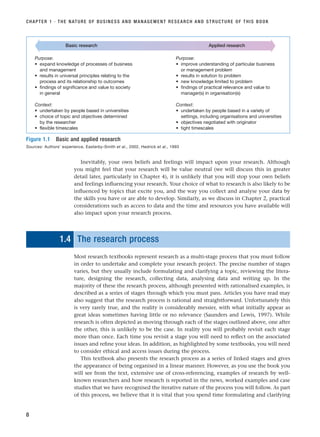
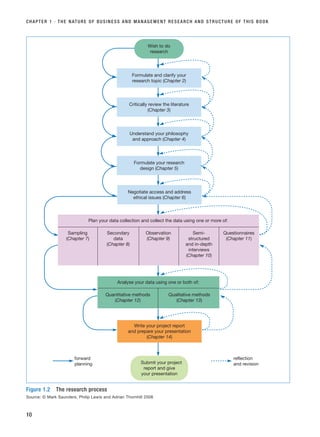
  • 237.
    used when itis impracticable to collect data from the entire population. Within prob- ability sampling, by defining the sampling frame you are defining the population about which you want to generalise. This means that if your sampling frame is a list of all cus- tomers of an organisation, strictly speaking you can only generalise, that is apply the findings based upon your sample, to that population. Similarly, if your sampling frame is all employees of an organisation (the list being the organisation’s payroll) you can only generalise to employees of that organisation. This can create problems, as often we hope that our findings have wider applicability than the population from which are sample was selected. However, even if your probability sample has been selected from one large multinational organisation, you should not claim that what you have found will also occur in similar organisations. In other words, you should not generalise beyond your sampling frame. Despite this, researchers often do make such claims, rather than placing clear limits on the generalisability of the findings. PROBABILITY SAMPLING 209 Selecting a suitable sampling frame In their 2005 British Journal of Management paper ‘An analysis of the relationship between environmental motivations and ISO14001 certification’ González-Benito and González-Benito outline and justify how they selected their sample of Spanish companies in three industrial sectors: chemicals, electronics and furniture manufacturing. They selected the chemical sector because of the high level of resources devoted to addressing pollution, whilst electronics was selected as it was facing up to increasingly stringent regulation. In contrast, they selected fur- niture manufacturing because it was subject to relatively low levels of regulatory pressure. Subsequently, lists of all companies in each of the three sectors employing 100 or more people were extracted from the Dun Bradstreet census of the 50 000 largest Spanish companies. In creating their sampling frame, González-Benito and González-Benito excluded pharmaceutical companies. They argued that, for these organisations, humanitarian objectives might be priori- tised over environmental objectives, resulting in the pharmaceutical companies not be subject to the same environmental pressures as others in the chemical sector. Their sampling frame consisted of 428 companies, 156 in the chemical sector, 211 in the electronics sector and 61 in the furniture sector. From these 184 valid responses were received, an overall response rate of 43 per cent. Source: González-Benito and González-Benito (2005) BOX 7.1 FOCUS ON MANAGEMENT RESEARCH In recent years a number of organisations have been established that specialise in selling lists of names, addresses and email addresses. These lists include a wide range of people such as company directors, chief executives, marketing managers, production managers and human resource managers, for public, private and non-profit-making organisations. They are usually in a format suitable for being read by word-processing and database computer software and can easily be merged into standard letters such as those included with questionnaires (Section 11.4). Because you pay for such lists by the case (individual address), the organisations that provide them usually select your sample. It is therefore important to establish precisely how they will select your sample as well as how the list was compiled and when it was last revised. For example, when obtaining a list of email addresses you need to be aware that a certain proportion of Internet users change their Internet Service Provider and also their email address regularly. This means the sampling frame is likely to under-represent this group who, it might be argued, are more likely to be price-sensitive consumers (Bradley, 1999). Whilst Internet users do not RESM_C07.QXP 3/30/07 6:43 AM Page 209
  • 238.
    differ from thetotal population in terms of sexual orientation, marital status, ethnicity, education and religion, they do in terms of age and gender. In particular, Internet users tend to be younger and have a greater proportion of males (Hewson et al., 2003). Box 7.2 provides a checklist against which to check your sampling frame. CHAPTER 7 · SELECTING SAMPLES 210 Selecting your sampling frame Are cases listed in the sampling frame relevant to your research topic, in other words will they enable you to answer your research question and meet your objectives? How recently was the sampling frame compiled, in particular is it up to date? Does the sampling frame include all cases, in other words is it complete? Does the sampling frame exclude irrelevant cases, in other words is it precise? (For purchased lists) Can you establish and control precisely how the sample will be selected? ✔ ✔ ✔ ✔ ✔ BOX 7.2 CHECKLIST Deciding on a suitable sample size Generalisations about populations from data collected using any probability sample are based on statistical probability. The larger your sample’s size the lower the likely error in generalising to the population. Probability sampling is therefore a compromise between the accuracy of your findings and the amount of time and money you invest in col- lecting, checking and analysing the data. Your choice of sample size within this compromise is governed by: ■ the confidence you need to have in your data – that is, the level of certainty that the characteristics of the data collected will represent the characteristics of the total popu- lation; ■ the margin of error that you can tolerate – that is, the accuracy you require for any estimates made from your sample; ■ the types of analyses you are going to undertake – in particular the number of cat- egories into which you wish to subdivide your data, as many statistical techniques have a minimum threshold of data cases for each cell (e.g. chi square, Section 12.5); and to a lesser extent: ■ the size of the total population from which your sample is being drawn. Given these competing influences it is not surprising that the final sample size is almost always a matter of judgement as well as of calculation. For many research ques- tions and objectives, your need to undertake particular statistical analyses (Section 12.5) will determine the threshold sample size for individual categories. In particular, an exam- ination of virtually any statistics textbook (or Sections 12.3 and 12.5 of this book) will highlight that, in order to ensure spurious results do not occur, the data analysed must be normally distributed. Whilst the normal distribution is discussed in Chapter 12, its implications for sample size need to be considered here. Statisticians have proved that the larger the absolute size of a sample, the more closely its distribution will be to the normal distribution and thus the more robust it will be (Box 7.3). This relationship, RESM_C07.QXP 3/30/07 6:43 AM Page 210
  • 239.
    known as thecentral limit theorem, occurs even if the population from which the sample is drawn is not normally distributed. Statisticians have also shown that a sample size of 30 or more will usually result in a sampling distribution for the mean that is very close to a normal distribution. For this reason, Stutely’s (2003) advice of a minimum number of 30 for statistical analyses provides a useful rule of thumb for the smallest number in each category within your overall sample. Where the population in the category is less than 30, and you wish to undertake your analysis at this level of detail, you should nor- mally collect data from all cases in that category. Alternatively, you may have access to an expert system such as Ex-Sample™ . This software calculates the minimum sample size required for different statistical analyses as well as the maximum possible sample size given resources such as time, money and response rates. In addition, it provides a report justifying the sample size calculated (idea Works, 2005). PROBABILITY SAMPLING 211 Politicians, it often seems, do not dare formulate a policy these days without first testing public opinion. Are fund managers going in the same direction? Research published this week by Mori, the polling company, purported to show that changes in satisfac- tion ratings it recorded among the customers of consumer companies such as Tesco and Vodafone were reflected in the companies’ share price perform- ance three to 12 months later. One may question the statistical robustness of such a link, particularly among such a small sample, but the fact is that portfolio managers – particularly more cutting edge hedge funds – increasingly appreciate that private polling data like this can give you an investment advantage. It does not need to be limited to issues as simple as consumer satisfaction. For example, the City is divided over the outlook for yellow pages companies. Do they have a bright future, or will they be swept aside by Google and other Internet operators? Market research into who uses yellow pages, and how, might provide a better answer than gut instinct, or pages of thumb sucking by brokers’ ana- lysts. It is a modern approach to the wise old investment adage – promoted by the likes of Warren Buffett and Peter Lynch, the legendary Fidelity fund manager – that you should invest in what you know about. Unfortunately, few of us can afford to employ the likes of Mori. Source: Article by Martin Dickson, Financial Times, 27 August 2005. Copyright © 2005 The Financial Times Ltd. BOX 7.3 RESEARCH IN THE NEWS FT In poll position It is likely that, if you are undertaking statistical analyses on your sample, you will be drawing conclusions from these analyses about the population from which your sample was selected. This process of coming up with conclusions about a population on the basis of data describing the sample is called statistical inference and allows you to calculate how probable it is that your result, given your sample size, could have been obtained by chance. Such probabilities are usually calculated automatically by statistical analysis soft- ware. However, it is worth remembering that, providing they are not biased, samples of larger absolute size are more likely to be representative of the population from which they are drawn than smaller samples and, in particular, the mean (average) calculated for the sample is more likely to equal the mean for the population. This is known as the law of large numbers. Researchers normally work to a 95 per cent level of certainty. This means that if your sample was selected 100 times, at least 95 of these samples would be certain to represent the characteristics of the population. The margin of error describes the precision of your estimates of the population. Table 7.1 provides a rough guide to the different minimum RESM_C07.QXP 3/30/07 6:43 AM Page 211
  • 240.
    sample sizes requiredfrom different sizes of population at the 95 per cent level of cer- tainty. It assumes that data are collected from all cases in the sample (full details of the calculation for minimum sample size and adjusted minimum sample size are given in Appendix 3). For most business and management research, researchers are content to estimate the population’s characteristics to within plus or minus 3 to 5 per cent of its true values. This means that if 45 per cent of your sample are in a certain category then your estimate for the total population within the same category will be 45 per cent plus or minus the margin of error – somewhere between 42 and 48 per cent for a 3 per cent margin of error. As you can see from Table 7.1, the smaller the absolute size of the sample and, to a far lesser extent, the smaller the relative proportion of the total population sampled, the greater the margin of error. Within this, the impact of absolute sample size on the margin of error decreases for larger sample sizes. deVaus (2002) argues that it is for this reason that many market research companies limit their samples’ sizes to approximately 2000. Unfortunately, from many samples, a 100 per cent response rate is unlikely and so your sample will need to be larger to ensure sufficient responses for the margin of error you require. The importance of a high response rate The most important aspect of a probability sample is that it represents the population. A perfect representative sample is one that exactly represents the population from which it is taken. If 60 per cent of your sample were small service sector companies then, pro- vided that the sample was representative, you would expect 60 per cent of the population to be small service sector companies. You therefore need to obtain as high a response rate as possible to ensure that your sample is representative. In reality, you are likely to have non-responses. Non-respondents are different from the rest of the population because they have refused to be involved in your research for whatever reason. Consequently, your respondents will not be representative of the total CHAPTER 7 · SELECTING SAMPLES 212 Table 7.1 Sample sizes for different sizes of population at a 95 per cent level of certainty (assuming data are collected from all cases in the sample) Margin of error Population 5% 3% 2% 1% 50 44 48 49 50 100 79 91 96 99 150 108 132 141 148 200 132 168 185 196 250 151 203 226 244 300 168 234 267 291 400 196 291 343 384 500 217 340 414 475 750 254 440 571 696 1 000 278 516 706 906 2 000 322 696 1091 1655 5 000 357 879 1622 3288 10 000 370 964 1936 4899 100 000 383 1056 2345 8762 1 000 000 384 1066 2395 9513 10 000 000 384 1067 2400 9595 RESM_C07.QXP 3/30/07 6:43 AM Page 212
  • 241.
    population, and thedata you collect may be biased. In addition, any non-responses will necessitate extra respondents being found to reach the required sample size, thereby increasing the cost of your data collection. You should therefore analyse the refusals to respond to both individual questions and entire questionnaires or interview schedules to check for bias (Section 12.2). Non- response is due to four interrelated problems: ■ refusal to respond; ■ ineligibility to respond; ■ inability to locate respondent; ■ respondent located but unable to make contact. The most common reason for non-response is that your respondent refuses to answer all the questions or be involved in your research, but does not give a reason. Such non- response can be minimised by paying careful attention to the methods used to collect your data (Chapters 9, 10 and 11). Alternatively, some of your selected respondents may not meet your research requirements and so will be ineligible to respond. Non-location and non-contact create further problems; the fact that these respondents are unreach- able means they will not be represented in the data you collect. As part of your research report, you will need to include your response rate. Neumann (2000) suggests that when you calculate this you should include all eligible respondents: total response rate ⫽ This he calls the total response rate. A more common way of doing this excludes ineli- gible respondents and those who, despite repeated attempts (Sections 10.3 and 11.5), were unreachable. This is known as the active response rate: active response rate ⫽ An example of the calculation of both the total response rate and the active response rate is given in Box 7.4. total number of responses total number in sample ⫺ (ineligible ⫹ unreachable) total number of responses total number in sample ⫺ ineligible PROBABILITY SAMPLING 213 Calculation of total and active response rates Ming had decided to administer a telephone questionnaire to people who had left his company’s employment over the past five years. He obtained a list of the 1034 people who had left over this period (the total population) and selected a 50% sample. Unfortunately he could obtain current telephone numbers for only 311 of the 517 ex-employees who made up his total sample. Of these 311 people who were potentially reachable, he obtained a response from 147. In addition, his list of people who had left his company was inaccurate, and nine of those he contacted were ineligible to respond, having left the company over five years earlier. His total response rate ⫽ ⫽ ⫽ 28.9% His active response rate ⫽ ⫽ ⫽ 48.7% 147 302 147 311 ⫺ 9 147 508 147 517 ⫺ 9 BOX 7.4 WORKED EXAMPLE RESM_C07.QXP 3/30/07 6:43 AM Page 213
  • 242.
    Even after ineligibleand unreachable respondents have been excluded, it is probable that you will still have some non-responses. You therefore need to be able to assess how representative your data are and to allow for the impact of non-response in your calcu- lations of sample size. These issues are explored in subsequent sections. Estimating response rates and actual sample size required With all probability samples, it is important that your sample size is large enough to provide you with the necessary confidence in your data. The margin of error must there- fore be within acceptable limits, and you must ensure that you will be able to undertake your analysis at the level of detail required. You therefore need to estimate the likely response rate – that is, the proportion of cases from your sample who will respond or from which data will be collected – and increase the sample size accordingly. Once you have an estimate of the likely response rate and the minimum or the adjusted minimum sample size, the actual sample size you require can be calculated using the following formula: na ⫽ where na is the actual sample size required, n is the minimum (or adjusted minimum) sample size (see Table 7.1 or Appendix 3), re% is the estimated response rate expressed as a percentage. This calculation is shown in Box 7.5. n ⫻ 100 re% CHAPTER 7 · SELECTING SAMPLES 214 Calculation of actual sample size Jan was a part-time student employed by a large manufacturing company. He had decided to send a questionnaire to the company’s customers and calculated that an adjusted minimum sample size of 439 was required. Jan estimated the response rate would be 30 per cent. From this, he could calculate his actual sample size: na ⫽ ⫽ ⫽ 1463 Jan’s actual sample therefore needed to be 1463 customers. Because of time and financial constraints this was rounded down to 1400 customers. The likelihood of 70 per cent non- response meant that Jan needed to include a means of checking that his sample was representative when he designed his questionnaire. 43900 30 439 ⫻ 100 30 BOX 7.5 WORKED EXAMPLE If you are collecting your sample data from a secondary source (Section 8.2) within an organisation that has already granted you access, your response rate should be virtually 100 per cent. In research Mark undertook he established that all the data he required were available from employees’ personnel files. Once access had been granted to these files by the organisation he was ensured of virtually a 100 per cent response rate. His actual sample size was therefore the same as his minimum sample size. RESM_C07.QXP 3/30/07 6:43 AM Page 214
  • 243.
    In contrast, estimatingthe likely response rate from a sample to whom you will be sending a questionnaire or interviewing is more difficult. One way of obtaining this esti- mate is to consider the response rates achieved for similar surveys that have already been undertaken and base your estimate on these. Alternatively, you can err on the side of caution. For most academic studies involving top management or organisations’ repre- sentatives a response rate of approximately 35 per cent is reasonable (Baruch, 1999). However, beware: response rates can vary considerably when collecting primary data. Willimack et al. (2002) report response rates for North American university-based ques- tionnaire surveys of business ranging from 50 to 65 per cent, with even higher non-response for individual questions. Work by Healey (1991) also records a wide vari- ation in response rates. He suggests average response rates of about 50 per cent for postal surveys and 75 per cent for face-to-face interviews, principally in the UK. More recently, Neuman (2000) suggests response rates of between 10 and 50 per cent for postal surveys and up to 90 per cent for face-to-face interviews. The former rate concurs with a ques- tionnaire survey we undertook for a multinational organisation that had an overall response rate of 52 per cent. In our survey, response rates for individual sites varied from 41 to 100 per cent, again emphasising variability. Our examination of response rates to recent business surveys reveals rates as low as 10–20 per cent for postal surveys, an impli- cation being that respondents’ questionnaire fatigue was a contributory factor! Fortunately a number of different techniques, depending on your data collection method, can be used to enhance your response rate. These are discussed with the data collection method in the appropriate sections (Sections 10.3 and 11.5). Selecting the most appropriate sampling technique and the sample Having chosen a suitable sampling frame and established the actual sample size required, you need to select the most appropriate sampling technique to obtain a representative sample. Five main techniques can be used to select a probability sample (Figure 7.3): ■ simple random; ■ systematic; ■ stratified random; ■ cluster; ■ multi-stage. Your choice of probability sampling technique depends on your research question(s) and your objectives. Subsequently, your need for face-to-face contact with respondents, the geographical area over which the population is spread, and the nature of your sam- pling frame will further influence your choice of probability sampling technique (Figure 7.3). The structure of the sampling frame, the size of sample you need and, if you are using support workers, the ease with which the technique may be explained will also influence your decision. The impact of each of these is summarised in Table 7.2. Simple random sampling Simple random sampling (sometimes called just random sampling) involves you selecting the sample at random from the sampling frame using either random number tables (Appendix 4) or a computer. To do this you: 1 Number each of the cases in your sampling frame with a unique number. The first case is numbered 0, the second 1 and so on. PROBABILITY SAMPLING 215 RESM_C07.QXP 3/30/07 6:43 AM Page 215
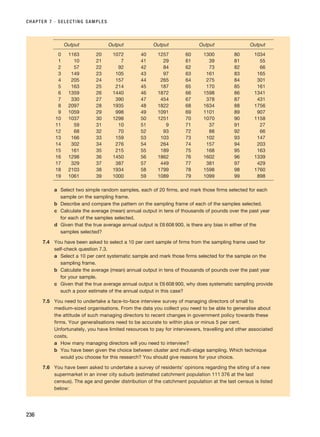

  • 244.
    CHAPTER 7 ·SELECTING SAMPLES 216 Must statistical inferences be made from the sample? Decide to consider sampling Can data be collected from the entire population? Does the research require face-to- face contact? Is population geographically concentrated? Does sampling frame have relevant strata? Does sampling frame contain periodic patterns? Does sampling frame contain periodic patterns? Is population in discrete geographical clusters? Does the sampling frame have relevant clusters or strata? Does the sampling frame contain periodic patterns? Does the sampling frame contain periodic patterns? There is no need to sample Use non- probability sampling Use stratified random sampling Use stratified systematic sampling Use simple random sampling Use systematic sampling Use cluster sampling Use mulit-stage sampling Use stratified random sampling Use stratified systematic sampling Use cluster sampling Use simple random sampling Use systematic sampling Yes Yes Yes Yes Yes Yes Yes Yes No No No No No No No No No No No Yes Yes Yes, strata Yes, clusters Figure 7.3 Selecting a probability sample (Note that random sampling requires ideally a sample size of over a few hundred) 2 Select cases using random numbers (Table 7.3, Appendix 4) until your actual sample size is reached. It is usual to select your first random number at random (closing your eyes and pointing with your finger is a good way!) as this ensures that the set of random numbers obtained for different samples is unlikely to be the same. If you do not, you will obtain sets of numbers that are random but identical. Starting with this number, you read off the random numbers (and select the cases) in a regular and systematic manner until your sample size is reached. If the same number is read off a second time it must be disregarded as you need different cases. This means that you are not putting each case’s number back into the sampling frame after it has been selected and is termed sampling without replacement. If a number is selected that is outside the range of those in your sampling frame, you simply ignore it and continue reading off numbers until your sample size is reached (Box 7.6). You can use a computer program such as a spreadsheet to generate random numbers. However, you must ensure that the numbers generated are within your range and that if a number is repeated it is ignored and replaced. If details of the population are stored on the computer it is possible to generate a sample of randomly selected cases. For telephone interviews many market research companies now use computer-aided telephone inter- RESM_C07.QXP 3/30/07 6:43 AM Page 216
  • 245.
    PROBABILITY SAMPLING 217 Table 7.2 Impact of various factors on choice of probability sampling techniques Sample technique Sampling frame Size of sample Geographical area Relative cost Easy to explain to Advantages required needed to which suited support workers? compared with simple random Simple random Accurate and easily Better with over a Concentrated if High if large sample Relatively difficult – accessible few hundred face-to-face contact size or sampling to explain required, otherwise frame not does not matter computerised Systematic Accurate, easily Suitable for all sizes Concentrated if Low Relatively easy Normally no accessible and not face-to-face contact to explain difference containing periodic required, otherwise patterns. Actual list does not matter not always needed Stratified random Accurate, easily See comments for Concentrated if Low, provided that Relatively difficult to Better comparison accessible, divisible simple random and face-to-face contact lists of relevant explain (once strata and hence into relevant strata systematic as required, otherwise strata available decided, see representation (see comments for appropriate does not matter comments for simple across strata. simple random and random and Differential systematic as systematic as response rates appropriate) appropriate) may necessitate re-weighting Cluster Accurate, easily As large as Dispersed if Low, provided that Relatively difficult to Quick but reduced accessible, relates to practicable face-to-face contact lists of relevant explain until clusters precision relevant clusters, not required and clusters available selected individual population geographically based members clusters used Multi-stage Initial stages: Initial stages: as Dispersed if Low, as sampling Initial stages: Difficult to adjust geographical. Final large as practicable. face-to-face contact frame for actual relatively difficult to for differential stage: needed only Final stage: see required, otherwise survey population explain. Final stage: response rates. for geographical comments for simple no need to use this required only for see comments for Substantial errors areas selected, see random and technique! final stage simple random and possible! However, comments for simple systematic as systematic as often only random and appropriate appropriate practical approach systematic as when sampling a appropriate large complicated population Source: © Mark Saunders, Philip Lewis and Adrian Thornhill 2006 RESM_C07.QXP 3/30/076:43 AM Page 217
  • 246.
    viewing (CATI) softwareto select and dial telephone numbers at random from an existing database or random digit dialling and to contact each respondent in turn. Random numbers allow you to select your sample without bias. The sample selected can therefore be said to be representative of the whole population. However, the selec- tion that simple random sampling provides is more evenly dispersed throughout the population for samples of more than a few hundred cases. The first few hundred cases selected using simple random sampling normally consist of bunches of cases whose numbers are close together followed by a gap and then further bunching. For over a few hundred cases this pattern occurs far less frequently. Because of the technique’s random nature it is therefore possible that the chance occurrence of such patterns will result in certain parts of a population being over- or under-represented. Simple random sampling is best used when you have an accurate and easily accessible sampling frame that lists the entire population, preferably stored on a computer. While you can often obtain these for employees within organisations or members of clubs or societies, adequate lists are often not available for types of organisation. If your popu- lation covers a large geographical area, random selection means that selected cases are likely to be dispersed throughout the area. Consequently, this form of sampling is not suitable if you are undertaking a survey that covers a large geographical area and requires face-to-face contact, owing to the associated high travel costs. Simple random sampling would still be suitable for a geographically dispersed area if you used an alternative tech- nique of collecting data such as online or postal questionnaires or telephone interviewing (Chapter 11). Sampling frames used for telephone interviewing are being replaced increasingly by random digital dialling. By selecting particular within-country area dialling codes this pro- vides a chance to reach any household within that area represented by that code which has a telephone, regardless of whether or not the number is ex-directory (Lavrakas, 1993). However, care must be taken as, increasingly, households have more than one telephone number as well. Consequently there is a higher probability of people in such households being selected as part of the sample. In addition, such a sample would exclude people who use only mobile telephones as their dialling codes are telephone network operator rather than geographical area specific. Systematic sampling Systematic sampling involves you selecting the sample at regular intervals from the sampling frame. To do this you: 1 Number each of the cases in your sampling frame with a unique number. The first case is numbered 0, the second 1 and so on. CHAPTER 7 · SELECTING SAMPLES 218 Table 7.3 Extract from random number tables 78 41 11 62 72 18 66 69 58 71 31 90 51 36 78 09 41 00 70 50 58 19 68 26 75 69 04 00 25 29 16 72 35 73 55 85 32 78 14 47 01 55 10 91 83 21 13 32 59 53 03 38 79 32 71 60 20 53 86 78 50 57 42 30 73 48 68 09 16 35 21 87 35 30 15 57 99 96 33 25 56 43 65 67 51 45 37 99 54 89 09 08 05 41 66 54 01 49 97 34 38 85 85 23 34 62 60 58 02 59 34 51 98 71 31 54 28 85 23 84 49 07 33 71 17 88 20 13 44 15 22 95 Source: Appendix 4 RESM_C07.QXP 3/30/07 6:43 AM Page 218
  • 247.
    2 Select thefirst case using a random number. 3 Calculate the sampling fraction. 4 Select subsequent cases systematically using the sampling fraction to determine the frequency of selection. To calculate the sampling fraction – that is, the proportion of the total population that you need to select – you use the formula sampling fraction ⫽ If your sampling fraction is 1 ⁄3 you need to select one in every three cases – that is, every third case from the sampling frame. Unfortunately, your calculation will usually result in a more complicated fraction. In these instances it is normally acceptable to round your population down to the nearest 10 (or 100) and to increase your minimum sample size until a simpler sampling fraction can be calculated. On its own, selecting one in every three would not be random as every third case would be bound to be selected, whereas those between would have no chance of selec- tion. To overcome this a random number is used to decide where to start on the sampling frame. If your sampling fraction is 1 ⁄3 the starting point must be one of the first three cases. You therefore select a random number (in this example a one-digit random number between 0 and 2) as described earlier and use this as the starting point. Once you have selected your first case at random you then select, in this example, every third case until you have gone right through your sampling frame (Box 7.7). As with simple random sampling, you can use a computer to generate the first random and subsequent numbers that are in the sample. actual sample size total population PROBABILITY SAMPLING 219 Simple random sampling Jemma was undertaking her work placement at a large supermarket, where 5011 of the super- market’s customers used the supermarket’s Internet purchase and delivery scheme. She was asked to interview customers and find out why they used this scheme. As there was insufficient time to interview all of them she decided to interview a sample using the telephone. Her calcu- lations revealed that to obtain acceptable levels of confidence and accuracy she needed an actual sample size of approximately 360 customers. She decided to select them using simple random sampling. Having obtained a list of Internet customers and their telephone numbers, Jemma gave each of the cases (customers) in this sampling frame a unique number. In order that each number was made up in exactly the same way she used 5011 four-digit numbers starting with 0000 through to 5010. So customer 677 was given the number 0676. The first random number she selected was 55 (shown in bold and italics in Table 7.3). Starting with this number she read off the random numbers in a regular and systematic manner (in this example continuing along the line): 5510 9183 2113 3259 5303 3879 3271 6020 until 360 different cases had been selected. These formed her random sample. Numbers selected that were outside the range of those in her sampling frame (such as 5510, 9183, 5303 and 6020) were simply ignored. BOX 7.6 WORKED EXAMPLE RESM_C07.QXP 3/30/07 6:43 AM Page 219
  • 248.
    In some instancesit is not necessary to construct a list for your sampling frame. Research Mark undertook for a local authority required data to be collected about every tenth client of a social services department. Although these data were not held on com- puter they were available from each client’s manual record. The were stored in files in alphabetical order and, once the first file (client) was selected at random, it was easy to extract every tenth file (client) thereafter. This process had the additional advantage that it was easy to explain to social services’ employees, although Mark still had to explain to inquisitive employees that he needed a representative sample and so their ‘interesting’ clients might not be selected! For online questionnaires, such as pop-up questionnaires that appear in a window on the computer screen, there is no need to create an actual list if computer software is used to trigger an invitation to participate at random. For system- atic sampling, the random selection could be triggered by some mechanism such as every tenth visitor to the site over a specified time period (Bradley, 1999). CHAPTER 7 · SELECTING SAMPLES 220 Systematic sampling Stefan worked as a receptionist in a dental surgery with approximately 1500 patients. He wished to find out their attitudes to the new automated appointments scheme. As there was insufficient time and money to collect data from all patients using a questionnaire he decided to send the questionnaire to a sample. The calculation of sample size revealed that to obtain acceptable levels of confidence and accuracy he needed an actual sample size of approxi- mately 300 patients. Using the patient files kept in the filing cabinet as a sampling frame he decided to select his sample systematically. First he calculated the sampling fraction: ⫽ This meant that he needed to select every fifth patient from the sampling frame. Next he used a random number to decide where to start on his sampling frame. As the sam- pling fraction was 1 ⁄5, the starting point had to be one of the first five patients. He therefore selected a one-digit random number between 0 and 4. Once he had selected his first patient at random he continued to select every fifth patient until he had gone right through his sampling frame (the filing cabinet). If the random number Stefan had selected was 2, then he would have selected the following patient numbers: 2 7 12 17 22 27 32 37 and so on until 300 patients had been selected. 1 5 300 1500 BOX 7.7 WORKED EXAMPLE Despite the advantages, you must be careful when using existing lists as sampling frames. You need to ensure that the lists do not contain periodic patterns. A high street bank needs you to administer a questionnaire to a sample of individual customers with joint bank accounts. A sampling fraction of 1 ⁄4 means that you will need to select every fourth customer on the list. The names on the customer lists, which you intend to use as the sampling frame, are arranged alphabetically by account with males followed by females (Table 7.4). If you start with a male customer, all those in your sample will be male. Conversely, if you start with a female customer, all those in your sample will be female. Consequently your sample will be biased (Table 7.4). This sam- pling frame is therefore not suitable without reordering or stratifying (discussed later). RESM_C07.QXP 3/30/07 6:43 AM Page 220
  • 249.
    Unlike simple randomsampling, systematic sampling works equally well with a small or large number of cases. However, if your population covers a large geographical area, the random selection means that the sample cases are likely to be dispersed throughout the area. Consequently systematic sampling is suitable for geographically dispersed cases only if you do not require face-to-face contact when collecting your data. Stratified random sampling Stratified random sampling is a modification of random sampling in which you divide the population into two or more relevant and significant strata based on one or a number of attributes. In effect your sampling frame is divided into a number of subsets. A random sample (simple or systematic) is then drawn from each of the strata. Consequently, strat- ified sampling shares many of the advantages and disadvantages of simple random or systematic sampling. Dividing the population into a series of relevant strata means that the sample is more likely to be representative, as you can ensure that each of the strata is represented pro- portionally within your sample. However, it is only possible to do this if you are aware of, and can easily distinguish, significant strata in your sampling frame. In addition, the extra stage in the sampling procedure means that it is likely to take longer, to be more expensive, and to be more difficult to explain than simple random or systematic sam- pling. In some instances, as pointed out by deVaus (2002), your sampling frame will already be divided into strata. A sampling frame of employee names that is in alphabetical order will automatically ensure that, if systematic sampling is used (discussed earlier), employees will be sampled in the correct proportion to the letter with which their name begins. Similarly, membership lists that are ordered by date of joining will automatically result in stratification by length of membership if systematic sampling is used. However, if you are using simple random sampling or your sampling frame contains periodic pat- terns, you will need to stratify it. To do this you: 1 Choose the stratification variable or variables. 2 Divide the sampling frame into the discrete strata. 3 Number each of the cases within each stratum with a unique number, as discussed earlier. 4 Select your sample using either simple random or systematic sampling, as discussed earlier. The stratification variable (or variables) chosen should represent the discrete charac- teristic (or characteristics) for which you want to ensure correct representation within the sample (Box 7.8). PROBABILITY SAMPLING 221 Table 7.4 The impact of periodic patterns on systematic sampling Number Customer Sample Number Customer Sample 000 Mr L. Baker M 006 Mr E. Saunders 001 Mrs B. Baker 007 Mrs M. Saunders F 002 Mr S. Davies 008 Mr J. Smith M 003 Mrs P. Davies F 009 Mrs K. Smith 004 Mr J. Lewis M 010 Mr J. Thornhill 005 Mrs P. Lewis 011 Mrs A. Thornhill F M all male sample selected if start with 000, F all female sample selected if start with 003 RESM_C07.QXP 3/30/07 6:43 AM Page 221
  • 250.
    Samples can bestratified using more than one characteristic. You may wish to stratify a sample of an organisation’s employees by both department and salary grade. To do this you would: 1 Divide the sampling frame into the discrete departments. 2 Within each department divide the sampling frame into discrete salary grades. 3 Number each of the cases within each salary grade within each department with a unique number, as discussed earlier. 4 Select your sample using either simple random or systematic sampling, as discussed earlier. In some instances the relative sizes of different strata mean that, in order to have suf- ficient data for analysis, you need to select larger samples from the strata with smaller populations. Here the different sample sizes must be taken into account when aggre- gating data from each of the strata to obtain an overall picture. The more sophisticated statistical analysis software packages enable you to do this by differentially weighting the responses for each stratum (Section 12.2). CHAPTER 7 · SELECTING SAMPLES 222 Stratified random sampling Dilek worked for a major supplier of office supplies to public and private organisations. As part of her research into her organisation’s customers she needed to ensure that both public and private sector organisations were represented correctly. An important stratum was therefore the sector of the organisation. Her sampling frame was thus divided into two discrete strata: public sector and private sector. Within each stratum the individual cases were then numbered: Public sector stratum Private sector stratum Number Customer Selected Number Customer Selected 000 Anyshire County 000 ABC Automotive Council manufacturer 001 Anyshire Hospital ✓ 001 Anytown printers and Trust bookbinders 002 Newshire Army 002 Benjamin Toy Training Barracks Company 003 Newshire Police Force 003 Jane’s Internet ✓ Flower shop 004 Newshire Housing 004 Multimedia productions 005 St Peter’s Secondary ✓ 005 Roger’s Consulting School 006 University of Anytown 006 The Paperless Office ✓ 007 West Anyshire Council 007 U-need-us Ltd She decided to select a systematic sample. A sampling fraction of 1 ⁄4 meant that she needed to select every fourth customer on the list. As indicated by the ticks (✓), random numbers were used to select the first case in the public sector (001) and private sector (003) strata. Subsequently every fourth customer in each stratum was selected. BOX 7.8 WORKED EXAMPLE RESM_C07.QXP 3/30/07 6:43 AM Page 222
  • 251.
    Cluster sampling Cluster samplingis, on the surface, similar to stratified sampling as you need to divide the population into discrete groups prior to sampling (Henry, 1990). The groups are termed clusters in this form of sampling and can be based on any naturally occurring grouping. For example, you could group your data by type of manufacturing firm or geo- graphical area (Box 7.9). For cluster sampling your sampling frame is the complete list of clusters rather than a complete list of individual cases within the population. You then select a few clusters, normally using simple random sampling. Data are then collected from every case within the selected clusters. The technique has three main stages: 1 Choose the cluster grouping for your sampling frame. 2 Number each of the clusters with a unique number. The first cluster is numbered 0, the second 1 and so on. 3 Select your sample using some form of random sampling as discussed earlier. Selecting clusters randomly makes cluster sampling a probability sampling technique. Despite this, the technique normally results in a sample that represents the total popu- lation less accurately than stratified random sampling. Restricting the sample to a few relatively compact geographical subareas (clusters) maximises the number of interviews you can undertake within the resources available. However, it may also reduce the repre- sentativeness of your sample. For this reason you need to maximise the number of subareas to allow for variations in the population within the available resources. Your choice is between a large sample from a few discrete subgroups and a smaller sample dis- tributed over the whole group. It is a trade-off between the amount of precision lost by using a few subgroups and the amount gained from a larger sample size. PROBABILITY SAMPLING 223 Cluster sampling Ceri needed to select a sample of firms to undertake an interview-based survey about the use of photocopiers. As she had limited resources with which to pay for travel and other associated data collection costs, she decided to interview firms in four geographical areas selected from a cluster grouping of local administrative areas. A list of all local administrative areas formed her sampling frame. Each of the local administrative areas (clusters) was given a unique number, the first being 0, the second 1 and so on. The four sample clusters were selected from this sam- pling frame of local administrative areas using simple random sampling. Ceri’s sample was all firms within the selected clusters. She decided that the appropriate telephone directories would probably provide a suitable list of all firms in each cluster. BOX 7.9 WORKED EXAMPLE Multi-stage sampling Multi-stage sampling, sometimes called multi-stage cluster sampling, is a development of cluster sampling. It is normally used to overcome problems associated with a geographi- cally dispersed population when face-to-face contact is needed or where it is expensive and time consuming to construct a sampling frame for a large geographical area. However, like cluster sampling, you can use it for any discrete groups, including those that are not geographically based. The technique involves taking a series of cluster samples, each involving some form of random sampling. This aspect is represented by RESM_C07.QXP 3/30/07 6:43 AM Page 223
  • 252.
    the dotted linesin Figure 7.1. It can be divided into four phases. These are outlined in Figure 7.4. Because multi-stage sampling relies on a series of different sampling frames, you need to ensure that they are all appropriate and available. In order to minimise the impact of selecting smaller and smaller subgroups on the representativeness of your sample, you can apply stratified sampling techniques (discussed earlier). This technique can be further refined to take account of the relative size of the subgroups by adjusting the sample size for each subgroup. As you have selected your subareas using different sampling frames, you only need a sampling frame that lists all the members of the population for those subgroups you finally select (Box 7.10). This provides considerable savings in time and money. Checking the sample is representative Often it is possible to compare data you collect from your sample with data from another source for the population. For example, you can compare data on the age and socioeco- nomic characteristics of respondents in a marketing survey with these characteristics for the population in that country as recorded by the latest national census of population. If there is no statistically significant difference then the sample is representative with respect to these characteristics. CHAPTER 7 · SELECTING SAMPLES 224 • Choose sampling frame of relevant discrete groups • Number each group with a unique number. The first is numbered 0, the second 2 and so on • Select a small sample of relevant discrete groups using some form of random sampling Phase 1 • From these relevant discrete groups choose a sampling frame of relevant discrete subgroups • Number each subgroup with a unique number as described in phase 1 • Select a small sample of relevant discrete subgroups using some form of random sampling Phase 2 • From these relevant discrete subgroups choose a sampling frame of relevant discrete sub-subgroups • Number each sub-subgroup with a unique number as described in phase 1 • Select your sample using some form of random sampling Phase 4 • Repeat phase 2 if necessary Phase 3 Figure 7.4 Phases of multi-stage sampling RESM_C07.QXP 3/30/07 6:43 AM Page 224
  • 253.
    When working withinan organisation comparisons can also be made. In a recent survey Mark and Adrian undertook of all types of employees in a large UK organisation they asked closed questions about salary grade, gender, length of service and place of work. Possible responses to each question were designed to provide sufficient detail to compare the characteristics of the sample with the characteristics of the entire popu- lation of employees as recorded by the organisation’s computerised personnel system. At the same time they kept the categories sufficiently broad to preserve, and to be seen to preserve, the confidentiality of individual respondents. The two questions on length of service and salary grade from a questionnaire they developed illustrate this: 58 How long have you worked for organisation’s name? up to 3 years ■ ■ over 3 years to 10 years ■ ■ over 10 years ■ ■ 59 Which one of the following best describes your job? Clerical (grades 1–3) ■ ■ Senior management (grades 12–14) ■ ■ Supervisor (grades 4–5) ■ ■ Directorate (grades 15–17) ■ ■ Professional (grades 6–8) ■ ■ Other (please say) ■ ■ Management (grades 9–11) ■ ■ …………………………………………...... Using the Kolmogorov test (Section 12.5) Mark and Adrian found there was no stat- istically significant difference between the proportions of respondents in each of the length of service groups and the data obtained from the organisation’s personnel data- base for all employees. This meant that their sample was representative of all employees with respect to length of service. However, those responding were (statistically) signifi- cantly more likely to be in professional and managerial grades than in technical, clerical PROBABILITY SAMPLING 225 Multi-stage sampling Laura worked for a market research organisation who needed her to interview a sample of 400 households in England and Wales. She decided to use the electoral register as a sampling frame. Laura knew that selecting 400 households using either systematic or simple random sampling was likely to result in these 400 households being dispersed throughout England and Wales, resulting in considerable amounts of time spent travelling between interviewees as well as high travel costs. By using multi-stage sampling Laura felt these problems could be over- come. In her first stage the geographical area (England and Wales) was split into discrete subareas (counties). These formed her sampling frame. After numbering all the counties, Laura selected a small number of counties using simple random sampling. Since each case (household) was located in a county, each had an equal chance of being selected for the final sample. As the counties selected were still too large, each was subdivided into smaller geographi- cally discrete areas (electoral wards). These formed the next sampling frame (stage 2). Laura selected another simple random sample. This time she selected a larger number of wards to allow for likely important variations in the nature of households between wards. A sampling frame of the households in each of these wards was then generated using a combination of the electoral register and the UK Royal Mail’s postcode address file. Laura finally selected the actual cases (households) that she would interview using systematic sam- pling. BOX 7.10 WORKED EXAMPLE RESM_C07.QXP 3/30/07 6:43 AM Page 225
  • 254.
    or supervisory grades.They therefore added a note of caution about the representative- ness of their findings. You can also assess the representativeness of samples for longitudinal studies. Obviously, it is still possible to compare respondent characteristics with data from another source. In addition, the characteristics of those who responded can be compared for different data collection periods. For example, you could compare the characteristics of those in your sample who responded to a questionnaire at the start of a research project with those who responded to a questionnaire six months later. We should like to add a note of caution here. Such a comparison will enable you to discuss the extent to which the groups of respondents differed for these characteristics over time. However, depending on your choice of characteristics, these differences might be expected owing to some form of managerial intervention or other change between these data collection periods. 7.3 Non-probability sampling The techniques for selecting samples discussed earlier have all been based on the assump- tion that your sample will be chosen statistically at random. Consequently, it is possible to specify the probability that any case will be included in the sample. However, within business research, such as market surveys and case study research, this may either not be possible (as you do not have a sampling frame) or appropriate to answering your research question. This means your sample must be selected some other way. Non-probability sampling (or non-random sampling) provides a range of alternative techniques to select samples based on your subjective judgement. In the exploratory stages of some research projects, such as a pilot survey, a non-probability sample may be the most practical, although it will not allow the extent of the problem to be determined. Subsequent to this, probability sampling techniques may be used. For other business and management research projects your research question(s), objectives and choice of research strategy (Sections 2.4, 5.3) may dictate non-probability sampling. To answer your research ques- tion(s) and to meet your objectives you may need to undertake an in-depth study that focuses on a small, perhaps one, case selected for a particular purpose. This sample would provide you with an information-rich case study in which you explore your research question. Alternatively, limited resources or the inability to specify a sampling frame may dictate the use of one or a number of non-probability sampling techniques. Selecting the most appropriate sampling technique and the sample A range of non-probability sampling techniques is available that should not be dis- counted as they can provide sensible alternatives to select cases to answer your research question(s) and to address your objectives (Figure 7.2). At one end of this range is quota sampling, which, like probability samples, tries to represent the total population. Quota sampling has similar requirements for sample size as probabilistic sampling techniques. At the other end of this range are techniques based on the need to obtain a sample as quickly as possible where you have little control over the content and there is no attempt to obtain a representative sample which will allow you to generalise in a statistical sense to a population. These include convenience and self-selection sampling techniques. Purposive sampling and snowball sampling techniques lie between these extremes (Table 7.5). For these techniques the issue of sample size is ambiguous. Unlike quota and probability samples there CHAPTER 7 · SELECTING SAMPLES 226 RESM_C07.QXP 3/30/07 6:43 AM Page 226

  • 255.
    are no rules.Rather, sample size is dependent on your research question(s) and objectives – in particular, what you need to find out, what will be useful, what will have credibility and what can be done within your available resources (Patton, 2002). This is particularly so where you are intending to collect qualitative data. The validity and understanding that you will gain from your data will be more to do with your data collection and analysis skills than with the size of your sample (Patton, 2002). As such, it is the logical relationship between your sample selection technique and the purpose and focus of your research that is important (Figure 7.5), generalisations being made to theory rather than a population. This means that it is the quality of the theoretical inferences that can be made from data collected using non- probability samples that is used to assess the extent to which generalisations can be made. Quota sampling Quota sampling is entirely non-random and is normally used for interview surveys. It is based on the premise that your sample will represent the population as the variability in your sample for various quota variables is the same as that in the population. Quota sam- pling is therefore a type of stratified sample in which selection of cases within strata is entirely non-random (Barnett, 1991). To select a quota sample you: NON-PROBABILITY SAMPLING 227 Decide to consider sampling Is the purpose just exploratory? Can data be collected from the entire population? Must statistical inferences be made from the sample? Must it be likely that the sample is representative? Are individual cases difficult to identify? Is the sample to be selected very small? Are relevant quota variables available? Is there little variation in the population? Is a suitable sampling frame available? There is no need to sample Use self-selection sampling Use snowball sampling Focus on unusual/special: use extreme case sampling Use convenience sampling Use quota sampling Use probability sampling Yes Yes Yes Yes No No No No No No Yes Revisit questions above Use purposive sampling with an appropriate focus Uncertain that sample will be representative Focus on key themes: use heterogeneous sampling Focus on in-depth: use homogeneous sampling Focus on importance of case: use critical case sampling Focus on illustrative: use typical case sampling No No No Yes Yes Yes Yes Figure 7.5 Selecting a non-probability sampling technique RESM_C07.QXP 3/30/07 6:43 AM Page 227
  • 256.
    1 Divide thepopulation into specific groups. 2 Calculate a quota for each group based on relevant and available data. 3 Give each interviewer an assignment, which states the number of cases in each quota from which they must collect data. 4 Combine the data collected by interviewers to provide the full sample. Quota sampling has a number of advantages over the probabilistic techniques. In par- ticular, it is less costly and can be set up very quickly. If, as with television audience research surveys, your data collection needs to be undertaken very quickly then quota sampling may be the only possibility. In addition, it does not require a sampling frame and may therefore be the only technique you can use if one is not available. Quota sampling is normally used for large populations. For small populations it is usually possible to obtain a sampling frame. Decisions on sample size are governed by the need to have sufficient responses in each quota to enable subsequent statistical analyses to be undertaken. This normally necessitates a sample size of between 2000 and 5000. Calculations of quotas are based on relevant and available data and are usually relative to the proportions in which they occur in the population (Box 7.11). Without sensible and relevant quotas, data collected may be biased. For many market research projects, quotas are derived from census data. Your choice of quota is dependent on two main factors: CHAPTER 7 · SELECTING SAMPLES 228 Table 7.5 Impact of various factors on choice of non-probability sampling techniques Sample type Likelihood of sample Types of research in Relative costs Control over being representative which useful sample contents Quota Reasonable to high, Where costs Moderately high to Relatively high although dependent constrained or data reasonable on selection of quota needed very quickly variables so an alternative to probability sampling needed Purposive Low, although Where working with Reasonable Reasonable dependent on very small samples researcher’s choices: extreme case focus: unusual or special heterogeneous focus: key themes homogeneous focus: in-depth critical case focus: importance of case typical case focus: illustrative Snowball Low, but cases will Where difficulties in Reasonable Quite low have characteristics identifying cases desired Self-selection Low, but cases Where exploratory Low Low self-selected research needed Convenience Very low Where very little Low Low variation in population Source: Developed from Kervin (1999), Patton (2002) RESM_C07.QXP 3/30/07 6:43 AM Page 228
  • 257.
    ■ usefulness asa means of stratifying the data; ■ ability to overcome likely variations between groups in their availability for interview. Where people who are retired are likely to have different opinions from those in work, a quota that does not ensure that these differences are captured may result in the data being biased as it would probably be easier to collect the data from those people who are retired. Quotas used in market research surveys and political opinion polls usually include measures of age, gender and socioeconomic status or social class. These may be supplemented by additional quotas dictated by the research question(s) and objectives (Box 7.12). Once you have given each interviewer their particular assignment, they decide whom to interview until they have completed their quota. You then combine the data from this assignment with those collected by other interviewers to provide the full sample. Because the interviewer can choose within quota boundaries whom he or she interviews, your quota sample may be subject to bias. Interviewers tend to choose respondents who are easily accessible and who appear willing to answer the questions. Clear controls may therefore be needed. In addition, it has been known for interviewers to fill in quotas incorrectly. This is not to say that your quota sample will not produce good results; they can and often do! However, you cannot measure the level of certainty or margins of error as the sample is not probability based. NON-PROBABILITY SAMPLING 229 Devising a quota sample Mohammad was undertaking the data collection for his dissertation as part of his full-time employment. For his research he needed to interview a sample of people representing those aged 20–64 who were in work in his country. No sampling frame was available. Once the data had been collected, he was going to disaggregate his findings into subgroups dependent on respondents’ age and type of employment. Previous research had suggested that gender would also have an impact on responses and so he needed to make sure that those interviewed in each group also reflected the proportions of males and females in the population. Fortunately, his country’s national census of population contained a breakdown of the number of people in employment by gender, age and socioeconomic status. These formed the basis of the cat- egories for his quotas: gender ⫻ age group ⫻ socioeconomic status male 20–29 professional female 30–34 managers/employers 45–64 intermediate and junior non-manual skilled manual semi-skilled manual unskilled manual As he was going to analyse the data for individual age and socioeconomic status groups, it was important that each of these categories had sufficient respondents (at least 30) to enable meaningful statistical analyses. Mohammad calculated that a 0.5 per cent quota for each of the groups would provide sufficient numbers for all groups, provided his analyses were not also dis- aggregated by gender. This gave him the following quotas: BOX 7.11 WORKED EXAMPLE ➔ RESM_C07.QXP 3/30/07 6:43 AM Page 229
  • 258.
    CHAPTER 7 ·SELECTING SAMPLES 230 Gender Age group Socioeconomic status Population Quota (10% sample) Male 20–29 Professional 11 210 56 Managers/employers 7 983 40 Intermediate and junior non-manual 9 107 43 Skilled manual 16 116 79 Semi-skilled manual 12 605 63 Unskilled manual 5 039 25 30–44 Professional 21 431 107 Managers/employers 23 274 116 Intermediate and junior non-manual 7 997 40 Skilled manual 21 410 107 Semi-skilled manual 19 244 96 Unskilled manual 4 988 25 45–64 Professional 16 612 83 Managers/employers 23 970 120 Intermediate and junior non-manual 9 995 49 Skilled manual 20 019 100 Semi-skilled manual 17 616 88 Unskilled manual 5 763 29 Female 20–29 Professional 8 811 44 Managers/employers 6 789 34 Intermediate and junior non-manual 21 585 108 Skilled manual 1 754 9 Semi-skilled manual 9 632 48 Unskilled manual 3 570 18 30–44 Professional 16 380 82 Managers/employers 9 765 49 Intermediate and junior non-manual 28 424 142 Skilled manual 2 216 11 Semi-skilled manual 11 801 59 Unskilled manual 8 797 41 45–64 Professional 8 823 44 Managers/employers 7 846 39 Intermediate and junior non-manual 21 974 110 Skilled manual 1 578 8 Semi-skilled manual 9 421 47 Unskilled manual 8 163 41 Total sample 441 604 2 200 These were then divided into assignments of 50 people for each interviewer. Purposive sampling Purposive or judgemental sampling enables you to use your judgement to select cases that will best enable you to answer your research question(s) and to meet your objectives. This form of sample is often used when working with very small samples such as in case study research and when you wish to select cases that are particularly informative (Neuman, 2000). Purposive sampling may also be used by researchers adopting the grounded theory strategy. For such research, findings from data collected from your initial sample inform the way you extend your sample into subsequent cases (Section 13.7). Such samples cannot, however, be considered to be statistically representative of the total popu- lation. The logic on which you base your strategy for selecting cases for a purposive sample RESM_C07.QXP 3/30/07 6:43 AM Page 230
  • 259.
    NON-PROBABILITY SAMPLING 231 In thepast few days, volatile opinion poll results have added a new frisson to the election campaign. Using a rolling average of the latest five polls, Labour’s lead over the past three months has remained between 31 ⁄2 and 61 ⁄2 points, and is currently at the top end of that range. But last week there were two bad polls for Labour, showing its lead shrinking to 3 percentage points or fewer. The other striking feature of the recent polls, however, is that they have become more erratic. In February, estimates of Labour’s lead ranged from 1 to 12 percentage points, compared with a range of 3 and 9 points during December. The increased volatility of the results suggests that some of the polls might be misjudging public opinion. In the half century up to 1992, political polling looked pretty easy. The gap between what the pollsters expected the difference between the two parties to be and the actual result had been more than 5 percentage points only twice since 1945. In 1992 it all went wrong. The polls were out by nearly 9 points and the Conservatives squeezed home against the odds. Since then there has been a range of changes in polling methodology that are still keenly debated. The fear that the volatility might be pointing to a repeat of 1992 means that polling techniques are now coming under scrutiny. Getting a representative sample is easier said than done and is getting harder as voting patterns become more complex. Of the many pollsters doing surveys, only six conduct monthly polls on voting intentions: ICM, Mori, Populous, YouGov, NOP and Communicate Research. Each has its own methods. Framing the question is one of the most important factors. There is a big difference for example, between “Who will you vote for?” and “Will you vote for Labour, Conservatives, Liberal Democrats or another party?”. Where a question comes in a survey is also important. Asking voting intention after questions about immigration raises support for the UK Independence Party. The standard method for all pollsters used to be face-to-face quota sampling: selecting set numbers of people by sex and age. But a review by the Market Research Society after the 1992 disaster said that quota sampling was too “down-market” and failed to catch a representative selection of the middle classes. It also said the problems reflected a late swing to the right and the unwillingness of some Conservative sup- porters to respond truthfully: a phenomenon that became known as a “spiral of silence” or “shy Tories”. Since 1992, interviewees have been selected more finely – allowing for home ownership and other demo- graphic variables – and the location of interviews has been made more representative. Some pollsters moved to telephone polling, which is now the most commonly used method. Almost all households have a phone. But phone polling, too, is now under pressure. It risks losing people who are rarely at home, use only a mobile phone or who filter their phone calls. The increased use of cold calling from salesmen has also poisoned the phone for political polling. But concerns about phone polling do not affect the one organisation that does not use phones – YouGov, which uses the internet. It has been successful at accurately predicting results and argues that respondents are more honest on topics such as tax when responding on the internet rather than to another person. The issue of turnout and the “don’t knows” is also tricky – some pollsters show a proportion of “don’t knows” voting as they did at the previous election, others ignore them. After doing very well in calling the 1997 election result, the pollsters’ performance deteriorated again in 2001, although Labour’s lead was so huge that it barely mattered. However, we will have to wait for the results of the next election to see whether the pollsters have really managed to put the 1992 outcome behind them. Source: Article by Simon Briscoe, Financial Times, 1 March 2005. Copyright © 2005 The Financial Times Ltd. BOX 7.12 RESEARCH IN THE NEWS FT Why polls are in danger of missing the point RESM_C07.QXP 3/30/07 6:43 AM Page 231
  • 260.
    should be dependenton your research question(s) and objectives. Patton (2002) emphasises this point by contrasting the need to select information-rich cases in purposive sampling with the need to be statistically representative in probability sampling. The more common purposive sampling strategies were outlined in Figure 7.2 and are discussed below: ■ Extreme case or deviant sampling focuses on unusual or special cases on the basis that the data collected about these unusual or extreme outcomes will enable you to learn the most and to answer your research question(s) and to meet your objectives most effectively. This is often based on the premise that findings from extreme cases will be relevant in understanding or explaining more typical cases (Patton, 2002). Peters and Waterman’s (1982) research on excellent companies was based on a purposive sample of extreme (excellent) companies. ■ Heterogeneous or maximum variation sampling enables you to collect data to describe and explain the key themes that can be observed. Although this might appear a con- tradiction, as a small sample may contain cases that are completely different, Patton (2002) argues that this is in fact a strength. Any patterns that do emerge are likely to be of particular interest and value and represent the key themes. In addition, the data collected should enable you to document uniqueness. To ensure maximum variation within a sample Patton (2002) suggests you identify your diverse characteristics (sample selection criteria) prior to selecting your sample. ■ In direct contrast to heterogeneous sampling, homogeneous sampling focuses on one particular subgroup in which all the sample members are similar. This enables you to study the group in great depth. ■ Critical case sampling selects critical cases on the basis that they can make a point dra- matically or because they are important. The focus of data collection is to understand what is happening in each critical case so that logical generalisations can be made (Box 7.13). Patton (2002) outlines a number of clues that suggest critical cases. These can be summarised by the questions such as: – If it happens there, will it happen everywhere? – If they are having problems, can you be sure that everyone will have problems? – If they cannot understand the process, is it likely that no one will be able to under- stand the process? ■ In contrast, typical case sampling is usually used as part of a research project to provide an illustrative profile using a representative case. Such a sample enables you to provide an illustration of what is ‘typical’ to those who will be reading your research report and may be unfamiliar with the subject matter. It is not intended to be definitive. Snowball sampling Snowball sampling is commonly used when it is difficult to identify members of the desired population, for example people who are working while claiming unemployment benefit. You therefore need to: 1 Make contact with one or two cases in the population. 2 Ask these cases to identify further cases. 3 Ask these new cases to identify further new cases (and so on). 4 Stop when either no new cases are given or the sample is as large as is manageable. The main problem is making initial contact. Once you have done this, these cases identify further members of the population, who then identify further members, and so CHAPTER 7 · SELECTING SAMPLES 232 RESM_C07.QXP 3/30/07 6:43 AM Page 232
  • 261.
    the sample snowballs(Box 7.14). For such samples the problems of bias are huge, as respondents are most likely to identify other potential respondents who are similar to themselves, resulting in a homogeneous sample (Lee, 1993). The next problem is to find these new cases. However, for populations that are difficult to identify, snowball sam- pling may provide the only possibility. NON-PROBABILITY SAMPLING 233 Purposive sampling A paper by Mark and a colleague published in the Services Industries Journal reports on research into an alternative process for measuring service users’ and deliverers’ perceptions of service quality independently. Within this paper they provide examples of four service situations in which the Extended Service Template Process was evaluated and explain how separate samples of service users and deliverers were selected. In each example, purposive samples of service users and deliverers were selected on the basis of their criticality to that service, it being argued that these would enable the diversity and key dimensions of the service to be explored and logical generalisations made regarding key themes. The service quality issues explored in these examples included the need for improvements to the main reception of a large multi-site public sector organisation. In this organisation three purposive samples were selected to enable the views of the service users, the service deliverers and their manager to be explored and understood: ■ six internal staff representing key service users of this reception service; ■ three receptionists employed at the main reception, these being the service deliverers; ■ the receptionist’s departmental manager. Subsequently, separate group interviews were held with each of these parties to collect data. Source: Williams and Saunders (2006) BOX 7.13 FOCUS ON MANAGEMENT RESEARCH Snowball sampling Steve was a part-time student. His project was concerned with the career paths of managing directors of large companies. As part of this, Steve needed to interview managing directors. He arranged his first interview with the managing director of his own company. Towards the end of the interview the managing director asked Steve whether he could be of further assistance. Two other managing directors that Steve could interview were suggested. Steve’s managing director offered to ‘introduce’ Steve to them and provided him with contact telephone numbers and the names of their personal assistants. Steve’s sample had started to snowball! BOX 7.14 WORKED EXAMPLE Self-selection sampling Self-selection sampling occurs when you allow each case, usually individuals, to identify their desire to take part in the research. You therefore: 1 Publicise your need for cases, either by advertising through appropriate media or by asking them to take part. 2 Collect data from those who respond. RESM_C07.QXP 3/30/07 6:43 AM Page 233
  • 262.
    Publicity for conveniencesamples can take many forms. These include articles and advertisements in magazines that the population are likely to read, postings on appro- priate Internet newsgroups and discussion groups, hyperlinks from other websites as well as letters or emails of invitation to colleagues and friends (Box 7.15). Cases that self-select often do so because of their feelings or opinions about the research question(s) or stated objectives. In some instances, as in research undertaken by Adrian, Mark and colleagues on the management of the survivors of downsizing (Thornhill et al., 1997), this is exactly what the researcher wants. In this research a letter in the personnel trade press generated a list of self-selected organisations that were interested in the research topic, considered it important and were willing to devote time to being interviewed. CHAPTER 7 · SELECTING SAMPLES 234 Self-selection sampling Siân’s research was concerned with teleworking. She had decided to administer her question- naire using the Internet. She publicised her research on a range of bulletin boards and through the teleworkers’ association, asking for volunteers to fill in a questionnaire. Those who responded were sent a short questionnaire by email. BOX 7.15 WORKED EXAMPLE Convenience sampling Convenience sampling (or haphazard sampling) involves selecting haphazardly those cases that are easiest to obtain for your sample, such as the person interviewed at random in a shopping centre for a television programme. The sample selection process is con- tinued until your required sample size has been reached. Although this technique of sampling is used widely, it is prone to bias and influences that are beyond your control, as the cases appear in the sample only because of the ease of obtaining them. Often the sample is intended to represent the total population, for example managers taking an MBA course as a surrogate for all managers! In such instances the choice of sample is likely to have biased the sample, meaning that subsequent generalisations are likely to be at best flawed. These problems are less important where there is little variation in the popu- lation, and such samples often serve as pilots to studies using more structured samples. 7.4 Summary ■ Your choice of sampling techniques is dependent on the feasibility and sensibility of col- lecting data to answer your research question(s) and to address your objectives from the entire population. For populations of under 50 it is usually more sensible to collect data from the entire population where you are considering using probability sampling. ■ Choice of sampling technique or techniques is dependent on your research question(s) and objectives: – Research question(s) and objectives that need you to estimate statistically the charac- teristics of the population from a sample require probability samples. – Research question(s) and objectives that do not require such generalisations can, alter- natively, make use of non-probability sampling techniques. ■ Factors such as the confidence that is needed in the findings, accuracy required and likely categories for analyses will affect the size of the sample that needs to be collected: RESM_C07.QXP 3/30/07 6:43 AM Page 234
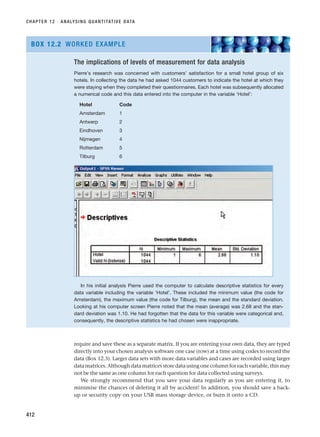
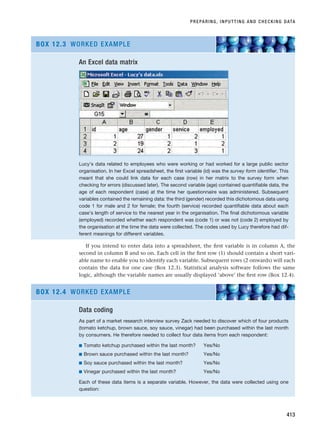
  • 263.
    – Statistical analysesusually require a minimum sample size of 30. – Research question(s) and objectives that do not require statistical estimation may need far smaller samples. ■ Sample size and the technique used are also influenced by the availability of resources, in particular financial support and time available to select the sample and to collect, enter into a computer and analyse the data. ■ Probability sampling techniques all necessitate some form of sampling frame, so they are often more time consuming than non-probability techniques. ■ Where it is not possible to construct a sampling frame you will need to use non-probability sampling techniques. ■ Non-probability sampling techniques also provide you with the opportunity to select your sample purposively and to reach difficult-to-identify members of the population. ■ For many research projects you will need to use a combination of different sampling tech- niques. ■ All your choices will be dependent on your ability to gain access to organisations. The con- siderations summarised earlier must therefore be tempered with an understanding of what is practically possible. SELF-CHECK QUESTIONS 235 SELF-CHECK QUESTIONS Help with these questions is available at the end of the chapter. 7.1 Identify a suitable sampling frame for each of the following research questions: a How do company directors of manufacturing firms of over 500 employees think a specified piece of legislation will affect their companies? b Which factors are important in accountants’ decisions regarding working in mainland Europe? c How do employees at Cheltenham Gardens Ltd think the proposed introduction of compulsory Saturday working will affect their working lives? 7.2 Lisa has emailed her tutor with the following query regarding sampling and dealing with non- response. Imagine you are Lisa’s tutor. Draft a reply to answer her query. 7.3 You have been asked to select a sample of manufacturing firms using the sampling frame below. This also lists the value of their annual output in tens of thousands of pounds over the past year. To help you in selecting your sample the firms have been numbered from 0 to 99. ➔ RESM_C07.QXP 3/30/07 6:43 AM Page 235
  • 264.
    CHAPTER 7 ·SELECTING SAMPLES 236 Output Output Output Output Output 0 1163 20 1072 40 1257 60 1300 80 1034 1 10 21 7 41 29 61 39 81 55 2 57 22 92 42 84 62 73 82 66 3 149 23 105 43 97 63 161 83 165 4 205 24 157 44 265 64 275 84 301 5 163 25 214 45 187 65 170 85 161 6 1359 26 1440 46 1872 66 1598 86 1341 7 330 27 390 47 454 67 378 87 431 8 2097 28 1935 48 1822 68 1634 88 1756 9 1059 29 998 49 1091 69 1101 89 907 10 1037 30 1298 50 1251 70 1070 90 1158 11 59 31 10 51 9 71 37 91 27 12 68 32 70 52 93 72 88 92 66 13 166 33 159 53 103 73 102 93 147 14 302 34 276 54 264 74 157 94 203 15 161 35 215 55 189 75 168 95 163 16 1298 36 1450 56 1862 76 1602 96 1339 17 329 37 387 57 449 77 381 97 429 18 2103 38 1934 58 1799 78 1598 98 1760 19 1061 39 1000 59 1089 79 1099 99 898 a Select two simple random samples, each of 20 firms, and mark those firms selected for each sample on the sampling frame. b Describe and compare the pattern on the sampling frame of each of the samples selected. c Calculate the average (mean) annual output in tens of thousands of pounds over the past year for each of the samples selected. d Given that the true average annual output is £6 608 900, is there any bias in either of the samples selected? 7.4 You have been asked to select a 10 per cent sample of firms from the sampling frame used for self-check question 7.3. a Select a 10 per cent systematic sample and mark those firms selected for the sample on the sampling frame. b Calculate the average (mean) annual output in tens of thousands of pounds over the past year for your sample. c Given that the true average annual output is £6 608 900, why does systematic sampling provide such a poor estimate of the annual output in this case? 7.5 You need to undertake a face-to-face interview survey of managing directors of small to medium-sized organisations. From the data you collect you need to be able to generalise about the attitude of such managing directors to recent changes in government policy towards these firms. Your generalisations need to be accurate to within plus or minus 5 per cent. Unfortunately, you have limited resources to pay for interviewers, travelling and other associated costs. a How many managing directors will you need to interview? b You have been given the choice between cluster and multi-stage sampling. Which technique would you choose for this research? You should give reasons for your choice. 7.6 You have been asked to undertake a survey of residents’ opinions regarding the siting of a new supermarket in an inner city suburb (estimated catchment population 111 376 at the last census). The age and gender distribution of the catchment population at the last census is listed below: RESM_C07.QXP 3/30/07 6:43 AM Page 236
  • 265.
    REVIEW AND DISCUSSIONQUESTIONS 237 Gender Age group 0–4 5–15 16–19 20–29 30–44 45–59/64* 60/65# –74 75⫹ Males 3498 7106 4884 7656 9812 12892 4972 2684 Females 3461 6923 6952 9460 8152 9152 9284 4488 *59 females, 64 males; #60 females, 65 males a Devise a quota for a quota sample using these data. b What other data would you like to include to overcome likely variations between groups in their availability for interview and replicate the total population more precisely? Give reasons for your answer. c What problems might you encounter in using interviewers? 7.7 For each of the following research questions it has not been possible for you to obtain a sampling frame. Suggest the most suitable non-probability sampling technique to obtain the necessary data, giving reasons for your choice. a What support do people sleeping rough believe they require from social services? b Which television advertisements do people remember watching last weekend? c How do employers’ opinions vary regarding the impact of European Union legislation on employee recruitment? d How are manufacturing companies planning to respond to the introduction of road tolls? e Would users of the squash club be prepared to pay a 10 per cent increase in subscriptions to help fund two extra courts (answer needed by tomorrow morning!)? 7.8 With a friend or colleague choose one of the following research questions (or one of your own) in which you are interested. – What attributes attract people to jobs? – How are financial institutions adapting the services they provide to meet recent legislation? Use the flow charts for both probability sampling (Figure 7.3) and non-probability sampling (Figure 7.5) to decide how you could use each type of sampling independently to answer the research question. 7.9 Agree with a colleague to watch a particular documentary or consumer rights programme on the television. If possible, choose a documentary with a business or management focus. During the documentary, pay special attention to the samples from which the data for the documentary are drawn. Where possible, note down details of the sample such as who were interviewed, or who responded to questionnaires and the reasons why these people were chosen. Where this is not possible, make a note of the information you would have liked to have been given. Discuss your findings with your colleague and come to a conclusion regarding the nature of the sample used, its representativeness and the extent it was possible for the programme maker to generalise from that sample. 7.10 Obtain a copy of a quality daily newspaper and, within the newspaper, find an article which discusses a ‘survey’ or ‘poll’. Share the article with a friend. Make notes of the process used to select the sample for the ‘survey’ or ‘poll’. As you make your notes, note down any areas where you feel there is insufficient information to fully understand the sampling process. Aspects for which information may be lacking include the total population, size of sample, how the sample were selected, representativeness and so on. Discuss your findings with your friend. REVIEW AND DISCUSSION QUESTIONS RESM_C07.QXP 3/30/07 6:43 AM Page 237
  • 266.
    References Barnett, V. (1991)Sample Survey Principles and Methods, London, Edward Arnold. Baruch, Y. (1999) ‘Response rates in academic studies – a comparative analysis’, Human Relations 52: 4, 421–38. Bradley, N. (1999) ‘Sampling for Internet surveys: an examination of respondent selection for Internet research’, Journal of the Market Research Society 41: 4, 387–95. Briscoe, S. (2005) ‘Why polls are in danger of missing the point’, Financial Times, 1 March. Clennell, A. (2002) ‘How Brunel lobby came off the rails’, The Guardian, 25 November. Cooper, J. (2002) Great Britons, the Great Debate, London, National Portrait Gallery. deVaus, D.A. (2002) Surveys in Social Research (5th edn), London, Routledge. Dickson, M. (2005) ‘Companies UK: In poll position’, Financial Times, 27 August. González-Benito, J. and González-Benito, O. (2005) ‘An analysis of the relationship between environmental motivations and ISO14001 certification’, British Journal of Management 16: 2, 133–48. Healey, M.J. (1991) ‘Obtaining information from businesses’, in Healey, M.J. (ed.), Economic Activity and Land Use: The Changing Information Base for Local and Regional Studies, Harlow, Longman, pp. 193–250. Henry, G.T. (1990) Practical Sampling, Newbury Park, CA, Sage. Hewson, C., Yule, P., Laurent, D. and Vogel, C. (2003) Internet Research Methods: A Practical Guide for the Social and Behavioural Sciences, London, Sage. idea Works (2005) ‘Methodologist’s Toolchest’ [online] (cited 27 October 2005). Available from URL:http://www.ideaworks.com/MToolchest.shtml. Kervin, J.B. (1999) Methods for Business Research (2nd edn), New York, HarperCollins. CHAPTER 7 · SELECTING SAMPLES 238 PROGRESSING YOUR RESEARCH PROJECT Using sampling as part of your research ■ ■ Consider your research question(s) and objectives. You need to decide whether you will be able to collect data on the entire population or will need to collect data from a sample. ■ ■ If you decide that you need to sample, you must establish whether your research question(s) and objectives require probability sampling. If they do, make sure that a suitable sampling frame is available or can be devised, and calculate the actual sample size required taking into account likely response rates. If your research question(s) and objectives do not require probability sampling, or you are unable to obtain a suitable sampling frame, you will need to use non-probability sampling. ■ ■ Select the most appropriate sampling technique or techniques after considering the advantages and disadvantages of all suitable techniques and undertaking further reading as necessary. ■ ■ Select your sample or samples following the technique or techniques as outlined in this chapter. ■ ■ Remember to note down the reasons for your choices when you make them, as you will need to justify your choices when you write about your research method. RESM_C07.QXP 3/30/07 6:43 AM Page 238
  • 267.
    Lavrakas, P.J. (1993)Telephone Survey Methods: Sampling, Selection and Supervision (2nd edn), Newbury Park, CA, Sage. Lee, R.M. (1993) Doing Research on Sensitive Topics, London, Sage. Neuman, W.L. (2000) Social Research Methods (2nd edn), London, Allyn and Bacon. Patton, M.Q. (2002) Qualitative Research and Evaluation Methods (3rd edn), Thousand Oaks, CA, Sage. Peters, T. and Waterman, R. (1982) In Search of Excellence, New York, Harper Row. Stutely, M (2003) Numbers Guide: The Essentials of Business Numeracy, London, Bloomberg Press. Teague, A. (2000) ‘New methodologies for the 2001 Census in England and Wales’ [online] (cited 11 February 2002). Available from URL:http://www.statistics.gov.uk/nsbase/ census2001/pdfs/NewMethodologies.pdf. Thornhill, A., Saunders, M.N.K. and Stead, J. (1997) ‘Downsizing, delayering but where’s the commitment? The development of a diagnostic tool to help manage survivors’, Personnel Review 26: 1/2, 81–98. Williams, C.S. and Saunders, M.N.K. (2006) ‘Developing the service template: from measure- ment to agendas for improvement’, Service Industries Journal 26: 5. Willimack, D.K., Nichols, E. and Sudman, S. (2002) ‘Understanding unit and item nonre- sponse in business surveys’, in Dillman, D.A., Eltringe, J.L., Groves, J.L. and Little, R.J.A. (eds) (2002) Survey Nonresponse, New York, Wiley Interscience, pp. 213–27. Further reading Barnett, V. (1991) Sample Survey Principles and Methods, London, Edward Arnold. Chapters 2, 5 and 6 provide an explanation of statistics behind probability sampling and quota sampling as well as the techniques. Baruch, Y. (1999) ‘Response rates in academic studies – a comparative analysis’, Human Relations 52: 4, 421–38. This examines 175 different studies in which sampling was used covering approximately 200 000 respondents. The paper suggests likely response rates between studies and highlights a decline in response rates over the period 1975–95. deVaus, D.A. (2002) Surveys in Social Research (5th edn), London, Routledge. Chapter 6 provides a useful overview of both probability and non-probability sampling techniques. Diamantopoulos, A. and Schlegelmilch, B.B. (1997) Taking the Fear Out of Data Analysis, London, Dryden Press. Chapter 2 contains a clear, humorous discussion of both probability and non-probability sampling. Dillman, D.A., Eltringe, J.L., Groves, J.L. and Little, R.J.A. (eds) (2002) Survey Nonresponse, New York, Wiley Interscience. This book contains a wealth of information on survey non- response. Chapter 1 provides a useful overview in relation to the impact of survey design on non-response. This is discussed in more detail in Chapters 7 to 17, Chapter 14 referring specifically to business surveys and Chapter 15 to Internet-based surveys. Patton, M.Q. (2002) Qualitative Research and Evaluation Methods (3rd edn), Thousand Oaks, CA, Sage. Chapter 5, ‘Designing qualitative studies’, contains a useful discussion of non-prob- ability sampling techniques, with examples. FURTHER READING 239 For WEB LINKS visit www.pearsoned.co.uk/ saunders RESM_C07.QXP 3/30/07 6:43 AM Page 239
  • 268.
    As soon asAndrea got back to the flat after the afternoon’s lectures, she rushed to her computer and switched it on. Would he have replied to her email yet? Five days she’d been waiting for a reply from Peter, a partner at a medium-sized, United Kingdom (UK) based audit firm. She had sent him a set of questions asking about the pressures he faced from companies to agree or ‘sign off’ their annual accounts when he was not entirely happy with their treatment of certain accounting items. And she wanted some answers. She couldn’t fabricate her research material, but if she didn’t get some more primary data soon, she couldn’t see how her final-year research project was going to get the grade she needed to ensure that she graduated with a good degree. The topic was certainly a good one, as her project tutor had confirmed. From her reading of auditing texts (for example: Gray and Manson, 2005; Millichamp, 2002; Porter et al., 2003), she had established that the basic aim of an audit is to express an independent, professional opinion on the financial statements drawn up by, or on behalf of, the directors of a company. However, recent high-profile financial scandals involving companies with a previous record of unqualified or ‘clean’ audit reports suggested that auditors were not keeping ‘creative accounting’ under control. She wanted to know about the threats to their independence and integrity that auditors experienced while conducting a company audit. As a partner, Peter was an ideal source of information. She had never met Peter. It was his suggestion to have an electronic conversation about her research into auditor independence and its importance for professional integrity; when he ticked the box on her questionnaire indicating he was willing to be interviewed, he’d scribbled by the side of it, ‘Why don’t we do this by email?’ She had originally mailed her questionnaire to each of the top 50 audit firms, a list of which she’d found while browsing through a copy of the weekly professional publication, Accountancy Age (2005), that her older, professionally qualified brother had lent her. The table gave the names of the top 50 UK auditing firms, ranked by total UK fee income. She’d then looked up the main postal address of each one on the Internet and sent one copy of her questionnaire to each address, asking for the questionnaire to be completed by one of their audit engagement partners. Since these people (or equivalent) are responsible for dealing with the board of directors, senior management and audit committee of the client company and will be a senior person with substantial experience of auditing, she considered them ideally qualified to answer the kinds of questions she was asking. Five weeks later, Peter’s was one of only 11 responses she had received, far short of the 25 she had been hoping for. Most of those had arrived in the third week after the mailing and she hadn’t had anything in the post for nearly a week now. She was also disappointed that the answers to the closed questions showed a high degree of homogeneity and many of the write-in answers to the open questions didn’t say much at all. She’d even thought about throwing the questionnaires away and starting again, but it was getting too near the submission deadline to do that. As far as Andrea could see, the only useful thing to come out of the questionnaire survey was the two interview leads. At least it wasn’t going to take her long to analyse the questionnaire responses, such as they were, though it was a shame that she wouldn’t be able to show off the statistical skills she had learnt the previous year. Given that only one other respondent had volunteered to be interviewed, she had jumped at the opportunity to get some more data for the research project by ‘e-interviewing’ Peter (Bampton and Cowton, 2002). With ethically sensitive issues there is always the problem of whether people are ‘telling like it is’ (Randall and Fernandes, 1991), but an interview seemed to offer the prospect of getting CHAPTER 7 · SELECTING SAMPLES 240 Auditor independence and integrity in accounting firms CASE 7 RESM_C07.QXP 3/30/07 6:43 AM Page 240
  • 269.
    to the heartof ethical issues in a way that the questionnaire couldn’t do (Liedtka, 1992) – and the first round of questions and answers with Peter had been encouraging. His replies had seemed to be really open and candid, and he had made some interesting remarks about the ‘real world’ of auditing, not least the pressure not to lose a particular audit engagement: push the client too hard, and the directors of the company could well be looking to appoint a new auditor next year. Then you could say goodbye to the audit fee and any additional consultancy services – and find yourself telling some of your staff that they were ‘no longer required’. His comments had brought home to her just how risky it could be to be over- zealous in audit work, to stand up to a client who was wanting to bend the financial reporting rules. She wanted and needed to know more and had immediately sent off the following open-ended questions, to which she was still awaiting a response: ■ Which items in the accounts cause you the most problems as an auditor? Where are companies at their most ‘creative’ with the figures? ■ Have you ever given an unqualified audit report which you didn’t feel happy about at the time or which you later regretted? ■ Have any companies threatened you with the loss of an audit engagement? If so, how has this been communicated to you? ■ What do you think should be done to ensure that auditors act more ethically? How can professional integrity be safeguarded? Her ancient computer at last booted up and she logged onto her email account. She opened the inbox: still no reply from Peter. Her heart sank. She wondered what was happening. She worried that perhaps her follow-up questions had been too probing. After all, with so many big accounting scandals in recent years, the independence of auditors and their professional integrity were a big issue, and a sensitive one. Some of the excesses of ‘creative accounting’ were being blamed on auditors who weren’t courageous or scrupulous enough to stand up to corporate management. She could imagine why he might be reluctant to answer some of her questions. But then again, was she just being unduly pessimistic or even paranoid? Was he simply busy at the moment? A final-year student project wouldn’t be his top priority. He might even be on holiday. (At this point a picture formed in her mind of a luxury villa on a sun-drenched island and she began to dream of how she would love to be there now. But then the reality of her research project burst back in and she was back in her flat, staring at the computer screen.) What should she do now? What could she do? Should she email him a reminder? That might seem impudent. Should she try telephoning him? That might seem pushy. Should she perhaps offer to visit him in his office? But it was 140 miles to the firm’s headquarters, a full day’s round trip, when she had so many academic assignment deadlines to meet and a part-time job to hold down – not to mention the train fare to find out of her meagre financial resources. And, after all, it was his idea to do the interview by email. Perhaps it was best to leave it another day and hope that he would get back to her without any prompting. She turned off the computer and headed for the kitchen and the biscuits. References Accountancy Age (2005) ‘Top 50 accounting firms’ [online] (cited 27 November 2005). Available from URL:http://www.accountancyage.com/resource/top50 Bampton, R. and Cowton, C.J. (2002) ‘The e-interview’, Forum: Qualitative Social Research 3: 2 [online] (cited 27 November 2005). Available from URL:http://www.qualitative-research.net/fqs/fqs- e/inhalt2-02-e.htm. Gray, I. and Manson, S. (2005) The Audit Process: Principles, Practice and Cases (3rd edn), London, Thomson Learning Liedtka, J.M. (1992) ‘Exploring ethical issues using personal interviews’, Business Ethics Quarterly 2: 2, 161–81. Millichamp, A.H. (2002) Auditing (8th edn), London, Continuum. Porter, B., Simon, J. and Hatherly, D.J. (2003) Principles of External Auditing (2nd edn), Chichester, Wiley. Randall, D.M. and Fernandes, M.F. (1991) ‘The social desirability response bias in ethics research’, Journal of Business Ethics 10: 11, 805–17. QUESTIONS 1 From what you know of her research design and approach, how appropriate do you consider Andrea’s approach to sampling to be? CASE 7 241 ➔ RESM_C07.QXP 3/30/07 6:43 AM Page 241
  • 270.
    2 How wouldyou assess her current position in relation to the number of responses and what advice could you give her about possible options for improving her chances of completing a reasonably successful project? 3 What are the major benefits and drawbacks of seeking to interview via email? What are the practical issues that would need to be addressed when collecting data through an ‘e-interview’? 4 How would you select a sample and research a sensitive topic like auditor independence and integrity? CHAPTER 7 · SELECTING SAMPLES 242 Additional case studies relating to material covered in this chapter are available via the book’s Companion Website, www.pearsoned.co.uk/saunders. They are: ■ Change management at Hattersley Electronics ■ Employment networking in the Hollywood film industry. 7.1 a A complete list of all directors of large manufacturing firms could be purchased from an organis- ation that specialised in selling such lists to use as the sampling frame. Alternatively, a list that contained only those selected for the sample could be purchased to reduce costs. These data are usually in a format suitable for being read by word-processing and database computer soft- ware, and so they could easily be merged into standard letters such as those included with questionnaires. b A complete list of accountants, or one that contained only those selected for the sample, could be purchased from an organisation that specialised in selling such lists. Care would need to be taken regarding the precise composition of the list to ensure that it included those in private practice as well as those working for organisations. Alternatively, if the research was interested only in qualified accountants then the professional accountancy bodies’ yearbooks, which list all their members and their addresses, could be used as the sampling frame. c The personnel records or payroll of Cheltenham Gardens Ltd could be used. Either would provide an up-to-date list of all employees with their addresses. 7.2 Your draft of Lisa’s tutor’s reply is unlikely to be worded the same way as the one below. However, it should contain the same key points: From: “tutor’s name” lisas.tutor@anytown.ac.uk To: lisa@anytown.ac.uk Sent: today’s date 7:06 Subject: Re: Help!!! Sampling non-response? Hi Lisa Many thanks for the email. This is not in the least unusual. I reckon to get about 1 in 20 interviews which go this way and you just have to say ‘c’est la vie’. This is not a problem from a methods per- spective as, in sampling terms, it can be treated as a non-response due to the person refusing to respond to your questions. This would mean you could not use the material. However, if he answered some other questions then you should treat this respondent as a partial non-response and just not use those answers. Hope this helps. ‘Tutor’s name’ SELF-CHECK ANSWERS RESM_C07.QXP 3/30/07 6:43 AM Page 242
  • 271.
    SELF-CHECK ANSWERS 243 7.3 aYour answer will depend on the random numbers you selected. However, the process you follow to select the samples is likely to be similar to that outlined. Starting at randomly selected points, two sets of 20 two-digit random numbers are read from the random number tables (Appendix 4). If a number is selected twice it is disregarded. Two possible sets are: Sample 1: 38 41 14 59 53 03 52 86 21 88 55 87 85 90 74 18 89 40 84 71 Sample 2: 28 00 06 70 81 76 36 65 30 27 92 73 20 87 58 15 69 22 77 31 These are then marked on the sampling frame (sample 1 is shaded blue, sample 2 is shaded orange) as shown below: 0 1163 20 1072 40 1257 60 1300 80 1034 1 10 21 7 41 29 61 39 81 55 2 57 22 92 42 84 62 73 82 66 3 149 23 105 43 97 63 161 83 165 4 205 24 157 44 265 64 275 84 301 5 163 25 214 45 187 65 170 85 161 6 1359 26 1440 46 1872 66 1598 86 1341 7 330 27 390 47 454 67 378 87 431 8 2097 28 1935 48 1822 68 1634 88 1756 9 1059 29 998 49 1091 69 1101 89 907 10 1037 30 1298 50 1251 70 1070 90 1158 11 59 31 10 51 9 71 37 91 27 12 68 32 70 52 93 72 88 92 66 13 166 33 159 53 103 73 102 93 147 14 302 34 276 54 264 74 157 94 203 15 161 35 215 55 189 75 168 95 163 16 1298 36 1450 56 1862 76 1602 96 1339 17 329 37 387 57 449 77 381 97 429 18 2103 38 1934 58 1799 78 1598 98 1760 19 1061 39 1000 59 1089 79 1099 99 898 b Your samples will probably produce patterns that cluster around certain numbers in the sampling frame, although the amount of clustering may differ, as illustrated by samples 1 and 2 above. c The average (mean) annual output in tens of thousands of pounds will depend entirely upon your sample. For the two samples selected the averages are: Sample 1 (blue): £6 752 000 Sample 2 (orange): £7 853 500 d There is no bias in either of the samples, as both have been selected at random. However, the average annual output calculated from sample 1 represents the total population more closely than that calculated from sample 2, although this has occurred entirely at random. 7.4 a Your answer will depend on the random number you select as the starting point for your systematic sample. However, the process you followed to select your sample is likely to be similar to that out- lined. As a 10 per cent sample has been requested, the sampling fraction is 1 ⁄10. Your starting point is selected using a random number between 0 and 9, in this case 2. Once the firm numbered 2 has been selected, every tenth firm is selected: 2 12 22 32 42 52 62 72 82 92 RESM_C07.QXP 3/30/07 6:43 AM Page 243
  • 272.
    CHAPTER 7 ·SELECTING SAMPLES 244 These are shaded orange on the sampling frame and will result in a regular pattern whatever the starting point: 0 1163 20 1072 40 1257 60 1300 80 1034 1 10 21 7 41 29 61 39 81 55 2 57 22 92 42 84 62 73 82 66 3 149 23 105 43 97 63 161 83 165 4 205 24 157 44 265 64 275 84 301 5 163 25 214 45 187 65 170 85 161 6 1359 26 1440 46 1872 66 1598 86 1341 7 330 27 390 47 454 67 378 87 431 8 2097 28 1935 48 1822 68 1634 88 1756 9 1059 29 998 49 1091 69 1101 89 907 10 1037 30 1298 50 1251 70 1070 90 1158 11 59 31 10 51 9 71 37 91 27 12 68 32 70 52 93 72 88 92 66 13 166 33 159 53 103 73 102 93 147 14 302 34 276 54 264 74 157 94 203 15 161 35 215 55 189 75 168 95 163 16 1298 36 1450 56 1862 76 1602 96 1339 17 329 37 387 57 449 77 381 97 429 18 2103 38 1934 58 1799 78 1598 98 1760 19 1061 39 1000 59 1089 79 1099 99 898 b The average (mean) annual output of firms for your sample will depend upon where you started your systematic sample. For the sample selected above it is £757 000. c Systematic sampling has provided a poor estimate of the annual output because there is an under- lying pattern in the data, which has resulted in firms with similar levels of output being selected. 7.5 a If you assume that there are at least 100 000 managing directors of small to medium-sized organis- ations from which to select your sample, you will need to interview approximately 380 to make generalisations that are accurate to within plus or minus 5 per cent (Table 7.1). b Either cluster or multi-stage sampling could be suitable; what is important is the reasoning behind your choice. This choice between cluster and multi-stage sampling is dependent on the amount of limited resources and time you have available. Using multi-stage sampling will take longer than cluster sampling as more sampling stages will need to be undertaken. However, the results are more likely to be representative of the total population owing to the possibility of stratifying the samples from the subareas. 7.6 a Prior to deciding on your quota you will need to consider the possible inclusion of residents who are aged less than 16 in your quota. Often in such research projects residents aged under 5 (and those aged 5–15) are excluded. You would need a quota of between 2000 and 5000 residents to obtain a reasonable accuracy. These should be divided proportionally between the groupings as illustrated in the possible quota below: Gender Age group 16–19 20–29 30–44 45–59/64 60/65–74 75⫹ Males 108 169 217 285 110 59 Females 154 209 180 203 205 99 RESM_C07.QXP 3/30/07 6:43 AM Page 244
  • 273.
    SELF-CHECK ANSWERS 245 b Dataon social class, employment status, socioeconomic status or car ownership could also be used as further quotas. These data are available from the Census and are likely to affect shopping habits. c Interviewers might choose respondents who were easily accessible or appeared willing to answer the questions. In addition, they might fill in their quota incorrectly or make up the data. 7.7 a Either snowball sampling as it would be difficult to identify members of the desired population or, possibly, convenience sampling because of initial difficulties in finding members of the desired popu- lation. b Quota sampling to ensure that the variability in the population as a whole is represented. c Purposive sampling to ensure that the full variety of responses are obtained from a range of respon- dents from the population. d Self-selection sampling as it requires people who are interested in the topic. e Convenience sampling owing to the very short timescales available and the need to have at least some idea of members’ opinions. Get ahead using resources on the Companion Website at: www.pearsoned.co.uk/saunders ■ Improve your SPSS and NVivo research analysis with practice tutorials. ■ Save time researching on the Internet with the Smarter Online Searching Guide. ■ Test your progress using self-assessment questions. ■ Follow live links to useful websites. Companion Website RESM_C07.QXP 3/30/07 6:43 AM Page 245
  • 274.
    Using secondary data 8 LEARNINGOUTCOMES By the end of this chapter you should be able to: ➔ identify the full variety of secondary data that are available; ➔ appreciate ways in which secondary data can be utilised to help to answer research question(s) and to meet objectives; ➔ understand the advantages and disadvantages of using secondary data in research projects; ➔ use a range of techniques, including published guides and the Internet, to locate secondary data; ➔ evaluate the suitability of secondary data for answering research question(s) and meeting objectives in terms of coverage, validity, reliability and measurement bias; ➔ apply the knowledge, skills and understanding gained to your own research project. 8.1 Introduction When first considering how to answer their research question(s) or meet their objectives, few of our students consider initially the possibility of reanalysing data that have already been collected for some other purpose. Such data are known as secondary data. Most automatically think in terms of collecting new (primary) data specifically for that purpose. Yet, despite this, such secondary data can provide a useful source from which to answer, or partially to answer, your research question(s). Secondary data include both raw data and published summaries. Most organisations collect and store a variety of data to support their operations: for example, payroll details, copies of letters, minutes of meetings and accounts of sales of goods or services. Quality daily newspapers contain a wealth of data, including reports about takeover bids and companies’ share prices. Government departments undertake surveys and publish official statistics covering social, demographic and economic topics. Consumer research organis- 246 RESM_C08.QXP 3/30/07 6:46 AM Page 246
  • 275.
    ations collect datathat are used subsequently by different clients. Trade organisations collect data from their members on topics such as sales that are subsequently aggregated and published. Some of these data, in particular documents such as company minutes, are available only from the organisations that produce them, and so access will need to be negotiated (Section 6.3). Others, including government surveys such as a census of population, are widely available in published form as well as via the Internet and on CD-ROM in univer- sity libraries. A growing variety have been deposited in, and are available from, data archives. In addition, the vast majority of companies and professional organisations have their own Internet sites from which data may be obtained. Online computer databases containing company information can be accessed via the Internet through information gateways such as Biz/Ed (Table 3.5). For certain types of research project, such as those requiring national or international comparisons, secondary data will probably provide the main source to answer your research question(s) and to address your objectives. However, if you are undertaking your research project as part of a course of study, we recommend that you check the assess- ment regulations before deciding to rely entirely on secondary data. You may be required to collect primary data for your research project. Most research questions are answered using some combination of secondary and primary data. Where limited appropriate sec- ondary data are available, you will have to rely mainly on data you collect yourself. INTRODUCTION 247 You, like all of us, probably receive ‘junk mail’ through the post almost every week. Such letters are clearly derived from computer mailing lists and so your name and address must be stored on a computer somewhere. However, this is only the tip of all the data that is likely to be stored about every one of us. In addition to private organisations, public sector organisations such as central and local government, the police, the Inland Revenue and the health service all hold data about us electroni- cally. Such data are obtained every time we interact directly or indirectly with these organisations’ electronic systems. Your supermarket loyalty card allows every pur- chase you make to be recorded against your name, allowing the supermarket to predict your purchasing patters as well as target special offers; your pass- port has a computer readable code that links to a central database and means that your travel movements across borders can be recorded. These data are often reused for purposes other than that for which they were originally collected. They are aggregated to provide information about, for example, different geographical regions or social groups. They are merged with other data to form new data sets, the creation of these secondary data sets allowing new relationships to be explored. They are also made available or sold to other people and organisations for new purposes as secondary data, resulting perhaps in the creation of new mailing lists and more junk mail! Junk mail Source: Alamy/Manor Photography RESM_C08.QXP 3/30/07 6:46 AM Page 247
  • 276.
    In this chapterwe examine the different types of secondary data that are likely to be available to help you to answer your research question(s) and meet your objectives, how you might use them (Section 8.2), and a range of methods, including published guides, for locating these data (Section 8.3). We then consider the advantages and disadvantages of using secondary data (Section 8.4) and discuss ways of evaluating their validity and reliability (Section 8.5). We do not attempt to provide a comprehensive list of secondary data sources, as this would be an impossible task within the space available. 8.2 Types of secondary data and uses in research Secondary data include both quantitative and qualitative data (Section 5.4), and they are used principally in both descriptive and explanatory research. The data you use may be raw data, where there has been little if any processing, or compiled data that have received some form of selection or summarising (Kervin, 1999). Within business and management research such data are used most frequently as part of a case study or survey research strategy. However, there is no reason not to include secondary data in other research strategies, including archival research, action research and experimental research. Different researchers (for example, Bryman, 1989; Dale et al., 1988; Hakim, 1982, 2000; Robson, 2002) have generated a variety of classifications for secondary data. These classifications do not, however, capture the full variety of data. We have therefore built on their ideas to create three main subgroups of secondary data: documentary data, survey-based data, and those compiled from multiple sources (Figure 8.1). Documentary secondary data Documentary secondary data are often used in research projects that also use primary data collection methods. However, you can also use them on their own or with other sources of secondary data, for example for business history research within an archival research strategy (Box 5.6). Documentary secondary data include written materials such as notices, correspondence, minutes of meetings, reports to shareholders, diaries, tran- scripts of speeches and administrative and public records (Box 8.1). Written documents can also include books, journal and magazine articles and newspapers. These can be important raw data sources in their own right, as well as a storage medium for compiled data. You could use written documents to provide qualitative data such as managers’ espoused reasons for decisions. They could also be used to generate statistical measures such as data on absenteeism and profitability derived from company records (Bryman, 1989). Documentary secondary data also include non-written materials (Figure 8.2) such as voice and video recordings, pictures, drawings, films and television programmes (Robson, 2002), DVDs (digital versatile disks) and CD-ROMs as well as organisations’ databases. These data can be analysed both quantitatively and qualitatively. In addition, they can be used to help to triangulate findings based on other data such as written doc- uments and primary data collected through observation, interviews or questionnaires (Chapters 9, 10 and 11). For your research project the documentary sources you have available will depend on whether you have been granted access to an organisation’s records as well as on your success in locating library, data archive and commercial sources (Section 8.3). Access to CHAPTER 8 · USING SECONDARY DATA 248 RESM_C08.QXP 3/30/07 6:46 AM Page 248
  • 277.
    an organisation’s datawill be dependent on gatekeepers within that organisation (Section 6.3). In our experience, those research projects that make use of documentary secondary data often do so as part of a within-company action research project or a case study of a particular organisation. Survey-based secondary data Survey-based secondary data refers to data collected using a survey strategy, usually by questionnaires (Chapter 11) that have already been analysed for their original purpose. Such data normally refer to organisations, people or households. They are made available as compiled data tables or, increasingly frequently, as a downloadable matrix of raw data (Section 12.2) for secondary analysis. Survey-based secondary data will have been collected through one of three distinct subtypes of survey strategy: censuses, continuous/regular surveys or ad hoc surveys (Figure 8.1). Censuses are usually carried out by governments and are unique because, unlike surveys, participation is obligatory (Hakim, 2000). Consequently, they provide very good coverage of the population surveyed. They include censuses of population, which have been carried out in many countries since the 18th century and in the UK since 1801 (Office for National Statistics, 2001), and other surveys such as the UK Annual Survey of Hours and Earnings. Published tabulations are available via the Internet for more recent UK censuses, but it is now also possible to obtain the raw data 100 years after census via the Internet (see Table 8.3 on page 258). In contrast, the UK Annual Survey of TYPES OF SECONDARY DATA AND USES IN RESEARCH 249 Documentary Secondary data Written materials Non-written materials Censuses Ad hoc surveys Survey Examples: Organisations' databases such as personnel or production. Organisations' communications such as emails, letters, memos. Organisationsí websites. Reports and minutes of committees. Journals. Newspapers. Diaries. Interview transcripts. Examples: Media accounts including television and radio. Voice recordings. Video recordings. Examples: Financial Times country reports. Government publications. Books. Journals. Examples: Industry statistics and reports. Government publications. European Union publications. Books. Journals. Examples: Governments’ Censuses: Census of Population, Census of Employment. Examples: Government: Family Spending, Labour market trends. Organisation: BMRB International’s Target Group Index, Employee attitude surveys. Examples: Governments’ surveys. Organisations’ surveys. Academics’ surveys. Multiple source Area based Time series based Continuous and regular surveys Figure 8.1 Types of secondary data Source: © Mark Saunders, Philip Lewis and Adrian Thornhill, 2006 RESM_C08.QXP 3/30/07 6:46 AM Page 249
  • 278.
    Hours and Earnings,which replaced the New Earnings Survey (1970–2003), provides information on the levels, make-up and distribution of earnings as well as details of hours worked and is only published online (Office for National Statistics, 2005). The data from censuses conducted by many governments are intended to meet the needs of gov- ernment departments as well as of local government. As a consequence they are usually clearly defined, well documented and of a high quality. Such data are easily accessible in compiled form, and are widely used by other organisations and individual researchers. Continuous and regular surveys are those surveys, excluding censuses, that are repeated over time (Hakim, 1982). They include surveys where data are collected throughout the year, such as the UK’s General Household Survey (Walker, 2002), and those repeated at regular intervals. The latter include the Labour Force Survey, which since 1998 has been undertaken quarterly using a core set of questions by Member States throughout the European Union. This means that some comparative data are available for Member States, although access to these data is limited by European and individual countries’ legislation (Economic and Social Data Service, 2005). Non-governmental bodies also carry out regular surveys. These include general-purpose market research surveys such as BMRB International’s Target Group Index. Because of the Target Group Index’s commer- cial nature, the data are very expensive. However, BMRB International has provided copies of reports (usually over three years old) to between 20 and 30 UK university libraries. Many large organisations undertake regular surveys, a common example being the employee attitude survey. However, because of the sensitive nature of such infor- mation it is often difficult to gain access to such survey data, especially in its raw form. Census and continuous and regular survey data provide a useful resource with which to compare or set in context your own research findings. Aggregate data are often avail- able via the Internet, on CD-ROMs or in published form in libraries (Section 8.3), in particular for government surveys. When using these data you need to check when they were collected, as it often takes at least a year for publication to occur! If you are under- taking research in one UK organisation you could use these data to place your case study CHAPTER 8 · USING SECONDARY DATA 250 Using documentary secondary data Sasha was interested in how her work placement organisation dealt with complaints by cus- tomers. Her mentor within the organisation arranged for her to have access to the paper-based files containing customers’ letters of complaint and the replies sent by the organisation’s cus- tomer relations team (written documentary secondary data). Reading through the customer’s letters, Sasha soon realised that many of these customers wrote to complain because they had not received a satisfactory response when they had complained earlier by telephone. She there- fore asked her mentor if records were kept of complaints made by customers by telephone. Her mentor said that summary details of all telephone conversations by the customer relations team, including complaints, were kept in their database (written documentary secondary data) and offered to find out precisely what data were held. Her mentor was, however, doubtful as to whether these data would be as detailed as the customers’ letters. On receiving details of the data held in the customer relations database, Sasha realised that the next stage would be to match the complaints data from the paper-based files with telephone complaints data. The latter, she hoped, would enable her to to obtain a complete list of all complaints and set the written complaints in context of all complaints received by the organisation. BOX 8.1 WORKED EXAMPLE RESM_C08.QXP 3/30/07 6:46 AM Page 250
  • 279.
    organisation within thecontext of its industry group or division using the Census of Employment. Aggregated results of the Census of Employment can be found in Labour Market Trends as well as via the UK government’s official statistics information gateway national statistics. Alternatively, you might explore issues already highlighted by data from an organisation survey through in-depth interviews. Survey secondary data may be available in sufficient detail to provide the main data set from which to answer your research question(s) and to meet your objectives. Alternatively, they may be the only way in which you can obtain the required data. If your research question is concerned with national variations in consumer spending it is unlikely that you will be able to collect sufficient data. You will therefore need to rely on secondary data such as those contained in Family Spending (formerly the Family Expenditure Survey; Gibbins, 2005). This reports findings from the Expenditure and Foods Survey. For some research questions and objectives suitable data will be available in published form. For others, you may need more disaggregated data. This may be avail- able via the Internet (Section 3.4), on CD-ROM, or from archives (Section 8.3). We have found that for most business and management research involving secondary data you are unlikely to find all the data you require from one source. Rather, your research project is likely to involve detective work in which you build your own multiple-source data set using different data items from a variety of secondary data sources and perhaps linking these to primary data you have collected yourself (Box 8.2). Like all detective work, finding data that help to answer a research question or meet an objective is immensely satisfying. Ad hoc surveys are usually one-off surveys and are far more specific in their subject matter. They include data from questionnaires that have been undertaken by inde- pendent researchers as well as interviews undertaken by organisations and governments. Because of their ad hoc nature, you will probably find it more difficult to discover relevant surveys. However, it may be that an organisation in which you are undertaking research has conducted its own questionnaire, on an issue related to your research. Some organ- isations will provide you with a report containing aggregated data; others may be willing to let you reanalyse the raw data from this ad hoc survey. Alternatively, you may be able to gain access to and use raw data from an ad hoc survey that has been deposited in an archive (Section 8.3). Multiple-source secondary data Multiple-source secondary data can be based entirely on documentary or on survey sec- ondary data, or can be an amalgam of the two. The key factor is that different data sets have been combined to form another data set prior to your accessing the data. One of the more common types of multiple-source data that you are likely to come across in doc- ument form is various compilations of company information such as Europe’s 15,000 Largest Companies (ELC International, 2006). This contains comparable data on the top 15 000 European companies ranked by sales, profits and number of employees as well as alphabetical listings. Other multiple-source secondary data include the various shares price listings for different stock markets in the financial pages of quality newspapers. These are available in most university libraries, including back copies on microfilm or CD-ROM. However, you need to beware of relying on CD-ROM copies for tabular data or diagrams as some still contain only the text of articles. The way in which a multiple-source data set has been compiled will dictate the sorts of research question(s) or objectives with which you can use it. One method of compi- lation is to extract and combine selected comparable variables from a number of surveys TYPES OF SECONDARY DATA AND USES IN RESEARCH 251 RESM_C08.QXP 3/30/07 6:46 AM Page 251
  • 280.
    or from thesame survey that has been repeated a number of times to provide a time series of data. For many undergraduate and taught masters courses’ research projects, this is one of the few ways in which you will be able to get data over a long period to under- take a longitudinal study. Other ways of obtaining time-series data are to use a series of company documents such as appointment letters or public and administrative records to create your own longitudinal secondary data set. Examples include the UK Employment Department’s stoppages at work data held by the Data Archive based at the University of Essex and those derived by researchers from 19th-century population census returns, which, in the UK, are accessible to the public after 100 years. Data can also be compiled for the same population over time using a series of ‘snap- shots’ to form cohort studies. Such studies are relatively rare, owing to the difficulty of maintaining contact with members of the cohort from year to year. An example is the television series Seven Up (already mentioned in Section 5.5), which has followed a cohort since they were schoolchildren at seven-year intervals for over 40 years. Secondary data from different sources can also be combined, if they have the same geographical basis, to form area-based data sets (Hakim, 2000). Such data sets usually draw together quantifiable information and statistics, and are commonly produced by CHAPTER 8 · USING SECONDARY DATA 252 Combining secondary and primary data Supplier branded products sold by major supermarkets have, in recent years, faced increased competiton from supermarkets’ own brands. One consequence of this has been that ostensibly similar products often sell at very different prices. Research by Davies and Brito (2004) pub- lished in the European Journal of Marketing sought to answer the question ‘why?’ using the concept of value systems. Davies and Brito selected five product types for their research: washing-up liquids, corn- flakes, margerine, mayonnaise, and cream crackers. Data were then gathered on the cost structure of the various supply chains for each product type. Selling prices were obtained at each stage in the value system: retail selling prices to customers for individual retailers were obtained from secondary data held by two market research companies. These were combined with primary data on purchase prices of retailers from manufacturers, obtained from interviews with managers working for both the retailers and their suppliers. Data on raw materials were derived from each product’s ‘ingredients’. These secondary data were obtained from a variety of sources, including manufacturers, retailers (in the case of own brands) and from the declared list of ingredients. Costs of these raw materials were then obtained from the manufacturers and their suppliers. When combined with estimates of manu- facturing costs, based on details of the manufacturing processes obtained from manufacturers and university departments, Davies and Brito were able to calculate the raw material cost per tonne of finished product. They verified all these data by checking each statistic with at least one other source. Based on their analyses of these secondary and primary data Davies and Brito concluded that the main reason for differences in selling prices between supplier branded products and supermarkets’ own brands was the internal costs (such as research and development) of indi- vidual value system members (for example, manufacturers and retailers). In particular, the internal costs of brand manufacturers were found to be the main source of their products’ price differences when compared with supermarkets’ own brands. The only product type where the price differential between the branded good and the supermarkets’ own brand could be justi- fied in terms of quality was washing-up liquid. BOX 8.2 FOCUS ON MANAGEMENT RESEARCH RESM_C08.QXP 3/30/07 6:46 AM Page 252
  • 281.
    governments for theircountry. Area-based multiple-source data sets are usually available in published form for the countries and their component standard economic planning regions. The more widely used by our students include the UK’s Annual Abstract of Statistics (Penny, 2005), Europe in figures: Eurostat yearbook 2005 (Eurostat, 2005a) and the journal Labour Market Trends. Area-based multiple-source data sets are also available from data archives. These include data such as the Labour Force Survey (UK Data Archive, 2006) and Eurostat’s statistical data collections for member countries (Eurostat, 2005b). 8.3 Locating secondary data Unless you are approaching your research project with the intention of analysing one specific secondary data set that you already know well, your first step will be to ascertain whether the data you need are available. Your research question(s), objectives and the literature you have reviewed will guide this. For many research projects you are likely to be unsure as to whether the data you require are available as secondary data. Fortunately, there are a number of pointers to the sorts of data that are likely to be available. The breadth of data discussed in the previous sections serves only to emphasise the variety of possible locations in which such data may be found. Finding relevant sec- ondary data requires detective work, which has two interlinked stages: 1 establishing that the sort of data you require are likely to be available as secondary data; 2 locating the precise data you require. The availability of secondary data There are a number of clues to whether the secondary data you require are likely to be available. As part of your literature review you will have already read books and journal articles on your chosen topic. Where these have made use of secondary data, they will provide you with an idea of the sort of data that are available. In addition, these books and articles should contain full references to the sources of the data. Where these refer to published secondary data such as multiple-source or survey reports it is usually rela- tively easy to track down the original source. Quality national newspapers are also often a good source as they often report summary findings of recent government reports (Box 8.3). Your tutors have probably already suggested that you read a quality national news- paper on a regular basis, advice we would fully endorse as it is an excellent way of keeping up to date with recent events in the business world. References for unpublished and documentary secondary data are often less specific, referring to ‘unpublished survey results’ or an ‘in-house company survey’. Although these may be insufficient to locate or access the actual secondary data, they still provide useful clues about the sort of data that might be found within organisations and which might prove useful. Subject-specific textbooks such as Curran and Blackburn’s (2001) Researching the Small Enterprise can provide a clear indication of the secondary sources available in your research area, in this instance small enterprises. Other textbooks, such as Kingsbury’s (1997) IT Answers to HR Questions, can provide you with valuable clues about the sort of documentary secondary data that are likely to exist within organis- ations’ management information systems. Tertiary literature such as indexes and catalogues can also help you to locate secondary data (Sections 3.2–3.4). Data archive catalogues, such as for the UK Data Archive at the LOCATING SECONDARY DATA 253 RESM_C08.QXP 3/30/07 6:46 AM Page 253
  • 282.
    University of Essex,may prove a useful source of the sorts of secondary data available.1 This archive holds the UK’s largest collection of qualitative and quantitative digital social science and humanities data sets for use by the research community (UK Data Archive, 2006). These data have been acquired from academic, commercial and government sources, and relate mainly to post-war Britain. The complete catalogue of these can be accessed and searched via the Internet (Section 3.5) through the Archive’s home page (see Table 8.2 on page 257). However, it should be remembered that the supply of data and documentation for all of the UK Data Archive’s data sets is charged at cost, and there may be additional administrative and royalty charges. More recently, online indexes and catalogues have become available with direct link- ages to downloadable files, often in spreadsheet format. Government websites such as the UK Government’s Directgov and the European Union’s Europa provide useful gateways to a wide range of statistical data, reports and legislative documents. However, although data from such government sources are usually of good quality, those from other sources CHAPTER 8 · USING SECONDARY DATA 254 Interest rates are more likely to be changed in February, May, August and November than at other times because those are the months in which the Bank of England’s monetary policy committee publishes its quarterly inflation report, says Rachel Lomax, one of the Bank’s deputy governors. Since 2002, more than 70 per cent of rate changes have occured in February, May, August or November. Ms Lomax said there was “no necessary reason” why interest rate changes should take place in inflation report months, because “information accrues relatively evenly over the year, and the committee goes through the same decision taking process every month”. But she added: “In non-inflation report months, the MPC may sometimes decide to ‘wait and see’ – to postpone a possible interest change until more evi- dence has accumulated.” Ms Lomax noted that the markets expected interest rate changes to occur in months when there was an inflation report and the MPC was known not to want to surprise the markets if possible. One implication of her remarks is that interest rates are unlikely to rise until after a general election if, as is widely expected, it is held on May 5. Apart from the additional information that exists in inflation report months, Ms Lomax pointed to two other possible reasons why MPC’s behaviour had changed since 2001: first, that there had been fewer economic shocks that required interest rate moves and second that current MPC members took a less activist view than former members. Articles published by the Bank today in its quarterly bulletin show how the MPC is trying to deal with the uncertainties created by revisions to official economic data from the Office for National Statistics. Bank officials found that some surveys of business sentiment could “usefully augment that in official esti- mates, particularly at the earlier stages of the ONS’s data production cycle”. Bank staff found that the CBI quarterly industrial trends survey and the Chartered Institute of Purchasing Supply survey were best in helping to determine busi- ness investment growth in the economy. Both were better than initial estimates from the ONS. “It seems that early ONS estimates of business investment growth may not provide a very precise guide to actual changes in business investment,” the Bank officials wrote. Source: Article by Chris Giles, Financial Times, 14 March 2005. Copyright © 2005 The Financial Times Ltd. BOX 8.3 RESEARCH IN THE NEWS FT Interest rate changes likely to follow pattern 1 There are numerous other data archives in Europe and the USA. The UK Data Archive can provide access to international data through cooperative agreements and memberships of data archives throughout the world. It also provides a useful gateway to other data archives’ websites such as the Danish Data Archive, DDA, and the Dutch Data Archive, Steinmetz (UK Data Archive, 2006). RESM_C08.QXP 3/30/07 6:46 AM Page 254
  • 283.
    may be neithervalid nor reliable. It is therefore important that you evaluate the suit- ability of such secondary data for your research (Section 8.5). Informal discussions are also often a useful source. Acknowledged experts, colleagues, librarians or your project tutor may well have knowledge of the sorts of data that might be available. In addition, there is a range of published guides to secondary data sources. Those business and management guides that we, and our students, have found most useful are outlined in Table 8.1. However, there are also guides that provide more detail on sources for specific subject areas such as marketing and finance. Finding secondary data Once you have ascertained that secondary data are likely to exist, you need to find their precise location. For secondary data published by governments this will be quite easy. Precise references are often given in published guides (Table 8.1) and, where other researchers have made use of them, a full reference should exist. Locating published sec- ondary data that are likely to be held by libraries or secondary data held in archives is relatively straightforward (Box 8.4). Specialist libraries with specific subject collections such as market research reports can usually be located using the Library Association’s (2005) publication or guides by Dale (2004) and McKenzie (2003) (Table 8.1). If you are unsure where to start, confess your ignorance and ask a librarian. This will usually result in a great deal of helpful advice, as well as saving you time. Once the appropriate abstracting tool or catalogue has been located and its use demonstrated, it can be searched using similar techniques to those employed in your literature search (Section 3.5). Data that are held by organisations are more difficult to locate. For within-organis- ation data we have found that the information or data manager within the appropriate LOCATING SECONDARY DATA 255 Table 8.1 Published guides to possible secondary data sources Guide Coverage Corris, A., Yin, B. and Ricketts, C. (2000) Guide to Official statistics produced by UK government Official Statistics, London, Stationery Office Books Mort, D. (2002) Business Information Handbook, Company and market information, online business Headland, Headland Press information and a who’s who in business information Mort, D. and Wilkins, W. (2000) Sources of Unofficial Unofficial UK statistics collected by major survey United Kingdom Statistics (4th edn), Aldershot, Gower organisations; lists of who produces these data Library Association (2005) Libraries in the United Lists of 3000 libraries in the UK and Eire Kingdom and Republic of Ireland, London, Library Association Dale, P. (2004) Guide to Libraries and Information Units Lists libraries and information services in UK in Government Departments and Other Organisations Government departments and related agencies (34th edn), London, British Library Publishing McKenzie, E. (2003) Guide to Libraries in Key UK Lists libraries in UK companies that are prepared to Companies, London, British Library accept serious enquiries from outside Patzer, G.L. (1996) Using Secondary Data in Marketing Includes lists of sources specific to marketing, global Research: United States and World-wide, Westport, CT, information sources, US Census data, and more general Quorum Books business-related sources RESM_C08.QXP 3/30/07 6:46 AM Page 255
  • 284.
    department is mostlikely to know the precise secondary data that are held. This is the person who will also help or hinder your eventual access to the data and can be thought of as the gatekeeper to the information (Section 6.3). Data on the Internet can be located using information gateways such as the University of Michigan’s Documents Center (Table 8.2), and search tools where you search for all possible locations that match key words associated with your research question(s) or objectives (Section 3.5). In some cases data will be located at sites hosted by companies and professional organisations and trade associations such as those listed in Table 8.3. A good way of finding an organisation’s home page is to use a general search engine (Table 3.5) or, in the case of UK-based companies, the links provided by the Yellow Pages UK subject directory (Table 3.5). Additional guidance regarding how to use general search engines such as Google is given in Marketing Insights’ Smarter Internet Searching Guide, which is available via this book’s web page. However, searching for relevant data is often very time consuming. In addition, although the amount of data on the Internet is increasing rapidly, some of it is, in our experience, of dubious quality. The evaluation of secondary data sources, including those available via the Internet, is discussed in Section 8.5. Once you have located a possible secondary data set, you need to be certain that it will meet your needs. For documentary data or data in a published form the easiest way is to obtain and evaluate a sample copy of the data and a detailed description of how it was collected. For survey data that are available in computer-readable form, this is likely to involve some cost. One alternative is to obtain and evaluate detailed definitions for the data set variables (which include how they are coded; Section 12.2) and the documen- CHAPTER 8 · USING SECONDARY DATA 256 Establishing that the secondary data you require are available Dunkerley (1988) undertook a three-year historical research project on the naval dockyard in the Devonport area of the city of Plymouth, UK. The proposed research strategy used interviews with dockyard workers as well as secondary data sources, including: ■ enumerators’ books for population censuses from 1851; ■ records relating to dockyard employment, labour relations and skills; ■ Admiralty and Treasury papers; ■ Poor Law records; ■ a sample of local newspapers. Initially it had been assumed that these secondary data would be readily available. Unfortunately, much of the secondary data that it had been assumed were available locally had been destroyed during enemy action in the Second World War. In addition, data that still existed had been obscurely catalogued in the Public Records Office at Kew, London. This made these data difficult to find. Although copies of enumerators’ books for the population censuses were available locally, the use of census material ‘proved more difficult than had been imagined’ (Dunkerley, 1988:86). Data collected differed between successive censuses. In addition, the 100-year confidentiality rule meant that the enumerators’ books were not available for more recent censuses. Because of these and other problems, a rethink of the aims and methods of the research was undertaken prior to proceeding further. BOX 8.4 FOCUS ON MANAGEMENT RESEARCH Companion Website RESM_C08.QXP 3/30/07 6:46 AM Page 256
  • 285.
    tation that describeshow the data were collected. This evaluation process is discussed in Section 8.5. 8.4 Advantages and disadvantages of secondary data Advantages May have fewer resource requirements For many research questions and objectives the main advantage of using secondary data is the enormous saving in resources, in particular your time and money (Ghauri and ADVANTAGES AND DISADVANTAGES OF SECONDARY DATA 257 Table 8.2 Selected information gateways to secondary data on the Internet Name Internet address Comment Biz/ed http://www.bized.ac.uk Gateway for primary and secondary business and management information. UK focus Directgov http://www.direct.gov.uk/ UK government information service with links to government departments, official statistics, etc. Europa http://europa.eu.int Information (including press releases, legislation, fact sheets) published by European Union. Links include Eurostat statistics information gateway RBA Information Services http://www.rba.co.uk/ Business information gateway with links to business, statistical, government and country sites SOSIG http://www.sosig.ac.uk Evaluates and describes social science sites including those with statistical data. UK focus UK Data Archive http://www.data-archive.ac.uk Collection of UK digital data in the social science and humanities fields. Links to data archives worldwide University of Michigan http://www.lib.umich.edu/ Although predominantly govdocs/ American in focus, has excellent annotated links to international agencies, non- American governments’ websites and their statistical agencies RESM_C08.QXP 3/30/07 6:46 AM Page 257
  • 286.
    CHAPTER 8 ·USING SECONDARY DATA 258 Table 8.3 Selected secondary data sites on the Internet Name Internet address Comment Economic and Social Data Service (ESDS) http://www.esds.ac.uk Access to and support for economic and social data, both quantitative and qualitative for both the UK and other countries FT Info http://news.ft.com/ Company information on 11 000 companies, including financial performance Global Market Information Database http://www.gmid.euromonitor.com Produced by Euromonitor. Key business intelligence on countries, companies, markets, and consumers Hemscott http://www.hemscott.net Hemmington Scott’s guide to companies and investment trusts, report service and market activity analysis Hoover’s Online http://www.hoovers.com Company information on 12 000 US and international companies MIMAS http://www.mimas.ac.uk National data centre for UK higher education institutions providing access to key data such as UK census. NB: For some data sets you will need to register through your university Countries European Union http://europa.eu.int/comm/eurostat/ Site of European Union’s statistical information service. This site is available in English as well as other languages France http://www.insee.fr Site of France’s National Institute for Statistics including both statistics and government publications. Much of this website is available in English Germany http://www.destatis.de Site of Germany’s Federal Statistical Office with a number of useful links. Much of this website is available in English Ireland (Eire) http://www.cso.ie Site of the Irish Central Statistical Office (CSO), the government body responsible for compiling Irish official statistics Netherlands http://www.cbs.nl Site of Holland’s Central Bureau of Statistics (CBS). Much of this website is available in English. Provides access to StatLine, which contains statistical data that can be downloaded free of charge United Kingdom http://www.statistics.gov.uk The official UK statistics site containing official UK statistics and information about statistics, which can be accessed and downloaded free of charge Organisations Advertising Association http://www.adassoc.org.uk Advertising Standards Authority http://www.asa.org.uk Advisory, Conciliation and Arbitration Service http://www.acas.org.uk American Marketing Association http://www.marketingpower.com Association of Chartered Certified Accountants http://www.accaglobal.com British Market Research Association http://www.bmra.org.uk/ Chartered Institute of Management Accountants http://www.cimaglobal.com Chartered Institute of Marketing (CIM) http://www.cim.co.uk Chartered Institute of Personnel and Development http://www.cipd.co.uk Chartered Management Institute http://www.managers.org.uk/ Confederation of British Industry (CBI) http://www.cbi.org.uk Department of Trade and Industry (UK) http://www.dti.gov.uk Institute of Directors http://www.iod.com Institute of Financial Services http://www.ifslearning.com Institute of Practitioners in Advertising (IPA) http://www.ipa.co.uk KPMG UK http://www.kpmg.co.uk London Stock Exchange http://www.londonstockexchange.com Organisation for Economic Cooperation and Development (OECD) http://www.oecd.org Public Record Office (UK) http://www.nationalarchives.gov.uk Trades Union Congress (TUC) http://www.tuc.org.uk United Nations (UN) http://www.un.org RESM_C08.QXP 3/30/07 6:46 AM Page 258
  • 287.
    Grønhaug, 2005). Ingeneral, it is much less expensive to use secondary data than to collect the data yourself. Consequently, you may be able to analyse far larger data sets such as those collected by government surveys. You will also have more time to think about theoretical aims and substantive issues, as your data will already be collected, and subsequently you will be able to spend more time and effort analysing and interpreting the data. Unobtrusive If you need your data quickly, secondary data may be the only viable alternative. In addition, they are likely to be higher-quality data than could be obtained by collecting your own (Stewart and Kamins, 1993). Using secondary data within organisations may also have the advantage that, because they have already been collected, they provide an unobtrusive measure. Cowton (1998) refers to this advantage as eavesdropping, empha- sising its benefits for sensitive situations. Longitudinal studies may be feasible For many research projects time constraints mean that secondary data provide the only possibility of undertaking longitudinal studies. This is possible either by creating your own or by using an existing multiple-source data set (Section 8.2). Comparative research may also be possible if comparable data are available. You may find this to be of particular use for research questions and objectives that require regional or international compari- sons. However, you need to ensure that the data you are comparing were collected and recorded using methods that are comparable. Comparisons relying on unpublished data or data that are currently unavailable in that format, such as the creation of new tables from existing census data, are likely to be expensive, as such tabulations will have to be specially prepared. In addition, your research is dependent on access being granted by the owners of the data, principally governments (Dale et al., 1988), although this appears to becoming easier as more data is made available via the Internet. In addition, many countries are enshrining increased rights of access to information held by public auth- orities through freedom of information legislation such as the UK’s Freedom of Information Act 2005. This gives you a general right to access to recorded information held by public authorities, although a charge may be payable (Information Commissioner’s Office, 2005). However, this is dependent upon your request not being contrary to relevant data protection legislation or agreements (Chapter 6.4). Can provide comparative and contextual data Often it can be useful to compare data that you have collected with secondary data. This means that you can place your own findings within a more general context or, alterna- tively, triangulate your findings (Section 5.3). If you have undertaken a sample survey, perhaps of potential customers, secondary data such as the Census can be used to assess the generalisability of findings, in other words how representative these data are of the total population (Section 7.2). Can result in unforeseen discoveries Reanalysing secondary data can also lead to unforeseen or unexpected new discoveries. Dale et al. (1988) cite establishing the link between smoking and lung cancer as an example of such a serendipitous discovery. In this example the link was established through secondary analysis of medical records that had not been collected with the intention of exploring any such relationship. ADVANTAGES AND DISADVANTAGES OF SECONDARY DATA 259 RESM_C08.QXP 3/30/07 6:46 AM Page 259
  • 288.
    Permanence of data Unlikedata that you collect yourself, secondary data generally provide a source of data that is both permanent and available in a form that may be checked relatively easily by others (Denscombe, 1998). This means that the data and your research findings are more open to public scrutiny. Disadvantages May be collected for a purpose that does not match your need Data that you collect yourself will be collected with a specific purpose in mind: to answer your research question(s) and to meet your objectives. Unfortunately, secondary data will have been collected for a specific purpose that differs from your research question(s) or objectives (Denscombe, 1998). Consequently, the data you are considering may be inap- propriate to your research question. If this is the case then you need to find an alternative source, or collect the data yourself! More probably, you will be able to answer your research question or address your objective only partially. Common reasons for this include the data being collected a few years earlier and so not being current, or the methods of collection differing between the original data sources which have been amal- gamated subsequently to form the secondary data set you intend to use (Box 8.5). Where the data are non-current and you have access to primary data, such as in a research project that is examining an issue within an organisation, you are likely to have to combine secondary and primary data. CHAPTER 8 · USING SECONDARY DATA 260 Making international comparisons An article in Labour Market Trends (Davies, 2001) outlines the differences in definitions and cov- erage of labour dispute statistics for the 23 Organisation for Economic Cooperation and Development (OECD) countries. In this article, Davies argues that international comparisons need to be made with care and that apparent differences between countries may not be signifi- cant when the method of data collection and the coverage of the data are taken into account. The differences she highlights in her article’s technical note are outlined for selected countries in the table below: Country How data collected Threshold for inclusion Sectors/types of dispute excluded Australia From Industrial 10 workdays not None mentioned Relations Department, worked employers, trades unions and newspapers Belgium Questionnaires to None Public sector employers following stoppages, police or media indirectly affected coverage workers France From labour inspectors’ 1 workday not worked None mentioned reports BOX 8.5 FOCUS ON MANAGEMENT RESEARCH RESM_C08.QXP 3/30/07 6:46 AM Page 260
  • 289.
    ADVANTAGES AND DISADVANTAGESOF SECONDARY DATA 261 Country How data collected Threshold for inclusion Sectors/types of dispute excluded Germany Compulsory notification 10 workers involved Public by employers to local and of 1 day duration administration, employment offices. unless 100 workdays indirectly affected Pre-1993 data not worked workers represents West Germany only Italy Not known None Indirectly affected workers Japan Legal requirement to 1 ⁄2 day duration Unofficial disputes, report to Labour indirectly affected Commission workers Netherlands Questionnaires to None None mentioned employers following a strike report news item United Kingdom Initially from press 10 workers involved Political stoppages reports, then contacts and of 1 day duration with employers and unless 100 workdays trades unions directly not worked United States Reports from newspapers, 1 day or 1 shift duration Political stoppages employers, trades unions and 1000 workers and agencies involved Based upon such differences, direct comparisons are in some instances not possible. For example, although some countries, including Germany, Italy and Japan, exclude workers indirectly affected by stoppages (that is, those who are unable to work because others at their workplace are on strike), others such as the UK, France, Belgium and the Netherlands include these workers in their statistics. Consequently, even though a country such as Germany has a similar threshold for inclusion, the recorded number of workers involved in any one stoppage is likely to be lower than in the UK. Davies highlights the fact that, although the article covers data for a 10-year period, there have been changes in the way the statistics have been collected and calculated and in their coverage over time. For example, prior to 1993, data for Germany covered only West Germany as opposed to the Federal Republic. In addition, she warns readers to be careful when com- paring data in her article with that reported in earlier articles, as data on ‘working days lost’ or ‘employment’ are often revised, resulting in significant changes. Access may be difficult or costly Where data have been collected for commercial reasons, gaining access may be difficult or costly. Market research reports, such as those produced by Mintel or KeyNote, may cost a great deal. If the report(s) that you require are not available in your library, they can rarely be accessed free of charge via the Internet or borrowed on inter-library loan and you will need to identify (Section 8.3) and visit the library that holds that collection. Aggregations and definitions may be unsuitable The fact that secondary data were collected for a particular purpose may result in other, including ethical (Section 6.4), problems. Much of the secondary data you use is likely to RESM_C08.QXP 3/30/07 6:46 AM Page 261
  • 290.
    be in publishedreports. As part of the compilation, process data will have been aggre- gated in some way. These aggregations, while meeting the requirements of the original research, may not be quite so suitable for your research (Box 8.6). The definitions of data variables may not be the most appropriate for your research question(s) or objectives. In addition, where you are intending to combine data sets, definitions may differ markedly or have been revised over time. Alternatively, the documents you are using may repre- sent the interpretations of those who produced them, rather than offer an objective picture of reality. CHAPTER 8 · USING SECONDARY DATA 262 Changing definitions As part of his research, Jeremy wished to use longitudinal data on the numbers of males and females disaggregated by some form of social grouping. Using the UK government’s national statistics website (Table 8.3), he quickly found and downloaded data which classified males and females using the National Statistics Socio-economic Classification (NS-SEC). However, this classification appeared to have been used only from 2001. Prior to this date, two separate clas- sifications had been used: social class (SC) and socio-economic group (SEG), for which much longer time series of data were available. Before arranging an appointment with his project tutor to discuss this potential problem, Jeremy made a note of the two classifications: NS-SEC SC 1 Higher managerial and professional occupations I Professional 2 Lower managerial and professional occupations II Managerial and technical 3 Intermediate occupations IIIa Skilled non-manual 4 Small employers and own account workers IIIb Skilled manual 5 Lower supervisory and technical occupations IV Semi-skilled 6 Semi-routine occupations V Unskilled 7 Routine occupations During their meeting later that week, Jeremy’s tutor referred him to research on the NS-SEC which compared this with the old measures of SC and SEG and made suggestions regarding the continuity of the measures. Jeremy noted down the reference: Heath, A., Martin, J. and Beerten, R. (2003) ‘Old and new social class measures – a comparison’, in Rose, D. and Pevalin, D.J. (eds), A Researcher’s Guide to the National Statistics Socio-economic Classification, London, Sage, pp. 226–42. BOX 8.6 WORKED EXAMPLE No real control over data quality Although many of the secondary data sets available from governments and data archives are of higher quality than you could ever collect yourself, this is not always the case. For this reason care must be taken and data sources must be evaluated carefully, as outlined in Section 8.5. Initial purpose may affect how data are presented When using data that are presented as part of a report you also need to be aware of the purpose of that report and the impact that this will have on the way the data are pre- sented. This is especially so for internal organisational documents and external documents such as published company reports and newspaper reports. Reichman (1962; RESM_C08.QXP 3/30/07 6:46 AM Page 262
  • 291.
    cited by Stewartand Kamins, 1993) emphasises this point referring to newspapers, although the sentiments apply to many documents. He argues that newspapers select what they consider to be the most significant points and emphasise these at the expense of supporting data. This, Reichman states, is not a criticism as the purpose of the reporting is to bring these points to the attention of readers rather than to provide a full and detailed account. However, if we generalise from these ideas, we can see that the culture, predispositions and ideals of those who originally collected and collated the sec- ondary data will have influenced the nature of these data at least to some extent. For these reasons you must evaluate carefully any secondary data you intend to use. Possible ways of doing this are discussed in the next section. 8.5 Evaluating secondary data sources Secondary data must be viewed with the same caution as any primary data that you collect. You need to be sure that: ■ they will enable you to answer your research question(s) and to meet your objectives; ■ the benefits associated with their use will be greater than the costs; ■ you will be allowed access to the data (Section 6.3). Secondary sources that appear relevant at first may not on closer examination be appropriate to your research question(s) or objectives. It is therefore important to eval- uate the suitability of secondary data sources for your research. Stewart and Kamins (1993) argue that, if you are using secondary data, you are at an advantage compared with researchers using primary data. Because the data already exist you can evaluate them prior to use. The time you spend evaluating any potential sec- ondary data source is time well spent, as rejecting unsuitable data earlier can save much wasted time later! Such investigations are even more important when you have a number of possible secondary data sources you could use. Most authors suggest a range of validity and reliability (Section 5.6) criteria against which you can evaluate potential secondary data. These, we believe, can be incorporated into a three-stage process (Figure 8.2). Alongside this process you need also to consider the accessibility of the secondary data. For some secondary data sources, in particular those available via the Internet or in your library, this will not be a problem. It may, however, still necessitate long hours working in the library if the sources are ‘for reference only’. For other data sources, such as those within organisations, you need to obtain permission prior to gaining access. This will be necessary even if you are working for the organisation. These issues are discussed in Section 6.3, so we can now consider the evaluation process in more detail. Overall suitability Measurement validity One of the most important criteria for the suitability of any data set is measurement validity. Secondary data that fail to provide you with the information that you need to answer your research question(s) or meet your objectives will result in invalid answers (Kervin, 1999). Often when you are using secondary survey data you will find that the measures used do not quite match those that you need (Jacob, 1994). For example, a manufacturing organisation may record monthly sales whereas you are interested in EVALUATING SECONDARY DATA SOURCES 263 RESM_C08.QXP 3/30/07 6:46 AM Page 263
  • 292.
    monthly orders. Thismay cause you a problem when you undertake your analyses believing that you have found a relationship with sales whereas in fact your relationship is with the number of orders. Alternatively, you may be using minutes of company meet- ings as a proxy for what actually happened in those meetings. These are likely to reflect a particular interpretation of what happened, the events being recorded from a particular viewpoint, often the chairperson’s. You therefore need to be cautious before accepting such records at face value (Denscombe, 1998). Unfortunately, there are no clear solutions to problems of measurement invalidity. All you can do is try to evaluate the extent of the data’s validity and make your own decision. A common way of doing this is to examine how other researchers have coped with this problem for a similar secondary data set in a similar context. If they found that the measures, while not exact, were suitable then you can be more certain that they will be suitable for your research question(s) and objectives. If they had problems then you may be able to incorporate their suggestions as to how to overcome them. Your literature search (Sections 3.4 and 3.5) will probably have identified other such studies already. Coverage and unmeasured variables The other important suitability criterion is coverage. You need to be sure that the sec- ondary data cover the population about which you need data, for the time period you need, and contain data variables that will enable you to answer your research question(s) and to meet your objectives. For all secondary data sets coverage will be concerned with two issues: ■ ensuring that unwanted data are or can be excluded; ■ ensuring that sufficient data remain for analyses to be undertaken once unwanted data have been excluded (Hakim, 2000). CHAPTER 8 · USING SECONDARY DATA 264 1. Assess overall suitability of data to research question(s) and objectives Pay particular attention to: • measurement validity • coverage including unmeasured variables 2. Evaluate precise suitability of data for analyses needed to answer research question(s) and to meet objectives Pay particular attention to: • validity • reliability • measurement bias 3. Judge whether to use data based on an assessment of costs and benefits in comparison with alternative sources If you consider the data are definitely unsuitable do not proceed beyond this stage Figure 8.2 Evaluating potential secondary data sources RESM_C08.QXP 3/30/07 6:46 AM Page 264
  • 293.
    When analysing secondarysurvey data you will need to exclude those data that are not relevant to your research question(s) or objectives. Service companies, for example, need to be excluded if you are concerned only with manufacturing companies. However, in doing this it may be that insufficient data remain for you to undertake the quantita- tive analyses you require (Sections 12.4 and 12.5). For documentary sources you will need to ensure that the data contained relate to the population identified in your research. For example, check that the minutes are of board meetings and that they cover the required time period. Where you are intending to undertake a longitudinal study, you also need to ensure that the data are available for the entire period in which you are interested. Some secondary data sets, in particular those collected using a survey strategy, may not include variables you have identified as necessary for your analysis. These are termed unmeasured variables. Their absence may not be particularly important if you are under- taking descriptive research. However, it could drastically affect the outcome of explanatory research as a potentially important variable has been excluded. Precise suitability Reliability and validity The reliability and validity (Section 5.6) you ascribe to secondary data are functions of the method by which the data were collected and the source. You can make a quick assess- ment of these by looking at the source of the data. Dochartaigh (2002) and others refer to this as assessing the authority or reputation of the source. Survey data from large, well- known organisations such as those found in Mintel and Key Note market research reports are likely to be reliable and trustworthy. The continued existence of such organisations is dependent on the credibility of their data. Consequently, their procedures for col- lecting and compiling the data are likely to be well thought through and accurate. Survey data from government organisations are also likely to be reliable, although they may not always be perceived as such (Box 8.7). However, you will probably find the validity of documentary data such as organisations’ records more difficult to assess. While organis- ations may argue that their records are reliable, there are often inconsistencies and inaccuracies. You therefore need also to examine the method by which the data were col- lected and try to ascertain the precision needed by the original (primary) user. Dochartaigh (2002) suggests a number of areas for initial assessment of the authority of documents available via the Internet. These, we believe, can be adapted to assess the authority of all types of secondary data. First, as suggested in the previous paragraph, it is important to discover the person or organisation responsible for the data and to be able to obtain additional information through which you can assess the reliability of the source. For data in printed publications this is usually reasonably straightforward (Section 3.6). However, for secondary data obtained via the Internet it may be more dif- ficult. Although organisation names such as the ‘Center for Research into. . .’ or ‘Institute for the Study of . . .’ may appear initially to be credible, publication via the Internet is not controlled, and such names are sometimes used to suggest pseudo-academic credi- bility. Dochartaigh (2002) therefore suggests that you look also for a copyright statement and the existence of published documents relating to the data to help validation. The former of these, when it exists, can provide an indication of who is responsible for the data. The latter, he argues, reinforces the data’s authority, as printed publications are regarded as more reliable. In addition, Internet sources often contain an email address or other means of contacting the author for comments and questions about the Internet site and its contents (Dees, 2000). However, beware of applying these criteria too rigidly as EVALUATING SECONDARY DATA SOURCES 265 RESM_C08.QXP 3/30/07 6:46 AM Page 265
  • 294.
    CHAPTER 8 ·USING SECONDARY DATA 266 Gordon Brown announced this week that he would introduce legislation to make the Office for National Statistics independent. That is no small change. Analogies with the Bank of England are misleading; the last remotely comparable government body to have been given statutory independence was the National Audit Office more than 20 years ago. The ONS is as integral to the weft and weave of government as the NAO ever was, if not more so. The chancellor went further, saying that he would make the governance of official statistics the responsibility of this new, “wholly separate” ONS. That word “governance” is crucial. While the ONS produces most of the key economic aggregates and a mass of other data, many politically explosive figures come out of Whitehall’s big battalions – crime statistics from the Home Office, hospital waiting lists from the health department and so on. Also, the administrations in Scotland, Wales and Northern Ireland increasingly run their own statistical shows. Getting a grip on the governance of all these statis- tics is needed both for good management and to give the rest of us some reassurance that the whole statis- tical system is being developed in the public interest, not just on behalf of today’s departmental ministers. At present, no one is in overall charge. The chancellor now seems to have reached the welcome view that it is time this was put right. In doing so he will need not only to take a firm hand in Whitehall but also find a way of respecting the independence, and needs, of devolved administrations while ensuring that all parts of the UK co-operate in fields such as health statistics where comparable data are needed. Somehow, Monday’s announcement managed to skirt the uncomfortable topic of trust, referring instead to “entrenching long-term stability”. But trust is what this is about. In the government’s view, our official sta- tistics are at least as good as anybody else’s: it is just that they have become a political football. While the rest of us might have a few quibbles, there is some truth in this. In February, the independent Statistics Commission published a report, Official Statistics: Perceptions and Trust. Two conclusions shone through. First, people who use the data – from businessmen to journalists and politicians – already have considerable regard for the ONS’s honesty and professionalism. Of course, statis- tics are complex and things sometimes go wrong. Yet no one doubted the values that underpin the work. But, second, there was huge cynicism about the use and abuse of statistics by government, both among the general public and those closer to policy. Only 17 per cent of the public thought figures were produced without political interference. Statistics are now the currency of policymaking. This government, in particular, has embraced evidence- based decisions and target setting for public policy, so that progress can be monitored. But, if the currency is debased, then policies will not be rooted in reality. Trust in government, let alone statistics, will be compromised. The commission was set up after political controver- sies during the previous government over, for example, unemployment statistics. It was something of an experi- ment, a non-statutory body, reporting to the Treasury and charged with recommending how National Statistics might develop. It has done good work, including pro- posals for legislation of the kind to which the chancellor is now committed, and recent reports on Managing the Quality of Official Statistics and a statistical assessment of public service agreement (or PSA) targets: things such as hospital waiting lists. The growth of the target culture puts a premium on data that are real and used sensibly. The commission does not attempt to police political debate. Rather, it tackles concern that, as the use of statistics increases, so too does the scope to mislead rather than inform. In all the excitement about changes to the ONS, the value of this complementary audit and oversight role must not be ignored. Indeed, it needs strengthening. It cannot remain dependent on individuals who come and go and could, therefore, be subject to political appointment. Rather, the commission should become, or be replaced by, a body whose authority and independence, like that of the new ONS, is rooted in statute and guaranteed by its ability to report directly to parliament. The small print of the chancellor’s announcement seems to point to such a change. But we must wait on the details and not let the opportunity slip past. The writer, a founder member of the Statistics Commission, is just completing her term of office. Source: Article by Patricia Hodgson, Financial Times, 1 December 2005. Copyright © 2005 Patricia Hodgson. BOX 8.7 RESEARCH IN THE NEWS FT The first step in restoring public trust in statistics RESM_C08.QXP 3/30/07 6:46 AM Page 266
  • 295.
    sometimes the mostauthoritative web pages do not include the information outlined above. Dochartaigh (2002) suggests that this is because those with most authority often feel the least need to proclaim it! For all secondary data a detailed assessment of the validity and reliability will involve you in an assessment of the method or methods used to collect the data (Dale et al., 1988). These may be provided by hyperlinks for Internet-based data sets. Alternatively, they may be discussed in the methodology section of an associated report. Your assess- ment will involve looking at who were responsible for collecting or recording the information and examining the context in which the data were collected. From this you should gain some feeling regarding the likelihood of potential errors or biases. In addition, you need to look at the process by which the data were selected and collected or recorded. Where sampling has been used to select cases (usually for surveys) the sam- pling procedure adopted and the associated sampling error and response rates (Section 7.2) will give clues to validity. Secondary data collected through a survey with a high response rate are also likely to be more reliable than from that with a low response rate. However, commercial providers of high-quality, reliable data sets may be unwilling to dis- close details about how data were collected. This is particularly the case where these organisations see the methodology as important to their competitive advantage. For some documentary sources, such as diaries, transcripts of interviews or meetings, it is unlikely that there will be a formal methodology describing how the data were col- lected. The reliability of these data will therefore be difficult to assess, although you may be able to discover the context in which the data were collected. For example, letters and memos contain no formal obligation for the writer to give a full and accurate portrayal of events. Rather they are written from a personal point of view and expect the recipient to be aware of the context (Denscombe, 1998). This means that these data are more likely to be useful as a source of the writer’s perceptions and views than as an objective account of reality. The fact that you did not collect and were not present when these data were collected will also affect your analyses. Dale et al. (1988) argue that full analyses of in- depth interview data require an understanding derived from participating in social interactions that cannot be fully recorded on tape or by transcript. The validity and reliability of collection methods for survey data will be easier to assess where you have a clear explanation of the techniques used to collect the data. This needs to include a clear explanation of any sampling techniques used and response rates (dis- cussed earlier) as well as a copy of the survey instrument, which will usually be a questionnaire. By examining the questions by which data were collected, you will gain a further indication of the validity. Where data have been compiled, as in a report, you need to pay careful attention to how these data were analysed and how the results are reported. Where percentages (or proportions) are used without actually giving the totals on which these figures are based, you need to examine the data very carefully. For example, a 50 per cent increase in the number of clients from two to three for a small company may be of less relevance than the 20 per cent increase in the number of clients from 1000 to 1200 for a larger company in the same market! Similarly, where quotations appear to be used selectively without other supporting evidence you should beware, as the data may be unreliable. Remember, the further away you are from the original data, the more difficult it will be to judge their quality (Patzer, 1996). Measurement bias Measurement bias can occur for two reasons (Kervin, 1999): EVALUATING SECONDARY DATA SOURCES 267 RESM_C08.QXP 3/30/07 6:46 AM Page 267
  • 296.
    ■ deliberate orintentional distortion of data; ■ changes in the way data are collected. Deliberate distortion occurs when data are recorded inaccurately on purpose, and is most common for secondary data sources such as organisational records. Managers may deliberately fail to record minor accidents to improve safety reports for their depart- ments. Data that have been collected to further a particular cause or the interests of a particular group are more likely to be suspect as the purpose of the study may be to reach a predetermined conclusion (Jacob, 1994). Reports of consumer satisfaction surveys may deliberately play down negative comments to make the service appear better to their target audience of senior managers and shareholders, and graphs may deliberately be dis- torted to show an organisation in a more favourable light (Box 8.8). CHAPTER 8 · USING SECONDARY DATA 268 Measurement distortion of graphs Graphs are widely used in organisations’ annual reports to portray financial information, over time. Research by Beattie and Jones (2002) used an experimental strategy to establish the level of measurement distortion that was noticeable to graph readers. In their article published in the Accounting, Auditing and Accountability Journal they addressed the research question ‘What is the level of distortion that would trigger a change in the user’s perception of a company’s per- formance?’ (p. 553). Pairs of abstract bar charts presenting data for a five-year time series were shown in random order to undergraduate students for three seconds. Each pair consisted of a graph with no distortion and a graph with either 5, 10, 20, 30, 40 or 50 per cent distortion. Scale values were omitted from these graphs and all were coloured blue. The graphs looked similar to the pair below in which graph Y shows a 20 per cent distortion of graph X: Beattie and Jones’s results indicated that, if financial graphs were to avoid distorting the per- ceptions of users, then no measurement distortions in excess of 20 per cent should be allowed. BOX 8.8 FOCUS ON MANAGEMENT RESEARCH Graph X Graph Y Other distortion may be deliberate but not intended for any advantage. Employees keeping time diaries may record only the approximate time spent on their main duties rather than accounting precisely for every minute. People responding to a structured interview (questionnaire) may adjust their responses to please the interviewer (Section 11.2). Unfortunately, measurement bias resulting from deliberate distortion is difficult to detect. While we believe that you should adopt a neutral stance about the possibility of bias, you still need to look for pressures on the original source that might have biased the RESM_C08.QXP 3/30/07 6:46 AM Page 268
  • 297.
    EVALUATING SECONDARY DATASOURCES 269 Assessing the suitability of data available via the Internet As part of a research project on changing consumer spending patterns in Europe, Jocelyn wished to establish how the cost of living had altered in the European Union since the acces- sion of the 10 new Member States in 2004. Other research that she had read as part of her literature review had utilised the European Union’s Harmonized Index of Consumer Prices (HICPs). She therefore decided to see whether this information was available via the Internet from the European Union’s Europa information gateway. On accessing the Eurostat home page she noticed that there was a link to a report on ‘Harmonized Indices of Consumer Prices’ (see screen shot [Eurostat, 2005b]). Source: © European Communities, 2005. Reproduced with permission Jocelyn clicked on this link and downloaded the report (Mejer, 2005), saving it onto her USB mass storage device. The report contained the monthly HICPs for each of the 15 Member States between January 2003 and April 2004 and, in addition, for the 10 new Member States from May 2004. A brief look at these data suggested that it would be suitable in terms of cov- erage for her research. It also contained a link to the Eurostat (2004) publication: Harmonized Indices of Consumer Prices (HICPs): A short guide for users. She decided to download this pub- lication to assess the precise suitability of these data. Initial examination of this document to assess the data’s overall suitability revealed that the source was credible, having been compiled for the European Union using data collected in each of the Member States. She also discovered that the actual data collected were governed by a series of European Union regulations. In order to be certain about the precise suitability of the HICPs, Jocelyn needed to find out exactly how the index had been calculated and how the data on which it was based had been collected. The Eurostat publication provided an overview of how the index was calculated, sum- marising the nature of goods and services that were included. The data for the HICPs were collected in each Member State using a combination of visits to local retailers and service providers and central collection (via mail, telephone, email and the Internet), over 1 million price observations being used each month! One potential problem was also highlighted: there was no uniform basket of goods and services applying to all Member States. Rather, the precise BOX 8.9 WORKED EXAMPLE ➔ RESM_C08.QXP 3/30/07 6:46 AM Page 269
  • 298.
    CHAPTER 8 ·USING SECONDARY DATA 270 nature of some goods and services included in the HICPs varied from country to country, reflecting the reality of expenditure in each of the countries. Jocelyn decided that this would not present too great a problem as she was going to use these data only to contextualise her research. The Eurostat publication emphasised that the HICP was a price rather than a cost of living index. However, it also emphasised that, despite conceptual differences between price and the cost of living, there were unlikely to be substantial differences in practice. Jocelyn therefore decided to use the HICPs as a surrogate for the cost of living. Evaluating your secondary data sources Overall suitability Does the data set contain the information you require to answer your research question(s) and meet your objectives? Do the measures used match those you require? Is the data set a proxy for the data you really need? Does the data set cover the population that is the subject of your research? Does the data set cover the geographical area that is the subject of your research? Can data about the population that is the subject of your research be separated from unwanted data? Are the data for the right time period or sufficiently up to date? Are data available for all the variables you require to answer your research question(s) and meet your objectives? Precise suitability How reliable is the data set you are thinking of using? How credible is the data source? Is it clear what the source of the data is? Do the credentials of the source of the data (author, institution or organisation sponsoring the data) suggest it is likely to be reliable? Do the data have an associated copyright statement? Do associated published documents exist? Does the source contain contact details for obtaining further information about the data? Is the method clearly described? If sampling was used, what was the procedure and what were the associated sampling errors and response rates? Who were responsible for collecting or recording the data? (For surveys) Is a copy of the questionnaire or interview checklist included? ✔ ✔ ✔ ✔ ✔ ✔ ✔ ✔ ✔ ✔ ✔ ✔ ✔ ✔ ✔ ✔ ✔ ✔ ✔ BOX 8.10 CHECKLIST RESM_C08.QXP 3/30/07 6:46 AM Page 270
  • 299.
    EVALUATING SECONDARY DATASOURCES 271 (For compiled data) Are you clear how the data were analysed and compiled? Are the data likely to contain measurement bias? What was the original purpose for which the data were collected? Who was the target audience and what was their relationship to the data collector or com- piler (were there any vested interests)? Have there been any documented changes in the way the data are measured or recorded including definition changes? How consistent are the data obtained from this source when compared with data from other sources? Are you happy that the data have been recorded accurately? Costs and benefits What are the financial and time costs of obtaining these data? Can the data be downloaded into a spreadsheet, statistical analysis software or word processor? Do the overall benefits of using these secondary data sources outweigh the associated costs? Sources: Authors’ experience; Blumberg et al. (2005); Dale et al. (1988); Dochartaigh (2002); Jacob (1994); Kervin (1999); Stewart and Kamins (1993) ✔ ✔ ✔ ✔ ✔ ✔ ✔ ✔ ✔ ✔ data. For written documents such as minutes, reports and memos the intended target audience may suggest possible bias, as indicated earlier in this section. Therefore, where possible you will need to triangulate the findings with other independent data sources. This is sometimes referred to as a cross-check verification (Patzer, 1996). Where data from two or more independent sources suggest similar conclusions, you can have more confi- dence that the data on which they are based are not distorted. Conversely, where data suggest different conclusions you need to be more wary of the results. Changes in the way in which data were collected can also introduce changes in meas- urement bias. Provided that the method of collecting data remains constant in terms of the people collecting it and the procedures used, the measurement biases should remain constant. Once the method is altered, perhaps through a new procedure of taking minutes or a new data collection form, then the bias also changes. This is very important for longitudinal data sets such as the UK’s Retail Price Index where you are interested in trends rather than actual numbers. Your detection of biases is dependent on discovering that the way data are recorded has changed. Within-company sources are less likely to have documented these changes than government-sponsored sources. Costs and benefits Kervin (1999) argues that the final criterion for assessing secondary data is a comparison of the costs of acquiring them with the benefits they will bring. Costs include both time and financial resources that you will need to devote to obtaining the data. Some data will be available in your local library and so will be free, although you will have to pay for any photocopying you need. Other data will require lengthy negotiations before access is granted (Section 6.3). Even then, the granting of access may not be certain (Stewart and RESM_C08.QXP 3/30/07 6:46 AM Page 271
  • 300.
    CHAPTER 8 ·USING SECONDARY DATA 272 Kamins, 1993). Data from market research companies or special tabulations from govern- ment surveys will have to be ordered specially and will normally be charged for: consequently, these will be relatively costly. Benefits from data can be assessed in terms of the extent to which they will enable you to answer your research question(s) and meet your objectives. You will be able to form a judgement on the benefits from your assessment of the data set’s overall and precise suitability (discussed earlier in this section). This assessment is summarised as a checklist of questions in Box 8.10. An important additional benefit is the form in which you receive the data. If the data are already in computer-readable form this will save you considerable time as you will not need to re-enter the data prior to analysis (Sections 12.2 and 13.3). However, when assessing the costs and benefits you must remember that data that are not completely reliable and contain some bias are better than no data at all, if they enable you to start to answer your research question(s) and achieve your objectives. 8.6 Summary ■ Data that have already been collected for some other purpose, perhaps processed and sub- sequently stored, are termed secondary data. There are three main types of secondary data: documentary, survey and those from multiple sources. ■ Most research projects require some combination of secondary and primary data to answer your research question(s) and to meet your objectives. You can use secondary data in a variety of ways. These include: – to provide your main data set; – to provide longitudinal (time-series) data; – to provide area-based data; – to compare with, or set in context, your own research findings. ■ Any secondary data you use will have been collected for a specific purpose. This purpose may not match that of your research. In addition, the secondary data are likely to be less current than any data you collect yourself. ■ Finding the secondary data you require is a matter of detective work. This will involve you in: – establishing whether the sort of data that you require are likely to be available; – locating the precise data. ■ Once located, you must assess secondary data sources to ensure their overall suitability for your research question(s) and objectives. In particular, you need to pay attention to the measurement validity and coverage of the data. ■ You must also evaluate the precise suitability of the secondary data. Your evaluation should include both reliability and any likely measurement bias. You can then make a judgement on the basis of the costs and benefits of using the data in comparison with alternative sources. ■ When assessing costs and benefits you need to be mindful that secondary data that are not completely reliable and contain some bias are better than no data at all if they enable you partially to answer your research question(s) and to meet your objectives. RESM_C08.QXP 3/30/07 6:46 AM Page 272
  • 301.
    REVIEW AND DISCUSSIONQUESTIONS 273 SELF-CHECK QUESTIONS Help with these questions is available at the end of the chapter. 8.1 Give three examples of different situations where you might use secondary data as part of your research. 8.2 You are undertaking a research project as part of your course. Your initial research question is ‘How has the UK’s import and export trade with other countries altered since its entry into the European Union?’ List the arguments that you would use to convince someone of the suitability of using secondary data to answer this research question. 8.3 Suggest possible secondary data that would help you answer the following research questions. How would you locate these secondary data? a To what extent do organisations’ employee relocation policies meet the needs of employees? b How have consumer-spending patterns in your home country altered in the last 10 years? c How have governments’ attitudes to the public sector altered since 1979? 8.4 As part of case study research based in a manufacturing company with over 500 customers you have been given access to an internal market research report. This was undertaken by the company’s marketing department. The report presents the results of a recent customer survey as percentages. The section in the report that describes how the data were collected and analysed is reproduced below: Data were collected from a sample of current customers selected from our customer database. The data were collected using an Internet-mediated questionnaire designed and administered via the online software tool SurveyMonkey™. Twenty-five customers responded, resulting in a 12.5 per cent response rate. These data were analysed using the SNAP™ computer software. Additional qualitative data based on in-depth interviews with customers were also included. a Do you consider these data are likely to be reliable? b Give reasons for your answer. 8.5 With a friend revisit Figure 8.1, types of secondary data, and reread the accompanying text in Section 8.2. Agree to find and, where possible, make copies (either electronic or photocopy) of at least two examples of secondary data for each of the seven sub-headings: a written materials, b non-written materials, c area based, d time series based, e censuses, f continuous and regular surveys, g ad hoc surveys. Compare and contrast the different examples of secondary data you have found. 8.6 Choose an appropriate information gateway from Table 8.2 to search the Internet for secondary data on a topic which you are currently studying as part of your course. a ‘Add to favourites’ (bookmark) those sites which you think appear most relevant. b Make notes regarding any secondary data that are likely to prove useful to either seminars for which you have to prepare or coursework you have still to undertake. REVIEW AND DISCUSSION QUESTIONS ➔ RESM_C08.QXP 3/30/07 6:46 AM Page 273
  • 302.
    CHAPTER 8 ·USING SECONDARY DATA 274 8.7 Agree with a friend to each evaluate the same secondary data set obtained via the Internet. This could be one of the data sets you found when undertaking question 8.6. Evaluate independently your secondary data set with regard to its overall and precise suitability using the checklist in Box 8.10. Do not forget to make notes regarding your answers to each of the points raised in the checklist. Discuss your answers with your friend. PROGRESSING YOUR RESEARCH PROJECT Assessing the suitability of secondary data for your research ■ ■ Consider your research question(s) and objectives. Decide whether you need to use secondary data or a combination of primary and secondary data to answer your research question. (If you decide that you need only use secondary data and you are undertaking this research as part of a course of study, check your course’s assessment regulations to ensure that this is permissible.) ■ ■ If you decide that you need to use secondary data, make sure that you are clear why and how you intend to use these data. ■ ■ Locate the secondary data that you require and make sure that permission for them to be used for your research is likely to be granted. Evaluate the suitability of the data for answering your research question and make your judgement based on assessment of its suitability, other benefits and the associated costs. ■ ■ Note down the reasons for your choices, including the possibilities and limitations of the data. You will need to justify your choices when you write about your research methods. References Beattie, V. and Jones, M.J. (2002) ‘Measurement distortion of graphs in corporate reports: an experimental study’, Accounting, Auditing and Accountability Journal 15: 4, 546–64. Blumberg, B., Cooper, D.R. and Schindler, P.S. (2005) Business Research Methods, Maidenhead, McGraw-Hill Education. Bryman, A. (1989) Research Methods and Organisation Studies, London, Unwin Hyman. Cowton, C.J. (1998) ‘The use of secondary data in business ethics research’, Journal of Business Ethics 17: 4, 423–34. Curran, J. and Blackburn, R.A. (2001) Researching the Small Enterprise, London, Sage. Dale, A., Arber, S. and Proctor, M. (1988) Doing Secondary Analysis, London, Unwin Hyman. Dale, P. (2004) Guide to Libraries and Information Units in Government Departments and Other Organisations (4th edn), London, British Library Publishing. Davies, G. and Brito, E. (2004) ‘Price and quality competition between brands and own brands: a values systems perspective’, European Journal of Marketing 38: 1/2, 30–55. Davies, J. (2001) ‘International comparisons of labour disputes in 1999’, Labour Market Trends 109: 4, 195–201. Dees, R. (2000) Writing the Modern Research Paper, Boston, Allyn and Bacon. RESM_C08.QXP 3/30/07 6:46 AM Page 274
  • 303.
    Denscombe, M. (1998)The Good Research Guide, Buckingham, Open University Press. Dochartaigh, N.O. (2002) The Internet Research Handbook: A Practical Guide for Students and Researchers in the Social Sciences, London, Sage. Dunkerley, D. (1988) ‘Historical methods and organizational analysis’, in Bryman, A. (ed.), Doing Research in Organisations, London, Routledge, pp. 82–95. Economic and Social Data Service (2005) ‘Labour Force Survey’ [online] (cited 19 December 2005). Available from URL:http://www.esds.ac.uk/government/lfs/. ELC International (2006) Europe’s 15,000 Largest Companies (32nd edn), Oxford, ELC International. Eurostat (2004) Harmonized Indices of Consumer Prices (HICPs): A Short Guide for Users, Luxembourg, Office for Official Publications of the European Communities. Eurostat (2005a) Europe in Figures: Eurostat Yearbook 2005, Luxembourg, Office for Official Publications of the European Communities. Eurostat (2005b) Eurostat home page [online] (cited 23 December 2005). Available from URL:http://epp.eurostat.cec.eu.int/portal/page?_pageid=1090,30070682,1090_30298591 _dad=portal_schema=PORTAL. Ghauri, P. and Grønhaug, K. (2005) Research Methods in Business Studies: A Practical Guide (3rd edn), Harlow, Financial Times Prentice Hall. Gibbins, C. (ed.) (2005) Family Spending: A Report on the 2003–04 Family Expenditure and Food Survey, London, Stationery Office. Giles, C. (2005) ‘Interest rate changes likely to follow pattern’, Financial Times, 14 March. Hakim, C. (1982) Secondary Analysis in Social Research, London, Allen Unwin. Hakim, C. (2000) Research Design: Successful Designs for Social and Economic Research (2nd edn), London, Routledge. Hodgson, P. (2005) ‘The first step in restoring public trust in statistics’, Financial Times, 1 December. Information Commissioner’s Office (2005) ‘What is the Freedom of Information Act?’ [online] (cited 19 December 2005). Available from URL:http://www.informationcommissioner. gov.uk/eventual.aspx?id=6790expmovie=1. Jacob, H. (1994) ‘Using published data: errors and remedies’, in Lewis-Beck, M.S. (ed.), Research Practice, London, Sage and Toppan Publishing, pp. 339–89. Kervin, J.B. (1999) Methods for Business Research (2nd edn), New York, HarperCollins. Kingsbury, P. (1997) IT Answers to HR Questions, London, Institute of Personnel and Development. Library Association (2005) Libraries in the United Kingdom and Republic of Ireland, London, Library Assocation. McKenzie, E. (2003) Guide to Libraries in Key UK Companies, London, British Library. Mejer, L. (2005) ‘Harmonized Indices of Consumer Prices October 2005’, Statistics in Focus: Economy and Finance, No. 37 [online] (cited 23 December 2005). Available from URL:http://epp.eurostat.cec.eu.int/portal/page?_pageid=1073,46587259_dad=portal_s chema=PORTALp_product_code=KS-NJ-05-037. Office for National Statistics (2001) ‘200 years of the Census’ [online] (cited 21 December 2005). Available from URL:http://www.statistics.gov.uk/census2001/bicentenary/pdfs/ 200years.pdf. Office for National Statistics (2005) ‘Annual Survey of Hours and Earnings (ASHE) 2005 Results’ [online] (cited 20 December 2005). Available from URL:http://www.statistics. gov.uk/StatBase/Product.asp?vlnk=14203. Patzer, G.L. (1996) Using Secondary Data in Market Research: United States and World-wide, Westport, CT, Quorum Books. REFERENCES 275 RESM_C08.QXP 3/30/07 6:46 AM Page 275
  • 304.
    Penny, D. (ed.)(2005) Annual Abstract of Statistics No. 141: 2005, London, Stationery Office. Reichman, C.S. (1962) Use and Abuse of Statistics, New York, Oxford University Press. Robson, C. (2002) Real World Research (2nd edn), Oxford, Blackwell. Stewart, D.W. and Kamins, M.A. (1993) Secondary Research: Information Sources and Methods (2nd edn), Newbury Park, CA, Sage. UK Data Archive (2006) ‘UK Data Archive’ [online] [cited 3 January]. Available from URL:http://www.data-archive.ac.uk. Walker, A. (2002) Living in Britain: Results from the 2000 General Household Survey, London, Stationery Office. Further reading Hakim, C. (2000) Research Design: Successful Designs for Social and Economic Research (2nd edn), London, Routledge. Chapter 4 contains a good discussion with a series of examples from the social sciences regarding using administrative records and documents as secondary data. Levitas, R. and Guy, W. (eds) (1996) Interpreting Official Statistics, London, Routledge. Although published a decade ago, this book provides a fascinating insight into UK published statis- tics. Of particular interest are Chapter 1, which outlines the changes in UK statistics since the 1980 Raynor review, Chapter 3, which looks at the measurement of unemployment, the discussion in Chapter 6 of the measurement of industrial injuries and their limitations, and Chapter 7, which examines gender segregation in the labour force, utilising data from the Labour Force Survey. Stewart, D.W. and Kamins, M.A. (1993) Secondary Research: Information Sources and Methods (2nd edn), Newbury Park, CA, Sage. This provides a good discussion on the evaluation of secondary data (Chapter 2). It also provides a wealth of information on American govern- ment and non-government data sets and their acquisition. CHAPTER 8 · USING SECONDARY DATA 276 For WEB LINKS visit www.pearsoned.co.uk/ saunders RESM_C08.QXP 3/30/07 6:46 AM Page 276
  • 305.
    Alan was apart-time student who wanted to investigate some aspect of small firm internationalisation, as there was relatively little existing research on the effects of globalisation and falling trade barriers on small firms, and little was known about how they related to a globalised economy. From his studies he was aware that until the mid-1990s small firms were regarded as only minor players in international markets because of their size and limited resources (Zaheer, 1995), but that these views were changing. From conducting a literature review Alan had discovered that a particularly interesting type of small firm had emerged which was active globally, often from or close to inception (Coviello and McAuley, 1999). Many of these small firms did not conform to the received wisdom of internationalisation ‘stage’ theories (Knight and Cavusgil, 1996). He felt he had discovered an emerging stream of research, where rapidly internationalising small firms were the subject of increased academic and public policy interest. Alan decided to focus his research project on exploring how such firms overcame their perceived liabilities of age, size and scarce resources to compete successfully internationally. One of the most interesting developments in Alan’s work life had been the continuing advances in information communications technology (ICT). From his literature review he was aware that web technology and the Internet allowed firms in different locations to interact with ease, often in real time, and to adopt new business models and practices (Hoffman and Novak, 1995; Indermaaur, 1997). He also observed that a website could give a small firm global reach, allowing them to serve even the narrowest of niche markets internationally. It appeared that the Internet was an indispensable technology that governments around the world were encouraging small firms to adopt. Alan decided that his research would examine the internationalisation processes of small Internet- enabled firms. However, as prior enquiries in this area had tended to concentrate on single country studies, particularly the United States or the United Kingdom, he wanted to compare countries. He decided to focus on Canada and Ireland. This presented him with some difficulties, as he was a part-time student with no flexibility to travel or the funds to do so. Alan decided that he needed a purposive sample of Internet-enabled small firms for his study, but as no easily identifiable databases existed he had to construct his own sampling frame. From studying country and industry reports obtained on the Internet (Table 1) he discovered that there was a cluster of potentially suitable firms in the ‘Canadian Technology Triangle’ close to Waterloo, Ontario, and also around the Greater Dublin and Belfast areas of Ireland. He therefore concentrated his search in those locations. Once Alan established that there were sufficient online resources from which he could build a sample, he established the criteria each small firm would have to meet in order to be included. In particular, he was concerned that they were independent. He then designed an information sheet, with headings for each piece of information he required. This contained sections on the profile of the firm, its founding history, what funding had been received, its export activities, its foreign market entry modes, partnerships and alliances, market spread, and other relevant information. A lot of information was obtained initially from firms’ websites, but Alan continued his searching and found additional data on firms on export promotion agency websites (for example, http://strategis.ic.gc.ca), features in the business press, industry-specific reports and lists of exporters (for example, http://www.garywill.com/digest/ companies.htm). He explored each of these links and then searched backwards for details on customers’ or suppliers’ websites, media releases, personal websites of the firms’ chief executive CASE 8 277 Small firms internationalisation CASE 8 RESM_C08.QXP 3/30/07 6:46 AM Page 277
  • 306.
    officers and soon. Altogether, he screened almost 200 firms, in order to find 50 in each location that met his selection criteria. All of the data were collated onto his information sheet and, by this stage, he had 80–90 per cent of the data he needed for his study. However, some data gaps remained. For example, he rarely found sales revenue figures for firms and often could not find the year of entry into the first export market. Despite this, he knew that they had internationalised rapidly as they were active in several countries by the time they were two years old. In the second stage of his research, Alan contacted the firms’ chief executive officers by telephone and explained the purpose of his study. Chief executives were asked if they would complete the information sheet on their small firm, which was then e-mailed to them. The chief executives corroborated the information already on the sheet, addressed specific highlighted information gaps and commented on various aspects of the firm’s internationalisation behaviour and strategy. In addition, some maintained an ongoing email dialogue with Alan during the research period. A total of 66 usable replies were obtained, resulting in a response rate of 66 per cent, evenly distributed across the two research locations. The additional information gathered during this stage were incorporated into Alan’s database and analysed, generating profiles of the firms and establishing patterns of internationalisation behaviour. From these analyses he demonstrated the crucial role the Internet played in the internationalisation of these Canadian and Irish firms. References Coviello, N.E. and McAuley, A. (1999) ‘Internationalisation and the smaller firm: a review of contemporary empirical research’, Management International Review 39: 2, 223–56. Hoffman, D.L. and Novak, T.P. (1995) ‘Marketing in hypermedia computer-mediated environments: conceptual foundations’ [online] (accessed 21 March 2003). Available from URL:http://www2000.ogsm.vanderbilt.edu/cmepaper.re vision.july11.1995/cmepaper.html. Indermaaur, K. (1997) ‘Behind the lines: managing a web site for the long haul’, Internet Systems [online] (accessed 14 November 2005). Available from URL:http://www.dbmsmag.com/9707i00.html. Knight, G.A. and Cavusgil, S.T. (1996) ‘The born global firm: a challenge to traditional internationalization theory’, in Madsen, T.K. (ed.), Advances in International Marketing: Export and Internationalization Research, Enrichment and Challenges: Vol. 8, Greenwich, CT: JAI Press, pp. 11–26. Zaheer, S. (1995) ‘Overcoming the liability of foreignness’, Academy of Management Journal 38: 2, 341–63. QUESTIONS 1 What advantages do you think this method of collecting data gave Alan when he was trying to get chief executive officers to participate in his study? CHAPTER 8 · USING SECONDARY DATA 278 Table 1 Indicative sources of country/regional information Canada Ireland The Ontario Business report SiliconRepublic.com: Ireland’s technology news service http://www.ontariocanada.com www.siliconrepublic.com Canadian Technology Triangle technology report National Reports Ireland www.ctttechnologyguide.com www.telework-mirti.org Canada’s Export E business portal Technology Ireland http://www.export.ca http://www.technologyireland.ie The Record.com (Tech Spot) Invest Northern Ireland http://www.therecord.com/business/techspot/ http://www.investni.com/keyexport/index_temp.htm The Economist The Economist www.economist.com http://www.economist.com Communitech: Waterloo Region Technology Association TechCentral: Ireland’s technology website http://www.communitech.ca/ http://www.techcentral.ie/ RESM_C08.QXP 3/30/07 6:46 AM Page 278
  • 307.
    2 How elsecould Alan have accessed a suitable sample of firms for his research? 3 Can you think of any potential pitfalls of using the Internet to conduct research? SELF-CHECK ANSWERS 279 Additional case studies relating to material covered in this chapter are available via the book’s Companion Website, www.pearsoned.co.uk/saunders. They are: ■ The involvement of auditors in preliminary profit announcements ■ Research and development in the UK pharmaceutical industry. 8.1 Although it would be impossible to list all possible situations, the key features that should appear in your examples are listed below: ■ to compare findings from your primary data; ■ to place findings from your primary data in a wider context; ■ to triangulate findings from other data sources; ■ to provide the main data set where you wish to undertake research over a long period, to undertake historical research or to undertake comparative research on a national or international scale with limited resources. 8.2 The arguments you have listed should focus on the following issues: ■ The study suggested by the research question requires historical data so that changes that have already happened can be explored. These data will, by definition, have already been collected. ■ The timescale of the research (if part of a course) will be relatively short term. One solution for longi- tudinal studies in a short time frame is to use secondary data. ■ The research question suggests an international comparative study. Given your likely limited resources, secondary data will provide the only feasible data sources. 8.3 a The secondary data required for this research question relate to organisations’ employee relocation policies. The research question assumes that these sorts of data are likely to be available from organ- isations. Textbooks, research papers and informal discussions would enable you to confirm that these data were likely to be available. Informal discussions with individuals responsible for the per- sonnel function in organisations would also confirm the existence and availability for research of such data. b The secondary data required for this research question relate to consumer spending patterns in your home country. As these appear to be the sort of data in which the government would be interested, they may well be available via the Internet or in published form. For the UK, examination of various published guides (both governmental and non-governmental sources) would reveal that these data were collected by the annual Family Expenditure Survey, summary results of which are published (for example, Gibbins, 2005). Summary data could then be downloaded via the UK government’s statis- tics information gateway (Table 8.2). In addition, reports could be borrowed either from your university library or by using inter-library loan. c The secondary data required for this research question are less clear. What you require is some source from which you can infer past and present government attitudes. Transcripts of ministers’ speeches and newspaper reports might prove useful. However, to establish suitable secondary sources for this research question you would need to pay careful attention to those used by other researchers. These would be outlined in research papers and textbooks. Informal discussions could also prove useful. 8.4 a The data are unlikely to be reliable. b Your judgement should be based on a combination of the following reasons: ■ Initial examination of the report reveals that it is an internally conducted survey. As this has been undertaken by the marketing department of a large manufacturing company, you might assume that those undertaking the research had considerable expertise. Consequently, you might con- clude the report contains credible data. However: SELF-CHECK ANSWERS RESM_C08.QXP 3/30/07 6:46 AM Page 279
  • 308.
    CHAPTER 8 ·USING SECONDARY DATA 280 ■ The methodology is not clearly described. In particular: – The sampling procedure and associated sampling errors are not given. – It does not appear to contain a copy of the questionnaire. This means that it is impossible to check for bias in the way that questions were worded. – The methodology for the qualitative in-depth interviews is not described. ■ In addition, the information provided in the methodology suggests that the data may be unreli- able: – The reported response rate of 12.5 per cent is very low for a telephone survey (Section 7.2). – Responses from 25 people means that all tables and statistical analyses in the report are based on a maximum of 25 people. This may be too few for reliable results (Sections 7.2 and 12.5). Get ahead using resources on the Companion Website at: www.pearsoned.co.uk/saunders ■ Improve your SPSS and NVivo research analysis with practice tutorials. ■ Save time researching on the Internet with the Smarter Online Searching Guide. ■ Test your progress using self-assessment questions. ■ Follow live links to useful websites. Companion Website RESM_C08.QXP 3/30/07 6:46 AM Page 280
  • 309.
  • 310.
    Collecting primary datathrough observation 9 LEARNING OUTCOMES By the end of this chapter you should be able to: ➔ understand the role that observation may play as a data collection method in your research design; ➔ identify two types of observation, participant observation and structured observation, and their differing origins and applications; ➔ adopt particular approaches to data collection and analysis for both participant observation and structured observation; ➔ identify threats to validity and reliability faced by the two types of observation. 9.1 Introduction Observation is a somewhat neglected aspect of research. Yet it can be rewarding and enlightening to pursue and, what is more, add considerably to the richness of your research data. It can even be fun, as the introductory example illustrates. If your research question(s) and objectives are concerned with what people do, an obvious way in which to discover this is to watch them do it. This is essentially what observation involves: the systematic observation, recording, description, analysis and interpretation of people’s behaviour. The two types of observation examined in this chapter are very different. Participant observation (Sections 9.2–9.4) is qualitative and derives from the work of social anthro- pology earlier in the 20th century. Its emphasis is on discovering the meanings that people attach to their actions. By contrast, structured observation (Sections 9.5–9.6) is quantitative and is more concerned with the frequency of those actions. A common theme in this book is our effort to discourage you from thinking of the various research methods as the sole means you should employ in your study. This is also true of observation methods. It may meet the demands of your research question(s) and objectives to use both participant and structured observation in your study either as the main methods of data collection or to supplement other methods. 282 RESM_C09.QXP 10/3/07 11:03 AM Page 282
  • 311.
    9.2 Participant observation:an introduction What is participant observation? If you have studied sociology or anthropology in the past you are certain to be familiar with participant observation. This is where ‘the researcher attempts to participate fully in the lives and activities of subjects and thus becomes a member of their group, organis- ation or community. This enables researchers to share their experiences by not merely PARTICIPANT OBSERVATION: AN INTRODUCTION 283 Sociologist Roger Penn (2005) has been examining the behaviour of football spectators in England and Italy. His research method makes considerable use of photographs of football matches in both countries. Such a method is both inno- vative and based upon wider traditions of observation within sociology. The recent advent of digital camera technology has encouraged a burgeoning use of visual data as evidence. Such an approach is particularly appropriate for an under- standing of differences between spectators in English and Italian football stadia, since both the game and spectating are central elements within the spectacle of modern football. The data formed part of a wider comparative approach to football in England and Italy. None of the photo- graphs were staged: all were taken ‘in situ’ as matches unfolded. Penn presents them both as illustrative of much wider structures and, in the opinion of the author, as typical of patterns of behaviour at major football matches in the two countries. Penn concluded that behaviour of fans in English and Italian football stadia is radically different. Nowadays the main complaints about English football are the price of tickets and the lack of ‘atmosphere’ in the new stadia rather than the behaviour of the fans. This represents a major change since the dark days of hooliganism in the 1970s and 1980s. Atmosphere is certainly not lacking in Italian stadia but also there is no shortage of major prob- lems with spectators. Penn’s paper attempts to delineate and explain this difference in national forms of spectator behaviour. Clearly there are major differences in the organisation of football matches between England and Italy which have a significant impact upon crowd behaviour. Italian football matches have a strong flavour of carnival and transgression. Games in the English Premier League are more akin to opera or theatre. Each has its own set of assumptions and each produces very different kinds of crowd behaviour. There was considerable irony – and not a little paradox – in the reaction of the Italian sporting press to crowd problems in Italy in the spring of 2005. The English ‘model’ was held up as an example for Italian football. This reveals the distance that English football has travelled since the dark days of the 1980s. Soccer fans during a game Source: Empics RESM_C09.QXP 10/3/07 11:03 AM Page 283
  • 312.
    observing what ishappening but also feeling it’ (Gill and Johnson, 2002:144). It has been used extensively in these disciplines to attempt to get to the root of ‘what is going on’ in a wide range of social settings. Participant observation has its roots in social anthropology, but it was the Chicago school of social research that encouraged its students to study by observation the con- stantly changing social phenomena of Chicago in the 1920s and 1930s. Participant observation has been used much less in management and business research. However, this does not mean to say that it has limited value for management and business researchers. Indeed, it can be a very valuable tool, usually as the principal research method, but possibly in combination with other methods. Delbridge and Kirkpatrick (1994:37) note that participant observation implies a research strategy of ‘immersion [by the researcher] in the research setting, with the objec- tive of sharing in peoples’ lives while attempting to learn their symbolic world’. It is worth dwelling on this explanation. Whichever role you adopt as the participant observer (the choices open to you will be discussed later), there will be a high level of immersion. This is quite different from data collection by means of questionnaire, where you probably will know little of the context in which the respondents’ comments are set or the delicate nuances of meaning with which the respondents garnish their responses. In participant observation the purpose is to discover those delicate nuances of meaning. As Delbridge and Kirkpatrick (1994:39) state: ‘in the social sciences we cannot hope to adequately explain the behaviour of social actors unless we at least try to understand their meanings’. This last comment gives a clue to the point that Delbridge and Kirkpatrick make about ‘attempting to learn the [respondents’] symbolic world’. Some understanding of this point is vital if you are to convince yourself and others of the value of using participant observation. The symbolic frame of reference is located within the school of sociology known as symbolic interactionism. In symbolic interactionism the individual derives a sense of identity from interaction and communication with others. Through this process of inter- action and communication the individual responds to others and adjusts his or her understandings and behaviour as a shared sense of order and reality is ‘negotiated’ with others. Central to this process is the notion that people continually change in the light of the social circumstances in which they find themselves. The transition from full-time student to career employee is one example of this. (How often have you heard people say ‘she’s so different since she’s worked at that new place’?) The individual’s sense of identity is constantly being constructed and reconstructed as he or she moves through differing social contexts and encounters different situations and different people. This is a necessarily brief explanation of symbolic interactionism. However, we hope that you can see why Delbridge and Kirkpatrick (1994:37) think that participant obser- vation is about ‘attempting to learn the [respondents’] symbolic world’. It is a quest for understanding the identity of the individual, but, more importantly, it is about trying to get to the bottom of the processes by which the individual constantly constructs and reconstructs his or her identity. Examples of such processes which formed the basis of research studies are illustrated in Boxes 9.1 and 9.2. Situations in which participant observation has been used One of the most famous examples of participant observation is that of Whyte (1955), who lived among a poor American-Italian community in order to understand ‘street corner society’. A celebrated business example is the work of Roy (1952). Roy worked in CHAPTER 9 · COLLECTING PRIMARY DATA THROUGH OBSERVATION 284 RESM_C09.QXP 10/3/07 11:03 AM Page 284
  • 313.
    a machine shopfor 10 months as an employee. He wanted to understand how and why his ‘fellow workers’ operated the piecework bonus system. Rather more colourfully, Rosen (1991) worked as a participant observer in a Philadelphia advertising agency. Rosen was working within the theoretical domain of dramaturgy. He wanted to understand how organisations used social drama to create and sustain power relationships and social structures. These may strike you as rather elaborate examples that suggest little relevance to you as you contemplate your own research project. Yet this would be a disappointing conclu- sion. Box 9.2 contains an example of participant observation research which you will find a little more familiar. You may already be a member of an organisation that promises a fertile territory for research. This may be your employing organisation or a social body of which you are a member. One of Phil’s students undertook research in his church community. He was a member of the church council and conducted observational research on the way in which decisions were reached in council meetings. A more specific focus was adopted by another of our students. She was a member of a school governing body. Her specific hypothesis was that the focus of decision-making power was the head teacher. Her study confirmed this hypothesis. All the significant decisions were in effect taken prior to gov- ernors’ meetings as a consequence of the head teacher canvassing the support of those committee members whom he defined as ‘influential’. PARTICIPANT OBSERVATION: AN INTRODUCTION 285 Managers and their use of power: a cross-cultural approach Mong was a young Chinese business graduate who had recently been working in a Chinese/German joint venture in the automobile industry. She was located in the supply chain department. Mong was completing the latter stages of a MBA at a British university. As part of the course she had to submit a research project on a management topic of her choice. Mong was fascinated by the international management component of her course that dealt with cross-cultural matters. This was particularly significant in her case as she worked at a company site that comprised both Chinese and German managers. Mong felt that a body of theory that she could profitably link to the issue of cross-cultural integration was that of power. With help from her project tutor she developed a research ques- tion that was designed to explore the way in which Chinese and German managers used power to ‘negotiate’ their relationships in a situation which was unfamiliar to both sets of managers. Mong was fortunate that one of her duties was to take minutes at the twice-weekly manage- ment meetings in the department. She decided to use these meetings as her major data collection vehicle. She developed an observation schedule which related to her research objec- tives and used this to collect data during each meeting. Data collection was not easy for Mong as she had to take minutes in addition to noting the type and frequency of responses of managers. However, as time progressed she became very skilled at fulfilling both her minute-taking and data collection roles. At the end of four months, when she had attended over 30 meetings, she had collected a wealth of data and was in a good position to analyse them and draw some fascinating conclusions. Mong’s observation role raised ethical questions as she did not reveal her researcher role to the meeting delegates. She discussed these questions with her project tutor and completed the necessary university ethics committee documentation. It was agreed by all concerned that Mong’s research objectives justified the data collection approach chosen and that the univer- sity’s ethics code had not been breached. BOX 9.1 WORKED EXAMPLE RESM_C09.QXP 10/3/07 11:03 AM Page 285
  • 314.
    So, adopting theparticipant observer role as an existing member of an organisation does present opportunities to you. However, it also has its dangers. We shall deal with these later. CHAPTER 9 · COLLECTING PRIMARY DATA THROUGH OBSERVATION 286 A participant observation study of software developers as an occupational community A typical participant observation study was carried out by Marschall (2001) at a US software development firm which specialises in working in partnership with Internet start-up companies. The purpose of the study was to establish the extent to which a group of skilled software workers in the company constitute an ‘occupational community’. Marschall made 34 visits to the company in a 13-month period. Data collected included random observations which were recorded in field notes; observation of company meetings which were attended by the staff being studied; numerous informal conversations with staff; and perusal of internal documents and news publications. Among the data collected Marschall found that the technologists: ■ were strongly encouraged to join the region’s technology community – ‘to get out and shake some hands’; tell people why we’re cool and why they would want to work for us or hire us; ■ work hard and long hours and interact little with the rest of the firm; ■ need to fit into a tense and aggressive environment; ■ use language such as ‘our collective goal is ever more beauty, both a deeper beauty in everything we do, and a greater volume of beauty delivered to the world’; ‘nurture the heart’; and ‘chump-free zones’ (to depict those not in tune with Internet technologies, etc.); ■ name their workstations after characters from the X-Men comic book series; ■ dress in casual shirts and blue jeans. Marschall concluded that the Internet technologists at the company share collaborative work practices, identify closely with one another, adopt a distinctive use of language and dress, and possess other characteristics indicating their participation in an occupational community. BOX 9.2 FOCUS ON MANAGEMENT RESEARCH 9.3 Participant observation: researcher roles We have explained what participant observation is, but we have not explained clearly what participant observers do. A number of questions may have occurred to you. For example, should the participant observer keep his or her purpose concealed? Does the participant observer need to be an employee or an organisational member, albeit tem- porarily? Can the participant observer just observe? The answers here are not straightforward. The role you play as participant observer will be determined by a number of factors. However, before examining those factors, we need to look at the dif- ferent roles in which the participant observer may be cast. Gill and Johnson (2002) develop a fourfold categorisation (Figure 9.1) of the role the participant observer can adopt. The roles are: ■ complete participant; ■ complete observer; RESM_C09.QXP 10/3/07 11:03 AM Page 286
  • 315.
    ■ observer asparticipant; ■ participant as observer. The first two of these roles, the complete participant and the complete observer, involve you as the researcher in concealing your identity. This has the significant advan- tage of your not conditioning the behaviour of the research subjects you are studying. The second two, observer as participant and participant as observer, entail you revealing your purpose to those with whom you are mixing in the research setting. Ethically, the latter two roles are less problematic. Complete participant The complete participant role sees you as the researcher attempting to become a member of the group in which you are performing research. You do not reveal your true purpose to the group members. You may be able to justify this role on pure research grounds in the light of your research questions and objectives. For example, you may be interested to know the extent of lunchtime drinking in a particular work setting. You would probably be keen to discover which particular employees drink at lunchtimes, what they drink, how much they drink, and how they explain their drinking. Were you to explain your research objectives to the group you wished to study, it is rather unlikely that they would cooperate since employers would usually discourage lunchtime drinking. In addition, they might see your research activity as prying. This example raises questions of ethics. You are in a position where you are ‘spying’ on people who have probably become your friends as well as colleagues. They may have learned to trust you with information that they would not share were they to know your true purpose. On these grounds alone you may agree with us that this is a role that the researcher should not adopt. There are also objections on pure research grounds. You may work so hard at gaining the trust of your ‘colleagues’, and value that trust when it is gained, that you lose sight of your research purpose. The objective, detached perspective that all researchers need will be lost. PARTICIPANT OBSERVATION: RESEARCHER ROLES 287 Researcher takes part in activity Researcher observes activity Researcherí s identity is revealed Researcher’s identity is concealed Observer as participant Complete observer Participant as observer Complete participant Figure 9.1 Typology of participant observation researcher roles RESM_C09.QXP 10/3/07 11:03 AM Page 287
  • 316.
    Complete observer Here tooyou would not reveal the purpose of your activity to those you were observing. However, unlike the complete participant role, you do not take part in the activities of the group. For example, the complete observer role may be used in studying consumer behaviour in supermarkets. Your research question may concern your wish to observe consumers at the checkout. Which checkouts do they choose? How much interaction is there with fellow shoppers and the cashier? How do they appear to be influenced by the attitude of the cashier? What level of impatience is displayed when delays are experi- enced? This behaviour may be observed by the researcher being located near the checkout in an unobtrusive way. The patterns of behaviour displayed may be the pre- cursor to research by structured observation (Section 9.5). This would be the exploratory stage of this research. Observer as participant You might adopt the role of observer as participant in an outward-bound course to assist team building if you were attending to observe without taking part in the activities in the same way as the ‘real’ candidates (Box 9.3). In other words, you would be a ‘spec- tator’. However, your identity as a researcher would be clear to all concerned. They would know your purpose, as would the trainers running the course. This would present the advantage of you being able to focus on your researcher role. For example, you would be able to jot down insights as they occurred to you. You would be able to concentrate on your discussions with the participants. What you would lose, of course, would be the emotional involvement: really knowing what it feels like to be on the receiving end of the experience. Participant as observer In the role of participant as observer you reveal your purpose as a researcher. Both you and the subjects are aware of the fact that it is a fieldwork relationship (Ackroyd and Hughes, 1992). You are particularly interested to gain the trust of the group. This was the role adopted by the sociologist Punch (1993) in his study of police work in Amsterdam. Because of the trust developed by Punch with police officers whom he was researching he was able to gain admission to activities that otherwise would have been ‘out of bounds’ to him. Because his identity as researcher was clear he could ask questions of his subjects to enhance his understanding. Robson (2002) argues that this leads to another advantage of this role. This is that key informants are likely to adopt a perspective of analytic reflection on the processes in which they are involved. Factors that will determine the choice of participant observer role The purpose of your research You should always be guided by the appropriateness of the method for your research question(s) and objectives. A research question about developing an understanding of a phenomenon about which the research subjects would be naturally defensive is one that lends itself to the complete participant role. Discovering what it is like to be a participant on a particular training course is more appropriate to the participant as observer role. CHAPTER 9 · COLLECTING PRIMARY DATA THROUGH OBSERVATION 288 RESM_C09.QXP 10/3/07 11:03 AM Page 288
  • 317.
    The time youhave to devote to your research Some of the roles covered above may be very time consuming. If you are really to develop a rich and deep understanding of an organisational phenomenon it will need much careful study. A period of attachment to the organisation will often be necessary. However, many full-time courses have placement opportunities that may be used for this purpose. In addition, most full-time students now have part-time jobs, which provide wonderful opportunities to understand the ‘meanings’ that their fellow employees, for whom the work is their main occupation, attach to a variety of organisational processes. What is needed is a creative perspective on what constitutes research and research oppor- tunities. The possibilities are endless. The degree to which you feel suited to participant observation Delbridge and Kirkpatrick (1994) note that not everybody is suited to this type of research. Much of it relies on the building of relationships with others. A certain amount of personal flexibility is also needed. As the participant observer you have to be ‘all things to all people’. Your own personality must be suppressed to a greater extent. This is not something with which you may feel comfortable. Organisational access This may present a problem for some researchers. It is obviously a key issue. More is said about gaining access to organisations for research in Section 6.3. Ethical considerations The degree to which you reveal your identity as the researcher will be dictated by ethical considerations. The topic of ethics in research is dealt with in detail in Section 6.4. 9.4 Participant observation: data collection and analysis Delbridge and Kirkpatrick (1994) categorise the types of data generated by participant observation as ‘primary’, ‘secondary’ and ‘experiential’. PARTICIPANT OBSERVATION: DATA COLLECTION AND ANALYSIS 289 Observer effects on data collection Rob’s research involved observing employees’ behaviours in a small business. Having obtained written permission from the organisation’s owner manager and explained to those he was observing that he would preserve confidentiality and anonymity, Rob began his observation. For the first few days he wondered if his presence and, in particular, his overt note taking were having an impact on the behaviours of the employees he was observing. Towards the end of the third day of observation one of the employees spoke to Rob as he was leaving the busi- ness’s premises. ‘At first we worried when we came in and you started writing things down; however, now we don’t really notice you.’ Rob discussed this remark with his friends who felt the remark suggested that, although he was likely to affect the way those he was observing behaved, these effects were lessening as time progressed. BOX 9.3 WORKED EXAMPLE RESM_C09.QXP 10/3/07 11:03 AM Page 289
  • 318.
    Primary observations arethose where you would note what happened or what was said at the time. Keeping a diary is a good way of doing this. Secondary observations are statements by observers of what happened or was said. This necessarily involves those observers’ interpretations. Experiential data are those data on your perceptions and feelings as you experience the process you are researching. Keeping a diary of these perceptions proves a valuable source of data when the time comes to write up your research (Box 9.4). This may also include notes on how you feel that your values have intervened, or changed, over the research process. Finally, you will also collect data on factors material to the research setting: for example, roles played by key participants and how these may have changed; organis- ational structures and communication patterns. CHAPTER 9 · COLLECTING PRIMARY DATA THROUGH OBSERVATION 290 A diary account For a period of ten months between 1944 and 1945 Donald Roy worked on the factory floor as a production operative in order to study how workers restricted production. He kept a diary, an extract of which is reproduced below as an example of a narrative account. The ‘technical’ content of the piece is irrelevant. What is important is to get a feel for narrative account. On April 7 I was able to enjoy four hours of ‘free time’. I turned out 43 pieces in the four hours from 3 to 7, averaging nearly 11 an hour (or $2.085 per hour). At 7 o’clock there were only 23 pieces left in the lot, and I knew there would be no point in building up a kitty for Monday if Joe punched off the job before I got to work. I could not go ahead with the next order . . . because the new ruling made presentation of a work order to the stock-chaser necessary before material could be brought up. So I was stymied and could do nothing for the rest of the day. I had 43 pieces plus 11 from yesterday’s kitty to turn in for a total of 54. Source: Roy (1952:432) BOX 9.4 FOCUS ON MANAGEMENT RESEARCH Data collection What will be clear from the types of data you will collect as the participant observer is that formal set-piece interviewing is unlikely to take place. Such ‘interviewing’ as does take place is likely to be informal discussion. It will be part of the overall approach of asking questions that should be adopted in this research method. These questions are of two types (Robson, 2002): first, to informants to clarify the situations you have observed and, second, to yourself to clarify the situation and the accounts given of the situation. Of course, the data that you collect depend on your research question(s) and objec- tives which have given a particular focus to your observation. Robson (2002:320) suggests that your data may well be classed as ‘descriptive observation’ and ‘narrative account’. In descriptive observation you may concentrate on observing the physical setting, the key participants and their activities, particular events and their sequence and the attendant processes and emotions involved. This description may be the basis for your writing of a narrative account, in much the same way as an investigative journalist would write one. However, Robson (2002) makes the point forcefully that the researcher must go much further than the journalist. Your job as the researcher is to go on and RESM_C09.QXP 10/3/07 11:03 AM Page 290
  • 319.
    develop a frameworkof theory that will help you to understand, and to explain to others, what is going on in the research setting you are studying. How you record your data will depend to a great extent on the role you play as the participant observer. The more ‘open’ you are the more possible it will be for you to make notes at the time the event is being observed or reported. In any event, there is one golden rule: recording must take place on the same day as the fieldwork in order that you do not forget valuable data. The importance placed on this by one complete participant observer, working in a bakery, is evident from the following quotation: Right from the start I found it impossible to keep everything I wanted in my head until the end of the day . . . and had to take rough notes as I was going along. But I was ‘stuck on the line’, and had nowhere to retire to privately to note things down. Eventually, the wheeze of using innocently provided lavatory cubicles occurred to me. Looking back, all my notes for that third summer were on Bronco toilet paper! Apart from the awkward tend- ency for pencilled notes to be self-erasing from hard toilet paper . . . my frequent requests for ‘time out’ after interesting happenings or conversations in the bakehouse and the amount of time that I was spending in the lavatory began to get noticed . . . Ditton (1977), cited in Bryman (1989:145) Data analysis We deal with this in more depth in Chapters 12 and 13. However, you should bear in mind that in participant observation research your data collection and analysis activity may be part of the same process. That is, you will be carrying out analysis and collection of data sim- ultaneously. Let us say you were acting as the complete participant observer in attempting to establish ‘what is going on’ in terms of sex discrimination at the workplace in which you were researching. You would observe informal banter, hear conversations of a discrimi- natory nature, talk to those who ‘approved’ and ‘disapproved’ of the activity. All this would be part of your everyday work. You might mix socially with colleagues in situations where discriminatory attitudes and behaviour might be evident. All these events would yield data that you would record, as far as possible, on the spot, or at least write up soon afterwards. You would turn these rough notes into something rather more systematic along the lines of the procedures suggested in Section 13.4. What would be emerging is what the investigative journalist might call ‘promising lines of enquiry’ that you might wish to follow up in your continued observation. However, remember that the journalist is interested in the story, while you are interested in generating a theory to help you understand ‘what is going on’. This will lead you to adopt the researcher’s equivalent of ‘promising lines of enquiry’. A common approach to this is what is called analytic induction (Box 9.5). Threats to reliability and validity Participant observation is very high on ecological validity because it involves studying social phenomena in their natural contexts. Nonetheless, participant observation is subject to the same threats to validity as noted in Section 5.6 (for example, history and maturation), although the fact that your study is likely to be over an extended time period will overcome most of these. The greatest threat to the reliability of your research conclusions produced as a result of a participant observation study is that of observer bias. As Delbridge and Kirkpatrick (1994:43) note, ‘because we are part of the social world we are studying we cannot detach ourselves from it, or for that matter avoid relying on our common sense knowledge and life experiences when we try to interpret it’. PARTICIPANT OBSERVATION: DATA COLLECTION AND ANALYSIS 291 RESM_C09.QXP 10/3/07 11:03 AM Page 291
  • 320.
    The propensity thatwe all have for our own perceptions to colour our interpretation of what we believe to be ‘true’ is well known. What we advocate here is that we cannot avoid observer bias. All we can do is to be aware of the threat to reliability it poses and seek to control it. The first way this may be done is to revert to the process of asking yourself questions about your conclusions: Did she really mean that? What other interpretations could I have put on this? The second way is that adopted by our student who was researching decision-making power in a school governing body. Her approach was to use informant verification. After each of her informal discussions with fellow Parent Teacher Association members she wrote these up, including her own conclusions as to the mean- ings of the discussions in the light of her research hypothesis. She then presented the written accounts to her informants for them to verify the content. Not only is this a form of triangulation, but it can be a source of new interpretations that have not occurred to the researcher. This method of triangulation is also one that can be used with more formal interview results. The advantages and disadvantages of participant observation are summarised in Table 9.1. CHAPTER 9 · COLLECTING PRIMARY DATA THROUGH OBSERVATION 292 Using analytic induction Parvati had already gained a sufficiently strong impression from the news media to form an initial hypothesis that the giant supermarkets impose restrictive trading conditions upon their small suppliers. These conditions are such that the suppliers lose effective control of many of their daily operations. Parvati’s impression was reinforced by data collected from the the litera- ture, both academic and practitioner. Parvati spent a period of time working with a small organisation which supplies specialist dairy products to one of the supermarkets. Her research objectives were specifically written in order that her period of time with the supplier would result in data collection which responded to her research objectives. Parvati’s initial findings confirmed the overall hypothesis that the giant supermarkets impose restrictive trading conditions upon their small suppliers. However, the situation was rather more complex than she imagined. She found that while the supermarket buyers conduct stringent checks on product quality matters, they are less demanding when it comes to such issues as dictating the amount of hours worked by employees. This led Parvati to redefine the initial hypothesis to one that stated that that the giant super- markets impose stringent product quality conditions upon their small suppliers but less restrictive conditions in relation to non-product quality issues. In the next data collection phase Parvati needed to extend the category of both product quality and non-product quality issues to see if the revised hypothesis required further revision and sophistication. Note: This worked example is a simplified version of analytic induction. It involves only one redefinition of the hypothesis whereas several may be involved. Moreover, an alternative to the redefining of the hypothesis is redefining the phenomenon to be explained so that the particular instance that casts doubt on the hypothesis is excluded (Denzin, 1989). BOX 9.5 WORKED EXAMPLE RESM_C09.QXP 10/3/07 11:03 AM Page 292
  • 321.
    9.5 Structured observation:an introduction So far this chapter might have given you the impression that research using observa- tional techniques is unsystematic and unstructured. This need not be the case. A sound research design based on clear research questions and objectives using participant obser- vation should be highly systematic. However, it would be true to say that the degree of predetermined structure in participant observation may not be that high. After all, one of the strengths of this method is its responsiveness. In contrast, structured observation is systematic and has a high level of predetermined structure (Box 9.6). If you use this method in your data collection strategy you will be adopting a more detached stance. Your concern would be in quantifying behaviour. As such, structured observation may form only a part of your data collection approach because its function is to tell you how often things happen rather than why they happen. Once again we see that all research methods have their place in an overall research strategy. What is important is choosing the method that meets the research questions and objectives. Situations in which structured observation may be used The most powerful image that occurs to many people when they think of structured observation is that of the ‘time-and-motion’ study expert. This inscrutable figure stalked the factory floor, complete with clipboard and pencil, making notes on what tasks machine operators were performing and how long these tasks took. This may seem to you a long way from the definition of ‘research’ that we have assumed in this book. Is it not simply fact-finding? Yes it is, but establishing straightforward facts may play an important role in answering your research questions and meeting your objectives. This is straightforward descriptive research, as we noted in Section 5.2. In recent years the call STRUCTURED OBSERVATION: AN INTRODUCTION 293 Table 9.1 Advantages and disadvantages of participant observation Advantages Disadvantages ■ It is good at explaining ‘what is going on’ ■ It can be very time consuming ■ in particular social situations ■ It can pose difficult ethical dilemmas for ■ It heightens the researcher’s awareness of ■ the researcher ■ significant social processes ■ There can be high levels of role conflict for ■ It is particularly useful for researchers ■ the researcher (e.g. ‘colleague’ versus ■ working within their own organisations ■ researcher) ■ Some participant observation affords the ■ The closeness of the researcher to the ■ opportunity for the researcher to ■ situation being observed can lead to ■ experience ‘for real’ the emotions of those ■ significant observer bias ■ who are being researched ■ The participant observer role is a very ■ Virtually all data collected are useful ■ demanding one, to which not all ■ researchers will be suited ■ Access to organisations may be difficult ■ Data recording is often very difficult for the researcher RESM_C09.QXP 10/3/07 11:03 AM Page 293
  • 322.
    CHAPTER 9 ·COLLECTING PRIMARY DATA THROUGH OBSERVATION 294 Observing staff behaviours at Fastfoodchain Fastfoodchain has restaurants all over the world. Central to its marketing strategy is that the customer experienece should be the same in every restaurant in every country of the world. An important part of this strategy is ensuring that customer-facing staff observe the same behav- ioural stadards in every restaurant. This is achieved by the defining of standards of behaviour that customers should experience in every transaction undertaken. These standards are used in the training of staff and assessment of their performance. Reproduced below is part of the section of the standards schedule concerned with dealing with the customer. (There are also sections which deal with the behaviours needed to prepare for work, e.g. till readiness, and general issues, e.g. hygiene.) The standards schedule is as an observation document by trainers in order to evaluate the degree to which their training is effective with individual employees. It is also used by managers in their assessment of the performance of employees. Section 2: Delighting the customer BOX 9.6 WORKED EXAMPLE Behaviour Staff member: Was the behaviour observed? Comments Smiles and makes eye contact with the customer Greets the customer in a friendly manner Gives the customer undivided attention throughout the transaction Suggests extra items that have not been ordered by the customer Places items on clean tray with trayliner facing customer Ensures customer is told where all relevant extras (e.g. cream, sugar) are located Explains to customer reasons for any delays and indicates likely duration of delay Neatly double-folds bags containing items with the Fastfoodchain logo facing the customer Price of order is stated and customer thanked for payment Lays all money notes across till drawer until change is given and clearly states the appropriate amount of change Customer is finally thanked for transaction, hope expressed that the meal will be enjoyed, and an invitation to return to the restaurant issued RESM_C09.QXP 10/3/07 11:03 AM Page 294
  • 323.
    STRUCTURED OBSERVATION: ANINTRODUCTION 295 The effects of monitoring on staff well-being in call centres There has been much debate in recent years about the effects of the various forms of work observation of call centre staff. This may take two forms. First, electronic performance moni- toring involving the automatic and remote collection of quantitative data (e.g. call times, number of sales, call type, time available to take calls) and the continuous monitoring of performance through the IT system. The second form of observation may be traditional forms of monitoring involving listening to calls. This can be conducted remotely (with or without the operator’s knowledge) or side-by-side. New technologies now permit the continuous recording of all calls. Holman et al. (2002) conducted a study to investigate the relationship between performance monitoring and staff well-being. They also: ■ examined a mechanism, namely emotional labour, that might mediate the relationship between performance monitoring and staff well-being; ■ assessed the effect of the work context on the relationship between performance monitoring and staff well-being; and ■ examined the relative effects of performance monitoring and work context on staff well- being. Their research covered three aspects of performance monitoring: its performance-related content (e.g. clarity of performance criteria), its beneficial purpose (i.e., developmental rather than punitive aims), and its perceived intensity. The participants were 347 customer service agents in two UK call centres who completed a battery of questionnaire scales. Holman et al. found that the performance-related content and the beneficial purpose of monitoring were posi- tively related to well-being, while perceived intensity had a strong negative association with well-being. Emotional labour did not mediate the relationship between monitoring and well- being in the form hypothesised, although it was related to these two factors. Work context (job control, problem-solving demand, supervisory support) did not mediate the relationship between monitoring and well-being, but job control and supervisory support did moderate the relationship between perceived intensity and well-being. Relative to other study variables, per- ceived intensity showed stronger associations with emotional exhaustion, while job control and supervisory support tended to show stronger associations with depression and job satisfaction. These findings tend to support the fears of critics of call centres. Such critics argue that per- formance monitoring is intrinsically threatening to employees because the information gained may affect employees’ remuneration or their relationship with their colleagues and supervisor. Monitoring is also considered to intensify employees’ workload and to increase the level of work demands. The net result is to reduce employee well-being. BOX 9.7 FOCUS ON MANAGEMENT RESEARCH centre has emerged as a focus for structured observation, as the research in Box 9.7 illustrates. One of the best-known examples of managerial research that used structured obser- vation as part of its data collection approach was the study of the work of senior managers by Mintzberg (1973). This led to Mintzberg casting doubt on the long-held theory that managerial work was a rational process of planning, controlling and directing. Mintzberg studied what five chief executives actually did during one of each of the executives’ working weeks. He did this by direct observation and the recording of events on three predetermined coding schedules. This followed a period of ‘unstructured’ RESM_C09.QXP 10/3/07 11:03 AM Page 295
  • 324.
    observation in whichthe categories of activity that formed the basis of the coding sched- ules he used were developed. So Mintzberg ‘grounded’ (grounded theory is explained in Section 13.7) his structured observation on data collected in the period of participant observation. Of course, studying what job-holders of the type not normally ‘observed’ actually do in their everyday lives lends itself to approaches other than observation. Self-completion of diaries is one approach that is often used. However, involvement of the researcher in the process is one that lends a degree of impartiality and thoroughness. This has benefits for reliability and validity that may not be evident when the job-holder is the ‘observer’. Another well-known setting for structured observation is the large retail store, as Box 9.8 illustrates. This is not what we would think of as the sort of research which would necessarily be the major focus of a student dissertation. The same could be said of the research reported in Box 9.9. However, the data generated by both studies is useful for the management of a variety of organisations. CHAPTER 9 · COLLECTING PRIMARY DATA THROUGH OBSERVATION 296 We all know that supermarkets lead the way when it comes to observing our shopping habits but perhaps did not appreciate the lengths to which they go to learn about what we buy in order that they can tailor their marketing to our needs. A recent BBC Money Programme revealed that the observation tactics adopted extend to searching our rubbish in the search for clues as to how we shop. Garbology is a pseudo-science that focuses on the analysis of waste packaging, left-over bits of food and other rubbish in order to come up with a profile of the shopper concerned. Do you think it would take long to work out your habits, your likes and dislikes just by looking at your rubbish? It wouldn’t take as long as you think. You may think that sifting through people’s rubbish is at least unethical and may even be illegal. But according to the programme, the legal position is clear – we have no real rights. As the ‘garbologist’ states, ‘once your bin goes outside your boundary, it’s public property’. In addition, the UK High Street chains are using ‘observational market researchers’ who spend their lives assessing how products and brands fit into people’s lives by living and shopping with families to see how they use them. These researchers draw on household behaviour and video observations of the most ordinary moments in people’s lives to come up with new money-spinning product lines. The types of product range enormously, from cosmetics, household cleaners and baby care items to food, drinks and even telecoms. Source: BBC News Online (2004) BOX 9.8 RESEARCH IN THE NEWS Supermarket observational research is garbage! The proliferation of the Internet has the potential for widening the scope for struc- tured observation. Hewson et al. (2003:46) note that at present this may be restricted to what they call ‘indirect observation’ by which they mean observation of the traces of behaviour. The example which Hewson et al. use is observations of the traces of behav- iour such as postings to newsgroups. Online retailers similarly use a form of indirect observation of the buying behaviour of their customers (Box 14.6) and search engines such as Google regularly do research on the search behaviour of their users. Hewson et al. (2003) point out that using the Internet for structured observation offers researchers the advantage of non-intrusiveness and the removal of possible observer bias. They also mention the potential for observation of webcam technology, though note that the use of this is very limited at present. The advantages and disadvantages of structured observation are summarised in Table 9.2. RESM_C09.QXP 10/3/07 11:03 AM Page 296
  • 325.
    STRUCTURED OBSERVATION: DATACOLLECTION AND ANALYSIS 297 The management of hygiene in hospitals has become a major concern for health services as the incidence of Methicillin Resistant Staphylococcus Aureus (MSRA) has spread in recent years. Some worrying observational research has come from a 2005 Harris Interactive survey, conducted for the American Society for Microbiology and the Soap and Detergent Association. The researchers argue that the number of infections passed by unwashed hands is probably much higher outside the hospital setting. Infectious diseases, many caused by unclean hands, are the leading causes of death and disease worldwide and the third leading cause of death in the United States. They report that the Center for Disease Control and Prevention (CDC) says that ‘hand washing is the single most important means of preventing the spread of infection’. The researchers note that the evidence on whether things have changed for the better over the last few years is not clear. On the one hand, the observation of people using public restrooms suggests a five per- centage point increase on hand washing (from 78% in 2003 to 83% in 2005). However, in four surveys con- ducted between 1996 and 2005, the proportions of adults who claim always to wash their hands have either remained virtually unchanged or have declined slightly. The 2005 research is based on a nationwide survey of 1,013 US adults surveyed by telephone in August 2005 and observation of 6,336 adults in public rest- rooms in Atlanta, Chicago, New York City and San Francisco observed in August 2005. The key findings of the research are: ■ The 91 percent of adults who claim that they always wash their hands after using public restrooms is higher than the numbers of people (83%) who were actually observed to do so. ■ Men are slightly less likely to claim that they always wash their hands after using public restrooms than are women (88% vs. 94%). They were also less likely to be observed washing their hands (74% vs. 83%). Those who claim always to wash their hands before or after various other activities vary substantially. The activities were: after using the bathroom at home (83%); before handling or eating food (77%); after changing a diaper (73%); after petting a cat or dog (42%); after coughing or sneezing (32%); after handling money (21%). Source: PR Newswire (2005). Reproduced with permission. BOX 9.9 RESEARCH IN THE NEWS Observation of hand-washing habits reveals worrying trends 9.6 Structured observation: data collection and analysis Using coding schedules to collect data One of the key decisions you will need to make before undertaking structured obser- vation is whether you use an ‘off-the-shelf’ coding schedule or design your own. You will hardly be surprised to hear us say that this should depend on your research questions and objectives. What follows are two sets of guidelines for assessing the suitability of existing tailor-made coding schedules. Choosing an ‘off-the-shelf’ coding schedule There are a number of questions you should ask yourself when choosing an ‘off-the-shelf’ coding schedule. These are detailed in Box 9.10. One of the most frequent uses of established coding schedules in management and business is for recording interpersonal interactions in social situations such as meetings or negotiations. This lends itself to structured observation particularly well. Figure 9.2 is RESM_C09.QXP 10/3/07 11:03 AM Page 297
  • 326.
    CHAPTER 9 ·COLLECTING PRIMARY DATA THROUGH OBSERVATION 298 Table 9.2 Advantages and disadvantages of structured observation Advantages ■ It can be used by anyone after suitable training in the use of the measuring instrument. Therefore you could delegate this extremely time-consuming task. In addition, structured observation may be carried out simultaneously in different locations. This would present the opportunity of comparison between locations ■ It should yield highly reliable results by virtue of its replicability. We deal with threats to reliability in Section 9.6 but suffice it to say here that the easier the observation instrument to use and understand, the more reliable the results will be ■ Structured observation is capable of more than simply observing the frequency of events. It is also possible to record the relationship between events. For example, is the visit to the retail chemist’s counter to present a prescription preceded by an examination of merchandise unrelated to the prescription transaction? ■ The method allows the collection of data at the time they occur in their natural setting. Therefore there is no need to depend on ‘second-hand’ accounts of phenomena from respondents who put their own interpretation on events ■ Structured observation secures information that most participants would ignore because to them it was too mundane or irrelevant Disadvantages ■ The observer must be in the research setting when the phenomena under study are taking place ■ Research results are limited to overt action or surface indicators from which the observer must make inferences ■ Data are slow and expensive to collect Questions to ask when choosing an ‘off-the-shelf’ coding schedule For what purpose was the coding schedule developed? Is it consistent with your research question(s) and objectives? (It should be.) Is there overlap between the behaviours to be observed? (There should not be.) Are all behaviours in which you are interested covered by the schedule? (They should be.) Are the behaviours sufficiently clearly specified so that all observers will place behaviours in the same category? (They should be.) Is any observer interpretation necessary? (It should not be.) Are codes to be used indicated on the recording form to avoid the necessity for memorisa- tion by the observer? (They should be.) Will the behaviours to be observed be relevant to the inferences you make? (They should be.) Have all sources of observer bias been eliminated? (They should have been.) Source: Developed from Walker (1985) Doing Research: A Handbook for Teachers, London: Routledge. Reproduced with permission. ✔ ✔ ✔ ✔ ✔ ✔ ✔ ✔ BOX 9.10 CHECKLIST RESM_C09.QXP 10/3/07 11:03 AM Page 298
  • 327.
    STRUCTURED OBSERVATION: DATACOLLECTION AND ANALYSIS 299 Taking initiative – e.g. attempted leadership, seeking suggestions, offering directions Nature of group: Nature of activity: Date: Name of observer: Initial arrangement of group: Name of group members (or reference letters) A B C D E E F F Brainstorming – e.g. offering ideas or suggestions, however valid Offering positive ideas – e.g. making helpful suggestions, attempting to problem-solve Drawing in others – e.g. encouraging contributions, seeking ideas and opinions Being responsive to others – e.g. giving encouragement and support, building on ideas Harmonising – e.g. acting as peacemaker, calming things down, compromising Challenging – e.g. seeking justification, showing disagreement in a constructive way Being obstructive – e.g. criticising, putting others down, blocking contributions Clarifying/summarising – e.g. linking ideas, checking progress, clarifying objectives/proposals Performing group roles – e.g. spokesperson, recorder, time-keeper, humorist Other comments A B C D Figure 9.2 Recording sheet for observing behaviour in groups Source: Mullins, L.J. (2002) Management and Organisational Behaviour, 6th edn, Financial Times Prentice Hall. Copyright © L.J. Mullins 2002. Reprinted with permission of Pearson Education Ltd. RESM_C09.QXP 10/3/07 11:04 AM Page 299
  • 328.
    an example ofjust such an ‘off-the-shelf’ coding schedule that may be used for this purpose. We would encourage you to use an ‘off-the-shelf’ coding schedule if you can find one that is suitable. Not only will it save you a lot of time, but it will be tried and tested. Therefore it should make your results and conclusions more reliable and valid. However, you may decide that no ‘off-the-shelf’ coding schedule is suitable for your purposes. In this case you will need to develop your own schedule. Table 9.3 contains useful guidelines for this activity. The observation categories in your schedule should be devised to be consistent with your research question(s) and objectives. To ensure ease of use and reliability the categories should reflect the attributes shown in Table 9.3. An alternative to the use of an ‘off-the-shelf’ coding schedule or the development of your own may be a combination of the two. If this is the option that seems most appro- priate in the light of your research question(s) and objectives, we recommend that you still use the checklist in Box 9.10 and the guidelines in Table 9.3 to ensure that your schedule is as valid and reliable as possible. Data analysis The complexity of your analysis will depend on your research question(s) and objectives. It may be that you are using Figure 9.2 to establish the number of interactions by cat- egory in order to relate the result to the output of the meeting. This may enable you to conclude that ‘positive’ behaviours (e.g. brainstorming) may be more strongly associated with meetings that make clear decisions than ‘negative’ behaviours (e.g. being obstruc- tive). Simple manual analysis may be sufficient for this purpose. Alternatively, you may be using Figure 9.2 to see what patterns emerge. It may be that the amount of interactions varies by the nature of the group or its activity, or that seating position is associated with the number of contributions. Patterns reflecting relationships CHAPTER 9 · COLLECTING PRIMARY DATA THROUGH OBSERVATION 300 Table 9.3 Guidelines for developing your own coding schedule Attribute Comment Focused Do not observe and record all that is going on. Concern yourself only with what is strictly relevant Unambiguous Therefore requiring the absolute minimum of observer interpretation Non-context dependent The observer’s job is more difficult if the coding of behaviours is dependent on the context in which the behaviour occurs. It may be essential for your research question(s) and objectives to record contextual data, but this should be kept to a minimum Explicitly defined Provide examples for the observer (even if this is you) of behaviours that fall into each category and those that do not Exhaustive Ensure that it is always possible to make a coding for those behaviours you wish to observe Mutually exclusive Ensure that there is no overlap between behaviour categories Easy to record The observer must be able to tick the correct box quickly without having to memorise appropriate categories Source: Developed from Robson (2002) Real World Research: A Resource for Social Scientists and Practitioner – Researchers, 2nd edn, Blackwell Publishing. Reproduced with permission. RESM_C09.QXP 10/3/07 11:04 AM Page 300
  • 329.
    between numbers ofinteraction categories may become evident (for example, when ‘drawing in others’ was high ‘clarifying/summarising’ was also high). This level of analysis is obviously more complex and will need computer software to calculate the cross-classifications. Section 12.2 contains guidance on preparing data for quantitative analysis by computer. Threats to validity and reliability The main threats here are ones of reliability. This section deals with three of these: subject error, time error and observer effects. Subject error Subject error may cause your data to be unreliable. You may be concerned with observing the output of sales administrators as measured by the amount of orders they process in a day. Subject error may be evident if you chose administrators in a section that was short-staffed owing to illness. This may mean that they were having to spend more time answering telephones, and less time processing orders, as there were fewer people avail- able to handle telephone calls. The message here is clear: choose subjects who in as many respects as possible are ‘normal’ examples of the population under study. Time error Closely related to the issue of subject error is that of time error. It is essential that the time at which you conduct the observation does not provide data that are untypical of the total time period in which you are interested. So the output of the sales administra- tors may be less in the immediate hour before lunch as their energy levels are lower. If you were interested in the number of customers using a retail store you would need to conduct observations at different times of the day and week to provide a valid picture of total customer flow. Observer effect One of the most powerful threats to the validity and reliability of data collected through observation is that of observer effect. This is quite simply that the process of the observer’s observation of behaviour changes the nature of that behaviour owing to the fact that the subject is conscious of being observed. The simplest way to overcome this effect is for the observation to take place in secret. However, this is often not possible, even if it were ethically sound to do so. Robson (2002) notes two strategies for overcoming observer effect. The first, minimal interaction, means that the observer tries as much as possible to ‘melt into the back- ground’ – having as little interaction as possible with the subjects of the observation. This may involve sitting in an unobtrusive position in the room and avoiding eye contact with those being observed. The second strategy is habituation, where the subjects being observed become familiar with the process of observation so that they take it for granted. Those of you who use a tape-recorder to record discussions may notice that initially the respondent is very wary of the machine, but after a short period this apprehension wears off and the machine is not noticed. Adopting a strategy of habituation to reduce observer effect may mean that several observation sessions are necessary in the same research setting with the same subjects. As the observer effect diminishes, so the pattern of interaction will settle down into a pre- dictable pattern. STRUCTURED OBSERVATION: DATA COLLECTION AND ANALYSIS 301 RESM_C09.QXP 10/3/07 11:04 AM Page 301
  • 330.
    9.7 Summary ■ Participantobservation is a method in which the researcher participates in the lives and activities of those whom they are studying. It is used to attempt to get to the root of ‘what is going on’ in a wide range of social settings. ■ You may use the participant observation method in a student placement or you may already be a member of an organisation that will enable you to adopt the role of the practitioner–researcher. ■ Participant observation means that you adopt a number of potential roles differentiated by the degree to which your identity is concealed from the subjects of the research and the degree to which you participate in the events you are studying. ■ Participant observation must avoid the trap of mere storytelling. The purpose is to develop theory. ■ A prevalent form of data analysis used in participant observation is analytic induction. This may lead to an initial hypothesis being redeveloped more than once. ■ Structured observation is concerned with the frequency of events. It is characterised by a high level of predetermined structure and quantitative analysis. ■ A choice may be made between ‘off-the-shelf’ coding schedules and a schedule that you design for your own purpose. Alternatively, you may decide to use a ‘hybrid’. ■ The main threats to reliability and validity inherent in structured observation are subject error, time error and observer effects. CHAPTER 9 · COLLECTING PRIMARY DATA THROUGH OBSERVATION 302 SELF-CHECK QUESTIONS Help with these questions is available at the end of the chapter. 9.1 You are a project manager responsible for the overall management of a large project to introduce your company’s technology into the development of a new hospital. Most of the members of your team and from UK, France and Germany. However, several of the engineers are from the newest EU states, principally Poland. You notice at project meetings that the Polish engineers tend to be far more reticent than the other team members in volunteering ideas for solving problems. This issue has coincided with the arrival on the scene of a management student from the local university who is keen to study a real-life management problem for her final-year undergraduate dissertation. You have asked her to study the assimilation experience of ‘new EU member state’ engineers into your company with a view to recommending any changes that may be necessary to change the programme designed to effect the assimilation process. You ask her to start the research by sitting in on the project team meetings and, in particular, observing the behaviour of the ‘new EU member state’ engineers. What suggestions would you make to your student to help her structure her observation of the meetings? 9.2 You have been asked to give a presentation to a group of managers at the accountancy firm in which you are hoping to negotiate access for research. You wish to pursue the research question, ‘What are the informal rules that govern the way in which trainee accountants work, and how do they learn these rules?’ You realise that talk of ‘attempting to learn the trainee accountants’ symbolic world’ would do little to help your cause with this group of non-research-minded business people. However, you wish to point out some of the benefits to the organisation that your research may yield. Outline what you believe these would be. RESM_C09.QXP 10/3/07 11:04 AM Page 302
  • 331.
    PROGRESSING YOUR RESEARCHPROJECT 303 9.3 You are a building society branch manager. You feel your staff are too reluctant to generate sales ‘leads’ from ordinary investors and borrowers, which may be passed on to the society’s consultants in order that they can attempt to sell life insurance policies, pensions and unit trusts. You would like to understand the reasons for their reluctance. As the participant observer, how would you go about this? How would you record your observations? 9.4 Look again at Box 9.10. Ask the questions contained in Box 9.10 in relation to the coding schedule in Figure 9.2. How well does it match? 9.5 Compile a behaviour observation sheet similar to that in Box 9.6 in respect of either your job or that of a friend. Use this to compile a record of the behaviours observed. 9.6 Choose an everyday example of social behaviour, such as the way that motorists park their cars in ‘open’ (not multi-storey) car parks. Observe this behaviour (for example, the distance from the entrance/exit that they park) and draw general conclusions about observed behaviour patterns. 9.7 Video record a current affairs (or similar) discussion on television. Use the recording sheet in Figure 9.2 to record the interactions and then assess interaction patterns. REVIEW AND DISCUSSION QUESTIONS PROGRESSING YOUR RESEARCH PROJECT Deciding on the appropriateness of observation ■ ■ Return to your research question(s) and objectives. Decide on how appropriate it would be to use observation as part of your research strategy. ■ ■ If you decide that this is appropriate, explain the relationship between your research ques- tion(s) and objectives and observation. If you decide that using observation is not appropriate, justify your decision. ■ ■ Look again at the previous paragraph and ensure that you have responded for both partici- pant observation and structured observation separately. ■ ■ If you decide that participant observation is appropriate, what practical problems do you foresee? Are you likely to be faced with any moral dilemmas? How might you overcome both sets of problems? ■ ■ If you decide that participant observation is appropriate, what threats to validity and relia- bility are you likely to encounter? How might you overcome these? ■ ■ If you decide that structured observation is appropriate, what practical problems do you foresee? How might you overcome these? ■ ■ If you decide that structured observation is appropriate, what threats to validity and reliability are you likely to encounter? How might you overcome these? ■ ■ If you decide that structured observation is appropriate, design your own research instru- ment. RESM_C09.QXP 10/3/07 11:04 AM Page 303
  • 332.
    References Ackroyd, S. andHughes, J. (1992) Data Collection in Context (2nd edn), London, Longman. BBC News Online (2004) ‘Shoppers in the wild’, 9 June [online] (cited 12 February 2006). Available from URL: http://news.bbc.co.uk/1/hi/business/3086967.stm. Bryman, A. (1989) Research Methods and Organisation Studies, London, Unwin Hyman. Delbridge, R. and Kirkpatrick, I. (1994) ‘Theory and practice of participant observation’, in Wass, V. and Wells, P. (eds), Principles and Practice in Business and Management Research, Aldershot, Dartmouth, pp. 35–62. Denzin, N. (1989) The Research Act: A Theoretical Introduction to Sociological Methods (3rd edn), Englewood Cliffs, NJ, Prentice-Hall. Ditton, J. (1977) Part-Time Crime: An Ethnography of Fiddling and Pilferage, London, Macmillan. Gill, J. and Johnson, P. (2002) Research Methods for Managers (3rd edn), London, Sage Publishing. Hewson, C., Yule, P., Laurent, D. and Vogel, C. (2003) Internet Research Methods, London, Sage. Holman, D., Chissick, C. and Totterdell, P. (2002) ‘The effects of performance monitoring on emotional labour and well-being in call centres’, Motivation and Emotion 26: 1, 57–81. Marschall, D. (2001) ‘Occupational technologist as an occupational community: ethnographic evidence’, Information, Communication and Society 5: 1, 51–69. Mintzberg, H. (1973) The Nature of Managerial Work, New York, Harper Row. Mullins, L. (2002) Management and Organisational Behaviour (6th edn), Harlow, Financial Times Prentice Hall. Penn, R. (2005) ‘Football spectators in English and Italian stadia’ [online] (cited 12 February 2006). Available from URL:http://www.cas.lancs.ac.uk/papers/roger/FootballSpectators/ Football_Spectators_in_English_and_Italian_Stadia.html. PR Newswire (2005) ‘Many adults report not washing their hands when they should, and more people claim to wash their hands than who actually do’, 14 December [online] (cited 12 February 2006). Available from URL:http://sev.prnewswire.com/publishing-information- services/20051214/NYW14514122005-1.html. Punch, M. (1993) ‘Observation and the police: the research experience’, in Hammersley, M., Social Research: Philosophy, Politics and Practice, London, Sage, pp. 181–99. Robson, C. (2002) Real World Research: A Resource for Soical Scientists and Practitioner– Researchers (2nd edn), Oxford, Blackwell. Rosen, M. (1991) ‘Breakfast at Spiro’s dramaturgy and dominance’, in Frost, P., Moore, L., Louis, M., Lundberg, C. and Martin, J. (eds), Reframing Organisational Culture, Newbury Park, CA, Sage, pp. 77–89. Roy, D. (1952) ‘Quota restriction and goldbricking in a machine shop’, American Journal of Sociology 57, 427–42. Walker, R. (1985) Doing Research: A Handbook for Teachers, London, Methuen. Whyte, W. (1955) Street Corner Society (2nd edn), Chicago, IL, University of Chicago Press. Further reading Ackroyd, S. and Hughes, J. (1992) Data Collection in Context (2nd edn), London, Longman. Chapter 6 contains a helpful analysis of the origins of, and problems with, participant observation. It also has a full analysis of symbolic interactionism. CHAPTER 9 · COLLECTING PRIMARY DATA THROUGH OBSERVATION 304 RESM_C09.QXP 10/3/07 11:04 AM Page 304
  • 333.
    Hammersley, M. andAtkinson, P. (1995) Ethnography Principles in Practice (2nd edn), London, Routledge. Chapters 4 and 8 on field relations and data analysis in participant observation are well worth reading. Mintzberg, H. (1973) The Nature of Managerial Work, New York, Harper Row. Appendix C has a full account of the methodology that Mintzberg employed. You will be struck by how such a seemingly simple methodology can lead to such important conclusions. Punch, M. (1993) ‘Observation and the police: the research experience’, in Hammersley, M. (ed.), Social Research: Philosophy, Politics and Practice, London, Sage, pp. 181–99. An absorbing account of fieldwork experience with the Amsterdam police that makes riveting reading; particularly good at the process of negotiating relationships with fellow partici- pants. Robson, C. (2002) Real World Research (2nd edn), Oxford, Blackwell. Chapter 11 is a most thor- ough and practical guide to observational methods. There is an interesting section at the end of the chapter on inter-observer reliability that you should look at if you intend to use a number of observers. Taylor, S. and Bogdan, R. (1984) Introduction to Qualitative Research Methods: A Guidebook and Resource, New York, Wiley. Chapters 2 and 3 are very practical accounts of how to approach and conduct participant observation. FURTHER READING 305 For WEB LINKS visit www.pearsoned.co.uk/ saunders RESM_C09.QXP 10/3/07 11:04 AM Page 305
  • 334.
    Hannah became interestedin the concept of the quality of customer service during her marketing degree. In thinking about her research project she was hoping to link this idea with marketing. Hannah wanted to explore the extent to which the service quality experience encouraged customers to use the bank branch. She also felt that as the bank branch was still in existence, there must be some positive experience or the customers would entirely migrate to other forms of distribution such as online banking, with the result that branches would disappear entirely from the High Street. Her initial research question asked: ‘to what extent is service quality instrumental in determining the customer’s face to face experience in UK bank branches?’ She felt this question would allow her to apply her research method preferences, in particular the chance to use observation as the initial stage of multi-method data collection approach. From her initial research question Hannah developed the following objectives: ■ to establish how the customer views the branch experience; ■ to understand the customer experience of service quality in bank branches; ■ to establish those elements of service quality that are likely to be instrumental in the face-to-face customer experience; ■ to understand the likely affects of service quality delivery on the face-to-face customer experience; ■ to draw conclusions of the probable results from this interaction. Having read the relevant research methods literature, Hannah decided structured observations would be an appropriate starting point for her data collection. The systematic and structured approach would enable her to be consistent about the data collected. She also felt she would take the role of a complete observer; as this would allow her to observe customer behaviour in an unobtrusive way. She was unclear whether she was also adopting the role of observer as participant, so made a diary note to discuss these concerns with her supervisor at their next meeting. Data from her observations would inform the second phase of her research in which she planned to use semi-structured interviews. Hannah discussed her thoughts on the use of observation as part of a multi-method approach with Arafet, her supervisor. She also discussed her role as complete observer and justified her approach to him. Hannah was observing only customers and not staff. She understood her presence in the branch might have some effect on the staff but not on the customers as they were not conscious of being observed. She argued the observations would give her an insightful and obvious way of observing what customers do in branches and that observing their behaviour would inform the contents of subsequent semi-structured interviews. Hannah knew that observation would be time consuming and felt she needed to be clear about the specific activities she needed to observe. In particular, she needed to know how much time the observation stage would consume and the appropriate number of observations in each branch. She decided to undertake six one-hour observations in six different branches in a variety of towns. To avoid the complication of time error the observations would be carried out at the different times during the day. Hannah wrote to a bank’s regional director requesting access and was delighted to receive a positive response inviting her to a preliminary meeting. As part of this she was requested to bring a structure of the observations and full background details of her research. The meeting went well and Hannah discovered that the regional director was already promoting service quality in the branches using a variation of the SERVQUAL service quality measurement (Parasuraman, 1995). He requested that Hannah wrote a short report as feedback for him when her observations were complete. CHAPTER 9 · COLLECTING PRIMARY DATA THROUGH OBSERVATION 306 Exploring service quality in bank customers’ face-to-face experiences CASE 9 RESM_C09.QXP 10/3/07 11:04 AM Page 306
  • 335.
    The introduction lettersto the branches would be organised by the regional director, but Hannah wanted to ensure that the staff would not be uneasy about her presence in their branch. She therefore offered to write a letter to each of the branch managers introducing herself and setting out the purpose of the observations. In her letter she also offered to meet the branch manager and staff at the branch prior to the visit in order to clarify any points of concern. The academic literature Hannah had read on service quality measurement suggested there were several approaches she could adopt as the structure and framework for her observations. In particular, she was interested in the frameworks offered by the work of Shostack (1977), Clark (2002) and Bitner (1992). Using these journal articles and the work of Parasuraman (1995) Hannah designed a form to record her observations. The recording form took two weeks to design as it needed to be flexible enough to account for the different customer behaviours that were likely to occur during the observation. The form’s headings were derived from the literature she had read. Hannah wanted the form to serve as a guide. She did not want the form to be too prescriptive. CASE 9 307 Floor plan: Branch name: Date of observation: Time of observation: Environmental conditions and perceived servicescape Ambient conditions Space/Function Sign, symbols, cues and artefacts Temperature Layout Signage Air quality Equipment Personal artefacts Noise Furnishings Style and decor Music Odour Customer response Cognitive Emotional Physiological Belief Mood Pain Categorisation Attitude Comfort Symbolic meaning Movement Physical fitness Customer behaviour Approach Avoid Attraction Not attracted Stay/explore Walk Spend purchase Not purchase Return attraction Leave and not return The recording form prior to pilot testing RESM_C09.QXP 10/3/07 11:04 AM Page 307
  • 336.
    In designing herrecording form, Hannah constantly referred back to the research objectives to make sure the headings and structure of the form would help in the collection of the relevant data. She was particularly concerned that it allowed her to measure the tangible and intangible elements of service quality. The form also included a floor plan and indicated where Hannah would sit in the bank branch. She also decided to take photographs as documentary evidence. These would provide a visual reminder of each branch visit when interpreting the data. Prior to using the form Hannah decided to pilot test it. References Bitner, M.J. (1992) ‘Servicescapes: the impact of physical surroundings on customers and employees’, Journal of Marketing 58: April, 57–71. Clark, M. (2002) ‘The relationship between employees’ perceptions of organizational climate and customer retention rates in a major UK retail bank’, Journal of Strategic Marketing 10: 1, 93–113. Parasuraman, A. (1995) ‘Measuring and monitoring service quality’, in Glynn, W.J and Barnes, J.G. (eds), Understanding Services Management, Chichester, Wiley, pp. 143–77. Shostack, G.L. (1977) ‘Breaking free from product marketing’, Journal of Marketing 41: April, 73–80. QUESTIONS 1 How should Hannah justify to Arafet, her supervisor, her role as a complete observer? 2 Imagine you are Arafet. How would you respond to the question, ‘Do you think I am adopting the role of observer as participant?’ Give reasons for your response. 3 How do you think Hannah’s presence as an observer might impact upon the data she collected? 4 Examine Hannah’s recording form (above). Outline how you feel it could be improved. CHAPTER 9 · COLLECTING PRIMARY DATA THROUGH OBSERVATION 308 Additional case studies relating to material covered in this chapter are available via the book’s Companion Website, www.pearsoned.co.uk/saunders. They are: ■ Manufacturing in a textile company ■ Customer satisfaction on a long-haul tour holiday 9.1 It may be as well to suggest to her that she start her attendance at meetings with an unstructured approach in order to simply get the ‘feel’ of what is happening. She should make notes of her general impressions of the ‘new EU member states’ team members’ general participation in meetings. She could then analyse these data and develop an observational instrument which could be used in further meet- ings she attends. This instrument would be based on a coding schedule that allowed her to record, among other things, the amount of contribution by each person at the meeting and the content of that contribution. Data collection at the meetings does, of course, raise questions of research ethics. In our view, you, as the project manager, should explain to the team the role that the researcher is playing at the meet- ings. It would be quite truthful to say that the meeting participation of all team members is being observed with the overall purpose of making the meetings more effective, although it need not be emphasised what gave rise to the project manager’s initial concern. 9.2 The research question is very broad. It allows you plenty of scope to discover a host of interesting things about the world of the trainee accountant. Without doubt, one of the things you will emerge with a clear understanding of is what they like about their work and what they do not like. This has practical implica- tions for the sort of people that the firm ought to recruit, how they should be trained and rewarded. You may learn about some of the short cuts practised by all occupations that may not be in the interest of the client. By the same token you will probably discover aspects of good practice that managers can dis- seminate to other accountants. The list of practical implications is endless. SELF-CHECK ANSWERS RESM_C09.QXP 10/3/07 11:04 AM Page 308
  • 337.
    SELF-CHECK ANSWERS 309 All thisassumes, of course, that you will supply the managers with some post-research feedback. This does raise issues of confidentiality, which you must have thought through beforehand. 9.3 This is a difficult one. The question of status may be a factor. However, this would depend on your relationship with the staff. If you are, say, of similar age and have an open, friendly, ‘one of the team’ relationship with them, then it may not be too difficult. The element of threat that would attend a less open relationship would not be present. You could set aside a time each day to work on the counter in order really to get to know what life is like for them. Even if you have done their job, you may have forgotten what it is like! It may have changed since your day. Direct conversations about lead generation would probably not feature in your research times. However, you would need to have a period of reflection after each ‘research session’ to think about the implications for your research question of what you have just experienced. 9.4 Clearly there are some question marks about the coding schedule in Figure 9.2. There does appear to be some overlap in the behavioural categories covered in the schedule. For example, it could be difficult to distinguish between what is ‘offering directions’ (taking initiative) and ‘offering ideas’ (brainstorming). It might be even more difficult to draw a distinction between ‘offering suggestions’ (brainstorming) and ‘making helpful suggestions’ (offering positive ideas). Similarly, there does not appear to be much differ- ence between the behaviours in ‘drawing in others’ and ‘being responsive to others’. You may argue that the first is defined by invitation, the second by response. But making the distinction when the interac- tions are coming thick and fast in the research setting will be much less easy. The point about all these potential confusions is that different observers may make different estima- tions. This obviously has potentially harmful implications for the reliability of the coding schedule. A much smaller point is: How does the observer indicate on the schedule the occurrence of a par- ticular interaction? Get ahead using resources on the Companion Website at: www.pearsoned.co.uk/saunders ■ Improve your SPSS and NVivo research analysis with practice tutorials. ■ Save time researching on the Internet with the Smarter Online Searching Guide. ■ Test your progress using self-assessment questions. ■ Follow live links to useful websites. Companion Website RESM_C09.QXP 10/3/07 11:04 AM Page 309
  • 338.
    Collecting primary datausing semi- structured, in-depth and group interviews 10 LEARNING OUTCOMES By the end of this chapter you should be: ➔ able to classify research interviews in order to help you to understand the purpose of each type; ➔ aware of research situations favouring the use of semi-structured and in-depth interviews, and their limitations; ➔ able to analyse potential data quality issues and evaluate how to overcome these; ➔ able to consider the development of your competence to undertake semi- structured and in-depth interviews, and the logistical and resource issues that affect their use; ➔ aware of the relative advantages of using one-to-one and group interviews, including focus groups, in particular contexts; ➔ aware of the issues and advantages of conducting interviews by telephone and via the Internet or intranet. 10.1 Introduction An interview is a purposeful discussion between two or more people (Kahn and Cannell, 1957). The use of interviews can help you to gather valid and reliable data that are relevant to your research question(s) and objectives. Where you have not yet formulated such a research question and objectives, an interview or interviews may help you to achieve this. In reality, the research interview is a general term for several types of interview. This fact is sig- nificant since the nature of any interview should be consistent with your research question(s) and objectives, the purpose of your research and the research strategy that you have adopted. We provide an overview of types of interview in the next section of this chapter (Section 10.2) and show how these are related to particular research purposes. However, as indicated by this chapter’s title, our main focus is semi-structured, in-depth and group interviews, structured interviews (interviewer administered questionnaires) being discussed in Chapter 11. 310 RESM_C10.QXP 3/30/07 6:52 AM Page 310
  • 339.
    Section 10.3 considerssituations favouring the use of semi-structured and in-depth interviews. The following three sections examine issues associated with the use of these types of interview. Section 10.4 identifies data quality issues associated with their use and discusses how to overcome them. Section 10.5 considers the areas of competence that you will need to develop. Section 10.6 discusses logistical and resource issues and how to manage these. Throughout the discussion of issues related to the use of semi-structured and in-depth interviews our focus is on what you will need to think about in order to be able to conduct these interviews. Section 10.7 considers the particular advantages and issues associated with the use of group interviews and focus groups. Finally, Section 10.8 explores the advantages and issues associated with telephone, Internet and intranet- mediated (electronic) interviews. 10.2 Types of interview and their link to the purposes of research and research strategy Types of interview Interviews may be highly formalised and structured, using standardised questions for each respondent (Section 11.2), or they may be informal and unstructured conversa- tions. In between there are intermediate positions. One typology that is commonly used is thus related to the level of formality and structure, whereby interviews may be categor- ised as one of: TYPES OF INTERVIEW AND THEIR LINK TO THE PURPOSES OF RESEARCH AND RESEARCH STRATEGY 311 There is probably not a day that goes by without you reading about, listening to and watching interviews. We read interviews such as those given by business leaders in quality newspapers, listen to inter- views such as those with celebrities on radio programmes and watch interviews such as those with politicians on television programmes. However, despite the seeming ease with which they are conducted, using the interview to collect research data requires considerable skills. Interviewer skills are regularly demonstrated by presenters such as the BBC’s Jeremy Paxman. His interview with the UK government’s Home Secretary, Michael Howard, on 13 May 1997 is still remembered as one of the toughest political interviews ever conducted (BBC, 2005) and resulted subsequently in Paxman winning the 1998 Interviewer of the Year award. During the interview, Paxman was questioning Howard about the management of the UK Prison Service and, in particular, his account of the recent dismissal of the Head of the Prison Service at that time, Derek Lewis. During the interview Paxman asked the former Home Secretary the question ‘Did you threaten to overrule him [i.e. Lewis]?’ twelve times, the question relating to a decision about a particular prison. Before moving on to the next part of the interview Paxman commented: ‘With respect, you have not answered the question of whether you threatened to overrule him.’ At the time, this interview and, in particular, Howard’s responses to this question were thought likely to have contributed to the stalling of Howard’s political career. Jeremy Paxman on Newsnight Source: Rex Features RESM_C10.QXP 3/30/07 6:52 AM Page 311
  • 340.
    ■ structured interviews; ■semi-structured interviews; ■ unstructured or in-depth interviews. Another typology (Healey, 1991; Healey and Rawlinson, 1993, 1994) differentiates between: ■ standardised interviews; ■ non-standardised interviews. Robson (2002), based on the work of Powney and Watts (1987), refers to a different typology: ■ respondent interviews; ■ informant interviews. There is overlap between these different typologies, although consideration of each typology adds to our overall understanding of the nature of research interviews. Structured interviews use questionnaires based on a predetermined and standardised or identical set of questions and we refer to them as interviewer-administered question- naires (Section 11.2). You read out each question and then record the response on a standardised schedule, usually with pre-coded answers (Sections 11.4 and 12.2). While there is social interaction between you and the respondent, such as the preliminary explanations that you will need to provide, you should read out the questions exactly as written and in the same tone of voice so that you do not indicate any bias. As structured interviews are used to collect quantifiable data they are also referred to as quantitative research interviews. By comparison, semi-structured and in-depth (unstructured) interviews are non-stan- dardised. These are often referred to as qualitative research interviews (King, 2004). In semi-structured interviews the researcher will have a list of themes and questions to be covered, although these may vary from interview to interview. This means that you may omit some questions in particular interviews, given a specific organisational context that is encountered in relation to the research topic. The order of questions may also be varied depending on the flow of the conversation. On the other hand, additional questions may be required to explore your research question and objectives given the nature of events within particular organisations. The nature of the questions and the ensuing discussion mean that data will be recorded by audio-recording the conversation or perhaps note taking (Section 10.5). Unstructured interviews are informal. You would use these to explore in depth a general area in which you are interested. We therefore refer to these as in-depth interviews in this chapter and elsewhere in this book. There is no predetermined list of questions to work through in this situation, although you need to have a clear idea about the aspect or aspects that you want to explore. The interviewee is given the opportunity to talk freely about events, behaviour and beliefs in relation to the topic area, so that this type of interaction is sometimes called non-directive. It has been labelled as an informant interview since it is the interviewee’s perceptions that guide the conduct of the inter- view. In comparison, a respondent interview is one where the interviewer directs the interview and the interviewee responds to the questions of the researcher (Easterby-Smith et al., 2002; Ghauri and Grønhaug, 2005; Healey and Rawlinson, 1994; Robson, 2002). We can also differentiate between types of interview related to the nature of interac- tion between the researcher and those who participate in this process. Interviews may be CHAPTER 10 · COLLECTING PRIMARY DATA USING SEMI-STRUCTURED, IN-DEPTH AND GROUP INTERVIEWS 312 RESM_C10.QXP 3/30/07 6:52 AM Page 312
  • 341.
    conducted on aone-to-one basis, between you and a single participant. Such interviews are most commonly conducted by meeting your participant ‘face to face’, but there may be some situations where you conduct an interview by telephone or electronically via the Internet or an organisation’s intranet. There may be other situations where you conduct a semi-structured or in-depth interview on a group basis, where you meet with a small number of participants to explore an aspect of your research through a group discussion that you facilitate. These forms of interview are summarised in Figure 10.1. The dis- cussion throughout most of this chapter applies to each of these forms. However, the final two sections (10.7 and 10.8) include specific consideration of the issues and advan- tages related to the use of group interviews and focus groups and to the use of a telephone and Internet-mediated interviews as an alternative to a ‘face-to-face’ meeting, respectively. Links to the purpose of research and research strategy Each form of interview outlined above has a distinct purpose. Standardised interviews are normally used to gather data, which will then be the subject of quantitative analysis (Sections 12.3–12.5), for example as part of a survey strategy. Non-standardised (semi- structured and in-depth) interviews are used to gather data, which are normally analysed qualitatively (Sections 13.2–13.6), for example as part of a case study strategy. These data are likely to be used not only to reveal and understand the ‘what’ and the ‘how’ but also to place more emphasis on exploring the ‘why’. In Chapter 5 we outlined how the purpose of your research could be classified as exploratory, descriptive and explanatory studies (Section 5.2). By examining these cat- egories we can see how the various types of interview may be used to gather information for, and assist the progress of, each kind of study: ■ In an exploratory study, in-depth interviews can be very helpful to ‘find out what is happening [and] to seek new insights’ (Robson, 2002:59) (Box 10.1). Semi-structured interviews may also be used in relation to an exploratory study. ■ In descriptive studies, structured interviews (Section 11.2) can be used as a means to identify general patterns. TYPES OF INTERVIEW AND THEIR LINK TO THE PURPOSES OF RESEARCH AND RESEARCH STRATEGY 313 Interviews Non-standardised Standardised Internet and intranet-mediated (electronic) interviews Face-to-face interviews One-to-many One-to-one Telephone interviews Focus groups Interviewer- administered questionnaires (Chapter 11) Focus groups Group interviews Internet and intranet-mediated (electronic) group interviews Figure 10.1 Forms of interview RESM_C10.QXP 3/30/07 6:52 AM Page 313
  • 342.
    ■ In anexplanatory study, semi-structured interviews may be used in order to under- stand the relationships between variables, such as those revealed from a descriptive study (Section 5.2). Structured interviews may also be used in relation to an explana- tory study, in a statistical sense (Section 12.5). This is summarised in Table 10.1. Your research may incorporate more than one type of interview. As part of a survey strategy, for example, you may decide to use in-depth or semi-structured interviews initially to help identify the questions that should be asked in your questionnaire. The data that you gather from such exploratory interviews will be used in the design of your questionnaire or structured interview. Semi-structured interviews may be used to explore and explain themes that have emerged from the use of your questionnaire (Wass and Wells, 1994). In addition to this staged approach, Healey and Rawlinson (1994:130) state that a combination of styles may be used within one interview: ‘one section of an inter- view may ask a common set of factual questions . . . while in another section a semi-structured qualitative approach may be used to explore [responses]’. Wass and Wells (1994) make the point that interviews, presumably semi-structured or in-depth ones, may also be used as a means to validate findings from the use of questionnaires. We can therefore see that the various types of interview have a number of potentially valuable uses in terms of undertaking your research project. The key point for you to consider is the consistency between your research question and objectives, the strategy you will employ and the methods of data collection you will use – their fitness for purpose. 10.3 Situations favouring non-standardised (qualitative) interviews There are many situations in which the use of non-standardised (qualitative) research interviews as a method of data collection may be advantageous. These can be grouped into four aspects related to interview: ■ the purpose of the research; ■ the significance of establishing personal contact; ■ the nature of the data collection questions; ■ length of time required and completeness of the process. We examine each of these in turn. CHAPTER 10 · COLLECTING PRIMARY DATA USING SEMI-STRUCTURED, IN-DEPTH AND GROUP INTERVIEWS 314 Table 10.1 Uses of different types of interview in each of the main research categories Exploratory Descriptive Explanatory Structured ✓✓ ✓ Semi-structured ✓ ✓✓ Unstructured ✓✓ ✓✓ ⫽ more frequent, ✓ ⫽ less frequent RESM_C10.QXP 3/30/07 6:52 AM Page 314
  • 343.
    The purpose ofthe research Where you are undertaking an exploratory study, or a study that includes an exploratory element, it is likely that you will include non-standardised (qualitative) research inter- views in your design (Blumberg et al., 2005). Similarly, an explanatory study is also likely to include interviews in order for the researcher to be able to infer causal relationships between variables (Sections 5.2 and 11.4). Essentially, where it is necessary for you to understand the reasons for the decisions that your research participants have taken, or to understand the reasons for their attitudes and opinions, it will be necessary for you to conduct a qualitative interview. Semi-structured and in-depth interviews provide you with the opportunity to ‘probe’ answers, where you want your interviewees to explain, or build on, their responses. This is important if you are adopting an interpretivist epistemology, where you will be con- cerned to understand the meanings that respondents ascribe to various phenomena (Section 4.2). Interviewees may use words or ideas in a particular way, and the oppor- tunity to probe these meanings will add significance and depth to the data you obtain. It may also lead the discussion into areas that you had not previously considered but SITUATIONS FAVOURING NON-STANDARDISED (QUALITATIVE) INTERVIEWS 315 Continuity and change in mergers and acquisitions A recent paper by Johannes Ulrich, Jan Wieseke and Rolf Van Dick in the Journal of Management Studies (2005) examines the role of a sense of continuity for employees’ organis- ational indentification after an organisational merger in a Germany-based global organisation. Prior to this, the two merged companies had been operating as competitors in the same market. In-depth interviews were conducted with a probability sample of 16 top managers, 12 months after the merger. This sample was drawn from a population of 50 managers identified as having high potential by the company’s internal leadership development system. Nine of the sample came from one of the merger partners and seven from the other. The interview guide used in the research consisted of open-ended questions and brain- storming cues. These were divided into four sections (2005:1556–7): ■ ‘feelings towards and acceptance of the new company structure’ – where participants were encouraged to say what came into their mind but with a focus on emotional reactions, acceptance of the new structure and issues associated with its implementation; ■ ‘hot spots’ – where respondents were asked to identify places on the new organisation chart where things did not run smoothly; ■ ‘organisational identification’ – where participants were asked to describe how much they and their subordinates identified with different foci before and after the merger; ■ ‘outlook’ – where participants were asked to project the future situation of the company in 12 months’ time and what they would have done differently if they had been in charge of cre- ating the new company structure. Interviews were conducted at five different company locations in Western Germany. Each interview lasted between one and two hours, all but one being audio-recorded. All interviews were voluntary, with assurances of confidentiality being given. Subsequently the interview find- ings were discussed and validated by in-depth interviews with the company’s change agent and triangulated using 40 company newspapers published both before, during and after the merger. BOX 10.1 FOCUS ON MANAGEMENT RESEARCH RESM_C10.QXP 3/30/07 6:52 AM Page 315
  • 344.
    which are significantfor your understanding, and which help you to address your research question and objectives, or indeed help you formulate such a question. They also afford each interviewee an opportunity to hear herself or himself ‘thinking aloud’ about things she or he may not have previously thought about. The result should be that you are able to collect a rich and detailed set of data. The significance of establishing personal contact We have found that managers are more likely to agree to be interviewed, rather than complete a questionnaire, especially where the interview topic is seen to be interesting and relevant to their current work. An interview provides them with an opportunity to reflect on events without needing to write anything down. Other researchers report similar conclusions, where participants prefer to be interviewed rather than fill in a ques- tionnaire (North et al., 1983, cited in Healey, 1991). This situation also provides the opportunity for interviewees to receive feedback and personal assurance about the way in which information will be used (Sections 6.2 and 6.4, Box 6.1). Potential research participants who receive a questionnaire through the post may be reluctant to complete it for a number of reasons. They may feel that it is not appropriate to provide sensitive and confidential information to someone they have never met. They may also not completely trust the way in which the information they provide is used. They may be reluctant to spend time providing written explanatory answers, where these are requested, especially if the meaning of any question is not entirely clear. The use of personal interviews, where appropriate, may therefore achieve a higher response rate than using questionnaires. Healey (1991:206) also makes the point that ‘the interviewer . . . has more control over who answers the questions’ in comparison with a question- naire, which may be passed from one person to another. The nature of the questions An interview will undoubtedly be the most advantageous approach to attempt to obtain data in the following circumstances (Easterby-Smith et al., 2002; Healey, 1991; Jankowicz, 2005): ■ where there are a large number of questions to be answered; ■ where the questions are either complex or open-ended; ■ where the order and logic of questioning may need to be varied (Box 10.2). A semi-structured or in-depth interview will be most appropriate for the latter two types of situation. Length of time required and completeness of the process Apart from the difficulty of trying to design a viable questionnaire schedule to cope with issues that are complex, unclear, or large in number, the time needed for the respondent to complete the questionnaire may mean that an interview is in any case the best or only alternative. In our experience, where expectations have been clearly established about the length of time required and participants understand and agree with the objectives of the research interview, they have generally been willing to agree to be interviewed. Some negotiation is, in any case, possible and the interview can be arranged at a time when the interviewee will be under least pressure. We have found that our respondents tend to be CHAPTER 10 · COLLECTING PRIMARY DATA USING SEMI-STRUCTURED, IN-DEPTH AND GROUP INTERVIEWS 316 RESM_C10.QXP 3/30/07 6:52 AM Page 316
  • 345.
    generous with theirtime, and sometimes when interviews have been arranged to start at mid-morning they often arrange for lunch, which can allow the discussion and explo- ration of issues to continue. However, for those of you who fancy a free lunch, we do not want to raise your expectations falsely, and the start time for an interview should not be set with this in mind! Your aim will be to obtain data to enable you to answer all your research questions, allowing for the right of participants to decline to respond to any question you ask. Where you conduct the event skilfully an interview is more likely to achieve this than the use of a self-administered or interviewer-administered questionnaire. Where your respondent does not provide an answer to a particular question or questions in a non- standardised interview, you should be able to form some indication of why a response could not be provided. This may even lead you to modify the question or to compose another where this would be appropriate. Section 6.4 provides a consideration of the ethical issues associated with seeking to obtain answers. While there are a number of situations favouring the use of non-standardised (quali- tative research) interviews, you still need to decide whether or not to use these types of interview and to justify your choice. Box 10.3 provides a checklist to help you in your deliberations. 10.4 Data quality issues and preparing for the interview Data quality issues A number of data quality issues can be identified in relation to the use of semi-structured and in-depth interviews, related to: ■ reliability; DATA QUALITY ISSUES AND PREPARING FOR THE INTERVIEW 317 The need to vary the order and logic of questioning Val undertook a series of semi-structured interviews into the approach used to manage public relations (PR) activities in 30 organisations. It soon became evident that it would not be mean- ingful to ask exactly the same questions in each organisation. For example, some organisations had centralised PR as part of the marketing function, whereas in other organisations it was devolved to individual business units. Another significant variable was associated with the public relations styles adopted. Some organisations adopted a ‘press agency’ approach where the main focus was to get the organisation or product mentioned in the media as often as poss- ible, the nature of the mention being of secondary importance. Others adopted a ‘public information’ approach where the main aim was to get media exposure for the organisation or product. The impact of these and other variables meant that it was not sensible to ask exactly the same questions at each interview, even though many questions remained applicable in all cases and the underlying intention was to ensure consistency between interviews. It was not until each interview had started that Val was able to learn which of these different variables operated within the particular organisation. Fortunately, the flexibility offered by semi-structured inter- views enabled her to do this. BOX 10.2 WORKED EXAMPLE RESM_C10.QXP 3/30/07 6:52 AM Page 317
  • 346.
    ■ forms ofbias; ■ validity and generalisability. These are discussed in turn. The lack of standardisation in such interviews may lead to concerns about reliability. In relation to qualitative research, reliability is concerned with whether alternative researchers would reveal similar information (Easterby-Smith et al., 2002; Healey and Rawlinson, 1994). The concern about reliability in these types of interview is also related to issues of bias. There are various types of bias to consider. The first of these is related to interviewer bias. This is where the comments, tone or non-verbal behaviour of the inter- viewer creates bias in the way that interviewees respond to the questions being asked. This may be where you attempt to impose your own beliefs and frame of reference th