WHAT IS
RESEARCH?
1
RESEARCH is
2
A Process of Systematic,
Scientific Data
O Collection
O Analysis &
O Interpretation
So as to find Solutions to
a problem.
Types of Research
3
O Qualitative
O Quantitative
STEPS IN DESIGNING
AND CONDUCTING
RESEARCH Thinking about topic formulating research question/ objective
Matching the Research Design to research objectives
Defining and clarifying the research Variables/ Analysis plan
Drawing the Sample
Developing the tools & defining the methods of data
collection Monitoring and Carrying out the research
Preparing the Data for Analysis
Analyzing Data
Writing the Research Report
4
SELECTING A
RESEARCH
TOPIC
5
CRITERIA FOR SELECTING A
RESEARCH TOPIC
6
O Relevance
O Innovation
O Feasibility
O
Acceptabilit
y
O Cost-
effectivenes
s
O Ethical
consideratio
n
CRITERIA FOR SELECTION
Proposed Topic
Relevance
Innovation
Feasibility
Acceptability
Cost
Effectiveness
Ethical
TOTAL SCORE
How big is the problem?
How important is it to look for relevant solutions to it ?
Are solutions to it available, if so how effective have they been proved?
Is the problem of inport in our local set up
7
Priority Ratings for Research Proposals
CRITERIA FOR SELECTION
Proposed Topic
Relevance
Innovation
Feasibility
Acceptability
Cost
Effectiveness
Ethical
TOTAL SCORE
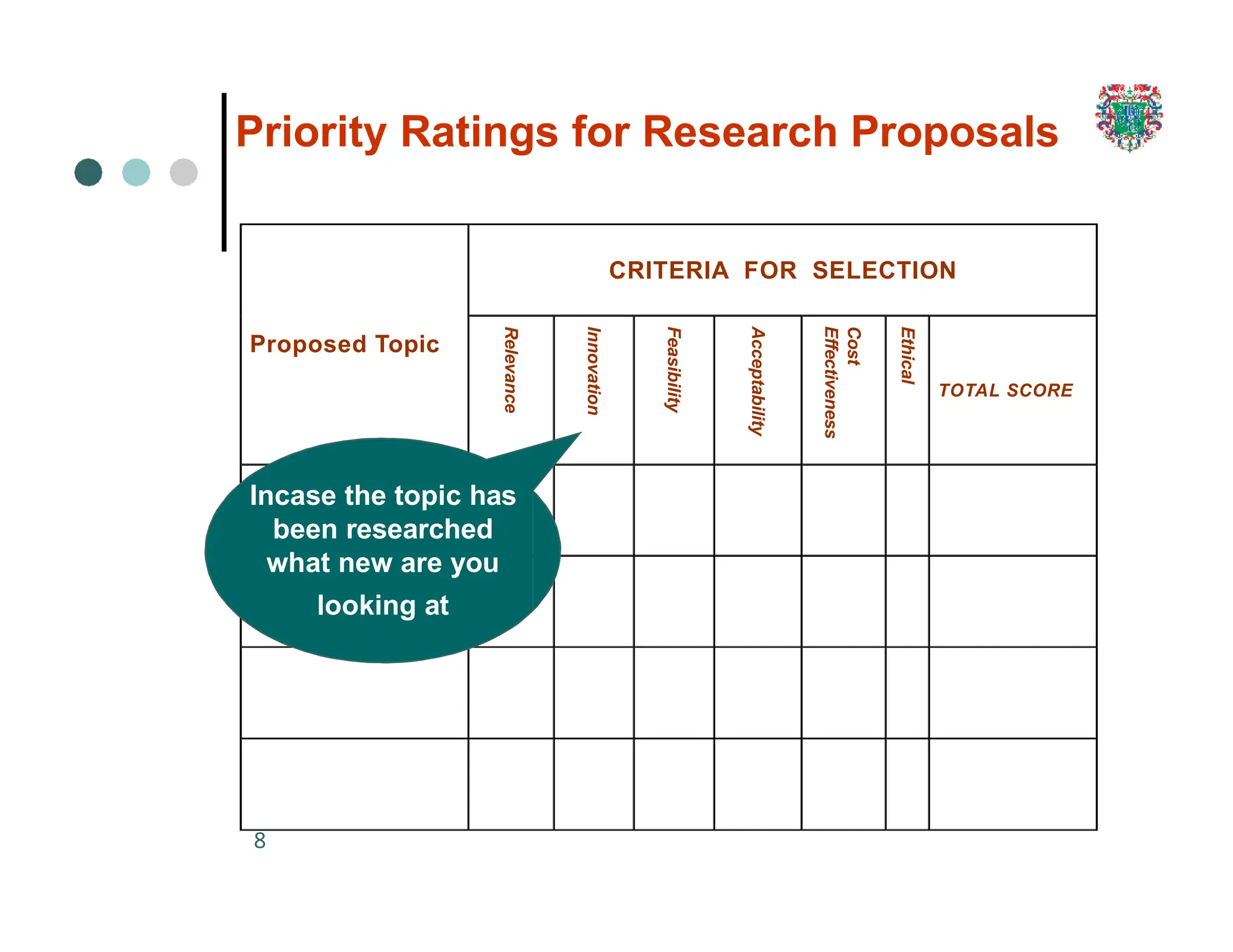
Incase the topic has
been researched
what new are you
looking at
8
Priority Ratings for Research Proposals
Proposed Topic
CRITERIA FOR SELECTION
Relevance
Innovation
Feasibility
Acceptability
Cost
Effectiveness
Ethical
TOTAL SCORE
Consider the resources
that are required to carry
out the project.
9
Priority Ratings for Research Proposals
CRITERIA FOR SELECTION
Proposed Topic
Relevance
Innovation
Feasibility
Acceptability
Cost
Effectiveness
Ethical
TOTAL SCORE
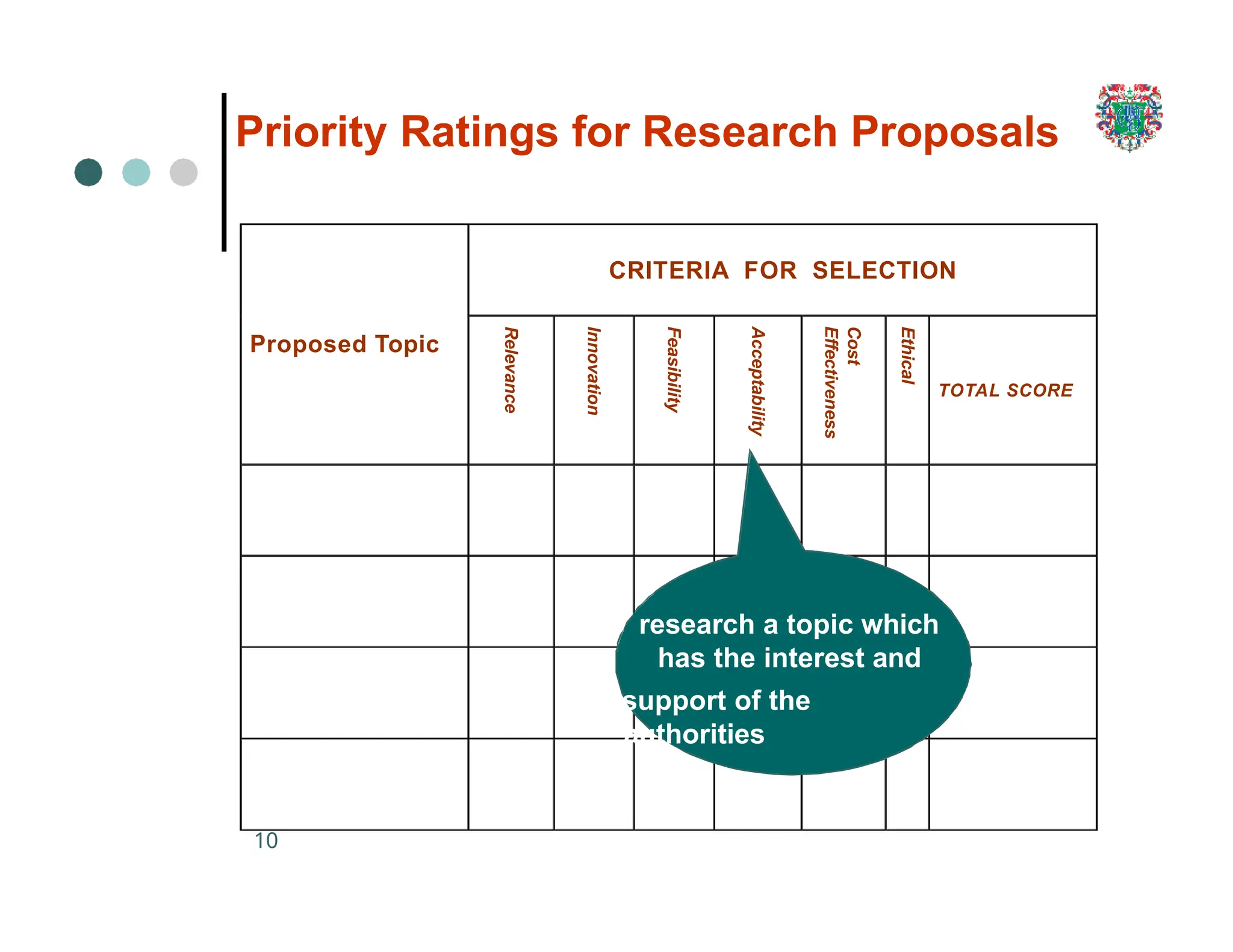
research a topic which
has the interest and
support of the
authorities
10
Priority Ratings for Research Proposals
CRITERIA FOR SELECTION
Proposed Topic
Relevance
Innovation
Feasibility
Acceptability
Cost
Effectiveness
Ethical
TOTAL SCORE
Whether the
resources of time,
money and manpower
being invested in the
study are worthwhile
11
Priority Ratings for Research Proposals
12
CRITERIA FOR SELECTION
Proposed Topic
Relevance
Innovation
Feasibility
Acceptability
Cost
Effectiveness
Ethical
TOTAL SCORE
Priority Ratings for Research Proposals
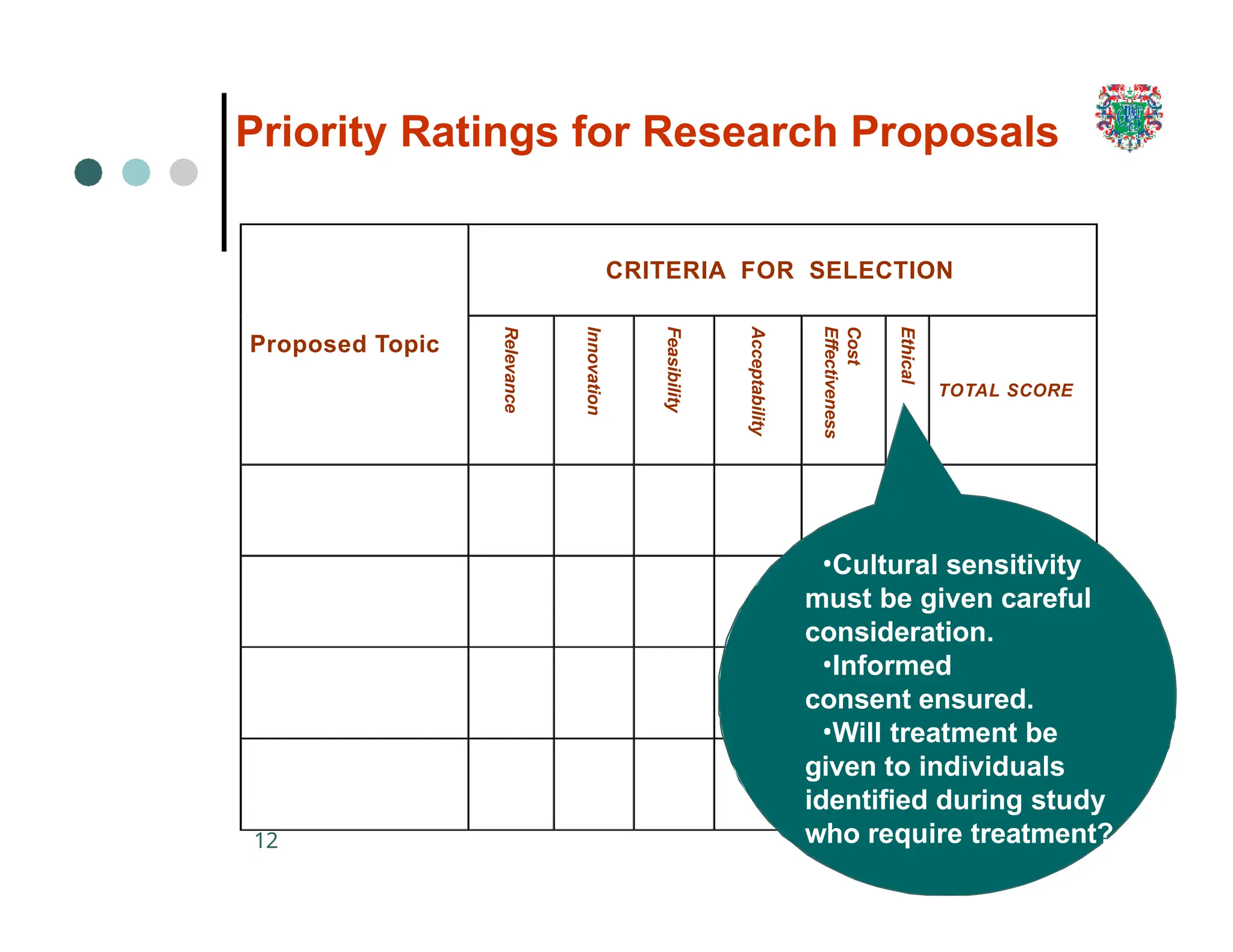
•Cultural sensitivity
must be given careful
consideration.
•Informed
consent ensured.
•Will treatment be
given to individuals
identified during study
who require treatment?
CRITERIA FOR SELECTION
Proposed Topic
Relevance
Innovation
Feasibility
Acceptability
Cost
Effectiveness
Ethical
TOTAL SCORE
Rating Scale:
1= low,
2 = medium,
3 = high
Total Score out of 18
13
Priority Ratings for Research Proposals
What?
O Allows one to search in a purposeful
and systematic manner, through a
range of literature or information
relevant to ones particular field, and to
hone in on material relevant to ones
interest and objectives.
14
Literature Search:
A Literature Search
15
Why?
1. To keep up with the latest developments in your
field.
2. To learn more about some topic.
3. To document important facts and ideas you
wish to research in light of previous work done
on it.
4. To understand your data in the context of
what is already known.
5. To provide your readers with sources they can
consult on their own.
6. PUBMED GOOGLE SCHOLAR
Research
Objective
26
Research Objectives
17
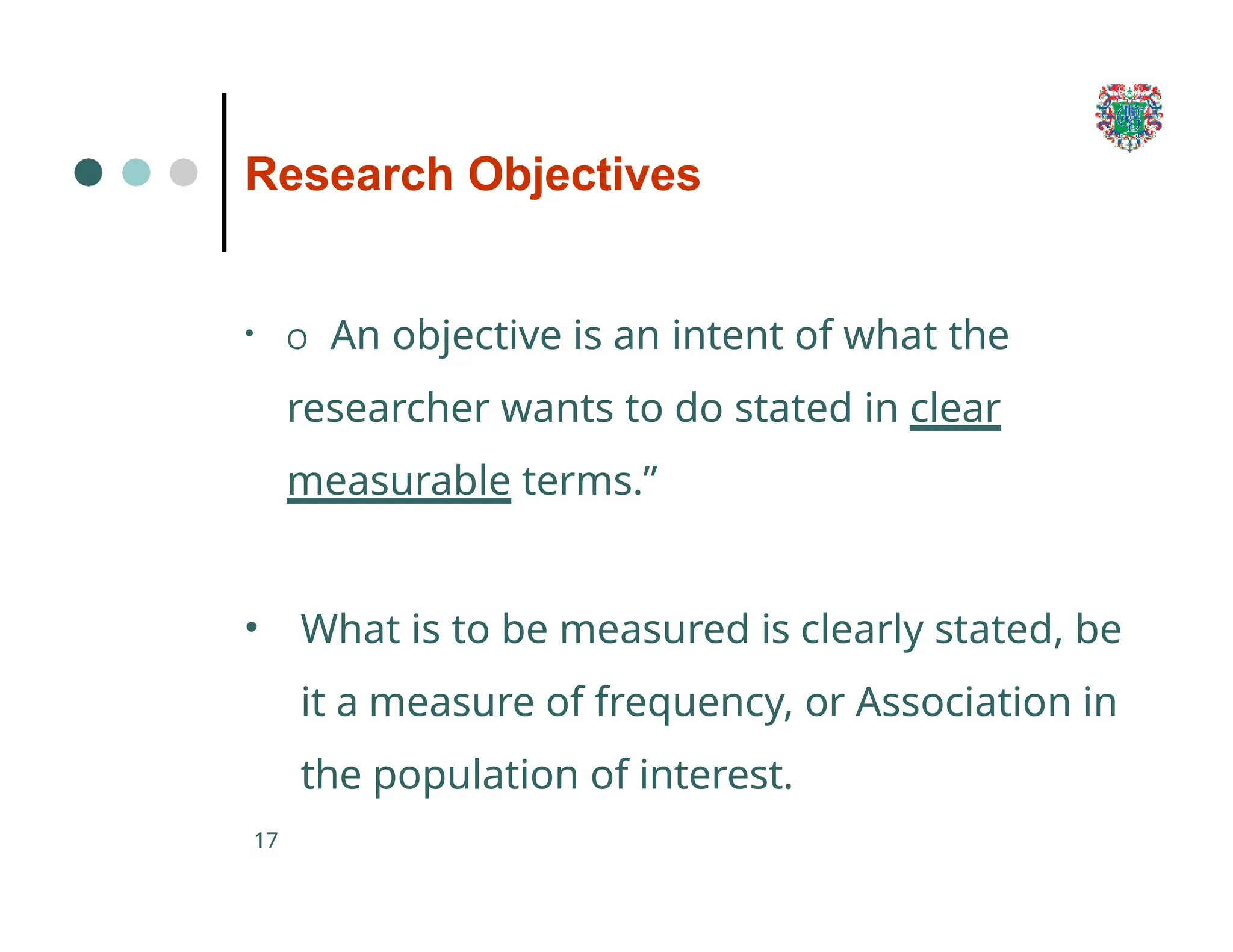
• O An objective is an intent of what the
researcher wants to do stated in clear
measurable terms.”
• What is to be measured is clearly stated, be
it a measure of frequency, or Association in
the population of interest.
Importance of Research Objectives
18
1. Brings focus to the study.
2. Avoids collection of unnecessary
data.
3. Determines an appropriate
study design.
4. Helps determine analysis plan.
Examples
19
Objectives:
O 1)To determine the frequency of anemia in
pregnant women visiting Tertiary care facilities of
Sindh.
O 2) To determine association between maternal
smoking and LBW.
O 3) To compare the effectiveness of dressing A vs.
dressing B in patients presenting with infected
wounds of the foot.
Operational Definitions
32
O Is the definition of the exposure and
outcome variables of interest in context to
objective in a particular study and their
means of measurement/determination.
O Examples:
• Anemia
• Effectiveness
• PPH
• Wound healing
Study Designs
33
Analytical Studies
Observational
Cohort
Case Control
Descriptive Studies
Case Report
Case Series
Cross Sectional
Epidemiological Study Designs
Experimental
Preventive Trial
Therapeutic Trial
22
DESCRIPTIVE STUDIES
23
Descriptive studies involve the systematic
collection and presentation of data to give a
clear picture of a particular situation and can
be carried out on a small or large scale.
O Case Report
O Case series
O Cross Sectional Survey
COMPARATIVE or ANALYTICAL
STUDIES
24
O An ANALYTICAL STUDY attempts to
establish association or determine risk
factors for certain problems. This is
done by comparing two or more
groups, with or
without the outcome of interest/exposure
of interest.
Types
▪ Observational
▪ Experimental
Case Report
25
O A detailed report by a physician of an
unusual disease in a single person.
O Classical example is that of a single case
reported in Germany in late 1959 of a
congenital malformation affecting the limbs
and digits.
O More cases were reported in the following
years.
In 1961 a hypothesis was put forward that
thalidomide, a sleeping pill, was responsible
for congenital malformations.
O Subsequent analytic studies confirmed the
link between the drug and congenital
malformation.
Case Series
26
O When several unusual cases all with
similar conditions are described in a
published report, this is called a Case
Series.
O A case series does not include a
control group.
Cross-Sectional Studies
27
O A cross-sectional study is a survey of a
defined population at a single point in
time.
O Also called “Prevalence Studies”.
O Determines the “burden of disease” in a
population.
O Exposure & outcome are determined
simultaneously.
Design of a Cross-Sectional Study
Defined Population
Gather Data on Exposure and Disease
simultaneously
Exposed;
Have Disease
Exposed;
Do Not
Have
Disease
Not Exposed;
Have Disease
Not Exposed;
Do Not
Have Disease
28
CROSS-SECTIONAL STUDY
SMOKERS
100
NON-SMOKERS
100
LUNG
CA
NON -LUNG
CA
NON-LUNG CA
20
LUNG CA
80
LUNG CA
60
NON-LUNG CA
40
PREVALENCE :-
80/100
PREVALENCE :-
60/100
PREVALENCE
RATIO :-
80/100
60/100
SAMPLE OF POPULATIONS AT A TIME :- SNAP SHOT
Cross-Sectional Surveys-Advantages
30
O Fairly quick and easy to perform.
O Inexpensive.
O Useful for determining the prevalence of
disease for a defined population and can also
measure factors leading to it subsequent to
group formations.
Cross-Sectional Surveys - Disadvantages
31
O Provide only a “snapshot” in time.
O The data about both the exposure to risk
factors and the presence or absence of
disease are collected simultaneously, hence
it is difficult to determine temporal
relationship of a presumed cause and effect.
Cohort Studies
32
O A cohort is a group of people who have
something in common (a characteristic or
characteristics suspected of being a precursor
to or risk factor for a disease) and who remain
part of a group over a period of time.
Cohort study
SAMPLE
100
SMOKERS
60
Lung CA
40
NON LUNG CA
20
NON-SMOKERS
40
LUNG CA
3
NON-Lung ca
37
LUNG CA NON-LUNG CA TOTAL INCIDENCE
SMOKERS 40 20 60 40/60
NON-
SMOKERS
3 37 40 3/40
AFTER 10 YEARS
INCIDENCE
RATIO :-
40/60
3/40
Prospective study
i.e see in future
Types of Cohort Studies
35
O Prospective Cohort Studies
O Retrospective Cohort
Studies
Prospective Cohort Studies
36
The investigator assembles the study
groups in the present time, collects
baseline data on them and then continues
to collect data for a period that can last
many hours to years.
Retrospective Cohort Studies
37
O The investigator goes back into history to
define a risk group (e.g. *those children
exposed to x-rays in utero vs. those not),
and follows the group members up to
the present to see what outcome
(cancer) have occurred
Cohort Study – Prospective
Unexposed (controls)
Exposed (cases)
With
outcome
Without
outcome
With
outcome
Without
outcome
Onset of study
38
Direction of study
Cohort
selected
for
study
Retrospective Cohort Studies
Exposed (cases)
Unexposed (controls)
With
outcome
39
Without
outcome
With
outcome
Without
outcome
Direction of study
Records
selected
for study
Onset of study
Prospective Cohort Studies - Advantages
40
O Because they are longitudinal, are the study
of choice for
❖ Establishing causes of a
condition (temporal relation)
❖Allows for measurement of
incidence
❖ Study of multiple effects
of a single exposure
Prospective Cohort Studies- Disadvantages
41
O *With diseases that develop over a long period of time,
or with conditions that occur as a result of long-
standing exposure, many years are needed and
hence:
❖High costs
❖Long wait until results are obtained
❖Loss to follow
O Are problematic when disease or outcome is rare
For example, studying the risk factors/ clinical
features associated with carcinoid tumors (very
slowly growing tumors)
Retrospective Cohort Studies
42
Advantages:
O Less expensive
O Completed in much shorter time than a prospective
study
Disadvantages:
O The quality of data collection is not as good As
records generated for clinical purposes and not for
research
O Because of a large number of biases associated with
these studies,carry less weight in establishing a cause
than prospective studies.
Case Control Study
43
O The investigator selects the case group and the control
group on the basis of the outcome (i.e. having the
disease of interest vs. not having the disease of
interest)
O Cases and controls are assembled and are questioned
or their medical records are consulted regarding past
exposure to risk factors
Case Control Studies
exposed
unexposed
exposed
unexposed
Cases
(with
disease)
Controls
(without
disease)
Direction of study Onset of study
44
Case Control Studies
45
Advantages
O Inexpensive
O Quick
O Especially useful when the disease being
studied is rare or for a condition which
develops over a long time
O Can evaluate multiple etiologies for one
outcome
Disadvantages
O Recall bias
O Selection Bias
Case-Control Studies - Selection of Cases
46
Cases can be selected from a variety
of sources:
O Hospital patients
O Patients in Physician’s practices
O Registries
Selection of Controls
47
Controls may be selected from
O Non-hospitalized persons living in the
community similar to cases
O Hospitalized patients admitted for diseases
other than that for which cases are admitted
Problems with Case Control Study
48
Selection Bias
O In 1929, Raymond Pearl at John Hopkins, Baltimore
conducted a study to test the hypothesis that
tuberculosis protected against cancer
O He selected 816 cases of cancer from 7500
consecutive autopsies
O He also selected 816 controls from others on
whom autopsies had been carried out at John
Hopkins
O Of the 816 CASES (with cancer), 6.6% had TB
O Of the 816 CONTROLS (without cancer), 16.3%
had TB
O From the finding that the prevalence of TB was
considerably higher in the control group, Pearl concluded
that TB was protective against cancer
O Was Pearl’s conclusion justified?
Problems with Case Control Studies
“Pearl’s Study”
49
O No!! At the time of the study, TB was one of the
major reasons for hospitalization at Johns
Hopkins Hospital
O Pearl thought that the control group’s rate of TB
would represent the level of TB in the general
population; but because of the way he selected
the controls, they came from a pool that was
heavily weighted with TB
O The way the controls are selected is a major
determinant of whether a conclusion is valid or not
Problems with Case Control Studies
50
Coffee-drinking and Cancer of the Pancreas in Women*
O Cases were white cancer patients from 11 Boston
and Rhode-Island hospitals
O Controls were patients from GI Clinics
O McMohan found that coffee consumption was
greater in cases than controls
O Controls were patients who had reduced their
coffee consumption because of Physician’s advice
O The controls level of coffee consumption was
not representative of the general population
O When a difference in exposure is observed between
cases and controls we must ask “Is the level of exposure
observed in the controls really the expected level in the
general population.
Recall Bias
51
Individuals who have experienced a
disease or other adverse health events
tend to think about possible causes &
thus are likely to recall histories of
exposure differently as compared to
controls.
INTERVENTIONAL / EXPERIMENTAL
STUDIES
52
O The researcher manipulates a situation and
measures the effects of the
manipulation amongst two groups, one in
which the intervention takes place (e.g.
treatment with a certain drug) and another
group that remains "untouched" (e.g.,
treatment with a placebo) .
SINGLE-BLIND STUDY
THE participant Also called single-masked study
DOUBLE-BLIND STUDY
neither the participating individuals nor the study Researcher
knows which participants are receiving the experimental drug and
which are receiving a placebo (or the therapy).
TRIPLE-BLIND STUDY
participants, investigators, and data analyst all remain unaware of
the intervention assignments throughout the trial.
PLACEBO
Refers to a pharmacologically inactive agent that investigators
administer to participants in the control group of a trial
SAMPLING
65
SAMPLING
58
A sample is a sub set of the population, with all
its inherent qualities. Inferences about the population
can be made from the measurements taken from a
sample, if the sample is truly representative of the
population. Since a sample is expected to represent
the whole population, the sampling procedure has to
follow three fundamentals:
1. Should be representative.
2. Large enough.
3. The selected elements should have been
properly approached, included and interviewed.
There are many good reasons for studying a sample instead
of an entire population:
➢Samples can be studied more quickly than populations.
Speed can be important if a physician needs to determine
something quickly, such as a vaccine or treatment for a new
disease.
➢A study of a sample is less expensive than a study of an
entire population because a smaller number of items or
subjects are examined. This consideration is especially
important in the design of large studies that require a long
follow-up.
➢A study of the entire populations is impossible in
most situations.
59
REASONS FOR USING SAMPLES
STEPS IN SAMPLING
60
1. Definition of the population
We first need to identify the population we wish to draw the
sample, from and do so somewhat formally because any
inferences we draw are really only applicable to that
population
2. Construction of a sampling frame (or thinking of an
alternate)
The list of all possible units that might be drawn in a
sample.
3. Selection of a sampling procedure
This is a critical decision about how to collect
the sample. We will look at some different
sampling procedure in the following slides.
61
TWO MAJOR TYPES OF SAMPLING PROCEDURES:
62
PROBABILITY
Each element has the same chance of being included in the
sample. Major types of probability sampling procedures:
1.
2.
3.
4.
NON-
PROBABILITY
Simple random
Systematic
Cluster
Stratified
There is no assurance that each element will have the same chance
of being included in the sample. The 3 major types:
1.
2.
3.
Consecutive
Convenience
Purposive
TYPES OF SAMPLING METHODS
Sampling
Non-Probability
Sampling
Consecutive Purposive
Convenience
Probability Sampling
Simple
Random
Systematic
Stratified
Cluster
63
SIMPLE RANDOM SAMPLING
64
PREREQUISITES
1. Sampling frame
a unique number is assigned to each element
2. Elements are selected into the sample randomly by 3
means
➢ Table of Random Numbers
➢ Lottery Method
➢ Computer Generated Numbers
SYSTEMATIC SAMPLING
65
PREREQUISITES
1. Sampling frame (If available ) if not then too
systematic sampling can be undertaken. What is required is
an estimate of population size and required sample size.
SYSTEMATIC SAMPLING
• Decide on sample size: n
•Determine population size = N
• Divide population of N individuals into groups
of k individuals: k = N/n
• Randomly select one individual from the 1st
group.
• Select every k-th individual thereafter.
N = 640
n = 80
k = 8
First Group
66
STRATIFIED SAMPLING
67
One of the main purposes of stratified sampling
is to compare different strata, which may not be
possible with simple random sampling alone.
Pre requisite: Sampling frame
▪ The population is first divided into groups of elements called strata.
▪ Each element in the population belongs to one and only one stratum.
▪ Best results are obtained when the elements within each
stratum are as much alike as possible (i.e. homogeneous group).
▪ A simple random sample is taken from each stratum.
CLUSTER SAMPLING
68
When a list of the entire area is not available
and it is not physically possible to visit the entire
area (e.g. the city, or country) one can divide the
area into several equal size clusters or units.
E.g.: Mohallas, Apartment Buildings, Villages, Schools
One can select (randomly) only a few cluster,
number all the units within it and draw either:
1. A random sample or
2. A systematic sample
NONPROBABILITY SAMPLING
69
Nonprobability sampling design are often more practical than
probability designs for some clinical research. Because
statistical significance test are based on the assumption that a
probability sample has been used, the objective in
nonprobability sampling is to produce a facsimile, for the
search question at hand of the probability sample.
CONSECUTIVE
CONVENIENCE
PURPOSIVE
70
Three major types of nonprobability sampling are
CONSECUTIVE SAMPLING
71
• It involves taking every patient who
meets the selection criteria over a
specified time interval or number of
patients.
• It is the best of the nonprobability
techniques and one that is very often
practical.
CONVENIENCE SAMPLING
72
1. It is the process of taking those members of
the accessible population who are easily
available.
2. Sample is selected in a haphazard fashion.
3. It is widely used because of its obvious
advantages in cost and logistics, however
this type of sampling technique in fraught
with biases.
PURPOSIVE SAMPLING
73
• Sampling is done on the basis of
some pre determined idea (clinical
knowledge etc).
• Specific targets are
interviewed, because they
posses the desired information.
VARIABLE
82
A Variable is a characteristic of a person,
object or phenomenon that can take on
different values.
A simple example of a variable is a
person’s age. The variable age can take on
different values because a person can be
20 years old, 35 years old, and so on.
75
Dependent and independent variables
76
Because in health system research you often
look for causal explanations, It is important to
make distinction between dependent and
independent variables.
The variable that is used to describe or
measure the problem under study (outcome)
is called the DEPENDENT variable.
The variables that are used to describe or
measure the factors that are assumed to
cause or at least to influence the problem are
called the INDEPENDENT (exposure) variables.
Data
77
Data are values of the observation
recorded for variables (e.g. age, weight,
sex).
TYPES of DATA
78
Qualitative or categorical data:-
The characteristic which can’t be expressed numerically like
sex, ethnicity , healing etc.
Quantitative data or numerical data:-
The characteristic which can be expressed numerically like
age, temperature, no. of children in a family.
Categorical Data
There are two types of categorical data:
• Nominal
• Ordinal data.
NOMINAL DATA
79
O In NOMINAL DATA, the variables are divided into
named categories. These categories however,
cannot be ordered one above another (as they are
not greater or less than each other).
O Example:
NOMINAL DATA
Sex/ Gender:
Marital
status:
CATEGORIES
male, female
single, married,
widowed, separated,
divorced
ORDINAL DATA
80
O In ORDINAL DATA, the variables are also divided
into a number of categories, but they can be
ordered one above another, from lowest to
highest or vice versa.
O Example:
ORDINAL DATA
Level of knowledge:
Level of blood
pressure:
CATEGORIES
good, average,
poor high,
moderate, low
Quantitative Data
81
Interval Scale:-
You are also allowed to quantify the difference
between two interval scale values but there is no
natural zero.
Example :- Temperature scales are interval data
with 25C warmer than 20C and a 5C difference has
some physical meaning. Note that 0C is arbitrary, so
that it does not make sense to say that 20C is twice as
hot as 10C.
Quantitative data
82
O Ratio Scale:- You are also allowed to take
ratios among ratio scaled variables. Physical
measurements of height, weight, length are
typically ratio variables. It is now meaningful
to say that 10 m is twice as long as 5 m. This
ratio hold true regardless of which scale the
object is being measured in (e.g. meters or
yards). This is because there is a natural
zero.
Presentation of Data
83
O Data once collected should be presented in a
such a way as to be easily understood . The style
of presentation depends, of course, on type of
data.
O Data can be presented in as frequency tables,
charts, graphs, etc. Here we would discuss some
of the important means of presentation.
FREQUENCY TABLES
84
O In a FREQUENCY TABLE data
is presented in a tabular form. It
gives the frequency with which
(or the number of times) a
particular value appears in the
data.
Systolic Blood Pressure of patients
coming to a tertiary care hospital OPD
n = 60
85
Distribution Frequency Relative Cumulativ
e
Relative
Below 100 6 0.10 0.10
100 – 120 9 0.15 0.25
121 – 140 24 0.40 0.65
141 – 160 15 0.25 0.90
Above 160 6 0.10 1.00
Graphs
86
O Another way to summarize and display data is
through the use of graph or pictorial
representations of numerical data. Graphs
should be designed so that they convey at a
single glance the general patterns in a set of
data.
Bar charts
O Bar charts are used for nominal or ordinal
data.
Cigarette consumption of persons 18
years of age or older, United States, 1900
- 1990
0
87
500
1000
1500
2000
2500
3000
3500
4000
4500
1900 1910 1920 1930 1940 1950 1960 1970 1980 1990
Years
No.
of
cigarettes
Pie chart
O Pie charts can also be used to display nominal or
ordinal data.
Gender distribution
Male
70%
Female
88
30%
Histogram
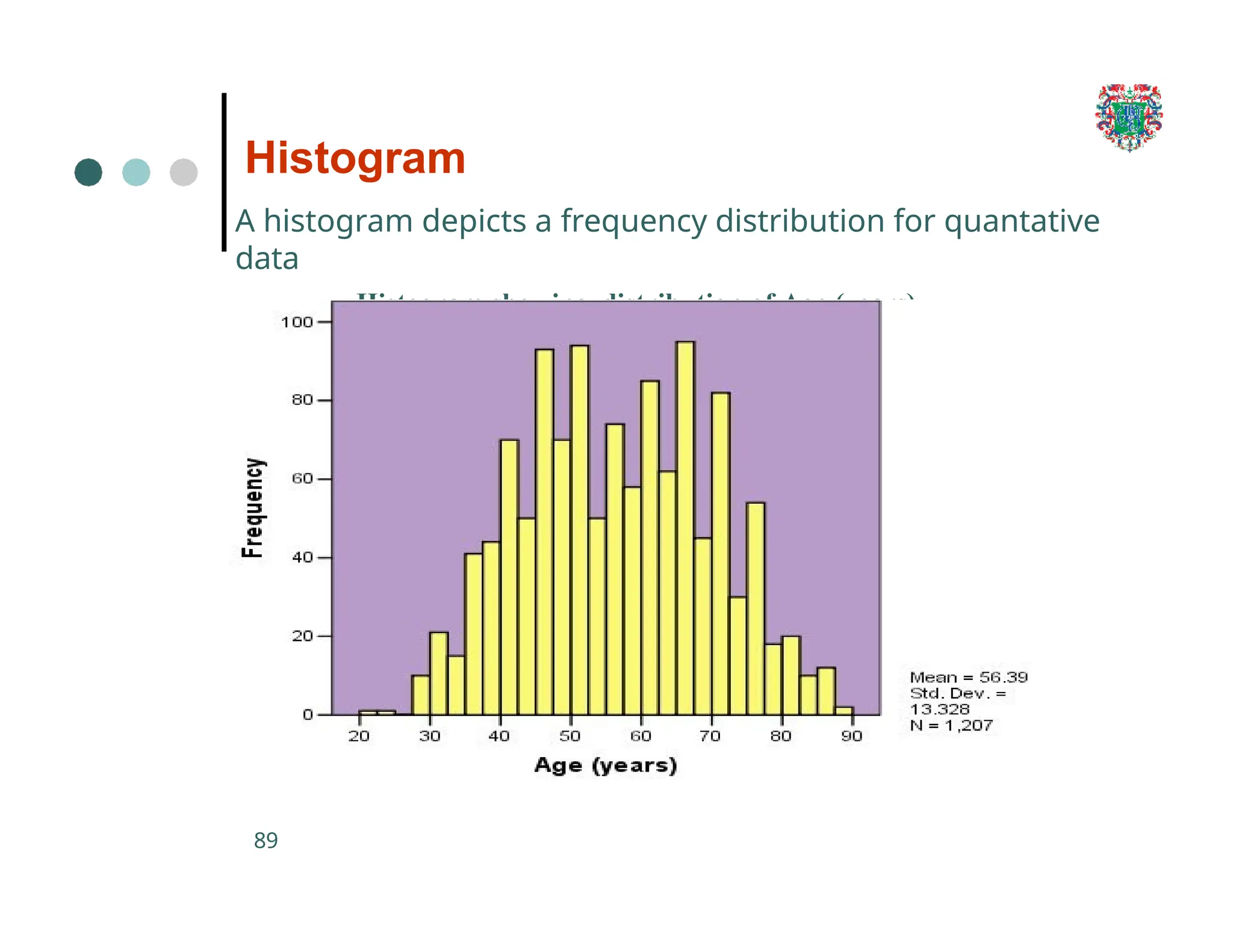
A histogram depicts a frequency distribution for quantative
data
Histogram showing distribution of Age (years)
89
SUMMARIZATION
OF DATA
98
MEASURES OF CENTRAL
TENDENCY
91
•Mean
•Median
•Mode
MEAN
92
O The MEAN (or arithmetic mean)
is also known as the AVERAGE. It
Is calculated by totaling the
results of all the observations
and dividing by the total number
of observations.
Note that the mean can only be
calculated for numerical
data.
MEDIAN
93
The MEDIAN is the value that divides a
distribution into two equal halves.
O The median is useful when some measurements
are much bigger or much smaller than the rest.
The mean of such data will be biased toward these
extreme values.
O The median is not influenced by extreme values.
MODE
94
• The MODE is the most
frequently occurring value in a
set of observations.
MEASURES OF VARIATION
95
Range is defined as the difference in value between the
highest (maximum) and the lowest (minimum) observation
Variance Quantifies the amount of variability or spread
about the mean of the sample.
Standard deviation it is the square root of the variance
Standard Deviation
96
O The STANDARD DEVIATION is a measure, which
describes how much individual measurements
differ, on the average, from the mean.
O A large standard deviation shows that there is a
wide scatter of measured values around the
mean, while a small standard deviation shows
that the individual values are concentrated
around the mean with little variation among
them.
Standard error of the mean
97
When we draw a sample from study population and
compute its sample mean it is not likely to be identical to
the population mean. If we draw another sample from
same population and compute its sample mean, this may
also not be identical to the first sample mean. It probably
also differs from the true mean of the total population
from which the sample was drawn this phenomenon is
called sampling variation.
Standard error:- The standard error gives an estimate of
the degree to which the sample mean varies from the
population mean and this measures is used to calculate
CI.
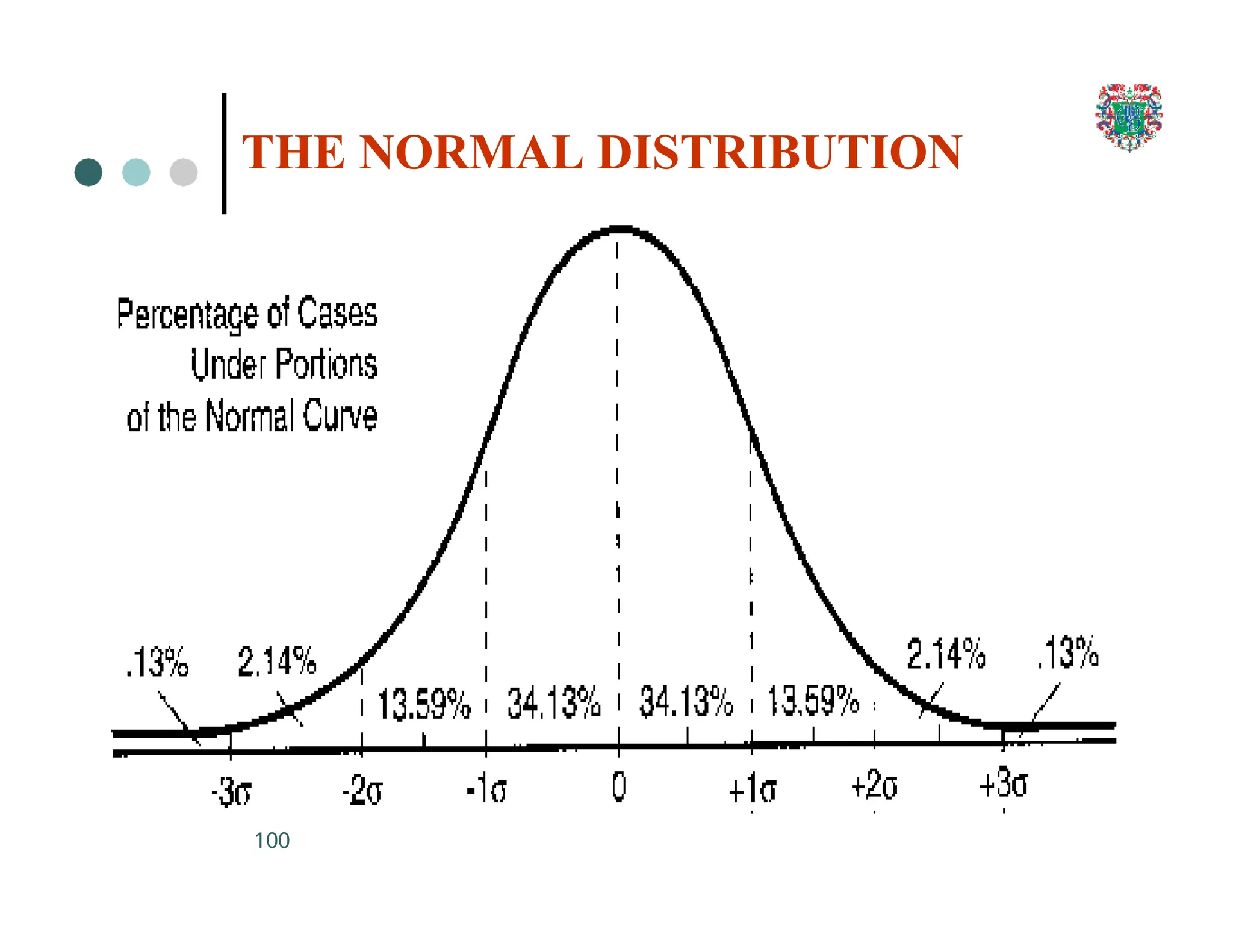
THE NORMAL DISTRIBUTION
98
O Many variables have a normal
distribution.
This is a bell shaped curve with most of
the values clustered near the mean
and a few values out near the tails.
O The normal distribution is symmetrical
around the mean. The mean, the median
and the mode of a normal distribution
have the same value.
O An important characteristic of a
normally distributed variable is that
95% of the measurements have value
which are approximately within 2
standard deviations (SD) of the mean.
99
THE NORMAL DISTRIBUTION
100
Estimation
101
The process of using sample
information to draw conclusion
about the value of a population
parameter is known as estimation.
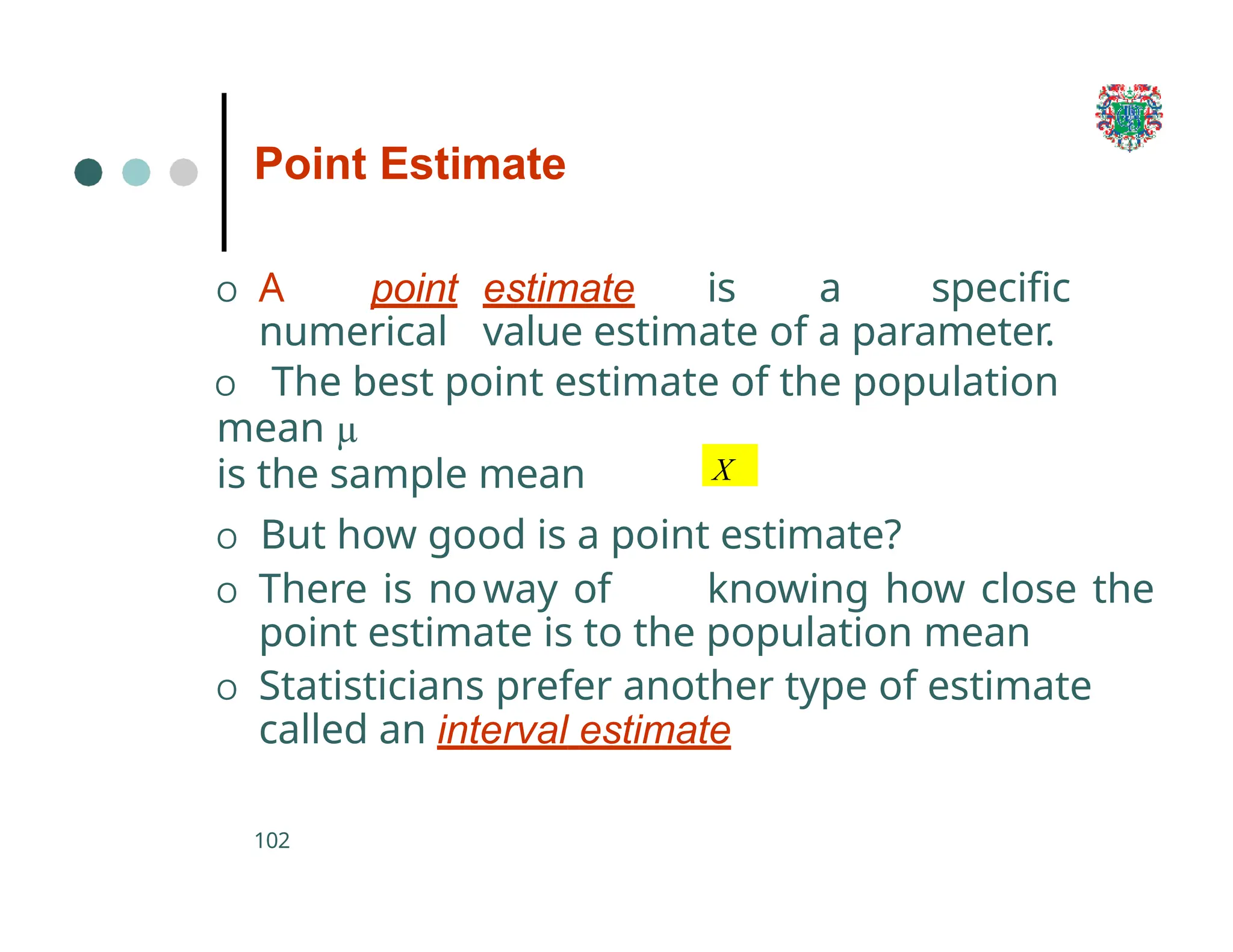
O A point estimate is a specific
numerical value estimate of a parameter.
O The best point estimate of the population
mean µ
is the sample mean
102
O But how good is a point estimate?
O There is noway of knowing how close the
point estimate is to the population mean
O Statisticians prefer another type of estimate
called an interval estimate
Point Estimate
X
Interval Estimate
103
O An interval estimate of a parameter is an interval or a
range of values used to estimate the parameter
Confidence Level
O The confidence level of an interval estimate of a
parameter is the probability that the interval estimate
will contain the parameter
O Three commonly used confidence levels are 90%, 95%
and 99%
O If one desires to be more confident then the sample size
must be larger
MEASURES OF
DISEASE
FREQUENCY
A Presentation
11
2
RATIO
105
• The most basic measure of distribution.
• Obtained by simply dividing one quantity
by another without implying any
specific relationship between the
numerator and denominator, such as
the number of stillbirths per thousand
live births.
• In ratio, the numerator &
denominator are mutually exclusive.
PROPORTION
106
O A proportion is a type of ratio in which those
who are included in the numerator must also
be included in the denominator.
O For example: the proportion of women over
the age of 50 who have had a hysterectomy,
or the number of fetal deaths out of the total
number of births (live births plus fetal
deaths).
RATE
107
O A rate is a proportion with specifications of
time.
There is a distinct relationship between the
numerator and denominator with a
measure of time being an intrinsic part of
the denominator.
O For example, the number of newly
diagnosed cases of breast cancer per
100,000 women during a given year.
IMPORTANT POINT
108
O It is necessary to be very specific about what
constitutes both the numerator and the
denominator. In some circumstances, it is
important to make clear whether the
measure represents the number of events
or the number of individuals.
O For example, the frequency of myopia among
a population of school children could
represent the number of affected eyes in
relation to total eyes, or the number of
children affected in one or both eyes relative
to all students.
PREVALENCE
109
O Prevalence quantifies the proportion
of individuals in a population who have the
disease at a specific instant and provides an
estimate of the probability (risk) that an
individual will be ill at a point in time
O The formula for calculating the prevalence P =
number of existing cases of a disease/ total
population (at a given point in time)
POINT PREVALENCE
110
O Prevalence can be thought of as the status of
the disease in a population at a point in time
and as such is also referred to as point
prevalence.
O This "point" can refer to a specific point in
calendar time or to a fixed point in the course
of events that varies in real time from person to
person, such as the onset of menopause or
puberty or the third postoperative day.
PERIOD PREVALENCE
111
O It represents the proportion of cases that exist
within a population at any point during a
specified period of time.
O The numerator thus includes cases that were
present at the start of the period plus new
cases that developed during this time
E.g. Frequency of patients receiving Psychiatric
Rx between May 31 – Dec 01 2008
INCIDENCE:
112
O Incidence quantifies the number of
new events or cases of disease that
develop in a population of
individuals at risk during a
specified time interval.
Cumulative incidence (CI)
113
O Is the proportion of people who
become diseased during a
specified period of time. It provides
an estimate of the probability, or
risk, that an individual will develop
a disease during a specified period
of time
CI = No. of new cases of a
disease Total population
at risk
Issues in the Calculation of
Measures of Incidence
114
O For any measure of disease frequency,
precise definition of the denominator is
essential for both accuracy and clarity.
This is a particular concern in the
calculation of incidence. The
denominator of a measure of incidence
should include only those who are
considered "at risk" of developing the
disease.
Contd.
115
O That is, the total population from
which the new cases could arise.
Consequently, those who currently
have or have already had the disease
under study or persons who cannot
develop the disease for reasons such
as age, immunization, or prior
removal of the involved organ should
be excluded from the denominator.
Special Types of Incidence Rates
MORBIDITY RATE
Is the incidence rate of non fatal cases in the total population at
risk during a specified period of time.
For example, the morbidity rate of tuberculosis (TB) in the U.S.
in 1982 can be calculated by dividing the number of nonfatal
cases newly reported during that year by the total U.S. midyear
population.
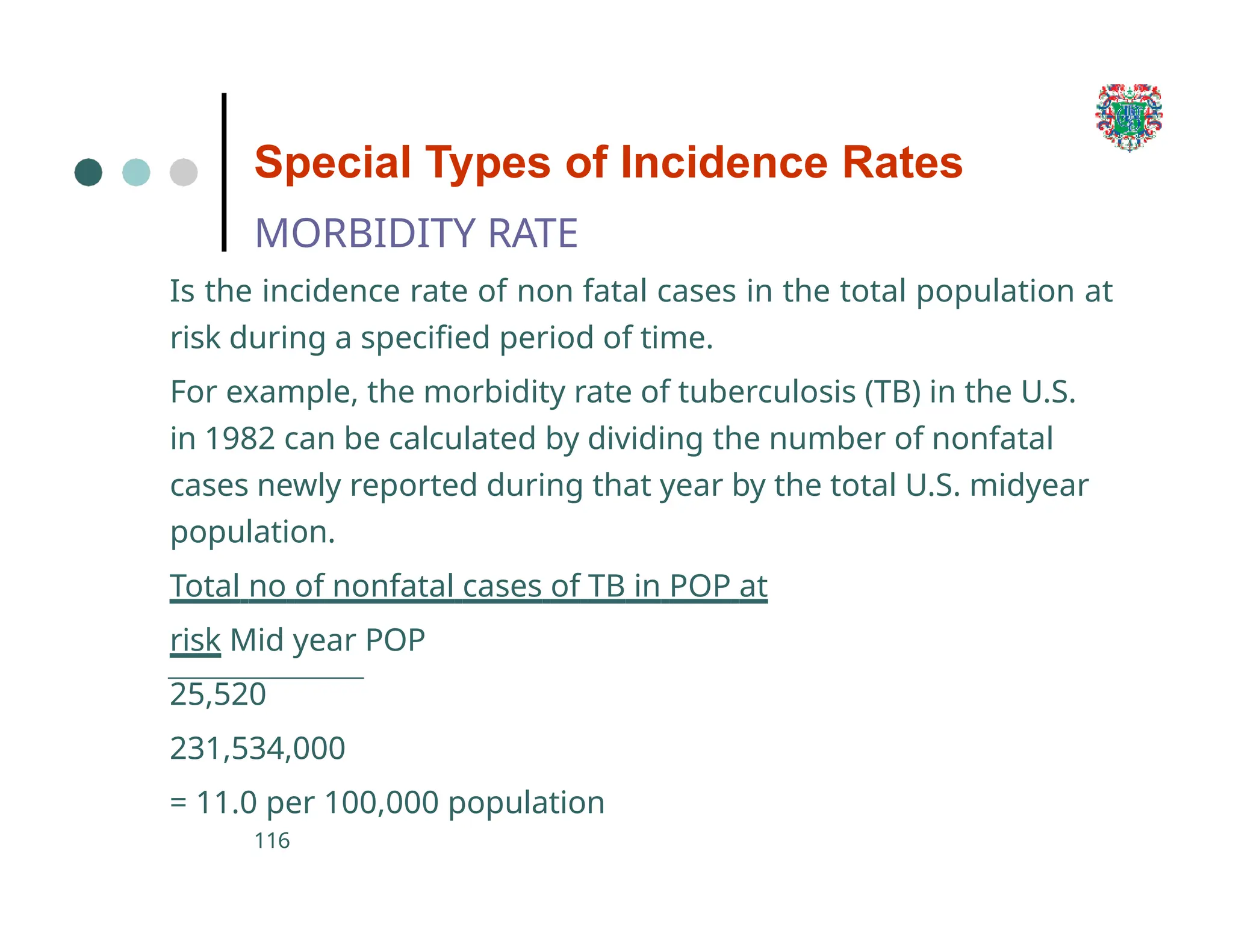
Total no of nonfatal cases of TB in POP at
risk Mid year POP
25,520
231,534,000
= 11.0 per 100,000 population
116
MORTALITY RATE
117
• It expresses the incidence of deaths in
a particular population during a period of
time.
• It is calculated by dividing the number
of fatalities during that period by the
total population.
• This can be further divided into cause
specific or all case mortality.
Measures of
Association
126
Measures of Association
119
O Relative risk (cohort
study)
O Odds ratio (case control)
Cohort Studies
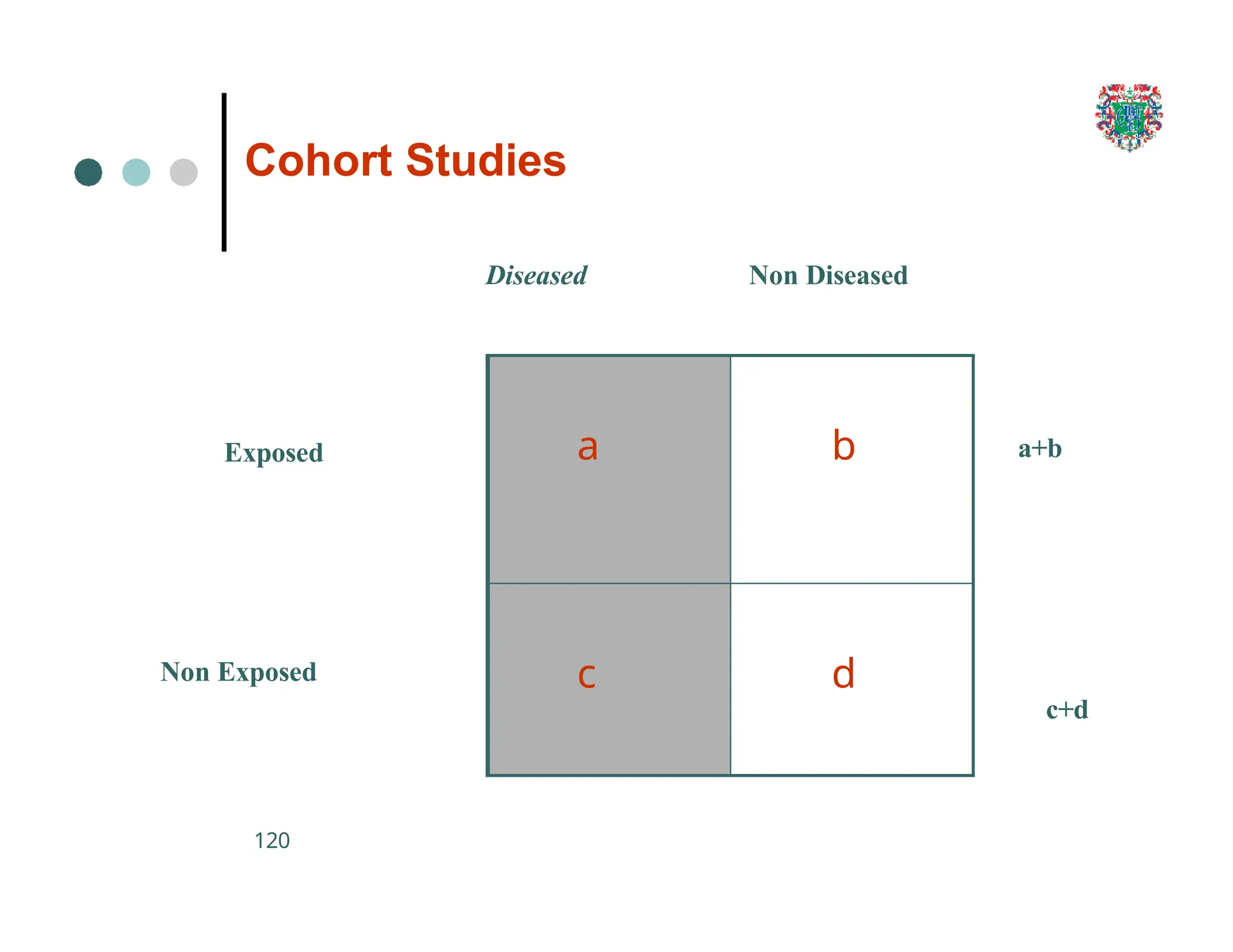
120
a b
c d
Exposed
Non Exposed
Diseased Non Diseased
a+b
c+d
Relative Risk
121
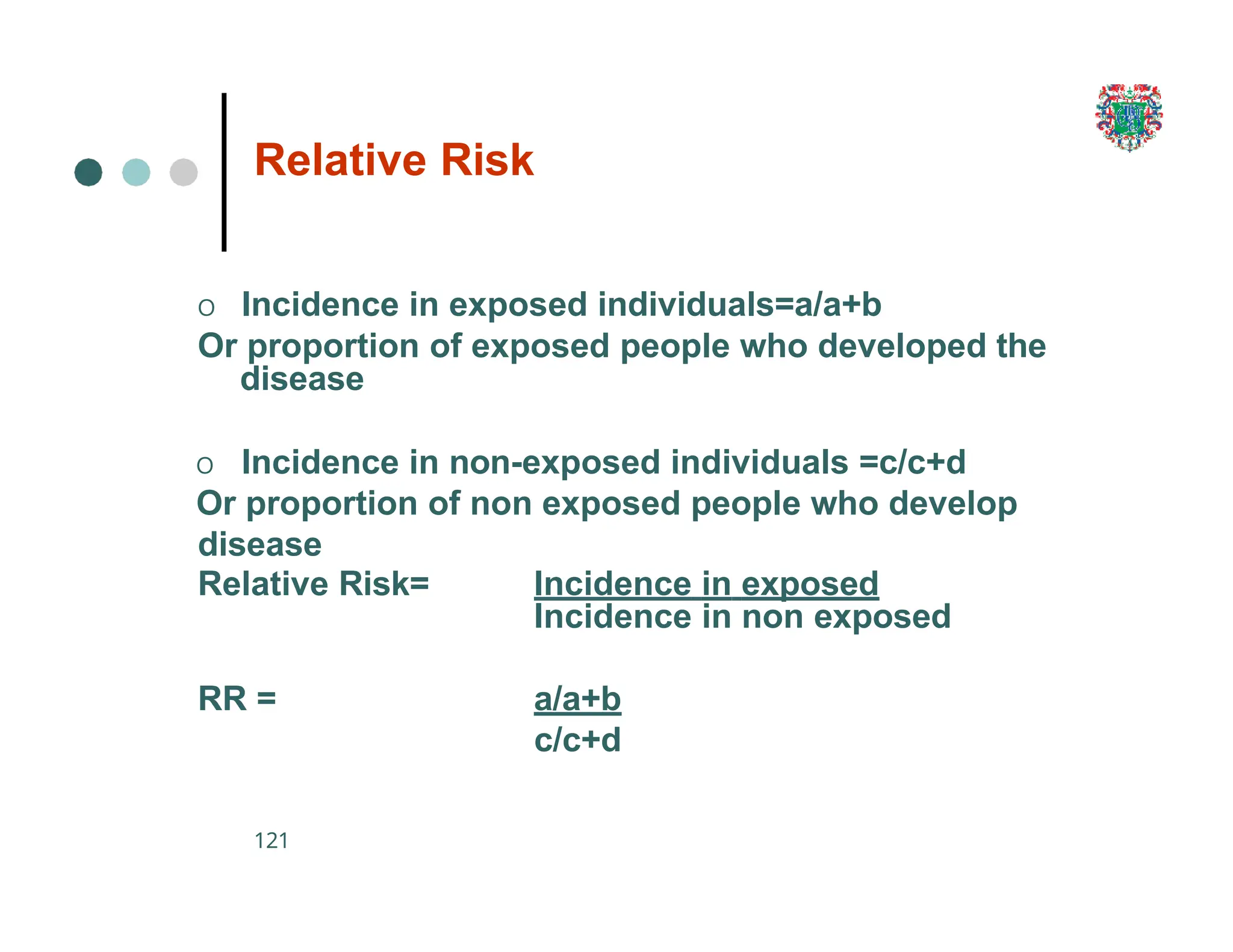
O Incidence in exposed individuals=a/a+b
Or proportion of exposed people who developed the
disease
O Incidence in non-exposed individuals =c/c+d
Or proportion of non exposed people who develop
disease
Relative Risk= Incidence in exposed
Incidence in non exposed
RR = a/a+b
c/c+d
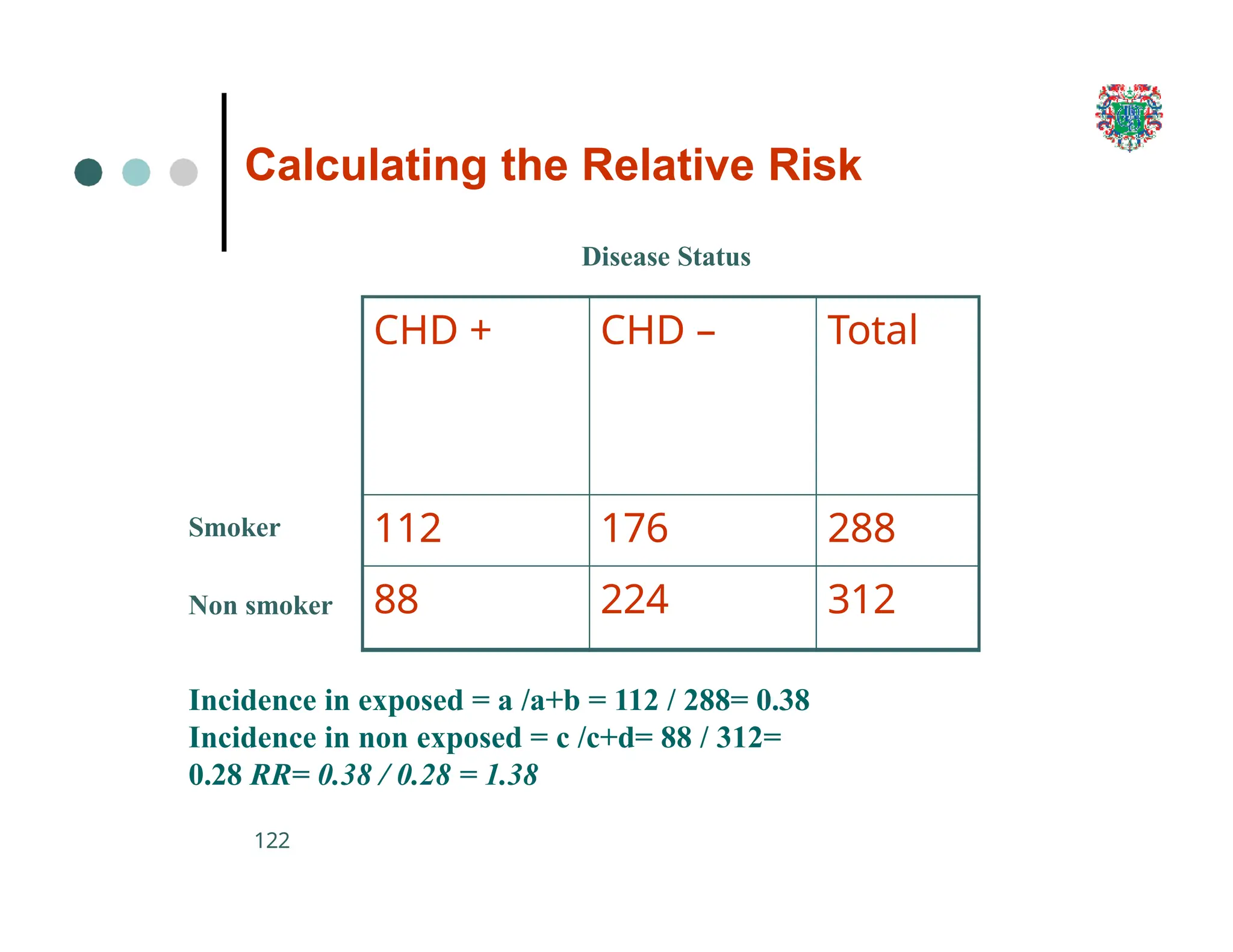
Calculating the Relative Risk
122
CHD + CHD – Total
112 176 288
88 224 312
Disease Status
Smoker
Non smoker
Incidence in exposed = a /a+b = 112 / 288= 0.38
Incidence in non exposed = c /c+d= 88 / 312=
0.28 RR= 0.38 / 0.28 = 1.38
Interpretation of RR
123
O Compared to non smokers, the
smokers have a 1.38 times greater risk
of developing CHD
Odds Ratio
124
O Incidence cannot be measured in
case control studies because we
start with the diseased people
(cases) and non diseased people
(controls), hence we calculate OR
Case Control
a b
c d
Exposed
Non Exposed
Cases Controls
a+b
c+d
b+d
a+c
OR=a/c b/d or
ad/bc 125
Passive Smoking & Breast Cancer
126
Breast
cancer
No Breast
cancer
Total
140 (a) 370 (b) 510
40 (c) 234 (d) 274
Exposed (Passive
Smokers)
Not exposed
Odds=140 / 40=3.5
OR=3.5 / 1.6=2.2
Odds=370 / 234=1.6
Compared to the control, the odds of being a passive smoker are 2.2
> in Ca breast cases
Factors Affecting
Study Outcomes
127
BIAS
128
Bias is:
129
Any systematic error that results in an
incorrect estimate of the association
between the exposure and outcome. Usually
introduced by the experimenter or the
researcher himself due to non-standardized
measuring techniques.
Type of Bias:-
130
Selection Bias
Observation (Information/Misclassification)
Bias
Recall Bias
Interviewers Bias
Lost-to-follow up
Can Control Bias:-
In study design through
Choice of study population
Data collection:-
Uniform Source of information
Efficient Questionnaire development
Standardization of measurement
technique
Blinding
131
Confounding
140
The concept of confounding is a central one in
the interpretation of any epidemiological
study.
Confounding can be thought of as mixing of
the effect of the exposure under study on the
disease with that of an extraneous factor.
This external factor or variable must be
associated with the exposure and,independent
of the exposure must be a risk factor for the
disease.
133
Example of confounding
Smoking MI
age
134
Table 1. Relation of Myocardial infarction
(MI)to Recent Oral Contraceptive (OC) Use.
135
ed
risk
MI +ve MI -ve Estimat
relative
OC
Yes 29 135 =1.68
No 205 1607
Total 234 1742
Table2:-Age -specific Relation of Myocardial infarction
(MI) to recent Oral Contraceptive (OC) Use.
Age (yrs) Recent OC
use
MI +ve MI -ve Estimated
age-Specific
relative risk
25 – 29 Yes 4 62 7.2
No 2 224
30 – 34 Yes 9 33 8.9
No 12 390
35 – 39 Yes 4 26 1.5
No 33 330
40 – 44 Yes 6 9 3.7
No 65 362
45 – 49 Yes 6 5 3.9
No 93 301
Total 234 1742
136
Confounding can be controlled in study
design through:
137
➢ Restriction
Matching
exposure
➢ Randomization
Confounding can be controlled in
analysis through:
▪ Stratification
▪ Multivariate analysis
The role of confounding, chance and bias have
to be evaluated in studies appropriate selection
of the population to be studied , with proper
study design, so that the results can be applied
to other population i.e., they are valid and
generalizable.
138
Evaluation of the role of chance consists
of two components:-
1. Hypothesis testing
2. Estimation of the confidence interval
139
FORMULATION
& TESTING OF
HYPOTHESIS
148
WHAT IS HYPOTHESIS?
141
Hypothesis: A testable theory, or
statement of belief used in evaluation
of a population parameter of interest
e.g. Mean or proportion
O Suppose a study is being conducted to answer
questions about differences between two regimens
for the management of diarrhea in children:
the sugar based modern ORS and the time-tested
indigenous herbal solution made from locally available
herbs.
O One question that could be asked is:
"In the population is there a difference in overall
improvement (after three days of treatment)
between the ORS and the herbal solution?"
142
O There could be only
two answers to this
question:
O Yes
O No
143
Null Hypothesis
144
"There is no difference between the 2
regimens in term of improvement” (null
hypothesis).
A null hypothesis is usually a statement that
there is no difference between groups or that
one factor is not dependent on another and
corresponds to the No answer.
Alternative Hypothesis
145
O "There is a difference in terms of improvement achieved
by a three days treatment with the ORS and that of the
herbal solution" (alternative hypothesis).
O Associated with the null hypothesis there is always
another hypothesis or implied statement concerning the
true relationship among the variables or conditions
under study if no is an implausible answer. This
statement is called the alternative hypothesis and
corresponds to the “Yes” answer.
TYPES OF ALTERNATE HYPOTHESIS
146
o Directional
o Non Directional
WHY TEST HYPOTHESIS
147
Hypothesis testing permits generalization
of an association or a difference obtained
from a sample to the population from
which it came.
Hypothesis testing involves conducting a
test of statistical significance and
quantifying the degree to which sampling
variability may account for the result
observed in a particular study. It entails
the following steps.
STEPS IN HYPOTHESIS TESTING
148
1. Statement of research question in terms
of statistical hypothesis (Null and
alternate hypothesis)
2. Selection of an appropriate level of
significance. The significance level is the
risk we are willing to take that a sample
which showed a difference was
misleading. 5% significance level means
that we are ready to take a 5% chance of
wrong results.
3. Choosing an appropriate statistics
t test, z test for continuous data, chi square
for proportions etc.
Test statistics is computed from the sample
data and is used to determine whether the
null hypothesis should be rejected or
retained.
Test statistics generates p value
149
STEPS IN HYPOTHESIS TESTING
P value: Indicates the probability or likelihood of
obtaining a result at least as extreme as that observed
in a study by chance alone, assuming that there is truly
no association between exposure and outcome under
consideration.
By convention the p value is set at 0.05 level. Thus any
value of p less than or equal to 0.05 indicates that there
is at most a 5% probability of observing an association
as large or larger than that found in the study due to
chance alone given that there is no association
between exposure and outcome. If p value>0.05 do not
reject the null hypothesis .
150
4. Performing calculations and
obtaining p
value
5. Drawing conclusions, rejecting
null hypothesis if the p value is less
than the set significance level
151
16
0
a and β error
Tests of
Significance
True
Ho Hypothesis
False
Ho Hypothesis
Accept
Ho Hypothesis
Correct Decision

Wrong Decision
β Error
Reject
Ho Hypothesis
Wrong Decision
a Error
Correct Decision

SAMPLE SIZE
ESTIMATION
161
Sample size calculations depend on:
154
1. Type of study.
2. Magnitude of the outcome of interest derived from
previous studies.
3. Type of statistical analysis
required (comparing means or proportions).
4. Level of significance / Power.
Sample size for single proportion
depends on:
1. The prevalence of the
condition/attribute of interest.
2. Level of confidence.
3. Margin of error.
155
Example of Sample size calculation
for single proportion
156
O A local health department wishes to estimate
the prevalence of tuberculosis among children
under
5 year of age in a locality. How many children
should be included in the sample so that
the prevalence may be estimated within 5%
point of the true value with 95% confidence, if
it is known that the true rate is unlikely to
exceed 20%?
Sample size calculation and formula
for single proportion
157
Sample size for single group
mean depends on:
1. The Mean of the
condition of
interest.
2. Level of confidence.
3. Margin of error.
158
Example of Sample size calculation for
single group mean
159
O A district medical officer seeks to
estimate the mean hemoglobin level
among pregnant women in his district.
A previous study of pregnant women
showed average hemoglobin level
8.2 g/dl and standard deviation of 4.2
g/dl. Assuming a sample of pregnant
women is to be selected, how many
pregnant women must be studied if he
wanted the estimate should fall within 1
g/dl with 95% confidence?
168
Where
Sample size calculation and formula
for single group mean
ε =d/µ
Sample size for two proportions
depends on:
1. The prevalence of the condition /
attribute of interest for
both groups.
2. Level of confidence.
3. Power of the test.
161
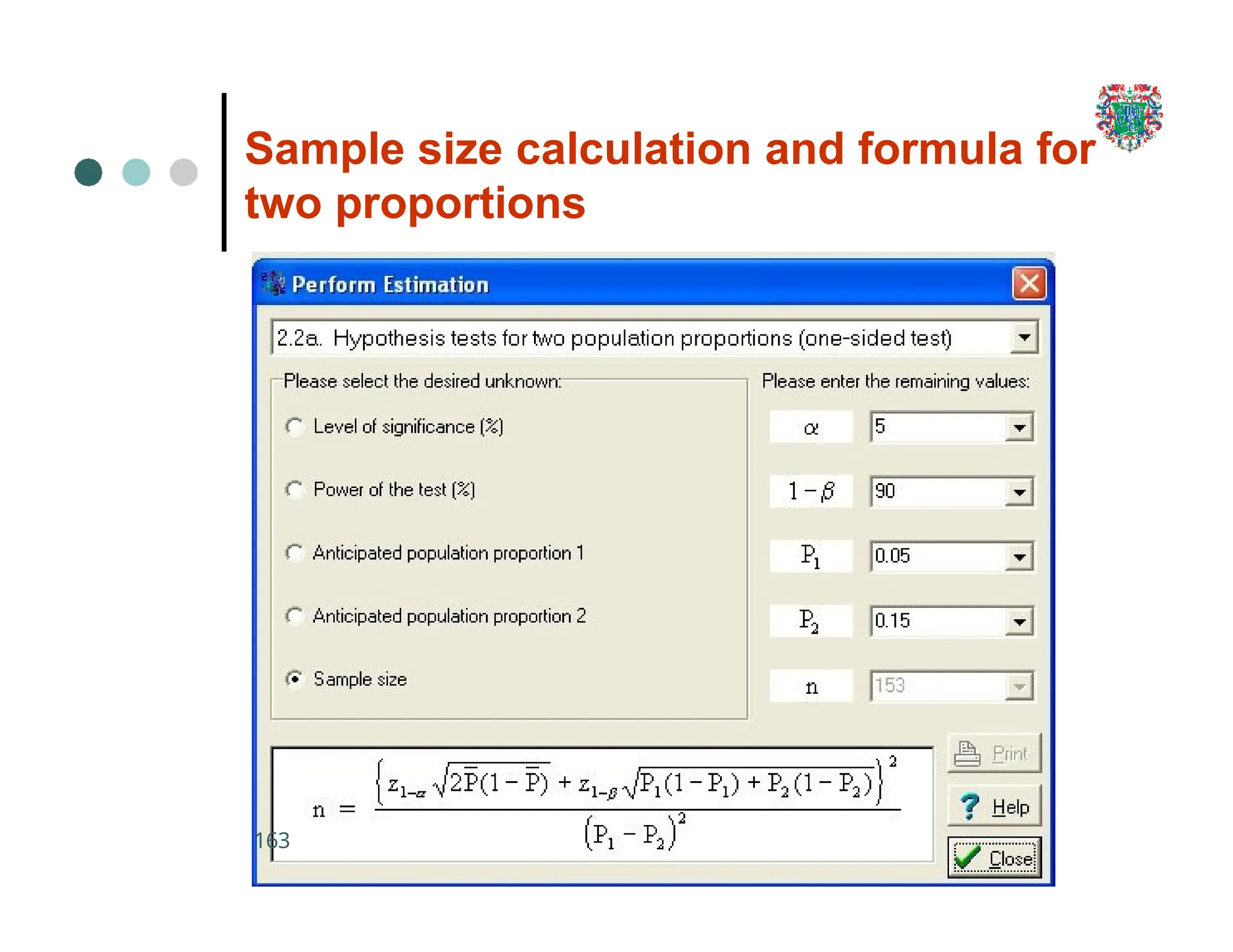
Example of Sample size calculation
for two proportions
162
O It is believed that the proportion of patient
who develop complications after
undergoing one type of surgery is 5%
while the proportion of the patients who
develop complication after a second type
of surgery is 15%. How large should the
sample size be in each of the two groups
of patients if an investigator wishes to
detect with a power of 90%, wether the
second procedure has a complication rate
significantly higher than the first at the
5% level of significance?
Sample size calculation and formula for
two proportions
163
Sample size for two group
means depends on:
164
1. The means/variance for both groups.
2. Level of confidence.
3. Power of the test.
Example of Sample size calculation
for two group means
165
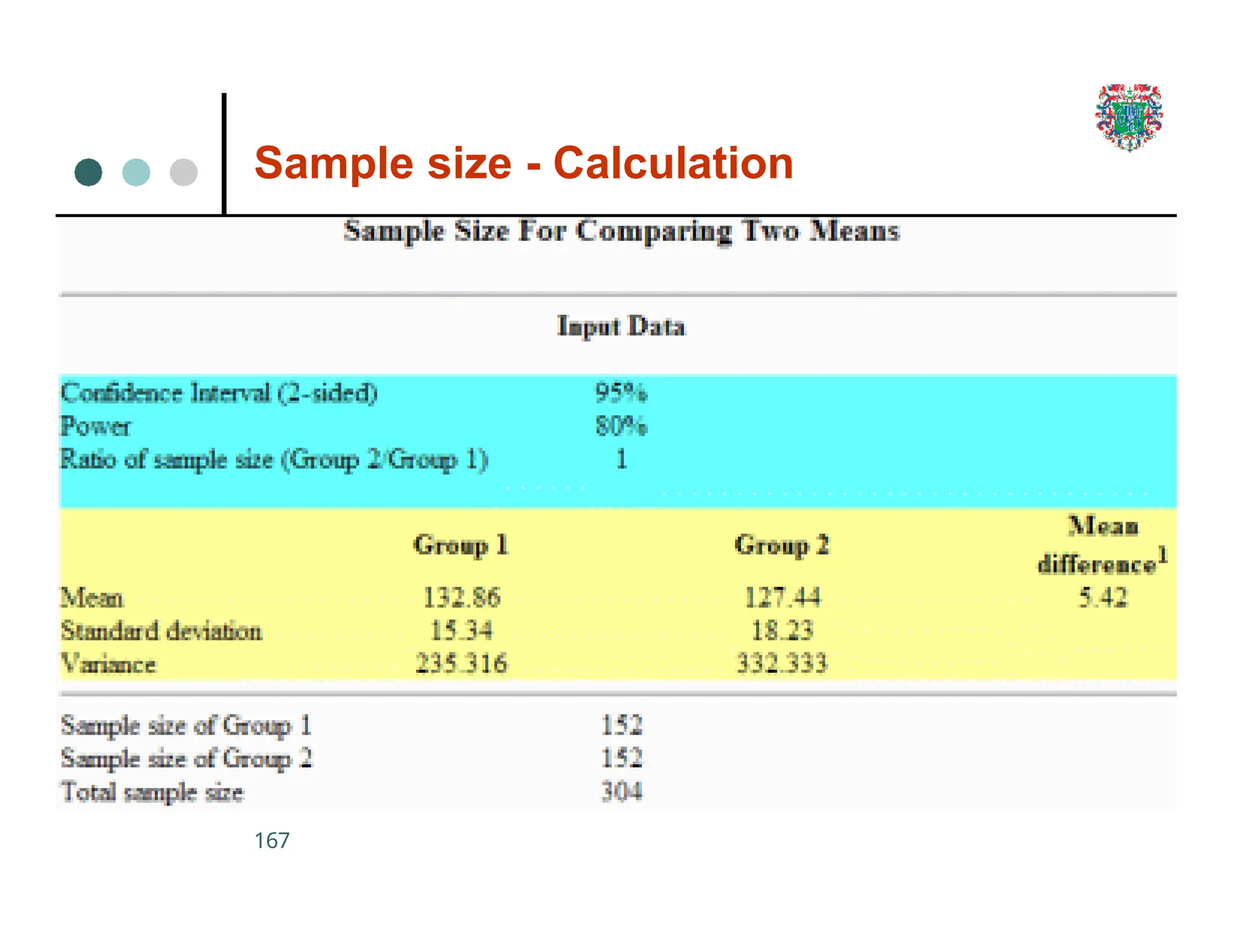
Suppose the true mean systolic blood
pressure (SBP) of 35 to 39 year old OC users
is (132.86 mmHg) and standard deviation
(15.34 mmHg). Similarly, for non-OC users,
the mean SBP is (127.44 mmHg) with
standard deviation (18.23 mmHg). If we
desire to estimate the difference
between 2 groups of equal size, what
would be the minimal sample size
required with a power of 80% at 95%
confidence level?
Calculator
166
Sample size - Calculation
167
Sample size for sensitivity and
specificity depends on:
1. The prevalence of the
condition/attribute of interest.
2. Estimated sensitivity.
3. Estimated specificity.
4. Level of significance.
5. Margin of error.
168
Example of Sample size calculation for
sensitivity and specificity
169
O If we want to determine the sensitivity
and specificity of graded
compression ultrasonography in the
diagnosis of acute appendicitis by
the gold standard histopathology.
How many patients should be included
in the sample .The prevalence OF AA is
77% and estimated sensitivity of US is
96.5% and estimated specificity is
94.1% with 95% confidence, if we want
to keep margin of error as 10%?
Sample size calculation and formula
for sensitivity and specificity studies
170
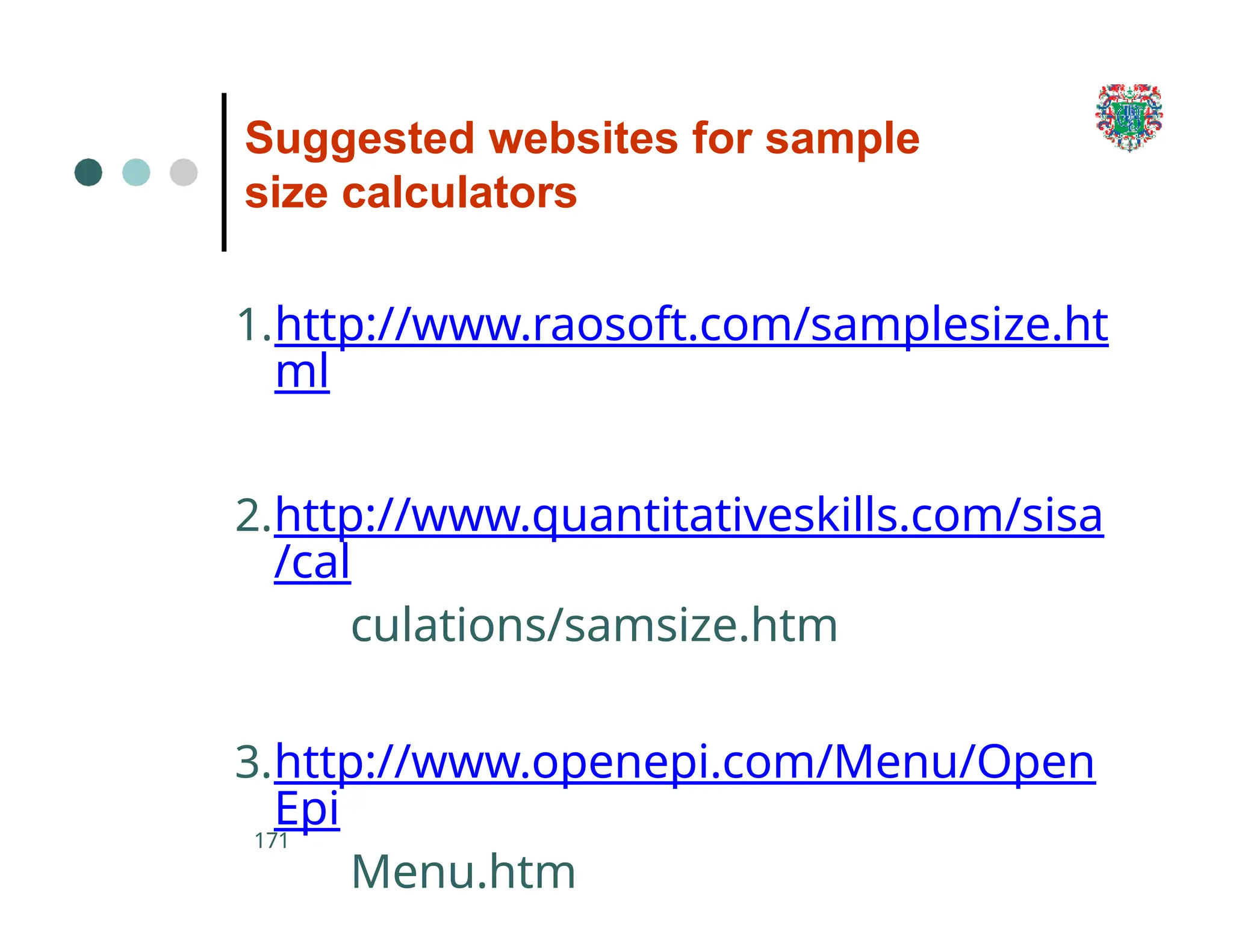
Suggested websites for sample
size calculators
171
1.http://www.raosoft.com/samplesize.ht
ml
2.http://www.quantitativeskills.com/sisa
/cal
culations/samsize.htm
3.http://www.openepi.com/Menu/Open
Epi
Menu.htm
Screening
180
Screening
173
O Screening for disease control can be
defined as the examination of
asymptomatic people in order to classify
them as likely or unlikely to have the
disease that is object of screening.
O If done in large groups---mass screening
or population screening.
Characteristics of Disease to
be Screened
174
O Disease must pass through preclinical
phase during which it is undiagnosed
but detectable
O Early treatment must offer some
advantage
Validity
175
O The ability of a test to distinguish
between who has disease and who
does not
Sensitivity
176
O Of a test is its ability to detect people
who do have disease.
O If a Test is always positive for all
diseased persons then sensitivity of the
Test will be 100%.
Specificity
177
O It is the ability of a Test to detect
people who don’t have disease.
O Thus a Test which is always negative in
non- diseased individuals is called to
have 100% specificity.
Validity
178
a
T P
b
FP
FN
c
d
TN
Positive
Negative
Diseased Non Diseased
a+b
c+d
Test
FNA
CA Breast
Positive
CA Breast
Negative
Total
Positive 60 a + + 50 b - + a + b
110
Negative 20 c - + 70 d - - c +d
90
Total 80 a + c 120 b + d a + b + c + d
200
179
O Sensitivity = a
180
x 100 = 60 x100 = 75%
80
a + c
I.e. Test (FNA) is 75% sensitive in detecting
disease
O Specificity = d x 100 = 70 x100 =
58%
d + b 120
I.e. Specificity of (FNA) is 58% to detect non-
diseased persons
Positive Predictive Value i.e
PPV
181
O PPV = a
a + b
x 100 = 60 x100 = 55%
110
I.e. 55% persons are actually suffering
from disease.
PPV Prevalence
Negative Predictive Value i.e NPV
O NPV = d x 100 = 70 x100 = 78%
c + d 90
I.e. 78% persons are actually free from
disease.
190
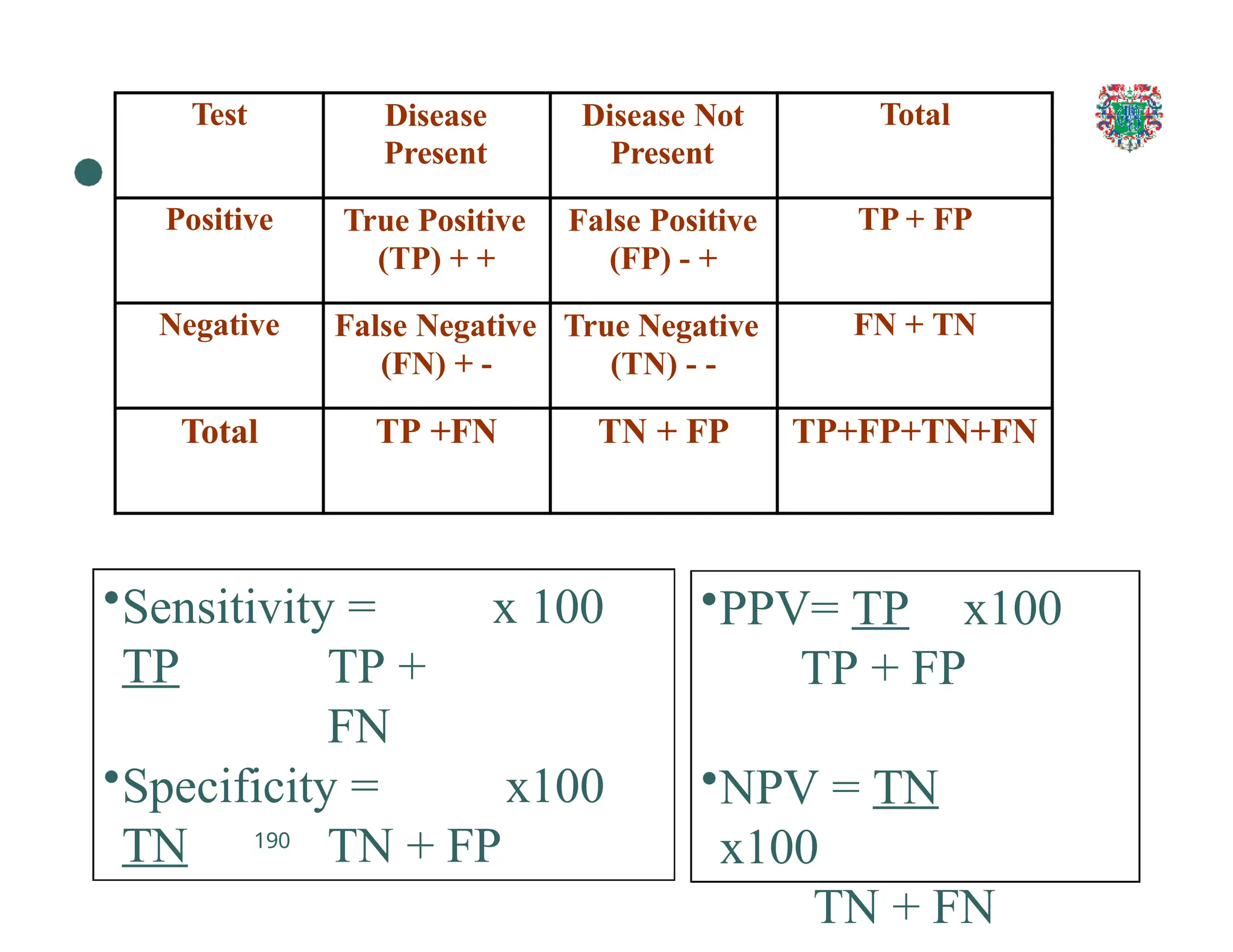
Test Disease
Present
Disease Not
Present
Total
Positive True Positive
(TP) + +
False Positive
(FP) - +
TP + FP
Negative False Negative
(FN) + -
True Negative
(TN) - -
FN + TN
Total TP +FN TN + FP TP+FP+TN+FN
•Sensitivity =
TP
x 100
TP +
FN
•Specificity =
TN
x100
TN + FP
•PPV= TP x100
TP + FP
•NPV = TN
x100
TN + FN
Relationship of Disease Prevalence to PPV
PPV = 99/594 = 17%
183
Dis. Prev Test
Results
Disease Not
Disease
Total
1% Positive 99 495 594
Negative 1 9405 9406
Total 100 9900 10,000
Example: Sensitivity = 99%; Specificity = 95% In a population of 10, 000
with a disease prevalence of 1%
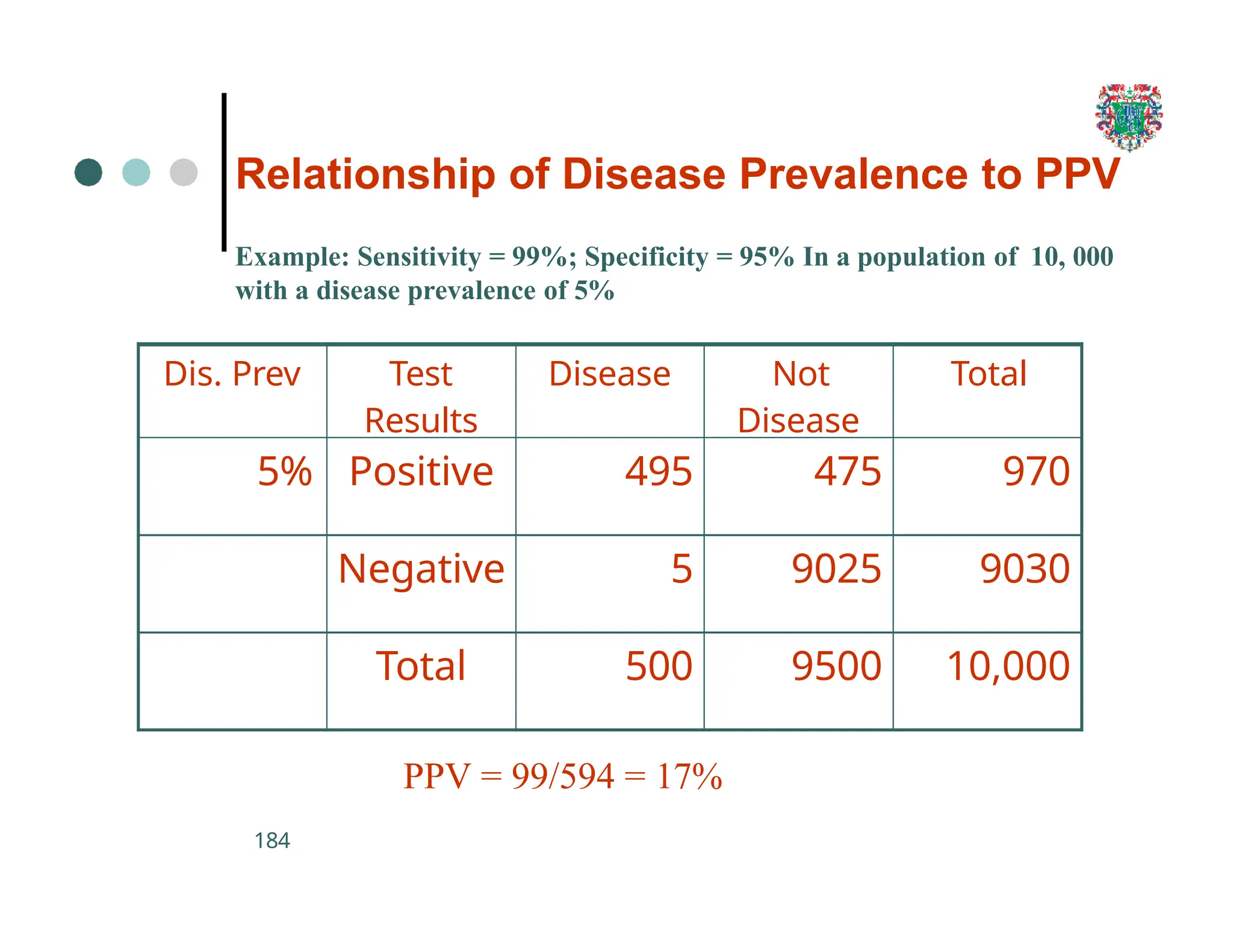
Relationship of Disease Prevalence to PPV
PPV = 99/594 = 17%
184
Dis. Prev Test
Results
Disease Not
Disease
Total
5% Positive 495 475 970
Negative 5 9025 9030
Total 500 9500 10,000
Example: Sensitivity = 99%; Specificity = 95% In a population of 10, 000
with a disease prevalence of 5%
Relationship between PPV & Prevalence
185
O A screening program is most effective
and beneficial if it is directed to a high-
risk target population
O Screening a total population for a
relatively infrequent disease can be very
wasteful of resources and may yield
very few previously undetected cases
DEVELOPING THE
QUESTIONNAIRE
194
POINTS OF IMPORT IN DESIGNING A
QUESTIONNAIRE
187
➢ It should be ensured that the format of the questionnaire be
attractive and easy for the respondents to fill,
overcrowding or clutter should be avoided and all
questions and pages clearly numbered
➢ The questionnaire should not be too long
➢ To maintain flow of the instrument, questions concerning
major areas should be grouped together
➢ Simple questions about age, birth date etc should be put at
the beginning to warm up the respondent
POINTS OF IMPORT IN DESIGNING A
QUESTIONNAIRE
188
➢ Questions should be close ended, possible answers to close
ended questions should be lined vertically, preceded
by boxes, brackets or numbers
Example
How many different medicines do you take daily (check one)
[ ]
None [ ]
1-
2
[ ] 3-
4
[ ] 5-
6
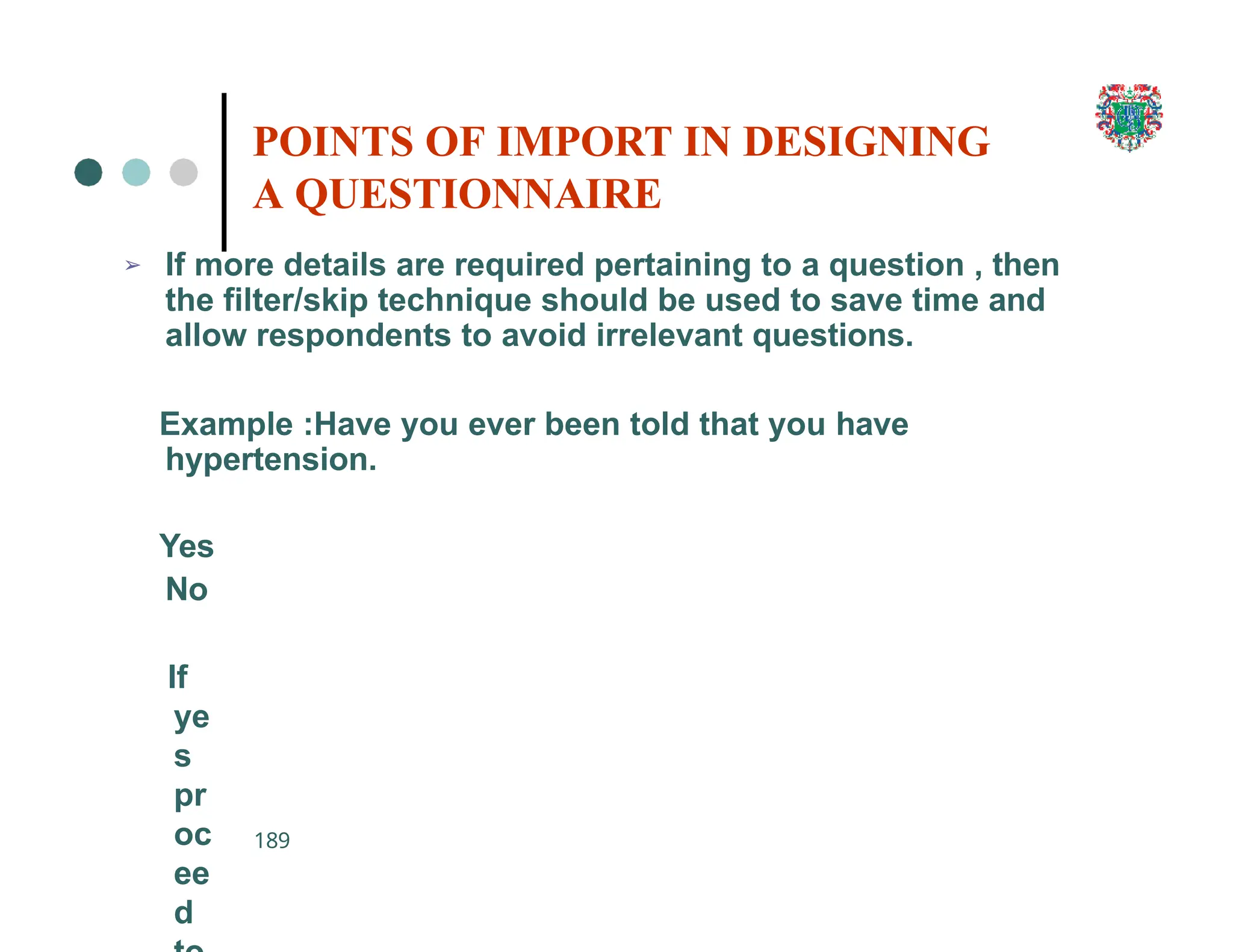
➢ If more details are required pertaining to a question , then
the filter/skip technique should be used to save time and
allow respondents to avoid irrelevant questions.
Example :Have you ever been told that you have
hypertension.
Yes
No
If
ye
s
pr
oc
ee
d
189
POINTS OF IMPORT IN DESIGNING
A QUESTIONNAIRE
POINTS OF IMPORT IN DESIGNING A
QUESTIONNAIRE
190
➢ Wordings of questions should be simple and free
from ambiguity, non judgmental and be
soliciting only one response.
➢ For behaviors that may change overtime specific
time span should be asked for in the question
Example :During the past 12 months how many
doctor visits did you make.
➢ Always choose a appropriate means of
measurement e.g. score /scales.
➢ Sensitive topic questions should be left for the
end
➢ If similar research instruments are available it
may be a good idea to review and if required
borrow questions.
➢ Always try to ensure that if questions are to be
asked in any language besides English they shall
be so written too
191
POINTS OF IMPORT IN DESIGNING
A QUESTIONNAIRE
Writing a
Synopsis
200
Introduction
193
O Synopsis: A short account of something
longer. A document that contains a brief
information about the research a
postgraduate trainee plans to conduct.
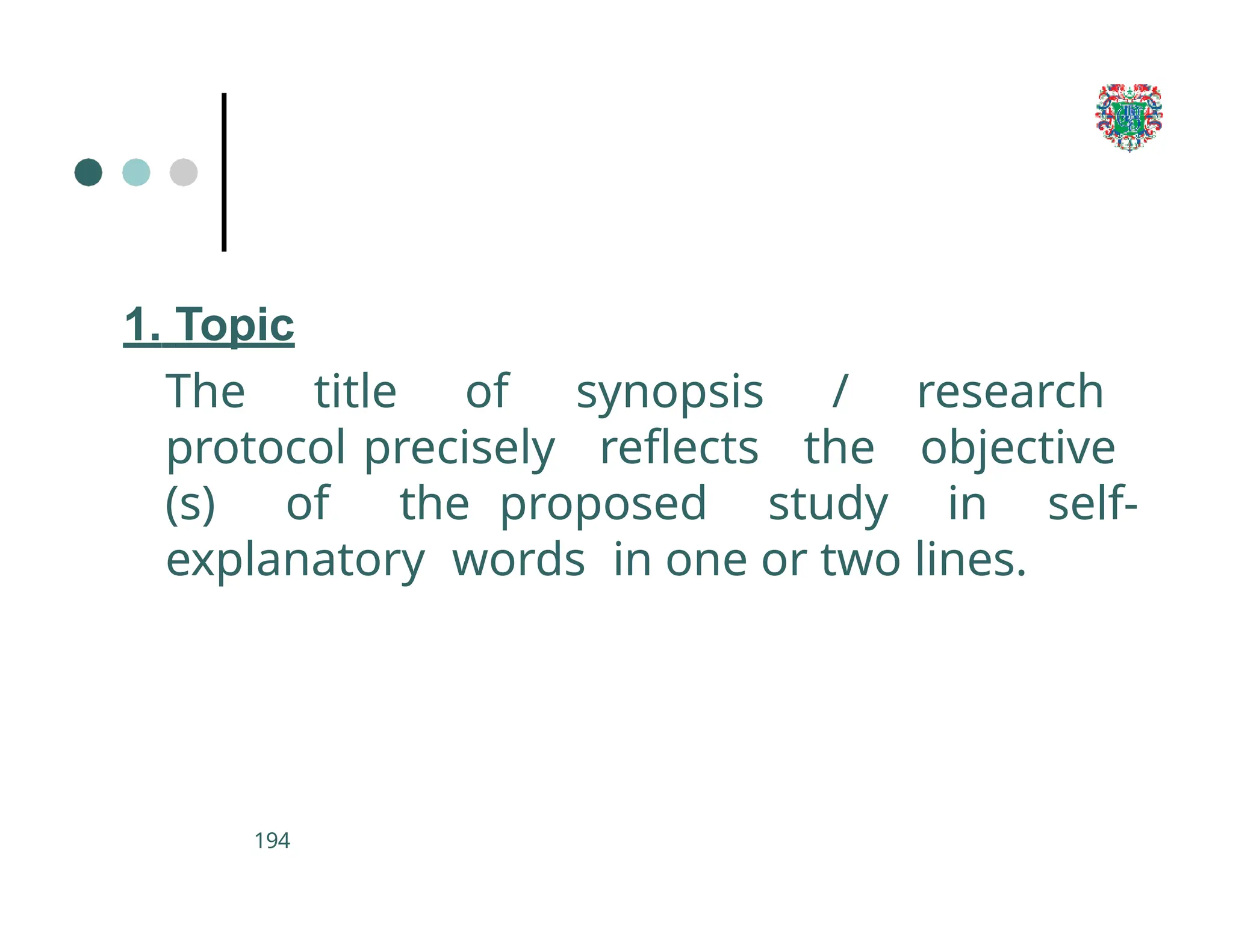
1. Topic
The title of synopsis / research
protocol precisely reflects the objective
(s) of the proposed study in self-
explanatory words in one or two lines.
194
20
3
2. Introduction
O Magnitude of the problem indicated clearly
O Recent (last 5 years) local & international
knowledge cited/provided (if not available, that
stated too)
O Gaps identified in existing knowledge regarding
the specific topic/theme of study, what would the
current study add to the same
O Rationale of study led by the above stated two
points
3. Objective(s):
Should be stated in clear & quantifiable words
4. Operational definition:
Should clearly define and indicate means
of measurement/determination of all
exposure/outcome (dependent & independent)
variables indicated in the objectives
5. Hypothesis:
Appropriately framed in terms of objectives
(alternate hypothesis)
196
4. Material and Methods:
197
O Setting: Place of study e.g. unit / department of the institute
O Duration of study: Time period required to complete
study (should not be less than 6 months) & to be
commenced after the approval of synopsis
O Sample Size: Sample size calculation done or stated
with justification, based on previous literature review
O Sample Selection:
Inclusion and exclusion criteria described with justification
4. Material and Methods:
O Study Design: Name of appropriate study design stated
O Data Collection:
▪ Description of study population & methods of
enrolment
▪ Selection & means of obtaining information of
variables of interest clearly indicated
▪ Means of determination of main outcomes
indicated, by who & when
▪ Means of control of bias & confounding indicated
198
Data Collection
(cont.)
199
▪ Sources of variables / data collection clearly stated;
if several methods were used, like records,
interview, laboratory tests, other
measurements like anthropometry, blood
pressure etc., then all stated in reference to
time and source
▪ Means of control of confounding variables (if to be
done at analysis stage ) indicated
Data Collection
(cont.)
200
▪ Ethical issues considered and maintained through
out the study
▪ Type of informed consent taken
▪ Proforma attached in appropriate format,
indicating all variables stated in methods and
relevant to the objective and not in the format of a
history sheet
Data Analysis:
201
▪ Statistical software used for data entry
stated
▪ Statistical software used for data
analyses stated
▪ Plan of data analyses according to
objectives, study design, and methods
▪ Type of descriptive statistics and
distribution of variables stated
Data Analysis:
202
▪ Any new variables that could be formed defined
and stated e.g. a scoring system, body mass index ,
% body fat etc. If composite variable formed then
the same clarified & indicated in operational
definition too
▪ Statistical tests used for testing of hypothesis with
levels of significance
▪ Any method used for control of confounding
factors stated / described
References:
203
▪ Minimum of FIVE
▪ References cited in
Vancouver style
▪ All references could be
verified
DISSERTATION
WRITING
WHAT?
&
WHY?
212
Dissertation Writing
Detailed discourse on a subject especially
submitted for a higher degree in a
University [Oxford]
213
214 Eligibility 2or FCPS II Examination
Application 2or Training Registration
(immeditely o n start o2 training)
Training Registration
Approval o2 Supervisor
Submission o2 Synopsis
(within 6 mo n t h s o2 registration)
Approval o2 Synopsis by the Synopsis Review Committee o2
CPSP Dissertation writing & its Submission
(at least 6 m o n t h s be2ore the examination in which
appearing)
Assessment o2 Dissertation by External
Assessors Approval o2 Dissertation
STEPS IN WRITING A DISSERTATION
Part - 1
• Title page
• Supervisor’s certificate
• Dedication
• Acknowledgement
• Table of contents
• List of tables
• List of figures, graphs,
illustrations
O List of abbreviations
215
FORMAT OF DISSERTATION
21
6
FORMAT (contd.)
Part - 2 (about 70-100
pages)
▪ Abstract
▪ Introduction
▪ Review of literature
▪ Objective(s) of study
▪ Operational definitions
▪ Hypothesis
▪ Material & Methods
▪ Result
▪ Discussion
▪ Conclusion(s)
▪ References
(Bibliography)
217
Title Page (Sample)
EDUCATIONAL IMPACT OF IMPROVED
MONITORING OF CPSP FELLOWSHIP
TRAINING PROGRAMS
by
Dr. Syeda K. Ali, MHPE
Supervisor:
Prof. Neil Paget, Ph.D
Work done at
Department of Medical Education
College of Physicians &
Surgeons Pakistan
JUNE 09, 1999
21
8
Supervisor’s Certificate (Sample)
I, hereby, certify that Dr. having Enrolment
Number : & RTMC Registration
Number: has been working under my direct
supervision with effect from :
(date)
in the Department:
to (date)
Unit:
of Training institution:
in the City of:
The enclosed Dissertation titled:
was prepared according to the “FCPS Dissertation - Guidelines” under
my direct supervision. I have read the Dissertation and have found it
satisfactory for FCPS part II examination in the subject.
Signature of the Supervisor:
Name of the Supervisor:
Designation: Date:
Official stamp:
Acknowledgement(s)
O May be included at the
end of the dissertation
or after the table of
contents.
O May acknowledge
Technical help
(separate
paragraph),
Financial and material
support.
211
TABLE OF CONTENTS
212
O Heading
• Subheading
O Annexes
Page #
Page #s
• Roman numerals till start of
summary
• Arabic numerals from summary
till annexes
Abstract
O Consists of 250 words covering the
introduction, objectives, design,
setting, subjects & methods,
results,
& conclusion of the study
O Three to ten key words
identified and written at the end
213
INTRODUCTION
(Why did you study the problem?)
O Identify problems & issues (magnitude of
the problem)
O Background (Why is it important to conduct
the study?)
O What previous work has been undertaken on
the topic?
O What new will your study be evaluating and
its impact
214
Review Of The Literature
O Comprehensive review of the current
status of knowledge on the selected topic.
O Collective review and critique in the
candidates own words (not copied).
O References of the last 5
years (older, relevant and
historical
references can be used).
O Review of the local
literature must be
included.
O Literature cited in
MedLine, ExtraMed
215
Objective(s) of Study
216
O Should be stated in clear &
quantifiable words
O Should be the same as stated in
synopsis
Operational Definition
217
O Should clearly define and indicate means of
measurement / determination of all
exposure / outcome (dependent &
independent ) variables indicated in the
objectives.
MATERIALS & METHODS
(What did you do? How did you do it?)
O Study designs
O Study population
O Procedures / apparatus used
O Methods of gathering & analyzing
data
O Statistical analysis
undertaken (Write in past
tense)
218
Results
O The result should be in
logical sequence.
O Main result should be
stated first.
O Summarization of the data
collected and statistical analysis
made should be given in this
section.
219
Discussion
220
O Results of the study should be
examined, interpreted.
O Implications and limitations described.
Conclusion(s)
O It describes the inferences drawn on
the basis of the results of study.
O Should be linked with the objectives
and purpose of the study.
221
References
222
O Citation in the text
- serially numbered
O Listing references
- at the end in Vancouver
style.
Annexes
O should be added if
they increase the
understanding or evaluation
of the study.
O All annexes should be serially
numbered and referred to at
appropriate places in the body of
dissertation.
223
REFERENCE
WRITING
232
Reference writing
225
•Vancouver Style
•International Committee of Medical Journal
Editors Uniform Requirements for Manuscripts
Submitted to Biomedical Journals
Articles in Journals
226
All authors should be listed. If there are
six or less
O Halpern SD, Ubel PA, Caplan AL. Solid-
organ transplantation in HIV-infected
patients. N Engl J Med. 2002 Jul
25;347(4):284-7.
Articles in Journals
227
If a journal carries continuous
pagination throughout a volume the
month and issue number may be
omitted.
O Halpern SD, Ubel PA, Caplan AL. Solid-
organ transplantation in HIV-infected
patients. N Engl J Med. 2002;347:284-
7.
Articles in Journals
228
More than six authors
O List the first six authors followed by et al
O Rose ME, Huerbin MB, Melick J,
Marion DW, Palmer AM, Schiding JK,
et al.
Regulation of interstitial excitatory amino
acid concentrations after cortical
contusion injury. Brain Res. 2002;935:40-
6.
Organization as author
229
Diabetes Prevention Program Research
Group. Hypertension, insulin, and
proinsulin in participants with impaired
glucose tolerance. Hypertension. 2002;40
:679-86.
No author given
230
O 21st century heart solution may have a sting in
the tail. BMJ.2002;325:184.
Volume with supplement
231
O Geraud G, Spierings EL, Keywood C. Tolerability
and safety of frovatriptan with short- and long-
term use for treatment of migraine and in
comparison with sumatriptan. Headache. 2002;42
Suppl 2:S93-9.
Issue with supplement
232
O Glauser TA. Integrating clinical trial
data into clinical practice. Neurology.
2002; 58(12 Suppl 7):S6-12.
Volume with part
233
Abend SM, Kulish N. The psychoanalytic method
from an epistemological viewpoint. Int J
Psychoanal.
2002;83(Pt 2):491-5.
Issue with part
234
O Ahrar K, Madoff DC, Gupta S, Wallace
MJ, Price RE, Wright KC. Development of
a large animal model for lung tumors. J
Vasc Interv Radiol. 2002;13(9 Pt 1):923-8.
Issue with no volume
235
O Banit DM, Kaufer H, Hartford JM.
Intraoperative frozen section analysis in
revision total joint arthroplasty. Clin Orthop.
2002;(401):230-8.
O Personal author(s)
O Murray PR, Rosenthal KS, Kobayashi GS,
Pfaller MA. Medical microbiology. 4th
ed.
St. Louis: Mosby; 2002.
236
Book References
Editor(s), compiler(s) as author
237
O Gilstrap LC 3rd, Cunningham FG,
VanDorsten JP, editors. Operative
obstetrics. 2nd ed. New York: McGraw-
Hill; 2002.
Author(s) and editor(s)
238
O Breedlove GK, Schorfheide AM.
Adolescent pregnancy. 2nd ed.
Wieczorek RR, editor.
White Plains (NY): March of Dimes
Education Services; 2001.
Chapter in a book
239
O Meltzer PS, Kallioniemi A, Trent JM.
Chromosome alterations in human solid
tumors. In: Vogelstein B, Kinzler KW,
editors. The genetic basis of human
cancer. New York: McGraw-Hill; 2002. p.
93-113.
Dissertation
240
O Borkowski MM. Infant sleep and
feeding: a telephone survey of Hispanic
Americans [dissertation]. Mount
Pleasant : Central Michigan University;
2002.
Journal article on the Internet
241
O Abood S. Quality improvement initiative
in nursing homes: the ANA acts in an
advisory role. Am J Nurs [serial on the
Internet].
2002 Jun [cited 2002 Aug 12];102(6):[about
3 p.]. Available from:
http://www.nursingworld.org/AJN/2002/j
une/
Wawatch.htm

research PPT NEW.pptx henananannanannanann

  • 1.
  • 2.
    RESEARCH is 2 A Processof Systematic, Scientific Data O Collection O Analysis & O Interpretation So as to find Solutions to a problem.
  • 3.
    Types of Research 3 OQualitative O Quantitative
  • 4.
    STEPS IN DESIGNING ANDCONDUCTING RESEARCH Thinking about topic formulating research question/ objective Matching the Research Design to research objectives Defining and clarifying the research Variables/ Analysis plan Drawing the Sample Developing the tools & defining the methods of data collection Monitoring and Carrying out the research Preparing the Data for Analysis Analyzing Data Writing the Research Report 4
  • 5.
  • 6.
    CRITERIA FOR SELECTINGA RESEARCH TOPIC 6 O Relevance O Innovation O Feasibility O Acceptabilit y O Cost- effectivenes s O Ethical consideratio n
  • 7.
    CRITERIA FOR SELECTION ProposedTopic Relevance Innovation Feasibility Acceptability Cost Effectiveness Ethical TOTAL SCORE How big is the problem? How important is it to look for relevant solutions to it ? Are solutions to it available, if so how effective have they been proved? Is the problem of inport in our local set up 7 Priority Ratings for Research Proposals
  • 8.
    CRITERIA FOR SELECTION ProposedTopic Relevance Innovation Feasibility Acceptability Cost Effectiveness Ethical TOTAL SCORE Incase the topic has been researched what new are you looking at 8 Priority Ratings for Research Proposals
  • 9.
    Proposed Topic CRITERIA FORSELECTION Relevance Innovation Feasibility Acceptability Cost Effectiveness Ethical TOTAL SCORE Consider the resources that are required to carry out the project. 9 Priority Ratings for Research Proposals
  • 10.
    CRITERIA FOR SELECTION ProposedTopic Relevance Innovation Feasibility Acceptability Cost Effectiveness Ethical TOTAL SCORE research a topic which has the interest and support of the authorities 10 Priority Ratings for Research Proposals
  • 11.
    CRITERIA FOR SELECTION ProposedTopic Relevance Innovation Feasibility Acceptability Cost Effectiveness Ethical TOTAL SCORE Whether the resources of time, money and manpower being invested in the study are worthwhile 11 Priority Ratings for Research Proposals
  • 12.
    12 CRITERIA FOR SELECTION ProposedTopic Relevance Innovation Feasibility Acceptability Cost Effectiveness Ethical TOTAL SCORE Priority Ratings for Research Proposals •Cultural sensitivity must be given careful consideration. •Informed consent ensured. •Will treatment be given to individuals identified during study who require treatment?
  • 13.
    CRITERIA FOR SELECTION ProposedTopic Relevance Innovation Feasibility Acceptability Cost Effectiveness Ethical TOTAL SCORE Rating Scale: 1= low, 2 = medium, 3 = high Total Score out of 18 13 Priority Ratings for Research Proposals
  • 14.
    What? O Allows oneto search in a purposeful and systematic manner, through a range of literature or information relevant to ones particular field, and to hone in on material relevant to ones interest and objectives. 14 Literature Search:
  • 15.
    A Literature Search 15 Why? 1.To keep up with the latest developments in your field. 2. To learn more about some topic. 3. To document important facts and ideas you wish to research in light of previous work done on it. 4. To understand your data in the context of what is already known. 5. To provide your readers with sources they can consult on their own. 6. PUBMED GOOGLE SCHOLAR
  • 16.
  • 17.
    Research Objectives 17 • OAn objective is an intent of what the researcher wants to do stated in clear measurable terms.” • What is to be measured is clearly stated, be it a measure of frequency, or Association in the population of interest.
  • 18.
    Importance of ResearchObjectives 18 1. Brings focus to the study. 2. Avoids collection of unnecessary data. 3. Determines an appropriate study design. 4. Helps determine analysis plan.
  • 19.
    Examples 19 Objectives: O 1)To determinethe frequency of anemia in pregnant women visiting Tertiary care facilities of Sindh. O 2) To determine association between maternal smoking and LBW. O 3) To compare the effectiveness of dressing A vs. dressing B in patients presenting with infected wounds of the foot.
  • 20.
    Operational Definitions 32 O Isthe definition of the exposure and outcome variables of interest in context to objective in a particular study and their means of measurement/determination. O Examples: • Anemia • Effectiveness • PPH • Wound healing
  • 21.
  • 22.
    Analytical Studies Observational Cohort Case Control DescriptiveStudies Case Report Case Series Cross Sectional Epidemiological Study Designs Experimental Preventive Trial Therapeutic Trial 22
  • 23.
    DESCRIPTIVE STUDIES 23 Descriptive studiesinvolve the systematic collection and presentation of data to give a clear picture of a particular situation and can be carried out on a small or large scale. O Case Report O Case series O Cross Sectional Survey
  • 24.
    COMPARATIVE or ANALYTICAL STUDIES 24 OAn ANALYTICAL STUDY attempts to establish association or determine risk factors for certain problems. This is done by comparing two or more groups, with or without the outcome of interest/exposure of interest. Types ▪ Observational ▪ Experimental
  • 25.
    Case Report 25 O Adetailed report by a physician of an unusual disease in a single person. O Classical example is that of a single case reported in Germany in late 1959 of a congenital malformation affecting the limbs and digits. O More cases were reported in the following years. In 1961 a hypothesis was put forward that thalidomide, a sleeping pill, was responsible for congenital malformations. O Subsequent analytic studies confirmed the link between the drug and congenital malformation.
  • 26.
    Case Series 26 O Whenseveral unusual cases all with similar conditions are described in a published report, this is called a Case Series. O A case series does not include a control group.
  • 27.
    Cross-Sectional Studies 27 O Across-sectional study is a survey of a defined population at a single point in time. O Also called “Prevalence Studies”. O Determines the “burden of disease” in a population. O Exposure & outcome are determined simultaneously.
  • 28.
    Design of aCross-Sectional Study Defined Population Gather Data on Exposure and Disease simultaneously Exposed; Have Disease Exposed; Do Not Have Disease Not Exposed; Have Disease Not Exposed; Do Not Have Disease 28
  • 29.
    CROSS-SECTIONAL STUDY SMOKERS 100 NON-SMOKERS 100 LUNG CA NON -LUNG CA NON-LUNGCA 20 LUNG CA 80 LUNG CA 60 NON-LUNG CA 40 PREVALENCE :- 80/100 PREVALENCE :- 60/100 PREVALENCE RATIO :- 80/100 60/100 SAMPLE OF POPULATIONS AT A TIME :- SNAP SHOT
  • 30.
    Cross-Sectional Surveys-Advantages 30 O Fairlyquick and easy to perform. O Inexpensive. O Useful for determining the prevalence of disease for a defined population and can also measure factors leading to it subsequent to group formations.
  • 31.
    Cross-Sectional Surveys -Disadvantages 31 O Provide only a “snapshot” in time. O The data about both the exposure to risk factors and the presence or absence of disease are collected simultaneously, hence it is difficult to determine temporal relationship of a presumed cause and effect.
  • 32.
    Cohort Studies 32 O Acohort is a group of people who have something in common (a characteristic or characteristics suspected of being a precursor to or risk factor for a disease) and who remain part of a group over a period of time.
  • 33.
    Cohort study SAMPLE 100 SMOKERS 60 Lung CA 40 NONLUNG CA 20 NON-SMOKERS 40 LUNG CA 3 NON-Lung ca 37 LUNG CA NON-LUNG CA TOTAL INCIDENCE SMOKERS 40 20 60 40/60 NON- SMOKERS 3 37 40 3/40 AFTER 10 YEARS INCIDENCE RATIO :- 40/60 3/40 Prospective study i.e see in future
  • 35.
    Types of CohortStudies 35 O Prospective Cohort Studies O Retrospective Cohort Studies
  • 36.
    Prospective Cohort Studies 36 Theinvestigator assembles the study groups in the present time, collects baseline data on them and then continues to collect data for a period that can last many hours to years.
  • 37.
    Retrospective Cohort Studies 37 OThe investigator goes back into history to define a risk group (e.g. *those children exposed to x-rays in utero vs. those not), and follows the group members up to the present to see what outcome (cancer) have occurred
  • 38.
    Cohort Study –Prospective Unexposed (controls) Exposed (cases) With outcome Without outcome With outcome Without outcome Onset of study 38 Direction of study Cohort selected for study
  • 39.
    Retrospective Cohort Studies Exposed(cases) Unexposed (controls) With outcome 39 Without outcome With outcome Without outcome Direction of study Records selected for study Onset of study
  • 40.
    Prospective Cohort Studies- Advantages 40 O Because they are longitudinal, are the study of choice for ❖ Establishing causes of a condition (temporal relation) ❖Allows for measurement of incidence ❖ Study of multiple effects of a single exposure
  • 41.
    Prospective Cohort Studies-Disadvantages 41 O *With diseases that develop over a long period of time, or with conditions that occur as a result of long- standing exposure, many years are needed and hence: ❖High costs ❖Long wait until results are obtained ❖Loss to follow O Are problematic when disease or outcome is rare For example, studying the risk factors/ clinical features associated with carcinoid tumors (very slowly growing tumors)
  • 42.
    Retrospective Cohort Studies 42 Advantages: OLess expensive O Completed in much shorter time than a prospective study Disadvantages: O The quality of data collection is not as good As records generated for clinical purposes and not for research O Because of a large number of biases associated with these studies,carry less weight in establishing a cause than prospective studies.
  • 43.
    Case Control Study 43 OThe investigator selects the case group and the control group on the basis of the outcome (i.e. having the disease of interest vs. not having the disease of interest) O Cases and controls are assembled and are questioned or their medical records are consulted regarding past exposure to risk factors
  • 44.
  • 45.
    Case Control Studies 45 Advantages OInexpensive O Quick O Especially useful when the disease being studied is rare or for a condition which develops over a long time O Can evaluate multiple etiologies for one outcome Disadvantages O Recall bias O Selection Bias
  • 46.
    Case-Control Studies -Selection of Cases 46 Cases can be selected from a variety of sources: O Hospital patients O Patients in Physician’s practices O Registries
  • 47.
    Selection of Controls 47 Controlsmay be selected from O Non-hospitalized persons living in the community similar to cases O Hospitalized patients admitted for diseases other than that for which cases are admitted
  • 48.
    Problems with CaseControl Study 48 Selection Bias O In 1929, Raymond Pearl at John Hopkins, Baltimore conducted a study to test the hypothesis that tuberculosis protected against cancer O He selected 816 cases of cancer from 7500 consecutive autopsies O He also selected 816 controls from others on whom autopsies had been carried out at John Hopkins O Of the 816 CASES (with cancer), 6.6% had TB O Of the 816 CONTROLS (without cancer), 16.3% had TB O From the finding that the prevalence of TB was considerably higher in the control group, Pearl concluded that TB was protective against cancer O Was Pearl’s conclusion justified?
  • 49.
    Problems with CaseControl Studies “Pearl’s Study” 49 O No!! At the time of the study, TB was one of the major reasons for hospitalization at Johns Hopkins Hospital O Pearl thought that the control group’s rate of TB would represent the level of TB in the general population; but because of the way he selected the controls, they came from a pool that was heavily weighted with TB O The way the controls are selected is a major determinant of whether a conclusion is valid or not
  • 50.
    Problems with CaseControl Studies 50 Coffee-drinking and Cancer of the Pancreas in Women* O Cases were white cancer patients from 11 Boston and Rhode-Island hospitals O Controls were patients from GI Clinics O McMohan found that coffee consumption was greater in cases than controls O Controls were patients who had reduced their coffee consumption because of Physician’s advice O The controls level of coffee consumption was not representative of the general population O When a difference in exposure is observed between cases and controls we must ask “Is the level of exposure observed in the controls really the expected level in the general population.
  • 51.
    Recall Bias 51 Individuals whohave experienced a disease or other adverse health events tend to think about possible causes & thus are likely to recall histories of exposure differently as compared to controls.
  • 52.
    INTERVENTIONAL / EXPERIMENTAL STUDIES 52 OThe researcher manipulates a situation and measures the effects of the manipulation amongst two groups, one in which the intervention takes place (e.g. treatment with a certain drug) and another group that remains "untouched" (e.g., treatment with a placebo) .
  • 56.
    SINGLE-BLIND STUDY THE participantAlso called single-masked study DOUBLE-BLIND STUDY neither the participating individuals nor the study Researcher knows which participants are receiving the experimental drug and which are receiving a placebo (or the therapy). TRIPLE-BLIND STUDY participants, investigators, and data analyst all remain unaware of the intervention assignments throughout the trial. PLACEBO Refers to a pharmacologically inactive agent that investigators administer to participants in the control group of a trial
  • 57.
  • 58.
    SAMPLING 58 A sample isa sub set of the population, with all its inherent qualities. Inferences about the population can be made from the measurements taken from a sample, if the sample is truly representative of the population. Since a sample is expected to represent the whole population, the sampling procedure has to follow three fundamentals: 1. Should be representative. 2. Large enough. 3. The selected elements should have been properly approached, included and interviewed.
  • 59.
    There are manygood reasons for studying a sample instead of an entire population: ➢Samples can be studied more quickly than populations. Speed can be important if a physician needs to determine something quickly, such as a vaccine or treatment for a new disease. ➢A study of a sample is less expensive than a study of an entire population because a smaller number of items or subjects are examined. This consideration is especially important in the design of large studies that require a long follow-up. ➢A study of the entire populations is impossible in most situations. 59 REASONS FOR USING SAMPLES
  • 60.
    STEPS IN SAMPLING 60 1.Definition of the population We first need to identify the population we wish to draw the sample, from and do so somewhat formally because any inferences we draw are really only applicable to that population 2. Construction of a sampling frame (or thinking of an alternate) The list of all possible units that might be drawn in a sample.
  • 61.
    3. Selection ofa sampling procedure This is a critical decision about how to collect the sample. We will look at some different sampling procedure in the following slides. 61
  • 62.
    TWO MAJOR TYPESOF SAMPLING PROCEDURES: 62 PROBABILITY Each element has the same chance of being included in the sample. Major types of probability sampling procedures: 1. 2. 3. 4. NON- PROBABILITY Simple random Systematic Cluster Stratified There is no assurance that each element will have the same chance of being included in the sample. The 3 major types: 1. 2. 3. Consecutive Convenience Purposive
  • 63.
    TYPES OF SAMPLINGMETHODS Sampling Non-Probability Sampling Consecutive Purposive Convenience Probability Sampling Simple Random Systematic Stratified Cluster 63
  • 64.
    SIMPLE RANDOM SAMPLING 64 PREREQUISITES 1.Sampling frame a unique number is assigned to each element 2. Elements are selected into the sample randomly by 3 means ➢ Table of Random Numbers ➢ Lottery Method ➢ Computer Generated Numbers
  • 65.
    SYSTEMATIC SAMPLING 65 PREREQUISITES 1. Samplingframe (If available ) if not then too systematic sampling can be undertaken. What is required is an estimate of population size and required sample size.
  • 66.
    SYSTEMATIC SAMPLING • Decideon sample size: n •Determine population size = N • Divide population of N individuals into groups of k individuals: k = N/n • Randomly select one individual from the 1st group. • Select every k-th individual thereafter. N = 640 n = 80 k = 8 First Group 66
  • 67.
    STRATIFIED SAMPLING 67 One ofthe main purposes of stratified sampling is to compare different strata, which may not be possible with simple random sampling alone. Pre requisite: Sampling frame ▪ The population is first divided into groups of elements called strata. ▪ Each element in the population belongs to one and only one stratum. ▪ Best results are obtained when the elements within each stratum are as much alike as possible (i.e. homogeneous group). ▪ A simple random sample is taken from each stratum.
  • 68.
    CLUSTER SAMPLING 68 When alist of the entire area is not available and it is not physically possible to visit the entire area (e.g. the city, or country) one can divide the area into several equal size clusters or units. E.g.: Mohallas, Apartment Buildings, Villages, Schools One can select (randomly) only a few cluster, number all the units within it and draw either: 1. A random sample or 2. A systematic sample
  • 69.
    NONPROBABILITY SAMPLING 69 Nonprobability samplingdesign are often more practical than probability designs for some clinical research. Because statistical significance test are based on the assumption that a probability sample has been used, the objective in nonprobability sampling is to produce a facsimile, for the search question at hand of the probability sample.
  • 70.
  • 71.
    CONSECUTIVE SAMPLING 71 • Itinvolves taking every patient who meets the selection criteria over a specified time interval or number of patients. • It is the best of the nonprobability techniques and one that is very often practical.
  • 72.
    CONVENIENCE SAMPLING 72 1. Itis the process of taking those members of the accessible population who are easily available. 2. Sample is selected in a haphazard fashion. 3. It is widely used because of its obvious advantages in cost and logistics, however this type of sampling technique in fraught with biases.
  • 73.
    PURPOSIVE SAMPLING 73 • Samplingis done on the basis of some pre determined idea (clinical knowledge etc). • Specific targets are interviewed, because they posses the desired information.
  • 74.
  • 75.
    A Variable isa characteristic of a person, object or phenomenon that can take on different values. A simple example of a variable is a person’s age. The variable age can take on different values because a person can be 20 years old, 35 years old, and so on. 75
  • 76.
    Dependent and independentvariables 76 Because in health system research you often look for causal explanations, It is important to make distinction between dependent and independent variables. The variable that is used to describe or measure the problem under study (outcome) is called the DEPENDENT variable. The variables that are used to describe or measure the factors that are assumed to cause or at least to influence the problem are called the INDEPENDENT (exposure) variables.
  • 77.
    Data 77 Data are valuesof the observation recorded for variables (e.g. age, weight, sex).
  • 78.
    TYPES of DATA 78 Qualitativeor categorical data:- The characteristic which can’t be expressed numerically like sex, ethnicity , healing etc. Quantitative data or numerical data:- The characteristic which can be expressed numerically like age, temperature, no. of children in a family. Categorical Data There are two types of categorical data: • Nominal • Ordinal data.
  • 79.
    NOMINAL DATA 79 O InNOMINAL DATA, the variables are divided into named categories. These categories however, cannot be ordered one above another (as they are not greater or less than each other). O Example: NOMINAL DATA Sex/ Gender: Marital status: CATEGORIES male, female single, married, widowed, separated, divorced
  • 80.
    ORDINAL DATA 80 O InORDINAL DATA, the variables are also divided into a number of categories, but they can be ordered one above another, from lowest to highest or vice versa. O Example: ORDINAL DATA Level of knowledge: Level of blood pressure: CATEGORIES good, average, poor high, moderate, low
  • 81.
    Quantitative Data 81 Interval Scale:- Youare also allowed to quantify the difference between two interval scale values but there is no natural zero. Example :- Temperature scales are interval data with 25C warmer than 20C and a 5C difference has some physical meaning. Note that 0C is arbitrary, so that it does not make sense to say that 20C is twice as hot as 10C.
  • 82.
    Quantitative data 82 O RatioScale:- You are also allowed to take ratios among ratio scaled variables. Physical measurements of height, weight, length are typically ratio variables. It is now meaningful to say that 10 m is twice as long as 5 m. This ratio hold true regardless of which scale the object is being measured in (e.g. meters or yards). This is because there is a natural zero.
  • 83.
    Presentation of Data 83 OData once collected should be presented in a such a way as to be easily understood . The style of presentation depends, of course, on type of data. O Data can be presented in as frequency tables, charts, graphs, etc. Here we would discuss some of the important means of presentation.
  • 84.
    FREQUENCY TABLES 84 O Ina FREQUENCY TABLE data is presented in a tabular form. It gives the frequency with which (or the number of times) a particular value appears in the data.
  • 85.
    Systolic Blood Pressureof patients coming to a tertiary care hospital OPD n = 60 85 Distribution Frequency Relative Cumulativ e Relative Below 100 6 0.10 0.10 100 – 120 9 0.15 0.25 121 – 140 24 0.40 0.65 141 – 160 15 0.25 0.90 Above 160 6 0.10 1.00
  • 86.
    Graphs 86 O Another wayto summarize and display data is through the use of graph or pictorial representations of numerical data. Graphs should be designed so that they convey at a single glance the general patterns in a set of data.
  • 87.
    Bar charts O Barcharts are used for nominal or ordinal data. Cigarette consumption of persons 18 years of age or older, United States, 1900 - 1990 0 87 500 1000 1500 2000 2500 3000 3500 4000 4500 1900 1910 1920 1930 1940 1950 1960 1970 1980 1990 Years No. of cigarettes
  • 88.
    Pie chart O Piecharts can also be used to display nominal or ordinal data. Gender distribution Male 70% Female 88 30%
  • 89.
    Histogram A histogram depictsa frequency distribution for quantative data Histogram showing distribution of Age (years) 89
  • 90.
  • 91.
  • 92.
    MEAN 92 O The MEAN(or arithmetic mean) is also known as the AVERAGE. It Is calculated by totaling the results of all the observations and dividing by the total number of observations. Note that the mean can only be calculated for numerical data.
  • 93.
    MEDIAN 93 The MEDIAN isthe value that divides a distribution into two equal halves. O The median is useful when some measurements are much bigger or much smaller than the rest. The mean of such data will be biased toward these extreme values. O The median is not influenced by extreme values.
  • 94.
    MODE 94 • The MODEis the most frequently occurring value in a set of observations.
  • 95.
    MEASURES OF VARIATION 95 Rangeis defined as the difference in value between the highest (maximum) and the lowest (minimum) observation Variance Quantifies the amount of variability or spread about the mean of the sample. Standard deviation it is the square root of the variance
  • 96.
    Standard Deviation 96 O TheSTANDARD DEVIATION is a measure, which describes how much individual measurements differ, on the average, from the mean. O A large standard deviation shows that there is a wide scatter of measured values around the mean, while a small standard deviation shows that the individual values are concentrated around the mean with little variation among them.
  • 97.
    Standard error ofthe mean 97 When we draw a sample from study population and compute its sample mean it is not likely to be identical to the population mean. If we draw another sample from same population and compute its sample mean, this may also not be identical to the first sample mean. It probably also differs from the true mean of the total population from which the sample was drawn this phenomenon is called sampling variation. Standard error:- The standard error gives an estimate of the degree to which the sample mean varies from the population mean and this measures is used to calculate CI.
  • 98.
    THE NORMAL DISTRIBUTION 98 OMany variables have a normal distribution. This is a bell shaped curve with most of the values clustered near the mean and a few values out near the tails.
  • 99.
    O The normaldistribution is symmetrical around the mean. The mean, the median and the mode of a normal distribution have the same value. O An important characteristic of a normally distributed variable is that 95% of the measurements have value which are approximately within 2 standard deviations (SD) of the mean. 99
  • 100.
  • 101.
    Estimation 101 The process ofusing sample information to draw conclusion about the value of a population parameter is known as estimation.
  • 102.
    O A pointestimate is a specific numerical value estimate of a parameter. O The best point estimate of the population mean µ is the sample mean 102 O But how good is a point estimate? O There is noway of knowing how close the point estimate is to the population mean O Statisticians prefer another type of estimate called an interval estimate Point Estimate X
  • 103.
    Interval Estimate 103 O Aninterval estimate of a parameter is an interval or a range of values used to estimate the parameter Confidence Level O The confidence level of an interval estimate of a parameter is the probability that the interval estimate will contain the parameter O Three commonly used confidence levels are 90%, 95% and 99% O If one desires to be more confident then the sample size must be larger
  • 104.
  • 105.
    RATIO 105 • The mostbasic measure of distribution. • Obtained by simply dividing one quantity by another without implying any specific relationship between the numerator and denominator, such as the number of stillbirths per thousand live births. • In ratio, the numerator & denominator are mutually exclusive.
  • 106.
    PROPORTION 106 O A proportionis a type of ratio in which those who are included in the numerator must also be included in the denominator. O For example: the proportion of women over the age of 50 who have had a hysterectomy, or the number of fetal deaths out of the total number of births (live births plus fetal deaths).
  • 107.
    RATE 107 O A rateis a proportion with specifications of time. There is a distinct relationship between the numerator and denominator with a measure of time being an intrinsic part of the denominator. O For example, the number of newly diagnosed cases of breast cancer per 100,000 women during a given year.
  • 108.
    IMPORTANT POINT 108 O Itis necessary to be very specific about what constitutes both the numerator and the denominator. In some circumstances, it is important to make clear whether the measure represents the number of events or the number of individuals. O For example, the frequency of myopia among a population of school children could represent the number of affected eyes in relation to total eyes, or the number of children affected in one or both eyes relative to all students.
  • 109.
    PREVALENCE 109 O Prevalence quantifiesthe proportion of individuals in a population who have the disease at a specific instant and provides an estimate of the probability (risk) that an individual will be ill at a point in time O The formula for calculating the prevalence P = number of existing cases of a disease/ total population (at a given point in time)
  • 110.
    POINT PREVALENCE 110 O Prevalencecan be thought of as the status of the disease in a population at a point in time and as such is also referred to as point prevalence. O This "point" can refer to a specific point in calendar time or to a fixed point in the course of events that varies in real time from person to person, such as the onset of menopause or puberty or the third postoperative day.
  • 111.
    PERIOD PREVALENCE 111 O Itrepresents the proportion of cases that exist within a population at any point during a specified period of time. O The numerator thus includes cases that were present at the start of the period plus new cases that developed during this time E.g. Frequency of patients receiving Psychiatric Rx between May 31 – Dec 01 2008
  • 112.
    INCIDENCE: 112 O Incidence quantifiesthe number of new events or cases of disease that develop in a population of individuals at risk during a specified time interval.
  • 113.
    Cumulative incidence (CI) 113 OIs the proportion of people who become diseased during a specified period of time. It provides an estimate of the probability, or risk, that an individual will develop a disease during a specified period of time CI = No. of new cases of a disease Total population at risk
  • 114.
    Issues in theCalculation of Measures of Incidence 114 O For any measure of disease frequency, precise definition of the denominator is essential for both accuracy and clarity. This is a particular concern in the calculation of incidence. The denominator of a measure of incidence should include only those who are considered "at risk" of developing the disease.
  • 115.
    Contd. 115 O That is,the total population from which the new cases could arise. Consequently, those who currently have or have already had the disease under study or persons who cannot develop the disease for reasons such as age, immunization, or prior removal of the involved organ should be excluded from the denominator.
  • 116.
    Special Types ofIncidence Rates MORBIDITY RATE Is the incidence rate of non fatal cases in the total population at risk during a specified period of time. For example, the morbidity rate of tuberculosis (TB) in the U.S. in 1982 can be calculated by dividing the number of nonfatal cases newly reported during that year by the total U.S. midyear population. Total no of nonfatal cases of TB in POP at risk Mid year POP 25,520 231,534,000 = 11.0 per 100,000 population 116
  • 117.
    MORTALITY RATE 117 • Itexpresses the incidence of deaths in a particular population during a period of time. • It is calculated by dividing the number of fatalities during that period by the total population. • This can be further divided into cause specific or all case mortality.
  • 118.
  • 119.
    Measures of Association 119 ORelative risk (cohort study) O Odds ratio (case control)
  • 120.
    Cohort Studies 120 a b cd Exposed Non Exposed Diseased Non Diseased a+b c+d
  • 121.
    Relative Risk 121 O Incidencein exposed individuals=a/a+b Or proportion of exposed people who developed the disease O Incidence in non-exposed individuals =c/c+d Or proportion of non exposed people who develop disease Relative Risk= Incidence in exposed Incidence in non exposed RR = a/a+b c/c+d
  • 122.
    Calculating the RelativeRisk 122 CHD + CHD – Total 112 176 288 88 224 312 Disease Status Smoker Non smoker Incidence in exposed = a /a+b = 112 / 288= 0.38 Incidence in non exposed = c /c+d= 88 / 312= 0.28 RR= 0.38 / 0.28 = 1.38
  • 123.
    Interpretation of RR 123 OCompared to non smokers, the smokers have a 1.38 times greater risk of developing CHD
  • 124.
    Odds Ratio 124 O Incidencecannot be measured in case control studies because we start with the diseased people (cases) and non diseased people (controls), hence we calculate OR
  • 125.
    Case Control a b cd Exposed Non Exposed Cases Controls a+b c+d b+d a+c OR=a/c b/d or ad/bc 125
  • 126.
    Passive Smoking &Breast Cancer 126 Breast cancer No Breast cancer Total 140 (a) 370 (b) 510 40 (c) 234 (d) 274 Exposed (Passive Smokers) Not exposed Odds=140 / 40=3.5 OR=3.5 / 1.6=2.2 Odds=370 / 234=1.6 Compared to the control, the odds of being a passive smoker are 2.2 > in Ca breast cases
  • 127.
  • 128.
  • 129.
    Bias is: 129 Any systematicerror that results in an incorrect estimate of the association between the exposure and outcome. Usually introduced by the experimenter or the researcher himself due to non-standardized measuring techniques.
  • 130.
    Type of Bias:- 130 SelectionBias Observation (Information/Misclassification) Bias Recall Bias Interviewers Bias Lost-to-follow up
  • 131.
    Can Control Bias:- Instudy design through Choice of study population Data collection:- Uniform Source of information Efficient Questionnaire development Standardization of measurement technique Blinding 131
  • 132.
  • 133.
    The concept ofconfounding is a central one in the interpretation of any epidemiological study. Confounding can be thought of as mixing of the effect of the exposure under study on the disease with that of an extraneous factor. This external factor or variable must be associated with the exposure and,independent of the exposure must be a risk factor for the disease. 133
  • 134.
  • 135.
    Table 1. Relationof Myocardial infarction (MI)to Recent Oral Contraceptive (OC) Use. 135 ed risk MI +ve MI -ve Estimat relative OC Yes 29 135 =1.68 No 205 1607 Total 234 1742
  • 136.
    Table2:-Age -specific Relationof Myocardial infarction (MI) to recent Oral Contraceptive (OC) Use. Age (yrs) Recent OC use MI +ve MI -ve Estimated age-Specific relative risk 25 – 29 Yes 4 62 7.2 No 2 224 30 – 34 Yes 9 33 8.9 No 12 390 35 – 39 Yes 4 26 1.5 No 33 330 40 – 44 Yes 6 9 3.7 No 65 362 45 – 49 Yes 6 5 3.9 No 93 301 Total 234 1742 136
  • 137.
    Confounding can becontrolled in study design through: 137 ➢ Restriction Matching exposure ➢ Randomization Confounding can be controlled in analysis through: ▪ Stratification ▪ Multivariate analysis
  • 138.
    The role ofconfounding, chance and bias have to be evaluated in studies appropriate selection of the population to be studied , with proper study design, so that the results can be applied to other population i.e., they are valid and generalizable. 138
  • 139.
    Evaluation of therole of chance consists of two components:- 1. Hypothesis testing 2. Estimation of the confidence interval 139
  • 140.
  • 141.
    WHAT IS HYPOTHESIS? 141 Hypothesis:A testable theory, or statement of belief used in evaluation of a population parameter of interest e.g. Mean or proportion
  • 142.
    O Suppose astudy is being conducted to answer questions about differences between two regimens for the management of diarrhea in children: the sugar based modern ORS and the time-tested indigenous herbal solution made from locally available herbs. O One question that could be asked is: "In the population is there a difference in overall improvement (after three days of treatment) between the ORS and the herbal solution?" 142
  • 143.
    O There couldbe only two answers to this question: O Yes O No 143
  • 144.
    Null Hypothesis 144 "There isno difference between the 2 regimens in term of improvement” (null hypothesis). A null hypothesis is usually a statement that there is no difference between groups or that one factor is not dependent on another and corresponds to the No answer.
  • 145.
    Alternative Hypothesis 145 O "Thereis a difference in terms of improvement achieved by a three days treatment with the ORS and that of the herbal solution" (alternative hypothesis). O Associated with the null hypothesis there is always another hypothesis or implied statement concerning the true relationship among the variables or conditions under study if no is an implausible answer. This statement is called the alternative hypothesis and corresponds to the “Yes” answer.
  • 146.
    TYPES OF ALTERNATEHYPOTHESIS 146 o Directional o Non Directional
  • 147.
    WHY TEST HYPOTHESIS 147 Hypothesistesting permits generalization of an association or a difference obtained from a sample to the population from which it came. Hypothesis testing involves conducting a test of statistical significance and quantifying the degree to which sampling variability may account for the result observed in a particular study. It entails the following steps.
  • 148.
    STEPS IN HYPOTHESISTESTING 148 1. Statement of research question in terms of statistical hypothesis (Null and alternate hypothesis) 2. Selection of an appropriate level of significance. The significance level is the risk we are willing to take that a sample which showed a difference was misleading. 5% significance level means that we are ready to take a 5% chance of wrong results.
  • 149.
    3. Choosing anappropriate statistics t test, z test for continuous data, chi square for proportions etc. Test statistics is computed from the sample data and is used to determine whether the null hypothesis should be rejected or retained. Test statistics generates p value 149 STEPS IN HYPOTHESIS TESTING
  • 150.
    P value: Indicatesthe probability or likelihood of obtaining a result at least as extreme as that observed in a study by chance alone, assuming that there is truly no association between exposure and outcome under consideration. By convention the p value is set at 0.05 level. Thus any value of p less than or equal to 0.05 indicates that there is at most a 5% probability of observing an association as large or larger than that found in the study due to chance alone given that there is no association between exposure and outcome. If p value>0.05 do not reject the null hypothesis . 150
  • 151.
    4. Performing calculationsand obtaining p value 5. Drawing conclusions, rejecting null hypothesis if the p value is less than the set significance level 151
  • 152.
    16 0 a and βerror Tests of Significance True Ho Hypothesis False Ho Hypothesis Accept Ho Hypothesis Correct Decision  Wrong Decision β Error Reject Ho Hypothesis Wrong Decision a Error Correct Decision 
  • 153.
  • 154.
    Sample size calculationsdepend on: 154 1. Type of study. 2. Magnitude of the outcome of interest derived from previous studies. 3. Type of statistical analysis required (comparing means or proportions). 4. Level of significance / Power.
  • 155.
    Sample size forsingle proportion depends on: 1. The prevalence of the condition/attribute of interest. 2. Level of confidence. 3. Margin of error. 155
  • 156.
    Example of Samplesize calculation for single proportion 156 O A local health department wishes to estimate the prevalence of tuberculosis among children under 5 year of age in a locality. How many children should be included in the sample so that the prevalence may be estimated within 5% point of the true value with 95% confidence, if it is known that the true rate is unlikely to exceed 20%?
  • 157.
    Sample size calculationand formula for single proportion 157
  • 158.
    Sample size forsingle group mean depends on: 1. The Mean of the condition of interest. 2. Level of confidence. 3. Margin of error. 158
  • 159.
    Example of Samplesize calculation for single group mean 159 O A district medical officer seeks to estimate the mean hemoglobin level among pregnant women in his district. A previous study of pregnant women showed average hemoglobin level 8.2 g/dl and standard deviation of 4.2 g/dl. Assuming a sample of pregnant women is to be selected, how many pregnant women must be studied if he wanted the estimate should fall within 1 g/dl with 95% confidence?
  • 160.
    168 Where Sample size calculationand formula for single group mean ε =d/µ
  • 161.
    Sample size fortwo proportions depends on: 1. The prevalence of the condition / attribute of interest for both groups. 2. Level of confidence. 3. Power of the test. 161
  • 162.
    Example of Samplesize calculation for two proportions 162 O It is believed that the proportion of patient who develop complications after undergoing one type of surgery is 5% while the proportion of the patients who develop complication after a second type of surgery is 15%. How large should the sample size be in each of the two groups of patients if an investigator wishes to detect with a power of 90%, wether the second procedure has a complication rate significantly higher than the first at the 5% level of significance?
  • 163.
    Sample size calculationand formula for two proportions 163
  • 164.
    Sample size fortwo group means depends on: 164 1. The means/variance for both groups. 2. Level of confidence. 3. Power of the test.
  • 165.
    Example of Samplesize calculation for two group means 165 Suppose the true mean systolic blood pressure (SBP) of 35 to 39 year old OC users is (132.86 mmHg) and standard deviation (15.34 mmHg). Similarly, for non-OC users, the mean SBP is (127.44 mmHg) with standard deviation (18.23 mmHg). If we desire to estimate the difference between 2 groups of equal size, what would be the minimal sample size required with a power of 80% at 95% confidence level?
  • 166.
  • 167.
    Sample size -Calculation 167
  • 168.
    Sample size forsensitivity and specificity depends on: 1. The prevalence of the condition/attribute of interest. 2. Estimated sensitivity. 3. Estimated specificity. 4. Level of significance. 5. Margin of error. 168
  • 169.
    Example of Samplesize calculation for sensitivity and specificity 169 O If we want to determine the sensitivity and specificity of graded compression ultrasonography in the diagnosis of acute appendicitis by the gold standard histopathology. How many patients should be included in the sample .The prevalence OF AA is 77% and estimated sensitivity of US is 96.5% and estimated specificity is 94.1% with 95% confidence, if we want to keep margin of error as 10%?
  • 170.
    Sample size calculationand formula for sensitivity and specificity studies 170
  • 171.
    Suggested websites forsample size calculators 171 1.http://www.raosoft.com/samplesize.ht ml 2.http://www.quantitativeskills.com/sisa /cal culations/samsize.htm 3.http://www.openepi.com/Menu/Open Epi Menu.htm
  • 172.
  • 173.
    Screening 173 O Screening fordisease control can be defined as the examination of asymptomatic people in order to classify them as likely or unlikely to have the disease that is object of screening. O If done in large groups---mass screening or population screening.
  • 174.
    Characteristics of Diseaseto be Screened 174 O Disease must pass through preclinical phase during which it is undiagnosed but detectable O Early treatment must offer some advantage
  • 175.
    Validity 175 O The abilityof a test to distinguish between who has disease and who does not
  • 176.
    Sensitivity 176 O Of atest is its ability to detect people who do have disease. O If a Test is always positive for all diseased persons then sensitivity of the Test will be 100%.
  • 177.
    Specificity 177 O It isthe ability of a Test to detect people who don’t have disease. O Thus a Test which is always negative in non- diseased individuals is called to have 100% specificity.
  • 178.
  • 179.
    Test FNA CA Breast Positive CA Breast Negative Total Positive60 a + + 50 b - + a + b 110 Negative 20 c - + 70 d - - c +d 90 Total 80 a + c 120 b + d a + b + c + d 200 179
  • 180.
    O Sensitivity =a 180 x 100 = 60 x100 = 75% 80 a + c I.e. Test (FNA) is 75% sensitive in detecting disease O Specificity = d x 100 = 70 x100 = 58% d + b 120 I.e. Specificity of (FNA) is 58% to detect non- diseased persons
  • 181.
    Positive Predictive Valuei.e PPV 181 O PPV = a a + b x 100 = 60 x100 = 55% 110 I.e. 55% persons are actually suffering from disease. PPV Prevalence Negative Predictive Value i.e NPV O NPV = d x 100 = 70 x100 = 78% c + d 90 I.e. 78% persons are actually free from disease.
  • 182.
    190 Test Disease Present Disease Not Present Total PositiveTrue Positive (TP) + + False Positive (FP) - + TP + FP Negative False Negative (FN) + - True Negative (TN) - - FN + TN Total TP +FN TN + FP TP+FP+TN+FN •Sensitivity = TP x 100 TP + FN •Specificity = TN x100 TN + FP •PPV= TP x100 TP + FP •NPV = TN x100 TN + FN
  • 183.
    Relationship of DiseasePrevalence to PPV PPV = 99/594 = 17% 183 Dis. Prev Test Results Disease Not Disease Total 1% Positive 99 495 594 Negative 1 9405 9406 Total 100 9900 10,000 Example: Sensitivity = 99%; Specificity = 95% In a population of 10, 000 with a disease prevalence of 1%
  • 184.
    Relationship of DiseasePrevalence to PPV PPV = 99/594 = 17% 184 Dis. Prev Test Results Disease Not Disease Total 5% Positive 495 475 970 Negative 5 9025 9030 Total 500 9500 10,000 Example: Sensitivity = 99%; Specificity = 95% In a population of 10, 000 with a disease prevalence of 5%
  • 185.
    Relationship between PPV& Prevalence 185 O A screening program is most effective and beneficial if it is directed to a high- risk target population O Screening a total population for a relatively infrequent disease can be very wasteful of resources and may yield very few previously undetected cases
  • 186.
  • 187.
    POINTS OF IMPORTIN DESIGNING A QUESTIONNAIRE 187 ➢ It should be ensured that the format of the questionnaire be attractive and easy for the respondents to fill, overcrowding or clutter should be avoided and all questions and pages clearly numbered ➢ The questionnaire should not be too long ➢ To maintain flow of the instrument, questions concerning major areas should be grouped together ➢ Simple questions about age, birth date etc should be put at the beginning to warm up the respondent
  • 188.
    POINTS OF IMPORTIN DESIGNING A QUESTIONNAIRE 188 ➢ Questions should be close ended, possible answers to close ended questions should be lined vertically, preceded by boxes, brackets or numbers Example How many different medicines do you take daily (check one) [ ] None [ ] 1- 2 [ ] 3- 4 [ ] 5- 6
  • 189.
    ➢ If moredetails are required pertaining to a question , then the filter/skip technique should be used to save time and allow respondents to avoid irrelevant questions. Example :Have you ever been told that you have hypertension. Yes No If ye s pr oc ee d 189 POINTS OF IMPORT IN DESIGNING A QUESTIONNAIRE
  • 190.
    POINTS OF IMPORTIN DESIGNING A QUESTIONNAIRE 190 ➢ Wordings of questions should be simple and free from ambiguity, non judgmental and be soliciting only one response. ➢ For behaviors that may change overtime specific time span should be asked for in the question Example :During the past 12 months how many doctor visits did you make. ➢ Always choose a appropriate means of measurement e.g. score /scales.
  • 191.
    ➢ Sensitive topicquestions should be left for the end ➢ If similar research instruments are available it may be a good idea to review and if required borrow questions. ➢ Always try to ensure that if questions are to be asked in any language besides English they shall be so written too 191 POINTS OF IMPORT IN DESIGNING A QUESTIONNAIRE
  • 192.
  • 193.
    Introduction 193 O Synopsis: Ashort account of something longer. A document that contains a brief information about the research a postgraduate trainee plans to conduct.
  • 194.
    1. Topic The titleof synopsis / research protocol precisely reflects the objective (s) of the proposed study in self- explanatory words in one or two lines. 194
  • 195.
    20 3 2. Introduction O Magnitudeof the problem indicated clearly O Recent (last 5 years) local & international knowledge cited/provided (if not available, that stated too) O Gaps identified in existing knowledge regarding the specific topic/theme of study, what would the current study add to the same O Rationale of study led by the above stated two points
  • 196.
    3. Objective(s): Should bestated in clear & quantifiable words 4. Operational definition: Should clearly define and indicate means of measurement/determination of all exposure/outcome (dependent & independent) variables indicated in the objectives 5. Hypothesis: Appropriately framed in terms of objectives (alternate hypothesis) 196
  • 197.
    4. Material andMethods: 197 O Setting: Place of study e.g. unit / department of the institute O Duration of study: Time period required to complete study (should not be less than 6 months) & to be commenced after the approval of synopsis O Sample Size: Sample size calculation done or stated with justification, based on previous literature review O Sample Selection: Inclusion and exclusion criteria described with justification
  • 198.
    4. Material andMethods: O Study Design: Name of appropriate study design stated O Data Collection: ▪ Description of study population & methods of enrolment ▪ Selection & means of obtaining information of variables of interest clearly indicated ▪ Means of determination of main outcomes indicated, by who & when ▪ Means of control of bias & confounding indicated 198
  • 199.
    Data Collection (cont.) 199 ▪ Sourcesof variables / data collection clearly stated; if several methods were used, like records, interview, laboratory tests, other measurements like anthropometry, blood pressure etc., then all stated in reference to time and source ▪ Means of control of confounding variables (if to be done at analysis stage ) indicated
  • 200.
    Data Collection (cont.) 200 ▪ Ethicalissues considered and maintained through out the study ▪ Type of informed consent taken ▪ Proforma attached in appropriate format, indicating all variables stated in methods and relevant to the objective and not in the format of a history sheet
  • 201.
    Data Analysis: 201 ▪ Statisticalsoftware used for data entry stated ▪ Statistical software used for data analyses stated ▪ Plan of data analyses according to objectives, study design, and methods ▪ Type of descriptive statistics and distribution of variables stated
  • 202.
    Data Analysis: 202 ▪ Anynew variables that could be formed defined and stated e.g. a scoring system, body mass index , % body fat etc. If composite variable formed then the same clarified & indicated in operational definition too ▪ Statistical tests used for testing of hypothesis with levels of significance ▪ Any method used for control of confounding factors stated / described
  • 203.
    References: 203 ▪ Minimum ofFIVE ▪ References cited in Vancouver style ▪ All references could be verified
  • 204.
  • 205.
    Dissertation Writing Detailed discourseon a subject especially submitted for a higher degree in a University [Oxford] 213
  • 206.
    214 Eligibility 2orFCPS II Examination Application 2or Training Registration (immeditely o n start o2 training) Training Registration Approval o2 Supervisor Submission o2 Synopsis (within 6 mo n t h s o2 registration) Approval o2 Synopsis by the Synopsis Review Committee o2 CPSP Dissertation writing & its Submission (at least 6 m o n t h s be2ore the examination in which appearing) Assessment o2 Dissertation by External Assessors Approval o2 Dissertation STEPS IN WRITING A DISSERTATION
  • 207.
    Part - 1 •Title page • Supervisor’s certificate • Dedication • Acknowledgement • Table of contents • List of tables • List of figures, graphs, illustrations O List of abbreviations 215 FORMAT OF DISSERTATION
  • 208.
    21 6 FORMAT (contd.) Part -2 (about 70-100 pages) ▪ Abstract ▪ Introduction ▪ Review of literature ▪ Objective(s) of study ▪ Operational definitions ▪ Hypothesis ▪ Material & Methods ▪ Result ▪ Discussion ▪ Conclusion(s) ▪ References (Bibliography)
  • 209.
    217 Title Page (Sample) EDUCATIONALIMPACT OF IMPROVED MONITORING OF CPSP FELLOWSHIP TRAINING PROGRAMS by Dr. Syeda K. Ali, MHPE Supervisor: Prof. Neil Paget, Ph.D Work done at Department of Medical Education College of Physicians & Surgeons Pakistan JUNE 09, 1999
  • 210.
    21 8 Supervisor’s Certificate (Sample) I,hereby, certify that Dr. having Enrolment Number : & RTMC Registration Number: has been working under my direct supervision with effect from : (date) in the Department: to (date) Unit: of Training institution: in the City of: The enclosed Dissertation titled: was prepared according to the “FCPS Dissertation - Guidelines” under my direct supervision. I have read the Dissertation and have found it satisfactory for FCPS part II examination in the subject. Signature of the Supervisor: Name of the Supervisor: Designation: Date: Official stamp:
  • 211.
    Acknowledgement(s) O May beincluded at the end of the dissertation or after the table of contents. O May acknowledge Technical help (separate paragraph), Financial and material support. 211
  • 212.
    TABLE OF CONTENTS 212 OHeading • Subheading O Annexes Page # Page #s • Roman numerals till start of summary • Arabic numerals from summary till annexes
  • 213.
    Abstract O Consists of250 words covering the introduction, objectives, design, setting, subjects & methods, results, & conclusion of the study O Three to ten key words identified and written at the end 213
  • 214.
    INTRODUCTION (Why did youstudy the problem?) O Identify problems & issues (magnitude of the problem) O Background (Why is it important to conduct the study?) O What previous work has been undertaken on the topic? O What new will your study be evaluating and its impact 214
  • 215.
    Review Of TheLiterature O Comprehensive review of the current status of knowledge on the selected topic. O Collective review and critique in the candidates own words (not copied). O References of the last 5 years (older, relevant and historical references can be used). O Review of the local literature must be included. O Literature cited in MedLine, ExtraMed 215
  • 216.
    Objective(s) of Study 216 OShould be stated in clear & quantifiable words O Should be the same as stated in synopsis
  • 217.
    Operational Definition 217 O Shouldclearly define and indicate means of measurement / determination of all exposure / outcome (dependent & independent ) variables indicated in the objectives.
  • 218.
    MATERIALS & METHODS (Whatdid you do? How did you do it?) O Study designs O Study population O Procedures / apparatus used O Methods of gathering & analyzing data O Statistical analysis undertaken (Write in past tense) 218
  • 219.
    Results O The resultshould be in logical sequence. O Main result should be stated first. O Summarization of the data collected and statistical analysis made should be given in this section. 219
  • 220.
    Discussion 220 O Results ofthe study should be examined, interpreted. O Implications and limitations described.
  • 221.
    Conclusion(s) O It describesthe inferences drawn on the basis of the results of study. O Should be linked with the objectives and purpose of the study. 221
  • 222.
    References 222 O Citation inthe text - serially numbered O Listing references - at the end in Vancouver style.
  • 223.
    Annexes O should beadded if they increase the understanding or evaluation of the study. O All annexes should be serially numbered and referred to at appropriate places in the body of dissertation. 223
  • 224.
  • 225.
    Reference writing 225 •Vancouver Style •InternationalCommittee of Medical Journal Editors Uniform Requirements for Manuscripts Submitted to Biomedical Journals
  • 226.
    Articles in Journals 226 Allauthors should be listed. If there are six or less O Halpern SD, Ubel PA, Caplan AL. Solid- organ transplantation in HIV-infected patients. N Engl J Med. 2002 Jul 25;347(4):284-7.
  • 227.
    Articles in Journals 227 Ifa journal carries continuous pagination throughout a volume the month and issue number may be omitted. O Halpern SD, Ubel PA, Caplan AL. Solid- organ transplantation in HIV-infected patients. N Engl J Med. 2002;347:284- 7.
  • 228.
    Articles in Journals 228 Morethan six authors O List the first six authors followed by et al O Rose ME, Huerbin MB, Melick J, Marion DW, Palmer AM, Schiding JK, et al. Regulation of interstitial excitatory amino acid concentrations after cortical contusion injury. Brain Res. 2002;935:40- 6.
  • 229.
    Organization as author 229 DiabetesPrevention Program Research Group. Hypertension, insulin, and proinsulin in participants with impaired glucose tolerance. Hypertension. 2002;40 :679-86.
  • 230.
    No author given 230 O21st century heart solution may have a sting in the tail. BMJ.2002;325:184.
  • 231.
    Volume with supplement 231 OGeraud G, Spierings EL, Keywood C. Tolerability and safety of frovatriptan with short- and long- term use for treatment of migraine and in comparison with sumatriptan. Headache. 2002;42 Suppl 2:S93-9.
  • 232.
    Issue with supplement 232 OGlauser TA. Integrating clinical trial data into clinical practice. Neurology. 2002; 58(12 Suppl 7):S6-12.
  • 233.
    Volume with part 233 AbendSM, Kulish N. The psychoanalytic method from an epistemological viewpoint. Int J Psychoanal. 2002;83(Pt 2):491-5.
  • 234.
    Issue with part 234 OAhrar K, Madoff DC, Gupta S, Wallace MJ, Price RE, Wright KC. Development of a large animal model for lung tumors. J Vasc Interv Radiol. 2002;13(9 Pt 1):923-8.
  • 235.
    Issue with novolume 235 O Banit DM, Kaufer H, Hartford JM. Intraoperative frozen section analysis in revision total joint arthroplasty. Clin Orthop. 2002;(401):230-8.
  • 236.
    O Personal author(s) OMurray PR, Rosenthal KS, Kobayashi GS, Pfaller MA. Medical microbiology. 4th ed. St. Louis: Mosby; 2002. 236 Book References
  • 237.
    Editor(s), compiler(s) asauthor 237 O Gilstrap LC 3rd, Cunningham FG, VanDorsten JP, editors. Operative obstetrics. 2nd ed. New York: McGraw- Hill; 2002.
  • 238.
    Author(s) and editor(s) 238 OBreedlove GK, Schorfheide AM. Adolescent pregnancy. 2nd ed. Wieczorek RR, editor. White Plains (NY): March of Dimes Education Services; 2001.
  • 239.
    Chapter in abook 239 O Meltzer PS, Kallioniemi A, Trent JM. Chromosome alterations in human solid tumors. In: Vogelstein B, Kinzler KW, editors. The genetic basis of human cancer. New York: McGraw-Hill; 2002. p. 93-113.
  • 240.
    Dissertation 240 O Borkowski MM.Infant sleep and feeding: a telephone survey of Hispanic Americans [dissertation]. Mount Pleasant : Central Michigan University; 2002.
  • 241.
    Journal article onthe Internet 241 O Abood S. Quality improvement initiative in nursing homes: the ANA acts in an advisory role. Am J Nurs [serial on the Internet]. 2002 Jun [cited 2002 Aug 12];102(6):[about 3 p.]. Available from: http://www.nursingworld.org/AJN/2002/j une/ Wawatch.htm