Research Methods and Research
Paper Writing
Guide and Tools for PG and Doctoral
Students
S.K. Soam
Head of Division (Information and Communication Management)
National Academy of Agricultural Research Management (NAARM)
Hyderabad, Telangana, India
sudhir.soam@icar.gov.in
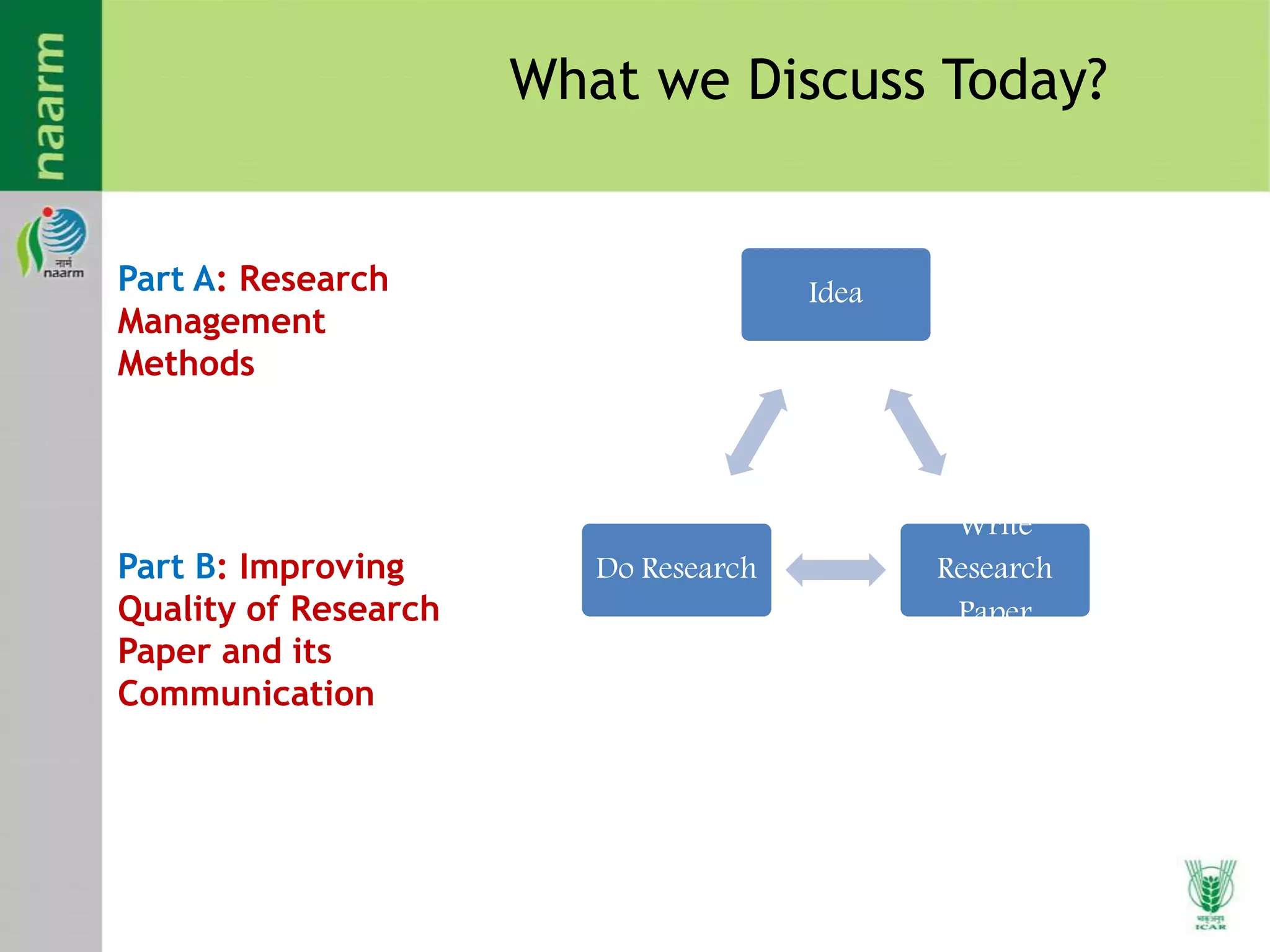
What we Discuss Today?
Part A: Research
Management
Methods
Part B: Improving
Quality of Research
Paper and its
Communication
Idea
Write
Research
Paper
Do Research
A-1: Research Concept
• Rationale
– Why do we plan
• Know the depth
– USPTO/ Web of Science/ EBASCO etc.
• Research question (s)
– Variable and universe
• Hypotheses
– Relationship with RQ
• Justification
– Outcome-Impact relationship
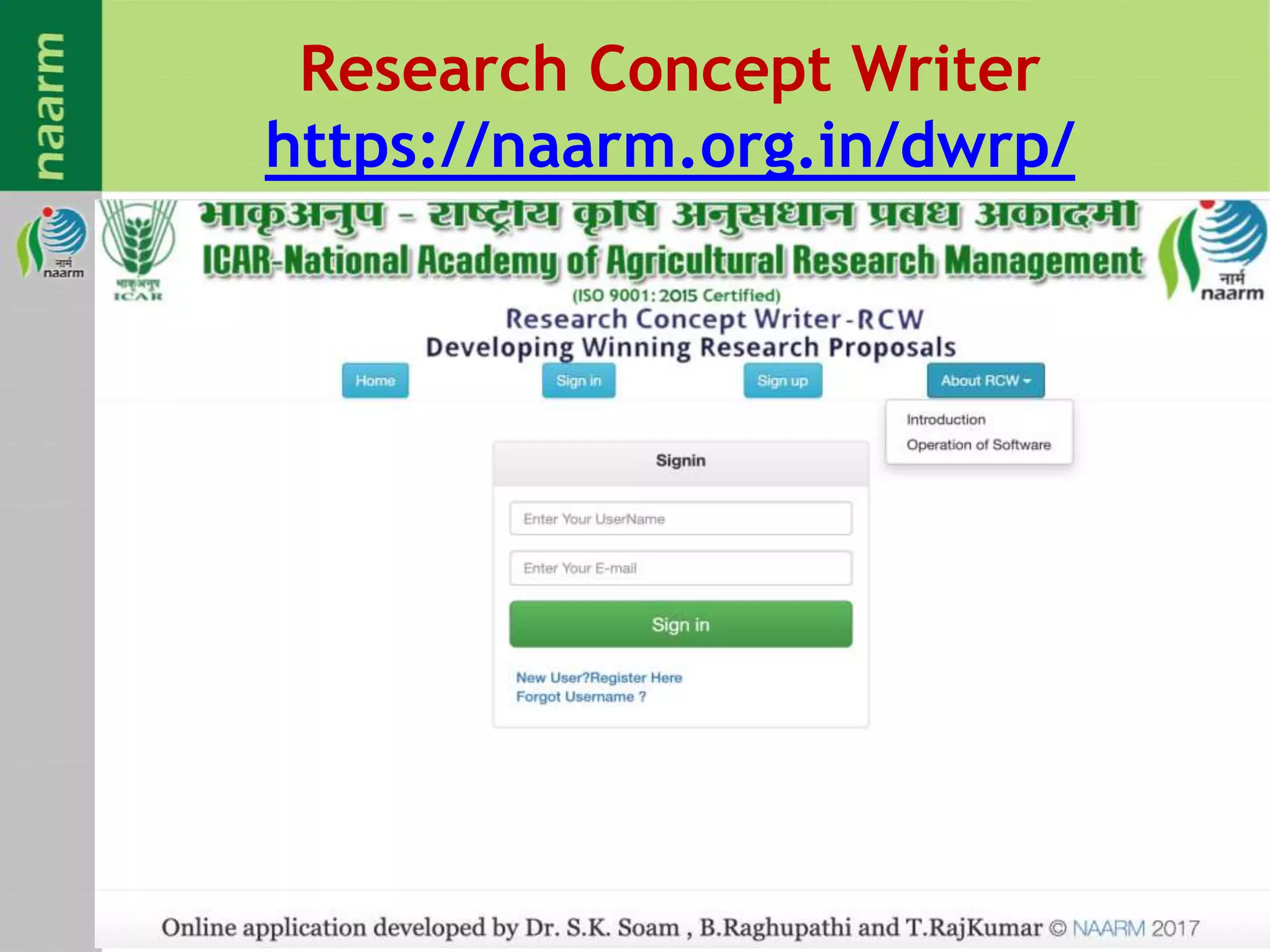
Research Concept Writer
https://naarm.org.in/dwrp/
A-2: Make a Project
Implementation Plan
• Goal
• Outcome
• Purpose
• Outputs
• Activities
• Inputs
• Budget
• Impact
• Monitoring &
Evaluation
• Assumptions
• Risks
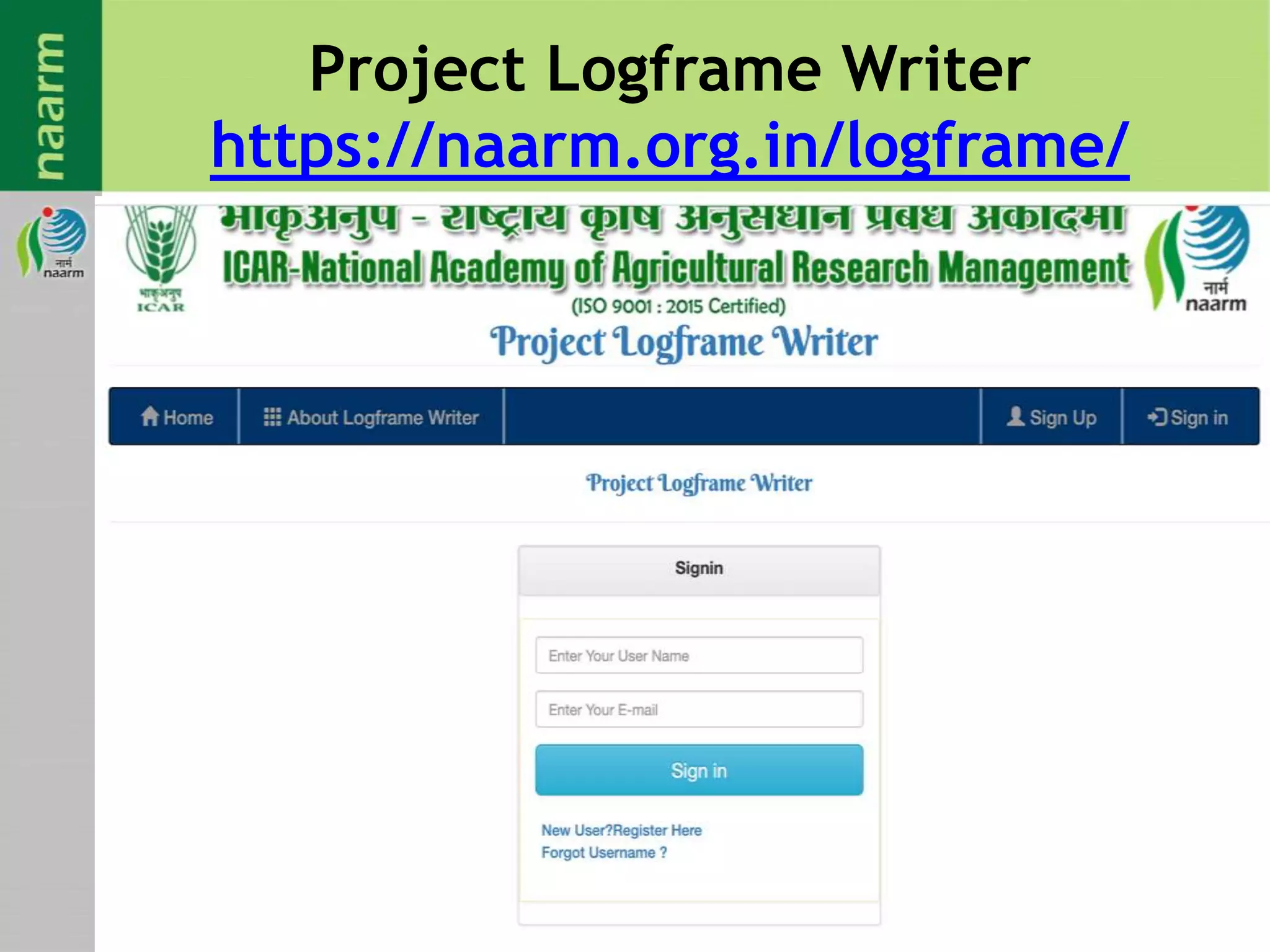
Project Logframe Writer
https://naarm.org.in/logframe/
A-3: Whether your Research
Project is Best Option?
• Did you see other options too?
• Have you evaluated these options?
• If yes, against which parameters?
• Have you talked to peer group?
• Do you have any process of point-by-
point analysis?
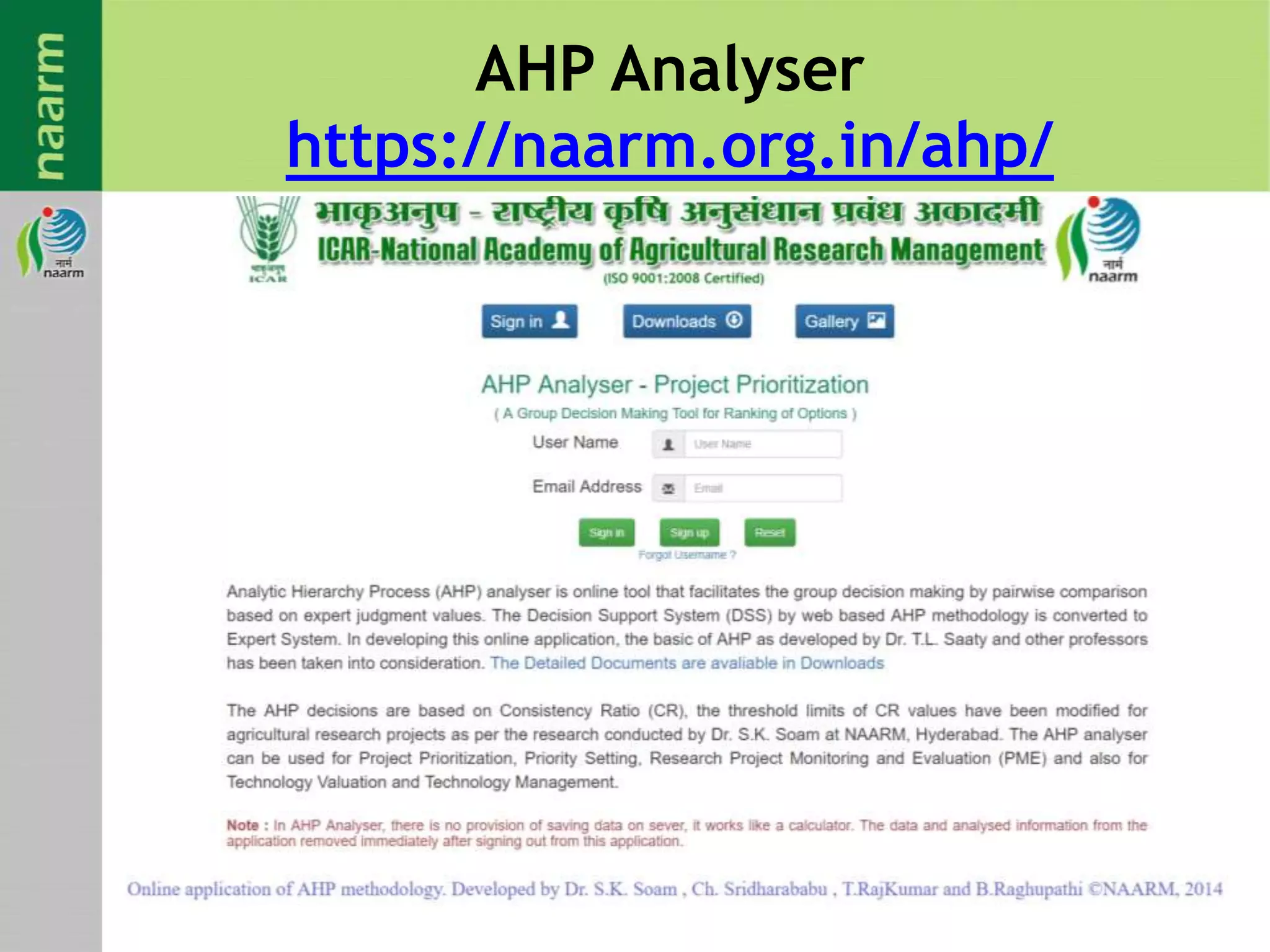
AHP Analyser
https://naarm.org.in/ahp/
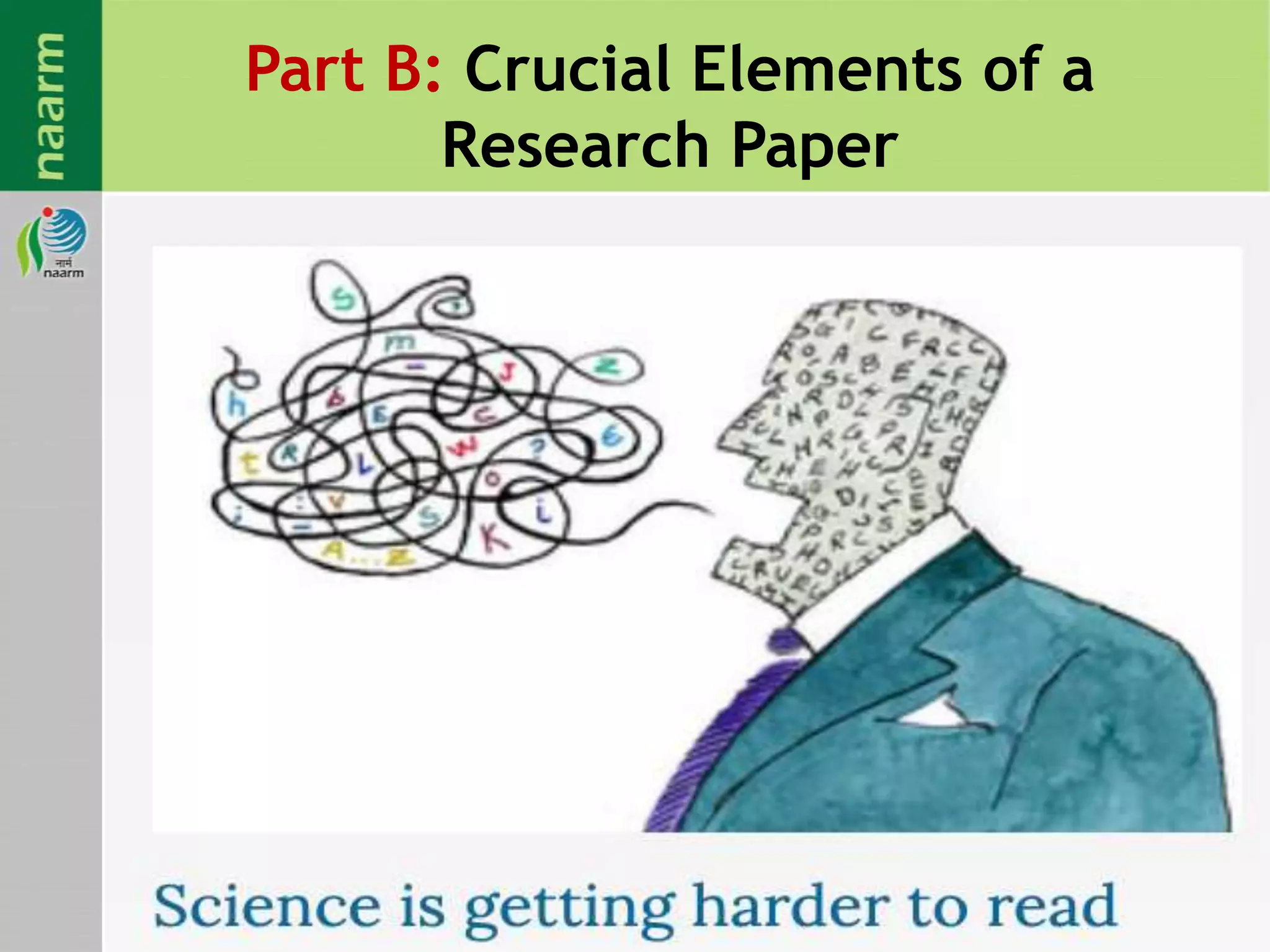
Part B: Crucial Elements of a
Research Paper
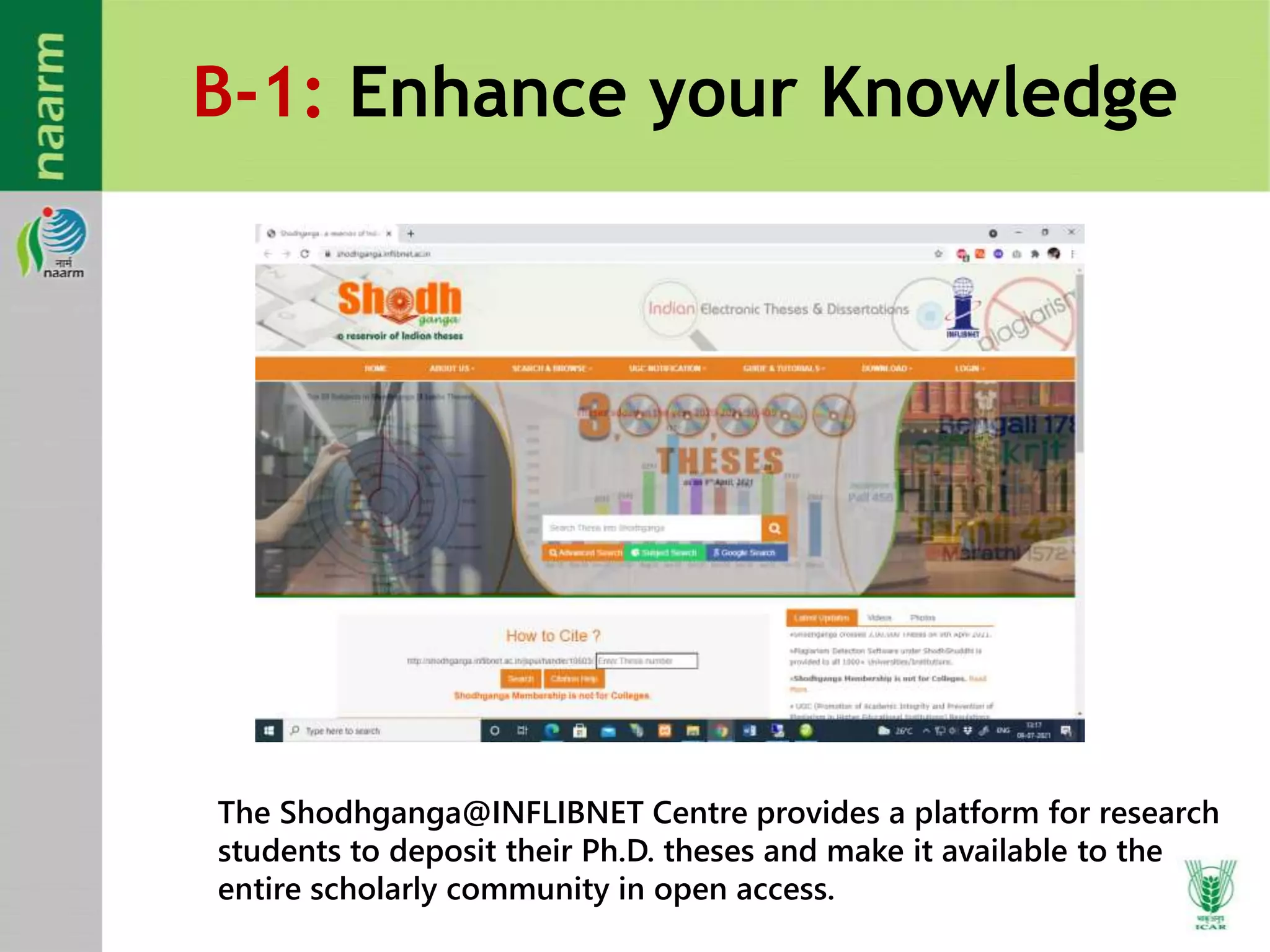
B-1: Enhance your Knowledge
The Shodhganga@INFLIBNET Centre provides a platform for research
students to deposit their Ph.D. theses and make it available to the
entire scholarly community in open access.
Searching International
Theses
• EThOS- eThesis Online Services - https://ethos.bl.uk/
• EBSCO Open Dissertations- https://biblioboard.com/opendissertations/
• Open Access Theses and Dissertations - https://oatd.org/
• Global Electronic theses and dissertations - http://search.ndltd.org/
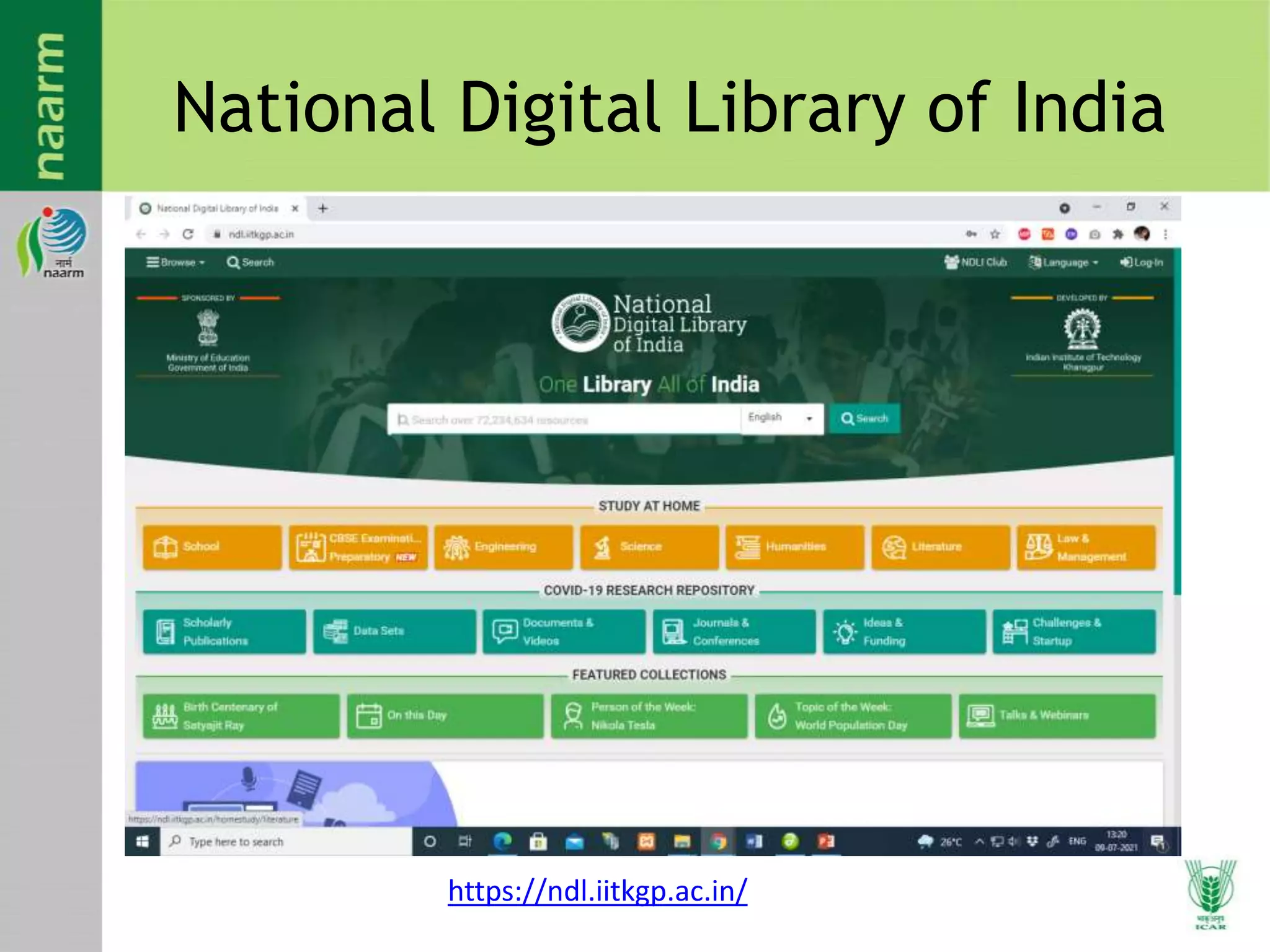
National Digital Library of India
https://ndl.iitkgp.ac.in/
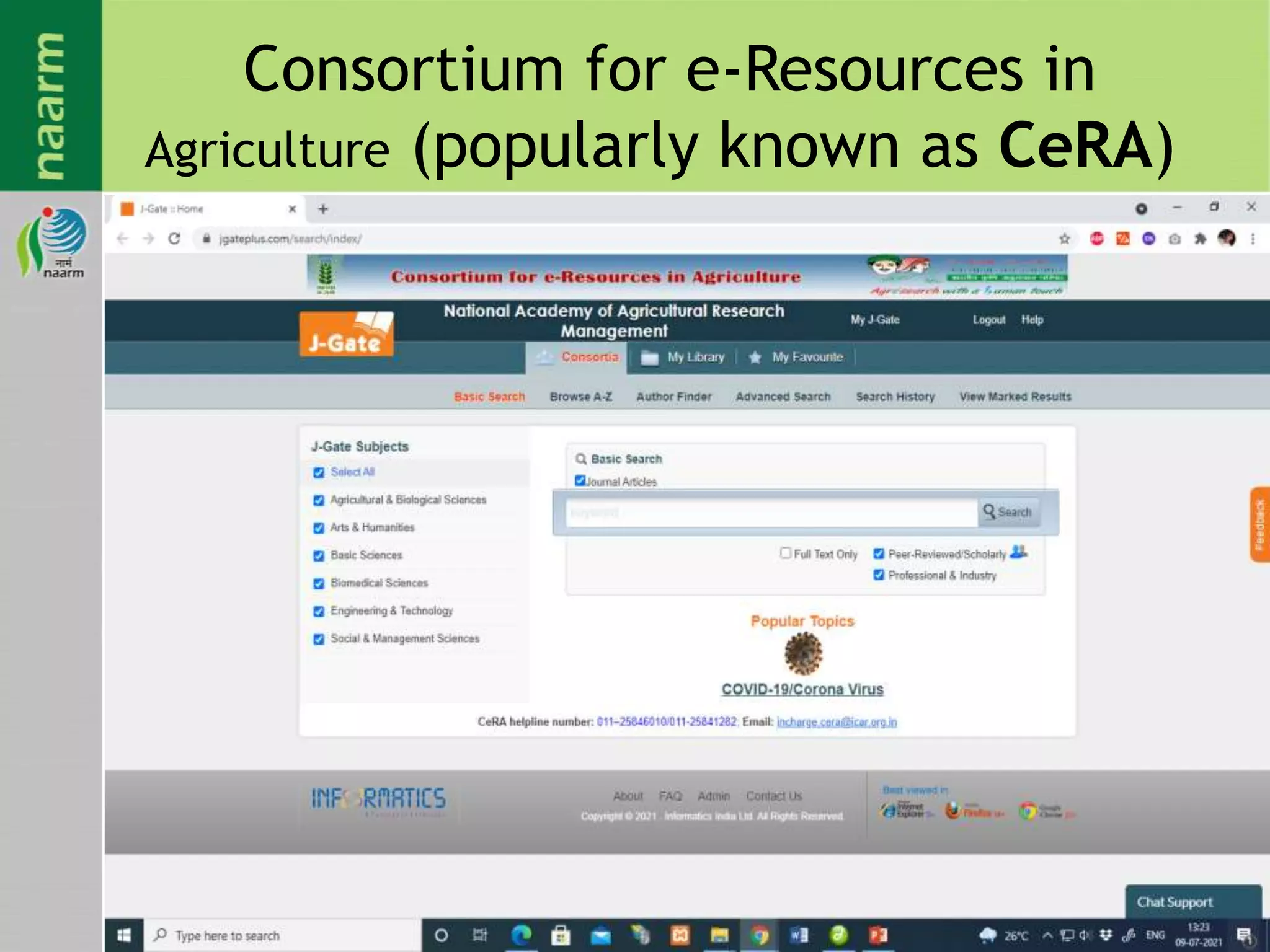
Consortium for e-Resources in
Agriculture (popularly known as CeRA)
B-2: Citation and Reference
Management
Four major citation styles:
• American Psychological Association (APA)
• Modern Language Association (MLA)
• Chicago Notes and Bibliography
• Chicago Author-Date
Need a tool for reference management and for
collaborating and sharing your work:
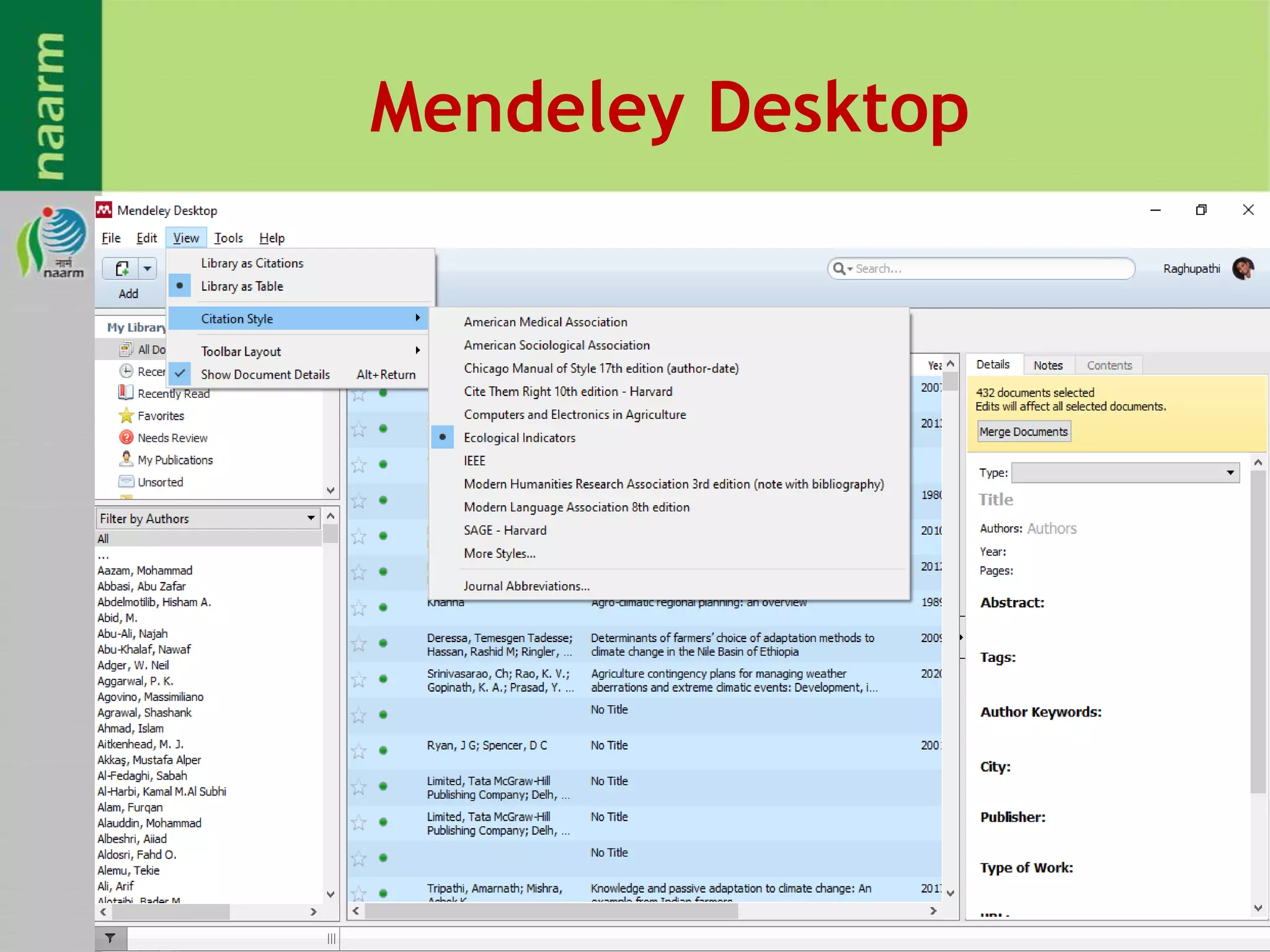
• Mendeley
• Zotero
• EndNote
• RefWorks
Mendeley Desktop
B-3: Title
Look from your own point of view
 Higher citation- searchability
 Access retrieval weightage of title- key words
 English language- use of colon (:), no acronyms, use of
verb/adverb/adjective etc
Look from potential reader point of view
 Predict content- of subject, scope etc
 Get reflection- of method, results, variables, hypotheses etc
 Satisfy and arouse- curiosity and interest
Avoid……
 Unnecessary words, jargons, acronyms
 Starting with: A study of…, An examination…., An
investigation…, etc
 Culture specific humour, puns etc
• Lengthy statement- 8-12 words
What Kind of Title?
Declarative (state main finding and conclusion): Introduction of
corn hybrids ‘A’ and ‘B’ enhances the income of farmers in Bihar
Descriptive (Introduce subject but not of conclusion):
Comparative analysis of corn hybrids ‘A’ and ‘B’ vis-à-vis changes
in income pattern of famers in Bihar
Interrogative (introduce subject as question): Does introduction
of corn hybrids ‘A’ and ‘B’ enhance the income of farmers in Bihar
Abstract
• Normally 10% principle, never > 300 words
• Stand at its own- no literature review
• Indexation / arouse interest
• Why research has been taken?
• How research has been done?
• What is the domain of research?
• What are broad findings?
• Impactful language- active voice, Direct
speech
Conclusion
• Where it all begin?
• Brief results/ findings
• Why findings are important?
• What is the impact of this study?
• How do you inspire others to take up
this work further?- gaps, additional
knowledge required for broader impact
etc
B-4: Journal Suggester
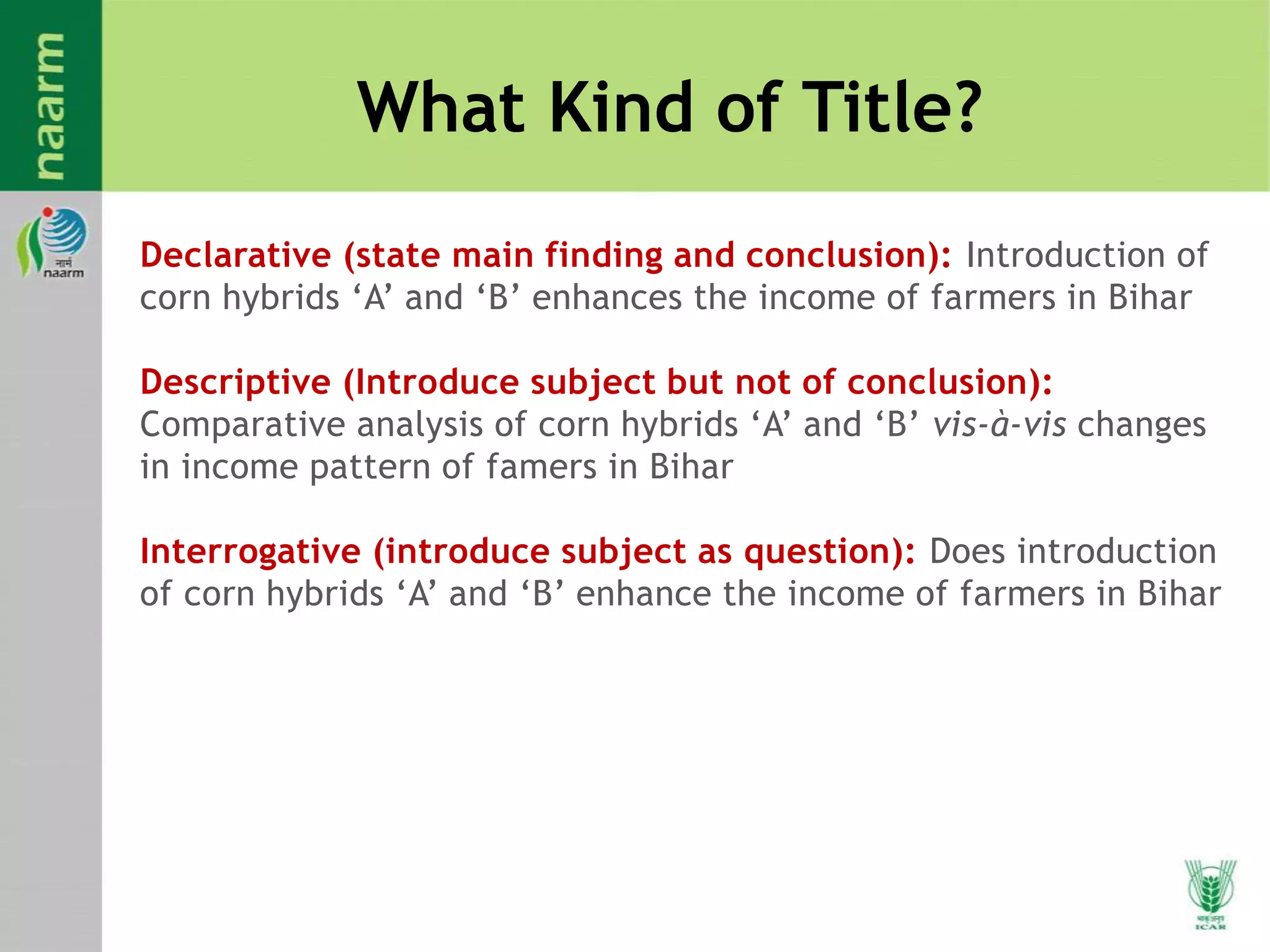
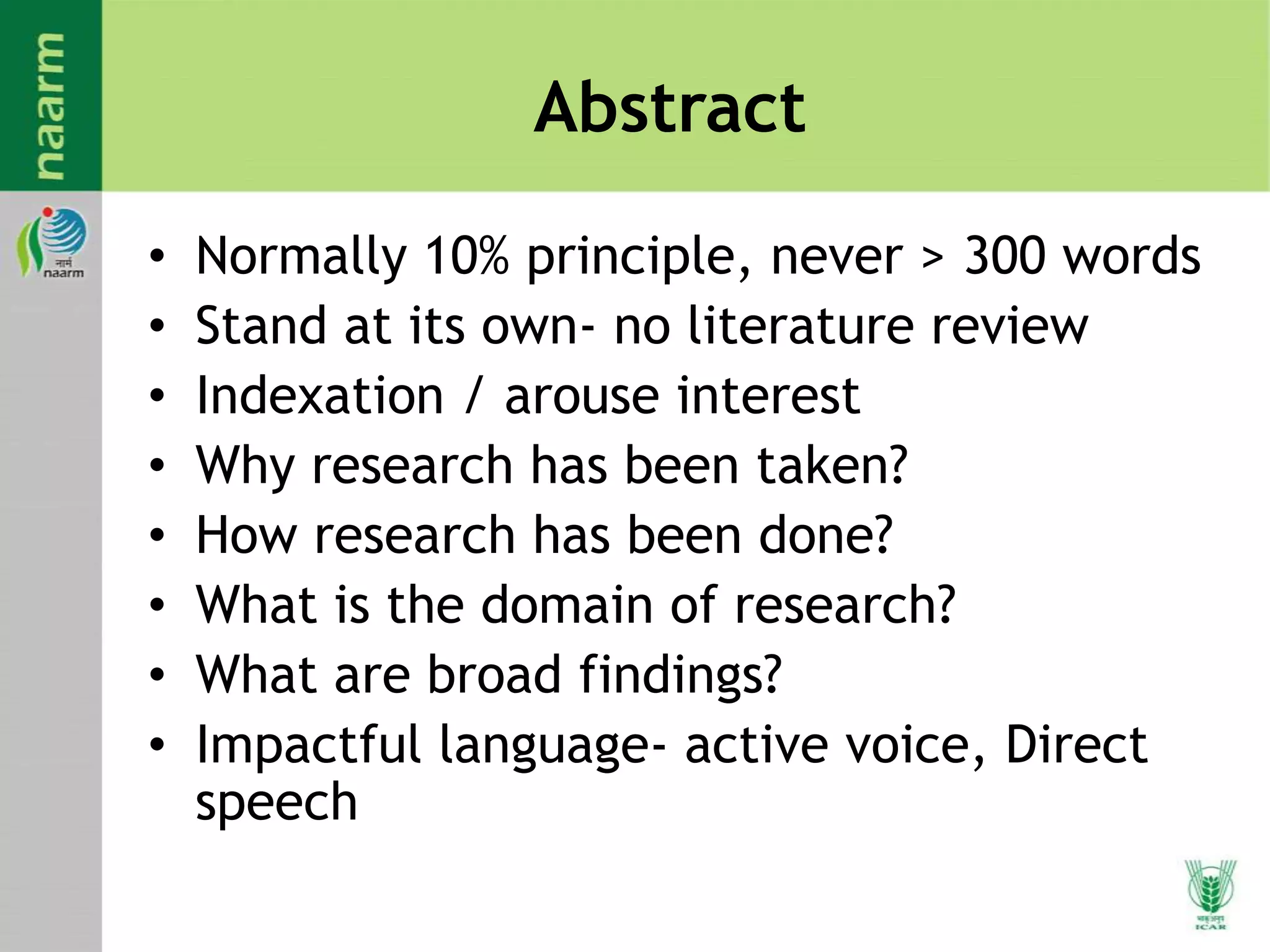
Taylor & Francis Journal Suggester -
https://authorservices.taylorandfrancis.com/
Springer Nature Journal Suggester -
https://journalsuggester.springer.com/
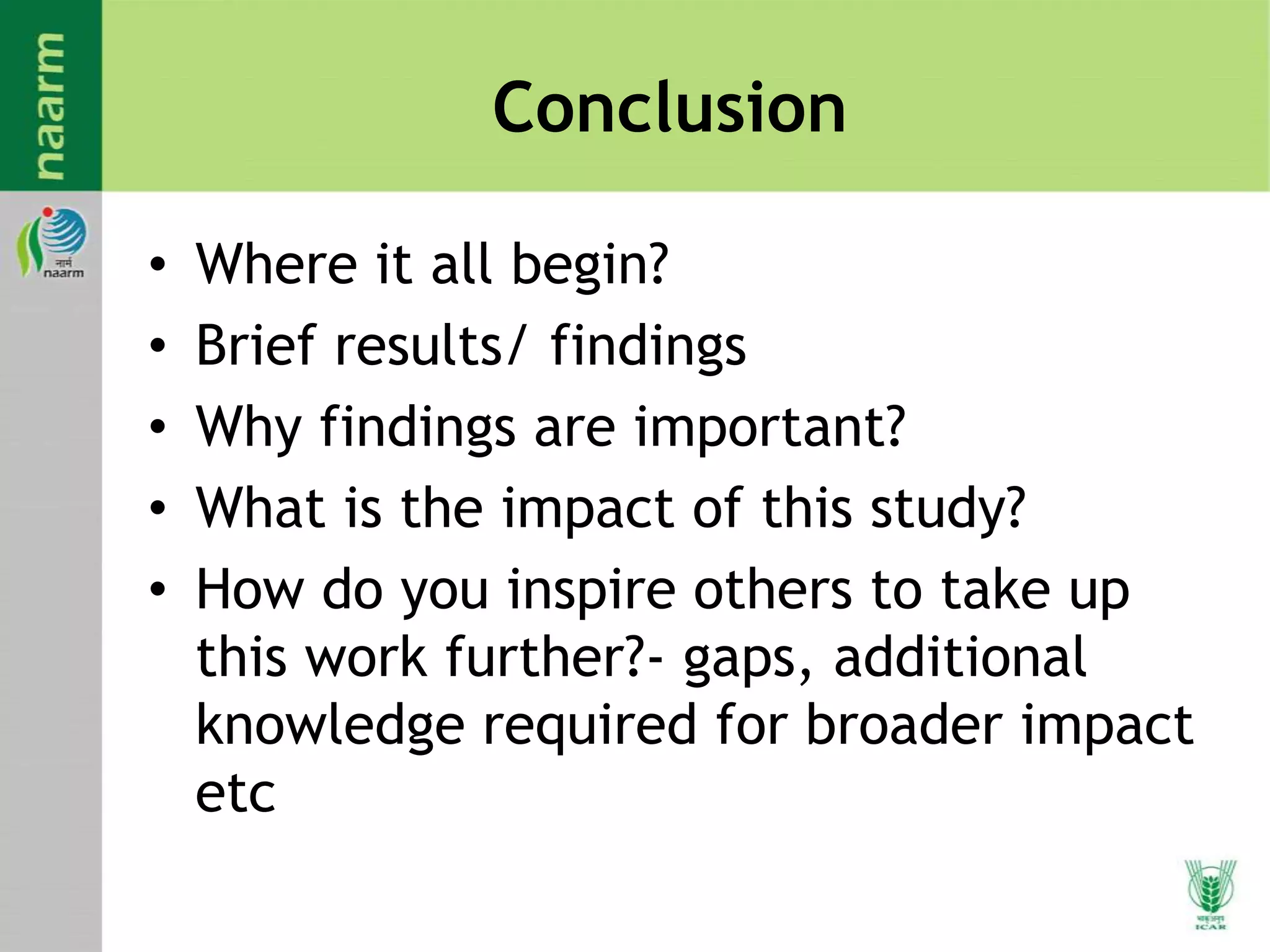
Wiley Journal Finder –
https://journalfinder.wiley.com/
Elsevier Journal Finder –
https://journalfinder.elsevier.com/
Impact factor of Journals &
Journal Citation Reports
The impact factor (IF) is a measure of the frequency with which the
average article in a journal has been cited in a particular year. It is used to
measure the importance or rank of a journal by calculating the times it's
articles are cited.
Journal Citation Reports are available at
• Journal Citation Reports (Web of Science)
• SCImago Journal Rank (SJR)
B-5: Plagiarism Check
Plagiarism is the representation of another author's language, thoughts,
ideas, or expressions as one's own original work.
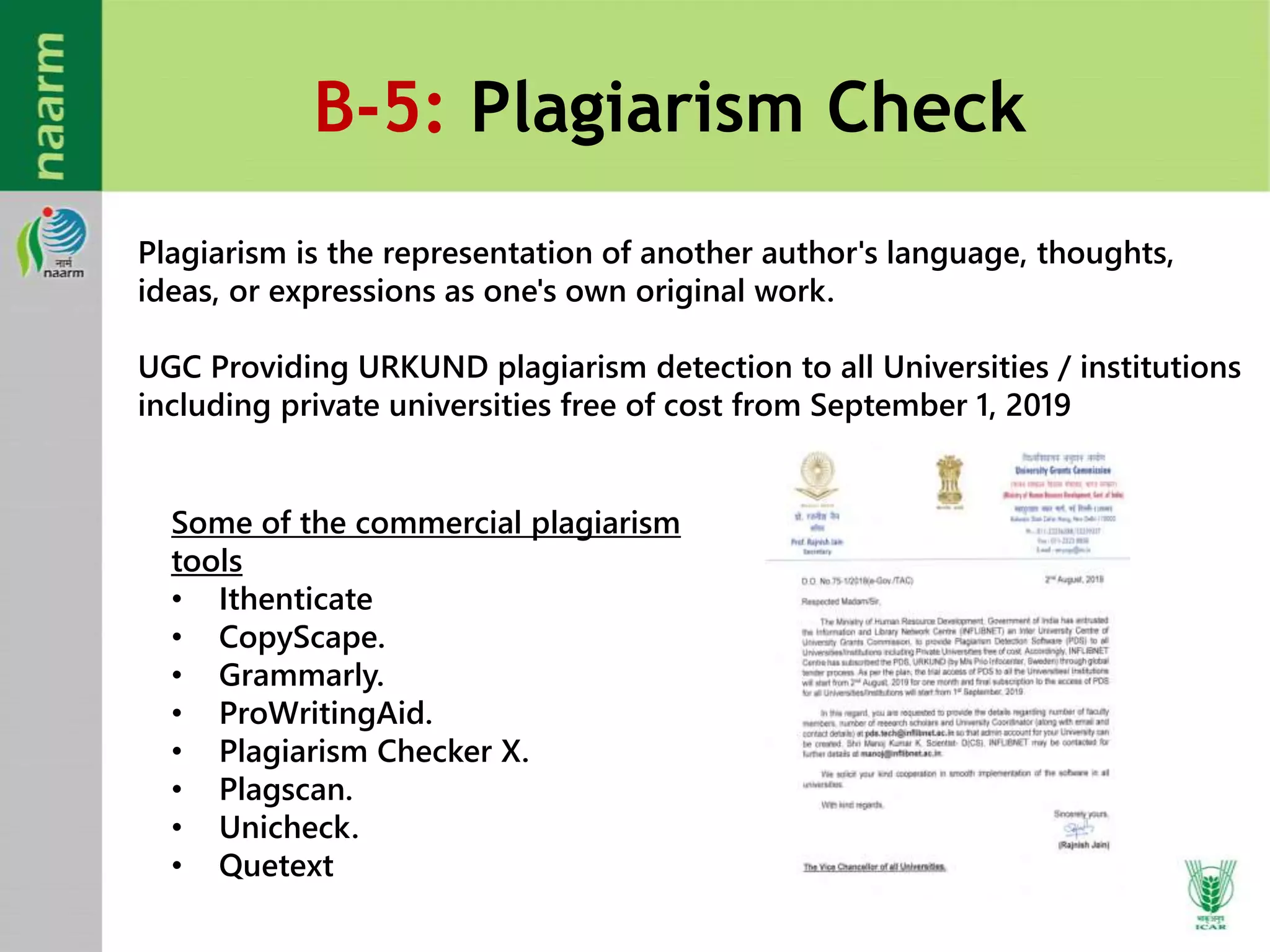
UGC Providing URKUND plagiarism detection to all Universities / institutions
including private universities free of cost from September 1, 2019
Some of the commercial plagiarism
tools
• Ithenticate
• CopyScape.
• Grammarly.
• ProWritingAid.
• Plagiarism Checker X.
• Plagscan.
• Unicheck.
• Quetext
B-6: Spell Checking & Language
Editing
The following tools are used for language editing and
spell check while writing research papers
• Microsoft Word
• Grammarly
• Ginger
• Share with your peer group
B-7: How do I communicate myself?
ORCID/ ResearchGate/OER Commons
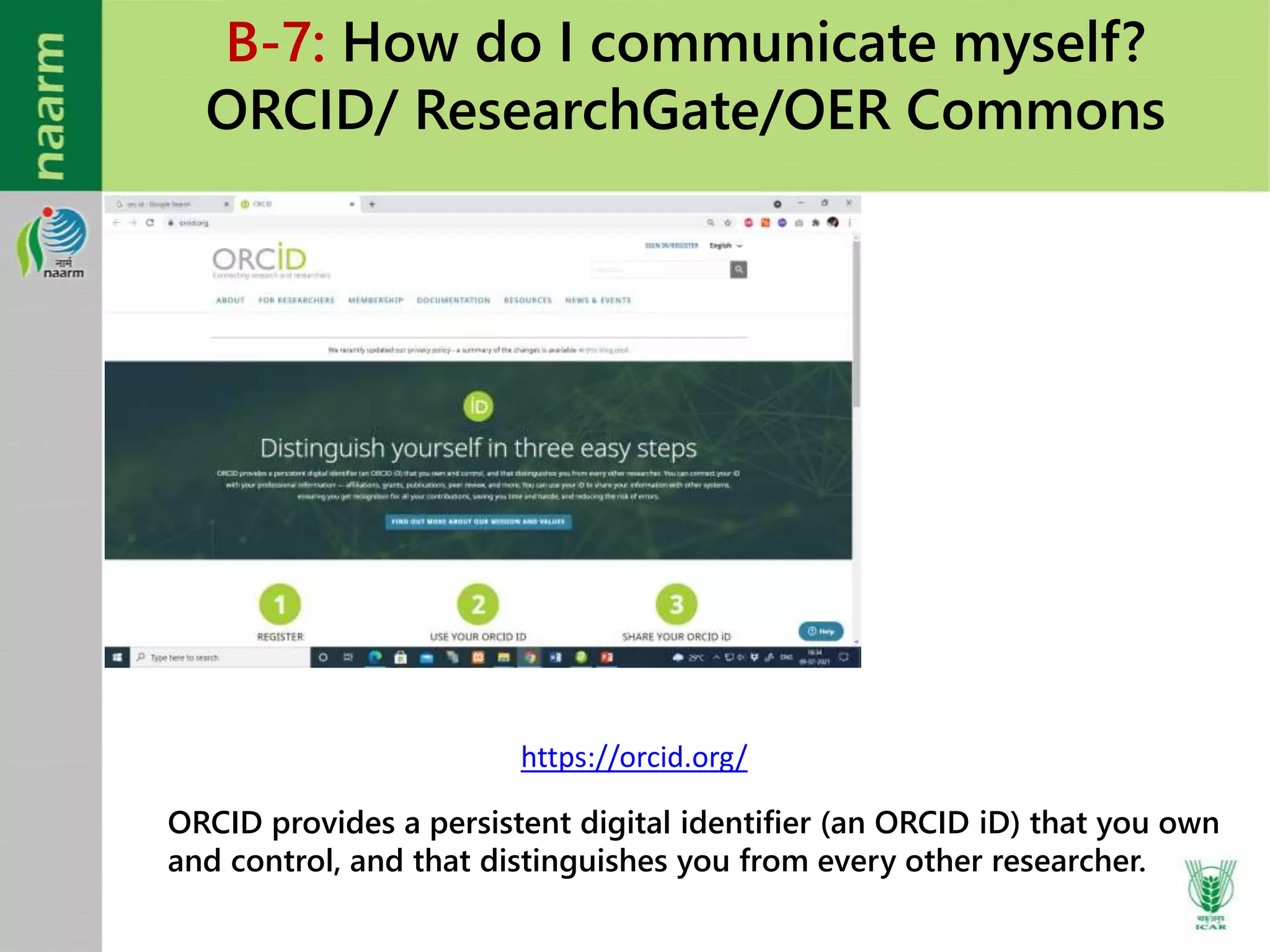
ORCID provides a persistent digital identifier (an ORCID iD) that you own
and control, and that distinguishes you from every other researcher.
https://orcid.org/
Thanks very much
sudhir.soam@icar.gov.in

Research Methods and Research Paper Writing: Guide and tools for PG and Doctoral Students

  • 1.
    Research Methods andResearch Paper Writing Guide and Tools for PG and Doctoral Students S.K. Soam Head of Division (Information and Communication Management) National Academy of Agricultural Research Management (NAARM) Hyderabad, Telangana, India sudhir.soam@icar.gov.in
  • 2.
    What we DiscussToday? Part A: Research Management Methods Part B: Improving Quality of Research Paper and its Communication Idea Write Research Paper Do Research
  • 3.
    A-1: Research Concept •Rationale – Why do we plan • Know the depth – USPTO/ Web of Science/ EBASCO etc. • Research question (s) – Variable and universe • Hypotheses – Relationship with RQ • Justification – Outcome-Impact relationship
  • 4.
  • 5.
    A-2: Make aProject Implementation Plan • Goal • Outcome • Purpose • Outputs • Activities • Inputs • Budget • Impact • Monitoring & Evaluation • Assumptions • Risks
  • 6.
  • 7.
    A-3: Whether yourResearch Project is Best Option? • Did you see other options too? • Have you evaluated these options? • If yes, against which parameters? • Have you talked to peer group? • Do you have any process of point-by- point analysis?
  • 8.
  • 9.
    Part B: CrucialElements of a Research Paper
  • 10.
    B-1: Enhance yourKnowledge The Shodhganga@INFLIBNET Centre provides a platform for research students to deposit their Ph.D. theses and make it available to the entire scholarly community in open access.
  • 11.
    Searching International Theses • EThOS-eThesis Online Services - https://ethos.bl.uk/ • EBSCO Open Dissertations- https://biblioboard.com/opendissertations/ • Open Access Theses and Dissertations - https://oatd.org/ • Global Electronic theses and dissertations - http://search.ndltd.org/
  • 12.
    National Digital Libraryof India https://ndl.iitkgp.ac.in/
  • 13.
    Consortium for e-Resourcesin Agriculture (popularly known as CeRA)
  • 14.
    B-2: Citation andReference Management Four major citation styles: • American Psychological Association (APA) • Modern Language Association (MLA) • Chicago Notes and Bibliography • Chicago Author-Date Need a tool for reference management and for collaborating and sharing your work: • Mendeley • Zotero • EndNote • RefWorks
  • 15.
  • 16.
    B-3: Title Look fromyour own point of view  Higher citation- searchability  Access retrieval weightage of title- key words  English language- use of colon (:), no acronyms, use of verb/adverb/adjective etc Look from potential reader point of view  Predict content- of subject, scope etc  Get reflection- of method, results, variables, hypotheses etc  Satisfy and arouse- curiosity and interest Avoid……  Unnecessary words, jargons, acronyms  Starting with: A study of…, An examination…., An investigation…, etc  Culture specific humour, puns etc • Lengthy statement- 8-12 words
  • 17.
    What Kind ofTitle? Declarative (state main finding and conclusion): Introduction of corn hybrids ‘A’ and ‘B’ enhances the income of farmers in Bihar Descriptive (Introduce subject but not of conclusion): Comparative analysis of corn hybrids ‘A’ and ‘B’ vis-à-vis changes in income pattern of famers in Bihar Interrogative (introduce subject as question): Does introduction of corn hybrids ‘A’ and ‘B’ enhance the income of farmers in Bihar
  • 18.
    Abstract • Normally 10%principle, never > 300 words • Stand at its own- no literature review • Indexation / arouse interest • Why research has been taken? • How research has been done? • What is the domain of research? • What are broad findings? • Impactful language- active voice, Direct speech
  • 19.
    Conclusion • Where itall begin? • Brief results/ findings • Why findings are important? • What is the impact of this study? • How do you inspire others to take up this work further?- gaps, additional knowledge required for broader impact etc
  • 20.
    B-4: Journal Suggester Taylor& Francis Journal Suggester - https://authorservices.taylorandfrancis.com/ Springer Nature Journal Suggester - https://journalsuggester.springer.com/ Wiley Journal Finder – https://journalfinder.wiley.com/ Elsevier Journal Finder – https://journalfinder.elsevier.com/
  • 21.
    Impact factor ofJournals & Journal Citation Reports The impact factor (IF) is a measure of the frequency with which the average article in a journal has been cited in a particular year. It is used to measure the importance or rank of a journal by calculating the times it's articles are cited. Journal Citation Reports are available at • Journal Citation Reports (Web of Science) • SCImago Journal Rank (SJR)
  • 22.
    B-5: Plagiarism Check Plagiarismis the representation of another author's language, thoughts, ideas, or expressions as one's own original work. UGC Providing URKUND plagiarism detection to all Universities / institutions including private universities free of cost from September 1, 2019 Some of the commercial plagiarism tools • Ithenticate • CopyScape. • Grammarly. • ProWritingAid. • Plagiarism Checker X. • Plagscan. • Unicheck. • Quetext
  • 23.
    B-6: Spell Checking& Language Editing The following tools are used for language editing and spell check while writing research papers • Microsoft Word • Grammarly • Ginger • Share with your peer group
  • 24.
    B-7: How doI communicate myself? ORCID/ ResearchGate/OER Commons ORCID provides a persistent digital identifier (an ORCID iD) that you own and control, and that distinguishes you from every other researcher. https://orcid.org/
  • 25.