Research Methods for
Engineers
Ashenafi Dabesa
Faculty of Water Resources Engineering, ASTU
Chapter One:-Introduction 1
Contents
Chapter One:-
Introduction
Chapter Two:- Planning a
Research
Chapter Three:-
Research Proposal
Writing
Chapter Four:- Organization &
Description of Data
Chapter Five:- Review
of Basic Statistical
Concepts in
Experimentation
Chapter Six:- Experimental Designs &
Analysis of Experiments
Chapter One:-Introduction 2
Chapter Objectives
• Identify sources of knowledge
• Define research
• Identify the types of research
• Steps in scientific research
Introduction
Chapter One:-Introduction 3
Sources of Knowledge
• It is human nature to quest for knowledge.
• Research emanates from this natural interest.
• Two major approaches to acquire knowledge:
1. Unscientific knowledge
2. Scientific knowledge
Chapter One:-Introduction 4
Types of unscientific Sources of knowledge
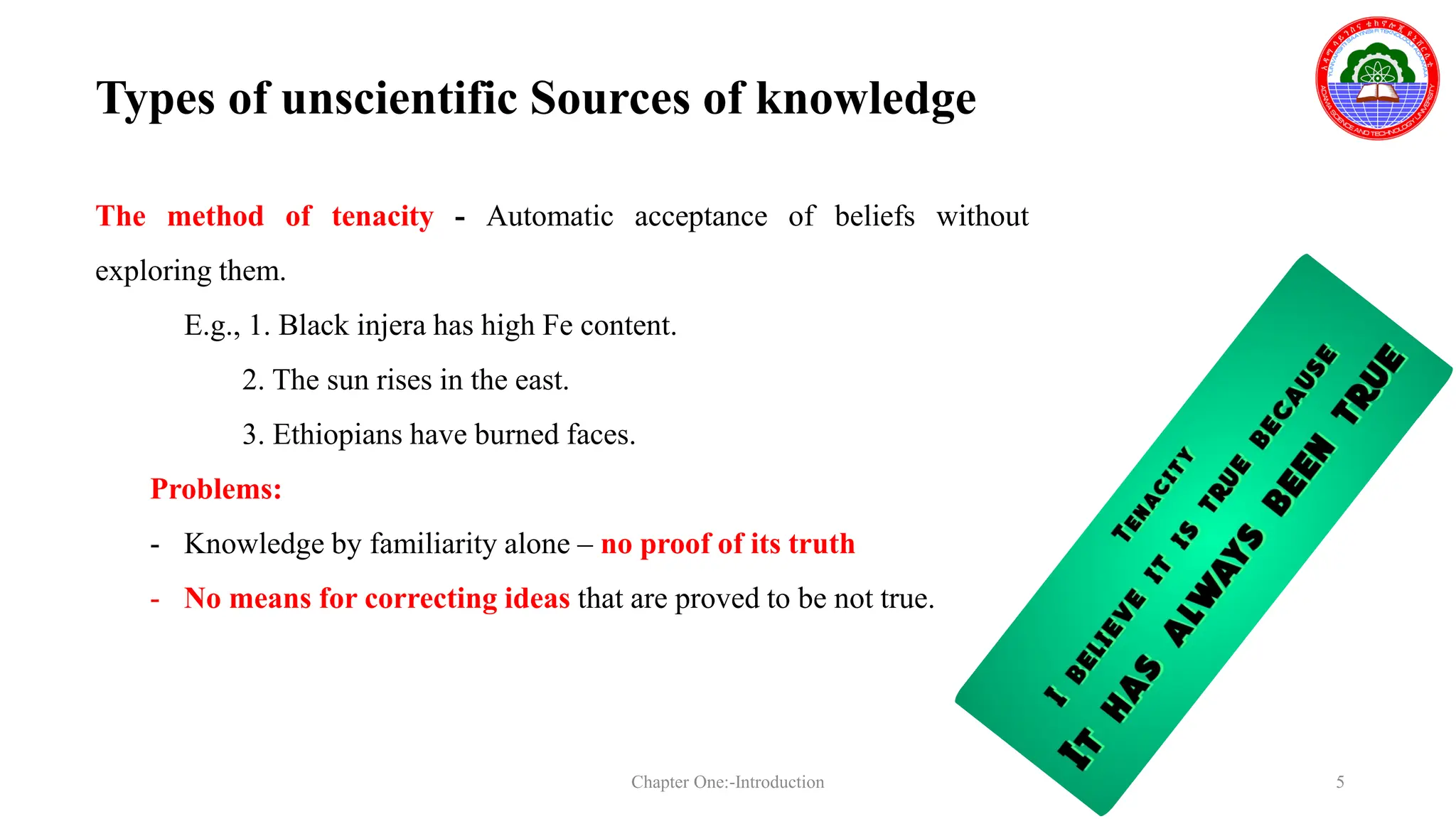
The method of tenacity - Automatic acceptance of beliefs without
exploring them.
E.g., 1. Black injera has high Fe content.
2. The sun rises in the east.
3. Ethiopians have burned faces.
Problems:
- Knowledge by familiarity alone – no proof of its truth
- No means for correcting ideas that are proved to be not true.
Chapter One:-Introduction 5
Cont’d …
• The method of Authority - Accepting information we
have been told by authority figure.
E.g. 1. Smoking affects our health
Problem:
- It is only useful and beneficial if the authority
figure is knowledgeable in the area.
Chapter One:-Introduction 6
Cont’d …
• A prior method/deductive reasoning - Reason and logic are the basic tools for a priori method.
E.g.,1. Ayele’s family are tall.
Alemitu is in Ayele’s family
Therefore, Alemitu is tall. _False
Conclusion from false premises.
E.g., 2. Human being is mortal
Alemu is a human being.
Therefore, Alemu is mortal. _True
E.g., 2. Runoff is a function of catchment area
Gumara and Ribb cathments do have the
same area.
Therefore, Both catchments produce the same volume of runoff. True or False?
Chapter One:-Introduction 7
Cont’d …
• Commonsense - Knowledge acquired from past experience or from our
perceptions of the world.
It is good for routines aspects of daily life but hinders to widen our
knowledge.
E.g., 1 The price of teff increases if the rainy season fails
E.g., 2 Since birr is devaluated, the Ethiopian economy is in
danger.
Chapter One:-Introduction 8
Scientific Method as a Source of Knowledge
• Knowledge acquired systematically. i.e., evaluate observation by
measuring devices.
• It is sometimes seen as a controlled extension of commonsense
knowledge.
• Therefore, science relies on information that is verifiable, unlike
commonsense.
• Science differs from commonsense:
✓ uses conceptual schemes and theoretical structures.
✓ Has the notion of control
✓ gives explanations or reasoning for different observed phenomena.
Cont’d …
Chapter One:-Introduction 10
Definition of research
Chapter One:-Introduction 11
Cont’d …
Chapter One:-Introduction 12
Research Characteristics
Chapter One:-Introduction 13
Cont’d …
Chapter One:-Introduction 14
Cont’d …
Chapter One:-Introduction 15
Cont’d …
Chapter One:-Introduction 16
Types of Research
17
Steps in Scientific Research Method
Chapter One:-Introduction
Chapter One:-Introduction 18
Cont’d …
Chapter One:-Introduction 19
Cont’d …
Chapter One:-Introduction 20
Cont’d …
Chapter One:-Introduction 21
Cont’d …
Chapter One:-Introduction 22
Cont’d …

Research Methodology for Engineering pdf