Research Methodology and Presentation
Outline Of Presentation
Conceptualization of a research
Components/essential steps/documentation by chapter
RESEARCH METHODOLOGY AND PRESENTATION
INTRODUCTION
Research is an enquiry to know achieved by
Systematic collection, analysis and interpretation of
data to solve the problem
Some problems could be solved without going though
this process
RESEARCH METHODOLOGY AND PRESENTATION
Defining data
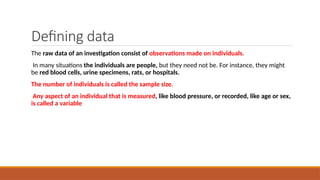
The raw data of an investigation consist of observations made on individuals.
In many situations the individuals are people, but they need not be. For instance, they might
be red blood cells, urine specimens, rats, or hospitals.
The number of individuals is called the sample size.
Any aspect of an individual that is measured, like blood pressure, or recorded, like age or sex,
is called a variable
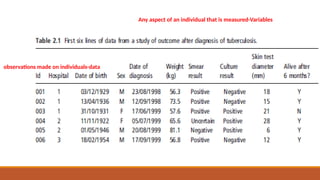
observations made on individuals-data
Any aspect of an individual that is measured-Variables
INTRODUCTION
Research is a scientific method of knowing
Other methods of knowing include:
Experience
Tenacity
Intuition/Inspiration/Revelation
Authority- the Bible, Quran, Pope, etc
These methods lack validity, reproducibility or reliability
and are highly subjective unlike the scientific method.
RESEARCH METHODOLOGY AND PRESENTATION
The Scientific Method
What do you do in a scientific research
Science defines problems.
Makes hypotheses- tentative answers to the problems.
Gathers data to reject or accept the hypothesis.
Draws conclusion based on the systematic inquiry.
RESEARCH METHODOLOGY AND PRESENTATION
LOGICAL STEPS IN RESEARCH
Research proposal- A blueprint that summarises and guides one
throughout the research.
A good proposal may serve different purposes such as :
Proposal for grant or sponsorship
Project proposal- for partial fulfilment of the requirement for awarding
a certificate.
RESEARCH METHODOLOGY AND PRESENTATION
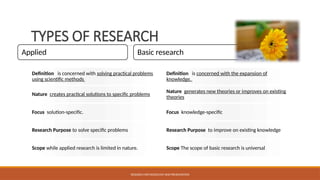
Applied
TYPES OF RESEARCH
Definition is concerned with solving practical problems
using scientific methods
Nature creates practical solutions to specific problems
Focus solution-specific.
Research Purpose to solve specific problems
Scope while applied research is limited in nature.
Definition is concerned with the expansion of
knowledge.
Nature generates new theories or improves on existing
theories
Focus knowledge-specific
Research Purpose to improve on existing knowledge
Scope The scope of basic research is universal
RESEARCH METHODOLOGY AND PRESENTATION
Basic research
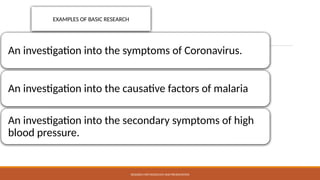
An investigation into the symptoms of Coronavirus.
An investigation into the causative factors of malaria
An investigation into the secondary symptoms of high
blood pressure.
EXAMPLES OF BASIC RESEARCH
RESEARCH METHODOLOGY AND PRESENTATION
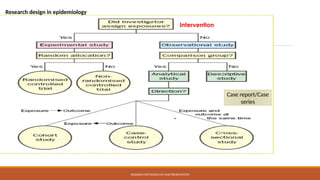
Intervention
Case report/Case
series
Research design in epidemiology
Conceptualizing the
research
RESEARCH METHODOLOGY AND PRESENTATION
Conceptualizing a research
Conceptualizing a research : The action or process of forming a concept or idea of
something
RESEARCH METHODOLOGY AND PRESENTATION
Problem identification
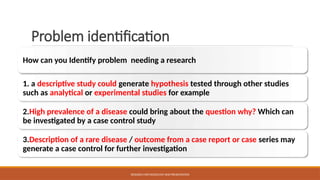
How can you Identify problem needing a research
1. a descriptive study could generate hypothesis tested through other studies
such as analytical or experimental studies for example
2.High prevalence of a disease could bring about the question why? Which can
be investigated by a case control study
3.Description of a rare disease / outcome from a case report or case series may
generate a case control for further investigation
RESEARCH METHODOLOGY AND PRESENTATION
Problem identification
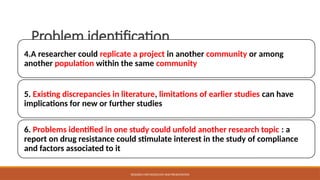
4.A researcher could replicate a project in another community or among
another population within the same community
5. Existing discrepancies in literature, limitations of earlier studies can have
implications for new or further studies
6. Problems identified in one study could unfold another research topic : a
report on drug resistance could stimulate interest in the study of compliance
and factors associated to it
RESEARCH METHODOLOGY AND PRESENTATION
Problem identification
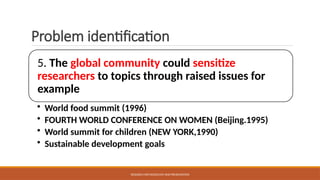
5. The global community could sensitize
researchers to topics through raised issues for
example
• World food summit (1996)
• FOURTH WORLD CONFERENCE ON WOMEN (Beijing.1995)
• World summit for children (NEW YORK,1990)
• Sustainable development goals
RESEARCH METHODOLOGY AND PRESENTATION
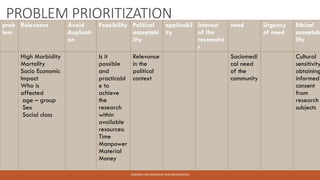
PROBLEM PRIORITIZATION
prob
lem
Relevance Avoid
duplicati
on
Feasibility Political
acceptabi
lity
applicabil
ity
Interest
of the
researche
r
need Urgency
of need
Ethical
acceptab
lity
High Morbidity
Mortality
Socio Economic
Impact
Who is
affected
age – group
Sex
Social class
Is it
possible
and
practicabl
e to
achieve
the
research
within
available
resources:
Time
Manpower
Material
Money
Relevance
in the
political
context
Sociomedi
cal need
of the
community
Cultural
sensitivity
obtaining
informed
consent
from
research
subjects
PROBLEM PRIORITAIZATION
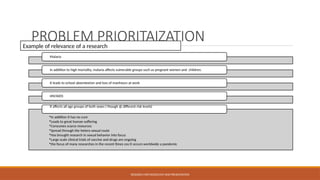
Malaria
In addition to high mortality, malaria affects vulnerable groups such as pregnant women and children.
It leads to school absenteeism and loss of manhours at work
HIV/AIDS
•In addition it has no cure
•Leads to great human suffering
•Consumes scarce resources
•Spread through the hetero sexual route
•Has brought research in sexual behavior into focus
•Large scale clinical trials of vaccine and drugs are ongoing
•the focus of many researches in the recent times cos it occurs worldwide a pandemic
it affects all age groups of both sexes ( though @ different risk levels)
RESEARCH METHODOLOGY AND PRESENTATION
Example of relevance of a research
PROBLEM PRIORITAIZATION
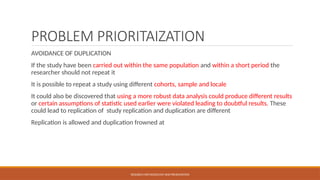
AVOIDANCE OF DUPLICATION
If the study have been carried out within the same population and within a short period the
researcher should not repeat it
It is possible to repeat a study using different cohorts, sample and locale
It could also be discovered that using a more robust data analysis could produce different results
or certain assumptions of statistic used earlier were violated leading to doubtful results. These
could lead to replication of study replication and duplication are different
Replication is allowed and duplication frowned at
RESEARCH METHODOLOGY AND PRESENTATION
Main
components/document
ation by chapter
RESEARCH METHODOLOGY AND PRESENTATION
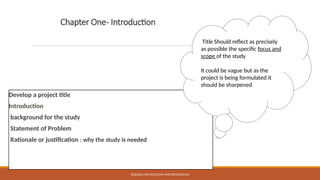
Chapter One- Introduction
Develop a project title
Introduction
background for the study
Statement of Problem
Rationale or justification : why the study is needed
RESEARCH METHODOLOGY AND PRESENTATION
Title Should reflect as precisely
as possible the specific focus and
scope of the study
It could be vague but as the
project is being formulated it
should be sharpened
RESEARCH METHODOLOGY AND PRESENTATION
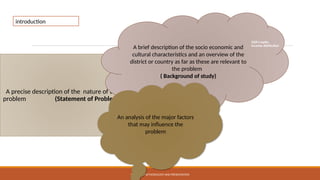
A precise description of the nature of the
problem (Statement of Problem )
A brief description of the socio economic and
cultural characteristics and an overview of the
district or country as far as these are relevant to
the problem
( Background of study)
An analysis of the major factors
that may influence the
problem
introduction
GDP/capita,
income distribution
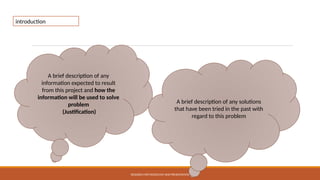
A brief description of any
information expected to result
from this project and how the
information will be used to solve
problem
(Justification)
A brief description of any solutions
that have been tried in the past with
regard to this problem
introduction
RESEARCH METHODOLOGY AND PRESENTATION
Chapter One: Introduction continues
AIMS AND OBJECTIVES
General Objective : title

 Specific Objectives
Objectives of the study- these are what the study promises to achieve
Study objectives must be clear, specific and measurable.
Objectives are stated using active sentences:
To investigate
To describe
To asses
To evaluate
To identify
To compare etc.
RESEARCH METHODOLOGY AND PRESENTATION
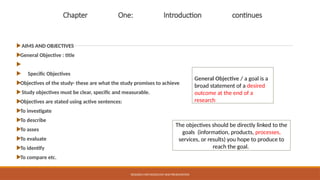
General Objective / a goal is a
broad statement of a desired
outcome at the end of a
research
The objectives should be directly linked to the
goals (information, products, processes,
services, or results) you hope to produce to
reach the goal.
Chapter One: Introduction continues
Hypotheses
Limitation and Scope of Study
Operational Definition of Terms
RESEARCH METHODOLOGY AND PRESENTATION
Chapter Two-Literature review
Write about all components of your title
Past studies that was done regarding your work
RESEARCH METHODOLOGY AND PRESENTATION
Chapter Two-Literature review
Literature review
Benefits of literature review
1.A helps to know what others have done and reported on the problem
2.Provides information on earlier studies, currency of last findings and continuous applicability
or staleness of previous studies
3.Provides facts for justification of studies
4.Assists in formulation and fine tunning of objectives and research questions
5.Assists to know methodology, samples size and statistical analysis that can be used
RESEARCH METHODOLOGY AND PRESENTATION
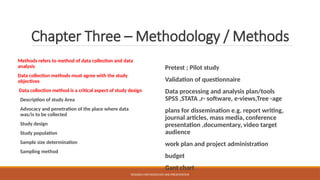
Chapter Three – Methodology / Methods
Methods refers to method of data collection and data
analysis
Data collection methods must agree with the study
objectives
Data collection method is a critical aspect of study design
Description of study Area
Advocacy and penetration of the place where data
was/is to be collected
Study design
Study population
Sample size determination
Sampling method
Pretest ; Pilot study
Validation of questionnaire
Data processing and analysis plan/tools
SPSS ,STATA ,r- software, e-views,Tree -age
plans for dissemination e.g. report writing,
journal articles, mass media, conference
presentation ,documentary, video target
audience
work plan and project administration
budget
Gant chart
RESEARCH METHODOLOGY AND PRESENTATION
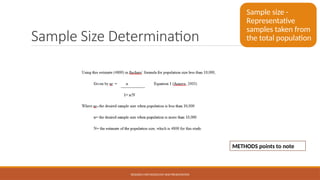
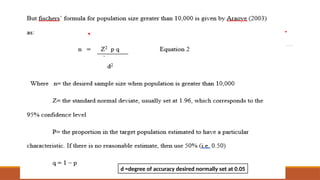
Sample Size Determination
RESEARCH METHODOLOGY AND PRESENTATION
METHODS points to note
Sample size -
Representative
samples taken from
the total population
RESEARCH METHODOLOGY AND PRESENTATION
d =degree of accuracy desired normally set at 0.05
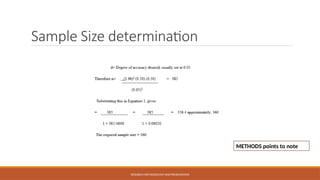
Sample Size determination
RESEARCH METHODOLOGY AND PRESENTATION
METHODS points to note
Subject selection
INCLUSION AND EXCLUSION CRITERIA
RESEARCH METHODOLOGY AND PRESENTATION
METHODS points to note
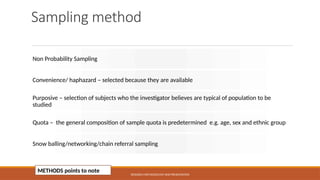
Sampling method
Non Probability Sampling
Convenience/ haphazard – selected because they are available
Purposive – selection of subjects who the investigator believes are typical of population to be
studied
Quota – the general composition of sample quota is predetermined e.g. age, sex and ethnic group
Snow balling/networking/chain referral sampling
RESEARCH METHODOLOGY AND PRESENTATION
METHODS points to note
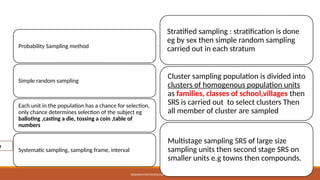
Sampling method
Probability Sampling method
Simple random sampling
Each unit in the population has a chance for selection,
only chance determines selection of the subject eg
balloting ,casting a die, tossing a coin ,table of
numbers
Systematic sampling, sampling frame, interval
Stratified sampling : stratification is done
eg by sex then simple random sampling
carried out in each stratum
Cluster sampling population is divided into
clusters of homogenous population units
as families, classes of school,villages then
SRS is carried out to select clusters Then
all member of cluster are sampled
Multistage sampling SRS of large size
sampling units then second stage SRS on
smaller units e.g towns then compounds.
RESEARCH METHODOLOGY AND PRESENTATION
e
What is quantitative data?
Quantitative data refers to any information that can be quantified. If it can be
counted or measured, and given a numerical value, it’s quantitative data.
Quantitative data can tell you “how many,” “how much,” or “how often”
for example, how many people attended last week’s webinar?
How much revenue did the company make in 2019?
How often does a certain customer group use online banking?
To analyze and make sense of quantitative data, you’ll conduct statistical analyses.
RESEARCH METHODOLOGY AND PRESENTATION
What is qualitative data?
Qualitative data cannot be measured or counted. It’s descriptive, expressed in
terms of language rather than numerical values.
Researchers will often turn to qualitative data to answer “Why?” or “How?”
questions.
RESEARCH METHODOLOGY AND PRESENTATION
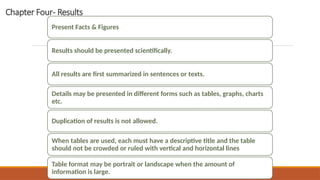
Chapter Four- Results
Present Facts & Figures
Results should be presented scientifically.
All results are first summarized in sentences or texts.
Details may be presented in different forms such as tables, graphs, charts
etc.
Duplication of results is not allowed.
When tables are used, each must have a descriptive title and the table
should not be crowded or ruled with vertical and horizontal lines
Table format may be portrait or landscape when the amount of
information is large. RESEARCH METHODOLOGY AND PRESENTATION
Chapter Five Discussion
The purpose of discussion is not to repeat the results as most students
wrongly do.
Discussion:
– interprets the results
– compares with other studies (cite references)
– highlights unanswered questions or direction for future research
– and finally should contain a section on limitations of the study
towards the end before conclusion / @ introduction
RESEARCH METHODOLOGY AND PRESENTATION
Chapter Six- Conclusion
Conclusions should be based on the objectives of the study.
For each objective a conclusion should be made.
Conclusion tells how far a study objective has been achieved.
Summary of findings may be included
Recommendations where desired though not always necessary should be
based on the data from the study and not the aspirations of the
researcher.
RESEARCH METHODOLOGY AND PRESENTATION
References
References tell how much work a student has done.
We consider the quantity, the quality i.e. the currency and relevance of
the reference.
Two styles of referencing:
Vancouver and Harvard methods.
Vancouver- references are cited in the text using consecutive Arabic
numbers.
Harvard- inside the work author‘s surname, and year are placed in
parenthesis. And at the end references are arranged alphabetically.
RESEARCH METHODOLOGY AND PRESENTATION
42
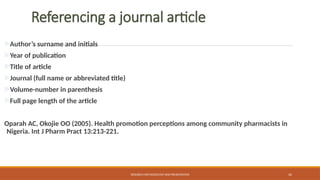
Referencing a journal article
Author’s surname and initials
Year of publication
Title of article
Journal (full name or abbreviated title)
Volume-number in parenthesis
Full page length of the article
Oparah AC, Okojie OO (2005). Health promotion perceptions among community pharmacists in
Nigeria. Int J Pharm Pract 13:213-221.
RESEARCH METHODOLOGY AND PRESENTATION
43
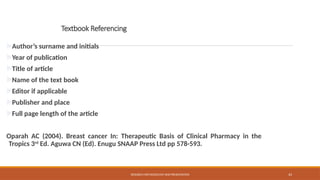
Textbook Referencing
Author’s surname and initials
Year of publication
Title of article
Name of the text book
Editor if applicable
Publisher and place
Full page length of the article
Oparah AC (2004). Breast cancer In: Therapeutic Basis of Clinical Pharmacy in the
Tropics 3rd
Ed. Aguwa CN (Ed). Enugu SNAAP Press Ltd pp 578-593.
RESEARCH METHODOLOGY AND PRESENTATION
44
Electronic Referencing
In addition to the above requirements, the website and the date the paper was accessed
should be indicated.
Gershon SK, Cultice JM, Jnaap K. How many pharmacistsare in our future? The Bureau of
Health Professionals Project Supply to 2020; Available at website
www.hhs.gov/pharmacy/phpharm/howmany.html (accessed 27 May 2005).
RESEARCH METHODOLOGY AND PRESENTATION
Research Methodology and Presentation  ppt1.pptx

Research Methodology and Presentation ppt1.pptx

  • 1.
  • 2.
    Outline Of Presentation Conceptualizationof a research Components/essential steps/documentation by chapter RESEARCH METHODOLOGY AND PRESENTATION
  • 3.
    INTRODUCTION Research is anenquiry to know achieved by Systematic collection, analysis and interpretation of data to solve the problem Some problems could be solved without going though this process RESEARCH METHODOLOGY AND PRESENTATION
  • 4.
    Defining data The rawdata of an investigation consist of observations made on individuals. In many situations the individuals are people, but they need not be. For instance, they might be red blood cells, urine specimens, rats, or hospitals. The number of individuals is called the sample size. Any aspect of an individual that is measured, like blood pressure, or recorded, like age or sex, is called a variable
  • 5.
    observations made onindividuals-data Any aspect of an individual that is measured-Variables
  • 6.
    INTRODUCTION Research is ascientific method of knowing Other methods of knowing include: Experience Tenacity Intuition/Inspiration/Revelation Authority- the Bible, Quran, Pope, etc These methods lack validity, reproducibility or reliability and are highly subjective unlike the scientific method. RESEARCH METHODOLOGY AND PRESENTATION
  • 7.
    The Scientific Method Whatdo you do in a scientific research Science defines problems. Makes hypotheses- tentative answers to the problems. Gathers data to reject or accept the hypothesis. Draws conclusion based on the systematic inquiry. RESEARCH METHODOLOGY AND PRESENTATION
  • 8.
    LOGICAL STEPS INRESEARCH Research proposal- A blueprint that summarises and guides one throughout the research. A good proposal may serve different purposes such as : Proposal for grant or sponsorship Project proposal- for partial fulfilment of the requirement for awarding a certificate. RESEARCH METHODOLOGY AND PRESENTATION
  • 9.
    Applied TYPES OF RESEARCH Definitionis concerned with solving practical problems using scientific methods Nature creates practical solutions to specific problems Focus solution-specific. Research Purpose to solve specific problems Scope while applied research is limited in nature. Definition is concerned with the expansion of knowledge. Nature generates new theories or improves on existing theories Focus knowledge-specific Research Purpose to improve on existing knowledge Scope The scope of basic research is universal RESEARCH METHODOLOGY AND PRESENTATION Basic research
  • 10.
    An investigation intothe symptoms of Coronavirus. An investigation into the causative factors of malaria An investigation into the secondary symptoms of high blood pressure. EXAMPLES OF BASIC RESEARCH RESEARCH METHODOLOGY AND PRESENTATION
  • 11.
    RESEARCH METHODOLOGY ANDPRESENTATION Intervention Case report/Case series Research design in epidemiology
  • 12.
  • 13.
    Conceptualizing a research Conceptualizinga research : The action or process of forming a concept or idea of something RESEARCH METHODOLOGY AND PRESENTATION
  • 14.
    Problem identification How canyou Identify problem needing a research 1. a descriptive study could generate hypothesis tested through other studies such as analytical or experimental studies for example 2.High prevalence of a disease could bring about the question why? Which can be investigated by a case control study 3.Description of a rare disease / outcome from a case report or case series may generate a case control for further investigation RESEARCH METHODOLOGY AND PRESENTATION
  • 15.
    Problem identification 4.A researchercould replicate a project in another community or among another population within the same community 5. Existing discrepancies in literature, limitations of earlier studies can have implications for new or further studies 6. Problems identified in one study could unfold another research topic : a report on drug resistance could stimulate interest in the study of compliance and factors associated to it RESEARCH METHODOLOGY AND PRESENTATION
  • 16.
    Problem identification 5. Theglobal community could sensitize researchers to topics through raised issues for example • World food summit (1996) • FOURTH WORLD CONFERENCE ON WOMEN (Beijing.1995) • World summit for children (NEW YORK,1990) • Sustainable development goals RESEARCH METHODOLOGY AND PRESENTATION
  • 17.
    RESEARCH METHODOLOGY ANDPRESENTATION PROBLEM PRIORITIZATION prob lem Relevance Avoid duplicati on Feasibility Political acceptabi lity applicabil ity Interest of the researche r need Urgency of need Ethical acceptab lity High Morbidity Mortality Socio Economic Impact Who is affected age – group Sex Social class Is it possible and practicabl e to achieve the research within available resources: Time Manpower Material Money Relevance in the political context Sociomedi cal need of the community Cultural sensitivity obtaining informed consent from research subjects
  • 18.
    PROBLEM PRIORITAIZATION Malaria In additionto high mortality, malaria affects vulnerable groups such as pregnant women and children. It leads to school absenteeism and loss of manhours at work HIV/AIDS •In addition it has no cure •Leads to great human suffering •Consumes scarce resources •Spread through the hetero sexual route •Has brought research in sexual behavior into focus •Large scale clinical trials of vaccine and drugs are ongoing •the focus of many researches in the recent times cos it occurs worldwide a pandemic it affects all age groups of both sexes ( though @ different risk levels) RESEARCH METHODOLOGY AND PRESENTATION Example of relevance of a research
  • 19.
    PROBLEM PRIORITAIZATION AVOIDANCE OFDUPLICATION If the study have been carried out within the same population and within a short period the researcher should not repeat it It is possible to repeat a study using different cohorts, sample and locale It could also be discovered that using a more robust data analysis could produce different results or certain assumptions of statistic used earlier were violated leading to doubtful results. These could lead to replication of study replication and duplication are different Replication is allowed and duplication frowned at RESEARCH METHODOLOGY AND PRESENTATION
  • 20.
  • 21.
    Chapter One- Introduction Developa project title Introduction background for the study Statement of Problem Rationale or justification : why the study is needed RESEARCH METHODOLOGY AND PRESENTATION Title Should reflect as precisely as possible the specific focus and scope of the study It could be vague but as the project is being formulated it should be sharpened
  • 22.
    RESEARCH METHODOLOGY ANDPRESENTATION A precise description of the nature of the problem (Statement of Problem ) A brief description of the socio economic and cultural characteristics and an overview of the district or country as far as these are relevant to the problem ( Background of study) An analysis of the major factors that may influence the problem introduction GDP/capita, income distribution
  • 23.
    A brief descriptionof any information expected to result from this project and how the information will be used to solve problem (Justification) A brief description of any solutions that have been tried in the past with regard to this problem introduction RESEARCH METHODOLOGY AND PRESENTATION
  • 24.
    Chapter One: Introductioncontinues AIMS AND OBJECTIVES General Objective : title   Specific Objectives Objectives of the study- these are what the study promises to achieve Study objectives must be clear, specific and measurable. Objectives are stated using active sentences: To investigate To describe To asses To evaluate To identify To compare etc. RESEARCH METHODOLOGY AND PRESENTATION General Objective / a goal is a broad statement of a desired outcome at the end of a research The objectives should be directly linked to the goals (information, products, processes, services, or results) you hope to produce to reach the goal.
  • 25.
    Chapter One: Introductioncontinues Hypotheses Limitation and Scope of Study Operational Definition of Terms RESEARCH METHODOLOGY AND PRESENTATION
  • 26.
    Chapter Two-Literature review Writeabout all components of your title Past studies that was done regarding your work RESEARCH METHODOLOGY AND PRESENTATION
  • 27.
    Chapter Two-Literature review Literaturereview Benefits of literature review 1.A helps to know what others have done and reported on the problem 2.Provides information on earlier studies, currency of last findings and continuous applicability or staleness of previous studies 3.Provides facts for justification of studies 4.Assists in formulation and fine tunning of objectives and research questions 5.Assists to know methodology, samples size and statistical analysis that can be used RESEARCH METHODOLOGY AND PRESENTATION
  • 28.
    Chapter Three –Methodology / Methods Methods refers to method of data collection and data analysis Data collection methods must agree with the study objectives Data collection method is a critical aspect of study design Description of study Area Advocacy and penetration of the place where data was/is to be collected Study design Study population Sample size determination Sampling method Pretest ; Pilot study Validation of questionnaire Data processing and analysis plan/tools SPSS ,STATA ,r- software, e-views,Tree -age plans for dissemination e.g. report writing, journal articles, mass media, conference presentation ,documentary, video target audience work plan and project administration budget Gant chart RESEARCH METHODOLOGY AND PRESENTATION
  • 29.
    Sample Size Determination RESEARCHMETHODOLOGY AND PRESENTATION METHODS points to note Sample size - Representative samples taken from the total population
  • 30.
    RESEARCH METHODOLOGY ANDPRESENTATION d =degree of accuracy desired normally set at 0.05
  • 31.
    Sample Size determination RESEARCHMETHODOLOGY AND PRESENTATION METHODS points to note
  • 32.
    Subject selection INCLUSION ANDEXCLUSION CRITERIA RESEARCH METHODOLOGY AND PRESENTATION METHODS points to note
  • 33.
    Sampling method Non ProbabilitySampling Convenience/ haphazard – selected because they are available Purposive – selection of subjects who the investigator believes are typical of population to be studied Quota – the general composition of sample quota is predetermined e.g. age, sex and ethnic group Snow balling/networking/chain referral sampling RESEARCH METHODOLOGY AND PRESENTATION METHODS points to note
  • 34.
    Sampling method Probability Samplingmethod Simple random sampling Each unit in the population has a chance for selection, only chance determines selection of the subject eg balloting ,casting a die, tossing a coin ,table of numbers Systematic sampling, sampling frame, interval Stratified sampling : stratification is done eg by sex then simple random sampling carried out in each stratum Cluster sampling population is divided into clusters of homogenous population units as families, classes of school,villages then SRS is carried out to select clusters Then all member of cluster are sampled Multistage sampling SRS of large size sampling units then second stage SRS on smaller units e.g towns then compounds. RESEARCH METHODOLOGY AND PRESENTATION e
  • 35.
    What is quantitativedata? Quantitative data refers to any information that can be quantified. If it can be counted or measured, and given a numerical value, it’s quantitative data. Quantitative data can tell you “how many,” “how much,” or “how often” for example, how many people attended last week’s webinar? How much revenue did the company make in 2019? How often does a certain customer group use online banking? To analyze and make sense of quantitative data, you’ll conduct statistical analyses. RESEARCH METHODOLOGY AND PRESENTATION
  • 36.
    What is qualitativedata? Qualitative data cannot be measured or counted. It’s descriptive, expressed in terms of language rather than numerical values. Researchers will often turn to qualitative data to answer “Why?” or “How?” questions. RESEARCH METHODOLOGY AND PRESENTATION
  • 37.
    Chapter Four- Results PresentFacts & Figures Results should be presented scientifically. All results are first summarized in sentences or texts. Details may be presented in different forms such as tables, graphs, charts etc. Duplication of results is not allowed. When tables are used, each must have a descriptive title and the table should not be crowded or ruled with vertical and horizontal lines Table format may be portrait or landscape when the amount of information is large. RESEARCH METHODOLOGY AND PRESENTATION
  • 38.
    Chapter Five Discussion Thepurpose of discussion is not to repeat the results as most students wrongly do. Discussion: – interprets the results – compares with other studies (cite references) – highlights unanswered questions or direction for future research – and finally should contain a section on limitations of the study towards the end before conclusion / @ introduction RESEARCH METHODOLOGY AND PRESENTATION
  • 39.
    Chapter Six- Conclusion Conclusionsshould be based on the objectives of the study. For each objective a conclusion should be made. Conclusion tells how far a study objective has been achieved. Summary of findings may be included Recommendations where desired though not always necessary should be based on the data from the study and not the aspirations of the researcher. RESEARCH METHODOLOGY AND PRESENTATION
  • 40.
    References References tell howmuch work a student has done. We consider the quantity, the quality i.e. the currency and relevance of the reference. Two styles of referencing: Vancouver and Harvard methods. Vancouver- references are cited in the text using consecutive Arabic numbers. Harvard- inside the work author‘s surname, and year are placed in parenthesis. And at the end references are arranged alphabetically. RESEARCH METHODOLOGY AND PRESENTATION
  • 41.
    42 Referencing a journalarticle Author’s surname and initials Year of publication Title of article Journal (full name or abbreviated title) Volume-number in parenthesis Full page length of the article Oparah AC, Okojie OO (2005). Health promotion perceptions among community pharmacists in Nigeria. Int J Pharm Pract 13:213-221. RESEARCH METHODOLOGY AND PRESENTATION
  • 42.
    43 Textbook Referencing Author’s surnameand initials Year of publication Title of article Name of the text book Editor if applicable Publisher and place Full page length of the article Oparah AC (2004). Breast cancer In: Therapeutic Basis of Clinical Pharmacy in the Tropics 3rd Ed. Aguwa CN (Ed). Enugu SNAAP Press Ltd pp 578-593. RESEARCH METHODOLOGY AND PRESENTATION
  • 43.
    44 Electronic Referencing In additionto the above requirements, the website and the date the paper was accessed should be indicated. Gershon SK, Cultice JM, Jnaap K. How many pharmacistsare in our future? The Bureau of Health Professionals Project Supply to 2020; Available at website www.hhs.gov/pharmacy/phpharm/howmany.html (accessed 27 May 2005). RESEARCH METHODOLOGY AND PRESENTATION

Editor's Notes

  • #3 Enquiry means to ask a question, and inquiry is a formal investigation Systematic done or acting according to a fixed plan or system
  • #6  Not all problems require the systematic collection, analysis and interpretation of data to solve the problem. Some problems could be solved without going through this process Intuition - the ability to understand something instinctively, without the need for conscious reasoning Validity/cogency; plural noun: cogencies Validity being authentic/correct /ability of the study to measure what the investigator will like to measure Reproducibility the ability to be reproduced or copied. "the reproducibility of reconstructive surgery techniques" the extent to which consistent results are obtained when an experiment is repeated. "the experiments were conducted numerous times to test the reproducibility of the results"
  • #8 A good proposal can only be written after an extensive literature review.
  • #9 The scope of basic research is universal while applied research is limited in nature. This means that while applied research addresses a specific problem and is limited to the problem which it addresses, basic research explores multiple dimensions of various fields. 
  • #14  e.g. previous undescribed disease e.g. unexpected link between diseases e.g. unexpected new therapeutic effect e.g. adverse events PI could be achieved through reading literature
  • #21 It could be vague but as the project is being formulated it should be sharpened
  • #23 A form of anti-retroviral drugs utilization study and consequently their economic evaluation is needed to promote rational antiretroviral drugs prescribing and improve economic, clinical and humanistic outcome of antiretroviral therapy.
  • #24 Aims and objectives used interchangeably, objectives are activity related statements leading to the aims
  • #28 Sampling method selection of the samples validity is measurement of what the instumet is supposed to measure
  • #36 For example, if your quantitative data tells you that a certain website visitor abandoned their shopping cart three times in one week, you’d probably want to investigate why—and this might involve collecting some form of qualitative data from the user. Perhaps you want to know how a user feels about a particular product; again, qualitative data can provide such insights. In this case, you’re not just looking at numbers; you’re asking the user to tell you, using language, why they did something or how they feel. Qualitative data also refers to the words or labels used to describe certain characteristics or traits—for example, describing the sky as blue or labeling a particular ice cream flavor as vanilla.