
The effects of social
networking sites on
brand equity as
a predictor of
consumer-brand
relationships.
An experimental study
Dr Małgorzata Karpińska-Krakowiak
Department of International Marketing and Retailing,
University of Lodz
• In the era of a vastly changing
marketing communications
environment, social media and
social networking sites become
an attractive outlet for brand
promotions and advertising.
• As traditional media such as
television, radio, and newspapers
prove ineffective in establishing a
valuable rapport with consumers,
it is social networks which are
expected to build bonds and
engage on-line users into an
amusing dialog, play, and
intercourse with brands
• Hypotheses
– H1: Individuals exposed to brand on SNS will develop
stronger relationships with brand (as indicated by
higher brand equity) than individuals not exposed to
this brand on SNS.
– H2: Individuals exposed on SNS to message content
with brand animation will develop stronger
relationships with a brand (as indicated by higher
brand equity) than individuals exposed to message
content without brand animation.
• Research variables
– In exploring this subject the concept of consumer-based
brand equity is being applied, as it is a commonly used
indicator of brand-consumer resonance.
– Consumer-based brand equity serves here as a
relationship outcome measure to reflect whether SNS
provide such lucrative setting for on-brand behaviours, as
it is expected.
• Research objectives
– To search for changes in brand-consumer bonds
as a result of their on-line interaction in social
networking sites.;
– To examine whether people can truly relate to
non-human objects (i.e. brands) via computer-
mediated environment
Analysis - linear mixed effects models
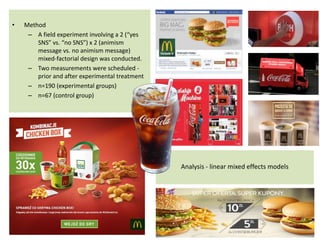
• Method
– A field experiment involving a 2 (“yes
SNS” vs. “no SNS”) x 2 (animism
message vs. no animism message)
mixed-factorial design was conducted.
– Two measurements were scheduled -
prior and after experimental treatment
– n=190 (experimental groups)
– n=67 (control group)
RESULTS:
H1 & H2 rejected (t=0.561, p=0.5754 )
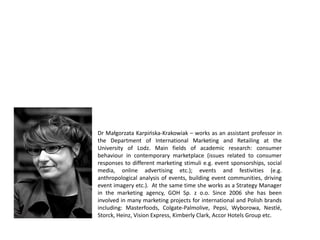
Dr Małgorzata Karpińska-Krakowiak – works as an assistant professor in
the Department of International Marketing and Retailing at the
University of Lodz. Main fields of academic research: consumer
behaviour in contemporary marketplace (issues related to consumer
responses to different marketing stimuli e.g. event sponsorships, social
media, online advertising etc.); events and festivities (e.g.
anthropological analysis of events, building event communities, driving
event imagery etc.). At the same time she works as a Strategy Manager
in the marketing agency, GOH Sp. z o.o. Since 2006 she has been
involved in many marketing projects for international and Polish brands
including: Masterfoods, Colgate-Palmolive, Pepsi, Wyborowa, Nestlé,
Storck, Heinz, Vision Express, Kimberly Clark, Accor Hotels Group etc.

Social media and brand equity

  • 1.
    The effects ofsocial networking sites on brand equity as a predictor of consumer-brand relationships. An experimental study Dr Małgorzata Karpińska-Krakowiak Department of International Marketing and Retailing, University of Lodz
  • 2.
    • In theera of a vastly changing marketing communications environment, social media and social networking sites become an attractive outlet for brand promotions and advertising. • As traditional media such as television, radio, and newspapers prove ineffective in establishing a valuable rapport with consumers, it is social networks which are expected to build bonds and engage on-line users into an amusing dialog, play, and intercourse with brands
  • 3.
    • Hypotheses – H1:Individuals exposed to brand on SNS will develop stronger relationships with brand (as indicated by higher brand equity) than individuals not exposed to this brand on SNS. – H2: Individuals exposed on SNS to message content with brand animation will develop stronger relationships with a brand (as indicated by higher brand equity) than individuals exposed to message content without brand animation. • Research variables – In exploring this subject the concept of consumer-based brand equity is being applied, as it is a commonly used indicator of brand-consumer resonance. – Consumer-based brand equity serves here as a relationship outcome measure to reflect whether SNS provide such lucrative setting for on-brand behaviours, as it is expected. • Research objectives – To search for changes in brand-consumer bonds as a result of their on-line interaction in social networking sites.; – To examine whether people can truly relate to non-human objects (i.e. brands) via computer- mediated environment
  • 4.
    Analysis - linearmixed effects models • Method – A field experiment involving a 2 (“yes SNS” vs. “no SNS”) x 2 (animism message vs. no animism message) mixed-factorial design was conducted. – Two measurements were scheduled - prior and after experimental treatment – n=190 (experimental groups) – n=67 (control group)
  • 5.
    RESULTS: H1 & H2rejected (t=0.561, p=0.5754 )
  • 6.
    Dr Małgorzata Karpińska-Krakowiak– works as an assistant professor in the Department of International Marketing and Retailing at the University of Lodz. Main fields of academic research: consumer behaviour in contemporary marketplace (issues related to consumer responses to different marketing stimuli e.g. event sponsorships, social media, online advertising etc.); events and festivities (e.g. anthropological analysis of events, building event communities, driving event imagery etc.). At the same time she works as a Strategy Manager in the marketing agency, GOH Sp. z o.o. Since 2006 she has been involved in many marketing projects for international and Polish brands including: Masterfoods, Colgate-Palmolive, Pepsi, Wyborowa, Nestlé, Storck, Heinz, Vision Express, Kimberly Clark, Accor Hotels Group etc.

Editor's Notes

  • #2 Grafika z mashable.com